MAHOMETANISM, which had made little progress so long as persuasion only was employed to propagate it, no sooner began to wield the sword than it spread rapidly on every side. Before the death of Mahomet, in 632, it had subdued all Arabia, and made a considerable impression both on Syria and Persia; and under his successors it had, in the course of less than a century, not only consolidated these conquests, but established an empire which stretched continuously from Arabia as a centre, west to the Atlantic, engulfing Spain and threatening the fairest portion of France—north and north-east through Persia, to the vast region which extends between the Oxus and the Jaxartes, from the Caspian to Mount Imaus—and east beyond the banks of the Indus. Its progress in this last direction must now be traced.
As early as the caliphate of Omar, the Arabs, coasting along the shores of the Indian Ocean, had made predatory descents upon Scinde, chiefly for the purpose of carrying off the women, whose beauty was in high repute, to adorn the Arabian harems; but no land expedition deserving of notice took place till 664, when part of an Arab force which had penetrated from Merv to Cabool, and gained, it is said, 12,000 converts, was despatched to explore the lower part of the Punjab. This detachment, under the command of Mohalib, who afterwards figured as a warrior in Persia and Arabia, forced its way into Mooltan, and returned with numerous captives. The next expedition was on a greater scale, and led to more permanent results. An Arab ship had been seized at Dewal, a seaport of Scinde. Restitution was demanded, but Rajah Dahir, whose territories are said to have included Mooltan and all Scinde, together with some adjacent plains, endeavoured to evade compliance, by pretending that Dewal was not subject to his authority. The Arabs, thus refused redress, determined to compel it, and, with this view, sent a body consisting only of 1000 infantry and 300 horse. It was altogether inadequate, and perished. Exasperated at the failure, Hejaj, governor of Bussorah in 711, despatched a regular force of 6000 men, under the command of his nephew Mohamed Casim, who, though only a youth of twenty, possessed great military talents, and after surmounting all difficulties, encamped under the walls of Dewal. The siege commenced with an attack on a celebrated pagoda contiguous to the town, and inclosed by a high wall of hewn stone. In addition to the Brahmins who usually occupied it, it had a strong garrison of Rajpoots. The defence was resolute, and might have been successful, had not Casim learned that the safety of the place was conceived to depend on a flag which was flying from a tower. Acting on this information, he directed all his engines against the flag, and had no sooner struck it down, than the resistance became so feeble as to make his entrance easy. With barbarous fanaticism he circumcised all the Brahmins, as a first step to their conversion, and on finding it ineffectual, put all the males above seventeen to death, and made slaves of the women and children. The capture of Dewal itself soon followed, and Casim continued his victorious progress, taking in succession, Nerun (the modern Hyderabad), Sehwan, and a fortress called Salim. A more formidable resistance was, however, in preparation; and the arrival of the rajah’s eldest son at the head of a strong force, reduced him to the necessity of acting on the defensive. This continued, till the arrival of 2000 Persian horse gave him once more the superiority; and he began to advance on Alor, the capital, which was situated in the north of Scinde, near the modern Bukkur.
The rajah himself being now, as it were, brought to bay, determined to make a final stroke for his kingdom, and appeared at the head of an army of 50,000 men. Casim again stood on the defensive, and skilfully compensated for inferiority of numbers by the strength of his position. The rajah, advancing boldly to the attack, was wounded by an arrow, and at the same time the elephant on which he was mounted, being struck by a fireball, rushed off in terror and plunged with him into the river. The occurrence completely disconcerted the Indians; and though Dahir mounted a horse, and displayed both skill and courage in endeavouring to rally them, it was too late. The fortune of the day was decided, and his gallant effort to retrieve it only cost him his life.
The remains of the Indian army took refuge in the city of Brahmanabad. Casim advanced against it, and met a resistance which probably he had not anticipated. The rajah’s widow heroically assumed the defence, and made it good while provisions lasted. When they failed, and resistance in consequence became hopeless, she erected a funeral pile, and committed herself and children to the flames. Many of the garrison, equally prepared for death, met it by throwing open the gates and rushing out to perish by the swords of the besiegers. Those who remained had no better fate. On the assault, all in arms were slaughtered; the rest were carried into bondage. Casim, in pursuing his conquests, took Mooltan without resistance, and became master of all the territories which had belonged to Rajah Dahir.
It would seem that, beside the children who perished with their mother in Brahmanabad, the rajah had two daughters possessed of great personal attractions. They were among the captives; and seeming fit to grace the caliph’s harem, were accordingly conveyed to Damascus, which was at this time the capital of the caliphate. On their arrival, Walid, the caliph, whose curiosity had been excited, ordered the elder to be brought to him. On entering, she burst into tears, exclaiming, “How can I be worthy of your notice, after having been dishonoured by Casim?” Walid, consulting only his indignation, sent orders forthwith to sew up Casim in a raw hide, and send him forward. When the body arrived, it was produced to the rajah’s daughter, who, overjoyed, exclaimed, “Now I am satisfied; Casim was innocent of the crime I imputed to him, but he was the ruin of my family, and I have had my revenge.”
After Casim’s death in 714, the Arabs made no new conquests in India. Even those which he had effected were maintained only till the downfall of the Ommeiad dynasty in 750, when the Hindoos rose in insurrection, and recovered all that had been wrested from them.
Reference has been made to the Arab conquest of the territory between the Oxus and the Jaxartes. From its position it is usually called by classical writers Transoxiana, and by Arab writers Mawar ul Nahr, words literally meaning beyond the river. Its inhabitants were mostly Persians, living in fixed habitations, and nomadic Tartars, the latter forming apparently the great majority. This territory, which the Arabs first entered in 706, and overran in the course of the eight following years, became finally dissevered from their empire about 820, and was ruled successively by the Tahirites till 872, the Sofarides till 892, and the Somanis till 1004. The last dynasty becomes interesting, because during it, and owing to one of its princes, the house of Ghuznee, which plays a most important part in the history of India, was founded.
Alptegin, the founder of the house of Ghuznee, was originally a Turki slave to Abdulmelek, the fifth prince of the Somani line, and had no higher office than that of amusing his master by tumbling and tricks of legerdemain. He was capable, however, of much better, and gradually rose to be governor of Khorasan. On the death of Abdulmelek, in 961, he lost the favour of his successor, Mansur, by recommending that another member of the family should be selected for the throne, was deprived of his government, and ran great risk of losing both his liberty and his life. After a variety of narrow escapes, in which he displayed much courage and military talent, he found an asylum with a body of faithful followers at Ghuznee, among the mountains of Soliman. Here he declared his independence, and succeeded in maintaining it till his death, in 976. He was succeeded by Sebektegin, who, like himself, had been originally a Turki slave, but had risen so much in his favour that he gave him his daughter in marriage, and made him his heir.
Sebektegin’s future sovereignty is said to have been early foretold. One day, while a private horseman, he hunted down a fawn and was carrying it off, when he looked behind and saw its mother following with such signs of distress, that he was moved with compassion and set the fawn at liberty. The joy and apparent gratitude expressed by the mother made so strong an impression upon him, that when he went to sleep it became the subject of a dream, in which Mahomet appeared to him, and announced that as a reward for his humanity he was destined to be a king. The prediction, if it was made, had no sooner been fulfilled, than an event took place which threatened to render it fruitless. The inhabitants on the left bank of the Indus had for nearly three centuries been living in the enjoyment of their recovered independence; but they knew enough of the cruelty and oppression which their forefathers had endured while subjected to an Arab yoke, and were naturally filled with alarm when they saw a new Mahometan kingdom established on their frontiers. It therefore seemed to them good policy not to wait till the threatened calamity overtook them, but to endeavour by anticipating to prevent it. The initiative in this bold enterprise was undertaken by Rajah Jeipal, who ruled over a large extent of territory, and kept his court at Lahore. Crossing the Indus, he advanced till he came up with the troops of Sebektegin, who commanded in person, and was accompanied by his son, who, then only a boy, gave proof of the talents which afterwards made him celebrated under the name of Sultan Mahmood. After some time spent in skirmishing, the armies were on the eve of fighting a great battle, when a fearful storm of wind, thunder, and hail occurred. Both armies suffered greatly, but not to the same extent. The troops of Ghuznee soon recovered from the disaster, whereas those of Hindoostan, being at once less hardy and more superstitious, were so dispirited that Jeipal was glad to propose terms of accommodation. Mahmood stood out, and would be satisfied with nothing short of a decisive victory; but his father, more prudent and moderate, was satisfied with a present payment in elephants and gold, and the promise of a certain amount of annual tribute. Jeipal returned humiliated to Lahore, and endeavoured to hide his shame by breaking his promise. When the messengers of Sebektegin arrived to receive the tribute, he not only refused it, but threw them into prison.
Warlike preparations on a grander scale than before again commenced. Sebektegin advanced to take revenge; and Jeipal, aware how much he had done to provoke it, endeavoured to ward it off by means of a confederacy, in which, in addition to other rajahs of less importance, he was joined by those of Delhi, Ajmeer, Callinger, and Canouge. Thus supported, he advanced at the head of an army composed of an innumerable host of foot and 100,000 horse. In his Oriental phraseology Ferishta says,1 that when Sebektegin ascended a hill to view the forces of Jeipal, they “appeared in extent like the boundless ocean, and in number like the ants or locusts of the wilderness;” but instead of being dismayed at his vast inferiority in point of numbers, “he considered himself as a wolf about to attack a flock of sheep.” So confident, indeed, was he, that, disdaining to act on the defensive, he commenced the attack by singling out a certain point in the enemy’s line, and charging it by successive squadrons of 500 men. When in this way he had thrown it into disorder, he made a general assault, and carried everything before him The Hindoos, panic-struck, thought only of flight, and suffered immense slaughter. The Indian camp yielded a rich plunder. The more permanent results of the victory were, that Sebektegin was acknowledged king of all the territory west of the Neelab or Upper Indus, and sent one of his officers with 10,000 horse to govern Peshawer.
Sebektegin died in 997, after a reign of twenty years distinguished by prudence, equity, and moderation. His death was sudden, but during his last moments he named his son Ismael his heir. He appears, indeed, to have had a better title than Mahmood, who, though elder, was illegitimate. Ultimately, however, after a war of succession, in which Ismael was worsted and imprisoned for life, Mahmood, assuming the title of sultan, which, though well known in Arabia, had not previously been borne by any prince of Turkish origin, seated himself firmly on his father’s throne.
Mahmood was of an athletic form, but was strongly marked with the smallpox, and so deficient in personal beauty, that one day, on beholding himself in a glass, he exclaimed, “The sight of a king should brighten the eyes of the beholders, but nature has been so unkind to me that my appearance is positively forbidding.” This defect probably made him less disposed to indulge in youthful pleasures, and concurred with his natural temper in inducing him to seek fame by military exploits. He has already been seen urging his father to reject the terms of accommodation offered by Rajah Jeipal, and we are therefore prepared to see him enter on a career of Indian conquest. At first a series of struggles, which ended in the extinction of the Somani dynasty, engrossed his attention, but no sooner were these settled than he turned his eye to India. His first expedition took place in 1001, when, at Peshawer with only 10,000 chosen horse, he encountered his old enemy Rajah Jeipal at the head of 12,000 horse, 30,000 foot, and 300 elephants. The field was keenly contested, but at last Jeipal, with fifteen of his chiefs, was taken prisoner. Mahmood, whose avarice was at least equal to his ambition, was able to gratify both passions by the victory, which, in addition to its fame, yielded him a rich spoil, partly in Jeipal’s jewelled necklaces, one of which was valued at 180,000 dinars, or about £81,000. The value of the spoil was largely increased by the large ransom which he obtained for the prisoners. Jeipal did not long avail himself of his freedom. Dispirited by his two defeats, or, it is said, disqualified by them, according to a Hindoo custom, from any longer reigning, he resigned the crown to his son, and placing himself on a funeral pile, set fire to it with his own hands.
In 1004, on failure of the tribute promised by the Hindoos, Sultan Mahmood again set out, and passing through the province of Mooltan arrived at a city called Bhateea. Its position is not ascertained; but it was surrounded by a very high wall and a deep and broad ditch, and belonged to a Rajah Beejy Ray, who, trusting both to its fortifications and the difficult nature of the surrounding country, was not afraid to measure his strength against that of the sultan. He had so skilfully seized the strong posts, that for three days he not only kept the Mahometans at bay, but inflicted on them such severe losses that they were on the point of abandoning the enterprise. In this emergency, Sultan Mahmood displayed his wonted inflexibility of purpose, and in announcing his intention to lead the main attack in person, added, “To-day I have devoted myself to conquest or death.” Both armies, indeed, had worked themselves up to the highest pitch of enthusiasm; Beejy Ray, on his side, performing religious services by which he was believed by his followers to have propitiated the gods; while the sultan, after turning his face to Mecca, and prostrating himself in sight of his troops, started suddenly up, exclaiming, “Advance! advance! our prayers have found favour with God!” An obstinate struggle took place, but Mahometan prowess prevailed, and the Indians were pursued to the gates of the town. Here, though a stand of a few days took place, resistance was found to be hopeless; and the rajah being overtaken during an attempt to lead off his troops by night, only escaped imprisonment by rushing on his own sword. Two hundred and eighty elephants, numerous captains, and a large spoil were taken in Bhateea, which with its dependencies was annexed to Ghuznee.
Mahmood’s next Indian expedition took place in 1005. Its main object was to chastise Abul Fatteh Lodi, the chief of Mooltan, who, though a Mussulman, had thrown off his allegiance and leagued with Anangpal, the son and successor of the unfortunate Rajah Jeipal. Not deterred by his father’s fate, Anangpal encountered Mahmood near Peshawer, and sustained a defeat which compelled him to take refuge in Cashmere. The victorious sultan continued his march to Mooltan, and obtained the submission of its chief. He would doubtless have exacted more rigorous terms than submission, and also made Anangpal feel the full weight of his vengeance, had he not been under the necessity of hastening home to repel the formidable invasion of a Tartar prince of the name of Elik Khan, who had hoped to make an easy conquest of Khorasan while the Ghuznee forces were beyond the Indus. He had miscalculated; and on the sultan’s arrival, was obliged, after a signal defeat, to recross the Oxus with only a few attendants. On this occasion the sultan’s victory was greatly aided by 500 elephants which he had brought from India. The Tartar horses would not face them; and the soldiers, who had never seen them before, were overawed by their huge bulk and strange appearance, especially after they had seen the one on which the sultan himself was mounted seize Elik Khan’s standard-bearer and toss him into the air with his trunk.
Anangpal’s escape was only temporary, for Mahmood was no sooner rid of the Tartar invader than he hastened back to India at the head of a formidable army. Anangpal meanwhile, anticipating the return of the sultan, had made exertions, and succeeded in forming a powerful coalition of rajahs against the common enemy of their freedom and their faith. Their united forces brought into the Punjab a larger army than had ever been seen in it before. Even the sultan seemed to hesitate; and instead of advancing with the headlong courage which he usually displayed, began to entrench himself in the vicinity of Peshawer. This sign of weakness added greatly to the strength of the confederates, who were daily joined by new auxiliaries, and received large supplies of money from all quarters, even the Hindoo women selling their jewels and melting down the gold of their other ornaments to assist in what was regarded as a holy war.
Mahmood kept within his entrenchments, well aware that if they were attacked, his position would give him a decided advantage; and that if the Indians, through fear of this, refrained from attacking, their immense tumultuary force could not be long kept together. The first skirmishes were not to his advantage, for the Gukkurs, and other mountaineer tribes, rushing impetuously among the Mahometan cavalry, made such dexterous use of their swords and knives that horse and riders tumbled to the ground, and, to the number of several thousands, were despatched in a twinkling.1 Mahmood still remained motionless, watching his opportunity. It came at last. Anangpal’s elephant, galled by the arrows and frightened by the fireballs, turned round and hurried him off the field. The Hindoos, thinking themselves deserted by their general, slackened their resistance, and finally turned their backs. No time was given them to rally, and ere long 20,000 lay dead upon the field. The rest were so completely dispersed that Mahmood had nothing more to do than gather the fruits of his victory. The one most gratifying to his avaricious temper was the capture of the fortified temple of Nagarcote, situated on one of the lower ranges of the Himalaya. It owed its sanctity to a natural flame which issued from the ground ; and, from the veneration in which it was held, as well as the strength of its position, was not only rich in votive offerings, but was the common depository of the wealth of the adjacent country. To assist in the recent struggle, its garrison had been withdrawn, and when Sultan Mahmood arrived before it, he was met only by a crowd of defenceless Brahmins clamorously imploring mercy. The inventory of its treasures was, according to Ferishta, 700,000 golden dinars, 700 maunds of gold and silver plate, 200 maunds of pure gold in ingots, 2000 maunds of unwrought silver, and 20 maunds of pearls, corals, diamonds, and rubies. The value must have been fabulous, and justifies Ferishta’s assertion, that it was greater than ever was collected before into any royal treasury.1 The sultan, on his return to Ghuznee, gave a triumphal banquet, which was spread out on a spacious plain, and lasted three days. The spoils of India, exhibited on thrones of gold, and tables of gold and silver, made a display rivalling the utmost that has been told of Oriental wealth and splendour. Mahmood forgot his avarice on the occasion; and while myriads of spectators were luxuriously feasted, splendid presents were bestowed on merit, and liberal alms given to the poor.
The beginning of the year 1010 was employed by Sultan Mahmood in the conquest of Ghor, situated among the branches of the Hindoo Koosh east of Herat, but before the year closed he is again found pursuing his conquests in India. For some succeeding years, his operations there were somewhat desultory and interrupted by an important expedition to Transoxiana, during which he extended his west frontier to the Caspian; but in 1017, determined no longer to confine himself to the Punjab, he set out at the head of an army of 100,000 foot and 20,000 horse, for the purpose of penetrating into the basin of the Ganges, and thus opening up a way into the very heart of Hindoostan. Marching from Peshawer, he kept close to the mountains till he passed the Jumna, and then turning suddenly south, made his unexpected appearance before Canouge. This great capital, the rajah of which, for some reason not well
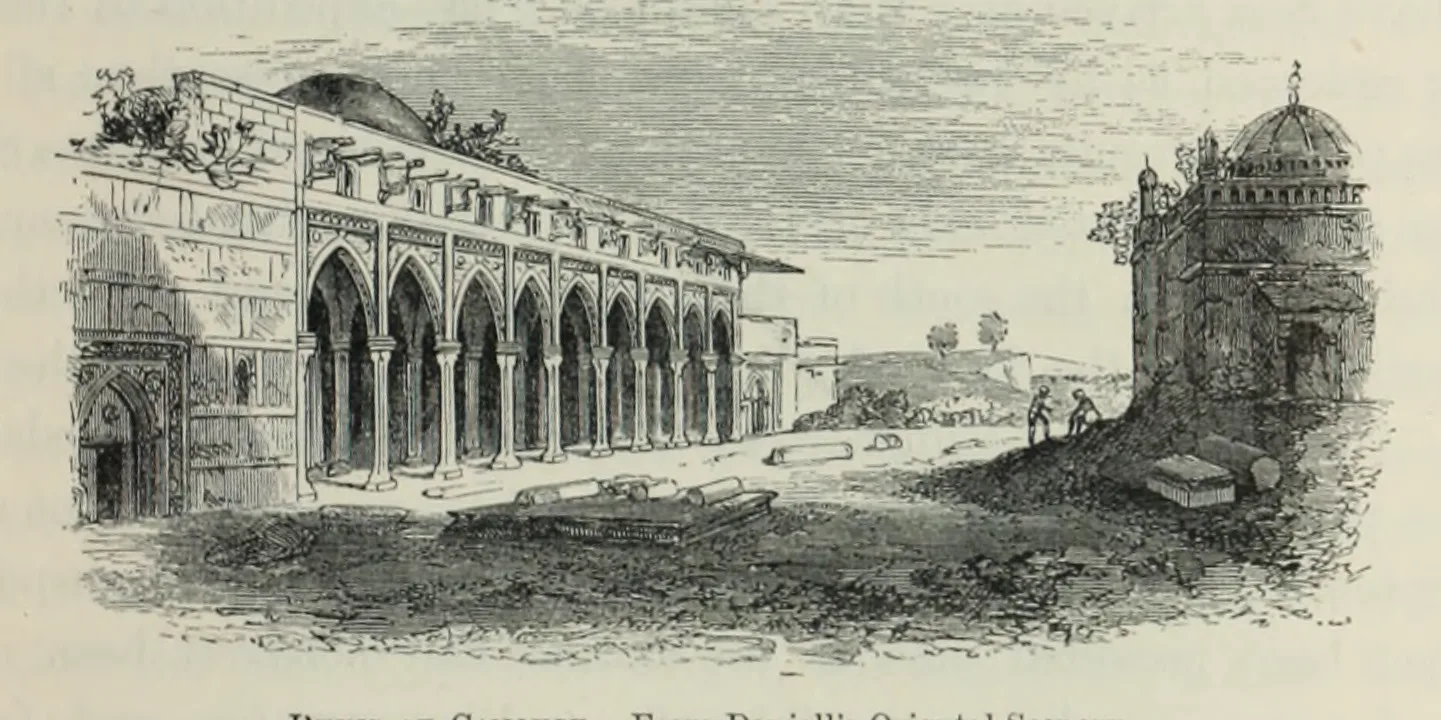
explained, took precedence of all the other Rajahs of Hindoostan, is acknowledged by all writers, Hindoo and Mahometan, to have been the largest and most magnificent of Indian cities, but it is unnecessary to give any description of it at present, as Mahmood, delighted with the abject submission of the rajah, who came out with his family and threw himself upon his mercy, left it uninjured, after a short stay of three days.1 He next bent his steps towards Muttra, one of the most famous seats of Hindoo superstition. The treatment it experienced was very different from that of Canouge. During twenty days of plunder, Mahometan fanaticism and licentiousness had their full swing, and every kind of outrage on humanity was perpetrated. In the midst of these horrors, Mahmood, while struck with the magnificence of the buildings, divided his thoughts between them and the immense sums which it must have cost to erect them, and wrote to the governor of Ghuznee a letter, of which the following very characteristic passage has been preserved:—“Here there are a thousand edifices as firm as the faith of the faithful, most of them marble, besides innumerable temples; nor is it likely that this city has attained its present condition but at the expense of many millions of dinars; nor could such another be constructed under a period of two centuries.”1 After leaving Muttra, Mahmood stormed several other towns, laid waste a large extent of country, and then returned to Ghuznee, with an incalculable amount of spoil and above 5000 captives.
Of the two next Indian expeditions of Sultan Mahmood, which took place respectively in 1022 and 1023, the second only is deserving of notice, because during it a Mahometan garrison was, for the first time, permanently stationed beyond the Indus. This unenviable distinction belongs to the city of Lahore, whose rajah, Jeipal II., the successor of Anangpal, after submitting to Mahmood and living for some time on friendly terms with him, was tempted in an evil hour to throw off his allegiance. The result, which might easily have been foreseen, was the loss of all his territories, which were forthwith annexed to Ghuznee.
We have now arrived at Sultan Mahmood’s last expedition to India. It is generally reckoned as his twelfth, and has made more noise than all the rest, though its political results were not important. Its destined goal was Somnauth, one of the most celebrated seats of Hindoo superstition, situated near the shore of the Arabian Sea, in the south of the peninsula of Gujerat. To this expedition, fanaticism and the love of plunder appear to have been the actuating motives. The way from Ghuznee to Somnauth lay for hundreds of miles through a parched sandy desert. The army, whose numbers are not stated, set out in September, 1024, and reached Mooltan in October. For transport, 20,000 camels had been provided; and as the soldiers had moreover been ordered to carry as large a supply as possible of provisions, water, and forage, the difficulties of the desert were surmounted without any serious disaster, and the expedition made its appearance in the cultivated country around Ajmeer. The Hindoos, though aware of the threatened attack upon their temple, had calculated on a different route, and were, in consequence, so totally unprepared for resistance, that their only safety was in flight. The usual devastation followed, and the city of Ajmeer was given up to plunder. Continuing his progress, Mahmood entered Gujerat, and arrived at Anhulwara, its capital. He might easily have made himself master of it, for the rajah had fled; but he was intent on higher game, and refused to be turned aside from it. At length Somnauth was reached. It was situated on a peninsula, which a fortified isthmus connected with the mainland. Here he was met by a herald, who defied him in the name of the god, and menaced him with destruction. Mahmood only answered with a shower of arrows, and cleared the walls of defenders, who hastened to the idol to prostrate themselves before it and implore its help. Meantime the besiegers advanced, and had nearly effected an entrance, when the defenders returned and fought so furiously, that their enemies, unable to make good a footing, were forced to retire. The next day the attack was repeated, and assumed the form of a general assault, but the result was the same. The third day opened still more propitiously for the defenders, for several native chiefs having united their forces, had advanced to the rescue. The attack could not be continued till this new enemy was disposed of. The battle which ensued was furiously contested, and seemed at one time about to be decided in favour of the Hindoos by the sudden arrival of the Rajah of Anhulwara with a large body of fresh troops. The Mahometans, who had previously been unable to do more than maintain their ground, now began to waver, and a general route was imminent, when the sultan, recurring to a device which had succeeded with him on other occasions, prostrated himself in presence of his army, and then, as if confident that his prayer had been heard, leaped to his horse, raised the war cry, and rushed into the thickest of the fight. His troops, ashamed not to follow where such a master would lead, followed close upon his track, and bore down all before them. The critical moment was passed, and they had gained a complete victory. No further attempt was made to defend the temple, and the defenders, to the number of 4000, took to their boats. Mahmood, in the course of his plunderings, had seen the interior of many Hindoo temples, but the magnificence of Somnauth was so surpassing that it filled him with wonder. The interior, whose lofty roof was supported by fifty-six pillars curiously carved and glittering with precious stones, received its light, not from the sun, but from a lamp which was suspended in its centre by a golden chain. The real object of worship at Somnauth was simply a cylinder of stone, but Ferishta takes no notice of it, and says that the idol, 15 feet in height, but six of them sunk beneath the surface, stood opposite the entrance. Mahmood at once ordered its destruction, but hesitated when the Brahmins threw themselves at his feet imploring him to spare it, and offering an immense ransom. After a momentary pause, exclaiming that he would rather be known as a breaker than as a seller of idols, he struck the idol with his mace. His followers instantly followed up the blow, till the idol broke asunder. It was hollow, and disclosed diamonds and other jewels of immense value hidden within it. Mahmood was equally surprised and delighted. The treasure obtained far exceeded the amount of ransom which the priests had offered, and was regarded by him and his followers as a gift from the Prophet in return for the zeal which they had displayed in his cause.
Two pieces of the idol were sent to Mecca and Medina, and two to Ghuznee. One of the latter was in the palace and another at the grand mosque in the sixteenth century, when Ferishta wrote his history. It is somewhat remarkable that he says nothing of the gates of the temple, which, according to a prevalent tradition, were also carried to Ghuznee, and ultimately formed one of the trophies placed on Sultan Mahmood’s tomb. The silence of Ferishta throws considerable doubt on the authenticity of the tradition; for the gates should have been there in his time, and if there, he certainly would have mentioned them.
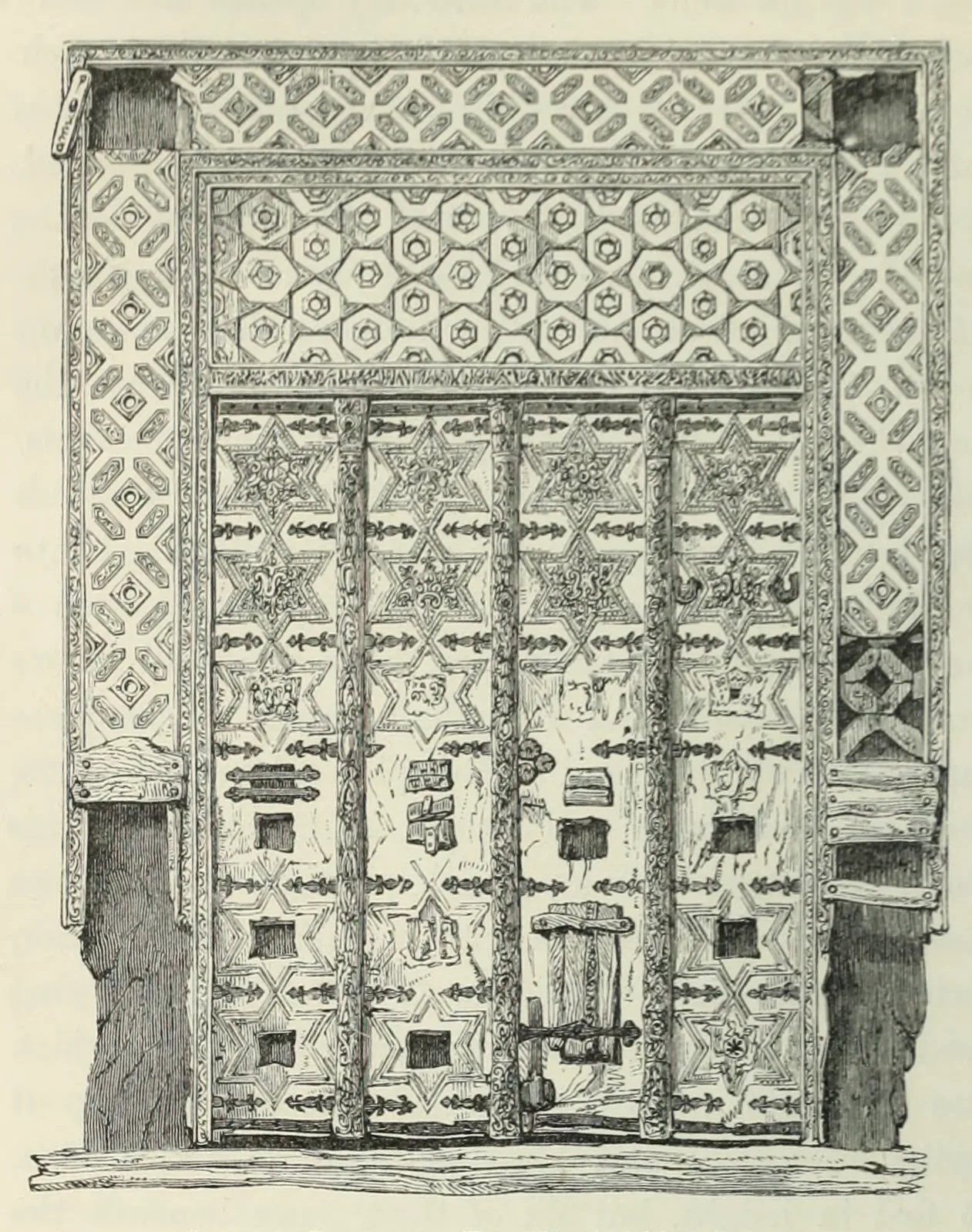
Be this as it may, the tradition was so firmly believed, that when the British army finally quitted Cabool, in 1842, the gates were brought away in triumph, and Lord Ellenborough, then Governor-general of India, made them the subject of a very pompous, unchristian, and impolitic proclamation.1
Mahmood, on his return, stopped for some time at Anhulwara, with which, as well as the surrounding country, he was so much pleased that he is said to have had some thoughts of adopting it as a new capital. Many other magnificent projects passed through his mind, but they all vanished in smoke, and he contented himself with setting up a new rajah in Gujerat. The person selected was an anchoret of the ancient royal stock, and seems to have recommended himself to Mahmood as the person most likely to yield him implicit submission. Another member of the royal stock thought himself better entitled to the rajahship, and, to prevent a disputed succession, his person was secured. When Mahmood was leaving Gujerat, the anchoret rajah requested that his competitor might be delivered up to him; and, on the assurance that his life would be spared, the request was granted. The hypocrite kept his promise to the ear. He was too holy a man to be guilty of shedding the blood of any living creature. He only dug a hole, in which he meant to have immured his prisoner, and regaled his ear with his groans. By a whirl of fortune the position of the parties was reversed; and the anchoret, deposed from his rajahship, was consigned to the hole, while the throne was occupied by his intended victim.
Though Mahmood had made his first passage across the desert without loss, he was less fortunate in returning. He had employed Hindoo guides, who kept the army wandering for three days and nights over desolate tracts, where neither forage nor water could be found. Numbers of the troops died raving mad, from the intolerable heat and thirst. Mahmood, suspecting that the guides had not erred, but led him wilfully astray, put one of them to the torture, and wrung from him a confession that he was one of the priests of Somnauth, and had sought, by misleading the army, to insure its destruction, and thereby obtain a rich revenge.
On the homeward march, Mahmood was greatly harassed by a tribe of Juts, who are described as occupying a district intersected by rivers, which form numerous islands. He determined to chastise them; and with this view took up a position at Mooltan, where he ordered 1400 boats to be built, and armed with iron spikes projecting from the bows and sides, to secure them against being boarded, as the Juts were particularly dexterous at this species of warfare. A series of naval engagements were fought in the neighbourhood of the locality where Alexander equipped his fleet thirteen centuries before. After a desperate struggle the Juts were overpowered, and those who had not fallen in battle were carried off into slavery.
Mahmood returned in triumph to Ghuznee, but had ceased to be capable of enjoying it, for he was suffering under an excruciating disease, which carried him off, April 29, 1030, in the sixty-third year of his age, and the thirty-fifth of his reign. Two days before his death, he ordered all the gold and precious stones which he possessed to be placed before him. He wept with regret to think how soon he must part with them for ever; but he had not the heart to bestow any of them as farewell presents, and simply caused them to be taken back to the treasury. The next day he ordered a review of the army, and, seated on his travelling throne, saw all his elephants, camels, horses, and chariots pass before him. He feasted his eyes, but could not satisfy his heart, and once more burst into tears. The day after, he lay on his bed a lifeless corpse, and an impressive example of the vanity of human wishes.
Avarice, which was one of his ruling passions, is generally supposed to be incompatible with true greatness; and yet it is impossible to deny that Sultan Mahmood, the founder of the Mahometan Indian empire, possessed in a high degree many of the qualities which have procured for other sovereigns the name of Great. He gained signal victories, made conquests, and by the ability of his government retained them, adorned his capital with magnificent buildings, and kept a splendid court, to which he attracted many of the most distinguished writers of his time. He must thus have been a munificent patron of literature and art, though one of the greatest blots on his reputation was his treatment of Ferdusi. That celebrated poet long lived at his court, and was commissioned to write a poem, for which he was promised at the rate of a dinar a line. There can be no doubt that a golden dinar was understood; but Mahmood, on making payment, had the meanness to take advantage of the ambiguity in the term, and gave only silver. Ferdusi quitted the court in disgust, and took his revenge by launching at its sovereign a stinging satire. Mahmood was magnanimous enough not only to forgive him, but to endeavour to make amends for the past, by sending him a rich present. It was, unfortunately, too late, for while Mahmood’s messenger entered at one door, Ferdusi was being carried out on his bier at another.
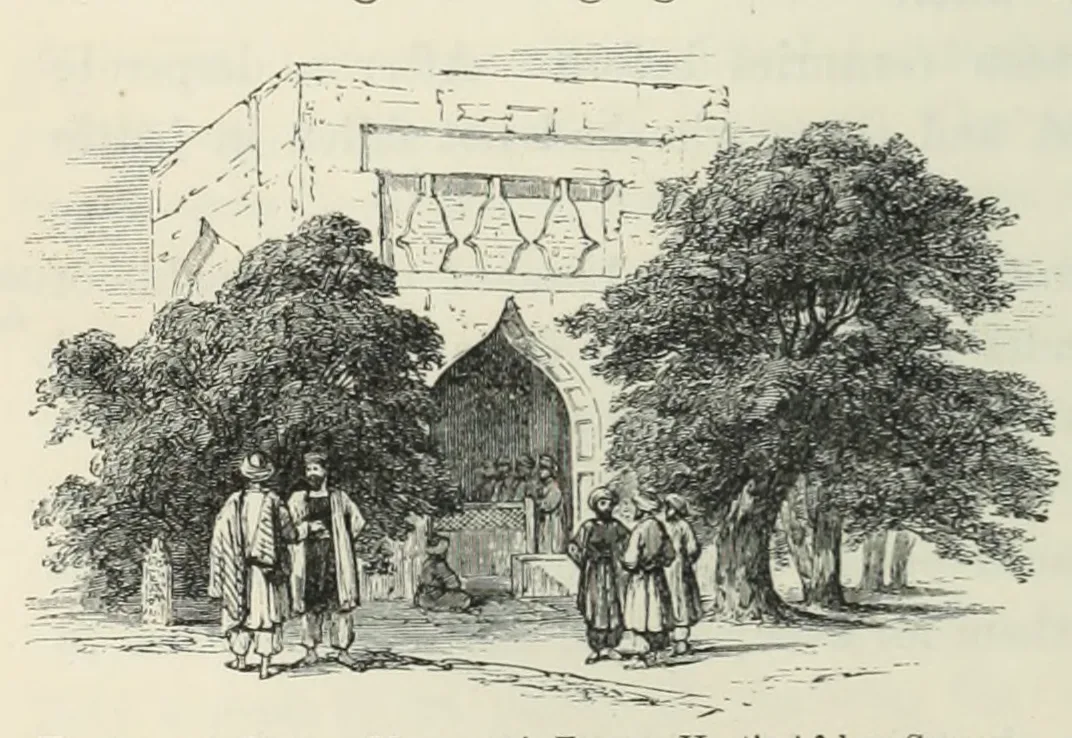
Mahmood does not figure as a legislator, but several anecdotes are told, which show that he had a high sense of justice, and occasionally made great sacrifices of personal feeling in administering it. One of these anecdotes will bear repetition. An inhabitant of Ghuznee, unhappy in a handsome wife, complained to the king that one of his courtiers, who had conceived a passion for her, took forcible possession of his house every night, and turned him into the street, where he was obliged to remain till the intruder chose to take his departure. He had sought redress from the proper judges, and failed to obtain it. The sultan, indignant, ordered the man to say nothing, but to hasten back to him the first time the gross outrage was repeated. He had not long to wait. The sultan, on being informed, wrapped a loose cloak about him, and was conducted to the house. On entering the chamber he found the guilty parties asleep. A light was burning. He extinguished it; and then, going up to the bed, cut off the adulterer’s head at a stroke. This done, he called for a light, and on examining the features of the adulterer, threw himself prostrate on the ground, and gave utterance to his joy in thanksgiving. The audacious manner in which the offence was committed had convinced him that the offender must be one of his sons, or near relatives. He had extinguished the light lest natural affection might stay his hand from doing justice; and now that it was done, he was rejoiced to find that his suspicions were unfounded, and that he had not been under the necessity of staining his hands with the blood of one of the members of his own family.
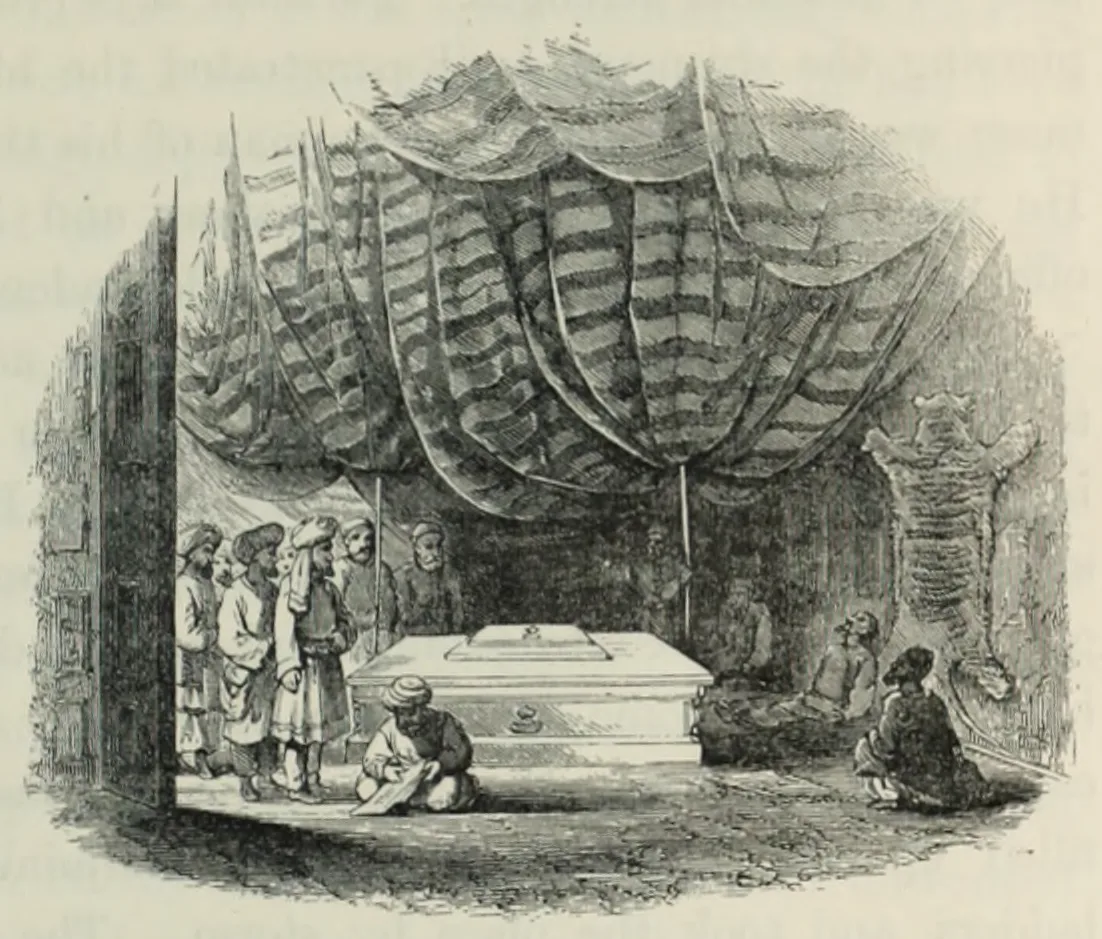
Sultan Mahmood left a will appointing his son Mahomed his successor. Another son, Musaood, Mahomed’s twin brother, but born some hours later, conceived he had as good a title. Both sons were absent at the time of their father’s death, but Mahomed, on his arrival in Ghuznee, was crowned. Musaood, however, was the favourite both of soldiers and people, and the household troops marched off in a body to join him. A large force, headed by an Indian chief, and composed principally of Hindoo cavalry, was sent in pursuit, but in the encounter which took place, the king’s party was defeated. Meanwhile Musaood was hastening on to assert his claim, and was met by the household troops at Nishapoor. Before actually appealing to arms, he offered to divide the empire, by retaining merely the portions which he had himself conquered. The only condition he added was, that in the Khootba, or public prayer for the sovereign, his name should be read first within his own dominions. Mahomed refused to consent; and a civil war broke out, which terminated in his overthrow and capture. According to the barbarous practice of the times, he was deprived of sight, and imprisoned. Musaood mounted the throne. He was remarkable for personal strength. Ferishta says (vol. i. p. 98), that “his arrow, after piercing the strongest mail, penetrated the hide of an elephant; and his iron mace was so ponderous, that no man of his time could raise it with one hand.” He was also distinguished by valour and liberality, and not unfrequently offended his father by his bold and independent bearing.
The transactions of Musaood’s reign are not important. Of those relating to India, with which here we have alone to do, the first deserving of notice is an expedition to that country in 1033. He took the route for Soorsooty, situated among the hills of Cashmere, and on arriving at it, summoned the garrison. It offered to submit, and he was disposed to grant easy terms, till he learned that some Mahometan merchants had been seized, and were then captives in the fort. Enraged at the information, he caused the ditch to be filled up with sugar-canes from the adjoining plantations, planted scaling ladders, and took the place by storm. The garrison to a man were put to the sword, and all the women and children were enslaved.
In 1036, when a new palace was finished at Ghuznee, containing a golden throne, studded with jewels, and surmounted with a canopy, in which was a golden crown, seventy maunds in weight, suspended by a golden chain, and glistening with jewels, Musaood again set out for India, mainly with the view of reducing the fort of Hansi, the ancient capital of Sewalik. The Indians believed it impregnable; and were confirmed in this belief by their soothsayers, who assured them that it was not destined ever to fall into Mahometan hands. The result falsified their predictions, for in the course of six days it was taken by storm. The treasure found in it was immense. Musaood next proceeded to Sonput, which he found abandoned. Leaving an officer in charge of it, he retraced his steps, taking possession of all the countries he had left in his rear, and arrived at Lahore, the government of which he conferred on his son Modood.
Musaood on his return found full occupation in repelling the Seljuks, who, after passing to the left bank of the Jaxartes, and residing for some time in Transoxiana, had settled and acquired considerable influence in Khorasan. While they professed the utmost submission to his authority, they were constantly warring with his lieutenants and ravaging his territories. At length, in 1039, Toghrul Beg, a celebrated Seljuk warrior, mustered so strongly, that Musaood found it necessary to take the field in person. The decisive battle was fought at Zendecan, near Merv, and ended, in consequence of the desertion of his Turkish followers, in Musaood’s complete defeat. After endeavouring to collect the wreck of his army, he returned to Ghuznee. Here new troubles awaited him ; and, unable to repress the mutinous spirit of his troops, he began to look to India as a place of refuge, and finally withdrew to it in the hope of being able to retrieve his affairs. Anarchy now reigned uncontrolled in his capital. No sooner had he crossed the Indus than his own guards attempted to plunder the treasury ; a general insurrection of the army immediately followed, and Musaood, being formally deposed, his brother Mahomed, whom he had kept in prison, was restored. A sovereign deprived of sight was totally unfitted to rule in such troublous times, and he devolved the administration on his son Ahmed, one of whose first acts was to put Musaood to death in 1040.
Modood, son of Musaood, had, as we have seen, been appointed governor of Lahore, but was at Balkh when his father was murdered. Without losing a moment he hastened east with his army, and crushed his rivals. Ghuznee still lay open to the inroads of the Seljuks, but these formidable intruders had turned their attention more to the west, and Modood, who had married Toghrul Beg’s grand-daughter, both maintained himself in Ghuznee and recovered Transoxiana. In India advantage was taken of his absence ; and the Rajah of Delhi, working on the feelings of the Hindoos, roused them to unwonted exertions. At the head of a powerful army he recovered Nagarcote, overran great part of the Punjab, and laid siege to Lahore, which, however, made good its defence. Modood, meanwhile, was unable personally to interfere ; and died in 1049, without again visiting India.
He left an infant son, who was murdered by his uncle Abul Hassan. A series of usurpations, usually effected by great crimes, now took place, and no name of note occurs till 1098, when Musaood II. ascended the throne. During the sixteen years of his reign, which ended with his death in 1114, he distinguished himself more as a legislator than a warrior, though his generals carried his arms beyond the Ganges. For some years his court resided at Lahore.
On the death of Musaood II., another usurpation took place in the person of his son Arslan, who, to secure the throne, imprisoned his brothers. The unnatural act did not avail him ; and he was, in his turn, deposed by Behram, the only brother who had escaped imprisonment. Behram’s reign, which lasted thirty-four years, was not more long than brilliant, and he might have transmitted his power unimpaired, had he not been guilty of a crime which brought its punishment along with it, and led to the extinction of the Ghuznee dynasty. It will be necessary to go back a few years in order to explain the circumstances.
The territory of Ghor, situated, as has already been mentioned, among the northern ramifications of the Hindoo Koosh, is regarded by the Afghans as their original seat. At a comparatively early period it was invaded by the Arabs, and a large portion of its inhabitants embraced Mahometanism. When the Arab dynasties were overthrown, it resumed its independence, and preserved it even while Sultan Mahmood was extending his conquests on every side. Two generations after, it was treacherously seized by Modood, and became a dependency of Ghuznee. It was still, however, governed by its own princes, who lived almost on terms of equality with the Sultans of Ghuznee. One of these princes, called Kutb-u-din Sur, had married a daughter of Sultan Behram. This affinity might have been supposed to bring the houses of Ghuznee and Ghor into the most friendly relations. It turned out otherwise. Differences arose; and Behram, having obtained possession of the person of his son-in-law, sullied the reputation which he had acquired for justice and humanity by poisoning him, or putting him to an open death. Kutb-u-din Sur had two brothers, Seif-u-din and Ala-u-din. They at once flew to arms to avenge his death; and, advancing upon Ghuznee, obliged Behram to seek an asylum among the mountains of Kerman.
Seif-u-din, the elder brother, established himself in Ghuznee, and sent back most of his army, under Ala-u-din, to Feruz Coh, his former capital. He thought he had gained the affections of the inhabitants, and only learned his mistake when it was too late to remedy it. A strong attachment was still felt to the dynasty to which Ghuznee owed all its prosperity and its splendour; and, as soon as the winter had set in so severely as to prevent all communication with Ghor, Behram made his appearance at the head of an army. Seif-u-din, totally unprepared, was about to retire, when treacherous promises of support from the inhabitants induced him to march out and risk a battle. It was no sooner commenced than the greater part of his troops passed over to his enemy. For a time he was able, by the aid of a small body of his own people who remained stanch, to maintain an unequal contest, but was at length wounded, overpowered, and taken prisoner. Behram, instead of availing himself of the opportunity to wipe off the stain which he had brought on his reputation by the murder of the eldest brother, acted still more atrociously. Seif-u-din, after being ignominiously paraded round the city, and subjected to every species of indignity, was put to death by torture.
Ala-u-din, the third brother, still remained, and set out burning for vengeance. In his eagerness, his preparations were imperfect; and Behram, either in insult or because the blood already shed had satiated him, made an offer of peace. It was indignantly rejected, and the battle immediately began to rage. Behram’s superiority of numbers made the issue for some time doubtful, but at last, when left almost alone, he turned his back and fled from the field.
The victor immediately advanced on Ghuznee, which could offer no resistance. Its doom was sealed. For three or seven days (for accounts vary) fire and sword continued the work of destruction, and all the proud monuments which attested the power, wealth, and splendour of the Ghuznavide kings were laid in ruins. Behram hastened to seek an asylum in India, but died before he had found it. His son Khosru was more fortunate, and reached Lahore, where he was received with acclamations, and fixed the seat of his government. He reigned till 1160, and was succeeded by his son Khosru Melik, at whose death, in 1186, the last wreck of the Ghuznavide empire passed to the house of Ghor, and the Ghuznavide dynasty became extinct.
The two last reigns have anticipated the course of the narrative. In order to resume it, it is necessary to return to Ala-u-din, and trace the history of the house of Ghor through him and his successors.
After the signal vengeance taken for the murder of his two brothers, Ala-u-din acted as if the heroic part of his life had been played out; and, retiring to the old Ghorite capital of Feruz Coh, he followed his natural bent by giving himself up to pleasure. He found it even more perilous than war would have been, for the Seljuks, under Sultan Sanjar, during an invasion of Ghor and Ghuznee, made him prisoner. He was soon, however, set at liberty, and reinstated in his dominions, which he held for four years, till his death in 1156. Shortly before, he had imprisoned his two nephews, Gheias-u-din and Shahab-u-din, with the view of securing the succession to Seif-u-din, his son; but this young prince set them at liberty, and replaced them in their governments. His confidence was not misplaced, but he had reigned little more than a year when he fell by the hand of an assassin. He was succeeded, in 1157, by the above cousins, who ruled jointly and, contrary to the general rule in such cases, harmoniously. Gheias-u-din superintended the territories in the west—Shahab-u-din gave his attention to the east; and, from consolidating the Mahometan power there, has sometimes been thought to have a better title even than Sultan Mahmood, to be regarded as the true founder of the Mahometan empire in India.
In 1176, he took the town of Ooch, situated at the point where the rivers of the Punjab, united into one stream under the name of the Punjnud, join the left bank of the Indus. In 1178 he undertook an expedition to Gujerat, but it proved disastrous. His next expedition, after he had marched twice to Lahore, and obliged Khosru Melik, the last of the Ghuznavides, to submit to a disadvantageous treaty, and give his son as a hostage, was to Scinde. Having completely overrun it, he once more attacked Khosru Melik. This prince, assuming the courage of despair, made an alliance with the Gukkurs, and opened the campaign with the capture of one of his enemy’s strongest forts. Shahab-u-din, under the pretext that he was about to march for Khorasan, where affairs had assumed an alarming appearance, increased his army, and at the same time made overtures of peace to Khosru Melik, sending back his son, whom he held as a hostage, in proof of his sincerity. The stratagem succeeded. Khosru Melik, thrown completely off his guard, set out to welcome his returning son, and was surprised by Shahab-u-din, who surrounded his camp with a strong body of cavalry, and took him prisoner. The last of the Ghuznavides and his family were sent to Gheias-u-din, who imprisoned them in a castle. Here, after a long confinement, they were all put to death.
Shahab-u-din, being thus left in India without a Mahometan rival, determined to extend his conquests. It is probable he did not anticipate much difficulty, as his army, drawn from the warlike province of the west, must have been considered more than a match for any that the Hindoos could oppose to it. The struggle, however, was severe. Several of the Indian rajahs successfully maintained their ground, while few of them yielded without a manful resistance.
In this war of independence the Rajpoots particularly distinguished themselves. Belonging to the military class in the original Hindoo system, they were born soldiers, and lived under a kind of military feudal system, not unlike that of the clans in the Highlands of Scotland and some other countries. While each chief had his hereditary territory, all the chiefs held under the rajah as their common head, and were thus in the position most favourable for united action and individual exertion. At the same time they laboured under some disadvantages. Living almost secluded, they had a simplicity of manners little fitted to protect them against political wiles, and an indolence and love of freedom which made it difficult to keep them under regular discipline.
Near the time of Shahab-u-din,1 Hindoostan was mainly composed of four leading sovereignties—Delhi, Canouge, Ajmeer, and Callinjer. On a failure of heirs in the third, the heir-apparent of the first had been adopted, and thus Delhi and Ajmeer were united under one head. This arrangement had given great offence to the Rajah of Callinjer, who thought he ought to have been preferred in the adoption; and thus, when cordial union among the rajahs constituted their only safety, considerable dissension prevailed. The disunion, thus dangerous to them, was most opportune for Shahab-u-din, who, taking advantage of it, made his first attack on the newly amalgamated, but by no means firmly cemented rajahships of Delhi and Ajmeer. It commenced in 1191, with the capture of Batinda. He placed a garrison in it; but had scarcely left when he learned that the Rajah of Delhi, at the head of a powerful confederation, was advancing against it with an army of 200,000 horse and 3000 elephants. In retracing his steps to relieve the garrison, he was met by the enemy on the banks of the Soorsooty, about eighty miles from Delhi. He immediately joined battle, but with forces so inferior that both wings, being outflanked, bent backwards till they met in the rear, and gave his army the form of a circle. While standing within its centre, affairs looked so desperate that he was advised to provide for his safety. This so enraged him that he cut down the messenger sent with the advice, and rushed into the enemy’s lines, making terrible slaughter. The Rajah of Delhi, observing where he smote, drove his elephant right against him; but Shahab saw his intention in time to frustrate it, and struck a blow with his lance which knocked out a number of his teeth. The rajah returned the thrust by letting fly an arrow, which pierced Shahab’s right arm. He was on the point of falling, when one of his faithful attendants leaped up behind him and bore him off the field, which his army had now almost wholly deserted. Having recovered of his wound at Lahore, he returned to Ghor, and disgraced the officers to whose desertion he attributed his discomfiture, compelling them to walk round the city with horses’ mouth-bags, filled with barley, about their necks.
After a year, spent partly in pleasure and festivity, and partly in preparation for a new campaign, Shahab set out from Ghuznee at the head of 120,000 chosen horse, and took the road to India without disclosing his intentions. At Peshawer an aged sage, prostrating himself before him, said—“O king, we trust in thy conduct and wisdom, but as yet thy design has been a subject of much speculation among us.” Shahab replied—“Know, old man, that since the time of my defeat in Hindoostan I have never slumbered in ease, nor waked but in sorrow and anxiety; I have, therefore, determined with this army to recover my lost honour from those idolaters, or die in the attempt.”
On arriving at Lahore, he sent an ambassador to Ajmeer, offering, as the only alternative, war or conversion. The rajah returned an indignant answer,
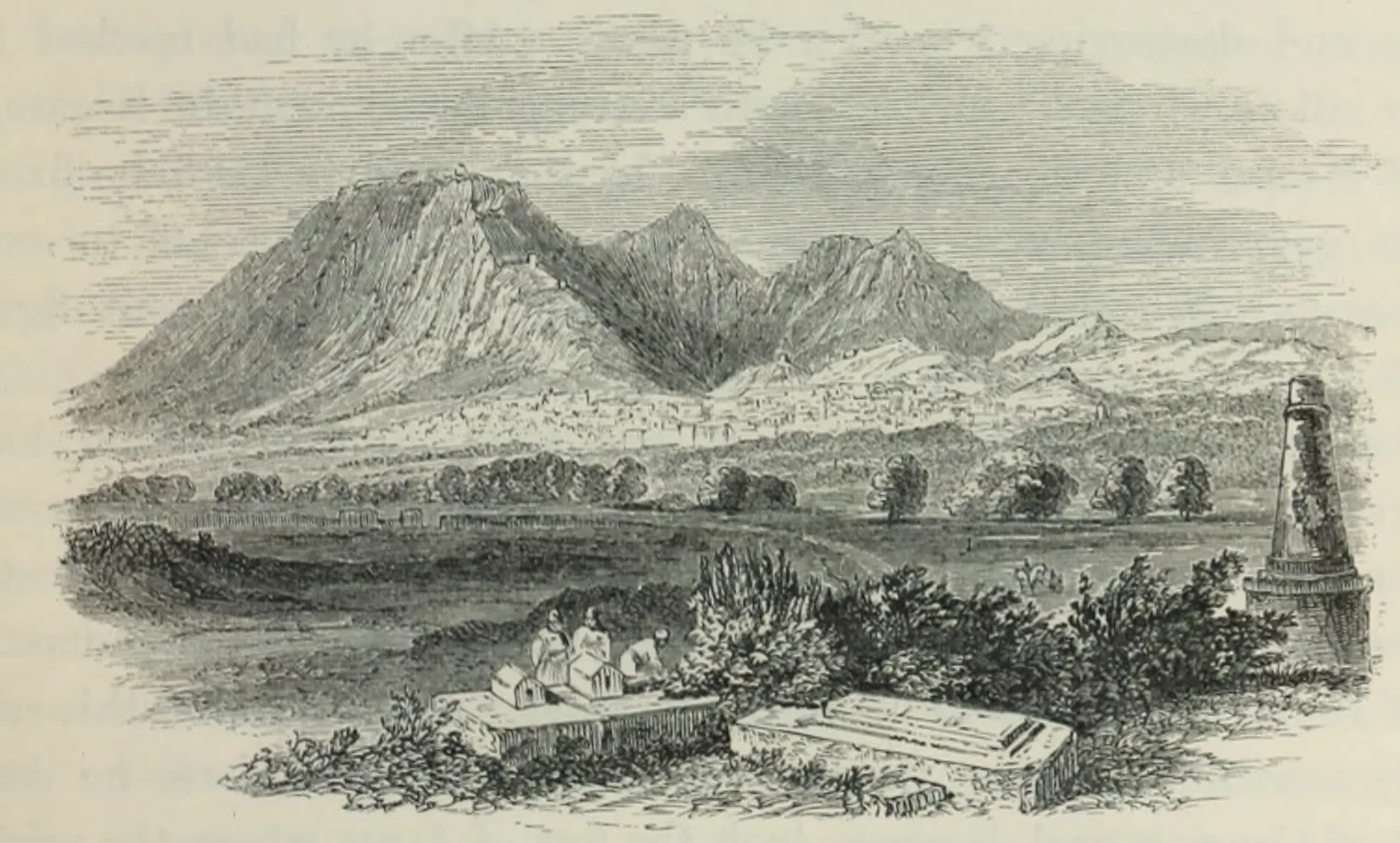
and immediately applied for succour to all the neighbouring princes. It was readily granted; and an army equal to that which had recently given them the victory again encamped on the same field. In this army were 150 Rajpoot princes, “who had sworn by the water of the Ganges that they would conquer their enemies or die martyrs to their faith.” While the camps were separated by the Soorsooty, the Indian princes sent a message to Shahab, warning him of his fate if he persisted, but at the same time offering to allow him to retreat in safety. He was so humble in his answer that they at once attributed it to fear, and, in the midst of their joy, gave themselves up to revelry. Shahab, in anticipation of the effect which his message would produce, prepared for a surprise; and, by the early dawn, having forded the river, was in the camp of the Indians before they had the least notice of his approach. Notwithstanding the confusion, they managed to bring their line into tolerable order, and had continued the contest till near sunset, when Shahab, placing himself at the head of 12,000 chosen horsemen, covered with steel armour, made a furious charge, which carried the day. The Indians were panic-struck, and the Mahometans had nothing to do but slaughter them. Many rajahs fell on the field; the Rajah of Delhi and Ajmeer was taken prisoner, and afterwards put to death in cold blood. The immediate results of the victory were the surrender of the forts Soorsooty, Samana, Koram, and Hansi, and the capture of Ajmeer, where all in arms were put to the sword, and the rest reserved for slavery.
Shahab next turned his arms towards Delhi, but was propitiated by presents. On his return to Ghuznee, he marched north to the Sewalik Mountains, plundering and destroying wherever he went. After he had reached home, Eibuk, the officer whom he had left with a strong detachment in Koram, took the fort of Meerut and the city of Delhi. In the latter, in 1193, he fixed the seat of his government, and compelled the surrounding districts to embrace Mahometanism. We shall afterwards see him make a prominent figure in Indian affairs.
The restless spirit of Shahab would not allow him to remain long at Ghuznee, and he is soon again found in India. His proceedings were not unimportant, but the personal share which he had in them is almost lost sight of in consequence of the prominence given to Eibuk, whom he had now made Viceroy of India, and to whom his future military achievements in this country are mainly ascribed. During this visit to his Indian dominions, he defeated the Rajah of Canouge and Benares, took the fort of Asny, where the rajah had laid up his treasure; and afterwards, entering the city of Benares, broke the idols in more than a thousand temples. After his return to Ghuznee, laden with spoil, his conquests and victories were continued by Eibuk, who, in 1194, defeated and slew the Rajah of Hemraj, and took revenge in the capital of Gujerat for the defeat which his master had there sustained.
In 1195 Shahab, returning once more to Hindoostan, took Byana, and sent the new governor whom he appointed against Gwalior, which yielded only after a long siege. The following year is chiefly remarkable for a defeat which Eibuk sustained in Rajpootana—a defeat so severe that he was compelled to shut himself up in the fort of Ajmeer. Having again recruited his strength he assumed the offensive, reduced the capital of Gujerat, with all its dependencies, and took the forts of Callinjer, Kalpi, and Budaoon.
During these events, Shahab received intelligence of the death of his brother Gheias-u-din, and returned to Ghuznee, where he was crowned sole sovereign. When he attained this additional elevation, his good fortune seemed to forsake him. During a struggle with the King of Kharism, he sustained a defeat which cost him the loss of all his elephants and treasure, and so complete an annihilation of a noble army that he was left with scarcely a hundred men. On escaping from the field of battle, he shut himself up in a fort, but had no means of sustaining a siege, and was not suffered to return to his dominions till he had paid a large ransom to the Khan of Samarcand. On arriving at Ghuznee, he found it in possession of one of his officers, who would not allow him to enter; and he was, in consequence, obliged to continue his route to Mooltan. Having here been reinforced, he returned to Ghuznee, and regained possession. Meanwhile, the Gukkurs had been laying waste the country around Lahore. They continued to ravage with impunity, for Shahab’s disasters left him without the means of chastising them, till a treaty which he had concluded with the King of Kharism left him fully at leisure to bring all his forces into the field against them. He accordingly again set out for India, and placed the Gukkurs between two fires, engaging them on the west, while Eibuk marched against them from the east. Lahore, which had fallen into their hands, was rescued, and their plundering hordes were entirely dispersed. It would seem, however, that they, not long after, again collected in great numbers at the foot of the mountains of Sewalik, carried on an exterminating war against the Mahometans, on whom they exercised unheard-of cruelties, and cut off the communication between the provinces of Peshawer and Mooltan. Their incursions continued till their king, who had been made captive, consented to embrace Mahometanism. On being sent home, he had so much influence with his people, that many of them, to whom religion appears to have been very much a matter of indifference, were easily induced to adopt his new creed. Many others, not so easily persuaded, yielded to force, and Islamism became the prevailing religion of the mountaineers both east and west of the Indus.
The affairs of India being settled, Shahab, in the end of 1205, set out from Lahore to return to Ghuznee. He was meditating an expedition beyond the Oxus, and had given orders to throw a bridge across it, and collect an army on its banks. Meanwhile he had only advanced on his homeward journey as far as the Indus. A body of twenty Gukkurs, who had lost some of their relatives during the war, and had entered into a conspiracy to avenge their death by assassinating him, had been tracking his footsteps, and watching their opportunity. Owing to the excessive heat, he had ordered the screens which surrounded the royal tents in the form of a square to be struck, in order to obtain a freer circulation of air. The Gukkur conspirators had thus obtained a view of the interior so far as to know the position of Shahab’s private apartment. In the dead of the night they crept stealthily up to the tent door. He was asleep, fanned by two slaves, and before any alarm could be given they had done the bloody deed so effectually, that his lifeless body lay pierced with twenty-two wounds.
This tragical termination of Shahab’s eventful life took place on the 14th of March, 1206. His reign, including that of the joint sovereignty with his brother, lasted thirty-two years. The succession was disputed. The chiefs of Ghor claimed it for Baha-u-din, who was Shahab’s cousin, and had been appointed by him governor of Bamian; the vizier and officers of the Turkish mercenaries supported the claim of Shahab’s nephew, the son of his brother Gheias-u-din. The claimants, however, had comparatively little interest in the decision, for Shahab’s death was the signal for internal commotions, which were shortly followed by the dismemberment of his dominions. His nephew Mahmood was indeed proclaimed king, and held a nominal supremacy; but the real power was in the hands of two individuals—Eldoz at Ghuznee, and Eibuk, or, as he is often called, Kutb-u-din, in India. It is with the latter that we have now to do; for under him India, dissevered from the governments beyond the Indus, assumed the form of a distinct and independent kingdom. As the first heads of this kingdom were originally slaves, their dynasty is known as that of the Slave Kings.
Notes
- 1. Brigg’s Ferishta, vol. i. p. 18.
- 1. The Gukkurs, Guckers, Gakkars, Guikkers, or Kahkares (for the name is spelled in all these different ways, and not always in the same way by the same author), are first mentioned in the history of the Arab conquests in India, as forming a league with the Afghans, and, in union with them, wresting a tract of territory from the Rajah of Lahore. Their exploit mentioned in the text seems to indicate that, as their mode of warfare bore a considerable resemblance to that for which the Ghorkas of Nepaul have recently distinguished themselves, they may have had a common origin. This, however, is improbable, as their localities are very remote from each other. The Gukkurs, according to Elphinstone (Cabul, Introduction, [p. 46] vol. i. p. 100) “once possessed the whole country between the Indus and the Hydaspes (Jailum), but have been driven out by the Siks.” In his map, they are represented as occupying a considerable tract of the Punjab east of the town of Attock, in the direction of Cashmere. On his homeward journey he passed through their country, in consequence of a letter of invitation which he received from the sultan, accompanied by a vast quantity of grapes, which there grow wild. Shortly after passing Rawil Pindee, he made a circuit of about forty miles, and saw “the ruins of some Gucker towns destroyed by the Siks, and those of some others, still more ancient, which had suffered the same fate from the Mussulmans.” The only other information he gives respecting them is, that they “have still a high military reputation.” Ferishta, in narrating the exploit of the Gukkurs in their encounter with Mahmood, says, that they “repulsed his light troops, and followed them so closely, that no less than 30,000 Gukkurs, with their heads and feet bare, and armed with various weapons, penetrated into the Mahometan lines, when a dreadful carnage ensued, and 5000 Mahometans in a few minutes were slain.” Price, in his Chronological Retrospect, or Memoirs of the Principal Events in Mahommedan History, vol. ii. p. 284, while professedly borrowing from Ferishta, improves upon his narrative, apparently for the purpose of making it still more graphic, and says, “In spite of the circumspection of Mahmood, and in the heat of the action, a body of 1000 Kahkares or Guikkers, bareheaded and barefooted, variously and strangely armed, passed the entrenchments on both flanks: and falling in with astonishing fury among the cavalry, proceeded with the desperation of savages, and with their swords and knives, to cut down and maim both the horse and his rider, until almost in the twinkling of an eye, between 3000 and 4000 men had fallen victims to the rage of these infuriated maniacs.” That they had the cunning and vindictiveness of savages will become apparent in the course of the narrative, from an assassination which some of them committed under singular circumstances; but that they were under regular government, and ruled by princes who occupied no mean place among their contemporaries, may be inferred from the fact that they were recognized by the title of sultan, and that the daughter of one of them was considered a fit match for the celebrated Jelal-u-din, son of the King of Kharism, and the only prince in whom Ghenghis Khan found a formidable opponent.—See Brigg’s Ferishta, vol. iv. p. 415–418.
- 1. The value of the golden dinar is about 9s. sterling. The Indian maund weighs 80, and the Persian only 11 lbs. The latter seems to be the one which is here intended.
- 1. This once magnificent city has long since fallen to decay. Its ruins are now surrounded with jungle, and once formed a place of retreat for desperadoes of all kinds.
- 1. Brigg’s Ferishta, vol. i p. 58.
- 1. Fergusson, in his Hand-Book of Architecture, says that these gates are not of sandal wood, but of the wood of the deodar pine tree; therefore the tradition of their having been the gates of the temple at Somnauth is wrong. The decorations bear no resemblance to Hindoo work; and as the ornaments are similar to those of the mosque of Ebn Touloun at Cairo, they show the same date of construction, and that the like ornamentation was used at the extreme ends of the Moslem empire.
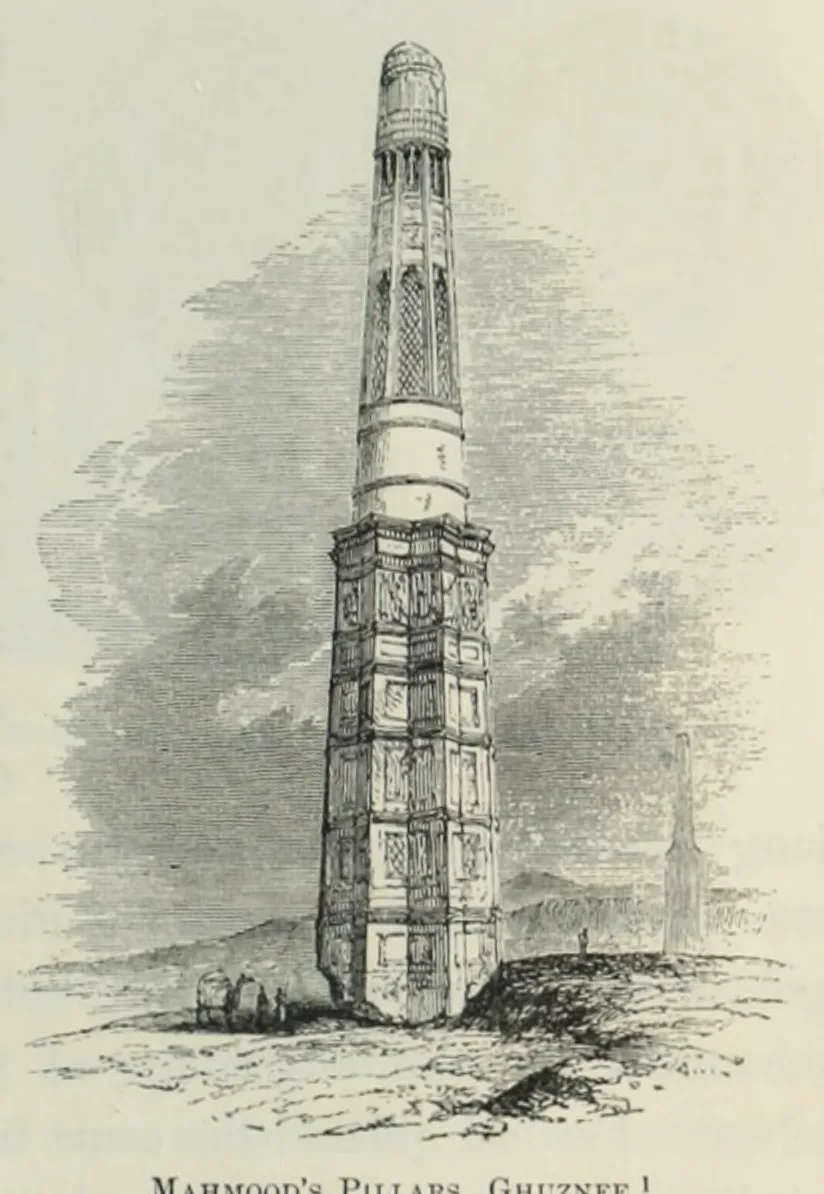
- 1. The two minars or pillars outside the city of Ghuznee were erected, as appears from inscriptions in Kufic characters upon them, the one nearest the village of Rozah by Mahmood, the other (nearest Ghuznee) by Masaood, son of Mahmood. The inscription on Mahmood’s pillar is as follows:—“In the name of God the most merciful—the high and mighty Sultan, the melic of Islam, the right arm of the state, trustee of the faith, the victory crowned, the patron of Moslems, the aid of the destitute, the munificence endowed Mahmood (may God glorify his testimony), son of Sabaktageen, the champion of champions, the emir of Moslems, ordered the construction of this lofty of loftiest of monuments; and of a certainty it has been happily and prosperously completed."—Journal of Asiatic Society of Bengal, 1843.
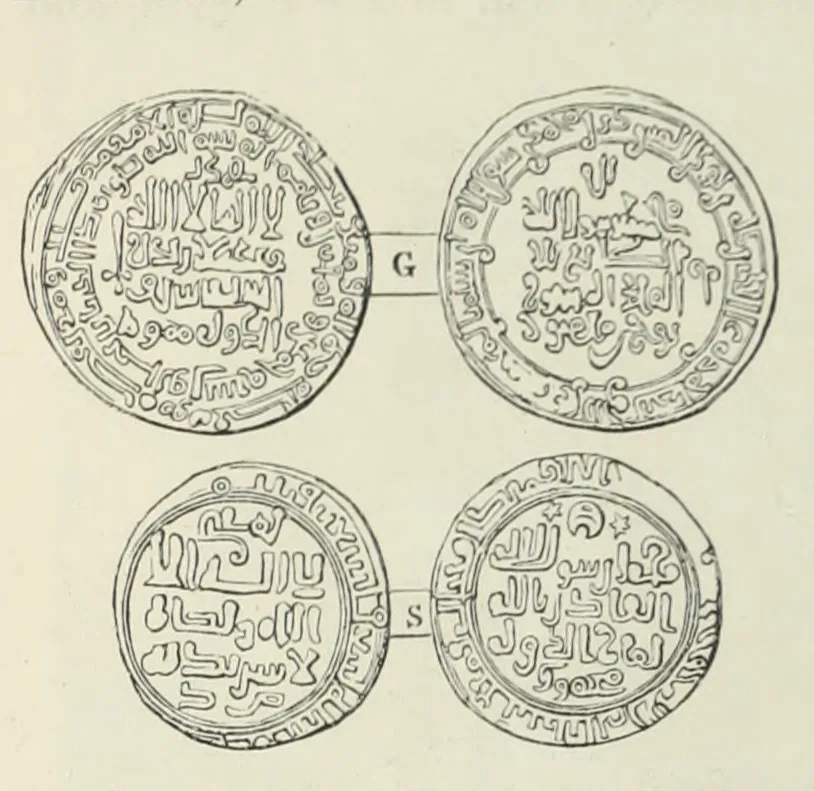
- 1. Gold coin of Mahmood — weight, 76·8 grains, A.H. 385, British Museum. On reverse, “Mahomed, the apostle of God whom he sent with instruction and the true faith, that he might exalt it above [p. 53] all other creeds, even though unbelievers be adverse thereto” (Koran, Surah ix. 33, and lxi. 9). On the obverse, “Dominion both past and future is of God, and in that day the Faithful shall rejoice in the aid of the Lord” (Koran, Surah xxx. 4, 5).—Silver coin of Mahmood—weight, 50 grains.—On the Coins of the Kings of Ghuzni, by Edward Thomas. Lon. 1848.
- 1. The inscription, in Kufic characters, on the sarcophagus of Mahmood’s tomb is to the following effect:—“May there be forgiveness of God, upon him who is the great lord, the noble Nizam-u-din Abul Casim Mahmood, the son of Sebektegin. May God have mercy upon him.”—Journal of the Asiatic Society of Bengal, 1843.
- 1. Ferishta gives his full name as Moiz - u - din Mahomed Ghoory, and speaks of him under the name of Mahomed Ghoory, not as joint sovereign, but only as the general of Gheias-u-din.
- 1. Ajmeer was occasionally the residence of the emperor, Jehangeer, who was here visited, in 1616, by Sir Thomas Roe, the English ambassador. In 1818 it was ceded to the British, and was then in a ruinous state, from which, however, it soon recovered, and is now one of the handsomest cities in British India. On the summit of the hill, in the back ground, stands a fortress, named Taraghur, nearly two miles in circumference, capable of containing 1200 men, but fast going to decay.—Imperial Gazetteer.