EIBUK had been carried off in infancy, and was brought to Nishapoor, where a wealthy citizen purchased him, and spent some pains on his education. On the citizen’s death, he was sold to a merchant, who presented him to Shahab-u-din. With the prince he became so great a favourite that he was taken into his confidence, and lived with him as a friend. His fidelity and military talents made him at once his royal master’s most trusted and most successful general, and he was ultimately dignified with the title of Viceroy of India. In this character, he fixed his government at Delhi, which thus began the course of prosperity which it was destined to run under Mahometan rule. The longer, and by far the more brilliant part of Eibuk’s career was finished before he became independent, for he afterwards reigned only four years, and died in 1210. He had displayed considerable tact in strengthening his position by affinity. He himself married the daughter of Eldoz, who ruled supreme in Ghuznee; his sister he gave in marriage to Nasir-u-din Kubachi, who held a delegated sovereignty in Scinde; and his daughter he gave in marriage to Altamsh, who, though purchased with his money, held the first place in his esteem, and possessed talents which ultimately made him his successor.
Eibuk’s affinity with Eldoz did not produce the cordiality which might have been anticipated. They not only quarrelled, but proceeded to open war, and carried it on with a virulence which brought each of them alternately to the brink of ruin. Nasir-u-din never thought of disputing Eibuk’s authority; and so long as his brother-in-law lived, was perfectly satisfied with a delegated sovereignty. He was not disposed, however, to yield the same deference to Altamsh, and made himself independent ruler of Mooltan and Scinde.
Shortly after Altamsh had secured his position as Eibuk’s successor, the whole of Asia was thrown into consternation by the appearance of Ghenghis Khan.2 Originally a petty Mogul chief, he had become the acknowledged sovereign of all Tartary, and, at the head of its countless hordes, burst through its mountain passes with irresistible fury. The Sultan of Kharism, at whom the first blow was struck, deserved it for the treachery and barbarity of which he had been guilty, in murdering the ambassadors of Ghenghis; and the penalty was not more than the crime, when he fled to die broken-hearted on a solitary island of the
Caspian. His son Jelal-u-din bore up more manfully; but victory after victory seemed to have no power either to intimidate or weaken his fearful adversary, and he only saved himself by swimming the Indus, while the enemy’s arrows showered thick around him. The Moguls threatening to cross the river in pursuit, he continued his flight to Delhi. Altamsh, to whom he here applied for an asylum, feared to expose himself to Mogul vengeance, and gave an answer with which Jelal-u-din was so dissatisfied, that he made a party for himself, and, in alliance with the Gukkurs, roamed the country, plundering and devastating, and even making himself master of Scinde, while Nasir-u-din Kubachi was glad to take refuge in Mooltan. To all appearance he might have made good his footing, if he had not been lured away by a brighter prospect, which seemed opening in Persia. Before he quitted Scinde a detachment of the Mogul army crossed the Indus, and commenced their barbarous warfare; but want of provisions compelled them to depart, after slaughtering 10,000 Indian prisoners. Nasir-u-din, who had repulsed the Mogul detachment when it laid siege to Mooltan, was less fortunate when he was attacked a second time by Altamsh. After retreating to Bukkur, he had, with the view of proceeding to Scinde, embarked with all his family on the Indus, when a sudden squall upset the boat, and all on board perished. This tragical event happened in 1225.
Altamsh was thus rid of a formidable competitor, and obtained a large accession of territory. Another competitor, however, remained, in the person of Bakhtiar Khilji, the governor of Behar and Bengal. He had been mainly instrumental in conquering these provinces; and though he was contented to hold them under Eibuk, one of whose sisters he had married, he had no idea of acknowledging any supremacy in Altamsh. The latter, after persuasion failed, had recourse to force, and Bakhtiar was not only worsted, but lost his life.
Altamsh, throned in his capital at Delhi, now swayed his sceptre over all the territories which the Mahometans had conquered in India. They were large enough and rich enough to satisfy any reasonable ambition, but he was still bent on conquests, which, being wholly his own, might form the most solid basis of his fame. Six years, from 1226 to 1232, were spent in executing these ambitious schemes; and in the end, after the conquest of Malwah, with its famous capital Oojein, had been completed, all Hindoostan proper, with a few isolated and unimportant exceptions, did homage to Altamsh. The additional greatness thus conferred on him was not enjoyed long, for he died four years after, in April, 1236. It may be mentioned, as a proof of the anxiety which the Mahometans of India still felt to keep up their connection with the central authority of Islamism in the west, that Altamsh, in the course of his reign, received his investiture from the Caliph of Bagdad.
Rukn-u-din, the son and successor of Altamsh, was a very unworthy representative of his talents. While his court was thronged with musicians, dancingwomen, and buffoons, he was too indolent and effeminate to support the cares of government, and devolved them on his mother, who was ambitious enough to undertake the task, but performed it so capriciously and tyrannically, that a rebellion broke out, and, at the end of seven months, Rukn-u-din was deposed to make way for his sister, who assumed the title of Sultana Rezia. She was not new to government, for her father, when absent on his campaigns, intrusted her with the administration in preference to his sons. According to Ferishta, “Rezia Begum was endowed with every princely virtue; and those who scrutinize her actions most severely, will find in her no fault but that she was a woman.”
The circumstances under which she assumed the government were difficult. The two most powerful parties in the state were cordially united in deposing her brother, but only one of them concurred in her elevation. The malcontent faction, headed by the vizier of the two previous reigns, at once appealed to the sword, and, appearing before Delhi, defeated an army which was advancing to its relief. But though Rezia was weak in arms, she was powerful in intrigue, and succeeded so well in sowing dissensions, that the confederacy formed against her melted away of its own accord. Equal skill and success marked her internal administration. Seated daily on her throne, she was accessible to all, gave a patient ear to complaints, redressed grievances, reformed abuses, and dispensed justice firmly and impartially. Unfortunately, she had one failing which affected her reputation, and lowered her in the estimation of her subjects. She showed a strong and undisguised favour for her master of the horse, whom, though originally an Abyssinian slave, she raised above all her other nobility, by appointing him commander-in-chief. It does not seem that her honour was compromised; for the utmost said against her in this respect is, that she allowed him to lift her up when she mounted on horseback. It was enough, however, to excite a rebellion, and make it successful. After a short struggle, the Abyssinian was murdered, and Sultana Rezia was deposed. She was confided to the charge of a Turki chief called Altunia, who had been the leader in the rebellion. Here her blandishments again availed her, and she so won upon Altunia that he fell desperately in love with her, married her, and attempted to restore her to the throne. At the head of an army, she advanced to Delhi, fought two bloody battles, lost them, and was taken prisoner with her husband. Both were put to death. She had reigned three years and a half.
In 1239, when Rezia was deposed, her brother Moiz-u-din Behram was placed on the throne. He was altogether unworthy of it; and endeavoured to rid himself of the importunities of those to whom he owed his elevation, by treachery and assassination. He was imprisoned and put to death after he had reigned little more than two years. The only event of importance in his reign was an irruption of the Moguls into the Punjab. Another reign, equally short and worthless, followed. The ruler was Ala-u-din Musaood, a son of Rukn-u-din. His crimes were soon terminated by a violent death. During his reign two irruptions of the Moguls took place; the one into the north-west, and the other by a route which they had not previously attempted—through Thibet into Bengal.
Nasir-u-din Mahmood, grandson of Altamsh, after a short interval, was raised to the throne in 1246. He was of retired and studious habits, and rid himself of the cares of government by devolving them on his vizier Gheias-u-din Bulbun. The Moguls were now the great enemies to be feared. The provinces of Herat, Balkh, Kandahar, Cabool, and Ghuznee were in their possession; and as India was constantly threatened by them, it was necessary to keep up a standing army along the frontier. Several of the earlier years of this reign were employed in suppressing disturbances which had arisen, chiefly in Mooltan and the Punjab generally. The events of the latter years are, generally, unimportant. In 1259, the Rajpoots of Meerut, having risen in insurrection, the Vizier Bulbun led an army against them; and, having obliged them to take refuge among the mountainous districts, continued for four months to ravage the country by fire and sword. The barbarities thus committed, however, made the Rajpoots desperate, and they rushed down with all their forces into the plain, attacking the Mahometans so suddenly and fiercely that Bulbun had great difficulty in keeping his men together. Superior discipline finally prevailed, and the Rajpoots were driven back to their fastnesses with great slaughter. Above 10,000 fell on the field; 200 chiefs, taken prisoners, were put to death; and the great body of their followers were condemned to slavery. Shortly before this formidable outbreak, an ambassador arrived at Delhi from Hoolakoo, King of Persia, and grandson of Ghenghis Khan. On his approach, the vizier went out in state to meet him, with a train of 50,000 foreign horse, then in the service of the Delhi government, 2000 elephants, and 3000 carriages of fireworks. What these last were is uncertain. They may have been merely for display, but more probably consisted of the Greek fire, with which the Mahometans, even of the far east, were then well acquainted. A series of reviews and sham fights were performed; and the ambassador was then led through the city to the palace, where everything was arranged for his reception in the most gorgeous style. Among those who graced the ceremony, and stood next the throne, were many tributary Indian princes. There were present, also, no fewer than twenty-five princes of Irak-Ajemi, Khorasan, and Transoxiana, who had sought protection at Delhi from the devastating hordes of Ghenghis Khan.
Nasir-u-din died of a lingering disease in 1266, after a reign of twenty years. He makes little figure on the page of history; and was, both by nature and habit, far better adapted for a private than for a public station. Though of royal parentage, he had acquired parsimonious habits, and lived in the utmost simplicity. When imprisoned in early life, he maintained himself by the labours of his pen; and, when seated on the throne, he made it his daily practice to write as much as would suffice to purchase his food. Ferishta’s account of his domestic arrangements is curious :—“Contrary to the custom of other princes, he kept no concubines. He had but one wife, whom he obliged to do every homely part of housewifery. When she complained one day, that she had burned her fingers in baking his bread, and desired he would allow a maid to assist her, he rejected her request, saying that he was only a trustee for the state, and was determined not to burden it with needless expenses. He therefore exhorted her to persevere in her duty with patience, and God would reward her on the day of judgment.”
Gheias-u-din Bulbun, usually called by European writers Balin, had long been virtual, and on his master’s death, became actual sovereign. He was the son of a powerful Turki chief, but, when a youth, had been carried off by the Moguls and sold to a merchant, who took him to Bagdad. Here he was bought by an inhabitant of Bussorah, who, on learning that he belonged to the same tribe as Altamsh, took him to Delhi, when that monarch paid for him so liberally that his previous master returned with an independent fortune.
His first employment was as falconer, because he was particularly skilful in the art of hawking; but, by the influence of a brother, whom he found living in high favour at court, he obtained a higher position and became a noble. In the reign of Rukn-u-din, he commanded in the Punjab. On receiving an order to return, he refused to place himself in the power of that worthless tyrant, who, he learned, had a design upon his life. He therefore took the only alternative that remained, and declared himself independent. When the Sultana Rezia mounted the throne, he joined the confederacy which marched to Delhi to depose her, and was taken prisoner. After a time he effected his escape, and became a leading supporter of Behram, during whose reign he held the government of Hansi and Rewaree, and distinguished himself in suppressing the insurrections in Meerut. In the reign of Ala-u-din Musaood, he held the office of Ameer Hajib; and at last, as has been seen, exercised all the powers of sovereign, though nominally only the vizier of Nasir-u-din.
Bulbun began his reign with some acts of what he deemed necessary severity; and having thus made his position secure, acquired a high reputation for justice and wisdom. He was a liberal rewarder of merit, and a rigid corrector of crime; but he seems to have attached more importance to birth than might have been expected in so wise a man; and, in particular, made a rule never to appoint any Hindoo to a place of trust and power. His patronage of literature brought some of the most distinguished writers of the period to his court, which, if we may credit Ferishta, was the most polite and magnificent in the world. His example found many imitators in the capital; and, while a society of learned men met at the house of a prince called Khan Shaheed, another society, of a more miscellaneous but not less attractive description, as it consisted of musicians, dancers, actors, and kissagoes or story-tellers, met at the house of the king’s second son. Various other societies, for similar purposes, were formed in every quarter of Delhi. Not merely the literary tastes of the king, but his love of show was sedulously imitated; and splendid palaces, equipages, and liveries became quite a rage among the courtiers.
Ferishta warms as he describes the pomp and state with which the monarch surrounded himself, and proceeds as follows:—“So imposing were the ceremonies of introduction to the royal presence, that none could approach the throne without a mixture of awe and admiration. Nor was Gheias-u-din Bulbun less splendid in his processions. His state elephants were covered with purple and gold trappings. His horse-guards, consisting of 1000 Tartars, appeared in glittering armour, mounted on the finest steeds of Persia and Arabia, with silver bits, and housings of rich embroidery. Five hundred chosen foot, in rich liveries, with drawn swords, preceded him, proclaiming his approach and clearing the way. His nobles followed according to their rank, with their various equipages and attendants.”
It is not unworthy of notice, that Bulbun took a very marked interest in what is now known as the temperance cause. An officer of rank, son of the keeper of the royal wardrobe, and governor of the province of Budaoon, had, while in a state of drunkenness, slain one of his personal dependants, and, on the complaint of the widow, was sent for, tried, and beaten to death in presence of the whole court. Another high officer, the governor of Oude, who had been guilty of the same crime under the influence of intoxication, received a public whipping of 500 lashes, and was given over as a slave to the widow of the man he had killed. These are not to be regarded as solitary instances of rigid justice, but rather part of a general system adopted for the purpose of putting down drunkenness. In the following statement of Ferishta, there is something very like an enactment of the Maine-law:—“Gheias-u-din Bulbun in his youth was addicted to the use of wine, but on his accession to the throne he became a great enemy to the luxury, prohibiting the use and manufacture of fermented liquors throughout his dominions, under the severest penalties.”
Though fond of splendour, and by no means niggardly, Bulbun seems sometimes to have been seized with fits of economy. During one of these, he caused a list of all the veterans who had served in the preceding reigns to be made out, and settled half-pay, with exemption from active duty, on all who were reported as worn out. The arrangement, though one which the most enlightened states of modern times have adopted, gave great dissatisfaction; and the veterans induced a magistrate of Delhi, venerable for years and character, and high in favour, to represent their case to the king. He accordingly went the next day to court, and, while standing in the presence, put on a face of great dejection. The king observing it, inquired the cause: “I was just thinking,” replied the magistrate, “that if, in the presence of God, all the old men were rejected, what would become of me.” The device succeeded, and the veterans were again placed on full pay.
In the year 1270 the king’s nephew, Sheer Khan, died. He was governor of Lahore, Mooltan, Sirhind, Batinda, &c., and all the districts exposed to Mogul incursions. These restless depredators immediately made their appearance. It seems that several of the subordinate governors were in league with them; and owing to this cause, as well as to mutual jealousies and dissensions in other quarters, the Moguls made such head that Bulbun was obliged to appoint his eldest son, Prince Mahmood, viceroy of the frontier provinces. At the same time he caused him to be proclaimed his successor.
The Moguls had hitherto been the only enemy against whom it was thought necessary to provide, but in 1279 a formidable insurrection broke out in a different quarter. During a serious illness, which led to a rumour that Bulbun had died, Toghrul Khan, the governor of Bengal, who had been guilty of some irregularities, for which he feared he might be called to account, not only revolted, but, assuming the scarlet canopy along with other insignia of royalty, declared himself King of Bengal. Bulbun immediately gave the government of Bengal to the governor of Oude, Aluptujeen, entitled Ameer Khan, and surnamed the Hairy. At the same time, he sent several generals with a large army to his assistance. Aluptujeen, thus reinforced, crossed the Gogra, and Toghrul Khan advanced to meet him. This he did with the more confidence, because he was aware that many of the Turki chiefs in Aluptujeen’s army had been gained by his largesses. The consequence was that the royal army sustained a total overthrow. When the news reached Bulbun, he bit his own flesh with vexation, hung Aluptujeen at the gate of Oude, and sent Mullik Tirmuny Toork with another army against the rebel. Not more successful than his predecessor, he was defeated, lost all his baggage, and with it the public treasure.
Bulbun now set out in person, crossed the Ganges without waiting for the dry season, and proceeded to Bengal by forced marches. The state of the river and roads, however, occasioned so much delay, that Toghrul Khan had time to collect a large army, though it did not seem to have been large enough to justify the risk of an encounter in the open field. He therefore evacuated Bengal with all his elephants, treasure, and effects; intending to keep out of sight till the king should return to his capital. This scheme he followed out with so much dexterity, that Bulbun, following close upon the route which he was understood to have taken, could not obtain a trace of him for several days. At last Mullik Mookudur, the governor of Kole, being out with a small reconnoitring party, saw some bullocks with pack-saddles. The drivers were seized, but in answer to all inquiries, obstinately pretended ignorance, till the head of one of them was struck off, when the rest fell on their faces and confessed that they had just left Toghrul Khan’s camp, which was four miles farther on. Mullik going forward climbed a rising ground, from which he saw the whole encampment spread over a plain, with the elephants and cavalry picketted, and everything in apparent security. Having fixed his eye on Toghrul’s tents, situated near the centre of the camp, he determined on a very daring enterprise. Advancing with the forty men he had with him at full speed, he was allowed to enter the camp, because it was never doubted that he belonged to it. He made directly for head-quarters, and ordering his men to draw their swords, rushed into the tent of audience, shouting “Victory to Sultan Bulbun!"
Toghrul thought he had been surprised by the royal army, and leaped from his throne to make way to the rear. Finding a horse without a saddle, he mounted it, and fled in the direction of the river. Mullik, having caught sight of him, pursued, and shot him with an arrow while he was in the act of swimming the stream. Toghrul fell from his horse, and was seized by Mullik, who dragged him out by the hair, and cut off his head, leaving the body to be carried down the stream. He had just time to hide the head in the sand when some of Toghrul’s people came up. They found Mullik bathing, and never suspecting how matters stood, left him after asking a few questions. The confusion produced by the supposed surprise spread into a general panic, and the whole camp dispersed, every one thinking only of his own safety. Mullik ever after bore the surname of Toghrul Koosh, or the Slayer of Toghrul.
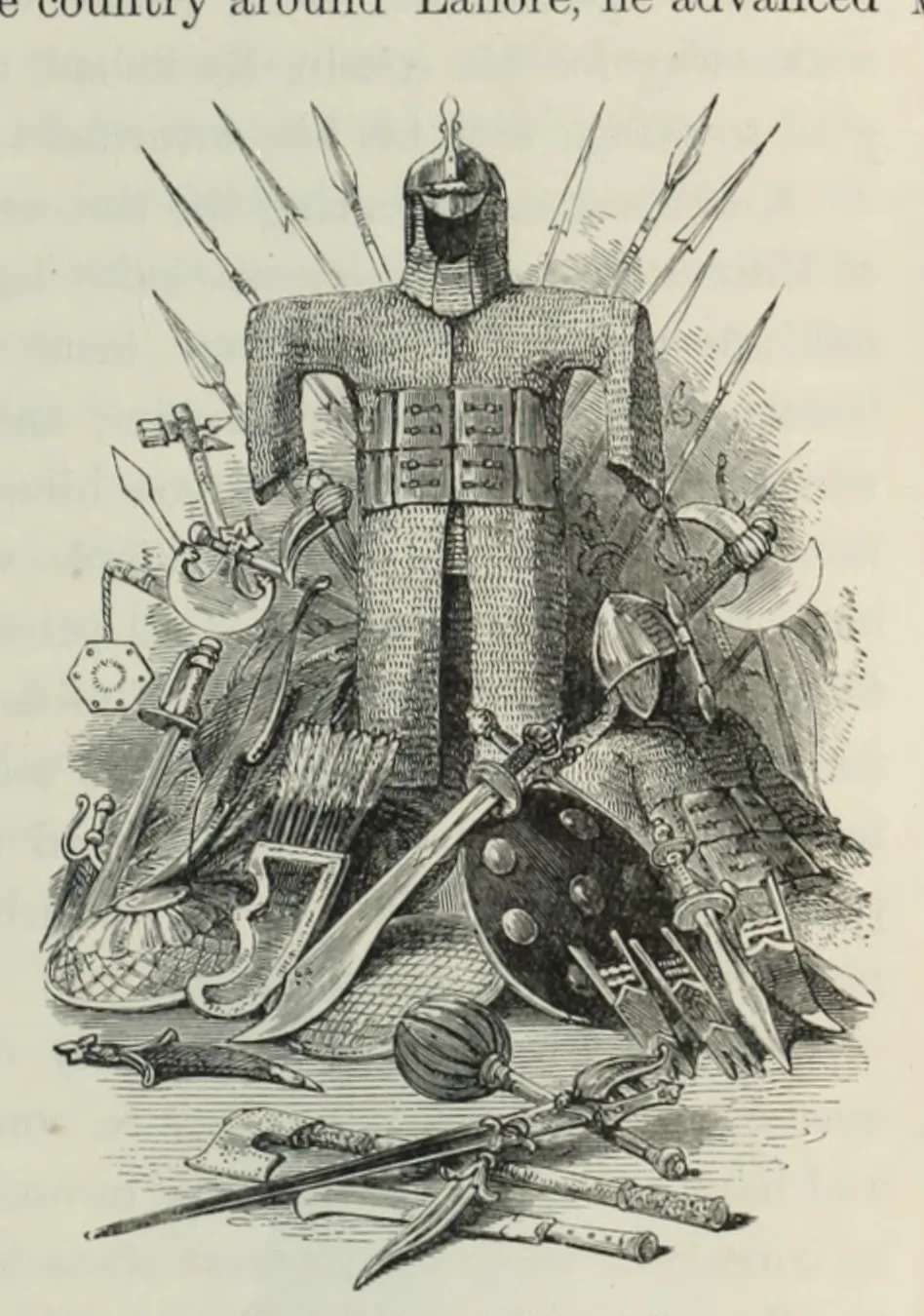
Bulbun arrived next day, and finding that no enemy remained, returned to execute vengeance on the rebel’s family, every member of which he put to death. Before returning from this expedition, on which he is said to have spent three years, he appointed his son, Khurra Khan, King of Bengal, and gave him all the spoils of Toghrul, except the elephants and treasure, which he removed to Delhi. As soon as Prince Mahmood heard of his father’s arrival, he hastened from Mooltan to visit him, and was received with the greatest affection. The two were almost inseparable; but they had not been three months together when an event occurred which was to part them for ever. The Moguls had invaded Mooltan. The prince made all haste to oppose them, and Bulbun, now on the borders of eighty, bitterly felt the pang of separation. His presentiment probably was that he himself was about to be gathered to his fathers, and that the prince would survive him. Accordingly he spent much of the last interview in counselling him as to the conduct he should pursue when on the throne. The counsels were wise, and the prince, who had given great promise, would doubtless have acted upon them if the succession had opened to him. It was otherwise determined. As soon as the prince arrived in Mooltan, he attacked the Moguls, recovered all the territories which they had seized, and expelled them with great slaughter. These Moguls were subjects of Timour Khan, of the house of Ghenghis Khan; and though not unknown to fame, a very different person from the still more famous Timour or Tamerlane, who did not make his appearance till a century after. The present Timour ruled the eastern provinces of Persia, from Khorasan to the Indus, and with the view of avenging the expulsion of his Moguls, appeared next year in Hindoostan, at the head of 20,000 chosen horse. After ravaging the country around Lahore, he advanced in the direction of Mooltan. Prince Mahmood hastened to meet him. A river lay between them, and might easily have been converted into an inseparable barrier against the further progress of the Moguls, but the prince disdained to avail himself of this advantage, and left the passage free. After Timour had crossed, the armies drew up and a great battle was fought. Both leaders distinguished themselves; but after contesting the victory for three hours, the Moguls were obliged to flee, and the Indians followed hotly in pursuit. Prince Mahmood, worn out with fatigue, halted on the banks of a stream to quench his thirst. He had only 500 attendants, and was spied by a Mogul chief, who lay concealed in an adjoining wood with 2000 horse. The prince had barely time to mount before the Moguls were upon him. With his small band he thrice heroically repulsed his assailants; but at last, overpowered by numbers, he fell mortally wounded, and almost instantly expired. His troops, who had gone in pursuit of the flying enemy, on returning with the shouts of victory, found their prince weltering in his blood. The voice of triumph was immediately turned to wailing, and every eye was in tears. The dismal news broke the old king’s heart, and he only lingered on, wishing for death to release him.
When he found his end approaching, he recalled his son, Khurra Khan, from Bengal, and nominated him his successor. He only stipulated that he should appoint a deputy in Bengal, and remain with him at Delhi till his death.
This event not happening so soon as Khurra Khan expected, he was unnatural enough to become impatient, and depart for Bengal without announcing his intention. Bulbun, both grieved and indignant, sent for his grandson, Kei Khosru, Prince Mahmood’s son, from Mooltan, settled the succession on him, and a few days after, expired, in 1286. He had reigned with great success for twenty-one years. Though all the officers of the court had sworn to give effect to Bulbun’s will, no sooner was he dead than the chief magistrate of Delhi, who had always been at variance with Kei Khosru’s father, exerted his influence against the young prince with such effect, that he was set aside to make way for his cousin, Keikobad, the son of Khurra Khan. Kei Khosru, glad to escape with his life, returned to his government.
Keikobad, on mounting the throne in his eighteenth year, assumed the title of Moiz-u-din. He was remarkably handsome in person, affable in his manners, mild in temper, of a literary taste, and well informed. Unfortunately he became too soon his own master; and on breaking loose from the tight rein which his father had kept upon him, he passed to the opposite extreme, and became a debauchee. His example was soon followed by his courtiers, and once more, to borrow the description of Ferishta, “every shady grove was filled with women and parties of pleasure, and every street rung with riot and tumult; even the magistrates were seen drunk in public, and music was heard in every house.” At Kelookery, on the banks of the Jumna, he fitted up a palace where he might revel undisturbed amidst his only companions—singers, players, musicians, and buffoons.
Nizam-u-din, the chief secretary of Keikobad, seeing how completely his master was engrossed by pleasure, conceived the idea of usurping the throne; and having no scruples as to the means, began by endeavouring to remove what he conceived to be the greatest obstacle. This was Kei Khosru, who had gone to Ghuznee, and solicited Timour Khan, the Mogul viceroy, to aid him with troops for the purpose of driving Keikobad from the throne, which, by the will of his grandfather Bulbun, belonged of right to himself. He failed in the attempt, but returned, notwithstanding, to his government. Either thinking that his attempt was unknown, or hoping that it had been forgiven, he was enticed to pay a visit to Delhi, and before he reached it, was waylaid and murdered by the hired assassins of Nizam-u-din. The next part of the plot was to procure the disgrace of Keikobad’s vizier, and cut off all the old servants of the late King Bulbun. They disappeared one after another by some kind of mysterious agency, and a general feeling of dismay was produced. Nizam-u-din, the real instigator, though not the actual perpetrator of the murders, was not even suspected.
Though the Moguls on the other side of the Indus were constantly crossing it, and making predatory incursions into India, it is a remarkable fact that vast numbers of their countrymen had voluntarily enlisted in the army of Delhi as soldiers of fortune, and were even understood to have done good and faithful service. Nizam-u-din, anxious to get quit of the Mogul mercenaries—who, he feared, might refuse to be the instruments of his designs—took advantage of a recent Mogul incursion, to persuade Keikobad that it was impolitic to retain them, as in the event of a general invasion, they would certainly join their countrymen. It was therefore resolved to get quit of them by any means, however atrocious. The plan adopted was to assemble the Mogul chiefs, and massacre them by the guards. Even all other officers who had any connection with them were first imprisoned, and then sent off to distant garrisons. While Nizam-u-din was thus clearing away all real or imaginary obstacles, his wife was equally busy in the seraglio, and had all its inmates at her devotion.
Khurra Khan, Keikobad’s father, who had hitherto been contented with Bengal, hearing of the state of affairs at Delhi, wrote to warn his son of his danger. No attention was paid to his advice; and Khurra Khan, seeing the crisis approaching, determined to anticipate it, by marching with a large army upon Delhi. Keikobad advanced with a still larger army to oppose his progress. The father, feeling his inferiority, proposed negotiation, but the son assumed a haughty tone, and would appeal to nothing but the sword. Before matters were allowed to come to this extremity, Khurra Khan made a last effort, and wrote a letter in the most tender and affectionate terms, begging he might be blessed with one sight of his son. Keikobad was melted, and a reconciliation took place, the ultimate effect of which was, that Nizam-u-din saw all his treacherous designs frustrated, and was shortly after cut off by poison.
For a time Keikobad seemed about to reform; but he had no decision of character, and his old habits returning, new factions were formed, and a kind of anarchy prevailed. To increase the confusion, his dissipation undermined his constitution, and he became paralytic. Every noble now began to intrigue for power, and two great parties were formed —the one headed by a Khilji of the name of Mullik Jelal-u-din Feroze, and the other by two high court officers, who, more loyally disposed, wished to secure the crown to Keikobad’s only son, Prince Keiomoors, an infant of three years of age. The Khiljies, almost to a man, took part with their countryman; the Moguls were equally unanimous in favour of the prince, whom they carried off from the harem, for the purpose of seating him upon the throne. It was not yet vacant, for Keikobad, though on a sickbed, might continue for a time to linger on. This was a state of uncertainty which the contending parties could not endure; and after mutual attempts at assassination, the emissaries of Jelal-u-din, having forced their way into the palace of Kelookery, where they found Keikobad lying in a dying state, deserted by all his attendants, they beat out his brains with bludgeons, rolled up the body in the bed-clothes, and threw it out of the window into the river. The young prince was shortly after put to death; and Jelal-u-din having been proclaimed king, became the founder of the Khilji dynasty. This revolution happened in 1288.
Jelal-u-din Feroze had reached the age of seventy when he usurped the throne. The footsteps to it he had stained with blood, but after he was seated, either remorse or policy induced him to become humane. Having no great confidence in the people of Delhi, he fixed his residence at Kelookery, which he fortified, and also adorned with fine gardens and terraced walls along the river. Numerous other buildings rapidly sprung up; and Kelookery, having thus assumed the appearance of a city, was known for a time by the name of New Delhi. The year after Jelal-u-din’s usurpation, a competitor for the crown appeared in the person of Mullik Juhoo, one of the late Bulbun’s nephews, instigated chiefly by Ameer Ally, governor of Oude. After an obstinate engagement, Juhoo was defeated, and Ameer Ally and several other leaders were taken prisoners. They were immediately sent off to Kelookery; but Jelal-u-din, as soon as he saw them, ordered them to be unbound, and gave them a free pardon, while quoting a verse of which the purport is—“Evil for evil is easily returned, but he only is great who returns good for evil.” The Khilji chiefs could not understand this humanity, which they condemned as at variance with sound policy. “At all events,” they observed, “the rebels should be deprived of sight, to deter them from further mischief, and as an example to others. If this was not done, treason would soon raise its head in every quarter of the empire.” The king answered, “What you say is certainly according to the ordinary rules of policy; but, my friends, I am now old, and I wish to go down to the grave without shedding more blood.”
It is refreshing to be able to turn aside from the massacres which we have in the course of the narrative been compelled to witness, and listen to sentiments partaking so much of the spirit of Christianity. It seems, however, that the Khiljies were not altogether wrong, for the king’s lenity was often mistaken, and the hope of impunity produced numerous disorders. “The streets and highways,” says Ferishta, “were infested by thieves and banditti. Housebreaking, robbery, murder, and every species of crime was committed by many who adopted them as a means of subsistence. Insurrections prevailed in every province; numerous gangs of freebooters interrupted commerce, and even common intercourse. Add to this, the king’s governors neglected to render any account either of their revenues or their administration.”
Crime, thus encouraged, did not stop short of treason, and two plots were formed against the king’s life. One, in which some Khilji chiefs were the conspirators, was no sooner detected than forgiven; the other, which was headed by a celebrated dervis, called Siddy Mollah, was visited more severely. This dervis, originally from Persia, after visiting various countries in the west, arrived at Delhi, where his reputation for sanctity, joined to the liberality of his alms, made him a great favourite, especially with the populace, who were constantly crowded around his gates. For a time he appeared to have no higher aspiration than popularity; but at last, ambition took possession of his soul, and an intriguer, to whom he had given his confidence, persuaded him that the people looked on him as sent from God to deliver the kingdom from Khilji misrule, and bless Hindoostan with a wise and just government.
The throne having thus become his object, he determined to take the nearest road to it, and sent two of his followers to assassinate the king as he was proceeding to the public mosque. One of the two, however, was seized with remorse, and disclosed the plot. Siddy Mollah and his confidential intriguer were apprehended; but as they persisted in their innocence, and no witness appeared against them, it was determined to have recourse to the fiery ordeal, that they might purge themselves of their guilt. Everything was ready, and the accused having said their prayers, were about to plunge into the fire, when Jelal-u-din, who had come to witness the ceremony, stopped them, and turning to his ministers, put the question, “Is it lawful to try Mussulmans by the fiery ordeal?” They unanimously answered that the practice was heathenish, and contrary to the Mahometan law as well as to reason, inasmuch as it was the nature of fire to consume, paying no respect to the righteous more than to the wicked. Siddy Mollah was ordered to prison, but was barbarously murdered before he reached it. This murder was associated in the minds of the populace with a series of public calamities which ensued, and particularly with two— the one a dreadful famine in the course of the same year (1291), and the other a Mogul invasion in the year following.
The invading force, headed by a kinsman of Hoolakoo Khan, Ghenghis Khan’s grandson, consisted of 100,000 horse. Jelal-u-din collected his army, and advanced against them. For five days the armies lay in sight of each other, with a stream between them. On the sixth morning, as if by mutual consent, they drew up on an extensive plain, to fight a pitched battle. After an obstinate conflict, the Moguls were defeated. It is probable that the victory was not decisive, for Jelal-u-din gave the Moguls free permission to withdraw from his dominions, and exchanged presents with them in token of amity. On this occasion, Oghloo Khan, a grandson of Ghenghis Khan, aware that he had little chance of rising among the numerous relations of that warrior who were still alive, induced 3000 of his countrymen to remain in the service of Jelal-u-din, who gave him his daughter in marriage.
In 1293 Ala-u-din, the king’s nephew, who had previously been governor of Kurra, obtained in addition to it the government of Oude, and began to entertain schemes of conquest, with a view to ultimate independence. One of his expeditions is interesting as the first which the Mahometans made to the Deccan. It was directed against Ram Dew, Rajah of Dewghur or Dowletabad, who is described as possessing the wealth of a long line of kings. Ala-u-din, after reaching the Deccan frontier, pressed forward towards the capital. The rajah happened to be absent, and hastened home in great alarm. Having suddenly collected a force, composed chiefly of citizens and domestics, he encountered the Mahometans about four miles from the city; but, though he behaved gallantly, was easily repulsed, and driven back into the fort. Its ditch, which is now one of the most remarkable sights of the Deccan, the scarp being in many places 100 feet, excavated in the solid rock, was not then in existence, and the chief defence was a bare wall. The city was taken at once, and pillaged. Many of the inhabitants, after heavy contributions had been levied from them, were cruelly tortured for the discovery of their property. The fort still held out, but Ram Dew began to despond, as the Mahometans had given out that their present force was only the advanced guard of the King of Delhi’s army. He therefore offered a large ransom, which Ala-u-din, who had begun to feel the difficulties of his position in the centre of a hostile country, was fain to accept.
The terms had just been concluded when Shunkul Dew, the rajah’s eldest son, was seen advancing with a numerous army. His father sent a message to him, intimating that peace was concluded, and ordering him to desist from hostilities. The youth refused, and sent messengers to Ala-u-din with a letter, in which he said, “If you have any love for life, and desire safety, restore what you have plundered, and proceed quietly homeward, rejoicing at your happy escape.” The Mahometan indignation was so roused that the messengers, after having their faces blackened with soot, were hooted out of the camp.
Ala-u-din immediately moved out to meet the approaching enemy, leaving only Mullik Noosroot, with 1000 horse, to invest the fort and prevent a sally. In the contest which ensued, the Mahometans were overpowered by numbers, and falling back on all sides, when the sudden arrival of Mullik Noosroot, who had left his station at the fort without orders, changed the fortune of the day. The Hindoos, supposing that the royal army, of which they had heard so much, was actually arrived, were seized with a panic, and fled in all directions. Ala-u-din returned to the fort, the besiegers of which were now pressed for provisions, it having been ascertained that a great number of bags, supposed to contain grain, were filled with salt. Ram Dew was obliged to submit to any terms; and Ala-u-din, besides obtaining the cession of Ellichpoor and its dependencies, retired with an immense ransom. He had many difficulties to contend with, as his route lay through the hostile and powerful kingdoms of Malwah, Gundwana, and Candeish; but he surmounted them all, and arrived safely at Kurra, where, from the interruption of the communications, nothing had been heard of him for several months.
Jelal-u-din, on hearing of the immense booty which his nephew was bringing with him, was overjoyed, because he had no doubt that the greater part of it would go to enrich the royal treasury at Delhi. His more sagacious servants thought otherwise, and hinted that Ala-u-din had ultimate designs of a treasonable nature, and would use the booty as a means of accomplishing them. The king refused to entertain suspicions which might prove unfounded; and, on receiving a letter from his nephew, couched in the most submissive terms, felt only anxious to assure him of his continued favour.
Meanwhile, the crisis was approaching. Partly by flattering letters from Kurra, and partly by the treacherous advice of counsellors at Delhi, the king was inveighled into the fatal resolution of paying a visit to his nephew in 1295. When the royal canopy appeared in sight, Ala-u-din drew out his troops under pretence of doing honour to his majesty, and sent his brother Almas Beg forward to arrange for his reception. Almas was deep in the plot, and artfully suggested that if the king advanced with a large retinue, Ala-u-din, who feared he had incurred the royal displeasure, might be alarmed. So plausible was the tongue of Almas Beg, that the king embarked in his own solitary barge with only a few select attendants, and, as if this had not been enough, ordered them to unbuckle their armour, and lay their swords aside. In this defenceless state, he reached the landing-place, and ordered his attendants to halt, while he walked forward to meet his nephew, who advanced alone, and threw himself prostrate at his feet. The old king raised him up, embraced him, and, tapping him familiarly on the cheek, exclaimed, “How could you be suspicious of me, who have brought you up from your childhood, and cherished you with a fatherly affection, holding you dearer in my sight, if possible, than my own offspring?” This kind-hearted appeal was answered by the nephew by a signal to his soldiers, one of whom made a cut with his sword, and wounded Jelal-u-din in the shoulder. He immediately ran to regain his barge, crying, “Ah! thou villain, Ala-u-din!” but, before he reached it, was overtaken by another of the soldiers, who threw him on the ground, and cut off his head, which was fixed on a spear, and carried in triumph through the camp. The wretch whose sword completed the bloody deed is said to have suffered a thousand deaths in imagination before he died. He became mad, and expired, screaming incessantly that Jelal-u-din Feroze was cutting off his head. This reign is full of incident, but lasted only for the comparatively short period of seven years.
When tidings of Jelal-u-din’s murder reached Delhi, the queen-dowager, of her own accord, without consulting the chiefs, placed her youngest son, Prince Kuddur Khan, a mere boy, on the throne. The real heir was Arkally Khan, then governor of Mooltan. He had all the qualities of a king, but the queen’s proceedings disconcerted him, and he resolved, in the meantime, to take no active steps to secure his right. Ala-u-din, when he atrociously murdered his uncle, aimed not at the throne of Delhi, but at the establishment of a new independent kingdom. However, on learning the state of matters, he began to entertain higher aspirations; and, in spite of the rainy season, set out at once for the capital. There was nothing to oppose his progress; and the queen-mother, with her son, having fled with the treasure to Mooltan, he made a triumphal entry into the city in the end of 1296.
Ala-u-din began his reign with splendid shows and festivities, by which he dazzled the populace, and made them forget, or overlook, the enormity which had placed him on the throne. At the same time, he conciliated the great by titles, and the venal and avaricious by gifts. The army, also, having been gained by six months’ pay, he turned his thoughts to the rival claimants in Mooltan, and sent thither his brother, Aluf Khan, at the head of 40,000 horse. The citizens, to save themselves, betrayed the princes, and delivered up Arkally Khan and Kuddur Khan, on an assurance that the lives of both would be spared. It is almost needless to say that the promise was not kept. While the princes were being conveyed to Delhi, a messenger arrived with orders from Ala-u-din, that they should be deprived of sight. After this barbarous deed was done, they were imprisoned in the fort of Hansi, and shortly after assassinated.
In 1296, after Ala-u-din had finished the first year of his reign, the startling intelligence arrived that Ameer Dawood, King of Transoxiana, had prepared an army of 100,000 Moguls, with a design to conquer the Punjab and Scinde, and was actually on the way, carrying everything before him with fire and sword. Aluf Khan was sent against them; and, after a bloody conflict on the plains of Lahore, defeated them with the loss of 12,000 men. Some days after, the numerous prisoners, not excepting the women and children, found in the Mogul camp, were inhumanly butchered.
In the beginning of the following year, Aluf Khan and the Vizier Noosroot Khan, were sent to reduce Gujerat. On their approach to the capital, the Rajah Ray Kurrun escaped into the territories of Ram Dew, Rajah of Dewghur, in the Deccan, but not without the capture of his wives, children, elephants, baggage, and treasure. Noosroot Khan then proceeded with part of the army to Cambay, which, being a rich country full of merchants, yielded a prodigious booty. With this, the whole troops were returning to Delhi, when the two generals, by demanding a fifth of the spoil in addition to the shares which they had already obtained, caused a wide-spread mutiny, especially among the Mogul mercenaries. Aluf Khan narrowly escaped with his life. His nephew, who was sleeping in his tent, was mistaken for him by the mutineers, and murdered. When the army reached Delhi, Ala-u-din gratified his passion by taking into his harem Kowla Devy, one of the captive wives of the Rajah of Gujerat, so celebrated for beauty, wit, and accomplishments, that she was styled the “Flower of India”—and his blood-thirsty revenge, by an indiscriminate massacre of all the families of those who had been concerned in the late mutiny.
About this time, another great invasion of the Moguls took place, under Kootloogh Khan, son of the Ameer Dawood, who had led the former expedition. Their army consisted of 200,000 horse, and contemplated nothing less than the entire conquest of Hindoostan. Kootloogh Khan, after crossing the Indus, proceeded direct for Delhi, and encamped, without opposition, on the banks of the Jumna. Zuffur Khan, the chief secretary and governor of the adjoining provinces, gradually retired as the Moguls advanced. The inhabitants, fleeing in dismay, crowded into the capital; and the supply of provisions being cut off, while the consumption was immensely increased, famine began to rage. Dismay and despair were painted on every countenance. In this emergency, Ala-u-din called a council of nobles, but, on finding them opposed to action, took his own way, and determined to attack the enemy. With this view, he marched out by the Budaoon gate with 300,000 horse and 2700 elephants, and, proceeding into the plains beyond the suburbs, drew up in order of battle. Here, too, Kootloogh Khan drew up to receive him. Two such armies had not mustered in Hindoostan since the Mahometans appeared in it.
The right wing of the Delhi army was commanded by Zuffur Khan, considered the greatest general of the age, and the left by Aluf Khan. Ala-u-din took post in the centre, with 12,000 volunteers, mostly of noble family, and headed by the vizier, Noosroot Khan. The choicest of the elephants occupied a line in front, and a body of chosen cavalry guarded the rear. Zuffur Khan began the battle by impetuously charging the enemy’s left, which he bore away before him, breaking up the line by his elephants, and thus committing dreadful slaughter. The enemy’s left flank, thus turned back, was driven upon his centre, and considerable confusion ensued. Ala-u-din, seeing this, ordered Aluf Khan to advance, but he, dissatisfied because the place of honour had been given to Zuffur Khan, of whose fame he was envious, meanly kept aloof, and left his rival to follow up his advantage as he could. This he did almost heedlessly, continuing the pursuit for many miles. A Mogul chief, whose toman, or division of 10,000 horse, had not been engaged, seeing Zuffur Khan unsupported, resolved to attack him; and, at the same time, sent information to Kootloogh Khan, who hastened forward with another toman. Zuffur Khan was consequently attacked in front and rear. Thus placed, he saw his danger; but as it was too late to retreat, he drew up his forces, in number not half those of the enemy, in two squadrons, and continued the unequal conflict. The leg of his horse having been cut through by a sabre, he fell to the ground, but rose instantly, seized a bow and quiver, and, being a dexterous archer, dealt death around him. Most of his soldiers were now slain or dispersed, and Kootloogh Khan—who, from admiration of his valour, would have saved him—called upon him to surrender, but he persisted in discharging his arrows, and refused quarter. On this, the Mogul attempted to take him alive, but it could not be done, and he was at last cut in pieces.
Notwithstanding this advantage, the Moguls did not venture to continue the contest; and, abandoning all hopes of success, evacuated India as fast as they could. Their departure was celebrated at Delhi with great rejoicing.
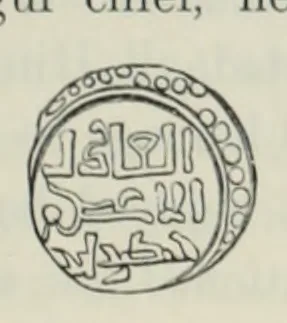
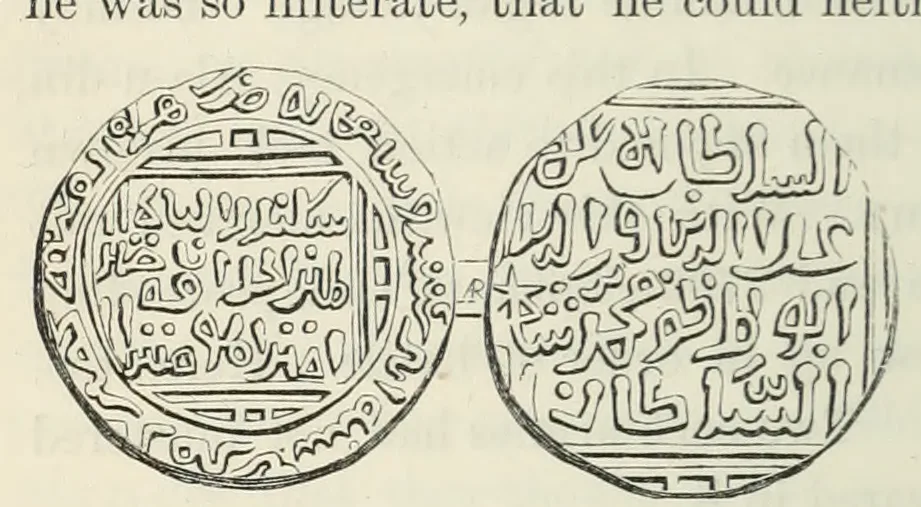
Ala-u-din, in consequence of the success which had attended his arms, became so elated, that he began to entertain some extraordinary projects. One of them was to imitate Mahomet, and become, like him, the founder of a new religion; another, to leave a viceroy in India, and set out, in the manner of Alexander the Great, to conquer the world. While meditating such schemes, he was so illiterate, that he could neither read nor write. The only part which he executed, was to assume the title, and issue coinage impressed with the name of Alexander II. A more practicable course of action was adopted in 1299, when he resolved to attempt new conquests in India. With this view, he sent his brother, Aluf Khan, and the vizier, Noosroot Khan, on an expedition against the Rajah of Runtunbhore, or Rintimbore, a strong fortress in the Rajpoot state of Jeypoor. Noosroot Khan, going too near to the wall, was killed by a stone thrown from an engine. The rajah, Humber Dew, immediately marched out from the fort, and, placing himself at the head of a large army, hastily collected, drove Aluf Khan back with great loss.
Ala-u-din, informed of the defeat, resolved to take the field in person. On the way, he one day engaged in hunting, and having wandered far from the camp, spent the night in a forest, with only a few attendants. Rukn Khan, his nephew and brother-in-law, tempted by the opportunity, thought he could not do better than gain the throne in the same way as Ala-u-din had done, by assassinating his predecessor. Accordingly, having communicated his design to some Moguls, on whose co-operation and fidelity he could rely, he rode up at sunrise to the place where the king was, and discharged a flight of arrows. Two of them took effect, and he fell, apparently dead. Rukn Khan drew his sword to cut off his head; but, as the deed seemed already effectually done, and time was precious, he desisted, and, hastening to the camp, was proclaimed king.
Ala-u-din’s wounds were not mortal; and he was able, after they were bound up, to reach the camp, where, to the astonishment of all, he suddenly appeared on an eminence. Rukn Khan was holding his court when the astounding news reached him, and had only time to mount his horse and flee. A party sent in pursuit, speedily overtook him, and, returning with his head, laid it at the feet of the king, who shortly after continued his march to Rintimbore, and renewed the siege. The place was obstinately defended; and, after standing out a whole year, was only taken at last by stratagem. Humber Dew, his family, and the garrison were put to the sword. It seems that the rajah’s minister had turned traitor, and gone over to the Mahometans with a strong party during the siege. He no doubt anticipated a splendid reward; but met the fate he deserved, when, with all his followers, he was ordered to execution. Ala-u-din justified the sentence by observing, that “those who have betrayed their natural sovereign will never be true to another.”
Ala-u-din, alarmed at the frequency of conspiracies against his life, became anxious to adopt some effectual means of preventing their recurrence. With this view, he summoned his nobles, and commanded them to give their opinions without reserve. They spoke more freely than might have been expected; and mentioned, among other causes of treason, his own inattention to business, and the consequent difficulty of obtaining redress of grievances—the prevalence of intoxication—the power of aristocratical families in connection with the abuse of patronage—and the unequal division of property. The opinion thus given made a deep impression upon him, and he immediately began to act upon it, though in a manner which left as much room for censure as for approbation. He first applied himself to reform the administration of justice, and made strict inquiry into the private as well as public characters of all officials. He next adopted a kind of universal spy system, by which he obtained a knowledge of all that was said or done in families of distinction in the capital, or throughout the country. Crime, also, was so rigorously punished, that robbery and theft, formerly common, became almost unknown; “the traveller slept secure on the highway, and the merchant carried his commodities in safety, from the Sea of Bengal to the Mountains of Cabool, and from Tulingana to Cashmere.” These are Ferishta’s words; but the description must be taken with considerable allowance, as a portion of the territories within these limits was not yet under the jurisdiction of the King of Delhi. To repress drunkenness, he issued an edict similar to that of Bulbun, making the use of wine and strong liquors a capital offence. To prove his sincerity and determination on the subject, he emptied his own cellars into the streets, and was imitated in this respect to such an extent, by all classes of people, that for several days the common sewers ran wine.
As too often happens under despotisms, the radical reforms of Ala-u-din degenerated into unmitigated tyranny and rapacity. As a means of keeping the nobility in check, he enacted that they should be incapable of contracting marriage without the previous consent of the crown, and prohibited them from holding private meetings, or engaging in political discussions. To such a length was this prohibition carried, that no man durst entertain his friends without a written permission from the vizier. His rapacity he gratified by seizing the private property and confiscating the estates of Mussulmans and Hindoos, without distinction, and cutting down the salaries of public offices, till they were filled only by needy men, ready to act as his servile instruments. Nor did he confine himself to officials; for all classes and employments were subjected to minute and vexatious regulations. His views in regard to ecclesiastical matters are evinced by a common saying attributed to him, “that religion had no connection with civil government, but was only the business, or rather the amusement of private life.”
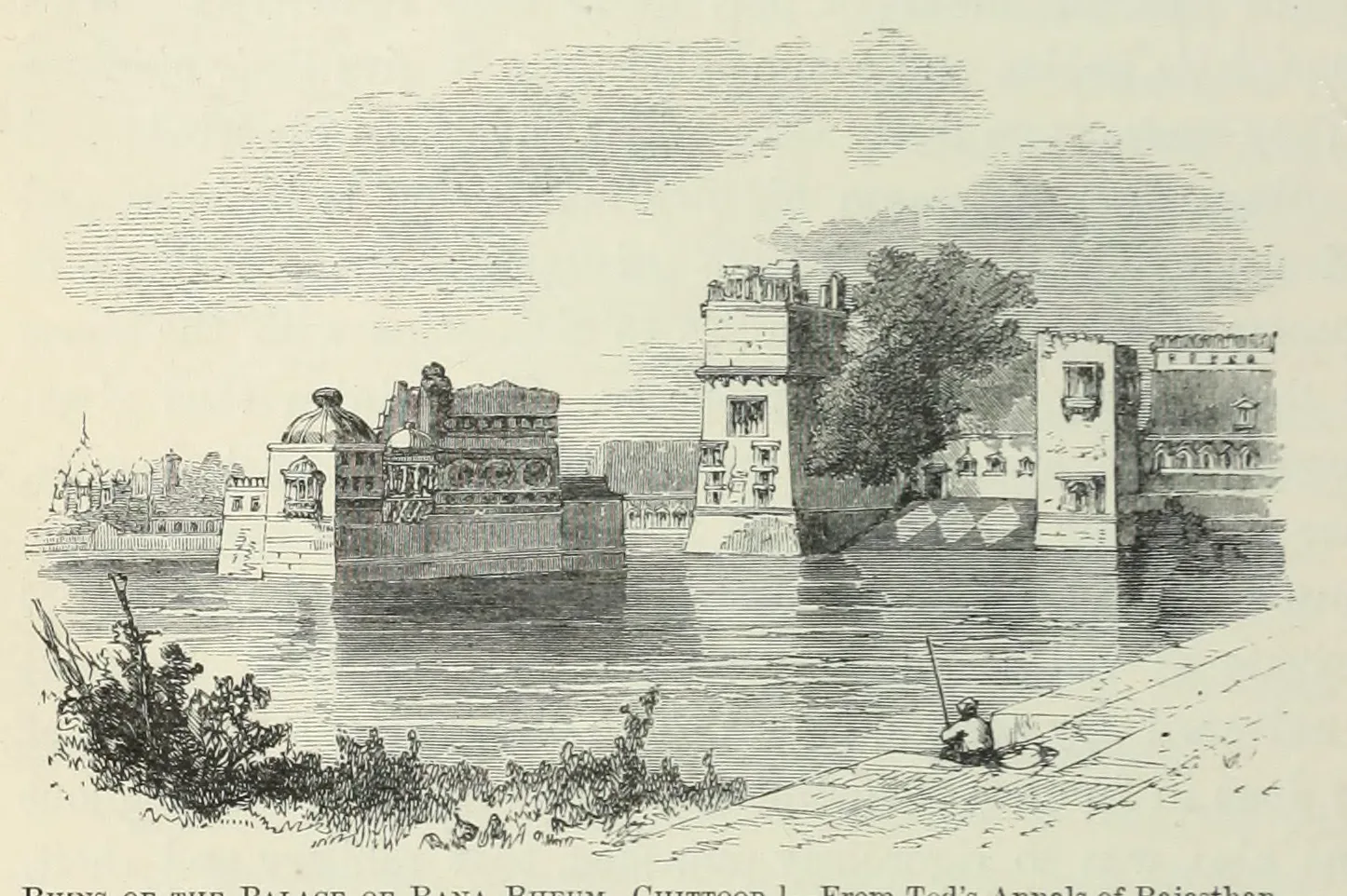
In 1303, Ala-u-din having set out to attack the strong fort of Chittoor, in Rajpootana, Toorghay Khan, a Mogul chief, took advantage of his absence, to prepare a new expedition into Hindoostan. He accordingly entered it at the head of twelve tomans of horse (120,000); and, proceeding directly towards Delhi, encamped on the banks of the Jumna. Ala-u-din, having been made aware of his intention, had hastened home by forced marches, and arrived before him. He was unable, however, to take the open field, as great part of his army had been left behind. All he could do was to entrench himself on a plain beyond the suburbs, where he remained two months; while the Mogul, in possession of the surrounding country, cut off all supplies, and plundered up to the very suburbs of the capital. From some cause never understood, and therefore ascribed to the miraculous intervention of a saint, the Moguls were one night seized with a panic, and never halted till they had regained their own country.
The extreme danger which he thus so singularly escaped, convinced Ala-u-din of the necessity of greatly increasing his forces, but the expense seemed beyond his means. Large as his treasures and revenues were, he found that he could not support an army on the scale proposed, for more than six years. Retrenchment then became the order of the day, and many curious plans were devised for that purpose. His first resolution was, to lower the pay, but as, according to the custom of that period, the soldiers furnished their own horses, arms, and provisions, a reduced pay was impossible, unless these articles also were lowered in price. This, therefore, was the course which Ala-u-din resolved to pursue. By an edict to be strictly enforced throughout the empire, he fixed the price of every article of consumption or use, grain of every kind, horses, asses, camels, oxen and cows, sheep and goats, cloths coarse and fine, ghee or clarified butter, salt, sugar and sugar-candy, onions, and garlic. The treasury even opened a loan to furnish merchants with ready money, with which they could import manufactured goods from the cheaper markets of adjoining countries. It is said that a court favourite proposed, by way of joke, to fix a price for prostitution. “Very well,” said the king, “that shall be fixed also;” and three classes, with fixed prices for each, were actually formed. Such is a sample of Ala-u-din’s scheme of finance.
About 1304, after a new irruption of Moguls had been chastised, Ein-ool-Moolk was sent to make the conquest of Malwah. The rajah met him with 40,000 horse and 100,000 foot; but was defeated, and his capital, Oojein, with other cities, were taken. The news gave so much joy, that the capital was illuminated for seven days. Amid the general rejoicings, there was one poor rajah who sat solitary in his prison, mourning. This was the Rajah of Chittoor, Ray Ruttun Sein, who, ever since the capture of his fort, had been kept in close confinement at Delhi. An insulting offer of liberty had, indeed, been made him. He had a daughter celebrated for her beauty and accomplishments, and Ala-u-din was willing to give him his release, provided she would become an inmate of his harem. It is said that he consented; perhaps he only seemed to consent. Be this as it may, he sent for his daughter, but his family determined sooner to poison her, than subject her to the degradation intended. The princess took the matter into her own hands; and adopted a scheme which, happily, proved successful in both saving her own honour and procuring her father’s freedom.
Every arrangement having been made for the proposed exchange, she wrote to say that on a certain day she would arrive at Delhi with her attendants. A royal passport was immediately sent her, and her cavalcade, proceeding by slow marches, reached the capital as the evening closed. By the king’s special orders the litters were carried directly into the prison, without being subjected to any inspection. The princess was not there, but in her stead several trusty dependants of her family completely armed, who, as soon as they were admitted within the prison, cut down the sentinels, and set the rajah free. He made his escape to the hills, from which he continued to make frequent descents, and avenge himself on the Mahometans for the insults and sufferings which he had endured.
In 1305, the Moguls again, under the leadership of an officer of the name of Eibuk Khan, crossed the Indus, and after ravaging Mooltan, proceeded to Sewalik. Ghazy Beg Toghlak, aware of the route by which they would return, placed himself in ambush near the banks of the Indus, and rushing out suddenly, defeated the invaders with great slaughter. Seeing their return cut off, the survivors had no alternative but to return into the desert. It was the hot season, and, in a short time, out of 57,000 cavalry, and camp followers who outnumbered them, only 3000 remained alive. When taken to Delhi, they were trodden to death by elephants, and a pillar was raised before the Budaoon gate with their skulls. Another invasion shortly after having met with no better success, the Moguls were so discouraged, as well as exhausted, that they not only desisted for many years from entering Hindoostan, but found themselves placed on the defensive, Ghazy Beg Toghlak scarcely allowing a season to pass in which he did not cross to the west bank of the Indus, and plunder the provinces of Cabool, Ghuznee, and Kandahar.
Ala-u-din, now rid of his most formidable enemies, had time to resume his conquests in the Deccan; and with this view despatched Mullik Kafoor, who had been originally purchased as a slave, with an army against Ram Dew, Rajah of Dewghur, who had neglected for three years to pay his stipulated tribute. The army, when it set out, mustered 100,000 horse, and was reinforced on the way by the troops of the governors of Malwah and Gujerat. Mullik Kafoor, after encamping on the frontiers of the Deccan, was so strenuously opposed, that for a time he made little progress, and had nothing to plume himself upon except the capture of a daughter of the beautiful Kowla Devy, who, from being the wife of a Hindoo rajah, as already mentioned, had become the favourite of the Delhi harem. The daughter had a similar fate, for she was on the way to become the bride of a rajah when she was captured; and afterwards, on being brought to Delhi, was married to Khizr Khan, Ala-u-din’s son.
On a second expedition to the Deccan, in 1309, Mullik Kafoor proceeded by way of Dewghur towards Wurungole, a place of great strength. After appearing at Indoor, about ninety miles north of Hyderabad, and causing great consternation among the inhabitants, who had never seen the Mahometans before, he sat down before Wurungole, which made a valiant defence, but was ultimately taken by assault. In the following year he proceeded still further south, reached the Malabar coast, and then, turning inland, continued his victorious career to the frontiers of Mysore. Much of his time was employed in plundering the temples, and the spoil which he brought back to Delhi was enormous. It is curious that silver is not mentioned as forming any part of it. Gold, indeed, seems to have been the precious metal chiefly used at this time in India, as coin, ornament, or plate.
Ala-u-din had now reached the zenith of his power. Though he had been guilty of many crimes, fortune had never ceased to favour him, and his territories had extended on every side, till they assumed the magnitude and splendour of an empire. The period of decline, however, had now arrived. Mullik Kafoor, who possessed his utmost confidence, and used it for the promotion of his treasonable designs, disgusted the nobles, and spread discontent among the people. His own health, too, undermined by intemperance and vicious indulgence, gave way; and his family, to whose training he had never attended, entirely neglected him, and spent their time in revelry. His principal wife, Mullika Jehan, was equally indifferent; and he found himself in the midst of a palace, glittering with gold and jewels, destitute of every domestic comfort. He made his complaints to Mullik Kafoor, who turned them to good account, by insinuating that the queen and her sons Khizr Khan and Shady Khan, together with his brother Aluf Khan, had entered into a conspiracy against his life. The brother was accordingly seized and put to death, while the queen and her sons were imprisoned.
During these domestic calamities, the flames of insurrection burst forth in various quarters. Gujerat took the lead, and defeated the general sent against it with great slaughter. The Rajpoots of Chittoor, rising against their Mahometan officers, hurled them from the walls, and resumed their independence; while Hurpal Dew, the son-in-law of Ram Dew, stirred up the Deccan, and expelled several of the Mahometan garrisons. The tidings made Ala-u-din mad with rage, and so increased his illness, that it took a fatal form, and carried him off in 1316, after a reign of twenty years. It is doubtful if his death was natural, for the subsequent conduct of his worthless favourite, Mullik Kafoor, tends to confirm the suspicion that poison was employed.
The day after the death, Mullik Kafoor produced a will, said to be spurious, by which the late king gave the crown to Prince Oomor Khan, his youngest son, and made Mullik regent during his minority. The young prince, then in his seventh year, was placed upon the throne, while Mullik used him as a tool, and proceeded to carry out his own schemes. One of his first acts was to put out the eyes of Khizr Khan and Shady Khan, and increase the rigour of the sultana’s confinement. Another act, somewhat singular, as he was an eunuch, was to marry the young king’s mother, who had ranked as Ala-u-din’s third wife. He meant, for additional security, to have put out the eyes of Prince Moobarik Khan, the son of the second wife of Ala-u-din, and had even proceeded to the still more atrocious step of sending assassins to murder him. The prince succeeded in buying them off; and a lieutenant of the guards, on hearing of the attempt, proceeded at once with several of his soldiers to Mullik Kafoor’s apartment, and put him, and several of the principal eunuchs in his interest, to death. Prince Moobarik Khan immediately ascended the throne, and Prince Oomor, who had occupied it nominally for three months, was deprived of sight, and imprisoned for life.
Moobarik’s reign, which lasted four years, is a mere tissue of vices and crimes. The officer who had saved his life, and been the main instrument of his elevation, was put to death, merely because it was said that he presumed upon his services. After this most ungrateful act, he began to show some little activity; and, besides sending Ein-ool-Moolk, a general of great abilities, into Gujerat, proceeded in person into the Deccan, and recovered the country of the Mahrattas. On returning, he sent his favourite, Mullik Khosrow, to whom he had given the ensigns of royalty, as far as the Malabar coast. Here he remained about a year, and acquired immense wealth by plunder. His ambition being thus excited, he proposed to make himself sovereign of the Deccan. With this view, he endeavoured to gain over the chief officers of his army. He did not succeed; and a formal charge of treason was made against him to the king, who was, however, so blinded in his favour, that he punished his accusers, and trusted him still more than before.
Moobarik no sooner found himself in quiet possession of Gujerat, the Deccan, and most parts of Northern India, than the little activity which he had begun to display ceased, and he gave himself up to unbounded and shameless excesses. Indecencies which cannot be mentioned, were his daily amusements. Universal discontent and disgust were in consequence excited; but the first attempt on his life was made by his favourite, Khosrow. He had been repeatedly warned that a conspiracy was being hatched, and the proofs of it were so evident, that it had become the common talk. Still, his infatuation was continued; and he was not roused from it till the conspirators were actually on the stairs of the palace. He endeavoured to make his escape by a private passage; but Khosrow, who knew of it, intercepted him, and a deadly struggle took place.
Moobarik, being the stronger of the two, threw Khosrow on the ground, but could not disentangle himself from his grasp, as his hair was twisted in his enemy’s hand. The other conspirators had thus time to come up, and Moobarik’s head was severed from his body by a scimitar.
Khosrow was not allowed long to profit by his crime. He, indeed, ascended the throne in 1321, under the title of Nasir-u-din, but a confederation of the nobility was immediately formed against him. It was headed by Ghazy Beg Toghlak, who had acquired great renown by his expedition against the Moguls. In the battle which ensued, Khosrow was defeated, captured, and slain; and Ghazy Beg Toghlak, with some degree of reluctance, mounted the throne amid universal acclamations. The people saluted him Shah Jehan, “The King of the Universe;” but he assumed the more modest title of Gheias-u-din, “The Aid of Religion.”
Gheias-u-din Toghlak reigned little more than four years. He owed his crown to his fame as a warrior, and secured it by the better fame of a wise and just ruler. The incidents of his reign are few. One of the most important was the siege of Wurungole, which had thrown off the Mahometan yoke, and resumed its independence. Prince Aluf Khan, the king’s eldest son, conducted the siege; the Rajah Luddur Dew the defence. Both sides greatly exerted themselves, and the losses were severe, particularly on the part of the besiegers, who not only failed to make a practicable breach, but, in consequence of the hot winds and severe weather, were seized with a malignant distemper, which daily swept off hundreds. The survivors, completely dispirited, were anxious to return home; and sinister rumours, circulated by the disaffected, caused general consternation, under the influence of which, a number of officers moved off suddenly during the night, with all their followers. Aluf Khan, thus deserted, had no alternative but to raise the siege. In the haste and disorder of his retreat, he was pursued by the enemy with great slaughter. The officers who deserted suffered equally. One died in a Hindoo prison, another was cut off by the Mahrattas, and their whole baggage was captured. One of the rumours which had been circulated, was the death of the king. The authors of the rumour having been discovered, were condemned to be buried alive, the king jocularly but barbarously remarking, “that as they had buried him alive in jest, he would bury them alive in earnest.” A new army having been collected, Aluf Khan renewed the siege of Wurungole, and obliged it to surrender. The news were celebrated with great rejoicings in the new citadel of Delhi, which had just been finished, and had received the name of Toghlakabad.
In 1325 Gheias-u-din Toghlak, after a journey to Bengal to inquire into complaints made against the governors in that quarter, reached Afghanpoor on his return. His son Aluf Khan, who had previously arrived with the nobles of the court to offer their congratulations, had hastily erected a wooden building for his reception. Here a splendid entertainment had been given; and the king, having ordered his equipage, was in the act of quitting the building to continue his journey, when the roof suddenly gave way and crushed him, with five of his attendants, in the ruins. The cause has been variously explained. Most attribute it to accident: some even to design. One author, not satisfied with either explanation, offers one of his own, and asserts, “that the building had been raised by magic, and the instant the magical charm which upheld it was dissolved, it fell.”
Aluf Khan, the late king’s eldest son, succeeded, under the title of Mahomed Toghlak. He is said to have been the most learned, eloquent, and accomplished prince of his time. He was well versed in history, having a memory so retentive that every date or event of which he once read, remained treasured up in it; wrote good poetry; and had made logic, mathematics, astronomy, and medicine his special study. The philosophy of the Greek schools was well known to him. With all these literary accomplishments, he was a skilful and valiant warrior, and thus united qualities so opposite that his contemporaries describe him as one of the wonders of the age. They also extol him for his piety, which he evinced by a careful observance of the rites enjoined, and strict abstinence from drunkenness and other vices forbidden by the Koran. This is the fair side of his character: for it had also its darker features. He was stern, cruel, and vindictive. As Ferishta expresses it, “So little did he hesitate to spill the blood of God’s creatures, that when anything occurred which excited him to that horrid extremity, one might have supposed his object was to extinguish the human species altogether.”
In 1327 the Moguls, who had ceased their incursions for many years, resumed them; and a celebrated leader, called Toormooshreen Khan, belonging to the tribe of Choghtay, made his appearance in Hindoostan at the head of a vast army. Province after province was overrun, and he advanced rapidly towards Delhi. Mahomed Toghlak, unable to meet him in the field, saved his capital by the fatal and humiliating expedient of buying him off by a ransom so large as to be almost equal to the price of his kingdom. The Mogul withdrew by way of Gujerat and Scinde, but plundered both, and carried off an immense number of captives.
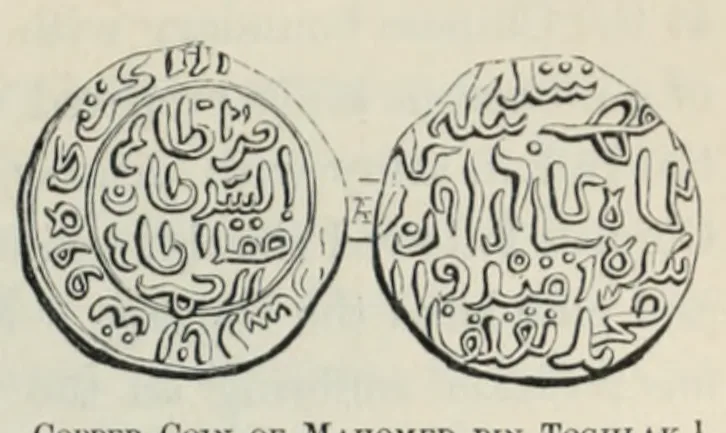
To compensate for what he had thus lost, Mahomed turned his eyes to the Deccan, the greater part of which he is said to have as effectually incorporated with his dominions as the villages in the vicinity of Delhi. All these conquests, however, were destined to be wrested from him in consequence of his grinding taxation, cruelty, and inordinate ambition. So heavy were the duties rigorously levied on the necessaries of life, that the industrious, having no security that they would be permitted to reap the fruits, ceased to labour. The farmers, flying to the woods, lived by rapine; and the fields remaining uncultivated, whole provinces were desolated by famine. The currency, too, was tampered with; and Mahomed struck a copper coin, which, because his name was impressed upon it, he ordered to be received at an extravagant imaginary value. This idea, he is said by Ferishta to have borrowed “from a Chinese custom of issuing paper on the emperor’s credit, with the royal seal appended, in lieu of ready money.” He shrewdly adds:— “The great calamity consequent upon this debasement of the coin, arose from the known instability of the government. Public credit could not long subsist in a state so liable to revolutions as Hindoostan; for how could the people in the remote provinces receive for money the base representative of a treasury that so often changed its master?”
In the midst of the discontent and ruin produced by these wretched financial devices, Mahomed conceived the idea of enriching himself by the conquest of the empire of China. As a first step to the realization of this idea, he despatched his nephew Khosrow Mullik, at the head of 100,000 horse, to subdue Nepaul, and the mountainous region on both sides of the Himalaya, as far as the Chinese
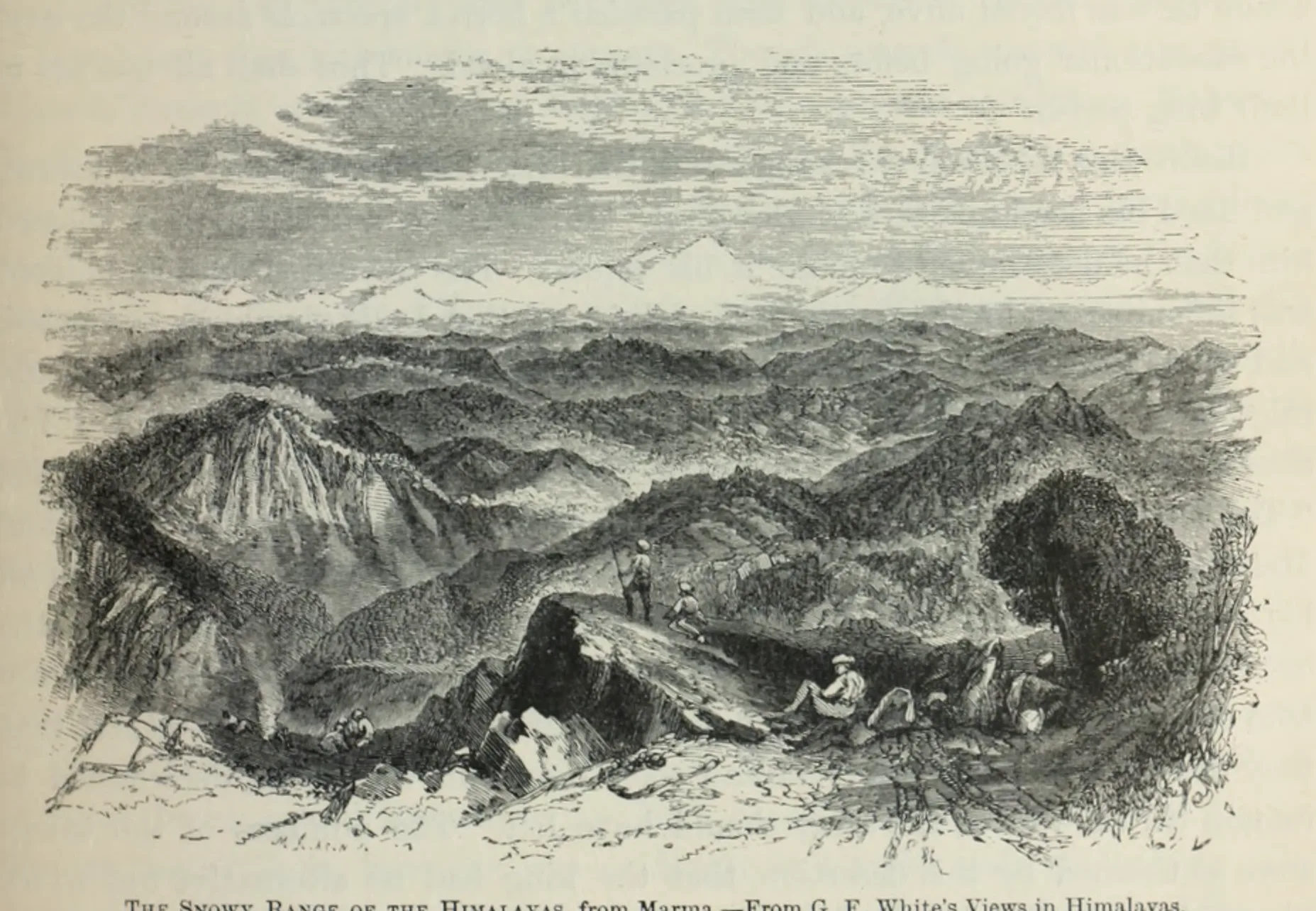
frontiers. This done, he was to follow in person. In vain did his more sagacious and faithful counsellors assure him that the whole scheme was visionary. He had made up his mind, and was not to be dissuaded.
Khosrow Mullik made his way with great difficulty across the mountains, building forts as he proceeded, in order to secure the road. On arriving, in 1337, at the Chinese boundary with forces fearfully reduced, he found himself in front of a numerous army prepared to oppose his further progress. The sight struck the Indian army with dismay, and a precipitate retreat was commenced. The Chinese followed closely, while the mountaineers occupied the passes in the rear and plundered the baggage. For seven days the Indians remained in this perilous position, suffering all the horrors of famine. At length the rain began to fall in torrents. The first effect was to oblige the Chinese to retire to a greater distance, and Khosrow began to conceive hopes of making good his retreat. He was soon undeceived. The low grounds became inundated, while the mountains continued impervious. The result is easily told. The whole army melted away, and scarcely a man returned to relate the particulars.
One of the king’s nephews, who was called Khoorshasip, and held a government in the Deccan, was tempted by the general discontent which prevailed to aspire to the throne, and in 1338 openly raised the standard of revolt. He at first gained some advantages, but was afterwards captured and carried to Delhi, where he was flayed alive, and then paraded a horrid spectacle around the city, the executioner going before and proclaiming aloud, “ Thus shall all traitors to their king perish.”
Before this rebellion was suppressed, the king had taken the field in person, and fixed his head-quarters at Dewghur. Its situation and strength so pleased him that he determined to make it his capital. His resolution once announced was inflexible, and orders were forthwith issued that Delhi should be evacuated, and all its inhabitants, men, women, and children, with all their property, should migrate to Dewghur, the name of which was changed to Dowletabad. The abandonment of Delhi, which was styled, in the hyperbolical style of the East, “The Envy of the World,” was productive of great misery and discontent, and Mahomed began to feel that the change of capital was an exploit which even all his energy and despotism could hardly accomplish. Having been led in the course of an expedition to the proximity of the old capital, those of his army who originally belonged to it, were seized with such a longing to return, that they deserted in great numbers and took refuge in the woods, determined to remain till the rest of the army should have left. The numbers of the troops were so thinned by this desertion, that the king had no alternative but to fix his residence at Delhi, and thus lure the deserters back. His original purpose, however, was not abandoned; and at the end of two years he carried off the whole of the inhabitants a second time to the Deccan, “leaving the noble metropolis of Delhi a resort for owls, and a dwelling-place for the beasts of the desert.” Before he left, he was guilty of barbarities which are almost incredible. On one occasion, having set out with an immense hunting party, on arriving at the district of Behram, he made the startling announcement that he had come to hunt not beasts but men, and began to massacre the inhabitants. He completed the barbarity by carrying back some thousands of the heads of the slain to Delhi, and hanging them over the city walls.
These atrocities were more than human nature could endure, and rebellion, on a greater or less scale, broke out in every quarter—in Bengal, on the Malabar coast, and even in the new capital, Dowletabad. These two last rebellions seem to have somewhat cooled the king’s partiality for the Deccan; and free permission was given to those whom he had forced to migrate, to return to Delhi. Thousands made the attempt; but a general famine was then raging, and while many perished by the way, many more reached their beloved Delhi, only to die in it. The most formidable insurrection of all broke out in the south. It was the result of a confederacy formed for the express purpose of extirpating the Mahometans from the Deccan. The principal leaders were Krishn Naig, son of Luddur Dew, who lived near Wurungole, and Belal Dew, Rajah of the Carnatic. So extensive and so successful was the confederacy, that, in a short time, Dowletabad was the only place within the Deccan which the Mahometans could call their own. Ultimately, however, a considerable portion of the lost territory was recovered, and the whole Deccan was divided, as before, into four Mahometan provinces. Though scarcely a month now passed without a revolt, and everything seemed ripe for a general revolution, Mahomed Toghlak kept his throne, and at last descended to the grave by a death which was not violent, and yet cannot well be called natural. He had ordered a large number of boats to be collected at Tatta, and proceeded thither across the Indus, to chastise the Soomara Prince of Scinde, who had given protection to Mullik Toghan, when heading a formidable revolt of Mogul mercenaries in Gujerat. When within sixty miles of Tatta, he was seized with fever, attributed by his physicians to a surfeit of fish. The symptoms were favourable, but his restless spirit would not allow him to remain to complete his recovery, and a fatal relapse ensued. His death took place in 1351, after a reign of twenty-seven years.
After a short struggle, in which a reputed son of the late king, a mere child, was put forward and immediately set aside, his cousin Feroze, known by the title of Feroze Toghlak, mounted the throne. Considering the troubled state of the country, two of the most remarkable facts of his reign are, its length of thirty-eight years, and its termination, by a peaceful death, at the age of ninety. The empire of Delhi, however, was evidently in a rapid state of decline. The Deccan could hardly be said to be incorporated with it; and Bengal was so completely dissevered, that in 1356 Feroze consented to receive an ambassador from its king, with proposals of peace; and thus virtually, if not formally, acknowledged it as an independent kingdom. Both Bengal and the Deccan, however, still continued to pay a small tribute. Though Feroze does not figure as a warrior, he obtained a high name for wise legislation, and a large number of public works, in which, while magnificence was not forgotten, utility was specially consulted. One of these works, in which 50,000 labourers were employed, was a canal, intended to connect the Soorsooty or Soorsa, a small tributary of the Sutlej, with a small stream, called the Sulima or Khanpoor, and thereby obtain a perennial stream to flow through Sirhind and Munsurpoor. The canal, if ever completed, no longer exists; but it deserves notice for the remarkable fact, that in the digging of it, about five centuries ago, fossil remains of a gigantic size were discovered and attracted much attention. It is not easy to say to what animals they belonged; but Ferishta, adopting the opinion which appears to have been formed at the time of the discovery, says they were the bones of elephants and men; and adds, “the bones of the human fore arm measured three gaz (5 feet 2 inches); some of the bones were petrified, and some retained the appearance of bone.”
Among the other works of Feroze are enumerated—40 mosques, 30 colleges, 20 palaces, 100 hospitals, 100 caravansaries, 100 public baths, 150 bridges, 50 dams across rivers, and 30 reservoirs or lakes for irrigation. He appears to have been sufficiently conscious of his good deeds; and rather pharisaically caused some of them to be inscribed on the mosque of Ferozabad, a city which he had built in the vicinity of Delhi. The following may be taken as a sample: —“It has been usual in former times to spill Mahometan blood on trivial occasions; and, for small crimes, to mutilate and torture them, by cutting off the hands and feet, and noses and ears, by putting out eyes, by pulverizing the bones of the living criminal with mallets, by burning the body with fire, by crucifixion, and by nailing the hands and feet, by flaying alive, by the operation of hamstringing, and by cutting human beings to pieces. God, in his infinite goodness, having been pleased to confer on me the power, has also inspired me with the disposition to put an end to these practices.”
Gheias-u-din, whom his grandfather Feroze had associated with him in the government a year before he died, now became sole sovereign, but proved utterly unworthy of reigning, and within six months was assassinated. A contest for the succession took place between Abubekr, a grandson, and Mahomed, a son of the late Feroze. The former had been placed on the throne by the assassins of Gheias-u-din; but in the course of eighteen months the latter displaced him, and assumed the title of Nasir-u-din Mahomed Toghlak. He died in 1394, after a reign of six years and seven months, entirely barren of great events, and fruitful only in intestine dissensions; and was succeeded by his son Hoomayoon, who assumed the name of Sikundur, and died suddenly, in the course of forty-five days. These constant changes threw everything into disorder, and a kind of anarchy ensued; each chief who thought himself strong enough making no scruple of throwing off his allegiance, and declaring himself independent. In Delhi alone there were two parties, each with a separate king, the one occupying Delhi proper, and the other Ferozabad. A third party, occupying the citadel, professed neutrality, but this only meant that they were endeavouring to hold the balance, with the view of ultimately selling themselves to the most advantage. Civil war thus raged in the very heart of the city, and the streets frequently ran with blood.
During this confusion, intelligence arrived, in 1396, that Prince Peer Mahomed Jehangir, grandson of the celebrated Timour or Tamerlane, had crossed the Indus by a bridge of boats, and laid siege to Ooch. The governor of Mooltan was preparing for the relief of it when Peer Mahomed, anticipating his movements, arrived, just in time to surprise the Mooltanies immediately after they had crossed the Beas. Their show of resistance was useless; and most of those who escaped the sword perished in the river. A few made good their retreat to Mooltan, but the victor was close at their heels, and the governor, Sarung Khan, had barely time to retire into the fort. After a siege of six months, want of provisions obliged him to surrender at discretion. The presence of such an enemy as Peer Mahomed Jehangir was a dire calamity. How fearfully must the calamity have been increased when he proved to be only the forerunner of his grandfather. The event is of sufficient importance to demand a new chapter.
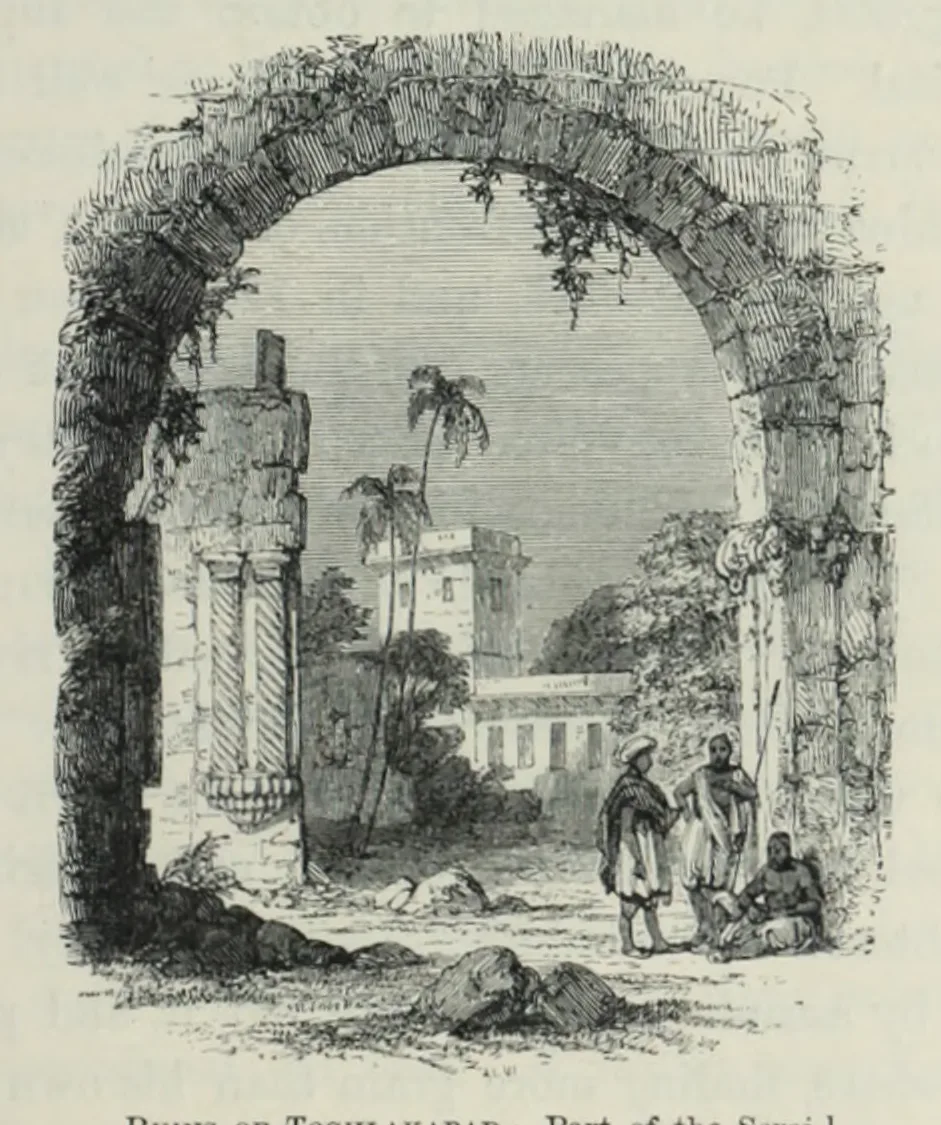
Notes
- 1. The Kutb Minar is a column of victory, built by Kutb-u-din, to celebrate his conquest of the Hindoos. It is 48 feet 4 inches diameter at the base, and when measured in 1794, was 242 feet in height. The base, which is circular, forms a polygon of 27 sides, and there are four balconies running round the pillar.
- 2. Silver coin of Ghenghis Khan; weight, 47 grains. From Thomas’s Coins of the Kings of Ghuzni.
- 1. The suits of mail are in the Meyrick Collection at Goodrich Court, as also the battle-axe, paiscash, and khanjar in the foreground. The rest of the weapons are from Langles, Monumens Anciens et Modernes de l’Hindoustan, taken from an ancient MS. of the Ayeen Akbery.
- 1. The Khiljies were in former times by far the most celebrated of the Afghans; and though now holding only the second rank among the races of their country, they still fondly cherish a remembrance of [p. 74] their former greatness, ere the Dooraunee dynasty succeeded in wresting from them the sovereignty. In the beginning of last century this tribe alone conquered all Persia. After a hard struggle, the third Khilji King of Persia was expelled by Nadir Shah. The territory occupied by them is situated in the north of Afghanistan, and forms a parallelogram of about 180 miles in length, by 85 miles in breadth. It is comprised more especially in the valley of the Cabool River, from its source to the town of Jelalabad, and also in the valleys which descend from the Hindoo Koosh.
- 1. Weight, 170 grs. On obverse—The most mighty sovereign, Ala-ud-dunia-wa-ud-din, Abul Muzafar Mahomed Shah, the Sultan. On reverse, area—Sekunder the second, right hand of the khalifat, supporter of the commander of the faithful. On margin—This silver (was) struck at the capital, Delhi, in the year 712.
- 1. Chittoor was also taken by Akber (1567); by Azim Ushaun, son of Aurungzebe (1680), by whom it was plundered, and (1790), by Sindia, from Bheum Singh, the rebellious subject of the Rana of Odeypoor.
- 1. On the obverse—Struck as a piece of fifty kanis, in the time of the servant, hopeful (of Divine mercy), Mahomed Toghlak. On the reverse—He who obeys the king, truly he obeys the Merciful (God). 138 grs. 732 A H, Dowletabad.—Thomas’s Coins of the Patan Sultans of Hindustan.
- 1. Toghlakabad was named after its founder, the Emperor Gheias-u-din Toghlak, who died A.D. 1325. A few miserable huts contain all its present inhabitants; but the rude, massy, and stupendous ruins of its walls, palaces, and subterranean apartments still attract the notice of travellers.