TIMOUR, or Timour Beg, usually called by the Asiatics Ameer Teimoor, and by Europeans Tamerlane or Tamerlan, evidently a corruption for Timour Leng, or Lame Timour, an epithet applied to him on account of a certain degree of lameness, was born about 1336, in a village in the vicinity of Samarcand. According to some, he was only the son of a herdsman; but a more probable account is, that he was the son or grandson of a Tartar or Mogul chief. He himself traced his descent from Ghenghis Khan. On the downfall of the Mogul dynasty of Dschaggatai, he managed to obtain the supremacy, and made Samarcand his capital. Possessing the ambition as well as the talents of a conqueror, he had overrun Persia, and extended his dominions over Central Asia, from the wall of China west to the frontiers of Europe, and even beyond, to Moscow. He was not yet satisfied; and in 1398, when his age must have exceeded sixty, he made his appearance on the west bank of the Indus, at the head of a mighty host. The convulsed state of the country promising an easy conquest, and the immense plunder which would necessarily follow, were his great inducements. His grandson had, as we have seen, been sent before, apparently to feel the way. He himself now crossed the river, and commenced a course of almost unparalleled massacre and devastation. Having arrived at the junction of the Chenab and Ravee, where the town and strong fort of Tulumba are situated, he crossed by a bridge; and, entering the town, plundered it, and slaughtered the inhabitants without mercy. The fort was too strong to be taken by assault. He therefore left it, and proceeded to a town called Shahnowaz, where, finding more grain than his own troops required, he caused the rest to be burned. On crossing the Beas, he entered a rich and plentiful country. Meanwhile, his grandson, Peer Mahomed Jehangir, had met with more obstruction. After taking Mooltan, the rainy season commenced, and so many of the cavalry encamped in the open country were destroyed, that he was under the necessity of lodging his whole army within the walls. Here he became so completely hemmed in and cut off from supplies, that he was in the greatest danger of losing his whole army, when Tamerlane, after sending forward a detachment of 30,000 select horse, joined him with his whole army.
Tamerlane now marched to Bhatneer, which was crowded with people flying in terror from the surrounding districts. On his approach half of them were driven out of the town, and obliged to take shelter under the walls. After a short resistance from the governor, he forced his entrance, and committed so many cruelties that the garrison, seeing the fate which awaited them, killed their wives and children in despair, set fire to the place, and, rushing out, sold their lives as dearly as they could, by killing some thousands of the Moguls. Tamerlane, in revenge, laid Bhatneer in ashes, after causing every soul in it to be massacred. Soorsooty, Futtehabad, Rajpoor, and other towns, were subjected to similar barbarities. These, however, were merely preludes to a more general extermination.
Tamerlane's great object was Delhi, towards which he kept steadily advancing. Having at length advanced opposite to it, he crossed the river with only 700 horse, to reconnoitre. Mahmood Toghlak, then the pageant King of Delhi, and his minister, Mulloo Yekbal Khan, tempted by the smallness of his attendants, sallied out with 5000 horse, and twenty-seven elephants. Notwithstanding their superiority in numbers, the Delhi troops were repulsed. A vast number of prisoners were in the Mogul camp, and some of them, on seeing Tamerlane attacked at a disadvantage, could not refrain from expressing their joy. The circumstance being reported to this cruel barbarian, he took his revenge by ordering that all the prisoners above the age of fifteen should be put to the sword. In this horrid massacre, nearly 100,000 men, almost all Hindoos, are said to have perished.
Having now forded the river with his whole army, Tamerlane encamped on the plain of Ferozabad. The King of Delhi and his minister again risked the encounter, but with the same result as before. The elephants, on which they mainly trusted, being, at the first charge, deprived of most of their drivers, turned back, and spread confusion in their own ranks. Tamerlane gave no time to rally; and, following the fugitives up to the very gates of Delhi, there fixed his head-quarters. Consternation now spread over the city; and the king, instead of attempting to allay it, thought only of his own safety, and fled in the direction of Gujerat. All idea of resistance being abandoned, the chief men of the city, crowding to the camp, made their submission, and Tamerlane was formally proclaimed emperor. A heavy contribution having been ordered, some difficulty was found in levying it. On this pretext, a body of soldiers were sent into the city, and immediately commenced an indiscriminate plunder. It had continued for five days before Tamerlane was even aware of it. He had remained outside in the camp to celebrate a festival in honour of his victory, and the first intimation of the proceedings in Delhi was given him when he saw it in flames; for the Hindoos, in despair, had murdered their wives and children, set fire to their houses, and then rushed out to perish by the sword. A general massacre ensued, and some streets became impassable from heaps of dead. The amount of plunder was beyond calculation. Tamerlane remained at Delhi fifteen days, and then commenced his return home, carrying with him, as part of his own share of the spoil, 120 elephants, twelve rhinoceroses, and a great number of curious animals belonging to a menagerie which Feroze Toghlak had formed. He is also said to have been so much struck with admiration at the mosque which that monarch had built, and on the walls of which he had inscribed the history of his reign, that he took back the architects and masons to Samarcand to build one on a similar plan.
He first halted at Paniput, and sent a detachment to besiege Meerut. The garrison, confiding in its strength, ridiculed the very idea of capture, and insultingly reminded the officer of the defeat which another Mogul general had sustained before it. The officer, without attempting anything, returned to Tamerlane, who forthwith appeared in person, and commenced running mines with such rapidity that his ultimate success was certain. The process, however, seemed too slow to his Moguls, who, having filled up the ditch, applied their scaling-ladders and grappling-irons to the walls, carried the place by assault, and put every soul within it to the sword. The mines employed by Tamerlane in this and many other sieges, were not intended to be filled with gunpowder, as in modern warfare, but merely to sap the foundations of the walls, which, while the process was being carried on, were supported by wooden frames. When the process was finished, the wooden frames were set on fire, and the walls, thus left without support, necessarily tumbled. In this instance the Mogul conqueror, to wreak his vengeance more effectually, completed his mines after the place had been taken without them, and thus entirely destroyed its defences.
In continuing his march, Tamerlane skirted the mountains of Sewalik, crossed the Ganges, and laid waste the whole country with fire and sword along its banks up to the point where it bursts from its rocky gorges. He afterwards repassed the river, and ultimately reached Samarcand by way of Cabool. Before he left, a Gukkur chief, taking advantage of his absence, got possession of Lahore, and refused to acknowledge his authority. He therefore sent a detachment against that city, which fell in a few days. While he halted at Jamoo, Khizr Khan, who had submitted to him and become a favourite, was appointed by him viceroy of Mooltan, Lahore, and Depalpoor.
For two months after Tamerlane’s departure, Delhi was a prey to anarchy, and was at the same time ravaged by pestilence and famine. After a series of sanguinary struggles, Mulloo Yekbal Khan, the old Mahometan vizier, gained the ascendency, and something like regular government was re-established. This return to order induced many of the inhabitants who had fled to return; and the city, which had recently been a smoking ruin, began to recover. In addition to a small district around the city, Mulloo Yekbal obtained possession of the Doab, or the tract lying between the Jumna and Ganges. This was now all that remained of what had recently been a great empire. All the other provinces were seized by the governors, who continued to hold them in their own names as independent kingdoms.
Mulloo Yekbal Khan was not contented that Delhi should be thus shorn of its greatness. He added considerably to its territory by successful attacks on neighbouring governors; and made affairs to assume an appearance so promising that the ex-king, Mahmood Toghlak, who had found an asylum first at Gujerat, and then at Malwah, was induced, by his invitation, to return in 1401. Mulloo Yekbal, however, still continued to retain the sovereign power in his own hands; and Mahmood, feeling ill at ease, was provided for by being put in possession of Canouge. Mulloo Yekbal, having thus got quit of him, appears soon to have forgotten all the deference which he used to show him; for, in 1404, after a victory which filled him with ambitious longings, he did not hesitate to lead an army against his old sovereign. Mahmood shut himself up in Canouge; and Mulloo, unable to reduce it, raised the siege. He shortly after turned his arms against Khizr Khan, but his good fortune forsook him, and he was defeated and slain in 1405.
On this event, the officers who had been left in Delhi gave an invitation to Mahmood Toghlak, who, leaving Canouge, came with a small retinue, and was re-seated on his throne. Mahmood had neither the sense nor courage necessary to maintain his positions; and after various vicissitudes, shut himself up in Ferozabad, where he was besieged by Khizr Khan, who was, however, obliged to raise the siege from want of forage and provisions. The release was only temporary, for having obtained supplies, he immediately returned. Meanwhile, Mahmood had removed to Siry, the old citadel of Delhi. A similar cause obliged Khizr Khan to retire as before; but the deliverance proved as fatal to Mahmood as the capture of the citadel would have been. The transition from fear to joy, and immoderate exertion during a hunting excursion, brought on a fever, of which he died in 1412. With him ended the race of Toorks, the adopted slaves of Sultan Shahab-u-din Ghoory. His inglorious and disastrous reign had lasted, with interruptions, twenty years. The nobles immediately placed an Afghan, of the name of Dowlut Khan Lody, on the throne. He held it nominally for fifteen months, and was then deposed by Khizr Khan, in 1416.
Khizr Khan had gained the favour of Tamerlane, and been appointed, as already mentioned, governor of Lahore, Mooltan, and Depalpoor. Hence, though on the deposition of Dowlut Khan Lody, he assumed the reins of government at Delhi, he refused to appropriate regal titles, affecting to regard himself as only the deputy of Tamerlane, in whose name money was coined, and the Khootba was read. Even after Tamerlane's death, the same policy induced Khizr Khan to acknowledge the supremacy of his successor, Shahrokh Mirza, and even send tribute occasionally to Samarcand. His reign or regency, which was terminated by his death in 1421, after it had lasted little more than seven years, presents few important events; but his conduct contrasts favourably with that of his predecessors, and the inhabitants of Delhi showed their respect for his memory by wearing black, their garb of mourning, during three days.
Moobarik, Khizr Khan’s eldest son, succeeded him, in virtue of a nomination by his father, when he felt his end approaching. His first military operations were carried on in the Punjab, where he succeeded, but not without difficulty, in suppressing a serious insurrection. The rebel, Jusrut Gukkur, though repeatedly defeated, managed always to escape, and to appear unexpectedly in some other quarter as strong as ever. He even succeeded in creating a diversion in his favour by forming an alliance with Ameer Sheikh Ally, a Mogul chief in the service of Shahrokh Mirza, governor of Cabool, and inducing him to make an incursion into Scinde. The King of Malwah, taking advantage of these disturbances, invested Gwalior, in the hope of adding it to his dominions. Moobarik’s attention was thus fully occupied; and his whole reign of thirteen years furnishes nothing more important than a succession of revolts. His temper, said to have been so equable that he never spoke in anger during his life, was probably ill fitted for the times in which he lived. A conspiracy, in which some of his own family were implicated, was formed against him, and he was basely assassinated in the new city of Delhi, while at worship in a mosque.
Prince Mahomed, Moobarik’s son, though not one of the actual perpetrators of his father’s murder, was perfectly cognizant of it, and endeavoured to turn it to account by immediately mounting the throne. His first act was to proclaim his own shame and guilt, by rewarding the conspirators. The appointment of the ringleader, Survur-ool-Moolk, to the office of vizier, produced general indignation; and a confederacy was formed, which soon broke out into open rebellion. The malcontents marched at once upon Delhi; and Mahomed, seeing that his vizier was chiefly aimed at, thought he might save himself by abandoning him to his fate. The vizier, however, was too crafty to be thus caught; and no sooner learned that the king was in communication with his enemies, than he formed a band of assassins, and broke into the palace in order to murder his master. He, too, had been put on his guard, and had laid a trap for the vizier, who fell into it and was cut to pieces.
Mahomed, now apparently on good terms with the confederates who had laid siege to Delhi, thought himself safe; and, throwing off all restraint, spent his time in sensual indulgence. The administration of affairs, thus neglected, fell into disorder; discontent prevailed, and an insurrection broke out in Mooltan among the Afghans. Bheilole Lody, who had placed himself at their head, had previously usurped the government of Sirhind, and now made himself master of Lahore, Depalpoor, and all the country as far south as Paniput. Bheilole, unable to cope with the royal army which was sent against him, was driven into the hills, and, abandoning open force, determined to try the effect of intrigue. This he managed so dexterously that the king, on his suggestion, put one of his ablest and most faithful servants to death ; and then, in order to suppress the disturbances which this imbecile and iniquitous act had produced, had recourse to Bheilole for assistance. The crafty Afghan at once obeyed the summons, and marched to Delhi with 20,000 horsemen arrayed in armour. Though this reinforcement made the royal army superior to that of the insurgents, he refused to take the field, and, like a coward, shut himself up in his palace. The brunt of the action which ensued fell upon Bheilole, who acquitted himself manfully ; and, in consequence, rose into such favour that Mahomed adopted him as his son. Matters seemed now ripe for the execution of the schemes which Bheilole had all along contemplated. He accordingly strengthened his army by numerous bodies of Afghans, and, throwing off the mask, marched upon Delhi. The siege which he commenced proved more formidable than he had anticipated, and he determined to wait a little longer. Meantime the weak and dissolute Mahomed was permitted, notwithstanding his crime of parricide, to die a natural death, in 1445, after a reign of twelve years.
Ala-u-din, Mahomed’s son, mounted the throne, and immediately received the homage of all the chiefs except Bheilole, who was probably not unwilling to provoke a contest in which he felt confident that he would prove the victor. Ala-u-din was too powerless or too mean-spirited to resent the insult, and soon fell into general contempt, the people not hesitating to say openly that he was a weaker man than his father. The kingdom of Delhi now possessed scarcely a shadow of its former greatness ; for the whole that could be considered as properly belonging to it was the city of Delhi and a small tract in its vicinity. All the rest of Hindoostan was broken up into separate principalities. The Deccan, Gujerat, Malwah, Jounpoor, and Bengal had each its independent king ; while all the other territories, though nominally subordinate to Delhi, were in the hands of chiefs equally independent. At the head of these was, as has been already seen, Bheilole Lody, whose designs on the capital had been repeatedly declared by overt acts, and were only postponed to a fitting opportunity. This opportunity soon arrived.
Ala-u-din had early taken a great fancy for Budaoon, where he had spent some time in building pleasure-houses and laying out gardens. He thought that its air agreed better with his health than Delhi, and wished to make it his residence. The remonstrances of his vizier, who showed him the danger, dissuaded him for a time ; but crafty courtiers, having succeeded in bringing the vizier into disgrace, he immediately proceeded to follow out his own wishes, regardless of the consequences, and set off to enjoy himself at Budaoon, leaving a deputy to act for him at Delhi. The vizier, though disgraced, was still alive. The very thought made him uneasy ; and some of his counsellors, taking advantage of the feeling, persuaded him that his best policy would be to take the vizier’s life. The order to that effect was accordingly given ; but the vizier was put on his guard, and made his escape to Delhi, where he had influence enough to obtain possession of all the royal effects. The king was urged to hasten back to his capital and strike a decisive blow, but he only made frivolous excuses for delay. One day it was the weather, which made it disagreeable to travel ; another day it was the stars, which pronounced it unlucky. The vizier made better use of the time, and invited Bheilole Lody to assume the government. Bheilole set out at once, but gave a new specimen of his Afghan craft by writing to Ala-u-din that his only object in going was to expel the vizier. This was too much even for the imbecile monarch to believe ; and he voluntarily took the step to which he saw he would soon be forced, by formally abdicating the throne in Bheilole's favour, on condition of being permitted to reside quietly at Budaoon. Here the remainder of his life, extending to nearly twenty-eight years, was spent. He had previously reigned seven years at Delhi.
Bheilole, the founder of the Lody Afghan dynasty, began his reign in 1450. The circumstances of his birth were extraordinary, and being interpreted to portend his future greatness, very probably contributed to realize it. Before he was born his mother was killed by the fall of her house. Her husband, Mullik Kaly, governor of a district in Sirhind, immediately ordered her body to be opened, and, strange to say, the life of the infant was saved. His uncle, Mullik Sultan, who had been appointed governor of Sirhind with the title of Islam Khan, rewarded his valour by giving him his daughter in marriage, and making him his heir, to the exclusion of his own full-grown sons. Islam Khan had usually retained 12,000 Afghans, mostly of his own tribe, in his service. The greater part of these joined Bheilole. The King of Delhi had his suspicions roused as to the ultimate objects of the Afghans ; and, by inducing Jusrut Gukkur to take the field against them, drove them to the hills. Here Bheilole headed them, made many predatory incursions, and, by the liberality with which he divided the spoil, attracted great numbers to his standard. The vizier, Hissam Khan, whom the king sent against him, was signally defeated. The result, as has been already related, was that Bheilole found means to ingratiate himself with the king, was adopted as his son, and at last succeeded in displacing Moobarik, who retired into private life, and went to reside, despised or forgotten, at his favourite residence of Budaoon.
After Bheilole succeeded, he continued for a time to treat the vizier, to whom he was mainly indebted for his elevation, with great respect ; but afterwards, thinking he presumed too much on what he had done, he caused some of his servants to seize him. The vizier, though not aware of the offence which he had given, expected nothing but death ; but Bheilole told him that, in gratitude for past services, he had a security for his life ; the only thing necessary now was, that he should cease to intermeddle with public affairs, and spend the rest of his life in retirement. In 1451, during an absence of Bheilole in Mooltan, a formidable insurrection broke out, headed by Mahmood Shah Shurky, King of Jounpoor, who advanced with a large army, and laid siege to Delhi. Bheilole returned with precipitation; and, by putting down the rebellion, placed his power on a firmer basis than before.
The kingdom of Delhi, contracted in extent as it then was, could not satisfy the ambition of Bheilole, who no sooner found himself firmly seated than he began to think of new conquests. He was not very successful; for he was obliged to make a treaty which bound him to limit his possession to the territories which had belonged to Delhi in the time of Moobarik. His most formidable enemies were the different members of the Shurky family. Among them, Hoossein Shah Shurky took the lead. At one time he advanced against Delhi with 100,000 horse and 1000 elephants; at another he obliged him to make a treaty, by which he relinquished all right to any territory east of the Ganges. Ultimately, however, Bheilole gained so many decided advantages, that a great part of the Shurky territory was incorporated with his own.
Bheilole, when he mounted the throne, had a family of nine sons. As he advanced in years, and felt the cares of government weighing heavily upon him, he adopted the very injudicious measure of partitioning his territory among them. In this way the amalgamation of the conquests, which had been the great object of his life, was completely frustrated. Shortly after making this arrangement he was seized with illness, and died in 1488, after a reign of nearly thirty-nine years.
He had previously declared that his son Nizam Khan, to whom he had allotted Delhi and several districts in the Doab, should be his successor. He was not the lawful heir; for the eldest son of Bheilole, though dead, had left a son, whose title, according to the ordinary rules of succession, was certainly preferable. Nizam Khan owed this preference to the influence of his mother, the daughter of a goldsmith, whose beauty had given her the first place in the harem. After a short contest, all opposition to the appointment ceased, and he assumed the title of Sikundur. His reign, which lasted twenty-eight years, was peaceful, at least compared with that of his predecessors; and he is described as remarkable alike for the comeliness of his person and the excellence of his character. In general, justice was administered impartially, but some remarkable instances of intolerance have left a stain on his reputation. One of these deserves to be recorded.
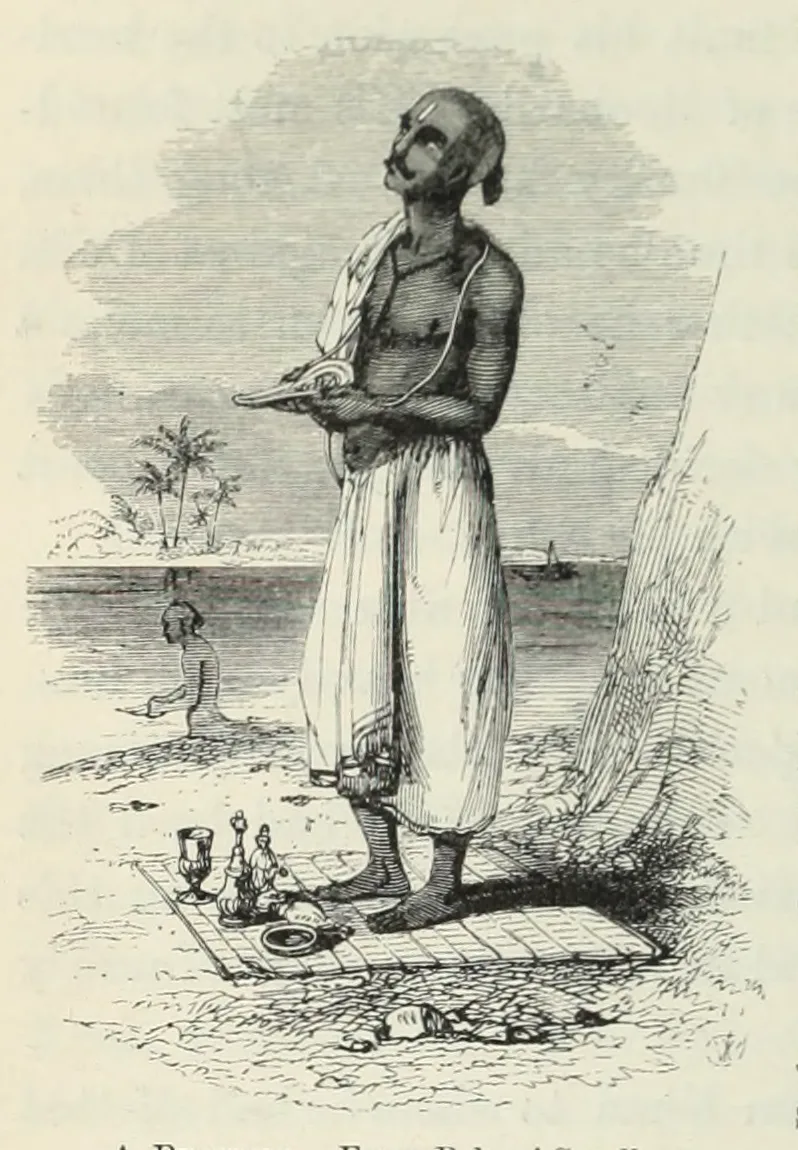
About 1499, a Brahmin of the name of Boodhun, an inhabitant of a village near Lucknow, being upbraided by some Mahometans on account of his faith, defended himself by maintaining “that the religions, both of the Moslems and Hindoos, if acted on with sincerity, were equally acceptable to God.” He argued the point so ingeniously that considerable attention was excited, and the subject was publicly discussed before the cazis of Lucknow. These judges did not agree in their conclusion; and the governor, as the best way of settling the matter, sent the Brahmin and all the other parties to Sumbuhl, where the court then happened to be. The king, who was well informed on religious subjects, and was fond of hearing them discussed, ordered the most learned of his subjects to assemble and debate with the Brahmin. At the very outset of the proceeding there was thus a considerable want of fairness, as the Brahmin was unsupported, while no fewer than nine of the ablest Mahometan doctors were arrayed against him. The result was that the chosen nine found themselves perfectly in the right, and the Brahmin altogether in the wrong. As a natural consequence, they were rewarded with gifts; and it would have been well if these had satisfied them, and they had allowed their opponent to go his way. A very different course was followed. The Brahmin, in maintaining that the Hindoo faith was entitled to rank on a footing of equality with the Mahometan, was held to have insulted the Prophet; and the only alternative left was to turn Mahometan or suffer death. He preferred the latter, and was accordingly executed.
The king appears to have been as fond of judicial as of religious questions, and often sat in person in the courts of law. Some of the decisions which he pronounced are celebrated. Two brothers, private soldiers, had, among other booty obtained during a siege, become possessed of two large rubies of different shapes. One of the brothers having determined to quit the service and return to his family at Delhi, the other intrusted him with his share of the plunder, including one of the rubies, and told him to deliver it to his wife. The soldier who had continued to serve, on returning after the war was ended, asked his wife for the ruby, and was told that she had never seen it. The brother, on the contrary, declared that he had delivered it; and when the case was brought before the court, produced a number of witnesses who swore that they had seen him deliver it. The judge, acting on this testimony, decided against the woman, telling her to go home and give the ruby to her husband. Her home was thus rendered so uncomfortable that, as a last resource, she laid her complaint before the king. He listened patiently to her statement, and then summoned all the parties before him. The witnesses repeated their evidence; and, in order to strengthen it, affirmed that they perfectly recollected the size and shape of the ruby, which they had seen given. On this the witnesses were separated, and a piece of wax being given to each of them, as well as to each of the soldiers, they were told to mould it into the form of the gem. On examination, the models of the soldiers agreed, but that of all the others differed. The king drew the inference that the soldiers alone had seen the ruby, and the witnesses had been suborned to perjure themselves. It is added that a confession to this effect was afterwards extorted from them.
Sikundur was succeeded in 1517 by his son Ibrahim. Under his grandfather and father, the Afghans had regarded themselves as a dominant race, and their chiefs, besides monopolizing all the great offices of the state, sat in the royal presence, while all others were constrained to stand. Ibrahim accordingly gave them mortal offence, when, at the commencement of his reign, he announced his determination to make no distinction between his officers, and said publicly, that “kings should have no relations nor clansmen.” He was soon made to feel the weight of their indignation. They did not, indeed, attempt to dethrone him; but endeavoured to partition his territories by placing his brother, Julal Khan, on the throne of Jounpoor. Julal accordingly assumed the title of king, appointed his own vizier, and was acknowledged by all the officers of the eastern provinces. The Afghan chiefs soon began to discover that the revenge which they had taken told as much against themselves as against Ibrahim. They and their followers formed a small minority of the population, and nothing but perfect union could enable them to maintain their ascendency. Influenced by this consideration, they would fain have retraced their steps, but Julal Khan had no idea of resigning his newly-acquired honours, and a civil war ensued. In the end, Ibrahim, having regained the confidence of the Afghan chiefs, crushed the rebellion of Julal Khan, who, having fallen into his brother’s hands, was by his private orders assassinated.
This rebellion was no sooner suppressed than another, still more formidable, broke out. Islam Khan, brother of Futteh Khan, whom Julal had made his vizier, believing that Ibrahim had vowed the ruin of his family, availed himself of his influence as governor of Kurra, to form a strong party, and immediately raised the standard of revolt. The first detachment sent against him fell into an ambuscade, and suffered a very severe loss. The insurgents, in consequence, advanced, flushed with victory, and so reinforced that they mustered 40,000 cavalry, 500 elephants, and a large body of infantry. The armies arrived in sight of each other, but, instead of fighting, came to a parley, on the suggestion of Sheikh Rajoo Bokhary, a man in universal esteem for his reputed sanctity. Terms of accommodation were proposed and agreed to; but the king was only playing a part. He had sent orders to the collector of Ghazipoor, and the governor of Oude, to advance, and his object was to keep the insurgents amused till he should be able to overpower them. They discovered their error when it was too late; and having no alternative but to flee or fight on unequal terms, chose the latter. The issue was not long doubtful. After a resistance, dictated rather by despair than by any hope of victory, they fled in all directions.
Ibrahim now thought himself secure; but he had only obtained a short respite. Bahadur Khan, on the death of his father, who was governor of Behar, immediately declared himself independent, and assumed the title of king. Numerous malcontent chiefs joined him; and, at the head of 100,000 horse, he made himself master of all the country as far as Sumbuhl, defeating the Delhi army in several engagements. A still more fatal step was taken by Dowlut Khan Lody, the governor of Lahore. He had at first taken part with the king, but became alarmed at the repeated instances of his perfidy. Not seeing any security for his family in any terms of accommodation which Ibrahim might be induced to grant, and conscious, at the same time, of his inability to meet him in the open field, he entered into a communication with Baber, who was then reigning in Cabool. That prince had long kept his eye fixed on Hindoostan, which, as a direct descendant of Tamerlane, he regarded as part of his inheritance. Nothing, therefore, could be more in accordance with his wishes than Dowlut Khan’s invitation. He was well acquainted with the convulsed state of the country; for at this very time Ala-u-din, the brother of Ibrahim, was living in exile at his court. Before taking the field in person, Baber sent forward this prince, who was immediately joined by Dowlut Khan. Many other officers of distinction also rallied around his standard, and he continued his march towards Delhi, with the intention of laying siege to it. His army mustered 40,000 horse. Ibrahim went out to oppose him, but suffered himself to be surprised in the night, and, after a tumultuous conflict, found, when the day dawned, that most of his officers had deserted to the enemy. The troops, however, had remained faithful, and an opportunity of regaining more than he had lost immediately presented itself. The troops of Ala-u-din, thinking they had secured the victory, had dispersed to plunder. Ibrahim, before they were aware, was on them with his elephants and as many of his soldiers as he had rallied, and drove them from the field with great slaughter. Ala-u-din, giving up all for lost, made a precipitate retreat to the Punjab, and Ibrahim once more entered Delhi in triumph. It was of short duration; for the only effect of Ala-u-din’s discomfiture was to bring Baber across the Indus in the end of 1525. As the details must be left for another chapter, it is sufficient here to mention the result. The kings met in the beginning of the following year, on the plain of Paniput, and a sanguinary battle was fought, which terminated the life of Ibrahim, and extinguished the Lody Afghan dynasty. On its ruins the far more celebrated dynasty of the Great Mogul was erected.