IN the time of the Roman emperor Justinian, when the Persians, by establishing a monopoly of the Indian trade along the route which led most directly to Constantinople, had raised the price of silk enormously in that luxurious capital, the opportune arrival of two Persian monks dissipated the alarm which had begun to prevail, by showing how an adequate supply might be obtained at home. In the course of their labours as Christian missionaries, they had penetrated into China, and become acquainted with the whole process of the silk manufacture, from its commencement in the rearing of silk-worms, to its termination in the finished product. Their information attracted general attention; and the emperor, fully alive to its importance, determined immediately to act upon it. With this view the monks, under his auspices, paid a second visit to China, and returned with a supply of the eggs of the silk-worm, concealed in the hollow of a cane. The worms hatched from these eggs being carefully reared, multiplied so rapidly that in a short time Greece, Sicily, and Italy were both producing raw silk, and manufacturing it on an extensive scale. One branch of the Indian trade was thus in some degree superseded, but the others which remained were still sufficient to create a large demand, and excite to strenuous exertions for the purpose of supplying it. In this way the ancient channels of intercourse were again partially opened, and Indian products were beginning to flow into Europe by the inland and maritime routes which have been already described, when new obstacles of a very formidable character were suddenly interposed.
The Mahometan imposture, after spreading like wild-fire over the whole of Arabia, continued its conquests in all directions, and soon placed both Persia and Egypt under the absolute control of its fanatical adherents. The fierce animosities thus engendered, left no room for friendly intercourse between those who regarded Mahomet as a prophet, and those who knew him to be an impostor. Exterminating warfare alone was thought of, and continued to rage with the utmost fury. In these circumstances, as the demand for Eastern products, originally confined to the more wealthy, had become generally diffused among all classes, the only alternative was to endeavour to obtain them by a channel which lay so far to the north as to run little risk of being interfered with by Mahometan fanaticism. Mention was formerly made of the commercial route, which after crossing the Indus continued west, and then sent a branch north to the Caspian. This route, with a slight modification, was now adopted as the safest and most practicable, and continued for a long period to be the main trunk by which the commerce between Europe and the more remote regions of Asia was maintained. Two lines of caravans, the one from the western frontiers of China, and the other from the western frontiers of India, met at a common point of the Amoo or Oxus, where that stream first became available for transport. The goods by both lines were here embarked; being carried down the stream into Lake Aral, they were again conveyed by land carriage to the Caspian, and thence by water to the mouth of the Kur, and up the stream as far as navigable. Another land conveyance brought them to the Phasis, down which they were transported into the Black Sea, and thence to Constantinople, which thus became a great commercial emporium. At a later period a direct caravan route brought the products of the East to Astrakhan, from which they were conveyed either down the Volga into the Caspian, thereafter to follow the same route as before, or by land to the Don, and thence to the Sea of Azof.
This route, with all its obvious disadvantages, was the best which Europe possessed for more than two centuries. The caliphs would not have been unwilling to renew the ancient channels of commerce. They were perfectly aware of the riches which would thus be poured into their treasury, and were politic enough to keep their fanaticism in check when it could not be indulged without sacrificing their pecuniary interests. Accordingly, even while the Indian trade was confined almost entirely to their own subjects, they carefully endeavoured to extend it, both by affording it new facilities at home, and encouraging the exploration of foreign countries. In this way, at an early period, the caliphs of Bagdad had provided a new emporium for the trade of the Persian Gulf, by founding the port and city of Bussorah, at the junction of the Euphrates and Tigris; and both from the Persian Gulf and the Red Sea numerous voyages were made to both sides of the peninsula of India, to Ceylon, to Malacca, and to the shores of countries lying far beyond it. By means of these voyages all the valued productions of the East Indies arrived in their ports, and found ready purchasers in merchants, who carried them for distribution into the interior.
The friendly intercourse between Christian and Mahometan nations seemed on the point of being renewed, at least commercially, when the preaching of Peter the Hermit set all Europe in a flame, and myriads of Crusaders hastened from every quarter to wrest the holy sepulchre from the hands of infidels. War accordingly began again to rage with new fury; and the exasperation which had been gradually softened by time, became more bitter and universal than it had ever been before. All idea of peaceful trade was now necessarily abandoned; and yet, perhaps, at no period did the trade of the West make more rapid progress than during the Crusades. The armies destined for these celebrated expeditions never could have reached the East without the aid of the Genoese, the Pisans, and the Venetians, whose fleets accompanying them in their march along the nearest shores, supplied them both with provisions and the means of transport. In return for these services they naturally shared in the success of those whom they had assisted, and, when valuable harbours fell into the hands of the Crusaders, obtained many important privileges.
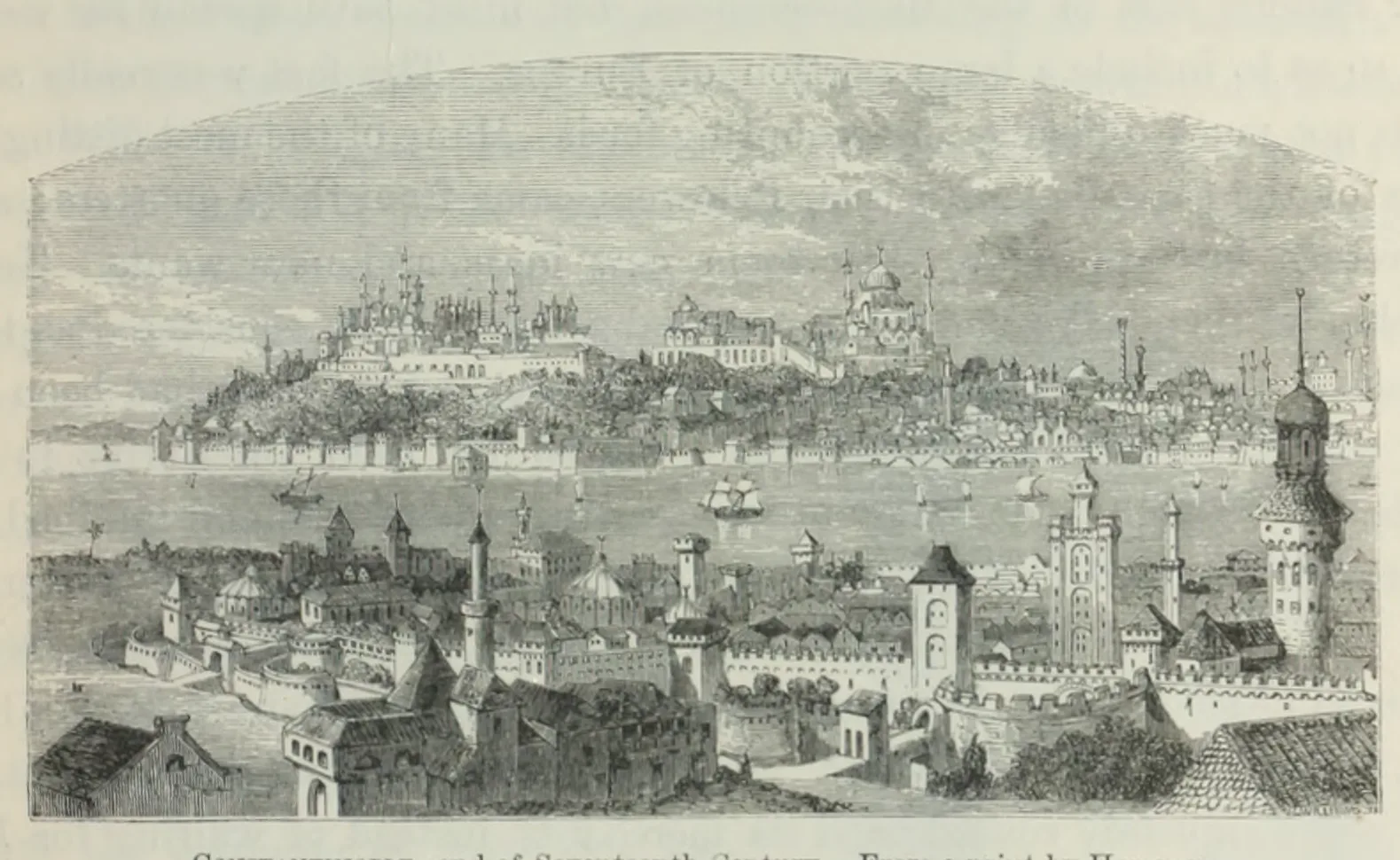
The maritime states of Italy, while thus ostensibly engaged in a common cause, were by no means prepared to admit that they had a common interest, and were hence disposed to act towards each other on the narrowest and most illiberal principles. The old maxim, that the commercial prosperity of a state was best promoted by depressing the trade of its neighbour, though now exploded, was then universally received; and in acting upon it, there was no injustice or perfidy of which the rival Italian republics scrupled to be guilty when it seemed possible in this way to establish a maritime ascendency. One remarkable illustration of this fact was given in 1204, when the Venetians induced the leaders of the fourth crusade to turn aside from their avowed object of warring with infidels in order to wrest Constantinople from the hands of a monarch, who, whatever his demerits might be, was by profession Christian. A variety of motives may have influenced the Crusaders in taking this unwarrantable step; but the subsequent conduct of the Venetians leaves no room to doubt that their only object was selfish aggrandizement. After Constantinople had been stormed and plundered, the dominions which had belonged to the Greek emperor were partitioned among his unprincipled conquerors; and while an Earl of Flanders was placed upon his throne, the Venetians obtained a chain of settlements which stretched from the Dardanelles to the Adriatic, and made them virtually masters of the navigation and trade of the Levant. In Constantinople, which, from the cause already mentioned, had long rivalled Alexandria as an emporium for the traffic between Europe and India, they obtained exclusive privileges, which made it impossible for any maritime state to compete with them, and furnished them with the means of lording it over all their rivals.
The ungenerous course pursued by the Venetians had undoubtedly the effect of greatly extending their trade generally, and of giving them an almost exclusive monopoly of that large portion of the Indian trade which had its centre in Constantinople. The superiority they had thus acquired remained with them for rather more than half a century; and the injustice to which they owed it seemed almost to be forgotten, when the day of retribution arrived, and their own tactics were successfully employed against them. The Greeks had never been reconciled to the Latin yoke, which had been fraudulently imposed upon them, and were therefore prepared to avail themselves of the first favourable opportunity of shaking it off. Had they been left to their own resources they could scarcely have hoped for success, but they had powerful auxiliaries in the Genoese, who were animated at once by a feeling of revenge for the injustice which they had suffered, and a desire to become masters of a traffic, the possession of which had given the Venetians an immense superiority over all their rivals. The terms of alliance between the Greeks and the Genoese were easily settled. The former were again to be ruled by their own dynasty, and the latter were to supplant the Venetians in all their exclusive privileges. Both objects were accomplished. A Greek emperor once more mounted the throne of Constantinople, and the Genoese, in addition to other important privileges, took formal possession of the suburb of Pera, subject only to the condition of holding it as a fief of the empire.
It was now the turn of the Venetians to be depressed; while the Genoese, not contented with their supremacy in the harbour of Constantinople, extended it to the Black Sea, where, by erecting forts on various points of the coast, and particularly on commanding positions in the Crimea and within the Sea of Azof, they secured a monopoly of the extensive and lucrative trade carried on with the East by way of the Caspian. In virtue of this monopoly Genoa became for a time the greatest commercial power in Europe. The Venetians at first attempted to compete with the Genoese, even in the harbour of Constantinople, but soon
found the terms so unequal, in consequence of being burdened with heavy duties, from which their rivals were exempted, that they abandoned the struggle as hopeless. Their only alternative now was to resign the Indian trade altogether, or endeavour to re-open its ancient channels. In preferring the latter, they were met at the very outset by deep-rooted prejudices, which made it unlawful and even impious to enter into alliances of any kind with Mahometan rulers; but no sooner were these prejudices overcome than the remainder of the task was comparatively easy. With the sanction of the pope himself, who on this occasion, as on many others, allowed the supposed impiety to be committed in consideration of the profit anticipated from it, a commercial treaty was concluded with the Sultan of Egypt. It contemplated the carrying on of the Eastern traffic both by the overland route across Syria, and by the way of the Red Sea. With this view the Venetian senate was empowered to appoint two consuls, with mercantile jurisdiction, the one to reside at Damascus and the other at Alexandria. Both of these cities were accordingly resorted to by Venetian merchants and artisans; while at Beyrout, as the port of the former, and in the harbour of the latter, mercantile vessels bearing the Venetian flag far outnumbered those of all other countries. The Genoese, contented with their undisputed monopoly at Constantinople, seem not at this time to have made any attempt to share in the advantages which the Egyptian sultans had conferred on the Venetians; but the Florentines, after they had, by the conquest of Pisa, in 1405, acquired the seaport of Leghorn, turned their attention to the Indian trade, and succeeded, in 1425, in concluding a treaty which placed them on the same footing as the Venetians in respect of commercial privilege. The earnest attempts thus made to share in the trade to the East Indies, would of themselves lead to the conclusion that a taste for the products of the regions included under that general name must no longer have been confined, as at first, to a few countries on the eastern part of the Mediterranean, but must have spread far west and north, so as to include a large portion of Europe. The fact was really so; and there is not much difficulty in accounting for it. Many of the most distinguished leaders of the Crusades, with their followers, came from those quarters; and on their return brought home with them new ideas and new wants. To their astonishment they had found that in several points, usually considered as tests of civilization, they were far surpassed by the infidels whom they had been accustomed to regard as mere barbarians. Galled by their inferiority in these respects, they had little difficulty in learning to surmount it; and imbibed tastes and formed habits which they could not indulge in the absence of Eastern products. The demand naturally produced a supply; and Italian ships, freighted with these products, were frequently seen in the English Channel, in the German Ocean, and even within the Baltic. In course of time the maritime spirit of the North was completely roused; and its merchants, instead of waiting for Italian visits, sent their own vessels into the Mediterranean, and there became purchasers of Indian produce at second hand from the Florentines, Venetians, and Genoese. In this traffic the lead was taken by the cities of the Hanseatic League, and particularly by Bruges, which in consequence became one of the most populous and flourishing marts in Northern Europe.
The Genoese were still in possession of their monopoly in 1453, when an event occurred which abruptly terminated it, and was followed by a series of disasters which ultimately annihilated their maritime greatness. This event was the capture of Constantinople, and the extinction of the Greek empire, by the Turks under Mahomet II. They made an effort to escape the destruction which threatened them, by attempting to form a commercial treaty with the Mameluke Sultans of Egypt; but the monopoly which they had held at Constantinople under the Greek emperors, placed them in a false position, and the negotiation proved fruitless. The Venetians, accordingly, were once more in the ascendent. Their most formidable rival had been obliged to resign the contest; and they began to run a new course of prosperity, to which, as far as human foresight reached, no limit could be assigned. At this period of unexampled prosperity Venice was tottering to her fall.
The revival of learning and the discovery of printing had at once awakened a spirit of inquiry, and furnished the most effectual means of diffusing it. In all departments of literature and science rapid progress was made; and discoveries leading to practical results in some of the most important arts of life, were constantly rewarding the diligent inquirer, and stimulating others to follow in his footsteps. Among the arts thus improved was navigation. Hitherto, when the shore was lost sight of, there had been no means of directing the course of a vessel at sea; and the utmost which the boldest and most experienced navigator attempted, was to steer from headland to headland without hugging the intervening shore, or to take advantage of a wind which blew regularly like the monsoons of the Indian Ocean, and thus use it according to the direction from which it blew for traversing a wide expanse of sea on an outward or a homeward voyage. When the compass was discovered, the greatest obstacle to a voyage out of sight of land was at once removed; and there was even less danger in launching out on the wide ocean than in following the windings of the coast, exposed to rocks and shoals, and the many dangers of a lee shore.
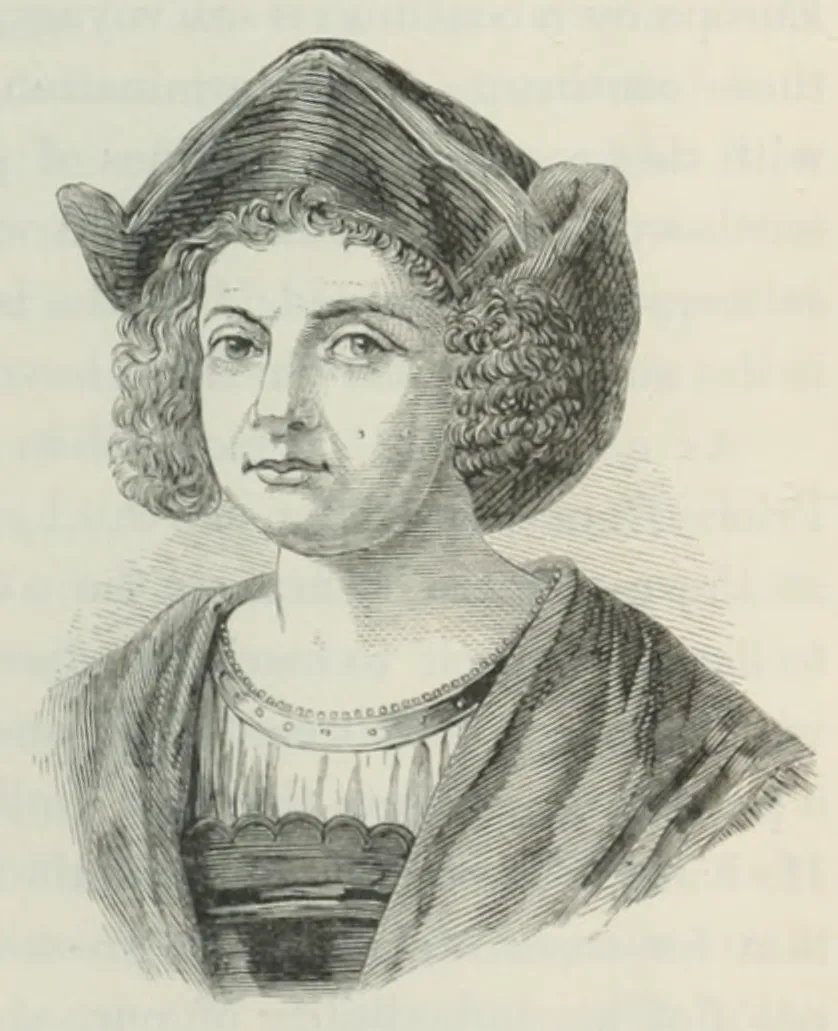
Among the first who proposed to turn the use of the compass to practical account in the discovery of new lands, was the celebrated Christopher Columbus. He had become satisfied, both on scientific grounds and from the accounts of travellers, particularly those of Marco Polo, that as the continent of Asia extended much further eastward than had been generally imagined, it would be possible to arrive at the East Indies by sailing west across the Atlantic. The immense importance of such a passage, once proved to be practicable, was perfectly obvious. It would at once dispense with the tedious and expensive overland routes by which the produce of the East was then brought to Europe, and transfer the most valuable traffic with which the world was yet acquainted, from the hands of infidels to those of Christians. These were the grand objects at which Columbus aimed; but so much were his views in advance of his age, that many years passed away before he could induce any European state to incur the expense which would be necessary in order to realize them. Spain at last undertook the task, and was rewarded with the discovery of a New World. This was more than even Columbus had anticipated. Though his geographical ideas were far more accurate than those of his contemporaries, he had greatly underrated the magnitude of the globe; and hence, imagining that the land which he first reached belonged to Asia, he gave it the name of West Indies. In this name he informs us of the goal after which he had been striving, and which he was so confident of having actually attained, that for a time he would scarcely believe the evidence of his senses, and insisted that everything which he saw was Indian. The delusion under which Columbus thus laboured is a striking proof of the general interest which was now felt in regard to India, and of the eager longings of the maritime states of Europe to obtain a share in its trade, without being fettered by the monopolies which the Mahometans and Venetians had established in the Levant.
Though Columbus failed to discover an oceanic route to India, he clearly pointed out the direction in which it lay. It was previously known that the Atlantic was bounded on the east by the continents of Europe and Africa, and he had now proved that an equally insurmountable barrier bounded it on the west. The conclusion, therefore, was obvious, that if India was accessible from Europe by a continuous sea voyage, it could only be by tracing one or other of these continents to its termination, and then sailing round it. In accordance with this conclusion, four lines of passage presented themselves as possible—a north-west, a north-east, a south-west, and a south-east. The three first were subsequently attempted; but the last, which was certainly the most promising, is the only one with which we have now to do.
As early as 1415, more than twenty years before Columbus was born, Prince Henry, fourth son of John I., King of Portugal, after distinguishing himself at the capture of Ceuta, on the coast of Africa, returned with a determination to devote himself to maritime discovery, by employing navigators to trace the western coast of that continent, and thereby perhaps solve the great problem of a practicable route to the East Indies, by sailing round its southern extremity. He had all the talent and scientific acquirement necessary, in order to qualify him for superintending the great task thus undertaken, and gave a striking proof of his inflexibility of purpose by withdrawing from court, and fixing his residence in the seaport of Sagres, not far from Cape St. Vincent. Here he erected an observatory, and established a school of navigation for the training of youth, whom he might afterwards employ on voyages of discovery. He was not destined to solve the grand problem; but before his death, in 1463, had paved the way for it, by fitting out expeditions, which, leaving Cape Non (so called because no previous navigator had passed it) far behind, discovered Madeira and the Cape Verd Islands, and penetrated as far south as Sierra Leone.
The spirit of enterprise which Prince Henry had fostered was not allowed to expire with him ; and under Alonso V., who was then reigning, the African coast was explored almost to the equator. John II., the son and successor of Alonso, continuing the progress of discovery, was so convinced that India would ultimately be reached, that, in 1484, he took a step which, though of an extraordinary nature, appears to have been dictated by sound and far-sighted policy. Great exertions had been made by the government of Portugal in fitting out expeditions for maritime discovery ; and now, when they seemed about to be crowned with success, the danger was, that other states might step in and insist on sharing in the fruits. As the best means of preventing this, he sent ambassadors to several of the leading European courts, and offered them the alternative of either uniting with him, and furnishing men and money to assist in the conquests which he was contemplating, on the understanding that a fair proportion of the benefit would be awarded them, or leave him to proceed as hitherto, on his own entire responsibility, and of course, in common fairness, for his own exclusive benefit.
This attempt to form what may be called a joint-stock company, in which kings were to be the only shareholders, failed. All the crowned heads applied to, declined to entertain the proposal ; and John took the additional precaution of calling in the aid of the pope, who, in the plenitude of an arrogant power, then undisputed, but soon after to be shaken to its very foundations, drew an imaginary line from north to south, by which he divided the world into two equal halves, and decreed that discoveries of new countries made from west to east should only be competent, and should belong exclusively to the Portuguese. It seems not to have occurred either to the king or the pope that discoveries made from east to west might be carried so far as to make this grant futile, and convert it into a great bone of contention.
From this period the King of Portugal assumed the additional title of Lord of Guinea, and evinced a determination to turn his grant to the best account. Besides fitting out an expedition, under Diego Cam, who, in 1484, reached 22° of south latitude, and must consequently have been within 12° of the southern extremity of the African continent, he sent two messengers overland with instructions to discover the country of Prester John, then believed to be a great reality, though since ascertained to have had only a fabulous existence. They were also to ascertain whence the drugs and spices came which the Venetians traded in, and whether there was any sailing from the south of Africa to India. One of these messengers, Pedro de Covillam, succeeded in reaching India, and obtained much important information ; but before the letter conveying it reached Portugal, the great problem had been solved by Bartolommeo Diaz, who had sailed south with three ships in 1486. After reaching a higher southern latitude than any previous navigator, a storm arose which drove him out to sea. His direction under such circumstances could not be accurately ascertained, but he knew it to be southerly. After tossing about for thirteen days, and suffering much by a sudden transition of the temperature from hot to cold, he attempted, when the storm abated, to regain the land by steering eastward. He reached it; but, to his great astonishment, discovered that the land which, when he quitted it, lay on his left hand, nearly due north and south, was now stretching east and west, and trending north-east. The cause was too apparent to leave any room for doubt. He had been carried round the southern extremity of Africa, and was now on its south-eastern coast. He was most anxious to prosecute this auspicious commencement, but his crews refused to follow him, and he was obliged to turn his face homewards. He was so far rewarded, for a few days brought him in sight of the magnificent promontory in which Africa terminates. The weather he had met with, and,
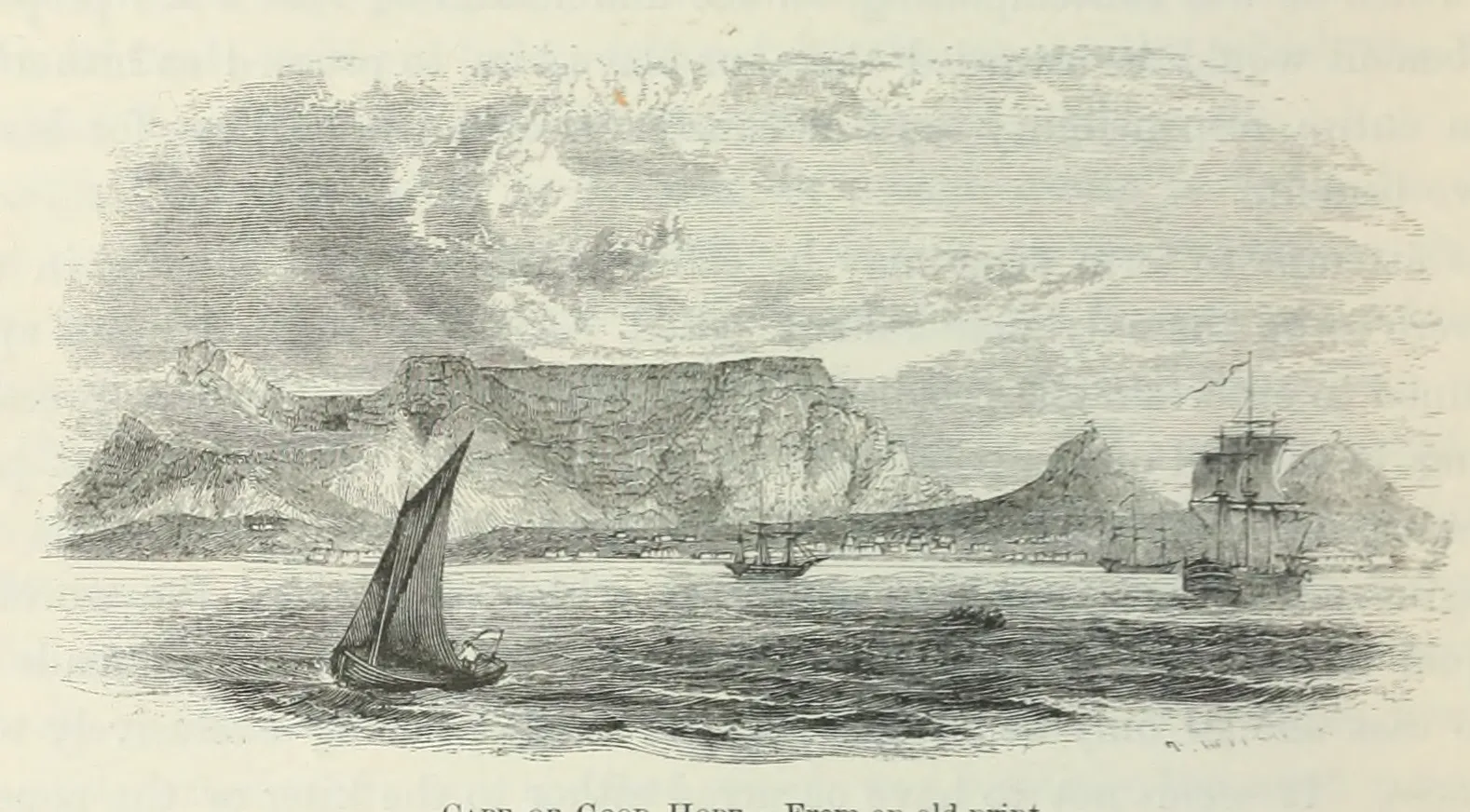
perhaps, also a painful remembrance of the conduct of his crews in forcing him to return, determined him to give it the name of Cabo de Todos los Tormentos, or Cape of Storms, but the king, on his return, thinking this name ominous, chose one much more appropriate, and, in allusion to the great promise which the doubling of the promontory held out, called it Cabo de Buena Esperanza, or Cape of Good Hope.
It is singular that, though John survived this discovery nine years, he made no attempt to follow it up. One cause of the indifference thus manifested may have been the mortification which he felt at the still more brilliant success which Ferdinand and Isabella of Spain had achieved by the employment of Christopher Columbus. This renowned navigator, returning from his discovery of a New World, arrived in the Tagus in 1493. Before applying to Spain, he had offered his services to Portugal, and been refused. What would John not now have given to be able to recall that refusal? It was too late; but he had counsellors base enough to suggest that the remedy was still in his own hands. He had only to assassinate Columbus, and take possession of his papers; his discovery would thus die with him. Happily for his own fame he spurned the infamous suggestion ; and Columbus, after a becoming reception, not less honourable to the giver than it must have been gratifying to the receiver, continued his triumphant progress to the court of Spain.
John was succeeded in 1495 by his cousin Emanuel, who was thoroughly imbued with the spirit of enterprise which had animated his predecessors. Timid counsellors were not wanting who advised him to rest satisfied with the discoveries already made, and not run the risk of impoverishing his hereditary dominions by expensive expeditions, of which it was impossible to foresee the final result ; but his resolution had been formed, and there could be no doubt what it was, when he was seen, in the third year of his reign, fitting out a new expedition for the avowed purpose of not only doubling the Cape of Good Hope, but afterwards continuing the voyage without intermission till the coast of India was reached. In this expedition, which consisted of three small ships, carrying 160 men, Bartolommeo Diaz held only a subordinate station. Nor had he even the satisfaction of seeing his discovery prosecuted by others ; for, on arriving at the fort of El Mina, he was sent back to Portugal, and not long after his return perished at sea.
The command of the expedition, thus rather ungenerously withheld from Diaz, was conferred on Vasco de Gama, a gentleman of the royal household, who had previously done good service at sea, and, by his subsequent conduct, justified the choice which had been made of him. After a pompous ceremonial, more in accordance with the great object contemplated by the expedition than with the very inadequate means furnished for its accomplishment, the three small ships left the port of Belem, on Saturday, the 8th of July, 1497. They were accompanied by a small bark carrying provisions, and a caravel, of which Diaz was captain. Off the Canaries the vessels encountered a storm, which separated them, but they met again at Cape Verd, which had been fixed as the place of rendezvous. Having next day anchored at Santa Maria, on the African coast, they repaired their damages, and took in water. Diaz, proceeding no farther, returned homewards ; the other vessels pursued their voyage. Another storm, still more violent than the former, overtook them ; and they had almost given up all hope of weathering it, when it abated, and they took shelter in a bay, to which they gave the name of Santa Elena. Vasco de Gama attempted to hold communication with the natives, but
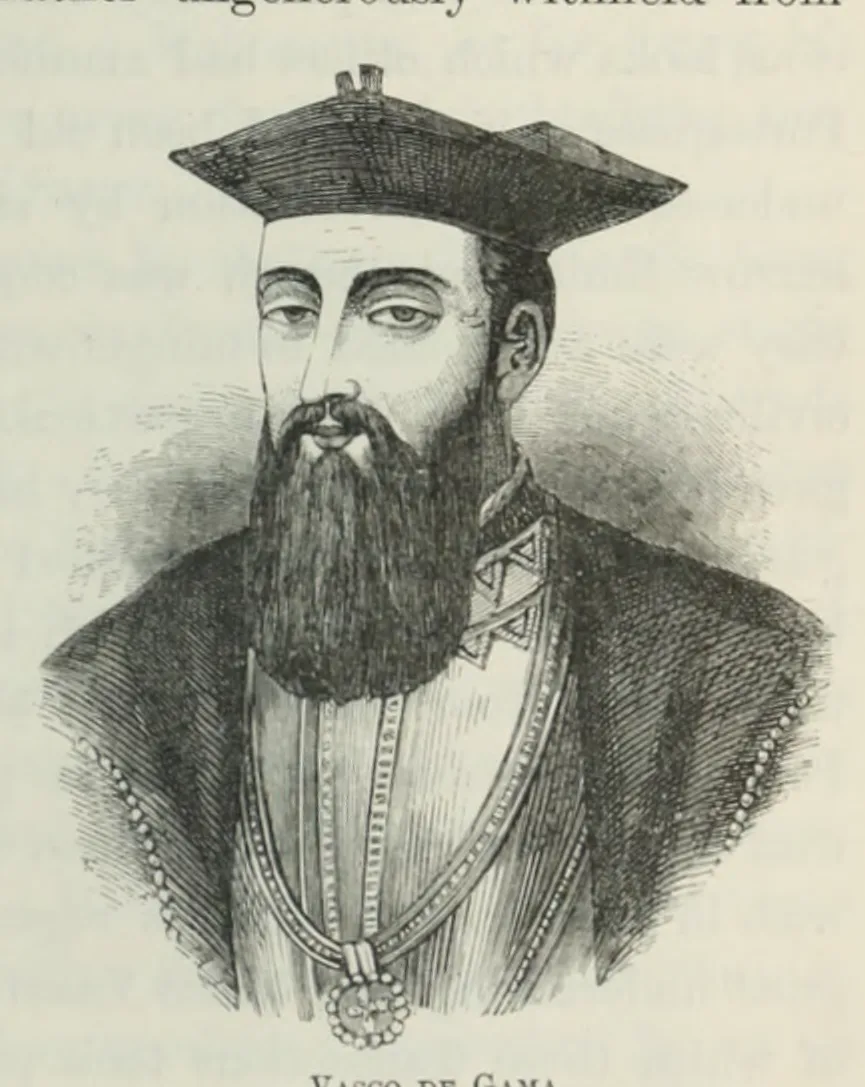
met with an inhospitable reception, which left him no inclination to prolong his stay. He set sail again on the 16th of November, having already been more than four months at sea; and two days after came within sight of the Cape of Good Hope, which, after tacking about in consequence of baffling winds, they doubled on the 20th of November, amid the sound of music and general rejoicing.
They were now fairly launched on the Indian Ocean, but instead of steering right across it, continued for a time to follow the coast, making careful observations, and daily discovering some new object to excite their wonder. On Christmas, 1497, they saw land, which, in honour of the day, they called Tierra de Natal; and which, still retaining its name, promises to rise into importance as a British colony. The next land visited belonged to the Kaffres, with whom they had much friendly intercourse.
In proceeding farther north, the expedition was much impeded by currents, which induced De Gama to give the name of Cabo de Corrientes to a prominent headland, and to keep far out to sea in order to avoid the risk of being embayed. Owing to this, Sofala, which was then the great emporium of this part of Africa, was passed without being seen. The natives appeared now to be more civilized than those who had previously been seen, and instead of the timid and suspicious looks which others had manifested, made themselves as familiar with the Portuguese as if they had been old acquaintances. As their language was not understood, the conversation by signs was necessarily confined within very narrow limits, but enough was communicated to satisfy Vasco de Gama that they were accustomed to mingle with people in a still more advanced state of civilization. Two chiefs in particular, who paid him a visit in their own boats, gave him to understand that they had seen ships as large as those of the Portuguese; and after they had returned to the shore, sent two pieces of calico on board for sale. This cloth, which it is almost needless to mention, takes its usual name from the town of Calicut, excited a particular interest in the Portuguese, because supposing it, perhaps erroneously, to be the product of that city, it was the first specimen of Indian manufacture which they had met with in their voyage. It was regarded as an omen of future success in their great undertaking, and hence Vasco de Gama gave to the stream, at the mouth of which these transactions took place, the name of Rio de Buenas Sinays, or River of Good Signs.
Having again set sail on the 24th of February, 1498, the vessels continued their voyage along the coast through the channel of Mosambique, and on arriving opposite to the town of that name, were hailed by a number of little boats, the crews of which made signs to stay for them. The vessels cast anchor, and the boatmen, without showing the least fear, leaped at once aboard, made themselves perfectly at home, ate and drank freely, and conversed in Arabic with one of the crew who understood that language. The intercourse at first promised to be very friendly, but on its being discovered by the sheikh or chief, that the Portuguese were not, as he had originally supposed, Turks and Mahometans, but Christians, his manner suddenly changed, and all his seeming friendship was at an end. Ultimately open hostilities were declared, and the Portuguese avenged themselves by bombarding and destroying the town of Mosambique.
The vessels again weighing anchor, continued their course northwards, and arrived at the island of Mombas, with a town of same name. Here the seeming friendship of the Moors proved as false as that of the inhabitants of Mosambique; and Vasco de Gama, believing, on the confession of two Moors, whom he barbarously put to the torture by dropping hot bacon upon their flesh, that a plot had been formed for his destruction, hastened his departure, and did not again halt till he arrived off Melinda, which delighted the Portuguese, as it reminded them more of home than any African city they had yet seen. It was seated on the level part of a rocky shore, amid plantations of palms and orchards of orange and other fruit trees, covered a large space, and consisted of houses built of stone, three stories high, and with terraced roofs.
At first the inhabitants, who were probably acquainted with the transactions at Mosambique and Mombas, kept aloof, but a good understanding was eventually established; and the king, though a Mahometan, so far forgot his prejudices that he afforded the Portuguese every facility for obtaining provisions, and even made a formal visit in his barge.
It was now unnecessary for the Portuguese to continue their course along the African coast. Their object had been to obtain such information as might enable them to proceed with safety across the ocean towards India. Melinda furnished them with all that they required. Four ships from India were then lying in its harbour, and little difficulty was found in obtaining a pilot capable of acting as their guide. This pilot, named Melemo Kana, was a native of Gujerat, and had a thorough knowledge of his profession. The compass, charts, and quadrants were quite familiar to him; and an astrolabe shown him seemed so inferior to other instruments which he had seen used for the same purpose, that he scarcely condescended to notice it. Before leaving Melinda, De Gama was visited by persons belonging to the Indian ships. He imagined them to be Christians, because on coming aboard they prostrated themselves before an image of the Virgin, probably mistaking it for one of their own idols; but it is plain, from the description given of them, that they were Hindoos. They were clothed in long gowns of white calico, wore their hair, which was long like that of women, plaited under their turbans, and ate no beef.
The expedition sailed from Melinda on Tuesday, the 22d of April, 1498, and after a prosperous voyage of twenty-three days, saw India, on Friday, the 17th of May. They were off the Malabar coast, which was at the distance of eight leagues, and rose high and bold from the sea. Their destination was Calicut, and as they were considerably north of it, they changed their course to south-east. On the 20th they beheld, to their unspeakable delight, the lofty wooded terraces rising behind that city, and shortly after cast anchor about two leagues below it.
Calicut, situated on the open beach, without roadstead or harbour, though partially protected by a rocky bank, inside of which small vessels lie tolerably
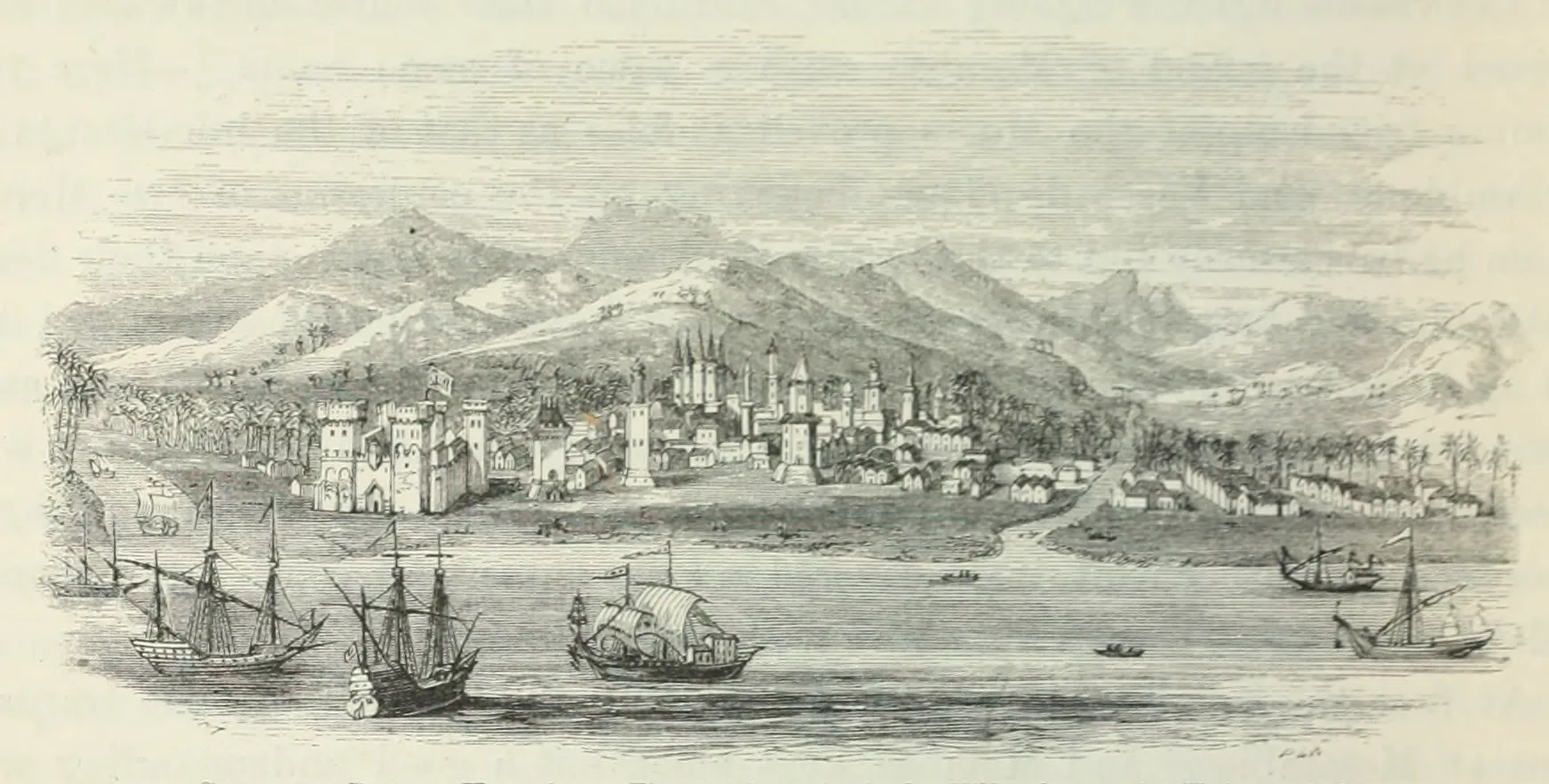
sheltered, was then the capital of a Hindoo sovereign, who, under the title of samiry or zamorin, ruled a considerable extent of country in the south-west of the peninsula. This title is probably the corruption of Tamuri, the name of a rajah on whom, according to popular tradition, a prince called Cheruman, after dividing his territories among his other chieftains, had nothing more remaining to bestow than his sword, “with all the territory in which a cock crowing at a small temple here could be heard.”1 The territory thus assigned took, from the singular nature of the grant, the name of Colico-du, or the Cock-crowing, which in course of time was metamorphosed into Calicut. This account may be set aside as fabulous; but it is certain that in whatever way the original nucleus of the territory was acquired, the sword of Cheruman proved the most valuable part of his bequest, and enabled Tamuri to place himself at the head of all his brother chieftains, and transmit his power to a series of successors. One of these had been converted to Mahometanism2 by some pilgrims who had been wrecked on his coast while proceeding to visit Adam’s Peak in Ceylon; and, with the zeal of a new convert, set out on a pilgrimage to Mecca. He never returned; but the favour shown to Mahometans during his reign, and the encouragement which, in consequence of his recommendation, they received from his successor, had induced them to settle in great numbers, and enabled them to acquire much influence in Cranganore, Calicut, and the surrounding districts. Such was the state of matters when the Portuguese arrived, and it is necessary to attend to it, as furnishing a key to many subsequent proceedings.
De Gama having anchored, as already mentioned, was immediately visited by some small fishing-boats, and under their guidance sailed as near to Calicut as the depth of water would allow. He had brought several criminals from Portugal, whose sentence had been remitted in consideration of the danger to which they were to be exposed by being sent ashore to hold intercourse with the natives, under circumstances too hazardous to justify the employment of any of the crew. One of these criminals was accordingly despatched along with the fishermen, in order that the reception given him might enable De Gama to shape his future course. He was immediately surrounded by a crowd whose curiosity could hardly be satisfied, though it was more importunate than rude. As his ignorance of the language made it useless to ask him any questions, they took him to the house of two Moors, one of whom, called Monzaide—who, from being a native of Tunis, knew him to be Portuguese—gave utterance to his astonishment by exclaiming in Spanish, “The devil take you! What brought you hither?” After some explanations, Monzaide went off with him to the ships, and on approaching De Gama, cried aloud in Spanish, “Good luck! good luck! Many rubies, many emeralds! Thou art bound to give God thanks for having brought thee where there are all sorts of spices and precious stones, with all the riches of the world.” De Gama and his crew were so surprised and affected at meeting with one who could speak their language so far from home, that they wept for joy.
Having learned from Monzaide that the zamorin was then at Ponany, a village at the mouth of a river of same name, about thirty-six miles south from Calicut, De Gama immediately announced his arrival, intimating at the same time that he was the bearer of a letter to him from his master the King of Portugal, a Christian prince. The zamorin, in answer, bade him welcome, and sent a pilot to conduct the ships to a safer anchorage, near a village called Pandarane. He accepted of the services of the pilot, but demurred at first to avail himself of an invitation by the cotwal or chief magistrate, to go ashore and proceed by land to Calicut. On second thoughts, however, he became convinced that this was a risk which he ought to run; and while his brother Paul, who commanded one of the ships, and the other officers, reminded him of the danger to be apprehended, not so much from the natives, whom they insisted on regarding as Christians, as from the Moors, whose deadly enmity they had already experienced on the African coast, he announced his determination, let what would betide him, to go ashore and leave no means untried to settle a treaty of commerce and perpetual amity.
On the 28th of May, after leaving orders that in the event of any accident befalling him, the vessels were to return home with the news of his discovery, he set out in his boat, attended by twelve of his company, with flags waving and trumpets sounding. The cotwal was waiting to receive him with 200 nairs, understood to be the nobility of the country, and a large promiscuous assemblage. Two palanquins had been provided, one for De Gama and another for the cotwal; the rest of the attendants followed on foot. During the journey they paid a visit to a temple built of freestone, covered with tiles, and as large as a great monastery. In front of it stood a pillar as high as the mast of a ship, made of wire, with a weather-cock on the top, and over the entrance hung seven bells. The interior was full of images; and these, as well as some of the ceremonies, confirming the Portuguese in their previous belief that the natives were Christians, they began to pay their devotions. The dimness of the light did not allow them to see the kind of figures they were worshipping, but on looking around they discerned monstrous shapes on the walls, some with great teeth sticking an inch out of their mouth, others with four arms and such frightful faces, that one of the Portuguese, on beholding one of them, before which he was making his genuflexion, exclaimed, “If this be the devil, it is God I worship.” On approaching the city the multitude became immense, and the cotwal halted at the house of his brother, who was waiting, along with a number of nairs, to conduct De Gama with all the pomp of an ambassador into the royal presence. Though almost stifled by the press, he was so much gratified that he could not help observing to those around him, “They little think in Portugal what honour is done us here.”
The palace, at which they arrived an hour before sunset, had a handsome appearance, and was surrounded by trees, and gardens adorned with fountains. It was entered by a series of five inclosures, each having its own separate gate; and such was the eagerness of the populace to squeeze themselves in, that several were crushed to death. At the grand entrance De Gama was received by the chief minister and high-priest, a little old man, who, after embracing him, took him with his attendants into the presence. The hall of audience was set round with seats, rising as in a theatre; the floor was carpeted with green velvet, and the walls hung round with silks of diverse colours. At the head of the hall the zamorin lay reclined on a kind of sofa, with a covering of white silk wrought with gold, and a rich canopy overhead. He was a large, stout man, of dark complexion, advanced in years, and with something majestic in his appearance. He wore a short coat of fine calico, adorned with branches and roses of beaten gold; the buttons were large pearls. Another piece of white calico reached to his knees. A kind of mitre, glittering with pearls and precious stones, covered his head; his ears were strung with jewels of the same kind; and both his fingers and toes were loaded with diamond rings. His arms and legs, left naked, were adorned with gold bracelets. Near him stood two gold basons and a gold fountain; the one bason contained betel and areca nut, which was handed him by an attendant, the other received it when chewed; the fountain supplied water to rinse his mouth.
After De Gama entered and made his obeisance according to the custom of the country, by bowing his body three times and lifting up his hands, the zamorin looked kindly at him, recognized him by a scarcely perceptible inclination of the head, and ordered him by signs to advance and sit down near him. The attendants being admitted, took their seats opposite, and were regaled with fruits. On calling for water to drink, a golden cup with a spout was brought, but they were told that it was considered bad manners to touch the vessel with their lips. The awkwardness of the Portuguese, who, in attempting to drink by the spout, either choked themselves with the water or spilled it upon their clothes, gave much amusement to the court. De Gama having been asked by the zamorin to open his business, gave him to understand that the custom of princes in Europe was to hear ambassadors in the presence of only a few of their chief counsellors. The suggestion was immediately adopted, and the audience took place in another apartment similar to the former, where only De Gama and another Portuguese, who acted as his interpreter, on the one side, and the zamorin, his chief minister, the comptroller of his household, and his betel-server on the other, were present. When asked whence he came, and with what object, De Gama answered that he was an ambassador of the King of Portugal, the greatest prince in all the West, who, having heard that there were Christian princes in the Indies, of whom the King of Calicut was the chief, had sent an ambassador to conclude a treaty of trade and friendship with him. He added, that for sixty years the King of Portugal and his predecessors had been endeavouring to discover India by sea, and had at length succeeded for the first time. In anticipation of this success, the king, his master, had intrusted him with two letters, the delivery of which, as it was now late, he would, with the zamorin’s permission, defer till to-morrow. De Gama had reason to think he had made a favourable impression, as the zamorin repeated his welcome, made inquiries as to the distance to Portugal, and the time occupied by the voyage, and declared his willingness not only to recognize the King of Portugal as his friend and brother, but to send an ambassador to his court.
De Gama, after passing the night with his attendants in a lodging specially provided for them, began next morning to prepare a present for the zamorin. He was not well supplied for that purpose; but after selecting four pieces of scarlet, six hats, four branches of coral, six almasars, a parcel of brass, a chest of sugar, two barrels of oil and two of honey, sent for the royal factor and cotwal to ask their opinion. On looking at the articles they burst into a laugh, and told him that the poorest merchant who came to the port made a better present. A kind of altercation arose, and at last the factor and cotwal departed, after taking his promise that he would not visit the king till they returned to go with him. He waited the whole day, but they never appeared. On the day following, when they arrived, and he complained of their behaviour, they made light of it and began to talk indifferently of other matters. The fact was that they had been gained by the Moors, who, fearing that their interests might be seriously affected by the opening up of a new trade with Europe, and the consequent decline of that which had hitherto been carried on by the Red Sea, were determined to leave no means untried to frustrate the object of the Portuguese expedition.
When De Gama went to the palace to pay the visit which, according to appointment, should have been paid a day sooner, the effect of the Moorish intrigue was very apparent. He was kept waiting for three hours; and when at last admitted, was told angrily by the zamorin that he had waited for him all the day before. He was then asked how it was that, if he came from so great and rich a prince as he represented his king to be, he brought no present with him, though in every embassy of friendship that must be regarded as a necessary credential. De Gama made the best excuse possible in the circumstances, by referring to the uncertain issue of his voyage, which made it imprudent to provide a present which there might be no opportunity of delivering, and promising that if he lived to carry home the news of his discovery, a suitable present would certainly arrive. The zamorin, not yet satisfied, observed, “I hear you have a St. Mary in gold, and desire I may have that.” De Gama, taken somewhat aback at this demand, replied that the image was not gold, but only wood gilded; and as he attributed his preservation at sea to its influence, he must be excused for not parting with it. The zamorin, quitting the subject, asked for the two letters, which indeed contained only the same thing in duplicate, the one written in Portuguese and the other in Arabic. The latter, interpreted by Monzaide, was in purport as follows:— “As soon as it was known to the King of Portugal that the King of Calicut, one of the mightiest princes of all the Indies, was a Christian, he was desirous to cultivate a trade and friendship with him, for the conveniency of lading spices in his ports; for which, in exchange, the commodities of Portugal should be sent, or else gold and silver, in case his majesty chose the same; referring it to the general, his ambassador, to make a further report.” This letter, and the noble bearing of Vasco de Gama, who throughout the interview behaved in a manner becoming the high character which he claimed, disabused the mind of the zamorin of the impression received of him through the intrigues of the Moors, who had sedulously circulated a rumour that he was no ambassador, but merely a pirate. He therefore conversed with him in the most friendly manner, and gave him full liberty to bring any merchandise he had with him ashore and dispose of it to the best advantage.
The next day, the 31st of May, De Gama prepared to return to his ships, and was actually on the way to Pandarane, when the Moors, fearing that if he once got away he would not again return, induced the cotwal, by a large bribe, to hasten after and detain him, so as to afford them an opportunity of disposing of him summarily. The cotwal accordingly set out in pursuit, and found De Gama hastening on considerably in advance of his attendants. The cotwal rallied him on his haste, and asked him if he was running away. He answered, “Yes; I am running away from the heat;” and continued his journey, the cotwal keeping close by him till he reached the village. It was sunset before his men came up, but he called immediately for a boat. The cotwal at first endeavoured to dissuade him, but finding him resolute, pretended to send for the boatmen, while at the same time he sent another message, ordering them to keep out of the way. The consequence was that no boat appeared, and there was no alternative but to pass the night on shore.
In the morning matters assumed a still more threatening appearance. The cotwal, instead of bringing a boat, told him to order his ships nearer shore, and on his refusal, threw off all disguise, telling him that as he would not do what he was ordered he should not go on board. De Gama was thus to all intents a prisoner. The doors of his lodging were shut, and several nairs with drawn swords kept guard within. Coello meantime had come with his boats within a short distance of the shore; and, fortunately, by communicating with one of De Gama's sailors, who had been left outside, was apprised of his situation. The cotwal, while he still detained him, seemed afraid to proceed to violent extremes; and after finding that he could not lure the vessels into the harbour, so as to give the Moors an opportunity of destroying them, changed his tactics and asked only that the merchandise should be sent ashore. His object apparently was to appropriate it to himself; and as De Gama's presence interfered with this object, he was easily induced, as soon as the merchandise arrived, to allow him to depart.
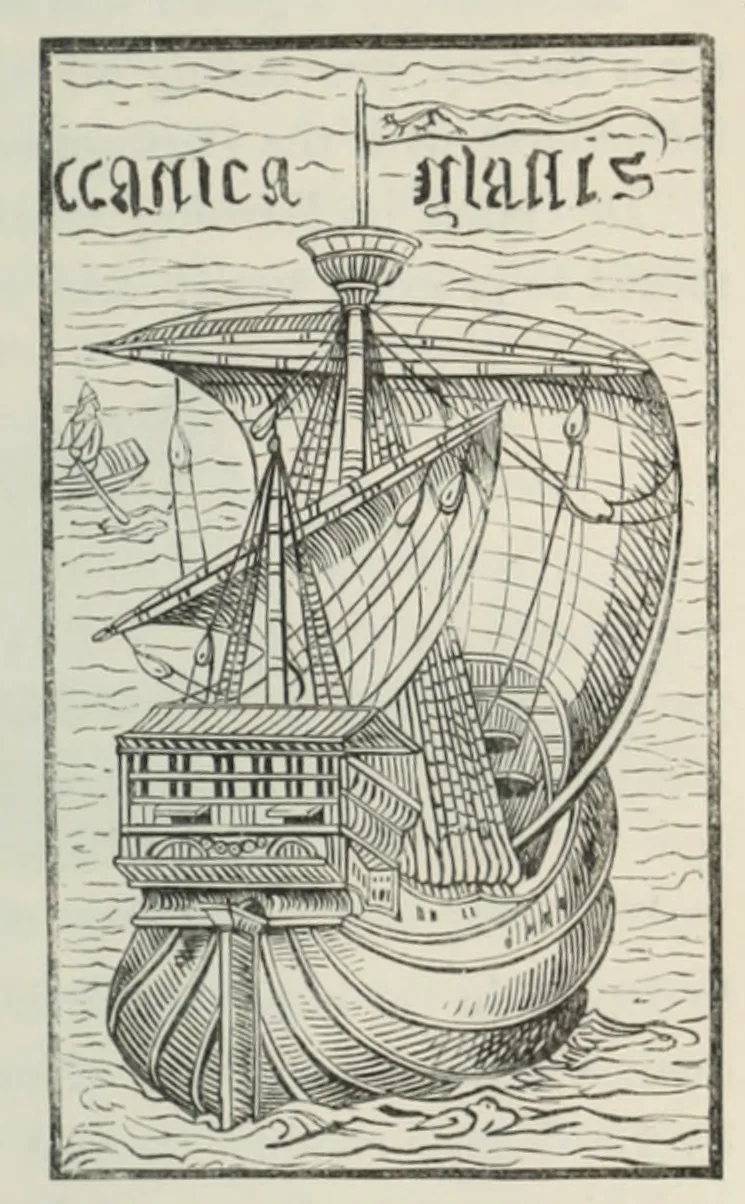
De Gama, once free of the cotwal and his associates, determined not again to place himself in their power, but took care by his factor, Diego Diaz, brother of the more celebrated Bartolommeo, who first doubled the Cape, to acquaint the zamorin with the unworthy treatment to which he had been subjected. The zamorin seemed much incensed, and promised both to punish the offenders and send merchants to purchase the goods. He could scarcely have been sincere, for the insolence of the Moors increased; and the goods, which they took every opportunity to depreciate, found few purchasers. A kind of traffic, however, was established; and after permission was given to remove the goods from Pandarane to Calicut, as a more suitable market, much friendly intercourse took place between the Portuguese and the natives. They were not destined, however, to part so amicably.
More than two months had elapsed since the arrival of the Portuguese vessels, and as the north-east monsoon, on which they depended for their return homewards, was about to set in, De Gama, on the 10th of August, sent Diego Diaz to the zamorin with a present of scarfs, silks, coral, and other things, and a notification of his intention to depart. He was obliged to wait four days for admission, and was then received with a frowning countenance. The zamorin’s mind had been completely poisoned; and he regarded the Portuguese either as pirates, who had come for plunder, or spies, who, after acquainting themselves with the country, intended to return with a fleet sufficient to invade it. Accordingly a guard was set over the house which the Portuguese had used for a factory, preventing all egress; and a proclamation issued prohibiting all intercourse with the Portuguese ships.
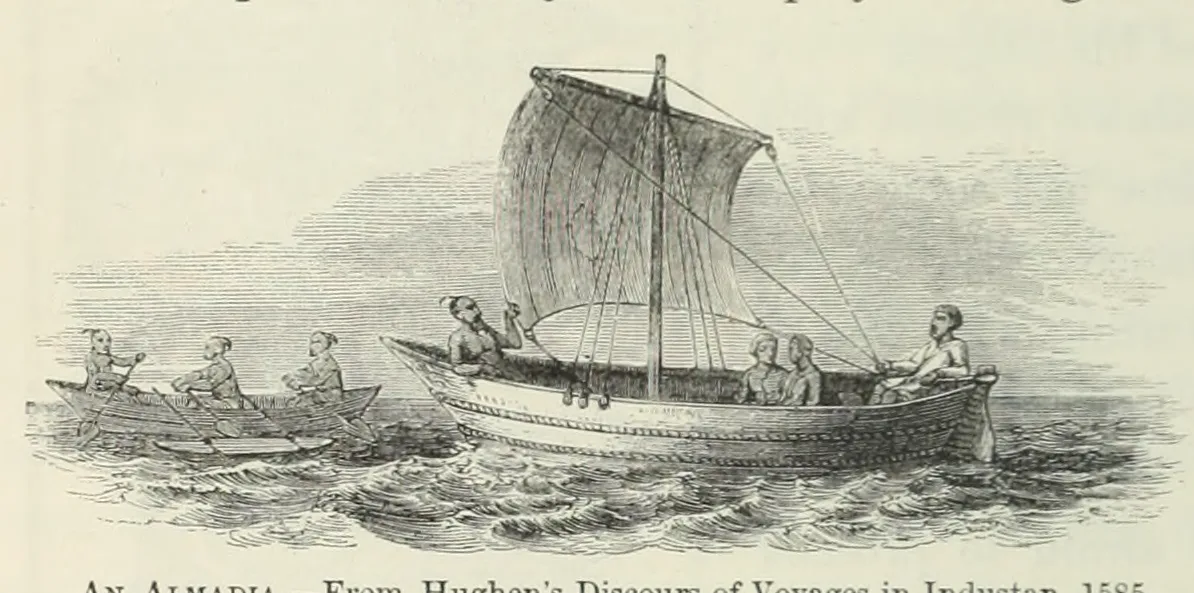
De Gama, on learning what had happened, was much incensed, but determined to proceed warily, and employ craft against craft. Two days after the proclamation, four lads arrived in an almadia, with precious stones for sale. They were suspected to be spies; but De Gama spoke to them as if he were entirely ignorant of what had taken place in Calicut, and allowed them to depart, in the hope that their return would induce other persons of more consequence to pay him a visit. Nor was he mistaken. For the zamorin, convinced by De Gama’s conduct that he was ignorant of the detention of his factor Diaz, and his secretary Braga, who were both in the factory when the guard was set over it, sent people on board to keep him amused till he should be able to effect the destruction of his ships by preparing a fleet in his own ports, or bringing one from Mecca for that purpose. De Gama kept his own counsel, till one day when six of the principal inhabitants arrived with fifteen attendants. He immediately seized them, and sent a letter ashore, demanding his factor and secretary in exchange. After some parleying, Diaz and Braga were sent aboard, and the principal inhabitants, who were nairs, were returned. The attendants, however, were detained, on the plea that some of the Portuguese merchandise was still unaccounted for. This was mere pretence on De Gama’s part, for he had already determined to carry off the poor natives to Portugal, and exhibit them as the vouchers of his discovery. Immediately after making this announcement to those who had been sent for the natives, and desiring them to inform the zamorin that he would shortly return and give him full means of judging whether the Christians were thieves, as the Moors had persuaded him, he weighed anchor and set sail on his homeward voyage.
Two days after their departure, when the ships were lying becalmed a league from Calicut, the zamorin's fleet of forty vessels was seen approaching, full of soldiers. Their object was obvious; but the Portuguese, by means of their ordnance, managed to keep them at bay till a gale fortunately sprung up, and they got clear off, though not without being pursued for an hour and a half. De Gama, for a short time, kept near the coast; and when within twelve leagues of Goa, received the alarming intelligence that the whole coast was in motion, and that in all its harbours vessels were being fitted out for the purpose of intercepting him. Longer delay, therefore, seemed dangerous, and he at once put out to sea. The voyage home was tedious and disastrous; but ultimately Belem was reached in September, 1499, after an absence of two years and two months. Of the original crew, only fifty returned alive. The news of their arrival was hailed with extraordinary demonstrations of joy throughout the kingdom; and De Gama, after being conducted into Lisbon in triumphal procession, was raised to new honours and liberally pensioned. So elated was King Emanuel with the success of the expedition, that he forthwith added to his titles that of Lord of the Conquest and Navigation of Ethiopia, Arabia, Persia, and the Indies.
No time was lost in fitting out a new expedition on a more extended scale. It consisted of thirteen vessels, containing 1200 men, and sailed from Belem on the 9th of March, 1500, under the command of Pedro Alvarez Cabral. Among the captains were Bartolommeo Diaz, the discoverer of the Cape of Good Hope, and his brother, Diego Diaz, who had been factor to Vasco de Gama. The Canaries were seen on the 18th; but from them the course was so far westward that the first land they reached was a new continent, the discovery of which, though little importance appears to have been attached to it at the time, ultimately proved the most valuable acquisition made by the crown of Portugal. It was Brazil. The expedition again sailed on the 2d of May for the Cape of Good Hope, but was thrown into considerable alarm by the appearance of a comet, which continued to increase for ten days, and shone so brightly as to be visible both day and night. The disasters, of which it was dreaded as the forerunner, seemed to be realized by the bursting of a storm with such suddenness and fury that, before the sails could be furled, four of the vessels, one of them commanded by Bartolommeo Diaz, sunk, with every soul on board, and the others were so shattered and filled with water that, had not their sails been so torn as to leave nothing but bare poles, they must certainly have foundered.
Dreadful as the storm was, it was ultimately weathered, and Cabral found, on its abating, that the Cape of Good Hope was already doubled. Continuing along the south-east coast of Africa, he fell in with two vessels at anchor near Sofala. They took fright and made for the shore, but were pursued and overtaken. They proved to be Moorish vessels bound for Melinda. As the Portuguese were on friendly terms with its chief, Cabral was sorry for what had happened, more especially as the most valuable part of the cargo consisted of gold, which, during the terror of the flight, had been thrown overboard. On expressing his regret, the Moorish captain gravely asked whether he had not some wizard with him, who might conjure it up from the bottom of the sea. At Melinda, where the chief proved as friendly as before, Cabral was furnished with two Gujerat pilots. Under their guidance he made a prosperous voyage across the Indian Ocean, and cast anchor within a league of Calicut on the 13th of September.
Shortly after his arrival several nairs came on board, bringing the zamorin's welcome, and making great offers of friendship. Cabral was thus induced to take his ships nearer the city, and sent ashore four natives whom Vasco de Gama had carried off. He afterwards sent a messenger, intimating that he came from Portugal purely to settle trade and friendship; but, taught by De Gama's experience, he refused to land till hostages were given. This demand produced some delay and altercation, but at last six of the principal natives arrived, and Cabral ventured ashore. The interview took place in a pavilion, erected on purpose, near the water-edge. The zamorin, dressed nearly as when De Gama visited him, dazzled all eyes with the size and brilliancy of the diamonds, rubies, sapphires, and pearls, which studded his girdle and hung from his ears, or covered his fingers and toes. His chair of state and palanquin, all of gold and silver, curiously wrought, glistened with precious stones; and, among other articles composed of the precious metals, were three gold and seventeen silver trumpets, and various silver lamps, and censers smoking with perfumes. Cabral, after delivering his credentials, and stating the desire of the King of Portugal to enjoy the zamorin's friendship, and establish at Calicut a factory, which should be supplied with all kinds of European goods, and take spices in exchange, or pay for them in ready money, caused the present to be brought in. It consisted of a wrought silver basin gilt, a fountain of the same, a silver cup with a gilt cover, two cushions of cloth of gold, and two of crimson velvet, a cloth of state of the same velvet striped and bound with gold lace, and two rich pieces of arras.
So far all things had gone on smoothly; but beneath this seeming friendship mutual distrust was at work, preparing for a final rupture. First, the hostages, on learning that Cabral was preparing to return, began to suspect that they might be detained altogether, and endeavoured to escape by leaping into the sea. Some succeeded, while those re-captured were treated with some degree of harshness. Before the misunderstanding thus occasioned was completely cleared up, Cabral proposed to send a message to the zamorin, to ask whether he was willing to finish the agreement which he had begun. So strong was the conviction among the Portuguese that this message would only make matters worse, that Francisco Correa was the only man in the fleet bold enough to volunteer to carry it. Contrary to expectation, Correa met with a friendly reception, and completed an arrangement by which a regular Portuguese factory was established in Calicut, under the charge of his brother, Ayres Correa. This factor seems to have been very indifferently qualified for his office ; and allowed himself to be imposed upon at all hands, and more especially by the Moors, who had never ceased their intrigues from the first moment when the Portuguese made their appearance. At their instigation some hostile manifestations were made, particularly by Khoja Comireci, the admiral of Calicut; and appearances became so alarming that Cabral deemed it necessary to quit the harbour, and stood out to sea. The zamorin expressed deep and apparently sincere regret at the cause of Cabral's removal, and showed a willingness to take whatever steps might be necessary to restore confidence. He gave orders to prevent the interference of the Moors, removed an officer whom he had placed in the factory, and substituted another, who, he thought, would be more acceptable. He even took the still more decided step of removing the factory from a locality which gave the Moors too great control over it, and gave the Portuguese a perpetual grant of a new house more conveniently situated near the sea-shore. The good effect of these measures was soon visible; and the Portuguese walked the streets of Calicut as safely, and as free from molestation, as if they had been in Lisbon.
The Moors, whose resources in intrigue were inexhaustible, determined to break up this understanding, and tried to effect it by a rather singular expedient. Availing themselves of the vindictive feelings of the officer who had been removed from the Portuguese factory, they employed him to persuade Correa that Cabral could not confer a greater service on the zamorin than to capture a large ship, which was bound from Ceylon to Cambay or Gujerat, with elephants. One of these animals, which the zamorin coveted, had been refused ; and as he had thus been unable to obtain it by fair means, he would be very glad to obtain it anyhow. The Moors calculated that the master of the vessel, whom they had put on his guard, would be more than a match for the Portuguese admiral, and, at all events, that the Portuguese, by attacking a vessel with which they had no proper ground of quarrel, would justify the reputation which they had given them as mere depredators. Cabral fell too easily into the snare thus laid for him; but, after discovering the trick, made the best reparation he could, by restoring the vessel to its owners.
The Moors, disappointed in their object, resumed their former practices, and threw many obstructions in the way of the Portuguese; who, in consequence, saw the time for their departure approaching while their ships remained unladen. Cabral complained to the zamorin, and was authorized to search the vessels of the Moors and take whatever spices were found in them, only paying the original cost prices. The Moors were too numerous and influential to be thus summarily dealt with; and on one of their ships being seized, obtained permission from the fickle zamorin to retaliate. They took measures accordingly; and having excited a riot, stormed the Portuguese factory. Many of the inmates, and among others Ayres Correa, the principal factor, lost their lives.
Cabral, not having received any apology for this outrage from the zamorin, determined to take his own method of revenge, without giving himself any concern as to the lawfulness of the means. On a sudden, without note of warning, he made a furious onset on ten large ships which were lying in the harbour; and after a contest, during which 600 of the Moors and natives perished, gained possession of the cargoes and set the ships on fire. Not satisfied with this, he opened his fire upon the town. Many of its public buildings were destroyed, and the inhabitants, becoming crowded in their flight, fell in great numbers. The zamorin himself made a narrow escape, as one of his nairs, who was immediately behind him, was struck down by a cannon-ball.
Peace was now out of the question, and open war was declared. The Portuguese, however, had no idea of abandoning their Indian traffic; and on being dispossessed of one factory, immediately looked out for another. Farther south than Calicut, and bounding with it, was the kingdom or rajahship of Cochin. It recognized the supremacy of Calicut, but had often aspired to independence, and was therefore easily induced to listen to proposals of amity from the Portuguese. The power of these new visitors had been signally displayed in their recent contest with the zamorin; and the King of Cochin could scarcely doubt that, were their powerful aid secured, the yoke of Calicut might soon be shaken off. Accordingly, when Cabral appeared off the coast, and stated his desire to make the town and harbour of Cochin the seat of Portuguese commerce, the terms were easily arranged. The rajah, whose name was Truimpara or Trimumpara, at once agreed to give hostages as a security that the Portuguese should not be treacherously dealt with when ashore, only stipulating that the two nairs whom he sent for the purpose should be changed daily, as they could not eat on shipboard without becoming unfit for the royal presence, or, in other words, losing caste.
The harbour of Cochin, forming one of a series of lagoons which here line the coast, and have occasional openings by which ships can enter, was far superior to that of Calicut; and the Portuguese saw reason to congratulate themselves on their change of locality; but recent experience made them cautious, and all that Cabral at first ventured to do was to land a factor of the name of Gonzalo Gil Barbosa, a clerk, an interpreter, and four criminals whom he had brought from Portugal, who were to act as servants. Their reception was very gracious: but the court presented none of the dazzling state conspicuous at Calicut. It soon appeared, however, that it possessed more valuable qualities. For every promise made was fulfilled. to the letter; and the lading of the Portuguese vessels with the spices which the country produced in abundance, was accomplished without delay. This difference of treatment was probably owing, not so much to the personal qualities of the sovereigns of Calicut and Cochin, as to their relative positions—the former considering himself strong enough to make his will law, and, if so disposed, to play the tyrant, while the latter, writhing under a galling yoke, was convinced that his best chance of escaping it was to throw himself into the hands of the Portuguese. This feeling of a common interest and a common danger naturally smoothed down many difficulties, and made friendship, when once established, firm and lasting.
The impression which the Portuguese had produced, both by the terror of their arms and the extent of their commercial transactions, was strikingly evinced by the anxiety which several native states now manifested to secure their alliance. From the chiefs of two of these—Cananore, situated considerably north of Calicut, and Coulan, or rather Quilon, situated considerably south of Cochin, in the state of Travancore—messengers arrived to invite the Portuguese to their harbours, promising them spices on cheaper terms than they could be obtained at Cochin. Cabral was, of course, inclined to open communications in as many quarters as possible, with a view to subsequent traffic; but at the time it was impossible to do more than promise a future visit, as he had more serious work on hand. Just as he was completing his cargo, a formidable fleet, composed of twenty-five large ships, and many smaller vessels, appeared off the coast. It was said to have 15,000 soldiers on board, and to be destined to avenge the injuries inflicted on Calicut. This information was furnished by the Rajah of Cochin, who proved his fidelity to his new allies by offering them all the assistance in his power; but Cabral, thanking him for the offer, felt confident that he would prove more than a match for them single-handed. It would seem, however, that this confidence was somewhat shaken, for after some manœuvring with the view of bringing the enemy to action, he suddenly changed his mind, and sailed away in such haste, that he did not even take time to restore the hostages whom he had received from the rajah. To increase the ignominy of the flight, he was pursued a whole day by the Calicut fleet. When it left him at night he appears to have availed himself of the darkness to regain the Malabar coast, and anchored in front of Cananore, where he took in 400 quintals of cinnamon. The rajah was so friendly that, supposing the want of money to be the reason why he did not take more, he offered him any additional quantity on credit; and showed how anxious he was to cultivate the Portuguese alliance, by actually sending an ambassador with Cabral to Europe for that purpose. Nothing of much interest occurred on the homeward voyage, and Cabral arrived in Lisbon on the 31st of July, 1501. Of the ships which originally formed the expedition only six returned.
Before Cabral's arrival a third Portuguese expedition was on its way to India. It had sailed in March, and consisted only of three ships and a caravel, with 400 men, under the command of an experienced seaman of the name of Juan de Nueva. His instructions, proceeding on the assumption that Cabral had established factories at Sofala and at Calicut, were to leave two of the vessels with their cargoes at the former, and proceed with the two others to the latter town. As a precautionary measure the expedition was to call at San Blas, situated east of the Cape of Good Hope, and wait ten days to give an opportunity of meeting with any of Cabral’s ships which might be on their way home. Here they found a letter which had been left for them, detailing the events which had taken place at Calicut and Cochin. In consequence of this information, Juan de Nueva deemed it imprudent to separate his vessels, and proceeded with the whole for India, arriving in November at Anchediva, a small island on the coast south of Goa. Shortly after he anchored off Cananore, the rajah of which was very urgent that he should lade there; but anxiety to learn the state of matters at the factory induced him to decline and hasten on to Cochin.
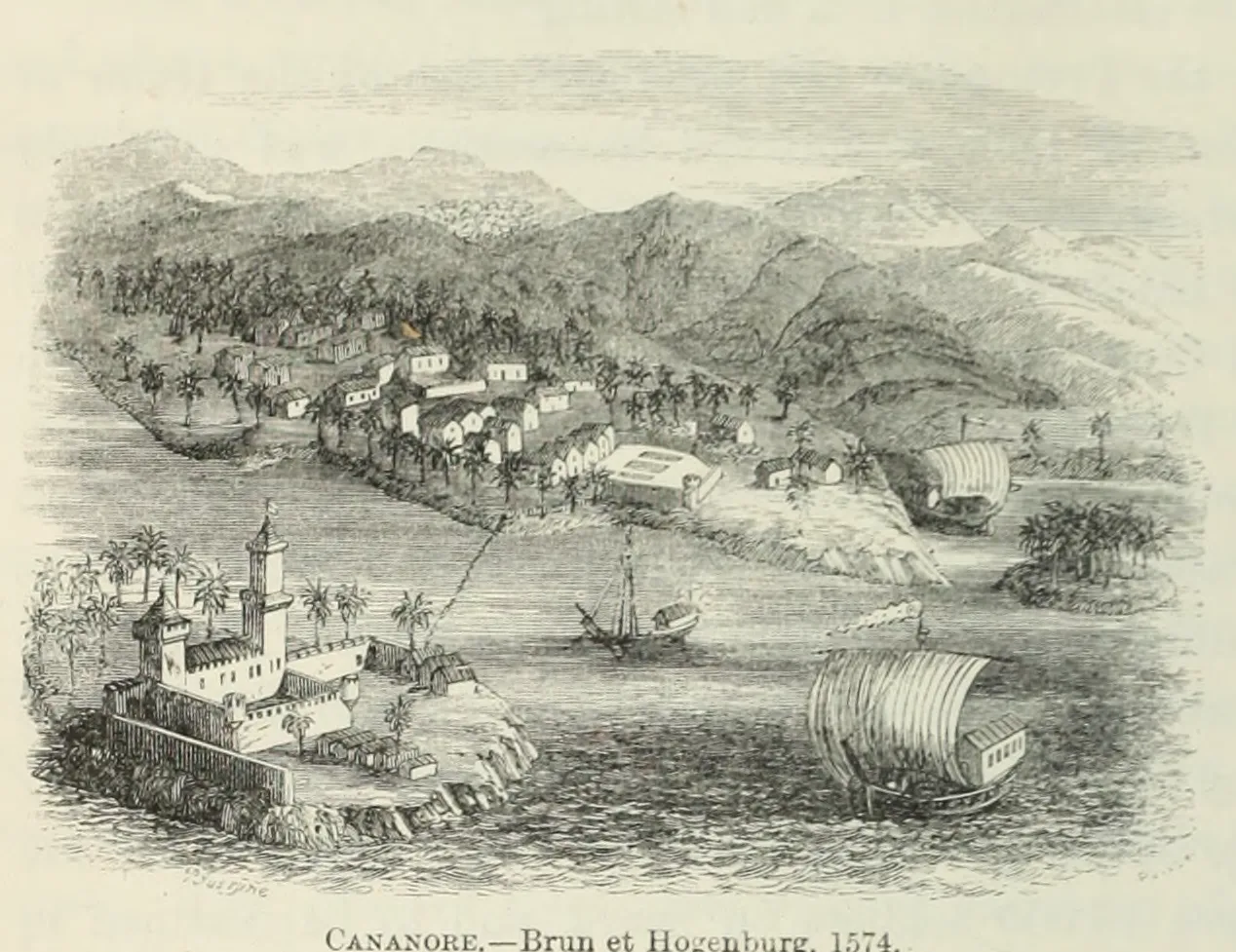
On arriving, he learned that the rajah, though greatly offended with Cabral for leaving without notice and carrying off his hostages, had proved a faithful ally, and given full protection to all the members of the factory; but that the Moors had carried their hostility so far as on one occasion to set fire to it, and in various ways, by depreciating the value of their merchandise, had prejudiced the native traders against them to such a degree, that they refused to part with their spices except for ready money. As this was a commodity with which Juan de Nueva was very scantily provided, he immediately returned to Cananore, where the rajah dealt with him much more liberally, and furnished him with 1000 quintals of pepper, 50 of ginger, and 450 of cinnamon, together with some cotton cloth, to be paid out of the proceeds of the goods which he had lodged for sale in a Portuguese factory established there. While occupied with these commercial transactions, Juan de Nueva received intelligence that a large fleet belonging to the zamorin was on the way to attack him. The rajah who sent the intelligence advised him to land his men and ordnance, and make an entrenchment on shore, as the only effectual means of defence. He was not so easily intimidated; and, on the next day, when 100 vessels were seen entering the bay, he advanced to meet them, and poured in his shot with such good effect, that the zamorin’s commander hung out a flag of truce, and, after a parley, agreed to quit the bay, and make the best of his way back to Calicut This failure made such an impression on the zamorin that he proposed terms of accommodation. Juan de Nueva, probably feeling that his powers were not sufficient for transacting business of so much importance, set sail for Europe. His homeward voyage was prosperous, and he arrived safely with all his ships.
The accounts brought home by Cabral satisfied the King of Portugal that he must either fit out his expeditions on a scale of greater magnitude, or desist from the attempt to establish a trade in the East. The latter alternative was not to be thought of; for even under the most adverse circumstances the profit had counterbalanced the loss. It was therefore determined that the next expedition would be more adequate to the objects contemplated. These were not merely to overawe any of the native Indian princes who might be disposed to be hostile, but to chastise the insolence of the Moors by attacking their trade in its principal seat. Accordingly, the expedition now fitted out consisted in all of twenty ships. The command, at first offered to Cabral, was ultimately given to Vasco de Gama, who was to proceed directly to India with ten ships; while his brother, Stephen de Gama, and Vicente Sodre, were each to have the command of a squadron of five, and clear the sea of Moors, the one by scouring the Malabar coast, and the other by cruizing off the entrance to the Red Sea.
Vasco de Gama, honoured with the title of Admiral of the Eastern Seas, set sail with Vicente Sodre on the 3d of March, 1502, before Juan de Nueva’s return; Stephen de Gama did not leave before the 1st of May. Having doubled the Cape of Good Hope, and sailed up the east coast of Africa, for the purpose of establishing factories at Sofala and Mosambique, Vasco de Gama, after waiting till he was joined by his brother, continued his course across the Indian Ocean, and had arrived within sight of Mount Dilly, a little north of Cananore, when he fell in with a large ship belonging to the Sultan of Egypt. It was richly laden, and had on board many Mahometans of rank and wealth, bound on a pilgrimage to Mecca. He immediately attacked it, and captured it after a vigorous resistance. To his disgrace he made an atrocious use of his victory. Going on board, he called the principal passengers before him, and ordered them to produce whatever property they had in money or in goods. They declared that most of both had been left in Calicut; but on his throwing one of them bound hand and foot into the sea, and threatening to treat all the others in the same way, they became terrified, and yielded to his demand. He had thus secured a rich prize by questionable means, and ought at all events to have been satisfied with it. Instead of this he acted as if he had thrown aside every feeling of humanity, and resolved to play the barbarian, not for the profit, but merely for the pleasure it afforded. After dividing the plunder among his crews, and removing all the children to his own ship, in order to fulfil a vow which bound him to make monks of all the males he should thus capture, he forced all the passengers and crew of the Moorish vessel below, and, having nailed down the hatches upon them, told his brother to set it on fire. The fiendish order was executed; but the unhappy victims, rendered desperate, made superhuman efforts, and having broken open the hatches, succeeded in quenching the flames. Had they been the guiltiest wretches possible, instead of being for the most part inoffensive pilgrims, they had now surely done enough to save their lives. But no. Their destruction had been ordered, and Vasco de Gama was not to be satisfied with less. Stephen, who proved himself no unwilling instrument in his brother's hands, was told to board, and made the attempt, but met with such a reception from the Mahometans, when they saw that no mercy was to be expected, as compelled him to retire. Had De Gama been acting under a sudden burst of passion, he had now full time to cool, for night came on, and nothing more could be done till morning. When he rose, it was only to repeat his inhuman order: the vessel was again boarded and set on fire, and 300 persons, of whom thirty were women, were burned to death, or drowned, or slaughtered. Of all who were in the vessel when the capture was made, not a soul escaped except the children, whom this bloody baptism initiated into the Romish faith.
After this infamous transaction one almost shudders to mention the name of Vasco de Gama, but the course of the narrative cannot in the meantime proceed without him. In his next proceeding, the caution which he used, when he thought it possible that his own life might be in danger, contrasts strangely with the recklessness he showed when iniquitously disposing of the lives of others. Having anchored off Cananore, he desired an interview with the rajah; but as the captivity he had suffered at Calicut on his first voyage seemed still uppermost in his mind, he adopted the device of having a wooden bridge, which projected a considerable way into the water. At the end of this bridge, which was covered with carpets, a pavilion was reared to form the hall of audience. The rajah made his appearance first, attended by 10,000 nairs, and advanced to the pavilion amid the beating of drums and flourishes of trumpets. De Gama came accompanied by all his boats, adorned with flags, and took his place in the pavilion, under a salute of artillery. The result of the interview was a treaty of amity, and the establishment of a Portuguese factory at Cananore.
From Cananore De Gama continued his course to Calicut, and, making his appearance unexpectedly in the roads, captured several small boats, containing about fifty natives. Whatever just cause of quarrel he may have had with the zamorin, these poor creatures were not implicated, and yet, on not obtaining redress for the destruction of the Portuguese factory, and the loss of lives occasioned by it, he hung them up at the yard-arm, and, after they were dead, cut off their arms and feet, and caused them to be carried ashore, with a message to the zamorin, that similar treatment was in reserve for himself for his repeated breaches of faith. To show that he was in earnest, he ordered three ships to stand in as near as possible to the town, and open their fire upon it. The royal palace was one of the many buildings thus demolished. Without waiting to ascertain the effect, he left Vicente Sodre with a squadron to scour the coast and destroy the Moorish trade, and set sail for Cochin. Here matters were easily re-established on their former friendly footing, mutual presents were exchanged, and a commercial treaty of a more formal nature than that previously existing was concluded.
The next proceeding of the zamorin was very inexcusable, and, indeed, looks as if he had determined to put himself entirely in the wrong. Hearing that De Gama was lading at Cochin, he sent a messenger, inviting him to Calicut, and promising that everything would be arranged to his entire satisfaction. This was rather a slender foundation on which to negotiate; but peace with Calicut was felt to be so desirable that De Gama determined to make one effort more to secure it, and set out alone, leaving all his other ships behind. The temptation was too strong for the fickle and tortuous court of Calicut; and De Gama, instead of the friendly reception which he had anticipated, was set upon by a large fleet of small vessels, and very narrowly escaped being made prisoner. Further negotiation was of course impossible, though he ought certainly to have disdained to take the petty revenge of putting the zamorin's messenger to death.
The details of the conflicts which ensued possess little interest. In one of them De Gama, after putting to flight a large number of small vessels, captured two large Moorish ships, which proved valuable prizes, both of them being richly laden, while on board one of them was an image of gold of thirty pounds weight, with emeralds for its eyes, a robe curiously wrought and set with precious stones for its covering, and on its breast a large ruby. Having again visited Cananore, and united with its rajah and that of Cochin in forming a kind of triple alliance, for mutual defence, De Gama, leaving Vicente Sodre with his squadron, sailed for Europe on the 20th of December, 1503, but did not reach Portugal till the following September. He had again proved himself an able navigator; but his proceedings had rather tarnished than increased his fame. His sovereign, however, was satisfied; and rewarded him with the title of Count of Videgueira.
Before De Gama departed, the Rajah of Cochin had made him aware of threatening messages which he had received from the zamorin. The peril to which a faithful ally was thus exposed, entitled his case to a more careful consideration than it received, and he was left exposed to the full fury of the zamorin's revenge. Nor was it long before it overtook him. De Gama's departure was too favourable an opportunity to be lost, and hostile preparations on a most formidable scale were immediately commenced. In the vicinity of Ponany, about sixteen leagues north of Cochin, 50,000 men were assembled. Before commencing operations the zamorin asked nothing more than the surrender of the Portuguese who had fixed their residence in Cochin. The population were urgent that the demand should be complied with, but the rajah stood firm, and, though his force was comparatively insignificant, advanced to the encounter. The contest, however, was too unequal; and he was driven from post to post, till he was at last obliged to abandon his capital, and seek an asylum in the island of Vaipi, or Vipeen, in its vicinity.
While in this extremity he received no support from Vicente Sodre, who kept cruizing about making captures, but on some shallow pretext or other refused to give any direct assistance. Powerful aid, however, was approaching. Nine ships had sailed from Lisbon, in three equal squadrons, under the respective commands of Alonso or Alfonso Albuquerque, Francisco Albuquerque, and Antonio Saldanha. The last was to cruize in the mouth of the Red Sea; the others were to proceed directly to India. Francisco Albuquerque arrived first, and with a considerable addition to his squadron, in consequence of having fallen in with some of the ships belonging to Vicente Sodre. This powerful reinforcement completely changed the aspect of affairs, and the zamorin was defeated at every point. Triumpara, in the joy of his heart, not only conferred new privileges on the Portuguese, but gave them permission to build a fort.
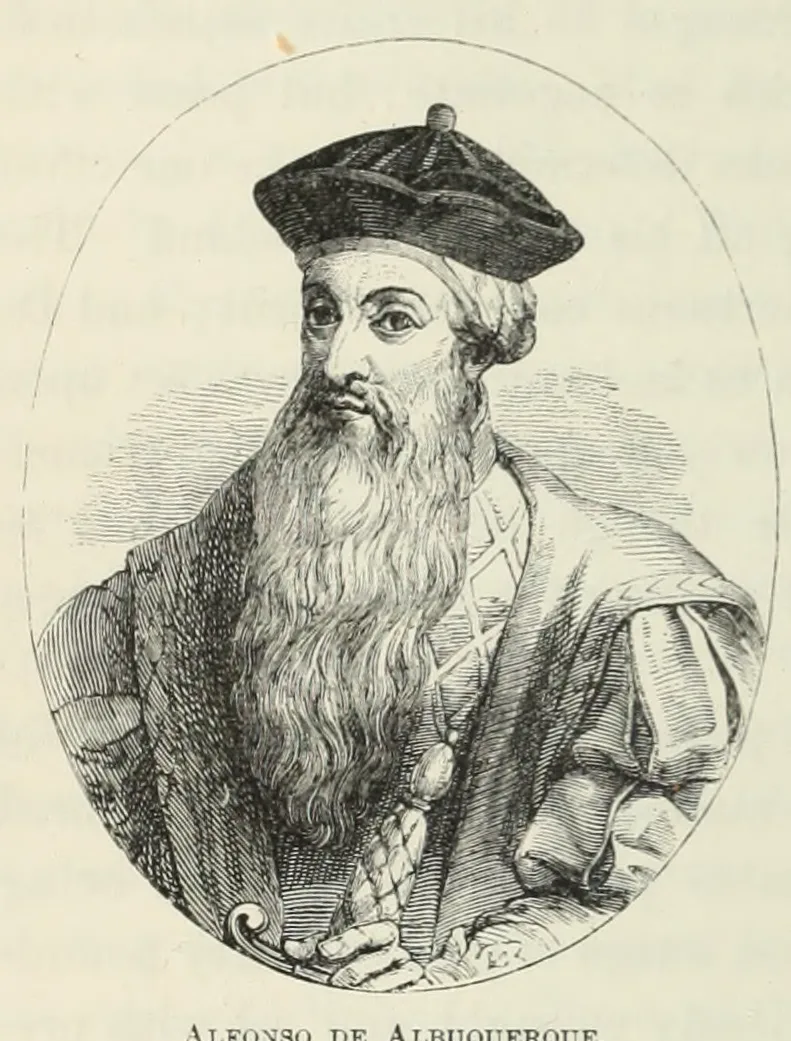
On the arrival of Alfonso Albuquerque new energy was thrown into the Portuguese operations, and many successful expeditions were made both by land and sea. The effect of these was manifested in various ways. In the south Coulan, or Quilon, then under female government, made a voluntary offer to lade two ships, and consent to the establishment of a factory; while the zamorin, dispirited by a series of disastrous defeats, was compelled to sue for peace. It was granted, but on terms so disadvantageous, that he availed himself of the first pretext for a rupture, and was soon again at open war. For some reason not explained the two Albuquerques, at this very time, when their presence seemed more necessary than ever, set sail for Europe, leaving only Duarte Pacheco with the ship which he commanded, two caravels, and 110 men, for the defence of Cochin. Francisco Albuquerque appears to have perished in a storm, for he was never more heard of; Alfonso, reserved for greater things, arrived in safety, bringing with him for the king forty pounds of pearls, a diamond of remarkable size, and two horses, a Persian and an Arab, the first of the kind which were imported into Portugal.
The zamorin had become convinced that he would never be able singlehanded to overcome the Portuguese; and therefore, in again preparing to take the field, made it his first business to strengthen himself by entering into a coalition with neighbouring states. In this he found little difficulty, for the Portuguese were not only viewed with jealousy as strangers, but had pursued a very reckless course at sea, attacking and making prizes of all vessels of whatever country, whenever they found any pretext for stigmatizing them by the name of Moors. We have already met with instances of this kind candidly confessed, or rather complacently dwelt upon by themselves; and it can scarcely be doubted that the instances which they have not recorded were still more numerous. Be this as it may, the coalition soon assumed a very formidable appearance; and while a numerous fleet, provided with nearly 400 cannons, prepared to bombard Cochin from the sea, an army, estimated at 50,000, began to approach it by land.
Triumpara was dismayed, and apparently with good reason, for not only was the enemy in overwhelming force, but his subjects, under the influence of terror, began to desert. The only person whose courage remained unshaken was the Portuguese captain, Duarte Pacheco, who, when the rajah came to him in the greatest alarm, and spoke of surrender, scouted the idea, assuring him that a valiant defence would certainly prove successful. This was no empty boast. Pacheco made all his arrangements with so much skill, and carried them out with so much resolution, that the confederates were ultimately obliged to retire with a severe loss. Attempts were repeatedly made to renew the attack, but the result was always the same; and the zamorin with his allies had the mortification of seeing all their efforts baffled by a mere handful of Europeans. Seldom has there been a more striking example of what one daring spirit can accomplish than was furnished by Pacheco in this struggle. In the course of it the zamorin had lost 18,000 men, and was now so humbled as gladly to accept of terms of peace from his own tributary Rajah of Cochin. As we shall not again meet with Pacheco, we may here conclude his history. It is a melancholy one. A fleet of thirteen ships, of larger dimensions than had ever before been built in Portugal, having arrived under the command of Lope Soarez, Pacheco, though treated with merited distinction, was superseded, and invested with the government of El Mina, on the west coast of Africa. Here it was thought that his private fortune, to which he was too heroically disposed to give much attention, would be improved. This object was entirely defeated by a violent faction, which first thwarted his measures, and then had the audacity to seize his person on a false charge, and send him home in chains. After languishing for a time in prison he obtained an honourable acquittal, but it was too late. The ungrateful return for his distinguished services had broken his heart, and he died either in prison or shortly after he was released from it.
Lope Soarez, soon after his arrival, moved up to Calicut, and was met by a messenger from the zamorin, who was now willing to comply with every demand made upon him except one. This was to deliver up an European, a native of Milan, who had entered his service, and taught him the art of casting cannon, along with other important naval and military improvements. To his honour the zamorin demurred to the delivery of an individual whose only offence was the ability and fidelity with which he had served him. Soarez, unable or unwilling to appreciate the honour and justice of the zamorin's refusal, immediately bombarded the town, and laid the greater part of it in ashes. This work of destruction accomplished, he immediately proceeded to another, and treated the town of Cranganore, which had adhered to the zamorin, in the same way. His next exploit began more ominously, but ended still more triumphantly. In sailing north from Cranganore to attack Ponany, he was met by the zamorin's fleet, and driven into a bay. Here he found himself in imminent peril; for in addition to the fleet before which he had been obliged to retire, seventeen large Moorish ships, well provided with cannon, and carrying 4000 men, were waiting to receive him. A fierce conflict ensued; but ultimately, with a very trifling loss to the Portuguese, all the ships of the enemy with their rich lading were destroyed. Soarez, thinking he had now done enough to justify his return, left four ships at the fort of Cochin, and set sail for Europe with the
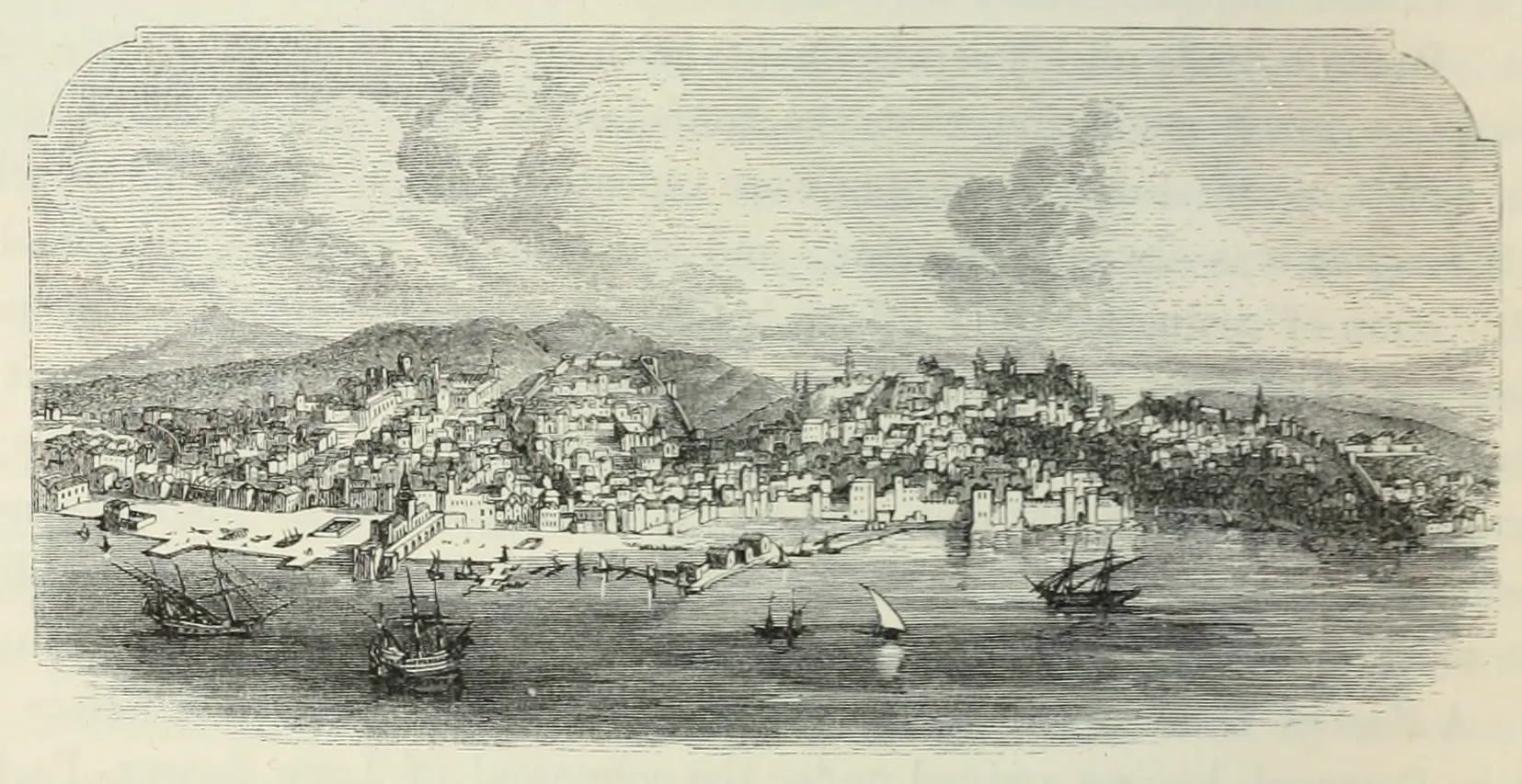
remainder. His arrival at Lisbon, on the 22d of July, 1506, was gladly welcomed, as no richer cargo in goods and prizes had ever returned from the East.
The next Indian armament fitted out by Portugal was on a more magnificent scale than any which preceded it. It consisted of twenty-two ships, carrying, in addition to the crew, 1500 fighting men, and was placed under the command of Don Francisco Almeida, who bore for the first time the proud title of Viceroy of India. His arrival in India took place in 1507. The first land reached was the island of Anchediva, where, as it occupied a commanding position on the coast, and had become a common station for Portuguese vessels, he built a fort. On arriving at Cochin, where he intended to have rewarded Triumpara, the old and faithful ally of the Portuguese, with a crown of gold, set with jewels, which he had brought from Portugal for the purpose, he was astonished to find that he had retired from the world, to spend the remainder of his days as a solitary devotee. His nephew was reigning in his stead, and received the crown from the hands of Almeida during a pompous ceremonial. It is probable that he did not understand all that was meant by it, for from that day he was to be regarded, not as an independent sovereign, but a vassal holding his crown during the pleasure of the Portuguese.
Before Almeida arrived, the zamorin had once more placed all his fortunes on a venture; and, as if fully aware that the struggle in which he was about to engage would prove decisive of his fate, left no means unemployed to insure success. At this time a powerful dynasty was reigning in the Deccan over territories which included a considerable tract of sea-coast, from Goa northwards, while the kingdom of Gujerat or Cambaya had risen to be a great naval power. Both of these states had been wantonly attacked by the Portuguese, and their commerce had suffered severely before they were aware of having done anything to provoke hostility. Naturally exasperated, they entered with readiness into
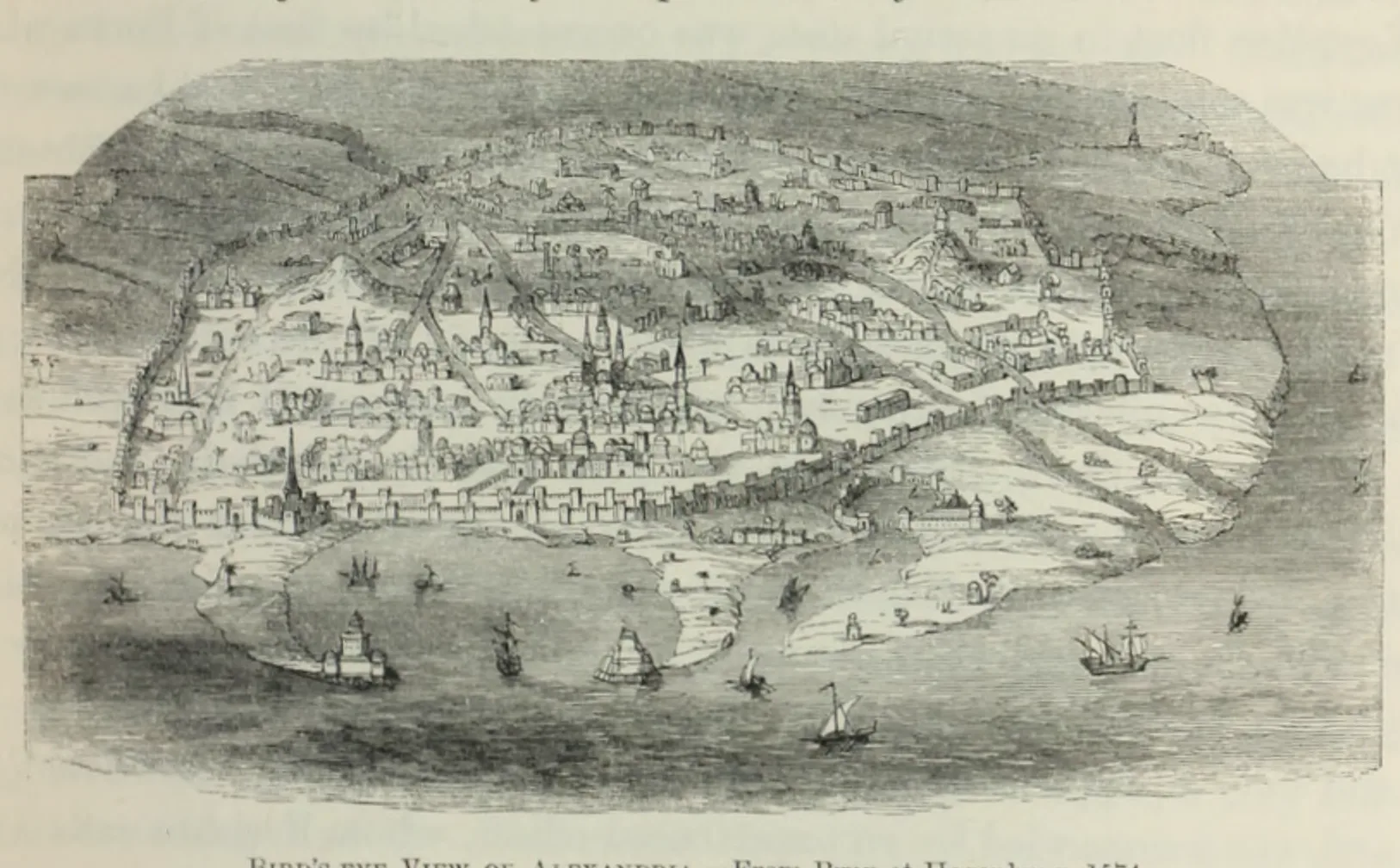
a combination intended to banish the Portuguese for ever from the Eastern seas. Even with these auxiliaries the zamorin did not feel secure. He therefore extended his views much further, and entered into communication with the Sultan of Egypt.
The Mameluke sultan at once responded to the call thus made upon him, and the more readily that his attention had previously been drawn to the subject from another quarter. The success of the Portuguese in the East was already telling powerfully against the lucrative trade which the Venetians had long been accustomed to regard as their special monopoly. Goods brought into the Levant, either overland or by way of Alexandria, had so heavy a burden of transport and taxation to bear, that they could not possibly compete with the comparatively inexpensive process of a single voyage, however long, from the port of lading to the port of delivery. The Venetians thus found themselves undersold in every European market, and became perfectly aware that they must either destroy the Portuguese trade or be destroyed by it. Their first endeavour was to work upon the fears of the King of Portugal and the pope, by instigating the sultan to send a threatening letter to Lisbon and Rome, intimating that if the Portuguese did not forthwith relinquish the new course of navigation, by which they had penetrated into the Indian Ocean, and cease from encroaching on a commerce which had been carried on from time immemorial between Asia and his dominions, he would put to death all the Christians in Egypt, Syria, and Palestine, burn their churches, and demolish the holy sepulchre itself.
This menace having failed to produce the effect anticipated, the Venetians did not scruple to urge the sultan to take the remedy into his own hands, and, in accordance with the invitation given by the zamorin, become a powerful auxiliary in the crusade against the Portuguese. There was only one difficulty. The Egyptian fleet in its actual state was overmatched by that of Portugal. If the war was undertaken, the first thing necessary would be to build a new fleet. Egypt had no proper timber for the purpose. How, then, was it to be obtained? The Venetians were not to be balked of their object by such an obstacle. Had they not whole forests of naval timber in Dalmatia? and having gone so far, why need they scruple to place them at the disposal of the sultan, who, after hewing down as much as he required, might easily transport it by a well known route to the Red Sea? Such was the plan actually adopted; and Europe saw the maritime power which had taken a prominent part in the crusade of Christian princes against Mahometans, as zealously engaged in promoting a Mahometan crusade against Christians.
By these extraordinary means a fleet of twelve ships of war having been built and fully equipped, set sail for the Indian coast in 1507. It carried 1500 men, and was commanded by an experienced officer, whom Ferishta calls Ameer Hoossein, and the Portuguese Meer Hashim. It sailed first to Gujerat, where Mullik Eiaz, admiral of Mahmood Shah I., who was then reigning sovereign of that kingdom, was prepared to join it with a squadron which would more than double its numbers and strength. Almeida seems not to have been aware of the danger which threatened him till he was almost overtaken by it. His tactics obviously should have been to attack the Turkish fleet on its passage. In this way it might not have been difficult for him to beat his enemies in detail. He may have been prevented by obstacles of which we are not aware; for after he had resolved to pursue this obvious course it was found to be too late. His son Lorenzo, whom he had despatched with eleven sail to intercept the sultan’s fleet, having been detained, first off Cananore, where he attacked and, with scarcely any loss, destroyed a native squadron far larger than his own, and afterwards at Anchediva, where sixty Moorish and native vessels had made an attempt on the fort, arrived in the harbour of Choul, or Chowul, about twenty-three miles south of Bombay, just in time to see the Egyptian admiral enter it. A fierce conflict immediately ensued, and was continued without any decided advantage till night separated the combatants. Next day an immense preponderance was given to Ameer Hoossein by the arrival of Mullik Eiaz with the Gujerat fleet. Lorenzo, still undismayed, immediately renewed the battle, but found the Egyptian admiral a much more formidable antagonist than he had been accustomed to deal with. After another day’s fighting had left the victory undecided, the Portuguese ships were so much shattered that it was determined by a council of war to take advantage of the night and effect a retreat.
Lorenzo, who had previously incurred his father’s displeasure, by declining on one occasion to force the fleet of the zamorin to action, was very reluctant to take a step which would justly be considered as an acknowledgment of defeat, and continued to linger on till the day began to dawn. He had by this time consented to retreat, and several of his vessels had set sail. Unfortunately when he began to follow, his ship grounded, and after some ineffectual efforts to tow it off, the rest of the squadron continued their flight, and left him to his fate. He might have escaped in his boat, but at once made up his mind to sell his life as dearly as possible, and die at his post. The enemy at first attempted to board, but was so bravely resisted, that he adopted the more cautious method of keeping at a distance and pouring in his shot. Lorenzo, having been struck by a ball, which broke his thigh, ordered himself to be placed against the mainmast, and there remained, encouraging his men, till another ball broke his back and killed him. The ship shortly after sunk. Of its crew of 100 men only nineteen escaped. According to Faria y Sousa, the whole loss of the Portuguese amounted only to eighty-one men, while the enemy lost 600. The Mahometan account given by Ferishta is very different. After mentioning that the Portuguese flag-ship, valued at a crore of rupees (a million sterling), was sunk, and every man on board perished, he adds, that the Mahometan fleet returned victoriously; for although 400 Turks were honoured with the crown of martyrdom, no fewer than 3000 or 4000 Portuguese infidels were at the same time sent to the infernal regions.