THE Portuguese were now fully committed to their career of conquest, and successive armaments, on a grand scale, quitted Lisbon for the East. One of these, under Tristan da Cunha, consisted of thirteen vessels, and 1300 fighting men. Another, of twelve vessels, sailed under the command of Alfonso Albuquerque, who, after performing several exploits on the African coast, and taking effectual measures to cripple the trade from India by the Red Sea, continued along the coast of Arabia, and entered the Persian Gulf, determined to strike a still more fatal blow. There the Mahometan traffic with India was still active. Albuquerque, in whom great military and political talents were combined, at once perceived how an effectual interdict might be laid upon it. The only thing necessary for this purpose was to make himself master of the city of Ormuz, situated on an island in the mouth of the gulf. In this way he could completely command the passage, and place the trade at his mercy. After the capture of Muscat, and several other places of minor importance, he proceeded to the execution of his grand enterprise. His design had been penetrated; and instead of being able to take the city by surprise, as he had anticipated, he found it defended by a fleet of 400 vessels, sixty of them of large size, and by an army of 30,000 men. To show how far he was from being dismayed at these preparations, he immediately advanced into the harbour, and anchored among five of the largest ships, firing his cannon as if in defiance. After waiting for a message from the king, but receiving none, he sent him his ultimatum, which, considering the relative position of the parties, was certainly of a very extraordinary and arrogant description. It was to the effect that he had come with orders to take the King of Ormuz under his protection,
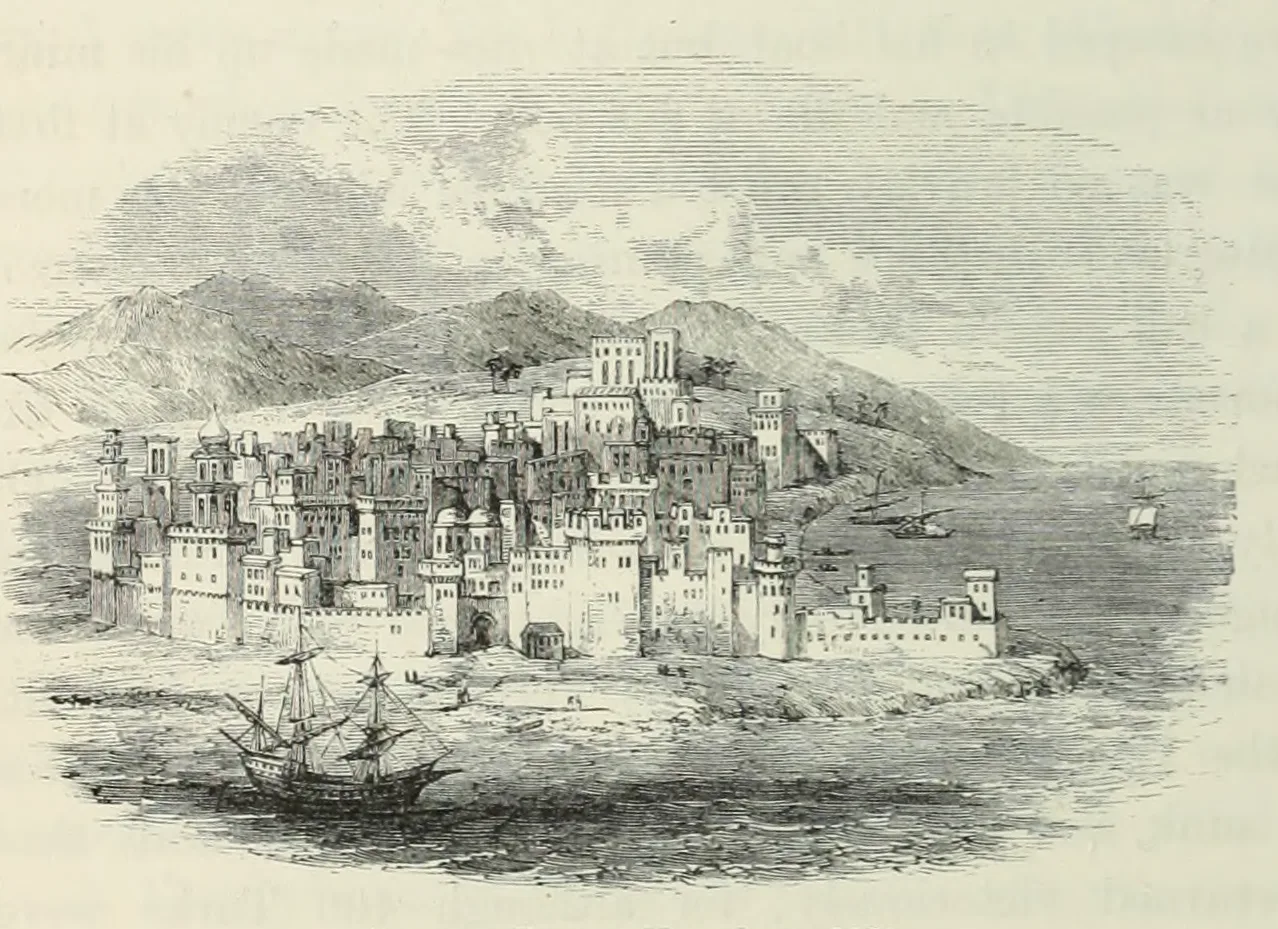
on the condition of paying a reasonable tribute to Portugal, or to treat him as an enemy by declaring war against him.
There was little room to doubt which of the alternatives, thus arbitrarily placed before him, the sovereign of Ormuz would accept, but as his fortifications were not yet completed, it was important to gain time; and solely with that view, instead of sending a resolute defiance, he entered into negotiation. Albuquerque saw what was intended, and at once brought matters to a point, by telling the messenger that when he next came, it must be with either an acceptance of peace, or a declaration of war. There had never been any room for choice, and the message accordingly was, that Ormuz was in use not to pay, but to receive tribute. Albuquerque lost not a moment in commencing a cannonade which must have caused fearful slaughter, as not only were the walls, shore, and vessels crowded with combatants, but even the tops of the houses were covered with spectators. The Persians, in the meantime, were not idle, and made two furious onsets; but neither in weapons nor discipline could they cope with the Portuguese, and the sea is said to have been coloured with their blood. With the loss of only ten men, Albuquerque burned, sunk, or otherwise destroyed all the ships of Ormuz, and received a flag of truce with an offer to comply with all his demands. The terms were, the annual payment of about £2000 as tribute to the King of Portugal, and ground on which to build a fort. No sooner were the terms arranged, than the fort was immediately commenced, and carried on with such rapidity, as to assume shape in the course of a few days.
Khojah Attar, who governed Ormuz in the name of Saifaddin, who was a minor, had no sooner made the arrangement than he repented of it. From the destruction which Albuquerque had caused, he had formed an extravagant idea of the force under his command; and was astonished above measure, on learning that it did not muster above 460 men. He therefore prepared anew for hostilities, and dexterously availed himself of a mutinous feeling among the inferior Portuguese commanders, to escape the consequences. Albuquerque, after venting his rage by some very barbarous proceedings, was obliged to depart and spend the winter at Socotra, which had become a Portuguese conquest. Having again returned, he gave formal notice of his arrival to the government of Ormuz, and was immediately informed that the tribute stipulated would be paid, but that he would not be permitted to build the fort. He would fain have resumed the siege, but more important interests required his presence in India. He had been appointed viceroy.
Almeida, in the midst of his preparations to avenge the death of his son, received the mortifying intelligence that he had been superseded in his government. Obedience to the royal mandate was, of course, his duty; but both revenge and ambition pointed to an opposite course, and he determined to follow it at all hazards. On the pretext that the public interest would not allow him, in present circumstances, to demit his authority, he refused to resign the insignia of office; and leaving Albuquerque, who was in no condition to force him, to devour his disappointment as he could, set out without him at the head of a powerful armament. While proceeding northwards along the coast, in search of the combined Egyptian and Gujerat fleets, he stopped at Anchediva, and there received information which determined him to make the important commercial city of Dabul, situated on the coast about half-way between Goa and Bombay, the first object of attack. It belonged to a king of the Deccan, who had joined the zamorin's confederation, and assisted him with ships. In Almeida's view this was sufficient to justify any severity; and, without any note of warning, he suddenly commenced his attack both by sea and land, and never desisted till he had laid Dabul in ashes. An immense plunder might have been obtained; but fearing the effect upon his troops, he chose rather to burn than to preserve the booty.
From this achievement, which certainly added little to his laurels, Almeida proceeded to Diu, finely and strongly situated on an island of the same name, on the southern shore of the peninsula of Gujerat. Here he found Ameer Hoossein and Mullik Eiaz, with their fleets. Had they remained in their position under the batteries of Diu, as the Gujerat admiral strongly urged, Almeida, if he had ventured an attack at all, must have made it under great disadvantage; but the Egyptian admiral, who was naturally of a chivalrous temper, and perhaps also rendered over-confident by his recent success, when Lorenzo was slain, disdained to be cooped up in a harbour, when he could meet his enemy in the open sea, and sailed out, displaying more valour than discretion. The conflict, after raging furiously for some time, terminated in a glorious victory gained by the Portuguese, who, however, converted it into an indelible disgrace, by an atrocious massacre. Several days after the battle was fought, and they had sailed away for Cananore, they murdered all their prisoners in cold blood. There is no possible excuse for the atrocity; and the only explanation given is, that Almeida's revenge could not otherwise be satiated. The defeat had so dispirited Mullik Eiaz that he made overtures of peace. They were readily listened to; and he might have obtained advantageous terms, if he would have stooped to the meanness of delivering up his Egyptian colleague. As much to his honour as to the disgrace of the Portuguese for making such a demand, he at once gave it a peremptory refusal.
Almeida, having returned to Cochin, was again pressed by Albuquerque to resign the viceroyship, which he had persisted in holding, in defiance of the mandate of his sovereign. So far from complying, he took the extraordinary step of seizing the person of his competitor, and sending him as a prisoner to the fort of Cananore. He would probably have completed the treasonable course to which he was now committed, by declaring himself independent, had not the opportune arrival of Don Fernando Coutinho, with a large fleet and extraordinary powers, enabled him to act with effect as a mediator. The result was, that Almeida abandoned all idea of resistance, and, resigning the insignia of office, took his departure for Europe. Before leaving, a native conjuror had told him that he was not destined to pass the Cape of Good Hope. He had passed it, however, and had begun to make merry with the prediction, when an event took place which terminated his career somewhat ignobly. The three ships he had with him anchored in Saldanha Bay, a little north of the Cape, and sent ashore a watering-party. One of the ex-viceroy's servants insulted one of the natives, and was roughly handled by them in return. Almeida, contrary to his wish and better judgment, was induced to take part in this petty squabble, and having gone ashore, was returning with the cattle carried off in a foray, when the natives, who had been lying in ambuscade, rushed out upon him. They were armed only with pointed stakes, but these they used so effectually, that fifty of the Portuguese soon lay dead at their feet. Among them was the ex-viceroy himself, mortally wounded by a thrust which pierced his throat.
Albuquerque, now fully installed as viceroy, was bent on following out his career of conquest, and sailed for Calicut, before which he appeared on the 2d of January, 1510, with thirty vessels and 1800 men, together with a number of natives who followed in boats, allured by the hope of plunder. Coutinho had arrived from Europe with an earnest longing for Eastern renown; and now that the opportunity offered, he had set his heart on symbolizing himself as the captor of the royal palace. Albuquerque indulged him by giving him the command of 800 men, after administering all the cautions which his superior talents and experience suggested. Unfortunately Coutinho thought only of his prize, and rushed forward as if he had been running a race rather than fighting a battle. Never looking behind him, he forced his way to the palace, and set about installing himself in it, for the purpose of celebrating his triumph. His infatuation was soon perceived by the native troops, who took advantage of it so silently and effectually, that Coutinho did not awake to a sense of his peril, till he found himself hemmed in by thousands of natives, and deprived of every outlet. Albuquerque, in exerting himself for his relief, was so severely wounded in the head by a stone, and in the throat by a dart, that he was borne senseless to the shore. Coutinho, and several young nobles from Lisbon, fell in the palace fighting desperately; and the whole detachment would have perished to a man, had not a large body of reserve arrived and obliged the enemy to retire. Notwithstanding this disastrous retreat, the inhabitants suffered much more severely than the Portuguese, and saw the greater part of their city laid in ruins.
Ormuz was the next place to which Albuquerque turned his attention. He had there been baffled by the supineness or treachery of his officers, particularly Lope de Soarez and Juan de Nueva, and obliged, in consequence, to leave one of the main avenues of Mahometan trade still open. He accordingly began to make such preparations for a new attack upon it as must have proved successful, when his attention was attracted to another quarter, and he resolved to employ his armament against Goa. This town which, from having afterwards become the seat of Portuguese government in the East, makes some figure in history, was finely situated on an island at the mouth of an estuary, forming one of the very few good harbours which occur on the western coast of the Indian peninsula. At this time (1510) it was included in the territories of one of the kings of the Deccan, who had his capital at Bejapoor, and is usually called by Portuguese writers Sabay or Savay, though his proper name or title was Yusuf Adil Shah. He had recently wrested it from the Rajah of Onore. The grounds of Albuquerque's quarrel with Yusuf are not very apparent; and it is probable that he did not deem it necessary either to allege or invent any. His only object was to extend the Portuguese rule; and if he could succeed, he regarded it as scarcely worth while to inquire whether the means which he employed could be justified. One inducement may have been, that, as a new conquest, Yusuf's possession of Goa must have been somewhat insecure. Another inducement was, that the Rajah of Onore, the legitimate owner, was ready to assist to the utmost in recapturing it. He found a third auxiliary capable of rendering still more effectual assistance in Timoja, who figures sometimes as Rajah of Canara, a district which was bounded by Goa on the north, and sometimes simply as a privateer, roaming the seas with a powerful fleet, and living by plunder.
Thus assisted, Albuquerque made his appearance off the coast in the beginning of 1510. At first anticipating a valiant resistance, he sent his nephew along with Timoja to take soundings. They discovered a fort which was well provided with guns, and defended by 400 men, and not only had the hardihood to attack, but the good fortune to capture it. This seemed a most auspicious commencement, and proved only the first of a series of fortunate events which followed rapidly, and put Albuquerque in possession of this most important locality, before he was required to strike a blow. According to the Portuguese accounts, some conjuror or fakir, whose predictions were implicitly believed, had announced that Goa was destined shortly to become subject to foreigners. On the faith of this prediction, the inhabitants thought it a stroke of good policy, instead of enduring the miseries of a siege which must ultimately be successful, to make a voluntary surrender. Accordingly, to the great but most agreeable surprise of Albuquerque, he was received ashore by the population as if he had been their native prince, conducted in state to the gate, when he received the keys, and thereafter put in possession of the palace. The Mahometan account says nothing of the conjuror; and with far greater probability represents the capture as the necessary result of a surprise. The fort captured by Timoja and Albuquerque's nephew may have given them complete command of the city, and thus rendered defence impossible.
At this time, however, it was lost almost as easily as it had been gained. Yusuf Adil Shah having died, was succeeded by his son Ismael Adil Shah, who, about four months after the hasty surrender of Goa, collected an army estimated at 60,000. Kumal Khan, the general to whom this army was intrusted, suddenly made his appearance, and conducted the siege with so much ability, that Albuquerque, after twenty days, finding his communication with the fleet seriously threatened, was glad to evacuate the place. But he had no idea of finally abandoning so valuable a prize. In the course of the same year, having collected all his forces, including several additional ships which had arrived from Portugal, he set sail from Cananore with a fleet of twenty-three ships, and 1500 fighting men. After landing at Onore, to assist at the celebration of Timoja's marriage with the daughter of a native queen, he hastened off to Goa, and, anchoring before it a second time, immediately prepared for the assault. It took place before daybreak, and with such success, that the Portuguese entered the city along with those of the defenders who had been stationed outside. For a time every inch of ground within the city was disputed, and more especially at the palace the fight was furiously renewed, till the defenders, fearing that their retreat to the mainland might be cut off, quitted the place in the utmost confusion. The enemy lost 6000; the Portuguese only fifty. Not one Moor was left alive; but the natives were treated with great moderation. Besides recovering their property, they had the satisfaction of being placed under the government of their countryman Timoja, who ruled more equitably than might have been anticipated from his predatory habits. Before departing, Albuquerque declared his intention to make Goa the capital of Portuguese India.
The remaining exploits of Albuquerque, though they had not India for their theatre, are so intimately connected with its history, that a short account of them is here subjoined. After returning to Cochin he began to prepare another armament, and gave out that it was destined to act against Aden, which was then, as it is now, the key to the navigation of the Red Sea. The importance of the object was sufficient to justify all the preparations which he was making; but while pretending to look to the west, his eye was fixed in an opposite direction. The city of Malacca, situated on the peninsula of the same name, had long been the most important emporium of the rich countries lying further east than India. The Moors were still carrying on a lucrative traffic in that quarter; and by means of it were almost able to compensate themselves for all the losses which they had sustained from the Portuguese. This consideration was of itself sufficient to determine Albuquerque to undertake the important expedition which he was now meditating, though the direct benefits which his own country might expect to derive from it were of themselves a sufficient inducement.
On the 2d of May, 1511, Albuquerque set sail from Cochin with nineteen ships and 1400 fighting men, Of these, however, 600 were natives of India. Malacca was at this time under the government of a king of the name of Mahomed, who had treacherously imprisoned a number of Portuguese, commanded by an officer called Diego Lopez de Siqueira. To avenge this outrage was the ostensible object of Albuquerque’s expedition. It was one of the boldest he had ever undertaken, as the city itself is said to have contained 100,000 inhabitants, and was now defended by 30,000 soldiers, and 8000 cannon. With all these means of defence, Mahomed, aware of the kind of enemy he had to deal with, did not feel secure, and sent a messenger to the viceroy to intimate that, if he came for merchandise, it was ready at his command. Albuquerque replied that the merchandise he required was some Portuguese left there by Siqueira, and that on the delivery of them he would be prepared to say what more he wanted. After some parleying, the captives were delivered, and Albuquerque sent his ultimatum. It demanded compensation for the outrage, and for the expenses incurred in obtaining redress, and a site for the erection of a Portuguese fort. This last proposal the king refused to entertain, and Albuquerque immediately prepared to compel him. The Malays are said to have fought well, but it is difficult to believe it; for with all the aid they could derive from artillery, poisoned arrows, poisoned thorns, and mines of gunpowder laid in the streets, their tens of thousands gave way before a mere handful of Portuguese, and the viceroy took triumphant possession of the city. While here he both received and sent several embassies; among the latter, one to Siam, and another to Pegu. He also sent out several navigators on exploring expeditions. One of these is said to have been commanded by Magalhaens, to whom it suggested the idea of his subsequent celebrated circumnavigation.
On the voyage home, Albuquerque lost his finest ship, which was nearly cut across the keel on a sharp rock off the coast of Sumatra. In this perilous position he was obliged to pass the night; and when the morning dawned, was seen performing an act of humanity and heroism, by sheltering with his arms a young girl whom he had saved in the midst of the confusion. When he arrived in India, he found that advantage had been taken of his absence. Adel Khan had resumed the siege of Goa with an army of 20,000 men, and the zamorin was again in arms. Goa was easily relieved; and the zamorin, despairing of success, retired from the contest. The subversion of the Mameluke dynasty in Egypt had deprived him of any further assistance from Ameer Hoossein, and on looking round he saw no quarter to which he could appeal for new aid. According to Ferishta, this humbling conviction so completely overwhelmed him, that his health gave way, and he died of a broken heart.
The attack on Aden, which Albuquerque meditated, had been postponed to that of Malacca, but by no means abandoned. Accordingly, on the 18th of February, 1513, he appeared before it with a fleet of twenty sail, having on board 1700 Portuguese, and 800 natives of India. He lost no time in landing, and hastened forward, in the hope that, by applying scaling-ladders to the walls, he might gain possession of the place. He had underrated its strength, and the
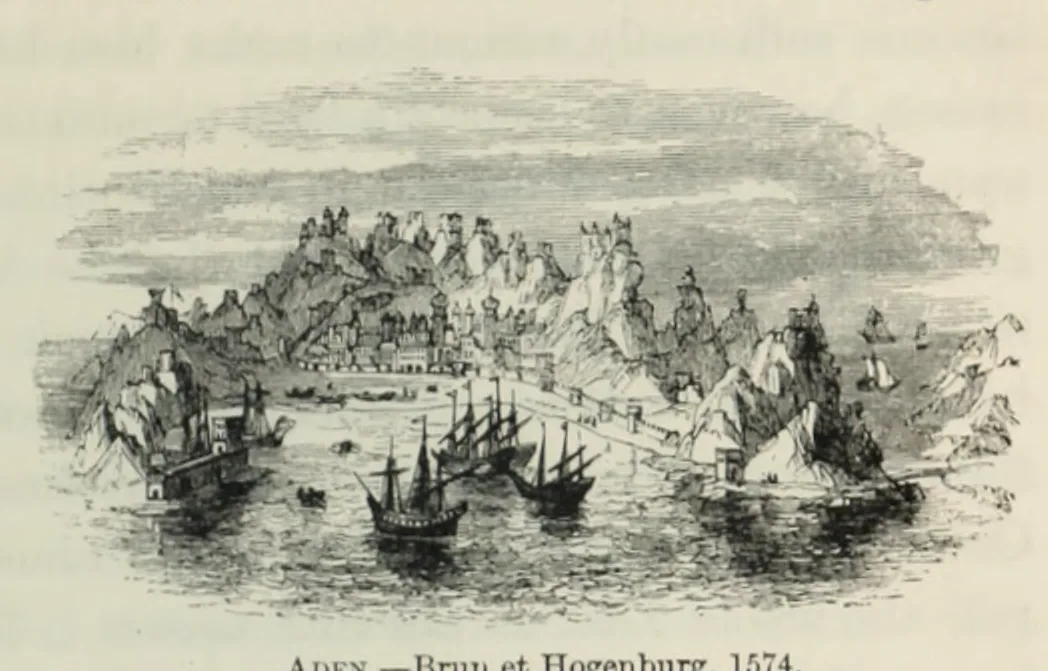
valour of its defenders, and was obliged to retire with a loss too severe to leave him any inclination to renew the attempt. He compensated himself in some degree by entering the Red Sea, which then, for the first time, saw an European vessel on its bosom, and made several valuable prizes. After remaining for some time at the island of Kamaran, he returned and again looked in upon Aden, but found that in the interval its fortifications had been so much improved that it would have been madness to attack it. He therefore passed on, and continued his voyage to India. On reaching Gujerat he made an ineffectual application for permission to build a fort at Diu, but did not attempt to enforce it, as he was intent on another project, on which his heart had long been set, and all the more earnestly that his attempts to accomplish it had hitherto been frustrated. This project was the command of the Persian Gulf by the capture of Ormuz. His third attempt upon it was made in March, 1514. The circumstances were opportune; and when he demanded permission to complete the fort, the governor, though disposed to resist, felt he had not the means, and was obliged to comply. The name of Albuquerque was now famous all over the East; and even Ismael, the founder of the famous Persian dynasty of Sophi, sent him an ambassador with valuable presents, and concluded a treaty with him. Before leaving Ormuz, Albuquerque not only finished his fort, but succeeded in inducing or forcing the king to lodge all his cannon within it. In this way Portuguese supremacy was completely established.
Under Albuquerque the Portuguese power extended more widely, and was more firmly seated, than before or since. It cannot, however, be with any propriety styled an empire, as it was not composed of contiguous territories, but rather consisted of a vast number of isolated forts, scattered over an immense extent of coast, and situated at wide distances from each other. The sites were for the most part admirably chosen, and gave a complete control over all the great maritime thoroughfares from the East Indies to Europe. In some respects this mode of rule has its advantages over territorial possession. It is more easily acquired, and admits of being maintained at a cheaper rate; but its stability is very precarious. The moment the command at sea is lost, it is necessarily extinguished. This, however, was an event of which, during Albuquerque's regency, there were no symptoms; and the fact that they began to be manifested not long after he disappeared from the scene, serves to impress us with a higher idea of the wisdom and vigour of his government. When his countrymen hailed him as “Great,” all impartial observers of his exploits were ready to echo their acclamations. His greatness, however, was now drawing to a close.
While at Ormuz he had suffered much from sickness, and the symptoms had become sufficiently serious to make him hasten his departure. There was no reason, however, to suspect a fatal termination. He had only passed his sixtieth year, and seemed unbroken in constitution. In truth, it was not disease but grief that killed him. It is said that he had applied to his sovereign for the title of Duke of Goa. His enemies took advantage of the circumstance to insinuate that he was cherishing schemes of ambition, and had manifested, by the arrogance of his application, the treasonable purpose which he had at heart. Once Duke of Goa, he would establish himself in that Eastern metropolis, and rule the whole East as absolute master. There was little plausibility in these insinuations; but there was enough to form the groundwork of a successful court intrigue. Albuquerque, while oppressed by sickness, was yet dreaming of a ducal title, when he received the mortifying intelligence that the only reward which he was to obtain for all his services was a summary dismissal. He was no longer viceroy; and as if this was not enough, he had been superseded to make way for his mortal enemy, Lope Soarez. The shock was more than he could bear; and when the vessel in which he sailed arrived off Goa, he was in a dying state. On the first news of his dismissal, he is said to have exclaimed, “See how it is! Love to my fellow-men has brought me into bad odour with the king, and love to the king into bad odour with my fellow-men. To the grave, then, old man, for it is now high time: to the grave!” One of his last acts was to write a touching letter to King Emanuel, in which, recommending his son to his protection, he says: “I bequeath to him my property, which is of small amount; but I also leave him the obligation which my services impose, and this is great. In regard to the affairs of India, they will speak for him and for me.” It was thought he might be able to reach Goa, but death advanced with such rapid strides, that he breathed his last almost immediately after the vessel had crossed the bar, on the 16th of December, 1515. He was buried with great pomp at Goa; but in accordance with a request in his will, his remains, in 1566, were transported to Lisbon.
After the death of Albuquerque, the Portuguese power began visibly to decline. “Up to this time,” says Faria y Sousa, “the gentlemen had followed the dictates of true honour, esteeming their arms the greatest riches; from this time forward, they so wholly gave themselves up to trading, that those who ought to have been captains became merchants.” There was, in short, a general and eager scramble for riches, from the highest to the lowest class of officials; and public was held subordinate and made subservient to private interest. The very first proceedings of Soarez gave evidence of his incapacity. He had brought with him a fleet of thirteen sail, and, having increased it by reinforcements to twenty-seven sail, proceeded, in accordance with the orders which he had received at Lisbon, on an expedition to the Red Sea, with the view of encountering a large fleet which the Sultan of Egypt was said to be fitting out at Suez. On arriving off Aden, he found a large breach in the fortifications, in consequence of a siege which it had lately sustained; and so conscious was the governor of its defenceless condition, that he actually made Soarez an offer of the keys. The compliments with which they were offered were so soothing to his vanity, that he returned the keys thus tendered, and desired the governor to keep them for him till his return, as he was at present on an expedition which admitted of no delay. He accordingly entered the Red Sea, and, after cruizing about to no purpose, retraced his steps to Aden, and was very much astonished when, on announcing his arrival to the complimentary governor, he received, instead of the keys, a proud defiance to come and take them. The explanation was soon given. The walls, which were defenceless on his former visit, had, in the interval, been thoroughly repaired. A bold stroke might yet have put him in possession of the place, but Soarez was not the man to make it; and he moved off to attempt some petty capture. Even this was not permitted him, for nearly a third of his fleet was destroyed in a storm, and he hastened back to Goa with the remainder.
The native princes, who had been overawed by Albuquerque, were not slow to discover the character of his successor, and take advantage of it. Both Goa and Malacca were seriously threatened, though as much of ancient discipline still remained to ward off the danger. The only occurrences to compensate for these disasters were the submission of the King of Ceylon, who, in 1517, agreed to become tributary to Portugal, and allow a fort to be built at Colombo; and the successful voyage of Fernando Perez de Andrada, who, in the same year, penetrated to Canton, and laid the foundation of a lucrative trade.
Diego Lopez de Sequeira, who succeeded Soarez, was a man of a similar temper, and instead of doing anything to retrieve the honour of the Portuguese arms, tarnished them still further by a dastardly retreat from Diu, after appearing before it with one of the largest armaments which had ever sailed under Portuguese colours in the Indian Ocean. He had in all forty ships, manned by 3000 Portuguese, and 800 natives. On his arrival, on the 9th of February, 1521, he sent a messenger to Mullik Eiaz, with the old request for permission to build a fort, and a menace, that if it were refused, he would force it. The Gujerat admiral told him to do his worst; and must have been as much pleased as surprised when, instead of being attacked in the style of which Almeida and Albuquerque had given examples, he saw the Portuguese fleet weigh anchor, and gradually disappear from the coast. The fortifications, it seems, had been strengthened; and Lopez, after endeavouring to shelter himself by calling a council of war, which sanctioned his cowardice, decided that the attack was too hazardous to be attempted.
This disgraceful retreat was not lost upon the native princes, and in the course of the same year the Portuguese saw several formidable combinations formed against them. Mullik Eiaz deemed it unnecessary any longer to seek the protection of his batteries at Diu, and, sailing out, converted the Portuguese retreat into a flight, taking one of their ships and dispersing the rest. Not satisfied with this success, he continued his course to Choul, where the Portuguese were engaged in building a factory, again defeated them, and remained off the port for twenty days, cutting off all communication between the factory and the Portuguese fleet, which kept hovering outside, without offering battle, or attempting to force a passage. In proportion as Portuguese pusillanimity increased, their assailants became emboldened, and Adel Khan, in 1522, made his appearance once more in the vicinity of Goa. The city was too well fortified to run much risk, but all the adjoining territory was occupied, and once more acknowledged the supremacy of the King of Bejapoor.
In 1527 the hopes of the Portuguese were much revived by a decisive victory gained at Choul over the Gujerat fleet, which consisted of eighty-three vessels. Of these, seventy-three were burned, destroyed, or driven ashore. Hector de Silveira, the victor, following his advantage, proceeded up to the head of the bay, where Bombay now stands, to Tannah, and then northwards to Bassein, levying contributions from both places, and compelling both to become tributary. Three years after, his brother, Antonio de Silveira, with a fleet of fifty-one vessels, crossed the bar of the river Taptee, and, forcing his way up to Surat, sacked and burned it. In the following year Daman, a large town situated on the same coast, shared the same fate.
These, however, were only desultory attacks, preparatory to a great effort about to be made for the capture of Diu. The King of Portugal, irritated at having been so often baffled in his attempts to take it, sent out peremptory orders to obtain possession of it on any terms! The preparations were on a scale far exceeding in magnitude anything that the Portuguese had ever before attempted. The expedition had its rendezvous in Bombay harbour, where it mustered 400 vessels of all descriptions, having on board 22,200 men. Of these, 3600 soldiers and 1400 sailors were Europeans. On the 16th February, 1531, the expedition, commanded by Nunno de Cunha, governor of India, arrived off Diu. Nine days before, it had attacked the town and island of Bet, or Beyt, which lies not far from the south side of the entrance to the Gulf of Cutch, and was strongly fortified both by nature and art. It was taken with a loss of 18,000 men and sixty cannon to the enemy, and with the loss of only twelve men to the Portuguese. The victory, however, great as it seemed, was in fact a disaster. Among the twelve slain was Hector de Silveira, the hero of the fleet; while the time lost was so diligently improved by the enemy, that Diu was rendered all but impregnable. The defence was conducted by Mustapha Khan, an European Turk, with so much courage and ability, that all the efforts of the besiegers proved fruitless, and they found it necessary, at the end of a month, to retire. According to the Portuguese accounts, the strength of the place was the sole cause of failure; but the Mahometan historians add that the immediate cause of raising the siege was the approach of Bahadur Shah, then ruler of Gujerat, at the head of a formidable army. This so frightened the Portuguese, that they made a precipitate retreat, leaving their guns behind them. One of these is said to have been “the largest ever before seen in India, and required a machine to be constructed for conveying it to Champanere.” The Portuguese, to avenge themselves for their defeat, burned a great number of towns upon the coast and committed fearful devastation.
Notwithstanding their discomfiture, the Portuguese had not abandoned the hope of being yet able to make themselves masters of Diu. If direct force failed, policy might yet succeed. Chand Khan, a brother of Bahadur, was at first set up as a competitor for the throne, and when this failed, a league was formed with Hoomayoon, King of Delhi, who, regarding Bahadur as a revolted vassal, had invaded Gujerat. Bahadur, thus pressed on all sides, was obliged to make his choice between submission to the King of Delhi, and submission to the Portuguese. He preferred the latter; and accordingly, in 1534, concluded a treaty by which he ceded Bassein, which was thenceforth to be the only port at which vessels sailing from India were to pay duties and take out clearances. He further engaged not to assist the Turkish fleets in the Indian seas.
This treaty gave him only a very partial relief. It made the Portuguese his friends, but made him more obnoxious than ever to the King of Delhi, who, following up the advantages which he had gained, obliged him to take refuge in Diu. Here, as the assistance of the Portuguese was indispensable to him, he was obliged to purchase it by giving them permission to build a fortified factory. As the work proceeded Bahadur became more and more uneasy, and besides entering into communication with the Turks, is said to have formed a plot for the destruction of his Portuguese allies. The statements on the subject by the Portuguese and the Mahometans vary so much, that it is difficult to pronounce between them. The probability is, that both parties were anxious to be quit of each other, and that thus there were plots and counter-plots. All that can now be considered certain is, that a fray commenced, and that Bahadur, who was on a visit to the Portuguese admiral, having fallen or leaped into the sea, a Portuguese sailor threw a boarding-pike at him, which pierced his skull, and killed him on the spot. Were the question to be decided on the principle of cui bono, the decision would necessarily be given against the Portuguese; for while Bahadur lost his life, they gained the island of Diu.
They had not been long in possession when an attempt was made to wrest it from them. It has been mentioned that when Bahadur repented of his concession to the Portuguese, he applied for aid to the Turks. Solyman the Magnificent was then upon the throne of Constantinople. The application therefore could not have been made under more favourable circumstances. Solyman was a great and a successful warrior, and his imagination fired at the idea of establishing an additional empire in the East. Before any steps were taken, the news of Bahadur's death arrived, but this only confirmed the determination to fit out an armament on such a scale as would insure the conquest of Diu. For this purpose instructions were given to Solyman, the Egyptian
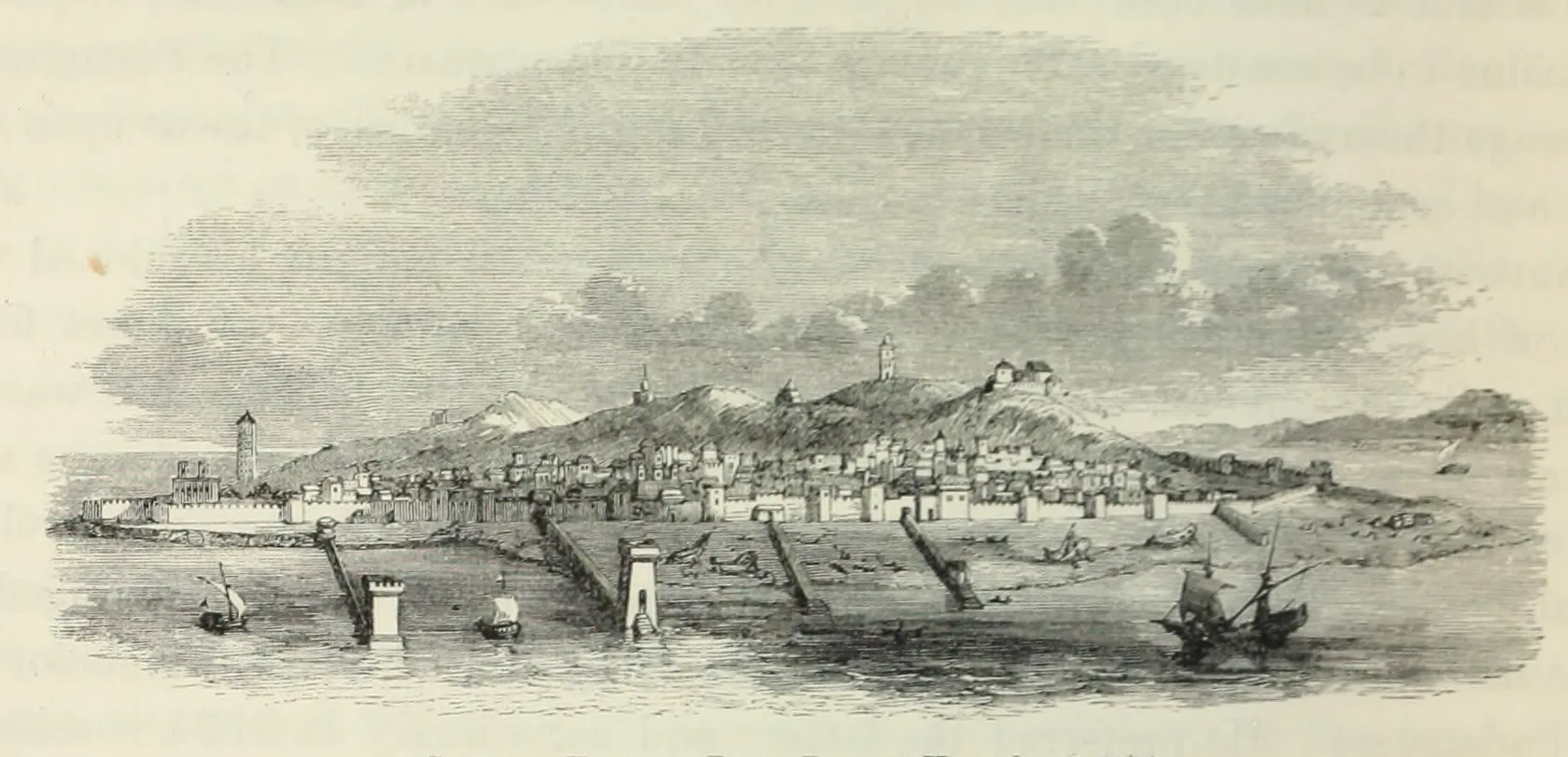
pacha, to commence preparations immediately in the port of Suez. There a fleet of seventy-six galleys, having 7000 Turkish soldiers on board, was forthwith equipped; and, sailing under the command of the pacha, arrived off Diu in the beginning of September, 1537.
Though the danger had been foreseen, the Portuguese councils were at this time so dilatory and distracted, that no adequate preparations were made to meet it. The government of India had just been conferred on Garcia de Noronha, and the time which ought to have been devoted to the supply of Diu with everything necessary to its defence was spent in petty squabbles between the old governor and the new. The consequence was, that when the Turkish fleet arrived, the garrison consisted only of about 600 men, many of them sickly. Nor was this the worst. Both ammunition and provisions were so deficient, that nothing could save the place from capture if the siege was persisted in or relief did not arrive. Nor was the Turkish the only armament which the Portuguese had to fear. A Gujerat army, estimated at 20,000 men, was in the vicinity, ready to co-operate with the besiegers.
Such was the apparently desperate state of matters when the governor, Antonio de Silveira, unable to maintain a footing in the town, shut himself up in the fort. In himself, however, he was equal to a host, possessing not only military talents of the highest order, but also the rare gift of infusing his own heroic spirit into all who were under his command. Not only was every soldier within the garrison prepared to do his duty, but the women, forgetting the feebleness of their sex, fearlessly encountered every danger, and worked with their own hands in repairing the walls as they crumbled beneath the powerful Turkish artillery. It is told of one lady, Anna Fernandez, wife of a physician, that by night she viewed all the posts, and during the assaults stood by encouraging the soldiers. She even saw her own son struck down by a cannon-ball, but, instead of giving way to the agony she must have felt, drew his body aside, returned to her post, and only after the assault had been repulsed went to bury him.
It was impossible, however, that the defence could last much longer. Every new assault thinned the numbers of the garrison, and scarcely as many remained as could make even a show of resistance, when a breach was made. The governor saw nothing before him but death or surrender, and was giving way to the gloomiest forebodings, when, to his unspeakable delight, the siege was raised. The Turkish commander, when dispirited by the failure of one of his greatest efforts, received the startling intelligence that a powerful Portuguese fleet was at hand; and, without staying to ascertain its accuracy, made off with the utmost precipitation. It turned out to be a false rumour, invented and circulated, strange to say, by Khojah Zofar, a renegade Turk, of Italian origin, who commanded the Gujerat forces. His pride had been repeatedly offended by the arrogance of Solyman Pacha; and he had, moreover, ascertained that the Turks were determined, if they gained the place, to retain it as a permanent possession. There was thus only a choice of masters; and as the Portuguese seemed the more tolerable of the two, Zofar had given them the preference.
After Khojah Zofar had rid himself of his Turkish allies by this stratagem, he entered into friendly communications with the Portuguese, but at the same time took several steps which convinced them that enmity was rankling at his heart. He was in the highest possible favour with the King of Gujerat; and feeling satisfied that that sovereign's complete ascendency in the peninsula would best secure his own aggrandizement, was prepared to adopt any means, however unscrupulous, that promised to expel the Portuguese. His first attempt was an infamous plot, in which he endeavoured to poison the water of an immense cistern which supplied the garrison, and to set fire to the magazine. When this plot failed, he attempted to build a wall which would have completely isolated the fort from the town. The Portuguese objected; and the foundation for a quarrel being thus laid, he had no sooner completed his preparations, in 1545, than he made an open declaration of war.
Mascarenhas, the commander of Diu, made the best arrangements possible in the circumstances; but his means being inadequate, he lost no time in acquainting Juan de Castro of his danger. Zofar, at the same time, aware of his advantage, resolved to assault the place before succour could arrive. With this view he prepared an immense floating battery, and, filling it with heavy artillery, caused it to be steered opposite to the sea-bastion, in the hope of making such a breach in it as would give him access into the fort. It proved a very clumsy device, for before he could bring it to bear the garrison made a night attack upon it, and, setting fire to it, blew it into the air. Zofar's next plan was to complete the wall already mentioned, and to mount it with cannon, which kept up an incessant and crushing fire on the fort. One of the pieces of ordnance was of extraordinary size, and being managed by an expert French renegade, did considerable damage. Every shot from it is said to have shook the island, and made pieces of the fort to fly. Happily for the besieged, one of their shot killed the Frenchman, and the gunner who succeeded him managed so awkwardly that his great gun did more harm to his own party than to the Portuguese. While the siege was thus proceeding, the King of Gujerat arrived. It seems that Zofar had become so confident of success, that he had invited him to come and witness it. It proved hotter work than he had anticipated; and the pusillanimous prince was so terrified by a chance ball which lighted on his tent and killed one of his attendants, that he fled, and never looked behind him till he was far on the way back to his capital. A still more fortunate shot killed Zofar himself. This gave the exhausted garrison some respite; but it was of short duration, for Roumi Khan, Zofar's son, succeeded him, and, not satisfied with the slow process which had hitherto been pursued, made a general assault. It failed, but scarcely a day passed without some new attempt to force an entrance into the place.
The siege had now lasted several months, while the preparations at Goa proved so dilatory, that the only relief sent to the garrison consisted of two insignificant detachments, the one commanded by Fernando de Castro, the governor's son, and the other by Don Alvaro. The latter consisted of 400 men, and brought supplies of ammunition and provision, when they were just on the point of being exhausted. The Portuguese were so elated that they disdained to be cooped up any longer in the fort, and almost compelled Mascarenhas against his better judgment to lead them out. They paid dearly for their rashness, and retreated with such precipitation, that they had the greatest difficulty in preventing the enemy from entering the fort along with them. Among the slain was the governor's own son.
This domestic misfortune seems to have had the effect of hastening De Castro's departure from Goa. What the cause of delay was is not explained; but it gives a poor idea of his energy and resources to learn, that at the end of eight months, while one of the most important stations which the Portuguese possessed in the East, and the acquisition of which had cost them more than any other, was in the most imminent danger, his preparations were for the first time considered to be complete. His fleet, which consisted of ninety-three sail, lost some time in committing barbarities at various localities on the coast, but at last, in 1545, was observed from Diu. The result was not long doubtful. After relieving the garrison, De Castro marched out at the head of his troops and gained a signal victory. The fall of the town followed of course, and the Portuguese acted, as they almost invariably did on such occasions, by indulging in horrid atrocities. “The women escaped not the fate of the men, and children were slain at their mothers’ breasts.”
The victory which De Castro had gained was not very remarkable. His troops bore a considerable proportion to those of the enemy, and with the superiority of discipline which they possessed, it would have been disgraceful to him not to have succeeded. But the Portuguese, in consequence of the decline of their power, had for several years before enjoyed few opportunities of celebrating a victory, and therefore entered readily into the feelings of the governor, who thought himself entitled to be received at Goa with all the magnificence of a Roman triumph. The gates and streets were hung with silk, all places resounded with music and salvos of cannon, and vessels gaily adorned covered the harbour. The governor on arriving at the gate, under a rich canopy, was presented with a crown of laurel, with which he encircled his head, and a branch of it which he carried in his hand; in front walked one Friar Anthony, with a crucifix, as he had borne it in the fight, and beside him an officer bearing the royal standard; behind was Jazar Khan, a Moorish chief, followed by 600 captives in chains. The governor walked on leaves of gold and silver, and rich silks, the ladies from the windows throwing flowers upon him, and sprinkling him with sweet water. On reading the account of this pompous procession, Catherine, Queen of Portugal, shrewdly remarked, that “De Castro had overcome like a Christian and triumphed like a heathen.” He did not long survive his triumph; and was on his death-bed when the honours sent out from Portugal to reward his victory were announced to him at Goa. He must have been a vain man, but this failing was compensated by many good qualities. He was so zealous for the public service, that grief for the miserable condition into which it had fallen is said to have broken his heart; and he gave the best proof of his honesty by dying in extreme poverty. One of his last acts was to make a formal protest, which he desired to be recorded, to the effect that “he had never made use of the king’s nor any other man’s money, nor driven any trade to increase his own stock.” The practices of which he thus solemnly declared his innocence, undoubtedly prevailed to a great extent among the Portuguese officials, and go far to account for the rapidity with which Portugal fell from the high place which she once held in the East. From time to time, however, she seemed to resume her ancient spirit, and showed how much she might still have been able to accomplish, had men of spirit and integrity, instead of mere court intriguers, been placed at the helm of affairs.
In 1570, when Luis de Ataida was viceroy, one of the most formidable combinations into which the native princes had ever entered, was triumphantly defeated. It was headed by the Deccan Kings of Ahmednuggur and Bejapoor, and a new zamorin, who, undeterred by the fate of his predecessor, was bent on recovering all that had been wrested from him. Their common object was to expel the Portuguese from the country, but each had his own separate grievance; and hence, though the attack was simultaneous, it was made at three important stations—by the King of Ahmednuggur, at Choul—by the zamorin, at Chale, where a fort had been erected which overawed his capital at Calicut— and by the King of Bejapoor, at Goa. The last, as in every respect the most memorable, is the only one to which it is necessary here to advert.
Ally Adil Shah, who was then sovereign of Bejapoor, having assembled an army of 100,000 foot and 35,000 horse, 2140 elephants and 350 pieces of cannon, suddenly descended from one of the passes of the Western Ghauts into the Concan, and then, turning south, marched without opposition upon Goa. No preparations had been made for this formidable attack; and the governor, on mustering his European troops, found that they did not exceed 700. Besides these he had about 1300 monks, whose zeal and fanaticism compensated in some degree for their want of discipline, and a considerable number of natives, on whom no great confidence could be placed. His great security was in his insular position, which, so long as he held the command at sea, made it impossible for the enemy to attempt an approach on any side but the one which lay nearest to the mainland. Against this side, accordingly, Ally Adil Shah directed all his efforts, and with such overpowering numbers and perseverance, that 5000 men succeeded in passing over into the island. It was only a temporary success; for the Portuguese, aware that if they made good their footing the place must surrender, mustered all their strength, and by one great effort, in which the most heroic valour was displayed, cut their assailants to pieces, or drove them into the sea. Ally Adil Shah had no heart to renew the combat; and, after lingering for a short time, took his final departure. More than 12,000 of his troops had perished. The attacks on Choul and Chale were equally unsuccessful. New lustre was thus added to the Portuguese arms; and many who looked only at the surface imagined that their power had never been established on a firmer basis. Those who looked deeper could not but see that the whole fabric was undermined and threatening ruin.
It would be out of place here to examine in detail the various causes to which the overthrow of Portuguese supremacy in the East is attributable. A few, however, may be briefly mentioned. One of the most obvious is the comparative indifference of the Portuguese themselves. When they first doubled the Cape of Good Hope, India was the great goal for which they were striving, and all the exertions of which they were capable were exclusively devoted to it. By the discovery of Brazil a new interest was created, and gradually became the more absorbing because the more lucrative of the two. A small state like Portugal was unable to superintend the affairs of two mighty empires, situated at the opposite extremities of the globe; and experience seems to have proved that in giving the preference to the American continent she made the wiser choice. Both empires, indeed, are now lost to her; but in that of the West her own race of kings still sits enthroned.
Another cause of Portuguese decline in the East may be found in the state of European politics. In 1580, after the short and inglorious reign of Henry the Cardinal, Portugal lost her national independence, and became subject to the bigoted and tyrannical rule of Philip II. of Spain. She was thus obliged to follow in the wake of her more powerful neighbour, and see all her interests sacrificed in the prosecution of objects from which she could not possibly reap any advantage. While her domestic interests were sacrificed, it is not to be supposed that those of her colonies were duly attended to. In connection with the degrading bondage to which Portugal was thus reduced, we see a third cause of rapid decay in the hostility which Philip’s arrogance provoked in other European states. The United Provinces of Holland, after throwing off his yoke, continued at open war with him, and saw no quarter in which they could so effectually resent the wrongs, and indemnify themselves for the losses they had suffered, as in the East. To the same quarter the eyes of the English had long been turned; and after they had triumphed gloriously over the Armada, which was to have enslaved them by a double yoke of the most intolerable description —the yoke of Spain and the yoke of Rome, all the friendly or prudential considerations which had prevented them from claiming a share in the Portuguese Indian monopoly ceased to have any weight, and their determination to establish an independent traffic in the East was openly avowed. Thus, at the very moment when Portugal was scarcely able to maintain her position, even had she been left alone to deal with native powers after her own fashion, she saw herself brought face to face with two most formidable competitors. To these we now turn.