SEVERAL years before the death of Jehangir, the succession to his throne was keenly contested by different members of his family. Khosroo, the eldest son, who had been the favourite of his grandfather Akber, failed in an attempt to seize the crown when Akber died, and was in consequence subjected during the remainder of his life to a rigorous imprisonment. Parviz, the second son, naturally looked forward to the succession; and was confirmed in the belief that it was intended for him, when his father intrusted him with the nominal command in the Deccan, where a great contest for supremacy was waged between the Mahometans and Hindoos. He proved unequal to the task assigned him, and was ultimately superseded by the third son, Khurram, whose abilities were of a superior order, and whose military fame had been established by a successful campaign in Mewar. These alone would not have sufficed had he not also enjoyed the favour of Nur Jehan, who had established a complete ascendency over her husband Jehangir, and virtually governed in his name. Under this influence Khurram, invested with ample powers, and bearing the title of king, which amounted to a recognition of him as heir apparent, proceeded to the Deccan. Here the first object was to recover those territories which had thrown off allegiance to the Mogul, and more especially the kingdom of Ahmednuggur, which, owing to the great abilities of an Abyssinian, named Mullik Amber, prime minister to the king, Nizam Shah, had successfully resisted all attempts to subdue it. Khurram was again successful; and, in return for his success, was made Viceroy of Gujerat, in which capacity mention is often made of him in the journal of Sir Thomas Roe.
While Khurram’s way to the throne was thus apparently clear, he stood on the brink of a precipice. His brother Shehriar, the youngest son of Jehangir, had become the son-in-law of Nur Jehan by marrying Shir Afgan, her daughter by her first husband. In consequence of this affinity, Nur Jehan was bent on securing the succession to Shehriar, and made no secret of her intention. She had little difficulty in gaining the assent of Jehangir; but Khurram, determined not to be excluded from the great object of his ambition, raised the standard of revolt. He had married the daughter of Asof Khan, Nur Jehan’s brother, and in him had a powerful supporter; but Nur Jehan chose her measures so skilfully, that Khurram soon found himself a fugitive in the Deccan. Here he succeeded in forming a league with his old opponent Mullik Amber; but misfortune still attended him, and he was obliged to throw himself on his father’s mercy. It would not have availed him; but a new revolt, produced by the imperiousness of Nur Jehan, drew off her thoughts from the vengeance which she was meditating, and he escaped. In consequence of the revolt, both Jehangir and his queen became for a time prisoners in the hands of Mohabat Khan, a celebrated general, to whose military talents Khurram’s previous discomfiture had mainly been owing. Jehangir died shortly after obtaining his liberty, leaving a will which appointed Shehriar his successor. Nur Jehan attempted to give effect to it, but the death of her husband completely destroyed her influence; and though she survived for many years, she never again figured in public life. Shehriar, by seizing the royal treasure, was able to raise an army and fight a battle for the crown. Khurram, however, now supported by the leading parties in the state, completely defeated him, and, with the usual cruel policy of his race, put him to death, along with two sons of another brother who had joined him. All opposition now ceased; and Khurram, on his arrival at Agra, 26th January, 1628, mounted the throne under the title of Shah Jehan.
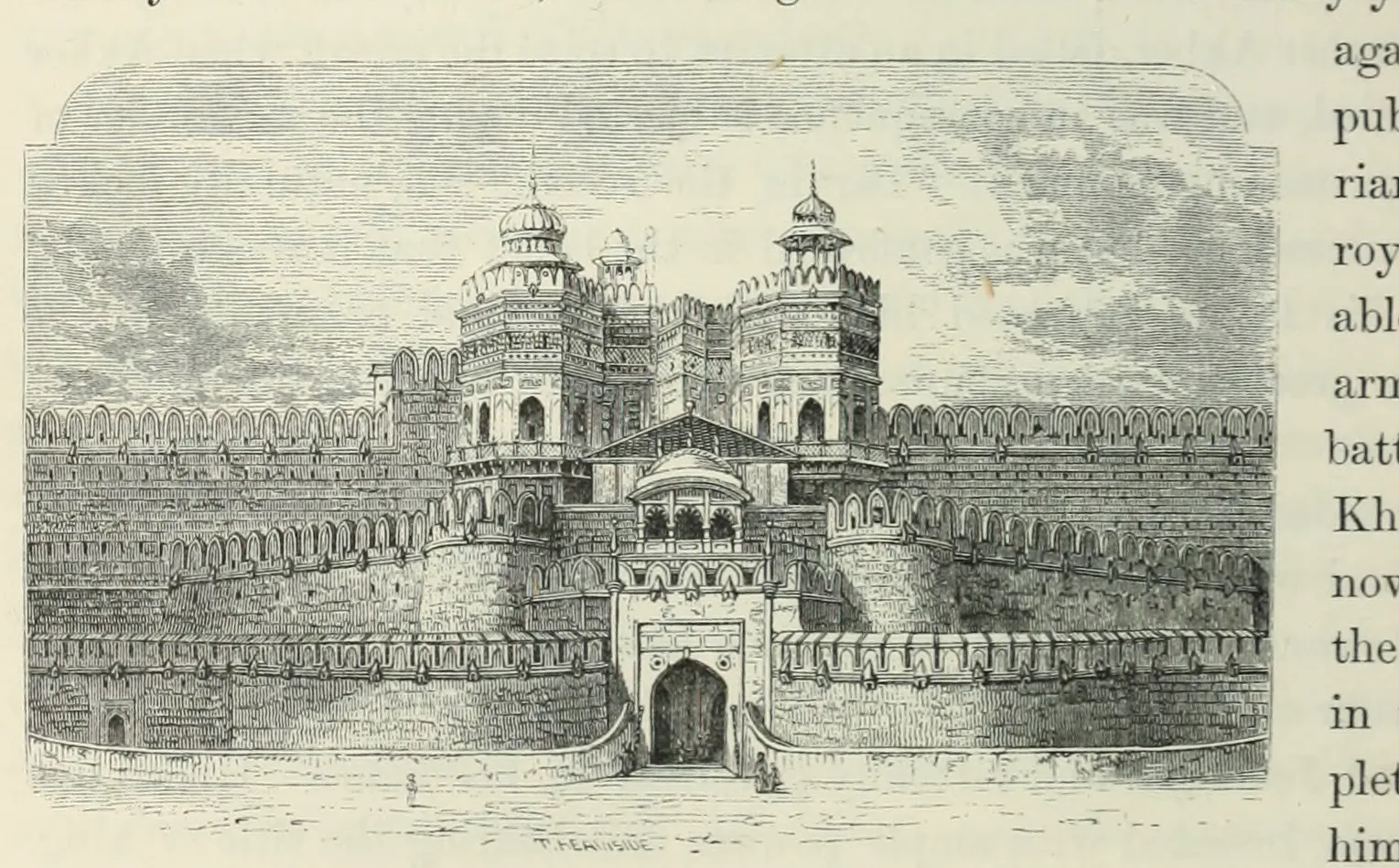
Shah Jehan, overjoyed at his accession after the many misfortunes which had befallen him, and which had made him at one time despair of being able to secure it, first testified his gratitude to Asof Khan, his father-in-law, by making him his vizier, and to Mohabat Khan by appointing him his commander-in-chief; and then began to indulge his natural taste for magnificence by public works and splendid entertainments. In the latter of these he seemed determined to outstrip all his predecessors; and on the first anniversary of his accession, not satisfied with the usual ceremony of distributing his own weight in presents of the most costly materials, caused vessels filled with jewels to be waved round his head or poured over his person as a supposed means of averting misfortune, and scattered the contents among the bystanders. In the valley of Cashmere, where the ceremony was performed, the value thus expended was estimated at £1,600,000.
He was not allowed long to indulge in such lavish and ostentatious displays. Though his cruel policy had extirpated all the members of his family who might have competed with him for the crown, in several quarters of his dominions the materials for revolt were provided and ready to explode. The Usbeks, endeavouring to profit by the uncertainties of a new reign, laid siege to Cabool and ravaged the surrounding country, till the approach of Mohabat compelled them to retire. In Bundelcund an insurrection, headed by Narsing Deo, the infamous murderer of Abulfazl, was not put down without a serious struggle. But, as in his father’s reign, the Deccan was the great theatre of war. The conquest of it by Akber had never been firmly secured; and even after the Hindoos had been forced to yield, their place had been occupied by Mahometan chiefs, who had established the three kingdoms of Ahmednuggur, Bejapoor, and Golconda, which often refused to yield even a nominal supremacy to the Mogul, and were always ready to embrace any opportunity which promised to free them entirely from the yoke. Such an opportunity was offered by the revolt of an Afghan chief of the name of Khan Jehan Lody, who had rendered important military services in the time of Jehangir; but, taking umbrage at some proceedings of Shah Jehan, suddenly quitted Agra at the head of 2000 veteran troops, and, in the face of numerous obstacles, made his way through Bundelcund and Gundwana to the court of Ahmednuggur, where he was welcomed by Mullik Amber.
The only chance which the Mahometan kings of the Deccan could have had of resisting the Mogul arms, would have been by forming a mutual league and uniting all their forces against the common invader. Instead of this they kept aloof, under the influence of old jealousies and feuds, and allowed themselves to be crushed in detail. The King of Golconda appears to have been first intimidated, and volunteered tribute. Nizam Shah, King of Ahmednuggur, so long as he was guided by the counsels of Mullik Amber, offered a strenuous resistance; but at last made choice of a new minister, who proved treacherous, and made peace with the Mogul by both murdering the king and sacrificing the independence of the kingdom. The most valiant struggle was made by Mahomed Adil Shah, who after obliging Mohabat Khan, the ablest general of the Mogul, to raise the siege of Bejapoor, his capital, gained several other decided advantages. He too, however, finding the contest unequal, was obliged to succumb; and Shah Jehan, now acknowledged supreme over all the Mahometan kingdoms of the Deccan, returned in triumph to his capital. During these campaigns the country suffered dreadfully from the ravages not merely of war, but of famine, which, caused by failures of rain during the two successive years of 1629 and 1630, depopulated whole districts, and inflicted calamities which it took nearly half a century to repair.
During the campaigns in the Deccan, disturbances had broken out in other quarters. They proved generally unimportant; and the only event in connection with them deserving of notice, was a declaration of hostilities against the Portuguese, whose fortified factory at Hooghly, in Bengal, was in consequence attacked by the Mogul governor, and captured after a siege. An event which gave Shah Jehan more pleasure was the recovery of Kandahar from the Persians, by the treachery of Ali Merdan Khan, the governor, who, dissatisfied with the treatment which he had received from his own sovereign, delivered up the place and took refuge at Delhi. This important acquisition seems to
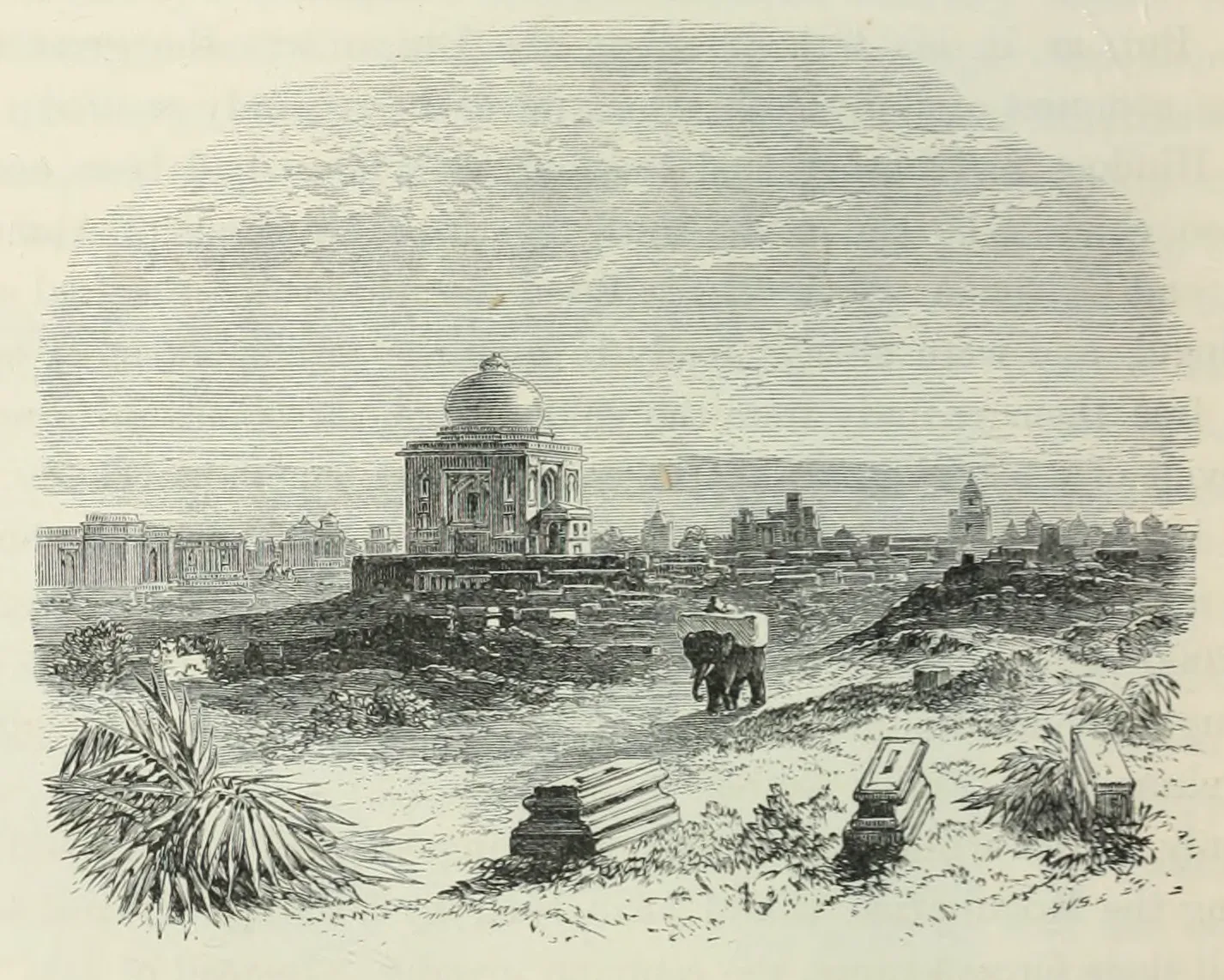
have stimulated the ambition of Shah Jehan, who immediately despatched an army into Balkh and Budukshan, which were now in possession of Nazar Mahomed, younger brother of Imam Kouli, whose rule extended over all the territory beyond the Oxus, from the Caspian Sea to Mount Imaus. The enterprise proved more difficult than had been anticipated; and, after a struggle of several years, Shah Jehan despaired of success. Not only Ali Merdan found his efforts unavailing; but two of the emperor’s sons, Murad and Aurungzebe, sustained repeated discomfitures. Even after an arrangement had been made which left Nazar Mahomed in possession of more than his original territory, Aurungzebe, attacked by the mountaineers of the Hindoo Koosh, made a most disastrous retreat.
Shah Jehan, though much chagrined, still had some compensation in the acquisition of Kandahar; but even this was soon to be wrested from him. In 1648 the Persian monarch Shah Abbas II. made his appearance before it, at the head of a large army. The time was well chosen, for winter, which was about to commence, made it almost impossible to march an army from India to its relief. Aurungzebe, however, undertook the task; and, after almost incredible exertions, only arrived in time to learn that the place had already fallen. He determined to attempt the recovery of it; but, four months after he had opened his batteries, was obliged to raise the siege. A second attempt, in which he was assisted by Saad Ullah, the vizier, having also failed, Dara Sheko, Shah Jehan’s eldest son, obtained permission to make a third attack. His force was more numerous and better appointed than those which had previously been employed, and he set out in full confidence of success. Great efforts were made on both sides; but, after several desperate assaults, Dara Sheko was beaten off, as his brothers had been, and Kandahar was left in the undisputed possession of the Persians.
Shah Jehan’s warlike energy seemed now expended; and he had passed two years in tranquillity, when circumstances occurred which tempted him to interfere with the internal affairs of the Deccan, for the purpose of bringing it more completely under his sway. Abdallah Kutb Shah, King of Golconda, had regularly paid the stipulated tribute. The Mogul government, therefore, had no claim against him; and he was entitled to expect that the conditions of the treaty which he had made would, on the part of that government also, be faithfully observed. He was soon taught the contrary. Mir Jumla, who had acquired great wealth as a diamond merchant, and risen by his talents to be Abdallah’s prime minister, having lost favour through the misconduct of his son, Mahomed Amin, entered into a correspondence with Aurungzebe, then in the Deccan, and lodged a formal complaint against his master. Abdallah, though tributary to the Moguls, was still perfectly independent in regard to his internal administration, and was therefore both surprised and offended on receiving a mandate from Shah Jehan, haughtily ordering him to give Mir Jumla redress. So far from complying, he sequestrated his property and placed his son in prison. This was probably the very step which Shah Jehan wished him to take, as it furnished him with a plausible pretext for further interference. Orders were accordingly given to Aurungzebe to employ force, if Abdallah still persisted in disobeying his mandate. Acting at once on this authority, Aurungzebe, without any previous warning of hostility, set out ostensibly on a visit to Bengal; and being brought in the course of his journey within a short distance of Hyderabad, Abdallah’s capital, turned suddenly aside with a body of troops and took forcible possession of it. Abdallah, taken completely by surprise, escaped with difficulty to the hill-fort of Golconda. Here, finding his position desperate, he was under the necessity of submitting to the terms which Aurungzebe chose to dictate. Mir Jumla, in reward for his treachery, was taken into Aurungzebe’s confidence, and became one of the main instruments of his ambitious designs. The subjugation of Golconda took place in 1656. In the same year Bejapoor was subjected to similar treatment. Ahmednuggur had before lost even the semblance of independence, and thus the authority of the Mogul seemed as firmly established in the Mahometan portion of the Deccan as in any part of Hindoostan.
The conquests thus achieved gave great delight to Shah Jehan. Had he known the use about to be made of them, his feelings would have been very different. Aurungzebe, while professing the utmost disinterestedness, was steadily pursuing his own aggrandizement, and preparing for the struggle which was eventually to give him the throne, even before it became vacant. To this struggle it is now necessary to attend.
Shah Jehan, now far advanced in years, had four sons, Dara Sheko, Shuja, Aurungzebe, and Murad. They were all of full, or rather mature age. In 1657, the period to which we now refer, the respective ages of the first three were forty-two, forty, and thirty-eight. Dara, recognized as heir apparent, was resident in the capital, where he enjoyed the full confidence of his father, and in relieving him from the cares, exercised the general powers of government. Shuja ruled as viceroy in Bengal, Aurungzebe, as has been seen, in the Deccan, and Murad in Gujerat. They were all fired with ambition, and disposed to take advantage of the political changes which might be occasioned by their father’s death, but differed much in temper and character. Dara was open and generous, but so impetuous and hasty as to set at nought the dictates of prudence; and so liberal, particularly in his religious opinions, as to be obnoxious to the more orthodox Mahometans. Shuja possessed talents, but rendered them useless by giving himself up to pleasure, and acquiring the habits of a confirmed drunkard. Aurungzebe was a perfect adept in dissimulation, and was equally successful in imposing on friends and foes. His principles, if he had any, never stood in the way of his interest; and when he had an end to accomplish, he was not to be deterred by any amount of crime which might be necessary in order to insure success. The only thing in which he could be said to be sincere was his religion, in which he carried fanaticism to its worst extremes, and persecuted with all the zeal which distinguished the earliest propagators of Mahometanism. Murad, the youngest son, bore a considerable resemblance to Shuja in tastes and habits, but was duller in intellect, and, if possible, still grosser in his pleasures. By the mother of these sons Shah Jehan had also two daughters, who, within the recesses of the harem, exercised considerable political influence. Padshah Begum, the elder, was her father’s favourite, and exerted herself to the utmost to further the interests of Dara. Roushanara, the younger, though not possessed, either in person or intellect, of the accomplishments of her sister, surpassed her as a skilful intriguer, and thus proved a powerful coadjutor to Aurungzebe, to whom she was strongly attached.
Such was the position of Shah Jehan’s family in 1657, when he was seized with a severe illness, destined apparently to prove fatal. Dara, that he might be able to make the necessary preparations to insure the succession, endeavoured to stop all the avenues of communication through which his brothers might become acquainted with his father’s state; but the fact was of too public and important a nature to admit of concealment, and a very short time elapsed before they were made thoroughly acquainted with it. Shuja was the first to act. Immediately assuming the title of king, he assembled a body of troops and began to march in the direction of the capital. Murad, in like manner, assumed the regal title, but instead of quitting his province, endeavoured to provide the sinews of war by seizing the district treasuries and laying siege to Surat, where he expected to find a still richer deposit. Aurungzebe acted with less precipitation, and at first rested satisfied with collecting his forces and encamping with them near his northern frontier. While here he had the satisfaction of seeing Dara and Shuja engaged in hostilities, which only wasted their strength. He at last declared against Dara, but, with his usual dissimulation, endeavoured to disguise his real object by pretending to place his hostility to his eldest brother on religious grounds. For himself, if he had ever entertained ambitious thoughts, he had now laid them aside, and was desirous, as soon as an orthodox successor to the throne was appointed, to retire from the world and spend the remainder of his days at Mecca. Murad was stupid enough to be imposed upon by this shallow pretence, and at once leagued his arms with those of Aurungzebe, in the belief that, in the event of their success, he was to be rewarded with the imperial crown. Dara was thus exposed to two formidable attacks—the one from Shuja, advancing from Bengal, and the other from Aurungzebe and Murad, advancing from the Deccan. Against Shuja he sent his son Soliman Sheko, who encountered him near Benares, and gave him a defeat which compelled him to retrace his steps to Bengal. Against his other brothers he sent the Rajpoot rajah Jeswant Sing. The encounter took place on the banks of the Sipra, near Oojein, in Malwah, and ended in Jeswant’s complete discomfiture. The gallantry of Murad had mainly decided the victory; and Aurungzebe, not satisfied with complimenting him upon it, hypocritically humbled himself before him as in token of the homage which he felt due to his future sovereign.
While his sons were thus warring with each other for the succession to the crown, Shah Jehan himself, contrary to expectation, had nearly recovered his usual health. Dara at once resigned his power. A very different spirit animated the other brothers, who, when ordered to lay down their arms, positively refused. They had, in fact, advanced too far to recede, and nothing now remained but a further appeal to arms. Shah Jehan was disposed to take the field in person, but allowed himself to be dissuaded, and left the supreme command to Dara, who soon saw himself at the head of an army which seemed sufficient to crush all his enemies. He might have added greatly to its strength by waiting for the arrival of a large reinforcement, which his son Soliman was bringing from Benares; but his natural impetuosity urged him forward, and, contrary to the better advice of Shah Jehan, he risked an engagement, by which all was lost. The battle was fought at Samaghar, one march from Agra, in the beginning of June, 1658. Many individual acts of heroism were performed on both sides; and victory hung suspended till the disappearance of Dara, in consequence of his elephant having become unmanageable, so discouraged his soldiers that a general panic ensued. In the evening, when he reached Agra in his flight, he could only muster 2000 men, all the rest of his army had perished or been dispersed. Three days after, Aurungzebe and Murad made their appearance, and took immediate possession of the capital. Dara was not in it, for, oppressed with grief and shame, he had hastily quitted for Delhi, but Shah Jehan was still in his palace.
Aurungzebe’s course was already determined, but policy did not allow him all at once to throw off the mask, and he spent some days in sending humble messages to his father, justifying his proceedings on the plea of necessity, and endeavouring to obtain the sanction of them. His object, probably, was to leave his father in nominal possession of the throne, while he retained all the powers of government in his own hand. Shah Jehan, however, was not to be thus won over. Dara’s misfortunes only gave him a stronger hold than ever on his affections, and he refused to concur in any proposal for disinheriting him. Aurungzebe, thus made aware that he could only possess the crown as an usurper, did not hesitate to make his father a prisoner and assume the reins of government. Murad, who had been dreaming of the crown, soon found that he was only his brother’s dupe. As soon as Aurungzebe had no further use for him, he invited him to supper; and, after feasting him till he was in a state of helpless intoxication, stripped him of his arms and placed him in confinement.
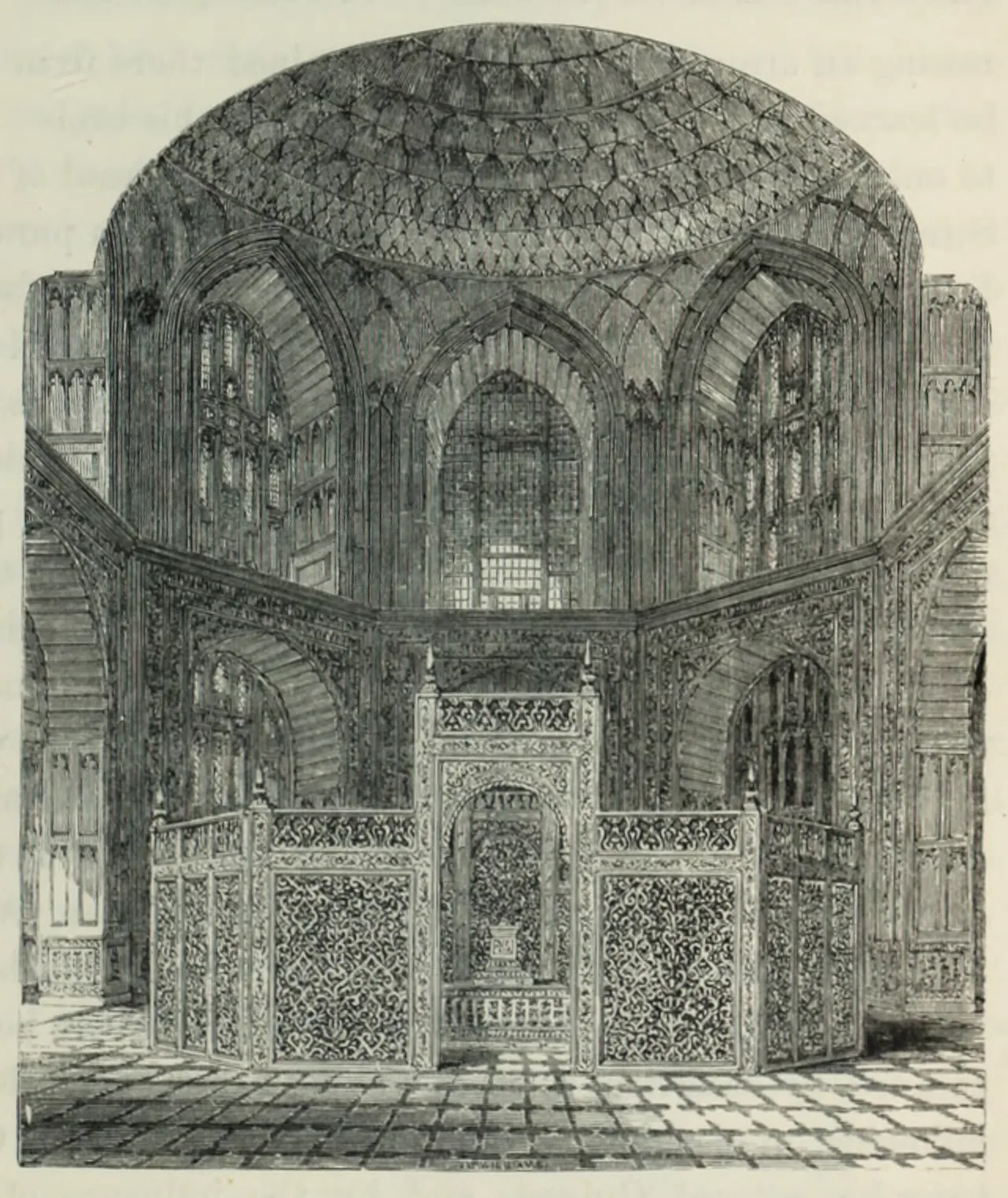
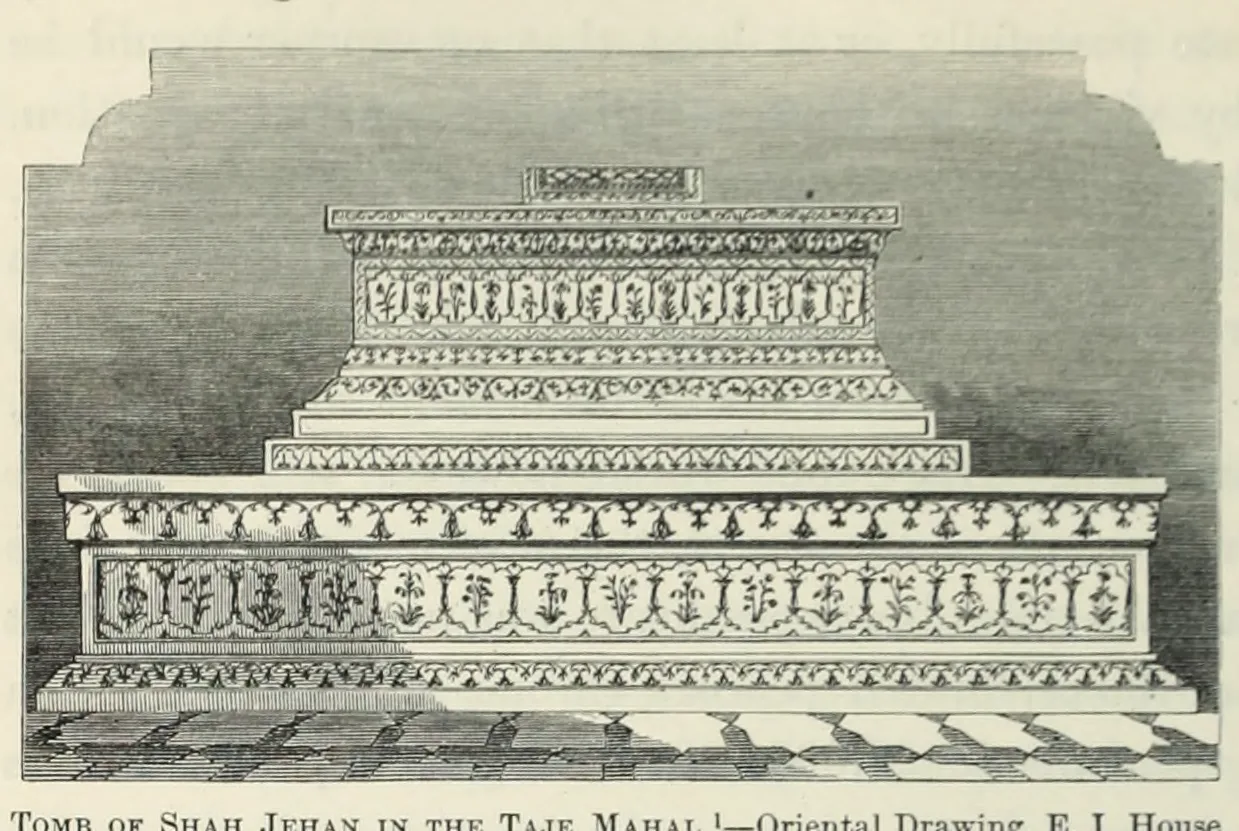
Shah Jehan was allowed to remain in his palace, where he continued to live for seven years. Much outward respect was shown him, but a strict watch was kept on his movements, and he was entirely excluded from all share in the government. The energy and talent which he had displayed during the greater part of his reign appear to have entirely forsaken him, and he made no effort to regain his freedom. It is remarkable that no attempt at rescue was made from without. His reign had been long and prosperous, and his subjects had enjoyed a degree of happiness to which they had previously been strangers. His wars, carried on for the most part on the outskirts of his dominions, had brought few calamities on his own subjects, while his internal administration had been singularly moderate and equitable. It might have been supposed that such a reign would terminate peacefully, or at least that no usurper would be allowed to extinguish it by violence, without exciting universal indignation, and stirring up hosts of adversaries in every quarter. The fact was otherwise, and may be regarded as a proof that the people had become indifferent to a change of masters, and were now ready to submit to any yoke which might be imposed on them. In the interval between his dethronement and his death, Shah Jehan was almost forgotten. His public works, however, still speak for him, and prove him to have been, if not the wisest, the most magnificent prince who ever held rule in India. At times his expenditure was not only lavish but childish, as in the instance of the celebrated peacock throne, in the construction of which he is said to have spent above £6,000,000 sterling, chiefly in diamonds and precious stones. A better splendour was displayed in the new city which he built at Delhi, and the noble structures with which he adorned both that city and Agra. In the latter stands conspicuous above all the Taje Mahal, the mausoleum of his queen Mumtaz Mahal, situated in the midst of extensive gardens, on a terrace overhanging the Jumna, and composed of a lofty marble structure, richly decorated with mosaics, and so chaste in design, and imposing in effect, as not to be surpassed in these respects by any edifice in the world. Notwithstanding his lavish expenditure, the revenues,
without being oppressive, were so ably and economically managed during Shah Jehan’s reign, that in addition to vast accumulations of plate and jewellery, he left to the value of about twenty millions sterling in coin.
Aurungzebe was no sooner seated on the throne than he endeavoured to make it secure by crushing his competitors. Dara, after a short halt at Delhi, had proceeded to Lahore, and was busily employed in raising an army with the money obtained there from the royal treasury, when he learned that Aurungzebe was already at his heels. Conscious of his inability to encounter him, he quitted Lahore at the head of 4000 men, and made for Scinde by way of Mooltan. He was saved from pursuit by the advance of his brother Shuja from Bengal, at the head of a force so formidable that Aurungzebe thought his presence was immediately required. He accordingly returned to Delhi, and, having made the necessary preparations, marched south-east past Etawah, in the direction of Allahabad. The armies met at Cajwah, about midway between these cities. Shuja held a strong position which he was not disposed to quit, and several days elapsed before the decisive struggle took place. It was commenced by Shuja, who, advancing at sunrise on the 6th of January, 1659, proceeded amidst a furious cannonade to close action. The contest was manfully maintained till Aurungzebe, who had repeatedly been in imminent danger, succeeded in forcing the enemy’s centre. Shuja was in consequence completely defeated, with the loss of 114 cannon and a number of elephants. Closely pursued by Mahomed Sultan, Aurungzebe’s son, and Mir Jumla, he continued his flight, and never halted till he reached Bengal.
Dara meanwhile had arrived in Scinde, where he found his ranks so much thinned by desertion, that, to escape capture by a detachment which had been following on his track, he had crossed the desert to Cutch. After a short stay here he entered Gujerat, and by the influence of Shah Nawaz Khan, its governor, had become master of the whole province, including the important towns of Surat and Baroach. His prospects thus brightening, he opened a communication with the princes of the Deccan, and also with Jeswant Sing, the Rajah of Joodpoor. In the latter he hoped to find an important coadjutor, but was disappointed, as the rajah, after balancing interests, was satisfied he would gain more by giving his adhesion to Aurungzebe. Dara, now at the head of an army of 20,000 men, advanced into Ajmeer, and took up a commanding position. He had not occupied it long before Aurungzebe made his appearance. After a cannonade of three days a general assault took place, and Dara saw himself once more defeated and compelled to become a fugitive. A week of incessant toil and hardship brought him to the neighbourhood of Ahmedabad; but it was to meet a bitter disappointment, for the gates were shut against him. His only resource was a new flight to Cutch, where he arrived with a mere handful of adherents. His altered circumstances produced a corresponding change in the ruler, who received him so coldly that he resolved to pursue his march to Kandahar. The route brought him to the small territory of Jun, on the east frontiers of Scinde. The chief, who was under great obligations to Dara, received him with much apparent kindness, but immediately meditated an act of gross treachery, and accomplished it by delivering him up to his enemies. Aurungzebe was so delighted with the news that he celebrated it by public rejoicings. Both Dara and a son Sepehr, who might have proved equally dangerous, were his prisoners. The son was forthwith confined in the strong castle of Gwalior; the father was reserved for more barbarous treatment. The form of a trial was given him; but the charge was not for any offence against the state, but for apostasy from Mahometanism. Absurd and monstrous as the charge was, no difficulty was found in constituting a court which held it proven, and pronounced sentence of death. After a hypocritical show of reluctance, Aurungzebe confirmed the iniquitous sentence, and Dara was executed.
During these transactions the war with Shuja was vigorously prosecuted by Mir Jumla, who drove him from the different strong positions in which he had posted himself, and compelled him, after a series of struggles, to seek an asylum in Aracan. The particulars of his subsequent history are not well known. One account is that the ruler of the country, doubtless at the instigation of Aurungzebe, was preparing to detain him as a prisoner, and that Shuja, made aware of his danger, endeavoured to avert it by heading an insurrection. I this account is true, he probably perished in the attempt to overthrow the Aracan government; but the only thing certain is, that neither Shuja nor any member of his family was afterwards heard of. The only immediate descendants of Shah Jehan who could now give Aurungzebe any alarm were Murad and his son, and Soliman Sheko and Sepehr Sheko, the two sons of Dara. They were already within his power, being all prisoners in the fort of Gwalior. Murad was put to death for a murder alleged to have been committed by him when Viceroy of Gujerat. The others quickly disappeared by deaths which Aurungzebe declared to be natural, but which were universally believed to have been violent.
Aurungzebe’s supremacy was now firmly established in every part of Hindoostan. In the Deccan, on the contrary, a new power had appeared; and a struggle, about to commence, was destined not to terminate till it had laid the Mogul empire in ruins. A race of native Hindoos, called Mahrattas, occupied a tract of the Deccan, bounded on the north by the mountain range which forms the water-shed between the basins of the Nerbudda and the Taptee, by the sea on the west, by the Wurda on the east, and in other directions by a line drawn obliquely from the vicinity of Goa through Beder to Chandah. Within this tract the great physical feature is the range of the Western Ghauts, descending precipitously to the sea through the narrow rugged strip known by the name of the Concan, but sloping gradually towards the interior, so as to form a lofty table land. This country, studded over with natural fortresses, and rendered almost inaccessible by forests and mountains, was admirably adapted to be the abode of a nation of marauders. Such the Mahrattas were, and had been from time immemorial. Strong, active, and daring, full of craft and void of honour, they were ever on the alert to pursue their own interest, while utterly regardless of the means. Descending suddenly into the plains they spread devastation on every side, and before they could be overtaken were hastening back laden with booty to their mountain fastnesses. The terror of their name was thus widely spread; and many of their neighbours purchased exemption from their ravages by annual payments. The three Mahometan sovereigns of Ahmednuggur, Bejapoor, and Golconda, being by their position brought into frequent communication with the Mahrattas, naturally endeavoured to turn their military qualities to good account by employing them as soldiers. In this way not a few of them acquired distinction, and rose to offices of trust. Mullik Amber, the celebrated prime minister and virtual sovereign of Ahmednuggur, in particular, made great use of their services, and was so well satisfied with them that not a few of his most distinguished officers were Mahrattas. One of these, called Jadu Rao, had attained to a command of 10,000 men. Subordinate to him, and under his immediate protection, was another Mahratta, named Malojee Bosla. The latter, as he brought into the field only a few mounted retainers, could not have been a person of much consequence; but he was one of those bold and dexterous adventurers on whom no opportunity of advancing his fortune was ever thrown away.
Malojee, accompanied by his son Shahjee, a boy of five years of age, was attending a great Hindoo festival, when Jadu, at whose house it was celebrated, giving way to the hilarity of the occasion, took up his daughter, a girl of three years old, and placing her and Shahjee on his knees, laughingly exclaimed, “What a fine couple! They ought to be man and wife!” No sooner had the words passed his lips than Malojee started up, and took the company to witness that Jadu’s daughter was affianced to his son. Jadu, who boasted of a Rajpoot descent, was indignant that one whom he probably regarded as a mere underling should thus presume to place himself on a footing of equality with him, and attempt to take advantage of a jocular expression for the purpose of claiming affiance with his family. A quarrel ensued; but Malojee continued to insist that the affiance had been made, and ultimately made good his point by obtaining advancement which placed him on an equality with Jadu, and thus obviated the main objection to the marriage. Shahjee, thus become the son-in-law of Jadu, took a prominent part in the war which extinguished the independence, or rather closed the existence of the Mahometan kingdom of Ahmednuggur. Though on this occasion he belonged not to the winning but the losing party, he managed so well for himself as to become master of all the western portion of that kingdom between its capital and the sea. Nominally this territory now belonged to the King of Bejapoor, to whose share it fell when the Moguls made a partition of the kingdom of Ahmednuggur. Shahjee, therefore, was now in the King of Bejapoor’s service; and being sent on an expedition to the south, greatly distinguished himself by making conquests in the territory of Mysore. He was rewarded for this service with a large jaghire, including within its limits the important towns of Sera and Bangalore.
By his marriage with Jadu’s daughter, Shahjee had several sons. The eldest accompanied him to Mysore, and died there; the second, born in May, 1627, and named Sevajee, had been left at Poonah with a Brahmin, Dadajee Condu, who, during Shahjee’s absence, managed his Bejapoor jaghire. The training which young Sevajee here received determined his future character. He became at once a zealous Hindoo, and an expert and fearless warrior. His principal associates were the horsemen retained in his father’s service, or the mountaineers inhabiting the neighbouring Ghauts. Under the influence of such companionship he soon shook off the authority of Dadajee, and was suspected of being in league with marauding parties. Having acquired a body of adherents, and perceived how carelessly some of the hill-forts belonging to Bejapoor were guarded, he made himself master of one of considerable strength, called Torna, situated among the Ghauts, twenty miles south-west of Poonah. It had previously been under the charge of the revenue officer of the district; and when the government of Bejapoor complained, he succeeded by artifice and money in obtaining a confirmation of his seizure. Shortly after, when, by the erection of a new place of strength in the vicinity, a new alarm had been excited, the government made their complaint to Shahjee, who immediately ordered his son to desist from encroachment. Instead of complying, he threw off the paternal authority, as he had done that of his guardian, and not only withheld the revenue of his father’s jaghire, but seized upon two forts situated within it. Hitherto he had feigned submission to the King of Bejapoor, but he now felt strong enough to throw off the mask. His first act of open hostility was the plunder of a convoy of royal treasure in the Concan. Feeling himself thus committed, he continued his aggressions, and ere long was in possession of five of the principal hill-forts in the Ghauts. New successes attended his arms, and the whole of the Northern Concan fell into his hands.
The King of Bejapoor naturally suspected that Sevajee’s conduct was connived at by his father, and therefore endeavoured to strike at the root of the evil by making Shahjee prisoner. He asserted his innocence, but was notwithstanding thrown into a dungeon, and told that if his son did not submit within a certain time, the entrance would be built up. This threat, savage as it was, would probably have been executed, had not Sevajee, who had hitherto kept on friendly terms with Shah Jehan, obtained his interposition in his father’s behalf.
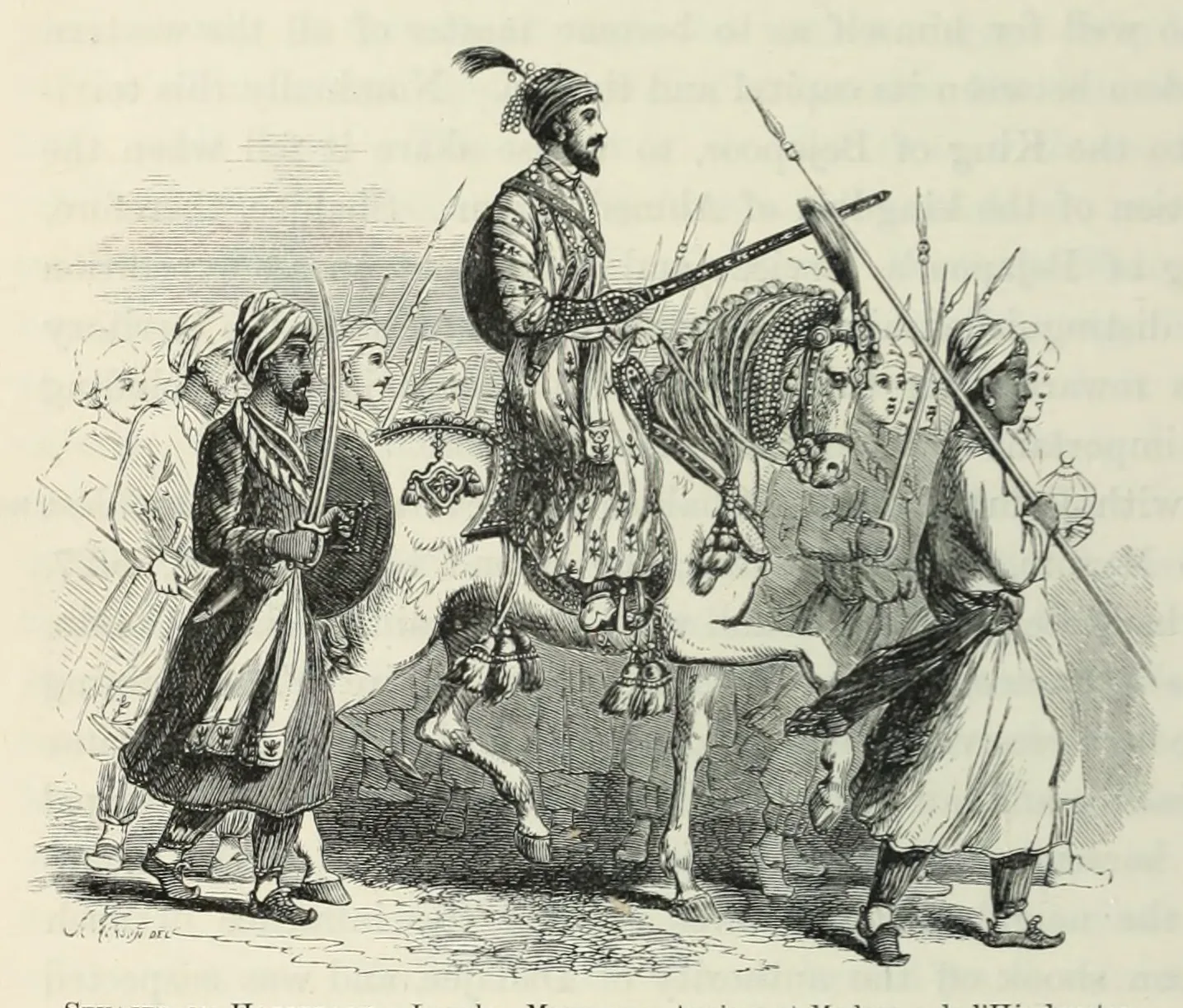
Having no longer any fears for his father, Sevajee gave full scope to his ambition; and not being restrained by any scruples of honour and justice, procured the assassination of a Hindoo rajah and seized upon his territory, which comprehended the whole of the hilly country south of Poonah from the Ghauts to the Upper Kistna. While he was thus extending his authority, Aurungzebe arrived in the Deccan in 1655. This event, which might have seemed fatal to Sevajee’s projects, was in the first instance rather made subservient to them, as he had previously been recognized as a commander of 5000 horse in the Mogul service; and on presenting a submissive address to Aurungzebe was confirmed in all his acquisitions. As yet, however, he was by no means satisfied; and on seeing Aurungzebe occupied in carrying on war with the King of Golconda, could not resist the opportunity of turning his absence to account. For the first time, therefore, he made an inroad on the Mogul territories. His success fell far short of his expectations; and when Aurungzebe suddenly returned after a rapid and successful campaign, it required all Sevajee’s address to save himself from the full weight of his vengeance. Very opportunely for him, Shah Jehan was seized with the sudden illness already mentioned, and Aurungzebe hastened off to prosecute his own ambitious schemes. Sevajee thus relieved from apprehension, renewed his attacks on Bejapoor, the throne of which was now occupied by a minor.
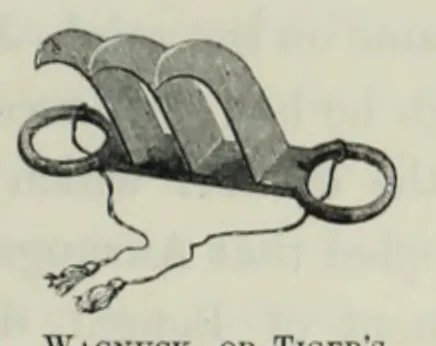
The Regent of Bejapoor, fully alive to the extent of the danger, raised a large army, and gave the command of it to a Mahometan noble of the name of Afzul Khan. The selection was unwise, for Afzul Khan, full of Mussulman pride, despised his enemy, and considered himself sure of victory. Sevajee, well aware of the kind of opponent he had to deal with, took his measures accordingly. Pretending to be overawed by the very terror of his name, he sent a messenger to say that he had given up all idea of resistance, and was only anxious to arrange the terms of submission. After some preliminaries, it was agreed that a personal interview should take place. Sevajee meanwhile showed great alarm lest some undue advantage should be taken of him, and as the most effectual means of dissipating his fears, induced Afzul Khan to meet him at a secluded spot with only a single attendant. Sevajee advanced with a timid, hesitating air, dressed in a cotton tunic. He was apparently unarmed, but wore beneath the tunic a coat of mail, together with a dagger concealed in its sleeve, while within his clenched fist, and attached to his fingers, were sharp hooks of steel, known by the name of “tiger’s claws.” Afzul Khan, thrown completely off his guard while Sevajee humbly implored forgiveness, was in a moment seized by the claws and stabbed to the heart. His army, which had shared in his over-confidence, was at the same time attacked on all sides by Mahrattas lying in ambuscade, and either perished by the sword or sought safety in flight. This atrocity was perpetrated in 1659, the year after Shah Jehan had been dethroned; and owing to the condition both of the Mogul empire, where a civil war of succession was raging, and of the kingdom of Bejapoor, which was threatened with dissolution from external violence and internal dissension, was allowed to escape with impunity. In 1662, when peace was concluded, Sevajee remained in possession of territory stretching 250 miles along the coast between Goa and Bombay, so as to include the whole of the Concan between these points, and also extending about 150 miles above the Ghauts, from Poonah to Meeruj near the banks of the Kistna. Within this territory, notwithstanding the ruggedness and general infertility of the surface, he was able to maintain an army of 7000 horse and 50,000 foot.
Aurungzebe after dethroning his father had conferred the viceroyalty of the Deccan on his maternal uncle Shaista Khan, who arrived in 1662, and fixed his residence at Aurungabad. Hostilities had commenced between the Moguls and Mahrattas, and Sevajee had carried his ravages into the very heart of the Mogul province. Shaista Khan in consequence put his forces in motion, and, driving the Mahrattas before him, gained possession of Poonah. Sevajee had retired to the hill-fort of Singurh, about twelve miles to the south, and there lay watching his opportunity. Being informed by spies of all his enemy’s movements, he learned that Shaista Khan had taken up his quarters in the house where Sevajee’s early days had been spent. Well aware of the Mahrattas’ craft, the Mogul commander had taken every precaution against surprise; and was living in supposed security, when a band of armed men, with Sevajee at their head, rushed into his bed-chamber. He escaped by leaping from a window, but not before he had lost two of his fingers by a blow from a sword. The Mahratta party had gained admission into the town by joining a marriage procession, and had afterwards availed themselves of their thorough knowledge of the locality to penetrate into the house by a back entrance. Shaista Khan’s son, and most of his attendants, were cut to pieces; and in the confusion, before any steps could be taken, Sevajee was again hastening back in triumph to his mountain fastness. Though the exploit failed in its main object, it was indirectly the cause of important results. Shaista Khan, unwilling to admit that he had been completely outwitted, threw the blame on the rajah, Jeswant Sing; not hesitating to accuse him of treachery, though he had only recently arrived to assist him with a strong reinforcement. In the quarrel which ensued, the operations of the Mogul army were so much crippled that Aurungzebe interposed; and, removing Shaista Khan to the government of Bengal, devolved the command of the Mahratta war on his son, Prince Moazzim, assisted by the rajah. The change was favourable to Sevajee, who did not fail to turn it to account. After an ineffectual attempt on Singurh, the Mogul army had returned to Aurungabad. It was now Sevajee’s turn to retaliate. Having, by a number of feigned movements, deceived the enemy, he suddenly darted off at the head of 4000 horse, and was not heard of before he made his appearance at Surat, in the beginning of January, 1664. It possessed no means of defence, and, with the exception of the English and Dutch factories, which effectually resisted the attacks made upon them, was plundered without opposition during six days.
Not long after this achievement Sevajee lost his father, Shahjee, who, at a very advanced age, was killed by a fall in hunting. He thus acquired a considerable addition to his territories; and, assuming the title of rajah, began to coin money in his own name. He also turned his attention to naval affairs; and collecting a fleet of eighty-seven vessels, manned with 4000 men, took many Mogul ships, made descents upon the coast, and carried off much plunder from the ports and maritime tracts belonging to the King of Bejapoor. All these aggressions could not be permitted to pass unavenged. The rajah, Jei Sing, who enjoyed as much of the confidence of Aurungzebe as that emperor’s suspicious temper allowed him to give to any one, arrived in the Deccan at the head of a large army. Sevajee made little resistance in the open field, and, though his forts of Singurh and Poorundhur when besieged made an effectual resistance, became so desponding of success that, on being assured of favourable terms, he at once offered to make his submission. It is difficult to penetrate his motives, but his conduct on this occasion certainly differs much from that which he had been accustomed to pursue. Without any better security than Jei Sing’s promise, he arrived with only a few attendants in the rajah’s camp, and then making the humblest professions of fidelity, readily accepted the terms which were offered. Of thirty-two forts which he possessed, he unconditionally surrendered twenty, with all the territory depending on them; the remaining twelve and all his other possessions he was contented to hold as a jaghire from the Mogul emperor. In return for all these sacrifices, he received nothing more than the rank of a commander of 5000 men in the Mogul service, for his son, Sambajee, a boy of five years of age, and a kind of percentage on the revenues of the different districts of Bejapoor. The latter grant was valuable only for its indefiniteness, as it afterwards furnished the Mahrattas with a pretext for making many unfounded claims. On the completion of this arrangement, Sevajee joined the Mogul army with 2000 horse and 8000 infantry, in an invasion of Bejapoor. The deference paid to him by Jei Sing, and two letters from Aurungzebe complimenting him on his services, made such an impression upon him, that he set out with his son Sambajee on a visit to Delhi. His reception was mortifying in the extreme. On approaching the capital, he was met only by an officer of inferior rank, and on entering the presence, was left unnoticed to take his place among commanders of the third rank. Overpowered by feelings of shame and indignation, he slunk behind, and fell down in a swoon. What Aurungzebe intended by this treatment is not very obvious. If he thought that the Mahratta spirit was thus to be tamed, he was greatly mistaken. Sevajee only burned for revenge, and, preparatory to it, began with all his usual craft to plan an escape. He had brought an escort of 500 horse and 1000 foot, and lulled suspicion by asking leave to send them home, on the ground that the climate did not agree with them. He next feigned sickness; and, by gaining over some of the Hindoo physicians who attended him, found means of communicating with his friends without. Meanwhile he was constantly making presents of sweetmeats and provisions to fakirs and other devotees. These were conveyed in large baskets and hampers, which passed so frequently, that the guards set over him ceased to inspect them. Escape thus became comparatively easy. One evening Sevajee was carried out in one of these hampers, and his son in another, and as he had taken the precaution to leave a servant in his bed to counterfeit him, some time elapsed before the escape was discovered. A strict search was made in every quarter, and all the avenues by which he might pass to his own country were carefully watched; but at length, after nine months of surprising adventures, he made his appearance among his own people in the disguise of a Hindoo religious mendicant.
It was not Sevajee’s policy to come at once to a final rupture with the Moguls; and therefore, availing himself of a change of commanders in the Deccan, he once more made his peace through the mediation of Jeswant Sing, obtained a formal recognition of his title of rajah, and, in addition to the recovery of a large portion of his old territory, obtained the grant of a new jaghire in Berar. He was thus at liberty to turn his arms against Bejapoor and Golconda, both of which, unwilling to risk a contest, submitted to the humiliation of paying tribute. An interval of tranquillity followed, and Sevajee turned it to good account, by introducing many important internal reforms, and organizing, with much skill and success, a regular form both of military and civil government.
The new arrangement made between Sevajee and the Moguls was not sincere on either side. Aurungzebe only pretended friendship that he might once more obtain possession of Sevajee’s person, and thus save the necessity of the protracted war which must be carried on, in order to subdue him by force of arms. A game of craft was accordingly played for some time, but so little to Aurungzebe’s advantage, that he at last threw off the mask and declared open hostilities. Sevajee, so far from declining the contest, took the first active step by attacking and re-capturing his hill-fort of Singurh. Other forts, together with the territories annexed to them, were also recovered; and, in 1670, after again plundering Surat, he retired along the left bank of the Taptee into Candeish, where he set the example, for the first time, of levying chout—a kind of permanent black-mail, for which the Mahrattas afterwards became notorious, and which amounted to no less than one-fourth of the annual revenue. Heavy and odious as the exaction was, many districts readily submitted to pay it, in return for the exemption which it gave them from the other forms of Mahratta plunder.
Sevajee’s rapid successes were greatly favoured by Aurungzebe’s suspicious temper and persecuting bigotry. Ever afraid that his sons might treat him as he had treated his own father, he never intrusted them with any important command, without sharing it with some other officer who might be able to neutralize any treasonable attempts. His war in the Deccan was carried on on this principle, and hence Prince Moazzim was not only crippled in his movements, but obliged to divide his forces so as to expose them to the danger of being beaten in detail. In 1671, Aurungzebe, under the influence of this suspicious spirit, left Moazzim without reinforcements, but at the same time sent Mohabat Khan to act independent of him, with an army of 40,000 men. Thus circumstanced, neither commander was able to cope with the enemy; and, after a few unimportant operations, the rainy season coming on, obliged both to retire into quarters. When the season for resuming operations commenced, Mohabat Khan, while eagerly prosecuting a siege, left 20,000 of his men exposed to the attack of a large army which Sevajee had raised. They were, in consequence, completely defeated. In this battle, which was fought in 1672, the Mahrattas were for the first time successful against the Moguls in fair conflict in the open field. As may be supposed, the moral influence of the victory was far greater than the actual gain and loss of the combatants, the conquerors being as much elated as the vanquished were disheartened.
While Aurungzebe was sustaining these losses in the Deccan, his attention was occupied by disturbances in the north-western provinces. The Afghans, always restless and troublesome, had for some time been kept in check by the governor of Cabool, Amin Khan, son and successor of the celebrated Mir Jumla; but in 1670 they defeated him in a pitched battle, and resumed their superiority. After various attempts to subdue them, Aurungzebe undertook the war in person, but with very indifferent success, and after the lapse of three years returned to Delhi. To save his honour, he had concluded a very imperfect arrangement. His return was opportune; for a formidable insurrection, headed by Hindoo devotees, who possessed great influence among their countrymen, broke out in the vicinity of the capital. Its importance was at first underrated, and the idea gaining ground that the rebels were rendered invincible by enchantment, the Mogul troops could scarcely be brought to face them. Ultimately, however, Aurungzebe succeeded in inspiring his Mussulmans with a fanaticism equal to that of the devotees, and the insurgents sustained a signal defeat. The religious form which the insurrection assumed, gave new force to Aurungzebe’s bigotry, and he commenced a long course of persecution, with the revival of the odious jezia, or capitation tax on Hindoos. The utmost discontent in consequence prevailed; and in the capital in particular, the streets were so crowded with clamorous suppliants, that one day, finding himself obstructed in proceeding to the mosque, he made way for himself by trampling down the mob with his horses and elephants.
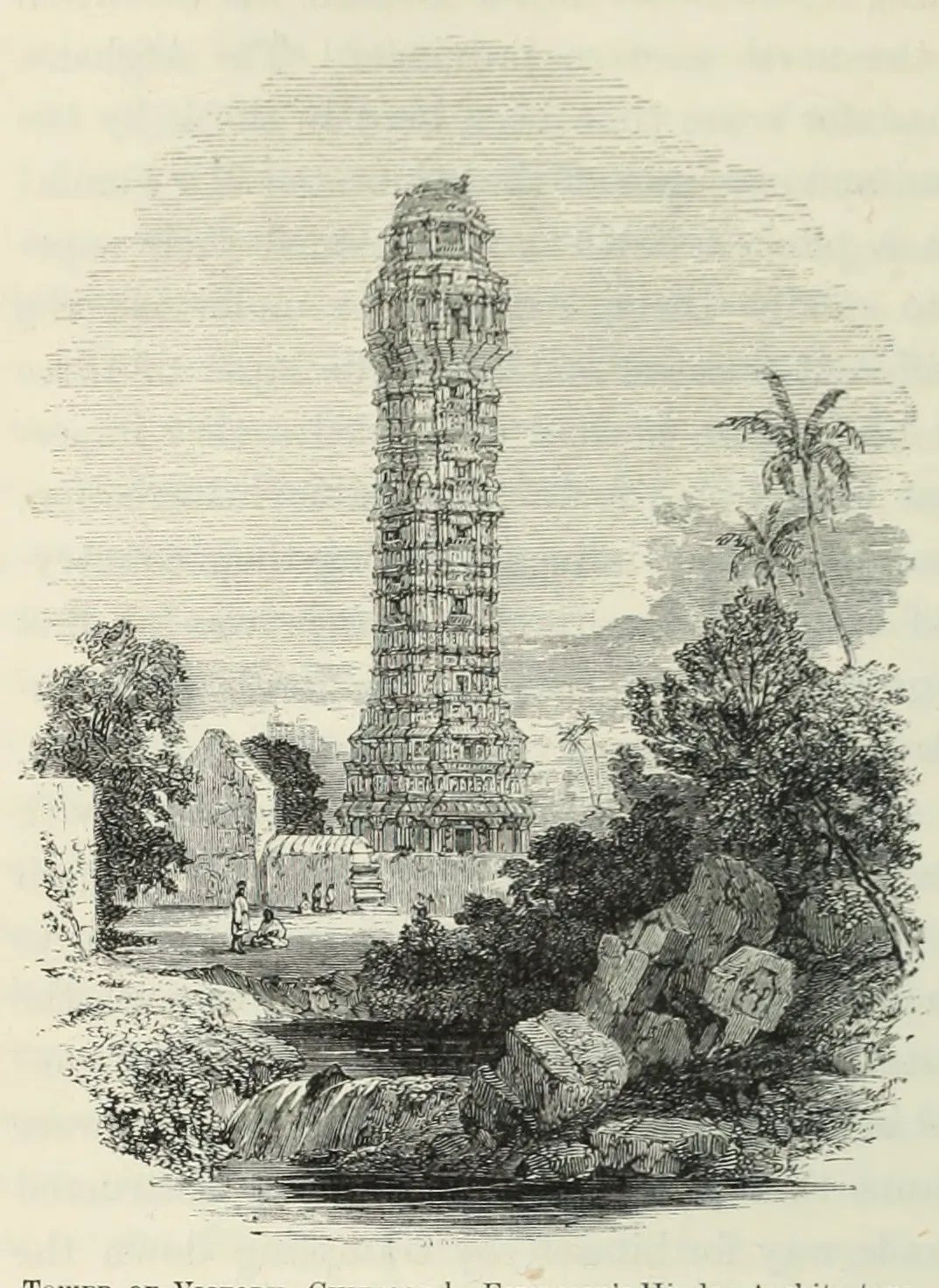
In the provinces the results of this persecuting system were soon manifested. The Rajpoots entered into a league for mutual defence, and the whole of the western part of Rajpootana rose in arms. An exterminating war commenced, and raged furiously for many years; but as Aurungzebe’s resources far exceeded those of the insurgents, he gradually gained ground, captured the remarkable Rajpoot fortress of Chittoor—situated on a lofty isolated rock, which, rising abruptly from its base, had for additional security been scarped all round to the depth of nearly 100 feet—and by the terror of his devastations compelled an external submission from many who continued to hate him in their hearts. In the Deccan, every Hindoo now considering his religion at stake, felt personally interested in the triumph of the Mahrattas. Sevajee, consequently, continued to prosper. In 1674, when a disputed succession in Bejapoor made conquest easy, he extended his sway over the whole of the Southern Concan, with the exception of a few isolated points; and beyond the Ghauts pushed his boundary much farther eastward. Having now all the reality of a great sovereignty, he resolved to complete it in due form; and on the 6th of June, 1674, was crowned with a pomp which imperfectly but ostentatiously imitated the Mogul ceremonial on similar occasions. From this period, regarding himself
as the founder of a new national dynasty, he lived in regal state, changed the name of his officers from Persian to Sanscrit, and became strictly observant of all the rites of Hindooism. These proceedings must have given mortal offence to Aurungzebe; and, accordingly, when the Mahrattas were engaged in making conquests from Bejapoor, the Moguls seized the opportunity to make an incursion into their territory. Sevajee deemed it too unimportant to require his presence, and contented himself with retaliating by sending detachments which plundered Candeish and Berar; and proceeding beyond the Nerbudda, which had never before been crossed by a Mahratta force, carried his devastations as far as Baroach, in Gujerat. For some time his thoughts had been fixed on the south. There the jaghire which his father acquired in Mysore was held by a younger brother under the nominal supremacy of Bejapoor. It properly formed part of Sevajee’s patrimony, and he determined to obtain it either in virtue of his legal claim or by compulsion. The distance, however, was too great to allow him to set out for it without taking precautions. The territory of the King of Golconda partly intervened, and in order not to leave his rear exposed it was necessary to come to an understanding with him. This was not difficult, as they agreed in regarding the King of Bejapoor and the Mogul emperor as common enemies. After making overtures, which were favourably received, Sevajee set out at the head of 30,000 horse and 40,000 foot. On the way he halted at Golconda, and concluded an alliance by which, in return for defence against a Mogul or Bejapoor invasion, a train of artillery, and a subsidy in money, he agreed to share with the king all the territory he should conquer beyond his father’s jaghire. Continuing his route, he crossed the Toongabudra at Kurnool, proceeded south-east to Cuddapah, then passed close to Madras, and finally turning south-west, presented himself before the strong fort of Gingee, belonging to Bejapoor. He could not have taken it by force; but had previously made secure of it by bribing its commander. The heavy part of his army left behind succeeded in capturing Vellore. On arriving at his father’s jaghire, his brother refused to resign it; but ultimately, after he had taken forcible possession, he entered into an arrangement by which he restored it to his brother on condition of receiving half the revenue.
The alliance with Golconda had been short-lived; for the king, shortly after Sevajee’s departure, arranged with the Moguls, and consequently forfeited all claim to any share in the conquests which had been made. The immediate inducement to abandon the alliance was an invasion of Golconda by the Moguls under a celebrated leader of the name of Dilir Khan. This chief, after his attack on Golconda, entered the territory of Bejapoor, and, though his force was small, so dexterously availed himself of internal dissensions that he was able to lay siege to the capital itself. In this extremity, the King of Bejapoor earnestly applied for assistance to Sevajee, who was advancing for this purpose when he was astonished to learn that his son Sambajee had deserted to the Moguls. His father had imprisoned him in a hill-fort for gross misconduct, and the youth having made his escape fled to Dilir, who received him with open arms. Notwithstanding this domestic calamity, Sevajee continued his exertions with so much vigour that all Dilir Khan’s efforts were baffled, and Bejapoor was saved. As the price of this service, Sevajee obtained a large accession of territory, all the Bejapoor districts between the Toongabudra and the Kistna being ceded to him.
Amid all these successes, Sevajee was seized with an illness which carried him off on the 5th of April, 1680. In the course of nature, he might still have had a considerable career to run, as he had only attained his fifty-third year; but he had lived long enough to produce great political changes, and become the founder of an empire. Originally little better than a marauding adventurer, he displayed wonderful sagacity in profiting by every opening that presented itself; and when brought face to face with the most powerful monarch of the East, not only maintained an equal contest but often gained decided advantages. When Aurungzebe entered upon his Mahometan crusade, Sevajee met him on his own ground; and taking Hindooism under his protection, gave it once more a national ascendency. It is not to be denied, that in pursuing his objects he was unscrupulous, and committed several atrocious crimes; but it may be pleaded for him in mitigation, that his enemies were in these respects still worse than himself, and that while their crimes were often the effect of mere barbarism delighting in deeds of blood for their own sake, he was never wantonly cruel, and threw honour and humanity aside only when he imagined, of course erroneously, that sound policy required it.
Sambajee was a very different man from his father, and possessed none of his good qualities except courage. While a mere youth he had become a complete debauchee; and when by his misconduct he had subjected himself to confinement, so little was his patriotism that the first use he made of his recovered freedom was to desert to the enemy. He had again returned to his country; but, so far from having recovered his father’s good graces, was a prisoner in the fort of Panalla when his father died. As might have been expected in these circumstances, some demur was made to his accession, though he was the eldest son; and a party was formed with the view of placing a second son, Rajah Ram, a boy of ten years old, on the throne. This party endeavoured to conceal the news of Sevajee’s death; but Sambajee got immediate notice of it, and was at once acknowledged by the garrison of the fort. What had previously been a prison was thus converted into a stronghold, where he remained secure till the party opposed to him broke down; and he entered Ryeghur, the capital, as undisputed sovereign.
His first acts justified the opposition which had been made to him. Sevajee’s widow, the mother of Ram Sing, was put to death, Ram Sing himself was imprisoned, several Brahmins of his party were thrown into chains, and such of his enemies as belonged to other castes were beheaded. The disaffection thus produced was greatly increased by harsh treatment of his father’s ministers, while he gave himself up to the guidance of a worthless favourite of the name of Calusha, who pandered to his vices.
The first hostilities in which Sambajee engaged terminated to his disadvantage. The island of Jinjeera, situated on the west coast of India, a little south of Bombay, had long been possessed by the Hubsees or Siddees, chiefs of Abyssinian origin, who held it of Bejapoor on the condition of maintaining a fleet for the protection of commerce, and the safe conveyance of pilgrims to Mecca. The island was strongly fortified; and the Siddees having the command at sea, were able when attacked to offer a very formidable resistance. The proximity of the island to the Mahratta capital would have made it a most desirable possession to that power, as it contributes to form one of the best harbours on the Indian coast; and many were the attempts which Sevajee had made to become master of it. He was always unsuccessful; and while making large conquests in other quarters, had the mortification of seeing all his efforts baffled whenever he directed them against this little spot. Sambajee flattered himself that he would be more fortunate, and no sooner felt firmly seated than he resolved to commence the siege of Jinjeera. One of his operations was to connect the island with the mainland by a mound, and effect the capture by means similar to those which Alexander the Great used when he took the city of Tyre. He proved no Alexander; and after being compelled to raise the siege, was enraged beyond measure on seeing the Siddees plundering his villages, and learning that they had defeated his fleet at sea. In the midst of his wrath he would willingly have fixed the blame on any but himself; and on the pretence that they had assisted his enemies, made war on the Portuguese, and was with difficulty restrained from attacking the English also.
A more formidable enemy than either immediately appeared, and gave him full employment. In the Deccan, the character of the new Mahratta sovereign had soon become manifest; and the strict discipline which Sevajee had maintained rapidly disappeared through the idleness and debauchery of his son. He had left vast treasures, but these were soon squandered, and the attempt to replace them by increasing the land revenue spread general disaffection. Aurungzebe, perfectly informed as to the change which had taken place, had no sooner quelled the insurrection of the Rajpoots than he began his march southwards with the avowed purpose of making a final conquest of the Deccan. His army was so numerous and well equipped that he never contemplated the possibility of failure, and therefore disdained to strengthen himself by forming any alliance with Bejapoor and Golconda. This overweening confidence was his first great fault; another, which looks like infatuation, was the announcement of his determination rigidly to exact the jezia. Even his military talents appear to have forsaken him, for he began the campaign without any properly concerted plan. While making a long halt at Boorhanpoor, on the Taptee, he sent off two large detachments—one under Prince Azim to reduce some hill-forts of the Ghauts, and the other under Prince Moazzim to overrun the Concan and penetrate to the south of the Mahratta country. Azim was partially successful, though more by bribery than prowess. Moazzim threaded his way through the thickets of the Deccan without being opposed; and yet, when he arrived in the vicinity of Goa, it was only to find himself in a worse condition than if he had sustained a signal defeat. Almost all his horses and cattle had perished under the hardships of the march and the want of forage, and even the men were beginning to suffer from scarcity. Sambajee, in the meantime, was not idle. While he occupied the passes through the Ghauts, his cruisers were scouring the sea, and capturing the Mogul vessels which were endeavouring to land provisions on the coasts. With the greatest difficulty Moazzim reached the country above the Ghauts with an army almost disorganized, and spent the rainy season near Meeruj, where his ranks were again dreadfully thinned by an epidemic.
When the campaign was resumed, Aurungzebe advanced in person to Ahmednuggur, while Azim and Moazzim were ordered to enter Bejapoor from opposite directions. Sambajee immediately saw his advantage, and, assembling a body of horse in the north of the Concan, placed himself suddenly in Aurungzebe’s rear, sacked and burned the city of Boorhanpoor, and was again back in the Concan, leaving the whole country in a blaze. In Bejapoor the campaign was equally disastrous, neither of the royal princes possessing sufficient strength to make head against the forces opposed to them; and, though both received reinforcements, no advantage whatever was gained, except the capture of Sholapoor. To this place Aurungzebe advanced with his army. This movement furnished Sambajee with the opportunity of making another plundering excursion, during which he devastated part of Gujerat and plundered the city of Baroach. About this time he had entered into an alliance with the King of Golconda, who was therefore now regarded as an enemy of the Moguls, and his kingdom invaded by Aurungzebe. The army, commanded by Prince Moazzim, made little progress till the commander-in-chief, a fanatic Mussulman, who was offended at the influence possessed by a Brahmin, turned traitor and deserted, carrying the greater part of his troops along with him. Resistance was now vain; and, while the king took refuge in the fort of Golconda, Hyderabad, his capital, was seized and sacked. Having been reduced to the necessity of accepting whatever terms were offered to him, the Moguls left him effectually crippled, and next turned their arms against Bejapoor. The siege of the capital was immediately commenced by Aurungzebe in person. It was successful, and the Bejapoor monarchy ceased to exist. The splendour to which the capital had attained is still attested by its ruins. Aurungzebe having thus succeeded probably beyond his expectations, appears to have repented of his leniency in having left the King of Golconda even a shadow of independence. Little difficulty was found in devising a pretext for breaking the peace, and the whole territory was speedily overrun. The king, Abul Hasan, shut up in his fort, shook off the effeminacy for which he had previously been notorious, and defended himself successfully for seven months. Treachery at
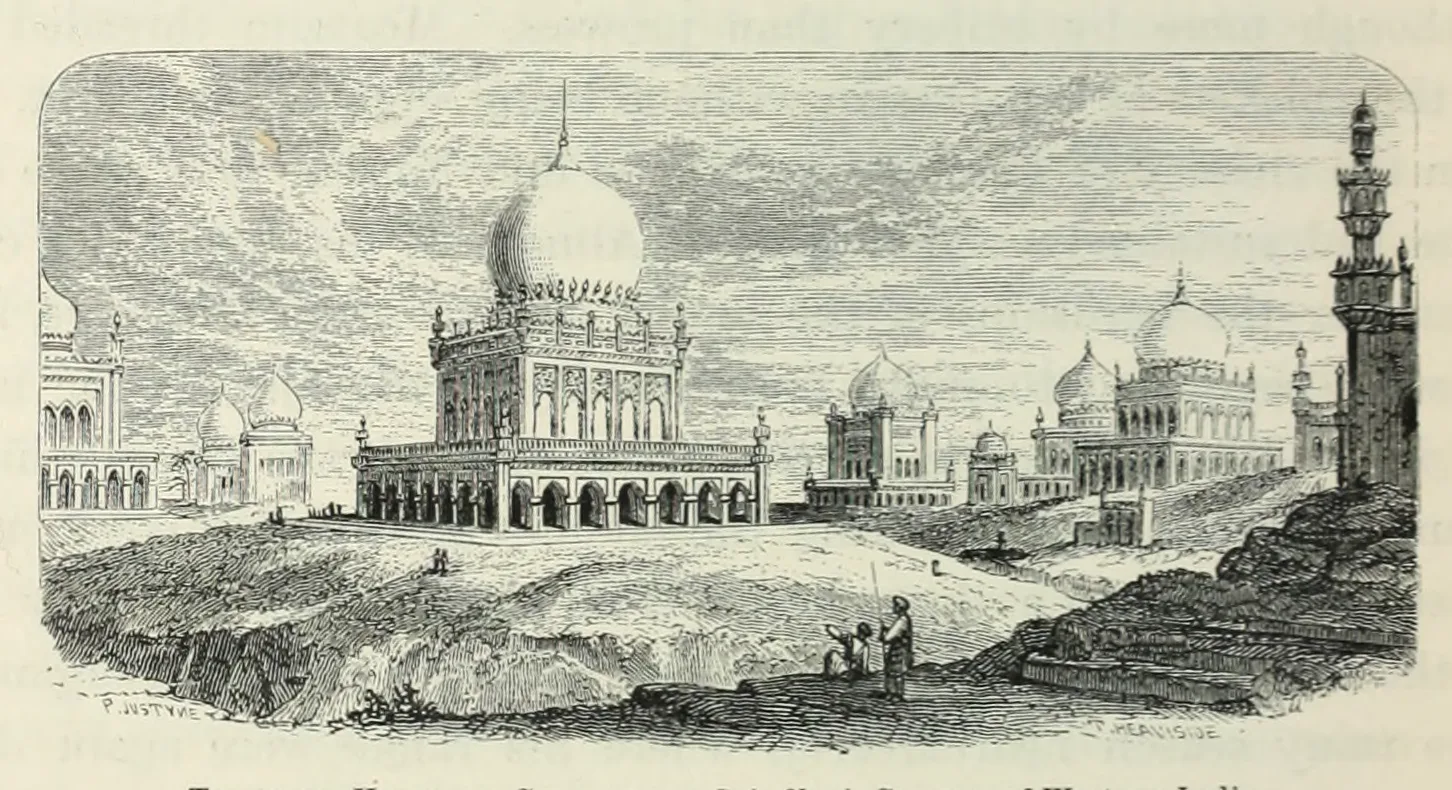
last again did its work, and the Golconda monarchy also was extinguished in 1687. The Mogul empire now reached its utmost limits in the south. The kingdoms of Ahmednuggur, Bejapoor, and Golconda, were formally incorporated with it, and even a considerable portion of the Mysore, and more especially that part which had formed Shahjee’s jaghire, was held at least by military occupation. Vencajee, whom Sevajee had left in possession of the jaghire, was obliged to confine himself to Tanjore; and any other Mahrattas who had made acquisitions in the same quarter, were driven from the open country and found no safety beyond the precincts of their hill-forts.
While Aurungzebe was thus pursuing his victorious career, Sambajee seemed to be almost forgotten. Under the guidance of the despicable Calusha, he had been pursuing a shameless course of drunkenness and debauchery. The whole of the open country belonging to the Mahrattas was in consequence overrun, and a systematic attempt was about to be made on the forts, when a still more important object was gained by the capture of Sambajee himself. He was living in security at a favourite pleasure house in the Concan, when Tokarrab Khan, the Mogul officer at Kolapoor, acting on a plan which is said to have originated with Aurungzebe himself, set off with a small body of troops, crossed the Ghauts, and, after a journey of nearly sixty miles, made his sudden appearance. An alarm was immediately spread, and escape was still practicable, but Sambajee was in such a state of intoxication as to be unable to attempt it, and was carried off in triumph, together with Calusha, to the Mogul head-quarters. Aurungzebe, deeming it possible to use him as a tool, offered him his life on condition of turning Mussulman; but he rejected the offer with scorn, and spoke of Mahometanism in such contemptuous terms that an ordinary death was deemed an insufficient punishment, and he was subjected to horrid barbarities before being beheaded.
This execution, which took place in August, 1689, spread universal indignation among the Mahrattas. Sambajee’s worthless character was overlooked, and the heroism with which he had courted death sooner than abjure his faith, made him be regarded somewhat in the light of a martyr. The principal chiefs, immediately on receiving tidings of his death, assembled at Ryeghur, and acknowledged his infant son, Saho, as rajah. Rajah Ram, Sambajee’s brother, was appointed regent. The task thus assigned him was extremely difficult. Aurungzebe in person was at the head of an overwhelming force, and it seemed as if the Mahrattas, more especially after the capital, and with it the young rajah himself, fell into his hands, would have no alternative but to throw themselves on the victor’s mercy. In this extremity Rajah Ram fled to the strong fortress of Gingee, in the Carnatic, after putting the forts of the Deccan in a good state of defence, and ordering the troops to disperse in their villages and wait for better times. The leading chiefs, whose lands might have been forfeited, made no scruple of making a feigned submission to the Mogul, while they still kept up an understanding with their countrymen, and watched for the first opportunity of joining any rebellion which promised to be successful.
The subjugation of the Deccan being apparently complete, Aurungzebe despatched a general of the name of Zulfikar Khan to reduce Gingee. Rajah Ram, who had now begun to govern in his own name in consequence of the captivity of his nephew, prepared for a vigorous defence; and Zulfikar Khan had no sooner reconnoitred the place than he saw that success was hopeless without strong reinforcements. While applying for these, he sent part of his army into Tanjore and other southern countries to levy contributions. They were thus employed when they received an urgent recall. The Mahrattas, who had never entirely desisted from their guerilla warfare, had become emboldened by partial successes, and were mustering strong in various quarters. Scarcely any district in the Deccan was secure from their incursions; and whenever the chout was withheld, nothing was to be seen but fire and devastation. Two Mahratta leaders, Santajee Gorpara and Danajee Jadu, particularly distinguished themselves. By intercepting convoys, and attacking isolated detachments, they spread such general alarm that Aurungzebe felt the necessity of endeavouring, by decisive measures, to revive the spirit of his troops. Zulfikar Khan was still before Gingee, and unable to make any progress because the reinforcements which he required had been withheld. When they were at last despatched, Aurungzebe gave the chief command to his son Cambaksh, but at the same time, adhering to his suspicious system, controlled his operations by sending along with him Assad Khan, Zulfikar Khan’s father. As might have been expected, all parties were dissatisfied with this arrangement. Cambaksh complained that, while he bore the responsibility, the authority which he possessed was only nominal; Assad Khan and his son, on the other hand, complained with equal reason that, while the burden of conducting the war lay on them, all the fame which might be acquired was reserved for another.
While the leaders were thus at variance, the combined operations necessary to insure success could not be adopted. It is even said that Zulfikar Khan carried his resentment so far as to enter into treasonable correspondence with the enemy, and furnish them with intelligence which enabled them to frustrate all the efforts of the besiegers. No wonder that, in such circumstances, the siege was protracted for years. Meanwhile Santajee and Danajee, the two leaders above mentioned, were not idle. Their partizans were spread over the whole country, and they could, on the shortest notice, gather thousands around their standard. Thus feeling their strength, they resolved to make a great effort for the relief of Gingee. The force provided for this purpose amounted to 20,000 chosen horse. It was commanded by Santajee, who came upon the besiegers so suddenly that one of their divisions was completely surprised. An attempt to check his progress only led to a second overthrow, and the Moguls, cut off from their supplies and confined within their intrenchments, became, instead of besiegers, besieged. They adopted the best course which remained to them in the circumstances, and made an arrangement which allowed them to retire to Wandivash, about twenty miles distant.
During the greater part of the siege, Aurungzebe had remained in permanent cantonments near Punderpoor, on the Beema, but on hearing of this disgrace, advanced to Bejapoor. While strongly condemning the conduct of his generals, he inconsistently conferred the sole command on Zulfikar Khan, the only one who was truly to blame. After a number of desultory operations, the siege was resumed, and again began to linger till Zulfikar Khan, aware that Aurungzebe’s suspicions were aroused, saw the necessity of no longer dallying. Accordingly, after allowing Rajah Ram to escape, he carried on his operations in earnest, and soon made himself master of the place.
This success was partly owing to internal dissensions which had broken out among the Mahrattas. Danajee and Santajee, after acting in concert, had given way to feelings of mutual jealousy, and come to an open rupture. Santajee, as the stricter disciplinarian of the two, was the less popular; and, after an attempt to maintain his position, found his party so weakened that he had no alternative but flight. He was pursued, overtaken, and, notwithstanding all his services, remorselessly put to death. At this time Rajah Ram had taken up his residence in Sattarah, where he had not only succeeded in again organizing the government, but soon found himself so strong as to be able to take the field at the head of the largest army which the Mahrattas had ever raised. Proceeding northward he crossed the Godavery, levying the chout, and when it was refused, spreading devastation as far as Jaulna, forty miles east of Aurungabad. Here his progress was checked by a Mogul detachment, headed by his old opponent Zulfikar Khan, who pressed closely upon his track, and inflicted upon him several defeats. These, however, were soon repaired, and the Mahrattas only dispersed for the time, to re-appear in another quarter as strong as ever. On the whole, therefore, the Moguls, even when they gained a victory, were seldom permitted to reap the fruits of it, and hence were gradually becoming more and more exhausted and dispirited.
Aurungzebe could not shut his eyes to the difficulties of his position; and though now far advanced in life, gave proof of indomitable energy in the efforts which he made to improve it. Quitting his cantonments on the Beema, he suddenly appeared before Sattarah, which was taken in April, 1700, after a desperate defence, which protracted the siege for several months. While it was carried on, Rajah Ram had died, and been succeeded by a minor son under the regency of his mother, Tara Bai. It is not improbable that this event favoured the Moguls, as, in the course of a few years, all the principal forts of the Mahrattas were wrested from them. The war, however, still continued, and with every new success gained by Aurungzebe, seemed rather to enlarge its sphere. Under the Mahratta system of devastation, the whole Deccan was converted into a desert, and districts which had previously escaped were thrown into consternation by their incursions. Malwah was almost overrun, and no part of Gujerat felt secure. Even the forts, in the capture of which the Moguls had spent so much time and treasure, and lost so many lives, could not be retained, and began to fall, one by one, into the hands of their former possessors.
To meet the dangers which thus environed him, all the energy which Aurungzebe possessed in the most vigorous period of his life would scarcely have sufficed, and this energy was now forsaking him. Borne down by the weight of years he longed for repose, and was not unwilling to have purchased it by setting the Rajah Saho at liberty, and even submitting to pay an annual percentage on the revenue of the Deccan. The Mahrattas listened to his overtures; but, conscious of their advantages, became so exorbitant in their demands that all attempts at negotiation failed, and Aurungzebe, threatened on every side, was compelled to retreat. He reached Ahmednuggur after a series of disasters and narrow personal escapes. Here his health gave way, and it soon became apparent that his end was approaching. Thus brought face to face with the last enemy, he cowered before him, and trembled under both real and imaginary terrors. None of his crimes seems to have filled him with so much remorse as the dethronement of his father. He feared that the same measure was about to be meted out to himself, and hence saw his worst enemies in his own sons. A suggestion by Prince Moazzim to make arrangements for the future was interpreted into a wish to pluck the crown from his head before he had ceased to wear it; and when a letter from Prince Azim was read, requesting permission to come to Ahmednuggur because his health was suffering at Gujerat, he exclaimed, “That is exactly the pretext I used to Shah Jehan in his illness.” Nothing, indeed, could be more melancholy than Aurungzebe’s death-bed. A letter dictated to Azim in his last moments gives utterance to his remorse and terror, and concludes thus:—“Come what may, I have launched my vessel on the waves. Farewell! farewell! farewell!” Another letter to Prince Cambaksh, his youngest son, is in the same spirit—“Wherever I look I see nothing but the Divinity. . . I have committed numerous crimes, and I know not with what punishments I may be seized. . . The agonies of death come upon me fast.”
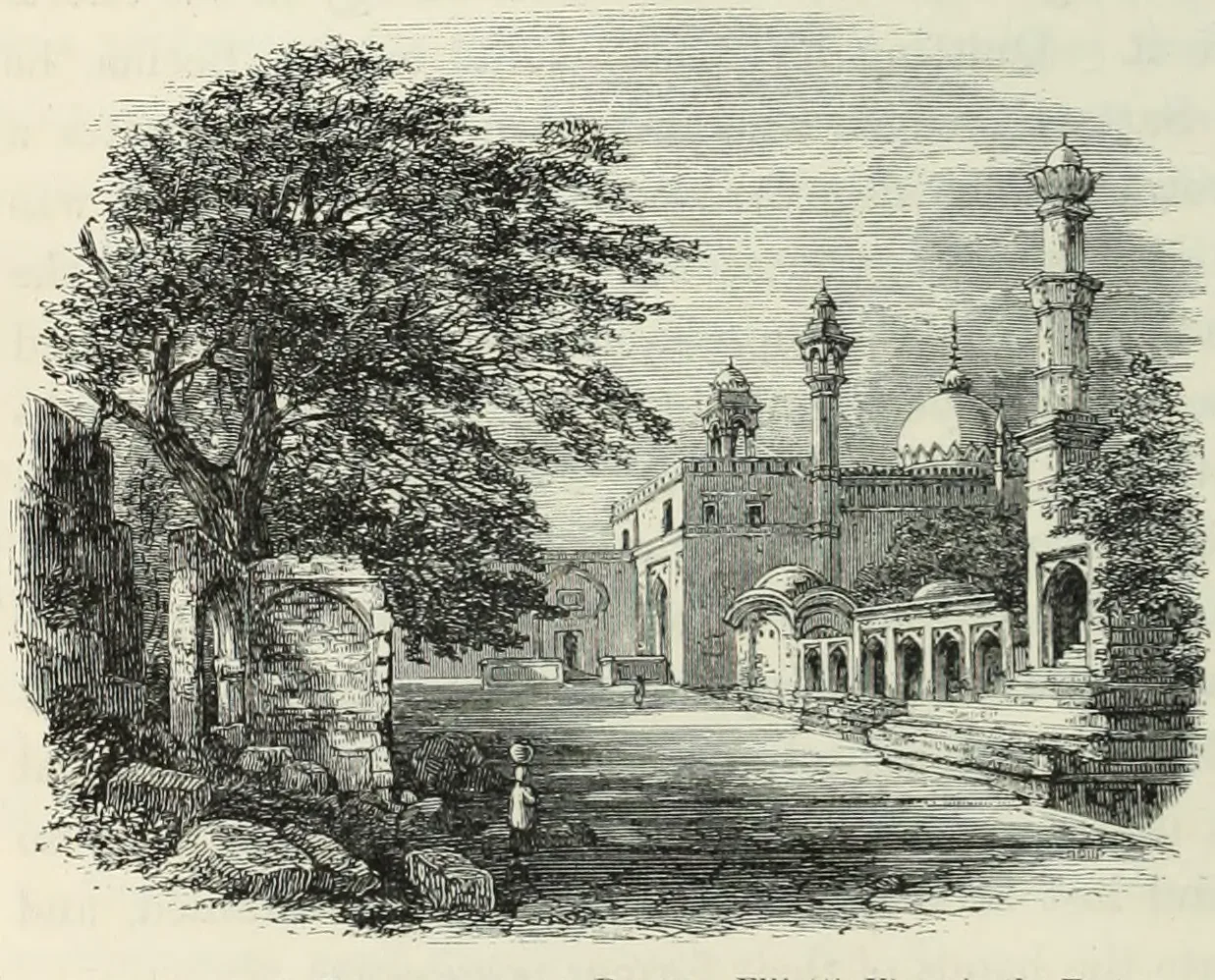
It was so; and on 21st February, 1707, Aurungzebe expired, in the eighty-ninth year of his age and the fiftieth of his reign. After his death a document of the nature of a will was found under his pillow, giving the northern and eastern provinces of the empire, with the title of emperor, and the capital, Delhi, to Moazzim — the south-west, and south, including the northern part of the Deccan, with Agra as a capital, to Azim—and the kingdoms of Golconda and Bejapoor to Cambaksh. The extent to which these arrangements were carried out, and the results, will afterwards be seen.
Notes
- 1. “The light to the central apartment is admitted only through double screens of white marble trellis-work, of the most exquisite design; one on the outer, and one on the inner face of the walls. In our climate this would produce nearly complete darkness; but in India, and in a building wholly composed of white marble, this was required to temper the glare that otherwise would have been intolerable. As it is, no words can express the chastened beauty of that central chamber seen in the soft gloom of the subdued light that reaches it through the distant and half-closed openings that surround it."—Fergusson’s Hand-Book of Architecture. “Tavernier saw this building begun and finished, and tells us it occupied 20,000 men for [p. 290] twenty-two years. The mausoleum and all the buildings that appertain to it cost 3,17,48026 (three crore, seventeen lacks, forty-eight thousand and twenty-six rupees, or £3,174,802 sterling.”—Sleeman’s Rambles and Recollections by an Indian Official.
- 1. On the queen’s tombstone are passages from the Koran, amidst wreaths of flowers; on her husband’s, only his name and date of death, and mosaic of flowers. The tombs are within a screen of trellis-work of white marble, a chef-d’œuvre of elegance in Indian art.
- 1. This weapon is said by Sir R. Meyrick to have been invented by Sevajee. The instrument is concealed in the hand, the first and fourth fingers being passed through the rings at the ends. The specimen represented in our engraving is in the museum of the East India Company.
- 1. The Kheerut Khumb, or Tower of Victory, was erected in 1439, to commemorate a victory over the combined armies of Malwah and Gujerat by Rana Khumbo, who reigned in Merwar, 1418–68. It stands on a terrace 42 ft. square; it is 172 ft. in height; and each of the four faces is at the base 35 ft. in length. There are nine stories, and on the summit is a cupola. The whole is one mass of the most elaborate sculpture, executed in white marble, and representing various subjects of Hindoo mythology.—Thornton, Gaz India.