BOMBAY was at first made subordinate to Surat. Sir George Oxinden, though still continuing to reside and hold his position as president at the latter, was appointed governor and commander-in-chief of the former; but at the same time authorized to send one of the members of his council, as deputy-governor, personally to administer the affairs of the island. With this view a series of directions had been drawn up by the court in England. The fort or castle was to be enlarged and strengthened; a town, so situated as to be under its protection, was to be built on a regular plan; inhabitants were to be induced to settle by exemptions from customs; and while the English were to be preferred, others also were to be encouraged by the free exercise of their religion. The improvement of the revenue, so far as practicable, without imposing new and burdensome taxes, was not to be forgotten. To foster manufactures of cotton and silk goods, looms were to be purchased for the weavers; and to give new facilities to commerce, a harbour and docks were to be constructed.
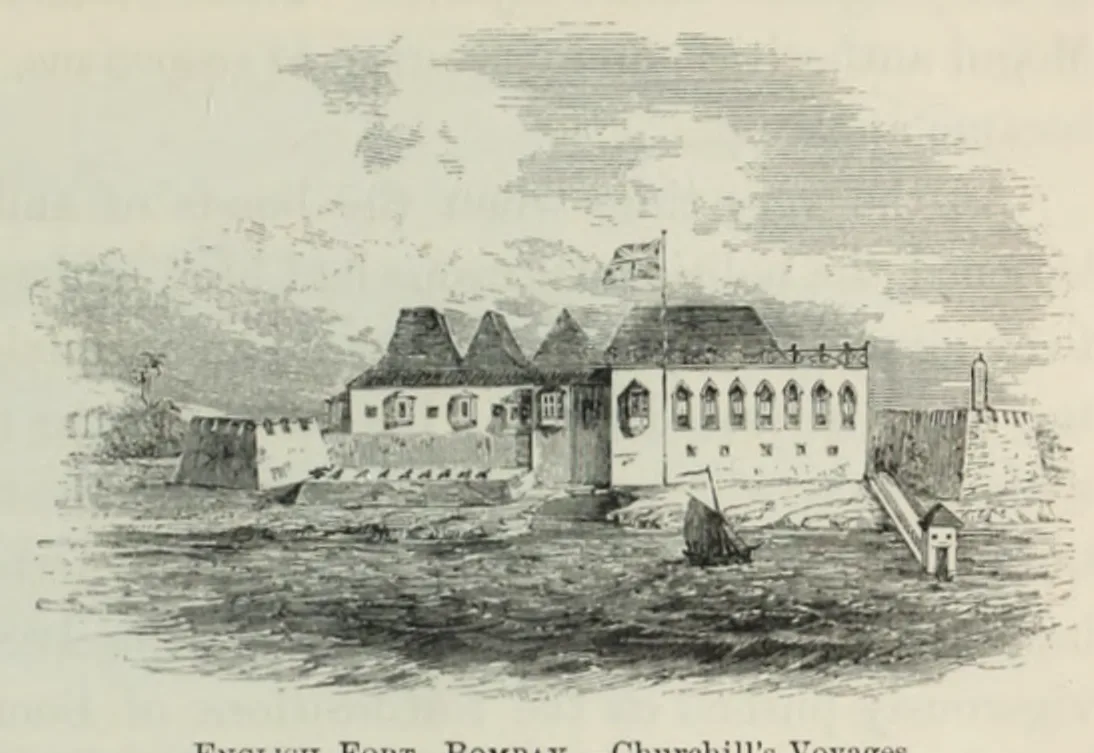
Before much progress could be made in carrying out these arrangements, several untoward events took place, and new difficulties arose from various quarters. The Portuguese, who had never been reconciled to the cession of Bombay, endeavoured to render it as little lucrative as possible to its new possessors, by taking advantage of their position at Tanna to impose heavy transit duties on all goods passing through it to or from Bombay; the trade of which was in consequence greatly crippled, as Tanna, situated at the head of Bombay harbour, commanded the only proper line of communication with the mainland. While an important branch of traffic was thus in a manner interdicted, the trade of Surat was again suspended by an incursion of Sevajee. Immediately after his former visit, a substantial wall of brick, flanked with bastions, had been commenced and was approaching completion, but as much still remained open as to make it easy for Sevajee to penetrate into the heart of the town and resume his work of plunder. Besides the English and Dutch, there was now also a French factory. The last showed no fight, but obtained an ignominious exemption by giving the Mahrattas a free passage through their factory, and thus enabling them to obtain a rich booty by the plunder of a Tartar prince who had returned by way of Surat from a pilgrimage to Mecca. The Dutch stood upon the defensive, and seemed so well prepared that they were allowed to escape. The English, under President Aungier, who had succeeded on the death of Sir George Oxinden, distinguished themselves as before by beating off repeated attacks. On this occasion, however, they were not so fortunate as to obtain the approbation of the Moguls. Sevajee, before he retired, had opened a friendly negotiation with the English, and several conferences had been held with the view of arranging the re-establishment of the Company’s factory at Rajahpore. Sevajee was anxious to secure the revenue which had been lost by the withdrawal of the factory, and the presidency at Surat were disposed to consent, provided they could obtain compensation for past and security against future injuries. These conferences were not unobserved by the Mogul authorities, and gave rise to suspicions, of which the results afterwards became apparent.
At the very time when the bonds of amity with the Moguls were thus loosened, the politics of Europe had been undergoing a change which threatened to expose the Company once more to an unequal contest with the Dutch. Hostilities were in fact declared; but, at the same time, by the alliance of England with France, which had now a considerable fleet in the East, the interests of the Company were better protected than formerly. With a wise precaution, however, they endeavoured to make themselves independent of foreign aid, and vigorously pushed on the fortifications of Bombay. They were thus engaged, but the works were far from completed and very inadequately garrisoned, when, in February, 1673, Rickloff van Goen, the Dutch Governor-general of India, made his appearance on the coast with a fleet of twenty-two ships, having 1000 regular troops on board. Bombay was evidently the object of attack, and could scarcely have resisted had it been made on the instant; but the Dutch lost time by endeavouring in vain to secure the co-operation of a land force under Sevajee, and when at last prepared for action, lost heart on seeing the kind of reception which awaited them. President Aungier, who fortunately happened to be in Bombay at the time, exerted himself, as Orme hyperbolically expresses it, “with the calmness of a philosopher and the courage of a centurion.” Besides 400 European soldiers, he succeeded in mustering 1500 militia, chiefly Portuguese and natives. Nor was he destitute of a marine force. In the harbour lay two frigates, a Dutch prize fitted up as a ship of war, and three armed sloops which had been lately built as a protection against the Malabar pirates; to this force a most important addition was opportunely made by the arrival of four French ships, which, on being informed of the danger, had hastened from Surat. Rickloff, under these circumstances, satisfied himself with reconnoitring, and then suddenly disappeared.
On the Coromandel coast the Dutch had excited similar alarm, and great fears were entertained for the safety of Fort St. George. Here, however, the French again proved important auxiliaries, and by means of a powerful fleet not only kept the Dutch in check, but made themselves masters of Trincomalee, in the island of Ceylon, and took St. Thomé by storm. The latter capture, as the place is situated only at a short distance from Madras, gave the Company more alarm than satisfaction, and they were therefore not displeased when, after a short tenure, the French were expelled and St. Thomé returned to the possession of the King of Golconda. Another success of the Dutch gave them deeper concern. On the 22d of August, 1673, the Dutch fleet engaged in the siege of St. Thomé fell in with the Company’s homeward bound ships, ten in number, and richly laden. A running fight commenced off the coast to the south of Masulipatam, and issued in the sinking of one and the capture of two of the Company’s vessels. The others, though not without sustaining considerable damage, found their way to Madras. In the Indian Archipelago, where the Dutch superiority was still more decided, it was impossible for the Company to traffic with any advantage, though they were now alive to the importance of carrying their trade still farther east, and endeavouring to establish that direct intercourse with China from which, in course of time, their chief, if not their only commercial profits were derived.
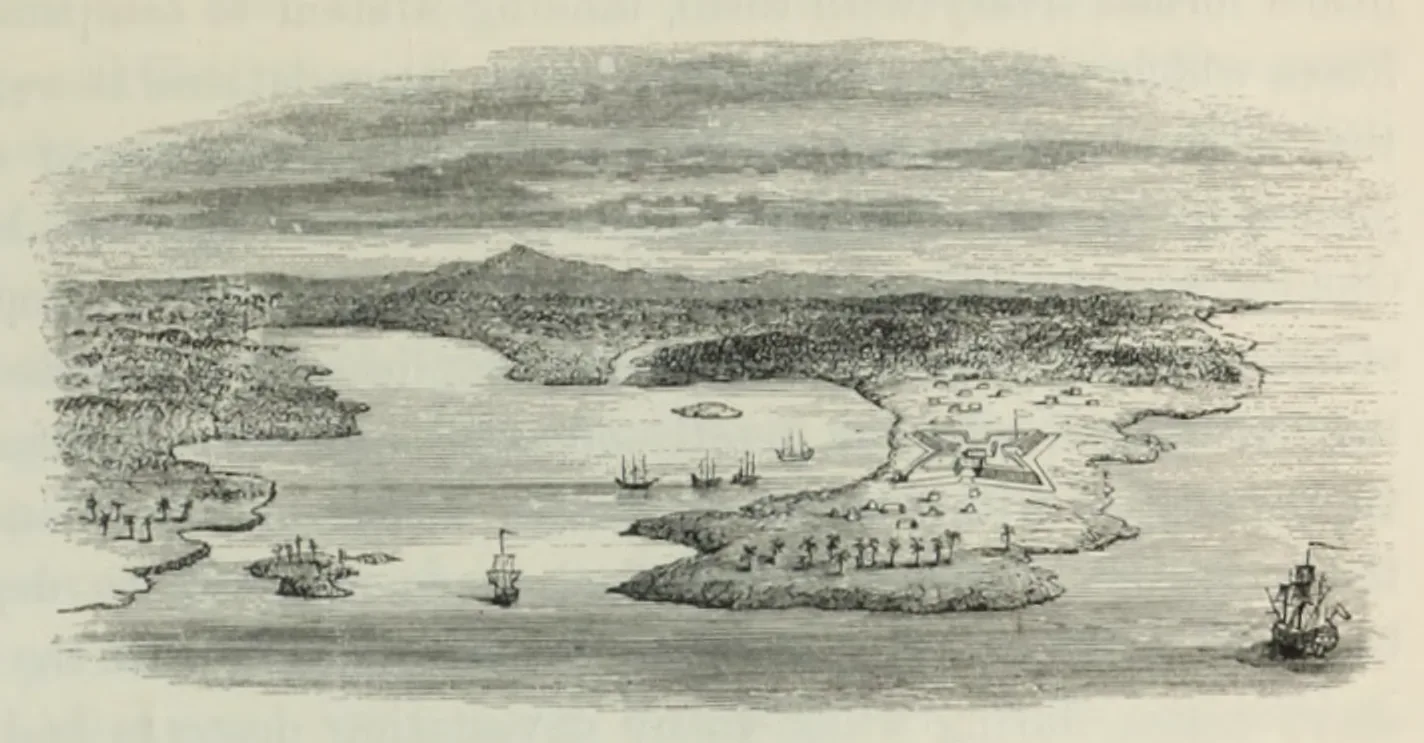
The danger to which Bombay had been exposed from the Dutch ceased entirely in consequence of a new whirl in European politics, by which, in 1674, peace was concluded, and shortly after happily cemented by the marriage of the Prince of Orange with Mary, daughter of the Duke of York. Another danger, however, immediately succeeded. The Moguls and the Mahrattas were constantly at war; and now that the English, by the possession of an island belonging to neither, were gradually beginning to assume the dignity of an independent Indian power, their alliance was naturally courted by both. The true policy of the Company in the meantime was to maintain a perfect neutrality; but the circumstances were such as to make this almost impossible. The Mogul fleet, commanded by the Siddee, sought shelter from a storm in Bombay harbour. To refuse it was impossible, without provoking the Moguls; to grant it was equally impossible, without giving umbrage to Sevajee. In this dilemma the Bombay government took the only course which lay open to them, by allowing the Siddee to remain till the storm blew over, and then requesting him to depart. He refused to obey; and collecting his vessels in the channel which separates the island from the mainland, landed a number of armed men at the villages of Sion and Mazagong, and drove out the inhabitants, apparently with the intention of gaining a permanent footing on the island. This was not to be tolerated; and after desultory hostilities to the disadvantage of the Siddee, he purchased permission to prolong his stay by engaging that no more than 300 of his men, armed only with their swords, should be ashore at one time, and that he would make no attack on the Corlahs—a fertile district of the Concan, stretching along the eastern shore of Bombay harbour, and belonging to the Mahrattas.
Sevajee was naturally jealous of this arrangement, and though, from his anxiety to see the Company’s factory again established at Rajahpore, he entered into a formal treaty with them, binding himself to compensate them for all the losses which they had sustained by his depredations, it soon became apparent that he was determined not to tolerate the continuance of a hostile fleet in his immediate vicinity. His first step was to send his general, Moro Punt, down the Ghauts with 10,000 men, to occupy Callianee or Kallian, opposite to the island of Salsette. By this movement he accomplished two objects—he levied chout on the Portuguese, who had greatly offended him by a fanatical attempt to force the Mahrattas within their territories to become Christians, and he overawed the Siddee, who, afraid for his fleet, made all haste to depart. Bombay harbour had, however, proved so convenient a station that the Siddee fleet, after a short cruise, during which many devastating descents had been made on the Mahratta coasts, again returned. The Bombay government having again permitted it to occupy its former station, Sevajee was greatly incensed, and resolved to rid himself of it at all hazards. With this view he at first collected a large fleet of boats within his own territory, on the east side of Bombay harbour; but finding the attack of the Siddee fleet in this manner impracticable, he made application to the Portuguese at Tanna for permission to cross over to Salsette, from which he anticipated little difficulty in finding access to Bombay itself. This permission being refused, he turned his attention to an opposite quarter, and dexterously availed himself of two small islands, called Kennery and Henery, situated so as to command the southern entrance of Bombay harbour. The natural strength of this position had hitherto been overlooked both by Portuguese and English; and when Sevajee had not only discovered it, but taken possession of Kennery, the larger of the two islands, and began to erect fortifications upon it, the greatest alarm prevailed. It was of no use to attempt negotiation, and therefore action was immediately resolved upon. The plan, however, was very defective, and in the first encounter the advantage was rather in favour of Sevajee’s party. A second attempt would have been disastrous to the assailants had not the Revenge, the only English frigate present, kept her ground, and, after sinking five of the enemy’s vessels, compelled the whole fleet of fifty to seek safety by flight. The Mahrattas still kept possession of Kennery, and, mounting several cannon, fired without much skill or effect. Meanwhile the Moguls, informed of the hostilities, expressed a desire to share in them, and sent a considerable fleet to Bombay. The dislodgment of the Mahrattas might now have been easy; but the English, having discovered that the Siddee, if he succeeded in capturing it, meant to keep it to himself, withheld their aid, and left the two native powers to fight it out as they best could. The struggle was in consequence protracted, and was not finished when Sevajee died in 1680.
Though war was thus raging in its vicinity, Bombay continued to make progress, and the propriety of substituting it for Surat, as the seat of the western presidency, had become so obvious as now to be regarded only as a question of time. Its fortifications had been carried on for a series of years without interruption, and, as early as 1674, mounted 100 pieces of cannon ; its regular garrison consisted of two companies, each of 200 men ; three companies of militia had been regularly organized ; and several well-manned vessels were permanently stationed in its harbour. The progress would have been still more rapid had not a deficiency of funds induced the government to adopt rather questionable means of replenishing their treasury. The inhabitants were burdened with new taxation in the shape of excise duties, and both imports and exports were charged with customs equalling, and in some instances far exceeding those which the Great Mogul, in the plenitude of his power, levied either from his own subjects or from strangers. On imports, including corn, grain, and timber, 2½ per cent. was to be levied as custom, and 1 per cent. to defray the expense of fortifications ; on exports the customs alone was fixed at 3½ per cent. Some articles of little bulk but considerable value, as gold and silver, jewels, musk and amber, were the only exemptions, while Indian tobacco and Indian iron imported, and, still more unaccountably, the whole produce of the island (cocoa-nuts, salt, fish, &c.) exported, were saddled with a custom of 8 per cent. Some of these impositions almost look as if the object had been not to encourage trade, but to extinguish it. The only justification must be sought in the eager desire of the governor to show that the original estimate of the revenue from the island was not overrated, and that it was able not only to pay its expenses, but yield a surplus.
While the governor was thus taxing his ingenuity in the invention of new sources of revenue, Captain Shaxton, his deputy, was, if not actively encouraging, at least conniving at proceedings of a mutinous tendency. The principal grounds of complaint by the soldiers were, that their period of service, which was limited to three years, had expired, and that a month’s pay, which had been promised them, had been withheld. On these grounds they threatened to lay down their arms. If the complaints were well founded, and it is to be presumed that they were, as Bruce in his Annals commends the prudence of President Aungier in granting the demands of the soldiers, it is not easy to see the justice of the praise which the same author bestows upon him for firmness in afterwards seizing the principal leaders and trying them, not by civil, but by martial law. The charter, it is true, authorized martial law, but it was surely both right and expedient that, in having recourse to it for the first time, the guilt should not only have been of a very aggravated description, but that, even after it was proved, judgment should have been tempered with mercy. Nothing of this is seen in President Aungier’s proceedings. The men were promised pay and then refused it ; they had served the full period for which they had enlisted, and insisted on their discharge. If the justice of the complaint could not be denied, the real fault was not in those who complained, but in the government who made it necessary. At all events, there was nothing in the conduct of the so-called mutineers to justify the sentence which condemned three of them to death, and which was actually carried into effect in the case of one of them. This first exercise of martial law in name of the Company took place on 21st October, 1674. Captain Shaxton, the worst culprit, if there was one, was next tried, and found guilty on several charges, but his station, though it only aggravated his offence, protected him, and he was sent to England to be dealt with as might there be deemed proper.
The most memorable event in the history of the Company in 1676 was the formal adoption of the principle of seniority as the rule of succession to offices of trust and emolument. In the letter of the court to the presidency of Surat, the mode in which the principle was to be applied is thus stated:—“For the advancement of our apprentices, we direct that, after they have served for the first five yeares, they shall have £10 per annum for the two last yeares; and having served these two yeares, to be entertayned, one yeare longer, as writers, and have writers’ sallary; and having served that yeare, to enter into the degree of factors, which otherwise would have been ten yeares. And knowing that a distinction of titles is in many respects necessary, we do order, that when apprentices have served their times, they be styled writers; and when writers have served their times, they be styled factors; and factors having served their times, to be styled merchants; and merchants having served their times, to be styled senior merchants.” By this arrangement many disputes as to advancement were obviated, and much discontent in consequence suppressed; but the principle of seniority, except in mere matters of routine, when the most ordinary qualifications combined with a sufficient amount of practice may suffice, is vicious in the extreme, because it removes all stimulus to exertion, and makes no account of either ability or industry. It is rather singular that in laying down this rule the court saw the necessity of departing from it in one very important particular, by holding out a kind of premium to military talent, enjoining all their civil servants “to apply themselves to acquire a knowledge of military discipline, that, in the event, either of any sudden attack, or of being found better qualified for military than for civil duties, they might receive commissions, and have the pay of military officers, till the pleasure of the court should be known.”
In the course of the war carried on between the Moguls and the Mahrattas, the Siddee had made himself master of Henery in the same way as Sevajee had of Kennery; and thus by the negligent and irresolute conduct which the local authorities had pursued, Bombay was exposed to a double danger, and its prosperity was seriously interrupted. The court at home, greatly perplexed at the threatening aspect of affairs, seem not to have been equal to the emergency, and disregarding the danger of being ousted altogether, kept insisting on a number of petty deductions, which produced much discontent among their own servants, and imposed various new burdens which were loudly complained of by the other inhabitants. At the same time temporizing expedients became the order of the day; and both the Moguls and Mahrattas, emboldened by the pusillanimous spirit in which their encroachments were met, set no limits to their arrogance. As if Bombay had been set up as a prize to be contended for, they were now only intent on deciding whether Siddee or Sevajee was to be the winning party. It would almost seem that the Company were gradually making up their minds to some such disastrous and ignominious result; for, in the face of remonstrances from India, complaining of the reductions already made, and distinctly stating that without additional expenditure and reinforcements the island would be lost, the court intimated their final decision that the fortifications having been the source of the heaviest expense, were to be continued in their present state without further improvements—that the manning of the batteries was to be reduced to the lowest scale possible—and that, with the exception of one small frigate, the armed ships stationed for guarding the harbour were to be sold. The letter of the court, after putting the island in jeopardy by these most improvident and niggardly injunctions, ludicrously, or, as some would rather term it, insultingly, concludes with a recommendation to the governor to maintain strict discipline, and have the garrison always prepared for a vigorous defence.
The above letter, addressed in the beginning of 1679 to Surat, which, by the way, was also to furnish its quota of reduction, by being degraded from a presidency to the less expensive form of an agency, produced a remonstrance which made the court pause before proceeding further in their reckless career of retrenchment. Surat accordingly resumed its rank as a presidency, and Bombay obtained some slight addition to its garrison. The change of policy thus indicated unhappily proved evanescent; and though Sambajee, now at the head of the Mahrattas, in consequence of the death of his father, was known to have aggressive designs on Bombay, its garrison, in January, 1683, could barely muster 100 Europeans, clamouring for additional pay as absolutely necessary to furnish them with the means of subsistence. On a former occasion, when similar complaints were made, the only step taken was to tantalize the complainers by obtaining letters-patent from the crown for the establishment of a mint at Bombay, a measure which, however useful in itself, only increased the quantity of coin without giving them any larger share of it. On the present occasion the complaints were similarly treated; and the letter from home in 1684 was chiefly occupied with announcing the erection of a court of admiralty, the judge of which, appointed by royal commission, was to have jurisdiction as far as the Company’s limits extended, and employ it specially for the suppression of unlicensed trading. In this arrangement Bombay was thus far interested, that it was not only to become the seat of the new court, but to be regarded in future as an independent English settlement, and the seat of the power and trade of the English nation in the East Indies.
While the court at home were conferring this magniloquent title on Bombay, an event had taken place which threatened to render it a mockery. Captain Richard Keigwin, the commander of the garrison, in concert with Ensign Thornburn and others, suddenly, on the 27th December, 1683, seized Mr. Ward, the deputy-governor, and the members of council who adhered to him, and issued a proclamation annulling the authority of the Company, and declaring the island to be immediately under the protection of the King of England. Dissatisfaction with the treatment which he had received from Sir Josiah Child, and his brother, Mr., afterwards Sir John Child, who had obtained a complete ascendency, the one as governor of the Company and the other as president of Surat and governor of Bombay, had tempted him to turn rebel, while the general discontent produced by the paltry reductions and other impolitic proceedings already adverted to, soon made the rebellion completely successful. With comparatively few exceptions the garrison and the inhabitants, when assembled, approved of his conduct, and recognized him as governor. The whole power of the island was thus in his hands. It is not easy to see on what grounds he could have imagined that his usurpation would receive any countenance in England; but as if he had been acting with the sanction of the crown, and with a single view to its interests, he required all the inhabitants to renew their allegiance to it, and proceeded to administer the government in its name. Immediately on hearing of the insurrection President Child despatched three of the Company’s homeward bound ships from Surat, having on board commissioners authorized to take measures which it was thought would prove effectual. When they arrived the frenzy was at its height; and the crews of the ships, catching the infection, so far from assisting in suppressing the revolt, began openly to fraternize with the revolters. The commissioners, alarmed at this new danger, were glad to avert it by allowing the ships to continue their voyage. In the meantime they remained on board a country vessel.
About a month after the insurrection broke out President Child arrived with three other Company’s ships, and on finding from the spirit which prevailed, both on the island and among his own crews, that force was out of the question, made lavish promises of pardon and redress of grievances. Keigwin listened to his proposals, but it was only to reject them; and after two months spent in unavailing conferences, the president despatched the ships to England, and with his commissioners returned crest-fallen to Surat, leaving the revolters still masters of the island. Keigwin, aware that appearances were entirely against him, drew up a justification, which he transmitted to the king and the Duke of York. His principal pleas were that by the misconduct of the parties intrusted with the management of the Company at home and abroad, Bombay was on the point of being lost, and nothing but the energetic measures which he had taken could have secured its continuance as a dependency of the British crown.
On receiving intelligence of the Bombay revolt, and of the attempt which Keigwin had made to justify his proceedings, the Company appointed a committee of secrecy to communicate directly with the crown, and take whatever other measures might seem expedient. In a report specially addressed to the king, they asserted that so far from acting penuriously with their officers and soldiers, their pay and encouragements were superior to those which the Dutch granted to their troops; that their president and governor had given every indulgence to the garrison “compatible with the duty of rendering the revenues equal to the charges of the establishment;” and that, since they had entered to possession of the island, they had expended the sum of £300,000 on fortifications, an excellent harbour, and other improvements. In conclusion, they returned to an old complaint by blaming the interlopers as the main instigators to the revolt, endeavoured to arouse the jealousy of the king by reminding him that the revolters had attacked his prerogative by questioning the right of the crown to give exclusive privileges of trade without the authority of the legislature, and hinted that the revolt, so far from being caused by any undue use of their powers, was rather owing to a defect in the powers themselves, which did not permit them to deal summarily and effectually with delinquents.
During these proceedings in England, Keigwin continued not only to maintain his position, but obtained a recognition of his authority from Sambajee, with whom he negotiated a treaty giving the privilege of free trade within the Mahratta dominions. More than this, Sambajee consented to the payment of a considerable sum due to the Company. This treaty and payment, together with the alleged fact that the island was now entirely supported by its own revenue, furnished Keigwin with plausible grounds for maintaining that his proceedings had advanced the interests both of the crown and the Company. It was impossible, however, that he could be listened to; and despatches were sent off from England, with a commission under the great seal, directed to the president and councils at Surat and Bombay, and to the commanders of the Company’s ships, to take the necessary steps for the recovery of the island. In the event of a peaceable delivery, a general pardon was to be proclaimed to all except Keigwin and other three ringleaders. As it seemed probable that force would be necessary, President Child was appointed captain-general and admiral of the Company’s sea and land forces, Sir Thomas Grantham vice-admiral, and the senior commander of the Company’s ships rear-admiral. Though the revolt was the immediate occasion of these appointments, it will soon be seen that ulterior objects were contemplated by them. Indeed, the necessity of these appointments, so far as related to the revolt, had ceased before the knowledge of them had reached India, Keigwin having in the interval agreed to deliver up the island to Sir Thomas Grantham, on receiving a free pardon for himself and his associates. In terms of this arrangement, the island was formally surrendered on the 19th of November, 1684. In the beginning of the following year a new reign commenced by the death of Charles on 6th February, 1685, and the accession of James II. A great change in the policy of the Company immediately took place; but before tracing it, it will be proper to attend to the changes which had in the meanwhile been taking place in the other settlements of the Company.
Notwithstanding the numerous obstructions to which the trade of the Company was subjected in the Eastern islands, it was determined still to persevere, and Bantam, as the most convenient intermediate point, continued to engross a considerable share of the annual investments. In the season 1676–77, the share allotted to it consisted of eight vessels, amounting in the aggregate to 3180 tons. The spice trade was still the great inducement, but a new interest had been created by the prospect of establishing a factory in China. In that case, it was supposed that Bantam would become the entrepôt between China and India. This purpose it was already serving to some extent; and the agent of Bantam was under orders to send annually, on the Company’s account, tea of the best quality to the value of 100 dollars. In this season, however, a direct intercourse was to be attempted, by sending a small vessel to Amoy under the charge of a person of known prudence and intelligence. From his information, the expediency of adopting further steps might be judged. This hopeful experiment was frustrated by an atrocity. In April, 1677, Mr. White, the agent, and a number of the principal servants of the agency, while sailing up the river of Bantam in their boats, were waylaid by the natives and barbarously massacred The king and his sons were suspected of complicity, but denied it, and promised to make every exertion to discover and punish the perpetrators. Whether they did so is very doubtful, but the promise was all that the few survivors could obtain. The effect was a temporary extinction of the agency. In the subsequent season new appointments were made, but they appear not to have been judicious. Instead of attending to their proper duties the persons appointed neglected them, and spent their time in squabbling with each other. In such circumstances trade languished, and before it could be revived the opening which had been anticipated at Amoy was closed by a Chinese civil war. Amid these discouragements, the only favourable incident was an overture from the Viceroy of Canton offering to admit the English to trade. In more prosperous times it would have been eagerly embraced, but the Company contented themselves with returning a respectful answer, and requesting to know what privileges of trade would be given if an English factory were established at that port.
In the season 1679–80, the prospect at Bantam had again brightened; for three ships, carrying 1600 tons and a stock of £69,000, chiefly bullion, were despatched to it. The inducement does not clearly appear; but from its being mentioned in the instructions that war was apprehended between the King of Bantam and the Dutch, it may have been anticipated that in the event of the king proving victorious, the Company, in pushing their trade in that quarter, would no longer have to encounter their most formidable competitors. In the succeeding seasons the investments to Bantam retained their importance, but from incidental allusions it may be gathered that it was not so much on account of that port itself as of the facilities which it afforded for forming connections with China. Amoy was again accessible, but its inferiority as a trading station to Canton had become more and more apparent. As the viceroy of the latter
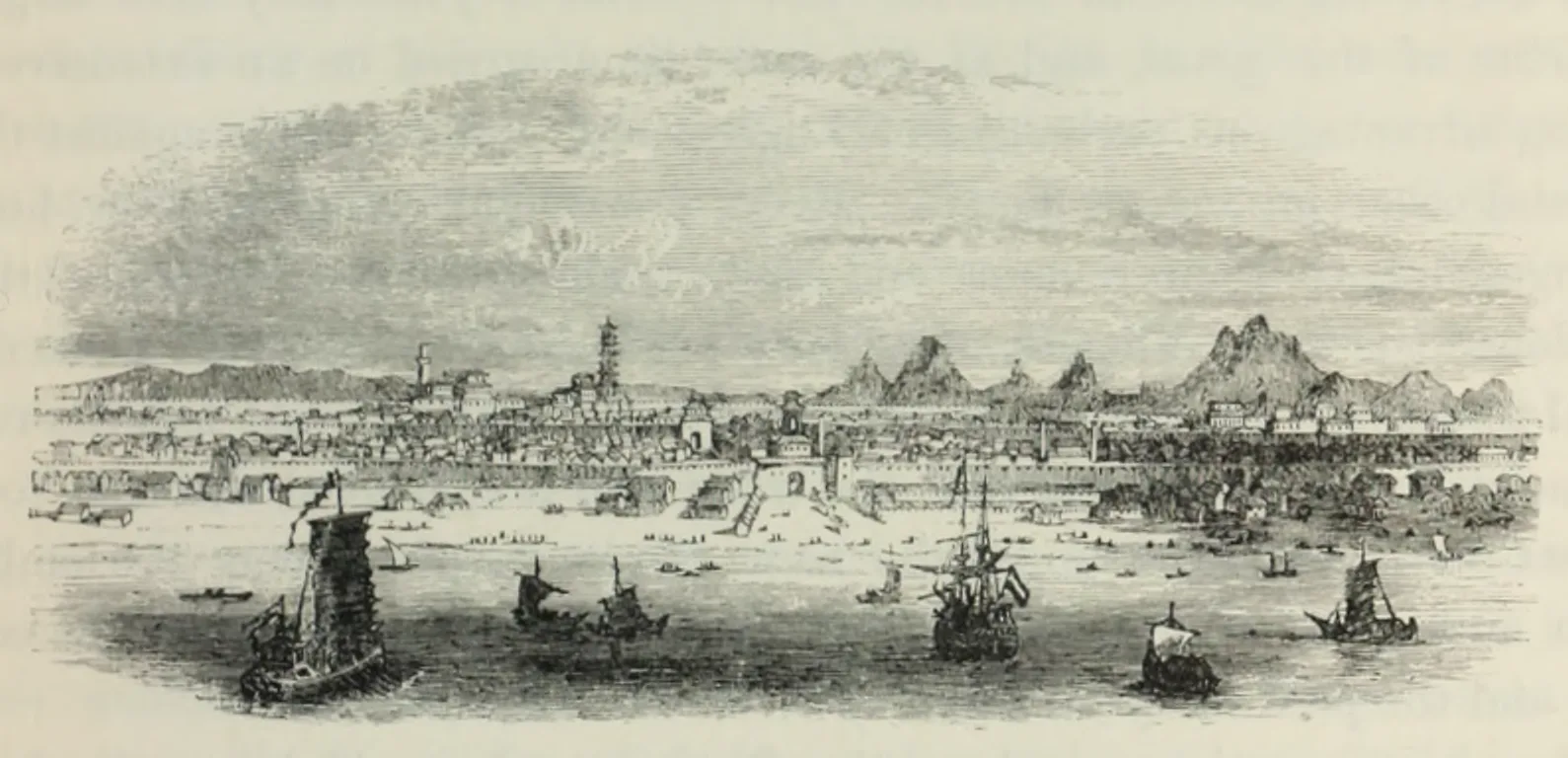
still continued to profess friendship, instructions were given in the season 1681–82 not only to renew the communication with him, but to make presents to him on a moderate scale, and assure him that, if proper privileges were granted, large ships with rich cargoes would annually visit his port.
The threatened war with the King of Bantam and the Dutch was now about to become a reality. It was probably with a view to it, and the hope of securing a powerful protector, that the king took the extraordinary step of sending ambassadors to England. They arrived, and had interviews both with the king and the Company. The only recorded result is that the Company’s ships carried out for him a present of 500 barrels of gunpowder. Before it arrived the war had been both begun and ended. The Dutch, with their usual sagacity, had made the victory easy by exciting an internal dissension, and giving their support to the winning party. The king’s own son had been induced to take up arms against him, and in 1682 effected a revolution which gave him the throne. One of his first steps was to take possession of the Company’s factory. This, we may presume, was done either at the instigation of the Dutch or to gratify them; but he had soon cause to see that while he supposed himself indebted to them for a throne, they had only been using him as their tool. The whole power was already in their hands, and scarcely a year elapsed before they had proclaimed themselves absolute masters. The Company, as on former occasions of a similar description, clamoured loudly for redress; and negotiations with that view were opened between the English government and the States-general. These, after promising much, proved abortive, and the Company’s connection with Bantam was finally closed. It had lasted eighty years.
About this time the Company’s trade in the Persian Gulf was threatened with similar extinction. At a very early period in their history they had here acquired a permanent revenue, independent of the profits of trade, by a grant of half of the customs of Gomberoon as a reward for assisting the Persians to expel the Portuguese from Ormuz. For a series of years they drew large sums by virtue of this grant, and at the same time carried on an extensive trade, making advantageous exchanges of English and Indian goods against the raw silks and other produce of Persia. Every new reign in that country, however, endangered both their revenue and their trade; and they would often have abandoned the latter altogether had they not been aware that the moment they ceased to carry it on the former also would be forfeited. At last the revenue became still more precarious than the trade, and it continued annually to figure in the Company’s books under the name of arrears of customs at Gomberoon. Again and again communications passed on this subject between the court at home and the presidency at Surat.
The great question was how the Persian trade could be most effectually revived, and payment of arrears obtained. At one time negotiation, at another force, seemed expedient; and the Company hung, as it were, suspended between the two, leaning sometimes to the one and sometimes to the other. In the season 1675–76, the warlike tendency had so far prevailed that two of the ships consigned to Surat were armed for service in the Persian Gulf; but before the final plunge was taken misgivings arose, and the conclusion arrived at was that could 3000 tomands, equivalent to £9000 sterling per annum, be obtained by treaty in lieu of the Gomberoon customs, it would be far better to negotiate. This was undoubtedly a very judicious conclusion. Negotiation appears accordingly to have been attempted, but unfortunately without success; for in 1677–78, we find the Company again agitating the question of peace or war with Persia, and again giving the preference to the former, though it was only hoped that instead of 3000, 1000 tomands might be recovered. During the following season the subject appears to have been overlooked, and in that of 1679–80 it is mentioned only to record the desponding resolution, that unless the trade at Gomberoon should be more advantageous than it had proved for several years it was to be relinquished. The very next year the court must have been agreeably surprised to learn that the arrears which they had thus begun to regard as a desperate debt had become the subject of a special firman, by which the King of Persia had ordered the payment of 1000 tomands as their share of the customs for the previous year, and that their agent was in expectation of receiving another 1000 tomands for the current year. It might have been supposed that negotiation, which had already produced such gratifying results, would henceforth have the preference, and yet, strange to say, the language of the court in regard to Persia becomes more warlike than ever; and in 1683, while their agent at Gomberoon was informed of “their determination to adopt more spirited measures,” a remonstrance was presented to the King of Persia himself. The purport of this document, as analyzed by Mr. Bruce in his Annals, is singular enough to be worth quoting. “The court,” he says, “after stating their claims to his justice, which was proverbially held in Europe to be unalterable,” proceeded to inform his majesty, “that contrary to this justice his ministers or officers at the port at which the English factories were settled, or to which their ships resorted, had obstructed their trade, in direct violation of solemn treaties between the two countries; that though with respectful deference they prayed for relief, yet, possessing a naval power which was unrivalled, if such relief should be withheld by his ministers and officers, they trusted that so great and so just a prince would, instead of considering that naval force which they employed for their protection as disrespectful to his dignity, view it only as a necessary expedient for restoring the amicable relations between Persia and England.” The high-flown compliment paid to the shah’s justice, however undeserved, may pass as an orientalism; but nothing can be more ludicrous than the description of their naval power as “unrivalled,” and their request that he would consider the employment of it against him as only a “necessary expedient” for restoring “amicable relations.”
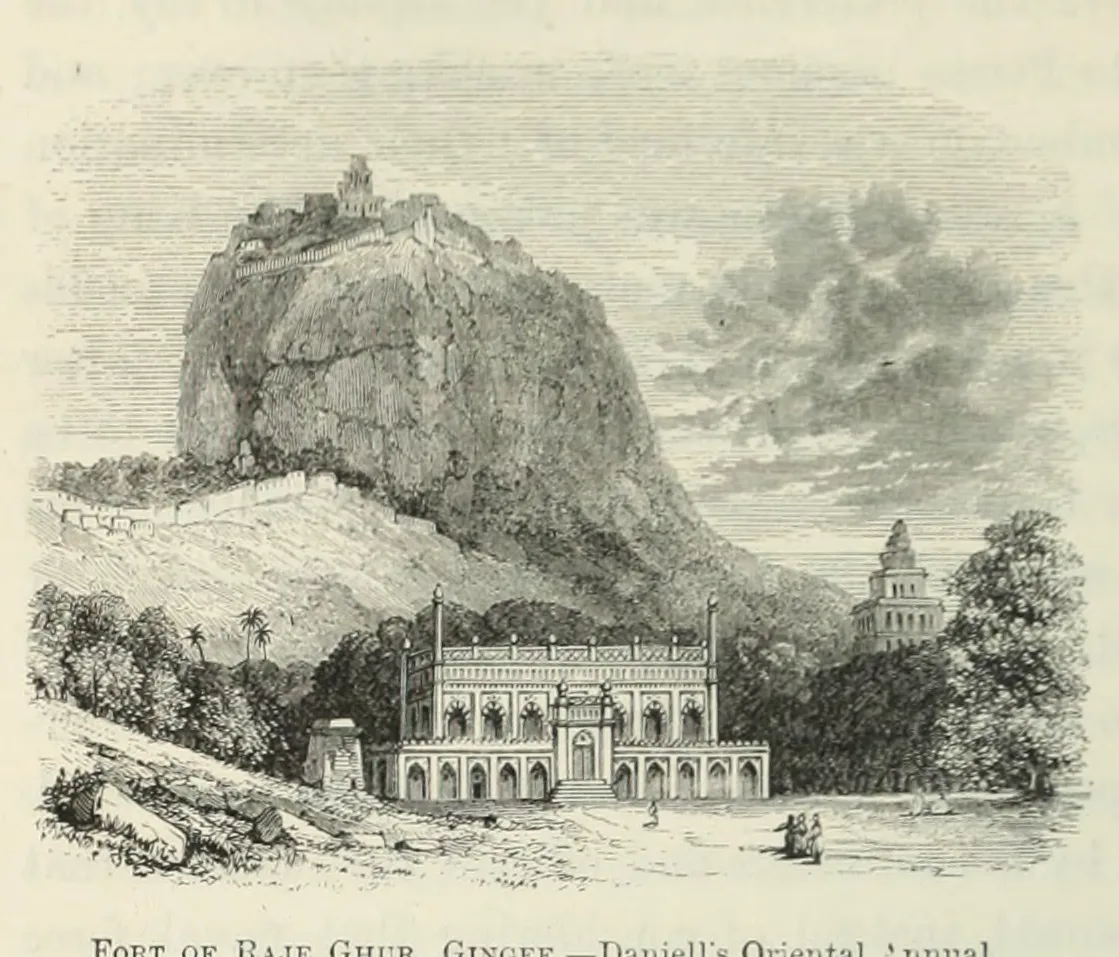
For the unsatisfactory state of matters at Bantam and Gomberoon, the Company had some compensation in the progress which they continued to make at Madras and in Bengal. The attempt of the Dutch on Bombay had shown the necessity of preparing for a similar attempt on Fort St. George, and the works had been so strengthened as to be capable of a vigorous resistance. The expense was, as usual, a subject of complaint in the letter from the court; and in 1676 special instructions were given that no new buildings should be proceeded with, until plans and estimates were sent home and returned approved. This was undoubtedly the regular course, but the emergency justified the neglect of it, and subsequent events proved that the expenditure on fortifications had been wisely made. Sevajee, during an irruption into the Carnatic, had passed within a short distance of Madras, and there is reason to presume that nothing but its strength preserved it from treatment similar to that which Surat had more than once experienced. By his capture of Gingee and Vellore, he had permanently fixed himself in its vicinity; and nothing therefore could have been more imprudent than to leave any portion of it exposed to an attack, either by land or sea. Indeed, in the very next season, the court had become so much alive to the importance of Fort St. George as a place of security for their property and servants, that they virtually withdrew the censure they had previously passed, and ordered the commanders of ships consigned to the Coromandel coast, “to take in as many large stones at Johanna (one of the Comoro Isles) as they could stow, to be used for the building of the fort, that it might be placed in a sufficient state of defence against any enemy.”
Meanwhile the subject of revenue was still uppermost in the minds of the court, and they never omitted an occasion of inculcating the necessity of increasing it, and proposing plans for this purpose. Among these the first which suggested itself was a house tax, with a view to which a survey was to be made of all the houses at Madras, both in the Portuguese and black towns. In anticipation of the discontent which this tax, and a duty imposed on articles of consumption, would produce, the authorities were instructed to explain that “those who lived under the English protection must contribute to the charges by which that protection was maintained.” There were two other plans of increasing the revenue, for which less apology was required. The one was to obtain authority from the King of Golconda to establish a mint at Madras, similar to the one which had already, by the authority of the English monarch, been established at Bombay; the other was to institute a bank, not, however, in the full sense of the term, but merely to receive deposits for a limited time, and to an amount not exceeding in all £100,000. The inducement to depositors was the payment of interest at the rate of not more than six per cent.; and the object of the Company was not merely to procure the means of purchasing goods at the cheapest rates, but to form a stock which would enable the agency and its dependencies to counterbalance the influence of the Dutch. Considering the very humble scale of the proposed bank, it is difficult to understand how so much should have been expected from it.
The progress of the Company’s trade in Bengal was at this period considerable. The principal factory was still Hooghly, to which several others—Balasore, Cossimbazar, Dacca, Malda, and Patna—were subordinate. In the season 1674–75 the whole amount of stock, principally bullion, sent to the eastern coast of India was £202,000. Of this, £65,000 was destined for Bengal. It seems to have been suspected that it would prove insufficient, and accordingly the factors were authorized to increase it by taking up £20,000 at interest. The investment purchased was to consist chiefly of silks and taffetas of a fine quality, and saltpetre. Should any surplus money remain, it was to be employed in purchasing white sugar, cotton yarn, turmeric, and bees’-wax, merely to fill up spare tonnage. In the two following years the amount of the investment was nearly the same; but in 1677-78 it rose to £100,000, and was still considered far from its maximum, as the factors were permitted to increase it by borrowing. In 1680-81 it amounted to £150,000, and in the following season to £230,000, distributed as follows:—£140,000 to Cossimbazar, £14,500 to Patna, £32,000 to Balasore, £15,000 to Malda, and £12,000 to remain at Hooghly. Hitherto Bengal had been subordinate to Fort St. George, but it was now considered of sufficient importance to constitute a distinct and independent agency. Mr. Hedges, who had been a member of the management in England, was sent out with special powers to be agent and governor of the Company’s affairs in Bengal. His establishment, however, appears to have been on a very humble scale, as his guard, restricted to twenty soldiers under “a corporal of approved fidelity and courage,” were to perform in addition the double duty of protecting the factory at Hooghly and acting against the interlopers.
In consequence of the erection of Bengal into a separate agency, vessels were despatched direct from England to the Ganges, and on a scale which shows that the importance of the trade in this quarter was now duly appreciated. In 1682–83, one of the vessels carried thirty guns; another was of the size of 700 tons, which was rather unusual at this period. The agent was empowered to borrow £200,000, which, with the unemployed stock and credit of the former season, was expected to yield a present sum for investment of £350,000; and hopes were held out that the stock of the ensuing season would amount to £600,000, principally in bullion. These hopes, however, were not realized, serious difficulties having arisen both at home and abroad—at home by the unexpected failure of several large houses which used to supply the Company with bullion for export; and abroad by the loss of one of the outward bound ships with £70,000 of bullion on board, the capture of Bantam by the Dutch, and the imposition of new and heavier customs in Bengal, together with the discovery of irregularities in the Company’s factories in that province. In consequence of all these untoward events a panic began to prevail, and a run took place on the Company’s treasury threatening it with insolvency. Instead, therefore, of providing foreign investments, the court resolved in the meantime to reserve all the produce of their sales for the payment of their debts, and neither to send bullion to India nor make any dividend to their proprietors till these debts were liquidated. With the view of facilitating this process of liquidation, all the settlements abroad were placed on the lowest possible scale; and Bengal, which had begun to act as an independent agency, was again made subordinate to Madras. Somewhat inconsistently, at the very time when Bengal was thus shorn of its independence, the court were seriously contemplating a great addition to its importance by endeavouring to acquire possession of an island in the mouth of the Ganges. Could such an acquisition be made, fortifications were to be immediately commenced. Such was the dubious position of the Company’s establishments in Bengal when Charles II. died.