BOTH the disgraceful termination of the war in which the Company had engaged with the Mogul, and the state of the public mind produced by the Revolution, gave great advantages to their enemies, who endeavoured, by a petition which they presented to the House of Commons, to prove that nothing but the establishment of a new Company was able to save the East India trade from being entirely lost to the nation. The question raised by the petition was too important not to attract considerable attention; and a committee, appointed by the house, to take cognizance of it, began by requiring an exact state of the Company’s accounts, an estimate of their stock, goods, cash, and debts, and a view of the correspondence both at home and abroad. The Company meanwhile met the petition of their opponents with a counter-petition, and both sides having been fully heard, resolutions were adopted, laying down a series of general propositions as to the terms on which the trade to the East Indies should in future be carried on. The most important of the resolutions were—“That a sum not less than £1,500,000, and not exceeding £2,000,000, was a fund necessary to carry on the East India trade in a joint stock—that no one person should possess any larger share than £5000, nor have more than one vote—that no private contracts should be made, but all goods be sold at public sales by inch of candle, except saltpetre for the use of the crown, and in lots each not exceeding at one time the value of £500—that all dividends be made in money, and no dividend be made without leaving a sufficient fund to pay all debts and carry on the trade —that no ships, either with permission or without, for the future be allowed to go to the East Indies, except only such as should be of a company, or be established by act of parliament—and that the joint stock of a company to trade to the East Indies be for twenty-one years, and no longer.”
Though in these resolutions no express mention was made of the existing Company, it became evident, from other resolutions adopted immediately after, that the intention of parliament was to continue them in possession of their monopoly; for after stipulating “that persons having above the sum of £5000 in the stock of the present East India Company, in their own or other persons’ names, be obliged to sell so much thereof as should exceed the sum of £5000, at the rate of one hundred pounds for every hundred,” and “that the members of the committee of the East India Company be obliged to give security, to be approved of by the house, that the stock and estate they now had should be made good £749,000, all debts paid,” it was added, “that security being first given, an humble address be presented to his majesty, to incorporate the present East India Company by charter, according to the regulations agreed upon by the house, that the same might pass into an act.”
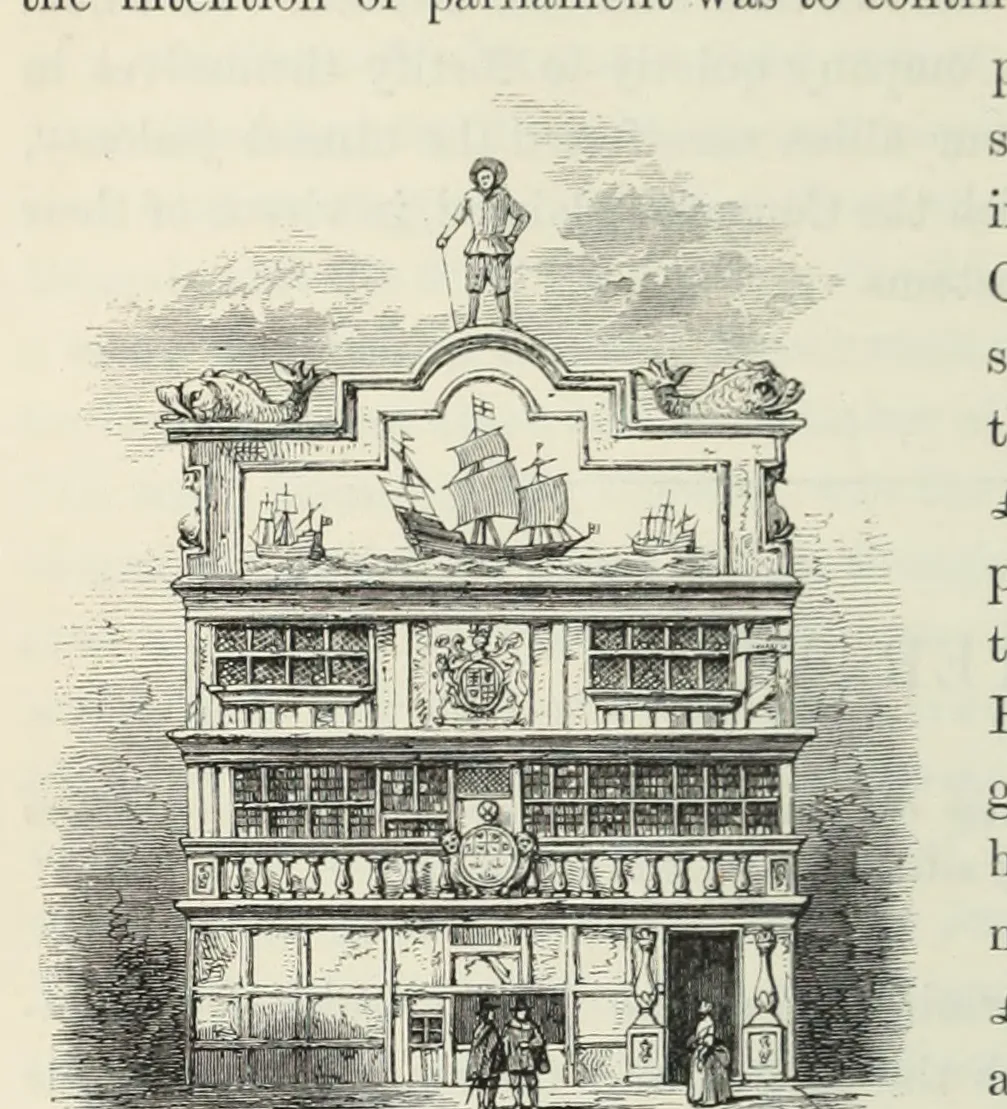
To some of these regulations as unnecessary or impolitic, valid objections might easily have been made; but the Company apparently resolved to waive them; for within a week, Sir Thomas Cooke the governor, and two other committees of the Company, produced their proposals of security. They were not deemed satisfactory, and the house, after a short delay, adopted the following resolution, dated 11th February, 1692—“That an humble address be presented to his majesty to dissolve the present East India Company, according to the powers reserved in their charter, and to constitute another East India Company for the better preserving of the East India trade to this kingdom, in such manner as his majesty in his royal wisdom should think fit.” To this address, which was ordered to be presented by the whole house, his majesty replied, “That it was a matter of very great importance to the trade of this kingdom, and that it could not be expected he should give a present answer to it, but that he would take time to consider of it, and in a short time give them his positive answer.” The Company having reason to believe that they had more to expect from the king than from the legislature, bound themselves by writing to submit to such regulations as should be made. Accordingly, the committee of the privy council, to whom the whole matter had been referred, drew up an elaborate paper, entitled, “Propositions for regulating the East India Company.” The propositions, thirty-two in number, while retaining the spirit of the resolutions sanctioned by the House of Commons, entered much more into detail, and also made some very important alterations and additions. Instead of accepting them as they had formerly promised, the Company returned what they called the “Humble Answer of the Governor, Deputy-governor, and Court of Committees of the East India Company, to a Paper of Propositions for Regulation of the East India Company.” In this answer the propositions were minutely criticized, and for the most part strenuously objected to. Some of the answers are very quaint and curious. To the second proposition, which was—“The stock of the present Company to be part of the fund” (the proposed fund amounting to at least £1,500,000, and not exceeding £2,000,000), “and to be rated at £744,000, if they can give security that it shall effectually produce that sum; or else at so much less, as they will engage to make good after all debts paid, and satisfaction made to the Mogul and his subjects, against whose pretensions the new stock to be indemnified by the like security:”—it was answered —“The Company, recommending their righteous cause to God and his majesty’s known and famous justice in the whole course of his happy life, say that the value of everything is what it will sell for; and their stock, under all the calumnies and persecutions of their adversaries, now currently sells for £150 per hundred; and they know and can prove it to be intrinsically more worth than that current price; but they know no law or reason why they should be dispossessed of their estates at any less value than they are really worth in ready money, by all the measures anything is valued in any part of the world. They humbly say as to security, they know no reason why they should give security for their own estates. They affirm that they owe not a penny to the Great Mogul or any of his subjects, other than their running accounts with their own banyans and brokers, which are changing daily, like merchants running cash in a goldsmith’s hand. Although the Company owe nothing to the Mogul, as aforesaid, yet the bare mentioning any such thing by a public act of his majesty, would be enough to persuade him to invent demands upon the Company for transactions and pretences done in ages past, before any of the present adventurers were born; and therefore that part of the proposition seems manifestly impossible, as well as unjust, neither the Mogul nor any of his subjects having made any complaint to his majesty of the Company’s being in debt to him or them; that being only a suggestion of the interlopers and their adherents, not only now, but for many years past. As to that hypothesis—if they can give security—it will not become the Company to say what they might of their own ability, or the ability or disability of their adversaries; they are, on both sides, well known on the Exchange.”
The other answers exhibiting a similar spirit, were regarded by the king as a formal rejection by the Company of the charter which had been offered to them; and accordingly, on the 14th November, 1692, he returned the following answer to the address which had been presented to him on the subject during the previous session of parliament:—
“The House of Commons having presented an address to the king to dissolve the present East India Company, according to the power reserved in their charter, and to constitute a new one, his majesty took into consideration the proper methods of complying with their desires, and of securing effectually this advantageous trade to the nation.
“But his majesty, upon examination of the charter, and consulting his judges and learned council, found that he could not legally dissolve the Company but upon three years’ warning; and that during the three years after warning the Company must subsist, and might continue to trade; and that although the king might constitute a new company, yet he could not empower such new company to trade till after three years, the crown having expressly covenanted not to grant any such liberties.
“Hereupon his majesty was very apprehensive of the ill consequences of giving warning to the Company, because they would then be less solicitous of promoting the true interest and advantage of the trade, whereof they could not long reap the fruits, and that no new company could be immediately admitted to it; so that this very beneficial trade, which is already so much impaired, might be in danger of being entirely lost to the nation.
“His majesty, very desirous to prevent so great a mischief, and to gratify the House of Commons in the end, since he could not do it without great hazard in the manner they proposed, required the East India Company to answer directly whether they would submit to such regulations as his majesty should judge proper, and most likely to advance the trade; and the Company having fully agreed to it, and declared their resolution in writing, his majesty commanded a committee of his privy council to prepare regulations; which they did, and offered them to the Company; but the Company, notwithstanding their declaration of submission, rejected almost all the material particulars.
“So that his majesty, finding that what possibly the House of Commons might have expected, and indeed was necessary to preserve this trade, could not be perfected by his own authority alone, and that the Company could not be induced to consent to any such regulations as might have answered the intentions of the House of Commons, and that the concurrence of parliament is requisite to make a complete and useful settlement of this trade, has directed all the proceedings in this matter to be laid before them; and recommends to them the preparing of such a bill, in order to pass into an act of parliament, as may establish this trade on such foundations as are most likely to preserve and advance it.”
The House of Commons endeavoured to act on this suggestion, but finding that the opposition of the Company still continued, resolved, on the 25th February, 1693, “That an humble address be presented to his majesty, that he will dissolve the East India Company, upon three years’ warning to the said Company, according to the power reserved in their charter.” The king answered, “I will do always all the good in my power for this kingdom, and I will consider your address.”
A crisis was thus evidently approaching; but the Company, though they had been bold enough to provoke it, became alive to the full extent of the danger, and determined to leave no means untried that promised to prevent it. Unfortunately, however, at this very time, from mere inadvertency or some other cause which has never been properly explained, they incurred a direct forfeiture of their charter by failing to make payment of the first quarterly instalment of a tax of five per cent. imposed upon their stock, by Act 4 Wm. and Mary, c. 15. In this act the stock was valued at £744,000, and consequently the whole sum exigible under the first quarterly payment was only £9300. It is obvious that the nonpayment of a sum so comparatively paltry must have been owing to oversight and not to inability; but the enemies of the Company were numerous, influential, and inveterate; and as the act, after ordering the first quarterly payment to be made on the 25th of March, 1693, expressly declared, that “in case the governors and treasurers of the said respective companies” (the East India Company, the Royal African Company, and the Hudson’s Bay Company) “shall make default in payment of the said several sums, or any of them respectively, charged on the stock of the said companies, at the days and times aforesaid, according to the true intent of this act, the charter of such company respectively shall be, and is hereby adjudged to be void,” it was seriously proposed to exact the full penalty. The Company being thus entirely at the mercy of government, abandoned all idea of resistance to any terms that might be offered them, and counted themselves fortunate when they escaped annihilation by obtaining new crown charters, which provided that the forfeiture, if really incurred, should not take effect.
The first of these charters, dated 7th October, 1693, after premising that “the governor and Company of Merchants of London trading into the East Indies have been of long time, to the honour and profit of the nation, a corporation,” and that “some doubt or question hath of late been made touching the validity of the charters of the said Company, and whether the same be not, in strictness of law, void, by the not actual payment into the receipt of our exchequer of the first quarterly payment of the tax of £5 per cent. charged on the general joint stock of the said Company,” proceeds as follows: “Now know ye, that we, taking the premises into our royal consideration, and well weighing what disorders and inconveniences would befall the said Company, and other persons concerned and employed in their trade, especially in the remote parts of the world, if we should take advantage of the forfeiture aforesaid (if any be), and we being willing that the said governor and Company, or late governor and Company of Merchants of London trading into the East Indies, and their successors, shall have and enjoy all such and the like lawful powers, privileges and advantages, and immunities; and in as ample manner, to all intents and purposes, as if the said first quarterly payment of the said tax had been duly and regularly made according to the said act; of our especial grace, certain knowledge, and mere motion,” constitute and appoint Sir Thomas Cooke, knight, and various other individuals named, “and all and every other persons who were members of the said Company, or late Company of Merchants of London trading into the East Indies, on the 25th day of March, now last past, who have not since parted with their stocks in the said Company; and all and every other person and persons who, since the 24th of March last past, by buying stock or otherwise, have come into, and remain in a capacity of being members of the said Company, be and shall be one body corporate and politick in deed and in name,” &c.
While thus generally confirming all the rights and privileges previously enjoyed by the Company, the new charter contains the following important proviso:—“If the said governor and Company of Merchants of London trading into the East Indies, and their successors, do not accept of, and from time to time, and at all times hereafter, act according to, and put in due and effectual execution, and submit and conform in all things unto such orders, directions, additions, alterations, restrictions, and qualifications, relating to the constitution, continuance, determination, rights, powers, or privileges of the said Company, or the government thereof, or of the said governor and Company; or the encouragement, management, regulation, or advancement of trade; or of the present or future joint stock of the said Company; or concerning any future subscriptions, to be made by way of increase or addition to the joint stock; or for ascertaining the true values of the said joint stock, at and during the times of any such future subscriptions; which, and as we, our heirs or successors, by the advice of our or their privy council, shall from time to time, at any time before the 29th day of September which shall be in the year 1694, think fit to make, insert, limit, direct, appoint, or express in or by any further or other charter, letters-patents, or other writing or instrument, under our or their great seal of England, then and in each and every of the cases aforesaid, it shall and may be lawful to and for us, our heirs and successors, by letters-patents, under our or their great seal of England, to determine, revoke, and make void these presents, and the grant hereby made.”
The object of this proviso evidently was to bind the Company to the acceptance of those conditions which the House of Commons had embodied in a series of resolutions already referred to; and accordingly, in little more than a month after the date of the above charter, effect was given to the proviso by another charter, in which, with several not unimportant modifications, the parliamentary resolutions were enforced. In this new charter, dated 11th November, 1693, after a repetition of the proviso, and a preamble stating, inter alia, the importance of the traffic to the East Indies, and the desirableness of rendering it “more national, general, and extensive than hitherto it hath been,” the Company are taken bound to accept and agree to a series of propositions, of which the most important are—that all subjects of the British crown, whether natural born, or “naturalized and endenized,” shall be entitled to become members of the Company; that £744,000 shall be added to the present general joint stock “by the new subscriptions of such persons who shall be minded to adventure any share; that no person shall subscribe or hold more than £10,000 of stock in his own or any other name; that the new subscriptions, if exceeding in the aggregate £744,000, shall be individually reduced pro rata; that every £1000 up to £10,000 shall give a vote, thus allowing to the individual possessed of the maximum of stock ten votes in all; that the qualification for a committee shall be £1000, and for governor and deputy-governor £4000; that all dividends shall be paid in money; that no private trade shall be permitted; that with the exception of saltpetre sold to the crown, all sales shall be public, by inch of candle; that no single lot of goods, except jewels, shall exceed £500 in value; and that British produce and manufactures should be annually exported to the amount of £100,000.
These clauses, though binding the Company to conditions which must have prevented many of the abuses of which their previous management was accused, not only fell far short of what their avowed opponents had anticipated, but failed to satisfy the public mind; and the question having again been keenly agitated, and brought specially before parliament by a petition praying for the erection of a new East India Company, the House of Commons “examined the charters of the old Company, the book of new subscriptions, the state of their present stock, and the petition above mentioned; and after mature deliberation” resolved, on the 19th of January, 1694, “that all the subjects of England have equal right to trade to the East Indies, unless prohibited by act of parliament.” The point thus summarily decided by one branch of the legislature was properly a question of law; and several years before, under very different circumstances, had undergone a lengthened discussion in the Court of King’s Bench. In the year 1683, when the crown was stretching its prerogative to the utmost, the East India Company, deeming the time favourable for obtaining an authoritative decision in favour of the validity of their charter, determined to try the question, and with that view brought an action against Thomas Sandys for attempting to trade within the limits to which they had, by their charter, an exclusive right. Sandys argued that the Company was a monopoly, and being consequently struck at by the statute against monopolies, had usurped powers which, however sanctioned by the crown, could not be legally maintained. The case, of which a full report is given in the state trials, under the title of the “Great Case of Monopolies,” attracted much attention; and having been fully argued by the ablest counsel at the bar, was not finally decided till 1685, when James II. had mounted the throne, and Jeffreys was lord chief-justice. The decision, as might have been expected in the circumstances, was in favour of the royal prerogative, and found that “the grant to the plaintiffs of the sole trade to the Indies, exclusive of others, is a good grant.” The victory which the Company thus gained was more apparent than real. The decision was in their favour, but the argument was clearly against them; and the maintenance of their monopoly became in consequence identified, in the public mind, with that of despotism. Hence, when the Revolution had made way for the establishment of constitutional freedom, their position became insecure, and every new discussion of their privileges seemed only to bring them nearer to the brink of destruction. The resolution of the House of Commons was indeed a virtual repeal of their monopoly, because it declared that nothing but an act of parliament could make it valid.
There was still, however, good ground to hope that such an act of parliament might yet be obtained. The king, by the charters which he had granted, had gone as far as he could safely do in their favour; and it was well understood, that while many of the members of the legislature were sincerely attached to their interests, because convinced that the trade to the East Indies could be best carried on by the present Company, there were others on whom, after argument had failed, another kind of influence might be brought to bear. What this influence was, and how unscrupulously the managers of the Company had employed it, soon became apparent.
Several instances of bribery and corruption in the administration of public offices having been detected, rumours began to prevail that the whole body politic was corrupt. Suspicion fell especially upon the city of London and the East India Company; and on the 7th of March, 1695, the House of Commons appointed a committee to inspect the books of these two bodies. The guilt of the former was easily established, as the chamberlain’s books contained an entry bearing that 1000 guineas had been paid to Sir John Trevor, speaker of the House of Commons, on the 22d of June, 1694, as a douceur for his pains about a bill brought into parliament under the name of the “Orphans’ Bill.” The guilt of the Company was not so easily established, though enough was at once discovered to show that bribery to an enormous extent must have been carried on. From an abstract obtained from the Company’s books, it appeared that from 1688 to 1694 inclusive, £107,013, 12s. 7d. had been paid in cash for what was called the “Company’s special service.” In 1693, when Sir Thomas Cooke was governor and Francis Tyssen deputy-governor, the sum issued under this head was £87,402, 12s. 3d. On searching for the orders for this issue, the committee discovered a minute of a court of committees, dated the 13th of April, 1693, and stating, inter alia, “The governor this day acquainting the court with what proceedings had been made in their affairs towards granting a new charter, and with what had been disburst by him in prosecution thereof, the court approved of the said charges, and ordered a warrant to be made out for the same; and returned him thanks for his great care, pains, and trouble in their service, desiring him to proceed in the perfecting thereof.” Two other minutes to a similar effect were found, together with one dated the 23d of November, 1693, in which “it is ordered that the cashier-general do from time to time make payment of such sums of money for carrying on of the Company’s service as the governor shall direct, pursuant to the sense of the present debate.”
In regard to the disposal of the money, the committee reported that they had been unable to obtain any further account than that it was for special service, and that a large part of it had been put into the hands of Sir Basil Firebrace. On examining the Company’s cash-book, they found a balance at their credit of £124,249, 15s. 10d.; but on asking Mr. Portmans, the cashier, if he had the same in cash, he answered that he had not, and in its stead produced the following voucher by Sir Thomas Cooke:—“Received, the 10th of January, 1693 [1694], of Mr. Edmond Portmans, for account of the East India Company, £90,000; which I have disburst and paid for £99,197 stock, in the East India Company, for their account; which I promise to be accountable for on account of the East India Company; and was by order of the Company the 24th of November, 1693.” No such amount of stock had been transferred to the Company’s account; but the committee, on examining Sir Benjamin Bathurst, one of the Company’s court of committees, were told by him, that “finding so great a sum as £30,000 charged for secret services, he had some warm discourse with Sir Thomas Cooke about it, to know how it was disburst; but he refused to give him any particulars, and told him he should remember he was bound by his oath to the Company to keep their secrets.” Sir Benjamin added, that “about April, 1694, understanding they were in want of money, he looked into the cash-book; which casting up, he found a considerable sum in cash; and taking some persons with him, discoursed Sir Thomas Cooke thereof, who said the £90,000 he had received was to gratify some persons in case the bill should pass.”
Beside the above suspicious payments, the committee discovered a contract of a very singular description. It bore the date of the 26th of February, 1694; and bound the Company to pay for 200 tons of saltpetre, to be brought home in the ship Seymour from India, the sum of £12,000, together with £25 freight per ton to the owners of the ship, besides all charges in England. It seems that this saltpetre, for which £12,000 was to be paid, could be purchased in India for £2000; and this sum was actually advanced by the Company for that purpose, and not only so, but they also granted bond under the Company’s seal for £10,000, as the remaining balance payable by a certain day, whether the ship should arrive in safety or not. The result of the contract is thus accurately explained by the committee:—“The Company runs the adventure of £12,000 for that which cost only £2000, and must consequently lose £12,000 if the ship miscarry; and on the contrary, the seller on the other hand gets £10,000 clear without disbursing or running the hazard of one penny; and what is yet more, a certain loss of £9000 or £10,000 will attend it if the ship arrive in safety.”
The report of the committee was made on the 12th of March, 1695; and on the 18th the House of Commons resolved, “that whosoever shall discover any money or other gratuity given to any member of this house for matters transacted in this house relating to the orphans’ bill or the East India Company, shall have the indemnity of this house for such gift.” On the 26th it was ordered, “that Sir Thomas Cooke, a member of this house, do give an account to the house how the £87,402, 12s. 3d. mentioned in the report was distributed.” When examined he refused to answer, and was committed to the Tower. At the same time a bill was ordered to be brought in for the purpose of obliging him to give an account. So much were the house in earnest that, in little more than a week, the bill, though counsel was heard against it, was passed and carried to the House of Lords. When it was read there for the first time it was vehemently opposed by the Duke of Leeds, lord-president of the council, who commenced with a most solemn protestation of his cleanness and innocence, and laying his hand upon his breast, declared upon his faith and honour “that he was perfectly disinterested, and had no part or concern in this matter, and therefore might the better appear against it.” Sir Thomas Cooke, being brought from the Tower to the bar of the lords, declared himself ready and very willing to make a full discovery on obtaining an indemnifying vote; and as the reports of the period express it, “bemoaned himself (weeping) that he was not indemnified at that instant, so that he might just then make the discovery which was expected, and which he was so desirous to make.” On being asked what he wanted to be indemnified from, he answered, “All actions and suits, except from the East India Company, whom, if he had injured, he would be bound to undergo the utmost rigour.” He also desired, he said, to be indemnified from scandalums, which he explained to mean the action of scandalum magnatum.
The lords sisted procedure with the bill sent up from the commons, and introduced a bill of indemnity, which was ultimately passed. The preamble and leading enacting clause of the act are as follows:—" Whereas it appears, by the books of the East India Company, that Sir Thomas Cooke, knight, in the year 1693, being the governor of the said Company, did receive, out of the stock and treasure belonging to the same, the sum of £77,258, and hath also received out of the stock and treasure of the said Company the further sum of £90,000 : And whereas a true discovery of the distribution and application of the said several sums of money will be of public use and service, and is necessary to the vindicating the justice and honour of the government ; and the said Sir Thomas Cooke hath voluntarily offered to make such discovery, so as he may be indemnified in such manner as is hereafter mentioned and provided : Be it therefore enacted, by the king’s most excellent majesty, by and with the advice and consent of the lords spiritual and temporal, and commons, in this present parliament assembled, and by the authority of the same, that, if the said Sir Thomas Cooke shall, on or before the 23d day of April, 1695, make a true and full discovery on oath, before a committee of the lords and commons, to be appointed by each house for that purpose, how and in what manner, and to what person or persons, and to what particular uses, intents, and purposes, and on what account, the said sum of £90,000, and the sum of £67,000, part of the said sum of £77,258, have been distributed, paid, applied, disposed, and made use of, then the said Sir Thomas Cooke shall not, by reason or means of such discovery, be liable to any action or suit of any person or persons whatsoever, other than the said East India Company, nor shall such discovery or confession be allowed or given in evidence against him in or upon any action or suit, other than as aforesaid ; and also shall be declared pardoned and indemnified for any crime he may be guilty of in the distribution, payment, application, or disposal of the said money, to any person other than to himself."
When examined before the committee of both houses appointed in terms of this act, Sir Thomas Cooke produced a written statement, entitled, " A true and full discovery, upon oath, made by Sir Thomas Cooke, to the best of his knowledge, &c., . . . which discovery is in pursuance of an act of this present session of parliament." This statement contained the names of the various parties to whom cash had been paid to the amount of £67,031, 18s. 2d., and of others from whom East India stock, to the amount of £90,000, had been bought for account of the East India Company. Among the cash items were £10,000 “delivered to Francis Tyssen, Esq., for the special service of the Company ;” £10,000 to Mr. Richard Acton, " to defray the expenses of himself, and for his friends’ soliciting to prevent a new settlement of an East India Company, and to endeavour the establishment of the old ;" £10,000 to Sir Basil Firebrace, " in recompense of his trouble in prosecuting the Company’s affairs, and in consideration of other losses he had sustained by neglecting his own business, and by not engaging himself with the interloping ships." An additional sum of £30,000 was set down as having been paid “to the said Sir Basil for £50 per cent. loss on stock I was obliged to accept of him at £150 per cent. on the Company’s account.” On being interrogated with reference to the above statement, Sir Thomas Cooke declared “that the first sum of £10,000 above mentioned was given in expectation to have the charter of the East India Company confirmed, and new regulations thereto made,” and that “it was intended for the king, but he could not say the king had it,” though “he believes Mr. Tyssen told him that he delivered it to Sir Josiah Child, who delivered it to the king.” He added that “it was a customary present, and that in King Charles’s and other former reigns, the like had been done for several years.” With regard to the £10,000 paid to Mr. Acton, he declared that he had given it with the privity of Sir Josiah Child, “who recommended Acton as a person capable of doing the Company service, having great acquaintance with parliament men, and others who had interest with them;” that “he could not particularize who they were, but the end aimed at was to get an act of parliament.” The sums paid to Sir Basil Firebrace were stated to be in implement of an agreement, by which the Company became bound, in case the charter passed, to take £60,000 stock of Sir Basil at £150 per cent. As the stock was then only £100 per cent., the Company lost £30,000 by the transaction. By another agreement of a similar nature, they would have been bound to accept a transfer of £40,000 stock on the same terms, if an act of parliament in favour of the Company had been obtained.
In following up the inquiry, various other persons were examined. Sir Josiah Child affected general ignorance of the matter, and said that “he never disposed of £10 of the Company’s money to his remembrance.” He admitted, however, that “he did recommend Mr. Acton as being an honest man, and thought he might do service to the Company in parliament, because of his acquaintances.” He also recommended “that a present of £50,000 should be made to the king, if his majesty would so far waive his prerogative that an act of parliament might be passed for settling the Company; but Mr. Tyssen told him the king would not meddle in that matter.” He “knew nothing of the £40,000 paid to Sir Basil Firebrace, but there was a kind of a company of twenty-five persons, that sat de die in diem, to destroy the Company, and he told Sir Thomas Cooke that he thought Sir Basil the fittest person to divide them."
Sir Basil Firebrace, when first examined, admitted the payments as stated by Sir Thomas Cooke, viz.—£10,000 as a gratuity for losses, and £30,000 in terms of contract. Both sums “were directly for himself, and for the use of no other person whatsoever; he paid no part of the same towards procuring a charter or act of parliament, nor made any promises to do so, but he had several discourses with Sir Thomas Cooke about using his endeavours to procure a new charter.” Being asked “what particular services he did or was to do for procuring a new charter,” he said “that he wished he might answer that at some other time, being not well, not having slept two or three nights, and being much indisposed as to his health; that he was unwilling to take too much upon himself, but thought he did great service to the Company in solicitation and other services.” On the following day, having desired to be called in, he deposed, “that having had a treaty with Mr. Bates, whom he thought able to do service in passing the charter, and to have acquaintance with several persons of honour,” he gave him two notes, the one for 3000 and the other for 2500 guineas, payable to Mr. Bates or bearer. The latter note was paid after the charter for restoring the East India Company passed; the other after the charter for regulation passed. These notes were from Sir Thomas Cooke, who, he believed, “did know how they were to be disposed of.” In fact, Mr. Bates had introduced Sir Basil several times to the Duke of Leeds, the lord-president, “who made some scruples in point of law.”
Mr. Bates deponed “that Sir Basil Firebrace did apply himself to him to use his interest for obtaining a charter to the East India Company:” that “he did use his interest with the lord-president, who said he would do what service he could: that he received 5000 guineas, told the lord-president of the fact, and urged the same upon his lordship’s acceptance, but he refused it.” He admitted, however, that “in regard he could not tell money very well himself,” he “did ask leave of my lord that his servant might tell the money.” His lordship gave leave, and accordingly his lordship’s servant, M. Robert, “did receive the money.” At first Bates alleged that M. Robert paid over the money to him, but on a subsequent examination he admitted that he had it not, and that it had remained with Robert till within the last few days, when Robert had brought it to him for the purpose of being given back to Sir Basil Firebrace. His reason for thus paying back the guineas was “the noise that it made, and that people might think he did not deserve them.” More light was thrown on this disclosure by Sir Basil, who, when again examined, stated “that the East India Company’s charter being forfeited, Sir Thomas Cooke was apprehensive “that it stuck with the Duke of Leeds,” and told him that “some way must be found out to the duke.” Sir Basil thereupon applied to Mr. Bates, who, after a good deal of higgling, agreed to accept of 5000 guineas for his friend, and 500 guineas to himself. Sir Thomas Cooke sanctioned the agreement, remarking that if “it was insisted on it must be done.” The agreement was that “if the duke did act in favour of the Company, he should have 2000 and 3000 guineas, and Bates 500 guineas for himself.” Sir Basil added, “that from the time the notes were given, they had free access to the lord-president, and found him easy and willing to give them his assistance.”
Mr. Tyssen deponed that “Sir Thomas Cooke and Sir Josiah Child gave him a note under their hands for £50,000, which was intended to be presented to his majesty if his majesty would pass an act of parliament as they should desire, and that he acquainted my Lord Portland with the Company’s intention to make such a present; who told the deponent that the king would not meddle with it.” On being asked “if he had offered the same to Lord Portland, he denied that he had so done, saying, if he had, he must never have seen his face more.”
That bribery to an enormous extent had been carried on, there could now be no doubt, but the only case in which, as yet, it seemed capable of being proved, was that of the Duke of Leeds, against whom, accordingly, the commons resolved to proceed by impeachment. On the reading of the report of the committee in the House of Lords, the duke rose in his place and said that “as he had formerly protested himself to be free in this matter, so he still denied, upon his faith and honour, that he was guilty of any such corruptions as were suggested against him, and that if the whole truth were laid open it would tend to his honour and advantage.” His explanation was, “that Mr. Bates introduced Sir Basil Firebrace to him, and that he had conferences with Sir Basil upon the subject of the East India Company, which Sir Basil was concerned for; that some time after Mr. Bates came and informed him that he was to have a sum of money of Sir Basil, and desired his lordship to lend him one of his servants, Mr. Bates keeping but a footman, to receive the money, and so he lent him M. Robert; that his lordship knew nothing of the sum, but afterwards Mr. Bates came to him and told him he had received 5000 guineas, which he offered to him, telling his lordship that he had been very obliging and kind to him, and that in acknowledgment of the many favours he had received from his lordship’s hands, he humbly desired him to accept of them, which he refusing, Mr. Bates pressed him earnestly to take one-half or a quarter, which he still refused, declaring he would not touch a penny of them; and told him since he had taken them, he thought there was no need of returning them—they were his own, and he wished him good luck with them.” While the duke was making this apology, or rather confession, he got private notice that the commons were preparing to impeach him. Startled at the news he hastened off, and intimated, through one of the members, his desire to be heard. Permission was given, and he made a long and apparently rambling speech, without making any favourable impression, for the impeachment was immediately carried up to the lords. The first article, containing the substance of the whole, was as follows:—“That certain merchants trading to
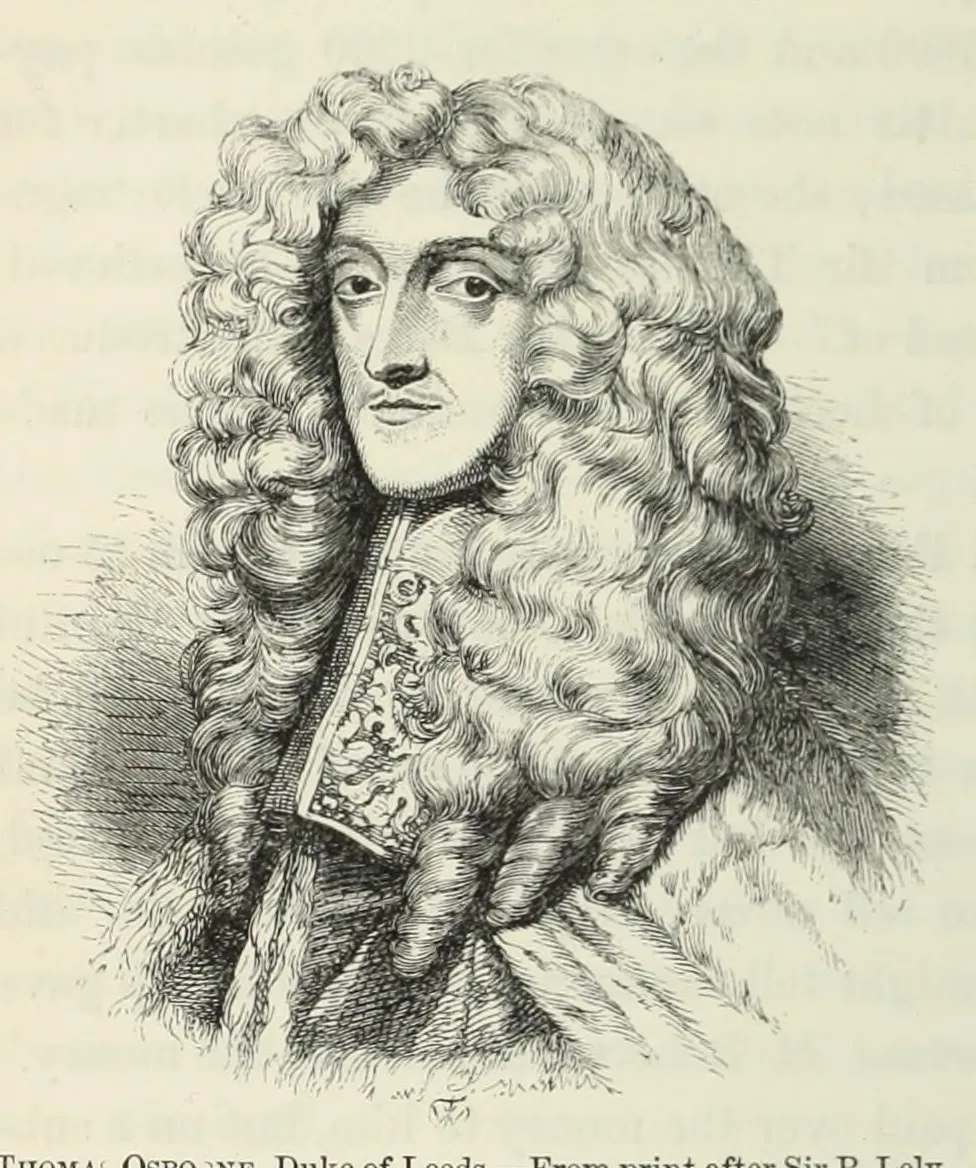
the East Indies, having either forfeited their charter, or being under an apprehension that they had forfeited the same, and having made their humble application to their majesties in council for obtaining a charter of confirmation : the said Duke of Leeds, being then president of their majesties’ most honourable privy council, and sworn to give their majesties true and faithful advice, did, contrary to his oath, office, and duty to their majesties, and in breach of the great trust reposed in him, by himself, his agents, or servants, corruptly and illegally treat, contract, and agree with the said merchants or their agents, for 5500 guineas, to procure the said charter of confirmation, and also a charter of regulations, or to use his endeavours to obtain the same.”
By some strange oversight the duke’s servant, M. Robert, whom the previous deposition had shown to be a most important witness, had not been examined, and when the necessary steps for the purpose were about to be taken, it was found that he had disappeared. A tardy proclamation for securing him was issued, but it proved unavailing; and thus an essential link in the chain of evidence could not be supplied. The Duke of Leeds, now feeling confident that the impeachment could not be made good, began to use the language of injured innocence, and to complain of the hardship and injustice of having a charge hanging over his head, while no attempt was made to prove, and no opportunity was given him to disprove it. The state of matters was, however, well understood, and his shuffling only served to confirm the conviction generally entertained of his guilt. Meanwhile parliament seemed resolved to do its duty; and as the leading witnesses were justly suspected of prevarication or concealment, an act was passed for imprisoning them, and for restraining them from alienating their estates. Unfortunately, the zeal manifested by parliament was not seconded at court. At a very early period of the inquiry, the king, after giving the royal assent to several bills, addressed both houses as follows :—“My lords and gentlemen, I take this occasion to tell you that the season of the year is so far advanced, and the circumstances of affairs are so pressing, that I very earnestly recommend to you the speedy despatching such business as you think of most importance for the public good, because I must put an end to this session in a few days.” From this significant hint, it was well understood that there was a strong feeling in high quarters against the exposure to which the parliamentary inquiry into bribery and corruption threatened to lead; and in fact, on the 3d of May, within a fortnight after the hint was given, and while the issue of the inquiry was still in suspense, parliament was prorogued. According to Burnet, “It was intended to hang up the matter to another session; but an act of grace came in at the end of this, with an exception, indeed, as to corruption; yet this whole discovery was let fall, and it was believed too many of all sides were concerned in it; for, by a common consent, it was never revived.”
There cannot be a doubt that the Company suffered severely in public estimation by the disclosure, so far as it had gone. A distinction, however, ought to be made between the Company and the management. This had been gradually monopolized by Sir Josiah Child and a few wealthy individuals, who, taking undue advantage of the unlimited power of purchasing stock, and of voting upon it, had succeeded in ousting most of the independent members of committee, and supplanting them by their own creatures. On them, therefore, the chief blame ought to rest; more especially as the general court of proprietors, even before the parliamentary inquiry commenced, had been induced, in consequence of the rumours which had begun to prevail, to appoint a committee “to inspect into the affairs of the general joint stock under the management of the court of committees, and of the several transactions that had been had therein, for the satisfaction of the adventurers.” The report of the committee thus appointed, had furnished most of the leading facts, which were afterwards more fully brought out by the parliamentary investigation.
While the Company were suffering severely in public estimation from these shameful disclosures, an alarm arose from a different quarter. Scotland and England, though their crowns were now worn by a single monarch, were still separate and independent kingdoms, and there was therefore nothing to prevent the former from having its East India Company as well as the latter. Indeed, as early as 1617, King James had given his sanction to such a company, by granting letters-patent under the great seal of Scotland, to Sir James Cunningham, of Glengarnock, appointing him, his heirs and assignees, to be its governors and directors, with authority “to trade to and from the East Indies, and the countries or parts of Asia, Africa, and America, beyond the Cape of Bona Sperantia to the Straits of Magellan, and to the Levant Sea, and territories under the government of the Great Turk, and to and from the countries of Greenland, and all the countries and islands in the north, north-west, and north-east seas, and all other parts of America and Muscovy.” Whatever may have been the original intention of this grant, it ultimately degenerated into a mere job for the benefit of the grantee, who sold it, and all his rights under it, for a valuable consideration. The purchasers were the London East India Company, who thus escaped the danger of a competition, which in honest and skilful hands might have proved formidable. This abortive attempt to give Scotland a trade to the East appears to have attracted little notice; and other interests, of a still more vital nature, so completely occupied the public mind during the persecuting reigns of the Stuarts, that the better part of a century elapsed before the subject was again mooted. The better era which commenced with the Revolution brought new desires and aspirations along with it, and a general desire was felt by patriotic Scotsmen to give their country as high a place in commerce as it had already attained in liberty, religion, and arms. The influence exerted with this view on the public mind, was soon manifested in parliament, which, on the 14th June, 1693, passed an “Act for encouraging of Forraigne Trade,” in which “our soveraigne lord and ladye, the king and queen’s majesties, considering how much the improvement of trade concerns the wealth and wellfare of the kingdom, and that nothing hath been found more effectuall for the improving and enlargeing thereof than the erecting and encourageing of companies, whereby the same may be carried on by undertakeings to the remotest parts, which it is not possible for single persons to undergo, doe therefore, with advice and consent of the estates of parliament, statute and declare, that merchants more or fewer may contract and enter into societies and companies for carrying on of trade, as to any subject and sort of goodes and merchandice to whatsoever kingdoms, countreyes, or parts of the world, not being in warr with their majesties, where trade is in use to be, or may be followed, and particularly beside the kingdoms and countreyes of Europe, to the East and West Indies, to the straits and trade of the Mediterranean, or upon the coast of Affrica, or northern parts, or elsewhere, as above.” By a subsequent act, dated 26th June, 1695, John, Lord Belhaven, and various individuals specially named, including beside Scottish, several English and foreign merchants, “together with such others as shall joyn with them within the space of twelve moneths after the first day of August next,” were constituted “a free incorporation, with perpetual succession, by the name of the Company of Scotland tradeing to Affrica and the Indies.” Half the capital was to be “allotted for Scottish men within this kingdom ;” but it was allowed to “Scotsmen residing abroad or forraigners to come in and subscribe,” the least sum being £100 and the greatest £3000. In carrying on their trade the company were “impowered to equip, fitt, set out, fraught, and navigate their own or hired ships in such manner as they shall think fitt, and that for the space of ten years from the date hereof,” and “from any of the ports or places of this kingdom, or from any other ports or places in amity, or not in hostility with his majesty, in warlike or other manner, to any lands, islands, countreyes, or places in Asia, Affrica, or America, and there to plant collonies, build cityes, touns, or forts, on or upon the places not inhabited, or on or upon any other place by consent of the natives or inhabitants thereof, and not possest by an European sovereign potentate, prince, or state ;” they were also fully authorized not only to defend themselves by “force of arms,” but “to seeke and take reparation of damage done by sea or land, and to make and conclude treaties of peace with the soveraigns, princes, estates, rulers, governors, or proprietors of the foresaid lands, islands, countreyes, or places in Asia, Affrica, or America.”
Beside these extensive powers, which were declared to be exclusive, no subject of Scotland being permitted without the company’s written permission to trade within these limits, various extraordinary privileges were conferred. Among others it was declared that “all persons concerned or to be concerned in this company” were “to be free denizens of this kingdom,” and that “they with all that shall settle to inhabit, or be born in any of the foresaid plantations, collonies, cityes, touns, factories, and other places, that shall be purchast and possesst by the said company, shall be repute as natives of this kingdom, and have the priviledges thereof;” and that for the space of twenty-one years, the company’s ships, goods, and other effects whatsoever, were to be “free of all manner of restraints or prohibitions, and of all customs, taxes, cesses, supplies, or other duties imposed or to be imposed by act of parliament or otherwise;” with the exception only of the duties on tobacco and sugar, not the growth of their own plantations. This privilege is made still broader by a subsequent clause, which provides that “the said company, whole members, officers, servants, or others belonging thereto, shall be free, both in their persons, estates, and goods, employed in the said stock and trade, from all manner of taxes, cesses, supplies, excises, quartering of souldiers, transient or local, or leavying of souldiers, or other impositions whatsoever;” and lest the power given to the company to redress themselves should prove inadequate, his majesty expressly promises, that if “contrar to the said rights, liberties, privileges, exemptions, grants, or agreements, any of the ships, goods, merchandise, persons, or other effects whatsoever, belonging to the said company, shall be stopped, detained, embazled, or away taken, or in any sort prejudged or damnifyed,” he will “interpose his authority to have restitution, reparation, and satisfaction made for the damnage done, and that upon the publick charge, which his majesty shall cause depurse and lay out for that effect.”
The liberality which parliament had displayed in conferring such ample privileges was fully seconded by the country at large. In a short time a subscription list, such as Scotland had never before seen, was filled up. The amount was £400,000; and the list contained the names of 1219 shareholders, among whom were most of the leading nobility, the public bodies, clergy, lawyers, merchants, and a large selection of individuals of all classes, thus proving beyond a doubt that the formation of the company was the effect of a great national movement. Liberal as the home subscription had thus been, a large addition was anticipated from other countries; and the managers, among whom the celebrated William Paterson, the founder of the Bank of England, took the lead, despatched commissioners to London, Amsterdam, and Hamburg, with authority to open new subscription lists, and confer the privileges of the company on all who might be induced by these representations to apply for them.
The English parliament, on being acquainted with these proceedings, immediately took alarm; and having their attention specially called to the subject by a petition of their own Company, proceeded, on the 13th December, 1695, to present a common address from both houses to the crown. This address proceeds as follows:—“The lords spiritual and temporal and commons, in parliament assembled, having taken into our consideration the state of the trade of this kingdom, do find that, besides many other disadvantages and difficulties it now lies under, an act of parliament that hath lately received your majesty’s royal assent in your kingdom of Scotland, for erecting a company trading to Africa and the Indies, is likely to bring many prejudices and mischiefs to all your majesty’s subjects that are concerned in the wealth and trade of this nation.” After quoting largely from the act in support of this allegation, it thus continues:— “By reason of which great advantages granted to the Scots East India Company, and the duties and difficulties that lie upon that trade in England, a great part of the stock and shipping of this nation will be carried thither, and by this means Scotland will be made a free port for all East India commodities; and consequently those several places which were supplied from England will be furnished from thence much cheaper than can be done by the English; and therefore this nation will lose the benefit of supplying foreign parts with those commodities, which hath always been a great article in the balance of our foreign trade. Moreover, the said commodities will unavoidably be brought by the Scots into England by stealth, both by sea and land, to the vast prejudice of the English trade and navigation, and to the great detriment of your majesty in your customs.”
The king was thus placed in a very awkward predicament. He could not question the competency of parliament to grant the act complained of without attacking the national independence, and disappointing what had become one of the national hopes of Scotland; nor could he continue to sanction the act without placing himself in decided opposition to the legislature of England, and some of the most strongly cherished prejudices of the English people. He therefore answered somewhat vaguely, “I have been ill served in Scotland, but I hope some remedies may be found to prevent the inconveniencies which may arise from this act;” and shortly after showed that he was really dissatisfied with the management of his ministers in Scotland by dismissing most of them from office. The English parliament took still more decided steps; and on receiving the report of a committee which had been appointed to examine the methods by which the act had been obtained, and the proceedings under it, the commons resolved, “that the directors of the company of Scotland trading to Africa and the Indies, administering and taking here an oath de fideli, and under colour of a Scots act styling themselves a company, were guilty of a high crime and misdemeanour, and that the Lord Belhaven, William Paterson (and other individuals named), be impeached of the same.” This resolution, violent as it undoubtedly was in its nature, and offensive in its terms, was not beyond the competency of the English parliament; and therefore, however much it must have roused the indignation of the Scots, did not properly furnish matter for formal complaint. Another step, however, was of a more objectionable nature.
The Scots company had, as already mentioned, sent a deputation to Hamburg, and had every prospect of obtaining a liberal subscription, when all their hopes were frustrated by hostility from an unexpected quarter. The nature of the hostility will be best explained by a memorial presented on the 7th of April, 1697, and subscribed by his Britannic majesty’s envoy extraordinary at the courts of Lüneburg, and his resident in the city of Hamburg. In this document, addressed to the senate of this city, the memorialists express themselves as follows:—“We, the subscribers, ministers of his majesty the King of Great Britain, have, upon the arrival of commissioners from an Indian company in Scotland, represented at two several times to your magnificences and lordships from the king our master, that his majesty, understanding that the said commissioners endeavoured to open to themselves a commerce and trade in these parts, by making some convention or treaty with this city, had commanded us most expressly to notify to your magnificences and lordships, that if you enter into such conventions with private men his subjects, who have neither credential letters, nor are any other ways authorized by his majesty, that his majesty would regard such proceedings as an affront to his royal authority, and that he would not fail to resent it. Your magnificences and lordships had the goodness to answer us thereto by your deputy that you would no way enter into commerce with the aforesaid commissioners, nor encourage them in any sort. Notwithstanding whereof, we, the subscribers, do see with displeasure that, without any regard to the remonstrances made by us in the name of his majesty, the inhabitants of this city forbear not to make conventions and treaties with the said commissioners, who dare even erect a public office to receive subscriptions, as appears by the annexed print. And it is not very credible that strangers could so openly enterprise matters of such importance without being supported by this government: wherefore we make our just complaints thereof to your magnificences and lordships, beseeching you, in the name of the king our master, to remedy in time that which is begun, and to do it so effectually as to prevent any consequences it may have, capable to disturb the friendship and good correspondence which we would cultivate between England and the city of Hamburg. We wait your magnificences’ and lordships’ answer in writing, to be transmitted to his majesty our master.”
This memorial, which contains a gross misrepresentation of the character of the Scotch commissioners, and amounted in fact to a most unwarrantable interference with the independent rights both of Scotland and Hamburg, having been transmitted by the senate to the Commercir, or general body of merchants, called forth the following answer:—“We look upon it as a very strange thing, that the King of Britain should hinder us, who are a free people, to trade with whom we please; but are amazed to think that he would hinder us from joining with his own subjects in Scotland, to whom he had lately given such large privileges by so solemn an act of parliament.” This answer unquestionably placed the matter in its true light; but the Hamburg merchants, though they signed for considerable sums in the company’s books, were too cautious to commit themselves finally, and appended a condition making their subscriptions void, “if the company did not procure some declaration from the king that might secure them against the threatenings and other insinuations contained in the memorial.”
It was now the first business of the Scottish company to endeavour to obtain the declaration for which their subscribers in Hamburg had stipulated ; and accordingly, on the 28th June, 1697, their council-general presented an address to the king, in which, after enumerating their legal rights, and the prejudice which they had sustained by the interference of individuals acting in his majesty’s name, they applied for the protection to which they were entitled by “natural right and the privilege of all merchants whatsoever, even though they had wanted the sanction of so solemn laws, and more especially for such declaration as in your royal wisdom you shall think fit to render the senate and inhabitants of the said city of Hamburg, and all others that are or may be concerned, from the threatenings or other suggestions” which the memorial contained. As the king had evidently been brought into a false position, and could not have justified the proceedings of the memorialists without throwing all Scotland into a flame, the Scotch secretaries, after the lapse of more than a month, answered as follows:—“We are empowered by the king to signify unto you that as soon as his majesty shall return to England he will take into consideration what you have represented unto him, and that in the meantime his majesty will give order to his envoy at the courts of Lüneburg and his resident at Hamburg not to make use of his majesty’s name or authority for obstructing your company in the prosecution of your trade with the inhabitants of that city.”
This answer, though little better than an evasion, promised more than was actually performed ; and new remonstrances by the company proved unavailing, till the general dissatisfaction which had begun to prevail, obliged the king to reply that the promise of his secretaries had been fulfilled, and his residents abroad distinctly prohibited from further interference. Matters, however, appeared to be drawing to a crisis, when the proceedings of the Scotch company freed the king from his embarrassments, and paved the way for their own ultimate extinction. They were expressly prohibited from attempting to settle on any territory belonging to a power in amity with Britain. The site of the Isthmus of Darien, situated between the Atlantic and the Pacific, seemed so advantageous that all other considerations were lost sight of, and the first expedition fitted out by the company attempted to settle upon it. Spain, which claimed the territory, immediately remonstrated, and King William appears to have been only too glad to second their remonstrance. The consequence was, that the Scots, instead of being permitted to establish a trade, found themselves suddenly engaged single-handed in a war with the Spanish monarchy. For a time they fought the battle manfully, but disaster followed disaster. Of the 3000 men whom Scotland had sent out to the isthmus, only a small remnant returned ; and the company trading to Africa and the Indies, after exciting so many hopes in the northern, and so many fears in the southern part of Great Britain, ceased to exist.
The discussions to which the establishment of the Scotch East India Company had given rise, and the obloquy which the London India Company had incurred by the nefarious proceedings of those who had usurped its management, had made the English legislature fully alive to the importance of placing the trade to the East on a new and permanent basis. The shape which the measure might have taken, had parliament been left at liberty to choose the wisest plan, would perhaps have differed much from that which was adopted ; but circumstances had occurred which rendered a new arrangement expedient, not only on its account, but with a view to other purposes to which it might be made subservient. The powerful coalition which King William had formed to frustrate the ambitious designs of the King of France required an enormous expenditure, and the necessity of obtaining the necessary funds to meet it seemed for a time to outweigh all other considerations. It had thus become obvious that the question which had long been keenly debated between the existing India Company and the numerous party now leagued in opposition to them, would be determined not so much on its own merits as on mere pecuniary considerations. The government was in urgent want of money. What amount of contribution were the candidates for its favour prepared to furnish? On this low and unworthy ground the question of continuing the old, or of erecting a new company was now to be settled by act of parliament. The offer of the old Company was a loan of £700,000 at four per cent. interest : their opponents offered £2,000,000, at eight per cent., and obtained the preference. Considering the different rates of interest, the smaller loan was certainly the more advantageous to the public, but the greater amount of present relief which the larger loan afforded, was eagerly grasped at and carried the day. Ostensibly, however, the preference given to it was justified, not merely by the amount of the loan, but by the terms on which it was offered. The old Company stipulated that the legislature should confirm their charter, and continue them in possession of all their privileges as a joint stock. Their rivals repudiated the idea of a joint stock, and asked only to be incorporated, at least in the first instance, as a regulated company, which would allow every member to trade in his own name and on his own responsibility to the amount of his subscribed capital. This arrangement being in accordance with the more liberal ideas which the Restoration had introduced, was supposed to possess intrinsic merits, which, even if other considerations had been equal, would have entitled it to be preferred.
The resolution in favour of a new East India Company was adopted by the House of Commons on 4th May, 1698, and on the 26th a bill was brought in for the purpose of giving effect to it. It was strenuously opposed in all its stages, the old Company being allowed to appear by counsel against it, but ultimately passed both houses by considerable majorities, and obtained the royal assent. The old Company, though powerfully supported, had lost favour with the public by the acts of bribery which had been proved against them; and even during the discussion of the bill which doomed them to extinction, had sustained new damage from the report of a parliamentary committee which had been appointed to examine their books; for in this report it was more than insinuated that by a kind of juggle the value of their stock had been greatly exaggerated, and large dividends had been paid, not out of profit, but out of capital. Some of the statements in this report throw so much light on the history of the Company that they deserve to be quoted. The original stock of the Company, in 1657, was £369,891, 5s. The aggregate dividends on this stock from October, 1661, to April 1, 1681, amounted to 390½ per cent., or about 19½ per cent. per annum. On 2d November, 1681, their funds were so low that a call was made on the adventurers for the residue of their subscriptions; and yet, on the 18th of January thereafter, circumstances had so suddenly altered that the call was revoked, and instead of it, a dividend of 150 per cent. was declared. Of this dividend, however, only 50 per cent. was paid in money, while the remaining 100 per cent. was retained, and held to be equivalent to a duplication of the original stock, which was accordingly henceforth stated at double its original amount. On this doubled stock dividends had been regularly paid at the rate of 25 per cent. These dividends were always made on the arrival of ships on general computations without the help of the books, or a minute statement of the whole account; and hence, even at the time of making them, the Company were hampered by a large debt, which in 1680 exceeded £500,000, and in 1698 amounted on bond alone to £631,554, 10s., exclusive of debts in India to an amount which could not be specified. In 1693, in fulfilment of the conditions of the charter granted them in that year, they opened a new subscription, and received under it £744,000. The only legitimate purpose to which this sum could have been applied was that expressly specified in the charter, viz., to raise the stock of the Company to £1,500,000. The parliamentary committee, after failing to obtain a distinct answer as to the manner in which this sum had been disposed of, consulted the Company’s cash-book, and ascertained that a large portion of it had been squandered in the system of bribery which has already been exposed, and that of the remainder no less than £325,565, 0s. 4d. had been repaid (on what ground is not explained) to the old adventurers. This report, given in at the very time when the Company were maintaining a desperate struggle for existence, must have told fearfully against them.
The act which founded the new East India Company ranks as 9 Wm. III. c. 44, and is entitled, “An act for raising a sum not exceeding £2,000,000, upon a fund for payment of annuities, after the rate of £8 per centum per annum, and for settling the trade to the East Indies.” It is of great length, and is entirely occupied in its first part with regulating the salt and stamp duties, from which his majesty was to derive the annual sum of £160,000, necessary to pay the interest or annuities exigible at the rate of eight per cent. on the £2,000,000 loan. In regard to the loan itself, the leading provisions are, that “it shall and may be lawful to and for his majesty, by commission under the great seal of England, to take and receive all such voluntary subscriptions as shall be made on or before the 29th day of September, 1698, by or for any person or persons, natives or foreigners, bodies politick or corporate (the governor and company of the Bank of England only excepted), of any sum of money whatsoever, not less than £100, for and towards the raising and paying into the said receipt of the exchequer the said sum of £2,000,000.” The whole sum was subject to redemption; but during the non-redemption his majesty might, by letters-patent, incorporate the subscribers under the name of the General Society entitled to the advantages given by this act of parliament. Of the General Society thus incorporated, the sum total of subscriptions was to form the principal stock, and every subscriber to the amount of £500 and upwards was entitled to have one vote, and not more than one, in the election of twenty-four trustees, each of them qualified by the possession of not less than £2000 of the society’s stock in his own right. The subscribers, their executors, successors, or assigns, and the persons licensed by them, were to have the privilege of trading to the East Indies, each to the extent of his stock; or if, instead of thus acting individually, the whole or any number of them, or even corporations, should prefer to manage their share of the trade as a company or joint stock, they might be incorporated for this special purpose. In order “to maintain such ambassadors or other ministers” as the crown, at the nomination of the trustees, directors, or managers of the General Society, or of a joint-stock company established as aforesaid, should “be pleased to send to any emperor, prince, or state” within the specified limits, and to “defray any other extraordinary or necessary expense in carrying on the said trade,” a duty of five per cent. was to be levied on all India goods imported, but should any surplus remain after these purposes were served, it was not to belong to the state, but to be distributed among the shareholders. The right of trading to the East Indies was in future to belong exclusively to the General Society, subject, however, to two most important provisoes:—first, that on three years’ notice after 1711, and the repayment of the £2,000,000, all the rights granted by the act were to cease; and, second, that the old Company might still continue to trade as before, till the 29th of September, 1701. This was meant to be an equivalent for the three years’ notice to which they were entitled under their charter, and yet fell far short of it, as the true meaning of the charter undoubtedly was, that while the three years were running, they were to enjoy the whole trade, instead of being subjected, as they now were, to a formidable competition. The equivalent, however, imperfect as it was, was not given without a grudge, and had something like a stigma attached to it by a clause in the act, which expressly stipulated that the present East India Company should be bound to pay all their just debts; and should they make dividends after the 24th of June, 1698, and before their debts were discharged, not only would the estate of the Company continue liable, but the individual members receiving such dividends would still be held bound in proportion of their shares, and, moreover, be subjected to the penalty of double costs. The stipulation thus inserted strikingly indicates the general suspicion which now attached to the proceedings of the London Company. Indeed, the language of the legislature evidently implies a doubt, not merely of their ability, but of their willingness to pay. There could not be any good ground for such a doubt; and yet it is impossible to deny that during the last years of their exclusive monopoly they had done too much to justify it.
The members of the General Society, though they had originally offered their subscriptions on condition of being established as a regulated, were soon found to be almost unanimous in favour of a joint-stock company; and accordingly, on the 5th of September, 1698, the crown, in accordance with the authority given in the act of parliament, granted a charter, incorporating the vast majority of their number as a company or joint stock, under the name of the English Company trading to the East Indies. The leading provisions of the deed are almost identical with those embodied in the charters of the old Company, and it is therefore unnecessary here to do more than refer to a few of the special clauses. Though the amount of their subscriptions to the £2,000,000 loan formed their proper capital, they were to have an indefinite power of augmenting their stock —one-tenth of their exports was to consist of British produce and manufactures; every shareholder to the amount of £500 was to have a vote, and none, however large his share, was to have more than one; all sales were to be by public auction by inch of candle; and no lot, except consisting of jewels, was to be of the value of more than £1000; the management was to be intrusted, as formerly, to twenty-four individuals, who were to form what was called, not as before, the court of committees, but the “court of directors;” four general courts were to be held annually. Abroad, the same powers of judicature as had been conferred by previous charters were to be exercised, and some provision was made both for general and religious instruction, by the maintenance of a chaplain in every ship of 500 tons, and of schoolmasters and ministers in all the principal factories. With regard to ministers, in particular, it was provided that they should be obliged to learn the Portuguese, and “apply themselves to learn the native language of the country where they shall reside, the better to enable them to instruct the Gentoos that shall be servants or slaves of the same Company, or of their agents, in the Protestant religion.”
The arrangements for the establishment of a new East India Company display little wisdom and foresight. The loan to government constituted the only capital; but this was already absorbed, and the only fund on which the Company could rely for carrying on their trade, was the annual sum of £160,000, payable to them as interest. This was wholly inadequate; and hence, at the very outset, their pecuniary resources began to fail. Their subscription list had been rapidly filled up, but as the instalments fell due, the defaulters became numerous, and the stock, which had at first brought a premium, with difficulty found purchasers at a considerable discount. While the new Company was thus hampered, the old Company still kept the field with its resources unimpaired, and all the advantages arising from pre-occupation. The result of a competition carried on under such circumstances could scarcely be doubtful; and it is therefore easy to understand how the old Company, in addressing their agents abroad on the recent changes, instead of using desponding terms, speak almost with exultation of the approaching contest, expressing themselves as follows:—
“Two East India Companies in England could no more subsist, without destroying one ye other, than two kings at the same time regnant in the same kingdom. Now, a civil battle was to be fought between the old and new company; two or three years must end this war, as the old or the new must give way. Being veterans, if their servants abroad would do their duty, they did not doubt of the victory; if the world laughed at the pains the two companies took to ruin each other, they could not help it, as they were on good ground, and had a charter.”
The confidence thus expressed was founded, not merely on the superior advantages which they possessed in a trade which had long been established, and for the protection of which various fortified stations had been provided, but on the important interest which they had secured in the stock of the General Society. The act of parliament left it open for them, as for any other corporation, to become subscribers to the £2,000,000 loan, and no less than £315,000 stood in the subscription list, in the name of Mr. Dubois, for their behoof. The consequence was, that instead of being extinguished when the three years of grace allowed them should expire, they would still be entitled to trade annually to India to the amount of the above subscription. There was, however, one great difficulty. As the law stood, their existence as a corporation and joint-stock company would terminate in 1701, and they would thereafter be obliged to trade, not as an united body, but as individuals, each in proportion to the amount which he had subscribed to the loan. The first object, therefore, now, was to provide against this emergency by endeavouring to secure a prolongation of their corporate character. In this they were completely successful, for in the beginning of 1700 a private act of parliament was passed, “for continuing the governor and Company of the merchants of London trading into the East Indies a corporation.” This act, after referring to the privileges conferred on the subscribers to the £2,000,000 loan, and stating that “John Dubois, of London, merchant, hath, by the direction, and in trust for the governor and Company of merchants trading into the East Indies, subscribed and paid the sum of £315,000, as part of the said sum of £2,000,000, in order to entitle the said governor and Company to the several benefits of the said act,” proceeds to declare that they shall “continue and be one body, corporate and politick, by the name aforesaid, subject, nevertheless, to be determined upon redemption of the fund.” The reasons given for the enactment are, that the London Company, though entitled to the benefits conferred on the subscribers to the loan, would, notwithstanding, be deprived of them “should they cease to be a corporation;” and “for that several hundred persons are interested in the said subscription of £315,000, they cannot manage the same, and the benefit of trade accruing thereby, but in a corporation.”
Thus, by solemn acts of the legislature, two independent East India Companies were established, without any provision whatever to prevent the evils which would necessarily arise from their rivalship and collision. The geographical limits of the trade were sufficiently ample for both, and each might have been assigned a distinct field, within which it would have found ample scope for all its capital and enterprise. Instead of this they were placed at once in hostile array, and commenced a system of warfare which, while it exposed them to the derision and extortion of the native rulers, could only terminate in their common ruin. So early was this perceived, that the new or English Company, afraid to face the difficulties which, from the very first, began to gather around them, made overtures for a union. The London Company were not disposed to listen. They had been forced into a struggle which they were most anxious to prevent; but, now that it had commenced, felt so confident of victory, that when their agents abroad expressed their alarm, they spoke slightingly of the danger, and described it “as a blustering storm, which was so far from tearing them up, that it only a little shook the roots, and made them thereby take the better hold, and grow the firmer, and flourish the faster.” The language thus employed was more vainglorious than sincere; and when the violent feelings which at the commencement of the struggle kept the companies aloof had been gradually moderated, a general desire for union began to be entertained. The king himself, probably convinced that the legislature itself was to blame for much of the confusion which had arisen, openly declared in favour of a union, and in particular when, agreeably to a practice then usual in passing a private act, a deputation of the London Company, consisting of the governor and committees, and about 100 proprietors, accompanied by the lord-mayor, sheriffs, and ten of the aldermen of London, obtained an audience of his majesty at Kensington on the 8th of March, 1700, to request that he would give the royal assent to the bill for continuing them a corporation, he took the opportunity, while assuring them of his favour and protection, to recommend the union of the two companies to their serious consideration, on the ground “that it would be most for the interest of the India trade.”
Though the union of the companies was not effected during the reign of King William, his recommendation had a powerful influence in paving the way for it. At first, indeed, the London Company, instead of meeting its rival on a footing of equality, endeavoured to get rid of it altogether by making an offer to parliament to advance, at a reduced interest, as much money as would suffice to pay the whole of the £2,000,000 loan. This offer could not have been accepted without a gross breach of faith with the subscribers to that loan, and was therefore justly rejected. It was now felt that the union could only be effected on equitable terms; and as the necessity for it became daily more and more apparent, the deputies of the two companies, abandoning all attempts to overreach each other, began in good earnest to arrange an amalgamation. The result was embodied in a deed dated the 2d of July, 1702, and entitled “Indenture Tripartite between her majesty Queen Anne and the two East India Companies, for uniting the said Companies.” The leading object of this deed was to place the companies in the very same position, by dividing the whole sum advanced to government into two equal portions, and assigning one portion to each. At the time of its execution, the subscription to the £2,000,000 loan stood as follows:—
| English Company’s subscription, | £1,662,000 |
| London Company’s subscription, | 315,000 |
| Separate traders’ subscription, | 23,000 |
| £2,000,000 |
Leaving out of view the separate traders, who were so called because they preferred to trade, to the amount of their subscription, on their own individual responsibility, and not on a joint stock, the whole sum subscribed by the two companies was £1,977,000. The share allotted to each company, under the new arrangement, was the half of this sum, or £988,500; but as the London Company had subscribed only £315,000, it was necessary for them to make up the difference by purchasing stock at par from the English Company, to the amount of £673,500. This arranged, the next object was to fix the value of what was called the dead stock of the companies, or that portion of stock which, consisting of forts, factories, buildings, &c., could not be turned into money, but behoved to be reserved in common for the purpose of carrying on the trade. The whole of this dead stock was valued at £400,000, of which £330,000 belonged to the London, and only £70,000 to the English Company. It was therefore necessary, in order to maintain equality, that the latter Company should make up the difference by paying to the former £130,000. During seven years, the companies were to maintain their separate existence, but the trade was to be carried on as an united trade, for the common benefit of both, and under the direction of twenty-four managers, twelve of them chosen by each company. At the end of the seven years the London was to be entirely merged in the English Company, which should, “from thenceforth, for ever, continue the same corporation and body politick, with change of its name, and be from thenceforth called by the name of ‘The United Company of Merchants of England trading to the East Indies.’ ”
Of the same date as the indenture tripartite, another was executed under the name of “Quinque-partite Indenture of Conveyance of the Dead Stock of the two East India Companies.” The inventory which it gives of this stock is of some interest, in so far at least as relates to the original Company, as it not only furnishes the names, but also indicates the extent of the acquisitions which it had made in the East during the 100 years of its existence. The various places and subjects conveyed, in terms of the above agreement, at the valuation of £330,000, are enumerated as follows:—“The ports and islands of Bombay and St. Helena, with all their rights, profits, territories, and appurtenances whatsoever. Under the presidency of the aforesaid island Bombay, the factories of Surat, Swally, and Broach, and the factories of Amadavad, Agra, and Lucknow (in which three last places the Company have only houses and buildings and some other conveniences remaining, but they have at present no factors that reside there). On the coast of Malabar, the forts of Carwar, Tellicherry, and Anjengo, and the factory of Calicut. In Persia, the factories of Gombroon, Shiraz, and Ispahan, and the yearly rent, pension, or sum of 1000 tomands, amounting to the yearly sum of £3333, 6s. 8d. English money, granted by the Sophy of Persia to the said governor and Company. On the coast of Choromandel, Chinghee and Orixa, Fort St. George, with the castle and fortifications, and territory thereto belonging, upon which a large city is built, consisting of —— houses, which are held of and pay rent to the said governor and Company, together with the said city and its dependencies; and also all that fort called Fort St. David (being a strong fort and factory), and about three miles compass of the circumjacent country, upon which several small towns or villages are erected; the factories of Cuddalore, Porto-Novo, Pettipolee, Melchlepatam (Masulipatam), and Madapollam, and the fort and factory of Vizagapatam. On the island of Sumatra, the settlement of York Fort at Bencoolen, and the factory there, with a territory of about five miles thereto belonging, and the factory at Indrapore; also the factories of Tryaming and Sillebar, and some other out-pagars or factories depending on the factory of Bencoolen. In Cochin-China, the factory of Tonquin, in the kingdom of Bengal; the Fort William and the factory of Chuttanuttee, with a large territory thereto belonging; the factories of Balasore, Cossimbuzar, Dacca, Hooghly, Moulda, Rajahmaul, and
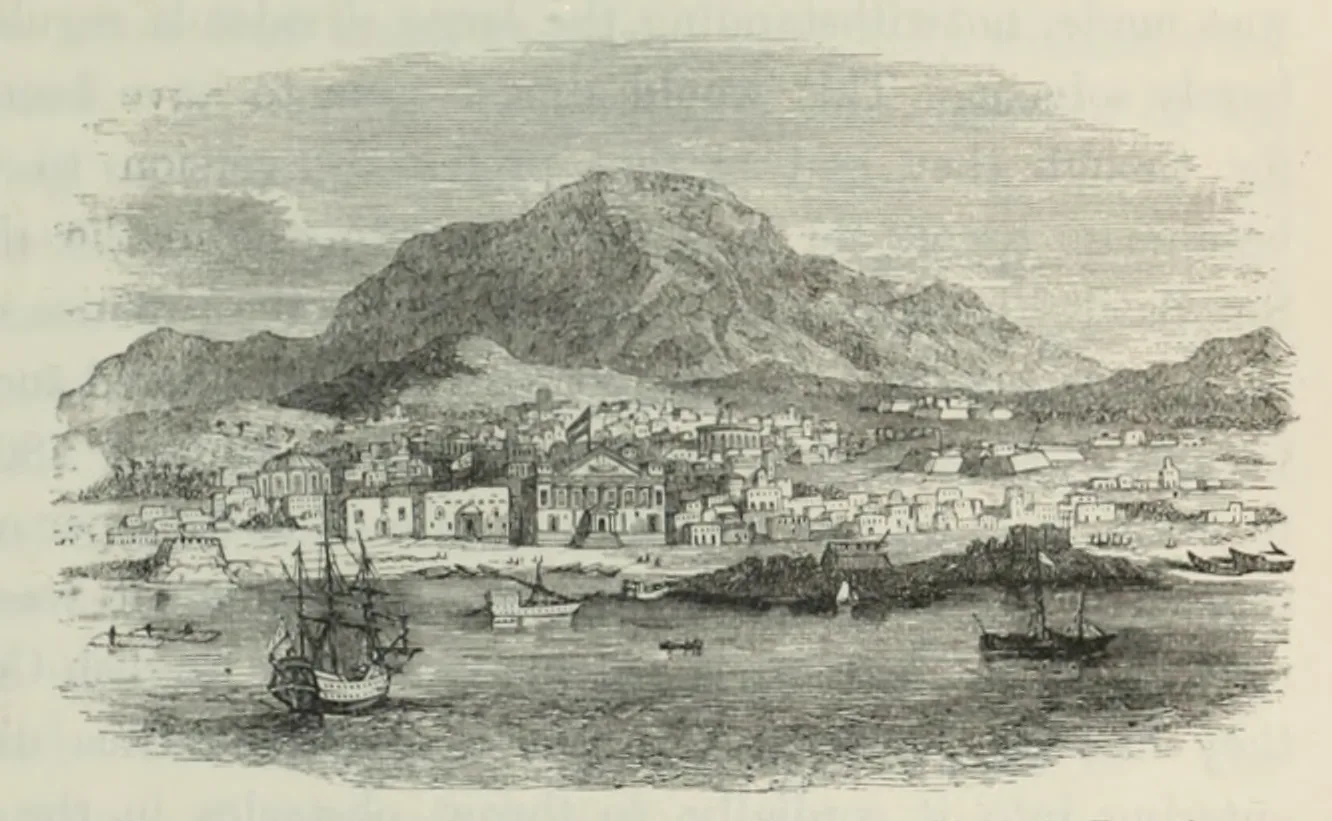
Patna. Also the right and title of the said governor and Company to Bantam, or any other settlements in the South Seas; and all rents, customs, and other profits, and all privileges, graunts, and phirmaunds in India.”
It must be admitted that the subjects above enumerated were very moderately valued, and had not only cost more, but would have been rated far higher for an absolute sale. The object, however, being to effect an amicable amalgamation, the London Company lost little by consenting to liberal terms, though the effect certainly was to give an unfavourable view of the state of their affairs, and countenance the allegation that at the period when the arrangement was made, notwithstanding the large dividends regularly declared, they were barely solvent. This would almost seem to have been their own impression, for though they had at first professed aversion to the union, they at last became so urgent for it as once more to ask in the aid of the now notorious Sir Basil Firebrace, and purchase it by the promise of an enormous reward. As a compensation for his services, if they proved successful, £150,000 of the Company stock was to be transferred to him at £80. Assuming the stock to be at par, he was to make a gain of twenty per cent., or in other rewards receive a douceur of £30,000. The arrangement was not more extravagant than impolitic, because it led many of the English Company to imagine that they had been outwitted in the bargain, and thus disposed them instead of entering into it cordially, to throw obstacles in the way of its completion. This want of cordiality was especially manifested abroad, where the servants of both companies, disregarding the instructions which they received from home, seemed determined to carry on a kind of internecine warfare. Year after year thus passed away, and the process of winding up the separate concerns of the companies, preparatory to the final amalgamation, made little progress. The necessity of taking some more decisive step for this purpose having become apparent, it was at last resolved to have recourse to a referee. This important office was undertaken by no less a personage than Sidney, Earl of Godolphin, the lord high-treasurer of Great Britain; and in order that full effect might be given to his award, it was previously made binding on both companies by a special clause in an act of parliament.
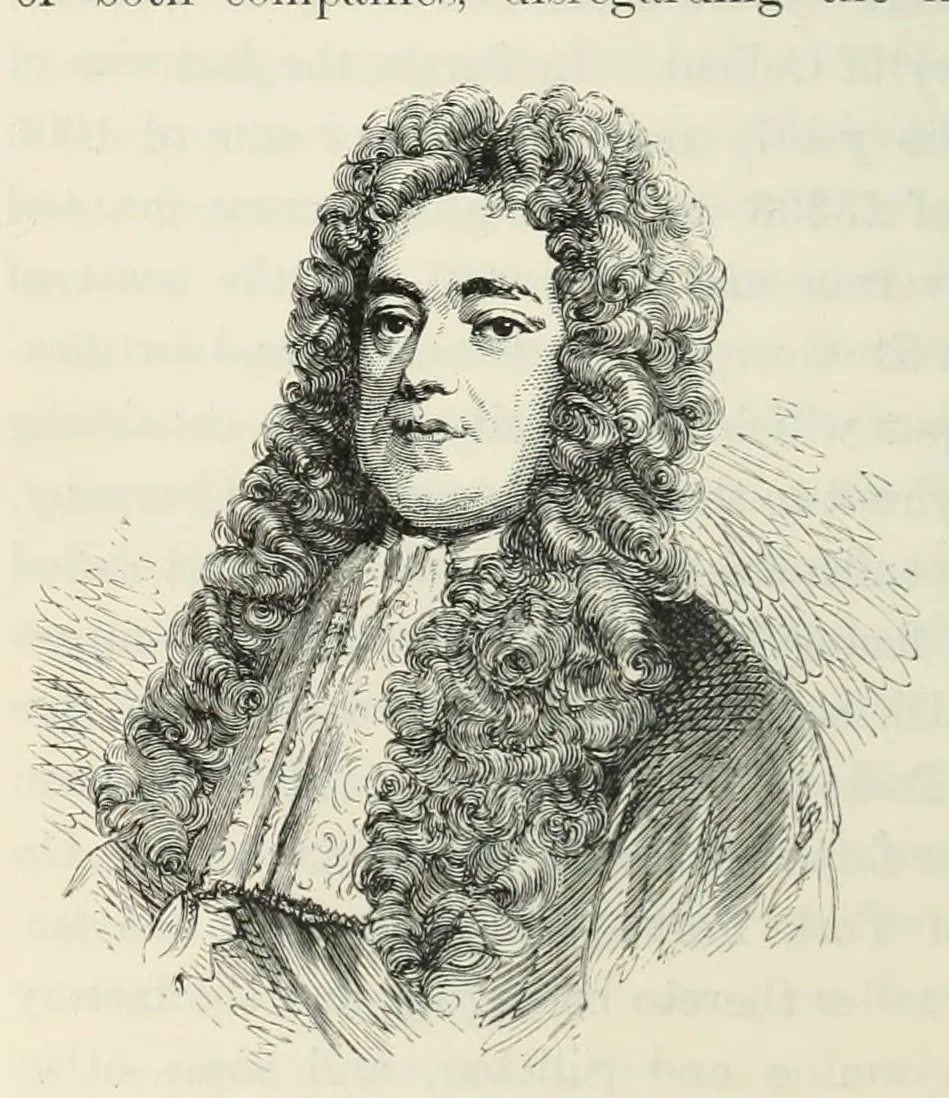
This act of parliament (6th Anne, chap. 17), exacted a new loan of £1,200,000 from the United Company, thus making the whole amount of the advance to government £3,200,000. No interest was allowed on the latter loan; but as the former had borne interest at eight per cent., the effect was to accumulate both loans into one, bearing a common interest of five per cent. In return for the loan thus exacted, certain new advantages were conferred. The portion of the original loan, which still belonged to the separate traders of the General Society, had been reduced to £7200, and it was now made optional to the United Company, on giving three years’ notice of their intention after 29th September, 1711, to pay off this sum and incorporate it with their own stock, so as to put them in exclusive possession of the whole East India trade, and leave them without even the shadow of a competitor. It was also enacted that the existence of the Company, instead of being terminable by three years’ notice after 1711, on repayment of the loan, should be prolonged under the same conditions till 1726; and power was given them to borrow £1,500,000, which they might either allow to remain as a bonded debt, or repay by means of calls on their shareholders. In this way the amount of capital, which would otherwise have been absorbed by the additional loan, was more than replaced. Lord Godolphin’s award was pronounced on the 29th September, 1708; and the arrangements consequent upon it being immediately completed, the amalgamation was finally effected. One Company only, bearing the name of “The United Company of Merchants of England trading to the East Indies,” now existed; and preparations were forthwith made for carrying on the East India trade on a larger scale than it had previously attained. The circumstances were propitious: the charter of the English Company on which the trade was in future to be conducted could no longer be called in question, as it had obtained the direct sanction of the legislature—the internal dissensions and animosities which at one time threatened to bring ruin on both companies had been suppressed—and the native governments, in consequence of the political changes which followed the death of Aurungzebe, had become less able to practise extortion and oppression.
Notes
- 1. This view is from an old print, copied from a painting in the possession of Mr. Pulham, of the India House. The inscription on it is, “Het Huis van den Oost Indische Compagnie en Londen.” A brief notice of the houses used by the Company is at foot of print, whence we extract the following:— From 1604 to 1621 the affairs of the Company were chiefly transacted at the house of the first governor, Sir T. Smith, in Philpot Lane. The regular establishment of the Company in 1621 was at Crosby House, in Bishopsgate Street, then belonging to Lord Northampton. In 1638 the Company removed to the house of Sir Christopher Clitheroe, in Leadenhall Street, at that time governor; and in 1648 removed to the house represented above, adjoining to Sir Christopher’s. In 1726 a new front was made, and a new building was in progress, which remained till 1796, when the present structure was commenced.