THE Carnatic, anciently called Canara, properly denotes the tract of country where the Canara language is spoken, but has long since lost its original application, and has two principal meanings, one more extensive, and the other more limited; the former, including under it nearly the whole of the south-eastern portion of the Indian peninsula, from the Kistna to Cape Comorin, and the latter adopting the same northern limit, but not descending further south than the country immediately north of the Coleroon, and at the same time so confining it on the west as not to leave it an average breadth of more than seventy-five miles. In this latter sense the Carnatic is nearly identical with the territory which, under the Mogul empire, formed one of the principal provinces of the soubah or government of the Deccan, and was administered by the soubahdar’s nabob or deputy, under the title of the Nabob of Arcot, the whole nabobship taking its name from Arcot, the capital. The country thus defined consists of two portions, differing greatly in their physical features, and distinguished from each other by the names of Balaghaut and Payeenghaut, or the land above and the land beneath the mountain passes. The Balaghaut, covered by a portion of the Eastern Ghauts, is elevated, and forms a kind of table-land, not so much traversed by continuous ridges as broken up by isolated hills and mountains, rising in precipitous masses, and not unfrequently separated from each other by deep ravines. The Payeenghaut, on the contrary, is a maritime flat, little elevated above sea level, and traversed by the beds of numerous streams, generally dry during the hot, but filled to overflowing during the rainy season. Immediately south of the nabobship of Arcot, and separated from it by a boundary not well defined, were the two rajahships or Hindoo states of Trichinopoly and Tanjore, which, though governed by their own princes, were so far dependent on the Nabob of Arcot, who levied tribute from them, not indeed in his own name, but as the deputy of the Mogul.
The nabobship of Arcot was held from 1710 to 1732 by an able and popular chief, of the name of Sadatulla, or, more properly, Saadut Oolla Khan. The office was not recognized as hereditary. It was held by commission from Delhi, but in the event of the Mogul not exercising, or delaying to exercise the right of nomination, a temporary appointment was made by the Soubahdar of the Deccan. Such was the regular mode of procedure when the Mogul empire was in vigour; but in the state of decay into which it had fallen, the imperial commission was regarded as only a form, and the right of appointment was tacitly, if not overtly contested between the soubahdar and the nabob, the one claiming it as his prerogative, and the other striving to render it hereditary in his family. Saadut Oolla having no issue, had adopted the two sons of his brother, and left a will by which he destined the nabobship to Doast Ali, the elder, and the subordinate government of Vellore to Boker Ali, the younger. By the same deed he conferred the office of dewan or prime minister on Gholam Hussein, the nephew of his favourite wife. Nizam-ul-Moolk, who, as has been already seen, regarded himself as independent sovereign of the Deccan, not having been consulted in these appointments, regarded them as encroachments on his authority, but, owing to other political entanglements at the time, was not in a position to give effect to his resentment.
Doast Ali, at the time of his succession, had two sons, of whom the elder, Sufder Ali, was arrived at man’s estate, and several daughters, one of whom was married to Murteza Khan, or Mortiz Ali, his brother’s son, and another to a distant relation of the name of Chunda Sahib, whose daughter by a former marriage was the wife of the above Gholam Hussein, Doast Ali’s dewan. Chunda Sahib, thus son-in-law to the nabob and father-in-law to his minister, naturally possessed great influence at court. His ambition tempted, and his talents enabled him to make the most of it. Ere long, under a pretext of assisting his father-in-law in administering the office of dewan, he had managed to supplant him. Not satisfied with the civil power thus placed entirely in his hands, he aspired to military power also, and obtained it by ingratiating himself with the soldiers.
The Rajah of Trichinopoly had died, like Saadut Oolla, in 1732, and, like him, also without issue. He had destined the succession to his first wife, but it was claimed by a collateral male heir, who, by the support of the commander-in-chief, pushed the ranee, or queen, to the desperate step of soliciting the aid of the Nabob of Arcot. It was readily granted ; and an army entered the rajahship, ostensibly for the purpose of collecting the accustomed tribute, but with a secret understanding that it was to support the queen. It was commanded by Sufder Ali and Chunda Sahib, and gradually approached the capital, where the queen still held possession, but by a tenure so precarious, that the admission of a portion of the nabob’s troops was deemed necessary to her safety. She was well aware of the danger which she thus incurred, and took what she conceived to be an effectual security against it, by requiring Chunda Sahib, who conducted the negotiation, to take an oath on the Koran, that the admitted troops should be employed solely to re-establish her authority, and then be withdrawn. He took the oath, but having no intention to keep it, took it only on a brick wrapped up in the usual splendid covering of the Koran, and no sooner gained possession than he made the ranee prisoner, and hoisted the Mahometan flag. Measures had been so effectually taken, not only in the fortress of Trichinopoly, but at various other stations, that the whole country submitted without resistance to this abominable treachery.
Sufder Ali returned home, leaving Chunda Sahib as governor. The office of dewan of Arcot having thus become vacant, was conferred on Meer Assud, Sufder Ali’s preceptor, who, well aware of Chunda Sahib’s ambitious character, quickly perceived the serious blunder which had been committed in making him ruler of Trichinopoly. It was more than probable that he would be tempted to revolt, and then the tribute withheld would be the least part of the loss, as the independence of the nabobship itself would be endangered. These representations had their full effect on Sufder Ali, but were lost on his father, Doast Ali, who, besides being of an indolent temper, was disposed to judge Chunda Sahib more favourably, and refused to sanction any proceedings against him. The fact, however, that such proceedings had been urged, was not lost on Chunda Sahib, who immediately took measures for his protection, by putting Trichinopoly in a complete state of defence, and intrusting tried friends with his other most important stations.
Sufder Ali and Meer Assud, unable to obtain the nabob’s concurrence in their designs against Chunda Sahib, determined to pursue them without his knowledge, and entered into a negotiation with the Mahrattas. The plan was, that the Mahrattas, under the pretext of levying the chout which the nabob had withheld, should invade his territories, and then, when Chunda Sahib came to his relief, as it was anticipated he would, suddenly unite their forces with Sufder Ali, and make a dash at Trichinopoly. By this intricate and tortuous policy, they overshot the mark. Doast Ali, knowing nothing of underhand arrangements with the Mahrattas, saw only that his territories were attacked, and, with more spirit than might have been expected from his age and habits, took post with a handful of men in a pass which was supposed, though erroneously, to be the only one through which the invaders could descend into the low country. He was here encountered, defeated, and slain. Sufder Ali, who had misgivings as to the course which the Mahrattas might pursue, retired, on hearing his father’s fate, to Vellore, while Chunda Sahib, who had been advancing into Arcot with an auxiliary force, hastened back to secure his own interests at Trichinopoly.
The Mahrattas, aware of the advantage which they had gained, thought no more of their engagements with Sufder Ali, and, as a means of forcing him to any terms which they were pleased to dictate, commenced their usual system of plunder and devastation. Sufder, anxious above all things to be immediately confirmed in the succession which had opened to him by his father’s death, complied with all their demands, and purchased their departure by agreeing to pay them, by instalments, 10,000,000 rupees, equivalent to £1,000,000 sterling. This was the only part of the treaty made public, but there was another article, kept secret for very obvious reasons, which handed over Chunda Sahib to their mercy, and left them free to appropriate as much of his territory as they could conquer at their own expense.
On the first news of the invasion of the Mahrattas, the late nabob, as well as Sufder Ali and Chunda Sahib, sent their families and treasure to Pondicherry, which they justly regarded as far stronger and every way more secure than any native fortress. Chunda Sahib, moreover, laid in a large store of grain at Trichinopoly, which, if it could not be starved out, promised to withstand any effort which the Mahrattas could make to take it. The Mahrattas seemed to be of this opinion; for immediately on their treaty with Sufder Ali, they turned their faces northwards, and commenced their journey, as if determined to lose no time in regaining their homes. It was a mere stratagem. They had calculated that Chunda Sahib, as soon as convinced that they were really gone, would consider his stores of grain unnecessary, and turn them into money. It was so; and though they had proceeded 250 miles north-west of Trichinopoly, they made sure of their prize by hastening back, and completely blockading the fortress. Famine made defence impossible; and after a siege of three months, it was compelled to surrender at discretion, on the 26th of March, 1741. The Mahrattas left 14,000 men, under Morari Row, to guard their conquest, and carried off Chunda Sahib, whom they confined in a strong fort in the vicinity of Sattarah.
Sufder Ali, when relieved from the alarm which Chunda Sahib had given, saw himself threatened by a still more formidable enemy. Nizam-ul-Moolk had returned to the Deccan, and had given him to understand that, as an indispensable condition to his being confirmed as nabob, he must pay up all the arrears of tribute which had accrued since the death of Saadut Oolla. His first step, on receiving this intimation, was to remove his family and treasures to Madras. He had formerly lodged them in Pondicherry, but circumstances had transpired to convince him that an understanding existed between Chunda Sahib and Dupleix, and that as his interest was decidedly opposite to that of the former, his true safety lay in courting an alliance with the only nation which seemed capable to counteract the designs of the latter.
Sufder Ali, after he had secured his treasures in Madras, endeavoured to propitiate Nizam-ul-Moolk by pleading poverty. The Mahrattas had impoverished the country, both by pillage and the immense contribution which they had exacted; and his finances were in consequence so depressed, that he had serious thoughts of retiring from the world altogether, and spending the remainder of his days at Mecca. It is not likely that Nizam-ul-Moolk would have allowed himself to be defeated of his purpose by such pretences, but Sufder Ali was not destined to feel the effects of his resentment, for he perished shortly after by the hands of an assassin. The crime was generally believed to have been instigated by Mortiz Ali, who immediately caused himself to be proclaimed nabob; but, unable to stand the storm of indignation which his atrocious conduct raised, was obliged to save himself by flight. Mahomed Saaed, an infant son of Sufder Ali, was immediately brought forward by the army, and, contrary to expectation, was confirmed as his father’s successor, by Nizam-ul-Moolk, who, at last, in 1743, made out his promised, or rather threatened visit to Arcot, by marching into it with an army of 80,000 horse and 200,000 foot. His presence was not unnecessary, for the country was rapidly verging towards anarchy. Every petty chief was affecting independence; and on one day no fewer than eighteen individuals, bearing the title of nabob, presented themselves to do homage to Nizam-ul-Moolk, who gave vent to his surprise and indignation by declaring that he always imagined there was only one nabob in the Carnatic, and that he would whip any of his chobdars, or gold-sticks-in-waiting, who announced an individual under that title.
As Nizam-ul-Moolk was bent on founding a new dynasty in the Deccan, he probably judged it good policy to give an exemplification of the hereditary principle in appointing to the nabobship, and was therefore easily induced to overlook any irregularities in the nomination of Mahomed Saaed. At the same time, he made little sacrifice, as he retained possession of the person of the infant nabob, and administered the government by one of his officers, Khojah Abdulla, as deputy. After this arrangement, he marched with his whole army to Trichinopoly to expel the Mahrattas, and succeeded, by presents and promises, without being obliged to strike a blow. Having thus settled matters to his satisfaction, he returned to Golconda. Khojah Abdulla, who had accompanied him, remained in command of the army till the spring of 1744, when he took formal leave, with the intention of resuming the government of Arcot. The very next day he was found dead in his bed, without visible marks, but certainly not without the suspicion of poison. Assuming that he was poisoned, public opinion agreed in fixing the crime on the person who profited most by it.
This was Anwar-u-din, who immediately stepped into the place which had belonged to Khojah Abdulla, and lost no time in setting out for Arcot. The young nabob, however, still stood in his way. It is almost needless to say that it was not long, and that another assassination, to which Anwar-u-din and the infamous Mortiz Ali were believed to be the instigators, made the nabobship once more vacant. Anwar-u-din was forthwith confirmed in the office, no longer as deputy but as principal. He was, however, most unpopular. The stain which was fixed on him as the supposed murderer or associate in the murder of Mahomed Saaed could not be wiped away by all his protestations; and the inhabitants of the nabobship could not be reconciled to one who, even if he could be supposed innocent of the murder, did in fact owe his government to the extinction of their favourite race of native princes.
It has already been seen how Anwar-u-din interfered in the hostilities between the British and the French, and passed from the one side to the other according as he imagined that his interest might be affected. Owing to his uncertain and vacillating conduct, Dupleix appears to have become satisfied that, as he could never be useful to him as an ally, the true policy would be to cripple him as an enemy, by giving him full employment at home. The most effectual means for this purpose were easily discovered. Chunda Sahib was still a prisoner with the Mahrattas, but had so many powerful connections in Arcot, that could he obtain his liberty, and be set up as a claimant for the nabobship, he would probably carry the national feeling along with him. In the event of his success, French interests might be greatly extended by express stipulations previously entered into for that purpose; and even in the event of his failure, more opportunities might occur of forming new and valuable connections with native powers. A scheme so much in accordance with the ambitious views which Dupleix had long entertained was not to be delayed, and he therefore began at once to give effect to it by employing some of the members of Chunda Sahib’s family, still resident in Pondicherry, as the medium of communication. Chunda Sahib, as might be expected, gladly embraced a proposal which promised at the very outset to give him his freedom. The Mahrattas were equally inclined to come to terms. So long as Sufder Ali lived they had a special interest in detaining their prisoner, because if they allowed him to escape, the instalments to which they were entitled under their treaty would not be paid. Since his death the case had altered; for Anwar-u-din, thinking perhaps that he could set the Mahrattas at defiance, positively refused to fulfil the obligations undertaken by his predecessor. The Mahrattas, therefore, had no longer any interest in detaining Chunda Sahib, and readily struck the bargain by which Dupleix agreed to pay a very heavy ransom for him. The sum is said to have been 700,000 rupees (£70,000).
Chunda Sahib, attended by his son Aabid Sahib, a few friends who had clung to him in misfortune, and a small Mahratta force, left Sattarah in the beginning of 1748, and proceeded south by slow steps, hoping to be able gradually to rally an army around him. On reaching the Kistna, the Rajahs of Chitteldroog and of Bednore, then at open war, applied to him for aid. He gave it to the former; and on the 24th of March a battle took place at Myaconda, in which he was defeated and taken prisoner, and his son was slain. He was carried in triumph to Bednore, but soon regained his liberty, and saw his fortunes suddenly assume a promising appearance at the moment when they seemed to have become desperate. On the very day when the battle of Myaconda was fought, Nizam-ul-Moolk died. Anwar-u-din thus lost his protector at the time when he stood most in need of him; and Chunda Sahib obtained powerful assistance from a quarter to which he had never looked for it. It will be necessary, however, before entering on the series of events occasioned by the death of the Nizam-ul-Moolk, to attend to a transaction which occurred about the same time, and in which the English East India Company became committed to a course of policy at variance with that which they had previously professed to pursue.
Shortly after hostilities ceased between the British and French, a native prince of the name of Saujohee arrived at Fort St. David, and applied for aid to reinstate him on the throne of Tanjore. Seven years had elapsed since he had lost it, and yet, according to his own account, he was not only the lawful heir, but so powerfully supported that he had only to appear at the head of a small force in order to insure success. His application was certainly made at a favourable time. Peace had been suddenly proclaimed, when the British, ashamed of their discomfiture at Pondicherry, were earnestly longing for an opportunity of regaining their laurels. A large body of troops was assembled and ready for action; but, according to all appearance, from the mere want of an enemy to fight with, they would be obliged to return to Europe without having performed a single achievement. It is not wonderful that under such circumstances the application of Saujohee was welcomed by many. The motives which influenced them, however, were not such as the governor and council of the presidency could adopt, and their resolution to give assistance was placed on very different grounds. Besides endeavouring to secure the Company against loss by binding Saujohee if successful to bear the whole expense of the war, they also stipulated for the cession of the fort of Devicotta, advantageously situated at the mouths of the Coleroon, and of the district attached to it. On such low grounds, and for such selfish objects the Company were made to appear for the first time in the very questionable character of mere mercenaries, lending out their troops for hire, and sending them to spend their blood in a native quarrel with which they had no concern.
The kingdom of Tanjore, in which this injudicious campaign was to be carried on, consisted of a tract extending from the Coleroon southwards along the coast about seventy, and inland about sixty miles. It had fallen into the hands of the Mahrattas in the time of Sevajee, and was appropriated by his brother, Venkajee, who died after a reign of six years, leaving three sons. It passed to all of them in succession in the order of their birth. But on the death of the last, as they had all left children, a number of rival claimants appeared, and a civil war ensued, during which three irregular successions took place within seven years. The whole power of the government had been usurped by Seid, the commander of the fort of Tanjore, who set up puppet kings at pleasure. In this way Saujohee, after wearing the crown for several years, had been set aside to make way for Pertaub Sing, his illegitimate brother. It is obvious from this account that the actual possessor of the throne of Tanjore at the time when Saujohee made his application at Fort St. David was an usurper; but this affords no justification of the conduct of the governor and council, who had no right to embroil the Company in a war for mercenary objects, and who had, moreover, on several occasions not only recognized him as sovereign, but courted his alliance.
The force by which it was expected that Saujohee would recover the kingdom of Tanjore, consisted of 430 Europeans and 1000 sepoys, with four field-pieces and four small mortars. The troops, accompanied by Saujohee, and commanded by Captain Cope, set out in the end of March, 1749; the battering cannon and provisions proceeded by sea in four ships, two of them of the line. Much time appears to have been lost, for it was the 13th of April before the army encamped on the banks of the Valaru, near its mouth at Portonovo, though the distance from Fort St. David did not exceed twenty miles. Time, however, was not the most serious loss. The wrong season had been chosen. The change of monsoon from north to south took place on the very evening of their arrival, and was accompanied with a dreadful hurricane, which continued to rage till four o’clock next morning, and with such fury, that many of the draught bullocks and horses were killed, the tents of the camp were blown to rags, and all the military stores were much damaged. At sea the ravages of the storm were still greater. The Pembroke, a sixty-gun ship belonging to the expedition, was wrecked, only six of her crew escaping. It was in the same storm that the Namur, of seventy-four guns, on which Admiral Boscawen’s flag was hoisted, and the finest ship of her size in the English navy, perished with 750 men.
After another delay, rendered necessary by a march to Portonovo to repair the damage which had been sustained, Captain Cope reached the northern branch of the Coleroon. Here he encamped and entrenched, because he was afraid to advance till better informed of the kind of reception that might be anticipated. It soon appeared that Saujohee’s representations were not to be confirmed. No persons of rank declared for him, and not a single squadron joined his standard, while Pertaub Sing’s troops were seen moving up and down on the opposite bank as if to dispute the passage. Captain Cope thought it imprudent to put them to the test, and remained where he was, till he was reinforced from Fort St. David with 100 Europeans and 500 sepoys. He now ventured to proceed, and discovered that he might safely have done it before, as scarcely any resistance was offered. Difficulties, however, soon multiplied upon him. The line of march was through a thick wood, which exposed them to a galling fire from parties of the enemy concealed in it, while the open plains were covered with large bodies of horse and foot moving on their flanks and rear. The position was really perilous, and seemed still more so because the English troops who had not before been brought face to face with an Indian army, naturally overrated the advantage which it derived from vast superiority of numbers. A general alarm was consequently felt, an alarm which might have grown to a fatal panic, had not the steadiness of the artillery kept the enemy at bay while a retreat to the river was effected. Here a council of war was deliberating whether to proceed or wait, when positive orders from Admiral Boscawen to advance on Devicotta at all events, left no alternative. Happily, a line of road, leading through a comparatively open country along the banks of the river to the sea-coast, was accidentally discovered by some of the soldiers. Pursuing it without much annoyance, the troops, after a march of ten miles, halted in the evening a mile east of the town.
The ships were anchored near the mouths of the river, not more than four miles from the camp, and yet so imperfectly were the means of intelligence provided, that they were not aware of each other’s presence. The excuse afterwards given was that the intervening ground was low and covered with trees. What was now to be done? The battering cannon was on board the ships, and the troops had only three days’ provisions. A sudden assault could not succeed, as the walls were too high to be escaladed; a proposal to advance the field-pieces by night, and gain an entrance by battering in the gates, was rejected, perhaps because it was too rational for Captain Cope to approve of it; and the childish resolution was adopted of trying to terrify the place into a surrender by throwing shells into it. In two nights of this foolish work all the shells were expended, and nothing now remained but retreat. It was accomplished with much more difficulty and loss than the advance; and the troops, after a long and harassing march, returned to Fort St. David, with nothing better to detail than misfortunes and blunders.
The presidency having undertaken the cause of Saujohee, had still two, and only two, honourable courses before them. The one was to persevere in his name; the other was to abandon the contest altogether. Declining both these courses, they devised a third, which, though it enabled them ultimately to gain their object, left a stain on their reputation. They made no scruple of abandoning Saujohee, but felt a stronger longing than ever for Devicotta. It was determined, therefore, to wrest it from its rightful owners, at all events, whether by force or fear. A new expedition was accordingly fitted out, and with much more prudence than before. It was commanded by Major Lawrence, the officer of highest reputation in India, and escaped the fatigue and dangers of a land march, by proceeding at once to the scene of action by sea. Six ships, three of them of the line, carried the Europeans, 800 in number, with the artillery and baggage; while 1500 sepoys accompanied them in large boats used by the natives for coasting. Having arrived and anchored in the mouth of the Coleroon, the troops and stores proceeded in boats up the arm leading to Devicotta, and were landed on the bank opposite to it. This position was chosen, both because the ground on the other side was marshy, and the Tanjore army lay encamped under the walls.
The fort, about a mile in circuit, formed an irregular hexagon, inclosed by a brick wall eighteen feet high, and flanked by square or circular towers. The attack was made on the eastern side by four twenty-four pounders, and in three days the breach was pronounced practicable. The great difficulty now was to cross the stream, which besides being dangerous from its rapidity, had woody banks, from which the enemy were prepared to defend the passage. It was ultimately effected by John Moor, a ship-carpenter, who not only contrived a raft capable of carrying 400 men, but swam the river during a very dark night with a rope, which was attached without being seen to the root of a large tree on the one side and to the raft on the other. By this contrivance the whole troops were transported, and soon succeeded in clearing the thickets. The enemy had not attempted to repair the breach, but learning from it the direction in which the final attempt would be made, endeavoured to counteract it by forming an entrenchment, which stretched from the banks of the river across this side of the fort. This entrenchment, though not finished when the troops crossed, presented a serious obstacle to further progress, the more especially that in front of it there was a deep and miry rivulet. The attack, however, was resolved upon; and Clive, who had finally quitted the civil for the military service, and attained the rank of lieutenant, volunteered to conduct it. His offer was accepted, and he advanced to the rivulet with a platoon of thirty-four Europeans and 700 sepoys. The Europeans and part of the sepoys having crossed without much difficulty, Clive hastened on to take the entrenchment in flank at that part where it remained unfinished. The Europeans kept close by him, but the sepoys who had passed remained at the rivulet, waiting till their companions from the other side should join them. Clive and his handful of Europeans thus left their rear completely exposed. The enemy at once saw their advantage; and a party of horse, who had stood concealed on the south side between the projections of the towers, rushed out and were within a few yards of the platoon, before they saw their danger, or could face about to meet it. In an instant, twenty-six of the party were cut down; only four escaped. Clive, reserved for greater things, was one of them. A horseman had lifted his sword to strike him, but he escaped the blow by stepping nimbly aside.
On this disaster, Major Lawrence lost no time in advancing with all the Europeans in a compact body. The trench was easily carried, and the Tanjorines, after attempting in vain to repeat the manœuvre which had proved so fatal to Clive’s little band, began to save themselves by flight. No resistance was offered at the breach, and the fort when entered was found completely evacuated. The real object of the expedition being now accomplished, the presidency had no longer any taste for Tanjorine warfare, and only kept up a show of hostilities till they should be able to secure their new conquest by regular treaty. It was not necessary to wait long, for the king, though naturally indignant at having been involved in hostilities with a foreign power which he had done nothing to provoke, had no inclination to continue them. On proposing terms of accommodation he was surprised and delighted to learn that the claims of a rival to his crown were not to be insisted on, and that if a pension of 4000 rupees was settled on Saujohee, for the sake of saving appearances, effectual steps would be taken to prevent him from giving any further trouble. In short, the presidency, instead of continuing to be his protectors, would condescend to act as his jailers. In return for their generosity in thus sacrificing him, all they asked for themselves was Devicotta, together with as much of the adjoining territory as would yield an annual revenue of 9000 pagodas (about £350), and also the expenses of the war! This last stipulation, all things considered, was utterly disgraceful to those who exacted it; but the king was not in a condition to resist, for events had just taken place in Arcot which made him aware that he might soon be engaged in a deadly struggle with still more formidable enemies.
As Clive was first brought prominently into notice during this Tanjore campaign, it will be proper in concluding it to prepare for the remarkable career on which he was now about to enter, by giving some details of his earlier life.
Robert Clive, the eldest of a family of six sons and seven daughters, was born on the 29th of September, 1725, at the mansion of a small estate called Styche, situated in the parish of Moreton-Say, near Market-Drayton, in Shropshire. His father, Richard Clive, possessed the above estate, and added to the rather scanty income which he derived from it by practising as a lawyer; his mother was Rebecca, daughter of Nathaniel Gaskill, of Manchester. In this city he spent his childhood in the family of Mr. Bayley, who had married his mother’s sister. According to this gentleman he was in his seventh year of a fierce and imperious temper, and “out of measure addicted” to fighting. From Manchester he was sent while yet very young to a school at Lostocke, in Cheshire, taught by Dr. Eaton, who is said to have predicted, that if “he lived to be a man, and opportunity enabled him to exert his talents, few names would be greater than his.” From Lostocke he removed, at the age of eleven, to a school at Market-Drayton, where he took a lead among his schoolfellows for mischief and daring, and was one morning seen seated on a stone spout near the top of its lofty steeple. A few years later he attended the Merchant Tailors’ School in London. His last school was at Hemel-Hempstead, in Hertfordshire, where he was in 1743, when he was appointed a writer in the service of the East India Company.
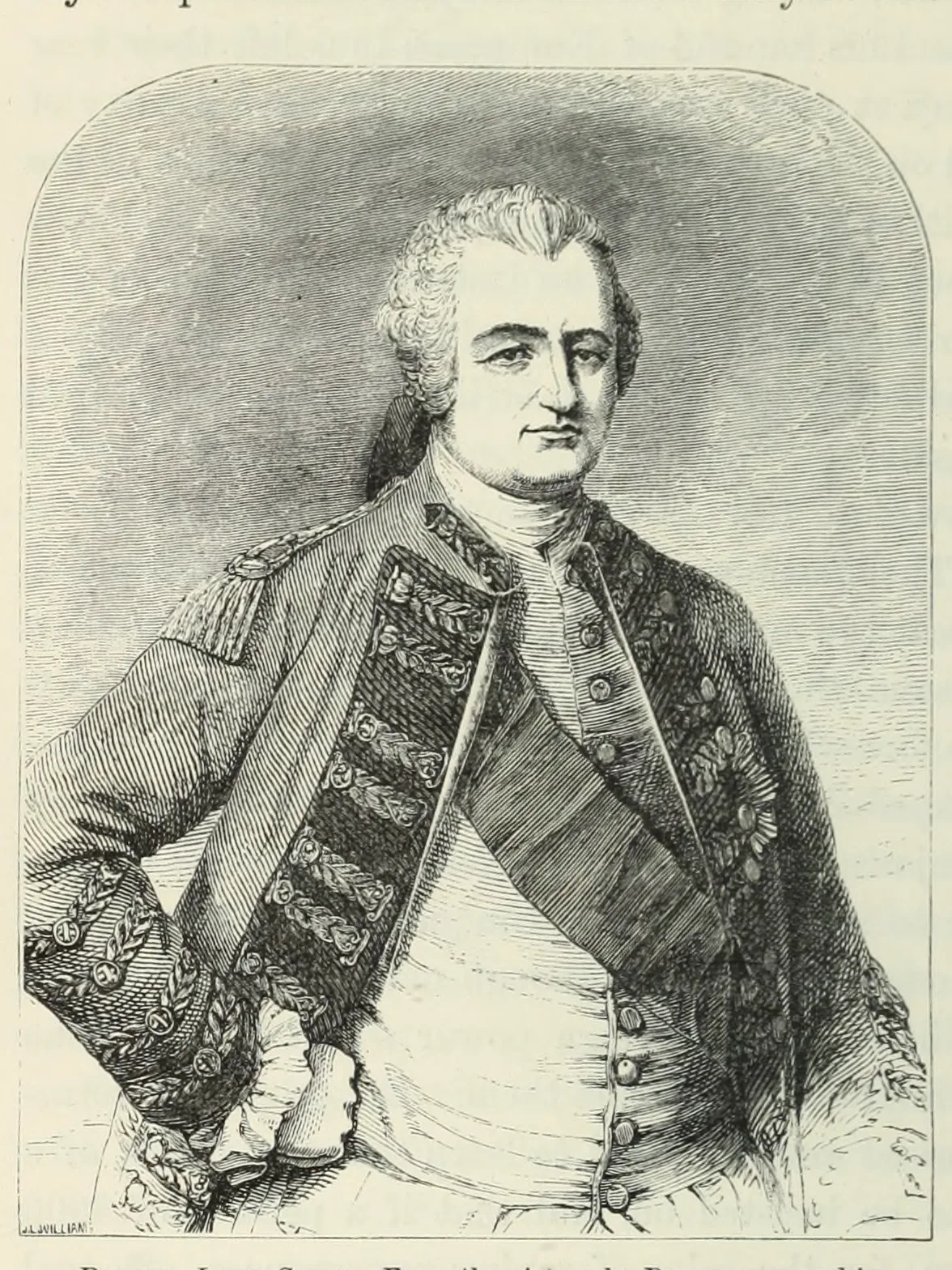
His destination was Madras, which he reached late in 1744. The voyage was tedious, but he appears to have turned his time to good account, for during a nine months’ detention of the ship at Brazil he made himself familiar with the Portuguese language. His letters, written to his friends at home shortly after he had entered on the duties of his office, display a kindly, thoughtful, manly spirit, and are so well expressed as to justify a doubt of the accuracy of the statement which has been made, that he idled away his time at school, and was in consequence very imperfectly educated. To one he says, “I must confess, at intervals, when I think of my dear native England, it affects me in a very particular manner; however, knowing it to be for my own welfare, I rest content and patient, wishing the views for which my father sent me here may, in all respects, be fully accomplished.” To a cousin of his own age he opens his heart more fully, and writes as follows :—“ I really think the advantages which accrue to us here are greatly overbalanced by the sacrifices we make of our constitutions. I have not been unacquainted with the fickleness of fortune, and may safely say, I have not enjoyed one happy day since I left my native country. I am not acquainted with any one family in the place, and have not assurance enough to introduce myself without being asked. If the state I am now in will admit of any happiness, it must be when I am writing to my friends. Letters surely were first invented for the comfort of such solitary wretches as myself.”
These extracts have a tinge of the melancholy to which he was constitutionally subject, and which was doubtless aggravated not merely by the loneliness referred to in them, but also by an employment to which he appears from the very first to have had a decided aversion. As yet the character of the Company was almost entirely mercantile, and the writer spent his time very much as ordinary clerks do in large commercial establishments. While thus employed Clive’s temper occasionally gave way, and the secretary under whom writers were placed on their first arrival was so offended at something he had said or done, that he complained of him to the governor. He was ordered to ask the secretary’s pardon, and complied ; but shortly after, when that gentleman with great kindness, wishing to bury the past in oblivion, invited him to dinner, he received the ungracious, surly, and half vindictive answer, “No, sir ; the governor did not command me to dine with you.” Other intemperate acts, hazarding the loss of his situation, are recorded ; and he is even said to have made an attempt on his own life. The account given is, that an acquaintance calling upon him was asked to take up a pistol which was lying in the room, and fire it out of the window. On seeing that it went off, Clive, who was sitting in a very gloomy mood, started up, as if astonished, and exclaimed, “Well, I am reserved for something! That pistol I have twice snapped at my own head.” The last act of his life makes this story not improbable, and yet it cannot be considered as perfectly authenticated.
If want of congenial employment was one of the main causes of this wild and reckless conduct, the remedy was at hand. Labourdonnais’ attack on Madras in 1746 must, for the time at least, have converted every servant of the Company within it into a soldier. No record remains of the manner in which Clive comported himself, but it can scarcely be doubted that had defence been attempted he would have been found among the foremost. As it was, he only shared the fate of his fellows, and was still resident in the town as a prisoner of war, when Dupleix, by grossly violating the terms of capitulation, freed him from his parole, and left him at liberty to consult his convenience or safety in any way he pleased. On this occasion he was one of those who escaped, disguised as natives, and succeeded in reaching Fort St. David. Here, shortly after his arrival, he became involved in a transaction which gave him more notoriety than fame. Two officers, who had won money at cards, were strongly suspected of having played unfairly, but most of the losers were terrified into payment. Clive, who was one of them, was not to be so bullied, and distinctly declared that he would not pay, simply because the money was not fairly won. The officer whom he thus accused challenged him. The parties met, it is said, without seconds. Clive having fired and missed; his antagonist came up, and holding the pistol to his head, told him to ask his life. He did so, and was then told that he must also retract his charge of unfair play. He refused, and when the pistol was again placed at his head exclaimed, “Fire, and be —. I said you cheated; I say so still, and I will never pay you.” The officer, in astonishment, threw away his pistol, saying that Clive was mad.
It is probable that at Fort St. David Clive resumed his occupation as a writer, but it was only as a temporary expedient. He had found his true vocation, and in 1747 obtained an ensign’s commission. The hopes already entertained of him appear from the letter of the court of directors of this year to the presidency of Madras. After alluding to the capture by Labourdonnais, they say, “Be sure to encourage Ensign Clive in his martial pursuits, according to his merit: any improvement he shall make therein shall be duly regarded by us.” His first recorded service after he obtained his commission was at the mismanaged siege of Pondicherry, where he attracted much notice by activity and gallantry. Strange to say, rumour at this very time charged him with an act of cowardice. While posted at a battery the ammunition failed, and he ran off to bring it, instead of sending a sergeant or corporal. An officer maliciously insinuated that it was not zeal but fear that had made him run. Clive, the moment he was made aware of the insinuation, called upon the officer to disavow it, and on receiving only an unsatisfactory explanation challenged him. While they were on the way to the place of meeting, some irritating words passed, and he was struck by his opponent. Their swords were instantly drawn, but some persons present interfered and prevented them from fighting. Their conduct was made the subject of a court of inquiry, and as the falsehood and malignity of the insinuation were easily proved, the author of it was ordered to ask Clive’s pardon in front of the battalion to which they both belonged. Here the matter ought to have rested, but as no notice had been taken of the blow, Clive insisted that satisfaction was still due. On its being refused, he waved his cane over the head of his antagonist and branded him as a coward. It would seem that he really was so; for he submitted to the disgrace, and next day resigned his commission.
The details now given bring down the narrative of Clive’s life to the date of the second Tanjore campaign, in which he has been seen volunteering to lead the assault on Devicotta, and making a hairbreadth escape with his life during the act of daring. The insight thus far obtained into his character disposes us to regard him as a man of a gloomy cast of mind, and a hot, irritable temper; jealous of his honour, and quick to resent an injury; bold even to foolhardiness, yet collected in the midst of danger; never losing his presence of mind, but always performing his part fearlessly, with indomitable energy and perseverance. As yet little opportunity has been given for the display of these qualities, but they will soon find a proper sphere, and make their possessor the hero of great events.
In concluding the account of the Tanjore campaign, it was observed that the king’s submission to the harsh and unjust terms imposed upon him was partly owing to the danger with which he was threatened from another quarter. The events in which this danger originated must now be explained. Nizam-ul-Moolk left six sons. At his death Ghazi-u-din, the eldest, was high in office at the court of Delhi, and easily obtained from the emperor, Ahmed Shah, a confirmation of his succession to the soubah of the Deccan. Other engagements, however, prevented him from attempting immediately to take possession, and rival claimants, taking advantage of his absence, began to contest the succession. On the one side, Nazir Jung, as the second son of Nizam-ul-Moolk, pretended to have become lawful heir by an alleged renunciation of his elder brother; on the other side, Hedayet Mohy-u-din Khan, afterwards known by his title of Muzzuffer Jung (Victorious in War), though only the son of Nizam-ul-Moolk’s daughter, claimed in virtue of an alleged will, by which his grandfather, with whom he had always been a special favourite, had left him the soubah of the Deccan and the greatest part of his treasures. Nazir Jung had the start of his competitor, and gaining possession of the treasures, possessed the most effectual means of securing the favour of the army. Muzzuffer Jung’s cause had in consequence become almost hopeless, when he was unexpectedly joined by Chunda Sahib, who, encouraged by promises of aid from Dupleix, was preparing to contest the right to the nabobship of Arcot with Anwar-u-din. The union between Muzzuffer Jung and Chunda Sahib was founded not only on mutual interests, but also on similarity of fortunes, inasmuch as they were both claiming on a female title.
The combined forces, forming a respectable army, immediately advanced to the frontiers of the Carnatic, and were there joined by a powerful reinforcement from Pondicherry. It consisted of 400 Europeans and 2000 sepoys, under the command of M. d’Auteuil, who had been allowed by the blundering of the nabob to make their march across the low country without molestation. Seeing the aid given to his enemies by the French, Anwar-u-din’s natural course would have been to strengthen himself by an alliance with the English; but whether he was so confident in his own might that he disdained to ask assistance, or the miserable expedition to Tanjore had made them averse, or left them too feeble to afford it, he advanced unaided to the encounter. His army consisted of 12,000 cavalry and 8000 infantry, with which he took up a position with one flank resting on the hill-fort of Amboor, about fifty miles west of Arcot, and the other on a hill bounding one of the passes into the Carnatic. If he chose this spot under the idea that it commanded the only practicable entrance into his territories, he was mistaken; but the enemy, though probably aware of his blunder, did not attempt to profit by it. Their numbers doubled his, and they doubtless deemed it more creditable to force his position than to evade or turn it. The brunt of the action on their part fell on the French troops, who gallantly carried the position, after they had been twice repulsed. The contest was now hopeless, but Anwar-u-din continued it with great bravery till he was slain. His two sons, Maphuze Khan and Mahomed Ali, were both present. The former was taken prisoner; the latter fled and took refuge in Trichinopoly, nearly 250 miles distant from the scene of action. The victorious army proceeded at once for Arcot, and entered it without opposition. Muzzuffer Jung and Chunda Sahib immediately assumed the dignities which they had claimed; the one taking the title of soubahdar and the other of nabob. Much time which ought to have been employed in giving a finishing stroke to the war was consumed in childish ceremonials; but, as if this had not been enough, Dupleix thought it right that his own vanity also should be gratified, and the new soubahdar and nabob made a pompous entry into Pondicherry, where they spent some time vying with their entertainer in senseless extravagance. French interests at the same time were not forgotten, for Chunda Sahib made the company a grant in perpetual sovereignty of eighty-one villages in the neighbourhood of their capital.
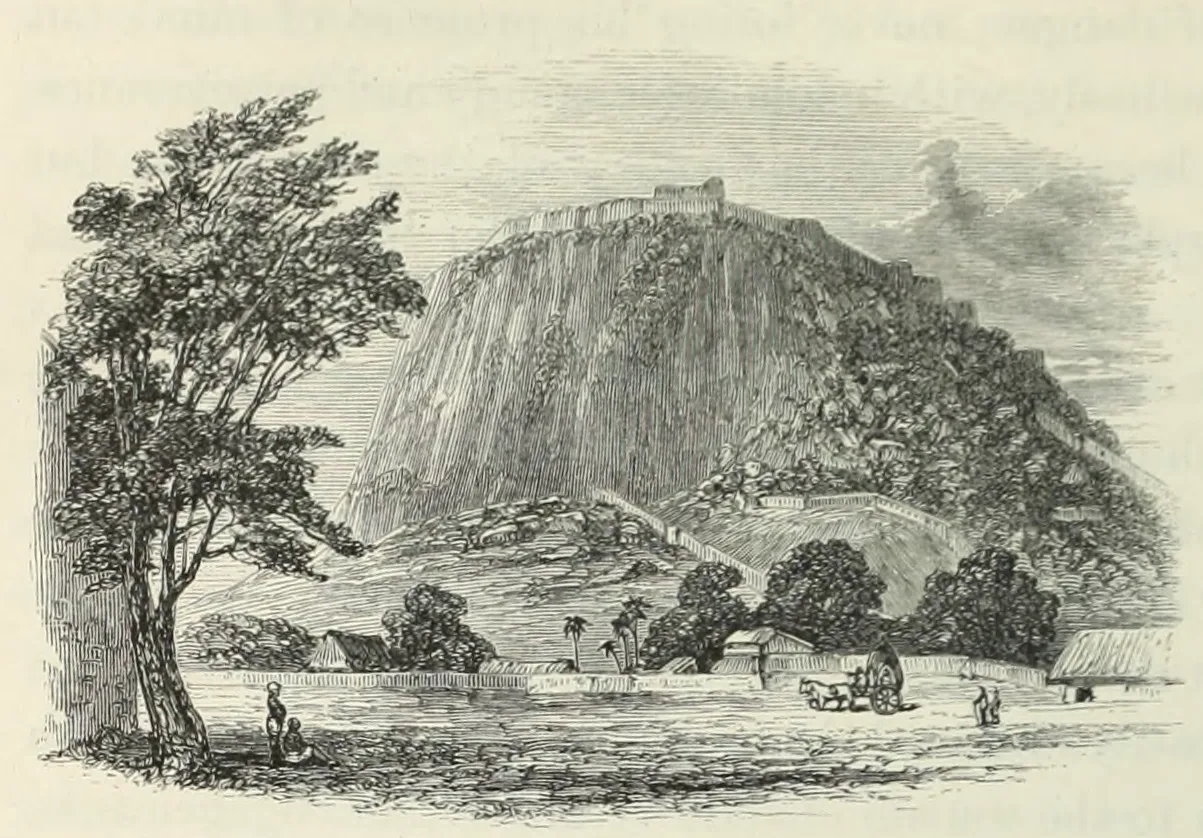
The ceremonials over, Dupleix, fully alive to the danger of further delay, urged the departure of his guests, and laboured to impress them with the necessity of proceeding instantly against Trichinopoly. They expressed complete acquiescence in all his views, and set out as if determined forthwith to carry them into effect. No sooner, however, were they beyond the reach of his importunity, than they followed their own course. They did proceed with their army for the south, but suddenly changed the direction and turned from Trichinopoly to make a campaign in Tanjore. Their motive was to replenish the treasury, which was nearly exhausted. Tanjore seemed the far easier conquest of the two, and they had no doubt that, at the very worst, the king would gladly buy them off by a large contribution. Being thus undecided as to the character which they ought to assume, they acted in the irresolute manner usually exhibited in such circumstances, and allowed themselves to be entrapped into a negotiation which the king skilfully protracted till he knew that Nazir Jung had arrived in Arcot. This was a contingency which, though most probable in itself, had never once occupied their thoughts. Indeed, their first knowledge of it was obtained by a message from Dupleix. It had all the effect of a surprise, and they took the only course open to them, by retreating with precipitation towards Pondicherry.
While the French were taking a decided part in the great struggle which was to determine the future fortunes of the Deccan, the English knew not how to act. The presidency had, on their own responsibility, become parties to a war in Tanjore, but the result had disappointed them; and their interference now seemed to them not a precedent which they ought to follow, but a beacon which they ought to avoid. The success which had attended the French arms was as gall and wormwood to them; and they would fain have employed all their force on the opposite side, especially if they had felt sure that it was to prove the winning side. This, however, was very doubtful; and the result of intermeddling, therefore, might be to subject themselves to the displeasure, and ultimately call down the vengeance of the successful competitors for the soubah and nabobship. These, and similar considerations, might perhaps have justified them in resolving to remain as mere spectators of the contest, but certainly could not justify the very extraordinary course which they adopted. When Mahomed Ali, who had shut himself up in Trichinopoly and assumed the title of nabob, earnestly implored their assistance, they at first turned a deaf ear, and afterwards, as if in mockery rather than in earnest, sent him a paltry reinforcement of 120 Europeans. By this act they committed themselves as much as if they had sent him 1000. They had chosen their side and must maintain it; and yet, with monstrous and suicidal inconsistency, they at this very time declined Admiral Boscawen’s offer to remain, and allowed him to depart with his fleet for Europe. So absurd did the proceeding appear to the French, that for some time they did not believe the departure to be more than a feint; but at length, when satisfied that it was a reality, could not refrain from openly manifesting their delight.
After the British and French had taken their sides, both were naturally anxious to show that they had made the right choice, and given their support to those who had the best title. On this subject volumes were written, but to very little purpose, for two reasons: first, because, were it worth the while, it could easily be shown that the titles of all the claimants were absolutely bad; and, secondly, because it was mere hypocrisy on the part of the two companies to pretend that they were fighting for legitimacy, when it was well understood that the justice of the war was a matter of perfect indifference to them, and that their true position was that of mercenaries, intent only on the gain which they stipulated, or might be able to extort, in return for their services. The most favourable view that can be taken of the matter is, that the regular course of government had been completely broken up, and that, in the general scramble which had ensued, the two companies were as well entitled as any other parties to make the most of it, more especially as it was not impossible that their important commercial interests might be compromised.
When Muzzuffer Jung first took the field, Nazir Jung seems to have regarded it as little more than a youthful outbreak, which, if it did not carry its own punishment along with it, might at any time be easily suppressed. After the battle of Amboor he saw reason to view it in a very different light, and made his preparations accordingly. Appointing the celebrated fort of Gingee,
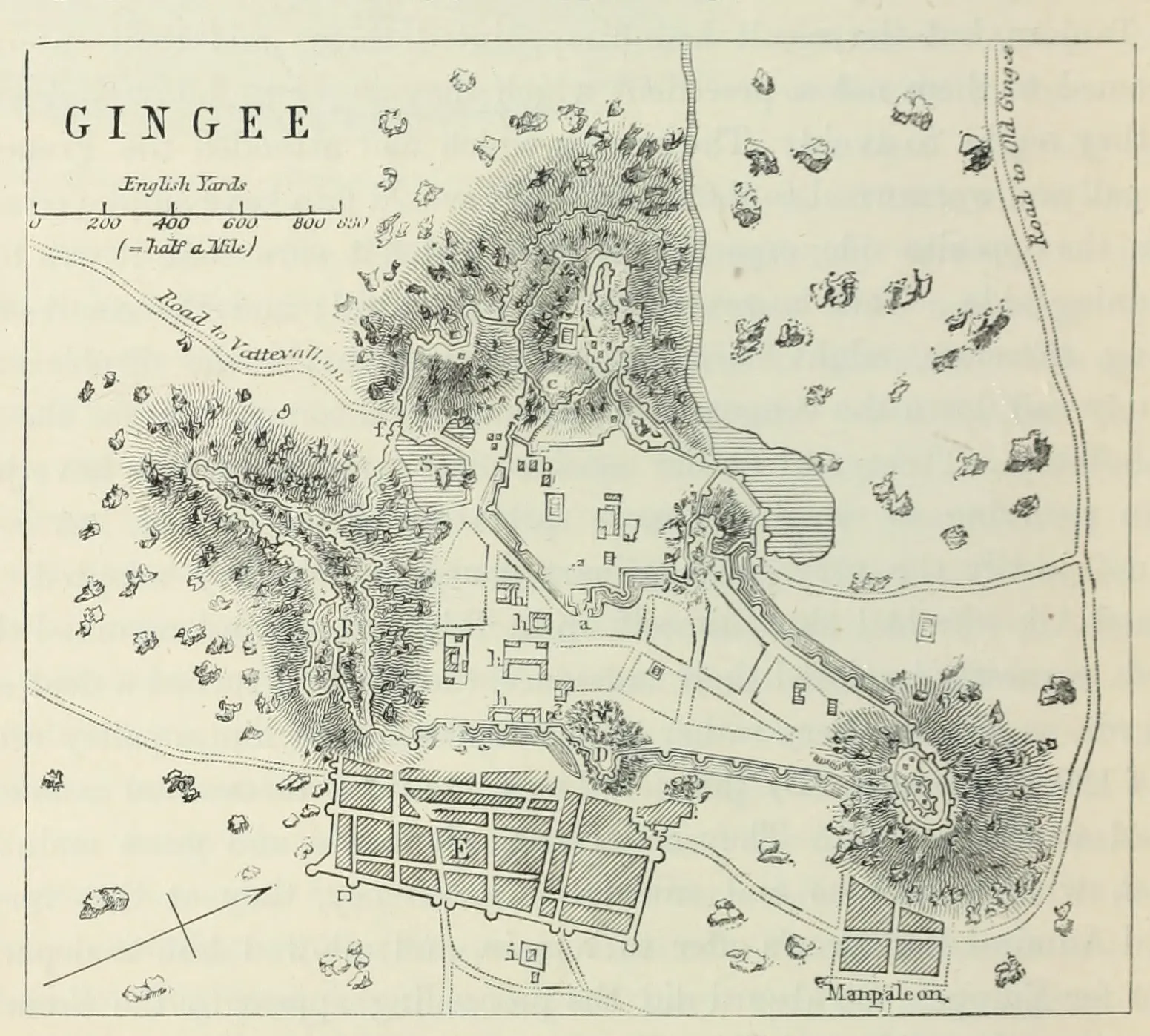
situated about thirty-five miles north-west of Pondicherry, as the general place of rendezvous, he issued summonses, in his character of Soubahdar of the Deccan, to all its various dependencies, and soon saw himself furnished with contingents from all quarters, to such an amount that his whole army was estimated at 300,000. Among these were a contingent of 6000 horse, furnished and commanded by Mahomed Ali, whose hopes of the nabobship were bound up with Nazir Jung’s establishment as soubahdar; and a contingent of 600 Europeans, furnished by the Company and commanded by Major Lawrence. The presidency, having satisfied themselves that the man who could muster an army of 300,000 men must be the real soubahdar, had got rid of all their doubts and scruples on the subject of his title, and resolved magnanimously to share his fortunes. At the same time it was thought prudent to feel his pulse, and Major Lawrence, together with Captain Dalton, and a member of council who accompanied them, were commissioned to act as a trio, and treat with Nazir Jung on the interests of the Company. He received them with politeness, paid them oriental compliments, and was liberal in his promises.
The French endeavoured to keep up the spirits of their allies, and along with them took up an excellent position, from which all the mighty host of Nazir Jung would have been unable to dislodge them. The only part of the force really formidable was the detachment under Major Lawrence. M. d’Auteuil endeavoured to bribe it into inactivity by sending a messenger to acquaint the major that, though their troops were arrayed on opposite sides, it was his wish that no European blood should be spilled. He therefore asked to know in what part of Nazir Jung’s army the English took post, in order that none of his shot might come that way. Major Lawrence, estimating this communication at its true worth, replied that the English colours were carried on the flag-gun of their artillery, and that, though he too was anxious to spare European blood, he would certainly return any shot that might be sent him. M. d’Auteuil, in proposing a kind of neutrality between the French and English, had not given the true reason. His men were in mutiny, and no fewer than thirteen of his officers had thrown up their commissions in presence of the enemy. This unworthy proceeding was adopted to avenge themselves on the governor, with whom they had had a bitter quarrel before leaving Pondicherry. The cause need not be inquired into, but the effect was important. M. d’Auteuil, convinced that his men would not fight, ordered them to quit the field and march home without delay. Muzzuffer Jung, who had previously begun to despair of his cause, and been attempting to come to an accommodation with his uncle, thought that not a moment was to be lost; and on receiving a solemn assurance that he would neither be imprisoned nor deprived of the government which he had held during his grandfather’s lifetime, passed over to the enemy. The pledge given him was violated without scruple. He was immediately thrown into fetters, and his troops, attacked and dispersed, were almost cut to pieces. Chunda Sahib behaved with more spirit, and fared better. Accompanying the French at the head of his cavalry, he repeatedly charged the Mahrattas, who, led by Morari Row, hung upon their flank and rear, and well nigh succeeded in cutting off their retreat.
The arrival of the troops in wretched plight threw Pondicherry into consternation. Dupleix, though he pretended to make light of it, saw the full extent of the disaster, and, as usual when force failed, had recourse to diplomacy. It was known that there was considerable disaffection in Nazir Jung’s camp. Several chiefs, who had pledged themselves for the honourable treatment of Muzzuffer Jung, were indignant at his captivity, and still more at the evasive answers given to themselves when they applied to be confirmed in their governments. Dupleix, having obtained permission, after several rebuffs, to send an embassy to Nazir Jung’s camp for the purpose of negotiating a peace, employed his deputies not only in ascertaining the extent of the defection, but in fomenting it. Their proposals were purposely so framed as to protract the negotiation, which, though it ostensibly failed, gained all that he sought by it. He had secured a party who, from belonging ostensibly to Nazir Jung’s camp, would do better service than if they had been ranged under French banners.
Major Lawrence, who had suspicions of the French deputies, endeavoured to put Nazir Jung on his guard, and obtained a personal interview for this purpose; but as he could only communicate by an interpreter, who feared to give the true meaning of his words, the warning was given in vain. The major then endeavoured, along with the deputies who accompanied him, to obtain a confirmation of a grant of territory near Madras, which Mahomed Ali, as nabob, had made to the Company in return for the services of their troops. After much prevarication compliance was promised, provided he would accompany the camp to Arcot, to which the soubahdar was eager to proceed, not for any stratigetical purpose, but to indulge his taste for licentious pleasures. Disgusted at all he saw, Major Lawrence refused; and after speaking his mind freely, returned with his troops to Fort St. David.
Leaving Nazir Jung to his degrading pleasures at Arcot, we must now follow the proceedings of the French, who, having recovered from their consternation, not only began to regain their lost ground, but were emboldened to make new conquests. In order to avenge an attack which had been made by Nazir Jung’s orders on their factory at Masulipatam, situated at the mouths of the Kistna, a detachment of 200 Europeans and 300 sepoys, with several pieces of battering cannon, were embarked at Pondicherry, in two large ships, in the beginning of July, 1750, and landing in the night, took the city by surprise with almost no loss. It was immediately put in a position of defence, and reserved to become the nucleus of other conquests which were already meditated in the same quarter. Their next conquest, if not so important in itself, did more to redeem the credit of their arms. About fifteen miles east of Fort St. David stood the town of Trivadi, with a pagoda so strongly fortified as to serve as its citadel. It seemed to the French a desirable possession, both from its proximity to the British territory, and as a station which might be turned to good account in a southern campaign. It was taken without resistance, and garrisoned with only fifty Europeans and 100 sepoys. Mahomed Ali, to whom it previously belonged, justly inferring that the capture had been made not for itself but for ulterior objects, took alarm and resolved to make an effort to regain it. With this view he raised an army, half of it drawn from the soubahdar’s camp at Arcot, and by engaging to defray all expenses, induced Major Lawrence, who was acting at Fort St. David as temporary governor, to send him a detachment of 400 Europeans and 1500 sepoys. His whole force mustered 20,000 men, with whom, after encamping for a short time in the plain of Trivandiparam, a little west of Fort St. David, from which he was to receive two 24-pounders and military stores, he marched along the south bank of the Pennar, and found the French posted on the opposite bank, about eight miles east of Trivadi. The French were entrenched; and Mahomed Ali, though strongly urged by Captain Cope, who commanded the British detachment, to take up a position which would force an engagement, was too cowardly to comply, and contented himself with skirmishes and a distant cannonade. After some time wasted in this way, Mahomed Ali proposed marching off to the west, but Captain Cope refused to accompany him; and on being refused payment of the expenses which had been promised, was ordered by Major Lawrence to return with his troops to Fort St. David. They arrived there on the 15th of August, and the French lost not a moment in taking advantage of their absence. Mustering a force which amounted in all to 1800 Europeans, 2500 sepoys, and 1000 horse, levied by Chunda Sahib, they brought the enemy to action, and gained a complete victory without the loss of a single man. Mahomed Ali escaped with difficulty, and reached Arcot with only two or three attendants.
Notwithstanding the consternation produced by this defeat, Nazir Jung still remained inactive; and the French, left at full liberty to pursue their victorious career, were emboldened to attack Gingee. This celebrated fortress, in which we have already seen the Mahrattas resisting, for many years, the whole power of the Mogul empire under Aurungzebe, is situated among the Eastern Ghauts, about thirty-five miles north-west of Pondicherry, and eighty-five miles south-west of Madras. It consisted of three steep and craggy hills, with an intervening hollow, the whole surrounded by a lofty wall flanked with towers, and inclosing an area nearly three miles in circuit. The town lay in the hollow, and the hills were both crowned on their summits, and along their declivities, with forts and other works, rendering the whole place so strong, at least according to Indian ideas, as to be deemed impregnable. How little it was really so was soon made apparent. The main body of the French army was commanded by M. d’Auteuil, but was preceded by a detachment of 250 Europeans and 1200 sepoys, with four field-pieces, under M. Bussy, who was rapidly establishing the reputation which he ultimately acquired of being the ablest French officer in India. His object probably was to take the place by surprise; but on coming in sight of it he found 5000 of the fugitives from Trivadi encamped under the walls. He waited, therefore, till the main body came in sight, and then attacking, drove off the enemy with little difficulty. One of the gates of the outer wall was next driven open by a petard, and the whole of the troops, artillery, and baggage were lodged in the town before night, with the loss of only three or four men. The real contest now began: the enemy firing and throwing rockets from their mountain heights, while the French answered them from their guns and mortars. The mischief done in this way by either side was not great, and preparations were made for an assault. This honour was reserved solely for the Europeans, who attacked the three hills at once in separate parties, carried redoubt after redoubt, reached the summits, and had their flags flying triumphantly on them all by daybreak, with the loss of only twenty men.
If the French were astonished at thus easily capturing what was justly considered the strongest fortress of the Carnatic, it is easy to conceive what dismay the first intelligence of the event produced in the camp at Arcot. Nazir Jung was at last aroused from his disgraceful stupor. In the excess of his confidence he had allowed many of the chiefs to return home with their contingents, and sent back the greater part of his own troops to Golconda. Besides recalling these, he gave a striking proof of his fear by sending two officers to Pondicherry to negotiate. It was now the turn of Dupleix to be imperious, and he set no limits to the extravagance of his terms. He well knew that they would be rejected, and had proposed them with this very view, for the party which he had secured in the enemy’s camp had organized a conspiracy, and Nazir Jung’s life was hanging by a thread. Totally unconscious of the danger impending over him, he ceased negotiating, and began his march towards Gingee late in September, 1750. Though many of the troops absent on leave had failed to return, his force still consisted of 60,000 foot, 45,000 horse, 700 elephants, and 360 pieces of cannon. Including camp followers, the whole army was little short of 300,000. This vast and unwieldy body moved so slowly that fifteen days were spent in marching thirty miles. It was still sixteen miles from Gingee when its further progress was arrested by the sudden setting in of the rains. Retreat was now the only prudent course, but it was considered disgraceful, and after the lapse of two or three days became impossible. The whole country was flooded, and the camp lay inclosed between two swollen rivers. Provisions began to fail, sickness as usual followed, and the prospect was gloomy in the extreme. Nazir Jung, now as anxious to quit the Carnatic as he had been fond of remaining in it, again made overtures of peace, and expressed a willingness to submit to the terms which lately he would not even entertain. Dupleix was not unwilling to have two strings to his bow, and began to negotiate without losing sight of his conspirators. At the same time he found himself in a kind of dilemma. If he made the treaty he must abandon the conspiracy, and, in all probability, sacrifice all the chiefs whom he had tempted to join in it; if he remained true to them they would do their bloody deed, and the treaty would be useless. Ultimately it was a mere toss which of the two methods of settlement would be adopted; for at the very time he was pressing Nazir Jung’s deputies to send back the treaty ratified, he sent orders to M. de la Touche, who commanded at Gingee, to march out to attack the camp whenever the conspirators should intimate to him that they were ready. This intimation reached Gingee before the ratified treaty was returned to Pondicherry, and Nazir Jung’s fate was sealed. The French force, consisting of 800 Europeans, 3000 sepoys, and ten field-pieces, arrived within sight of the enemy’s camp. It extended eighteen miles, as every chief had a separate quarter. Where the space occupied was so enormous, the French, left to themselves, would have been at a loss to choose their point of attack; but the conspirators had provided for this by sending a guide, who conducted them to the locality immediately occupied by Nazir Jung. He had ratified the treaty only the day before, and would not at first believe that the French had attacked him. When convinced of the fact, and asking how the battle went, he was astonished to learn that a large portion of his army remained motionless as mere spectators. Enraged, he mounted his elephant and hastened off in the direction where they stood. The first troops he came up to were those of Kurpa, and Nazir Jung thinking, as it was not yet clear daylight, that the nabob who was at their head on his elephant did not recognize him, raised himself up to receive his salutation, when two shots, fired from the nabob’s howdah, pierced his heart, and he instantly expired.
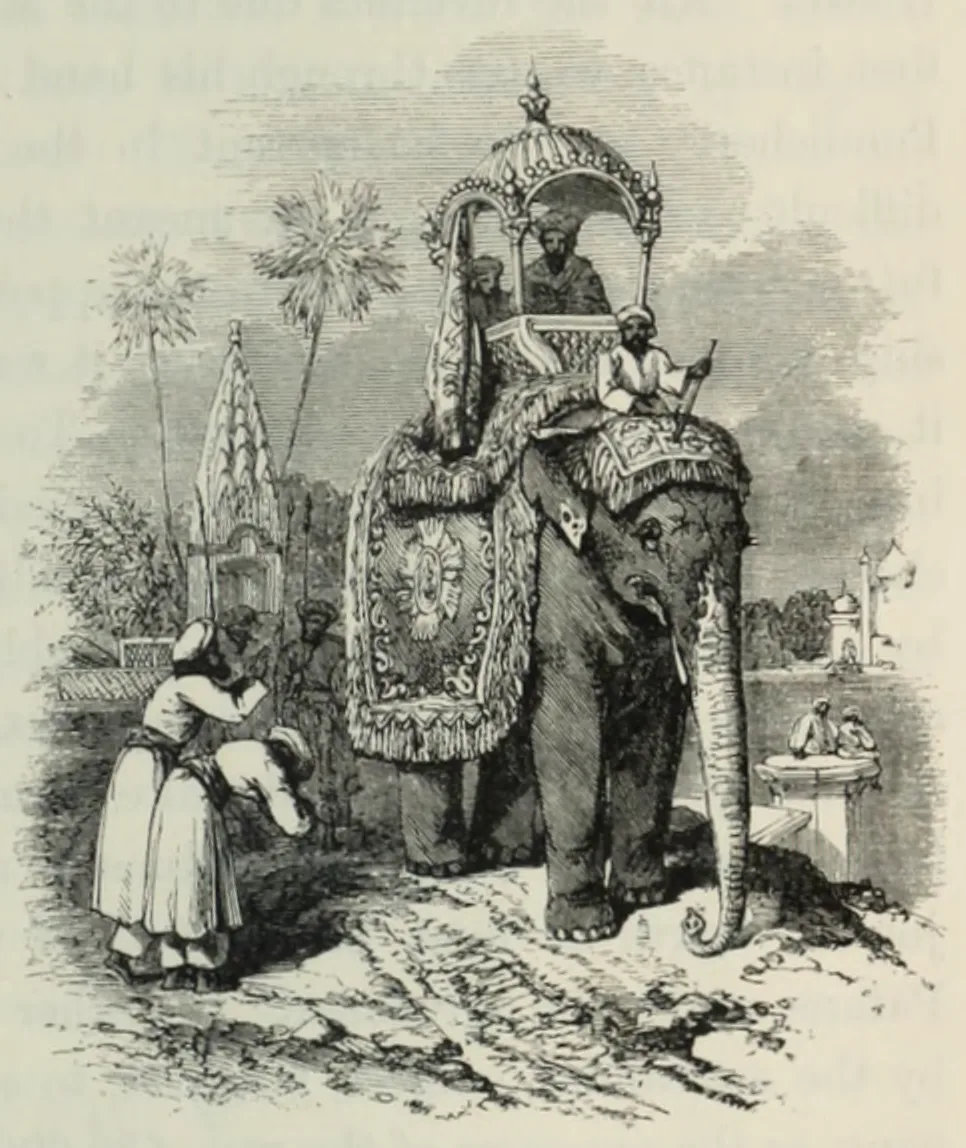
Muzzuffer Jung was immediately proclaimed as soubahdar, and, accompanied by a large portion of the army which had just belonged to his murdered predecessor, set out in triumph for Pondicherry. The governor and Chunda Sahib received him in a tent without the gates, and a procession took place in which none of the usual accompaniments of oriental ostentation were wanting. No sooner was he seated in the palace than the new soubahdar, opening his heart to Dupleix, made him aware that, along with the honours, he had already began to experience some of the perplexities of sovereignty. The Patan chiefs, to whose treachery he was mainly indebted for his elevation, were determined that he should pay for it liberally. How to satisfy them was the puzzle. Their demand was that three years’ arrears of tribute, which they owed, should be remitted; that in future no tribute should be exacted from them, either for the territories which they possessed, or the large additions which they thought themselves entitled to expect; and that one-half of the contents of Nazir Jung’s treasury should be distributed among them.
Dupleix undertook the office of mediator, and, after several days spent in discussion, concluded an arrangement, which was signed by all the parties, and with which all of them declared themselves perfectly satisfied. Business was naturally succeeded by festivities, and Pondicherry assumed the appearance of a gay and luxurious capital. The most gorgeous of the ceremonies was the installation of Muzzuffer Jung as soubahdar. His first act, after it was completed, was to declare Dupleix governor for the Mogul of all the countries south of the Kistna. All the revenues due to the Mogul from these countries were, in the first instance, to pass through his hand; and no coin but what was coined at Pondicherry was to be current in the Carnatic. From the terms used it is difficult to say whether it was meant that the soubahdar or Dupleix should in future take precedence; but in the appointment of Chunda Sahib to the nabobship of Arcot and its dependencies, it was expressly stated that he was to hold it under Dupleix, as his superior. To the French East India Company the immediate advantages were the acquisition of tracts of territory near Pondicherry, Carrical in Tanjore, and Masulipatam, producing a revenue estimated by themselves at £38,000, but probably not less than £50,000; the indirect advantages were unlimited, inasmuch as, under the titles and powers conferred on their governor, they could make them anything they pleased. The treasure taken from Nazir Jung was estimated at £2,000,000 sterling, exclusive of the jewels, worth at least £500,000. Of the treasure, one-half belonged to the Patans, under the agreement; the other half, and the jewels, were appropriated by the soubahdar, subject, however, to a deduction of £50,000 paid to the company, as the expenses of the war, £50,000 to the officers and troops which gained the battle of Gingee, and a present to Dupleix, consisting, besides many precious jewels, of money fixed at the conjectural amount of £200,000.
Muzzuffer Jung left Pondicherry for Golconda on the 4th of January, 1751, accompanied by his own troops, and also a French detachment, commanded by M. Bussy, and consisting of 300 Europeans and 2000 sepoys. On reaching the territory of Kurpa, a quarrel ensued between some of the inhabitants and the soldiers, and three villages were set on fire. The nabob, professing great indignation at the injury done to his subjects, retaliated by attacking that part of Muzzuffer Jung’s division where the women were placed. According to oriental ideas, there could not be a grosser insult; and he was vowing to take summary vengeance when M. Bussy interposed, and procured the nabob an opportunity of explaining. He did so, but in such terms as only to aggravate the insult. It now appeared that the whole affair was concerted. The Patan chiefs had never been satisfied with the arrangement at Pondicherry, and had been on the watch for a favourable opportunity to give effect to their resentment. The army was about to pass to a defile, and found it pre-occupied by the Patans, who had even planted the posts leading to it with cannon, which had been brought forward several days before. A battle ensued, which was decided by the fire of the French artillery, but the victory cost Muzzuffer Jung his life. In pursuing the fugitives he came up with the Nabob of Kurnool, who, finding escape impossible, turned at bay with a handful of troops. Both instantly prepared for a personal encounter, and drove their elephants right in the face of each other. Muzzuffer Jung had his sword uplifted to strike, but the nabob anticipated him, and drove the point of his javelin through his forehead, into his brain.
The French were returning with the acclamations of victory when they learned, to their dismay, that they had sustained a worse loss than defeat. M. Bussy did the best that could be done in the circumstances, by urging the immediate appointment of a successor. There was considerable room for choice, for, besides an infant son of Muzzuffer Jung, three of his uncles, the brothers of Nazir Jung, were in the camp. Necessity dictated the exclusion of the infant, and the choice fell on Salabut Jung, who, as the eldest of the brothers, had the next best claim. M. Bussy, who had a chief share in his election, took care that the interests of his company were not forgotten, and procured from him a confirmation of all the grants made to the French by his predecessor, and the promise of still greater advantages. On these conditions Dupleix recognized him as soubahdar, and placed M. Bussy’s detachment at his service.