MAHOMED ALI was in the camp when Nazir Jung was assassinated, and fled for the third time to Trichinopoly. His prospects were now gloomy in the extreme. The English, after sending him assistance, had withdrawn in disgust and left him to his fate, and it was not likely that Chunda Sahib would allow him to escape, as before, by repeating the blunder into which he fell when, instead of laying siege to Trichinopoly, he invaded Tanjore. Dupleix could doubtless control his movements, and would take care that they were conducted more skilfully. Mahomed Ali, while thus threatened and perplexed, was incapable of coming to any manly decision, and followed the true bent of his nature by weaving an intricate web of policy. While applying to every quarter from which any aid could be anticipated—to the Mahrattas, the Mysoreans, and the British presidency—he entered into secret communications with the French, and adjusted, it is said, the terms of a treaty, by which he was to renounce his claims on the nabobship of Arcot, and content himself with some inferior appointment in the Deccan. The surrender of Trichinopoly, of course, formed a leading stipulation in such a treaty; and, when completed, would have formed another most important link in the scheme of French aggrandisement, on which Dupleix was exerting all his energies with every prospect of success.
The Madras presidency could not but be aware that the ultimate effect of the accomplishment of this scheme would be to drive the British and every other European rival from the field, and make the French absolute masters of the destinies of India; but so little were they prepared to take the course which even self-preservation should have dictated, that they voluntarily deprived themselves of the ablest and most experienced officer in their service, by allowing Major Lawrence to sail for England. When they had thus weakened their hands they began to be alarmed at the consequences of their timorous policy, and wished that they had not so hastily withdrawn their aid from Mahomed Ali. The best reparation they could now make, was to send him a new detachment, and endeavour if possible to dissuade him from the suicidal step which he was understood to be contemplating of making a surrender of Trichinopoly. The aid thus offered consisted only of 280 Europeans and 300 sepoys; but he gladly accepted it, as his fortunes, in consequence of recent events, were assuming a more favourable aspect. He had been a steady adherent of Nazir Jung, and it was not unreasonable to suppose that Salabut Jung would rather confide in his brother’s friend than in those who had been the main instruments of his assassination. At all events, as he had removed with his army into the Deccan, it was not likely that he would soon return to the Carnatic. Chunda Sahib would thus be left to fight his own battles, and there seemed no reason to despair of being able to muster a force equal to any which he could bring into the field.
The first campaign in which Mahomed Ali was concerned, after he had renewed his alliance with the British, proved very disastrous. In addition to Trichinopoly, he claimed authority over two territories or kingdoms; the one, Madura, lying immediately south, and the other, Tinnevelly, lying beyond Madura, and reaching to Cape Comorin. His power in these kingdoms was more nominal than real; and with the view of establishing it more firmly, he fitted out an expedition, and gave the command of it to his brother, who met with little opposition from the inhabitants, but was paralyzed by a mutinous spirit among his own soldiers. Their sympathies were with Chunda Sahib; and had not strong measures of repression been used, they would have declared in his favour. In Madura a similar feeling prevailed; and being fostered by a soldier of fortune, who had once been in the service, and was still in the interest of Chunda Sahib, gained a complete ascendant in the garrison of the capital.
As the loss of Madura, by interrupting the communication with Tinnevelly, from which Mahomed Ali expected a considerable revenue, greatly crippled his resources, Captain Cope, who commanded the Company’s detachment, volunteered to recover it. His means were very inadequate. He had only one battering cannon, three field-pieces, and two coehorns; and with these he set out at the head of 150 Europeans and 600 native cavalry, to lay siege to a city above two miles in circuit, and fortified with a double wall and a ditch. The deficiency of troops, so far at least as regarded numbers, was, however, sufficiently supplied, for on coming within sight of Madura he was joined by the army of nearly 5000 men which was returning from Tinnevelly; the artillery continued as before, and his whole success depended on the breaching power of a large old native gun which might at any moment burst in his hands. The enterprise, though little judgment had been displayed in arranging it, seemed favoured by fortune. Several large breaches already existed in the outer wall, and the gun fired through one of them at the inner wall for two successive days made a breach which was deemed practicable with the aid of fascines. It was now resolved to storm. The reader naturally asks, Why not continue the firing for another day, and enlarge the breach, so as to make fascines unnecessary? The answer is, It was impossible: the old gun had expended all its shot! The storming party passed the first wall without resistance, but at the foot of the breach of the inner wall were encountered by a trio of champions; “one of them,” says Orme, “a very bulky man, in complete armour,” who fought manfully and wounded several of the forlorn hope before they were cut down. Meanwhile, bullets, arrows, and stones poured thick from above. Nothing daunted, the storming party gained the parapet, but there saw a sight which might well have filled them with dismay. On each side of the breach was a mound of earth, with trees laid horizontally upon it, yet leaving openings through which the enemy thrust their pikes, while at the bottom of the rampart a strong entrenchment had been thrown up, and from three to four thousand men stood ready to defend it. The assault, in which it would have been madness to persist, was abandoned, and on the following day Captain Cope, after blowing his old gun to pieces, because he had not the means to carry it away, returned crest-fallen to Trichinopoly. It was indeed high time to be off, for the bad spirit of the Tinnevelly army
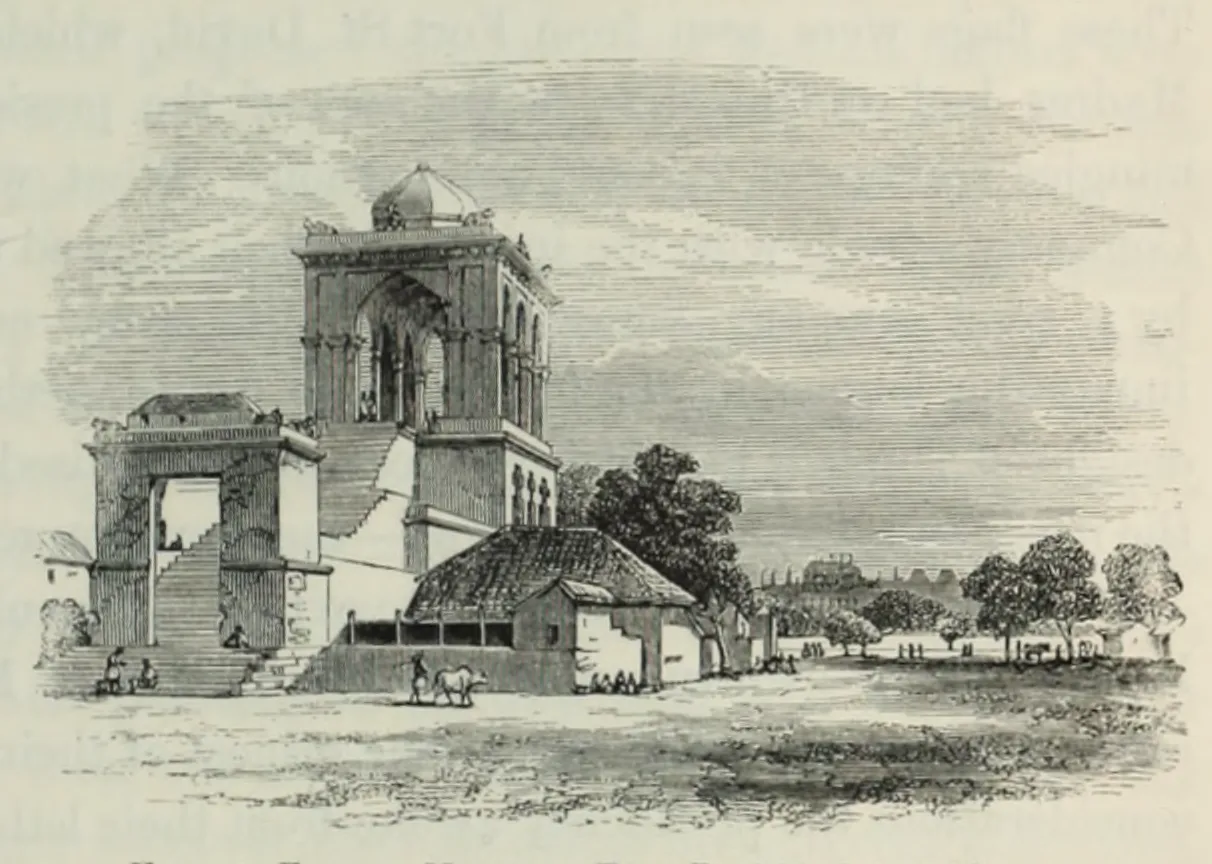
could no longer be restrained, and 2500 horse and 1000 infantry went over to the enemy.
At the time when this reverse was sustained, news arrived that Chunda Sahib was preparing to march from Arcot to besiege Trichinopoly. Mahomed Ali’s applications to the presidency for aid became more urgent than ever, and he endeavoured to give weight to them by promising not merely to pay all expenses, but to give a grant to the Company of a considerable territory adjoining Madras. Tempting as the offer was, there is reason to doubt if it would have succeeded had it not found a powerful advocate in a very unexpected quarter. Dupleix, ostensibly for the purpose of marking the boundaries of his new acquisitions, though probably as much for the purpose of tantalizing his rivals, had caused small white flags to be planted in almost every field. These flags were seen from Fort St. David, which, ever since the capture of Madras, had continued to be the seat of the presidency, and naturally excited mingled feelings of fear and indignation. What was to become of the English Company’s trade with the interior if they allowed themselves to be hemmed in by a rival company, whose boundary line would ere long be converted into an impassable barrier by the imposition of heavy, perhaps prohibitive duties? The designs of Dupleix had hitherto been only surmised, but he had now thrown off the mask and given them warning—the more impressive because of its insolence —of what they must be prepared to expect. It would be madness to hesitate any longer. Their own ruin was involved in that of Mahomed Ali, and their only safety was in supporting him to the utmost of their power. Influenced by such considerations the presidency awoke from their lethargy and resolved on action, still, however, not as principals but under their old disguise of mercenaries or auxiliaries.
In the beginning of April, 1751, a detachment was provided of 500 Europeans, fifty of them cavalry, 100 Africans, and 1000 sepoys, with eight field-pieces, and placed under the command of Captain Gingen, who was to wait near Fort St. David the arrival of Mahomed Ali’s troops from Trichinopoly. After a delay of six weeks he was joined by only 600 horse and 1000 foot, and proceeded south-west to Verdachelum, a large and strong pagoda, garrisoned by 300 of Chunda Sahib’s troops, who surrendered after being threatened with an assault. Shortly after the army was more than doubled by the arrival of 100 Europeans, sent by Captain Cope, and 2000 horse and 2000 foot, commanded by Mahomed Ali’s brother, and set out to encounter Chunda Sahib in person. He was encamped near Volconda, situated thirty-eight miles N.N.W. of Trichinopoly, on the highway from that city to Arcot. Its principal defence was a rock 200 feet high, and about a mile in circuit at its base, which was washed by the Valaru. It was inclosed by three walls; one at the bottom, mostly cut out of the solid rock; another near, and the third actually on the summit. The governor was summoned by both parties, but answered that he wished to see the issue of a battle before he would yield it up to either. Captain Gingen, becoming impatient, determined to force a surrender; and after posting his army so as to intercept the approach of Chunda Sahib, should he attempt to interfere, sent a strong detachment to attempt the capture. The town, inclosed only by a mud wall, was easily gained; but the rock, as should have been foreseen, could not be assaulted till a breach was made, and the detachment returned to the camp.
Captain Gingen, while thus assuming the offensive, seems to have been ignorant or regardless of the fact, that he was opposed by far superior numbers. Chunda Sahib had an army of 12,000 horse and 5000 sepoys, and was besides supported by a strong battalion of French. These at break of day next morning were seen approaching along the bed of the river, which was nearly dry. Instead of attempting to intercept their progress, Captain Gingen and his officers were deliberating in a council of war whether they should fight or retreat. It was resolved to fight; but meanwhile the French were near the foot of the rock, and the resolution came too late. The troops, aware of the hesitations of the council of war, had no hope of victory; and, seeing some of their officers betraying symptoms of fear when the guns of the fort opened on them, were seized with panic. Strange to say, it was at first begun and for some time confined to the Company’s battalion, for not only did their own officers—Clive, now a lieutenant, among the number—endeavour to rally them, but Abdul Wahab Khan, Mahomed Ali’s brother, riding up to them, and pointing to his own men, who still kept their ground, upbraided them for their cowardice. It was all in vain, and the day was lost. Even after the danger was over, the fear was so unequivocally declared, that Captain Gingen, to free them even from the sight of the enemy, commenced his retreat at midnight, on the road leading to Trichinopoly, and did not venture to halt till he had reached the pass or straits of Ootatoor. Chunda Sahib followed slowly by the same route. When he appeared in sight some skirmishing took place, and even a regular battle was talked of, but the spirit of the troops was still such that Captain Gingen was afraid to risk it, and stole away with them in the silence of the night. So eager were they to place themselves beyond the reach of pursuit, that they marched eighteen hours without refreshment in the hottest season. Chunda Sahib following leisurely found them encamped on the northern bank of the Coleroon, within sight of Trichinopoly. The site of the encampment was now the only spot of ground beyond the Coleroon which Mahomed Ali could call his own.
About five miles north-west of Trichinopoly, the Cauvery, after a somewhat circuitous south-easterly course of 380 miles from its source in the Western Ghauts, divides into two principal arms, the northern of which is called the Coleroon, while the southern retains its own name. For the first fifteen miles, as far as the fort of Coilady, the two arms run nearly parallel to each other, and again approach so near that they are only prevented from uniting by means of an artificial mound. The long and narrow slip of land thus inclosed between the arms forms what is called the island of Seringham. Near its western extremity, where the fork begins, and at a short distance from the Coleroon side, stood one of the most famous pagodas, or Hindoo temples, in Hindoostan. It consisted of seven squares, one within the other, each surrounded by a wall twenty-five feet high and four thick, and entered by four lofty turreted gates, facing the cardinal points. The wall of the outermost square is about four miles in circuit. The pagoda owed its celebrity to the supposed possession of the very image of Vishnu which Brahma used to worship; and the myriads of pilgrims flocking to it sufficed at one time to maintain 40,000 Brahmins in voluptuous idleness. About half a mile east of this pagoda, and near the Cauvery side, stood another, also of large dimensions, but with one inclosure only.
The encampment on the north bank of the Coleroon was inconvenient for obtaining supplies, and for this reason, and also no doubt because it was deemed safer to have a river between them and the enemy, Mahomed Ali’s army crossed over into the island of Seringham. The whole, including the English battalion, took up their quarters within the three first inclosures, and abstained at the earnest solicitations of the priests from approaching nearer to the sanctuary of the idol. The post was admirably adapted for defence, but a cowardly spirit still prevailed among the troops, and they would not believe themselves safe till they had taken the last retrograde step now possible, and place themselves under the walls of Trichinopoly. Chunda Sahib gladly occupied the island thus evacuated. It was not, however, with the intention of remaining in it. The great prize for which he was contending was now full in his view, and leaving only a garrison in Seringham, he crossed the Cauvery, and encamped on the east of Trichinopoly. The main body of Mahomed Ali’s troops were stationed on the south side, and the English battalion under Captain Gingen on the west. Captain Cope, with 100 Europeans, remained within the walls.
Trichinopoly, situated within half a mile of the south or right bank of the Cauvery, is in the form of a parallelogram, of which the east and west sides have each a length of 2000, and the north and south a breadth of 1200 yards. It is inclosed by a ditch, 30 feet wide, and 12 deep, supplied with water more or less copiously according to the season, but never dry, and two walls flanked at regular intervals by round towers. The outer wall, only 18 feet high, and about 5 thick, has neither rampart nor parapet; the inner wall, 30 feet high, and 25 feet apart from the other, is much stronger in every respect, having a rampart and a parapet both of stone, the former rising from a broad base by large decreasing steps, so as to be only 10 feet broad at the top, and the latter about 7 feet high, loopholed for musketry. Within the walls in the north part of the city is a lofty precipitous rock of sienite, commanding an extensive view of the surrounding country.
Such was the only place of strength now belonging to Mahomed Ali; and on the issue of the siege about to be commenced, depended not only his fate, in which, from the worthlessness of his character, no great interest could be felt, but the decision of the momentous question, whether a French or a British empire was to be established in India.
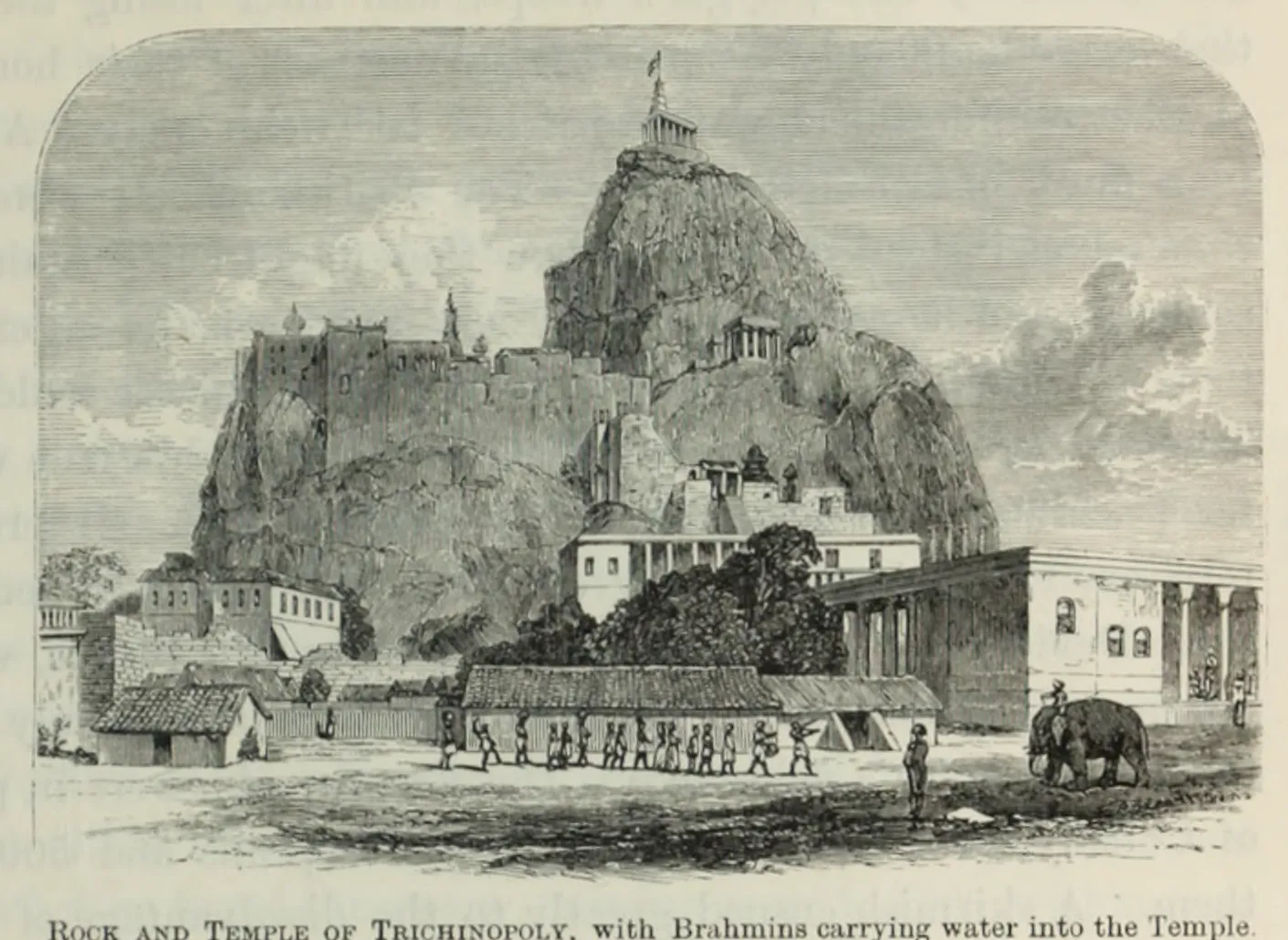
The presidency at Fort St. David, now fully committed to the war, were grievously disappointed at the series of disgraces and defeats which had been sustained, and could not look forward to the siege of Trichinopoly, without the gloomiest forebodings. They had no idea, however, of abandoning the contest in despair, and began to display a firmness and decision of which, it must be confessed, they had previously given few examples. Mr. Saunders, the governor, though devoid of the versatility and showy talents of Dupleix, surpassed him in more solid qualities; and having now no doubt as to the course which the interests of the Company dictated, pursued it with judgment and perseverance. His means, however, were very limited, and his first reinforcement for Trichinopoly consisted of only eighty Europeans and 300 sepoys, cumbered with a large convoy of stores. The conducting of such a body through a hostile country was a matter of no small difficulty, more especially, as Verdachelum which lay in the line of route, though it still held out against Chunda Sahib, was at this very time besieged by a polygar in his interest. The removal of this obstruction was therefore the first object to be accomplished. The charge of the reinforcement was given to Mr. Pigot, a member of council. He was accompanied, it would seem not officially, but rather as a volunteer, by Clive, who, after the capture of Devicotta, had resumed his position as a civil servant of the Company, though still closely connected with the army, by holding the appointment of commissary for supplying the European troops with provisions. It was in this capacity that he was present at Volconda when the ignominious flight took place; and hence, though he is mentioned as having been present at the council of war which preceded, and was one main cause of that flight, he did not share in the disgrace of it, but returned to Fort St. David.
Pigot and Clive, after reaching Verdachelum, and relieving it by surprising and defeating the troops of the polygar, sent the reinforcement forward to its destination through the kingdom of Tanjore, and were on their return to Fort St. David with twenty-four attendants, twelve of them sepoys, when they were surrounded by the polygar’s troops, and after losing the greater number of their attendants, only escaped by the fleetness of their horses. Not long after, another reinforcement was despatched to Trichinopoly. Affairs there were still in a most unsatisfactory state. The British officers were quarrelling among themselves instead of thinking how they might best sustain the honour of their country; and it seemed absolutely necessary to make an example of several of them by dismissing them at a time when their places could hardly be supplied. To meet the difficulty in part, Clive returned to his true vocation, and set out for Trichinopoly in command of the reinforcement. It proceeded through the territory of Tanjore, the king of which still professed neutrality, and received from Devicotta a small accession under Captain Clarke, who, as senior officer, assumed the command. The whole united mustered only 100 Europeans and fifty sepoys, with a field-piece. The French, who were in possession of the fort of Coilady, detached a body of thirty Europeans and 500 sepoys to intercept them. A skirmish ensued greatly to the disadvantage of the French, and the detachment reached Trichinopoly in safety. The superiority of the enemy was still very decided. Chunda Sahib’s troops were ten times more numerous than those of Mahomed Ali; and while the French battalion mustered 900, the English did not exceed 600 men. In pecuniary resources, also, the enemy had decidedly the advantage. The whole country either acknowledged their authority, or was subject to their exactions, while almost all the usual sources of Mahomed Ali’s revenues were dried up. The only thing to balance these advantages of the besiegers was the strength of the place.
Captain Clive returned to Fort St. David in the beginning of August, 1751, and after representing the fatal issue to which affairs at Trichinopoly were evidently tending, suggested as a last resource to attempt a diversion by an attack on Arcot. The bold proposal was accepted, and he was requested, or volunteered to undertake the execution of it. After stripping Fort St. David and Madras so as to leave only 100 men in the one and fifty in the other, the whole force that could be mustered for the expedition, amounted to 200 Europeans and 300 sepoys, with three field-pieces. Of the officers, eight in number, six had never seen service, and of these six four were civilians, who, animated by Clive’s example, quitted the desk for the sword. Starting from Madras on the 26th of August, they proceeded south-east to Conjeveram, where they arrived on the 29th, and learned that the fort of Arcot was garrisoned by 1100 men. From Conjeveram they continued their march nearly due west, not far from the northern bank of the Paliar, and on the 31st were within ten miles of Arcot. Their approach was made known by spies, who had seen the detachment marching with unconcern in a violent storm of thunder and rain. The garrison on hearing this report lost all heart, and under the combined influence of superstition and cowardice, abandoned the place a few hours before the detachment arrived. The city being without walls or defences was immediately entered, and Clive and his 500 men, marching in triumph under the gaze of 100,000 spectators, took possession of the fort. It was inhabited by 3000 or 4000 persons, who were permitted to remain, and contained goods which had been deposited in it for security to the value of £50,000. The goods were judiciously and generously restored to the owners without ransom; the artillery, consisting of eight pieces of cannon, from four to eight pounders, and a large quantity of lead and gunpowder, were all that remained to the captors.
Clive anticipating a siege made it his first business to provide the necessary stores, and then, in order to strike new terror into the garrison, set out in quest of them with the greatest part of his men and four field-pieces. They were found about six miles to the south-west, near the fort of Timery, but though drawn up as if they meant to make a stand, they only continued firing a single field-piece, managed by two or three Europeans, and made off for the hills before they could be brought within musket-shot. Two days after Clive again marched out of the fort, and, as before, found the enemy, now increased to 2000, within gun-shot of Timery. They were posted in a grove inclosed by a ditch and a bank, and having about fifty yards in front a large tank almost choked up and dry, with a bank much higher than that of the grove. As the detachment advanced, the enemy fired smartly from two field-pieces, and killed three Europeans. On this the detachment advanced rapidly, and the enemy, leaving the grove, hurried into the tank, where they were so well sheltered, that they inflicted some loss without sustaining any. Clive removed his troops behind some buildings, and sent out two platoons to attack two sides of the tank. Both gained the banks, and at the same instant let fly a double volley among the crowds within. They made no attempt to return, and fled, while Clive gained possession of the pettah or village under the walls of the fort. This he immediately summoned to surrender, but the garrison, discovering that he had no battering cannon, refused, and he had no alternative but to retreat, the enemy’s cavalry hovering around him at a safe distance till he reached Arcot.
The next ten days were employed on necessary works within the fort; and the enemy, increased to 3000 men, acquired new courage and began to talk of besieging. They were allowed to lull themselves into security, and on the 14th of September, two hours after midnight, were surprised in their sleep. Clive, with the greater part of his troops, beat up their camp from end to end without the loss of a man, while they fled on all sides with shrieks and confusion. When day broke, not a man of them was to be seen.
Two eighteen-pounders with some military stores had been asked from Madras, and were on the way escorted only by a few sepoys. In hope of intercepting them, a large detachment of the enemy occupied the pagoda of Conjeveram; and, on being expelled by thirty Europeans and fifty sepoys from Arcot, withdrew to a neighbouring fort. Here their numbers were continually augmented. The convoy being thus endangered, Clive, reserving only thirty Europeans and fifty sepoys, sent out all the rest of his troops to insure its safety. On this, the enemy with considerable dexterity suddenly changed their tactics, and hastening to Arcot, surrounded the fort with their whole force as soon as it was dark. A fire of musketry was immediately opened upon the ramparts from the adjacent buildings, while a large body, horse and foot promiscuously, rushed towards the principal gates with loud outcries and the noise of martial music. A few hand-grenades thrown into the mass so frightened the horses, that they galloped off, trampling the foot beneath them; a second assault made in the same manner was repulsed by the same means. The fire against the ramparts was still kept up and continued till daybreak, when the assailants fled precipitately on seeing the approach of the detachment and convoy. It is rather singular, that during the attack on the fort, the inhabitants within it expressed no sympathy with their countrymen outside. Some may see in this nothing but Clive’s good fortune, but others with more justice will see in it the due reward of the kindness and generosity which he had displayed in allowing them both to occupy their dwellings and retain possession of their goods.
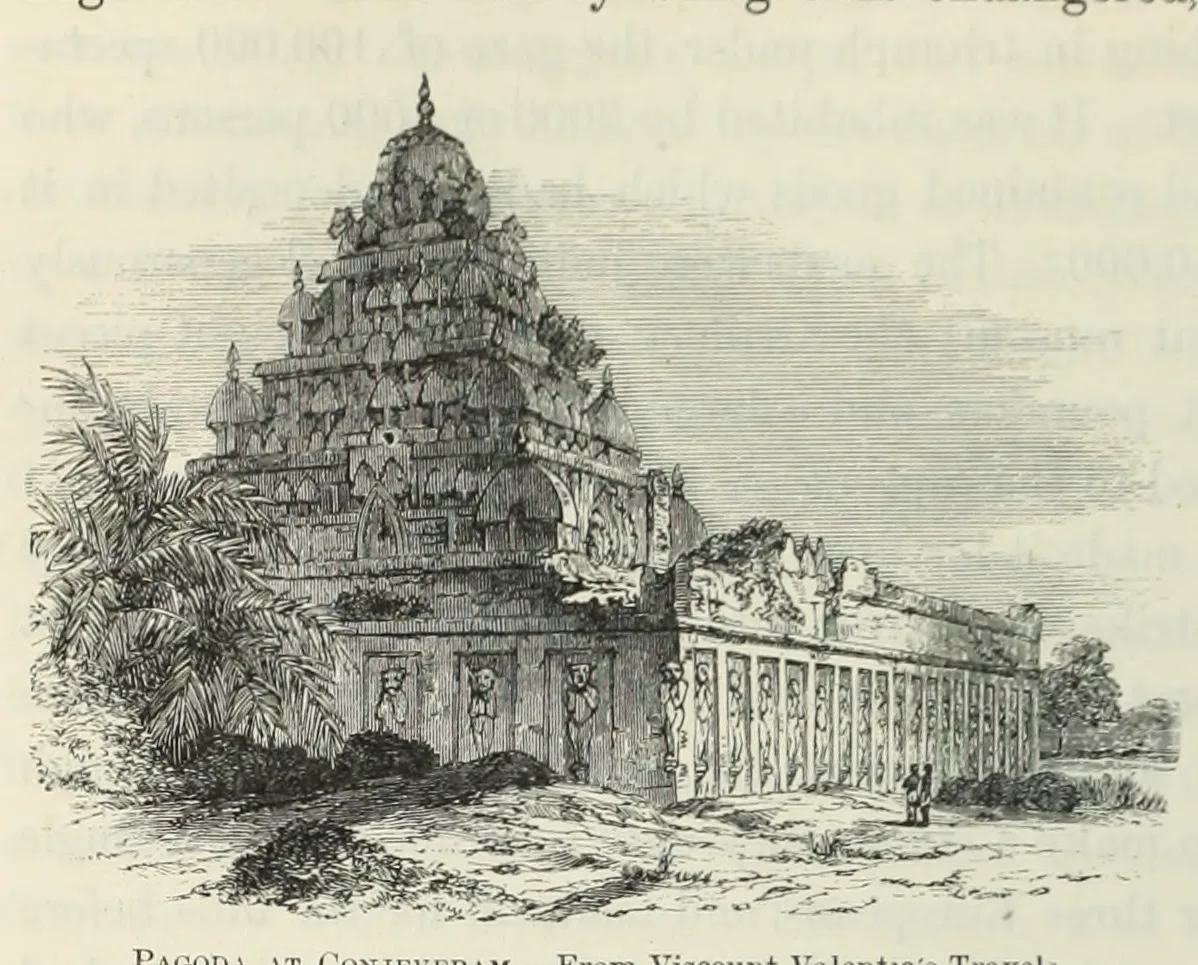
The capture of Arcot produced the effect which had been anticipated; and the pressure on Trichinopoly was considerably relieved by the withdrawal of 4000 of Chunda Sahib’s troops. These, joined on their route by his son Rajah Sahib, with 150 Europeans from Pondicherry, and the other troops previously collected in the neighbourhood, entered Arcot on the 23d of September. Clive, unwilling to be cooped up within the fort, determined to take the initiative, and try whether he could not, by a vigorous effort, rid himself of the enemy altogether. Facing the north-west gate of the fort was a street, which, after running north for 70 yards, turned east to the nabob’s palace, where Rajah Sahib had fixed his head-quarters. From the palace another street ran south, and was continued along the east side of the fort. The space thus bounded by streets on the west, north, and east, and by the north wall of the fort on the south, formed a square occupied by buildings and inclosures. With the intention of placing the enemy between two fires, Clive sallied out from the north-west gate with the greatest part of his troops and the four field-pieces, and advanced along the street leading north and east; while Ensign Glass was ordered to proceed from the east gate up the street leading north to the palace, which was thus the common point at which the two detachments, if they removed the obstacles in their way, would meet. On turning east, Clive saw the French troops, with four field-pieces, drawn up at the palace, and a cannonade commenced at the distance of only 30 yards. A few minutes cleared the street of the French, and obliged them to take refuge in the palace. Meanwhile, Rajah Sahib’s troops occupying the houses in the street, and sheltered by them, kept up a continual fire, with so good an aim that fourteen men sent to capture and bring away the French guns were all killed or wounded. To escape this murderous fire, Clive took advantage of a large choultry or building for the reception of travellers. It was situated on one side of the street, and having an open front supported by pillars, while its other three sides were inclosed, afforded good cover; and at the same time, giving free ingress and egress, enabled the artillerymen to load and fire without much danger. In this way the guns were gradually withdrawn into the north street; and the whole party which had sallied from the north-west gate were able to return by it into the fort. The platoon under Ensign Glass returned about the same time, after encountering similar difficulties. The whole attack was a decided failure, and gave Clive a lesson of caution which seems to have been, at this early stage of his military experience, by no means unnecessary. It cost him the lives of fifteen Europeans, who were killed on the spot or mortally wounded; and the services of sixteen more of his party, who were disabled. Among the latter was Lieutenant Revel, the only artillery officer; among the former was Lieutenant Trenwith, who, by pulling Clive aside when he saw a sepoy aiming at him, saved his commanding officer’s life and lost his own, as the sepoy immediately changed the aim, and shot him through the body.
The day after this affair Rajah Sahib was reinforced by 2000 men from Vellore, commanded by Mortiz Ali in person, and commenced the siege by occupying all the avenues leading to the fort. Its defence must have been regarded, both by besiegers and besieged, as all but impossible. Its walls, about a mile in circuit, and several of the towers flanking them, were in many places ruinous; the rampart, surmounted by a low and slightly built parapet, was too narrow to admit the firing of artillery; and the ditch, choked up in some places and dry in others, was generally, even when it contained water, so shallow as to be fordable. The only two gates—the north-west and east, already mentioned—were large piles of masonry projecting 40 feet beyond the walls, and the entrance to each of them was not by a drawbridge, but a broad causeway. This large, decayed, and ill-constructed fort had an efficient garrison of only 120 Europeans and 200 sepoys; and was besieged by an army of above 10,000, composed as follows—150 Europeans, 2000 sepoys, 5000 peons or undisciplined native infantry, and 3000 cavalry. As it was provisioned only for forty days, it was necessary to send away all the inhabitants except a few artificers, one of them, a mason, who most fortunately knew of a secret subterraneous aqueduct, by which, if it had not been choked up in consequence of his information, the only reservoir within the fort might have been drained of its water. As many of the houses of the town were within musket-shot, and would give great facilities to the besiegers, an attempt was made to burn several of them. It failed, because they were almost entirely of stone; and it was resolved to get rid of the two which threatened to be most annoying by employing more destructive means. Accordingly, at midnight, Ensign Glass and ten men, with several barrels of gunpowder, were let down from the wall by a rope. They got into the houses without being discovered, but made the explosion so unskilfully that the effect intended was not produced. Nor was this the only misfortune. The rope broke while Ensign Glass was ascending by it, and the fall unfitted him for further duty.
For a fortnight the besiegers, while waiting for the battering cannon, kept up a bombardment with four mortars, which did little damage. The fire of musketry from the houses was more effective; indeed, the aim was so sure that a man could scarcely show his head above the parapet without being hit. In this way three sergeants, accompanying Clive while he visited the works, were picked off, and several other persons were killed or wounded. Before the siege began in earnest, Mortiz Ali was tempted to try a stratagem. Pretending to be dissatisfied with Rajah Sahib, he withdrew with his troops to a different quarter of the city, and sent a secret messenger to acquaint Clive with his feelings, and assure him that if he would make a sally, he would support him with all his force. Clive was not to be thus caught, and cleverly foiled Mortiz Ali with his own weapons. Instead of giving a refusal, he pretended to approve of the scheme; and by maintaining the correspondence for several days, induced a large portion of the enemy to remain inactive. Mortiz Ali, perceiving at last that he was outwitted, returned to his former place in the camp.
On the 24th of October, two eighteen-pounders and seven smaller pieces arrived from Pondicherry. With these the French opened a battery to the north-west, and served it so well that the very first shot dismounted, and the second entirely disabled one of the eighteen-pounders in the fort. The other eighteen-pounder there was also soon dismounted, and removed to a spot not exposed to the fire from the battery, which, being thus scarcely answered at all, succeeded in six days in beating down all the wall between two towers, and making a practicable breach. The garrison, meantime, spared no exertion. Immediately under the rampart opposite to the breach two trenches were dug, leaving a considerable space between them, which was covered with crows’-feet; and still farther back, a house was pulled down to the height of a breastwork, from which palisades were carried along the ends of the trenches up to the parapet. One field-piece was placed on one of the towers flanking the breach, and two on the flat roof of a house opposite to it. The enemy, aware of the reception prepared for them, did not yet venture to storm, and proceeded to erect another battery on the south-west.
The garrison, in the meantime, more in the spirit of bravado than the anticipation of any important result, thickened the highest tower of the ramparts, and crowned it with a mound of earth. On the top of this mound, which commanded the palace, as it towered above the intervening houses, they hoisted up an enormous gun, said to have been sent from Delhi by Aurungzebe, and transported by 1000 yoke of oxen. The iron balls belonging to it weighed seventy-two pounds. The very first of these, fired from it with a charge of thirty pounds of gunpowder, went right through the palace, to the no small terror of Rajah Sahib and his staff. It was fired only once a-day, and after four discharges burst. The besiegers, wishing to retaliate in similar style, filled up the interior of a large house with earth well rammed down; and having thus formed a square mound, and raised it so high as to overlook every part of the fort, intended it for two small cannon and musketry. The garrison allowed the works to proceed till the cannon were actually mounted, and then opened upon it with their reserved eighteen-pounder, and with such good effect, that in less than an hour it tumbled down with the fifty men stationed upon it.
The perilous position of the garrison being well known at the presidency, it was resolved to reinforce it; and, with this view, a party of 100 Europeans and 200 sepoys left Madras under Lieutenant Innes. After a considerable part of the journey was accomplished, they were surrounded by 2000 of the enemy, and were only able, after serious loss, to retreat to the fort of Ponamalee, fifteen miles west of Madras. Relief from the presidency having thus become apparently hopeless, Clive opened a communication with Morari Row, the Mahratta chief of Gootee, who had been encamped for some time with 6000 men among the mountains, thirty miles west of Arcot. He had come as the hired ally of Mahomed Ali, but had remained inactive on seeing the desperate state of his affairs. Clive’s name, however, was now beginning to carry a charm along with it; and Morari Row’s answer was, that he would lose not a moment in coming to the assistance of such brave men as the defenders of Arcot, “whose behaviour had now first convinced him that the English could fight.” This intelligence alarmed Rajah Sahib, who endeavoured to anticipate the arrival of the Mahrattas by sending a flag of truce to the fort, offering honourable terms to the garrison, and a large sum of money to Clive, and threatening, if his offers were not accepted, to storm immediately and put every man to the sword. Clive only disdained his bribe, and laughed at his threats.
The reinforcement from Madras, slightly increased, and commanded by Captain Kilpatrick, was again attempting to advance; and a detachment of Mahrattas had actually arrived in the neighbourhood, and captured a quantity of ammunition going to the besiegers. Rajah Sahib, now awake to the danger of further delay, and encouraged by the effect of his south-west battery, which had made a still larger breach than that on the north-west, determined to storm. The day selected was the 14th of November, one of the greatest of Mahometan festivals, commemorative of the murder of Hossein, the chief of the Fatimites. During its celebration, every son of Moslem falling in battle against unbelievers, is understood to pass at once to paradise without enduring the delays and pains of intermediate purgatories. Taking advantage of the enthusiasm which such a period excites, and heightening it by inebriating drugs, Rajah Sahib, as soon as morning broke, gave the signal for assault. Every part of the fort was threatened; but the principal attack was made in four divisions, two directed against the breaches, and two against the gates. Clive, after making his arrangements, had gone to sleep, and on being aroused found the garrison at their posts. The ditch in front of the north-west breach was fordable, and the division allotted to this part of the attack rushed across it. A large number immediately sat down with great composure underneath the wall to act as a reserve, while the rest hastened up to the breach, filled it, and had even passed, before the defenders gave fire. It was most deadly, and continued without a moment’s interruption, those behind supplying loaded muskets to those in front as fast as they could discharge them. The two cannons planted on the roof of the house opposite the breach did fearful execution, and the assailants were forced to retire. Fresh bodies, however, again and again renewed the assault, but were driven off as before. Meantime, those seated under the wall were not forgotten, and a few bombs with short fusees thrown from above obliged them to decamp. At the south-west breach, the attack was made in a different manner. The ditch under it not being fordable, the assailants brought forward a raft, which was large enough to carry seventy men. These embarked upon it, and, though fired upon by two field-pieces, one on each flank, were nearly across, when Clive, observing the bad aim of the gunners, took the management of one of the pieces, and in two or three discharges caused such confusion that the raft was overset, and those upon it who escaped drowning swam back to the opposite side.
The assault had lasted nearly an hour. As soon as it ceased, the assailants employed themselves in carrying off their dead. They might have been permitted to discharge this duty of humanity undisturbed; but the fire of the garrison was not slackened, and they were obliged to desist. An act of heroism, on the part of a native, is not unworthy of being recorded. The leader of the sepoys at the north bridge, after greatly distinguishing himself, had fallen. He was greatly beloved by his men, and one of them crossed the ditch for his body. Though the attempt exposed him to the fire of forty muskets, he had the good fortune to escape unharmed with his honourable burden. The whole loss of the enemy was computed at 400 men, almost all natives; for the French, as if unwilling to encounter the English in the deadly breach while the two governments were actually at peace, had kept aloof, and been only spectators of the assault. The loss of the garrison amounted only to four Europeans killed, and two sepoys wounded. When the assault took place, so many of the garrison were disabled by wounds or sickness, that the whole number engaged mustered only eighty Europeans, officers included, and 120 sepoys. These, during the attack, served five pieces of cannon, and expended 12,000 musket-cartridges.
Two hours after their repulse, the enemy renewed their fire both with cannon and musketry; and with the exception of two hours, during which they were allowed, at their own request, a truce to bury their dead, maintained it till two in the following morning, when it suddenly ceased. When the day dawned the garrison were overjoyed to learn the cause. The enemy had evacuated the town; and the siege, after lasting fifty days, was finally raised. In the camp were found four pieces of artillery, four mortars, and a large quantity of ammunition, showing how precipitate the departure of the enemy must have been. In the evening, Captain Kilpatrick arrived with his detachment.
Rajah Sahib’s repulse had been the signal for the departure of all his auxiliary chiefs, and he was left only with the troops which his father had sent from Trichinopoly. With these and the French he moved west to Vellore, close to the eastern side of which he inclosed himself within strong intrenchments. Clive, being now free to act, left Captain Kilpatrick in command of the fort, and proceeded with 200 Europeans, 700 sepoys, and three field-pieces, south to Timery, which surrendered on the first summons. His next movements depended on the Mahrattas, who had promised to join him, but as usual employed themselves in plundering the surrounding country. Basin Row, whom his uncle, Morari Row, had left in command of 1000 horse, conducted himself so negligently when in the vicinity of Vellore that he exposed himself to a night attack, and was obliged to leave his camp to the enemy. Anxious to repair the loss he applied to Clive, who set out with him, and was thus engaged when he learned that a party of Europeans from Pondicherry were on the way to Arnee, a strong fort on the road between Arcot and Gingee. He proposed to intercept them, and succeeded, after some difficulty, in obtaining the consent of Basin Row, whose objections were not overcome till he learned that the French were carrying a large sum of money to Rajah Sahib. Even after he gave his consent, he was unable to muster more than 600 horse. These, when added to Clive’s original force, left him far inferior to the enemy, whom he discovered after a forced march of twenty miles, preparing to cross the river immediately to the north of Arnee with 300 Europeans, 2000 horse, and 2500 sepoys.
The enemy, perceiving their superiority, wheeled round and determined to give battle. Clive on his part did not decline it, and awaited the attack in an advantageous position—the Mahrattas occupying a grove of palm trees on the left, the sepoys a village on the right, and the Europeans an open ground in the centre between the two. In front were swampy rice fields, with a causeway leading through them to the village. The French, with about 1500 of their sepoys and their artillery, advanced along the causeway, while the horse, with the remaining sepoys interspersed with them, moved forward on the grove. Here a spirited action commenced, and the Mahrattas displayed much gallantry, making five successive charges, though only to be repulsed. The division advancing along the causeway were more successfully opposed, and were so galled and enfiladed by the English field-pieces that all but the artillerymen with the cannon quitted the causeway and made for the rice fields. Their position was not thereby improved, and a general alarm spreading over their whole ranks they commenced a retreat. Clive followed close in pursuit, but night coming on they made their escape with comparatively little loss, crossed the river and entered Arnee. So much, however, were they dispirited that they did not venture to remain, and quitted it in disorder, followed by the Mahrattas, who, now entirely in their element, overtook them, and captured Rajah Sahib’s military chest, containing 100,000 rupees. In consequence of this defeat, many of the enemy’s sepoys deserted and offered their services to Clive, who enlisted 600 of those who were best armed.
During the siege of Arcot, the French, by occupying Conjeveram, had interrupted the communication with Madras, and captured a party of disabled men who were proceeding thither. Some of them they are said to have atrociously murdered in their litters, but Lieutenant Revel and Ensign Glass, already mentioned, obtained quarter, and were living as prisoners in Conjeveram when Clive appeared before it and summoned it to surrender. The French commander so far forgot himself as to threaten that, if he were attacked, he would expose these English officers on the walls. Clive paid no regard to this unworthy menace; and on receiving two eighteen-pounders from Madras, began to batter in breach at the distance of 200 yards. On this occasion he made another of those remarkable hairbreadth escapes, of which we have already seen several instances, an officer who accompanied him while reconnoitring being shot dead by his side. The breach would soon have been rendered practicable, but the French commander, dreading the resentment which he knew he must have provoked, did not venture to stand an assault, and abandoned the place in the night, leaving his two prisoners behind. After ruining the defences of Conjeveram, Clive sent 200 Europeans and 500 sepoys to Arcot, and returned with the rest to the presidency, to give an account of his triumphant campaign.
Rajah Sahib’s scattered troops, seeing the field again clear by the departure of the British, re-assembled, and moving down toward the coast, ravaged part of the Company’s territory around Madras and in the vicinity of St. Thomé. They next returned to Conjeveram, repaired the defences of the pagoda, garrisoned it with 300 sepoys, and kept possession of the open country as far east as Ponamalee. The presidency, who had been employed in preparing a reinforcement for Trichinopoly, determined to employ it, in the first instance, in expelling these dangerous and troublesome intruders. Clive, appointed to this task, marched from Madras in February, 1752, with a detachment which, when augmented by a reinforcement from Arcot, consisted of 380 Europeans and 1300 sepoys, with six field-pieces. The enemy, though mustering 400 Europeans, 2000 sepoys, and 2500 horse, with a large train of artillery, did not venture to risk an encounter, and removed south to Vandaloor, where, as they strongly intrenched themselves, they seemed determined on a stand. On Clive’s approach it looked as if their courage had again failed them, for they had not only abandoned their camp, but dispersed as if some sudden terror had struck them. It soon appeared, however, that they were not obeying their fears, but following out a deep-laid scheme. When again heard of they were united at Conjeveram, and preparing to move west on Arcot. Aware that it had been almost entirely stripped of its garrison to furnish the above reinforcement, they had determined to fall upon it suddenly, after they had tempted Clive so far away as to make it difficult for him to advance to its relief. The stratagem nearly succeeded, not merely in consequence of the feebleness of the garrison, but of treachery within it. Two native sepoy officers had been gained over, and were to have opened the gates. Fortunately the plot was discovered, and the enemy, finding that the signals agreed upon were not answered, went off as suddenly as they had appeared.
Notwithstanding intelligence of their departure, Clive continued his march westward, and at sunset had come within sight of Coverypauk, when the van, advancing without suspicion, were fired upon from nine pieces of cannon at the distance of only 250 yards. The whole enemy were here lying in ambuscade, and the cannons were the French artillery posted in a grove, with a ditch and bank in front. Clive made his arrangements hastily, but with the greatest coolness. Ordering the infantry to take shelter in a water-course immediately on the left, and the baggage to be moved back half a mile, under the guard of a platoon and one of the field-pieces, he sent a detachment, with two field-pieces, to oppose Rajah Sahib’s cavalry, who were spreading out on the plain, and employed his other three remaining pieces to answer the fire from the grove. The French infantry advanced along the water-course in a column of six men abreast, and were met by the English infantry in the same order. Neither ventured to come to the bayonet, and an indecisive fire of musketry was kept up for two hours by moonlight. The enemy’s cavalry were also kept at bay, and failed in several attempts on the baggage. So far the fight was equal. It was otherwise with the artillery. Clive’s three pieces were no match for the French nine, and so many of his gunners were killed or disabled, that he saw no alternative but to take the enemy’s battery or to retreat. The former, if practicable, was of course the more desirable, and was at once adopted, when a sergeant, who had been sent to reconnoitre, returned with the information that the enemy had left the rear of the grove without any guard. A strong detachment was immediately despatched towards the enemy’s rear by a long circuit. Clive himself accompanied it half-way, and returned only in time to find the troops he had left in the water-course on the point of giving way. He succeeded with some difficulty in rallying them, and had renewed the fight, when all at once the enemy’s artillery ceased to fire. The attack on the rear had been completely successful. The detachment reached the grove unperceived, and gave a general volley at the distance of only thirty yards. The panic was instantaneous, and the enemy fled without firing another shot. Many of the Frenchmen who had crowded into a choultry in the grove gladly accepted of quarter, and became prisoners of war. Among the immediate fruits of the victory were nine field-pieces, three coehorn mortars, and the surrender of the fort of Coverypauk.
Clive continued his march to Arcot, and was next day on his way to Vellore, in the hopes of inducing Mortiz Ali to pay a contribution, or at least deliver up the elephants and baggage which Rajah Sahib had deposited with him, when he received an order to repair with all his force to Fort St. David, from which it was determined to despatch him, in command of a reinforcement, to Trichinopoly. In marching south across the country in obedience to this order, he passed the spot where Nazir Jung had lost his life, and where Dupleix, to commemorate the very detestable action which he heralded as a victory, had founded a city under the name of Dupleix-Fateabad, or the City of Dupleix’s Victory. In its centre a column, with a pompous inscription in French, Persian, and several Indian languages, was to have been erected. Clive did an act of justice, as well as sound policy, by levelling the whole with the ground. Though his route lay through a country still nominally in the hands of the enemy, no obstruction was offered. Their spirits and their force were equally broken ; and Mahomed Ali, who lately did not possess any spot north of the Coleroon, was, mainly by Clive’s exploits, put in virtual possession, as nabob, of a territory sixty miles long by thirty broad, and yielding an annual revenue of £150,000. Three days after Clive’s arrival at Fort St. David, Major Lawrence returned from England and again assumed the chief military command.