WHILE Clive was gaining his successes in Arcot, Chunda Sahib continued to beleaguer Trichinopoly. The chief burden of the siege fell upon the French, who, having obtained a train of battering artillery from their settlement of Carrical, erected their principal battery at the distance of 1200 yards from the north-east angle of the fortress. Their head-quarters were fixed at some distance eastward, near the south bank of the Cauvery; and in order to save the trouble of connecting them by trenches, they converted the battery into a regular redoubt by inclosing the flanks and rear with a parapet and a ditch. The battery was mounted with three eighteen-pounders and three mortars; and on a rock, afterwards known as the French Rock, situated nearly due south of the battery and about 2000 yards from the south-east angle of the fortress, two eighteen-pounders were placed. Two guns were also posted on the north bank of the Cauvery, within the island of Seringham, opposite to the northern gate. These arrangements indicated a great lack of engineering skill and enterprise, as both of the two gun-batteries were far too distant to make any impression on the walls. Accordingly, after they had continued for several days wasting their ammunition to no purpose, the troops under Captain Gingen not only got rid of their former fears, but ran to the opposite extreme, and blamed him for not allowing them to be foolhardy. All his caution, though it had formerly been excessive, was now necessary to prevent them from exposing themselves to disaster.
To meet the enemy's attack the defenders raised up a glacis, leaving nothing but the parapet of the wall visible, opposite to the principal battery, flung up an entrenchment opposite to the French Rock, and mounted two guns close to the south bank of the Cauvery, to answer those on the opposite side in the island of Seringham. A constant firing was now kept up on both sides without any result. The time wasted, however, began to tell severely against Mahomed Ali, whose resources were much more limited than those of the besiegers. Besides maintaining his own troops he was expected to subsidize the Company's troops. This he feared would soon become impossible, and the consequence might be that these troops would withdraw and leave him to his fate. Very naturally, therefore, he looked about for new allies, and found one in Mysore, then the most powerful of the neighbouring states. Its sovereign was at this time an infant, and the whole power was concentrated in the hands of his uncle, the dalaway or regent, who listened to Mahomed Ali the more readily from the deep hatred which he bore to Chunda Sahib. At the same time, while gratifying his hatred, he did not forget his interest, and sold the promise of his assistance at a very extravagant rate. He was not long, however, in beginning to fulfil it. In the beginning of October, 1751, a party of horsemen arrived from Seringapatam, the capital of Mysore. Their number was only seventy, but they brought with them what was of more consequence, in the shape of a subsidy of 500,000 rupees (£50,000).
This was only a foretaste of the aid about to be furnished by the dalaway, for in the latter end of November he began to assemble an army at Caroor, about forty-five miles W. N. W. of Trichinopoly; and, not contented with his own troops, hired a body of 6000 Mahrattas, under the command of Morari Row. We have already seen 1000 of these mercenaries, under Basin Row, co-operating with Clive in Arcot. A party of 500 sent to Trichinopoly distinguished themselves as soon as they arrived by their activity; and both by the boldness of their charges, and their cunning devices in laying ambuscades, cut off a considerable number of the enemy. Unduly elated by this success, they were eager for a general engagement, and on finding the English indisposed to risk it, told them, “they were not the same kind of men they had seen fighting so gallantly at Arcot.”
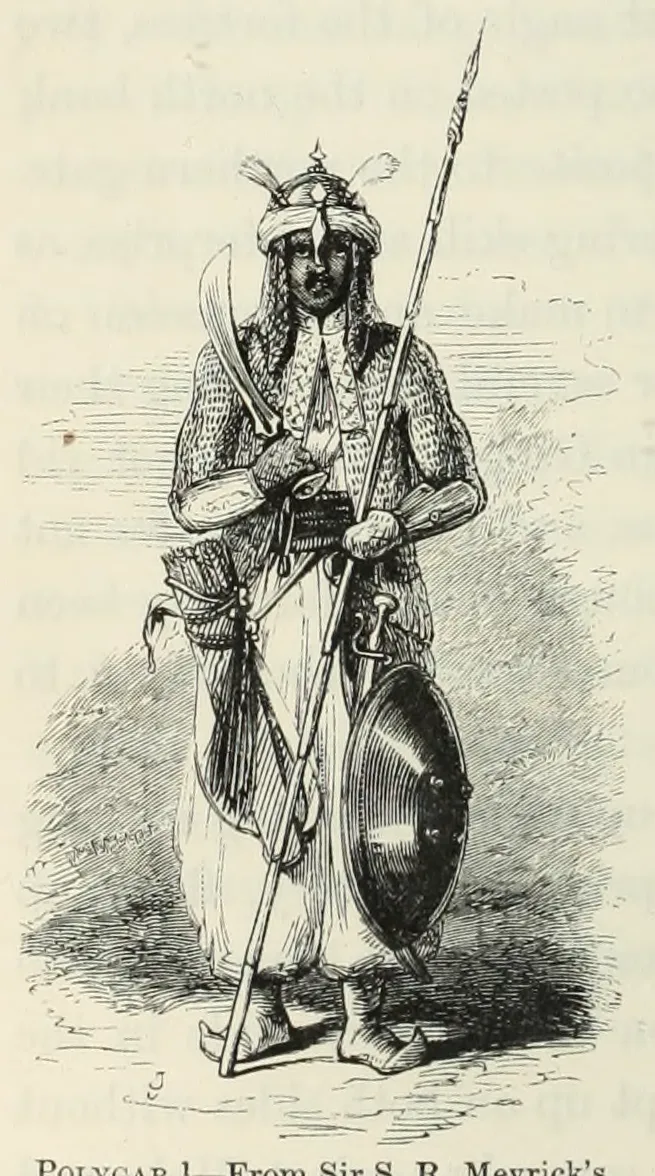
Mahomed Ali's prospects now began to brighten, for after some frivolous delays, the Mysore army, consisting of 12,000 horse, of whom 4000 were Mahrattas, led by Morari Row, and 8000 foot, arrived at Trichinopoly. The numbers appear much more formidable on paper than they were in reality, for at this time the Mysorean troops were cowardly and undisciplined. Independently, however, of their actual value, they had indirectly a powerful influence in inducing other neighbouring states to join the same side; and hence the King of Tanjore, who had hitherto professed neutrality, no sooner learned the arrival of the Mysorean army than he declared in favour of Mahomed Ali, and sent him an auxiliary force, consisting of 3000 horse and 2000 foot, under the command of his general Monacjee. The Polygar Tondeman, whose country is Tanjore and Madura, also espoused the same side, and sent a considerable reinforcement. The army of Mahomed Ali now amounted to 20,000 horse and 20,000 foot; that of Chunda Sahib, increased from different quarters, was little inferior, since it had exactly the same number of foot, and was only 5000 weaker in cavalry.
The urgency of the Mahrattas and their other confederates for action was now greatly increased, and Captain Gingen had much difficulty in resisting their importunity. When he announced his determination to wait for the reinforcement which was expected from the presidency, several of the native officers lost all patience, and scrupled not to stigmatize his so-called caution as mere cowardice. So dissatisfied, indeed, was Nusheraj, the Mysorean commander, that he was more than once on the point of returning home with his army, and was only appeased when the revenues of all the districts recovered since his arrival were made over to Mysore. Morari Row, equally offended, said less, but acted with the characteristic duplicity of his countrymen, by entering into a secret correspondence with the enemy.
The reinforcement commanded by Major Lawrence, ably seconded by Captain Clive, was now on its way. It consisted of 400 Europeans and 1100 sepoys, with eight field-pieces, and was cumbered with a large quantity of military stores. Both armies, aware of the effect which it might have on future operations, were equally on the alert, the one to secure its safe arrival, and the other to intercept it. On the 26th of March it arrived at a fort of the King of Tanjore, within twenty miles of Trichinopoly, and there deposited such of the stores as were most cumbersome. M. Law, the commander of the French battalion, acting not merely on his own judgment, but by special instructions from Dupleix, was determined not to allow it to pass without a strenuous effort to effect a capture. The first struggle commenced at the fort of Coilady. It was in possession of the French, who had here posted a strong body with artillery. Major Lawrence, anxious to avoid the danger, ordered his guides to look out for another road. Instead of doing so they led him to the very spot. The error was first discovered by the fire of six pieces of cannon from the opposite side of the Cauvery. Great was the confusion, but both by good fortune and good management the loss sustained was small, and the line, by diverging to the left, was soon beyond the enemy's reach. A more serious contest was at hand. On advancing towards Elimiserum, a rock crowned with a fortified pagoda, five miles south-east of Trichinopoly, Major Lawrence learned that the greater part of the enemy's army was drawn up in battle array between it and the French Rock, while the remainder occupied the space between this rock and the village of Chukleypollam, on the south bank of the Cauvery. The object was very apparent. Had the major attempted to pass to the north of Elimiserum he could scarcely have escaped being surrounded. He therefore passed to the south, and had only proceeded a short way, when he had the satisfaction of being joined by 200 Europeans and 400 sepoys under Captain Dalton, and the greater part of Mahomed Ali's army.
Scarcely half an hour had been spent by the troops in taking refreshment when the scouts came in at full speed to announce that the whole of the enemy’s army was advancing. Clive, sent out to reconnoitre, observed that a large choultry with some stone buildings in front of the French battalion remained unoccupied, and was ordered forward as fast as possible with the first division of artillery, supported by the grenadiers, to take possession of it. The enemy, though aware of their object, did not attempt to outstrip them, as they might and ought to have done, and contented themselves with opening a cannonade. It was the hottest that had yet taken place in India, the French firing from twenty-two pieces, and the English from nine. The latter, though much fewer, did more execution, because the English not actually serving the guns were sheltered by the choultry and its buildings, while the French stood exposed in the open plain. This advantage soon told ; and the enemy beginning to waver, first drew back their artillery, and then commenced a general retreat. Had the native troops on the English side done their part a decided victory might have been gained, but they had remained almost inactive, as if they had been not combatants, but mere spectators. This is said to have been owing, not to any want of bravery, but to the bad example set by Morari Row, whose intrigue with the enemy was now so far advanced that he was unwilling to act against them. Though from this cause the enemy escaped with a comparatively small loss, an important object had been gained ; for the reinforcement, no longer interrupted in its progress, arrived in the course of the evening at Trichinopoly.
Major Lawrence, not to allow the enemy to recover from the terror inspired by their defeat, proposed immediate action, but met with so many obstructions from his allies, whose notions of fortunate and unfortunate days often induced them to sacrifice their most favourable opportunities, that he resolved to attempt something with his own troops on his own responsibility. His object was to surprise Chunda Sahib’s camp, which lay to the east of that of the French, and had no entrenchments. With this view he despatched Captain Dalton with 400 men, with orders to make a long circuit, and commence his attack on the east side of the camp, beat it up, and set fire to it. Owing to a blunder of the guides the expedition failed, but the mere fact of its having been attempted so alarmed the French commander that nothing would satisfy him but a retreat to the island of Seringham. Chunda Sahib remonstrated, but M. Law carried his point, and with so much precipitation, that a part of the baggage and whole magazines of provisions were set on fire, to save the difficulty of transport or prevent the danger of capture. The whole proceeding looks like infatuation. By retiring beyond the Cauvery the siege was truly at an end. Why then remain cooped up in an island, with the certainty of being soon pressed for supplies, and the probability of being excluded from the possibility of egress ? The only plausible account which has been given of the enemy’s withdrawal to the island is, that “ they were afraid to fight, and ashamed to retreat.”
The English East India Company, while naturally encouraged and elated by the favourable turn which affairs had taken, were suffering severely in their mercantile interest by the length and expensiveness of the war; and it therefore seemed justifiable, even at some risk of failure, to adopt any plan which promised to bring it with the least delay to a successful termination. Such a plan was suggested by Clive, and adopted by Major Lawrence. It was to form the army into two divisions; and while retaining the one south of the Cauvery, to send the other to the north of the Coleroon. Hazardous it certainly was, for the defeat of one division almost necessarily involved the destruction of both. A difficulty remained. To whom was the command of the northern division to be intrusted? Major Lawrence was anxious to appoint Clive, but several of the officers as his seniors had a prior claim. The Mahrattas and Mysoreans removed the difficulty, by declaring that they would not allow any of their troops to accompany the expedition unless Clive had the command of it. He was accordingly appointed, and after arranging to choose a central position between the Coleroon and the straits of Ootatoor, so as to be always within a forced march of Trichinopoly, set out on the 6th of April, 1752, with 400 Europeans, 700 sepoys, 3000 Mahrattas commanded by Innis Khan, 1000 Tanjorine horse, two battering cannon, and six field-pieces. Having reached the north bank of the Coleroon by crossing the island of Seringham three miles east of the pagoda of Jumbakistna, he marched north seven miles and took possession of the village of Samiaveram, with its two pagodas, one on each side of the highroad leading to Ootatoor.
Dupleix, alarmed at the critical position into which Chunda Sahib’s army had been brought by M. Law’s injudicious retreat into the island of Seringham, sent M. d’Auteuil to supersede him. He was accompanied by 120 Europeans, 500 sepoys, with four field-pieces, and a large convoy of provisions and stores. Clive, on learning his arrival at Ootatoor, and intention to avoid Samiaveram, by making a large circuit to the west, set out with the greater part of his force to intercept him. M. d’Auteuil, informed of this movement, hastened back to Ootatoor, and Clive retraced his steps to Samiaveram. M. Law, who knew of Clive’s departure and not of his return, sent a party of eighty Europeans and 700 sepoys to attack Samiaveram, and make an easy prize of the few troops who had been left in it. They arrived in the vicinity at midnight, and were informed by a spy of the return of the force sent against M. d’Auteuil. The commanding officer refused to believe it, and pushed forward with his men. On being challenged by the advanced guard of the English sepoys, an Irishman, who was in command of a body of deserters, stepped out and told them that Major Lawrence had sent him with a reinforcement. The sepoys, hearing some of the other deserters speaking English, were so fully satisfied, that they never thought of asking the counter-word, and even sent one of their number to conduct them to head-quarters. Thus guided, they passed without interruption through part of the Mahratta camp, and reached the lesser pagoda. Here they were challenged by the sentinels, and answered by firing a volley. Clive, who was sleeping in a neighbouring choultry, started up, and, imagining that it was his own sepoys who were firing in consequence of some alarm on the outskirts, hastened off to the larger pagoda for a body of Europeans, and returned with 200 of them to the choultry, when he was confirmed in his first impression by finding a large body of sepoys drawn up facing the south, from which any alarm might be supposed to have come, and firing at random. Never doubting that they were his own men, he left his Europeans twenty yards in their rear, and went in among them, upbraiding them for their panic. His voice betrayed him to one of the sepoys, who instantly attacked him with his sword, and wounded him in two places. Clive immediately encountered his assailant, who took to his heels and ran off for the lesser pagoda. Still unconscious of his mistake, and enraged that he should thus have been attacked by one of his own men, he followed in pursuit, and first learned the real state of matters by being accosted by six Frenchmen. With singular presence of mind, he at once recovered from his surprise, and with great composure told the Frenchmen he had come to offer them terms, at the same time bidding them look round and see how completely the pagoda was surrounded by his army. Three of the Frenchmen went back into the pagoda to acquaint their countrymen with the offer of quarter; the other three actually gave up their arms and followed him to the choultry, where he took the necessary steps to rid the camp of intruders.
Clive’s personal dangers were not yet over. The pagoda, desperately defended by the French and the English deserters, remained in their hands till daybreak. As the only chance of escape, a sally was attempted. It failed; and Clive, anxious to save further bloodshed, advanced to parley. Weak with the loss of blood and fatigue, he was standing with his back towards the wall of the porch, and leaning in a stooping posture on the shoulders of two sergeants, when the Irish deserter, probably aware that whatever terms were made, he could have no hope of mercy, insolently advanced, and telling Clive that he would shoot him, fired his musket. The bullet missed him, but passed through the bodies of both the sergeants, who fell mortally wounded. The escape looks like a miracle. It was afterwards discovered that, at the very commencement of the alarm, he had had another escape scarcely less wonderful. The very first volley which started him from his sleep, shattered a box under his feet, and killed a servant who was lying close to him. Three hairbreadth escapes in a single day —the midnight volley—the sepoy’s sword—and the Irish desperado’s deadly aim—make it impossible to doubt that a special Providence was watching over him and reserving him for great events. The 700 sepoys who had entered the camp, managed to quit it again during the confusion, and were hastening back to the Coleroon, when the Mahrattas were observed in full pursuit. They attempted to escape by throwing down their arms and dispersing. It was in vain; every man of them perished.
The position of the two armies was now reversed. The besiegers saw themselves besieged and in danger of being starved out. Their great hope was in M. d’Auteuil; but this hope soon failed them, for that officer, despairing not only of reaching Seringham, but of maintaining his position at Ootatoor, made a rapid retreat to Volconda, after sacrificing a large quantity of his stores. This loss, and the dangers which threatened on every side, determined Chunda Sahib’s officers to execute a design which they had for some time contemplated. Approaching him in a body, they announced their determination to quit his service. Instead of upbraiding them, he told them that they had only anticipated a similar proposal from himself. He was unable to pay their arrears, but assured them that they would not be forgotten should better fortune again attend him; and gave the best proof of his sincerity by making over to them at a valuation the greater part of his elephants, camels, horses, and other military effects. Some of the troops thus set free returned home; others took service with the Mysoreans. Very few went over to Mahomed Ali; but Clive, at Samiaveram, was joined by 2000 of the best horse and 1500 sepoys. Chunda Sahib was left with only 2000 horse and 3000 foot, who were lodged in the pagoda of Seringham. The French battalion, with 2000 sepoys, shut themselves up in the pagoda of Jumbakistna, and gave out that they meant to defend themselves to the last extremity. As their only hope, they still kept their eyes turned towards M. d’Auteuil, who, on his part, so far from being able to bring them succour, was entirely occupied with his own difficulties. After various movements, which only entangled him more and more, he was cooped up by Clive in the fort of Volconda, and obliged to come to terms. One of these was that deserters should be pardoned. It seems strange that there should have been any occasion for such a clause; but its importance is perceived when we learn the astounding fact, that though the whole number of Europeans under M. d’Auteuil was only 100, no fewer than thirty-five, more than one-third of the whole, were English soldiers who had deserted.
The surrender of M. d’Auteuil left the French in Seringham without the least prospect of relief. Preparatory to a capitulation, it was thought desirable that an attempt should be made to secure the escape of Chunda Sahib. M. Law was aware that in the hands of Dupleix he might still be turned to good account; and he appears, moreover, to have been sincerely desirous not to allow him to fall into the power of Mahomed Ali, who was well known to be thirsting for his life. So completely, however, was the island now watched, that the only mode of escape which seemed practicable was to bribe some of the native auxiliaries to allow him a passage through their quarters. Several were thought of—the Mahrattas, but they would sell him to the highest bidder—the Mysoreans, but they would employ him as a hostage to obtain the performance of the promises which Mahomed Ali had made to them—and the Tanjorines, but they bore him an old grudge, and would be willing to take an opportunity of avenging it. It was known, however, that Monacjee, the Tanjorine commander, was at variance with the prime minister, and might in consequence be induced to pursue a separate interest. To him, therefore, the overture was made. He gave his consent readily, and received a large sum of money in hand, with the promise of much more, and almost any advantage for which he chose to stipulate. The bargain was thus concluded, and nothing remained but to fix the time of Chunda Sahib's departure, when, on the 31st of May, on the arrival of battering cannon from Devicotta, Major Lawrence summoned M. Law to surrender. Monacjee, now pretending zealous friendship, took advantage of the summons to urge Chunda Sahib to come over that very night, and assured him that every hour's delay added greatly to his risk. Some suspicion of treachery was felt, and Monacjee was asked for a considerable hostage. He answered with great calmness, that if treachery was meant, no hostage could prevent it, and that, moreover, the mere giving of a hostage would be equivalent to a divulging of the whole secret. He bound himself, however, by an oath on his sword and poniard, the most sacred of all obligations to an Indian soldier, to send off Chunda Sahib as soon as he came into his quarters, with an escort of horse to Carrical. All this had taken place at an interview with M. Law, whose suspicions were still further lulled by a Tanjorine officer who told him he was to command the escort, and showed him the palanquin and other preparations for the journey. Chunda Sahib, who was waiting to hear the result of the interview, immediately placed himself in the power of Monacjee, whose first use of it was to put him in irons.
M. Law, after concluding the arrangement for his unfortunate colleague in arms, had no alternative for himself. He was absolutely at the mercy of his antagonists, and had no hope except in the moderation of Major Lawrence. The French, he said, were not at war with the English; and now that Chunda Sahib was a prisoner, and his army dispersed, he expected to be treated not as an enemy, but as the representative of a friendly power, and assisted to return in safety with his army to the French settlements. Major Lawrence replied that he acted only as the interpreter of the intentions of Mahomed Ali, and justified the terms which he proposed to exact by producing a letter in which Dupleix declared that he would never cease to pursue him while a Frenchman remained in India. The first summons to M. Law was to surrender at discretion; a second, in more peremptory terms, demanded a decisive answer by a fixed hour, and added that, if the batteries once began to play, every man in the pagoda should be put to the sword. Ultimately, all evasions proving vain, M. Law resigned himself to his fate, and made an unconditional surrender. The whole force under his command, and which thus became prisoners of war, consisted of a battalion of 820 Europeans and 2000 sepoys. Their artillery were eleven battering cannon, mostly eighteen-pounders, twenty field-pieces, four thirteen-inch mortars, and two petards; they had also a large quantity of ammunition, stores, and carriages of all descriptions. The native horse and foot within the pagoda of Seringham were allowed to depart without molestation. They all embraced the offer except 1000 Rajpoots, who, having vowed to defend the sanctity of the pagoda, kept their station, and threatened death to any one who should dare to penetrate beyond the third inclosure. It was deemed unnecessary to disturb them. The only point still to be decided was the fate of Chunda Sahib.
He was still the prisoner of Monacjee, who held him as his prize and refused to part with him. Major Lawrence proposed his safe custody in one of the English settlements; but the confederates were unanimous in rejecting this proposal. They were, however, far from being agreed as to any other, and Monacjee began to suspect that his prisoner would eventually give him more trouble than profit. The Dalaway of Mysore, Mahomed Ali, and Morari Row were all equally bent on securing possession of his person; and it was impossible to gratify one of them without offending the other two. In these circumstances Monacjee took the course which his savage nature dictated, and rid himself of further importunity on the subject of Chunda Sahib by putting him to death. Mahomed Ali, now freed from a rival in the Carnatic, became nabob in reality as well as in name, and will in future be mentioned under that title.
No sooner was the surrender of the French completed than Major Lawrence urged the nabob to lose no time in proceeding into the Carnatic at the head of the confederate army. The soundness of his advice was readily admitted; still the nabob lingered and betrayed a mysterious backwardness to move. Major Lawrence had no idea of the cause, till the Mysorean explained it by refusing to move until Trichinopoly and its dependencies were yielded up to him as the stipulated recompense of his services. The secret had been well kept; but now, when dissimulation could no longer avail, the nabob, when questioned on the subject, readily admitted that he had promised all which the Mysorean asked. This ought to have settled the question; and be the consequences what they might, the only honest course was to fulfil the promise. Nothing, however, was farther from the nabob's intention, and it was easy to devise plausible pretexts for evading the obligation. Trichinopoly was not his; it belonged to the Great Mogul; he was only viceroy, and might be recalled at pleasure; the Mysorean, when he took advantage of his distress to extort the promise, must have known that it was not in his power to perform it; to give up Trichinopoly to an Indian king would only be to involve himself and the British as his allies in a war with the whole Mogul empire.
It would be useless to explain the negotiations which ensued, and detail the cunning tricks which the parties employed to outwit each other. The most important point is that the Company, while recommending mutual concession, agreed to stand by the nabob, and so far to support him in his injustice by intimating to the Mysorean, that if he had recourse to force they would repel it. The effect was to patch up a hollow agreement, which neither party meant to keep. By this agreement the dalaway was put in possession of the revenues of the island of Seringham and some other districts, and promised the possession of Trichinopoly in two months; in return he engaged to assist the nabob with all his force in the complete reduction of the nabobship. When, in terms of this agreement, the Mysorean was asked to march, he made so many frivolous excuses as left no doubt as to his intentions. As the most effectual means of frustrating them, Captain Dalton was left in Trichinopoly with 200 Europeans and 1500 sepoys. This measure was doubtless necessary, since the Mysoreans and Mahrattas still retained their old encampment in the vicinity; but it greatly reduced the strength of the expedition intended for the Carnatic, reducing the Company’s battalion to 500 men and 2500 sepoys, while the nabob was unable to accompany them with more than 2000 horse. Such was the whole army which set out on the 28th of June, to accomplish objects for which ten times their number would scarcely have sufficed. The first place of importance which they reached was Volconda, the governor of which, though he refused to deliver up the fort, took the oath of allegiance to Mahomed Ali, as nabob, and, besides paying 80,000 rupees as arrears, gave security for the regular payment of the revenue in future. From Volconda the nabob sent his brother, Abdul Wahab Khan, with 1000 horse, to Arcot, appointing him deputy-governor of the districts north of the Paliar, and proceeded with the rest of the troops to Trivadi, about seventeen miles west of Fort St. David. To this settlement, now no longer the seat of government, which had been again removed to Madras, Major Lawrence repaired for the recovery of his health, leaving the command to Captain Gingen.
The reverses sustained by the French in the south produced great consternation at Pondicherry. These, however, were somewhat balanced by the successes of M. Bussy in the north. After the death of Muzzuffer Jung, Salabut Jung, the new soubahdar, appointed by Bussy’s influence, proceeded with him for Karnool, by the hand of whose chief Muzzuffer Jung had fallen, and barbarously revenged the act by massacring a large number of the inhabitants, storming the fort, and putting the garrison to the sword. They then crossed the Kistna, and continued their march northward in the direction of Golconda. But a serious obstruction was to be removed before they could reach it. Ghazi-u-din, the eldest son of Nizam-ul-Moolk, had never, as was falsely alleged, renounced his claim to the soubahship, and was now taking active steps to secure it. With this view he had formed an alliance with the Peishwa Balajee Bajee Rao, who stood ready with 25,000 Mahrattas to dispute Salabut Jung's further progress. Negotiation was attempted, and the Peishwa, aware that his presence was urgently required at Sattarah, made no scruple of changing sides. The obstacle being thus removed, Salabut Jung, accompanied by Bussy, more as his protector than his protégé, made a triumphant entrance into Golconda. Ghazi-u-din had, in the meantime, set out from Delhi, and arrived at Aurungabad, which now vied with it in importance, and was regarded as the capital of the Deccan. As negotiation could not here avail, another device equally characteristic was adopted, and Ghazi-u-din was cut off by poison. The death of the chief was, as usual, followed by the dispersion of his army, and Salabut Jung, now left without a rival, took his seat on the musnud at Aurungabad, amid general rejoicings. At such a season Bussy could obtain anything he chose to ask; and, besides receiving large pecuniary presents to himself and his officers, arranged for the future payment of his troops at a very extravagant rate. Dupleix also displayed the extent of his authority by disposing of the nabobship of Arcot, as if it had been his own absolute property. First, he proclaimed himself nabob, next he laid aside the title and conferred it on Reza Sahib, Chunda Sahib's son; and when his exhausted treasury required to be supplied, he set aside this appointment also, and made an attempt to dispose of it for money to Mortiz Ali. This man, who had already sealed his infamy by two atrocious murders, grasped eagerly at the honour, and after advancing a sum of about £80,000, was formally installed at Pondicherry. While there, however, having become acquainted with the views which Dupleix had upon his treasures, he repented of his bargain, and, without explaining his intentions, made a precipitate return to his fortress at Vellore.
Though greatly hampered by the state of his pecuniary resources, Dupleix contended manfully with fortune, and was soon able to throw serious obstacles in Mahomed Ali's way. In this he was greatly aided by the misconduct of the nabob himself, whose dishonesty with regard to the cession of Trichinopoly had begun to tell strongly against him. While the larger part of his force was detained there to counteract the intrigues of the Mysoreans and Mahrattas, scarcely a chief in the Carnatic voluntarily declared in his favour. In these circumstances it seemed desirable to strike some decisive blow which might at once raise the sinking spirits of his followers and intimidate his enemies. His scheme was to effect the capture of Gingee. Major Lawrence strongly disapproved of it, and paid a visit to Madras for the purpose of dissuading the presidency from entertaining the proposal. His influence, however, proved less than it ought to have been; and on the 23d of July, 1752, the nabob’s application for assistance was complied with, by sending, under Major Kinneir, who had lately arrived from England, a detachment of 200 Europeans and 1500 sepoys, accompanied by 600 native cavalry, on this formidable enterprise. The low country was easily traversed, but on reaching the mountains difficulties presented themselves at every step. For ten miles round, Gingee is encircled by mountains, and accessible only by a few strong passes. These the invading force ought to have secured, but no troops could be spared for this purpose, and the whole continued to advance. When Gingee was reached, it soon appeared that the whole march hitherto had been labour in vain. The governor, when summoned, refused to surrender, and there were no means of compelling him, for, by a very unaccountable blunder, two pieces of battering cannon, on the way from Fort St. David, had not been waited for. Meanwhile Dupleix, who had been on the alert, no sooner learned that the expedition had passed the mountains than he detached 300 Europeans and 500 sepoys, with seven field-pieces, who took up a strong position at Vicravandi, near the pass through which Major Kinneir had led his troops. No longer dreaming of the capture of Gingee, his object now was to disentangle himself. He had the good fortune to succeed, and having not only got clear of the mountains, but been reinforced by above 1000 of the nabob’s horse, determined to give battle. He had not properly counted the cost, and sustained a defeat in which the loss was not so great as the disgrace, the whole troops, not excepting the Europeans, having given way under panic.
Elated by this success, Dupleix reinforced the victors, who, now mustering 450 Europeans, 1500 sepoys, and 500 horse, encamped near the north boundary of the territory of Fort St. David. The Company’s troops, after retreating to Trivadi, retired still further, and took up a position at a redoubt in the bound hedge, about three miles west of the fort. Here they remained inactive, waiting the arrival of two companies of Swiss of 100 men each, who had just arrived at Madras from England. To avoid delay, one of the companies was embarked in the light boats of the country, and were proceeding for Fort St. David by sea. It had been assumed that on that element Dupleix would not venture to violate English colours. The mistake was discovered when too late, for as soon as they were seen from Pondicherry, a ship set out and made them all prisoners. The capture was loudly complained of, as a violation of the peace subsisting between Great Britain and France, but Dupleix thought he had a sufficient precedent in the capture of French troops at Seringham.
To avoid a repetition of the loss, Major Lawrence embarked with the other company of Swiss in one of the Company’s ships, and brought them safely to Fort St. David, on the 16th of August. The next day he took command of the whole force, consisting of 400 Europeans, 1700 sepoys, and 4000 of the nabob’s troops. The enemy immediately drew back to Bahoor, and when still pursued, encamped between the bound hedge of Pondicherry and Villenore, which thus became their advanced post. From this they were soon driven, but here the pursuit ended, because Major Lawrence, under instructions from the presidency, which, amidst overt acts of war, still clung to a semblance of peace, refrained from passing the bound hedge. In this state of matters he determined, as a last attempt to bring them to action, to pretend a precipitate retreat; and, as if he had in his return become afraid, hastened back to Bahoor. The stratagem, clumsy though it was, succeeded; and Dupleix, only afraid that his enemies should escape, insisted on pursuit, against the remonstrances of M. Kirkjean, his nephew, who commanded the French. They accordingly advanced within two miles of Bahoor. Major Lawrence lost no time in preparing for action, and at three next morning was in motion with his whole force. The action commenced with the sepoys on either side, and did not become decisive till the British and French battalions met at the point of the bayonet. After a short struggle, two platoons of British grenadiers broke the enemy’s centre, and his whole line immediately gave way. Had the nabob’s cavalry done their duty, instead of galloping off to plunder, few of the enemy could have escaped. Even as it was, their loss was serious in men, artillery, ammunition, and stores. This victory was still more important in its indirect consequences. Morari Row had actually been gained over to the French, and a detachment of 3000 Mahrattas was on the way to join them, when they received intelligence of the affair of Bahoor. Nothing more was wanting to make them change their route; and they made their appearance in the nabob’s camp, complimenting him on his victory, and lamenting their misfortune in not having been able to join him in sufficient time to share the honour of it.
Major Lawrence having advanced to Trivadi, prepared to devote the remainder of the season, before the rains should set in, to the reduction of all the country northward from Pondicherry to the Paliar. It was at the same time determined by the presidency, at the urgent request of the nabob, to attempt the reduction of the forts of Chingleput and Covelong, situated north of that river. Being of great strength, they commanded a considerable tract of country, and often sent out detachments, which plundered within the territory of the nabob and the Company. The only force which could be saved for the task of subduing them, consisted of 200 raw recruits just arrived from England, and apparently the very refuse of London, and 500 sepoys, as ignorant of service as the recruits. The only hope of success was, that Clive had volunteered to command them.
Heading these troops with four twenty-four pounders, Clive set out on the 10th of September for Covelong. It stands on the sea-shore, about twenty-five miles south of Madras, and consisted of a fort inclosed by a strong wall, flanked with towers and mounted with thirty pieces of cannon. It had a garrison of fifty Europeans and 300 sepoys, and was in possession of the French, who had seized it in 1750, by a very disgraceful stratagem. A ship anchored in the road, making signals of distress. The natives going on board, were told that most of the crew had died of scurvy, and that the survivors, still suffering from the same disease, and unable to navigate the vessel, must perish if not allowed to go on shore. They were allowed, and repaid the humanity by making themselves masters of the place. The Frenchmen, thirty in number, landed, only counterfeiting disease, and having concealed arms under their clothes, rose in the dead of the night and overpowered their benefactors.
The troops arrived in the evening at a height two miles to the westward. Half of them remained, and the other half proceeded, during the night, in charge of Lieutenant Cooper, to occupy a garden 600 yards south of the fort. At break of day, a party from the garrison, advancing to the garden, fired suddenly through some crevices of the gate. This alarm, and the fall of Lieutenant Cooper by a shot, so frightened the recruits in the garden, that they immediately took to their heels, and were running as fast as their legs could carry them, when they were met by Clive, advancing with the other half of the troops, and compelled by him, though not without difficulty, to return. The next day he summoned the governor of the fort, and receiving a very blustering answer, began without loss of time to erect a battery at the distance of 300 yards from the walls. He at the same time placed a strong guard on an adjoining rock. An unlucky shot having struck it, and killed or wounded fourteen men with the splinters, all the rest hastened off, and for some time could not be persuaded again to expose themselves; indeed, several hours after, one of the advanced sentries was found hiding at the bottom of a well.
Clive tried to shame them into courage by constantly exposing himself to the hottest of the fire, and at last succeeded in giving them some degree of firmness. It was high time, for a reinforcement was approaching from Chingleput. The very name of Clive, however, seems to have sufficed, for on hearing that he was on the way with half his troops to give battle, it fled with precipitation. The blustering governor was as easily cowed, and, just as the battery was finished and preparing to fire, surrendered at discretion. Besides the cannon mounted on the walls, fifty of large calibre were found within the fort. They proved to be part of those captured by Labourdonnais when he took Madras. The day after the surrender a large body of troops were observed at daybreak crossing a stream about a mile west of the fort. They proved to be a new and stronger reinforcement sent by the governor of Chingleput to make a vigorous effort for the relief of Covelong. They had no idea of the surrender, and were advancing in security, when, from an ambuscade which had been laid for them, a sudden fire was opened. In a few minutes 100 men were struck down, and more than half of the rest stood as if rivetted to the spot, till they were taken prisoners. The few who escaped carried back their consternation to Chingleput.
This fort, situated about twenty miles south-west of the other, near the northern or left bank of the Paliar, was much stronger both by nature and art. Allowing for some irregularities, it was nearly in the form of a parallelogram, about 400 yards long from north to south, and 320 broad from east to west, and was nearly inaccessible on three sides, being surrounded by a lake on the west and north-west, and by swampy rice-fields on the east and north-east. It was naturally weak only on the south, where higher ground commanded it; but to compensate for this defect, the fortifications were much stronger here than elsewhere; for while the parts washed by the lake were inclosed only by a slender wall, and those opposite to the rice-fields were but feebly defended, the south side had first a deep ditch faced with stone, and then a stone wall 18 feet high, flanked with towers. Within these works another wall, continued parallel to them, formed a second similar inclosure. The cannon mounted were fifteen pieces, and the garrison consisted of forty Europeans and 500 sepoys. Clive made his appearance before the consternation caused by the defeat at Covelong had subsided, and by means of a battery of four twenty-four pounders, placed at first at the distance of 500, and afterwards of only 200 yards, a breach was in four days effected in both the outer and the interior walls. Much remained to be done, and a stout defence might still have been made, but the officer in command had no heart to continue a resistance which he was satisfied must be ineffectual, and surrendered on condition of being permitted to march away with the honours of war. With these services Clive closed the first part of his career. His health had suffered severely, and made a visit to England absolutely necessary.
The nabob's affairs, while thus flourishing in the north, were becoming more and more entangled at Trichinopoly. As is almost invariably the case, the honest course would have been the most politic. By performing his promises to the King of Mysore, he might not only have secured a powerful ally, but been able to make his whole force available for the reduction of the Carnatic; by attempting a course of fraud and trickery, he at once provoked and justified retaliation. He would not keep faith, and therefore only received his deserts when it was not kept with him. The effect of his double-dealing has already been seen in the attempt of Nunjeraj, the Mysore general, to take advantage of his departure. The vigilance of Captain Dalton frustrated several conspiracies formed for the purpose of seizing the city; but at last all disguise was thrown aside, and both Nunjeraj and Morari Row entered into open alliance with Dupleix, who had all along been active in fomenting their quarrel with the nabob. Open war being thus declared, a series of desultory affairs took place. In some of these Captain Dalton's troops suffered severely, but the means of resistance which he still possessed convinced the Mysorean that if Trichinopoly were to be taken, his surest means was famine. He accordingly endeavoured to cut off all the sources of supply. For a time little apprehension was felt by the garrison, more especially as Kheir-u-din, the nabob's brother-in-law, who had been left as his representative, assured Captain Dalton that the provisions in the magazines were sufficient to last four months. At last, however, when the blockade began to be more effective, and provisions were sold in the city at an enormous price, Captain Dalton thought it necessary to ascertain the actual state of provisions by a personal inspection of the magazines. Then for the first time he learned that Kheir-u-din had been selling the provisions for his own profit, and that the quantity in store was equal to a consumption of only fifteen days.
Appalled at this discovery, he immediately communicated it to Major Lawrence, who was then encamped at Trivadi. So urgent did the case appear to him, that, withdrawing all the troops, except a garrison of 150 Europeans and 500 sepoys, he was on his way the very next morning with all the rest of the troops. After a short halt at Fort St. David, to procure the necessary stores, he proceeded, accompanied by the nabob, through the territories of the King of Tanjore, and reached Trichinopoly on the 6th of May, 1753. The very day after, a detachment of 200 Europeans and 500 sepoys, with four field-pieces, sent by Dupleix, arrived at Seringham, under M. Astruc, and joined the Mysoreans. The whole force which Major Lawrence could muster, inclusive of all the troops that could be spared from the garrison, amounted only to 500 Europeans, 2000 sepoys, and 3000 of the nabob's horse. With the infantry only, the horse refusing to move because their pay was in arrear, he passed over into the island on the 10th of May, and was immediately attacked by great numbers of the Mysoreans. Their infantry was easily repulsed; their cavalry, gallantly headed by that of the Mahrattas, gave more trouble, but were ultimately obliged to yield; the brunt of the battle was then borne by the French, who maintained their post and kept up a cannonade till evening, when Major Lawrence deemed it prudent to repass the Cauvery. The operations of the day had convinced him that M. Astruc would prove a more formidable opponent than M. Law, and that instead of attempting to dislodge the enemy from the island, his most important business was to replenish the magazines of the city with provisions. This task was attended with the greatest difficulty, and kept him inactive for five weeks.
In the meantime Dupleix, fully alive to the important struggle about to be waged, kept his eye fixed on Seringham, and continued to urge forward reinforcements, till the whole army within the island amounted to 450 Europeans, 1500 sepoys, 3500 Mahrattas, 8000 Mysore horse, and above 16,000 Mysore infantry of an heterogeneous and worthless description. To this army Major Lawrence had nothing to oppose but his 500 Europeans and 2000 sepoys. Even of the latter 700 were constantly employed in escorting provisions. The enemy, confident in superiority of numbers, was now emboldened to quit the island, and began to form a chain of positions with the view of cutting off the communications of the city with the surrounding country. In this they were so successful that provisions again began to fail, and even the most sanguine ceased to hope that the city could be saved. To add to the general despondency, Major Lawrence was suffering from a severe illness, which threatened to withdraw him entirely from duty.
While the enemy were steadily pursuing their plan of gaining their object by starvation, Major Lawrence was most reluctant to quit any commanding position which it seemed possible to maintain, and kept a guard of 200 sepoys posted on a rock about a mile south-west from his camp and north-east from that of the enemy. Being thus equidistant from both, the possession of the rock was soon contested. M. Astruc, determined to have it, attacked it with a select body, and supported them at a distance by his whole force. Major Lawrence at first endeavoured to support the sepoy guard by a platoon of only forty Europeans, but, on perceiving all the army of the enemy in motion, took the bold resolution of leaving only 100 Europeans to guard the camp, and risking a general action with the remainder of his troops, amounting in all to 300 Europeans, eighty artillerymen, with eight field-pieces, and 500 sepoys. The great contention now was, which of the two armies should first reach the rock. M. Astruc was successful, and carried it by a vigorous effort when Major Lawrence was only half way. What was now to be done? Advance and retreat seemed equally desperate. In such circumstances the boldest course is usually the safest. The order to advance was received by the soldiers with three cheers, and while the grenadiers attacked the rock with fixed bayonets, the rest wheeled round it to engage the French battalion. The grenadiers carried all before them, and, with some sepoys who had followed in their track, commenced a deadly fire from the top of the rock upon the French drawn up below within pistol-shot; the other troops behaved with equal gallantry, and reserving their fire till within twenty yards of the enemy’s line, poured in such a volley that the French fled in consternation, leaving three pieces of cannon behind them. The Mahrattas, in endeavouring to cover the retreat of the French, and even to regain the day, were severely handled. Though the victory had been gained, the struggle was not yet ended. The victors were a mile distant from their camp, and in order to reach it must pass over an intervening plain in the face of nearly 12,000 cavalry, who stood ready to pounce upon them the moment their retrograde movement should begin. Nothing but the utmost skill, coolness, and courage could have saved them. Fortunately the heroic band possessed all these qualities in an eminent degree, and made the cavalry pay so dearly for attempting to charge them, that they were at last allowed to proceed without interruption.
The enemy, ashamed and dispirited by their defeat, lost much time in mutual recrimination. The sepoys employed in forwarding supplies made diligent use of the interval, and succeeded in bringing in a stock of provisions sufficient to last for fifty days. The danger of famine being thus removed, Major Lawrence determined to march into the Tanjore country, with the double object of meeting a reinforcement which he expected from the presidency, and inducing the king to throw aside the neutrality he had again professedly assumed, and furnish a contingent of cavalry, which was very much wanted. To facilitate this negotiation the presence of the nabob was thought desirable; but when he prepared to set out, an unexpected difficulty occurred. His troops, clamouring for their arrears of pay, declared he should not quit the city till they were satisfied. This he could not or would not do; and the singular spectacle was seen of 200 Europeans, with fixed bayonets, escorting the nabob, in whose cause the Company had already expended much blood and treasure, because his own troops, so far from escorting him, were bent on committing outrage on his person. A few days after his departure the whole of these troops repaired in a body to Captain Dalton, and intimated their intention to join the enemy. This intimation they accompanied with the singular request that he would not fire upon them while they were marching off. Glad to be quit of them on any terms he granted their request, and they walked off unmolested at noon-day.
The enemy being now in complete possession of the whole country around Trichinopoly, the city itself was the only object now to be contended for, and both parties made their arrangements accordingly. The garrison, as a matter of stern necessity, reserved all the provisions which had been stored up for their own use, and the inhabitants, threatened with absolute starvation, had no alternative but to quit their habitations. The whole population, estimated at nearly 400,000, disappeared in less than a month, and nothing remained to fill up the blank but a garrison, which, including soldiers and artificers of all descriptions, did not exceed 2000 men. Of these nearly one-half were native peons or undisciplined infantry, who, being of no use except to give an alarm, occupied the interval between the two walls; the others, on whom the whole burden of the defence lay, consisted of about 600 sepoys, who were stationed at intervals on the ramparts, and 200 Europeans, of whom part kept the gates, while the rest
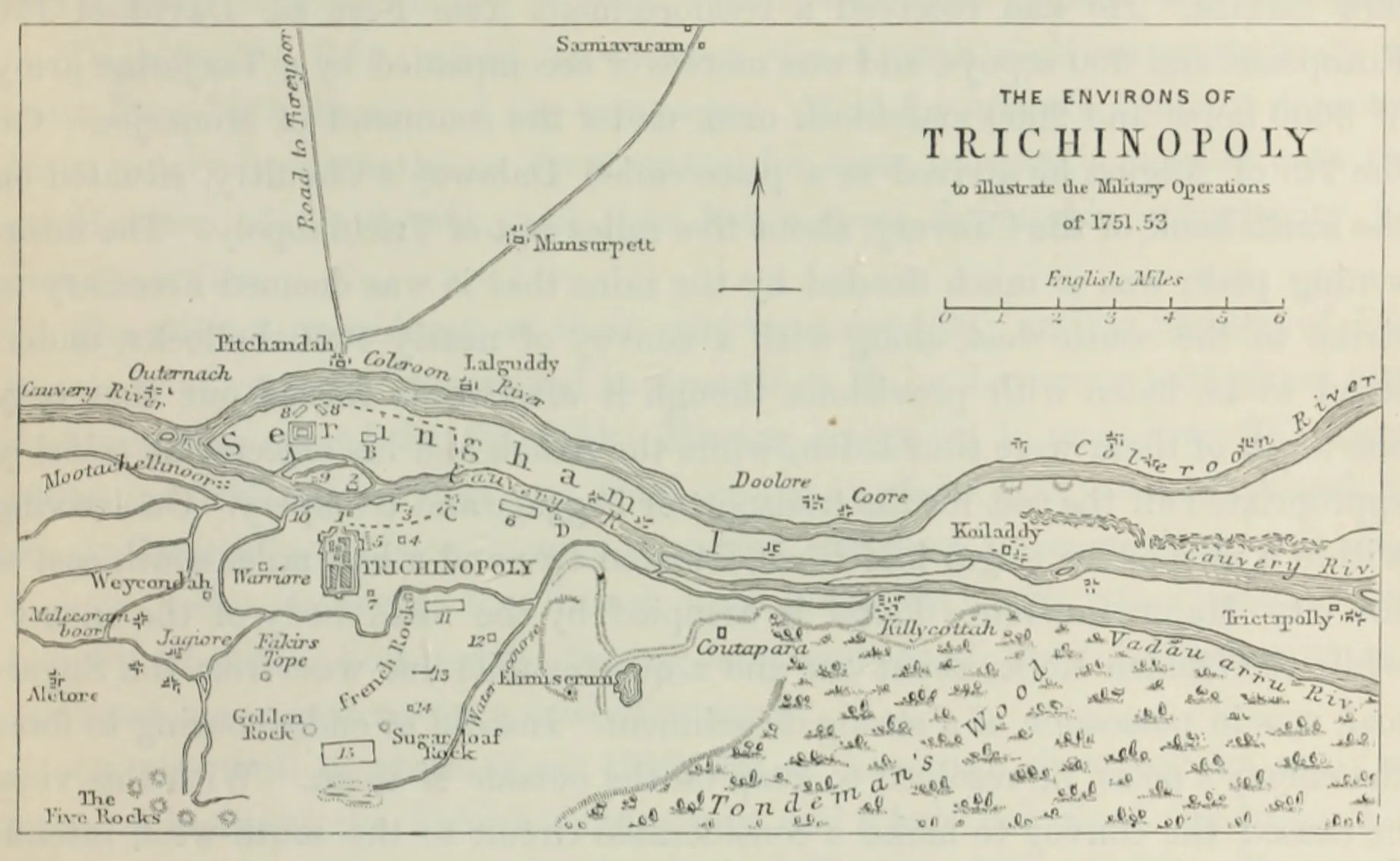
5, Covered way, thrown up against the French grand battery, 1751, 1752. 6, The French and Chunda Sahib's camp from August, 1751, to April, 1752. 7, English post opposite the French Rock, 1751, 1752. 8, Mysore camp, December, 1752. 9, The Great Choultry, where the English party was cut off in December, 1752.
10, Covering party to support that in the Choultry, December, 1752. 11, English camp in Sept. 1753, whilst waiting for the reinforcement. 12, A small entrenchment for the security of the left flank of the camp, September, 1753. 13, English advanced guard, Sept. 1753. 14, French advanced guard, Sept. 1753. 15, Camp of the French, Mysoreans, and Mahrattas, in Sept. 1753.
lay on their arms every night, ready to start on the first announcement of danger. The besiegers, who had been contented with maintaining the blockade, now began to think that they might venture on more decisive measures. Dupleix was of the same opinion, and was constantly importuning M. Brenier, who had succeeded M. Astruc in the command, to attempt an escalade. To procure the information which was previously desirable, he suggested the employment of a French officer of the name of De Cattans, who was to be sent into the town as if he had deserted, and then act as a spy. De Cattans readily undertook the degrading and perilous office, but by overacting his part excited suspicions which ultimately led to his detection. Captain Dalton seized the opportunity to turn the devices of the enemy against themselves, and induced De Cattans, by the promise of interceding for his pardon with Major Lawrence, to write a letter to M. Brenier, recommending an escalade at a particular spot which he pointed out. It was in fact, though it did not appear so externally, the strongest point in the city; and any attempt to escalade it must have resulted in the repulse and destruction of the party engaged in it. M. Brenier, however, would have fallen into the snare, and only escaped it in consequence of being obliged to employ his troops elsewhere.
Major Lawrence's approach, which had for some time been rumoured, was now certain. He had received a reinforcement from Fort St. David of 170 Europeans and 300 sepoys, and was moreover accompanied by a Tanjorine army of 3000 horse and 2000 matchlock-men, under the command of Monacjee. On the 7th of August he arrived at a place called Dalaway's Choultry, situated on the south bank of the Cauvery, about five miles east of Trichinopoly. The intervening plain was so much flooded by the rains that it was deemed necessary to strike to the south-west, along with a convoy of nearly 4000 bullocks, understood to be laden with provisions, though it afterwards turned out that only one-tenth of them were thus laden, while the nabob and his officers had selfishly appropriated all the rest for the transport of baggage and trumpery. On arriving within a mile of the Sugar-loaf Rock, situated two and a half miles south-east of the city, Major Lawrence found it occupied by the main body of the enemy; while the Golden Rock, about one and a quarter mile due west from the Sugar-loaf, was in possession of a strong detachment. Instead of endeavouring to force the enemy's posts, he resolved to keep on the outside of them. With this view he caused the convoy to make a considerable circuit to the south-west, intending himself to march round by the Golden Rock. This, however, was not possible while that strong position was held by the enemy's detachment. It was necessary to drive them from it, and this was the great difficulty. In fact, had M. Brenier supported the detachment as he ought, it would have been impossible. Instead of supporting he weakened it, by withdrawing the greater part of the detachment to assist in meeting a feigned attack on his main body. Having thus allowed himself to be outwitted, he did not discover his blunder till it was too late to repair it. The Golden Rock had been carried by the English grenadiers and a party of 800 sepoys, when the French infantry hastening forward to relieve it had reached only half way. Major Lawrence followed up the advantage he had thus gained with signal ability, and ultimately drove off the whole body of the enemy in confusion. Had the Tanjorine horse pursued as they ought to have done, instead of remaining mere spectators of the flight, a decisive victory would have been gained.
The enemy, after their defeat, encamped in a strong position at Weycondah, two miles west of the city; and Major Lawrence endeavoured to turn their own tactics against themselves by occupying the Five Rocks, situated about three miles farther south, and thus interposed between the enemy and the open country from which they drew their supplies. He had frightened them away from Weycondah to Mootachellinoor, on the south bank of the Cauvery, over against the south-west extremity of the island of Seringham, and was preparing to act more decidedly when all offensive movements on his part were suddenly arrested.
The enemy had received a reinforcement equal in strength to the whole English force. It consisted of 400 Europeans and 2000 sepoys, with six guns, together with 3000 Mahratta horse, and a great number of peons or native infantry, under the command of Morari Row. The Europeans of this reinforcement had arrived at Pondicherry in June. Had they been immediately forwarded to Trichinopoly they would have given the French such an ascendency as must have been decisive of the campaign. Most fortunately Dupleix detained them nearly two months in the Carnatic for some purpose connected with the gratification of his vanity, and thus lost a most favourable opportunity for decisive action.
The Madras presidency on their part were not idle; and on hearing of Dupleix’s reinforcement, determined to strengthen Major Lawrence with every man that could be spared for the field. Having succeeded in mustering 237 Europeans and 300 sepoys, they sent them under Captains Ridge and Calliaud by sea to Devicotta. Major Lawrence moved eastward to meet them, and after a sharp action, in which the French were decidedly worsted, the junction was happily effected. Both parties having now received all the reinforcements they expected, were anxious for a trial of strength.
On the 20th of September, 1753, Major Lawrence drew up his army in order of battle at the Fakir’s Tope, a mile and a half S.S.W. of the city. The enemy, encamped between the Sugar-loaf Rock and the Golden Rock, and covering a considerable space behind, showed no inclination to accept the challenge. Major Lawrence determined to attack them next day, but concealed his intention by ordering his tents, which, in expectation of battle, he had sent to the city, to be brought back and pitched in their former place. At night the tents were again sent back, and the whole army rested on their arms, with orders to be in readiness at four o’clock the next morning. At this hour the army began to move in profound silence; and by a sudden obscuration of the moon, which had before been shining brightly, the first division arrived within pistol-shot of the Golden Rock before they were discovered. Their sudden fire so disconcerted those in charge of the rock, that they hurried off, leaving two field-pieces, which they had loaded with grape, undischarged. Before the confusion thus caused in the camp could be repaired, the British in three divisions kept advancing, with reserved fire and fixed bayonets, on the left flank of the French battalion stationed at the Sugar-loaf Rock, while the sepoys attached to the divisions kept up a constant fire on swarms of Mysorean and other fugitives, who were fleeing in all directions. The whole of the British battalion, consisting of 600 men, arrived in an unbroken line within twenty yards of their French antagonists. The latter were commanded by M. Astruc, who did the utmost to bring them into order, and even prevailed upon them to receive the English fire before they gave theirs. In this encounter Captain Kilpatrick, who led the first division of English, fell desperately wounded. His place was taken by Captain Calliaud, who, by dexterously wheeling round and gaining the left flank of an entrenchment, behind which the French battalion was posted, poured in a close fire. The grenadiers at the same time pushing on with their bayonets, drove them crowding upon their centre. A well-levelled discharge from the centre and left of the British battalion in front completed the confusion, and the rout became irremediable. The victory was now gained; but the Tanjorines again prevented it from being so complete as it might have been, by remaining to plunder the camp, when they ought to have been pursuing the fugitives. The loss of the enemy in Europeans amounted to 100 killed and nearly 200 taken prisoners; among the latter was M. Astruc, regarded as undoubtedly the best of the French officers. On the British side not more than forty Europeans were killed or wounded.
The enemy, though still mustering about 30,000 infantry of all sorts, and 16,000 horse, were so dispirited that they did not venture beyond Seringham, and allowed provisions of all kinds to be poured into the city in such abundance, that a six months' supply was easily provided at a moderate rate. It was deemed advisable, however, in order not to encroach on this supply during the rainy season, which was now at hand, that the troops should quit the city and be carried into cantonments. With this view Major Lawrence, after reinforcing the garrison, so as to make it strong enough with ordinary vigilance for any attempt that might be made against it, removed to Coilady on the frontiers of Tanjore, from which abundant supplies could be obtained, without the necessity of escorting convoys. The Tanjorines were permitted to return home, but not without great reluctance on the part of Major Lawrence, who suspected, and as it afterwards appeared on too good grounds, that the king would scarcely be induced to send them back when the campaign should be resumed.
The enemy remained in the island of Seringham as inactive as if a cessation of hostilities had taken place; and, so far from endeavouring to take advantage of Major Lawrence's absence, allowed the market of Trichinopoly to be regularly supplied in abundance from the surrounding country. In the beginning of November they received a reinforcement of 300 Europeans, 200 topasses or natives, chiefly of Portuguese origin, and 1000 sepoys. Even this did not make them more adventurous, and they remained as if determined to attempt nothing till Major Lawrence should again appear and challenge them to encounter him in a new campaign. This apparent indolence was part of a scheme. It had been conceived possible to take Trichinopoly by surprise, and the object now was to lull the garrison into a false security. The circumstances were not unfavourable. Captain Dalton, whose vigilance and experience were successful in detecting and frustrating several plots, had sailed for England; and Captain Kilpatrick, on whom the command had devolved, was still confined to bed with his wounds.
The point selected for assault was Dalton's battery, the same recommended in the letter of De Cattans, who, after obtaining what was equivalent to a promise of pardon, had been unjustifiably hung by Major Lawrence. It was situated on the west side, near the north-west angle of the walls, and had once formed part of a gateway. This part, so far as it jutted beyond the wall, had been converted into a solid battery with embrasures; the remainder retained its original form, and led by zigzag passages inclosed between terraces to a gate in the inner wall. The enemy had learned, both from the letter of De Cattans and from deserters, the exact mode of entrance, and must thus have been aware of the difficulties which it would be necessary to surmount, but they still preferred the battery as the most accessible point of attack, because the ditch immediately in front of it was almost choked up by a rock on a level with the water.
On the night of the 27th November the greater part of the enemy’s army crossed over from the island. The Mysoreans and Mahrattas were distributed in parties round the walls, and by approaching the ditch and making other demonstrations, were to divert the attention of the garrison while the French battalion were carrying out the real attack, which was planned as follows:— At three o’clock in the morning 600 of the battalion were to commence the escalade, and the remaining 200, together with a large body of sepoys, were to wait at the outside of the ditch, ready to cross as soon as the escaladers should have gained an entrance into the town. The battery was guarded by fifty sepoys and some European gunners. All these were present and on the alert when the rounds passed at midnight, and yet the event proved that, three hours after, the greater part had absented themselves, and the few who remained had fallen fast asleep. Owing to this gross breach of duty, the whole of the escalading party were able to cross the ditch and mount the battery without causing the least alarm. The sleepers being at once despatched with the bayonet, the assailants began to move forward, intending not to fire till they were fired upon. This intention was frustrated by an accident. Within the battery, close to a slight wall inclosing it at the back, was a pit thirty feet deep. It was not observed in the dark, and as several of the party screamed in tumbling into it, some shots were let off. This was alarm sufficient, and all the garrison were instantly in motion. The French, aware that concealment was now impossible, turned the two guns which they found in the battery, and fired them into the town, together with a volley of firearms, at the same time endeavouring to strike terror by beating their drums and shouting Vive le Roi! Captain Kilpatrick, still unable to leave his bed, gave his instructions with great coolness and precision to Lieutenant Harrison, the next in command, who not only executed them but improved upon them, and by the precaution of keeping up an incessant fire on the passage leading to the gate in the inner wall, killed the two persons who were hastening forward to burst it open with a petard.
The attack had now become almost desperate. From the ramparts and terraces commanding the battery the garrison assembled at their posts commenced a murderous fire, which the assailants vainly endeavoured to answer. Those who had got into the passages between the two walls, clambered back into the battery with the view of effecting their escape, but the want of ladders made this impossible, except by leaping down a perpendicular height of eighteen feet into the water of the ditch, or on the rock on a level with it. About 100 made this desperate plunge; but the rest, deterred by what these suffered, crept into the embrasures or any corner that gave some kind of shelter, and as soon as daylight appeared, asked and obtained quarter. The number who thus surrendered was 360; the number of those found killed within the works was sixty-seven; and of the 100 who took the frightful leap, few escaped without being killed or disabled. With the exception then of the 200 who had remained outside the ditch, the whole French battalion was in a manner annihilated by this fatal assault. The noise of the firing was heard at Coilady. On being informed of the cause Major Lawrence reinforced the garrison, and shortly after followed with his whole force.
The Rajah of Tanjore, on the return of his troops, justified the fears which Major Lawrence had entertained, by not only refusing to send them back, but giving unequivocal manifestations of hostile designs. Dupleix and Nunjeraj, by working alternately upon his hopes and fears, had completely alienated him from his alliance with the nabob; and he was on the point of declaring himself openly, when the serious reverse sustained by his new allies in their attempt on Trichinopoly made him pause. Irritated at his vacillation, Dupleix determined to try the effect of force, and engaged a body of 1200 Mahrattas to ravage his territories. The rajah, who had dismissed his old general Monacjee, because he suspected him of being too friendly to the English, sent a new and incapable general of the name of Ganderow, who made his arrangements so unskilfully, that the Mahrattas easily eluded him, and continued their devastations with little interruption. In this way the whole of the eastern part of Tanjore was converted into a waste.
The rajah applied for assistance to Major Lawrence, who, in promising it, complained of Ganderow’s inefficiency, and suggested the re-appointment of Monacjee. After considerable demur this suggestion was adopted, and Monacjee, shortly after resuming the command, obtained a signal success. Proceeding at the head of 3000 horse, he found that the Mahrattas, from ignorance of the country, had got entangled between two branches of the Cauvery, which a sudden flood had swelled so much as to leave no means of egress. Monacjee encamped at the point which he knew would first become fordable on the falling of the waters, and before the Mahrattas deemed it possible, crossed over and met them face to face. With their usual gallantry, augmented by despair, they endeavoured to cut their way through the Tanjorines, but were repeatedly repulsed. Ultimately, 800 of them lay dead on the field. The survivors were reserved for a worse fate. In the spirit of a savage, Monacjee caused them to be impaled alive, and even extended his barbarism to the dead by ordering their bodies to be suspended on the surrounding trees. This success did not produce the effect which might have been anticipated from it. The rajah, satisfied that the immediate danger was passed, dismissed Monacjee from his command with a few compliments; and instead of reinforcing Major Lawrence as he had promised, disbanded his troops as no longer necessary.
While the nabob’s army thus received no accession, and was on the contrary diminished by the necessity of increasing the garrison of Trichinopoly, in consequence of the great number of French prisoners detained in it, the enemy, by means of reinforcements, was able to muster 600 Europeans, 400 topasses, 6000 sepoys, and nearly 30,000 Mysoreans and Mahrattas. To meet these Major Lawrence was unable to bring into the field more than 600 Europeans and 1800 sepoys. Notwithstanding this enormous inequality of force, the enemy were so dispirited by their repeated defeats, that they did not venture to cross to the south bank of the Cauvery.
Trichinopoly had so long been the seat of war that there was not a tree left standing in the plain around it, and the British could only procure firewood by sending out detachments to a distance of five or six miles. Their provisions were obtained with still greater difficulty. These from what was called Tondeman’s Country were brought no farther than the skirts of the woods, distant about seven miles; while those from Tanjore were not brought nearer than eighteen miles, the merchants depositing them at Trictapolly, a fort situated at that distance eastward on the banks of the Cauvery. The detachments employed in escorting the provisions from these distances were seldom less than 150 Europeans and 500 sepoys. Experience seemed to have proved that this force was sufficient, for from the beginning of January to the middle of February, 1754, seven convoys had been safely escorted. The next convoy in readiness was larger than any of these. It consisted of military stores as well as provisions, and required no less than 3000 bullocks. The escort was strengthened in proportion, and composed of the grenadier company of 100 men, eighty other Europeans, 800 sepoys, and four pieces of cannon. As not much less than a half of the whole army was thus required, the more prudent plan undoubtedly would have been not to divide it, but to employ it all as an escort. A more serious blunder was committed in intrusting the command of it to an officer of little experience and less ability.
The escort, which left Trictapolly on the morning of the 13th of February, reached Killycottah, about eight miles farther west, in the evening. The following morning it was journeying on in the same direction, without any apprehension of danger, and had proceeded two miles beyond Killycottah, along the skirts of Tondeman’s Woods, when several bodies of cavalry were seen moving on all sides among the thickets and underwood. The officer commanding the convoy had adopted the worst possible arrangement, for he had no more than a single platoon in his front and rear, while the rest of the troops were distributed in small bodies along the line of bullocks and carts. Most imprudent as this arrangement was, he made no attempt to alter it, and left his troops exposed to the sudden and impetuous onset of 12,000 Mysorean and Mahratta horse, the latter commanded by Morari Row and Yoonas Khan, and the former by an officer of the name of Herri Sing, and another, destined to future celebrity under the name of Hyder Ali. These cavalry formed only part of a detachment which had been lying in wait for the convoy, and was composed, in addition to the cavalry, of 400 Europeans and 6000 sepoys, with seven pieces of cannon. The issue was not for a moment doubtful. The sepoys at once flung down their arms and fled. The grenadiers, who had gained so many laurels in previous fights, still distinguished themselves, and, with the other eighty Europeans, were selling their lives as dearly as possible, when the French arrived, and much to their credit, obliged the Mahrattas to grant quarter. This was the severest loss which the British had yet sustained during the war. The whole of these Europeans were either killed, or wounded and taken prisoners. The loss of the convoy scarcely deserves to be mentioned along with that of the troops, and yet must have been severely felt. Besides the whole of the provisions and military stores, £7000 in money fell into the enemy’s hands.
The presidency of Madras, on hearing of the disaster, made an exertion to repair it, and sent a detachment of 180 men by sea to Devicotta. There, however, they were obliged to remain till an opportunity should be found of joining the camp in safety. Major Lawrence, though his Europeans had been reduced to 400, still kept his position in the plain. It was now impossible, however, to draw supplies from Tanjore, both on account of the distance, and because the rajah, again disposed to league with the enemy, discouraged his merchants from furnishing them. Tondeman’s Country being thus the only resource, 400 sepoys were detached to collect them at Killanore, a village in the woods about twelve miles distant. The want of a body of horse was now severely felt, and the presidency, on the suggestion of Major Lawrence, sent a deputy to the Rajah of Tanjore, for the purpose of inducing him to send a contingent. He was too irresolute and crafty to comply ; and without declaring for any party, resumed his old game of neutrality. While the nabob and British were thus left without an ally, a new danger was discovered. Treachery was at work in the city and the camp. Though it was frustrated, the details are not unworthy of being recorded.
Mahomed Issoof, who had enlisted into the British service under Clive, excelled alike in valour and stratagem, and gradually raised himself by merit to the chief command of all the sepoys. In this position he rendered essential service to Major Lawrence. Not only did he possess a perfect knowledge of the country, and constantly procure intelligence of the enemy’s movements, but he planned all the marches of the convoys, choosing his times and his routes with so much dexterity, that during three months not one of the convoys of provisions coming from Tondeman's Woods was intercepted. The enemy were most anxious to deprive Major Lawrence of his services, but having no hope of corrupting his integrity by a bribe, endeavoured to effect their object by a very base plot. A Brahmin, named Poniapa, acting as Indian interpreter to the British, necessarily possessed much of their confidence, and became privy to their most secret designs. This confidence, of which he was altogether unworthy, he shamefully betrayed by entering into a secret correspondence with the enemy, and ultimately engaging to act entirely in their interest. In the course of this guilty intercourse it was resolved by all means to get rid of Mahomed Issoof; but, as he was too much on his guard to be cut off by any kind of assassination, the following scheme was adopted:—A letter, addressed by the Mysorean commander Nunjeraj, was purposely placed so as to be intercepted. Captain Kilpatrick, on obtaining possession of it, carried it to Major Lawrence, who caused Poniapa to interpret it in their presence. It desired Mahomed Issoof and another sepoy officer to meet according to promise with some persons deputed by Nunjeraj, to adjust the time and mode of betraying Trichinopoly, promising him, if the plot succeeded, an immense sum in money, and various other advantages. Mahomed Issoof and the other sepoy named in the letter were at once imprisoned, but a short investigation established their innocence, and they were released. Suspicion now fell upon the proper party, and Poniapa, though refusing to the last to make any confession of his guilt, was blown from a gun.
The first symptom of a favourable turn in the affairs of the nabob and his British allies appeared about this time, when Morari Row, who had become tired of the war, picked a quarrel with Nunjeraj, by making some exorbitant demands for money, and, on being refused, withdrawing to an encampment on the north bank of the Coleroon. Another incident, which at first threatened very disastrous results, terminated triumphantly. On the 12th of May a party of 120 Europeans and 500 sepoys, with two field-pieces, set out under the command of Captain Calliaud, at four in the morning, intending to wait about two miles south of the Sugar-loaf Rock, for a convoy of provisions which had been ordered to advance from Tondeman's Woods. The place where they meant to halt was an old water-tank, nearly choked up, though its mound was nearly entire. They had nearly reached it when Mahomed Issoof, who was riding in front, was surprised on ascending an eminence, by the neighing of his horse and the answer of it by several others. On advancing to reconnoitre, he was fired at from the other side of the eminence by several French troopers. The presence of the enemy in the very tank in which the party had determined to wait for the convoy was now certain. Captain Calliaud immediately prepared for attack, and by dexterously moving the sepoys on the left, while the Europeans wheeled round to the right flank, placed the enemy between two fires, and obliged them to abandon the tank with precipitation. The day was only dawning when the action began, but there was now sufficient light to perceive that the enemy consisted of 250 Europeans, with four field-pieces, 1000 sepoys, and 4000 Mysore horse. A smart cannonade immediately commenced, and both armies, attracted by the sound, immediately prepared to take part in the engagement. Captain Polier, commanding in the absence of Major Lawrence, whom sickness had obliged to retire into the city, hastened forward with all his remaining troops, while the rest of the enemy's army crossed over from Seringham. When the two armies were thus pitched against each other, the inequality was seen to be enormous. On the one side stood the British battalion, mustering only 360 men, 1500 sepoys, and eleven troopers; on the other side 700 Europeans, fifty troopers, 5000 sepoys, and 10,000 horse; fortunately, from the cause already mentioned, none of them Mahrattas. With such odds a decisive victory was scarcely possible; and the utmost, therefore, which Captain Polier proposed, was to fight his way back to the camp. The English, defiling from the tank into the plain, marched onward in column, while the sepoys followed in a line at right angles with the rear of the battalion, and extending beyond it both on the right and left. In this manner they proceeded, galled by the enemy's seven field-pieces, but suffering little from their musketry, which kept too far off to do much mischief, and without halting reached a second tank about a mile nearer the city. Just as they reached this post, Captain Polier, who had previously been struck, received another wound, which so disabled him that he was obliged to resign the command to Captain Calliaud. The fight being now visible from the walls of the city, Major Lawrence, although very ill, ordered himself to be carried to the top of one of the gates, and there beholding how his little army was hemmed in, trembled for its fate. While the enemy's sepoys and cavalry were drawn up opposite to three sides of the tank, the fourth side was menaced by the French. As the latter advanced, the three British field-pieces, brass six-pounders, capable of carrying a large quantity of grape-shot, and admirably served, did fearful execution. In a few minutes nearly 100 of the French battalion were struck down. The rest, dismayed at the havoc, showed signs of faltering. Captain Calliaud seized the favourable moment, and sallying out with all the Europeans, gave a volley so well levelled that an indiscriminate flight immediately ensued, and continued till the fugitives were fairly out of cannon-shot. The rest of the enemy were not slow to follow the example, and the whole hastened back for Seringham; the British, satisfied with their victory, did not attempt pursuit. In the evening the convoy reached the camp in safety. More depended upon its arrival than the enemy seemed to have been aware of. Had they succeeded in preventing it, mere want of provisions would have obliged the victors to decamp for Tanjore the very next day.
The enemy, ashamed and enraged at their disgraceful defeat, sought to wreak their vengeance in any quarter where it could be done without much danger, and fixed upon Tondeman's Country, from which Trichinopoly had drawn the greater part of its supplies after Tanjore had ceased to send them. Accordingly, on the very second night after their defeat, M. Maissin, the French commander, with all his Europeans, 3000 sepoys, and 2000 horse, suddenly entering that country, began to commit every species of ravage. The Polygar Tondeman, who had some warning of their approach, had caused his people to remove with their cattle and all their effects into the depth of the forests, whither it was impossible to follow them. The invaders, in consequence, could do nothing more than gratify their impotent malice by burning empty villages. Disappointed of the plunder which they had anticipated, they carried their depredations into Tanjore.
Major Lawrence, in expectation that the rajah, on seeing his country thus attacked, would apply to him for assistance, set out with his army in order that he might be at hand to comply with the application as soon as it should be made, and thus bind the rajah by interest to an alliance of a more durable nature than any he had yet been able to form with him. He, at the same time, ordered the reinforcement at Devicotta to effect a junction with as little delay as possible. The very next day after his arrival, a message from the rajah arrived, urging him to hasten his approach. The cause of this urgency was soon explained. The invaders, not contented with pillaging the country, had been guilty of an atrocious proceeding, which threatened to doom a large portion of it to perpetual barrenness. It has been already mentioned that at Coilady the Coleroon and Cauvery would again unite were the junction not prevented by an artificial mound. At this point the level of the Coleroon is about twenty feet lower than that of the Cauvery, and the object of the mound is to prevent the whole from being precipitated into the Coleroon, when it would run waste to the sea, and preserve the Cauvery as a separate and independent stream, which, employed in irrigating the plains of Tanjore, renders them almost fabulously fertile. The invaders had cut across this mound, and afterwards cannonaded the workmen sent to repair it.
This attempt to starve a whole population in order to compel their sovereign to adopt a certain political course, proved as impolitic as it was iniquitous; for the only effect was to inspire the rajah with a deep hatred of those who had employed such abominable means to effect his ruin, and convince him that his only security against the repetition of such malice was a close and cordial alliance with the British presidency. Another event, which took place at the same time, formed an additional inducement to this alliance. On the invasion of Tanjore the rajah despatched Ganderow, with 1500 horse, to Tricatopoly. Morari Row, who, after quarrelling with Nunjeraj, had fixed himself at Pitchandah, on the north bank of the Coleroon, watching for any change of circumstances which he might be able to turn to account, no sooner heard of the approach of Ganderow than he resolved to encounter him. If he succeeded in giving him a defeat, one of two objects would be gained. The rajah, already frightened by the French and Mysorean invasion, would be glad to pay a large sum as the purchase of his retreat; or if this were refused, the destruction of Ganderow's detachment would avenge the slaughter of the Mahrattas, and the barbarities practised on those of them who had been taken prisoners during a former campaign. Thus stimulated both by interest and revenge, Morari Row, crossing the Coleroon and Cauvery by night, with 3000 of his best troops, surprised Ganderow at daybreak, and so completely defeated him that only 300 of his whole force escaped. Major Lawrence arrived at Tanjore only two days after this defeat, and was consequently able to negotiate with the rajah under the most favourable circumstances. The result was that Monacjee was not only reinstated in his command, but appointed prime minister in room of Succojee, who had hitherto been the great obstacle to a permanent British alliance.
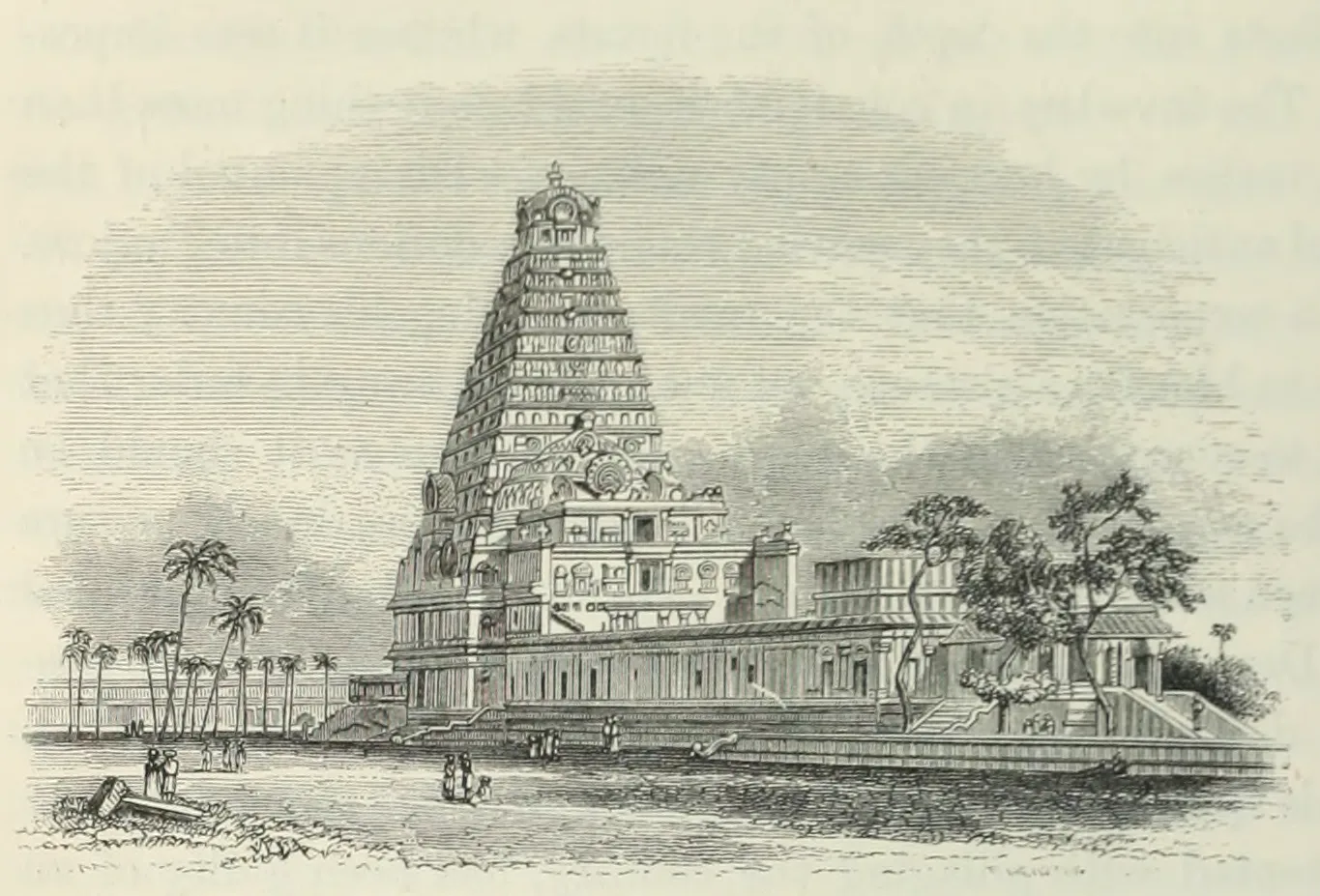
Major Lawrence was again in possession of an army sufficient to enable him to cope with the enemy. The Company's force consisted of a battalion of 1200 men, some of them topasses, and 3000 sepoys, with fourteen field-pieces; to these were added 2500 Tanjorines and 3000 infantry, under Monacjee. A considerable reinforcement had also been expected under Maphuze Khan, the nabob's elder brother. As the legal heir of Anwar-u-din, his right to the nabobship was better than that of Mahomed; but as he was taken prisoner in the action in which his father was slain, he was entirely overlooked in the new arrangements, and on obtaining his liberty found it necessary, after considerable hesitation, to recognize the validity of his brother's title. He had, in consequence, been placed at the head of a body of troops nominally belonging to the nabob, but made them entirely subservient to his own purposes, and found so many pretexts for delay that the army was at last obliged to set out without him. The whole troops furnished by the nabob, therefore, were only his own guard of fifty horse. On entering the plains of Trichinopoly, encumbered with a considerable convoy, Major Lawrence found that the enemy, who had previously fixed their camp at the Five Rocks, had quitted it and advanced eastward, to dispute his further progress. Both armies drew up in order of battle; and from the apparent resolution with which the French moved to the attack, a decisive engagement was expected. Suddenly, however, after enduring a destructive cannonade with great steadiness, they wheeled round before coming within musket-shot, and began to retreat with some appearance of confusion. Major Lawrence was preparing to pursue when he ascertained that the retreat of the French infantry was only a feint to cover an attack upon the convoy. The plan was, that while the British battalion were engaged with the imagined pursuit, Hyder, at the head of the Mysore horse, should wheel round and fall upon the rear, where the baggage and provisions were deposited. Hyder’s impetuosity and eagerness for plunder frustrated the stratagem. By making his attack prematurely, he succeeded in carrying off only thirty-five carts, laden partly with arms and ammunition, and partly with baggage belonging to the British officers. This loss was more than compensated by the result of the action. The French, besides sustaining a virtual defeat, had 100 of their battalion killed or wounded, while only eight of the British fell. After proceeding to Trichinopoly without further interruption, and lodging the stores of provision in its magazines, Major Lawrence made several attempts to bring the enemy to a general engagement. Instead of accepting his challenges they retired as he advanced, and finally quitted the plains on the south side of the Cauvery, to establish themselves once more in the island of Seringham. The commencement of the rains prevented further military operations; and before a new campaign could be undertaken, a great change in French East India politics was effected. To various occurrences which preceded and contributed to this change, it is necessary now to attend.
Notes
- 1. “The Polygars derived their name from inhabiting the pollams or woods in the southern parts of Hindoostan, and appear to have taken their rise from municipal regulations relative to the destruction of tigers and other ferocious beasts.”—Meyrick's Illustrations of Ancient Arms and Armour.