AT the time when Ali Verdy was appointed to the government of Behar, one of his daughters, who was married to his youngest nephew, gave birth to a son. The event seemed so auspicious that he declared his intention to adopt the boy and make him his heir. Mirza Mahmood, as he was originally called before he assumed the title of Surajah Dowlah, received the kind of training which was considered suitable to his prospects. All his wishes were gratified, all his faults overlooked, and he never knew what it was to be refused or contradicted. The natural cruelty of his temper appeared in the amusements of his childhood. No bird or animal within his reach was safe from torture. As might be anticipated, his vices ripened with his years, and the cruelty which he had practised on the brute creation was transferred to his own species. To every virtuous feeling he seems to have been an utter stranger. His only companions were infamous profligates, with whom he used to patrole the streets of Moorshedabad, and commit every form of indecency and outrage. With his other vices he possessed a certain degree of low cunning, which he employed in concealing some of the worst parts of his conduct from his grandfather, who, it is charitable to suppose, though his general character was well known to him, must have been ignorant of his worst villanies, when, in 1753, he placed him on the musnud, and required all the courtiers and officers to recognize him as his successor. From that time Ali Verdy, without ceasing to hold the reins of government, threw a large share of his authority into the hands of Surajah Dowlah, who of course perverted it to the worst of purposes.
Nuazish Mahomed, as the eldest nephew, naturally thought himself best entitled to the succession, and took no pains to conceal his dissatisfaction. He had for some years, though resident at Moorshedabad, held the government of Dacca, and from its revenues acquired enormous wealth, which enabled him to keep a large body of armed men in his pay. In himself, as he was possessed of very moderate talents, and had nothing warlike in his disposition, he was not dangerous. His two leading ministers, however, an uncle and a nephew, the one named Hossein Cooly Khan and the other Hossein Addeen, were men of capacity, and it was deemed necessary to remove them. The uncle resided at Moorshedabad with his master, the nephew at Dacca, where he acted as deputy-
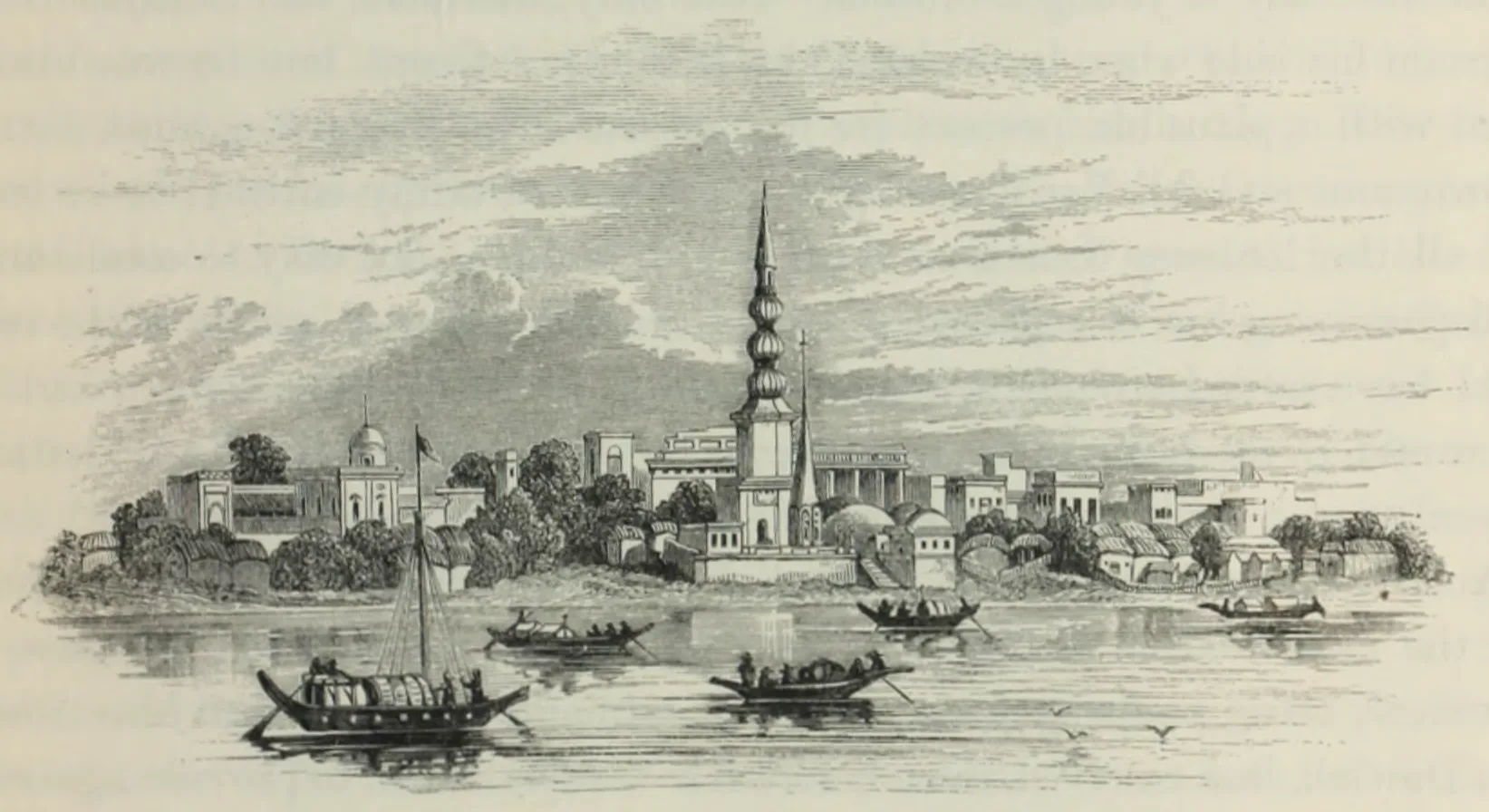
governor. Ali Verdy wished to act warily in the dismissal of these officers, as he feared that Nuazish, if alarmed by any hasty step, would at once retire to Dacca and assert his independence. Surajah Dowlah had no idea of temporizing, and having no scruples as to the atrocity, determined to rid himself of all fears by taking the nearest road. His hired assassins entering Dacca, stabbed Hossein Khan in the dead of the night; and a few days after, Hossein Cooly Khan was assassinated in open day in the streets of Moorshedabad. Nuazish and his brother Syed Ahmed, who, as they were both aspiring to the nabobship, had hitherto acted independently of each other, now saw the necessity of uniting their interests, and leaguing against Surajah Dowlah, as their common enemy. A civil war was imminent, when they both died suddenly, as has been already told.
Deaths which happened so opportunely for Surajah Dowlah might, without uncharitableness, have been attributed to his agency, but all writers agree in regarding them as natural. Their effect was to allow him to take the benefit of all the arrangements which Ali Verdy had made in his favour. It soon appeared, however, that his title to the nabobship was not to remain unchallenged. Gheseety Begum, Ali Verdy’s daughter, had succeeded to the wealth of her late husband Nuazish, and saw no means of saving it from the rapacity of the new nabob, except by placing herself at the head of a powerful party. Her sex made it impossible for her to claim the government in her own name, and she therefore set up a competitor in the person of an infant two years old, the son of a deceased brother of Surajah Dowlah. Another competitor appeared in the person of his cousin, Shokut Jung, governor of Purneah. Could he have succeeded, the inhabitants of Bengal would not have gained much by the change, as it would have been difficult to choose between them, so closely did they resemble each other in ignorance and profligacy. The title of the claimant set up by Gheseety Begum was evidently bad, as the father of the infant was only a younger brother. Not only, therefore, had Surajah Dowlah justice on his side when he resisted the Begum’s attempt, but he was also furnished with a plausible pretext for the measures he adopted against her. As his own aunt and Ali Verdy’s daughter, she was certainly entitled to be treated with all the leniency consistent with safety, but it is not easy to condemn him for dispossessing her of a palace, where all the discontented spirits of the capital would have rallied around her, and depriving her of treasures which had been, and would in all probability continue to be employed in secretly undermining or openly assailing his government.
A Hindoo, of the name of Rajbullub, who had become dewan to Nuazish after the assassination of Hossein Cooly Khan, and made common cause with his widow, being perfectly aware of the treatment which awaited him from Surajah Dowlah, had resolved, even before Ali Verdy’s death, to provide against the danger by removing his family and treasures. The difficulty was to find a place where they would be beyond the nabob’s reach. They were then in Dacca, and the plan he adopted was to send them away in the charge of his son Kissendass, under pretence of making a pilgrimage to the celebrated Temple of Juggernaut, on the coast of Orissa. In prosecuting this intended pilgrimage, Kissendass proceeded with several loaded boats down the Ganges, as if to enter the Bay of Bengal by one of its mouths, but stopped short, and sailed upwards till he reached the Jellinghee, by which the Ganges communicates with the Hooghly. He was thus enabled to enter the latter river. This was in fact the preconcerted scheme, for his real destination was not Juggernaut, but Calcutta. His father had prevailed with Mr. Watts, the chief of the Company’s factory at Cossimbazar, to apply to the presidency for permission to Kissendass and his family to halt for some days in Calcutta. It does not appear very distinctly whether Mr. Watts was duped by Rajbullub into the belief that nothing more than a halt was intended, or whether he was aware that the real object was to secure permanent British protection. Be this as it may, Mr. Watts’ application in behalf of Kissendass was successful, and he arrived in Calcutta, where he was hospitably received by Omichund, an extensive Hindoo merchant, who had large connections at Moorshedabad, and was naturally inclined to conciliate the good-will of so influential a person as Rajbullub.
The arrival of Kissendass, and the reception given to him at the British presidency, filled Surajah Dowlah with rage. Not only had large treasures, on the confiscation of which he had confidently calculated, escaped, but the very idea that a body of foreign merchants, whose settlement in the country existed only by sufferance, should protect any party whom he had marked out as a victim, was galling to his pride. He immediately proceeded to the palace, and gave utterance to his disappointment and indignation, exclaiming, that the suspicions which he had long entertained of the English were now confirmed, and that they were evidently in league with the faction which meant to contest his succession to the nabobship. Ali Verdy, now on his death-bed, turned to Mr. Forth, surgeon of the factory of Cossimbazar, who was attending him professionally, and put a variety of searching questions to him, asking, How many soldiers were in the factory at Cossimbazar? Where the English fleet was—whether it would come to Bengal—and with what object it had come to India? The answers satisfied him that the British, in the expectation of a war with France, had already sufficient work upon their hands, and were in no condition to provoke the hostility or even risk the displeasure of the Bengal government. Surajah Dowlah was silenced, but not satisfied, and was so little careful to conceal his feelings, that his determination to sack Calcutta and expel the English was openly talked of.
This ominous circumstance and the previous conversation with Mr. Forth, is said not to have been communicated to the presidency; but sufficient warning was given them when a letter, dated two days after the death of Ali Verdy, was received, demanding the delivery of Kissendass and his treasures. The letter purported to come from Surajah Dowlah, and seems to have borne sufficient evidence of its genuineness. The governor and council, however, learning that the bearer of it, a brother of Ramramsing, the head of the spies, had come in a small boat, landed in the disguise of a pedler, and proceeded in the first instance to the house of Omichund, chose to conclude that this was an invention of this crafty Hindoo, who, having by some recent changes in the mercantile arrangement of the Company, lost some of his importance, had devised this curious method of endeavouring to regain it. This extraordinary conclusion once formed, it was gravely resolved that both the messenger and the letter were too suspicious to be received, and Ramramsing’s brother was hurried back to his boat, and turned off with insolence and derision.
The presidency, after they had thus committed themselves, appear not to have been perfectly satisfied with the propriety of their proceeding, and instructed Mr. Watts to give explanations which might prevent any evil consequences. He was thought to have succeeded; for, when his vaqueil or agent appeared at the durbar, and stated the grounds on which Ramramsing’s brother had been treated as an impostor, Surajah Dowlah gave no sign of emotion or displeasure. He acted, indeed, as if the matter had passed entirely from his mind, and made no further communication to Mr. Watts or the presidency respecting Kissendass and his treasures.
At this very time letters arrived from England stating a rupture with France was inevitable, and ordering the settlement to be put in a state of defence. The work was immediately commenced; but as the fort was in such a dilapidated state as to make it necessary rather to rebuild than repair it, a considerable number of labourers were employed, in the first instance, to repair a line of guns which were placed along the brink of the river opposite to the west side of the fort. When these repairs were begun, Surajah Dowlah was proceeding at the head of an army of 50,000 men for Purneah, to encounter his cousin and rival claimant, Shokut Jung. It was known that he had a number of spies in Calcutta, and though the presidency had used every effort to discover and expel them, enough still remained to carry tidings to him of the operations in which they were engaged. Their nature and extent were of course exaggerated, and a letter arrived from the nabob, in which, after stating that he had been informed that the English were building a wall and digging a large ditch around the town of Calcutta, he peremptorily ordered them to desist, and restore the fortifications to the state in which they were before. Mr. Drake, the governor, answered this letter with more candour than good policy; he explained the full extent to which the operations had been carried, and the motives which, as they originally dictated their commencement, rendered it expedient to continue and complete them. “The nabob,” he said, “had been misinformed by those who had represented to him that the English were building a wall round the town; they had dug no ditch since the invasion of the Mahrattas, at which time such a work was executed with the knowledge and approbation of Ali Verdy; in the late war between England and France, the French had attacked and taken the town of Madras, contrary to the neutrality which it was expected would have been preserved in the Mogul’s dominions; and that there being at present great appearance of another war between the two nations, the English were under apprehensions that the French would act in the same manner in Bengal; to prevent which they were repairing their line of guns on the bank of the river.”
This answer was received by the nabob on the 17th of May, at Rajamahal, and threw him into a transport of rage, which astonished even those of his attendants who were most familiar with the violence of his temper. It is not easy to see why it should have had such an effect. His dignity may have been offended at the very supposition that Europeans should presume to make war within his territories without his sanction; and still more at the assumption, that if they did so, the party attacked would be obliged to trust to their own resources, instead of leaving it to him to repel and punish the aggressor. Beyond this, there was nothing in the answer to provoke an outburst of passion even in the proudest and most sensitive of tyrants. The rage, if real, and not merely assumed to give a colour to further proceedings, was probably provoked by perceiving that a plan which he had long been meditating, and a revenge which was rankling in his mind, were in danger of being frustrated. Were Calcutta put into such a state of defence as would enable it to resist the attacks of the French, whose skill in siege operations had been rendered famous throughout India, by the capture of fortresses previously deemed impregnable, how could he be able to make himself master of it, and rifle it of the fabulous wealth which was believed to be treasured up within its precincts? Now, therefore, was the decisive moment. Calcutta, if not forthwith attacked, would set him at defiance, and both the fame which he anticipated as its conqueror, and the plunder on which his heart was set, would be lost to him for ever.
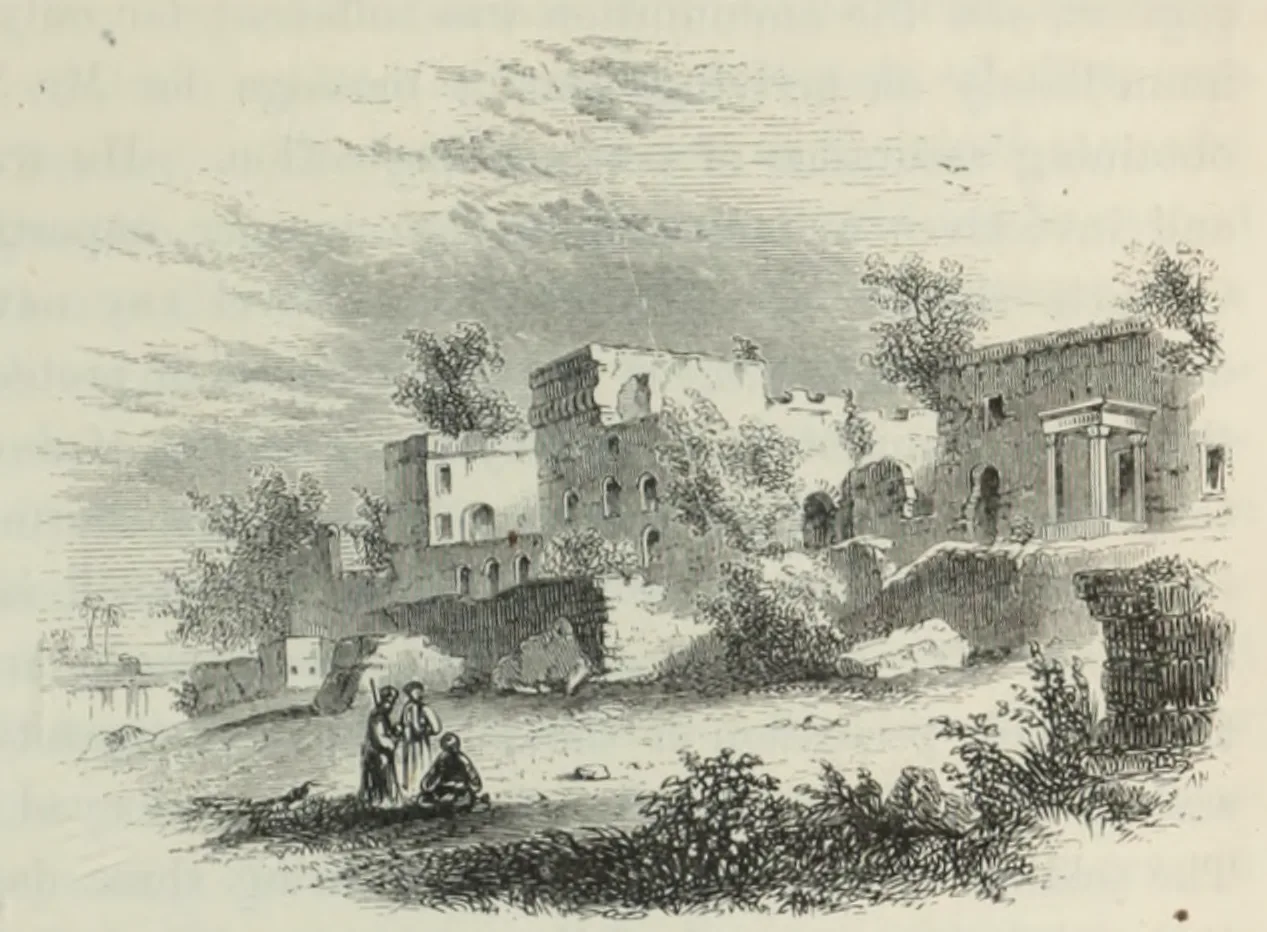
Instigated by some such motives as these, the expedition to Purneah was immediately postponed, and the army began its march back to Moorshedabad. Its movements were too slow for the nabob’s impatience, and a detachment of 3000 men was pushed forward to invest the Company’s factory at Cossimbazar. Though the garrison consisted only of twenty-two Europeans and twenty topasses, no attempt was made to carry it by a sudden onset, and the detachment were contented to remain for nine days after their arrival, merely watching it so as to preclude either egress or ingress.
On the 1st of June, the nabob came up with the main body of the army. The idea of resistance seems not to have been entertained, as the fortifications, undeserving of the name, consisted only of a brick wall, three feet thick, with small bastions at the angles, but without ditch or palisade. Part of the curtain formed the outer wall of a series of chambers looking inward, and affording, by their roofs, a terrace resembling ramparts. These, however, were completely overlooked from without by buildings at the distance of only 100 yards. The cannon were still more defective than the works, most of them being honeycombed, and the ammunition was sufficient for only 600 charges. The nabob, immediately on arriving, sent a message for Mr. Watts, who obeyed, after obtaining assurance of personal protection. He was received with insolence and invectives, and ordered to sign a paper, importing that the presidency of Calcutta should, within fifteen days, level any new works they had raised, deliver up all government tenants under their protection, and refund whatever the revenue might have lost by the granting of dustuks or passports of trade to parties not entitled to them. Mr. Watts, alarmed for his life, signed the paper, and the two other members of the council being sent for, imitated his example. No terms of capitulation were made, and a party of the nabob’s troops took possession of the place without opposition. Their orders were to seal up what effects they found; but they disobeyed, and stole the greater part. The soldiers in the factory, after enduring three days of such contumely, that the ensign in command of them went mad and shot himself, were imprisoned at Moorshedabad. One of the members of council, and the junior servants of the factory, were allowed to retire to the Dutch and French factories; but Mr. Watts and the other member, instead of being sent, as they expected, to communicate the nabob’s resolves to the presidency, were detained in the camp, and told that they were to accompany the nabob himself to Calcutta. This was the first intimation they received of his determination to attack it.
The extreme violence and injustice exhibited by the nabob at the very outset must have made it almost palpable to the minds of the presidency that nothing less than the complete destruction of the settlement was aimed at; and yet, in the vain hope of deprecating his wrath, before the final step was taken, letters were daily despatched to Mr. Watts, instructing him to express their readiness to demolish everything that could be considered a recent addition to their fortifications. The letters were probably intercepted by the nabob, as they never reached Mr. Watts; but the presidency, while writing them, could not well act at variance with the offer they contained, and thus nearly three weeks passed away without any preparation against the coming danger. Had a proper use been made of this intervening period, by applying for reinforcements to the other presidencies, and making the most of the means of defence at their disposal, the governor and council might have set the nabob at defiance, and given the first example of what a mere handful of our countrymen can achieve, when true heroism inspires them, against myriads of native Indians. Unfortunately neither the European soldiers nor civilians in Bengal were, at that period, animated by that spirit which in our own times has been so illustriously displayed. When, at length, the struggle arrived they were far less disposed to face it than to flee from it.
The letter which filled the nabob with so much rage, and was the ostensible cause of his abandoning the expedition to Purneah, was received by him at Rajamahal on the 17th of May, and though his intention then announced was never revoked, and he from that day continued his march southwards, evidently bent on mischief, the 7th of June arrived before the first note of alarm was despatched to Madras and Bombay. The passage by sea, as the south monsoon was then blowing, was impossible, and an overland message could not be carried in less than thirty days. It was therefore evident that long before any answer could be received the nabob would have ample time to do his worst. Conscious of the desperate predicament in which they were thus placed, the presidency applied to the Dutch at Chinsurah, and the French at Chandernagore, and endeavoured to persuade them that they ought to unite their forces as in a common danger. The former simply refused—the latter, as if in mockery, proposed that they should abandon Calcutta, and place themselves with their effects under their protection. What that protection would have been may be inferred from the fact that the nabob in passing Chandernagore was propitiated by a present of 200 barrels of gunpowder. The presidency, now thrown entirely on their own resources, began to display some activity. Works of defence, such as the shortness of the time would admit, were erected, provisions were laid in, and the number of Indian matchlock-men was augmented to 1500. The regular garrison consisted of 264 men, and the inhabitants enrolled as militia amounted to 250, forming an aggregate of 514, but of these two-thirds were topasses, Armenians, and Portuguese, on whom no reliance could be placed, and of the remaining third, mustering in all 174, not more than ten had seen service.
With such feeble resources a successful defence was more than doubtful, and therefore the attention of the presidency was, first of all, directed to the means of escape. On the opposite side of the river Hooghly, about five miles below Calcutta, the native fort of Tanna, mounting thirteen guns, commanded the narrowest part of the channel. The necessity of securing this fort, so as to give a free outlet to the sea, seemed so urgent, that it was determined, while the nabob was only advancing, to assume the offensive and endeavour to gain possession of it. Accordingly, on the morning of the 13th of June, two vessels of 300 tons, and two brigantines anchored before it, and opened a fire which at once dislodged the garrison, consisting of not more than fifty men. A party immediately landed, spiked some of the guns, and threw the rest into the river. If it was intended to retain the fort, the true plan would have been not to destroy the guns but point them so as to repel any attack on the land side. The mistake was soon apparent, for the very next day a detachment of the enemy, 2000 strong, arrived from Hooghly, drove the few Europeans and lascars within the fort to their boats, and resisting any attempt to dislodge them by a cannonade, obliged the ships to weigh anchor and return to Calcutta.
The same day when the ships sailed against Tanna a letter was intercepted, addressed to Omichund, by the head spy, and advising him to put his effects out of danger. This confirming the suspicion previously entertained, Omichund was immediately put under strict confinement in the fort. Kissendass was, in like manner, confined; but when an attempt was made to apprehend Omichund’s brother-in-law, a serious fray took place. He had concealed himself in the female apartments, and not only did all the peons and armed domestics in Omichund’s service resolutely resist a forcible entrance into them, but the person at their head, a native of high caste, to save the women from the dishonour of being exposed to strangers, rushed in, slew thirteen of them with his own hand, and then stabbed himself. Meanwhile the nabob was hastening forward with such expedition that many of his troops died of fatigue and sun-stroke. On the 15th of June he reached Hooghly, and immediately after transported his army to the Calcutta side, by means of an immense fleet of boats. The militia and military
immediately repaired to their posts, and all the natives took to flight, with the exception of about 2000 Portuguese, whose claim as Christians was so far recognized as to procure them admission into the fort.
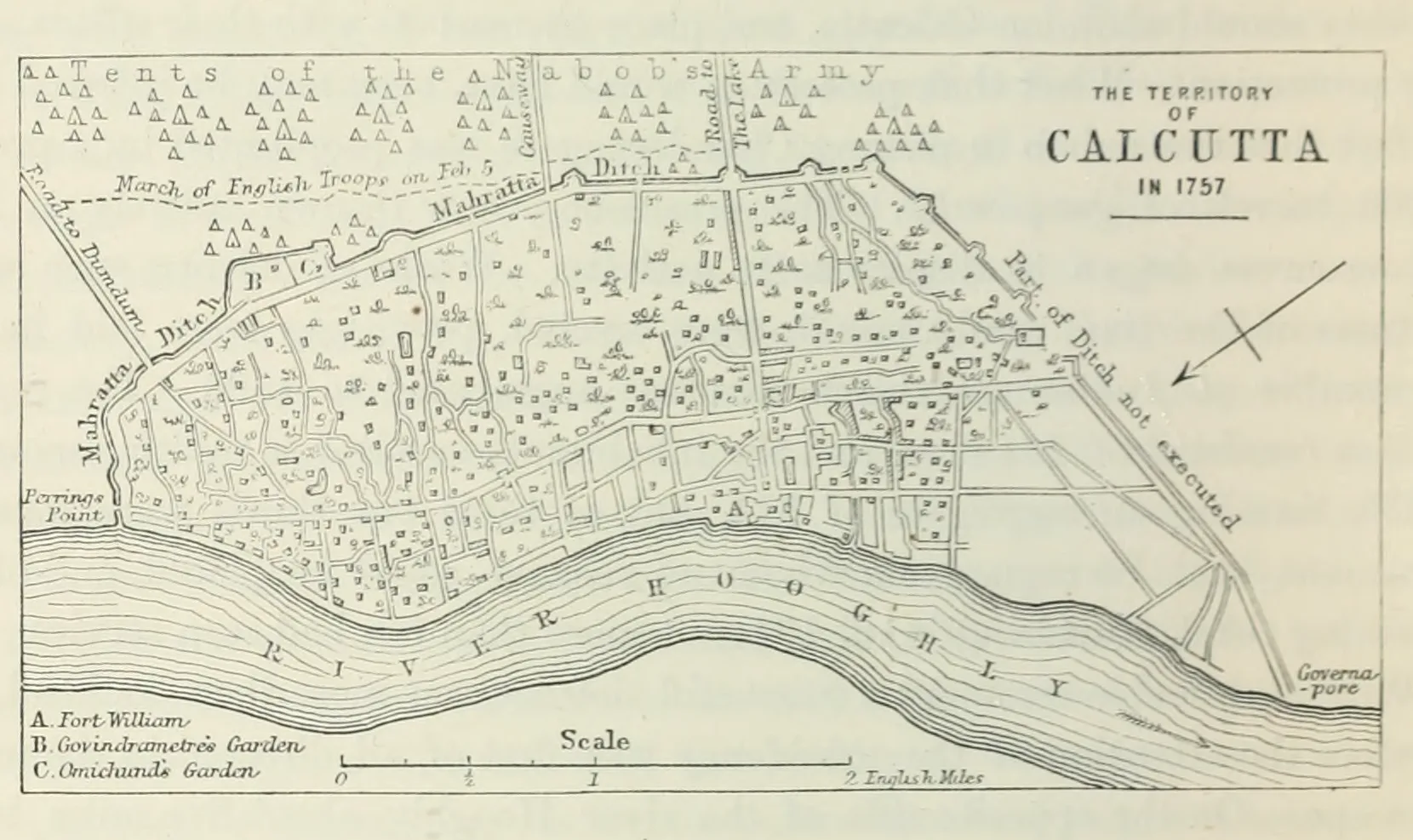
At noon of the 16th the nabob was seen approaching from the north. His first movement showed that he had not taken any means to acquaint himself with the locality. Had he turned eastward he would have arrived where the Mahratta Ditch had not been completed, and met with no obstacle. Instead of this he came directly in front of a deep rivulet, where it enters the Hooghly, and formed of itself so strong a defence as to render the ditch unnecessary. There was indeed a bridge over it, but this was defended by a redoubt, which had recently been erected, and the approach to it was, moreover, flanked by a ship of eighteen guns, which had been stationed there for that purpose. When the point of attack was perceived the greater part of the Company’s matchlock-men were posted near the banks of the rivulet. The first of the nabob’s operations was to send forward a detachment of 4000 men, with four pieces of cannon, into the adjoining thickets. Here, from three in the afternoon till dark, an incessant fire was kept up by both sides without any result. At midnight all was still, and Ensign Pischard, who commanded the redoubt, suspecting from what he had learned on the Coromandel coast of the Indian mode of warfare, that the enemy were buried in sleep, crossed the rivulet with his party, seized and spiked their four guns, cleared the thickets, and returned without the loss of a man.
On the following day the nabob changed his tactics. Omichund’s chief peon had not stabbed himself mortally; and, still breathing indignation and revenge, had caused himself to be carried to the enemy’s camp. By his advice the attack on the north was abandoned, and an entrance was easily effected from the east, through various passages where there were no defenders. The suburbs were thus in the hands of the enemy, who set fire to the great bazaar, and took possession of the quarter which had been inhabited by the principal Indian merchants. An unavailing attempt was made to dislodge them, and the space left to the defenders became gradually more and more contracted. Had the fort been considered tenable they would probably have at once retired into it, and by thus concentrating their efforts made them more efficient. Fort William, however, like that of Cossimbazar, scarcely deserved the name. It stood near the river, about half-way between the north and south extremities of the Company’s territory, and formed nearly a parallelogram, of which the longest sides, the east and west, were each 200 yards; the breadth on the south side was 130, and on the north only 100 yards. The walls, not more than four feet thick, formed the outer side of chambers, and were in several places pierced with windows; the terraced roofs of these chambers supplied the place of ramparts. The four bastions, one at each angle, were each mounted with ten guns, but the two on the south side were rendered useless to each other by a line of warehouses which had been built contiguous to the wall. The roofs of the warehouses were, however, strong enough to bear the firing of three-pounders, which were mounted on them. The east gateway, forming a considerable projection, was mounted with five guns, three in front and one on each flank. Besides these, which formed the proper works of the fort, a line of heavy cannon, mounted in embrasures of solid masonry, was placed outside, on the brink of the river, under the west wall.
It is plain from this description how very little engineering skill had been employed in the construction of the fort. In addition to other disadvantages it was overlooked by the English Church, opposite to the north-east bastion, and several other houses belonging to the English town, which consisted for the most part of spacious detached inclosures, and occupied the ground 600 yards towards the east and half-a-mile to the north and south of the fort. Taking all these things into consideration, it is easy to understand the reluctance of the defenders to allow themselves to be cooped up within the fort, and their consequent anxiety to dispute every inch of ground as they were obliged to recede. They accordingly erected three batteries, each mounting two eighteen-pounders and two field-pieces, one at the distance of 300 yards from the east gate, so as to command the principal avenue leading due east from it to the Mahratta Ditch; the second in a street commencing about 200 yards north of the fort, and continuing in that direction with one of its sides bordering on the river; and the third 300 yards to the south of the fort, at a point where a road leading north and south was bridged over to give passage to a rivulet. The principal approaches being thus secured, breast-works with palisades were erected in the smaller inlets, and trenches were dug in the more open grounds.
It soon appeared that the defence of these outworks required a far greater force than the garrison could afford. Even had they been sufficiently defended, many points remained by which the enemy could penetrate; and, availing themselves of the houses and inclosures, advance, without once losing shelter, near to the walls. The contest thus became too unequal to be long successfully maintained. Post after post was necessarily abandoned, and the whole three batteries were taken the very first day they were attacked. This result spread general consternation, and, with the exception of the comparatively few Europeans, all were stupified with fear. The enemy were of course proportionably emboldened, and not only kept up an incessant firing, but made attempts to escalade. On one of these attempts, made at midnight, the governor ordered the drums to beat the general alarm, but the summons, though thrice repeated, did not bring forward a single man except those on duty. In such a state of matters it was impossible for the bravest and most sanguine not to feel that a fatal issue could not be long delayed. It was some consolation, however, to know that, if the worst should happen, the means of escape had been provided. A ship, and seven smaller vessels, and numerous boats, with the natives who plied them, were lying before the fort. As night approached all the European women were embarked; and at two in the morning a council of war, to which all the British, except the common soldiers, were admitted, met, to deliberate whether escape to the ships should take place immediately or be deferred to the following night. The council broke up without any formal resolution; but, as the immediate abandonment was not carried, the natural conclusion was that the other alternative had been adopted.
In the morning, when it was intended to embark the Portuguese women and children, a scene of inextricable confusion arose. Many of the boats had deserted in the night, and not a few of those which remained were upset by overcrowding. The enemy in the meantime were not idle. Having gained possession of all the houses and inclosures on the banks of the river, they shot down the helpless fugitives and endeavoured to burn the ship and other vessels by means of firearrows. In the panic which now began to prevail many became more intent on their own personal safety than on any united effort for the general benefit. Two members of council, attended by several of the militia, in superintending the embarkation of the European women, had accompanied them to the ship, and forgotten or been unable to return. Nor was this the worst. The ship suddenly weighed anchor, and the other vessels, following in her wake, sailed down to Govindpore, about three miles below. Many of the militia, believing themselves abandoned, rushed to the boats and quitted the shore. Not long after Mr. Drake, the governor, seeing only two boats remaining at the wharf, and several of his acquaintance preparing to escape in them, followed the disgraceful example. He was indeed only a civilian, and might have some shadow of excuse when he entirely forgot himself under the influence of momentary terror; but what can be said for Captain Minchin, the military commander, who, valuing his own precious person more than honour and duty, sailed off in the same boat with the governor? Can we wonder that for a time those thus foully and mercilessly abandoned could do nothing but vent execrations against the fugitives?
The soldiers and militia within the fort now numbered only 190. On recovering in some degree from their astonishment and indignation, they proceeded to deliberate. Their position, though fearful, was not yet altogether desperate, and it might therefore be possible by acting with prudence and energy to keep the enemy at bay till they could provide themselves with some means of escape. Their first step was to appoint a new governor. Mr. Pearkes, as the eldest member of council present, was entitled to the office, but he waived his right, and Mr. Holwell was appointed. The task which thus devolved upon him was difficult in the extreme, and he appears to have performed it with judgment. On the return of two or three boats to the wharf he took the precaution of locking the western gate, in order to prevent any more desertions. At the same time he ordered the ship, which was originally stationed opposite to the northern redoubt, and still remained there, to come down immediately to the fort, and made preparations for continuing a vigorous defence till it should become possible to get on board of her. The ship immediately weighed anchor, and all were buoyed with the hope of a speedy rescue when she struck on a sandbank, and stuck so fast that the crew at once abandoned her. This was a fearful disappointment, but there was still another resource. The vessels were still at Govindpore, and it was not to be imagined that the highest civil and military authorities on board of them, after feeling themselves secure, would not recover from their unmanly panic, and leave no means untried to bring off their abandoned companions. Indeed no great effort was required, for the ship, once again before the fort, could easily have repelled any attempt of the enemy to prevent the garrison from embarking. It was strange that the anticipated relief from Govindpore was not volunteered; and still stranger that it was not in a manner extorted by all the signals of flags by day, and fires by night, which the garrison continually threw out. With a cowardice and heartlessness almost unexampled, the ships at Govindpore beheld the signals unmoved, and the garrison were abandoned to their fate.
The day on which the shameful desertions from the garrison took place the enemy warmly attacked the fort, but were so vigorously met that they desisted about noon, and contented themselves during the rest of the day and the succeeding night with setting fire to all the adjacent houses, except those which gave them a command of the ramparts. On the following morning their efforts became more determined than ever, while the means of resistance were rapidly becoming feebler and feebler. While some of the defenders were resisting with the courage of despair, others were entreating or clamouring for a capitulation. To calm the latter class Mr. Holwell caused Omichund, who was still a prisoner in the fort, to write a letter to Monichund, the governor of Hooghly, who was commanding a considerable body of the besieging army, and threw it over the wall. This letter requested him to intercede with the nabob for a cessation of hostilities, as the garrison were ready to submit, and were only resisting in order to preserve their lives and honour. The only answer the letter received was a determined attempt to escalade. It was repulsed, but at a fearful loss. In the course of a few hours twenty-five of the garrison were killed or desperately wounded, and seventy more had received slighter hurts. The common soldiers, moreover, had intoxicated themselves by breaking into the arrack store, and were no longer under control. Mr. Holwell prepared another letter of similar import, addressed to Roydullub, and threw it over the north-east bastion, and at the same time hung out a flag of truce, in answer to one with which a man was advancing on the part of the enemy. A parley ensued, and was not finished when the fort was taken. The drunken soldiers, endeavouring to escape, had forced open the western gate. Part of the enemy when they saw it opening rushed in, while others gained admission by escalading the wall where, by a most absurd arrangement, it formed the abutment of warehouses. Further resistance was impossible, and the garrison surrendering their arms were made prisoners.
The capture being thus effected on the 21st of June, the nabob, at five in the afternoon, entered Fort William, and seating himself in state, surrounded by his general, Meer Jaffier, and his principal officers, received their congratulations on the great achievement which he had performed. Omichund and Kissendass, on being presented to him, were received with civility. Mr. Holwell was then sent for, and, after a severe reprimand for the presumption which had been manifested in even daring to defend the fort, was told to divulge the place where the wealth of the Company was concealed. The treasury had already been searched, and, to the nabob’s infinite disappointment, only 50,000 rupees (£5000) had been found in it. Could this be all which he was to receive, instead of the countless sums which had inflamed his imagination and provoked his rapacity? In two other conferences which he had with Mr. Holwell before seven o’clock he returned to the same subject, and then dismissed him with repeated assurances of personal safety. Mr. Holwell, from whose narrative the account of the subsequent catastrophe is derived,1 believes that the nabob did not mean to violate his word, and only gave a general order that the prisoners “should for that night be secured.”
Mr. Holwell on returning found his fellow-prisoners surrounded by a strong
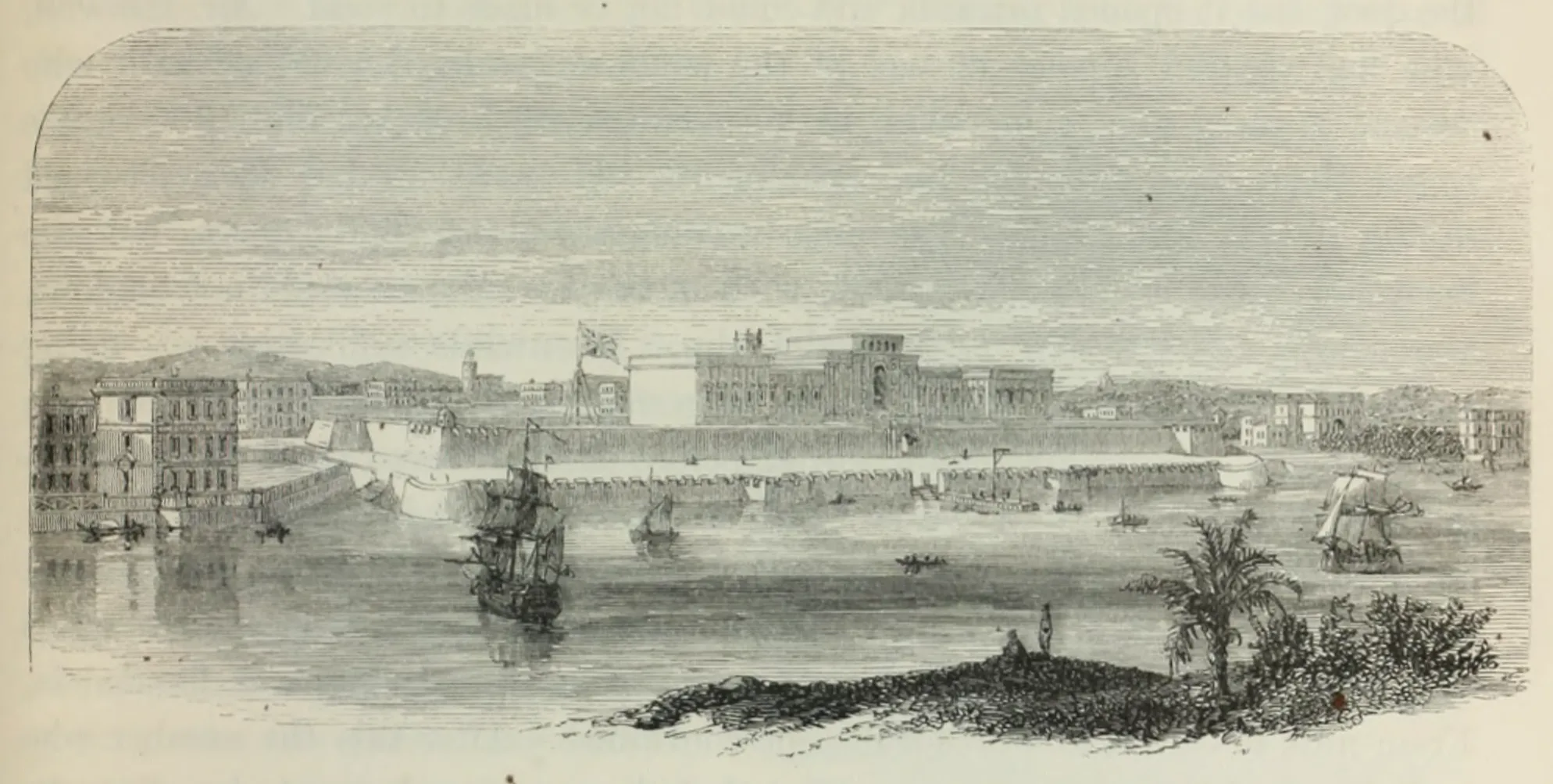
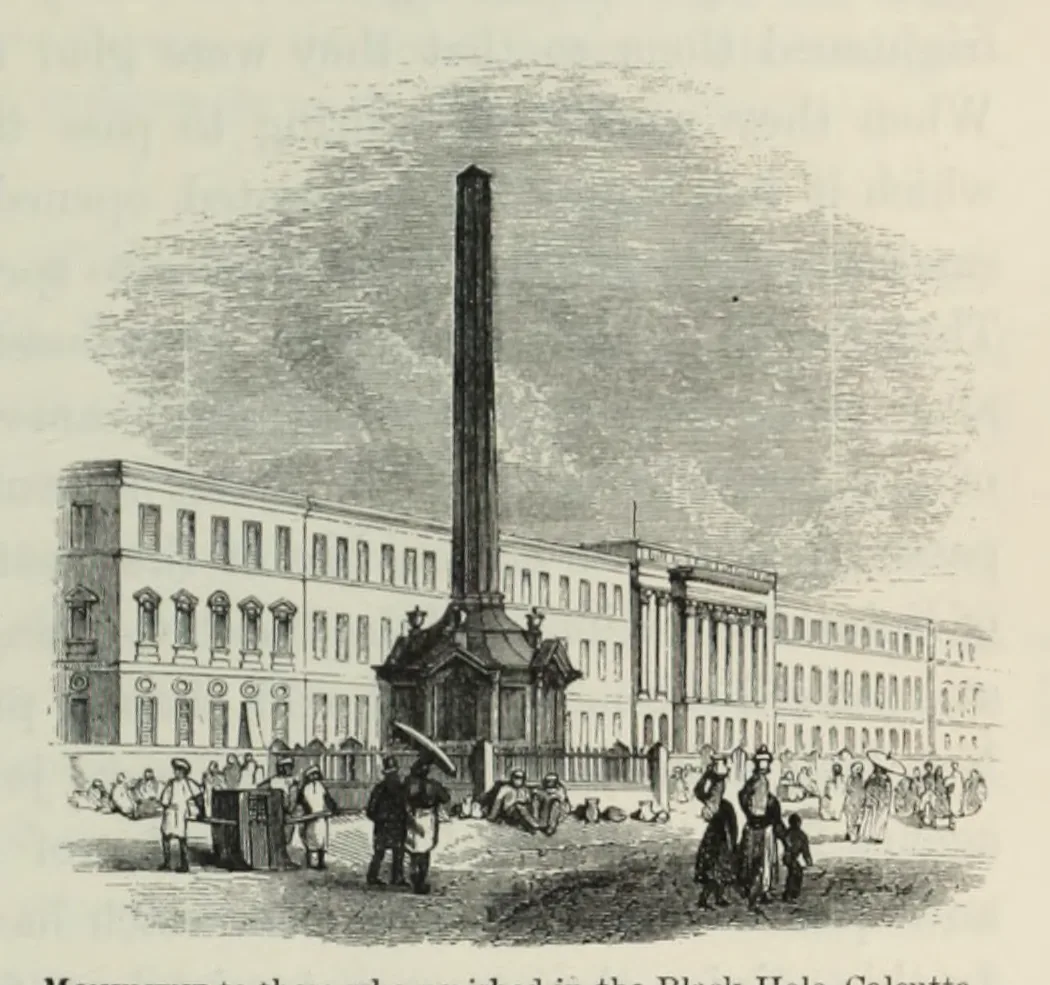
guard, who as soon as it was dark ordered them to collect themselves and sit down quietly under a verandah, or piazza of arched masonry, which extended on each side of the eastern gate, in front of the chambers already described as abutting on the wall. At this time the factories, both to the right and left, were in flames, and parties were seen moving about with torches, and some of the prisoners imagined that it was intended to suffocate them between two fires. This was a mistake, for the torch-bearers were only searching for a place in which to confine them. During this search they were ordered into that part of the verandah which fronted the barracks, along which was a large wooden platform for the soldiers to sleep on. The prisoners readily obeyed this order, for it now seemed that the worst which was to happen to them was to spend a night on the platform, at a season when all the air which could reach them through the openings of the piazza was required to temper the excessive heat. No sooner, however, were they within the space in front of the barracks than the guard advancing, some with pointed muskets, others with clubs and drawn scimitars, forced them back into a room at the southern extremity. It was the soldiers’ prison; or, as it was generally termed, the Black Hole. The whole formed a cubical space of only eighteen feet, completely inclosed by dead walls on all sides, except the west, where two windows, strongly barred with iron, furnished the only supplies of air, but gave no ventilation, as at this time no breezes blew except from the south and east. Few were aware of the nature of the horrid place till they found themselves crammed within it and had the door shut behind them. Their whole number was 146.
It was about eight o’clock when they entered, and in a very few minutes the dreadful consequences began to appear. Attempts were first made to force the door, but it opened inwards and could not be made to yield. Mr. Holwell, who had secured a place at one of the windows, seeing an old officer “ who seemed to carry some compassion in his countenance,” offered him 1000 rupees to get them separated into two apartments. He went off, but soon returned saying it was impossible. The offer was increased to 2000 rupees, but the answer was the same. The nabob, without whose orders it could not be done, was asleep, and no man durst awake him. Meanwhile suffocation was doing its work. First, profuse perspiration, then raging thirst, and lastly, in not a few instances, raving madness followed, before death relieved the sufferer. The general cry was—Water! water! and several skins of it were furnished by the natives outside, some apparently from compassion, but others from brutal merriment, holding up torches to the windows to enjoy the desperate struggles which took place among the unhappy prisoners as each supply was handed in. From nine to eleven this dreadful scene continued. After this the number who had already fallen victims was so great that the survivors began to breath more freely. At six in the morning an order arrived to open the prison. It was not easily executed, for so many dead bodies were lying behind the door that twenty minutes elapsed before it could be forced back so as to leave a passage. Of the 146 who had been thrust into the dungeon only twenty-three came out, and these more dead than alive. Strange to say, one of these was a woman, a native of India though of English parentage, and of such personal attractions that Meer Jaffier carried her off as a trophy to his harem.
Surajah Dowlah must have been well aware of the barbarity perpetrated, at least in his name, if not by his authority, and yet was so far from showing any signs of humanity and contrition, that when Mr. Holwell, still unable to stand, was carried before him, he rudely interrogated him as to concealed treasures, threatened new injuries if he refused to disclose them, and ordered him to be kept a prisoner; he was accordingly put in fetters, along with two others of the survivors who were supposed to know something of the imaginary treasures; the rest were set at liberty. Most of them, unwilling to remain within the nabob’s reach, proceeded to Govindpore, but found guards stationed to prevent any communication between the shore and the Company’s vessels still lying there. Two or three, however, managed to get on board, and brought tidings which must have wrung the hearts of those who had been instrumental in bringing such a catastrophe on their comrades by a double cowardice—first, by deserting them, and then leaving them to perish unsuccoured. “ Never, perhaps,” as Mr. Orme justly remarks,1 “ was such an opportunity of performing a heroic action so ignominiously neglected; for a single sloop, with fifteen brave men on board, might, in spite of all the efforts of the enemy, have come up, and, anchoring under the fort, have carried away all who suffered in the dungeon.”
The plunder of Calcutta fell far short of the nabob’s expectations. No treasures were forthcoming except those of Omichund, who, in consequence of the hard measure dealt out to him by the presidency, had not been permitted to remove them, and is said to have been pillaged of £40,000 in money, besides many valuables. Even the quantity and value of the Company’s merchandise were less than might have been anticipated. The capture had been made at the wrong season. The investments provided had been shipped off before the previous April, when the monsoon made navigation impossible; the imports of the past year had been mostly disposed of, and no new cargoes had yet arrived from England. Owing to these causes the Company’s loss in goods was estimated at not more than £200,000. Even of this only a small portion escaped the hands of the soldiers, or the embezzlement of the officials, who should have accounted for it to the treasury. The nabob therefore had made, on the whole, only a barren conquest, and consoled himself for the disappointment in the manner suitable to his character, by pompously changing the name of Calcutta to Alinagore, or the Port of God, in commemoration of his victory, and by maltreating Mr. Holwell and his two companions, who were sent as prisoners to Moorshedabad, and subjected to much hardship and indignity. The nabob, flattering himself that the British would never dare to show themselves again in Bengal, left Monichund in command of Calcutta, with a garrison of 3000 men, and proceeded homewards to carry out the expedition against Purneah, which he had so suddenly abandoned. After crossing the Hooghly with his army he determined to make the Dutch and French factories feel the weight of his displeasure. In passing southward he had imperiously ordered them to join his standard with all their forces. They declined; and he now sent a message threatening them with extirpation if they did not forthwith send him a large contribution by way of fine. Ultimately the Dutch compounded for £45,000, and the French for £35,000. The difference in favour of the latter was probably made in consideration of the present of gunpowder already mentioned.
The vessels at Govindpore had not remained there with the intention of rendering any assistance to the Calcutta garrison. On the contrary, yielding only to their fears, they had continued to sail down the river, and would willingly have quitted it altogether, had they not encountered a new danger, which frightened them so that they were glad to return to their former anchorage. When they were endeavouring to pass the fort of Tanna the cannon, with which it had again been mounted, opened upon them, and drove two of the smaller vessels ashore. This sufficed to spread a panic through the whole fleet. That the danger was magnified by excessive timidity was proved a few days after, when two ships from Bombay came up the river and sustained the fire of the fort without injury. Thus reassured the fleet again weighed anchor, passed Tanna without any loss of the least consequence, and reached the town of Fulta, the station of all the Dutch shipping. Here it was determined to remain, at least till the monsoon should change, provided the nabob did not interfere. Not long after their arrival they were joined by several other ships, and the agents from the subordinate factories of Dacca, Balasore, &c., who naturally anticipated a similar fate to that which had befallen Cossimbazar and Calcutta. In this opinion they were not mistaken, for the nabob had no sooner reached Moorshedabad than he issued orders for the confiscation of all the English property within his dominions.
Though the nabob did not molest the fugitives at Fulta their sufferings were not over. Ever dreading that they might be attacked they did not venture to sleep on shore, and crowded the vessels, where they lay, most of them on the decks, without shelter, exposed to the inclemencies of one of the worst climates in the world, during its unhealthiest season. Numbers were in consequence carried off by malignant fever, which infected the whole fleet. The evils thus produced by natural, were greatly aggravated by moral causes. Many, conscious of the light in which their conduct would generally be viewed, and unable to reflect on it without shame and remorse, endeavoured to exculpate themselves at the expense of their neighbours. Much time was thus spent to no purpose in mutual recrimination, and no course of united action was possible. At last, however, after a course of wrangling, the authority of the governor and the other members of council was acknowledged, and one of their number, with a military officer, set out for Madras, to represent their condition and solicit the necessary assistance.
Notes
- 1. Holwell’s Tracts, page 387, et seq.
- 1. History of Military Transactions in Hindoostan, vol. ii. page 78.
- 1. This obelisk was erected by Governor Holwell, in 1756. It is not undeserving of notice, that Mr. Holwell himself survived the catastrophe more than forty years, and died in 1798, aged eighty-seven. The Writers’ Buildings were so called from being the residence of the junior officers of the East India Company. Immediately beyond this edifice is the old court-house; the road leads on to the Lall Bazaar.