A rupture with the Mahrattas—A force sent overland from the Bengal to the Bombay presidency— Expedition from Bombay to assist Ragobah—Disastrous results—Negotiation with Moodajee Bhonsla, Rajah of Berar—Goddard’s campaign against the Mahrattas—Treaty with the Rana of Gohud—Campaign of Popham—Capture of Gwalior—Capture of Bassein—Hostilities with Scindia —Peace with the Mahrattas.
THE treaty of Poorundhur, concluded with the Poonah ministry by Colonel Upton, not being much relished either by the Company or the Mahrattas, had received a very imperfect execution, each party endeavouring to evade his obligations under it, and lay the blame of non-fulfilment on the other. In this state of feeling very little was required to produce a rupture. The more immediate occasion of it was as follows. In the middle of March, 1777, a French ship, laden with military and marine stores, cloth, and other articles of European export, arrived at Choul or Chowal, a Mahratta port about twenty-three miles south of Bombay, and landed several Frenchmen, who proceeded towards Poonah. One of them announced himself as a French ambassador, and was received in that character by the Mahratta ministers This ambassador proved to be the Chevalier St. Lubin, who, it will be recollected, formed part of the train of the field-deputies whom the council of Madras during the war with Hyder had the folly to send to the army, as a kind of check on the movements of their own general. This chevalier pretended to have lived long among the Mahrattas, to be intimately acquainted with their leading chiefs as well as with Hyder, and to be thus able, by the accuracy of his knowledge and the extent of his influence, to be of essential service during the campaign. Credit was given to his statements, but subsequent inquiry proved that they were without foundation, and that he was a mere adventurer. He had now succeeded in palming his impostures on the French, who, mortified at the ascendency which the British had established in India, and in daily expectation that a new war between the two nations was about to commence, were anxious to obtain some locality which might facilitate their naval and military operations, and serve as a nucleus from which new conquest might be made. On the east coast the retention of what they already possessed was the utmost that they could venture to hope for; the west coast presented a more favourable prospect. It was much nearer to the Mauritius, which had become the chief place of rendezvous for their European armaments, and the hostile feelings of the Mahrattas towards the British would make negotiation with them comparatively easy. Entertaining these views, they gave a willing ear to St. Lubin, and sent him on a mission to Poonah. As soon as his arrival and reception were known at Bombay, the greatest alarm was excited; and the council, who had been mortified above measure, both at the terms of the treaty of Poorundhur, and the manner in which it had been concluded, would at once, had their power been as absolute as it formerly was, have began to prepare for war. Under the restrictions which the Bengal government had imposed upon them, they were obliged to proceed more cautiously. Their freedom of action had, however, been in a great measure restored to them by a letter from the directors, disapproving of the manner in which they had been interfered with by the governor-general and council, giving it as their opinion “that an alliance originally with Ragobah would have been more for the honour and advantage of the Company, and more likely to be lasting than that at Poonah,” and summing up their views on the subject thus:—“His (Ragobah’s) pretensions to the supreme authority appear to us better founded than those of his competitors; and therefore, if the conditions of the treaty of Poonah have not been strictly fulfilled on the part of the Mahrattas, and if, from any circumstance, our governor-general and council shall deem it expedient, we have no objection to an alliance with Ragobah, on the terms agreed upon between him and you.”
Shortly after they had obtained this sanction to their proceedings, the Bombay council received an application which at once decided their future course. The dissensions which had long prevailed in the court of Poonah at last came to such a height that one of the parties, despairing of being able to establish their own ascendency, resolved to espouse the cause of Ragobah. At the head of this party was Moraba Furnavese, the cousin and rival of Nana Furnavese, the acting prime minister. The latter, not satisfied with shewing favour to St. Lubin, had put many petty affronts on Mr. Mostyn, the Company’s resident at Poonah, and it was therefore concluded that he had finally committed himself to the French, and was even prepared to give them a permanent footing in the country. Hence when Moraba, the head of the rival party, opened a communication with the Bombay council, and formally proposed that they would take means to reinstate Ragobah at Poonah, the request was so much in accordance with their own views and wishes, that they determined to comply with it without delay. Having formed this resolution, they lost no time in conveying intelligence of it to Bengal. Here, as usual, a serious difference of opinion arose. Messrs Wheler and Francis opposed the Bombay resolution as illegal, because adopted without the previous sanction required by the Regulating Act; as dishonourable, because in violation of a still subsisting treaty; and as impolitic, because involving the Company, without necessity or any adequate cause, in a war of the most formidable description. On the other hand, Messrs. Hastings and Barwell argued that the resolution, which might otherwise have been illegal, was fully justified by the suddenness of the emergency, and its conformity to the views expressed by the directors; that it could not be considered as a breach of the Poorundhur treaty, since one of the principal parties to that treaty was in favour of the application which had been made for assistance; and that it was in accordance with true policy, since it would not only frustrate the ambitious schemes of their great European rival, but secure their future ascendency in Mahratta councils, besides giving accessions of territory which would more than compensate for all the expense. This opinion, by means of the governor-general’s casting vote, prevailed, and it was resolved to assist the Bombay presidency both with money and with troops.
The transmission of the money was a simple process, but the conveyance of troops presented obstacles of no ordinary nature. The Company’s brigades were stationed far to the north and west, near the frontiers of Oude, and not only would much time be required to bring a sufficient detachment down to Calcutta, but a long and tedious voyage at an unfavourable season would intervene before it could reach the field of action. Mr. Hastings suggested the bold idea of an overland journey. It was adopted, and a force consisting of six battalions of sepoys, a proportionate artillery, and a corps of cavalry, was directed to assemble at Calpee, on the right bank of the Jumna. This place is nearly equidistant in a direct line from Calcutta and Bombay, being about 600 miles W.N.W. of the one, and 680 miles N.N.E. of the other. In the latter direction, the distance by any practicable route cannot be less than 1000 miles, and thus was the march about to be undertaken through a country only half explored, and for the most part unfriendly, if not actually hostile, by a force mustering in all 103 European officers, and 6234 native troops, with a cumbersome mass of followers estimated at not less than 30,000. The command was given to Colonel Leslie, whose orders were to proceed across India towards Bombay, and place himself at the disposal of that presidency.
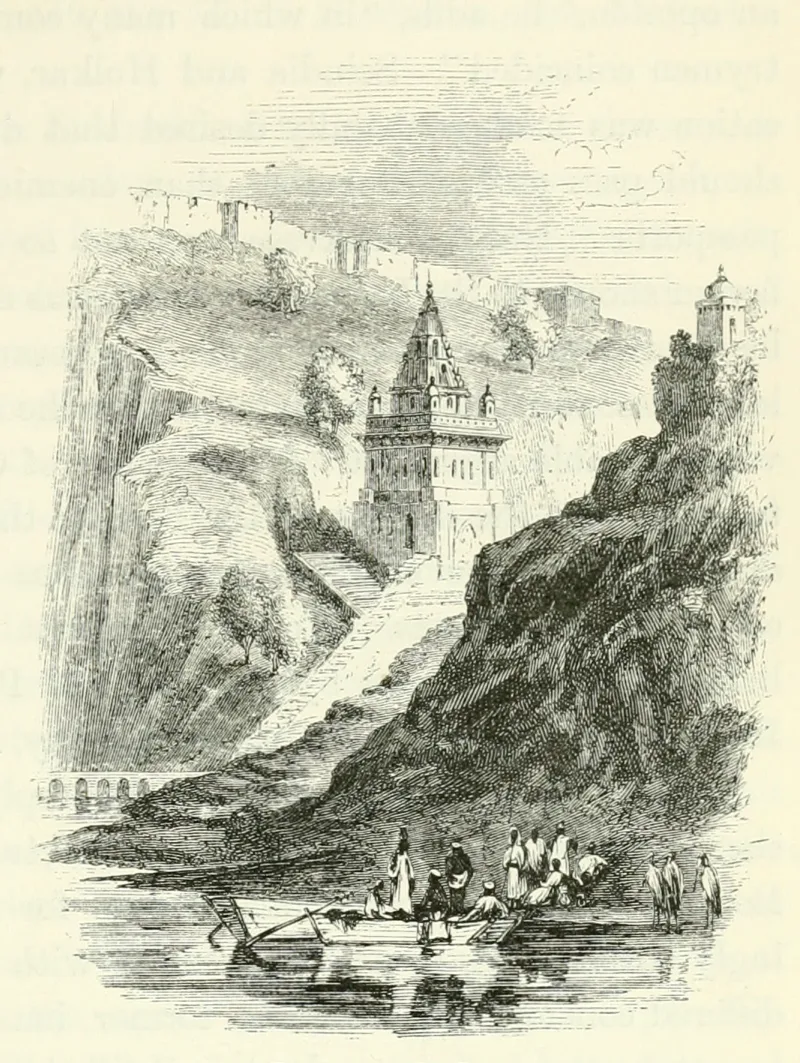
During these preparations the aspect of affairs at Poonah had undergone another change. Moraba, whose talents and honesty were far less than his ambition, no sooner believed that his own ascendency was established, than he began to repent of the invitation to reinstate Ragobah, and showed an evident anxiety to evade the subject when it was pressed by his English friends. A majority of the Bombay council seeing this change, resolved, on 22d April, 1778, to countermand Colonel Leslie’s detachment. A letter, received immediately after, from the Bengal government, induced them to alter this resolution, and on the 3d of May another order was despatched, directing Colonel Leslie to advance. Meanwhile another sudden revolution at Poonah had issued in the overthrow of Moraba and his party. Moraba himself was imprisoned in the fortress of Ahmednuggur; Sukaram Bapoo, through whom chiefly the treaty of Poorundhur was concluded, and who had throughout all changes steadily supported Ragobah, was carried off to end his days in a dungeon, loaded with chains so heavy, that though a powerful man he could scarcely lift them, and so scantily supplied with food and water, that they barely sufficed to maintain him in life for fourteen months, without satisfying his hunger or quenching his thirst; and Nana Furnavese, who had played his part with consummate art, was once more at the head of the ministry without a rival. On this change of administration, the Bombay council applied to know whether the new ministers held the Mahratta state to be still bound by the treaty of Poorundhur.
At an earlier period the Company’s resident at Poonah had made application to the ministers there, and to Scindia and Holkar, for passports to the British troops during the overland march. The object of their expedition was stated to be to counteract the designs of the French. On this subject the Mahratta chiefs were rather incredulous. “They probably considered,” says Duff,1 “that if it had been intended to send troops to Bombay, they would have been embarked from the coast of Malabar or Coromandel, and replaced from Bengal, an opinion,” he adds, “in which many competent judges among our own countrymen coincided.” Scindia and Holkar, who were at Poonah when the application was made, naturally desired that during their absence the British force should pass as friends rather than enemies, and therefore readily granted the passports. Nana Furnavese was not so complying. When he saw that the favour shown to St. Lubin at Poonah was made the ground of serious complaint, he dismissed him without difficulty, because he was too clear-sighted not to have discovered his true character, but he made this dismissal the ground of a very plausible argument. If the object of Colonel Leslie’s expedition really was to counteract the designs of the French, this object was already gained by their dismissal, and the expedition being thus rendered unnecessary, there was no occasion for passports. To the important question, whether the new ministers held themselves bound by the treaty of Poorundhur, the reply was, that “the English should keep that treaty faithfully, and then they would do the same.”
About the time when this decisive reply was given, intelligence arrived that the expected war with France was actually declared. This seemed to the Bombay council an additional reason for taking decisive steps. They accordingly entered into a new agreement with the opposition party at Poonah. It differed considerably from the former, inasmuch as under it Ragobah was only to assume the regency, and retain it till the majority of Gunga Bye’s son, Madhoo Row Narrain, who was thus acknowledged to be the legitimate peishwa. This agreement had scarcely been concluded, when the party with whom it had been made was completely overthrown. The Bombay council, however, had gone too far to recede, and they determined to carry out their plans.
Colonel Leslie had commenced his march in the end of May, 1778, and was expected by the Bengal government to advance with so much rapidity as to be able to cross the Nerbudda before the rains. Instead of this he allowed himself to be retarded by some petty Rajpoot chiefs, whom the Mahrattas had instigated to throw obstructions in the way, and in desultory warfare with them wasted the time which might have carried him far in advance. In the middle of August he had only reached Mhow, a town of Bundelcund, a little west of Chatterpore; and in the course of five months, while the estimated expense of his army amounted to more than twelve lacs, the whole distance accomplished did not exceed 120 miles. His incapacity, which had been previously suspected, was now considered proved, and an order was issued for his recall. Before it reached him he had died of fever, on the 3d of October, 1778. The command of the detachment was assumed by the next senior officer, Colonel Goddard, who a few days after quitted Rajegurh, and proceeded towards the Nerbudda. The Mahratta officer stationed at Sagur, after many professions of friendship, made a perfidious attempt on the baggage of the army; the Nabob of Bhopaul, on the contrary, gave it every assistance in his power, and greatly facilitated its progress. On the 2d of December, the Nerbudda was forded at Hoosingabad.
Colonel Goddard, after crossing the Nerbudda, remained for some time on its south bank, awaiting some communications on which his future operations depended. Mr Hastings had conceived it possible to detach Moodajee Bhonsla, the Rajah of Berar, from his connection with the ministers of Poonah, and enlist him in the interests of the Company. His views of the means by which this desirable object was to be accomplished were at first somewhat indefinite. When questioned on the subject by the party opposed to him in the council, he stated two methods by which the friendship of the rajah might be secured. The one was to assist him in recovering certain territories which had been wrested from him by Nizam Ali; the other was to support his claim to the Mahratta rajahship. The former pageant rajah had recently died at Sattarah without issue, and Moodajee Bhonsla, without pretending to be the nearest heir, was disposed to put in a claim to the succession, on the ground of his being a descendant of Sevajee. Before determining in which of these two modes the rajah’s friendship was to be courted, it was resolved to send an embassy to him. Mr. Elliot, who was at the head of the embassy, died on the 12th of September, before reaching Nagpore, the capital of Berar, and further proceedings were in consequence deferred. The rajah, whose vanity had been flattered by the court paid to him, professed great sorrow at the death of the ambassador, and wrote a letter to the governor-general, in which, after lamenting the event, he expressed a hope that the plan of friendship would not thereby be frustrated. On the same day the governor-general received a despatch from Colonel Goddard, dated 22d October, detailing the progress he had made towards the Nerbudda. It was now necessary to come to some decision, and the governor-general had nothing better to propose than that the negotiation with the rajah should be resumed, and conducted through Colonel Goddard. This motion, though strenuously opposed, was carried by the usual casting vote, and Colonel Goddard received the necessary powers to act in a double capacity. It was this which kept him halting on the banks of the Nerbudda.
The state into which affairs had thus been brought was very complicated. The Bombay government were under agreement to secure the residency at Poonah for Ragobah, till such time as the young peishwa should be able to act for himself; and the Bengal government were negotiating another agreement, which was totally incompatible with it. Moodajee Bhonsla’s object was to be a real, not a pageant rajah; and if he succeeded there would obviously be no room for any peishwa, at least in the sense in which the term was now understood, and the Bombay council and Ragobah and his friends understood it, when they incurred their mutual obligations. Mr. Hastings, when twitted with the inconsistency, did not attempt to deny it. He merely argued that the proposed agreement with the rajah would, if adopted, be by far the more valuable of the two, and that at all events the detachment ought to continue its march, whether its service should ultimately be employed in restoring Ragobah, or in raising Moodajee Bhonsla to the rajahship, or in counteracting the schemes of the French. On the 7th of December, when the complete overthrow of Ragobah’s party at Poonah became known at Calcutta, the governor-general held that the object originally contemplated in sending the detachment to Bombay was defeated, and that it therefore ought not to remain any longer under the orders of that presidency. His object in advising the Bengal government to resume authority over it, was to prevent the employment of it in a manner which would defeat his favourite negotiation with the Rajah of Berar. On this occasion he carried the whole council along with him, though their votes were given on very different grounds; the opposition hoping that the result would be to secure the object for which they had all along been contending—the recall of the detachment to Bengal. Meanwhile, the negotiation with the rajah made little progress, as he was evidently anxious not to commit himself so long as there was room to doubt which of the two would prove the winning side.
Colonel Goddard, while still halting on the banks of the Nerbudda, received the order which withdrew him from the authority of the Bombay government, and a few days after received an order from this government to advance with all expedition to the aid of their army, which had taken the field in the cause of Ragobah. This was a dilemma from which an officer satisfied with performing the ordinary routine of duty could easily have extricated himself. He would simply have remained at Hoossingabad, and pleaded the authority of his superiors. Colonel Goddard was not an officer of this cast. Fearing, from the terms of the Bombay letter, that much more might be at stake than appeared on the face of it, he resolved without hesitation to hasten westwards. He accordingly started about the 26th of January, 1779, and on the 30th reached Burhanpoor. In order to refresh his men, he remained here till the 6th of February, when he resumed his march. Surat, towards which he was proceeding, was 300 miles distant. He reached it in twenty days. By this extraordinary expedition he avoided a body of horse which had been sent from Poonah to intercept him.
Though Colonel Goddard had regularly transmitted full accounts of his progress to Bombay, he had received no information. Why he was thus kept in the dark has not been satisfactorily explained. It may have been merely culpable negligence, though another hypothesis is that the Bombay authorities, confident in their own resources, believed that they were a match for the Mahrattas without his aid, and were therefore unwilling to give him a share of the glory, which they hoped to appropriate entirely to themselves. If they acted from such selfish and vain-glorious motives, they were now paying the penalty. They had brought disgrace on themselves, disaster on the Company, and dishonour on the British name. The course of events which terminated in this result must now be explained.
In the end of August, 1778, the Bombay government learned for the first time, from the governor-general and council, that there was some intention of forming an alliance with Moodajee Bhonsla, and were directed in consequence not to enter into any engagement hostile to the government at Poonah. This information and direction were too vague to stay the majority of the Bombay council from following up the measures into which they had now entered with their whole soul, and they resolved that Moodajee was so totally unconnected with their design of securing the regency to Ragobah, that the intimation given them could not be intended to interfere with it. Their preparation, however, did not keep pace with their resolutions, and they remained inactive till the 12th of October, when Mr. John Carnac, one of the members of council, and the declared successor of Governor Hornby, lodged a minute, urging the necessity of adopting vigorous measures without further delay. Mr. Carnac, though ranked as a civilian, was the very same individual whom we formerly saw figuring in Bengal in the days of Clive as Brigadier-general Carnac. His opinion on a military question was therefore supposed to be entitled to some weight; and though Mr. Draper urged a delay of two months, and gave good reasons for it, his caution only subjected him to a smile of contempt from the ancient brigadier, who carried the majority along with him, and obtained the first reward of his zeal by being appointed president of a committee to settle the preliminaries with Ragobah.
The council gave the command of their army to Colonel Charles Egerton. His health was so infirm as to unfit him for active service, and on this account the place properly belonging to him had been taken in the former expedition by Colonel Keating. Strange to say, this fact, which furnished the best ground for excluding him still, was urged as the main reason for now appointing him, and an individual confessedly unfit was placed at the head of the army on the eve of a formidable war, merely in order that he might be able to draw the emoluments attached to the office. In some measure to counteract the foreseen consequences of such an appointment, the absurdity of field-deputies, which proved so mischievous in the Carnatic during the war with Hyder, was repeated, and two members of council, Mr. Carnac, the ex-brigadier-general, and Mr. Mostyn, lately resident at Poonah, accompanied the camp, to form, with the commander-in-chief, a committee empowered to regulate everything of importance, except the mere detail of duty and march. Colonel Egerton alleged that he had assented to the proposal of a committee under the impression that it was intended solely for the purpose of settling the preliminary arrangements with Ragobah, but afterwards, on finding how much more extensive its powers were, he not only made repeated objections, but protested against the whole measure “as contrary to the orders of the court of directors, and derogatory to his situation as commanding officer.” This was an ominous commencement, and ought to have opened the eyes of the Bombay government to the blundering and fatal course they were pursuing.
Though it was well known that Nana Furnavese was exerting himself to the utmost to meet the coming storm, a spirit of procrastination prevailed at Bombay, and it was late in November before the preparations were pronounced to be complete. On the evening of the 22d, an advanced party, consisting of six companies of native grenadiers and some light artillery, sailed from Bombay,
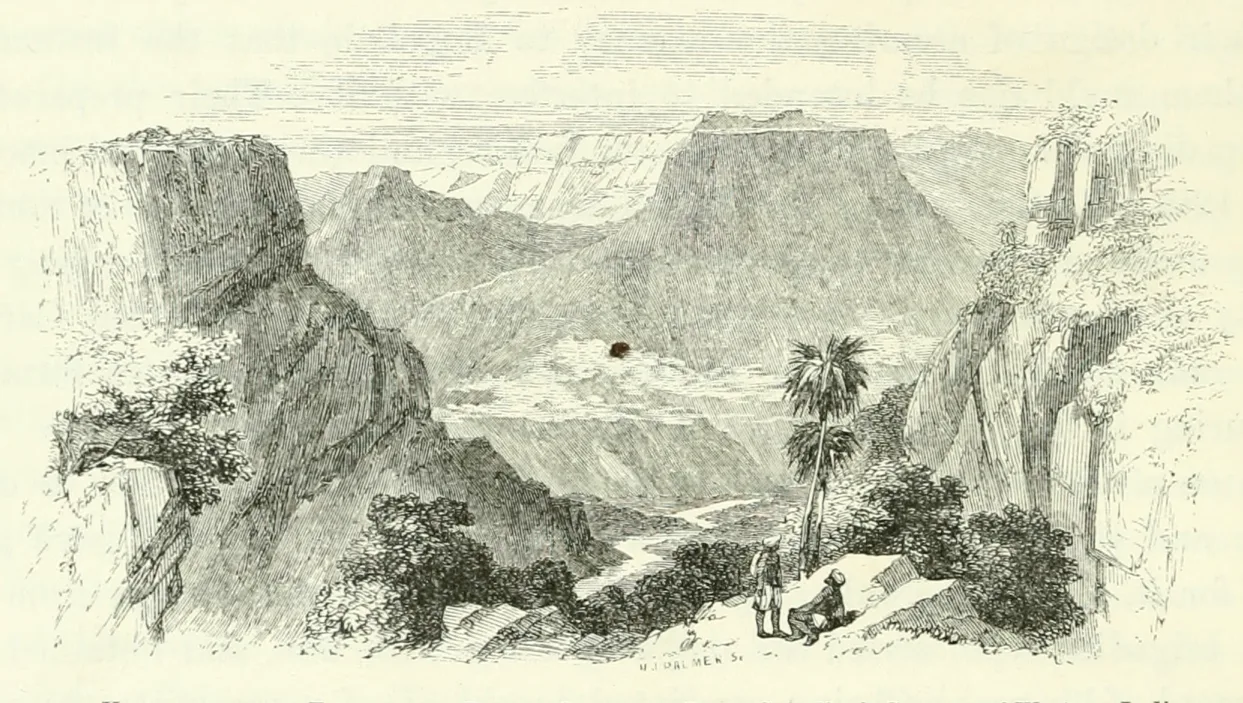
and landing at Aptee, gained possession of the Bhore Ghaut, a mountain pass on the road from Bombay to Poonah, and nearly equidistant from both, being about forty miles south-east of the former and north-west of the latter. The main body sailed on the following day, and disembarked at Panwell on the 25th. Including the advanced party under Captain Stewart, the whole force mustered 3900 men, of whom 591 were Europeans, 2278 sepoys, and 500 gun lascars. At Panwell a proclamation, declaring the objects of the expedition, was issued in Ragobah’s name. Some time was lost at Panwell, and before leaving it, Colonel Egerton and Mr. Carnac had quarrelled on a point of etiquette, the knotty point in dispute being the military honours claimed by the latter. A matter of more serious consequence was the illness of Mr. Mostyn, who, without once attending the committee, returned to Bombay, where he shortly after died. The great benefit which the expedition might have derived from his local knowledge, and the influence which he had acquired by personal acquaintance with the Mahratta chiefs, were thus lost. On his illness Colonel Egerton declared that the powers of the committee were suspended; but in thus endeavouring to throw off a galling yoke, he only rivetted it more firmly. The Bombay council, when appealed to, overruled his objections, and as there were now only two members, and Mr. Carnac as president had the casting vote, the effect was to make him virtually sole master.
The army, which did not reach the top of the Ghauts till the 23d of December, was there divided into two brigades, the one commanded by Colonel Cay, and the other by Lieutenant Cockburn, while the advance under Captain Stewart was still kept up as a separate corps. There were thus three divisions moving in succession, the one always occupying the ground which the other had occupied, and the whole creeping on at such a sluggard pace that eleven days were spent in reaching Karlee, a village only eight miles in advance of the Bhore Ghaut. This extraordinary mode of warfare was attributed to the imperfection of the commissariat. The effect of it was to encourage the enemy, who kept harassing the march by infantry, rockets, and guns. In the skirmishes thus occasioned, both Colonel Cay, who was an excellent officer, and Captain Stewart, who had given great promise of future eminence, lost their lives. The Mahrattas meanwhile had full leisure to assemble their army, in which the chief commands were held by Mahadajee Scindia, Hurry Punt Phurkay, and Tookajee Holkar, the latter, however, who was known to have a leaning for Ragobah, being stationed so as to make it extremely hazardous to attempt to join him.
On the 9th of January, 1779, when the British army reached Tullygaom, the enemy appeared in force, and seemed prepared for resistance. This was merely a feint; for when battle was offered them, they suddenly retired. At this time Colonel Egerton, disabled by sickness, had resigned the command to Colonel Cockburn; but as he still remained in the camp—for the very good reason that he durst not venture to quit it, because a body of the enemy had cut off the communication with Bombay—his counsels and those of Mr. Carnac still prevailed. The distance from Tullygaom to Poonah was only eighteen miles, and a determined effort might have accomplished it. Despondency, however, had now taken the place of overweening confidence, and two fatal resolutions were taken in one breath. The first was to open a negotiation with some of the chiefs, the second to retreat. Colonel Cockburn, on being asked his opinion, said he had no doubt of being able to carry the army to Poonah, though not without the sacrifice of the baggage, provisions, and cattle. The last, in bullocks alone, were 19,000. Whether it was that the sacrifice was deemed too expensive, or that some other inexplicable motive weighed with Messrs. Egerton and Carnac, the resolution to retreat was persisted in, in the face of an earnest remonstrance from Ragobah, who saw but too clearly what the result would be. When unable to change the resolution, he prayed only that the execution might be deferred. This was refused, even for a single day, and “at eleven o’clock on the night of the 11th of January,” says Duff, “the heavy guns having been thrown into a large tank, and a quantity of stores burned, an army of 2600 British troops began its retreat, secretly, as was supposed, before 50,000 Mahrattas.” They had not made a single march before receiving too good proof that they were discovered. At two o’clock in the morning, the advanced guard under Captain Gordon was fired upon by a party of horse. As soon as the firing was heard, Colonel Cockburn ordered two companies of Europeans to support the advance, but before any respite was obtained the rear also was attacked, and part of the baggage plundered. At daylight the army discovered that they were completely surrounded. A halt immediately took place, the line was formed, and a desperate struggle commenced. In the rear, where the onset was fiercest, the six grenadier companies of sepoys, under command of Captain Hartley, fought with perfect enthusiasm, and set an example which, if followed, might have secured an unmolested retreat. As it was, Hartley’s intrepidity so far succeeded in keeping the enemy at bay, that the advanced guard made some progress, and halted at the village of Wurgaom. The main body, however, was in great confusion. The followers crowded in between the troops so as greatly to impede their movements, and when the village was neared, rushed forward for shelter from the rockets which the enemy were showering upon them. The case, not yet hopeless, was soon made so by the pusillanimity of the commanding officer, who, instead of repressing despondency, encouraged it. Though a considerable loss had been sustained in entering the village, the troops had extricated themselves, the enemy’s horse were driven off, and the guns were placed in commanding positions. In the afternoon of the 12th some respite was thus obtained, but on the following day, when the enemy’s guns opened on the village, and a large body of infantry advanced to attack it, the resistance grew feebler and feebler, many desertions took place and the most alarming reports were circulated. The loss of the preceding day amounted to 56 killed, 151 wounded, and 155 missing—the last, the heaviest item of all, was supposed to be mostly owing to desertion. Among the killed and wounded were fifteen European officers.
A loss of 352 in a single day was a fearful deduction from so small a force, and a further retreat being deemed impracticable, Mr. Farmer, the secretary of the committee, was sent to negotiate. The first demand was that Ragobah should be given up. This would have been complied with, had he not previously made a better arrangement for himself by agreeing to surrender to Scindia. The next demand was that the committee should enter into a new treaty, surrendering all that the Bombay government had acquired since the death of Madhoo Row, together with the revenues drawn by the Company from Baroach and Surat. When this demand was made known by a note from Mr. Farmer, a consultation was held. Colonel Cockburn’s opinion, given in writing, as he was called upon to do, was that retreat was impracticable, and that he could not undertake the responsibility of it. Captain Hartley manfully combated this opinion, and even showed a plan by which retreat might be insured. Colonel Cockburn refused to alter his opinion, and Mr. Carnac acquiesced in it, though according to his own account he rather agreed with Captain Hartley that a retreat might be accomplished, and ought to be attempted, sooner than submit to the humiliating terms proposed. Ultimately the answer of the committee was that they had no power to enter into any treaty without the sanction of the supreme government. No sooner was this answer returned than Mr. Carnac did the very thing which it was said he had no power to do, and sent Mr. Holmes to Scindia to conclude a treaty. His apology for this double-dealing was, that if the Poonah ministers, after he had told them he could not treat, chose to be duped, it was their own fault, and that so far from intending the good faith he pledged, he gave Mr. Holmes his powers under a mental reservation that they were to be of no validity.
Some dexterity was shown in sending Mr. Holmes to Scindia. Between him and Nana Furnavese great jealousy and rivalry had long subsisted, and he felt greatly flattered when a separate negotiation was opened with him. His vanity, however, did not blind him so far as to make him lower the original demands. The convention settled with Mr. Holmes, restored everything to the Mahrattas as held by them in 1773, gave Scindia the Company’s share of Baroach, besides a sum of 41,000 rupees in presents to his servants, and bound the committee to send on the spot an order countermanding the advance of the Bengal troops. Humiliating as these conditions were, the committee expressed their gratitude to Scindia for having obtained them, and in security of fulfilment on their part, left Mr. William Gamul Farmer and Lieutenant Charles Stewart as hostages. On descending the Ghauts, the first act of the committee was to commit a breach of faith by countermanding the order they had sent to Colonel Goddard, when under the dictation of the Mahrattas they forbade him to advance. This explains the cause of the contradictory messages which puzzled that officer, and determined him to make his celebrated march to the west. When the army arrived at Bombay, the first thing which occupied the attention of government was the distribution of punishment and reward. Colonels Egerton and Cockburn they suspended from the service; of the conduct of Mr. Carnac, a worse culprit than either, they took no notice. The directors, when they reviewed these proceedings, distributed justice more impartially, by placing Mr. Carnac in the same category with the colonels, and dismissing the whole three. The only officer particularly entitled to reward was Captain Hartley, on whom the council immediately conferred the rank of lieutenant-colonel. Unfortunately this was a violation of the rule of rising by seniority, and excited so much clamour among those who considered themselves defrauded a step of promotion, that the directors virtually deprived Captain Hartley of his colonelcy by suspending his pay as lieutenant-colonel, and his further promotion, till all those formerly his seniors should in the usual routine be promoted over him.
Nothing could exceed the mortification and distress of the Bombay government. Eager to show the Bengal government what Bombay could do without their assistance, they had disdained to wait for the arrival of the detachment, and “desperately,” as Duff well expresses it, “sent a handful of men against the strength of the Mahratta empire.” This enterprise, “practicable only by celerity, address, and resolution,” they committed to men totally unfit for such a charge. The consequence was that “their army had returned defeated, their treasury was exhausted, their credit insignificant, and their reputation sullied.” Under these disastrous circumstances, a most judicious course was pursued by Governor Hornby. He advised his colleagues to abstain from recrimination, leaving it to their superiors to decide on their motives and measures, and in the meanwhile giving their whole minds to the consideration of the means best fitted to prevent or surmount the evils which seemed to be impending. The disgraceful treaty or convention of Wurgaom they could never think of ratifying, but as this was a question which they could not of themselves decide, nothing could be gained by repudiating it at once, and thus publishing a defiance to the Mahrattas. Their best policy was to begin anew with their preparations, and strain every nerve to recruit and improve their army.
Such was the position of affairs at Bombay, when the joyful tidings were received of Colonel Goddard’s arrival at Surat. The government, besides expressing their liveliest gratitude for the honourable and generous motives which had induced him to hasten to their relief, testified their sense of his merits by offering him a seat in their council, and recommending that he should be appointed their commander-in-chief. During a visit which he paid to Bombay, the esteem which they previously felt for his character was greatly increased by personal acquaintance, but at the same time, some facts were communicated which awoke the jealousy of the council, and threatened to produce some degree of misunderstanding. The Bengal government, on learning that the Bombay army had taken the field, had decided on sending forward the detachment to their support, but declined to relinquish their own control over it. At a later period, they had taken the still more decided step of not only retaining Colonel Goddard under their orders, but of conferring upon him distinct powers to negotiate as their plenipotentiary with the court of Poonah. On being made acquainted with the disasters which were crowned by the disgraceful convention of Wurgaom, they first provided for their own safety by ordering a brigade to the banks of the Jumna, and sending Sir Eyre Coote, their commander-in-chief, to inspect and prepare their military resources on the north-west frontier, where an attack was most to be apprehended. This done, they gave their attention to the Bombay presidency, and manifested a spirit worthy of all praise. In this respect Mr. Hastings particularly distinguished himself. In a minute lodged on the 24th of May, 1779, he remarked, “Whatever our resolutions, I hope the board will see with me the propriety of conveying them in such a form and temper, as may give encouragement and confidence to the presidency of Bombay, instead of adding to their depression.” Again: “To mark our want of confidence in them by any public act, would weaken theirs in us; to load them with harsh and unoperating reproaches, would indispose them to our authority, at the same time that it would absolve them from its effects; and to bind their deliberations by absolute and unconditional orders, might eventually disable them from availing themselves of any fortuitous advantages which the confusion of the Mahratta government is more likely to offer them, than any plan which we could prescribe to them, or which they could form on the letter of our instructions.” His advice therefore was, “Let us rather excite them to exert themselves for the retrieval of their past misfortunes, and arm them with means adequate to that end; restricting their powers where the object is determinate, and permitting a more liberal extension of them in cases which are too variable and uncertain for positive injunctions.”
Liberal and moderate as these views are, Mr. Hastings, when he came to the practical application of them, did not succeed in giving entire satisfaction. The Bombay government thought themselves slighted when the rank of brigadier-general was conferred on Colonel Goddard by the governor-general and council, and not as they thought it ought to have been only through them; they also complained of his being appointed to negotiate separately with the Poonah ministers, and objected in particular to the stationing of a military force within their limits, and independent of their authority, as an invasion of their rights and highly unconstitutional. The governor-general and council refused to give way on any of these points, and the Bombay government had the good sense to promise that a difference of opinion would not prevent them from co-operating heartily in whatever measures might be adopted. On the 15th of April, 1779, General Goddard had been directed to endeavour to negotiate a peace on the terms of the treaty of Poorundhur, with the addition of an article excluding the French from any establishment within the Mahratta dominions. In the end of May he received more detailed instructions, directing him, if peace on the above terms could not be obtained, to adopt a plan suggested by Governor Hornby, and form an alliance with Futteh Sing as the acknowledged head of the Baroda or Guicowar territories. After the disaster at Wurgaom, little hope was entertained of an effective alliance with Moodajee Bhonsla, and therefore General Goddard was instructed to tender specific conditions, the rejection of which would put it in his power to declare the negotiation at an end.
There was still another proposed alliance, from which at one time great things were expected. This was an alliance with Scindia. The rivalry subsisting between him and Nana Furnavese was well known. While apparently acting cordially together, they were constantly counterworking and endeavouring to out-manœuvre each other. In playing this double game, Scindia had repeatedly acted in a manner which seemed to imply that he would willingly come to a separate understanding with the Company. One marked instance had recently occurred. By the convention of Wurgaom, Ragobah had been committed to his custody. His real object in undertaking this office was to employ it as a means of working on the fears of Nana Furnavese. With this view he had caused a jaghire worth twelve lacs to be settled on Ragobah in Bundelcund. Ragobah was thus induced to believe that Scindia was his friend; and Nana was also satisfied, because Scindia, on obtaining the jaghire, became security to him that Ragobah would no more molest his government. Shortly after this arrangement Ragobah was sent off to his jaghire. He was very imperfectly guarded, and in the latter end of May, just before he reached the Nerbudda, a hint was given him that it was intended to confine him in the fortress of Jhansi. He therefore watched his opportunity, and when about to ford the river made his escape, and fled with all speed to seek an asylum with his English friends at Baroach. The whole was believed to be a scheme of Scindia, who thus at once widened the breach between Nana and the English, and led the latter to believe that he himself might be induced to co-operate with them in their scheme of establishing Ragobah at Poonah.
All Scindia’s professions of friendship proved vain, and Nana Furnavese, after the negotiation with him had been protracted for several months, virtually put an end to it, by declaring, when General Goddard demanded from him explicit answers, that the surrender of Salsette and the person of Ragobah were preliminaries to any treaty which the English might wish to conclude with the Mahratta state. Previous to this, Ragobah with his two sons, Amrut Row and Bajee Row, the latter a child of four years old, had visited General Goddard in his camp, and received from him an allowance of 50,000 rupees a month. This was censured by the Bengal government as lavish expenditure, the more especially after it had been resolved to make no more use of him politically. The discovery, though late, had at last been made, that nothing could be more impolitic than an attempt to force into the Mahratta government a person to whom the whole nation, instead of rising in his favour, as expected during the late expedition, had manifested indifference or aversion. Now, therefore, that the declaration of Nana Furnavese had made war inevitable, it was to be carried on not in his name, but by the Company themselves as principals.
General Goddard, on receiving the above answer from Nana, set out for Bombay, where he arrived on the 1st of November. The object of his visit was twofold—to consult on the future plan of operations in connection with the proposed alliance with the Guicowar Futteh Sing, and more especially to urge the immediate preparation and despatch of a reinforcement. The council would have preferred delay, but could not resist his urgency, and a detachment under Colonel Hartley, consisting of 100 European artillery, 200 European infantry, and two battalions of sepoys, was immediately embarked for Gujerat. From Madras a detachment, under Colonel Browne, of 100 artillery, 500 Europeans, and a battalion of sepoys, was expected. On the side of Bengal a detachment of 2000 sepoys, which had been prepared to follow the overland route previously, was diverted to a different purpose, which will afterwards be explained. On returning to Surat, where the main body of his army was stationed, General Goddard dismissed the envoys of Nana, and opened a negotiation with Futteh Sing. On perceiving that this chief, afraid to commit himself, evaded a definite engagement, he put his army in motion, and crossed the Taptee on the 1st of January, 1780. He advanced slowly northward till joined by his battering train and stores from Baroach, and then hastened to attack the fort of Dubhoy, which was held by an officer for the peishwa, with a garrison of
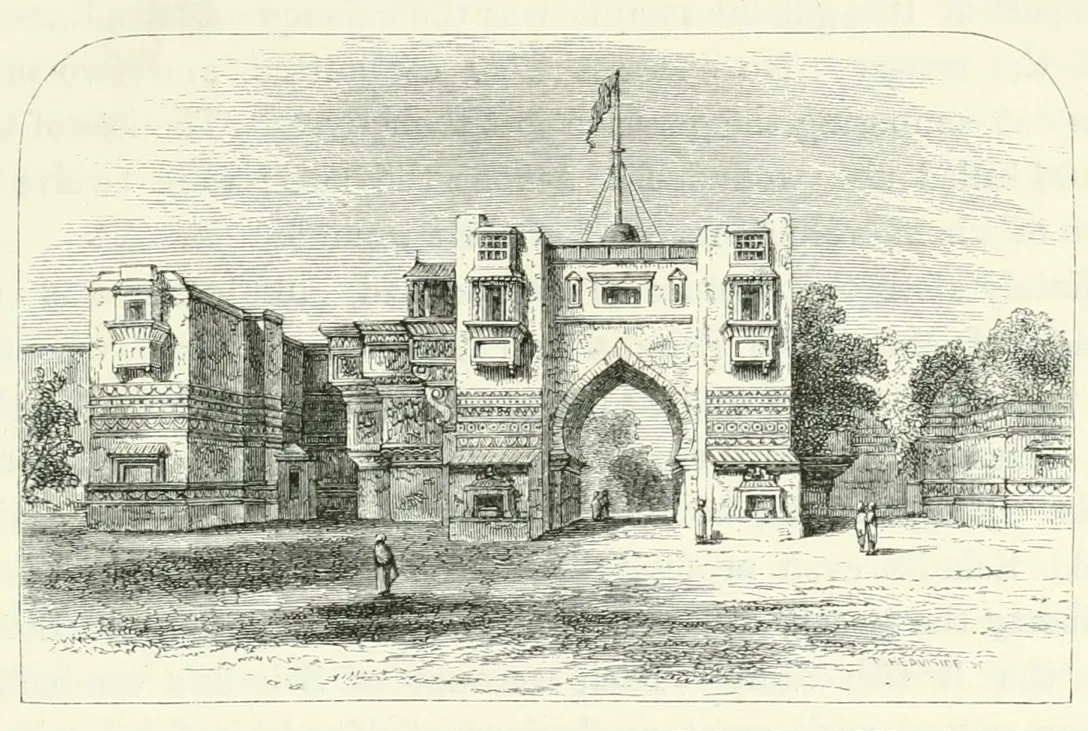
2000 men. This place, situated fifteen miles south-east of Baroda, and seventy-eight miles north-east of Surat, was believed by the natives to be of great strength, and had certainly a very imposing appearance. It formed a quadrangle of two miles in circuit, inclosed by a rampart built of large hewn stones, and surmounted by fifty-six towers. General Goddard arrived before it on the 18th of January, and on the 20th, when ready to open upon it from a battery of three eighteen-pounders, within two hundred yards, found that the garrison had evacuated it during the night. Leaving it in charge of a company of sepoys and a few irregulars, under the charge of a civil officer, Mr. James Forbes, author of the Oriental Memoirs, he continued his march in the direction of Baroda. He was met by Futteh Sing, who showed how completely the sudden capture of Dubhoy had changed his views, by entering at once into an offensive and defensive alliance, by which, in addition to other advantages ceded to the Company, he agreed to furnish a body of 3000 horse. One of the stipulations in his favour was that he should be put in possession of Ahmedabad. For this place, therefore, the army now directed its march.
Ahmedabad, the capital of Gujerat, situated on the left bank of the Saburmuttee, about sixty miles above its mouth in the Gulf of Cambay, though greatly declined from its ancient splendour, was still a place of great importance, with a population estimated at upwards of 100,000. Its lofty turreted walls, about six miles in circuit, were remarkably strong, and it was at this time held for the peishwa by a Brahmin commandant, with a garrison of 6000 Arab and Sindee infantry, and 2000 Mahratta horse. General Goddard arrived before it on the 10th of February, and on the 12th opened a battery, by which a practicable breach was effected on the evening of the 13th. After the delay of a day in expectation of a surrender, the assault took place on the morning of the 15th, and was completely successful. Duff justly observes, that “the most honourable part of this gallant assault was the subsequent steadiness and good conduct of the troops. No excesses were committed, and two only of the inhabitants not composing the garrison lost their lives.” The loss of the captors was only 106 killed and wounded. Among the latter were twelve European officers, two of whom, volunteers, died of their wounds.
Immediately after the capture of Ahmedabad, intelligence was received of the approach of Mahadajee Scindia and Tookajee Holkar, who forded the Nerbudda with upwards of 20,000 horse, and proceeded to the neighbourhood of Baroda. General Goddard crossed the Myhie on the 6th of March, to give them battle. They showed no inclination to accept of it, and retired as he approached. Scindia even professed the greatest friendship, and as a proof of it, set at liberty the two Wurgaom hostages, Messrs. Farmer and Stewart, who arrived in the British camp. Their account of Scindia’s conduct, and the arrival of an envoy, with great professions of friendship for the English, and hatred for Nana Furnavese, gave some ground for belief that he really desired an alliance. General Goddard, however, suspected that the real object was to keep him inactive during the fair weather; and therefore, while reciprocating the expressions of friendship, sent back the envoy, and left Scindia only three days to make his proposals. On the 16th of March the envoy returned with terms, which were in substance that Ragobah should retire to Jhansi, and live on his jaghire of twelve lacs, that the government should continue, in the name of Madhoo Row Narrain as peishwa, and that Bajee Row, Ragobah’s son, should be appointed the peishwa’s dewan. The most essential part of the proposed arrangement, though mentioned last, was that as Bajee Row, who was only a child of four years, could not act as dewan, Scindia should take him with him to Poonah, and manage for him. General Goddard answered that as these proposals amounted to nothing less than that the Company should assist Scindia in acquiring the entire power of the state, it was necessary that he should on his part consent, in the name of the peishwa, to certain concessions in favour of British interests. Scindia, seeing the negotiation which he probably meant to spin out for months brought to a point in a few days, made no further overtures, and entered into a communication with Govind Row, the brother of Futteh Sing, and his rival claimant for the office of Guicowar, with the view of putting him in possession of Gujerat. General Goddard, on being made acquainted with this new intrigue, had no other wish than to bring on an action with the least possible delay.
It proved no easy matter to force the Mahrattas to an encounter, which they continued anxious to avoid. Having placed his baggage under the protection of the hill-fort of Pawangurh, Scindia threw out a number of small parties of horse, to give alarm in case of danger, and prevent a surprise. Thus feeling secure, he allowed the British to encamp within six miles of him. The two armies had remained in sight of each other for a week, when, on the morning of the 3d of April, General Goddard attempted a surprise. Taking the greater part of his troops, and heading them in person, he marched silently along, passed the out-parties of the Mahrattas and their grand guard of several thousand men, and was pushing on for the camp, which was still a mile in front, when the day dawned, and an alarm was given. The main body of the enemy hence stood ready mounted, and even advanced to charge, when a heavy fire from the advancing British obliged them to turn their backs. General Goddard was under the impression that he had gained a victory, and felt mortified when, after encamping, he perceived the enemy still keeping the same distance as before. On the 14th of April he was joined by the expected reinforcement from Madras, under Colonel Browne, and about a week after made another ineffectual attempt on Scindia’s camp, the Mahrattas merely waiting till he came within sufficient distance, and then retiring under a flight of rockets. The effects of this protracted desultory warfare was to make foraging extremely difficult, and General Goddard, shortly after one of his covering parties had been briskly attacked, moved to the Nerbudda, to place his troops in cantonments during the approaching rains.
The Bombay government made pressing application to General Goddard to seize Parneira, a hill fifteen miles north of Damaun, which had been fortified in the time of Sevajee. Before it could be attempted, it was found that their wishes had been anticipated. A Mahratta officer, of the name of Gunnesh Punt, who had been stationed in the Concan, set out on a marauding excursion, and after plundering the districts on the south of the Taptee known by the name of Uthawees Mahal, or Attaweesee, carried his devastations to the vicinity of Surat. On application from the authorities, Lieutenant Welsh, of the Bengal cavalry, was sent forward with the Candahar horse (the designation of a body of cavalry belonging to the Nabob of Oude), and a body of infantry, and not only succeeded in surprising the camp of Gunnesh Punt, but afterwards proceeded southward, and greatly distinguished himself by the capture of three forts in the district of Damaun, one of them this very Parneira, about which the government had been so urgent. At this time, also, the tranquillity of the districts in Gujerat, recently ceded to the Company by Futteh Sing, was insured during the approaching monsoon by the gallantry of a detachment of Bengal sepoys under Major Forbes, who came up with one of Scindia’s detachments near Sinnore, on the Nerbudda, and completely defeated it.
Mention has been made of a Bengal detachment which was preparing to follow Goddard’s overland route to Surat, when it was countermanded, and employed in a different direction. The nature of this employment must now be explained. The Rana of Gohud, the designation of a Jat zemindar, made application to the Bengal government for assistance against the Mahrattas. His territories consisted of a hilly tract, of which Gwalior was the capital; but so little was known of him at the time, that he is merely described as “a chief south of Agra.” Mr. Hastings thought that the application might be turned to account. In this view he was seconded both by Sir Eyre Coote and General Goddard, who strongly recommended a diversion, which might be effected by operating against the Mahrattas in Malwah, through the rana’s territories. Accordingly, on the 2d of December, 1779, a regular treaty with him was concluded, the Company engaging to furnish a force for the defence of his country, at a certain rate for each battalion of sepoys, and he engaging to furnish 10,000 horse, as soon as combined operations against the Mahrattas should be determined on. Of any new territories acquired he was to receive seven-sixteenths, and when peace should be made, he was not only to be included, but his actual possessions, as well as those seized by the Mahrattas, were to be guaranteed to him. Sir Eyre Coote, as has been said, was in favour of a diversion, but he wished it to be attempted on a large scale, and therefore condemned the measure as extremely injudicious, when it was resolved to employ only the detachment with which it had been intended to reinforce General Goddard.
This detachment, under Captain William Popham, consisted of 2400 men, formed into three equal battalions, a small body of cavalry, and a detail of European artillery, with a howitzer and a few field-pieces. Captain Popham crossed the Jumna in the beginning of February, 1780, and immediately attacked and routed a body of Mahrattas, who were plundering in the neighbourhood of Gohud. He then marched, at the request of the rana, against Lahar, a fort situated fifty miles west of Calpee. Though it proved much stronger than he had been led to expect, and a breach behoved to be made, he resolved to persevere, and having made some impression on the works, without seeing any prospect of effecting a practicable breach, in the ordinary sense of the term, gave orders for the assault, and, by the determined gallantry of the storming party, succeeded, though not without the heavy loss of 125 men. This success was so little expected by Sir Eyre Coote, who, knowing the want of battering cannon, anticipated nothing but disaster, that in consequence of his representations, another detachment of four regular battalions, with a battering train, was held in readiness to cross the Jumna under Major Jacob Carnac.
The capture of Lahar was only the prelude to a much more brilliant achievement. After returning from Lahar, Captain Popham encamped during the rains within a few miles of the celebrated fortress of Gwalior. This place, situated sixty-five miles south of Agra, had been wrested about a year before from the rana, and was in the possession of Scindia, who justly plumed himself upon his conquest, since it was regarded as all but impregnable. Its site is an isolated rock of ochreous sandstone, partially capped with basalt, about a mile and a half in length, by 300 yards in breadth, and at the north end, where loftiest, of the height of 340 feet. The lower part of the rock is sloping, but
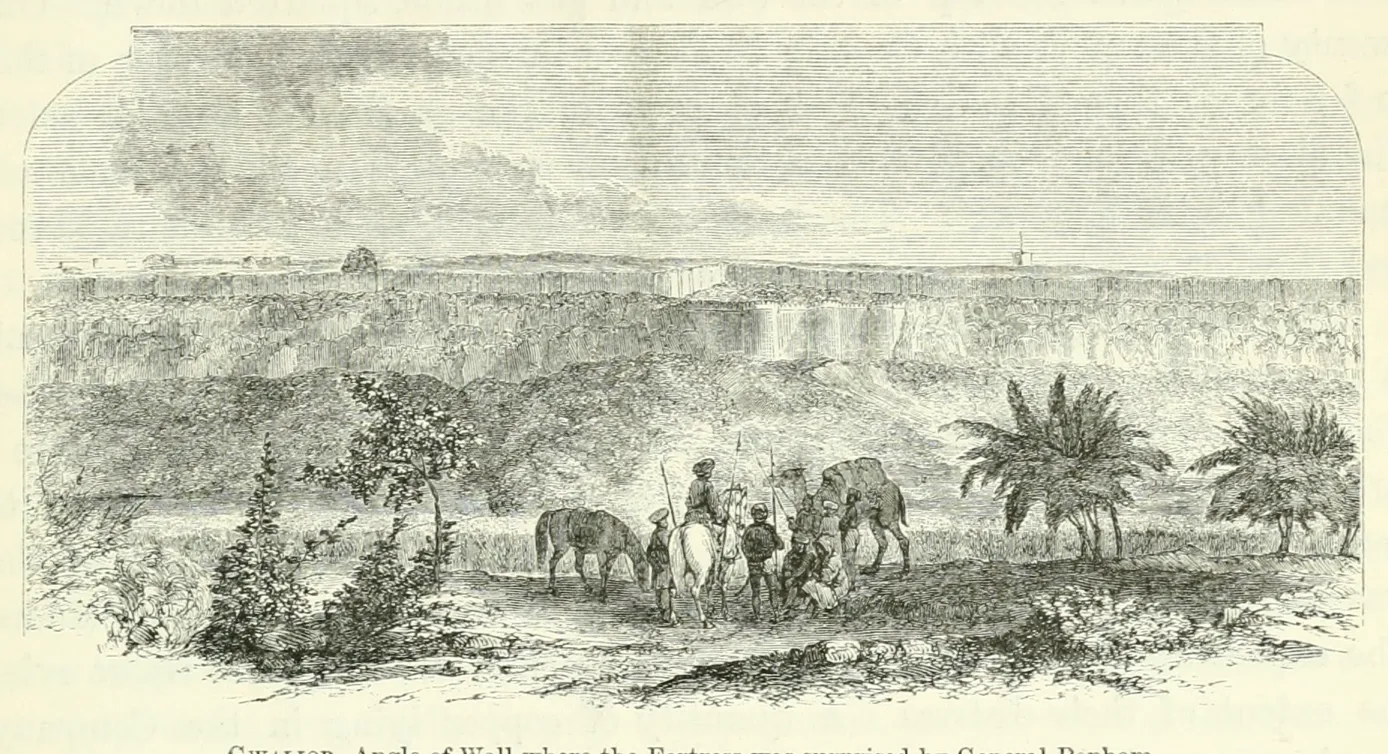
immediately above the slope the sandstone rises in a precipice, partly natural and partly scarped, so as to seem in some places to be not only perpendicular, but overhanging. Along the verge of the precipice rises a rampart, which, from being of the same height throughout, while the level of the base varies, has an irregular appearance. The entrance to the inclosure is near the north extremity of the east side, and consists of a steep road, succeeded by a huge staircase cut out of the rock, with a width so great, and an acclivity so gentle, that elephants easily ascend it. The outer side of the staircase is protected by a strong and lofty wall, and within it are seven successive gates. Should an enemy surmount all these obstacles, and get within the rampart, his work would only be half finished, as a citadel with six lofty round towers or bastions, connected by curtains of great height and thickness, would still remain to be taken. The town of Gwalior lies along the eastern base of the rock. Hopeless as the capture of such a place by surprise might have appeared to ordinary minds, Captain Popham resolved to attempt it. He had a good coadjutor in the rana, who was himself thoroughly acquainted with the interior, and kept spies within it who would act as guides. After every preparation had been made with the utmost secrecy, the night of the 3d of August was fixed on for the attempt. The command of the advance was given to Captain Bruce, and consisted of two companies of chosen sepoys, headed by four British lieutenants. Immediately behind the sepoys were twenty Europeans; two battalions of sepoys followed. When the attempt was made, the scarped rock was only sixteen feet high, and was easily mounted by scaling ladders. Beyond this a steep ascent of about forty yards led to the bottom of the second wall. This was thirty feet high, and was surmounted by the aid of the spies, who, having managed to ascend, made fast ladders of ropes. Each man, as soon as by this means he reached the top of the wall and got inside, squatted down. Only twenty of the sepoys with Captain Bruce had thus entered, when three of them so far forgot themselves as to shoot some of the garrison as they lay asleep. The alarm was immediately given, but the sepoys stood firm till their comrades mounted to their support. The garrison, intimidated, made a feeble resistance, and Gwalior was taken without the loss of a man.
The Bombay government had every reason to be satisfied with the results of the campaign. Difficulties, however, of a most formidable nature had arisen. They were totally without funds, and knew not from what source they were to be obtained. A most ruinous war had begun to rage in the Carnatic, and the money which the Bengal government had been expected to send to Bombay was more than required to supply the still more urgent necessities of Madras. The expedients to which the Bombay government were obliged to resort evince the extent of their distress. A quantity of copper lying in the Company’s warehouses, and valued at ten or twelve lacs, was sold to the highest bidder; loans on their own credit were proposed for negotiation in Bengal; and a plan was formed for seizing the enemy’s resources, by anticipating them in the collection of the revenue.
It had been determined that General Goddard should open the ensuing campaign with the siege of Bassein. With this view the European part of the army was conveyed to Salsette by sea, the battering train was prepared at Bombay, and the sepoys were to march by land. Meanwhile the want of funds rendered it necessary to employ the whole disposable force at Bombay in work of a different description. Early in October, five battalions were placed under Colonel Hartley, with instructions to cover as much of the Concan as possible, so as to enable agents from Bombay to collect part of the enemy’s revenues, and secure the rice harvest, which is gathered at the close of the rains. Before he could accomplish this task, his services were required for the purpose of relieving Captain Abington. This officer, on the very night Gwalior was taken, had made a similar attempt on the strong fort of Mullangurh, or Bhow Mullan, situated eastward of the island of Bombay. He succeeded in gaining possession of the lower fort, but the garrison escaped to the upper fort, where they were able to set him at defiance. While he remained in the lower fort, a body of the enemy, to the number of more than 3000, cut off his communication with Kallian or Callianee. He was thus completely surrounded, till Colonel Hartley marched to his relief, and extricated him without loss. The enemy, however, having been reinforced, took up a position on the south-east side of the fort, and began to lay waste the country. Colonel Hartley, who had marched back to Kallian, determined to return and attack them. The enemy, apprised of his advance, came forward to meet him, and for this purpose left their camp standing as if it were perfectly secure. As he approached they retired, apparently meaning to lead him into an ambuscade. Captain Jameson, who was marching with the 8th battalion to assist in the attack, seeing them thus retiring, did not hesitate, unaided as he was, to encounter the whole body, and not only routed them, but gained possession of their camp. This exploit put the troops in high spirits, and Colonel Hartley, taking advantage of their alacrity, drove the enemy entirely from the Concan, and by taking up a position near the Bhore Ghaut, procured a short respite, during which the Bombay government were able to carry out the plan of replenishing their treasury at the expense of the enemy, by anticipating them in the collection of the revenue.
General Goddard arrived before Bassein on the 13th of November, 1780. This place, twenty-eight miles north of Bombay, stands on an island of the same name, separated by a narrow channel from the mainland of the Northern Concan, and was so strong, that it was deemed necessary to attack it by regular approaches. These were practicable only on the north side, where several batteries, principally twenty-four pounders, were erected at the distances of 900, 800, and 500 yards. One of twenty mortars at the last distance did great execution. The division of Colonel Hartley endeavoured to prevent the Mahrattas from attempting to raise the siege. This they were evidently bent on doing, and large numbers of troops, as fast as they could be assembled, were hurried down into the Concan. General Goddard’s precautions having effectually frustrated all endeavours to succour Bassein, the Mahrattas turned their whole force against the covering army. It amounted to upwards of 20,000 horse and foot, led by an able officer of the name of Ramchunder Gunnesh; whereas the force under Colonel Hartley, diminished by casualties and sickness, mustered little more than 2000 effective men. On the 10th of December, while he was occupying a position at Doogaur, nine miles east of Bassein, they attacked him both in front and rear, but notwithstanding the inequality were steadily repulsed. On the following day the attack was renewed with a similar result, though the Mahratta guns did considerable execution. Colonel Hartley’s flanks were secured by two eminences, and Ramchunder Gunnesh perceiving that he could not otherwise force the position, was determined at whatever cost to make himself master of one of them. Accordingly, on the morning of the 12th, while the other Mahratta leaders were ordered to advance in front and rear, Ramchunder in person, at the head of a body of Arab foot, accompanied by 1000 regular infantry under Signior Noronha, a Portuguese officer in the peishwa’s service, approached by a circuitous route, for the purpose of storming the height. Colonel Hartley, having some apprehension of this attack, had prepared for it, by throwing up a small breastwork, and planting a gun on each of the eminences. A thick fog, which had greatly favoured the approach of the assailants, suddenly cleared away when they were just close upon the picket, and the parties stood in full view of each other, face to face. After a momentary pause the work of destruction began. Guns brought from the right of the British line made fearful havoc; but the Mahrattas persevered, and the issue was still doubtful, when their fire suddenly slackened, and a party were seen bearing off a dead body to the rear. It was Ramchunder Gunnesh. The loss of their leader produced the usual effect, and the Mahrattas retired precipitately with heavy loss. General Goddard had meanwhile been successfully prosecuting the siege, and on the 11th of December, the day immediately preceding that of the above victory, Bassein surrendered. It is not unworthy of notice, that at this time the services of Colonel Hartley were lost to the Company. In consequence of the order suspending his rank and pay as colonel, till all his seniors should have again stepped over, he sailed for England to lay his case before the directors. Their fiat was irrevocable; but they showed their sense of his services by recommending him to his majesty, who made him lieutenant-colonel of the 73d regiment. At a later period he acquired new distinction in India, as Major-general Hartley.
The loss of Bassein, and the defeat of the army, though severely felt by Nana Furnavese, were not destined to prove either so advantageous to the British, or so injurious to the Mahrattas, as might have been anticipated. Immediately after the fall of Bassein, General Goddard, knowing how Colonel Hartley was beset, hastened off to his assistance. On the very day when he joined him, letters dated the 9th of October were received from Bengal, intimating that the governor-general and council intended to make peace with the Mahrattas, and ordering that hostilities should cease, as soon as the peishwa should intimate on his part the same order that had been given. Meanwhile, till the intimation was actually received, the war should be vigorously prosecuted. This extraordinary change in the Bengal councils had been produced by a most formidable confederacy, which aimed at nothing less than the total destruction of British interests in India. In order to detach the Mahrattas from this confederacy, peace with them seemed desirable at almost any price; and in consequence of negotiations which had been entered into with this view, the above letters had been despatched from Bengal. The details will be given in the next chapter, and, in the meantime, not to break the thread of the narrative, the account of the operations in the west of India will be continued.
General Goddard, after spending some time in the capture of Arnaul, a fort on a small island ten miles north of Bassein, thought that his troops might be more usefully employed in making an advanced movement, which by threatening Poonah, might facilitate the negotiations for peace. In pursuance of this “half measure of threatening, without being prepared to carry his threat into execution,” which Duff calls “his first error,” he proceeded towards the mountain passes, in the end of January, 1781. The Bhore Ghaut though
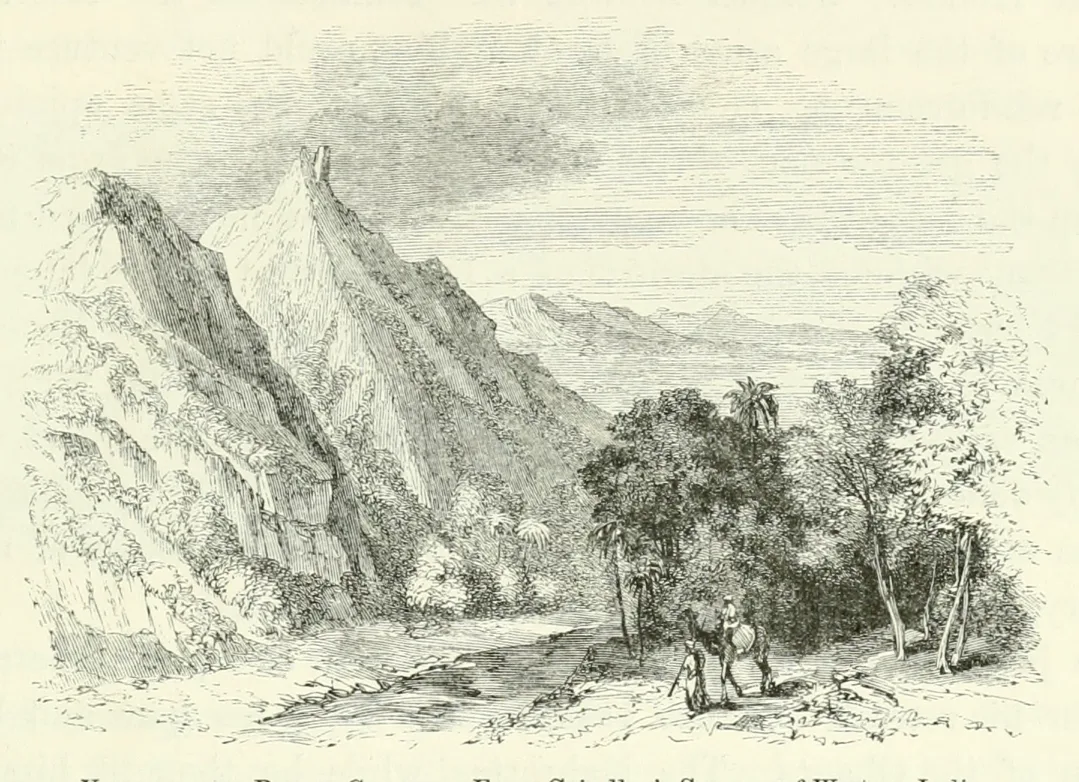
guarded by the enemy was easily forced, and the troops which forced it encamped at Kundalla, on the spot which Captain Stewart had occupied three years before, the head-quarters still remaining at the village of Campoly at the bottom of the Ghauts. The whole effective army mustered, exclusive of European officers, 6152 men, of whom 640 were Europeans, and 5512 natives. Nana Furnavese, though under no alarm, thought it good policy to pretend it, and tried to amuse General Goddard with a show of negotiation, while he was straining every nerve to increase the army, and render the surrounding country a desert.
Nana having sent the peishwa, now in his seventh year, to Poorundhur, advanced with the main body of the army, commanded by Hurry Punt Phurkay and Tookajee Holkar, towards the Ghauts, while Pureshram Bhow Putwardhan descended into the Concan to harass detachments and obstruct the communication with Bombay. The movement towards the Ghauts having produced none of the political results anticipated, the negotiation was broken off, and it was resolved that the army should return for cantonment during the rains to Bombay and Kallian. This was resolved; but it was a resolution to which it had already become impossible to give effect, without sacrificing a great part of the stores and equipments. Pureshram Bhow had managed so dexterously, that no detachment or convoy could move without risk of being overpowered. In the beginning of April, General Goddard had sent down to Panwell three battalions of sepoys, ten guns, and the whole of the cavalry to escort a convoy of grain and stores. On the road to Panwell the escort was attacked by Pureshram Bhow, who succeeded in carrying off a considerable number of the cattle. The escort was strong enough to have brought on the convoy in spite of Pureshram Bhow, had he not been strengthened by the arrival of a large force under Holkar. Colonel Browne who commanded the escort, on being made aware of the large army in front of him, could not venture to proceed without a reinforcement. General Goddard was of the same opinion, but unfortunately the greater part of his cattle had gone down in order to assist in bringing up the supplies. The consequence was, that he could not march with his whole army without the sacrifice of a large amount of public property, or with a part without the certainty of being cut off. In this dilemma, all he could do was to forward a message to Bombay, entreating that every disposable man of the garrison should be sent to reinforce the escort. This was immediately done, and Colonel Browne, though exposed during a march of three days to the attack of upwards of 25,000 horse, besides bodies of rocket-men and infantry, succeeded in bringing in his convoy in safety.
On the junction of the detachment on the 15th of April, General Goddard prepared for his retreat. On the 19th, he sent down his guns and baggage to the bottom of the Ghauts. The Mahrattas, while he thought himself unobserved, were watching all his movements. Tookajee Holkar with 15,000, and Pureshram Bhow with 12,000, were below the Ghauts, while Hurry Punt Phurkay was above them with 25,000 horse, 4000 foot, and several field-pieces. The moment General Goddard began his march on the 20th, Hurry Punt’s force poured down into the Concan, and captured a considerable quantity of baggage and ammunition. The whole of the retreat was a succession of attacks and repulses, and Panwell was reached on the 23d, with a loss of 460 in killed and wounded. After despatching a reinforcement to Tellicherry, which was in imminent danger, and embarking the Madras troops for their own presidency, where they were imperatively required, the remainder of the army was marched to Kallian, and there cantoned for the monsoon.
During this unfortunate campaign, the Bengal government had attempted a powerful diversion, by carrying the war into the heart of Scindia’s territories. A detachment had been prepared under Major Camac, to assist Captain Popham, when it was generally believed that he was on the eve of a reverse. His subsequent brilliant achievements having rendered this reinforcement unnecessary, Major, now Colonel Camac, employed it in invading Malwah. After reducing Sippree he advanced on Seronge, which he reached on the 16th of February. Here he allowed himself to be surrounded by Scindia in person, and reduced to great distress for provisions and forage. In this extremity, he sent off pressing letters for a reinforcement to Colonel Morgan, commanding in Oude, who detached for this purpose Colonel Muir with three battalions of infantry, two regiments of cavalry, and a company of artillery. Meantime, Colonel Camac had no respite from Scindia, and after he had been cannonaded in his camp for seven days, he resolved to attempt a retreat at all hazards. He commenced it at midnight on the 7th of March, and at daybreak, on the
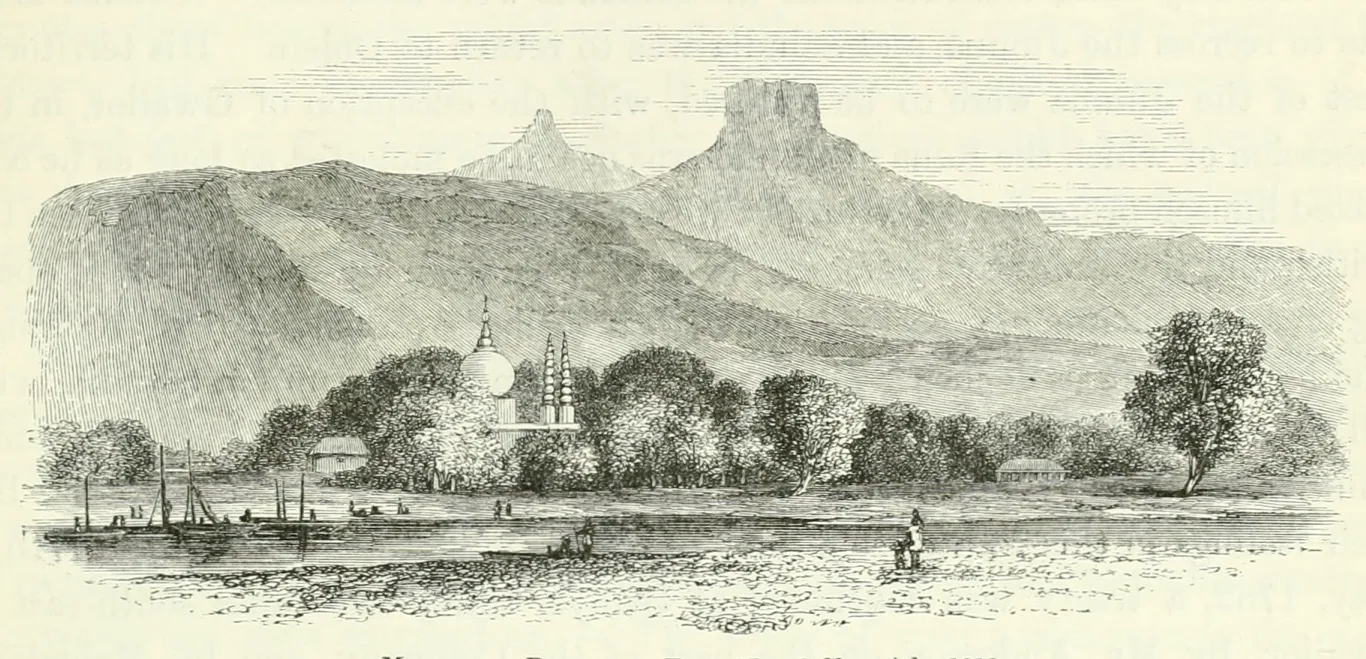
discovery of his departure, was pursued and harassed for two successive days till he arrived at Mahantpoor. Here, having forced a supply of provisions, he faced about, and offered battle to his pursuers. Scindia, though always on the alert, kept at the cautious distance of five or six miles. This disposition was continued several nights, till Scindia, convinced that the British commander had no enterprise, became less careful. This was the very result at which Colonel Camac had been aiming, on the suggestion, it is said, of Major Bruce, who led the escalade at Gwalior. On the night of the 24th, when the wily Mahratta suspected no danger, he entered his camp, routed his army, and captured his principal standard, thirteen guns, three elephants, twenty-one camels, and many horses. Nothing could have happened more opportunely for raising the fame of the British, and disposing Scindia to listen to overtures of peace. Colonel Muir joined Colonel Camac on the 4th of April, and as senior officer assumed the command. Though their united force kept the field for some time, and afterwards encamped during the rains within Scindia’s territory, nothing further was effected. Attempts to gain over some of the Rajpoot chiefs failed; and even the Rana of Gohud, after Gwalior was made over to him, showed an inclination to make separate terms for himself with Scindia.
The government of Bengal had for some time been engaged in a series of intricate negotiations with Moodajee Bhonsla, who, it was thought, might act as a mediator, and be the means of establishing a general pacification with the Mahrattas. Little progress, however, had been made, when intelligence arrived that a separate agreement with Scindia had been concluded by Colonel Muir. The overture had been made by Scindia, who after his defeat by Colonel Camac, became convinced that he had nothing to gain, and everything to lose, by a contest carried on in the heart of his dominions. It might result in his being driven a fugitive across the Nerbudda, while in the meantime, his rivals at Poonah had the satisfaction of seeing him wasting his internal resources. Influenced by these considerations his demands were moderate. Colonel Muir was to recross the Jumna, and Scindia was to return to Oojein. His territories west of the Jumna were to be restored, with the exception of Gwalior, in the possession of which the Rana of Gohud was not to be molested so long as he conducted himself properly. In return, he would either negotiate a treaty between the British and the Mahrattas generally, or at all events remain neutral. This opening of a new channel of pacification was particularly pleasing to Mr. Hastings, who lost no time in deputing Mr. David Anderson to the camp of Scindia, with full powers to conclude a treaty with the Mahrattas. Nana Furnavese and Hurry Punt would rather have negotiated without the interference of Scindia, but their feelings in this respect could not be openly manifested; and on the 17th of May, 1782, a treaty was concluded at Salbye, thirty-two miles south-east of Gwalior, by Mr. Anderson on the part of the Company, and by Mahadajee Scindia on the part of the peishwa, Nana Furnavese, and all the chiefs of the Mahratta nation. By a singular arrangement, Scindia, who acted as the plenipotentiary of the peishwa, and was, strictly speaking, one of his subjects, became the mutual guarantee of both parties for the performance of the conditions.
By the treaty of Salbye, which consisted of seventeen articles, the Company resigned everything for which they had engaged in a long, bloody, and expensive war, and returned to the same state of possession as at the date of the treaty of Poorundhur. Salsette, and a few small islands in the vicinity of Bombay, were confirmed to them, but they lost Bassein, on which their hearts had been so long set, and all the districts and revenues which had been ceded to them in the Guicowar territory, and other parts of Gujerat. Ahmedabad, too, which had been guaranteed to Futteh Sing, returned to the peishwa, and all the territory acquired west of the Jumna was restored to Scindia. In this last cession Gwalior was not excepted, because the Rana of Gohud, by attempting to make separate terms for himself, was held to have forfeited all title to the privileges of an ally. Ragobah, entirely abandoned by the Company, was to receive 25,000 rupees a month from the peishwa, and have the choice of his place of residence. The only articles which might be considered favourable to the Company, were a very vague agreement, that Hyder should restore all his recent conquests from them and the Nabob of Arcot, and an exclusion of all European establishments, except their own and those of the Portuguese, from the Mahratta dominions. Though no part of the treaty, Baroach and its valuable district were made over to Scindia, in testimony of the service rendered by him to the Bombay army at Wurgaom, and of his humane treatment and release of the two English gentlemen left as hostages on that occasion. These were the ostensible grounds of this extraordinary gift, though different grounds were taken by the governor-general and council in justifying it to the directors. It would have the important effect, they said, of attaching so distinguished a chief to the Company’s interests, while the expediency of retaining what was given was doubtful, inasmuch as the expenses were nearly equal to the revenues, disputes about boundaries might arise, and the price of cotton, the staple of the district, had risen in Bombay after the Company obtained possession of it. This last fact, of which more charitable explanations might have been given, was characterized by the governor-general and council as “the natural consequence of a commercial place (being) possessed by men who are dealers in the specific article of trade which it produces.”
While the Bengal government endeavoured to show that the terms obtained were the best that could have been expected in the circumstances, the Bombay government did not hesitate to express a different opinion, and to insinuate that if the negotiation had been left to them, it would have terminated more advantageously. In a letter to the directors, the nature and probable results of the treaty are thus summed up:—“The whole of your possessions to the westward are now reduced to the castle and dependent revenues of Surat, as held since the first acquisition of them, in 1759. A powerful and dangerous neighbour is now placed close to this remaining possession, which it will be necessary to guard with a watchful eye; but it would be equally unavailing and mortifying to expatiate on this subject, or the value of the countries you have lost by this treaty. We shall rejoice should we have future occasion to enumerate the benefits resulting from it. This presidency must, from henceforward, require from the Bengal treasury a large and annual supply of money, for the indispensable occasions of the Company’s concerns under our management.”
Great as were the advantages which the Mahrattas gained by the treaty, it suited the crafty and tortuous policy of Nana Furnavese to seem not perfectly satisfied with it. At Calcutta, it was ratified on the 6th of June, within three weeks of the day on which it was signed; at Poonah it was not ratified till six months had elapsed, nor were the ratifications finally exchanged till the 24th of February, 1783. The delay was partly owing to jealousy of Scindia, who, by acting as guarantee for both parties, had virtually declared himself independent, and partly to a belief that terms still more advantageous might be obtained, by working alternately on the fears of the Company and of Hyder. From the one, Nana Furnavese wished to obtain Salsette, and from the other, his acquisitions of Mahratta territory south of the Kistna. To the Company he represented himself as the steadfast ally of Hyder, while to Hyder he spoke only of his intended ratification of the treaty with the Company, thus playing them off against each other, in the hope of receiving tempting offers from both. It is impossible to say how long he would have continued this game, had not Hyder’s death obliged him to decide in favour of the treaty.
Notes
- 1. Duff’s History of the Mahrattas, vol ii. p. 354