DEVIATION from the restrictive policy enjoined by the legislature being regarded as the primary cause of the financial embarrassments of the Company, the directors naturally longed for a return to that policy, and the appointment of a new governor-general, who was at once inclined from conviction, and qualified by ability and experience, to carry it into full effect. The choice being thus limited, there was no difficulty in making it, and general satisfaction was felt at the announcement that Marquis Cornwallis had again consented to wield the destinies of India. His lordship, ever since his return, had been regarded as a high authority on Indian subjects. Lord Castlereagh, who had become president of the Board of Control, frequently consulted him: his views were known to be decidedly opposed to all schemes of conquest, and he was therefore regarded as the individual best qualified to remedy the serious errors into which his predecessor was presumed to have fallen. Of this his lordship himself seems to have been too easily persuaded. Referring to his second appointment, which, it will be remembered, he resigned hastily after every arrangement had been made for his departure, he had said,1 “I am not sure that I acted wisely in declining to return in 1797.” This declinature had led to the appointment of Marquis Wellesley, and was thus indirectly the cause of the evils which were supposed to have ensued. The moment, therefore, it was flatteringly suggested to him that it was in his power to remedy these evils, or, as it was expressed, to save the Indian empire, he never hesitated. What his views on the subject were may be learned from his correspondence. Mr. Pitt, who had given way to Mr. Addington (Lord Sidmouth), was again at the head of the ministry, but from some offence which he had taken, had not given the marquis any place in it. Hence his lordship wrote, “I know nothing of public affairs, and with the exception of Lord Melville, who has behaved to me with his accustomed kindness, I have not been in the most distant manner noticed by the present administration.” This was galling to his feelings, as he still deemed himself capable of good service. Hence, though he considered it a “desperate act to embark for India at the age of sixty-six,” on being assured by Lord Castlereagh that Lord Wellesley “could not be suffered to remain in the government,” and that Mr. Pitt, Lord Melville (Mr. Dundas), and himself (Lord C.), “were of opinion that it would be of the utmost advantage to this country” that he should become governor-general, he answered as follows:— “They might easily suppose that it was no pleasant undertaking for a man of my age, but as I had still good health, and felt myself, in times like the present, rather awkwardly circumstanced by being totally laid aside, I would not refuse any situation in which I thought I might be useful.”
Such were the circumstances under which Marquis Cornwallis again assumed the government of India. The nature of the services expected from him may be gathered from the above conversation with Lord Castlereagh, from which an extract has already been given. Mr. Pitt, according to Lord Castlereagh, “was decidedly of opinion that he (Marquis Wellesley) had acted most imprudently and illegally.” So much was Marquis Cornwallis of the same opinion that he feared the mischief “had gone so far as to render it very difficult to apply a remedy.” To this observation Lord Castlereagh replied, “that they were well aware that the subsidiary treaties could not at present be done away, but that it was highly necessary to bring back things to the state which the legislature had prescribed.” The object gravely contemplated by the ministry, the court of directors, and the new governor-general, was to commence and carry out a retrograde process, with a view to the ultimate abandonment of the high position which had been gained by a lavish expenditure of blood and treasure, and the occupation of a subordinate, and by inevitable consequence, a precarious place among the governments of India. It is melancholy to see such a man as Marquis Cornwallis thus sent out to India to end his days and sully his reputation.
The new governor-general arrived at Calcutta on the 29th of July, 1805, and though his predecessor was still present, lost no time in entering upon the government, for he was sworn in on the following day. Holding as before the united offices of governor-general and commander-in-chief, he had the destiny of India in his hands, and was determined to make all haste in carrying out his plans. To Lord Lake, who had descended to the subordinate position of provincial commander-in-chief, he wrote on the very day of his instalment: “It is my earnest desire, if it should be possible, to put an end to this most unprofitable and ruinous warfare.” He might have written more confidently, because he was determined to make peace at all events, and purchase it at any cost however large. One is almost ashamed to add that he was willing for this purpose to make a sacrifice even of honour. In a letter to Lord Lake, acquainting him with the terms on which he was disposed to offer peace to Scindia, he says: “I am aware of the disadvantage of immediately relinquishing, or even of compromising, which has been so repeatedly and so urgently made for the release of the British resident; but I deem it proper to apprise your lordship that, as a mere point of honour, I am disposed to compromise or even to abandon that demand if it should ultimately prove to be the only obstacle to a satisfactory adjustment of affairs with Dowlut Row Scindia; and that I have hitherto been induced to support it by the apprehension that the motives of such a concession might be misinterpreted, and that it might lead to demands on the part of Scindia with which we could not comply without a sacrifice of dignity and interest incompatible with our security, and thereby render still more difficult of attainment the desirable object of a general pacification.”
According to this idea, so unlike that which Marquis Cornwallis was wont to entertain in better days, honour was to be abandoned or compromised, as an obstacle unworthy of standing in the way of “a satisfactory adjustment with Dowlut Row Scindia.” Could anything be more monstrous? A Mahratta chief who had not only violated a solemn treaty, but trampled on the laws recognized by all states having any pretensions to civilization, by detaining, maltreating, and plundering an ambassador, was to be not punished but propitiated—not hunted down as a barbarian whom no faith could bind, but studied and courted, and scarcely even reminded of his atrocious procedure lest his delicate feelings should be offended. Security was everything, and it was to be obtained by truckling to an insolent and faithless man, who on finding how much he had gained by rebellion, would take the first opportunity of rebelling again in the hope of gaining still more. To imagine that peace could be secured by stooping to such degradation was, to say the least, a very gross delusion. Scindia would of course take all that misplaced indulgence could bestow upon him, but it would only be to employ it for the purpose of subsequent extortion, and to a certainty, the moment he felt strong enough, his former aggressions would be resumed. Fortunately the British government was spared the disgrace of making concessions to Scindia, while he was openly insulting it by detaining the resident as a prisoner in his camp. Lord Lake, on being made aware of the extreme degradation to which the governor-general was prepared to submit in pursuit of a vain phantom of peace, managed to draw the first overtures from Scindia, and to induce him to release the resident, by assuring him that until this was done, his overtures could not be favourably entertained. By this dexterous move on the part of Lord Lake, Mr. Jenkins was on his way to the British territories, and the humiliation which the governor-general was preparing for himself and his country was happily escaped.
It would be painful and it is not necessary to dwell on all the other concessions which Marquis Cornwallis had declared his readiness to make while bent on obtaining peace at any price, since he was not destined to carry his intentions into effect. He had arrived in India in very indifferent health, and did not allow himself to take the ease and relaxation which might have restored it. The very day after his arrival at Calcutta he was immersed in all the cares and toils of office. A week afterwards he was on his way to the upper provinces to engage in negotiations, of the success of which, notwithstanding the generous or rather lavish spirit in which he was disposed to act, he was very doubtful. Though convinced of the propriety of the course he was taking, and not easily turned aside from his purpose when once it was formed, he could hardly be free from misgivings when he found his measures decidedly condemned by some of those who were best qualified to judge of them, and more especially by his old friend Lord Lake, who not only disapproved but threatened to resign. Thus perplexed and grieved his indisposition rapidly increased, and when he arrived at Buxar on the 25th of September, 1805, he was considered by his attendants as beyond hope of recovery. His voyage up the Ganges was however continued, and he lingered on in a state bordering on unconsciousness till he arrived at Ghazipoor, where he breathed his last on the 5th of October.
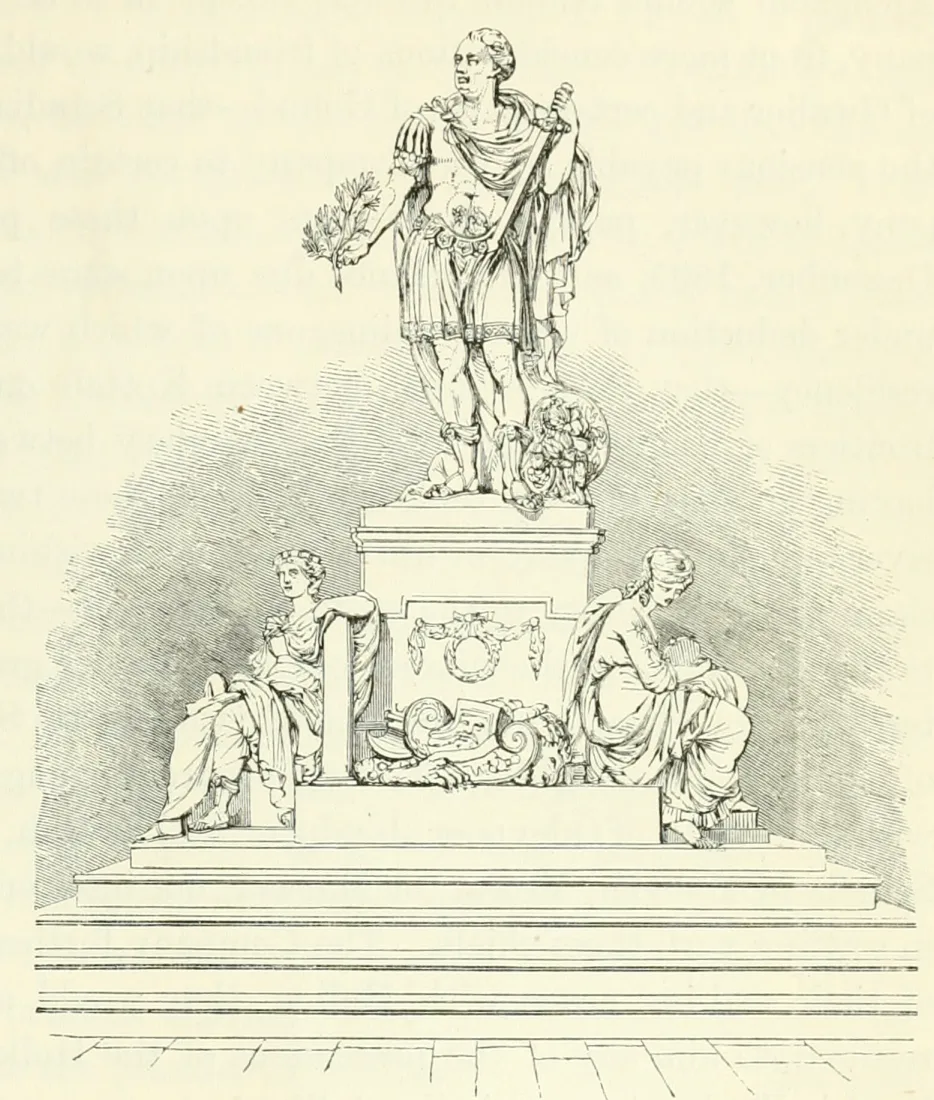
The merits of his first Indian administration have already been examined; in regard to his second administration, Sir John Malcolm justly observes: “However questionable the policy of some of the last acts of this nobleman may be to many, or whatever may be their speculations upon the causes which produced such an apparent deviation from the high and unyielding spirit of his former administration, no man can doubt the exalted purity of the motive which led him to revisit that country. Loaded with years as he was with honour, he desired that his life should terminate as it had commenced; and he died as he had lived, in the active service of his country.” The universal esteem in which he was held both at home and abroad was testified by the honours paid to his memory. A mausoleum was erected over his remains at Ghazipoor by public subscription; Bombay erected a statue, and Madras, which, as well as Calcutta, had already his statue, erected a cenotaph. At home the House of Commons voted a statue to him in St. Paul’s; and the court of proprietors, who had in 1794 settled upon him a pension, of which at his death about ten years were still to run, bore further testimony to his merits by a vote of £40,000 to his family.
Sir George Barlow, an old and distinguished civil servant of the Company, succeeded by a provisional appointment to the office of governor-general. When the succession opened to him he had been four years a member of the supreme council. Previously he had been chief secretary to government during the whole of Lord Teignmouth’s and the commencement of Marquis Wellesley’s administrations. He had also been actively employed by Lord Cornwallis during his first administration, and had the credit of having furnished the original draft of the code of regulations, in accordance with which the civil and judicial business of the Company had since been conducted. Judging from his previous antecedents, it was difficult to say what his policy would be. He had been connected with several administrations, and though the principles on which they acted were very different, he had the good fortune to give satisfaction to all. During the whole of Marquis Wellesley’s administration, he had so uniformly and zealously supported it, that he was supposed to be finally pledged to the same system of policy, and hence, when Marquis Cornwallis, who had a high opinion of his merits, urged the propriety of giving him a provisional appointment as his successor, Lord Castlereagh, then at the head of the Board of Control, “did not,” says the marquis, “give much encouragement on that head, intimating that the inveteracy of the court of directors against Lord W. (Wellesley) had produced a disinclination in that quarter towards Barlow.” He was made acquainted with the objection thus taken to him, and it is not improbable that he had taken care to remove it by satisfying the court that he was very pliable on the subject of policy, and was just as ready to support the restrictive system of Marquis Cornwallis, as he had previously been to support the extensionist system of Marquis Wellesley. Be this as it may, it is certain that the objection was withdrawn, and he not only obtained the provisional appointment, but rose so high in the favour of the directors that they afterwards made the appointment absolute.
Brought into office under such auspices, Sir George Barlow immediately announced his determination to pursue the system of neutrality, and walk as much as possible in the footsteps of his predecessor. His plan was to terminate the war as speedily as possible by concluding treaties with Scindia and Holkar, in which the defensive or subsidiary principle would be altogether ignored, and to throw off all connexion with the petty states beyond the Jumna, bounding the British territory by that river, or by a line nowhere exceeding ten miles beyond it. Taking up the negotiation with Scindia on the basis which Marquis Cornwallis had adopted, he concluded a treaty with him on the 23d of November, 1805. Its principal articles were that the previous treaty of Surjee Ajengaom should remain in force, except in so far as altered—that the Company, from mere considerations of friendship, would cede to Scindia the fortress of Gwalior and certain parts of Gohud—that Scindia would abandon all claim to the pensions payable by the Company to certain officers of his court, the Company, however, paying the arrears upon these pensions up to the 31st of December, 1805, and the balance due upon some territorial revenues, but only under deduction of certain claims, one of which was the plunder of the British residency—that the Chumbul, between Kottah on the west, and the eastern frontiers of Gohud, should form the boundary between the two states, Scindia having no claims to any territory between these two points to the north of the river, and the Company in like manner, and within the same limits, having no claim to any territory to the south of the river—that the Company would pay to Scindia annually the sum of four lacs, besides granting two jaghires of their territories in Hindoostan, the one of two lacs to Scindia’s wife, and the other of one lac to his daughter, and would moreover engage to enter into no treaties with the Rajahs of Odeypoor, Joudpoor, and Kottah, or other chiefs, tributaries of Scindia in Malwah, Mewar, or Marwar, nor interfere in any shape with Scindia in settling with these chiefs. The Company further engaged that, in the event of their making peace with Holkar, they would not restore, nor desire to be restored to him any of the possessions of the Holkar family in Malwah taken by Scindia, but leave Scindia at liberty to arrange with Holkar or any branch of the Holkar family, in any way he pleased. This treaty, negotiated by Colonel Malcolm acting under the authority of Lord Lake, did not receive the entire approval of the governor-general. The new policy which he was to carry out assumed that the interest and security of the British possessions would be best provided for by limiting the relations with surrounding states to general amity without special engagements, and he therefore objected to those articles which, by fixing the Chumbul as the boundary, implied that the petty states immediately north of that river were to continue under British protection. So averse was he to any such implied guarantee, that he insisted on appending to the treaty two declaratory articles, for the express purpose of withdrawing it, and leaving the petty states to protect themselves as they best could. Lord Lake had already strongly protested against this policy, and again made a last effort to convince the governor-general that, while the breach of faith committed by such an abandonment of allies would lower the British reputation and produce general distrust, the distractions and wars which would necessarily ensue would sooner or later compel the Company to interfere, and involve them in new hostilities for the purpose of regaining the ascendency, which they were now by a kind of suicidal act voluntarily relinquishing. Sir George Barlow could not answer Lord Lake’s arguments, but he persisted in his own course, or rather, perhaps, the course which he knew that the home authorities expected from him.
Pending the negotiations with Scindia, Lord Lake was in pursuit of Holkar, who had proceeded northward into the Punjab, in the hope of obtaining assistance from the Sikhs. When he failed in this object, Holkar saw that further resistance was hopeless, and sent envoys to Lord Lake to solicit peace. The terms were easily arranged, as Holkar was not in a condition to withhold assent from any proposals that might be made to him, and those who had him at their mercy were disposed to treat him with a liberality which he little deserved, and which must have gone far beyond his expectations. The conditions offered to his acceptance gave him back all his territories, with a few exceptions, of which the most important were, that he should renounce all claims to places situated north of the Chumbul, to Kooch and Bundelcund, and generally all claims whatever upon the British government and its allies. Chandore, Gaulnah, and his other forts and districts in the Deccan, were not restored; but he was assured of their restoration in the course of eighteen months, provided his conduct in the interval were such as to give full proof of his amicable intentions. Both into Scindia’s and Holkar’s treaty an article was introduced, binding them not to admit Sirjee Row Ghatka to their counsels or service. The individual thus placed under the ban was the father-in-law of Scindia, and was not only a man of a cruel and worthless character, but an inveterate enemy to the British, and the instigator to the plunder of the British residency. Notwithstanding the stipulation against him, he was understood to be preparing, a few months afterwards, to join Holkar; and Sir George Barlow, fearing the embarrassment which might hence arise, carried his peace policy so far as to cancel the article in the treaties which stipulated for Sirjee Row Ghatka’s exclusion. He accordingly resumed his mischievous influence at Scindia’s court. His fate is not unworthy of being recorded. In 1809, while attending the durbar, he had pressed some of his proposals, and was answered evasively by Scindia, who, to escape his importunity, ordered his equipage for the purpose of going to an elephant fight. Sirjee Row, enraged, so far forgot himself as to seize Scindia’s robe, and try to keep him forcibly in his seat. The attendants rushed to the rescue, and were ordered by Scindia to secure the offender. A scuffle ensued, and Sirjee Row, drawing his sword, escaped to his own tent. The attendants enraged, and not unwilling to rid their master of an obnoxious minister, pursued, cut the ropes of the tent, and dragged him into the public street, where he fell dead, pierced with wounds.
The article in Holkar’s treaty which bound him to renounce all claims to places north of the Chumbul was at variance with the new policy, but was at first sanctioned by the governor-general, because he was in hopes that Tonk Rampoorah and its district to the north of that river would be accepted by Scindia as an equivalent for the pension of four lacs which the Company had engaged to pay him. On finding that Scindia would not accept Tonk Rampoorah, even as a gratuity, because it would bring him into necessary collision with Holkar, Sir George Barlow gave full effect to his policy by making a present to Holkar of Tonk Rampoorah, and leaving the British allies, as was
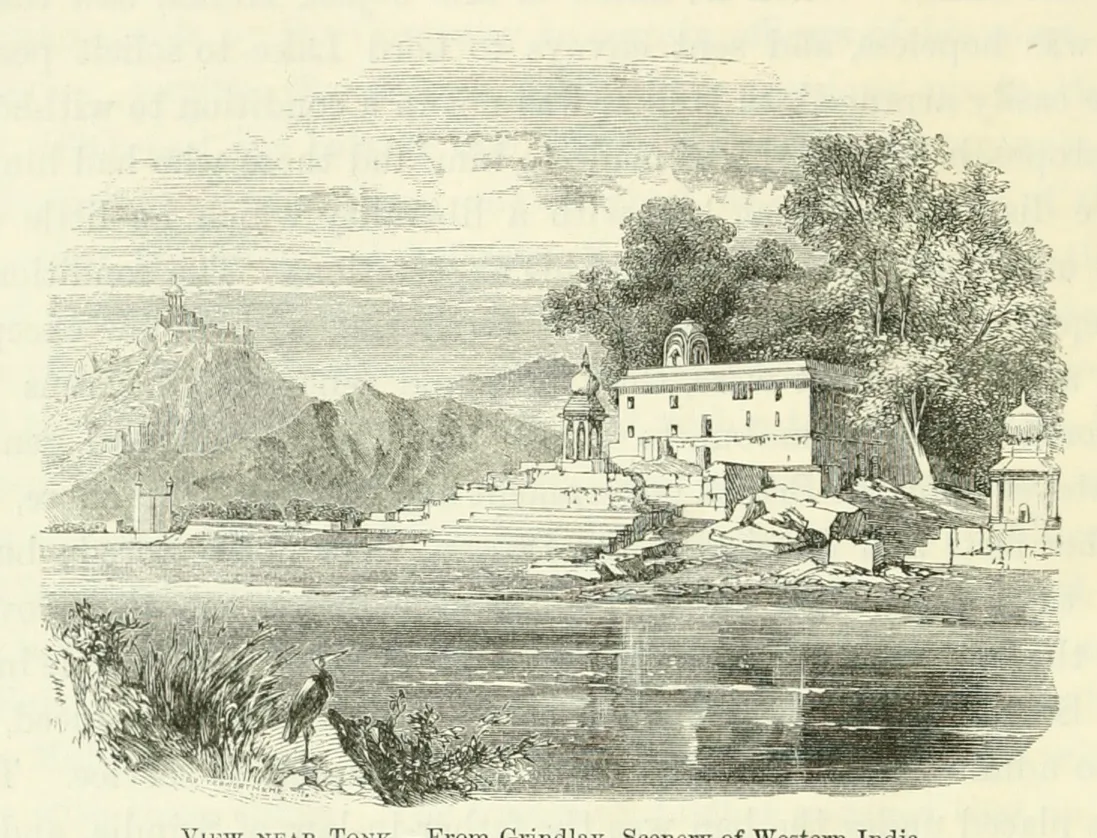
already done in the treaty of Scindia, to Holkar’s mercy. This he did while forewarned and perfectly aware that these allies would be subjected to cruel persecution, and that mainly as a punishment for adhering steadfastly to British interests, when they might have gained much by betraying them. A proceeding more unworthy of British honour and equity cannot easily be imagined. How humbling and yet how true the remark made by an agent of one of the abandoned rajahs, that now, for the first time since the establishment of the English government in India, “it had been known to make its faith subservient to its convenience!”
The alliances with the Rajahs of Jeypoor and Boondee having been shamefully abandoned, the next step in the retrograde policy would have been to deal out the same measure to the Rajahs of Macherry and Bhurtpoor. On the part of the governor-general there would have been no delay, but Lord Lake interposed once more, and pointed out so forcibly the confusion and anarchy into which countries recently settled at the expense of so much blood and treasure would inevitably be thrown, that even Sir George Barlow, with all his obstinacy, hesitated to proceed in the face of such a remonstrance. At first, while declaring that his resolution was unchanged, he simply intimated that he had no desire to precipitate the measure, but second thoughts proved better than his first, and he never again attempted to carry it into effect.
While engaged in making arrangements in Hindoostan, the attention of the governor-general was arrested by a sudden and unsuspected outbreak in a very different quarter. At three in the morning of the 10th of July, 1806, a sudden discharge of firearms was heard in the fort of Vellore, which, it will be remembered, had been fixed upon as the residence of the family of Tippoo on their removal from Seringapatam. The discharge was repeated in various quarters, and on inquiry being made, it was ascertained that the sepoys of the garrison, headed by their native officers, were in open revolt. They had assembled secretly, and on an appointed signal attacked the European posts. The few sentinels on duty had been shot down or bayoneted, and the magazine containing the only supply of ammunition was in the hands of the insurgents. The European part of the garrison, consisting of four companies of his majesty’s 69th regiment, mustered about 370 men, that of the natives 1500. The main body of the mutineers, having set watches on the apartments of the officers to prevent egress, beset the European barracks, and with a six-pounder, which they had planted opposite to the doorway, and their muskets, commenced firing volley after volley through the doors and windows. The soldiers within, destitute of ammunition, were unable to return this murderous fire, and had no alternative but to shelter themselves as they best could behind the beds and furniture. At an early hour a few officers who had assembled in one of the dwellings and successfully defended themselves, made their way into the barracks. Here eighty-two privates had already fallen, and ninety-one were wounded. Nor was this the full amount of the loss. Colonel Fancourt, who commanded the fort, had been mortally wounded as he was descending from his house; Colonel M‘Kerras shot dead as he was hastening to the parade; and, during an indiscriminate massacre by parties who searched the houses of Europeans, and with savage ferocity butchered every one they could discover, thirteen officers were killed. The officers who had reached the barracks, heading the survivors whom they found within them, sallied forth, and forcing a passage through the mutineers, ascended the ramparts and took post in a cavalier. From this they proceeded to the magazine, but being disappointed in their expectation of ammunition, were obliged to retrace their steps and seek cover above the main gateway, and in the bastion at the south-east angle. All these movements had been made under exposure to an incessant fire, and the consequence was, that every officer was disabled, and many of the men were killed.
At Arcot, about sixteen miles eastward, intelligence of the revolt was received at six in the morning, and Colonel Gillespie, who was there in command, hastened off with a squadron of the 19th dragoons and a troop of native cavalry, ordering the rest of the regiment and the galloper-guns to follow. By eight o’clock he arrived, and immediately passed through the two outer gates, which were open. The third gate was closed. It was, however, the one above in which part of the European soldiers had taken shelter; and a rope having been formed of soldiers’ belts, Colonel Gillespie was enabled to mount and take his place beside them. As soon as the guns arrived, the gate was blown open and the dragoons rushed through. Colonel Gillespie at the same moment charged the insurgents at the head of his small party, and a signal vengeance was
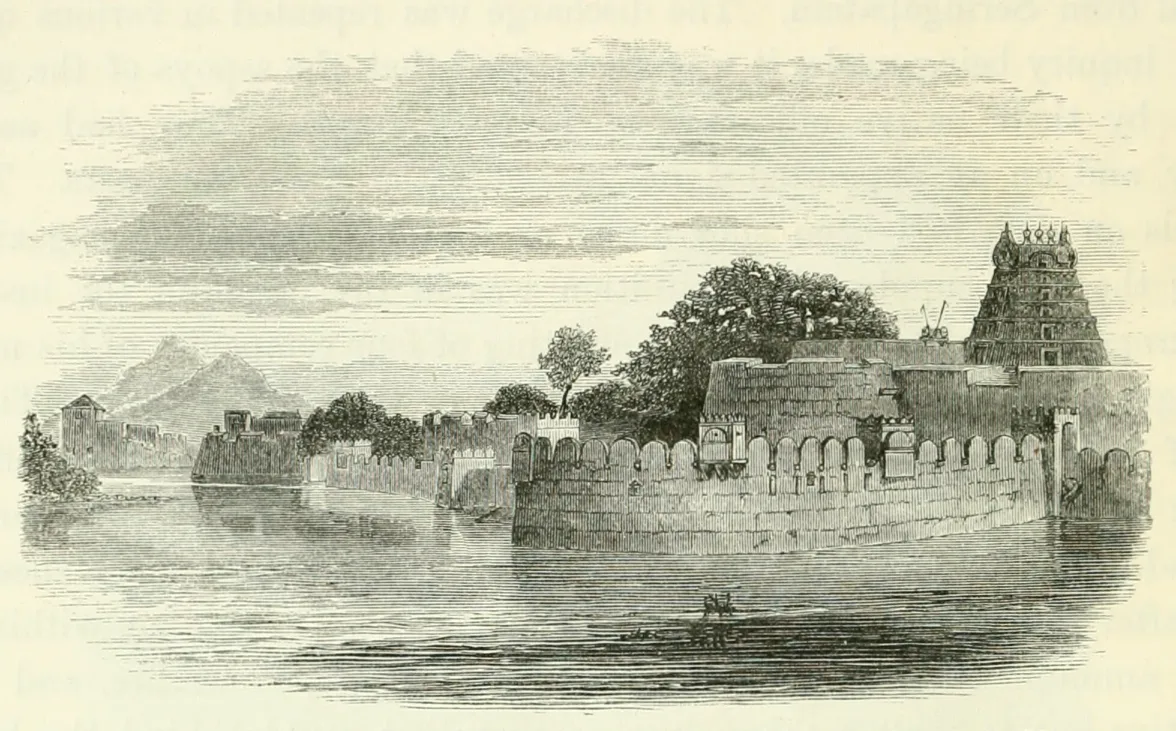
taken. After a feeble and straggling fire, all resistance ceased. About 400 of the mutineers were slain, not a few threw down their arms imploring quarter, and many who had escaped through the sally-port, or by dropping from the walls, were afterwards captured. The recovery of the fort and suppression of the mutiny were the work of little more than ten minutes.
During the insurrection an active communication was kept up between the mutineers and the palace in which Tippoo’s family resided. A flag which once belonged to Tippoo and bore his arms (a central sun with tiger stripes on a green field), was even brought out and hoisted on the flagstaff, amid the acclamations of the multitude. As there could thus be little doubt that at least some members of the family were deeply implicated, Colonel Gillespie lost no time in sending off the whole of them to Madras, from which they were ultimately removed to Calcutta. It was reported that but for these decisive measures, the insurgents would in a few days have been joined from different quarters by 50,000 men. Three native officers and fourteen non-commissioned officers and privates, condemned by a court-martial on the spot, suffered death. These were selected for extreme punishment from being regarded as ringleaders; but it was generally suspected, though legal proof was not obtained, that the whole of the native troops, with only a few exceptions, were privy to the plot. Under these circumstances it was difficult to draw a line of demarcation, and the utmost that could be done was to allow the officers and men who were absent at the time, or proved their fidelity, to remain in the service, and not only dismiss all the others, but erase the very names of the mutinous regiments from the army lists. About 600 sepoys retained as prisoners still remained to be disposed of. As the final decision was not given till a considerable period had elapsed, a lenient course was preferred, and, with the exception of those who, being proved guilty of plunder or murder, suffered according to their deserts, all the others were simply dismissed the service, and disabled from again entering it.
When a strict inquiry into the circumstances and causes of the mutiny was instituted, it appeared that had ordinary caution and judgment been used it might not have occurred at all, or at all events could not have broken out so suddenly and unexpectedly. To make this manifest it will be necessary to enter a little into detail. When Sir John Cradock (afterwards Lord Howden) in the beginning of 1805 became commander-in-chief at Madras, he found that this presidency had no code of military regulations. With the permission of Lord William Bentinck, who had succeeded Lord Clive as governor, he instructed Major Pearce, the deputy adjutant-general, to draw up a code. According to Sir John’s statement, the regulations previously in force and sanctioned by the government were to be simply inserted in the manuscript, while everything that was new was to be carefully distinguished, so as to make it easy for the governor to perceive at a glance what the changes were to which his sanction was requested. Lord William Bentinck, confiding in the strict accuracy of this statement, gave his whole attention to the marked regulations, as in these alone he conceived that he had any immediate interest, and discovering nothing objectionable, allowed all the regulations to be put in force. Unfortunately, from some strange oversight, a regulation which was entirely new—so new, indeed, that it had never before appeared in any military code—was inserted in the body of the old regulations without any distinguishing mark, and thus eluded the governor’s notice. The object was to assimilate the appearance of the sepoys to that of the European troops. The most obnoxious of these changes were, that the sepoys should appear on parade with their chins clean shaved, and their mustachios cut to a particular model, and not only without earrings, but without the coloured marks which declared the particular sects to which they belonged. Their turban also was changed into a form which seemed to the sepoys to resemble a hat. This was to them an abomination, as they were wont to regard the hat as peculiarly an European, and therefore a Christian head-dress.
The feeling of discontent and insubordination thus engendered was first manifested early in May, by the second battalion of the 4th regiment of Madras infantry, quartered at Vellore. The grenadier company refused to make up the turban, and on being called before the colonel and questioned on the subject, declared firmly but respectfully that they could not wear the new turban without disgracing themselves for ever in the eyes of their countrymen. This seems ludicrous, and yet when it is considered how much commotion the subject of man millinery has produced, and is producing, in one of the most enlightened churches of Christendom, it is impossible to deride the honest scruples of the childish and ignorant sepoy. Such, unfortunately, was not the spirit in which his superiors were disposed to deal with him, and his scruples were regarded and treated as contumacy. Nineteen grenadiers were sent off to Madras for trial. They were all convicted, and two of them actually received 900 lashes each. The remaining seventeen, who were each to have received 500 lashes, were pardoned on professing contrition. The governor, who could formerly have pleaded that he had unconsciously sanctioned the new dress, could not use this plea any longer, as he showed himself no less zealous for it than the commander-in-chief, and proclaimed his determination to enforce it.
In justification of the course thus pursued, it was shown that the new turban, or hat, as the sepoys insisted on calling it, was not objectionable either in itself or on the score of religion, and two respectable natives, a Mahometan and Hindoo, when gravely consulted, gave solemn testimony to this effect. But this was not the question. However absurd and unreasonable the scruple might be, was it felt in reality, instead of being used as a mere pretext for insubordination? The moment this question was answered in the affirmative, turbaned hats and shaved chins and clipped mustachios were condemned, and became fit only for the limbo of vanity. It is not impossible that the fear of corporal punishment or of expulsion from the service might ultimately have proved stronger than the scruple, and compelled the sepoy’s submission, but in Vellore he was subjected to other influences, and there were parties on the alert to turn his scruples to account. Tippoo’s family had never forgotten that their father and grandfather had been sovereigns of Mysore, and it was proved that when insubordination had begun to take root, and secret meetings were held, Moiz-ad-din, one of his sons, attended, and both directly, and by means of real or pretended messages from the palace, encouraged the mutineers.
The Vellore mutiny was occasioned by the absurd attempt to force an obnoxious dress on the sepoys, and it was fostered by the adherents of Tippoo’s family, who snatched at the disaffection thus produced as a means of again becoming a reigning dynasty, but it had its primary cause in the deep-rooted hatred of Mahometans and Hindoos to the rule of a Christian nation. It is this hatred which, always lurking in the heart of the native, is ready to break forth on the slightest encouragement or provocation, that makes every outbreak of the natives against Europeans a war of extermination. What but this hatred actuated the wretches who, while the Vellore mutiny was raging, went about in bands to search the houses of Europeans, and massacre all their inmates? On ordinary occasions this hatred is not manifested, and the natives, balancing the advantages which they enjoy under British rule against the mischief which they would inevitably suffer under native dynasties, are not disposed to run the risk of violent changes. It is only when their fanaticism is aroused by some imaginary insult to their faith, or the fear of being forcibly compelled to abandon it, that all prudential restraints are thrown aside, and nothing but the utter extermination of the hated race will either allay their fears or satiate their vengeance. Assuming this representation to be correct, some have hastily inferred that in India Christianity ought to be altogether ignored, or at least that no European ought ever to be allowed to make it the subject either of conversation or of argument in the presence of a native. It would, indeed, be a melancholy thing if the inference were well founded. But it is not. Persuasion enforced by pure Christian example is as potent in India as in any other part of the world, and many distinguished men, with nothing else to recommend them, have been and still are loved and venerated, even by those who have no sympathy with their doctrines. The thing to be guarded against is the reality or semblance of compulsion in any matter in which religion is supposed to be concerned, and more especially compulsion in which the government directly bears a part. “It is a great error,” says Professor Wilson,1 “to suppose that the people of India are so sensitive upon the subject of their religion, either Hindoo or Mahometan, as to suffer no approach of controversy, or to encounter adverse opinions with no other arguments than insurrection and murder. On the contrary, great latitude of belief and practice has always prevailed amongst them, and especially amongst the troops, in whose ranks will be found seceders of various denominations from the orthodox system. It was not, therefore, the dissemination of Christian doctrines that excited the angry apprehensions of the Sipahis on the melancholy occasion which has called for these observations, nor does it appear that any unusual activity in the propagation of those doctrines was exercised by Christian missionaries at the period of its occurrence. It was not conversion which the troops dreaded, it was compulsion; it was not the reasoning or persuasion of the missionary which they feared, but the arbitrary interposition of authority. They believed, of course erroneously, that the government was about to compel them to become Christians, and they resisted compulsory conversion by violence and bloodshed. The lesson is one of great seriousness, and should never be lost sight of as long as the relative position of the British government and its Indian subjects remains unaltered."
It has been mentioned that the mutiny took the European part of the garrison entirely by surprise. This ought not to have been. The previous insubordination had shown the necessity of increased vigilance. Though it had been forcibly suppressed, there was every reason to apprehend that the scruples in which it originated had not been removed. On the contrary, the presumption was that the usual result, whenever force and conviction are brought into collision, had been produced, and that feelings which could no longer find vent by external acts, had only become more deeply seated within. These considerations appear to have been altogether lost upon the officers in command. At the very time when rumours of disturbance were prevalent in the town and fort, and a Mahometan fakir had repeatedly proclaimed in the bazaar the impending destruction of the Europeans, no means were used to trace these rumours to their source, and even the ordinary duties of the garrison were performed with culpable remissness. On the very night of the mutiny the European officer commanding the main-guard, when called to go the rounds at midnight, pleaded indisposition, and ordered the subahdar (native captain) to take his place. The subahdar, likewise indisposed, sent the jemadar (native lieutenant), who being one of the ringleaders of the mutiny, of course reported that all was right, though the mutineers must at the time have been actually arming. A still more extraordinary degree of remissness had been previously displayed. Nearly a month before the mutiny broke out, a sepoy named Mustafa Beg waited at midnight on his colonel, and divulged the plot. That officer, partly from ignorance of the native language, which made it difficult for him to interpret accurately all that he was told, and partly also from Mustafa Beg’s agitation, which made him give little credit to his testimony, left the investigation to a committee of native officers, in other words, to the conspirators themselves, who at once declared Mustafa Beg unworthy of belief, and demanded that his calumnies should be punished by imprisonment. He was, in consequence, expiating in a dungeon the supposed falsehood of his testimony, at the very time when its truth was only too fully established by the event.
It was for some time believed that the mutiny at Vellore had extensive ramifications, and was, in fact, only part of a general conspiracy to massacre all the Europeans in India, and thereby for ever extinguish British rule. The events of our own day give to this hypothesis a degree of plausibility which it did not previously possess, but still it does not seem to be borne out by facts. Insubordination was certainly manifested simultaneously in distant quarters. This, however, indicates rather a common ground of complaint than an extensively ramified conspiracy. At Hyderabad, for instance, the turban produced great dissatisfaction among the sepoys of the subsidiary force, and some designing men endeavoured to make it subservient to their own designs. Had the European officers in command been as careless and intemperate as those at Vellore, another dreadful mutiny would in all probability have been the result. A much more judicious course was taken, and all dissatisfaction vanished the moment the cause which had produced it was removed. As soon as the aversion to the new turbans was manifested, the order for making them up was suspended. The effect was instantaneous, and calm and confidence were at once restored. This could not have been, had the objection to the turbans been taken, not on its own account, but with a view to the furtherance of a widely and deeply laid conspiracy.
The only important events which occurred during the administration of Sir George Barlow have now been mentioned. In his foreign policy, his main object seems to have been to establish himself in the good graces of the directors, by rigidly adhering to the course which he knew would be most pleasing to them. In so doing he proved himself at once an obedient servant, and a very indifferent statesman, throwing away great advantages, which it was necessary, at a later period under a better administration, to regain by a new expenditure of blood and treasure, and at the same time lowering the British reputation with foreign states, by quibbling away solemn obligations, and sacrificing honour and justice to fancied convenience. In his internal administration he appears to greater advantage. Under Marquis Wellesley’s administration, expensive wars were not met by the ordinary revenue, and the debt which had been accumulated had caused severe financial pressure. So severely was this felt when Marquis Cornwallis entered upon his second administration, that in order to pay arrears which could no longer be delayed, and discharge other urgent demands, he was obliged to appropriate all the bullion which was sent out from England for the China investment. In a letter written to the directors, on the third day after his arrival at Calcutta, he says, “The pressure on your finances is so severe, that had the bullion sent out in the ships of the present season been withheld, I know not how our difficulties could have been overcome.” Lord Lake’s army, the monthly pay of which was about five lacs, was about five months in arrear. A large body of irregulars, composed chiefly of deserters from the enemy, had been engaged at a monthly expenditure of about six lacs, and were also in arrear. With the reduction of this force, as at once the most burdensome and least effective, Marquis Cornwallis immediately commenced, and during the few months of his administration made considerable progress in diminishing the monthly charge. Sir George Barlow continued the process, and was able to reduce still more largely and rapidly, by the steps which he took to force a general pacification. There is, indeed, some reason for suspecting that his reductions were in some instances more rapid than judicious, and that by suddenly throwing loose upon the country numbers of men who lived only by their sword, he laid a foundation for future disturbance. While carrying on the work of retrenchment in Bengal, he called upon the other presidencies “to establish a system of the most rigid economy through every branch of their civil and military expenditure,” and “to abrogate all such charges as were not indispensable to the good government and security of the provinces under their control.” By means of a system of economy carefully matured and fully carried out, the excess of expenditure above revenue rapidly diminished, and ultimately —though he did not continue in office so long as to see this result—not only disappeared altogether, but left a surplus.
A governor-general who produced such favourable financial results, and showed himself ready at all times to give implicit obedience to orders received from home, was naturally a favourite at the India House. As soon as the death of Marquis Cornwallis was known in England, the directors made his provisional appointment absolute, and he was thus regarded as no longer a governor-general by sufferance, in consequence of an unexpected vacancy, but as formally installed in the usual way and for the usual period. The new ministry, which had been formed on the death of Mr. Pitt, was understood to have acquiesced in this permanent appointment. The commission to Sir George Barlow as Governor-general of India was signed on the 25th of February, 1806. How great, then, was the astonishment when, on the 7th of March, only ten days afterwards, the directors were informed by Lord Minto, president of the Board of Control, that ministers had determined to supersede Sir George Barlow, and confer the office of governor-general on the Earl of Lauderdale. A quarrel immediately ensued. The directors, charging the ministers with gross inconsistency in first sanctioning or rather expressly recommending Sir George Barlow’s appointment, and then trying to cancel it, refused to recall him. The conduct of the ministers was, they said, insulting both to them and to Sir George Barlow, and they refused to be dragged through the mire for the purpose of enabling ministers to complete any job on which they might have set their fancy. Lord Minto, through whom the correspondence with the directors was conducted, endeavoured to justify himself and his colleagues by replying that, in the letter in which he recommended Sir George Barlow, he distinctly intimated that the arrangement was to be regarded as merely temporary. This proved to be a very lame defence, as the letter as distinctly stated that there was no intention to make any immediate change. The truth is that the real point in dispute was not fairly put by either party. Ministers had rashly parted with a valuable piece of patronage, which they were now anxious to recover, and some of the leading members of the cabinet preferred the policy of Marquis Wellesley to that which Sir George Barlow was pursuing. The directors, on the other hand, not only preferred Sir George Barlow’s policy, but had an invincible aversion to the Earl of Lauderdale. He was a free trader, in the limited sense given to these words at that period, and would do all he could to break up the Company’s monopoly. It would therefore be suicidal to make him governor-general. Another objection, not quite so tangible, but probably regarded by some of the directors, was the Earl of Lauderdale’s extreme liberalism, which led him, during the first fervour of the French revolution, to affect it even in his dress. When the quarrel between the directors and the ministers was at its height, Sir George Barlow was recalled by a warrant under the king’s sign-manual. This stretch of authority, though it had been threatened before, was on this occasion exercised for the first time, and gave a practical solution to a question which had hitherto been rather evaded than answered. The question was, In which of the two—the court of directors and the government— was the power of appointing the Governor-general of India really vested?
By Mr. Pitt’s India act of 1784 (24 Geo. III. c. 25), and by the act of 1793 (33 Geo. III. c. 52), renewing the Company’s charter, it was expressly enacted that “all vacancies happening in the office of governor-general” were to be “supplied by the court of directors.” Mr. Fox’s East India bill had been severely censured for the amount of patronage which it would have placed at the disposal of ministers, and Mr. Pitt seemed to have introduced the above clause for the purpose of escaping a similar censure. Had the clause stood alone it would have left the patronage entirely in the hands of the directors, and enabled them to exercise it without control. This was certainly not the intention of ministers, and they dexterously managed while disclaiming patronage to introduce clauses which virtually gave them a monopoly of it. The above clause enacted that the vacancies were to be supplied by the directors; but by two subsequent clauses his majesty, on the failure of the directors to supply a vacancy within two months after it was notified to them, might fill it up, and might, moreover, at any time by his sign-manual, countersigned by the president of the Board of Control, “remove or recall any person or persons holding any office, employment, or commission, civil or military, under the said United Company in India.” By means of one clause the directors appointed; by another his majesty, or, which is the same thing, his ministers, might recall every appointment as soon as it was made; and by a third, should the directors, wearied out in making unavailing appointments, leave the vacancy unsupplied for two months, ministers were rewarded for obstructing them by obtaining the patronage to themselves.
There cannot be a doubt that an honest interpretation of the above clauses gave the directors the appointment, and the ministers nothing more than a veto —a veto, too, to be exercised not antecedent to the appointment, but subsequent to it, and not tyrannically or capriciously, but on grounds which could be stated and substantiated. Now in the present instance ministers could not possibly have any such grounds. Sir George Barlow owed his appointment to their recommendation, and therefore when they attempted to supersede him, only ten days after the appointment was made, they were precluded from saying that he was unworthy of it. What then? They were determined to usurp the patronage which their predecessors had disclaimed, and which the legislature had expressly denied them, and to this unworthy purpose they prostituted the sign-manual. In arriving at this conclusion we have looked merely at the statutes, and endeavoured to give fair effect to their meaning. The appointment by the directors was to be the rule, and the recall by ministers the exception. It is easy to imagine cases in which a governor-general might be supported by directors merely as a thorn in the sides of a ministry, or from other motives equally unworthy, and in which such an extreme measure as the use of the sign-manual might be not only justifiable but imperative. The present, however, was no such case, and ministers, though they remained within the letter of the law, violated its spirit by perverting the powers conferred upon them to a purpose for which they never were intended. Had the directors met ministers in their own spirit, they were not without the means of maintaining a protracted struggle. They had the sole right of appointment, and might have baffled ministers with their own weapons by appointing as often as they recalled. They acted more wisely by submitting to a compromise. Sir George Barlow, descending from his elevation, was permitted to hope that he would be restored to it on the next vacancy, and condescended to console himself in the meantime by accepting the subordinate office of governor of Madras; the Earl of Lauderdale found employment which interfered less with his jacobinical predilections than the Indian appointment would have done; and Lord Minto exchanged the office of president of the Board of Control for that of Governor-general of India.