The migrations of the nomad nations of the Central Asian steppes, briefly noticed in the last preceding chapter, produced on the political fortunes of India effects so momentous that they deserve and demand fuller treatment.
A tribe of Turkī nomads, known to Chinese authors as the Hiung-nū, succeeded in inflicting upon a neighbouring and rival horde of the same stock a decisive defeat before the middle of the second century b. c. The date of this event is stated as 165 b. c. by most scholars, while Dr. Franke gives the limiting dates as 174 and 160 b. c. The Yüe-chi were compelled to quit the lands which they occupied in the province of Kan-suh in North-western China, and to migrate westwards in search of fresh pasture-grounds. The moving horde mustered a force of bowmen, estimated to number from one hundred to two hundred thousand; and the whole multitude must have comprised, at least, from half a million to a million persons of all ages and both sexes.1
In the course of their westward migration in search of grazing-grounds adequate for the sustenance of their vast numbers of horses, cattle, and sheep, the Yüe-chi, moving along the route past Kuchā (N. lat. 41° 38′, E. long. 83° 25′), to the north of the desert of Taklamakān, the Gobi of old maps, came into conflict with a smaller horde, named Wu-sun, which occupied the basin of the Ili river and its southern tributaries, the Tékès and Kongès.1 The Wu-sun, although numbering a force of only ten thousand bowmen, could not submit patiently to the devastation of their lands, and sought to defend them. But the superior numbers of the Yüe-chi assured the success of the invaders, who slew the Wu-sun chieftain, and then passed on westwards, beyond Lake Issyk-kūl, the Lake Tsing of Hiuen Tsang, in search of more spacious pastures. A small section of the immigrants, diverging to the south, settled on the Tibetan border, and became known as the Little Yüe-chi; while the main body, which continued the westward march, was designated the Great Yüe-chi.
The next foes encountered by the Yüe-chi were the Śakas, or Se, who doubtless included more than one horde; for, as Herodotus observes, the Persians were accustomed to use the term Sakai to denote all Scythian nomads.2 The Śakas, who dwelt to the west of the Wu-sun, and to the north of the Jaxartes (Syr Daryā) also attempted to defend their lands; but met with even worse success than the Wu-sun, being compelled to vacate their pasture-grounds in favour of the victorious Yüe-chi, who occupied them. The Śakas were forced to migrate in search of new quarters, and, ultimately, as stated in the last preceding chapter, made their way into India through the northern passes.3
For some fifteen or twenty years the Yüe-chi remained undisturbed in their usurped territory. But meantime their ancient enemies, the Hiung-nū, had protected the infant son of the slain Wu-sun chieftain, who had grown to manhood under their care. This youth, with Hiung-nū help, attacked the Yüe-chi, and avenged his father's death by driving them from the lands which they had wrested from the Sakas. Being thus forced to resume their march, the Yüe-chi moved into the valley of the Oxus, and reduced to subjection its peaceful inhabitants, known to the Chinese as Ta-hia. The political domination of the Yüe-chi probably was extended at once over Bactria, to the south of the Oxus, but the head-quarters of the horde continued for many years to be on the north side of the river, and the pastures on that side sufficed for the wants of the new-comers.
In the course of time, which may be estimated at one or two generations, the Yüe-chi lost their nomad habits ; and became a settled, territorial nation, in actual occupation of the Bactrian lands south of the river, as well as of Sogdiana to the north, and were divided into five principalities. As a rough approximation to the truth, this political and social development, with its accompanying growth of population, may be assumed to have been completed about 10 b. c.
For the next century nothing is known about Yüe-chi history ; but more than a hundred years after the division of the nation into five territorial principalities, situated to the north of the Hindū Kush, the chief of the Kushān section of the horde, who is conventionally known to European writers as Kadphises I, succeeded in imposing his authority on his colleagues, and establishing himself as sole monarch of the Yüe-chi nation. His accession as such may be dated approximately in the year a. d. 40, which cannot be far wrong.1
The pressure of population upon the means of subsistence, which had impelled the Yüe-chi horde to undertake the long and arduous march from the borders of China to the Hindū Kush, now drove it across the barrier, and stimulated Kadphises I to engage in the formidable task of subjugating the provinces to the south of the mountains.
He made himself master of Ki-pin, which may be interpreted as meaning Gandhāra, as well as of the Kābul territory,1 and, in the course of a long reign, consolidated his power in Bactria, and found time to attack the Parthians. His empire thus extended from the frontiers of Persia to the Indus, or perhaps to the Jihlam, and included Sogdiana, now the Khanate of Bukhāra, with probably all the territories comprised in the existing kingdom of Afghanistan. The complete subjugation of the hardy mountaineers of the Afghan highlands, who have withstood so many invaders with success, must have occupied many years, and cannot be assigned to any particular year, but A. D. 50 may be taken as a mean date for the conquest of Kābul.
The Yue-chi advance necessarily involved the suppression of the Indo-Greek and Indo-Parthian chiefs of principalities to the west of the Indus; and in the last preceding chapter proof has been given of the manner in which the coinage legibly records the outline of the story of the gradual supersession of Hermaios, the last Greek prince of Kābul, by the barbarian invaders.
The final extinction of the Indo-Parthian power in the Panjāb and the Indus valley probably was reserved for the reign of Kanishka.
At the age of eighty Kadphises I closed his victorious reign, and was succeeded, in or about A. D. 77 or 78, by his son, who is most conveniently designated as Kadphises II.1 This prince, no less ambitious and enterprising than his father, devoted himself to the further extension of the Yue-chi dominion, and apparently completed the conquest of Northern India, commenced by his predecessor.
There is reason to believe that he conquered the Panjāb and a considerable part of the Gangetic plain, probably as far as Benares. It is probable that he extended his power to the mouths of the Indus and swept away, if they still existed, the petty Parthian princes who still ruled that region in the first century after Christ, but are heard of no more afterwards. The conquered Indian provinces were administered by military viceroys, to whom should be attributed the large issues of coins known to numismatists as those of the Nameless King, which are extremely common all over Northern India from the Kābul Valley to Ghāzīpur and Benares on the Ganges, as well as in Cutch (Kachchh) and Kāthiāwār.1
The embassy of Chang-kien2 in 125–115 B. C. to the Yüe-chi, while they still resided in Sogdiana to the north of the Oxus, had brought the western barbarians into touch with the Middle Kingdom, and for a century and a quarter the emperors of China kept up intercourse with the Scythian powers. In the year A. D. 8 official relations ceased, and when the first Han dynasty came to an end in A. D. 23, Chinese influence in the western countries had been reduced to nothing. Fifty years later Chinese ambition reasserted itself, and for a period of thirty years, from A. D. 73 to 102, General Pan-chao led an army from victory to victory, nearly as far as the confines of the Roman empire,3 and thus effected the greatest westward extension ever attained by the power of China. The king of Khotan, who had first made his submission in A. D. 73, was followed by several other princes, including the king of Kāshgar, and the route to the west along the southern edge of the desert was thus opened to the arms and commerce of China. The reduction of Kuchā and Kara-shahr in a. d. 94 similarly threw open the northern road.
The steady advance of the victorious Chinese evidently alarmed the Kushān king, presumably Kadphises II, who regarded himself as the equal of the emperor, and had no intention of accepting the position of a vassal. Accordingly, in a. d. 90,1 he boldly asserted his equality by demanding a Chinese princess in marriage. General Pan-chao, who considered the proposal an affront to his master, arrested the envoy and sent him home. Kadphises II, unable to brook this treatment, equipped a formidable force of 70,000 cavalry under the command of his viceroy Si, which was dispatched across the Tsung-ling range, or Tāghdumbāsh Pāmīr, to attack the Chinese. The army of Si probably advanced by the Tāshkurghān Pass, some fourteen thousand feet high,2 and was so shattered by its sufferings during the passage of the mountains, that when it emerged into the plain below, either that of Kāshgar or Yārkand, it fell an easy prey to Pan-chao, and was totally defeated. Kadphises II was compelled to pay tribute to China, and the Chinese annals record the arrival of several missions bearing tribute at this period.3
The Indian embassy which offered its congratulations to Trajan at some date after his return to Rome in a. d. 99 may have been dispatched by Kadphises II to announce his conquests.4
The Yüe-chi conquests opened up the overland path of commerce between the Roman empire and India. Kadphises I, who struck coins in bronze or copper only, imitated, after his conquest of Kābul, the coinage either of Augustus in his latter years, or the similar coinage of Tiberius (a. d. 14 to 38). When the Roman gold of the early emperors began to pour into India in payment for the silks, spices, gems, and dyestuffs of the East, Kadphises II perceived the advantage of a gold currency, and struck an abundant issue of orientalized aurei, agreeing in weight with their prototypes, and not much inferior in purity. In Southern India, which, during the same period, maintained an active maritime trade with the Roman empire, the local kings did not attempt to copy the imperial aurei, which were themselves imported in large quantities, and used for currency purposes, just as English sovereigns now are in many parts of the world.1
The victorious reign of Kadphises II undoubtedly was prolonged, and may be supposed to have lasted for about thirty-two years, from a. d. 78 to 110.1
Kadphises II was succeeded by Kanishka, who alone among the Kushān kings has left a name cherished by tradition, and famous far beyond the limits of India. His name, it is true, is unknown in Europe, save to a few students of unfamiliar lore, although it lives in the legends of Tibet, China, and Mongolia, and is scarcely less significant to the Buddhists of those lands than that of Asoka himself. Notwithstanding the widespread fame of Kanishka, his authentic history is scanty, and his chronological position strangely open to doubt. Unluckily no passage in the works of the accurate Chinese historians has yet been discovered which synchronizes him with any definite name or event in the well-ascertained history of the Middle Kingdom. The Chinese books which mention him are all, so far as is yet known, merely Buddhist works of edification, and not well adapted to serve as mines of historic fact. They are, in truth, as are the books of Tibet and Mongolia, translations or echoes of Indian tradition, and no student needs to be told how baffling are its vagaries. Kanishka and his proximate successors certainly are mentioned in an exceptionally large number of inscriptions, of which considerably more than a score are dated ; and it might be expected that this ample store of epigraphic material would set at rest all doubts, and establish beyond dispute the essential outlines of the Kushān chronology. But, unfortunately, the dates are recorded in such a fashion as to be open to various interpretations.1
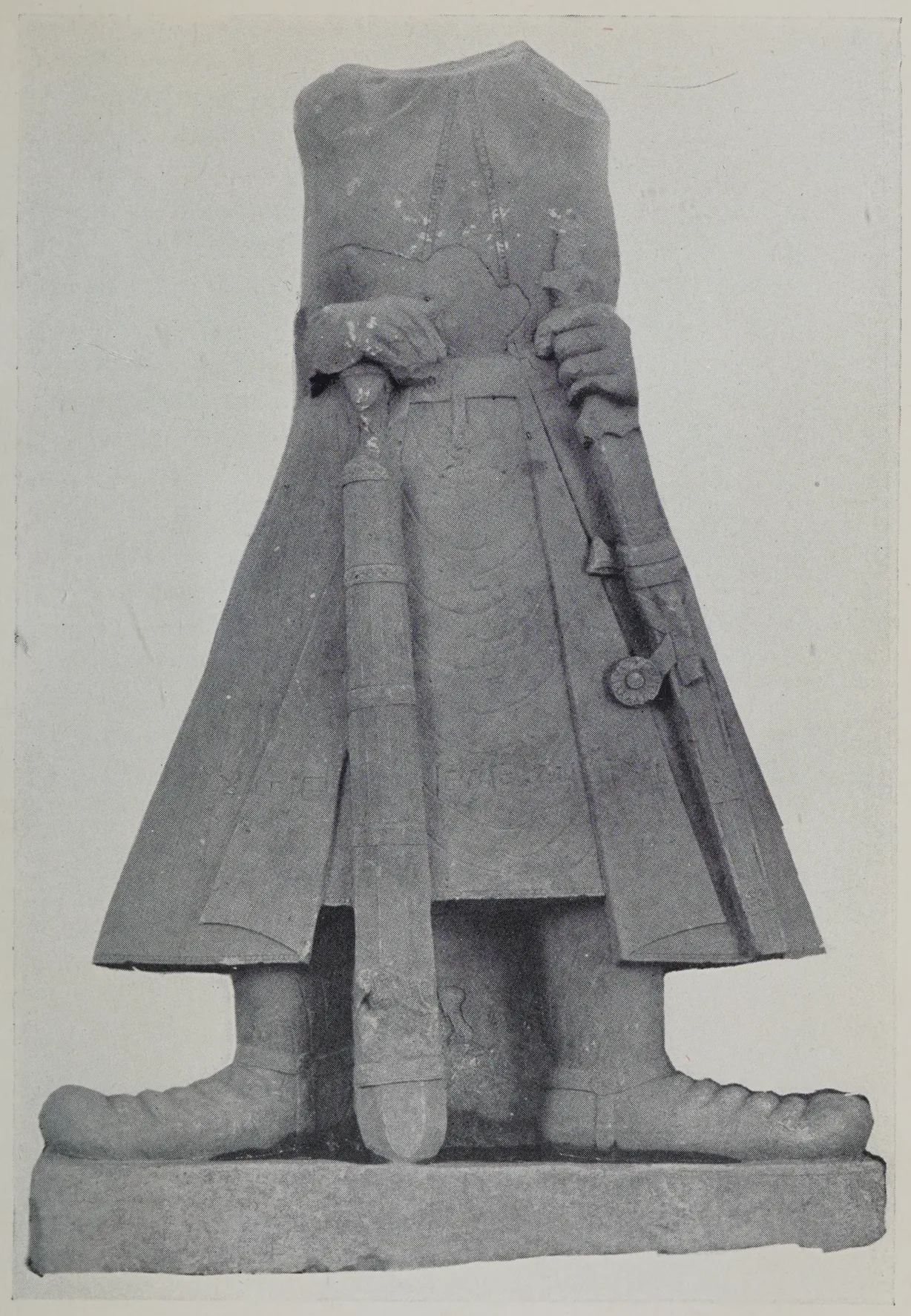
Excavations at a small town called Māt in the Mathurā district have disclosed the remarkable life-size statue of Kanishka (see Plate) and two other headless statues of kings. The name and titles of Kanishka are inscribed on his skirt in plain script. The details of his dress and equipment are of interest, and differ from those shown on the coins.2
I have no doubt whatever that the numismatic evidence alone—a class of evidence unduly depreciated by some historical students—proves conclusively that Kanishka lived at a time considerably later than the Christian era, subsequent to both Kadphises I and Kadphises II, and was exposed to the influence of the Roman empire. Many other lines of evidence, of great force when brought together, lead to the conclusion that Kanishka came to the throne early in the second century of the Christian era, and most probably in A. D. 120, directly succeeding Kadphises II.
Kanishka unquestionably belonged to the Kushān section of the Yüe-chi nation, as did the Kadphises kings, and there does not seem to be sufficient reason for believing that he was unconnected with them.1 The coins of both Kadphises II and Kanishka, found together in many places, frequently display in the field the same four-pronged symbol, and agree accurately in weight and fineness, besides exhibiting a close relationship in the obverse devices.2 If, as some scholars hold, the group of kings comprising Kanishka, Vāsishka, Huvishka, and Vāsudeva preceded Kadphises I, the coins of the two princes last named should be found together, as they are not, and those of Kadphises II and Kanishka should not be associated, as they are. We must accept the Chinese evidence that Kadphises II (Yen-kao-ching) ‘conquered T’ien-chu (India), and then set up generals, who governed in the name of the Yüe-chi’. Nobody can dispute the fact that Kanishka, Vāsishka, and Huvishka were well established in power at Mathurā on the Jumna as well as in Kashmīr and in the intermediate Panjāb. It is not apparent how they could have attained that position prior to the ‘conquest of India’ by Kadphises II, as attested by the Chinese historian. Without further pursuing in detail a tedious archaeological argument, it will suffice to say here that ample and conclusive reason can be shown for holding that the great majority of Indianists are right in placing the Kanishka group directly after that of the Kadphises kings. Our knowledge is so limited that difficulties remain, whatever theory be adopted, but the ordinary arrangement of the royal names appears to be strictly in accordance with the history of other nations, and with the phenomena of artistic, literary, and religious development.1
Kanishka, then, may be assumed to have succeeded Kadphises II, to whom he was closely related, in or about A. D. 120. Tradition and the monuments and inscriptions of his time prove that his sway extended all over North-Western India, probably as far south as the Vindhyas, as well as over the remote regions beyond the Pāmīr passes.
Hiuen Tsang, who recorded the history or tradition which he learned in Kapisa, expressly states that ‘when Kanishka reigned in Gandhāra his power reached the neighbouring states, and his influence extended to distant regions’. He kept order, we are told, over a wide territory reaching to the east of the Tsung-ling mountains, that is to say, ‘the meridional range or ranges which buttress the Pāmīr region on the east and divide it from the Tārīm Basin.'1 In India his coins are found constantly associated with those of Kadphises II from Kābul to Ghāzīpur on the Ganges, while their vast number and variety indicate a reign of considerable length.2
The temporary annexation of Mesopotamia between the Euphrates and Tigris in a. d. 116 by Trajan brought the Roman frontier within 600 miles of the western limits of the Yüe-chi empire. Although the province to the east of the Euphrates was given up by Hadrian in the year after its annexation, there can be no doubt that at this period the rulers of Northern and Western India were well acquainted with the fame and power of the great empire in the west.3
Kanishka may be credited with having completed in his earlier years the subjugation and annexation of the secluded vale of Kashmīr. He certainly showed a marked preference for that delightful country, where he erected numerous monuments, and founded a town, which, although now reduced to a petty village, still bears his honoured name.4
Tradition affirms that he penetrated far into the interior of India, and attacked the king residing at the ancient imperial city of Pāṭaliputra. It is said that he carried off from that city a Buddhist saint named Aśvaghosha. Comparison of the different versions of this story gives reasons for accepting as true at least the bare fact that Kanishka and Aśvaghosha were contemporaries.1 If the chronology adopted in this edition be correct, the Indo-Scythian or Kushān dynasty, during the reign of Kanishka, wielded authority over Western India, through the agency of the Śaka satraps of Ujjain, one of whom, Chastana, was probably related to the Kushān dynasty. There are grounds also for the belief that from the time of Kanishka to the reign of Vāsudeva, Kushān rule extended over Bihār.2
Kanishka's capital was Purushapura, the modern Peshāwar, the city which then guarded, as it now does, the main road from the Afghan hills to the Indian plains. There, in his latter days, when he had become a fervent Buddhist, he erected a great relic tower, which seems to have deserved to rank among the wonders of the world. The superstructure of carved wood rose in thirteen stories to a height of at least 400 feet, surmounted by a mighty iron pinnacle. When Song-yun, a Chinese pilgrim, visited the spot at the beginning of the sixth century, this structure had been thrice destroyed by fire, and as often rebuilt by pious kings. A monastery of exceptional magnificence which stood by its side,1 was still flourishing as a place of Buddhist education as late as the ninth century when it was visited by Vīradeva, an eminent Buddhist scholar, who subsequently was appointed abbot of Nālandā in the reign of king Devapāla of Magadha (c. A. D. 844–92).2
The final demolition of this celebrated establishment undoubtedly must have been due to the Muhammadan invasions of Mahmūd of Ghaznī and his successors. Muslim zeal against idolatry was always excited to acts of destruction by the spectacle of the innumerable images with which Buddhist holy places were crowded.
The ambition of Kanishka, as already observed, was not confined by the limits of India. He is alleged to have engaged in successful war with the Parthians, having been attacked by the king of that nation, who is described by the tradition as ‘very stupid and with a violent temper’.3 The prince referred to may be either Chosroes (Khusrū), or one of the rival kings who disputed the possession of the Parthian throne between a. d. 108 and 130.1
The most striking military exploit of Kanishka was his conquest of Kāshgar, Yarkand, and Khotan, extensive provinces of Chinese Turkestān lying to the north of Tibet and the east of the Pāmīrs, and at that time, as now, dependencies of China.2 When Kadphises II had attempted the same arduous adventure in a. d. 90, he had failed ignominiously, as already related, and had been compelled to pay tribute to China; but, after the death of Pan-chao, Kanishka having secured the peaceful possession of India and Kashmīr, was in a better position to surmount the appalling difficulties of conveying an effective army across the passes of the Tāghdumbāsh Pāmīr, which no modern ruler of India would dare to face. Kanishka succeeded, where his predecessor had failed; and not only freed himself from the obligation of paying tribute to China, but exacted the surrender of hostages from a state tributary to the Chinese empire. The assertion made by one authority that the hostages included a son of the emperor of the Han dynasty does not appear to be worthy of belief. The territory of the ruler to whose family the hostages belonged seems to have been not very distant from Kāshgar.
The hostages were treated, as beseemed their princely rank, with the utmost consideration, and were assigned suitable residences at different Buddhist monasteries for each of the three seasons—the hot, the cold, and the rains. During the time of the summer heats, when the burning plains are not pleasant to live in, they enjoyed the cool breezes at a Hīnayānist monastery named Sha-lo-ka, perhaps meaning ‘the Kāshgar monastery’, situated in the hills of Kapisa, the modern Kāfiristān, beyond Kābul, which was erected specially for their accommodation. During the spring and autumn, including the rainy season, they resided in Gandhāra, no doubt at the capital; while they spent the cold weather at an unidentified place in the Eastern Panjāb, to which the name of Chīnabhukti, or ' the Chinese allotment', was given in consequence. They were reputed to have introduced the pear and peach, previously unknown in that part of India, during their residence at Chīnabhukti. One of their number, before returning home, deposited a rich store of gold and jewels for the endowment of the Kapisa establishment, and they all continued to recognize the generosity with which they had been treated by remitting offerings for the benefit of the brethren. The grateful monks adorned their walls with paintings representing their guests, who are said to have been somewhat like Chinamen in appearance and dress. When Hiuen Tsang resided at the Kapisa monastery, during the rainy season of A. D. 630, he found that his hosts still cherished the memory of their benefactors, and celebrated services in their honour. He also stayed for fourteen months in A. D. 633–4 at the hostages' monastery in Chīnabhukti.
The biographer of Hiuen Tsang tells a curious story about the treasure deposited by the hostage as an endowment for the Sha-lo-ka shrine at Kapisa; which was known to be buried under the feet of the image of Vaisravana, otherwise known as Kuvera, or Jambhala, the Great Spirit King, at the south side of the eastern gate of the hall of Buddha. An impious Rāja who had tried to appropriate the hoard was frightened away by portents which seemed to indicate the displeasure of its guardian spirit, and when the monks endeavoured to make use of it for the purpose of repairing the shrine, in accordance with the donor's intention, they, too, were terrified by similar manifestations.
While Hiuen Tsang was lodging at the shrine, the monks besought him to use his influence with the spirit to obtain permission to expend the treasure on urgently needed repairs of the steeple. The pilgrim complied, burned incense, and duly assured the guardian spirit that no waste or misappropriation would be permitted. The workmen who were set to dig up the spot then suffered no molestation, and at a depth of 7 or 8 feet found a great copper vessel containing several hundredweight of gold and a quantity of pearls. The balance of the treasure left after the repairs to the steeple has doubtless been appropriated long since by excavators less scrupulous than the pious Master of the Law.1
The stories told about Kanishka's conversion and his subsequent zeal for Buddhism have so much resemblance to the Asoka legends that it is difficult to decide how far they are traditions of actual fact, and how far merely echoes of an older tradition. The Yüe-chi monarch did not record passages from his autobiography as Asoka did, and when we are informed in the pages of a pious tract that his conversion was due to remorse for the blood shed during his wars, it is impossible to check the statement.2 Probably it is merely an echo of the story of Asoka, as told by himself.
Just as the writers of edifying books sought to enhance the glory of Asoka's conversion to the creed of the mild Sākya sage by blood-curdling tales of the king's fiendish cruelty during the days of his unbelief, so Kanishka was alleged to have had no faith either in right or wrong, and to have lightly esteemed the law of Buddha during his earlier life.1 The most authentic evidence on the subject of his changes of faith is afforded by the long and varied series of his coins, which, like most ancient coinages, reflect the religious ideas both of the monarch in whose name they were struck, and of the peoples whom he subdued. The finest, and presumably the earliest, pieces bear legends, Greek in both script and language, with effigies of the sun and moon personified under their Greek names, Hēlios and Selēnē.2 On later issues the Greek script is retained, but the language is Khotanese, a form of old Iranian, while the deities depicted are a strange medley of the gods worshipped by Greeks, Persians, and Indians.3 The rare coins exhibiting images of Buddha Sākyamuni with his name in Greek letters are usually considered to be among the latest of the reign, but they are well executed, and may be earlier in date than is generally supposed.4 Although it is impossible to fix the exact date of Kanishka's conversion, the event evidently did not occur until he had been for some years on the throne.
The appearance of the Buddha among a crowd of heterogeneous deities would have appeared strange, in fact would have been inconceivable to Asoka, while it seemed quite natural to Kanishka. The newer Buddhism of his day, which may be traced back to an earlier period and was designated as the Mahāyāna, or Great Vehicle, must have been largely of foreign origin, and its development was the result of the complex interaction of Indian, Zoroastrian, Christian, Gnostic, and Hellenic elements, which had been made possible by the conquests of Alexander, the formation of the Maurya empire in India, and, above all, by the unification of the Roman world under the sway of the earlier emperors.1 In this newer Buddhism the sage Gautama became in practice, if not in theory, a god, with his ears open to the prayers of the faithful, and served by a hierarchy of Bodhisattvas and other beings acting as mediators between him and sinful men.2 Such a Buddha rightly took a place among the gods of the nations comprised in Kanishka's widespread empire,3 and the monarch, even after his 'conversion', probably continued to honour both the old and the new gods, as, in a later age, Harsha did alternate reverence to Siva and Buddha.
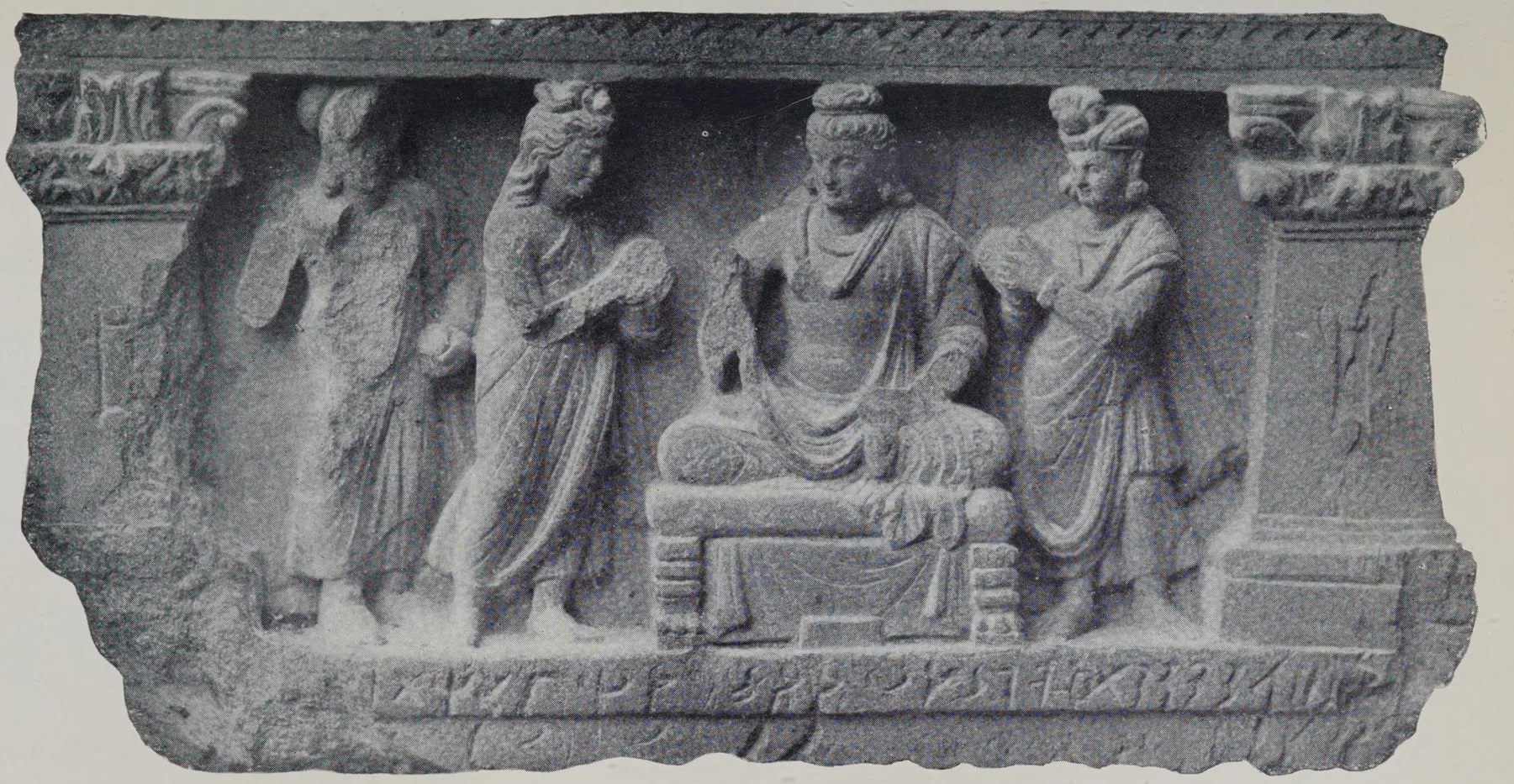
The celebrated Gandhāra sculptures, found abundantly in the Peshāwar district and neighbouring regions, the ancient Gandhāra, of which many excellent examples date from the time of Kanishka and his proximate successors, give vivid expression in classical forms of considerable artistic merit to this modified Buddhism, a religion with a complicated mythology and well-filled pantheon.4 The florid Corinthian capitals and many other characteristic features of the style prove that the Gandhāra school was merely a branch of the cosmopolitan Graeco-Roman art of the early empire. The most competent critics are now generally agreed that the school reached its highest point of development early in the second century of the Christian era.1
In Buddhist ecclesiastical history the reign of Kanishka is specially celebrated for the convocation of a council, organized on the model of that summoned by Asoka. Kanishka's council, which is ignored by the Ceylonese chroniclers, who probably never heard of it, is known only from the traditions of Northern India, as preserved by Tibetan, Chinese, and Mongolian writers. The accounts of this assembly, like those of the earlier councils, are discrepant, and the details are obviously legendary.
Kanishka, we are told, studied the Buddhist scriptures in his leisure hours under the guidance of a monk, who attended daily at the palace to give him instruction. The king, becoming hopelessly puzzled by the conflicting doctrines of the various sects or schools, suggested to his adviser, the Venerable Pārsva, that it would be well to obtain an authoritative exposition of the truth. Pārsva gave his cordial approval to the suggestion, and arrangements were made accordingly for a general assembly of theologians. As a matter of fact, however, all the learned men assembled seem to have belonged to a single school, the Sarvāstivādins of the Hīnayāna, or Little Vehicle, whose practice, if we may judge from the contemporary sculptures, must have differed little from that of the Mahāyānists. The first question demanding settlement was that of the place of meeting. The king proposed his capital in Gandhāra, but objection was taken to the hot damp climate. Somebody then suggested Rājagriha, in Magadha, where the first council was reputed to have met. Ultimately it was decided to convoke the assembly in the pleasant climate of Kashmīr, at a monastery named Kundalavana, near the capital of that country. Vasumitra was elected president, and Aśvaghosha, the famous author, who, according to the story, had been carried off from Pātaliputra, was appointed vice-president. The members, 500 in number, devoted themselves to a thorough examination of theological literature from the most remote antiquity, and elaborated huge commentaries on the three main divisions of the Canon. The works so prepared included the Mahāvibhāshā, which still exists in Chinese, and is described as being an encyclopaedia of Buddhist philosophy. Dr. Takakusu, a highly competent authority, is of opinion that until this work shall have been made accessible to scholars it will be vain to argue about the Council of Kashmīr or its works. When the labours of the assembly were completed, the commentaries were copied on sheets of copper, which were deposited in a stūpa built for this purpose by order of king Kanishka. It is possible that these precious records may still exist buried under some mound near Srīnagar, and that a lucky chance may reveal them. After the conclusion of the business of the council, Kanishka renewed Asoka's donation of the kingdom of Kashmīr to the Church, and went home through the Bārāmūla Pass.1 No political importance should be attached to the assembly.
The legends published by M. Sylvain Lévi include a strange tale professing to relate the end of Kanishka, which possibly may be founded on fact.
‘The king’, so runs the story, ‘had a minister named Māṭhara, of unusual intelligence. He addressed Kanishka in these words: “Sire, if you wish to follow the advice of your servant, your power will assuredly bring the whole world into subjection. All will submit to you, and the eight regions will take refuge in your merit. Think over what your servant has said, but do not divulge it.” The king replied: “Very well, it shall be as you say.” Then the minister called together the able generals and equipped a force of the four arms. Wherever the king turned, all men bowed before him like herbage under hail. The peoples of three regions came in to make their submission; under the hoofs of the horse ridden by king Kanishka everything either bent or broke. The king said: “I have subjugated three regions; all men have taken refuge with me; the region of the north alone has not come in to make its submission. If I subjugate it, I shall never again take advantage of an opportunity against any one, be he who he may, but I do not yet know the best way to succeed in this undertaking.” The king’s people, having heard these words, took counsel together, and said: “The king is greedy, cruel, and unreasonable; his campaigns and continued conquests have wearied the mass of his servants. He knows not how to be content, but wants to reign over the four quarters. The garrisons are stationed on distant frontiers, and our relatives are far from us. Such being the situation, we must agree among ourselves, and get rid of him. After that we may be happy." As he was ill, they covered him with a quilt, a man sat on top of him, and the king died on the spot.'1
The reign of Kanishka appears to have lasted some forty-five years, and may be assumed to have terminated about a. d. 160.
Very little is known about the successors of Kanishka. Inscriptions prove that Vāsishka was reigning at Mathurā in the year 24, and Huvishka between the years 33 and 60, while a prince of the name of Kanishka was reigning at Āra in the Panjāb2 in the year 41. The best way to reconcile the apparent contradiction is to assume that Vāsishka and Huvishka were sons of Kanishka, who both acted in succession as Viceroys of Upper India while their father was warring beyond the mountains. Vāsishka, of whom no coins are known, seems to have predeceased his father, who was succeeded in his whole empire by Huvishka.3 The extensive coinage of Huvishka may have been all issued after his succession to the imperial throne. Vāsishka, presumably, was not empowered to coin in his own name. If he had issued coins, it is hardly possible that some specimens should not have been discovered by this time.
The dominions of Huvishka certainly included Kābul,4 Kashmīr, and Mathurā. At the last-named city, a splendid Buddhist monastery bore his name, and no doubt owed its existence to his munificence;1 for, like Kanishka, he was a liberal patron of Buddhist ecclesiastical institutions. He also resembled his more famous predecessor in an eclectic taste for a strange medley of Greek, Indian, and Persian deities. The types on the coins of Huvishka include Herakles, Sarapis ('Sarapo'), Skanda with his son Visākha, Pharro, the fire-god, and many others, but the figure and name of Buddha are wanting. It would seem that the Buddhist convictions of these old Scythian kings were not very deeply seated, and it is probably justifiable to hold that the royal favour was granted to the powerful monastic organization of the Buddhists as much as to their creed. No prudent monarch in those days could afford to neglect the wealthy and influential order, which had spread its ramifications all over the empire.
The town of Hushkapura, founded by Huvishka in Kashmīr, occupied a position of exceptional importance just inside the Bārāmūla Pass, then known as the 'western gate' of the valley, and continued for centuries to be a place of note. When Hiuen Tsang visited Kashmīr about A. D. 631, he enjoyed the liberal hospitality of the Hushkapura monastery for several days, and was escorted thence with all honour to the capital, where he found numerous religious institutions, attended by some five thousand monks. The town of Hushkapura is now represented by the small village of Ushkür, at which the ruins of an ancient stūpa are visible.2
The reign of Huvishka undoubtedly was prolonged, but all memory of its political events has perished. His abundant coinage is even more varied than that of Kanishka, with which it is constantly associated, and, like the contemporary sculpture, testifies to the continuance of Hellenistic influence. A few specimens of the gold coinage present well executed and characteristic portraits of the king, who was a determined-looking man, with strongly marked features, large, deep-set eyes, and aquiline nose.3 So far as appears, the Kushān power suffered no diminution during his reign, which may be assumed to have ended in or about a. d. 182.
Huvishka was succeeded by Vāsudeva, whose thoroughly Indian name, a synonym for Vishnu, is a proof of the rapidity with which the foreign invaders had succumbed to the influence of their environment. Testimony to the same fact is borne by his coins, almost all of which exhibit on the reverse the figure of the Indian god Siva, attended by his bull Nandi, and accompanied by the noose, trident, and other insignia of Hindu iconography. The inscriptions of Vāsudeva, mostly found at Mathurā, certainly range in date from the year 74 to the year 98 of the era used in the Kushān age, and indicate a reign of not less than twenty-five years. We may assume that his reign terminated in or about the year 220.1
It is evident that the Kushān power must have been decadent during the latter part of the long reign of Vāsudeva, and apparently before its close, or immediately after that event, the vast empire of Kanishka obeyed the usual law governing Oriental monarchies, and broke up into fragments, having enjoyed a brief period of splendid unity. Coins bearing the name of Vāsudeva continued to be struck long after he had passed away, and ultimately present the royal figure clad in the garb of Persia, and manifestly imitated from the effigy of Sapor (Shāhpur) I, the Sassanian monarch who ruled Persia from a. d. 238 to 269.2
It seems reasonable to believe that the decay of the Indo-Scythian monarchy must have been hastened by the terrible plague of a. d. 167, which started in Babylonia, and desolated the Roman and Parthian empires for several years. At Rome, as well as throughout Italy and the provinces, the greater part of the inhabitants, and nearly all the troops, sank under the disease. Niebuhr expressed the opinion that ‘the ancient world never recovered from the blow inflicted upon it by the plague which visited it in the reign of M. Aurelius’. It is not likely that India can have escaped.1
Absolutely nothing positive is known concerning the means by which the renewed Persian influence, as proved by numismatic facts, made itself felt in the interior of India. Bahrām (Varahrān) II is known to have conducted a campaign in Sīstān, at some time between 277 and 294; but there is no definite record of any Sassanian invasion of India in the third century, during which period all the ordinary sources of historical information dry up. No inscriptions certainly referable to that time have been discovered, and the coinage, issued by merely local rulers, gives hardly any help. The two great dynasties, the Kushān in Northern India, and the Āndhra in the tableland of the Deccan, disappear together almost at the moment (a. d. 226) when the Arsakidan dynasty of Persia was superseded by the Sassanian.2 It is impossible to avoid hazarding the conjecture that the three events may have been in some way connected, and that the persianizing of the Kushān coinage of Northern India should be explained by the occurrence of a Persian invasion, such as that mentioned by Firishta as having occurred during the reign of the first Sassanian king.3
So much, however, is clear, that Vāsudeva was the last Kushān king who continued to hold extensive territories in India. After his death there is no indication of the existence of a paramount power in Northern India. Probably numerous Rājas asserted their independence and formed a number of short-lived states, such as commonly arise from the ruins of a great oriental monarchy; but historical material for the third century is so completely lacking that it is impossible to say what or how many those states were. The period evidently was one of extreme confusion associated with foreign invasions from the north-west, which is reflected in the muddled statements of the Purāṇas concerning the Ābhīras,1 Gardabbilas, Śakas, Yavanas, Bāhlīkas, and other outlandish dynasties named as the successors of the Āndhras. The dynasties thus enumerated clearly were to a large extent contemporary with one another, not consecutive, and none of them could claim paramount rank. It seems to be quite hopeless to attempt to reduce to order the Purāṇic accounts of this anarchical period, and nothing would be gained by quoting a long list of names, the very forms of which are uncertain.
Coins indicate that the Kushāns held their own in the Panjāb and Kābul for a long time. It is certain that the Kushān kings of Kābul continued to be a considerable power until the fifth century, when they were overthrown by the White Huns. At the beginning of the fourth century one of them gave a daughter in marriage to Hormazd II, the Sassanian king of Persia; and when Sapor II besieged Amida in A.D. 360, his victory over the Roman garrison was won with the aid of Indian elephants and Kushān troops under the command of their aged king Grumbates, who occupied the place of honour, and was supported by the Śakas of Sīstān.2
It is difficult to judge how far the foreign chiefs who ruled the Panjāb during the third century, and struck coins similar to those of Vāsudeva, yet with a difference, were Kushāns, and how far they belonged to other Asiatic tribes. The marginal legends of the coins of this class, which are written in a modified Greek script, preserve the name of either Kanishka or Vasu[deva] Kushān,1 King of Kings, and so recognize the Kushān supremacy; but the name in Indian letters, placed by the side of the spear, is frequently monosyllabic, like a Chinese name, Bha, Ga, Vi, and so forth. These monosyllabic names seem to belong to chiefs of various Central Asian tribes who invaded India and acknowledged the supremacy of the Kushān or Shāhi kings of Kābul. One coin with the modified Kushān obverse, and the names Pāsana, Nu, Shilada in Indian Brāhmī characters in various parts of the field, has on the reverse a fire-altar of the type found on the coins of the earliest Sassanian kings. It is thus clear that in some way or other, during the third century, the Panjāb renewed its ancient connexion with Persia.2 It is also certain that the later coinage of the Kushāns is clearly connected with that of the Sassanians, a fact which to my mind is fatal to theories which antedate Kanishka and his successors.
Nothing definite is recorded concerning the dynasties of Northern India, excluding the Panjāb, during the third century, and the early part of the fourth. The imperial city of Pātaliputra is known to have continued to be a place of importance as late as the fifth century, but there is little indication of the nature of the dynasty which ruled there during the third. Probably, for at any rate the greater portion of the period, the city was under Śaka rule. The high importance attached by the founder of the Gupta era in a.d. 320 to his alliance with a Lichchhavi princess suggests that during the third century the non-Aryan Lichchhavis of Vaisāli, who appear to have been closely related to the Tibetans, may have held Pātaliputra as tributaries or feudatories of the Kushān dynasty at Peshāwar. The only intelligible dynastic list for the period is that of the Śaka satraps of Western India, whose history will be more conveniently noticed in the next chapter in connexion with that of the Gupta emperors. The period between the extinction of the Kushān and Āndhra dynasties, about a.d. 220 or 230, and the rise of the imperial Gupta dynasty, nearly a century later, is one of the darkest in the whole range of Indian history.
APPROXIMATE KUSHĀN CHRONOLOGY 1
| DATE. | EVENT. |
|---|---|
| B. C. | |
| 174 | Death of Hiung-nū chief, Moduk. |
| c. 165 | Expulsion of main body of Yüe-chi horde from Kan-suh by the Hiung-nū. |
| c. 163 | Nan-tiu-mi, chief of the Wu-sun, killed by the Yüe-chi. |
| 160 | Death of Hiung-nū chief, Ki-yuk. |
| c. 160–50 | Yüe-chi occupation of the Śaka territory ; Śaka migration. |
| c. 150–140 | Śaka invasion of India. |
| c. 140 | Expulsion of Yüe-chi from Śaka territory by Koen-muo, the young Wu-sun chief, son of Nan-tiu-mi. |
| c. 138. | Reduction of the Ta-hia, both north and south of the Oxus, to vassalage by the Yüe-chi, who begin to settle down. |
| c. 135 | Dispatch by Chinese emperor Wu-ti of Chang-k'ien as envoy to the Yüe-chi. |
| c. 125 | Arrival of Chang-k'ien at Yüe-chi head-quarters, north of the Oxus. |
| c. 122–120 | Return of Chang-k'ien to China. |
| c. 114 | Death of Chang-k'ien. |
| c. 100 | Extension of Yüe-chi settlements to the lands south of the Oxus ; occupation of Ta-hia capital, Lan-sheu, south of the river, probably = Balkh. |
| c. 95 | Formation of five Yüe-chi principalities, including Kushān and Bāmiān. |
| 58–57 | Epoch of the Mālava or Vikrama era. |
| c. 26 | Indian embassy to Augustus. |
| 2 | A Chinese official instructed in Buddhist books by a Yüe-chi king. (See Franke, Türkvölker, p. 92 n.) |
| A. D. | |
| 8 | Temporary cessation of intercourse between China and the West. |
| 14 | Augustus, Roman emperor, died ; Tiberius acc. |
| 23 | End of First, or Early Han dynasty of China. |
| 38 | Gaius (Caligula), Roman emperor, acc. |
| c. 40 | Kadphises I (Kieū-tsieū-ki'o, Kozolakadaphes, &c.) acc. |
| c. 40–55 | Consolidation of the five Yüe-chi principalities into one Kushān kingdom under Kadphises I ; conquest by him of Kao-fū (Kābul), Ki-pin (Gandhāra), and Pota (? Bactria or more probably Arachosia). |
| 41 | Claudius, Roman emperor, acc. |
| c. 45–70 | Destruction of Indo-Parthian power, and gradual conquest of Northern India by Kadphises I. |
| c. 48 | Kadphises I succeeded Gondophernes at Taxila. |
| 54 | Nero, Roman emperor, acc. |
| c. 64 | Buddhist books sent for by Chinese emperor, Ming-ti. |
| 68, 69 | Galba, Otho, and Vitellius, Roman emperors. |
| 70 | Vespasian, Roman emperor, (acc. Dec. 22, 69). |
| 73–102 | Victorious career of Pan-chao, the Chinese general, in Khotan, &c. |
| 77 | Publication of Pliny's Natural History. |
| 78 | Epoch of the Śaka or Sālivāhana era ; Kadphises I died, aged 80 ; Kadphises II Kushān (Yen-kao-ching, Wema Kadphises, &c.), his son, acc. |
| 79 | Titus, Roman emperor, acc. |
| A. D. | |
| 81 | Domitian, Roman emperor, acc. |
| 89–105 | Ho-ti, Chinese emperor. |
| c. 90 | Defeat of Kadphises II by Pan-chao. |
| 94 | Reduction of Kuchā and Kara-shahr by the Chinese under Pan-chao. |
| 96 | Nerva, Roman emperor, acc. |
| 98 | Trajan, Roman emperor, acc. |
| 99 | Arrival of Trajan in Rome. |
| c. 100 | Indian embassy to Trajan; Buddhist Council. |
| 105 | Overthrow by the Romans of the Nabataean kingdom of Petra in Arabia; rise of Palmyra. |
| c. 110 | Kadphises II died. |
| 116 | Conquest of Mesopotamia by Trajan. |
| 117 | Hadrian, Roman emperor, acc.; retrocession of Meso-potamia. |
| c. 120 | Kanishka Kushān, acc.; year 1 of his regnal era. |
| c. 123 | Sārnāth inscription of Kanishka (year 3). |
| 123–6 | Residence of Hadrian at Athens. |
| c. 130–52 | Kanishka's conquests in Chinese Turkestan.1 |
| 131–6 | War of Hadrian with the Jews. |
| 138 | Mānikyāla inscription of Kanishka (year 18); Antoninus Pius, Roman emperor, acc. |
| c. 150 | Jūnāgaṛh inscription of Rudradāman, Western satrap. |
| c. 160 | Death of Kanishka; Huvishka Kushān, acc. as sovereign of whole empire. |
| 161 | Marcus Aurelius Antoninus, Roman emperor, acc. |
| 162–5 | Defeat of Parthian king, Vologeses III, by the Romans. |
| 175 | Eastern campaign of Marcus Aurelius. |
| 180 | Commodus, Roman emperor, acc. |
| c. 182 | Vasudeva Kushān, acc. |
| 192, 193 | Pertinax and Julianus, Roman emperors. |
| 193 | Septimius Severus, Roman emperor, acc. |
| c. 200 | Palmyra created a Roman colony. |
| 211 | Caracalla, Roman emperor, acc. |
| 216 | Parthian expedition of Caracalla. |
| 217 | Macrinus, Roman emperor, acc. |
| 218 | Elagabalus, Roman emperor, acc. |
| c. 220 | Death of Vasudeva Kushān. |
| c. 220–60 | Later Kushān kings. |
| 222 | Alexander Severus, Roman emperor, acc. |
| 226 | Foundation of Sassanian empire of Persia by Ardashīr or Artaxerxes I. |
| 260 | Defeat of Valerian, Roman emperor, by Sapor I. |
| 273 | Capture of Palmyra by Aurelian. |
| 284–305 | Diocletian, emperor. |
| 360 | Successful siege of Amida by Sapor II, with Kushān help. |
Notes
- 1. The Yüe-chi were not snubnosed Mongols, but big men with pink complexions and large noses, resembling the Hiung-nū in manners and customs (Kingsmill, J. R. A. S., 1882, p. 7, of reprint of Intercourse of China with Eastern Turkestan). The Yüe-chi belonged to the Hu group of tribes, who seem to have been Iranians. The coins of Kanishka and Huvishka, as well as those of Kadphises II, present recognizable portraits. See Plates of Coins, ante.
- 1. Chavannes, Turcs Occidentaux, p. 263. According to Laufer, The Language of the Yüe-chi, p. 12, the Wu-sun as well as the Yüe-chi and the Ephthalites, were Scythic Iranians.
- 2. In later times the Muhammadans were sometimes styled Śakas, as in the Baṭihāgaṛh inscription of Samvat 1385 from the Damoh District, Central Provinces (Ep. Ind., xii, 45), and in several other instances.
- 3. In the time of Darius, son of Hystaspes (500 b. c.), the Sakai, with the Caspii, formed the fifteenth satrapy; and, in the army of Xerxes, they were associated with the Bactrians under the command of Hystaspes, the son of Darius and Atossa (Herod. iii. 93; vii, 64). Now that the position of the Wu-sun has been determined, and the line of the Yüe-chi migration thus fixed, the approximate location of the Sakai must be as stated in the text. Strabo clearly states that the Sakai and allied tribes came from the neighbourhood of the Jaxartes. Canon Rawlinson's opinion that they occupied the Kāshgar and Yarkand territory in the days of Darius (Herod. transl., vol. ii, 403; v, 170) is no longer tenable. The Śaka migration is discussed fully in my paper, 'The Śakas in Northern India', Z. D. M. G., 1907, pp. 403–21; and by Dr. F. W. Thomas in his valuable article 'Sakastana' (J. R. A. S., 1906, pp. 181–216, 460–4). He shows [p. 265] reasons for believing that Śakas had been settled in Sīstān from very early times, and for holding that an irruption of Śakas into that country in the second century b. c. is improbable. In my second edition I had assumed the reality of such an irruption, but now am disposed to agree with Dr. Thomas.
- 1. Many books antedate the unification of the Kushān monarchy in consequence of a misunderstanding of a condensed version of the history given in Ma-twan-lin's Chinese encyclopaedia of the thirteenth century. The publication [p. 266] of translations of the original texts which the encyclopaedist abstracted has made the true meaning plain, although exact dates are not known. In a valuable paper ‘Indoskythische Beiträge’ in Sitzungsber. d. königl. preuss. Akad. der Wissenschaften, 1916, pp. 787–827, Sten Konow suggests (p. 814), and he may well be right, that the Śaka era was founded by Kadphises II, and that the Mālava or Vikrama era originated at Ujjain, and was established by a king named Vikrama, who defeated the Śakas, who preceded the Kushāns. The king called Kadphises I in the text is the Kieū-tsieū-k’io of the Chinese, and the Kozolakadaphes, Kozoulokadphises, and Kujulakarakadphises of various coins. The exact meaning of these names or titles is unknown. Full references will be found in my paper entitled ‘The Kushān or Indo-Scythian Period of Indian History’ (J. R. A. S., 1903, pp. 1–64). I have given up the theory advocated in that essay that the Kushāns used the Laukika era. The name of the clan is spelled Kushana in the Kharoshṭhī script, which does not mark long vowels, but there is good Chinese and Sassanian evidence that the second vowel was long, e. g. the words rabbā Kushān on coins of Hormazd II (a. d. 302–9). See Drouin, ‘Les Légendes des Monnaies Sassanides,’ in Revue Archéologique, 1898, pp. 62 foll. I therefore follow Cunningham and Drouin in using the form ‘Kushān’ instead of the more fashionable ‘Kushana’. Baron A. von Staël Holstein believes that Kusha (Kuṣa) ‘was the correct name of the warlike race that gave Kaniṣka to the Buddhist world’. The forms transliterated as ‘Kushān’, &c., appear to be genitive plural of the name Kusha (Kuṣa). (‘Was there a Kuṣana Race?’ J. R. A. S., Jan., 1914, pp. 79–88). Fleet and Allan disagree with the Baron (J. A. R. S., 1914, pp. 369–81, 413). See also Fleet, ibid, 1915, p. 532 and Thomas, ibid, 1915, p. 532. Laufer (Language of the Yüe-chi, Chicago, 1917) denounces the speculations of A. v. S. Holstein as ‘entirely inadmissible’. The names Yüe-chi and Kuṣana have no philological connexion, but are ‘thoroughly independent’. Laufer agrees with F. W. Thomas (J. R. A. S., 1906, p. 203) that Kuṣana was ‘not a tribal name, but a family or dynastic title’. See also K. P. Jayaswal (J. B. O. Res. Soc., vi, pp. 12–22), who suggests that Kushān was actually the personal name of Wema Kadphises’ predecessor, Kadphises I.
- 1. The Chinese texts, as Sylvain Lévi has proved conclusively, distinguish Ki-pin from Kao-fū, or Kābul. The signification of Ki-pin or Ka-pin has varied. In the seventh century, in the time of the Tang dynasty, it generally, although not invariably, meant Kapiśa, or North-eastern Afghanistan. Sten Konow in the paper mentioned in the preceding note (p. 811) holds that in Han times Ki-pin meant Gandhāra (the region including Taxila and Takht-i-Bahai). He seems to be right, and [p. 267] I relinquish my earlier view that the name signifies Kashmir, as suggested by Sylvain Levi, in J. A., tome vii, ser. ix, p. 161. See the learned observations of Watters (On Yuan-chwang, i, 259), who points out that ‘in many Chinese treatises Ka-pin is a geographical term of vague and varying extension, and not the description of a particular country. It is applied in different works to Kapis, Nagar, Gandhāra, Udyāna, and Kashmir.’ Sir M. A. Stein spells Ki-pin as Chi-pin. All Chinese names are spelt in a great variety of ways by different authors. Dates, also, are given with a certain amount of variation.
- 1. Yen-kao-ching of the Chinese; Wima (Ooēmo) Kadphises, &c., of the coins.
- 1. No inscriptions of Kadphises II being known, the evidence for the extent of his Indian dominions rests chiefly on the distribution of his coins. When the Periplus was written, about A. D. 80, Parthian chiefs still ruled the Indus delta. The proof that the Nameless King, Σωτὴρ μέγας, was contemporary with Kadphises II is given in detail by Cunningham (Num. Chron., 1892, p. 71). His coins, mostly copper or bronze, include a few in base silver. Both Kadphises II and the Nameless King use the title sōtēr-megas; but while the former calls himself basileus basileōn, ‘king of kings’, the latter describes himself as basileus basileuōn, ‘reigning king’. The participle probably indicates subordinate rank. See Catal. Coins in I. M., vol. I.
- 2. See ‘The Story of Chang K’iên, China’s Pioneer in Western Asia’, by Friedrich Hirth, in J. Amer. Or. Soc., vol. xxxvii, pt. i, ii, cited in J. R. A. S., 1918, p. 202.
- 3. Prof. Douglas says that ‘an army under General Pan-c’hao marched to Khoten, and even carried their country’s flag to the shores of the Caspian Sea’ (China, in Story of Nations Series, p. 18). M. Sylvain Lévi, referring to Mailla, Histoire générale de la Chine, says—‘jusqu’aux confins du monde gréco-romain’ (Notes sur les Indo-Scythes, p. 50).
- 1. According to Laufer (op. cit., p. 3), the demand was made in a. d. 87.
- 2. For an account of Tāshkurghān in the Sarīkol tract of the mountains, see Stein, Preliminary Report of Exploration in Chinese Turkestan, pp. 11–13 ; Sand-buried Ruins of Khotan, ch. v ; Ancient Khotan, p. 54, note 17.
- 3. ‘ In the time of the Emperor Hwa [=Hiao-houo-ti, or Ho-ti] (89–105) they [the Indians] often sent messengers to China and presented something, as if it were their tribute. But afterwards those of the western regions rebelled (against the emperor of China), and interrupted their communication, until the second year of the period Yenhsi (159) in the reign of the Emperor Kwan [=Hwan-ti] (147–67) ’ (Annals of Later Han Dynasty, as translated by Prof. Legge in India, What Can it Teach us ? p. 277).
- 4. ‘ And to Trajan after he had arrived in Rome there came a great many embassies from barbarian courts, and especially from [p. 270] the Indians. . . . He (Trajan) having reached the ocean (at the mouth of the Tigris) saw a vessel setting sail for India’ (Dion Cassius, Hist. Rom., ix, 58; lxvii, 28; in McCrindle, Anc. Ind. (1901), p. 213).
- 1. For weights and assays of Kushān coins, see Cunningham (Coins Med. India, p. 16). The opinions expressed by Von Sallet (Nachfolger Alexanders, pp. 56, 81) that the close resemblance between the heads of Kadphises I and Augustus is due to fortuitous coincidence, and that there is no reason to connect the weight of the Kushān coins with that of the imperial aurei, can only be regarded as strange aberrations of that distinguished numismatist. The one silver coin of Kadphises II which is known weighs 56½ grains, and thus agrees in weight, as Cunningham observed, with a Roman silver denarius. A silver coin of Huvishka, okpo type, now in the museum of the Bombay Branch R. A. S., agrees in weight with the Indo-Parthian silver (Prog. Rep. A. S. W. Circle, 1915–16, p. 59). For an account of large finds of Roman coins in India, see Thurston, Coin Catal. No. 2 of Madras Museum; and, more fully, Sewell, ‘Roman Coins found in India’, J. R. A. S., 1904, p. 591. The testimony of Pliny (Hist. Nat. xii, 18) to the drain of Roman gold in exchange for Indian, Arabian, and Chinese luxuries is well known:—‘Minimaque computatione milies centena milia sestertiûm annis omnibus India et Seres peninsulaque illa imperio nostro adimunt. Tanto nobis deliciae et feminae constant. Quota enim portio ex illis ad deos quaeso iam uti ad inferos pertinet?’ The Roman coins in circulation in North-western India were not however all gold. ‘As many as 69 Roman coins were found in Mrs. Howell’s collection, most of which were silver and belonged to the various officers of the Roman Republic.’ These coins were all collected from Kohat and the neighbouring regions and must have been in circulation there for the purposes of commerce. Seventeen of them belong to the Roman emperors, four to the ‘coinage of Italy’, and one to the ‘coinage of Spain’. Forty-one pertain to the various officers of the Roman Republic, and one is unidentifiable. The remaining five, which are [p. 271] copper, belong to both republican and imperial times (Prog. Rep. A. S. W. I., 1916–17, p. 51).
- 1. No definite proof of the length of this reign can be given, but the extent of the conquests made by Kadphises II and the large volume of his coinage are certain indications that his reign was protracted. Cunningham assigned it a duration of forty years. My presentation of the history of Kanishka is largely based on the original and valuable essay by Mr. R. D. Banerji of the Indian Museum, entitled ‘The Scythian Period of Indian History’ (Ind. Ant., 1908, pp. 25–75). Prof. Lüders’s view that the Kanishka of the Ara record may have been the grandson of the Kanishka of the years 3 and 11 (Sitzungsber. d. kön. preuss. Akad. d. Wissensch., 1912, p. 827) is accepted by Sten Konow (op. cit., p. 266 n., ante), who takes Vajheshka to be an alternative form of Vasishka (p. 819). He further explains his views in Ep. Ind., xiv, pp. 130 ff. This view apparently is also accepted by K. P. Jayaswal in a paper on the ‘Statue of Wema Kadphises and Kushān Chronology’ (J. B. O. Res. Soc., vi, pp. 12–22). The point requires further elucidation. I think that Prof. Lüders is right, and Sten Konow agrees (p. 805 n.), in reading Kaïsarasa ‘Caesar’, as a title of Kanishka in the Ara inscription, but the reading is not sufficiently clear to justify stress being laid upon it. The name of Kanishka is sometimes spelled Kāṇishka and the form Kanishtha (Kaniṣṭa), transliterated by the Chinese as Kanit‘a, also occurs. In all probability the Śaka era was founded by Kadphises II; and possibly a new era, running from the accession or from the enthronement of Kanishka, came into use in Northern India, including Kābul, and continued in use in the reigns of his successors. Private inscriptions certainly so dated extend from the year 3 to the year 99. The evidence from Taxila makes it quite clear that the Kadphises kings preceded Kanishka.
- 1. The substantial controversy is between the scholars who place the accession of Kanishka in A. D. 78 and those who date it later in about A. D. 120. It is possible that the Kushān kings may have used a special era, distinct from the Śaka, but it is unlikely. If such an era was used, it began after, not before, A. D. 78. Sir J. H. Marshall, Director-General of the Archaeological Survey, has been convinced by the direct evidence of the stratification of the remains of Taxila that Kanishka reigned in the second rather than the first century of the Christian era. A nearly complete list of the dated inscriptions will be found in the author's paper on the Kushān period, cited ante, p. 266. For records of the third year of Kanishka at Sārnāth near Benares, see Ep. Ind., viii, 173. Other additions also have been made to the list.
- 2. For description of Māt, see Growse, Mathurā, 3rd ed., 1883, p. 391. See note 1 on next page.
- 1. K. P. Jayaswal is of opinion that the statue of the seated king, discovered close to the statue of Kanishka near Mathurā, is that of Wema Kadphises (Kadphises II) and that Kanishka was the son of Kadphises II. This traverses the opinion put forward in the third edition of this work that Kanishka was not the son of Kadphises II, but of Vajheshka (J. B. O. Res. Soc., v, p. 511 and vi, pp. 12–22). If the theories of K. P. Jayaswal in regard to the statue, and the views of Lüders and S. Konow in reference to the Kanishka of the Ara inscription are correct, it seems justifiable to infer that Kanishka was the son and immediate successor of Kadphises II. The difficulty in regard to the ‘Nameless King’ (ante, p. 268 n.) is explained by K. P. Jayaswal, by taking ‘Kushān’ to be the personal name of Kadphises I (J. B. O. Res. Soc., vi, pp. 17–19). But this problem requires further elucidation.
- 2. Examples of the association of the coins of Kadphises II and Kanishka are: (1) in Gopālpur stūpa, Gorakhpur District; coins of Kadphises II, Kanishka, Huvishka, and a much earlier prince, Ayu Mitra (Proc. A. S. B., 1896, p. 100); (2) Benares hoard of 163 pieces, namely 12 of Kadphises II, and the rest (4 not read) of Kanishka and Huvishka (Thomas, Prinsep’s Essays, I, 227 note); (3) Masson’s collections from Beghrām, 25 miles from Kābul (ibid., pp. 344–51). See also Ariana Antiqua. The numerous coins found by Marshall at Taxila clearly establish the order of the dynasties as stated in the text.
- 1. The chief supporters of the view that Kanishka and his immediate successors preceded the Kadphises kings, are Fleet (J. R. A. S., 1903, 1905, 1906, 1913, various papers), Dr. O. Franke, of Berlin (Beiträge aus chinesischen Quellen zur Kenntniss der Türkvölker und Skythen Zentralasiens, Berlin, 1904), and Mr. James Kennedy. Franke lays stress on the fact that Chinese historians, as distinguished from Buddhist writers, never mention Kanishka. But he himself sufficiently answers this argument by the remark that ‘with the year 124 A. D. the source was dried up from which the chronicler could draw information concerning the peoples of Turkestan’ (p. 71; see also p. 80). The other argument on which he relies is based on the well-known story telling how, in 2 B. C., a Yüe-chi king communicated certain Buddhist books to a Chinese official. The inference drawn is that the king in question must have been Kanishka. I admit the premise, that is to say, the fact that in the year 2 B. C. the king of Yüe-chi knew and cared something about Buddhism; but I deny the conclusion drawn by Franke and Sylvain Lévi. There is no difficulty in devising better explanations of the admitted fact. Franke (p. 96) greatly underrates the power and influence of Kanishka. This misunderstanding appears to be due to the learned author’s avowed indifference to Indian archaeological evidence (p. 100). It seems to me that no historical problem can be solved satisfactorily without a careful review of the evidence of all kinds, and that reasoning which shrinks from grappling with certain classes of facts cannot claim to be decisive. The evidence now obtained from the excavations at Taxila and further research prove clearly that the order which I have adopted in the text is correct.
- 1. Stein, Ancient Khotan, p. 27.
- 2. Inscription at Suë Vihār, near Bahāwalpur, ed. Hoernle, Ind. Ant., x, 324, dated in the year 11 in the reign of mahārāja rājātirāja devaputra Kanishka, on the 28th day of the month Daisios of the Macedonian calendar. That calendar might be used in connexion with any era, as it was used with the Pontic era of 297 b. c. by Pontic cities (Num. Chron., 1905, p. 118). Similarly, Jahāngīr used the names of the Persian solar months with the Hijrī lunar year.
- 3. The provinces abandoned by Hadrian were Armenia, Mesopotamia, and Assyria (Merivale, Hist. of the Romans, ch. lxvi).
- 4. Stein, Rājat., transl. bk. i, 168–72. Kanishkapura is now represented by the village of Kānispōr, 74° 28′ E. long., 34° 14′ N. lat., situated between the Vitastā (Bihat) river and the high road leading from Varāhamūla (Bārāmūla) to Srīnagar. The text of the Kashmir chronicle is as follows: 'Then there were in this land three kings, called Hushka, Jushka, and Kanishka, who built three towns named after them. That wise king Jushka, who built Jushkapura with its Vihāra, was also the founder of Jayasvāmipura. These kings, who were given to acts of piety, though descended from the Turushka race, built at Śushkaletra and other places mathas, chaityas, and similar [structures]' (Stein, transl. Rājatar., Bk. I, vv. 168–71). Kalhaṇa adds that during the rule of those powerful princes Kashmīr to a large extent was in the possession of the Buddhists. He dates them 150 years after the Nirvāṇa, which is, of course, absurd. Jushka suggests an alternative form of the name to be Juvishka. His reality is attested by the continued existence of his town, now the large village of Zukur, to the north of Srīnagar. There is no sufficient [p. 276] reason to identify him with Vāsudeva. He may have been merely a Viceroy in Kashmir. Coins of Kanishka and Huvishka are abundant in that country. The word Turushka was often applied to Muhammadans, and meant, I think, simply 'foreigner from beyond the passes'. The term must not be interpreted as implying a belief that Kanishka, &c., belonged to the Turks, or any other distinct nomad people.
- 1. Chinese translation, made in A. D. 472, of a lost Sanskrit work called the Śrī Dharmapitaka-sam-pradāya-nidāna (?), in Lévi, Notes sur les Indo-Scythes, p. 36. According to a Tibetan tradition, Kanishka dispatched a friendly invitation to Aśvaghosha, who, being unable to accept it on account of age and infirmities, sent his disciple Jñāna Yaśa in his stead (transl. of Sumpālī Ch'oijūng in J. Buddhist Text Soc., 1893, pt. iii, p. 13). A variant version is given in Schiefner's Tāranāth, ch. xii; and another by Watters (ii, 104), who says that the saint was given to Ka-ni-t'a (Kanishka), king of the Yue-ti, as part of a war indemnity. The form Kanit'a, with aspirated t, used by the Chinese author, is explained by the tradition of the local Brahmans of Kanishkapura (Kānispōr), who ascribe the foundation of the place to Kanishṭha Rāja (Stein, transl. Rājat., Bk. I, v. 168, note). This king, Kanit'a, treated the bhikshu with much kindness and esteem, and Aśvaghosha continued his labours in his new place of abode in Kashmīr. Watters adds that 'this great Buddhist, who apparently lived in the second century of our era, was a poet, musician, scholar, religious controversialist, and zealous Buddhist monk, orthodox in creed, and a strict observer of discipline'. Aśvaghosha was a pupil of Pārśva, who took a leading part in Kanishka's Council (Watters, i, 209); M. Foucher also holds independently, from 'le témoignage des bas-reliefs', that Aśvaghosha lived in the second century after Christ (L'Art gréco-bouddhique, i, 623).
- 2. See J. B. O. Res. Soc., vi (1920), p. 22.
- 1. For the topography of Gandhāra, the region around Peshāwar, the only trustworthy authority is Foucher's admirable treatise, Notes sur la géographie ancienne du Gandhāra (Hanoi, 1902) Tāranāth (Schiefner, ch. xiii, p. 62) mentions the neighbouring town of Pushkalāvatī as a royal residence of Kanishka's son. The fullest description of the great relic tower is that by Song-yun (Beal, Records, vol. i, p. ciii, and in Chavannes's revised version, Hanoi, 1903). It is mentioned by Fa-hien (ch. xii) and Hiuen Tsang (Bk. ii, Beal, i, 99; Watters, i, 204). Even so late as A. D. 1030 Albērūnī alludes to the Kanik-chaitya (Sachau, transl. ii, 11). The monastery is described by Hiuen Tsang (Beal, i, 103). The identification of the site is due to Foucher (op. cit., pp. 9–13, with view and plan). The site indicated by Foucher has been excavated by the Archaeological Department with remarkable success, the most notable discovery being that of the now celebrated relic casket bearing an image and inscription of Kanishka whose Superintending Engineer had the Greek name of Agesilaos (J. R. A. S., 1908, p. 1109; Ann. Rep. Arch. S., India, 1908–9, pp. 38–60; Hist. of Fine Art in India and Ceylon, pp. 356–8, pl. lxxv).
- 2. Ghosrāwa inscription, ed. and transl. by Kielhorn, Ind. Ant., xvii (1888), pp. 307–12.
- 3. Lévi, op. cit., p. 40.
- 1. G. Rawlinson, Parthia (1893), p. 316.
- 2. Yărkand represents the mo-dern pronunciation. Yārkand often occurs in Muhammadan texts (Stein, Anc. Khotan, p. 87).
- 1. The grounds of the statements in the text are stated at length in App. L of the second edition, which need not be reprinted. It will suffice to note here a few points. The territory from which the hostages came was the Chinese dependency watered by the Sītā or Yārkand river and the so-called Chakshū, that is to say, the Oxus. The name Chakshū seems to have been obtained from the astronomer Bhāskara Achārya (Colebrooke, Siddhānta Siromani, &c., and Wilson, Sanskrit Dict., s. v. Meru, quoted in Elliot, Hist. of India, I, 50). But Prof. Pāthak has shown (Ind. Ant., 1912, p. 266) that the Sanskrit name for the Oxus should be Vakshū. I conclude, therefore, that ‘Chakshū’ is a clerical error for ‘Vakshū’, due to the confusion of the characters ch and v, which might easily occur in mediaeval script. The hostages' monastery at Kapiśa was Hīnayānist, and therefore presumably connected with Hīnayānist Kāshgar rather than with Mahāyānist Yārkand. It is possible that the introduction of the Hīnayāna into Kāshgar may date from Asoka's time. The treasure, according to Beal's version, consisted of ‘several hundred catties of gold, and several scores [scil. of catties] of pearls’. The catty is a Chinese weight, said to be equal to about 1½ lb. avoirdupois. The references for the hostages' story are :— Hiuen Tsang (Yuan Chwang), Records, in Watters, I, 124, and Beal I, 57, for Kapiśa; ibid., in Watters, I, 292, and Beal, I, 173 for Chīnabhukti; and Life, p. 54, for Kapiśa. The story has been discussed by O. Franke, Beiträge . . . zur Kenntnis der Türkvölker, &c., Berlin (Königl. Akad. d. Wissensch.), 1904, pp. 80 foll. For identification of the Sītā river, see Stein, Ancient Khotan (1907), pp. 27, 35, 42. The correct transcription, Chīnabhukti, is due to Watters. The town lay to the SW. of Jālandhar, and must be sought in the Fīrōzpur District.
- 2. ‘Comme il avait en maintes occasions tué à la guerre plus de trois cent mille hommes, il sentit que sa faute devait être infailliblement punie dans l'avenir. Il fut pris au cœur d'angoisse; aussitôt il confessa sa faute, se repentit, fit la charité, observa les défenses, fit élever un monastère et donner de la nourriture aux moines’ (Conte 16, Samyukta-ratnapiṭaka, in Lévi, Notes sur les Indo-Scythes, p. 34). [p. 281] The Notes, revised by the author, have been translated by Philipps in Ind. Ant., 1903, p. 381 ; 1904, p. 10.
- 1. Beal, Records, i, 99.
- 2. Spelt Salēnē on the coins.
- 3. Besides the technical numismatic works, see Stein's remarkable paper on ‘ Zoroastrian Deities on Indo-Scythian Coins ’ (Or. and Babyl. Record, August, 1887, reprinted by Nutt in same year ; and, with additions, in Ind. Ant., xvii (1888), p. 89). The theories of Sir M. Aurel Stein have been criticized adversely on philological grounds by Kirste, with the approval of Seiger, in Vienna Or. J., II (1888), pp. 237–44. So far as I can understand the technical details, the critics are right. Dr. Kirste's paper was not known to me when my second edition was published.
- 4. Von Sallet, Nachfolger, p. 195.
- 1. R. F. Johnston, Buddhist China (John Murray, 1913), who speaks with authority, gives a general survey of the Mahāyāna system and discredits the theory that its rise was directly due to Kanishka. On the contrary its growth may be traced from the earliest stages of the religion, back to the disputes and discussions of the Hīnayāna schools (review by W. P. Yetts, in J. R. A. S., 1914, pp. 478–83).
- 2. On Bodhisattvas, see Poussin's elaborate article in Hastings, Encyclopaedia of Religion and Ethics.
- 3. It is noteworthy that the eminent Buddhist writer, Nāgārjuna, whose name is associated with that of Kanishka, was a native of Vidarbha.
- 4. This fact, which was not recognized by the earlier writers on the subject, has been established by Grünwedel and Foucher. The sculptures include innumerable figures of Bodhisattvas. The leading authority is Foucher's masterly work, L'Art gréco-bouddhique du Gandhāra (vol. i, 1905; vol. ii, 1918). See also A History of Fine Art in India and Ceylon, ch. iv.
- 1. The officers of the Archaeological Department are inclined to assign an earlier date.
- 1. Hiuen Tsang, the leading authority (Beal, i, 117, 151; Watters, i, pp. 270–8; Takakusu's review of Watters, J. R. A. S., 1905, p. 414), states that the council was convened in Kashmīr under the presidency of Vasumitra, by Kanishka, king of Gandhāra, acting on the advice of Pārśva or Pārśvika. Paramārtha (a. d. 499–569), in his biography of Vasubandhu (see App. N. of this edition) gives an independent account of the council as having been held in Kashmīr at some time in the fifth century ('in the five hundreds') after the Nirvāna. He does not name king Kanishka, and ascribes the summoning of the assembly to Kātyāyanīputra. According to him, Aśvaghosha was invited from Sāketa in the Śrāvastī province for the purpose of applying his well-known literary skill to the redaction of the commentaries drafted by the council (Takakusu, J. R. A. S., 1905, p. 52). Vasumitra's work, Mahāvibhāshā Śāstra (No. 1263 of Nanjio's Catal.), ascribed to the time of Kanishka, was an elaborate commentary on the Jñānaprasthāna Śāstra, the fundamental work of the Sarvāstivādin school (Takakusu; I-tsing, Buddhist Practices, p. xxi). The Mongolians represent the council as engaged in the collection of the sayings of Buddha. It met at Jālandhar, which was in Kashmīr, according to the Śāstra Chingola kereglegchi, and in the kingdom of Gatchiin Kunasana, according to the history of Sanang Setsen (Klaproth, in Laidlay's Fa-hian, p. 249). The Tibetan Kah-gyur represents the work of the council as being the third compilation of the doctrine of Buddha (Csoma Körösi, As Res., vol. xx, quoted in Eastern Monachism, p. 188). Wassiljew (Schiefner, p. 298) observes that the Bu-ston refuses to acknowledge Kanishka's council; that the Tangyur describes the council in 400 anno Buddhae (one [p. 285] of the traditional dates of Kanishka), as having been led by Vatsiputra, and devoted to the doctrines of his school; while a Chinese account locates the assembly at Kandahār (? Gandhāra). Tāranāth notes that some authors aver that the council met in the Kundalavana Vihāra in Kashmīr, while others locate it in the Kuvana monastery at Jālandhar; observing that the balance of authority favours the latter view. But the evidence, as it now stands, proves clearly that the council met in Kashmīr. Hiuen Tsang, when describing his visit to Jālandhar (Beal, i, 175; Watters, i, 296), makes no allusion to the council. The fact that in some books Kanishka is called the king of Jālandhar may have given rise to the belief that the council met at that city. The council, according to Tāranāth, settled the strife between the eighteen schools, which were all recognized as orthodox; and the three piṭakas were now either for the first time reduced to writing, or, so far as previously written, were purified from error. All kinds of Mahāyāna texts appeared about this time (Schiefner, p. 58). For criticism of the legends of the earlier councils see the author’s paper, ‘The Identity of Piyadasi with Asoka Maurya, and some connected Problems’ (J. R. A. S., Oct., 1901). For the meaning of Kundala in Kashmirī local names, see Stein, transl. Rājatar., Bk. v, v. 106.
- 1. Śrī-Dharma-piṭaka, &c., in Notes, p. 43; and an English version in Ind. Ant., 1903, p. 388.
- 2. The Āra inscription is in the Lahore Museum. As to the possibility of this being a record of a second Kanishka, see note on p. 271, ante.
- 3. The name of Huvishka is written in several variant forms, including Hushka and Hoveshka, due to difficulties in transliterating a foreign name.
- 4. Inscription of the year 51 on a brass vase obtained by Masson from one of the Khawāt stūpas in the Wardak District, about 30 miles marching distance SW. from Kābul. Edited and translated by Pargiter (J. R. A. S. 1912, pp. 1060–3, and Ep. Ind., xi, pp. 202–19). See Sten Konow, 'Indoskythische Beiträge' in Sitzungsber. d. Königl. Preuss. Akad. der Wissenschaften, 1916, pp. 807–10.
- 1. Cunningham, Arch. Rep., i, 238.
- 2. Stein, Rājatar., transl. Bk. i, v. 168; vol. ii, p. 438; Beal, Life of Hiuen Tsiang, p. 68.
- 3. Gardner, B. M. Catal. Greek and Indo-Scythic Kings, pl. xxvii, 9, xxviii, 9; V. A. Smith, Catal. [p. 288] Coins I. M., vol. i, pl. xii; and ante, plate of Indian Coins and Medals II.
- 1. K. P. Jayaswal holds that Vāsudeva was a contemporary of the western satrap Rudrasena (a. d. 199–222) (J. B. O. Res. Soc., vi, p. 22).
- 2. Von Sallet, Nachfolger, p. 63. Catal. of Coins in I. M. vol. i, pp. 63–92. Mr. R. D. Banerji holds that the successors of Vāsudeva were Kanishka II (Kaneshko), Vāsudeva II, and Vāsu[deva] III, basing his opinion on his interpretation of the obscure numismatic evidence (‘Notes on Indo-Scythian Coinage’, J. & Proc. A. S. B., 1908, p. 81).
- 1. Eutropius, ch. xii. Merivale (Hist. of the Romans under the Empire, viii, pp. 332, 358, ch. lxviii) cites the authorities and gives a vivid description of the disaster.
- 2. But the Wei-lio ‘informs us that during the period of the Three Kingdoms (San-kuo, a. d. 221–277) Kashmīr (Ki-pin), Bactria (Ta-hia), Kābul (Kao-fu) and India (T‘ien-ču) were all subject to the Great Yüe-či’ (San kuo ci, Wei ci, ch. 30, p. 126; and Chavannes’ translation, T’oung Pao, 1905, pp. 538, 539). Chavannes remarks ‘Thus, in the middle of the third century, the power of the Kushān kings was at its climax. . . . the Chinese text shows that as late as a. d. 230 at least the Kushān dynasty was still in power (Laufer, The Language of the Yüe-chi, p. 13).
- 3. Firishta in his Introduction (Elliot and Dowson, vi, 55) records that ‘one year Ardeshīr Bābagān [a. d. 226–241] marched against India and reached as far as the neighbourhood of Sarhind. Jūnah was very much alarmed and hastened to do homage to him. He presented pearls and gold and jewels and elephants as tribute, and so induced Ardeshīr to retire’. The statement is confirmed by the existence of the coin from Jhelum District, described by V. A. Smith in J. A. S. B., part i, vol. lxvi (1897), p. 5.
- 1. The settlements of the Ābhīras appear to have been very ancient; for their name is associated with that of the Sūdras in a dictum of Patañjali (second century B. C.); Kielhorn, Mahābhāshya, i, 252 (Ind. Ant., xlvii (1918), p. 36).
- 2. Cunningham, Num. Chron., 1893, pp. 169–77, who seems to be right in identifying the Chionitai of Ammianus Marcellinus with the Kushāns; Drouin, ‘Monnaies des Grands Kouchans’, in Rev. Num., [p. 291] 1896, p. 163. Gibbon (ch. xix) gives a. d. 360 as the date of the siege of Amida on the Tigris, the modern Diarbekir. Other authorities prefer 358 or 359.
- 1. The coins usually have Vasu, not Vāsu.
- 2. This is the coin referred to ante, p. 289 n. Drouin (Rev. Num., 1898, p. 140) points out that the form of the altar is that found on the coins of Ardashīr, the first Sassanian king (225 or 226–41), as well as on those of some of his successors. See V. A. Smith, Catal. of Coins in I. M., vol. i (1906), pp. 88, 89; and Banerji's corrections in ‘Notes on Indo-Scythian Coinage’ (J. & Proc. A. S. B., 1908, p. 90).
- 1. Compare Appendix J, ante, p. 229.
- 1. According to Franke, China lost Khotan in A. D. 152. Kanishka is not mentioned by name in the Chinese histories. Franke (Beiträge, p. 99 n.) considers as doubtful the current identification of Po-ta (P'u-ta, Cantonese Pok-tiu) with Bactria, and suggests as the true equivalent the 'Paktyan land' (Πακτυϊκὴ γῆ), which he places to the north of Arachosia. See ante, p. 40, note 1.