From a.d. 647 to 1200
I
Relations with China and Tibet
The tenacity of the Chinese government in holding on to the most distant possessions of the empire has been exemplified in recent times by the recovery of Kāshgaria and Yunnan from Muhammadan powers, and of Kulja from the Russians. The history of the seventh and eighth centuries offers many illustrations of the same characteristic, and exhibits China as making the most determined efforts to exercise influence in, and assert suzerainty over, the countries on the northern frontier of India.
In the first half of the sixth century the power of China in the ‘Western countries’ had vanished, and the Ephthalites, or White Huns, ruled a vast empire, which included Kāshgaria—the ‘Four Garrisons’ of Chinese writers— Kashmīr,1 and Gandhāra, the region near Peshāwar.
About the year 565 (‘between 563 and 567’) the Ephthalite dominion passed into the hands of the Western Turks and Persians; but the grasp of the latter power on the provinces south of the Oxus soon relaxed, and the Turks became the heirs of the Ephthalites in the whole of their territory as far as the Indus. Accordingly, in a. d. 630, when Hiuen Tsang was on his way to India, his safety was assured by passports granted by Tong-she-hū, the ‘Kazan’, or supreme chief of the Western Turks, which guaranteed him protection as far as Kapisa.2
In the same year the pilgrim's powerful protector was assassinated, and the Chinese, under the guidance of the emperor T'ai-tsung, the second prince of the Tang dynasty, inflicted upon the Northern or Eastern Turks a defeat so decisive that the vanquished became slaves to the Chinese for fifty years.
When relieved from fear of the Northern Turks, the Chinese were able to turn their arms against the western tribes, and in the years 640–8 succeeded in occupying Turfān, Kara-shahr, and Kuchā, thus securing the northern road of communication between the East and West.
At this time Tibet was under the rule of the famous king, Srong-tsan-Gampo (acc. A. D. 629), who founded Lhāsa in A. D. 639, introduced Buddhism into his country, and, with the help of Indian scholars, devised the Tibetan alphabet.1 While still very young he married Bhrikuti, a daughter of the king of Nepāl, and two years later, in A. D. 641, he succeeded with much difficulty in winning by his victories the hand of the princess Wen-cheng, daughter of the Chinese emperor, T'ai-tsung. Both these ladies being zealous Buddhists, converted their young husband, and so determined the whole course of Tibetan history. The Church has not been slow to recognize the merit of its patrons. The king has been deified as an incarnation of Buddha, Avalokitesvara, the Saviour, while his Nepalese consort is revered as the 'Green Tārā' and the Chinese princess as the 'White Tārā'. The Chinese marriage secured the maintenance of friendly relations between Tibet and China during the life of Srong-tsan-Gampo, which ended, according to most authorities, in or about A. D. 698, but may possibly have come to a close several years earlier. In consequence, the Chinese envoys, in the years 643–5, when on their way to the court of Harsha, were able to pass through Tibet and its dependency Nepāl as allied countries, and both those kingdoms willingly sent troops to rescue Wang-Hiuen-tse from the troubles into which he fell after Harsha's death.1
The work of subduing the Turks, begun by the emperor T'ai-tsung, was continued by his successor Kao-tsung (649–83), and, by the year 659, China was nominally mistress of the entire territory of the Western Turks, which was then formally annexed. In 661–5 China enjoyed unparalleled prestige, and had reached a height of glory never again attained. Kapisa (Ki-pin) was a province of the empire, and the imperial retinue included ambassadors from Udyāna, or the Suwāt valley, and from all the countries extending from Persia to Korea.
But this magnificent extension of the empire did not last long. A terrible defeat inflicted by the Tibetans in 670 deprived China of Kāshgaria, or the 'Four Garrisons', which remained in the hands of the victors until a. d. 692, when the province was recovered by the Chinese.
Between 682 and 691 the Northern Turks had regained a good deal of the power which had been shattered by the defeat of 630, and even exercised a certain amount of control over the western tribes. But internal dissension was at all times the bane of the Central Asian nations, and the Chinese well knew how to take advantage of the national failing. They intervened in the tribal quarrels, with the support of the Uigurs and Karluks, with such effect that in 744 the Uigurs established themselves on the Orkhon in the eastern part of the Turkish territory; while, on the west, the Karluks gradually occupied the country of the Ten Tribes, and took possession of Tokmak and Talas, the former residences of the Turkish chiefs, to the west of Lake Issyk-kūl.
Between 665 and 715 the government of China was unable to interfere effectually in the affairs of the countries between the Jaxartes (Syr Daryā) and the Indus; the southern route to the west through Kāshgaria having been closed by the Tibetans, and the roads over the Hindū Kush blocked by the conquests of Kotaiba, the Arab general, who was busily engaged in spreading the religion of the Prophet throughout Central Asia.
The accession of the emperor Hiuen-tsung, in 713, marks a revival of Chinese activity; and determined efforts were made by means of both diplomacy and arms to keep open the Pāmīr passes, and to check the ambition of the Arabs and Tibetans, who sometimes combined. In 719, Samarkand and other kingdoms invoked the aid of China against the armies of Islam; while the Arab leaders sought to obtain the co-operation of the minor states on the Indian borderland. The chiefs of Udyāna (Suwāt), Khottal (west of Badakshān), and Chitrāl, having refused to listen to Muslim blandishments, were rewarded by the emperor of China with letters patent conferring on each the title of king; and a similar honour was bestowed upon the rulers of Yasin (Little Po-lu), Zabulistan (Ghaznī), Kapisa, and Kashmīr. China made every effort to organize these frontier kingdoms, so as to form an effective barrier against both Arabs and Tibetans. Chandrāpīda, king of Kashmīr, received investiture as king from the emperor in 720, and his brother Muktāpīda-Lalitāditya was similarly honoured in 733.
A few years later—in 744 and 747—Chinese influence had been so far extended that the emperor granted titles to the king of Tabaristān, south of the Caspian. In the latter year a Chinese army crossed the Pāmīrs, in spite of all difficulties, and reduced the king of Yasin to subjection.
But, as in the seventh century, so in the eighth, the Chinese dominion over the western countries was short-lived, and was shattered by a disastrous defeat inflicted in 751 on the Chinese general Sien-chi by the Arabs, who were aided by the Karluk tribes. Indirectly this disaster had an important consequence for European civilization. The art of making paper, up to that time a monopoly of remote China, was introduced into Samarkand by Chinese prisoners, and so became known to Europe, with results familiar to all.1
During the long reign of Thi-(or Khri-)srong-de-tsan (A.D. 743–789)2 the development of Buddhism in Tibet was encouraged with a zeal which did not shrink from persecution of the adherents of the rival indigenous Bon (or Pon) religion. The Indian sages, Sānta-rakshita and Padma-sambhava, were invited to court, and with their aid a system of clerical government was instituted, which survives to this day as Lamaism. The work of Thi-srong-de-tsan was continued and carried further by King Ralpachan (a. d. 816–38), but his successor, Langdarma, hated Buddhism, and did his best to extirpate it. A Lama avenged the wrongs of his co-religionists by assassinating the king, a. d. 842. During the eleventh century (a.d. 1013 and 1038), Buddhist missionaries from Magadha securely re-established Buddhism as the official and predominant religion of Tibet.3
In the reign of Ralpachan a severe struggle with China took place, which was terminated by a peace recorded (822) in bilingual inscriptions at Lhāsa. In subsequent ages Tibetan relations with the Chinese empire varied much from time to time, but whatever they might be, they did not concern India. The final attainment of supremacy by China over Tibet was deferred until 1751. Since that date the Chinese government has always endeavoured to keep Europeans out of Tibet, and has generally succeeded in doing so. Tibetan affairs, consequently, long remained completely apart from Indian history. Contact between the politics of India and those of China had ceased in the eighth century,1 owing to the growth of Tibetan power at that time. It was not renewed until the conquest of Upper Burma in 1885, which made the Indian and Chinese empires conterminous. In these latter days, Tibet, which had been a dependency of China in greater or less degree for several centuries, has again come within the purview of the Indian government, and its affairs have been the subject of Anglo-Chinese diplomacy.2
II
Nepāl
The kingdom of Nepāl, as at present constituted, is a considerable self-governed state extending from Sikkim on the east to Kumāon on the west, for a distance of about 500 miles along the northern frontier of Tirhūt, Oudh, and the Agra Province. Except for a narrow strip of lowlands known as the Tarāi, the whole country is a maze of mountains and valleys. Strictly speaking, the name Nepāl should be restricted, and was confined in ancient times to the enclosed valley, about 20 miles in length by 15 in breadth, within which Kāthmandū, the capital, and many other towns and villages are situated. The policy of the existing government rigorously excludes Europeans from almost every part of the state except that valley, and consequently very little is known about the rest.
The earliest definite historical information concerning Nepāl, meaning the valley, is the statement in Samudragupta's great Allāhābād inscription of the fourth century after Christ, that, like Kāmarūpa or Assam, it was an autonomous frontier state, paying tribute and yielding obedience to the paramount Gupta power. The tribute probably was little more than nominal and the obedience intermittent. At the present day the Nepālese Government, although practically independent, sends presents or tribute to the Emperor of China, and recognizes in a vague way the suzerainty of that potentate, while receiving a British Resident and subordinating its foreign policy to the direction of the Government of India.
Local tradition affirms that long before the time of Samudragupta, in the days of Asoka, in the third century b.c., the valley was under his control, and this tradition is confirmed by the existence at the town of Pātan of monuments attributed to him and his daughter, and by inscriptions which prove that the lowlands at the foot of the hills were an integral part of his empire.1 The distance from Pātaliputra to the valley of Nepāl not being great, it is probable that that territory formed part of the home provinces and was administered directly from the Maurya capital.
It is impossible to say exactly what happened between the time of Asoka and that of Samudragupta. The local annals, which exist in abundance, do not bear strict criticism, and give little information of value. The ruling dynasty during the sixth and the early part of the seventh century was a Lichchhavi family, but its exact connexion with the Lichchhavis of Vaisāli is not ascertainable. The Nepālese Lichchhavis are described by Hiuen Tsang as being eminent scholars and believing Buddhists, ranking as Kshatriyas.2
During the seventh century Nepāl occupied the position of a buffer state between Tibet on the north, then a great power in Asia, and the empire of Harsha of Kanauj on the south. King Amsuvarman, founder of the Thākuri dynasty, who died about a.d. 642, was in close touch with Tibet by reason of his daughter's marriage to Srong-tsan-Gampo, the monarch of that country, who was strong enough to compel the emperor of China to give him the princess Wen-cheng as second consort in 641.1 After Harsha's death Tibetan and Nepālese troops acted together in support of Wang-hiuen-tse, the Chinese envoy, and against the usurper of Harsha's throne (ante, p. 366). It is also certain that at the beginning of the eighth century Nepāl was still dependent on Tibet, and continued in that position until a. d. 703, when it, together with Tirhūt, shook off dependence on Tibet. The Tibetan king was killed in the course of the war.2 The reason for the introduction of a new Nepālese era dating from October, a. d. 879, is not known. Chinese relations with Nepāl and India had come to an end soon after the middle of the eighth century. In recent times wars between China and Nepāl have resulted in a complimentary recognition by the smaller state of the suzerainty of the greater.
The confused and bloodstained story of the various petty dynasties which ruled in Nepāl up to a. d. 1768 possesses no general interest. In that year the Gurkhas conquered the country, and established the dynasty which now rules Nepāl through the agency of powerful ministers who have taken over all the substantial functions of sovereignty, reducing the nominal monarchs to a position of absolute insignificance.
Buddhism, in its early pure form, was introduced into the valley by Asoka, whose daughter is believed to have erected sacred edifices near the capital, which are still pointed out. Little or nothing is known concerning the religious history of the country for many hundred years afterwards. In the seventh century the prevailing religion appears to have been a much modified Tantric variety of the 'Great Vehicle' Buddhist doctrine, allied so closely to the orthodox Hindu cult of Siva as to be distinguishable from it with difficulty.
In the course of ages the corruption of the church increased, and Nepāl now presents the strange spectacle of so-called monasteries swarming with the families of married 'monks' engaged in all sorts of secular occupations.1 The spontaneous progress of the decay of Buddhism, which had been operating in Nepāl for centuries, has been much hastened by the action of the Gurkha Government, to which Buddhist rites are obnoxious; and there is good reason to believe that in the course of a few generations Nepālese Buddhism will be almost extinct.
The total disappearance of the Buddhist worship from India, the land of its birth, has been the subject of much discussion and some misconception. Until lately the assumption commonly was made that Buddhism had been extinguished by a storm of Brahman persecution. That is not the true explanation. Occasional active persecutions by Hindu kings, like Sasāṅka, which no doubt occurred, though rarely, formed a factor of minor importance in the movement which slowly restored India to the Brahmanical fold. The furious massacres perpetrated in many places by Musalman invaders were more efficacious than orthodox Hindu persecutions, and had a great deal to do with the disappearance of Buddhism in several provinces. But the main cause was the gradual, almost insensible, assimilation of Buddhism to Hinduism, which attained to such a point that often it is nearly impossible to draw a line between the mythology and images of the Buddhists and those of the Hindus. This process of assimilation is going on now before our eyes in Nepāl, and the chief interest which that country offers to some students is the opportunity presented by it for watching the manner in which the octopus of Hinduism is slowly strangling its Buddhist victim. The automatic compression of the dying cult by its elastic rival is aided by the action of the Government, which throws its influence and favour on the side of the Hindus, while abstaining from violent persecution of the Buddhists.1
III
Kāmarūpa or Assam
The ancient kingdom of Kāmarūpa, although roughly equivalent to Assam, generally occupied an area larger than that of the modern province, and extended westward to the Karatōya river,2 thus including the Kūch Bihār State and the Rangpur District. The earliest notice of the kingdom which is of any use for the purposes of the historian is the statement in Samudragupta's inscription on the Allāhābād pillar, recorded about A. D. 360 or 370, that Kāmarūpa was then one of the frontier states outside the limits of the Gupta empire, but paying tribute and owing a certain amount of obedience to the paramount power.3
The next glimpse of this remote region is afforded by the Chinese pilgrim Hiuen Tsang. When he was staying for the second time at the Nālandā monastery, early in A. D. 643, he was compelled, much against his will, to pay a visit to the king of Kāmarūpa, who insisted on making the acquaintance of the renowned scholar, and would not take a refusal. After a short stay at the capital of Kāmarūpa, Harsha Sīlāditya, the Kanauj sovereign, sent a message commanding that Hiuen Tsang should be sent to him. The king replied that Harsha might take his head if he could, but should not get his Chinese visitor. However, when Harsha sent a peremptory order to the effect that he would trouble the king to send back his head by the messenger, that potentate, on second thoughts, deemed it advisable to comply with the request of his suzerain, and hastened to meet Harsha, bringing the pilgrim with him.
This king was named Bhāskaravarman, and was also known as Kumāra. He belonged to a very ancient dynasty, which claimed to have existed for a thousand generations. Hiuen Tsang describes him as being a Brahman by caste, but the form of his name indicates that he considered himself to be a Kshatriya or Rājpūt, and it would seem that the pilgrim really meant that Bhāskaravarman was a Brahmanical Hindu in religion. He may have been a ‘Brahmakshatrī’, as the Sena kings were in later times. Buddhism was scarcely known in his country, which did not contain a single monastery.1
Practically nothing more is on record concerning the political history of Kāmarūpa for several centuries. The kingdom was included in the dominions of some of the Pāla kings of Bengal, and Kumārapāla, a member of that dynasty, in the twelfth century appointed his minister Vaidyadeva as ruler of the province with royal powers.2
Early in the thirteenth century, about A. D. 1228, the invasions of the Shān tribe named Āhōm began. Gradually the Āhōm chiefs made themselves masters of the country, and established a dynasty which lasted until the British occupation in 1825.3 The dynastic history of Kāmarūpa, being only of local interest, need not be considered further.
The claims which the province can fairly make on the respectful attention of the outer world rest on other grounds. It is a gate through which successive hordes of immigrants from the great hive of the Mongolian race in Western China have poured into the plains of India, and many of the resident tribes still are almost pure Mongolians. The religion of such tribes is of more than local concern, because it supplies the clue to the strange Tantric developments of both Buddhism and Hinduism which are so characteristic of mediaeval and modern Bengal. The temple of Kāmākhyā near Gauhāti is one of the most sacred shrines of the Sākta Hindus, the worshippers of the female forms of deity, while the whole country is renowned in Hindu legend as a land of magic and witchcraft. The old tribal beliefs are being abandoned gradually in favour of extreme, or even fanatical, Hindu orthodoxy, and the history of Assam offers many examples of the process by which Brahman priests have established their influence over non-Aryan chiefs step by step, and drawn them within the roomy fold of Hinduism. All the various methods of conversion and absorption enumerated by Sir Alfred Lyall and Sir H. Risley have been adopted from time to time.1
Another good claim to notice is based upon the fact that Assam is one of the few Indian provinces the inhabitants of which successfully beat back the flowing tide of Muhammadan conquest, and maintained their independence in spite of repeated attempts to subvert it. The only Musalman invasion of Kāmarūpa which comes within the limits of the period treated in this volume is the expedition rashly undertaken in a. d. 1204–5 (a. h. 601) by the son of Bakhtyār, Muhammad, the conqueror of Bengal and Bihār. He advanced northwards along the bank of the Karatōya river, which then formed the western frontier of Kāmarūpa, and succeeded in penetrating into the mountains to the north of Darjeeling, but being unable to obtain any secure foothold, was obliged to retreat. His retirement was disastrous. The people of Kāmarūpa having broken down the great stone bridge of many arches, which was the only means by which he could cross the river in safety, nearly all his men were drowned. The leader of the expedition managed to swim across with about a hundred horsemen, and then fell ill from distress at his failure. Next year, a. d. 1205–6 (a. h. 602), he was assassinated.2 Subsequent Muhammadan incursions were equally unsuccessful. The Muslim historian, who accompanied Mīr Jumla on his invasion of the country in 1662, expresses in striking phrases the horror with which the country and its people were regarded by strangers.1 The kingdom retained its autonomy until 1816, when the Burmese appeared and occupied the country until 1824. They were expelled by British troops, and early in 1826 Assam became a province of the Indian empire.
IV
Kashmīr
A detailed account of the history of Kashmīr would fill a volume; in this place a brief notice of some of the leading passages will suffice. The valley had been included in the Maurya empire in the time of Asoka, and again in the Kushān dominion in the days of Kanishka and Huvishka. Harsha, although not strong enough to annex Kashmīr, was yet able to compel the king to surrender a cherished relic, an alleged tooth of Buddha, which was carried off to Kanauj. The authentic chronicles of the kingdom begin with the Karkota dynasty, which was founded by Durlabhavardhana during Harsha's lifetime. Hiuen Tsang spent two years in Kashmīr, from about May 631 to April 633, and was received with distinguished honour by the unnamed reigning king, presumably Durlabhavardhana. That prince and his son Durlabhaka are credited with long reigns.
The latter was succeeded by his three sons in order; the eldest of whom, Chandrāpīḍa, received investiture as king from the Emperor of China in 720; by whom the third son Muktāpīḍa, also known as Lalitāditya, was similarly honoured in 733. This prince, who is said to have reigned for thirty-six years, extended the power of Kashmīr far beyond its normal mountain limits, and about the year 740 inflicted a crushing defeat upon Yasovarman, king of Kanauj.2 He also vanquished the Tibetans, Bhūtias, and the Turks on the Indus. His memory has been perpetuated by the famous Mārttāṇḍa temple of the Sun, built by him, and still existing. The acts of this king, and all that he did, with something more, are set forth at large in Kalhaṇa's chronicle.
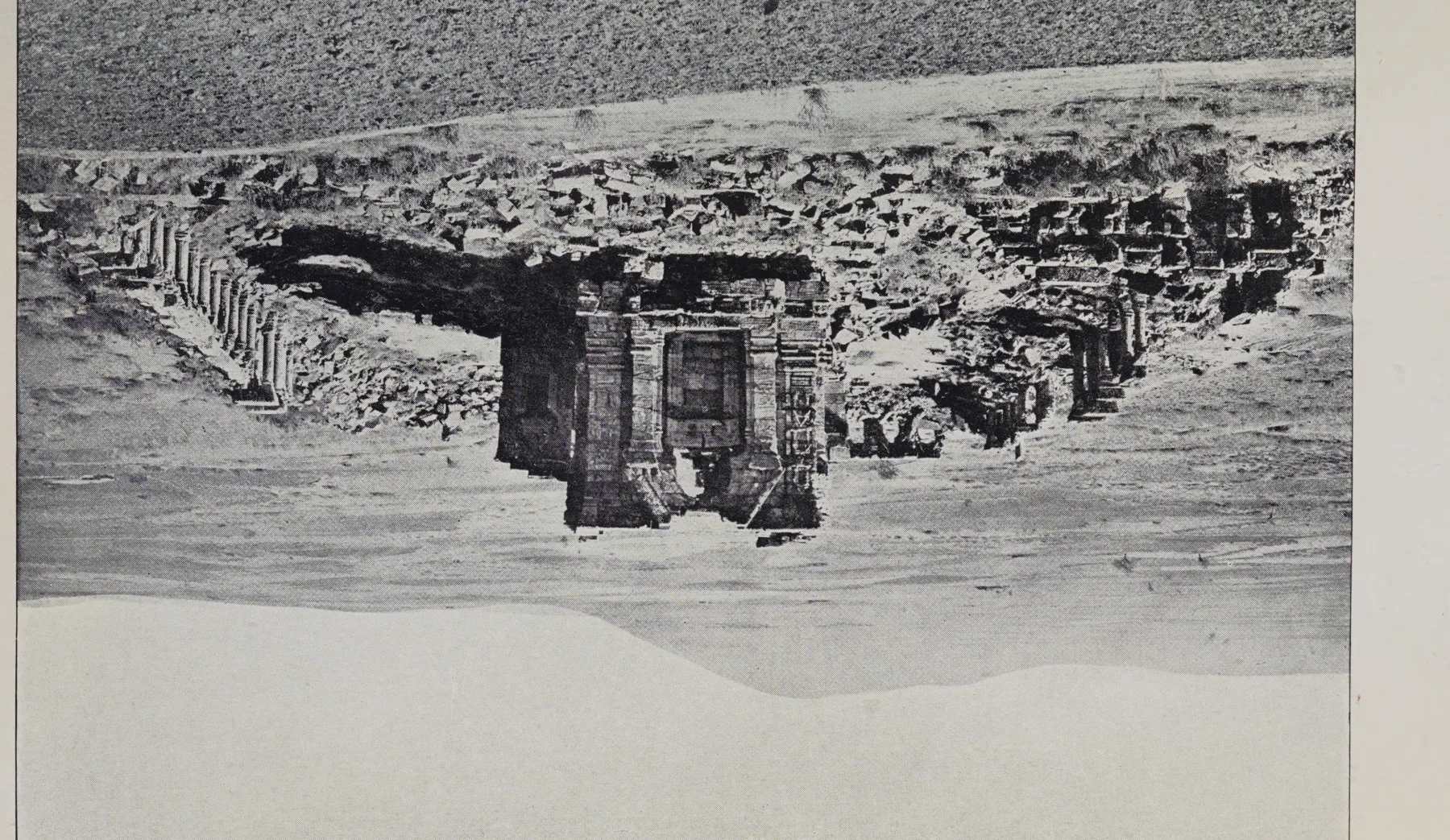
Jayāpīda, or Vinayāditya, the grandson of Muktāpīda, is credited with even more adventures than those ascribed to his grandfather. Probably it is true that he defeated and dethroned the king of Kanauj, apparently Vajrāyudha. But the romantic tale of his visit incognito to the capital of Pauṇḍravardhana in Bengal, the modern Rājshāhi District, then the seat of government of a king named Jayanta, unknown to sober history, seems to be purely imaginary. The legend of his expedition against a king of Nepāl, with the strange name Aramudi, of his capture and imprisonment in a stone castle, and of his marvellous escape, equally belongs to the domain of romance. The details of the acts of cruelty and oppression, due to avarice, which disgraced the later years of his reign, read like matters of fact, and unhappily are quite in accordance with the low moral standard of most of the rulers of Kashmīr. The chronicler closes his narrative with the following quaint comment :
'Such was for thirty-one years the reign of this famous king, who could not restrain his will. Princes and fishes, when their thirst is excited by riches and impure water respectively, leave their place and follow evil ways, with such result that they are brought into the strong net of death—the former by changes which fate dictates, and the latter by troops of fishermen.'
The substantial existence of Jayāpīda is testified by the survival of multitudes of exceedingly barbarous coins inscribed with his title Vinayāditya.1
The reign of Avantivarman, in the latter part of the ninth century, was notable for his enlightened patronage of literature, and for the beneficent schemes of drainage and irrigation carried out by Suyya, his minister of public works.1
The next king, Sankaravarman, distinguished himself in war ; but is chiefly remembered as the author of an ingenious system of fiscal oppression, and the plunderer of temple treasures. The details of his exactions are worth reading as proving the capacity for unlimited and ruthless extortion of an Oriental despot without a conscience.2
During his reign the last of the Turki Shāhiya kings, the descendants of Kanishka, was overthrown by the Brahman Lalliya. The Turkī Shāhiya kings had ruled in Kābul until the capture of that city by the Arab general Yakūb-i-Lāis in A. D. 870 (A. H. 256).3 After that date the capital was shifted to Ohind, on the Indus. The dynasty founded by Lalliya, known as that of the Hindu Shāhiyas, lasted until A. D. 1021, when it was extirpated by the Muhammadans.4
In the reign of the child-king Pārtha and his father Pangu, the regent, an awful famine occurred in the year A. D. 917–18, thus described by the Brahman historian of a Hindu government :—
‘ One could scarcely see the water in the Vitastā (Jihlam), entirely covered as the river was with corpses soaked and swollen by the water in which they had long been lying. The land became densely covered with bones in all directions, until it was like one great burial-ground, causing terror to all beings. The king’s ministers and the Tantrins (Praetorian guards) became wealthy, as they amassed riches by selling stores of rice at high prices. The king would take that person as minister who raised the sums due on the Tantrins’ bills, by selling the subjects in such a condition. As one might look from his hot bath-room upon all the people outside distressed by the wind and rain of a downpour in the forest, thus for a long time the wretched Pangu, keeping in his palace, praised his own comfort while he saw the people in misery.’ 5
This gruesome picture may give cause for reflection to some critics of modern methods of famine relief.
Pārtha chastised his people with whips, but his son Unmattāvanti, ‘who was worse than wicked,’ chastised them with scorpions. ‘With difficulty’, sighs the chronicler, ‘I get my song to proceed, since from fear of touching the evil of this king’s story it keeps back like a frightened mare.’ Parricide was one of his many crimes. The details of his brutalities are too disgusting for quotation. Happily his reign was short, and he died the victim of a painful disease in A. D. 939.1
During the latter half of the tenth century, power was in the hands of an unscrupulous queen, named Diddā, the granddaughter of a Shāhiya king, who, first as a queenconsort, then as regent, and ultimately as sovereign for twenty-three years, misgoverned the unhappy state for half a century.
In the reign of her nephew, Saṅgrāma, the kingdom suffered an attack from Mahmūd of Ghaznī; and, although its troops were defeated by the invader, preserved its independence, which was protected by the inaccessibility of the mountain barriers.
During the second half of the eleventh century, Kashmīr, which has been generally unfortunate in its rulers, endured unspeakable miseries at the hands of the tyrants Kalasa and Harsha. The latter, who was evidently insane, imitated Sankaravarman in the practice of plundering temples, and rightly came to a miserable end. Few countries can rival the long Kashmīr list of kings and queens who gloried in shameless lust, fiendish cruelty, and pitiless misrule.
A local Muhammadan dynasty obtained power in 1339, and the religion of Islam gradually spread in the valley during the fourteenth century; but the natural defences of the kingdom effectually guarded it against the ambition of the sovereigns of India, until Akbar conquered it in 1587, and incorporated it in the Moghal empire.2
V
The kingdoms of Kanauj (Pañchāla), the Panjāb, Ajmēr, Delhi, and Gwālior; Muhammadan conquest of Hindustan.
Before proceeding to discuss the history of the kingdom of Kanauj, it will be well to give some account of the famous capital city, which is now represented by a petty Muhammadan country town (N. lat. 27° 3′, E. long. 79° 56′) in the Farrukhābād District of the United Provinces. Kanauj was of high antiquity. It is mentioned in several passages of the Mahābhārata, and alluded to by Patanjali in the second century B.C. as a well-known place. It has been so completely destroyed that nothing beyond rubbish heaps remains to testify to the former existence of its gorgeous temples, monasteries, and palaces. Commentators usually take it for granted that Kanauj is mentioned twice, under the variant names of Kanagora and Kanogiza,1 in Ptolemy's Geography, written about A.D. 140, but there is little reason to warrant the belief. The first certain mention of the city with any descriptive details is in the Travels of the Chinese pilgrim Fa-hien, who visited Kanauj about A.D. 405, during the reign of Chandra-gupta II, Vikramāditya. His remark that the city possessed only two Buddhist monasteries of the Hīnayāna school and one stūpa suggests that it was not of much importance at the beginning of the fifth century.2 Probably it grew under the patronage of the Gupta kings, but the great development of the city clearly was due to its selection by Harsha for his capital. When Hiuen Tsang stayed there, in 636 and 643, a marked change had occurred since Fa-hien's time. The later pilgrim, instead of two monasteries, found upwards of a hundred such institutions, crowded by more than 10,000 brethren of both the great schools. Hinduism flourished as well as Buddhism, and could show more than two hundred temples, with thousands of worshippers. The city, which was strongly fortified, then extended along the east bank of the Ganges for about 4 miles, and was adorned with lovely gardens and clear tanks. The inhabitants were well-to-do, including some families of great wealth ; they dressed in silk, and were skilled in learning and the arts.1
Although Kanauj had been captured several times by hostile armies during the ninth and tenth centuries, it recovered quickly from its wounds, and when Mahmūd appeared before its walls, at the end of A. D. 1018, was still a great and stately city, defended by seven distinct forts or fortifications and reputed to contain 10,000 temples. The Sultan destroyed the temples, but seems to have spared the city. The removal of the capital of Panchāla to Bārī must have greatly reduced the population and importance of Kanauj, although it revived to some extent under the rule of the Gaharwār Rājas in the twelfth century. The subjugation of Rāja Jaichand’s territory, including the city, in A. D. 1194 (A. H. 590), by Shihāb-ud-dīn, reduced it to insignificance for ever. Its final destruction was the work of Shēr Shah, who built a new town close by, called Shēr Sūr, to commemorate his victory over Humāyūn in 1540. The Muhammadan historian who chronicles the event observes that he could not find any satisfactory reason for the destruction of the old city, and that the act was very unpopular.2
Kanauj, although it twice attained the dignity of being the capital of Northern India, for the first time under Harsha in the seventh century, and for the second time under Mihira Bhoja and Mahendrapāla in the ninth and tenth centuries, was primarily the capital of the kingdom of Panchāla. According to the story told in the Mahābhārata, Northern Panchāla, with its capital Ahichchhatra, fell to the share of Drona, while Southern Panchāla, with its capital Kāmpilya, became the kingdom of Drupada. Ahichchhatra, the modern Rāmnagar in the Barēli (Bareilly) District, was still a considerable town when visited by Hiuen Tsang in the seventh century. Little is known about the history of Kāmpilya, apparently the modern Kampil in the Farrukhābād District.1 Both the ancient capitals were thrown into obscurity by the rapid development of Kanauj under Harsha's rule, and after his time that city was the undisputed capital of Panchāla.
Harsha's death, in a.d. 647, was followed by a period of disturbance and anarchy throughout his wide dominions. We do not know what happened to the kingdom of Panchāla immediately after the suppression of the usurper, about a.d. 650, by the Chinese ambassador with the help of his Nepalese and Tibetan allies, as related in the thirteenth chapter.
After Harsha's death the earliest known king of Kanauj was Yasovarman, who sent an embassy to China in a.d. 731,2 and nine or ten years later was dethroned and slain by Lalitāditya Muktāpīda of Kashmir.3 In the history of Sanskrit literature Yasovarman's name holds an honoured place as that of the patron of Bhavabhūti, the famous author of the Mālatīmādhava, and of Vākpatirāja, a less renowned author, who wrote in Prākrit. The next occupant of the throne of Kanauj apparently was Vajrāyudha, who, like his predecessor, suffered the fate of defeat and dethronement by Lalitāditya's son, Jayāpīda.4 Similar ill-luck attended his successor, Indrāyudha, who is known to have been reigning in a.d. 783, and was dethroned, about a.d. 810, by Dharmapāla, king of Bengal and Bihār. The eastern monarch, while probably insisting on a right to homage and tribute, did not keep the administration of Panchāla in his own hands, but entrusted it to Chakrāyudha, presumably a relative of the defeated rāja. The new ruler was consecrated with the consent of the kings of all the neighbouring states.1 His fortune was no better than that of his predecessors. About a.d. 816 he was deprived of his throne by Nāgabhaṭa, the ambitious king of the Gurjara-Pratihāra kingdom in Rājputāna, the capital of which was at Bhilmāl.2
Nāgabhaṭa presumably transferred the head-quarters of his government to Kanauj, which certainly was the capital of his successors for many generations, and so again became for a considerable time the premier city of Northern India. During the reign of Nāgabhaṭa the chronic warfare between the Gurjaras, descendants of foreign invaders, and the Rāshtrakūtas (Rāthōrs) of the Deccan, representing the indigenous ruling races, continued, and the southern king, Govinda III, claims to have won a victory over his northern rival early in the ninth century.3 Nothing particular is recorded about Nāgabhaṭa's successor, Rāmabhadra (Rāmadeva), who reigned from about a.d. 834 to 840.
The next king, Rāmabhadra's son Mihira, usually known by his title Bhoja, enjoyed a long reign of about half a century (c. 840–90), and beyond question was a very powerful monarch, whose dominions may be called an 'empire' without exaggeration. They certainly included the Cis-Sutlaj districts of the Panjāb, most of Rājputāna, the greater part, if not the whole, of the present United Provinces of Agra and Oudh, and the Gwālior territory. The next two kings being known to have held the remote province of Surāshtra, or Kāthiāwār, in the extreme west, the possession of which implies control over Gujarāt and Mālava or Avanti, it is highly probable that these distant regions also were subject to the sway of Bhoja. On the east his dominions abutted on the realm of Devapāla, king of Bengal and Bihār, which he invaded successfully; on the north-west his boundary probably was the Sutlaj river; on the west the lost Hakrā or Wahindah river separated his territories from those of his enemies, the Muhammadan chiefs of Sind; on the south-west his powerful Rāshtrakūta rival, the ally of the Muhammadans, kept his armies continually on the alert; while on the south his next neighbour was the growing Chandēl kingdom of Jejākabhukti, the modern Bundelkhand, which probably acknowledged his suzerainty.1 Bhoja liked to pose as an incarnation of Vishnu, and therefore assumed the title of Ādi Varāha, 'the primaeval boar,' one of the incarnations of the god. Base silver coins inscribed with this title are exceedingly common in Northern India, and by their abundance attest the long duration and wide extension of Bhoja's rule.2 Unfortunately no Megasthenes or Bāna has left a record of the nature of his internal government, and it is impossible to compare the polity of Bhoja with that of his great forerunners.
Bhoja's son and successor, Mahendrapāla (Mahendrāyudha) (c. a.d. 890–908) preserved unimpaired the extensive heritage received from his father, and ruled all Northern India, except the Panjāb and Indus valley, from the borders of Bihār (Magadha) to the shore of the Arabian sea. Inscriptions of his eighth and ninth years found at Gayā seem to prove that Magadha was included in the Parihār (Pratihāra) dominions for some time. His teacher (Guru) was the celebrated poet Rājasekhara, author of the Karpūra-mañjarī play and other works, who continued to reside at the court of Mahendrapāla's younger son.3
The throne was occupied for two or three years by Bhoja II, elder son of Mahendrapāla, who died early, and was succeeded by his half-brother, Mahīpāla (c. a. d. 910–40).1 The beginning of the decline and fall of the empire of Kanauj dates from his reign. In a. d. 916 the armies of the Rāshtrakūta king, Indra III, once more captured Kanauj, and gave a severe blow to the power of the Pratīhāra dynasty.2 Surāshtra, which was still subject to Mahīpāla in 914,3 probably was then lost along with other remote provinces, in consequence of the successes gained by the southern monarch. Indra III not being in a position to hold Kanauj, Mahīpāla recovered his capital with the aid of the Chandēl king, and probably other allies.4
The waning power of Kanauj and the waxing strength of Jejākabhukti are shown by the incident that king Devapāla of Kanauj (c. 940–55) was obliged to surrender a muchprized image of Vishnu to the Chandēl king, Yasovarman, who enshrined it in one of the finest temples at Khajurāho.5 Yasovarman had established his power by the occupation of the strong fortress of Kālanjar, and no doubt became absolutely independent of Kanauj. In the reign of Dhanga, the successor of Yasovarman, the Jumna is known to have formed the boundary between the territories of Panchāla and those of Jejākabhukti.
Devapāla was succeeded by his brother, Vijayapāla (c. a. d. 960–90),6 whose reign is marked by the loss of Gwālior, the ancient possession of his house, which was captured by a Kachchhwāha (Kachchhapaghāta) chief named Vajradāman,1 the founder of a local dynasty which held the fortress until a.d. 1128. The establishment of the Solankī (Chaulukya) kingdom of Anhilwāra in Gujarāt by Mūlarāja, about the middle of the tenth century, shows that the king of Kanauj no longer had any concern with Western India.2 The Gwālior chieftain became a feudatory of the Chandēl monarchy, which, under Dhanga (c. 1000–1050), evidently was stronger than its rival of Kanauj.
At this period the politics of the Hindu Rājpūt states of Northern India became complicated by the intrusion of Muhammadan invaders. The Arab conquest of Sind, in a.d. 712, did not seriously affect the kingdoms of the interior. The Arabs maintained friendly relations on the whole with their powerful Rāshtrakūta neighbours on the south, and their attacks on the dominions of the Gurjara kings of Rājputāna and Kanauj do not seem ever to have exceeded the proportions of frontier raids. But now the armies of Islam began to appear in more formidable fashion through the north-western passes, the gates which had so often admitted the enemies of India.
In those days a large kingdom comprising the upper valley of the Indus and most of the Panjāb to the north of Sind, extending westward to the mountains and eastward to the Hakrā river, was governed by a Rāja named Jaipāl, whose capital was at Bathindah (Bhatinda), the Tabarhind of Muhammadan histories, now in the Patiālā State, and for many centuries an important fortress on the military road connecting Mūltān with India proper.3 Sabuktigīn, the Amīr of Ghaznī, made his first raid into Indian territory in a. d. 986–7 (a. h. 376). Two years later Jaipāl retaliated by an invasion of the Amīr's territory, but, being defeated, was compelled to accept a treaty binding him to pay a large sum in cash, and to surrender a number of elephants and four fortresses to the west of the Indus. Jaipāl having broken the compact, Sabuktigīn punished him by the devastation of the frontier and the annexation of Lamghān (Jalālābād). Soon afterwards (c. a. d. 991) Jaipāl made a final effort to save his country by organizing a great confederacy of Hindu princes, including Ganda, the Chandēl king, Rājyapāla, then the king of Kanauj, and others. The vast host thus collected was disastrously defeated in or near the Kurram (Kurmah) valley, and Peshāwar was occupied by the Muhammadans. Jaipāl, who was again defeated in November, 1001, by Sultan Mahmūd, committed suicide, and was succeeded by his son, Anandpāl,1 who, like his father, joined a confederacy of the Hindu powers under the supreme command of Vīsaladeva, the Chauhān Rājā of Ajmēr. In spite of assistance from the powerful Khokhar tribe of the Panjāb, the Hindus again sustained a heavy defeat.
At Kanauj, Vijayapāla had been succeeded by his son Rājyapāla, who took his share in opposing the foreign invader. A few years later (a. d. 997) the crown of Sabuktigīn descended, after a short interval of dispute, to his son, the famous Sultan Mahmūd, who made it the business of his life to harry the idolaters of India, and carry off their property to Ghaznī. He is computed to have made no less than seventeen expeditions into India. It was his custom to leave his capital in October, and then three months' steady marching brought him into the richest provinces of the interior. Early in January, a. d. 1019, he appeared before Kanauj. Rājyapāla made no serious attempt to defend his capital, and the seven forts which guarded it all fell into Mahmūd’s hands in a single day. The conqueror plundered the forts but seems to have spared the city, and quickly returned to Ghaznī laden with booty. Rājyapāla made the best terms that he could obtain, abandoned Kanauj, and retired to Bārī on the other side of the Ganges.1
The pusillanimous submission of Rājyapāla incensed his Hindu allies, who felt that he had betrayed their cause. His fault was sternly punished by an army under the command of Vidhyādhara, heir-apparent of the Chandēl king, Ganda, supported by the forces of his feudatory, the chief of Gwālior, which attacked Kanauj in the spring or summer of a.d. 1019, soon after the departure of Sultan Mahmūd, and slew Rājyapāla, whose diminished dominions passed under the rule of Trilochanapāla. The Sultan was furious when he heard of the punishment inflicted on a prince whom he regarded as a vassal, and in the autumn of the same year (a.h. 410) started again from Ghaznī to take vengeance on the Hindu chiefs. Early in a.d. 1020 he captured Bārī, the new Pratihāra capital, without much difficulty, and then advanced into the Chandēl territory, where Ganda had assembled an apparently formidable force to oppose him. But the heart of the Chandēl king failed him, and, like Rājyapāla, he fled from the field without giving battle. His camp, munitions, and elephants were left a prey to the Sultan, who returned as usual to Ghaznī with heaps of spoil.2
Nothing is known about Trilochanapāla except that he ineffectually resisted Mahmūd’s passage of the Jumna at the end of 1019 or the beginning of 1020, and made the grant of a village near Allāhābād in A. D. 1027.1 A Rāja named Yasahpāla, who is mentioned in an inscription of A. D. 1036, may have been his immediate successor.2 Other obscure chiefs continued to be recognized as Rājas of Kanauj, and governed a considerable territory, no doubt in subordination to Muhammadan kings, even after the reduction of Kanauj in 1194. The names of some of these chiefs have been preserved. They seem to have resided at Zafarābād near Jaunpur. But these later chiefs did not belong to the old Gurjara-Pratihāra dynasty, which disappeared utterly. Kanauj had been conquered and occupied, a little before A. D. 1090, by a Rāja of the Gaharwār clan, named Chandradeva, who established his authority certainly over Benares and Ajodhyā, and perhaps over the Delhi territory.3 The city of Delhi had been founded about a century earlier, in A. D. 993–4.4
The Gaharwār dynasty, subsequently known as Rāthōr,5 thus founded by Chandradeva, lasted until the subjugation of the Kanauj kingdom by Shihāb-ud-dīn, in A. D. 1194
(a. h. 590). Govindachandra, grandson of Chandradeva, enjoyed a long reign, which included the years a. d. 1104 and 1155. His numerous land grants and widely distributed coins prove that he succeeded to a large extent in restoring the glories of Kanauj, and in making himself a power of considerable importance.1
The grandson of Govindachandra was Jayachchandra, renowned in the popular Hindī poems and tales of Northern India as Rāja Jaichand, whose daughter was carried off by the gallant Rāi Pithōra of Ajmēr. He was known to the Muhammadan historian as the king of Benares, which, perhaps, may be regarded as having been his capital, and was reputed the greatest king in India. It is alleged that his territory extended from the borders of China to the province of Mālwā, and from the sea to within ten days' journey of Lahore, but it is difficult to believe that it can have been really so extensive. Shihāb-ud-dīn met him at Chandāwar in the Etawah District near the Jumna, and having defeated his huge host with immense slaughter, in which the Rāja was included, passed on to Benares, which he plundered, carrying off the treasure on 1,400 camels.2 Thus ends the story of the independent kingdom of Kanauj. When the rājas of the Gaharwār line died out, their place was taken by chiefs of the Chandēl clan from Mahoba, who became the local rulers of Kanauj for eight generations.3
Inscriptions record the genealogy of a long line of Rājpūt kings belonging to the Chauhān (Chāhumāna) clan who governed the principality of Sāmbhar (Sākambharī) in Rājputāna, to which Ajmēr was attached. Only two of these chiefs demand notice. Vigraha-rāja, in the middle of the twelfth century, extended his ancestral dominions considerably, and is erroneously alleged to have conquered Delhi from a chief of the Tomara clan. That chief was a descendant of Ānangapāla, who, a century earlier, had built the Red Fort, where the Kutb mosque now stands, and thus given permanence to the city, which had been founded in a. d. 993–4.1 Europeans are so accustomed to associate the name of Delhi with the sovereignty of India that they do not easily realize the fact that Delhi is among the most modern of the great Indian cities. Vague legends, it is true, irradiate the lands along the bank of the Jumna near the village of Indarpat with the traditional glories of the prehistoric Indraprastha, and these stories may or may not have some substantial basis. But, as an historical city, Delhi dates only from the time of Ānangapāla in the middle of the eleventh century. The celebrated iron pillar, on which the eulogy of a powerful king named Chandra, who lived in the fourth century, is incised, was removed by the Tomara chief from its original position, probably at Mathurā, and set up in a. d. 1052 as an adjunct to a group of temples, from the materials of which the Muhammadans afterwards constructed the great mosque.2
Vigraha-rāja (IV) was a man of considerable distinction. Some years ago, during the progress of repairs executed at the principal mosque of Ajmēr, six slabs of polished black marble were discovered bearing inscriptions in Sanskrit and Prākrit, which on examination proved to be large portions of two unknown dramas. One of these, the Lalita-Vigraha-rāja-nāṭaka, was composed in honour of Vigraha-rāja, while the other, the Harakali-nāṭaka, professes to be the composition of that prince himself.1
His nephew was Prithivī-rāja, Prithīrāj, or Rāi Pithōra, lord of Sāmbhar and Ajmēr, famous in song and story as a chivalrous lover and doughty champion. His fame as a bold lover rests upon his daring abduction of the not unwilling daughter of Jaichand, the Gaharwār Rāja of Kanauj, which occurred in or about a. d. 1175. His reputation as a general is securely founded upon his defeat of the Chandēl Rāja, Parmāl, and the capture of Mahoba in 1182, as well as upon gallant resistance to the flood of Muhammadan invasion. Indeed, Rāi Pithōra may be described with justice as the popular hero of Northern India, and his exploits in love and war are the subject of rude epics and bardic lays to this day.2
The dread inspired by the victorious Musalman army under the command of Shihāb-ud-dīn or Muhammad of Ghōr, who was now undisputed master of the greater part of the Panjāb, constrained the jarring states of Northern India to lay aside their quarrels and combine for a moment against the foreign foe. At first fortune smiled on the Indians; and in A.D. 1191 (A. H. 587) Prithivī-rāja succeeded in inflicting a severe defeat upon the invaders at Tarāīn or Talāwarī between Thānēsar and Karnāl, which forced them to retire beyond the Indus. A year later, in A. D. 1192 (A. H. 588), the Sultan, having returned with a fresh force, again encountered on the same field Prithivī-rāja, who was at the head of an immense host, swollen by contingents from numerous confederate princes. A vigorous charge by twelve thousand well-armed Musalman horsemen repeated the lesson given by Alexander long ages before, and demonstrated the inability of a mob of Indian militia to stand the onset of trained cavalry. Prithivī-rāja, having been taken prisoner, was executed in cold blood, and the wretched inhabitants of his capital Ajmēr were either put to the sword or sold into slavery.1
supported by the inscriptions. The correct lineage of Pṛithivīrāja according to the Pṛithivīrājavijaya is:—
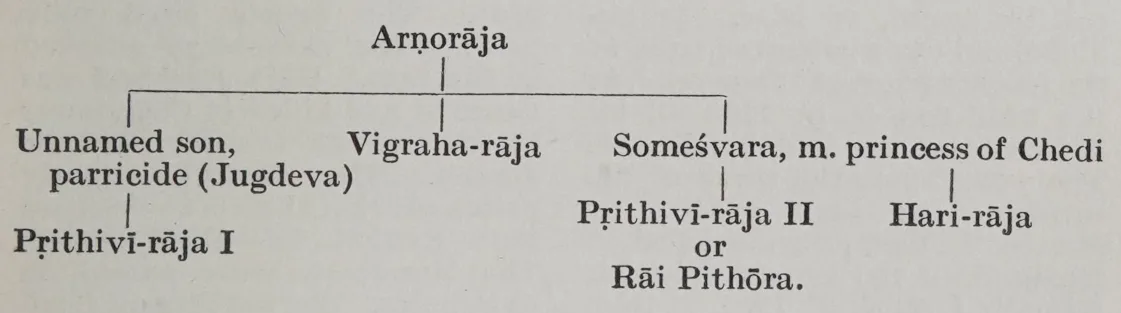
Chand's statement that Rāi Pithōra (Prithirāj) was the son of the daughter of Ānangapāla, king of Delhi, is doubtful. The single imperfect MS. of the Pṛithivīrāja vijaya has been described and summarized by Har Bilas Sarda in J. R. A. S., 1913, pp. 259–81, with references to earlier notices of the work. He uses the spelling Pṛithvī. The truth of the assertion that Vigraha-rāja wrested Delhi from the Tomaras is extremely doubtful
(Bühler, Proc. A. S. B., 1893, p. 94). It seems to be contradicted by verse 22 of the Bijoli inscription (J. A. S. B., part i, vol. lv (1886), p. 31).
In a. d. 1193 (a. h. 589), Delhi fell. Kanauj does not seem to have been molested, but must have come under the control of the invaders. Benares, the holy citadel of Hinduism, in a. d. 1194 became the prize of the victors, who could now feel confident that the final triumph of the arms of Islam over 'the land of the Brahmans' was assured. The surrender of Gwālior in 1196, the capture in 1197 of Anhilwāra the capital of Gujarāt, and the capitulation of Kālanjar in 1203 completed the reduction of Upper India, and when Shihāb-ud-dīn died in a. d. 1205–6 (a. h. 602), he—
'Held, in different degrees of subjection, the whole of Hindustan Proper, except Mālwā and some contiguous districts. Sind and Bengal were either entirely subdued, or in rapid course of reduction. On Gujarāt he had no hold, except what is implied in the possession of the capital (Anhilwāra or Nahrwāla). Much of Hindustan was immediately under his officers, and the rest under dependent or at least tributary princes. The desert and some of the mountains were left independent from neglect'.1
An important consequence of the Muslim conquest of Kanauj was the migration of the bulk of the Gaharwār clan to the deserts of Mārwār in Rājputāna, where they settled and became known as Rāṭhōrs. The state so founded, now generally designated by the name of its capital, Jodhpur, is one of the most important principalities of Rājputāna.1 Similar clan movements, necessitated by the pressure of Muhammadan armies, which were frequent at this period, account to a large extent for the existing distribution of the Rājpūt clans.
VI
The Chandēls of Jejākabhukti and the Kalachuris of Chedi
The ancient name of the province between the Jumna and Narmadā, now known as Bundelkhand, and partly included in the United Provinces of Agra and Oudh, was Jejākabhukti.2 The extensive region, farther to the south, which is now under the administration of the Chief Commissioner of the Central Provinces, nearly corresponds with the old kingdom of Chedi. In the mediaeval history of these countries two dynasties—the Chandēls of Jejākabhukti and the Kalachuris of Chedi—which occasionally were connected by marriage, and constantly were in contact one with the other, whether as friends or enemies, are conspicuous. From the beginning of the eleventh century the Chedi country was divided into two kingdoms, Western Chedi, or Dāhāla, with its capital at Tripura, near Jabalpur, and Eastern Chedi, or Mahākosala, with its capital at Ratanpur.
The Chandēls, like several other dynasties, first come into notice early in the ninth century, when Nannuka Chandēl, about A. D. 831, overthrew a Parihār chieftain, and became lord of the southern parts of Jejākabhukti. The Parihārs of Bundelkhand, like their brethren of Bhinmāl, must have belonged to the Gurjara or Gūjar group of tribes which had entered India in the sixth century. The Parihār capital had been at Mau-Sahaniya, between Nowgong (Naugāon) and Chhatarpur.1 The predecessors of the Parihārs were Gaharwār Rājas, members of the clan which afterwards gave Kanauj the line of kings commonly miscalled Rāthōrs.
The Chandēl princes were great builders, and beautified their chief towns, Mahoba, Kālanjar, and Khajurāho, with many magnificent temples and lovely lakes, formed by throwing massive dams across the openings between the hills. In this practice of building embankments and constructing lakes the Chandēls were imitators of the Gaharwārs, who are credited with the formation of some of the most charming lakes in Bundelkhand.
The Chandēls, who appear to have been Hinduized Gonds, closely connected with another autochthonous tribe, the Bhars, first acquired a petty principality near Chhatarpur, and gradually advanced northwards until the Jumna became the frontier between their dominions and those of Kanauj. The earlier Rājas may have been subject to the suzerainty of Bhoja and Mahendrapāla, the powerful kings of Panchāla, but in the first half of the tenth century the Chandēls certainly had become independent. Harsha Chandēl, aided perhaps by other allies, helped Mahīpāla to recover the throne of Kanauj from which he had been driven by Indra III Rāshtrakūta in A. D. 916. Harsha's son and successor, Yasovarman, whose power had been greatly enhanced by the occupation of the fortress of Kālanjar, was strong enough to compel Mahīpāla's successor, Devapāla, to surrender a valuable image of Vishnu, which the Chandēl king wanted for a temple built by him at Khajurāho.
King Dhanga, son of Yasovarman (A. D. 950–99), who lived to an age of more than a hundred years, was the most notable of his family. Some of the grandest temples at Khajurāho are due to his munificence, and he took an active part in the politics of his time. In A. D. 989 or 990 he joined the league formed by Jaipāl, king of the Panjāb, to resist Sabuktigīn, and shared with the Rājas of Ajmēr and Kanauj in the disastrous defeat which the allies suffered between Bannū and Ghaznī, in or near the Kurram (Kurmah) valley.1
When Mahmud of Ghaznī threatened to overrun India, Dhanga's son Ganda (999–1025) joined the new confederacy of Hindu princes organized by Ānand Pāl, son of Jaipāl, king of the Panjāb, in 1008–9 (a. h. 399), which also failed to stay the hand of the invader. Ten years later, as already narrated, Ganda's son attacked Kanauj and killed the Rāja, Rājyapāla, who had made terms with the Muhammadans; but early in 1023 (a. h. 413) was himself compelled to surrender the strong fortress of Kālanjar to Mahmūd,2 who, however, did not retain it or any of his conquests in the interior of India beyond the Panjāb.
Gāngēyadeva Kalachuri of Chedi (circa 1015–40), the contemporary of Ganda and his successors, was an able and ambitious prince, who aimed at attaining the position of paramount power in Upper India, and succeeded to a considerable extent. In 1019 his suzerainty was recognized in distant Tirhūt.3 His projects of aggrandizement were taken up and proceeded with by his son Karnadeva (circa 1040– 70), who joined Bhīma, king of Gujarāt, in crushing Bhoja, the learned king of Mālwā, about a. d. 1060. He had attacked the Pāla king of Magadha at an earlier date, about a. d. 1035.
But some years later Karnadeva was taught the lesson of the mutability of fortune by suffering defeats inflicted by several hostile kings, and notably one at the hands of Kīrtivarman Chandēl (1049–1100), who widely extended the dominion of his house. The earliest extant specimens of the Chandēl coinage were struck by this king in imitation of the issues of Gāngēyadeva of Chedi. Kīrtivarman is also memorable in literary history as the patron of the curious allegorical play entitled the Prabodha-chandrodaya, or ‘Rise of the Moon of Intellect’, which was performed at his court in or about a. d. 1065, and gives in dramatic form a clever exposition of the Vedānta system of philosophy.1
The last Chandēl king to play any considerable part upon the stage of history was Paramardi, or Parmāl (1165–1203), whose reign is memorable for his defeat in 1182 by Prithivī-rāja Chauhān, and for the capture of Kālanjar in 1203 (a. h. 599) by Kutb-ud-dīn Ībak.2 The Chauhān and Chandēl war occupies a large space in the popular Hindī epic, the Chand-Rāisā, which is familiar to the people of Upper India.
The account of the death of Parmāl and the capture of Kālanjar, as told by the contemporary Muhammadan historian, may be quoted as a good illustration of the process by which the Hindu kingdoms passed under the rule of their new Muslim masters :—
‘ “ The accursed Parmār,” the Rai of Kālanjar, fled into the fort after a desperate resistance in the field, and afterwards surrendered himself, and placed “the collar of subjection” round his neck; and, on his promise of allegiance, was admitted to the same favours as his ancestor had experienced from Mahmūd Sabuktigīn, and engaged to make a payment of tribute and elephants, but he died a natural death before he could execute any of his engagements. His Dīwān, or Mahtea, by name Aj Deo, was not disposed to surrender so easily as his master, and gave his enemies much trouble, until he was compelled to capitulate in consequence of severe drought having dried up all the reservoirs of water in the forts. “ On Monday, the 20th of Rajab, the garrison, in an extreme state of weakness and distraction, came out of the fort, and by compulsion left their native place empty; ... and the fort of Kālanjar, which was celebrated throughout the world for being as strong as the wall of Alexander,” was taken. “ The temples were converted into mosques and abodes of goodness, and the ejaculations of the bead-counters and the voices of the summoners to prayer ascended to the highest heaven, and the very name of idolatry was annihilated. . . . Fifty thousand men came under the collar of slavery, and the plain became black as pitch with Hindus.” Elephants and cattle, and countless arms also, became the spoil of the victors. ‘The reins of victory were then directed towards Mahobā, and the government of Kālanjar was conferred on Hazabbar-ud-dīn Hasan Arnal. When Kutb-ud-dīn was satisfied with all the arrangements made in that quarter, he went towards Badāūn, “which is one of the mothers of cities, and one of the chiefest of the country of Hind.” ’ 1
Chandēl Rājas lingered on in Bundelkhand as purely local chiefs until the sixteenth century, but their affairs are of no general interest.2 The Chandēl clan was scattered, and its most notable modern representative is the Rāja of Gidhaur, near Mungir (Monghyr) in Bengal.
The Kalachuri or Haihaya Rājas of Chedi are last mentioned in an inscription of the year A. D. 1181, and the manner of their disappearance is not exactly known; but there is reason to believe that they were supplanted by the Bāghēls of Rēwā. The Hayobans Rājpūts of the Baliyā district in the east of the United Provinces claim descent from the Rājas of Ratanpur in the Central Provinces, and probably are really an offshoot of the ancient Haihaya race. The later kings of Chedi used an era according to which the year 1 was equivalent to A. D. 248–9. This era, also called the Traikūtaka, originated in Western India, where its use can be traced back to the fifth century.3 The reason of its adoption by the kings of Chedi is not apparent.
VII
Paramāras (Pawārs) of Mālwa
The Paramāra dynasty of Mālwa, the region north of the Narmadā, anciently known as Avanti, or the kingdom of Ujjain, is specially memorable by reason of its association with many eminent names in the history of later Sanskrit literature. The dynasty was founded by a chief named Upendra or Krishnarāja, early in the ninth century, when so many ruling families attract notice for the first time, and it lasted for about four centuries. Upendra appears to have come from Chandrāvatī and Achalgarh, near Mount Ābū, where his clan had been settled for a long time.
The seventh Rāja, named Munja, who was famous for his learning and eloquence, was not only a patron of poets, but himself a poet of no small reputation, as attested by the anthologies, which include various compositions attributed to his pen. The author Dhanamjaya and his brother Dhanika were among the distinguished scholars who graced his court. His energies were not devoted solely to the peaceful pursuit of literature, much of his time being spent in fighting with his neighbours. Six times the Chalukya king, Taila II, was defeated by him. The seventh attack failed, and Munja, who had crossed the Godāvarī, Taila's northern boundary, was defeated, captured, and executed about A. D. 995.1
Munja's nephew, the famous Bhoja, ascended the throne of Dhārā, in those days the capital of Mālwa, about A.D. 1018, and reigned gloriously for more than forty years. Like his uncle, he cultivated with equal assiduity the arts of peace and war. Although his fights with the neighbouring powers, including one of the Muhammadan armies of Mahmūd of Ghaznī, are now forgotten, his fame as an enlightened patron of learning and a skilled author remains undimmed, and his name has become proverbial as that of the model king according to the Hindu standard. Works on astronomy, architecture, the art of poetry, and other subjects are attributed to him, and there is no doubt that he was a prince, like Samudragupta, of very uncommon ability. A mosque at Dhārā now occupies the site of Bhoja's Sanskrit college, which seems to have been held in a temple dedicated appropriately to Sarasvatī, the goddess of learning.1
The great Bhōjpur lake, a beautiful sheet of water to the south-east of Bhopāl, covering an area of more than 250 square miles, formed by massive embankments closing the outlet in a circle of hills, was his noblest monument, and continued to testify to the skill of his engineers until the fifteenth century, when the dam was cut by order of a Muhammadan king, and the water drained off. The bed of the lake is now a fertile plain intersected by the Indian Midland Railway.2
About a. d. 1060 this accomplished prince succumbed to an attack by the confederate kings of Gujarāt and Chedi; and the glory of his house departed. His dynasty lasted as a purely local power until the beginning of the thirteenth century, when it was superseded by chiefs of the Tomara clan, who were followed in their turn by Chauhān Rājas,3 from whom the crown passed to Muhammadan kings in 1401. Akbar suppressed the local dynasty in 1562, and incorporated Mālwā in the Moghal empire.
VIII
Pāla and Sena Dynasties of Bihār and Bengal
Harsha, when at the height of his power, exercised a certain amount of control as suzerain over the whole of Bengal, even as far east as the distant kingdom of Kāmarupa, or Assam, and seems to have possessed full sovereign authority over western and central Bengal. After his death, the local Rājas no doubt asserted their independence; but, except for the strange story of Arjuna and Wang-Hiuen-tse, related in the thirteenth chapter, no particulars are known concerning the history of Bengal for nearly a century. Bengālī tradition traces the origin of many notable families to five Brahmans and five Kāyasths imported from Kanauj by a king named Ādisūra in order to revive orthodox Hindu customs, which had fallen into disuse during the time when Buddhism was predominant. But no authentic record of this monarch has been discovered. There is, however, no reason to doubt the actual existence of Ādisūra, who belonged to a local dynasty of Rājas ruling Gaur and the neighbourhood. He may be dated approximately in a. d. 700, perhaps a little earlier, or possibly later.1
Early in the eighth century (c. A. D. 730–40) a chieftain named Gopāla was elected king of Bengal, which had been suffering from anarchy. Towards the close of his life he extended his power westwards over Magadha or South Bihār, and is said to have reigned forty-five years. He suffered defeat at the hands of Vatsarāja, the Gurjara king of Rājputāna.1 He was a pious Buddhist, and founded a great monastery at Uddandapura, or Otantapuri, the existing town of Bihār, which seems to have been at times the capital of the later Pāla kings. Inasmuch as the word pāla was an element in the personal names of the founder of the family and his successors, the dynasty is commonly and conveniently designated as that of the ‘Pāla kings of Bengal’.
The second king, Dharmapāla, who is credited with a reign of sixty-four years, is known to have reigned for at least thirty-two years. The Tibetan historian Tāranāth expressly states that his rule extended from the Bay of Bengal to Delhi and Jālandhar in the north and to the valleys of the Vindhyan range in the south. This ascription of wide dominion is supported by the certain fact that Dharmapāla dethroned Indrāyudha, or Indrarāja, king of Panchāla, whose capital was Kanauj, and installed in his stead Chakrāyudha, with the assent of the neighbouring northern powers, enumerated as the Bhoja, Matsya, Madra, Kuru, Yadu, Yavana, Avanti, Gandhāra, and Kīra kings. This event took place soon after A. D. 800, and prior to the thirty-second year of Dharmapāla's reign, as recorded in two grants.2 It is noticeable that the grant of four villages in the province of Paundravardhana was issued from the royal head-quarters at Pātaliputra.1 When Hiuen Tsang visited the ancient imperial city in the seventh century he had found the buildings of Asoka in ruins, and the inhabitants limited to about a thousand persons occupying a small walled town on the bank of the Ganges in the northern portion of the site.2 Apparently the city had recovered to some extent when Dharmapāla held his court there about a. d. 810. The famous monastery of Vikramasīla, which is said to have included 107 temples and six colleges, was founded by Dharmapāla. It stood on a hill overlooking the right bank of the Ganges, but its position has not been conclusively determined.3
Devapāla, the third sovereign of the dynasty, is regarded by the oldest writers on Brahman genealogy in Bengal as having been the most powerful of the Pālas.4 His general, Lāusena or Lavasena, is said to have conquered Assam and Kalinga. A grant dated in the thirty-third year of his reign was issued from the court at Mudgagiri, or Monghyr.5 Like all the other kings of his house, he was zealous in the cause of Buddhism, and is reputed to have waged war with the unbelievers, destroying forty of their strongholds. He is said to have reigned for forty-eight years.6
During the latter part of the tenth century the rule of the Pāla kings was interrupted by the intrusion of hillmen, known as Kāmbojas, who set up one of their chiefs as king. His rule is commemorated by an inscribed pillar at Dinājpur, erected apparently in a. d. 966.7
The Kāmbojas were expelled by Mahīpāla I, the ninth sovereign of the Pāla line, who is known to have been reigning in a. d. 1026, and may be assumed to have won back his ancestral throne about A. D. 978 or 980. He is credited with a long reign of 52 years, a statement which cannot be far wrong, as there is epigraphic evidence that his rule endured for 48 years.1 Of all the Pāla kings he is the best remembered, and songs in his honour, which used to be sung in many parts of Bengal until recent times, are still to be heard in remote corners of Orissa and Kūch Bihār. He was attacked by Rājendra, the Chola king of Kānchī, about A. D. 1023. His reign is marked by the revival of Buddhism in Tibet, which had been weakened by the persecution of Langdarma a century earlier. Pundit Dharmapāla and other holy men from Magadha accepted an invitation to Tibet in A. D. 1013, and did much to restore the religion of Gautama to honour in that country. A subsequent mission dispatched in 1038, during the reign of Mahīpāla's successor, Nayapāla, and headed by Atīsa, from the Vikramasīla monastery in Magadha, continued the work and firmly re-established Tibetan Buddhism.2
The son of Nayapāla, king Vigrahapāla III, who defeated Karna, king of Chedi, and died about A. D. 1080, left three sons, namely Mahīpāla II, Sūrapāla II, and Rāmapāla.
When Mahīpāla succeeded to the throne he imprisoned his brothers and misgoverned the realm. His evil deeds provoked a rebellion, headed by Divya or Divyoka, chief of the Chāsi-Kaivarta tribe or Māhishya caste, which at that time was powerful in Northern Bengal. Mahīpāla II was killed by the rebels, who took possession of the country. Divyoka's place was taken by his nephew Bhīma, who became king of Varendra. Prince Rāmapāla, having escaped from confinement, travelled over a large part of India in order to obtain help in the recovery of his kingdom. After much effort he collected a strong force, including contingents from the Rāshtrakūtas, to whom he was related by marriage, and many other princes. Bhīma was defeated and killed, and Rāmapāla regained the throne of his fathers.1
Rāmapāla is described by Tāranāth as possessing a vigorous understanding and widely extended power. After defeating the Kaivarta usurper, he conquered Mithilā or North Bihār, the modern Champāran and Darbhanga Districts, and it is clear that his dominions also included Kāmarūpa or Assam, because his son Kumārapāla conferred the government of that country, with kingly powers, upon a valiant minister named Vaidyadeva. Buddhism, although then declining in Hindustan, flourished in the Pāla dominions during the reign of Rāmapāla, the monasteries of Magadha being crowded with thousands of residents. Tāranāth and certain Bengal authors treat Rāmapāla as the last of his dynasty, or at any rate, the last who exercised considerable power, but the inscriptions prove that he was followed by five kings of his family.2
King Govindapāla is known to have been on the throne in a. d. 1175 ; and, according to tradition, the ruler of Magadha at the time of the Muhammadan conquest, in a. d. 1197, was Indradyumna[-pāla]. Forts attributed to him are still pointed out in the Mungir (Monghyr) District.1
The Pāla dynasty deserves remembrance as one of the most remarkable of Indian dynasties. No other royal line in an important kingdom, save that of the Āndhras, endured so long, for four and a half centuries. Dharmapāla and Devapāla succeeded in making Bengal one of the great powers of India, and, although later kings had not the control of realms so wide or possessed influence so extensive, their dominion was far from being contemptible. The Pāla authority was considerably shaken by the Kāmboja usurpation in the latter part of the tenth century, and again by the Chāsi-Kaivarta or Māhishya revolt in the eleventh century, which prepared the way for the encroachments made by the Sena kings. The Pālas seem to have held Magadha or South Bihār, and Mungir in North Bihār, almost throughout to the end, with little interruption, but during the last century of their rule they lost nearly the whole of Bengal to the Senas.2 The details of the local history need to be worked out.
The reigns of Dharmapāla and Devapāla, extending over more than a century, from about a. d. 780 to 892, were a period of marked intellectual and artistic activity. Two artists of that time, Dhīmān and his son Bitpālo (Vitapāla), acquired the highest fame for their skill as painters, sculptors, and bronze-founders. Some works of their school are believed to be extant.3 No building of Pāla age appears to survive, but the numerous great tanks in the central districts of their territory, especially in Dinājpur, testify to the interest taken by the kings in the execution of undertakings intended for the public benefit.
All the Pāla kings without exception were zealous Buddhists, ready to bestow liberal patronage on learned teachers and the numerous monastic communities. Dharmapāla, clearly a man of exceptional capacity, is credited with the merit of having been an ardent reformer of religion. His successors in the eleventh century, who were devoted to Tantric forms of Buddhism, enjoyed the services of many pious men, among whom Atīsa, already mentioned as a missionary in Tibet, was the most eminent.1
The Sena dynasty was founded by a chief named Sāmantadeva, who came from the Deccan. About the middle of the eleventh century he, or his son Hemantasena, founded a principality at Kāsīpurī, which has been identified with the modern Kasiārī in the Mayūrabhanja State. Neither of those chiefs seems to have acquired extensive power.
But Sāmantasena's grandson, Vijayasena, certainly raised himself to the rank of an independent sovereign in the latter part of the eleventh or early in the twelfth century, and wrested a large part of the Bengal province from the Pālas, thus firmly establishing the Sena dynasty. He also carried on successful wars with other powers, and enjoyed a long reign of about forty years, more or less. He kept on terms of friendship with Choraganga of Kalinga, who ruled that kingdom for the extraordinary term of seventy-one years, and who about the time of the Chāsi-Kaivarta rebellion (c. A. D. 1080) extended his conquests to the extreme north of Orissa.
The dominions acquired by Vijayasena were transmitted (c. A. D. 1108) to his son Vallālasena, famous in Bengal tradition as Ballāl Sen, who is credited with having reorganized the caste system and introduced the practice of ‘Kulinism’ among Brahmans, Baidyas, and Kāyasths. Some accounts allege that he founded Gaur or Lakhnautī, but there is reason to believe that the city was in existence at an earlier date. The site of a palace attributed to him is pointed out at Rāmpāl near Bikrampur in the Dacca District.1 All the Sena kings were Brahmanical Hindus, and so had a special reason for hostility to the Buddhist Pālas, and a keen interest in the maintenance of caste. The Hinduism of Ballāl Sen was of the Tantric kind. The Brahman genealogists assert that he sent numerous missionaries, all Brahmans, to Magadha, Bhotan, Chittagong, Arakan, Orissa, and Nepāl.2
Ballāl Sen was succeeded in A. D. 1119 by his son Lakshmanasena.
In Bihār and Bengal both Pālas and Senas were swept away by the torrent of Muhammadan invasion at the end of the twelfth century, when Kutb-ud-dīn’s general, Muhammad the son of Bakhtyār, stormed Bihār in or about A. D. 1197, and surprised Nūdīah (vulgo Nuddea) a year or two later. The Musalman general, who had already made his name a terror by repeated plundering expeditions in Bihār, seized the capital by a daring stroke. The almost contemporary historian met one of the survivors of the attacking party in A. D. 1243, and learned from him that the fort of Bihār was seized by a party of only two hundred horsemen, who boldly rushed the postern gate and gained possession of the place. Great quantities of plunder were obtained, and the slaughter of the ‘shaven-headed Brahmans’, that is to say the Buddhist monks, was so thoroughly completed, that when the victor sought for some one capable of explaining the contents of the books in the libraries of the monasteries, not a living man could be found who was able to read them. ‘It was discovered’, we are told, ‘that the whole of that fortress and city was a college, and in the Hindī tongue they call a college Bihar.’1
This crushing blow, followed up, of course, by similar acts of violence, destroyed the vitality of Buddhism in its ancient home. No doubt, a few devout, though disheartened, adherents of the system lingered round the desecrated shrines for a few years longer; and even to this day traces of the religion once so proudly dominant may be discerned in the practices of obscure sects; but Buddhism as an organized religion in Bihār, its last abode in Upper India south of the Himalaya, was destroyed once and for all by the sword of a single Musalman adventurer.2 Many monks who escaped death fled to Tibet, Nepāl, and Southern India. Their advent produced an important effect upon the Hindu revival in Southern India. In Tibet the arrival of the learned refugees enabled Buton, the Grand Lama appointed by Kublai Khan, to enrich the Tibetan language by translations from Sanskrit sources, which were included in the Tangyur encyclopaedia at the close of the thirteenth century. The preservation of the fruits of the joint labours of the Indian Pundits and the Tibetan Lamas was secured by the practice of the art of block-printing, which had been introduced into Tibet from China in the seventh century.3
The overthrow of the Sena dynasty was accomplished with equal or even greater ease. The ruler of eastern Bengal in those days was Lakshmanasena, described by the Muhammadan writer as an aged man and reputed, though erroneously, to have occupied the throne for eighty years. The portents which were said to have attended his birth had been justified by the monarch's exceptional personal qualities. His family, we are told, was respected by all the Rāis or chiefs of Hindustan, and he was considered to hold the rank of hereditary Khalīf (Caliph), or spiritual head of the country. Trustworthy persons affirmed that no one, great or small, ever suffered injustice at his hands, and his generosity was proverbial.
This much-revered sovereign held his court at Nūdīah, situated in the upper delta of the Ganges, on the Bhāgīrathī river, about 60 miles north of the site of Calcutta. The town still gives its name to a British district (Nuddea, Nadiā), and is renowned as the seat of a Hindu college organized after the ancient manner.
Probably in A. D. 1199, not long after his facile conquest of Bihār, Muhammad the son of Bakhtyār equipped an army for the subjugation of Bengal. Riding in advance of the main body of his troops, he suddenly appeared before Nūdīah with a slender following of eighteen horsemen, and boldly entered the city, the people supposing him to be a horsedealer. But when he reached the gate of the Rāi's palace, he drew his sword and attacked the unsuspecting household. The Rāi, who was at his dinner, was completely taken by surprise,
‘and fled barefooted by the rear of the palace; and his whole treasure, and all his wives, maidservants, attendants, and women fell into the hands of the invader. Numerous elephants were taken, and such booty was obtained by the Muhammadans as is beyond all compute. When his (Muhammad's) army arrived, the whole city was brought under subjection, and he fixed his head-quarters there.’
Rāi Lakhmaniya, as the author calls him, fled to Bikrampur in the Dacca district,1 where he died; and the conqueror presently destroyed the city of Nūdīah, establishing the seat of his government at the ancient Hindu city of Lakhnautī, or Gaur. Mosques, colleges, and Muhammadan monasteries were endowed by him and his officers in all parts of the kingdom, and a great portion of the spoil was judiciously sent to his distant chief, Kutb-ud-dīn.
Such was the dishonoured end of the last Hindu kingdoms of Bengal and Bihār, which would have made a better fight for life if they had deserved to exist.1 The administration must have been hopelessly inefficient to permit a foreign army to march unobserved across Bengal, and to allow of the surprise of the palace by an insignificant party of eighteen horsemen.
The reign of the earlier king Lakshmanasena was remarkable for considerable literary activity and for his liberal patronage of Sanskrit literature. An imitation of Kālidāsa's Meghadūta by Dhoyi, or Dhoyīka, court-poet of Lakshmanasena, has been published. Jayadeva, the famous author of the Gītagovinda, seems to have lived in the reign of Lakshmanasena, who wrote verses himself. His father, Ballāl Sen, also was an author.
IX
The Rājpūt Clans
Ethnological speculations, or discussions about facial angles, thick or thin noses, long skulls or broad skulls, the mystery of the origin of caste, and so forth, are foreign to the purpose of this work, and cannot be even lightly handled in these pages.2 But the narrative sections of this chapter dealing with the political fortunes of many Rājpūt clans can hardly fail to suggest to the thoughtful reader inquiries which seem to demand with urgency some sort of answer. Who were these Rājpūts—Parihārs, Pawārs, Chandēls, and the rest—and why do they and their affairs make such a confused stir during the centuries intervening between the death of Harsha and the Muhammadan conquest ? The dominance of the Rājpūt clans is at first sight the conspicuous fact differentiating the mediaeval from the ancient period in the history of Northern India, and the mind craves for an explanation. It is proverbially easier to ask questions than to answer them, and in this case the facts are far too complex and imperfectly known to admit of concise satisfactory explanations. Still it may be worth while to make a few observations on the subject, designed to help the weary reader in his endeavour to find some sort of clue to guide him through the maze of dynasties.
The apparently sudden introduction of Rājpūt states on the stage during the eighth and ninth centuries is in part an illusion. Hardly anything is known about the caste or tribal position of the ancient ruling families. Nobody can tell exactly the rank of Hindu society to which the family of Asoka or Samudragupta belonged, and nothing is on record to indicate how far the kings whose names appear prominently on the scene were merely successful personal adventurers or how far they were the heads of dominant clans. In later times all Rājpūts have considered themselves to be Kshatriyas—members of the second of the four groups of castes according to the familiar Brahman theory.1 So far back as the time when the Dialogues of the Buddha were composed the Kshatriyas were recognized as an important element in society, and in their own estimation stood higher than the Brahmans.1 The fact probably is that from very remote days ruling clans of Kshatriyas, essentially similar to the Rājpūts of later days, existed and were continually forming new states, just in the same way as in the mediaeval period. But their records have perished, and only a few exceptionally conspicuous dynasties are at all remembered, and so stand out on the page of history in a manner that does not fully represent the truth. The term Kshatriya was, I believe, always one of very vague meaning, simply denoting the Hindu ruling classes which did not claim Brahman descent. Similarly all persons performing priestly functions could be regarded by Hindus only as Brahmans. Occasionally a Rāja might be a Brahman by caste, but the Brahman's natural place at court was that of minister rather than that of king.2 Chandragupta Maurya presumably was considered to be a Kshatriya—his minister Chānakya or Kautilya certainly was a Brahman.
The real difference between the ancient and mediaeval periods is that the living tradition concerning the former has been broken, while that concerning the latter survives. The Mauryas and Guptas belong to a dead and buried past, remembered only through books, inscriptions, and coins, whereas the clans whose ruling families came into notice during the mediaeval period are still very much alive, and in many cases form numerous and influential sections of the existing population.
Tod and the other older writers perceived long ago that the Rājpūt clans are in large part of foreign, or, as they called it, ‘Scythian’ descent. The more exact researches of recent times have fully confirmed this opinion, and it is now possible to indicate with a considerable degree of precision the source of the foreign blood in several of the principal clans, and at the same time to recognize the closeness of their relationship with castes which occupy a social position lower than that of the Rājpūts.
The earliest foreign immigration within the limits of the historical period which can be verified is that of the Sakas in the second century b. c. (ante, pp. 240, 265); and the next is that of the Yüe-chi or Kushāns in the first century after Christ (ante, p. 267). Probably none of the existing Rājpšt clans can carry back their genuine pedigrees nearly so far. I have no doubt that the ruling families of both the Sakas and the Kushāns when they became Hinduized were admitted to rank as Kshatriyas in the Hindu caste system, but the fact can be inferred only from the analogy of what is ascertained to have happened in later ages—it cannot be proved.
The third recorded great irruption of foreign barbarians occurred during the fifth century and the early part of the sixth. There are indications that the immigration from Central Asia had continued during the third century (ante, p. 289), but, if it did, no distinct record of the event has been preserved, and, so far as positive knowledge goes, only three certain irruptions of foreigners on a large scale through the northern and north-western passes can be proved to have taken place within the historical period anterior to the Muhammadan invasions of the tenth and eleventh centuries. The first and second, as above observed, were those of the Sakas and Yüe-chi respectively, and the third was that of the Hūnas, or White Huns. These names, Saka, Yüe-chi, and Hūna, merely indicate the predominant elements in the invading swarms, which included many various races. The tradition of descent from the first and second swarms has been lost for ages. The Turkī Shāhiya kings of Kabul, who were displaced by the Hindu Shāhiyas in the ninth century, boasted their descent from the great Kushān king, Kanishka, but I do not know of any later claim on the part of an Indian ruling family to relationship with the Yüe-chi.
The break in tradition seems to be due in large measure to the far-reaching effects of the third barbarian irruption, to which the name of Hūna is given. The meagre literary record of the Hun invasion is supplemented by so many miscellaneous observations in the domains of ethnology, archaeology, and numismatics, that a strong impression is produced on the mind of the student that the Hun invasions disturbed Hindu institutions and polity much more deeply than would be supposed from perusal of the Purānas, and other literary works. The Hindu writers display great unwillingness to dwell upon ‘barbarian’ invasions, uniting in ‘a conspiracy of silence’. They never allude to the existence of Alexander the Great, and the Gujarāt historians similarly ignore the sack of Somnāth by Mahmūd of Ghaznī.1 If Muhammadan authors had not related in detail the story of that famous raid, no record of it would have been found in Indian literature or inscriptions. There is, therefore, no reason for surprise that the Hindu record of the Hun deluge is meagre, and that recognition of its importance has had to be won laboriously by the patient researches of modern archaeologists. It is impossible to set forth the complicated evidence in this place, and the reader must be asked to accept the assertion that the series of invasions by the Huns and associated foreign tribes in the fifth and sixth centuries shook Indian society in Northern India to its foundations, severed the chain of tradition, and brought about a rearrangement of both castes and ruling families. The effects of the Hun cataclysm are obscured partially by the brilliant achievement of Harsha in establishing for thirty-five years (612–47) a strong paramount power able to control the conflicting interests of the various races, clans, and creeds subject to his temporary sway.2 When his heavy hand was removed all those elements broke loose, and, after a period of unrecorded anarchy, produced in the domain of politics the new grouping of states described in its leading features in this chapter.
It seems to be clearly established that the Hun group of tribes or hordes made their principal permanent settlements in Rājputāna and the Panjāb. The most important element in the group, after the Huns themselves, was that of the Gurjaras, whose name still survives in the spoken form Gūjar as the designation of a widely diffused middle-class caste in North-Western India. The Gūjars, primarily a pastoral people, are, of course, like almost all Indian castes, largely engaged in agriculture. The Jāts or Jats, more exclusively agricultural, are recognized universally to be akin to the Gūjars, although it is impossible to define the relationship. Neither Jats or Gūjars are accounted to rank as Rājpūts or Kshatriyas, but most of the Panjāb Jats claim Rājpūt descent.1
The prominent position occupied by Gurjara kingdoms in early mediaeval times is a recent discovery. The existence of a small Gurjara principality at Bharōch (Broach), and of a larger state in Rājputāna, had been known to archaeologists for many years, but the recognition of the fact that Bhoja, and the other kings of the powerful Kanauj dynasty in the ninth, tenth, and eleventh centuries were Gurjaras is of recent date. Certain misreadings of epigraphic dates had obscured the true history of that dynasty, until the correct readings were established. It is now definitely proved that Bhoja (c. a. d. 840–90), his predecessors and successors, belonged to the Pratihāra (Parihār) clan of the Gurjara tribe or caste, and, consequently, that the well-known clan of Parihār Rājpūts is a branch of the Gurjara or Gūjar stock.2
A familiar legend appearing in the Chand Rāisā and other late documents in variant forms groups together four Rājpūt clans—the Pawār (Pramāra), Parihār (Pratihāra), Chauhān (Chāhumāna), and Solankī or Chaulukya—as being Agnikula, or ‘fire-born’, originating from a sacrificial fire-pit at Mount Ābū in Southern Rājputāna. The myth seems to express the historical truths that the four clans named are related, and all arose in Southern Rājputāna; and further, as Mr. Crooke justly observes, it ‘represents a rite of purgation by fire, the scene of which was in Southern Rājputāna, whereby the impurity of the foreigners was removed and they became fitted to enter the Hindu caste system’.1
The fact that one of the four clans, namely, the Parihār, undoubtedly is of the Gūjar stock, raises a strong presumption that the three others also are descended from Gurjaras or similar foreign immigrants. In this way the origin of some of the most notable of the Rājpūt clans is accounted for. The Gurjaras are believed to have entered India either along with or soon after the White Huns, and to have settled in large numbers in Rājputāna; but there is nothing to show what part of Asia they came from, or to what race they belonged.2 The Pawār head-quarters were at Chandrāvatī and Achalgarh, near Mount Ābū, and in the seventh century the Parihārs ruled a large part of Rājputāna from Bhinmāl, some 50 miles to the north-west of Mount Ābū. About A. D. 800 Nāgabhata, king of the Gurjara country, conquered Kanauj on the Ganges, to which city he shifted his capital, and so founded the long line of Kanauj kings who ruled there until the advent of Mahmūd of Ghaznī at the beginning of A. D. 1019 (ante, p. 404). The discovery that the Rājas of Kanauj from 800 to 1018, some of whom enjoyed the rank of paramount sovereigns of Northern India, really were the descendants of ‘barbarian’ foreign immigrants into Rājputāna in the fifth or sixth century and cousins of the Gūjars, though recognized as high-class Rājpūts, is one of the most notable additions made to Indian historical knowledge for many years past. Although the history of the other Rājpūt clans of the north has not been worked out with equal fullness, a fair presumption arises that many of them were of similar origin. The truth seems to be that when a foreign clan or tribe became Hinduized the ruling families were readily recognized as Kshatriyas or Rājpūts, while the rank and file gradually lost their tribal organization, and developed into an Indian caste not regarded as aristocratic.
Some of the principal clans farther south spring from a different source, and apparently are descended from the so-called aboriginal tribes, Gonds, Bhars, Kols, and the like, whom Sir Herbert Risley designated by the singularly inappropriate generic name of ‘Dravidians’, one of the most misleading terms ever introduced.1 The evidence of a close connexion between the Chandēls and the Gonds, who, again, were associated with the Bhars, is particularly strong; and the inference is fully justified that the Chandēl Rājpūts were originally Hinduized Bhars or Gonds, or both, who attained recognition as Kshatriyas or Rājpūts, when they acquired power and took up the business of kingship for which the Kshatriya group of castes was appropriated. The Gaharwārs similarly are associated with the Bhars; the Bundēlas and the northern Rāthōrs are offshoots of the Gaharwārs, and so on. The name of the great Rāshtrakūta clan of the Deccan, the political history of which will be treated in the next chapter, is etymologically identical with Rāthōr, but there is not, so far as I am aware, evidence of any racial connexion between the Rāshtrakūtas of the Deccan and the Rāthōrs of Hindustan. The former seem to have originated among some one or other of the indigenous tribes of the Deccan in much the same way as the Chandēls became differentiated from the Gonds of the territory which is now the Chhatarpur State.1
The unceasing wars of the mediaeval period become a little more intelligible and interesting when they are regarded as being in large part a secular struggle between the foreign Rājpūts of the north and the indigenous Rājpūts of the south. Of course, this arrangement of the sides did not always hold good, and powers normally at feud sometimes made friends and contracted alliances one with the other, or all parties momentarily combined against the Muhammadans. But I think it is true that, as a general rule, the Rājpūts formed by the social promotion of ‘aborigines’ were inimical to the Rājpūts descended from ‘barbarian’ immigrants. In the northern group the clans most conspicuous in the historical field are the Chauhāns, Parihārs, Tomaras, and Pawārs; in the southern group the principal clans are the Chandēls, Kalachuris, or Haihayas, Gaharwārs, and Rāshtrakūtas. The origin of the Solankis or Chalukyas (Chaulukya, &c.) is disputed. They claim to come from Oudh, but it is more probable that they are really of foreign origin, like the three other clans with which they are associated in the ‘fire-pit’ story.2
The main points to remember are that the Kshatriya or Rājpūt group of castes is essentially an occupational group, composed of all clans following the Hindu ritual who actually undertook the work of government1; that, consequently, people of most diverse races were and are lumped together as Rājpūts; and that most of the great clans now in existence are descended either from foreign immigrants of the fifth or sixth century of the Christian era, or from indigenous races such as the Gonds and Bhars. This finding will, I fear, be displeasing to many families of Indian gentry, who naturally prefer to believe in orthodox Brahman-made pedigrees going back to the sun, moon, or fire-pit; but I am convinced that it is substantially true, although the evidence is of a kind difficult to grasp, and incapable of brief presentation. The references in the note will enable the curious reader to pursue the subject further.2
Notes
- 1. Ki-pin, which term was usually understood to mean Kashmīr by Chinese writers of the sixth century, in the time of the Wei dynasty (Chavannes, Song Yun, p. 37).
- 2. Ki-pin, which ordinarily meant Kapiśa, the country to the north of the Kābul river, for Chinese writers of the seventh century, in the time of the T’ang dynasty.
- 1. The Tibetan alphabet really is that of Khotan, learned by Thon-mi Sambhota in Kashmīr from a learned Brahman of Khotan (Ep. Ind., xi, 266; Hoernle, Manuscript Remains of Buddhist Literature from E. Turkestan, Clarendon Press, 1916, p. xvii). According to tradition, Khotan came under Tibetan rule in the seventh century.
- 1. Sarat Chandra Dās (J.A.S.B., vol. i, pt. i (1881), pp. 217–22); Waddell, The Buddhism of Tibet, or Lamaism (1895), pp. 20–4. The dates of the Tibetan historians for the birth of Srong-tsan Gampo range from a. d. 600 to 617, but the latter date seems to be correct, and is accepted by M. L. de Milloué. That author states that Srong-tsan Gampo married both the Nepalese and Chinese princesses between a. d. 628 and 631. Waddell and Sarat Chandra Dās agree on the date 641 (L. de Milloué, Bod-Youl ou Tibet, Paris, 1906, pp. 139, 164–6). The Chinese pretend that they defeated the Tibetans, but the emperor would never have given the princess in marriage to a defeated enemy. Chinese authors habitually represent defeats as victories. There is a good sketch of Tibetan history by Sir R. Temple in Ind. Ant., 1916, pp. 38–41, 47, being part of an article ‘Outlines of Indo-Chinese History’, which is important.
- 1. The foregoing account of the relations of China with the states on the northern frontier of India is chiefly derived from the learned and valuable work by Professor Chavannes, Documents sur les Toukiue (Turcs) Occidentaux, St. Pétersbourg, 1903. For the geography, see the map in that work, or Stanford's map appended to vol. ii of Watters, On Yuan Chwang. Sir M. A. Stein also treats of the relations of China with the frontier countries of India in the early chapters of Ancient Khotan, 1907.
- 2. The dates in the text are those given by Sarat Chandra Dās and Waddell (Encycl. Brit., 11th ed.). M. de Milloué (pp. 165, 166) gives 740–86.
- 3. Sarat Chandra Dās (J.A.S.B., vol. l, part i (1881), pp. 224–38); Waddell, The Buddhism of Tibet, or Lamaism, p. 24; Lévi, Le Népal, II, 177, 178. The dates in the text are those of Lévi. M. de Milloué differs widely, assigning the reign of Langdarma to the years 899–902 (op. cit., pp. 170, 171).
- 1. ‘Vers 760, la perte du pays de Ko-long sépare définitivement les Chinois de l'Inde’ (Lévi, Le Népal, ii, 175).
- 2. ‘The strange story of our dealings with Tibet and its ruler ends with the offer of the Dalai Lama to send us assistance in the Great War of 1914’ (A Historical Geography of the British Dependencies, vol. vii, India, pt. ii, by P. E. Roberts, Clarendon Press, 1920, p. 575).
- 1. Pātan, 3 miles south of Khātmandū, and Bhatgaon, 9 miles east of it, were each the capital of a separate principality for a long time before 1768, the date of the Gurkha conquest of Nepāl.
- 2. Watters, ii, 84. Probably the pilgrim did not visit Nepāl.
- 1. Between a. d. 628 and 631, ac- Nepaul, Bhutan, and Sikkim', in cording to M. de Milloué (op. cit., J. Manchester Oriental Soc., 1911, p. 164). pp. 129–52.
- 2. See E. H. Parker, 'China,
- 1. Married monks are allowed by certain Tibetan sects (de Milloué, p. 176), and used to be recognized by the Vajrayāna sect in Bengal and Eastern India (N. N. Vasu, Modern Buddhism and its Followers in Orissa, Calcutta, 1911, pp. 4, 13, 17).
- 1. Most books concerning Nepāl are superseded to a large extent by Sylvain Lévi's comprehensive treatise entitled Le Népal, t. i and ii, 1905; t. iii, 1908. Wright's History of Nepāl (Cambridge, 1877) gives a translation of one recension of the traditional annals. The coinage is described in Catal. Coins I. M., vol. i, pp. 280-93, and more fully by E. H. Walsh, ‘The Coinage of Nepal’ (J.R.A.S., 1908, pp. 669–760), with seven plates. Oldfield's Sketches from Nipāl is a good descriptive work.
- 2. Mr. Blochmann spells the name as Karataya; others write Karatōya, which seems to be correct.
- 3. J. R. A. S., 1890, p. 879.
- 1. Beal, i, 215–17; ii, 195–8; Watters, i, 349; ii, 195–7; Life of Hiuen Tsiang, p. 172.
- 2. Ep. Ind., ii, 355.
- 3. Catal. Coins I. M., vol. i, p. 294; J. Allan, ‘The Coinage of Assam’ (Num. Chron., 1909, pp. 300–31, with three plates).
- 1. Gait, History of Assam, Calcutta, 1906; Sir Alfred Lyall, Asiatic Studies, First Series, ch. v; Risley, Census of India, 1901, Report, pt. i, pp. 519–21, 531.
- 2. Raverty, transl. Ṭabaḳāt-iNāṣirī, pp. 560–73; J. A. S. B., vol. xlv, pt. i (1876), pp. 330–3; Blochmann, ibid., vol. xliv, pt. i (1875), pp. 276–85. I accept Raverty's chronology.
- 1. See Jadunath Sarkar, 'Assam 179–95). and the Ahoms in A. D. 1660' (J. B. & O. Res. Soc., vol. i, pp.
- 2. Between 736 and 747 (Lévi and Chavannes, 'Itinéraire d'Oukong,' [p. 387] in J. A., 1895, p. 353). See V. A. Smith, 'The History of the City of Kanauj and of King Yaśovarman' (J. R. A. S., 1908, pp. 765–93).
- 1. Stein, transl. Rājatar., Bk. iv; Catal. Coins I. M., vol. i, pp. 266, 269.
- 1. Stein, transl. Rājatar., Bk. v, vv. 2–126.
- 2. Ibid., 128–227.
- 3. Raverty, Notes on Afghānistan, pp. 63, 64.
- 4. Stein, Zur Geschichte der Çāhis von Kābul (Stuttgart, 1893).
- 5. Stein, transl. Rājatar., Bk. v, vv. 271–7.
- 1. Stein, transl. Rājatar., Bk. v, vv. 414–48.
- 2. Full details of Kashmīr history will be found in the text and commentary of Stein’s translation of the Rājatarangiṇī.
- 1. Bk. vii, ch. 1, sec. 52; ch. 2, sec. 22; transl. McCrindle, Ind. Ant., xiii, 352, 380.
- 2. Travels, ch. xviii.
- 1. Watters, i, 340 ; Beal, i, 206.
- 2. Elliot, Hist. of India, iv, 419. The author, Abbās, wrote in the reign of Akbar, about 1580. For other particulars, see V. A. Smith, ‘A History of the City of Kanauj ’ (J. R. A. S., 1908, pp. 765–93). I was mistaken in asserting that the city was sacked by Shihāb-ud-dīn.
- 1. Cunningham, Archaeol. S. Rep., xi, 11.
- 2. Stein, transl. Rājatar., Bk. iv, v. 134, note, with reference to Pauthier.
- 3. Stein, transl. Rājatar., Bk. iv, vv. 133–46; Lévi and Chavannes, ‘Itin. d'Oukong’ (J. A., 1895, p. 353). They fix the date as lying between a.d. 736 and 747.
- 4. Konow and Lanman, Karpūramañjarī, iii, 52, p. 266; ‘to the capital of Vajrāyudha, the king of Panchāla, to Kanauj.’ Stein, transl. Rājatar., Bk. iv, 471, records the defeat and dethronement of the king of Kanauj by Jayāpīda. The king of Kanauj apparently must have been Vajrāyudha.
- 1. A. D. 783, Jain Harivaṁśa in Bomb. Gaz. (1896), vol. i, pt. i, p. 197 note; Bhāgalpur copperplate (Ind. Ant., xv, 304; xx, 188); Khālimpur copperplate (Ep. Ind., iv, 252, note 3).
- 2. Gwālior inscription, Nachr. d. k. Gesellsch. d. Wiss. Göttingen, 1905, 'Epigr. Notes,' No. 17; Archaeol. S., Annual Rep., 1903–4, p. 277. A. M. T. Jackson, 'Bhinmāl,' Bom. Gaz. (1896), vol. i, pt. i, App. See Watters, On Yuan Chwang, ii, 250; D. R. Bhandarkar, A. S. W. I., Prog. Rep., 1907–8, pp. 36–41; and J. Wilson, Indian Caste (1877), vol. i, p. 109.
- 3. Unpublished inscription in possession of Prof. D. R. Bhandarkar ('Gurjaras,' p. 4, in J. Bo. Br. As. Soc., vol. xx).
- 1. These facts are collected from a series of inscriptions, Nos. 542, 544, 710 of Kielhorn's List (Ep. Ind., vol. v, App.), and others. For the relations of the native powers with the Muhammadans see Al Masūdī in Elliot, i, 23–5; Bom. Gaz. (1896), vol. i, pt. i, pp. 506, 511, 526.
- 2. Catal. Coins I. M., vol. i, pp. 233, 241. The coins are rude degradations of the Sassanian type, such as the Huns issued, and suggest a connexion between the Gurjara-Pratihāras and the Huns.
- 3. Konow and Lanman, Karpūra mañjarī, p. 178. But the remark (op. cit., p. 179) that Mahendrapāla of Mahodaya must be distinguished from the king of that name in the Dighwa-Dubauli [p. 395] copperplate has been proved to be erroneous. Rājasekhara also wrote a treatise on the art of poetry (Kāvyamīmāṁsa), published in the Gaekwar’s Oriental Series.
- 1. Inscription No. 544 of Kielhorn’s List.
- 2. Cambay plates (Ep. Ind. vii, 30, 43).
- 3. Inscription No. 353 in Kielhorn’s List.
- 4. Ep. Ind., i, 121.
- 5. Ibid., 134.
- 6. A stone inscription at Bayana of a. d. 955 records the erection of a temple by a queen named Chittralekha during the reign of a Mahārājādhirājā Mahīpāla, who appears to have belonged to the Kanauj dynasty. If this is so, this Mahīpāla must have succeeded Devapāla and have reigned for a very brief time, as another inscription of a. d. 960 shows that Vijayapāla had gained the throne four or five years after the date of the Bayana inscription (Prog. Rep. A. S. W. Circle, 1919, p. 43).
- 1. Inscription No. 47 of Kielhorn’s List.
- 2. Three inscriptions of Mūlarāja, ranging in date from Aug. a. d. 974 to Jan. 995, are known. According to the Gujarāt chronicles his reign extended from a. d. 942 to 997. He is described as the son of Rāji, king of Kanauj. Rāji is probably one of the many designations of king Mahīpāla, who reigned from about a. d. 910 to about 940. Mūlarāja presumably was his viceroy, and finding an opportunity, threw off his allegiance. See Ep. Ind., x, 76, 77, and J. R. A. S., 1909, pp. 269– 72. The date, a. d. 961, which I formerly assigned for the establishment of the Anhilwāra kingdom, does not seem to be right. Mūlarāja was killed by a Chauhān Rāja, named Vigraharāja (II), who was alive in a. d. 973 (J. R. A. S., 1913, pp. 266, 267, 269).
- 3. J. Panjab Hist. Soc., ii, p. 109, and iii, p. 35.
- 1. This summary statement, so far as it differs from current accounts, rests upon the authority of Raverty, Notes on Afghanistan, p. 320. Alberūnī (India, transl. Sachau, i, 135) tells us that Jaipāl's son, ‘Shāh Ānandapāla, who ruled in our time,’ had as teacher a grammarian named Ugrabhūti, whose book was made fashionable in Kashmīr by liberal donations from the royal pupils to the pundits.
- 1. The name Rājyapāla is obtained from the Jhūsī copperplate (Ind. Ant., xviii, 34, Kielhorn’s List, No. 60) and the Dūbkund inscription (Ep. Ind., ii, 235). Hitherto it has been misread as ‘Rāi Jaipāl’ in Al Utbi (Elliot, ii, 45), with the result that much confusion has occurred. Elliot (ibid., pp. 425–7, 461) mixes up the dynasty of Bathindah with that of the Shāhiyas of Ohind, commonly called ‘of Kābul’, and so renders the whole story unintelligible. The inscriptions were not known when he wrote, and all subsequent writers have perpetuated his error. The version of the Ṭabaḳāt-i-Akbari is given by Elliot (ibid., 460). The retirement to Bārī is recorded by Alberūnī and Rashīd-ud-dīn. The subject is discussed more fully in my second paper on ‘The Gurjaras of Rājputāna and Kanauj’ (J. R. A. S., 1909, pp. 276–81).
- 2. The history is obtained from the Chandēl inscriptions in Ep. Ind., i, 219; ii, 235, combined with the Muhammadan accounts in Elliot, vol. ii, pp. 464–7. The dates are often stated erroneously by English authors.
- 1. Inscription No. 60 of Kielhorn's List. Cunningham (Coins of Med. India, p. 61) confounds Trilochanapāla of Kanauj with the prince of the same name who was the last of the Shāhiyas of Ohind.
- 2. Colebrooke, Essays, ii, 246.
- 3. Inscription No. 75 of Kielhorn's List; Ind. Ant., xviii, 13. Copperplate grant of Rāja Chanradeva, dated A. D. 1090 (1148 v. E.), found at Chandrāvatī in Benares District, and now in Lucknow Museum (A. S. Prog. Rep., N. Circle, 1907–8, pp. 21, 39). Another grant of the same Rāja was executed two years later at Ajodhyā (Lucknow Prov. Mus. Rep., 1911–12, p. 3), as was a third grant dated A. D. 1156.
- 4. Notes on Afghanistan, p. 320. Raverty informed me that his authority for the date was the Zain-ul-Akbar by Abū S'aīd-i-Abū-l Hakk, who wrote his history in the time of Sultan Mahmūd and his sons, not many years after the date stated. Another more modern writer dates the foundation in the year 440 of Bikramajit, which of course is absurd; but if the figures are taken as referring to the Harsha era, the date would be A. D. 1045, about the time of Ānangapāla. Tieffenthaler was told that Delhi had been founded by a Tomar Rāja named Rāsena in A. H. 307 = A. D. 919–20 (Géogr. de l'Indoustan, Fr. transl., Berlin, 1791, p. 125). In certain inscriptions and popular verses Delhi is called Yoginīpura (Ind. Ant., 1912, p. 86, and Ep. Ind., xii, 45).
- 5. The ‘Rāthōr dynasty of Kanauj’ commonly mentioned in books is a myth. The Rājas belonged to the Gahadavāla or Gaharwār clan, as is expressly affirmed in the Basāhi copperplate grant of Govindachandra dated 1161 v. E. = A. D. 1104 (No. 77 of List; Ind. Ant., xiv, 103), and recognized by the traditions of the Gautam clan (J. A. S. B., part i, vol. liv (1885), p. 160). The appellation ‘Rāthōr’ applied to the Kanauj Rājas is due solely to [p. 400] the claim made by the 'Rāṭhōr' chiefs of Jodhpur to be descended from Rāja Jaichand (Jayachchandra, Ind. Ant., xiv, 98–101) through a boy who escaped massacre. Stories of this kind are commonplaces of family traditions and historically worthless. No Tomara dynasty of Kanauj ever existed.
- 1. Nearly sixty grants made by the dynasty are known, most of which belong to Govindachandra's reign. One of Govindachandra's grants from Oudh, dated 1186 (=1129 a. d.), mentions turushka daṇḍa, a special tax levied to meet the cost of resisting the Muhammadan invasion (Lucknow Museum Report, 1914–15, pp. 4, 10). For the coins, see Catal. Coins I. M., vol. i, pp. 257, 260.
- 2. Kāmilu-t-Tawārīkh, Elliot, ii, 251.
- 3. J. A. S. B., part i, vol. i (1881), pp. 48, 49.
- 1. For the genealogy, see Kielhorn in Ep. Ind., viii, ‘Supplement to Northern List,’ p. 13. Ajmēr was founded about a. d. 1100 by Ajayadeva Chauhān. Coins of him and his queen, Somaladevī, are extant (Ind. Ant., 1912, p. 209).
- 2. The traditional story of the foundation of Delhi by an imaginary Ānangapāla I is fictitious. The earliest remains, excepting the transported iron pillar, date from the eleventh century (J. R. A. S., 1897, p. 13). For the Red Fort (Lālkot), see Cunningham, Reports, i, 153. For Indarpat, see Carr Stephens, Archaeology of Delhi (8vo ed., 1876), pp. 1–8; Fanshawe, Delhi Past and Present (1902), p. 228. There was no Tomara dynasty of Kanauj. Cunningham’s argument (Reports, i, 150) rests mainly on the misreading of Rāi Jaipāl for Rājyapāl in Al Utbi.
- 1. Kielhorn, Bruchstücke indischer Schauspiele in Inschriften zu Ajmere (Berlin, 1901).
- 2. The best-known work dealing with Prithīrāj is the Chand-Rāisā, or Prithīrāj-Rāisā, a Hindī epic, extremely popular in the United Provinces. The authorship is attributed to Chand Bardāi, who was the court poet of his hero and patron. A descendant of the poet still lives in the Jodhpur State on the income of the lands granted to his ancestor by Prithīrāj. He has the MS. of the original poem, consisting of only 5,000 verses. Additions were made by descendants until Akbar's time, enlarging the work to 125,000 verses. Copies of part of the original have been made, and it is hoped that the whole may be published (J. & Proc. A. S. B., Feb. 1911, Ann. Rep., p. xxx). The supposed chronological errors in the Rāisā are explained by the discovery that the author used the Ananda variety of the Vikrama era, equivalent roughly to a. d. 33, and so 90–1 years later than the ordinary Sananda Vikrama era of 58–57 b.c. (J. R. A. S., 1906, p. 500). Chand gives the date of Prithīrāj's birth as 1115 of ananda, which means ‘nanda-rahit’, devoid of nine, ‘nine’ being one of the submeanings of nanda. A-nanda therefore means (100–9) 91 or 90. Possibly the high-caste Rājpūts declined to recognize the low-caste Nanda kings, to whose dynasty they may have assigned a period of 91 years. Another explanation is that Prithīrāj founded an era of his own on account of his jealousy of Jaichand, who claimed descent from Vikrama, dating the era perhaps from the time of Prithirāj's ancestor Chandra Deva (Syam Sundar Das in his Annual Report on the Search for Hindi MSS. for 1900, pp. 5–10). See also Hoernle in J. R. A. S., 1906, p. 500. Both eras were current in Rājputāna in the twelfth century. The Sanskrit work from Kashmīr, entitled Pṛithivīrāja vijaya, discovered and made known by Bühler, is of higher authority and great historical value. It was composed between a. d. 1178 and 1200, probably later than 1191. Its genealogical statements are
- 1. Raverty, transl. Ṭabakāt-i-Nāṣirī, pp. 456, 459, 467, 468, 485, 486, and App. A. Most English books give the dates inaccurately and miscall the battle-field Tirauri. A. H. 587, 588, and 589, are almost exactly equivalent to the years A. D. 1191–3, extending from 29th [p. 404] January, 1191, to 26th December, 1193. A Hindu tale that Pṛithivi- rāja was taken to Ghazni, where he shot the Sultan, and was then cut to pieces, is false. Sultan Shihāb-ud-dīn was assassinated at the halting-place of 'Damyek', in the year 602 (a. d. 1205–6), by a fanatic of the Mulāḥidah sect. The exact spot, the scene of the surprise, has been visited by Mr. G. P. Tate and identified at Dhamiāk in the Jhelum District, Panjāb (J. R. A. S., 1909, p. 168). The phrase attributed to Firishtah by his translator that 'this pro- digious army, once shaken, like a great building tottered to its fall, &c.', is not in the Persian.
- 1. Elphinstone, Hist. of India, 5th ed., p. 338. Shihāb-ud-dīn is designated by an inconvenient variety of names and titles, as Muhammad the son of Sām, Muhammad Ghorī, or Muizz-ud-dīn. Similarly, his elder brother and colleague, who was also named Muhammad, is known as both Shams-ud-dīn and Ghiyāṣ-ud-dunyā wa ud-dīn (Raverty, J. A. S. B., vol. xlv, part 1, p. 328). The article cited fully justifies the chronology adopted in the text. Rājā Jaichand was defeated and killed at Chandāwar in the Etāwah District near the Jumna. Mr. Banerji rightly points out that there is no evidence that Kanauj was then sacked. The Musalman army passed on to Benares. But the Kanauj territory, including the city, must have then passed under Muhammadan control. The army probably did not visit Kanauj, which is on the Ganges. The city certainly was taken by Iltutmish (Altamsh) in or about a. d. 1226 (J. & Proc. A. S. B., 1911, pp. 761, 765, 769). It would seem that in 1194 Kanauj was treated as an unimportant place which could be left aside without danger.
- 1. Imp. Gaz., xiv, 183. Real Rāṭhōrs had been settled at Bālī in Mārwār as early as the tenth century (ibid., vi, 287).
- 2. i. e. the province of Jejāka; the name Jejāka or Jejā occurs in the inscriptions (Ep. Ind., i, 121). Compare Tīrabhukti, Tirhūt. The name of the ruling clan is Chandēl in Hindī, Chandella in Sanskrit. It is better to use the Hindī form.
- 1. J. A. S. B., 1881, part i, p. 6.
- 1. Raverty, Notes on Afghānistan, p. 320.
- 2. Ṭabaḳāt-i-Nāṣirī in Elliot, ii, 467, where a. d. 1021 is wrongly stated to be the equivalent of a. h. 413.
- 3. Bendall, 'Hist. of Nepāl' (J. A. S. B., 1903, part i, p. 18 of reprint). Sylvain Lēvi rejects Bendall's interpretation (Le Népal, ii, 202, note), but without sufficient reason. See R. D. Banerji in 'The Palas of Bengal' (Memoirs A. S. B., 1915).
- 1. A full abstract of the play is given by Sylvain Lévi (Théâtre Indien, pp. 229–35). See plate of coins, fig. 13.
- 2. There is a variant reading a. h. 597 (a. d. 1200–1201) in the text of the Tāj-ul-Maāsir (Raverty, transl. Ṭabaḳāt, App. D).
- 1. Tāj-ul-Maāsir, as abstracted by Elliot, Hist. of India, vol. ii, p. 231; Raverty, transl. Ṭabakāt, p. 523. The learned translator, usually so accurate, has made an unlucky slip in this passage by rendering the personal name Parmār as ‘of the Pramārah race’. Kālanjar is in the Bānda District, N. lat. 25° 1′, E. long. 80° 29′; Mahobā is in the Hamīrpur District, N. lat. 25° 18′, E. long. 79° 53′.
- 2. The subject is exhaustively treated (with a bibliography), in my monograph entitled ‘The History and Coinage of the Chandel (Chandella) Dynasty of Bundelkhand (Jejākabhukti), from A. D. 831 to 1203’ (Ind. Ant., 1908, pp. 114–48). One inscription of Paramardi has been discovered since the publication of that essay (Ep. Ind., x, 44).
- 3. For Kalachuri history, see Cunningham, Reports, vols. ix, x, xxi; and many inscriptions in Ep. Ind. For the era, see Fleet (J. R. A. S., 1905, p. 566), and Kielhorn (Ep. Ind., ix, 129). For [p. 410] the Hayobans Rājputs, see Crooke, Ethnographical Handbook (Allāhābād, 1898), p. 156 ; Tribes and Castes of the North-West Provinces and Oudh, vol. ii, p. 493. In connexion with the Rājas of Ratanpur see C. V. Wills, ‘The territorial system of the Rājput kingdoms of mediaeval Chhattisgarh’, in J. and Proc. A. S. B., N. S., vol. xv, No. 5, pp. 198–262.
- 1. Muñja had an embarrassing variety of names—Vākpati (II), Utpalarāja, Amoghavarsha, Pṛithivīvallabha, and Śrīvallabha. His accession took place in A. D. 974, and his death about twenty years later, between 994 and 997 (Bühler, in Ep. Ind., i, 222–8, 294, 302 ; Fleet, ‘Dynasties of Kanarese Districts,’ 2nd ed., p. 432, in Bom. Gaz., 1896, vol. i, part ii ; Bhandarkar, ‘Early Hist. of Dekkan,’ ibid., p. 214). The attacks were six, not sixteen, as erroneously supposed by Bühler (Haas, Daśarūpa, p. xxii, note 4 ; Columbia Univ. Press, 1912).
- 1. Archaeol. S. Annual Rep., 1903–4, pp. 238–43. The most complete list of the works ascribed to Bhoja is said to be that in Aufrecht's Catalogus Catalogorum, vol. i, p. 418, vol. ii, p. 95. For Bhoja's date and the history of his predecessor, Sindhurāja, see Ind. Ant., 1907, pp. 170–2. Two inscriptions of his are known, dated respectively in a. d. 1019 and 1021 = v. e. 1076 and 1078 (Ind. Ant., 1912, p. 201).
- 2. Malcolm, Central India, i, 25; Kincaid, Ind. Ant., xvii, pp. 350–2, with map of the bed of the lake. Further details are given in Major Luard's article, 'Gazetteer Gleanings in Central India': the great dam and temple at Bhojpur in Bhopal State, J. R. A. S., 1914, pp. 309–16, with map and photo of the remains of the dam. The king who cut the dam was Hoshang Shāh of Mālwā (1405– 35). The lake, while it existed, probably modified the climate and tended to prevent famine.
- 3. Malcolm, Central India, i, 26.
- 1. ‘Up to date no authentic account of Ādisūra has been obtained. The oldest writers on Brahmanical genealogy whose writings have come down to us— I refer particularly to Hari Miśra and Ēru Miśra—place Ādisūra shortly before the Pālas; and they state that shortly after the arrival of the five Brāhmaṇas from Kanauj, the kingdom of Gauṛ became subject to the Pālas’ (U. C. Batavyal in J. A. S. B., part i, vol. lxiii (1894), p. 41). ‘Raṇaśūra of southern Rāḍha [scil. the Burdwan Division] seems to have belonged to the Śūra dynasty of Bengal who are said to have brought the five Brāhmaṇas from Kanauj. That they were dispossessed of the greater part of their dominions by the Pālas is also asserted by the Bengal genealogists.’ Raṇaśūra was one of the chiefs who helped Mahīpāla to repel the invasion of Rājendra Chola, king of Kāñchī, about a. d. 1023 (H. P. Sastri, Mem. A. S. B., vol. iii, No. 1 (1910), p. 10). H. P. Sastri places Ādisūra in the eighth century, and declares that the story about the importation of Brahmans is neither foolish nor imaginary. It was rather part of the Brahmanical movement set on foot by Kumārila a generation [p. 413] earlier (J. & Proc. A. S. B., 1912, p. 348). On the other hand, the tradition is discredited by Radha Govinda Basak, who thinks that he can prove the existence of learned Brahmans in Bengal from ‘time immemorial’, or at any rate from the fifth century (Ep. Ind., xiii (1916), p. 288). The site of the palace of Ādisūra is pointed out at the northern end of the ruins of Gaur, outside the walls of Lakhnauti (E. India, iii, 72).
- 1. Rāshtrakūta grants (Ind. Ant., xi, 136, 160; xii, 164; Ep. Ind., vi, 240). Mr. R. D. Banerji places the accession of Gopāla forty or fifty years later, but I am not satisfied that he is right.
- 2. Bhāgalpur copperplate (Ind. Ant., xv, 304; xx, 308); Khālimpur copperplate (Ep. Ind., iv, 252).
- 1. The term jayaskandhāvāra does not necessarily mean a camp only (D. R. Bhandarkar).
- 2. Watters, ii, 87, 88; Beal, ii, 82, 86.
- 3. The site may be at Patharghāṭa in the Bhāgalpur District (J. & Proc. A. S. B., 1909, pp. 1–13).
- 4. J. A. S. B., vol. lxiii, part i (1894), p. 41.
- 5. Ind. Ant., xxi, 254.
- 6. Schiefner, Tāranāth, pp. 208– 14. Tāranāth adds that Devapāla subdued Varendra, i. e. the Mālda District, &c., which is hard to understand, for that province, apparently, must have been under Pāla rule earlier.
- 7. ‘Dinājpur Pillar Inscription’ (J. & Proc. A. S. B., 1911, p. 615). The date is 888, which, if referred to the Saka era, is equivalent to a. d. 966.
- 1. Sārnāth inscription of 1083 (v. E.) in Ind. Ant., xiv, 140. Two groups of bronze figures found in the Muzaffarpur District of Tirhūt or North Bihār bear inscriptions dated in the forty-eighth year of Mahīpāla (Hoernle in Ind. Ant., xiv (1885), p. 165, note 17. The readings in Proc. A. S. B., 1881, p. 98, are imaginary. Cunningham quoted the date correctly in A. S. Rep., xv, 153). Mahīpāla I seems to have used Samataṭa as his base. The Bāghaura inscription of his regnal year 3, found at Bāghaura in Samataṭa in the Comilla Sub-division of the Tipperah District, indicates that, and also shows that Comilla was included in Samataṭa. The town of Comilla (Kumillā) is on the main road from Dacca to Chittagong. See J. & Proc. A. S. B., 1915, p. 17. The subject is further elucidated by N. K. Bhattasali in ‘A Forgotten Kingdom of Eastern Bengal’ (ibid., 1914, pp. 85–91). Good reason from inscriptions is shown for holding that Karumanta is the modern Kamta, 12 miles west of Comilla town, where numerous ruins and Buddhist images exist. That was the capital of the Samataṭa kingdom, which seems to have included the Districts of Tipperah, Noakhali, Barisal, Faridpur, and the eastern half of the Dacca District. In the tenth century the country probably was under the overlordship of the Chandra kings of Arakan.
- 2. Sarat Chandra Dās (J.A.S.B., vol. i, part i, pp. 236, 237). Tāranāth says that the date of Mahīpāla's death coincided approximately with that of the Tibetan king, Khriral, whom I cannot trace in the lists (Schiefner, p. 225). For the chronology, see J. A. S. B., vol. lxix, part i (1900), p. 192.
- 1. The killing of Bhīma and the conquest of Mithilā are recorded in the Kamauli grant of Vaidyadeva (Ep. Ind., ii, 355). The details are supplied by the contemporary historical poem entitled Rāmacharita, by Sandhyākara Nandī, discovered in Nepāl and published in A. S. B. Memoirs, vol. iii, No. 1 (1910).
- 2. The chief authority for the period is R. D. Banerji's elaborate article, 'The Pālas of Bengal', in Mem. A. S. B., vol. v, pp. 43–113, 1915, with a separate fasciculus of plates. See also M. Haraprasad Sastri's 'Literary History of the Pāla Period' in J. B. & O. Res. Soc., vol. v, part ii, pp. 171 ff.; and Benoy Kumar Sarkar, The Folk-element in Hindu Culture (Longmans, 1917). The latter lays stress on the power and importance of the Pālas and Cholas, long after Harsha's death, and suggests that India became [p. 417] really the school of Asia by supplying faith, literature, arts, and material necessities to Nepāl, Tibet, China, Japan, Java, Burma, and other lands beyond the seas.
- 1. Buchanan, Eastern India, ii, 23; Cunningham, Rep., iii, 135, 159, 162. See also J. N. Samaddar's ‘Raja Indradyumna’ in J. B. & O. Res. Soc., vol. v, part ii, pp. 295–7. The author suggests that, after his defeat by the Muhammadans, the king fled to Orissa and there rebuilt the temple of Jagannāth in 1198.
- 2. Mahendrapāla Gurjara-Pratihāra of Kanauj (c. a. d. 850) seems to have annexed Magadha for a few years.
- 3. History of Fine Art in India and Ceylon, pp. 305–7. The Varendra Research Society at Rājshāhi has devoted special study to the schools of Dhīmān and Bitpālo.
- 1. See the learned Introduction by Mahā. Haraprasad Shastri to Mr. N. N. Vasu's work on Modern Buddhism and its Followers in Orissa, Calcutta, 1911, which is in part a reprint from the Archaeological Survey of Mayūrabhanja, vol. i, and the same author's article on the Literary History of the Pāla Period in J. B. & O. Res. Soc., vol. v, part ii, pp. 171 ff. According to him Atīsa was the Tibetan name of Dīpānkara Srījñāna, who was the son of the Rāja of Vikramanipura, east of Magadha.
- 1. J. A. S. B., part i, vol. xlvii (1878), p. 400; Imp. Gaz., s. v. Rāmpāl. According to Mahā. Haraprasad Shastri, Ballāl Sen ‘conquered Northern Bengal with the help of the Kaivartas, and tried his best to make a clean caste of them’ (Introd. p. 15 to N. N. Vasu, Modern Buddhism and its Followers in Orissa). The Māhishyas or Chāsi-Kaivartas deny this and claim that they were a clean caste from time immemorial. They declare themselves to be quite distinct in origin from the Kewats (Jaliya-Kaivartas, &c.), and state that the Pāla kings belonged to their caste. They are hostile to the memory of Ballāl Sen. See also the same writer in Proc. A. S. B., 1902, pp. 2–7.
- 2. Arch. S. Mayūrabhanja, vol. i, p. lxiv, note.
- 1. Raverty, transl. Ṭabaḳāt-i-Nāṣirī, p. 552.
- 2. See papers by H. P. Çāstrī, ‘Buddhism in Bengal since the Muhammadan Conquest’; ‘Çrīdharma mangala; a distant echo of the Lalitavistara’ (J. A. S. B., vol. lxiv, part i, 1895, pp. 55–68); and N. N. Vasu’s work, Modern Buddhism and its Followers in Orissa, already cited.
- 3. J. & Proc. A. S. B., Feb. 1911, Address, p. xliii.
- 1. Raverty, transl. Ṭabaḳāt-i-Nāṣirī, p. 557: Elliot, Hist. of India, ii, 309.
- 1. The Senas continued to exist as a local dynasty in Eastern Bengal subordinate to the Muhammadans for four generations after the capture of Nūdīah. Their eastern capital is believed to have been Rāmpāl in the Dacca District (Ep. Ind., xii, 136). It is in the Bikrampur pargana, and Ballāl Sen is said to have held his court there (I. G. s. v. Dacca Dist.). See also ibid. s. v. Rāmpāl. The authorities for the history of the dynasty are discussed in App. O, but the chronology is not yet finally settled. The chief difficulty lies in the determination of the duration of Ballāl Sen's reign. For minor dynasties not noticed in this work, see Duff, The Chronology of India, Constable, 1899.
- 2. See Risley and Gait, Census of India, 1901, vol. i ; Rose, Census Report for the Panjāb, 1901 ; the other Census Reports ; Ibbetson, Outlines of Panjab Ethnography, 4to, Calcutta, 1883 ; and Baden-Powell, Notes . . . on the Rājpūt Clans, J. R. A. S., 1899, pp. 533– 63.
- 1. The four varṇas of the theory are Brahmans, Kshatriyas, Vaiśyas, and Śūdras. The Brahmans appear to be as much mixed in blood as the Rājpūts. The Vaiśyas are a very indefinite group, and Śūdras, as such, are hardly recognized in Northern India. For the true explanation of varṇa as meaning ‘ a group of castes (jāti) ’, and not ‘ a caste ’, see Ketkar's valuable History of Caste in India, esp. vol. i (1909), p. 77. Vol. ii appeared in 1911.
- 1. Rhys Davids, Dialogues of the Buddha (1899), pp. 59, 119; J. R. A. S. (1894), p. 342.
- 2. See the brilliant paper by K. P. Jayaswal, ‘Revised Notes on the Brahman Empire’ (J. B. & O. Res. Soc., iv, pp. 257–65). The Sungas, as well as the Kānvas, were Brahmans, anti-Greek and anti-Buddhist. Hiuen Tsang mentions several Brahman Rājas, e. g. of Ujjain, Jijhoti, and Maheśvara-pura (Beal, ii, 270, 271). See the explanation of Brahmakshatra in App. O post.
- 1. Bom. Gaz., vol. i, part i (1896), p. 164, note 5. The sack of Somnāth or Prabhāsa Pattan on the coast of Kāthiāwār was the object of Mahmūd’s sixteenth raid. He left Ghaznī in December, A. D. 1023, and appeared before Somnāth about March, A. D. 1024. He spent about a year in Gujarāt and returned through Sind to Ghaznī, which he reached about April, 1026.
- 2. Harsha’s reign began in 606, but his paramount power dates from A. D. 612 and continued until his death in 647.
- 1. Jāt in United Provinces, Jat in Panjāb. Panjāb Census Rep., 1901, pp. 324, 326.
- 2. The discovery is the work of Messrs. A. M. T. Jackson (Bom. Gaz., vol. i, part i (1896), esp. p. 467); D. R. Bhandarkar, ‘Gurjaras’ (J. Bo. Br. R. A. S., vol. xx); ‘Epigraphic Notes’ (ibid., vol. xxi); and Prof. Kielhorn, ‘Epigraphic Notes,’ No. 17, ‘The Gwālior Inscription of Mihira Bhoja’ (Nachr. d. k. Gesellschaft d. Wissensch., Göttingen, 1905). This important inscription has been edited also by Hīrānanda in the [p. 428] Archaeol. S. India, Annual Rep., 1903–4, p. 277. Dr. Hoernle has laid stress on the discovery in his small History of India, and in articles in J. R. A. S., 1903–5.
- 1. ‘Rajputs and Mahrattas’ (J. Roy. Anthrop. Inst., 1911, p. 42).
- 2. Sir J. M. Campbell identified the Gūjars with the Khazars (Ghusars, &c.), ‘part of the great horde of which the Juān-Juān or Avārs, and the Ephthalites, Yetas, or White Hūnas were leading elements’ (Bom. Gaz. ‘Hindus of Gujarāt,’ App. B; ‘The Gūjars,’ quoted in Tribes and Castes of the C. P., 1916, vol. iii, p. 168). The Khazars included a Black and a White section.
- 1. Dravidian is the English form of the adjective Drāvida, with the meaning ‘belonging to Draviḍa, or the Tamil country.’ It is applied with propriety to the territory, people, or language of the extreme south, but is wholly inapplicable to the Goṇḍs, Kols, Bhars, and other so-called ‘non-Aryan’ tribes of Central India and the North. The word Drāvida is said to be an Aryanized form of Tamil, meaning ‘nice’ or ‘sweet’, as applied to the language (Ind. Ant., 1912, p. 229).
- 1. For the origin of the Chandēls, see my paper in J. A. S. B., vol. xlvi, part i (1877), p. 233; and my monograph, ‘The History and Coinage of the Chandēl (Chandella) Dynasty of Bundelkhand (Jejākabhukti) from a. d. 831 to 1203’ (Ind. Ant., 1908, pp. 114–48). For Gaharwārs, see Beames and Elliot, Races of the N.W. Provinces, and for all northern castes Mr. Crooke's work in four volumes, Tribes and Castes of the N.W. P. For speculations about the Rāshtrakūtas, see Bom. Gaz., vol. i, part i (1896), pp. 119–34; ibid., part ii, pp. 178, 384.
- 2. Bom. Gaz., vol. i, part i (1896), p. 465, &c. Contra, Ojha, Early History of the Solankīs (in Hindī), pp. 12–14.
- 1. ‘It may be assumed as certain that had the conquering Moghuls and Puthâns been without a vivid belief and an organized priesthood, they would have adopted Vedism and have become enrolled among the Kshutrees or ruling races’ (Cunningham, Hist. of the Sikhs (1853), p. 347, App. IV).
- 2. Further references are: V. A. Smith, ‘The Gurjaras of Rājputāna and Kanauj’ (J. R. A. S., 1909, Jan. and April); ‘White Hun (Ephthalite) Coins from the Panjāb’ (ibid., Jan., 1907); ‘White Hun Coin of Vyāghramukha’ (ibid., Oct., 1907); ‘The Outliers of Rājasthānī’ (Ind. Ant., 1911); and D. R. Bhandarkar, ‘The Gurjaras’ (J. Bo. Br. R. A. S., vol. xxi). The same author’s paper ‘Guhilots’ (J. & Proc. A. S. B. (N.S.), vol. v, 1909), is most suggestive and valuable. He demonstrates that the Rāṇās of Mewār or Udaipur, admittedly the premier chiefs in Rājputāna and the leaders of the Rājpūt chivalry, are descended from Nāgar Brahmans; that their ancestors, after they became chiefs, were known as Brahmakshatrīs, and that they were closely associated with the kings of Valabhī, who belonged to the Hūna-Gurjara group. Bhandarkar’s views about the descent of the Rāṇās are disputed at great length by Pandit Mohaulal Vishnulal Pandia, who criticizes his documents and upholds the tradition that the Rāṇās are descended from the kings of Valabhī (J. & Proc. A. S. B., 1912, pp. 63–99). He does not, however, seriously shake Bhandarkar’s close reasoning. There is no real proof of the descent of the Rāṇās from the Valabhī kings, but, as Bhandarkar shows, both parties, i. e. the Rāṇās (= Nāgar Brahmans) and the Valabhīs, seem to have been Maitrakas, and closely associated with the Gurjaras.