Tom Coryat, ‘the Odcombian Gallo-Belgic leg-stretcher,’ as he called himself (in allusion to his birthplace and his pedestrian feats in Western Europe), is a figure familiar enough to students of seventeenth-century literature, though his fame is based almost as much upon his eccentricities as upon the merits of his published works. Here we are concerned only with his remarkable journeys in Asia; and we may note in this connexion that, leaving out of account the Jesuit Stevens, he was the first Englishman to set out for India with no thought of trade, his motives being in the first place to see that strange country, and in the second to write a book about his experiences.
The son of a Somersetshire clergyman who had himself made some reputation as a writer of Latin verse, young Coryat was educated at Winchester and Oxford, leaving the latter with a great knowledge of the Classics, which his ready memory enabled him to turn to good account. After the accession of James I he obtained a small post in the household of Prince Henry and thus secured a footing in Court circles. Here he quickly made himself notorious by his irrepressible loquacity and his eagerness to push himself into notice; and he became in consequence a general butt, alike at Court and in the famous club that met at the Mermaid Tavern, where Ben Jonson and his associates diverted themselves hugely at his expense. Fuller tells us that Coryat served as ‘the courtiers anvil to try their wits upon; and sometimes this anvil returned the hammers as hard knocks as it received, his bluntness repaying their abusiveness’. In general, however, Coryat put up very patiently with gibes and practical jokes, content to pay any price for the privilege of figuring on such a stage.
In his restless desire to distinguish himself, in 1608 he undertook a continental walking tour, traversing parts of France, Northern Italy, Switzerland, and Germany, and covering about two thousand miles—all on foot and in one pair of shoes. His account of his peregrinations appeared in 1611, dedicated to Prince Henry and bearing the characteristic title of Coryats Crudities, hastily gobled up in five moneths travells. A special feature of the book was an extraordinary number of commendatory verses and epigrams, contributed by the wits of the day, in which the traveller's peculiarities were not spared; but it had solid merits of its own, in its vivid and accurate descriptions of the places visited and the many shrewd observations scattered up and down its pages. Its success was so great that the author was encouraged to publish in the same year a supplement, entitled Coryats Crambé, or his Colwort twise sodden.
Elated by the notice taken of his travels, Coryat now determined upon a far greater enterprise. He would go overland to India, see the Great Mogul in all his glory, and ride upon an elephant. First, however, he visited his birthplace and, after delivering an elaborate oration, solemnly hung up in the church the pair of shoes he had worn during his continental journey. An ingenious commentator has found an allusion to this in Shakespeare's Measure for Measure, where ‘brave Master Shoetie, the great traveller’, is named among the inmates of the Duke's prison. This seems likely enough; but it may be added that, as the play was produced in 1604 (though not printed till 1623), the allusion must have been introduced afterwards—possibly by some player induced thereto by the attention excited by Coryat's perambulations.
The earlier stages of Coryat's journey are described, from his own notes, in Purchas His Pilgrimes (part ii, book x, chap. 12). He started in October 1612, just before the death of his patron, Prince Henry. His first objective was Constantinople, to which place he went by sea. On the way he visited the islands of Zante and Scio, and made an excursion, with some of his fellow voyagers, to the ruins of Troy; here the party indulged in some characteristic fooling, and Coryat was, by one of his companions, solemnly dubbed a Knight of Troy, to the astonishment—and perhaps disappointment—of some peasant onlookers, who imagined that he was about to be beheaded for some crime. Constantinople was reached in April 1613, and there the traveller found a hospitable friend in Mr. (afterwards Sir) Paul Pindar, the English Agent. Coryat tarried in the city and neighbourhood until the following January, and then, once again taking ship, he coasted down the shores of Asia Minor until he reached Scanderoon, where he disembarked and hastened up to Aleppo. After a fortnight's stay, he and another Englishman set out for Jerusalem by way of Damascus. The Holy City was reached in the middle of April, and there, after visiting all the sights, Coryat had his wrists tattooed with the Crusaders' fitched cross and other devices, as a memento of his visit (Terry's Voyage, ed. 1655, p. 64). This practice, by the way, is alluded to by Manucci as being a common one among Christians making the pilgrimage to Jerusalem; and it is said that the late King Edward VII had something of the kind tattooed on his arm when he visited that city in 1869. After a visit to the Jordan the two Englishmen retraced their steps to Aleppo.1
Coryat spent four months in Aleppo waiting for a caravan, and then started on his long tramp eastwards, apparently some time in September 1614. He travelled by way of Diarbekr (where a Turkish soldier robbed him of most of his money), Tabrīz, Kazvin, and Ispahān to Kandahār. Near the Indian frontier he met Sir Robert and Lady Sherley, coming in great state from the Mughal court (see p. 212). The former exhibited to the flattered author the Crudities and its supplement, which he had brought from London, and further excited Coryat's cupidity by promising to show them to the Persian Shāh and urge him to bestow a princely reward on the writer as he returned through his dominions. Lady Sherley, more practical or more generous than her husband, gave the traveller a sum of money to help him on his road.
Still making eastwards, Coryat proceeded, by way of Multān (where he had the altercation with a Muhammadan described on p. 271) to Lahore, and thence to Delhi and Agra. Even now his journey was not at an end, for he found that the Emperor was at Ajmer; so thither the indefatigable traveller turned his steps, arriving, it would seem, in the early part of July 1615. He had spent in all ten months in trudging from Aleppo; and not the least remarkable feature of his journey was that it was performed at an average cost of little more than twopence a day. The explanation is of course the hospitality and kindness of Eastern races, especially to wandering pilgrims; also the fact that Coryat travelled in Oriental dress, was always ready to rough it, and had learnt to content himself with Spartan fare. All the same, he must have experienced many a hardship; and it is much to his credit that he made so light of this aspect of his travels.
At Ajmer Coryat was comparatively in clover. He found there a little group of the East India Company's servants, ten in all, including William Edwards the agent, and a chaplain, Peter Rogers, who, later in the year, carried down to Surat and thence to England the first four of the letters here reprinted, and was commended in them by Coryat to the hospitality of the Mermaid Club. A travelling Englishman, especially one of some notoriety, was always welcome to a lodging in the Company's factory and a seat at the Company's table; and so Coryat was able to rest himself in comfort after the fatigues of the journey, and enjoy at leisure the strange sights afforded by a city crowded with the retainers of the Great Mogul. Early in October came the news that Sir Thomas Roe had landed at Surat as ambassador from King James, much to the satisfaction of our traveller, who describes Roe as a ‘deare friend’ of his. Three days before Christmas the ambassador was met within a stage of Ajmer by Edwards and Coryat, and, sick and weary as he was, had to endure from the latter ‘a long, eloquent oration’ by way of welcome. However, Roe was not sorry, among the many troubles of the next few months, to distract himself with the conversation of Coryat, ‘whom’, he says in a letter to Lord Pembroke, ‘the fates have sent hither to ease mee, and now lives in my house. He came heither afoote: hath past by Constantanople, Jerusalem, Bethlem, Damascus, and (breefly) thorowgh all the Turkes territory: seene every post and pillar: observed every tombe: visited the monuments of Troy, Persia, and this kings dominions, all afoote, with most unwearied leggs; and is now for Samarcand in Tartarya, to kisse Tamberlans tombe: from thence to Susa, and to Prester Jhac in Ethiopia, wher he will see the hill Amara, all afoote: and so foote it to Odcombe. His notes are already to great for portage: some left at Aleppo, some at Hispan—enough to make any stationer an alderman that shall but serve the printer with paper. And his excercise here, or recreation, is making or reapeating orations, principally of my Lady Hartford.’
In all, Coryat spent about fourteen months in Ajmer. Some account of his doings there, including the oration he one day made to Jahāngīr in Persian (which he had now acquired, in addition to some Turkish and Arabic), will be found in the letters that follow. At last the time came for him to resume his wanderings. Roe was to accompany the Emperor in his progress southwards, and, since the march was likely to be an arduous one, only the ambassador’s immediate attendants were to be taken, while the factory at Ajmer was to be dissolved as soon as possible after the departure of the Court. The only plan Coryat had formed (besides one of visiting the Ganges) was to return overland in the same way as he had come; and for this Agra was a convenient stage. He therefore took the opportunity of the departure of two of the English merchants for that city on September 12, 1616, to accompany them thither. At the time of his arrival, Agra was in the grip of the plague, but of this the intrepid traveller says nothing. One incident of his stay there is referred to by Terry (infra, p. 315); and from the same authority we learn that Coryat visited Akbar’s tomb at Sikandra.
At the end of October 1616, when he wrote the last of his extant letters, Coryat was still at the capital, but was intending in about six weeks' time to make an excursion to Hardwār, on the Ganges, and then to set out for Lahore on his homeward journey. We now lose sight of him for several months ; but we know from Terry that he carried out his intention of visiting Hardwār, and that his tour included the famous temple of Jawāla Mūkhī, in Kāngra. Evidently, however, he still lingered for some time at Agra after his return. Possibly his health had already been affected by the climate ; and since he was enjoying, as at Ajmer, the hospitality of the Company's factors, he was in no hurry to face the hardships of the long overland journey to Europe. In this uncertainty arrived a letter from Roe, written from the imperial headquarters at Māndu to one of the Agra factors on July 20, 1617, in which he expressed a desire to learn Coryat's ' purpose, for England or stay ; or, if I take any new course, whither hee will goe with mee ' (Brit. Mus., Addl. MS. 6115, f. 205). At this time the ambassador was half expecting to receive by the next fleet instructions to proceed to Persia (the ' new course ' to which he referred), and otherwise he hoped to sail for England early in 1618. His invitation offered Coryat the chance of either going with Roe to Persia in comfort by sea, and then resuming his land journey, or of taking a passage home in the same ship as the ambassador. Accordingly he made his way down to Māndu, and spent several weeks in Roe's temporary home there. During his time Coryat shared the quarters of Chaplain Terry, who tells us a good deal about his strange companion and his doings.
Evidently the rest at Māndu was very necessary, for hard living and much travelling had told severely upon Coryat's health. One day he fainted in the ambassador's presence and was with difficulty brought to his senses. Moreover, he was troubled with a presentiment—born doubtless of his enfeebled condition—that he would never live to reach England and give his expectant countrymen the promised account of the wonders he had seen. Soon his plans were deranged by a new turn of events. The letters from England absolved Roe from going to Persia, while the slow progress of his negotiations rendered it doubtful whether he would be able to return home for yet another year. All that was clear was that the ambassador must follow the Emperor wherever he went, whether (as was expected) to Ahmadābād or (as some of the courtiers hoped) to Agra. When Jahāngīr left Māndu on October 24, 1617, his real intentions were still uncertain ; and, perhaps in the hope that his destination would prove after all to be the capital, whence Coryat could set out afresh on the overland journey to Europe, our traveller started with Roe on October 29 to overtake the Emperor. Before, however, the party had got as far as Dhār, it was known for certain that Gujarāt was their goal; and thereupon, it would seem, Coryat decided to make his way down to Surat, where he was sure of hospitality at the English factory and might rest while he matured fresh plans. The date of his quitting the ambassador’s camp seems to have been on or about November 13, 1617.1 Of the incidents of this last lonely tramp nothing is recorded. We only know that he managed to reach his destination, and that the English merchants there received him kindly—too kindly in fact, for they plied him with sack, which increased the dysentery from which he was suffering, with the result that he rapidly succumbed to the illness. The date of his death, at the early age of forty, was some time in December 1617.
There was then no regular English burying-ground at Surat; so the body was taken outside the city on the north and interred on the western side of the road leading to Broach. It is true that Terry, who, as Coryat’s contemporary, might be supposed to know the facts (though he was not at Surat when the death occurred), declares that the traveller was buried at Swally, ‘amongst many more English that lye there interred’; but he was writing nearly forty years later, and, as we have seen, his recollection was frequently in fault over matters of detail.2 The evidence on the other side is strong. Thomas Herbert, who reached India only ten years after Coryat’s death, says that the body of a Persian ambassador, who had died aboard the English fleet at Swally, was ‘conveighed to Surrat (10 miles thence), where they intombed him, not a stones cast from Tom Coryats grave, knowne but by two poore stones, there resting till the resurrection’ (Some Yeares Travels, p. 35); while Dr. John Fryer, when at Surat in 1675, was shown, just outside the Broach Gate, the tomb of the Persian ambassador, ‘not far from whence, on a small hill on the left hand of the road, lies Tom Coriat, our English fakier (as they name him), together with an Armenian Christian, known by their graves lying east and west' (New Account, p. 100). It may be added that some years ago Mr. (now Sir William) Morison, who was then Collector at Surat, made an unsuccessful search for traces of Coryat's grave, and came to the conclusion that it had either been swept away or silted over by the periodical floods of the Tāpti.
In conclusion, a few words may be said regarding the literature of Coryat's Eastern travels. As we have learnt from Roe, the pilgrim left one batch of notes at Aleppo and another at Ispahān; while presumably he had a third with him at the time of his death. The first instalment found its way to England and came into the hands of Purchas, who, as already noted, printed considerable extracts in the second volume of his Pilgrimes. Of the fate of the other two portions nothing is known. Their loss is much to be deplored, for Coryat had a true gift of observation and narrated fully and accurately what he saw, including many small details which other travellers have passed over as unworthy of notice. Had he lived to publish as full an account of his Indian journey as he had previously given of his travels in Europe, it would probably have ranked as high as the works of Fryer or Tavernier; but unfortunately, all that we have from his own pen are the five letters here printed. Apart from these, there are some notes given to Purchas by Roe (see p. 276), and a few details and anecdotes preserved by Terry (p. 282). Finally, we may trace in Roe's journal and correspondence, as also in the map of India which he assisted Baffin to compile, items of information supplied to him by Coryat concerning parts of India which Roe himself had not visited. We have thus mere scraps of what might have been a feast. Our consolation is that even these scraps are better than nothing, and that, slight as they are, they contain much to make us remember with gratitude the eccentric wanderer who sleeps in an unknown grave on the banks of the Tāpti.
Turning to the letters themselves, we may note that the first four were printed, almost immediately after their arrival in England, in a pamphlet entitled Thomas Coriate, Traveller for the English Wits: Greeting, illustrated with some rough woodcuts. Apparently this production excited considerable interest, for a reprint was issued with the same date.1 The fifth letter was published in similar form two years later, under the title of Mr. Thomas Coriat to his Friends in England sendeth Greeting, adorned by a picture of the author riding on a camel.
In 1625 Purchas, in his Pilgrimes (part i, book iv, chap. 17), reprinted large portions of the first, third, and fifth; and the fifth was again reproduced, five years later, in a volume containing the works of John Taylor, the Water Poet. The 1776 edition of Coryat's works gives the first four letters in full, while as regards the fifth it is content to follow the abbreviated version supplied by Purchas. Since then there has been no fresh edition of the letters from India, though Purchas's extracts from them were of course included in the recent reissue of the Pilgrimes. The text now given is from the British Museum copies of the 1616 and 1618 pamphlets, omitting the commendatory and other verses.
I
Most deare and beloved Friend, Maister L. W.,1 animæ dimidium meæ.
Cordial salutations in the Author of Salvation, Jesus Christ. Where I writ unto you last I remember wel; even from Zobah, as the Prophet Samuel calleth it (2 Booke, 8 chap., ver. 3), that is, Aleppo,2 the principall emporium of all Syria, or rather of the orient world; but when, in trueth I have forgotten, for I keepe not coppies of my letters, as I see most of my countrey-men doe, in whatsoever place of the worlde I finde them. Howbeit, if my conjecture doe not much faile me, I may affirme that it was about xv. moneths since, about a month after I returned unto Aleppo from Jerusalem; after which time I remained there three months longer, and then departed therehence in a caravan into Persia, passing the noble river Euphrates (the cheefest of all that irrigated Paradise wherehence, as from their original, the three other rivers were derived) about foure dayes journey beyond Aleppo; on the farther side of which I entered Mesapotamia, alias Chaldea, for the Euphrates in that place disterminateth Syria and Mesopotamia. Therehence I had two dayes journey to Ur [Orfah] of the Chaldeans, where Abraham was born, a very delicate and pleasant cittie. There I remained foure dayes ; but I could see no part of the ruines of the house wher that faithful servant of God was borne, though I much desired it. From thence I had foure dayes journey to the river Tigris, which I passed also ; but in the same place where I crossed it I found it so shallow that it reached no higher then the calfe of my legge ; for I waded over it afoot. Now I wel perceive, by mine occular experience, that Chaldea is named Mesopotamia for that it is inclosed with the foresaid rivers. Trajecto Tigride, I entred Armenia the Greater ; after that, Media the Lower, and resided six dayes in the metropolis therof, heretofore called Ecbatana, the sommer seate of Cyrus his court, a city eftsoone mentioned in the Scripture, now called Tauris [Tabrīz]. More wofull ruines of a city (saving that of Troy and Cyzicum1 in Natolia) never did mine eies beholde. When I seriously contemplated those ἐρείπια [i. e. ruins], the doleful testimonies of the Turkish devastations, I called to minde Ovids verse :
And that of Hesiod,
From that I had two daies journey to a city that in Strabos time was called Arsacia, in Media the Higher, now Casbin, once the royall seate of the Tartarian princes, 4 daies journy from the Caspian Sea. From Casbin I had 23 daies to Spahan, in Parthia, the place of residence of the Persian K[ing] ; but at my being there he was in the countrey of Gurgistan, ransacking the poor Christians ther with great hostility, with fire and sword.4 There I remained 2 months, and so with a caravan travelled into the Easterne India, passing 4 months and odde daies in my travell betwixt that (through part of the true Persia, and a large tract of the noble and renownd India) and the goodly city of Lahore in India, one of the largest cities of the whole universe, for it containeth at the least xvi. miles in compasse and exceedeth Constantinople itself in greatnesse. But a dozen dayes before I came to Lahore I passed the famous river Indus, which is as broad againe as our Thames at London, and hath his originall out of the mountaine Caucasus,1 so much ennobled by the ancient, both poets and historiographers, Greeke and Latine; which Plato for curiosity sake, in his travelles of these parts, went to see. It lyeth not farre from that upon the confines of Scythia, now called Tartaria; my selfe also conceiving some hope of seeing it before my finall farewel of India.
I had almost forgotten one memorable matter to impart unto you: About the middle of the way, betwixt Spahan and Lahore, just about the frontiers of Persia and India, I met Sir Robert Sherley and his lady, travailing from the court of the Mogul (where they had beene verie graciously received, and enriched with presents of great value) to the King of Persia's court; so gallantly furnished with all necessaries for their travailes that it was a great comfort unto me to see them in such a florishing estate. There did he shew mee, to my singular contentment, both my bookes neatly kept; and hath promised me to shew them, especially mine itinerarie, to the Persian King, and to interpret unto him some of the principall matters in the Turkish tongue, to the end I may have the more gracious accesse unto him after my returne thither; for through Persia I have determined (by Gods helpe) to returne to Aleppo. Besides other rarities that they carried with them out of India, they had two elephants and eight antlops, which were the first that ever I saw; but afterwards, when I came to the Moguls court, I sawe great store of them. These they meant to present to the Persian King. Both he and his lady used me with singular respect, especially his lady, who bestowed forty shillings upon me in Persian mony; and they seemed to exult for joy to see mee, having promised me to bring mee in good grace with the Persian King, and that they will induce him to bestow some princely benefit upon me. This I hope will be partly occasioned by my booke, for he is such a jocond prince that he will not be meanlie delighted with divers of my facetious hieroglyphicks, if they are truelie and genuinely expounded unto him.
From the famous citie of Lahore I had twentie daies journey to another goodly citie, called Agra, through such a delicate and eeven tract of ground as I never saw before, and doubt whether the like bee to be found within the whole circumference of the habitable world. Another thing also in this way beeing no lesse memorable then the plainenesse of the ground ; a row of trees on each side of this way where people doe travell, extending it selfe from the townes end of Lahore to the townes end of Agra ; the most incomparable shew of that kinde that ever my eies survaied. Likewise wheras ther is a mountaine some ten daies journey betwixt Lahore and Agra, but verie neere ten miles out of the way on the left hand, the people that inhabite that mountaine observe a custome very strange, that all the brothers of any familie have but one and the selfesame wife, so that one woman sometimes doth serve 6 or 7 men1: the like whereof I remember I have read in Strabo, concerning the Arabians that inhabited Arabia Felix. Agra is a verie great citie, and the place where the Mogul did alwaies (saving within these two yeares) keepe his court ; but in everie respect much inferior to Lahore. From thence to the Moguls court I had ten daies journey, at a towne called Asmere, where I found a cape merchant of our English men, with nine more of my countrimen, resident there upon termes of negotiations for the Right Worshipfull Company of Merchants in London that Trade for East India. I spent in my journey betwixt Jerusalem and this Moguls court 15 moneths and odde daies ; all which way I traversed afoot, but with divers paire of shooes, having beene such a propateticke (I will not call my selfe peripatetick, because you know it signifieth one that maketh a perambulation about a place, περιπατεῖν signifying to walk about), that is, a walker forward on foote, as I doubt whether you ever heard of the like in your life ; for the totall way betwixt Jerusalem and the Moguls court containeth two thousand and seaven hundred English miles. My whole perambulation of this Asia the Greater is like to bee a passage of almost sixe thousande miles, by that time that in my returne backe thorough Persia, afterward also by Babylon and Ninivie, I shall come to Cairo in Egypt, and from that downe the Nylus to Alexandria, there to be one daie (by Gods helpe) imbarqued for Christendome ; a verie immense dimension of ground.
Now I am at the Moguls court, I think you would be glad to receive some narration thereof from mee, though succinctly handled : for I meane to be very compendious, lest I shold otherwise preoccupate that pleasure which you may here after this reape by my personall relation thereof. This present prince is a verie worthy person, by name Selim, of which name I never read or heard of any more then one Mahometan king, which was Sultan Selim of Constantinople, that lived about 80 years since ; the same that conquered Jerusalem, Damascus, Aleppo, Cairo, etc., adding the same to the Turkish Empire. He is 53 yeares of age,1 his nativitie daie having beene celebrated with wonderfull pompe since my arrivall here ; for that daie he weighed himselfe in a paire of golden scales, which by great chance I saw the same day (a custome that he observeth most inviolablie every year) laying so muc golde in the other scale as countervaileth the weight of his body, and the same he afterward distributed to the poore. Hee is of complexion neither white nor blacke, but of a middle betwixt them ; I know not how to expresse it with a more expressive and significant epitheton then olive ; an olive colour his face presenteth. Hee is of a seemelie composition of bodie, of a stature little unequall (as I guesse, not without grounds of probabilitie) to mine, but much more corpulent then my selfe. The extent of his dominion is verie spacious, beeing in circuite little lesse then 4000 English miles, which verie neere answereth the compas of the Turks territories ; or if any thing be wanting in geometricall dimension of ground, it is with a great pleonasme supplied by the fertility of his soyle. And in these two thinges hee exceedeth the Turks, in the fatnesse (as I have said) of his land, no part of the world yeelding a more fruitfull veine of ground then all that which lieth in his empire, saving that part of Babylonia where the terrestriall paradise once stoode ; whereas a great part of the Turks land is extreme barren and sterill, as I have observed in my peregrination thereof, especially in Syria, Mesopotamia and Armenia ; many large portions thereof beeing so wonderfull fruitelesse that it beareth no good thing at all, or if any thing, there infelix lolium et steriles dominantur avenæ.1 Secondly, in the conjunction and union of all his territories together in one and the same goodly continent of India, no prince having a foote of land within him. But many parcels of the Turkes countries are by a large distance of seas and otherwise divided asunder. Again, in his revenue he exceedeth the Turk and the Persian his neighbour by just halfe ; for his revenues are 40 millions of crownes (of sixe shillings value) by the yeare,2 but the Turkes are no more then fifteene millions (as I was certainly informed in Constantinople), and the Persians five millions, plus minus (as I heard in Spahan). It is saide that he is uncircumcised, wherein he differeth from all the Mahometan princes that ever were in the world.
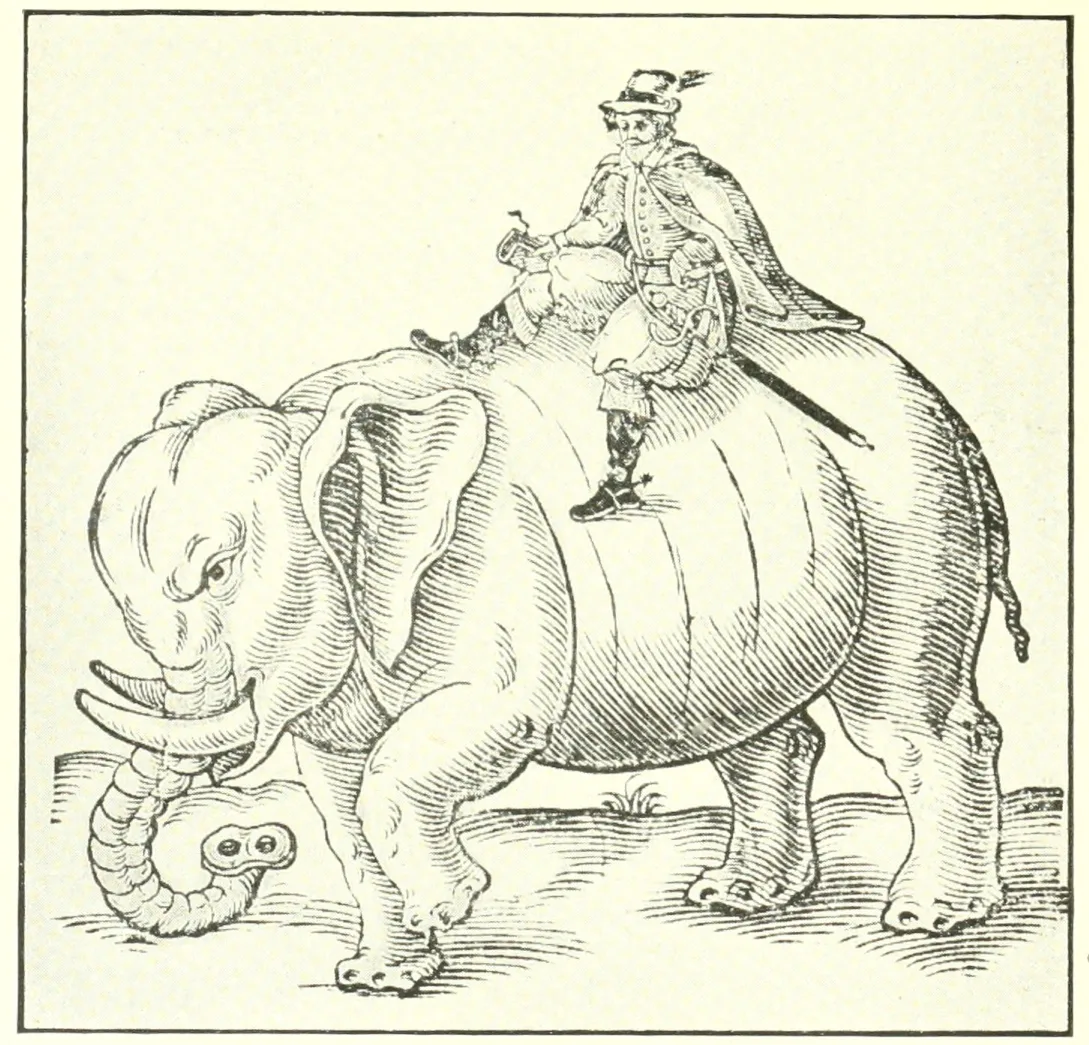
Hee speaketh very reverently of our Saviour, calling him in the Indian tongue Isazaret Eesa [Hazarat Īsa], that is, the Great Prophet Jesus ; and all Christians, especiallie us English, he useth so benevolently as no Mahometan prince the like. Hee keepeth abundance of wilde beasts, and that of divers sorts, as lyons, elephants, leopards, beares, antlops, unicornes ; whereof two I have seene at his court, the strangest beasts of the world.3 They were brought hither out of the countrie of Bengala, which is a kingdom of most singular fertilitie within the compasse of his dominion, about four moneths journey from this, the midland parts therof being watered by divers channels of the famous Ganges, which I have not as yet seene, but (God willing) I meane to visite it before my departure out of this countrie, the neerest part of it beeing not above twelve daies journy from this court. The King presenteth himselfe thrice every daie without faile to his nobles; at the rising of the sunne, which he adoreth by the elevation of his hands; at noone; and at five of the clocke in the evening. But he standeth in a roome aloft, alone by him selfe, and looketh uppon them from a window that hath an embroidered sumptuous coverture, supported with two silver pillasters to yeeld shaddowe unto him. Twice every week elephants fight before him, the bravest spectacle in the worlde. Many of them are thirteene foot and a halfe high; and they seeme to justle together like two little mountaines, and were they not parted in the middest of their fighting by certaine fire-workes, they would exceedingly gore and cruentate one another by their murdering teeth. Of elephants the King keepeth 30,000 in his whole kingdome at an unmeasurable charge; in feeding of whom, and his lyons and other beasts, he spendeth an incredible masse of money, at the least ten thousand pounds sterling a day.1 I have rid upon an elephant since I came to this court, determining one day (by Gods leave) to have my picture expressed in my next booke sitting upon an elephant.2 The king keepeth a thousand women for his own body, whereof the chiefest (which is his Queene) is called Normal.
I thinke I shall here after this send another letter unto you before my departure out of this countrey, by a worthy man, which is the minister and preacher of our nation in this place, one M. Peter Rogers, a man to whom I am exceedingly obliged for his singular offices of humanity exhibited unto me. Pray use him kindly for my sake. Hee understanding that there is a certaine yong gentleman, called Maister Charles Lancaster, that serveth the M[aster] of the Rolles, intreated me to desire you to recommend him very kindly unto him. Our cape-merchants name is M. William Edwards, an honest gentleman, that useth me with verie loving respect.
Dear M. L. W., conveigh these twoe letters that I have sent to you, to the parties to whom they are directed : my poore mother and mine unckle Williams. You may do me a kinde office to desire him (with such convenient termes and patheticall perswasions as your discretion shall dictate and suggest unto you) to remember me as his poore industrious peregrinating kinseman, neerest unto him in blood of all the people in the world ; to remember me, I say, with some competent gratuitie, if God should call him out of the world before my returne into my native countrie. I praie you, if hee be living, and doth use to come to London as he was wont to doo, that you would deliver my letter to him with your owne hands, and not send it unto him.
You may remember to relate this unto your friends that I will now mention as a matter verie memorable : I spent in my ten moneths travels betwixt Aleppo and the Moguls court but three pounds sterling, yet fared reasonable well everie daie ; victuals beeing so cheape in some countries where I travelled, that I oftentimes lived competentlie for a pennie sterling a day. Yet of that three pound I was cousened of no lesse then ten shillings sterling by certaine lewd Christians of the Armenian nation ; so that indeed I spent but fiftie shillings in my ten moneths travailes. I have beene in a citie in this countrie, called Detee [Delhi], where Alexander the Great joyned battell with Porus, K[ing] of India, and conquered him ; and in token of his victorie erected a brasse pillar, which remaineth there to this day.1
Pray remember my humblest service to the Right Honourable, your Maister of the Rolles, si superatque, et vescitur aura ætherea, nec adhuc crudelibus occubat umbris.1 And to Sir Robert Phillips, once my Mecænas, but how affected to me at this time I know not. Pray tell them that I meane to write to each of them before my departure out of India. Remember my duty also to their right vertuous ladies. About foure yeares hence looke for me, but not before. For if God grant me life and health, I meane to make it a voyage of full seaven yeares before I come home, whereof three are already spent. Commend me also, I pray you, to M. Martin,2 though at a mans house in Woodstreet he used mee one night verie perversly before I came away; but you see that my being at Jerusalem dooth make me forget many injuries. Commend mee likewise to Maister H. Holland3 and Inigo Jones.4 At this time I have many irons in the fire; for I learne the Persian, Turkish, and Arabian tongues, having already gotten the Italian (I thank God). I have bene at the Moguls court three moneths already, and am to tarry heere (by Gods holy permission) five moneths longer, till I have gotten the foresaide three tongues, and then depart herehence to the Ganges, and after that directly to the Persian court.
Your assured loving friend till death, Tho. Coryate.
From the court of the Great Mogul, resident at the towne of Asmere, in the Eastern India, on Michaelmas day, anno 1615.
I do enjoy at this time as pancraticall and athleticall a health as ever I did in my life; and so have done ever since I came out of England, saving for three dayes in Constantinople, where I had an ague, which with a little letting blood was clean banished; the Lord be humbly thanked for His gracious blessing of health that Hee hath given me. I was robbed of my money, both golde and silver (but not all, by reason of certaine clandestine corners where it was placed), in a cittie called Diarbeck in Mesopotamia, the Turks countrey, by a Spasheê [Spāhi], as they call him, that is, one of the horsemen of the Great Turke; but the occasion and circumstance of that misfortune would be too tedious to relate. Notwithstanding that losse, I am not destitute of money, I thanke God. Since my arrivall heere, there was sente unto this King one of the richest presents that I have heard to be sent to any prince in al my life time. It consisteth of divers parcels; one beeing elephants, whereof there were 31, and of those two so gloriously adorned as I never sawe the like, nor shal see the like again while I live. For they wore foure chaines about their bodies all of beaten gold; two chains about their legges of the same; furniture for their buttocks of pure gold; twoe lyons upon their heads of the like gold; the ornaments of each amounting to the value of almost eight thousand pound sterling; and the whole present was worth ten of their leakes [i. e. lakhs], as they call them (a leak being ten thousand pound sterling); the whole, a hundred thousand pounds sterling.1
Pray commend me to M[aster] Protoplast and all the Sireniacall2 gentlemen; to whom I wrote one letter from Aleppo, after my being at Jerusalem, and another I intend to write before my going out of Asia. Their most elegant and incomparable safe-conduct that they have graciously bestowed upon me I have left at Aleppo, not having made any use of it as yet, neither shall I in all my peregrination of Asia; but when I shall one day arrive in Christendom, it will be very available to me.
I have heere sent unto you the coppy of certaine facetious verses that were lately sent to me to this court, from one of my countrimen, one M. John Browne,1 a Londoner borne, now resident, with divers other English merchants, at a citie in India, five hundred miles from the place where I abide, called Amadavers, about sixe dayes journey from the sea; who, understanding of my arrivall at this court, and of my tedious pedestriall peregrination all the way from Jerusalem hither (understanding it, I say, by Latine and Italian epistles that upon a certaine occasion I wrote to some of that company), made these pretty verses, and sent them me. You may reade them to your friends, if you thinke fit, and especially to the Sireniacall gentlemen; for they are elegant and delectable. The superscription of his letter was this: To the painefull gentleman, M. Thomas Coryate. The title within, prefixed before the verses, this: To the Odcombian wonder, our laborious countriman, the generous Coryate . . . .2
Yet one post-script more by way of a corollary, and so with the same, beeing the fourth and the last, I will adde the final umbilicke to this tedious English-Indian epistle. I have written out two severall coppies of these verses, and included them within the letters which I have intreated you to distribute for me, but so that the letters are not sealed upon them, onely they lie loose within the letters; therefore they are subject to losing, except you have an extraordinary care of them. Wherefore I intreate you to deliver that to mine unkle with your owne hands, if he be in London, or to conveigh it to him by such a one as will not lose that loose paper of verses. The like care I desire you to have of that to my mother, and to send it unto her by some other man then a carrier, if you can jet [meet?] with such an opportunity: for in truth I am afraide the carrier will lose the inclosed paper. Pray take advice of some of the M[aster] of the Rolles his people that are to ride to Euill.3 Pray remember my commendations with all respect to M. Williams the goldsmith and his wife; and to Benjamin Johnson, and to reade this letter to them both; likewise to Mistris Elizabeth Balch, if shee continueth with your lady.
One appendix more, and so an end. There happened betwixt the day of the writing of this letter and the day of the sealing of it up, a memorable occurrent not to bee omitted. Wee received newes at this court the ninth day after the writing of this letter (for nine daies it was unsealed), being the eight of October, of the arrivall of foure goodly English ships at the haven of Surat in India, and in the same of a very generous and worthy English knight, a deare friend of mine, Sir Thomas Rowe, to come to the court with some mature expedition, as an ambassadour from the Right Worshipfull Company of London Merchants that Trade for India. He cometh with letters from our King and certaine selected presents of good worth from the Company; amongst the rest a gallant caroch, of 150 pounds price.1 Also there came with him 15 servants, al Englishmen. Forty daies hence at the farthest, we expect (θεοῦ διδόντος2) his arrival at this court. This newes doth refocillate (I will use my olde phrase so well knowne to you) my spirits; for I hope he will use me graciously, for old acquaintance sake.
II
To The Right Honourable Sir Edward Phillips, Knight, and Maister of the Rolles, at his house in Chancery-Lane, or Wanstead.3
Right Honourable,
I am perswaded that if ever any accident worthy of admiration ever happened unto Your Honor in al your life time, it will be the receiving of this present letter from me out of the Easterne India; yet perhaps it will seeme unto you so wondrous that I beleeve you will doubt whether this bee the true handwriting of your once Odcombian neighbor, Thomas Coryate. But Your Honour may soone very infallibly and apparantly perceive it to be true, partly by the forme of the style, which is just answerable to that manner of speech that you have heard and observed in me, sometimes in my linsie-woolsie orations and somtimes in my extravagant discourses; and partly by the testimony of the bearer heereof, M[aster] Peter Rogers, minister, at the time of his being in India, to the English merchants resident at the court of the most puissant monarch the Great Mogul, at a town called Asmere; whose comfortable and sweet company I enjoyed at the same court about the space of foure moneths.
Now, though there hath itched a very burning desire in mee, within these few yeares, to survay and contemplate some of the chiefest parts of this goodly fabricke of the world besides mine owne native country, yet never did I thinke it would have broken out to such an ambitious vent as to travell all on foote from Jerusalem so farre as the place where I wrote this letter. Howbeit since fortune, or rather (to speake more properly, in using a Christian word) the providence of the Almighty, (for Fatuus est, S. Augustine saith, qui fato credit) hath so ordained that I should securely passe so far into the orientall world, with all humilitie, upon the bended knees of my hart, I thank my Creator and merciful Redeemer, Jesus Christ (whose sacrosanct sepulcher I have visited and kissed, terque quaterque, in Jerusalem), and do very much congratulate mine owne happines that He hath hitherto endued mee with health (for in all my travels since I came out of England I have enjoyed as sound a constitution of body and firme health as ever I did since I first drew this vitall ayre), libertie, strength of limbs, agilitie of foot-manship, etc.
Neither do I doubt but that Your Honour it selfe will likewise congratulate the felicitie of our Sommersetshire, that in breeding me hath produced such a traveller as dooth, for the diversitie of the countries he hath seene and the multiplicitie of his observations, farre (I beleeve) out-strippe anie other whatsoever that hath beene bred therein since the blessed Incarnation of our Saviour. Yea, I hope my generall countrie of England shall one day say that Odde-combe, for one part of the word, may truelie be so called (for Odde-combe consisteth of two words, odde and combe, which latter word in the olde Saxon tongue signifieth, besides the vertical point of a cocks head, the side of a hill, because the east side of the hill whereon Od-combe standeth is very conspicuous, and seene afar off in the country eastward) for breeding an odde man, one that hath not his peere in the whole kingdome to match him.
Three yeares and some few odde dayes I have spent already in this second peregrination, and I hope with as much profite (unpartially will I speake it of my selfe, without any overweening opinion, to which most men are subject), both for learning foure languages more then I had when I left my country (viz. Italian, Arabian, Turkish, and Persian) and exact viewing of divers of the most remarkeable matters of the universe; together with the accurate description thereof, as most of my countri-men that are now abroad. Yet such is my insatiable greedinesse of seeing strange countries (which exercise is indeede the very queene of all the pleasures in the world) that I have determined (if God shall say Amen) to spend full seaven yeares more, to the ende to make my voyage answerable for the time to the travels of Ulysses; and then with unspeakable joy to revisite my country, which I will ever entitle (notwithstanding all the goodly regions that I have seene in my two perambulations) with the stile of the true Canaan of the world, that flowes with milke and hony. Onely wish me good successe, I beseech Your Honour, as I will from my heart to you and all your familie; hoping to salute you after the finall catastrophe of my exoticke wanderings, when you shall bee in the great climacterical year of your age; you being about fifty three, if my conjecture doth not faile mee, when I tooke my leave of you; a thing verie likely, by the mercifull goodnesse of God, for your father, that was my god-father, who imposed upon me the name of Thomas, lived more then eightie yeares.
Honourable Sir, take it not (I beseech you) for a discourtesie, in that I write nothing in this letter of my past travels. I am certaine that a letter which I have written to M[aster] Whitaker, your learned and elegant secretary, wherein I have compendiouslie discoursed of some of my observations in Asia, will quicklie come to your hands, at least if hee remaineth still in your service ; therfore it would be superfluous to have repeated the same things. Dutie joyned with the recordation of the manifold benefits and singular favours I have received from you, hath injoyned mee to send this letter to Your Honour, from this glorious court of the Mogul ; wherein, seeing I relate not the singularities I have seene in those orientall regions, I will desist to be farther tedious ; humbly recommending Your Honour, and vertuous lady : your well-beloved sonne and heire-apparant, Sir Robert 1 (to whom I have written a few times [lines ?] also) and his sweet lady : M. Martin [see p. 249] also : M. Christopher Brooke,2 whom I thanke still for his no lesse elegant then serious verses : M. Equinoctiall Pasticrust, of the Middle Temple 3 : M. William Hackwell 4 : and the rest of the worthy gentlemen frequenting your honourable table, that favour vertue and the sacred Muses : to the most heavenly clientele of the Eternall Jehovah. Your Honors most obsequious beadsman, Thomas Coryate.
From the court of the Great Mogul, resident in the towne of Asmere, in the Easterne India, on Michaelmas day, Anno 1615.
I beseech Your Honour to speake courteously to this kind minister, M. Rogers, for my sake ; for he ever shewed himselfe very loving unto me.
III
To the High Seneschall of the Right Worshipfull Fraternitie of Sireniacal Gentlemen, that meet the first Fridaie of every moneth at the signe of the Mere-Maide in Bread-streete in London, give these.1
From the court of the Great Mogul, resident at the towne of Asmere, in the Easterne India.
Right generous, joviall, and mercuriall Sirenaicks, I have often read this Greeke proverb, χεὶρ χεῖρα νέπτει,2 that is, one hand washeth another, and in Latine, Mulus mulum scabit,3 one mule scratcheth another; by which the ancients signified that courtesies done unto friends ought to bee requited with reciprocall offices of friendship. The serious consideration heereof dooth make me to call to mind that incomparable elegant safe-conduct, which, a little before my departure from England, your Fraternity with a general suffrage gave me for the security of my future peregrination, concinnated by the pleasant wit of that inimitable artizan of sweet elegancy, the moytie of my heart, and the quondam Seneschall of the noblest Society, M[aster] L. W[hitaker]. Therefore, since it is requisite that I should repay some-what for the same, according to the lawes of humanity, such a poore retribution as I sent unto you from Aleppo, the metropolitan city of Syria, by one M. Henry Allare of Kent, my fellow-pilgrime therehence to Jerusalem (I meane a plaine epistle, which I hope long since came unto your hands), I have sent unto you by a man no lesse deare unto mee then the former, one M. Peter Rogers, a Kentish man also, from the most famigerated region of all the East, the ample and large India; assuring my selfe that because I am not able to requite your love with any essentiall gratulations, other then verball and scriptall, you wil as lovingly entertaine my poore letters, beeing the certaine manifestation of an ingenious minde, as if I should send unto you the minerall riches or drugged of the noble country.
Thinke it no wonder, I pray you, that I have made no use in all this space, since I left my native country, of the superexcellent commeate [passport ; Latin commeatus] ; for I have spent all my time hitherto in the Mahometan countries, and am like to spend three yeares more in these Musselman (as they call them) regions of Asia, after of Europe, before I shal arrive in Christendome. For this cause I left it in Aleppo, with my countrimen, there to receive it from them againe, after that I shall have ended my Indian and Persian perambulation ; and therethence to carrie it once more to Constantinople, and that by the way at Iconium, Nicæa, Nicomedia, and in the country of Natolia, a journie of forty daies. From that finally through the heart of Greece, by the cities of Athens; Thebes, Corinth, Lacedæmon, Thessalonica, and to the citie of Ragouze, heretofore Epidaurus, so sacred for the image of Aesculapius in the countrie of Sclavonia, once called Illyricum ; from thence, I have three daies journey to the inestimable diamond set in the ring of the Adriatique Gulfe (as once I said in the first harangue that ever I made to Prince Henry of blessed memory, translated, since my departure from London, from the terrestriall tabernacles to the cœlestial habitations), venereous Venice, the soveraign queen of the Mare Superum. If the great Jehovah shall be so propitious unto mee as to grant mee a prosperous arrivall in that noble cittie, I will there beginne to shew your safe conduct, and to decantate, yea, and blazon your praises for the same ; and after in every other place of note, untill I shall arrive in glorious London, communicate it to the most polite, with that the cities will yeeld, thorough which my laborious feete shall carry mee.
It would be supervacaneous to commemorate unto you the almost incredible extent of land I traversed from Jerusalem to the court of the Great Mogul in India, where I now reside ; with the variable regions and provinces interjacent betwixt them, and the manifold occurrences and observations of speciall worke [worth ?] in this vaste tract : for it wold be such a fastidious discourse that it could not be wel comprehended in a large sheete of paper. But M[aster] W[hitaker], I hope, will not faile to import unto you in a few compendious relations, which I have acquainted him with, in a particular letter to himselfe; of which if I should have written againe to you, it would have proved Crambe bis Cocta.
The gentleman that bringeth this letter unto you was preacher to the English merchants conversant at the court of the aforesaid might monarch in the towne of Asmere in this Easterne India; and in divers loving offices hath bene so kind unto me that I intreat your generosities to entertaine him friendly for my sake, to exhilarate him with the purest quintessence of the Spanish, French, and Rhenish grape which the Mermaid yeeldeth; and either one in the name of you all, or else the totall universalitie of the one after another, to thanke him heartily, according to the quality of his merits. Farewell, noble Sirenaicks.
Your Generosities most obliged countreyman, ever to be commanded by you, the Hierosolymitan-Syrian-Mesopotamian-Armenian-Median-Parthian-Persian-Indian Leggestretcher of Odcomb in Somerset,
Thomas Coryate.1
IV
To his Loving Mother.
By this present letter I am like to minister unto you the occasion of two contrary matters, the one of comfort, the other of discomfort. Of comfort, because I have, by the propitious assistance of the omnipotent Jehovah, performed such a notable voyage of Asia the Greater, with purchase of great riches of experience, as I doubt whether any English man this hundred yeares have done the like ; having seene and very particularly observed all the cheefest things in the Holy-land, called in times past Palastina ; as Jerusalem, Samaria, Nazareth, Bethlehem, Jericho, Emaus, Bethania, the Dead Sea, called by the Ancients Lacus Asphaltites, where Sodome and Gomorrha once stood. Since that, many famous and renowned cities and countries ; Mesopotamia, in the which I entred by the passage of the river Euphrates, that watered Paradise ; in which the citty of Ur, where Abraham was borne ; both the Mediaes, the Higher and the Lower ; Parthia, Armenia, Persia ; through al which I have travailed into the Eastern India, being now at the court of the Great Mogull, at a towne called Asmere, the which from Jerusalem is the distance of two thousand and seaven hundred miles ; and have traced all this tedious way afoote, with no small toile of bodye and discomfort.
Because that beeing so exceeding farre from my sweet and most delicious native soyle of England you will doubt perhaps, how it is possible for me to returne home againe ; but I hope I shall quickly remove from you that opinion of discomfort (if at the least you shall conceive any such), because I would have you know that I alwayes go safely in the company of caravans from place to place. A caravan is a word much used in all Asia ; by which is understood a great multitude of people travelling together upon the way, with camels, horses, mules, asses, etc., on which they carry merchandizes from one country to another, and tents and pavillions, under which instead of houses they shelter themselves in open fields, being furnished also with all necessary provision, and convenient implements to dresse the same ; in which caravans I have ever most securely passed betwixt Jerusalem and this towne, a journey of fifteene months and odde dayes ; whereof foure (wanting a weeke) spent in Aleppo, and two and five and od dayes spent in Spahan, the metropolitan citty of Persia, where the Persian King most commonly keepeth his court. And the occasion of my spending of sixe moneths of the foresaide fifteene in those two citties, was to waite for an opportunity of caravans to travaile withall ; which a traveller is not sure to finde presently when he is ready to take his journey, but must with patience expect a convenient time ; and the caravan in which I travelled betwixt Spahan and India contained 2000 camels, 1500 horses, 1000 and odde mules, 800 asses, and sixe thousand people. Let this therefore (deer mother) minister unto you a strong hope of my happy returne into England.
Notwithstand all these lines for provision for your funerall, I hope for to see you alive and sound in body and minde, about foure yeares hence ; and to kneele before you with effusion of teares, for joy. Sweet mother, pray let not this wound your heart, that I say four yeares hence, and not before ; I humbly beseech you, even upon the knees of my heart, with all submissive supplications, to pardon me for my long absence ; for verily, I have resolved, by the favour of the supernall powers, to spend 4 entire yeares more before my returne, and so to make it a pilgrimage of 7 yeares, to the end I may very effectually and profitably contemplate a great part of this worldly fabricke ; determining, by Gods special help, to go from India into the countrey of Scythia, now called Tartaria, to the cittie Samarcanda, to see the sepulcher of the greatest conqueror that ever was in the worlde, Tamberlaine the Great ; thither it is a journey of two months from the place I now remaine. From that I meane to return into Persia ; and therethence, by the way of Babylon and Ninivy, and the mountaine Ararat, where Noahs arke rested, to Aleppo, to my countrymen. From that, by the way of Damascus, and once again to Gaza in the land of the Philistims unto Cairo in Egypt ; from that downe the Nilus to Alexandria ; and therehence finally I hope to be imbarked for some part of Christendome, as either Venice, or etc. After mine arrivall in Christendome, I shall desire to travell two yeares in Italy, and both High and Low Germany, and then with all expedition into England, and to see you (I hope) with as great joy as ever did any travailer his father or mother. Going in that manner as I do, like a poore pilgrime, I am like to passe with undoubted securitie and very small charge; for in my tenne months travailes betwixt Aleppo and this Moguls court, I spent but three pounds sterling, and yet had sustenance enough to maintaine nature, living reasonably well, oftentimes a whole day for so much of their money as doeth countervaile two pence sterling. But least I be over tedious unto you, I will heere make an end, etc.
I will now commend you to the most blessed protection of our Saviour Jesus Christ; before whose holy sepulcher at Jerusalem I have poured foorth mine ardent orisons for you to the most sacrosanct Trinity, beseeching It, with all humilitie of heart, to blesse and preserve you in a solid health, etc.
Your loving sonne, Tho. Coryate.
V
To His Mother.
From Agra, the capitall city of the dominion of the Great Mogoll, in the Easterne India, the last of October, 1616.
Most deare and welbeloved Mother, Though I have superscribed my letter from Azmere, the court of the greatest monarch of the East called the Great Magoll, in the Eastern India, which I did to this end, that those that have the charge of conveiance thereof, perceiving such a title, may be the more carefull and diligent to convey it safely to your hands: yet in truth the place from which I wrote this letter is Agra, a city in the said Eastern India which is the metropolitan of the whole dominion of the foresaid King Mogol, and 10 daies journy from his court at the said Azmere.
From the same Azmere I departed the 12 day of September, An. 1616, after my abode there 12 moneths and 60 daies ; which though I confesse it were a too long time to remaine in one and the selfe same place, yet for two principall causes it was very requisite for me to remaine there some reasonable time : first, to learne the languages of those countries through which I am to passe betwixt the bounds of the territories of this prince and Christendome, namely these three, the Persian, Turkish, and Arab (which I have in some competent measure attained unto by my labour and industry at the said Kings court), matters as availeable unto me as mony in my purse, as being the cheifest or rather onely meane to get me mony if I should happen to be destitute, a matter very incidentall to a poore footman pilgrim as my selfe, in these heathen and Mahometan countries through which I travell ; secondly, that by the helpe of one of those languages (I meane the Persian) I might both procure unto my selfe accesse unto the King, and be able to expresse my mind unto him about the matter for the which I should have occasion to discours with him. These were the reasons that moved me so long to tarry at the Mogols court ; during which time I abode in the house of the English merchants, my deare countrimen, not spending one little peece of mony, either for diet, washing, lodging, or any other thing. And as for the Persian tongue, which I studied very earnestly, I attained to that reasonable skill (and that in a fewe moneths) that I made an oration unto the King before many of his nobles in that language, and, after I had ended the same, discoursed with His Majesty also in that tongue very readily and familiarly ; the coppy of which speech, though the tong it selfe wil seem to an Englishman very strange and uncuth, as having no kind of affinity with any of our Christian languages, I have for novelty sake written out in this letter, together with the translation thereof in English, that you may shew it to some of my lerned friends of the clergy and also of the temporalty in Euil and elswere, who, belike, will take some pleasure in reading so rare and unusuall a tongue as this is. The Persian is this that followeth :
The Copie of an Oration that I made, in the Persian tongue, to the Great Mogoll, before divers of his Nobles.1
Hazaret Aallum pennah salamet, fooker Daruces ve tehaungeshta hastam kemia emadam az wellagets door, ganne az mulk Inglizan : ke kessanaion petheen mushacas cardand ke wellagets, mazcoor der akers magrub bood, ke mader hamma iezzaerts dunmast. Sabebbe amadane mari mia boosti char cheez ast auval be dedane mobarreck deedars. Hazaret ke seete caramat ba hamma Trankestan reseedast ooba tamam mulk Musulmanan der sheenedan awsaffe. Hazaret daueeda amadam be deedane astawne akdas musharaf geshtam duum bray deedane feelhay Hazaret, kin chunm ianooar der heech mulk ne dedam seu in bray deedane namwer daryaee shumma Gauga, ke Serdare hamma daryaha dumiest. Chaharum een ast, keyec fermawne alishaion amayet fermoyand, ke betwanam der wellayetts Vzbeck raftan ba shahre Samarcand, bray zeerat cardan cabbre mobarrec Saheb crawncah awsaffe tang oo mosachere oo der tamam aallum meshoor ast belkder wellagette Vzbec eencader meshoor neest chunan che der mulc Inglisan ast digr, bishare eshteeac daram be deedanc mobarrec mesare Saheb crawnca bray een saheb, che awne saman che focheer de shabr Stambol boodam, ycaiaeb cohua amarat deedam dermean yecush bawg nasdec shaht mascoor coia che padshaw Eezawiawn che namesh Manuel bood che Saheb crawnca cush mehmannec aseem carda bood, baad as gristane Sulten Baiasetra as iange aseem che shuda bood nas dec shahre Bursa, coimache Saheb crawn Sultan Baiasetra de Zenicera tellaio bestand, oo der cafes nahadond een char chees meera as mulche man ium baneed tamia, as mulc Room oo Arrac peeada geshta, as door der een mulc reseedam, che char hasar pharsang raw darad, beshare derd oo mohuet casheedam che heech ches der een dunnia een cader mohuet ne casheedast bray deedune mobarrec dedare Haseretet awn roos che be tacte shaugh ne shaughee musharaf fermoodand.
The English of it is this.
Lord1 Protector of the World, all haile to you. I am a poore traveller and world-seer, which am come hither from a farre country, namely England, which auncient historians thought to have been scituated in the farthest bounds of the West, and which is the queene of all the ilands in the world. The cause of my comming hither is for foure respects. First, to see the blessed face of Your Majesty, whose wonderfull fame hath resounded over all Europe and the Mahometan countries; when I heard of the fame of Your Majesty, I hastened hither with speed, and travelled very cherefully to see your glorious court. Secondly, to see Your Majesties elephants, which kind of beasts I have not seen in any other country. Thirdly, to see your famous river Ganges, which is the captaine of all the riever[s] of the world. The fourth is this : to intreat Your Majesty that you would vouchsafe to grant mee your gracious passe that I may travell into the country of Tartaria to the city of Samarcand, to visit the blessed sepulcher of the Lord of the Corners 1 (this is a title that is given to Tamberlaine in this country in that Persian language, and wheras they call him the Lord of the Corners, by that they meane that he was lord of the corners of the world, that is, the highest and supreme monarch of the universe), whose fame, by reason of his warres and victories, is published over the whole world : perhaps he is not altogether so famous in his own country of Tartaria as in England. Moreover, I have a great desire to see the blessed toombe of the Lord of the Corners for this cause; for that when I was at Constantinople, I saw a notable old building in a pleasant garden neer the said city, where the Christian Emperor that was called Emanuell [Manuel Palaeologus] made a sumptuous great banquet to the Lord of the Corners, after he had taken Sultan Bajazet in a great battell that was fought neere the city of Bursia [Brusa], where the Lord of the Corners bound Sultan Bajazet in fetters of gold, and put him in a cage of iron.2 These four causes moved me to come out of my native country thus farre, having travelled a foote through Turky and Persia. So farre have I traced the world into this country that my pilgrimage hath accomplished three thousand miles ; wherin I have sustained much labour and toile, the like whereof no mortall man in this world did ever performe, to see the blessed face of Your Majesty since the first day that you were inaugurated in your glorious monarchall throne.
After I had ended my speech, I had some short discourse with him in the Persian tongue, who amongst other things told me that, concerning my travell to the city of Samarcand, he was not able to doe me any good, because there was no great amity betwixt the Tartarian princes and himselfe; so that his commendatory letters would doe me no good. Also he added that the Tartars did so deadly hate all Christians that they would certainely kill them when they came into their country; so that he earnestly diswaded me from the journy, if I loved my life and welfare. At last he concluded his discourse with me by a sum of mony that he threw downe from a windowe through which he looked out, into a sheete tied up by the foure corners, and hanging very neer the ground, a hundred peeces of silver, each worth two shillings sterling, which countervailed ten pounds of our English mony. This busines I carried so secretly, by the help of my Persian, that neither our English Ambassador, nor any other of my countrimen (saving one speciall, private, and intrinsical friend) had the least inkling of it till I had throughly accomplished my designe; for I well knew that our Ambassador would have stopped and barracadoed all my proceeding therein, if he might have had any notice thereof; as indeed he signified unto me after I had effected my project, aleaging this forsooth for his reason why he would have hindered me, because it would redound some what to the dishonour of our nation that one of our countrey should present himselfe in that beggarly and poore fashion to the King, out of an insinuating humor to crave mony of him; but I answered our Ambassador in that stout and resolute manner, after I had ended my busines, that he was contented to cease nibling at me. Never had I more need of mony in all my life then at that time; for in truth I had but twenty shillings sterling left in my purse, by reason of a mischance I had in one of the Turkes cities called Emert,1 in the country of Mesopotamia, where a miscreant Turke stripped me of almost all my monies, according as I wrote unto you in a very large letter the last yeer, which I sent from the court of this mighty monarch by one of my countrimen that went home by sea in an English shippe laden with the commodities of this India; which letter I hope came to your hands long since.
After I had been with the King, I went to a certaine noble and generous Christian of the Armenian race,1 two daies journy from the Mogols court, to the end to observe certain remarkable matters in the same place; to whom by means of my Persian tongue I was so welcome that hee entertained me with very civill and courteous complement, and at my departure gave mee very bountifully twenty peeces of such kind of mony as the King had done before, countervailing 40 shillings sterling. About ten daies after that, I departed from Azmere, the court of the Mogol Prince, to the end to begin my pilgrimage after my long rest of fourteen moneths back againe into Persia; at what time our Ambassador gave mee a peece of gold of this Kings coine worth foure and twenty shillings,2 which I will save (if it be possible) till my arivall in England. So that I have received for benevolences since I came into this country twenty markes sterling [13s. 4d. each] saving two shillings eight pence; and by the way uppon the confines of Persia a litle before I came into this country three and thirty shillings foure pence3 in Persian mony of my Lady Sherly. At this present I have in the city of Agra, where hence I wrote this letter, about twelve pounds sterling, which, according to my maner of living uppon the way at two-pence sterling a day (for with that proportion I can live pretty well, such is the cheapnes of all eatable things in Asia, drinkable things costing nothing, for seldome doe I drinke in my pilgrimage any other liquor then pure water), will mainetaine mee very competently three yeeres in my travell with meate, drinke and clothes. Of these gratuities which have been given me, willingly would I send you some part as a demonstration of the filiall love and affection which every child bred in civility and humility ought to performe to his loving and good mother ; but the distance of space betwixt this place and England, the hazard of mens lives in so long a journey, and also the infidelity of many men, who though they live to come home, are unwilling to render an account of the things they have received, doe not a little discourage me to send any precious token unto you ; but if I live to come one day to Constantinople againe (for thither doe I resolve to goe once more, by the grace of Christ, and therehence to take my passage by land into Christendom over renouned Greece), I wil make choice of some substantial and faithfull countriman, by whom I will send some prety token as an expression of my dutifull and obedient respect unto you.
I have not had the oppertunity to see the King of Persia as yet since I came into this country, but I have resolved to goe to him when I come next into his territories, and to search him out wheresoever I can find him in his kingdome ; for, seeing I can discourse with him in his Persian tongue, I doubt not but that, going unto him in the forme of a pilgrime, he will not onely entertaine me with good words, but also bestow some worthy reward upon me, beseeming his dignity and person ; for which cause I am provided before hand with an excellent thing, written in the Persian tongue, that I meane to present unto him. And thus I hope to get benevolences of worthy persons to maintaine me in a competent maner in my whole pilgrimage till I come into England ; which I hold to be as laudable and a more secure course then if I did continually carry store of mony about mee.
In the letter which I wrote unto you by an English ship the last yeere, I made relation unto you both of my journy from the once holy Hierusalem hither, and of the state of this Kings court, and the customes of this country ; therfore I hold it superfluous to repeat the same things againe. But what the countryes are that I meane to see betwixt this and Christendome, and how long time I will spend in each country, I am unwilling to advertise you of at this present, desiring rather to signify that unto you after I have performed my designe then before. Howbeit, in few words I will tell you of certaine cities of great renown in former times, but now partly ruined, that I resolve (by Gods help) to see in Asia, where I now am, namely, ancient Babilon and Nymrods Tower, some few miles from Ninive, and in the same the sepulcher of the prophet Jonas, spacious and goodly; Caire in Egypt, heretofore Memphis, upon the famous river Nilus, where Moises, Aron, and the Children of Israel lived with King Pharaoh, whose ruined palace is shewed there til this day, and a world of other movable things as memorable as any city of the whole world yeeldeth, saving only Jerusalem. But in none of these or any other cities of note do I determin to linger as I have done in other places, as in Constantinople, and Azmere in this Easterne India; onely some few daies will I tarry in a principall city of fame, to observe every principal matter there, and so be gone.
In this city of Agra where I am now, I am to remaine about six weekes longer, to the end to expect an excellent oportunity which then will offer it selfe unto me to goe to the famous river Ganges, about five daies journy from this, to see a memorable meeting of the gentle people of this country, called Baieans,1 whereof about foure hundred thousand people go thither of purpose to bathe and shave themselves in the river, and to sacrifice a world of gold to the same river, partly in stamped mony, and partly in massy great lumpes and wedges, throwing it into the river as a sacrifice, and doing other strange ceremonies most worthy the observation.2 Such a notable spectacle it is, that no part of all Asia, neither this which is called the Great Asia nor the Lesser, which is now called Natolia, the like is to be seen. This shew doe they make once every yeere, comming thither from places almost a thousand miles off, and honour their river as their God, Creator, and Saviour; superstition and impiety most abominable in the highest degree of these brutish ethnicks, that are aliens from Christ and the common-wealth of Israel. After I have seen this shew, I wil with all expedition repaire to the city of Lahore, twenty daies journy from this, and so into Persia, by the helpe of my blessed Christ.
Thus have I imported unto you some good accidents that happened unto me since I wrote a letter unto you the last yeere from the Kings court, and some litle part of my resolution for the disposing of a part of my time of abode in Asia; therefore now I will draw to a conclusion. The time I cannot limit when I shall come home, but as my mercifull God and Saviour shall dispose of it. A long rabble of commendations, like to that which I wrote in my last letter to you, I hold not so requisite to make at this present; therefore, with remembrance of some fewe friends names, I will shut up my present epistle. I pray you recommend me first in Odcombe to Master Gollop, and every good body of his family, if he liveth yet; to Master Berib, his wife and all his family; to all the Knights,1 William Chunt, John Selly, Hugh Donne, and their wives; to Master Atkins and his wife at Norton. I pray commend me in Euill to these; to old Mr. Seward,2 if he liveth, his wife and children, the poore Widow Darby, old Master Dyer, and his sonne John, Master Ewins, old and young, with their wives, Master Phelpes and his wife, Master Starre and his wife, with the rest of my good friends there. I had almost forgotten your husband3: to him also, to Ned Barber and his wife, to William Jenings. Commend me also, I pray you, and that with respectfull and dutifull termes, to the godly and reverent fraternitie of preachers that every second Friday meet at a religious exercise at Euill; at the least, if that exercise doth continue, pray read this letter to them, for I thinke they wilbe well pleased with it, by reason of the novelties of things. And so finally I commit you and all them to the blessed protection of Almighty God. Your dutifull, loving, and obedient sonne, now a desolate pilgrim in the world.
Thomas Coriat.
The copy of a speech that I made to a Mahometan in the Italian tongue.
The coppy of a speech that I made extempore in the Italian tongue to a Mahometan at a citie called Moltan, in the Easterne India, two daies journy beyond the famous river Indus, which I have passed, against Mahomet and his accursed religion, upon the occasion of a discurtesie offered unto mee by the said Mahometan in calling me Giaur,1 that is infidell, by reason that I was a Christian. The reason why I spake to him in Italian was because he understood it, having been taken slave for many yeeres since by certaine Florentines in a galley wherein hee passed from Constantinople towards Alexandra; but being by them interrupted by the way, he was carried to a citie called Ligorne [Leghorn] in the Duke of Florences dominions, where after two yeeres he had learned good Italian; but he was an Indian borne and brought up in the Mahometan religion. I pronounced the speech before an hundred people, whereof none understood it but himselfe; but hee afterward told the meaning of some part of it as far as he could remember it to some of the others also. If I had spoken thus much in Turky or Persia against Mahomet, they would have rosted me upon a spitt; but in the Mogols dominions a Christian may speake much more freely then hee can in any other Mahometan country in the world. The speech was this, as I afterward translated it into English:
But I pray thee, tell me, thou Mahometan, dost thou in sadnes [i. e. in seriousness] call me Giaur? That I doe, quoth he. Then (quoth I) in very sobersadnes I retort that shamefull word in thy throate, and tell thee plainly that I am a Musulman and thou art a Giaur. For by that Arab word Musulman thou dost understand that which cannot be properly applied to a Mahometan, but onely to a Christian; so that I doe consequently inferre that there are two kindes of Muselmen, the one an orthomusulman, that is a true Musulman, which is a Christian, and the other a pseudo-musulman, that is, a false Musulman, which is a Mahometan. What thy Mahomet was, from whom thou dost derive thy religion, assure thy selfe I know better then any one of the Mahometans amongst many millions; yea, all the particular circumstances of his life and death, his nation, his parentage, his driving camels through Egipt, Siria, and Palestina, the marriage of his mistris, by whose death he raised himselfe from a very base and contemtible estate to great honor and riches, his manner of cozening the sottish people of Arabia, partly by a tame pigeon that did fly to his eare for meat, and partly by a tame bull that hee fed by hand every day, with the rest of his actions both in peace and warre, I know aswell as if I had lived in his time, or had beene one of his neighbours in Mecca. The truth whereof if thou didst know aswell, I am perswaded thou wouldest spit in the face of thy Alcaron [al-Kurān], and trample it under thy feete, and bury it under a jaxe [i. e. privy], a booke of that strange and weake matter that I my selfe (as meanely as thou dost see me attired now) have already written two better bookes (God be thanked), and will hereafter this (by Gods gratious permission) write another better and truer. Yea, I wold have thee know (thou Mahometan) that in that renouned kingdome of England where I was borne, learning doth so flourish that there are many thousand boies of sixteene yeeres of age that are able to make a more learned booke then thy Alcaron. Neither was it (as thou and the rest of you Mahometans doe generally beleve) composed wholy by Mahomet, for hee was of so dull a wit as he was not able to make it without the helpe of another, namely a certaine renegado monke of Constantinople, called Sergis.1 So that his Alcoran was like an arrow drawne out of the quiver of another man. I perceive thou dost wonder to see me so much inflamed with anger; but I would have thee consider it is not without great cause I am so moved, for what greter indignity can there be offered to a Christian which is an Arthomusulman then to be called Giaur by a Giaur; for Christ (whose religion I professe) is of that incomparable dignity that, as thy Mahomet is not worthy to be named that yeere wherein my blessed Christ is, so neither is his Alcoron worthy to be named that yeere wherein the Injeel 1 of my Christ is. I have observed among the Mahometans such a foolish forme of praier ever since my departure from Spahan (which I confesse was no novelty unto me, for that I had observed the like before, both in Constantinople and divers other Turkish cities) that what with your vain repeti- [ti]ons and divers other prophane fooleries contained therein, I am certaine your praiers doe even stinke before God, and are of no more force then the cry of thy camell when thou doest lade or unlade him. But the praiers of Christians have so prevailed with God that in time of drougth they have obtained convenient aboundance of raine, and in time of pestilence a suddaine cessation from the plague, such an effect of holy and fervent praier as never did the Scoofferalahs, or the Allamisselalow 2 of any Mahometan produce. Yet must wee, whose praiers like a sweete smelling sacrifice are acceptable to God, be esteemed Giaurs by those whose praiers are odious unto His Divine Majestie. O times ! O maners !
Now, as I have told thee the difference betwixt the effect of our Christian and your Mahometan praiers, so I pray thee observe another difference betwixt you and us, that I wil presently intimate unto thee. Thou by the observation of the law of thy ridiculous Alcaron dost hope for Paradice, wherein thy master Mahomet hath promised rivers of rice, and to virgins the imbracing of angels under the shaddowe of spacious trees, though in truth that Paradice be nothing else then a filthy quagmire, so full of stincking dung-hils that a man cannot walke two spaces there but he shall stumble at a dung-hill and defile himselfe ; but where this Paradice is, not one amongst a thousand of you knoweth ; therefore I will tell thee. It standeth in a country scituate betwixt heaven and earth called Utopia, whereof there is mention in the third book of thy Alcaron and in the seven and thirty Asaria,1 but expressed with those misticall and obscure termes that is very difficult to understand it. For this Utopian Paradice, I say, as the reward of al your superstitious mumbling in your praiers and the often ducking downe of your heads, when you kisse the ground with such a devoute humilitie forsooth, doe you Mahometans hope in another world! But wee Christians hope to live with God and His blessed angels for ever and ever in Heaven, as being a proper and peculiar inheritance purchased unto us by the precious blood of our Christ. Yet must wee be reputed Giaurs by those that are Giaurs?
One thing more will I tell thee (O thou Mahometan), and so I will conclude this tedious speech, whereunto thy discurtious calling of me Giaur hath inforced mee; and I prethee observe this my conclusion. Learning (which is the most precious jewell that man hath in this life, by which he attaineth to the knowledge of divine and humane things) commeth to man either by revelation, which we otherwise cal inspiration, or by industry. Learning by revelation I cal that which God doth infuse from above by His special grace, unto those whom He will use as the instruments of His glory; who without labour or travell doe aspire to a most eminent degree of knowledge. Learning by industry, I call it that which a man doth purchase to himselfe by continuall writing and reading, by practise and meditation. Now by neither of these meanes have the Mahometans acquired any meane, much less any singular, learning; for as Mahomet himselfe was a man of a very superficiall and meane learning, so never was there any one of his disciples in any part of the world that was indued with any profound knowledge. But wee Christians, by the one and the other meane, have attained to the most exquisite science that can be incident to man.2 Some of our men that never were brought up in studies having been so expert in a generall learning (onely by Gods special illumination) as those have spent forty yeeres in the practise thereof ; and others, by continuall practise of writing and reading, have beene so excellent that they became the very lampes and stars of the countries wherein they lived. These things being so, it cannot possible come to passe that the Omnipotent God should deale so partially with mankind as to reveale His will to a people altogether misled in ignorance and blindnes as you Mahometans are, and conceale it from us Christians that bestowe all our lifetime in the practise of divine and humane disciplines, and in the ardent invocation of God's holy name with all sincerity and purity of heart. Goe to, then, thou pseudomusulman, that is, thou falsebeleever, since by thy injurious imputation laid upon mee, in that thou calledst mee Giaur, thou hast provoked mee to speake thus. I pray thee, let this mine answere be a warning for thee not to scandalize mee in the like manner any more ; for the Christian religion which I professe is so deare and tender unto mee that neither thou nor any other Mahometan shal scotfree call me Giaur, but that I will quit you with an answer much to the wonder of those Mahometans. Dixi.
I pray you, mother, expect no more letters from me after this till my arrivall in Christendom ; because I have resolved to write no more while I am in the Mahometans countries, thinking that it will be a farre greater comfort, both to you and to all my friends whatsoever, to heare newes that I have accomplished my travelles in Mahometisme, then that I am comming up and down, to and fro in the same, without any certainty of an issue therof. Therfore, I pray, have patience for a time. About two yeers and a halfe hence I hope to finish these Mahometan travelles, and then either from the citie of Raguzi [Ragusa] in Sclavonia, which is a Christian citie and the first we enter into Christendome from those parts of Turky by land nere unto the same, or from famous Venice, I will very dutifully remember you againe with lines full of filiall piety and officious respect.
I have written two letters to my Uncle Williams since I came forth of England, and no more ; whereof one from the Mogols court the last yeere, just at the same time that I wrote unto you ; and another now, which I sent jointly by the same messenger that carried yours out of India by sea. Once more I recommend you and all our hearty wel-willers and friends to the gratious tuition of the Lord of Hosts. I pray you, remember my duty to Master Hancoke, that reverend and apostolicall good old man, and his wife, if they are yet living; to their sonnes Thomas and John, and their wives.
Certaine observations written by Thomas Coryat.1
Whereas the beggers begge in this countrey of a Christian in the name of Bibee [Bībi, Lady] Maria, and not of Hazaret Eesa [see p. 246], thereby we may gather that the Jesuits have preached Mary more then Jesus.
A great Raja, a Gentile, a notorious atheist and contemner of all deitie (glorying to professe he knew no other God then the King, nor beleeving nor fearing none), sitting dallying with his women, one of them plucked a haire from his brest; which, being fast rooted, plucked off a little of the skinne, that bloud appeared. This small skarre2 festered and gangrened incurably; so that in few dayes he despaired of life. And beeing accompanied with all his friends and divers courtiers, he brake out into these excellent words: Which of you would not have thought that I, being a man of warre, should have dyed by the stroke of a sword, speare, or bow? But now I am inforced to confesse the power of that great God whom I have so long despised: that Hee needs no other lance then a little haire to kill so blasphemous a wretch and contemner of His majestie as I have beene.3
Ecbar Shaugh had learned all kind of sorcery; who, beeing once in a strange humour, to shew a spectacle to his nobles, brought forth his chiefest queene, with a sword cut off her head, and after the same, perceiving the heavinesse and sorrow of them for the death of her (as they thought), caused the head, by vertue of his exorcismes and conjunctions, to be set on againe, no signe appearing of any stroke with his sword.
Sultan Cursaroo1 hath but one wife ; for which one principall reason is that during his imprisonment the King, intending to make a hunting progresse of foure moneths, consulted how to keepe him safe in his absence ; at last resolved to build a towre and immure him within it, without gate, doore, or window, except some small holes to let in ayre, higher then he could come unto ; putting in all sorts of provision whatsoever, both fire, clothes, etc., with some servants to abide with him for that time. While this was building, his wife came and fell at the Kings feete, and never would let goe till shee had obtayned leave to bee shut up with him. The King much perswading to enjoy her libertie, she utterly refused any other comfort then to be the companion of her husbands miseries amongst which this was the greatest, that if any of those that were immured (beeing in number fiftie) should have dyed in the Kings absence, there was no meanes to burie them, for that no man was admitted to come neere the towre.
The fountaine found the first day by one of My Lords people, Master Herbert (brother to Sir Edward Herbert)2 ; which if he had not done, he [i. e. Roe] must have sent ten course every day for water to a river called Narbode [Narbada], that falleth into the Bay of Cambaya at Buroch [i. e. Broach] ; the custome being such that whatsoever fountaine or tanke is found by any great man in time of drought, hee shall keepe it proper and peculiar to himselfe, without the interruption of any man whatsoever. The day after, one of the Kings haddys finding the same, and striving for it, was taken by My Lords people and bound all, etc., a great controversie being about it, etc.
Remember the charitie of two great men that, in the time of this great drought,1 were at the charge of sending ten camels with twentie persons every day to the said river for water, and did distribute the water to the poore ; which was so deare that they sold a little skinne for eight pise.
Ecbar Shaugh a very fortunate prince, and pious to his mother ; his pietie appearing in this particular, that when his mother was carried once in a palankeen betwixt Lahor and Agra, he, travelling with her, tooke the palankeen upon his owne shoulders, commanding his greatest nobles to doe the like, and so carried her over the river from one side to the other. And never denyed her any thing but this, that shee demanded of him, that our Bible might be hanged about an asses necke and beaten about the towne of Agra, for that the Portugals, having taken a ship of theirs at sea, in which was found the Alcoran amongst the Moores, tyed it about the necke of a dogge and beat the same dogge about the towne of Ormuz. But hee denyed her request, saying that, if it were ill in the Portugals to doe so to the Alcoran, being it became not a King to requite ill with ill, for that the contempt of any religion was the contempt of God, and he would not be revenged upon an innocent booke ; the morall being that God would not suffer the sacred booke of His truth to be contemned amongst the infidels.
One day in the yeere, for the solace of the Kings women, all the trades-mens wives enter the Mohal [see p. 148] with somewhat to sell, in manner of a faire ; where the King is broker for his women and with his gaines that night makes his supper, no man present.2 (Observe that whatsoever is brought in of virill shape, as instance in reddishes, so great is the jealousie, and so frequent the wickednesse of this people, that they are cut and jagged for feare of converting the same to some unnaturall abuse.) By this meanes hee attaines to the sight of all the prettie wenches of the towne. At such a kind of faire he got his beloved Normahal.
After Shaof Freed [Shaikh Farīd] had wonne the battle of Lahor 1 by a stratagem, the captaines being taken by the King and hanged upon flesh-hookes and stakes made an entrance for the King to Lahor. His sonne Cursaroo being then taken prisoner and riding bare-footed upon an elephant, his father demanded him how hee liked that spectacle of his valiant and faithfull captaines hanging in that manner, to the number of two thousand. Hee answered him that hee was sorrie to see so much crueltie and injustice in his father, in executing them that had done nothing but their dutie, for that they lived upon his bread and salt; but hee should have done right if hee had saved them and punished him, which was their master and the authour of the rebellion.
For more cleere declaration of this excellent vertue, upbraiding the coldnesse of our charitie, you shall understand a custome of this King, who sleeping in his Gusle-can,2 often when hee awakes in the night, his great men (except those that watch) being retired, cals for certaine poore and old men, making them sit by him, with many questions and familiar speeches passing the time; and at their departure cloathes them and gives them bountifull almes often, whatsoever they demand, telling the money into their hands.
For a close of this discourse, I cannot forget that memorable pietie, when at Asmere hee 1 went afoot to the tombe of the prophet Hod. Mundin there buried, and kindling a fire with his owne hands and his Normahal under that immense and Heidelbergian-aequipollent 2 brasse-pot, and made kitcherie 3 for five thousand poore, taking out the first platter with his owne hands and serving one; Normahal the second; and so his ladies all the rest. Cracke mee this nut, all the 4 Papall charitie vaunters.
An Armenian, desirous to turne Moore, procured a noble-man to bring him to the King; whom the King asked why hee turned Moore: whether for preferment? Hee answered: No. Some few monethes after, craving some courtesie of the King, hee denyed it him, saying that hee had done him the greatest favour that could bee, to let him save his soule; but for his bodie, hee himselfe should provide as well as he could.
The King likes not those that change their religion; hee himselfe beeing of none but of his owne making, and therefore suffers all religions in his kingdome; which by this notable example I can make manifest. The King had a servant that was an Armenian, by name Scander 5; to whom, upon occasion of speech of religion, the King asked if hee thought either hee or the Padres had converted one Moore to bee a true Christian, and that was so for conscience sake and not for money; who answered with great confidence that hee had one which was a perfect Christian and for no worldly respect would bee other; whom the King caused presently to bee sent for, and, bidding his master depart, demanded why hee was become a Christian; who rendred certaine feeble, implicite, Jesuiticall reasons, and avowed that hee would never be other. Whereupon the King practised by faire speeches and large promises to withdraw him to the folly of Mahomet, offering him pensions, meanes, and command of horse, telling him hee had now but foure rupias a moneth wages, which was a poore reward for quitting his praepuced faith ; but if hee would recant, hee would heape upon him many dignities ; the fellow answering it was not for so small wages hee became Christian, for hee had limbes and could earne so much of any Mahometan, but that hee was a Christian in his heart, and would not alter it. This way not taking effect, the King turned to threatnings and menacings of tortures and whippings ; but the proselyte manfully resolving to suffer any thing, answered hee was readie to endure the Kings pleasure. Upon this resolution, when all men expected present and severe castigation, the King changed his tune, highly commending his constancie and honestie, bidding him goe and returne to his master, and to serve him faithfully and truely ; giving him a rupia a day pension for his integritie. About two monethes after, the King, having beene a hunting of wilde hogges (a beast odious to all Moores), and accustomed to distribute that sort of venison among Christians and Razbootes, sent for this Armenian, master of this converted catechumen or Mahometan, to come and fetch part of his quarrie. The Armenian not beeing at home, this his principall servant came to know the Kings pleasure ; who commanded him to take up a hogge for his master (which no Moore will touch) ; which hee did and, being gone out of the court-gate, was so hooted at by the Mahometans that hee threw downe his present in a ditch and went home, concealing from his master what had passed. About foure dayes after, the Armenian comming to his watch, the King demanded of him whether the hogge he sent him were good meat or no ; who replyed hee neyther heard of nor see any hogge. Whereat the King, remembring to whom this hogge was delivered, caused the fellow to be sent for ; and examining the matter, had it confessed how he threw away the hogge and never carryed it home. The King pressing to know the reason, the poore fellow answered how he was mocked for touching it, and (it being a thing odious to the Moores) for shame he threw it away. At which he replyed : By your law there is no difference of meats, and are you ashamed of your lawes ? Or, to flatter the Mahumetans, doe you in outward things forsake it ? Now I see thou art neither good Christian nor good Mahumetan, but a dissembling knave with both. While I found thee sincere, I gave thee a pension ; which now I take from thee, and for thy dissimulation doe command thee to have a hundred stripes (which were presently given him in stead of his money) ; and bade all men by his example take heed that, seeing hee gave libertie to all religions, that which they choose and professe they may sticke unto.1
Terry's Account of Coryat.2
And now, Reader, I would have thee to suppose me setting my foot upon the East-Indian shore at Swally before named ; on the banks whereof, amongst many more English that lye there interred, is laid up the body of Mr. Thomas Coryat, a man in his time notus nimis omnibus, very sufficiently known. He lived there, and there died while I was in those parts, and was for some months then with my Lord Ambassadour ; during which time he was either my chamber-fellow or tentmate, which gave me a full acquaintance of him. . . . If he had lived, he would have written his last travels to and in and out of East-India ; for he resolved (if God had spared him life) to have rambled up and down the world (as sometimes Ulysses did) ; and though not so long as he, yet ten full years at least before his return home ; in which time he purposed to see Tartaria, in the vast parts thereof, with as much as he could of China and those other large places and provinces interposed betwixt East-India and China, whose true names we might have had from him, but yet have not. He had a purpose after this to have visited the court of Prester John in Æthiopia, who is there called by his own people Ho Biot, the King ; and after this it was in his thoughts to have cast his eyes upon many other places ; which if he had done, and lived to write those relations, seeing (as he did or should) such variety of countries, cities, nations, things, and been as particular in them as he was in his Venetian journal, they must needs have swoln into so many huge volumes as would have prevented the perishing of paper. But undoubtedly, if he had been continued in life to have written them, there might have been made very good use of his observations ; for, as he was a very particular, so was he without question a very faithful, relator of things he saw ; he ever disclaiming that bold liberty which divers travellers have and do take by speaking and writing any thing they please of remote parts, when they cannot easily be contradicted, taking a pride in their feigned relations to overspeak things. . . . And because he could not live to give an account unto the world of his own travels, I shall here by the way make some little discovery of his footsteps and flittings up and down, to and fro ; with something besides of him in his long peregrinations, to satisfie very many yet living, who, if they shall please to read this discourse, may recall that man once more into their remembrance ; who, while he lived, was like a perpetual motion, and therefore now dead should not be quite forgotten. . . .1
From hence [Shīrāz] they journied afterwards to Candahor, the first province north east under the subjection of the Great Mogol ; and so to Lahore, the chiefest city but one belonging to that great empire ; a place (as I have been often told by Tom. Coryat and others) of very great trade, wealth, and delight, lying more temperately out of the parching sun than any other of his great cities do. And to this city he wanted not company, nor afterwards to Agra, the Mogol's metropolis or chief city. And here it is very observable that from Lahore to Agra it is four hundred English miles, and that the countrey betwixt both these great cities is rich, even, pleasant, and flat, a campania ; and the rode-way on both sides all this long distance planted with great trees, which are all the year cloathed with leaves, exceeding beneficial unto travellers for the shade they afford them in those hot climes. This very much extended length of way 'twixt these two places is called by travellers the Long Walk, very full of villages and towns for passengers every where to find provision.
At Agra our traveller made an halt, being there lovingly received in the English factory, where he staid till he had gotten to his Turkish and Morisco or Arabian languages some good knowledge in the Persian and Indostan tongues ; in which study he was alwaies very apt, and in little time shewed much proficiency. The first of those two, the Persian, is the more quaint ; the other, the Indostan, the vulgar language spoken in East-India. In both these he suddenly got such a knowledge and mastery that it did exceedingly afterwards advantage him in his travels up and down the Mogol's territories ; he wearing alwaies the habit of that nation and speaking their language. In the first of these, the Persian tongue, he made afterwards an oration to the Great Mogol. . . . Then, larding his short speech with some other pieces of flattery, which the Mogol liked well, concluded. And when he had done, the Mogol gave him one hundred roopies, which amounts to the value of twelve pounds and ten shillings of our English money ; looking upon him as a derveese or votary or pilgrim (for so he called him), and such as bear that name in that countrey seem not much to care for money ; and that was the reason (I conceive) that he gave him not a more plentiful reward.
After this, he having got a great mastery likewise in the Indostan or more vulgar language, there was a woman, a landress belonging to my Lord Embassadors house, who had such a freedome and liberty of speech that she would sometimes scould, brawl, and rail from the sunrising to sun-set. One day he undertook her in her own language, and by eight of the clock in the morning so silenced her that she had not one word more to speak.
. . . He was a man of a very coveting eye, that could never be satisfied with seeing (as Salomon speaks, Eccles. i. 8.), though he had seen very much ; and I am perswaded that he took as much content in seeing as many others in the enjoying of great and rare things. He was a man that had got the mastery of many hard languages (as before I observed) to the Latine and Greek he brought forth of England with him; in which, if he had obtained wisdome to husband and manage them as he had skill to speak them, he had deserved more fame in his generation. But his knowledge and high attainments in several languages made him not a little ignorant of himself; he being so covetous, so ambitious of praise that he would hear and endure more of it than he could in any measure deserve; being like a ship that hath too much sail and too little ballast. Yet if he had not fall'n into the smart hands of the wits of those times, he might have passed better. That itch of fame which engaged this man to the undertakings of those very hard and long and dangerous travels hath put thousands more (and therefore he was not alone in this) into strange attempts onely to be talked of. . . . 'Twas fame, without doubt, that stirred up this man unto these voluntary but hard undertakings, and the hope of that glory which he should reap after he had finished his long travels made him not at all to take notice of the hardship he found in them. That hope of name and repute for the time to come did even feed and feast him for the time present. And therefore any thing that did in any measure eclipse him in those high conceivings of his own worth did too too much trouble him; which you may collect from these following instances. Upon a time one Mr. Richard Steel1, a merchant and servant to the East-India Company, came unto us from Surat to Mandoa, the place then of the Mogol's residence . . . at which time Mr. Coryat was there with us. This merchant had not long before travelled over-land from East-India through Persia and so to Constantinople, and so for England; who in his travel homeward had met with Tom. Coryat, as he was journeying towards East-India. Mr. Steel then told him that, when he was in England, King James (then living) enquired after him, and when he had certified the King of his meeting him on the way, the King replied : Is that fool yet living ? Which when our pilgrim heard, it seemed to trouble him very much, because the King spake no more nor no better of him ; saying that kings would speak of poor men what they pleased.
At another time, when he was ready to depart from us, my Lord Ambassadour gave him a letter, and in that a bill to receive ten pounds at Aleppo when he should return thither. The letter was directed unto Mr. Libbeus Chapman, there consul at that time ; in which that which concerned our traveller was thus : Mr. Chapman, When you shall hand these letters, I desire you to receive the bearer of them, Mr. Thomas Coryat, with curtesy, for you shall find him a very honest poor wretch. And further I must intreat you to furnish him with ten pounds, which shall be repayed, etc. Our pilgrim lik'd the gift well, but the language by which he should have received it did not at all content him ; telling me that my Lord had even spoyled his curtesy in the carriage thereof ; so that, if he had been a very fool indeed, he could have said very little less of him than he did (Honest poor wretch) ; and to say no more of him was to say as much as nothing. And furthermore he then told me that, when he was formerly undertaking his journey to Venice, a person of honour wrote thus in his behalf unto Sir Henry Wotton, then and there Ambassadour : My Lord, Good wine needs no bush, neither a worthy man letters commendatory, because whithersoever he comes he is his own epistle, etc. There (said he) was some language on my behalf ; but now for my Lord to write nothing of me by way of commendation but Honest poor wretch is rather to trouble me than to please me with his favour. And therefore afterwards his letter was phras'd up to his mind ; but he never liv'd to receive the money. By which his old acquaintance may see how tender this poor man was to be touched in any thing that might in the least measure disparage him. O what pains this poor man took to make himself a subject for present and after discourse ; being troubled at nothing for the present, unless with the fear of not living to reap that fruit he was so ambitious of in all his undertakings. And certainly he was surprized with some such thoughts and fears (for so he told us afterwards), when upon a time, he being at Mandoa with us, and there standing in a room against a stone pillar, where the Ambassadour was and myself present with them, upon a sudden he fell into such a swoon that we had very much ado to recover him out of it. But at last come to himself, he told us that some sad thoughts had immediately before presented themselves to his fancy, which (as he conceived) put him into that distemper; like Fannius in Martial1: Ne moriare mori, to prevent death by dying. For he told us that there were great expectations in England of the large accounts he should give of his travels after his return home; and that he was now shortly to leave us, and he being at present not very well, if he should dye in the way toward Surat, whither he was now intended to go (which place he had not as yet seen), he might be buried in obscurity and none of his friends ever know what became of him, he travelling now, as he usually did, alone. Upon which my Lord willed him to stay longer with us; but he thankfully refused that offer, and turned his face presently after towards Surat, which was then about three hundred miles distant from us. And he lived to come safely thither; but there being over-kindly used by some of the English, who gave him sack which they had brought from England; he calling for it as soon as he first heard of it, and crying: Sack, sack; is there such a thing as sack? I pray give me some sack; and drinking of it, though, I conceive, moderately (for he was a very temperate man), it increased his flux which he had then upon him. And this caused him within a few daies, after his very tedious and troublesome travels (for he went most on foot) at this place to come to his journies end; for here he overtook Death in the month of December, 1617, and was buried (as aforesaid) under a little monument, like one of those are usually made in our church-yards.2
Notes
- 1. Terry states that Coryat sailed from Smyrna to Alexandria, went up the Nile to Cairo and back, and then took ship for Jaffa and so reached Jerusalem. This, however, is quite inconsistent with the traveller's own account, and evidently in this, as in other instances, the reverend gentleman's memory played him false.
- 1. This is inferred from an entry in the accounts of the Court Factory (India Office Factory Records, Miscellaneous, vol. xxv, f. 9), which shows that on that date Coryat paid in thirty-five rupees in cash and received in exchange a bill on the factors at Surat for the same amount. Two of Roe’s letters to Surat (probably carried by Coryat) are dated November 11 and 12 respectively.
- 2. It should be mentioned that the Admiralty chart of the coast near Swally marks ‘Tom Coryat’s Tomb’; but this is probably the monument at Rājgari, ‘consisting of a dome resting on circular pillars’, in a Muhammadan style of architecture, which, in the absence of any inscription or other clue, has been supposed to be the resting-place of the traveller (List of Tombs and Monuments in the Bombay Presidency). We know, however, that originally the grave had merely two small stones at head and foot, without an inscription; and there is no reason to suppose that a later generation provided an elaborate monument.
- 1. 1616. Of course this would extend to March 24, 1617, according to modern reckoning.
- 1. Laurence Whitaker, who (as shown by the next letter) was secretary to Sir Edward Phelips. He contributed some laudatory poems to the Crudities, as well as a prose eulogy.
- 2. This identification is not accepted by modern commentators, who place Zobah farther south.
- 1. Now Kyzik, on the southern shore of the sea of Marmora.
- 2. Epist. ex Ponto, lib. iv, epist. iii, l. 49.
- 3. This is really from Aristophanes (Lysistrata, 772) ; but, as Dr. Thomas points out, Coryat was probably thinking of line 8 of Hesiod’s Works and Days.
- 4. The campaign of Shāh Abbās in Georgia is mentioned by Roe (Embassy, pp. 113, 121), but he doubtless had his information from Coryat.
- 1. The range of the Hindu Kush was known to ancient geographers as the Indian Caucasus.
- 1. Polyandry is still common in parts of the Dehra Dūn and other Himālayan tracts. For a discussion of the passage in Strabo, see Robertson Smith’s Kinship and Marriage in Early Arabia, p. 133.
- 1. Jahāngīr was really only forty-six, having been born in 1569.
- 1. This is from Virgil's Georgics, bk. i, l. 154.
- 2. Presumably his informant gave the amount as 120 millions of rupees, which Coryat converted at the rate of 2s. to the rupee (the value he adopts elsewhere). Even assigning a higher value to the rupee, and supposing the figure to relate to land revenue only, it is probably too low an estimate (cf. Hawkins, supra, p. 99, and Thomas's Revenue Resources, p. 26).
- 3. In the original pamphlet a fanciful portrait of a unicorn is here inserted. The beasts mentioned by Coryat were of course rhinoceroses.
- 1. This appears to be an exaggeration (cf. supra, p. 104).
- 2. Though Coryat did not live to issue another book, the publishers of the 1616 pamphlet remembered his wish and placed on the title-page a fancy sketch of him riding upon an elephant. This illustration appears three times.
- 1. Terry, in his 1655 edition (p. 81), says : ‘ I was told by Tom Coryat (who took special notice of this place) that he, being in the city of Dellee, observed a very great pillar of marble, with a Greek inscription upon it which Time hath almost quite worn out, erected (as he supposed) there and then by great Alexander, to preserve the memory of that famous victory ’ [over King Porus]. Roe also mentions this monument (Embassy, p. 103), no doubt on Coryat’s authority. The reference seems to be to the Asoka pillar described by Finch (supra, p. 156). It is of stone, not of brass as stated in the text.
- 1. This is a combination of two passages from the Aeneid: Superatne et vescitur aura? (bk. iii, l. 339) and Si vescitur aura aetheria, neque adhuc crudelibus occubat umbris (bk. i, l. 546).
- 2. Richard Martin, Recorder of London, still remembered as a wit and poet.
- 3. Hugh Holland, poet and traveller. He wrote a sonnet prefixed to the first folio of Shakespeare.
- 4. The celebrated architect. Both he and Holland wrote laudatory poems for the Crudities.
- 1. This embassy was from the King of Bījāpur, and reached Ajmer about the middle of August 1615 (see the Tūzuk, vol. i, p. 298).
- 2. The members of the Mermaid Club called themselves Sireniacs (cf. p. 256)—a term due to the confusion of the mermaid with the Siren. Possibly there was also a playful allusion to the Cyrenaic philosophers, who held that pleasure was the chief aim of life. Who was meant by ‘Master Protoplast’ has not been ascertained.
- 1. Went out to India in 1614. He was chief of the Ahmadābād factory from early in 1616 to his death in April, 1620.
- 2. The verses have been omitted, as not worth quoting.
- 3. Yeovil, the nearest town to Odcombe.
- 1. Particulars of this coach are given in The Embassy of Sir Thomas Roe, p. 322.
- 2. ‘God granting it.’
- 3. Sir Edward Phelps, Speaker of the House of Commons (1604) and Master of the Rolls (1611), was the fourth son of Thomas Phelps, Coryat's godfather. The family seat was at Montacute, near Odcombe. In 1612 Sir Edward rented Wanstead House (afterwards the residence of Sir Josia Child), and there entertained King James, at a cost (it is said) of £700. He was dead at the time when Coryat was writing this letter.
- 1. Sir Robert Phelps, a prominent parliamentarian. He was knighted at the same time as his father (1603).
- 2. Brooke was a lawyer and a friend of Ben Jonson. His poems were reprinted in 1872.
- 3. John Hoskins (see p. 258) was another friend of Jonson and a well-known wit.
- 4. William Hakewill, legal antiquary and parliamentarian.
- 1. Purchas notes that Rogers delivered this letter to him.
- 2. This proverb occurs among the fragments of Epicharmus, in the form χεὶρ τὰν χεῖρα νίζει.
- 3. Ausonius (Idyllia, 12) has Mutuum muli scabunt.
- 1. In a postscript, dated 8 Nov., 1615, is given a list of persons to whom Coryat desired to be commended. This includes ‘the two Ladies Varney, the mother and the daughter’; ‘that famous antiquarie, Sir Robert Cotten’; ‘Master William Ford Preacher to our nation at Constantinople’; George Speake, son of Sir George Speake; John Donne; Richard Martin, of the Middle Temple; Christopher Brooke, of York and Lincoln's Inn; John Hoskins, ‘alias Æquinoctiall Pasticrust’; George Garrat; William Hackwell or Hakewill, of Lincoln's Inn; ‘Benjamin Johnson, the poet, at his chamber at the Black-Friars’; John Bond, chief secretary to the Lord Chancellor; ‘Master Doctor Mocket’; and Samuel Purchas. There is also a postscript containing a message to the Bishop of Bath and Wells [James Montague], promising to write him a letter which ‘shall not bee unworthy to bee read to the Kings most excellent Majesty’. Some of the persons mentioned require no introduction to the reader, and others have been already described on pp. 249, 255. Several of them had contributed laudatory verses to the Crudities. The Ladies Verney were Mary, third wife of Sir Edmund Verney the elder, and Ursula, her daughter by a former husband, wife of Sir Francis Verney. Bond was a physician and classical scholar, secretary to Lord Chancellor Egerton; and Dr. Richard Mocket was Warden of All Souls and a theologian of some repute.
- 1. The Persian has been printed exactly as it appears in the original text, printer's errors and all. The late Sir Charles Lyall kindly furnished the following transcript, which does not, however, attempt to correct Coryat's wording or grammar :— Ḥaẓarat-i ʿālam-panāh salāmat ! Faqīr darvīsh u jahāngashta hastam, ki īnjā āmadam az wilāyat-i dūr, yaʿnī az mulk-i Inglistān, ki qiṣṣa-navīsān-i (?) pīshīn mushakhkhaṣ karda-and ki wilāyat-i maẕkūr dar ākhir-i maghrib būd, ki mādar-i hamah jazāʾir-i dunyā-st. Sabab-i āmadan-i man īnjā ba-wāsiṭa-e (?) chār chīz ast : awwal ba-dīdan-i mubārak dīdār-i Ḥaẓarat, ki ṣīt-i karāmat ba-hamah Farangistān rasīdast u batamām mulk-i Musalmānān : dar shanīdan-i awṣāfī Ḥaẓarat davīda āmadam : ba-dīdan-i āstān-i aqdas musharraf gashtam. Dūwam barā-e dīdan-i fīl-hā-e Ḥaẓarat, ki chunīn jānwar dar hīch mulk na-dīdam. Sīwam barā-e dīdan-i daryā-e nāmwar-i shumā Gangā, ki sardār-i hamah daryāhā-e dunyā-st. Chahārum īn ast, ki yak farmān-i ʿālī-shān ʿināyat farmāyand, ki bituwānam dar wilāyat-i Uzbak raftan ba-shahr-i Samarqand, barā-e ziyārat kardan-i qabr-i Ṣāḥib-Qirān ki awṣāfī jang u musakhkhara-e ū dar tamām ʿālam mashhūr ast, balki dar wilāyat-i Uzbak īn-qadar mashhūr nīst chunān ki dar mulk-i Inglistān ast. Dīgar, bisyār ishtiyāq dāram ba-dīdan-i mubārak mazār-i Ṣāḥib-Qirān-rā barā-e īn sabab, ki ān zamān ki faqīr dar shahr-i Istambōl būdam, yak ʿajīb kuhna ʿimārat dīdam dar miyān-i yak khush bāgh nazdīk-i shahr-i maẕkūr, kujā ki pādshāh-i ʿĪsāʾīyān ki nāmash Manuel būd ki Ṣāḥib-Qirān-rā khush-mihmānī-yi ʿaẓīm karda būd, baʿd az giriftan-i Sulṭān Bāyazīd-rā az jang-i ʿaẓīm ki shuda būd nazdīk-i shahr-i Bursa, kiānjā ki Ṣāḥib-Qirān Sulṭān Bāyazīd-rā dar zanjīr-i ṭilāʾī bastand u dar qafas nihādand. Īn chār chīz marā az mulk-i man jumbānīd tā īnjā, az mulk-i Rūm u ʿIrāq piyāda gashta, az dūr dar īn mulk rasīdam, ki chār hazār farsang rāh dārad : bisyār dard u miḥnat kashīdam, ki hīch kas dar īn dunyā īn qadar miḥnat na kashīdast, barā-e dīdan-i mubārak dīdār-i Ḥaẓaratat ān rūz ki ba takht-i shāhanshāhī musharraf farmūdand.
- 1. ‘This is the ordinary title that is given him by all strangers’ (marginal note).
- 1. Sāhib Kirān (properly Qirān), a title largely used by Tīmūr. Coryat is wrong as to its meaning, which is really ‘Lord of the (auspicious) Conjunction ’—alluding to the grand conjunction of the planets at the time of Tīmūr's birth. Coryat has evidently confused qirān with karān (‘boundary ’ or ‘limit ’).
- 2. The reference is to the battle of Angora (1402), in which Tīmūr defeated and captured Bāyazīd I. The story of the iron cage is a myth (see Gibbon's Decline and Fall, chap. 65).
- 1. Coryat has already stated (p. 250) that this incident took place at Diarbekr. Apparently he is here giving that town its alternative name of (Kara) Amid.
- 1. This was probably the well-known Mīrza Zulkarnain, who farmed the salt works at the Sāmbhar Lake, about forty miles north-east of Ajmer. See Father Hosten's article on him in Memoirs of the Asiatic Society of Bengal, vol. v, no. 4, p. 122.
- 2. A gold mohur, valued by Coryat at twelve rupees.
- 3. Doubtless a hundred shāhīs On p. 243 Coryat gives the sum as 40s.
- 1. A misprint for ‘Banians’, meaning Hindus.
- 2. Coryat appears to be referring to the annual bathing festival at Hardwār, held on the first day of the Hindu sidereal year (in 1617 this would fall about the end of March). Terry (ed. 1655, p. 88) expressly states that Coryat visited Hardwār. The latter’s informant seems to have exaggerated the amount of gold offered on such occasions, though Dr. William Crooke, C.I.E., tells me that he has known of small coins, and sometimes sand gold, being dropped into the pool.
- 1. Probably Sir Edward and Sir Robert Phelips.
- 2. The Rev. John Seward, of Yeovil, to whom Laurence Whitaker addressed a letter in praise of the Crudities, printed as an introduction to that work.
- 3. Coryat's mother had evidently married again (see a passage in the commendatory verses prefixed to the 1618 pamphlet).
- 1. Giaour, an infidel, from the Persian gaur or gabr, through the Turkish gyaur
- 1. Sergius or Georgius, known to Muhammadans as Bahīra: see the Encyclopaedia of Islam, s. n., and Hughes's Dictionary of Islam, p. 515. The assertion in the text is not accepted by modern scholars.
- 1. ‘This doe all Mohametans call our Gospell or the History of our Saviour, written by the foure Evangelists’ (marginal note). The word is injīl (= evangelium).
- 2. ‘Words that the Mahometans doe often repeat in their praiers’ (marginal note). The first phrase is Astaghfiru-l-lāh (‘I ask pardon’); the second may be all that Coryat could catch of the muttered formula Lā ilāha illa-l-lāh, Muhammadur-Rasūlu-llāh (see p. 315).
- 1. The Kurān is not divided into books but into chapters, known as sūrahs. ‘Asaria’ is apparently meant for some form of al-sūrah (as-sūrah), which, in the Latin translation of 1550, appears as ‘azoara’. The 37th sūrah is the one describing Paradise.
- 2. ‘I mean the blessed Apostles of our Saviour’ (marginal note).
- 1. From Purchas His Pilgrimes, part i, bk. iv, chap. 17.
- 2. A term, now obsolete, for a crack or incision. It is quite distinct from our ordinary ‘scar’.
- 3. For an account of other versions of this story see The Embassy of Sir T. Roe, p. 311 n.
- 1. Khusrau’s devotion to his wife (a daughter of Azīz Koka) is said to have cost him his chance of the succession and consequently his life. The story is that Nūr Mahal was willing to lend him her support against Khurram, on condition that he would also espouse her daughter by her former husband—a proposal he scornfully rejected (see Della Valle, Grey’s edition, vol. i, p. 56, where also it is stated that his wife insisted on sharing his imprisonment).
- 2. This is an incident of Roe’s stay at Māndu : see The Embassy, p. 393. For the Thomas Herbert here mentioned, the Dictionary of National Biography, Letters Received (vol. v, p. 126), and Terry’s Voyage (ed. 1655, p. 176) may be consulted.
- 1. At Māndu, caused by Jahāngīr's heedlessness in fixing his camp in this deserted city. Roe (loc. cit.) speaks of the pitiful misery caused by the scarcity of water.
- 2. For accounts of these fairs see the Āīn, vol. i, p. 276, Constable's trans. of Bernier, p. 272, and The Travels of Peter Mundy, vol. ii, p. 238.
- 1. The victory by which Khusrau’s rebellion was crushed. The stratagem seems to be that mentioned on p. 159, of pretending that Jahāngīr had arrived on the scene with all his forces (see also Herbert’s Some Yeares Travels, p. 73). The conversation between Khusrau and his father is recorded by Terry (ed. 1655, p. 430), doubtless on Coryat’s authority. Manucci (vol. i, p. 131) has a similar story, but makes it relate to Jahāngīr’s rebellion against Akbar.
- 2. Ghuzl-khāna, ‘bath-room’, and hence a private apartment. For examples of Jahāngīr’s respect for such devotees, see Roe, pp. 366, 380.
- 1. Jahāngīr. The reference is to the ceremony still observed during the Urs Mela festival at the shrine of Khwāja Muīnuddīn Chishti at Ajmer, when, at the expense of some rich devotee, a gigantic mixture of rice, spices, &c., is cooked in a large cauldron and distributed to the pilgrims.
- 2. Equal in capacity to the Great Tun of Heidelberg (a description of which was one of the features of Coryat's Crudities).
- 3. Khichri (whence ‘kedgeree’), the common Indian dish of rice, cooked with pulse and butter.
- 4. Probably this should be ‘ye’.
- 5. Possibly this was Mīrza Sikandar, father of Mīrza Zulkarnain (see p. 267n.). Father Hosten takes this view.
- 1. This anecdote bears a strong resemblance to one recorded in a letter from Father Jerome Xavier in 1604, which is reproduced by Sir Edward Maclagan in his article on Jesuit Missions to the Emperor Akbar. In that version the present was a live pig and was intended for a Portuguese.
- 2. From the 1655 edition of the Voyage to East-India, p. 57.
- 1. Terry's lengthy account of the earlier stages of Coryat's journey has been omitted, partly because they are sufficiently described in his letters and the introduction, and partly because the reverend gentleman's statements are unreliable.
- 1. His journey in pursuit of Mildenhall has been mentioned on p. 51. From Surat he was sent back to Persia at the end of 1614, and proceeded thence overland to England, arriving in May, 1616. He came out again to India in the 1617 fleet, and was sent from Surat to Roe's camp, carrying with him some valuable pearls. He arrived on Nov. 2, and left again for Surat a few days later. For his subsequent proceedings see The Embassy of Sir T. Roe.
- 1. Epigrammata, bk. ii, no. 80.
- 2. Terry adds a poetical epitaph (from his own pen) which, he suggests, might have commemorated Coryat, ‘if it could have been there engraved upon his tombe’.