The following pages are written round the few tables of dry statistics which bring this book to a close. The tables are few, because statistics are always unpleasant and will only be swallowed in small doses. The statistics themselves have been extracted from a mass of figures in several volumes and have been selected to illustrate as far as possible the various phases of the economic life of an Indian district. They concern the district or county of Faridpur, which is part of the large Indian province of Bengal and is situated near the coast at the northern angle of the Bay of Bengal. The province of Bengal is nearly as large as Great Britain and contains a greater population than the United Kingdom. Faridpur itself contains an area of 2,464 square miles and a population of 2,121,914 persons. It is therefore as large as the county of Devon and contains more people than any English county except Lancashire and Yorkshire. In contrast, however, to all the more populous counties of England and Scotland, the population is almost entirely rural. There are only two small towns in the whole district, of which the true urban population is not more than 20,000. There are no industries, so that the entire population, with insignificant exceptions, is dependent directly or indirectly upon the produce of the soil for its livelihood: yet the population is nine hundred to the square mile, far heavier than in any agricultural tract of Europe and almost as heavy as in any industrial tract of the same size. The purpose of these pages is to explain how these people live, to analyse their income and expenditure, and to examine the burden of taxation and indebtedness which they bear.
It will perhaps help to an understanding of the true nature of the statistics which are presented and reviewed if some description be given of the country and some account be attempted of the homes of its people and the manner of their life. To the ordinary European India conjures up visions of starved and toiling people, dusty plains or gorgeous vegetation under a scorching sun. The delta of the Ganges, although its population is larger than all England's, is forgotten in this picture, for it has none of these features. Yet it is a peculiar country, worth knowledge and worth description. It is made up of new mud, old mud and marsh; it contains rivers as large as any in the world, linked together by an amazing network of lesser rivers, streams and ditches; it mostly disappears under water for several months in the year, yet it grows abundant crops everywhere and supports a very considerable population in very considerable idleness. Faridpur is in all these respects a perfect specimen of the delta.
Faridpur is situated in the upper part of the Ganges delta. The Ganges delta is a very peculiar formation. It is absolutely flat and was in remote times a shallow lagoon of great extent on the edge of the Bay of Bengal. Two huge rivers, the Ganges and the Brahmaputra, flowed into this lagoon from the Himalayas and brought down in their streams an enormous mass of sand, silt and detritus which they had collected in their passage through the heavy woods bordering the slopes of the mountains and the friable soil at their foot. By means of this annual deposit the level of the lagoon was gradually raised until land emerged, extending slowly southward as the north was filled in. When land first appeared above the surface of the lagoon, it was intersected by a network of broad streams through which the water of the rivers flowed to the sea ; but each year its level was raised by a fresh deposit of silt until it had reached the height of an ordinary flood. The land was not, however, uniformly raised, as the parts which bordered the rivers and streams got the greater portion of the silt and the parts which were remote from them got very little ; hollows were thereby formed, and when the rivers should have turned their attention to these hollows their beds had silted and the volume of their deposit had diminished. Faridpur contains tracts which illustrate all stages of formation. In the south-east the land is still below flood-level and broad rivers and countless streams are still building up their banks ; in the south-west the rivers are flanked by wide strips of land which has emerged, but marsh is still predominant ; in the north the land is generally above flood-level, broad rivers have given place to narrow streams which are usually dry, hollows are already small and are slowly disappearing.
The dry north of Faridpur measures more than a thousand square miles and to the eye it is an infinite series of flat, sandy plains, broken by a large number of old water-courses which are now full of water only at the height of the flood season and at other times show dry beds which are merely a few feet below the surface of the banks. In the plains enclosed by these old water-courses there is usually in the centre a depression which still holds water for six or eight months of the year, but in the remaining months is capable of bearing a luxuriant crop. The country has been inhabited for several centuries and the villages are old. The population clusters along the banks of the old water-courses, which are always fringed by a thick belt of fruit and other trees. Scattered houses are rare: on the other hand there is always some orchard or garden between the houses fringing the banks of the streams. Away from the streams villages are found chiefly in the centre of the depressions, where houses have been built only after mounds have been raised to place them above flood-level. In such marshes a village appears as a cluster of houses raised ten or fifteen feet upon little hillocks and in the dry months looks from a distance not unlike a row of ninepins.
The south-east is much more interesting. It is still in process of formation and is full of rivers which are broad and deep, heavy in the flood season with constructive silt, yet sufficiently active to work their will upon a land of plastic mud. Here, as is the fashion of the delta, the rivers are washing away mud from one bank and re-forming it on the other with a method so complete and comprehensive that in the entire tract, perhaps 900 square miles in extent, very little of the present land has been in existence a hundred years and not very much for more than fifty years. Probably there has been land and population in all this country for five centuries and more; but so long as the general level of the land remains lower than the pitch of an ordinary flood, the rivers in the fury of the flood season will continue to eat away banks which are made of nothing firmer than mud, to sweep away the old country through which their currents carry them and to raise fresh flats of mud to take its place a few years later. It is a well-known law that the course of a river is not a straight line, but a series of oscillations, which must always shift if not confined between banks of rock. Here the banks are of mud so that the rivers can swing about at will; but although at any one spot there may be land to-day, a river next year and new land a few years later, yet in the total the land is always slowly increasing at the expense of the rivers and the level of the whole tract is always slowly rising. The soil in this portion of the district is very fertile and the population very dense; but the homesteads are new and orchards of well-grown trees are rarely to be seen. Homesteads are always built upon land which is raised three or four feet, the earth being obtained by cutting a tank or digging a pond beside the site.
In the south-western part of the district the whole land is a vast marsh, yet able to sustain a large and growing population. In the normal course this land would have been raised many centuries ago by silt from the great rivers, but owing to an abrupt and unexplained change in their courses, those rivers abandoned it and went farther eastward, leaving a few smaller distributaries to fill up the vast basin. It is only within the last century that the population has flocked to this basin, but to such purpose that the dismal swamp now contains 800 people to the square mile. For eight months of the year the country is a lake, 700 square miles in extent, whose surface is broken only by the village clumps and by the two narrow strips of land which mark the course of winding streams; in the other four months large parts dry up and enable crops to be grown upon them, but the centre, away from the rivers, is still marsh and unfit for cultivation. In all this portion of the district the villages are small and cluster round a tank or large pond. When the village was founded the tank was dug first and the earth heaped up until the banks were raised above the level of the marsh. Houses were then built on the top of the banks. In the dry season of the year, when the water in the marsh is very low or sinks into mud, these villages stand up in a rough circle like the crater of a volcano and can be seen for a long distance; at the height of the floods they appear to be islands floating on the surface of the lake.
There is no village street in the delta as in England, flanked on both sides by stone or brick houses in rows or pairs, with two or three shops, the village church, the village inn and the village hall or recreation-room. Indeed, in the English sense of the word, there is rarely a village at all, although in several parts of the district the homesteads of the villagers are grouped together in clusters. In the older north the houses usually straggle at irregular intervals along the banks of the streams and are surrounded by orchards or at least by some garden and a few trees. The hamlets in the depressions are also built in some kind of irregular line, but with houses closer together and each raised on a separate mound and usually shaded by several fruit-trees. In the south-western swamps the long line of homesteads is rarer, although it is always found, with much garden, beside the rivers; but elsewhere it gives place to the circular formation round a tank, and the houses are fewer and very close together and the trees are very few. In the alluvial south-east the land is too recently formed and too liable to be swept away to encourage the planting of a slow-growing orchard, but the normal line of detached homesteads is often seen, although isolated homesteads built by each cultivator on his own land are no less common. The newer lands are bare of trees and only in the older formations are orchards visible. In all these villages there is rarely a village road, usually a footpath leads from house to house, but often there is not a path at all. Nowhere are houses built of masonry, not a house in the district is semi-detached, nor is there a single row of houses as is the habit in European villages. As the village shop is not a Bengal institution, shops are found only in the markets of the more important centres; there are no village inns, parish halls, or recreation-rooms, while only rarely is there a place of worship, always the mosque of the Muhammadans. Worship among the Hindus is a family affair celebrated in their own houses, while amongst the Muhammadans it consists of prayers and preaching, which do not necessarily require a mosque, but may be conducted in the open air.
Nobody in Bengal, whether a cultivator or engaged in any other occupation, lives in a hired house. The peasant or the workman, although paying rent for the land to a landlord, always builds his own house at his own expense. This is the custom with all classes of the community, and I doubt if one man in a thousand in any part of the district lives in a hired house or in a house not erected by himself or at his own expense. This has always seemed to me one of the most effective points of contrast between Bengal and English conditions. The homesteads do not display as much variety in construction or arrangement as might be expected on this account. They conform to a common type amongst all classes of the community and tend also to cover an equal extent of ground. In the average they cover a quarter of an acre of ground in all parts of the district, although in the swamps, where a plinth sometimes 15 or 20 feet high has to be raised, the space is, as might be expected, very much smaller. Within this quarter-acre will usually be found a pond, an orchard and a courtyard, round which several huts with mat walls are constructed. The pond is in some parts of the district an almost universal feature and is everywhere very common. As the land nearly always needs to be raised to place it above flood-level, a pit or ditches would in any case be necessary, but the pond is preferred in order that the women of the household may take their daily bath in privacy—where there is no pond they must go to the public streams. The Bengali is certainly the cleanest race on earth. High and low, rich and poor, old and young, men and women, people of all occupations and all conditions bathe every day, submerging themselves even in the coldest weather from head to foot. The pond is also used for cleaning pots and pans and washing clothes and even for drinking, as the cultivators generally prefer its water to well-water, although in the north wells are common enough. The pond is always cut to a formal shape, usually a parallelogram, sometimes a square; the banks are well raised and usually planted with fruit-trees. The garden is popular wherever it is possible; but in the swamp villages and in the new alluvium it is naturally not to be found. In the north and in villages along the river banks elsewhere, every other house has a good garden, which contains several fruit and timber trees, besides plaintains and a clump of the indispensable bamboo. The homestead often has some kind of a hedge round it, and a patch is usually sown with tobacco or vegetables for the family consumption.
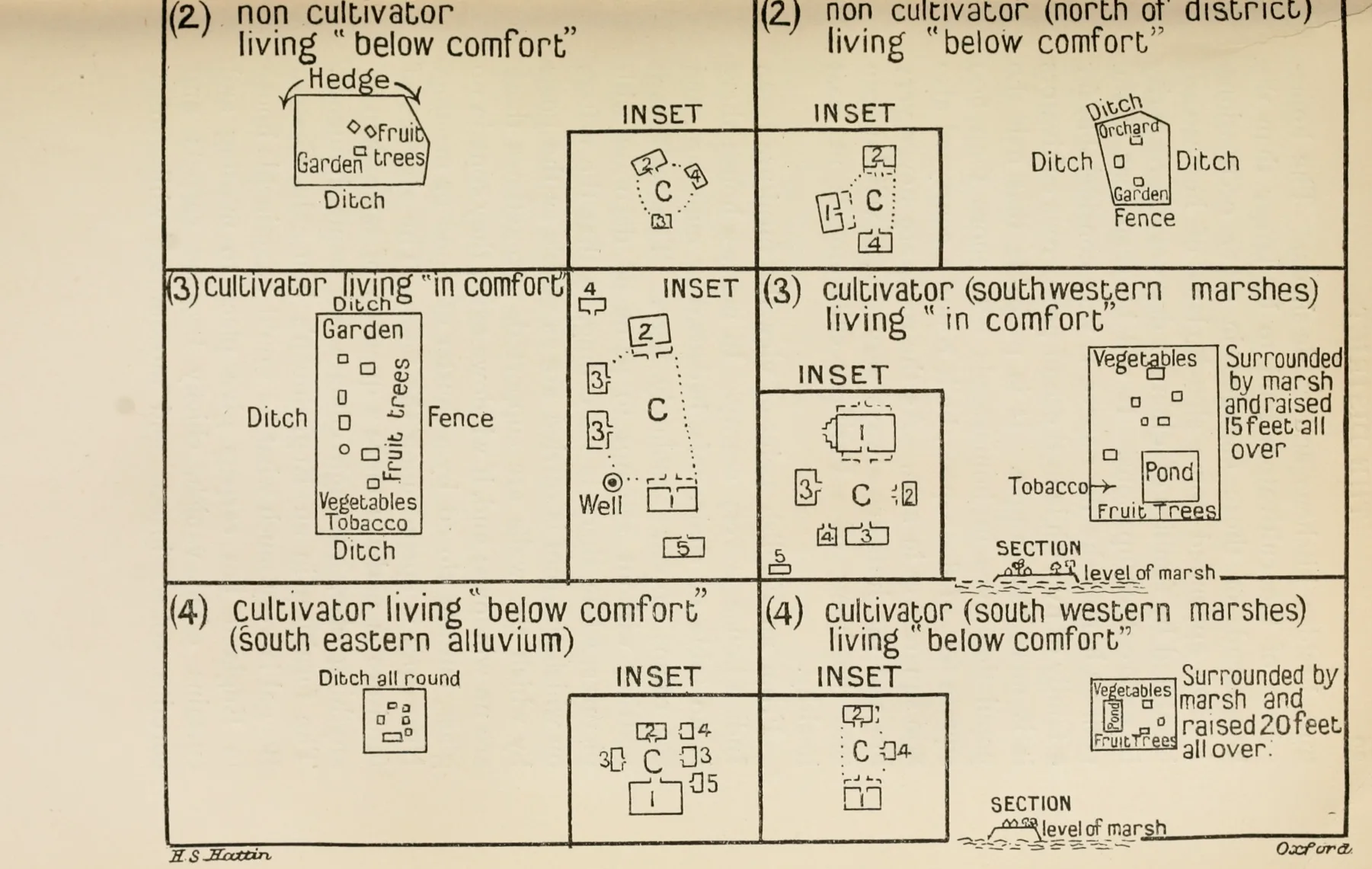
The homestead is neither a cottage nor a house as Europe knows them, that is to say, a building containing several rooms and probably two floors under one roof. It never consists of a single hut—even the poorest families always have a separate kitchen—and the huts, being cheaply made of materials grown on the land or locally obtained, are never strong enough to carry an upper story. A prosperous family builds larger huts and more of them; thus most cultivators in comfortable circumstances have five or six separate huts in their homesteads. Other classes of the community plan their houses in the same style, those who are prosperous usually erecting four or six huts, those who are poor contenting themselves with two or three. It is only in the main streets of towns or trading centres that a single hut is found sufficient and even then it is usual to contrive a detached kitchen. In the common model the huts surround an open courtyard, the dwelling-rooms often having verandahs opening into it. The largest hut will be used as a parlour in which guests are received; no friends or strangers will be admitted to any of the other huts, which will usually be smaller and be used as bedrooms by the family. Each hut will be raised on an earthen plinth one or two feet above the level of the courtyard. The most usual arrangement is to place the parlour facing down the avenue which leads to the homestead. All the huts will have doors, which will, however, only be closed at night. These houses are very rarely constructed of masonry, not so much on the ground of expense, but partly because the landlord will not permit it and partly because there is a preference in favour of mat houses on the score of healthiness. This preference is certainly well grounded, as even without windows and with doors shut sufficient air can get in to keep the atmosphere sweet, while in so mild a climate as that of Bengal protection against the weather is unnecessary. If houses were constructed of masonry, they would necessarily be very much smaller, and in every way it is wiser for the people to continue to build them of matting. It may be mentioned that Englishmen with large incomes prefer to build houses with mat walls than to live in the smaller and hotter brick houses as in Europe. The matting of which the walls are made is woven of reeds or grasses in large sections and is usually very tough. The poorer cultivators weave it of jute sticks, which are neither so durable nor so successful as a protection against the sun or the rain. In the houses of the more prosperous cultivators the door is usually made of wood and the posts inside the house to which the mat walls are nailed are substantial beams, but in the houses of the poorer classes the walls are often carried on bamboo poles and the doors are often made of matting like the rest of the house. The floor is made of earth, which is beaten with a pole until it is absolutely level and then covered over with a layer of liquid mud. This dries quite hard and gives a surface which remains for a considerable period as firm and level as a concrete floor; when it breaks up, inequalities are levelled again and a fresh coating of liquid mud is run over the surface. Most of the poorer houses are thatched, but a very large proportion of the cultivators now roof two or three of their huts with sheets of corrugated iron, which are sold in the larger markets. In some parts of the country tin-roofed houses are a common feature of the landscape and almost every homestead has at least one hut roofed with tin; but communications are so bad in the interior that, away from the single line of railway or the steamer routes on the big rivers, transport is a great difficulty and tin roofs are much rarer. In the district only one homestead in every two hundred has a brick house, but one in every seven has a tin-roofed hut and in the south-east one in every four. In the west, however, where communications are at their worst, only one homestead in every twenty has a tin-roofed hut, despite a higher level of prosperity. The advantage of a tin roof lies in the protection it offers against fire, which in the dry hot months is very prone to attack a thatched roof. It is much hotter and less healthy than thatch and affords no better defence against rain, if the thatch is well made. The people themselves say that thatched roofs keep a house warmer in the winter.
The figures show that the average homestead of the district amongst all classes contains two separate
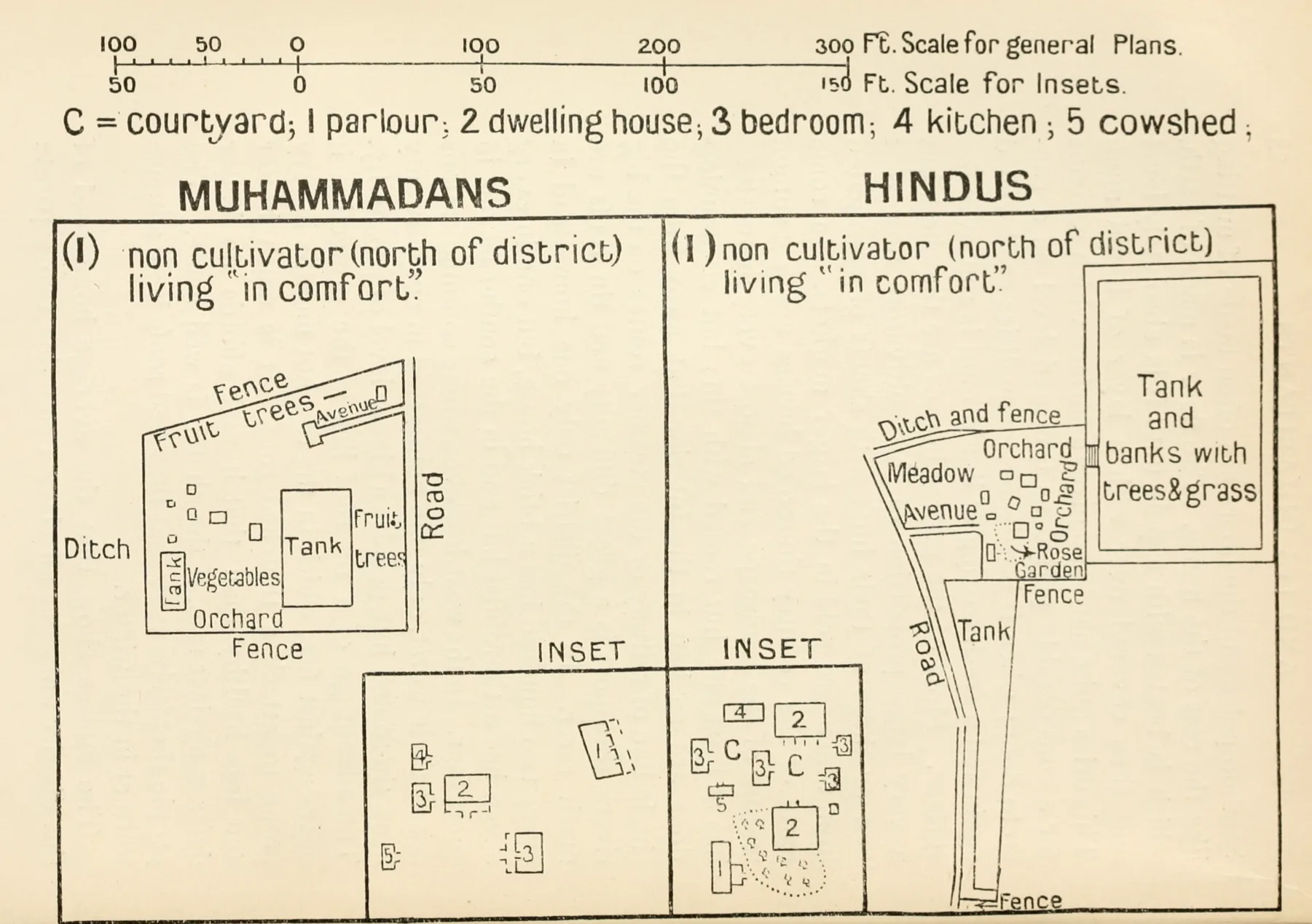
300 Ft. Scale for general Plans. 150 Ft. Scale for Insets.
C = courtyard; 1 parlour; 2 dwelling house; 3 bedroom; 4 kitchen; 5 cowshed;
HINDUS
MUHAMMADANS
(1) non cultivator (north of district) living "in comfort".
(1) non cultivator (north of district) living "in comfort".
H. S. Hattin
huts besides kitchens and cattle-sheds. The homesteads of the cultivators tend to be larger than the homesteads of those engaged in other occupations. I have appended some sketch-plans of homesteads inhabited by families of different degrees of prosperity in different occupations. It will be seen that in the poorest homes the floor-space is very considerable for a family of five, while in those of prosperous cultivators it is more than ample. It is probable that half the population lives in homesteads with more than 800 square feet of floor-space, built round a courtyard also 800 square feet in area. As the roofs are never very low and the huts are always very airy, it will be seen that the home of a Faridpur cultivator is at least healthy.
From an English point of view the furniture in an Indian house is very scanty. In many a house there is no table or chair, sofa, bedstead or cupboard, and the rooms appear absolutely bare. The walls are matting without attempt to paint or decorate with pictures, while there is no ceiling, so that the rafters on which the roof is carried are as visible as the posts by which the walls are supported. Sometimes there are no windows; and, if windows exist, they contain no glass, but are closed by a shutter of wood or matting. No carpet is spread upon the floor. The absence of furniture is perhaps more a question of taste than of anything else, although climate has some influence. The furniture in an Englishman's house in Eastern Bengal is very much what he would have in his house in England, but carpets give place to matting and curtains often vanish, chiefly because carpets and curtains collect insects and mosquitoes, while sofas, chairs and bedsteads are lightly made, often of cane. A wealthy Bengali, unless he keeps one room furnished in the English style for entertaining English guests, has as little furniture as a member of the poorer classes. Cupboards are rarely to be found even in the houses of the most wealthy; linen is usually kept in boxes or chests, often richly decorated with brass work. A Bengali always eats off the ground from a sheet or mat and squatting on his haunches. He will not eat off a table, even if his house contains one. If he sits on a chair at all, he selects a very low stool, for to sit on a chair of the ordinary size is to him not at all restful; when he is tired and requires a rest he will squat on his haunches, however many chairs he has in his house. To beds there is not the same objection, but of all articles of furniture bedsteads are the most expensive and cheap bedsteads are of little use. In truth the absence of internal decoration and of furniture is not a question of money, but a question of taste. The wealthiest Bengali who is untouched by foreign influences keeps as bare a house as his poorer neighbours and eschews ceilings, painted walls and furniture as completely as they do.
Perhaps the best means of conveying some idea of the interior of an Indian house and of the life led by the people who inhabit it is to describe exactly what was found in a few houses occupied by families of different classes. The homestead of a cultivator should be examined first, for cultivators form nearly 80 per cent. of the population. The huts will vary in size and number according to the prosperity of the family, but six huts appear to be the normal number, of which one will be a cowshed, one will be a kitchen and exclusively used as such, one will be a parlour for the entertainment of guests, one will be the ordinary dwelling-room and the remainder will be used as bedrooms. The less prosperous cultivators do without one or other of the bedrooms or without the parlour. In a homestead of this kind taken at random the kitchen contained two clay fire-places and a dozen earthen jars of large size filled with different kinds of eatables, while hanging from the walls were the cooking-pots made of brass, an iron pan, a mortar and pestle for husking purposes, a few knives and a jar full of water. The parlour contained a verandah, in which was placed a huge bedstead made of wood which is used in the daytime as a table or couch, as it has a flat wooden top. Inside the parlour there was a large wooden chest and ten large jars containing rice: on the walls hung a row of little brass pots and empty bottles. Raised from the ground and hanging from the roof there was a mat ledge, which is used as a cupboard. This is of large size and heaped upon it is all the bedding of the family—pillows, sheets, and blankets—and all the clean linen for the use of both men and women. Another shelf supported an ink-pot, a looking-glass and a brush and comb. Several bags and a few jars containing biscuits, sweetmeats and betel nut hung from different parts of the wall. On another shelf were some neat clay figures as ornaments and a lamp. A pair of shoes, several pairs of slippers, a fishing-rod and a fishing-net completed the contents of the hut. In one of the bedrooms there were a bedstead, a mat shelf to carry the usual earthen jars and a spinning-wheel. The other bedroom contained much the same furniture. One of the huts was used as a dining-room; it contained nothing except a shelf to hold fuel and a few sheets for the family to squat upon when eating. Along the wall were five brass plates, four brass cups and two glasses. The paddles for the boat of the family are kept in a corner. The best hut and the chief dwelling-room in the homestead had walls of split bamboo woven into a very artistic pattern. In the verandah at the door were two earthen jars, two feet high, besides a great deal of fishing-tackle and several garments. Inside the hut there were one tin trunk and one wooden chest as well as four cushions, several cane baskets, a large brass jar and a large pile of the best clothes of the family, including their fez caps and shoes. In one corner there was a lamp on a lamp-stand and there were the usual small jars for betel nut, betel leaves and lime, with which every guest is entertained; along the walls was the usual row of earthen pots containing rice, vegetables, condiments, sweetmeats and other foodstuffs.
Generally speaking, the houses of all cultivators are similarly filled, the most conspicuous features being fishing-tackle of all kinds and the rows of jars in which rice and other food is stored. If there are any chairs and caned stools, they are usually kept in the parlour, one or two at the most being kept in the general dwelling-house. In the poorer homesteads the most obvious signs of poverty will be holes in the walls of the huts and the absence of brass plates, pots and jars. There are rarely any pictures or prints on the walls except coloured photographs of the King and Queen, although in Hindu houses pictures of gods are sometimes found. The houses of non-cultivators of the working-classes are furnished in the same fashion.
The huts are usually not so numerous or not so large, because the non-cultivator does not, like the cultivator, store rice and other foodstuffs for the consumption of a year. Occasionally a separate hut is kept entirely as a granary, in which case earthen jars containing rice are dispensed with in other rooms of the homestead.
The first comment which springs to the lips on an inspection of these interiors is that the Bengali house seems rather a store and a place to sleep in than a place to live in. These are indeed its uses. The menkind, who rise at dawn and go to bed soon after sundown, spend little time inside their houses except at night, as by favour of a mild climate they can live in the courtyards or the verandahs on most days of the year. Thus, although close-woven mats with a polished surface are kept in most houses as covers for the floor, they are usually spread in the courtyard and not within the huts. The womenkind spend most of the day inside the house, but their comfort and their tastes are little considered by the men; and if they were, the women must improve them by the light of nature, for they are not permitted to visit the houses of their neighbours. This accounts for the absence of all attempt to beautify or make comfortable and for the indiscriminate use of every room, even parlour and principal dwelling-hut, as bedroom as well as living-room; while the use of the house as a store-room accounts for the rows of jars, great and small, containing all varieties of food, for the fishing-tackle and for the clothes, linen and shoes which are to be seen in every room. Wooden cupboards are wisely avoided because of the countless moths and other destructive insects which they attract in so hot and damp a climate and because of the rats and mice which they too effectively conceal. Despite their absence there is not that untidiness which might have been expected. The garments of the family are chiefly cotton sheets, which fold neatly and take up little space.
The ideal domestic standard of Bengali society in these country districts may be shown by a description of the homes of a well-to-do Muhammadan gentleman who sees something of the officials and has travelled in other parts of India and of a prosperous Brahman amongst Hindus. The home of the Muhammadan is placed in the centre of a large garden, which covers nearly an acre and a half and contains a splendid pond or tank. There are five main huts, all with walls of matting, but of the best kind of matting, the larger with tin roofs and verandahs, the smaller with thatched roofs. The fruit-trees in the garden surround the huts on all sides and conceal them entirely from outside view. An avenue leads up to the guest-house, which is the only room into which the outside world can penetrate. This is divided by a corridor of matting into three rooms, each of which has a separate door on to the verandah and several windows with iron bars. The verandah has a neat wooden railing. In the hall there is a hanging lamp, a writing-table with writing materials, a shelf with a large number of books, a long bench upon which books are usually placed, a small round table, a praying-mat, two chairs, a steel trunk and a cane stool. Formerly there was a carpet, but when the tables and chairs were introduced the carpet was stowed away in the trunk and matting substituted for it. There is the usual jar of water and glasses which are to be found in every house. On the walls hang the clothes of the family; in this case the clothes for ceremonial occasions. There are also two war maps and some war pictures. In a corner of the room there are two wooden bedsteads with large pillows and coloured quilts. In another room, where a shelf carries a copy of the Koran, the Muhammadan Bible, there is a bench, a steel trunk and a wooden chest on which lie several novels; on the floor there is a rug, and in a corner there is a bedstead with bedding and quilt upon it. Facing the door there is a large mirror and beside it a large wooden chest containing a carpet, table-cloths and dish-covers, dresses for ceremonial occasions and clothing for the winter; on the top lie two decorated hookahs from Northern India. On a matting shelf there are a dozen brass pots for use when necessary. The furniture in the third room is very similar.
The second hut, which is walled with coloured matting in an oriental pattern, has a verandah and is used as the living-room of the family. It contains a camp table, a cane chair, a filter and a bamboo stand for four water jars, two cane stools, some large shelves of matting which hang from the roof and carry a variety of household requisites in the usual jars and all the crockery of the family, which is here of china or glass. In the centre of the room there is a bedstead and in a corner a brass lamp, a lamp-stand, two or three lanterns, two hookahs and two brass spittoons. Along the walls are three other bedsteads with mattresses, quilts and pillows and a cupboard which contains the work-a-day clothes of the family. One of the other huts is merely a bedroom with bedsteads, trunks and a large supply of linen of all kinds. The spare foot-gear of the family is kept here, besides a number of earthen jars containing the best rice. This is the bedroom of the mistress of the house, and it is curious to see that her toilet aids consist of one small looking-glass, one comb, a few hairpins, three or four pieces of black ribbon, one ball of thread and two needles. Another house in this homestead, which belonged to a son who died recently, is now in great disorder. It contains three benches, a chair and a stool, one cupboard and the usual bedstead, besides boxes and trunks which are full of the clothes which the son used to wear; he was something of a dandy and had many. The fifth house is the kitchen. It has the usual clay hearth with two mortars for husking purposes, several brass pots and two brass plates, and all the other crockery of the family—china plates and cups and glasses. Two small houses in the rear are used as a cowshed and a goatshed, the latter containing two large crates in which poultry are kept.
The Muhammadan was a man of the old school and had not received a modern education; but his home shows more traces of western influence in its furniture and arrangement than is usual amongst the most advanced and educated of Hindus. Educated Muhammadans are even more modern in their tastes and appear to have a natural instinct for the manners and social customs of the West.
At the risk of being wearisome I will complete the picture of domestic life in the district by describing the home of a Hindu of high caste in easy circumstances. He is not by any means one of the wealthiest inhabitants in the district, but he is a professional man with a modern education and a leader of the orthodox community, and his home will illustrate how far a Hindu imbued with the new western education is willing to amalgamate western and eastern domestic arrangements. He lives on the outskirts of a small country town and corresponds roughly in social position to a doctor living in an English country town with an income of between £500 and £1000 per year. In this Brahman's household there are five adult males, five adult females, three boys and four girls, a total of seventeen people. The houses and garden cover 2½ acres. In the homestead there are altogether eight separate huts of different sizes, besides a cowshed, the principal hut opening on a formal rose garden in the English style. The buildings are surrounded on all sides by land which is half a meadow and half an orchard, the fruit-trees in some measure screening them from view. An avenue leads to the principal dwelling-house and the guest-house. There are two courtyards, the larger and outer surrounded by five huts containing all the living-rooms, and the smaller opening from the larger and surrounded by the four smaller huts, two of which are kitchens, one a bedroom and the fourth the cowshed. Behind the main courtyard there is a large pond, shaped formally like a parallelogram and covering nearly 1½ acres, the banks of which are high and grow tall thatching-grass and a profusion of fruit-trees. This is the bathing-place of the family, and a flight of masonry steps leads to the water. The guest-house is somewhat apart from the courtyard, and behind it there is another large pond from which the drinking-water of the family is obtained. Both of the ponds were excavated mainly in order to raise the land of the garden and houses well above flood-level ; but a pond must in any case have been made to preserve privacy for the daily bath of the ladies of the household. In such a low-lying country as Eastern Bengal half of the land upon which the residence is placed must be sacrificed to a pond in order to raise the remaining half to a height which permits life to be maintained in health and comfort. Cultivators dig this pond themselves, but to the upper classes the cost of raising the land is a very large part of the expense of building a residence.
In internal arrangement and furniture the home of this professional man is very little different from the homes of cultivators ; in size and in strength and quality of materials it is better than the ordinary cultivator can afford, but no better than the more prosperous cultivators can and do provide for themselves. It contains in the same way a bewildering profusion of earthen and brass jars, as it is the custom of the upper class to buy rice for the whole year when the price is low, as well as supplies of other food for long periods. Very few homes contain a separate granary, chiefly owing to the depredations of rats, and no houses contain store-rooms or pantries, so that all the vast amount of food-stuff required by a large family must be stored in large or small jars which are scattered over all the huts of the residence, as many being found in the bedrooms as in the kitchen and dwelling-rooms. In this particular residence there are two kitchens, the smaller of which is used only to fry rice and not to cook the main meals of the family. The larger kitchen has strong walls of matting and a roof of corrugated iron. It is divided into two parts, of which the outer, a wide verandah, is used as the dining-room of the family and the inner, separated from the verandah by a strong wall, as the kitchen. In this kitchen there are five hearths for cooking and a brave array of cooking-pots and pans of iron, copper and brass, besides several metal waterjugs, sixteen cups and plates and eight tumblers, all of brass or of bronze alloy, as the Hindu prefers to eat off metal. Of the other huts, one is the guest-room, two others are the main dwelling-rooms of the family, although used also as bedrooms, one is exclusively used as a bedroom, and two smaller huts are used partly as bedrooms and partly as store-rooms. All these huts are strongly walled, the three larger partly of timber, and all have roofs of corrugated iron. All contain bedsteads (or taktaposh), the large, low, square, wooden tables which are used as beds at night and as tables in the daytime. The walls of all are hung with garments and linen of the family, while along the floor in rows stand earthen and brass jars. From the ceiling hang the large matting shelves upon which supplies of linen are promiscuously heaped at the side of plates and cups and jars of sweetmeats and spices, for the Hindu has much less idea of neatness and order than the Muhammadan. Material for chewing pān (betel) has a conspicuous place in every hut, while usually a shelf will carry articles of toilet.
It would be tedious to describe in detail the contents of any of these smaller huts, as a description of the guest-house and the main dwelling-house will serve as an indication of the contents of the rest. It may be said, however, that in the whole residence twelve huge, twenty-five large and forty small earthen jars were counted, besides twenty-two large and fifteen small brass jars and twelve baskets for holding vegetables, fish and fruits.
The wide verandah of the guest-house contains one chair, a long stool and two benches. Inside, a portion is walled off to serve as a bedroom for a guest, but it contains only a single taktaposh; the rest of the house contains two taktaposh, which are used chiefly as tables, as this is the office of the master of the house; but they will serve as bedsteads in the event of guests arriving. In the main room there is another chair and two long low benches for visitors of the lower classes, as it is a custom in Bengal for people of all classes to call on the well-to-do and pass the time of day. The room contains a bookcase, three lamps and several fishing-nets. The articles more immediately necessary for the welcome of guests are five hookahs and smoking materials, the hookahs being scrupulously kept apart for the different classes of the community, two for the Brahman caste, two for Hindus of lower castes and one for Muhammadan visitors; in no case will any of these be used by people of another rank or denomination. A visitor is offered a smoke from his own particular hookah, just as a visitor in China is offered a cup of tea, or he is served with a leaf containing betel-nut and lime, which is as popular with high-caste Hindus in Bengal as chewing-gum is with Americans. Another interesting feature is a row of shoes and sandals ranged along the wall, which are offered for the use of guests.
The main dwelling-house is a very large room, flanked by two corridors, which are separated from the interior by mat partitions, and with broad verandahs on the north and south. It has altogether nine windows, each of which is carefully fenced with iron bars. One side of the room is used chiefly by the adult men of the family and the other by the boys. Although this is the principal dwelling-room of the family, yet the floor is the usual smooth mud, not covered with either mat or carpet. On the boys' side of the house there is a writing-desk, clock, bookcase and two small wooden chests, no chairs or stool : on the men's side there is a large easy chair, a long bench and a footstool, a writing-table and a large clock, two bookcases, one of which has a glass front and both of which are well filled, chiefly with novels and religious books, but the glass bookcase also with a shelf of the wonderfully modelled and painted clay figures representing Hindu deities. There are, besides, an iron chest to contain jewellery and valuables, three steel cash boxes, four tin trunks and one huge wooden chest which contains the plate, valuable crockery and richer garments of the family. On the walls there are several gaudy prints, chiefly mythological or religious in character. The corridors which contain only bedsteads and clothes are used as a bedroom by most of the family. There are seven prints on the walls, four of religious subjects, one of Queen Victoria and the other two of English women. In the verandah are a bicycle and a tennis bat.
The life of the cultivator in Eastern Bengal is in many ways a very happy life. Nature is bountiful to him, the soil of his little farm yields in such abundance that he is able to meet all his desires without excessive work. He can produce the food of his own family and sufficient to purchase everything else which he requires from a few acres of land that he can cultivate unaided without overwork. The whole of his labour is over in three months if he grows a rice crop only.
He may take a second crop out of the land by sowing a spring or autumn crop. If he sows a spring crop, he pays it but little attention and only for a very short period, while if he sows an autumn crop he sows it only on a portion of his land and thereby reduces his work. In those parts of the country in which jute is grown he works at two seasons of the year, growing rice on one portion of his land and jute on another; but many of the cultivators content themselves with the winter rice crop and so put all their labour into the months of March, April and May. The harvest, which most of those who can afford it get in by hiring the labour of others, takes place in November. If they have decided to grow a spring crop, they will spend a day or two in December in preparing the ground and in planting the seed and will give very little further attention to it. If they grow the autumn crop of jute, they will need to spend much labour in July and August at the time of harvest in steeping and stripping the fibre. This work will not fill the whole of the day, but will be sufficient to occupy their energies for a few hours of every day during a month or six weeks. The time-table of the cultivator, therefore, when his land is unfit for jute, shows three months' hard work and nine months' idleness; if he grows jute as well as rice, he will have an additional six weeks' work in July and August. These are not conditions of which he can reasonably complain.
During the months of March, April and May, when he is really hard at work, the cultivator will get up at sunrise about five o'clock, smoke for a few minutes at his hookah and go forth to his field with his plough and cattle, where he will plough in the heavy soil until his children arrive with his hookah and tobacco. From that time until 9 or 10 o'clock he will work and smoke by turns. The children will bring him his breakfast to the fields about 10 o'clock and after breakfast he will continue his ploughing until noon. As a usual thing the breakfast consists of the rice cooked the evening before, heated up and mixed with green pepper (pantha). When his work is over at midday he goes off with his children for a bathe in the nearest river or stream, or in the pond near his house. He then returns to his house and eats the midday meal which his women-folk have prepared for him. This consists of rice mixed with a liquid preparation of pulses (dal) and a curry made of vegetables and fish. After his midday meal he will go to sleep for an hour or two and set out for his field about 3 or 4 o'clock, when he will engage himself in either harrowing or weeding. He will work in the field until dark and sometimes even later, if the field be close to the homestead; ordinarily, however, he is too superstitious and too much afraid of ghosts to work in the dark. On return to his house he will wash again, and if the night is, as usual, fine and balmy, sit on a stool in his courtyard and smoke hookah after hookah while his neighbours drop in to have a chat about the crops. At 8 or 8.30 they will go off to their evening meal and he to his, very much the same food being eaten as at the midday meal. After his meal is finished he will smoke for a short time and retire to rest usually about 9 or 9.30. He sleeps on a blanket or sheet on the floor of his hut, although some of the prosperous cultivators sleep on beds with or without mattresses, and often with a mosquito curtain.
At other seasons of the year the cultivator has very little work in his fields and rarely pays a visit to them. If he has sown jute or an autumn crop, the ploughing has also been finished in April, but he will be busy with it at the harvest time in July and August. The harvest of the autumn rice crop is a simple operation taking only a few days, but the harvest of the jute crop is much more laborious. He has to cut it by degrees, steep it in some neighbouring water, which lies everywhere after the torrential rains at that season of the year, wash it and strip the fibre; all of which will occupy him for perhaps a month from early morning till the afternoon. He rarely pays a visit to his fields after the midday meal.
In the winter, from December to February, he is only engaged in the harvesting of the winter rice-crop, or perhaps, if he sows a spring crop, he may spend one or two days in ploughing and harrowing the ground and a few hours in February in harvesting the crop. The winter rice-crop is cut by hand by a small hook sickle. It is exhausting labour, as the reaper has to squat down and bend to it. However, the owner always hires a few men and employs his children with them so as to finish it in a few days; even when he has much land he arranges to finish harvesting within a week. He provides the hired labourers with breakfast and supplies them with tobacco to smoke in their frequent intervals of rest. They work until the early afternoon and receive as wages one-sixth part of the crop. After returning from the field he will take his delayed midday meal and occupy himself in the evening with thrashing the paddy in his courtyard. The cattle are tied to a central stake in the threshing floor, round which the paddy is piled, and are driven by him round and round until the ear is completely separated from the stalk. The stalk is then removed and the ear collected and passed through a sieve, when it is made over to his women-folk to husk. He does not forget the old injunction, ‘Thou shalt not muzzle the ox that treadeth out the corn’. Next morning at dawn, his first duty is to apportion the crop between himself and his labourers. In the east and south of Faridpur the whole of the rice harvest in many villages is cut by cultivators hired from neighbouring districts such as Nadia, who are lodged and fed by the owner for the week or fortnight during which they are employed. In the meantime he himself takes boat and goes off with a party of his neighbours to the fertile lands of Bakarganj and Mymensingh, where the cultivators are much too prosperous and much too proud to harvest their own crop and always import labour from other districts for the purpose. Here he gets his food and one-fifth of the crop as wages, the crop being so luxuriant that his share supplies his family with rice for the year and far outweighs the portion of his own crop which goes as wages to its harvesters.
During the rest of the winter the cultivators spend their days in comparative idleness. If there is water in the streams or marshes they go out fishing with rod or trap, and they always spend much of their time in mending their fishing-tackle to be of use in the rains, when fishing is at its best. They also spend no little time at this season of the year in repairing their houses and in thatching such as require it. For the rest of their time they either smoke away the day or attend one of the frequent markets and gossip with their fellows whom they find there.
During the dismal period of the rains, from July to September the cultivators spend much of their time in fishing or in visiting friends. At that season of the year water is everywhere, deep lakes forming in all depressions, the rivers and streams overflowing their banks, and water lying to the depth of a foot even in the highest field. Fish, both large and small, are innumerable, and some of the larger fish come swimming over the fields and are to be caught there. During this season of the year practically all men in the district go a-fishing, for which they have a variety of contrivances in rods, spears, nets, traps and baskets. With a rod, which is usually baited with smaller fish or grasshoppers, they tempt the bigger fish in the streams, but although fishing with a rod is an amusement eminently suited to their indolent natures, they are even more fond of spearing fish from a boat. Two or three will go together in a dug-out paddling over the fields, one will steer and the others standing in the bows will fling the spear at any fish seen moving through the shallow water. The spear is weighted with a barbed hook at the end (sometimes with one, sometimes three and sometimes seven barbs) and is thrown with wonderful accuracy, rarely missing its mark completely. This form of fishing is only possible on windless days, as the fish do not come over the fields when the shallow water is much ruffled into ripples. On other days the cultivator sets traps or nets, made of bamboo or string, with a pocket or purse in which the fish are caught. He visits them in the morning and evening with a basket and collects his catch. Another method of fishing in the fields which is very popular is the use of domeshaped baskets which are open at the base. All the villagers collect, each bringing a trap of this shape, and walk along the shallow water in the field in line with the traps in front of them. The traps are dropped simultaneously on the bed and no gap is left between them, so that the whole line is scoured. Any number of small fish are caught in this way and as the field is swept to a finish very few of the fish can get away. In the smaller streams other means are adopted besides the rod for catching fish. Most days and every night several nets and traps can be seen in every stream. The cultivator may walk along the bank with a net shaped like a lacrosse or butterfly net and attached to a bamboo pole. He will scoop it upwards through the water and with wonderful quickness fling any fish caught in it on to the bank. Or he may use a net shaped like a parachute and weighted all round the hem, holding it by a long rope attached to the crown. He will swing this out from the bank with a rapid jerk and, if he is dexterous, it will open wide and fall level on the water, when the weights on the end will gradually sink down, catching any fish which may be underneath in the meshes. Often he nets fish from a boat with nets which are shaped like large purses or bags and are fitted to the prow with a bamboo pole rising up as a lever. The boat is driven along at a rapid pace with the net spread out under the water; as soon as the fish is caught the bamboo pole swings slightly forward, whereupon the attendant at the prow jerks it back, raising the net out of the water and securing the fish. In the larger rivers and especially in the southern part of the district fishing from a dinghy, a large canoe, is very popular with all classes, the butterfly type of net being used by hand or with a rope, or more frequently an enormous net the size of a sail, which is fixed like a sail to a bamboo pole rising from the centre of the boat. This net is triangular in shape and rests upon three bamboo poles, which are secured to each other at the ends, the one which is used as a mast being fixed in a movable socket so that the whole net can be dipped over and sunk into the water. After it has been in a minute or two it is raised up and the fish secured which have been caught in its ample folds. It may be imagined what dexterity and watermanship are necessary to keep a long dug-out or canoe on an even keel and driving forward with such a weight swung over one of the sides. But this form of fishing is very popular in the great rivers of the south, which at the height of the rains on a breezy day present a most lively scene, the fishing fleets of the different villages collecting in hundreds, each boat with a triangular sail of many colours bellying in the breeze, each with a steersman standing at the helm to guide it as it drives rapidly before the wind, and each with a fisherman crouching intently over the prow, ready to jerk the net by pole or rope as soon as he discovers that a victim has been caught. The extent to which the villagers are devoted to fishing will be shown by a cursory glance inside the huts of any homestead, where rods, spears, traps and nets will often be seen of twelve varieties and rarely of less than six.
Once a week during the rains, if any marshy country is near, the cultivators will go off for the whole day in a party of five or six, each in his own boat, to cut marsh grass for the cattle. This is a more succulent food than might be expected and is a useful variant to the straw of the rice-crop. When water is everywhere, the cattle find little grass to eat and without such marsh grass are apt to lose condition very rapidly.
Another amusement of the cultivator during the dull season of July to September is a visit to his friends and relatives in other villages. This is more common amongst Muhammadan than Hindu villagers. When he visits a relative he will stay in his house, if there is room, as well as take his meals with him, but usually when he visits a friend he will only eat with him. On these visits he takes the entire family with him in a boat which is somewhat larger than the dinghy and must usually be hired, although many of the more prosperous cultivators possess one. This boat is about 15 feet long and 4 feet in beam and carries towards the stern a tunnel-shaped cabin about 6 feet long and 3 feet high, made usually of thick matting, but sometimes of corrugated iron. The entire family lives in this diminutive cabin, cooking such meals as are necessary on a fire improvised in the bows of the boat. During these visits the children play with the children of the village, the women cook the meals, and the cultivator smokes and gossips through the day or plays cards with his friends.
But the chief amusement of the cultivator at all seasons of the year is to attend the neighbouring markets on market-days. Probably ten or twelve such markets will be within walking or boating distance of his homestead, all of which he will attend in turn, even in his busiest season finding time to go to two markets a week and during the winter and the rains, when he has nothing to do, going usually to four or five and sometimes to a different market every day. No women go to market in Bengal, yet an infinite deal of chaffering and gossip is needed for the transaction of a very little business. The cultivator goes to market with his sons soon after his midday meal and will often forgo his midday sleep to attend a distant market; he leaves again at dusk. He does not ordinarily go to buy anything, but to talk with his friends and neighbours. He often smokes there but never eats or drinks anything. Muhammadans drink no alcohol in any case, and there are no tea-shops or restaurants at any of the markets. Even if he buys some soda-water or lemonade or sweetmeats, of which he and his children are inordinately fond, neither he nor they will consume them at the market. If he buys fruit, mangoes or lichis, one or two may be eaten at the market and he may drink a little water from the stream; but he finds his amusement in the idle gossip of a few hours amongst the crowd, in noting the price at which country produce sells and in looking at the cattle and live stock brought for sale and the price which is asked for them. On such occasions all disputes between neighbours are canvassed and advice offered, sometimes to conciliate the parties and sometimes to embroil them further. A cultivator may attend a market every day of the week and not spend more than fourpence altogether, but when he has money the Muhammadan at least is a great spendthrift. In the harvest season nine out of every ten cultivators returning from the market will carry an earthen jar full of sweetmeats and at least a pair of the best fish obtainable, whatever may be their price; if the large jack-fruit, which is not unlike a melon and a great favourite with the cultivator, is in season, he will carry home two or three also.
The women-folk in the family have a much less varied time. They have no seasons of work and seasons of idleness, but must work throughout the year at duties which are always the same. They get up before the men, sweep the yard and then the floors of the houses, sprinkling them with water and brushing them with a wet brush. The floors of working-class houses are always kept scrupulously clean and the brass jars and pans are always shining. The women next scrub all the cooking-pots and pans and take the pestle and mortar to husk the rice which will be eaten during the day. They then collect vegetables and other condiments and prepare the ingredients for the midday meal. After this they go to their pond or the nearest stream for their daily bath, taking with them a jar to bring back such water as may be necessary for cooking. During the rest of the day they are employed in cooking the meals for the family, keeping the houses clean, washing clothes, looking after the young children and tending to the sick. No woman is ever supposed or allowed to take any rest while husband or brother or father is in the house; or is ever allowed to eat until all the male members of the family, including her little sons, have finished their meal. The women in Eastern Bengal, with the exception of Christian women in the marsh country who are very few in number, do no work of any sort in the field. The only part they take in the agricultural round is to husk the rice both for sale and for consumption, although if jute is grown they are employed during the mornings in the homestead or very close to it in stripping the fibre after it has been steeped and dried. In this manner they may spend three or four hours every morning for a few weeks. Theirs is a dull life indeed; the bustle of the market-place is not for them, nor the gentle pleasures of the fisherman. They take no part in the conversation of the men and are not allowed the simplest amusements; they can only gossip with their women friends, when washing pots or bathing in the pond or public stream. But custom is a kindly autocrat who softens every hardship. They do not grumble or rebel and are not discontented with their lot; they do not know and do not want the charms of a fuller or a freer life.
The children in a Bengali family have a very easy life. The fathers are very fond of their boys and retain that fondness, at least to outward appearance, far longer than an ordinary father of an English family. Amongst the English working-classes there is little obvious affection between father and son after the boy has reached the age of fourteen and become rough; in an Indian family the bond between father and son remains very close even after the son has married and got a family of his own. At all times the father is never happy unless his boys accompany him to the field or in his fishing. When quite little lads, the boys take out breakfast to the father in the field and prepare tobacco for his occasional pulls at the hookah; when the morning’s work is done they drive the cattle back for him; in the afternoon they take off the cattle to graze and look after them. This is not always an easy task, as an Indian village has no meadow or set pasturage and the cattle pick up what they can on the grassy balks between the fields and on the roadside. They scatter very much, and the little lad must keep them from feeding on the crops of the neighbours, because it is only too easy, as there are no hedges to the fields, for the cow to stray from the grass into the fields of grain. The boys collect together while cattle-tending in the afternoon and play country games which require a good deal of activity. In many of the larger villages near schools and towns they play football in the evening; and even cricket, a more expensive game, is not unknown. Before going out in the afternoon with the cattle, they are usually given a simple meal, which amongst the more prosperous may often include ginger-beer or English biscuits, of which they are very fond. As the boys get older they help their fathers in the field and especially in weeding and when they reach the age of fourteen they take their place as a man in the whole of the agricultural round. Only a few of the village lads go to school, and village schools are very primitive institutions. There is no prejudice against learning, but even the most careless observer must notice the tendency of lads who have gone to school to refuse to work in the field and to despise their unlettered fathers. Elementary education may be a very blessed thing, but it would seem that in an agricultural country it needs to be universal, if it is not to prove a curse. The boys and the girls of a village never mix or play together after the age of six; but perhaps the most conspicuous feature of a Bengali village to an Englishman is the quietness of the boys, the lack of laughter and of the rough-and-tumble games so common amongst English lads of all classes. This is not due to hard conditions of life, for the children are well fed and well cared for and are ruled with a light hand. It may be an effect of the damp and depressing climate; but whatever the cause, boisterous merriment and merrymaking is not in Bengali character amongst old or young. On winter evenings it is a custom in some villages for boys to go out in parties round the homesteads and collect coppers by singing ballads to their elders. These ballads are written by rustics in the country dialect and are full of simple repetitions. They are often humorous and usually about local happenings which have struck the imagination of the village. The most popular of these ballads deal with the misfortunes of the great and describe their punishment with realism and relish. The elders like to hear the same ballad again and again; when it is ended they turn it over and over in their minds and gossip about it endlessly, wisely whispering obvious comments to their beards with many a shake of their heads. In the simple Bengali village this is the only amusement open to the villager in the long evenings. There are no inns or clubs or recreation-rooms, cards and dice are rarely played and other indoor games are unknown. There are no neighbouring towns with theatre or picture-palace and, if there were, there is no railway or other means of conveyance to them. Happily the villagers have not yet learnt to want them and are quite content with the simple songs that the village lads can sing.
The little girls learn to help very early in the house-work, brushing the floors, cleaning the pots and dishes, carrying water from the nearest river and keeping infants asleep with simple lullabies. They play with dolls, often beautifully made of painted clay, which are cheaply bought at special fairs in February. They gossip a great deal and play a few simple games, but they are very ignorant and learn very early to be women. The village school is not for them and it will be long before they are allowed into its precincts ; until then the happy days of childhood will be very short and in later life they will find no relief from the dull round of domestic duties.
It is impossible to give any brief description of the manner of life of the non-cultivating classes. Their occupations differ so widely and there are comparatively so few families engaged in each occupation that it is not worth while to go into any detail. They work, however, very much harder than the cultivator and with more regular hours ; they have also no seasons of idleness, but work throughout the year. Domestic servants are a hard-worked class, whose work is never done. Weavers—a numerous class— work at home on the hand-loom and not in factories, but they work long hours, beginning early and continuing into the night. The casual labourer in Faridpur, as elsewhere, has idle days in the week. Generally speaking, labourers, weavers and others of the working-classes take their meals and their daily bath, rise in the morning and go to bed at night at the same time as the cultivators. Fishermen—another numerous body—spend most of the day in their boats on the big rivers, but usually eat in their houses ; they very often spend the whole of the night fishing and certainly work harder than any other class of the community. The life of the women is in no way different from that of women of the cultivating classes, except that the wives and daughters of the well-to-do have women servants to assist them or to do their work for them. The few shopkeepers, the landlords and professional men and generally the population of the towns live a more civilized life with a greater variety of food, a greater variety of occupation and a greater variety of amusement. The hours of work of the professional classes are not different from those in Europe. The only feature of life amongst the professional classes which is worthy of comment is a result of the dependence of women upon the man. Amongst these classes, known in Bengal by the generic term of bhadralok, the bread-winner of the family is usually employed in one of the towns or away from his village; but instead of taking his family to live with him, he leaves them at home, not alone however, as he always leaves an adult male member of the family as guardian over them. These guardians have no serious occupation. Landowners also are accustomed to spend an idle life in their village homes, not only the father but all the sons together. The result is that idle men are found in many villages who have no possible means of spending their days profitably and who not unnaturally devote themselves to intrigue or to fomenting strife between their neighbours; wherever villagers quarrel or are at loggerheads with their neighbours there is usually some idle bhadralok who acts as the agent provocateur. Much of the sin and the crime in the villages is to be laid at their doors.
It may be added that all boys of the Hindu ‘respectable’ classes go to school from the age of six to the age of sixteen at least and many of them stay much longer; . indeed, in the highest forms of most schools some of the boys are really men with beards, a wife and a growing family. Hindu and Muhammadan traders also send their sons to school but usually take them away at the age of fourteen. Muhammadans of the landowner and ‘respectable’ classes have only recently begun to send their boys to school, and in many of such families the sons still lead a lazy life and create much bad blood and mischief. Labourers and fishermen rarely send their boys to school, weavers more often, while the Hindu shopkeeper, goldsmith or silversmith usually teaches his boys at home to read, write and keep accounts.