Allusion was made in the last volume to the difficulty experienced by the East India Company in raising capital for carrying on the trade, as shown by the failure of the attempt made in 1628 to form a Third Joint Stock. All that could then be managed was a subscription for a single venture to Surat and Persia (‘the First Persian Voyage’1), and with this money the Discovery and the Reformation were equipped in the spring of 1629. Edward Heynes, who had been secretary to Sir Thomas Roe during his embassy, and had thereafter served the Company in India until 1625, was sent out as chief factor for the Persian portion of this new venture. At the same time the adventurers in the Second Joint Stock dispatched the Charles and a pinnace (the Samuel), under Captain Weddell, for the purpose of bringing home any goods belonging to them which might be awaiting shipment at Surat; while the London sailed for Bantam on a similar errand.
The arrival in India of those four ships, the destruction of the Samuel by some Portuguese frigates, and the dispatch of the remaining three, together with the Jonas (belonging to the Joint Stock), to Persia in December, 1629, have already been chronicled They returned to Surat in March, 1630, and thereupon the Charles and Jonas were prepared for their return to England. To complete their lading, notwithstanding the impending dissolution of the Joint Stock, President Wylde and his Council did not hesitate to borrow freely, involving the factory in a total debt of nearly 60,000l.2 The ships sailed on April 14, 1630, accompanied by the Discovery and Reformation, which (in view of a threatened attack by the Portuguese) were ordered to go with them as far as St. Augustine’s Bay (Madagascar) or the Comoro Islands, and then return in company with the 1630 fleet from England.
Among the passengers in the homeward-bound ships were Richard Wylde, who (anticipating, as it proved, his recall by the Company) had surrendered his post of President to John Skibbow (p. 40); George Page, a member of the Surat Council, who had been recalled by the Company; Richard Boothby, also a member of the Council, who had quarrelled with his colleagues and was being sent home in disgrace; and Gregory Clement, formerly chief at Agra. All four were accused of excessive private trading, and all fell under the Company's displeasure on this account. The general letter carried home on this occasion referred to the scarcity of indigo in Gujarāt caused by 'the want of raines these three passed yeares'; while mention was made of a boycott organized by the weavers of Broach, who objected to the large purchases of cotton yarn made by the English, presumably because of the consequent enhancement of its price. As regards private trade (the suppression of which was now the burden of all the Company's communications) the President and Council frankly acknowledged its general prevalence and asserted the impossibility of preventing it. They appear to have made some half-hearted attempts to lessen it, but these were fiercely resented by the persons affected, and Wylde and his associates, by their own notorious excesses in this direction, had lost all moral control. As regards political affairs they reported that the country was in peace and quietness, owing to the new Emperor 'having pollitickly wrought his owne securitie by cutting off all the bloud royall, without leaving any butt his owne sonnes that canne lay claime to his crowne;1 and then impovrishing his amrawes or nobles by taking from them all their treasure and livings, allowing noe more then will maintaine them barely in an ordinary state' (p. 33). This latter assertion is important as indicating that Shāh Jahān, mindful of the trouble caused to his father by the great power and influence of the leading nobles, had set himself from the commencement of his reign to keep them in due subordination to the throne.
The volume containing the Court Minutes for the year commencing July, 1629, is no longer extant; but we know from other sources that the Company—assisted perhaps by the arrival of three ships from Surat in January, 1630—succeeded in raising funds for a Second General Voyage,1 and with these equipped a fleet, consisting of the James (900 tons), William (700), and Blessing (700), which sailed in March, 1630, under Captain Matthew Morton. In these ships went Thomas Rastell, who had been reappointed President at Surat. He had held that post from 1621 to 1625, and since his return had been (from 1628) one of the 'Committees' of the Company. He was now given a much wider authority than any of his predecessors, for it had been decided to reduce Bantam from a Presidency to an Agency, and to place that and all other factories in the East under the care of Rastell, with headquarters at Surat. The letter announcing this decision also ordered that a permanent Council of three members 2 (besides the President) should be maintained at Surat. Another point to be noted is that from Rastell's arrival he and his colleagues altered their style to 'the President and Council of India, Persia, etc.' Later on some further steps were taken. By instructions sent out in 1632 the President was required to do nothing and write nothing without the concurrence of his Council (p. 274); and the general letter of the following year increased the number of members to five, including the President, and took away the latter's casting vote (Court Minutes, March 20, 1633).
On the way out Rastell met Weddell's homeward-bound ships at St. Augustine's Bay, and the Discovery and Reformation at the Comoros. In company with the latter, Morton's fleet proceeded to the coast of India, where they arrived on September 23, 1630, and found a force of about thirty Portuguese frigates awaiting them. The new Viceroy of Goa, the Conde de Linhares, had earlier in the year sent a representative to Surat with offers that, if the Mogul Emperor would expel the English and Dutch from his ports, the Portuguese would undertake to settle at Surat and bring thither as much trade as their opponents (p. 36). Considerable feeling had, however, been aroused by the action of the Portuguese in capturing some Indian junks at the time of the destruction of the Samuel; and this was intensified by the fact that even while the messenger from the Viceroy was at Surat, a further seizure of the same kind was made by the Portuguese frigates (p. 37), apparently in order to force the Indian vessels to pay for Portuguese passes, as in former times. Measures of retaliation were at once taken, and the English were hopeful that Shāh Jahān, who had come down to Burhānpur with designs (it was said) on Bāglān and Ahmadnagar, would turn his arms against Diu and Damān. The dispatch of the squadron of Portuguese frigates under Francisco Coutinho (with whom went, as a volunteer, the Viceroy's son, Fernando de Noronha) seems to have been intended as a countermove; but in the end it brought only humiliation and loss. Some negotiations took place between Coutinho and Father Antonio de Andrade on the one hand and the Governor of Surat on the other, but without definite result (O Chronista de Tissuary, vol. iv, p. 75, reprinted in Biker's Tratados, vol. i, p. 237). A Surat vessel, the Mūsāī, returning rich from the Red Sea, was seized upon arrival, and the Portuguese were in hopes that its still richer consort, the Shāhī, would likewise fall into their net. But at this juncture the English fleet made its appearance; and Rastell, who had managed with some difficulty to get ashore, and had thereupon assumed the office of President (September 26, 1630), at the urgent prayer of the Surat officials dispatched the ships to meet and escort the Shāhī into harbour.
The cruise proved fruitless, and the fleet returned on October 14 without having seen anything of the missing vessel or of the Dutch squadron expected from Batavia. Finding the port free from the enemy, the ships took up their usual anchorage and commenced to land their cargoes. The following day, however, the Portuguese frigates reappeared on the scene, and for nearly a fortnight the English ships had to be continuously on the watch for the expected attack. The first engagement, however, took place on shore. On Sunday, October 17, the enemy landed a considerable force, as if for the purpose of assailing the English encampment. Captain Morton1 thereupon manned his boats and hastened ashore to meet them. The opposing forces were about equal in number, but the Portuguese had the advantage of being supported by the fire of their frigates, some of which had drawn close in shore for the purpose. However, Morton's sailors had been worked up to a high pitch of exasperation by 'the howerly vexations and braveing of the enemye', and their instantaneous onset, cutlass in hand, was more than their opponents could face. They broke and fled to the frigates, vigorously pursued by the English tars, who did not hesitate 'to runn up to the chin in water, even to the very sides of their friggats'. Many of the fugitives were slain and twenty-seven were taken prisoners; while the only loss on the English side (besides a few wounded) was an 'ancient' corporal ('being a fate man') who died from the heat, or (according to another account) from drinking cold water when overheated.2
The result of this skirmish made a considerable impression upon the Indians. They were aware that the English were more than a match for the Portuguese at sea; but they had deemed the soldiers of the latter invincible on land. The spectacle of their utter rout by an equal number of English sailors dispelled this illusion, and, according to the President and Council at Surat, 'added more to our nations fame then hath all our sea fights formerly acquired here in India' (p. 122). Recollections of the engagement still lingered in 1674, when Dr. John Fryer visited Surat, for he tells us (New Account, p. 88) that 'the long-liv'd people yet at Swalley remember a notable skirmish betwixt the English and Portugals there, wherein they were neatly intrapp'd, an ambuscado of ours falling upon them behind in such sort that they were compelled between them and the ships in the road to resign most of their lives, and gave by their fall a memorable name to a point they yet call Bloody Point for this very reason '.
The crestfallen Portuguese disappeared for a couple of days, and then they returned with four fireboats which had been carefully prepared for the destruction of the English fleet. On the evening of October 24 these vessels, fastened in pairs by long chains, were towed on the ebb tide towards Morton's ships. But the latter were on the watch, with their boats ahead of them ; and the Portuguese in charge, finding themselves discovered, fired their boats prematurely and retired. The burning vessels were soon grappled with and towed ashore without doing the slightest damage ; and thus the second attempt of the Portuguese ended in an ignominious failure. Two days later, a fresh squadron of frigates came in, making up the number to forty-five ; but they did not venture within reach of the guns of the five English ships, and on October 27 the Portuguese withdrew altogether.
Towards the end of November, about twenty frigates made their appearance, and hovered round the English fleet until December 4, when they went away for good. In the meantime the Governor of Surat had patched up a peace with the Portuguese, who agreed to surrender the Mūsāī and their other captures in return for the release of the goods and men seized by the Indian authorities. The Portuguese dropped their demand for the expulsion of the English and Dutch from the Mogul territories ; but, on the other hand, they secured a promise that the Indian junks should, as in earlier years, take out Portuguese passes. In August, 1631, the Viceroy reported that the Moorish vessels that went with the English to Persia paid 4,000 patacas (i. e. rials of eight) in accordance with the late agreement. This reconciliation is stated on p. 130 to have been due partly to a blockade of Goa by the Bījāpur forces, instigated by Shāh Jahān, and partly to the consternation caused by the great losses sustained in Ceylon, where the natives had made themselves masters of all but two of the Portuguese settlements. Still, the English were not altogether freed from anxiety on this score, for there were persistent rumours that the Viceroy was coming in person with a large force (pp. 69, 123, 130). Fortunately, however, the usual difficulty in finding men and money, to say nothing of the distractions from other quarters, prevented him from carrying out his threats.
On the Coromandel Coast, at the beginning of 1630, the sole English foothold was the little fort at Armagon, as the settlement at Masulipatam had been abandoned in the autumn of 1628, owing to the exactions of the native officials. The merchants of that
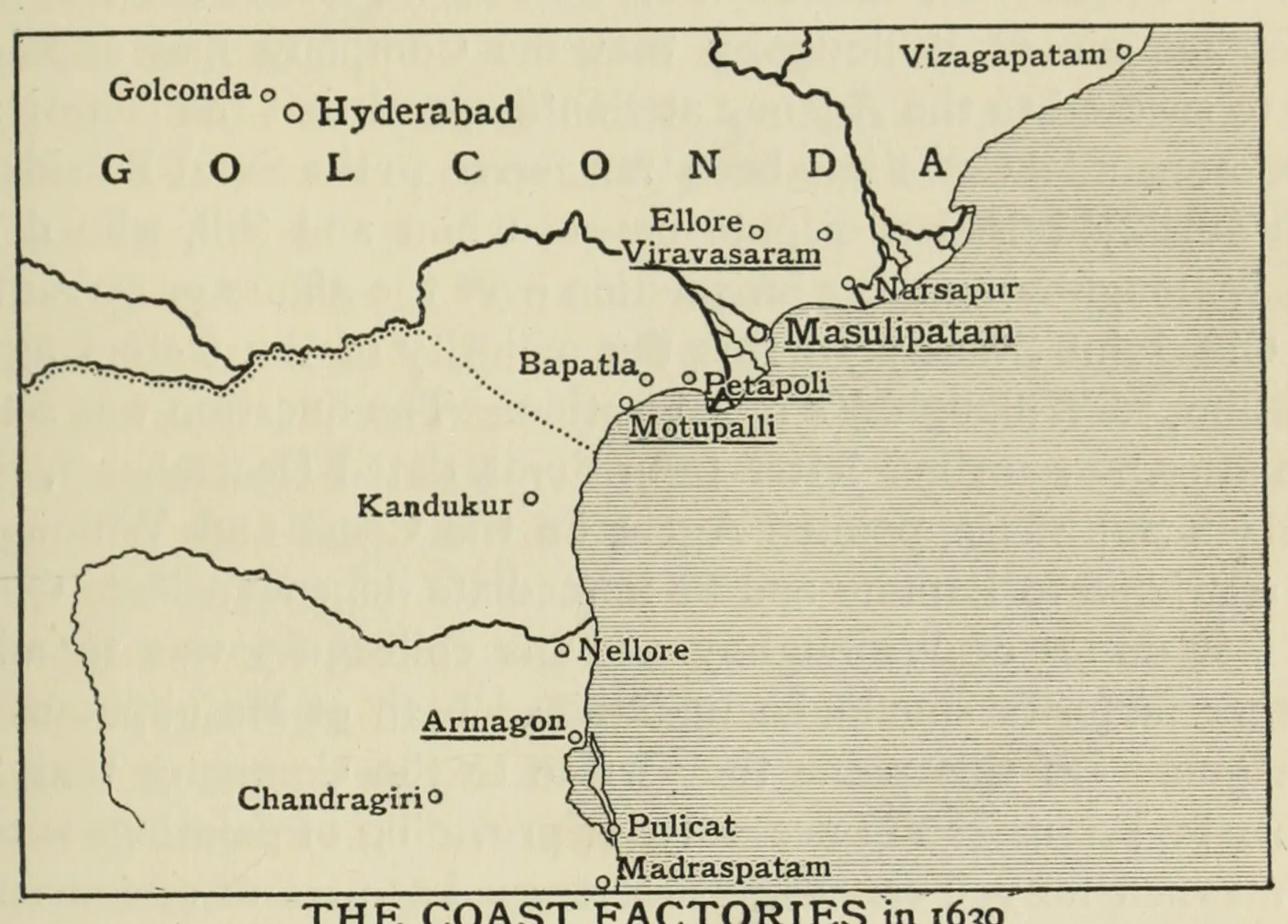
port, however, were anxious that the English should return, and the latter were equally desirous of doing so, owing to the fact that Armagon by itself was insufficient to supply their commercial needs. The result was the dispatch from Bantam on April 1, 1630, of two small vessels—the Falcon and the Dove—under Henry Sill, who had been appointed ‘Agent of the Coast’, with instructions to reopen trade at Masulipatam. Apparently commerce was resumed on the old lines, without any definite agreement (p. 78), and soon the English had five factories going (p. 85).
The Company at home were of course unaware of these developments. As already related, they had decided to reduce Bantam to an Agency, and to place that and the Coromandel factories under Surat; but this decision appears to have been taken after the dispatch of the Star (300 tons) in December, 1629, with a cargo on account of the Second General Voyage.1 In her went George Willoughby, whose instructions were to proceed first to the Coromandel Coast, invest some of his capital, and take the proceeds on to Bantam. He reached Armagon on June 27, 1630, and, after landing some of his goods, passed on to Masulipatam, where he found Sill and other factors employed on behalf of the Old Joint Stock. For a few months the two sets of merchants worked along without serious friction. Then on October 24 letters received from Surat acquainted Willoughby that the Company had appointed him to succeed to the Agency at Bantam, and that the factories on the Coromandel Coast had been transferred to the Surat Presidency. This quickly raised a dispute between him and Sill, who denied that Willoughby had any jurisdiction over the affairs or servants of the Old Joint Stock. In this the majority of the factors agreed with him, to Willoughby's mortification. The question was settled soon after by a further letter from Surat, dated December 3, 1630, in which Sill was appointed Agent on the Coast and Willoughby was restricted to Bantam and its immediate dependencies. One of the first duties of Willoughby and his colleagues was to advise whether factories should be maintained both at Masulipatam and Armagon. On this point they wrote to the Company that 'the factory [at] Armagon of necessity for providing of paintings is to be mayntayned, for you cannot be ascerteyned at present of convenient sorts and quanteties elsewhere': that an establishment of five factors and twenty soldiers would be required there, at an annual charge of about 666l. a year: that it 'will be necessary to build a fort of four points, each point haveing four peece ordnance (at present there only being a wild fortification without forme or strength), which wee suppose will cost 8,000 rials of eight':2 and that a settlement at Masulipatam could not be dispensed with, as white calicoes were not to be had at Armagon (p. 81). In a letter addressed about the same time to the President and Council of Surat the Masulipatam factors advised that, following the example of the Dutch, an agreement should be made with the King of Golconda for the payment of an annual sum in lieu of all customs duties (p. 85)—a suggestion which was approved at Surat (p. 107), though it did not bear fruit until some years later.
The all-absorbing topic of 1630 was the frightful famine which, following three bad seasons (pp. 20, 79), had now culminated in ‘an universall dearth over all this continent, of whose like in these parts noe former age hath record; the country being wholy dismanteled by drougth . . . the poore mechaniques, weavers, washers, dyers, etc., abandoning their habitacions in multitudes, and instead of reliefe elcewhere have perished in the feilds for want of food to sustaine them’ (p. 122). Many of the inhabitants fled into ‘parts of more hoped plenty’, i. e. the northern provinces, which had escaped the famine (p. 178); while others in desperation attacked and plundered all but the strongest parties of travellers (p. 129). From Gujarāt to the Golconda coast the land became one vast charnel-house. In the words of an Indian writer, the author of the Bādshāhnāma (Elliot and Dowson’s History of India, vol. vii, p. 24): ‘Life was offered for a loaf, but none would buy; rank was to be sold for a cake, but none cared for it; the ever-bounteous hand was now stretched out to beg for food; and the feet which had always trodden the way of contentment walked about only in search of sustenance. For a long time dog’s flesh was sold for goat’s flesh and the pounded bones of the dead were mixed with flour and sold. When this was discovered, the sellers were brought to justice. Destitution at length reached such a pitch that men began to devour each other, and the flesh of a son was preferred to his love. The numbers of the dying caused obstructions in the roads, and every man whose dire sufferings did not terminate in death and who retained the power to move wandered off to the towns and villages of other countries. Those lands which had been famous for their fertility and plenty now retained no trace of productiveness.’1
According to the same writer, the Emperor ordered soup and bread to be distributed gratis in the chief centres: at Burhānpur a lakh of rupees, and at Ahmadābād half that sum, were given away in charity by his directions; while remissions of revenue were made to the extent of nearly seventy lakhs. It is to be feared, however, that, for want of adequate organization, much of this relief failed to reach the sufferers; at all events it did not prevent a terrible loss of life. For a time, while the peasants' scanty resources lasted, private enterprise brought food-stuffs into the stricken provinces; brinjarries with their pack-oxen came trooping from the north, and their demand for rupees in lieu of the local currency of mahmūdīs sent down the exchange value of the latter to an unheard-of figure (O.C. 1559). But when the last coin was spent and the last bangle disposed of, this traffic ceased; the peasant was left to die in the field and the weaver in his hut.
With materials and labour scarce and food-grains at famine rates, manufacture came of course to a standstill, at least so far as foreign trade was concerned. Indigo and calicoes were not necessities, and the rates at which they could compete in the markets of Europe were strictly limited; yet high prices were in the circumstances inevitable. Consequently the English merchants were reduced to the position of mere spectators of 'Gods heavye wrath . . . in the further punishing of these people', as they wrote in their stern Puritan way (p. 94). They themselves felt the pinch of scarcity (p. 97), though they had money enough at command, while the sea was open for their supply; and we find them bringing grain and dates from Gombroon (p. 143), and making arrangements for supplies of rice from Masulipatam, Bantam, and even from the distant islands of Comoro (pp. 94, 145, 148, 178). On the Coromandel Coast too, according to an eyewitness (p. 268), the land was 'sorely opprest with famine, the liveing eating up the dead, and men durst scarsly travell in the countrey for feare they should be kild and eaten'. Southern Persia was also troubled with scarcity (p. 290).
In spite of all difficulties, when 1630 was closing, the energy of the new President was making itself felt at Surat. Private trade was reduced to more decent limits; plans were set on foot for obtaining a supply of pepper and sugar from Bantam for sale in India and Persia; and the vessels proceeding from Surat to the latter country, instead of carrying (besides native passengers and their goods) mostly the private trade of the merchants and seamen, were laden with goods for the Company, ‘for an entrance into that trade, so benefitiall unto others, and hetherto so much neglected for your better behoufes’ (p. 124). As it was dangerous, in view of possible attacks from the Portuguese, to separate the fleet, all five ships and the pinnace Intelligence (originally a native boat, but altered for service as ‘an adviser’) sailed in company for Gombroon on January 8, 1631. After embarking what silk was available there, they departed on March 18. Six days later, the James, William, and Blessing parted company from the rest and made for Swally, which was reached on April 5. The other three steered to the southwards, the Discovery and Reformation being bound for England,1 while the pinnace was to go to the Comoros with letters for the outcoming fleet.
Rastell, finding large quantities of private trade in the ships returned from Persia, made a brave attempt to seize the lot, but met with such determined resistance that he was obliged to buy it all for the Company at 25 per cent. advance on cost (p. 158). His plans for 1631 included the dispatch of the James and Blessing to Bantam, and the William to the Coast of Coromandel. After touching at these places all three were to make for the Comoros and join the fleet expected from England. They sailed accordingly towards the end of April.
A letter sent overland from Surat to Persia in June, 1631, mentions that rain had at last fallen, and that prospects were consequently more hopeful. The Emperor was continuing his war in the Deccan, but with scanty success, as the three Kings were now strongly confederated. The rebel Khān Jahān Lodī had, however, been surrounded by the royal forces under Abdulla Khān and ‘so finished his daies, amongst the thickest of his enemyes fighting’ (p. 160). From other sources we learn that Shāh Jahān’s army had suffered terribly from the famine and the diseases it had brought in its train, insomuch that his 300,000 men were reported to have dwindled to 12,000 (Lisbon Transcripts at India Office : Doc. Remett., bk. 29, f. 197).
The subscription for a Third General Voyage, Rastell tells us (p. 54), was completed the day before he left London (February, 1630), largely owing to the hopes excited by favourable reports of the prospects of trade in Persia. The amount subscribed appears to have been 100,000l., and with this four ships were prepared. Of these, the Mary (800 tons) and Exchange (700), with the pinnace Speedwell (150), were to go to Persia and India under the command of James Slade; while the Hopewell (150 tons) was to proceed direct to the Coast of Coromandel and thence to Macassar to buy cloves. In addition, the adventurers of the Second Joint Stock determined to dispatch the London and Palsgrave under Captain John Hall to Bantam for the purpose of bringing home a large stock of pepper which was lying at that place on their account. The Hopewell set sail towards the end of November. Two months later the Palsgrave started; and she was followed by the London early in March, 1631.
In the latter month the Company were startled to learn that a certain Captain Quail, commanding the Seahorse, a small ship in the service of King Charles, had been met with off the Cape Verd Islands, and had reported that he was bound for the Red Sea. Inquiries were made of Sir William Russell, Treasurer of the Navy, who assured the Governor in reply that Quail had not gone for the East Indies; but as a matter of fact this was exactly what had happened. It seems that the Seahorse had sailed in the previous summer, with a royal commission dated March 19, 1630,1 when England was still at war with Spain and Portugal; and this had been made a pretext for authorizing her commander to range the seas all the world over for the purpose of taking prizes. Slade overtook him at St. Augustine's Bay at the end of May, 1631, and demanded to see his commission (p. 177). This was found to be in order, and he also exhibited written instructions from the King to proceed to the Red Sea and there capture the vessels of any nation not in amity with His Majesty. In the face of these documents nothing could be done, and the Seahorse proceeded on her voyage to Mokha (p. 181). Off the coast of Arabia she took a couple of Malabar junks (p. 180, 226), but little of value was found in them. Quail then made for Surat, which was reached towards the end of September. There his crew suffered from the prevailing mortality, till of the fifty men he had brought from England less than half remained (p. 180). To the servants of the Company Quail gave great offence by ostentatiously displaying the royal flag, and some difficulty seems to have been put in the way of his obtaining supplies (p. 181). He quitted Surat on his return voyage on January 24, 1632 (p. 198), and was met at the Comoros by the outward-bound fleet in August. In the following October Quail died, and the command was taken by the mate, William Marsh, who carried the vessel to the West Indies, and finally to Plymouth in July, 1633. After the Seahorse's departure from Surat she robbed a Malabar junk of a quantity of provisions; and, as the latter had an English pass, the Company's servants were obliged to pay 100l. in compensation. This appears to have been the only actual loss inflicted upon the Company's interests by the cruise, and it is to be noted that Quail made no attempt to molest vessels actually owned by the subjects of the Mogul; but the fact that the King should send one of his ships to the East on such an errand was disturbing, and it can scarcely be doubted that the experience thus gained of the ease with which Asiatic junks could be plundered led directly to the more serious piracies of Cobb and Ayres a few years later.
Slade's fleet sailed from the Downs on February 2, 1631. On board the Mary was a distinguished passenger in the person of William Feilding, Earl of Denbigh, the first English nobleman to go touring in the East.1 His prominent position at court was due primarily to his having married the sister of the famous Duke of Buckingham; and it was to this relationship, rather than to any special ability or knowledge of naval matters, that he owed his appointments as rear-admiral of the Cadiz expedition of 1625 and commander of the squadron sent to relieve Rochelle in 1628. His present visit to the East, which seems to have been prompted entirely by curiosity, was made with the sanction and approval of his royal master, who furnished him with commendatory letters to the Shāh of Persia, the Nawāb Āsaf Khān, and the Khānkhānān (probably also to the Mogul Emperor, though this is not recorded).1 King Charles used his influence with the East India Company to induce them to provide passages for the Earl and his followers in one of their ships. The Committees were far from pleased at the idea of this, and were only partially mollified when Lord Denbigh assured them on his honour that he would do nothing to their prejudice, and that his voyage should not involve the least charge upon their funds. Fresh annoyance was felt when His Lordship insisted upon being allowed the best cabin on board the chief ship (the Mary); but in the end this too was conceded, on the understanding that the factors would be allowed the use of ‘the great cabin’ for consultations when necessary.
Of the events of his journey we hear but little. He landed at Swally on November 22, 1631 (p. 150), with the intention of paying a visit to the Emperor, who was then at Burhānpur. The Company's servants provided him with a lodging in their factory at Surat, and did their best to find him attendants and means of conveyance (p. 194). He departed for the court just before Christmas, after some trouble with the Governor of Surat, who had impounded all the horses at the disposal of the English (p. 200). According to a Dutch letter (Hague Transcripts, series i, vol. ix, no. 307) His Lordship was favourably received and entertained by Shāh Jahān, who gave him at his departure 6,000 rupees. Returning to Surat, he had fresh difficulties with the Governor, and was glad to slip aboard the Mary, where he was safe from that official's annoyances. This short experience of India seems to have been enough for him, for he made up his mind to remain on board the Mary during the rest of her cruise. He accordingly went in her to Masulipatam and Gombroon (p. 257), and on her return to Surat embarked in the James for England (January, 1633). On August 28, 1633, James Howell wrote to Sir Francis Windebank that 'the Lord Denbigh is returned from the Great Mogor full of jewells' (Dom. State Papers, vol. ccxlv, no. 33); and this is the last we hear of the matter, except a false alarm of huge quantities of private trade brought home by His Lordship (Court Minutes, September 20, 1633).
Presumably the Earl was proud of his visit to the East, for in his portrait by Van Dyck he is shown as dressed in a semi-Indian costume and attended by an Indian servant, with a background of tropical scenery. This picture, which is now in the possession of the Duke of Hamilton—the first Duke having married Lord Denbigh's eldest daughter—has been reproduced (from an engraving by H. T. Ryan) as a frontispiece to the present volume. The story of the Earl's later years has of course nothing to do with our purpose here; yet allusion may perhaps be made to the circumstances of his death, as illustrating his loyal and generous nature. At the outbreak of the Civil War he found himself passed over for command in favour of younger men; whereupon, in spite of his advanced age, he attached himself as a volunteer to Rupert's regiment and (as Clarendon tells us) served 'with unwearied pains and exact submission to discipline and order, and engaged with singular courage in all enterprises of danger'. He did not live to see the ruin of the cause to which he had devoted himself with such ardour; for in April, 1643, he was dangerously wounded in Rupert's attack on Birmingham, and died five days later.
The instructions given to Captain Slade by the Company were to wait at the Comoro Islands for the William and Blessing until July 10, 1631, and then, should they fail to appear, to proceed direct to Persia. By the Intelligence, however, which was met at St. Augustine's Bay (Madagascar), he received two letters which must have caused him and his colleagues much perplexity. One was from the President and Council at Surat, directing him to wait until August 20 for the three ships from Bantam and the Coromandel Coast, and then (with or without them) to sail for Gombroon ; in the other, of a later date, the factors in Persia wrote that it would be useless for the fleet to adopt this course, since the silk could not be brought to the port by the time of their arrival, and urged that Slade should disregard his orders and make Surat his first port. At first it was decided to take this advice ; then, in view of the fact that such a course meant disobedience to the express orders both of the Company and of the President and Council of Surat, that resolution was rescinded, and it was determined that Persia should be the destination of the fleet in the first instance. At the end of August, however, the William arrived from the Coromandel Coast with a fresh letter from Surat, in which the President and Council (on learning the views of the Persia factors) wrote cancelling their former instructions and definitely ordering the fleet to come straight to India. As a matter of fact, the merchants in Persia, repenting their first advice, had subsequently written to Surat, saying that after all they thought it would be possible to get their silk to Gombroon by the time desired ; and thereupon the President and Council had sent further letters to Masulipatam, re-directing the fleet to Persia. These letters, however, missed the William, with the result that Captain Slade remained in ignorance of the fresh change of plan and, after waiting in vain for the James and Blessing, made straight for Surat, arriving at that port on October 14, 1631. The Blessing was picked up on the way, and reported that she and her consort had lost their monsoon for Bantam, and had been forced to anchor in a bay near the southern extremity of Sumatra. There they agreed to separate, the Blessing going back to join Slade's fleet, while the James struggled on to Bantam, which was reached with much difficulty on August 24, 1631.
The mission of the three ships to the Coast and Bantam was partly due to the serious dissensions between the factors employed at the former place. At the end of January, 1631, Willoughby took matters into his own hands, seized Sill and his principal supporters at Armagon, and carried them prisoners in the Star to Bantam, installing John Hunter as Agent for the Coast until fresh orders should arrive from Surat. This action was, to say the least, extremely arbitrary; and the arguments used to justify it, chiefly on the ground of Sill's private trade, can scarcely be considered convincing. Rastell and his colleagues were exceedingly angry, and at once took vigorous measures. Skibbow and Bangham were sent to Bantam in the James with directions to bring Willoughby, Sill, and others to Surat for examination; while the William carried John Norris and Thomas Robinson to the Coast to displace Hunter, and send him and Osmond Smith to the Presidency for the same purpose. These orders were duly carried out, and Willoughby, much to his indignation, found himself in his turn a prisoner aboard the James. This vessel started for Surat again early in October, 1631, but lost the monsoon and had to return to Bantam. She did not set out afresh until the end of the year, and it was November 28, 1632, before she reached Surat. Death had in the meantime put an end to Sill's troubles; but Willoughby was arraigned, censured, and sent home in the James. On his arrival, however, he was well received by the Committees, who were easily persuaded that he had in effect been punished for endeavouring to suppress private trade. He was therefore rewarded with the post of President at Bantam, at a salary of 300l., and dispatched again to the East at the beginning of 1634.
In India the summer and autumn of 1631 were little less full of misery than the preceding year. In October the Viceroy at Goa informed his royal master that the deaths in Gujarāt during the past ten months had reached three millions, while those in the kingdom of Ahmadnagar were estimated at another million. Writing on September 8 to Bantam, President Rastell and his Council mentioned that, though there were hopes of a peace in the Deccan, the situation was scarcely improved in other respects. The long-prayed-for rains had come with a vengeance and had spoilt the crops from which so much was hoped, with the result that foodprices were as high as ever. In the train of famine had come sicknesses of various kinds; and there was ‘not a family throughout either here or Baroch that hath not beene vissited with agues, feavors, and pestilentiall diseases’ (p. 166). ‘The tymes here’— runs another letter (p. 178)—‘are soe miserable that never in the memory of man any the like famine and mortallity hapened. This that was in a manner the garden of the world is nowe turned into a wilderness.’ The most vivid description of all is contained in a letter from a Dutch factor printed on p. 180, which deserves to be read at full length. The English and Dutch suffered with the rest. Slade’s fleet found ‘all the merchants in this factory either dead or sicke, those liveinge hardly able to helpe one another’ (p. 178). President Rastell was for a time the exception, but soon he too fell ill. He died on November 7, 1631 (pp. 149, 179), and the management of affairs at Surat passed into the feeble hands of Joseph Hopkinson, who was formally elected President on December 29.
Meanwhile, on the other side of India an interesting experiment had been made. The Hopewell reached Armagon from England on June 25, 1631, and Masulipatam on the 10th of the following month (p. 203). Three days later a consultation was held, at which it was decided to send her to ‘the Bay of Bangalla’, in accordance with instructions given by President Rastell (p. 203).1 She sailed, under the charge of Thomas Robinson, on July 29, her ultimate destination being Pipplī, in Bengal. First, however, a visit was paid to ‘Calapara’ (a port difficult to identify : see p. 188), the intention of the merchants being to wait upon Bāqir Khān, the Sūbadār of Orissa, who was there with an army, and whose permission was necessary before making any attempt to trade in his province. He seems to have given his visitors an affable reception and to have complied with their request. Preparations were now made for resuming the voyage. But the weather was bad, and a large boat the English had brought with them was split to pieces in the surf on the bar ; with the result that the merchants decided to go overland to Mānikpatam, where the Hopewell met them on August 18. Here again the bar gave them great trouble and the crossing of it cost several lives ; but the merchants and their goods were safely embarked on October 6. All idea of proceeding to Pipplī had been given up, and sail was made for Masulipatam, which was reached five days later (p. 190). The enterprise was admittedly an unsuccessful one, but it was held to have ‘laid a good begining to a future hopefull trade’ (p. 183).
In view of the recent celebrations in America, it may be of interest to note in passing that one of the factors brought out to the Coast by the Hopewell was Richard Hudson, son of the famous Arctic explorer. In April, 1614, when practically no hope remained that Henry Hudson would ever be seen again, his ‘wife or widdowe’ (as she is pathetically termed) implored the East India Company to help her in her poverty by employing ‘a younge youth, a sonne of his’; and the Committees, ‘conceyvinge that therein they were partlie obliged in charitye to give assistaunce, in reguard that his father perished in the service of the comonwealth,’ caused the boy to be bound apprentice and sent him to the East. He spent some time in the Company’s factory at Hirado (in Japan); and in 1626 we find him proceeding from Batavia to Masulipatam in the Abigail, to be employed there as an assistant. He was at home again in 1630, and was then engaged by the Company to return to India in the Hopewell, as already mentioned. The rest of his life was spent in various factories on the Coast and in the Bay of Bengal. About July, 1647, he became chief in the Bay (O.C. 2046), and he died at his post early in the following year.
Having taken in what cargo was ready at Masulipatam and Armagon, the Hopewell departed for Bantam on December 26, 1631, and arrived there a month later. The factors at Armagon wrote excusing the small returns they had been able to make as due to the ‘miserable tymes, full fraught with the calamitie of warr, pestilence, and famine’ (p. 183); but they held out hopes of better success the following year, provided they were furnished with funds in good time. Another letter of this period (p. 203) dwelt upon the depopulation caused by the famine, and aggravated by the wars between the Nāyaks and their Hindu overlord. An attack upon Armagon fort was daily expected, and it was intended to procure permission, if possible, to build a brick wall round the house for greater security.1
In the letters brought out by the Hopewell, the Company, while not interfering with Rastell's control over the Coromandel factories, had ordered that the accounts of the latter should be subject to the ‘commaund and approvall’ of the Agent at Bantam; but, on the ground that such an arrangement was obviously undesirable, the President and Council at Surat resolved that action should be suspended until their objections were heard and decided upon at home (p. 165).
Captain Slade sailed from Swally for Persia on January 24, 1632, with the Mary, Exchange, William, and Blessing. In the letters sent by this fleet the President and Council drew a woeful picture of the state of affairs at Surat.1 The country round had been ruined by famine and floods, and though the handicraftsmen were beginning to return, both cotton goods and indigo were scarce and dear. All the subordinate factories in the Mogul’s dominions had been dissolved and the factors withdrawn to Surat ‘for want of busines and savinge of charges’. Of the merchants, thirteen were dead and the rest were sick and weak. They were heavily in debt, with no prospect of avoiding further commitments. In these circumstances their chief hope of providing return cargoes for their ships lay in supplies of silk from Persia; and partly for this purpose they directed their two pinnaces, the Speedwell and the Intelligence, after visiting Sumatra and Bantam respectively, to make for Madagascar and the Comoros and instruct the fleet from England to proceed in the first instance to Persia.
Slade’s fleet returned from Gombroon early in April, 1632; and at the end of the same month all four ships sailed again—the Blessing for England, the William for Bantam, and the Mary and Exchange for Masulipatam, to carry freight goods from that port to Persia. The two latter ships reached Armagon on May 24, and Masulipatam six days later. Having embarked about 130 native passengers and their goods, a start was made for Persia at the end of June. Gombroon was reached about September 23; and nine days later Captain Weddell’s fleet from England arrived in the same port. The experiment of carrying freight goods from Masulipatam to Persia appears to have been considered a success, for the Gombroon factors reported that the resulting receipts were nearly 3,000l. (p. 239). Besides the direct gain, it had the effect of conciliating the native authorities, who were only too glad to see merchants attracted to their port by the prospect of the safe and rapid carriage of their goods in European vessels (pp. 208, 211).
Weddell’s two ships, the Charles and the Jonas, which had left Surat in April, 1630, reached England about a year later; and the Company thereupon endeavoured to raise funds for a Fourth General Voyage; but the subscriptions totalled only 11,000l. and so the attempt came to nothing. In the face of this it is rather surprising to be told that in the same year a Third Joint Stock was started, with a capital of over 400,000l. Owing to the loss of the Court Minutes for this period, the only authoritative information we have is that contained in Jeremy Sambrooke's report of a later date (Home Miscellaneous, vol. xl, p. 33). His statement is as follows: ‘The Third Joynt Stock, with remaines brought over from the Second Stock and an additional subscripcion, made up a capitall of 420,700li.’1 Of course it is not likely that the whole of this new capital was called up at once; but from p. 291 it appears that over 160,000l. was sent out to the East in the next season.
The first ship dispatched after the formation of the new Stock was the Pearl (250 tons), which left the Downs a little before Christmas, 1631, bound for the Coromandel Coast. Three months later a fleet of five vessels—the Charles, Jonas, Dolphin, Hart, and Swallow—under the command of Captain Weddell, sailed for India and Persia, with a cargo of 43,000l. worth of goods, besides 103,000l. in money (p. 291). At the Comoro Islands (August, 1632) they met the Seahorse, as already narrated, and also the James and the Intelligence. In obedience to the orders received, the fleet now made straight for Persia, anchoring off Gombroon on October 2, where they found the Mary and Exchange. After a stay of twenty days the whole of the ships departed for Surat, and arrived there on November 28.
The Pearl reached Armagon in August, 1632, bringing a cargo valued at 10,300l., intended, it would seem, for investment in piece-goods, which were to be taken to Bantam and Macassar for the provision of a return lading of pepper and spices. In announcing to Surat the arrival of the vessel, Norris and Cartwright, the chief factors at Masulipatam, wrote that they hoped to secure the desired goods at Petapoli and Vīravāsaram, though the time was short. Apparently they had made some proposal to the King of Golconda regarding the payment of a lump sum in lieu of customs duties and tolls; but this had been opposed by Mīrzā Rōzbihān, the Governor of the district, who, with other officials, required bribes as the price of any concession. ‘Such is the miserable condicion of this cuntry, whence justice and truth are fleed long since, the poore exceedingly suffering the riches tyrannie without redresse’ (p. 228). Mention is also made of a desire expressed by the Company to have a ship laden home direct from the Coast; this the factors thought might well be effected, especially as prospects were favourable, in view of the plentiful harvest anticipated.
One of the merchants sent out in the Pearl was Thomas Colley, who not long after died at the newly-established factory in Orissa. Thereupon his papers were sent home, and, being found to contain abundant evidence of private trade, were detained. To this accident we owe the preservation of the many interesting letters given on pp. 228, 237, &c., which throw valuable sidelights on the labours and amusements of the Company’s servants on the Coast. From these it appears that their operations extended over a large area— roughly the whole district from Masulipatam to Armagon; a glimpse is also given of the rigorous methods employed by the local officials, and of a popular rising thus produced (p. 232).
A letter from Masulipatam dated October 18, 1632, refers to ‘our freinds being all gone to Bengala’ (p. 238); while another of November 24 announces the return of ‘our shipp’ on the previous day. From this it is evident that the Pearl had been ordered to follow up the attempt made by the Hopewell the year before to get to a Bengal port. She started on October 1; but of the result we are only told that ‘the tyme did not afforde our shipp the gettinge to our porte in Bengala; and soe, haveinge spent this tyme not to much purpose, we are retorned with the discoverie only of some places and ports which may yeald benefitt to our [imploiers in future tymes?]. In this voyage we have buryed Mr. Morris, the masters brother; two men more were drowned goeinge over the barr of Manecapatam’ (p. 244). As reference is made to fresh discoveries, it may be surmised that the Pearl got further to the eastwards than her predecessor; and it is possible that she actually reached Harispur, the port which was the objective of the well-known voyage of the following year.
From Agra we hear little or nothing at this time. It appears, however, from the invaluable journal of Peter Mundy (already cited) that in August, 1632, under instructions from Surat, he was sent with a native broker to Patna, to renew the experiment which had terminated so unsatisfactorily in 1620-21. He reached his destination on September 17, and succeeded in selling some quicksilver and vermilion; but the prospects of trade were uninviting, and after two months' stay he returned to Agra. He notes that it was found afterwards that the President and Council had written ‘Patna’ by mistake, intending in reality to direct an investment at Samāna.
For the English fleet at Swally the year 1633 opened with serious disaster. The Swallow, in firing a salute, took fire and, drifting on to Weddell's flag-ship, the Charles, set her alight also.1 In spite of every effort, both vessels were destroyed, with some loss of life, and all that was saved of their contents was part of the money on board the Swallow. The master of the latter, Giles Waterman, was held to be chiefly responsible; and he, the gunner, and other officers were sent home in the James to be punished. No blame attached to Weddell, for he was on shore at the time; and he was permitted by the President and Council to retain his command, shifting his flag to the Jonas, another vessel of his fleet.
At the end of January, 1633, Weddell departed for Persia with the Jonas, Mary, Hart, and Dolphin. There was a prospect of exciting developments, for the Khān of Shīrāz was still strongly bent upon taking Muskat from the Portuguese with the aid of an English fleet. This had been repeatedly proposed to the Company's factors, but they had put off the Persians with excuses from time to time, and it was only when they found that the Dutch were offering to undertake this service in their place that they took up the matter in earnest (pp. 211, 240, 278). On Weddell's arrival, however, he found that an end had been put to the project by the death of the Khān, who had been cruelly executed by order of his jealous master (pp. 288, 293); in addition to which the country was threatened with invasion by the Georgians on the north and the Turks on the west (p. 295).
At the same time as Weddell's fleet left Swally for Persia, the James sailed for England1 and the Exchange for Sumatra, accompanied by the Intelligence, which was afterwards to seek the new fleet from England at Madagascar or the Comoros, with orders to them to proceed straight to Persia, as Weddell had done the previous year. From Sumatra the Exchange was to go on to Bantam, and there lade for England.
On Weddell's return from Persia (April 5, 1633) he was sent to Masulipatam with the Jonas, Mary, and Hart, while the Dolphin was told off to proceed to Bantam and thence home. With the former vessels went Thomas Joyce, a member of the Surat Council, who had been appointed to succeed Norris as Agent on the Coast, with Ralph Cartwright as second. He was specially instructed (p. 300) to inquire into the necessity of retaining Armagon, to push on 'the Bengala trade', and to follow up a scheme which Norris had set on foot (p. 228) for obtaining a grant of privileges from the King of Golconda, similar to those recently secured by the Dutch.
The Swan was dispatched from England to the Coast of Coromandel in September, 1632, carrying with her instructions that that Agency was to revert to the care of the President at Bantam (Court Minutes, September 5). Her cargo was invoiced at 22,454l. She reached Masulipatam in June, 1633, and found there Weddell's three vessels, which had arrived some three weeks earlier. After taking in freight goods for native merchants, Weddell sailed again for Gombroon, where he arrived in September. As, owing to the rise of prices induced by the recent famine, the Masulipatam factors had not been able to purchase goods at remunerative rates for either Persia or Bantam, they were at a loss what to do with the Swan; but in the end they decided, by a consultation held on June 27, to dispatch her to Bengal, to second a venture in that direction which had been begun in the preceding April. To this experiment we must now for a few moments turn our attention.
As we have seen, voyages had already been made in the Bay during the three previous years, but with little or no success. The present attempt had a more ambitious object, namely, that of establishing a permanent factory or factories in Orissa or Bengal. It may seem strange that this action had been so long delayed. The fertility of the Ganges delta was well known; the Portuguese had been settled at Hūglī and Pipplī for many years; and both the Dutch and the Danes had made profitable voyages in the Bay. The answer seems to be that the goods sought by the English merchants on the Coast were chiefly the calicoes of Golconda and the Hindu countries to the southwards; that the products of Bengal were readily obtainable at Masulipatam, and there was no temptation to venture further afield in quest of them, at the risk of being snapped up by the Portuguese war-vessels; moreover, the troubles at Masulipatam, culminating in the withdrawal of the English in 1628, had effectually stopped for a time any schemes they may have entertained for the enlargement of their commerce. The change of policy which followed their return in 1630 seems to have been due partly to the great famine. Not only did the high price of all food-stuffs render the coasting-trade in rice, sugar, and butter more remunerative, but the general dearth of piece-goods which resulted from the mortality among the weavers made the coarse silks and cottons of Bengal more valuable in the eyes of merchants. Another less obvious, but perhaps equally effective, inducement to venture in this direction was the prospect it offered of lucrative private trade for the merchants employed, who in the then state of affairs at Masulipatam and its neighbourhood had little opportunity for investing their own capital. Further, we seem to discern that the capture of Hūglī by the Mogul forces in September, 1632, and the supposed intention of the Emperor to stamp out Portuguese trade in Bengal, had led the Masulipatam factors to conclude that a particularly favourable opportunity had offered itself for planting English trade in those parts (p. 308).
Be this as it may, in the spring of 1633 the endeavour was made. On April 6 a party of eight Englishmen—two merchants (Cartwright and Colley) and six sailors or attendants1—departed from Masulipatam in a country junk for the northwards. On Easter Day (April 21) they anchored off a place they called ‘Harssapoore’, i.e. the modern Harispur Gar, at the mouth of the Pātuā, in Orissa; and on the following day they all went ashore. Cartwright and two other Englishmen started on April 27 for the city of Cuttack, in order to visit the Nawāb in charge of the province, a Persian named Āghā Muhammad Zamān (Wilson, op. cit., pp. 8, 241), who had recently succeeded Bāqir Khān in that post.1 From him they obtained (May 5) a parwāna to trade free of all customs
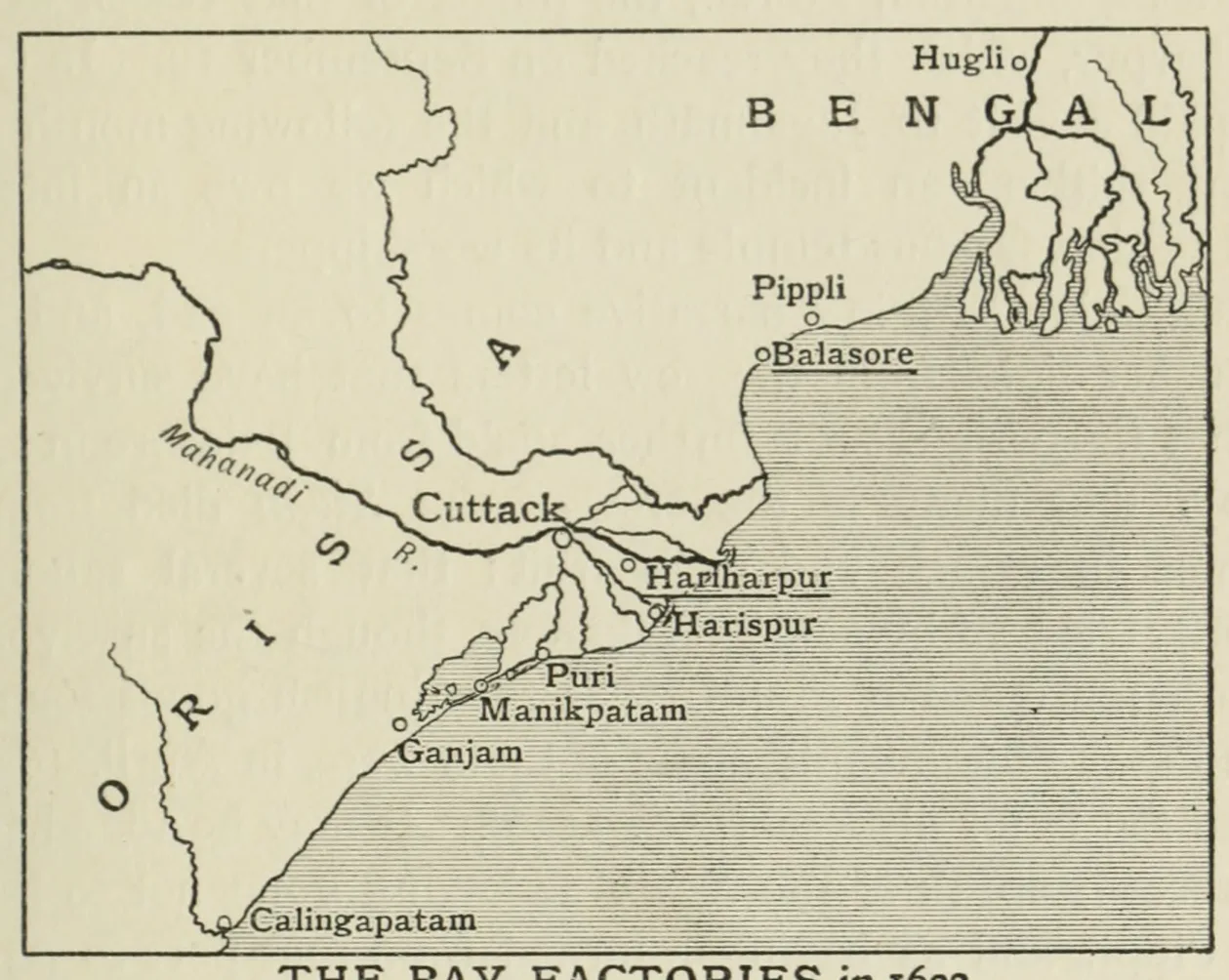
or duties and to build houses or ships. Armed with this grant they returned to Hariharpur, a place about half-way between Cuttack and their port, and, summoning thither the Englishmen they had left at Harispur, they proceeded to build a factory. On June 16 Cartwright and two more set out for Balasore, leaving Colley in charge.1 The latter intended to pay a visit to Jagannāth (Purī), in the hope of disposing of some of his goods there; but he fell ill and died (August 25) before he could undertake the enterprise.
Meanwhile, as already mentioned, the Masulipatam factors had decided to send on to Bengal the Swan. This vessel anchored off Harispur on July 22, but finding no English there passed on to Balasore, where Cartwright had established himself. News arriving of the death of Colley, Robert Littler, a factor who had come in the Swan, and John Powell, the purser of that vessel, were sent to Hariharpur, which they reached on September 19. In October Littler paid a visit to Jagannāth, and the following month Bruton was sent thither—an incident to which we owe an interesting account of that famous temple and its worshippers.
At this point Bruton's narrative comes to an end, and we get little further light from the few letters that have survived. We know that Cartwright went further afield from Balasore in October (p. 320): that many of the crew of the Swan died from overindulgence in arrack and fresh fruit: that several sailors were killed or carried off by some Arakanese, though the survivors were afterwards ransomed at Pipplī: that the English goods found little sale, and that consequently some of them were, in April, 1634, sent inland to Patna for disposal (O.C. 1536). It may be added that the Dutch records speak of the Swan as having gone, not to Balasore, but to Pipplī, and as having returned from that port to Armagon towards the end of December, 1633, with a quantity of sugar, rice, and piece-goods, besides some lac and sugar belonging to native merchants (Dagh-Register, 1631–34, p. 242).
In March, 1633, a new fleet started from England for Persia and India under Captain Allnutt, consisting of the Palsgrave, Discovery, and Reformation, laden with nearly 19,000l. worth of goods and over 61,000l. in gold and silver (p. 286). It carried out also a new President for Surat. A proposal that Wylde should be reappointed had found influential backing, but the Company could not so easily forget his past delinquencies; and so the post was offered to, and accepted by, William Methwold, who had been Agent at Masulipatam in 1618–23 and had on his return to London contributed to the 1626 edition of Purchas His Pilgrimage (p. 993) an interesting account of Golconda and the neighbouring countries. As we shall see, the Company found no reason to regret their choice. Alike in character and ability Methwold stood head and shoulders above both his immediate predecessors and his colleagues. His period of office proved to be an exceptionally arduous one—he himself wrote later: ‘I knowe no trouble or misery (except sicknesse) which I have not mett withall in this my short employment in India’—yet no danger daunted him, no emergency found him wanting; his cool judgement at once pointed out the course to be pursued, while his energy and fixity of purpose wrested success from even the most adverse conditions. In dealing with the Indian officials and merchants he was courteous and conciliatory, without for a moment forgetting his responsibilities as the representative of a foreign nation. The Dutch, who were pleased to find that he had spent some time in the Netherlands and spoke their language well, praised his affability and discretion, and wished that other English Presidents had been like him (Hague Transcripts, series i, vol. ix, no. 312). To his subordinates he strove to be just and considerate, at the same time insisting upon their fulfilling punctually their obligations to the Company, particularly in the matter of private trade, in which respect he himself set them a good example; yet, when occasion required, he was fearless in his censures, as even members of Council like Fremlen and Bornford found to their cost. Nor was he less outspoken in his letters to his employers, who, however, had the good sense to respect his openness and to give him their steady and whole-hearted support. In November, 1635, the Company’s bookkeeper, mistaking his instructions, drew up a ‘tart’ letter to Surat, censuring certain transactions; but the ‘Committees’ ordered him to revise the draft and, ‘wherein hee shall find any harsh or bitter language, to sweeten the same in a more mild and gentle phrase’; and further he was directed to express the Company’s appreciation of Methwold’s services, his ‘well written and digested’ letters, his care for the prevention of private trade, the course he had taken for lessening their ‘huge debt’ and charge of their factories, and especially his good service in coming to an agreement with the Portuguese (Court Minutes of the E. India Company, 1635–39, p. 115). This is by no means a bad summary of the chief features of Methwold's administration.
The fleet reached the Comoros without incident in August, and found there the pinnace Intelligence. Dispatching her back to Surat with letters, Methwold proceeded to Gombroon, where he found Weddell's squadron awaiting him. On October 10 all six vessels sailed for Swally, and arrived there the 5th of the following month. Two days later Methwold landed and assumed the post of President. Matters were in a far from satisfactory condition. Hopkinson, who seems to have been a man of very ordinary abilities at his best, had been in bad health for a long time, and from December, 1632 (pp. 247, 258), Nathaniel Mountney had been acting as coadjutor. It is not even certain whether Hopkinson survived until Methwold's arrival; and in any case he must have died before the end of the year (p. 318). The factors were in debt to the amount of 90,000l.—a sum far beyond their means of paying. Indigo and piece-goods were so scarce and dear that there was little prospect of satisfying the Company's expectations of return cargoes. And, finally, the English were on bad terms with the Governor of Surat, whose attempts at extortion they had been forced to resist.
One of the first matters to engage the new President's attention was the endeavour that was being made, with the sanction and support of the Mogul Emperor, to render the indigo trade a monopoly. If we may trust the assertion of the Governor of Surat (O.C. 1543 A; Hague Transcripts, series i, vol. ix, no. 310), this had originated in a suggestion made by Hopkinson that the Emperor might with advantage follow in respect of this commodity the practice of his Persian brother in regard to silk, which was a royal monopoly and could only be obtained by the European merchants on terms dictated by the Shāh. Wherever the idea came from, it was warmly taken up at court; and a letter of January 4, 1633, states that the Governor of Surat had shown the English factors a licence from his master to offer indigo in exchange for broadcloth (p. 256). In the autumn of that year the scheme was set in action by a royal edict confining the sale of indigo throughout the Mogul dominions for three years to a Hindu named Manohar Dās, who was to be assisted by a loan from the royal treasury, which was to share in any profit that might result. The Dutch and English protested strongly, but without result, for behind the Hindu merchant stood an influential noble, Mīr Jumla (Hague Transcripts, series i, vol. ix, no. 310; Dagh-Register, 1631-34, p. 262). However, they had a powerful weapon left, for it was open to them to refrain from buying and, as they were the principal customers for the commodity, there was every hope that by this means they would break down the monopoly. Accordingly, on November 19, 1633, a solemn engagement was entered into by the representatives of the two nations at Surat, pledging both parties to abstain for one year from purchase of indigo, save at prices laid down; and further agreeing in the latter case to buy in partnership and divide the proceeds equally. It was also stipulated that, in order to hinder native merchants from stepping into their places, neither side should permit indigo to be shipped as freight for Persia in Dutch or English vessels. The further efforts made to defeat the monopolists will be narrated in the next volume.
It is necessary, before concluding, to give some account of the negotiations which were being carried on at this time for the purpose of putting an end to the war which had been waged between the English and the Portuguese ever since the former made their appearance in the Indian seas. Hopes of an amicable arrangement were excited in 1630, when, after five years of desultory hostilities, King Charles and King Philip commenced negotiations for peace. It was expected in London that the Portuguese would recognize the futility of their opposition to English trade in the East, and would agree to abstain from a warfare for which so little real justification could be found. This, however, was not to be, at least for the present; and the treaty which was signed at Madrid on November 5, 1630, reproduced, with a few unimportant modifications, the treaty of 1604. The Company's trade in the regions claimed by Portugal was not expressly forbidden, but neither was it in any way conceded; and on the return of Sir Francis Cottington, the special commissioner for the treaty, it was made clear that the Portuguese had no intention of changing their attitude in the matter. At a meeting held on March 18, 1631, ‘Mr. Governour made report to the Court that himselfe, Mr. Deputy, Mr. Alderman Garway, and Mr. Muns had attended Sir Francis Cottington, lately returned out of Spaine, and understood from him that hee had negotiated with the King of Spaine, the Counsell, and the President of Portugall concerning peace to bee concluded betwene the English and the Portugalls beyond the Cape and in all parts of the Indies ; who all seemed very inclyneable to the mocion ; whereupon comissioners beeing sent for out of Portugall, the remonstrance of peace was made knowne unto them, but they utterly rejected the proposicion, glorying in the victories they have acquired in the Indies. Soe that the Company stand upon the same termes of hostility with them in the Indies as formerly.’
In India, however, the English authorities, who were acutely conscious of the drawbacks of the existing state of affairs, did not lose hopes of effecting an accommodation ; and they found zealous helpers in the Jesuits, who were frequently passing through Surat and found it expedient to keep on friendly terms with the Europeans there. Even before the conclusion of peace, while Kerridge was still President (1625–28), overtures had been made, but only to be scornfully rejected by the Viceroy (Court Minutes, September 26, 1634). In May, 1631, Rastell endeavoured to open negotiations through Father Antonio Pereira and Father Antonio de Andrade, the Provincial of the Jesuits, but the only reply that he got was an inquiry whether the English would be willing to join in an offensive and defensive alliance against the Dutch (Lisbon Transcripts : Doc. Remett., book 29, ff. 145, 197). The mention made on p. 216 of some fruitless overtures may possibly relate to this incident. Early in 1633 the Viceroy (who had not yet received a copy of the treaty of peace and was in some doubt as to its terms) reported to King Philip a conversation that had taken place between the English President and Father Reimão on the same subject (Lisbon Transcripts: Doc. Remett., book 30, f. 263); to which the King replied in March, 1634, refusing absolutely to entertain the idea, and stating that he had called upon the English monarch to withdraw his subjects from the East Indies, as their remaining was a clear breach of the new treaty ; if, however, they should apply for a suspension of arms to enable them to carry out this withdrawal, the Viceroy might grant this on his own authority, pending a reference to Madrid (ibid., f. 185). But at the time when this last letter was written negotiations were actually in progress. Methwold seems to have taken up the matter warmly as soon as he entered upon his administration, stimulated thereto, it may be, by the parlous state of affairs at Surat. With bad trade and a heavy debt, it was most desirable both to reduce expenses and to open up new sources of revenue. As regards the former, an accommodation with the Portuguese would allow the English to send ships singly to Persia or elsewhere, and moreover, the annual cruise to the Comoros to escort to Surat the new fleet from England might then be dispensed with; while in the same event new markets would be opened to the English at Goa, Macao, and other Portuguese settlements, to say nothing of opportunities of earning freight by carrying Portuguese goods. On the other hand, the Viceroy and his advisers might be expected to be more amenable to reason, seeing that the clouds were thickening around them, while the prospects of effective assistance from Europe were growing more remote. During the past few years their power had been rudely shaken by native risings in Ceylon and East Africa, and by a determined attack upon Malacca by the King of Achin; and a still more threatening menace was the ever-growing power of the Dutch in the Eastern seas and their evident intention of carrying the war to the gates of Goa itself. Though the English were taking no active part in these hostilities, it would be a gain to detach them from their co-religionists, and perhaps sow dissension between the two nations; while there were obvious advantages in being able to send goods from one Portuguese settlement to another under cover of the English flag.
So the negotiations began. In the middle of December, 1633, we find Methwold writing to Father Tavares, who was now the Provincial of the Jesuits at Goa, intimating the readiness of the English to 'lay by these our unwilling armes', if the Portuguese authorities were willing to construe the Treaty of Madrid as extending to the East Indies. A week later Tavares replied from Damān, promising to do all in his power to effect an accommodation; and with his letter came a safe-conduct for one or more Englishmen to repair to that city for the purpose of treating upon the matter. The result of this will be seen when the next instalment is published.
As usual, throughout the volume we find the English merchants complaining of the competition of the Dutch, whose skill and prudence, backed by immense resources, had given them an indisputable supremacy in the Eastern trade. In the Malay Archipelago they were easily first, and, but for the fact that Bantam, Achin, Jambi, and Macassar still remained free ports, they would have completely monopolized the commerce of those regions. They were the only Europeans in Japan, and they were actively endeavouring to secure a footing in China. Yet in spite of these calls upon their energies—to say nothing of the war they were waging against the Portuguese—we find them competing vigorously with the English Company's servants in India and Persia, outbidding them for silk, indigo, and piece-goods, and beating them too in the sale of European and other commodities. They possessed a decided advantage in having at their command quantities of spices and similar products of the Far East, which were eagerly bought in Persia and India; while even in broadcloth the bales brought by the Dutchmen excelled those of their rivals ‘in goodnes and well dressing above the one halfe’ (p. 27). Money also they appeared to have in abundance; for instance, at the beginning of 1632 one fleet landed at Gombroon no less than 150,000l. in specie, besides goods to the same value (pp. 207, 210). Of other European nations, the Danes were still active, though their equipment was on a modest scale and they devoted themselves chiefly to the traffic in calicoes and spices between Macassar and the Coromandel Coast (pp. 113, 184). The French, too, were beginning to awake to the advantages of Oriental commerce and to send vessels to those seas (pp. 198, 222, 275); and on p. 141 occurs a reference to some project for French trade in Persia.
Turning to miscellaneous topics, we may point out that St. Augustine's Bay in Madagascar 1 had now become the regular port of call for the Company's ships on the outward voyage in lieu of the Cape. Not only were provisions more easily obtainable at the former place, but experience had shown that Table Bay was at certain seasons difficult to enter or to leave, and that the best course from England to the Indies was to stretch first across the Southern Atlantic towards Brazil, and then south-easterly to a point well away from the Cape, thus avoiding the cross currents and heavy seas which had led the early Portuguese explorers to call that promontory the ‘Cabo Tormentoso’. On the homeward voyage also the Company’s captains often put into St. Augustine’s; and increasing use was being made of the island of Mauritius (then uninhabited) as a place of refreshment (pp. 41, 218). The Comoro Islands were much favoured for similar purposes.
The rules laid down by President Hopkinson and his Council (p. 302) for the regulation of the English factory at Surat should be read with Boothby’s indictment (p. 16) of the state of things prevalent there three years earlier. A night’s absence without sufficient excuse cost the offender forty shillings; the penalty for neglect of divine service was half-a-crown for weekdays and double that amount for Sundays; any one guilty of drunkenness was to be fined two shillings; while oaths or curses were luxuries only to be enjoyed at a cost of twelvepence apiece. The severest punishment of all was reserved for ‘strikeing and abuseing divers people that have no relacion to our service’, any one convicted of this offence being liable to three days’ imprisonment in irons.
Many quaint and graphic phrases are scattered up and down the volume; and touches of homely humour or sarcasm are not wanting, as when Boothby remarks (p. 151) that ‘like will to like, quoth the Divill when he danced with the collier’. On p. 289 will be found the rather obvious jingle of ‘mend it or end it’, which is sometimes set down as the invention of a statesman who is still living.
ENGLISH CHIEFS AT SURAT, 1613-1633.
| Aldworth, Thomas. | Left in charge of the factory at Best's departure in January, 1613. Died at Nariād, October 4, 1615. |
| Kerridge, Thomas. | Appointed Agent, February 18, 1616. Title changed to President in 1618 or 1619. Handed over charge i nApril, 1621. |
| Rastell, Thomas. | Became President in April, 1621. Sailed for England, February 15, 1625. |
| Kerridge, Thomas. | Arrived as President, March 8, 1625. Sailed for England in April, 1628. |
| Wylde, Richard. | Elected President, April 13, 1628. Sailed for England, April 14, 1630. |
| Skibbow, John. | Took over charge, April 14, 1630. |
| Rastell, Thomas. | Arrived from England as President, September 26, 1630. Died November 7, 1631. |
| Hopkinson, Joseph. | Elected President, December 29, 1631. Died towards the end of 1633. |
| Methwold, William. | Arrived as President, November 7, 1633. |
Notes
- 1. This and the two subsequent ventures were often called the First, Second, and Third General Voyages.
- 2. The Company’s auditors declared on July 16, 1634, that Wylde left only a debt of 47,000l.; the rest appears to have been the accumulated charges for interest. The cargoes of the two ships were valued in England at about 170,000l.
- 1. See, however, the interesting allusion made later (p. 160) to the escape to Tartary of Prince Bāyasanghar (son of Jahāngīr's brother Dāniyāl) and his claim to a portion of Shāh Jahān's dominions. Perhaps mention should also here be made of the impostor who claimed to be Bulāqī (Dāwar Bakhsh). Among the Lisbon Transcripts at the India Office is a copy of a letter from the Viceroy at Goa to King Philip, dated in December, 1632 (Doc. Remett., book 30, f. 7), stating that he had sent Father Francisco de Leão (who was intimately acquainted with Bulāqī) to interview the claimant, with the result that the Father pronounced him to be an impostor. The Viceroy added that nevertheless the latter had been accepted as Bulāqī by the Persian Court and had been assigned an army with which to recover his dominions, in which case the Shāh had promised to give up Kandahār. It will be remembered that Mandelslo saw at Kasbin in 1637 a person described as Mīrzā Bulāqī, and was told that Shāh Jahān had sent an embassy to demand his surrender.
- 1. According to the Court Minutes of September 11, 1633, the amount subscribed was 140,000l., and the amount sent out 150,000l. (see also O.C. 1311).
- 2. This did not, however, preclude the attendance at consultations of other merchants who might for special reasons be invited to take part.
- 1. With him were Captain Green (of the Blessing) and Messrs. Wills and Morris (commanding the William and Reformation respectively). Morton and Green both died before they could receive any acknowledgement from the Company for their services on this occasion; but each of the other two was presented with plate to the value of twenty marks, with the Company's arms engraved thereon.
- 2. No Portuguese account of the fight has been found. There is a brief mention of it in a Dutch letter from Surat (Hague Transcripts, series i, vol. ix, no. 300), in which the number of the Portuguese is set down as only about eighty, which is about half the figure given on pp. 65, 67, 121.
- 1. The Star was the first ship (with the exception of the Globe in 1611) sent direct from England to the Coast. This course had been urged both from Surat and Batavia (see the previous volume, pp. 159, 180).
- 2. According to p. 265, an attempt was made about this time to raise some sort of a bulwark, but the work was stopped at the peremptory demand of the local authorities.
- 1. Equally terrible accounts of the effects of the famine may be found in Van Twist’s Generale Beschrijvinge van Indien (1648); in Dr. H. T. Colenbrander’s edition of the Batavia Dagh-Register, 1631-34 (p. 33); and in Peter Mundy’s narrative of his journey from Surat to Agra towards the close of 1630 (see p. 90).
- 1. They carried with them a private letter from President Rastell to Sir John Coke, Secretary of State, dated from Swally on January 7, 1631. This is now among Earl Cowper’s MSS. (Twelfth Report of the Hist. MSS. Commission: Appendix, pt. i, p. 447). In it Rastell refers to the arrival of the fleet, the famine, the war in the Deccan, and the defeat of the Portuguese with the loss of a hundred killed and twenty-seven prisoners. He says that he is in hopes of delivering in person King Charles’s letter to the Mogul, who is now at Burhānpur, awaiting the result of the campaign against Khān Jahān. There is trouble on the frontier owing to the inroads of the Persians, and an expedition against them is probable; in that case the English may be asked to supply the aid of their ships, but they will avoid complying with any such request. Finally, Rastell commends his disconsolate wife and little ones to Coke’s protection. With regard to this it may be explained that he had married a daughter of Alderman William Gore, whose widow had become Coke’s second wife.
- 1. A copy of Quail’s commission will be found in Marine Records, Miscell., vol. iv (no. 12); see also the documents in Mr. Sainsbury’s calendar for 1630–34, pp. 11, 12. From p. 482 of that volume it appears that the ship did not actually depart before June. Probably she then went in the first instance to the West Indies.
- 1. The distinction of being the first English tourist to visit India may be claimed for the [p. xviii] eccentric Tom Coryat, who reached that country overland early in 1615. He was closely followed, however, by Humphrey Boughton, who came out as a passenger in the same fleet as Sir Thomas Roe, arriving in September of that year. Boughton died at Burhānpur two months later; and Coryat ‘overtook Death’ in Dec., 1617, at Surat.
- 1. See Mr. Sainsbury's calendar for 1630–34, p. 38. Some of these credentials (or copies of them) appear to be still in the possession of the family (Fourth Report of the Hist. MSS. Commission: Appendix, p. 254). The engraved portrait of the Earl, by Voerst, reproduced in vol. ii of Hedges' Diary, describes him as ambassador to the King of Persia.
- 1. This venture, which (like that of the following year) has been generally overlooked by historians, who have been content to date English trade in the Bay from 1633, was not actually the first English expedition in that direction ; for we learn from pp. 81 and 168 that the Falcon, during her stay in those parts in 1630 (April–December), had made a voyage to ‘Gingelly’—by which is probably meant Vizagapatam (see Fort St. George Diary for 1684, edited by A. T. Pringle, p. 170)
- 1. At some undetermined date Agent Norris gave the Nāyak a present of the value of 1,000 pagodas for permission to strengthen the fort; but nothing was done until [p. xxiv] Captain Altham (apparently in 1634) boldly pulled down the existing building and erected a new one (O.C. 1536). In this connexion the following may be cited from the Court Minutes at home, under date of December 30, 1633: ‘Hereupon a proposicion was made for the repayring and strengthening of their fort at Armagon, beeing a place of very great consequence to the Company, and will every day more and more bee advantageous unto them, if the same were more strongely fortifyed and inlarged. The Court, for their better informacion herein, called for John Hunter, who for many yeares had lyved as a factour in that place and upon the Coast, and demaunded of him his opinion whether that place bee of that importance to the Company as may invite them to the charge propounded. To which hee made answeare that first, the country of itselfe is most healthfull, and the natives very well affected to the English; next, that the Company hath more previledges and ymunities graunted them then [there?] from the late King (which hee doubts not but may bee confirmed and inlarged by the nowe present King) then they have in all or any part of India besides; thirdly, that the fort is of very great consequence to the Company, by reason it keepes all the people round about them, both Christians and the Gentries [Gentoos], in awe and subjeccion under them; that the Company payes but one per cent. custome inwards and no custome at all outwards; that they have all wracks at sea three miles north and three miles south from their fort; besides many other previledges which hee cannott readily recount, but will deliver a note in writing at the next court; and therefore declared that hee conceaved the Court should doe well to contynue that factory and to repayre and inlarge the said fort, for that they [sic] proffitts which they shall rayse thereby will soone answeare the charge they shall bestowe thereon. The Court upon this relacion resolved first to endeavour the confirmacion of their former previledges with an inlargement thereof from the present King, before they give order for repayring the fort; and to that end directed Mr. Ellam, in their letters to the Factory at Armagon, to authorize Mr. Norris and Captain Altham to repayre to the said King and to present him with a present for obteyning and confirming of their former previledges, and in particuler for leave to remove their fort nearer to the waterside, that soe the fort may bee able to protect the Companies shipps as they lye at anchour and defend [sic] the enemy that shall offer any attempt against them at sea; which, as the fort nowe stands, beeing soe farre into the land it cannott doe; and then, when theis previledges are graunted and confirmed by the King that nowe is, the Company will then give further direccions concerning the repayring or newe building of the said fort in such manner as upon informacion from the said Norris and Altham they shalbee advised.’
- 1. The steady progress of Surat as a port (largely, no doubt, owing to the Dutch and English trade there), in spite of all adverse influences, is shown by the fact that the Governor at this time found it worth his while to give a large sum to secure his continuance in office (p. 193).
- 1. The capital subscribed appears to have been 385,000l. (Court Minutes, June 20, 1634), to which was added 43,000l. by the absorption of the remains of the Three General Voyages (ibid., November 21, 1634).
- 1. Few details are forthcoming from the English records; but the following is a Dutch account of the occurrence:—‘The English pinnace Swallow took her departure for Java on January 11 [January 1, O.S.], 1633; and in passing by her admiral, the Charles, she fired three guns as a salute. In so doing the gunroom caught fire, and the flames burnt with such vehemence that it was impossible to quench them. The blazing vessel was close to the Charles and, her anchor being inconsiderately let fall, she ran aboard that ship and set her alight also, with the result that she was burnt to the water's edge. This all happened so quickly that nothing could be done except to save the crews of the two vessels’ (Dagh-Register, 1631-34, p. 171).
- 1. Half empty, according to the Dutch. A quantity of indigo had been expected from Agra, but it could not be got down in time, owing to want of money (Dagh-Register, 1631–34, p. 195).
- 1. One of these, William Bruton, quartermaster of the Hopewell, wrote an account which is the chief source of our information regarding the expedition. It was published in 1638, [p. xxxi] under the title of Newes from the East-Indies: or a Voyage to Bengalla: and reprinted in vol. viii of Osborne's Travels, and also in vol. v of the enlarged Hakluyt of 1809–12. Dr. C. R. Wilson has reproduced a great deal of it in the introduction to the first volume of his Early Annals of the British in Bengal. See also Yule's Hedges' Diary, vol. iii, p. 176.
- 1. In February, 1633, Peter Mundy, on his way from Agra to Surat, overtook, a little beyond Fatehpur Sīkrī, ‘Backeer Ckaun, whoe was newly come from Oreshaw.’
- 1. The ‘Harrarpore’ accounts, we may notice, began on June 12, 1633; those for Balasore on August 15 of that year (O.C. 1585).
- 1. On p. 42 it is stated that Captain Weddell had compiled a vocabulary of Malagasy words, and that some of the natives had been taken to England.