SIVĀJI’S ATTACK UPON SURAT, 1664
In the early days of the new year, while Oxenden and his colleagues were busily engaged in lading the Loyal Merchant and the African and in writing their letters for England, the redoubtable Sivāji, whom everybody supposed to be a couple of hundred miles away, suddenly swooped down upon Surat—then an unwalled town—plundered it for some days, burnt a great part of it, and withdrew unmolested, laden with booty.
The main object of the Marātha chieftain, of course, was to recruit his treasury. With two such powerful and implacable foes as the Mughal Emperor and the King of Bījāpur, the maintenance of a strong military force was an absolute necessity. From his own people, had he desired to do so, he could hardly have wrung sufficient to provide for this outlay, in addition to the cost of the civil administration ; and so we find him continually seeking to plunder the coast towns or raiding far into enemy territory, thus securing treasure for the state and at the same time encouraging and rewarding his soldiery. The expedition against Surat was the longest and most daring that he had yet undertaken, but the results were commensurate. The richest and most important seaport of Aurangzeb’s empire was ransacked and an enormous booty was secured. To the material loss sustained by the Mughals was added the shame of the military incompetence revealed. The large army assembled at Aurangābād did nothing, either to prevent the raid or to intercept Sivāji’s retreat. The Surat officials took refuge in the castle, the garrison of which remained entirely on the defensive. Only the English and Dutch merchants displayed a bold front and defied the intruders. The latter showed no inclination to face the guns and swords of the Europeans, and even Sivāji contented himself with endeavouring, quite unsuccessfully, to frighten them into ransoming their property. Meanwhile, his followers were more congenially employed in plundering the unresisting inhabitants, and of actual fighting the Europeans had little experience.
The English factory of that time stood in the north-western part of the city, in what is now known as the Mulla’s Ward. Its position is shown at A in the accompanying plan, which has been compiled from (1) a French map in the British Museum, based upon one drawn by Captain De Gloss in 1753; (2) a MS. survey of Surat in 1817 by Lieuts. Adams and Newport, now in the India Office Map Room; (3) a large scale map of that portion of Surat, kindly furnished by Mr. F. G. H. Anderson, I.C.S., who has also taken much trouble to identify as far as possible the ancient sites. B is the sarāi and mosque of Mīrza Zāhid (Zāhid Beg), still standing. This is presumably the mosque mentioned in the narrative. C is a building known as the Dadhimār or Racket Court. It was originally a sarāi, and may have been the one in which some
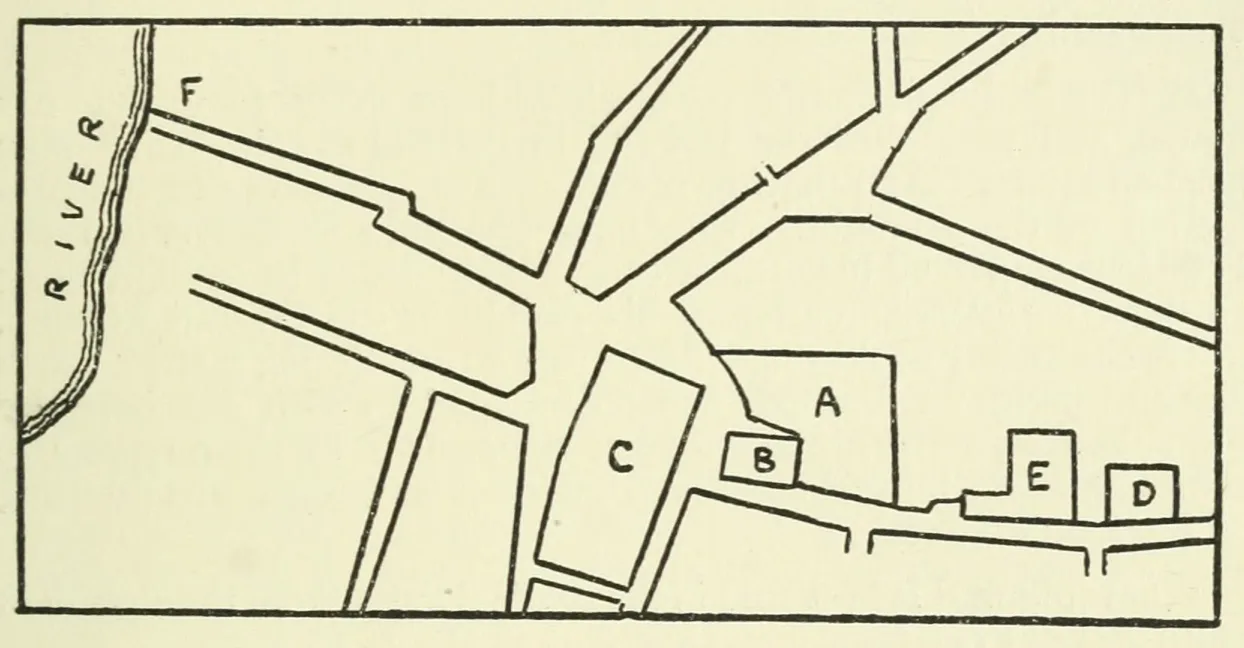
Armenian and Turkish merchants secured themselves and their goods (see p. 308). D is the Armenian Church, now in ruins. E shows the position of the French factory established a little later. F is the site of the subsequent English factory, near the Mulla's Water Gate. Part of this building is still standing, and has been erroneously labelled as the original factory. The boundaries shown in the case of A are partly conjectural; nor can we determine precisely the position of the neighbouring buildings mentioned, including the warehouse of Zāhid Beg. A picture of the factory has been given in the 1634–6 volume of the present series.
With this prelude we turn to the contemporary accounts of the raid. Our first extracts are taken from the record of a consultation held by the English factors on 6 January, and show the composure with which, under the leadership of their intrepid President, they faced the menace of Sivāji's approach.
The 5th of this month comes an hot alarme of that grand rebell Sevage's approach to Gundave, and expected hourly to fall upon the towne. The President thereupon called his councell, and with as much composedness as the distracted time would permit, made these propositions.
In the first place, the broadcloth sold to Khwāja Minaz was, at his request, to be taken into the factory for safe custody. Secondly, it was resolved to instruct the ships at Swally to send up men and arms. Thirdly, directions were given to receive any goods brought in by the dyers and 'beaters' to whom advances of money had been paid.
4. It was unanimously resolved without delay to fortifie our howse, and to hazard the last life in defence of our honourable masters estate. And (having recommended our selves to the protection of the Almightie, who only was able to deliver us) the President employed his utmost care and prudence in strengthening all defective places, quartering his people in the severall avenues, where the enemy could most offend us, and appointing a strict watch day and night. All which being consented to with one heart by the subscribers every one betooke themselves to their respective charge, humbly beseeching the Almighties assistance and blessing on their endeavours.
What followed is best told in the original letter from the President and Council1 (28 January, 1664), now in the India Office. .
Just as wee had proceeded thus farr, being the 6 of January, the day appointed for our goeing to Swally to hasten the ships dispatch, some 3 or 4 houres before our intentions to proceed on our journey, was brought us a hot alarme that Sevogee, the grand rebell of Decan, was within 10 or 15 miles of the towne. This sudden surprize strucke such a terrour to all, both men, woemen & children, that the Governour and the rest of the Kings ministers and eminent merchants betooke themselves to the Castle; which the townes folke perceiveing left theire houses and what ever belonging to them, and fled with theire wives and children, some upon the river in vessayls and boates, some to the out villages, that in a few howers the whole towne was dispoepled, excepting that part of the towne about us, in hopes of our protection. Wee presently sent for forty men from the ships to our assistance, that came to us the next morning early, with whom wee your factors [and] servants joyned, and haveing drawne them out in ranke and file, with drum and trumpet, your President in the head, march[ed] through the body of the towne to the green before the Castle, where the Governour was, ready to pop in upon the first notice of theire approach. Wee past close by him and soe marcht on, taking a great circle round, that the enimy was at the gates before wee could reach our house. The next newes was the rebell had sent two men and a letter, requireing the Governour, Hodgee Zaed Beague [Hāji Zāhid Beg], Virgee Vorah, and Hodgee Cosum [Hāji Kāsim], the three eminent merchants & mony'd men in the towne, to come to him in person immediately and conclude with him; else hee immediately threatned the whole towne with fyre and sword; which hee presently put in practice, not receiveing a present answer, and that day, being the 5th [6th?] at night uninterrupted comes before the Castle and entrencht himselfe, and with his musketeers began to play upon the Castle, wee beleive with no expectation to take it, but to keepe in and frighten the Governour and the rest that had got in, as also the souldyers of the Castle from sallying out upon them whilst the others plundered and fired. In this interim Mr. Anthony Smith, comeing from Swally, was met with and carryed to Sevegee (for it is certainely beleived it was hee in person), who tooke 300 rupees ransome of him and sent him the next day to menace us. But before wee had received many threats, but wee still bid him keepe his poeple out of the reach of our gunns, else wee would shoot them. Hee retourned answere wee were freinds. Wee replyed: if so, why did [hee] detaine an English man, take a horse out of our stable, and make fences of our goods that lay before the custome house, and also sufferred them to bee plundered? All these things speake him an enimy, and therefore the President retourned answere wee would not trust him, or admit of any further treaty, and therefore hee should send us no more messages; if hee did, wee would kill the messinger. Wee had almost omitted to let you know, amoungst these embassaes hee sent to us to demaund homage, which wee presently concluded was all wee had and that a part would not serve his tourne, and that if wee refused it, hee would raze our house to the ground and not spare a life. Wee replyed wee were here on purpose to mainetaine your house to the death of the last man, and therefore not to delay his comeing upon us. By this time hee had broken open Hodgee Zaeds house and had one nights plunder out of it; which being soe very neare us, as one wall to part both houses, wee feared they would streingthen that place and afterward annoy us and by theire multitudes force theire way to undermine and blow us up, and they did begin with theire horse and foote to surround us, some of them then standing under our [ewes1] for no good. Wee caused a party of foote to sally forth the house and fight them, in which scuffle wee had three men slightly wounded, our men slew a horse and man, some say two or three, but wee routed them; and heareing that they had taken up theire randevouz in a muskeet [masjid] or Moores church joyneing close to our house, and also in Hodge Zaeds house and warehouses (haveing out of feare of us not done him the quarter of the mischeife they intended him), whilst our men were cleareing the muskeet, they in the house and warehouses opened the doores and fled. Soe wee shut up the doores and barracadoed them and made a passage from our into his house, and kept a garrison in a belcony that cleared all the street, and guarded all the other house of this Hodjees. When the rebell had heard what was past of the killing and routing his guards, hee falls athreating Mr. Smith, sometimes with the losse of his head, and sometime to cutt of his hands, and at last causes him to write a note to the President that, if wee persisted in fighting against him, hee would race our house to the ground and bee our destruction. By this time wee had more assistance from the ships; wherefore the President wrote [wee would persecute what wee had begun, and not at all moved at his threats, requireing him to save the labour of his servants running too and fro one messages and come himselfe with all his army. The next day hee sent] Mr. Smith upon his peroll, with an Armenian that hee had plundered and another of his servants, with another message to us and the Dutch, with offers of peace, promising to accept of what wee shall present him with; which if wee shall not accept, first hee will plunder and fire the towne, and then set upon us:2 to which wee retourned answere that Mr. Smith belonged to us and wee would not part with him now hee was in our custody, and that there was neither faith or trust in him, but a perfidious rebell, and therefore wee would not trust him. From that time none of his party dared to come neare us, but continued a great deale of tyranny and cruelty to the townes men, cuting of the hands of some and the heads of others, day and night robbing and burning downe the citty, untill the 11, which day hee made a generall fire round about the towne, which had like to have destroyed the Dutch house, it standing amoung tyled and thatcht howses more then your doth, that they were surrounded with flames; but they escaped, now standing quasi alone with but a very few houses neare it. But our quarters are all preserved neare a quarter of a mile round, soe fearefull were the villaines of comeing neare our house againe after the first [losse] they sustained. Soe that you may please to take notice that the greatest part of the towne is burnt to the ground, but what wee preserved; for which the inhabitants are very thankefull in theire acknowledgements, blesseing and praiseing our nation, ascribeing all to the valour of our companyes, who now and then did sally out even to the gates of the Castle. The 12th day, by the comeing in of his espies, that brought him intelligence of an approaching army, hee left the towne and retourned the way hee came, guarding his spoile from the persute of any that should follow him. Hee hath carryed away in gold, pearle, pretious stones and other rich goods to the valew of many hundred thousand pounds, and burnt of other goods and houses to the amount of as much more. The towne is utterly ruin'd, and very little left either of riches or habitation. The rogue was very cruell. Mr. Smith, in the time of his imprisonment, was present when hee cut of more then 26 hands in one day, and many heads. Who ever hee was that was taken and brought before him, who could not redeme himselfe, lost either his hands or his head; and his manner was first to plunder and then to cause the owner of his house to give him something over and above to redeeme his house from being burnt, and yet the perfidious villaine would fire it afterwards, although hee had oblidged himselfe to the contrary. Wee are now endeavoureing to improve this skimage1 of ours to your proffitt by the acclamations of the townes people, as well they that are suffirers as those whose howses were preserved; who, laying aside theire owne losses, cry out in thousands for a reward from the king to the English, that had by theire courage preserved them, when those to whome they were entrusted, as the Governour etc., dared not shew his head. Wee were with the noblemen of the army who came to our releife, from whome wee received great thankes for the service wee did the King and the country; whereupon your President, haveing a pistoll in his hand, laid it before the Cheife, saying with that hee did now lay downe his armes, leaveing the future care and protection of the citty to them; which was exceedingly well taken, telling the President hee did accept it, and in reward of the good service hee must give him a horse, a vest, and girt a sword about him; but your President told him they were things becomeing a souldier, but wee were merchants and expected favour from the King in our trade. Hee replyed: what hee spoke of was intended from himselfe as a souldyer, and that hee did not doubt but that the King, when hee should bee advised of the service wee did him, would gratifie us to our content. Whereupon your President hinted to him his expectations to have the customes remitted you, as a signall of the King’s grace and favour, and it would animate us to bee yet further serviceable to him upon all occasions. This wee have with a petition sent up to the King, backt with the affirmations of the Generall of the army, the King’s publique and private intelligencers (for hee maintains both in towne), the Shawbunder, etc., and also taken care that it bee incerted from the Governour of Ahmadavad, who is this King’s uncle, besides severall letters your President hath wrote to his freinds at court, as Mustapha Ckaun, Rozon Zemeir [Raushan Zamīr], etc. ; which being finished and sent away, the 16th wee repaired to the Maryne for the dispatch of the Europe ships ; who lade very slowly, notwithstanding the goods lay ready upon the Maryne ; but indeed they were hindered sometime for want of theire men which they sent to our rescue ; wherein they were very [forward] and liberall, which will deserve not only to bee gratified, but a perticuler acknowledgement in court to the commanders for theire future encouragement when ever your occasions shall require theire complyance in this nature ; for if they had confined themselves to charter party and spared us no more men then there they contracted to spare, you might have been great sufferers, you haveing then in cash in your warehouses upwards of 100,000 rupees, all your ellephants teeth, all your broad cloth (though sold, retourned againe, which wee thought as good receive as that merchant [that bought it], if plundered or burnt, to breake and runn away), a cargoe of 40,000 royalls from Bantam, virmilian, perpetuanaes, and a great many other goods, as well for sale as bought for Europe, that wee cannot compute your house to bee lesse worth to you then fourescore thousand pounds sterling, besides your President and Councell, which were intended dead corps, knoweing hee would valew us at more then wee and all our families are worth. But blessed bee God, that hath delivered us and you from soe great sufferrings ; and yet your losse will amount to nearest one thousand pounds, in mercooles that lay before the custome house to bee sent downe, and lead that was intended to bee weighed out to the King ; all which wee have advised of to court and required satisfaction.
Later on in the same letter the President and Council reported a fresh alarm, which fortunately proved groundless :
Wee have had second alarmes of Sevages retourne to Surat ; which did soe scare all the inhabitants that they all fled, some in boats and some into inland villages, to preserve themselves and their families from his cruelty, that the flight was worse then at his first plundering and burning the towne, and hee become so terrible that report of his approach is sufficient at any time to dispoeple the small remainder of the citty. . . . [Here] is arrived from Amadavad Mohobutt Ckawne [see p. 106], that Governour, who is the King’s uncle and lord of all these provinces ; who wee heare is much troubled at the ruine of this citty, as the choicest flower in his garden. Hee made what expedition possible after hee heard of Sevages approach. His army hath been here these three dayes, but hee himselfe hath not reacht further then Broach, and tis thought will come no further, now this second fright is over. Wherefore wee have sent Mr. Goodyer, Mr. Aungier and Mr. Rolt, fitingly accomodated, to him to procure his letter to the King for a reward for our good service done him ; which wee are much encouraged to beleive wee shall obtaine, his grandees here being so thouroughly possest of our good service in preserveing not only the greatest, but the best and richest, part of the towne, that wee hope by our next to give you a good accompt of this businesse.
Naturally this absorbing topic figures also in the President and Council’s letters to other correspondents. Writing on 22 January to the factors in Persia, they gave a brief account of Sivāji’s attack on the city, and said that his booty was generally estimated at ‘a crue [krore] of rupees’. The same news was imparted in a letter to the Kārwār factors of 10 February, and in another to Fort St. George of 16 February (printed by Sir George Forrest, op. cit., p. 33). The second letter estimated Sivāji’s force at between six and seven thousand men, and said that, notwithstanding that Mahābat Khān had now stationed 1,000 horse and 500 foot in the city, the majority of the inhabitants had not ventured to return.
From the first of this allarme (which was the 6 January) wee sent downe to the severall commanders in the Roade, and the next morning had 50 or 60 of theire seamen sent to our aid, well armed for our assistance. That day, being the 7th, hee entered the towne with fire and sword, hath rob’d and plundered Virgy Vorah, Hodjee Zaide Beague, those great and eminent merchants, of the greatest part of theire riches, with many more, though inconsiderable to them, yet of great estate and fortunes, all lying in gold, silver, and jewells, dugg all their howses and, when they had possest themselves of all, fired them theire howses downe to the ground ; all but Hodjee Zaid Beagues our neighbour, and that wee preserved in defence of our owne. Hee sent many messages to us. The first was that hee demaunded a liberall gift from us towards the maintaineance of his army, haveing been at great expences to come soe farre, which (as hee was a rebell, a theife) for our owne safties hee expected wee should beare in some measure. This allarmed us to stand upon our guards, concludeing that lesse then the whole would not satisfie him. Whereupon wee gott to us a second supply of men, that wee were (the Companies servants included) one hundred and three or foure score strong; till when hee [wee?] demur'd our answer, and then sent him word, by another messinger hee sent the next day, that wee knew no obligation wee had to give him anything, or hee any reason to demaund it, and that wee were resolved to maintaine our owne with our lives. Hee replyed that, if hee had not what hee expected, hee would raise our house to the ground and not leave a man alive; at which wee sent away the messinger and bid him assault us if hee dare: wee were ready to oppose him; and that hee send no further message or messinger, resolveing to treate no further with him; which if hee did, wee would shoote the messinger dead in the place; requireing him, and all that belonged unto him, not to come in the reach of [our?] gunns. The next day, or the day afterwards, hee sent a party of horse and foote with combustable stuffe to fire the severall Banians houses that were joineing to ours, hopeing thereby to doe as much to us. That they might not bee discovered, they kept under the eves of the houses, that wee could discerne only the blades of theire lances; whereupon wee sent a party out to fight them, that in a shorte time routed them out from thence; in which conflict there fell of theirs to the ground a horse and man and one of theire foote, besides what wounded; our poeple comeing of againe with one wounded deeply in the shoulder and another shott in the legg with an arrow. After which they came not more neare us, but minded theire plunder and fireing the towne at distance, untill said rebell had heaped to himselfe vast riches, to the amount of many hundreds of thousand pounds; which hee had gott together by the 13 in the morning and marcht away without any opposition or any ones lifting theire hands against him, except our selves, in the whole time of his ransackeing the towne. Since here hath arrived severall armyes out of the country, who served to no other end then to behould the ruine and desolation that hee hath made, the greatest part of the towne being burnt downe and laid in ashes.... Wee had allmost forgott to tell you that Mr. Anthony Smith in the time of troubles was so inconsiderate as to come from Swally hither alone, and was snapt comeing through the towne and carryed to the said Sevagy; who, after hee had threatened him with the losse of his head, caused him to bee bound with his armes behinde him amoungst the rest of the prisoners, demaunding 300,000 rupees for his ransome, but by the freindship of an Armenian that was of his acquaintance, of whom Sevagy asked his quality and condition, who assured him that hee was a common man, the next day tooke 300 rupees and sett him free, sending him to us upon his peroul, with a message full of threats and menaces; but haveing him in our possession wee were resolved not to sufferr him to returne, but sent our answere by those that came with him, that hee was a rebell and a theife and therefore valued not his threats, and that Mr. Smith was our servant and wee would keepe him. . . .
The story was repeated in a letter to Bantam of 19 March, but the only additional details given are that, in addition to the supply of men, the English received from their ships 'some brasse guns, which wee mounted before our doore and other convenient places', and that Sivāji's design was judged to be 'not altogether riches but a revenge upon this King'. A letter to Bengal of 30 April also recounts the incident, but without adding anything fresh.
Next we may give the account to be found in the log of the Loyal Merchant (Orme MSS., no. 263), then lying at Swally. It is partly, of course, based on hearsay.
Januarie 5. This day at 3 after noone came downe newes from the President of Savages, a great robber, being within 10 or 12 miles of Suratt; soe required from Mr. James to desire the commanders to send up 40 men armed to guard the Companies stock. Soe we sent up 10 men compleately armed. 6. This afternoone at half past two another noate came from the President that life and goods and all at stake; so desired to send up all our men except 10, with our longboats and skiffs; but by consultation did not think that fitting, so sent up 20 men more armed, and out of the other ships 22 more. That night the rogue gott into the towne and began to sett itt on fire, and fell to plundring. The men gott all safe into the English house; with those that were above before, [they] made up some 150 English and some 50 peones; [who] were resolved to defend the towne, the cowardly Governour haveing ranne into the Castle and left the towne to bee plundred, there being some 20,000 men and upwards in the towne, none standing to theire defence butt the English and Dutch. 7. The enemy fired and plundred the towne; and comeing to fire aboute the English quarters, the English sallied out and killed three men and a horse; and from that time they forbore any more to molest the English; wee and the rest of the shipps haveing sent up 100 men, and there was in the English house some 50 English and some 60 [sic] peones; soe that there was in all some 210. In all the English did behave themselves gallantly, which made the Armenians and other strangers stand on their defence; butt amongst them all noe party soe considerable to sally out to repulse them, hee wasteing with fier all the towne except the English quarters aboute them, and soe continued plundering without resistance, scorning to carry any thing away but gold, silver, pearles and diamants, and such pretious wares. The 10 at night, after [hee] had committed many cruelties, haveing destroyed ⅔ parts of the towne with fier and cutt of severall heads and hands, haveing had Mr. Anthony Smith prisoner, whom after 3 daies hee released for 350 [sic] rupees, haveing certifyed him that hee would cutt of his head, and hee had surely dyed, if a plott had taken effect, which was the murthering of Sivagee, a Moore stabbing att him, whose hand was cutt off before [hee] could give the blowe; hee closeing with the Generall, being all bloody, they tumbling downe, blooded the Generall; soe his men thought hee had been slaine, and the word was given to kill all the prisoners; butt the Moore being killed imediately, the Generall forbad the execution. Soe at night, hee having notice of some forces that were acomeing against him, haveing sufficiently enriched himselfe, haveing by report carried away with him above a million and halfe of mony (Suratt not haveing been soe rich, not in many yeares before), hee departed, with the curses of many undone people. This unhapy disaster did obstruct all our buisnesse, wee being forced to lay aside all buisnesse, haveing spared most part of our men. The 17th, the King’s army being in the towne, the President came downe with the applauses of all the townes people, the Governour of the towne being as much derided and scorned; for if hee had not gon into the Castle, hee might in all reason have saved the towne. At his comeing out of the Castle the people derided him and flung dirt at him; for which his sonne shott a poor Bannian, that was just come over the water with his packe on his backe, with an arrowe in at his mouth and killed him; sheweing the insulting pride and basenesse of those people, that durst not stand an enemy to save there estates, yett killed a poore Bannian that durst not doe him any jurye. The people of Suratt [were] still terrefied with fresh alarums of the rogue comeing; all being ready to leave the towne, and would, were it not for the English and Dutch. The Dutch had two peons killed; they not vent[u]ring themselves out, but sent out there servants. There was in this season the Malabars came up to the rivers mouth and tooke a boate [in] which a Moore had saved his estate; wherein they tooke much wealth; which caused an alarum by the feare of those poore Bannians that Sivagees men had sett the Buzar1 on fier. Soe I had 40 men, well armd, ashoare, but found no opposition, there feares not giveing them leave to beeleeve what they saw with there owne eyes was not soe.
A first-hand account is contained in a letter from Henry Gary to the Earl of Marlborough, dated 26 January, 1664, now preserved in the Public Record Office (C. O. 77, vol. ix. no. 24). It adds nothing to the foregoing narratives, except that Gary’s house, which adjoined the English factory, was garrisoned as well : that the number of houses burnt was upwards of three thousand : and that the amount of plunder carried away was ‘credibly reported neere unto tenn millions of rupees’. Consul Lannoy at Aleppo heard that the amount was ‘above one million of pounds sterling’ (Report on Finch MSS., vol. i. p. 313).
The fullest and most graphic narrative of all is to be found in a long letter from the lately arrived chaplain, the Rev. John L’Escaliot, dated 26 January, 1664. This was first printed in 1836 by Simon Wilkin, in his edition of the works of Sir Thomas Browne, from a copy found amongst the latter’s papers (now in the British Museum : Sloane MSS., no. 1861); but, as that version contains several inaccuracies, I have recently reprinted the text in the Indian Antiquary (December, 1921). As I have there shown, the letter was addressed, not (as usually stated) to Browne himself, but to one of the writer’s relatives at Norwich, probably his brother George. The narrative is too lengthy to reproduce in full here, and only a few salient quotations can be given.
It commences with a description of Surat, in the course of which we are told that
The whole towne is unfortefied, either by art or nature. . . . Their care hath beene soe little to secure it by art that thay have only made against the cheefe avenues of the towne some weake and ill built gates, and for the rest in some parts a dry ditch easely pasable by a footman, wanting a wall or other defence on the inner side; the rest is left soe open that scarce any signe of a dich is perceiveable.
An account is given of Sivāji and his exploits. As regards his appearance and character,
His person is discribed by them whoe have seen him to bee of meane stature (lower some what then I am), erect, and of an excellent proportion; active in excersise, and when ever hee speaks seemes to smile; a quicke and peercing eye; and whitter then any of his people. Hee is disstrustfull, seacret, subtile, cruell, perfidious, insulting over whomsoever he getts into his power, absolute in his commands, and in his punishments more then severe, death or dismembering being the punishment of every offence; if nesessitty require, venterous and desperate in execution of his resolves.
The approach of the raiders, the terror and flight of the inhabitants, and the cowardly behaviour of the Governor are then described.
We the English in our house, the Duch in theirs, and some few marchants of Turky and Armenia, neighbours to our English house, possesed of a seraw1 or place of reception for straingers, were left by the Governour and his people to make what shift wee could to secure ourselves from the enemy. This might the English and Duch have done, leaveing the towne and goeing over the river to Swalley to our shipps, which were then riding in Swalley Hole; but it was thought more like English men to make ourselves ready to defend our lives and goods to the uttermost.
L’Escaliot then details the steps taken to fortify the factory.
Our four smaller guns are then carried up to the tope of the house, and three of them planted to scoure two great streets; the four[th] was bent upon a rich churles house (Hogee Said Beeg ...), because it was equally of hight and, being posesed by the enemy, might have beene dangerous to our house.... On one side wee tooke possesion of [a] pagod or Banian idol temple which was just under our house... on the other a Moorish meseete [i. e. mosque], where severall people were harboured and had windowes into our outward yard, was thought good to bee cleared and shutt up.
The capture of Anthony Smith is narrated, and then an account is given of the sally made by the English, which it appears took place on the Thursday afternoon and was led by Gerard Aungier. Smith’s release, and the various messages sent by Sivāji to Oxenden, are next recorded. Smith related, amongst other things, that
When hee came away, hee could not [but] guess, by the mony heaped up in tow great heapes before Sevagee his tent, than that hee had plundered 20 or 25 lack of rupees: that the day when hee came away in the morning there was brought in neere upon 300 porters, laden each with 2 baggs of rupees, and some hee guessed to be gold: that thay brought in 28 sere of large pearle, with many other jewells, great diamonds, rubies, and emeralds... and these, with an increedable quantety of mony, they found at the house of the reputed richest marchant in the wourld (his name is Verge Vora, his estate haveing beene esteemed to bee 80 lack of rupees): that they were still, every hower while hee was there, bringing in loods of mony from his house. His disire of mony is soe great that he spares noe barbour[ou]s cruelty to extort confessions from his prisoners; whips them most cruely, threatens death, and often executeth it, if thay doe not produce soe much as hee thinks they may or disires they should; at least cutts off one hand, sometymes both.
Smith also narrated the attempt of an emissary from the Governor to assassinate Sivāji, already mentioned in the extract from Captain Millet’s log. Smith himself had narrowly escaped execution among the prisoners.
It comes to Mr. Smith[s] turne; and his right hand being comanded to bee cutt of, hee cryed out in Indostan to Sevagee rather to cutt of his head; unto wich end his hatt was taken of, but Sevagee stopt execution, and soe (praised bee God) hee escaped. There were than about 4 heads and 24 hands cutt of.
L’Escaliot then relates the receipt of fresh threats from Sivāji (the Ethiopian ambassador being employed as the messenger), Oxenden’s reiterated defiance, the burning of the town, and the raiders’ withdrawal.
The account given by the Dutch factors of their experiences is of great interest, but much too long for detailed notice here. Their dwelling was in the southern part of the city, not far from the Castle. The Directeur, Dirck van Adrichem, had at his disposal a much smaller number of Europeans than Oxenden, and was compelled therefore to adopt a more cautious policy, standing strictly on the defensive. He and his companions had, however, a very anxious time, mainly owing to the danger to their factory from the conflagration raging around them. A fairly long summary, based upon advices from Surat, has been printed (in Dutch) in the Dagh-Register, Batavia, 1664 (p. 195); and a still fuller one, being a copy of the Surat Factory Diary for those days, is contained in the Hague Transcripts (at the India Office), series i. vol. xxvii. no. 719.1 I have printed a condensed translation of this in the Indian Antiquary (January, 1922), to which the reader must be referred.
Another account from a Dutch source is to be found in the narrative of Volquard Iversen, a German version of which was printed in 1696 in Adami Olearii Reise-Beschreibungen (part v. p. 141).
Iversen was one of the staff of the Dutch factory at the time; but he tells us nothing of his own experiences, contenting himself with giving an abstract of the official account, above mentioned, which he copied at Surat. He adds that the loss sustained by Vīrji Vora was estimated at six tons of gold, and that two other Hindu merchants suffered to the extent of thirty tons. The Dutch ton gouds represented 100,000 gulden, and at this rate Vīrji Vora's loss would be about 50,000l.; but of course all such statements were based on guess-work.
To the foregoing accounts Bernier (Constable's edition, p. 188) adds a few details, of course from hearsay.
Seva-Gi (the holy Seva-Gi!) respected the habitation of the Reverend Father Ambrose, the Capuchin missionary. 'The Frankish Padrys are good men,' he said, 'and shall not be molested.' He spared also the house of a deceased Delale [Hind. dallāl] or Gentile broker, of the Dutch, because assured that he had been very charitable while alive.1 The dwellings of the English and Dutch likewise escaped his visits, not in consequence of any reverential feeling on his part, but because those people had displayed a great deal of resolution, and defended themselves well. The English especially, assisted by the crews of their vessels, performed wonders, and saved not only their own houses but those of their neighbours. The pertinacity of a Jew, a native of Constantinople, astonished everybody. Seva-Gi knew that he was in possession of most valuable rubies, which he intended to sell to Aureng-Zebe; but he persevered in stoutly denying the fact, although three times placed on his knees to receive the stroke of a sword flourished over his head. This conduct was worthy of a Jew, whose love of money generally exceeds his love of life.
Jean de Thevenot (Voyages, ed. 1727, vol. v. p. 85) gives an account of the raid, in which he also says that the house of the Capuchins was spared, because Father Ambrose had appealed in person to Sivāji not to harm the poor Christians of the city, and his request had been granted.
The Dutch letter from Surat already mentioned gives (as summarized in the Dagh-Register) the further intelligence that Mahābat Khān, with four or five thousand horse, reached the city a fortnight after the departure of Sivāji: that the Emperor, on learning the news, cashiered the Governor, the Captain of the Castle, and the ‘Commissaris’ [Kotwāl?], and ordered that a wall should be built round the city to guard against a repetition of the raid: and that, in compensation for their losses, all merchants, including the English and the Dutch, were granted a remission of customs duties for one year. A letter from Batavia to Holland, repeating this intelligence, will be found in the Hague Transcripts (series i. vol. xxvii. no. 711). This added that a new Governor had been appointed to Surat, named ‘Geadischan’ [see p. 314]. He arrived on 22 April (Dagh-Register, 1664, p. 423).
We now return to the English records. In a letter of 4 April, 1664,1 from Surat to the Company we find the following account of the remission of customs duties.
This King hath taken very heavily the plundering and burning of this towne and port of Surratt, and hath vowed revenge upon the rebell. Our last acquainted you how that wee were then in action, by solliciting the severall commanders of armies that came downe (though too late) upon notice given them of Sevages approach; also that wee were then writteing a petition to the King for a reward for our good service done him; which since wee are informed was by our freinds in court (to whom your President wrote) delivered into the Kings hand; wherein wee hinted our expectations that hee would remitt us all your customes. Whereupon the King, after hee had taken it into his most gratious consideration, hath sent downe an order that the whole customes of all merchants should bee remitted for one intire yeare. The benefitt wee hope you will reap in your next yeare[s] ships out and home; and Mohobutt Ckaun, the Governour of Ahmad[abad] and Generall of the province of Guzzeratt, adviseth your President that, upon his request to the King on our behalfes and the solicitation of freinds at court, it is resolved, upon the expiration of the yeare, the King, in leiw of our good service, will give us the ¼th part of all your customes free; and this when by our endeavours wee shall effect, wee shall hope for a sutable reward from you our masters; whilst the thing it selfe shall remaine as a lasting memoriall of our active willingnesse to promote your interest.
On 19 May the President and Council, in a letter to Madras, said modestly that their action
Truly hath had the good hap to bee famed to deserve much beyound our merritt. . . . The King hath graunted to all custome free for one whole yeare for all that shall bee either exported or imported in this port; and since wee have received a letter from Gafferekaune [Jafar Khān], the King's Dewan, which is called a husbull huckum1 or the Kings speciall command, that acquaints us the King received our letter and petition of the accompt of the fight, and read it with soe great content, and soe much satisfaction that hee had those in his country that faced his enimy, that thereupon hee gave to all the favour exprest of a yeares custome gratis, and for our further encouragement, from the expiration of the yeare the halfe of our customes for ever. This improvement wee have already made, and are yett in expectation of greater honors; for wee strike whilst the iron is hott, verifying the old proverb: tis good to fish in troubled waters some times.
Later in the year (26 November) the President and Council repeated to the Company this news, and gave some additional information as to the course of events.
Wee are dayly in feare of Sevagees comeing againe, and soe have [been] ever since hee was heere; for hee dayly threatens heartily to visitt this towne once more, except the King will give him peacible[y] the fourths of what hee receives of the towne and country yearely; which is too dishonourable for the King to except. . . . Wee are in a peacible condition at present. All things goe on in an even channell. Pray God continue our quiett, for wee are dayly alarm'd, and the townes poeple are frighted and unsetled. Our Governour is a very good man, who is wonne by your Presidents late services done the King and him (by his ship Royall Welcome) to doe from time to time whatever your President moves for, and hath exceedingly earnestly wrote to the King in favour of our nation to bestow on us some further favours and immunities in recompence of the service done, thereby to expresse his princely favour. You have this whole yeares customes, both out and in, graunted you free, and, as an addition of honour, the Governour, upon your Presidents request, sufferred all your Europe goods and monyes to bee transported in your boats directly to your house, without comeing neare the custome house and without any notice taken of the goods by either Customer or weighters; which was not only admired at by all the towne, but many were disgusted at it; unto whom the
Governour replyed that wee had soe deeply engaged the King and him that hee could in reason refuse us nothing wee could aske. Wee hope you will bee pleased to consider us in this good service done you, by an answerable reward; the purchaseing of which hath cost your President a considerable summe of mony, which hee doth not doubt your ready reimburseing him with, since the adventure was soe hazardous to him and gainefull to you; the accompt whereof shall bee given you in our next. Wee have received from court a letter to your President from the King's Dewan (which they heere call Husbull Huckum, which is as much as by the King's immediate commaund), wherein you have graunted you the halfe of your customes for ever. Wee doe endeavour (and this Governour labours with us) to procure all under a phirmaund immediately from the King; which will bee much more authentique to any Prince or Governour that shall come after.... Hodjee Zaied Beague and Virjee Vorah, the two great merchants of this towne, hould up theire heads still and are for great bargaines; soe that it seems Sevagy hath not carryed away all, but left them a competency to carry on theire trade. Hodjee Zaied had fared very ill, had his [house] not joyned to ours; for when they had entered his house, they could not [sic] annoy us at pleasure, nay indeed, destroy us with fire, soe much combustable stuffe was in the house next to us, being filled with poles, timber, caroo,1 cotton etc. stores for shipping. Wherefore wee, apprehending the danger of it, and knowing him [Sivāji] to bee a rouge that houlds neither faith nor truce, but designed us one of his last morcells, drue out a file or two of musketeers, cleared the house, shutt the doores within, and kept a guard of our owne there ever after; by which Hodgee Zaied was preserved. Thus wee have troubled you with peeces of storyes concerning Sevagy, who is the sole talke of court and country.
The letter of 2 January, 1665, referred to in the next chapter, continues the story.
Our present Governour begins to abate of his kindnesse, now that his turne is served and the King's businesse done to theire hands. But wee have not spared to lett him know our services, and the King's promises in the performance of them; [so] that at last hee is perswaded to doe us right in the cleareing of nearest a 1000 bales of goods of yours now intended for Europe, intending by delayes to putt it off untill such time as the graunt of the King's for custome free should bee expired. But perceiveing his drift, [wee] never left importuneing him untill wee gott his graunt for the getting of them away within the time. Now our next businesse will bee to gett this Governour to confirme this Kings Chancellour or Dewan's order, sent to us by the King's expresse commaund, that for the future wee should pay but ½ customes; which notwithstanding wee have it from this Dewan under his owne seale and by the King's expresse commaund, yett is it very much in this Governour etc. officers power to allow it, in reguard you have no person at court to represent your greivances; which makes those heere impose soe much upon us, which otherwise they dare not doe.
The assertion made in the above extracts that half the customs were to be remitted to the Company for the future seems to have been based on some misunderstanding, the fact being that they were granted a reduction of one-half per cent.,1 viz. from 2½ to 2. This appears from the text of the document itself, as represented in two translations, forming nos. 3025 in the original and duplicate series of the Original Correspondence. The second of these (from which we quote) was sent home with a letter of 7 November, 1671 (O.C. 3594); while the first appears from the handwriting to belong to the same period or a little later.
The document commences by referring to Oxenden's letter and expressing the Emperor's satisfaction with the behaviour of the English, and then continues:
The King haveing received and understood these things, and the inhabitants of Surrat haveing also wrote of these matters, the Governour of Surrat, Reaite [sic] Chaun, was turned out of that goverment, and in his place Ghasty Chaun2 is appointed by the King; and the King, out of his own favor to the merchants, Mahometans, Hindoes, Armenians, Hollanders, English, Portugez, French, and Mallabars, for jewells, gold, silver, horses, and all other goods that come from other ports to Surrat, and for all other goods that are carryed out from the happy Hindustan to other places, the whole customes thereof which are taken in the custome house for the Kings accompt he hath given free for one yeare. And moreover, haveing regard to the welfare and good condition of the Dutch and English, in the customes which are paid by other merchants and them hath freely rewarded you; for of the 2½ per cent. which you pay to the Kings custome house he hath given you ½ per cent. free, and hath wrote a phyrmaund to the officers of the bundar that they alwaies take 2 per cent. custome upon all your goods. Understand you the Kings favor and ask Gods blessing. Doe the King acceptable service and expect a reward. The 26 day of this month Sabaun in the 6 yeare of the reigne [i.e. 14 March, 1664].1
It will be seen that the concession was made to the Dutch as well as to the English; and this is confirmed by the Dagh-Register, Batavia, 1664 (p. 423), which agrees that the reduction was one-half per cent. It appears also that this applied only to imports, the duty paid on exports by the English continuing to be three per cent. until 1667.
Directly the English factors became conscious of the error they had made, they set to work to get the concession enlarged. It would appear, however, that all Oxenden’s efforts were fruitless, and the factors had to content themselves with the reduction already obtained. Even this lasted only for a time. In November, 1679, Streynsham Master noted in his diary the receipt of letters from Delhi, advising that
The King, being informed how our customes were paid at Surratt, demanded the ½ per cent. againe, both of the English and the Dutch, that was taken off for service done at Sevagees first plundering that towne, and turned out all the writers for leting it pass free soe long.2
The rewards which the factors expected from the Company did not arrive until 1668, when Oxenden received a sum of 200l., with a gold medal, Goodier 100l., and Gary and Aungier 60l. each; in addition, the Council was directed to distribute 400l. amongst those who took part in the defence of the factory (Yule’s Diary of William Hedges, vol. ii. p. 302). Prompter action was taken in the case of the officers and men of the Loyal Merchant and African. Plate to the value of 30l. and 20l. respectively was presented to Captains Millett and Fisher (besides a money reward to the former), 40s. each to the men landed, 5l. to the mates commanding them, and 20s. each to the men who remained in the ships; the owners of the Loyal Merchant were awarded 300l.; the purser 20l.; and Thomas Paine, 'whoe was shott in the legg on shoare', received 5l. as compensation (Court Minutes, 23 September and 2 December, 1664, and 4 April, 1665).
Notes
- 1. First printed (from a copy at Bombay) in Sir George Forrest's Selections from the Bombay Records, Home Series, vol. i. p. 24. The words inserted in the text between square brackets are taken from the duplicate in Factory Records, Surat, vol. 86.
- 1. Eaves.
- 2. According to L'Escaliot, Sivāji demanded a present of three lakhs of rupees, ‘or elss let his men freely to doe their pleasure to Hogee Said Begs house’.
- 1. ‘Skirmage’ in the copy. It is an obsolete form of ‘skirmish’.
- 1. Presumably at Swally.
- 1. According to the Dutch account, this was called the ‘new sarāi’, the old one being occupied by the Ethiopian ambassador and his followers.
- 1. See also Valentyn’s account in his Oud en Nieuw Oost-Indien (book iv. part ii. p. 265), which is obviously from the same source.
- 1. Tavernier (Ball's edition, vol. ii. p. 204) says that the broker's name was Mondas Parek [Mohan Dās Pārak]. 'He was a rich man and very charitable, having bestowed much alms during his life on the Christians as well as on the idolaters; the Rev. Capuchin Fathers of Surat living for a part of the year on the rice, butter, and vegetables which he sent to them.'
- 1. Printed in Sir George Forrest’s Selections from the Bombay Records, Home Series, vol. i. p. 36.
- 1. Hasb-ul-hukm (literally ‘according to order’) was the formula used in recording a verbal order from the Emperor.
- 1. Possibly the Hind. kari, a small beam or rafter.
- 1. Bruce (Annals, vol. ii. p. 145) says one per cent. He seems to be confusing the present concession with that granted by Aurangzeb's farmān of June, 1667 (see Forrest's Selections from the Bombay Records, Home Series, vol. i. p. 213). Fryer (ed. Cooke, vol. i. p. 223) states that the reward was 'an abatement of customs to two and an half per cent.'; but evidently he was misinformed. He also says that Oxenden received a dress of honour from the Great Mogul; presumably this accompanied the letter.
- 2. 'Jhasty Ckaun' in the other version. The name appears to have been Ghiyās-ud-dīn (O.C. 3218). The suburb of Surat known as Gāstipura is said to have been named after him (Bombay Gazetteer: Surat, p. 309).
- 1. A copy of this version will be found in Factory Records: Miscellaneous, vol. ii (p. 86).
- 2. The Diaries of Streynsham Master, vol. ii. p. 292.