1. The Political Situation
The subject of this book is an examination of the economic movements which affected India during the first half of the seventeenth century, but it is desirable to say a few words by way of introduction about the political situation in India itself, and in the countries with which India then maintained commercial relations. In this volume, as in India at the Death of Akbar, I mean by “India” the area now occupied by the Indian Empire and the Indian States, but exclusive of the province of Burma, the political union of which with India dates from a much later period.
The bulk of this area falls into three main divisions, the Mogul Empire in the north, the Deccan kingdoms in the centre, and the territories held by Hindu chiefs in the south. So far as the Mogul Empire is concerned, the period I have chosen coincides with the reigns of Jahangir and Shahjahan, and during these reigns the political history of the Empire possesses but little interest for the economist. Occasional rebellions, struggles for the succession to the throne, an endless series of Court intrigues,—such matters as these will not concern us greatly, apart from the obvious facts that recurring outbreaks of disturbances involved not only loss at the moment but discouragement of enterprise for the future, and that the growth of public expenditure meant a progressive increase in the administrative pressure on producers. As regards the frontiers, no events of importance occurred on the north, while on the west it is sufficient to mention the struggle with Persia for the possession of Kandahar, which affected not only the land trade between the two countries but also the commerce of the Gulf of Cambay. On the east, the effective rule of the Moguls stopped short at or near the estuary of the Meghna, and portions of eastern Bengal were ruled by the king of Arakan until the year 1666, when Chittagong was captured, and, with the intervening country, brought under the administration of the Empire. More important changes occurred on the southern frontier, where the subjugation of the Deccan kingdoms had already begun. Of the five states usually included under this expression, Bidar was absorbed by its neighbours and disappears from history, while Khandesh was already a Mogul province. The conquest of Ahmadnagar had been attempted by Akbar, but was not finally effected until the year 1635, when most of its territory was incorporated in the Empire, and about the same time the two remaining kingdoms, Bijapur and Golconda, were reduced to the position of vassals, though their internal organisation remained practically intact.
Of the Hindu territories in the south no detailed history is required. After the destruction of the power of Vijayanagar in 1565, the country was left in the hands of chiefs, who were known as Nāyaks, and who recognised in theory, and occasionally in practice, the overlordship of a representative of the Vijayanagar dynasty, styled king of Chandragiri, or popularly king of the Carnatic. Such glimpses as we obtain through the Dutch and English records show these nayaks constantly fighting among themselves, with the king sometimes as a puppet and sometimes as an active partner; the grouping changes rapidly, and all that need be said is that peace was rarely enjoyed, and could never be expected to continue. Meanwhile Golconda and Bijapur were extending their territories in this direction, sometimes in alliance with one nayak or another; I can find no suggestion of anything that would nowadays be regarded as a reasonable casus belli, but at this period the prospect of obtaining revenue or treasure was commonly a sufficient motive for hostilities.
Of the lesser territorial units in India, the position of the Portuguese will be discussed in subsequent sections ; the remainder are of little economic interest, and the only one which requires mention is the small state of Calicut, still practically independent, and, from its situation on the pepper-yielding coast of Malabar, a place of some importance in the commercial politics of the time.
The description which has just been given of Southern India might almost be applied to the greater part of Asia. Throughout the countries with which India maintained relations, war was, if not the normal condition of affairs, at least sufficiently probable to dominate the minds of merchants and producers, while the slightness of the pretexts on which it might be undertaken made a reasoned forecast impossible, and there was nothing for it but to accommodate oneself to circumstances as they arose. The most important countries on the western side of India were Persia and Turkey ; they were frequently at war, and their hostilities had marked effects on the course of trade, while Turkey had in addition occasional troubles with the Arab tribesmen on the shores of the Red Sea. To the east of India, the countries of Arakan, Pegu, Ava, and Siam form a group of which it can be said only that war might break out among them at any moment, and Siam might also be expected to interfere in what is now Indo-China, where local wars were not less frequent. China was being conquered during this period by invaders, while Japan had recently attempted to seize Korea, and had been the scene of prolonged civil wars.
The situation in the southern islands was perhaps worse than on the continent, for kingdoms were smaller, and sources of dispute were accordingly more numerous. The chief power in Sumatra was the tyrant of Achin, a dynasty founded in the sixteenth century on the destruction of some older kingdoms. Achin controlled most of the pepper-yielding country on the West Coast, and attempted from time to time to extend his dominions over the minor kings farther to the east, but his hostility was directed primarily against the Portuguese at Malacca, a place to which he had no particular claim, but to which he was attracted by its commercial advantages. In western Java the adjacent maritime kingdoms of Bantam and Jakatra might be at war at any time, either with each other or with their neighbours, and the establishment of the Dutch at Batavia did not at first make for peace. The king of Macassar, the chief place on the island of Celebes, had ambitions towards the conquest of eastern Java, while his commercial policy involved occasional hostilities with the Dutch. The position in the Spice Islands1 at the end of the sixteenth century was nearly desperate. The inhabitants of the Banda Islands had then ousted the Portuguese, and were for the moment in enjoyment of a precarious independence. In Amboina the Portuguese still held out, owing mainly to dissensions among their local enemies. In the Molucca Islands proper there were nearly as many parties as islands; and since the control of exports from these islands was essential to the successful prosecution of the Eastern trade, the advent of the Dutch and the English served at first to increase the confusion. Eventually the Dutch secured the mastery, but in spite of their drastic methods of pacification it was long before tranquillity was established.
The economist can pass lightly over the details of such conflicts, but it is important for him to realise that, with the exception of China, none of the Asiatic powers had developed anything which could properly be described as naval force. We read indeed of “fleets” set out by Pegu, or Achin, or Macassar, but the descriptions of their activities show that the vessels must be regarded as transports rather than as fighting units. When Achin, for example, sent an expedition against Malacca, it meant that an army was embarked on some hundreds of craft of different types, to be ferried across the intervening waters and landed on the enemy's coast; and if such an expedition met with a Portuguese fleet in the strict sense, the transports were simply swept off the sea. The Mogul Empire had no navy, and it is almost pathetic to read the demands of the Surat authorities for the help of one or two Dutch or English ships to protect their harbours against attack.1 A few Dutch gunboats sufficed, as we shall see, to force Golconda to sue for peace. On one occasion the steward of the king of Persia declared with perfect truth that his master was king of the land but not of the sea. We shall refer later on to the "fleet" maintained by the Turks at Mocha; here it is enough to say that in the closing years of the sixteenth century the Portuguese were indisputably masters of the Indian seas, not so much from their own strength as from the failure of the Asiatic nations to realise the nature of sea-power. The history of Indian commerce during our period is bound up indissolubly with the transfer from the Portuguese to the Dutch of sea-power in the region between Mozambique and the Moluccas, and it is necessary therefore to describe this change in some detail.
2. The Portuguese Maritime Empire
The first Portuguese vessels appeared in Indian waters at the end of the fifteenth century, and within a very few years the conception was formed of a type of Empire of which Asia had no recent experience. The design was to hold the seas in strength, and control sea-borne commerce for the benefit of the ruling power: it was an enormous enterprise for a small nation seated some thousands of miles away, and its realisation was rendered possible only by the attitude of the Asiatic powers which has just been described. The essentials for success were two : fleets strong enough to overcome opposition on the water, and a small number of naval stations, defensible both by land and by sea, to afford shelter and supplies for the fleets, and—as time went on—to furnish reinforcements of sailors and fighting men. The absence of any serious opposition made it possible to control the seas by means of fleets of very moderate strength, so that at the outset the real problem for the Portuguese was the acquisition and fortification of the naval bases. The primary bases were three in number : Goa on the western coast of India, Malacca at the gateway of the Farther East, and Ormuz at the entrance to the Persian Gulf. The original design had included also the harbour of Aden, to control traffic with the Red Sea; the spread of the Turkish power along the Arabian coast prevented its acquisition, but the three places named proved sufficient for nearly a century. Apart from them, the Portuguese held various forts designed for special purposes, the chief of which were Mozambique, Diu, Damān, Cochin, and Colombo. Mozambique on the eastern coast of Africa served as a halting-place for the annual fleets from Europe, and also as a trading centre; Diu and Damān watched the Gulf of Cambay, the most important of the various outlets of Indian trade; Cochin was the chief port for the pepper of Malabar, which formed the largest single item of the cargoes sent to Europe; and in the same way Colombo controlled the principal source of marketable cinnamon. There were also smaller forts scattered among the hostile populations of the Spice Islands, to secure the trade in cloves, mace, and nutmegs, and at carefully chosen points on the East African coast; while at or near some of the stations, particularly on the west of India, small areas of territory came from time to time under Portuguese rule.
As the century went on, Portuguese communities of a somewhat different type came into existence. Some of them were provided with forts to which commanders were appointed from Goa, others were merely settlements in foreign territory, but all were distinguished by being primarily places of trade rather than centres of power. On the eastern side of India, such settlements existed at S. Thomé and Negapatam in the south, and at Hooghly and Chittagong in Bengal. Farther east there was Macao, at the entrance to the harbour of Canton, whence merchants were admitted under severe restrictions to a share in the trade of the mainland of China; there was a small colony on the distant island of Timor, engaged in supplying the white sandalwood procurable in those parts, and at a later period there was an extensive settlement in Macassar; but these and various places of less importance did not add materially to Portuguese power, though they made important contributions to the wealth of the community. The centre of power was Goa, on which the chief fleets were based, and whence reinforcements were despatched East or West in case of need. The smaller vessels, and some of the larger, were built in India, either at Goa itself or at Bassein, and the dockyard at the former city was probably the most highly organised industrial enterprise in the country.
The methods adopted for the control of sea-borne commerce were briefly as follows. In the first place, certain trade routes were declared a monopoly of the king of Portugal, and on these routes no vessels of other nationalities were allowed to ply. The reserved routes varied from time to time, but at the end of the sixteenth century it may be said that no Indian ship could venture to East Africa, to China, to Japan, or to the Spice Islands without risking capture or destruction by the Portuguese; commerce to these countries was either conducted as a State enterprise, granted to individuals by way of reward, or farmed for the benefit of the treasury. In the second place, the carriage of certain goods, notably munitions and pepper, was prohibited to all foreign vessels, and a breach of this rule involved destruction or confiscation. In the third place, no Asiatic vessel could ply to any port, or carry any cargo, until fees had been paid and a licence (cartaz) obtained; while, apart from licence-fees, customs duties were levied at such ports as Ormuz or Malacca. In theory, then, the official control of sea-borne commerce was complete, but in order to understand the actual position allowance must be made for the fact that the Portuguese administration was exceedingly corrupt. The income of the commanders appointed to the various stations was popularly estimated not in terms of the official salaries, but on the basis of their illicit gains, and, as Pyrard wrote of Ormuz, the authorities “for money let everything pass.” The same writer tells us that Portuguese merchants frequently joined with Indians as partners in their ventures, an arrangement of obvious convenience for evading control; free licences given for political reasons to various Indian rulers were employed for the same purpose; and the final result of the system was that, while commerce was active throughout the Indian seas, a large part of the profits came into Portuguese hands, the sum total of charges, legitimate and other, tending to approximate to “what the traffic would bear.” It would not pay a commander to discourage trade with his port, but there was no other limit to his rapacity.
The question may perhaps be asked, By what right did the Portuguese assume sovereignty over the Indian seas? There are two possible answers, either of which is conclusive within the limited sphere of its validity. To the Portuguese themselves it was sufficient that their enterprise had the sanction, and the blessing, of the Pope. It will be remembered that in temporal affairs the position of the Pope was at that time supra-national, and that his “mandates” (as we might now term them) were accepted as valid throughout Latin Christendom; the Portuguese title was therefore beyond question among those nations which adhered to this view of the Pope’s authority. On the other hand, the papal sanction had no validity whatever in the eyes of nations like the Dutch and English, who at the close of the sixteenth century had definitely rejected this view of the Pope’s position, and of course it was entirely irrelevant in the case of Asiatic powers. From the Asiatic standpoint, however, the Empire of the Portuguese was equally beyond question, because it rested on force, the only origin of public right then recognised in practice on that continent. The king of Portugal was Emperor of the Indian seas because he had been strong enough to seize on them, and because no other power was strong enough to take them from him; Akbar was Emperor of the Indian plains for precisely the same reasons. Had Asia paid any regard to prescription or lapse of time, it must have recognised the Portuguese Empire as the more legitimate of the two, for the Portuguese were already firmly established in India when Babur started on his great adventure, but length of possession was not regarded in practice as an obstacle in the way of other claims.
Akbar tacitly recognised the position of Portugal by taking out licences for ships sent by him to the Red Sea, and the Moguls made no attempt either to free or to command the water. Bijapur more than once attacked Goa, and the concerted action taken about the year 1571 by various Moslem powers may be regarded as a threat to the Portuguese Empire as a whole, but as such it was ineffective. Some years later, the Turks renewed the efforts made earlier in the century to capture the Indian seas for themselves, and, conscious of the want of timber for shipbuilding in their dominions in Arabia, established themselves on the wooded coasts of East Africa; but their “fleet” of two galleys, one of them unseaworthy, and supported by small craft of low fighting value, was altogether inadequate for the purpose, and the Portuguese had little difficulty in recovering the lost territory; and the only other challenge to the Empire was that of “Cunnale,” the pirate-king of Malabar.1 The story of his rise to power is curious rather than important. Enjoying the secret protection of Calicut, he gradually became a serious danger to Portuguese shipping, and towards the close of the sixteenth century he assumed the title of “Lord of the Indian Seas,” and granted licences for shipping on the lines adopted by his enemies. A Portuguese expedition sent against him was defeated, and he then styled himself “Defender of Islam, and Expeller of the Portuguese”; but his enjoyment of these titles was short, for a second expedition was completely successful, and it is said that the "Lord of the Indian Seas" was eventually executed at Goa. Thus the Portuguese had up to the end of the century held their own against all challengers, and there were not many powers in Asia which could show any better cause for their existence.
To all appearance, then, the Empire stood firm, but its foundations had been shaken, and it was in no condition to resist a determined attack. The story of its decay must be left to the political historian; there were many grave errors of policy and administration, but the central fact is that the strength of Portugal had been overtaxed by the enterprises carried on simultaneously in Asia, Africa, and Brazil. The population of the country declined seriously during the sixteenth century, and at its end was perhaps about the same as that of the modern city of Calcutta; a time had come when it was no longer possible to send out year by year the men needed for these enterprises, men of whom very few returned, and the manning of the fleets, together with the defence of the Asiatic possessions, was left more and more to the mixed race which had grown up in the various settlements. It is no slur on the men of this race to say that they were not the equals of their ancestors; on occasion they could fight well, but they fell short in the extraordinary qualities which in the earlier days had gained for the Portuguese in Asia the reputation of invincibility on land and sea. The men of mixed race were not invincible, and even of them the number was inadequate for the continuous wars of attack and defence; Goa was still able to build ships, but not always to provide the necessary crews and soldiers.1
This fundamental weakness was aggravated by the diversion of Portuguese resources to meet the needs of Spain, when the sovereignty of the two countries was united at the end of the year 1580. The union was purely personal. Portugal remained a separate nation, but for a period of sixty years the policy of the country was directed by the king of Spain, and such power as the smaller nation still possessed was squandered in the attempt to establish Spanish supremacy in Europe. When Portuguese independence was regained in 1641, the position in Asia was already desperate. The diversion of material resources was, however, not the only result of this period of “subjection to slavery,” as the union was regarded by patriotic Portuguese. The national spirit, which had counted for so much in the Asiatic enterprise, was almost crushed, and a tone of fatalistic resignation replaces confident aspiration in the literature of the time. The Portuguese in Asia quickly realised that they could expect little help from Europe in their struggles with their neighbours, but they had also to learn that their connection with Spain had brought them new enemies, and that their supremacy at sea was to be challenged successfully by the Dutch, the inveterate opponents of the Spanish power.
3. The Advent of the Dutch and English
The enmity between Spain and Holland is one of the outstanding facts of European politics in the latter portion of the sixteenth century. The country which we know as Holland has grown out of those United Provinces of the Netherlands which revolted from the sovereignty of the king of Spain, and engaged in a struggle for national independence. It was a small country, and its internal resources were scanty. A large proportion of the national income was derived from the fisheries and the sea-borne carrying trade, and Dutch vessels plied in large numbers throughout the waters of Western Europe; but the shipping industry was more than a source of income, for its maintenance was essential to the security of the national existence. Holland could hope to withstand Spain only with the aid of strength at sea, and the success of her efforts depended on sea-power in the full meaning of the term, not merely a fleet on the water, but adequate numbers of vessels of all kinds, dockyards equipped for construction and repair, a steady supply of expert sailors and navigators, and the wealth necessary to employ these resources to the best advantage. The efficiency of the mercantile marine was thus a primary national interest.
This national interest was threatened by the succession of the king of Spain to the Portuguese throne, because at this period Lisbon and the neighbouring seaports formed the principal market for the goods carried southwards by the Dutch. It was here that they sold most of the grain, timber, and materials for building and equipping ships which they brought from the Baltic, as well as the salted fish and other produce of their own country; and it was here that they obtained goods to carry northwards on the return voyage, in particular the salt which was required for curing fish, and the spices and other Eastern goods for which Antwerp, and subsequently Amsterdam, were the principal distributing centres. The effective closure of the Portuguese seaports would therefore have entirely disorganised the fishing and shipping industries on which the existence of Holland depended, and it is at least doubtful whether in the conditions of the period their vessels could have found adequate employment elsewhere in European waters. The common statement that the Dutch trade with Portugal was in fact closed is so far true that orders to that effect were issued from time to time; but the Portuguese were not enthusiastic in the Spanish cause, and in spite of prohibitions they continued to trade with the Dutch, who on their side considered it sound policy to draw from the enemy's country the money which they needed in order to fight him. The trade therefore continued, but it was subject to frequent interference: Dutch vessels in Portuguese waters were seized and impressed for naval service; merchants and seamen were arrested and handed over to the Inquisition; goods were confiscated; and the danger increased as time went on. The Dutch were thus compelled to face the possibility that their trade with Portugal might cease, and among the alternatives open to them that which offered the most hopeful prospect was the extension of their business to a wider area, and the establishment of direct commercial relations with countries where Spain and Portugal still enjoyed a practical monopoly. Such a project was in harmony with the new ideas which were spreading rapidly in Holland. The material resources of the country were increased very greatly by the transfer of trade from Antwerp to Amsterdam, while a strong national spirit was developing, and enterprises which ten years earlier would have seemed to be impracticable quickly came to be regarded as reasonable commercial propositions.
About the same time English merchants also were becoming eager to secure a share in the Eastern trade, and were studying in particular the possibilities of the Mediterranean route, because the voyage round the Cape of Good Hope was barred to them by the Spanish or Portuguese claim to a monopoly. The main result of their efforts at this time was the increase of knowledge furnished by the reports of John Newbery, who, along with Ralph Fitch, reached India overland. The prospects of the Mediterranean route were found to be unattractive, but the Cape voyage became practicable after the defeat of the Spanish Armada in 1588, which relieved the Dutch, no less than the English, from their most immediate political anxieties. Three years later an English expedition under George Raymond started for the East, but it led to nothing, and the Dutch were probably wise in waiting until they had procured more detailed information regarding the conditions of the enterprise. The data upon which they acted came mainly from two sources; in the year 1592 van Linschoten arrived in Holland after more than five years' residence in Goa, while about the same time Cornelis Houtman was sent by a group of merchants to collect secret information in Lisbon; and on his return two years later the Dutch were in a position to make a definite attempt to enter the Eastern trade.1
Their earliest ventures were strictly commercial : it is true that from about 1603 onwards, the Dutch fleets went out prepared to fight as well as trade, but for nearly ten years previously their ruling policy had been to reach the East without encountering Spanish or Portuguese, and to establish commercial relations with those Asiatic countries which were not under direct Portuguese influence or control. In theory three routes to the East were available, round the north of Asia, round the south of America, and round the Cape of Good Hope. The first of these appeared to offer exceptional attractions, mainly owing to the fact that neither Spain nor Portugal was established in the Northern seas, and ships were despatched northwards in 1594 and 1595, but the difficulties of navigation proved to be insuperable. The route by the south of America was also tried, and in the year 1600 Dutch ships succeeded in reaching the intended markets by this course, but it was unsuitable for trade, mainly because the Spaniards were established in strength on the west coast of South America, and also in the Philippines, where it was necessary for ships to refresh after crossing the Pacific. There remained the route round Africa, and this was attempted for the first time in the year 1595, when four vessels were despatched from Amsterdam with the object of bringing direct to Western Europe supplies of the spices, drugs, and other goods available in the East. In view of the vast political changes which eventually resulted from this small beginning, it may be well to insist on the fact that at the outset there is no trace of any design to acquire territory, or establish what are now called colonies. The projectors of this first voyage did not even provide for the establishment of “factories” or agencies in the Eastern markets: their intention was merely that their ships should visit Eastern ports, sell their goods, and return as soon as suitable cargo had been procured. The gradual change of organisation, from trading voyage to factory, from factory to fort, and from fort to territorial sovereignty, resulted mainly from the conditions prevailing in the Eastern markets, conditions which, as events proved, were imperfectly realised by the first projectors.
Experience quickly showed that the difficulties of the African route were not insuperable. For the first part of the voyage there was indeed a risk of meeting hostile ships, but the Dutch fleets were equipped for such casual encounters, and, once past the Cape of Good Hope, it was possible to find a safe course, provided that the objective was rightly chosen. India had no attractions for the promoters of the earliest voyages. Of the goods most in demand, India furnished nothing but pepper, and to sail to the Malabar coast for pepper would have been to challenge the Portuguese at the chief centre of their power. The information available at the outset indicated that the most suitable objectives were western Java, and Achin in Sumatra, and both these localities possessed great attractions for the Dutch adventurers.1 Achin controlled the large supply of pepper on the west coast of Sumatra ; it was within reach of the east coast of Ceylon, whence a supply of cinnamon might be anticipated ; and it was a commercial centre where a variety of other Eastern goods could be procured. The king was notoriously faithless, but the dominant feature of his policy was hostility to the Portuguese, and there were thus grounds for the hope, which was not entirely realised, that he would welcome their declared enemies. The attractions of Bantam and Jakatra in western Java were still greater. The Portuguese were represented only by a few merchants ; pepper and various Eastern goods were available ; and, assuming that trade could be established in one of these harbours, the road onwards to the Spice Islands lay open. The route to Bantam by way of the Straits of Malacca was of course to be avoided owing to the existence of the Portuguese naval station in the narrow waters, but this obstacle could be turned by sailing outside Sumatra, and passing through the Strait of Sunda, the navigability of which had by this time become known. The course marked out for the earliest voyages after rounding the Cape was thus to avoid Mozambique, to refresh if necessary at the south end of Madagascar, or preferably at Mauritius,1 and then strike across the open sea in the direction of Sumatra.
The early voyages directed on these lines were, on the whole, profitable. Particular ventures had disastrous endings, but others, notably that conducted by van Neck in 1598, were highly successful; the great possibilities of the enterprise were generally recognised; and by the year 1602 Dutch merchants were known not only in Bantam and Achin, but also on the east coast of Ceylon, in the Spice Islands, and at the important Siamese mart of Patani. Success, however, brought fresh anxieties. The various expeditions, sent out independently from nearly every port in Holland, came into competition in the East, and quickly raised prices against each other, while the large supplies of spices brought to Europe threatened to glut the consuming markets. The national importance of the new trade was too great to allow of the continuance of such injurious competition, and through the intervention of the States General, the supreme political authority in Holland, the competitors were eventually united in a single powerful Company, with exclusive privileges for the Eastern trade, an exceedingly wide charter, and a constitution which may almost be described as national. The first fleet of the new chartered Company, which sailed in June, 1602, consisted of 15 ships, aggregating nearly 7000 tuns’ burden,2 and the rapidity of the Dutch progress may be gauged by comparing this fleet with the four vessels, of about 1000 tuns in all, which had started in the year 1595.1
Internal competition was not the sole danger threatening the Dutch enterprise, for other European nations were realising the possibilities of Eastern trade, and, stimulated by the high prices charged at first by the Dutch, were preparing to follow their example, and fetch for themselves the spices which they needed. From England a second attempt to reach the East was made in 1596, but the fleet was wholly lost. Three years later the project was revived, and “divers merchants, induced by the success of the voyage performed by the Dutch nation, were stirred up with no less affection to advance the trade of their native country.” The result was the establishment of the English Company.
The Merchants of London, in the year of our Lord 1600 joined together, and made a stock of seventy-two thousand pounds, to be employed in Ships and Merchandises, for the discovery of a Trade in the East-India, to bring into this Realm Spices and other Commodities. They bought four great Ships to be employed in this Voyage. . . . These ships they furnished with men, victuals and munition for twenty months, and sent in them, in Merchandise and Spanish money, to the value of seven and twenty thousand pounds: all the rest of their stock was spent and consumed about the ships and other necessaries appertaining to them.2
This fleet sailed in February 1601, under the command of James Lancaster, reached Achin in the following year, and returned after a successful voyage in August 1603, but it was a small venture compared with that of the Dutch Company; the capacity of the ships aggregated less than 1500 tuns, while the cargo carried out proved to be insufficient to procure a return lading, and Lancaster found it necessary to cruise for a Portuguese prize in order to put himself in funds. The English Company sent out ships regularly from this time forward, but its resources were limited, and in these early years the leadership was unquestionably with the Dutch.
The formation of the Dutch Company coincided with a fundamental change in policy. We have seen that the early voyages were planned so as to avoid the Portuguese, but the experience gained in them yielded two lessons, the ubiquitous hostility of that nation, and its weakness on the sea. Portuguese traders or missionaries were to be found in every seaport, and they exerted all their skill in diplomacy to render the Dutch unpopular in the markets and at the Courts : the idea of trading at places where the Portuguese had no influence had therefore to be abandoned, and at the same time various encounters with their ships had demonstrated their weakness in action. Accordingly, we now find the Dutch determined to oust the Portuguese from those seas which at first they had aspired only to share, and for some years from 1603 onwards each of the fleets sent out attempted some definite act of aggression.1 Success was not quickly attained on land : some small forts were captured in the Spice Islands, but Mozambique, Malacca, and Macao in turn resisted attack, and the Dutch soon realised the need for a base in Eastern waters if they were to bring such enterprises to the desired conclusion. In purely naval actions they were much more successful : Portuguese fleets were defeated, merchant vessels were captured in large numbers, and the enemy was rapidly reduced to the defensive; the Portuguese supremacy on the water had already passed away.
The Dutch were not slow to develop a commercial policy based on the position they had won. The first sketch which I have found on such a policy is contained in a memorandum written apparently by order of Admiral Matelieff, who commanded the Dutch fleet of 1605.1 After insisting on the need for a base in Eastern waters, the writer took a general survey of Asiatic trade, which he considered under five principal heads, (1) pepper, (2) other spices, (3) Gujarat, (4) Coromandel, (5) China and Japan. The basis of his policy is found in the proposition that the trade in cloves, mace, and nutmegs must be monopolised, since competition would ensure the ruin of all competitors, and consequently the English must at all costs be kept out of the Spice Islands. Entire exclusion from the pepper trade was not immediately practicable, seeing that England had already secured a footing in the markets of Java and Sumatra, but he suggested that this difficulty could be surmounted if the Dutch Company would content itself for a few years with the profits arising from other spices, and sell pepper so cheaply in Europe that the English should be driven out of Asia; this being accomplished, victory over the Portuguese would ensure a monopoly of all spices, as well as of the trade to China and Japan. The Indian trade he regarded as purely subsidiary: Gujarat, he thought, could wait, but Coromandel must be developed, because its cotton goods were the chief medium of trade in the markets farther East. Such was the early design: monopoly from Java eastwards, and if possible in Java and Sumatra, with the Indian trade developed as subsidiary to the main business of the Company. The history of the period can be told most conveniently on these lines, and I shall attempt first to sketch briefly the events in the Farther East, the principal theatre of the Dutch effort, and then to trace the development of Indian trade together with the associated enterprises in Persia and Arabia, countries with which the earliest schemes were not concerned.
To modern readers the most surprising feature of this policy is the importance attached to the trade in spices, a trade which is so little heard of in Asia at the present day. In our period, however, spices were the main commercial link between Asia and Western Europe. The insistent demand for pepper and cinnamon, cloves, mace, and nutmegs, arose partly from their use in preserving meat for winter consumption, and partly from the taste of the time; while its gradual reduction was due on the one hand to changes in Western agriculture, which ensured supplies of fresh meat throughout the winter, on the other hand to changes in the art of cooking, and in particular to the substitution of sweet for spiced dishes. Writers of the eighteenth century usually attributed the declining profits of the Dutch Company to this change in fashion, which steadily depreciated the value of the monopoly of spices; but throughout our period, and for some time after, the monopoly was one of the most important facts of the world's commerce, and the large expenditure incurred on its acquisition could be regarded as a thoroughly sound investment. In later chapters we shall see that spices were almost equally important for some branches of Asiatic trade, in which the Dutch took so large a share; and looking at the commercial situation as a whole, there is no doubt that the policy outlined in the memorandum was justified.
4. Dutch Progress and Portuguese Decay
The first Dutch objective, a monopoly of the trade in the Farther East, was attained as a result of events which took place mainly in the second decade of the seventeenth century. In the year 1610 Dutch interests were already predominant in the spice trade, while in India their factors were established on the Coromandel coast; but it cannot be said that their position in Asia was assured, for the Portuguese were their open enemies, while the English were dangerous commercial rivals. The sea-power of the former nation had been weakened, but its framework was still intact; the small forts in the Spice Islands, which had been lost, were in any case at the mercy of the strongest fleet; and, so long as Goa and Malacca stood firm, nothing but adequate reinforcement was required to re-establish the maritime Empire of the previous century. The English competition was vigorous, and, had greater resources been available, it might finally have prevailed; but Portugal was not reinforced, while the English effort was hindered partly by lack of capital, partly by the attitude of the home government; and thus the general situation turned definitely in favour of the Dutch.
The story of the critical years is complicated by the fact that the official relations subsisting between the various nations in Europe did not correspond with the hard facts of Asiatic waters. England had no quarrel in Europe with Portugal, and was at peace with Spain from the year 1604 onwards, but Portuguese fleets attacked the English ships off Surat in successive years, and in 1614 the king of Spain ordered the Viceroy of Goa to drive the English out of India by force; subsequently there were occasional naval actions in the Indian seas, while in 1622 we find the English joining Persia in the capture of Ormuz; and it was not, in fact, until 1635 that friendly relations were established with the Portuguese authorities in Goa by the convention negotiated there by William Methwold. Nor was England openly at war with Holland until the year 1652, but about 1617 the ships of the Dutch and English Companies were fighting over the seas from Bantam eastwards. The war between Spain and Holland was suspended by the twelve years’ truce arranged in 1609, which in theory became effective in the East in the following year, but hostilities between Dutch and Portuguese in Asia were not prevented; and thus we find that each of the three nations concerned in the struggle for the spice trade might at any time be called on to fight either of its two competitors. Except, however, on the western side of India, the activities of the Portuguese were of comparatively small importance, and the real contest lay between the English and the Dutch. A description of its incidents is unnecessary for the present purpose : the agents of the two Companies were active in the attempt to secure the trade of the Spice Islands and the Farther East ; the markets of Siam, Indo-China, and Japan were explored with feverish energy ; and, as has just been said, the competition developed into war. Hostilities were terminated by an agreement negotiated in Europe in 1619, by the terms of which the disputed trade was to be shared between the two Companies, whose merchants were to live in harmony, and conduct their business in the common interest ; but the relations which seemed so desirable to the diplomatists at home proved incapable of realisation in the East, and the events of the next few years served only to emphasise the fundamental divergence of aim, the English seeking a share of the trade which the Dutch aspired to monopolise. The English Company was already contracting its operations when the tragic affair at Amboina in the year 1623 brought matters to a head ;1 the Company then abandoned the attempt to enforce its claim to a share in the trade of the Spice Islands and the Farther East, and all its agencies lying to the eastward of Macassar were closed. Meanwhile the Dutch had realised their project of establishing a permanent base in Eastern waters. The port of Jakatra in Java had fallen into their hands, and in 1619 they founded there the new city of Batavia, which remains the capital of their Asiatic possessions.
The Dutch had now succeeded in eliminating English competition from the commerce to which they attached the highest value, and shortly afterwards they completed the framework of their far-Eastern organisation by the establishment of a settlement at Taiwan on the coast of Formosa, as a base for the trade with China.1 Their next task was to destroy the remaining power of the Portuguese, and thus consolidate their monopoly in this region. For some years they relied for this purpose mainly on a policy of blockade, but at last in 1641 they became masters of Malacca, and the possession of this naval base secured to them undisputed control of the trade with all the countries to the East: Portugal retained the settlements of Macao and Timor, but without Malacca they were of little use, while her commercial settlement in Macassar, which was for some years a source of annoyance to the Dutch, was eventually dispersed in 1661.
The second objective of the Dutch, the elimination of English competition from the pepper-markets in Java and Sumatra, was not destined to be realised. After the failure of the attempt to live in harmony, the English Company established its Eastern headquarters at Bantam, and maintained a factory at Jambi on the coast of Sumatra, while its agents traded with other parts of the two islands from time to time. When war broke out between England and Holland in 1652, the Dutch strength in the East was very much the greater: the English merchants left Bantam for Madras, many of the English ships were captured, and it must have seemed to the Dutchmen on the spot that the monopoly of pepper, and also of the Indian trade, was within their grasp. The questions at issue were, however, decided in the North Sea, not in the Indian Ocean, and the success of the English was followed by the restoration of their Eastern trade. But by this time their position in the islands was being weakened by other causes, for the Dutch were securing political predominance in Achin, while in western Java pepper was giving way to sugar-cane ; without pepper, factories in these islands would have been unprofitable concerns, and at the close of our period their abandonment by the English was foreshadowed.1
Apart from the war with England, the period from 1624 to 1660 was for the Dutch one of commercial and administrative success. Their capital, Batavia, was occasionally threatened by their local enemies, but it prospered and extended steadily. The population of the Spice Islands yielded gradually to the drastic discipline which was enforced, and it became possible to regulate production on strictly monopolistic lines. Political difficulties in Japan were overcome, and trade with that country was developed as a profitable branch of the main undertaking ; while Taiwan was perhaps the most hopeful of all the Dutch possessions, and we read not only of its extensive commerce with the mainland, but of important agricultural developments carried out under the guidance of the merchants. The loss of this settlement in the year 1661 was the first serious blow to the progress of the Dutch enterprise, but its effects lie outside the period of which I am writing, which begins with their appearance in Eastern waters, and ends with their supremacy in Eastern commerce.
A few words must be said of the position occupied by Macassar during this period. This seaport was of very little importance in the sixteenth century, but as the Portuguese hold over the Spice Islands grew weaker, it came into prominence as a market for cloves, mace, and nutmegs. The voyage to the islands was well within the power of the local vessels, large numbers of which sailed every season to gather up whatever spices they could procure ; the king actively supported the trade ; and some of the Portuguese who were driven from the islands settled under his protection, and thus retained at least a portion of their former commerce. The Dutch regarded this trade with the utmost disfavour, because it infringed the monopoly which they sought to establish. The Portuguese at Macassar distributed spices in some of the Eastern markets; the English maintained a factory there to procure supplies for Europe; and the Danes from Tranquebar made the trade a speciality. Various measures were therefore taken to cut off the supplies which reached Macassar. The most important sources were policed by resident garrisons, while the spice-trees on the outlying islands were systematically destroyed. Fleets were posted off the islands to intercept the Macassar vessels; Macassar itself was occasionally blockaded; and the Danes were driven out of the Indian market by the offer of spices below cost. Eventually friendly relations were established with the king of Macassar, who expelled the Portuguese settlement from his dominions, and the trade was reduced to meagre limits, though small quantities of spices continued to find a market throughout our period.1
Mention of the Danes recalls the fact that the Dutch and English were not left to dispute the Eastern markets entirely alone. The other competitors proved, however, to be unimportant. The Danes did little during our period, and, apart from their connection with Macassar, their energies were devoted mainly to local activities in the Bay of Bengal. French vessels appeared from time to time off Java and Sumatra, and more rarely in other parts of the Eastern seas, but the part played by them was small, and the story of their enterprise in India lies outside the limits of our period. For a few years early in the century it looked as if the Spaniards, from their settlements in the Philippine Islands, might play an important part in the spice trade, but their effort was not sustained.2 In order, therefore, to complete the outline of the history of this period, it remains only to record the territorial losses of the Portuguese. As we have seen already, their possessions in the Spice Islands went first. The next loss was Ormuz, which surrendered to the allied Persian and English forces in the year 1622; the neighbouring fort of Muscat was retained for a quarter of a century longer, but did not suffice to support Portuguese authority in the Persian Gulf, and when it was taken by the Arabs the story of the Portuguese in those waters was closed. The next loss after Ormuz was the trading settlement at Hooghly, which was destroyed by Shahjahan's forces in 1632, and though some Portuguese were allowed to return to the vicinity, their predominant position in the trade was not recovered. Their hold over Chittagong lasted longer, but shortly after the close of our period that port also passed definitely under the jurisdiction of the Moguls. Nine years after the loss of Hooghly, Malacca fell to the Dutch. A truce followed, but in the 'fifties the Portuguese were driven gradually out of Ceylon, and subsequently the Dutch occupied first Negapatam on the east coast of India, and then Cochin and the minor fortresses in Malabar. When therefore a stable peace was at last framed, the Portuguese possessions in the East had been reduced practically to the list as it stands to-day.1 Their sea-power had vanished, and their commerce was almost negligible. In the Far East there remained to them only Macao and part of Timor; in India, the metropolis of Goa, and the ports of Damān and Diu, which still watched the shipping of Gujarat, but had lost the power of interfering with its course.
AUTHORITIES FOR CHAPTER I
In these notes on Authorities, reference is made by means of abbreviated titles or key-words, which are printed in italics, and are explained in alphabetical order in Appendix E.
Section 1.—The account of the political situation in India is based on standard authorities such as Elliot and Tuzuk; detailed references would be superfluous. The position in the south can be realised by studying the Dutch reports contained in the Dagh Register. The remarks on conditions in other Asiatic countries are drawn from a wide field. The relations between Turkey and Persia are mentioned frequently in English Factories and the Dagh Register, which also throw occasional light on the countries east of India; further information regarding Pegu, etc., will be found in Faria y Sousa, Begin ende Voortgangh, and other general works; the state of the islands can best be gathered from the Dutch authorities just named. The attitude of the Moguls towards sea-power is brought out in Terpstra's Surat, especially App. V., VI., VIII., XIII., but it is obvious throughout the English correspondence (Letters Received and English Factories); see also Jourdain, 223. Manucci (ii. 45) tells an illuminating, and possibly authentic, story of Aurangzeb's decision that naval warfare was only fit for Europeans. For the attitude of Persia, see English Factories, ix. 226.
Section 2.—The Portuguese maritime Empire can be studied in Whiteway and Danvers, and more fully in the voluminous works of Barros, Couto, Castanheda, Correa, and Alboquerque. For the European aspect of their enterprise, it is perhaps sufficient to refer to the Cambridge Modern History (especially I. i.; III. xv.), where full bibliographies will be found. Pyrard gives a clear account of the working of their maritime control; his reference to the prevailing corruption is ii. 240. For the recognition of their Empire by Akbar, see Couto, ix. 246 and x. 441; and Elliot, v. 403. The Turkish attempts to capture the Indian seas were described in an article by the late Mr. Longworth Dames in Journal R.A.S., January, 1921; their enterprise in East Africa is recounted in Couto, x. For the exploits of "Cunnale" see Faria y Sousa, iii. 99 ff., Hay, 831 ff., Renneville, iii. 453, Calendar S.P., 1513–1616, No. 280. The courage of the Portuguese forces as late as 1625 is attested by della Valle (ii. 290), as well as by various narratives of naval actions.
Section 3.—The position of Holland in Europe at this period is dealt with in the Cambridge Modern History (Vols. I.-IV.); Edmundson also gives the facts in a convenient form. Dutch materials for the Eastern enterprise are voluminous; what I have written is based on van der Chijs, de Jonge, Elias, Linschoten, Houtman, and the early voyages narrated in Begin ende Voortgangh (Renneville, i.-iv.). For the first English voyages, see Early Travels, 1 ff., Letters Received (Introduction to vol. i.), Purchas, Book I., and Calendar S.P., 1513–1616 (Nos. 258, 268, 281, etc.). The maintenance of Dutch trade with Lisbon is dealt with in van der Chijs, c. I.; its difficulties are stated in Houtman, i. xxxi; Linschoten (c. 99) gives instances of impressment of shipping. The original policy of avoiding the Portuguese is brought out in various authorities, e.g. Houtman, i. xxxii. A passage in the Cambridge Modern History (IV. 729) suggests that the aggressive policy of the Dutch Company dates only from 1608, but the narratives in Begin ende Voortgangh show that the fleet of 1603 threatened Mozambique and Goa, while the fleet of 1605 carried secret instructions directing an attempt to seize Malacca (Renneville, v. 1 ff., 264 ff.). That the necessity of monopolising the Spice Islands was generally accepted is shown by the whole course of Dutch action: the first direct orders I have seen on this subject are in the instructions issued in 1609 to the first Governor General (de Jonge, III. 133), one of whose earliest acts was to improve the fortifications in Banda in order to secure the entire produce of the islands for the Company (van Dijk, 10). The importance of spices in Europe is discussed more fully in India at the Death of Akbar, 221 ff.
Section 4.—The English side of the struggle for the Farther East can be studied in Letters Received, English Factories, i. ii., Calendar S.P., from 1611 onwards, Purchas, Book I., and Jourdain (especially 318 ff.). The Hague Transcripts throw light on the Dutch attitude, and the Lisbon Transcripts help us to appreciate the situation of the Portuguese. The concentration of the Dutch on essentials is well brought out in Hague Transcripts, Series II. Nos. 1, 2, 5, 9, 12, 26, etc., and Series III., B, and T3. The difficulties of Portugal are seen in such records as Lisbon Transcripts, 126 (want of men, ships, and money), 371 (want of timber), 409 (want of guns), 931 (want of saltpetre), and so on. The order to drive the English out of Surat is in idem, 444. The establishment of peace between the English and Portuguese is dealt with in English Factories, v. p. ix and passim.
There are various references to hostilities between Portuguese and Dutch during the Twelve Years' Truce, e.g. Hague Transcripts, I. 69, and Renneville, vii. 256. The abortive agreement between Dutch and English bulks largely in the Calendar S.P., 1617–21 (e.g. Nos. 115, 351, 425, 666, etc.), and its working can be appreciated from various details in English Factories, i. and ii. The subsequent action taken by the Dutch against the Portuguese can be traced in the Dagh Register from 1624 onwards.
The events of the Anglo-Dutch war in the East are detailed in English Factories, ix.; the relevant volume of the Dagh Register is unfortunately too concise to be of much value. For the war in European waters, see Cambridge Modern History, IV. xvi.; and for the loss of British trade in Java and Sumatra, see English Factories, x. 255, and Elias, ii. 46. For the Dutch progress during the intervening years, the Dagh Register is the most important authority, but it is reflected in the envious comments scattered through English Factories. The affairs of Macassar can best be studied in the Dagh Register; there are occasional references in the Hague Transcripts (e.g. I. 233, 264; II. 94, 100; III. R5). For its importance about 1612, see Jourdain, 294.
I know of no contemporary Danish sources for the enterprise undertaken by that nation. Scattered notices of their activities will be found in the Dagh Register and English Factories. For the capture of Ormuz, see English Factories, ii. (Introduction, and passim); its effect on the affairs of the English Company is recorded in Calendar S.P., 1622–24, Nos. 418, 448, etc. For the fall of Muscat, see English Factories, viii. 311; for Hooghly, Elliot, vii. 31, 211; for Chittagong, Sarkar's Studies, 131; for Ceylon and Cochin, The Dutch in Malabar (Introduction, 7 ff.).
Notes
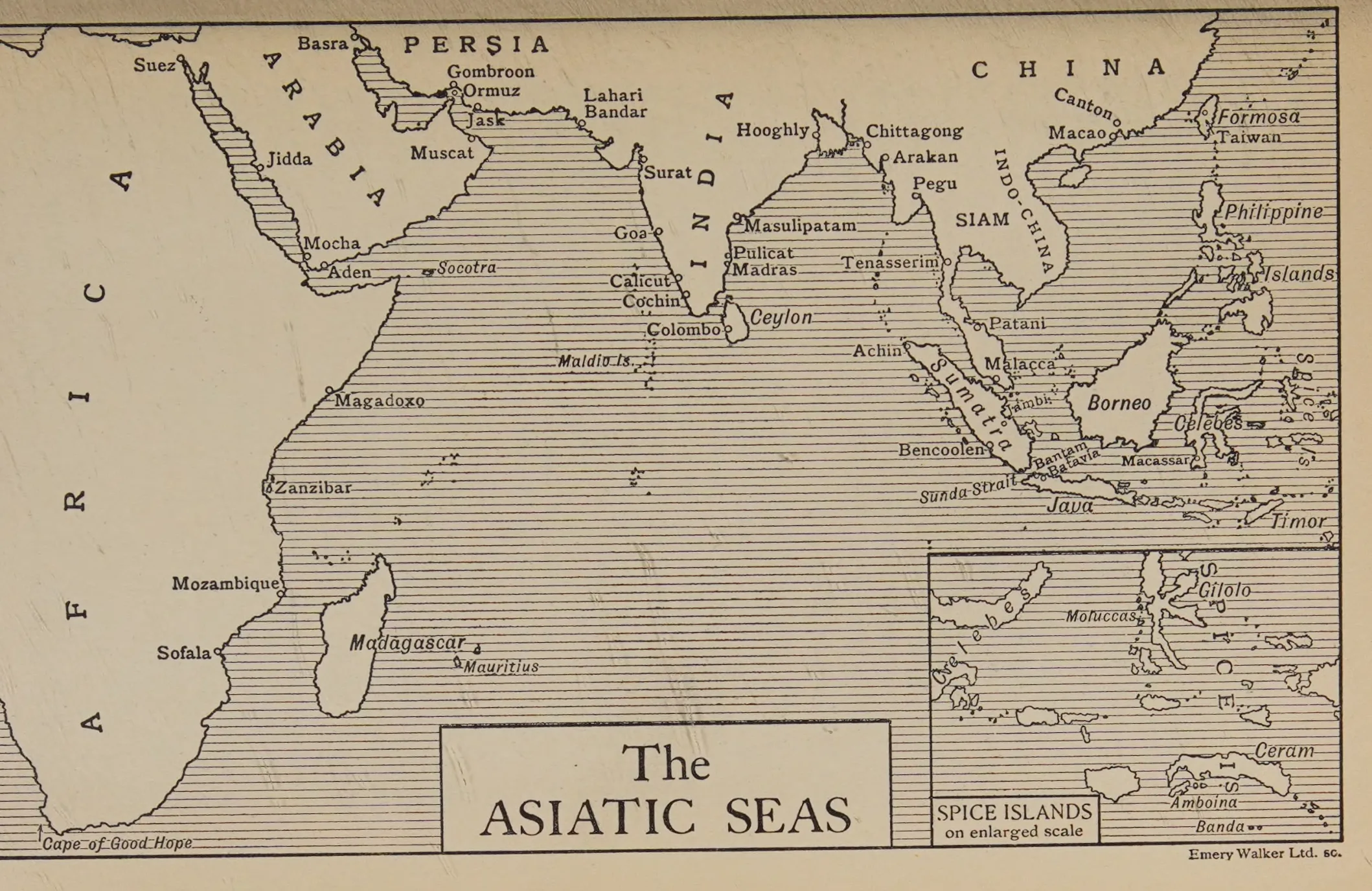
- 1. The nomenclature of the islands varies in the literature of the period. I use the term Spice Islands in a wide sense, to include the Moluccas, Ceram, Amboina, and the Banda Islands; the balance of convenience appears to lie in confining the term Moluccas to the small islands lying to the west of Gilolo. The Moluccas and Amboina yielded cloves, while mace and nutmegs came only from the Banda Islands. There were cloves also on Ceram, but this island does not come into prominence during our period. The position of the islands is shown on the map facing p. 16.
- 1. See, for an instance, the entries in Methwold's diary, in English Factories, v. 310 ff. When the harbour at Surat was threatened by pirates from Malabar, and the English were not disposed to provide for its defence, the Mogul Governor "fitted up three frigates, and pressed a crew of poor, unexperienced cotton-beaters, etc., who had never seen the sea, and therefore could be of no great use unto him; yet sometimes they would row out of the river, and then, riding under the security of our ship, or rather on board her, they would return into the river again at night."
- 1. The name of the pirate-king appears in various forms, and I am not certain of the correct transliteration; presumably it is Kunhi Ali. A Dutch narrative says he was sent to the galleys (Renneville, iii. 451); the statement that he was executed comes from Portuguese sources (Calendar S.P., 1513–1616, No. 280).
- 1. It is of course impossible to speak precisely regarding the population of Portugal at this period. I have seen an estimate that the number of Portuguese fell from two millions in 1500 to half that number a century later, but I do not know the basis of the calculation. The insufficiency of "man-power" during our period is evident from numerous incidental notices, e.g. Lisbon Transcripts, i. 126; Hague Transcripts, I. 318; Calendar S.P., 1513–16, Nos. 408, 432; Dagh Register, June 20, 1633. Linschoten (c. 93) noted that while 1500 or more soldiers reached Goa yearly about the year 1590, the number returning was rarely as large as 100.
- 1. Some of van Linschoten's results were not actually published until 1596, but it is clear that the information he brought was available to Houtman [p. 14] on the first voyage round the Cape; vide Houtman, i. xxxii, 62, and passim. As he was a member of the Northern expeditions of 1594 and 1595, his knowledge was obviously at the disposal of their promoters. The details of Houtman’s proceedings in Lisbon are obscure (van der Chijs, 29), as might be expected from the fact that he was in search of information which the Portuguese endeavoured to keep absolutely secret; but the fact of his visit is clear (Houtman, i. xxxi, n.).
- 1. The advantages of these objectives were brought out clearly by Linschoten : in c. 19 he pointed out that the Portuguese had no settlements in Sumatra, and that the king of Achin was their great enemy, while in c. 20 he entered into details of the pepper trade of western Java, which could be enjoyed without interference from the Portuguese.
- 1. The idea of refreshing at the Cape does not appear to have been suggested at this time; the Dutch were well established in Java before the founding of their settlement there.
- 2. For reasons explained in India at the Death of Akbar (p. 230 and Appendix D), I use the spelling “tun” to indicate that the unit of ship-measurement at this time was substantially different from the modern registered ton. A “tun” represented approximately 60 cubic feet of cargo space.
- 1. Some particulars regarding the constitution and operations of the Dutch and English Companies will be found in Appendix A.
- 2. What little is known of “the miserable disastrous successe” of the voyage of 1596 will be found in Purchas, I. iii. 110 ff. The first quotation in the text is taken from the Petition of the Adventurers for the voyage to the East Indies, presented in September 1599 (Calendar S.P., 1513–1616, No. 258); the Dutch voyage alluded to is presumably that of van Neck, who had returned to Holland in the previous June, and had received a spectacular welcome at Amsterdam (van der Chijs, 85). The second quotation is from the opening paragraph of Purchas’ account of Lancaster’s voyage (I. iii. 147); the figures given for the capital are said to be exaggerated, but the difference is not very material.
- 1. A note in van der Chijs (p. 84) suggests that van der Hagen, who sailed in the year 1599, had orders to conquer Amboina. If this is correct, the aggressive policy began slightly earlier than is stated in the text. As a matter of fact the Dutch attempted to capture a fort in Amboina in 1600, but the account in Begin ende Voortgangh (p. 11 of the narrative of Verhagen's voyage) shows that on that occasion the initiative was taken by the native inhabitants; the Dutch refused repeated requests for aid, but at last yielded to the importunity of the native leaders. In any case, an attack on an outlying post, where the Portuguese position was already weakened, would not be on the same footing as the attempts to capture strongholds like Mozambique or Malacca.
- 1. The memorandum is given on pp. 72 ff. of the journal of Matelieff's voyage in Begin ende Voortgangh; a French translation will be found in Renneville, vi. 35-47. From its position in the journal, it may perhaps be inferred to date from the year 1607.
- 1. A misleading idea of the affair in question is given by the phrase “ the massacre of Amboina,” which became classical in England. The English merchants, who were resident in the Dutch fort under the agreement of 1619, were charged with conspiracy to seize it ; they were convicted on confessions obtained by torture, and most of them were executed. The Dutch admitted that the proceedings were in some respects irregular, and the “ massacre ” may be regarded either as a judicial murder or a tragic failure of justice according to the view formed of the intentions of the judges. The literature relating to the affair is extensive ; the important contemporary documents can be traced through the Calendar S.P., 1622– 1624.
- 1. The Dutch, like most other nations, were strongly attracted by the commercial possibilities of China, and ships were sent on from Java in that direction as early as the year 1601. Three years later, a Dutch admiral was negotiating for admission to a port on the Chinese coast, and was advised unofficially to occupy some island not belonging to China but sufficiently near to facilitate regular trade. The advice was not acted on at once, but some years afterwards the Dutch established a post on one of the Pescadores Islands lying between Canton and Formosa. The Chinese objected to this settlement, and suggested in its place Taiwan in Formosa itself; their strength at sea was sufficient to convince the Dutch, and the change was promptly effected. See the voyages of van Neck, de Veen, Spilberg, Warwyk, and Matelieff, and the Account of China, in Begin ende Voortgangh (Renneville, iii. 229, 480; iv. 146, 381; vi. 48; ix. 199).
- 1. The factory at Bantam was closed in 1683, when the Dutch became masters of the town, but the establishment of a fortified post at Bencoolen on the west coast of Sumatra enabled the English Company to retain a footing in the pepper trade.
- 1. These friendly relations did not last for long; by 1668 the Dutch were supreme in Macassar.
- 2. It will be recollected that the union of 1580 did not destroy the separate existence of Portugal, and in the East the distinction between the two kingdoms was punctiliously observed. Spaniards from the Philippine Islands had secured a fort in Ternate, one of the Moluccas, whence they [p. 27] occupied other forts which the Portuguese had abandoned under Dutch pressure, but they were unable to hold all of these. They retained a footing in the islands for many years, and they also possessed a fort in Formosa, but they made little use of these opportunities (Renneville, v. 235; vi. 5, 424; vii. 114, 308, etc. Dagh Register, June 11, 1645).
- 1. The harbour and islands of Bombay were ceded to England under the terms of the treaty of marriage between Charles II. and the Princess of Portugal. The territories of Bassein remained in Portuguese hands until their seizure by the Marathas in the eighteenth century.