THE history of Muhammadan India falls naturally into three periods : (I) a time of incursions, ending in final conquest (637–1206) ; (II) the story of the kingdoms founded as a consequence of this first conquest (1206–1526) ; and (III) the empire of the Mughals, commencing with the latest western conquest under Bābar (1526–1803).
I. Incursions and Final Conquest (A.D. 637–1206)
From preceding chapters it will have been seen that in the seventh century of our era India was, and had been for many generations, a country of which the open plains and river valleys were occupied by a settled population devoted to agriculture and the arts, with a copious literature, a refined philosophy, and fully developed religions ; and living under a singular social system, which had gradually developed within the country itself. No doubt, many successive invaders—Greeks, Parthians, Scythians, and Huns—had entered India through the north-western passes ; but all of them either returned whence they came or were rapidly absorbed in the general population, and they have left few definite traces of their presence. With Islām it was different ; its pressure from the West was more continuous, and the marked disparity in religious belief between the ancient inhabitants and these invaders produced far deeper and more lasting results.
Muhammad died in 632, having launched on the world a religion which to this day has not altogether lost its missionary energy. Islām had become a militant faith even before its founder died ; and under his immediate successors its strength as an engine of political conquest was as great as, if not greater than, its success in converting the nations. In a few years Syria, Egypt, and Persia had succumbed to the new rulers and been forced to embrace the new religion.
From the first India must have seemed a tempting prey to the aggressive Arabs ; and one or two not very successful attempts (A.D. 636–7) were made on it by way of the sea. The second Khalīfah, Umar (634–43), had a horror of naval expeditions ; and under the severe prohibition issued by him all further attempts against India in this direction came to an end. During the Khalīfat of Walīd (705–15, January), Hajāj (d. July, 714) was governor of Persia. Under his orders his son-in-law Muhammad, son of Qāsim, advanced through Makrān and Baluchistān, and entered India. His success was immediate ; on the 21st of June, 712, the ruler of Lower Sind was slain and the country taken. Muhammad, son of Qāsim, finally penetrated as far as Multān, about 500 miles from the sea, and even reached the foot of the Himālayas. At this time Muhammadan armies were engaged in the subjugation of Spain to the west, and Khwārizm (Khiva) in the north. After 715, having spent three and a half years in Sind, Muhammad was recalled by Sulaimān, brother and successor to Walīd, put into prison, and tortured until he died. The hold of the Khalīfahs on Sind and Multān was maintained with varying success until 870–1, when those provinces were handed over with Seistān and Kermān to a local potentate, an adherent of the Muhammadan faith. There were Muhammadan courts at Multān and Mansūra (in Sind) in 915–16, when Mas‘ūdī visited the country ; and the governments were still strong and the land prosperous at the time of Ibn Haukal’s journey in A.D. 976. By A.D. 1051 a local dynasty, the Sūmras, had seized power. They are spoken of by Elphinstone as Hindu Rājputs, though from some of their names it is more than probable that they were Muhammadans. In any case, the power of the Muhammadans in this small corner of India was on the wane, even if it had not wholly ceased.
It is obvious, from this résumé, that before the first flood of Muhammadan conquest had touched India it had almost exhausted its strength, and its eastward advance was entirely spent as soon as the valley of the Indus had been reached. The Arabs ceased to hold exclusive control over the movement of Islām, and took no further part in its expansion into India. Another race, advancing from another direction, was the appointed instrument for the effective conquest of India for the new faith. In the tenth century a Turkish slave of the fifth Samānī ruler of Northern Persia founded a kingdom of his own, fixing his capital at Ghaznī, between Kābul and Kandahār. His fourth successor, Sabuktigīn, consolidated this kingdom and extended its eastern frontier to Peshāwar. This king’s son and successor, Mahmūd (born December 15, 967; succeeded 998; died April 30, 1030), the greatest Muhammadan ruler of his time, began early in his reign a long series of incursions into India, the first in 999, the last in 1025–7, entering India no less than fifteen times in those twenty-eight years.
He began (999) with attacking some frontier towns, next (1000–1) he defeated Jaipāl, ruler of Lahore, near Peshāwar, and took Wahind (Ohind) on the west of the Indus. Bhera on the left bank of the Jhelum river was attacked in 1004–5; in the following year, Multān on the Indus submitted and paid a contribution. In 1007–8 Sukhpāl, who had revolted after being left in charge of the Indian conquests, was brought under subjection once more. Again Wahind was attacked (1008–9), and Mahmūd penetrated as far as Nagarkot (Kāngra) in the outer hills. After a year (1009–10) the Sutlej was crossed and Tarāīn (now Tarāwari), near Thānesar, was reached. Multān was once more the objective in 1010–11. The plundering of Nandana in the Sind-Sāgar Doāb (1013–14), and of Thānesar, east of the Sutlej (1014–15), followed in close succession. Up to this date, during sixteen years of constant activity, the farthest point reached had been, in one direction, Multān, and in the other, Thānesar and Tarāīn. During the remaining ten years of his active career, Mahmūd began to extend his raids much farther into the heart of India. He crossed the Indus in October, 1018, and taking Baran (the modern Bulandshahr), Mahāban, and Muttra on his way, reduced Kanauj (January, 1019); and, after plundering towns as far east as Fatehpur Hanswa, or even farther, ended his campaign with a flying expedition across the Jumna into Bundelkhand. It was next the turn of Katehr (the modern Rohilkhand), the region to the east and north of the Ganges; and in 1021 or 1022 a battle was successfully fought on the river Rāhab (either the Rāmgangā or the Sai). The years 1022–3 were devoted to fighting in the country west of Peshāwar; but India proper enjoyed no long respite, for in 1023–4 the fortresses of Gwalior in Central India and of Kālinjar in Eastern Bundelkhand were attacked, and their rulers forced to make terms. Mahmūd’s last expedition (1025–7), the most fruitful in plunder and the most memorable of them all, included the taking of Somnāth, the Hindu holy place on the shores of the Indian Ocean, in the peninsula of Kāthiāwār, where immense booty was acquired. Mahmūd died at Ghaznī on April 30, 1030.
Permanent absorption of conquered Indian territory does not seem to have presented itself to Mahmūd’s mind. Hence his unceasing activity and marvellous success in war did not result in imposing Muhammadan dominion on any part of India, beyond the confines of the comparatively small north-western corner adjoining his own territory. The Punjab seems to have felt his influence most, and it was held henceforth by the Ghaznavī kings as the frontier province of their realm. In the ruin which soon overtook that dynasty, Mahmūd’s feeble successors, on the loss of their ancestral capital, moved to Lahore (1160), where they continued to reign obscurely until finally set aside there also (1186) by the Ghorī kings, their supplanters at Ghaznī.
A petty kingdom had for many years existed in Ghor, the country between Ghaznī and Herāt, having its capital at Fīrūzkoh. Ghiyās-ud-dīn Muhammad, son of Sām, succeeded to this throne in 1162 ; and eleven years afterwards (1173) he annexed Ghaznī, leaving his younger brother, Mu‘izz-ud-dīn Muhammad, in command of the conquered territory. The latter turned his face almost at once towards India (1176) ; and before his death thirty years afterwards he had established, by his own efforts and those of his lieutenants, an enduring Muhammadan kingdom in India, extending from Peshāwar to the Bay of Bengal.
Muhammad Ghorī’s earlier campaigns were in the nature of rapid incursions, after the fashion of Mahmūd Ghaznavī. In 1175–6 he ejected the local rulers of Multān ; in 1178–9 he returned to India, and, passing by Multān and Uchh, reached Nahrwāla in Gujarāt, where he was defeated by Rāe Bhīm Deo and forced to beat a retreat. In 1181–2 the last Ghaznavī ruler bought off a threatened attack on Lahore ; the country of Sind, with its chief city, Debal, was next acquired (1182–3) ; three years afterwards (1185–6) the Lahore territory was plundered, and in the next year reunited to the kingdom of Ghaznī. In this first phase the invader had made somewhat slow progress ; he was now to move more rapidly towards his goal.
For several years India obtained a respite, while Mu‘izz-ud-dīn was occupied elsewhere in defending his brother’s kingdom from attack. At length, in 1191, he gathered together a great army for the conquest of India. Prithwī Rāj (otherwise called Rāe Pithora), the Chauhān ruler of Delhi and Ajmer, in order to repel this advance took up a position near Tarāīn (now Tarāwari), about a hundred miles north of Delhi. A pitched battle took place, Mu‘izz-ud-dīn was wounded, his defeated army retired on Lahore, and finally he returned to Ghaznī.
A garrison left in Tabarhinda defended the place against Prithwī Rāj for thirteen months. The interval had been well employed by Mu‘izz-ud-dīn in restoring order to his army. When all was once more ready, he returned to avenge the disasters of the previous year. The armies met again (1192) in the neighbourhood of Tarāīn, when the victory remained with the invaders. Prithwī Rāj was taken prisoner and then slain ; the whole of his territory, as far as Ajmer (excepting the city of Delhi itself), was subjugated. Qutb-ud-dīn, Ībak (of the Powerless Finger), a Khalj slave, was placed in command, and posted at Kuhrām (now in the Patiāla State).
Qutb-ud-dīn soon captured Meerut, and in the following year (circa January, 1193) he took possession of Delhi city, and of the fort of Koil (modern Aligarh) in the Doāb. The capital was now established at Delhi. In 1194 Mu‘izz-ud-dīn Ghorī returned to India and led his forces eastwards, until near Chandwār on the Jumna river (a place now in the Etāwah District) they met and overthrew Rāja Jai Chand, Rāthor, ruler of Kanauj. After this success, he pushed on to Benares and sacked it. Muhammad Ghorī returned to Ghaznī, where his attention was taken up for some years with the succession to his deceased brother’s throne, involving many arrangements and a campaign in Trans-Oxiana.
Meanwhile Qutb-ud-dīn, the king’s generalissimo in India, had not been idle. A rising at Ajmer under Hemrāj, brother of Prithwī Rāj, was suppressed (1194) ; an advance followed into Gujarāt, where Rāe Bhīm Deo was defeated and forced to seek refuge in the hills. Further trouble was given by the Hindus of that region, and on one occasion Qutb-ud-dīn was wounded and retired to Ajmer, where he was for a time invested (July–August, 1196). In December, 1196, and January, 1197, the advance on Gujarāt was resumed ; and on February 4, 1197, a complete victory was obtained over Rāe Karan of Chitor (now in the Udaipur State). But a permanent hold on Gujarāt could not be retained. In 1202–3 Qutb-ud-dīn undertook an expedition against the hill fort of Kālinjar (in Eastern Bundelkhand), and by its reduction vast booty and many captives were acquired. On the return march, Mahobā (in Bundelkhand) was taken ; and thence, by a circuitous route, Delhi was reached, Budaun, north of the Ganges, having been overcome on the way.
In 1205–6, provoked by the turbulence of the Khokhar (Gakhar) tribesmen in the hills north and north-west of Lahore, Mu‘izz-ud-dīn returned to India. After suppressing this rising, the king reached Lahore (February 22, 1206). Taking but a short rest, he soon started on his way back to Ghaznī. While he was encamped at a place called Daniya, a little to the west of the Jhelum river, some Muhammadan heretics rushed upon and slew him (March 15, 1206). At that date supreme power had passed to the Muhammadans in all Northern India from Peshāwar to the Bay of Bengal. These Indian conquests had been governed through Satraps, mostly Turkish slaves, of whom the four principal at the time of Mu‘izz-ud-dīn’s death were (1) Qutb-ud-dīn, Ībak, holding Delhi and Lahore; (2) Tāj-ud-dīn Īyaldūz, in the Kurram valley; (3) Nāsir-ud-dīn, Qabājah, in Multān and Sind; (4) Muhammad, son of Bakhtyār, a free Khalj Turk, at Laknautī in Bengal. All of these governors now became practically independent sovereigns.
II. Muhammadan Kingdoms, 1206–1526
§ A. Northern India—Kings of Delhi
From the outset the kings of Delhi asserted, and from time to time were able to enforce, suzerainty over the other Muhammadan states of Northern India. This pre-eminence may be attributed to several causes: the ability of Qutb-ud-dīn and his long connexion with India; the central position of Delhi, with its comparative nearness to the border lands, whence the best fighters came; and partly to the prestige of Hindu times, which still clung to the place.
The thirty years of conquest which began in 1176 must have been attended with much loss of life and destruction of property. Political supremacy had been easily secured; some pitched battles and a victory or two usually sufficed, and the Hindu ruler at once succumbed. But the conqueror’s hold on the country could not, at this stage, have amounted to much more than a military occupation. Apart from the violence connected with the suppression of armed resistance, we do not find that the victors displayed any excessive zeal in imposing their religion, which seems, for the most part, to have sat somewhat lightly upon themselves. Such matters were allowed to take their course, and Islām filtered gradually into the population through intermarriage and immigration, coupled with the thousand inducements which, in those earlier ages, led to the adoption of the ruler’s faith. Muhammadans prefer town life, and thus congregated in the towns. Their principal occupation was that of soldiers or armed messengers, but many of the handicrafts, such as weaving, dyeing, painting, and so forth, were followed by them. A considerable accession to their numbers was obtained by conversion from the humbler classes of the Hindu community, who had much to gain in a worldly sense by such a change. The priestly, the superior trading, and the land-holding classes of Hindus have from the first shown themselves more obdurate to the appeal of the Prophet’s faith. The course of Muhammadan conquest can be traced, and the effect of nearness to or remoteness from the centre of Islām may be seen, by the existing distribution of the Muhammadan population, and the proportion between Muhammadans and Hindus in the different provinces. In the North-West Frontier Province and in Sind, the population is essentially Muhammadan, as also in the State of Kashmīr. In the Punjab proper, the proportion of the two religions is about equal. But as one proceeds either eastward or southward from the Punjab, the number of Muhammadans steadily diminishes, with one or two notable exceptions. Throughout Eastern Bengal, no less than two-thirds of the inhabitants have adopted the faith of Islām, probably because Hinduism was never firmly established there ; and on the Malabar coast a numerous colony of Muhammadans has long been settled, under the name of Moplahs, whose origin is due to sea-borne trade with Arabia and the Persian Gulf.
The political divisions of the Muhammadan period, or the demarcation of the country into kingdoms, provinces, and still smaller jurisdictions, down to and including the village townships, appear to have been a continuation of those existing under the Hindu kings. Even to this very day, the villages, districts, divisions, and provinces of the empire, could (if necessary) be traced back in outline to those of the Hindu states which existed when Mu‘izz-ud-dīn Ghorī first set up his standards, and began to conquer and govern India. In their early days, the Muhammadan kingdoms of Northern India may be said to have comprised the Punjab from Peshāwar to Ambāla, the valleys of the Indus, the Jumna, and the Ganges as far down as Lakhnautī (Gaur) ; with some outlying posts and strongholds to the south, such as Ajmer, Biāna, Ranthambhor, Gwalior, and Kālinjar. The Himālayas formed an impenetrable refuge for Hindu princelings, while a wide strip of the country lying at their foot, from the Jumna across the north of the Doāb, Rohilkhand, Oudh, and Bihār as far as Bengal, was only partially explored and little inhabited. To the south of Ajmer, the Rājput clans maintained their position undisturbed; and beyond their country, to the south and west, Gujarāt, though often invaded, could never be held, until many years had elapsed.
Thirty-four kings reigned at Delhi from 1206 to 1526; they are divided into five houses: (1) the Mu‘izzī Slave kings, 1206– 90; (2) the Khaljīs, 1290–1320; (3) the Tughlaq Shāhīs, 1320–1413; (4) the Saiyids, 1414–51; and (5) the Lodīs, 1451–1526. But though thus divided, the transfer from one line to another was made either by some pretext of inheritance, or by the election of some leading general. In no case was the succession to power due to the external influence of a new conqueror from the west. The troubled nature of the times is shown by the low average length of nine and a half years for each reign, as compared with the fifteen reigns which cover the years from 1526–1803, and yield an average length of eighteen years, about double that of the earlier epoch. Almost every succession was vigorously contested, and the country thrown each time into confusion. Of the thirty-four kings of Delhi, twelve were deposed, assassinated, or killed in battle; whereas during the vigorous period of the Mughal rule (1526– 1712), if we disregard Humāyūn’s expulsion, no emperor was deposed, assassinated, or killed in battle, while seven successions from father to son happened, with only two contests of short duration.
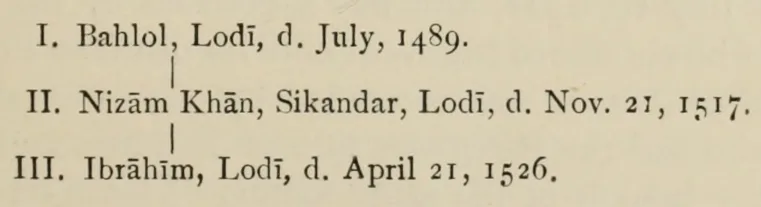
Of this long line of thirty-four kings, only eleven stand out with any distinctness: Qutb-ud-dīn, Ībak (1206–10); Shams-ud-dīn, Iyaltimish, his son-in-law and successor (1214–36); Nāsir-ud-dīn Mahmūd Shāh, son of Iyaltimish (1246–66); Ghiyās-ud-dīn, Balban, slave and son-in-law of Iyaltimish (1266–86); Alā-ud-dīn Muhammad Shāh, Khaljī (1296– 1316); Ghiyās-ud-dīn Tughlaq Shāh (1320–5); Muhammad, son of Tughlaq (1325–51); Fīroz Shāh, nephew of Muhammad (1351–88); Bahlol Lodī (1451–89); Sikandar Lodī (1489– 1517); and Ibrāhīm Lodī (1517–26).
Qutb-ud-dīn’s reputation was made during the fourteen years that he acted in India as deputy to his master, Mu‘izz-ud-dīn. In addition to his prowess as a warrior, he is famous as the builder of the great Qutbī mosque which stands near Mihraulī, some miles to the south-west of modern Delhi. From the date of his assuming the insignia of sovereignty at Lahore (June 25, 1206), his reign lasted only a little more than four years, the king losing his life about November 4, 1210, by a fall from his horse while playing polo at Lahore. The only notable event of these few years was a contest with Īyaldūz, another Turkī slave, who tried to wrest Lahore from Qutb-ud-dīn. Īyaldūz was defeated, and retreated to Kurram, whereupon Qutb-ud-dīn, following up this advantage, took possession of Ghaznī itself (1208–9), but could only retain it for forty days, beating a precipitate retreat upon the reappearance of Īyaldūz. On Qutb-ud-dīn’s sudden death, his adopted son was placed on the throne by the nobles, only to be set aside and murdered (1214–5) to make way for Shams-ud-dīn, Iyaltimish, one of Qutb-ud-dīn’s slaves and his son-in-law. The early part of the new reign was taken up with a triangular duel between Qabājah, ruler of Multān (also a son-in-law of Qutb-ud-dīn), Īyaldūz, another slave who had succeeded to Ghaznī and Kurram, and Iyaltimish, for the possession of Lahore. On Feb. 15, 1216, a decisive battle was fought near Tarāīn (now Tarāwari), in the Cis-Sutlej Doāb, between Iyaltimish and Īyaldūz, when the latter was defeated and sent a prisoner to Budaun, where his life was taken.
Although Chingīz Khān (born 1162, died 1227) never crossed the Indus himself, the pressure of his conquests was severely felt in India. Jalāl-ud-dīn, Mangbarnī (1220–31), the last Khwārizmī Shāh of Khwārizm (now Khiva), when ejected by the Mongols, migrated into India, in the hope of founding a new kingdom. He had recently suffered defeat at the hands of Chingīz Khān not far from the west bank of the Indus (Sept., 1221). He retreated into the Punjab, and when followed by a Mongol general, retired eastwards to Nandana in the Sind-Sāgar Doāb. Iyaltimish, roused by the approaching danger, advanced to protect Lahore. Jalāl-ud-dīn turned off towards Multān, followed by the Mongols, who, after investing that place for forty-two days (1223) and failing to reduce it, withdrew to Ghaznī. Jalāl-ud-dīn was soon recalled to Irāq and Kermān by his former supporters, and India knew him no more. In 1226 a body of Khalj Turks from Jalāl-ud-dīn’s army made an inroad on Mansūra, in Sind, but were speedily ejected by Qabājah. Jalāl-ud-dīn was killed soon after in Northern Persia (1231); and with this episode ended the influence exercised on India by Chingīz Khān’s own conquests, though Mongol hordes continued from time to time to make passing raids.
Iyaltimish and Qabājah had meanwhile continued their disputes; they fought in Sind in 1217, when the latter was defeated, but still retained a hold on his province. In 1228 Iyaltimish once more attacked Uchh and Multān. Hostilities continued for three months, Uchh finally submitting on May 6, 1228 ; shortly afterwards, Qabājah drowned himself at Bhakkar on the Indus (May 30, 1228). Iyaltimish had also resolved to recover Bengal, where for nearly twenty years (1206–25) the successors of Muhammad, son of Bakhtyār, Khaljī, had remained independent. In the last-named year Bengal submitted, and Iyaltimish placed his second son, Mahmūd, in charge as governor. In the more central parts of India the strong hill-fortress of Ranthambhor was reduced in 1226, Gwalior was taken on Dec. 13, 1232, and Mālwā invaded in 1234. The king died at Delhi on May 1, 1236, and was buried close to the Qutbī mosque. In addition to his extension of the Delhi boundaries so as to include Sind and Bengal, he is famous as the continuer of his predecessor’s great works, the Qutbī mosque near Delhi and its beautiful tower (minār).
The reign of Iyaltimish’s eldest son, Rukn-ud-dīn, was short and inglorious (May 1 to November 20, 1236) ; he was replaced by his sister, Razīyah, the only female sovereign in Indian annals until our own day. Her father had pronounced her fitter to rule than any of his sons ; and the truth of his prophecy was borne out by her vigorous reign of three and a half years. But the jealousies of rival commanders and their repugnance to seeing a woman in authority over them were too strong for her, and she was finally defeated on October 14, 1240. A brother and a nephew followed her : the first, Bahrām, being killed on May 15, 1242, less than two years afterwards ; and the second, Mas‘ūd, imprisoned on June 10, 1246. The alleged irruption of the Mongols at this period into Bengal, by way of Tibet (1244), is founded on a mistaken rendering of the authority. A third son of Iyaltimish was now raised to power. Nāsir-ud-dīn Mahmūd Shāh (born 1229 ; died February 19, 1266) reigned twenty and a quarter years. This long reign secures him a place of note among the Delhi kings ; but, in truth, he was never more than a cipher, the real ruler being an Ilbarz Turk, one of his father’s slaves and Mahmūd’s brother-in-law, who had married one of Iyaltimish’s daughters. This remarkable man, Ghiyās-ud-dīn, Balban, who was known throughout this reign by his title of Ulugh Khān, became his brother-in-law’s Wazīr, and strengthened his position by marrying his own daughter to his master (August 2, 1249). He succeeded in capturing all power, Nāsir-ud-dīn Mahmūd being of a quiet and studious disposition. For eight years Ulugh Khān, Balban, was supreme ; three or four years of disgrace and exclusion from power followed, but in the twelfth year he recovered his position. The first half of the reign was a confused struggle between rival generals, during which the outlying provinces of the kingdom fell into disorder. In spite of all such hindrances, the work of extending and consolidating Muhammadan rule went on apace. The army proceeded first to Lahore (March, 1247); next year Kanauj and Karra were visited, and an incursion made into Bundelkhand (March to April, 1248). The Mewāt country between Delhi and Agra was reduced to order, and Ranthambhor secured (November, 1248, to April, 1249). In 1250–1 a general was sent to occupy Multān, where he captured some predatory Mongols. The following year, a general’s revolt at Nāgor was suppressed and Uchh in Sind was taken. Then came the great campaign against Gwalior, Chanderī, Narwar, and Mālwā. Narwar was taken after a stiff resistance. The court returned to Delhi on June 4, 1252, and after seven months’ rest, left it again for Lahore. Now occurred the disgrace of Ulugh Khān and his retirement, first to Hānsī and then to Nāgor; while the king moved against Ulugh Khān’s relation, Sher Khān, governor of Multān and Uchh. Sher Khān fled to the Mongols in Turkistān. The ninth year (1254) was occupied by a campaign at the foot of the hills, north of Bijnor, the Ganges being crossed at Māyāpur, near Hardwār. Five months later an army advanced towards Samāna, in the Punjab (November, 1254), to deal with the party that had formed round the king’s brother, Mas‘ūd; but before there was any fighting a reconciliation was effected, and Mas‘ūd was given the government of Lahore (December 29, 1254). The king’s mother having married again, she and her husband, Kutlugh Khān, were considered dangerous and sent away to Oudh. In 1256–7 Kutlugh Khān took unauthorized possession of Karra and Mānikpur in the lower Doāb. On expulsion from these places, he fled to the hills of Sirmūr; and in consequence that country was raided by Ulugh Khān, who by this time had returned to power. Kutlugh Khān and a dissatisfied general, Kashlū Khān, who held Multān, tried to join hands (1257–8). While Ulugh Khān was marching against them, they managed to evade him, and, invited by their secret adherents, made for Delhi, which they reached on June 21, 1257. Their attack upon the city failed, and Ulugh Khān was now approaching. Kashlū Khān retired on Multān, thence going to Hulāgu Khān, the Mongol chief, from whom he obtained an army of Mongols, and with their aid the Delhi frontiers were ravaged. A feeble attempt was made to restore order, but the king’s forces did little or nothing, and in a few months they returned to the capital. Again, in 1258–9, a similar ineffective campaign took place. In 1259–60 Ulugh Khān was obliged to deal with renewed trouble from the Meos in Mewāt, south of Delhi. We know little of what happened in the remaining five or six years of this reign. Nāsir-ud-dīn died on February 19, 1266, and was at once succeeded by Ulugh Khān under the title of Ghiyās-ud-dīn, Balban.
Unfavourable opinions have been expressed about Balban; he has been called a narrow-minded and selfish tyrant. But there can be no question that he was a strong, if severe, ruler. Although his army was kept in excellent order, his reign was not marked by any extensive campaigns; his own explanation of his inactivity being that he dreaded the Mongols and must remain on the defensive. During his time India was the refuge of many exiled rulers and men of letters, the most celebrated among the latter being the poet Amīr Khusrū. In the first year there had been a fresh expedition against the Mewātīs; followed shortly afterwards by another to the Ganges, near to Patiālī (Etah District), Kampil, and Bhojpur (Farrukhābād District). Katehr, across the Ganges, next engaged the king’s attention; Lahore was also visited. All these matters had been of little importance, but in the fifteenth or sixteenth year (1281–2) there was serious trouble in Bengal, caused by a rebel governor. At length, after his generals had twice suffered defeat, the king took the field in person, and with his usual energy soon quelled the outbreak. Balban now had the misfortune to lose his eldest son, who was killed in the moment of victory over a Mongol army which had invaded the Punjab. Balban died in 1286, and was succeeded by a grandson, Kaiqubād, son of Bughrā Khān. The young man left all affairs in the hand of a minister, and after an inglorious reign of two or three years was assassinated (October, 1290).
An informal election secured the throne to the most powerful of the generals, Jalāl-ud-dīn, Khaljī, a man seventy years of age. Two inconclusive campaigns in Mālwā began the reign (1292–3), and a Mongol invasion of Lahore was repelled (1291). In the second year an attempt to obtain the throne made by Chhaju, a nephew of Balban, was suppressed. Jalāl-ud-dīn was himself old and averse to the shedding of blood; but his place in the field was soon taken by his nephew, Alā-ud-dīn, a man of great vigour and few scruples. After an excursion into Bundelkhand and Mālwā, Alā-ud-dīn resolved to attempt a longer flight. In 1294 he led the first Muhammadan army into the Deccan, or India south of the Narbadā Starting from Karra on the Ganges, he proceeded through forest country till he reached Berār, then turning westward, he was soon at Deogiri (now Daulatābād) in Khāndesh. A victory having been gained by the Muhammadans, the Rājā submitted. Ellichpur was next sacked, and with immense booty Alā-ud-dīn returned through Khāndesh across the Narbadā, into Mālwā. In 1295–6 Jalāl-ud-dīn, Khaljī, had gone himself to Gwalior, but instead of advancing to meet Alā-ud-dīn, he returned to Delhi. At the earnest entreaties of Alā-ud-dīn he agreed to meet him, and for this purpose went down the Ganges to Karra. When Jalāl-ud-dīn landed, he was received by Alā-ud-dīn ; then, at a signal given by his nephew, the king was attacked and wounded. He ran back towards the river, was pursued, and his head was cut off (July 21, 1296).
If Alā-ud-dīn obtained power by evil means, he used it with vigour and effect, in spite of being totally illiterate. He began by sending an army to Multān to subdue the late king’s sons, and in his second year expelled the Mongols from Sind. In 1297–8 his forces traversed Gujarāt as far as Cambay, perpetrating fearful cruelties as they went. It was here that Malik Kāfūr, Hazār Dīnārī, afterwards the king’s most celebrated general, was captured and sent as a slave to Delhi. About the same time another army went against Siwistān (Seistān), to the west of the Indus. Soon after this, a fresh invasion of Mongols threatened the kingdom with destruction ; they arrived quite close to Delhi before they were overcome in a pitched battle. Alā-ud-dīn was so elated by this success, that he seriously contemplated founding a new religion, and attempting universal conquest. However, some sound advice was tendered to him, which he was wise enough to accept. Religion was the business of prophets, not kings ; as for conquests, India was not yet subdued, nor the route into it by way of Multān closed to the Mongols. He turned his attention to internal affairs. Ranthambor, which had reverted to the Hindus, was the first conquest attempted, and after a long siege it was reduced. An attempt at the king’s assassination failed, and four insurrections were suppressed. Chitor was captured in 1303. Measures were then taken to resume all grants of land, an elaborate system of espionage was instituted, and there was much oppression of the Hindus. The Mongols appeared once more before Delhi, but were forced to retreat ; they made a few more attempts, but the king’s unremitting attention to his army and its discipline enabled him to prevail, and at length the Mongols came no more. Freed from danger on that side, Alā-ud-dīn resumed the project of conquering the whole of India. In 1307 Deogiri (now Daulatābād), the scene of Alā-ud-dīn’s earlier exploit, was taken. In 1309–10 Kāfūr was sent to the south to conquer Warangal (now in the Nizām’s territory), marching by way of Chanderī (in Bundelkhand). The army returned to Delhi in 1310 ; a few months afterwards (early in 1311) Kāfūr took the field again, and making Deogiri his base, marched far to the south against Ballāla Rāya, took the Rāya’s capital of Dwarasamudra, 100 miles north-west of Seringapatam, and built a mosque at Rāmeswaram, almost the most southerly point of the Indian mainland. About the middle of 1311, Kāfūr returned to Delhi with immense booty of every kind. These campaigns in the South established no permanent Muhammadan kingdoms there, but served to weaken the Hindu kings, and opened the way to Muhammadan soldiers and adventurers, by whom such kingdoms were soon afterwards founded. Alā-ud-dīn, with Fīroz Shāh, Sher Shāh Sūr, and Akbar, must be counted among the great administrators who have ruled in India. One of his chief concerns was the regulation of prices, and though the object was, as we think, a wrong one, the means taken were well enough conceived. He also had a well-developed system of letter-post. At Delhi he built the arched gateway at the Qutb, considered one of the most elegant and appropriate buildings in India. He also erected and repaired many mosques and forts. Towards the end of the reign prosperity declined, and the king’s measures were less wise : he chose weak ministers, allowed his sons too great licence, and placed himself too much in the hands of Malik Kāfūr. Alā-ud-dīn died on Jan. 3, 1316.
An infant son was placed on the throne by Kāfūr, but thirty-five days afterwards the minister was assassinated (Feb. 7, 1316), and the infant replaced by Mubārak Khān, a grown-up son of the late king, under the title of Qutb-ud-dīn. He was a man of licentious habits, quite incapable of maintaining the stern rule of his father : his reign was short and inglorious, full of plots, treasons, and revolts. His only energetic actions were to march to Deogiri, and to send an army to the south-west. Finally his favourite minister, after assassinating him in June, 1320, ascended the throne ; only to be himself defeated and slain a few months afterwards (Oct., 1320) by a rival general, who, finding that no descendants of the Khalj line survived, decided to ascend the throne himself, under the titles of Ghiyās-ud-dīn Tughlaq Shāh.
During the sixty-eight years (1320–88) covered by the first three kings of the Tughlaq house, the kingdom was in a flourishing condition. Ghiyās-ud-dīn (1320–5) was an excellent ruler; he also continued the scheme of conquest to the south, at first without success, but in the end both Bīdar and Warangal (renamed Sultānpur) were reduced. Bengal submitted to the king in person. On his return to Upper India, his eldest son met him some miles from Delhi, and, as has happened before and since, in some mysterious way the roof of the pavilion erected in his honour fell and crushed him. The son, Muhammad, succeeded (1325–51). He was a most accomplished man, well versed in letters, eloquent, liberal of disposition, gallant, moral, and devout. But as a ruler his judgement was so unbalanced that his condition approached mental derangement, and in his actions he was most unjust and oppressive. He increased the taxes, tried to transfer the capital with its population from Delhi to Deogiri, introduced a token currency, and indulged in lavish expenditure as a preparation to the conquest of Khurāsān and part of China. Yet he saw himself forced to buy off a Mongol invasion, and for many years was troubled with revolts, all of which, however, he succeeded in suppressing. He died on March 20, 1351, upon the bank of the Indus, 14 miles from Tatta, where he had gone to punish the Sūmra ruler for sheltering a refugee.
Fīroz Shāh (born in 1309), brother’s son to Ghiyās-ud-dīn Tughlaq, was placed on the throne on March 22, 1351; and the reign commenced with a difficult retreat from Tatta to Delhi. After the throne had been secured, Fīroz Shāh devoted himself to recovering Bengal, which had once more repudiated the authority of Delhi; and he was successful in two expeditions to that country. On his return, as soon as he had reached Jaunpur (which he had founded on his march eastwards), he moved off through Bihār to Jājnagar in Orissa. After reducing that place, he returned to Delhi, only to set out again on an expedition against Nagarkot (Kāngra). Four years afterwards he made a campaign against Tatta with doubtful success, and was forced to retire on Gujarāt, suffering greatly in crossing the Rann of Cutch. After recovering from these hardships, the army was led once more against Tatta, the ruler of which now surrendered, and peace was made. Fīroz Shāh is worthy of remembrance as the maker of the canal from the Jumna to the dry country west of Delhi, on which he founded the town known as Hisār Fīrozah. He also built a great deal at the capital, and repaired the works of former kings. On the whole, he was an excellent ruler, though not devoid of bigotry, acting occasionally with great harshness and intolerance. Up to 1385 Fīroz retained the government in his own hands ; but having now reached the age of seventy-six, he invested his son with full power. In one year’s time a sudden rising caused the son to take to flight ; it was then announced that Fīroz Shāh had abdicated in favour of a grandson. Almost immediately after this event Fīroz died (Sept. 20, 1388). Six short and troubled reigns followed, and in 1398 Taimūr’s invasion threw the country into confusion. The Tughlaq dynasty ended ingloriously in 1413.
Fīroz Shāh is famous for his many excellent rules of administration, and in the histories of his reign we find the first connected account of the Muhammadan system of government in India. It was, no doubt, the same from the earliest times, and, subject to slight modification and improvement, remained the same to the last. The king held all power in the last resort, and was his own commander-in-chief ; the outlying provinces were governed by princes of the royal house or leading generals. Under the king there was a chief minister, whose power varied according to the energy and ability of the sovereign. Fīroz Shāh was the first to remunerate officials by assigning to them the land revenue from villages, a mode which Alā-ud-dīn, also a notable administrator, had condemned, preferring to pay everybody in cash from the treasury. In Fīroz Shāh’s time the modern jāgīr does not seem to have been known ; the assignments then made appear to have been mere orders to receive a particular sum, and involved no right to manage the villages or otherwise interfere. Fīroz Shāh seems also to have favoured hereditary succession in office, a practice to which Muhammadans are less inclined than Hindus, and accordingly the rule was not long observed. The army consisted almost entirely of cavalry. Men brought their own horses, and there was a system of musters, which does not seem, however, to have been very effective. The daily wants of the court were supplied by a staff of its own, divided into thirty-six departments, for the elephants, the stables, the kitchen, water-cooling, and so forth. An audit department existed, and when any provincial governor came to court his accounts were examined. There was a gold and silver coinage, of which the purity was carefully maintained.
The chief source of revenue was a share of the produce of land, supplemented by a poll-tax on non-Muhammadans. There were also a number of petty cesses, which Fīroz Shāh thought unjust and attempted to abolish; probably without much success, as we find Akbar and Aurangzeb, centuries afterwards, issuing similar lists of prohibited demands. There was constant interference with prices, a habit consonant with the opinions of that age, in fact still approved by the general public in India. There seems to have been an efficient postal system for the carrying of government orders. We hear little about courts and judges; probably disputes were then, as in later ages, decided by local officers, such as qāzīs, or by reference to private arbitration.
In the days of Mahmūd, the last of the Tughlaqs (1398–1413), the Delhi kingdom began to fall to pieces; Gujarāt, Mālwā, Khāndesh, and Jaunpur became separate states. Ruin was completed by the arrival in India of the Turkish conqueror, Taimūr the Lame (born April 9, 1336; succeeded April 9, 1370; died February 18, 1405), who, though himself a Muhammadan, made no distinction between men of his own and of other religions. In his campaign in India, crowded into seven months, he dealt out death and destruction wherever he went.
Taimūr crossed the Indus on September 20, 1398, and when he reached the Jhelum river he detached a force against Multān. After capturing a fort and a town on his way, he arrived there in person; and Multān was taken in October, 1398. He then retraced his steps to Bhatner, visiting on his way the shrine of Farīd-ud-dīn Shakkarganj, at Ajodhan (now in the Montgomery district). On November 9, 1398, Bhatner succumbed. After attacking the Jāts, Taimūr passed the Ghaggar stream and reached Kaithal; thence, he marched down past Pānīpat to Delhi. On December 15 the forces of Delhi were defeated in the field, 100,000 prisoners having previously been massacred to free his army from the trouble of guarding them. Sultan Mahmūd fled, and Delhi was occupied (December 18, 1398); eight days afterwards it was given up to pillage and a general massacre. After a halt of fifteen days at Delhi, the campaign was resumed by crossing the Jumna and proceeding northwards to Hardwār, which was reached on January 13, 1399. Part of the army went a little distance across the Ganges to the east, while Taimūr himself advanced some way into the hills. But he soon turned his face westwards; on January 29, 1399, he was at Sirsāwa (in Sahāranpur District), and two days afterwards crossed the Jumna. For over a month there was constant fighting in the outer hills, from the Jumna westwards as far as Jammu. On March 4, 1399, Jammu surrendered. But no long halts were allowed, and on March 11 Taimūr recrossed the Indus, made for Bannu, and India knew him no more.
Mahmūd regained little or none of his power, though he was successful after a time in recovering the capital. When he died in February, 1413, a Lodī chief succeeded for fifteen months ; he in turn was expelled from Delhi (May 28, 1414) by a Saiyid governor, formerly of Multān, then Lahore, who had submitted to Taimūr and been received into his favour. From December, 1407, this man had begun to struggle with the other generals in a general contest for supremacy. The victor, Saiyid Khizr Khān, soon lost Lahore, but retained Delhi. Three descendants followed until, in 1451, the last of them retired to Budaun, and left Delhi to be claimed by the son of a horse-dealer, Bahlol Khān, Lodī, a former general of Fīroz Shāh and governor of Sihrind, who now proclaimed himself king.
At his death (July, 1489), Bahlol left a considerable kingdom, extending from Delhi to Benares, including the formerly independent state of Jaunpur, which he had reannexed (November, 1488). He was a man of simple habits, pious, brave, and generous. Sikandar, his son, had a prosperous reign of over twenty-eight years, during which he extended his kingdom considerably. He ejected his brother from Jaunpur, annexed Bihār, and even advanced into Bengal ; reoccupied Dholpur, Gwalior, and some other provinces farther to the south and east. It is recorded that in his time harvests were plentiful, food cheap, and the populace contented. The king was handsome in person, an encourager of learning, a good man of business, liberal, honourable, and polite. The throne passed (November 21, 1517) to his eldest son Ibrāhīm, who was at once involved in a contest with his brother Jalāl, to whom Jaunpur had been given. In the end Jalāl was captured and murdered. Ibrāhīm made some additions to his territories, and also attacked the powerful Rānā Sanga, Sesodia, of Chitor. But he was soon involved in a dispute with Bābar, king of Kābul, who claimed all the lands in India ever held by the Turks. After several incursions had been made by Bābar into the Punjab, at length he resolved in 1526 upon a campaign of conquest. On April 21, 1526, the contending armies met near Pānīpat, about fifty-five miles to the north of Delhi, where the Delhi force was utterly defeated and Ibrāhīm himself slain. The conqueror advanced on Delhi and Agra, and the kingdom of Delhi was replaced by what is known to us as the Mogul (Mughal), but called by the rulers themselves the Gurgānī Chaghatāe, dynasty. For the present we suspend our narrative, and turn to consider the smaller states which rose and fell in Northern India during this second period (1206–1526).
TABLES OF DELHI KINGS, 1206–1526
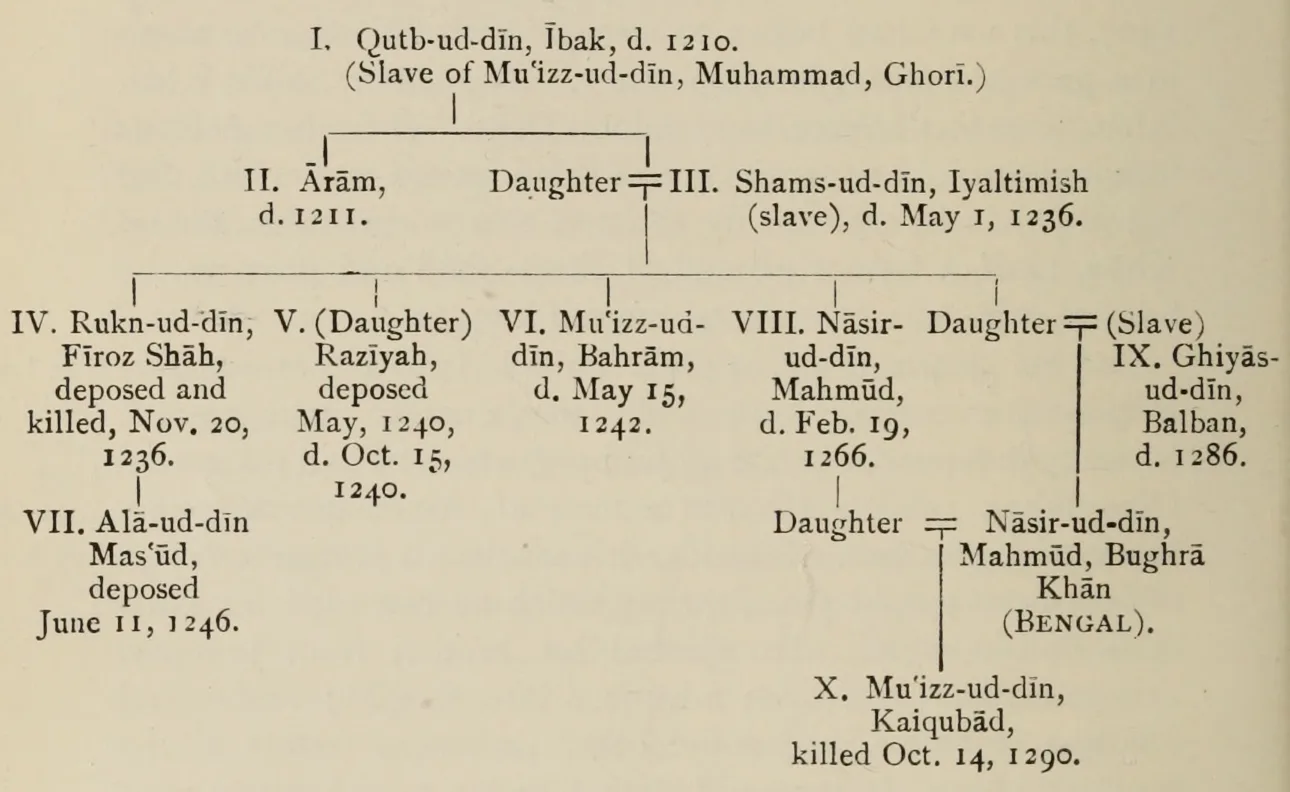
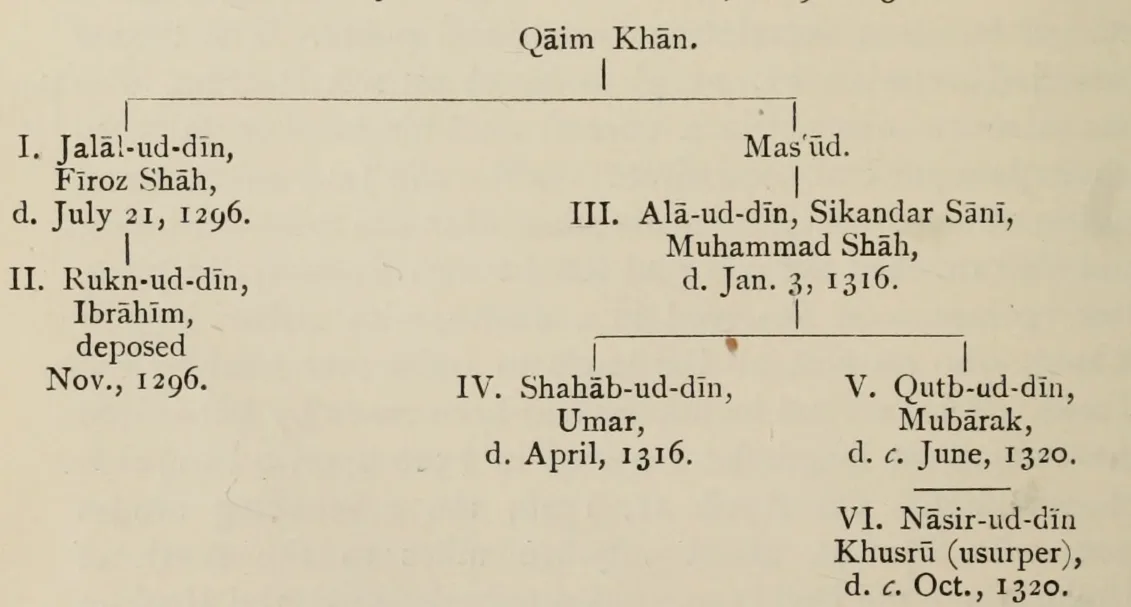
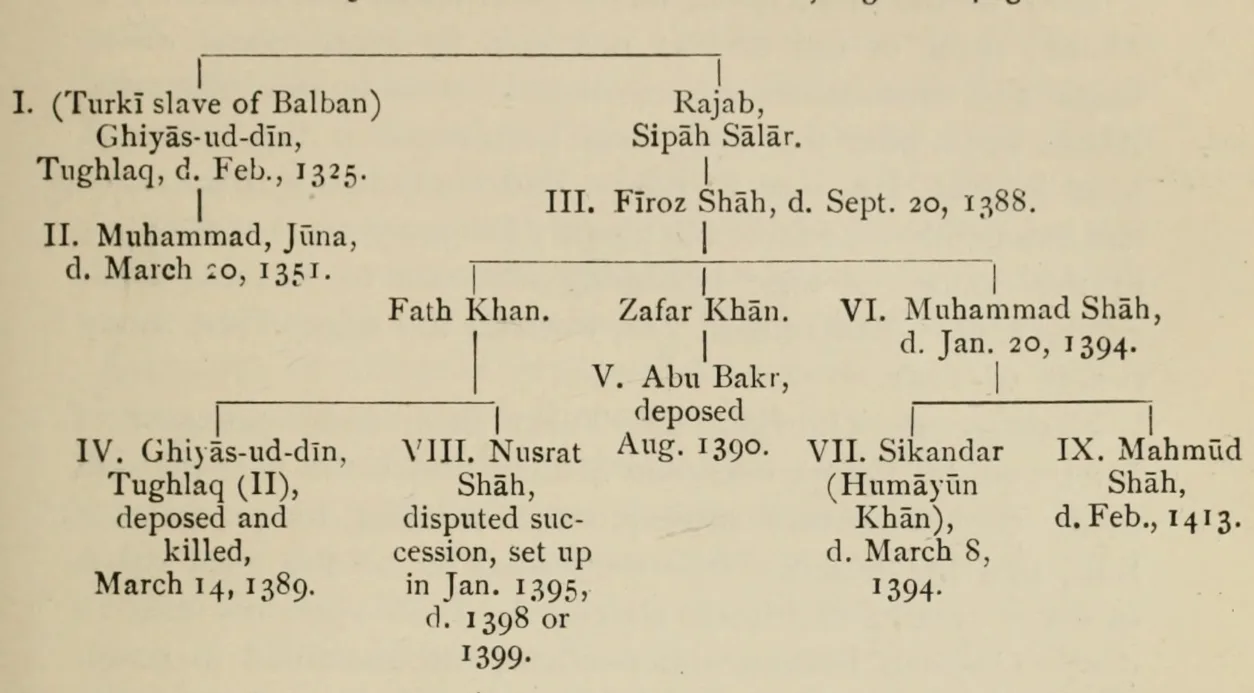
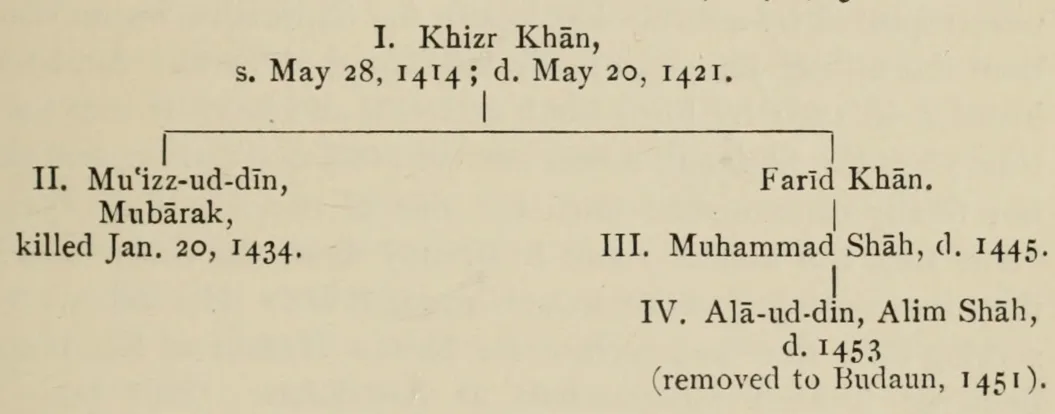
§ B. Minor Dynasties in Northern India (1206–1591)
Lahore hardly deserves a place in this category, since it was seldom held for long by any ruler independent of the king of Delhi. In 1206, upon the death of Mu‘izz-ud-dīn Ghorī, a contest for its possession arose between Īyaldūz of Kurram and Ghaznī, Qabājah of Multān, and Qutb-ud-dīn, Ībak, of Delhi. The last finally annexed it. For the rest of the period it was sometimes half independent, sometimes the apanage of a Delhi prince.
Sind, on the other hand, was seldom under the authority of Delhi; most of the time it was held by local rulers, whose origin and even names are involved in considerable obscurity. About 1050, after the Arabs had been expelled, the Sūmras, a local Rājput clan, rose to power, and continued with more or less independence to rule the country for 300 years (1050–1351), in the course of time becoming converts to Islām. Their capital was at Muhammad Tur, towards the edge of the sandy desert, or Thar.
Nāsir-ud-dīn, Qabājah, the Turkī slave and lieutenant of Mu‘izz-ud-dīn Ghorī, occupied Multān and Uchh near the end of the twelfth century, subsequently extending his power over Sind and the Sūmras, who continued to be the local rulers of seven small subordinate states. In 1206, upon his master’s death, Qabājah became independent, and remained in power till his own death in 1228. Iyaltimish of Delhi was for a time overlord of Sind; Muhammad son of Tughlaq also tried to establish the authority of Delhi. About 1351 the Sūmras were replaced by another local clan, the Sammahs, whose chief bore the title of Jām, and made his capital at Tatta. Sind was invaded in 1361 by Fīroz Shāh of Delhi and held by him for a time; but the Sammah power survived this occupation, and was not finally extinguished until the rise of the Arghūns (1520). Shāh Beg, the first of them to occupy Sind, was descended in the nineteenth generation from Chingīz Khān. His father, after serving for a time as governor for Sultān Husain of Khurāsān, declared himself independent at Kandahār. Shāh Beg, in December, 1514, descended into Sind, returned again in 1518, and finally took Tatta, the capital, in December, 1520. He died on July 18, 1522, and was succeeded by his son, Shāh Husain, who continued to govern until his death on February 14, 1544. Shāh Husain was succeeded by one of his officers, Īsā Khān, who had the hereditary title of Tarkhān, and belonged to another branch of the same family. This Tarkhān house continued in power until 1592, when the last of them, Jānī Beg, ceded the country to the Mughal emperor, Akbar.
As part of the dismemberment which followed upon the invasion of Taimūr, Multān, finding itself without a ruler, set up one of its own in the person of a Qureshi Shaikh (1443). A few years afterwards this man was supplanted by the Sehra chief of Sīwī (or Sibi), who proclaimed himself under the title of Qutb-ud-dīn Muhammad, Langah, and reigned for fifteen years (1454–69). His son Husain succeeded, and, after a long and fairly prosperous reign, abdicated in favour of his son Fīroz. On the murder of Fīroz, Husain resumed power, but died soon afterwards (1502). Mahmūd, son of Fīroz, was placed on the throne ; and after twenty-two years, Husain, an adopted son, followed (1524), only to be set aside a year afterwards by Shāh Husain, Arghūn, of Sind (1525).
Almost from the day of its conquest Bengal formed a separate kingdom, and its acknowledgement of the Delhi sovereignty was rarely more than nominal. Muhammad, Khalj (son of Bakhtyār), an officer of Mu‘izz-ud-dīn Ghorī, who was the first Muhammadan to invade Bengal (1198 or 1199), had, before the time of his death seven years afterwards, advanced as far east as Nadiā, and had even attempted to enter Tibet by way of Cooch Behār. He established his rule at the old Hindu capital of Lakhnautī (or Gaur) on the left bank of the Ganges (now in Mālda District). Two of his generals followed him ; then the government passed to another Khaljī, Hisām-ud-dīn, Iwaz. He was successful in increasing his territorial holding, annexing the country as far as Kanauj in one direction and Jagannāth (Orissa) in the other. In 1225 Iyaltimish of Delhi invaded Bihār and took it, only to lose it again the next year. Nāsir-ud-dīn, that king’s second son, who was now sent to Bengal, took Lakhnautī, and overcame Iwaz, who was killed.
After holding Bengal for four years, Nāsir-ud-dīn died there. Iyaltimish then came to Lakhnautī himself, and took measures to secure his authority. Three governors subject to Delhi followed one another. The last of these Delhi nominees was supplanted by a governor of Oudh, who had been sent to aid him against the Hindus. The supplanter survived only two years ; his successor, another Turk, a slave, held the country for seven years. At his death another man, who had been a slave of Iyaltimish, king of Delhi, was appointed ; and he in 1253, declaring himself independent, marched to conquer Oudh. He soon beat an ignominious retreat, without waiting to encounter the Delhi king. Next he invaded Kāmrūp (Assam), where he was made prisoner and died of his wounds (1258).
The next ruler was a man sent from Delhi (1258) ; but a rival governor, who held Karra on the Ganges (now in Allahābād District), invaded Bengal, and the governor from Delhi was slain in battle. The victor ruled for two years, and was succeeded by his son, who died seventeen years afterwards. His successor, Tughril (1277), was a slave whom Balban of Delhi had sent from that capital. Having declared himself independent (1279), this ruler twice defeated the Delhi generals ; whereupon Balban took the field in person, and in a vigorous campaign pushed his way as far east as Jājnagar, in Eastern Bengal, and Sonārgaon. Tughril was pursued relentlessly, until finally he was shot down, and his head cut off.
The next five rulers (1282–1331) were scions of the house of Balban, commencing with his son, Nāsir-ud-dīn, Bughrā Khān, who preferred obscure independence in Bengal to a laborious struggle for the Delhi throne, his right by inheritance. One of Bughrā Khān’s sons, of whom little is known, ruled for about eleven years ; and his second son ended in 1318 a prosperous reign of sixteen years. This last king’s sons fought together for supremacy in Bengal, and the defeated competitor appealed to Muhammad son of Tughlaq, at Delhi, who was quite ready to seize the pretext. The end of the struggle was the reannexation of Bengal to Delhi (1331). The province had been divided about 1297 into two parts, the eastern portion having its capital at Sonārgaon, the western, as before, at Lakhnautī. This division continued to exist up to 1352. In the interval, the governor of Sonārgaon had declared himself independent, under the title of Fakhr-ud-dīn, Mubārak Shāh (1338). An officer of the Lakhnautī government, who claimed to be king with the title of Alī Shāh, defeated the Sonārgaon ruler, put him to death, and annexed his territory, only to be himself assassinated a few months afterwards by Ilyās, his foster-brother. His son was placed on the throne, but two years afterwards was supplanted by Ilyās.
Ilyās Shāh and his descendants ruled Bengal up to the year 1406, the divided province having been reunited in 1352. Bengal was at this period entirely independent of Delhi ; a new capital was founded at Panduā, a little to the north of Lakhnautī, where the second king, Sikandar, erected some fine buildings. During thirty-nine years (1407–46) the house of Ilyās was set aside ; a local Hindu Rājā called Kāns, succeeded by his son and grandson, taking its place. The son of Kāns became a Muhammadan. This line of Rājās ended with a slave, who, after a usurpation of eight days, was replaced by a descendant of Ilyās Shāh. A son, a grandson, and a greatgrandson of this king ruled in succession. The last of them occupied the throne for only two and a half days, when he was superseded by his uncle, who reigned for seven years. On the murder of the latter, an Abyssinian (Habshī) eunuch ascended the throne for eight months, being followed by another Abyssinian, also a slave, for three years, when he was assassinated. His successor, also an Abyssinian, made himself detested, and finally was murdered after a reign of three years and five months.
The throne now passed to a family of Arab Saiyids, the first of whom, Husain Shāh, was selected by his fellow-generals to rule over them. He made a campaign in Assam, but soon had to defend himself against Sikandar, Lodī, of Delhi (1499). Terms of peace were arranged, and Husain Shāh died in 1523, after a reign of twenty-nine years. Two sons and a grandson followed him, until in 1538 Humāyūn, the second Mughal emperor, conquered the country, only to lose it again almost immediately.
Sher Shāh, Sūr, took Bengal, and in 1539 proclaimed himself king of Bengāl and Bihār, preparatory to his successful attempt to oust Humāyūn from the throne of Delhi. In the reign of Salīm Shāh, Sher Shāh’s son and successor (1545–54), a relation of the king was placed in charge of Bengal. This ruler was killed in 1554; his two sons succeeded one another, and then the line ended in a youth who was assassinated shortly after his father’s death. Sulaimān Khān, the governor of Bihār on behalf of the Sūr emperor of Delhi, intervened with success, and held the country through his brother. In 1563 Sulaimān Khān himself went to Bengal, and set up his capital at Tāndah near Gaur (Lakhnautī). He conquered Orissa, and died after a reign of nine years (1572). His eldest son was set aside after a few months in favour of his second son, Dāūd Shāh. In 1575 the emperor Abkar sent an army against Patna; Dāūd was driven from point to point, until he sought refuge in Orissa, but finding no safety even there, submitted to the conqueror. On a favourable opportunity, the local generals rose and again placed Dāūd Shāh at their head. A second campaign followed, ending in 1576 in Dāūd’s capture and execution. Independent sovereignty in Bengal was thus extinguished.
As it does not stand in the direct line of advance from Ghaznī to Lahore, Kashmīr did not fall under Muhammadan domination so quickly as the plains of the Punjab. Early in the fourteenth century Shāh Mīr, a Persian, found his way into the valley, and in time gained great influence at the Rājā’s court. In 1334 this man revolted and proclaimed himself king under the title of Shams-ud-dīn. Twelve of his descendants held the kingdom (1334–1541); the most celebrated were Sagga, otherwise Sikandar, the Idol-Breaker (1386–1410), and Zain-ul-ābidīn (1417). In the reign of Sikandar the population became almost entirely Muhammadan, as they remain to this day. Sikandar submitted himself to Taimūr when he approached Kashmīr, and thus saved the country from invasion. Zain-ul-ābidīn, during his long and prosperous reign, constructed canals and built many mosques ; he was just and tolerant.
In 1541 some fugitive chiefs of the two local factions of the Mākrī and the Chakk invited Mirzā Haidar Dughlāt, a relation of the Mughal emperor Bābar, to invade Kashmīr. The country was conquered and the Mirzā held it (nominally in the name of the emperor Humāyūn) till 1552, when he was killed in a skirmish. The line of Shams-ud-dīn, the first Muhammadan king, was restored for a few years, until in 1559 a Chakk leader, Ghāzī Shāh, usurped the throne ; and in the possession of his descendants it remained for nearly thirty years. But constant dissensions had weakened their power, and Akbar, then at Attock on the Indus (1586), sent an army into Kashmīr and without much difficulty added the valley to his empire.
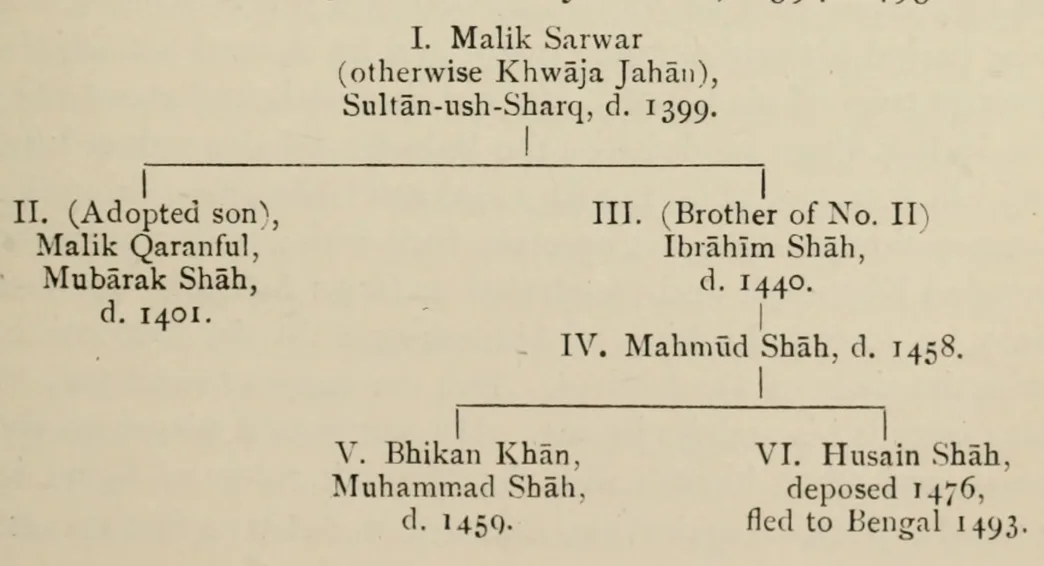
Jaunpur on the Gumti, an affluent of the Ganges, was founded by Fīroz Shāh, Tughlaq, about the year 1351. In 1394, during the reign of that monarch's grandson, a eunuch named Khwāja Jahān was appointed governor of the eastern provinces, with his head-quarters at Jaunpur. The Delhi kingdom was then at its weakest, and Khwāja Jahān soon declared himself independent, under the title of Sultān-ush-Sharq, or King of the East. At his death in 1399 he had included Bahraich and Gorakhpur, with parts of the Doāb and Bihār, in his kingdom. An adopted son succeeded under the title of Mubārak Shāh ; and an attack from Delhi was successfully repulsed in 1400. A younger brother succeeded in 1401 ; whereupon further hostilities with Delhi occurred, in which Kanauj on the Ganges was taken and retaken. The Jaunpur king ventured for a time even so far westward as Sambhal in Rohilkhand. Ibrāhīm of Jaunpur once threatened Delhi itself, and another time marched to Biāna, south-west of Agra (1427). Five years afterwards, he fought with Hoshang Shāh of Mālwā for possession of Kālpī on the Jumna. Ibrāhīm died in 1440, and was succeeded by his son, Mahmūd. This king continued the contest with the Mālwā ruler, without either side obtaining any decisive advantage. Elsewhere the Jaunpur ruler succeeded better. Chunār fort on the Ganges was captured, and an expedition was led into Orissa. In 1452 Mahmūd besieged Delhi, but was compelled to retire ; again in 1456, the two kings fought for possession of the district of Etāwah, between Agra and Allahābād. The next king, Muhammad, succeeded in 1458. Owing to his cruelties a revolt took place ; the king was killed, and his brother, Husain, ascended the throne. A truce was made with Delhi and an exchange of prisoners took place. Husain Shāh began his reign by a campaign in Orissa, and next (1465) forced the Hindu ruler of Gwalior to pay him tribute. In 1473 he laid claim to the throne of Delhi and actually occupied the suburbs of the city. But Bahlol, Lodī, inflicted a defeat on the Jaunpur troops, who fled in disorder, leaving their king’s family in the enemy’s hands. After a year the attempt was renewed ; but the Jaunpur troops were again defeated in two battles. The Delhi troops under Bahlol then advanced and took Jaunpur. A son of Bahlol was left in possession of Jaunpur, and a small fief was made over to Husain ; but on the death of his father (1488), the Lodī prince, supported by Husain, endeavoured to wrest the sceptre of Delhi from the hands of his brother, Sikandar. The king of Delhi overcame the allies, and thus (1493) the Sharqī or Eastern kingdom was extinguished. Husain ended his days a fugitive in Bengal, although coinage, by some strange freak, continued to be issued in his name up to the year 1500.
The perturbed state of the rest of India gave to this short-lived dynasty a greater prominence than its power would otherwise have conferred upon it. The Sharqī capital was the resort of many learned men, and the fine buildings there erected survive, an object for our admiration, to the present day. The extraordinary activity in war of these Sharqī kings has been sufficiently indicated in the above brief narrative of their doings. Sikandar Lodī of Delhi endeavoured (1517) to revive the kingdom as an apanage for his second son, Jalāl Khān, but this attempt was soon ended by Ibrāhīm, king of Delhi, who expelled his brother and reannexed the territory.
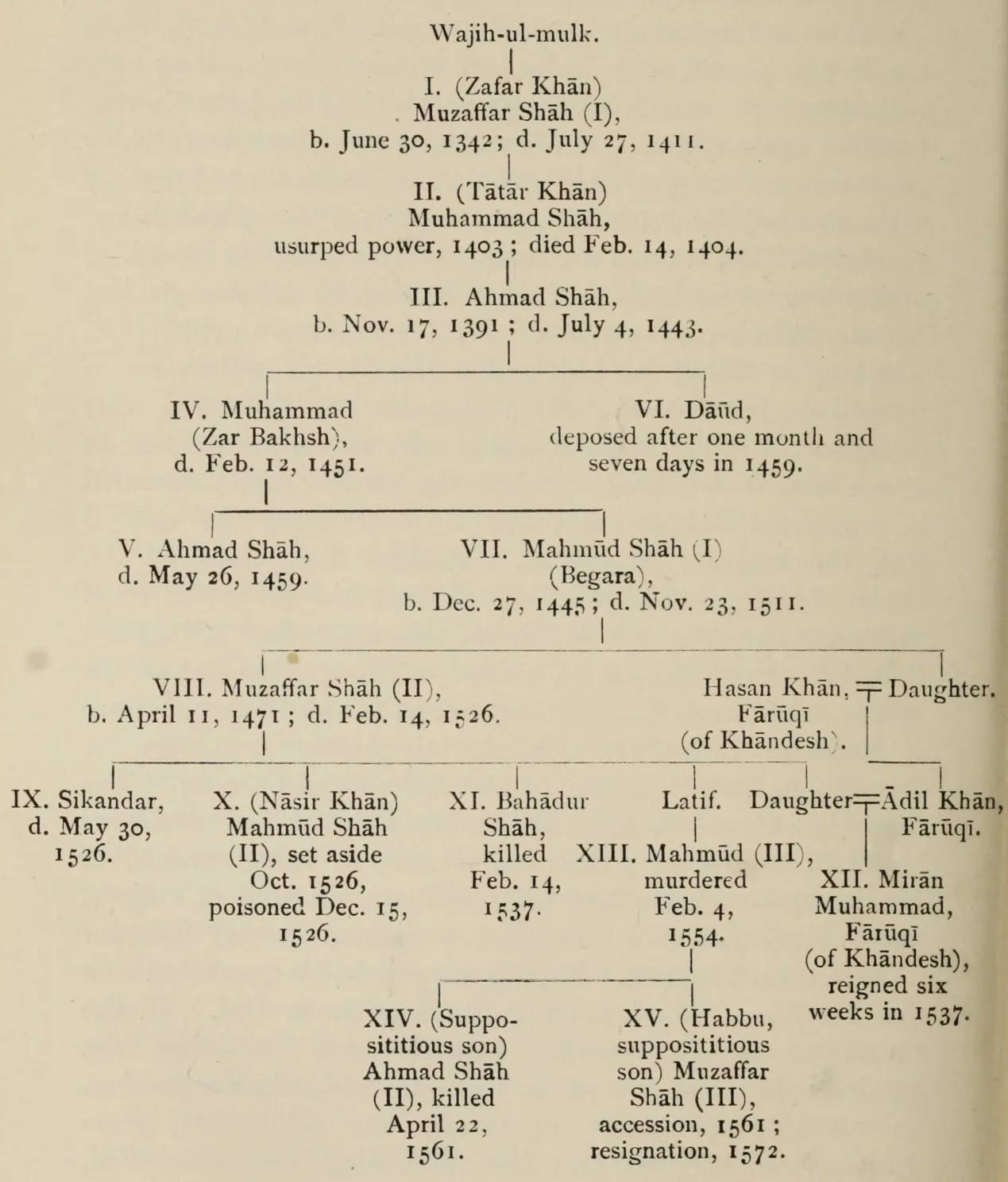
Gujarāt, one of the richest and most productive provinces of India, was first invaded by Mahmūd of Ghaznī in 1025–7, and there were several subsequent Muhammadan incursions into it; but not until the time of Mu‘izz-ud-dīn Ghorī (1196), was it annexed to the Delhi kingdom. It continued more or less in subjection to Delhi until the end of the fourteenth century. That kingdom was during that period at its weakest; and the governor of Gujarāt, Zafar Khān, the son of a converted Rājput, following the example of so many others, declared himself independent under the title of Muzaffar Shāh and enlarged his bounds considerably. In his time began the struggle with the kings of Mālwā. In 1411 the sceptre passed to his grandson, Ahmad Shāh, the founder of the capital, Ahmadābād. This king had a prosperous reign of nearly thirty-three years, during which he erected many of the fine buildings for which Ahmadābād is still celebrated. Ahmad Shāh continued the aggressive acts of his grandfather; thrice he invaded Mālwā, penetrating once as far east as Sārangpur, while the Mālwā king appeared twice under the walls of Ahmadābād. Expeditions were also made into the small surrounding states of Idar and Jhālor, and into Kāthiāwār to the south. There were two wars with Khāndesh and one with the Bahmanī king of Gulbarga. In spite of this warlike activity abroad, the king’s own territory was well governed and at peace. Ahmad Shāh was succeeded by his eldest son (1443–51), eldest grandson (1451–9), youngest son (1459), and youngest grandson, Mahmūd Shāh, Begara (1459 to November, 1511). The sixteen years from 1443–59 were occupied with a war against Gujarāt’s neighbour to the north-east, the Rānā of Mewār, in the course of which two victories were gained, Chitor, the Mewār capital, was besieged, and Abu, the country of Mewār’s ally, annexed. Mahmūd was under fourteen years of age when he succeeded, and he reigned for fifty-two years. During this long period his exploits were many, and he showed himself the greatest ruler of his house. He overran Cutch, and marched to the Indus, where he defeated the Baloch; he also reduced the two hill fortresses of Girnār (in 1471) and Chāmpāner (in 1484). Insurrection at home was severely dealt with; while abroad he invaded Khāndesh and penetrated as far as Asīrgarh; another time he forced the king of Ahmadnagar (in the Deccan) to raise the siege of Daulatābād. But the most unusual part of his career is his activity by sea. He suppressed piracy on the coast, and allied himself with the Mamlūk rulers of Egypt in a naval expedition against the Portuguese. After a first success at Chaul, south of Bombay, the Musalmān fleet was annihilated in a great battle off Diu in Kāthiāwār (February 3, 1509). Mahmūd Shāh, Begara, who died on November 23, 1511, is said to be the original of Samuel Butler’s prince whose
Is asp, and basilisk, and toad.
The reign (1511–26) of his son and successor was chiefly remarkable for an attempt to protect Mālwā against the Rānā of Mewār. The Rānā retaliated by an invasion of Gujarāt ; the king of Gujarāt replied by besieging the Rānā in Mandasor. The short and inglorious reigns of two sons followed (1526), when the throne passed to the third son, Bahādur. This king fully maintained the warlike traditions of his line ; he joined a confederacy against the king of Ahmadnagar in the Deccan, of which the command was given to Bahādur, and his supremacy thereby acknowledged by Khāndesh and Berār. This campaign was successful. Mālwā was the scene of his next exploit ; the king of that country having intrigued against Gujarāt and also attacked Mewār, Bahādur and the Rānā allied themselves to crush him. The king of Mālwā was captured at Māndū, his capital, and in the end was put to death. Mālwā was annexed (February, 1531) to Gujarāt. While Bahādur was absent, Diu had undergone an attack from the Portuguese, which the garrison had succeeded in repulsing (February 16, 1531). Next came the quarrel with the emperor Humāyūn. Bahādur had espoused the cause of the dispossessed Lodī princes, and furnished them with means to attack the Mughals. Humāyūn marched against Bahādur, then engaged on a siege of Chitor ; but before the armies could meet, Bahādur had retired to an entrenched camp at Mandasor in Mālwā. Finding this position untenable, he then fled to Māndū, thence to Chāmpāner and Cambay. The day before Humāyūn reached Cambay, Bahādur had continued his flight to Diu in Kāthiāwār. Humāyūn being recalled to Hindustān by trouble then brewing there, his hold of Gujarāt was so weakened that his officers evacuated it, and Bahādur recovered his kingdom. Shortly afterwards, he quarrelled with the Portuguese about their encroachments at Diu. In the course of the negotiations, Bahādur went on board the admiral’s ship, and in a scuffle which ensued as he was leaving, he was killed (February 14, 1537). For nearly forty years the kingdom survived, and four more kings reigned over it, amid a scene of continuous war, confusion, and tumult. It finally came to an end in September, 1572, when Akbar marched from Delhi to Ahmadābād, and the last king formally resigned his crown to that Mughal emperor. He escaped in 1583 and recovered his country, only to be expelled again in the following year. Eight years of guerrilla warfare followed, until his final capture in 1592–3, when he committed suicide on his way to the Mughal general’s camp.
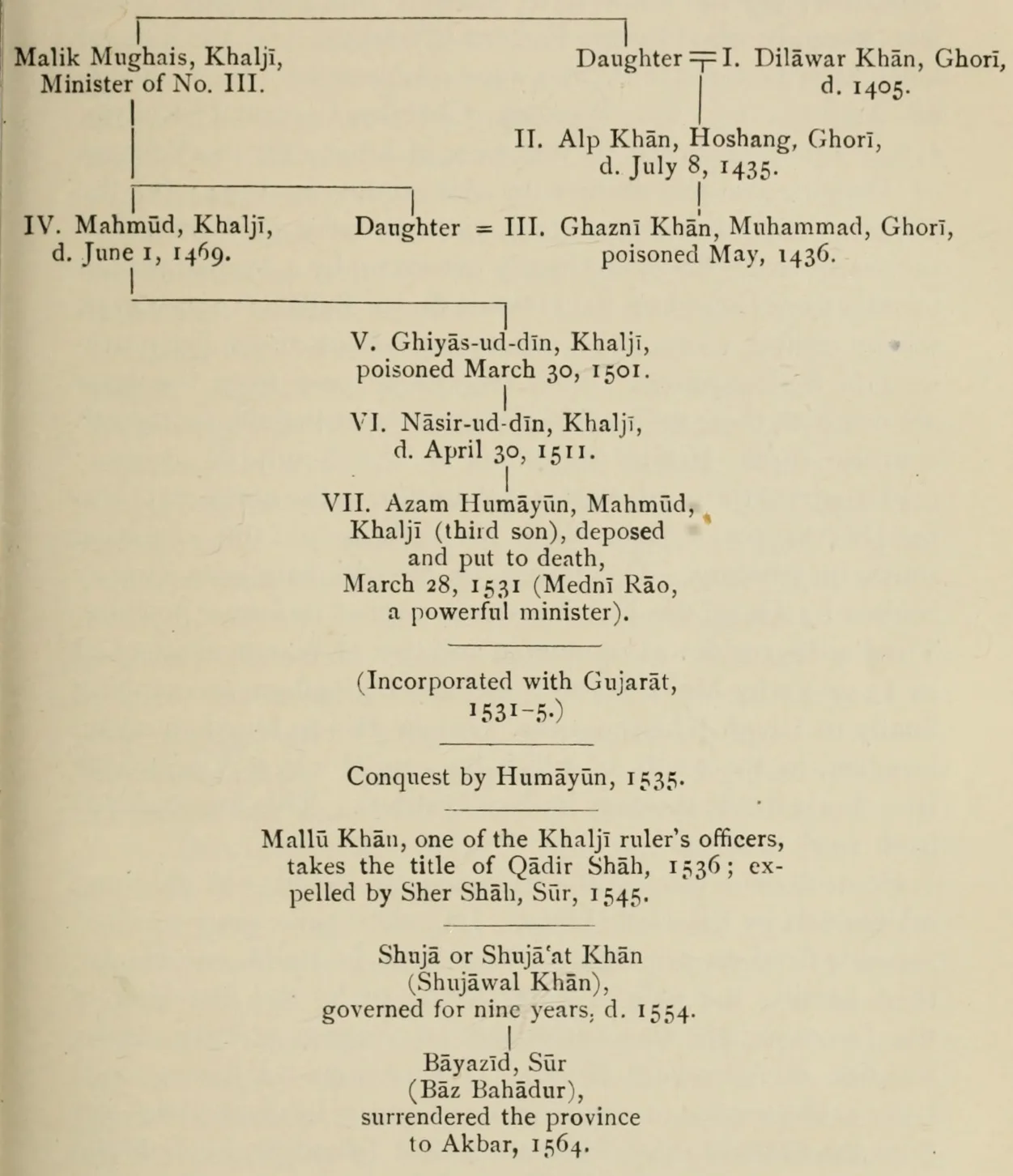
The central plateau north of the Narbadā, known as Mālwā, is one of the most fertile parts of India, and in popular belief is always verdant and free from famine. It was not until the reign of Alā-ud-dīn, Khaljī (1296–1316), that the Muhammadans conquered the country. The local Rāe or Rājā was slain in November, 1305. At some time shortly before 1389, one Dilāwar Khān, a Ghorī by race, was sent from Delhi as governor of the province. At length in 1401, when the ruin caused by Taimūr’s invasion had reduced the power of the Delhi kings to its lowest point, Dilāwar Khān declared his independence, establishing his capital at Dhār. Dying four years afterwards (1405), he was succeeded by his more celebrated son, Alp Khān, under the title of Hoshang Shāh, the founder of Hoshangābād on the Narbadā, who transferred the capital to Māndū. Almost at once trouble arose with the king of Gujarāt, who invaded Mālwā, reduced Dhār, and installed there his own governor. Hoshang was removed to Gujarāt, but reinstated in 1408. Instead of being grateful for this clemency, Hoshang invaded Gujarāt more than once, provoking reprisals, and in the end being forced to come to terms. In 1420 Hoshang invaded Berār, south of the Narbadā, and imposed a tribute on that country. In the next year he carried out a most romantic expedition to Jājnagar in Orissa. During his absence, Ahmad Shāh of Gujarāt had entered Mālwā. Hoshang returned in time to throw himself into Māndū, which he had strongly fortified in his father’s reign. After a time Ahmad Shāh retreated, vigorously pursued by Hoshang, until the fugitive defeated his pursuer in a pitched battle (March 16, 1423). A few years afterwards (1428), a quarrel broke out with the Bahmanī king of the Deccan over the occupation of Berār. Hoshang met the invader bravely, but was defeated ; all his heavy baggage, his family, and his followers fell into his enemy’s hands. Hoshang himself escaped to his own country in safety. In 1432 he determined to move northwards against Kālpī on the Jumna, whither the Jaunpur king was also leading an army. The Jaunpur forces retired under fear of an attack by the Delhi troops, and Kālpī was taken by Hoshang. On his death (July 8, 1435), he was followed by his son, Ghaznī Khān, under the title of Muhammad, Ghorī. During his short reign of one year, Muhammad behaved cruelly to his family and officers, gave himself up entirely to his own pleasures, and disgusted his people. He suspected his cousin and minister, Mahmūd, Khaljī, of an intention to dethrone him. Finding himself thus suspected, Mahmūd caused Muhammad Shāh to be poisoned. Mahmūd, Khaljī, himself then reigned for thirty-three years, and earned the character of a brave soldier and a just ruler. At first he had to contend against the heirs of the last Ghorī king, who, aided by Gujarāt, endeavoured to recover the throne. Of the claimants two were poisoned and one beheaded. This king made Kālpī, Mandalgarh, Kotah, and Būndī tributary, and fought with Jaunpur, Chitor, and Gujarāt. Once he invaded the Deccan, defeating the Bahmanī king and taking his capital. But the final victory in this contest did not rest with Mālwā, and a compromise was arrived at, by which a boundary was fixed on between the two kingdoms. Mahmūd’s successor reigned peacefully for thirty-two years. Nāsir-ud-dīn, this king’s son, was suspected of having poisoned his father ; for this reason three governors of provinces united their forces and marched against him. They were defeated, and two of them killed in battle. Nāsir-ud-dīn’s conduct was, however, so scandalous that his eldest son was induced to head a revolt, but not succeeding in his attempt, was forced to escape to Delhi. The succession passed to the third son, Mahmūd, although the other sons contested his right. With the assistance of a Hindu officer, Mednī Rāo, Mahmūd was able to defeat his rivals and establish himself, even though Delhi and Gujarāt had intervened. After a time Mahmūd, resenting the insolence of an all-powerful minister, fled to Gujarāt. A restoration followed, then another dethronement, and a second restoration. Gujarāt now became the scene of a disputed succession, and Mahmūd having sheltered one of the claimants, the successful aspirant, Bahādur, declared war. Māndū was taken, Mahmūd and his family being made prisoners and deported to Chāmpāner. On the way Mahmūd was put to death (March 28, 1531). The Khaljī line became extinct and Mālwā was annexed by Gujarāt.
Humāyūn in the year 1535 made a temporary conquest of the province. The next year the governor, one Mallū Khān, proclaimed himself king under the title of Qādir Shāh, only to be expelled by Sher Shāh, Sūr (1545). Subsequently Shujā or Shujā‘at (popularly, Shujāwal) Khān, Sūr, ruled for nine years until his death in 1554, during the later years being practically independent. His son Bāyazīd (Bāz Bahādur) succeeded him, and held the country for ten years, finally surrendering it in 1564 into the hands of the emperor Akbar. Bāz Bahādur is more famed in fable than in history, his love for Rūpmatī forming the theme of many poems.
§ C. Southern India to 1526, with names of kings to 1687
We have seen that the first incursion of the Muhammadans into the country south of the Narbadā took place in 1294, when Alā-ud-dīn, Khaljī, marched from Karra on the Ganges, and passing through Bundelkhand reached Deogiri in Khāndesh, returning by a more western route to Delhi. A pause of some ten years followed, when the southward movement was resumed (1305) under Malik Kāfūr, Alā-ud-dīn’s general, who carried the standards of Islām to the very southernmost headland of India opposite Ceylon. Southern India, for some centuries before that time, had been divided between six principal Hindu dynasties : (1) the Yādavas in Eastern Telingāna (900–1000), who were absorbed by the Eastern Chālukyas ; (2) the Eastern Chālukyas (1000–1300), who were conquered by the Ganpatīs of Āndhra ; (3) the Western Chālukyas, capital Kaliyān (1000–1300), absorbed by the Deogiri kings ; (4) the Yādavas of Deogiri, conquered first by Alā-ud-dīn in 1294 ; (5) the Ganpatīs of Āndhra (953–1322), with a capital at Warangal to the north-east—they were finally overcome by a Muhammadan invader from Delhi ; (6) the Hoysala line of Ballāla (1050–1311), whose capital was at Dwārasamudra, about 100 miles north-west of Seringapatam. Thus, as will be seen from the dates above given, there were at the commencement of the fourteenth century three Hindu kingdoms in the South or Deccan : (1) Deogiri in the north-west ; (2) Warangal in the north-east ; and (3) Dwārasamudra, from which the Ballālas held the remaining southern territory. The power of Deogiri had been already broken by Alā-ud-dīn, and it never recovered its former position. The Ballāla realm was conquered and that of Warangal attacked in 1310–11 by Malik Kāfūr ; the latter kingdom succumbing finally to Ulugh Khān in 1322. A new Hindu kingdom arose, however, in the south, of which the capital was at Vijayanagar (the site is in the modern Bellary District). This line endured from 1336 to 1565.
Control over the southern conquests could not be long maintained by the Delhi kings. In a short time some revolted generals fixed on an Afghān officer born in Delhi, one Hasan, then bearing the title of Zafar Khān, to be the first king of the Deccan. He was enthroned on August 3, 1347, under the title of Alā-ud-dīn Hasan. Either from his having once been in the service of a Brāhman, or because he claimed descent from the Sāsānid ruler, Bahman, son of Isfandyār, he bore the appellation of Bahman Shāh ; and by the epithet Bahmanī, derived therefrom, the kings of his house are known. Their capital was at Gulbarga, in the south-west of the modern State of Hyderābād. From similar causes, the rule of Delhi was thrown off by Khāndesh, the country just south of the Narbadā, and the Fārūqī line of kings, who ruled that country from Burhānpur, endured from 1399 to 1599. The Bahmanī power at Gulbarga fell into decay in 1482, but was not finally extinguished till 1526, nearly 180 years after the first king’s elevation to the throne. During the last forty years or so of this period the kings had no real power, and their dominions had already been divided between five of their officers, who established kingdoms known by the titles of their founders. These kingdoms are: (1) the Ādil Shāhī of Bijāpur (1490– 1686); (2) the Nizām Shāhī of Ahmadnagar (1490–1637); (3) the Qutb Shāhī of Golconda (1512–1687); (4) the Imād Shāhī of Ellichpur in Berār (1484–1574–5); and (5) the Barīd Shāhī of Bīdar (1492–1609). In 1510 the Portuguese established themselves at Goa on the western coast.
The kingdom of the Bahmanīs reached its fullest extent almost at once, in the eleven years during which the first king, Alā-ud-dīn Hasan, reigned. It stretched from sea to sea, including the Deccan Districts of the Bombay Presidency, the modern Hyderābād State, and those Districts of the Madras Presidency which used to be called the Northern Circārs. The adjoining states were: on the north, Gujarāt, Khāndesh, and Orissa; on the south, Vijayanagar. Orissa and Vijayanagar were Hindu states. For nearly 110 years (1374–1482) the kingdom endured unimpaired; in the remaining forty-four years (1482– 1526) power was in the hands of revolted generals, who had founded new states, thereby reducing the Bahmanī power to a mere shadow of its former greatness. The last holder of the title of king became a fugitive, and ended his days in obscurity at Ahmadnagar. Altogether there were eighteen Bahmanī kings, the first eight ruling from Ahsanābād-Gulbarga, the rest from Muhammadābād-Bīdar. The second and third kings were at almost constant war with Vijayanagar, their southern Hindu neighbour. Dāūd, the fourth ruler, poisoned his nephew and predecessor, and shortly afterwards was himself murdered at the instance of the late king’s sister. Muhammad, nephew of Dāūd, had a fairly quiet reign of over nineteen years; he was enlightened and liberal. On his invitation the celebrated poet Hāfiz, Shīrāzī, embarked for India; but being driven back by a storm accepted the omen, and sent an ode to the king declining to leave his beloved Shīrāz. The eyes of Ghiyās-ud-dīn, son of Muhammad, were put out by a slave; and he was deposed after a short and inglorious reign. His successor, a youth of fifteen, fared no better; two princes of the house revolted, and after defeating the king’s army, blinded and deposed him. Fīroz, one of the successful princes, followed with a long reign of nearly twenty-five years (1397–1422). Early in his reign he was assailed almost simultaneously by the Rājā of Kherla in Berār from the north, and by the Rāe of Vijayanagar from the south. Fearing invasion by the Bahmanī king, Mālwā and Gujarāt entered into an agreement with Vijayanagar. War ensued, Vijayanagar was invested, and the country ravaged. For a time peace was patched up ; but war soon broke out afresh, and the Muhammadan kingdom was threatened with extinction. Luckily the king’s brother, Ahmad, won a signal victory over the Hindus, and the dynasty was saved. On the whole it was in these years that the state attained its highest prosperity. Fīroz was succeeded by his brother, whose thirteen years on the throne were passed chiefly in warfare against the Hindu confederacy of Vijayanagar and Warangal. The fortune of war varied ; but at length the Warangal Rājā was slain and his capital taken. Hostilities next broke out with Mālwā, in defence of the northern boundary of the Bahmanī kingdom. No definite success was gained by either side, and peace was at length arranged through the good offices of the ruler of Khāndesh. Under Ahmad’s son, Alā-ud-dīn, the war with Vijayanagar was continued, complicated by the revolt of another son, whose cause was espoused by that Hindu state. In the end, the pretender was defeated, and forced to content himself with the apanage of Raichūr. When the Bahmanī king had partially reduced the Konkan and suppressed a revolt in Berār, he was called on to meet a fresh attack from Vijayanagar. After three severe actions peace was made. Another unsuccessful invasion of the Konkan followed. The death of the king having been falsely reported, fresh insurrection broke out in Berār and Telingāna, supported by the allied kings of Mālwā and Khāndesh. These troubles were met vigorously by Alā-ud-dīn, although now in failing health. He did not survive more than two years, when, after a disputed succession, the throne passed to his eldest son. This king, Humāyūn, acted so cruelly that he has earned the epithet of Zālim, or ‘the oppressor’ : he was succeeded first by one, then by another minor son. Power fell into the hands of a vigorous minister, Khwāja Mahmūd Gāwan, and a victorious reign of twenty years followed. At the king’s death (March 26, 1482), the kingdom, with the exception of a small area round the capital, was split up among various revolted governors. Of the remaining five kings of the dynasty, one was in the power of his minister and for four years was actually a prisoner, while the other four were mere puppets set up by this minister for his own purposes.
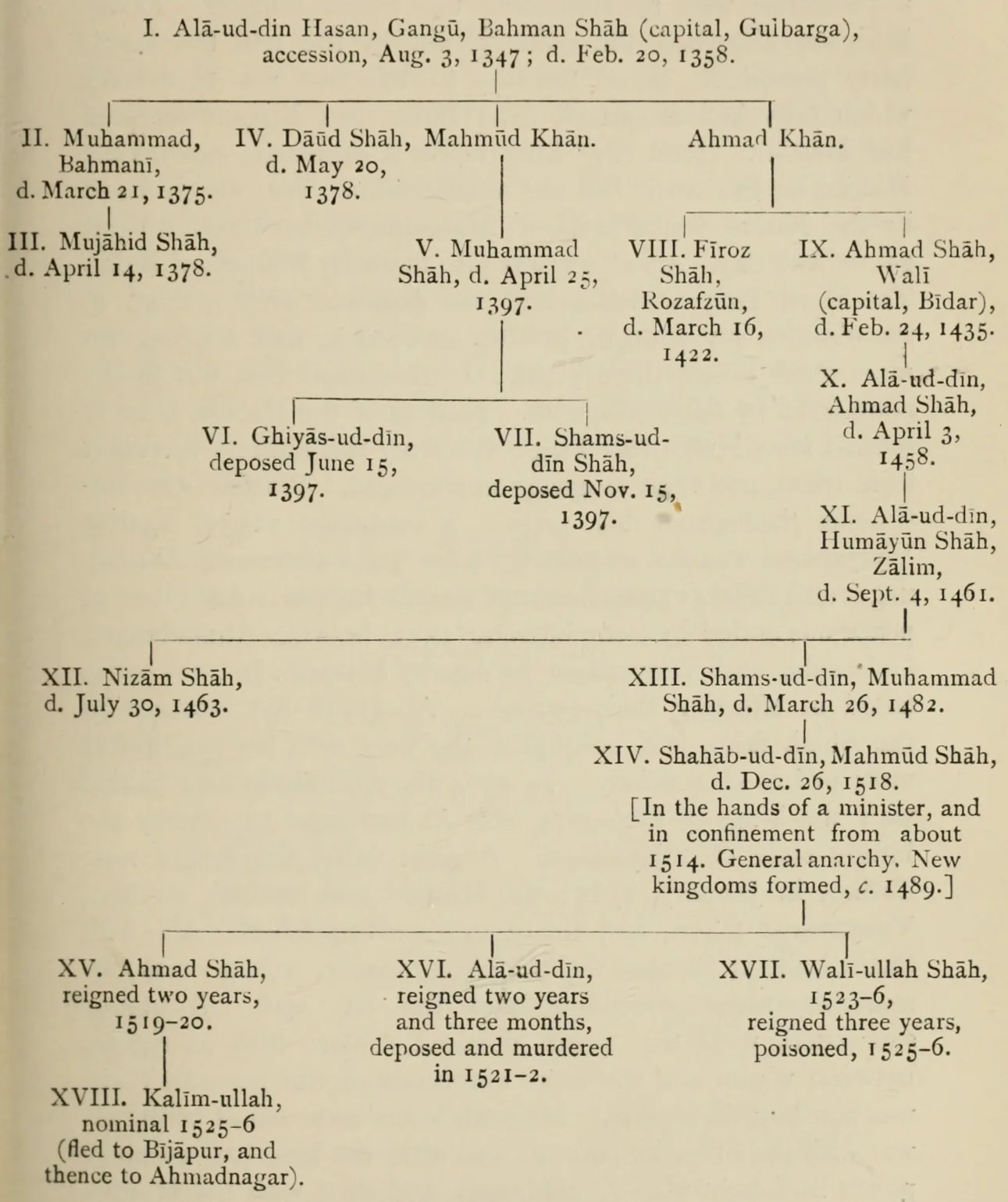
The founder of the Ādil Shāhī dynasty, Yūsuf, entitled Ādil Khān, was a Turk who had found his way through Persia to the Deccan. Entering the service of the Bahmanīs, he had risen to be governor of Bījāpur. After some years he renounced his allegiance to the waning power at Bīdar, and assumed the attributes of sovereignty (1490). He carried war into the territory of Vijayanagar (1493), and was able to defeat a combination against him, due to his encouragement of the Shiah form of Islām. His minor son succeeded (1510), under charge of a protector, who re-established the Sunni religion. Palace intrigues disturbed the country, but in the end the king’s party prevailed. Some territory to the east was recovered, which provoked an attack from Bīdar, but Bijāpur repulsed the invader. Next the king made a campaign against the Hindus on the south, but was unsuccessful. War was declared by the Nizām Shāhī king of Ahmadnagar, in which Bijāpur gained the day. An attack was also made by Bijāpur on Bīdar. The third king, a debauchee, was removed after a reign of six months, his younger brother succeeding and reigning for more than twenty-three years. In this reign Goa was finally conquered by the Portuguese. Natives of the Deccan were in special favour with this king ; the army was entirely recruited from them, and their language encouraged. Warfare was continuous throughout his reign : a campaign (1535) against Vijayanagar was not successful ; a few years afterwards Ahmadnagar and Bīdar (1542) combined against Bijāpur. A short-lived peace was ended by a confederacy (1551) between Ahmadnagar, Golconda, and Vijayanagar to destroy Bijāpur ; but the allies failed in effecting their purpose. Ali (1558–80) returned to the Shiah faith, and continued the wars with his neighbours more or less successfully. In 1564 the Ādil Shāhī king joined with the kings of Golconda and Ahmadnagar to destroy the Hindu state of Vijayanagar. A great battle was fought near Tālikot in January, 1565 ; the Hindus were entirely crushed, Vijayanagar taken, and the dynasty extinguished. Ali, Ādil Shāh, built at Bijāpur the principal mosque, a large masonry reservoir, some aqueducts, and the city wall. A minor succeeded, with the queen dowager, Chānd Bībī, as regent, between whom and the more ambitious of the generals there was constant dissension. Meanwhile the state was at continual war with the other kingdoms ; and after the king had assumed power he fought with Ahmadnagar, and then with the Hindus to the south. In 1595 the king of Ahmadnagar was killed in battle. A new king succeeded at Bijāpur in 1626, and soon after that date the Mughal emperor Shāhjahān began a war of conquest against Ahmadnagar. Bijāpur came to the latter’s aid ; but the Nizām Shāhī king preferred to submit, and left his ally to bear the whole brunt of the emperor’s attack. A long investment of Bijāpur began in 1633 ; two years afterwards the siege was raised, and in 1636 a peace concluded. During the years 1648–59 the kingdom was troubled by the new power of the Marāthās, then rising into notice under the celebrated Sivajī. In 1662 Sivajī was forced to conclude a peace. Already in 1657 Aurangzeb, then only governor for his father, had made an unprovoked attack on Bijāpur ; but before he had effected his purpose, the Mughal war of succession called him away to the north. In 1665–6 Jai Singh, the Mughal general, and Sivajī made a fresh attack on Bijāpur. These allies were not able to conquer it ; but in 1667 Sivajī by himself forced it to pay him tribute, and in 1673–4 he was able to annex some of its territory. In 1679 the Mughal emperor's eldest son attempted to take the capital, but failed ; and in 1685 he was similarly unsuccessful. At length Aurangzeb moved against the place himself ; and on October 15, 1686, Bijāpur was taken and the monarchy destroyed. All the territory was occupied by the Mughals in the year 1688.
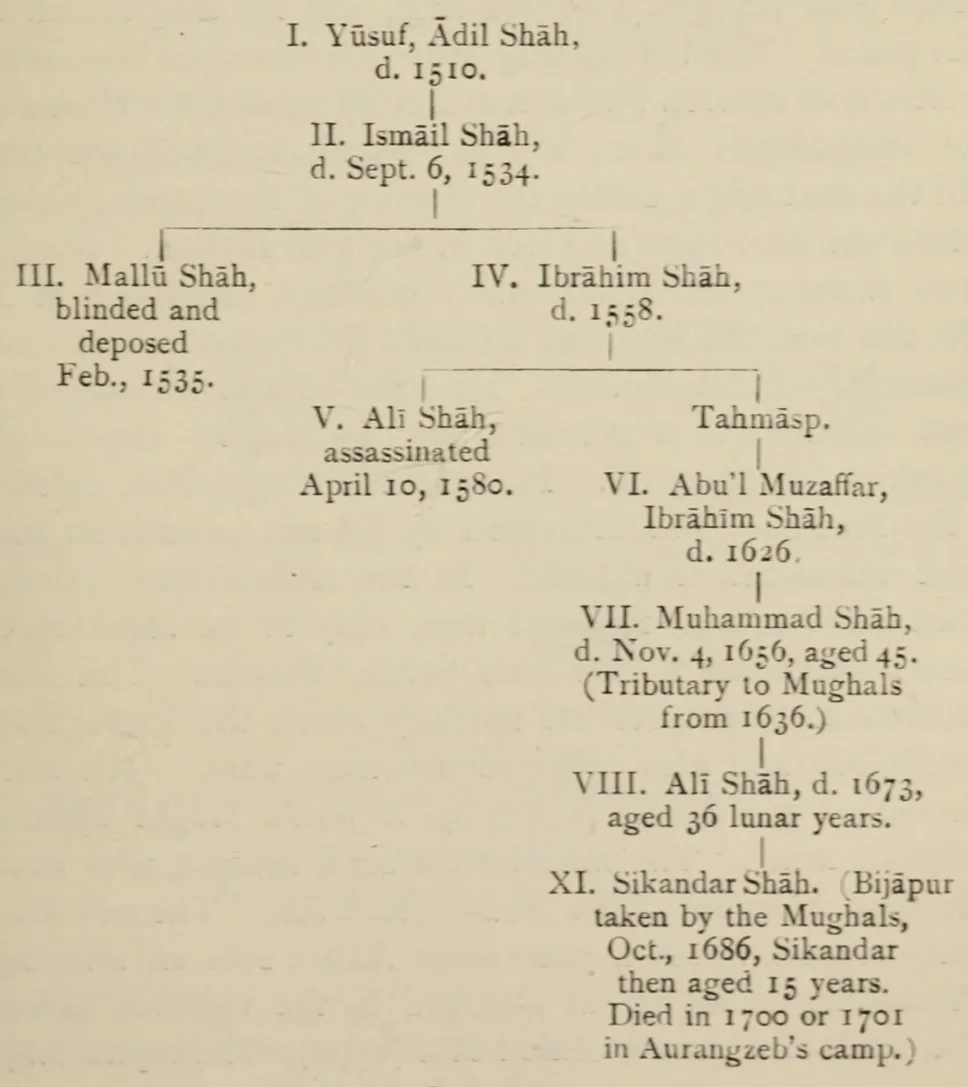
The history of the Nizām Shāhīs is much like that of the Ādil Shāhīs—consisting chiefly of wars and rumours of wars, intrigues of generals and courtiers, and disputed successions. The founder had been governor of Junnar under the Bahmanīs. When his father, a converted Brāhman who had risen to be minister, was murdered by the king’s order, the son proclaimed himself independent. He founded the city of Ahmadnagar, built a fort there, and made the place his capital. On his northern frontier he captured the fortress of Daulatābād, and along with it a part of Khāndesh. The next king was involved for some time in a war of succession ; as soon as he had freed himself from this entanglement, he inflicted defeats on Berār and Khāndesh. Bahādur, king of Gujarāt, intervened, and in the end, having been proclaimed at Ahmadnagar, forced its king to admit his supremacy. In the remaining years of the reign there were further wars with Bijāpur. On the second king’s death the succession was again disputed. Fresh war with Bijāpur broke out, in the course of which the Nizām Shāhī king was besieged in his capital. Peace was made only to be broken. Golconda then offered itself as an ally against Bijāpur and Vijayanagar. The campaign was disastrous, Ahmadnagar was besieged a second time, and the king forced to sue for peace. Tired of fighting with each other, the Muhammadan rulers now entered into a confederacy against the Hindu power of Vijayanagar, which was successfully attacked and crushed. In the next reign, during the regency of the queen-mother, the state was once more involved in war with Bijāpur. Next, these two states united against their northern neighbour of Berār. By this time the king had set aside the queen-mother and had assumed control himself. He invaded and conquered Berār, but, yielding to a protest from the Mughal emperor, relinquished his conquest. In 1588 the king, whose epithet was ‘the Madman,’ was murdered by his son ; confusion reigned, and assassination was rife. In the end, a rival prince, the parricide’s cousin, replaced him, only to be superseded two years afterwards by his own father, Burhān. This king endeavoured to recover the territory which the Portuguese had occupied, and also engaged in other wars. His son and successor was killed (1595) in a battle fought against the Bijāpur army. The minister set up a usurper, who was soon deposed in favour of his predecessor’s son. The new king had only reigned about a year when Akbar sent an army against Ahmadnagar, but it was repulsed by the vigorous defence of the celebrated queen, Chānd Bībī (1596). The capital fell, however, upon a second attempt (July, 1600), the king being made captive and sent to the fortress of Gwalior. In 1610 the chief minister, an Abyssinian called Malik ‘Ambar, freed the territory from the Mughals and set up the last king’s son. In 1612 the emperor Jahāngīr failed in an attempt to oust Malik ‘Ambar. This great minister died about 1626, and his son, who succeeded to power, having quarrelled with the king, strangled him (about 1631). Meanwhile, early in the reign of Shāhjahān (1627– 58), one of his generals, Khān Jahān, rose in revolt, and obtained an ally in the king of Ahmadnagar ; but the attempt to throw off the Mughal yoke did not succeed. Husain, a child of ten, had been made king by the son of Malik ‘Ambar ; but in 1635 this noble was divested of all power by the Mughal emperor, and the boy-king sent to prison at Gwalior. Shāhjī, Bhonsla, the father of Sivajī, attempted to revive the kingdom under another boy-king. This youth, too, was taken and sent to Gwalior ; and in 1637 the Nizām Shāhī kingdom was finally absorbed into the Mughal empire.
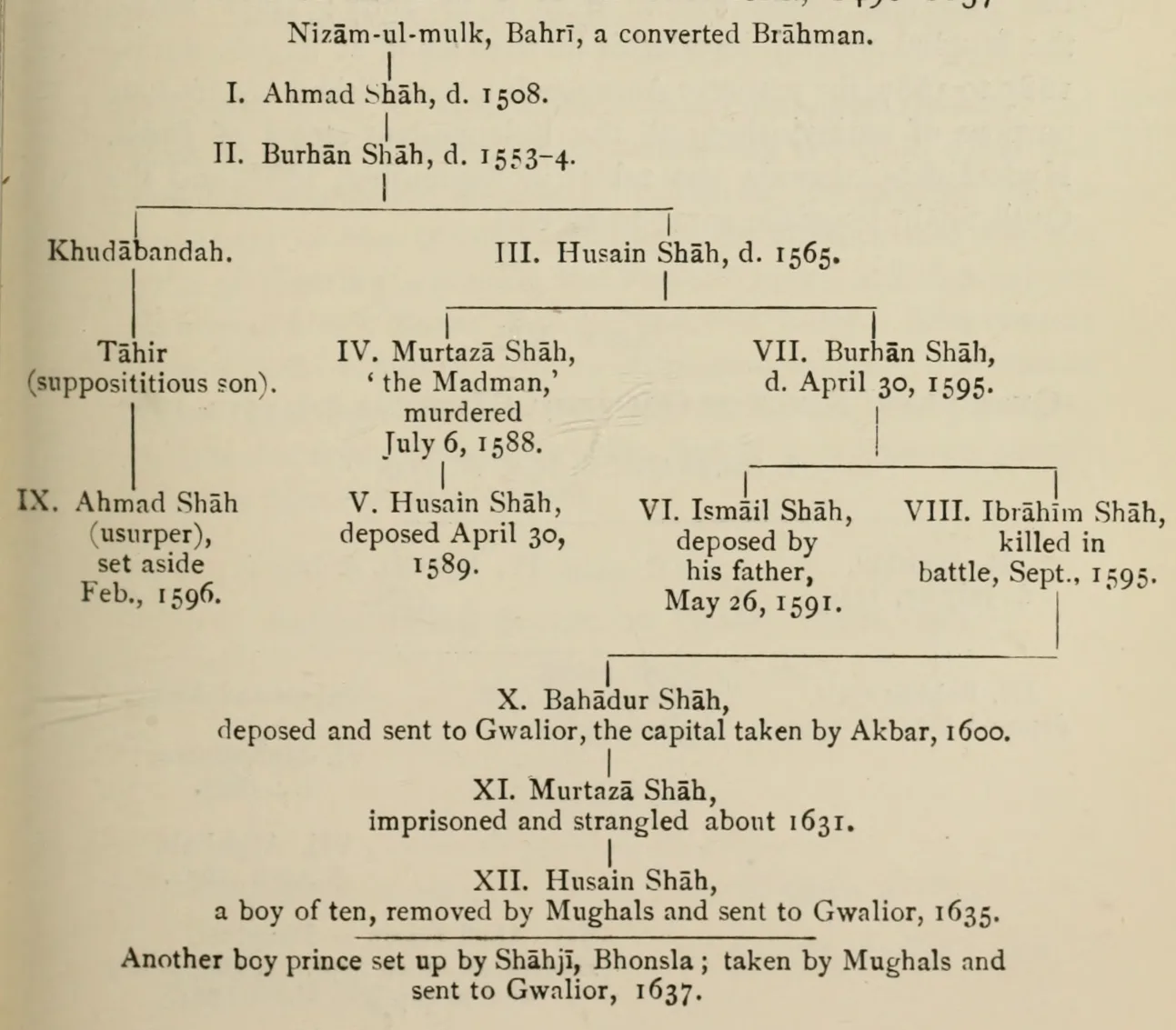
The Qutb Shāhī kingdom was founded by a Turk in the Bahmanī service, who had become governor of their eastern province of Golconda. In 1512, after having long held that province, he declared himself independent and ruled the country as king for thirty-one years. His son succeeded him, and, during a reign of seven years, carried on war against Bijāpur with varying success. Ibrāhīm, another son, followed, and during his long reign of over thirty years the usual warfare continued. This king was one of the allies who destroyed Vijayanagar, the last Hindu kingdom of the south. Another long reign carries us on to 1612; it was during this period that the city of Hyderābād, the present capital of the Nizām, was founded a few miles from Golconda. A nephew succeeded in 1612. In his reign (1635) the Mughal emperor, Shāhjahān, forced the Qutb Shāhīs to pay tribute. Twenty years afterwards, Aurangzeb, then governor of the Mughal provinces, won over by his intrigues Mīr Jumla, the Qutb Shāhī minister, and began to undermine the dynasty. Events in Hindustān called the prince away (1657) before he could carry out his project. But the Golconda state was already in decay; Sivajī, the Marāthā, levied tribute from it in 1667; Diler Khān, the Mughal general, invaded it in 1678; and at length, during 1685 to 1687, the emperor Aurangzeb accomplished his life-long purpose of extinguishing all the independent states of India. Hyderābād-Golconda was taken in September, 1687, and the Qutb Shāhī kingdom came to an end.
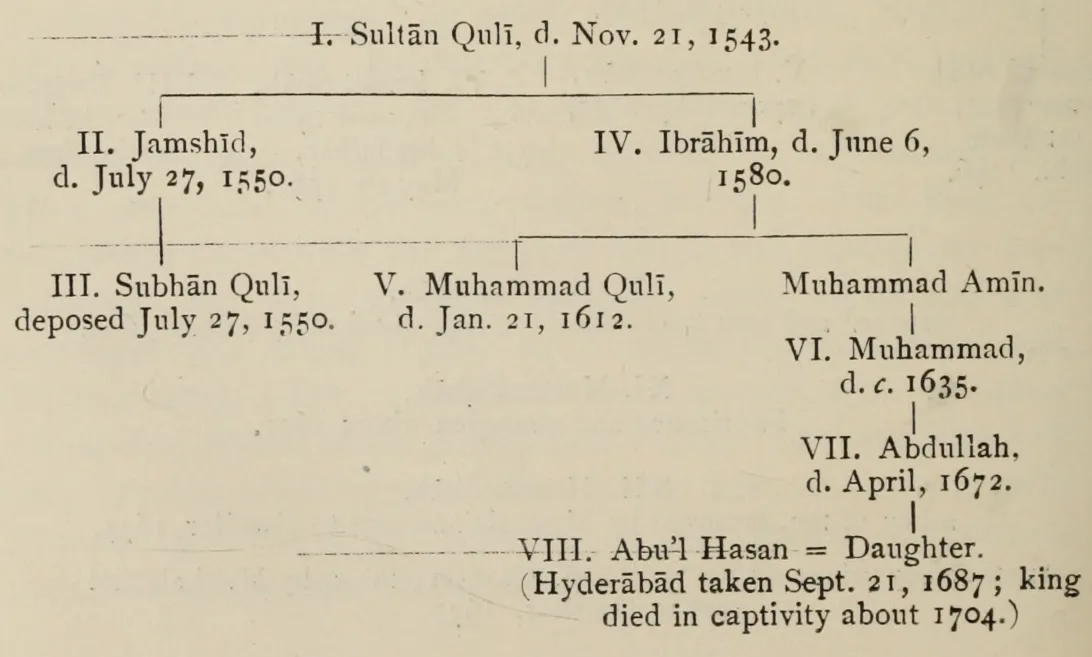
When the other generals and governors threw off the Bahmanī yoke, the governor of Berār, Imād-ul-mulk, a converted Hindu from the Kanara coast, followed their example (1484); when he died, he was succeeded by his eldest son, who maintained his position and reigned for about twenty-three years. His son, Daryā Shāh, had a more peaceable reign than usual, and after about thirty-four years was succeeded by an infant son. The regent set aside this boy after a few years, and assumed power in his own name. At length the Nizām Shāhī king of Ahmadnagar defeated the usurper about 1574–5, and, setting both him and the legitimate king aside, annexed the territory to his own dominions.
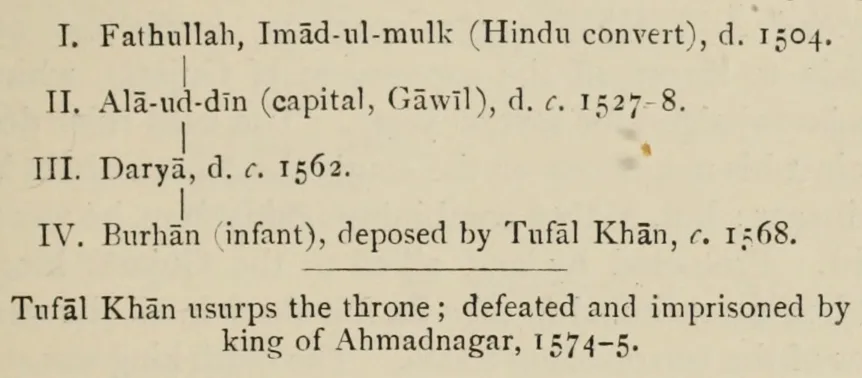
Qāsim, Barīd, a Turkish officer of the Bahmanī dynasty, had risen to high office at the capital during the time when that kingdom was slowly decaying. Following the example of the governors of the outlying provinces, he appropriated the last strip of territory adjoining the capital (1492), and limited the Bahmanī king’s power to the citadel of Bīdar. The country passed from father to son for four generations. The last of these rulers was expelled by a distant relation, who continued to rule for some time after 1609, but it is not known exactly when or how his reign ended.
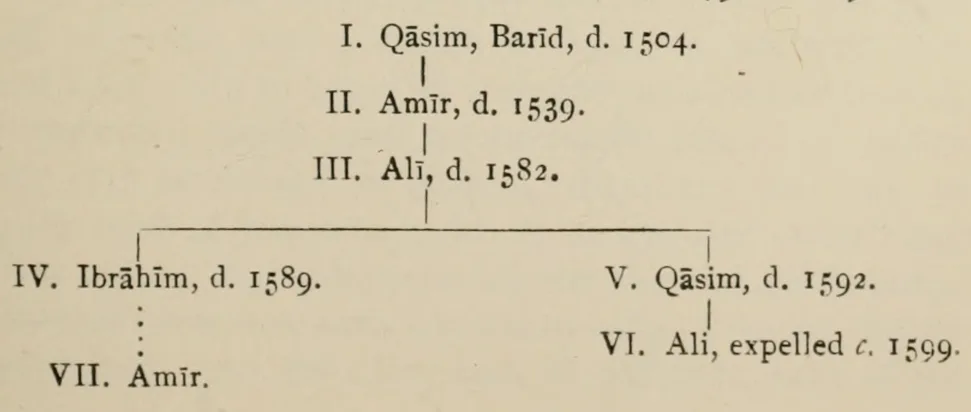
The Khāndesh kings were the second Muhammadan dynasty to establish independent rule south of the Narbadā. In the reign of Fīroz Shāh of Delhi (1351–88), there lived one Malik Rājī, who claimed descent in the twenty-second generation from the Khalīfah Umar (634–44), surnamed Fārūq (the Discriminator). This man entered the Delhi service as a simple trooper, and rose to be governor of the district of Thālner, on the northern edge of Khāndesh. After the death of Fīroz (1388), Rājī maintained his hold on the country, and on his death (1399) it passed to his son Nasīr. The territory was enlarged to the south, the hill fort of Asīrgarh was captured from the Hindus, and Burhānpur was founded and made the capital. Towards the end of his thirty-eight years’ reign, Nasīr was discomfited by a Bahmanī army, and owed his rescue to aid from Gujarāt and Mālwā. Two peaceful reigns followed ; but in that of the second Ādil Khān (1457–1503) an ineffectual attempt was made to throw off the supremacy of Gujarāt, which had been acknowledged for several years. The next ruler declared war against his neighbour on the south, the Nizām Shāhī king at Ahmadnagar ; but, Mālwā combining against him, he was forced to desist. Protected by and allied to the Gujarāt kings, the Fārūqī house continued to take its full share in all the wars and disputes of the surrounding states. The ninth king was actually for a time placed on the Gujarāt throne, his mother having been a princess of that dynasty. In 1572 the Mughal generals made a raid into Khāndesh ; and subsequently, in 1595, the Khāndesh ruler served on their side under Akbar’s son, Murād. The last king, however, Bahādur, who succeeded in 1597, declared war against the Mughals ; and when Akbar came to Mālwā on his way to the Deccan, the king shut himself up in Asīrgarh and prepared to stand a siege. When Akbar’s men had stormed and taken the lower fort (1599), Bahādur and his garrison surrendered.
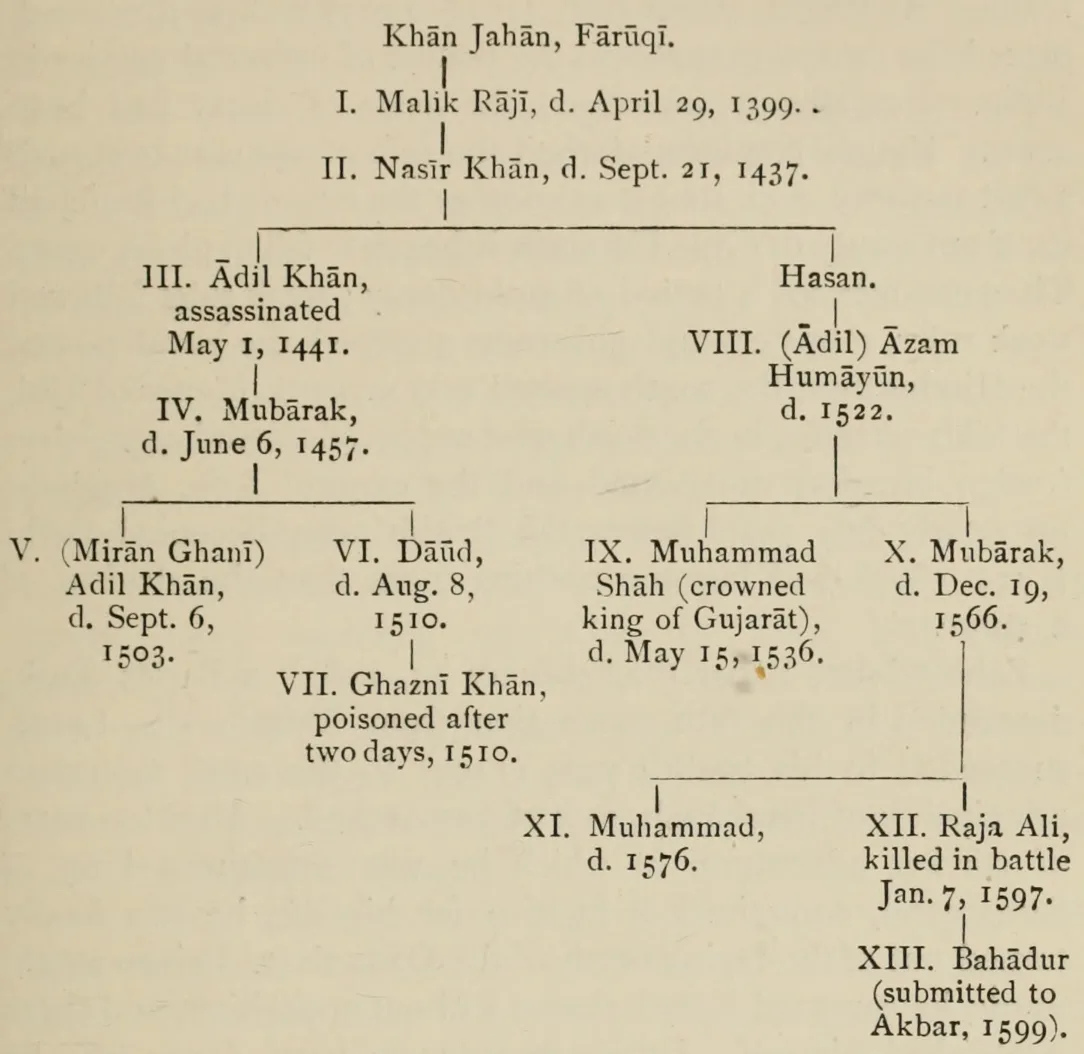
III. The Mughal Empire, 1526–1803, including the Sūr Line of Afghāns (1540–1555), with Appendix to 1862
The conquest of India by Bābar at the end of the first quarter of the sixteenth century introduced into the government of the country a succession of strong and vigorous rulers, who by persistent effort gradually brought the whole of India under subjection. These Mughal rulers were, for nearly two hundred years, men of exceptional bodily activity and great force of character, being usually blessed, in addition, with length of days. Up to 1712, all authority remained exclusively in the emperor’s hands, and no successful general or palace favourite ever succeeded in pushing them on one side, or seizing the reins of power, as had been so frequent under other dynasties. There were comparatively few disputed successions ; those that did arise were soon concluded without having thrown the government into disorder ; and, in addition, most of the reigns were of more than usual length. Thus, we have now to describe two hundred years of strong government and continuous conquest, of increasing order and tranquillity within the realm. At length, Aurangzeb (1658–1707) had, as it seemed, placed the crowning stone on the edifice of universal empire in India. But already, unnoticed, the seeds of decay had been sown. Natural conditions forbad the rule of one man over such a vast territory, and almost as soon as the empire had stretched itself out nearly to Cape Comorin it began to fall to pieces again. Then commenced a period of rapid decay ; weak ruler followed weak ruler, ministers and governors usurped the royal power, the Hindus from the south pressed ever onwards towards Delhi, the Sikh sectaries in the north-west were restless and aggressive, foreign invasion supervened, and the empire of the Mughals, for nearly fifty years before the British army occupied Delhi (1759–1803), had become nothing more than the shadow of a name.
Zahīr-ud-dīn, Bābar (b. February 14, 1483), a Barlās Turk, descended in the fifth generation from Taimūr the Lame, succeeded in his twelfth year (1494) to the small mountain principality of Farghānah, east of Samarqand. After ten years of stirring adventure, in which he was sometimes king of Samarqand, sometimes a fugitive for his life, he was finally turned out of the region north of the Oxus river. Driven southwards, he captured Kābul almost without opposition, and there established himself. During twenty-two years (1504–26) he extended his rule over Kandahār, fought the Uzbegs in Khurāsān and Transoxiana with little or no success, and made several raids into India. At length he determined on a permanent conquest of that country. He advanced without much difficulty to within a hundred miles of Delhi. The king, Ibrāhīm, Lodī, drew up his army on the plain of Pānīpat, about fifty-five miles north of Delhi ; and on April 21, 1526, a decisive battle was fought, in which Ibrāhīm, Lodī, was killed and his army defeated with prodigious loss. Delhi surrendered at once, and Agra was occupied on May 10, 1526. In four months, all of the Delhi kingdom then in possession of the Lodīs and the former kingdom of Jaunpur had been reduced to submission. Then the Hindu Rājās, who had tardily espoused the Lodī cause, advanced to contest the day with Bābar, having at their head Rānā Sanga Singh, the Sesodia ruler of Mewār (Chitor). A decisive battle was fought near Kanwa, three marches from Biāna, on March 16, 1527, in which the Hindus were routed. The rest of 1527 and the whole of 1528 were spent in consolidating Bābar’s hold on the country. But ill-health began to diminish his energy, and he died at Agra on December 27, 1530.
Humāyūn (b. March 6, 1508) was the eldest of the four sons left by Bābar. His first act was to conciliate his next brother, Kāmrān, by ceding to him Kābul, Kandahār, and the Punjab. The other brothers were given governments in India. Humāyūn began by pushing his armies eastward to Kālinjar in Eastern Bundelkhand, and to Chunār on the Ganges between Allahābād and Benares. Trouble then arose with Gujarāt, which was invaded and conquered (November, 1534). On this occasion, Humāyūn himself reached as far south as Cambay on the ocean ; but he was recalled to the northern provinces by the threatening acts of Sher Khān, an Afghān officer of the late Jaunpur kingdom, who held a fief in the south of Bihār.
Since the defeat of the Lodīs by Bābar in 1526, Sher Khān had become conspicuous in his own part of the country. At length, after mastering the whole of Bihār and gaining possession of the strong hill fort of Rohtās, Sher Khān laid siege to Chunār. In 1532 Humāyūn reduced Sher Khān to nominal submission ; but during the emperor’s absence in Gujarāt his rival had recovered Bihār, and was busily besieging Gaur, the capital of Bengal.
Humāyūn hastened back from Gujarāt, and in 1538 and 1539 recovered first Chunār, and then the Bengal capital of Gaur. After this many of his troops began to desert and return to their homes in the west. Sher Khān resumed his activity, and barred Humāyūn’s line of retreat from Bengal to the capital at Agra. On his way back, Humāyūn’s camp was surprised one night at Chausa, near the mouth of the Karamnāsa river (June 26, 1539), and he barely escaped with his own life, leaving his women and baggage in the hands of the enemy. A further attempt to retrieve the day again ended in disaster near Kanauj on the Ganges (May 16, 1540.) For several years Humāyūn became a homeless wanderer, was refused shelter in Sind and Mārwār, and forced finally to betake himself to Kandahār (1543), Persia, and Kābul.
Sher Shāh, Sūr, was one of the greatest rulers that India has known, though his fame has been obscured by the fact that writers like Abu’l Fazl, in the interests of the Mughals, have done their utmost to decry or obscure his merits. In his short reign, to the territories taken from Humāyūn he added those of Mālwā. He also invaded Mewār and took Chitor. He was killed by an explosion on May 22, 1545, when supervising operations at the siege of Kālinjar in Bundelkhand.
Islām (or Salīm) Shāh, the second son of Sher Shāh, succeeded his father after a contest with his eldest brother. In his time India was troubled by no foreign invasion, unless it were Humāyūn’s advance in 1552 as far as the Indus. But there was civil war at first, and afterwards repeated conspiracies, the latter provoked by the king’s hatred and suspicion of his Afghān chiefs. Salīm Shāh conducted two successful campaigns in the Punjab, which he recovered from the hands of a powerful governor. He also strengthened his hold on Mālwā. At his death (October 21, 1554), his son was proclaimed, only to be murdered a few days afterwards by his maternal uncle, Mubāriz Khān, who was also a Sūr, and a nephew of Sher Shāh.
The murderer ascended the throne under the title of Muhammad Shāh, Ādil (the Just), which was corrupted by the common people into Adilī (the Confuser), or Andhlī (the Blind). He was as illiterate and as incompetent as his two predecessors, Sher Shāh and Salīm Shāh, had been the reverse. But he had the good fortune to be served by a man of genius, a great warrior and a great administrator, Hīmū, a native of Mewāt, belonging to the small Hindu trading class known as Dhūsar. Hīmū is said to have defeated his master’s opponents in twenty-two pitched battles. Ādil Shāh can hardly be said to have reigned, for he was not able to hold Delhi for longer than eleven months. The last two years of the Sūr rule (1554–5) were, in truth, nothing more than a confused fight between Ādil and his two relatives, Ibrāhīm and Ahmad Khān (Sikandar). Ibrāhīm Khān rose in Biāna, west of Agra, took Delhi and Agra, and assumed the sovereignty. Ahmad Khān (Sikandar) did the same in the Punjab. These two claimants met at Farrah near Agra, where Sikandar was victorious, and seizing Agra and Delhi was soon in possession of the whole country from the Indus to the Ganges. Humāyūn now advanced from the west and defeated Sikandar’s troops; whereupon Ibrāhīm seized the opportunity to recover his position, but was himself defeated near Biāna by Hīmū, the general of Ādil. Ibrāhīm, Sūr, who suffered sixteen or seventeen defeats in three years, finally forced his way to Bengal, where he was treacherously put to death (1567 or 1568). Ādil and his general were next obliged to turn eastwards to resist an invasion from Bengal. Hīmū now resolved to return to Delhi in order to attack the emperor Humāyūn, whose accidental death before Hīmū’s force reached that place enabled him to occupy Agra and Delhi without difficulty.
On his flight from Agra and Delhi in 1540, Humāyūn had passed first into Sind (1541–2). There he was unable to establish himself, and next tried Mārwār with equally unfavourable results. He returned to Sind, where his son Akbar was born. In 1543 he was forced to retire westwards to Kandahār, where his brothers did not welcome him. At length, in 1544 he entered Persia, and after undergoing many humiliations, obtained from the Safawi king, Tahmāsp, aid to recover Kandahār. After it had been taken (1545), Humāyūn set out for Kābul, which he occupied, ousting another of his brothers. Two years afterwards (1547) this brother recovered Kābul, only to be again ejected (1548). The succeeding years were occupied by this struggle for Kābul and the country to the north, in which Humāyūn finally prevailed. In 1554 the state of his affairs had become so favourable that a reconquest of India was determined upon.
Humāyūn, with Bairām Khān, his best general, crossed the Indus early in January, 1555, and occupied the Northern Punjab and Sihrind (Sirhind). The first battle was decided in their favour, and again near Sihrind a victory was obtained over Sikandar, Sūr. These successes cleared the way to Delhi, which was reoccupied on July 23, 1555. Matters were at this stage when, on January 20, 1556, Humāyūn died from the results of an accidental fall as he was descending from the roof of a house.
At Humāyūn's death his eldest son Akbar (born October 15, 1542) had entered on his fourteenth year. Under the tutelage of Bairām Khān he had been sent to restore order in the Punjab. Altogether the position of affairs was most unfavourable. The reconquest of India was only just begun, and there were formidable rivals in the field. Hīmū was advancing from the east, and a council of war proposed the abandonment of India and a retreat upon Kābul. But thanks to Bairām Khān's determined attitude, this advice was rejected; and thereby the Mughal empire was established firmly, perhaps more firmly than could have been hoped for if Humāyūn had survived. The first danger, an advance by Hīmū, the general of Ādil Shāh, Sūr, was boldly met; and in a well-contested battle at Pānīpat, the Hindu general was wounded, taken prisoner, and executed. After Delhi and Agra had been rapidly reoccupied, a return to the Punjab was necessary, to meet the renewed attempts of Sikandar Shāh, Sūr; but he was soon forced to desist and take to flight. In the first three years of the reign Ajmer, Gwalior, and Jaunpur were recovered, in the last instance a son of Ādil Shah, Sūr, being put to flight.
As was natural for a young prince of ability, Akbar was dissatisfied with his position of subordination to Bairām Khān; and in March, 1560, he proclaimed his assumption of the government in person. Bairām Khān fled to the Punjab and tried to resist, but soon submitted, was pardoned, and permitted to depart for Mecca. At the port of embarkation he was assassinated by a man who had a private grudge against him.
For several years Akbar was hindered by rebellion among his generals and relations. These difficulties having been surmounted, in 1564 Mālwā, and in 1566 Kābul, were added to his realm. By the time he was twenty-five (1567), Akbar had crushed all his adversaries. His career of conquest was now uninterrupted. The Rājputs were attacked and Chitor taken (1568), the fortresses of Ranthambor and Kālinjar reduced (1569–70), and Gujarāt conquered (1572). Bengal, Bihār, and Orissa were first acquired in 1575, but not reduced to complete subjection until 1592. A brother, having caused trouble in Kābul (1581), was soon recalled to obedience; in 1581–4 an insurrection in Gujarāt was effectually dealt with; in 1587 Kashmīr was acquired without much exertion. From 1586 the Afghāns north and south of the Khyber were greatly agitated by a religious leader called Jalāla, who proclaimed war against the empire. For fourteen years a campaign was waged against them, without any very satisfactory results. During these years (1586–1600) Akbar remained near the Punjab frontier; but his armies were not idle elsewhere: Sind was taken in 1592, and Kandahār in 1594. By this last date, the whole of India north of the Narbadā had fallen under the sway of the Mughal emperor. Akbar now endeavoured to extend his dominions into the Deccan. The Fārūqī king of Khāndesh was the first to acknowledge Akbar as his suzerain; and after a repulse in 1596, due to a spirited defence by the celebrated queen, Chānd Bībī, the citadel of Ahmadnagar was taken (July, 1600). The last few years of Akbar’s life were embittered by the conduct of his eldest son, Salīm (afterwards Jahāngīr), who procured the murder of Abu’l Fazl, his celebrated minister. Akbar died on October 5, 1605, leaving behind him one of the greatest names in history.
From 1579 Akbar endeavoured to establish a new eclectic religion, the Divine Faith, but without permanent results. His constant aim was to conciliate the Hindus, and to repress Muhammadan bigotry. This far-sighted policy is no doubt one of the chief reasons for the unusual duration of his dynasty. We have in the Āīn-i-Akbarī, written by Abu’l Fazl, exceptional means of understanding Akbar’s system of government in all departments. At the end of his reign there were fourteen Sūbahs or provinces, each under a governor, or Nāzim, with a Revenue Controller, or Dīwān, at his side. With the assistance of a Hindu financier, Todar Mall, the system of land revenue had been reduced to some sort of order. But the assessments then made must be looked on rather as ideal standards than as the actual income for any particular year. Far into the eighteenth century, the measurements of the lands were incomplete ; and there is every indication that annual revenue-rolls had never ceased to be drawn up. The object of Todar Mall’s registers appears to have been rather to prevent the state being imposed on than to protect the ryot. His tables enabled the central controlling offices to check the local officials, and, secondly, to prevent the grant of larger or more profitable assignments (jāgīrs) than the rules justified. The army consisted almost entirely of cavalry, and it was recruited through its own chiefs, and not directly by the state. Civil justice was very much in the hands of private bodies, such as trade guilds or caste juries ; petty crime was dealt with by the village headmen. There was a great deal of private fighting between clans and villages ; and the land revenue was frequently refused until an armed force had been sent. The degree in which order and subjection were ensured varied with the conditions at court and the efficiency of the local governors ; but even at the best of times there was little approach to the regularity and punctuality of revenue payment expected in modern days.
Although far from being the equal of his father Akbar, Jahāngīr (born August 10, 1569) was by no means an inefficient ruler. After suppressing an attempt by his eldest son to seize the throne, he began his reign by going himself to Kābul, and sending armies against the Rānā of Mewār and the kings of the Deccan. The campaign in the South met with little success, for in 1610 Malik ‘Ambar, the able minister of Ahmadnagar, recovered that territory and expelled the Mughals. In 1611 Jahāngīr married the celebrated Persian lady, Nūr Jahān, who from this time until the end of the reign played a conspicuous part. Disturbances which had arisen in Bengal were finally put an end to in 1612 ; but in the Deccan an attack on Ahmadnagar was defeated. Soon after this mishap, war broke out with Mewār, where prince Khurram (Shāhjahān) succeeded (1614) in forcing the Rānā to make his submission. In the same year an insurrection in distant Kābul was quelled.
The English ambassador, Sir Thomas Roe, visited Jahāngīr’s court about this time (he landed near Surat, September 26, 1615 ; re-embarked February 7, 1619) ; and he has left us an interesting account of the king’s character and the condition of the country. Prince Khurram was now given the command in the Deccan, but returned to court in September, 1617. Jahāngīr in that year was at Māndū in Mālwā ; the next year he passed in Gujarāt. A renewal of disturbances in the Deccan involved the return of prince Khurram to that country. Not long afterwards a dangerous illness of the emperor gave rise to much intrigue as to the succession, in the course of which Khurram was forced into rebellion. He fled first to Telingāna and then to Bengal ; and it was not till 1625 that he made his peace with his father. Jahāngīr now set out for Kābul, where the followers of the fanatic Jalāla were once more giving trouble ; and on the march occurred the curious episode of the emperor’s seizure by his chief general, Mahābat Khān, and his release by the courage and cleverness of Nūr Jahān. Jahāngīr had gone to Kashmīr as usual in 1627, but, falling ill, his removal to Lahore was determined on. Before the journey was completed, he died on October 18, 1627. The chief buildings in his reign were the tomb of his father at Sikandra near Agra, part of the palace within the Agra fort, and the palace, fortress, and city wall of Lahore.
A slight contest for the succession was soon decided in favour of Jahāngīr’s eldest son, Khurram (born December 27, 1591), who succeeded under the title of Shāhjahān. Some troubles in Kābul and in Bundelkhand were suppressed ; then occurred the revolt of Khān Jahān, Lodī, who had been a favourite general in the late reign. In consequence, Shāhjahān was forced in October, 1629, to proceed to the Deccan, where he passed two and a half years. Khān Jahān was driven out of Ahmadnagar, where he had sympathizers. He sought refuge at Bijāpur, but was soon forced to move away and abandon that part of India. Becoming a mere fugitive, he was finally killed in Bundelkhand (1630). The war against Ahmadnagar and Bijāpur had meanwhile been vigorously prosecuted. The Nizām Shāhī king was murdered by his minister, whose submission was accepted by Shāhjahān. A siege of Bijāpur was then begun, but without success. After being absent three years (1632–5), during which Deccan affairs did not prosper, Shāhjahān returned there. A second attempt to take Bijāpur failed, but in 1635 terms were made under which that state became tributary to the Mughals. Golconda-Hyderābād was also forced to agree to the payment of tribute.
The emperor returned to Delhi in 1637. It was in this year that Ali Mardān Khān, the Persian king’s governor, ceded Kandahār to the Mughal emperor. It was held for eleven years (1637–48), when the Persians retook it. Three successive attempts, in 1649, 1652, and 1653, failed to eject them, and Kandahār ceased thenceforth to form part of the empire.
In 1645 Shāhjahān took the field in person and proceeded to Kābul, while Balkh was reduced by his fourth son, prince Murād, only to be overrun again soon after by the Uzbegs. Prince Aurangzeb’s campaign against these invaders was a failure ; he was besieged in Balkh, forced to abandon it, and only avoided capture by a disastrous retreat (1647). Earnest but ineffectual efforts to recover Kandahār filled the years 1649–53. The Deccan wars then recommenced, on this occasion prince Aurangzeb being in command. Attacks were made on Golconda-Hyderābād (January, 1656) with some measure of success ; and an unprovoked war with Bijāpur was commenced in March, 1657. At this point Shāhjahān’s illness absorbed the attention of his four sons, each of whom hoped to acquire the throne ; and for the time being further action in the Deccan was suspended.
Dārā Shukoh, the eldest son, was with his father at court, and was the declared heir apparent. Shujā, the second son, advanced against his eldest brother from his own government of Bengal, only to be defeated and forced to retire. Soon afterwards (April, 1658) Aurangzeb and Murād, the third and fourth sons, defeated Dārā Shukoh’s partisan Rājā Jaswant Singh, Rāthor, near Ujjain in Mālwā. At length Dārā Shukoh met his brothers in the field at Samūgarh near Agra (May 30, 1658), where he sustained a crushing defeat, followed by his flight to the west. Shāhjahān was deposed by Aurangzeb, and left a prisoner in his palace within the fort of Agra, where he survived until February 1, 1666. Shāhjahān’s court was the most magnificent that India has ever seen, and in his reign the Mughal empire, if not quite at its greatest extent, was without doubt at its greatest glory. This emperor was a most extensive builder : we owe to him the lovely tomb known as the Tāj Mahal ; the fort and palace at New Delhi (Shāhjahānābād), the wall of that city, and the imposing Jāmi Masjid there ; also at Lahore the tomb of his father Jahāngīr.
It was three years (1658–61) before all the rival claimants were finally disposed of. Pursued by Aurangzeb, Dārā fled first to Lahore and then to Sind; but an advance by prince Shujā from Bengal recalled Aurangzeb to the east before Dārā had been dealt with. At Khajwa (now in Fatehpur District) the two armies met; Shujā was defeated and fled. Jaswant Singh, Rāthor, who had passed first to one side and then to the other, now threatened Agra, but retreated on Aurangzeb’s approach. Meanwhile Dārā had found his way to Gujarāt, whence he tried to effect a junction with Jaswant Singh. The Rājā once more played the traitor; and Dārā Shukoh, left alone to face Aurangzeb, suffered a defeat near Ajmer, and being refused entry into Ahmadābād fled onwards to Sind. There his host betrayed him, he was brought to Delhi, and four days afterwards murdered. Further trouble arose with prince Shujā, who won over Aurangzeb’s eldest son for a time. But Shujā’s fortunes declined, and soon he fled from Bengal into Arakan, and was never heard of again. The remaining brother, Murād, was murdered in prison.
In 1661 Bīkaner was entered and the Rājā reduced to submission. At the other extremity of the realm Mīr Jumla, an officer who had come over to Aurangzeb from the Golconda king’s service, led an expedition into Assam with disastrous results (1662–3). About this time the emperor had a dangerous illness, during which intrigue was rife. Happily he soon recovered, and to restore his health he departed for Kashmīr.
The Marāthās of the Deccan, whose doings occupy from this time so large a space in Indian history, now began to be conspicuous under the leadership of a remarkable man, Sivajī (1627–80), son of Shāhjī. In his sixteenth year Sivajī began his career as a robber chief; in 1648 he revolted against his sovereign, the king of Bijāpur, and soon began to plunder the adjoining Mughal territories. In 1662 Shāista Khān, the Mughal governor, took the field against him without much success, but three years afterwards Rājā Jai Singh (of Amber), who had superseded Shāista Khān, induced Sivajī to submit (1665) and proceed to Delhi. There he found himself practically a prisoner, but in 1666 he managed to escape. Jai Singh had been ordered to attack Bijāpur, but failed in the attempt; no greater success attended the emperor’s son, Mu‘azzam, and Jaswant Singh, Rāthor. During all this time Sivajī continued his raids and incursions. Finally, about 1671, danger elsewhere prevented any continuance of active measures in the Deccan, and the Marāthās gained considerable strength in the interval.
The Afghān clans beyond the Indus had broken out into open hostility, and in 1673 Aurangzeb marched in person to Hassan Abdāl. For over two years (Jan., 1673, to Oct., 1675) he remained in that quarter, and after his return to the capital his generals carried on the strife. During the emperor's absence, an obscure Hindu sect, called by Manucci the mundīyas, or ‘shaven-heads,’ had raised a rebellion to the south of Delhi, which was suppressed with some difficulty. Aurangzeb's rule now became more openly bigoted. The poll-tax on Hindus was imposed, and other oppressive acts against them were enforced.
On the death of Jaswant Singh, Rāthor (Dec. 8, 1678), Aurangzeb attempted to seize his infant sons. This outrage led to an alliance between Mewār and Mārwār. Aurangzeb marched to Ajmer for an invasion of Mārwār, while terms were made with Mewār. Hardly had Aurangzeb returned to Delhi when the Rānā of Mewār was found to have broken the treaty. Active measures were adopted to meet the new difficulty, and Aurangzeb went back to Ajmer. In a little time, prince Akbar, the emperor's third surviving son, was won over by the Rājputs (Jan., 1681), and, openly joining them, was proclaimed emperor. Akbar's own troops, however, soon deserted him, and the Rājputs alone not being able to sustain his cause, he fled for refuge to the Marāthās (1681).
In the Deccan from 1672 to 1680 Sivajī had continued his activity, becoming more and more powerful every day. He even ventured occasionally north of the Narbadā, and far to the south recovered his father's fief of Tanjore. During these years the Mughal governor forced the king of Golconda to come to a temporary settlement (1678), and then turned his arms against Bijāpur, but without success, being forced in the end to raise the siege. In 1680 Sivajī died, and was succeeded by his son, Sambhājī.
In 1682 Aurangzeb arrived in the Deccan, where he was destined to remain constantly engaged in warfare until his death twenty-five years afterwards. He began by reducing a number of small hill forts. His son, Mu‘azzam, was sent against Bijāpur, but found himself too weak to reduce it. Golconda was the next object of attack, and terms of peace were wrested from the Qutb Shāhī king. Aurangzeb then marched in person against Bijāpur; the capital was taken and the monarchy destroyed (1686). The peace with Golconda was now perfidiously broken, the capital taken (Sept., 1687), and the monarchy subverted. As the result of suspicions arising during these operations, Mu‘azzam, the eldest surviving son of Aurangzeb, was made a prisoner, and remained in confinement for seven years (1687–94) in his father’s camp. By the above conquests the whole of India as far south as Tanjore was for the first time incorporated in the Mughal empire, which was now at its greatest extent.
Eight years (1690–98) were spent in a dilatory siege of Jinjī (Gingee), then held by the Marāthās. During these years and those that followed Aurangzeb was at perpetual warfare against various Hindu chiefs, taking one petty fort after another only to abandon them again. The Mughal power was beginning to bleed to death ; no one was completely trusted, and the fighting power of the army was gradually wearing down. One of the last movements of the army was a retreat northwards to Ahmadnagar, and there Aurangzeb died on Feb. 21, 1707.
In spite of his many virtues, enormous industry, unwearying persistence, and fair talent for war, Aurangzeb cannot be pronounced a successful ruler. Apparently he had raised the empire to a pinnacle of glory never before attained ; but the germs of decay were already at work. He had educated the Marāthās by twenty-four years of fighting into being his equals, if not his superiors, in war. The huge area of the empire, under then conditions, was quite beyond one man’s control, as probably Aurangzeb himself perceived, since he attempted to effect a partition of it between his three sons. While the emperor was absent in the Deccan, government in Hindustān had suffered. The empire, as Aurangzeb left it, did not endure much beyond the five years of his son’s reign ; and from 1712 the governors sent to the Deccan began to be practically independent. Aurangzeb has been blamed for the suppression of the Muhammadan kingdoms of the Deccan ; but this charge should not be laid entirely at his door, for the same policy had been pursued by Akbar, who seized Khāndesh and did his best to acquire Ahmadnagar, while Jahāngīr and Shāhjahān continued to follow the same course.
Aurangzeb left three sons, of whom the eldest was away in Kābul, while the youngest had been sent south to govern Bijāpur. The middle son, being on the spot, took possession of the camp, claimed the throne, and set out to seize the capitals of Agra and Delhi. The eldest son made still greater haste, and arrived at Agra first. Their armies met to the south of that city ; the eldest son, Shāh Ālam (Mu‘azzam), gained the day, and his brother, Āzam Shāh, was defeated and slain (June 7, 1707). In a few months the new emperor, who had taken the title of Bahādur Shāh, proceeded to Rājputāna, in the hope of reasserting the Mughal authority ; but before he had done much in that direction, he decided to advance into the Deccan against his youngest brother, who had usurped Hyderābād. This brother, Kām Bakhsh, was defeated near that place on Jan. 2, 1709, and died of his wounds. Bahādur Shāh retraced his steps, in order to resume his efforts against the Rājputs. He had barely reached Ajmer when a rising of the Sikhs to the north of Delhi forced him to make what terms he could with the Rājputs, and hurry on to face this new danger. Banda, the Sikh leader, escaped, though his fort was taken. Content perforce with this imperfect measure of success, Bahādur Shāh moved on to Lahore. He died there on Feb. 17, 1712.
At the time of his death, Bahādur Shāh’s four sons were in his camp. The second son, Azīm-ush-shān, who had been governor of Bengal, was the wealthiest and best equipped. But he was slow in action ; and while he stood on the defensive the remaining brothers combined, and under persistent attack Azīm-ush-shān’s force melted away. During the battle, which he was at length forced to fight with a much diminished army, his elephant took fright and in its terror rushed into the Rāvi, where both elephant and rider were drowned. The three victors began at once to quarrel over the terms of their compact, the two younger were killed in battle, one after the other, and the eldest, Mu‘izz-ud-dīn, Jahāndār Shāh, remained for the moment undisputed master of the throne. He moved to Delhi, and there plunged into dissipation in the company of a dancing-woman, of whom he had become violently enamoured.
But Azīm-ush-shān had left behind in Bengal as his representative his second son, Farrukhsīyar. This prince, as soon as he heard of his father’s defeat and death, proclaimed himself emperor. With the aid of two Saiyid brothers, who were then governors of Patna-Azīmābād and Allahābād respectively, he was able to gather together an army. He advanced from Patna to Allahābād, and thence onwards to Agra. Jahāndār Shāh’s attempt to eject one of the two Saiyids from Allahābād had already failed ; and soon afterwards Jahāndār Shāh’s eldest son was shamefully beaten in the neighbourhood of Khajwa (Fatehpur District). Jahāndār Shāh, after these disasters, moved out in person from Delhi and pitched his camp to the east of Agra. Farrukhsīyar found a ford to the west of it, by which he crossed the river Jumna, whereupon Jahāndār Shāh shifted his position. A battle ensued not far from Akbar’s tomb at Sikandra. On Jahāndār Shāh’s side the Turānīs were disaffected, and his Wazīr, Zulfiqār Khān, was dilatory and over-cautious. The vigorous onslaughts led by the Saiyids broke Jahāndār Shāh’s division to pieces; finding that he ran great danger of falling into their hands, he abandoned the field and fled to Delhi. There the fugitive monarch was surrendered by his Wazīr, who earned nothing by his treachery, as he was strangled on the same day that his master was beheaded.
Although Farrukhsīyar had arrived at the throne through the exertions of the two Saiyids, his reign was passed in efforts to get rid of them. Owing to the emperor’s own vacillation, these efforts were entirely fruitless. Early in the reign the second Saiyid brother led a force against the Rāthors of Jodhpur, compelling the Rājā to make terms and give a daughter as a bride to the emperor. In the Punjab, another general besieged the Sikh leader in Gurdāspur, and Banda and some hundreds of his followers, yielding to starvation, gave themselves up. The captives were brought to Delhi, paraded in triumph, and publicly executed. An expedition was sent against the Jāts, who had lately become powerful in the region between Delhi and Agra. These latter operations were not very successful, but diplomacy secured what arms had failed to effect. In the Deccan the governors, first Nizām-ul-mulk, and then the second Saiyid brother, Husain Alī Khān, found the Marāthās too strong for attack, and temporized with them instead of fighting. Certain concessions of a share in the revenue were made, on condition that the Marāthās ceased their raids. The underhand hostility to the Saiyids reached in the end to such a pitch that the elder Saiyid urged his brother to return to Delhi from the Deccan. When they were once more together, they deposed Farrukhsīyar (Feb. 17, 1719) in favour of another member of the family. After a short time Farrukhsīyar’s life was taken in prison (April 17, 1719).
The two emperors who succeeded were mere puppets in the hands of the Saiyids. They were brothers, young men of about twenty, both sickly and consumptive. The first died on May 31, and the second on Sept. 6, 1719. During these seven months the two most important events were the grant to the Marāthās of written assignments on the Deccan revenues, in return for their aid in the deposition of Farrukhsīyar; and a rising by the garrison of Agra fort, the nominal head of which was a grandson of Aurangzeb, who had been long a prisoner there. This rising the Saiyids suppressed with sufficient vigour.
For the third time the Saiyids had recourse to the prison-house of Taimūr's descendants at Delhi. Muhammad Shāh, then a youth of eighteen, ascended the throne under their tutelage, in the same way as his predecessors. Soon the governor of Allahābād, a partisan of Farrukhsīyar, showed his discontent, and an army was sent against him; but the fort could not be taken and the siege lingered on until terms were arranged. Nizām-ul-mulk, head of the Turānī party, was equally dissatisfied, and abandoning his government of Mālwā, made for the Deccan and possessed himself of the fortress of Asīrgarh. An army sent by the Saiyids in pursuit was defeated on June 7, and on July 31, 1720, the Saiyids' nephew, who was their representative at Aurangābād, was also defeated and killed. Evidently active measures were necessary. The elder brother returned to Delhi to take charge of Hindustān, the younger, with Muhammad Shāh in his train, moved towards the Deccan. The emperor's camp had not travelled farther than the borders of Jaipur territory, when the younger Saiyid was assassinated (September 27, 1720), by a Mughal, instigated by some of the chief generals among the Turānīs and Persians. The whole of the Saiyid's army immediately dispersed. Unavailing efforts were made by the elder brother to save the situation; he brought out another prince, Muhammad Ibrāhīm, and gathered together a host of men to oppose Muhammad Shāh's return to Delhi. In a well-contested battle of two days (November 1 and 2, 1720), fought between Muttra and Delhi, the Saiyid was defeated and captured.
The new Turānī Wazīr lived only a few months, when Nizām-ul-mulk, also a Turānī, was recalled to take his place. He endeavoured to deal with disorder in Rājputāna and Gujarāt, but he was disliked at court and his position soon became untenable. Finding some pretext, he returned to the Deccan. The court party tried to supersede him in that government, but he defeated the newly named governor in a pitched battle at Shakar Kherā on September 30, 1724. Other semi-independent states began to arise. In Rohilkhand a petty trooper had gradually accumulated most of the province into his hands, and barely yielded a nominal allegiance to Delhi. Another campaign against the Jāts did little more than change the line of their succession; and the Jāt power continued to grow in strength. As for the Marāthās, they began to appear everywhere—in Gujarāt, in Mālwā, in Bengal, in Bundelkhand. They established themselves firmly in the first named, and in the second they acquired office as deputies of the Mughal governor. The Rājā of Eastern Bundelkhand was glad to cede to them one-third of his territory, as payment for their aid against the Mughal governor.
Internal disorder and Marāthā encroachment were not the only dangers that threatened. A warrior of genius, Nādir Shāh, had arisen in the north of Persia, had first recovered that kingdom for the Safawis and ejected the Ghilzai usurpers, then setting the Safawis aside altogether, had lately stood forth as sovereign in his own right (January, 1733). He opened communications with Muhammad Shāh, but met with scant courtesy, and his letters remained for years unanswered. Nādir Shāh had taken Kandahār (March 12), and moving northwards occupied Kābul (June 18, 1738). His next project was the invasion of India. The governor of Kābul was defeated near Peshāwar on November 14, 1738, and Lahore yielded on January 11, 1739, after a nominal defence. Nizām-ul-mulk had been recalled to court the year before, and was then acting with little success against the Marāthās in Mālwā. In the face of the new danger, he was made vicegerent (December 1, 1738), the governor of Oudh was summoned with his troops, and the imperial forces at Delhi were set in order. The army of Hindustān entrenched itself in front of Pānīpat. Nādir Shāh camped some miles to the north of this position. On the day that Sa‘ādat Khān, governor of Oudh, reached the imperial camp (February 12, 1739), his baggage train was captured by the Persians. Sa‘ādat Khān insisted on immediate retaliation ; and ambitious to share the honours of the day, the noble next in rank to the Wazīr, Khān Daurān, followed him into the field. The Indians were disastrously defeated, Sa‘ādat Khān was taken prisoner, and Khān Daurān mortally wounded. During the succeeding night and day the Indian army began to melt away. Further resistance could not be hoped for from such a disheartened crowd, and negotiations were opened. Nizām-ul-mulk went to visit Nādir Shāh, when fair terms were arranged ; and as a reward Muhammad Shāh conferred on Nizām-ul-mulk the offices of the late Khān Daurān. On learning of this appointment, Sa‘ādat Khān, who had long intrigued for the position, made common cause with a discontented Persian courtier. They persuaded Nādir Shāh that the terms granted were ridiculously easy. The first offers were withdrawn, Muhammad Shāh was forced to visit Nādir Shāh, and the two monarchs proceeded to Delhi. On the second night after their arrival, a rumour spread that Nādir Shāh had been assassinated. A relation of the Wazīr headed a street émeute, and the Persians were slain wherever they were seen. Next morning early, Nādir Shāh left the palace for the roof of a mosque in the nain street, and, laying his bare sword down before him, g ve orders for a general slaughter. Many hours afterwards, when thousands had been slain, he was persuaded to put up his sword, and the slaughter was stayed. Some weeks were passed in collecting a huge ransom and emptying the imperial storehouses of their treasures. A formal treaty was drawn up by which Muhammad Shāh ceded the Punjab, Multān, Sind, and Kābul; and a princess was given in marriage to Nādir Shāh’s son. Coin was stamped and the Friday prayer made in Nādir Shāh’s name. At length, after restoring Muhammad Shāh to the throne, the conqueror departed from Delhi, and recrossed the Indus on September 13, 1739.
In regard to the remaining years of the reign (1739–48) there is little to say. New favourites intrigued and supplanted each other at court; the Marāthās invaded Bengal in 1742 and were repulsed with difficulty; and in 1745, at the instigation of the Oudh governor, a futile attempt was made to recover Rohilkhand, Muhammad Shāh in person accompanying the army. At length, in the end of 1747, the news came that Nādir Shāh had been assassinated, coupled with the report that one of his Afghān officers, Ahmad Khān, Abdālī, had proclaimed himself king at Kandahār under the title of Ahmad Shāh, Durr-i-durrān, and was already on his way to India. An army was prepared and sent out under the orders of the emperor’s young son, also named Ahmad Shāh, with the Wazīr as real commander. By the time they reached the Sutlej, Ahmad Shāh, Abdālī, had taken Sihrind. The Wazīr was killed by a gunshot while at prayers in his tent (March 11, 1748). But his son, Mu‘īn-ul-mulk, at once gave battle to the Afghāns, who were defeated and retired to their own country.
During the return march to Delhi it became known that on April 14 Muhammad Shāh had died. The governor of Oudh, Safdar Jang, a Persian, the nephew and successor of Sa‘ādat Khān, seized his opportunity and proclaimed prince Ahmad Shāh as emperor, obtaining for himself the coveted office of Wazīr. The remainder of this reign was taken up by a contest between the Turānī party, represented by the family of the late Wazīr, and the Irānī or Persian faction, to which Safdar Jang belonged. The latter began his term of office by inducing an Afghān, the chief of the semi-independent state of Farrukhābād, to attack his fellow-tribesmen in Rohilkhand. The chief was slain in the attempt, and the Wazīr at once annexed the Farrukhābād country. A few months elapsed, and the Farrukhābād Afghāns rose and ejected the Wazīr’s officers. First the Wazīr’s chief general, then the Wazīr himself was defeated in the field. Recourse was had to the Marāthās, always ready to hire themselves out to the highest bidder. With their aid the Afghāns were reduced to subjection ; but the Marāthās and their claims remained as an incubus, which could never afterwards be shaken off. The emperor was in the hands of his mother, an ex-dancing-girl, and she again under the control of a eunuch. The eunuch was assassinated by the Wazīr, whereupon the Turānīs took advantage of the emperor’s anger to detach him from the Wazīr. For six months the conflict raged round Delhi, till at length the Wazīr drew off to his government in Oudh. The Marāthās, who were allies of the winning side, became all-powerful. Confusion increased, and the country round Delhi was raided in every direction. The grandson of Nizām-ul-mulk, a youth of eighteen, emerged as dictator, and by him the emperor, who had shown a preference for this boy’s uncle, was deposed, blinded, and sent into the prison-house of the princes.
The successor was an older man, the only surviving son of Jahāndār Shāh ; personally he was amiable and devout, but feebler, if possible, than his predecessors. Such troops and officials as were left passed their time in demonstrations for arrears of pay. Money ceased to come in, even from the few districts still unabsorbed by hostile Marāthās or revolted generals. The Wazīr made many unsuccessful efforts to recover territory, and to assure his position placed all the emperor’s sons and relations in a more or less honourable captivity. The heir apparent, Mirza Abdullah (known as Alā Gohar, afterwards Shāh Ālam), was the only one who evaded capture. On May 19, 1758, he was besieged in his house but effected his escape and fled to the districts west of Delhi, and then made his way, via Bareilly, Fyzābād, and Allahābād, to Bihār. Ahmad Shāh, Abdālī, had previously returned to India ; he occupied Delhi and was there proclaimed king (January 28, 1757) ; he then advanced on Muttra and Agra. Cholera breaking out in his camp, he beat a hasty retreat from India. Dissatisfied with Ālamgīr II’s conduct during this invasion of Ahmad Shāh, Abdālī, the young Wazīr procured his assassination on November 28, 1759, and raised up another phantom ruler to the throne under the title of Shāhjahān Sānī.
After his flight from Delhi, Alā Gohar travelled round by Sahāranpur and sought the protection of the Afghāns of Rohilkhand ; failing with them, he next addressed himself to Shujā-ud-daulah, the son of Safdar Jang, governor of Oudh. This noble’s only anxiety was how easiest to rid himself of such an undesirable visitor. He suggested the recovery of the rich provinces of Bihār and Bengal. Alā Gohar, with such aid as he had been able to obtain, took the hint, and marching eastwards endeavoured to occupy Patna. On December 22, 1759, having heard of his father’s death, he claimed the throne under the title of Shāh Ālam. Several years were spent in ineffectual attempts to conquer Bihār. At the battle of Buxar (October 23, 1764), fought by the British against Shujā-ud-daulah, the emperor was present on the side of the latter. After the defeat of Shujā-ud-daulah, Shāh Ālam made terms with the British, and accepted a tribute from the revenues of Bengal ; and in addition the greater part of the Allahābād province was made over to him. He resided at Allahābād under the protection of the British from 1765 to 1771.
At Delhi, after the death of Ālamgīr II, the Marāthās were supreme. The Muhammadan nobles entered into a combination against them, and called on Ahmad Shāh, Abdālī, to help them to strike a blow for their faith. The Marāthās collected all their strength, and, abandoning their old guerrilla tactics, entrenched themselves in a position near Pānīpat. Their adversaries gradually reduced them to a state of starvation, and at length on January 13, 1761, inflicted on them a crushing defeat. For six or seven years, the Marāthās were not seen any more in Northern India ; and a newly risen Afghān, Najīb Khān, was all-powerful at Delhi, while Shujā-ud-daulah occupied the country as far as Alīgarh, and Sūraj Mall, Jāt, of Bharatpur, became master of Agra city and fortress. The Marāthās appeared again in force in 1769–70, when Najīb Khān, now entitled Najīb-ud-daulah, made terms with them, but died soon after (October 30, 1770). An invitation to return to Delhi was sent to Shāh Ālam, which he accepted, and he re-entered Delhi in 1771.
Although there was an emperor at Delhi, the Marāthās were the real rulers. For a few years after 1774, domestic quarrels recalled them to their own capital at Poona in the Deccan. It was at this time that Shūjā-ud-daulah, aided by the British, conquered and annexed Rohilkhand, thus at length terminating in his favour a quarrel that had lasted over thirty years. At Delhi itself, Najaf Khān, a Persian related by marriage to the Oudh governor, came to the front ; and before his death in 1782 he had recovered some portion of the country between Delhi and Agra, and the fortress of Agra itself. But the Marāthās now acquired even more than their old position, through the energy of Mahādjī Sindhia, aided by the military talents and vigour of the Savoyard soldier of fortune, Benoît de Boigne. During an interval of Marāthā absence from Delhi the grandson of Najīb Khān made an attack on that city (1788), seized and blinded the emperor Shāh Ālam, only to be himself driven out to perish miserably. Sindhia and the European officers commanding his trained infantry and artillery continued to rule undisputed for fifteen years longer. The causes of the hostility between the British and Marāthās, which led to the war of 1803, will be spoken of elsewhere. Suffice it to say here that on September 11, 1803, Lord Lake fought the Marāthā army within sight of Delhi and thoroughly defeated it, taking sixty-eight pieces of cannon of different kinds and sixty-one tumbrils of ammunition. The city of Delhi was occupied and the Mughal empire ceased to exist.
The blind Shāh Ālam (born June 4, 1728) died on November 18, 1806, and was succeeded in his barren title, under the terms of the treaty with the British, by his son Akbar Shāh II (born April 24, 1760, died September 30, 1837) ; and he in turn by his son, Bahādur Shāh (born 1775), who was deported after the Mutiny to Rangoon, and died there on November 7, 1862.
W. IRVINE.
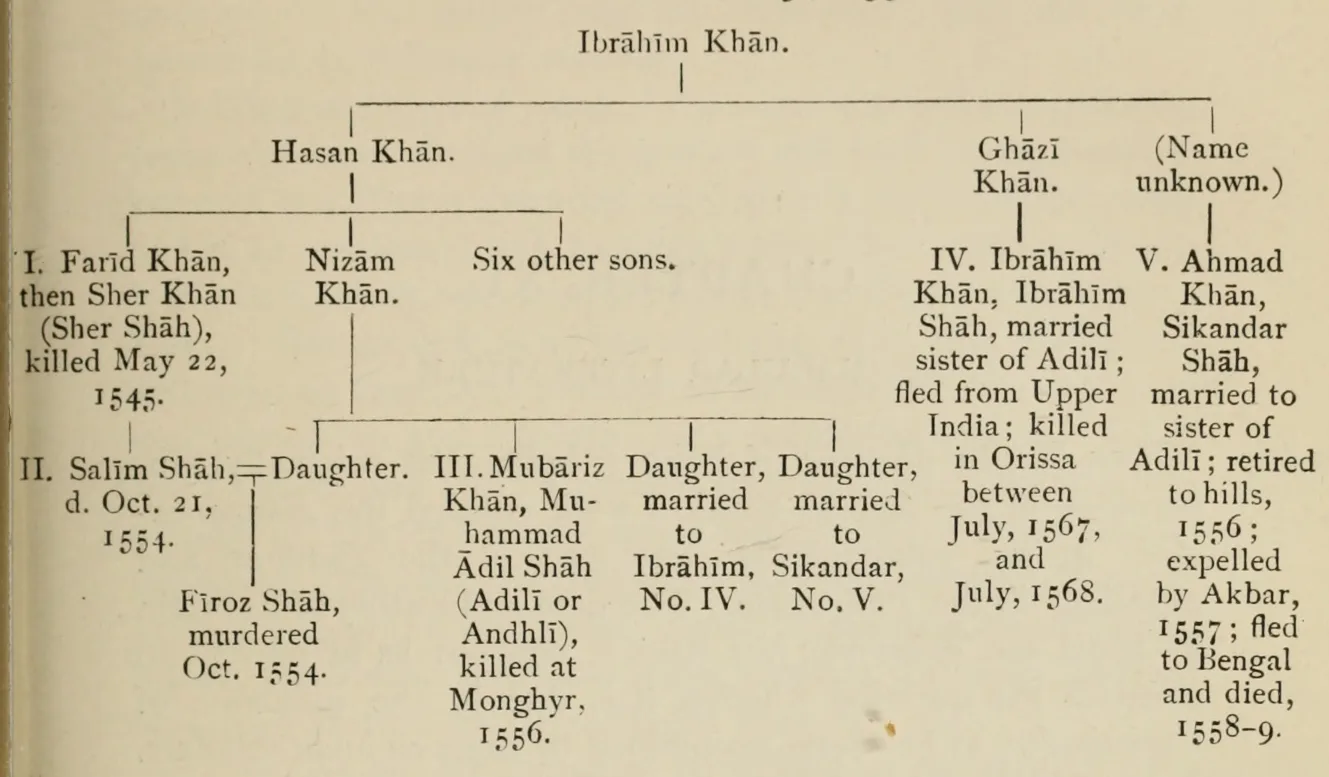
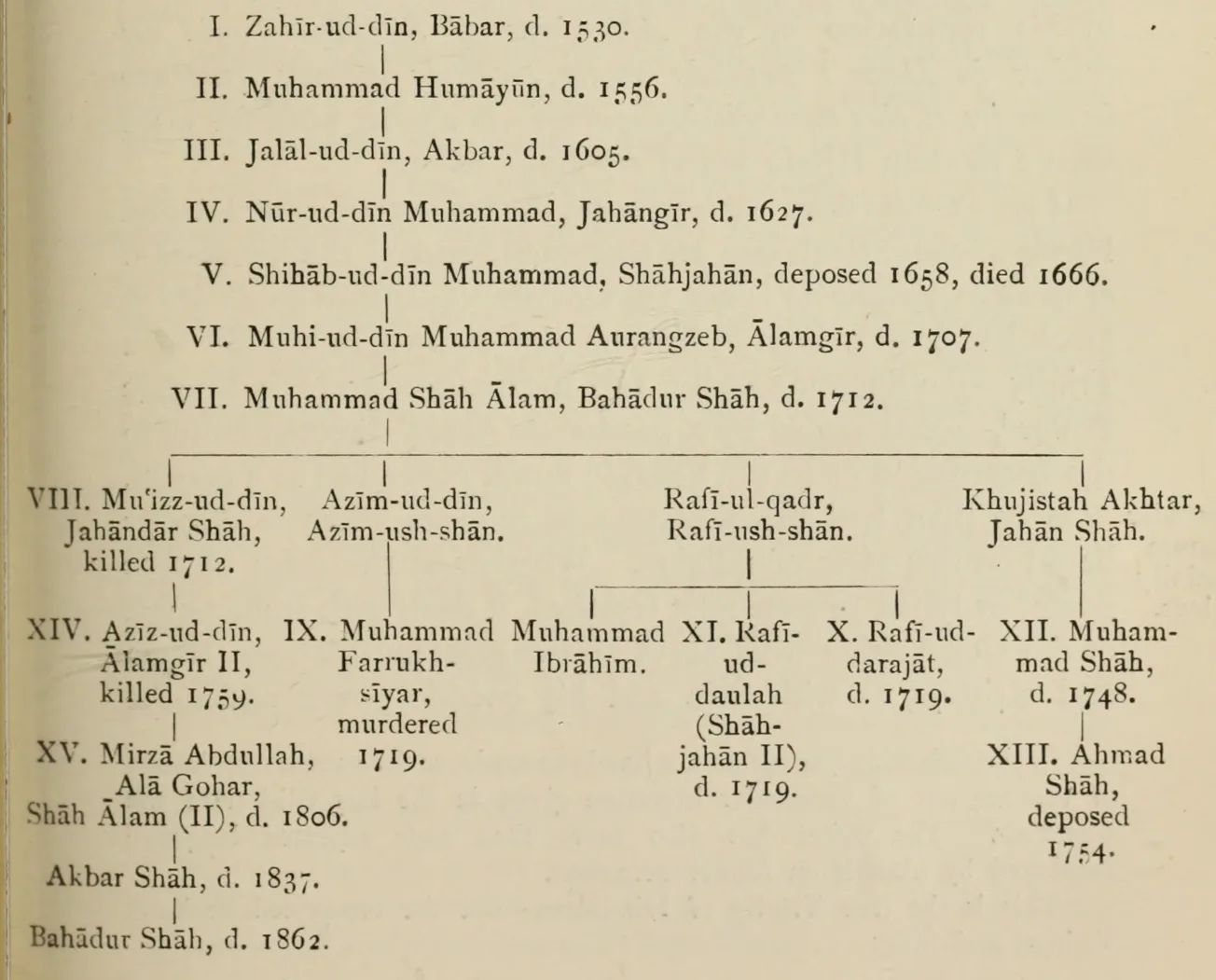
Notes
- Note. Note.—In all the tables only those names are shown which affect the line of succession.