MY inquiries could not commence, with proper effect, till after my arrival at Seringapatam, nor until I had there procured sufficient authority from the Raja's Dewan; I trust, however, that my observations on the appearance of the country, as I passed along, will not be considered as entirely useless.
In the afternoon of the 23d April 1800, I set out from Madras, in the very hot dry weather, which usually prevails at this season. After leaving the plain occupied by the houses of Europeans, I entered a country then scorched up by a powerful sun, yet containing little waste land; for the soil, being fine, produces a very good crop of rice, provided, in the wet season, the usual quantity of rain falls. In some places, the industry of the natives causes a verdure that is highly refreshing, by watering a few fields, that are near tanks, or reservoirs of water. These fields are now covered with rice, approaching to maturity; and in the rainy season they will yield another crop. The appearance of the country, however, at this time of the year, is dreary. It is almost as level as Bengal: and in general forms a naked, brown, dusty plain, with few villages, or any thing to relieve the eye, except a ridge of abrupt detached hills toward the south. The roads are good; and many of the huts being built of mud, and neatly covered with tiles, have a better appearance than those in Bengal: but the roofs of such as are thatched look ragged; as the thatch is not composed of smooth straw, but of palmira leaves, which never can be put on with neatness.
Near the road, charitable persons have built many resting-places for porters, who here carry all their burdens on the head. These resting-places consist of a wall about four feet high, on which the porters can deposit their burdens, and from which, after having rested themselves, they can again, without assistance, take up their loads. The inns, or Choultries, which are common on the road, evince an attention to travellers not to be found in Bengal. At these places, the poorest, without expense, have shelter from the inclemencies of the weather; and the richer traveller, can purchase both for himself and for his cattle, at least the necessaries of life.
This part of the country, although at present naked, seems capable of raising trees and hedges; and shows evident appearances of its being in a state of improvement, there being in view many new plantations, especially of fruit-trees, and coco-nut palms.
Leaving on the right the road to Poonamalee, I went to Condaturu, near which the country assumes a very different, and a very pleasing aspect. Numerous small canals, from the Saymbrumbacum tank, convey a constant supply of water to most of the neighbouring fields, and fertilize them without the trouble of machinery. They consequently yield every year two crops of rice. The one at present on the ground will be reaped in June, and has a very promising appearance.
Instead of preventing the crops from being cut down, till the rent is paid, as is usual in Bengal, the custom here is, to collect the grain in stacks, or heaps, after it has been thrashed out on the field. In order to guard against embezzlement, several pieces of clay, stamped with a seal, are then put on the surface of the heap; and, to prevent injury from the weather, it is thatched. The grain continues in these heaps, till the cultivator is able to satisfy the renter, either by advancing money, or by dividing the produce. In every village a particular officer, called Talliari, keeps watch at night, and is answerable for all that may be stolen.
The cattle in the neighbourhood of Madras, are of the species which is common to the Decan; but much smaller than those, which are brought from the northern parts of that country. They seem, however, to be larger than the cattle produced in the southern parts of Bengal. They are mostly light-brown, or white, and, notwithstanding the apparent want of pasture, are in better condition than the labouring cattle of Bengal, owing probably to the superior care that is taken of the rice straw by the inhabitants of Madras. Milch cows are fed entirely on grass; grain, or pulse, is rarely given to such cattle as are not employed in hard labour.
Near Madras, Buffaloes are in general use, and are often yoked in the same cart with bullocks, although the paces of the two animals are very different. The buffaloes here are much smaller than in Bengal.
24th April.—I set out early, and soon arrived at Saymbrumbacum tank, which is of great extent. It has not been formed by digging, like those in Bengal; but by shutting up, with an artificial bank, an opening between two natural ridges of ground. The sheet of water is said to be seven or eight miles in length, and three in width; and in the dry season is let out in small streams, as wanted for cultivation. In the rainy season it receives a supply of water from the river Chir-nadi, and from several small streams that are collected by a canal. As at times the water overflows, and would break down the bank by falling over it, and sapping its foundations, the natives in different places construct what they call Codies, or sluices of stone. These are twenty or thirty feet wide, and are lower by some feet than the other parts of the bank. On the surface, they are strongly fortified by large stones placed in a sloping direction; so that the water rushes over without undermining the bank, and is conveyed away from the fields by a canal. This is a matter of the utmost importance; for there are instances where, the banks of these large tanks having given way, whole villages have been destroyed by the torrent. In order, however, that when there is plenty of rain, the tank may be completely filled, a row of stone pillars is placed on the top of the sluice; and, on the water rising to a level with their base, a temporary wall is formed of mud, sticks, and straw, placed between the pillars, so as to confine the water till it rises as high as the top of the bank. People watch this night and day, in order to break down the temporary bank, should any additional rain endanger the whole. The water is let out, to supply the fields, by a sluice lined with cut stone, or bricks, and placed under the bank, on a level with the country. The inner end of this sluice is covered by a flat stone, in which is cut a circular opening, that can be shut or opened by a plug fixed to a bamboo, and secured in its place by two pillars of stone, which rise above the level of the water. The accompanying sketches (Plate I.) will assist the reader to understand the foregoing description. The proper name for a tank of this kind, in the Tamul language, is Eray. Saymbrumbacum tank is said to be sufficient to supply with water the lands of thirty-two villages (should the rains fail) for eighteen months. In these villages, it is said, there are five thousand persons employed in agriculture. In a country liable to famine from want of rain, a reservoir, such as this, is of inestimable value.
The late collector, Mr. Place, although he augmented the revenue considerably, by the repairs made on this tank during his administration, gave great satisfaction to the inhabitants. Another of Mr. Place’s measures seems to have been very well judged. He caused each village to be surrounded by a hedge of Bamboos, with two small towers at each gate. By this measure, in case of any invasion, small parties of plundering cavalry may be kept off, and a great quantity of that most valuable plant the bamboo will in time be raised. At present it is brought from the neighbourhood of Tripetty, and sells three-fold dearer than at Calcutta : for from ten to sixteen Bamboos cost here a Pagoda, or 7s. 4¼d.
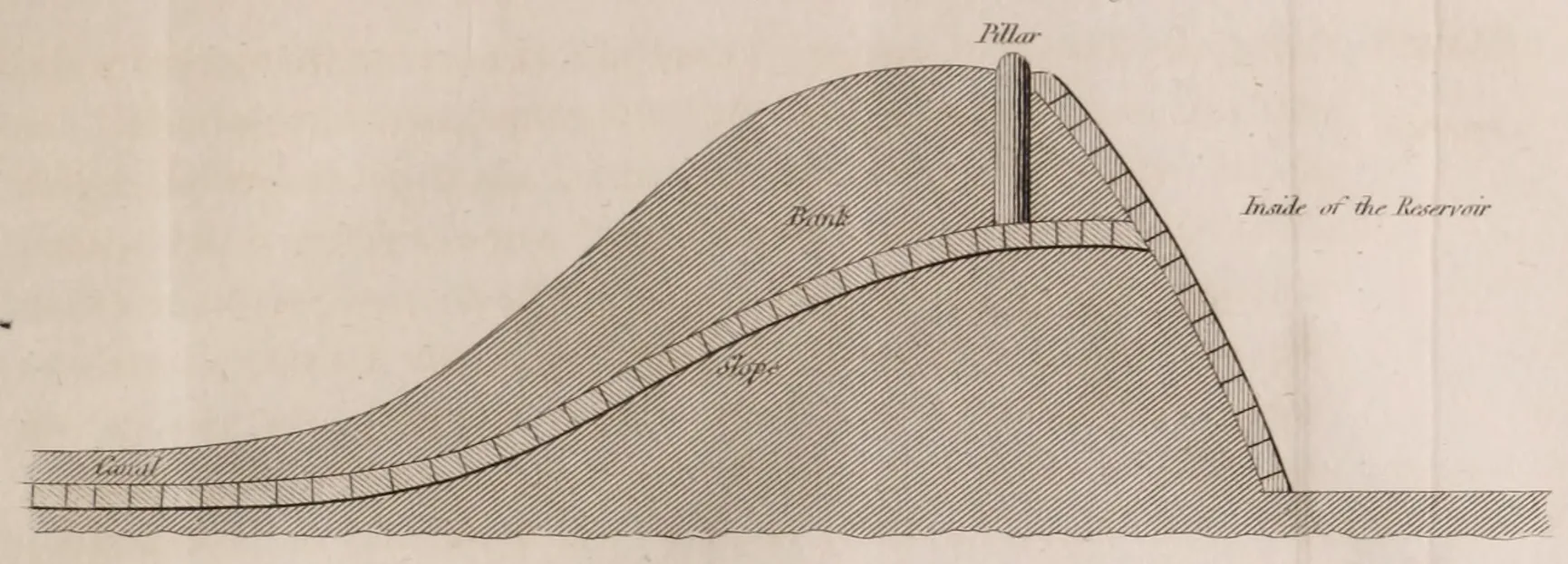
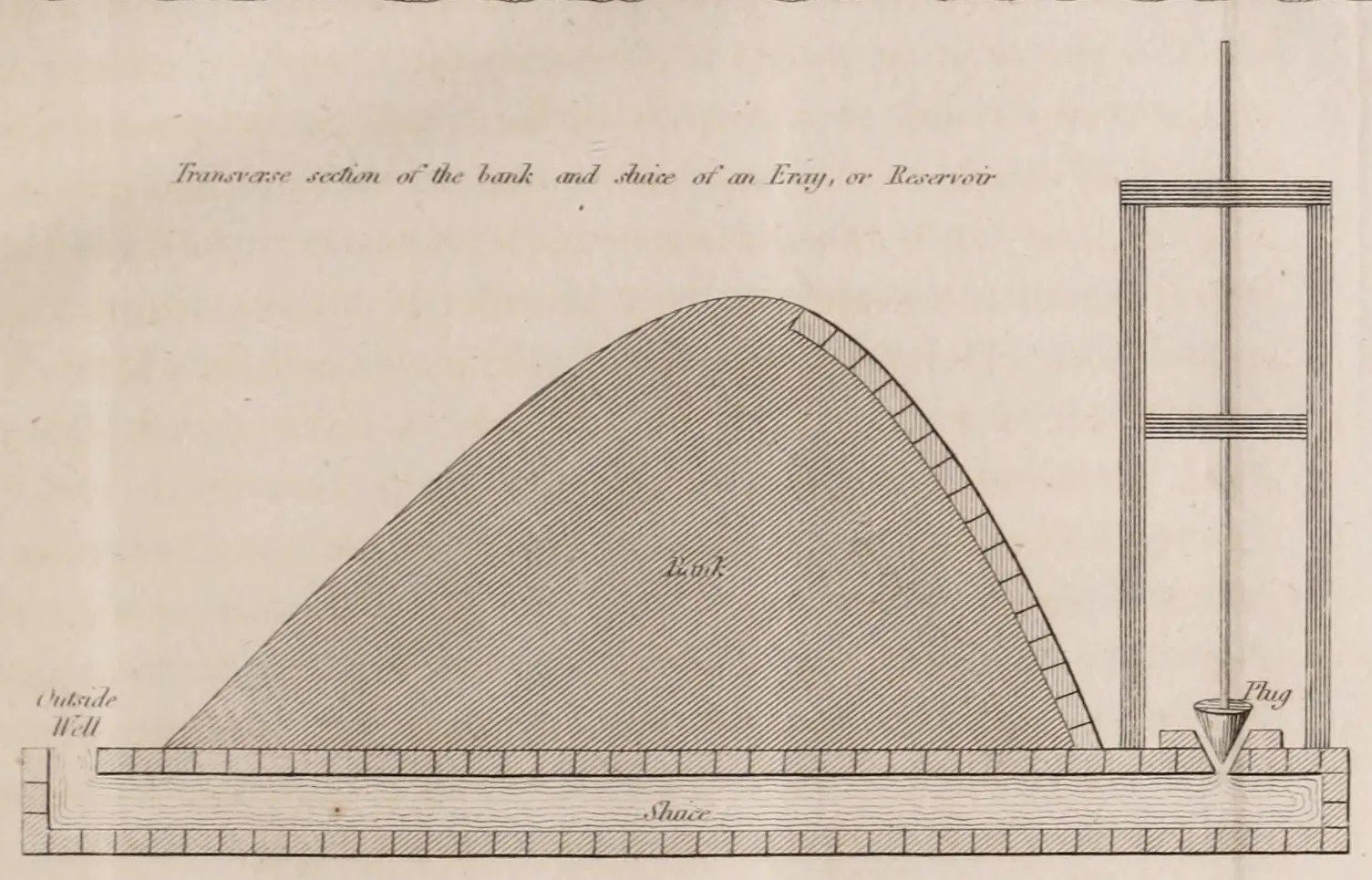
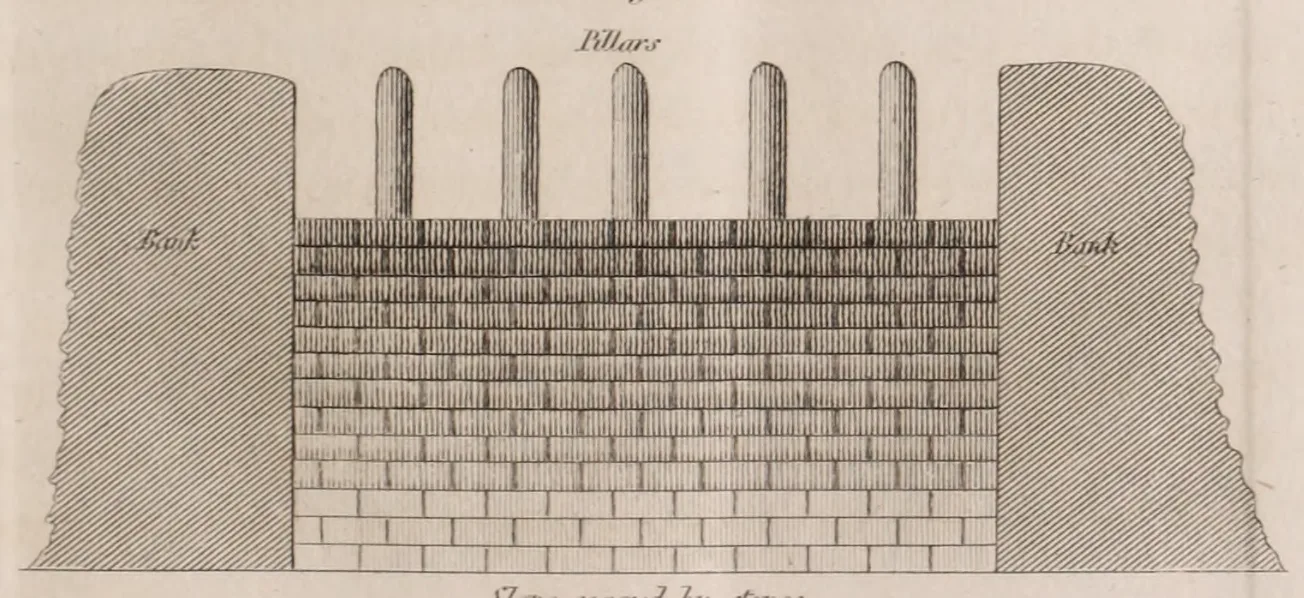
The remaining part of my journey to Sri Permaturu tank was along the high grounds that bound it, and the Saymbrumbacum reservoir on the south. The land is no where so steep as to prevent the use of the plough ; but in most places the soil is very indifferent. The rocks, or large detached masses of granite, project in many fields ; and almost every where the country is overrun with low prickly bushes, such as the Rhamnus circumscissus of Linnæus, Rhamnus scandens of Roxburgh, Paulinia Asiatica, and Monetia Barlerioides. Except in a few fields, which in the rainy season are sown with Ragy (Cynosurus corocanus), and other dry grains, there is here no cultivation ; and I am assured by the natives, that in most places the crop would not be worth the seed. It appears too dry for any useful purpose, except giving a scanty pasture. Perhaps some forest trees might be planted on it with advantage, such as the Gurgions of Bengal, and the Lagerstromia reginæ. The Palmira thrives on it without trouble ; but the produce is so cheap and abundant, from those which spring forth almost spontaneously, that, I am assured, the planting them on a large scale would not be profitable. The wild date (Elate sylvestris) is in a similar predicament.
The Tári, or fermented juice, and the Jagory, or inspissated juice of the Palmira tree (Borassus flabelliformis), are in this country more esteemed, than those of the wild date, which is contrary to the opinion of the Bengalese. The people of the Carnatic allege, that the produce of the latter is very heating. They pretend to be very moderate in the use of the Tári, but consume much of the Jagory. It sells in the country for 30 Vees, a Pagoda, or about 9s. 5d. a hundred-weight. Could it be converted into either a palatable spirituous liquor, or sugar, the barren plains of the Carnatic might be rendered productive. The former appears not to be improbable, and seems to be an object worth trying. If it should answer, the whole of the grain distilled in Europe might be saved for food.
The proper native weights used in the Company's Jaghire are as follows :
| 10 Vara hun (Pagodas) | 1 Polam. |
| 40 Polams | 1 Visay. |
| 8 Visay (Vees) | 1 Manungu |
| 20 Manungus (Maunds) | 1 Baruay. |
| 20 Baruays (Candies) | 1 Gursay, called by the English Garse. |
The Vara hun, or star Pagoda, weighs 52¾ grains; therefore the Visay is nearly three pounds avoirdupois; and the Garse nearly 1205 lbs.
The land measure of the Jaghire is as follows : 24 Adies square = 1 Culy; 100 Culies = 1 Canay. Out of what is called charity, however, the Culy is in fact a Bamboo twenty-six Adies, or twenty-two feet eight inches in length; the Ady, or Malabar foot, is therefore 10 46/100 inches nearly; and the customary Canay contains 51,375 square feet, or 1 18/100 acres nearly; while the proper Canay would only contain 43,778 square feet.
The tank at Sri Permaturu is much inferior to the Saymbrumbacum reservoir, and serves only to water the ground of one village; but that has very extensive possessions. It is said to contain 1812 Canays, or 2137 acres of rice lands; 370 Canays, or 436 acres of ground fit for the cultivation of dry grains; and a large extent of pasture, which may be compared to the moors of Scotland, but is in general still more barren.
A native of Bengal, who accompanies me as a painter, is delighted with the plenty of milk and Dhui in this part of the country. The Dhui, or sour curds, is made of buffalo's milk; and is much superior, he says, to that of Calcutta, and considerably cheaper. On account of the comparatively high value of provisions, he has hitherto been rather depressed in spirits.
Throughout the Carnatic the ass is a very common animal. The breed is as small as in Bengal; but there is a singular variety among them in their colour; some are of the usual ash colour, whilst others are almost black, in which case the cross on their shoulders disappears. Milk-white asses are also to be found, but they are rare. These are not varieties as to species; for black individuals have sometimes ash-coloured colts, and, on the contrary, black colts are sometimes produced by ash-coloured dams. They are kept by five classes of people, who are all of low cast, for the higher ranks disdain the use of an animal so impure. The ass is kept, 1st. by washermen, called Venar; 2d. by a people called Caravar, that carry salt from the sea-coast to the interior parts of the country; 3d. by tinkers, called Cunnar, who go up and down selling brass utensils; 4th. by people called Vaylacarar, who sell the glass rings worn on the wrists by the women of this country; lastly, by a wretched kind of people called Chensu Carir.
I have as yet obtained but an imperfect account of this tribe. They are said to have neither house nor cultivation; but catch birds and game, part of which they sell for rice. One common article of their food is the white ant, or Termes. They travel about from place to place, conveying their baggage and children on asses. Every man has also a cow, instructed like a stalking horse, by means of which he approaches his game, and shoots it with arrows.
The Chensu Carir, who preserve their native manners, and never come among the villages, are said to speak an unintelligible jargon, and have no clothing but the leaves of trees. Those, who occasionally wander about in the cultivated country, understand many Telinga words, and wear a small slip of cloth to cover their nakedness.
April 25th.—Early in the morning I went from Sri Permaturu to an inn, or Choultry, erected by Vira Permal Pillay, who was Dubash to Sir Charles Oakley. The country is high and barren, like that eastward of Sri Permaturu, but it has more Palmira trees, and in the neighbourhood of several tanks have been planted tamarind, Pipal (Ficus religiosa), Banyan (Ficus indica), and mast trees (Uvaria altissima), all of which thrive well, if they are watered for two or three years after being planted. The only trees that grow spontaneously are, the Melia azadirachta, and the Robinia mitis; the last of which flourishes both on the arid hills of the Carnatic, and on the muddy banks of the Ganges. Very little of this soil, at the usual rent, will repay the expence of cultivation ; and in the present state of population it perhaps would not be proper to let it low, as by that means useful labourers might be taken away from more valuable lands. The same reason prevents the fields near the inn from being cultivated. They are level, but too poor to produce rice. The inhabitants would willingly bring them into cultivation for dry grains, were they allowed the two first years free of rent : but then part of the rice fields must remain uncultivated.
The only good water in this neighbourhood is the rain preserved in Tanks. That, which is found in wells, is by the natives called salt, although the quantity of muriate of soda contained in it is very small.
The oil chiefly used here, both for food and unguent, is that of Sesamum, by the English called Gingeli, or sweet oil ; a few individuals use the oil of the cocoa-nut. At Madras this last is much employed for the lamp ; but in the country the natives make other oils serve for this purpose.
The oils used in the Company’s Jaghire, or district immediately surrounding Madras, are the following :
- Taynga any, oil of the cocoa-nut.
- Nulla any, oil of the sesamum.
Velac, or amanucky any, oil of the Ricinus Palma Christi. It is the common lamp oil which the natives use.
Cat amanucky any, oil of the Jatropha curcas; used for the lamp only.
Mulu any, oil of argemone seed, also for the lamp.
Illepen any, oil of the Bassia longifolia; used for frying cakes made of rice flour and Jagory.
Badaga any, oil of black and white mustard; brought from the interior parts of the country.
Vaypa any, oil of the seeds of the Melia azadirachta. About an ounce of this is given to every woman, immediately after she is delivered of a child. It is used also for the lamp.
Veleri very any, oil of cucumber seed; used both in cookery and for the lamp.
Tomute very any, oil of the seed of the Cucumis colocynthis, L. Lamp oil.
Penny coty any, oil of the Calophyllum Inophyllum; used also for the lamp.
Cossumba any, oil of the seeds of the Carthamus tinctorius.
In the Tamul language there are many good botanical terms, —for instance :
- Maram, a tree, Arbor.
- Chery, a shrub, Frutex.
Cody, a climber, Planta volubilis.
Shudy, an herb, Planta herbacea.
Very, small seed, many of which are contained in a common fruit.
Coty, a seed, of which one only is contained in each fruit.
The people, who make Jagory from palm trees, follow no other profession. An individual of this profession in the Tamul language is called Shanan; but collectively the cast is called Shanar. The Shanan mounts the Palmira tree morning and evening, in order to collect the exuded juice, which through the day he and his family boil down into Jagory. The tree produces at all seasons. One man can take care of 200 trees: from which, according to their account, he can extract annually 20 Manugu, or about 482 pounds of Jagory, worth at this place, 6 Pagodas; which, at the usual exchange, is £2. 8s. or rather more than eleven shillings the cwt. Besides, the Shanan daily sells one or two Fanams’ worth of Tári. According to this account, the produce of two hundred Palmira trees would be
| Jagory | Pagodas 6 | 0 |
| Tári at 1½ Fanam daily | 15 | 7½ |
| 21 | 7½ | |
| Deduct rent at 2 Fanams a tree | 11 | 4 |
| Profit | Pagodas 10 | 3½ |
I suspect, that by this account the produce is under-rated. If it were true, I can hardly see, how the Shanan could maintain a family in a country where provisions are by no means cheap.
The inn, Choultry, or Chaturam, of Vira Permal Pillay consists of two square courts enclosed by low buildings, which are covered with a tiled roof, and divided into small apartments for the accommodation of travellers. The buildings on the outside are surrounded by a colonnade, and are constructed of well cut, whitish, granite, brought from the distance of twenty miles. Although said to have cost 15,000 Pagodas, or £5515. 8s. 1d. they are very mean structures.
April 26th.—In the morning I went from Vira Permal’s Choultry, to the greater Conjeveram, called by the natives, Kunji. The country is in general level, but the soil is wretched. It consists chiefly of a coarse sand, seemingly deriving its origin from decomposed granite, and at this season of the year is almost destitute of vegetable covering; nor is it perhaps capable of being ever converted to use. Some spots possess a tolerable soil, and in these have been formed rice fields, that in the rainy season produce a crop, but at present they look quite desert. Near Conjeveram many of the fields, receiving a supply of water from a large reservoir on the north side of the town, were covered with a thriving crop of rice, which displayed a verdure highly refreshing to the eye.
In one of the most desert places of the country, a very fine tank has been dug by a Dewan of the late Mahomed Aly. It is square, and lined all round with stones of cut granite, which descend to the bottom in steps. The water is said to be very deep. At two of the sides of this tank are Choultries, built also of cut granite. Each consists of a room divided by two rows of pillars, that support a flat roof consisting of long stones. This apartment, which is shut up on three sides by a wall, and entirely open in front, is surrounded by a colonnade, or veranda, which in front is double. The pillars are very rude and inelegant, but are covered with figures, in basso relievo, of the Hindu deities, of fishes, and of serpents.
It must be observed, that there are two distinct kinds of buildings confounded by Europeans under the common name Choultry.
The first is that called by the natives Chaturam, and built for the accommodation of travellers. These, like that of Vira Permal Pillay, have in general pent roofs, and commonly are built in form of a square enclosing a court in the centre.
The other kind, like those here, are properly built for the reception of images, when these are carried in procession; although, when not occupied by the idols, travellers of all descriptions may take up their quarters in them. These have flat roofs, and consist of one apartment only, and by the natives are called Mandapam.
The inhabitants here distinguish also two kinds of tanks.
The first is the Eray, which is formed by throwing a mound, or bank, across a valley, or hollow ground; so that the rain water collects in the upper part of the valley, and is let out on the lower part by sluices, for the purposes of cultivation.
The other kind of tank is the Culam, which is formed by digging out the earth; and is destined for supplying the inhabitants with water for domestic purposes. In this country the Culams are very frequently lined on all the four sides, with cut stone, and are the most elegant works of the natives. By making tanks and choultries, the wealthy Hindus endeavour to procure a lasting good name; and they certainly deserve it, as the sums they expend in this way, are very considerable, and the utility of the works is very great.
In passing through the Company’s Jaghire I have found very little inclination among the natives to oblige a European traveller. It appears to me, that their condition is better than that of the people in Bengal; but this is entirely contrary to the opinion of my painter. He has no doubt better opportunities than I can have of knowing the truth, the houses of the natives in both countries being inaccessible to a European. I suspect, however, that he is not exempt from prejudice in favour of his native land.
The town of Conjeveram is of considerable size, and very regularly built; but it appears to be by no means populous, as many of the lots for building are unoccupied, and none of the houses are more than one story high. The streets are tolerably wide and clean, and cross one another at right angles. On each side is a row of coco-nut trees, enclosed by a small mud wall, painted vertically with red and white stripes.
The houses have mud walls, and are roofed with tiles. Each is built in the form of a square with a small court in the centre. They certainly appear to be much more comfortable than the houses in the country towns in Bengal. Most of them are inhabited by the Bráhmans belonging to two large temples, that are dedicated to Iswara, and to his wife Cámachuma. Of these Bráhmans there are one hundred families; a hundred dancing girls are kept for the honour of the deities, and the amusement of their votaries; and any familiarity between these girls and an infidel would occasion scandal. About three miles off, at the lesser Conjeveram, is another grand temple dedicated to Vishnu, who has here a Mandapam, for his reception at the two visits, which he makes in the year to Iswara. Siva returns the visit once a year only. At these visits the worshippers of the two gods, who are of different sects, are very apt to fall into disputes, occasioning abusive language, and followed by violence; so that the collectors have sometimes been obliged to have recourse to the fear of the bayonet, to prevent the controversy from producing bad effects.
I have no occasion to describe the Covils, or Pagodas, that having already been done with sufficient accuracy. I shall only remark, that they are great stone buildings, very clumsily executed both in their joinings, and carvings, and totally devoid of elegance or grandeur, although they are wonderfully crowded with what are meant as ornaments. The Rat'hs, Tær, or chariots, on which the images of the gods are carried in procession, are much superior to those I have seen in Bengal. There are here three Tær, one for Iswara, a second for his wife, and a third for his son Ganésra. In Bengal, the images of Vishnu only, and of this family, are conveyed in Rat'hs; Mahádéva, or Iswara, is never carried in procession.
At Kunji there is a small mosque of very neat workmanship. The Hindoos say, that it was originally a Covil, or Pagoda; but if it has been such, great alterations have been made on it for the better.
The divisions of the Bráhmans here, are different from those found in Bengal.
The most numerous class here, and which comprehends about one half of all the Bráhmans in the Lower Carnatic, is called the Smartal sect, and its members are followers of Sankara Achárya. They are commonly said to be of the sect of Siva; but they consider Brahmá, Vishnu, and Iswara, to be the same god, assuming different persons as the creator, preserver, and de troyer of the universe. They consider their souls as being portions of the divinity, and do not believe in transmigration as a punishment for sin. They are readily distinguished by three horizontal stripes on the forehead, made with the ashes of cow-dung.
The next most numerous sect of the Bráhmans here, are the followers of Ráma Anuja Achárya, who form about three tenths of the whole. They are called Sri Vaishnavum and A'ayngar, and may readily be known by three vertical marks on the forehead, connected by a common line above the nose, and formed of a white clay. They abhor Iswara, calling him the chief of the Rákshasa, or devils, and worship only Vishnu, and the gods of his family. They form two sects; the Wadagalay, who believe in transmigration, and the Tangalay, who do not.
The Madual form the remaining two tenths of the Bráhmans. These use the vertical marks on the forehead, which are appropriate to the followers of Vishnu; but they worship Siva also; they believe in the generation of the gods in a literal sense, thinking Vishnu to be the father of Brahmá, and Brahmá to be the father of Siva.
All these sects admit the authority of the same Puráns; but each sect explains some obscure passages so as to confirm its own doctrines.
Each sect of Bráhmans has here a number of followers, in proportion nearly to its own comparative strength. This, I am told, is not the case in Bengal, where the sect of Iswara or Mahadáva prevails among the Bráhmans, while that of Vishnu is the most common among the vulgar.
27th April.—In the morning I went to Oulur Sátghadam, which is a Choultry, or inn, with hardly any houses in its neighbourhood; but it is remarkable for having formerly had seven hill-forts in its vicinity; and from this circumstance it derives its appellation, Sátghadam. In the Decany dialect of the Musulman language, Ghadam signifies a fortress situated on a hill, while Kilah is applied to one built on a plain. In the Sanscrit language, Patanam or Patana is analogous with Kilah, and Durga, or Durgam, is analogous with Ghadam. In the Tamul language a fort of either kind is called Cotay.
Besides the Chaturam and Mandapam, there is another kind of building, which by Europeans is called Choultry; in the Tamul language it is called Tany Pundal, or water shed. These are small buildings, where weary travellers may enjoy a temporary repose in the shade, and obtain a draught of water or milk. In some of the inns or Chaturams, provisions are sold; in others, they are distributed gratis, at least to Bráhmans or other religious mendicants, as is the case in the Choubaries of Bengal.
When a man erects a building of any of these kinds, the natives add its name to his, as a title of honour; thus any person speaking of Vira Permal, would call him Vira Permal Chaturam. Others derive a similar title from having dug a Culam, or constructed an Eray.
Soon after leaving Conjeveram, I found the country again a desert, and it continues so till near Damerlu, the last village in the Jaghire. From my having passed over such a great proportion of bad land, on my way from Madras, it must not be concluded, that the whole country is similar. Dry, hard, and elevated ground, where little expense is bestowed on keeping the roads in repair, being most favourable for highways, the traveller of course meets with a greater proportion of that description than of any other. Between Damerlu, and Oulur, a canal coming from the Palar, waters much valuable rice land. At Oulur the soil is good, but where I encamped is fit only for dry grains; and at present its surface is wholly a brown dust, enlivened alone by the bushes and trees which, from the slovenliness of the cultivators, are scattered about in the best fields.
In one place I saw people employed in watering a rice field with the Yatam, or Pacota, as it is called by the English. When the water of a tank is expended before the rice of the fields watered by it ripens, the inhabitants must either allow their crop to perish, or use the Yatam. One Canay of ground (1 18/100 acre) requires the constant labour of four men to supply it with water for the cultivation of rice, The same number of men are able to water three Canays of garden ground, which requires a comparatively small supply ; a deduction of rent is generally allowed, when the cultivator is reduced to the necessity of watering by machinery.
28th April.—In the morning I made a long journey to Arcot. From Oulur to Kávary-pák, the barren ridge on which the road leads, is very narrow; and the country, being abundantly supplied with water from the Kávary-pák tank, has a fertile delightful appearance; and with its distant hills, verdant fields, and running streams, would afford a most beautiful prospect, were it somewhat better wooded. The great Eray, or tank, is about eight miles long and three broad, and fertilizes a considerable extent of country. I never viewed a public work with more satisfaction, a work that supplies a great body of people with every comfort which their moral situation will permit them to enjoy. Kávary-pák is a large but dirty village, with a stone mosque in its centre. The fort by which it was protected, is also built of stone, but is now ruinous.
After passing Kávary-pák, I found the barren ridge more extensive, reaching almost from the Palar to the northern hills, and in most places consisting of immense beds of granite, or of that rock decomposed into harsh coarse sand. The whole country is almost destitute of verdure, but a little withered grass affords sustenance to a few wretched sheep. Other parts have somewhat of a better soil, and in the rainy season may produce some of the dry grains; several reservoirs have been formed in the waste, the water of which produces crops in a few narrow strips of land chiefly near the river. The bed of the river Palar at Arcot, where we crossed it, is above half a mile wide, but at present is quite a dry loose sand, except in two narrow channels, containing a stream not sufficient to turn a mill.
Arcot, or Arrucate, is the nominal capital of the Carnatic páyin ghát, (Carnatic below the Passes) as the Mussulmans and English call the dominions of the Nabob. He maintains a garrison of his own troops in the fort, which is pretty large, but not in good repair. The music of his Nabut, or state band, is much superior to any thing I have ever heard among the natives, and is not much harsher than our clarionet. His brother-in-law, who manages this part of the country, resides near the fort, in a good house belonging to the Nabob.
The town surrounds the glacis on all sides, and is extensive. The houses are as good as in the towns of the Jaghire. The inhabitants speak the Decany dialect of the Mussulman language, which we call Moors or Hindustany. They took advantage of us as strangers, and for every supply we procured, demanded three times the usual price. At this place coarse cotton cloth is made. It seems to be cheaper than in the Jaghire, but dearer than in Bengal.
From Madras to Kávery pák, the road is tolerably good. From Kávery pák to Arcot, a wheel carriage could not easily pass. Many of the rich natives travel in bullock coaches, like those in Calcutta, called Chaycra. Near Arcot, I met the Mussulman women riding on bullocks, and entirely wrapt up in white veils, so as to conceal both features and shape.
The heat on the glacis of the fort, where I encamped, was intense. The hills in this vicinity are the most barren I have ever seen, those even of St. Jago in the Cape de Verd islands not excepted. They appear to be composed of the same granite, that abounds in the elevated barren grounds, on which the road from Madras is conducted. They seem to be undergoing a rapid decay, and will probably continue to do so, till they are reduced to nearly a level with the circumjacent plain, when the decomposed parts, no longer rolling off, will cover them with a bed of sand, and prevent them from farther decay, as is now the case in the waste lands already mentioned. In many parts of the vallies, formed by these hills, is found Chunam, or lime-stone nodules, which in Bengal is called Congcar.
29th April.—The country between Arcot and the western hills contains some good ground, some that serves for gardens, and dry grains, and some that is barren, consisting of granite covered with beds of sand.
The road leading to Vellore is conducted along the foot of the hills, which bound the Palar valley on the south, and is formed on the rocky basis of these hills, and on the sand and fragments, that have fallen from them. A greater verdure however prevails here, than any I have seen in the Carnatic, owing probably to a subterraneous supply of water; for on the whole way there is not a spring visible. This ground at the foot of the hills is in some places pasture, and in others is overgrown with trees and bushes, especially with the wild date, or Elate Sylvestris, which thrives very well, but here is considered as useless. There are also many Palmira trees, from which Tári is extracted. The lower part of the valley, near the river, is very good land, and looks well, the greater part of it being verdant with the second crop of rice. The houses and villages by the way are very miserable.
30th April.—I remained at Vellore in order to give my people rest. The present fort is large and beautiful; and having been chosen for the residence of the family of the late Sultán of Mysore, is strongly garrisoned by English forces. The town, which belongs to the Nabob, is pretty large, and well built after the Hindu fashion. Above it are three small forts, which occupy the summits of a hill that overlooks the town, but one of them only has a supply of water. The fortifications are said to have been erected by the Canarese monarchs.
The greater part of the Bráhmans in the lower Carnatic follow secular professions. They almost entirely fill the different offices in the collection of the revenue, and administration of justice; and they are exclusively employed as Hircaras, that is, guides or messengers, and as the keepers of inns or Choultries. Much of the land is rented by them; but, like the Jews, they seldom put their hand to actual labour, and on no account will they hold the plough. Their farms they chiefly cultivate by slaves of the inferiour casts, called Súdra, and Panchum Bundum.
The Panchum Bundum are by far the most hardy and laborious people of the country, but the greater part of them are slaves. So sensible of their value was Hyder, that in his incursions it was these chiefly, whom he endeavoured to carry away. He settled them in many districts as farmers, and would not suffer them to be called by their proper name, which is considered opprobrious; but ordered, that they should be called cultivators. The Panchum Bundum consist of four tribes; the Parriar, the Baluan, the Shecliar, and the Toti. The Shecliars dress hides; and from among the Toti is chosen a particular class of village officers.
There are a few Mussulman farmers, who possess slaves; but the most numerous class is composed of the different tribes of the Súdra cast. Some of these possess slaves, but many of them cultivate their farms with their own hands.
In this Carnatic payin ghát, or Carnatic below the mountains, there are no fairs like the Hauts of Bengal; but the shopkeepers purchase the articles in demand from the farmers and manufacturers, and retail them daily in the Bazars or towns. Milk and its preparations are commonly sold by women, who sit by the road side.
1st May.—I went from Vellore to Paligonda. The valley is in general very fine, much of it having water for two crops of rice; some part however is covered with rocks of granite. The villages are very poor; and the two towns, Verimchepurum, and Paligonda are full of ruins; at each of them is a considerable temple; that of Paligonda is within the remains of a fort. The name of the place is derived from a Tamul word, which signifies sleeping. It arises from the image in the temple, which represents Ranganáth, one of the forms of Vishnu, in a sleeping posture.
A procession, that took place to-day at Paligonda, gave me an opportunity of learning, that only the three pure casts of Bráhmans, Vaishyas, and Súdra, are allowed to attend on such occasions. The fourth pure cast (the second in rank), the Kshatriyas, are considered by all the Bráhmans here, as having been for many centuries quite extinct. The Parriar, and other impure tribes, composing what are here called the Panchum Bundum, would be beaten, were they to attempt joining in a procession of any of the gods of the Bráhmans, or entering any of their temples. The Bráhmans indeed despise those poor people so much, that they will give them no religious advice; nor perform for them any religious ceremony; and, what is still more extraordinary, will not even receive money from them as charity. The Parriars have among themselves a kind of priests, named Velluan, who possess books in the Tamul language. They have also small temples, in which the only image is said to represent the head of the mother of Parasu Ráma Avatár. This, according to the legend, was taken up by the Parriars, when it had been cut off by her son.
I have already mentioned the three grand sects prevailing among the Bráhmans of this country, and which are said to prevail also over all the five nations of Bráhmans, called collectively Pansh Dravada, who occupy the southern parts of India. There are, however, many other divisions among these Bráhmans, arising from their various occupations.
The proper duty of a Bráhman is meditation on things divine, and the proper manner of his procuring a subsistence is by begging (Bhikshá). This mode of living is considered as very agreeable to the gods; and all industry is deemed derogatory to the rank of a man, and more especially to that of a Bráhman. The lower classes of society, however, in this degenerate age, not being sufficiently charitable, nor quite so willing to part with their money, as the noble cast of Bráhmans could wish, many of that sacred order have been obliged to betake themselves to what they consider as unworthy employments, such as being governors and judges of cities, collectors of revenue, and accomptants ; nay some even condescend to cultivate the earth by means of slaves. Hence arises the distinction of Bráhmans into Vaidika and Lókika, or Lovadica ; the former of whom follow the proper duties of the cast, while the Lókika debase themselves by dedicating their labours to worldly affairs. The diversity of employment, however, does not create an absolute distinction of cast ; the daughter of a Vaidika Bráhman may marry a Lókika, and the son of a Lókika may betake himself to the occupations of a Vaidika Bráhman ; but instances of either circumstance are not common. It is however not so unusual for a poor Vaidika, to be tempted to give his daughter to a wealthy Lókika Bráhman ; as for the son of a Lókika Bráhman to acquire the character of a pure Vaidika. He is always considered as a new man ; and several generations, devoted to study and mortification, would be required to wash away the stain of ignoble birth, before the merits or learning of a Lókika family could enable them to procure a comfortable subsistence by charity.
The Bráhmans are considered as the priests of the Hindus ; yet there are none, even of the lowest among the Lókika, who would intermarry with the families of the Bráhmans that officiate in the temples of Vishnu and Siva : and in this country no Bráhman officiates in any of the temples of the inferior gods, whose altars are stained with blood.
The highest among the Bráhmans are certain Vaidika, who by more than usual mortification attain a large proportion of divine favour. They cut off their hair ; dress in a yellow or red cloth ; eat but once a day ; abstain entirely from women ; and, relinquishing all the domestic enjoyments of society, live in Pagodas, or Matams, that is to say convents, where they dedicate their time entirely to devotion, and the instruction of those who are less pious, and who follow them as disciples. A Bráhman of this kind is called a Sannyási, and must be a man of learning, that is to say, must be able to read Sanscrit, and be acquainted with the dogmas of his particular sect. The number of Bráhman Sannyásis is very small, and is chiefly confined to those, who are Gurus, Swamalus, or bishops of the different sects, and who, in every thing relating to religion and cast, have a jurisdiction over all their inferiors. They also perform certain ceremonies, such as Upadésa, and Chicranticum, which may be considered as analogous to the Confirmation granted by our prelates. They are supported entirely by the contributions of their disciples; but these are so burthensome, that a Guru seldom continues long in one place; for the contributions even of Madras are not equal to supply the wants of a Swamalu for more than one or two months. A hundred Pagodas a day, £36. 15. 5. is as little, as can be decently offered to such a personage. The Raja of Tanjore is said to give his Guru 250 Pagodas a day (£91. 18. 6½.), when that personage honours him with a visit. The Gurus travel in great state, with elephants, horses, Palankeens, and an immense train of disciples, the least of whom considers himself as highly elevated above mankind by his sanctity. They generally travel at night, in order to avoid their Mussulman or European conquerors, who would not show them that veneration, or rather adoration, to which they consider themselves entitled; and they have therefore been seldom seen by travellers. On the approach of a Guru to any place, every inhabitant of pure birth must go to meet him; the lower classes are not admitted to his presence. The Guru, on being conducted to the principal temple, bestows Upadésa, or Chicranticum, on such as have not received these ceremonies, and distributes holy water. He then inquires into matters of contention, or transgressions against the rules of cast; and having settled, or punished these, hears his disciples and other learned men dispute on theological subjects. This is the grand field for acquiring reputation among the Bráhmans. These disputations are said to be very similar to those, which were common among the doctors of the Romish church seven or eight hundred years ago; and in fact a strong resemblance will be found between the present state of Hindu knowledge, and that which then prevailed in Europe.
The contributions for the support of the Guru are made chiefly by the rich Bráhmans, especially by the Lókika. Small donations offered by a Súdra would be rejected with scorn, as being proper only for the Bráhman who performs ceremonies for him; but should a Sudra offer a thousand or two thousand Pagodas it would be received. As the Guru is supposed to be entirely weaned from the pleasures of the world, the whole of these contributions ought to be expended in charity, that is to say, in the support of buildings and men dedicated to the honour or service of the gods.
At Paligonda, the river Palar is considerably diminished in size, from what it is at Arcot; but at this season its channel is occupied entirely by dry sand. The people, however, procure water from it, by digging canals in the sand six or seven feet deep. These canals transverse the channel diagonally, and collect a gentle stream of pure water about a foot deep, and six feet wide; this by other canals is conveyed through the country to water the fields, and renders the valley of Vellore one of the finest tracts in the Carnatic.
2d May.—In the morning I went fifteen miles to Sátghadam. I first crossed the Palar, and proceeded up its northern bank till I came to the Camundala. Following the course of this river, I came to Gurietum, a pretty large town, about five miles N. N. W. from Paligonda. Part of it is on either side of the river, and that on the eastern side is guarded by a mud fort. Soon after, I turned towards the left from the Camundala, and entered a narrow valley leading west. So far was a fine valley, like that near Vellore, and well watered by canals, cut from the Palar and Camundala. This last river has water in many parts of its channel; but at this season, it does not afford in any place a quantity sufficient to form a stream on the surface. The narrow valley, by which I proceeded, is watered in its lower part by a reservoir. The head of the valley rises considerably, and consists chiefly of dry fields; towards the upper end some is barren land full of granite. The hills approaching here, a stone wall, with a gateway, marks the boundary of Sátghadam. On the north this gate is commanded by a naked rocky hill, irregularly fortified by various walls and castles, after the country fashion. These are called Sátghadam, the Decany pronunciation of Sátghur, or the seven castles. The Malabar, or Tamul name of the place is Elamulla Durgam. The village under the hill, or the Petta, is surrounded by a wall, and is pretty considerable in point of space, but it is ruinous. The district belonging to it is extensive, and fertile. It is surrounded on all sides by granite rocks; and in the rainy season, the water of three torrents falls from it into the Palar near Amboor. The principal cultivation in it, however, is that of dry grains, with some fruit gardens, for which it is celebrated.
The Nabob has here an extensive garden, which he lets to some Armenians at Madras. The fruit, especially the oranges, are reckoned the best in the Carnatic, and the choicest are sent to the Nabob, and to other persons of distinction. This garden is a large piece of ground, thickly planted with a variety of fruit trees; and to the roots of each water is conveyed by separate canals: but the whole is kept in a very slovenly condition. More extensive gardens might be formed here, but the expence of watering them would be considerable.
Since leaving Madras, I have found the weather very hot and dry. The thermometer at noon in my tents, which are well constructed for keeping out the heat, has been from 95° to 98°. In a house it would probably have been two or three degrees lower. The wind has generally been strong; but so arid, and hot, as not to mitigate the effects of the sun, or cool the burning atmosphere.
I am gravely informed by my interpreter, a Bráhman, that he has relations, who live by performing a variety of wonderful feats. Among others, they can make a Mango stone, in the course of four hours, shoot out a small tree a foot high. He maintains, that this is not a deception, but a real art, the manner of doing which is as follows: Take of the kernels of a shrub which is a species of Vantanea, a convenient quantity, and grind them between two stones for seven days and seven nights, without ceasing. Then place a sword upright, with its point in a cup. Rub the pulp of the kernel on the blade of the sword, exposed to the sun, and an oil will run down into the cup. Put the oil in a bottle to be preserved for use. In order to perform the experiment, take a ripe Mango stone, rub it over with the oil, and place it in a pot of earth properly watered. The young shoot will be immediately formed; but dies soon, that is, whenever it has exhausted the nourishment contained in the kernel. I have seen the experiment performed at Calcutta; and know that it is a mere deception.
3d May.—I went to Naiekan Eray, by the Pedda Naikana Durga Pass. After crossing the first hill by a very bad road, I descended into a narrow valley, running north and south, and containing two channels, in one of which was a small quantity of clear running water. These two currents uniting, and having joined the streams from Satghadam, fall into the Palar near Amboor. In this valley was encamped an officer, with many pioneers, employed in making a road up the Ghats, from Amboor to Pedda Naikana Durga. The new road is very well formed; but for about half a mile is exceedingly steep, so as to render a noble work of comparatively little value. The mountains of the Ghats have not quite so barren an aspect as those to the east; and contain many trees, some of which are fit for timber.
Specimens of the following were brought to me, as being the most useful trees on the Ghats of this place. The names are Telinga.
- 1. Nara Vaypa, described by Dr. Roxburgh as a species of Copaifera. A black, hard timber, taking a good polish.
- 2. Yegu, which in my manuscripts I call Pterocarpus? Vaynga. Gives small planks for doors, &c.
- 3. Naro, Premna tomentosa Willd. Used for beams and posts in the huts of the natives.
- 4. Neruddy. Serves for both planks and beams.
- 5. Muddi. The wheels of the immense chariots of the gods are made from this tree.
- 6. Topissi, Ulmus integrifolia, Roxb. Serves for door-frames, and similar uses.
- 7. Tayca, Tectona Robusta. In this neighbourhood about a hundred full grown trees might be procured.
- 8. Chigry, a Mimosa, which I call Tuggula. Said to be a black, heavy, strong timber.
- 9. Tella Maliki which I call Bilitalium Farinosum. A white wood used for posts in huts.
- 10. Wudaga. Used by Tippoo for stocking firelocks.
- 11. Palawaraynu, Nerium tinctorium, Roxb. MSS. The timber is sawed into planks; and ploughs, and other implements of agriculture, are made of it. The natives are acquainted with the process for extracting indigo from its leaves.
- 12. Devadarum, Erythroxylon Sideroxyloides, L. M. A sweet-scented black wood, used by the poor instead of sandal wood.
- 13. Bilu, Sweitenia Chloroxylon, Roxb. The timber is reckoned of little value by the natives, although it is said to be our satin wood.
- 14. Raynu, Rhamnus xylopyrus Koen. A strong timber used for posts and beams.
- 15. Aree, Bauhinia. A strong black timber.
- 16. Pedualingee. A black wood.
- 17. Mimosa Lebec, L. M. A white heavy timber.
- 18. Tanaca. Used for planks and beams.
- 19. Vaypachitu, Melia Azadirachta, Lin. Used for beams and posts.
- 20. Nayla Balasu, Haydarany of the Canarese. A black wood, that kindles readily, and burns clearly, and therefore is used for torches.
In ascending the Ghats, I had an excellent opportunity of observing the strata, where the rock has been cut away to form the road. The grand component part of these mountains is a granite, consisting of white felspar and quartz, with dark green mica, in a small proportion to the other two ingredients. The particles are angular, and of moderate size. It seems to come near to the Glanitello of the Italians (Waller. Min. II. p. 423), and is an excellent material for building ; as it is readily cleft by wedges, and is at the same time strong and durable. Intermixed with this is another stone, in a state of decay, consisting of angular masses of various sizes, divided by fissures, so as to be separable with little difficulty. The sides of the fissures are tarnished, and covered by extraneous matter. This is a stone commonly called a granite in decay, the mica being supposed to have been entirely decomposed, and the felspar to be in the act of decomposition, and to have assumed an arid powdery appearance, while the glassy quartz retains its natural consistence. That the strata in question are in a state of decay, from the numerous fissures in them, I have no doubt; but there are other strata of similar component parts common all over the lower Carnatic, especially at Mahabalipura (the seven Pagodas), which are in the most perfect state of preservation, without the smallest mark of decay, and fit for forming the most durable buildings. Mr. Fichtel, who has been so kind as to look over my specimens, and to assist me with his opinion concerning their nature, thinks, that the stone of Mahabalipura consists of a mixture of arid and of fat quartz; and, although he calls the stone of the Ghats granite, I have no doubt of its component parts being the same with those of the Mahabalipura stone.
Both these rocks appear to be stratified; but the strata are wonderfully broken, and confused. In some places they are almost horizontal, in others they are vertical, with all intermediate degrees of inclination. Sometimes the decaying stratum lies above the perfect, and at other times is covered by it. I saw many strata not above three feet wide; while in other masses, of eight or ten feet high, and many long, I could perceive no division.
Immersed in both kinds, I observed many nodules, as large as the head, which were composed of a decaying substance containing much green mica. In other places there are large veins, and beds, containing small rhomboidal masses, of what Mr. Fichtel takes to be a composition of a small proportion of quartz with much iron.
The country about Naiekan Eray rises into swells, like the land in many parts of England, and is overlooked by the high barren peaks of the Ghats, which close the view to the eastward. Among these peaks, the most remarkable is that occupied by Pedda Naiekana Durga, or the Great Chief’s castle, which, till the overthrow of the late Sultan, was a frontier garrison of the Mysoor kingdom. It formerly belonged to a Polygar, called the Pedda Naieka, who was restored by Lord Cornwallis; but obliged again to leave his dominions, after his Lordship granted peace to Tippoo. During the remainder of the Sultan’s reign, he continued to harass the country in nocturnal predatory excursions; but is now quietly waiting for the decision of the British government concerning his fate. The country formerly belonging to his family has, by the partition treaty of 1799, been annexed to the British possessions, and is under the authority of Captain Graham, the collector of Khistnaghery.
At Naiekan Eray, or the chief’s reservoir, the only remains of a village are a ruinous Choultry, and a few wretched shops, called a Bazar. The houses of the cultivators are scattered about in groups of four or five families. The common language spoken here, as well as in the neighbouring parts of the Nabob’s dominions, is the Telinga, or Beder as it is commonly called. The people are infinitely more obliging than those below the Ghats, and my servants find here no difficulty in procuring supplies.
4th May.—In the morning I went from Naiekan Eray, to Vencataghery, about nine miles. So far as I can judge by the view, one half of the country has been ploughed ; of the half that has never been cultivated, a small part, perhaps about a tenth of the whole, rises into hills too steep for the plough ; the remainder is gently swelling ground, like the rest of the country ; but the soil is very poor, and covered with copse, having a few large trees intermixed. The whole of the copse land serves for pasture, such as it is ; and the bushes supply the natives with fuel for their domestic purposes, for burning limestone, and for smelting iron. The bushes seem also to preserve a moisture in the soil, which it is alledged would improve it, should it ever be determined to extend cultivation ; so that I do not think the pasture would be improved by clearing the country ; and the loss of fuel, and timber for country uses, that would be sustained by the operation, would be of serious inconvenience.
About two miles from Naiekan Eray, a torrent, in the rainy season, brings down from the hills a quantity of iron ore in the form of black sand, which in the dry season is smelted. The operation is performed by Malawanlu, the Telinga name for the cast called Parriar by the natives of Madras. Each forge pays a certain quantity of iron for permission to carry on the work.
The watered lands receive a good supply from reservoirs, constructed like those below the Ghats. The rice now on the fields looks well, but cannot occupy more than a twentieth part of the arable lands. At present the dry fields look very ill, being quite parched up; for the want of water seems to be the predominant feature of the eastern part of the upper Carnatic. Were it not that the slovenly cultivation, in use here, leaves a few straggling bushes in the midst of their fields, the whole would be entirely bare, and devoid of vegetation. These lands appear, however, to be perfectly fitted for the English manner of cultivation; and in order to preserve some moisture in the ground, they ought to be enclosed with hedges, and planted with hedge-rows. The Euphorbium Tirucalli, common in the country, makes a beautiful fence; and I think it probable, that the mahogany and chesnut would be found to answer in hedge-rows, as they are both natives of hilly countries, and warm climates.
Vencataghery was formerly the usual residence of the Pedda Naieka Polygar, and the ruins of his fort are still conspicuous. It is built on a rising ground, and consists of various enclosures, surrounded by walls of mud and stone, flanked by towers and bastions, that rise higher and higher as you advance inwards, till you come to the central enclosure, which contained the Raja's dwelling. There have been in this place three small temples, two of which are preserved. The remains of this palace do not indicate that it ever possessed any grandeur, few of the rooms being more than seven or eight feet square. The outer enclosures contain much ground formerly occupied by the town, which is now reduced to one street of shops. The houses are much inferiour to those in the Tamul villages. They are built of mud, with thatched roofs; but do not surround a square court; nor have they any Verandah to keep off the sun or rain. The inhabitants are almost all Telingas, or Gentoos as the English of Madras call this nation.
Near Vencataghery also iron is smelted from black sand; and mixed with the soil of different fields, lime-stone, in form of nodules, is common. The strata resemble those in the Ghats. The white granite is the most prevalent ; but the masses of quartz impregnated with iron are much larger, and more perfect. I saw no other rocks : it would however appear, from the stones in the wall of the fort, that the country produces red granite. Near Vencataghery I observed the water tinged with an iridescent oily matter, floating on its surface, as is usual in coal countries.
5th May.—In the morning I went to Baydamungulum; leaving on my right a hill crowned with a fortress, and a temple dedicated to Seitadeva. By the way I visited a place to the north of my route, where the natives obtain limestone. I found it to be two small fields, containing what in Bengal is called Congcar. These fields are distant from each other about three hundred yards, and are situated on a low piece of ground, surrounded by naked rocks of white granite. This low ground is intersected by the channel of a torrent, which at this season is quite dry ; and the water of the only spring that I have yet seen in this arid country, passes by the sides of the two calcareous fields. In some parts of these fields the small concretions, of which Congcar consists, are found on the surface, mixed with the soil ; in others, a foot of soil must be removed, before they are found in any quantity. The natives have never dug deep to ascertain the thickness of the bed. This kind of stone seems to be the calcareus æquabilis incarnatus of Wallerius. II. p. 124. Similar beds are said to be scattered all over the country. A few families of Malawanlu gain a subsistence by collecting the limestone, by burning it in kilns, and selling the Chunam, or quick-lime, for chewing with betel.
Common salt (Muriate of Soda) seems to be also very generally diffused over this part of the country. It is found in low wet grounds, contained in a black poor soil, and in Tippoo's reign was extracted in considerable quantities. The trade with the Nabob's dominions being then entirely contraband, such a bulky article could not be smuggled in quantities sufficient for the consumption, and the inhabitants were obliged to have recourse to this their native salt ; against which, however, they are strongly prejudiced, considering it as inferior to the salt made from sea-water.
I am informed, that in every part of the country the black sand ore of iron is brought down by the torrents ; but that it is smelted in such places only as abound with woods. It is called Nalla isaca, in the Telinga language ; Cari usu in the Carnataca, and Carupu Manul in the dialect of the Tamuls.
The land that has not been cultivated, is much less in proportion than in my yesterday’s route : I do not think, that it occupies above three tenths of the country. It consists entirely of rocks, or stones, without copse wood : but affords some miserable pasture in the interstices between the lumps of granite. In a few places are small hills. The wet ground cannot be more than one-fortieth part of the arable land.
The country is exceedingly bare, and the population scanty. All the houses are collected in villages ; and the smallest village, of five or six houses, is fortified. The defence of such a village consists of a round stone wall, perhaps forty feet in diameter, and six feet high. On the top of this is a parapet of mud, with a door in it, to which the only access is by a ladder. In case of a plundering party coming near the village, the people ascend into this tower, with their families, and most valuable effects, and having drawn up the ladder defend themselves with stones, which even the women throw with great force and dexterity. Larger villages have square forts, with round towers at the angles. In those still larger, or in towns, the defences are more numerous, and the fort serves as a citadel ; while the village, or Pettah, is surrounded by a weaker defence of mud. The inhabitants consider fortifications as necessary for their existence, and are at the whole expence of building, and the risk of defending them. The country, indeed, has for a long series of years been in a constant state of warfare ; and the poor inhabitants have suffered too much from all parties, to trust in any.
The mud here is excellent for making walls. It is a reddish ferruginous clay intermixed with small fragments of quartz, and other materials of decayed granite; and a wall constructed of it will, with tolerable care, resist the rains for many years. So good is it, that in many towns and villages, the houses have flat roofs terraced with this mud, which is laid on in the dry season, and turns the rain very well. The houses and huts have their walls universally built of this mud; and have a tolerable appearance, the mud being smoothed, and painted on the outside, with alternate vertical broad stripes of white and red. The white is lime, and the red colour is given by a ferruginous clay, which is called Caym-munnu in the Karnataca language, Shay-manu in the Tellinga, and Erra-manu in the Tamul. The huts are built in the form of a parallelogram, without veranda or windows, or any other vent for the smoke than the doors. Rich men, instead of enlarging the house, generally build a number of similar huts in the form of a square, sufficient to accommodate their families, which are always numerous.
It is said by the people here, that for two months from this time, they expect to have occasional rains, with strong westerly winds. In the two succeeding months much wind, and almost constant rain usually prevail. In September and October the winds abate, and there are only occasional showers. After this comes cold weather with heavy dews. In the hot weather preceding the rainy season, there is very little dew.
Baydamungulum was formerly the residence of a Polygar, and a considerable place. In the dispute for the dominion, between its ancient lord and Hyder, the town suffered exceedingly, and is now reduced to sixty or seventy miserable houses fortified by a mud wall, and some towers in a ruinous state. At the south side are the remains of a large fort, now totally useless; but at the north side is another fort, not so far decayed. One end of this the inhabitants have lately repaired as a last resource, and say that they will defend it to the utmost extremity. It contains an old temple, the roof of which, as an additional defence, has been surrounded by a parapet of mud.
The town stands about three hundred yards west from the Palar, which, here, is not above forty feet wide, and at this season contains two or three feet depth of water nearly stagnant. In the rainy season, it fills several fine reservoirs, or tanks, for the use of cultivation.
The people here are a mixture of Tamuls, Telingas, and Karnataca, or Canarese, with a good many Mussulmans. They complain, that the Amildars of the Mysore government take more money from them, than they did in the reign of Tippoo; but acknowledge, that they are exempted from the licentiousness of that prince's army, and from the arbitrary exactions usual in his government.
6th May.—I went sixteen miles to Tayculum. The country in most points resembles that through which I passed yesterday; but I think the proportion of land that has never been cultivated is greater; I should estimate it to be four tenths of the whole. Of this also a greater part consists of high rocky hills. Those towards Colar are very extensive; and the last two miles of our road lay between two immense piles of bare granite, gradually crumbling into fragments that roll down into the plain. These hills occupy three fourths of the land that has never been ploughed; the remainder is covered with copse wood, chiefly of the Mimosa which I call Tuggula, and seems to be capable of cultivation. The proportion of watered land to that of the dry arable fields, seems to be very small, and the supply of water appears not to be plentiful. A considerable quantity of it was occupied by betel leaf gardens; and I observed one field under sugar-cane. The nakedness of the country does not proceed from any incapacity in the soil to produce trees; for to-day I observed many that were really fine. The Tamarind, Mango, Pipal, and Robinia mitis, thrive well.
The villages appear miserable; the houses being entirely hidden by the walls of the fortifications, which present nothing to the view but a brown dusty mud. The farther we advance into the Mysore Raja’s dominions, they appear to be kept in better repair.
Part of the country indicated that it had last night been watered by a very heavy rain; for the surface continued to be wet. This had allayed the dust and heat, removed the desert appearance of the land, and shewed much of the soil to be of a good quality, On this day’s journey I had an opportunity of observing one of the places where salt is made. It was low and moist, with a black mould, consisting of a mixture of sand and clay, that from its appearance I should have reckoned a good soil; but the impregnation of salt renders it greatly inferior, for cultivation, to soils of apparently a worse quality, which are free from salt. The natives alledge, that, if they walk much on this saline earth, their bare feet become blistered. In the dry season, the surface of this earth is scraped off, and collected in heaps. In front of these heaps the native salt-makers construct a semicircle of small round cisterns, each about three feet in diameter, and a foot deep. The sides and floors of these cisterns are made of dry mud; and each, at its bottom, on the side toward the heaps of saline earth, has a small aperture, with a wooden spout, to convey the brine into an earthen pot that is placed in a cavity under it. The bottoms of the cisterns are covered with straw, and then the saline earth is put in, till it rises nearly to the level of the tops of the walls. Water is now poured on the surface of the saline earth, and, in filtering through into the pots, carries with it all the salt. The inert earth is then thrown out behind the cisterns, and new earth is put in, for impregnating more water. In the mean time the brine is emptied into a cavity cut in a rock, and the evaporation is performed entirely by the sun. This salt is sold at the rate of twenty Seers for a Sultany Fanam, while the same sum procures eight Seers only of Madras salt. The natives say that it is sufficiently wholesome; but my Madras servants pretend, that it is capable of producing all manner of diseases; the prejudices, of all nations, however, concerning the wholesomeness and insalubrity of different aliments, are so well known, as to deserve no attention. The grain of the salt is large, and consists of well-formed cubes; but it is mixed with much earthy impurity. At each of these salt works is an image of Ganeswara, who receives sacrifices to prevent him from disturbing the operation. The image is placed in a temple little better than one of the cisterns.
The Euphorbium Tirucalli, with very little trouble, makes excellent fences. In the beginning of the rainy season, cuttings are planted in a trench, which is dug where the fence is intended to grow, and they take root without any farther trouble. No cattle will eat this plant; so that it is easily preserved, and in one year becomes a tolerable fence. The natives here plant also many aloes (agave vivipara) in their hedges, and use the leaves for making cordage. It forms a strong defence against both man and beast, and thrives better in the arid soil of Mysore, than in any other place that I have seen: its Canarese, or Karnataca name is Ravana Meshid.
Tayculum is strongly situated at the end of a small hill of granite, and has a triple wall, each line strengthened with various defences. The houses, about a hundred in number, are very poor, and hardly fill up the space between the outer and second line of defence, about sixty of these houses are occupied by Mussulmans, among whom is the Amildar. There are eight families of Bráhmans, who are in possession of all the other offices under government. On the outside of the fort is a temple of Siva, and within it one of Vishnu; both of which are ruinous. On visiting the latter, I asked when and by whom it was built. A Mussulman, who was my conductor, replied, that owing to the great antiquity of the building, nobody knew. On hearing this, a Bráhman, sitting at the porch, asked with a sneer, if every body did not know that it had built itself. The Mussulman, attempting to be witty, asked the Bráhman if he had seen this. “How should I,” replied the other, “when it happened so long ago?” The prevalent language at Tayculum is the Karnataca, called by us Canarese. I could not purchase a bullock here for less than double the price that I had paid at Madras. I found the people very unwilling to give me information; and I am clearly convinced, from what I have already seen, that without authority to demand it, very little useful information on statistical subjects could be procured by a mere traveller.
7th May.—In the morning I went to Waluru. On the whole day’s route I saw no hills, except those mentioned yesterday; but at least six tenths of the whole country seem never to have been cultivated, and of this the greater part is covered with brush or copse wood. There is no large timber; but in some places the trees grow to a size sufficient for building the natives’ houses, and other country purposes. The greater part of the brush, however, is no higher than broom or furze, and consists chiefly of the Cassia auriculata, and Ptelea viscosa, which are the most common bushes throughout this part of the country. The soil is very unfavourable to vegetation; spaces of forty feet square, in many parts, are without a bush or stalk of grass; and whole acres of it may be seen, on which there is nothing but a few scattered bushes, surrounded, at their roots, by small heaps of dust, which the passing wind deposits near the stems. This soil, by the Tamuls called Callaru, consists of clay, sand, and small fragments of stone; all of which, when allowed to remain undisturbed, concrete, and acquire an almost stony hardness; but the united mass is very capable of being reduced to powder by the plough, and then of producing tolerable crops of grain. The proportion of wet land to the whole of the arable, on this day’s route, is very small, and the crop of rice has been lately reaped. The cultivators are just beginning to plough their dry fields. The villages still appear to be fortified; and the lower or impure casts not being permitted to build within the walls, their houses are surrounded by strong hedges of the Cæsalpinia Lacerans. Roxb. MSS Waluru is a town containing about five hundred houses, and by far the richest, and best built, that I have yet seen above the Ghats. Most of the houses are white-washed within, and painted red and white without; many of them are terraced with mud, and several are roofed with tiles; but these, as usual in Mysore, are very clumsily put on. The houses are in general clean, and, had they any windows, would be comfortable. The town consists of a castle, of a fort or city, and of a Petta or suburb. The castle is occupied by a Rajput and fifteen of his family. The ancestors of this man were formerly Jaghirdars of the place, and of villages in the neighbourhood, to the annual value of eleven thousand Pagodas, (3432l. 9s. 11d.) They were expelled by Hyder; but, during the war carried on by Lord Cornwallis, they were again put in possession of their territory by Colonel Read. After the peace they were a second time expelled by Tippoo, and then the place suffered considerably, as may be known by the ruins of many houses that were burnt on the occasion. The present Mysore government has granted the heir of the family an annual pension of four hundred Pagodas, (124l. 16s. 3¾.), and allows him to live in the castle.
The outer wall is surrounded by a strong hedge of the Mimosa saponaria; the fruit of which, called Shicai, is used as soap for washing the hair. The leaves, which are acid, serve the poor instead of tamarinds, which are much used in the cookery of the southern Hindus. The hedge is rented at 20 Pagodas (6l. 4s. 7d.) a year; for the fruit is an article of trade, that is carried even so far as Madras, where three pods are said to cost 1 dub, or small pice. In the same hedge about twenty years ago were planted some Sandal-wood trees, which, although surrounded by the Mimosa, a strong scandent shrub, seem to be very healthy; but, as none of them have yet been cut down, it is impossible to ascertain how far they will be valuable.
The town is badly supplied with water. The reservoir is dry, and the few wells are attended by a great concourse of people. So far as I have yet observed above the Ghats, tanks are very rare; and at this season of the year, at least, the water is in general very bad and dirty.
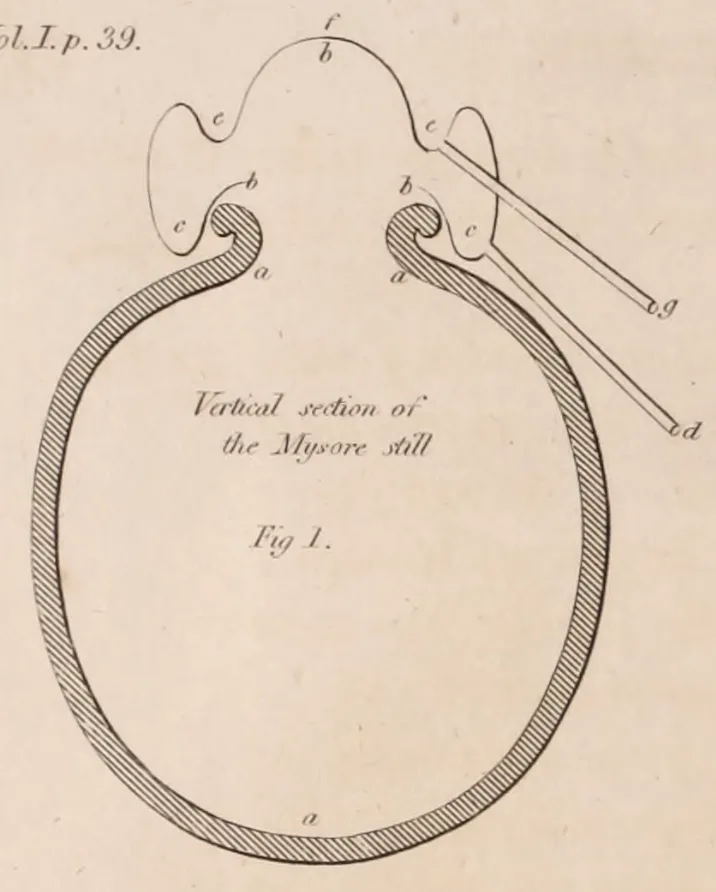
In the evening I went to the house of a distiller of country rum, in order to examine his process. The bark of the Mimosa leucophlea Roxb: is considered as a necessary ingredient. This tree grows commonly in the country, and is called Cari Jaly in the Canarese, Nella tumica in the Telinga, and Caru velun in the Tamul. The bark is dried, and cut into chips, of which about four pounds are added to one maund (24¼ lb.) of sugar-cane Jagory, with a quantity of water equal to about twice the bulk of this sweet substance. The mixture is made in an earthen jar, which is kept in the shade, and the fermentation commences in about twenty-four hours. It is completed on the twelfth day; when the liquor is distilled by the following apparatus (see Plate II. Fig. 1.). The body of the still (a a a) is a strong earthen jar, capable of containing three times the bulk of the materials. On this is luted, with cow dung, a copper head (b b b), having on the inside a gutter (c c) for collecting the vapour that has been condensed into spirit by a constant small stream of water, which falls on the head at (f). This water is conveyed away by the pipe (g), while the spirit is conducted into a jar by the pipe (d). The mode of condensing the spirit is very rude; and the liquor, which is never rectified by a second distillation, is execrable. The natives allege that the bark, which is very insipid to the taste, is useful, by diminishing the too great sweetness of the Jagory. To me, however, it appears to be rather of use by regulating the fermentation; which, in such a warm climate, would be apt to run suddenly into the acetous.
May 8th.—I was obliged to halt this day at Waluru, in order to give rest both to my people and cattle. At this place there is a weekly fair; and to-day one was kept, to which people flocked in great numbers from all the neighbouring country. It is in the larger towns only of the Mysore dominions, that weekly fairs are held ; there are here none of those small markets called Hauts, which are so much frequented in Bengal, and are such a waste of time to its inhabitants. A small duty is levied on all persons frequenting this fair, bearing a certain proportion to the value that each brings for sale. It does not seem to be considered as burthensome. The articles exposed for sale to-day were provisions of all kinds, coarse cotton cloths, blankets or cumlies, iron work for country uses, and the like.
The chief manufacture of Waluru is cotton cloth ; and the weavers work both for country use, and for exportation. The coarse cloths for the former purpose, they sell at the weekly fairs. The finer kinds they either weave on their own account, selling them to traders at the same places ; or they receive advances from merchants to enable them to purchase thread. On exportation from hence, each bullock load of cloth pays a duty of one Sultany fanam, or a little more than eight pence. Their cloth must be cheap, as during the Sultan's reign much of it was smuggled out of the country ; for he strictly prohibited all trade with the lower Carnatic. The merchants of Wallajah petta sent up some European goods, spiceries, and other commodities ; and, in return, took back cloths, which they sold at Madras. At present, of course, the trade is free, and European goods are sold openly in the market.
The cotton raised in the country is not sufficient for its manufactures ; the people here get it from Hossocotay, and pay a small duty on every bullock load that enters. At Hossocotay it is said to pay heavier duties, and is brought there from the northward.
In the neighbouring villages many coarse blankets, or cumlies, are woven from the wool which the country produces. When offered for sale, they are almost as hard as pasteboard ; but this quality is given to them by a decoction of the kernels of the tamarind, and is intirely removed by the first washing. They seem to be an article of dress in almost universal use above the Ghats or passes, and the families of the weavers may be readily distinguished by their wearing no linen. The sheep are shorn twice a year, once in the cold, and once in the rainy season; and twelve sheep give as much wool, as makes a blanket six cubits long and three wide.
In this neighbourhood are many kitchen gardens, which are very well cultivated. A gardener is here a separate profession from a farmer, and is considered as inferior in rank. The gardens are on sloping ground, watered from wells by the Yatam, or, as the English say, by the Pacota. This is reckoned hard labour; and a man who works constantly at the Yatam, receives daily a quarter of a rupee, or about 6½ pence. These gardeners cultivate a little sugar-cane, but merely to supply the market with cane for eating. All that, of which Jagory is made, is raised on irrigated lands by the farmers. The gardeners frequently cultivate the betel leaf, (Piper Betle L.) and for that purpose hire from the farmers a portion of their watered lands.
The soil of the gardens here is very deep; as, where wells have been dug, it exceeds twenty feet in thickness.
May 9th.—I went to Catcolli through a country containing much less granite than any that I have yet seen above the Ghats. The arable land may amount to seven tenths of the whole, and perhaps a twentieth part of it is watered. The rice lands are mostly situated near the banks of the southern Pennar, or Dakshana Pinakani, as it is called in the Sanscrit language. This river passes southward by the east side of Catcolli. At present it contains a good deal of stagnant water; but in the rainy season its current is rapid, and it is frequently not fordable. The waste land contains much low brush wood, in some places intermixed with stunted Mimosas. The hedges surrounding the villages, in this part of the country, rise very high and thick, so as almost entirely to conceal the mud wall, which enlivens the prospect considerably, especially as at the villages there are a good many mango trees. The planting of these, or other fruit trees, is here attended with a considerable expense ; as every young tree is surrounded by a mud wall, three or four feet high, and perhaps twenty in diameter ; and in the dry season the plant requires to be watered, every second or third day, for three years.
There having now been several showers, the soil has been softened, and the farmers are busy ploughing their dry-fields. Their plough, and manner of working, resemble those of Bengal. Both oxen and buffaloes are used, and frequently an animal of each kind is yoked in the same plough. This strongly marks a deficiency of stock ; the two animals, from their different paces, being very ill suited to work together. Before the field is ploughed, it is manured with a compost of cow dung, ashes, and mud. The manure is carried out by the women, in baskets placed on their heads, and is distributed very scantily, the baskets being emptied at the distance of about thirty feet from each other.
All the way between Arcot and this place I have frequently observed strata of gneiss, consisting of the same materials with the common grey granite of the country, and disposed in vertical strata. Under the great tank here is a remarkable bed of it, consisting of rough grains, and divisible into laminæ from one quarter to one inch thick ; and these are united into strata from one to two feet wide. These strata run by the compass north and south ; and are intermixed with others of hornblende-slate, interspersed with small grains of white quartz, which thus compose a granitell. These strata, as are also those of the grey granite throughout the country, are intersected nearly at right angles by veins of quartz, often a foot and a half wide. These veins cross the various strata of granite, gneiss, and hornblende, to great lengths, without altering their direction ; they frequently also contain felspar, or felspar and quartz intermixed, as is the case at Catcolli, where the veins are filled with a mixture of reddish felspar and quartz ; which, if not venigenous, would form a granitell. It has commonly been alleged, that large veins of these materials denote a country to be productive of gems; but the contrary is the case here, no precious stones having been ever found in Mysore. It must be observed, that among the natives the gneiss and grey granite are called white-stone; and the hornblende-slate with quartz, and the quartz impregnated with iron, which I have before mentioned, are called the black-stone; in fact these are found to approach to each other by such gradual shades, that it seems difficult to distinguish them, at least as genera; yet in many cases the two extremes of each kind are so different, that they have very little resemblance to each other.
In the soil of this country are found two varieties of congcar, or calcarious nodules. The nodules are often as large as a man’s head, are very irregular in shape, and frequently perforated with holes, apparently from having been formed round the roots of plants. Outwardly they have an earthy resemblance, although in some parts there is an appearance of irregular crystallization. They are very hard with a splintery fracture. Both dissolve readily, and with a strong effervescence, in the muriatic acid; but deposite a fine sand, that is insoluble. The solution contains iron, and their specific gravity is very considerable. The one is externally of a greyish white; but its fracture has a dull purplish brown tinge, intermixed with shining particles, arising from its texture, which is a mixture of compact and sparry. Its fracture is splintery; and it is opake. The scratch is of a colour similar to that of the stone, which is hardish. Its lustre is common. The sand which it contains seems to be quartz, stained of a rust colour by iron. The other variety has, both externally and internally, a darker colour, and it has more numerous and larger sparry concretions. On breaking it, are discovered many irregular cavities lined with small, white, irregular crystallizations. It contains many black dots, probably fragments of shorl.
There can be little doubt, that these nodules have been formed by a deposition from water, and are therefore a tophus, or calcarious tuffa. I have already stated, that they appear to be the Calcareus æquabilis incarnatus of Wallerius, or Marmor margaceum of Linnæus. Mr. Kirwan would probably call them silicious marlites. The small pieces of quartz have evidently been involved by the calcarious matter, while that was in the act of deposition.
The burning of these calcarious nodules into quicklime, which they produce of a beautiful white colour, is at Catcolli the occupation of about ten families. The stones are brought from a distance of five miles; some on oxen, but the greater part on men's heads. The lime is burned in kilns about six feet high; at the bottom about four feet, and at the top about two feet in diameter. The structure is of mud wall; and, in order to give admission to the air, it is perforated in many places through its whole height. The fewel used is charcoal, the making of which is the duty of the men, and the bringing it home that of the women.
May 10th.—In the morning I travelled from Catcolli to Bangalore, through a very naked country, of which about six tenths appear to be arable. The remainder is covered with low bushes, and much of it seems capable of being brought into cultivation. Not above a twentieth part of the arable ground is watered. The pasture is rather better than any that I have seen above the Ghats, and the cattle are in rather better condition than those in Bengal are at this season, when they are reduced to the lowest state of wretchedness compatible with existence.
The morning being cool and pleasant, I walked through the ruins of the Fort of Bangalore, which was constructed by Hyder after the best fashion of Mussulman military architecture; and which was destroyed by his son, after he found how little it was fitted to resist British valour. The entrance toward the Petta, or town, is a very handsome building of cut granite, and was probably considered by the defenders as the strongest part of the works. It certainly would have been a very difficult matter to have forced a way through all the various gateways in this entrance; as the troops, after having forced one gate, would have been exposed to a fire from all quarters before they could have reached another. But there are no ditches between the different gates, nor even without the outer one; and, if the enemy obtained possession of the works above the first gateway, they had a ready communication with all the others; as our troops found when they stormed the place, which they did at this part of the works. In the buildings of this entrance is a dungeon, amply provided with all the horrors that usually attend such places.
The garrison contained well constructed magazines, and many huts for the accommodation of the troops; but no good building, except the mahal or palace. Although this is composed of mud, it is not without some degree of magnificence. On the upper story, it contains four halls, each comprising two balconies of state for the prince, and each balcony faces a different Cutchery, or court for giving audience. No persons, except a few trusty guards, were admitted into the hall with the Sultán: but at each end of the court was erected a balcony for the officers of the highest rank. The inferior officers occupied a hall under the balcony of the prince, open in front, and supported by columns as high as the roof of the upper story. The populace were admitted into the open court, in which there were fountains for cooling the air. At each end of the halls are private apartments, small, mean, and inconve nient. The public rooms are neatly painted, and ornamented with false gilding. The offices are mean; and the bath consists of a small room, in which a person may sit, and have water poured over him. The same bath seems to have served both the prince and his women, as it communicates with their apartments by a small court, which contains the huts that served for kitchens, and for lodging the female slaves. There were two apartments for the ladies. One, for the principal wife, contains a cutchery, where, like the Sultán she gave audience to the concubines, and to the ladies of the Mussulman chiefs. The other apartment belonged to the concubines. It is a square court, having at two of the sides a corridor, under which the women sat at their meals and amusements. Behind the corridor are their sleeping rooms, which are mean, and dark, being about twelve feet square, and without any air or light, but what is admitted by the door, or in some by a hole about a foot wide. Lowness of roof is a fault prevailing over the whole structure. Before the palace is a large square court fronted by the Nóbat Khána, or station for the band of music, and surrounded by a fine corridor. The palace lately served the officers of a European regiment for quarters, while the privates were lodged in the corridor.
In the centre of the fort are still visible the ruins of the mud wall, that surrounded the small village, which occupied the place before Hyder founded the city.
11th May.—I visited the gardens made by the late Mussulman princes, Hyder and Tippoo. They are extensive, and divided into square plots separated by walks, the sides of which are ornamented with fine cypress trees. The plots are filled with fruit trees, and pot-herbs. The Mussulman fashion is to have a separate piece of ground alloted for each kind of plant. Thus one plot is entirely filled with rose trees, another with pomegranates, and so forth. The walks are not gravelled, and the cultivation of the whole is rather slovenly; but the people say, that formerly the gardens were well kept. Want of water is the principal defect of these gardens; for in this arid country every thing, during the dry season, must be artificially watered. The garden of Tippoo is supplied from three wells, the water of which is raised by the Capily, or leather-bag, fastened to a cord passing over a pulley, and wrought by a pair of bullocks, which descend an inclined plane. This, the workmen say, is a much more effectual machine than the Yatam. Hyder's garden is watered from a reservoir, without the assistance of machinery. The taste of Hyder accorded more with the English, than that of his son. His walks are wider, his cypress trees are not so much crowded; and in the means for watering the plots there is not so much masonry, or bricklayer's work, employed. There is, indeed, so much of these in the parts of Tippoo's garden which he probably considered the finest, as almost to cover the ground, and to leave nothing but holes, as it were, through which the trees grow.
In this climate the cypress and vine grow luxuriantly, and the apple and peach both produce fruit; the former much better, and the latter much worse than at Calcutta. Some pine and oak plants, lately introduced from the Cape of Good Hope, seem to be thriving. I think there can be little doubt, but that in this country all the valuable plants of the Levant would succeed. The people at the gardens could form no estimate of the quantity of grapes produced by any number of vines.
At Bangalore there are many Mussulmans; and, owing to the change of government, they are in great distress. Accustomed to a military life, they do not readily enter into civil occupations, nor are they willing to attach themselves to the military service of the enemies of their late Sultán. Many of the more wealthy among them, however, are now betaking themselves to trade, and the poorer sort are gaining a livelihood by agriculture.
I was much surprised to hear, that the greatest complainers against the change of government are certain Bráhmans; although, by the fall of Tippoo, this cast has been freed from persecution, and is now in the almost exclusive possession of public offices. But it is alleged, that under the government of Tippoo, the persecutions fell chiefly on the Bráhmans attached to temples, who are considered as low men; while the Lókika, being the only men of business in the country, were in full possession of the revenue department. During the reign of the Sultán, the number of petty officers in this department was immense, and every one was permitted to share in the spoil of the country. The present system is, to reduce the number of officers, and to give to those who are employed allowances that ought to put them above temptation; while a strict watch at the head of affairs renders it very dangerous either to injure the revenue, or the subject. By this system many Bráhmans, formerly employed, are now destitute, and are said to be very clamorous.
I saw here a man labouring under the Durda, Elephantiasis, or Lepra Arabum; and am told, that in almost every village one or two persons will be found afflicted with this terrible malady. It is very much confined to the poorer class of inhabitants, who here, however, enjoy a dry air, and use very little fish in their food. The frequency of the disease in the lower parts of Bengal, and about Cochin on the coast of Malabar, had led to an opinion, that it was produced by a moist climate, and a diet consisting of the fish which frequent muddy places: but the prevalence of the disease among the dry hills of Mysore strongly invalidates this opinion, especially as fish are little used by the inhabitants of that country.
Above the Ghats the Kusht'ha, or leprosy, in which the skin of the natives becomes white, is also very common. The persons troubled with it enjoy, in every respect, good health, and their children are like those of other people.
12th May.—I went to Kingara, or Tingara, which seems to have formerly been much more flourishing than it is at present. The hedges, and other defences of the town, are of much greater extent than would be necessary for the present population; and the space within them contains the ruins of many houses. It is said to have been destroyed by Tippoo in order to prevent it from being of use to Lord Cornwallis, and never to have recovered the loss which it then sustained. The inhabitants were very inhospitable; a Bráhman encouraging them to refuse us any assistance, by pretending that my people would not pay for what they might obtain. The fort is in good condition.
The arable land on this day's route does not appear ever to have exceeded four tenths of the country; and the small proportion of irrigated land which has formerly been cultivated, appears to be now waste, owing to the decay of the reservoirs. The uncultivated land is more hilly than any between the Ghats and Bangalore. It is very rocky and bare, and does not contain even copse wood. Some part of our route led by the banks of a small river, which contained a little running water.
It is here alleged, that Tippoo's regulations, prohibiting trade to the dominions of the Nabob of Arcot, were very ill observed, and that passports were privately given to traders by the principal officers of government. The Sultan's table was served with country salt, and his nobles attended the court in their native manufactures; but, among the rich at home, sea-salt, and the cloths of Europe, Bengal, and Madras, were in constant use.
13th May.—Went to Wiridy, or Biridy, a place which derives its name from the tree so called in the Karnataca language, and which is either the same, or very nearly resembles, the Pterocarpus Sissoo of Dr. Roxburgh. The country through which I passed is one continued copse: but, as at Wiridy, there is a valley about a mile wide, and as there are some small villages scattered in the woods, I calculate the arable part of the country at about a sixth part. I observed no watered land.
There are, indeed, some small reservoirs; but the water contained in these, is destined merely to supply the cattle with drink. A small reservoir of this kind in the Karnataca language is called Cuttay, as the large ones for watering the lands are called Carays. They are both formed exactly in the same manner, by building a mound or dam, of earth and stone, across a hollow ground. Large reservoirs, or Carays, might no doubt be formed every where in a hilly country; but, where there is not a sufficient extent of level land with a good soil for the cultivation of rice, the expense of such works would far exceed the profits.
The uncultivated land is very hilly, and in many places rocky; yet some of it seems capable of being rendered arable. Except for fewel, the wood is of very little use, as it is in general too small for planks, or beams. Tigers are very numerous among the copse; a circumstance, however, which does not prevent the inhabitants from sending their cattle into it. A beast is occasionally lost; but this loss is compensated by the abundance of grass. The woods here are not impenetrable, like those of Chittagong, where a luxuriant growth of rattans, and climbers of numerous kinds, prevents all ingress. Here every thing is stunted, and the trees serve to render the grass better, by sheltering it from the sun.
From the hilly nature of the surrounding country, both Kingara and Wiridy are considered as very unhealthy. Fevers, want of appetite, and pains in the bowels, are very common, even among the natives.
The country about Wiridy is beautiful. A small river runs north and south through the valley, which is about a mile wide, and extends far in the direction of the river. It consists of fields, swelling like the grounds in Kent, and contains many scattered trees, mangoes (mangifera), banyans (Ficus bengalensis), and the like. It is on all sides surrounded by hills, most of them covered with wood, but some rising into bare rocky peaks. If the rivulet were adequate to the other parts of the view, this would be complete; but at present it contains only small pools of dirty stagnant water.
The villages are small and poor, and are not fortified like the others in the country; the woods, by which they are surrounded, having probably been sufficient to keep off the irregular troops that attend all Indian armies, and which generally are cavalry. In case of invasion, the inhabitants have also been accustomed to take refuge in the neighbouring hill-fort called Ramagiri.
The strata throughout these hills, as well as in the country between them and the eastern Ghats, are disposed about north and south, by the compass, and are all nearly vertical. A very common stratum here is white quartz running parallel to the gneiss, and disposed between two strata of that rock. I have observed these strata of quartz three feet thick.
In my evening walk the following plants were shewn to me in the woods as being useful. The names are Karnataca. 1. Mara halay, Nerium tinctorium, Rox. Grows sometimes to a large tree, and is used for planks.
2. Mara Harulu, Iatropha Curcas, Lin. From the seed of this shrub, oil for the lamp is extracted, by the following process. Parch the seed in an earthen pot, then bruise it, and put the powder in boiling water for three hours. The oil then rises to the surface, and is removed by skimming. This oil being much used by the poor, the plant is frequently raised in the hedges near villages; but it is also found wild in almost every copse, especially near the banks of torrents.
3. Alaygara, Terminalia myrobalana citrina of Koenig. The fruit is used in medicine, and as a pickle.
4. Dévadárum, Erythroxylon sideroxyloides of Lamarck. It grows to a considerable size, and its timber is black and odorous, serving the inhabitants who are poor in place of sandal wood. It seems to be a tree that deserves particular notice.
5. Sri Gunda Chica, Santalum album, Lin. Grows in the woods towards Chinapatam. It is never planted, but springs up spontaneously. No person is allowed to cut it, without permission from the Amildar, or officer, who sells it on account of the Circar, or government.
6. Wotu, Loranthus falcatus, Lin. The bark of this beautiful parasitical shrub is used by the poorer natives in place of the betel-nut. With quicklime it tinges the saliva and mouth of a fine red, brighter even than that communicated by the Areca. The bark of the Sandal-wood-tree serves the same purpose.
7. Easy, Premna tomentosa, Willd. Makes beams and planks, with posts of a bad quality.
8. Ha-Shi-cai, Mimosa pennata. Is a favourite food of the long-legged goat of this country.
9. Cacay, Cassia fistula, Lin. This is the greatest ornament of the woods of Karnáta. The foliage is a fine shining green; and the pendulous strings of flowers surpass those of the Laburnum, not only in beauty, but in length and number. In the cool of the morning they diffuse a most agreeable perfume. The plant is sacred to Ganeswara, the god that is addressed by all those who are about to commence any undertaking; as he is considered to be the Power that hinders or stops all human efforts, in the same manner as his father Iswara is the Power that deprives all beings of life. The people here, instead of addressing themselves immediately to the god, worship him under the form of his favourite tree. At this season, the cultivators of every village place a stake of the Cacay in the ground, level a circular space round it, and purify this area with cow-dung. On this spot they assemble before the commencement of seed-time, burn some incense before the stake, make offerings of rice, milk, and the like, and pray that it will not prevent the success of their crops. The ceremony concludes with a rural feast.
In both the upper and lower Carnatics, taking snuff is much more common than in Bengal: indeed, I have never been in a country where the custom was more prevalent. Smoking, on the contrary, is in great disrepute. The Hooka is totally unknown, except among Mussulmans. The lower classes smoke Cheruts, or tobacco rolled up in a leaf; but a Bráhman would lose cast by such a practice, and it is not considered as becoming, even among the richer part of the Súdra tribe.
14th May.—I went to Chinapatam, or Chinapatana, through a very beautiful country, consisting of swelling grounds, in some places cultivated, and in many more covered with trees, which are intermixed with steep fantastic rocks and hills. The trees here are by far the finest that I have seen in either Carnatic, although they fall very short of the stately forests of Chittagong. In these woods the bamboo is common. It is now in flower, and produces a great quantity of grain, which is gathered for food by the poor inhabitants of the neighbourhood. The cultivation is said to extend but a short distance from the road, there being on either hand extensive woods. I therefore reckon the arable land, on this day's route, at one tenth of the country. It consists entirely of dry-fields.
At a small temple, dedicated to Hanumanta, I observed, for the first time, the rock of red granite. It is a handsome variety, consisting of bright red felspar, a small quantity of glassy quartz, and a very minute proportion of black mica. I had before seen many detached masses of it in buildings ; so that it is probably common in the country. It is a most elegant stone.
Chinapatam, or Chinapatana, is an open town, containing about a thousand houses. At some distance from it stands a handsome stone fort : this was formerly the residence of a Polygar family of distinction, which derived its name from Jacadéva Raia.
The Cutwal, or superintendent of the market at Chinapatam, is a Mussulman, and is extremely attentive to strangers. This, however, does not proceed from any principle of hospitality, a virtue which seems little known in India. He expects a present in return, and charges three times the usual price for every thing that he furnishes. Between this and Madras I have met with two other native officers that were civil. One of these was a eunuch, the Cutwal at Satghur in the dominions of the Nabob of Arcot; but he seemed to be actuated by the same motives with the Cutwal of Chinapatam. The other was a Bráhman, the Amildar at Waluru, who was very polite, and did not seem to have any sinister design. Among all the other officers of government, I found that any attention to a traveller was considered as degrading to their rank, and could only be extorted by authority.
In sight of Chinapatam, but at a considerable distance, is Capála durga, one of the places to which Tippoo sent those unfortunate wretches who incurred his displeasure. It is a fort situated on a high steep rock. Death soon terminated the sufferings of those confined in it ; for the air and water were extremely bad ; and the wells were frequently rendered more loathsome and pernicious, by having purposely thrown into them the branches of Euphorbium, and dead snakes, or other reptiles, in order to increase the putrefaction. It is said, that no native prisoner ever returned to detail the horrors of this dungeon.
15th May.—I went to Muduru. All the country seems to have been arable, except on some high land that separates the two districts of Chinapatam and Muduru. This high land is not in general too steep for the plough, and some parts of it have been cultivated; but much of it remains entirely in a state of nature, and is covered with brushwood. There are a few small conical hills, and large masses of naked granite. The arable land, on this day's journey, I estimate at three quarters of the whole country. The plantations of palm and fruit trees are pretty extensive, and the watered grounds perhaps amount to a tenth part of the arable lands. Many of the fields are surrounded by hedges; but these are not kept in such repair as to be fences against cattle. Perhaps they are meant merely to distinguish the fields of different proprietors, or tenants, and to contain the Agave vivipara, and Iatropha curcas, that are wanted for the use of the country, and of which they chiefly consist.
Among the waste lands there are many parts that seem capable of being rendered arable. In several places the Phœnix farinifera, Roxb: abounds; and intermixed with it, the Elate sylvestris, or wild date. From this the inhabitants extract Tári, or Toddy, in the same manner as is practised in Bengal. Here the Tári is used for drinking only; but in some places, where it is more plenty, it is boiled down into a hard substance called Jagory, which by the poor is substituted in place of the Jagory extracted from the sugar-cane.
There have been this season two considerable falls of rain, which have enabled the inhabitants to plough a great deal, and the country to assume some degree of verdure. A river passes this place, which in the rainy season is considerable, and now contains a small quantity of clear running water. Here is also a large reservoir, which some years ago was broken down, and has not yet been repaired: but 2000 Cantery Pagodas (Canter'raia Varaha) (671l. 11s. 2d.) have now been granted for the purpose; and it is supposed, that, when completed, it will supply the rice grounds in the bottom of the valley for seven miles in length.
The oppressions of Tippoo and the miseries of war are said to have driven away four tenths of the cultivators. That tyrant received the country in a very flourishing state from his father, of whom every native that I have conversed with on the subject speaks in terms of the highest respect.
As we approach the capital, I think the style of building becomes somewhat better. The houses, although in other respects equally mean, have in general small Verandas, or open galleries, in front, to shelter from the sun their shops and their customers. The villages are not fortified, the vicinity of the capital having been a sufficient security against marauders.
Near Muduru are the ruins of a stone fort, containing a temple of Vishnu, and the houses of several Bráhmans. This fort was built by the grandfather of the present Rájá of Mysore, and destroyed by the late Sultan with great propriety; for it could make no resistance against a European army, but might serve as a protection to their convoys; at the same time, it was burthensome, by being much stronger than was necessary for protecting the town against plundering parties of native cavalry.
It must be observed, that throughout both Carnatics, except at Madras, and some other large towns under the government of infidels, the Bráhmans appropriate to themselves a particular quarter of every town, and that generally the best fortified. A Súdra is not permitted to dwell in the same street with a Bráhman; while he again exacts the same difference from the Whalliaru or Parriars, and other low casts. These people in general live in wretched huts about the suburbs. A Bráhman is considered as polluted by merely walking through such a place.
Although the Nerium odorum is very common by the sides of rivers in most parts of the Mysore dominions, I found a garden here, of about an acre in extent, which was planted with nothing else. The flowers are dedicated to the temple, and a garland-maker is paid by a merchant to gather them for the use of the god. This is one of the deeds called charity by the Hindus. This plant has usually been taken for the oleander, which, I believe, is not a native of India.
16th May.—I went to Mundium, through a country free from hills, but of which not more than one half is arable. Much of it, however, might be rendered so without difficulty. The soil is in general poor. The waste land is occupied by brushwood, and many places are covered with the Phœnix farinifera, Roxb. among which are some trees of the wild date.
It is reported, that this tree was formerly very common; but Tippoo, observing that his subjects frequently intoxicated themselves with the Tári, ordered the whole to be cut down; and in places near the capital the order was enforced.
This prince is said to have attempted to introduce a great strictness of manners; absolutely prohibiting the use of all spiritous liquors, and ordering that no loose women should be tolerated. He was himself, however, unreasonably addicted to women; and the Bráhmans here allege, that he sometimes forced away the most beautiful of their daughters. After some detention in the Zenana, if he did not like them, he sent the girls back to their fathers, who, in general, refused to admit them into their families. But Tippoo was not to be treated in this manner with impunity. On such occasions, he sent for the father, took from him all his property, and flogged him severely. He then ordered the girl to point out any Bráhman for a husband, and the unfortunate man was flogged until he gave his consent. A loss of cast, of course, ensued; but the husband commonly fled out of Tippoo’s dominions, leaving his wife behind, to want, or prostitution. On going to another place, and turning away his unclean wife, he could get an absolution from his Guru, with permission to marry again.
The hedges here, like those which I saw yesterday, are very bad fences, and are made of the Euphorbium antiquorum. When the ground is sown, the farmers fill up the gaps with thorns cut from the Mimosa indica of Lamarck. This tree is allowed to grow promiscuously through the fields, and its branches are lopped off for fewel, and for repairing the fences. Its shade does not injure the crops, and its timber is valuable for making ploughs, and other instruments of agriculture.
Mundium is a poor village, fortified by a mud wall that has been rebuilt since the restoration of the Rája’s government. It was formerly an Agrarum, or village bestowed in charity on the Bráhmans. They were deprived of it by Tippoo, when he annexed to the Circar or public, all the property of that kind.
In the evening a flight of locusts passed over the town. It extended in length probably about three miles; its width was about a hundred yards, and its height fifty feet. The insects passed from west to east in the direction of the wind, at the rate of six or seven miles an hour. The whole ground, and every tree and bush, was covered with them; but each individual halted for a very short time on any one spot. They went in a very close body, and left behind them very few stragglers. In an hour after the flock had passed, few were to be discovered in the neighbourhood of the town. The stragglers from the grand body did not extend above a hundred yards on each side of it, and were perhaps not more than one to the cubic foot. In the middle of the flock four times that number must be allowed to the same space. I could not perceive, that in their passage they did the smallest damage to any vegetable; but I was informed, that last year a flock passed, when the crop of Iola (Holcus Sorghum) was young, and had entirely devoured it. The noise of this immense number of insects somewhat resembled the sound of a cataract. At a distance they appeared like a long, narrow, red cloud near the horizon, which was continually varying its shape. The locusts were as large as a man’s finger, and of a reddish colour. Some of them I put into a box, intending next day to examine them ; but in the course of the night they were devoured by the ants.
17th May.—In the evening I went from Mundium to the banks of the Cávery (Kavari), opposite to Seringapatam. For one half of the way the country is almost entirely free from rocks, or waste lands. Here I observed a space of about fifty yards in diameter, consisting entirely of a denudated rock of very white glassy quartz. There was no other rock near it. The quartz separates into fragments of a rhomboidal form, from the size of an orange, to that of a man’s head ; but those are all disposed in strata, every six or eight inches of rock separating, with a clean straight surface, from the similar parts on either hand. These strata are vertical ; but, contrary to all the others that I have seen in the country, run nearly east and west.
About half way to Seringapatam I arrived at a hilly country that reaches very near to the Cávery. On the south side of these hills Lord Cornwallis encamped, before the final engagement which gave him possession of the island. His marches from Bangalore may every where be traced by the bones of cattle, thousands of which perished through fatigue and hunger. The road among these hills is no where steep, as it leads over a part of the ridge that is not high ; but towards the west are numerous small mountains. Many parts of these hills are cultivated ; but much more is incapable of ever becoming arable. The whole is stony, and the barest country that I have ever seen. From ascending the ridge, until reaching the Cávery, one can hardly find a bush sufficiently large to make a broom. Of the country in this day’s route perhaps seven tenths are arable, and of these a fifth at least produces wet crops. Many of the tanks however are ruinous, and their beds are now cultivated with Iola, or Holcus Sorghum.
The strata on these hills are various. I saw red granitic porphyry, and took specimens of a fine-grained gneiss consisting of pale red felspar, white quartz, and black mica. The most common rock, however, is the hornblende slate with quartz, which I have before mentioned. When exposed to the air in large high masses, so as to prevent the water from lodging on it, the pieces decay into fragments of a rhomboidal form ; but, when exposed to the air on a level with the ground, so as to be penetrated by the rain water, it divides into thin laminæ, like common schistus.