MAY 18th, I was employed at Seringapatam in delivering my credentials.
19th May.—I had an interview with Purnea, the Dewan of the Mysore Rája, and, during that prince’s minority, the chief administrator of his government. By means of Colonel Close, I have received assurances of every assistance in forwarding the objects of my mission; and a Bráhman has been appointed to accompany me, with orders to call upon every person that I shall desire for information.
Purnea is a Bráhman of the Madual sect, and descended from a family of the Coimbetore country. His native language is, of course, Tamul; but he speaks the Karnataca, Mussulman, Marattah, and I believe the Persian. He is said, by good judges, to be a person extremely well versed in the affairs of the country, and is much more active than Bráhmans in general are. By the inhabitants he is now called Srí Mantra, the same title that is given to the Peshwa at Poonah. It is said to signify a person who has been fortunate from the time of his having been in the womb. Next to Meer Saduc, he seems to have enjoyed a greater power, under the late Sultan, than any other person; but his authority was greatly inferior to that of the above-mentioned favourite; and he is said to have been in no small danger from the bigotry of his master. The Sultan is reported to have once proposed to Purnea to become a convert to the faith of Mahomet: as all proposals from a Sultan are tantamount to orders that must be obeyed, the Bráhman replied, “I am your slave,” and immediately retired. Those who knew the man, and especially the Sultan's mother, a very respectable lady, represented to that prince, how dangerous such a proceeding was, and that, if persisted in, it would throw every thing into confusion; for the apparent acquiescence of Purnea was merely words of course, and his influence among the people was considerable. Tippoo very properly allowed the affair to rest, and nothing more was said on the subject.
From the 20th of May, to the 5th of June, I was employed in visiting every thing remarkable in Seringapatam and its neighbourhood, and in taking an account of the state of agriculture, arts, and commerce at that place.
Seringapatam, as is well known, is situated at the upper end of an island surrounded by the Cávery, which is here a large and rapid river, with a very extensive channel, filled with rocks, and fragments of granite. At this season it is in many places fordable with facility; but during the rains it rises very high, to the great inconvenience of the inhabitants. On the south branch of the river a bridge has been erected, which serves also as an aqueduct, to convey from the upper part of the river a large canal of water into the town and island. The rudeness of this bridge will show the small progress that the arts have made in Mysore. Square pillars of granite are cut from the rock, of a sufficient height to rise above the water at the highest floods. These are placed upright in rows, as long as the intended width of the bridge, and distant about ten feet from each other. They are secured at the bottom by being let into the solid rock, and their tops being cut to a level, a long stone is laid upon each row. Above these longitudinal stones others are placed contiguous to each other, and stretching from row to row, in the direction of the length of the bridge. The whole breadth of this may be twenty feet. One half is occupied by the aqueduct, which is secured at the bottom and on both sides by brick and plaster. The road is laid with gravel, and secured by a parapet wall on one side, and by the aqueduct on the other. But, however rude such a bridge may be, it is of most essential convenience to the town, and to the inhabitants of the southern bank of the river, though the construction is attended with great expense. The inconveniencies felt from the want of a bridge on the northern branch are so great, that both Purnea and the Resident are very anxious to have one erected; but on an estimate being formed, it is found, that even without an aqueduct, a rude bridge of this kind would cost 16,000 Canter'raia Pagodas, or 5,372l. 9s. 4d. It is very fairly proposed, that the Company should defray one half of this, as lords of the island; while the Rája should defray the other half, on account of the advantages to be derived by his subjects on the north side of the river.
Seringapatam is commonly called Patana, or Patan, that is to say, the city; but the name used in our maps is a corruption from Srí Ranga Patana, the city of Srí Ranga, from its containing a temple dedicated to Vishnu under that name. The temple is of great celebrity, and of much higher antiquity than the city, which did not rise to be of importance until the time of the princes of the Mysore dynasty.
The island is about three miles in length, and one in breadth, and has a most dreary, ugly appearance; for naked rock, and dirty mud walls are its predominant features. The fort or city of Srí Ranga, occupies its upper end, and is an immense, unfinished, unsightly, and injudicious mass of building. Tippoo seems to have had too high an opinion of his own skill to have consulted the French who were about him; and adhered to the old Indian style of fortification, labouring to make the place strong by heaping walls and cavaliers one above the other. He was also very diligent in cutting ditches through the granite; but, as he had always on hand more projects than his finances were adequate to defray, he never finished any work. He retained the long straight walls and square bastions of the Hindus; and his glacis was in many parts so high and steep, as to shelter an assailant from the fire of the ramparts. In the island also, in order to water a garden, he had dug a deep canal parallel to the works of the fort, and not above eight hundred yards distant from them. He was so unskilled, as to look upon this as an additional security to the place; but had it been deemed necessary to besiege the town regularly from the island, the assailant would have found it of the utmost use. Had Tippoo’s troops been capable of defending the place properly, this mode of attack would have been necessary; but the confidence which our officers justly reposed in the superiority of their men, and the extreme difficulty of bringing up the immense stores necessary to batter down many heavy works, made them prefer an attack across the river, where the works were not so strong, and where they ventured on storming a breach, that nothing, but a very great difference between the intrepidity of the assailants and defendants, could have enabled them to carry. The depth of the river was of little importance; but the assailants, in passing over its rocky channel, were exposed to a heavy fire of artillery, and suffered considerable loss.
On ascending the breach, our men found an inner rampart lined with troops, separated from them by a wide and deep ditch, and defended at its angle by a high cavalier. By this they were for a little while discouraged; as, from the information of spies, they had expected to have been able to mount the cavalier from the breach, and to form a lodgement there, till means could be taken to gain the inner works, and expel the garrison, which consisted of about eight thousand men, nearly the same number with that employed on the storming party.
After, however, the first surprise occasioned by this disappointment, the troops soon recovered their spirits, and pushed on, along the outer rampart, towards both the right and left of the breach. Those who went to the left found great opposition. At every twenty or thirty yards distance, the rampart was crossed by traverses, and these were defended by the Sultan in person. The loss of men here was considerable; but the English troops gradually advanced, and the Sultan retired slowly, defending his ground with obstinacy.
The enfilading fire from the Bombay army, on the north side of the river, had been so strong, that the defendants had been entirely driven from the ramparts on the right of the breach, and had been prevented from raising any traverses. Our people who went in that direction did not meet with the smallest opposition; and the flank companies of the 12th regiment, having found a passage across the inner ditch, passed through the town to attack the rear of the enemy, who were still opposing the Europeans on the left. The Sultan had now been driven back to the eastward of the palace, and is said to have had his horse shot under him. He might certainly have gone out at a gate leading to the north branch of the river, and nothing could have prevented him from crossing that, and joining his cavalry, which, under the command of his son Futty Hyder, and of Purnea, were hovering round the Bombay army. Fortunately, he decided upon going into the inner fort, by a narrow sally-port; and, as he was attempting to do so, he was met by the crowd flying from the flank companies of the 12th regiment; while the troops, coming up behind, cut off all means of retreat. Both parties seem to have fired into the gateway, and some of the Europeans must have passed through with the bayonet; as a wound, evidently inflicted by that weapon, was discovered in the arm of the Sultan. His object in going into this gateway, is disputed. The Hindus universally think, that, finding the place taken, he was going to the palace to put all his family to death, and then to seek for his own destruction in the midst of his enemies. But, although such is considered by the Hindus as the proper conduct for a prince in his situation, we have no reason to think that a Mussulman would conduct himself in this manner; nor was Tippoo ever accused of want of affection for his family. I think it more probable, that he was ignorant of the British troops having got into the inner fort, and was retiring thither in hopes of being still able to repel the attack.
No individual claimed the honour of having slain the Sultan, nor did any of either party know that he had fallen in the gateway. The assailants were, indeed, at that time too much enraged to think of any thing but the destruction of their enemy. Each division pushed on towards the eastern end of the town; and, as they advanced, the carnage increased. The garrison threw themselves from the works, attempting to escape into the island, and from thence to their cavalry. The greater part, however, were either killed by the fall, or broke their limbs in a most shocking manner. Meer Saduc, the favourite of the Sultan, fell in attempting to get through the gates. He is supposed to have been killed by the hands of Tippoo's soldiery, and his corpse lay for some time exposed to the insults of the populace, none of whom passed without spitting on it, or loading it with a slipper; for to him they attributed most of their sufferings in the tyrannical reign of the Sultan.
The two divisions of the storming army now met at an open place surrounding a very fine mosque, into which the remains of the garrison withdrew, and with their destruction the fighting nearly ceased. The number of burials amounted to somewhat above seven thousand; several of these were towns-people of both sexes, and all ages; but this was accidental, for our soldiers killed none intentionally but fighting men. Those who are disposed to declaim on the horrors of a town taken by assault, may always find room to dwell on the women, infants, and aged persons killed, and on the little protection given by places, however sacred; for such terrible things must always happen, when an enraged soldiery with fire-arms are pursuing an enemy through a populous place.
When our two parties had met, and no longer saw before their eyes the enemy, by whom they, or their countrymen, had been often most barbarously used, they soon cooled, and were disposed, by their officers, in the manner most proper to secure their new conquest; many, however, left their ranks; and the followers of the camp, under pretext of taking refreshment to their masters, poured into the town, and an entire night was employed in plunder. In this, I believe, very little murder was committed; although there can be no doubt that many persons were beaten, and threatened with death, in order to make them discover their property. The women on this occasion went out into the streets, and stood there all night in large groups; I suppose, with a view of preventing any insult, by their exposed situation; few men being capable of committing brutality in public. This precaution was probably little necessary. The soldiers had mostly been in the trenches two days; they had been engaged in a hard day's work; and their hopes and their rage having then ceased, they were left in a state of languor, by which they were more inclined to seek repose, or cordial refreshments, than to indulge in sensual gratification.
Next day the wounded and bruised of the enemy were collected from the works, and neighbourhood, to which some of them had crept; and the mosque, which had been the great scene of bloodshed, became now a place of refuge, in which these poor creatures had every attention paid to them by the British surgeons.
The town of Seringapatam is very poor. The streets are narrower, and more confused, than in any place that I have seen since leaving Bengal. The generality of the houses are very mean, although many of the chiefs were well lodged after their fashion; but for European inhabitants their houses are hot and inconvenient. Within the fort, Tippoo allowed no person to possess property in houses. He disposed of the dwellings as he thought fit, and on the slightest caprice changed the tenants. A great many of the chiefs fell at Siddhiswara, and at the storming of Seringapatam; and those who survived, and the families of those who fell (all of whom have been pensioned by the Company), have mostly retired to the dominions of the Nabob of Arcot, which they consider as more secure and pleasant than Mysore; many of the families having originally come from the lower Carnatic, and settled here on the establishment of a Mussulman government. Numbers of the houses which had been thus deserted, are now occupied by the officers of the garrison.
The old palace of the Mysore Rájas at Seringapatam is in a ruinous condition. At the time of the siege, the family was reduced to the lowest ebb. The old Rája Crishna, who was first confined by Hyder, died without issue; but left his wife in charge of a relation, whom he had adopted as his son. This young man soon died, not without suspicion of unfair means. His infant son, the present Rája, was under the charge of the old lady, and of Nundi Rája his mother’s father, a respectable old relative, who now superintends his education. Shortly before the siege, the whole family had been stripped, by the merciless Meer Saduc, of even the poorest ornaments; and the child, from bad treatment, was so sickly, that his death was expected to happen very soon. This was a thing probably wished for by the Sultan, the family having fallen into such contempt that the shadow of a Rája would no longer have been necessary. The family of the Rája, having been closely shut up in the old palace, knew very little, during the siege, of what was going forward; and in the confusion of the assault, having been left by their guards, they took refuge in the temple of Srí Ranga, either with a view of being protected by the god, or of being defended by the surrounding walls from the attack of plunderers. On the restoration of the prince to the throne of his ancestors, a place for his residence was very much wanted; the necessity of keeping the island of Seringapatam for a military station, having rendered the palaces there very unfit for the purpose. Tippoo, with his usual policy of destroying every monument of the former government, had razed Mysore, and removed the stones of the palace and temples to a neighbouring height, where he was building a fort; which, from its being situated on a place commanding an extensive view, was called Nazarbar. This fortress could have been of no possible use in defending the country, and was probably planned merely with the view of obscuring the fame of Mysore, the former capital. At a great expense, and to the great distress of the peasants working at it, the Sultan had made considerable progress in the works of this place, when he began to consider that it afforded no water. He then dug an immense pit, cutting down through the solid black rock to a great depth and width, but without success; and when the siege of his capital was formed, the whole work was lying in a mass of confusion, with a few wretched huts in it for the accommodation of the workmen. Into the best of these, in July last, the young Rája was conducted, and placed on the throne. At the same time the rebuilding of the old palace of Mysore was commenced. It is now so far advanced, as to be a comfortable dwelling; and I found the young prince seated in it, on a handsome throne, which had been presented to him by the Company. He has very much recovered his health, and, though he is only between six and seven years of age, speaks, and behaves with great propriety and decorum. From Indian etiquette, he endeavours in public to preserve a dignified gravity of countenance; but the attentions of Colonel Close, the Resident, to whom he is greatly indebted for that officer’s distinguished efforts in his delivery, make him sometimes relax; and then his face is very lively and interesting.
The sovereign Rája of Mysore is called the Curtur; in order to distinguish him from the head of another branch of the family, called also Rája, but distinguished by the title of Dalawai, or Putarsu. The two families generally intermarried; and the power of the Curtur was frequently as much controlled by the Dalawai, as it was afterwards by Hyder. The Dalawai family still exists, having been spared by the magnanimity of Hyder, although they had attempted to procure his destruction; and they had sunk too low in the estimation of the people, to be objects of Tippoo’s jealousy. By the Mussulmans, they were in derision called the Pettahutty Rájas; but the head of this branch, a handsome young man, being now pensioned by the Rája, and treated by the Resident with respect, the subjects pretend to be ignorant of the appellation Pettahutty, and he is spoken of by his proper titles, although he has no authority. Numerous other branches of the Mysore family, in the male line, are scattered over the country, and are called Arsu Mocalu, or Raj’bundy. They are little respected; and few of them are possessed of wealth sufficient to support the appearance of rank.
The palace of the Sultan at Seringapatam is a very large building, surrounded by a massy and lofty wall of stone and mud, and outwardly is of a very mean appearance. There were in it, however, some handsome apartments, which have been converted into barracks; but the troops are very ill lodged, from the want of ventilation common in all native buildings. The private apartments of Tippoo formed a square, in one side of which were the rooms that he himself used. The other three sides of the square were occupied by warehouses, in which he had deposited a vast variety of goods; for he acted not only as a prince, but also as a merchant.
These goods were occasionally distributed among the Amildars, or governors of provinces, with orders to sell them, on the Sultan’s account, at a price far above their real value; which was done by forcing a share of them upon every man in proportion to his supposed wealth. This was one of the grand sources of oppression, peculation, and defalcation of revenue. The friends, or wealthy corruptors of the Amildars, were excused from taking a large share of the goods; while the remainder was forced upon poor wretches, whose whole means, when torn from them, were inadequate to the estimated value of the goods; and the outstanding balances on this account were always large.
The three sides of the square formerly used as warehouses, are now occupied by the five younger sons of Tippoo, who have not yet been removed to Vellore. They are well looking boys, and are permitted to ride, and exercise themselves in the square, when they are desirous so to do : they are also allowed to view the parade, and to hear the bands of music belonging to the troops in garrison.
The apartment most commonly used by Tippoo was a large lofty hall, open in front after the Mussulman fashion, and on the other three sides, entirely shut up from ventilation. In this he was wont to sit, and write much; for he was a wonderful projector, and was constantly forming new systems for the management of his dominions, which, however, he wanted perseverance to carry into execution. That he conceived himself to be acting for the good of his subjects, I have no doubt; and he certainly believed himself endowed with great qualities for the management of civil affairs; as he was at the pains of writing a book on the subject, for the instruction of all succeeding princes: his talents in this line, however, were certainly very deficient. He paid no attention to the religious prejudices of the greater part of his subjects; but every where wantonly destroyed their temples, and gloried in having forced many thousands of them to adopt the Mussulman faith. He never continued long on the same plan; so that his government was a constant succession of new arrangements. Although his aversion to Europeans did not prevent him from imitating many of their arts; yet this does not appear to have proceeded from his being sensible of their value, or from a desire to improve his country; it seems merely to have been done with a view of showing his subjects, that, if he chose, he was capable of doing whatever Europeans could perform: for although he made broad-cloth, paper formed on wires like the European kind, watches, and cutlery, yet the processes for making the whole were kept secret. A French artist had prepared an engine, driven by water, for boring cannon; but so little sensible was the Sultan of its value, that he ordered the water wheel to be removed, and employed bullocks to work the machinery. One of his favourite maxims of policy was, to overthrow every thing that had been done in the Rája's government; and in carrying this into practice, he frequently destroyed works of great public utility, such as reservoirs, and canals for watering the ground. Although an active prince, he in a great measure secluded himself from his subjects (one of the greatest evils that can happen in an absolute monarchy); and his chief confident, Meer Saduc, was a monster of avarice and cruelty. The people universally accuse Tippoo of bigotry, and vain-glory; but they attribute most of their miseries to the influence of his minister. The Bráhmans, who managed the whole of the revenue department, were so avaricious, so corrupt, and had shown such ingratitude to Hyder, that Tippoo would have entirely displaced them, if he could have done without their services; but that was impossible; for no other persons in the country had any knowledge of business. Instead of checking them by a constant inspection into their conduct, by exemplary punishment when detected in peculation, and by allowing them handsome salaries to raise them above temptation, he appointed Mussulman Asophs, or Lord Lieutenants, to superintend large divisions of the country; and this greatly increased the evil; for these men, intirely sunk in indolence, voluptuousness, and ignorance, confident of favour from the bigotry of their sovereign, and destitute of principle, universally took bribes to supply their wants; and the delinquencies of the Bráhmans were doubled, to make good the new demands of the Asophs, over and above their former profits. Owing to this system, although the Sultan had laid on many new taxes, the actual receipts of the treasury never equalled those in the time of his father. The Amildars, under various pretexts of unavoidable emergency, reported prodigious outstanding balances; while they received, as bribes from the cultivators, a part of the deductions so made. Although the taxes actually paid by the people to government were thus much lighter than they had been in the administration of Hyder, the industrious cultivator was by no means in so good a condition as formerly. The most frivolous pretexts were received, as sufficient cause for commencing a criminal prosecution against any person supposed to be rich; and nothing but a bribe could prevent an accused individual from ruin. Tippoo certainly had considerable talents for war; but his fondness for it, and his engaging with an enemy so much his superior in the art, brought on his destruction; while his early habits, of contending with the Marattah plunderers, had given him a ferocity and barbarity, that must prevent every considerate person from pitying his overthrow. The policy in which he succeeded best, was in attaching to him the lower Mussulmans. He possessed in the highest degree all the cant, bigotry, and zeal, so well fitted for the purpose, and which some few men of abilities have succeeded in assuming; but with him, I believe, they were natural. None of his Mussulmans have entered into our service, although many of them are in great want; and they all retain a high respect for his memory, considering him as a martyr, who died in the defence of their religion.
Though Tippoo had thus secured the affections of many of his subjects, and though he was perhaps conscious of good intentions, and fondly imagined that his government was fit to be a pattern to all others; yet whoever sees his private apartments, will be sensible, that the mind of the despotic monarch was torn with apprehension. Such is, perhaps, the universal state of men of this description; and although a knowledge of the circumstance may not be sufficient to prevent the ambitious from grasping at this power, nor to induce the person who has once possessed it to return to the calm of private life; yet it may be some consolation to the persons exposed to its baneful influence, to know, that their ruler enjoys less security and tranquillity of mind than themselves.
From the principal front of the palace, which served as a revenue office, and as a place from whence the Sultan occasionally showed himself to the populace, the chief entry into the private square was through a strong narrow passage, wherein were chained four tigers; which, although somewhat tame, would in case of any disturbance become unruly. Within these was the hall in which Tippoo wrote, and into which very few persons, except Meer Saduc, were ever admitted. Immediately behind this, was the bed-chamber, which communicated with the hall by a door and two windows, and was shut up on every other side. The door was strongly secured on the inside, and a close iron grating defended the windows. The Sultan, lest any person should fire upon him while in bed, slept in a hammock, which was suspended from the roof by chains, in such a situation as to be invisible through the windows. In the hammock were found a sword and a pair of loaded pistols.
The only other passage from the private square was into the Zenána, or women’s apartments. This has remained perfectly inviolate under the usual guard of eunuchs, and contains about six hundred women, belonging to the Sultan, and to his late father. A great part of these are slaves, or attendants on the ladies ; but they are kept in equally strict confinement with their mistresses. The ladies of the Sultan are about eighty in number. Many of them are from Hindustan Proper, and many are the daughters of Bráhmans, and Hindu princes, taken by force from their parents. They have been all shut up in the Zenána when very young ; and have been carefully brought up to a zealous belief in the religion of Mahomet. I have sufficient reason to think that none of them are desirous of leaving their confinement ; being wholly ignorant of any other manner of living, and having no acquaintance whatever beyond the walls of their prison.
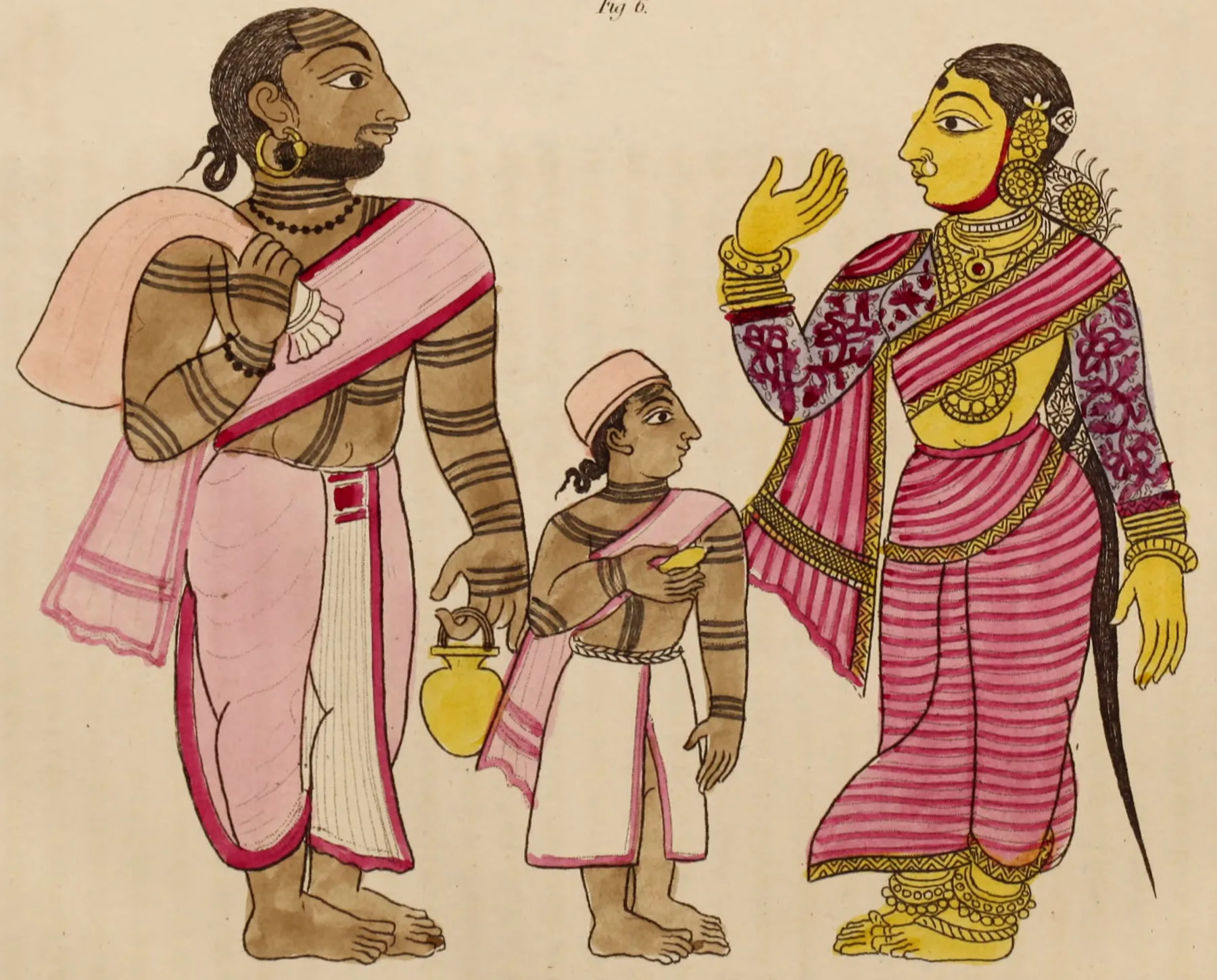
Without the walls of Seringapatam are two gardens and palaces, which formerly belonged to the Sultan, but are now occupied by the Commandant of the forces, and by the Resident at the court of Mysore. The gardens have been laid out at a considerable expense ; and canals from the river afford them a copious supply of water. The palace at the Laul Baug, which occupies the lower end of the island, though built of mud, possesses a considerable degree of elegance, and is the handsomest native building that I have ever seen. Near to it stands the Mausoleum of Hyder, where his son also reposes in state. The tombs of both are covered with rich cloths at the Company's expense; and the establishment of Moulahs to offer up prayers, and of musicians to perform the Nobat, is kept up as formerly. The buildings are handsome of the kind, and are ornamented with mishapen columns of a fine black hornblende, which takes a most splendid polish. The other palace and garden, called the Durria adaulut Baug, was Tippoo's favourite retreat from business. Its walls are covered with paintings, which represent the manner in which the two Mussulman princes, Hyder and Tippoo, appeared in public processions; the defeat of Colonel Bailie; and the costume of various casts, or professions, that are common in Mysore. In these paintings the figures are much in the style of caricatures, although they retain a strong likeness of native countenance and manner. The annexed Drawing (Figure 6) of a Bráhman, his wife, and child, done by one of the best artists at Seringapatam, and fully equal to the paintings on the walls of this palace, will convey to the reader a more exact idea of the progress made there in the art of painting, than words could possibly express.
The principal workman employed by Colonel Close in repairing the palace in the Laul Baug, gave me the following account of the processes used for finishing the inside of the palaces at Seringapatam.
At first sight, one would imagine that much gilding is used in the ornaments; but in truth not a grain of gold is employed. The workmen use a paper covered with false gilding. This they cut into the shape of flowers, and paste these on the walls or columns. The interstices are filled up with oil colours, which are all of European preparation.
The manner of making this false gilded paper is as follows: Take any quantity of lead, and beat it with a hammer into leaves, as thin as possible. To twenty-four parts of these leaves add three parts of English glue, dissolved in water, and beat them together with a hammer, till they be thoroughly united; which requires the labour of two persons for a whole day. The mass is then cut into small cakes, and dried in the shade. These cakes can at any time be dissolved in water, and spread thin with a hair brush on common writing paper. The paper must then be put on a smooth plank, and rubbed with a polished stone, till it acquire a complete metallic lustre. The edges of the paper are then pasted down on the board, and the metallic surface is rubbed with the palm of the hand, which is smeared with an oil called Gurna, and then exposed to the sun. On the two following days the same operation is repeated; when the paper acquires a metallic yellow colour, which, however, more resembles the hue of brass, than that of gold. The Gurna oil is prepared as follows: Take three quarters of a Maund (about 18 lb.) of Agashay any (Linseed oil), half a Maund (lb. 12) of the size called Chunderasu, and a quarter of a Maund (6 lb.) of Musambra, or aloes prepared in the country. Boil the oil for two hours in a brass pot. Bruise the Musambra; and, having put it into the oil, boil them for four hours more. Another pot having been made red hot, the Chunderasu is to be put into it, and will immediately melt. Take a third pot, and, having tied a cloth over its mouth, strain into it the oil and Musambra: these must be kept in a gentle heat, and the Chunderasu added to them gradually. The oil must be strained again; and it is then fit for use.
The Chunderasu is prepared from the milky juice of any of the following trees: (Ficus glomerata Roxb.), Goni (a tree which I call Ficus gonia) Bayla, Bayvina, Gobali, &c. It is therefore an elastic gum.
The oil used for painting consists of two parts of linseed, and one part of Chunderasu.
In white washing their walls, over the chunam or lime plaster, the workmen of Seringapatam first give a thin coat of Suday, or fine clay; which is mixed with size, and put on with a hair brush. They next give a coat of whitening made of powdered Balapum, or potstone, and then finish with a coat composed of eight parts of Abracum, or mica, one part of powdered Balapum, and one of size. The Abracum is prepared from white mica, by repeated grindings, the finer particles being removed for use by washing them from the grosser parts. The wall, when finished in this manner, shines like the scales of a fish; and when the room is lighted, has a splendid appearance: but in the day time, the wall white washed with the powdered potstone alone, in my opinion, looks better than when washed with either quick lime or mica.
In the space between the city and the two gardens, the greater part of the island of Seringapatam is covered with the ruinous mud walls of the suburb, called Shahar Ganjam; and nothing can have a look more dismal and desolate. Tippoo, before the siege, had entirely removed the roofs; for he expected that the British army would have taken possession of the island, as they had done under Lord Cornwallis. It must not be supposed, however, that the huts, of which we now see the ruins, have been at any one time all inhabited. They were, in fact, cantonments for the troops, who were removed from one side of the island to another as caprice dictated. In Shahar Ganjam a new town is fast rising up, in which the streets are laid down broad and regular. In the old cantonments, the huts had been miserably huddled together.
According to the register of houses which I received from the Cutwal, the fort, or city, contains 4,163 houses, and 5,499 families; and the Shahar Ganjam contains 2,216 houses, and 3,335 families. At five inhabitants to each house, we may estimate the population of the city to be 20,815, and of the suburbs 11,080; in all, 31,895 persons. This, however, is independent of a strong garrison and its numerous followers. The principal merchant in the place says, that in the reign of Tippoo the island contained 500,000 inhabitants; and he pretends to found his estimate on the quantity of grain consumed. In this calculation, I think he exaggerates grossly; as I see no place where such a number of persons could have lived. I know also, that the man, in other respects, is not to be trusted. Perhaps we may safely admit the former population of the island to have amounted to 150,000 persons; who were entirely supported by the court and army, scarcely any manufactures having been established. By the removal of the court, and the diminished number of the troops, the inhabitants have been reduced to the necessity of leaving the island; which is still a very inconvenient place for Europeans; all their servants, and the most common artificers, being people from Madras, who charge the most extravagant wages. Excellent meat and good vegetables are to be had in abundance; but, bread being dear, the private soldiers are in general under the necessity of eating rice.
In this country, the division of the people into what are called the left and right hand sides, or Eddagai and Ballagai, is productive of more considerable effects than at any place that I have seen in India, although among the Hindus it is generally known.
The tribes, or casts, comprehended in the Eddagai, or left hand side, are nine.
- 1. Panchala, comprehending,
- 1. The Cubbinadava, or blacksmiths.
- 2. Badiga, carpenters.
- 3. Cunsugaru, coppersmiths.
- 4. Cul'badiga, masons.
- 5. Axala, gold and silversmiths.
- 2. Bheri chitty, merchants, who pretend to be of the Vaisya cast.
- 3. Devanga, a class of weavers.
- 4. Heganigaru, oilmakers, who use two oxen in their mills.
- 5. Gollur, or Golawanlu, who transport money.
- 6. Paliwanlu 7. Palawanlu } two tribes of cultivators, who are not of Karnataca origin.
- 8. Baydaru, hunters.
- 9. Madigaru, tanners or shoemakers. The Panchala command the whole party; and the Madigaru, in all disputes, form the most active combatants; on which account, as their own name is reproachful, they are commonly called the Eddagai cast, as if they were the only persons belonging to it.
The casts forming the Ballagai, or right hand side, are eighteen in number.
- 1. Banijigaru, who are of many trades, as well as many religions. The two most conspicuous divisions are,
- 1. Panchum Banijigaru, who are traders, and wear the Linga.
- 2. Teliga Banijigaru, who worship Vishnu.
- 2. Wocligaru, cultivators of the Súdra cast, and of Karnátaca extraction.
- 3. Jotiphana, oilmakers, who use one bullock in the mill.
- 4. Rungaru, calico printers, and taylors.
- 5. Ladaru, a kind of Mussulman traders, who are followed by all the artificers of the same religion.
- 6. Gujerati, merchants of Guzerat.
- 7. Camatigaru, persons who are really of the Vaisya cast.
- 8. Jainaru, worshippers of Jain.
- 9. Curubaru, shepherds, blanket-weavers, and cultivators.
- 10. Cumbaru, potters.
- 11. Agasaru, washermen.
- 12. Besta, Palankeen-bearers.
- 13. Padma Shalayvaru, a kind of weavers.
- 14. Naindaru, barbers.
- 15. Uparu, persons who dig tanks, and build rough walls.
- 16. Chitragaru, painters.
- 17. Goallaru, keepers of cows and buffaloes.
- 18. Whalliaru. The people called Parriars at Madras, who form the active part of the right hand side, and are commonly called Ballagai, their own name being disgraceful. The Panchum Banijigaru are the leaders of this division.
It must be observed, that in these lists I have used the Karnátaca or Canarese language; and almost all the names are in the plural, as speaking of classes of men. The singular number may in general be obtained by rejecting the final ru. I must also observe, that these lists differ, in some respects, from a valuable account of the right and left hand sides, which Colonel Close was so obliging as to communicate. The difference, I suppose, arises partly from his having received the accounts through the medium of the Mussulman language, and partly from his having taken them at Bangalore. Mine I received at Seringapatam, by means of an interpreter from the Karnátaca language ; and I have found, that in different places, though at no great distance, there are considerable variations in the customs of the same tribes : a circumstance to which I request the reader’s attention. My descriptions of sects are only to be considered as strictly applicable to those of the places where they have been taken. I avoid the Mussulman names ; as I find that these people had, in general, very imperfect notions concerning their Hindu subjects, and frequently used distinctions to which there was nothing analogous among the aboriginal natives.
The origin of the division of Hindus into the right and left hand sides, is involved in fable. It is said to have taken place at Kunji, or Conjeveram, by order of the goddess Kali ; and the rules to be observed by each side were at the same time engraved on a copper plate, which is said to be preserved at the temple of that place. The existence of such a plate, however, is very doubtful ; both parties founding on its authority their pretensions, which are diametrically opposite. The different casts, of which each division is composed, are not united by any common tie of religion, occupation, or kindred : it seems, therefore, to be merely a struggle for certain honorary distinctions. The right hand side pretend, that they have the exclusive privilege of using twelve pillars in the pundal, or shed, under which their marriage ceremonies are performed ; and that their adversaries, in their processions, have no right to ride on horseback, nor to carry a flag painted with the figure of Hanumanta. The left hand side pretend, that all these privileges are confirmed to them by the grant of Kali on the copper plate; and that they are of the highest rank, having been placed by that goddess on her left hand, which in India is the place of honour. Frequent disputes arise concerning these important matters; and on such occasions, not only mutual abuse is common, but also the heads of the divisions occasionally stir up the lowest and most ignorant of their followers to have recourse to violence, and encourage them by holding out the houses and shops of their adversaries as proper objects for plunder. A very serious dispute took place at Seringapatam since it fell into the hands of the English. Thirty families of the weavers, belonging to the left hand side, joined themselves to the Teliga Banijigaru, and were encouraged by them to use all the honorary distinctions claimed by the right hand side. This gave great offence to the Panchum Banijigaru, and the Whalliaru were let loose to plunder: nor could they be repressed without an exertion of military force, by which several people were killed. In order to preserve the peace of the garrison, and to endeavour to bring the two parties to an agreement, it has ever since been thought expedient to prohibit any marriages from being celebrated within the fort.
Pride is the occasion of another violent dispute for precedency between two casts, the Panchum Banijigaru, and the Camatigaru, although they are both of the same side. The former allege, that they are the hereditary chiefs of the division; and the Camatigaru declare, that they are of a higher cast, as being Vaisya, while the others are only Súdras. The dispute at present runs very high, and has occasioned some trouble to government.
In every part of India with which I am acquainted, wherever there is a considerable number of any one cast or tribe, it is usual to have a head man, whose office is generally hereditary. His powers are various in different sects and places; but he is commonly intrusted with the authority of punishing all transgressions against the rules of the cast. His power is not arbitrary; as he is always assisted by a council of the most respectable members of his tribe. The punishments that he can inflict are fines and stripes, and above all excommunication, or loss of cast; which to a Hindu is the most terrible of all punishments. These hereditary chiefs also, assisted by their council, frequently decide civil causes, or disputes among their tribe; and when the business is too intricate or difficult, it is generally referred to the hereditary chief of the ruling tribe of the side or division to which the parties belong. In this case, he assembles the most respectable men of the division, and settles the dispute; and the advice of these persons is commonly sufficient to make both parties acquiesce in the decision; for every one would shun a man who could be so unreasonable as to refuse compliance. These courts have no legal jurisdiction; but their influence is great, and many of the ablest Amildars support their decisions by the authority of government.
The dominions of the Rája of Mysore are now divided into three great districts, or Subayenas, called the Patana, Nagara, and Chatrakal Subayenas or Rayadas; from the three places where the chief offices or Cutcheries are situated. The Patana district is by far the largest, and is under the immediate inspection of the Dewan, Purnea, and of his deputy, Bucherow. The Cutchery is in Seringapatam; and dependent on it are ninety-one Talucs, or subdivisions, of which six formerly belonged to Nagara. This present district is a much greater extent of territory than ever before was subject to the Mysore family; for although they had conquered Coimbetore, and though some districts formerly belonging to them, and bordering on the Bara Mahal, have been ceded to the Company, yet, beside these six Talucs taken from Nagara, they never possessed Sira, Bangaluru, nor Colar, which were conquered from Mussulman families by Hyder. In addition to this, they have acquired the Chatrakal Subayena, containing thirteen Talucs; and the Nagara, containing nineteen. Each of these districts is under the inspection of a Subadar.
Each Taluc is managed by an Amildar, who is an officer of justice, police, and revenue; but his authority is very limited; the power of severe punishment, and of revising all civil causes, being reserved to the Dewan. The Amildars have under them a sufficient number of Sheristadars, or accomptants, who in the Karnátaca language are called Parputties; and the villages under them are managed by Gaudas, and Shanabogas, called by the Mussulmans Potails, and Curnums. These two offices are properly hereditary. The Gauda is the representative of the Amildar, and the Shanaboga is the village accomptant. The Amildars, Parputties, and Shanabogas, are almost universally Bráhmans. The Gaudas are all Súdras.
The Taluc or district on the north bank of the Cávery, at Seringapatam, is called the Patana ashta Gram; while that on the south side of the river is called the Mahásura ashta Gram. These Talucs derive their names from each of them having formerly contained eight Grams, Gramams, or villages, granted to Bráhmans in Enaum, or charity. The country rises gradually on both sides of the river, is naturally fertile, and for some distance from the town is finely watered by noble canals; which, having been taken from the river, follow the windings of the hills, and as they advance horizontally to the eastward, send off branches to water the intermediate space. The water is forced into the sources of these canals by Anacuts, or dams, which have been thrown across the river, and formed of large blocks of granite of a prodigious strength, and at a great expense. Desolation, however, is to be seen every where near Seringapatam, and has been occasioned partly by invading armies, partly by the precautions of the defenders, and partly by the wanton caprice of Tippoo; but still more by the natural effects of his bad system of government. The temples, villages, and dams have been broken down, the canals choked, and every plantation of trees totally ruined, while a great extent has been laid waste for hunting ground. But now every thing wears an aspect of beginning restoration. The villages are rebuilding, the canals are clearing ; and in place of antelopes and forest guards, we have the peaceful bullock returning to his useful labour.
Having assembled some of the most sensible Gaudas of the Ashta gram Talucs, in the presence of the Sheristadars and Shanabogas, or lower officers of revenue, who were recommended to me as the men best acquainted with country concerns, I examined them, both at my tents and on the field, concerning their practices in agriculture ; and the following is the result of my inquiries.
The grounds are of three kinds ; wet land, or that watered artificially, and producing what are called wet crops, or grains ; dry field, or that which receives no artificial supply of water, and which produces dry crops, or grains ; and gardens, or Bagait.
The soil of the ashta gram is considered as of four different kinds, the fertility of which is great according to the order in which they are enumerated. First, a very black soil containing a large proportion of clay, and called Eray, Crishna, or Mucutu. Secondly, a very red soil, containing also a large proportion of clay, and called Cabbay or Kempu bumi. These two sometimes contain a few small pebbles, or loose rounded stones, without injuring the quality of the land. Thirdly, Marulu is a light brown coloured soil, with a large proportion of sand. This also may contain loose nodules of stone without injury to its quality. Fourthly, Daray, which consists of much sand, and angular nodules of stone so compacted that the plough penetrates it with difficulty : to avoid circumlocution, I shall frequently use these native terms.
The articles which the ashta gram farmers cultivate in wet grounds are, rice, sugar-cane, Udu, Hessaru, Wull’ Ellu, and Tadaguny. Of these, rice is the one of by far the greatest importance.
The farmers of the ashta gram have annually two crops on their wet grounds ; one crop grows daring the rainy season, and is called Hainu, and also the male crop, being supposed to be the stronger ; the other crop is called Caru, and female, and grows in the dry season. The grounds are of course formed into terraces, quite level, and surrounded by little banks for the purpose of irrigation. The plots of watered ground, owing to the considerable declivity of the country, are very contracted, and irregular in shape : but by means of small channels leading from the grand canals, or from reservoirs, they can, at the pleasure of the cultivator, be either filled with water, or allowed to be dry.
The tanks or reservoirs not being numerous in the ashta gram, and the canals being completely filled from the river in the rainy season only, the Hainu crop of rice is by far the most copious. The small supply of water in the dry season is reserved chiefly for sugar-cane. If attention were paid to construct reservoirs for the preservation of the water that is lost from the canals in the rainy season, much of the ground would annually give two crops of rice.
Throughout India there are three modes of sowing the seed of rice, from whence arise three kinds of cultivation. In the first mode, the seed is sown dry on the fields that are to rear it to maturity: this I call the dry seed cultivation; at Seringapatam it is called the Bara butta, or Puneji. In the second mode, the seed is made to vegetate before it is sown; and the field, when fitted to receive it, is reduced to a puddle: this I call the sprouted cultivation; at Seringapatam it is called the Mola butta. In the third kind of cultivation, the seed is sown very thick in a small plot of ground; and, when it has shot up to about a foot high, the young rice is transplanted into the fields where it is to ripen: this I call the cultivation by transplanting; the farmers of the ashta gram call it Nati.
The kinds of rice cultivated here are as follow:
| NAMES. | Months required to ripen. | Season for sowing. | Modes of Cultivation. |
|---|---|---|---|
| 1 Doda Butta - - | 7 | Both | Puneji, Mola, both kinds of Nati. |
| 2 Hotay Caimbuti | 5½ | Hainu | ditto ditto ditto. |
| 3 Arsina Caimbuti | 5½ | ditto | ditto and Barra'agy Nati. |
| 4 Sucadass - - - | 5½ | ditto | ditto and Mola. |
| 5 Murargilli - - | 5½ | ditto | Mola. |
| 6 Yalic Raja - - | 5½ | ditto | Puneji. |
| 7 Conawaly - - | 5½ | ditto | ditto and Mola. |
| 8 Bily sana butta - | 5½ | ditto | ditto ditto. |
| 9 Puttu butta - | 5½ | Both | Mola and Nir'agy Noti. |
| 10 Caracullu - - | 5½ | Caru | ditto ditto. |
I attempted to ascertain, whether the different kinds of cultivated rice ought to be considered as different species, or merely as varieties; but I soon found, that for a traveller this was impracticable. Among the natives, even with such as speak the same language, the greatest confusion prevails; for the same name, in different parts of the country, is applied to distinct kinds of rice; while in one village even the same kind of rice acquires two or more names, from a dissimilar season, or mode of cultivation. Thus in the Ashta grams, the same kind of rice, when raised in the Caru crop, is called Doda cassery; which, when raised, in the Hainu crop, is called Doda butta. Although I by no means presume to be certain, yet, from the dissimilitude of appearance, and from the difference of soil, cultivation, and time of coming to maturity, required by the various kinds of rice, I am inclined to think, that the Oryza sativa of Linnæus actually comprehends several species, as distinct as the different kinds of barley, or Hordeum, that are cultivated in Europe.
The Hainu cultivation of rice, being here the principal crop, shall engage the chief part of our attention.
The higher fields are cultivated after the dry seed manner of sowing; the lower grounds are reserved for the sprouted and transplanted cultivations. By far the most common seed used is the Doda butta, a coarse grain, like that which, in Bengal, is by the English called cargo rice.
In the Hainu crop the following is the management of the dry seed cultivation. During the months Phalguna, Chaitra, and Vaisakha, that is, from the 14th of February till the 23d of May, plough twice a month; having, three days previous to the first ploughing in Phalguna, softened the soil by giving the field water. After the fourth ploughing, the field must be manured with dung, procured either from the city or cow-house. After the fifth ploughing, the field must be watered, either by rain, or from the canal; and three days afterwards the seed must be sown broad-cast, and then covered by the sixth ploughing. Any rain, that happens to fall for the first thirty days after sowing the seed, must be allowed to run off by a breach in the bank which surrounds the field; and should much rain fall at this season, the crop is considerably injured. Should there have been no rain for the first thirty days, the field must be kept constantly inundated, till the crop be ripe; but if there have been occasional showers, the inundation should not commence till the 45th day. Weeding, and loosening the soil about the roots of the young plants with the hand, and placing them at proper distances, where sown too close, or too far apart, must be performed three times; 1st, on the 45th or 50th day; 2dly, 20 days afterwards; and 3dly, 15 days after the second weeding. These periods refer to the crops that require seven months to ripen. In rice which ripens in 5 1/2 months, the field must be inundated on the 20th day; and the weedings are on the 20th, 30th, and 40th days.
In the Hainu crop the following is the manner of conducting the sprouted-seed cultivation. The ploughing season occupies the month of Ashadha, or from the 23d of June till the 22d of July. During the whole of this time the field is inundated, and is ploughed four times; while, at each ploughing, it is turned over twice in two different directions, which cross each other at right angles. This I shall call a double ploughing. About the 1st of Srávana (22d July), the field is manured, immediately gets a fifth ploughing, and the mud is smoothed by the labourers' feet. All the water, except one inch in depth, must then be let off, and the prepared seed must be sown broad-cast. As it sinks in the mud, it requires no labour to cover it. For the first twenty-four days, the field must once every other day have some water, and must afterwards, until ripe, be kept constantly inundated. The weedings are on the 25th, 35th, and 50th days. In order to prepare the seed, it must be put into a pot, and kept for three days covered with water. It is then mixed with an equal quantity of rotten cow-dung, and laid in a heap, in some part of the house, entirely sheltered from the wind. The heap is well covered with straw and mats: and at the end of three days, the seed, having shot out sprouts about an inch in length, is found fit for sowing. This manner of cultivation is much more troublesome than that called dry-seed: and the produce from the same extent of ground is in both nearly equal; but the sprouted-seed cultivation gives time for a preceding crop of pulse on the same field, and saves a quarter of the seed.
Two distinctions are made in the manner of cultivating transplanted rice: the one called Barra’agy, or dry-plants; and the other called Nir’agy, or wet-plants. For both kinds low land is required.
The manner of raising the Barra’agy, or dry seedlings, for the Hainu crop, is as follows: Labour the ground at the same season, and in the same manner, as for the dry-seed crop. On the first of Iyaishtha, or 24th of May, give the manure, sow the seed very thick, and cover it with the plough. If no rain fall before the 8th day, then water the field, and again on the 22d; but, if there are any showers, these waterings are unnecessary. From the 45th till the 60th day, the plants continue fit to be removed. In order to be able to raise them for transplanting, the field must be inundated for five days, before they are plucked.
The ground on which the dry-seedlings are to be ripened, is ploughed four times in the course of eight weeks, commencing about the 15th of Iyaishtha, or 7th of June; but must, all the while, be inundated. The manure is given before the 4th ploughing. After this, the mud having been smoothed by the feet, the seedlings are transplanted into it, and from three to five plants are stuck together, into the mud, at about a span distance from the other little branches. The water is then let off for a day: afterwards, the field, till the grain is ripe, is kept constantly inundated. The weedings are performed on the 20th, 35th, and 45th days after transplanting.
The manner of raising the Nir-agy, or wet-seedlings, for the transplanted crop in the Hainu season, is as follows: In the month Phalguna (14th February to 14th March) plough the ground three times while it is dry. On the 1st of Iyaishtha, or 24th of May, inundate the field; and in the course of fifteen days plough it four times. After the 4th ploughing smooth the mud with the feet, sow the seed very thick, and sprinkle dung over it: then let off the water. On the 3d, 6th, and 9th days, water again; but the water must be let off, and not allowed to stagnate on the field. After the 12th day, inundate until the seedlings be fit for transplantation, which will be on the 30th day from sowing.
The cultivation of the field into which the seedlings are transplanted, is exactly the same as that for the dry-seedlings.
The plot on which the seedlings are raised produces no crop of pulse; but various kinds of these grains are sown on the fields that are to ripen the transplanted crop, and are cut down immediately before the ploughing for the rice commences. The produce of the transplanted crop is nearly equal to that of the dry seed cultivation; and on a good soil, properly cultivated, twenty times the seed sown is an average crop.
The Caru crops, according to the time of sowing, are divided into three kinds. When the farm is properly stocked, the seed is sown at the most favourable season, and the crop is then called the Cumba Caru; but if there be a want of hands, or cattle, part of the seed is sown earlier, and part later than the proper season; and then it produces from 30 to 50 per cent. less than the full crop. When sown too early, the crop is called Tula Caru; when too late, it is called Maysha Caru. The produce of the Hainu and Cumba Caru crops is nearly the same.
No Tula Caru dry seed is ever sown. The ploughing season for the Cumba Caru dry seed begins in Bhádrapada, or 21st August, and the seed is sown about the end of Márgasirsha, or 16th December. In the Maysha Caru dry seed, the ploughing commences on the 1st of Chaitra, or 26th of March, and the seed is sown at the feast of Chaitra Purnama, or 9th of April.
The Tula Caru sprouted seed is sown on the 1st Kártika, 19th October, the ploughing having commenced with the feast Navarátri, 19th September. The Cumba Caru sprouted seed is sown about the 16th of Pushya, or 1st of January. The ploughing season occupies a month. The ploughing for the Maysha Caru sprouted seed commences about the 15th of Chaitra. The seed is sown about the 16th of Vaisákha, or 9th of May.
The Cumba Caru transplanted rice is cultivated only as watered seedlings. The ground for the seedlings begins to be ploughed in the end of Kártika, (16th November), and the seed is sown on the 15th Pushya, or 30th December. The fields, on which this crop is ripened, are begun to be ploughed in the middle of Márgasirsha, (1st December). The transplanting takes place about the 15th of Mágha, or 29th of January. The Tula Caru transplanted rice also is sown Niragy about the 30th of Asuja, or 18th of October, and in a month afterwards is transplanted. The Maysha Caru transplanted rice is also sown as watered seedlings, about the 15th of Vaisákha, or 8th of May, and about a month afterwards is transplanted.
The regular Caru crop of the transplanted cultivation, does not interfere with a preceding crop of pulse; but this is lost, when from want of stock sufficient to cultivate it at the proper time, the early or late seasons are adopted. But the various modes of cultivating the rice gives a great advantage to the farmer; as by dividing the labour over a great part of the year, fewer hands and less stock are required to cultivate the same extent of ground, than if there was only one seed time, and one harvest.
The manner of reaping and preserving all the kinds of rice is nearly the same. About a week before the corn is fit for reaping, the water is let off, that the ground may dry. The corn is cut down about four inches from the ground with a reaping-hook, called Cudugalu, or Cudagu. (PLATE II. Fig. 2.) Without being bound up in sheaves, it is put into small stacks, about twelve feet high; in which the stalks are placed outwards, and the ears inwards. Here the corn remains a week, or, if it rain, fourteen days. It is then spread out on a thrashing-floor, made smooth with clay, cow-dung, and water; and is trodden out by driving bullocks over it. If there has been rain, the corn, after having been thrashed, must be dried in the sun; but in dry weather this trouble is unnecessary. It is then put up in heaps called Rashy, which contain about 60 Candacas, or 334 bushels. The heap, as I have before mentioned, is marked with clay, and is carefully covered with straw. A trench is then dug round it, to keep off the water. For twenty or thirty days, till the division of the crop between the government and the cultivator takes place, the corn is allowed to remain in the heap.
The grain is always preserved in the husk, or, as the English in India say, in Paddy; the term rice being appropriated to the grain separated from the husks, a distinction which I shall always observe.
There are in use here various ways for keeping Paddy. Some preserve it in large earthen jars that are kept in the house. Some keep it in pits called Hagay. In a hard stony soil, they dig a narrow shaft, fifteen or sixteen cubits deep. The sides of this are then dug away, so as to form a cave, with a roof about two cubits thick. The floor, sides, and roof, are lined with straw; and the cave is then filled with Paddy. These pits contain from fifteen to thirty Candacas, or from 83½ to 167 Winchester bushels. When the Paddy is wanted to be beaten out into rice, the whole pit must at once be emptied. Other people again build Canajas, or store-houses, which are strongly floored with plank, to keep out the Bandicoots, or rats. In these store-houses there is no opening for air; but they have a row of doors, one above another, for taking out the grain, as it is wanted. Another manner of preserving grain is in small cylindrical stores, which the potters make of clay, and which are called Woday. The mouth is covered by an inverted pot; and the Paddy, as wanted, is drawn out from a small hole at the bottom. Finally, others preserve their Paddy in a kind of bags made of straw, and called Mudy. Of these different means the Canaja and Woday are reckoned the best. Paddy will keep two years without alteration, and four years without being unfit for use. Longer than this does not answer, as the grain becomes both unwholesome and unpalatable. No person here attempts to preserve rice any length of time; for it is known by experience to be very perishable. All the kinds of Paddy are found to preserve equally well. That intended for seed must be beaten off from the straw as soon as cut down, and dried for three days in the sun; after which it is usually kept in straw-bags.
There are two manners of making Paddy into rice; one by boiling it previously to beating; and the other by beating alone. The boiling is also done in two ways. By the first is prepared the rice intended for the use of Rájas, and other luxurious persons. A pot is filled with equal parts of water and Paddy, which is allowed to soak all night, and in the morning is boiled for half an hour. The Paddy is then spread out in the shade for fifteen days, and afterwards dried in the sun for two hours. It is then beaten, to remove the husks. Each grain is broken by this operation into four or five pieces, from whence it is called Aydu nugu aky, or five-piece rice. When dressed, this kind of rice swells very much. It is always prepared in the families of the Rájas, and is never made for sale. The operation is very liable to fail; and in that case the rice is totally lost.
Rice prepared by boiling in the common manner is called Cudapal aky, and is destined for the use of the Súdras, or such low persons as are able to procure it. Five parts of Paddy are put into a pot with one part of water, and boiled for about two hours, till it is observed that one or two of the grains have burst. It is then spread out in the sun for two hours; and this drying is repeated on the next day; after which the Paddy is immediately beaten. Ten parts of Paddy, by this operation, give five parts of rice, of which one part goes to the person who prepares it, for his trouble. Ten Seers of Paddy are therefore equal in value to only four Seers of rice.
The rice used by the Bráhmans, and called Hashy aky, is never boiled. On the day before it is to be beaten, the Paddy must be exposed two hours to the sun. If it were beaten immediately after being dried, the grain would break, and there would be a considerable loss. Even with this precaution, many of the grains break; and, when these are separated from the entire rice to render it saleable, the Hashy aky sells dearer than the Cudapal aky, in the proportion of nine to eight.
The beating is performed chiefly by women. They sometimes, for this purpose, use the Yata, which is the same with the Danky of Bengal; or a block of timber fastened to a wooden lever, which is supported on its centre. The woman raises the block by pressing with her foot on the far end of the lever, and by removing her foot allows the block to fall down on the grain. The more common way, however, of beating Paddy, is by means of a wooden pestle, which is generally about four feet in length, and three inches in diameter, which is made of heavy timber, and shod with iron. The grain is put into a hole formed in a rock or stone. The pestle is first raised with the one hand, and then with the other; which is very hard labour for the Hindu women, who in general are rather delicately formed.
So far as I have observed in Mysore, ground, once brought into cultivation for rice, is universally considered as arrived at the highest possible degree of improvement; and all attempts to render it more productive by a succession of crops, or by fallow, would be looked upon as proofs of insanity. Where there is a supply of water, the farmers in general think, that the best plan of cultivation is to sow one crop of rice, immediately after another has been reaped; and in many parts, favoured with a supply of water, three crops of rice are every year regularly produced. In the Ashta grams, however, there is no such land; and though some parts each year give two crops of rice, by far the greater part of the irrigated lands have too small a supply of water to ripen two crops of rice; and the farmer must content himself with one crop of that valuable article, and another of some kind of pulse, or other dry grain. Even this crop is frequently prevented by some of the operations attending the cultivation of rice, as I have had several times occasion to mention; but still it is of considerable importance. The articles of which it consists are Udu, Hessaru, Wull' Ellu, and Tadaguny.
The Udu is of two kinds; Chic'udu, and Dod'udu; or little, and large Udus.
The Chic'udu seems to be a variety, with black seeds, of the Phaseolus minimoo of Dr. Roxburgh. From the season in which it ripens, it is also called Car'udu. It is the Minamolu of the Telingas, the Sir ulandu of the Tamuls, the Mash of the Decany Mussulmans, the Wudied of Kankána, and the Ticory Colai of the Bengalese. It is cultivated as follows: The ploughing commences ten days after the feast Sivaratri, which this year happened on the 12th of February, and lasts for fifteen days, or until the 9th of March. Previous to the first ploughing, if there has not recently been any rain, the field must have a little water, and then it is three times ploughed. The seed is sown immediately before the third ploughing, by which it is covered. This crop obtains neither water, manure, nor weeding. The straw, when ripe, is pulled up by the roots, stacked for three days, dried two days in the sun, and then trodden out by bullocks. The flour, made into cakes, and fried in oil, is here a common article of diet. It is also mixed with rice flour, and made into white cakes called Doshy, which are also fried in oil, and are a favourite food. The straw is reckoned pernicious to cattle. It is thrown on the dunghill, and serves to increase the quantity of manure. The grain is always preserved in the Mudy, or straw bag.
The Dod'udu, or great Udu, is called also Hain'udu. I had no opportunity of examining it in a state proper for ascertaining its place in the botanical system; but I have no doubt of its being the Phaseolus minimoo of Dr. Roxburgh. It is cultivated and managed exactly like the other kind; but the first ploughing is on the 8th day after the Swarna Gauri vrata, which this year happened on the 23d of August. The sowing season is 15 days afterwards; that is, about the 15th of September. The straw is equally pernicious to cattle, but the grain is reckoned better than that of the Chic'udu.
The Hessaru is the Phaseolus Mungo of the botanists, a barbarous name derived from the Mung of the Mussulmans, and of Kankána. In the Telinga language it is called Pachy Pessaru; and in the dialect of the Tamuls, Pacha Pyru. It is of one kind only, but is cultivated both as a Hainu and as a Caru crop: in both of which the manner of cultivation is exactly the same as that of the Udus. The straw, being equally unfit for cattle, is reserved for manure. The grain is dressed as Curry.
The Tadaguny is the Dolichos Catsjang of Linnæus, who has here introduced a most barbarous appellation. In the Telinga language, it is called Alasunda. It is the Bobra and Choni of the Mussulmans, the Caramuny of the Tamuls of Madras, the Tata Pyru of Coimbetore, the Bily Hessaru of Haiga, and the Cauli of Kankána. Of this grain, there is but one kind, and it is cultivated only as a Caru crop, which is performed exactly in the same manner with that of the Car'udu. The green pods, and ripe grain, are both made into Curries, as is usual here, by frying them in oil with tamarinds, turmeric, onions, capsicum, and salt. Horses eat the grain; but the straw is only useful as manure.
Wull' Ellu is the Sesamum orientale; and one kind only is cultivated here. The Indicum, however, is to be met with in some places not far distant, and is called the Phulagana Ellu. It is raised exactly like the Car'udu, cut down when ripe, and stacked for seven days. It is then exposed to the sun for three days, but at night is collected again into a heap; and, between every two days drying in the sun, it is kept a day in the heap. By this process the capsules burst of themselves, and the seed falls down on the ground. The cultivators sell the greater part of the seed to the oil-makers. This oil is here in common use with the natives, both for the table and for unction. The seed is also made into flour, which is mixed with Jagory, and formed into a variety of sweet cakes. The straw is used for fewel and for manure.
A considerable quantity of sugar-cane is cultivated by the farmers of the Ashta gram. It is of two kinds, Restali, and Puttaputti. Both yield Bella, or Jagory; but the natives can extract sugar from the Puttaputti alone. The Jagory of the latter is also reckoned the best. The Restali can only be planted in Chaitra; the Puttaputti may also be planted in Srávana, or Mágha. The crop of Restali is over in a year; that of Puttaputti requires fourteen months, but may be followed by a second crop, or, as is said in the West Indies, by a crop of Ratoons, which require twelve months only to ripen. The Restali will not survive for a second crop. This is the original sugar-cane of the country: the Puttaputti was introduced from Arcot by Mustaph'Aly Khan, who in the reign of Hyder was Tosha Khany, or Paymaster General. The cultivation of Restali has ever since been gradually declining.
When the ground is to be cultivated for sugar-cane, it is watered three days, and then for the same length of time it is allowed to dry. During the next eight days it must be ploughed five times, and the clods must be beaten small with a kind of pick-ax, called Col Kudali (see Plate II. Fig. 3.). The field must then be manured, and ploughed a sixth time. The ground now rests fifteen days; after which, in the course of one or two days, it must be ploughed twice, and then be allowed eight days more rest. It is afterwards ploughed a ninth time. These operations occupy forty-four days; six more are employed in planting the cane, which is done by the instrument called Yella Kudali (see Plate II. Fig. 4.). With this the field is divided into beds of about six cubits wide, see (a) Fig. 7. These beds are separated by small trenches ( ), which are about fourteen inches wide, and eight deep. In every alternate trench are dug small wells (c) about two feet deep. The water from the canal flows through all the trenches, and, a quantity of it lodging in these wells, is taken out with pots for watering the plants by the hand. Across every bed, at the distance of a cubit, are dug five holes (d) about six inches in diameter, and three in depth. In each of these are placed horizontally two cuttings of the cane, each containing three joints. These are covered slightly with earth, over which is laid some dung. When the cane is planted in Chaitra, the trenches must be filled with water from the tank, and every hole must be watered by pots. At the other seasons the trenches are full, it being the rainy weather; but even then, for one month, the holes containing the canes must daily be watered by the hand. The earth in the holes is then stirred up with a stick, and a little dung is added. Next month the daily watering must be continued, and at the end of it the whole field must be dug up with the Yella Kudáli; and round every cluster of young canes there must be formed by the hand a small cavity, into which a little dung is to be put. In the third month the canes must be watered every other day. At the end of the third month, if the canes have grown with luxuriance, the field must be dug over again with the Yella Kudáli; but, if they are rather stunted, the watering must be continued all the fourth month, before they get the third weeding. At this time, the earth, at the roots of the cane, is heaped up into ridges crossing the beds at right angles to the trenches. Afterwards, no water is given immediately to the plants, but for three days the trenches must be kept full. It is then let out for a week. If there be rain, there is no occasion for more watering; but, if it be dry weather, the trenches, for a month, must be filled with water one day in the week. Then the weeding with the Yella Kudáli must be repeated, and the earth must be smoothed with the hand, and placed carefully round the canes. The young shoots from each hole will be now ten or twelve in number; those which are sickly must be cut off; and the healthy, which are about a cubit long, must be tied up with a leaf of the plant into bundles of two or three, in order to prevent them from spreading too much. Should there be no rain, the trenches must, once in fifteen days, be filled with water, till the canes, having grown higher, again require to be tied together. In a month after the first tying, they ought to be two cubits high. When the plants are eight months old, they will have grown another cubit, and will require another tying. The farmer now begins to repair his apparatus for making Jagory: the Alay munny, or boiling-house; the Gana, or mill; the Copriga, or boiler; the Utsu, or mould; the Cunu, or cooler; the Goarmuny, or ladle; and the Chebalu, or skimmer. In the eleventh month he begins to cut the Restali, and the crop must be finished within the year. The Puttaputti is ripe in twelve months, and two months may be allowed for cutting it.
If it be intended to keep the field of Puttaputti for a second year’s crop, the dry leaves which are cut off at crop season must be burned on the spot, and the whole field must be dug with the Yella Kudáli. The trenches must then be filled with water, and for six months the watering must be continued once in eight or ten days, unless there be rain. The weedings, during this time, ought to be three; at each of which dung ought to be given. At the end of six months, the canes having grown one cubit high, the weakly plants must be removed, and the strongest tied up, as in the first crop. The manner of conducting the two crops after this is quite similar. The canes of the second crop must be all cut within the year.
Mucutu, or black clay, is the best soil for both kinds of sugar-cane; but it is reserved for the Puttaputti. The Cabbay, or red earth, answers for the Restali, which does not require such a strong soil. The two inferior soils do not by any means answer for this production. The crop of rice immediately succeeding sugar-cane is very bad; the second returns to its usual quantity; but the sugar-cane is never again repeated on the same ground, till three crops of rice have intervened. The roots and tops of the cane are burned for boiling the Jagory. The ashes are reckoned injurious to any soil on which they may be laid; but this is certainly a prejudice. Sugar-cane is never cultivated without manuring.
Having neglected, at my first visit to Seringapatam, to obtain an account of the produce of the various crops of watered land, on my second visit I called together some respectable Gaudas, in presence of the Amildar, and of a well informed Sheristadar. I then measured a field, said by them to contain a Candaca of land, or as much as ought to sow 280 Seers of rice, and found it to be 6⅕ acres; on which, joined to their report concerning the quantity of seed required, and the return produced by a Candaca of land, I found the following calculations:
| NAMES. | Seed per Acre. | Produce per Acre. | Increase on one seed. | ||
|---|---|---|---|---|---|
| Bushels. | Gallons. Decimals. | Bushels. | Gallons. Decimals. | ||
| Rice Mola cultivation | 1 | 4.57 | 31 | 3.40 | 20 |
| Udu | 0 | 4.0 | 7 | 6.86 | 15 |
| Hessaru | 0 | 4.0 | 7 | 6.86 | 15 |
| Wull' Ellu | 0 | 0.898 | 3 | 7.43 | 35 |
Of sugar-cane one acre plants 2420 holes, and produces 10,890 ripe canes, which yield 16 3/4 cwt. of Jagory.
The produce of rice by every mode of cultivation is nearly the same.
In the Ashta grams the articles cultivated on dry field are as follow:
| NAMES. | Seed per Acre. | Produce per Acre. | Increase on one seed. |
|---|---|---|---|
| Gallons. Decimal parts. | Bushels. Decimal parts. | ||
| Ragy | 3.568 | 23.35 | 52 1/2 |
| Avaray | 0.892 | 0.889 | 8 |
| Tovary | 0.892 | 0.889 | 8 |
| Harica | 3.568 | 15.56 | 30 |
| Navonay | 3.568 | 15.56 | 30 |
| Shamay | 3.568 | 15.56 | 30 |
| Chica Cambu | - - - | - - - | - - - |
| Jola | 0.892 | 15.56 | 120 |
| Huruli | 3.568 | 15.56 | 30 |
| Carlay | - - - | - - - | - - - |
| Harulu | - - - | - - - | - - - |
| Huts' Ellu | 0.892 | 1.12 | 10 |
| Wull' Ellu | 1.784 | 1.334 | 12 |
The estimate of seed, and produce of an acre, I obtained by taking three sensible farmers to a small field, and asking them how much seed it would require, and how much it would produce. No revenue officer was present, nor did the field belong to any of the farmers. I then measured the field, and reduced the measures to the English statute acre and the Winchester bushel. Not having been entirely satisfied with this manner of ascertaining the produce, on my return to Seringapatam I questioned the same persons on this subject, that I had interrogated respecting the wet crops. I made them show me what they considered as a Wocula of dry field; that is to say, the land, on which a Wocula or Colaga of Ragy should be sown. On measuring it, I found that it was 1 15/100 acre; and they said that the produce ought to be two Candacas, besides the Avaray and Tovary. This makes the seed required for an acre to be 3 389/1000 gallons, the produce 19 1/2 bushels, and the increase on the seed forty fold. All these numbers are less than those stated in the table, and may be taken as the average produce; the other calculation implying a favourable season and soil, with good management.
The Ragy, by Linnæus, is named Cynosurus Corocanus. The Decany Mussulmans call it Ragy. In the Tamul language, it is called Kevir. The farmers reckon three kinds of it, which, however, are only varieties; the Cari, Kempu, and Huluparia: all are equally productive; but the third, when nearly ripe, is very apt to shake the seed. In the vicinity of Seringapatam, it is not customary to keep the kinds separate; in the same field all the three are sown intermixed; but in some places, at no great distance, more attention is paid to the quality of the grain.
The ploughing commences whenever the first occasional showers in spring have softened the soil sufficiently to receive the plough. From that period till the 13th of Iyaishtha, or 5th of June, the field is ploughed from four to six times, according as it may be found clean or foul. The dung is then given, and ploughed into the soil. When the rains begin to be heavy, the seed is sown broad-cast, and covered by the plough. The field is then smoothed with the Halivay, which is a harrow, or rather a large rake drawn by two bullocks, (see Fig. 9.) Then, if sheep are to be had, a flock of them is repeatedly driven over the field, which is supposed to enable it to retain the moisture; and for this purpose bullocks are used, when sheep cannot be procured. Next day, single furrows are drawn throughout the field, at the relative distance of six feet. In these is dropt the seed of either Avaray or Tovary, which are never cultivated by themselves; nor is Ragy ever cultivated, without being mixed with drills of these leguminous plants. The seed of the Avaray or Tovary is covered by the foot of the person who drops it into the furrow. Fifteen days afterwards, the Cuntay, or bullock-hoe, (see Fig. 10,) is drawn all over the field; which destroys every young plant that it touches, and brings the remainder into regular rows. On the 35th day the Cuntay is drawn again, at right angles to its former direction. On the 45th day it is some times drawn again; but, when the two former ones have sufficiently thinned the young corn, this third hoeing is not necessary. At the end of the second month, the weeds should be removed by a small iron instrument called Ujary (see Plate II. Fig. 5). According to the quantity of rain, the Ragy ripens in from three to four months. The Avaray and Tovary do not ripen till the seventh month. The reason of sowing these plants along with the Ragy seems to be, that the rains frequently fail, and then the Ragy dies altogether, or at least the crop is very scanty; but in that case the leguminous plants resist the drought, and are ripened by the dews, which are strong in autumn. When the Ragy succeeds, the leguminous plants are oppressed by it, and produce only the small return which is mentioned in the above list; but when the Ragy fails, they spread wonderfully, and give a very considerable return.
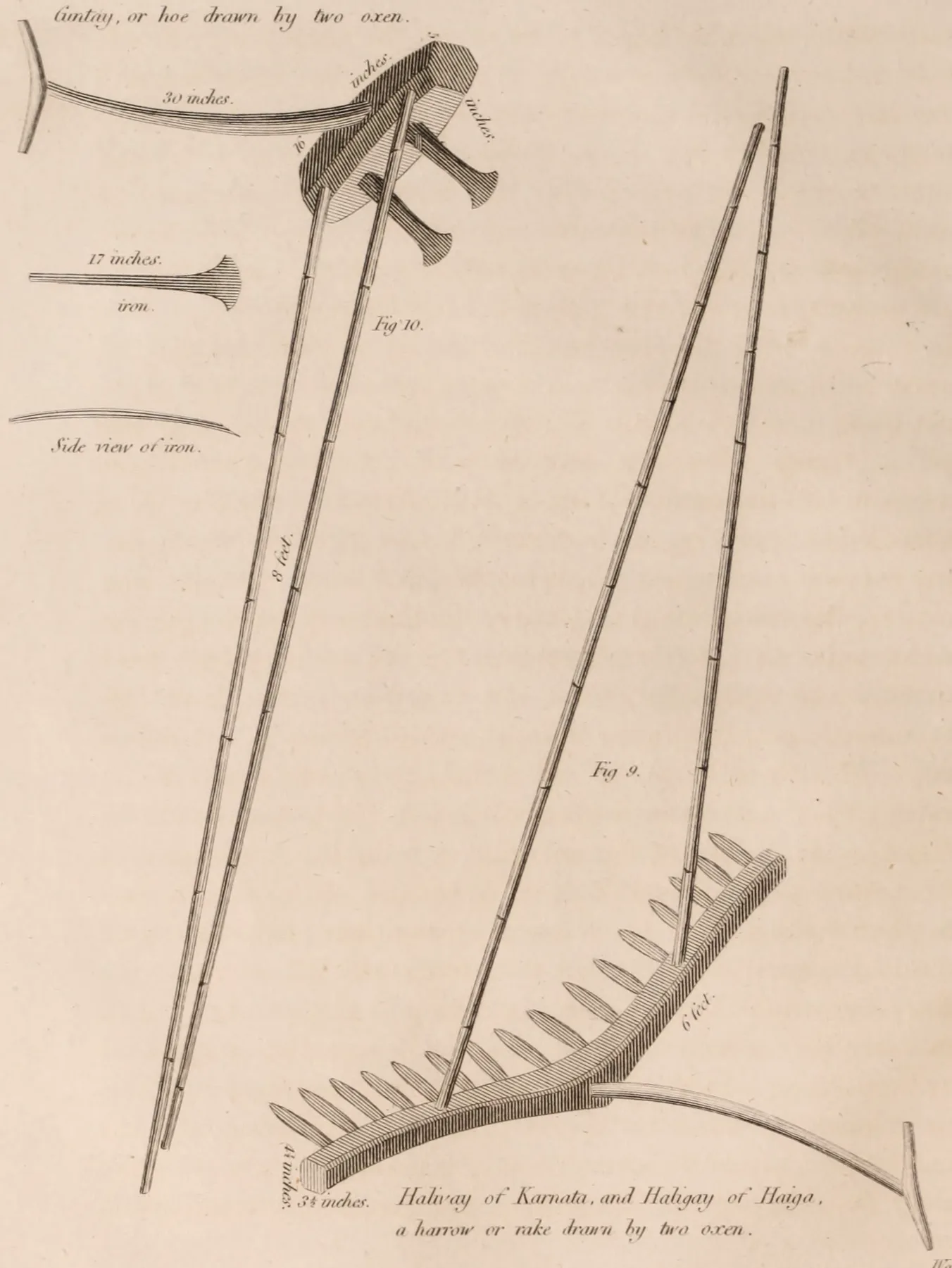
The crop of Ragy is by far the most important of any raised on dry field, and supplies all the lower ranks of society with their common food. Among them, it is reckoned the most wholesome and invigorating food for labouring people ; and in every country, most fortunately, a similar prejudice appears to prevail, the most common grain being always reckoned the nourishment most fit for the labourer. Habit seems to be able to render every kind of grain sufficiently wholesome ; but the stomach is not able, without inconvenience, to bear a change. Hence the labourer, accustomed to live on the cheapest grain of the country, finds it agree with his stomach ; but he becomes disordered when first compelled or induced to try another food. He therefore very naturally concludes, that his usual fare is the most wholesome ; while, for similar reasons, a labourer from another country will justly reprobate it. My Bengal and Madras servants, who have been accustomed to live upon rice, look upon the Ragy as execrable food, and, in fact, would experience great inconvenience were they compelled to live on it.
The Ragy is reaped by the sickle, and the straw is cut within four inches of the ground. For three days the handfuls are left on the field ; and then, without being bound up in sheaves, are stacked, and the whole is well thatched. At any convenient time within three months, it is opened, dried two days in the sun, and then trodden out by oxen. The seed, having been thoroughly dried in the sun, is preserved in straw Mudies. The remainder is put into pits, or Hagays ; where, if care has been taken to dig the pit in a dry soil, it will keep in perfect preservation for ten years.
Ragy is always ground into flour, as wanted, by means of a hand-mill, called Visacallu. In this operation it loses nothing by measure ; so that a Candaca of Ragy is reckoned to contain as much nourishment as two Candacas of Paddy. The flour is dressed in various ways. The most common are, a kind of pudding called Sangutty, and two kinds of cakes, called Ruty and Doshy, both of which are fried in oil.
For all kinds of cattle, the Ragy straw is here reckoned superior to that of rice. My Madras bullock-drivers dispute the point; but I am inclined to think that they are wrong; for the people here have much experience of both kinds of straw, while the Madras people are only accustomed to that of rice, or at least have never seen the Ragy straw used except in our camps, where many causes contributed to render the mortality among the cattle very great.
The Avaray is probably what Linnæus, from an indecent Chinese word, calls by the barbarous appellation of Dolichos Lablab. This, however, is doubtful. Dr. Roxburgh calls it Dolichos spicatus. By the Decany Mussulmans it is called Bullar. It is the Putcary of the Bengalese, and Anamalu of the Telingas. When ripe, the legumes are nearly dry. The plant, having been cut, and for one day exposed to the sun, is beaten with a stick to separate the seed. That which is designed for seed is preserved in Mudies; while that for consumption is kept in pots, and is used in Curries. The straw is eaten by all kinds of cattle except horses.
The Tovary is the Cytisus Cajan of Linnæus, the Orhur of the Bengalese, the Dhál of Hindustan, and the Tower of the Decany Mussulmans. Many of the Karnátas also call it Togari. It is cut when almost dry, then put up in heaps; and on the day after, it is opened to dry in the sun. The grain is beaten out with a stick; and that intended for sowing must be preserved in a straw Mudy. It is used in Curry. After the seed has been thrashed, cattle eat the husks of the legume. The straw is used for fewel.
The best soil for the cultivation of these three articles is the black soil, or Eray bumi; which yields a crop of Ragy every year, and even without manure will give a considerable return; but, when it can be procured, dung is always given. After a crop of Jola, Ragy does not thrive; but Jola succeeds after a crop of Ragy. The next best soil for Ragy, and the one most commonly used, is the Cabbay, or red soil. In this also it is frequently cultivated without dung; but it requires to be manured at least once in two or three years. In Marulu and Daray soils, it every year requires dung. If these soils have been cultivated with horse-gram, the Ragy will not grow in them without a large quantity of manure. Two or three years rest are said by some to improve the ground for one crop of Ragy; after which it returns to its usual state. But the advantages of this fallow are too inconsiderable to induce the farmers to practise it commonly, and most of them are altogether insensible of the benefit to be derived from this part of agriculture.
Jola is the next most considerable dry crop. It is the Holcus Sorghum of Linnæus, the Jewarry of the Mussulmans, the Sholum of the Tamuls, and the Jonalu of the Telingas. It is often sown for fodder; for when the crop is not uncommonly good, the grain is no object. It is cut, and given to the cattle at a time when Ragy straw is not to be procured. Previously to being given to cattle, however, it must be dried, as the green straw is found to be very pernicious. There are two kinds of Jola; the white, and the red. When they are intended to be cut for the grain, these are sown separately; as the red kind ripens in three months, while four are required to ripen the white Jola. In those parts of the Ashta gram Talucs which are remote from the city, the grain is generally preserved; but near Seringapatam, where the demand for fodder is greater, and where the Jola is commonly cultivated with a view to furnishing that article, the two kinds are often sown promiscuously. A red Ragy soil is preferred for it, and crops of Ragy and Jola are generally taken alternately, the crop of Ragy having an extraordinary allowance of dung. The Jola requires less rain than the Ragy, and admits of a second crop of Huruli being taken after it; and thus, in the course of two years, there are on the same ground three crops. In Phalguna and Chaitra, from the 14th of February to the 22d of April, they plough from five to seven times. If a crop of Ragy has preceded, there is no occasion for manure to the Jola; but, when two crops of this succeed each other, the last must get some dung, which is put on before the last ploughing. After a heavy rain in Vaisakha, from the 23d April to the 23d May, the seed is sown broad-cast, and covered with the plough. When the young plants have appeared above ground, the field must be cleared with the Cuntay, or bullock hoe; and this operation must be repeated on the thirtieth and forty-fifth days. If it be intended merely for fodder, these hoeings are unnecessary, and the seed is sown very thin, as mentioned in the list; but then, should it by chance succeed, and be allowed to ripen, the produce will be very great. Where it is intended from the first to be allowed to ripen, the quantity of seed sown is one half more, or 1,338/1000 gallon for an acre; in which case 80 fold being the average return, the produce of an acre is the same as mentioned in the list, or 15 1/2 bushels. If it be intended for fodder, the Jola is sown about the middle of Chaitra, or the 9th of April, and cut down in Ashádha, or from the 23d of June till the 23d of July. The straw is not so good as that of Ragy, but is here reckoned better than that of Paddy.
The Chica Cambu is the Holcus spicatus of Linnæus, the Bajera of the Mussulmans, the Ghentalu of the Telingas, and the Sujagury of the Marattahs. In the Tamul language also it is called Cambu. There is another variety of the plant, called Doda, or Great Cambu; but none of this is cultivated near Seringapatam. During the spring, plough six times; about the 13th of Jyaishtha, or 5th of June, put on the dung, and plough again; when the heavy rains commence, sow broad-cast, and plough in the seed. In drills with the Cambu some people put Avaray; others do not. On the tenth day hoe with the Cuntay, once lengthways, and once across the field. It must be carefully protected from the birds, when approaching toward ripeness, which happens in three months and a half. The ears are first removed, and then the straw is cut down close to the ground. It makes excellent thatch, and is also eaten by cattle, but is not much esteemed as fodder. The ears are kept in a heap for three days, then trodden out by oxen, and cleaned by a fan, or Moram. The seed intended for sowing, after being well dried in the sun, is preserved in Mudies. That intended for consumption, is kept in Canajas, or store-houses, but cannot be preserved long. It is made into flour for cakes, and for Sangutty, or pudding. If sown on the two good soils, it requires no dung; but on the two bad soils manure is absolutely necessary. Repeated crops of this grain do not exhaust the ground, and Ragy thrives after it.
Shamay is the Panicum miliare of Lamarck, the Sama and Sawmun of the Mussulmans, the Chama of the Telinga, and the Shamay of the Tamul language. It is never sown on the Eray or black clay, and rarely on the Cabbay, or red soil; the two worst qualities of land being considered as sufficiently good for such a crop. In the spring the field is ploughed five times. At the commencement of the heavy rains it is sown broad-cast, and the seed is covered by a ploughing. Even in the worst soil, there is no absolute necessity for dung; but when any can be spared, the crop will doubtless be benefited by manure. It ripens without further care in three months, is cut close to the ground, and gathered into stacks. Five or six days afterwards it is spread on a thrashing-floor, and the grain is trampled out by oxen. That intended for sowing is dried in the sun, and tied up in straw Mudies. The remainder is preserved in Canajas. It is sometimes boiled whole, like rice; at others, ground into flour for cakes. All kinds of cattle eat the straw, which is also esteemed the best for stuffing pack-saddles.
The Harica is the Paspalum frumentacum of Dr. Roxburgh, the Varagu of the Tamul, the Harica of the Telinga, and the Cadoro of the Decany Mussulman language. As it is found to injure the succeeding crop of Ragy, it is never cultivated on the best soil, and rarely on that of the second quality. It is commonly followed by a crop of horse gram, and is seldom allowed any manure. In the spring plough five times. The dung, if any be given, must be put on before the last ploughing. When the heavy rains commence, sow broad-cast, and plough in the seed: next day form drills of Tovary in the same manner as with Ragy. When the sprouts are a span high, hoe with the Cuntay, once longitudinally and once across the field. Next week weed with the Ujary. It ripens in six months; and, having been cut down near the root, is stacked for six days. It is then trodden out by cattle. The seed reserved for sowing must be well dried in the sun. The remainder is preserved in the Canaja, but does not keep long. It is both boiled like rice, and made into flour for dressing as Sangutty, or pudding. The straw is eaten by every kind of cattle; but, of all the fodders used here, this is reckoned the worst.
Navonay is the Panicum Italicum of Linnæus, the Bagera of the Bengalese, Cangony of the Decany Mussulmans, Carolu of the Telingas, and Tenay of the Tamul language. There are two varieties of it cultivated; the one called Ghidu, or short; and the other Jotu, or long, and Doda, or great. Unless a quantity of dung can be spared, it is never sown on the two worst soils. On the two best soils it requires no manure, and does not injure the succeeding crop of Ragy. In the spring, plough six times. When the heavy rains commence, sow, and plough in the seed. It requires neither weeding nor hoeing, and ripens in three months. Cut it close to the ground, and stack it for eight days; then spread it to the sun for a day, and on the next tread out the grain with oxen. The seed for sowing must be well dried in the sun, and preserved in a Mudy. The remainder is kept in the Canaja. It is made into flour for Sangutty, or pudding, and is also frequently boiled whole, like rice; for which, according to my taste, it is the best succedaneum that the country affords. The straw is used for fodder, but is not good. The Jotu Navonay is sometimes put in drills with Ragy, in place of the Avaray or Tovary.
Huruli is much cultivated. It is the Dolichos biflorus of Linnæus, the Horse gram of the Madras English, the Cultie of the Decany Mussulmans, and the Colu of the Tamul language. There are two varieties; the red, and the black; but here the two are always sown intermixed. In the last half of Srávana, from the 5th to the 20th August, plough three times. Sow broad-cast, with the first rain of Bhádrapada, which commences on the 21st of August. It requires no manure, and the seed is covered by a fourth ploughing. In three months it ripens without farther trouble, and is then pulled up by the roots, and stacked for eight days : after which it is spread in the sun to dry, and next day is trodden out by oxen. The seed for sowing must be well dried in the sun, and preserved in Mudies; the remainder is kept in pots, or in the Canaja. It is used for human food, either dressed as Curry, or parched; but the chief consumption of it is for cattle, both horses and bullocks. The straw is an excellent fodder, and is preferred even to that of Ragy. It is generally sown on the two worst soils, in fields that are never used for any thing else; but it also follows as a second crop after Jola; or, when from want of rain the crop of Ragy has failed, the field is ploughed up, and sown with Horse-gram. In this case, the next crop of Ragy will be very poor, unless it be allowed a great quantity of manure. In places where the red and black Horse-grams are kept separate, the black kind is sown from twelve to twenty days later than the other.
Carlay is the Cicer Arietinum of Linnæus, the Cadaly of the Tamuls, the Shenigalu of the Telinga language, the Herbary of the Decany Mussulmans, the Putny Chola of the Bengalese, and the Putny Bhut of Hindustan. On the banks of the Ganges, this grain is the common food given to horses, and is very well fitted to make them fat and sleek, but it does not seem to invigorate. In the peninsula it is too dear to be given as food for horses, and indeed, even for men, is considered as a delicacy. There is only one kind of it that is commonly sown as a second crop, after Jola; but it requires the richest black soil. When sown alternately with Ragy, it seems neither to injure nor improve the ground. It has no manure. From the 15th of Srávana till the 10th of Bhádrapada, that is, from the 5th till the 29th of August, plough five times. The seed is then placed in rows, every way distant from each other a span. Each row is then covered by a furrow drawn with the plough. In three months it ripens without farther trouble; it is then pulled up by the roots, and stacked for a week. It is afterwards opened to the sun for five or six days, and then trodden out by bullocks. The grain intended for seed must be dried in the sun, and preserved in a Mudy. The common way of preparing Carlay for food is by parching it. The straw is used for camels only, and is their favourite food.
Harulu is the Ricinus Palma Christi of Linnæus. In the Ashta gram two varieties of it are common; the Chica, or little Harulu, cultivated in gardens; and the Doda, or great Harulu, that is cultivated in the fields, and the plant of which I am now to give an account. In the spring, plough five times before the 15th of Vaisákha, or the 8th of May. With the first good rain that happens afterwards, draw furrows all over the field at a cubit's distance; and, having put the seeds into these at a similar distance, cover them by drawing furrows close to the former. When the plants are eight inches high, hoe the intervals by drawing the Cuntay first longitudinally, and then transversely. When the plants are a cubit and a half high, give the intervals a double ploughing. The plant requires no manure, and in eight months begins to produce ripe fruit. A bunch is known to be ripe by one or two of the capsules bursting; and then all those which are ripe are collected by breaking them off with the hand. They are afterwards put into a heap, or large basket; and the bunches, as they ripen, are collected once a week, till the commencement of the next rainy season, when the plant dies. Once in three weeks or a month, when the heap collected is sufficiently large, the capsules are for three or four days spread out to the sun, and then beaten with a stick to make them burst. The seed is then picked out from the husks, and either made by the family into oil for domestic use, or sold to the oil-makers.
The following is the process for making castor-oil, which is used by the farmers: the seed is parched in pots containing about a Seer, which is somewhat more than a quart. It is then beaten in a mortar, by which process balls of it are formed. Of these from four to sixteen Seers are put into an earthen pot, with an equal quantity of boiling water, and boiled for five hours; during which, care must be taken, by frequent stirring, to prevent the decoction from burning. The oil now floats on the surface, and is decanted off into another pot, in which it is boiled by itself for a quarter of an hour. It is then fit for use, and by the last boiling is prevented from becoming rancid. After the oil has been poured from the seed, the pot is filled up with water, which is again boiled, and next day the decoction is given to the Buffaloes, by which their milk is said to be remarkably increased. The boiled seed is mixed with cow-dung, and formed into cakes for fewel. The dry stems of the plant are also used for the fire. The oil is that which we call Castor-oil, and at Seringapatam is commonly used for the lamp. It is taken internally as a purgative; and the Súdras, and lower casts, frequently anoint their heads with it, when they labour under any complaint which they attribute to heat in the system. It is cultivated on the two best qualities of land, and on the better kinds of Marulu. When the same piece of ground is reserved always for the cultivation of this plant, the succeeding crops are better than the first; when cultivated alternately with Ragy, it seems neither to improve nor injure the soil for that grain.
Huts’ Ellu, or the foolish-oil-plant, is a species hitherto undescribed by botanists. It is the Ram Tila of the Mussulmans. Near Seringapatam it is most commonly sown after Jola, as a second crop. When that has been reaped, plough four times in the course of eight days. Toward the end of Srávana, or about the middle of August, after a good rain, sow broad-cast, and plough in the seed. It requires neither manure nor weeding, and ripens in three months. It is cut near the root, and stacked for eight days. Then, having been for two or three days exposed to the sun, the seed is beaten out with a stick, and separated from fragments of the plant by a fan. The seed is kept in pots. Part of it is parched, and made into sweet-meats with Jagory; but the greater part is sold to the oil-maker for expression. This oil is used in cookery, but is reckoned inferior to that of Sesamum. The stems are a favourite food of the camel; but are disliked by the bullock, though want often forces this animal to eat them. When not used as a second crop after Jola, it is always sown on the two poorer soils.
The Wull’ Ellu, or Sesamum, is sometimes sown on dry-field, but grows very indifferently.
In the Ashta grams there are four kinds of Tota, or gardens, cultivated. I. Tarkari Tota, or kitchen-gardens : II. Tayngana Tota, orchards, literally Coco-nut gardens ; but many other kinds of fruit-trees are planted in them. III. Yellay Tota, or Betel-leaf gardens. IV. Huvina Tota, or flower-gardens.
Near Seringapatam the first two kinds of gardens are always cultivated by the farmers ; the Yellay Tota by a distinct class of men ; and the flower-gardens by Satany, or those who make garlands.
The plants cultivated as Tarkari are :
| Canarese Names. | Botanical Names. | Synonyma. | |
|---|---|---|---|
| Badana | Solanum Melongena | ||
| Hiray | Cucumis | Junga. Bengalese. | |
| Somaty | Cucumis sativus. | ||
| Cumbala | Cucurbita Pepo. | ||
| Budu Cumbala | |||
| Swary | Cucurbita Lagenaria | Mitalau. Bengalese. | |
| Padawala | Trichosanthes lobata. | ||
| Hogala | Momordica. | ||
| Chica Hagala | |||
| Benday | Hibiscus esculentus. | ||
| Pundichira Cumbala | Hibiscus cannabinus | A red variety from Pondichery, introduced by Tippoo. | |
| Gori | Trigonella tetrapetala, Rox. MSS. | ||
| Fruits. | Chaprada avaray | Dolichos Lablab, a variety. | |
| Nella Cotalay | Arachis hypogæa | Velaty Mung, i.e. European bean. Mussulmans. | |
| Meneshena | Capsicum. | ||
| Musucu Jola | Zea Mays. | ||
| Roots and Leaves. | Dovana | Artemisia abrotanum? | |
| Kiray | Amaranthus Mangostanus. | ||
| Duntu | Amaranthus oleraceus. | ||
| Mentea | Trigonella Fænum Græcum Lin. | ||
| Columari | Coriandrum Fætidum, Buch. MSS. | Danya. Bengalese. | |
| Sopsica | Anethum sowa, Rox. MSS. | Sulpo. Bengalese, Sowa. Mussulmans. | |
| Holichicay | Rumex truncata, Buch. MSS. | Chucay. Mussulmans. | |
| Chicotra | Rumex | Chuca Palam. Bengalese. | |
| Doda Gorai | Portulaca oleracea. | ||
| Mulingay | Raphanus sativus | Radish. | |
| Truly | Allium | Onions of the Engl: | |
| Beluly | Allium | Garlic. | |
| Arsina | Curcuma longa | Turmeric. | |
| Sunty | Amomum Zinziber | Ginger. | |
| Ghenasu | Convolvulus Batatas | Sweet Potatoes. | |
| Kissu dentu | Arum pellatum B. Lamarck. | Shamay. Mussulman. Sada Cutchu. Bengalese. | |
| Bassalay | Basella rubra. | ||
| Suranu. |
All the kitchen gardens in this neighbourhood are irrigated from the canals, by small channels that conduct the water into wells, whence it is distributed by pots. The gardens are laboured by digging with the Col Kudáli, and are then smoothed with the Yella Kudáli. The weeds and roots must be carefully removed, and the gardens must be manured from the dunghill. Many farmers have small Tarkari gardens for their family use, and for supplying the city with vegetables ; but there are no considerable gardens of this kind. The same piece of ground is generally preserved for the garden, and is not changed into rice fields. The soil must be of the two first qualities ; and the rent is paid in money. The expense of cultivating a Tarkari garden is much greater than that which is incurred in the same extent of ground prepared for rice.
In the Tayngana Tota, or orchards, are cultivated the following articles :
| Canarese Names. | Botanical Names. | Synonyma. |
|---|---|---|
| Tayngana | Cocos Nucifera | Coco-nut. |
| Adicai | Areca Catechu | Betel-nut, Supari of the Mussulmans. |
| Balay | Musa | Plantain tree. |
| Nimbay | Citrus | Lime. |
| Kictalay | Citrus | Sweet orange. |
| Hayralay | Citrus | Bitter orange. |
| Jambu | Psidium | Guava. |
| Dalimbay | Punica Granatum | Pomegranate. |
| Hulusu | Artocarpus integrifolia | Jack. |
| Mau | Mangifera | Mango. |
| Nerulu | Calyptranthes Cariophyllifolia W. | |
| Nelli | Phyllanthus Emblica | |
| Hunishay | Tamarindus | Tamarind. |
| Amuttay. | ||
| Humtica | Spondias dulcis. |
In the Ashta gram Talucs, no fruit gardens of any consequence are remaining; these having all perished during the late wars. The soil favourable for them is low ground in narrow valleys, where water can easily be procured by digging a few feet. If this ground cannot be had, rice lands may be converted into orchards. In the neighbourhood of Seringapatam, however, there is much ground fit for gardens, where, by digging from one to four cubits, water can always be obtained. The soil must be Eray, or rich black clay. In making these gardens, it has been customary for the government to advance money to the farmer. The young trees are planted in rows; and between these are set plantain trees, with the produce of which, at the end of the year, the farmer pays back the advance. The Coco and Betel-nut palms are called Vara, and pay to government one half of the produce. The plantain pays three Sultana Fanams (2s. 0,177d.) for the hundred trees. The fruits of the mango, orange, &c. belong entirely to the farmer; but it is said, that the Amildars expect to be supplied for their own use, although they do not bring any thing to accompt for these trees.
Near Seringapatam the Betel-leaf gardens (Piper betel) are not numerous. They are invariably formed on rice-ground; and a Cabbay soil, or a mixture of Cabbay with Marulu, best answers the purpose. The Betel-leaf-vine is sometimes planted against the Betel-nut-palm, in which case it pays no rent; but when it is planted by itself, a rent is fixed by an agreement between the officers of revenue and the cultivator. In this case, the garden is surrounded by a hedge of the Euphorbium Tirucalli; and a well is dug, from whence the garden is watered by pots. In Chaitra, from the 26th of March till the 23d of April, the garden throughout is dug one cubit deep, and the grass and roots are carefully removed. Having allowed it to rest for a month, and having obtained a shower of rain, hoe it with the Yella Kudali, and make it smooth. Holes, one cubit and a half in diameter, and three inches deep, are then formed throughout the field, at the distance of five cubits. In each of these is laid down a bundle of five cuttings of the Betel-leaf-vine, a cubit and a half in length, and tied slightly together at the middle. A thin covering of earth is then put on the middle of each bundle, both ends of the cuttings being left bare. After this, for one month, the holes must be shaded from the sun, by covering them with leaves and branches, and each hole must daily receive two pots of water. Near each row of holes, a drill must be made with the Yella Kudali; and in this must be planted, at every half cubit's distance, the seeds of the Agashay (Æschynomene grandiflora), Harwana (Erythrina Indica, Lamarck), Bura, and Nugay (Guilandina Moringa), which must be slightly covered. This whole process must be finished in Vaisákha, which this year ends with the 23d of May. Each of the holes must every day receive half a pot of water, except when it rains; and on the 15th day must have as much cow-dung and ashes mixed as the cultivator can lift between his two hands joined. After this manuring, when there is no rain, the garden must once every other day be watered. The manuring must be repeated once a month till the shoots are six months old; at the same time the garden must be weeded, and the earth in the holes loosened with a sharp stick. In each hole, at the end of six months from planting, must be put two sticks, three cubits high, on which the young vines may climb. At the end of the year these sticks are pulled out; the vines are then put upon the young trees; and every month, as they grow, must be tied up to the stems. Once a year, two cubits of the part of the vine that is nearest the ground must be laid down, and buried in the earth. The plant begins to produce ripe leaves in the twenty-fifth month, and continues productive at all seasons, and for many years. One of the men present, who is about fifty years of age, possessed a garden that had been planted by his father when a young man.
The Huvina, or flower gardens, are cultivated near towns and populous places which afford a market for their produce. In other situations, small spots are planted with flowers for the use of the temples. It is only where the flowers are sold, that any rent is exacted for the soil. High grounds, that can be watered with pots from a well, are chosen for flower gardens, and the red soil is reckoned the most favourable.
In the dry sandy channel of the river, at this season, the natives plant four kinds of cucurbitaceous fruits; viz. the Carbuja, or water melon; the Tarbuja; the Calungudy; and the Minicai. In Kártika (19th October till 16th November) they dig down trenches till the sand appears moist. Then they plant the seed, and put over it a little dung and Marulu soil. In fifteen days it must have more dung, and a slight covering of sand; and at the end of the month another manuring. In a fortnight more the flowers appear, and, next fortnight, young fruit is cut for sale. In the whole of the third month, the plants produce mature fruit. If any rain comes, the whole labour is lost.
The cattle chiefly bred in the vicinity of Seringapatam are cows, buffaloes, sheep, the long-legged goat, and asses. Horses, swine, and the common goat, are in too small number to be of any importance; and camels are all brought from a distance.
In this part of the country, the oxen that are bred are by no means numerous enough for the use of the cultivators; and none are reared that are fit for carriage. The supply comes chiefly from Alumbady, Tripaturu, Cavadu hully, Cancana hully, Ramaghery, and Mageri. The farmers in general keep no more stock than the oxen required to cultivate their lands, with a few cows, or more commonly buffaloes, to give milk for their families. I shall, therefore, defer till another opportunity giving any further account of this kind of cattle.
The persons who sell milk are commonly called Gaulies, and Cabadies; but, in fact, they are of four distinct tribes. I. Gaulies, a tribe that wear the Linga. II. Gualaru of the Súdra cast. III. Eiru, who are Mussulmans. IV. Hindustany Eiru, who are Rajputs. Their mode of managing cattle is the same. Near Seringapatam they keep only buffaloes ; as these animals continue in milk longer, and give it in greater quantities, than the cows do; and the grand object of the Gauly is to supply cities and camps with the produce of his dairy. Three men, one woman, and two oxen, are required to manage twelve female buffaloes. One man, with the assistance of the two oxen, brings the grass for their nightly consumption ; one man collects the various articles of dry food given to them in the house ; and the third conducts them to pasture and drink, and milks them. The woman prepares the milk, and carries it to market. Near a camp, in order to prevent the woman from mixing too much with the soldiery, the last two persons exchange offices.
Early in the morning the buffalo receives the inner husks of rice, or the farinaceous cakes remaining, after the expression of oil, from the seeds of the Sesamum or Huts' Ellu : these are mixed with water, and given as the morning drink. The keepers have also a pot in which they collect the water wherein their rice or other grain has been boiled, and into which is thrown the remains of all their farinaceous food. They add to this by collecting, through the villages, similar materials from all those who can spare them, making in return occasional presents of butter-milk. The acidulous contents of this pot are also given to the buffaloes as part of their morning drink. They are then milked, and at about seven o'clock in the morning are sent out to pasture in the waste lands. During the Sultan's government there was great difficulty in procuring pasture, as the whole was reserved for his horses and deer. At present, it is in plenty, and the buffalo-keepers pay nothing for it. The buffalo requires drink again at noon, and in the evening. About noon, in hot weather, she throws herself into the water or mud of a tank, if there be one accessible at a convenient distance ; and, leaving nothing above water but her nose, continues there for five or six hours, or until the heat abates : she is then carefully washed by the keeper, and driven home. In cold weather, before she retires in the evening, she must be forced to the tank or well, in order to be washed. When tied up, she receives another feed of rice husks, oil-cake, or, if they can be procured, of Jola, Cambu, Udu, Hessaru, or cotton seed. The Cambu and Hessaru are reckoned the most productive of milk, and the cotton seed of butter. At each meal, a full allowance of these dry articles of provision is two Seers, or rather more than half a gallon. The buffalo is then milked a second time, and receives her share of the grass that has been collected through the day. According to the heat of the weather, she drinks daily from 60 to 90 Seers, or from about 16 to 24 gallons.
The female buffalo is fit for breeding at three years of age; and, after going with young nine months, brings forth her calf in the cold season. The best males are kept for breeding. The others are either sacrificed when young, or brought up for labour; and at four years of age, in the rainy season, these last are emasculated. Two ploughs wrought by bullocks will perform as much labour as three wrought by buffaloes, that work from six in the morning till noon, and from three in the afternoon till sun-set.
The buffalo of India is the same with that of Europe, or the Bos Bubalis of Linnæus; of which I do not observe any good description, or figure, in our books of natural history. It is totally distinct from the buffalo of the Cape; and the Arnee is merely the animal in its wild state, an exaggerated account of which has been given to Mr. Ker, and published in his translation of the Systema Naturæ. The figure and description of the naked buffalo, in Pennant's History of Quadrupeds, bears no resemblance whatever to any variety of this animal that I have met with. Three varieties of buffalo are reared near Seringapatam: I. the Hullu; II. the Gujari, or Guzurat; III. the Chocatu, which comes from the country bordering on the river Krishna.
The Hullu is by far the most common, and is the native breed of the country. The female has a calf every year, and gives milk for seven months. Besides what the calf draws from her, she gives twice a-day about a Seer, or quart, of milk. (The Seer of milk, it must be observed, is less than that of grain; for the last is always heaped. The Seer of milk is very nearly equal to the English ale quart). She generally bears from ten to twelve calves, and is very unruly when the keeper attempts to milk her without the calf being present. A female of this breed, when three or four years old, costs from three to six Canter'raia Pagodas, or from 1l. 0s. 2¾d. to 2l. 0s. 5½d. A male fit for labour sells for from one to three Pagodas, or from 0l. 6s. 8½d. to 1l. 0s. 2¾d. They will convey a greater weight, either in a cart or on their back, than a common ox; but walk very slowly, do not endure heat, and cannot easily travel more than seven miles a-day.
The two stranger breeds are greatly superior in size to the Hullu; but in this country they very soon degenerate. The females breed once in two or three years only, and produce in all about six calves. For two years after each parturition, they continue to give a large quantity of milk; but in the third year their milk begins to diminish; and it entirely ceases about two months before the time of calving. In this country, besides what the calf is allowed, they give daily from six to eight quarts of milk, and require no more food than the common breed, neither do they refuse their milk, should the calf be removed or die: a young female of these breeds sells for ten to twelve Pagodas (3l. 7s. 2d. to 4l. 0s. 7d.). The males are entirely reserved for breeding, or for carrying cloth; one of them will carry as much as six oxen, and will walk faster. They sell for about fifteen Pagodas, or 5l. 0s. 8¾d.
The shepherds are of a tribe called Hal, or Wullay Curubaru; who in this neighbourhood have generally fixed abodes, and rear large flocks of sheep, and long-legged goats.
I shall take another opportunity to describe the Curi, or sheep of Mysore. There are three varieties as to colour, red, black, and white; but these do not constitute different breeds. The red are scarce, and do not thrive, being chiefly brought from the Coimbetore country; and it has been found by experience, that no sheep thrive here, except those yeaned in the immediate vicinity. One man and a dog will take care of a flock of ten rams and a hundred ewes. The males that are not wanted for breeding are partly offered up, when lambs, as sacrifices by the shepherds themselves, and of course are eaten by them; or, while in their third year, they are emasculated, and a year afterwards sold to the butcher. The ewes breed at two years of age, without observing any particular season; and, after having given about four lambs, are sold to the butcher. For three months the lamb is suffered to draw the whole milk. Once a day afterwards, for from two to four weeks, a moderate portion is taken by the shepherd. The milk is mixed with that of cows and buffaloes; and thirty ewes do not give daily to the shepherd more than a quart. The sheep are shorn twice a year, and fifty fleeces produce about a Maund (or 24lb. 6 ounces), or nearly half a pound each. The wool here is all coarse, and is usually manufactured into a kind of blanket. A good wether sells for 1¼ Rupee, (2s. 8½d.) an old ewe for one Rupee (2s. 2d.), the fleeces of seven sheep sell for one Fanam (8d). The sheep are fed entirely on the grass that is found in waste lands; for which nothing is paid to government, only the shepherd is occasionally required to furnish a sacrifice for the village gods. In general, they are confined at night in a pen contiguous to the shepherd’s hut; but in the ploughing season, they are lent out to the farmers, to be folded on their fields. For this, so long as he is employed, the shepherd receives his food. The sheep must have water twice a day, at noon, and two hours afterwards.
The long-legged-goat, called Maycay in the Canarese language, is a very different breed from the common goat; but the two kinds can propagate together. It seems to approach nearly to the Syrian goat, as may be seen by the accompanying figure of a male, Fig. 10. By the Mussulmans here, it is most absurdly classed with the sheep: while the short-legged goat has an appropriate name. In every flock of sheep there is commonly a proportion of Maycays, which may be from ten to twenty out of every hundred. This does not interfere with the pasture of the sheep; as the Maycay lives entirely on the leaves of bushes and trees, while the sheep eat only the grass. They require the same quantity of water. One male is kept for twenty females. Of those not wanted for breeding, the shepherd sacrifices some for his own use while they are young; the remainder he castrates and sells to the butcher. The female breeds at two years of age, without observing any regular season; and once a-year produces sometimes one kid, sometimes twins. They breed about four times; after which they are generally killed by the shepherds for their own use. For three months the kid is allowed the whole milk; afterwards the mother is milked once a day for two months; and eight goats will give a quart of milk. A castrated Maycay sells for a Rupee and a half, or 3s. 3d. Some, that are very large, are ornamented with silver chains and bells, and serve for the children of the rich to ride on.
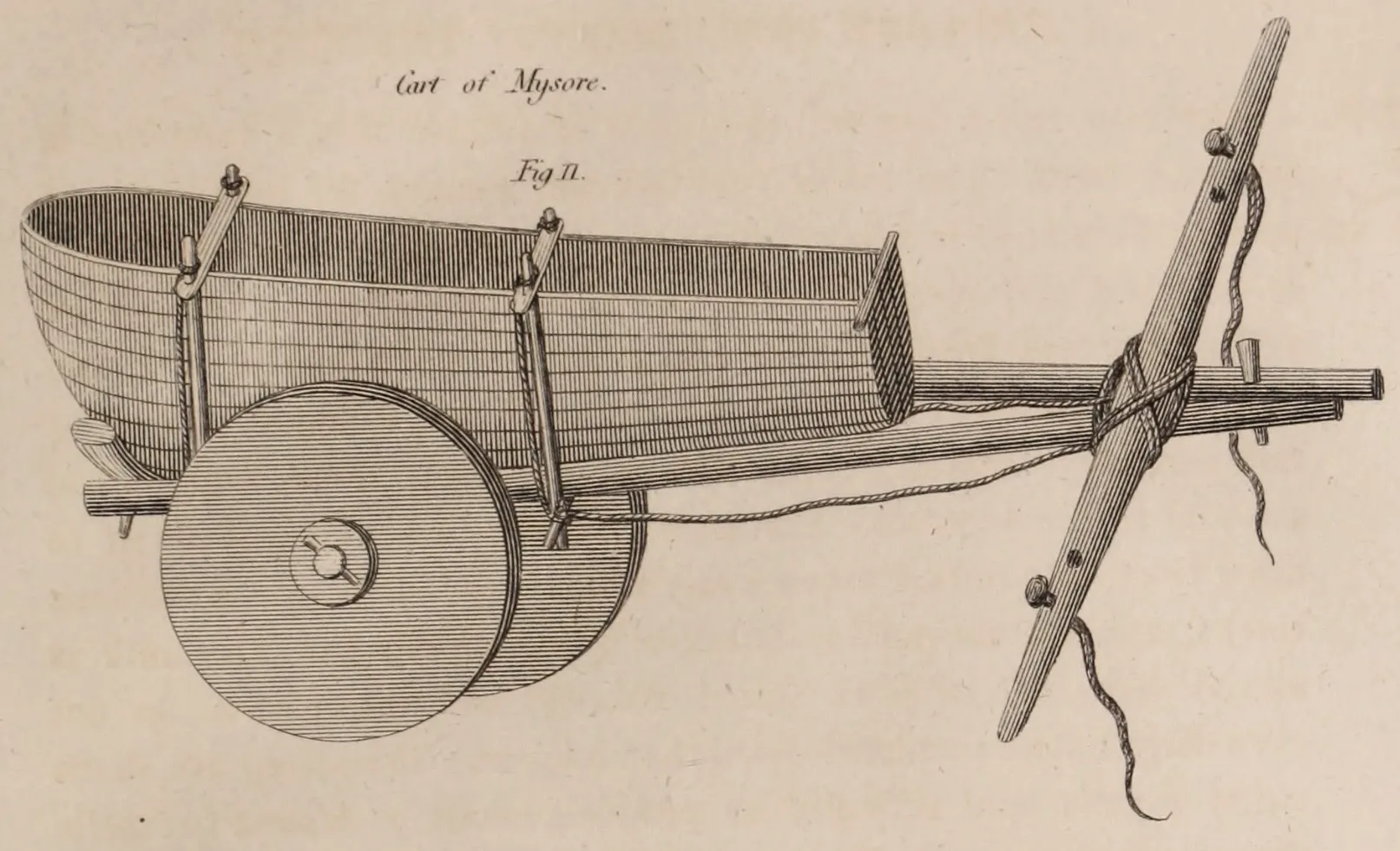
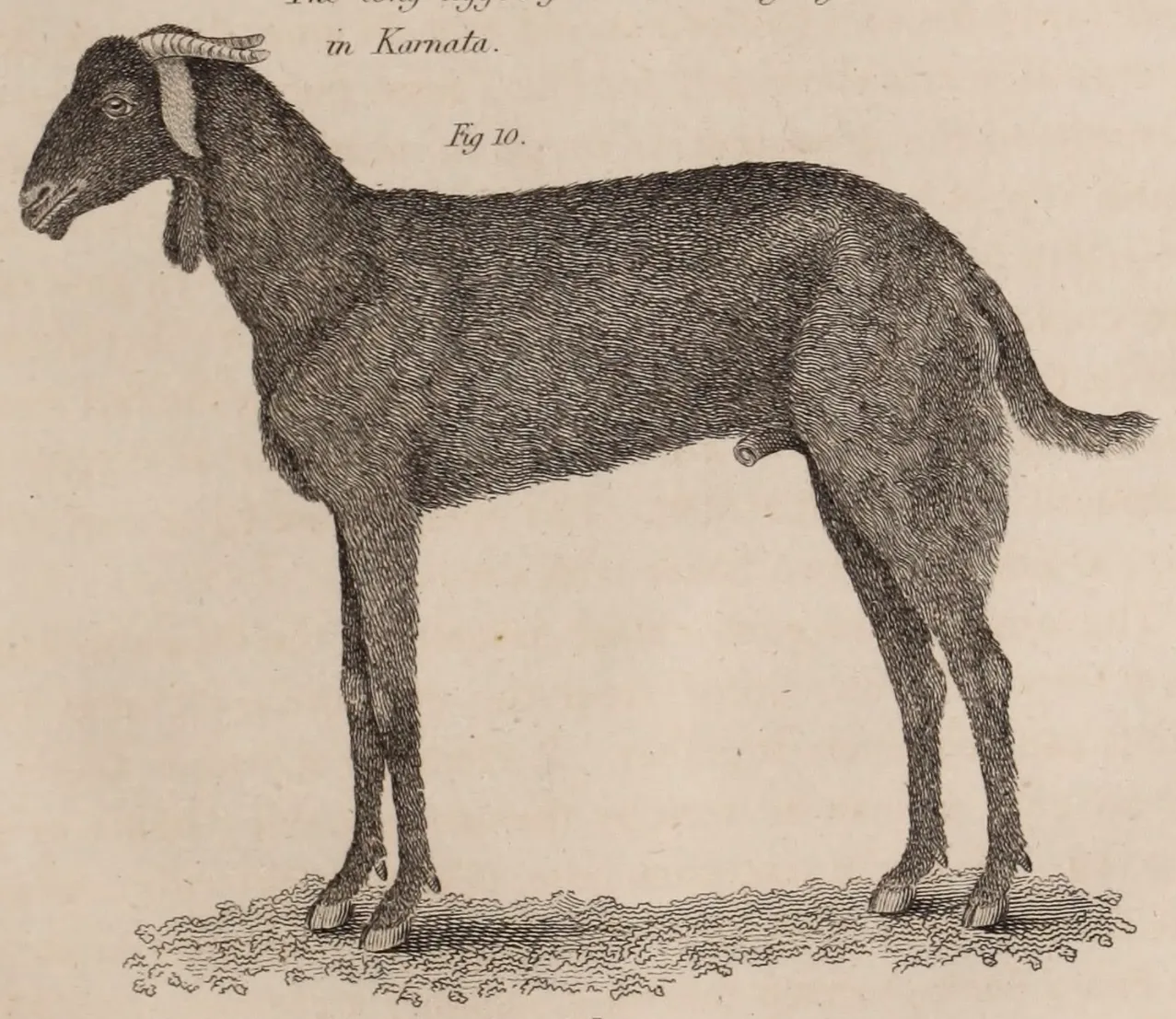
Swine were once very common; but Tippoo succeeded in banishing them from the immediate neighbourhood of his capital. Very few have as yet been brought back; but they will soon be numerous, as their flesh is sought after by many of the farmers. The lard is extracted, and used for strengthening carriage bullocks. A Seer given to an ox, when he is two years old, and repeated yearly, is said to make him grow very fat and strong. It is given mixed with the porridge of Ragy; but is so nauseous to the animal, that it requires to be crammed down his throat. It appears to me very improbable that any good should arise from such a practice; but among the natives it is in frequent use.
The native breed of horses here, as in most parts of India, is a small, ill-shaped, vicious poney; though considerable pains were taken by Hyder and Tippoo to introduce a better kind. They had however very little success, and their cavalry was extremely ill mounted. The studs of brood mares kept by the Sultan have been dispersed, and most of them have fallen into the hands of the Amildars; each of whom has one or two mares for his own riding, and breeds from them whenever he can procure a stallion. As many good horses have been introduced by the English officers, I have no doubt, that, in the hands of the Amildars, the breed will improve, and become very hardy and serviceable. The mothers have now the former quality in an eminent degree; and they only want an occasional supply of foreign horses to give them size and figure.
A good deal of attention is here paid to manuring the soil. Every farmer has a dunghill; which is prepared by digging a pit of sufficient extent; in this is collected the whole of the dung and litter of the cattle from the houses where they are kept, together with all the ashes and soil of the family. The straw, and various leaves intended to be used as manure, are never mixed with the dung. The farmers who are within two miles of the city, send bullocks with sacks, and procure from the Halal, or sweepers, the ashes, ordure, and other soil of the town. This also is kept separate from the dunghill. The straws of various crops, as before-mentioned, are reserved for manure; and to these are added various leaves of wild plants; the Cogay Sopu, or Galega purpurea; the Hoingay Sopu, or Robinia mitis; the Tumbay Sopu, or Phlomis esculenta of Dr. Roxburgh's MSS.; the Ugany Sopu, a Convolvulus: the Atty Sopu, or Ficus glomerata, R.; the Umutty Sopu, or Datura metel; and the Yeccada Sopu, or Asclepias gigantea. These leaves, and the straw, are the manure given to rice ground in the sprouted-seed and transplanted cultivations. When the field has been reduced to mud, a sufficient quantity of the manure is trampled into the puddle, and, with the moisture and heat of this climate, soon rots. The dung in every part of Mysore is most commonly carried out on carts, (see Fig. 11,) which are applied to scarcely any other purpose. The city soil is reckoned best for sugar-cane, but is also given to various grains. The use of lime as a manure is totally unknown to the natives; who, indeed, consider all ground, naturally impregnated with that substance, as very unfit for most kinds of cultivation. This accords well enough with the theory of Lord Dundonald, who supposes that lime is useful by promoting the putrefaction of inert vegetable matter. The heat of the climate is here sufficient for the purpose; and the lime, which in a cold climate may be necessary, would be here destructive, by exhausting the vegetable matter too quickly.
Near Seringapatam the farms, in general, extend to two or three ploughs of land. One plough is a poor stock; the possessor of four or five is a great farmer; and six or seven are reckoned prodigious wealth: the total want of a land-measure, and the scattered disposition of the plots of which each farm consists, render it very difficult to ascertain the extent of a plough of land; especially as a difference arises from the proportion of watered land and dry field which it contains. We may readily affirm, however, that the extent of a plough of land is very inconsiderable; for the ploughings given to the same field are very numerous, although dispersed over a considerable portion of the year; and I was assured, that a plough wrought by bullocks did not labour more, daily, than one seventh of an acre.
This account of the tenures and extent of farms not being satisfactory, on my return to Seringapatam I assembled the Amildar of the Pattana Ashta gram, with the most intelligent of his Sheristadars, and several respectable Gaudas, to consult them on the subject. They say, that a farmer having five ploughs, if he lives near the town, must keep ten servants, owing to the scarcity of forage. At some distance, five men servants are sufficient. In harvest and seed time, he must hire additional labourers, who are chiefly women, and must have fourteen oxen.
Instead of dividing the crops, as usual in most parts of the country, the farmer here cultivates his watered land as he pleases, and pays for each Candaca of ground ten Candacas of Paddy, which are equal in value to 1120 Seers of rice. The average price of this is about 20 Seers for a Rupee. For this ground, therefore, he pays to the government 66 Rupees, which is at the rate of 1l. 3s. an acre. He must also give an allowance to the gods, and to the Panchanga, Talliari, and other village officers, in lieu of the share which they were formerly wont to receive on a division of crops. The rent of dry field is paid in money, according to an old valuation formed on an estimate of its produce. With five ploughs, a man cultivates about 12½ acres of watered land, and 25 acres of dry field. The Circar, or government, is bound to keep the canals and tanks in repair.
The Ryuts, or farmers, have no property in the ground; but it is not usual to turn any man away, so long as he pays the customary rent. Even in the reign of Tippoo, such an act would have been looked upon as an astonishing grievance. The Gaudas are not here hereditary, but are appointed by the Amildar, with the consent of the farmers; for the Amildar never attempts to put in any person contrary to the wishes of the people. These Gaudas receive a fixed pay of 20 Fanams, or 13s. 5¼d. a month, and perform the sacrifices, which in other places are usually offered by the hereditary chiefs of villages.
The account of these persons, concerning the quantity of ground that can be laboured by one plough, is probably under-rated. According to an account of the ground that is now actually cultivated by the plough in the Pattana Ashta gram, which was procured from Purnea, and given me by Colonel Close, the watered lands amount to 1369 Candacas, or 8487 acres, and the dry field to 964 Candacas, or 22,172 acres. This divided by 3078, which, according to public documents, is the number of ploughs in the same district, will give for a farm of five ploughs 13. 78/100 acres of watered land, and 36 acres of dry field.
The hire of farmers’ labourers at Seringapatam, and generally within two miles from the city, when employed throughout the year, is 10 Sultany Fanams, or 6s. 8½d. a month. The servant lives in his own house; and it is customary for the master, on extraordinary occasions, such as marriages, to advance the servant money. This is not deducted from his wages by gradual instalments; but is considered as a debt, that must be repaid before the servant can leave his place. In case of the servant's death, his sons are bound to pay the debt, or to continue to work with their father's master; and, if there be no sons, the master can give the daughters away in marriage, and receive the presents that are usually given on such occasions, unless these should exceed the amount of the debt. In harvest, the daily hire of a man is six Seers of Paddy. A woman transplanting rice gets daily ¼ of a Sultany Fanam, or about two-pence. The only servant that does work in the house of a farmer is a woman, who comes once a day to sweep the house, and for her trouble receives a piece of cloth once a year. The women of the family cook, fetch water, and perform all other family labour. The servants are both Súdras and Whalliaru; but seven tenths of the whole are of the former cast.
Six or seven miles from town, the monthly hire of a servant is 8 Fanams, or about 5s. 4d. Farther from the city, the hire is one Fanam, and 80 Seers (or a little more than eleven pecks) of grain; of which one half must be Ragy, and the remainder of such kind as it may be most agreeable to the farmer to spare.
At different convenient places in every Taluc there are weekly markets, which in good parts of the country may be about two or three miles from each other. To these the farmers carry their produce, and sell it, partly to consumers by retail, and partly by wholesale to traders. In the early part of the day they endeavour to sell their goods by retail, and do not deal with the traders unless they be distressed for money. It is not customary for traders to advance money on the crops, and to receive the produce when they ripen. At all these markets business is carried on by sale; no barter is customary, except among a few poor people, who exchange grain for the produce of the kitchen garden.
On considering the state of agriculture near Seringapatam, many capital defects will be perceived. A meliorating succession of crops is utterly unknown ; scarcely any attention is paid to the improvement of the breed of labouring cattle, and still less to providing them with sufficient nourishment. The religion of the natives, indeed, is a powerful obstacle in the way of agriculture. The higher ranks of society being excluded from animal food, no attention will, of course, be paid to fattening cattle ; and without that, what would our agriculture in England be worth ? We could have no green crops to restore our lands to fertility, and but a scanty manure to invigorate our crops of grain. I am afraid, however, that the reader, in perusing the foregoing accounts, will have formed an opinion of the native agriculture still more favourable than it deserves. I have been obliged to use the English words ploughings, weedings, and hoeings, to express operations somewhat similar, that are performed by the natives ; and the frequent repetitions of these, mentioned in the accounts taken from the cultivators, might induce the reader to imagine that the ground was well wrought, and kept remarkably clean. Quite the reverse, however, is the truth. Owing to the extreme imperfection of their implements, and want of strength in their cattle, a field, after six or eight ploughings, has numerous small bushes remaining as upright in it as before the labour commenced ; while the plough has not penetrated above three inches deep, and has turned over no part of the soil. The view of the plough and other implements in the annexed plates, will sufficiently account for this circumstance. The plough, it must be observed, has neither coulter nor mould-board, to divide, and to turn over the soil ; and the handle gives the ploughman very little power to command its direction. The other instruments are equally imperfect, and are more rudely formed than it was possible for my draughtsman to represent.
The manufactures of Seringapatam and its vicinity were never considerable. They were chiefly military stores and camp equipage ; and of course, have been greatly reduced by the arsenal having become a mere dependency on that of Madras. Weavers are now assembling in considerable numbers in Shahar Ganjam, and in a short time will probably become numerous. The trade of the place was almost entirely confined to the importation of provisions, clothing, and luxuries for the court and army; and the returns were almost wholly made in cash.
In the following table, the coins current here are detailed.
| Carnata Name. | Mussulman Name. | English vulgar Name. | By whom coined. | Grains weight. | Grains pure Gold or Silver. | Value compared with a Guinea. | Value compared with a Shilling. | Value according to exchange of silver and base gold compared to Sultany Pagodas | Value in Dudus. | ||
|---|---|---|---|---|---|---|---|---|---|---|---|
| According to Government Regulation. | According to change given by Shrofs. | According to Market price. | |||||||||
| £. s. d. dec. | s. d. dec. | s. d. dec. | |||||||||
| Ahumuddy | Gold Mohur | Tippoo Sultan | 212 | 181,791 | 1 12 2,84 | - - - | - - - | 728 | 936 | 1040 | |
| Siducy | Half Mohur | Tippoo Sultan | 106 | 90,8955 | 0 16 1,42 | - - - | - - - | 364 | 468 | 520 | |
| Sultany Varaha | Sultany Hun | Sultany Pagoda | Tippoo Sultan | 53 | 45,4477 | 0 8 0,71 | - - - | - - - | 182 | 234 | 260 |
| Bahadury Varaha | Bahadury Hun | Bahadury Pagoda | Hyder Aly Khan | - - - | - - - | ||||||
| Ikery Varaha | Ikery Hun | Swamy Pagoda | Mysore Raja | - - - | - - - | ||||||
| Company Varaha | Companyca Hun | Star Pagoda | The Madras Mint | 52¾ | 41,47 | 0 7 4,24 | - - - | - - - | 168 | 216 | 240 |
| Sultany Hana | Sultany Palam | Sultany Fanam | Tippoo Sultan | 6 | 3,519 | 0 0 7,489 | - - - | 8,059 | 14 | 18 | 20 |
| Canter'raia Hana | Canter'raia Palam | Cantery Fanam | Mysore Raja | - - - | |||||||
| Silver. | |||||||||||
| Sultany Rupea | Sultany Rupea | Sultany Rupee | Tippoo Sultan | 177 | 165,053 | - - - | 1 11,05 | 2 2,036 | 49 | 63 | 70 |
| Mysoor Raja Rupea | Rajaca Rupea | Rajas Rupee | Mysore Raja | - - - | |||||||
| Company Rupea | Companyca Rupea | Company Rupee | The Madras Mint | 175 | 163,625 | - - - | 1 10,84 | 2 2 | 48 | 62 | 69 |
| Copper. | |||||||||||
| Dudu | Paissa or Jora | Dub | 177 | - - - | - - - | - - - | - - - | - | - | 1 | |
| Dod dudu | Du' Paissa | Double Dub | 354 | - - - | - - - | - - - | - - - | - | - | 2 | |
Accounts are commonly kept in Canter'raia Palams, and in an imaginary money containing ten of these; by the Mussulmans called Chucrums, and by the English Cantery Pagodas, a corruption of Canter'raia Pagoda. It must be observed, that, in the table, the value of the silver coins is estimated from that of the gold, according to the rate of exchange. That of gold coins is fixed by comparing the pure gold that each contains, with that of a guinea: but the Canter'raia Palam, being much adulterated, passes for more than its real value. This would occasion much confusion. I shall therefore, in all calculations, consider it as worth one twelfth part of the Sultany Pagoda. The coins were assayed at the Calcutta mint by Mr. Davidson.
The value of the different coins was frequently changed by the late Sultan in a very arbitrary and oppressive manner. When he was about to pay his troops, the nominal value of each coin was raised very high, and kept at that standard for about ten days; during which time the soldiery were allowed to pay off their debts at the high valuation. After this, the standard was reduced to the proper value. Ever since the place has been in the hands of the English, the value has been fixed by the commanding officer. The value put upon the copper, by this regulation, is higher than the market price of that article; owing, probably, to a difficulty in getting copper money to pay the troops the fractional parts of their allowances. The Batta, or price exacted by the money-changers for converting coin of one kind into another, is moderate; but the dealers are accused of imposing on those who are unacquainted with business; and, as scarcely any of the coins are aliquot parts of another, they have great opportunities for this kind of fraud. I have, in the table, stated the quantity of copper given, by the Shrofs, for gold and silver; when they give gold or silver for copper, they charge 240 Dubs for a Sultany Pagoda, which is a difference of 2½ per cent.
According to the regulations of the late Sultan, the Seer is the standard weight and measure, and is of two kinds; called in the Mussulman language Cucha Seer, and Pucka Seer. Each is divided into halves, quarters, eighths, and sixteenths.
The Cucha Seer is the basis of the weights, and is equal to 24 Sultany Rupees, or to the 0.6067 part of a pound avoirdupois. On this is founded the following set of weights : lb. 1 Seer - - - - - = 0.6067 5 Seers make 1 Pansh Seer - - - = 3.0335 8 Pansh Seers = 1 Managu, or Maund - - = 24.2680 20 Managus = 1 Barua, or Candy - - = 485.3600
By the Cucha weight are sold Jagory, sugar, tamarinds, turmeric, ginger, mustard, capsicum, betel-nut, asafœtida, garlic, spices, pepper, cardamoms, sandal-wood, wool, silk, cotton, thread, ropes, honey, wax, lac, oil, Ghee, &c. &c. Oil and Ghee are frequently sold by measure. A Seer weight of oil is taken, and put into a cylindrical brass vessel, which is reduced to a size adequate to contain the exact quantity, ánd serves afterwards as a standard.
The Pucka Seer is formed by mixing equal quantities of rice, Udu, Hessaru, Huruli, Tovary, Avaray, Carlay, Ellu, and wheat ; and then by taking of the mixture 84 Rupees weight, which is put into a vessel that will exactly contain it when heaped. This serves for a standard, and measures 74.8125/10000 cubical inches. From this standard the Sultan established the following dry-measure, which he ordered to be used throughout his dominions.
| Sultany Measure. | Cubical inches and Decimals. | Winchester Measure. | |||
|---|---|---|---|---|---|
| Bushels. | Pecks. | Gallons. Decimals. | |||
| 1 Seer - - - | 74.8125 | 00 | 00 | 0.3592 | |
| 16 Seers - | 1 Colaga or Wocula | 1197 | — | 2 | 0.454 |
| 20 Colagas | 1 Candaca - - | 239 40 | 11 | — | 0.108 |
Notwithstanding the arbitrary power of the Sultan, he was by no means able, in this matter, to introduce any uniformity; the weight therefore differs in almost every village, and even in the same for different purposes. The Candaca indeed every where contains 20 Colagas; but the Colaga varies from 5 Seers, to the Sultany standard. In the Ashta gram the usual measure is :
| Customary Measure in the Ashta gram. | Cubical inches and Decimals. | Winchester Measure. | |||
|---|---|---|---|---|---|
| Bushels. | Pecks. | Gallons. and Decimals. | |||
| 14 Seers | 1 Colaga | 1047.375 | — | 1 | 1.897 |
| 20 Colagas | 1 Candaca | 20947.5 | 9 | 2 | 1.94 |
By this measure are sold all kinds of grain.
The measure of length introduced by Tippoo was founded on the Gujah, equal to 38 1⁄2 inches.
| Miles. | Furlongs. | |
|---|---|---|
| 6000 Gujahs = 1 Hardary, commonly by Europeans called a Sultany Coss | 3 | 5.16⁄100 |
| 4 Hardaries = 1 Gavada, or day’s journey, | 14 | 4.64⁄100 |
| But the Hardary in common use is one fourth less, and is therefore equal to | 2 | 5.87 |
| The Gavada, or day’s journey, | 10 | 7.48 |
This measurement is called Canter’raia, or Cantery, as the English pronounce it.
None of the roads, however, are measured; but all the distances are formed by computation, and may therefore, in general, be estimated as much longer than they are commonly called.
Cloth and timber are usually measured by the purchaser’s cubit; which may be considered, in all nations, as on an average eighteen inches.
The natives here are either not well acquainted with the quarries of their country, or else pretend great ignorance concerning them. Although the country abounds in a variety of ornamental stones, I observe only two about Seringapatam, that have received a marble polish. The one is the black stone used in Hyder's monument, the quarry for which I shall hereafter have an opportunity of examining. The other is a most beautiful green stone, of which some bases for pillars were found in the palace; but no person can tell from whence they were brought. It has the appearance of quartz stained by copper; but is vitrifiable, per se, in a moderate heat, and gives out no copper to the vitriolic acid.
The two finest stones near Seringapatam are found at Kingalu Copalu, and Cavary Cadu, both near the northern branch of the river. The former is a compact granite, consisting of dark red felspar, red and yellowish quartz, and black mica. Some of the yellow particles appear to be felspar. The prevailing colour is owing to the dark red minute particles of felspar; but it also contains large concretions of the same stone, which have a bright red colour.
I had a specimen resembling this brought me (I do not know from what place), in which the red felspar predominated over the quartz, and the mica was in a very small proportion. The grains are small; it is also a very ornamental stone.
The stone from Cavary Cadu may be called either a hornstone porphyry, or a granatine. Its basis is a dark brown hornstone, in which are imbedded grey, yellow, and red felspars, and black shorl. Like the former, it is very compact.
The granite, of which the walls of Mysore and Nuzerbar have been formed, is loose-grained, and consists of glassy quartz, green and black mica, and reddish felspar. The mica is in large quantity, and the felspar in a smaller proportion than usual.
Specimens of a fine-grained granite were also brought me from some quarry in the neighbourhood, consisting of black mica, grey felspar, and yellowish brown quartz, which gives the predominating colour. It is, probably, rather a gneiss than a granite, as a stratified appearance may be seen in one of the specimens ; but, except in the rock, it is generally difficult to distinguish gneiss from granite.
At Kingalu Copalu is also found a very pretty, fine-grained granitell, consisting of grey felspar and black mica. It is evidently of a slaty texture, and would be a gneiss, if it contained quartz. It is of the kind of stone called by Saussure Roche feuilletée, which seems to be a useful distinction.
Near the Durria Adaulut Baug, on the island of Seringapatam, are found nodules of a stone called Madi Cullu, which is sometimes used for making gun-flints; these, however, are of a bad quality. Better ones, called Cheky-muky, are said to be found near a village, called Beü Cullu, about twenty miles north and west from Seringapatam. The Madi Cullu is evidently a hornstone.
All these stones are very hard; yet the natives cut them into pillars, or flags, with tolerable facility. The same persons cut the stones out of the quarry, and afterwards work them up into the various fantastical shapes that are given to them in Hindu buildings. Good workers in stone get from 40 to 50 Fanams a month (from about 1l. 6s. 10 1⁄2d. to 1l. 13s. 7d.). The drudgery is performed by common labourers. The granite may be cut by wedges in any direction, and to any length; but there is always one direction, in which it is found to split easiest; a number of small square holes, about an inch and a half in diameter, and four inches deep, are cut in the line by which the stone is meant to be split. The work is performed by a small steel punch of this shape, which is driven in by a heavy iron mallet. When the rock or stone is very long, or deep, these holes must be almost contiguous; but when the surface to be split is small, they may be at considerable distances. Blunt wedges of steel are then put in the holes, and each is struck upon in its turn, until the stone splits, which it does in a straight line to the very bottom of the mass or stratum. The surface is cut smooth with steel chisels, and, except in the very finest works,
receives no higher polish. When a marble polish is to be given, it is done by rubbing the stone with cakes made of the adamantine spar, reduced to powder, and united with melted lac. The adamantine spar is here called Curungada Cullu, and is said to be found in lumps, which are immersed in rocks of a black stone, near Nagamangula. It must be observed, however, that at Nagamangula the people denied their having any such stone.
Near Seringapatam the Congcar, or limestone nodules, called there Suna Cullu, are very common, and are found of four different qualities, which, however, are generally intermixed in the same field. These four varieties, therefore, although they produce lime of different degrees of whiteness, and are distinguishable by the workmen, have the same origin. They have, no doubt, been deposited by water; and I have been told, by good authority in Bengal, that a field, after having been perfectly freed of these nodules, will in a few years be again filled with them. Whence then is this calcarious matter derived? There are here no rocks of limestone, or marble, from which it could have been washed. The whole calcarious matter to be found in Mysore is a Tufa. The quicklime is prepared by a class of people called Uparu, who are in general poor, and must receive advances to enable them to hire labourers. A labouring man at this work earns daily ¾ of a Fanam, almost a sixpence; and women, who perform much of the labour, get one third of that sum. They are allowed to collect the nodules, which are generally found by the sides of rivulets, and in waste ground, without paying any thing to the public; but in the late government they were frequently compelled to supply the Sultan at a low rate. The lime is always burned with charcoal. The dark-coloured quicklime, for building, costs, at Seringapatam, six Fanams a Candaca, or nearly five pence a bushel; finer lime, for white-washing, costs ten Fanams, or a little more than eight pence a bushel; and the finest, that is used for chewing with betel, costs twenty Fanams a Candaca, or one shilling and four pence half-penny a bushel.
Firewood at Seringapatam is a dear article, and the fewel most commonly used is cow-dung made up into cakes. This, indeed, is much used in every part of India, especially by men of rank ; as, from the veneration paid to the cow, it is considered as by far the most pure substance that can be employed. Every herd of cattle, when at pasture, is attended by women, and these often of high cast, who with their hands gather up the dung, and carry it home in baskets. They then form it into cakes, about half an inch thick, and nine inches in diameter, and stick them on the walls to dry. So different, indeed, are Hindu notions of cleanliness from ours, that the walls of their best houses are frequently bedaubed with these cakes ; and every morning numerous females, from all parts of the neighbourhood, bring for sale into Seringapatam baskets of this fewel.
Many females who carry large baskets of cow-dung on their heads are well-dressed, and elegantly formed girls. The dress of the Karnátaca women is indeed very becoming ; and I have never seen finer forms than even the labouring women of that country frequently possess. Their necks and arms are in particular remarkably well shaped. Their nastiness, however, is disgusting ; very few of the inhabitants above the Ghats being free from the itch ; and their linen, being almost always dyed, is seldom washed.
Timber, for building and furniture, may be had at Seringapatam of excellent quality ; but it is dear, as it is brought from a great distance by land carriage. The principal supply comes from the neighbourhood of the western Ghats.
The plan which I have concerted with Colonel Close, for my future investigations, is, to proceed to the chief places of the Rája’s dominions ; and there to make myself master, so far as I shall be able, of the state of the country. I am then to draw up a set of queries applicable to the state of affairs, which Purnea will circulate among the Amildars, and procure their answers for my information. I shall follow a similar plan in the dominions immediately subject to the Company. The country toward the north-west being now in a very unsettled state, owing to the insurrection of Dundia, I shall defer my visit to that quarter to the last; with a view of giving the collectors of Canara time to answer such queries as I may propose to them, after having visited that province, which is the last part of the Company's territory that I intend to survey.
Notes
- Note. N. B. The following Fractions of the Rupee were coined by Tippoo Sultan ; ¼ or Bacri, ⅛ or Jasri, 1/16 or Casmi, and 1/32 or Kizri.