BEFORE entering Malabar, it may be necessary to premise, that this province is subject to the authority of three commissioners; under whom are employed a number of gentlemen, that act in their respective circles as magistrates and collectors. These officers, formerly appointed by the government of Bombay, have been lately placed under the Presidency of Fort St. George. With an establishment the expense of which has far exceeded the revenue, a complete protection from invaders, and a most tender regard to avoid the punishment of the innocent, it might have been expected, that this province would have been found in a situation very different from what I am compelled to represent it. No doubt, this has arisen from a lenity in punishing crimes, and an aversion to employ harsh measures to repress the turbulent, originating in a gentleness of disposition, which, however amiable in private life, in a government often produces the utmost distress to the peaceable and industrious subject.
November 29th, 1800.—Having crossed the rivulet immediately after leaving Mingara, I entered the province of Malabar, in that part of it which formerly belonged to the Tamura Rája, as the Zamorin is called by the natives. I found that they considered it unlawful to mention the real name of this personage, and always spoke of him by his titles.
The stage that I went to Colangodu is of moderate length, and the road crosses the rivulet five times, which from that circumstance is called Wunan-Ar. The woods through which we passed to-day are very fine; but the declivities are rather steeper, the roads worse, and the country is more rocky, than between Ani-malaya and Mingara. About half way to Colangodu are the ruins of a small mud fort which was built by the Tamuri Rájá, and destroyed by Tippoo. The circumjacent country has once been cultivated, as is evident from the remains of corn-fields. Teak and other forest trees are now fast springing up among the Banyan (Ficus bengalensis) and Palmira trees (Borassus flabelliformis), by which the houses of the natives have formerly been shaded; and this part of the country will soon be no longer distinguishable from the surrounding forests.
The environs of Colangodu are very beautiful. The high mountains on the south pour down cascades of a prodigious height; and the corn fields are intermixed with lofty forests, and plantations of fruit trees. The cultivation, however, is very poor. Most of the dry-field is neglected, and the quantity of rice-land is not great. Here the rain, without any assistance from art, is able to bring one crop of rice to maturity; and in a few places the natives have constructed small reservoirs, which enable them to have a second crop.
Colangodu has a resemblance to many of the villages in Bengal, although the structure of the houses is quite different; but each is surrounded by a small garden, and at a little distance nothing is to be seen, except a large grove of trees, mostly Mangoes (Mangifera) or Jacks (Artocarpus). The houses in Colangodu are about 1000 in number, and many of them are inhabited by Tamul weavers of the Coicular cast, who import all their cotton from Coimbetore. The Malayala language is, however, the prevalent one, and differs considerably from that of the Tamuls, or what among the Europeans at Madras is called the Malabar language. They are, nevertheless, both branches of the same dialect; and my Madras servants and the natives are, to a certain degree, able to understand each other. The accents are very different, and the Malayala language, containing a larger share of Sanskrit, and of the Paat, or poetical dialect, than the language prevailing to the eastward, is generally allowed to be the more perfect. The character used in Malayala is nearly the same with that used among the Tamuls for writing poetry; and the poetical language of both people is very nearly the same.
30th November.—I went a long stage to Pali-ghat. The country through which I passed is the most beautiful that I have ever seen. It resembles the finest parts of Bengal; but its trees are loftier, and its palms more numerous. In many places the rice grounds are interspersed with high swells, that are crowded with houses, while the view to the north is bounded by naked rocky mountains, and that to the south by the lofty forests of the Travancore hills. The cultivation of the high grounds is much neglected.
1st—4th December.—I remained with Mr. Warden, the collector of the district, taking an account of the neighbourhood; and from him I not only received every assistance during my stay, but have also been favoured with very satisfactory answers to queries which I proposed to him in writing. Of these I shall avail myself in the following account. Owing to Mr. Warden’s kind and hospitable attentions, I found myself perfectly at home while under his roof; which was indeed the case every where in Malabar, when I had the good fortune to meet with an English gentleman.
Pali-ghat is a beautiful fort, built by Hyder on his conquest of Malabar, and situated in the country called Pali-ghat-shery, which belonged to the Shekhury Rája, one of the petty chiefs of Malaya; a word from which, by sundry corruptions, Malabar is derived. In the list of the 56 Desas of Bharata-khanda, given me by the Bráhmans of Arava-courchy, Malayala and Kérala are laid down as two distinct Desas; but among the Bráhmans here they are considered as the same; or at least, that Malayala forms a part of Kérala. Some consider the words as synonymous, and say, that Malayala is the vulgar word, for what is called Kérala in the Sanskrit; while others allege, that Kérala comprehends the whole country below the western Ghats, from Cape Comorin to Surat; while Malayala includes that part only which is situated to the south of the Chandra-giri river. The Malayala of the list given me at Arava-courchy is probably a corruption for Malayáchala.
According to the accounts of the Bráhmans here, no part of Kérala is included in the 56 Désas of Bharata-khanda, and it is of a much later origin. They say, that when Pârasu-ráma, one of the incarnations of Vishnu, had conquered all Bharata-khanda, had destroyed all the Kshatri cast except the families of the Sun and Moon, and had divided the whole of their dominions among the Bráhmans, these favourites of heaven were still dissatisfied, and continued to importune the god for more charity. To free himself from their solicitations, which he could not resist, he created Kérala, and retired thither: but he was followed by the Bráhmans, who extorted from the god the whole also of this new creation. For many ages the Bráhmans retained possession of Kérala, and lived under a number of petty chiefs of their own cast, who were called Potties. Dissentions, petty wars, assassinations, and every other sort of disorder, became so common under this kind of government, that the Bráhmans of Malayala, who are called Namburis, were forced to apply for a viceroy to govern them under the Sholun Rájas, who were at that time the most powerful princes in the south. Each of these viceroys was continued in power for twelve years, and a successor was then appointed by the sovereign. This continued until about a thousand years ago; when Cheruman Permal, having acquired great popularity during his viceroyalty, retained his government for twenty years. The Sholun Rája, called also Permal, enraged at this disloyalty, marched with an army into Malayala, and, having forced Cheruman Permal to retire into the forests, established his court at Teravanji Callum, a place now belonging to the Cochi Rája. There he reigned for some time; but at length the Namburis, who were extremely attached to Cheruman Permal, persuaded some of their own cast to undertake the assassination of the king. The chief of these murderers, having, from his rank and sacred character, gained admission to Sholun Permal, soon ingratiated himself so far into the prince's favour, that he and his companions were admitted into the inner apartments of the palace, while none of the guards nor servants were present. They embraced their opportunity, and, having cut the king's throat, made their escape to Cheruman Permal; who, taking advantage of the confusion occasioned by their crime, re-established his authority over all Malayala. About this time the Arabs had settled on the coast, where they carried on a great trade, and were called by the natives Moplaymar. Some of their priests seem to have converted Cheruman Permal, who came to the resolution of retiring to Mecca. Having called a great assembly of the Namburis at a place called Trishu meru vacadu nada swami covil, he in their presence divided his dominions among his twelve principal chiefs, of whom five were of the Kshatri cast, and seven were Nairs, who are the Súdras of pure descent belonging to Malayala. He then retired to the place which we call Calicut, where he was to embark. He was met there by a Nair, who was a gallant chief; but who, having been absent at the division, had obtained no share of his master's dominions. Cheruman Permal therefore gave him his sword, and desired him to keep all he could conquer. From this person's sisters are descended the Tamuri Rájas, or Zamorins, who, although among the most powerful of the chiefs of Malabar, were never acknowledged as their superiors, as in Europe has been commonly supposed. From the time of Cheruman Permal, until the time of Hyder, Malayala continued to be governed by the descendants of these thirteen chiefs' sisters; among whom, and among the different branches of the same families, there subsisted a constant confusion, and change of property; which was greatly increased by many inferior chiefs assuming sovereign power, although they abstained from the title of Rája. Many also of the former Namburi Putties continued to enjoy every jurisdiction of a sovereign prince. The country became thus subdivided, in a manner, of which, I believe, there is no example; and it was a common saying, that in Malayala a man could not make a step, without going out of one chief's dominions into those of another. Hyder, taking advantage of these dissensions, subdued the northern part of Malayala, or what is now called the province of Malabar; while the Kerit Rám' Rája, and Cochi Rája rendered all the petty chiefs of the southern part obedient to their authority. Both of them are descended from sisters of chiefs appointed by Cheruman Permal. The former, whom we call the Rája of Travancore, has always retained his independence; but the Cochi Rája was compelled by Tippoo to pay tribute, as he does now to the Company. The violent bigotry and intolerance of Tippoo forced the greater part of the Rájas, Nairs and Namburis, either to fly to Travancore, or to retire into the forests, and other inaccessible places. On the landing of the British army, a good many of the Nairs and some of the Rájas joined it; and after the province was ceded to Lord Cornwallis, the Rájas were in general placed in authority over the countries that had formerly belonged to their families; but their government having been found such, that it could not be tolerated, or protected, consistent with the principles of humanity that influence Englishmen, they have in general been deprived of all authority, and are allowed one fifth part of their country's revenue to support their dignity, which is more than any sovereign of consequence in Europe can spare for that purpose. Some of them, however, are in actual rebellion; some are refractory, and all are undoubtedly discontented; although before the arrival of the British army they had been very wretchedly supported on the allowances which they received from the Rája of Travancore. It is alleged, that they are in some degree excusable; as promises, for corrupt purposes, were made to them by persons high in office, although perfectly unauthorised by government.
Pali-ghat-shery, on the division of Malayala, fell to the lot of the Shekhury Rája, of the Kshatri cast; but as this family invited Hyder into the country, they are considered by all the people of Malabar as having lost cast, and none of the Rájas of Kshatrya descent will admit them into their company. To an European the succession in this family appears very extraordinary; but it is similar to that which prevails in the families of all the chiefs of Malayala. The males of the Shekhury family are called Achuns, and never marry. The ladies are called Naitears, and live in the houses of their brothers, whose families they manage. They have no husbands; but are not expected to observe celibacy, and may grant their favours to any person of the Kshatri cast, who is not an Achun. All the male children of these ladies are Achuns, all the females are Naitears, and all are of equal rank according to seniority; but they are divided into two houses, descended from the two sisters of the first Shekhury Rájá. The oldest male of the family is called the Shekhury, or first Rájá; the second is called Ellea Rájá, the third Cavashiry Rájá, the fourth Talan Tamburan Rájá, and the fifth Tariputamura Rájá. On the death of the Shekhury, the Ellea Rájá succeeds to the highest dignity, each inferior Rájá gets a step, and the oldest Achun becomes Tariputamura. There are at present between one and two hundred Achuns, and each of them receives a certain proportion of the fifth of the revenue that has been granted for their support, and which amounts in all to 66,000 Vir’-Ráya Fanams a year (1638l. 9s. 8d.): but one sixth part of this has been appropriated for the support of the temples. Formerly the whole was given to the head of the family; but, it having been found that he defrauded his juniors, a division was made for each, according to his rank; and every one receives his own share from the collector. Every branch of the family is possessed of private estates, that are called Chericul lands; and several of them have the administration of lands belonging to temples; but in this they are too closely watched by the Namburis, to be able to make any profit. The present Shekhury Rájá is a poor looking, stupid old man, and his abode and attendance are the most wretched of any thing that I have seen, belonging to a person who claimed sovereignty. His principal house, or Colgum, is called Hatay Toray, and stands about three miles north from the fort. He is now engaged in rebuilding the temple of Bhagawat, at Callay Colam; which was pulled down by Tippoo; but that bigot did not venture to destroy the image, which is in the form of a human hand. Bhagawat is the mother of Parasu-ráma. She followed her son to the mountains above Pali-ghat, and sat down there on a three peaked hill. At the intercession of the Bráhmans, she consented to appear at a certain hour in the tank called Callay Colam. On going thither at the appointed time, the Bráhmans found the image projecting from the water of the tank, and there it has remained for these eight thousand centuries. Two marks on a rock are shown, as the print of the deity's feet as she descended to the tank. They are of the human size.
Around the fort of Pali-ghat are scattered many Desas (districts), Agrarums (villages), and two Angadies; all together containing a considerable population: but there is very little appearance of a town.
In Angady is a street occupied by shops, or what in many other places of India is called a Bazar. Those here are rather mean.
The Agrarums, or Gramams, are villages occupied by Puttar Bráhmans, as they are here called; that is to say, by Bráhmans, who, coming from other countries, are not Namburis, and who are looked upon by the people of Malayala as inferior in rank; at which they are of course exceedingly offended. The houses of the Gramas are built contiguous, in straight streets; and they are the neatest and cleanest villages that I have seen in India. The beauty, cleanness, and elegant dress of the girls of the Bráhmans add much to the look of these places. Their greatest defect is, that the houses are thatched with palm leaves, which never can be made to lie close, and which render them very liable to fires, that when they happen generally consume the whole Gramam.
Both Angadies and Gramams have been introduced by foreigners; the Namburis, Nairs, and all aboriginal natives of Malayala living in detached houses surrounded by gardens, and collectively called Désas. The houses of the Namburis, Nairs, and other wealthy persons, are much better than those usually met with in the villages of India. They are built of mud, so as generally to occupy two sides of a square area, that is a little raised, and kept clean, smooth, and free from grass. The mud is of an excellent quality, and in general is neatly smoothed, and either whitewashed or painted. These higher ranks of the people of Malayala use very little clothing, but they are remarkably clean in their persons. Cutaneous disorders are never observed, except among the slaves, and lowest orders; and the Nair women are remarkably careful, by repeated washings with various saponaceous plants, to keep their hair and skins free from every impurity, a thing very seldom sufficiently attended to among the natives of India.
Money.
Accompts are kept in Feringy, or Porto-novo Pagodas, or Varahuns; Pudameni, commonly called Vir'-Ráya Fanams; and Cash. I have already mentioned the intrinsic value of the two gold coins. No Vir'-Ráya Fanams are current, but those of the last coinage struck at Calicut. The Madras Rupee at present exchanges for 3¾ Vir'-Ráya Fanams, 2½ Cash. A vast variety of other coins are current in the country, but not in any considerable quantity: Couries are not in use. A Brâhman has the exclusive privilege of coining copper money, which is every year recoined. He pays a certain sum annually to government, and at the beginning of the year issues out his money at the rate of 22 Cash for the Vir'-Ráya Fanam. He buys in the old ones at the rate of 40 for the Fanam. The value of the Cash therefore gradually sinks toward the end of the year, until it falls to be the 40th part of a Fanam, below which it never can descend. The Company's Niruc, or rate of exchange, is necessarily varied occasionally, and is generally altered according to the representations of the money-changers. The exchange of the Pagoda into Fanams is very variable, and alters from 11¼ to 11¾; so that a profit of from 11¼ to 11¾ per cent. may be had by bringing Porto-novo Pagodas from Daraporam to Pali-ghat, and carrying back the Vir’-Ráya Fanams. The Batta, or allowance made to the money-changer, for giving Fanams for Pagodas, is 2 Cash for each Pagoda.
Weights.
9 Pondichery Rupees and 1 Cash = 1 Polam = 1624 gr. 2½ Polams = 1 Seer = 4060 gr. 5 Seers = 1 Visay = 2,89906 lb. 8 Visays = 1 Tolam = 23,19248 lb.
By this are sold Betel-nut, black pepper, turmeric, ginger, sugar, and other Sweets ; onions, tamarinds, sandal-wood, wax, Dupada gum ; tin and other metals ; cotton and thread.
Grain Measure.
The merchants sell by the following standard : 84 Pondichery Rupees (each weighing 177 grains) weight of rice fill a Puddy measure, which by actual measurement I found to contain 79,875/1000 cubical inches. 9 Puddies are equal to 1 Poray, which is therefore about 1,3375/10000 peck.
The farmers divide their Poray into 10 Edangallies ; and about 100 Puddies being equal to 111 or 110 Edangallies, the two Porays ought to be nearly the same. Government have affixed a stamp to the Tolam and Puddy, to ascertain their being according to standard. The other denominations of measures are made up in various rude manners, and differ so much from each other, that in all bargains for goods it is customary to specify the person’s weights and measures by which they are to be delivered.
By the grain measure are also sold mustard, capsicum, oil, and Ghee or boiled butter.
Land Measure.
No land measure has ever existed at Pali-ghat; but the natives form computations of extent by saying, that such or such a space of ground is a Poray-candum, or what ought to be sown with a Poray of rice-seed. It being a matter of great importance to ascertain the extent of a Poray-candum, I used much pains in endeavouring to come at the truth; but I met with such opposition, from the fears of the natives of all ranks, that I could ascertain nothing to my own satisfaction. The field that seemed to me best ascertained as a Poray sowing measured 7622 square feet; but Mr. Warden informs me, that, after my departure, he made particular enquiries on this subject; and the result of these, which he considers as not liable to material error, is, that the Poray sows a field of 58 feet square. One acre therefore contains about 12 95/100 Porays.
Time.
The people of Malayala reckon by the era of Parasu-ráma, and divide it into cycles of one thousand years. This is reckoned the 976th year of the cycle: but as their year consists of 365 days, without any means of intercalation, its commencement must constantly, though slowly, be varying through the seasons. The following is a TABLE of the current year, with the corresponding days of our calendar.
| Tamul Months. | European Months. | Tamul Months. | European Months. | ||||
|---|---|---|---|---|---|---|---|
| Canni 976 - | 1 | 14 | September 1800. | Canni 976 - | 10 | 23 | September 1800. |
| 2 | 15 | 11 | 24 | ||||
| 3 | 16 | 12 | 25 | ||||
| 4 | 17 | 13 | 26 | ||||
| 5 | 18 | 14 | 27 | ||||
| 6 | 19 | 15 | 28 | ||||
| 7 | 20 | 16 | 29 | ||||
| 8 | 21 | 17 | 30 | ||||
| 9 | 22 | 18 | 1 | October. | |||
| Canni 976 - | 19 | 2 | October 1800. | Vrichica 976 | 7 | 20 | November 1800. |
| 20 | 3 | 8 | 21 | ||||
| 21 | 4 | 9 | 22 | ||||
| 22 | 5 | 10 | 23 | ||||
| 23 | 6 | 11 | 24 | ||||
| 24 | 7 | 12 | 25 | ||||
| 25 | 8 | 13 | 26 | ||||
| 26 | 9 | 14 | 27 | ||||
| 27 | 10 | 15 | 28 | ||||
| 28 | 11 | 16 | 29 | ||||
| 29 | 12 | 17 | 30 | ||||
| 30 | 13 | 18 | 1 | December. | |||
| 31 | 14 | 19 | 2 | ||||
| Tulam - - | 1 | 15 | 20 | 3 | |||
| 2 | 16 | 21 | 4 | ||||
| 3 | 17 | 22 | 5 | ||||
| 4 | 18 | 23 | 6 | ||||
| 5 | 19 | 24 | 7 | ||||
| 6 | 20 | 25 | 8 | ||||
| 7 | 21 | 26 | 9 | ||||
| 8 | 22 | 27 | 10 | ||||
| 9 | 23 | 28 | 11 | ||||
| 10 | 24 | 29 | 12 | ||||
| 11 | 25 | Danu - - | 1 | 13 | |||
| 12 | 26 | 2 | 14 | ||||
| 13 | 27 | 3 | 15 | ||||
| 14 | 28 | 4 | 16 | ||||
| 15 | 29 | 5 | 17 | ||||
| 16 | 30 | 6 | 18 | ||||
| 17 | 31 | 7 | 19 | ||||
| 18 | 1 | November. | 8 | 20 | |||
| 19 | 2 | 9 | 21 | ||||
| 20 | 3 | 10 | 22 | ||||
| 21 | 4 | 11 | 23 | ||||
| 22 | 5 | 12 | 24 | ||||
| 23 | 6 | 13 | 25 | ||||
| 24 | 7 | 14 | 26 | ||||
| 25 | 8 | 15 | 27 | ||||
| 26 | 9 | 16 | 28 | ||||
| 27 | 10 | 17 | 29 | ||||
| 28 | 11 | 18 | 30 | ||||
| 29 | 12 | 19 | 31 | ||||
| 30 | 13 | 20 | 1 | January 1801. | |||
| Vrichica - - | 1 | 14 | 21 | 2 | |||
| 2 | 15 | 22 | 3 | ||||
| 3 | 16 | 23 | 4 | ||||
| 4 | 17 | 24 | 5 | ||||
| 5 | 18 | 25 | 6 | ||||
| 6 | 19 | 26 | 7 | ||||
| Danu 976 - | 27 | 8 | January 1801. | Cumbha 976 | 17 | 26 | February 1801. |
| 28 | 9 | 18 | 27 | ||||
| 29 | 10 | 19 | 28 | ||||
| 30 | 11 | 20 | 1 | March. | |||
| Macara - | 1 | 12 | 21 | 2 | |||
| 2 | 13 | 22 | 3 | ||||
| 3 | 14 | 23 | 4 | ||||
| 4 | 15 | 24 | 5 | ||||
| 5 | 16 | 25 | 6 | ||||
| 6 | 17 | 26 | 7 | ||||
| 7 | 18 | 27 | 8 | ||||
| 8 | 19 | 28 | 9 | ||||
| 9 | 20 | 29 | 10 | ||||
| 10 | 21 | 30 | 11 | ||||
| 11 | 22 | Mina - - | 1 | 12 | |||
| 12 | 23 | 2 | 13 | ||||
| 13 | 24 | 3 | 14 | ||||
| 14 | 25 | 4 | 15 | ||||
| 15 | 26 | 5 | 16 | ||||
| 16 | 27 | 6 | 17 | ||||
| 17 | 28 | 7 | 18 | ||||
| 18 | 29 | 8 | 19 | ||||
| 19 | 30 | 9 | 20 | ||||
| 20 | 31 | 10 | 21 | ||||
| 21 | 1 | February. | 11 | 22 | |||
| 22 | 2 | 12 | 23 | ||||
| 23 | 3 | 13 | 24 | ||||
| 24 | 4 | 14 | 25 | ||||
| 25 | 5 | 15 | 26 | ||||
| 26 | 6 | 16 | 27 | ||||
| 27 | 7 | 17 | 28 | ||||
| 28 | 8 | 18 | 29 | ||||
| 29 | 9 | 19 | 30 | ||||
| Cumbha - - | 1 | 10 | 20 | 31 | |||
| 2 | 11 | 21 | 1 | April. | |||
| 3 | 12 | 22 | 2 | ||||
| 4 | 13 | 23 | 3 | ||||
| 5 | 14 | 24 | 4 | ||||
| 6 | 15 | 25 | 5 | ||||
| 7 | 16 | 26 | 6 | ||||
| 8 | 17 | 27 | 7 | ||||
| 9 | 18 | 28 | 8 | ||||
| 10 | 19 | 29 | 9 | ||||
| 11 | 20 | 30 | 10 | ||||
| 12 | 21 | Mayda - - | 1 | 11 | |||
| 13 | 22 | 2 | 12 | ||||
| 14 | 23 | 3 | 13 | ||||
| 15 | 24 | 4 | 14 | ||||
| 16 | 25 | 5 | 15 | ||||
| Mayda 976 - | 6 | 16 | April 1801. | Ayduma 976 | 24 | 4 | June 1801. |
| 7 | 17 | 25 | 5 | ||||
| 8 | 18 | 26 | 6 | ||||
| 9 | 19 | 27 | 7 | ||||
| 10 | 20 | 28 | 8 | ||||
| 11 | 21 | 29 | 9 | ||||
| 12 | 22 | 30 | 10 | ||||
| 13 | 23 | 31 | 11 | ||||
| 14 | 24 | Maytuna - | 1 | 12 | |||
| 15 | 25 | 2 | 13 | ||||
| 16 | 26 | 3 | 14 | ||||
| 17 | 27 | 4 | 15 | ||||
| 18 | 28 | 5 | 16 | ||||
| 19 | 29 | 6 | 17 | ||||
| 20 | 30 | 7 | 18 | ||||
| 21 | 1 | May. | 8 | 19 | |||
| 22 | 2 | 9 | 20 | ||||
| 23 | 3 | 10 | 21 | ||||
| 24 | 4 | 11 | 22 | ||||
| 25 | 5 | 12 | 23 | ||||
| 26 | 6 | 13 | 24 | ||||
| 27 | 7 | 14 | 25 | ||||
| 28 | 8 | 15 | 26 | ||||
| 29 | 9 | 16 | 27 | ||||
| 30 | 10 | 17 | 28 | ||||
| 31 | 11 | 18 | 29 | ||||
| Ayduma - - | 1 | 12 | 19 | 30 | |||
| 2 | 13 | 20 | 1 | July. | |||
| 3 | 14 | 21 | 2 | ||||
| 4 | 15 | 22 | 3 | ||||
| 5 | 16 | 23 | 4 | ||||
| 6 | 17 | 24 | 5 | ||||
| 7 | 18 | 25 | 6 | ||||
| 8 | 19 | 26 | 7 | ||||
| 9 | 20 | 27 | 8 | ||||
| 10 | 21 | 28 | 9 | ||||
| 11 | 22 | 29 | 10 | ||||
| 12 | 23 | 30 | 11 | ||||
| 13 | 24 | 31 | 12 | ||||
| 14 | 25 | 32 | 13 | ||||
| 15 | 26 | Carcataca - | 1 | 14 | |||
| 16 | 27 | 2 | 15 | ||||
| 17 | 28 | 3 | 16 | ||||
| 18 | 29 | 4 | 17 | ||||
| 19 | 30 | 5 | 18 | ||||
| 20 | 31 | 6 | 19 | ||||
| 21 | 1 | June. | 7 | 20 | |||
| 22 | 2 | 8 | 21 | ||||
| 23 | 3 | 9 | 22 | ||||
| Carcataca 976 | 10 | 23 | July 1801. | Singhium 976 | 6 | 19 | August 1801. |
| 11 | 24 | 7 | 20 | ||||
| 12 | 25 | 8 | 21 | ||||
| 13 | 26 | 9 | 22 | ||||
| 14 | 27 | 10 | 23 | ||||
| 15 | 28 | 11 | 24 | ||||
| 16 | 29 | 12 | 25 | ||||
| 17 | 30 | 13 | 26 | ||||
| 18 | 31 | 14 | 27 | ||||
| 19 | 1 | August. | 15 | 28 | |||
| 20 | 2 | 16 | 29 | ||||
| 21 | 3 | 17 | 30 | ||||
| 22 | 4 | 18 | 31 | ||||
| 23 | 5 | 19 | 1 | September. | |||
| 24 | 6 | 20 | 2 | ||||
| 25 | 7 | 21 | 3 | ||||
| 26 | 8 | 22 | 4 | ||||
| 27 | 9 | 23 | 5 | ||||
| 28 | 10 | 24 | 6 | ||||
| 29 | 11 | 25 | 7 | ||||
| 30 | 12 | 26 | 8 | ||||
| 31 | 13 | 27 | 9 | ||||
| Singhium | 1 | 14 | 28 | 10 | |||
| 2 | 15 | 29 | 11 | ||||
| 3 | 16 | 30 | 12 | ||||
| 4 | 17 | 31 | 13 | ||||
| 5 | 18 | ||||||
Having assembled the principal merchants, they gave me the following account of their commerce. They are chiefly of the kind called Tarragamar, who are a sort of brokers, or rather warehouse-keepers. They have storehouses, in which the merchants coming from the east or west deposit their goods, until they can dispose of them to those coming from the opposite quarter. The principals in general remain to make in person their sales and purchases; but some of them, that are rich, employ the Tarragamar of this place to sell their goods. The merchants that frequent this mart are those of Colicodu (Calicut), Tiruvana-angady, Panyani-Wacul (Paniany), Parupa-nada, Tanur (Tannore), Manapuram, Valatire, Manjery, Puten-angady, Shavacadu (Chowghat), and Cochi (Cochin) on the west: and Coimbetore, Dindigul, Daraporam, Saliem, Sati-mangala, Palani (Pulni), Wudumalay-cotay, Tritchenopoly, Tanjore, Madura, Tinivelly, Madras, and Seringapatam from the east.
The broker is not answerable for fire, or theft; nor is he even bound to pay any loss that may happen from the badness of his storehouses. The commission is ¼ of a Fanam on every Tolam of weighable goods, whether they be stored seven days or one year, which is at the rate of 7⅕d. a hundred-weight. Cloth-merchants always sell their own goods. On each load, they pay as warehouse rent half a Fanam. The brokers say, that during the reign of Tippoo they had a more extensive trade than at present. Even after Malabar fell into the hands of the English, the trade with Coimbetore was not interrupted. These assertions appear to me highly improbable; but I am not able to ascertain the truth; for the reports of the custom-house, which Mr. Warden was so good as to send me, through the commissioners, have not reached my hands.
The weavers here are very few in number, and make only very coarse cloth: but at Colangodu all the kinds are made that are wrought at Coimbetore. The quantity, however, is very inadequate to the supply of the country. The weavers are all of foreign extraction, from above the Ghats, or from the eastward; and are all either Dévangas or Coicular. The looms employed in the whole district, according to the returns made to the collector, are 552.
I have already mentioned, that the Namburis pretend to have been possessed of all the landed property of Malayala, ever since its creation; and in fact it is well known, that before the conquest by Hyder they were the actual lords of the whole soil, except some small parts appropriated to the support of religious ceremonies, and called Déva-stánam; and other portions called Chericul, which were appropriated for supporting the families of the Rájas. All the remainder, forming by far the greater part, was the Jenm, or property, of the Namburi Bráhmans; and this right was, and by them is still considered as unalienable: nor will they allow, that any other person can with propriety be called a Jenmcar, or proprietor of land. As, however, both duty and inclination prevented the Namburis from attending to the management of their lands, they took various means of obtaining an income from the Súdras, to whom they granted a temporary right of occupancy.
The whole of this district may be divided into two portions; the one of which is well inhabited, and much cultivated; the other is covered with thick uninterrupted forests, among which are scattered a few villages of the rude tribes, who subsist by collecting the productions of these wilds.
I shall endeavour in the first place to describe the state of the cultivated part; and in doing so, I must express my thanks to Mr. Smee, one of the commissioners, who was so good as to give me a very satisfactory report, that he formed when employed in valuing the middle and southern divisions of Malabar; and also to Mr. Warden, for the pains which he bestowed in answering the statistical queries that I proposed to the collectors of Malabar.
Mr. Warden states the houses of the inhabited part of his district to be as follow :
| Occupied by the families of Rájás | 42 |
| by Nazaranics | 13 |
| Mussulmans | 1469 |
| Namburis | 137 |
| Puttar Bráhmans | 3309 |
| Nairs | 4292 |
| Artificers, tradesmen, &c. | 2329 |
| Shanars, or Tiars | 4287 |
| Fishermen | 539 |
| People of Karnata, or Chéra | 5054 |
| Total houses | 21,473 |
From an enumeration of the houses and persons in the southern district of Canara, who live in a state of society similar to that here, the number of houses may be multiplied by 4,961/1000 to give the number of persons. This will give - - 106,500 Add Churmar, or slaves - - - 16,574 Total population - 123,074
This is exclusive of military, camp followers, travellers, vagrants, &c. &c. From an enumeration of the inhabitants in one of the districts of Malabar, given by Mr. Baber, the number of persons in each house is 3,6755/10000 nearly. This would reduce the number of free persons in Mr. Warden's circle to - - 78,925 Add slaves - - - - 16,574 Total inhabitants - 95,499 but I think the estimate formed on the enumeration by Mr. Ravenshaw more likely to be true.
The extent of inhabited country, as stated by Mr. Warden, is given in the accompanying Table. He was at the pains to consult all the land-holders in this district, and to procure from each a computation of the different kinds of ground in the Désam to which he belonged. This computation was made by estimating how many Porays of rice such an extent would sow. From the extent contained in the Table, however, some deduction must be made in the article of Ubayum lands. Mr. Warden, in this article, followed Mr. Smee's calculation of the number of Porays of seed sown; without recollecting, that a considerable proportion of this kind of land is sown twice a year. Say that this is the case with one fourth part of it, and we must reduce the Ubayum land now cultivated to 581,021 Porays, and to 46,862 1/5 acres; and the general total to 792,941 1/2 Porays, and to 60,540 acres; for it must be observed, that Mr. Warden, after much inquiry, fixes the land sown with a Poray of rice at 58 feet square. According to these estimates, we have a country containing 60,540 acres, and these by no means all cultivated, and yet maintaining 123,000 inhabitants. This is at the rate of 1300 inhabitants to the British square mile, which appears to me impossible; especially considering that there are few or no towns in the country, and few or no manufactures; and still more so, considering that large quantities of grain are exported. That the population is not exaggerated, I have strong reason to think. From Mr. Smee's valuation of the districts under Mr. Warden, it would appear, that the average quantity of rice in the husk annually produced there, after deducting seed, amounts in round numbers to 6,500,000 Porays. Now, allowing one Edangally daily for every person, which is a reasonable maintenance, the annual consumption of 123,000 persons in round numbers will be 4,500,000 Porays, leaving 2,000,000 Porays, or almost a third of the whole produce, for exportation. I omit bringing to account the other grains raised in these districts, as they are of no great importance, and are not more than sufficient to make up for the maintenance of strangers, vagrants, and cattle. I suspect, therefore, that Mr. Warden's estimate of the extent of a Poray land is inadmissible. Even taking the Poray lands to be all of the same size with the one that I measured, the population will amount to 567 souls to the square mile, and that is more than can be reasonably allowed. Mr. Baber's estimate of the numbers of persons being taken would indeed reduce the number to 440 persons in the square mile; but I am more inclined to think that the dimensions of the territory are diminished, than that the number of inhabitants is over-rated. However, as I have no better data to proceed on, I consider the Poray sowing of land to be equal to 7622 square feet, and, on that supposition, give a corrected Table.
| Porays. | Acres. | |
|---|---|---|
| A. Lands too rocky, steep, or barren, for cultivation | 40,189½ | 3,103½ |
| B. Lands that are arable, or that might be made so | ||
| I. Dhanmurry, or Paddum-land. | ||
| a. Now actually cultivated. 1. Palealil Porays 32,184, acres 2,485 2. Ubayum, ditto 726,276, ditto 56,092¾ Total cultivated 758,460 58,577¾ b. At present waste, but formerly cultivated 39,751 3,067½ c. That never have been cultivated 300 23¼ | ||
| Total Dhanmurry or Paddum-land | 798,511 | 61,668½ |
| II. Parumba lands. | ||
| a. At present occupied by houses, gardens, and plantations 32,392 2,501½ b. At present in rotation for various kinds of grain 49,659 3,835 c. Not lately employed nor cultivated 15,445 1,192¾ d. That never has been cultivated 2,000 154¼ | ||
| Total Parumba lands | 99,496 | 7,683½ |
| Total inhabited lands | 938,196½ | 72,455½ |
| Porays. | Acres. | |
|---|---|---|
| A. Lands too rocky, steep, or barren, for cultivation | 40,189½ | 7,032½ |
| B. Lands arable, or that might be made so | ||
| I. Dhanmurry, or Paddum lands. | ||
| a. Now actually cultivated. 1. Palealil Porays 32,184, acres 5,631½ 2. Ubayum 581,021 101,667 Total Paddum land cultivated 613,205 107,298½ b. At present waste, but formerly cultivated 39,751 6,956 c. That never have been cultivated 300 52½ | ||
| Total Paddum land | 653,256 | 114,307 |
| II. Parumba lands. | ||
| a. At present occupied by houses, gardens, and plantations 32,392 5,668 b. At present in rotation for various kinds of grain 49,659 8,690 c. Not lately cultivated 15,445 2,703 d. That never have been cultivated 2,000 350 | ||
| Total Parumba land | 99,496 | 17,411 |
| Total inhabited land | 792,941½ | 138,750½ |
The lands capable of cultivation in this province are of two kinds : the one called by the natives Paddum, or Padda land ; the other Parum, or Parumba.
The Paddum land is by the Mussulmans called Dhanmurry, and Batty field by the English gentlemen of the Bombay establishment ; but there can be little doubt, that this is the origin of the word Paddy-field used by the gentlemen of Madras, and which from thence has been carried to Bengal, and extended to the grain usually cultivated in such fields. It comprehends all the lower grounds of the province, which are cultivated almost solely for rice.
The Parum land by the Mussulmans is corrupted into Perm, or Purm, in which they have been generally followed by Europeans. It consists of the higher grounds, generally formed into terraces, and is partly occupied by the houses, gardens, and orchards or plantations ; partly reserved for pasture ; and partly cultivated with a peculiar kind of rice, and with various pulses and grains.
There being very few plantations in the neighbourhood of Pali-ghat, I shall confine my account of the cultivation to the arable lands, and only state the extent of the plantations from the authority of Mr. Smee.
| Coco-nut palms (Cocos nucifera). | Total 53,305. | In full bearing 26,027 |
| Betel-nut ditto (Areca catechu) | 101,897 | 35,556 |
| Jack trees (Artocarpus integrifolia) | 18,089 | 8,840 |
| Pepper vines (Piper nigrum) | 13,316 | 4,365 |
| Brab palms (Borassus flabelliformis) | 622,801 | 133,619 |
The palm, which in Malabar is called Brab by the English, is in such immense quantity, that the Jagory prepared from it commonly sells at 1 Fanam a Tolam, or about 2s. 7½d. for the hundred-weight. I am persuaded, that, with proper care, an excellent spirit might be extracted from this ; and no place seems more favourable for the experiment than Pali-ghat.
I now return to the manner in which the Namburi proprietors managed their arable lands; for, as I have before mentioned, almost the whole of Malayala was the property of these Bráhmans.
Before the invasion of Hyder, a few of them cultivated their estates by means of their slaves, called in this country, in the singular, Churmun, but collectively Churmar or Churmacul. These industrious Bráhmans were said to receive the Jenm Patom, or full produce of their lands.
A much greater number of the landlords let their lands to farmers called Cudians, for what was called Vir'-Patom, or neat produce. The allowance made to these farmers was very small. They deducted from the gross produce the quantity of seed sown, and an equal quantity, which was the whole granted them for their stock and trouble; and they gave the remainder to the landlord under the name of Vir'-Patom, or neat produce. This was a tenure very unfavourable to agriculture. The farmer had no immediate interest in raising more than two seeds, of which he was always sure: and the only check upon him was the fear of being turned away from his farm, which was a very inadequate preventive against indolence, where the reward for industry was so scanty.
By far the greater part of the arable lands, however, had been long mortgaged, or granted on Canum. When a man agreed to advance money on a mortgage, the proprietor and he determined upon what was to be considered as the neat produce (Vir'-Patom) of the land to be mortgaged. The person who advanced the money, and who was called Canumcar, took upon himself the management of the estate, and gave a sum of money, the interest of which, at the usual rate of 10 per cent. per annum, was deducted from the neat produce; and the balance, if any remained, was paid to the proprietor of the estate. Sometimes the balance was fixed in money; at other times the proprietor was allowed, instead of it, a certain portion of the gross produce in kind, such as a fifth and a tenth. The proprietor always reserved a right of reassuming the estate whenever he pleased, by paying up the sum originally advanced, and no allowance was made for improvements. This tenure also is evidently unfavourable to agriculture; as no prudent man would lay out money on an estate, of which he might be deprived whenever he had rendered it more valuable. The fact is, however, that this right of redemption was rarely exercised by the Namburis; and from the existing bonds it is known, that the same family, for many generations, has continued to hold estates in mortgage. This I consider as a clear proof, that this tenure prevented improvement; and that agriculture, as an art, was at least not progressive. Before the conquest of Hyder, the mortgagees were mostly Nairs; but after this event many Moplays, and still more Puttar Bráhmans, acquired that kind of property; and now many Shanars, and other persons of low cast, have become Canumcars.
Under the government of the Rájás there was no land-tax; but the conqueror soon found the necessity of imposing one; as the expenses of his military establishment greatly exceeded the usual revenues. The low ground (Paddum) was the only part of the arable land on which this tax called Negadi was imposed. The reason of this seems to have been, that had the Parumba, or high grounds, been taxed, almost the whole property of the Namburis would have been annihilated. The Negadi of course fell upon them first, and the share which they had reserved in the mortgage bonds being totally inadequate to pay this tax, the interest of the proprietors in the assessed lands entirely ceased, and the balance fell upon the mortgagees (Canumcars), who were very well able to pay it. The small profits arising from the high (Parum) lands were left entire to the proprietors (Jenmcars), to prevent them from falling into absolute want; but they were all reduced to great comparative poverty.
The violent outrages of Tippoo having forced most of the Namburis, in order to avoid circumcision, to fly to Travancore, many of the families have perished, and the mortgagees on their estates have in general assumed the title of Jenmcars, and in fact enjoy all the rights belonging to that class of proprietors. It is pretended, that, when the Namburis fled, being in want of money, they sold their estates fully, and took the whole balance of the value of the (Vir’-Pato) neat produce.
Many of the mortgagees, and other landholders, now let their lands to (Cudians) tenants; but they can seldom procure any person who will give the (Vir’-Patom) neat produce. The leases in general are for three years, and the annual rent is fixed, and always paid in kind. This is what is commonly called the Patom, or produce of an estate. When the landholder is poor, he is under the necessity of allowing the farmer to pay the land-tax, who of course says, that he is obliged to sell his rice at the lowest rate, and therefore charges a large share of the produce as expended for this purpose; but landholders in tolerable circumstances keep their grain until it rises to a medium price, and discharge the land-tax themselves.
The Déva-stanum, or temple-lands, and those called Chericul, which belong to the Rájás, were under the management of these chiefs, and were let out exactly like those of the Namburis. The temple-lands were exempted by Hyder from the assessment: but the Chericul lands were considered as private property. Tippoo seized on the former, and they are now subject to the tax; but they still yield a profit, and are managed by the Rájá for the benefit of the temples.
According to the account of the principal proprietor here, the Patom, or rent paid for a Poray sowing of land, varies from 5 to 2 Porays of grain. That which pays the high rent produces two crops in the year; that which pays the low rent produces only one crop; so that the crops are considered as not varying greatly in value from a difference in soil; and the average rent for one crop may be about 2 1/4 Porays for one Poray-sowing. According to Mr. Smee's estimate, in which I place great confidence, the average produce of rice in this district of Pali-ghat, after deducting 10 per cent. for contingencies, is 7⅛ seeds. This, deducting 4¼ for rent and expense of every kind, leaves 2⅞ for clear gain to the farmer, or rather more than 40 per cent. on the gross produce. The proprietor of the land therefore, were the land-tax to exhaust the whole rent, and were he in consequence reduced to the necessity of cultivating his estate on his own account, would be in a much better condition than farmers are in general in India; but they are by no means reduced to this state, although in general they now cultivate as much of their own lands as they can conveniently superintend. The whole (Dhanmurry) low land is assessed here at a tax of 1½ Fanam for what is called a Poray-land; but it is absurd to suppose, that land paying five seeds, and that paying two, could be equally assessed; these Porays are merely imaginary, and the tax imposed by Hyder was on the supposition that the land paid five seeds; and where that was not the case, so much land as made up the deficiency was included in the accompts as one Poray-land. Mr. Smee values the rice at 2 9/10 Porays for a Fanam; which indeed is its price when lowest, and the market glutted, after harvest. According to this valuation, the proprietor of the land would pay 84 per cent. of his neat rent as land-tax, which is more than the Zemindars of Bengal in general pay; and some necessitous men may be forced to do this; but men of common prudence, unless the revenue be collected at unreasonable seasons, ought to expect a medium price for their grain, and that is two Porays for the Fanam; so that the land-tax would exhaust 60 per cent. of the neat rent. This is, no doubt, a heavy tax, and must have greatly distressed individuals not accustomed to pay a land-tax of any kind, and must also have annihilated the remaining property of those whose estates were involved in mortgages: still, however, the present occupants of the ground possess a much larger property in it than is usual in India.
Some poor men, chiefly of the Shanar cast, cultivate with their own hands the lands which they hold as farmers (Cudians) ; but Bráhmans never labour, and the Nairs or Moplays very rarely.
By far the greater part of the labour in the field is performed by slaves, or Churmar. These are the absolute property of their Dévarus, or lords, and may be employed in any work that their masters please. They are not attached to the soil, but may be sold, or transferred in any manner that the master thinks fit, only a husband and wife cannot be sold separately ; but children may be separated from their parents, and brothers from their sisters. The slaves are of different casts, such as Parriar, Vullam, Canacun, Erilay, &c. ; and the differences in the customs by which the marriages of these casts are regulated occasion a considerable variation in the right of the master to the children of his slaves, according to the cast to which they belong. The master is considered as bound to give the slave a certain allowance of provisions : a man or woman, while capable of labour, receives two Edangallies of rice in the husk weekly, or two-sevenths of the allowance that I consider as reasonable for persons of all ages included. Children, and old persons past labour, get one half only of this pittance ; and no allowance whatever is made for infants. This would be totally inadequate to support them ; but the slaves on each estate get one-twenty-first part of the gross produce of the rice, in order to encourage them to care and industry. A male slave annually gets seven cubits of cloth, and a woman fourteen cubits. They erect for themselves small temporary huts, that are little better than large baskets. These are placed in the rice fields while the crop is on the ground, and near the stacks while it is thrashing.
There are three modes of transferring the usufruct of slaves. The first is by Jenmum, or sale, where the full value of the slave is given, and the property is entirely transferred to a new master, who is in some measure bound by his interest to attend to the welfare of his slave. A young man with his wife will sell for from 250 to 300 Fanams, or from 6l. 4s. 1½d. to 7l. 8s. 11½d. Two or three young children will add 100 Fanams, or 2l. 9s. 7¾d. to the value of the family. Four or five children, two of whom are beginning to work, will make the family worth from 500 to 600 Fanams, or from 12l. 8s. 3d. to 14l. 17s. 11d. The second manner of transferring the labour of slaves is by Canum, or mortgage. The proprietor receives a loan of money, generally two-thirds of the value of the slaves; he also receives annually a small quantity of rice, to show that his property in the slaves still exists; and he may reassume this property whenever he pleases to repay the money borrowed, for which in the mean while he pays no interest. In case of any of the slaves dying, he is held bound to supply another of equal value. The lender maintains the slaves, and has their labour for the interest of his money, and for their support. The third manner of employing slaves is by letting them for Patom, or rent. In this case, for a certain annual sum, the master gives them to another man; and the borrower commands their labour, and provides them with their maintenance. The annual hire is 8 Fanams (3s. 11½d.) for a man, and half as much for a woman. These two tenures are utterly abominable; for the person who exacts the labour, and furnishes the subsistence of the slave, is directly interested to increase the former and diminish the latter as much as possible. In fact, the slaves are very severely treated; and their diminutive stature and squalid appearance show evidently a want of adequate nourishment. There can be no comparison between their condition and that of the slaves in the West India islands, except that in Malabar there are a sufficient number of females, who are allowed to marry any person of the same cast with themselves, and whose labour is always exacted by their husband’s master, the master of the girl having no authority over her so long as she lives with another man’s slave. This is a custom that ought to be recommended to our West-India planters; and, if adopted, I am persuaded, would soon induce the Negro women to breed, and would give a sufficient supply of inhabitants, without having recourse to an annual importation from Africa.
Five families of slaves, probably amounting to 24 persons of all ages, are adequate to cultivate 200 Porays of rice-land, which according to my estimate is a little more than 35 acres. They require five ploughs and ten oxen, of which two ought to be of large size. Now I know, that in Bengal a plough cultivates about 7½ acres of rice-land, which confirms my opinion of the extent of a Poray of land. A farmer with such a stock as that above-mentioned is reckoned a substantial man, and hires a servant to superintend his slaves. All the morning he sits in his house, washes his head, and prays; then eats his dinner quietly at home, and once a day takes a walk round his farm, and gives his orders. The superintendant is a yearly servant, and is not expected to perform any labour with his hands. He gets 16 Fanams worth of cloth, and from 24 to 32 Fanams a year in cash, with from eight to ten Porays of rough rice a month, and one Puddy of Sesamum oil; so that he is able to maintain a family. This account is given me by the farmers themselves.
I shall now proceed to give an account of the cultivation of the land called Paddum, or Dhanmurry, which I took from three Shanar farmers, who were intelligent men, but who either actually were, or pretended to be, afraid of giving offence to the landlords. In all their estimates of seed, produce, and rent, they were guided by an average of the computed Porays, which I find impossible to reduce to any standard; and indeed for the same extent of ground, the different modes of culture require different quantities of seed.
If a Poray be sown on 58 feet square, according to Mr. Warden’s estimate, an acre would require almost 4¼ bushels of seed; but by my estimate, it will require rather less than two bushels, which is more than is usually sown in other parts of India. From what I afterwards learned, I am persuaded that the quantity of seed required for an acre in Malabar is from 2 to 2½ bushels an acre, and more commonly nearer the last than the first quantity. According to Mr. Smee's calculation, the average produce of a Poray sowing, ineluding all Mr. Warden's district, is 7½ Porays; which, according to Mr. Warden's estimate, would make the produce of an acre 32½ bushels; but according to my measurement 14⅓ bushels, and according to the last mentioned estimate 16¾ bushels.
The only article of any consequence that is cultivated in the Paddum land is rice. A little sugar-cane has been lately introduced; but it is planted only in small spots by the sides of tanks, or on the banks of rivulets. These places are not included in the lands assessed by government, but they pay rent to the landlord.
The rain is every where sufficient to bring one crop of rice to maturity; and in the lower grounds a second crop of rice may be depended on, wherever small reservoirs have been constructed to give a few weeks supply toward the ripening of the corn after the rainy season has abated. These have been formed, and are kept up, at the expense of the landlords. The declivity of the country is in general such, that, whenever the cultivators please, all superfluous water can be let off, and the fields may again at pleasure be inundated; and by custom, a regular plan of watering every valley has been established; so that the caprice or malice of those who occupy one part of it may not prevent their neighbours from receiving the usual supply. In some places, where there is not a sufficient level, the superfluous water is thrown off by a basket suspended between four ropes, and wrought by two men; a manner of raising water practised in China, as well as in every part of India.
The Dhanmurry, or rice-field, is divided into two kinds; the one called Palealil, and the other Ubayum.
The Palealil lands are the higher parts of the rice-ground, and never produce more than one crop in the year. On this kind of land two sorts of rice are cultivated, the Navara, and the Mundupailay.
For Navara rice the field is ploughed ten times, between the 12th of May and the 12th of June, after the rain has reduced the soil to mud. The manure is given after the third ploughing. The field, having been ploughed, is smoothed with the Uricha Maram (Plate XIX. Fig. 46.), which is drawn by two oxen, yoked as usual by the yoke, or Nocum (Plate XIX. Fig. 47.). To drain off the water, two furrows are then drawn, with the usual plough of the country (Plate XIX. Fig. 48.). When drained, the field is smoothed by the women, who draw over it a small square stick called Pati. After this the seed is sown broad-cast, having been previously prepared so as to sprout. This prepared seed is here called Mola vittu. The field, after having been sown, is for fifteen days kept free of water. The female slaves then weed it, and with the hand separate the young plants to equal distances. This operation takes up four or five days, after which the field is inundated, until ripe, which happens in three months after it has been sown. The corn is cut about nine inches from the ground. The grain is separated from the straw by beating handfuls on the ground, or against a stone. That which is wanted for seed must be beaten immediately after being cut, and dried in the sun seven days. That intended for consumption must be all beaten in the course of three days, and requires only four days sun to be sufficiently dry. The straw is afterwards dried in the sun four or five days, and then trodden by the feet of oxen, or beaten with a stick, to separate the rice that, from having been less ripe, did not fall at the first beating. This second quality of rice is kept for the use of the slaves, and is considered as adequate to their maintenance. The grain in the husk is kept in large Bamboo baskets, from six to nine feet high, and from three to five feet in diameter. These baskets, called Vallavutti, are coated on the outside with a mixture of cow-dung and clay, and are covered with lids of the same materials. They are kept on planks, which are raised from the floor of the house upon stones. Rough rice is also preserved in larger baskets, called Vullam, which contain from two to four hundred Porays, or from 65 to 130 bushels, and are placed under sheds built for the purpose. In either of these rough rice will keep well for three years. All kinds of this grain keep equally well, and the harvest of all the kinds is managed in the same manner. This crop is apt to fail from drought, but excessive rain does it no injury.
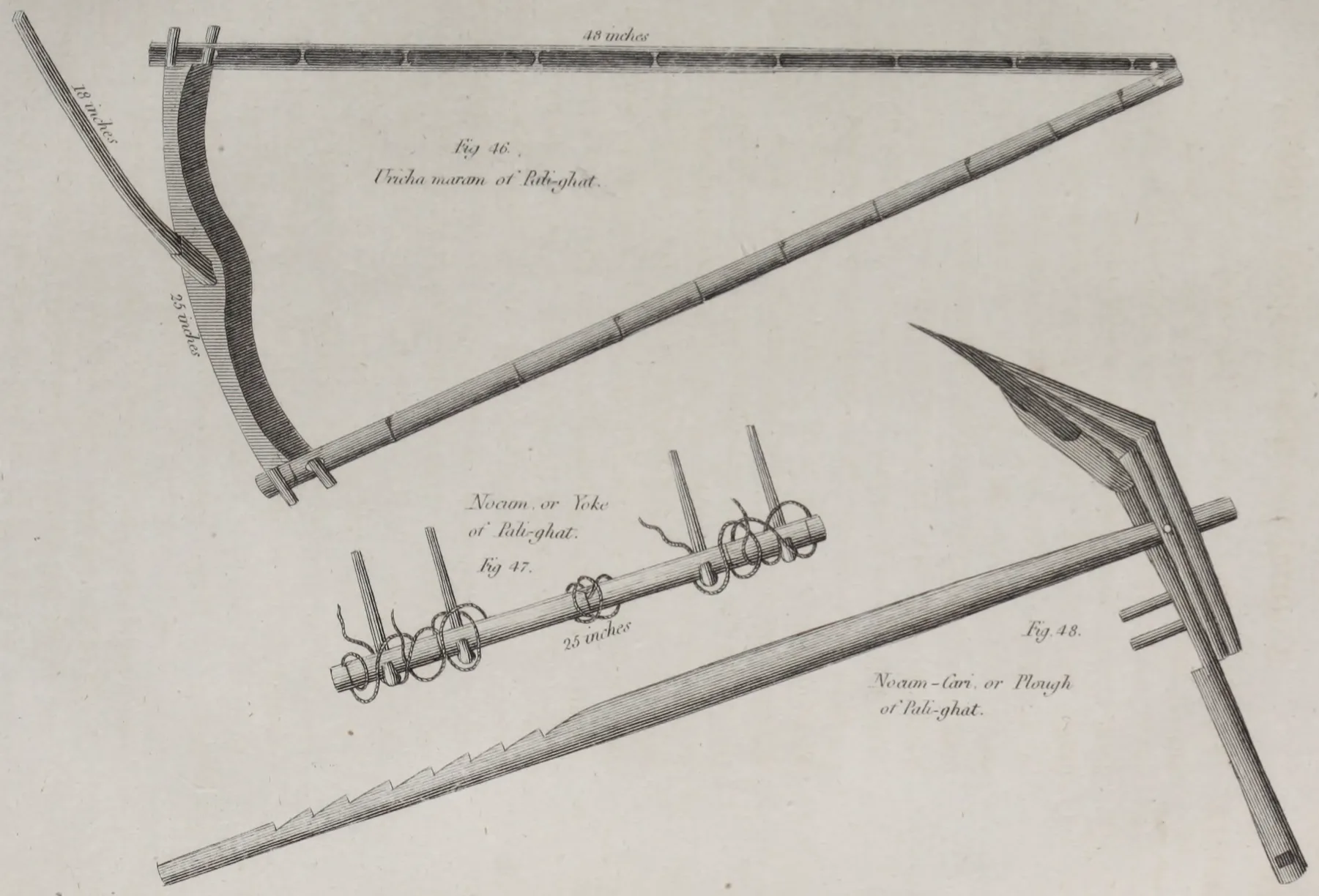
The rice called Mundu-pallay may be either cultivated, like the Navara, after the sprouted-seed manner; or the dry-seed may be sown broad-cast; or it may be transplanted. The only difference between it and the Navara, when cultivated after the sprouted-seed manner, is, that it requires four months to ripen. In this country, when the dry-seed is sown broad-cast, the cultivation is called Pudiaki. When this is to be performed, the ground is ploughed two or three times, immediately after the preceding crop has been reaped. Then, at any time in the course of six or seven months, it is manured. Between the 12th of March and the 10th of April, after a shower, it is ploughed again ten times. After a heavy rain, in either of the two following months, the seed is sown broad-cast, and covered with the plough. On the third day the field is ploughed across. At each ploughing the clods must be carefully broken with a stick, and smoothed with a hoe called Caicotu (Plate XXI. Fig. 55.). At the end of the month the weeds are removed, and the field is afterwards inundated. This is reckoned the least troublesome manner of cultivation. The seed requires to be sown a little thicker than in the sprouted-seed cultivation, and the produce is nearly the same.
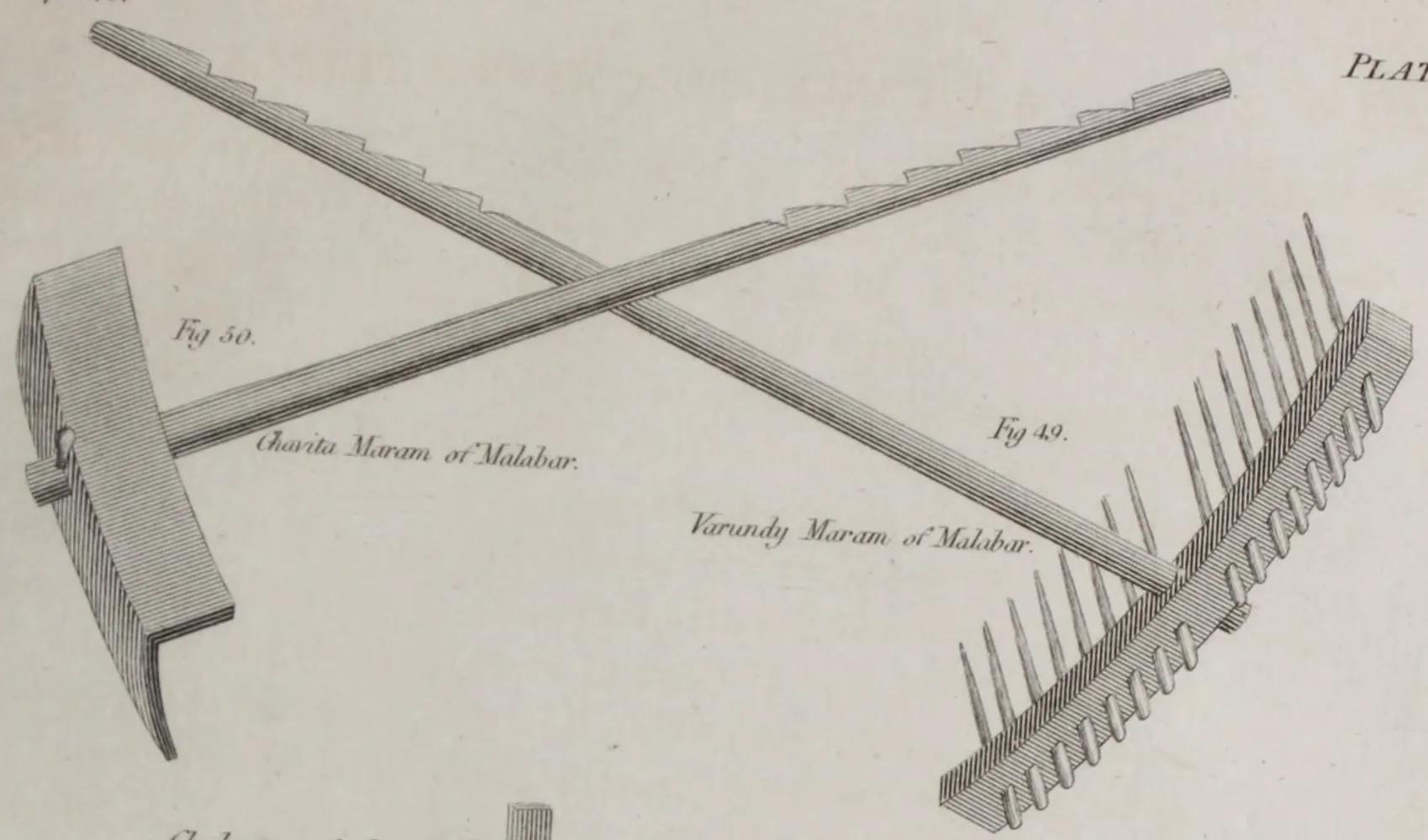
The following is the manner of cultivating the transplanted Mundu-pallay, which method of cultivation is here called Naduga. The Maytan, or ground kept for raising seedlings, is chosen in a high situation and poor soil. It pays neither rent nor land tax. In the course of the preceding year it is ploughed three or four times. Some then give it dung, others do not. After rain, between the 11th of April and the 11th of June, it is ploughed again five or six times, no water being kept on it. The clods are then broken with a stick, and cleaned by a rake drawn by oxen, and called Varundy Maram (Plate XX. Fig. 49.), which is drawn twice over the field in different directions, and serves as a harrow. On one Poray-candum, three Porays of seed are sown, and covered by two harrowings with the rake drawn by oxen. On the third day the field has a slight ploughing, the plough-share being purposely drawn up, so as not to project beyond the timber part. The water is never allowed to inundate the seedlings until they are fit for transplanting, which they are in from 25 to 30 days. When the seed has been sown, the field into which it is to be transplanted begins to be cultivated. It is ploughed two or three times, then dunged, and afterwards ploughed again five or six times. It is always inundated, except when any operation is going to be performed, and then the water is let off. After the ploughings the clods are broken with the implement called Chavita Maram (Plate XX. Fig. 50.), which is drawn by two oxen, while the driver stands on it, to increase the weight. The field is then ploughed again twice, and smoothed with the implement called Uricha Maram. The seedlings are watered for a day to loosen the roots; then they are pulled, and for three days small bundles of them are placed in the mud, with the roots uppermost. On the fourth and fifth days they are planted. The seedlings raised on one Poray-candum serve to plant four fields of that extent. Fifteen days after planting the field is inundated. This is the most troublesome manner of cultivating rice.
The lower parts of the rice-land (Dhanmurry) are called Ubayum, and a great number of these produce annually two crops.
The kinds of rice cultivated in the first crop are Sambau, Shornali, Callma, and Carpali. The first crop is cultivated, in all the three manners, in about the following proportion: 65/100 as dry-seed, 25/100 as transplanted, and 10/100 as sprouted-seed.
The cultivatio is the same with that which is used for the rices called Navarà, and Mundu-pallay; only the soil, being stiffer, requires two more ploughings, and the seasons at which the operations are performed are somewhat different. The time for sowing the dry-seed is the same, and so is the harvest of the Carpali rice; but the Sambau is one month, the Shornali one month and a half, and the Callma two months later in coming to maturity. The quantity of seed sown on the same extent of ground is nearly equal; but the produce is more considerable, especially that of the Callma. In the transplanted cultivation the seed is sown toward the 11th of May, and the transplantation must be performed between the 11th and the 26th of June. The quantity of seed is the same as that of Mundu-pallay; the produce is rather more, especially that of the Callma. These kinds of rice, cultivated as sprouted-seed, produce very poor crops.
The kinds of rice cultivated in the second crop are, Maliga or Shiriga Sambau, Shittany, Bally Shittany, and Nonan. It is almost entirely transplanted: for these kinds of rice, none but a few poor creatures use the sprouted-seed cultivation. The Maytan, or seedling bed, receives less seed at this season than for the first crop, especially of the Maliga Sambau. It may be sown at any time from the 28th of July until the 28th of August. The seedlings may be transplanted at any time between the 14th of August, and the 13th of November. Before the Maliga Sambau, the first crop is often omitted, and then it is sown early, and its produce is considerable. The crop of the other kinds is small, and very precarious. It depends upon rain coming from the eastward in December, which it sometimes fails to do.
In this country there is another set of rices, that require eight or nine months to ripen. The only one of these that is cultivated in this immediate neighbourhood is that called Ariviray. It is sown on land lower than the Palealil, but not so low as that which gives two crops. It is cultivated in the same manner as the Mundu-pallay, both as dry-seed, and as a transplanted crop. The former is sown about the 11th of April, and the crop is rather a scanty one. The seedlings, in the transplanted crop, are moved between the 12th of June and the 13th of July, and are planted very thin.
In some parts of the country there is a kind of rice called Cutaden, which requires a year to ripen, and grows in places where the water remains long, and is very deep. The persons from whom I have my information are not acquainted with the manner in which it is cultivated.
In the arable parts of the high or Parum lands, which pay no land tax, the following articles are cultivated:
- Modun, Morun, or hill-rice.
- Ellu, or Sesamum, by the English in India called Gingely.
- Ulindu, Phaseolus minimoo Roxb: MSS.
- Carum Pyro, Dolichos Catsjang semine nigro.
- Shayro Pyro, Phaseolus mungo.
- Shamay, Panicum miliare E. M.
This kind of land is in general cultivated once in two years only, and requires a year's fallow to recover its strength; but in places near villages, where it receives manure, or is much frequented by men and cattle, it gives a crop every year. Whatever crop is to be taken, the long grass and bushes growing on this ground are always cut down by the roots, and burned, before the first ploughing, for the ashes serve as a necessary manure.
For Modun rice the ground is ploughed two or three times between the 14th of November and the 12th of December. Between the 12th of March and the 10th of April, with the early rains, the field is manured with dung and ashes, and is ploughed again two or three times. Between the 12th of June and the 13th of July the seed, without preparation, is sown broad-cast, and covered with the plough, after which the clods are broken with a large stick. On the third day the field is ploughed across, and the clods are broken again, and made smooth with the hoe called Padana Caicotu (Plate XXI. Fig. 56.). At the end of a month the weeds are removed by the hand. If the rain does not come plentifully between the 14th of August and the 13th of September, the whole crop is lost; but, when the season is favourable, this crop is as good as is usual in the low or Paddum lands. For all the grains cultivated on this kind of land, the Patom, or neat rent, is one-fifth of the gross produce.
The most considerable crop here on Parum land is Sesamum, of which there are two kinds, the Shiray and Peri Ellus. These are always sown separately; but they are cultivated at the same season, in the same manner, and in the same kind of soil. Between the 14th of July and the 13th of August, the small bushes, growing on the fields are cut, dried for two days, and then burned. The field is then ploughed seven times. Between the 14th of August and the 13th of September, after seven days fair weather, the seed is sown, and covered with the plough. Twenty days afterwards, that is, about four weeks after the rains from the westward have ceased, the rains from the eastward ought to commence. If these come, there will be a good crop, which is ripe between the 13th of December and the 11th of January. The Shiray ripens ten days earlier than the Peri. Too much rain, when the plants are in flower, is very apt to injure the crop.
All the pulses called Ulindu, Carum Pyro, and Shayro Pyro, are cultivated in the same manner. The field is ploughed once between the 12th of January and the 9th of February; the seed is sown immediately afterwards, and covered with a cross ploughing. Between the 14th of September and the 14th of October these pulses ripen without farther trouble.
For Shamay the field is ploughed five times between the 11th of April and the 11th of May. After a shower of rain, it is harrowed with the rake drawn by oxen; then sown; and the seed is covered by another harrowing. It is ripe between the 14th of July and the 13th of August.
In such part of the high lands as is manured sufficiently to enable it to produce annually a crop of grain, a rotation has been introduced: 1st year Shamay, 2d year Ulindu, 3d year either of the Pyros. Another rotation is alternate crops of Sesamum and Shamay. The pulses and Sesamum can never be sown in the same field.
The cultivation of the arable part of the high lands is that which is by far the most neglected in this part of the country, yet no land-tax has been imposed on it; which in my opinion clearly shows, that the clamours raised against that tax, as injurious to cultivation, are groundless.
Ashes and cow-dung are carefully collected for manure; and the latter is preferred when dry and rotten. The quantity is therefore very small, as nothing is mixed with the dung, to rot, and increase its bulk. The leaves of every kind of bush and tree that is not prickly are, however, used as a manure for rice-land.
The native oxen of this country are of the same form or breed with those in Coimbetore and Mysore; but they are much smaller, and are indeed the most diminutive cattle that I have ever seen. A few good ones are imported from Coimbetore, generally when very young. Mr. Warden thinks the native cattle very inadequate to cultivate the land properly; and states, that upon inquiry he has been informed, that the produce of a field ploughed with large oxen is nearly double of that which has been tilled with the common oxen of Malabar.
In small huts contiguous to their houses the Puttar Bráhmans commonly keep four or five cows, and the farmers have generally one or two. When a man’s stock of cows is larger, they are kept, with the labouring cattle, in a house built at some distance from the abode of free-men, in the place where the slaves are permitted to dwell when the crop is not on the ground; for these poor creatures are considered as too impure to be permitted to approach the house of their Devaru, or lord. The cow, in her fourth or fifth year, has her first calf, and generally breeds five or six times. She gives milk about fourteen months, and is then dry about ten months before she has another calf; so that she lives about sixteen years. For the first fifteen days, the calf is allowed to suck the whole milk; for the first ten months it gets a share, but none afterwards. A good cow, fed by a Bráhman, besides what the calf gets, gives daily 1½ Puddy of milk, or about 80 cubical inches: but, if fed by a farmer, owing to his comparative poverty, she will give only one Puddy. The cows feed all day on the pasture, and at night have cut grass, or straw; but the Bráhmans give them oil-cake also during the time they are in milk.
The women of the Bráhmans, when they are afraid of not having children, carry a bull-calf to the temple of Siva, and dedicate it to that god, in hopes that he will avert, what they consider as a great evil. The bulls so dedicated are ever afterwards considered as sacred, are allowed to roam about wherever they please, and are in general very well fed, almost every one that has any grain to spare giving them some as they pass. These are properly the town-bulls; but their duties are often performed by the young cattle intended for labour, which are not emasculated until they are between four and five years of age. This want of selection, in the males intended to keep up the breed, seems one great cause of the degeneracy of the cattle.
The oxen are never wrought until after they have been emasculated, and they continue capable of labour for five or six years. Rich men feed their labouring cattle four months on grass, and eight months on straw. Poor people can only allow straw for one half of the year. Every man who occupies rice-land (Dhanmurry) has a certain part of the high land attached to it for pasture; and to this he has an exclusive right, without paying rent: but any man may cut grass wherever he pleases.
The buffaloes also of this country are of a very poor breed. Both males, and females when not giving milk, are put into the yoke, and, like the ox, are wrought from about six to nine in the morning, and from two to six in the evening. In the sowing season they are wrought an hour longer. In the same space of time the ox performs somewhat more labour than the buffalo; but the buffalo, having more strength, is capable of turning up stiffer soils than the ox can do. The male buffaloes, intended for labour, are emasculated when they are between five and six years of age. The two kinds of cattle are fed much in the same manner. The quantity of milk given by the female buffalo here does not exceed that given by the cow, and it is reckoned of an inferior quality: both are, however, generally mixed for making butter, which among the natives of Malabar is very bad and nasty.
Last year, for five months, the distemper prevailed among both kinds of cattle, but was most severe upon the buffaloes. It is said to have carried off about one half of the whole stock, but the loss is perhaps greatly exaggerated.
According to Mr. Warden’s returns, the number of cattle of the ox kind in his districts amounts to 39,575, and of the buffalo kind to 11,762, in all 51,337. The number of ploughs which these work amounts to 14,433. It must be observed, that the farmers estimated a plough to be capable of cultivating 40 Porays of low (Paddum) land, probably including the small portion of arable high (Parumba) land which falls to each man’s share, in proportion nearly to the extent of the low lands that he occupies, and which, requiring little comparative labour, would add about 2 Porays to each plough. Now on this supposition, which cannot be very erroneous, the number of ploughs in the district could only cultivate 577,320 Porays of low land (Dhanmurry). Mr. Warden’s estimate makes the Porays actually cultivated 758,460. This I have corrected, by allowing one fourth of the low land called Ubayum to be cultivated twice a year, to 613,205 Porays; but it is probable, that I have under-rated the extent of land producing two crops: the difference, however, on the data given is very small; in place of 2500/10000 of the Ubayum land being cultivated twice, as I supposed by the statement given of the number of ploughs, we ought to allow 2665/10000.
No horses, asses, swine, sheep, nor goats, are bred in Malayala, or at least the number is perfectly inconsiderable. All those required for the use of the inhabitants are imported from the eastward. The original natives had no poultry; but since Europeans have settled among them, the common fowl or pullet may be had in abundance. Geese, ducks, and turkeys, are confined to the sea coast, where they are reared by the Portuguese.
The part of Mr. Warden's districts occupied by thick forests, and almost uninhabited, is very extensive. The forest which is a continuation of the Ani-malaya woods, and which lies between the frontier and Colangodu, is about seven miles long, and nearly the same in breadth. To the eastward of Pali-ghat there is another extensive forest, and there is a long narrow space in the south-east corner of the district. The hills toward the south are covered with trees to the summit; while those toward the north, like all the other Ghats extending from thence to the east, are naked on the prominent parts, and only covered with trees in their recesses or glens.
The forests here are divided into Puddies, each of which has its boundary ascertained, and contains one or more families of a rude tribe, called Malasir. Both the Puddy and its inhabitants are considered as the property of some landlord, who farms out the labour of these poor people, with all that they collect, to some trader (Chitty, or Manadi), who treats the Malasirs much in the same manner as the Malypuddy of Ani-malaya does the rude tribes under his authority, and receives from them nearly the same articles. In fact, this is a most iniquitous mode of taxing the Malasir, and the produce of it is a mere trifle. The most productive Puddy in the whole district pays only four Rupees a year. A capitation tax on the Malasir might raise a greater income to the proprietors of the woods, and be much less oppressive.
Having sent for some of these poor Malasirs, they informed me, that they live in small villages of five or six huts, situated in the skirts of the woods on the hills of Daraporam, Ani-malaya, and Pali-ghat. They speak a mixture of the Tamul and Malayala languages. They are a better looking people than the slaves; but are ill clothed, nasty, and apparently ill fed. They collect drugs for the trader, to whom they are let; and receive from him a subsistence, when they can procure for him any thing of value. He has the exclusive right of purchasing all that they have for sale, and of supplying them with salt, and other necessaries. A great part of their food consists of wild Yams (Dioscoreas), which they dig when they have nothing to give to the trader for rice. They cultivate some small spots in the woods after the Cotu-cadu fashion, both on their own account and on that of the neighbouring farmers, who receive the produce, and give the Malasirs hire. The articles cultivated in this manner are Rali (Cynosurus corocanus), Avaray (Dolichos Lablab), and Tonda (Ricinus palma christi). They are also hired to cut timber and firewood. In this province they pay nothing to the government. They always marry girls of their own village, and never take a second wife unless the first dies. Marriage is indissoluble, except in case of infidelity on the part of the woman. When such a thing happens, the people of the village assemble; the woman is well flogged, and returned to her parents. The husband never receives her back; but any other person, that is inclined, may marry her. A widow may marry again; but a girl who has arrived at the age of puberty as a virgin is considered impure, and no person will take her for a wife. When a man wishes to marry his son to any girl of the village, he speaks to her parents, generally while both the parties are very young; the father of the girl must give her to the first suitor; and should the boy die, before the ceremony is performed, the poor girl cannot get a husband. The boy's father, when the proper time is arrived, gives a dinner to all the relations, with two Fanams to the bride's mother, two Fanams to the girl for a new dress, and one Fanam's worth of spirituous liquors for the guests. The girl is delivered over to the boy, and the marriage is considered as valid. The elder sons of a family, as they grow up and marry, build separate huts for themselves. The parents continue to live with the youngest son; but his elder brothers contribute to their parents support when they are no longer able to work. The Malasir burn the dead, and seem to have no knowledge of a future state. The god of their tribe is called Mallung, who is represented by a stone that is encircled by a wall, which serves for a temple. Once a year, in April, a sacrifice of goats, and offerings of rice, honey, and the like, are made by the Malasir to this rude idol. If this be neglected, the god sends elephants and tigers to destroy both them and their houses. There is no priest for this god, nor do the Malasir acknowledge any Guru, or a dependance on the Bráhmans. The wax that these poor people might collect in a year Mr. Warden estimates at 600 Tolams, or about 24¼ hundred-weight.
The most valuable production of these forests, however, is their timber, of which there are several good kinds; but the Teak is by far the most valuable. To the increase or preservation of this, little or no attention has been paid; but about two years ago an order was issued by the commissioners, prohibiting any trees from being cut that were under certain dimensions; and trees of the regulated girth are said by Mr. Warden to be too heavy for the native carriage. These forests possess a great advantage, in being intersected by many branches of the Panyáni river, which in the rainy season are large enough to float the timber down to the sea. All the hills near this river seem naturally fit for producing the Teak; and with a little pains, in the course of time, very valuable forests of that excellent tree might be reared. All that would be required would be to cut down every other kind of timber, allowing the Teak to spring up naturally, which it will every where do; and to enforce the commissioners’ regulation concerning the size of the trees. In the course of fifty or sixty years, very excellent forests might thus be formed near water carriage, very much to the advantage of their proprietors and of the nation; but these people are so ignorant, that, without compulsion, it could not be expected that any such plans should be carried into effect. At present, every man who chooses to give the landlord a Fanam may cut down a tree, and all the valuable trees being cut, while the useless ones are allowed to remain and come to seed, the consequence is, that in all places of easy access the valuable kinds have become almost entirely extinct. Mr. Warden thinks, that at present between four and five thousand Candies of Teak, fit for ship-building, might be annually procured from the forests in his districts; but that could only be done by a large body of trained elephants, an expense beyond the reach of individuals, and only to be undertaken by the Company. The Candy of Teak timber, when seasoned, measures 10¾ cubical feet.
The elephants are a dreadful nuisance to the farmers who live near these forests, and have prevented much land, formerly deserted, from being again cultivated. A regular hunting of them, carried on from Ani-malaya to Priya-pattana, would be a great relief, and might be done to advantage if the Company could afford to purchase the elephants.
Near Colangodu four forges are supplied with iron ore. The ore is the usual black sand, and is found mixed with clay in strata near the river.
An immense rock near the temple of Bhagawat consists of a good grey granite, very fit for building; and indeed the temple is constructed of this stone. The structure of this granite is evidently lamellar, the plates being vertical, and running east and west, as they do in Coimbetore: in some places the plates have a sort of circular disposition round a centre, somewhat like the layers round a knot in wood; in others they are undulating, and have a resemblance to the waving figures on marbled paper. Each of the plates containing different proportions of the felspar, quartz, and mica, they are more distinguishable by their colour, than by its being practicable to separate them. The rock here contains fewer veins of quartz than any granite that I have hitherto seen in the peninsula. Although the plates are vertical, the rock is divided by parallel horizontal fissures that have a smooth surface, and which is frequently the case with aggregate rocks in all the south of India. This greatly facilitates the cutting of stones for building; as wedges readily cut off large masses, by being driven in at right angles to the fissures.
5th December.—I set out, in company with Mr. Waddel, lately superintendant of the southern division of Malabar, whose activity as a magistrate, while his office lasted, had procured him many enemies among the ruffians who have long infested this part of the country. Mr. Warden was so good as to accompany us to our stage at Lacaday cotay. On our route we were joined by armed Nairs, who said they had come from all quarters to protect us from the ruffians, who are mostly Moplays. We saw nothing, however, to cause alarm. We first crossed the river which passes the south side of the fort, and is a fine clear stream. We afterwards crossed the same, after it had united with the northern river, forming one of the clearest and most beautiful streams that I have ever seen. The ford is at Mangada, called by Major Rennell Mangery cottay. The fort that was there has gone entirely to ruins, and there is no market at the place. The country is very beautiful; a mixture of little hills, swelling grounds, and rice fields, which seem to bear but a small proportion to the high lands. These are in a very bad state of culture. Sesamum is the most common crop, and it looks very well. Lacaday is in the territory formerly belonging to the Tamuri Rájá. The remains of the fort are now scarcely discernible. There is at this place a small market, chiefly inhabited by Tamuls; for the original natives of Malayala seem rarely, if ever, to have kept shops.
6th December.—In the morning Mr. Waddel and I went about ten miles toward the south, as it was dangerous for him to go by the direct road. We passed through a beautiful country, consisting of low hills intersected by narrow fertile vallies; the whole, like that which we saw yesterday, finely wooded and well peopled. The high grounds in a few places are rocky, but their soil is in general good. Their cultivation is exceedingly neglected. We first crossed the same river that we did yesterday at Mangada, and then a branch of the same coming from the south-east. Both of them are fine streams. At the first river we entered the dominions of the Cochi Rájá, and found the chief men of the country, called Nambirs, waiting for us with a numerous band of Nairs, who were commanded by an officer in a uniform resembling the Dutch. Every possible attention was shown not only to ourselves, but also to supply the wants of our followers; and we were escorted by the officer’s party to Paryunuru, where we encamped.
The Cochi Rájá pays an annual tribute to the Company, as he did to Hyder and Tippoo; but he retains full jurisdiction, civil and military; and his country is so far better administered than that more fully under the authority of the Company, that neither Moplays nor Nairs presume to make any disturbance. It is said, that this prince’s government is rather severe and cruel; but with a people so exceedingly turbulent, a vigorous government at least is necessary.
Both Nairs and inland Moplays pretend to be soldiers by birth, and disdain all industry. Their chief delight is in parading up and down fully armed. Each man has a firelock, and at least one sword; but all those who wish to be thought men of extraordinary courage carry two sabres. As every man walks about with his sword drawn, assassinations are very frequent; which indeed cannot be avoided among a barbarous people with weapons always ready:
It is said also, that the Rájá wrings much money from his people; but I see no appearance of their being reduced to poverty, either in their houses or persons.
Paryunuru is a large Désam without any market. It has a small temple, and a Colgum, or house belonging to the Rájá.
7th December.—We went a short stage to Shelacary. The road leads through a most beautiful country. The rice grounds are narrow valleys, but are extremely well watered by small perennial streams, that enable them annually to produce two crops. Very little of the high ground is cultivated. I observed, however, some fields, that contained the Cytisus Cajan, more luxuriant than I ever before saw. The houses of the natives are buried in the groves of palms, mangoes, jacks, and plantains, that skirt the bottoms of the little hills. Above these are woods of forest trees, which, though not quite so stately as those of Chittagong, are still very fine, and are pleasant to walk in, being free from Rattans and other climbers. The Teak, and Viti, or black-wood, abound in these woods; but all the large trees have been cut; and no care is used to encourage their growth, or to check that of useless timber.
We were escorted by many of the Rájá's Nairs, and were met by one of his officers of cavalry, well dressed in a blue uniform with white facings, and attended by two orderlies in a similar dress. They wore boots and helmets, and the officer had a gorget; the whole exactly after the European fashion. He informed us, that the Rájá had been very desirous of meeting us; but that at present he was so unwell, that he could not stand without support. This information, I believe, was merely complimentary. The Rájá has made tolerable roads through the hilly parts of the country all the way we have come, and for our accommodation they had been repaired; but we were always much obstructed when we came to a valley, as the roads have not been continued through the rice fields. In fact, the road has been made from ostentation alone, and not from any rational view of facilitating commerce or social intercourse. There are no shops at Shelacary, but people were sent by the Rájá to supply our wants. Indeed, nothing can be more polite or attentive than the whole of his conduct.
Near our tents was a Colgum, or house belonging to the Rájá. It is a large square building, composed partly of stone, and partly of mud. The greater part of it is only one story in height; but in some places there is an upper floor. It is roofed with tiles, and totally destitute of elegance or neatness, but is looked upon by the natives as a prodigy. Like the other houses of the country, it is surrounded by a grove of fruit trees. Some Sepoys were here on duty, the mud walls surrounding the house being considered as a fort.
8th December.—We went a long stage to Nellaway, through a country similar to that which we passed yesterday; but the hills are higher, and much of the road is very bad. From the people of the Rájá we continue to receive every possible attention. Nellaway has a small temple, but no shops.
9th December.—In the morning we went a short stage to Cacadu, through a country differing from that seen on the two preceding days, by its hills being much lower, and covered with grass in place of forest trees. Although the soil of these hills appears to be good. yet scarcely any part of them is cultivated; but the pasture seems to be tolerable, the cattle, though remarkably small, being in good condition. The country is very beautiful: its round hills covered with grass are separated by fine verdant fields of corn, skirted by the houses of the inhabitants, which are shaded by groves of fruit-trees.
Opposite to our encampment was a Nazaren, or Christian village, named Cunnung colung curry Angady, which looks very well, being seated on a rising ground amid fine groves of the Betel-nut palm. The Papa or priest waited on us. He was attended by a pupil, who behaved to his superior with the utmost deference. The Papa was very well dressed in a blue robe ; and, though his ancestors have been settled in the country for many generations, he was very fair, with high Jewish features. The greater part of the sect, however, entirely resemble the aborigines of the country, from whom indeed they are descended.
The Papa informed me, that his sect are dependent on the Jacobite patriarch of Antioch ; but that they have a metropolitan, who resides in the dominions of Travancore, and who is sent by the patriarch on the death of his predecessor. None of the Papas, or inferior clergy, go to Antioch for their education, and all of them have been born in the country. My visitor understood no languages but the Syriac, and that of Malayala. He preaches in the latter ; but all the ceremonies of the church are performed in the Syriac. In their churches they have neither images nor pictures, but the Nazarens worship the cross. Their clergy are allowed to marry ; my visitor, however, seemed to be not a little proud of his observing celibacy, and a total abstinence from animal food. He said, that, so far as he remembers, the number of the sect seems neither to be increasing nor diminishing. Converts, however, are occasionally made of both Nairs and Shanars ; but no instance occurs of a Moplay having been converted, nor of a Namburi, unless he had previously lost cast.
The Papa says, that the Nazarens were introduced, 1740 years ago, by a certain saint named Thomas, who, landing at Meila-pura, took up his residence on a hill near Madras, and which is now called after his name. He afterwards made a voyage to Cochin, and in that neighbourhood settled a church, which is now the metropolitan, as the Portuguese drove all the Nazarens from the eastern coast. St. Thomas afterwards returned to Meila-pura, where he died. At that time Malayala belonged to the Bráhmans, who were governed by a Rájá sent by Sholun Permal, the sovereign king of the south. The Papa then related the history of Cheruman Permal, nearly as I have given it (page 348, 9.) on the authority of the Namburis; only he says, that this traitor, after having divided his usurped dominions, died before he reached Mecca. It was in his reign that the Mussulmans first arrived in India. They landed at Challiem, a place near Vaypura. The Papa says, that the metropolitan has an account of all his predecessors, from the time of Saint Thomas, with a history of the various persecutions that they have been subjected to by the governing powers, the worst of which would appear to have been that inflicted by the Portuguese. He promised to send me a copy of this kind of chronicle, but has not been so good as his word.
A Bráhman of the place says, that when any slaves are converted by the Nazarens, these people bestow on them their liberty, and give them daily or monthly wages. He said also, that the Nazarens are a very orderly, industrious people, who live chiefly by trade and agriculture.
In the afternoon we went to the Nazareny village, which contains many houses regularly disposed, and full of people. For an Indian town it is well built, and comparatively clean. It has a new church of considerable size. An old church is situated at some distance on a beautiful rising ground. It is now unroofed; but the walls, although built of indurated clay only, continue very fresh and strong. The altar is arched over with the same materials, and possesses some degree of elegance. The burying ground is at the west end of the church, where the principal door is placed. From its being very small, the graves must be opened long before the bones are consumed. As the graves are opened for new bodies, the old bones are collected, and thrown into an open pit near the corner of the church, where they are exposed to the view of all passengers.
From thence we went to Chowgaut, where we embarked in a canoe, and went to the house of Mr. Drummond, the collector, who resided then at the place called by us Chitwa, but by the natives Shetuwai.
10th and 11th December.—I remained with Mr. Drummond at Chitwa. This place is situated in an island, which is twenty-seven miles long, and in some places five miles wide, and which by Europeans is commonly called the island of Chitwa; but its proper name is Mana-puram. It consists of two districts, Shetuwai, and Atty-puram; and is separated from the continent by beautiful inlets of salt water, that form the northern part of one of the finest inland navigations imaginable. The soil of the island is in general poor; and, although the whole may be considered as a plain, the rice fields are very small in proportion to the Parum or elevated land, which rises a few feet only above the level of the sea. Water may every where be procured by digging to a little depth; there can be no doubt, therefore, but that with proper industry the whole might be made productive. The shores of the island are covered with coco-nut palms, from which the revenue is chiefly derived. The whole is rented by the Cochi Rájá of the Company, at 30,000 Rupees a year. He possesses no legal jurisdiction over the inhabitants; but daily complaints are preferred against him to the collector, to whom he is accused of great cruelty.
I here had a conversation with one of the Carigars, or ministers of the Tamuri Rájá, the person who manages the affairs of that chief. He says, that all the males of the family of the Tamuri are called Tamburans, and all the ladies are called Tamburettis: all the children of every Tamburetti are entitled to these appellations; and, according to seniority, rise to the highest dignities which belong to the family. These ladies are generally impregnated by Namburis; although, if they choose, they may employ the higher ranks of Nairs; but the sacred character of the Namburis almost always procures them a preference. The ladies live in the houses of their brothers; for any amorous intercourse between them and their husbands would be reckoned scandalous. The eldest man of the family is the Tamuri Rájá, called by Europeans the Zamorin. He is also called Mana Vicrama Samudri Rájá, and is crowned. The second male of the family is called Eralpata, the third Munalpata, the fourth Edatara Patana Rájá, the fifth Nirirupa Muta Eraleradi Tirumulpata Rájá, and the sixth Ellearadi Tirumulpata Rájá. The younger Tamburans are not distinguished by any particular title. If the eldest Tamburetti happen to be older than the Tamuri, she is considered as of higher rank. The Tamuri pretends to be of a higher rank than the Bráhmans, and to be inferior only to the invisible gods; a pretension that was acknowledged by his subjects, but which is held as absurd and abominable by the Bráhmans, by whom he is only treated as a Súdra.
During the government of the Tamuris, the business of the state was conducted, under his authority, by four Savadi Carigars, whose offices were hereditary, and by certain inferior Carigars, appointed and removed at the pleasure of the sovereign. The Savadi Carigars are, 1st. Mangutachan, a Nair of the tribe called Súdra; 2d. Tenancheri Elliadi, a Bráhmán; 3d. Bermamuta Panycary, also a Súdra Nair; and 4th. Paranambi, a Nair of the kind called Nambichan. The inferior Carigars managed the private estates, or Chericul lands, of the Tamuri, and collected the revenues. These consisted of the customs, of a fifth part of all the moveable estates of every person that died, and of fines; of course, the Carigars were the administrators of justice, or rather of what was called law. They were always assisted by four assessors; but, the selection of these being left to themselves, this provision gave little security to the subject. Eight tenths of all fines went to the Tamuri, and two tenths to the judge. For capital punishments, the mandate of the Tamuri was required. The defence of the country rested entirely on such of the Nairs as received arms from the Tamuri. These were under the orders of Nadawais, who commanded from 200 to 3000 men, and who held their authority by hereditary descent. The Carigar says, that these Nadawais had lands given them, in proportion to the number of men that each commanded; but how that could be, when the whole lands belonged to Namburi landlords, I do not understand. The soldiers, when on actual service, received a certain small subsistence.
In cases of emergency, certain tributary or dependent chiefs were also summoned to bring their men into the field. These chiefs, such as Punetur, Talapuli, Manacollatil, Ayenecutil, Tirumanachery, and many others, acknowledged the Tamuri as their superior; but they assumed the title of Rájá, and in their respective territories possessed full jurisdiction. They were merely bound to assist the Tamuri with military service. He never bestowed on any of them the title of Rájá, either in writing or conversation, and treated with contempt their pretension to such a dignity. The principal Colgum of the Tamuri is near the fort at Chowgaut; but at present he is absent on business at Calicut.
The Tolam, by which all weighable goods are here sold, contains 120 Polams, each of ten Pondichery Rupees, or is nearly 30,1/3 lb.; but it differs in almost every circle.
The Poray grain-measure is the same as at Pali-ghat, and is the same every where in Mr. Drummond's districts. By the merchants it is divided into ten Edangallies; but by the farmers it is divided into Naras, which differ in almost every Désam, and vary from five to ten in the Poray.
The Poray-candum, or Poray-land, is said, by the people here, to be nearly the same in extent all over Malayala; but the quantity of seed sown on a Poray-candum differs according to the soil. The proper extent of a Poray-candum is said to be 32 Varracolus square. The Varracolu is equal to 28 inches and 5/8 English measure; and the Poray-candum is therefore very nearly 5825 square feet. This I am inclined to think applicable to at least all the low rice land near the sea.
Mr. Drummond's answers to the statistical queries which I proposed to him through the commissioners, not having been received, in my account of his district I have no assistance, except from Mr. Smee's valuable communication.
The low land that lies near the sea is extremely sandy, and the quantity of rice-field is not very great. It is all of the kind called Paddum, no hill rice being cultivated except in the inland districts. A large proportion of it produces only one crop, and the second crop is always very precarious. The average produce of the whole rice lands in this district, according to Mr. Smee, is five Porays from one sown, or from one Poray-candum, which, according to the extent lately mentioned, will make the average produce a little more than 12 1/2 bushels an acre. But Mr. Smee deducted ten per cent. for contingencies, in order not to distress the cultivator; so that the actual average produce is a little more than 13 3/4 bushels an acre. According to the account of the people, every Poray-candum, on an average, pays two Porays of (Patom) rent; and the farmer, besides, discharges the land-tax. As this amounts on each Poray-candum to 1 1/4 Fanam, which is worth at the cheap season 1,625/1000 Porays of rough-rice, it is evident that the Poray-candum, by which the tax is paid, must be quite different from an actual Poray-candum; for, deducting two Porays for seed and expense of cultivation, two Porays for rent, and 1,625/1000 for taxes, the Poray-candum should on an average produce 5,625/1000 Porays, besides what may be supposed necessary for the trouble of the farmer. On consulting these people, they explain this by saying, that it is only the best lands that are rated in the revenue accompts at their true extent, and that of the poor soils five Poray-candums are sometimes written as one. In middling soils two Poray-candums are rated in the revenue accompts as one, which reduces the medium Negadi to eight Endangallies, even when the rice is lowest. Thus the farmer deducting ten per cent. for contingencies, on an average, pays 4,8/10 Porays for each Poray-land, and has 7/8 of a Poray for neat profit, after deducting seed and expense of labour. The profits of the landholder here are much greater, and those of the farmer much smaller, than at Pali-ghat.
All the three methods of cultivating rice, which I call dry-seed, sprouted-seed, and transplantation, are here in use.
For dry-seed, the field immediately after the preceding crop has been cut, between the 14th of November and the 12th of December, must be ploughed twice. Every month afterwards, for the five following times, the ploughings must be repeated twice, and at one of these times some ashes must be sprinkled on the field. Between the 11th of April and the 11th of May, after a shower of rain and a ploughing, the seed is sown broad-cast, one Poray to a Poray-candum, or 2 1/2 bushels to an acre. Some farmers plough in the seed, while others cover it with a hoe. It then gets a sprinkling of ashes, the whole cow-dung being burned. The weeds are removed by the hand one month after the seed has been sown; and at the same time, if possible, some more ashes should be given. After this the banks are repaired, and the water is confined on the field. About the middle of July the weeds must be again removed. The seed time is sometimes a month later than that here stated. The kinds of rice thus cultivated are Wonavuttun, Velletty vuttum, and Ericalay sambau, requiring four months to ripen; and Arien, which requires six months to come to maturity.
The sprouted seed cultivation is managed here as follows. The ploughing season lasts six months, commencing about the middle of May. During any thirty days of this period, the field is ploughed from twelve to eighteen times, and is always kept full of water, except when the plough is at work; then the field is drained until the water does not stand deeper than a hand's breadth. At each ploughing, some leaves of any bush or weed that can be procured are put into the mud. Then manure is given, twenty baskets to one Poray of land. After this the mud is smoothed, by dragging over it a plank yoked to two oxen; and the water is allowed to drain off completely, by two or three small channels formed with the hoe. The prepared seed is then sown, as thick as in the dry-seed cultivation. Ten days afterwards two or three inches of water are allowed to rest on the field, and as the corn grows the depth is increased. When it is a month old, some ashes are sprinkled on it. This requires no weeding. The kinds of rice thus cultivated are fifteen in number, and require from three to six months to ripen.
The manner of ploughing, and manuring, for the transplanted cultivation, is the same as for the sprouted-seed, and is performed at the same season. If the ground be clean, the seedlings are transplanted immediately from the field in which they were raised, into that in which they are to be reared to maturity; but if this be full of worms, they are exposed for three days in bundles on the little banks that separate the rice-plots; and there, in order to harden them, they are kept with their roots uppermost. When they are planted, the field contains about three inches depth of water. On the fourth day it gets nine inches, and ever after is kept inundated to that depth. Good farmers manure the field ten days after it has been planted. It requires no weeding.
The first crop may be cultivated after any of these three methods. The dry-seed cultivation requires by far the least trouble, and, if the early rains are copious, is equally productive with the others. Of the other two, the transplanted rice is rather the most troublesome; but, being most productive, it is much more commonly employed. In the second crop, the dry-seed cultivation cannot be used.
On the (Dhanmurry) low land no other article but rice is cultivated.
The only grains cultivated on the higher lands here are Carum Pyre (Dolichos catsjang), Wulindu (Phaseolus minimoo), and Ellu (Sesamum), and these in very small quantities. In the island of Mana-puram a large share of the whole land is of this kind, and by far the greatest part of it is totally waste. The whole might probably be cultivated for these grains, or planted with coco-nut trees, which in gardens near the sea coast are the principal object, and which indeed near the sea are the most valuable articles cultivated; for there is always a great demand for them from the countries to the northward, where they do not thrive; and, as they are a bulky article, a vast saving is made by raising them near water carriage.
Having assembled the most wealthy proprietors of coco-nut plantations, I obtained the following account of the manner in which these are formed.
The soil reckoned fittest for the coco-nut is a mixture of mud with a very large proportion of sand; and such is generally found in greatest quantity near the banks of rivers, where the tide flows; and near inlets from the sea, by which the whole coast is very much intersected, although they have not a depth of water sufficient to admit ships.
The Parum, or garden, called Oart by the English, having been inclosed, between the 12th of May and the 11th of June, holes are dug throughout for the reception of the young palms. These pits are 1 Varacolu (28⅝ inches) square, and the same in depth. They are placed at the distance from each other, in all directions, of 12 Varacolus, or 28 feet 7½ inches. In the bottom of each pit is then dug a small hole, in which is placed a young palm, or coco-nut tree, together with some ashes and salt. A little earth is then put round the roots, the young tree receives a little water, and some thorns are put round the pit. For the first three weeks water must be given three times a day; afterwards, until the garden is three years old, the trees must be watered once in two days. Once every month a little ashes must be put into each pit. Between the 12th of June and the 13th of July of the third year, a trench one cubit deep is dug round the young tree, at 1½ cubit from the root. The use of this is to confine the water near the tree during the rainy season. When this is over, between the 15th of October and the 13th of November, the whole garden is ploughed, and the trenches are levelled. Every year afterwards, before the rains commence, the trenches are renewed, and each tree is allowed a basket full of ashes. When the rainy season is over, the garden is ploughed again, and the trenches are filled. The cattle of the proprietor are always folded in the garden, and in the course of the year moved over the whole. The fold is covered with a roof. Between the 10th of February and the 10th of April the grass that has sprung up in the plantation is burned. The young plants are raised from the seed as follows. Between the 12th of June and the 13th of July, the nuts for seed are ripe. At that time a plot of ground is dug to the depth of three-fourths of a cubit. The nuts are placed on this, contiguous to each other, and sunk into the earth three fourths of their height, the eyes being placed uppermost. The plot is then sprinkled with ashes, and a bank of earth is formed round it to confine the water. The following day, if no rain falls, the plot must be watered. After the rainy season is over, it is watered every second day, and once a month gets some ashes. In three or four months the nuts begin to shoot. In three years the young plants are fit for being removed; and the nut even then adheres to some of them, although not to all. The gardens are not allowed to die out, and then formed anew, as in some places is the case with the coco-nut plantations; but, as one tree dies, a new one is set in its stead. The coco-nut palm, after having been transplanted, begins to bear in from thirteen to sixteen years. It continues in full vigour forty years, and lives for about thirty years more, but is then constantly on the decline.
When the trees begin to flower for the first time, a trial is made, by cutting a young flowering branch (spatha), to ascertain whether it will be fit for producing nuts, or for producing palm-wine. If the cut bleed, it is fit for the latter purpose, and is then more valuable than a tree whose spatha, when cut, continues dry, and which is fit only for producing nuts. The palms fit for wine are let to the Tiars, or Shanars, who extract the juice, and boil it down to Jagory, or distil it to extract arrack. In a good soil the trees yield juice all the year; but on a poor soil they are exhausted in six months. A clever workman can manage from 30 to 40 trees, and pays annually for each from 1 to ½ Fanam. Coco-nut Jagory is reckoned better than that of the Brab (Borassus), and on an average sells at 2 Fanams the Tolam, or 3s. 8d. the hundred-weight. This account must be compared with that which was afterwards given by the Tiars, or men who manage the palms.
The Cudian, or occupant of the garden, cultivates the soil, and collects the nuts. Each tree produces five or six bunches, and each bunch seven or eight full grown nuts, or fourteen or fifteen of an inferior size, and of very little value. A little bad Coir (or cordage) is made from the husks of the nuts that are used green in the country. A few of the nuts are exported with the husk on; but in general they are sent to the north inclosed in the shell only. They are bought up by the Moplay merchants, who make advances from six to three months before the time of delivery. The price advanced is from two to three Fanams for every hundred nuts which the garden is expected to produce. If the occupant be not necessitated to take advances, he will be able to sell his nuts at from 4 to 4½ Fanams the hundred. If the produce of the garden be greater than that for which advances have been made, the occupant sells the overplus as he pleases; but, if he has been too sanguine in his expectations, and has received advances for more than he can deliver, he must pay for the deficiency, not at the rate of the advance, but at the rate of the market. A proprietor, who lets his garden, gets from 8 to 15 Fanams rent (Patom) for every hundred trees; and the occupant (Cudian) pays the land-tax, which is half a Fanam for every tree that is in full bearing: old and young trees are exempted, as unproductive. Mr. Drummond says, that in fact not above ten trees in a hundred pay the tax; while all the others, under pretence of being aged or young, are excused. He also alleges, that the trees are much more productive than the proprietors acknowledge, and give annually from 80 to 100 nuts. Monkeys and mice (squirrels?) are very destructive in the plantations of Shetuwai.
Among the coco-nut trees are raised plantains, and a variety of kitchen stuffs, called here Caigari, on which no tax is exacted. There are also planted many fruit trees, especially Jacks (Artocarpus integrifolia) and Mangoes (Mangifera). The fruit of the former enters largely into the food of the natives, and has always a ready sale; so that, the tree being valuable, a tax is levied on it. The Mangoes are so numerous, that they are not saleable, and no tax is demanded for them.
In Malabar there are no Betel-leaf gardens; but every person who has a garden plants a few vines of the Betel (Piper Betle), and allows them to climb up the Mango trees, or any others that are most convenient. Once in three years the vines are renewed. Although in most parts of India the Betel-leaf is an object of taxation that produces a considerable and fair revenue, in Malabar no tax has been imposed on it; but this seems by no means to have been of service to the people; as very large quantities of the leaf are imported from Coimbetore, where a heavy tax is levied, and no drawback allowed.
The quantity of Betel-nut and pepper that is raised on the sandy levels near the sea is so small, that for the present I shall defer saying any thing concerning these valuable productions.
The tenures by which plantations are held differ considerably from those by which the Paddum, Dhanmurry, or low land, has been granted by the Namburís. When a man wishes to plant a space of Parum land, he obtains from the landlord a lease called Cuey Canum, which is granted for a time sufficient to allow him to have at least two years full produce from the garden, and often much longer. If the lease be for any considerable time, he in general pays some money in advance, which is called the Canum, or mortgage. When the term of the lease has expired, the landlord may reassume the plantation, by paying up the mortgage, and liquidating the amount of all the charges incurred by the Canumcar, or mortgagee, for buildings, wells, fences, &c. together with the value of the trees brought to maturity. The amount of these sums due to the mortgagee by the landlord, who wishes to reassume a plantation, is generally determined by arbitration. When the lease has expired, and the sum due to the (Cuey Canumcar) mortgagee has been determined, the landlord either reassumes the garden by liquidating the claims of the planter, or he grants it to the planter on proper Canum, or full mortgage. In this case, the Patom, or neat rent of the garden, having been ascertained to the satisfaction of both parties, the mortgagee agrees to pay the amount to the landlord, after deducting the land-tax, and the interest of his claims; which are then consolidated into one sum, called Canum, or mortgage.
In Mr. Smee’s valuable survey, the trees producing less than ten nuts are considered as altogether unproductive, and therefore it is proposed to exempt them entirely from taxes. Taking the average of all the trees yielding above ten nuts, the produce of each is stated by him to be 33 nuts. I confess, that Mr. Smee’s opportunities of information were in many respects superior to mine, and his assiduity could not be exceeded; yet I suspect, that he has very much under-rated the produce, and am induced to do so both from the confession of the natives, and from the appearance of the bunches on the trees. His inquiries were attended with one great disadvantage; namely, that they were avowedly made with a view to assessment; and of course all means possible were taken to conceal the truth, and to diminish the value of the produce.
When Arshid-Beg-Khán, by the orders of Hyder, imposed a tax on the plantations of Malabar, he formed an estimate of their produce; and then, having calculated the average amount of the produce of a tree, he imposed upon each what he considered as a fair tax. The amount of this on every coco-nut palm was half a Fanam. Old and young trees were exempted, which has given rise to immense frauds on government. The young trees, of course, ought in justice to be exempted, because they do not produce any fruit; but old trees ought either to be paid for, or to be cut, there being no possible means of ascertaining what trees are really productive enough to afford the tax. If the rate be found too heavy, it would be much better for government to lower it, and to exact the tax for every tree above a certain age that a person chose to have in his plantation. Mr. Smee thinks the tax on coco-nuts, imposed by Arshid-Beg-Khán, too high, and has proposed to reduce it to one third of a Fanam. According to his own estimate, the average produce of a tree is worth 1 155/1000 Fanam : now above the Ghats the cultivators of gardens pay one half of the produce, in a less favourable soil and climate, and yet are reckoned to possess by far the most valuable property that is in the country, and new plantations are forming in every part that will admit of them. I do not see, therefore, why the people of Malabar should cry out against the tax in the manner they do : and I perfectly agree with Mr. Smee in thinking that the tax proposed by him is extremely moderate. Say, that a man has a garden containing 40 trees, rateable according to Mr. Smee’s plan of excluding all those which do not produce more than ten nuts; the produce of these, at 33 nuts a tree, will be 1320; which, according to Mr. Smee, are worth at the rate of 35 Fanams a thousand : the produce is therefore worth
| Fanams | 47 | 10 |
| Deduct revenue | 13 | 13⅓ |
| Annual charges | 8 | 0 |
| 21 | 13 1/3 | |
| Clear profit | 25 | 36 2/3 |
Out of which is to be deducted the interest of the money employed in making the garden. But this is not the whole that the proprietor of the garden receives. In these gardens he cultivates plantain trees, and all kinds of kitchen stuffs, free from rent ; and, what is still more, he has the whole produce of the trees reckoned not productive. These, in a garden containing 40 productive trees, may safely be taken at 25 trees, each producing six nuts, which amount to 150, in all worth 5¼ Fanams : so that the proprietor's share, after deducting the expense of cultivation, amounts to nearly three fifths of the gross produce.
This whole system of finance, however, appears to me unfavourable to the revenue, and injurious to the morals of the people. It can only be exacted, either by suffering immense frauds, or by constant surveys carried on at a great expense ; while all the officers of revenue, and all the proprietors will be constantly exposed to temptations that are scarcely to be resisted, owing to the difficulty attending their detection. The quantity of the produce of these plantations that is consumed in this country, except that used for distillation, is inconsiderable, and in a fiscal view may be altogether neglected ; and that which is exported, being a bulky article, may, by means of an excise, be made a source of revenue to any extent, compatible with leaving such a profit to the cultivators, as to make it worth their while to raise the commodity. I understand, that the Rájás of Travancore have adopted a plan somewhat analogous with their pepper, which in the plantations of Malabar is one of the grand articles of produce. In their dominions, they are the only merchants who are permitted to deal with foreigners in that article. They take from the cultivator the whole pepper produced in their country, at a fixed price, and dispose of it in the best manner that they can. The Company have adopted in Bengal a similar management with respect to salt and opium, and even advance money to carry on the manufacture and cultivation of these articles of commerce ; and no doubt the same might be done with the pepper, coco-nut, and Betel of Malabar. I am inclined, however, to give the preference to duties levied on the export, and checked by an excise; it being dangerous, wherever it can be avoided, for the sovereign to act as a merchant. My opinion is, therefore, that all Negadi, or taxes on plantations, should be done away in Malabar; and, in place of them, either a tax should be imposed on the exportation of their produce; or the Company should agree to receive all that is brought to the sea coast, or frontier, at such a price as would allow them a profit, and the cultivator a reasonable encouragement. The latter plan, of course, implies an absolute monopoly; and the former, in order to avoid the frauds incident to duties levied by custom-houses, requires the establishment of an excise. Either plan, however, seems to me greatly preferable to that system of falsehood and deceit which is at present employed.
In order to judge of the value of ground cultivated with coco-nuts, let us suppose a plantation, as described by the proprietors of 100 trees, which will occupy 81,940 square feet. Among these the taxable trees, according to the general proportion of the country, as established by the survey, will be 34 trees, producing 1122 coco-nuts; to which we may safely add 128, for those produced by trees not taxable. The produce is then worth to the cultivator 43¾ Fanams, besides plantains, kitchen-stuff, coco-nut leaves, &c. &c. and the tax paid at Mr. Smee’s rate would be 11⅓ Fanams. Reducing these measures to the English standard, the produce of an acre will be 12s. 8½d., and the tax will be 3s. 3½d., taking the Fanam at 3½ for the Rupee.
I have already mentioned how far the tenure by mortgage (Canum) is prejudicial to improvement. In order to remedy this in some measure, Mr. Drummond compels all landlords, when sued for the payment of a mortgage, either to pay the money or to sell the estate. This seems to be contrary to the customary law of the country, but will no doubt be advantageous.
At Manapuram a slave, when 30 years old, costs about 100 Fanams, or 2l. 14s. 7d.; with a wife he costs double. Children sell at from 15 to 40 Fanams, or from 8s. 2¼d. to 21s. 10d. A working slave gets daily three-tenths of a Poray of rough rice, or about 36½ bushels a year. He also gets annually 1 Fanam for oil, and 1½ Fanam for cloth, which is just sufficient to wrap round his waist. If he be active, he gets cloth worth 2 Fanams, and at harvest time from 5 to 6 Porays of rough rice. Old people and children get from one to two-thirds of the above allowance, according to the work which they can perform.
12th December.—I went with Mr. Drummond to his house at Chowgaut, which, for what reason I do not know, is called by the natives Shavacadu, or deadly forest. The town is a small place, chiefly inhabited by Moplays and Nazarens, and is the sea-port belonging to the Nazareny town named Cunnung Colung Curry.
On the way I examined a machine, by which the natives remove superfluous water from their rice-grounds, when there is no level, by which these can be drained. It is called Chakram, or the wheel, and is represented in Plate XX. Figure 51. The arms of the wheel are 3 feet long, and 14 inches broad, and are confined in a case consisting of planks, and supported by four feet (a b, a b,). That part of the case (b b) which is farthest from the center of the wheel, being placed towards the bank inclosing the field; so that the upper part of the segment of a circle (c c c), that lines the bottom of the case, is on a level with the top of the bank; while all the lower part of the case is immersed in the water; it is evident, that each arm of the wheel moving from a to c will force out, by the opening b c, the volume of water contained between the lines a d, d c, and the segment of the circle c c c. The wheel is moved by six men, who support themselves on slight Bamboo stages, and push the upper arms of the wheel with their feet. Two sets relieve each other, and three Chakrams, or 36 men, will, in the course of a day, clear ten Porays of three feet of water. The ten Porays are 1⅓ acre, and the quantity of water thrown out is 174,800 cubical feet.
The Nazareny priest (Papa) of Chowgaut waited on us, to inform me, that my wishes for procuring the history of the sect in India had been communicated to the metropolitan, who desired him to say, that a copy of the chronicle would be sent to me through Mr. Drummond. Unfortunately, I have not received any account from that quarter. The Papa denied that the Nazarens give liberty to such of their slaves as are converted; probably thinking that the conversion might be attributed to this circumstance, more than to the apostolical virtues of his brethren. He also maintained, that the sect was rapidly increasing in numbers, and daily gaining proselytes. In these points he differed in his account from the Papa whom I had before seen.
Having assembled the most respectable of the Nairs in this neighbourhood, they gave me the following account of their customs.
The Nair, or in the plural the Naimar, are the pure Súdras of Malayala, and all pretend to be born soldiers; but they are of various ranks and professions. The highest in rank are the Kirüm, or Kirit Nairs. On all public occasions, these act as cooks, which among Hindus is a sure mark of transcendent rank; for every person can eat the food prepared by a person of higher birth than himself. In all disputes among the inferior orders, an assembly of four Kirüms, with some of the lower orders, endeavour to adjust the business. If they cannot accomplish this good end, the matter ought to be referred to the Namburis. The Kirit Naimar support themselves by agriculture, or by acting as officers of government, or accomptants. They never marry a woman of any of the lower Nairs, except those of the Súdras, or Charnadu, and these very rarely. The second rank of the Nairs are called Súdra, although the whole are allowed, and acknowledge themselves to be of pure Súdra origin. These Súdra Nairs are farmers, officers of government, and accomptants. They never marry any girls but those of their own rank; but their women may cohabit with any of the low people, without losing cast, or their children being disgraced. The third rank of Nairs are the Charnadu, who follow the same professions with their superiors. The fourth are the Villium, or Villiit Naimar, who carry the palanquins of the Namburis, of the Rájás, and of the persons on whom these chiefs have bestowed the privilege of using this kind of conveyance: they are also farmers. The fifth rank of Nairs are the Wattacata, or oil-makers, who are likewise farmers. The sixth rank, called Atticourchis, are rather a low class of people. When a Nair dies, his relations, as usual among the Hindus, are for fifteen days considered unclean, and no one approaches them but the Attacourchis, who come on the fifth, tenth, and fifteenth days, and purify them by pouring over their heads a mixture of water, milk, and cow's urine: the Attacourchis are also cultivators. The seventh in rank are the Wullacutra, who are properly barbers; but some of these also cultivate the ground. The eighth rank are the Wullaterata, or washermen, of whom a few are farmers. The ninth rank is formed of Tunar Naimar, or tailors. The tenth are the Andora, or pot-makers. The eleventh and lowest rank are the Taragon, or weavers; and their title to be considered as Naimar is doubtful; even a pot-maker is obliged to wash his head, and purify himself by prayer, if he be touched by a weaver.
The men of the three higher classes are allowed to eat in company; but their women, and both sexes of all the lower ranks, must eat only with those of their own rank.
Among the two highest classes are certain persons of a superior dignity, called Nambirs. These were originally the head men of Désams, or villages, who received this title from an assembly of Namburis and Tamburans, or of priests and princes; but all the children of Nambirs sisters are called by that title, and are considered as of a rank higher than common.
The whole of these Nairs formed the militia of Malayala, directed by the Namburis, and governed by the Rájás. Their chief delight is in arms; but they are more inclined to use them for assassination, or surprise, than in the open field. Their submission to their superiors was great; but they exacted deference from those under them with a cruelty, and arrogance, rarely practised, but among Hindus in their state of independence. A Nair was expected instantly to cut down a Tiar, or Mucua, who presumed to defile him by touching his person; and a similar fate awaited a slave, who did not turn out of the road as a Nair passed.
The Nairs have no Puróhitas; but at all their ceremonies the Elleadu, or lowest of the Namburis, attend for charity (Dharma), although on such occasions they do not read prayers (Mantrams) nor portions of scripture (Sástrams). The Namburi Bráhmans are the Putteris or Gurus of the Naimar, and bestow on them holy water, and ashes, and receive their Dána, and other kinds of charity.
The proper deity of the Naimar cast is Vishnu; but they wear on their foreheads the mark of Siva. They offer frequent bloody sacrifices to Marima, and the other Saktis, in whose temples the Namburis disdain not to act as priests (Pújaris); but they perform no part of the sacrifices, and decline being present at the shedding of blood. The Nairs can very generally read and write. They never presume to read portions of the writings held sacred (Sástrams); but have several legends in the vulgar language. They burn the dead, and suppose that good men after death go to heaven, while bad men will suffer transmigration. Those, who have been charitable, that is to say, have given money to religious mendicants, will be born men; while those, who have neglected this greatest of Hindu virtues, will be born as lower animals. The proper road to heaven they describe as follows. The votary must go to Kási, and then perform the ceremony in commemoration of his ancestors at Gya. He is then to take up some water from the Bhágírathi, or Ganges, and pour it on the image of Siva at Raméswara. After this he must visit the principal Kshétras and Tírthas, or places of pilgrimage, such as Jagarnat, and Tripathi, and there he must wash in the Puscarunny, or pool of water that sprung forth at the actual presence of the god. He must always speak truth, and give much charity to learned and poor Bráhmans. He must have no carnal knowledge of any woman but his wife, which with a Nair confines him to a total abstinence from the sex. And lastly, in order to obtain a place in heaven, the votary must very frequently fast and pray.
The Nairs marry before they are ten years of age, in order that the girl may not be deflowered by the regular operations of nature; but the husband never afterwards cohabits with his wife. Such a circumstance, indeed, would be considered as very indecent. He allows her oil, clothing, ornaments, and food; but she lives in her mother's house, or, after her parents' death, with her brothers, and cohabits with any person that she chooses of an equal or higher rank than her own. If detected in bestowing her favours on any low man, she becomes an outcast. It is no kind of reflection on a woman's character to say, that she has formed the closest intimacy with many persons; on the contrary, the Nair women are proud of reckoning among their favoured lovers many Bráhmans, Rájás, or other persons of high birth: it would not appear, however, that this want of restraint has been injurious to population. When a lover receives admission into a house, he commonly gives his mistress some ornaments, and her mother a piece of cloth; but these presents are never of such value, as to give room for supposing that the women bestow their favours from mercenary motives. To this extraordinary manner of conducting the intercourse between the sexes in Malayala, may perhaps be attributed the total want, among its inhabitants, of that penurious disposition so common among other Hindus. All the young people vie with each other, who shall look best, and who shall secure the greatest share of favour from the other sex; and an extraordinary thoughtlessness concerning the future means of subsistence is very prevalent. A Nair man, who is detected in fornication with a Shanar woman, is put to death, and the woman is sold to the Moplays. If he have connection with a slave girl, both are put to death; a most shocking injustice to the female, who, in case of refusal to her lord, would be subject to all the violence of an enraged and despised master.
In consequence of this strange manner of propagating the species, no Nair knows his father; and every man looks upon his sisters’ children as his heirs. He, indeed, looks upon them with the same fondness that fathers in other parts of the world have for their own children; and he would be considered as an unnatural monster, were he to show such signs of grief at the death of a child, which, from long cohabitation and love with its mother, he might suppose to be his own, as he did at the death of a child of his sister. A man’s mother manages his family; and after her death his eldest sister assumes the direction. Brothers almost always live under the same roof; but, if one of the family separates from the rest, he is always accompanied by his favourite sister. Even cousins, to the most remote degree of kindred, in the female line, generally live together in great harmony; for in this part of the country love, jealousy, or disgust, never can disturb the peace of a Nair family. A man’s moveable property, after his death, is divided equally among the sons and daughters of all his sisters. His landed estate is managed by the eldest male of the family; but each individual has a right to a share of the income. In case of the eldest male being unable, from infirmity or incapacity, to manage the affairs of the family, the next in rank does it in the name of his senior.
The Naimar are excessively addicted to intoxicating liquors, and are permitted to eat venison, goats, fowls, and fish.
13th December.—Having taken leave of my kind friends, Messrs. Waddel and Drummond, I went about twelve miles to Valiencodu, which in our maps is called Billiancotta. The road passes over sandy downs near the sea, and on each side has a row of Banyan trees (Ficus bengalensis); but in such situations they do not thrive. To the right were large plantations of coco-nut trees and rice fields. Toward the sea were scattered a few groves of palms. The appearance of the country is very inferior to that of the inland parts of the province.
Valiencodu is a small open village, containing about 45 houses, and a few shops. Near it is a ruinous fort. It is situated in a district called Vaneri Nadu, which belonged to the Peneturu Rájá, one of those who were dependent on the Tamuri, and who now receives from the Company a fifth part of the revenue. Being a man of some abilities, he is entrusted, under the authority of the collector, with the management of the revenue. I was visited by a relation of his, called the Manacalatu Rájá, who came with a Namburi, and eight or ten Nairs, following his palanquin. He was a poor looking old man, stupified with drink. He said, that one-half of his own country, and that of his kinsman, had been situated in the Cochi Rájá's dominions, and that they had been entirely stript of this share ever since they fled to Travancore to avoid Tippoo's bigoted persecution. He afterwards began to talk as if the Company had taken from him the remainder; but he became sensible of his error, on being asked what he possessed when the Company conquered Malabar.
The province of Malabar has no very large temples; and even those which are dedicated to the great gods are of very miserable structure. Those dedicated to the Saktis are few in number, and are not ornamented with images of potter's work, like those of Coimbetore. There are no buildings for the accommodation of travellers. Near the sea-coast are many Meshids, or mosques, built by the Moplays. These are poor edifices with pent roofs.
The Niadis are an outcast tribe common in Malabar, but not numerous. They are reckoned so very impure, that even a slave will not touch them. They speak a very bad dialect, and have acquired a prodigious strength of voice, by being constantly necessitated to bawl aloud to those with whom they wish to speak. They absolutely refuse to perform any kind of labour; and almost the only means that they employ to procure a subsistence is by watching the crops, to drive away wild hogs and birds. Hunters also employ them to rouse game; and the Achumars, who hunt by profession, give the Niadis one fourth part of what they kill. They gather a few wild roots, but can neither catch fish, nor any kind of game. They sometimes procure a tortoise, and are able, by means of hooks, to kill a crocodile. Both of these amphibious animals they reckon delicious food. All these resources, however, are very inadequate to their support, and they subsist chiefly by begging. They have scarcely any clothing, and every thing about them discloses want and misery. They have some wretched huts built under trees in remote places; but they generally wander about in companies of ten or twelve persons, keeping at a little distance from the roads; and when they see any passenger, they set up a howl, like so many hungry dogs. Those who are moved by compassion lay down what they are inclined to bestow, and go away. The Niadis then put what has been left for them in the baskets which they always carry about. The Niadis worship a female deity called Maladeiva, and sacrifice fowls to her in March. When a person dies, all those in the neighbourhood assemble and bury the body. They have no marriage ceremony; but one man and one woman always cohabit together; and among them infidelity, they say, is utterly unknown.
A wretched tribe of this kind, buffeted and abused by every one, and subsisting on the labour of the industrious, is a disgrace to any country; and both compassion and justice seem to require, that they shouldbe compelled to gain a livelihood by honest industry, and be elevated somewhat more nearly to the rank of men. Perhaps Moravian missionaries might be employed with great success, and at little expense, in civilising and rendering industrious the rude and ignorant tribes that frequent the woods and hills of the peninsula of India? In the execution of such a plan, it would be necessary to transport the Niadis to some country east from Malabar, in order to remove them from the contempt in which they will always be held by the higher ranks of that country.
The Shanar, who in the dialect of Malayala are properly called Tiar, are in Malabar a very numerous tribe, and a stout, handsome, industrious race. They do not pretend to be of Súdra origin, and acknowledge themselves to be of the impure race called Panchamas; but still they retain all the pride of cast; and a Tiati, or female of this cast, although reduced to prostitution, has been known to refuse going into a gentleman’s palanquin, because the bearers were Mucuar, or fishermen, a still lower class of people. All Tiars can eat together, and intermarry. The proper duty of the cast is to extract the juice from palm trees, to boil it down to Jagory, and to distil it into spirituous liquors; but they are also very diligent as cultivators, porters, and cutters of firewood. They have no hereditary chiefs, and all disputes among them are referred to the Tamburan, or officers of government. In every Désam certain Tiars were formerly appointed to a low office, called Tondan, which gave them powers similar to those enjoyed by the Totis above the Ghats. At present, the duties of these officers are confined to an attendance at marriages and funerals, where they receive some trifling dues. The Tiars have certain families among them, who are called Panikin. These can read and write, and instruct the laity, so far as to enable some of them to keep accompts. They are the only Gurus received by this cast; and are supposed to dedicate their time to prayer and religious duties, on which account they receive charity. The Panikin intermarry with the laity. The deities of the cast are a male named Mundien, and a female named Bagawutty. On holy days these are represented by two rude stones, taken up for the occasion, and, during the ceremony, placed under a shed; but afterwards thrown away, or neglected. At these ceremonies a fowl is offered up as a sacrifice, and a Nair is employed to kill it before the idols. The same Nair acts as Pújári for the god Mundien, adorns the stone with flowers, anoints it with oil, and presents it with fruit. A Namburi is employed to be Pújári to Bagawutty, and this is the only occasion on which the Tiars give that class of men any employment. The Panikins attend at marriages, but do not read any thing on these occasions. The Tiars seem to be entirely ignorant of a state of existence after death. Some of them burn, and some of them bury the dead. They are permitted to eat swine, goats, fowls, and fish; and have no objection to eat animals that have died a natural death. They may also drink distilled liquors, but not palm wine. In fact, they are not so much addicted to intoxication as the Nairs. In wealthy families, each man takes a wife; but this being considered as expensive, in poor families the brothers marry one wife in common, and sleep with her by turns. If either of the brothers becomes discontented, he may marry another woman. The whole family lives in the same house, even should it contain two women; and it is reckoned a proof of a very bad temper, where two brothers live in separate houses. It must be observed, that in Malabar a family of children are not reckoned burthensome; so that the Tiars are induced to adopt this uncommon kind of wedlock, merely to save the trifling expense of several marriages, the whole amount of one of which is as follows: four Fanams (2s.) given to the girl’s parents, a piece of cloth given to herself, and a feast given to the relations. Many of the women are thus unprovided with husbands, a thing very uncommon in India; and, their remarkable beauty exposing them to much temptation, a great many Tiatis in the sea-port towns are reduced to prostitution. Women continue to be marriageable after the age of puberty, and after the death of a former husband. Adulteresses are flogged, but not divorced, unless the crime has been committed with a man of another cast. A Namburi, who condescended to commit fornication with a Tiati, would formerly have been deprived of his eyes, and the girl and all her relations would either have been put to death, or sold as slaves to the Moplays, who sent them beyond the sea; a banishment dreadful to every Hindu, and still more so to a native of Malabar, who is more attached to his native spot than any other person that I know.
Having examined the Tiars concerning their customs, I then questioned them about the coco-nut plantations; and the account which they gave ought to be compared with that which was given at Shetuwai by the proprietors. The Tiars say, that there is no distinction between palms that will produce juice, and those that will not; the trees that would produce a good crop of nuts will produce much juice, and sometimes continue to bleed the whole year. Poor trees give juice in the rainy season only, and even then in small quantity. They agree with the farmers in allowing, that trees giving juice are more profitable than those producing nuts; but the extraction of this liquor is apt to injure the palm, and, if continued for three years, will kill it. The rent paid by Tiars here for twelve good coco-nut trees is one Fanam for twelve months in the year. That paid for bad trees is at the same monthly rate, but is only paid for six months in the year. The proper management of a coco-nut palm requires, that it should be allowed to bear fruit two years; after which, toddy should be extracted from it for eighteen months, and never afterwards.
When the spadix, or flowering branch, is half shot, and the spatha, or covering of the flowers, has not yet opened, the Tiar cuts off its point, binds the stump round with a leaf, and beats the remaining part of the spadix with a small stick. For fifteen days this operation is repeated, a thin slice being daily removed. The stump then begins to bleed, and a pot is fixed under it to receive the juice, or Callu, which the English call Toddy. Every day afterwards, a thin slice is taken from the surface of the stump, which is then secured by a ligature; but after it has begun to bleed, the beating is omitted. The juice is removed once a day. If it be intended for drinking, nothing is put into the pot, and it will keep for three days. On the fourth day it becomes sour ; and what has not been sold to drink while fermenting, is distilled into arrack : the still is like that described at Malur, but the head is made of tin. The liquor is distilled without addition, and the spirit is not rectified. In the pots intended to receive juice that is to be boiled to Jagory, a little quick lime must be put, to prevent fermentation ; and the juice must be boiled on the same day that it is taken from the tree. Twelve trees daily fill with juice a large pot, which, when boiled down, gives six balls of Jagory, each worth one Caas ; that is, 180 Caas, or 5 Fanams, a month for the produce of twelve trees ; out of which the Tiar pays one Fanam to the proprietor of the trees, and has four Fanams for his trouble. The Tiars say, that a man cannot manage more than twelve trees ; the cultivators allege, that an active man can manage four times that number.
The coco-nut palm, during the season that it is productive, pushes out a new spadix once a month ; and after each spadix begins to bleed, it continues to produce freely for a month, by which time another is ready to supply its place. The old spadix continues to give a little juice for another month, after which it withers ; so that there are never more than two pots to one tree. Each of these spadices, if allowed to grow, would produce a bunch of nuts, containing from two to twenty. When the nuts are very numerous, they grow to an inconsiderable size, and are of little value ; and from seven to ten good nuts may be considered as the average produce of each bunch. Trees in a favourable soil produce twelve bunches in the year ; ordinary trees give only six bunches. From this it does not appear to me, that the gross average produce can be possibly calculated at less than fifty nuts a tree.