DECEMBER 14th.—I went a short stage to Panyáni. Soon after leaving Valiencodu, I crossed the mouth of a small river, which, by the influx of salt water as it approaches the sea, is extended to a great width. I was ferried over it by means of two canoes lashed together, which forms a very safe conveyance for baggage, or foot passengers, but is not adapted for cattle, the latter being forced to swim. Orders have been issued by the commissioners to construct proper stages on canoes at every ferry; so that cattle, and even artillery, may be transported with safety. The canoes in this part of Malabar are among the best and handsomest that I have ever seen.
On the north side of the river is some level marshy ground, into which the tide is received, and salt is formed by the evaporation of the water by the heat of the sun. Between this and Panyáni the country is very beautiful, and thickly covered with groves of coco-nut trees, which are separated by rice-fields that are now covered with the second crop. This, however, by no means looks thriving. On the mere sand of the sea-shore may be here seen flourishing the coco-nut palm. It is said, that in such situations it produces fruit for ten years only; but that is of little consequence; as it seems to be reared at a very trifling expense, and is afterwards left entirely to nature.
Panyáni is also called by the natives Punany Wacul, and contains 500 houses belonging to traders, with above forty mosques, and at least 1000 huts inhabited by the lower orders of people. It is very irregularly built; but many of the houses are two stories high, and seem to be very comfortable dwellings. They are built of stone, and thatched with coco-nut leaves. The huts are inhabited by boatmen and fishermen, who were formerly Mucuas, a low cast of Hindus; but now they have all embraced the faith of Mahomet. All the mosques are thatched, and their principal entrance is at the east end, where the roof terminates abruptly in fanciful mouldings, and carved work, that by the natives are considered as ornamental. The town is scattered over a sandy plain, on the south side of a river, which descends from Ani-malaya, and enters the sea by a very wide channel. The mouth, however, is shut by a bar, which admits boats only to enter.
The trading boats are called Patemars, and on an average carry 50,000 coco-nuts, or 1000 Mudies of rice, equal to 500 Bengal bags. There are many Patemars larger, but these seldom frequent this port.
About fifty years ago the Moplays of this place were very rich, and possessed vessels that sailed to Surat, Mocha, Madras, and Bengal; but the oppression of Tippoo has reduced them to great poverty, and most of them are now under the necessity of acting as agents to Mousa, a Mussulman merchant of Tellichery. They have, however, a few small boats, that go to Tellichery and Calicut for supplies of European and Bengal goods. The port is also frequented by vessels (Patemars) from different places on the coast. Those from Bombay bring wheat, Meti, or fenugreek, the pulses called Wulindu, Pyru, and Avaray, sugar-cane, Jagory, and salt; they take back Teak-wood and coco-nuts. From Rája-puram, a town in the Marattah part of Kankána, vessels (Patemars) bring the same kinds of grain that are brought from Bombay, and also sugar-cane, Jagory, and Cut, or Terra Japonica: they take away the same returns. From Gheria, in the same country, are brought much Jagory and Cut, and coco-nuts are taken in return. Goa sends the same kind of goods that are brought from Bombay. Much rice is exported from hence to the northern parts of the province of Malabar. There is no trade between Panyáni and the Maldives. From Cochin are brought canoes, spices, sugar, sugar-cane, Jagory, wheat, and mustard-seed; and the returns are iron smelted in the interior parts of the country, and rice both rough and freed from the husk. From Anjengo are brought cotton cloths wrought there, and coco-nuts. No account is kept here of the arrivals or departures of vessels (Patemars); but in the custom-house books every article exported or imported ought to be entered. The returns of these, which I expected from Mr. Drummond the collector, have not reached me.
Panyáni is the residence of the Tangul, or chief priest of the Moplays, who says that he is descended from Ali and Fatima, the daughter of Mahomet. Both the Tangul, and his sister’s son, who according to the custom of Malayala is considered as the heir to this hereditary dignity, are very stout, handsome, fair men, but from their countenances would not be suspected to belong to the priesthood. The nephew is a middle-aged man, and at the jollity of a marriage, a few days ago, exerted himself so much, that he burst a blood vessel in his lungs, and could not venture to speak. The Tangul was remarkably civil, and, when I returned his visit in the evening, received me with great hospitality, and requested me to eat with him; a thing very uncommon with the natives of India. He promised to send me an account of the arrival of his sect in this country, and has kept his promise. It is written in Arabic, and is said to be the original from which Ferishta translated the account of this colony that is given in his works. The Tangul says, that his people are called Moplaymar in Malayala; and Lubbaymar at Madras; but among themselves they acknowledge no other name than that of Mussulmans. Being of Arabic extraction, they look upon themselves as of a more honourable birth than the Tartar Mussulmans from the north of India, who of course are of the contrary opinion. The Arabs settled in India soon after the promulgation of the faith of Mahomet, and have made very numerous converts; but in many families of distinction the Arab blood seems as yet uncontaminated. They use a written character peculiar to themselves, and totally different from the present Arabic. The language of their original country is known to few of them, except their priests; and they have never acquired the language of the country in which they live so as to speak it in decent purity, but use a jargon as corrupted as what Europeans in general speak for Hindustany. The Moplays of Malabar are both traders and farmers; the Lubbaymars of Madras confine themselves entirely to the former profession. As traders, they are remarkably quiet, industrious people; but those who in the interior parts of Malabar have become farmers, having been encouraged by Tippoo in a most licentious attack on the lives, persons, and property of the Hindus, are fierce, blood-thirsty, bigoted ruffians. In religious matters, the Tangul is the head of this sect, and his office is hereditary. Mosques are very numerous. In each presides an Imám, or Mulla, appointed by the Tangul. He usually bestows the office on the sister’s son, or heir of the person who last enjoyed the office, unless he should happen to be disqualified by ignorance, or immorality. The Tangul has some lands, for which he pays no tax; but the inferior clergy are supported entirely by the contributions of their followers. The late Sultán, who wished to make innovations in every thing, did not respect this descendant of his prophet; but appointed another head for the priests of his faith in Malabar. This person, called Arabi Tangul, resides at Panyáni; but his followers are now reduced to five or six families, and he has lost one half of the property that Tippoo bestowed on his new favourite.
15th December.—I went a long stage to Adanad. The country between Panyáni and Ternavay, although higher than the sea-shore, is level; and consists entirely of rice-grounds, which annually produce only one crop, and of which a great part seems to be waste.
On leaving the sea-coast, the number of trees, especially of coco-nut palms, decreases fast. I crossed the Panyáni river at Ternavay, where there is a small temple, but no town. The channel of the river is very wide; but at this season most of it is occupied by dry sands. The water is clear, and the stream gentle; the fords are, however, bad, owing to the depth of water, which in most parts is four feet, and no where less than three. Cattle, in crossing it, must therefore be unloaded, and the baggage carried to the other side by the drivers. This river in the rainy season is navigable for canoes almost up to Pali-ghat.
After crossing this river, I came to a country like that near the Nazareny town in the Cochi Rájá's dominions, and consisting of narrow vallies surrounded by low bare hills. The vallies produce annually two crops of rice; each having a perennial stream, that is applied to the irrigation of the soil. The roots of the hills are occupied by the houses and plantations of the natives; and their sides in many places have been formed into terraces; but these are very badly cultivated, considering the abundance of rain in this country, which will ensure plenty of water for any crop that does not require more than four months to come to maturity. The soil, in many places of these hills, is very intractable, and consists of a kind of indurated clay, which, on exposure to the air, becomes as hard as a brick, and serves indeed all the purposes of stone.
Adanad is no town, but is celebrated as the throne of the Alvangheri Tamburacul, or chief of the Namburis, who are the Bráhmans of Malayala. Soon after my arrival I sent a message, by a Bráhmán, to know, whether it would be most agreeable to this person to receive a visit from me, or for him to come to my tent. The answer was, that he would be very happy to see me whenever I was ready. My politeness was lost on the Bráhman, who kept me waiting in an outer apartment until my patience was exhausted, and I returned to my tents without the honour of an interview. I then sent to him an order from the government of Madras, commanding all persons to give me such information as I wanted, and desired him to come to my tent. This was complied with, and he came attended by several Namburis. The Alvangheri Tamburacul having been seated on a chair, which he took care should be higher than mine, I soon discovered that he was an idiot, who grinned with a foolish laugh when the most serious questions were proposed to him. His attendants, however, were men of good sense, and apparently well informed; and from them the following account is taken.
The present Tamburacul is descended in the male line from the Bráhman who was appointed to that high dignity by Parasu-ráma, when he created Malayala and gave it to the Namburis. When a Tamburacul is likely to die without male children, he adopts a male of the same family, and appoints him successor; but, if he have sons, the eldest succeeds of course. Sankara Achárya, about 1000 years ago, came to Malabar, and made some reforms in the discipline of the Bráhmans; but the then Tamburacul was far from acknowledging the superiority of that personage, and the present one considers himself as much higher in dignity than the Sringa-giri Swami, who is the successor of Sankara Achárya, and chief of the Smartal Bráhmans. The Tamuri Rájá, as I have already mentioned, affected to consider himself as inferior only to the invisible gods; but this pretension is treated with the utmost contempt by the Namburis, the lowest of whom is of a much higher birth than any prince on earth. This high opinion of themselves is attributed to the power that they have of influencing the gods by their invocations (Mantrams), especially to the power which they have, by means of certain forms of prayer, of rendering an image the residence of a god. The Namburis pretend, that while this country was governed by princes appointed by the Sholun Rájás, these viceroys were entirely subject to the Alvangheri Tamburaculs, and did nothing more than, by means of the civil arm, carry their orders into execution. When the office of Rájá came to be hereditary, by the appointment of Cheruman Permal, the Tamburacul still pretended to have a right to dispose of the government; but his power was confined to the performance of a ceremony called Putapayshacum, which is somewhat analogous to the anointing that our kings use. On this occasion, the Tamburacul and his Namburis received much Dána, and other charities; but they had no authority to reject the next heir. All the Rájás, except the Velat family, had, for many generations before the conquest, given up the ceremony of Putapayshacum. The Rájás possessed no authority to punish any Namburi, farther than, in case of some very atrocious crime, to banish him from their dominions. The Namburis were subject to the jurisdiction of the Alvangheri, who in his judgments was always assisted by a council of learned men, and guided by the Hindu law. The book that they consult on this subject is the Asocha Prayaschittum, composed by Véda Vyása, one of the gods, who assumed the form of a Rishi, and was also the author of the eighteen Puránas. The laws of Menu seem to be totally unknown to the Namburis, who all pretend to be Vaidikas, nor do any of them follow lay professions. Few of them, however, are men of learning. The only book on astronomical subjects that those here could mention was the Jotis Sástram, which, from their account, is a work on astrology. They will neither eat nor drink with the Bráhmans of other countries, whom they call Puttar, and whom they consider as very inferior to themselves in dignity. The others are equally proud; and these allege, that Sankara Achárya, in consequence of their disobedience, cursed the Namburis, and degraded them below the faithful Bráhmans, who adhered to his council. The Namburis, like other Bráhmans, marry, and live with their wives, of whom they take as many as they are able to support. A Namburi’s children are also considered as his heirs. They do not lose cast on account of fornication with a Súdra woman; and indeed, in order to prevent themselves from losing dignity by becoming too numerous, the younger sons of a Namburi family seldom marry. They live with the elder brother, and assist the ladies of the Rájás, and of the Nairs of distinction, to keep up their families; and in general they are the most favoured lovers, the young women of rank and beauty seldom admitting any person to their bed, but a Bráhman, and more especially a Namburi. A Namburi woman loses cast for infidelity, even if the crime has been committed with a Namburi. Many Namburis have lost cast by having committed murder, or by having eaten forbidden things. In such cases, their children have in general become Mussulmans. The Namburis eat no kind of animal food, and drink no spirituous liquors. They burn the dead, but a widow is not expected to perish on the funeral pile with the body of her husband. The Namburis, like the Smartal, allege, that Siva, Brahmá, and Vishnu are the same god; and most of them, like the Smartal, wear the mark of Siva; but the Alvangheri Tamburacul uses the mark of Vishnu. They are not too proud to be Pújáris, or priests, in even the temples of the Saktis; a circumstance that the Bráhmans of the East do not fail to mention, in order to render their rivals contemptible.
On the accession of Tippoo, the Namburis met with much trouble; and many of them were caught and circumcised. Those, who could escape fled to Travancore. It was three years after the Company obtained possession of Malabar, before the Alvangheri Tamburacul would return to this his proper residence. The Matam is now rebuilt, and a throne is erecting for his seat. The Company allow 25,000 Rupees a year for the Namburis who officiate in the temples.
Every Namburi who stains his hands with blood ought to become an outcast; but an exception was made in favour of Putter, and his companions, who undertook to assassinate Sholun Permal, as I have already mentioned. Before he departed on this enterprize, the Namburis promised, that, in consideration of the laudable intention with which the deed was undertaken, the law should not be enforced against men who were acting for the good of a cast so favoured by the gods. After Putter and his companions, however, had murdered the unsuspecting prince, and had made their escape to the tank where the Bráhmans were performing their devotions, they became struck with horror, and, sitting down on the steps, exclaimed, “How can we with our bloody hands approach such pure beings!” The Bráhmans replied, that, in consequence of the promises which had been made, if they had come down they must have been received; but, as they had chosen to sit at a distance, conscious of their impurity, they must ever afterwards be considered as inferior to the Namburis. The descendants of these persons are to this day called Nambuddy, or sitting on steps, and are considered by the Namburis as not much higher in rank than Rájás, or other princes.
16th December.—I went to Tritalay, a small market (Bazar) of 40 or 50 houses, situated on the south bank of the river. It is inhabited by Hindus, brought by Tippoo from the country to the eastward, with a view of accommodating travellers by keeping shops. This is a business to which the original inhabitants of Malayala have a great dislike. The place is situated in the great route between Pali-ghat on one hand, and Calicut and Panyáni on the other. It is, of course, a very great thoroughfare; but the roads are exceedingly bad, or, rather, there is no road whatever. The country through which I passed consists of innumerable low hills, divided from each other by narrow vallies, which indeed is the case almost every where in Malayala, or the hilly country.
17th December.—I remained at Tritalay, endeavouring to obtain an account of the agriculture and produce of the neighbourhood; but found a great difficulty from the fears of the natives, who consider every inquiry as being made with a view of increasing their burthens, and therefore wish to make their condition appear as poor as they can.
The most intelligent farmers here give me the following account of the weather.
In Canni (14th September—14th October) they have strong winds from the westward, with a considerable quantity of rain, and much thunder.
In Tulam (15th October—13th November) the westerly winds generally continue; but the rains abate, and come once only in four or five days. They are accompanied by much thunder.
In Vrichica (14th November—12th December), or sometimes in Tulam, the winds change to the eastward, and blow strong through the Ani-malaya passage. Three or four times in the course of this month there comes heavy rain from the eastward. By the natives, the air is reckoned very cold. To my feelings, the days were very hot, but the nights cool and pleasant. The cool air of the night, however, is apt to produce, on those who sleep exposed to its influence, a disease named Vatum. In this, the legs are drawn up to the buttocks, and become stiff and emaciated; and, if the patient escape with life, he never recovers the full use of his limbs. The disease, from the accounts of the natives, seems to be a violent rheumatism followed by palsy; I have, however, had no opportunity of tracing its progress.
In Danu (13th December—11th January) there are pretty strong winds from the south, and the air is still colder. These winds also produce the Vatum. All this month there are strong fogs and dews, but seldom rain.
In Macara (12th January—9th February) there is no rain, and less fog than before; but the dews continue heavy. The winds are easterly and strong, and the weather is cool. The Jack fruit, called Chaca by the natives (Artocarpus integrifolia), is ripe, which is about six weeks earlier than at Calcutta.
In Cumbha (10th February—11th March) there are very strong easterly winds, but no rain, and very slight dews. The weather begins to get hot. Mangoes are in season.
In Mina (12th March—10th April) there is very seldom any rain, and most of the rivulets become dry. The weather is hot, with slight breezes from the eastward. Mangoes continue in season.
In Mayda (11th April—11th May) the winds change to the westward, and there are four or five heavy showers, which are accompanied by thunder, and generally fall at night. The heat is great. This is the commencement of the ploughing season.
In Ayduma, or as it is also called Vrishuppa (12th May—11th June), the winds are westerly, and not strong. Moderate rains for the first half of the month, and these are sometimes accompanied by hail. The heat abates considerably. Toward the end of the month the rains become very heavy, and are accompanied by much thunder.
In Maytuna (12th June—13th July) the rains increase, with strong westerly winds, and much thunder: the heat is moderate.
In Carcataca (14th July—13th August) there is less thunder; but the westerly winds, and the rains, increase in violence. There is seldom a fair day, or even any considerable intermission from rain.
In Singhium (14th August—13th September) the rains and wind somewhat abate, and the thunder is moderate.
The low hills occupy a very large proportion of the country, and are clear from woods. Their sides are formed into terraces for the cultivation of hill-rice, Ellu (Sesamum), and Shamay (Panicum miliare E. M.). The violence of the rain is such, that it would sweep away any thing which was sown on a sloping surface; and it is merely to prevent this, that the terraces have been formed. They are seldom so level, however, as to enable the cultivator to confine the rain, and inundate their surface. The whole that can be cultivated has been divided into terraces; but that in a very slovenly manner, very different indeed from the hills in China. From the same field a good crop can be had once only in five years. This kind of land is here called Malaya, or hill; and is partly the property of the government, and partly that of the landlords (Jenmcars). That belonging to government is cultivated by the neighbouring farmers, rent free; that belonging to the private landlords pays them one fourth of the produce.
Dhanmurry, or Paddum, or low land, besides the tax to government, pays to the proprietor from one to four Porays of rough rice for every Poray candum. If a Poray candum pay four Porays to the proprietor, it is called a four Patom land; if it pay three Porays, it is called three Patom land; and so on. The two highest kinds of land produce two crops in the year, the others produce only one. The land-tax is in the proportion of 1¼ Vir’-Ráya Fanam for every Patom rent. Thus four Patom-land pays five Fanams land-tax, which is at the rate of 20s. 5d. an acre. The remainder left to the proprietor is at the rate of 16s. 3d. The worst land pays at the rate of one-fourth of the best. The people at first would not acknowledge that the best land produced more than ten Porays upon one Poray candum; but, by putting a number of questions to them, of which they could not perceive the tendency, they were soon induced to confess, that they had concealed the truth. The common interest of money is 12 per cent. per annum; but as money lent on mortgage (Canum) is perfectly secure, four Porays of rough rice are reckoned an adequate interest for 100 Vir’-Ráya Fanams advanced on mortgage. If the farmer (Cudian), therefore, as usual here, advance 100 Fanams on a Poray candum of the best land, the interest of the money is equal to the rent (Patom), and the landlord (Jenmcar) has no right to any thing, but a bunch of plantains, or some such trifle, as an acknowledgment of tenure: but it is customary, on account of the high rank of the landlord, for the farmer to give him, as a mark of respect, a small quantity of grain. On this account, on a Poray candum of the best quality, eight-tenths of a Poray of rough rice are usually given. The farmer therefore gives for a Poray of land of the first quality as follows:
| Porays. | |
|---|---|
| For Patom, or rent | 4 |
| For Negadi 5 Fanams For charges of collection ½ ditto } worth | 7 |
| For present to the landlord | 0 8/10 |
| For seed of two crops | 2 |
| For slaves, labour, &c. | 2 |
| Porays | 15 8/10 |
Allowing that the mortgagee (Canumcar), on account of the goodness of the security, were willing to undertake the trouble of superintending the cultivation without reward, it is evident, that the produce of the two crops on the best land must be on an average 15 3/10 Porays on each Poray-candum. The people here, however, do not pretend to say, that the mortgagees have no farther profit ; and, after having considered the foregoing statement, they acknowledged 10 Porays for the first crop, and 7 for the second, leaving a gain of 1 2/10 Porays of neat proceeds to the mortgagee for his trouble. If Mr. Drummond be right in his estimate of the extent of a Poray-candum, this will make the produce of an acre in the first crop 25 bushels, and in the second about 17 bushels ; and on each crop will leave a profit to the mortgagee of about 1 1/4 bushel. Reasoning on the same data, which cannot well be erroneous, the produce of the one crop on the worst land must be 5 6/10 Porays from a Poray-candum, which will give about 13 bushels an acre. During Tippoo's government almost the whole of the landlords (Jenmcars) fled out of the province, and emigrated to avoid persecution. They have now returned, and are in nominal possession of their estates ; but as most of these have been alienated on full mortgage (Canum), they receive but a very small share of the produce.
In this part of the country there are few coco-nut palms, the produce being too bulky for being carried to the sea side for exportation. The palms that are planted round the houses of the natives are chiefly Betel-nut (Areca catechu) ; and these are intermixed with Jack, Mango, orange, lime, and plantain trees. The ground that is applied to the raising of these plantations is the best of what is called Parumba ; and, when a tenant (Cudian) pays the land-tax, and advances 25 Fanams on mortgage, for a Poray-candum, he is not expected to give any rent to the landlord (Jenmcar). A Poray-candum therefore of this land is worth to the landholder 1 Poray of rough rice a year, or about 2 1/2 bushels an acre.
18th December.—After crossing the river about a mile above Tritalay, I went a long stage to Cherupalchery, which was the residence of the superintendant of the southern division of Malabar, while that office existed. Several good houses, or rather cottages, remain at the place as a monument, but there is no town nor shop. On this day's route the quantity of hill-ground is very great, and but a very small proportion of it is cultivated. Some of it has so gentle a slope, that it admits of being cultivated without being formed into terraces. To judge from the thickness of the grass, one would think that this ground was much more fertile than that of Coimbetore.
Cherupalchery is situated in a district called Nedunga nadu, which formed a part of the Tamuri Rájá's dominions. The Tamuri, although of a cast inferior to the Cochi Rájá, and although possessed of less extensive dominions, was commonly reckoned of equal rank; which is said to have been owing to the superior prowess of his people. This produced a confidence in themselves, which, when Hyder invaded the country, proved ruinous. The Cochi Rájá quietly submitted to pay a tribute, and still enjoys the government of his country; while the pride of the Tamuri refused any kind of submission to Hyder, and now he is reduced to a cypher, supported by the bounty of the Company. Hyder in person invaded the country, but was soon afterwards called away by a war in the dominions of Arcot. The Rájás embraced this opportunity, and, having repossessed themselves, held their lands for seven years. A Bráhman named Chinavas Row was then sent against them, and drove them into the dominions of Travancore. After nine years of his administration, an English army came, and took Pali-ghat; but, on the approach of Tippoo, was obliged to retreat by Panyáni. The Rájás continued in exile until 1790; when, a little before the battle of Tiruvana Angady, they joined Colonel Hartly with 5000 Nairs. The second personage of the Tamuri's family now resides at Carimporay, a Colgum, or palace, that is situated west from Cherupalchery, on the banks of the river. It must be observed, that in Malabar no river has any peculiar appellation; but each portion is called by the name of the most remarkable place near which it flows.
A Vaidika Bráhman gives me the following account of the weather here, which may be compared with that of the farmers that I have before detailed. This account is taken from a Sanskrit work composed by the serpent Subhramani, and illustrated by a commentary of Sankara Achárya. The year is, as usual, divided into six Ritus, or seasons.
The first, containing Macara and Cumbha (12th January—11th March), is called Sayshu Ritu. In this the prevailing winds are easterly and northerly, and are not strong. There is no rain. The old leaves fall from the trees.
The second, containing Mina and Mayda (12th March—11th May), is called Vasanta Ritu. The weather is hot, with light winds from the westward, and a few showers of rain. The new leaves come out on the trees.
The third, containing Ayduma and Maytuna (12th May—13th July), is called Gríshma Ritu. There are now thunder, wind, and rain; which, being all united together, though not very severe, make a great tumult in the air.
The fourth, containing Carcataca and Singhium (14th July—13th September), is called Varshá Ritu. In this the thunder, wind, and rain are very severe.
The fifth, containing Canni and Tulam (14th September—13th November), is called Sarat Ritu. In this, rain comes both from the east and from the west. The winds are easterly.
The sixth, containing Vrichica and Danu (14th November—11th January), is called Hémanta Ritu. In this there are heavy dews, but no rain.
The first three Ritus form Utráyana; in which the day-winds are easterly, and the night-winds westerly; the latter of which are the strongest. The last three Ritus form Dakshanáyana, in which the day-winds are westerly, and the night-winds easterly and the strongest. From this it would appear, that on shore the sea and land winds in some degree overcome even the violence of the monsoon; but at sea, near the coast, this is not observable during the strength of the south-west monsoon; at other seasons it is well known to seamen.
19th December.—I went about nine miles to Angada-puram, having crossed a fine little river, a branch of that which falls into the sea at Panyáni. The low rice-fields seem to occupy but a small proportion of the country. The roads are very bad; but Mr. Wye, the collector, has lately obtained leave to lay out on their repair a small revenue, the produce of some ferries. Although the sum is small, yet it will have a considerable effect in a country where the soil is in general favourable, and where there are no carriages. In Malabar even cattle are little used for the transportation of goods, which are generally carried by porters. Angada-puram, by Europeans commonly written Angrypar, is at present a military station, the troops being in cantonments at some distance from the old fort. The situation is very pleasant, and many camp followers, and traders from Coimbetore, having settled shops (Bazars), have been the means of introducing many conveniences that are not commonly to be found in the inner parts of Malabar.
20th and 21st December.—I remained with Mr. Wye, from whom, in making my inquiries, I received every possible attention and assistance. I have also received from him very satisfactory answers to the queries which I proposed in writing to the Commissioners, and of which I shall here avail myself.
Mr. Wye has the collection of four districts, namely Bettutanada, and Parupa-nada, on the sea coast; and Vellater, and Shirnada, toward the Ghats. Of the last two districts, Mr. Wye thinks that one half is too steep, rocky, or barren for cultivation. He estimates a third of Bettutanada, and a fourth of Parupa-nada to be of the same nature.
Besides these districts, there is a tract of land occupying part of the mountains which separate Malabar from Coimbetore. The Namburis or Nairs had no authority over its inhabitants, who speak the language of Karnáta. It is divided into two districts, Attapadi, and Ayrata Cadawa, each subject to a Gauda, or hereditary chief. The pass leading up to Attapadi goes by Manar-ghat, which was subject to the Tamuri, as chief of a district called Nerunganada; and the pass leading up to Ayrata Cadawa was named Cherumbil, and subject to the Rájá of Velater. Each Rájá took advantage of the hill chief, who could only have access to the commerce of the low country through his dominions, and forced him to pay a tribute for permission to trade. This tribute, for both chiefs, amounts to 1000 Rupees. The manner in which these chiefs manage their country, or raise the revenue, is here totally unknown; as the natives seldom venture up to the hills, on account of the unhealthiness of their air. The Cherumbil pass was reckoned the best; but, owing to the disturbances prevailing in the country, it has of late been neglected, and is now overgrown with trees. It might be cleared at the expense of three or four hundred Rupees. From these hilly districts there are roads, that lead to Dan'-Náyakana Cotay, and Coimbetore; and it would be of great importance to commerce to have these roads cleared, as also the passes which lead up from the Irnada district, in Malabar, to the southern parts of Mysore. For their respective productions, the two countries have a mutual demand, which at present is chiefly accommodated by the circuitous route of Coimbetore, and Pali-ghat; but, if direct roads were opened through the passes in the mountains, we might expect, says Mr. Wye, “that towns would spring up at the foot of every pass; that the customs would increase; and that small Bazars (towns containing shops), so much wanted, would be established on the different routes between the passes and the towns on the sea coast. The Moplays of the inland country, hitherto a most troublesome race of men, would, like their brethren on the sea coast, turn their attention to commerce, and procure a field of exertion for their restless spirit, which now so often interrupts the tranquillity of the country.”
The forests in every part of Malabar would appear to be private property. A person who wants to cut timber must first apply to the landlord (Jenmcar) for permission; which is granted in a writing called Cuticanum, in which is specified the price that is to be paid for each tree. This varies, according to the distance of the trees from water carriage, from two to eight Fanams for a Teak tree, from one to two Fanams for a Viti, or black-wood tree (Pterocarpus), and from one to four Fanams for an Aiony tree (Artocarpus hirsuta En: Meth:): these are the only trees for which the landlords demand a price; but there are two others reckoned valuable; the Vayntayca, which resists the white ant; and the Trimbucum, an iron-wood, which belongs to the genus that Dr. Roxburgh in his MSS. calls Hopea. After the bargain has been made, a small advance is given, and the wood-cutter goes and fells whatever trees he wants. When he is ready to take them away, he informs the landlord, who numbers those that have been cut, and, before he allows one to be moved, receives the full value. The quantity of Teak trees annually produced in this circle does not, in Mr. Wye's opinion, exceed a hundred. This valuable tree grows chiefly about Manar-ghat, and is therefore too remote from a navigable river to be carried for a market to the sea coast.
No lac nor sandal-wood is produced in the hills of Malabar; at least, the few trees of sandal that may be found are devoid of smell.
In Velater there are 34 forges for smelting iron. In company with Mr. Wye, I examined one of these belonging to a very active and sensible Moplay, who was anxious for improvement in his profession, and took great pains to show us every part of the process, with a laudable desire of obtaining advice to enable him to improve defects. These are indeed very numerous; and his process is less complete than even that used in Coimbetore, which is chiefly owing to the defects of the bellows; for the furnace is much better.
In all the hills of the country the ore is found forming beds, veins, or detached masses, in the stratum of indurated clay that is to be afterwards described, and of which the greater part of the hills of Malabar consists. This ore is composed of clay, quartz in form of sand, and of the common black iron sand. This mixture forms small angular nodules closely compacted together, and very friable. It is dug out with a pick-ax, and broken into powder with the same instrument. It is then washed in a wooden trough, about four feet in length, open at both ends, and placed in the current of a rivulet; so that a gentle stream of water runs constantly through it. The powdered ore is placed in the upper end of this trough; and as the water passes through the heap, a man continually stirs it about with his hand. The metallic sand remains in the upper end of the trough, the quartz is carried to the lower end, and the clay is suspended in the water, and washed entirely away. The Moplay in general collects the ore by means of his own slaves. At other times, he buys it ready washed for the furnace; and then what he puts in one furnace costs him 10 Fanams. Each smelting requires 2160 lb.; the price, therefore, is not quite 3½d. the hundred-weight. In this ore the quantity of metallic sand is small, in comparison with that of the earthy matter.
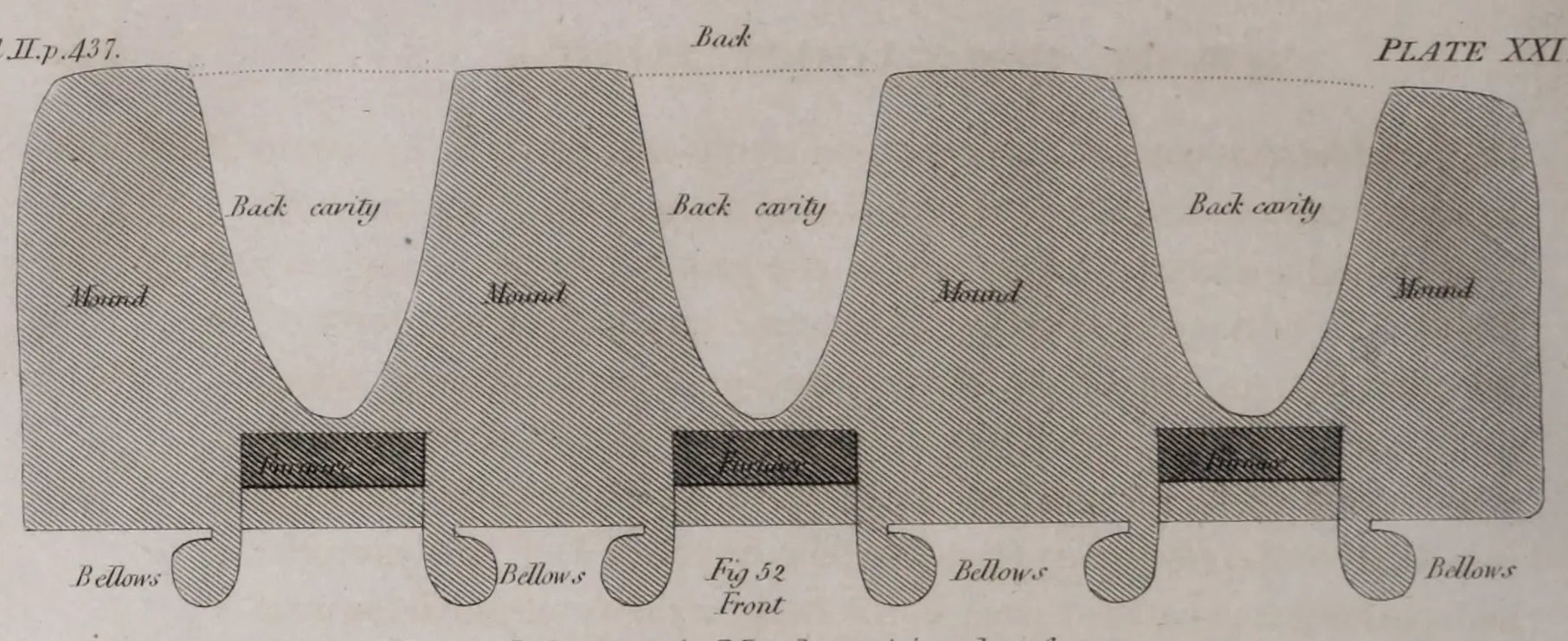
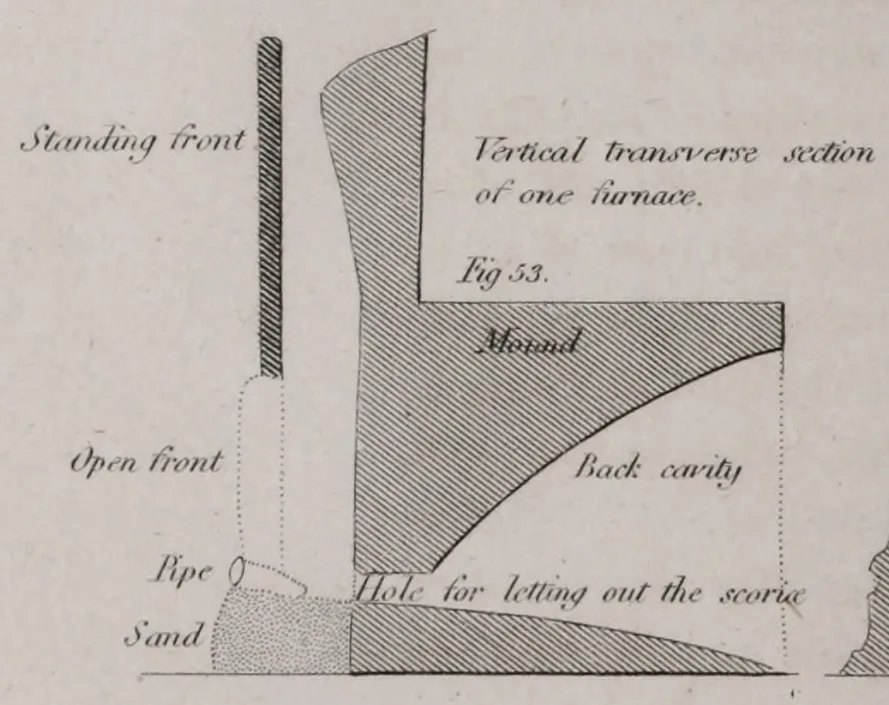
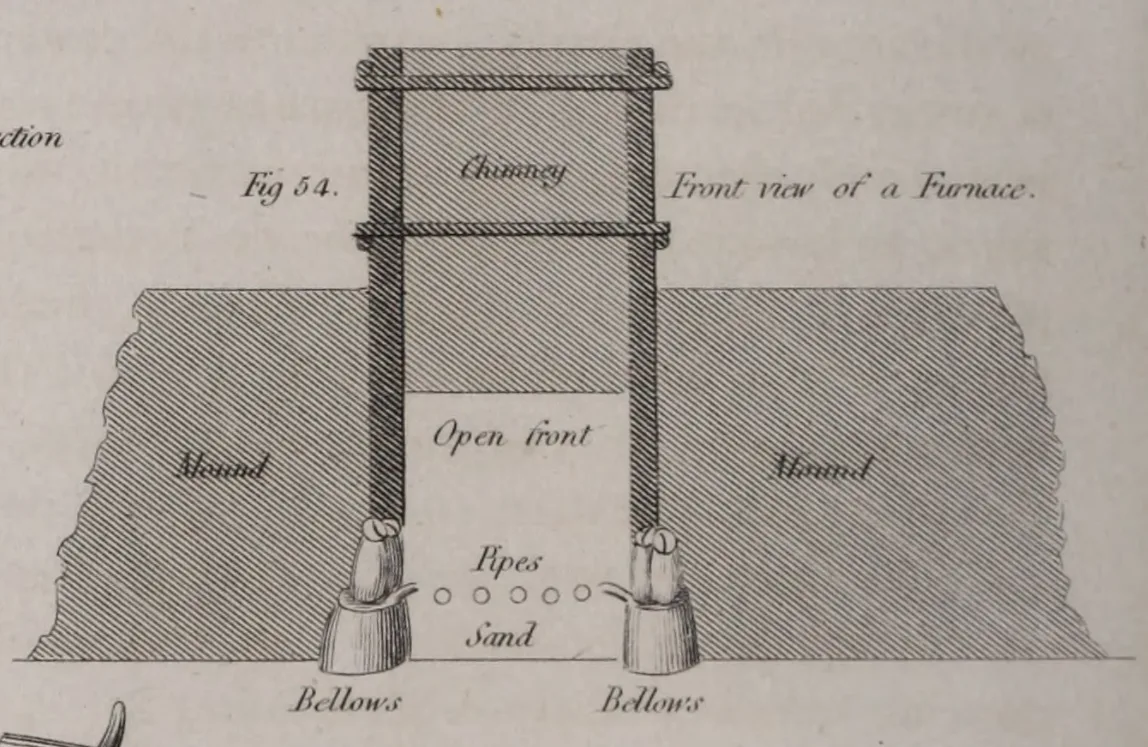
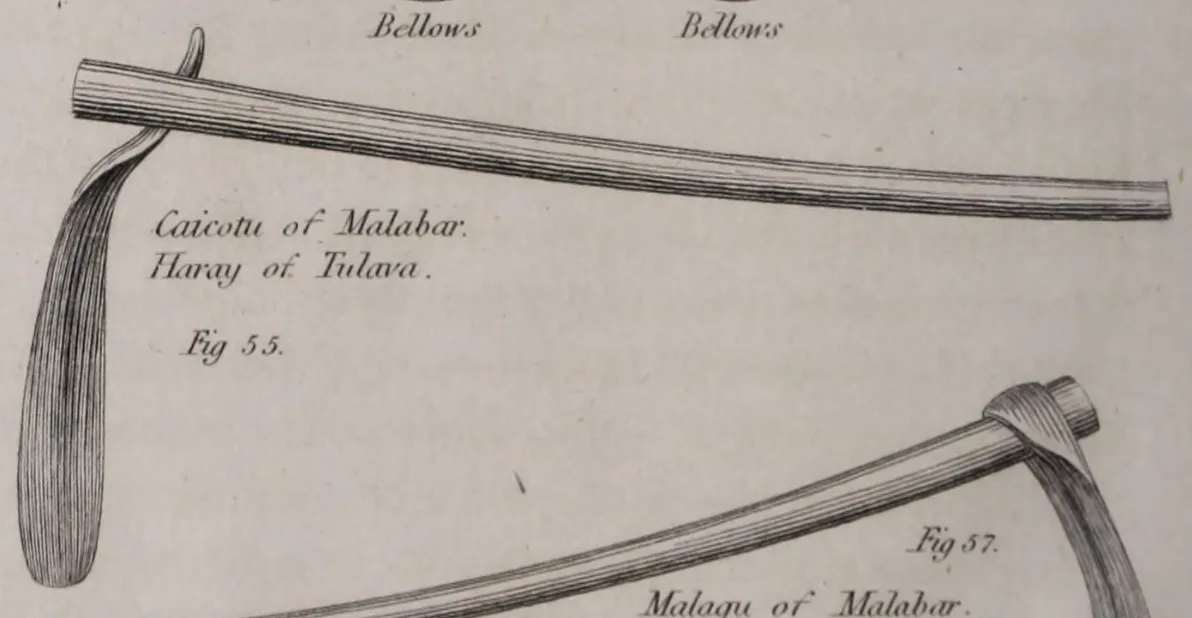
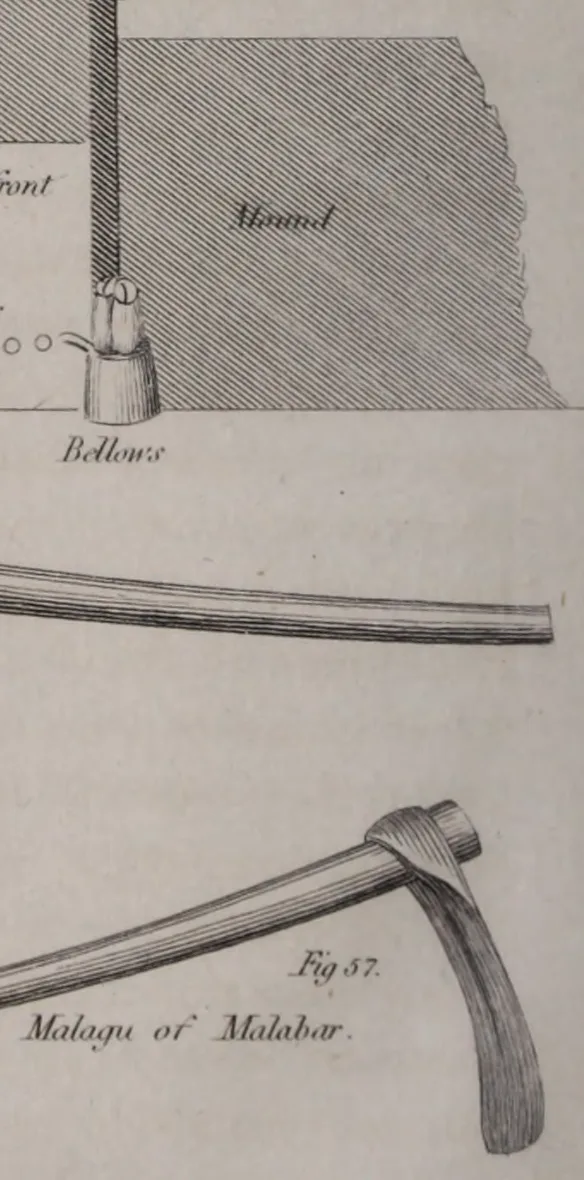
Under the same roof are built two or three furnaces, of which the description will be rendered more intelligible by means of the sketches annexed, Plate XXI. Figures 52, 53, 54. The furnaces are excavated out of the front of a mound of clay, which is 4 feet high behind, and 5 feet four inches before; and about 7 feet wide, from front to back. The excavation made for each furnace is 2 feet 11 inches wide, and 2 feet deep; and is dug down from the top of the mound to the ground. From behind, opposite to each furnace, an arched cavity is dug into the mound; so as to leave a thin partition between the two excavations. For allowing the vitrified matter to run off, there is in this partition a hole one foot in diameter. Above the furnace is erected a chimney of clay, built with four plain sides, which in two different places is strengthened by four Bamboos, lashed together at the angles. The front of the chimney consists of baked clay, two inches in thickness. Behind, the clay is gradually thickened toward the summit; so that the upper mouth of the chimney is contracted to 8 inches in depth by 2 feet 11 inches in width. The front of the furnace is quite open.
Early in the morning, when going to smelt, the workmen put wet sand mixed with powdered charcoal into the bottom of the furnace; so as to fill it up as far as the hole in its back part, through which the vitrified matter is to run out. The sand and charcoal are well beaten, and formed so as to slope from the outer and upper edge, both toward the hole and toward the ground in front of the furnace. The hole is then well stopped with clay; and clay pipes are inserted at each corner of the furnace, for the reception of the muzzles of the bellows. A row of clay pipes, eight or ten in number, is then laid on the surface of the sand, at right angles to the back of the furnace. Their outer ends project a little beyond the front, and their inner ends reach about half way to the back. The front of the furnace is then shut up with moist clay; and stoppers of the same are put in the outer mouths of the pipes. By removing these stoppers, and looking through the pipes, the workmen judge how the operation is going forward. Ten baskets of charcoal, each weighing 63 lb., are then poured in by the chimney; and this having been kindled, the bellows are set to work. Then 16 Porays of prepared ore, weighing 2160 lb., and 20 baskets more of charcoal, as the fire makes room for them, are gradually added. The operation lasts 24 hours, two sets of men relieving each other at the bellows, and keeping up a constant blast. The principal workman who attends the fire adds the fewel and ore, and stops up breaches; and, when the mass of iron has formed, breaks the clay that shut up the hole in the back part of the furnace, and lets out much vitrified matter, that strongly resembles brown hæmatites, and no doubt contains much iron, which this imperfect operation is unable to reduce. The bellows are then removed, and the front of the furnace is broken down. A great part of the charcoal which has not been consumed is then pulled out with sticks or forks, and extinguished by water. The mass of iron is allowed to remain on the sand 24 hours, and to cool gradually. According to the success of the operation, it weighs from 8 to 12 Tolams, or from 256 to 384 lb. The mass, when cool, is broken in pieces with a large hammer, and sold for use, it being then malleable, although somewhat brittle. The mass is extremely porous, and irregular in its shape, and has never formed what chemists call a button; that is to say, the liquefaction produced on the iron has only been partial, sufficient to cause the particles to adhere in a mass, but not adequate to form a fluid that expels all matters of a different specific gravity. In fact, the mass, in its cavities, includes many pieces of charcoal enveloped by the iron. How these have not been consumed, I do not know; but this circumstance clearly shows, that combustible matter being contained in a stratum is no proof, that the particles of this have not been united by a fire capable of mollifying them, and of making them cohere.
I have already mentioned, that this process obtains only from 11 8/10 to 17 8/10 per cent. of iron from the ore, and that what is produced is very imperfect. The great defect in the process, that renders it so unproductive, seems to be the want of proper bellows. Each man works a pair, consisting of two cylindrical leather bags, about 18 inches high, and 9 inches in diameter. The top has a slit, the edges of which overlap, and serve as a valve. Each pair is placed, on a small platform of clay, at a corner of the furnace; and a man, taking hold of the outer flaps of their upper ends in his two hands, alternately pushes them down to expel the wind, and draws them up to get a supply of air, the one hand going up while the other goes down. The air is expelled through a muzzle common to both bags. Each furnace has two pair, which at the same time requires two men, and there must be two sets, one to relieve the other.
To the proprietor the profit of these works is considerable. The expense for each smelting is as follows.
| Fanams. | Poray. | Edangallies. | |
|---|---|---|---|
| Each bellowsman 1 Fanam, and 1⁄10 Poray of rice | 4 | 0 | 4 |
| The head workman | 2 | 0 | 1 |
| The hammerman | 1 | 0 | 1 |
| Charcoal | 10 | 0 | 0 |
| Ore | 10 | 0 | 0 |
| Fanams | 27 | 0 | 6 |
| Value of 6 Edangallies of rice | 0,1⁄2 | 0 | 0 |
| 27,1⁄2 | 0 | 0 |
The iron sells at 4 Fanams a Tolam, or 7 s. 7 3⁄4 d. a hundred-weight. When the operation is well performed, and the iron mass weighs 12 Tolams, the proprietor has 20 1⁄2 Fanams profit; and at the worst, when he gets 8 Tolams only, his profit is 4 1⁄2 Fanams.
The expense of implements and buildings, owing to their wretchedness, cannot be estimated at more than 50 Fanams a year; and neither the government nor the landlord demand any thing for fewel.
What I have called indurated clay is not the mineral so called by Mr. Kirwan, who has not described this of which I am now writing. It seems to be the Argilla lapidea of Wallerius I. 395, and is one of the most valuable materials for building. It is diffused in immense masses, without any appearance of stratification, and is placed over the granite that forms the basis of Malayala. It is full of cavities and pores, and contains a very large quantity of iron in the form of red and yellow ochres. In the mass, while excluded from the air, it is so soft, that any iron instrument readily cuts it, and is dug up in square masses with a pick-ax, and immediately cut into the shape wanted with a trowel, or large knife. It very soon after becomes as hard as brick, and resists the air and water much better than any bricks that I have seen in India. I have never observed any animal or vegetable exuvia contained in it, but I have heard that such have been found immersed in its substance. As it is usually cut into the form of bricks for building, in several of the native dialects, it is called the brick-stone (Itica cullu). Where, however, by the washing away of the soil, part of it has been exposed to the air, and has hardened into a rock, its colour becomes black, and its pores and inequalities give it a kind of resemblance to the skin of a person affected with cutaneous disorders; hence in the Tamul language it is called Shuri cull, or itch-stone. The most proper English name would be Laterite, from Lateritis, the appellation that may be given to it in science.
In the Irnada district, gold dust is collected in the river which passes Nelambur in the Mangery Taluc. A Nair has an exclusive privilege of the collection, and on that account pays a small annual tribute. I was very desirous to have visited the place; but, the district being in extreme confusion, I could not with prudence enter it, especially on such an errand. The Nelambur river is a branch of that which falls into the sea north from Parupa-nada.
Mr. Wye gives the following account of the population and stock of his district:
| Houses inhabited by Mussulmans | 12,581 |
| Ditto by Namburis | 297 |
| Ditto by Puttar Bráhmans | 44 |
| Ditto by the families of Rájás | 33 |
| Ditto by Nairs | 6747 |
| Ditto by Tiars | 4733 |
| Ditto by Mucuas | 608 |
| Ditto by people from the country to the eastward | 472 |
| Total | 25,515 |
It is evident, that Mr. Wye has not given the total number of houses, but only the total of those inhabited by the principal casts to which my queries referred. I imagine, that we may take the total number of houses to be, at least, 28,000. These, at the rate of population in Canara, will contain 146,800 persons; but Mr. Barber's estimate will reduce this number to 103,900.
| Males | 8547 |
| Females | 7654 |
| Total | 16201 |
| Add free persons by first estimate | 146,800 |
| Total population by first estimate | 163,001 |
| Total population by Mr. Barber's ditto | 120,101 |
| Cows | 17,331 |
| Oxen, large | 2068 |
| small | 25,428 |
| 27,496 | |
| Total animals of the cow-kind | 44,827 |
Animals of the buffalo kind 8900. Number of ploughs 18,000. Number of looms 329.
From the number of ploughs, which is not likely to be exaggerated, there can be little doubt that the native officers have concealed from Mr. Wye the real number of cattle. 18,000 ploughs require at least 36,000 oxen or buffaloes, to which must be added the young of both species, the cows, and the cattle employed for carriage and in mills. The returns of cattle made to Mr. Warden are apparently correct; and at their rate 18,000 ploughs would require 66,840, in place of 53,727 given by Mr. Wye.
The Dhanmurry, Paddum, or low land in Mr. Wye's circle is stated, in the revenue accompts, at 170,400 Porays; of which, in the two districts nearest the Ghats, 3500 were last year waste. Many parts of the districts near the sea, and near the rivers in Shirnada, are, in the rainy season, very liable to suffer by being overflooded. In the last rainy season many people were obliged, once or twice over, to transplant their Macara crop. In the last mentioned district, owing to an embankment having given way, some low land has been deserted, and is now overgrown with bushes. In the interior part of the country, there are large tracts which have been over-run with high grass and trees since they have been deserted by their inhabitants, owing to the persecutions of the Hindus by the late Sultan, and the subsequent depredations committed on the Nairs by the Moplays. These atrocities raged most violently in the Malabar years 970—974; and were somewhat checked two years ago by the vigorous justice of Mr. Waddel, then superintendent of the southern division; but in the country immediately north from Angada-puram, they have again commenced.
The ground called 166,900 Poray-candums, stated in Mr. Wye’s account to have been cultivated, can have no reference to the quantity of seed, which Mr. Smee estimates at 472,113 Porays: allowing one half to produce two crops in the year, the Poray-candums must at this rate be 314,742; but this would be only 17 Poray-candums for each plough to cultivate; whereas, by the account of the farmers at Pali-ghat, a plough ought to cultivate 40 Poray-candums. Whether the number of ploughs have been exaggerated, or whether, owing to the commotions in Velater, Mr. Smee was prevented from surveying the whole district, I cannot say; but it is evident that there is some error. The produce of the districts, as stated by Mr. Smee, cannot be well reconciled with the population, taken at the lowest estimate. Mr. Smee calculates the gross average produce of rice in these districts, deducting seed, at 2,928,751 Porays; but 120,000 inhabitants would require 4,180,000, at the rate which I allowed in Pali-ghat. The exportation of these districts is not considerable; but we must either allow, that the number of inhabitants and ploughs is greatly exaggerated, or that Mr. Smee’s survey did not extend to the whole of Mr. Wye’s district. I am indeed inclined to think this last to be the case.
With regard to the Porays of land mentioned in the revenue accompts, a most fallacious opinion has been entertained, that they are so much land as will sow a Poray of seed, and this is defined to be 32 cubits square, which is still smaller than the allowance made by Mr. Warden. The fact at Angada-puram is, that, when the assessment was made by Arshid Beg Khán, so much land, good or bad, was called a Poray of land, as was supposed to produce to the landlord (Jenmcar) 10 Porays of Vir'-Patom, or of neat rent. The tax imposed on this was 5 Fanams, which, at harvest, is nearly the value of the whole rent; so that, unless the proprietor reserved the grain for a favourable market, he had no profit left him from his rice-lands. This, the people say, has been actually the case; but as people are still willing to advance money in mortgage on rice-lands, we may safely conclude, that Hyder did not so far deviate from his usual policy and justice, as to lay on a tax that would entirely absorb the property of the subject. It is true, that the inhabitants of Malabar speak of Hyder as of a rapacious tyrant; but little attention can be paid to what such people say, as they are universally discontented with the government of the English, by whom they have been indulged like sick children. To illustrate the matter more fully, let us consider what is usually done, according to the acknowledgment of the natives. For the mortgage of what is in the revenue accompts called ten Porays land, and of what among the proprietors is called a hundred Patoms, being estimated to produce 100 Porays of rack-rent (Vir'-Patom), a man, who has money is willing to advance on mortgage bond (Canum) 300 Fanams; and, after deducting the interest, to allow the landlord one-fifth of the rent (Patom). The mortgagee pays the land-tax; and for the trouble of cultivation, should he not occupy the land himself, allows the farmer a certain fixed amount in grain. This allowance is as follows.
| Porays. | |
|---|---|
| For seed | 20 |
| For cattle, implements, and slaves | 60 |
| For neat profit to the farmer | 20 |
| Porays | 100 |
From this it is evident, that what in the revenue accompts is called a ten-poray-land, on an average actually sows 20 Porays, although the whole cannot be land that produces two crops. After deducting the 100 Porays given to the farmer, it is supposed that an equal quantity remains to the mortgagee; but, if we consider what he has to pay, we must allow him more.
| Porays. | |
|---|---|
| The natives allow 5 Porays for the interest of 100 Fanams; so the interest of the bond is | 15 |
| Land-tax 5 Fanams, with 10 per cent. collector’s charges = 5, all together 55 Fanams, worth | 110 |
| One-fifth of rent, deducting interest | 17 |
| Total to be paid by the mortgagee | 142 |
| Farmers’ allowances | 100 |
| Porays | 242 |
We may safely assert therefore, that in both crops, the average produce of what, in the revenue accompts, is called a ten-poray-land, is at least 242 Porays; otherwise nobody would be willing to advance money on mortgage. Perhaps somewhat might be added for the trouble of the mortgagees (Canumcars); but, considering that they have perfect security for their money, and that, as most of them cultivate the ground themselves, they have the large profits allowed here for the Cudian, or cultivator, I am inclined to think, that nothing ought to be added on that account. Mr. Smee’s estimate of the average produce of this district is 7 5/8 seeds for one : at this rate, the 242 Porays, which make the produce of what is called a ten-poray-land, will in fact be the produce of about 31 Porays sowing.
After the first invasion of Malabar by Hyder, an attempt was made, by Chinavas Row, to introduce a regular system of finance; but this could never be carried into execution. The present system was sometime afterwards introduced by Arshid Beg Khán. All the vigilance of this commander, and of his master, were certainly inadequate to prevent unjust inequalities in the original assessment; and there cannot be a doubt, that many landlords (Jenmcars) who chose to corrupt the officers of revenue had their lands valued at a low rate, and the deficiency which this occasioned was made up by valuing high the lands of those who were too poor, or too proud, to corrupt the assessors. Tippoo having heard frequent complaints of this, and having been misled by the improper use of the term Poray-land, which he conceived to signify, in the revenue accompts, a quantity of land capable of sowing a Poray of seed, endeavoured to equalize the tax by a measurement, conducted by Ram Lingam Pillay, who had previously ascertained the average extent of ground sown with one Poray. This made the matter infinitely worse; as his officers were much more liable to corruption than those of his father; for he was very lenient to such offenders.
In Velater there are a few spots of land, watered by perennial streams, that annually produce three crops of rice. The greater part of the vallies give two crops: the first by means of the rain in the south-west monsoon; and the second by means of the easterly rains, and of the small streams which wind through the vallies, and are forced out upon the low grounds by means of dams. About the end of January, these streams dry up, but the supply of water is sufficient to bring the second crop to maturity. The lower parts of the vallies are called Ubayum lands; but the whole does not produce two crops. This term signifies perfectly level ground; and in some places the water lies so deep on it, that one crop only can be procured.
The higher borders of the vallies, which are too much elevated\n to receive a supply of water from the rivulets, but which are suffi-\n ciently level to admit of being inundated in the rainy season, are\n called Palealil, and annually produce only one crop. Mr. Wye\n thinks that the quantity of this does not amount to more than a\n twentieth part of the Dhanmurry, or rice-ground. The land which\n is higher than that called Palealil is Parum, and in this neighbour-\n hood pays no land-tax.
The three usual modes of cultivating rice are here in use. When\n the seed is sown without preparation, the cultivation is called Podi-\n wetha, i. e. dry-sowing; when, before sowing, it is sprouted, it is\n called wet-sowing, or Chetu-wetha; and when it is transplanted, it is\n called Nearra.
From the months in which the crops ripen, the first is called\n Canni, and the second Macara. The first is the most productive, in\n a proportion of 3 to 2; but, owing to its being cut in the rainy\n season, the grain is often injured.
In the Palealil, or higher parts of the level land, the most common\n cultivation is the sprouted seed. When, however, any fields of the\n Ubayum or low-land come up thin, the young rice is pulled up, and\n transplanted into a Palealil field; and there still remains time for\n having two crops on the former. On Palealil land the following\n kinds of rice are cultivated.
| Navara | a 2½ months crop. Average produce | 5 seeds |
| Watun | 4 | 7 or 8 |
| Calii | 4 | 7 or 8 |
| Caruma | 3½ | 7 |
| Ari Modun | 3 | 7 |
| Tua Punarin | 4 | 7 |
| Cheru Modun | 3 | 7 |
| Ari Caruma | 3 | 5 |
The average produce of this land may therefore be taken at 6 625⁄1000 seeds. If one Poray-candum measure only 32 cubits square, then the seed for an acre will be above 6 bushels, and the produce 32 4⁄10 bushels. I am inclined, however, to think that the Poray-candum is larger. The expenses of cultivation, and farmers (Cudians) profit, amount on this land to two thirds of the produce, leaving one third to the landholder and government.
The following is the manner of cultivating Palealil, or the higher parts of the level land, with sprouted-seed. Between the 2d and 11th of June plough twice while the field is dry, and afterwards inundate the ground, which in the course of the following month must be ploughed eight times, the plough going over the field, at each time, first length-wise, and then across. The field is all the while kept inundated, and before the fourth or fifth ploughing is manured with leaves and twigs. After the eighth ploughing the dung is given, and ploughed down. The mud is then smoothed with the feet; and about the 13th of July, the prepared seed is sown, the water being two or three inches deep. In twenty or thirty days the weeds must be removed by the hand. It ripens without any farther trouble than confining the water to the proper depth. The ears only are cut off; and, the rain making it impossible to preserve the straw for fodder, the cattle are allowed to eat it on the ground. The seed is made to sprout by putting it in baskets, and wetting it with water. Thrice a day afterwards, for from four to six days, it is watered, and is then fit for use.
On the Ubayum, or low level land, the first, or Canni crop, is in general sown in the same manner as on the fields called Palealil; only the season commences somewhat earlier, as the lowness of the situation affords a better supply of water. When the ears have been removed, the straw is immediately ploughed in for the second crop, which is always transplanted. For this the field is ploughed five or six times. If the farmer be not pushed for time, he allows for this operation from ten to twenty days; but, if the season be nearly over, he completes it in less than a week. After the second ploughing, the field is manured with leaves; and after the last with dung, which is ploughed in, and the seedlings are transplanted, the mud having been previously smoothed by the Uricha Maram (Plate XIX. Fig. 46.). The fields are always kept inundated, and require no weeding. The straw of this crop is cut down close by the ground, and kept four days in a heap. The grain is then rubbed off with the feet; for the Hindus, on such occasions, make as much use of their feet as we do of our hands. Twenty days afterwards the straw is beaten with sticks, and gives some more grain of an inferior quality. The seedlings are raised on a piece of high ground allowed for the purpose, and which pays no tax. Between the 14th of August and the 13th of September this is ploughed four or five times in the course of eight days, the field being in general inundated; this practice, however, is not always followed. The field is manured with leaves and dung; and the seed, after it has been prepared so as to sprout, is sown very thick. It seldom gets any water, except the rain, and before it is transplanted is often very nearly dead. Before the seedlings are pulled, the field must be well watered. After one month and a half, they are fit for transplantation, and continue in that state for fifteen days. The produce of good Ubayum land is reckoned twelve seeds for the first crop, and eight for the second, in all twenty seeds; which, should one Poray of seed require only 32 cubits square, would make the produce of the two crops on an acre 123 bushels.
In the Ubayum land, which, owing to too great a depth of water, produces only one crop, a particular kind of rice called Cuttaden is cultivated. To ripen it requires seven months, and its harvest is Macara (12th January—9th February). It is always transplanted, and in good seasons gives 15 seeds, which will make the produce of an acre 62¼ bushels, if 32 cubits square sow a Poray of seed.
The kinds of rice cultivated on Ubayum ground for the Canni, or early crop, are,
- Walli Arien - a 6 months crop.
- Cheru Arien - - 5½ ditto.
- Ayduma Cari - 5 ditto.
- Cartipun Arien - 4 ditto.
For the Macara, or late crop.
- Cumbalum - - a 6 months crop,
- Mundium pala - 5½ ditto.
- Tecun - - - 4 ditto.
- Bembala - - - 4 ditto.
The kind of rice must be adapted to the soil. On Ubayum land nothing but rice is ever cultivated.
In Mr. Wye's district, no estimate has been formed of the extent of the Parumba, or hilly lands. The lower parts of the hills bordering on the rice fields are occupied by the houses of the natives; these are surrounded by gardens, in which are planted fruit trees; and among them many different small articles, such as Shamay (Panicum miliare), Pyro (legumes), turmeric, and ginger, are raised. The higher parts, not too steep or rocky, are converted into terraces, or might be so; and, according to their fertility, are once in three, four, or five years cultivated for hill-rice, and Gingely (Sesamum). In the eastern parts of Velater, a great extent of this kind of ground has been allowed to be over-run with bushes and long grass; and Mr. Wye does not suppose that it would repay the expense of clearing. He thinks that on this kind of ground the culture of cotton might be introduced, by furnishing the collectors with seed to distribute. He thinks that the Company might show an example, by cultivating a small spot in each district, to initiate the natives in the manner in which new articles might be managed. The expense would be trifling. He thinks that, if the natives knew how to cultivate them, Sholum (Holcus sorghum), Dhal (Cytisus cajan), Coolty (Dolichos biflorus), and other dry grains, might be reared. I saw a field which Mr. Wye had sown with hill-rice mixed with Bourbon cotton seed. The crop of rice had been very good ; but, owing to his absence at the time, the weeds had been allowed to choke many of the cotton plants. Such of them as had struggled through were very thriving and productive. There can be no doubt, but that in this manner a very good crop of cotton might be obtained, if pains were taken, after the rice has been cut, to keep down the weeds by ploughing or hoeing. I have, however, some doubt, whether the cotton crop would equal in value that of Sesamum, which now always follows the hill-rice. Although the whole of the Parum, or hilly land, is private property, no one here prevents the cattle of his neighbours from feeding on his ground, or any person that pleases from cutting grass. The people of the country say, that it is customary for the landlords to grant hill land, free of rent for six years, to any person who will clear away the trees or bushes, and form terraces. Afterwards, when cultivated, it pays a rent to the landlord, but no land-tax has been exacted. The best soil on these hills is a red clay, like the soil used for Ragy in Mysore. Ellu or Sesamum is always sown immediately after the hill-rice has been reaped ; but, as this second crop is precarious, some fields are sown with Ellu alone.
For the Modun, or hill-rice, the Parum is ploughed three or four times between the 14th of July and the 13th of August. Afterwards, for eight times, it is ploughed once a month. Between the 11th of April and the 11th of May it is ploughed four or five times, and before the last is manured with ashes and dung. At the end of this period, the seed unprepared is sown broad-cast, and covered with the plough. When the rice is about a foot high the weeds ought to be removed by the hand ; but in general this is much neglected. In ninety days it is ripe. The ears are then cut, and the straw is immediately ploughed down for Sesamum. The field, after the rice harvest, is ploughed eight or ten times, and before the last is manured. Between the 14th of August and the 13th of September, the Ellu seed is sown, and covered with the plough. It ripens in four months.
This land is never alienated on mortgage, but pays to the landlord what is called Warrum, or rent. Before either crop is reaped, its amount is estimated, and the cultivator pays a certain share to the landlords. These consider themselves as entitled to a fifth part of the gross produce; but, in fact, a great many of the cultivators being Mussulmans, they will seldom give more than a tenth. The hill-rice is an extremely precarious crop, and five seeds are reckoned a good return; but this, if Mr. Wye be right in calling 32 cubits square a Poray-candum, is 30 bushels an acre; and as this rice comes in when that article is scarce and dear, it sells very high. One-sixtieth of a Poray of Ellu seed is required for a Poray-candum, and 24 seeds is a good crop; which makes the produce 2 4⁄10 bushels an acre.
The Shamay is sown in the plantations, or in the ground that serves for raising the seedlings of rice for transplantation. This requires four or five ploughings. The seed is sown about the beginning of May, and is covered by having bushes drawn over the field. There is no regular Warrum or rent for Shamay, but the landlord always gets some share. It ripens in 60 days, and produces very little; but it is ripe at a season when grain is always scarce and dear, and keeps the cultivators alive until the rice harvest.
The people of Malabar are indeed very improvident. As soon as the rice harvest is over, in order to drink and feast, they sell off their grain at a very low rate; and seven or eight months afterwards their stores are commonly exhausted, the price of rice is doubled, and they are reduced to eat many things which, while rice was in plenty, they would not taste.
The ground for plantations of palms, fruit trees, pepper, Betel-leaf, &c. must be free of rocks, and near a supply of water. It pays no land-tax; but a tax has been imposed on some of the articles that it produces. When a man wants to make a new plantation, he applies to some landlord, and gets, upon a land called Cuey Canum, a piece of ground fit for the purpose. According to the size of the garden, he advances from 30 to 50 Fanams, forms the plantation at his sole expense; and for two years after the garden or plantation becomes productive, in order to reward him for his trouble, he receives the whole profits. Afterwards he continues to cultivate the garden; and for his trouble, and for the interest of the money advanced to the landlord, and expended in forming the plantation, he receives one half of the produce. At any time, by paying up the money advanced, and the value of the trees planted, the landlord may entirely reassume the plantation. The value of the trees is fixed by long custom, and must be very nearly the real expense incurred in bringing them to maturity; otherwise no man would be so foolish as to advance money, or form plantations, on the tenure called Cuey Canum. A Betel-nut palm (Areca) is valued at three-tenths of a Poray of rice, worth about half a Fanam; a Jack tree (Artocarpus integrifolia) is valued at 8 Fanams; a coco-nut palm (Cocos) at 16 Fanams; a tree covered with pepper vines at 5 Fanams. These Fanams are the old Vir'-Ráya Fanams, worth ¼ Rupee, or about 6 d.
Before the Mussulman invasion, these gardens were to the landlords a very valuable property; but, when a tax was laid on, it was supposed to exhaust almost the whole of the landlord's share; and, where the garden is held by the tenure called Cuey Canum, he gets only from one to three Fanams yearly from the Canumcar, who pays the taxes. The plantations in Velater are on the decrease, which, like all other evils in Malabar, is usually attributed to the taxes, but it seems to me without justice. In the other districts under Mr. Wye, the plantations are increasing, and there is no reason to suppose that the tax is more oppressive in the one than in the other. Besides, although the tax, no doubt, bore excessively hard on the landlords, and may have nearly annihilated their property, as is alleged, it is not asserted, that it has infringed on the share of the persons possessing by the tenure called Cuey Canum; and it is by that class of people alone that gardens have been formed, and by them that they are most commonly kept in repair. But the oppression of the former government, and the turbulence and disorder that have prevailed in Velater since it fell under the Company’s management, are quite sufficient to account for the destruction of the plantations.
The trees most commonly planted in Velater are, the Betel-nut (Areca), and Jack (Artocarpus integrifolia). Betel-leaf (Piper Betle) is raised in a greater quantity than is consumed in the country; but it is all in the small way; every garden has eight or ten vines, for which the occupant pays nothing. Here are also many of the palms called by the natives Erimpanna, the Caryota urens of Linnæus. Its leaves are the favourite food of the elephant; and the palm wine most commonly used here is extracted from its young spadix, or flowering shoot. The Jagory prepared from this juice is inferior to that which is prepared from the juice of the coco-nut, but superior to the Jagory of the Brab, or Borassus. The natives, however, for drinking, greatly prefer the palm-wine of the coco-nut tree, but it is expensive. The seeds of the Erimpanna are planted, but it pays no tax. In general, it pushes out only one spadix annually; but that is so productive, that the Tiars pay yearly a Fanam for liberty to extract the juice of each palm. When this is old, and has become unfit for producing juice, it is cut; and the heart of the upper quarter of the stem is converted into a kind of sago, which the poor eat in the scarce season. This heart is divided into small pieces, and is exposed for five or six days to the sun. The pieces are then beaten in a large wooden mortar, like that used for removing the husks of rice. By this method a powder is separated from the stringy part. This powder is dried for another day in the sun; and in the evening, to separate some remaining strings, it is again beaten. From one tree, about a Poray of clean powder, or of a very coarse sago, is procured. This having been washed in water, and the larger part of the water having been poured off, it is boiled with the remainder into a kind of pudding, which is eaten with salt and tyre, or milk curdled by having become sour.
Mr. Wye says, that in the southern division of Malabar, the cultivation of black pepper (Piper nigrum), owing to Tippoo’s having destroyed the vines, is much less than it formerly was; but it is still considerable, and may produce 800 Candies of 640 lb. each, and worth at least 100,000 Rupees. All the gardens are small, and all the cultivators have other property. In June, July, or August, the traders go round to the cultivators, and advance them money, on condition, that in January or February the cultivators shall deliver their pepper at a given place. The money advanced is in proportion to the wants of the cultivator. If he be pressed for money, not above two thirds of the value will be given. In other cases, where the cultivator is not so necessitous, the money advanced is nearer the true value of the pepper. The condition of the bargain is also such, that, if the cultivator does not deliver the stipulated quantity of pepper, he must pay for the deficiency at the Calicut price, which is considerably greater than the common rate of the interior parts of the province. The advance is frequently made in cloth or other goods; but most commonly in old Fanams, worth ¼ Rupee. There are, however, several men, chiefly of the Moplay cast, who are prudent enough to be able to wait for their money until the produce of their gardens is ready for delivery. These, in general, let their gardens on Vir’ Patom, where the cultivator is in fact nothing more than a superintendant for the proprietor, who furnishes every expense, and allows a small per centage on the produce for the support of the tenant. The traders who make the advances to the farmers are mere factors for the merchants residing in the great towns, who furnish them with goods and cash to make the advances, and who have them in as great subjection as they have the inconsiderate cultivators. In the southern districts, there being several merchants who make advances, and of course there being some competition, the farmers get for their pepper something that approaches to a fair price, and they are daily increasing the cultivation; but in the northern district every thing is so much under the control of Mousa, the great monopolist at Tellichery, that it would be of very little importance to the cultivator were all the vines to be destroyed; and few are willing to plant new ones in place of those that decay.
Mr. Wye thinks that the most ready way of encouraging the cultivation of pepper would be, to allow the proprietors to pay it to government, in lieu of revenue, at a certain fixed rate, which, he thinks, need not exceed 100 Rupees a Candy. The average price given by the merchants to those not in distress is 125 Rupees; but of late it has cost the Company much more. Those who could dispose of their pepper to greater advantage than the Company's offer, might sell it as they pleased; by far the greater part of it would, however, go to the Company; which would gain considerably, and could be put to no inconvenience, by the plan in the southern district, where the amount of the revenue always greatly exceeds the value of all the pepper produced. In the northern districts it might perhaps, at times, be inconvenient for the Company to advance money, and the value of the pepper exceeds the amount of the revenue; but even there the pepper, to the extent of each man's land-tax, might be received, at a fixed price, which, if fair and reasonable, would effectually protect the industrious cultivator from monopolists, whose influence has been known to affect even the commercial interests of the Company.
Mr. Wye thinks that it might be very advisable for the Company to purchase the whole of the pepper raised in the province, and to make advances to the poorer tenants who may be in need of such assistance. Whatever the Company did not want for their own immediate commerce, might be sold by public sale at the great marts, such as Tannore, Calicut, and Tellichery; and the price to be given for the pepper should be regulated by the proceeds of these sales. Mr. Wye thinks that this would be an effectual mean of preventing smuggling, by which the revenue is at present excessively defrauded, there being a duty of 10 1/2 per cent. ad valorem on all the pepper exported. The whole of this business might be managed by the collectors, so far as the delivery of the pepper into the Company’s store-houses, after which it would of course be under the management of the commercial resident. In the bonds taken by the traders when they make advances, there is no particular precaution taken for the delivery of the pepper of certain qualities; so that we may safely conclude, that difference of curing, or other similar circumstances, make no considerable difference in its value; the receiving it by the collectors, therefore, would be attended with little trouble, and require no particular skill. I have already mentioned this, as one of the means that might be adopted to obviate the difficulties that must always attend a tax which is imposed upon plantations by the number of trees that they contain. I have in my possession a manuscript concerning Travancore, in which it is stated, that the Kerit Rám Rájá, in the year 1757, having received some assistance from the English, was willing to favour their commerce. On this occasion Mr. Spencer, the English chief, took an account of the pepper produced in the dominions of that prince, where there was no land-tax, but where the Rájá monopolized all the pepper, and gave the cultivators a fixed price for whatever they could raise. As the pepper trade of Travancore has always been more flourishing than any other, we may fairly infer, that this is the way in which a tax may be levied from it with the greatest advantage to the extent of cultivation. The whole pepper raised in the dominions of Travancore amounted to 11,752 Candies. For this the Rájá gave to the cultivators 30 Rupees a Candy, amounting to 3,52,560 Rupees. The amount of the sales, even including 2000 Candies that were given to the English Company at the low price of 82 Rupees, came to 13,12,260, or on an average 111½ Rupees a Candy. The Rájá did not, therefore, allow the cultivators more than 27 per cent. of the produce; and yet we know that the cultivation was carried on with the greatest spirit. But were the Company to monopolize the pepper, and allow the farmers 50 per cent. of the value, or 60 Rupees a Candy, I am persuaded that their profit would greatly exceed the amount of any revenue which they can derive from the present plan. How far a similar monopoly might be extended to coco-nut and Betel, or Areca, with advantage, I am not certain. I think it probable, however, that it would contribute greatly to the benefit both of the revenue and of the cultivator. But these being bulky articles, and not easily smuggled, an excise on them might answer the purpose very well, and leave the trade more open to competition.
The taxable trees which are planted in Mr. Wye’s districts, according to that gentleman, are,
| Bearing. | Unproductive. | Total. | |
|---|---|---|---|
| Jack trees | 25,740 | 43,929 | 69,669 |
| Coco-nut trees | 2,94,025 | 4,26,548 | 7,20,573 |
| Betel-nut trees | 2,68,375 | 4,10,152 | 6,78,527 |
| Pepper vines | 8,484 | 24,026 | 32,510 |
According to Mr. Smee’s survey they are,
| Bearing. | Unproductive. | Total. | |
|---|---|---|---|
| Jack trees | 34,428 | 72,117 | 1,06,545 |
| Coco-nut trees | 3,79,659 | 4,17,630 | 7,97,289 |
| Betel-nut trees | 2,06,699 | 4,37,833 | 6,44,532 |
| Pepper vines | 29,764 | 87,092 | 1,16,856 |
| Brab trees | 941 | 3,741 | 4,682 |
Mr. Wye’s statement is that by which the revenues are at present collected, and was formed several years ago. If accurate, these details would show that every article of plantation was advancing in the districts under Mr. Wye, except the Betel-nut, which grows chiefly in the interior parts of the country, where the disturbances have prevailed; and this confirms my opinion, that it is owing to these disturbances chiefly, and not to the taxes, that the plantations in many parts of Malabar are on the decrease.
This seems to be a country well fitted by nature for rearing cattle; but no place, in fact, rears worse, or fewer. The hills over a great part of Malabar are clear of wood or bushes, and in the rainy season produce a thick coat of grass, which, as it ripens toward the beginning of the fair season, and is then about a cubit high, is fit for making hay. By the natives this is entirely neglected. Some of the grasses are indeed very coarse; but Mr. Wye has made good hay from one of the species, which I take to be Dr. Roxburgh’s Ischæmum geminatum. It grows very commonly, and with a little pains might be made universal. At present, there being the greatest abundance of grass, the cattle of Malabar are in better condition than any that I have seen in India; but, as that will soon wither up from the drought, I am told, that for three months before the commencement of the rainy season their condition will be deplorable. On the present system, no more cattle can be kept than what can be supported from the beginning of January until the end of May upon the straw of the second or smallest crop of rice. The straw of the first crop, owing to its being cut in the rainy season, cannot be preserved. If hay could be collected, or if on the higher Parum lands Ragy (Cynosurus corocanus) could be cultivated, merely for the straw, a great many more cattle might be kept, and the increased quantity of manure would be an immense advantage to the farmer.
Every where in the interior parts of Malabar a prodigious inconvenience is felt, from the want of Bazars or markets. A little encouragement given to the Nazarens might induce that industrious class of men to settle in small villages of 30 or 40 houses, at reasonable distances throughout the country, where they would keep shops greatly to the advantage of the natives.
The exports and imports, by sea and land, in the part of this province under Mr. Wye will be seen in extracts from the custom-house accompts, which were sent to me by that gentleman. See the APPENDIX at the end of the Third Volume.
Mr. Wye says, that in his districts there are 18,544 Cannies or plots of ground employed for making salt, and that the quantity might probably be increased, were the inhabitants rich enough to incur the necessary expense. According to the calculations procured at Calicut, the quantity of salt made will be about 2096 Winchester bushels. It will be seen, that the quantity of salt exported, especially by sea, is considerable: in the two last years, after allowing for the importation of a small quantity, an excess of 40,000 Parahs has been exported. I am not acquainted with the contents of a Parah of salt. If it be the same with a Poray of rice, the annual exportation would be double the quantity which, according to my calculation, is manufactured. The Canny of salt ground may, however, be different here from that in use at Calicut.
22d December.—In the morning I went a long stage to Vencata-cotay. The road, most of the way, passes along the ridge of a low hill, whence narrow vallies go off toward both sides, and are separated from each other by branches of the hill. These vallies are very beautiful; but the rest of the country, at this season, looks ill. It is only the declivities of the hills that are formed into terraces for cultivation; the level ground on the summits of the ridges, which occupies a large proportion of the country, is quite waste. The soil in some places is apparently good; but, in general, the Laterite, or brick-stone, comes very near the surface, and would impede the plough. In some places the granite appears. As usual in Malabar, it is entirely free from veins of quartz or felspar. The whole, however, is covered with long grass used for thatch and pasture; but not a thousandth part of it is employed for these purposes; and in December and January the remainder is burnt, which destroys the bushes that spring up in the rainy season, and keeps the country clear.
Vencata-cotay is in a district named Shirnada, and the land-tax is paid in kind. This appears to be owing to its having formerly been Chericul lands, that is, such as were appropriated for the support of a Rájá. When the Rájá of the Tamuri family, to whom it belonged, fled to Travancore, the whole was seized, and valued at the full rack-rent. By some error in the accompts, every Patom (portion equal to the quantity of seed sown) of rent was valued at a Fanam; which being more than its average value, the farmers would not have cultivated the ground, had the rent been demanded in money. It has therefore been taken in kind, as is usually done by landlords when they receive rack-rent. Last year the Company found a considerable deficiency from the amount rated in the public accompts, although the grain was kept until the dearest season before it was sold. A man has this year undertaken to pay the whole in money, on condition that the instalments of payment are made at favourable seasons. He is enabled to do this, by letting the ground to the most advantage; whereas the government allowed the farmers 100 seeds for every ten-poray-land, and agreed to receive what was given them as the remainder of the crop, in which, of course, they were enormously defrauded. The farmers of Vencata-cotay make annual agreements for their lands, and frequently change their possessions; but no rice grounds are unoccupied.
I observed one of the machines for raising water called a Yatam, which was made on a better construction than those above the Ghats. It was wrought by one man, who stood on a plank running parallel to the lever, and placed on one side; so that the side of the lever passed parallel to his face, and he was in no danger of being hurt by the bucket coming up between his legs, as happens where the man's face looks toward the end of the lever. The lever was made of a Bamboo, and the weight was a large stone fixed by a swivel. The bucket was made of an excavated piece of wood, shaped like the half of a cheshire cheese, and, when full of water, was lighter than the stone, which of course raised it without any exertion of the labourer. From a well 16 feet deep the man raised four buckets in a minute, each containing 209 3/10 cubical inches, or about 178 ale gallons in the hour.
At night I was visited by the sixth Rájá of the Tamuri family, who, as well as the third in rank, resides at Vencata-cotay. The third declined receiving a visit from me; and perhaps thought that his coming, as his relation did, would be derogatory to his rank. The Rájá who visited me was a good looking man of about 50 years of age. His suite was not numerous, but very well dressed. He said, that Shirnada, the country in which we then were, formerly belonged to the Rájá of Velater. About 400 years ago that chief, having been attacked by the northern Nairs, applied for assistance to the Tamuri, and by ceding Shirnada obtained the protection of that prince. The fort of Vencata was afterwards built by the Tamuris; but, although it was much enlarged by the late Sultan, it is still a place of no importance. The Rájás of Malabar, indeed, do not seem to have ever trusted to fortifications for the defence of their country. The Tamuri family, during the time they suffered exile in the Travancore dominions, were chiefly supported by the liberality of its prince. There are at present about 25 Tamburettis, or ladies of this noble family, and the males are nearly about the same number.
23d December,—I went a short journey to Tiruvana-Angady, and passed through a country similar to that which I saw yesterday. Tiruvana-Angady is a small Moplay town on the southern bank of a river which comes from Irnada, and in the rainy season is navigable with canoes for 32 miles upwards. It has no communication with the Baypour (Vaypura) river, as represented in Major Rennell's map. Tiruvana-Angady is the place which in our maps is called Tervanagary, and is remarkable for the decisive victory which in the year 1790 Colonel Hartley gained in its neighbourhood over the forces of Tippoo. Near the Angady, or market, there is a small fort, which was erected by the Sultán round a Colgum, or palace, belonging to the Tamuri Rájá. Both have now fallen into ruins; and the Tamuri, since his return from exile, has not visited the place.
In this district of Shirnada the Parumba land may be divided into three kinds. First, that which is fit for plantations. This kind of land pays a rent to the landlord, when cultivated for ginger, turmeric, plantains, or other articles that are not taxed: the rent amounts to 1 Fanam for every Poray-candum, of which nine-twenty-fourths go to government as land-tax. The second kind is land near the villages, which is cultivated once in three years for hill-rice, Sesamum, and Shamay (Panicum miliare). It pays the same rent as the first kind, and the same share of this is taken as land-tax. The third kind is cultivated in the same manner; but, on account of its distance from the villages, poverty, or other causes, such as the officers who valued it having been corrupted, it pays no tax. To the landlord it ought to pay a fifth part of the produce; but some farmers refuse to give more than one seventh.
I here examined the cultivators concerning the manner of raising the pepper vine. They say, that it does not thrive where planted close together; and therefore every man, in the garden near his house, has five or six trees only, which are intended as supports for this valuable plant. The Mango tree (Mangifera) is reckoned the best for the purpose, and its fruit is not injured by the pepper. The Jack tree (Artocarpus integrifolia) is sometimes employed; but its fruit is diminished in quantity, and is said to be injured in quality, the pepper communicating its flavour. This circumstance I have heard confirmed by Europeans; but I confess that I am still sceptical. The pepper-vine thrives also very well on the Erythrina; and, where there are no trees in the garden, this is preferred; as a large branch of it, being put in the ground in the rainy season, will in the course of a year be fit for receiving the vine; and in the mean time Mango trees may be raised, to serve after the Erythrinas have died; for the pepper vines, after bearing from six to fifteen years, kill this tree. The Mango tree ought to be at least twenty years old before any pepper vines are put on it. Suppose a Mango tree be fit for receiving the vine, the following is the manner in which that is planted. Between the 11th of June and the 12th of July, or at the commencement of the rainy season, the soil round the tree is dug; and a small bank, surrounding the root at a cubit’s distance, is formed to confine the water. Then from 8 to 12 shoots of the vine, in proportion to the size of the tree, are laid down within the bank, and with two or three inches of one end standing up against the trunk. They are then covered with about an inch of fine mould; and, if any length of time occurs without rain, they must be watered; but this is seldom required. The shoots are about a cubit long. As the vines grow, they must be tied up to the tree, and rank weeds must be pulled up from near their roots. In the hot season they require to be watered with a pot; and at the commencement of the rainy season some leaves, ashes, and dung, must be spread on the ground near their roots. The pepper vine begins to bear at six years of age; in four years more it is in full perfection, and continues so for twenty years, when it dies. The young amenta begin to form at a feast called Tiruvadaray Netvelly, which is accompanied by a certain conjunction of the stars, the period of which none but astrologers can tell. It happened this year on the 17th of June. The beginning of the rainy season may therefore be considered as the flowering time of the pepper. When the fruit is intended for black pepper, it is not allowed to ripen; but is collected green, so soon as the berries become hard and firm, which happens between the 13th of December and the 11th of January. As the amenta come to a proper maturity, they are pinched off by the fingers, placed on a mat, and rubbed with the hands and feet, until the berries separate from the stem. These are then spread out on mats, so that one does not lie upon another, and are dried two, or at the most three days in the sun; while at night they are collected in earthen jars, to keep them from the dew. The pepper is then put up in mat-bags, containing from 2 to 4 Tolams, or from 64 to 128 lb., and is fit for sale. The whole cost attending this process seems to be very trifling; and I have no doubt of Mr. Smee’s allowance, of one-ninth of the produce, being fully adequate to defray the annual expense. The original cost of planting can hardly be brought to an accompt, it is so small. What is intended for white pepper, is allowed to become quite ripe. The berries are then red, and, the pulp being washed off, the white seed is dried for sale. The vines in this case are very apt to die, and in this province little or none is now made.
The soil most esteemed here for pepper is red, and contains small stones. When a man wants to make a garden, he gives on a mortgage bond (Cuey Canum) from 15 to 40 Fanams to the landlord for three Poray-candums of a proper soil; and pays annually one Fanam for each Poray-candum, should he raise nothing in his garden but ginger, turmeric, plantains, Mangoes, or the like: but out of this the landlord pays the tax. Should the mortgagee plant any Jack, Betel-nut, or coco-nut trees, or pepper vines, as soon as these come into bearing, he must give an eighth part of the produce to the landlord, and pay the land-tax, which on pepper vines is 3 Fanams for every tree. This is only to be understood of the largest trees, supporting ten or twelve pepper vines. In the revenue accompts, a sufficient number of smaller trees are written as one, to make the tax equable, and not heavier than at the rate of three Fanams for a tree of the best quality. The three Fanams paid for the land-tax are new, of which 3½ are equal to 1 1/3½ Rupee. But all other Fanams mentioned among the farmers are old, and equal to ¼ Rupee.
The produce of the vines growing on a tree paying full revenue, the cultivators estimate at half a Tolam, or 16 lb.; but the collector’s agent says, that this is the produce of a very ordinary tree; that a middling one produces three quarters of a Tolam, or 24 lb.; and that a good one in fact produces one Tolam, or 32 lb. The land-tax, the farmers acknowledge, amounts to about a third part of the produce. Now we shall see that they frequently sell their pepper at 15 old Fanams a Tolam, equal to 13¼ new ones; and by this estimate the average produce should be 9/13¼ parts of a Tolam, or about 21¾ lb. In the revenue accompts of Mr. Wye’s districts, the number of trees bearing pepper vines is rated at 8484; and the average quantity exported is 4270 Tolams, which gives very nearly half a Tolam, or 16 lb. for the produce of each tree; to which we must add what is consumed in the country, and what is smuggled; and then 21¾ lb. will not, I am persuaded, be thought too great an allowance. Each tree actually producing pepper with vigour is, however, by no means to be conceived as producing that quantity. This is the produce of the best; and in the revenue accompts, four, or even five, are written as one, as I have before mentioned; still I am at a loss to explain the very small quantity of produce stated by Mr. Smee as the average of the trees in the southern and middle parts of Malabar. After rejecting all trees covered with old or young vines, as not productive, he estimates the average produce of the remainder at 4½ lb. of dried pepper. I am still farther staggered by the quantity of pepper stated by Mr. Wye to be exported from the southern division alone, and which that gentleman has good opportunities of knowing: this he stated, in round numbers, at 800 Candies of 640 lb. Now the whole productive pepper vines, in the southern and middle division of Malabar, by Mr. Smee’s valuation, amount to only 45,803, and at his average rate of produce could give only 322 Candies. By Mr. Wye’s estimate of the export, each of them ought certainly to give more than 11 pounds, exclusive of country consumption, smuggling, and the number of vines in the middle division; but, as these are very few, they need not be taken into consideration. The obstacles, indeed, that are thrown in the way of the most careful investigation of the produce of plantations are such, as should cause a mode of taxation founded on a supposed knowledge of its amount to be totally rejected. The present tax is three Fanams for every vine; that is to say, for as many vines as produce nine Fanams worth of pepper. Mr. Smee, in consequence of his finding the produce so small, proposes to reduce the tax to one half levied on the actual number of productive vines, which, by his account, amount to about one fourth of the whole. The present tax is certainly not oppressive, as the cultivation is extending; and the cultivators, besides giving a considerable loan on mortgage to the landlord, can afford to give him one eighth part of the produce, and a small ground-rent for the garden. It will be seen, that the principal evils attached to the cultivators arise from their own want of prudence.
Farmers of prudence and substance, such as the Moplays mostly are, receive no advances; but, when their pepper is fit for market, sell it to the best advantage, and deliver it at the sea-port towns at from 24 to 25 old Vir'-Ráya Fanams a Tolam, or at from 120 to 125 Rupees a Candy of 640 lb. The case, however, is very different with most of the Hindus, who in Malabar are as remarkable for a thoughtless profusion, as in other parts they are notoriously penurious. Between the 12th of June and the 13th of September, the Mussulman traders come from the coast, and enter into written agreements with those who are willing to receive advances. The cultivator agrees to deliver a certain quantity of pepper, for which the trader pays down immediately from 13 to 15 Fanams a Tolam, or from 65 to 75 Rupees a Candy. Should the cultivator, at the crop season, be unable to deliver the quantity for which he contracted, he must pay for the deficiency at the market price, which is generally 120 or 125 Rupees a Candy. As he is seldom or never able to pay this in cash, he gives a note of hand, engaging to deliver pepper for the amount of the price of the deficiency, at the rate of one Tolam for from 13 to 15 Fanams; but no interest is charged. Indeed, the profits of the trader are immense; as for an advance of 15 Fanams for six months, he gets a profit of ten; and it is evident that the risk is very small. Should a merchant not consent to receive the pepper, on account of its being bad, the cultivator may sell it to any person that he pleases, and give the proceeds to the merchant. Should these not amount to the market price, he gives a note of hand for the balance, which is considered as part of the advance for the next year. It is evidently the interest of the merchant to keep up a high nominal price, even should he, in selling the pepper to foreigners, be obliged to allow a large discount; for all the balances due by the farmer are paid at what is called the market price. The present market price is 125 Rupees a Candy, or 2l. 1s. 5d. a hundred-weight. It is sometimes so low as 100 Rupees, and at others rises to double that sum.
The cultivators, when questioned concerning the reason that can induce them to take up money on terms so disadvantageous, attribute it entirely to the land-tax; for every evil in Malabar is ascribed to that as its source. When asked, however, if they would be willing to pay in their pepper to the Company, in place of the land-tax, at 18 or 20 Fanams a Tolam, they start innumerable objections. At length I found out, that the real cause of the Hindus disposing of their pepper at this low rate, is a festival called Wona, which is celebrated in the month Singhium. At this the Hindus expend in drinking and finery every thing which they can raise. In their fits of intoxication there are constant scenes of fighting and abuse, which were a great source of revenue to the Rájás, as opening a way for law-suits and criminal prosecutions; and, with a view probably to encourage this source of revenue, the Rájás did not punish any murder that was committed during the festivities of Wona; but restricted themselves to fining those who gave abusive language, in the vehemence and indecency of which the Hindus exceed all other nations. It is hardly necessary to mention, that such an excuse for murder would not be admitted in the courts which are at present established in the country.
In the gardens of this neighbourhood much ginger and turmeric are cultivated. For this purpose a red soil, free from stones, is reckoned the best. Between the 11th of April and the 11th of May the garden is dug with the hoe, and formed into ridges, one cubit broad, one cubit high, and one cubit distant from each other, their sides being perpendicular. Two rows of the cuttings of ginger, or turmeric, are put in each ridge, and slightly covered with earth. The plot is then covered with bushes, to act as a manure, and to keep off the sun. Between the 12th of June and the 13th of July, the shoots appear above ground; and ten days afterwards the stems of the bushes are removed. Between every two rows of the plants, small twigs of trees are then put lengthwise and across, and weeds are removed by the hand. Between the 13th of December and the 11th of January, both roots are fit for pulling. Those intended for replanting are mixed with a little red mud, and immediately buried in a pit.
The ginger, intended for sale, is scraped with a knife to remove the outer skin; and, having been sprinkled with the ashes of cow-dung, is spread out on mats, and dried eight or ten days; when it is fit for sale.
The turmeric intended for sale, immediately after having been taken up, is boiled a whole day in water. The pieces that are large are then split, and for five or six days the whole is exposed on mats to the sun.
In the gardens and plantations toward the sea coast of the southern parts of Malabar, a species of Cycas, called Indu by the natives (Todda Panna Hort: Mal:), is very common; but it grows spontaneously from the nuts that accidentally fall. The nuts are collected; and, having been dried for a month in the sun, are beaten in a mortar, and the kernels formed into a flour, which the natives eat, and call Indum Podi. It is reckoned superior to the flour prepared from the stem of the Erimpanna (Caryota), but it is only used by the poor, who between the 14th of July and the 13th of September are in danger of perishing. It is prepared during the former month, and cannot be preserved longer than the end of the latter.
24th December.—I set out with an intention of stopping at Pa-rupa-nada, which in our maps is called Perperengarde; but, owing to the untowardness of my guides, I found, on my arrival there, that my tents had been carried on to Vay-pura. I was of course obliged to follow; but much of my baggage did not arrive until four in the afternoon, and the cattle were worn out with fatigue. From Tiruvana Angady to Parupa-nada is a plain, intersected in the middle by a deep creek running north and south, and forming the boundary between the Shirnada belonging to the Tamuri, and the dominions of a petty chief called the Parupa-nada Rájá. The country formerly belonging to this chief extended in a narrow tract along the sea side, from the river of Calicut to Tannore. At Tannore commenced another petty Rájáship, extending to the Panyáni river, and called Bettutanada. The family that governed this has become entirely extinct.
The plain between Tiruvana and Parupa-nada consists partly of high (Parum) and partly of very low, or Paddum land. Both are at present very much neglected. The higher land, being no where steep, seems capable of being wholly converted into plantations, or of being cultivated with hill-rice, and other dry-grains. The Paddum-land is very low; and so much inundated, that a great part of it does not become dry until the hot season. It is said to be of a very good quality. The neglected state of agriculture is attributed to the want of people, and to the poverty of those who remain. Near the sea coast runs a narrow border, well filled with coco-nut gardens, and highly productive. Between this and the sea are barren downs, on which is situated the Moplay town Parupa-nada. This contains about 700 houses, and is the best built native town that I have yet seen. The houses are built of stone; and, were they better aired, would be comfortable even for Europeans.
The Moplays on the sea coast are a most industrious quiet people, and will scarcely acknowledge as brethren those ruffians who live in the interior part of the country, and who, having been let loose upon the Nairs, have acquired a blood-thirsty, rapacious disposition, which they justify by considering their adversaries as infidels.
At some distance north from Parupa-nada, I passed over, in a very bad ferry boat, the mouth of the river which comes from Tiruvana; and about two miles farther, I crossed a still larger river, and came to Vay-pura, which in our maps is called Baypour. When compared with that at Madras, the surf on this coast is trifling; and, except where rocky head-lands run a little way into the sea, boats of any kind might, without danger, land on every part of the coast. I met people tracking boats along the shore, and observed men, who were walking on the outside of the surf, and pushing along floats of timber, while the water did not reach up to their shoulders.
The Parupa-nada Rájá resides at Vay-pura. He pretends to be of the Kshatri cast. Like those of the other noble families of Malabar, the ladies of this, who are called Tamburettis, cohabit with such of the Namburis as they choose, and all their male children are called Unitamban. The five eldest of these are called Rájás, each of whom has a peculiar title. That of the oldest, who is the head of the family, is Taycapadu.
Vay-pura was originally called north Parupa-nada. It is a small town, containing 120 houses of all casts, and has hardly any trade. The situation is most beautiful, on the north side of a river, where it enters the sea. Within, the river has deep water; but, like all those on the coast, has a bar at its mouth. At favourable seasons vessels drawing 14 feet may be floated over the bar by means of casks. Some projectors have here erected lofts, and other works accommodated for building ships of war; for which purpose no place seems to be worse fitted. Small vessels, however, might be built to considerable advantage, a good deal of timber coming down the river, which affords fine situations for slips, or docks. The native collector says, that two years ago 10,000 Teak trees were brought down the river; but this was the produce of the forests for four years, none having been exported during that time. The native collector thinks, that between two and three thousand trees may be annually procured. The timber is cut on the Ghats, and conveyed by elephants to the part of the river which in the rainy season has water sufficient to float it. Many of the best trees are cut in two, to enable the elephants to drag them; and in this operation many of them are rent, or otherwise materially injured. Teak timber, of an ordinary quality for ship-building, sells at 9 or 10 Rupees a Candy, which measures 10¾ English cubical feet. The foot, therefore, costs from about 18d. to 2s. Choice timber sells as high as 16 Rupees a Candy, or 34 2⁄10d. a cubical foot.
At Vay-pura some private gentlemen, with a view of supplying the dock yard at Bombay with Teak plank, have erected a saw mill; and a great deal of money has been expended in the project, with very little prospect of success. The power intended to have turned this mill was the wind; which appears to me to be by far too precarious a moving power for such heavy machinery.
No rice is exported from this river, the produce of the country being only sufficient for the maintenance of the inhabitants.
25th December.—I went a short journey to Calicut, and had a good road. By the way I crossed a river, much inferior to that at Vay-pura, but provided with excellent ferry-boats, composed of two canoes connected by a stage. The road passes through plantations of coco-nuts, some of which are thickly set; but in general, throughout the coast, not one half the number of trees are placed in the gardens that they are calculated to receive. Very little attention is any where paid to keep the gardens in order. The flat Parumba lands near the sea are never cultivated for hill-rice, and pay no land-tax, unless for the trees that may be planted on them; as is the case indeed every where, except in Shirnada. A man who wants a house and garden gives for a piece of suitable ground from 15 to 20 Fanams on mortgage. If the landlord wishes to reassume this ground, which he may at any time do, he must not only repay the mortgage, but also pay the value of the house, of the fences, and of any trees that have been planted. If a man wants to raise a plantation of coco-nut trees, he gives from 60 to 90 Fanams on mortgage for 10 Candies of land, and gives the landlord annually a piece of cloth, and a bunch of plantains, as an acknowledgment of tenure. The Candy is 12 Gajas (of 28⅛ inches each) square: so that the value of this kind of land, to the landlord, is from 8l. 4s. 0½d. to 12l. 6s. 0¾d. an acre. The farmer or mortgagee is at the whole expense of making and cultivating the garden, and pays the tax, which is half a Fanam for each good tree, old and young trees being exempted, and three or four bad ones being rated as one in the revenue accompts. The trees are planted in such a straggling manner, that it is impossible to say what the amount of the tax on any given space really is. It is said, that 20 trees may be planted on one Candy, of which ten ought to be in full bearing, and to produce on an average 23 nuts, worth at the cutting season three fourths of a Fanam; but, if dried, worth one Fanam. The Tiars give a Fanam yearly for each tree, for liberty to extract the juice. This account was given me by the native revenue officer at Vay-pura, while no cultivators were present; and if it be just, an acre would produce 1266 nuts, worth when green 1l. 0s. 6d., and when dried 1l. 7s. 4d.; and if the tax were strictly exacted, an acre would pay to government 13s. 8d.; but in fact the tax is not levied by an actual enumeration, nor are the trees ever planted so closely. For at the rate stated here, the trees would be distant from each other only about 6 feet. The produce stated by the collector, as the average rate of one tree, is 30 per cent. less than Mr. Smee’s accommodated for building ships of war; for which purpose no place seems to be worse fitted. Small vessels, however, might be built to considerable advantage, a good deal of timber coming down the river, which affords fine situations for slips, or docks. The native collector says, that two years ago 10,000 Teak trees were brought down the river; but this was the produce of the forests for four years, none having been exported during that time. The native collector thinks, that between two and three thousand trees may be annually procured. The timber is cut on the Ghats, and conveyed by elephants to the part of the river which in the rainy season has water sufficient to float it. Many of the best trees are cut in two, to enable the elephants to drag them; and in this operation many of them are rent, or otherwise materially injured. Teak timber, of an ordinary quality for ship-building, sells at 9 or 10 Rupees a Candy, which measures 10¾ English cubical feet. The foot, therefore, costs from about 18d. to 2s. Choice timber sells as high as 16 Rupees a Candy, or 34 2⁄10d. a cubical foot.
At Vay-pura some private gentlemen, with a view of supplying the dock yard at Bombay with Teak plank, have erected a saw mill; and a great deal of money has been expended in the project, with very little prospect of success. The power intended to have turned this mill was the wind; which appears to me to be by far too precarious a moving power for such heavy machinery.
No rice is exported from this river, the produce of the country being only sufficient for the maintenance of the inhabitants.
25th December.—I went a short journey to Calicut, and had a good road. By the way I crossed a river, much inferior to that at Vay-pura, but provided with excellent ferry-boats, composed of two canoes connected by a stage. The road passes through plantations of coco-nuts, some of which are thickly set; but in general, throughout the coast, not one half the number of trees are placed in the gardens that they are calculated to receive. Very little attention is any where paid to keep the gardens in order. The flat Parumba lands near the sea are never cultivated for hill-rice, and pay no land-tax, unless for the trees that may be planted on them; as is the case indeed every where, except in Shirnada. A man who wants a house and garden gives for a piece of suitable ground from 15 to 20 Fanams on mortgage. If the landlord wishes to reassume this ground, which he may at any time do, he must not only repay the mortgage, but also pay the value of the house, of the fences, and of any trees that have been planted. If a man wants to raise a plantation of coco-nut trees, he gives from 60 to 90 Fanams on mortgage for 10 Candies of land, and gives the landlord annually a piece of cloth, and a bunch of plantains, as an acknowledgment of tenure. The Candy is 12 Gajas (of 28⅛ inches each) square: so that the value of this kind of land, to the landlord, is from 8l. 4s. 0½d. to 12l. 6s. 0¾d. an acre. The farmer or mortgagee is at the whole expense of making and cultivating the garden, and pays the tax, which is half a Fanam for each good tree, old and young trees being exempted, and three or four bad ones being rated as one in the revenue accompts. The trees are planted in such a straggling manner, that it is impossible to say what the amount of the tax on any given space really is. It is said, that 20 trees may be planted on one Candy, of which ten ought to be in full bearing, and to produce on an average 23 nuts, worth at the cutting season three fourths of a Fanam; but, if dried, worth one Fanam. The Tiars give a Fanam yearly for each tree, for liberty to extract the juice. This account was given me by the native revenue officer at Vay-pura, while no cultivators were present; and if it be just, an acre would produce 1266 nuts, worth when green 1l. 0s. 6d., and when dried 1l. 7s. 4d.; and if the tax were strictly exacted, an acre would pay to government 13s. 8d.; but in fact the tax is not levied by an actual enumeration, nor are the trees ever planted so closely. For at the rate stated here, the trees would be distant from each other only about 6 feet. The produce stated by the collector, as the average rate of one tree, is 30 per cent. less than Mr. Smee's estimate; probably owing to his including every tree of a bearing age good or bad, whereas Mr. Smee rejects all that do not bear more than 10 nuts. The very great difference between the estimates founded on the collector’s information, and those founded on the information of the cultivators at Shetuwai, show the difficulty in this province of procuring statistical accounts. The account of the cultivators seems to agree best with the actual number of trees in any given space: that of the collector, with pains and industry, might perhaps be realised.
26th—30th December.—I remained at Calicut with Mr. Spencer, the president of the commission for the affairs of Malabar; and from that gentleman, and from Mr. Smee, the other commissioner, I received every assistance that I could require.
The proper name of the place is Colicodu. When Cheruman Permal had divided Malabar among his nobles, and had no principality remaining to bestow on the ancestor of the Tamuri, he gave that chief his sword, with all the territory in which a cock crowing at a small temple here could be heard. This formed the original dominions of the Tamuri, and was called Colicodu, or the cock-crowing. This place continued to be the chief residence of the Tamuri Rájás until the Mussulman invasion, and became a very flourishing city, owing to the success that its lords had in war, and the encouragement which they gave to commerce. Tippoo destroyed the town, and removed its inhabitants to Nelluru, the name of which he changed to Furruck-ábád; for, like all the Mussulmans of India, he was a mighty changer of old Pagan names. Fifteen months after this forced emigration, the English conquered the province, and the inhabitants returned with great joy to their old place of residence. The town now contains about five thousand houses, and is fast recovering. Before its destruction by Tippoo its houses amounted to between six and seven thousand. Most of its inhabitants are Moplays.
The people here say, that the whole country between Cape Comorin and Surat is, in their books, divided into Kéralam and Kankánam; both of which were created by Parasu-ráma, and therefore ought not to be included in the fifty-six Désams of Bharata-khanda. Of their country the people here have a history, which is called Kérala Ulpati, and is written in a pure and old dialect of the Ellacanum, or poetical language. It is understood with great difficulty; many passages are interpreted in different ways; and some of the copies are said to differ essentially from others. The author is supposed to have been Sankara Achárya.
At this place Mr. Torin, the commercial resident, has been endeavouring to establish a manufacture of the plain cotton goods which are called long cloth. It is of 6 Calls fineness (that is to say, contains in its warp 744 threads), and the pieces are 72 cubits long, by 2¼ in width. The prices given to the weavers are 34, 32, and 30 gold Fanams for the piece, according to its quality. Very few are made of the first quality. The prices reduced to Bombay Rupees, and these valued at the mint price, are 18s. 6¾d., 17s. 5½d., and 16s. 4½d. The cloth is afterwards bleached, and sent to Europe on the Company’s account. The weavers have been brought from the dominions of Travancore and Cochi; and Mr. Torin complains of their indolence, and want of honesty. They are 344 in number, but work 237 looms only, and bring in monthly 468 pieces of cloth. Within these two months Mr. Torin has established another manufactory of the same cloth at Pali-ghat, of which he has favourable expectations, as the cloths are better and cheaper. Pali-ghat is indeed the only part of the province that seems to be a fit situation for manufacturers, as its neighbourhood is the only part that affords a surplus of grain. The other parts of the province have, in their plantations more than sufficient employment for all the hands which they can support, and a constant demand for the produce of the labour which is so bestowed. I should, therefore, consider the introduction of manufactures as likely to prove injurious, by taking away labourers that might be more usefully employed. At present, by far the greater part of the clothing that is used in the country is imported. In every district a few weavers make coarse cotton cloth for the use of the lower classes; and at Tellichery a few make table-cloths, napkins, and towels for the Europeans and native Portuguese.
Some men of the Panchála tribe, which here is called Peringullan, paint and varnish wood by the following process. They take butter-milk, and boil it with a small quantity of quicklime, until strings form in the decoction and separate from the watery parts, which they decant. The stringy matter is then mixed with the paint, which has been well powdered. With these the wooden work is first painted; it is then allowed to dry for one day, and afterwards receives a coat of Pundum, which is the fresh juice of a tree called Peini Maram. The Pundum must be used while it is fresh, and will not keep for more than two or three days. After the first coat of Pundum has dried, another coat of paint is given, and that is followed by another of varnish. In the same manner leather may be painted and varnished. The varnish effectually resists the action of water. All my attempts, however, to find out the varnish-tree were vain.
Calicut and Vay-pura form a small district; and, unfortunately, I have received no answers to the statistical queries which I proposed relative to it; as has also been the case in the districts under the management of Mr. Drummond and Captain Osburn, which renders my account of Malabar much less complete than I expected to make it. From Mr. Smee's valuable communications I am persuaded, that from the southern and middle divisions of Malabar at least the following quantity of the produce of plantations is annually exported.
| Rupees. | ||
|---|---|---|
| Coco-nuts | 38,458 thousand, at 13½ Rupees, | 519,048 |
| Betel-nuts | 58,392 thousand, at 3 Fanams, | 32,916 |
| Black pepper | 340 Candies, at 125 Rupees, | 42,500 |
| Rupees | 6,14,464 |
Besides large quantities of ginger and turmeric; and I have already mentioned, that the quantity of black pepper is more than double that here stated.
In the Appendix at the end of the Third Volume, will be found a report, made by the commercial resident at Calicut, on the province having been ceded to the Company; which will throw considerable light on the trade of the country.
Having procured an intelligent native officer of revenue, I went with him to a rice field belonging to a man of substance; and, having measured this, found that it contained 27,893 square feet. The Poray here contains 607½ cubical inches. These preparatory measures having been taken, I, in presence of the native officer, obtained the following account from the proprietor of the field, and believe that what he stated may be depended on as true.
The field which I measured was of a poor soil, and in the revenue accompts was called a five-Poray-land; but in fact it sows 6 Porays in the first crop, and 5 Porays in the second. The person to whom it has been mortgaged stated its usual produce to be 36 Porays in the first crop, and 15 Porays in the second, in all 51 Porays.
This, he says, is disposed of as follows:
| Porays. | |
|---|---|
| Negadi, or land-tax | 15 |
| Charges of collection | 1½ |
| Seed | 11 |
| Slaves, and other stock | 11 |
| Landlord | 2¼ |
| Interest of 25 Fanams, which he has given on mortgage, and which ought to be considered as part of the landlord's profit | 1¼ |
| Farmer's profit | 9 |
| Porays | 51 |
On the sea-coast the Poray at harvest time is worth one Fanam. Reducing the measures and money, we shall have, at this rate, for every acre,
| Produce. Bushels. | Value. | |||
|---|---|---|---|---|
| £. | s. | d | ||
| Negadi, or land-tax | 6,619 | 0 | 12 | 9½ |
| Charges of collection | 0,6619 | 0 | 1 | 3¼ |
| Seed | 4,8639 | 0 | 9 | 4½ |
| Expense of cultivation | 4,8639 | 0 | 9 | 4½ |
| Landlord | 0,9928 | 0 | 1 | 11 |
| Interest for money advanced to ditto | 0,5516 | 0 | 1 | 0¾ |
| Cultivator's profit | 3,9713 | 0 | 7 | 8 |
| Total of two crops | Bushels 22½ | £. 2 | 3 | 5½ |
If the same extent of ground had been of the best quality, these people say, it would have been rated in the public accompts at six Porays, and would produce in the first crop 48 Porays, and in the second crop 35 Porays, in all 83 Porays. This would be divided as follows :
| On the field. | By the Acre. | ||||
|---|---|---|---|---|---|
| Bushels and dec. parts. | Value. | ||||
| Porays. | . | s. | d. | ||
| Tax, and charges of collection | 19¾ | 8,715 | 0 | 16 | 10 |
| Seed | 11 | 4,8639 | 0 | 9 | 4½ |
| Charges of cultivation | 11 | 4,8639 | 0 | 9 | 4½ |
| Interest of mortgage | 1¼ | 0,5516 | 0 | 1 | 0¾ |
| Landlord | 10 | 4,4126 | 0 | 8 | 6¼ |
| Cultivator's gain | 30 | 13,2378 | 1 | 5 | 6¾ |
| Total | 83 | 39,6448 | 3 | 10 | 8¾ |
The Poray-candum here is from 4,649 to 5,578 square feet, according to the crop ; average, 5,113. If the seed be also sown of the same thickness at Pali-ghat, Angada-puram, and Chowgaut, where the Poray is larger, and of which I think there is no reason to doubt, the Poray-candum at these places ought to contain 5893 square feet. Mr. Warden's estimate makes it only 3364; my estimate at Pali-ghat made it 7622; Mr. Drummond's estimate made it 5827, which approaches so near what I here found to be the case, that I consider it as the real extent, and that the average quantity of seed sown on an acre is a little less than 2½ bushels.
Owing to the comparative thickness of the seed in Malabar, with that in the eastern parts of India, the crops appear very poor, when the increase on each seed sown is only mentioned; from 5 to 10 seeds being what is usually allowed as the produce in Malabar, while 40, and even 60 fold, are frequently mentioned in the Carnatic. But the rice land of Malabar is really very valuable, and bears actually heavier crops than most of the country toward the east. The soil near the sea is poorer than in the interior of the province; but the grain being higher priced at the sea side, makes the value of the crops in both parts nearly the same.
All along the coast of Malabar salt is made by the natural evaporation of the sea water. In order to be satisfied concerning this subject, I first examined a set of people called Vaytuvans, who are those by whom the salt is made. Their account is as follows.
Low grounds near the inlets from the sea, and surrounded by channels into which the tide flows, are chosen for the purpose. Between February the 10th and March the 11th, the preparatory steps must be finished. First, the tide is excluded, by damming up at low water the mouth of the channels. The field is then cleaned, by removing a slippery green conferva that grows in the rainy season. It is then ploughed twice, and the roots of any herbs that grow on it are carefully removed. The field is then allowed 20 days to dry, and the clods are broken with a wooden stake. The channels for admitting the tide are then cleared, and filled with sand, to be used as afterwards mentioned. Part of it is mixed with ooze, and of these materials is formed a square plot, or one in form of a parallelogram, which is raised about a foot above the level of the field, well smoothed, and then every day for a month rubbed with a stone, until it becomes solid and hard. It is divided into small squares, eight or ten cubits in extent, and surrounded by small banks of the same materials. This plot is used for evaporating the brine. It is surrounded by several small mounds, which are formed of sand taken from the channels and mixed with a little mud. In the summit of each is formed a small cistern, about a cubit in diameter. From the bottom of this a Bamboo spout conveys any water that may be put in the cistern, to a reservoir which is formed at the bottom of the mound. The whole field is then smoothed; and about the 12th of March the dams are removed from the channels, and the tides are daily admitted. Some earth is every morning scraped from the surface of the field, and with this the cisterns in the mounds are filled. Water from the channels is then poured upon this earth, and filters gradually through the pipe into the reservoir. A clear brine is thus procured, with which every day at noon the small squares in the plot are filled, to about the depth of a quarter of an inch. In the course of the afternoon the water is evaporated by the sun and wind, the salt remains quite dry, and is collected in the evening. This operation is repeated daily for 92 days, from the 12th of March to the 11th of June inclusive. The salt made in the beginning of the season is the best and cleanest. The grain is large and cubical; but it is never white, and has a strong attraction for water.
A field thus fitted for making salt is called Cullum, and each square in the evaporating plot is called a Canny. The Canny ought to be twelve feet long by eight broad; and six of them pay one Fanam as land-tax. If they happen to be larger or smaller than the proper measure, they are taxed accordingly. A family of Vaytuvans can manage 40 Cannies. The proprietor of the field, whether he be a landlord (Jenmcar) or a mortgagee (Canumcar), either hires a Vaytuvan to work it, or employs his own slaves. In the former case, the Vaytuvan, during the two months that he is employed in the preparatory steps, receives half a new Vir'-Ráya Fanam a day, his wife gets a quarter of a Fanam, and the proprietor finds the ploughs and cattle. When the salt begins to be made, the Vaytuvan receives two-thirds, and the proprietor one-third, of the produce. A field of 40 Cannies produces daily 80 Puddies, of 121½ cubical inches, which at the time sells for from 20 to 30 Puddies for the Fanam. Allowing, therefore, that a man and woman manage a field of 40 Cannies, and that the salt is sold at the cheapest, in 92 days evaporation they would make 7360 Puddies of salt, or 416 bushels; but I am inclined to think, that, although the Vaytuvan did not mention this circumstance, an allowance must be made for rainy days that occasionally happen at this season, and must interrupt the process. I allow therefore only 84 days evaporation; producing 6720 Puddies, or almost 380 bushels of salt, worth 224 Fanams, or 64 Bombay Rupees, or 6l. 2s. 3d. Of this the Vaytuvan receives two-thirds, or 4l. 1s. 6d.; to which if we add the 40 Fanams that he and his wife receive in the preparatory months, their wages, for the five months of the salt-making season, we shall find amount to 189⅓ Fanams, or 5l. 3s. 4d.
On the same data the proprietor’s share will be worth 2l. 0s. 10d. from which deduct 6 4⁄6 Fanams as land-tax, and there will remain 1l. 17s. 2½d. as profit; against which the only charges are, the 40 Fanams given to the Vaytuvans, and the use of a plough for a few days. When the salt sells high, one half must be added to all these gains.
A person who has obtained thirteen salt fields, containing 360 Cannies, by advancing money on mortgage, says, that to work them he employs ten men and ten women of the Vaytuvan cast; which makes the quantity of work performed by each a tenth less than the statement of the Vaytuvans does. During the two preparatory months he gives each man and his wife half a Fanam only a day; and that partly in cash, partly in provisions. The Vaytuvans get two thirds of the produce. He agrees with them in the daily quantity of salt produced from one Canny, namely four Nallis, or two Puddies; but he says that the productive season lasts only 75 days. I shall however, as before, consider 84 days as a just medium between his account and that of the Vaytuvans; and then the produce of his estate will be annually 1,20960 Nallis, or 3428 bushels, worth at the cheapest season 2016 Fanams. This is divided as follows:
| Fanams. | |
|---|---|
| To the Vaytuvan, for two months wages | 300 |
| for two thirds of produce | 1344 |
| Land-tax | 60 |
| To the landlord, interest of 400 Fanams advanced by the landholder | 30 |
| Paid annually | 20 |
| 50 | |
| Profit to the landholder | 262 |
| Fanams | 2016 |
At this rate, the bushel of salt is worth 3863/10000 of a penny.
These Vaytuvans are not considered as Súdras, and consequently are of the impure tribes called Panchumas. They are of Malayala extraction. Besides making salt, they quarry stones, dig tanks, build mud walls; and, from the outer husk of the coco-nut, their women twist Coir rope. They can all eat together and intermarry. They have no hereditary chiefs, and refer all their disputes to the officers of government. A man marries only one wife, who lives in his family, and whose children are considered as his heirs. The ancient custom permitted a man to put his wife to death, if he detected her in adultery; but at present the cuckold contents himself with drubbing his wanton spouse. The reason of this seems to be, that none of the higher casts will touch a Vaytuvan woman, and none of the slaves can approach her house; so that she has no opportunity of being corrupted, except by a man of the same cast; and a slip with such a person, among the lower Hindus, is looked upon as a very trivial matter. Some few of the Vaytuvans can read a little. They bury the dead, and seem to have no knowledge of a future life. As the deity peculiar to their cast, they worship Nedamaly Bhagawatí, a goddess who is represented by a stone, which is placed in a hut formed of coco-nut leaves. In March an annual festival is celebrated in honour of this idol. It lasts three days, during which a lamp is burned in the rude temple, and a fowl is sacrificed before the stone. The most venerable of the cast then takes some boiled rice, carries it thrice round the temple, offers it to the goddess, and divides it among the people, who eat it with reverence, considering it as holy. The Vaytuvans are not permitted to approach the temples of the great gods; but may send offerings by the hands of a person of pure descent. They have no Guru, Puróhita, nor priest of any kind.
31st December.—During the night there has been heavy rain, which at this season is very uncommon. In the morning I went to Coduwully, which by us is commonly called Cadolly.
The country through which I passed resembles that to the southward. Some of the hills are covered with wood. The road has been formed, so as to enable artillery to pass; but in some places it is very steep.
Some troops having formerly been stationed at Coduwully, I found at it a cottage which an officer had built. A small street of shops (Bazar) had then been established at the place; but, from want of employment, the people have removed. It is situated in Tamarachery Nada, a district that formerly belonged to the Cotay-hutty, or Pychi Rájá. In this family the four eldest males assume the title of Rájá. The three eldest, like the other Rájás of Malabar, fled into Travancore, to escape from the violence of the late Sultan; but the fourth remained behind in defiance of the Mussulman, at times being forced to retire into the woods, and again at times issuing forth with a band of determined Nairs, overthrowing the troops of the Sultan, and levying contributions to a great extent. On the arrival of the English army, this chief joined them with a considerable body of Nairs, and expected perhaps that he would have been favoured in the same manner as the Coorg Rájá was. In this, however, he was disappointed. The eldest male of the house, indeed, to avoid disturbance, would not quit Travancore; but the two next in succession, and whose claim to the dominions of the house was undoubtedly founded in law, returned, and requested that they might be put on the same footing with the other Rájás of Malabar, by having the management of the territory that formerly belonged to their family. This was accordingly granted, so far as was practicable, and they are now in quiet possession of the fifth of the revenue in the Nadas, or districts of Curumbara and Tamarachery. This gave great offence to the fourth Rájá, who considered himself entitled to the whole, by his seniors having deserted their country, whilst he stood gallantly on the defensive. Besides, he was of a bold ambitious spirit, and nothing would induce him to give up the jurisdiction and sovereignty of an independent prince. Of course he is now in a state of open rebellion, and lives exactly on the same footing with the English that he did with Tippoo; and a warfare has ensued, in which our loss has been very great, and the country has been terribly desolated. He is commonly called the Pychi Rájá, from a house of that name, which was the principal residence of the family. He is also called the Cotay-hutty (Cotioté), or Wynatil Rájá, from the two districts that are now in his possession. The former is in Malabar, and the latter forms a part of Karnáta above the Ghats, and in our maps is called Wynaad. Both parties have been long tired of this destructive war; and some time ago the Rájá offered to give up the whole country of which he was in possession, if he should be secured in the independent government of such a portion of the Wynaad as would equal in revenue the fifth of his whole territory. This has not been accepted, nor have the military operations been ever carried on with that vigour which the case would require. The breach is too wide to be now closed; and the most vigorous steps would be necessary, as every Nair in Malayala secretly wishes success to the insurgents.
From the returns made by Mr. Baber, who has obligingly sent answers to my queries, it would appear, that in the three neighbouring districts of Kerakum-puram, Kadakum-puram, and Poraway or Polaway, there are 7331 houses, inhabited by 26332 persons, which is at the rate only of 3 6755⁄10000 to a house. In this I suspect there is some error. Besides, there are 4765 slaves, making the population in all 31097, of whom there are,
| Men adult | 11,112 |
| Children | 4,431 |
| Males, total | 15,543 |
| Females adult | 10,834 |
| Children | 4,481 |
| Females, total | 15,315 |
| General total | 30,858. |
It appears to me, that these tables of inhabitants have been made up by the native officers without attention. In twenty-six houses of Puttar Bráhmans, for instance, there are stated to be only 20 inhabitants, and these are all male adults. This last circumstance, however, is not impossible; as the Puttar Bráhmans here are generally persons who come from the countries to the eastward, and subsist upon charity; while they occupy one chamber in the house of a Nair, whose women administer to all the wants of the sacred man. But farther, as may be seen above, the total of the inhabitants, as stated, does not agree with the amount of the particulars.
The country, in Mr. Baber's opinion, is thinly inhabited, and much of the arable land is unoccupied, especially in the eastern or interior parts of the districts. Owing to the inundations of the Ellatoor and Vaypura rivers, a considerable quantity of the low rice ground is waste. Mr. Baber having demanded from every proprietor a return of his arable lands, the amount of what they gave in is 49,036 Porays sowing of Paddum rice, and no hill rice is sown in these districts. Mr. Smee's valuation states the Porays of seed required to sow these districts at 88,227; which is probably not over-rated, and which shows how little dependance, in such cases, ought to be put on the assertions of the proprietors. According to Mr. Smee, the soil of these districts is not more productive than the sandy levels near the sea; and the average produce, deducting one-tenth, is 4 6⁄8 seeds, making the average gross produce rather more than 5 1⁄4 Porays from one Poray-candum, or 12 8⁄10 bushels an acre, for each crop; which agrees very well with the statement given by the cultivators at Calicut. I am rather surprised, however, at the low average of these three districts under Mr. Baber; as a considerable proportion of them is at a distance from the sea, where in general the lands are more fertile.
Mr. Baber, in a similar manner, procured an account of the taxable trees raised in the plantations of his districts, which I here contrast with Mr. Smee's estimate.
| Mr. Baber. | Mr. Smee. | |||
|---|---|---|---|---|
| Old and young. | Bearing. | Exempted. | Taxable. | |
| Coco-nut palms | 293,576 | 153,302 | 325,958 | 269,025 |
| Betel-nut ditto | 158,440 | 76,788 | 266,128 | 153,848 |
| Jack trees | 62,573 | 19,120 | 78,832 | 26,538 |
| Pepper vines | 5,038 | 1,176 | 5,442 | 2,617 |
| Brab palms | 6,847 | 0,168 | ||
In the gardens of these districts, as well as in all those toward the south of the province, a considerable number of Chapingum, or Sapan-wood trees (Guilandina Sapan), is reared. This tree affords a good dye; and, as it is exempted from tax, it would appear that no farther encouragement was necessary for raising it. No place would seem to be more favourable for the purpose, as it grows without any care, and water carriage is at hand for its transportation; yet the quantity raised is not great.
Although these districts are separated from the sea by the territory annexed to Calicut, yet the low lands near the rivers admit of a considerable quantity of salt being made in them. According to the returns made to Mr. Baber, and which are probably under-rated by at least one-third, there are employed in this way 4627 Cannies of ground. This pays to government 961⅙ Fanams a year as land-tax, which is 26l. 4s. 7d. According to the Vaytuvan's account, this ground will employ 147 families, and produce 989,000 Puddies, or 55,891¼ bushels, worth 32,975 Fanams, or 450l. 0s. 10d. Of this sum,
| The salt-makers get | Fanams 27,865 |
| The owners of the soil | 4,149 |
| The government | 961 |
In these districts the live stock, according to the returns made to Mr. Baber, is as follows :
| Kind. | Male. | Female. | ||
|---|---|---|---|---|
| Young. | Full grown. | Young. | Full grown. | |
| Large breed of the ox kind | - - | 56 | ||
| Small country breed of ditto | 898 | 4021 | 2339 | 4101 |
| Buffaloes | 5 | 113 | 25 | 9 |
This stock is able to work 2000 ploughs, each of which cultivates above 40 Porays of seed sowing.
Mr. Baber states, that a very considerable quantity of Teak-wood is procured annually from a forest called Tirumunbady; and that the district of Porawaye has many young plants of this valuable tree, but scarcely any fit for cutting. The other produce of the forests is of inconsiderable value; and the whole of the wax and honey is consumed by the natives.
The unhappy disturbances prevailing in the country have put a total stop to the trade with the dominions of the Rájá of Mysore.
In the gardens of the middle division of Malabar are raised from the seed many of the palms which by the natives are called Codda Panna (Corypha umbraculifera). The leaves are the most useful part of this palm, and serve for thatch, for umbrellas, and as paper; but by no means correspond with the accounts given by travellers in Ceylon. The thatch is reckoned inferior to that of the coco-nut; as it requires to be changed twice a year, whereas the coco-nut leaves last twelve months. In books this leaf is very durable, and all valuable manuscripts are written on the leaves (Ollas) of the Codda Panna; those of the Ampanna, or Borassus, being in this country used only for accompts. Some fine palms of the Corypha produce folds five inches wide, and these sell very high. This palm produces annually ten leaves, and flowers at the age of twenty years. Immediately after having ripened its fruit, it dies; but in general it is not permitted to live so long, but is cut down when it is fifteen years old. The pith is beaten, like that of the Caryota, and a powder is extracted, which is eaten by all ranks of people. One tree produces 10 Puddies, or rather more than 2 1/4 pecks. It is chiefly used in times of scarcity, that is, between the 14th of July and the 13th of August; for the people are in general so improvident, that every year by this time, their stock of grain is nearly exhausted, and sells for almost double the price that is demanded immediately after harvest.