JANUARY 29th.—I went about ten miles to Arcola, which is also called Feringy-petta, having formerly been chiefly inhabited by the Christians of Kankána, invited to reside here by the princes of the house of Ikeri. Its situation, on the northern bank of the southern Mangalore river, is very fine, and it was formerly a large town. After Tippoo had taken General Mathews, he destroyed the town, and carried away its inhabitants. One end only of the church remains, which however shows that it has been a neat building. Its situation is remarkably fine.
Even now the river contains a great deal of water, and in the rainy season it is very large. Its banks, like those of the Panyani river, are very beautiful and rich. Indeed the whole country entirely resembles Malabar, only the sides of the hills have been formed into terraces with less industry. As no hill-rice is cultivated in this vicinity, the terraces are formed at the roots of the hills only, where the gardens in Malabar are situated. According to the report of the natives, not one fourth part of the ground fit for gardens is now planted. They say, that Tippoo, in order to remove every inducement for Europeans to frequent the country, destroyed all the pepper vines, and all the trees on which these were supported. Much of the rice land is so well watered by springs and rivulets, that it produces a constant succession of crops of that grain; one crop being sown as soon as the preceding one has been cut. Although here the steep sides of the hills are not formed into terraces, as in Malabar, yet the gently sloping lands are formed into rice-fields that are cultivated once a year. In Malabar they would be either planted, or reserved for the cultivation of hill-rice, Sesamum, or the like; and would yield a crop once only in three years.
30th January.—Yesterday a considerable part of my baggage lost its way; and although accompanied by two guides, and travelling on the most public road in Canara, I did not discover my tents until two o'clock this morning. The guides and attendants, in excuse for their stupidity, alleged, that they were misled by the reports of the natives, who had informed them of my having passed places which I never had been near. The cattle were so much fatigued that I would not proceed; so I employed the day in collecting plants.
31st January.—In the morning I went three Sultany cosses to Nagara Agrarum. The road in general is bad even for oxen. The country is similar to that between Mangalore and Arcola. Most of the hills are clear; but many palms of the Borassus kind are scattered throughout the country, and the little vallies are finely watered with clear perennial rivulets. These are confined by dams; so that it is said, that about one fourth part of all the low rice land in Buntwala district (Taluc) produces annually three crops of rice.
About a coss from Nagara I passed through an open town named Buntwala, which at present contains about 200 houses. In the last war the Coorg Rájá destroyed about 200 houses, and carried away one half of the inhabitants. Many new houses are building; and, as I passed through, I observed, that the people were deeply engaged in the bustle of commerce, and from their appearance were in good circumstances. They carry on a great trade between Mangalore on the one hand, and Hásina, Bailuru, Wostara, Singa-pura-petta, Narasingha-pura, and Attigupa on the other. From the neighbouring country they also collect much rice for exportation.
The town is situated on the north bank of the river passing Arcola, and which is named the Nétrawati. Since I left Animalaya, this is the first river that I have found possessing a name. The tide flows no higher than Arcola; but canoes carrying 100 Morays, or about 130 bushels of rice, can at all seasons ascend five or six cosses above Nagara. The channel is very wide, and full of rocks, which in the dry season form many islands, among which the river winds with a gentle current. In the rainy season, canoes can ascend six cosses farther than they can do at present. There are two branches of the river, which join five cosses above Nagara. The northern branch is the largest, and comes from the same place that gives rise to the Tunga and Bhadra rivers.
All the way I observed many iron guns lying near the road ; and was told that Tippoo, when he destroyed Mangalore fort, ordered all the guns to be transported to Seringapatam ; but the people entrusted with performing this duty were bought off by the labourers, and found out various pretexts for leaving most of the guns on the road. By the natives they are considered as totally useless.
Nagara Agrarum, as its name implies, is a village, inhabited by Bráhmans, of whose houses it at present contains thirty. They were brought here 70 or 80 years ago, and land was assigned for their support by Colala Vencatashya, a Bráhman in the service of Sómasékara Náyaka, the son of Sivuppa Náyaka, the first prince of the house of Ikeri. The Tahsildár of Buntwala resides here ; for, being a Bráhman, he naturally prefers the society of Nagara to that of the traders of Buntwala. His district (Taluc) contains four Rájáships ; Choutar, Bungar, Ajelar, and Mular. These Rájás were all Jain. The families are still extant, but have neither authority nor public revenue. They support themselves by their private estates.
The soil of Tulava gradually grows worse for grain, as it is distant from the sea. The best in quality extends from Mangalore to Buntwala ; the next from thence to Punjalcutta ; and the worst from thence again to the hills. There the rains are so excessive, that they injure the crops of rice, as indeed happens in Malabar ; but it is allowed, that this inland portion of the country is very favourable for plantations.
1st February.—I went three cosses to Cavila-cutty. The hills are much higher than those to the westward, and some of them are covered with tall thick forests, in which are found Teak (Theka) and wild Mango (Mangifera) trees, and the palm which Linnæus called Caryota. These hills abound with tigers, which have of late killed several passengers. The road all the way is tolerably well formed, but the engineer has paid no attention to avoid hills: some parts of it are excessively steep. I passed many oxen, loaded with salt, going to the Mysore dominions, and met many coming from thence loaded with iron.
The road, part of the way, led along the south side of a small river called Bambilu. A dam has been formed on it, which confines a great body of water, so that it serves also as a reservoir.
My halting-place was at a small temple dedicated to Culimanatia, one of the Saktis. Near it is a small temple belonging to the Jain, and a tree, which is surrounded by a terrace for the repose of passengers. Such a tree, in the languages of Karnáta and Tulava, is called a Cutty; and the names of many places in both countries have this word for their termination. The tree here is named Cavila-Cutty from its standing in Cavila, a district that belonged formerly to the Mular Rájá. The representative of the family lives at Bylangudy, on the road between Jamál-ábád and Subhramani.
In the last war this vicinity was plundered by the Coorg Rájá; and, among others, the house of the Jain priest was destroyed. The Rájá wished to replenish his dominions with inhabitants; many of his subjects having perished in his wars with Tippoo. From most villages he contented himself with levying a contribution of fourteen or fifteen persons; but he carried off a much larger proportion of the Bráhmans from the Agrarums, or villages granted to them in charity. This did not proceed from any partiality that the Rájá has for the sacred order, as he is supposed rather to be averse to the whole cast, and at any rate does not reverence them as his Gurus, for he is a Sivabhaktar. His severity, which the Bráhmans consider as worse than ordinary impiety, arose from their obstinacy. Relying on the sacred nature of their cast, the Bráhmans would come to no composition, and the Coorg officers carried away every one of them whom they could seize. In Tulava their loss will not be severely felt; for there the Agrarum Bráhmans possess none of the industry that distinguishes those of Pali-ghat, and in Coorg necessity will probably induce them to follow some useful employment.
In the temples of Tulava there prevails a very singular custom, which has given origin to a cast named Moylar. Any woman of the four pure casts, Bráhman, Kshatri, Vaisya, or Súdra, who is tired of her husband, or who (being a widow, and consequently incapable of marriage,) is tired of a life of celibacy, goes to a temple, and eats some of the rice that is offered to the idol. She is then taken before the officers of government, who assemble some people of her cast to inquire into the cause of her resolution; and, if she be of the Bráhman cast, to give her an option, of living either in the temple or out of its precincts. If she choose the former, she gets a daily allowance of rice, and annually a piece of cloth. She must sweep the temple, fan the idol with a Tibet cow's tail (Bos gruiens), and confine her amours to the Bráhmans. In fact, she generally becomes a concubine to some officer of revenue, who gives her a trifle in addition to her public allowance, and who will flog her severely if she grant favours to any other person. The male children of these women are called Moylar, but are fond of assuming the title of Stánika, and wear the Bráhmanical thread. As many of them as can procure employment live about the temples, sweep the areas, sprinkle them with an infusion of cow-dung, carry flambeaus before the gods, and perform other similar low offices. The others are reduced to betake themselves to agriculture, or some honest employment. The daughters are partly brought up to live like their mothers, and the remainder are given in marriage to the Stánikas.
The Bráhmany women who do not choose to live in the temple, and the women of the three lower casts, cohabit with any man of pure descent that they please; but they must pay annually to the temple from one sixteenth to half a Pagoda. Their children also are called Moylar; those descended from Bráhmany women can marry the daughters of the Moylar who live in the temples; but neither of them ever intermarry with persons descended from a woman of inferior cast. It is remarkable in this cast, where, from the corrupt example of their mothers, the chastity of the women might be considered as doubtful, that a man’s children are his heirs; while in most other casts the custom of Tulava requires a man’s sister’s children, by way of securing the succession in the family. The Moylar differ much in their customs, each endeavouring to follow those of the cast from which his mother derived her origin. Thus the descendants of a Bráhmany prostitute wear the thread, eat no animal food, drink no spirituous liquors, and make marks on their faces and bodies similar to those which are used by the sacred cast. They are not, however, permitted to read the Védas, nor the eighteen Puránas. Indeed but very of them learn to keep accompts, or to read songs written in the vulgar language. Contrary to the custom of the Bráhmans, a widow is permitted to marry. They burn the dead, and believe in the transmigration of souls, but seem to have very crude notions on this subject. They are, indeed, very ignorant of the doctrine of the Bráhmans, who utterly despise them, and will not act as their Gurus to give them Upadésa. They will attend, however, at the ceremonies of the Moylar, and read the services proper on the occasion, and will accept from them both Dhana and Dharma.
The strata of Tulava, near the sea-coast, resemble entirely those of Malayala, and consist of Laterite or brickstone, with a very few rocks of granite interspersed. This granite is covered with a dark black crust, and is totally free from veins of quartz, or of felspar. In many places large masses of the granite immersed in the Laterite are in a state of decay; the black mica has entirely disappeared, and the white felspar has crumbled into powder, leaving the quartz in angular masses. These sometimes form so large a share of the whole rock, that, after the decay of the other component parts of the granite, they firmly adhere.
On arriving in the Cavila district, the granite shows itself more abundantly; and among that which, as usual, has no strata, I observed some disposed in strata running east and west, and which were truncated at the end, like much of that which is found above the Ghats. Even this was free from veins of quartz.
2d February.—I went three Sultany cosses to Bellata Angady, or the white market; a place very improperly named, as it contains only one shop, and in that nothing but Betel is sold. The country is not so steep as that through which I came yesterday; but it contains much less rice-land, which is the only part of this country that is considered as of any value. I am persuaded, however, that for cotton or dry crops much of it might be cultivated by the plough; but the population at present is too small to admit of all the rice-land being cultivated; and, while that continues to be the case, it would be madness to attempt any other. On the hills many trees have now grown up; but it would appear, that formerly they had been all cleared; and to keep the bushes down, and to destroy vermin, the grass is still annually burned. To-day many buffaloes and sheep have passed, coming for sale from the dominions of Mysore; and many oxen have passed from the same quarter, laden with iron, cloth, and grain.
At no great distance from the shop near which I encamped, is a Matam belonging to the Sivabhaktar; and from thence a town formerly extended, almost two miles west, to a temple of the Jain. Midway is a ruinous fort, formerly the residence of the Bungar Rájás, to whom much of the neighbouring country belonged. The fort and city were destroyed by Sivuppa Náyaka, the first prince of the house of Ikeri who established his power in Tulava. From this it is clear, that the petty Jain Rájás existed before the time of that conqueror; and so indeed do the people of this place say, in contradiction to the story which those of Hosso-betta told. The tradition here is, that the petty Jain Rájás existed long before the time of Sivuppa Náyaka, and were entirely independent of each other. Under the Ikeri Rájás they paid no tax of any kind for their Umblica lands, or private estates. For at least a portion of these Hyder continued to allow an exemption from taxes; but the Sultan taxed their whole lands at the same rate as the rest of the province, and this tax they continue to pay. During the siege of Seringapatam, the commandant of Jamál-ábád hanged the Bungar Rájá, as he was suspected of an inclination to favour the English. His children live at Nandavanram, south from Buntwala, and cultivate their lands in that neighbourhood.
On the river at Bellata Angady is a dam, which is rebuilt every year, at the commencement of the dry season, and is formed of piles, stones, and earth. It sends off a large stream of water, the whole of which is wasted on one small Betel-nut garden.
3d February.—I went a short journey to Jamál-ábád, which originally was called Narasingha Angady. The country through which I passed to-day is almost entirely covered with wood; but much of it has a good soil, and might be watered by means of the small river which we twice crossed. The road is very good.
The tradition here is, that a Bráhman named Narasingha Ráyá, the founder of a dynasty who governed the whole of Tulava immediately after that of Myura Varmá became extinct, built a town on the banks of the river here, and called it Narasingha Angady after his own name. Toward the foot of the rock, at present occupied by the fortress, he erected a citadel; and this was the residence of the family, of which I have found no traces in any other place. From the extinction of this family, which must have happened many ages ago, the place continued totally unoccupied, until Tippoo was returning in triumph, after the peace which he granted to the English at Mangalore. As he encamped where the town now stands, he observed the immense rock placed to the westward; and having sent two officers (Hirkaras) to survey it, he determined to build a fortress on its summit. Money was transmitted from the capital immediately on his arrival there, and the work having been completed, a number of people were collected and sent to inhabit the town, which was called Jamál-ábád. The Sultan afterwards destroyed the fort at Mangalore, as being too accessible for Europeans, and made his new town the residence of an Asoph, who governed the province of Canara. In the fort was placed a Khiladar, or commandant, with a garrison of 400 men. In the town there were then about 1000 houses, and it enjoyed a considerable trade. On the late invasion of Mysore, the Coorg Rájá destroyed the town, and carried away one half of its inhabitants. The remainder made their escape into the woods, and only about 20 houses have been rebuilt; for the former inhabitants, having been mostly collected by force from different places, when dispersed by the Coorg Rájá, returned to their native villages. The immense rock on which the fort stands is wholly inaccessible, except by one narrow way, and may be deemed impregnable. The nature of the access to it, however, renders the descent, in face of an enemy, nearly as difficult as the ascent; so that a very small body of men, with artillery, are adequate to blockade a strong garrison; which renders the place of little use, except as a safeguard for treasure or records. After the fall of Seringapatam, a party of British troops summoned the place to surrender; and informed the commandant, that if he submitted immediately, the whole arrears of the garrison should be paid; but that no quarter would be given, should the garrison, by a useless resistance, occasion a wanton effusion of blood. The garrison, however, continued obstinate for about a month and a half, until some mortars were brought up. After three days bombardment, the soldiers ran off, the commandant poisoned himself, and the principal officers who submitted to be taken were hanged. Sometime afterwards, a person named Timma Náyaka, who had been a petty military officer at Beäcul, and who, by promising to procure recruits for the Bombay army, had been admitted into the Company's service, persuaded about 200 of the recruits to desert, and with them went to join an insurgent of the name of Suba Row. This was a Bráhman, who had been a clerk (Sarishtadár) at Coimbetore; and who, with a view of raising a disturbance, had set up a pretended Futty Hyder. The man that pretended to be Futty Hyder, who is a natural son of the late Sultan, remained at a temple near Bylangudy, a town on the Ghats towards Subhramani; while the Bráhman occupied a cave at no great distance, and detached Timma Náyaka with his recruits to surprise Jamál-ábád. In this they succeeded. A young officer had relieved the garrison, and was sleeping that night in a house at the foot of the rock, with all his men, except a native corporal's (Náyaka's) party, intending probably next day to march into the fort; but Timma Náyaka came upon them unawares, and put the whole party to death; after which he persuaded the corporal to give up the gate, and took possession without loss. While the neighbourhood was awed by their success, Suba Row, with his pretended Futty Hyder, descended from their hills, and plundered several villages. They then advanced to Buntwala, where they defeated the Tahsildár, who, to oppose their ravages, had collected some armed messengers (Peons). Elated with this advantage, they attacked a person called Rájá Hegada of Dharmastulla, whom they wounded at a place called Potur; but two of the neighbouring Tahsildárs, having procured thirty regular Sepoys, soon came up, and immediately dispersed the rabble. The two leaders, however, made their escape to the mountains, where they are still skulking. A military force was sent from Mangalore, that a proper example might be made of Timma Náyaka and his party, and two attempts were in vain made by Europeans to take the fort by assault. The place was then blockaded for three months ; when, all the provisions having been exhausted, the people in the fort contrived to let themselves down the back of the rock by means of chains, ropes, blankets, and the like. They immediately dispersed ; but many of them were secured by the country people, and hanged. For some time Timma Náyaka concealed himself in disguise ; but at length he was recognised by an old friend, a Nair, at Beäcul. This man, under pretence of cutting a Bamboo, borrowed Timma's sword, without seeming to know him, but addressing him as a stranger. No sooner had he disarmed his old acquaintance, than he rushed on him, and threatened him with instant death, unless he followed quietly. The culprit was thus delivered over to justice, and the Nair as a reward received 500 Rupees. The fellow has the impudence to complain of its insufficiency, and has persuaded some gentlemen to support his demands for more, by pretending that, in attacking so desperate a man, he has performed extraordinary deeds of valour. The fort, in order to prevent it from falling into the hands of ruffians, is now garrisoned ; for, as I have said before, in a military point of view it is of little use.
In this neighbourhood, the hills that are cultivated after the Cotucadu or Cumri manner are all private property. The Mulucaras, or proprietors, have alienated the whole right of cultivating them to a rude tribe, called Malayar, or Malay-cudies. The Malayar, who dwells on any hill of this kind has the exclusive hereditary right of cultivating it ; but, while not occupied by this labour, he and his family must work for the proprietor (Mulacara), at the allowance of provisions usually given to slaves. The Malayar may give up his possession when he pleases, which secures him from being ill used by the proprietor ; for such people on an estate add greatly to its value. They work for their master ten months in the year ; but, having six or seven miles to come and go from their hills to their master's fields, they labour only six hours in the day. In this neighbourhood no tax is imposed on this kind of land ; but in some districts the Malayar pay annually a small sum to government for each hill.
The following is the manner in which this sort of cultivation, called Cumri, is performed. In the beginning of the dry season, the Malayar cuts down all the trees and bushes from a certain space of ground, and before the rains set in he burns them. The ground is then dug with a sharp Bamboo, and sown with Shamay (Panicum miliare), Ragy (Cynosurus Corocanus), rice, and various cucurbitaceous plants. The grains are sown separately; but seeds of the cucurbitaceous fruits are mixed with all the farinaceous crops. With the Ragy are also mixed the seed of Hibary (Cytisus Cajan), and of Abary (Dolichos Lablab). Next year another piece of ground must be cleared, the former not being fit for cultivation in less than twelve years. In Tulava, this is the only kind of cultivation of dry grains, although much of the ground seems fit for the purpose; but the natives have a notion, that no high ground can produce any thing unless a great deal of timber has been burned on it.
They therefore consider the greater part of the country as totally useless, except for pasture or hay, and very little of it produces the proper grass. One kind of grass only that is produced in Tulava is eatable; and when I proposed to the natives to destroy the bad kinds, and sow the seed of the good, they were filled with astonishment at what they considered as the extravagance of the project. Where the hills are not too steep for the plough, I am persuaded that this might be done to great advantage; and the quantity of live stock and manure might be thus quadrupled. The hay at present is very bad, and sapless; for the grass, in its natural state, withers from maturity, before the rainy season is over; and before that period the hay could not be preserved. This, however, might be easily remedied, by cutting the grass while young, and allowing a second crop to come up, so as to be in juice at the commencement of the fair weather. The first crop would make good manure. This project the natives consider as equally extravagant with the former; nor indeed can it be expected, that in their circumstances they should attempt any innovation of the kind, until convinced, by an experiment made before their eyes, that it would succeed.
4th February.—I returned by the same road to the Jain temple at Bellata Angady, and then turned towards the north, and came to Padanguddy in a district named Majura, which formerly belonged to the Bungar Rájás. The country through which I came from Bellata Angady is clear, and the road good; the hills being low, and of gentle declivity. The quantity of rice ground is inconsiderable, and by the way I saw hardly any gardens. Near the temple is a very fine reservoir, made, exactly like those above the Ghats, by building a mound of stone across the head of a narrow valley, which it supplies with water. The value of the rice ground, from its small extent, seems not to have been a sufficient inducement with them to construct such a work; which was made, probably from ostentation, by a Linga Banijigar, named Luddi Guruvaia.
5th February.—I went three cosses to Sopina Angady. From Padanguddy, to the banks of the northern branch of the Mangalore river at Einuru, the country is much like what I saw yesterday, but more woody. Between the river and Sopina Angady, the hills are steeper, and consequently the road is very bad.
Einuru is a small town, containing eight temples belonging to the Jain, and one to the Siva Bráhmans. The former have an annual allowance of 14 Pagodas, and the latter one of 10 Pagodas. As in this country the worshippers of Jain are more numerous than those of Siva, the temples of the former ought to have the best endowments; but while the native officers of government are mostly Bráhmans, pretences will never be wanting for depressing these heretical temples.
At Einuru is an immense colossal image of one of the gods worshipped by the Jain. It is formed of one solid piece of granite and stands in the open air.
Sopina Angady has only three shops; but the houses of the proprietors are very large, and the occupants seem to be in easy circumstances. Here is a Jain temple, with an excellent house for the priest (Pújári). The place was formerly much infested with tigers; but a year ago the inhabitants collected, and cleared away so much of the wood, that they now have no trouble from these animals. They clear the country by cutting down the brush-wood, and burning it when it has dried. If this be repeated two or three years successively, the large trees also decay. The country is afterwards preserved clear by annually burning the grass. A few bushes always spring up, but not more than is sufficient to supply the farmers with leaves for manure.
6th February.—I went two cosses to Mudu, or East Biddery, and by the way crossed a branch of the northern Mangalore river, which descends from the Ghats. On the way, two tigers were seen by some of my people. Although the country is well cleared, it contains very little rice ground; and, as the hills are considered as totally useless, this is in fact one of the poorest countries that I have ever seen.
Mudu Biddery was formerly subject to the Choutar Rájás, and their descendants have still a house in the place. The tradition, as given me here by a Bráhman native officer, and apparently a well informed man, is, that the Jain Rájás of Tulava were independent of each other, and of all other powers, and were descended from the kings of Vijaya-nagara by Jain women. They derived their territories from their parents, as appanages free from all claims of tribute. I think it probable, that the Bráhman confounds the Baylala Ráyas, who were sovereigns of Karnáta, and who were Jain, with the family who afterwards founded Vijaya-nagar, who governed the same dominions, and who were worshippers of Vishnu.
About 150 years ago, when under the Choutar Rájás, the place contained 18 Busties or temples of the Jain, and a throne occupied by one of the chief Gurus of this sect of Bráhmans. It also contained 6 Gudies, or temples belonging to the Bráhmans who follow the Puránas, and 700 houses, mostly occupied by Bráhmans of the two sects. At that time, a dissension happening between the Rájás of Carculla and Choutar, the Siva-Bhaktar were called in, and subjected the country in the name of the kings of Vijaya-nagara; but in fact it continued subject to the princes of Ikeri, until these were overthrown by Hyder. Ever since the overthrow of the Choutar, the place has been on the decline, and the allowances formerly granted to the Guru have been stopped. The temples still, however, continued to enjoy their land; and in the government of Hyder, those of the Jain had possessions to the amount of 360 Pagodas a year. These were entirely resumed by Tippoo, who gave, in place of them, an annual pension of 90 Pagodas; but he destroyed most of the Bráhmans houses, and now the whole place contains only a hundred families. Major Monro increased the pension of the Jain temples to 207 Pagodas; but Mr. Ravenshaw has reduced it to what Tippoo allowed, and it is to be collected in the same manner, that is to say, by a small tax levied on the farmers. As this is to be done by officers who abhor the Jain as detestable heretics, very little of the pension will reach their hands. The free lands formerly occupied by the Jain have been totally resumed, and they have not been allowed to cultivate it on payment of the land-tax, as all the other persons holding land of this kind have been permitted to do. This is owing to the ill will of those Bráhmans who act as revenue officers.
Having invited Pandita Achárya Swámí, the Guru of the Jain, to visit me, he came, attended by his most intelligent disciples, and gave me the following account of his sect.
The proper name of the sect is Arhita (worthy); and they acknowledge, that they are one of the twenty-one sects who were considered by Sankara Achárya as heretical. Like other Hindus, they are divided into Bráhman, Kshatri, Vaisya, and Súdra. These casts cannot intermarry; but, provided she be of pure descent, a man of a high cast is not disgraced by having connection with a woman of inferior birth. A similar indulgence is not granted to the women of the higher casts. The men are allowed a plurality of wives, which they must marry before the age of puberty. The man and woman must not be of the same family in the male line. Widows ought not to burn themselves with the bodies of their husbands; but it is those of the Súdras only that are permitted to take a second husband. The Bráhmans and Vaisyas in Tulava, and every cast above the Ghats, consider their own children as their heirs; but the Rájás and Súdras of Tulava, being possessors of land, follow the custom of the country, and their sisters’ children are their heirs. Even the Súdras are not permitted to eat animal food, nor to drink spirituous liquors; nor, except for the Kshatriyas when engaged in war, is it lawful for any one to kill an animal. They all burn the dead.
The Védas, and the eighteen Puránas of the other Bráhmans, the Arhita reject as heretical. They say, that these books were composed by a saint (Rishi) named Vyása, whom the other Bráhmans consider as an incarnation of the deity. The chief book of which the doctrine is followed by the Arhita is named Yoga. It is written in the Sanskrit language, and character of Karnáta, and is explained by 24 Puránas, all written by its author, who was named Vrishava Sayana, a saint (Rishi), who by long continued prayer had obtained a knowledge of divine things. They admit, that all Bráhmans are by birth of equal rank, and are willing to show their books to the Bráhmans who heretically follow the doctrine of the Védas; but they will not allow any of the lower classes to inspect their sacred writings.
The gods of the Arhita are the spirits of perfect men, who, owing to their great virtue, have become exempt from all change and misfortune, and are all of equal rank and power. They are collectively called by various titles; such as Jínéswara, (the lord Jína), Arhita (the worthy), and Siddha (the holy); but each is called by a particular name, or names, for many of them have above 1000 appellations. These Siddha reside in a heaven called Moesha; and it is by their worship only, that future happiness can be obtained. The first person who by his virtue arrived at this elevated station was Adí Paraméswara (the first supreme being); and by worshipping him, the favour of all the Siddha may be procured He has 1008 names, the most common of which among his adorers is Jínéswara, the god Jína.
The servants of the Siddha are Dévatas, or the spirits of good and great men, who, although not so perfect as to obtain an exemption from all future change, yet live in an inferior heaven called Swargam; where for a certain length of time they enjoy great power and happiness, according to the merit of the good works which they performed when living as men. Swargam is situated higher in the regions of the air than the summit of Mount Méru (the north pole); and men ought to worship its inhabitants, as they possess the power of bestowing temporal blessings. Concerning the great gods of the eighteen Puránas and Védas, the Arhita say, that Vishnu was a Rájá, who, having performed certain good works, was again born a Rájá named Ráma. At first, he was a great hero and conqueror; but afterwards he retired from the pleasures of the world, became a Sannyási, and lived a life of such purity that he obtained Siddha under the name of Jína, which he had assumed when he gave up his earthly kingdom. Mahéswara, or Siva, and Brahmá are at present Dévatas; but are inferior in rank and power to Indra, who is the chief of all the happy beings that reside in Swargam. In this heaven are sixteen stages, containing so many different kinds of Dévatas, who live in a degree of bliss in proportion to their elevation. An inferior kind of Dévatas, called Ventaru, live on mount Méru; but their power and happiness are greatly inferior to those of the Dévatas of Swargam. Marimá, Putalimá, and the other Saktis, are Ventarus living on Mahá Méru; but they are of a malevolent disposition.
Below Mahá Méru and the earth, is situated Bhuvana, or hell, the residence of the spirits of wicked men. These are called Rákshas and Asuras; and, although endowed with great power, they are miserable. Bhuvana is divided into ten places of punishment, which are severe in proportion to the crimes of their respective inhabitants.
The heaven and earth in general, including Mahá Méru, and Bhuvana, are supposed never to have been created, and to be eternal; but this portion (Khanda) of the earth called Arya, or Bhárata, is liable to destruction and re-production. It is destroyed by a poisonous wind that kills every thing; after which a shower of fire consumes the whole Khanda. It is again restored by a shower of butter (Ghee), followed by one of milk, and that by one of the juice of sugar-cane. Men and animals then come from the other five portions (Khandas) of the earth, and inhabit the new Arya or Bharata-khanda. The books of the Arhita mention many Dwipas, islands or continents, surrounding Mahá Méru, of which the one that we inhabit is called Jambu-dwipa. People, from this, can go as far as Manushotra, a mountain in Pushkarara-dwipa, between which and Jambu-dwipa are two seas, and an island named Daticy shunda. Jambu-dwipa is divided into six Khandas, and not into nine, as is done by the Bráhmans who follow the Védas. The inhabitants of five of these portions are called Mléchas, or barbarians. Arya or Bharata is divided into 56 Désas, or nations, as is done by the other Bráhmans. As Arabia and China are two of these nations, Arya would seem to include all the world that was tolerably known to the Arhita who composed the books of this sect.
Every animal, from Indra down to the meanest insect, or the most wicked Ráksha, has existed from all eternity; and, according to the nature of its actions, will continue to undergo changes from a higher to a lower rank, or from a lower to a higher dignity, until at length it becomes perfect, and obtains a place among the Siddha. Before a Súdra can hope for this exemption from evil, he must be born as one of the three higher casts; but, in order to become a Bráhman, it is not necessary that he should be purified by being born of a cow, as many of the followers of Vyása pretend. The Arhita however allow, that to kill an animal of the cow kind is equally sinful as the murder of the human species. The death of any other animal, although a crime, is not of so atrocious a nature. The Arhita, of course, never offer sacrifices, but worship the gods and Dévatas by prayer, and offerings of flowers, fruits, and incense.
By the Bráhmans who follow the doctrine of Vyása, the Arhita are frequently confounded with the Saugata, or worshippers of Buddha; but this arises from ignorance. So far are the Arhita from acknowledging Buddha as their teacher, that they do not think that he is now even a Dévata; but allege, that, as a punishment for his errors, he is undergoing various low metamorphoses. Their doctrine however, it must be observed, has in many points a strong resemblance to that which is taught in Ava by the followers of Buddha.
The Jain Bráhmans abstain from lay affairs, and dress like those who follow the doctrine of Vyása. They have Gurus, who are all Sannyásis; that is to say, have relinquished the world, and all carnal pleasures, These Gurus in general acknowledge as their superior, the one who lives at Sravana Belgula, near Seringapatam; but Pandita Achárya Swámí pretends to be at least his equal. In each Matam, or convent, there is only one Sannyási, who, when death approaches, gives the proper Upadésa to one of his followers, who must relinquish the world and all its enjoyments, except perhaps an indulgence in the pride of devotion. The office is not confined to the Bráhmans; none but the Súdras are excluded from this highest of dignities; for all the Sannyásis, after death, are supposed to become Siddha, and of course do not worship the Dévatas, who are greatly their inferiors. The Sannyásis never shave, but pull out all their hair by the roots. They never wear a turban, and are allowed to eat and drink but once a day. In fact, they are very abstemious; and the old Swámí, who, from his infirmities, expected daily to become a god, mortified the flesh exceedingly. The Gurus have the power of fining all their followers who cheat or lie, or who commit murder and adultery. The fines are given to the gods, that is, to his priest (Pújári). These Gurus excommunicate all those who eat animal food, or fornicate with persons that are not Jain; which, of course, are looked upon as greater crimes than those which are only punished by fine. The married Bráhmans act as Pújáris for the gods, and as Puróhitas for the inferior casts. The follower may choose for his Puróhita any Bráhman that he pleases. The Bráhman receives Dhana, and on this occasion reads prayers (Mantrams); as he does also at the marriages, funerals, and commemorations of the deceased ancestors of his followers.
The Jain extend throughout India; but at present, except in Tulava, they are not any where numerous. They allege, that formerly they extended over the whole of Arya or Bharata-khanda; and that all those who ever had any just pretensions to be of Kshatri descent, were of their sect. It, no doubt, appears clear, that, until the time of Ráma Anuja Achárya many powerful princes in the south of India were their followers. They say, that formerly they were very numerous in Arabia; but that about 2500 years ago a terrible persecution took place at Mecca, by order of a king named Parsua Battáraka, which forced great numbers to come to this country. Their ideas of history and chronology, however, as usual with Bráhmans, are so very confused, that they suppose Parsua Battáraka to have been the founder of the Mussulman faith. None of them have the smallest trace of the Arabian features, but are in every respect complete Hindus.
7th February.—I went three cosses to Carculla. The first part of the road led through a tolerably level country; but, as usual, nothing more was cultivated than low places, which wind through among the swelling lands, and are very narrow. The higher part, which is bare, seems to be capable of cultivation for cotton or dry grains. Nearer Carculla the hills are steep and rocky, and some of them are overgrown with trees. The road is wide, and has a fine row of trees on each side. In this part of the country are many traces of inclosures; and it is said, that formerly there were here several villages, which have been deserted ever since Hyder raised the taxes.
Carculla is an open town, containing about 200 houses, which mostly belong to shopkeepers. Near it are the ruins of the palace of the Byrasu Wodears, the most powerful of the Jain Rájás of Tulava. The Jain, who are the chief inhabitants of the place, do not pretend that their prince had any authority over the Rájás of the south; the whole tradition, therefore, at Hosso-betta seems to be erroneous. That place, however, may have belonged to the Byrasu Wodears; as the territories of the Rájás of Tulava were probably as much intermixed as those of the chiefs of Malayála. The revenues of this family, it is said, amounted to 17,000 Pagodas, or 6850l. 4s. 7½d.
The Jain altogether deny the creation of Tulava by Parasu Ráma, or any gift of it made by that personage to the Bráhmans. From a book called Amonoro Charitra, which gives an account of Jenadutta Ráya, the ancestor of the Byrasu Wodears, they say that he was born at Uttara Madura (the Matra of Major Rennell), near the Jamuna river. He was of the family of the sun; and, having incurred the displeasure of the Rájá his father, in order to avoid being put to death, was obliged to fly. Having come to a village near Nagara, he founded a city named Hombucha, and soon after conquered a place called Culisha. He afterwards descended to Sisila, near Subhramani, and finally established himself at Carculla. His son was the first Byrasu Wodear, and all his descendants assumed that title. The book gives no account of the time when these events happened, nor of the princes who were previously in the country. In one of the temples here there is an inscription on stone, in the language and old character of Karnáta, of which a copy in the modern character has been delivered to the government of Bengal (MSS. Inscriptions No. 1.). From this it would appear, that the protected by Padmawati (a title by which, it is well known, Jenadutta is meant) reigned at Carculla in the year of Saliváhanam 1256 (A. D. 133¾). From this it would seem probable, that in the beginning of the fourteenth century a Rájá of the Jain religion governed Matra, now one of the chief seats of the followers of the Védas. The latest inscription here belonging to this family is on a colossal image. A copy (No. 2.), in the old character, has been also delivered to the Bengal government. It is dated in the year of Saliváhanam 1353 (A. D. 1431). The family were overthrown by Sivuppa Nayaka of Ikeri, and have since become extinct. The tradition is, that before the arrival of Jenadutta there were many Rájás of the Kshatri cast, and who, of course, according to the Jain, were of their religion. These, they say, were all tributaries, or Polygars, under the kings of Vijaya-nagara. These Jain say, that the Tulava Bráhmans who follow the Védas were first introduced by Myuru Varmmá, who was a Jain prince that lived about a thousand years ago at Barcuru, and governed all Tulava without any superior; but of this prince the Jain have no written account.
Among the Jain there are two kinds of temples; one covered with a roof, and called Busty; the other an open area, surrounded by a wall, and called Betta, which signifies a hill. The temples of Siva and Vishnu, the great gods of the followers of the Védas, are here called Gudies. In the Busties are worshipped the images of 24 persons, who have obtained Siddharu, or become gods. These images are all naked, and exactly of the same form; but they are called by different names, according to the Siddharu which they are designed to represent. These idols are in the form of a man sitting. In the temples called Betta the only image of a Siddha is that of a person called Gomuta Ráya, who while on earth was a powerful king.
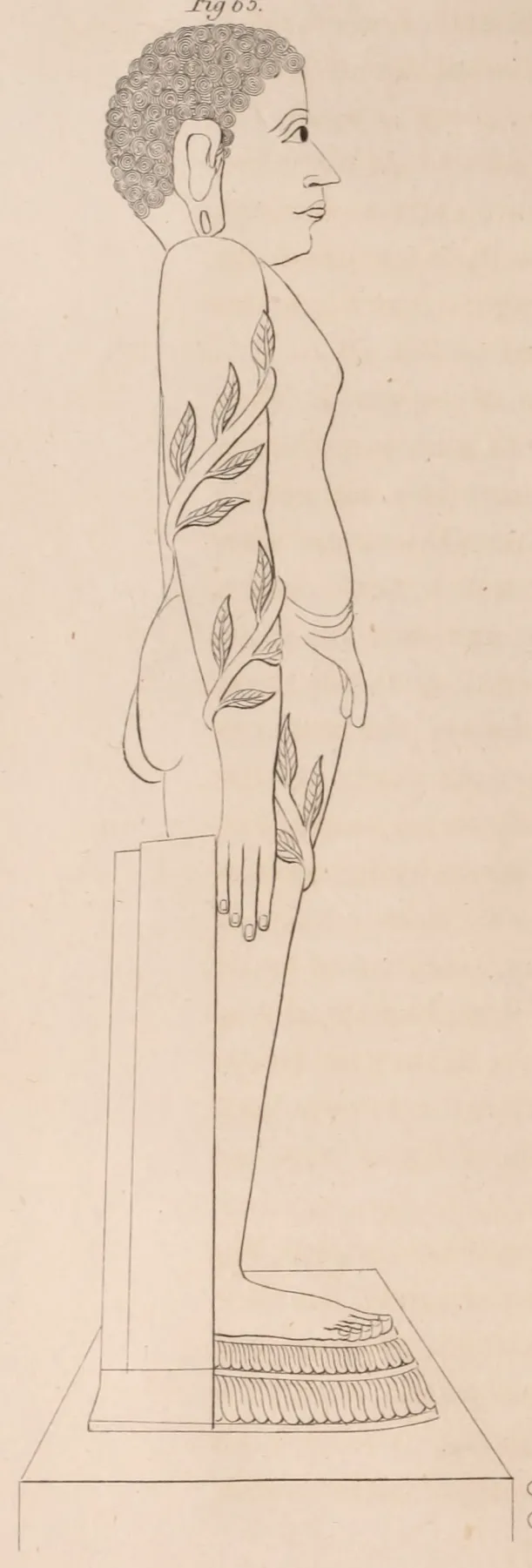
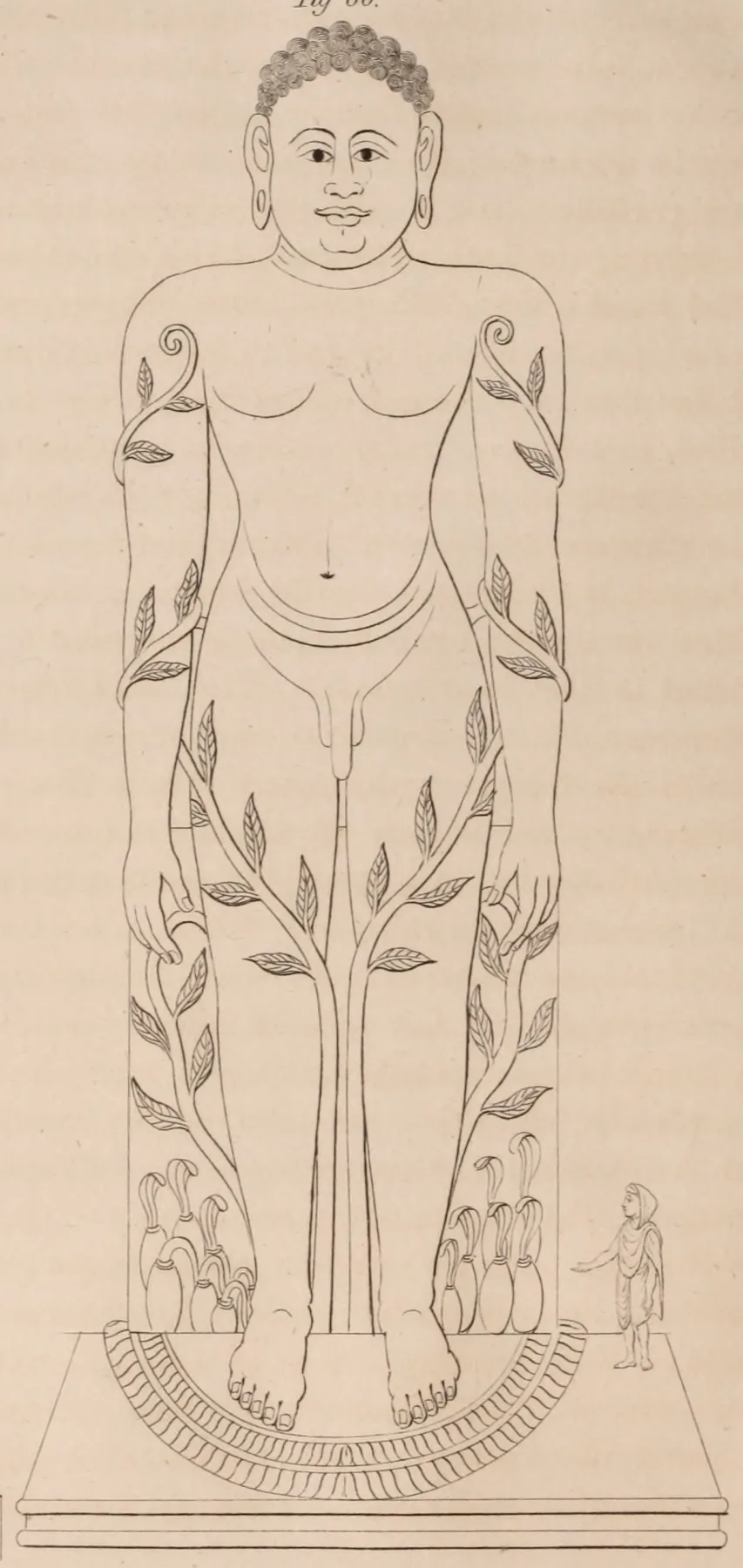
The images of Gomuta Ráya are naked, and always of a colossal size. That here, of which two views are given (Plate XXIII. Fig. 65, 66.), is made of one piece of granite, the extreme dimensions of which, above ground, are 38 feet in height, 10⅓ feet in breadth, and 10 feet in thickness. How much is below ground I cannot say; but it is probably sunk at least three feet, as it has no lateral support. According to an inscription on the stone itself, it was made by Víra Pandia, son of Bhairava-Indra, 369 years ago. A copy of this inscription has been delivered to the government of Bengal.
The Jain deny the creation of man, as well as of the world. They allow, that Brahmá was the son of a king, and that he is a Dévata, and the favourite servant of Gomuta Ráya; but they altogether deny his creative power. Brahmá and the other Dévatas are worshipped, as I have said, by the Jain, who have not become Sannyásis; but all the images of these supposed beings that are to be found in the great temples of the Jain (Busties, or Bettas), are represented in a posture of adoration, as worshipping the Siddha to whom the temple is dedicated. These images, however, of the Dévatas are not objects of worship, but merely ornamental; and the deity has not been induced to reside in the stone by the powerful invocations of a Bráhman. When a Jain wishes to adore one of these inferior spirits, he goes to the temple that is dedicated to its peculiar worship. Jain or Ráma is never represented by an idol in a temple of the kind called Busty, although he is acknowledged to be a Siddha; and although Ganésa and Hanumanta are acknowledged to be Dévatas, these favourites of the followers of Vyása have no images in the temples of the Arhita.
The Jain have no tradition concerning a great deluge that destroyed a large proportion of the inhabitants of the earth; but they believe, that occasionally most of the people of Arya are destroyed by a shower of fire. Some have always escaped to the other portions of the earth, and have returned to repeople their native country, after it has been renovated by showers of butter, milk, and of the juice of the sugar-cane. The accounts of the world, and of the various changes which the Jain suppose it to have undergone, are contained in a book called Lóka Swarupa. An account of Gomuta Ráya is given in a book called Gomuta Ráya Charitra. The Camunda Ráya Purána contains a history of the 24 Siddháru which are worshipped in the temples called Busties. These books may be read by any person; and the Jain of Carculla entered into an agreement with me to copy them for my use. I paid them the price, but I have not yet received the books.
8th February.—I remained at Carculla in order to investigate some matters relative to agriculture.
Here the distinctions of rice ground differ somewhat from those in the south. Bylu is that which receives from rivulets a supply of water sufficient to ensure two crops. Majelu has one crop ensured by the same means. Small reservoirs, in case of a scarcity of rain, secure one crop from Betta land. Bana Betta is that which depends on the rains alone; so that, if these give over early, the crop is entirely lost. Potla is land overflowed by rivers. The sprouted seed is here by far the most common cultivation in both crops, and in all soils, except in some called Nunjinay Gudday, in which worms abound. In this the seed is sown broad-cast without preparation. Scarcely any rice is here transplanted, and sprouted seed is sown even on Potla land. The quantity of seed required for the same extent of ground, of whatever kind, is nearly the same; only Bylu land requires a little more, as part of the seed is choaked by sinking too deep in the mud. This is directly contrary to the assertion of the people at Mangalore; but the farmers here say, that the information given at that place was correct; and that near the sea the Bylu land requires the least seed, while in inland places it requires more than the Majelu or Betta.
If the rains continue late, a crop of pulse or Sesamum may be procured from both kinds of Betta land; but, if the dry weather commences early, they can only be obtained from Majelu, the others being too dry. On the Majelu land here a very small quantity of sugar-cane is raised; but the whole of this is of very small extent. At the head of a Bylu field here, there is a large reservoir; but very little use is made of its water, at least for the purpose of agriculture. The people say, that they do not make reservoirs, because the rains are so heavy that they would break the mounds, and that the soil soaks up the water so fast, that, very soon after the rainy season is over, they would become dry. The farmers of Carculla seem to be an obstinate and ignorant set of men.
The Betel-leaf is raised on the Areca, and this is planted in separate gardens. It does not injure the produce of the tree. These gardens are made both on the low grounds, and on hills where there is a command of water. They are allowed much manure; but, if on hilly ground, require no red earth. They are always watered, as at Mangalore; their cultivation must be therefore much more expensive than in Malabar, where they are only watered when young. All the gardens belong to the landlords, who occasionally mortgage them, but very rarely let them out for rent. The revenue, although nominally raised by so much a tree, has nothing to do with the actual number. It is levied by an old valuation; in making of which three trees were called one; and, if double the original number has been planted, no additional tax is paid. A thousand nominal trees on good land were rated at so much, and those on worse soils are rated lower in proportion.
In the Hitelu, or back-yard of the house, are cultivated turmeric, ginger, Capsicum, greens, roots, and other things called Tarkári. The quantity of turmeric and ginger raised in the neighbourhood is considerable. The soil proper for these plants is Betta land which is free from stones. Between the 24th of May and the 22d of June the ground is ploughed four times, and smoothed with a hoe. The whole is then divided by trenches, one cubit wide, half a cubit deep, and one cubit distant; and the earth which is taken from the trenches is thrown on the ridges. Then bits of the roots, each containing an eye, are planted in the ridges at half a cubit's distance from each other. These are then covered with Casara Sopu, or the small branches and leaves of the Strychnos Nux vomica, which is the most common tree on the hills of Tulava. At the end of a month, the leaves having rotted, the small sticks are removed. Dung is then put over the plants, and a little more earth is thrown up from the trenches. In the month preceding the winter solstice, the roots are fit for taking up. The large roots, containing eyes, are kept for seed; and, being tied up in a straw bag, are hung upon a tree until the next season for planting. The smaller roots are fit for sale. The turmeric and ginger are cultivated exactly in the same manner. The roots of the turmeric intended for sale are boiled for twelve hours, and afterwards dried fifteen days in the sun.
About 250 years ago a Márattah Bráhman came here, and observed that many hills were quite waste, which might be cultivated for Betel-nut by making reservoirs at the head of a valley; so that the water might be preserved, and distributed upon the sides of the hills. He applied to Byrasu Wodear, then sovereign of the country, for some of these hills; and having obtained a grant of them, he began his plantations with great success. By degrees this man's descendants increased to fifty families; and these were joined by many of the same sect and country, who all betook themselves to this kind of cultivation; so that between Subhramani and Gaukarna they amounted to seven hundred families. In their plantations Betel-nut was the great article; but they also contained many coco-nut palms, and some black pepper, and Mango and Jack trees. Each of the last produces from two to three hundred fruit; and these are so little in demand, that they are given to the cattle. They are not palatable to the ox; but at the season in which they ripen, any thing will be devoured, as the cattle are then starving. The prohibition against exporting Betel-nut by sea, which the late Sultan issued, reduced the price so much, that many of the plantations were allowed to go to ruin; and the number of Bráhmans was reduced to four hundred families. The markets being now open, and a brisk trade carried on between the coast and Madras, and Goa, which are the principal markets for the nut, the Bráhmans are with great spirit returning to this object of industry. The influence of Mousa and his Moplays does not extend this length. The principal merchant is Murtur Sangaia, a Banijigar, who lives at Hara-punya-hully, but has factories in every part of the peninsula.
The most judicious old men that I could find here gave me the following account of the weather. Between the 13th of March and the 13th of May they have slight showers, lasting three or four hours a day. These come three or four days successively, with equal intervals of dry weather, and accompany easterly winds. In the first month the winds night and day are easterly; in the latter part of this time the winds are from the southward, and in the west there is much thunder. Between the 14th of May and the 16th of August there come from the west strong winds, and heavy rains. The land winds are not at all perceptible. Between the 17th of August and the 15th of October there are gentle showers from the eastward. Except when it rains, the winds are westerly. From the 16th of October to the 13th of November there are slight showers from the eastward. The rain is sometimes, however, so heavy as to injure the crops. Except when it rains, the winds are variable. In the four following months there is no rain, and the air is reckoned cold by the natives. At present, the days are hot and the nights cool. The winds in the day come from the sea, and in the night from the land.
9th February.—I went three cosses to Beiluru, a place where there were a few houses of cultivators, but no shops nor market. There is a small temple of Siva there, with an annual allowance to the Pújári of six Pagodas. The country is rather woody, and little rice ground can be seen from the road. The granite rocks make a conspicuous figure on the high lands. Although the guides were natives of the place, and the road was well marked, yet they contrived to make a part of my baggage wander about from four in the morning, until two in the afternoon. Occasionally I meet with such accidents; from what other principle but obstinacy in the guides, I cannot say. This place is in the district of Barcuru, which formerly gave a title to one of the Jain Rájás of Tulava.
10th February.—I went three cosses to Haryadika. The country is similar to that through which I came yesterday. The farmers here say, that all the hills, wherever the soil is free from rock, might be converted into Betta-land. The quantity of such grounds, they say, is very considerable; at least three times as much as is cultivated; but, they add, the expense is great, and the returns are small. About a fourth part of what was formerly cultivated is now waste, for want of people and stock. Until that be fully occupied, no experiments on new land would be proper. The people say, that they would be willing to bring this new land into cultivation on the following conditions. The whole expense attending the various operations being collected into a sum, they should pay no revenue to government until that was reimbursed by the usual amount of the land-tax, which is from one to three Sultany Fanams for a Moray sowing, or from rather more than 6½d. to almost 1s. 11d. an acre.
The proprietors here say, that they let their rice lands to tenants (Gaynicaras), and are obliged to advance stock to a new man. In the course of four years the value of the stock is repaid by instalments. The rent is paid in rice, so much for each Moray sowing. The best Bylu-land pays 4 Morays of rice for both crops; the next in quality pays 3 Morays; and the worst 2. The best Majelu pays 2½ Morays; the second quality 1½; and the third 1 Moray. The best Betta land pays 2 Morays; the second 1½; the third 1; and the fourth ½ a Moray. The Moray of rice, if of the coarsest quality, is at present worth 2s. 8¼d.; and each Moray of rent, for a Moray’s sowing, is at the rate of about 2s. 4½d. an acre. The tenant, according to these people’s account, has about one half of the produce; which therefore, in the worst Betta land, must be three seeds, or 3 696⁄1000 bushels an acre. These people say, that when the rice is cheap the whole rent is not equal to the land-tax. At present, they acknowledge that they have a little profit. Taking the statement which they give as fair, their present profit will be evident, even allowing their whole rice to be of the coarsest kind. The worst Betta land pays 6½d. tax an acre, and the rent is 1s. 2¼d.; so that the tax does not amount to half the rent; and I am inclined to think, that the average price of all the kinds of rice is never lower than the present value of the coarsest.
At Haryadiká there is only one shop; and on the approach of my people the owner ran away. There is a large temple of one of the Saktis; this is attended by one of the Tulava Bráhmans as Pújári, on which account no bloody sacrifices are performed. There was formerly a Jain temple here of the kind called Busty, but it has gone to ruin, and the number of the Jain is daily diminishing. The image in the temple was of copper. With many other similar idols from different parts of the country, it was carried to Jamál-ábád. By orders from the late Sultan, some of them were converted into money, and others cast into guns.
11th February.—In the morning I went three cosses to Udipu. The country, to the vicinity of this place, is similar to that which I passed through on the two preceding days. The strata of granite, however, are mostly covered by the Laterite. The roads are execrable; but, like many of those in Canara, are shaded by fine rows of trees, especially of the Vateria indica; which, being now in full blossom, makes the most beautiful avenues that I have ever seen.
On getting within sight of the sea near Udipu, the country becomes more level; and round the town it is finely cultivated, and the rice fields are beautifully intermixed with palm gardens. Such a delightful situation has been chosen as the chief seat of the Tulava Bráhmans of the Madual sect.
Having assembled the men who, among the followers of Madua Achárya in Tulava, were reckoned the most eminent for their knowledge, they gave me the following information. The Tulava Bráhmans belong to the Panch Drávida division of the sacred tribe, and are a mixture composed of emigrants from each of the nations or tongues that compose this division. These are, Andray, or the nations speaking the Telinga, or Andray language, which occupy the north-eastern parts of the peninsula; Karnátaca, those who speak the language which we call Canarese, and who inhabit the country south from the Krishna river, and above the Ghat mountains; Mahárashtra, who speak the Maráttah language, and occupy the north-western parts of the peninsula; Gurjara, or Carjura, or the Bráhmans of Guzerat, who also have a peculiar dialect, very different from the language of the Maráttahs; and Drávida, or those who speak the Tamul language, and occupy the southern parts of the peninsula below the Ghats. Drávida proper, or the Désam so called, is confined to the country between Madras and the mountains; but the name is extended, first to all the country occupied by people who speak the Tamul language, and then to the whole of the Bráhmans of this division. Although the whole of the Tulava Bráhmans form a kind of separate nation, yet each subdivision confines its marriages to its own original nation; and, contrary to the custom of the Namburis, a Karnátaca Tulava Bráhman has no objection to marry the daughter of a Bráhman of Karnáta who never has left his own country.
They allege, that originally they were assembled here from all their native countries by Parasu Ráma, who created Tulava for their use, in the same manner as he created Malayála for the Namburis. The language of Tulava has a strong resemblance to that of Malayála, and the written characters are the same; but in the language of Tulava there is a very great admixture of words from all the countries containing the five southern nations of India.
Originally, the Tulava Bráhmans were followers of Batta Achárya, who flourished at Ahichaytra, on the banks of the Godávery. An account of his life, which they of course consider as prophetical, is to be found in the Skandha Purána, one of the eighteen books written by Vyása. Batta Achárya had great success against 18 of the 21 heretical sects, some of which admitted, and others denied, the authority of the Védas.
Afterwards Sankara Achárya disputed with the followers of Batta, and, having convicted them of numerous errors, gained many proselytes; and many of the Tulava Bráhmans continue to follow his doctrines, and receive the Sringa-giri Swamalu as their Guru, and as the successor of Sankara Achárya. In this Yugam, or age, there have been three appearances of Sankara Achárya. First, he was born at Sivuli, in Tulava, about 1500 years ago, and established the Matam or college at Sringa-giri. His next appearance was some hundreds of years afterwards; when he was born in Malayála, and lived at Sri Rangam, near Tritchenopoly. Lastly, he was born about 600 years ago at Paducachaytra, in Tulava. In the Skandha Purána, composed, as my informants imagine, many myriads of millions of years ago, an account of all his transactions in these three incarnations is to be found, and also an account of the great success which he had against the heretical sects.
Madua Achárya was last born at Paducachaytra, in the year of this Kali-yugam 4300, or 601 years ago. In the time of the five sons of Pandú, he had appeared as one of these brothers, named Bhíma; in the time of Ráma he had been Hanumanta; and in the Kali-yugam preceding this (for the Bráhmans suppose a constant succession of the four Yugams) he had appeared as the Madua Achárya of that degenerate age. When he appeared last, he not only confuted the heretical sects, but obtained a great victory in dispute over Sankara Achárya, who had forced all the Madual Bráhmans outwardly to adopt his opinions; and he thus restored his sect to its proper splendour. The Hindus will seldom allow their own sect to have had any origin; but insist rather, that it has existed from all eternity, or at the very least from the first origin of things. The Maduals say, that all the different sects were created in the beginning by Náráyana, and have continued ever since, sometimes one prevailing and sometimes another; and the prevailing sect has always forced the others, at least in appearance, to comply with their doctrine.
The Madual allege, that there is one supreme God, Náráyana or Vishnu. His son is Brahmá, who is the father of Siva. Both of these ought to be worshipped, but Brahmá only mentally; as temples and regular forms of prayer to that deity are not lawful. They look with abhorrence upon the doctrine of the spirits of good men being absorbed into the deity, in which they differ from both Smartal and Sri Vaishnavam. Moesha they consider as the highest heaven; and men who, by their piety, obtain a place there, are ever afterwards exempted from change; but still they are greatly inferior to Náráyana, or the other great gods; and, according to their merit, enjoy different ranks. The Madual pray to the Dévatas who reside in Swargham, which they say is the same with Mahá Méru; and when they are sick they pray to the destructive spirits, such as Marimá, Putalimá, and Kalimá. These are not considered to be different names for the wife of Siva, as the Smartal allege, but beings that live in the stars, clouds, and lower regions of the heavens. The Madual Bráhmans of Tulava act as Pújáris in the temples of these spirits, and offer sacrifices of paste made in the form of animals, but will not consent to the shedding of blood. In this country there are eight Sannyásis, each of whom has a Matam at Udipu, and each has a disciple who from his infancy is brought up to celibacy and other mortifications, and is destined to be his successor. These eight Sannyásis are the Gurus of the whole sect in Tulava; and each maintains a number of disciples, who are permitted to marry, but who are men of great Indian learning, and who read, and perform all manner of services for their master. These Sannyásis are not conceived to be any portion of the deity; nor is it even believed, that in general they obtain after death a seat in Moesha. To attain this, a Bráhman must completely adhere to every rule of his order, which is attended with so much difficulty, that human nature is seldom adequate to the task. No other cast has any kind of chance to procure a place so near the gods; and my informants seem to doubt, whether it be even possible for any person of low rank ever to be born a Bráhman. Temporal blessings they consider as those which the three lower casts ought chiefly to expect; and, by means of charity given to their superiors, they may have an abundance of these low pleasures.
The eight Gurus, each in his turn for two years, act as priests (Pújáris) in the temple of Krishna at Udipu. During this time the officiating Sannyási must not only defray the expenses of worship, but must feed all his disciples, and every Bráhman that comes to the place. To do this handsomely, will require above 20,000 Pagodas (8054l. 14s. 8¼d.); and the very least, for which it can be done, is 13,000 Pagodas (5238l. 4s. 8½d.). In order to raise such great sums, each Sannyási, with his disciples, during the fourteen years that he is out of office, wanders about the country, and, wherever he goes, levies contributions under the name of Bhiksha, or begging. Out of these alms he not only supports a considerable equipage, and feeds all his disciples, but can save a sum sufficient to defray the expense which he must incur during the two years that he performs the office of Pújári. Except in Tulava, these Sannyásis have no authority as Gurus; for above the Ghats there are three Matams, whose Sannyásis possess the sole authority of bestowing Chakrántikam and Upadésa, and of punishing transgressions against the rule of cast. Each Sannyási of Tulava has certain families, who are hereditarily annexed to his Matam, as to that of their Guru. As, however, the officiating Pújári never goes out of the temple, and as the others are generally absent, begging, the eight have mutually appointed two persons to act as judges. These have the power of excommunication, which implies the whole wealth of the sect being at their mercy. They also levy fines, and cleanse sinners by prayers (Mantrams), cow’s urine, and other things esteemed pure. The Gurus reserve to themselves the exclusive right of bestowing Chakrántikam and Upadésa. They never, at any ceremony, read Mantrams, that office being reserved for the married Bráhmans; and each man by hereditary right belongs to some Bráhman, who is his Puróhita. The Sannyásis do not require a Puróhita; for they are considered as sufficiently holy to be exempted from all the ceremonies and customs usually observed by Bráhmans. They do not wear the thread; all meats become to them indifferent; and they do not celebrate the ceremonies in honour of their deceased parents. A Puróhita may sell or mortgage the families that belong to him, and may give them to a Bráhman of any sect; for the prayers (Mantrams) and portions of scripture (Sastrams) read by any person of the sacred order, whatever his theological opinions may be, are considered as equally efficacious. This does not proceed from any gentleness or facility of temper among the Bráhmans, who abound in the Odium theologicum. It is, however, between the Madual and Sri Vaishnavam, although both are worshippers of Vishnu, that the most violent antipathy prevails. The Smartal, although followers of Siva, agree much better with the Madual; and, in Tulava and Malayála especially, these two live on tolerable terms. In Tulava, indeed, it is not unusual for one temple to be common to both gods; and in most places there the temples of Vishnu and of Siva are built near each other, and the same Rath, or chariot, serves for the Játram, or procession, of both idols.
To the east of the Ghats, the Madual Bráhmans scorn to serve as Pújáris, even in the temples of Vishnu, and are the proudest of the whole sacred order. This scorn, however, is perhaps affected; as when Madua Achárya appeared, the Sri Vaishnavam were in possession of the temples, and have always been favourites with the persons in authority.
The Bráhmans of Tulava are allowed a plurality of wives, which must be of the same nation with themselves, but of a different Gótram, or family, and which must be married before the signs of puberty appear. Their widows cannot marry, but may become Moylar, as already described. It is looked upon as disreputable for a Bráhman to keep a woman of this kind, and he would lose cast by having a connection with a dancing girl, or with a Moylar, that did not belong to a temple; but all such women as are consecrated to the gods cohabit with some Bráhman or other. The Bráhmans of Tulava burn the dead, and their widows ought to be burned along with them; but this practice has gone entirely into disuse. They can neither eat animal food, nor drink spirituous liquors. A man’s own children, even in landed property, are his heirs.
I next questioned these Bráhmans concerning the history of the country; and they produced a book called Gráma Paditti, which they say is historical. It is written in Sanskrit, and is presumed to have been composed by Vishnu, who assumed a human form, under the name of Védi Vyása, and promulgated the Védas, the eighteen Puránas, the Gráma Paditti, and other sacred writings. From this work the Bráhmans say, that Tulava was created, and given entirely to them, 1 Arbuda, 95 Crowds, 58 Lacs, and 80 thousand of years, before the extinction of the Pándu family. The last of these ended his reign in the year of the Kali-yugam 1036, or - - - - - 3,865 years ago. Add 80 thousand - - 80,000 58 Lacs - - 5,800,000 95 Crowds - 950,000,000 1 Arbuta - 1,000,000,000 1,955,883,865 years since the creation of Tulava, according to the Gráma Paditti. The candid reader will not expect, that in a work comprehending the accounts of such a long duration of time a few thousand years, earlier or later, in the chronology of these degenerate times can be considered as of any consequence. This having been premised, and the accounts of the Hindu gods and heroes having been left in becoming obscurity, we find from the Gráma Paditti, that 1115 years after the family of the Pándus became extinct, Ananda Ráya governed Tulava. He and his eight brothers (or rather kinsmen in the male line) reigned 200 years, or until the year of the Kali-yugam 2351. Vakia Rájá and his ten sons (descendants) reigned 112 years, till Kali-yugam 2463. Maursushy and his ten sons governed 137 years, till Kali-yugam 2600. Cadumba Ráya 45 years, till Kali-yugam 2645. Myuru Varmá 10 years, till Kali-yugam 2655. Hubushica, chief of the savages called Coragoru, or Corar, governed 12 years, till Kali-yugam 2657. Lócáditya Ráya, son of Myuru Varmá, expelled the Coragoru, and governed Tulava, Malayála, and Haiga 21 years, till Kali-yugam 2678. After his death, eighty-one of his cousins, among whom the chief was Cadumba Ráya of Wudia-nagara, governed 24 years, till Kali-yugam 2702. Balhica Ráya, and twenty-nine other petty princes, governed 46 years, till the Kali-yugam 2748. Abhiri, and ten Rájás governed 99 years, till Kali-yugam 2847. The descendants of Mona Rájá then reigned 200 years, till Kali-yugam 3047, or till 53 years before the birth of Christ. At this time Mahummud Surtala, a Mlécha, who was a spy, visited the whole country as far as Ráméswara. It must be observed, that, according to these Bráhmans, Mlécha properly means an Arab, Turc a Tartar, and Yavana an European; but all the three terms are frequently applied to the nations living toward the north and west of Hindustan, without distinction of country or religion. Nine Belalla Ráyas governed 6 years, till Kali-yugam 3053, or 47 years before the birth of Christ. The Turc then returned, took Anagundi, and governed 540 years, till the Kali-yugam 3593, or A. D. 493. The followers of Vyása here, it must be observed, cut short the government of the Belalla family, who are more detestable than Mléchas, as having been followers of the Arhita or Jain Bráhmans. Campi Ráya of Penu-conda drove out the Mléchas, and governed 13 years over the whole country south of the Krishna, till the year Kali-yugam 3606, or A. D. 506. This prince sent an officer named Sankara Déva Ráya to visit Tulava. In his train was a messenger (Peon) named Hucabuca, a Curuba by cast. This fellow, having received assistance from the Yavanas, took Anagundi, and having built a city near it, which he called Vijaya-nagara, or the city of victory, he assumed the title of Hari-hara Ráya. This account of the origin of the family of Vijaya-nagara may be attributed to the following circumstance. The Bráhmans of Tulava had hitherto been exempted from taxes; but Hari-hara, on the conquest of the country, imposed an annual tax upon them, to the amount of 12,000 Morays of rice. Déva Swámi, a tributary prince, was ordered to collect this tax; but, his conscience having revolted at the thoughts of exacting tribute from the Bráhmans, he was dismissed, and their tax was increased to 2578 Pagodas in money. The history of the Gráma Paditti ends with this grievous event; but the Bráhmans say, that thirteen princes of the family of Hari-hara governed for about 150 years, or from A. D. 493 to 643. Unfortunately for the exactness of this chronology, many inscriptions on stone, made in the reigns of these princes, are scattered throughout their dominions. Copies of five of these have been delivered to the Bengal government. The date of the first is in the era of Salivahanam 1297, or A. D. 1375, and of the latest E. S. 1400, or A. D. 1478. With this correction of about eight centuries and a half, Muhammad Surutala may have been a Mussulman, and probably some of the followers of Muhammad Ghizni. The Yavana dynasty of Anagundi is, however, a matter of great curiosity, and not yet well understood.
These Bráhmans say, that the celebrated Krishna Ráyalu, of Vijaya-nagara, was not of the family of Hari-hara, but governed the same dominions after the overthrow of the former dynasty. He was descended from the nurse of one of the five princes called Pándus, who lived at the commencement of the present Kali-yugam. Dharma Ráya, the last of these five brothers, died in the year 36 of that era, or 4865 years ago.
The country of Tulava was first subject to the kings of Anagundi, and then to the princes of Ikeri; by whom, these Bráhmans suppose, the Jain Polygars were appointed; but they pretend an almost total ignorance of these chiefs, and a sovereign contempt for their sect.
They allege, although there were Jain Rájás in many parts of Tulava, that there never was one at Barcuru; but that it, and all the Grámas in Tulava, were governed by Bráhmans immediately dependent on the sovereign, and over whom these infidel chiefs had no control. The thoughts of being subject to a Jain are indeed horrible to a follower of Vyása; nor will it ever be acknowledged, where there is a possibility of denial. When pushed to account for the introduction of so many Jain into a country made expressly for the Bráhmans who follow the true doctrine of Vyása, they say, that Hubashica drove all the Bráhmans out of the country; and that, when Lókáditya regained his paternal dominions, he only brought a few Bráhmans from Ahichaytra, where he resided during his exile, and gave them the 32 Grámas, which they enjoyed without molestation till Hari-hara imposed the illegal tax. I think it probable, that Lókáditya, in order to procure assistance to regain his throne, changed the religion which he inherited from his father Myuru Varmá who, according to the Jain of Mudu Bidery, was of their sect; and having become a follower of Batta Achárya, then teaching the doctrine of Vyása with great success on the banks of the Gódávéry, he brought with him the first colony of Tulava Bráhmans, and gave them a gift (Enam) of thirty-two villages. In imitation of the Namburis, they afterwards set up the story of Parasu Ráma; but it does not seem to have succeeded so well with them as with their southern neighbours.
Udipu is a town which contains about 200 houses, and stands about a coss from the sea near a small river called the Pápa-násaní, which comes from a Tank at Carculla, passes about two miles to the south of the town, and falls into the sea at a fort named Duriá Bahádar. Near Udipu is a small fort, which formerly was the residence of Chittupadi Baylala, the chief Bráhman of the town (Gráma). Each of the 32 Grámas belonging to the Tulava Bráhmans was governed and defended by an hereditary chief of their own sect, who was in every respect, but the name, a Polygar, or petty chief; some of them assumed the title of Baylala; others that of Hegada, which signifies mighty.
At Udipu are three Gudies, or temples, which are placed in a common square, and surrounded by 14 Matams, or convents, belonging to an equal number of Sannyásis, who are Gurus to different sects of Bráhmans. Eight of these Matams belong to the eight Madual Sannyásis, who in their turn officiate as priests in the temple of Krishna, which is one of the three that stand in the square. Two other Matams belong to Sannyásis of the same sect; each of the predecessors of whom, as well as the eight others, received an image from Madua Achárya; but they have few followers, and are not entitled to officiate at the temple. Three other Matams belong to the three Sannyásis, who are the Gurus of all the Madual Bráhmans to the eastward of the mountains. The fourteenth Matam belongs to the Sringa-giri Swámi. These Matams are large buildings; and, considered as houses belonging to Hindus, improved by neither Mussulman nor European arts, they are stately edifices. Some pains have even been taken to admit air, as they have many windows. Apertures indeed “for the purpose of intromitting air and light,” although scarcely deserving the appellation of windows, are more common in the houses of Tulava, than I have any where else seen among the mere natives of Hindustán. The Matams are designed chiefly as storehouses, in which the Sannyasis may deposit the produce of their begging till they want it for consumption. Being too expensive guests, they very seldom reside in one place more than a few days. The temples, as usual, are but poor buildings, and, like almost all those of Malayala and Tulava, have pent roofs. Those here are roofed with copper, which must have cost much money; but, being very rudely wrought, it makes no show.
Having assembled some of the Corar, or Corawar, who under their chief Hubashica are said to have once been masters of Tulava, I found, that they are now all slaves, and have lost every tradition of their former power. Their language differs considerably from that of any other tribe in the peninsula. When their masters choose to employ them, they get one meal of victuals, and the men have daily one Hany of rice, and the women three quarters of a Hany. This is a very good allowance; but, when the master has no use for their labour, they must support themselves as well as they can. This they endeavour to do by making Coir, or rope from coco-nut husks, various kinds of baskets from Ratans and climbing plants, and mud walls. They pick up the scraps and offals of other people’s meals, and skin dead oxen, and dress the hides. They build their huts near towns or villages. Their dress is very simple, and consists in general of a girdle, in which they stick a bunch of grass before, and another behind. Some of the men have a fragment of cloth round their waist; but very few of the women ever procure this covering. They are not, however, without many ornaments of beads, and the like; and, even when possessed of some wealth, do not alter their rude dress. Some few of them are permitted to rent lands as Gaynigaras. In spite of this wretched life, they are a good looking people, and therefore probably are abundantly fed. They have no hereditary chiefs, and disputes among them are settled by assemblies of the people. If they can get them, they take several wives; and the women are marriageable both before and after puberty, and during widowhood. They will not marry a woman of any other cast; and they are considered of so base an origin, that a man of any other cast, who cohabits with one of their women, is inevitably excommunicated, and afterwards not even a Corar will admit his society. The marriages are indissoluble, and a woman who commits adultery is only flogged. Her paramour, if he be a Corar, is fined. The master pays the expense of the marriage feast. When a man dies, his wives, with all their children, return to the huts of their respective mothers and brothers, and belong to their masters. They will eat the offals of any other cast, and can eat beef, carrion, tigers, crows, and other impure things; they reject however dogs and snakes. They can lawfully drink intoxicating liquors. They burn the dead, and seem to know nothing of a state of future existence, nor do they believe in Paisachi, or evil spirits. Their deity is called Buta, and is represented by a stone, which is kept in a square surrounded by a wall. To this stone, in all cases of sickness, they sacrifice fowls, or make offerings of fruit or grain, and every man offers his own worship (Pújá); so that they have no officiating priest, and they acknowledge the authority of no Guru. They follow all the oxen and buffaloes of the village, as so much of the live stock, when these are driven in procession at a great festival which the farmers annually celebrate.
12th February.—I went three cosses to Brahmá-wara. The rice grounds extend from Udipu to the sea; their extent towards the north and south is not considerable. I soon came to gently rising hills, free of woods; but the road was finely sheltered by avenues of the beautiful Vateria indica, called here Dupada Maram, or the resin tree. I passed first through Kalyána-pura, which was formerly a large place; but during Tippoo’s government it has been almost intirely ruined. I then crossed a very wide, but shallow river, named the Suvarna. Its source is from a lake or tank near Carculla; but it owes its magnitude entirely to the water of the sea. Near the Suvarna are many fine plantations of coco-nut palms, and also some rice grounds. Barcuru is near Brahmá-wara; but for a long time, even previous to the irruption of Sivuppa Nayaka, it has been ruined. The fortress was erected by Hari-hara, first king of Vijaya-nagara. It still gives its name to the district (Taluc), the Tahsildar of which resides at Brahmá-wara. This is a small place containing only about 60 houses, but in its neighbourhood there is much rice ground.
I have received much information relative to the produce of the rice grounds in this neighbourhood; partly from Mr. Ravenshaw, and partly from the people employed to measure and value the district. In the annexed Tables I give some of this information, with the measures reduced to the English standards. It must be observed, that the Gunta, or chain used by the surveyors, ought to have been 33 English feet in length; but, owing to the rudeness of the workmanship, it had stretched to 33 feet 10 1/2 inches: by the standard, the acre would be equal to 40 Guntas; but, by the actual chain, it would be equal to only 37 96/100 Guntas. I calculate, however, by the standard measure. The Mudi, or Moray in use here, is that of the market of Mangalore; but is divided, when speaking of seed, into 60 Hanies; and, when speaking of produce, into 40 Hanies; but the produce is in general estimated in rice, after deducting the expense of beating and cleaning. It would appear from all circumstances, that the quantity of seed which is sown on the same extent of ground, even of the same kind, differs much. Whether this proceed from the natives having found by experience, that such or such a field gives most profits when sown with a certain quantity of seed; or whether it arises from a want of precision and economy that attends all rude states of agriculture, I cannot take upon myself to affirm; but the latter cause seems the most probable. The seed is here sown much thinner than in Malabar; which, although a kind of saving that is common in every part of India, seems to be very injudicious: the crops in general appear to me to be proportionably scanty. Of the gross produce of estates, one half is here, as in most parts of India, considered as a proper reward for the labour of the cultivator, and the use of his stock; and is perhaps sufficient, considering that his cattle pay nothing,
| Estates. | Measurement. | Seed. | Gross Produce. | Average produce of one Acre. | |||||||||||||||||
|---|---|---|---|---|---|---|---|---|---|---|---|---|---|---|---|---|---|---|---|---|---|
| Quantity according to the report of the Cultivators. | Proportion. | Of rough Rice. | Clean Rice, deducting the expense of beating and cleaning. | Value at 12½ Pagodas for 40 Mudies. | Average increase of rough rice. | Quantity. | Value of the preceding Column. | ||||||||||||||
| Guntas. Anas | Acres dec. | Reduced to the Mudy of 40 Hanies. | Reduced to English measures. | One Mudy sows, | One Acre requires, | Quantity. | Value at 12½ Pagodas for 40 Mudies. | Rough rice. | Clean rice, deducting expense of cleaning. | ||||||||||||
| Guntas. Anas | Acres dec. | Mud. Han. | Bush. dec. | Guntas. Anas | Bush. dec. | Mud. Han. | Bush. dec. | Mud. Han. | Bush. dec. | Pag. Rup. Fan. | £. | s. | d. | Folds. | Bush. dec. | Bush. dec. | £. | s. | d. | ||
| Beem Pundary Landlord. | |||||||||||||||||||||
| 1 sort Bylu land - - | 182 14 | 4,572 | 4 20 | 5,9145 | 40 0 | 1,2936 | 109 0 | 141,945 | 46 0 | 59,928 | 14 1 | 2 | 5 | 15 | 11½ | 22 5/10 | 31,06 | 13,102 | 1 | 13 | 0 |
| 2 ditto Magelu land - - | 52 15½ | 1,324 | 2 10 | 2,95725 | 23 4 | 2,233 | 26 4 | 32,99 | 11 25½ | 15,154 | 3 2 | 2½ | 1 | 7 | 7½ | 11 3/10 | 25,665 | 11,446 | 1 | 8 | 10 |
| 3 ditto Bettu or Mackey land | 209 6 | 5,234 | 6 0 | 7,8134 | 37 10 | 1,4928 | 23 28 | 30,086 | 9 19 | 12,339 | 2 3 | 3½ | 1 | 3 | 10½ | 3 8/10 | 5,896 | 2,357 | 0 | 5 | 11 |
| Total - | 445 3½ | 11,130 | 12 30 | 16,68515 | 35 0 | 1,6731 | 158 32 | 206,021 | 67 4½ | 87,421 | 20 3 | 8 | 10 | 7 | 5½ | 12 18/10 | 18,51 | 7,854 | 1 | 0 | 3 |
| Ante Tolar Landlord. | |||||||||||||||||||||
| 1 sort Bylu land - - | 197 4 | 4,931 | 4 5 | 5,371625 | 47 12 | 1,089 | 264 0 | 343,785 | 108 36 | 141,813 | 34 0 | 0¼ | 13 14 | 3 | 64 | 69,713 | 22,843 | 2 | 17 | 6½ | |
| 2 ditto Mackey land - | 400 10 | 10,015 | 7 35 | 10,2551 | 50 12 | 1,024 | 128 32 | 167,746 | 51 21 | 67,1 | 16 0 | 1 | 6 9 | 9 | 164/5 | 16,748 | 6,699 | 0 | 16 | 10½ | |
| Total - | 597 14 | 14,946 | 12 0 | 15,626725 | 49 12 | 1,0465 | 392 32¼ | 511,531 | 160 17 | 208,913 | 50 0 | 2 | 20 4 | 0 | 32 29/40 | 34,225 | 13,89 | 1 | 14 | 11½ | |
| General Total | 1043 1½ | 26,076 | 24 30 | 32,311875 | 42 0 | 1,24 | 551 24½ | 717,552 | 227 21½ | 296,334 | 71 | 0 1⅗ | 30 | 11 | 5¼ | 22 ½/40 | 27,5 | 11,36 | 1 | 8 | 7½ |
| Villages. | Landlords. | Measurement. | Seed rough rice. | Produce in Rice, deducting the expense of beating. | |||||||||
|---|---|---|---|---|---|---|---|---|---|---|---|---|---|
| Total. | For One Acre. | Gross. | Average. | Of One Mudy sown. | Of One Acre. | ||||||||
| Quantity. | Value. | ||||||||||||
| Guntas. Anas | Acres. dec. | Mud. Han. | Bush. dec. | Bush. dec. | Mud. Han. | Bush. dec. | Mud. Han. | Bush. dec. | £. | s. | d. | ||
| Heggualu - | Muddoo Row - | 5242 12 | 131,0727 | 136 27½ | 178, | 1,3580 | 967 20 | 1259,911 | 7 5 | 9,612 | 0 | 18 | 7 |
| Ooloor - - | Sankara Narayana | 19928 10 | 498,2333 | 357 22½ | 465,63 | 0,9345 | 3830 20 | 4988,125 | 10 30 | 10,011 | 0 | 19 | 4 1/3 |
| Huticky - - | Munjee Shitty - | 1062 4 | 26,5564 | 26 17½ | 34,4276 | 1,2964 | 199 30 | 260,123 | 7 22 | 9,795 | 0 | 18 | 11 1/3 |
| Hemmunu - | Pooteyar - - | 1507 14 | 37,6727 | 33 15 | 43,462 | 1,153 | 289 — | 376,35 | 9 — | 9,983 | 0 | 19 | 4 |
| Retardy - | Aniss Shitty - | 2440 14 | 61,0243 | 62 17½ | 81,308 | 1,332 | 456 30 | 591,8 | 7 5 | 9,747 | 0 | 18 | 10 |
| Shambercy - | 479 13 | 11,9955 | 18 22½ | 24,1728 | 2,015 | 109 — | 141,945 | 5 35 | 11,833 | 1 | 2 | 10⅗ | |
| Timmy Hebba - | 272 13 | 6,8204 | 5 32½ | 7,5691 | 1,11 | 56 20 | 73,576 | 9 29 | 10,787 | 1 | 0 | 10⅗ | |
| Total - | 30932 — | 773,4 | 640 25 | 834,4 | 1,078 | 5909 — | 7694,838 | 9 8 | 9,955 | 0 | 19 | 2 | |
| Bylu lands. | Majelu lands. | Bettu, Vara-Bettu, and Mackey lands. | Total of Rice lands. | ||||||||||||||||||||||||||||||||||
|---|---|---|---|---|---|---|---|---|---|---|---|---|---|---|---|---|---|---|---|---|---|---|---|---|---|---|---|---|---|---|---|---|---|---|---|---|---|
| Situation. | Measurement. | Seed rough rice. | Produce in clean Rice after deducting the expense of cleaning. | Measurement. | Seed rough rice. | Produce in clean Rice after deducting the expense of cleaning. | Measurement. | Seed rough rice. | Produce in clean Rice after deducting the expense of cleaning. | Measurement. | Seed rough rice. | Produce in clean Rice after deducting the expense of cleaning. | |||||||||||||||||||||||||
| Gross. | Per Acre. | Per Acre. | Gross. | Per Acre. | Per Acre. | Gross. | Per Acre. | Per Acre. | Gross. | Per Acre. | Per Acre. | ||||||||||||||||||||||||||
| Village. | Landlord. | Quantity. | Value. | Quantity. | Value. | Quantity. | Value. | Quantity. | Value. | ||||||||||||||||||||||||||||
| Guntas. Anas | Acres. dec. | Mud. Han. | Bush. dec. | Gross. | £. | s. | d. | Guntas. Anas | Acres. dec. | Mud. Han. | Bush. dec. | £. | s. | d. | Guntas. Anas | Acres. dec. | Mud. Han. | Bush. dec. | £. | s. | d. | Guntas. Anas | Acres. dec. | Mud. Han. | Bush. dec. | Mud. Han. | Bush. dec. | £. | s. | d. | |||||||
| Coligay - | Ram Chandra Nayaka | 513 13 | 12,846 | 7 0 | 0,70963 | 126 20 | 12,825 | 1 | 4 | 9½ | 411 2 | 10,27 | 4 5 | 0,526 | 69 20 | 8,805 | 0 | 17 | 0½ | 228 12 | 5,71 | 4 17½ | 1,01 | 15 10 | 3,472 | 0 | 6 | 8½ | 1153 11 | 28,78 | 15 22½ | 0,704 | 211 10 | 9,557 | 0 | 19 | 3¾ |
| Linga Baylala - | 668 11 | 16,679 | 8 0 | 0,625 | 120 20 | 12,687 | 1 | 4 | 6½ | 587 9 | 9,68 | 8 20 | 1,142 | 67 0 | 9,004 | 0 | 17 | 5 | 250 1 | 6,40 | 3 10 | 0,832 | 18 20 | 3,769 | 0 | 7 | 3½ | 1312 5 | 32,739 | 19 13 | 0,729 | 208 0 | 9.866 | 0 | 19 | 11 | |
| Siteram Uluru - | 338 15 | 8,474 | 4 23 | 0,701 | 76 20 | 11,709 | 0 | 18 | 1½ | 232 2 | 5,80 | 2 10 | 0,505 | 41 0 | 9,158 | 0 | 17 | 8¼ | 124 4 | 3,1 | 1 30 | 0,733 | 18 10 | 3,539 | 0 | 6 | 10 | 695 5 | 17,383 | 8 25 | 0,646 | 125 30 | 9,42 | 0 | 18 | 2½ | |
| Umpei Chitty - | 773 15 | 19,349 | 11 5 | 0,749 | 186 20 | 12,552 | 1 | 4 | 3¾ | 244 6 | 6,09 | 3 5 | 0,839 | 44 10 | 9,427 | 0 | 18 | 2¾ | 338 0 | 8,45 | 4 5 | 0,635 | 24 10 | 3,737 | 0 | 7 | 2½ | 1356 7 | 33,912 | 18 15 | 0,706 | 255 0 | 9 792 | 0 | 18 | 11½ | |
| Krishna Ediala - | 86 1 | 2,151 | 1 20 | 0,929 | 21 20 | 13,012 | 1 | 5 | 2 | 34 6 | 0,85 | 0 20 | 0,757 | 6 0 | 9,092 | 0 | 17 | 7 | 62 9 | 1,56 | 1 0 | 0,895 | 2 0 | 4,162 | 0 | 8 | 0½ | 183 0 | 4,575 | 3 0 | 0,854 | 32 20 | 9,25 | 0 | 17 | 10½ | |
| Dugupa Bagawata - | 15 12 | 0,393 | 0 10 | 0,827 | 4 0 | 13,229 | 1 | 5 | 7 | - | - | - | - | - | - | - | - | - | - | - | - | - | - | - | - | - | - | 15 12 | 0,393 | 0 10 | 0,826 | 4 0 | 13,229 | 1 | 5 | 7 | |
| Total - | 2397 3 | 59,93 | 32 20 | 0,811 | 577 20 | 12,548 | 1 | 4 | 3 | 1509 9 | 37,66 | 18 20 | 0,657 | 227 30 | 9,086 | 0 | 17 | 6¾ | 1009 10 | 25,2 | 14 22½ | 0,753 | 71 10 | 3,684 | 0 | 7 | 1¾ | 4716 8 | 117,91 | 65 22½ | 0,724 | 876 20 | 9,68 | 0 | 18 | 8¾ | |
| Himana - | Rangaia - - | 1027 7 | 25,687 | 21 10 | 1,077 | 256 0 | 12,979 | 1 | 5 | 1¾ | 342 5 | 8,56 | 7 0 | 1,065 | 58 0 | 8,825 | 0 | 17 | 0½ | 643 14 | 16,1 | 10 30 | 0,809 | 44 30 | 3.62 | 0 | 7 | 0 | 2013 10 | 50,342 | 39 0 | 1,007 | 358 30 | 9,28 | 0 | 17 | 11½ |
| Rama Sastri - | - - | - | - - | - | - - | - | - | - | - | - - | - | - - | - | - - | - | - | - | - | 384 4 | 9,599 | 5 0 | 0,677 | 28 0 | 3,795 | 0 | 7 | 4 | 384 4 | 9,599 | 5 0 | 0,677 | 28 0 | 3,795 | 0 | 7 | 4 | |
| Ariaudopa - | 123 1 | 3,077 | 2 20 | 1,058 | 30 20 | 12,802 | 1 | 4 | 9 | - - | - | - - | - | - - | - | - | - | - | 8 13 | 0,22 | 0 15 | 2,214 | 0 20 | 3,955 | 0 | 5 | 8½ | 131 14 | 3,289 | 2 35 | 1,138 | 31 0 | 12,272 | 1 | 3 | 8¼ | |
| Madua Row - | 121 5 | 3,022 | 2 5 | 0,912 | 30 0 | 12,881 | 1 | 4 | 11 | - - | - | - - | - | - - | - | - | - | - | 21 13 | 0,55 | 0 15 | 0,895 | 2 0 | 4,776 | 0 | 9 | 2 | 143 2 | 3,578 | 2 20 | 0,910 | 32 0 | 11,647 | 1 | 2 | 6¼ | |
| Total - | 1271 13 | 31,79 | 25 95 | 1,06 | 316 20 | 12,962 | 1 | 5 | 0½ | 342 5 | 8,56 | 7 0 | 1,065 | 58 0 | 8,825 | 0 | 17 | 0½ | 1058 12 | 26,47 | 16 20 | 0,811 | 75 10 | 3,689 | 0 | 7 | 2 | 2672 14 | 66,82 | 49 15 | 0,962 | 449 30 | 8,766 | 0 | 16 | 11½ | |
| General total | 3669 - | 91,728 | 58 15 | 0,829 | 894 0 | 12,692 | 1 | 4 | 6½ | 1651 14 | 41,22 | 25 20 | 0,804 | 285 30 | 9,009 | 0 | 17 | 5 | 2068 6 | 51,7 | 31 2½ | 0,782 | 146 20 | 3,795 | 0 | 7 | 1½ | 7389 6 | 184,74 | 114 37½ | 0,81 | 1326 10 | 9,48 | 0 | 18 | 1 | |
that his other stock is of little or no value, and that the quantity of seed is very small. Owing to the present great want of people and stock, the cultivators, however, do not in general pay so much; and, according to the valuation of five villages in this neighbourhood, I find, that out of 2048 Pagodas, the gross value of their produce, the cultivators retain 1295 Pagodas. The share of the government amounts in general to one quarter of the gross produce; and in these villages is 671 Pagodas, of which 37 are alienated in Enam, or charity lands, as they are called. What remains to the landlord is 82 Pagodas; but part of their lands are waste, and the Enams are nominally higher than what is here stated; so that, apparently, some of the landlords, who are supposed to pay these charities, are losers by their estates. At present, they are all cultivators; and, when the country is repeopled, there can be little doubt, that, should they not encumber themselves with mortgages, they will enjoy one fourth of the gross produce of their estates; for a part of the present great share of the cultivators arises from the interest of money which they have advanced on their farms; and this also should be considered as a part of the profits of the landlord.
13th February.—I went three cosses to Hirtitty, one of the fourteen small villages that are called by the common name of Cotta. The whole of this almost is occupied by Bráhmans, who pretend to be of Parasu Ráma's colony, although almost the only language spoken by them is that of Karnáta. Very few of them understand the peculiar dialect of Tulava. It must be observed, however, that, this country having been long subject to princes residing above the Ghats, all persons of rank speak the language of Karnáta; and from having been subject to these princes, and from its having been the place where all intercourse between them and Europeans was conducted, the province has got the name of the coast of Canara, a corruption of Karnáta. In the towns on the sea-coast the Mussulman language is more commonly understood, than in any other part of the peninsula that I have visited.
The road from Brahmá-wara to Hirtitty for the most part passes along a low sandy ridge, on either side of which are extensive rice-grounds; for the Bráhmans, as usual, have appropriated to themselves the finest parts of Tulava. The country looks well; for even the greater part of the sandy height is inclosed, and planted for timber and fewel. Except where the cattle were forced to swim over a very wide river, called Mabucullu, the road was comparatively excellent. This river descends from the Ghats, and in the rainy season brings down a great body of fresh water; but, where the road crosses, it is at this season quite salt. The tide goes up from the sea about three cosses; and canoes, in the rainy season, can ascend six cosses from the mouth. The banks are well planted with coco-nut trees, which in Tulava seem confined chiefly to such places.
14th February.—I went three cosses to Kunda-pura, where I entered the northern division of Canara, which is under the management of Mr. Read, a young gentleman brought up in the same school with Mr. Ravenshaw. I had not the good fortune to meet with him; but he was so obliging as to send me very satisfactory answers to the queries that I proposed in writing, of which I shall avail myself in the following account. The country between Hirtitty and Kunda-pura resembles that between Brahmá-wara and Hirtitty; only there is by the way neither river nor coco-nut plantations; and, in proportion, the extent of rice-ground is smaller. The whole road is excellent, and fit for any kind of carriage, except in one place, where, in the descents to a low narrow valley, stairs have been formed. By the natives these are considered as an excellent improvement on a road, although they are very inconvenient even for cattle that are carrying back-loads.
15th February.—I was detained at Kunda-pura, as being the only place where I could get a supply of necessaries, till I reached Nagara; and also in expectation of meeting a Bráhman named Rámuppa Varmica, who is said to be the most intelligent person in the country concerning its former state.
Kunda-pura is situated on the south side of a river, which in different places, according to the villages which it passes, is called by different names. This river is in general the boundary between the northern and southern divisions of Canara; but Kunda-pura is under the collector of the northern division. The villages or towns on the banks of this river are the places where all the goods coming from, or going to Nagara are shipped, and landed. The custom-house is at Kunda-pura; but the principal shipping place is farther up the river at Bassururu. On the north side of the river the Sultan had a dock; but the water on the bar, even at spring tides, does not exceed 9 cubits, or 13½ feet. The river, or rather lake, at Kunda-pura has only one opening into the sea. It is very extensive, and the only ferry-boats on it are wretched canoes. Five fresh water rivers come from the hills, and, meeting the tide in this lake, intersect the whole level ground, and form a number of islands. I have not seen a more beautiful country than this; and an old fort, situated a little higher up than the town, commands one of the finest prospects that I ever beheld. The people here seem to have no knowledge of any thing that happened before the conquest by Sivuppa Nayaka; since which it is, that the place has risen into any kind of consequence. The origin of its rise was probably a small fort built by the Portuguese. Round this General Mathews drew lines, as a defence for his stores, when he went up to Nagara. These were afterwards somewhat strengthened by Tippoo, but were always poor defences. The town contains about 250 houses, and is never remembered to have been larger. It is the head quarters of a battalion of Bombay Sepoys, by the officers of which I was most kindly received.
Colonel Williamson informed me, that at no great distance there was a tank of fresh water, in which was a kind of fish that the Sultan reserved for his own use, and which by the natives was named Hu-minu, or the flower-fish. It is a large fish, full of blood, and very fat, but is only fit for use when salted. For this purpose it is excellent, a circumstance very rare with fresh-water fish; so that the propagating of this species in different parts of the country would seem to be an object worthy of attention. My time would not admit of seeing any of them taken, as the fishery cannot be carried on without some days preparation.
In the northern parts of Tulava are two casts, called Bacadaru and Batadaru, both of whom are slaves; both speak no other language than that of Karnáta, and both follow exactly the same customs. Each disputes for a pre-eminence of rank, and they will not eat nor intermarry with one another, except in certain cases of adultery, when, a ceremony of purification having been undergone, a slave of the one cast may marry a female of the other.
Although they do not use leaves to cover their nudities, they seem to be poorer and worse looking than the Corar, whom I lately described. Their masters give annually to each slave, male or female, one piece of cloth worth a Rupee, together with a knife. Each family has a house, and 10 Hanies sowing of rice-land, or about a quarter of an acre. At marriages they get one Mudy of rice (3/10 bushel), worth about 2s., and half a Pagoda, or 4s. in money. When their master has no occasion for their work, they get no wages, but hire themselves out as labourers in the best manner they can; for they have not the resource of basket-making, nor of the other little arts which the Corar practise. The master is bound, however, to prevent the aged or infirm from perishing of want. When they work for their master, a man gets daily 1 1/2 Hany of rice to carry home, with 1/2 a Hany ready dressed, in all 2 Hanies, or rather more than one-sixteenth of a bushel; a woman gets 1 1/4 Hany of rice to carry home, and 1/2 Hany ready dressed; and a boy gets 1 Hany of rice.
These casts have no hereditary chiefs; but quarrels are amicably settled by eight or ten prudent men, who assemble the parties, and, with the assistance of a little drink, discuss the business. They never expel any one from the cast; even women who commit fornication with strange men are not subjected to this disgrace. If the seducer has been a Súdra, or man of pure birth, the husband is not at all offended at the preference which his wife has given to a superior. If he be a slave, the husband turns her away; but then she is taken to wife by her paramour, even though he be of a different cast. In order to purify her for this purpose, the paramour builds a small hut of straw, and, having put the woman into it, sets it on fire. She makes her escape, as fast as she can, to another village, where the same ceremony is again repeated, till she has been burned out eight times; she is then considered as an honest woman. The men may lawfully keep several wives, but either party may at pleasure give up the connection. Girls after the age of puberty, widows, and divorced women, are all allowed to marry. These casts can eat goats, sheep, fowls, and fish; but no other kind of animal food. They may lawfully intoxicate themselves. None of them can read, nor have they any kind of Guru, or priest. In every house is a stone representing the Penates called Buta, which, according to the Bráhmans, means a devil, or evil spirit. Two or three times a year the family perform worship (Pújá) to this stone, by oiling it, and covering it with flowers. Fowls are also sacrificed to Buta, whose worship generally costs the family from two to three Pagodas a year; but the sacrifices are the most expensive part, and these the votary eats. It must be observed, that the Hindus of pure descent seldom eat animal food, except such as has been sacrificed to the gods; a custom that seems to have also prevailed among the Grecians, in whose language the same word ἱερειον signifies a sacrifice, and an animal whose flesh is fit for eating. When the annual worship of Buta is neglected, he is supposed to occasion sickness and trouble. The spirits of the dead, both of those who have been good or bad, and of those who died naturally or by accident, are supposed to become Pysachi, and are troublesome, unless a sacrifice is made to Buta, who takes the spirit to himself, and then it gives the living no more trouble.
16th February.—I was obliged to set out without seeing Ramuppa Varmiká ; and, after having crossed the lake, I went three cosses to Kira-manéswara, a temple dedicated to Siva. I passed first between the sea and a branch of the Kunda-pura lake, and afterwards my road led along a rising ground near the sea. I saw many plantations of coco-nut trees; but, owing to the want of inhabitants, they are very poor. About fifty years ago an epidemic fever raged in the country, and carried off a great number of the people. A few months ago the same complaint again destroyed many. The natives say, that before the third day it resembled a common fever; then the patient became delirious, and on the fifth day died. About ten years ago a predatory band of Marattahs, under the command of Balu Row, came this way, destroyed entirely the Agrarum at Kira-manéswara ; and the inhabitants, who remained after the epidemic, were swept away from all the neighbouring country.
The quantity of rice ground is small, and a great part of the country is covered with low woods, in which are to be seen the enclosures of former gardens. The road is good, but is not ornamented with rows of trees, as usual to the southward. The sea-coast, like that between Mangalore and Kunda-pura, is chiefly occupied by villages of Bráhmans ; the interior parts of the country belong to Buntar. This is a part of Tulava, but the language of Karnata is that in most common use. The water in wells is no where at any great depth from the surface. The temple here is a sorry building. It had formerly lands to the yearly value of 100 Pagodas, or of about 40 guineas. Last year it received in money an allowance of 5 Pagodas.
17th February.—Early in the morning I was joined by the learned Bráhman Ramuppa Varmika, who accompanied me to Beiduru, three cosses distant. By the way we crossed three rivers ; the first, called the Edamavany, is the most considerable ; the second also is not fordable, and is called Angaru ; the third is small, and joins the second at some distance to the westward. Its channel is in many places shut up, and converted into places for making salt; for the tide in all the three rivers, reaches a considerable way into the country. On this day’s route there is much rice ground, and the crops look well.
Beiduru is an open village, containing about 120 houses. It had once a fort, and was then a large place, which belonged to a Jain princess, named Byra Dévi. This family was destroyed by the Siva-bhaktars, and the place has ever since been on the decline. The cultivators now are Bráhmans, and Nadavar, who are a kind of Bunts, but they do not speak the language of Tulava. The Jainar are quite extinct. One temple of the kind called Busty continued until the time of Hyder; when the Pújári, being no longer able to procure a subsistence, left the place.
The temple at present here is one dedicated to Siva. There are about it several inscriptions on stone, that contain the grants of lands with which the temple was endowed. One, which was a good deal defaced, so as not to be wholly legible, is dated in the year of Salivahanam 1445 (A. D. 152 2/3), in the time of Devarasu Wodear, Rájá of Sanghita-pura; and son of Sanga-raya Wodear, who held his Ráyada of Krishna Ráya, the chief of Rájás in wealth, a Rájá equal to Paraméswara, a hero greater than the Trivira, &c. &c. Sanghita-pura, in the vulgar language called Hadwully, is four cosses east from Batuculla, and was formerly the residence of a governor appointed by the kings of Vijaya-nagara. Devarasu Wodear must either have been one of these, or an ancestor of Byra Dévi. Krishna Ráya is, no doubt, the celebrated Ráyalu of that name.
In another inscription, of which a copy has been presented to the Bengal government, it is stated, that in the year of Salivahanam 1429 (A. D. 150 6/7), and in the reign of Jebila Narasingha Ráya, the great king of Vijaya-nagara, Kedaly Baswappa Arsa Wodear having been appointed to the Ráyada of Barcuru, with orders to restore the lands of the god, and of the Bráhmans, certain merchants of Bideruru (Nagara) founded an inn for the accommodation of six travelling Bráhmans, and for this purpose purchased certain lands, which are specified in the inscription.
Ramuppa Varmika says, that his family have been hereditary Shanabogas, or accomptants of Barcuru district, ever since the time of the Belalla Ráyas ; which dynasty, according to him, commenced their reign here in the year 637 of Salivahanam or A. D. 71 4⁄5. Ramuppa, however, possesses no revenue accompts previous to the conquest of the country by Hari-hara Ráyalu, in the year of Sal. 1258 (A. D. 133 5⁄6).
Ramuppa has a book in Sanskrit, called Vidiarayana Sicca ; and from thence, and his family papers, he has made out a Ráya Paditti, or succession of the Rájás who have governed Tulava. Of this I here give a translation, with observations, partly made by himself, and partly from what I could collect from inscriptions. From these it will appear, that not much dependence can be placed on some of his dates. Great difficulty occurs in comparing the native accounts with those of the Mussulman writers, who corrupt the Hindu names most extravagantly, and hold all knowledge of the infidels in so much contempt, that very little can be gathered from what they say.
“ Srí.”
“ Succession of Rájás.”
“ The reign of the Yudishtira family commenced on Friday, the 6th day of the moon, in the month Chaitra, in Primdi, the 1st of the Kali-yugam.”
“ After this, Parikshitta Ráya was king here.”
Then follows a Slokam on his Putapesheca, which is a ceremony somewhat similar to our coronation and anointing.
“ From Parikshitta Ráya to Nanda Ráya’s coronation, there had elapsed of the Kali-yugam 1115 years,” B. C. 198 4⁄3.
“ After this, under Nanda Ráya and his family, in all nine princes, there passed 200 years.”
“After that, under ten princes of the Vahanicula family, passed 112 years.”
“After that, under ten princes of the Moviuan Navaiada family, passed 137 years.”
“After that, one Cadumba Ráya had 45 years possession, till the year of the Kali-yugam 1609,” B. C. 149½.
“After that, in the year Vicruti, of the Kali-yugam 1631 (B. C. 147½) Myuru Varmá brought the Bráhmans from Ahichaytra, or Eichetra, and gave them 18 Grámas or villages. In this 22 years were employed, till the year of the Kali-yugam 1631.”
“After that, Myuru Varmá possessed the kingdom for 10 years.”
“After that, Trinétra Kadumba Ráya, son of Myuru Varmá, sat on the throne of the kingdom for 12 years.”
“After that, from the year Virodicrutu Myuru Varmá governed with his son for 10 years, till 1663 years of the Kali-yugam had elapsed,” (B. C. 143 9/40).
“After that, Myuru Varmá gave Cadumba Ráya’s sister in marriage to Lókáditya at Gaukarna, and destroyed the Hubashica family. This occupied 15 years.”
“After this, the countries of Parasu Ráma being without Bráhmans, Cadumba Ráya and Lókáditya brought good Bráhmans, and kept them in the country in the year Sarvajitu, being of the Kali-yugam 1689,” (B. C. 1413).
“After this, under twenty-one Jeantri Cadumba Ráyas, there passed 242 years.”
From an inscription from Bellagami, which has been presented to the government of Bengal, it would appear, that a Trinétra Cadumba was sovereign prince in the year of Sal. 90 (A. D. 16½), or 1579 years after the time assigned for Trinétra Cadumba in this Ráya Paditti. These princes, however, were probably the same; and in order to make the time of the possessions of the Bráhmans in Tulava much more ancient than it really is, the succession of dynasties has either been altered; or a number of families, that never existed, have been introduced to fill up the space between the Cadumba Ráyas and the Belalla family, of whom many traces remain. In the northern parts of Karnáta the Cadumba family seem long to have retained considerable power, as I procured two inscriptions, belonging to them, after the time of Trinétra Cadumba. The one is a grant of land to the Kudali Swámalu in the reign of Purandara Ráya of the Cadumba family, who governed at Banawási in the year of Sal. 1043, or A. D. 112 0/1. The other is from a temple near Savanuru in the reign of a Cadumba Ráya, and in the year of Sal. 1130, or A. D. 120 4/5. Copies of these inscriptions have been delivered to the Bengal government.
“After the Cadumba Ráyas there elapsed, under thirty-two Banhica Ráyas, 456 years.”
“After that, under Rájás of the Abhira family, there passed 1199 years.”
“After that, the Monayer family possessed the kingdom 200 years.”
“3786 years of the Kali-yugam had now elapsed; of which the particulars are,
3044 years of the Yudishtira era. 135 years of the Vikrama era. 607 years of the era of Salivahanam. 3786 total of Kali-yugam,” A. D. 68 4/5.
“From the year 607 of Salivahanam, Belalla Ráyaru, and persons of the same family, being in all nine princes, governed 209 years. Above and below the Ghats they governed 98 years, and below the Ghats they continued to govern 111 years more.”
“Above the Ghats were the following princes:”
“The Yavanas at Anagundi possessed the kingdom for 54 years.”
Who were these Yavanas? This word properly signifies an European; but as the Hindus speak with great confusion concerning the northern and western nations, it is often confounded with the Melenchas and Turcs, or Arabs and Tartars; and all the three terms are frequently applied to the Mussulmans. But the Yavanas of Anagundi could not be Mussulmans, as their government by this account lasted from A. D. 782 till 836; and there is strong reason to believe, that Ramuppa is not essentially mistaken in the time at which the Belalla Ráyas lived. Although he says that they only governed 98 years above the Ghats, this must not be understood literally. Anagundi, where Vijaya-nagara was afterwards built, was probably their first seat of government; and after their being expelled by the Yavanas, according to the accounts given verbally by Ramuppa, they retired to Hully-bedu, or Goni-bedu, a town situated above the Ghats. They governed Tulava by officers called Ráyaru, who resided at Barcuru, and were also masters of all the southern parts of Karnáta. They were of Andray or Telinga descent, and originally of the Jain religion. One of them having been killed by the Mussulmans, who then were making predatory excursions into the Deccan, his son removed the seat of government to Tonuru, near Seringapatam; and soon after this period Tulava seems to have withdrawn its allegiance, instigated perhaps to rebellion by his having thrown aside the religion of his fathers, and adopted that taught by Ráma Anuja, as I have related in the seventh Chapter. After this conversion he resided at Bailuru; and from an inscription there, it would appear, that he rebuilt the temple of Cayshava Permal there, in the year of Sal. 1039, or A. D. 111 6⁄7; while, from the inscription No. 13, it would appear, that his son, Hoisela Narasingha Ráya, continued to govern in the year of Sal. 1095, or A. D. 117 2⁄3. The government of the Yavanas of Anagundi, and of the Hindu princes who followed them, must have been confined to the northern and eastern parts of the peninsula: for we have already seen, that the Cadamba Ráyas continued to have possessions in the north-west of Karnáta.
“After the Yavanas, the Campina Ráma Ráyas had the kingdom 30 years.”
“ Then Daria Soructa cut off the head of Campina Comora Rámanátha in the year of the Kali-yugam 3951.” (A. D. 8 49/50).
“ After that, Boji Ráya possessed the kingdom 63 years; and under nine princes of his family were passed 145 years. Total of the reigns of the ten princes of this family 213 years.” (A. D. 106 2/3).
“ After that, under eighteen princes of Andray descent, the ancestors of Pratápa Rudra, there passed 211 years.”
“ After this, Pratápa Rudra possessed the kingdom 54 years, till the year of the Kali-yugam 4429,” (A. D. 132 1/2) “ then the kingdoms of Andray were in the possession of the Mlécha, who, increasing in power, seized on the dominions of Pratápa Rudra. They took his towns, and gained his kingdom, wealth, and umbrella. Then Hucca and Buca, both the Bundara Cavilas” (guards of the treasury) “ of Pratápa Rudra, came to Sri Mahá Vidyáranya Mahá Swami” (who according to Ramuppa was Guru to the late king, and the eleventh successor of Sankara Achárya on the throne of Sringa-giri), “ and solicited his favour. The Mahá Swámi visited God, and acted according to his orders. He built Vijaya-nagara city” (Pattana). “ In seven years the whole city was fully built. In the year Datu, being 1258 of the era of Salivahanam” (A. D. 133 5/6), “ in the 7th day of the moon in Vaisákha, being Wednesday, under the constellation Mocca, in Abijun Muhurta” (Muhurta is a division of the day containing 3 3/4 Hindu hours), “ and in Singha Laghana” (Laghana is a space of time equal to 1/2 a Pahar, or 1/4 of a natural day), “ he took both Hucca and Buca, the guards of the treasury of Pratápa Rudra. To the man Hucca he gave Puttavuncutty” (a ceremony like our coronation), “ and gave him the name of Hari-hara Ráyaru. The whole kingdom was given to him in the year of the Kali-yugam 4437,” or A. D. 133 5/6.
There is reason to believe, that in the reigns of Pratápa Rudra and his ancestors the seat of government was Woragulla (Warancul of the Mussulmans), the chief place in Andray or Telingana. In many accounts, the last of the family is called Woragulla Pratápa Ráya. He probably governed Telingana, or the country of warriors, and the northern parts of Karnáta which were not subject to the Belalla family. We learn from Scot’s translation of Ferishta’s history of the Deccan, that in the year 1309 Ala ad Dien, Mussulman king of Dhely, sent Mallek Naib to invade Telingana, and obliged Ludder Deo, Rájá of Warancul, to become tributary. In 1310 Mallek Naib advanced into Carnatic, and took Rájá Bellaul Deo prisoner ; and in 1312 he again over-run these countries, and obliged Telingana and Carnatic to become tributary to the throne of Dhely. This chronology agrees very well with that of the Ráya Paditti, which makes the final overthrow of the kingdoms of Andray by the Mléchas to have happened in 1327, or 13 years after this last expedition of Mallek Naib, who had then rendered them tributary. It must be observed, that the Belalla family still continued to be in 1312 the principal rulers in Karnáta ; but the Ráya Paditti considers them also as of Andray, as they originally came from that country. It is true, that Pratápa Rudra is not mentioned by Ferishta, by whom the Rájá of Warancul is called Ludder Deo ; but for this we may account, either from the sovereign contempt in which these infidel princes were held by the Mussulmans, who rarely gave themselves the trouble to inquire about their true names or customs ; or Ludder Deo may be a corruption of some of the numerous titles, which, like all Hindus of his rank, this prince assumed.
Soon after this, we learn from Ferishta, that the government of Dhely declined into the usual debility of an Indian dynasty that has been established for any length of time ; and many chiefs declared themselves independent of the king’s authority. Among these, the most remarkable was the founder of a dynasty, who governed the Mussulman conquests in the Deccan, and who were called the Bhaminee Sultáns. This enterprising man, in the year 1347, was able to throw off all appearance of submission, and assumed at Beder all the insignia of sovereign authority. He was of course obliged to manage with discretion the neighbouring Hindus; and Hucca and Buca, two of the principal officers of Pratápa Rudra, took this opportunity of establishing a kingdom in the southern parts of the countries which formerly belonged to princes of Andray descent; and to the southern provinces of Pratápa Rudra, they added those of the latter Belalla Ráyas. Ramuppa says, that after the overthrow of their master, these two men undertook a pilgrimage to Ráméswara; and, while on their way, met the Guru of the late king at Humpay, a village on the opposite side of the river from Anagundi, where afterwards Vijaya-nagara was built. Having conferred with this mighty Bráhman, he retired into a celebrated temple of Siva, who is worshipped at Humpay under the name of Víra-pacsha. Here the god was consulted; and the Bráhman declared, that he was ordered by the deity to crown Hucca, and to build the city Vijaya-nagara, or the city of victory. This name the Mussulmans corrupt into Beejanuggur; and Ferishta gravely tells us, that it derives its name from Beeja, a Hindu prince; and that it had been founded by the family who governed it in 1365, about 700 years previous to that time. Of his judgment in antiquities an opinion may be drawn from his also gravely relating, that Deccan (that is the south country) derives its name from Deccan, the son of Hind, the son of Ham, the son of Noah. In this author we need not wonder at any corruptions of names; for he changes the name of the river on which Vijaya-nagara stands, from Tunga-bhadra, or contractedly Tung’bhadra, into Tummedra; and he corrupts the celebrated Vikramáditya into Bickermajeet.
The Ráya Paditti, having detailed the princes who governed the country above the Ghats, returns to mention those who governed the sea-coast, while it was separated from Karnáta.
“Here below the Ghats Belalla Ráya entered upon the government in the year of Salivahanam 637” (A. D. 71 4⁄5). “He and his descendants, nine princes, and eleven persons of the same family, from Pratápa Rudra to Viruppa Wodearu, in all twenty princes, occupied the country for 461 years, till the year of Salivahanam 1068.” (A. D. 1145).
N. B. This Pratápa Rudra is evidently a very different personage from the prince destroyed by the Mléchas in 132 1/2.
“Then in the intermediate time between the year of Salivahanam 1068, and the year Paradavi 1175 (A. D. 125 2/3), for a space of 107 years, there was no person in the possession of the kingdom. Some of the servants of the Bellala Ráyas strengthened themselves, and this inter-regnum was passed in one person’s plundering another.”
“In the year of Salivahanam 1175, being Paridavi, the devils (Butagallu) brought Panda Ráya to the government of Baracuru kingdom, and gave him Puttuvuncutty, calling him by the name of Buta Panda Ráya. He alone possessed the kingdom 42 years. Of the same family Víra Pratápa Ráya governed 19 years, and Déva Ráya 21 yea Total three princes 82 years.”
“There had then passed of the era of Salivahanam 1257 years.” A. D. 133 4/5.
I have already mentioned the probable cause of the overthrow of the Belalla family’s authority in Tulava. These servants of the king, who strengthened themselves, were according to Ramuppa the ancestors of the Jain Rájás, such as the Choutar, Bungar, Byrasu Wodears, &c. &c. who have in this journal been often mentioned; and of the truth of this, I think, there can be little doubt. When the king changed his religion, and assumed the name of Vishnu Vardhana Ráya, as I have already related, these petty Jain Rájás refused to submit to his authority, or to pay any tribute. Many idle stories are told concerning the manner in which the Butagallu, or devils, introduced Panda Ráya, and rendered all the Jain princes subject to his authority. It would appear, that he came from Pandava, the district contiguous to Cape Comorin; and he is said to have introduced from thence the singular mode of succession that prevails in Tulava, as well as in Malayála. The Ráya Paditti then proceeds thus. “ In this manner in the year of Salivahanam 1257, being the year Yuva, Déva Ráya Mahá Ráya, of the family of Buta Panda Ráya, commanded Baracuru kingdom. In the year Dat’hu, by the favour of Srí Vidyáranya Mahá Swámí, the founder of Vijaya-nagara city, and the crowner of Hari-hara Ráya, Déva Ráyaru delivered Baracuru kingdom to Hari-hara Ráya. There had then elapsed of the era of Salivahanam 1258 years.
“ From the year of Salivahanam 1258, being the year Dhatu, on Wednesday the 7th of the moon, in Vaisákha, after Hari-hara Ráya, were the following Ráyaru.”
In the original here follows a Slókam, containing the first letter of every Rájá’s name, as the commencement of a word. It must be observed, that each of these princes is spoken of by the title of Ráyaru, the Karnátaka plural of Ráya. This is the same word with the Rylu, or Rayalu of the Telingas, contracted by Mussulmans into Ryl, and commonly applied exclusively to the kings of Vijaya-nagara. In the south, however, every person of very high rank is spoken of in the plural number; and the princes of all the great dynasties that have governed Karnáta are commonly called Ráyaru by its native inhabitants.
“ In this manner 13 Ráyaru princes possessed the kingdom for 150 years.”
| “ Particulars. | Until the æra of Sal. | Until the year of Christ. |
|---|---|---|
| 15 years Hari-hara Ráya | 1273 | 135 0⁄1 |
| 22 Buca Ráya | 1295 | 137 2⁄3 |
| 31 Hari-hara Ráya | 1326 | 140 3⁄4 |
| 4 Vírapaksha Ráya | 1330 | 140 7⁄8 |
| 1 Buca Ráya | 1331 | 140 8⁄9 |
| 7 Déva Ráya and Ráma Ráya | 1338 | 141 5⁄6 |
| 11 Vírapaksha Ráya | 1349 | 142 6⁄7 |
| 28 Déva Ráya and Vírapaksha Ráya | 1377 | 145 4⁄5 |
| 4 Maruppa Ráya | 1381 | 145 8⁄9 |
| 27 Ráma Ráya and Vírapaksha Ráya | 1408 | 148 5⁄6 |
“ Total thirteen princes governed till the year Crodi for 150 years. It was then of the era of Salivahanam 1407.” A. D. 148 4⁄5.
Although this is detailed with great minuteness, little reliance can be placed on its exactitude. From an inscription, a copy of which I presented to the Bengal government, we learn, that Buca Ráya was king in Salivahanam 1297, A. D. 137 4⁄5, two years after the end of his reign according to the Ráya Paditti. Another inscription, also presented to government, is in the reign of Déva Ráya, and is dated in the year of Sal. 1332, A. D. 14 09⁄10, which agrees with the chronology of the Ráya Paditti. In this last Ráma Ráya is stated to have reigned conjointly with Déva; but it is evident from the inscription, that he had not been admitted to partake in the royal dignity for some time after the other’s accession. Another inscription, also procured by me, is dated in the year Sal. 1352, A. D. 14 29⁄30 in the reign of Pratápa Déva Ráya, son of Vijaya Ráya. This also agrees with the chronology of the Ráya Paditti. This prince’s father was never sovereign. Another inscription is dated in the year of Sal. 1400, A. D. 147 7⁄8, in the reign of Vírapaksha Mahá Ráyaru. This also agrees with the chronology of the Ráya Paditti; but that mentions a Ráma Ráya, as governing along with Vírapaksha, which is not countenanced by the inscription. It must, however, be observed, that these inscriptions seem to be among the Hindus, what the legends on the coins are among the Mussulmans; and so long as a nominal king is retained, all inscriptions and legends are made in his name; but the historian or chronologer must also mention the person actually possessed of the power of government; and Ráma Ráya was perhaps a minister, like the Peshwa at the Poonah, who confines his sovereign, the descendant of Sevajee, and governs the Marattah states with absolute authority. The general agreement between these inscriptions, collected in parts of the country very remote from the residence of Ramuppa, confirms beyond a doubt his account of the dynasty of Vijaya-nagara; and the accounts given of the great antiquity of that city by Ferishta must be looked upon as entirely fabulous. Of the actions which the princes of this dynasty performed, we have in that author's history of the Deccan several accounts, apparently strongly tinctured by zeal for the Mussulman doctrines. Owing to his corruptions of names, and probably owing to his frequently mistaking the general or minister for the sovereign (for Ráya is a title applied to all Hindus of distinction, as well as to kings) we very seldom can reconcile his names with those of the Ráya Paditti, or of inscriptions. He says, that in the year 1365 Roy Kishen Roy was king of Beejanuggur, and his ancestors had possessed the kingdom for 700 years. This was in the reign of Buca Ráya, son of the founder of the dynasty and of the city. From the year 1398 to the year 1420 Dewal Roy of Beejanuggur is frequently mentioned. This may have been Déva Ráya the First, who may have been employed as a general long before his accession in 1408. Deo Roy of Beejanuggur is mentioned in 1437 and 1443, and is no doubt Déva Ráya the Second, who during these times was sovereign.
As the two dynasties of the Bhaminee Sultáns, and the Ráyarus of Vijaya-nagara commenced nearly about the same time, their fall also happened at the same period. From Ferishta we have the following account of the manner in which the servants of the Hindu princes usurped their authority. Hemraje, or as he in one place is called Ram Ráje, was minister of Beejanuggur. He was a man of abilities, and gained some advantages over the declining power of the Bhaminee Sultáns. In order to protract his authority, he poisoned the young prince, son of Sheo Roy, and placed on the throne a younger brother. In making an excursion into the Mussulman territories, in the year 1492, he was met by Adil Shah, founder of the dynasty of Beejapoor (Vijaya-pura), and defeated. In this engagement the young Rájá was killed, and Hemraje assumed sovereign power. It must be observed, that Sheo Roy is a manner of writing Siva Ráya; and Vírapaksha is one of the names of the god Siva. Vírapaksha Ráya, the last of the thirteen Ráyaru, may therefore be meant by Sheo Roy; and Hemraje, or Rám Raye, the usurping minister, may be the Ráma Ráya mentioned in the Ráya Paditti as conjoined in authority with Virupacsha. The dates agree very well. On his usurping sovereign authority, it is likely, that, as usual in India, he assumed some new name, and was called Prouwuda Ráya, the name by which the first usurper is known among the Hindus. Of these the Ráya Paditti gives the following account.
“From the year Visua Vasu of Saliváhanam 1408 (A. D. 1485), the servants (Cadaëvaru) of the Ráyaru, being seven men, possessed the kingdom 103 years.
| Particulars. | Till year of Sal. | Till year of Christ. |
|---|---|---|
| 12 years Prouwuda Ráya - - - | 1420 | 149 7⁄8 |
| 10 ditto Vira Narasingha Ráya - | 1430 | 150 7⁄8 |
| 12 ditto Solva Narasingha Ráya - | 1442 | 15 19⁄20 |
| 43 ditto Achuta Ráya, and Krishna Ráya | 1485 | 156 2⁄3 |
| 26 ditto Sadásiva Ráya, and Ráma Ráya | 1511 | 158 8⁄9 |
“Total 7 men and 103 years.”
Here, in the original, follows a Slókam, or Anagram on these seven princes. Among a set of usurpers struggling for authority, we cannot expect much regularity; and it is hardly possible, that two of them could unite exactly at the same time, reign together for 43 years, and then die together; but to a Hindu chronologist such difficulties do not present themselves as extraordinary. Several of these princes were men of abilities, and Krishna Ráyaru was by far the greatest Hindu monarch that has appeared in modern times. Of this we need not require a stronger proof, than his living in the immediate frontier of the countries whose history Ferishta is writing, and yet his never being mentioned by that author. In his reign no victories over the idolaters were to be celebrated; and it would have been unbecoming a Mussulman to disclose the disasters of the faithful.
The account given orally by Ramuppa of the manner in which this country was governed by the kings of Vijaya-nagara is as follows. Hucca and Buca were of the Curuba cast, the customs of which low tribe I have already described. They were of Telinga extraction; all the officers of their court were of the same nation; and the remaining Rájás of Anagundi still retain that language. When Hucca had assumed the name of Hari-hara, and became very powerful, the Rájá of Tulava made a submission, in appearance voluntary, and did not attempt any resistance. It is not known what has become of his descendants; but they seem to have been entirely deprived of power; and Hari-hara appointed three deputies to command the military force, and to collect the revenue from the Jain Rájás, and other tributaries. The deputy, who resided at the former capital, Barcuru, or Baracuru, had the title of Ráyaru; the one who governed Mangaluru was styled Wodear; and an inferior person governed the small district belonging to Bagwady. These offices were not hereditary. The Jain Rájás were confirmed in the hereditary possession of their territories, and were allowed for their support certain estates, called Umbli lands, free from revenue. They collected the revenues of the other parts of their territories, and paid them in to the deputy under whom they lived; and over all persons living within their respective territories they possessed most ample authority. Each supported a certain number of troops, with which in time of war he was bound to assist his liege lord. Their common title was Manatana Dévaru. The Manatana, however, were not allowed to exercise any authority over the 32 Grámas which Cadumba Ráya had bestowed on the Bráhmans. The revenues of Cotta and Shivuli, two of these, were collected by the officers of the deputies. The remaining thirty were under the government of an equal number of Bráhmans, who held their offices by hereditary right. These were called Hegadas, or Baylalas, and also enjoyed Umbli lands; but their jurisdiction was much less extensive than that of the Jain Rájás. They could not inflict capital punishment, nor confiscate a man’s property, nor erase his house.
It would appear, that before the time of Hari-hara no land-tax existed in Tulava; and this country, after its rebellion from the Belalla Ráyas, was probably in a state of anarchy and confusion similar to that of Malayála after its division among the captains of Cheruman Permal. The settlement and valuation made by Hari-hara is said to be still extant, and Ramuppa gives the following account of the plan adopted by that prince. The whole produce having been estimated, out of every thirty measures the government took 5, the Bráhmans got 1½, the gods 1, the proprietors 7½; and 15, or one-half, was allowed to the cultivator. The whole lands of the Bráhmans were valued in the same manner as the others; but the revenue was remitted on such part of them as was dedicated to the support of the temples, or of public worship. This system of revenue continues to the present day; only the shares of the god and the Bráhmans are supposed to have been taken by the government, who grant annual sums for the support of public worship; and the Umbli lands are now taxed, in the same manner as the others.
Concerning the usurpers of the throne of Vijaya-nagara I collected from inscriptions, copies of which I presented to the government of Bengal, the following information. From that which I procured at Beidura, it would appear that Jebila Narasingha Ráya was king in the year of Sal. 1429. This is probably the Víra Narasingha of the Ráya Paditti, whose reign ended in the following year. In another inscription, Achuta Ráya Narasingha Ráya, and Krishna Ráya are mentioned as sovereigns conjunctly. The copyist has made the date 1337, but he evidently ought to have made it 1437. From this it would appear, that Achuta and Krishna had been conjoined with their predecessor, Solva Narasingha, so early as the seventh year of his reign, although the Ráya Paditti does not make their government commence until his terminated. In an inscription at this place, of which I have no copy, Krishna Ráya is mentioned as sovereign in the year of Sal. 1445, or A. D. 152 2/3. In another inscription, Víra Pratápa Achuta Ráya is sovereign in the year of Sal. 1452, or A. D. 15 29/30; and in another Achuta Ráya and Krishna Ráya are joint sovereigns in the year of Sal. 1454, or A. D. 153 1/2. In another still, Achuta Ráya is mentioned alone in the intermediate year 1453. With the long and glorious reign of these two princes the fortune of Vijaya-nagara departed. In another inscription at Banawási, is mentioned a Vencatadri Deva as sovereign in the year of Sal. 1474, or A. D. 1551. This name is not to be found in the Ráya Paditti; and Vencatadri was either some person struggling for the supreme authority, or some tributary who had entirely thrown off his allegiance. In another inscription Víra Pratápa Sadásiva Déva Mahá Ráya is mentioned as king in the year of Sal. 1477, or A. D. 155 4/5; and he is again mentioned in another inscription as king, and as son of Achuta Ráya. The date to this inscription is Sal. 1412; but that is an evident error in the copyist, and it must be in the original 1512. This, it is true, according to the Ráya Paditti, is one year after the death of his colleague Ráma Ráya, and the destruction of Vijaya-nagara; but the representatives of this family still exist, and for a long time their rebellious Polygars continued to show an external deference for their dignity, although they refused all submission to their authority. Upon the whole, from these two inscriptions it would appear, that although Achuta and Krishna are mentioned as joint sovereigns, whose reign did not terminate till Sal. 1485; yet Achuta died earlier, and was succeeded by his son Sadásiva, so early at least as Sal. 1477; but his name was obscured, by the lustre of his first colleague's reputation, till the death of this celebrated prince.
Probably owing to the reason which I have before mentioned, the account of these princes in Ferishta is extremely imperfect. He makes the first usurper to be succeeded by his son Rám Ráye, against whom three of the Mussulman princes united in 1564, and killed him in the first engagement. After which the capital city was destroyed, and each of the Zemeendars (Polygars) assumed in his own district an independant power. This account makes the destruction of Vijaya-nagara 24 years earlier than the end of the reign of Ráma Ráya according to the Ráya Paditti. Which is in the right, I cannot say; but the matter may probably be decided by means of some of the numerous inscriptions that are to be found in the country. It does not appear clear, whether or not the line of Hari-hara has become extinct, nor whether the present Rájá of Anagundi be descended from him, or from one of the usurpers who seized on Vijaya-nagara, but who still continued to govern in the name of the royal family, as their servants.
Ramuppa now takes leave of the family of the Ráyaru, and proceeds to give an account of one of the chief Polygars, who on the decline of Vijaya-nagara assumed independence.
“Until the year Dhatu of Salivahanam 1510 (A. D. 158 7⁄8) Sadásiva Ráya, and Ráma Ráya possessed the kingdom, as servants of the Ráyaru. In the mean while Sadásiva Ráya gave to Sadásiva Gauda, son of Baswuppa, the Gauda of Kilidi, a government (Subayena) in Karnátaka Désa, namely Guty, Baracuru, and Mangaluru. These three towns were given into the possession of Sadásiva Gauda, and his name was changed into Sadásiva Ráya Náyaka, after the name of the Ráyaru who gave him the power Suluntra (of governing by a deputy), and put it into his possession. From the year Durmuti 1482 (A. D. 15 59⁄60), to the year Chitrabanu 1685 (A. D. 176 2⁄3), sixteen persons, styling themselves Rájás of Kilidi or Ikeri, possessed the government 203 years. Particulars.”
“Seven persons governed 77 years, styling themselves servants (Cadaëvaru) of Vijaya-nagara. Particulars.”
“16 years Sadásiva Náyaka;” began to reign 1482. A. D. 1559.
“9 years his younger brother Bhadruppa Náyaka;” began to govern 1498. A. D. 157 5⁄6.
“ 11 years Doda (great) Sunkana Náyaka, the son of Sadásiva Náyaka’s first wife.” He began to govern 1507. A. D. 158 4/5.
“ 7 years Chica (little) Sunkana Náyaka, the son of Sadásiva’s second wife.” He began to reign in 1518, A. D. 159 5/6.
“ 1 year Siduppa Náyaka, son of Chica Sunkana Náyaka.” He began to reign in 1525. A. D. 159 2/3.
“ 22 years Vencatuppa Náyaka, son of Doda Sunkana Náyaka.” He began to govern in 1526, A. D. 159 3/4.
“ This Vencatuppa’s son, Bhadruppa Náyaka, and his son Bhadruppa Náyaka, governed for 23 years nominally as servants of the Ráyaru, and 12 years as sovereign princes. They began to reign in 1548, A. D. 162 5/6.
“ In all, as servants of the Ráyaru, 7 princes governed 77 years.”
“ After this, from the year Dhatu 1559 (A. D. 163 6/7), till the year Chitrabanu 1685 (A. D. 176 2/3), nine Rájás governed in their own name 126 years. Particulars.”
“ The above mentioned Bhadruppa Náyakas 23 years; but, deducting 11 years before they governed independently, they reigned in their own name
“ 12 years.” This began in 1559, A. D. 163 6/7.
“ 22 years Sivuppa Náyaka, son of Chica Sunkana Náyaka.” He began to reign 1571. A. D. 164 8/9.
“ 10 years his eldest son Bhadruppa Náyaka.” He began to reign 1593. A. D. 167 0/1.
“ 5 years Hutso (Mad) Sómasikhara Náyaka, younger son of Sivuppa Náyaka.” He began to reign in 1603. A. D. 168 0/1.
“ 12 Doda Chinna Magi, wife of Sómasikhara Náyaka.” She began to govern in 1608. A. D. 168 5/6.
“ 16 years Baswuppa Náyaka, her adopted son.” He began to reign 1620. A. D. 169 7/8.
“ 26 years Sómasikhara Náyaka, his eldest son.” He began to reign 1636. A. D. 171 3/4.
“ 31 years Budi (wise) Baswuppa Náyaka, son of Vírabhadra, younger brother of Sómasikhara.” He began to govern 1662, A. D. 17¾ .
“ 2 years Chinna (little) Baswuppa Náyaka, adopted son of Viru Magi, widow of Budi Baswuppa.” He began to govern in 1675. A. D. 175⅔.
“ 8 years Sómasikhara Náyaka, another adopted son of Viru Magi.” He began to govern in 1677. A. D. 175⅘.
“ In all, ten independent princes of Kilidi governed 126 years.”
Ramuppa says, that Doda Sunkana Náyaka resigned his government to his younger brother, and undertook a pilgrimage to Kási, or Benares. From thence he went to Dhely, where he encountered and killed Ancusha Khán, a celebrated prize-fighter. On account of his gallantry he received many honours and lands from the king. The whole of these lands he gave in charity to the Bráhmans, and returned home, where he lived in retirement, without making any attempt to resume his authority. His younger brother, in return, left the government to his nephew. This nephew Vencatuppa, and his son and grandson, the two Bhadruppa Náyakas, being weak men, and mere cyphers, the whole business of the country was managed by their cousin Sivuppa, who acted as Dalawai, or minister. On their death without children, he succeeded to the sovereignty as lawful heir, and seems to have been the greatest prince of the house. It was he who finally reduced the Jain Rájás of Tulava, and added to the family dominions the whole province of Canara ; for, on the overthrow of Vijaya-nagara, the Jain Polygars had assumed independence. His successor, Sómasikhara, was mad, and during the paroxysms of his disease committed great enormities. He ripped up pregnant women with his own hands, and for the gratification of his lust seized every beautiful girl that he met. At length he was assassinated by a Bráhman named Saumya, who was one of his servants. The rank of the assassin did not save him, and he was put to death by the Sivabhactars, who were much attached to this family of princes, as being of their own sect, and which by this murder seems to have become extinct. Doda Chinna Magi, the widow of Sómasikhara, assumed the government; but having no children, she adopted Baswuppa, the son of Marcupa Chitty, a Banijiga merchant of Bideruru (Bednore), where the seat of government then was. The male descendants of this adopted son also ended in Budi Baswuppa, who left two widows, Chinna Magi, and Vira Magi. The latter, although inferior in rank, being a bold woman, put her superior in confinement; and, having adopted a young man named Chinna Baswuppa, she governed in his name, and was called Rání. The publicity of her amorous intrigues was so scandalous, that the young Rájá ventured to remonstrate with her concerning this part of her conduct. He was immediately removed by a violent death, and a boy was adopted in his stead, and called Sómasikhara. Hyder, taking advantage of the disgust occasioned by her immoral conduct, subjected to his own authority the dominions of the Sivabhactars of Ikeri, and shut up the Rání and her adopted son in the fort of Madhu-giri. From thence they were taken by the Marattahs, but died before the purpose for which the Marattahs intended them could be carried into execution. The Ráya Paditti proceeds thus.
“ In the year Chitrabanu, of Salivahanam 1685 (A. D. 176⅔), on the 3d of the moon in Maga, on Friday at the 18th hour, the Nabob Hyder Aly Khán’s troops took possession of Bideruru city; from which time this name was lost, and the place was called Hyder Nagara. This Nabob Hyder Ali Khán governed (that is to say the dominions of Ikeri) from Chitrubanu, of Salivahanam 1685, till the 3d of the moon in Paushya of the year Shobacrutu, Salivahanam 1706 (A. D. 178¾), 20 years and 11 months.”
“ From the same year Shobacrutu, till Saturday the last of the moon in Chaitra, of the year Sidarti, of Sal. 1722 (A. D. 1799/800), governed Tippoo Sultán 16 years 3 months, and 28 days.
“ On Monday the Amávásya in Chaitra, in the same year Sidarty, 1722, the Company’s forces took possession of Sri Ranga Pattana.”
It must be observed, that Saturday is the real date; but, that being an unlucky day, the Bráhman changes the day of taking possession into Monday. In order, however, to show that it was on the same day with the fall of Tippoo, he tells us, that the one event happened on the last day of the month, and the other on the Amávásya, which is the same thing. Such discordances therefore in Hindu chronology must not be considered by the antiquary as any proof of either error or ignorance.