FEBRUARY 18th.—I went four cosses to Batuculla, which means the round town. A very steep barren ridge separates Beiduru from a fine level, which is watered by the Combara, a small slowrunning stream, that in several places is dammed up for the irrigation of the fields. Here was formerly a market (Bazar) named Hosso-petta, which General Mathews destroyed. After passing this level, I came to a very barren country, but not remarkably hilly. It is covered with stunted trees, and intersected by a small rapid stream, the Sancada-gonda, and farther on by a narrow cultivated valley. Batuculla stands on the north bank of a small river, the Sancada-holay, which waters a very beautiful valley surrounded on every side by hills, and in an excellent state of cultivation. At the public expense eight dams are yearly made in order to water the rice grounds. They are constructed of earth, and are only intended to collect the stream in the dry season. In the rains they would be of no use, and the violence of the stream would then sweep away the strongest works. The dams are repaired between the 17th of November and the 16th of December, and are carried away in the two months which precede the summer solstice. There are here many coco-nut gardens, and these in the best condition of any that I have seen in Canara. They are well inclosed with stone walls. Their produce is partly shipped for Mangalore, or Rája-pura, and partly sent to the country above the Ghats.
Batuculla is a large open town containing 500 houses. It has two mosques ; one of which receives from the Company an allowance of 100 Pagodas, and the other half as much. These places of worship are situated in a quarter of the town inhabited by Mussulmans alone. Many of these are wealthy, and go on commercial speculations to different parts of the coast; but this is their home, and here they leave their families. In this part of the country there are no Buntar, nor does the language of Tulava extend so far to the north. In fact, Batuculla is properly in a country called Haiga; and the most common farmers are a kind of Bráhmans, named Haiga after the country, and a low cast of Hindus called Halepecas. There are here 76 Gudies, or temples belonging to the followers of the Vyása. Last year the officers of revenue, being all Bráhmans, began by their own authority to levy money, under pretence of applying it to the support of these places of worship; but some of them having been flogged, and dismissed from the service, a stop was put to this dangerous practice, and the priests (Pújáris) must content themselves with voluntary contributions. Major Monro does not seem to have thought it necessary to be so liberal to the temples, as Major Macleod and Mr. Hurdis have been. I do not perceive that his economy has been attended with any bad effect; and his conduct, on the whole, seems to have gained the good opinion of every honest industrious man that lived under his authority.
Thinking to obtain some information from the Bráhmans in a place where they were so numerous, I sent for some of them. They denied having ever been subject to the Jain, and said, that this and four other districts were each governed by an independent officer, sent immediately from Nagara, meaning the capital above the Ghats; for the present Nagara is a name of very recent origin. These four territories were Shiraly, Chindawera, Garsopa, and Mirzee, and each occupied the whole country from the sea to the Ghats. They afterwards confessed, however, that this was only during the government of the Sivabhactars; and that Batuculla formerly belonged to Byra Devi, a Jain princess, whose dominions extended almost to Barcuru, which belonged to a Jain Rájá of the name of Budarsu. These Bráhmans having told me that at all their temples I should find inscriptions, I set out in search of them, and was a good deal disappointed to find none at the two chief Gudies; and I inquired at several others, but was informed that they had no such thing. In the course of my walk I met with two Jain temples of the kind called Busties, the only remains of sixty-eight that were formerly in the place. The one had an inscription dated in the year of Sal. 1468, A. D. 154 5/6, in the reign of Runga-ráya. He is not mentioned in the Ráya Paditti, but in the inscription is said to have been brother’s son of Krishna Ráya, by whom he was probably employed as a deputy. The date is toward the end of the time assigned by Ramuppa for the reign of Krishna Ráya. At the other Busty is an inscription, dated Sal. 1479, A. D. 155 6/7, in the reign of Sri Víra Sadásiva Ráya. A copy of this has been delivered to the Bengal government. From the Pújári of the Busty, one of the few Jain now remaining in the place, I obtained the following account.
All the country between Carcul and Cumty belonged to a family of Jain Rájás, called by the common name of Byrasu Wodears; but each had a particular name, several of which the Pújári mentioned. The founder of this family, as we have already seen, was Jenaditta, a fugitive prince from the north of India. The last of these Wodears having no son, the greater part of his dominions was divided among his seven daughters, all of whom were called Byra Devi; and it is concerning them, that Ferishta has related an absurd fable. From these ladies Barcuru was taken by a Jain prince, whom the Bráhmans called Budarsu. The Byra Devi of this place built a fort, the ruins of which may still be traced. In her time the town was very large. During the war conducted by Lord Cornwallis it suffered much from a plundering band of Marattahs, but is again recovering fast. The Pújári showed me the ruins of a Busty built by one of the Wodears. The workmanship of the pillars and carving is superior to any thing that I have seen in India, probably owing to the nature of the stone, which cuts better than the granite in common use, and preserves its angles better than the common pot-stone, of which many temples are constructed. The quarry is four cosses to the eastward. The stone is what Mr. Kirwan calls Sienite in a slaty form, and consists of hornblende slate, with layers of white quartz, and a little felspar interposed. In some pieces these are occasionally wanting, and the plates of hornblende are connected only by fibres of the same nature crossing the interstices between plate and plate. In some places again, the plates are waved, somewhat like the layers of timber at a knot, and there the quantity of quartz and felspar generally exceeds that of the hornblende.
As the Bráhmans err in denying their former dependance on the Jain, and endeavour as much as possible to conceal the former existence of such odious infidels ; on the other side the Jain go into the contrary extreme, and deny altogether the dependance of their Rájás on the kings of Vijaya-nagara, which from many inscriptions, and other circumstances, is quite indubitable. The Belalla family, who, till the time of Vishnu Verdana Ráya’s conversion, were undoubtedly Jain, probably governed their dominions, like other Hindu princes, by chiefs paying tribute, and holding their lands by military tenure. We have seen that, when their sovereign changed his religion, these chiefs threw off their allegiance, and continued in an independent anarchy, till subjected by Buta Panda, and soon after by Hari-hara. The princes of the throne of Vijaya-nagara, although favourers of the Bráhmans who follow Vyása, did not venture to dispossess the Jain Rájás, but employed them as their vassals, both in the civil and military government of the country. When the government at Vijaya-nagara became weak under Sadásiva, and fell into utter contempt by the death of Ráma Ráya, the Jain Rájás again asserted their independence ; and in the inscription here, dated in the year 155 6⁄7, the Byra Devi no longer acknowledges any superior. It was at this time that Sadásiva Náyaka of Killidi obtained a grant of Tulava from the king; and, taking advantage of the weakness of a female reign, he attacked the Jain without mercy. It must be observed, that the Jain are extremely obnoxious to the Sivabhactars, as they altogether deny the divinity of Iswara; but the Bráhmans who serve as priests (Pújáris) in his temples are favourites, although among the Sivabhactars they are not the order dedicated to the care of religin. In this part of the country the princes of Ikeri seem to have almost extirpated the Jain; but toward the south they met with a more obstinate resistance, and made no considerable conquests there, until the government of Sivuppa, who reigned from 1642 till 1670, and had the management of public affairs from about the year 1625. Even he was obliged to permit the Jain Rájás of the south to retain their authority as his vassals; and until the more vigorous government of Hyder they continued in power.
19th February.—Honawera being too far distant for two days journey with my cattle, I went a short stage of one coss and a half to Shiraly. The country, after ascending the little hill above Batuculla, is not steep; but much of the soil is very poor, in many places the Laterite being almost entirely naked. In some other places the soil is very good; and, although not level, a part of it has been formed into Betta land for the cultivation of rice; which confirms the account given by the people of Haryadiká, concerning the possibility of rendering all the hills of Canara arable. In general, however, they are considered as not fit for this purpose. At Shiraly is a river called Shiraly-tari, which comes from a temple on the Ghats that is named Bhimeswara. The tide comes up to Shiraly, a mile from the sea, and forces the traveller to swim his cattle. The banks at the ferry are rather stony; but round the village, there is much rice land, and good plantations of coco-nut trees. A great quantity of salt is made in the neighbourhood. Shiraly is a poor village, with three or four shops.
20th February.—I went three cosses to Beiluru, which signifies the cleared place, and is a common name in countries where the dialect of Karnata prevails. My tents were, however, pitched in a very stately grove of the Calophyllum inophyllum, which in this part of the country is much planted near the villages. It grows to a large size, especially in sandy places near the sea. The common lamp oil of the country is expressed from its seed, by means of a mill turned by oxen. It is here called Hoingay, the name by which above the Ghats the Robinia mitis is known. In Tulava and Malayala it is called Puna, by us commonly written Poon. I suspect that the Poon of the eastern islands is different.
From Shiraly to Beiluru the plain, between the sea and the low hills, varies in breadth from half a mile to a mile and a half. Its soil is in general good, and almost the whole of it is cultivated for rice; but few parts yield two crops annually. The sea-shore is skirted with groves of coco-nut palms, and the view is very beautiful. This plain is only watered by two small streams, the one of which is a branch of the Shiraly. Among the low hills are said to be, as usual, many narrow rice vallies. About three-quarters of a coss from Beiluru is Murodéswara, a temple standing on a lofty promontory that has been fortified, and at high water is insulated by a narrow channel. To the south of the promontory is a small bay sheltered by some rocks, which appear above the water, and afford protection to boats. Near this is a small village containing shops (Bazars). South-west from the promontory is a peaked island, which I suppose is what our seamen call Hog Island: the natives call it Jaliconda. In the offing from Murodéswara is a very large rock; and still farther west an island, which I suppose is what the seamen call Pigeon Island. It seems to be five or six leagues from the continent, and is pretty high, with a flat top. By the natives it is called Naytrany Guda, which last word signifies a hill. They say, that it has trees, with a small stream of fresh water, and good landing on its western side. Its caves are frequented by many wild pigeons, whence the European name is probably derived. It is frequented also by boats for coral, with which its shores abound; and they likewise supply all the neighbouring continent with quick lime.
To this island many people also go to pray, offer coco-nuts, and sacrifice to a stone pillar called Jetiga, which represents a Buta, or male devil. As this spirit is supposed to destroy the boats of those who neglect him, he is chiefly worshipped by traders and fishermen. On the continent there is another pillar called Jetiga; but as this devil is less troublesome than the one on the island, he receives fewer marks of attention.
At Beiluru the inhabitants, living in scattered houses unprotected by forts, suffered much in the Marattah invasion; and there is not remaining above one half of the people that would be requisite to cultivate the ground. Owing to this cause, a great part of the coco-nut palms have died. A good tree is reckoned to produce annually 50 nuts. The rice lands near the sea, contrary to the common rule in Malayala, are reckoned more productive than those inland; but the soil here near the sea is not so sandy as that to the south, and the beach is quite firm; whereas to the south it is very heavy. The roads here are in general good; but that is entirely owing to the nature of the country, no pains having been bestowed on them by the natives. Every now and then the traveller comes to a river, hill, or rock totally impracticable for a carriage of any kind, and very difficult even for cattle that are carrying back loads.
21st February.—I went four cosses to the south side of the Honawera lake, and encamped in a coco-nut grove close by the ferry, which is above a mile wide, and without previous notice it is impossible to procure a conveyance capable of transporting cattle. The country from Beiluru to Cassergoda, about two miles from the ferry, is one of the most barren that I ever saw. It consists of low hills of Laterite, which extend down to the sea, and are almost destitute of soil. In some places a few stunted trees may be seen; but in general the rock is thinly scattered with tufts of grass, or of thorny plants. On the whole route there are only two narrow vallies. In these there are a few inhabitants, and a little good rice-land. On descending to Cassergoda the traveller enters a plain, which, after having been in the desert, looks well; but its soil is very poor, and it wants cultivators, especially to plant coco-nut palms, for which it is best fitted.
The lake is of great extent, and, like that at Kunda-pura, contains many islands, some of which are cultivated. It reaches almost to the Ghats, and in the dry season is quite salt; but it receives many small streams, which during the rainy monsoon become torrents, and render the whole fresh. By the natives it is commonly called a river, but lake is a more proper term. The lake abounds with fish; but many more are taken in the sea, and, when salted, form a considerable article of commerce with the inland country. Each fishing-boat pays annually to government from four to six Rupees.
Garsopa is a district including all the lands on the south side of the lake, and part of those on the north. The chief town, of the same name, stood at the extremity of the lake on its south side. This is now in ruins, and ought to be distinguished from a fort of the same name above the Ghats, which is laid down by Major Rennell.
Honawera, or Onore, as we call it, was totally demolished by Tippoo after he had recovered it by the treaty of Mangalore. It was formerly a place of great commerce, and Hyder had established at it a dock for building ships of war. In the lake remain the wrecks of some which were sunk by our troops, after the fort was taken by assault. There is now a custom-house at the place, and some poor people have made offers of rebuilding the town if government would assist them. Five shops only have been rebuilt, and these are not in the situation of the former town. Boats now come from Goa and Raja-pura; and from merchants who live scattered near the bank of the lake, they purchase rice, pepper, coco-nuts, Betel-nuts, salt-fish, &c.
The piratical boats from the Marattah coast are a great impediment to commerce; they hover especially round Pigeon Island, and have even the impudence to enter the rivers and inlets of the coast. Eight days ago they cut out from this place two boats; fifteen days ago one boat from Manky; and five days previous to that a fourth from Batuculla.
A little way north from the entrance into Honawera lake is Baswa Rasa Durga, called by us Fortified Island. Its works were erected by Sivuppa Náyaka of Ikeri, and it contains coco-nut palms and plantain trees, with abundance of fresh water. Boats can occasionally go to it in the south-west monsoon; I imagine that vessels might even then find shelter in the channel between it and the continent. It produces the best quality of Cavi, or reddle, which is used by the natives for painting their houses.
All the country, as far as Gaukarna inclusive, is called Haiga, and seems formerly to have been under the influence of Rávana, king of Lanca, or Ceylon. Tritchenopoly is said to have been the station of his most northern garrison on the eastern side of the peninsula. It is probable, that on the west side his dominions extended much farther. Although a king governing the Racshasa, or devils, he seems to have been a pious Hindu; and four temples, dedicated to Siva in Haiga, are said to have been erected by him. Their names are Mahaboléswara at Gaukarna; Murodéswara, which I passed yesterday; Shumbéswara, on the south side of the lake; and Daréswara, half a coss from Hulledy-pura. He also built Sujéswara, which is in Kankána.
22d February.—I crossed the inlet or lake, and went two cosses to Hulledy-pura, where the Tahsildar of Honawera resides. The road leads over a plain of rice-ground. The soil is poor, and much intersected and spoiled by creeks containing salt-water; this, however, might be easily excluded by dams. Hulledy-pura is an open town containing 352 houses, and is situated east from a considerable creek that runs through the plain. Its present name, signifying turmeric-town, was given to it by Hyder; for its original appellation, Handy-pura, signifying hog-town, was an abomination to the Mussulman.
23d February.—I remained at Hulledy-pura, with a view of taking an account of the agriculture of the country, as an example of that which prevails in Haiga. Is found most of the cultivators to be Bráhmans, cunning as foxes, and much alarmed concerning my intentions in questioning them on such subjects. Great reliance, therefore, cannot be placed on what they said, especially as their answers were very contradictory.
Most of the cultivated lands in Haiga are private property; but the hills and forests belong to the government. Every man pays a certain Shistu, Caicagada, or land-tax, for the whole of his property in cumulo, and cultivates it in whatever manner he pleases. This prevents a traveller from being able to ascertain how far the tax is reasonable or oppressive. The proprietors are called Mulugaras, and are chiefly Bráhmans. Most of them cultivate their lands on their own account; but some let a part out to Gayniguras, or renters; for Gayni signifies rent. Very few are encumbered with mortgages; the Bráhmans of Haiga, like most Hindus, being in many respects good economists.
Those who keep twenty ploughs are reckoned very wealthy; men in moderate circumstances have from four to six; but a very great number possess only one plough. The Bráhmans perform no labour with their own hands. One of them says, that he has four ploughs, with eight oxen, and keeps four male and four female servants. The extra expenses of harvest and weeding amount to 20 Morays of rough rice. He sows 20 Morays on low land, and 2 Colagas on hill land, and has a coco-nut garden containing 200 trees.
In the farms of the Bráhmans most of the labour is performed by slaves. These people get daily 1½ Hany of rice: a woman receives 1 Hany. Each gets yearly 2½ Rupees worth of cloth, and they are allowed time to build a hut for themselves in the coco-nut garden. They have no other allowance, and out of this pittance must support their infants and aged people. The woman’s share is nearly 15 bushels a year, worth rather less than 14¼ Rupees; to this if we add her allowance for clothes, she gets 16¾ Rupees a year, equal to 1l. 16s. 8½d. The man’s allowance is 22½ bushels, or 23¾ Rupees, or 2l. 3s. 0½d.
A male free servant, hired by the day, gets 2 Hanies of rice. Both work from seven in the morning until five in the evening; but at noon they are allowed half an hour to eat some victuals that are dressed in the family as part of their allowance; and every cast can eat the food which a Bráhman has prepared.
The leases granted to tenants (Gaynigaras) are in general for from four to ten years. For each crop of rice they pay, for every Moray sown, 2 Morays of rice for land of the first quality; 1½ for middling land; and 1 Moray of rice for the worst land: out of this the proprietor pays the taxes. The proprietor ought to find security for the payment of the land-tax. If he does not, a revenue officer is sent to superintend the harvest, to sell the produce, and to deduct the revenue from the proceeds. This is a miserable system, and one of a true Hindustany invention; as the person sent to collect the harvest received an allowance from the farmer; and thus one of the idle tatterdemalions that formed part of the clamorous suite of some great man had for a while the cravings of his appetite satisfied. If a man has given security, and fails in payment, on the third day after the term the security is called upon, and confined until the revenue is paid. The estate is never sold on account of arrears; and where the crop has failed from bad seasons, or other unavoidable causes, a deduction from the rent is generally allowed.
Estates that pay 20 Pagodas as land-tax, sell for about 100 Pagodas. The same quantity of land may be mortgaged for 50 Pagodas. The lender gets the whole profits of the estate for interest; but, whenever the borrower pleases to repay the debt, he may resume his land.
Both these circumstances, of estates being saleable, and capable of being let on mortgage, show, that they are of more value to the proprietors than what might be esteemed as an adequate reward for the labour and expense of cultivation. This is also evinced by the number of disputes that happen concerning succession. These, in the first instance, are determined by the Tahsildar, with the assistance of a Panchaity, or assembly of respectable neighbours. The decision is sent to the collector, who, as he sees reason, either confirms it finally, or investigates farther into the matter. Here a man's sons generally divide the estate equally among them; but the eldest manages the whole, and they live all together. When it comes to be divided among a number of cousins, owing to more than one brother of a family having children, the estate is commonly let, and the rent divided.
I measured three fields. The first containing 76,280 square feet, was rated in the public accompts at 3 1/2 Morays sowing, which would make the seed at the rate of 2,447/1000 bushels an acre. The next plot measured 10,135 square feet, and was said to sow 8 Hanies, which is at the rate of 1,4/10 bushel an acre. The third plot measured 21,356 square feet, and was said to require 20 Hanies of seed, which is at the rate of 1,668/1000 bushel an acre. These agree so ill, that much dependance cannot be placed on the estimate; but, having no better grounds to proceed upon, I must take the average, or 2 194/1000 bushel as the seed required for one acre. This is nearly the same quantity with that used in the southern parts of Malabar; but much greater than would appear to be the case in Mr. Ravenshaw's district.
In this neighbourhood there are three kinds of rice-ground; Mackey, Bylu, and Caru. The first is the higher ground, which gives only one crop in the year. The Bylu ground gives either two crops of rice, or one of rice and one of pulse. The Caru in the rainy season is so deeply inundated, that it cannot then be cultivated; and in the dry season gives one crop. The crop of rice produced in the rains is called Catica; that which grows in the dry season is called Sughi.
In the accompanying Table, several particulars, relative to the cultivation of rice are detailed. The rice raised on Mackey ground is of a very inferior quality to that raised on the lower fields, and is that which is given to slaves and day labourers. Its average price is 12 Pagodas a Corge, or 21¼ pence a bushel; while that of the other is 20 Pagodas a Corge, or 35½ pence a bushel.
| Kinds. | Soils for which each is fitted. | Crop in which each is sown. | Months each requires to grow. | Produce after deducting Seed. | |||||
|---|---|---|---|---|---|---|---|---|---|
| Of one Moray sown. | Of one Acre. | ||||||||
| Good crop. | Middling crop. | Poor crop. | Good crop. | Middling crop. | Poor crop. | ||||
| Morays | Morays | Morays | Bushels | Bushels | Bushels | ||||
| Hany Samy | Mackey - - | Catica | 2½ | 6 | 4 | 2 | 19¾ | 13⅛ | 6½ |
| Cochiga - | Mackey - - | Catica | 2½ | 6 | 4 | 2 | 19¾ | 13⅛ | 6½ |
| Aria - - | Bylu - - - | Catica | 4 | 10 | 8 | 8 | 33 | 26¼ | 13⅛ |
| Hulluga - | Bylu - - - | Catica | 5 | 10 | 8 | 8 | 33 | 26¼ | 13⅛ |
| Cansu Surity | Bylu and Caru | Sughi | 4 | 12 | 9 | 9 | 39½ | 29½ | 16½ |
| Chituca - | Bylu and Caru | Sughi | 4 | 9 | 6 | 6 | 29½ | 19¾ | 13⅛ |
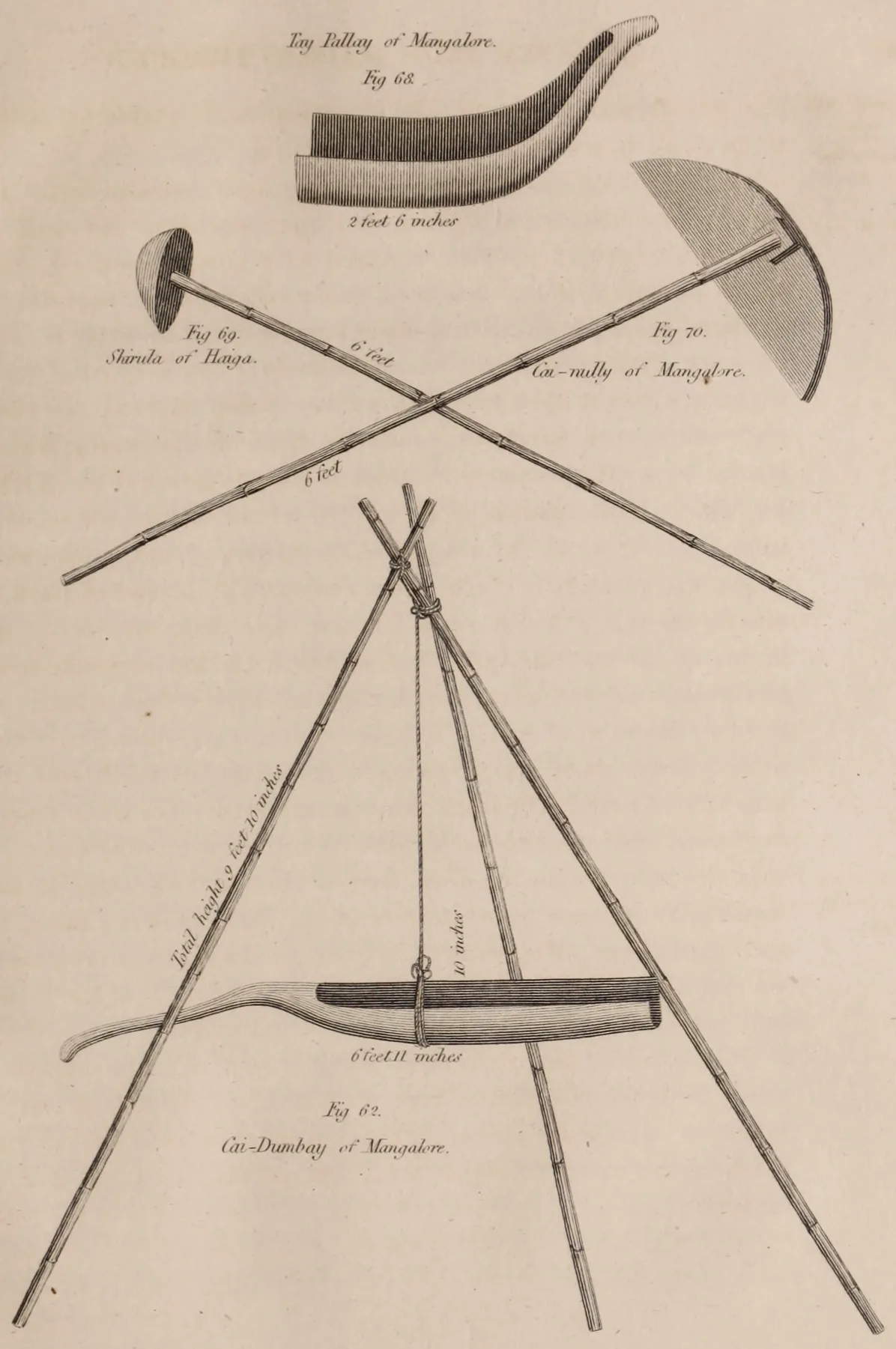
The only mode of cultivation used here for Mackey land is that called Mola, or sprouted-seed. In the month preceding, and that following the summer solstice, when the rains commence, the field is ploughed five times in the course of fifteen days, and all the while the water is confined. Before the last ploughing it is manured with dung from the cow-house. After the ploughings the field is smoothed with the Noli-haligay, or plank drawn by oxen (Plate XXII. Fig. 58.). It is then harrowed with the Haligay, which is the same with the Halivay of Seringapatam (Plate IV. Fig. 9.); and at the same time roots and weeds are pulled out by the hand. The water is then allowed to run off, and the prepared seed is sown broad-cast. If in three days any rain fall, the seed is lost, and the field must be sown again. For a month the water is allowed to run off as fast as it falls, after which it is confined on the rice until the crop is ripe. At the end of one moon and a half the weeds are removed by the hand.
The straw is cut with the grain. That intended for seed is immediately thrashed, and dried seven days in the sun. That intended for eating is put in heaps for eight days, and defended from the rain by thatch. The grain is then either beaten off with a stick, or trodden by oxen; and for three days is dried in the sun. The whole is preserved in Morays or straw bags, and kept in the house, till it can be boiled, and cleaned from the husks; for the farmer here never sells rough rice (Paddy). All the grain that is cut in the rainy season is boiled, in order to facilitate the separation of the husks.
The Catica crop on Bylu land is mostly sown sprouted-seed: a very little only is transplanted. The manner of preparing the seed here is, to steep the straw bag containing it in water for an hour twice a day. In the intervals it is placed on a flat stone which stands in the house, and it is pressed down by another. The largegrained seeds require three days of this treatment, and are sown on the fourth day. The small-grained seeds are steeped two days, and sown on the third. For the Catica crop on Bylu land the five ploughings are given at the same season as for that on Mackey land. After the fifth ploughing the field in the course of five days is manured, and ploughed again twice, having all the while had the water confined on it. The mud is then smoothed with the rake drawn by oxen; the water is let off, and the prepared seed is sown broad-cast. It is managed afterwards exactly like the crop on Mackie land; and, as it ripens toward the end of the rainy season, the straw is in general well preserved. The rice however, to enable the husks to be easily removed, must be always boiled.
The Sughi crop on Bylu land is entirely sown sprouted-seed. In the two months following the autumnal equinox, the field is ploughed eight times, then manured with cow-house dung, and ploughed a ninth time. It is then smoothed with the rake drawn by oxen, having been all the while inundated. The water is then drawn off by an instrument named Cainully (Plate XXV. Fig. 70.), which is wrought by a man like a rake. Small furrows are then made in the mud, to allow the water to drain off thoroughly, which is done by a small wooden instrument named Shirula (Plate XXV. Fig. 69.). In the month preceding the winter solstice the seed is sown. On the ninth day a little water is given; and, as the rice grows, the quantity is gradually increased. Till the end of the first month, the rain water in general is not expended; afterwards, by means of the machine called Yatam, the fields are supplied from small reservoirs and wells, or still more commonly from rivulets or springs, the water of which is raised by dams, and spread over the fields. These dams are very simple, consisting of earth and the branches of trees, with a few stones intermixed. The government in general is at the expense of making the reservoirs and dams.
In the rainy season the Caru land is covered with water to the depth of from three to six feet; and on that account cannot be then cultivated. Afterwards it is cultivated exactly in the same manner as the Bylu land for the Sughi crop; and, although it yields only one crop in the year, the produce is not greater.
Upon some of the Bylu land, where there is not a supply of water for two crops of rice, a crop of some of the dry grains is taken in the Sughi season. The quantity of seed for all the kinds is the same, 2 Colagas for a Moray land, or 0,292/1000 bushel an acre.
Of the grains cultivated, Ellu, or Sesamum produces 10 Colagas, or 1,463/1000 bushel an acre. Udu, Phaseolus minimoo R: produces 12 Colagas, or 1,755/1000 bushel an acre. Hessaru Bily (white) Phaseolus mungo, produces 14 Colagas, or 2,047/1000 bushels an acre. Pachy (green) produces 10 Colagas, or 1,463/1000 bushel an acre.
For all these, the ground is ploughed five times in the month which precedes the shortest day; but the Hessaru is sown fifteen days later than the Ellu, and the Udu fifteen days later than the Hessaru. Before the last ploughing, the field is manured with ashes. The seed is sown broad-cast, and covered with the rake drawn by oxen. A month after seed time, the weeds are removed by the hand. Cattle will eat the straw of all the three pulses, but it is reckoned a worse fodder than the straw of rice.
Sugar-cane is raised on Mackey land; but four years must intervene between every two crops; and for the first two years after cane, the rice does not thrive. The kind of cane used here is called Bily-cabo, which above the Ghats is called Mara-cabo. Inland they cultivate the Cari-cabo, which above the Ghats is called Puttaputty. In the month preceding the vernal equinox, the field is dug to the depth of ten inches with the hoe called Cutari. It is then ploughed five times, and smoothed with the rake drawn by oxen. Channels for conveying the water are then made, parallel to each other, and at the distance of three cubits. They are about nine inches wide, as much deep, and raised a little above the surface, the field being level. The intermediate beds are formed into ridges perpendicular to the channels, and resembling those of a potatoe field when it has been horse-hoed. The field is then covered with bushes, grass, dry cow-dung, and especially with dried parasitical plants, such as Epidendra, Limodora, &c. and the whole of these are burned to ashes as a manure. On the third day after this the canes intended for planting are cut into pieces, each containing three joints, and these are soaked in water for two days. Then in each furrow between two ridges are placed longitudinally two rows of these cuttings. Each piece leaves an interval of four inches between it and the next piece of the same row. The rows are placed near the bottom of the furrows, and are slightly covered with earth; and the furrows are then filled with water. All this must be performed before the new year commences at the equinox. Next day the furrows are again watered, and this is repeated on the eighth day, and afterwards once every four days. Two months after planting the field is weeded, and the ridges are repaired with a small hoe called Halucatay. The field is then manured with ashes, and with mud taken out of places where water lies deep. After this the watering is repeated once in four days till the commencement of the rainy season, when the ridges are thrown down, and new ones formed at the roots of each row of canes. In nine months these ripen without farther trouble. The water is in general raised, by the machine called Yatam, from wells in which it is found at the depth of from three to twelve feet from the surface. Three men are required to water and cultivate one Moray land, of which 1,79/100 are equal to an acre; but at the time they are so employed the farm requires little other work. The canes are very small, being from 2 to 2 1/2 cubits long, and about the thickness of a man’s thumb. The juice is expressed by a mill, which consists of three cylinders moved by a perpetual screw. The force is applied to the centre cylinder by two capstan bars, wrought by six or eight men; and the whole machine is extremely rude. A Moray land produces 10 Maunds of Jagory, worth in all 5 Pagodas. This is at the rate of 4,33/100 hundred-weight an acre, worth about 3l. 10s. My informants seem to have greatly under-rated the quantity of Jagory.
In the very satisfactory answers which Mr. Read, the collector, has been so good as to send to my queries, he observes as follows: “As the land on which the sugar-cane is reared is all rice-ground, its cultivation might be increased to a very considerable extent; but not without lessening the quantity of rice, because, the market for sugar being neither so extensive nor so profitable, by any means, as that for rice, few farmers would be at the expense of levelling and preparing ground for sugar-cane only. They, probably, even now plant as much of their grounds with the sugar-cane as they think they can readily sell; but I do not think this cultivation will be ever much increased, because the late reduction in the export duties on rice, together with the increased demand for that article, make its cultivation of still more importance to the farmer than it was heretofore.”
In this Grámam of Hulledy-pura there are 144 Mulagaras, or proprietors, whose estates in the revenue accompts are said to amount to 1443 2⁄3 Morays sowing, or 805 3⁄4 acres. They have besides, by actual enumeration, 7499 coco-nut palms, and 226 Arecas, young and old. The Shistu, or land-tax, is 10845½⁄10 Bahadury Pagodas, or 436l. 16s. 11d.
The land called here Betta, or Hackelu, like the Parum of Malabar, is formed into terraces; but on these rice is not cultivated. The only crops that it produces are Sesamum and Udu (Phaseolus minimoo Roxb:). On this kind of ground, after the soil has been ploughed three times, and manured with ashes, these grains are sown broad-cast in the second month after the summer solstice. The seed is covered with a hoe called Ella-kudali. The produce is much the same as on Bylu land; but there are no means by which the extent of Betta ground can be estimated.
In the hilly parts of the country, many people of a Marattah extraction use the Cumri, or Cotu-cadu cultivation. In the first season, after burning the woods, they sow Ragy (Cynosurus), Tovary (Cytisus cajan), and Harulu (Ricinus). Next year they have from the same ground a crop of Shamay (Panicum miliare Lamarck.). These hills are not private property, and pay no land-tax; but those who sow them pay, for the right of cultivation, a poll-tax of half a Pagoda, or nearly 4s. On account of poverty, many of them at present are exempted from this tax. I could here procure no satisfactory account of the garden cultivation, and shall not state what was said on the subject; but shall defer describing the gardens of Haiga until another opportunity.
The only cattle in Haiga are buffaloes and oxen, about an equal number of each of which are used in the plough. This implement is here of the same form as that in the neighbourhood of Seringapatam. In Haiga they have no carts. Many of the cattle are imported from the countries adjacent to the Gháts near Nagara, and even these are of the poorest kind, nor are they larger than those of Malayala or Tulava. In the dry season, although fed with hay and straw, they are scarcely able to crawl. In the rainy season they grow fat, and strong, on the natural grass of the hills. Working oxen get the powder which separates from rice while it is beaten; buffaloes get the cake which is left after squeezing the oil from coco-nut kernels. The natives are ignorant that the cake which is formed in the same manner from Sesamum seed could be given to their cattle. Milk, and butter, or Ghee, are very dear, owing to the small number of cows, and their wretched condition.
At night the cattle in every part of Haiga are kept in the house, where they are daily well littered with fresh materials. The litter and dung are carefully reserved, as a manure for rice-land ; and the manure that is made from each kind of litter is kept in a separate dunghill. In the two months preceding, and in that following the winter solstice, the litter is dry grass, and the manure formed with it is called Caradada Gobra. Dry leaves of every kind of tree, except those that are prickly, and those of the Govay (Goa) or Anacardium occidentale Lin: are used as litter in the three following months, and form a manure which is called Daryghena Gobra. During the six remaining months, mostly of wet weather, the fresh leaves of trees are used for litter, and make a dung called Hudi Gobra, which is esteemed the best. The ashes of the family are kept in a separate pit, and are applied to different purposes. The cakes made of cow-dung are little used as fewel in this part of the country; but, to increase the quantity of manure, the women and boys follow the cattle while at pasture, and pick up the dung.
The Seer weight at Hulledy-pura is the same with that of Mangalore. It ought to weigh 24 Bombay Rupees; but, these being a scarce article with the shopkeepers, in their stead Dubs, or Dudus, are commonly used, and are somewhat heavier.
The Maund for the common articles in the market (Bazar)=40 Seers, or 24 55/100 lb. The Maund of pepper - - =42 do. or 26 99/100 lb. of Betel-nut - - =45 1/2 do. or 27 92/100 lb. of dry coco-nut kernels =48 do. or 29 46/100 lb. of Jagory - - =44 do. or 26 82/100 lb.
There are in use here two kinds of grain measure; one for the farmers, and one for the merchants. The basis of the farmer’s measure is the Hany, containing 87 3/4 cubical inches.
2 Hanies =1 Colaga - - - =Bushel 0,08163 20 Colagas=1 Moray or Mudy for common use =Bushel 1,632 22 1/2 Colagas=1 Moray for sale - - =Bushel 1,8136 15 Colagas=1 Moray for seed - - =Bushel 1,224
The basis of the measure by which merchants deal is the Sida of 32 1/2 cubical inches.
6 Sidas =1 Colaga - =Bushel 0,0907/100000 20 Colagas =1 Moray, or Mudi =Bushel 1,814/1000 30 Morays =1 Corge - =Bushel 54,419/1000
The market (Bazar) Mudy, or Moray, and that of the farmers for sale, ought to be the same; but they differ 22/1000 parts of a bushel. Any exact coincidence, however, cannot be expected from the rude implements which the Hindus employ in forming their measures. The different quantities that are called by the same denomination, when used for different purposes, seem to have been contrived with a view of increasing the difficulty of the government in acquiring a knowledge of the real state of the country.
The common currency here consists of Ikeri, Sultany, and Bahadury Varahas, Hoons, or Pagodas; Surat and Madras Rupees, which are considered as of equal value, and pass for one quarter of a Pagoda; Silver Fanams, of the same kind as are current in Malabar, but here five and a half are only equal to one Rupee; and the Any Dudu, or elephant Dubs, coined by Tippoo, ten of which pass for one Fanam. The revenue is collected in a much greater variety of coins, according to a rate fixed by the collector, which private people also have adopted in their dealings; in forming it, therefore, due regard to justice has been observed.
Having assembled the principal traders from the neighbourhood, they said, that in the government of Hyder the trade of Honawera was very considerable.
The Company had established a factory, where they annually procured from above the Ghats about 750 Candies (520 lb.) of pepper, and 150 Candies the produce of the low country. The greater part of the pepper from above the Ghats was sold directly by Hyder. The chief of the factory contracted with individuals for the produce of Billighy, and of the low country, and advanced sometimes one-half, and at others the whole of the price, which varied from 110 to 120 Rupees a Candy of 520 lb. The merchants again began to make advances to the cultivators in the month after the autumnal equinox, which is about four months before crop season. These advances were always less in amount than what the merchant received from the Company; and the use of the balance, and two Rupees on each Candy, are alleged to have been all the profit which he received. The advances were not made to individuals; but the merchant gave a certain sum into the hands of some respectable Gauda, or chief of a village, who contracted to deliver a certain quantity of pepper at Honawera, at two Rupees a Candy less than the Company's price. What profits these Gaudas had, the merchants do not know. There were no export duties; and nobody, except the Company, exported pepper.
Hyder sold to the Company the whole of the sandal wood. None of it is produced below the Ghats; and the quantity then brought annually to Honawera was from two to three hundred Candies of 600 lb.
No cardamoms ever came this way.
All the Betel-nut exported from Honawera was the produce of the low country between Batuculla and Mirzee, and amounted annually to 1000 Candies of 560 lb. worth 10,000 Pagodas (4034l. 19s. 7d.): of this the Company took a considerable quantity, both raw and boiled; and, for whatever they wanted, they had always a preference.
The trade in coco-nuts, both whole, and in the state called Copra, or dried kernels, was in the hands of individuals. The value annually exported was about 12,000 Rupees (1206l. 1s. 1½d.). Owing to the great number of inhabitants, rice was then imported; at present it is the chief article of export. There never were in this country any manufactures. The oppressions of the late Sultan soon destroyed the whole trade; and the merchants are now just beginning to appear from their lurking-places, or to return from the countries to which they had fled. The exports at present, besides rice, are a little pepper, Betel-nut, and coco-nut; which are purchased by boats from Goa, Bombay, and Raja-pura. The Marattah pirates are a great obstacle to the inhabitants building boats for the exportation of goods.
The present price of staple articles here is:
| Rice for slaves per Corge Pagodas | 13 |
| coarse | 15 |
| fine | 22½ |
| Betel-nut boiled, per Candy | 15 |
| Betel-nut raw per Candy, Pagodas | 11 |
| Coco-nut Copra | 10 |
| whole per 1000 | 6 |
| Black-pepper, per Candy | 30 |
| Jagory of sugar-cane, Maunds 2½ | 1 |
24th February.—I went a long journey, called four cosses, and encamped on the south side of a river opposite to Mirzee. About two cosses from Hulledy-pura, I came to a town named Cumty. It seems to have been formerly a place of some note. Its lanes are straight, and fenced with stone walls, and it has many coco-nut gardens. Twice it had the misfortune of having Tippoo’s army encamped in its vicinity; and on both occasions it was burned down by some of the irregulars. On its south side is a plain, intersected by a salt-water creek, which allows much salt to be made. The soil of the plain, which extends all the way from Hulledy-pura, is very sandy. For a coss north from Cumty, the ground is high, with very little cultivation; but a great part of it seems to be fit for being formed into Mackey, or at least into Betta land. Between this and the river is a very fine plain, called Hegada, from a small town near which I encamped. The low lands here are subject to being inundated by the swelling of the river, which frequently spoils the Catica crop of rice when the farmers attempt to cultivate it. The appearance of the farm-houses at Hegada denotes that the inhabitants are in a much more comfortable situation than is usual in India. The river is called Tari-holay, and abounds with fine oysters. At this place, which is three cosses from the sea, it is at this season about 600 yards wide. The tide and salt-water go up about three cosses farther. Its northern bank is high, and was formerly occupied by a fort and town called Midijay, corrupted by the Mussulmans into Mirzee, Merzee, and Merjawn. This place suffered much in a siege which it stood against Hyder; and in the oppressive government of his son it was entirely deserted. The river formed the northern boundary of the dominions of a Jain family, who resided at Cumty, and possessed the country as far south as Honawera.
There being in this neighbourhood many palm gardens, I assembled the cultivators, and obtained from them the following account :
In this part of the country the sandy downs near the sea are not much esteemed for the cultivation of the coco-nut. Here the farmers prefer the banks of salt-water inlets ; and near these the rising grounds are generally planted, and the houses are built in the gardens. About towns, many gardens are enclosed with stone walls ; in villages, the proprietors are contented with fences of earth, like those in Malabar. Once in two years the whole garden is dug, and fresh earth at the same time is spread throughout, by the industrious, to the depth of two inches ; but lazy people allow only a little to the roots of each tree. The garden gets no other manure, except some salt to the young seedlings when these are transplanted. For six months in the year they must be watered once in four days. A young tree, fit for transplanting, costs two Dubs (about a penny), and is set in place of an old one which has died ; so that the garden is never suffered to decay. In a good soil, the trees when ten years old begin to produce fruit, but in bad soils they are much later. Common reckoning says, that a coco-nut palm lives 100 years ; but some die at 20, and many at all intermediate ages. At all times plantains and Yams (Dioscorea) are raised in the coco-nut gardens. Rich people never draw juice from their coco-nut trees, except in one year when they are young. For some years before the young palms can bring the fruit to maturity, they produce flowers ; but, by extracting juice for one year, their coming to perfection is hastened. If any disease happen to the tree, rich men, to give relief to the sickly plant, do not extract juice, as is usual in some places, but with a sharp iron they bore a hole into the pith above the diseased part. Poor people, not being able to raise money to pay the wages of their workmen, give them annually a certain number of trees for extracting juice, with which they can procure a daily subsistence. This compels the poor man, once in four or five years, to take juice from his trees. Besides, although this practice soon kills the tree, it gives much more immediate profit, especially in poor soils. In good soils, the nuts are of equal value with the juice; as a good tree in such a situation gives on an average, 80 full grown nuts, worth 25 Rupees a thousand; and 100 trees in such a soil, good and bad, young and old, produce 3000 nuts, which is at the rate of three quarters of a Rupee for each. In an indifferent soil the same number of trees produce only 1000 nuts, which is only at the rate of a quarter of a Rupee for each; but the coco-nut trees, good and bad, produce each a Rupee worth of juice, one-half of which goes to the extractor, and one-half is clear profit to the proprietor. One man can collect the juice of forty trees, and his share of the produce, being 20 Rupees (2l. 0s. 3½d.), is reckoned a sufficient maintenance for a man, his wife and children; for the people who extract the juice of palms are of a very low cast.
The Betel-nut gardens are cultivated, at a distance from the banks of rivers, in the upper ends of narrow vallies, which contain Bylu land. The best soil is red, and contains shining particles, which I take to be mica. This soil is called Câgadala. Next in value to this is Gujiny, which is a black loose earth. The worst soil is called Betta, and is a hard earth composed of decayed or broken Laterite. The Cagadala is found in the bottoms of the vallies at their upper end, and is watered from a small reservoir, whence the water sometimes runs off by sluices, and sometimes is raised into the channels by the machine called Yatam. The Gujiny is found very low and level, where the hills forming the valley begin to recede a little from each other. In such land the water at all seasons of the year stands in the ditches, but is of a quality pernicious to the Areca, which must be watered from springs or rivulets. The Betta land forms the upper parts of the declivities of the hills, and must be irrigated, by the hand, with water drawn from wells that are dug in the valley below. The garden must be fenced with a wall of stone or mud, on the upper side of which a deep drain must be formed to carry off the water, which during the rainy season descends from the hills in torrents. In this respect the Cagadala requires most trouble, and its watering is more expensive than that of the Gujiny; yet, owing to its being more productive, it is more profitable. The produce of the Betta land is still smaller than that of the Gujiny, and its cultivation is attended with much more trouble; yet it is worth while to plant the whole that is near a man's house; for to a certain extent the family can perform the watering without great inconvenience.
Immediately before the winter solstice, the nuts for seed are cut, and are exposed three days to the sun, and three nights to the dew. In the mean time, a plot of Cagadala soil is dug for a seed-bed. In this the seeds are placed at four inches distance, and are half immersed in the ground. They are then covered with dung; and, that having been covered with straw, they are watered every other day until the second month after the vernal equinox. The rainy season then commences; and a drain must be dug to prevent the water from lying upon the bed. In the first or second month after the autumnal equinox, another piece of ground is hoed, and in this are placed the nuts which are then said to be Mola, as they have shoots sprouting from them a cubit long. The nuts in this bed are placed at about the distance of a foot from each other, and are buried an inch under ground. Every other day, during the dry season, they are well manured and watered. In this bed they remain fifteen months; and in the month preceding the winter solstice, they are manured with dung made from dry grass-litter; while in the month following the vernal equinox, the manure, which they receive, is that formed of dry leaves. During the month before and the month after the autumnal equinox, the young palms are (Sussi) fit for planting.
The garden having been properly inclosed, and secured from the torrents of the rainy season; and tanks, wells, or canals for supplying it with water, having been formed; the Cagadala soil is levelled into terraces like rice-ground, and formed into beds seven cubits wide. Between every two beds is a deep channel, to carry off the rain water; and in the middle of each is a small channel to convey the water that is to refresh the palms; and which, as it runs along, a man throws out on their roots with a spatha, that has fallen from the trees. On each side of the bed is planted a row of the Arecas, distant from each other five cubits, and between every two Arecas is set a young plantain tree. The garden is then manured with dung made from fresh leaves, and ever afterwards during the dry season it must be watered once in two days. For the first four years, it must be dug over in the month preceding the autumnal equinox, and at three different seasons must be manured with the three different kinds of manure. Afterwards, it is manured once a year only, in the second month after the autumnal equinox; and it is once in two years only that it requires to be dug. The Betel-nut is improved by the plantain trees, which keep the earth cool and moist; and therefore these are always continued, except where it is intended to train up the Betel-leaf vine upon the Areca, which is the manner wherein that plant is here cultivated. In this case, in the tenth year, the plantain trees are removed; and in the second month after midsummer, five cuttings of the Betel-vine, each containing three joints, are placed round every Betel-palm, while one of their ends is buried in the ground. They are then manured with the leaves of the Nelli (Phyllanthus emblica). Immediately after the autumnal equinox, the ground round the young vines must be hoed, and manured with dung made from fresh leaves. Ever afterwards, it must be manured three times a year. As the vines grow, they must be tied up to the palms. In eighteen months they begin to produce leaves fit for sale; in the third year they are full sized; two years they continue to give a full crop; in the following year the crop is bad, and then the vines are lifted, and new ones are planted in their stead. The Betel-palm, or Areca, in Cagadala soil begins to ripen fruit in ten years, is in full crop at fifteen, and continues in perfection for thirty years. They then die; and as the old ones decay, new ones are planted. Each tree yields two bunches, which ripen at different times between the autumnal equinox and winter solstice. The produce of a hundred trees, young and old, is reckoned five Maunds of boiled nut, or thirty-five Bazar Colagas by measure of nuts in the husk, as they come from the tree. The five Maunds are one fourth of a Candy, or 140 lb. The present price of boiled Betel-nut is fifteen Pagodas; each tree therefore, young and old, produces to the value of 3 626/1000 pence, or a hundred trees produce fifteen Rupees. The cultivators boil the Betel-nut.
In Gujiny ground, in order to remove the water off the soil, the drains between the beds must be one cubit and a half deep. It is irrigated once in seven days only, from the same sources that supply the Bylu rice-ground. In this soil, plantains and Betel-leaf grow in the same manner as in Cagadala gardens. A hundred trees, young and old, on Gujiny ground, are reckoned to produce four Maunds of boiled Betel-nut, worth twelve Rupees.
On the Betta land no drains nor channels are required; but round the root of every palm a small bank is formed to confine the water, which is given once in two days. In such gardens, plantains, but not Betel-leaf, are reared. The trees in this soil do not come into full fruit till they are twenty years of age, and a hundred pro duce only two Maunds and a half of boiled nut, worth seven Rupees and a half. A man and his wife can manage a garden of 500 trees; some of which will grow on Betta, and a proportion on either Cagadala, or Gujiny, or on both. They require no assistance at crop season; but, unless the keeper be an active man, he will require some help when the garden is hoed. The expense of first planting a garden is commonly reckoned 100 Rupees for every 500 trees; but in level situations it will be much less, and in steep places much more. Some people go to 50 Pagodas for 100 trees, or 2 Rupees for each. No value is put upon the future expense, which is merely that of the keeper and his wife, who get 2 3/4 Hanies of coarse rice daily, and 4 Rupees a year for clothing; that is to say, 37 1/4 bushels of rice, worth 32 852/1000 Rupees, and 4 Rupees in money; or in all 36 Rupees 13 Anas (3l. 14s. 3d.). It must be observed, however, that after the first year the plantains are adequate to the defraying of this expense, which is therefore not charged in the accompt. The farmer has therefore, on an average, 50 Rupees a year, for an original advance of from one to two hundred; but out of this must be deducted the revenue. His profit is much larger where he has a sale for Betel-leaf. It appears to me, that the gardens here are formed with more care, and at a greater expense, than in Malabar, where a colony of Haiga Bráhmans would be highly beneficial.
25th February.—In the morning, having crossed the river, I took a circle of about six miles into the country east from Mirzee, in order to see some forests that spontaneously produce black pepper. The whole of the country through which I passed was hilly; but I met with several narrow vallies well watered, though not fully cultivated, owing to a want of inhabitants. Many of the hills were so barren, steep, and rocky, that I was soon forced to dismount from my horse, and proceed on foot. These hills consist entirely of naked Laterite. Other hills, which were those I sought after, were covered with stately forests.
The pepper-plant (Piper nigrum) seems to grow spontaneously on the sides of all the narrow vallies in the interior of Haiga, where the soil is so rich and moist as to produce lofty trees close to each other, by which a constant coolness is retained. In such places the pepper-vine runs along the ground and the roots of bushes, and propagates itself entirely by striking its roots into the soil, and then again sending out new shoots. The natives say, that without assistance it cannot ascend a tree; and that, unless it is exposed in such a situation to sun and air, it never produces flowers. In order to procure fruit from a hill which spontaneously produces the pepper-vine, the proprietor cuts all the underwood and bushes, and leaves only the large trees, and a number of the young ones sufficient to exclude the violence of sun, but to allow of a free circulation of air. Four cubits from tree to tree is reckoned a proper distance. The ends of the vines, which were lying on the ground, are then tied up to the nearest trees. Any kind of tree answers the purpose; but those of about eight inches or a foot in diameter are preferred, as it is easy to climb such for the purpose of gathering the pepper. A quantity of leaves are then placed round the root of the vine, to rot, and to serve as a manure. In the course of the year the vine, so far as it has been tied, strikes its roots into the bark of the tree; but the shoots above that, hang down. Twice a year afterwards these are tied up, and strike root, till they spread over all the large branches of the tree. In places where no vines have naturally sprung, the owner, after having dug a small spot round the tree to loosen the earth, propagates them by planting slips near the roots of the trees on which he wishes them to climb. The early part of the rainy season is the time proper for this operation. In five years, after having been managed in this manner, a hill begins to produce fruit, and in eight years is in full bearing. The vines live about thirty years; when others, that are found creeping on the ground in their natural state, are tied up in their stead; or, where these happen to be wanting, shoots or cuttings are planted near the trees. There is no difference in the quality between the pepper springing spontaneously from the seed, and that growing from cuttings; nor is the pepper growing in gardens either better or worse than that growing on a hill, managed as I am now describing. These hills producing pepper require no trouble, but the tying up of the plants, keeping the forest clear of underwood, and collecting the pepper. They are manured in the following manner. In the month succeeding the vernal equinox, a hole three or four inches above the ground is made into the trunk of any very large tree that is situated near the top of the hill. Into this are put some burning coals, and, for an hour, a fire is kept up with fresh fewel. After this, the tree will burn inwardly for two days, and is then killed. A large insect immediately takes possession of the trunk, and works its nest into the wood. In the next rainy season, the whole falls down into a rotten dust, which the rain washes away, so as to disperse it over the face of the hill below. The crop season commences about the winter solstice, and it continues rather more than two months. A man can in one day gather three Colagas, farmer’s measure, or almost one peck of the amenta. These are dried three days in the sun, and then are rubbed with the feet on a piece of smooth ground, to separate the grains; which, having been cleared from the husks and foot-stalks, are again dried two days in the sun, and tied up for sale in straw bags or Morays. Seventy-five Colagas of amenta are required to make one Bazar Moray (bushel 1 6⁄10) of dry pepper, which weighs 3 Maunds (about 84 lb.); so that a man daily collects about 3 15⁄23 lb. of dry pepper. These hills were formerly valued; and, according to their extent, each paid as a land-tax so many Maunds of pepper, the Maund containing 60 Seers. The same valuation is now continued; but the Maund is reduced to 40 Seers, and converted into money, at the rate of a Pagoda, which is in favour of the proprietor. Still one half of these hills is waste, owing to a want of hands to cultivate them; and on that account three-fourths of the revenue are remitted to the proprietors, who are also favoured by having all the rice-ground lying among these hills free from tax. This has been given them, on a supposition that its produce was only adequate to feed the people who are employed in cultivating the pepper.
So far as I went, no Teak grows in these forests; but I am told, that it is procurable farther inland. The landlords (Malugaras) pretend, that all the timber trees are their property, but that none of them are saleable.
The wild nutmeg and Cassia are very common. As the nutmegs ripen, the monkies always eat up the outer rind, and mace; so that I could not procure one in a perfect state. They are collected from the ground, after having been peeled by the monkies, and are sold by some poor people to the shopkeepers; but they have little flavour; and the demand for them is very small. Although they are, doubtless, of a distinct species from the nutmeg of Amboyna, it is probable, that by proper cultivation and manure their quality might be greatly improved; and that, in the situations where they now grow spontaneously, they might be reared as the supporters of the pepper vine; which would produce copiously, and of an excellent quality, were the same pains bestowed on it here as is done in the gardens above the Ghats, where by far the best pepper grows.
The Cassia belongs to government, and is in general given in lease; but at present no renter can be procured. Its quality also might, no doubt, be greatly improved; and by cutting the shoots, when of a proper size, and cleaning and rolling up the bark neatly, it might be made equal to the Cassia of China.
On my return from the pepper hills to Mirzee, I passed a very fine plantation of Betel-nut palms, belonging to four Bráhmans, and containing many thousand trees. It was placed on the two steep sides of a very narrow valley, well supplied with water from springs. Here I observed the first regular strata since leaving Pali-ghat. They consisted of very soft pot-stone, probably impregnated with hornblende slate, as they seem to be a continuation of the quarries of slaty sienite, from which the temples at Batuculla have been supplied with stone. I have already noticed the affinity that prevails between the hornblende and pot-stone rocks in the dominions of Mysore. The strata at this garden are vertical, and run nearly north and south.
Having returned to Mirzee, I went two cosses and a half to Hirigutty. Part of the country through which I passed was very barren, consisting of low hills covered with stunted trees. The soil of other parts was good; but, owing to a want of inhabitants, was much neglected. Near Hirigutty, there is on the northern side of the river a remarkably fine plain. It does not seem to be well cultivated, and has suffered lately from the breaking down of a dam, which has permitted a great part of it to be inundated with salt-water.
At Hirigutty, I collected several Haiga Bráhmans, who were said to be the best informed men concerning the history of the country. The Shanaboga, or accomptant of the temple of Daréswara, produced a book called Bahudunda, which, they said, was written by a certain Subahitta, or Bráhmany chief, who will hereafterwards be mentioned. On the authority of this book the Shanaboga said, that Parasu Ráma created Haiga at the same time that he formed Tulava and Malayála, and he then also appointed certain Bráhmans to inhabit these lands. Tulava he gave to the Mittu Bráhmans, and Haiga to those called Nagar and Mutchy. These people were not true Bráhmans; but they kept possession of the country till after the commencement of the Kali-yugam. The country was then seized upon by two casts of impure origin, the Mogayer and the Whalliaru. The former are the fishermen of Haiga; the latter I have had frequent occasion to mention; and to this tribe the Rájá belonged. At length a Sannyási, who had visited the country, induced Myuru Verma to invade it. He was king of Banawási and Gutti in Karnata, and by cast a Baydar, which is a tribe of Telingana. His attack was successful, and he conquered Haiga, Tulava, and Kankána. He then brought a colony of five thousand true Bráhmans from Ahichaytra, a city in Telingana, and settled them in Haiga. He brought others of the same origin to Kankána and Tulava. A thousand of these Haiga Bráhmans lost cast immediately, having omitted the performance of certain prayers (Mantrams) which were necessary to purify the country before they took possession. The remaining four thousand obtained the whole lands of Haiga, and continued to enjoy them until Myuru Verma was obliged to fly by Nunda, the son of Utunga, one of the Whalliaru, who recovered the dominions of his ancestors. This low fellow seized on the lands that had been granted to the four thousand Bráhmans, and forced them to retire to Ahichaytra. He was succeeded by his son Chanda Sayana, whose mother, being a dancing girl from the temples of Karnata, had educated him so as to have a due respect for the sacred order. Soon after his accession to power, he invited back the Bráhmans; and, having given up the whole of his authority to their Subahitta, or chief, the author of the book, he made all his Whalliaru the slaves of the sacred order. So long as Chanda Sayana lived, he was called Rájá, and the Subahitta continued to govern in his name. On his death without children, the Subahitta was at a loss what to do; as according to the laws of his cast he could not assume the regal title, and as there was no Rájá under whose authority he could act. He therefore invited Solva Krishna Devarasu Wodearu of Anagundi to take possession of Haiga, which had never before been subject to Vijaya-nagara. This prince accordingly came; but, far from allowing the Subahitta to enjoy any authority, he imposed a land-tax on the Bráhmans, and gave all the country to a Jain Polygar, Itchuppa Wodear Rájá of Garsopa. No date is assigned in the book for these extraordinary events, which nobody but a Haiga Bráhman can possibly believe. In order to conceal the long subjection to the infidel Jain, in which the Bráhmans of Haiga had been compelled to live, they bring down the time of Myuru Verma to that of the latter princes, or usurpers of the throne of Vijaya-nagara. Many inscriptions render it indubitable, that Haiga belonged to the kings of Karnata long before the time of Krishna Ráyalu. Copies of all these, which I now quote, were in the possession of the very Bráhmans who gave me the foregoing account. The temple at Daréswara has two grants engraved on copper-plates. The one is dated Sidarti of Sal. 1422, on the 14th of the moon in Bhádrapada, in the reign of Déva Ráya Wodearu Trilochia, &c. &c. This title of king of the three people (Trilochia) is said to be peculiar to the kings of Vijaya-nagara, as is also the title of king of the three seas. The title of Trilochia seems well enough applied, as these princes governed the tribes who speak the Telinga, Tamul, and Karnataca languages. This date apparently does not agree well with the Ráya Paditti; for the last Déva Ráya which it mentions ended his reign in the year of Sal. 1377. But, as we shall afterwards see, this Déva Ráya may have been one of the names of the usurper who reigned in 1422. The other grant on copper is by Solva Krishna Devarasu Wodearu Trilochia, &c. &c. and is dated Sal. 1481, on the 15th of Ashádha, in the year Calayucti. This agrees very well with the chronology of Ramuppa. A third grant to the same temple is by Krishna Devarasu Wodearu Trilochia, &c. &c. in the year Vicari of Sal. 1462, on the 1st of Kartika. This also agrees with the chronology of Ramuppa. Another, in the time of Trinetra Solva Narasingha Nayaka, king of the three seas, and of Anagundi, &c. &c. is dated in Durmati Sal. 1424, 14th Bhádrapada. Among other strange titles assumed by this prince, he is said to be able to pull all other potentates by the whiskers. In it he commands Devarasu Wodear, probably the lieutenant of Haiga, to grant such and such lands to the Bráhmans. It is clear therefore, that before the time of Krishna Ráyaru the kings of Anagundi were sovereigns of Haiga, and that all the lands did not belong to the Bráhmans. Another grant, for erecting an inn for travellers, is dated on the same day and year, and by order of Solva Déva Ráya Wodearu, Rájá of Nagara (not the present Nagara but Vijaya-nagara), Haiga, Tulava, Kankana, &c. &c. We here find, that the second Narasingha of the usurping princes is sometimes called also Déva; and the same probably was the case with the first Narasingha, which will reconcile the chronology of the first grant with that of Ramuppa. The inscription on stone at the temple of Gunavunti, in Garsopa district, of which a copy has been presented to the Bengal government, mentions, that Itchuppa Wodearu Pritani (Jain Rájá of Garsopa) granted certain lands to that temple by order of Pritápa Déva Ráya Trilochia, &c. &c. of the family of Hari-hara, &c. &c. in Virodi Sal. 1332, on the 10th of Márgasírsha. This is Déva Ráya the First, and agrees very well with the chronology of Ramuppa.
A very intelligent Bráhman from Batuculla says, that he had consulted a book in the possession of a Jain Sannyási, which stated, that the Byrasu Wodear family of Carculla was descended from the Belalla Ráyas, the supreme kings of Karnata. The last male of this branch of the family had seven daughters, all called Byra Dévi. When the Rájá died, his country was divided among his daughters in seven portions; and Krishna Ráyaru was so gallant, as to remit the whole tribute to them, as being ladies. The eldest sister, Doda Byra Dévi, lived at Batuculla. The second sister married the son and heir of Itchuppa Wodear of Garsopa, who seems to have been the tributary Rájá of Haiga. This marriage produced only one daughter; and none of her aunts having had children, she united again in her person the sovereignty of all the dominions of Carculla. To these she added Haiga; and, during the weakness of the princes of Anagundi, in the reign of the last usurper, she seems to have refused all marks of submission to their authority. She lived sometimes at Garsopa, and sometimes at Batuculla, until she was destroyed by the Sivabhactars of Ikeri, who were assisted by an insurrection of the Halypecas; and who, in conjunction with that low, barbarous tribe, almost exterminated the Jain of Haiga, and the northern districts of Tulava. There is still a man living at Dharmastilla, six cosses distant from Jamal-ábád, who is named Comara Hegada, and who is looked upon as a descendant in the male line of the Carculla family, and legal representative of the Belalla Ráyas, who began to govern Karnata in the year of our Lord 684. This man may very probably be of the family of the Carculla Rájás; but, in fact, these were descended from Jenaditta, a fugitive from the north of India; and a desire of flattering the princes of the Jain sect, who were the most powerful in these latter days, probably occasioned the legend, in the book of the Sannyási, to trace up their origin to the Belalla family.
Hirigutty, which has no market (Bazar), stands on a fine plain, about two miles from the river; and at some distance, toward the east and north, has rugged barren hills.
26th February.—I went three cosses to Gaukarna. There was a thick fog, which prevented me from seeing the country; but near the road it was a plain, consisting mostly of rice fields; many of which, by the breaking down of the bank, had been inundated with salt-water. At the western extremity of this plain is a ridge of low barren hills, which bend round to the sea, and separate the plain on the banks of the river from that on which Gaukarna stands, about a coss north from the mouth of the river. The plain of Gaukarna is well cultivated, and consists of rice fields intermixed with coco-nut gardens.
Gaukarna, or the cow’s horn, is a place of great note among the Bráhmans, owing to a celebrated image of Siva called Mahaboléswara. The image is said to have been brought from the mountain Coila by Ravana, king of Lanca. He wished to carry it to his capital; but having put it down here, the idol became fixed in the place, where it stands to this day. The building, by which the idol is at present covered, is very mean. Gaukarna is a scattered place, buried among coco-nut palms; but enjoys some commerce, and contains 500 houses, of which Bráhmans occupy one half.
I assembled the most distinguished of these Bráhmans, who informed me, that the book produced yesterday by the Shanaboga of Daréswara is not considered by them as of good authority. That every Shanaboga has a Bahudunda, containing the papers and deeds belonging to his office, and which are generally preceded by such an account of past times, as the first person of the family who enjoyed the office could obtain. These Bahudundas the Vaidika Bráhmans hold in great contempt; but, as the office of Shanaboga has in numerous instances continued for many generations in the same family, I am inclined to think that from this source much historical information might be procured. The Bráhmans here are all Smartal, of true Panch Dravada extraction, and despise the Haiga Bráhmans, as being greatly their inferiors. When I inter-rogated them concerning the history of the country, they said that it was contained in a book in their possession, called Seinghadri Utracunda, or the second volume of Seinghadri, a work composed by God in the form of Vyása, who wrote the eighteen Puranas. They suppose, that this was done long before the creation of this part of the world, and therefore look upon all the historical part as entirely prophetical. I found that none of them had ever been at pains to read the book, and they therefore spoke of its contents merely from report, or tradition. They say that it brings the history of Kérala, Tulava, Haiva (the Sanskrit name for Haiga), and Kankana, no lower down than the time of Myuru Verma's grandson. It is written in the character of Tulava, which is the same with that of Malayála, and in the Sanskrit language. It contains no dates, and seems to be, as usual, an idle rhapsody, in which are foretold the great deeds of five princes of one family, who were to be great favourers of a certain sect of Bráhmans. These five princes are Trenetra Cadumba, Hæmanga, Myuru Verma, Locadita, and Chanda-Sayana; which last the Haiga Bráhmans suppose to have been a Whalliaru. The dominion of these princes extended all over the country created by Parasu Ráma, from Cape Comorin to Surat. In all this country, at the accession of Myuru Verma, there was no true Bráhman; but for each division of it that prince brought a colony from Ahichaytra. The Namburis formed one of these colonies, all of which have in some measure lost cast, or at least have been degraded, by a disobedience of the orders of Sankara Achárya. At that time, the Rájá of Ahichaytra was a Jain; but he favoured the Bráhmans who followed Vyása, his wife's mother having been very intimate with one of these persons, and having educated her daughter in a due regard for the sect. Shortly before that time, this sect had risen into considerable reputation in Andray, by the efforts of Buta Achárya, and was afterwards spread throughout the peninsula by the teaching of the three great doctors Sankara, Rama Anuja, and Madua. These Smartal Bráhmans possessed a grant of lands engraved on a plate of copper. It is dated Servajittu of Sal. 1450, in the 20th of Maga, and in the reign of Krishna Ráya, which agrees with the chronology of Ramuppa. Having been informed that there were here many inscriptions on stone, I went out in search of them.
The large tank is a very fine work, and the only structure in the place that is worth notice. Near this, in the yard of a small religious building called Kaméswara Matam, I found the most ancient inscription. The stone on which this is cut is at the top adorned with emblems, which indicate that its erectors have been worshippers of Siva. Much of it is buried under ground ; only thirteen lines are at all legible, and parts of these are decayed. First come the titles of the sovereign Cadumba Chicraverti. These are quite different from those assumed by the kings of Vijaya-nagara, which are known by almost every Bráhman, and facilitate greatly the reading of all the inscriptions that were made during their government. The titles given to Cadumba Chicraverti seem to be little understood. After the titles, and a defacement of half a line, mention is made of two sons, learned and heroic men, and Rájás by the favour of Rajaya (the goddess of the earth). Then follow some unintelligible words. Then the date of the Kali-yugam 120, being Vikrama, 15th Maga, there being then an eclipse of the moon. These two sons gave Dharma (charity), by building Kaméswara Matam, on the west side of the temple of Sankara Narayana, in the name of Sri Mahaboléswura ; and for the performance of Bunaneia (worship and charity) in this Matam, they granted certain grounds, then overset, without proprietors, and become Haraweri (reverted to the state) with the water-courses, house-steads, gardens, Bettafields, Chitta-fields high and low, and the rank formerly thereunto appertaining. Here the writing is totally defaced. It probably contained the extent, name, and boundaries of the lands. From their disposing of lands belonging to the government, it is probable that the two sons, mentioned in the inscription, were sons of the king. The first cypher of the date is defaced; but from some fragments of it the Bráhmans think that it must be either a 1 or a 3; and from their traditions they are inclined to think that it is the former. Cadumba Chicraverti is the ancestor of Myuru Verma. This date would make him to have reigned 534 years earlier than the time assigned for the commencement of his reign by Ramuppa; which, I have already said, is probably much more early than the reality. The 3120, supposing that to be the true reading, would make Cadumba Chicraverti to have been governing 149 years before the time in which (from an inscription that I afterwards procured) I found that his descendant Trenetra Cadumba actually reigned. I am persuaded, therefore, that this is the proper era of Myuru Verma, and the introduction of the Bráhmans from Ahichaytra; and that the Banchica, Abhira, and Monayer families of Ramuppa, are either names altogether fabricated, in order to increase the antiquity of Myuru Verma; or that, more probably, the order in the succession of the dynasties has been altered. This inscription, copied in imitation of the old character, has been delivered to the Bengal government. The image of Sankara Narayana, mentioned in this inscription, still remains in a small temple, on the east side of the Matam; and is a strong proof of the early prevalence of the doctrine which the Smartal now teach, namely, that Siva and Vishnu are different names for the same god, according to his different attributes, as destroyer and preserver of the world. A likeness of it is given in Plate XXIV.; from which it will appear, that, in order to show their identity, the same image has the emblems of both gods. The names do the same; for Sankara is one of the titles of Siva, and Narayana one of the names of Vishnu.
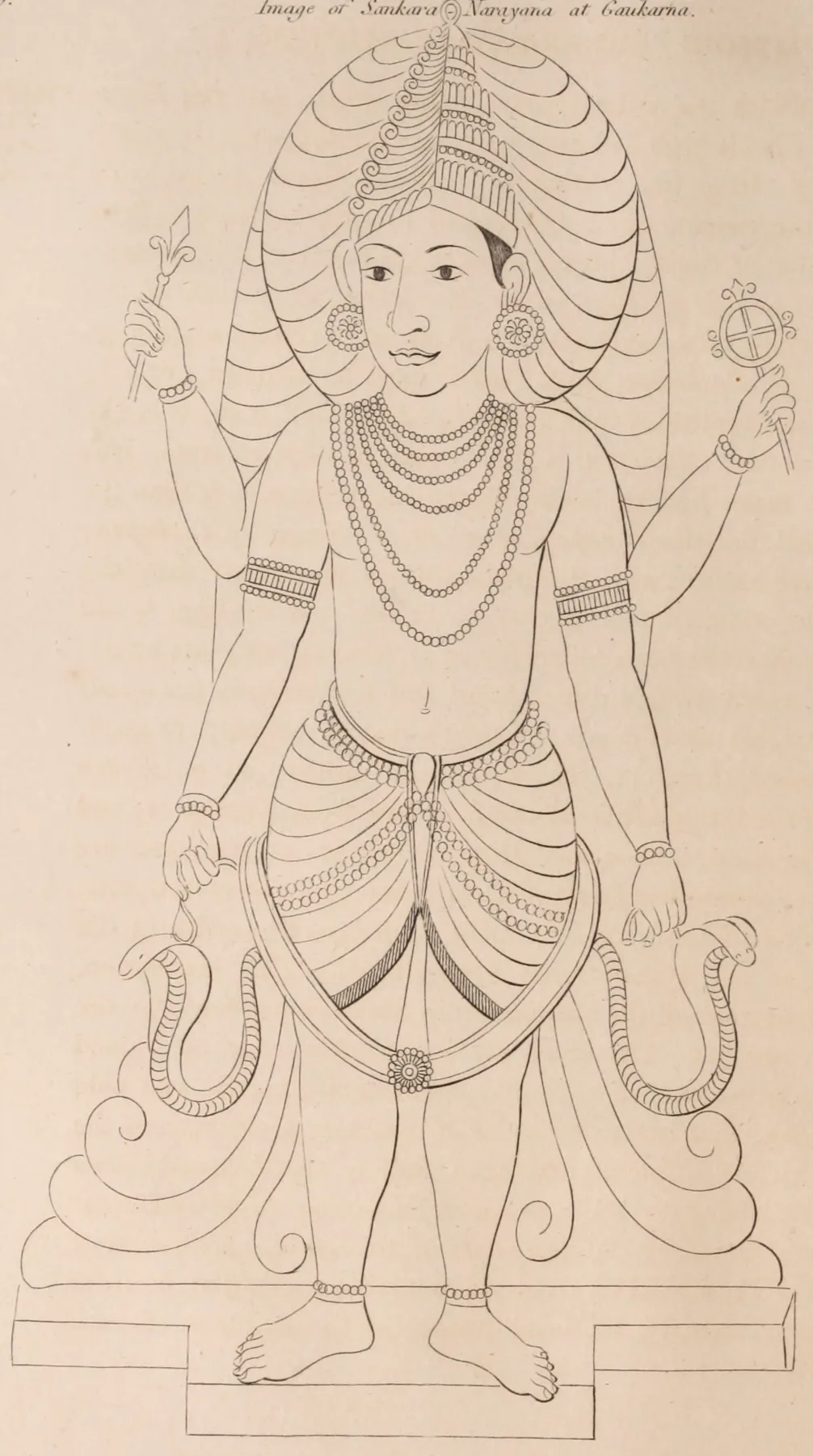
The next most ancient inscription that I found here was, like the others, in a private house, and exceedingly neglected. It is dated Anunda 1297, Friday 1st Palguna, in the reign of Sri Vira Buca Ráya, by the favour of the feet of Virupacsha Devaru (the Siva at Humpay opposite to Vijaya-nagara) king of the east, west, and south seas. This must be Buca Ráya the First, who would therefore appear to have reigned at least two years later than the time assigned for him by Ramuppa.
Another is dated in Sal. 1308, and contains a grant of revenue for supporting an inn, by the son of Hari-hara Ráya; but his name is effaced. A copy of this has been delivered to the Bengal government.
The last that I visited is dated Suabanu Sal. 1472, on the 23d of Srávana. In this, Solva Krishna Devarasu Wodearu, son of Sedásiva Ráya, and king of Nagara (Vijaya-nagara), Haiva, Tulava, Kankana, &c. grants lands situated in the Ashtá-grám of Sashisty district (Desa), in Govay Ráyada (principality of Goa). Hence it will be evident, that, while this powerful Hindu prince lived, the Adil Shah Sultans of Vijaya-pura were very much confined in their territories toward the south-west.
27th February.—It having been mentioned to me, that the books of the hereditary Shanaboga here contained much curious information, I determined to stay a day, and examine them. I found that he had a Bahudunda of two volumes. The first commenced with some verses on medicine. Then followed some rules for the performance of the ceremonies of religion. Then came an old list of the names of all the principal traders in Mirzee. They were 54 in number; but the ants had eaten up the date. This was followed by an old enumeration of the inhabitants of Mirzee district (Taluc), then divided into three divisions (Maganas) Gaukarna, Nagara, and Seiganahully. Then came an account, without date, of a contribution which a vagrant Bráhman had raised for the repairs of a temple. Then came the copy of a grant, originally engraven on stone, dated in 1442, the year of Sal. 1441 having past. By this, Rutnuppa Wodearu, and his son Vijayuppa Wodearu, having been appointed Rájás of Barcuru by Sri Vira Krishna Ráya on the throne of Vijaya-nagara, they granted to a certain Bráhman the Shistu, or land-tax, arising from certain grounds, and amounting to the annual value of 25 Pagodas. This year, according to Ramuppa, was the first of the reign of Krishna. Next follows a paper respecting the relief granted to a village by a Mussulman governor, under the Sultan of Vijaya-pura. Then comes a memorandum, which states that Mahaboléswara, the great Pagoda here, possessed lands to the value of 12000 Pagodas a year (4835l. 7s. 2½d.), from the time of Madua Ráya (probably the great doctor of the Bráhmanical laws) in the year of Sal. 138 8/9, until the time of Byra Devi. The memorandum then details all the lands, and appropriates the manner in which the revenue is to be expended. No date accompanies this memorandum; but it is looked upon by the Bráhmans as affording the temple a sufficient right to the specified lands, and as a clear proof that the rules for expenditure were prescribed by Madua Ráya. Next follows a grant of lands to the ancestors of the Shanaboga, from Mahamundeléswara Krishna Devarasu Wodearu, king of Nagara, Haiva, Tulava, Kankana, &c. in the year of Sal. 1452, which also is agreeable to Ramuppa’s chronology. Then comes a copy of a Shist, or valuation, usually called that of Krishna Ráyaru; but there is nothing in the writing that shows when or by whom it was framed. It extends to the three divisions (Maganas) of Mirzee already mentioned, and includes a fourth named Hirtitty. From this it would appear, that those people who cultivated Cumri land paid 2 5/8 Fanams a head. At present they pay 2½ Fanams. Gardens then were also taxed, and the government took one half of their supposed produce. Thus 1000 coco-nuts paid 3 Pagodas. It would appear, that since that time the price of this article has not increased, 6 Pagodas being the present value of 1000 coco-nuts. This seems to me a clear proof of the flourishing state of the country when the valuation was formed; as there can be no doubt, that the value of gold has in general decreased greatly since the time of Krishna, owing to the great quantities procured from America. The difference, therefore, must be made up by the more flourishing state of the country, which introduced wealth, and enhanced the price of every thing valuable: the present decayed state of the country, notwithstanding the low value of money, keeps down the price. By this valuation the pulse sown as a second crop was taxed. It had been a custom for every proprietor of a garden, at a certain festival, to wait on the officers of government, and present them with 1 1⁄2 Pagoda. The valuation directs, that they should be exempted from this trouble, and that the money should be paid at the same time with their land-tax. The rice land paid 3 Pagodas for every Cumbum of produce. The Cumbum is two-thirds of a Corge, and at present is worth on an average about 12 Pagodas. Since that time an additional tax of 3 3⁄4 Fanams has been laid on each Cumbum. In this manner each estate having been valued, the land-tax was fixed on it in cumulo; and the same continues still to be taken, with the addition above mentioned on the rice-lands; but a great deduction is made on account of lands not occupied. When the valuation was formed, there was no tax on houses, but shops paid a duty to the Suncha, or custom-house.
The second volume of the Shanaboga's register commences with a kind of chronicle. Killidi Vencatuppa Náyaka having destroyed Byra Devi, information of the event was sent to Ibrahim Adil Shah Padishah, by Sherif ún Mulk, the Vazir residing at Ponday, a place near Goa. This officer seems to have commanded in Kankana, after the Mussulmans had seized on it, during the decline of the Hindus of Vijaya-nagara. The Padishah then ordered all the Havildars (military officers) commanding in Kankana, to join Sherif ún Mulk, and to fight with Vencatuppa Náyaka. On the 5th of Margasirsha Sal. 1529, being the year Parabava, they advanced as far as Chindawera, where they were entirely defeated. They retreated beyond the Mirzee river, and, having there built a strong fort, the river continued to be the boundary between the Sivabhactars and Mussulmans. Next year Sherif ún Mulk returned to Ponday, leaving an officer (Havildar) in command at Mirzee to collect the revenues, and remit them to Ponday. In the course of thirty-five years, there were twelve governors (Havildars). These were succeeded by officers called Mahal Mocasi, of whom there were ten at Mirzee in the course of thirty years. A Tannadar then governed it for eighteen months. After which Mammud Khan held the government for a year and a quarter. Abdul Hassein Havildar then governed twenty-one months, another Havildar nine months, and Murtiza Khan a similar length of time. He was displaced by two Mussulmans, who rose up, and put him in confinement. These possessed the country for eighteen months. After this Mirzee became subject to the Sivabhactars, and continued to be governed by Karnataca Parputties till the year Durmutti, fourteen years after Hyder had reduced Bidderuru, now called Nagara.
Next follows a valuation (Shistu) which was made by the officers of Adil Shah, in the Fusly year, or year of the Hejira 1044, and includes the five districts, or Mahals, that were subject to Vijaya-pura, and were named Mirzee, Ancola, Ponday, Cadawada (Carwar), and Sivéswara; and which were probably the part of the dominions of Byra Devi, that fell to the share of the Mussulmans. This is the valuation now in use. Hyder imposed no new taxes, but resumed one half of the charity lands (Enams); Tippoo seized upon the remainder.
I have detailed the contents of these volumes, that a judgment may be formed, of what may be usually expected in such registers, which are very numerous throughout the Peninsula.
In my evening walk I examined an inscription on stone. It is dated Sal. 1311, 1st Phálguna, and in the reign of Buca Ráya Trilochia, &c. son of Hari-hara Ráya, king of Haiva, Tulava, Kankana, &c. This must be Buca Ráya the First, and his reign must have continued much longer than is mentioned in the Ráya Paditti. He must also be the same prince mentioned in the inscription, page 170 (of this Volume), which shows that Hari-hara was not succeeded by his former companion Buca, but that he named his son and heir after that friend.
On my return, I met with an itinerant image of Hanumanta. He was in a palanquin, attended by a Pújári, and many Vairagis, and had tents, flags, Thibet-tails, and all other insignia of honour. He was on an expedition to collect the money that individuals in distress had vowed to his master Vencata Ramanya, the idol at Tripathi; and from his style of travelling seemed to have been successful. Many such collectors are constantly travelling about the Peninsula. Out of the contributions the Pújári (priest) defrays all the expenses of the party, and pays the balance into the treasury at Tripathi, which is one of the richest that the Hindus now possess.
At the temples here dancing girls are kept, which is not done any where on the coast toward the south; for in Tulava and Malayala many of the finest women are at all times devoted to the service of the Bráhmans.
28th February.—I went three cosses to Ancola. Midway is the Gangawali, an inlet of salt water that separates Haiga, or Haiva, from Kankana. Its mouth toward the sea is narrow; but inwards it forms a lake, which is from one mile to half that extent in width, except at the ferry, where it contracts to four or five hundred yards. Boats of a considerable size (Patemars) can come over the bar, and ascend the river for three cosses. Canoes can go three cosses farther, to the foot of the Ghats. The boats of Haiga are the rudest of any that I have ever seen, and no where worse than on this river, which possesses no trade; and the country on its banks, although very beautiful, seems rather barren.
Between Gaukarna and the river, the country consists of low hills, separated by rice grounds of very small extent. Where they are of any considerable size, the soil is very sandy. Soon after leaving the Gangawali I crossed a smaller salt water inlet, which by overflowing it at high water injures a good deal of land.
The salt made in this part of the country, where there are the same natural advantages as at Goa, is very bad, and scarcely saleable at any market; whereas at Goa vast quantities are made, and sent not only inland, but all over the coast. This seems to be an object that merits attention, so soon as the population shall have increased beyond what is adequate to cultivate the lands.
The part of Kankana through which I have passed resembles Haiga. The quantity of rice-land is pretty considerable. Most of it is what in Malabar would be called Parum, yet it produces annually a crop of rice, and much of it a second crop of pulse. Although this part of Kankana, which is subject to the British government, and forms the district (Taluc) of Ancola, is larger than either of the districts into which Haiga is divided, it produces only an annual revenue of 29,000 Pagodas; while Honawera produces 51,000, and Kunda-pura yields 50,000. This is not attended with any advantage to the inhabitants; for the houses of the proprietors and cultivators are greatly inferior in appearance to those in Haiga, Tulava, and Malayala. The low revenue is not therefore owing to the people being less burthened, nor is it owing to an inferiority in natural riches, but to a long unsettled state, which has occasioned a wonderful devastation. The officers of revenue say, that one-third of even the good lands are now waste. This devastation has been owing to the constant depredations of Marattah chiefs, and robbers of two casts which are called Comarapeca and Halepeca. A Comarapeca chief, named Ghida Ganoji, or the short Ganésa, having continued in his usual practices after the conquest by the English, Major Monro sent a party of Sepoys, who shot him; ever since which the country has been quiet.
Ancola is a ruinous fort, with a small market (Bazar) near it. Robbers have frequently burned the market; but it is now recovering, and contains forty shops. It is not the custom here for the people to live in towns. A few shops are collected in one place; and all the other inhabitants of what is called a village are scattered upon their farms. Most of the people here are of Karnata extraction; and few of Kankana descent remain, except a particular kind of Bráhmans, who are all merchants, as those of Haiga are all cultivators. Being originally descended from Pansh Gauda, or Bráhmans of the north of India, those of Kankana are held in great contempt by the Dravada Bráhmans, or division of the south; one of the strongest reasons assigned for which is, that they eat fish.
1st March.—I went five cosses to Chandya. At two computed cosses from Ancola, I crossed a considerable salt-water inlet called Belicary. The country between is level, but very sandy, and little cultivated. The banks of the Belicary are well planted with coco-nut gardens; and being broken into many islands and points are very beautiful. At the mouth, although it admits boats of some size (Patemars), it is not above two hundred yards wide. Small boats can ascend two cosses, to where the inlet receives from the Ghats a stream of fresh water. A little north from its mouth is a high island, called by the natives Sonaka Guda, which with a high promontory, projecting far to the west, forms a large bay, in which at this season there is scarcely any surf. Here the road for some way leads along the beach. At the head of the bay there is a fine plain between the hills toward the Ghats, and those forming the promontory which projects into the sea. The soil of this plain is good, but in many places is spoiled by the irruption of salt water creeks. Money has this year been advanced to make a bank, which which will be a great improvement. Toward the north the plain becomes narrower, and is overgrown with trees. Part of this has been formerly cultivated; and, if there were inhabitants, the whole might be rendered productive. Farther north the valley opens again into a fine plain, which faces the sea on the north side of the promontory. From the sea on the south of this to that on the north, is computed three cosses, or about ten miles. On our maps this part of the coast appears to be very ill laid down. Chandya is in the plain at some distance from the sea. At this place there is no market (Bazar), but there are many scattered houses sheltered by groves of coco-nut palms.
In this part of Kankana, a little Cut, Catechu, or Terra Japonica, is made by some poor people, who gave me the following account of the process. The tree, or Mimosa Catechu, is called here Keiri, and grows spontaneously on all the hills of Kankana, but no where else in the peninsula that I observed. It is felled at any season ; and, the white wood being removed, the heart is cut into small bits, and put, with one half the quantity of water by measure, into a round-bellied earthen pot. It is then boiled for about three hours; and when the decoction has become ropy, it is decanted. The same quantity of water is again added, and boiled, until it becomes ropy ; when it is decanted, and a third water also is given. This extracts all the substance from the wood. The three decoctions are then mixed, and next morning boiled in small pots, until the extract becomes thick, like tar. It is afterwards allowed to remain in the pots for two days, and then has become so hard, that it will not run. Some husks of rice are then spread on the ground, and the inspissated juice is formed into balls, about the size of oranges, which are placed on the husks, or on leaves, and dried seven days in the sun. For two months afterwards they are spread out in the shade to dry, or in the rainy season for twice that length of time, and are then fit for sale. Merchants who live above the Ghats advance the whole price four months before the time of delivery, and give 2 Rupees for a Maund of 40 Cutcha Seers of 24 Rupees weight ; that is, for a hundred-weight 9 89⁄100 Rupees, or nearly 1l. sterling. The merchants who purchase reside chiefly at Darwara, Shanore, and other parts in that neighbourhood, and are those who supply the greater part of the peninsula with this article, which among the natives is in universal use. Their greatest supply comes from that part of Kankana which is subject to the Marattahs. The encouragement of this manufacture in British Kankana seems to merit attention. The tree is exactly the same with what I found used for the like purpose in the dominions of Ava, and does not agree very well with the descriptions in the Supplementum Plantarum of the younger Linnæus, nor in Dr. Roxburgh's manuscripts.
2d March.—I went three cosses to Sedásiva-ghur. The road passes over two steep ridges of hills, running out into two promontories, between which is a bay sheltered by the island of Angediva, belonging to, and inhabited by the Portuguese. South from the island are two small hummocks, and off the southern promontory are some high rocks. The appearance of the whole from land renders it probable, that shelter might be found here for ships, even during the south-west monsoon. In the plain round this bay the soil is tolerably good. On the plain north from the two ridges it is very sandy, and much spoiled by salt water, which soaks through any such banks as can be formed of the loose materials that are procurable. The coco-nut is perhaps the production which would thrive best; but a great part of the plain is waste, and covered with bushes of the Cassuvium, called Govay by the natives, from its having been introduced from America by the Portuguese of Goa. The river of Sedásiva-ghur is a very wide and deep inlet of the sea. The passage into it is intricate, but at the height of the tide contains 25 feet water. It is sheltered in a deep bay by three islands, one of which, called by the natives Karmaguda, is fortified. The entrance is commanded by the fort, which is situated on a lofty hill. Much land in this vicinity has fallen into the hands of government, and, owing to the depredations of the Comarapeca robbers, has become waste. One of their chiefs, named Venja Náyaka, was the terror of the whole country, and forced even Bráhmans to adopt his cast. Two of his sons were hanged by Tippoo; but, until terrified by the firmness of Major Monro's government, he continued obstinate in his evil practices. Soon after that gentleman's arrival, he made his submission, and continues to behave like a good subject. I found him very ready to give me assistance in procuring supplies, and means to transport my baggage; and from the mildness of his manners, until informed by the officers of revenue, I had no idea of his disposition, which was barbarous in the extreme.
3d March.—I remained at Sedásiva-ghur taking some account of the state of British Kankana, and making preparations for my journey up the Ghats. The Petta, or town, here contains about twenty very wretched shops: all the other inhabitants live scattered on their farms. Cadawada, or as we usually pronounce it Carwar, stood about three miles above Sedásiva-ghur, on the opposite bank of the river. It was formerly a noted seat of European commerce, but during the Sultán's reign has gone to total ruin. There are here at present some merchants from the Marattah dominions above the Ghats, who say that they came chiefly with a view of purchasing salt. They also procure here a considerable quantity of Cut, none of which grows above the Ghats. They purchase it for ready money from the merchants of the country, who make the advances to the manufacturers. It is of a very good quality; and they cannot afford to give more than 10 Sultany Pagodas for the Candaca, or Candy of 40 Maunds of 48 Seers each; that is, 40 Rupees for the Candy of 582½ lb., or 15 s. 5 d. a hundred-weight.
It would appear, that at one time all the lands of this district (Taluc) belonged to Jain landlords (Mulagars); but all these have either been killed, or so oppressed that they have disappeared. After their expulsion, part of the lands were annexed to the government, and part given to landlords (Mulagars) called Hubbu Bráhmans. These are of the Pansh Dravada division; but are considered as having been degraded by Sankara Achárya, and are now reduced to a miserable state of ignorance. None of them here can give any account of the time when they came into the country, who brought them, or whence they came. They are the common Panchangas, or almanac-keepers of the country, and in some temples are priests (Pújáris); but Sujéswara, the most celebrated temple in the country, and one of those built by Ravana king of Lanca, is in possession of a colony of Marattah Bráhmans, who were introduced by Mahomed Adil Shah of Vijaya-pura. Of the history of the country these know nothing, except the legends concerning the foundation of their temple that are to be found in the eighteen Puránas. The lands formerly granted to the Hubbu Bráhmans, and which form by far the greater part of the country, are called Mula lands, and may be transferred by sale whenever the proprietor pleases. The Hubbus have indeed alienated a great part of it to Marattahs, Kankana Bráhmans, and Comarapeca. It may be also transferred on mortgage, resumable at pleasure by paying the debt. This tenure is here called Adava. The Shist, or assessment, now in use, was made by Sherif un Mulk, the Vazir of Ponday already mentioned; and was formed by laying so much on the land, according to its soil, and the quantity of rice seed that it was supposed capable of sowing. The proprietor may cultivate it with whatever he pleases, and may plant it with palms without any additional tax. Since the time of Sherif un Mulk, a small tax has been imposed on every coco-nut tree; and at different times, by imposing a per centage (Pagadiputti) on the amount of each person's land-tax, an increase of revenue has been made. Major Monro, according to the account of the revenue officers, considerably reduced the rate of the land-tax; but owing to his care, and strictness in the collections, the revenue which he raised was much greater than was ever before realised. The proprietors allege, that they paid more to him than they did to Tippoo. The two accounts are very reconcileable; as under the inspection of Mr. Monro there was little room for the corrupt practices which in the Sultán's government were very prevalent. Disputes about landed property are very common. An estate paying four Pagodas of revenue can be mortgaged for a hundred Pagodas, and the mortgagee pays the taxes. The same estate will sell for one hundred and fifty Pagodas. The government lands are let at rack rent, which is of course higher than the tax (Shist) paid by the proprietors (Mulagars). The tenants on these lands, or Circar Cutties, cannot be turned out of their farms so long as they pay the rent, the leases being in perpetuity. They can neither sell nor mortgage their lease; but they may let it to an undertenant. By far the greater part of the cultivation is carried on by the proprietors (Mulagars) and tenants of the public (Circar Cutties), and very little by lease-holders. The sizes of the farms vary from one to five ploughs. Two oxen are required to each plough, which cultivates from five to seven Candies of land. In general, the family of the proprietor labours the farm, but a few rich men employ hired servants. There are here no slaves. Men servants get yearly from two to six Pagodas, or from 16s. 1½d. to 48s. 4½d.; but those, who get only the first sum in money, have daily one meal of rice.
The cultivation of watered-fields, and of gardens, both on the same kind of land, is the only one known in British Kankana, except the Cumri, or Cotu Cadu, called here Culumbi. There is no ground from which two crops of rice in one year are taken; but, while most of the rice grows in the rainy season, some land called Vaingunna is so low, that in the rainy season it cannot be cultivated, and, after the water has evaporated, this yields a crop. All the other land is called Surd, and is mostly what in Malabar would be called Majelu, and what the people of Tulava would call Betta. In the accompanying Table may be seen several particulars relative to the cultivation of rice, which were taken from the accounts of the cultivators. I had no opportunity of ascertaining the quantity of land required to sow one Candaca of seed, nor, consequently, of judging how far the statement of the produce is credible.
| Name. | Ground. | Produce of One Candaca sown. | Time required to ripen. | Quality. | ||
|---|---|---|---|---|---|---|
| Suca-dan. | Rice. | |||||
| 1st Soil. | 2d Soil. | |||||
| Candacas. | Candacas. | Candacas. | Months. | |||
| Asgha | Surd | 6 | 5 | 4 | 3½ | Large. |
| Pandia | - | 6 | 5 | 4 | 3½ | Ditto. |
| Patni | - | 6 | 5 | 4 | 3 | Ditto. |
| Halga | - | none | - | 4 | 3 | Middle sized. |
| Sanmulghi | - | 6 | 5 | 4 | 4 | Ditto. |
| Wala | - | 8 | 6 | 5 | 4 | Small. |
| Cago | - | none | - | 10 | 3½ | Large and coarse. |
| Sorutta | Vaingunna | none | - | 4 | 4 |
The Suca-dan is, where the seed is sown broad-cast without preparation ; and in this case one-fifth more seed is required for the same ground, than when, previous to its being sown, the seed is prepared, or made to sprout, which is here called Rau. The Cago is cultivated on the lands impregnated with salt by inundations, and is the only kind that will thrive in such places. The Wala requires a clayey soil, and its produce is great ; but the quantity of this soil is very small. All the Surd land requires manure. The seed season for dry-seed is the month preceding midsummer ; and that for sprouted-seed is the month following. In Vaingunna, or inundated land, according as the water evaporates, the seed season continues during the two months previous to and one month after the winter solstice. The fields are watered from small Tanks, which in such low situations do not suddenly dry up, and contain the water at from one to two feet below the surface. It is raised by means of a trough, which moves upon a pivot near the centre ; so that one of its ends may be immersed into the water, while its lighter end hangs over the field.
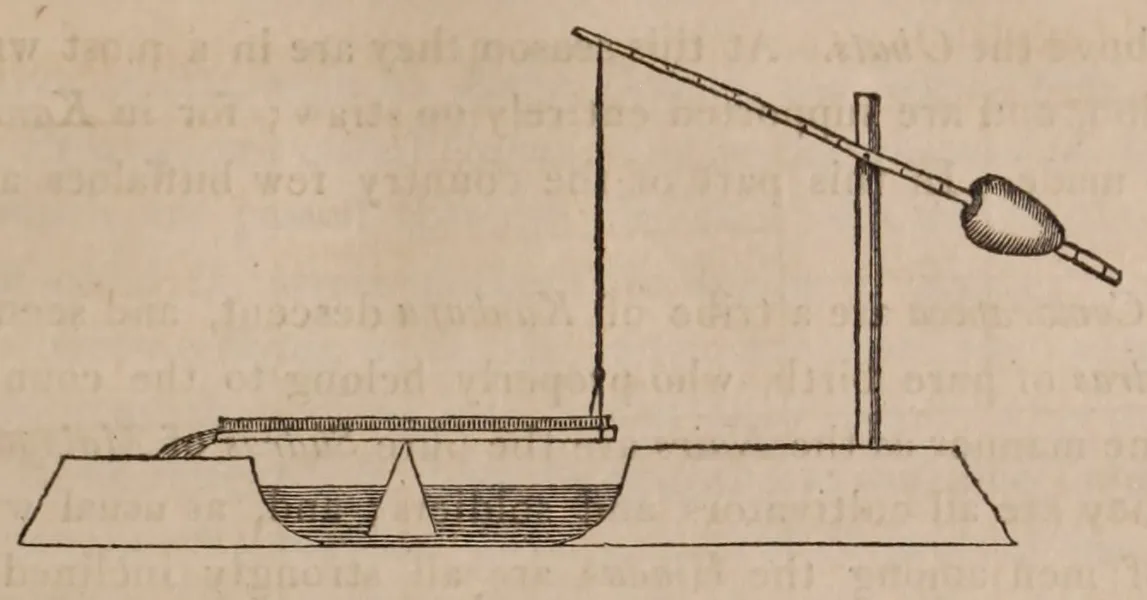
To the heavy end is annexed a Yatam wrought by two men, who allow this extremity of the trough to sink into the water, and to be thus filled. They then raise it by the Yatam, and the water runs out upon the field by the light end. Two men with a basket and ropes would throw out four times as much water, but it would be hard work.
Upon good Surd land may be procured a second crop of the following leguminous plants :
- Udied, Phaseolus minimoo Roxb: MSS.
- Mung, Phaseolus mungo.
- Cultie, Dolichos biflorus.
These are cultivated in the same manner as the pulses in Haiga.
In the rainy season the cattle are kept in the house, and, to increase the quantity of manure, are littered with fresh leaves. In the dry season they are shut up at night in pens, which are placed on the Surd lands, and are shifted once in four days. Every morning some dry soil is mixed with the foregoing night’s dung, and the whole is made smooth, that the cattle may lie clean. The manure collected in the rainy season is given to the soil of the first and second quality, which are always sown with rice after the dry-seed cultivation. The ashes of the family are kept separate, but are used for the same kind of land.
The cattle here are of the same small kinds that are to be found on the coast to the southward. A great many of them are brought from above the Ghats. At this season they are in a most wretched condition, and are supported entirely on straw; for in Kankana no hay is made. In this part of the country few buffaloes are employed.
The Comarapeca are a tribe of Kankana descent, and seem to be the Súdras of pure birth, who properly belong to the country; in the same manner as the Nairs are the pure Súdras of Malayala. By birth they are all cultivators and soldiers; and, as usual with this class of men among the Hindus, are all strongly inclined to be robbers. From the anarchy which has long prevailed in this neighbourhood, they had acquired an extraordinary degree of cruelty, and had even compelled many Bráhmans to assume their customs, and adopt their cast. They have hereditary chiefs called Náyakas, who, as usual, with the assistance of a council, can expel from the cast, and settle disputes among their inferiors. A man's own children are his heirs. They can read poetical legends, and are permitted to eat meat and drink spirituous liquors. Their women are not marriageable after the age of puberty. Widows ought to burn themselves with the bodies of their husbands, but this barbarity is no longer in use. Widows, and women who have been divorced for adultery with a Bráhman or Comarapeca, may be taken into a kind of left-hand marriage; but their children are despised, and no person of a pure descent will marry them. A woman cannot be divorced for any other cause than adultery; if the crime has been committed with any man but a Bráhman, or Comarapeca, she loses cast. The men may take as many wives as they please. The Sringa-giri Swamalu is their Guru. He receives their Dharma, and bestows on them Upadesa, holy-water, consecrated ashes, and the like. The Panchanga, or astrologer of the village, is their Puróhita, and reads prayers (Mantrams) at marriages, Namacurna (the giving a child its name), Tithi, Amávásya, &c. &c. They worship the great gods, Siva and Vishnu, in temples where Kankana Bráhmans are Pújáris. They offer bloody sacrifices; and at the temples of the Saktis, or destructive spirits, such as Dava Dévaru, and Marca Devi, whose priests (Pújáris) are called Gurus, they swing suspended by iron hooks which are passed through the skin of their backs. The spirits of children, whose mothers die during pregnancy, are supposed to become Butas, or devils, and to occasion much trouble to those unfortunate persons into whom they enter. The sufferers attempt to be relieved of them by prayer and sacrifice, and some village people are imagined to be possessed of invocations (Mantrams) capable of expelling these evil spirits. The Comarapecas suppose that the spirits of good men go to Moesha, a pretence that is looked upon by the Bráhmans as very impudent; for they think that such a place is far beyond the reach of a Súdra. For the spirits of bad men the Comarapeca do not know any place of punishment, nor do they know what becomes of such after death.
The Bráhmans properly belonging to Kankana, and who alledge that they are the descendants of the colony to whom the country was given by Parasu Ráma, are of the Pansh Gauda division. Goa, called by them Govay, seems to have been their principal seat. After being expelled thence by the Portuguese, they dispersed, and have now mostly become traders. A few are still priests (Pújáris), and a very small number call themselves Vaidikas. All those who are here are very ignorant, and do not pretend to say when the Jain and Panch Dravada Bráhmans came in upon them.
4th March.—I went three cosses to Gopi-chitty. For the first part of the journey the road led through a level country, with a few small hills scattered at some distance, and a pretty good soil. It afterwards passed among low hills covered with wood. In many places here, the soil seems good, and the trees are tall; so that pepper might probably be cultivated to advantage. In many other places the hills are barren, producing nothing but bushes, or stunted trees: among them I saw no Teak. Gopi-chitty is a village containing eight houses. Owing to the disturbed state of the country, it had for twenty years been entirely deserted; but the confidence of enjoying security under Major Monro’s authority, has induced the present inhabitants to settle in the place, and they have already cleared a considerable extent of the rice ground, which consequently belongs entirely to the government. The lower part of the valley, toward the great river, has been destroyed by the breaking down of the dykes that kept out the tide. To repair these, would cost 25 Pagodas, which is more than the tenants can afford or choose to advance.
This part of Kankana, on the fall of the Sultans of Vijaya-pura, became subject to the Rájás of Sudha, which we call Soonda. One of these, named Sedásiva Row, built the fort at the mouth of the river, and called it after his own name. The dialect of Kankana is used by the natives of this place in their own houses; but, from having been long subject to Vijaya-pura, almost all of them can speak the Marattah language, which has a very strong affinity with the Hinduy that is spoken on the banks of the Ganges.
5th March.—I went four cosses to Caderi, and did not see a house the whole way; but the heads of some cultivated vallies approach near the road, and extend from thence toward the river. I passed through many places that formerly have been cultivated, but are now waste, and through some places where the soil seems fit for cultivation, but which probably have never been cleared. The trees in some places are of a good size, but none of them are very valuable. The people whom I took with me for the purpose gave me the following account of such as I observed by the way.
The most common is the prickly Bamboo, called Colaki.
Cussum, or the Shaguda of my MSS. Is very hard, and strong, and is used for the cylinders of sugar-mills.
Rindela, Chuncoa Huliva, Buch: MSS. Is used only for the beams of the houses of the natives.
Biba, Holigarna, Buch: MSS. This is the varnish tree of Chittigong, and I suppose of Ava. The natives here are only acquainted with the caustic nature of its juice, and apply it to no use.
Cadumba, the Nauclea purpurea Rox: A large tree used for planks.
Maratu, a Chuncoa called by Dr. Roxburgh Terminalia alata glabra, Grows to a very large size, and is used for building boats and canoes.
Beiladu, Vitex foliis ternatis, Of hardly any use.
Cajeru, Strychnos Nux vomica.
Hedu, Nauclea Daduga Roxb: MSS. A large tree fit for planks.
Cumbia. The Pelou of the Hort: Mal:
Ticay, Laurus Cassia. People from above the Ghats come to collect both the bark and the buds, which the natives call Cabob-China.
Paynra. Gardenia uliginosa Willd: Of no use.
Hodogus. Arbor foliis suboppositis, estipulaceis, ovalibus, integerrimis. The timber is said to be very strong and durable, and to resist the white ants, even when buried in the ground.
Sissa. Pterocarpus Sissoo Roxb: MSS. Is found in great plenty near the river toward the Ghats.
Dillenia pentagyna Roxb: The natives have no name for it.
Jambay. Mimosa xylocarpon Roxb: It grows to an immense size.
Bassia longifolia.
Robinia mitis.
Myrtus cumini.
The forests are the property of the gods of the villages in which they are situated, and the trees ought not to be cut without having obtained leave from the Gauda, or head man of the village, whose office is hereditary, and who here also is priest (Pújári) to the temple of the village god. The idol receives nothing for granting this permission; but the neglect of the ceremony of asking his leave brings his vengeance on the guilty person. This seems, therefore, merely a contrivance to prevent the government from claiming the property. Each village has a different god, some male, some female, but by the Bráhmans they are all called Saktis (powers), as requiring bloody sacrifices to appease their wrath.
No persons here collect honey or wax.
Caderi at present contains only two houses, with one man and a lad, besides women. It was formerly a place of note; but for several years a great sickness has prevailed, and has swept off nearly all the inhabitants. This is attributed to the vengeance of some enraged Buta, or devil; but may be accounted for from the neighbouring country having been laid waste, and being over-run with forests. On the banks of the river at Caderi there was a fort, which was destroyed by Hyder, and the garrison sent to occupy the fortified island at the mouth of the river. General Mathews, the natives say, took possession of the ruins, erected some works, and left a garrison, which held out until the peace of Mangalore. Most of the cultivators lived on the opposite side of the river. Those who resided near the fort were chiefly traders; and there is still a weekly fair at the place, to which many people resort. This seems to be the reason why the few remaining inhabitants continue in such a situation. They are Bráhmans; and from those who frequent the fair they receive considerable contributions. Patemars, or large craft, can ascend almost to the fort, and canoes can go two miles above it. The water is quite fresh. The encouraging of a market (Bazar) here seems to be an object of importance, and a mean likely to bring back a great trade to this river, which by nature has many advantages.
6th March.—I went four cosses to Avila-gotna, without having seen the smallest trace of cultivation, or of inhabitants. The country is not, however, entirely a desert. Small villages are scattered through the forests, and hidden in its recesses. Formerly the inhabitants of these lived in a constant defiance of the rest of mankind, robbing whoever unfortunately came within their power, and continually on the alarm to defend themselves from their neighbours. This manner of living has however been entirely stopped. Major Monro, by taking advantage of the terror inspired by the fall of Seringapatam, and by an instant punishment of the first transgressor, has made every thing quiet; and there is reason to think that a defenceless man may now traverse these forests without danger from his fellow-creatures. Tigers are said to be very numerous; and, to lessen the danger to be apprehended from them, the traders who frequent the road have cleared many places where they may encamp, and these are prevented from being overgrown by annually burning the long grass. On one of these clear places I halted, having at no great distance a village of thieves.
The country through which I passed to-day was in general level, with hills near the road toward the left, and a ridge to the right at about four or five miles distance. This ridge is that which runs out into the sea to form the southern boundary of the bay of Sedásiva-ghur. The trees are in general high, with many Bamboos intermixed. The soil is apparently good, and a large proportion of it is sufficiently level for the plough. Near Avila-gotna I crossed the river, which here assumes a very singular appearance. Its channel is about half a mile wide, and consists of a confused mass of rocks, gravel, and sand, intersected by small limpid streams, and overgrown with various trees and shrubs which delight in such situations. In the rainy season, it swells into tremendous torrents, but never fills the channel from bank to bank. It is then, however, quite impassable. At present its clear streams, with the fresh verdure of the plants growing near them, are very pleasant, after having come through the forest, whose leaves at this season drop; for all the juices of the trees are dried up by the arid heat of this climate, in the same manner as they are by the cold of an European winter. The nights, however, are at present cool, but the days are burning hot. Near the sea a more equable temperature prevails.
7th March.—Although before leaving Sedásiva-ghur, I had collected the persons who were said to be best informed concerning the road, and had procured from them a list of stages said to be distant from each other three or four cosses, that is, about ten or thirteen miles; yet to-day I came to my stage at Déva-kara, after less than an hour's journey.
The road passes along the south side of the river; and toward the east the valley becomes narrower, and more uneven; but still much of it is fit for the plough. From the stunted appearance of the trees, I conclude that the soil is worse than that on yesterday's route. At Déva-kara there is a good deal of ground cleared, and formed into rice fields; but the people of eight houses, which form the village, are not able to cultivate the whole. The ground that is cleared is by no means equal either in soil or levelness, to much of what I saw waste on the two last days' journey; but it is finely watered by a stream that even now affords a great supply. The river at Déva-kara is a rapid stream full of small islands; but not so much broken as at Avila-gotna, and of course narrower. In the rainy season it is quite impassable; and then, although very rapid, swells at least ten feet above its present level.
At the commencement of the last rainy season, this village contained twelve houses; but, twenty persons having died, four of the houses are now deserted. It is looked upon as certain death, for any stranger to attempt to settle in this place.
Here was the residence of a very notorious robber, who died in consequence of the wounds that he received from the party which Major Monro sent to apprehend him. His family are now quiet cultivators, and ever since his death safety and tranquillity have been established in the country.
The people here say, that their Surd lands produce from 12 to 20 seeds, which is a more probable account than that given at Sedásiva-ghur, unless the seed there be sown as thick as in Malabar.
As I am now about to enter Karnata Désam, where a new face of things will present itself, I shall here conclude the chapter, by extracting from Mr. Read's answers to my queries such as relate to that part of his district which is situated below the Ghats, and which comprehends the districts (Talucs) of Kunda-pura and Honawera in Haiga, and that of Ancola in Kankana.
In these districts the proportion of land capable of being cultivated with the plough, or of being converted into gardens, Mr. Read estimates as follows:
| Now cultivated. | Capable of being so. | Sterile. | |
|---|---|---|---|
| Kunda-pura | 0,32 | 0,08 | 0,60 |
| Honawera | 0,26 | 0,12 | 0,62 |
| Ancola | 0,21 | 0,20 | 0,59 |
The revenue, notwithstanding so much waste land, is said to have been greater during the first year of Major Monro's management, than it was ever before known to have been. Mr. Read attributes this to an increase of rent on the lands actually in cultivation; but of this I have much doubt. In general, the natives acknowledged a remission, which naturally they would not have done had their taxes been increased; and it must be remembered, that Tippoo had resumed all the charity lands (Enams), which during the former governments probably amounted to more than what is now waste, while the collections remitted to the treasury, and consequently brought to accompt, during the Sultán's government, are no rule by which an estimate can be formed of the taxes; the whole revenue department under him having been subject to the most gross peculation.
The produce of the waste lands brought to market, Mr. Read states as follows.
The Maund weighs 24 84/100 lb. and is divided into 40 Seers.
| Sandal wood trees. Total. | Teak trees cut annually. | Sissa trees cut annually. | Annual produce of honey. | Annual produce of bees wax. | Annual produce wild cin-namon. | Annual produce of Cabob China. | Annual produce nutmegs | Annual produce of wild pepper. | |
|---|---|---|---|---|---|---|---|---|---|
| Maunds. | Maunds. | Maunds. | Maunds. | Maunds. | Maunds. | ||||
| Kunda-pura | 8758 | — | 1582 | — | — | 8 30 | 25 30 | — | 51 0 |
| Honawera - | 1017 | 2059 | 344 | — | — | 99 35 | 42 32½ | 12 5 | 533 0 |
| Ancola - - | 315 | 1124 | 572 | 8 0 | 2 7½ | 15 10 | 50 14 | 28 17½ | 474 38¾ |
| Total - | 10143 | 3183 | 2498 | 8 0 | 2 7½ | 123 35 | 118 36½ | 40 22½ | 1058 38¾ |
The Cut, and perhaps some other articles of less importance, have eluded Mr. Read's inquiries, probably from their never having been objects of revenue.
“All sandal trees,” says Mr. Read, “growing upon private lands are considered as the property of the government; but it would be ridiculous to suppose, that they will always be considered as such by the occupiers of estates, who undoubtedly commit frequent depredations upon them. It would therefore be for the benefit of the Company to have the whole cut down immediately that are of a fit age, which I am told is not till they are 30 years old. The whole might be easily collected at Onore (Honawera), and taken up by one of the Indiamen passing from Bombay to China.” Mr. Read was probably not aware, that last year all the ripe sandal in Mysore had been cut, and a great danger has consequently been incurred of glutting the market; while some years hence it will probably be greatly enhanced in value. I have already mentioned, that some measure should be adopted for regulating the cutting of the sandal wood; so that a certain supply should annually be brought to market, and no more permitted to grow than can be disposed of to advantage; for it must be considered as a mere superfluous luxury, the only proper use of which is to become a source of as much revenue as possible. As the Company and the Mysore Rájá are in the sole possession of the countries which produce it, the arrangement might be readily made on somewhat like the following plan. An estimate of the quantity annually saleable, and of the whole produce that grows in both territories, having been formed, an agreement might be made, that each party should furnish the annual supply for a number of years, in proportion to the whole quantity that grows in his country. For instance, the Mysore Rájá might furnish the supply for nineteen years, and the Company for one, which I imagine is somewhat about the relative proportion of what the two territories produce. The parties, of course, would be tied down to sell no more than a certain weight each year. They might improve its quality, as much as they could; and public sales, such as the Company use in Bengal for opium and salt, I am persuaded would be found by far the most advantageous manner of disposing of this article. Mr. Read mentions no difference in the quality of the sandal which grows below the Ghats, from that which grows in Karnata; but all the natives that I have ever spoken with on the subject, from Pali-ghat to this place, look upon the produce of the low country as of little or no value, as having no smell.
The wild cinnamon and Cabob China are rented together for about 22 Rupees a year. The former sells in the market (Bazar) at 28 Rupees a Candy, and the latter at 32 Rupees. The Candy is equal to 20 Maunds.
Mr. Read values the wild pepper at one Pagoda a Maund; and says, that it is of a quality very inferior to that raised in gardens, which sells for about 1½ Pagoda. All the natives with whom I conversed looked upon them as of equal value.
The number of people at present employed in the Cumri, or Cotu-cadu cultivation, amounts to 2418, who pay yearly 954½ Pagodas, or 3s. 2¼d. a head. It is supposed by the revenue officers, that in this manner 1900 more people might find employment.
I have already mentioned Mr. Read's opinion concerning the quantity of land in his districts below the Ghats that is fit for the cultivation of rice or gardens. The quantity of sugar-cane annually raised is estimated at 98,19,250 canes, and Mr. Read does not think that this cultivation ought to be farther encouraged, as it would interfere with that of rice, which is more valuable.
The stock required for the arable lands, according to Mr. Read, is as follows.
| Ploughs belonging to | Cattle. | ||||
|---|---|---|---|---|---|
| Landlords. | Tenants. | Total. | Buffaloes old and young. | Cow kind old and young. | |
| Kunda-pura | 3180 | 4343 | 7523 | 5894 | 23462 |
| Honawera | 4883 | 1221 | 6104 | 8472 | 22148 |
| Ancola | 2331 | 673 | 3004 | 2858 | 11055 |
| Total | 10396 | 6237 | 16633 | 17224 | 55665 |
Mr. Read states it as Major Monro's opinion, that, had the land-tax on coco-nut plantations been more moderate, double the present quantity would have been raised. No means at present exist to ascertain the number, either actually growing, or that of plantations which have gone to decay.
Mr. Read gives the following account of the population of these districts.
| Houses, of which the following are occupied by | Persons of the following conditions. | ||||||||
|---|---|---|---|---|---|---|---|---|---|
| Total Numbers | Christians. | Mussulmans. | Bráhmans. | Sivabhactars. | Jain. | Salt-makers. | Fishermen. | Slaves of both sexes. | |
| Kunda-pura | 9049 | 36 | 485 | 1799 | 115 | 46 | — | 2628 | 410 |
| Honawera | 10554 | 256 | 704 | 2231 | 21 | 39 | 180 | 4842 | 470 |
| Ancola | 6130 | 93 | 311 | 804 | 11 | 1 | — | 1832 | 270 |
| Total | 25733 | 385 | 1500 | 4834 | 147 | 87 | 180 | 9302 | 1099 |
In the annexed Statement will be seen the exports and imports, by sea, from these districts: the first amounting to 331,532 Rupees, and the latter to 44,585 Rupees.
| No. | Names of the Articles. | Average annual Quantity Imported. | Total Value in Rupees. | Average annual Quantity Exported. | Total Value in Rupees. | |||||||||||||||||
|---|---|---|---|---|---|---|---|---|---|---|---|---|---|---|---|---|---|---|---|---|---|---|
| Corges of 1470 Pucka Seers. | Morays of 51½ Pucka Seers. | Candies of 20 Maunds. | Maunds of 44 Seers Cutcha. | Seers Cutcha of 24 Rupees. | Kodie, or Scores. | Tak 40 Cubits. | Adud, or Pieces. | Corges of 1470 Pucka Seers. | Morays of 51½ Pucka Seers. | Candies of 20 Maunds. | Maunds of 44 Seers Cutcha. | Seers Cutcha of 24 Rupees. | Kodie, or Scores. | Tak 40 Cubits. | Adud, or Pieces. | |||||||
| 1 | Rice, cleaned | — | 2 | 3¼ | — | — | — | — | — | 118 | 2363¾ | 5¾ | — | — | — | — | — | — | 141837 | |||
| 2 | Paddy, or rough rice | — | 64¾ | 5 | — | — | — | — | — | 1687 | 650¾ | ½ | — | — | — | — | — | — | 19523 | |||
| 3 | Ragy (Cynosurus) | — | — | — | — | — | — | — | — | — | 23¼ | 1 | — | — | — | — | — | — | 716 | |||
| 4 | Toor Dhall (a pulse) | — | — | — | 9 | — | — | — | — | 27 | 6¼ | ¾ | — | — | — | — | — | — | 628 | |||
| 5 | Green Cuddalay (ditto) | — | 1½ | 1½ | — | — | — | — | — | 218 | 1 | — | — | — | — | — | — | — | 130 | |||
| 6 | Wheat | — | 1½ | 8½ | — | — | — | — | — | 244 | — | 3½ | — | — | — | — | — | — | 14 | |||
| 7 | Shamay (millet) | — | — | ½ | — | — | — | — | — | 2 | — | 1 | — | — | — | — | — | — | 4 | |||
| 8 | Mustard | — | — | ¼ | ½ | 4 | — | — | — | 18 | ½ | — | ½ | 1½ | — | — | — | — | 59 | |||
| 9 | Wooduth (a pulse) | — | — | — | — | — | — | — | — | — | 14¼ | — | — | — | — | — | — | — | 862 | |||
| 10 | Green Gram (ditto) | — | — | — | — | — | — | — | — | — | 4½ | ¼ | — | — | — | — | — | — | 281 | |||
| 11 | Hurraday, or Allahsundy (ditto) | — | — | — | — | — | — | — | — | — | 6¾ | 2¼ | — | — | — | — | — | — | 364 | |||
| 12 | Gram for horses (ditto) | — | — | — | — | — | — | — | — | — | 14¾ | — | — | — | — | — | — | — | 740 | |||
| 13 | Lamp-oil seeds (Ricinus) | — | — | 2 | — | — | — | — | — | 5 | — | — | — | — | — | — | — | — | — | |||
| 14 | Chunam (lime) | — | — | 25¾ | — | — | — | — | — | 13 | — | — | — | — | — | — | — | — | — | |||
| 15 | Salt | — | — | 7643¼ | — | — | — | — | — | 2419 | — | 3105 | — | — | — | — | — | — | 621 | |||
| 16 | Sweet-oil seeds (Sesamum) | — | — | 6 | — | — | — | — | — | 15 | — | 10 | — | — | — | — | — | — | 25 | |||
| 17 | Toor (a pulse) | — | — | 7½ | — | — | — | — | — | 15 | ¼ | — | — | — | — | — | — | — | 19 | |||
| 18 | Lobay, or white Gram (ditto) | — | — | — | — | — | — | — | — | — | — | ¾ | — | — | — | — | — | — | 1 | |||
| 19 | Oil | — | — | — | 3 | 1 | 10 | — | — | 165 | — | — | 12¼ | 3 | 6½ | — | — | — | 731 | |||
| 20 | Ghee (boiled butter) | — | — | — | 1 | 2 | 9 | — | — | 149 | — | — | — | 3¾ | ¼ | — | — | — | 24 | |||
| 21 | Betel-nut 1st sort | — | — | — | 1½ | ¾ | — | — | — | 72 | — | — | 195¼ | ¼ | 10¾ | — | — | — | 11740 | |||
| 22 | Ditto - 2d ditto | — | — | — | — | — | — | — | — | — | — | — | 896 | 2½ | 6 | — | — | — | 36577 | |||
| 23 | Ditto - 3d ditto | — | — | — | — | — | — | — | — | — | — | — | 128¼ | 3¼ | 8½ | — | — | — | 4688 | |||
| 24 | Ditto - 4th ditto | — | — | — | — | — | — | — | 98500 | 78 | — | — | — | — | — | — | — | 1538605 | 620 | |||
| 25 | Pepper | — | — | — | ¼ | 4 | — | — | — | 50 | — | — | 278¼ | 3¼ | 9 | — | — | — | 28030 | |||
| 26 | Cardamoms | — | — | — | — | 4½ | 5 | — | — | 138 | — | — | — | — | — | — | — | — | — | |||
| 27 | Jagory of sugar-cane | — | — | — | 12 | 3 3/4 | — | — | — | — | — | 366 | — | — | — | 54 | 1 | — | — | — | — | 1100 |
| 28 | Palmira Jagory (bundles) | — | — | — | — | — | — | — | — | — | — | — | — | — | — | — | — | — | — | — | 537 | 136 |
| 29 | Turmerick | — | — | — | — | 4 1/2 | — | — | — | — | — | 5 | — | — | — | 17 1/2 | 4 1/4 | — | — | — | — | 476 |
| 30 | Jeeryah (a pulse) | — | — | — | 1/4 | 3 | — | — | — | — | — | 34 | — | — | — | — | 4 | 5 | — | — | — | 20 |
| 31 | Mathee (ditto) | — | — | — | 1/4 | 2 1/4 | — | — | — | — | — | 8 | — | — | — | 1/2 | — | — | — | — | — | 12 |
| 32 | Coriander seed | — | — | 16 3/4 | 3 3/4 | 1 1/2 | — | — | — | — | — | 108 | — | — | — | 6 1/4 | 4 3/4 | — | — | — | — | 204 |
| 33 | Woomum, or Ajewan (a kind of anise) | — | — | — | — | — | — | — | — | — | — | — | — | — | — | — | — | — | — | — | — | — |
| 34 | Onions | — | — | — | 10 1/4 | 3 | — | — | — | — | — | 6 | — | — | — | 1/4 | 2 | — | — | — | — | 4 |
| 35 | Garlick | — | — | — | 2 1/2 | 3/4 | — | — | — | — | — | 102 | — | — | — | 8 1/2 | 1 1/2 | — | — | — | — | 103 |
| 36 | Chillees, or Capsicum | — | — | — | 5 1/2 | 3 1/4 | — | — | — | — | — | 45 | — | — | — | 1 3/4 | 2 3/4 | — | — | — | — | 50 |
| 37 | Cinnamon (Cassia) | — | — | — | — | — | — | — | — | — | — | 162 | — | — | — | 66 3/4 | 1 | 8 | — | — | — | 2184 |
| 38 | Ditto flower | — | — | — | — | — | — | — | — | — | — | — | — | — | — | 4 | 4 | — | — | — | — | 81 |
| 39 | Dry coco-nuts | — | — | — | 42 1/4 | 2 1/2 | — | — | — | — | — | 1349 | — | — | — | 10 1/4 | 4 | — | — | — | — | 252 |
| 40 | Tamarind | — | — | — | 3 3/4 | 1 1/2 | — | — | — | — | — | 44 | — | — | — | 2 1/2 | 2 1/2 | — | — | — | — | 95 |
| 41 | Hamsool ditto | — | — | 5 | — | — | — | — | — | — | — | 7 | — | — | — | 11 1/4 | 2 1/4 | — | — | — | — | 114 |
| 42 | Ginger | — | — | — | 1 1/2 | 1 1/4 | — | — | — | — | — | 94 | — | 21 1/4 | — | — | — | — | — | — | — | 38 |
| 43 | Green ginger | — | — | — | 1/4 | — | — | — | — | — | — | 4 | — | — | — | — | — | — | — | — | — | — |
| 44 | Cut, or Terra Japonica | — | — | — | — | — | — | — | — | — | — | — | — | — | — | — | — | — | — | — | — | — |
| 45 | Coirs (coco-nut-rope) | — | — | — | — | — | — | — | — | — | — | — | — | — | — | 1/4 | — | — | — | — | — | 10 |
| 46 | China sugar | — | — | — | 11 3/4 | 2 1/2 | — | — | — | — | — | 960 | — | — | — | 214 3/4 | 2 | 5 | — | — | — | 4170 |
| 47 | Sugar candy | — | — | — | 1 1/2 | 3 3/4 | 5 | — | — | — | — | 270 | — | — | — | 2 1/4 | 2 | — | — | — | — | 235 |
| 48 | Dry dates | — | — | — | 61 1/2 | 5 | — | — | — | — | — | 1364 | — | — | — | — | — | — | — | — | — | — |
| 49 | Dates | — | — | — | 312 3/4 | 4 1/4 | — | — | — | — | — | 4522 | — | — | — | — | — | — | — | — | — | — |
| 50 | Plumbs (raisins) | — | — | — | — | 2 3/4 | 5 | — | — | — | — | 72 | — | — | — | — | — | — | — | — | — | — |
| 51 | Mace | — | — | — | — | 1/4 | — | — | — | — | — | 50 | — | — | — | — | — | — | — | — | — | — |
| 52 | Almonds | — | — | — | — | 2 3/4 | — | — | — | — | — | 6 | — | — | — | — | — | — | — | — | — | — |
| 53 | Camphire | — | — | — | — | 4 1/4 | — | — | — | — | — | 176 | — | — | — | — | — | — | — | — | — | — |
| 54 | Benjamin | — | — | — | 1/4 | 3 | — | — | — | — | — | 80 | — | — | — | — | — | — | — | — | — | — |
| 55 | Googool Dammer (Resin) | — | — | — | 1 | — | — | — | — | — | — | 21 | — | — | — | 4 1/4 | — | — | — | — | — | 90 |
| 56 | Malaca (ditto) | — | — | — | — | 1/2 | — | — | — | — | — | — | — | — | — | — | — | — | — | — | — | — |
| 57 | Brimstone | — | — | — | — | 1 1/2 | — | — | — | — | — | 4 | — | — | — | 1/4 | 3/4 | 5 | — | — | — | 18 |
| 58 | Saltpetre | — | — | — | — | 2 | — | — | — | — | — | 8 | — | — | — | 1/4 | — | — | — | — | — | 25 |
| 59 | Kankana kar | — | — | — | — | 3 3/4 | — | — | — | — | — | 35 | — | — | — | — | 1 | — | — | — | — | 10 |
| 60 | Tin | — | — | — | 6 1/2 | 1 1/4 | — | — | — | — | — | 1290 | — | — | — | — | — | — | — | — | — | — |
| 61 | Soap | — | — | — | 2 | 1/2 | — | — | — | — | — | 162 | — | — | — | — | — | — | — | — | — | — |
| 62 | Chendoorum | — | — | — | — | 3 1/2 | — | — | — | — | — | 21 | — | — | — | — | — | — | — | — | — | — |
| 63 | Puppada kar | — | — | — | 3 | 2 | — | — | — | — | — | 50 | — | — | — | — | — | — | — | — | — | — |
| 64 | Cupper Sooth | — | — | — | — | 2 1/2 | — | — | — | — | — | 10 | — | — | — | — | — | — | — | — | — | — |
| 65 | Wax | — | — | — | 1/4 | 1 1/4 | 3 | — | — | — | — | 43 | — | — | — | 1 | 2 1/2 | 1 | — | — | — | 180 |
| 66 | Moy Pull, or Coy | — | — | — | 4½ | — | — | — | — | 40 | — | — | — | — | — | — | — | — | — | |||
| 67 | Hing, or Asafœtida | — | — | — | 3 | 1½ | — | — | — | 90 | — | — | — | — | — | — | — | — | — | |||
| 68 | Tippeelee Moolum | — | — | — | 2½ | — | — | — | — | 20 | — | — | — | — | — | — | — | — | — | |||
| 69 | Red paint | — | — | — | — | 5 | — | — | — | 10 | — | — | — | — | — | — | — | — | — | |||
| 70 | Green ditto | — | — | — | — | 1¼ | — | — | — | 3 | — | — | — | — | — | — | — | — | — | |||
| 71 | Spanish root | — | — | ¼ | 2 | ¼ | — | — | — | 56 | — | — | — | — | — | — | — | — | — | |||
| 72 | Issup Koole | — | — | — | 2 | — | — | — | — | 20 | — | — | — | — | — | — | — | — | — | |||
| 73 | Goornalputhay | — | — | — | — | 5 | — | — | — | 10 | — | — | — | — | — | — | — | — | — | |||
| 74 | Subjah | — | — | — | 1 | — | — | — | — | 1 | — | — | — | — | — | — | — | — | — | |||
| 75 | Gum | — | — | — | 3 | — | — | — | — | 10 | — | — | — | — | — | — | — | — | — | |||
| 76 | Jahpull Beez (nutmegs" | — | — | — | 3 | — | — | — | — | 15 | — | — | — | 4 | — | — | — | — | 8 | |||
| 77 | Gurd pull | — | — | — | — | — | — | — | — | — | — | — | — | 4 | — | — | — | — | 4 | |||
| 78 | Coochalay Beez | — | — | — | — | — | — | — | — | 2 | — | — | — | — | — | — | — | — | — | |||
| 79 | Muckah | — | — | — | — | 1 | — | — | — | 4 | — | — | — | — | — | — | — | — | — | |||
| 80 | Rogun | — | — | — | — | 1 | — | — | — | 120 | — | — | — | — | — | — | — | — | — | |||
| 81 | Cauvee, or paint (Reddle" | — | — | 5¼ | 2½ | — | — | — | — | 80 | — | — | — | — | — | — | — | — | — | |||
| 82 | Paring Chucka | — | — | 2 | — | — | — | — | — | — | — | — | 1 | 4¾ | — | — | — | — | 288 | |||
| 83 | Fish geeree | — | — | — | ½ | — | — | — | — | 20 | — | — | — | — | — | — | — | — | — | |||
| 84 | Cuteecoorogcony | — | — | — | — | — | — | — | 400 | 80 | — | — | — | — | — | — | — | 140 | 28 | |||
| 85 | Iron | — | — | 10 | 3½ | 4½ | — | — | — | 129 | — | — | ¼ | 3 | — | — | — | — | 3 | |||
| 86 | Gopee Chundenum | — | — | 3½ | 4½ | — | — | — | — | 300 | — | — | — | — | — | — | — | — | — | |||
| 87 | Copper | — | — | 4½ | 4½ | — | — | — | — | 145 | — | — | — | — | — | — | — | — | — | |||
| 88 | Brass | — | — | 1 | 2 | — | — | — | — | 88 | — | — | — | — | — | — | — | — | — | |||
| 89 | Cotton | — | — | — | — | — | — | — | — | — | — | — | ½ | — | — | — | — | — | 180 | |||
| 90 | White thread | — | — | 6¼ | 2½ | — | — | — | — | 133 | — | — | — | — | — | — | — | — | — | |||
| 91 | Twine | — | — | — | 4¾ | — | — | — | — | 15 | — | — | — | — | — | — | — | — | — | |||
| 92 | Cossumba flower (Carthamus" | — | — | — | 1½ | — | — | — | — | 30 | — | — | — | — | — | — | — | — | — | |||
| 93 | Silk thread | — | — | 105½ | 4¼ | 3¼ | — | — | — | 8508 | — | — | 6 | 4¼ | — | — | — | — | 745 | |||
| 94 | Tobacco Malabar | — | — | — | — | — | — | — | — | — | — | — | — | — | — | — | — | 16 | 2 | |||
| 95 | Steel | — | — | — | — | — | — | — | — | — | — | — | — | — | — | — | — | — | — | |||
| 96 | Sealing-wax | — | — | — | — | — | 3 | — | — | — | 103 | — | — | — | — | — | — | — | — | |||
| 97 | Soonda salt | — | — | — | 1/2 | 1/4 | — | — | — | — | 1 | — | — | — | — | — | — | — | — | |||
| 98 | Hingdah | — | — | — | — | 1 1/2 | — | — | — | — | 30 | — | — | — | — | — | — | — | — | |||
| 99 | Budda Soop | — | — | — | — | 3 | — | — | — | 140 | 20 | — | — | — | — | — | — | — | — | |||
| 100 | Sundry cloths | — | — | — | — | 4 3/4 | — | 126 | 196 1/2 | — | 3720 | — | — | — | 33 1/4 | 49 1/2 | — | — | — | |||
| 101 | Blue cloths | — | — | — | — | — | — | 55 3/4 | 5 | — | 680 | — | — | — | — | — | — | — | — | |||
| 102 | Silk cloths | — | — | — | — | — | — | 1 1/2 | 45 | — | 560 | — | — | — | — | — | — | — | — | |||
| 103 | Case shawls (Bonares | — | — | — | — | — | — | — | 40 | — | 60 | — | — | — | — | — | — | — | — | |||
| 104 | Silk upper cloths | — | — | — | — | — | — | — | 2 | — | 65 | — | — | — | — | — | — | — | — | |||
| 105 | Cutkah Tharree cloths | — | — | — | — | — | — | 1 1/4 | — | — | 400 | — | — | — | — | — | — | — | — | |||
| 106 | Nankeen | — | — | — | — | — | — | 6 1/2 | 4 1/2 | — | 202 | — | — | — | — | — | — | — | — | |||
| 107 | Nar Muddee | — | — | — | — | — | — | 8 1/4 | 37 | — | 130 | — | — | — | — | — | — | — | — | |||
| 108 | Chints | — | — | — | — | — | — | 3 | 5 1/4 | — | 257 | — | — | — | — | — | — | — | — | |||
| 109 | White Comblie (blankets | — | — | — | — | — | — | 124 | 1 | 1 | 80 | — | — | — | — | — | — | 1 | 2 | |||
| 110 | Black Comblie (ditto | — | — | — | — | — | — | 6 1/2 | — | 5 | 698 | — | — | — | — | — | — | — | — | |||
| 111 | Musrooms | — | — | — | — | — | — | 1 3/4 | 57 | — | 290 | — | — | — | — | — | — | — | — | |||
| 112 | China Peelown | — | — | — | — | — | — | 1 1/4 | 3 | — | 125 | — | — | — | — | — | — | — | — | |||
| 113 | Soorlee Thaun | — | — | — | — | — | — | 1/4 | — | — | 310 | — | — | — | — | — | — | — | — | |||
| 114 | Dummas | — | — | — | — | — | — | 1/4 | 5 | — | 120 | — | — | — | — | — | — | — | — | |||
| 115 | Moocmall | — | — | — | — | — | — | 1/2 | — | — | 202 | — | — | — | — | — | — | — | — | |||
| 116 | Mooctay cloth | — | — | — | — | — | — | 2 3/4 | 40 1/2 | — | 1163 | — | — | — | — | — | — | — | — | |||
| 117 | China handkerchiefs | — | — | — | — | — | — | 3 1/4 | 36 3/4 | — | 4 | — | — | — | — | — | — | — | — | |||
| 118 | Loongee | — | — | — | — | — | — | 1/2 | 2 | — | 56 | — | — | — | — | — | — | — | — | |||
| 119 | Silk Kittasauls (umbrellas | — | — | — | — | — | — | 7 1/2 | — | 4 | 70 | — | — | — | — | — | — | — | — | |||
| 120 | China ditto | — | — | — | — | — | — | 6 | — | — | 180 | — | — | — | — | — | — | — | — | |||
| 121 | Canvas | — | — | — | — | — | — | — | — | — | 88 | — | — | — | — | — | — | — | — | |||
| 122 | Red Dungree | — | — | — | — | — | — | 2 1/2 | 4 | — | 100 | — | — | — | — | — | — | — | — | |||
| 123 | Kinkop (silk cloth | — | — | — | — | — | — | — | 2 | — | 40 | — | — | — | — | — | — | — | — | |||
| 124 | Umroo | — | — | — | — | — | — | — | 2 | — | 940 | — | — | — | — | — | — | — | — | |||
| 125 | Silk Womans cloth | — | — | — | — | — | — | — | 91 1/2 | — | 147 | — | — | — | — | — | — | — | — | |||
| 126 | Kelkee ditto ditto | — | — | — | — | — | — | — | 21 | — | 90 | — | — | — | — | — | — | — | — | |||
| 127 | Howrunga Jubbee Thaun | — | — | — | — | — | — | — | 9 | — | 40 | — | — | — | — | — | — | — | — | |||
| 128 | Thod putree | — | — | — | — | — | — | 1/4 | 4 | — | 1274 | — | — | — | — | — | — | — | — | |||
| 129 | Turbans | — | — | — | — | — | — | — | 66 | — | 45 | — | — | — | — | — | — | — | — | |||
| 130 | Gunnee, or sackcloth | — | — | — | — | — | — | — | — | 44 1/2 | 2 | — | — | — | — | — | — | — | — | |||
| 131 | Glass | — | — | — | — | — | 1 | — | — | — | 22 | — | — | — | — | — | — | — | — | |||
| 132 | Pearl shells | — | — | — | — | — | — | — | — | 511 | — | — | — | — | — | — | — | — | — | |||
| 133 | Rojahver Tubbucks | — | — | — | — | — | — | — | — | 28 | 42 | — | — | — | — | — | — | — | — | |||
| 134 | Rose water bottles | — | — | — | — | — | — | 1 3/4 | — | 2 | 37 | — | — | — | — | — | — | — | — | |||
| 135 | China ware | — | — | — | — | — | — | 16 | — | 111 | 431 | — | — | — | — | — | — | — | — | |||
| 136 | Salt-fish bundles | — | — | — | — | — | — | — | 2 | 4 | — | — | — | — | — | — | — | — | — | |||
| 137 | Ditto by Donies | — | — | — | — | — | — | — | 6 | 150 | — | — | — | — | — | — | — | — | — | |||
| 138 | Coomloo Mass (a fish) | — | — | — | 1¼ | — | — | — | 1500 | 50 | — | — | — | — | — | — | — | — | — | |||
| 139 | Sheep and goats | — | — | — | — | — | — | — | 2 | 4 | — | — | — | — | — | — | — | — | — | |||
| 140 | Liquor pipes | — | — | — | — | — | — | — | — | — | — | — | — | — | — | — | — | 109¾ | — | |||
| 141 | Coco-nuts | — | — | — | — | — | — | — | 172399 | 4000 | — | — | — | — | — | — | — | 48795 | 975 | |||
| 142 | Country paper reams | — | — | — | — | — | — | — | 60¾ | 607 | — | — | — | — | — | — | — | — | — | |||
| 143 | Betel-leaf bundles | — | — | — | — | — | — | — | 17½ | 26 | — | — | — | — | — | — | — | 6000 | 6000 | |||
| 144 | Sugar-cane | — | — | — | — | — | — | — | 5300 | 43 | — | — | — | — | — | — | — | 150 | 2 | |||
| 145 | Cadjans (coarse mats) bundles | — | — | — | — | — | — | — | — | — | — | — | — | — | — | — | — | 4½ | 60 | |||
| 146 | Green plantains | — | — | — | — | — | — | — | 18 | 5 | — | — | — | — | — | — | — | — | — | |||
| 147 | Bahder buttoo | — | — | — | — | — | — | — | — | — | — | — | 32¾ | — | — | — | — | — | 200 | |||
| 148 | Mummeeties | — | — | — | — | — | — | — | — | — | — | — | — | — | — | — | — | 140 | 140 | |||
| 149 | Firewood boat loads | — | — | — | — | — | — | — | — | — | — | — | — | — | — | — | — | 13 | 52 | |||
| 150 | Basket bundles | — | — | — | — | — | — | — | 10 | 1 | — | — | — | — | — | — | — | 25 | 12 | |||
| 151 | Matts | — | — | — | — | — | — | — | — | — | — | — | — | — | — | — | — | 318 | 318 | |||
| 152 | Buttoovah | — | — | — | — | — | — | — | 9 | 2 | — | — | — | — | — | — | — | — | — | |||
| 153 | Sundry Curry-stuff bundles | — | — | — | — | — | — | — | 19 | 39 | — | — | — | — | — | — | — | 5 | 12 | |||
| 154 | Sandal-wood | — | — | — | — | — | — | — | — | — | — | — | 803 | 6¼ | 5 | — | — | — | 64660 | |||
| Total value in Rupees | 44585 | 331532 | ||||||||||||||||||||