MARCH 29th.—I went to Cowldurga, which is said to be four cosses from Nagara; but the stage proved very long, as the gate was at least four miles from where my tents had been pitched. The road the whole way is exceedingly rough and hilly. The hills are all covered with woods, most of which produce the wild pepper vine: but these are quite neglected; and as they are not cultivated, although the village people collect a little pepper, they pay no revenue. The want of the stimulus of rent seems to produce the neglect. I passed through a good many narrow vallies fit for the cultivation of rice, several of which were entirely waste. All the streams of these vallies fall into the river of Honawera.
The original name of Cowldurga was Bhavana-giri, and it is a place of great antiquity. A small fort is said to have been erected on the hill by Dharma Rájá, or Yudistara, one of the five sons of Pandu, who governed India at the commencement of this Yugam, almost 5000 years ago. The works of this old fortress are said to be still distinguishable by their solidity, and the excellence of their structure. The fortifications were much enlarged, and improved into their present form by Sedásiva Náyaka, the founder of the Kilidi family. Hyder repaired it, and added a cavalier, which by the Mussulmans here is called a battery; and he then changed the name of the place into Cowldurga, a name which the natives have retained out of respect to Hyder's memory, although they laugh at the barbarity of its derivation; for Cowl is a Mussulman word, originally I believe Arabic, and signifies protection or encouragement, such as is given by a good government to the subject; and Durga is a Karnataca word, signifying a fort that is situated on a rock. Tippoo, with the usual zeal of a Mussulman, changed the Pagan names of almost every town in his dominions; but the names which he bestowed have already fallen into disuse, and in a few years will sink into oblivion. The hill on which Cowldurga stands is not very high; but, the walls being numerous and lofty, it looks better than most of the hill forts of Karnata, of which the buildings are hardly observable at a distance, being hidden among the immense rocks on which they are placed. It is now undergoing a complete repair, and is garrisoned by the troops of the Mysore Rájá. The Petta stands at some distance, and contains about a hundred houses, which for an Indian town are well built. In the government of the Kilidi family, it contained six or seven hundred houses; for it is a considerable thoroughfare, and well situated for trade. The road from Hosso-Angady-ghat divides into two branches at Hyder-ghur: the one goes by Nagara; and that way the trade of Bangalore, Chatrakal, and other places toward the north-east, passes; the other branch of the road passes through Cowldurga, and is that by which the trade of Seringapatam goes to Canara. Hyder-ghur is a pass fortified by a wall and gate. Near it there is no cultivation; and indeed near Cowldurga there is very little. As, however, the pass commands one of the principal entrances into Karnata Désam, it seems to deserve some attention.
30th March.—I went four cosses to Hodalla. Near Cowldurg, the country is covered with thick forests. Farther on, the hills are tolerably well cleared, and the intermediate little vallies are as usual rice grounds. In fact, all this part of the country resembles entirely that below the western Ghats. The hills here, although apparently well fitted for this purpose, are never formed into terraces, as in Malabar. The gardens are not so numerous as near Nagara, and infinitely fewer than in Malayala. About half way, I passed through a village named Arga, which formerly was a large place. Its inhabitants were removed by Hyder to Cowldurga, and suffered much from the change of air; for Arga is in a clear open country, and Cowldurga is surrounded by hills and forests. East from Arga are two small rivulets, the Gopinátha, and Kusawati; which join, and then fall into the Tunga. The natives say, that at Galagunjy-mani, a hill near Sringa-giri, there is an image of Narasingha, the incarnation of Vishnu, whose head resembles that of a lion. This image is not larger than a man. From one eye comes a small stream, called the source of the Nétrawatí, which falls into the sea at Mangalore; another stream comes from his left tusk, and is the source of the Tunga; and a third stream, called the source of the Bhadra, comes from the right tusk of this image. These streams are about the thickness of a quill, and, having united for a little way, run down a rock, when they again separate; and each, being joined by various springs and rivulets, forms a river. I have heard a similar story at several places, both above and below the Ghats; and the account here given I took with care from a sensible person who has been on the spot; yet there is probably some gross mistake in it, most of the people here being willing to believe any thing extraordinary, even in perfect opposition to the evidence of their senses.
Hodalla contains seven or eight families, who are very inadequate to cultivate all the arable lands. It was formerly the residence of a family of Polygars, named Coramar, and of Telinga extraction. They were hereditary flute-players to the kings of Vijaya-nagara. By the first chiefs of the family of Kilidi they were deprived of their authority, but were allowed certain lands free from taxes. The family is now extinct.
A man here is just now forming a garden that will plant 12000 Betel-nut trees, which will be rated in the public accompts as 4000. The cost, before it comes to produce, according to estimate, will be 4000 Ikeri Pagodas, or 1611l. 15s. 11¼d. When the garden begins to produce, the Amildars (chief officers) of three districts (Talucs), three Sheristadars (accomptants of districts), and two principal cultivators from each of three neighbouring districts, will form a kind of jury, and fix the revenue according to the soil and local advantages; the maximum being 18 Ikeri Pagodas, and the minimum being 5 Pagodas, for every thousand rateable trees. In every part of the country this is the practice.
31st March.—I went to Tuduru. The stage seemed to be short, but it is called four cosses. The road passes near a village called Maluru, but on the whole way I did not see a house. By far the greater part of the country is covered with stunted woods; and as the roads generally follow the low hills, these hide from the view of the traveller the greater part of what is cultivated.
On the banks of the Tunga, near Maluru, is a celebrated temple named Mahisi, which signifies the female buffalo. It is supposed to have been built by Hanumanta, who, unwilling to accompany Ráma in his expedition against Lanca, assumed for concealment the form of this animal. At that time he built this temple, and dedicated it of course to Vishnu, his master. It is said to possess inscriptions on stone of great antiquity, of which the Amildar promised to send me copies. All that has come to hand, however, is one without a date, of which a copy has been given to the Bengal government.
At Tuduru there is no village, and only a few scattered houses. I pitched my tents at a ruinous Jangama's Mata, which stands on the left bank of the Tunga. The stream of this river never dries, but is not applied to irrigate the fields. In the morning there were two very heavy showers of rain from the eastward, with much thunder, and little wind. At this season usually, once in eight or ten days, similar rains are said to happen. The prevailing winds come from the west, and are strong and dry.
1st April.—I went four cosses to Baikshaváni Mata. The road is near the left bank of the Tunga. After leaving the cultivated country near Tuduru, which is pretty extensive, I entered a forest of trees and Bamboos, almost equalling in stature those of the western Ghats. Here were many fine Teak trees, more indeed than I have ever seen in any one place. They might be of value, could they be floated down the Tunga to the Krishna, and so to the sea; which I think might probably be done by supporting the floats with Bamboos. The Tunga at all times contains water; but in the dry season the channel, being full of rocks, will not admit floats. In the rainy season the river swells prodigiously, and is said to be in most places eight or ten feet higher than the top of the rocks. Its stream is then exceedingly rapid and muddy, and filled with large trees swept away by the flood; while in some places rocks come very near the surface. These circumstances would, no doubt, render the navigation in boats very dangerous, but they do not seem to me likely to impede well-constructed floats of timber, strengthened and buoyed up by Bamboos. If this should be found practicable, I know of no place that would answer better, for rearing a Teak forest, than the banks of the Tunga near Tuduru, where close to the river there is much excellent soil, which is considered as useless. As there are already on the spot many fine Teak trees, all that would be required would be, to eradicate the trees of less value, which I look upon as a necessary step to procure any considerable quantity of Teak in a well regulated government. In the wilds of America, or the dominions of Ava, where a few inhabitants are buried in the recesses of an immense forest, a considerable supply of timber may without trouble be procured; but in a well cultivated country, without much pains bestowed on rearing the proper trees, it is in vain to think of supplying the extensive demands of the shipbuilder.
In this forest the road is in several places defended by fortifications; for, although not hilly, it is a pass called Uluvadi. These fortifications were erected by Hyder, with a view probably of stopping marauders. After leaving this pass, I came to an extensive plain of rice ground, in which stands Manday Gudday, a scattered town surrounding a ruinous mud fort. It formerly was considerably larger, but suffered much from Purseram Bhow's army, into the course of whose destructive route I have again come.
Near the town I observed many fine trees of the Tundu, or Cedrella Tuna Roxb: MSS. Its flowers, as I have mentioned at Bangalore, are used for dyeing. It is said, that they are collected by Mussulmans, who gather them every morning as they fall from the tree, and afterwards dry them on mats exposed to the sun. The price at present is said to be so low, that none are collected.
East from the plain of Manday Gudday, I passed through a forest which contains much sandal-wood, but no Teak. Indeed, I have never seen the two trees in the same place.
On passing this forest, I came to an open country, in which is situated Baikshaváni Mata, where there is no village; all the houses are scattered on the different farms, which is the usual custom throughout the principalities (Ráyadas) of Sudha and Nagara, as well as in the country below the western Ghats.
The Mata belongs to the Sivabhactar Jangamas, one of whom still resides in it. The village is considered as his property, but he pays the usual taxes to government. He is dependent on the Umblay Guru, who lives near Shiva-mogay. None of these Matas seem to be older than the government of the Kilidi Rájás. Long before their accession, it is true, the greater part of the cultivators were Sivabhactars, and no doubt had among them many Jangamas; but they were probably in too great poverty to be able to erect religious buildings of any consequence.
The people here say, that if there were a sufficient number of cultivators the greater part of the woods might be cut, and the land, which these now occupy, might be converted into dry field; but at present about one third of the rice land is unoccupied. It would not however appear, that the country was ever sufficiently populous to cultivate more than the rice lands, with a very little of the adjacent high ground, and a few small plantations. At this distance from the Ghats, both Betel-nut and sandal-wood become scarce. Great quantities of the latter grow in the low woods between Hodalla and Tuduru.
Here the quantity of rain also diminishes ; and rice cannot be cultivated without small reservoirs, sufficient to contain a supply of water for two months after the cessation of the rains ; for the rains last four months only ; and all the kinds of rice that are cultivated here require six months to grow.
2d April.—I went a long stage, called five cosses, to Shiva-mogay. The first two cosses of this road are in a forest of very fine trees, many of which are Teak. On leaving this, I entered an open country extending very far to the eastward. The greater part of it seems to be fit for cultivation ; but at present a want of inhabitants renders the greatest part of it a waste. One coss from the forest is Gajunuru, a fort and village on the left bank of the Tunga.
On the plain between this and Shiva-mogay was fought a battle between Purseram Bhow, and Mahomet Reza, usually called the Binky Nabob, or burning Lord ; as, from his activity, he was usually employed by the Sultán to lay waste any country that might be of use to his enemies. Purseram had advanced as far as Fatah Petta, hoping that the garrison of Nagara would run away, and leave him the spoil of the city ; but as they preserved a countenance which he did not like, he marched toward his left, in order to join Lord Cornwallis before Seringapatam. At this place he was met by Mahomet Reza, who had 5000 horse, and 10,000 foot, with eight guns. An engagement took place, in which the Mussulman was defeated, and compelled to retire to Nagara with the loss of four or five hundred men. This is the account of the natives of Shiva-mogay, little inclined to favour either party. From the field of battle, Purseram advanced to Shiva-mogay, and after a siege of two days took the fort. His march, as usual, was marked by devastation, famine, and murder. The town at that time contained 6000 houses, the whole of which were destroyed; the women were ravished, and the handsomest carried entirely away. Such of the men as fell into the hands of the Marattahs were killed, and of those who escaped the sword a large proportion perished of hunger; every eatable thing having been swept away by those whom people in Europe are pleased to call the gentle Hindus. These ruffians did not even spare the Kudali Swami, who is the Guru of all the Marattah Bráhmans of the Smartal sect, and who is by them considered as an actual incarnation of the deity. His Matam, or college, was plundered and burnt; but this cost the Peshwa dear. The enraged Swami held out threats of instant excommunication, and was only pacified by a present of 400,000 Rupees. Tippoo had the satisfaction of taking one half of this sum, which was the assessment levied from the Swami on account of the Nuzzur that Lord Cornwallis exacted.
The Swami is said to have been of great use in the famine, and to have employed the utmost of his influence in collecting money to support the starving wretches. He daily fed 3000 Bráhmans, and other religious mendicants; for, according to the Hindu doctrine, it is the charity which is bestowed on religious men that chiefly procures favour in the eyes of the gods. In his distributions the Swami is said to have expended six Lacs of Rupees, or 60,441 l. 13 s. 4 d., most of which was collected in the Marattah states.
On the fall of Seringapatam, the unfortunate Shiva-mogay became a prey to Dundia, who remained in it fifteen days, and plundered the inhabitants very completely. Many of the neighbouring villages he burnt. On going away, he put a garrison in the fort, which was stormed by Colonel Stephenson, who hanged the commandant. The Amildar who gave me the foregoing account is said to have distinguished his courage on this occasion. The town now contains about 500 houses, and is increasing fast. Its proper name is disputed. In the public accompts it is called Shiva-mogay; but some Bráhmans of the place say, that its name is properly Shimuggay (Simoga of the English). This signifies sweet-pot. Such an absurd name is said to be owing to its having been the residence of one of the saints called Rishis, who lived entirely on the roots of grass, which he pounded in a pot, and called the mixture his Shimuggay. The whole time that the Rishi did not employ in preparing this simple diet was of course passed in prayer and other acts of devotion.
From Mangalore Hyder brought to Shiva-mogay many carpenters, and built a number of lighters of about eight tons burthen. They are strong, and flat-bottomed; but, as the greater part of them have been allowed to remain on the bank where they were built, I doubt not that they were found very useless. From the account of the river, which I have given, this will readily be believed; the attempt is however no impeachment on the sagacity of Hyder, who, having been educated in a place remote from every kind of navigation, could have no idea of what boats could perform, nor of what obstacles would prevent their utility. The only object that could strike him was the immense advantage of carrying down the river the timber, and bulky produce of this country; from whence even the Betel-nut and the pepper require many cattle to go loaded, that must again return empty. To attempt dragging any thing up such a torrent as the Tunga, would be vain; but, after having seen the boats, and known that some of them have been actually navigated down the river, I have no doubt of its being practicable to carry down floats; and on these perhaps many bulky articles of commerce might be transported.
In this neighbourhood the manufacture of cotton cloth begins; for none is made to the westward. In all the villages of this district (Taluc), very coarse cloths, for country use, are made by the Whalliaru, and by a class of the Sivabhactars, who are called Bily Muggas.
Every village has different grain measures. Those of the Kasba, or chief town of the district (Taluc), are as follow : First, Those used by the farmers. 90 1/8 cubical inches are equal to 1 Mana, or Seer. 16 Manas make 1 Colaga. 20 Colagas make 1 Candaca, which contains 13 414/1000 bushels.
Second, Those used in the Bazar, or market for retail: 18 Sultany Seers make 1 Colaga. 20 Colagas make 1 Candaca; which therefore, if the Sultany Seer were at the true standard, ought to contain 12 495/1000 bushels; but in fact the two Candacas are the same, and this measure is divided by the farmers into 320 Manas, and by the shopkeepers into 360 Seers.
In the open country round Shiva-mogay, according to the account of its intelligent and obliging Amildar, the hills and barren ground do not occupy more than a third of the surface. Near the river the greater part of the arable lands are rice grounds; far from it the dry-field prevails. On the whole, the quantity of ground fit for the cultivation of rice is about equal to that fit for dry grains. Not above one third of the whole arable land is now under cultivation, and the rice ground is more neglected than the dry field. This is not owing to rice being less profitable to the cultivator, but to the contrary cause; for the devastation of the Marattahs fell heaviest on the best parts of the country; while the inhabitants of the villages situated among the dry field were near the forests to make their escape.
The wet lands are in general of a light soil. Although the rains are less copious than at Nagara, so that artificial irrigation would be of great utility, little care has been taken with that branch of agriculture. The people here allege, that the plains are so small as to render the construction of reservoirs too expensive. This seems to be one of the usual excuses held out by indolence; as no where in Karnata have I seen so much level country. No dams have been made on the Tunga; and in fact its channel is so wide, and so deep under the level of the country, that they could be made only at a great expense; but then, I am persuaded, it would be found that they would irrigate a proportionably large extent of ground. The greater part of the rice is raised by the rain water alone, and of course there is only one crop; so that during six months the people are almost wholly idle. A few farmers have small reservoirs, which give a supply of water to the crop when the rains are less regular than usual; and where the reservoirs are somewhat larger, their water supplies in the hot season a few plantations of Areca and sugar-cane. The extent, however, of both these is so inconsiderable, as scarcely to deserve notice. The plantations of palm trees contain only coco-nuts and Arecas, without pepper; and their produce is of so bad a quality, that it will answer only for country consumption.
The kinds of rice cultivated here are,
- Sampigy Dala, produce in a good crop 10 seeds.
- Betta Candala, - - 12 seeds.
- Caimbutty, - - - 9 seeds.
- Sanabutty, - - 9 seeds.
All these require six months to grow. They are all large grained, except the Sanabutty, which sells five per cent. higher than the others. The lowest ground is used for the Sanabutty; the highest is used for the Caimbutty. The Candaca of land is the quantity supposed to require a Candaca of seed, and is quite indefinite in size; more and more seed being sown in proportion to the goodness of the soil. This seems agreeable to reason; the contrary was, however, at first asserted by the cultivators, and throughout the country is indeed a usual cry with that class of people; but I was cautioned by the Amildar not to credit such assertions. The produce of a good and that of a bad field, each of one Candaca, is nearly the same; but the good one, being much smaller, and requiring less expense of cultivation, can afford a higher rent. Accompanied by the Amildar, I measured a field of the poorest soil, said to require eight Colagas of seed, and found it to contain 152,084 square feet; so that the Candaca in such a soil would be 380,210 feet. The acre would therefore sow 1 536/1000 bushel. The produce of this field last year, which was a favourable season, was 5 Candacas, or 12 1/2 seeds, or 19 1/5 bushels an acre. In the preceding year the crop was bad, and produced only 3 Candacas, or 7 1/2 seeds, or 11 52/100 bushels an acre. This account I think is true, the Amildar being well informed, and apparently inclined to give me assistance. What the extent of a Candaca land of the two superior qualities is I did not attempt to ascertain: the people said it was much less.
The cultivation of all soils and all kinds of rice is the same, and the unprepared seed is sown by a drill. Immediately after harvest, the ground is once ploughed. When the rains commence, during the two months following the vernal equinox it is ploughed again twice, smoothed with the implement called Coradu, which is similar to that of Banawási (Plate XXIX. Fig. 72.), and then hoed twice with the Heg Cuntay (Plate XXVIII. Fig. 75.), which is drawn by two oxen. This removes the grass; after which the clods are broken by drawing the Coradu twice over the field, which in some measure serves as a rolling-stone. The dung is then spread; and after the first good rain the seed is sown with the drill or Curigy, and covered with the Coradu. At this season the rain comes in showers, between which are considerable intervals. On the third day after having been sown, the field is hoed with the Heg Cuntay, which here is called also Cambutigay. On the twentieth day, when the seedlings are nine inches high, the Coradu is used again; then the Edday Cuntay (Plate XXVIII. Fig. 76.); then the Coradu, and finally the harrow which is made of a bunch of thorny Bamboos. On the thirtieth day, more grass having sprung, the Edday Cuntay is again used, the rows of young corn passing between the hoes; and this must be repeated as often as the grass springs. In the third month the water is confined, and then for the last time the Edday Cuntay must be used. The mud raised by this is smoothed by the Coradu; but in this operation, the same implement is called Aravasi. All these weedings are not sufficient, and the remaining grass must be removed by the hand and weeding-iron. The rice is cut with the straw, and for two days is allowed to lie loose on the field. It is then put in ricks, without having been bound in sheaves, and remains there until trodden, which may be done any time in the course of three months. It is always preserved in the husk, and when wanted for consumption is cleaned by a hand mill of the usual form, but made entirely of timber, which removes the outer husk; but the inner one, or bran, must be separated by beating in a mortar. Eight measures of clean rice, as usual in India, are equal in value to twenty of that which retains the husk.
In a few places, where there is a moist black soil, the rice-ground produces a second crop of Callay (Cicer arietinum), and of Hessaru (Phaseolus mungo). The seed for both is one fifth of the quantity of rice that is required to sow the field; and, as the soil is rich, will probably be about half a bushel the acre. The Callay produces five seeds, and the Hessaru four. For the former, the field is ploughed once in the month preceding the winter solstice. The seed is dropt into the furrow after the plough, and in three months ripens without farther trouble; and this is no additional labour, as the field must at any rate have been ploughed. For the Hessaru, the field after the rice harvest must be ploughed twice. In the month following the shortest day, it must be watered from a reservoir, and smoothed with the implement called Coradu. As a mark for the sower, furrows are then drawn through the whole field, at the distance of four cubits; and the seed having been sown broad-cast is covered by the plough. The field is then smoothed with the Coradu, and in four months the crop ripens.
Near Shiva-mogay the cultivation of dry grains begins to be of importance. The following kinds are cultivated.
Ragy, or the Cynosurus Corocanus, with its concomitants Avaray (Dolichos Lablab), Tovary (Cytisus Cajan), Punday (Hibiscus Cannabinus), Lin, and Udu (Phaseolus Minimoo Roxb: MSS.)
- Huruli, or Dolichos biflorus.
- Shamay, or Panicum miliare Lamarck.
- Navonay, or Panicum italicum.
- Harica, Paspalum frumentaceum Roxb: MSS.
- Barugu, Panicum miliaceum.
- Harulu, Ricinus palma christi.
- Huts' Ellu, or Verbesina sativa Roxb: MSS.
- Wull' Ellu, or Sesamum.
- Udu, or Phaseolus minimoo Roxb: by itself.
- Jola, or Holcus sorghum.
The only ones, that are raised in a quantity deserving much attention, are the Ragy with its concomitants, and the Huruli. About three fourths of the fields are sown with the first crop, and one fourth with the last mentioned. In giving an account of the present state of the country, the others may be altogether neglected. They might, however, deserve much attention from any person who wished to try experiments for the improvement of agriculture. The best soil is reserved for Ragy. The Huruli is sown on poor soils, or on the Ragy fields when, owing to a want of rain, the crop of that grain has failed. Here the crop of Huruli is not thought to injure the following one of Ragy, which is contrary to the opinion that is commonly received in most parts of the country. In the present system of Hindu agriculture, however, very many opinions must be commonly held, without any fair trial having been made to ascertain how far they are well founded. Both Ragy and Huruli fields are sown every year without rest. The Huruli is a very uncertain crop; for, by either too much or too little rain it is spoiled; so that, although very high priced, it gives little profit.
At Shiva-mogay there is only one kind of Ragy, and one mode of cultivation. In the month following the summer solstice, the field is ploughed twice, and smoothed with the Coradu. It is then ploughed and smoothed again, and hoed with the Heg Cuntay. After this, it is harrowed with the rake drawn by oxen. Eight days afterwards, it is again hoed with the Heg Cuntay, and is allowed to rest fifteen days. Then throughout the field furrows are drawn at the distance of about seven inches, and into these the Ragy-seed, mixed with dung, is placed very thin with the hand; a small quantity being dropped at about every ten inches. In every seventh furrow are put the seeds of Avaray, Tovary, and Punday intermixed, or of Udu by itself. The field is then smoothed with the Coradu, and with the bunch of prickly Bamboos. In eight days, when the young plants have come up, the spaces between the rows are hoed with the Eddey Cuntay (Plate XXVIII. Fig. 76.), and again smoothed with the Coradu and bunch of twigs. These operations must be repeated twice, with an interval of eight days between each time. After the third the field is harrowed with the rake drawn by oxen, and after another interval of eight days this is again repeated. In the fourth month, the weeds are removed by the hand: in five months the crop is ripe. It is tied up in sheaves; and as the rainy season is not then quite over, it is dried with some difficulty. When the Ragy is in flower, the crop is apt to be spoiled by heavy rain; which may be a reason why it does not thrive well to the westward. The produce of Ragy in a good crop is reckoned to be ten seeds, which, unless the seed is sown much thicker than usual, is very poor. This is probably in some measure the case, as at Shiva-mogay this crop is allowed little or no manure; but the people who gave me the account certainly concealed the quantity of produce, as the rent paid for the Ragy-land amounts to the value of almost ten seeds. All the dry-field being at a distance from the town, I had no opportunity of ascertaining the extent of a Colaga of Ragy-land.
For Huruli, the field, having been previously manured, is ploughed three times during the month which precedes the autumnal equinox, at the interval each time of three days. The seed is sown broad-cast, and covered with the Coradu. It ripens in four months; four seeds are reckoned a good crop, and three a middling one.
The greater part of the cultivation is carried on by the tenants, and their own families. In agriculture, some hired servants, but no slaves, are employed. The yearly wages for a labouring servant are from four to five Ikeri Pagodas, one blanket, one pair of shoes, and a handkerchief, amounting in all to about two guineas. He finds his house and victuals. In weeding time, women are hired, at four Seers of rough rice a day. A man, when hired by the day, gets five Seers. These wages are very high, when it is considered that no servant works here more than six hours. The labourers gave me the following account of the manner in which they pass their time. About eight o’clock of our day they rise from bed, and smoke tobacco; they perform their evacuations, and ablutions; and having been purified, they worship the gods. They then eat, an operation in which two hours are expended. They then rest themselves half an hour, when they proceed to the field, and work six hours. On their return, they again pray, and take a little of any cold victuals that they have ready. They then look after the cattle, and give them water and fodder. The labour of the day is now over; and the workman, having again washed and prayed, takes his supper, and about seven o’clock goes to bed, where he remains thirteen hours. This is their employment during the six months of toil. In the remaining half of the year, little cultivation being carried on, they repair their houses, lay in a stock of firewood, carry out dung, and do other little jobs about the farm. Masters, of course, work still less.
In this vicinity there are two kinds of tenure. The first comprehends gardens, and lands formerly granted in Enam. Both of these the occupants have a right to sell. Hyder laid half the usual rent upon the lands held by Enam, and this tax was increased by the Sultán; but Purnea has again reduced it to Hyder’s assessment. The other tenure is that of what are called Shist, or valued lands; these are the absolute property of the government; and the occupants may be turned out at will. Each field is valued at a certain rent to be paid in money, which was first determined by Sivuppa Náyaka. The Rany Viru Magi added a half of the amount, and Hyder doubled her assessment; but no partial raisings upon any man’s possessions have been permitted. Rice ground pays from four to eight Sultany Pagodas a Candaca; at this rate, the field which I measured, being of the worst soil, pays about 3 s. 8 d. an acre; its produce in a good crop being about ten bushels of clean rice, which is reduced to eight by deducting the expense of cleaning. Dry-field pays from sixteen to twelve Pagodas a Candaca: the produce, therefore, must be much greater than the ten seeds stated by the cultivators; for ten Candacas of Ragy are only worth about seventeen Pagodas.
Four ploughs are here reckoned a large stock; and require four men, two boys, and eight or ten oxen. These four ploughs are said to be able to cultivate one Candaca and a half of rice land, with one Colaga of dry-field; but, even allowing for the extreme indolence of the labourers, this must be under-rated in the very worst soils.
The breed of cattle, when compared with that of the hilly country to the west, begins to improve at Shiva-mogay. None, however, that are bred in this district, are fit for the carriage of goods; but the oxen are of a short thick breed, well adapted for ploughing rice ground. Some are exported to the westward. The oxen are not wrought more than four or five hours in the day. From about the end of July till toward the end of January, they are fed on grass, some of which is cut, and at night is given to them in the house. During the remainder of the year they are fed on straw, and husks of Huruli; to which, when they are in danger of perishing, some of that grain is added. Very few buffaloes are employed in the plough; but many females are kept for giving milk, and the young males are exported. Immediately on leaving the forests of the western hills, asses become numerous. A few sheep and goats are to be seen, but they are not bred in the country; very few indeed are reared on the west side of the Tunga-bhadra. For the use of traders, the public reserves some pasture land; and for each head of cattle they pay two Dudus a month. The farmers send their cattle to pasture in the hills and woods, where they pay nothing.
The cattle are never littered; and the only manure used is their dung, collected in a pit, together with the grass and straw which they did not eat in the night. To these are added the ashes and sweepings of the farmer's house.
At the entrance into the open country, the Laterite seems to stop. The last that I have seen was at Baikshaváni Mata. Between that place and Shiva-mogay the strata are not very observable. In some places they appear to run east and west, in others the rock seems not to be stratified. In one place only, since I came up to Karnata, have I observed the large veins of quartz so common to the eastward, and I saw none in any place below the western Ghats.
4th April.—I went four cosses to Kudali. The country all the way is plain; but it contains many detached hills, some of which, toward the north, are pretty high. The whole country is bare, and almost entirely waste.
Mid-way I came to a village, where the inhospitable disposition of the natives fully manifested itself. Near this village, I overtook a Sepoy lying in the utmost agony from a rupture. Having with some difficulty reduced it, the pain in his groin was succeeded by a violent colic, which contracted his limbs; and, had any exercise been at all proper for a man in his condition, rendered him totally unable to walk. I therefore went into the village, in order to procure a cot or bedstead, of which a litter could be readily made. As I had left all my attendants with the sick man, except an interpreter, the villagers held me in contempt. I found the Gauda, his brother, and some head men of the village, all Sivabhactars, standing in conversation, and wrapped up in their blankets. Having made known to them my case, the Gauda replied, that they had no cots, and his brother talked very loud, and in an insolent manner. This was checked by the coming up of a superior officer of revenue, who informed me that there were cots in every house; but neither offers of payment, nor threats of complaint, were of more avail than humanity. In excuse for these people it may however be said, that the Sepoy belonged to the Bombay army, a detachment of which had enabled Purseram Bhow to commit all his cruelties. Not that the Bombay army had any share in these excesses; but without its assistance he either would not have ventured into the country at all, or would have been assuredly defeated at Shiva-mogay.
About a coss from this inhospitable village, I crossed the Tunga, and from thence to Kudali some part of the country is cultivated. The principal crops are Jola and cotton.
Kudali, or the Joining, is an Agraram, or village given in Enam to the Bráhmans, and is situated between the Tunga and Bhadra rivers at their junction, whence the place derives its name. It was plundered and burned, as I have already mentioned, by a party of the Marattah army, who put all the Súdra inhabitants to the sword, although the place is quite defenceless, nor did the people attempt to make any resistance. After this, the Bráhmans went to complain to the Bhow, who gave each of them one Rupee as in duty (Dharma) bound.
I found, that the Guru or Swami was at Hara-punya-hully, employed in begging, as it is called. He had with him all his principal disciples; so that the Bráhmans who remained at Kudali were not men of great intelligence; but they gave me a copy in the Marattah character, of the Sankara Acharya Cheritra, or an account of the life and actions of that very celebrated personage. It is esteemed a book of great authority, and has been delivered to the Bengal government.
The Bráhmans whom I found at Kudali said, that Sankara appeared on earth in that character only once, and that he lived about two thousand years ago. At the time of his coming, the sect of Buddha and other heretics were very numerous; and most of the Bráhmans who were then living had fallen into the error of worshipping the sun, moon, and stars. The Matam, or college, of Sankara Acharya was at Sringa-giri, and he appointed one Sannyási only to be his successor, and to occupy his throne. The Matam of Sringa-giri is still called the throne of Sankara; but each Swami that occupies it as his successor has a peculiar name, although they are all acknowledged to be gods, and incarnations of Iswara. The successors of Sankara Acharya have at different times found it necessary to appoint agents for the management of their remote followers; and, to render these agents sufficiently respectable, it has been found necessary to reveal to them the Upadésa peculiar to the rank of Sannyási. By this mean a portion of Iswara is incorporated with their bodies, in such a manner that the worship offered to them becomes of equal efficacy with the worship of that portion of the deity which remains in heaven. They are not supposed to be possessed of any extraordinary power, which indeed would be a pretension very difficult to support with credit for ages. Several of these agents, who managed their followers with skill, established Matams of their own, and appointed successors, who, according to their success, either acknowledged a dependance on the Sringa-giri throne, or have pretended to be equal to its Swami. Among these, the most conspicuous of whom I have heard is the Swami of Kudali. About 400 years ago, the first founder of this Matam was appointed a Sannyási by the Sringa-giri Swami, and was entrusted with the management of all the Smartal of the Marattah nation. These all continue to consider his successors as their Gurus; and the present opulence and power of the Marattah Bráhmans have raised the Mata of Kudali to a greater splendor than that of Sringa-giri.
I procured from the Bráhmans of Kudali a copy of an inscription engraven on a copper-plate, and belonging to the Swami. It is dated Sal. 1043, in the reign of Purundara Rájá, of the Cadumba family at Banawási; and a copy has been given to the government in Bengal.
At Kudali are three temples of the great gods, all reckoned celebrated by the Bráhmans, and all accompanied by miraculous traditions. The buildings are mean, and have the appearance of being ancient. The oldest, according to tradition, is that dedicated to Brahméswara, one of the names of Siva. Many Yugams ago, it rose spontaneously from the earth. In the same manner the second sprang up three Yugams ago, and is dedicated to Narasingha, one of the incarnations of Vishnu. At this there is an inscription on stone, but it is no longer legible. The third, compared with the others, is modern, and was built by Ráma only a few hundred thousand years ago, and dedicated to Siva, under the name of Raméswara, in order to wash away the sin which Ráma had incurred by killing Walli king of Kiskinda, a place that is near Vijaya-nagara, and is now called by the vulgar name of Humpay. This happened immediately after Ráma's return from Lanca, or Ceylon. When I tell the Bráhmans here, that the English have now conquered this celebrated island, they do not venture to call me a liar; but what they think is evident.
At the temple of Raméswara are four inscriptions on stone, of which one only is entirely legible. It is written in the Nagara character, but in the Karnataca language intermixed with Sanskrit. A copy of it in the character of Karnata has been delivered to the Bengal government. Another, that is partly legible, is also in the Nagara character. Two, that are in the character of Karnata, are only legible in part. The one is dated in Cara Sal. 1214, in the reign of Vira Narasingha Ráya Maha Ráya. Who this prince was I cannot say. The date is 44 years before the foundation of Vijaya-nagara, according to Ramuppa's chronology. The other is in the year of Sal. 1242; the Rájá's name, however, is not legible.
5th April.—I went four cosses to Sahasiva-hully. I recrossed the Tunga immediately above its junction with the Bhadra, where both rivers are nearly of an equal size, and even at this season contain considerable streams. The united rivers form the Tungabhadra, the channel of which is very little, if at all, wider than that of either of the parent streams: but its water is of course more copious. The water at this season is sunk very deep in the channel; so that the forming dams for irrigation would be very expensive.
The country on the west side of the river is in general level, but is interspersed with hills. The whole is exceedingly bare. Near the river are many small villages, each provided with a round tower, near which the houses are crowded for protection. The cultivation near these villages is pretty considerable, and at present is confined almost wholly to the dry grains, about two thirds Ragy and Tovary, and one third Jola and Harulu. The other crops are of little importance. On the higher lands, near the hills, there is no cultivation. The soil in many places there is indeed very poor; but in others it is a fine red earth, reckoned particularly favourable for Ragy; and, if there were people, would be cultivated for that grain. The greater part of the tanks have gone to decay, so that there is very little wet land; and, even when the country was in its best state of cultivation, irrigation seems to have been much neglected. The Kilidi family, to whom this part of the country belonged, from having lived in a district where artificial watering was not requisite, seem not to have been sensible of its advantages. The Amildar says, that by constructing reservoirs much dry-field might be converted into rice ground. Below Sahasiva-hully, the river taking a bend to the south-west, I crossed it at the angle, and ascended the right bank to that village. Its name signifies Along with Siva, as it is supposed to be a place where that deity resided some time together with his wife. It has a small mud fort, and about a hundred houses. In this open part of the country there are very few fences, which in many points of view is a great loss. The crops here rarely fail from want of rain, and the epidemic disease among cattle is seldom so general as to the eastward. Tigers seem to be more destructive here than in the woods. The want of game makes them bold, and they frequently carry away the inhabitants from their beds.
This part of the Nagara Ráyada entirely resembles the Mysore country. The cultivators live in villages, their cattle are large and white, they rear sheep, the country is naked, and the people subsist chiefly on dry grains. Many of the inhabitants are Cunsa Woculigas, a laborious and intelligent class of farmers, strongly contrasted with the Sivabhactars of the west, who appeared to me to be as stupid and lazy a class of men as I have ever seen.
The hills here, however, are not so rugged as toward Mysore; but the strata run north and south, and contain many lumps of quartz. In all the open country, where there is no Laterite, the limestone nodules abound. Although the natives in general think that calcareous stone in the ground diminishes its fertility, I have an idea that the want of this substance in the countries to the westward, more than any absolute sterility in their soil, may be the cause why the dry grains do not thrive.
Before the invasion of Purseram Bhow, this country was in a very good state. After his destructive march, not above one fourth of the inhabitants remained alive, and these were left destitute of every thing which the Marattahs could either carry away or destroy. The wretched remnants of population had again begun to recover, when Dundia came among them. He did not put any one to death; but he plundered the houses, and even burned some of the villages, the inhabitants of which he suspected of concealing their property.
The dry-field of this village is very hard, and full of small stones, being what is called Darray; yet it seems to be productive, or at least the people seem willing to acknowledge the real returns which they obtain from its cultivation. Almost every kind of dry grain is raised on it, without attention to rotation, or any idea among the farmers that one grain is more exhausting than another. The soil is never rested, and contains limestone; but it is well dunged. The two great crops are Ragy and Jola. This has been a remarkably favourable year, and the Ragy produced forty seeds.
A hard labouring man is supposed to eat daily the following quantities of the different kinds of grain; the Mana of this place containing 84 375/1000 cubical inches.
| Peck. | |
|---|---|
| 1½ Mana of Ragy, which is weekly | 1,6489/10000 |
| 1 Mana of Jola | 1,0989/10000 |
| 1 Mana of cleaned Shamay | 1,0989/10000 |
| 1¾ Mana of cleaned rice | 1,923/1000 |
The allowance of Jola is reckoned the most nutritious.
| Pence. | |
|---|---|
| 1 Ikeri Pagoda purchases 192 Manas Ragy. 1 bushel costs | 12 83/100 |
| 120 ditto Harulu | 20 54/100 |
| 120 ditto Tovary | 20 54/100 |
| 160 ditto Jola | 15 4/10 |
Having ascertained these preliminaries, I went to the fields with the cultivators, and officers of revenue; and found, that in the public accompts they were not valued by any measurement, nor by the quantity of seed which they were supposed to require; but that each field was rated at a certain rent. Having fixed on one that pays two Rupees, or half a Pagoda yearly, I found that it contained 55608 square feet. The soil is very stony, and apparently poor. The rent is at the rate of 3s. 1 875/1000d. an acre. The farmers gave me the following account of its average produce, and seed, in four different kinds of cultivation.
| Crop. | Seed. | Increase Folds. | Produce. | ||||||
|---|---|---|---|---|---|---|---|---|---|
| Of the Field. | Of one Acre. | Of the Field. | Of an Acre. | ||||||
| Quantity. | Value. | Quantity. | Value. | ||||||
| Gross. | Deducting seed and rent. | ||||||||
| Manas. | Bush. dec. | Pence dec. | Manas. | Sul Pag. An | Bush. dec. | Pence dec. | Pence dec. | ||
| 1st Ragy - | 12 | 0,3689 | 4,7347 | 20 | 240 | 1 4 | 7,378 | 94,694 | |
| Avaray - | 4 | 0,12296 | not sold. | 15 | 60 | not sold. | 1,8445 | not sold. | not sold. |
| Total - | 16 | 0,489186 | 300 | 9,2225 | |||||
| 2d Ragy - | 12 | 0,3689 | 4,7347 | 20 | 240 | 1 4 | 7,378 | 94,694 | |
| Harulu - | 12 | 0,3689 | 7,5755 | 5 | 60 | 0 8 | 1,8445 | 37,8775 | |
| Total - | 24 | 0,7378 | 12,3292 | 300 | 1 12 | 9,2225 | 132,5715 | 82,3673 | |
| 3d Jola - | 6 | 0,18445 | 2,8408 | 20 1/3 | 122 | 0 12 1/5 | 3,7505 | 75,763 | |
| Tovary - | 5 | 0,1537 | 2,3671 | 12 4/5 | 64 | 0 8 8/15 | 1,9675 | 30,3 | |
| Total - | 11 | 0,33815 | 5,2079 | 186 | 1 4 11/15 | 5,718 | 88,063 | 44,9801 | |
| 4th Shamay - | 24 | 0,7378 | not sold. | 10 | 240 | not sold. | 7,378 | not sold. | not sold. |
I here received from Subaia, a Bráhman of Holay Honuru, a short Ráya Paditti, of which the chronology is very different from that of Ramuppa. Subaia says, that the original was copious, but was burnt by the Marattahs. The present short extract was made up from books and memory, and inaccuracies must therefore be expected. The general chronology is that of the eighteen Puranas. The following is a translation : “The Kali-yugam will contain 432,000 years. Particulars :
Yudishtera era - - 3,044 years Vicrama - - 135* Salivahana - - 18,000 Naga Arjuna - - 400,000 Kali Bupati - - 821 Total- 432,000 Of this there have elapsed to the present time (being Raudri of Salivahana 1722), 4901 years. Particulars :
| Yudishtara era | 3044 |
| Vicrama | 135 |
| Salivahana | 1722 |
| 4901 years. |
Particulars of the Ráyaru family.
Woragulla Pritapa Rájá Son of Campila Rájá Son of Comara Rájá
The end of his reign was in the year of Sal. 1150, A. D. 1227. In the year Servadavi of this Rájá Woragulla Pritapa Ráya the house guards of the treasury were Hari-hara and Buca Ráya. According to his order, these two men came to Vijaya-nagara. The year Servadavi is the commencement of the kingdom of the Ráyaru. This year, on Monday the 5th of Chaitra, they placed the pillar (a ceremony similar to ours of laying the foundation stone) for building Vijaya-nagara. The Rájás were placed on a throne of jewels.
Here follows a Slókam, signifying, “In this manner thirteen princes sat on the throne, governing every cast according to its own customs, and hearkening to the word of God with pleasure.” Particulars :
- 1 Hari-hara Ráya
- 2 Buca Ráya
- 3 Hari-hara Ráya
- 4 Virupacsha Ráya
- 5 Buca Ráya
- 6 Deva Ráya
- 7 Rama Rájá Ráya
- 8 Virupacsha Ráya
- 9 Deva Ráya
- 10 Rama Rájá Ráya
- 11 Malicarjuna Ráya
- 12 Rama Ráya
- 13 Virupacsha Ráya
Total 13 princes reigned 232 years, till the year of Sal. 1382, A. D. 1459.
After that came the following kings.
Prowuda Ráya reigned 12 years. He was a son adopted from Penu-conda, and died in the year Nundina of Sal. 1394, A. D. 147 1/2.
After that Vira Narasingha Ráya reigned 10 years. He died in the year Chubucrutu of Sal. 1404, A. D. 148 1/2.
After that Solva Narasingha Ráya reigned 12 years. He died in the year Anunda of Sal. 1416, A. D. 149 3/4.
After that Achuta Ráya reigned 3 years. He died in the year Pingala of Sal. 1419, A. D. 149 6/7.
After that for 9 months there was a Nava Náyakara. This literally means nine Náyakas or petty princes; but implies an anarchy, where every chief is contending with his neighbour, and plundering the vicinity.
After that came the following kings.
Krishna Ráya reigned 40 years. He died in the day time on the 5th of the moon Kartika, being Monday, in the year Hevalumbi, of Sal. 1460, A. D. 153 7/8.
After that Sedasiva Ráya reigned 2 years. He died on the Amávásya, or last day of Margasírsha in the year Shervari of Sal. 1462, A. D. 15 39/40.
After that, Rama Rájá reigned 24 years. He died on Wednesday the 14th of the dark moon in Mágha, in the year Ructachi of Sal. 1486 (A. D. 1563), and the city Vijaya-nagara was destroyed.
Total seven princes 103 years.
Grand total twenty princes 335 years.
The chronology will be found totally incompatible with the inscriptions. A copy of the original has been delivered to the Bengal government.
6th April.—I went three cosses to Baswa-pattana, in order to avoid a steep mountainous road, called a Ghat, that lies in the direct route between Sahasiva-hully, and Hari-hara. On the open country through which I passed, there are scattered several small hills. The soil in general seems to be capable of cultivation; but in other parts the rock comes to the surface, and much of it is waste. The farther I advanced into the open country, I observed that the villages are more strongly fortified. The country is very bare, and, like that to the eastward, is covered with bushes of the Cassia auriculata, and Dodonæa viscosa.
Baswa-pattana was formerly a part of the dominions of Kingalu Náyaka, the Terricaray Polygar. His successors were expelled by Renadulla Khan, who was succeeded by Delawer Khan, both Mogul officers. Delawer Khan resided here twenty years, and under his government the place seems to have been very flourishing. He was expelled by the Marattahs, who held it for seven years, when they were driven out by Hyder. This Mussulman destroyed the fort, in order to prevent it from being of use to the Marattahs, who in their next incursion destroyed the town; and till after the fall of Seringapatam it continued waste. The fort has now been repaired, and about two hundred houses have been erected in the town. It has two reservoirs, one of which is tolerably large. South east, about two cosses from Baswa-pattana, is one of the most celebrated works of this kind, which was erected by a dancing girl from the gains of her profession. It is called Solicaray, and the sheet of water is said to be three cosses in length, and to send forth a constant considerable stream for the irrigation of the fields. It is built on a similar plan with the reservoir at Tonuru, near Seringapatam. A bank has been erected between two hills, and thus confines the water of a rivulet which had originally found a way between them.
Near the fort is a mosque, celebrated among the Mussulmans for being the first place where Baba Bodeen took up his abode. He afterwards went, and resided on a hill toward the south, which now is called after his name. The people of the mosque say, that he was a saint of the greatest reputation, who, although he performed a number of miraculous things, suffered many persecutions from Vira Belalla, the infidel king of this country. The saint at length invited Jan Padisha, a prince of the Faithful, from the north, and the infidel was taken prisoner. The saint then put the Rájá and all his family into a pit under his hill, and there they still continue to live, suffering the punishment due to their want of faith.
Near my tent a farmer was at work, expressing the juice from sugar-cane, and boiling it to form Jagory. He said that his field contained a Wocula land. The taxes amounted to 20 Pagodas, or 8l. 2s. 3d. The whole expense he calculates at 26 Pagodas, or 10l. 10s. 11d. The crop season will last 30 days; and on each he will boil three times, getting 2 Maunds of Jagory from every boiling. He therefore expects to get 180 Maunds, which sells at the rate of 3½ Pagodas for 10 Maunds. The whole produce therefore will be 63 Pagodas, or 25l. 11s. 1½d., leaving a neat profit of 6l. 17s. 11½d., or 17 Pagodas, or very nearly 27 per cent. on the gross produce. I did not measure the field. The cane was Maracabo.
7th April.—I went three cosses to Malaya Banuru. This last word is a common termination in the names of villages in this part of the country, and signifies a place behind any other; thus Malaya Banuru signifies the place behind the hill. On the left of the road, are the low bare hills which form the Ghat between Sahasiva-hully and Hari-hara, and which render that road very bad; but among the hills are many villages, and cultivated places, which from their situation are said to have escaped better than those in the plain. All to the right of this day's route is a fine level country, but it is exceedingly bare of trees and fences. Near the road at least nine tenths of the soil appear to be good; but a very large proportion of the country is waste, having been desolated by Purseram Bhow. The natives say, that two-thirds of the whole plain are of so poor a soil as to be unfit for cultivation. They are very unskilful in making reservoirs, and of course are negligent in the cultivation of rice, and never take a second crop. On being asked the reason of this, they say, that in the dry season the soil is too hot for cultivation. There is, however, no end to the foolish reasons which unskilful farmers assign for their conduct. Sugar-cane is a good deal cultivated, but the kind is the Maracabo, which yields a very small quantity of juice, and that contains little saccharine matter. When the farmers are asked a reason, why they do not cultivate the Putta-putty, or Restali, they say, that these canes are so sweet, that it is impossible to keep the wild hogs from devouring them. Little or no credit can therefore be given to the reasons assigned by such farmers for their practices, or for the state of the country; especially, as is generally the case, when it is found, that no two people give the same reason; for the ignorant and lazy are in general abundantly unwilling to confess their weaknesses, and, rather than acknowledge them, assign some random excuse for their conduct.
Malaya Banuru has a small fort surrounded by a Petta, which contains about two hundred houses. It formerly belonged to the Terricaray Polygars, who were at one time very powerful; but their territory became a prey to various invaders. The Mussulmans of Sira took Baswa-pattana. The Sivabhactars of Ikeri took from Main-hully to Lacky-hully. The Mysore Rájá took Banawara. When Hyder seized the remainder, it consisted of Terricaray, with the adjacent country to the value of a hundred thousand Pagodas a year. Hyder permitted the family to remain at Terricaray with a yearly allowance of thirty thousand Pagodas. The whole of this was stopt by the Sultán. On his fall, one of the family returned, seized on the fort, and intended to set himself up as an independent prince. He was, however, betrayed by some of his ragamuffin followers, who, after wounding him, hanged him by the orders of the new government. Some of the family now remain, but they have no pension nor allowance.
In some of the wells here the water is saline, and culinary salt has formerly been made at the place. The saline earth is found in low moist places. In this respect also the strata here agree with those to the eastward. No saline earth nor springs are to be found in the hilly western tract, nor in the country below the western Ghats.
8th April.—I went a very long stage, called four cosses, to Hari-hara, and by the way crossed a large empty water-course, and afterwards a wide channel containing a considerable stream, which comes from the Solicaray, and is therefore called the Solicaray holay. It falls into the Tungabhadra immediately above Hari-hara, and never dries, except in very extraordinary seasons. The country in general near this day’s route is plain, with a few hills scattered at great distances. Much of it is what the farmers of Malaya Banuru consider as totally useless; but the people of Hari-hara are of a different opinion, and think that two thirds of the whole level country is fit for cultivation, and would be employed in that way were there a sufficient number of inhabitants. A great proportion of it has, however, been long waste; for far beyond the reach of human memory the country has been a scene of warfare, and the wars of the natives are carried on in a most barbarous and destructive manner. The country is exceedingly bare, and at this season is very ill supplied with water.
The bank of the Tungabhadra opposite to Hari-hara forms a part of the Marattah dominion, and at present belongs to Appa Saheb, the son of Purseram-Bow : the natives here speak in raptures of the Savanuru district, including Darwara, Hubuli, and Nilagunda, and compare its air and fertility to those of Cashemire. The territory south of the Varada, although fertile, is greatly inferior to the other. Both are fast becoming desert.
I remained three days at Hari-hara, which was formerly an Agraram belonging to the Bráhmans of its celebrated temple of the same name. After the death of Rám Rájá, and the destruction of Vijaya-nagara, it became subject to the Adil Shah dynasty, and was given in Jaghire to a Sheer Khan, who built the fort. On the conquest of the Decan, it was taken by the Savanuru Nabob, Delil Khan, who was an officer of the court of Delhi. From the house of Timour it was taken by the Ikeri Rájás, who were expelled by the Marattahs; and these again, after fifteen years possession, were driven out by Hyder. Since that time these free-booters have taken it thrice; the last time was by Purseram Bow. He did not kill any of the people, nor did he burn the town; but he swept away every necessary of life so completely, that many of the inhabitants perished from hunger. They have since enjoyed quiet. The fort contains the temple, and a hundred houses occupied by Bráhmans; the suburbs contain three hundred houses of the low casts. The temple, for a Hindu place of worship, is a tolerable building, but is kept in the usual slovenly manner. Many families live within its walls, and the area is defiled by cow-dung, mud, broken bricks, straw, dunghills, and other similar impurities. The idol resembles that of Sankara Narayana at Gaukarna, having part of the attributes or symbols of Siva, and part of those of Vishnu. Its name also implies its being a representative of both deities; for Hari is an appellation of Vishnu, and Hara one of the titles of Siva. Within the walls of the temples are twenty fine inscriptions on stone.
The most numerous class of cultivators near Hari-hara, and as far at least as Savanuru, are the Sivabhactars. There are scarcely any Marattahs among them, that is to say, Sudras of pure origin belonging to Maháráshtra Désam. Very few of the poorer inhabitants marry, the expense attending the ceremony being considered as too great. They content themselves with giving their mistress a piece of cloth; after which she lives with her lover as a wife, and both she and her children are as much respected, as if she had been married with the proper Mantrams and ceremonies: very few of the women live in a state of celibacy, to which indeed in most parts of India, I believe, they are seldom subjected. Few of the men go to foreign countries, and the rich have always more wives than one, which makes up for the men who live as bachelors.
The tenants, I am told, are remarkably fickle, being constantly changing from one side of the river to another, and of course at each time change their sovereign. They appear to me to be remarkably stupid, but they pique themselves on being superior to their northern neighbours, who, they say, are no better than beasts. Even the Bráhmans here are stupid, which is certainly a defect not common in that sacred order of men. Out of the hundred houses, I could not get one man who could copy the inscriptions at their temple with tolerable accuracy. During my stay I employed twelve Bráhmans, and two Jangamas, paying them whatever the Amildar judged proper; and he kept a man with them to rouse their industry; but I obtained copies of four inscriptions only; and it was necessary to have these corrected by my interpreter, although I could ill spare his services.
Of the inscriptions that I had copied here, the most ancient is dated in Sal. 1444, according to the Slokam in which the date is involved.
The next is dated Sal. 1452, in the reign of Vira Pritapa Achuta Ráyá.
The next is dated Sal. 1453, in the reign of Achuta Ráyá.
The last is dated in Sal. 1477, in the reign of Vira Pritapa Sedasiva Deva Maha Ráyá.
All remarks that have been suggested by these inscriptions have already been anticipated in my commentary on the Ráyá Paditti of Ramuppa.
This year the crops have been remarkably bad, owing to too much rain; a circumstance of which I have not heard a complaint in any other part of Karnata.
The common currency here being gold Fanams, and thirteen of these exchanging for an Ikeri Pagoda, this must be valued at the quantity of pure gold contained in the thirteen Fanams, which is somewhat more than it is actually worth. The Rupee is worth one fourth of a Pagoda.
The Cucha Seer here weighs 24 Rupees. The Maund of cotton contains 48 Seers, or is 29 12/100 lb. nearly. The Taccady contains 36 Seers, or is 21 84/100 lb. This is the weight used by the farmers. The Bazar, or market Maund, contains 40 Seers of 24 Rupees.
A Cucha Seer of oil, &c. measures 16 3125/10000 cubical inches.
The grain measure is founded on the Chitty of 159 3/4 cubical inches; 4 Chitties make 1 Gydna; 20 Gydnas make 1 Colaga; 20 Colagas 1 Candaca, which contains 118 883/1000 bushels.
Land here is estimated by Mars, the extent of which the natives have two methods of ascertaining. The most common is, to call a Mar that extent of ground which requires 2 1/2 Gydnas of Jola for seed. I measured a field said to require twelve Gydnas of seed, and found it to contain 17,67,684 square feet. According to this, the Mar is 368267 1/2 square feet, or somewhat less than eight acres and a half. The other method of ascertaining the extent of a Mar is by counting the number of rows of pulse or Acadies contained in it, when it has been sown with Jola. A square field containing 120 of such rows is called a Mar. If the rows are from 3 to 3 1/2 cubits distant, this extent would coincide with that given by my measurement. I did not ascertain this to be the case at Hari-hara, but I found it to be the actual distance in other parts of the neighbourhood.
The merchants here give the following as the average rate at which the produce of the country sells by wholesale immediately after harvest:
| Cotton wool with the seed | per Maund, 1/6 Pagoda | Cwt. 62,41/100 Pence |
| Do. cleared from do. | do. 12 Fanams | do. 345,6/10 do. |
| Cotton seed | do. 1/20 Pagoda | do. 18,72/100 do. |
| Jagory | do. 4 Fanams | do. 138,25/100 do. |
| Gydnas 20 of Jola | pence 16,378 per bushel | |
| do. 18 Avaray | 18,298 | |
| do. 12 Tovary | 27,307 | |
| do. 10 Hessaru | 32,757 | |
| do. 20 Madiky | 16,378 | |
| do. 20 Huruli | 16,378 | |
| do. 16 Alasunda | 20,473 | |
| do. 10 Callay | 32,757 | |
| do. 20 Navonay | 16,378 | |
| do. 18 Sujjay | 18,298 | |
| do. 12 Gur Ellu | 27,307 | |
| do. 12 Harulu | 27,307 | |
| do. 20 Ragy | 16,378 | |
| do. 10 Rice | 32,757 | |
| do. 9 Wheat | 36,396 |
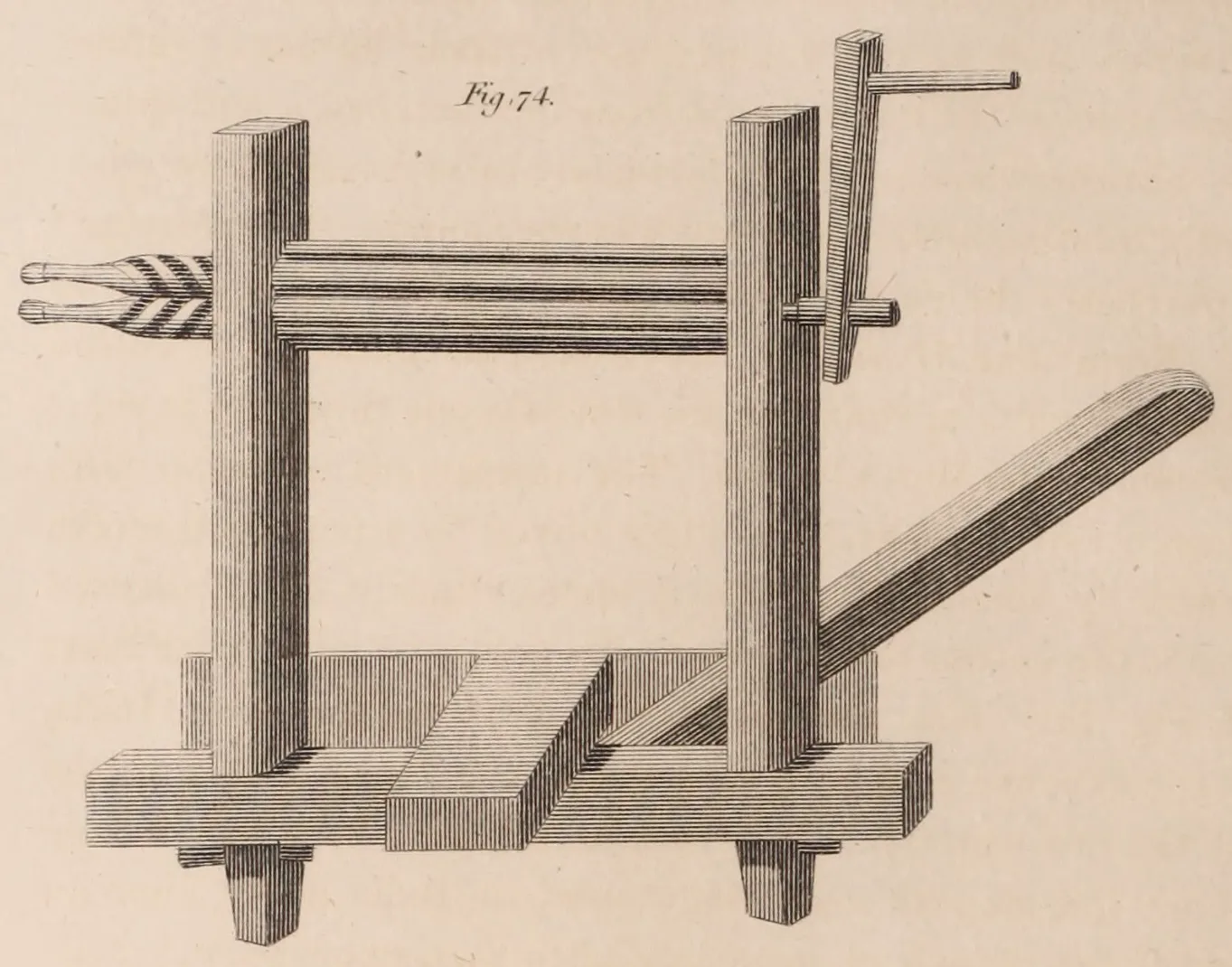
In this neigbourhood much cotton thread is spun. The women of the cultivators spin part of the produce of their husbands farms; and others receive the cotton wool from the merchants, and spin it for hire; but the women of the Bráhmans are as averse from spinning, as their husbands are from holding the plough. The merchant always purchases the cotton with the seed, and employs people to clean it. From four Maunds of raw cotton he gets one of cotton wool, at the expense of four Fanams, which is one third of the value of the whole cotton thus cleaned. The instrument is a small mill, consisting of two horizontal cylinders moved by a perpetual screw, and turned by the hand; while a semi-cylindric cavity behind forces back the cotton to the person who feeds the mill. (See Plate XXVII. Fig. 74.) The rudeness of the machinery, as usual in India, renders the expense of the operation great, in comparison with the value of the raw material. The Maund of cotton wool, in beating with a bow, the manner universally used in India and China for preparing it for the wheel, loses an eighth part, expense included; that is to say, the merchant gives forty Seers of cotton wool to the cleaner, who returns thirty-five fit for spinning. When this is spun, the thread weighs only from thirty to thirty-two Seers, owing I suppose to its having been imperfectly cleaned. The coarsest thread made here costs 8 3/4 Fanams for the spinning of the 35 Seers of prepared wool, which has been procured from 40 Seers of raw cotton. At this rate, to make a pound of cotton wool into thread, costs a very little less than 2 3/4 pence, and it loses in the operation from one fourth to one fifth of its weight. The thread is remarkably coarse. The finest made here costs double the former price. When a woman does no other work, she can in one day spin three quarters of a seer of the coarsest kind; and therefore she makes about 1 639/1000 penny a day.
From this part of the country, cotton and thread are the principal exports, and there are few traders of any note. Two months before crop season, the merchants advance to the poor cultivators, and charge for interest half a Fanam on each Pagoda, or about 23⅓ per cent. per annum. They say, that they are contented with this profit, and when the crop is ripe take so much of the produce, at the market price, as pays the advance with interest. The farmers however allege, that when they receive advances, what the merchants call the market-price is lower than what a man, who is not necessitous, can get for his cotton. According to their account, the common price of cotton in the seed is 7 Taccadies for the Pagoda, or 71⅓ pence for the cwt., which is a little lower than the price stated by the merchants.
The great cultivation here is that of dry grains. The extent of land fit for the plough is very great; but a small proportion only is occupied, and in the best of times much has always been waste. If any farmer, or even an intelligent officer of revenue, be asked, why such or such a piece of ground is not cultivated, he will immediately say that it is impracticable, and assign some reason for this being the case. At first, I was inclined to pay much attention to these reasons; but finding that two people seldom gave the same reason, and that what two men, equally qualified by experience, alleged, was often totally contradictory, while no difference was observable between the soil and situation of the fields now cultivated, and those that are condemned as useless, I began to doubt; and after having questioned many natives, and having considered carefully what they said, I am persuaded, that the soil may be rendered productive, wherever it is not too hard or steep for the plough. The natives talk of one third of the land near the Tunga-bhadra being useless from these two causes; but I think that they over-rate its extent. In the land of many villages the soil is very full of small stones, especially of quartz; but the natives of these places are far from reckoning these useless; on the contrary, they allege that the stones are advantageous by keeping the soil cool, and retaining the moisture. In other places, these stones are reckoned a loss, as is the case at Hari-hara.
The ground here is divided into three kinds. The first, called Eray, consists of a black mould containing much clay, and is valued in the rental at one Pagoda a Mar, or at 11½ pence an acre. The second kind of land, called Kingalu, or red soil, is valued at ¾ of a Pagoda a Mar, or at 8½ pence an acre. The third kind, called Cul' Maradi, or stony soil, is valued at ½ Pagoda a Mar, or at 5¾ pence an acre. This was the account given me at my tents; but when I went to a field to measure it, accompanied by the owner, the Amildar, and the Shanaboga with the public rental, I found that it paid 15 Pagodas, or at the rate of 3⅛ Pagodas a Mar, or nearly 3s. an acre. In general, it was of a fine black soil; only about one acre of it was rather stony, although the whole was reckoned of the first quality. The immense difference in the rent, as stated at my tents, and again in the field, did not strike me at the time, so that I got no positive explanation; but it, no doubt, arose from the following circumstance. This Shist, or valuation of the country, was first made by the Ráyarus. It was increased by the Savanuru Nabobs in the proportion of 8 to 3; and Hyder added to this an increase of ⅛ part. Both he and his son imposed some new assessments; but these were not included in the rental, and have been remitted by Purnea. The people at the tents mentioned the tax imposed by the Ráyarus, which by way of eminence is probably called the Shist; while at the field the whole land-tax that is now levied as brought into the accompt. The Mar of land of the best quality pays therefore 3⅛ Pagodas, or at the rate of 3s. an acre; the Mar of the 2d quality pays 25½/16 Pagodas, or at the rate of 2s. 3d. an acre; and the worst pays 1 9/10 Pagoda a Mar, or 1s. 6d. an acre. Rice-ground pays no higher than dry field; so that the only advantage government has by watered-land, is an excise of three Pagodas on every 1000 sugar-canes planted. Some soils here contain saline matter; and if the water be allowed to lodge on low spots, these become so impregnated with salt, as to be of little value for cultivation; but with proper pains this may be avoided. In some of the clay-land, there is a kind of soil, which, though it is black, and to all appearance of the kind called Eray, yet it does not retain water, and very soon becomes dry; but, by a proper management of the manure, it may be rendered productive.
The three kinds of ground being of very different qualities, every man’s share of each is scattered up and down in various places, in order to make the assessment fall equally; but hence arises an inexplicable obscurity in the accompts, and a great hindrance to improvement. All the cultivators live in fortified villages, and each man’s share is scattered in small patches through the village lands.
The Gaudas, or chiefs of the villages, are hereditary; but in case of their incapacity, the villages may be let to Gutigaras, or renters. These renters and Gaudas force the cultivators to labour more than they are willing, which is a pernicious practice. The extreme indolence of the people in this neighbourhood is, however, an excuse that bears at least the appearance of reason. The Amildar says, that without compulsion they would not cultivate more than ⅔ or ¾ of what they are able. A subsistence is all that they look for, and with little labour that can be procured. Superfluities, or riches, they have some reason to consider as mere temptations to the plunderer: so long as a man cultivates his fields, he cannot be deprived of them; but they cannot be mortgaged, or sold, to pay his debts. If he allow his lands to become waste, the government can give them to any person who will undertake their cultivation; but the original proprietor may at any time resume them, when he is able to find sufficient stock.
The greater number of the farmers here have only one plough each; but all such as have not more than three ploughs are reckoned poor men, and are in general obliged to borrow money to pay the rent, and to carry on the expenses of cultivation. The crop is a security to the lender, who is repaid in produce at a low valuation. Farmers who have 4, 5, or 6 ploughs, are able to manage without borrowing, and live in ease. Those who have more stock are reckoned rich men. Each plough requires one man and two oxen, and can cultivate two Mars of land, or about 17 acres. In seed time and harvest, some additional labourers must be hired. All the farmers, and their children, even those who are richest, Bráhmans excepted, work with their own hands, and only hire so many additional people as are necessary to employ their stock of cattle. A servant’s wages are from six to nine Jimshiry Pagodas a year, together with a blanket and pair of shoes. The Jimshiry Pagoda is four Dudus worse than that of Ikeri, which is rather less than 1⅓ per cent. The wages are therefore from 2l. 7s. 10d. to 3l. 11s. 9d. Out of this they find every thing but the shoes and blanket. Men labourers get daily half a fanam, or 3¼d. and women receive one half of this hire, which is seldom paid in money, but is given in Jola at the market price. The man’s wages will purchase daily about a quarter of a bushel. The people here work from eight in the morning until sun set, and in the middle of the day are allowed twenty-four minutes to rest and eat. The cattle work from eight in the morning until noon. They are then fed for an hour, and work from one until about five o’clock.
Many of the farmers keep no cows, but purchase all their cattle. They, of course, can sell at least one half of their straw to the Bráhmans of the town, who in general keep many milch cows, and who in return sell the young oxen and the manure to the farmers. Although the cattle are always kept in the house, except during the two months immediately following the rains, no litter is used. Their dung is collected in pits, with the sweepings and ashes of the family, and sells for from six to twelve Dudus for the load of a cart which is drawn by eight oxen, but which does not appear to contain more than a single-horse cart. The price is from about 5d. to half that amount. The farmers also hire flocks of sheep to manure their fields, and say, that for folding his flocks on a Mar of land, they give the shepherd one Colaga of Jola; this, however, must be a gross exaggeration.
The most considerable crop in this neighbourhood is Jola (Holcus sorghum), which is always accompanied by one or more of the following articles, Avaray (Dolichos Lablab), Tovary (Cytisus Cajan), Hessaru (Phaseolus Mungo), Madiky, a kind of pulse that seems to be peculiar to this part of the country, and of which I have seen only the seed; Huruli (Dolichos biflorus), and Alasunda (Dolichos Catsjang). These articles being intended chiefly for family use, a portion of each is wanted, and every man puts in his Jola field a drill or two of each kind.
Jola thrives best on black clay, but is also sown on the red earth, and even sometimes on the stony soil. In Chaitra, the field is hoed with a Heg Cuntay (Plate XXVIII. Fig. 75,) which requires from six to eight oxen to draw it; for this is the month following the vernal equinox, when the soil is very dry and hard. In the following month the field is ploughed once, and then manured. In the month preceding the summer solstice, the seed is sown after a rain by means of the drill; while the rows of the accompanying grains are put in by means of the Sudiky or Acadi. The drill here differs from that of Banawasi, (Plate XXVI. Fig. 73,) in wanting the iron bolts that connect the bills with a wooden bar which crosses the beam. The Sudiky is a bamboo with a sharp point, which is tied to the drill, and through which the labourer drops the seed of the pulse, as he follows that implement. After having been sown, the field is smoothed with the Bolu Cuntay, a hoe drawn by oxen, and entirely resembling the Heg Cuntay, but of a lighter make. On the 20th day the field is weeded with the Eddey Cuntay, (Plate XXVIII. Fig. 76), and on the 28th day this is repeated. In five months the Jola ripens, without farther trouble. The Mar of land usually produces 7 Colagas of Jola, or 56 fold, worth 7 Pagodas; deduct for rent 3⅛ Pagodas, and for seed ⅛ Pagoda, and there remains to the cultivator for stock and labour 4¾ Pagodas, or about 68 per cent. of the gross produce, besides the pulse and straw; but this last must be allowed to go for manure. Besides, in favourable seasons, the farmer from the high-rented Jola land procures a second crop of Callay, (Cicer arietinum) as follows.
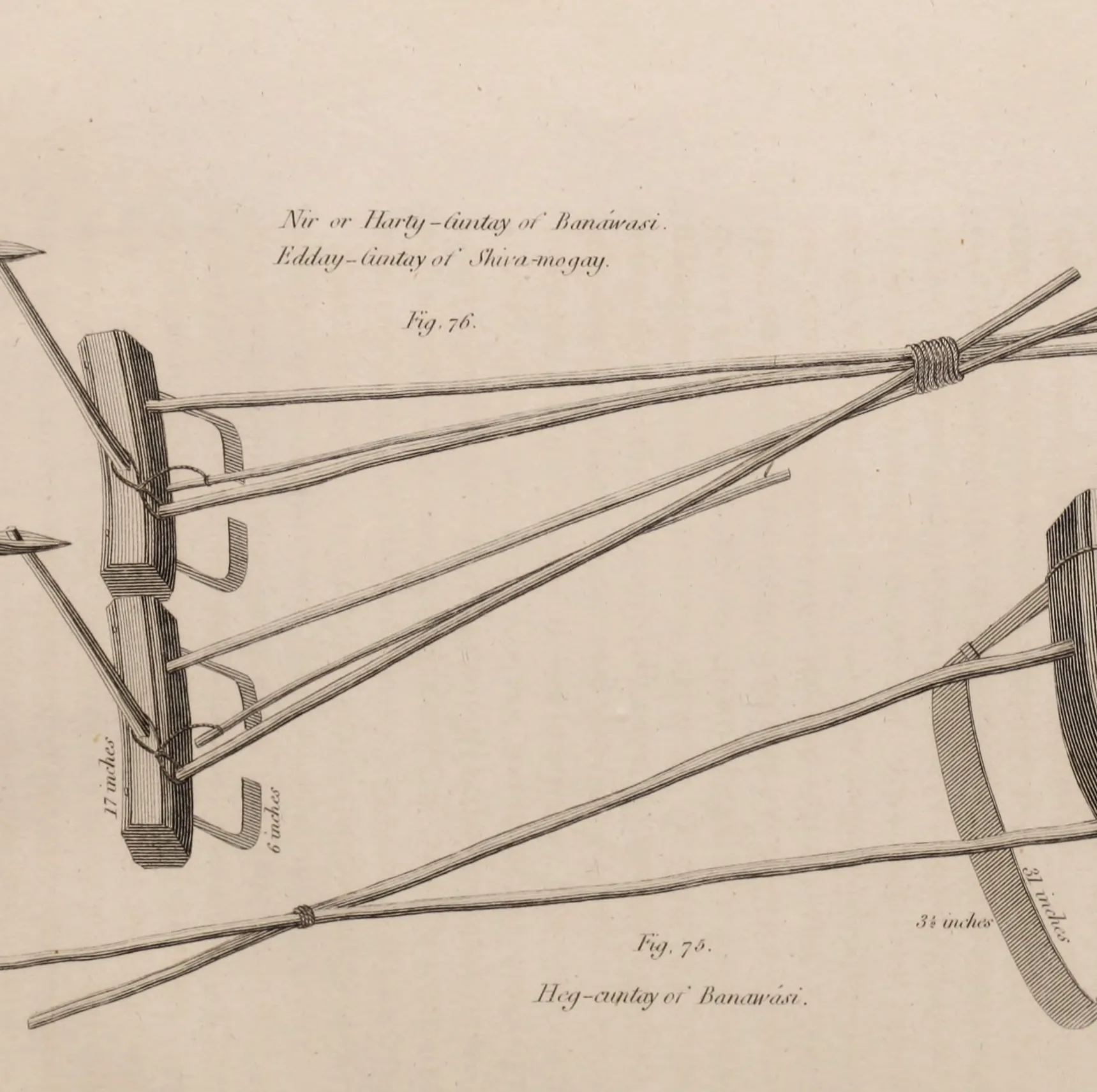
If after harvest there be any rain, the field is ploughed in the month preceding the winter solstice. It is then ploughed across, and by means of the sharp pointed bamboo the seed is dropt into the furrows after the plough, and is covered with the Heg Cuntay. The Mar of land requires 8 Gydnas of seed, and produces 4 Colagas, or 10 seeds. This, deducting the seed, is a neat produce of 72 Gydnas, worth 7 1/5 Pagodas. It is only from the very best ground that this can be taken, and each farmer’s share of this kind is very small.
A few rich spots are reserved solely for the cultivation of Callay, and these are cultivated in the following manner. In the month following the vernal equinox the field is ploughed once, then manured, and in the following month is hoed with the Heg Cuntay. Between that period and the month preceding the shortest day, the grass is ploughed down twice, and the seed is sown with the sharp bamboo following the plough, and covered with the Heg Cuntay, as before described. It ripens in three months, and produces 8 Colagas ; which, deducting seed, leaves 152 Gydnas, worth 15 1/5 Pagodas ; from which if 3 1/8 be taken for rent, the cultivator has better than 12 Pagodas for his trouble and stock.
Cotton is raised entirely on black soil, and is either sown as a crop by itself, or drilled in the rows of a Navonay field. In the former case, two crops of cotton cannot follow each other, but one crop of Jola at least must intervene. In the 2d month after the vernal equinox, the field is ploughed once, then manured, then hoed with the Heg Cuntay ; and the grass is kept down by occasional hoeings with the Bolu Cuntay, until the sowing season in the month preceding the autumnal equinox. The seed is sown by a drill having only two bills, behind each of which is fixed a sharp pointed bamboo, through which a man drops the seed ; so that each drill requires the attendance of three men, and two oxen. The seed, in order to allow it to run through the bamboo, is first dipt in cow-dung and water, and then mixed with some earth. Twenty days after sowing, and also on the 35th and 50th days, the field is hoed with the Edday cuntay. The crop season is during the month before, and that after the vernal equinox. The Mar of land requires three maunds of seed, worth 3/20 of a Pagoda. The produce is 50 Tacadies, at 7 for a Pagoda, and therefore amounts to 7 1/7 Pagodas. From this deduct 3/20 of a Pagoda for seed, and 3 1/8 Pagodas for rent, and there remains to the cultivator for trouble and stock very little less than 4 Pagodas. When these weights, measures, and values, are reduced to the English standard, the produce of an acre appears very small. The seed is about 10 1/3 lb. worth two-pence. The produce is about 1 281/1000 cwt. worth, according to the cultivators, 82 1/4 pence: deducting 36 pence for rent, and two-pence for the seed, there will remain for the cultivator 44 1/4 pence, or about 53 per cent. of the gross produce.
Next to Jola, the most considerable crop in this neighbourhood is Navonay, which is cultivated on both the black and red soils, but by far most commonly on the latter. On the black soil it is usually accompanied by cotton in the rows between the drills ; on red soil, it is accompanied by rows of Jola, Sujjay, (Holcus spicatus) and Gur’ Ellu, which is the Huts Ellu of Seringapatam (Verbesina sativa Roxb. MSS.). In black soil, the ploughing commences in the month following the vernal equinox. After having been ploughed, the field is manured, and in the following month is hoed with the Heg Cuntay, and, after eight days rest, with the Bolu Cuntay. In the month following mid-summer, the seed is sown with the drill, and the accompanying grains by means of the sharp bamboo. The seed is covered by two hoeings with the Bolu Cuntay, one lengthwise and the other across. On the 20th and 28th days the weeds are removed by the Edday Cuntay. In three months the crop is ripe. In the red soil, the ploughing does not commence until the beginning of the rainy season; but the seed time, and all the process of agriculture, are the same as in the black soil. The Mar of land requires for seed 5 Gydnas of Navonay, worth 1⁄4 Pagoda; together with one Maund of cotton seed, worth 1⁄20 Pagoda; or 3⁄4 Gydna of Jola, worth 10⁄266 Pagoda; or 1 Chitty of Sujjay, worth 1⁄72 part of a Pagoda; or 1 Chitty of Gur' Ellu, worth 1⁄48 of a Pagoda. The produce in a middling crop is 12 Colagas of Navonay, worth 12 Pagodas, together with 15 Tacadies of cotton, worth 2 1⁄7 Pagodas; or 1 1⁄2 Colaga of Jola, worth 1 1⁄2 Pagoda; or 1 Colaga of Sujjay, worth 1 1⁄9 Pagoda; or 1 Colaga of Gur' Ellu, worth 1 2⁄3 Pagoda. It must be evident from this, that the people who gave me the account diminished the real produce of the Jola, which would never be the common object of cultivation, while Navonay was so much more profitable.
Sujjay is here the next most common crop, and is always accompanied by Huruli, or Alasunda, or Tovary, or Hessaru. This is the crop commonly taken from the red soil, or that of the second quality. In the month preceding the summer solstice, the field is ploughed once, then manured, and then hoed with the Heg Cuntay. At the end of the month the seeds are sown with the drill, and covered with the Bolu Cuntay. On the 20th and 28th days, the field is weeded with the Eddey Cuntay. In three months the crop is ripe. The Mar requires for seed 1⁄2 Gydna of Sujjay, worth 1⁄36 Pagoda; together with 2 Gydnas of Huruli, worth 1⁄10 Pagoda; or 1 Gydna of Alasunda, worth 1⁄16 Pagoda; or 3 Gydnas of Tovary, worth 1⁄4 Pagoda; or 1 1⁄2 Gydna of Hessaru, worth 3⁄20 of a Pagoda. The average produce is 12 Colagas of Sujjay, worth 13 1⁄6 Pagodas; together with 1 1⁄2 Colaga of Huruli, worth 1 1⁄2 Pagoda; or 1 1⁄2 Colaga of Alasunda, worth 1 7⁄8 of a Pagoda; or 2 Colagas of Tovary, worth 3 1⁄3 Pagodas; or 1 Colaga of Hessaru, worth 2 Pagodas. The rent is about 2 11⁄32 Pagodas. From these data, the share which the farmer gets for his stock and labour may readily be calculated. For instance, the gross produce of a Mar sown with Sujjay and Huruli is 14 2⁄3 Pagodas; while the rent and seed are rather more than 2 1⁄2 Pagodas, or 17 1⁄4 per cent. of the gross produce. This is another proof, that the cultivators concealed the real produce of Jola and cotton, which are their most common crops.
Huruli, or what the English of Madras call Horse-gram, is at Hari-hara the next most usual crop, and is cultivated entirely on the poorest and worst soil, which pays as rent 1 9/16 Pagoda for the Mar. The field is ploughed once in the end of the 2d month after the summer solstice. In three or four days afterwards it is ploughed again; and with the sharp bamboo the seed is dropped into the furrow, after the plough, in rows about 9 inches distant from each other. It is then covered with the Heg Cuntay. On the 20th and 28th days, the hoe called Edday Cuntay is employed to remove weeds, and in five months it ripens without farther trouble. A Mar of land requires for seed five Gydnas, worth 1/4 Pagoda; and the common produce is 3 Colagas, worth 3 Pagodas; so that the farmer has here only 1 3/16 Pagoda out of 3 of the gross produce; but he gives no manure, and the trouble is very small, and performed at a season when little else is doing.
On the 2d quality of soil some considerable quantity of Harulu, or Ricinus, is raised. In the month preceding the summer solstice, when the rainy season commences, the field is ploughed once. Fifteen days afterwards the seed is dropped into furrows made by the plough, in rows two cubits distant from each other, and is covered by another furrow. At the end of a month from sowing, the weeds are removed by the Edday Cuntay; and every 15 days afterwards, until the month preceding the autumnal equinox, the intervals between the rows must be ploughed. At this time the plants begin to flower; and the fruit ripens at various times between the month following the autumnal equinox, and that following the winter solstice. A Mar of land requires 2 1/2 Gydnas of seed, worth 5/24 of a Pagoda. The produce is six Colagas, worth ten Pagodas. It is sold to the oil-makers, who extract the oil by boiling, as is the usual practice in India. The seed is first boiled for about an hour, when it bursts a little. It is then dried in the sun three days, and beaten into flour in a large mortar. The flour is then put into a pot with a little water, and boiled for about two hours. The oil floats above the flour, which forms a thick mass in the bottom of the pot. The oil is very bad, and thick. Two Gydnas of seed give sixteen Seers, Cucha measure, of oil; so that a bushel gives about 2 wine gallons.
Ragy (Cynosurus corocanus), Shamay (Panicum miliare E. M.), Harica (Paspalum frumentaceum Roxb. MSS.), Baragu (Panicum miliaceum), Wull’ Ellu (Sesamum), and Udu (Phaseolus minimoo Roxb. MSS.), are also cultivated at Hari-hara; but in such small quantities, that a particular account of each will not be required.
The usual daily allowance of grain for one person’s eating, is ½ Chitty, or about 27 bushels, a year. The Navonay and Sujjay are chiefly consumed by the Bráhmans, and other people in easy circumstances, as being a more light and delicate food; while the labourers feed upon Jola, or Ragy, purchased from other districts. Jola straw, being the most common, is reckoned the most wholesome fodder for cattle.
The watered lands are here of little importance; for in the whole district, which produces annually 15,000 Canter’ Raya Pagodas, there are no dams, and only six reservoirs. The rains are quite inadequate to the cultivation of rice. Very little of this grain is therefore sown. Orders, however, have been issued by Purnea to erect dams on the Solicaray Holay. The Amildar says that there are three places in the district where reservoirs might be constructed with advantage. He thinks that forming dams on the Tungabhadra would be attended with great expense; nor could they be so constructed as to irrigate much ground. Below Hari-hara indeed, towards Anagundi, there are very fine ones, which supply with water rice-grounds worth 100,000 Pagodas a year. These are situated partly in the territories of the Nizam, and partly in those lately ceded to the Company.
Sugar-cane is here the most considerable irrigated crop, as it requires but a small supply of water. In the intervals between the crops of cane, a crop of rice is taken, should there be a sufficient supply of water; but that is seldom the case, and the intermediate crop is commonly some of the dry grains. The land, when cultivated for grain, pays the usual rent; when cultivated with sugar-cane, it pays three Pagodas for every 1000 double cuttings planted. Land that pays 10 Pagodas of rent is called a Wocula land, which, as it plants 6000 double cuttings, pays, when under sugar-cane, 18 Pagodas, with two Pagodas for the use of the boiler, making in all a rent of 20 Pagodas for the Wocula, as stated by the man at Baswapattana.
The account that follows was taken from a principal accomptant (Sheristadar), who says that he is proprietor of a field, and is well acquainted with the process. The cane may be planted at any time; but there are only three seasons which are usually employed. One lasts during the month before and another after the summer solstice. This is the most productive and most usual season; but the cane requires at this time longer to grow, and more labour, than in the others; so that, although it pays the same tax only, it yields to the cultivator but little more profit. The other two seasons are the 2d month after the autumnal equinox, and the 2d month after the shortest day. Those crops arrive at maturity within the year. I shall confine myself to an account of the process in the first season. The kind of cane cultivated is the Maracabo, of which, according to the Sheristadar, 4800 canes are required to give one Maund, or about 24¼lb. of Jagory. When asked why he does not raise a better kind, the Sheristadar says, that the soil is too poor, and the climate too dry; both of which are, to all appearance, ill founded excuses for an obstinate adherence to old custom. In the second month after the vernal equinox, the field must be watered, and eight days afterwards it is ploughed once. After another rest of eight days, it must be ploughed again with a deeper furrow, four oxen having been put into the yoke. After another interval of eight days it is ploughed, first lengthwise, and then across, with a team of six oxen. Then, at the distance of three, or three and a half cubits, are drawn over the whole field furrows, which cross each other at right angles. In order to make these furrows wider, a stick is put across the iron of the plough. In the planting season, two cuttings of the cane, each containing two eyes, are laid down in every intersection of the furrows, and are covered slightly with mud. The furrows are then filled with water, and this is repeated three times, with an interval of eight days between every two waterings. A little dung is then put into the furrows; and when there happens to be no rain, the waterings once in the eight days are continued for three months. When the canes have been planted forty days, the weeds must be removed with a knife, and the intervals are hoed with the hoe drawn by oxen. This operation is repeated on the 55th, 70th, and 85th days, and the earth is thrown up in ridges toward the canes. In the beginning of the fourth month, the field gets a full watering. Fifteen days afterwards, the intervals are ploughed lengthwise and across; and to each bunch of plants a basket or two of dung is given and ploughed in. The weeds are then destroyed by a hoe drawn by oxen; after which, channels must be formed between the rows; and until the cane ripens, which varies from fourteen to seventeen months, these channels are filled with water once in fifteen days. The crop season lasts from one month to six weeks. The mill is excessively rude, being two cylinders moved by a perpetual screw, and turned by a beam, to which four oxen are yoked. The Wocula land plants 6000 double cuttings, and the bunch springing from the two cuttings planted at each intersection contains from eight to twenty canes. The average may be fourteen, or altogether 84,000. These, at 4800 for the Maund, should produce not quite eighteen Maunds, which is only one tenth part of that which the man at Baswa-pattana mentioned, and he may be considered as having given a true account. The Sheristadar however, on being pressed, acknowleges 120 Maunds; but he is evidently a liar, and no dependence can be placed on what he says concerning the produce. I did no get any satisfactory account concerning the extent of ground called a Wocula ; but there is no reason to suppose any difference between the Wocula of Baswa-pattana and that of Hari-hara. If we take 6000 squares, of 3 1/2 cubits, as the extent of a Wocula, it will give 3 3/4 acres, which pay a tax of 20 Pagodas, or at the rate of 2l. 2s. 9d. an acre.
April 11th—I went three cosses to Dávana-giri. Near the road, three small hills excepted, the whole country is fit for the plough. Much of it however, even where the soil is of that fine black mould called Eray, would appear never to have been cultivated, and is overgrown with bushes. The soil of a very small proportion indeed, so far as I can judge, appears to be too barren for cultivation ; much of it, however, is Marulu, or a poor stony land, and some of it is a red soil, fit for the cultivation of Ragy.
Dávana-giri contains above 500 houses, and a new Bazar (or street containing shops) is now building. In the centre of the town is a small mud fort. Some years ago, it was a poor village ; and its rise is owing to the encouragement given to settlers by Apojee Ráma, a Marattah chief, who, having entered into the service of Hyder, obtained the place as a Jaghire. He died without heirs, but Tippoo continued to give encouragement to settlers, and ever since it has been gradually increasing. It is the first place in the Chatrakal principality (Ráyada) towards the west ; and the Amildar of the district (Taluc) usually resides at it, although properly it is not the Kasba, or chief town.
At Dávana-giri some coarse cotton cloths are made ; and at every village of the district three or four looms are employed in the manufacture. The staple commodity, however, of the Chatrakal principality consists of Cumlies, or a kind of blankets which in their fabric greatly resemble English camblets. They are four cubits broad, by twelve long, and form a piece of dress, which the natives of Karnata almost universally wear. They are not dyed, but are of the natural colour of the wool, which in the finer ones is almost always a good black. The best are made at Hara-punya-hully, in the territory lately ceded to the company, and at Dávana-giri. Each of the blankets, made of the wool from the first shearing of the sheep, sells for from two to twelve Pagodas, or from 16s. 2 1⁄4d. to 4l. 17s. 4d. Those at four Pagodas are the finest made for common sale; and these, with all of an inferior value, are brought to weekly markets, and purchased by the merchant for ready money. If any of a higher value are wanted, advances must be made. The great excellence of these blankets is their power of turning rain; and, the finer they are, the better they do this. Some have been made, that were valued so high as from two to three hundred Rupees, and that were considered to be impenetrable by water.
Before the sheep are shorn, they are well washed. The wool, when it has been shorn, is teased with the fingers, and then beaten with a bow, like cotton, and formed into bundles for spinning. This operation is performed both by men and women, partly on the small Hindu cotton wheel, and partly with the distaff. Some tamarind-seeds are bruised; and, after having been infused for a night in cold water, are boiled. The thread, when about to be put into the loom, is sprinkled with the cold decoction. The loom is of the same simple structure with that usual in India. The new made cloth is washed by beating it on a stone; and, when dried, is fit for sale. From this account of the process it will be evident, that the great price of the finer kinds is owing to the great trouble required in selecting wool sufficiently fine, the quantity of which in any one fleece is very small.
Dávana-giri is a place of considerable trade, and is the residence of many merchants, who keep oxen, and send goods to distant places. Some of the merchants hire their cattle from Sivabhactars, Mussulmans, and Marattahs, who make the carriage of goods a profession, and are called Badigaru. The load is reckoned 8 Maunds of 48 Cucha Seers, or about 233lb., and the hire is estimated by this quantity, whatever load the owner may choose to put on his cattle. The hire for a load to any place near, is one Fanam, or almost 7½ pence, for every Gau or Gavada of 4 cosses, which amount upon an average, I suppose, to between 12 and 14 miles; but to the great marts at a distance there is a fixed price; for instance, the load from Sagar, near Ikeri, to Wallaja-petta, near Arcot, costs 3 Pagodas, or 1l. 4s. 4½d. The distance may be about 320 miles.
Far from considering the customs exacted at different places on the road as a burthen, the traders here consider them as advantageous; for the custom house is bound to pay for all goods that may be stolen, or seized by robbers, within their respective districts. This seems to be an excellent regulation, which is in general use throughout the peninsula.
The most valuable trade here is that which is carried on with Wallaja-petta. The goods carried from hence are Betel-nut and pepper, and those brought back are Madras goods, imported from Europe, China, Bengal, and the Eastern Islands, together with salt, and some of the manufactures of the coast of Coromandel.
There is also a great trade carried on between this and Nagara, and Sagar. From thence are brought Betel-nut and pepper, and from this are sent Cumlies, salt, and Madras goods.
Next to these, the trade with Rayá-durga, and Hara-punya-hully, in the newly-ceded district, is the most considerable. The exports from Dávana-giri are coco-nuts, Jagory, tobacco, turmeric, Betel-nut, pepper, and Capsicum. The returns are, a little cotton wool, and cloth, Cumlies, and a large proportion of cash.
To Caduru, and other places south from this, are sent cotton, cloth, and Terra Japonica; and from them are brought coco-nuts, tobacco, turmeric, fenugreek, garlic, and Danya, a carminative seed. The manufacturers of this neighbourhood frequently carry their blankets to Seringapatam.
Merchants from the Marattah territories beyond the Tungabhadra bring hither silk cloths, cotton, Terra Japonica, and wheat; and take away Callay (Cicer arietinum), Jagory, and coco-nuts. At present this trade is at a very low ebb; parties of the Marattah troops seizing on whatever they meet. As these are not robbers, but persons regularly employed by government, the custom-house is not held answerable for their depredations.
From this it would appear, that the trade of Dávana-giri chiefly consists in exchanging the produce of one neighbouring country, for those of another. The only articles of export produced in the neighbourhood are Cumlies, Jagory (inspissated juice of sugar cane), and Callay (Cicer arietinum).
April 12th.—To-day I was prevented from advancing by no less than seven of my people having been seized with the fever in the course of the night, and from its being impossible, without some delay, to provide means for their being carried. Fevers have of late been very prevalent among my servants, although the country is perfectly dry and clear. The weather is now very hot in the day-time, with strong irregular blasts of hot wind, which often comes in whirls. The nights are tolerably cool. Early this morning we had a very heavy rain, with much thunder, but little wind.
As I was detained here, in order to save time I sent for the principal sheep-breeders in the neighbourhood, and obtained from them the following account. Throughout the principality, and in the neighbouring country of Hara-punya-hully, which belongs to the Company, sheep are an object of great importance, and are of the kind called Curi in the language of Karnata. They are kept by two casts, the Curubaru, and Goalaru. A man of either cast, who possesses a flock of sheep, is by the Mussulmans called a Donigar. The Curubaru are of two kinds; those properly so called, and those named Handy or Cumly Curubaru. The Curubaru proper, and the Goalaru, are sometimes cultivators, and possess the largest flocks; but they never make blankets. The Handy Curubas abstain entirely from cultivation, and employ themselves in tending their flocks, and manufacturing the wool. The flocks kept by the two former casts contain from 30 to 300 breeding ewes; those of the Handy Curubas contain only from five to one hundred and fifty. All the shepherds have besides some cows, buffaloes, and Maycays, or long-legged goats; but the sheep form the chief part of their stock. They are pastured in waste places; for which a Hulibundu, or grass renter, is appointed by government; and to him each family pays a certain rent, fixed by an old valuation of their property. This rent varies from ½ a Fanam to 20 Fanams a year, or from 3¼d. to 12s. 5¾d. It is said, that changes in the quantity of a family’s stock are not common, and that it is rare for a man to possess thirty more or less than his ancestor had at the time of the valuation. If any man’s flock, however, should increase much above the number originally belonging to the family, the Hulibundu may increase the tax. The office of Hulibundu is not hereditary; but there are certain families of shepherds hereditarily annexed to the Hulibundu of each district; that is to say, they must pay their tax into his office. They are at liberty to pasture their flocks wherever they please, even into the territories of a different sovereign. Thus a shepherd of this place may feed his flocks in Hara-punya-hully; but he pays his rent to the Hulibundu of Chatrakal.
The sheep are allowed no food but what they can procure in the pastures, which are open uncultivated lands containing a few scattered bushes, but which are here called Adavi, or forests. In the rainy season, the sheep at night are driven into folds made of prickly bushes. In the dry season, they are at night confined on the arable lands, for the purpose of manuring them; and, as a reward, the cultivator gives victuals to the shepherds and their dogs. Four rams are reckoned sufficient for a hundred ewes. Owing to the temperate nature of the climate, the females breed at all seasons indifferently, and they bear six months in the womb. They have their first lamb at eighteen months old, and breed once a year, but never have twins. After bearing three lambs, the ewe is sold. If allowed to live, she would breed five times, but afterwards she would not be saleable. Sheep are never fattened for the market, farther than can be done by pasture, with which in India a sheep seldom becomes fat; but I think the meat of those here is better than I have seen any where else in India, where the animal has not been stall-fed. For stall-feeding, they are preferred by the gentlemen of Madras, who used formerly to be supplied from Bengal.
The males, except those intended for breeding, are sold by the shepherds when under two years of age. At a year old, the best males are selected for breeding, the others are castrated. A female at one year old, sells for about a quarter of a Pagoda, or rather more than two shillings, and continues of the same value until after having had her third lamb. A male of a year old is worth the same money. A wether two years old is worth about a third of a Pagoda, or 2s. 8½d. A good ram for breeding sells for half a Pagoda, or rather more than four shillings.
The fleece is shorn twice a year; in the second month after the shortest day, and in that which follows the summer solstice. The first fleece is taken when the sheep is about six months old, and is by far the finest in quality. From this alone can Cumlies, of any considerable fineness, be made. Every successive fleece becomes worse and worse, and does not increase in quantity. The sheep are never smeared. They are commonly black; and the deeper this colour is, the more valuable the wool is reckoned. The finer blankets are all of an excellent native black, without dye. Each fleece weighs from 1½ to 3 Seers, or from 91/100 of a pound, to 1 82/100lb. The fleeces, as shorn, are divided into three qualities; which sell for 13, 8, and 7 Fanams the Maund; or for 1l. 11s. 2½d., 19s. 2½d., and 16s. 9½d. for the hundred weight.
The Handy Curubaru, or in the singular number Curuba, are a cast living in the Hara-punya-hully and Chatrakal districts, and are of Karnata descent; but many of them have now settled on the banks of the upper part of the Krishna river, in the Marattah dominions. All those who have settled in that country being horse-men, they are called Handay Ravalar, a name pronounced Rawut by the Mussulmans, and by them frequently applied to every kind of Curuba. In this country they confine themselves entirely to the proper duties of their cast; which are, to rear sheep, and to work up wool into blankets. They can eat with the other tribes of Curubaru, but do not intermarry with them. They are allowed a plurality of wives, and their women continue to be marriageable after the age of puberty. Widows may live with a second husband as left-hand wives (Cutigas), and their children are not thereby disgraced; for in this tribe there is no inferior Cutiga cast. A woman who commits adultery is always excommunicated; nor can her paramour take her for his Cutiga. The Handy Curubas eat sheep, fish, venison, and fowls. They hold pork to be an abomination, and look upon the eating of the flesh of oxen, or of buffaloes, as a dreadful sin. They are allowed to drink spirituous liquors. When a Curuba dies, his property, as is usual with that of all Hindus in Karnata, is divided equally among his sons; and his wives and daughters are left entirely at the discretion of the males of his family.
The Deities, whom this cast consider as their peculiar objects of worship, are Bira Deva, and his sister Máyava. Bira is, they say, the same with Iswara, and resides in Coilasa, where he receives the departed spirits of good men. Bad men are punished in Nuraca, or by suffering various low transmigrations. There is only one temple of Bira, which is situated on Curi-betta, or the sheep hill, on the banks of the Krishna, near the Poonah. There is also only one temple dedicated to Máyava. It is near the Krishna, at a place named Chinsulli. Once in ten years, every man of the cast ought to go to these two temples; but a great many do not find leisure for the performance of this duty. These deities do not receive bloody sacrifices, but are worshipped by offerings of fruit and flowers. The priests (Pújáris) at both these temples are Curubaru; and, as the office is hereditary, they of course marry. Once in four or five years they go round, distributing consecrated powder of turmeric, and receiving charity. Besides the worship of the deities proper to the cast, the Curubas offer sacrifices to some of the destructive spirits, such as Durgawa, Jacani, and Barama Deva. When sick, or in distress, they vow sacrifices to these spirits, provided they will no longer exert their baneful influence. The Curabaru have no trouble from Pysachi; and ordinary Butas, or devils, they believe, are expelled by prayer addressed to the deities of the cast. At Hujiny, in the Hara-punya-hully district, resides Rávana Siddheswara, the Guru of this cast. His office also is hereditary; and he is able to read, an extent of knowlege to which no other person of the tribe has pretensions. The Guru attends at feasts and sacrifices, to receive his share, and punishes transgressions against the rules of cast by fine and excommunication. At the principal ceremonies of the Curabaru, such as marriages, building a new house, or the like, the (Panchanga) astrologer of the village, who is a Bráhman, attends; and, having read the prayers (Mantrams) proper on the occasion, receives the accustomed due.
April 13th.—I went what was called four cosses, but the stage was exceedingly long, and I halted at Coduganar. Except two small hills between which I passed, all the country near this day’s route is sufficiently level for the plough, and very little of it appears to be too barren for cultivation. Some of the soil is black clay, some is red mould, but by far the greater part of it is poor stony land. I saw several villages, but a very small proportion of the country is cultivated, and from time immemorial much has been waste. A long continued scene of Indian warfare has prevented by far the greater part from having been cultivated. The most severe loss, however, that the natives remember, was what they suffered in Purseram Bow’s invasion, when the whole Chatrakal principality was reduced to nearly a desert. The Amildar of Mahiconda, who met me at Coduganar, says, that almost the whole country is capable of cultivation, and with manure will produce either Ragy or Jola.
In the forenoon a leopard was killed by the people of the village in a garden near the town, and brought to my tent in great triumph, with every thing resembling a flag, and every instrument capable of making a noise, that could be collected. First he had been shot in the belly, and then he was driven to the banks of a reservoir, where he stood at bay; and, before he was killed, wounded three of the men who attacked him with spears; one of whom was severely torn. He agreed very well with the description in Ker’s translation of Linnæus, and was about four feet from the snout to the root of the tail. He had killed several oxen; and in this country, it is not unusual for leopards to attack even men. Although I have called this animal the leopard, there is reason to think that it does not differ from the panther of India; for I am persuaded that we have no larger spotted animal of the feline genus. The Indian panther and leopard I consider, therefore, as two names for the same animal. The African panther may, however, be different, as certainly is the hunting leopard of India.
14th April.—I went a very long stage, called four cosses, to Aligutta. For some way, near the middle of this day’s route, the road passed among low hills that are rather barren. On both sides of these there is a great deal of fine land; for much of the soil is of the fine black mould called Eray. Almost the whole is waste, owing chiefly to the invasion of Purseram Bow. Many of the fields, however, would appear to have remained longer uncultivated, which is attributed to invasions by the Marattahs that happened during the government of Hyder. I do not think that more than a tenth part of the arable fields is now occupied. Ragy and sugar-cane seem to be what the farmers attend to most; yet there is much land fit for Jola and cotton. Some sheep are reared; but all the wool is sent to other places, where it is manufactured. In the villages of this district are scattered a few weavers of coarse cotton cloths. In the Chatrakal principality there are no plantations of palm-trees; but there are many gardens in which kitchen stuffs (Tarkari) are raised. Among these, the carrot thrives remarkably well, and in flavour is superior to any that I have seen in India. Aligutta is a sorry place, situated among some rocky heights that are fortified. Contiguous to it is a very good reservoir. Distant from it about three cosses to the south, is a reservoir, which in size almost equals Solicaray, and is named Bhima Samudra, or the sea of Bhima, who was one of the five sons of Pandu, celebrated in Hindu fable.
15th April.—I went a very long stage, called also four cosses, and encamped in the plain near Chitteldroog, as we call it. Most of the country through which I passed is tolerably good, but very thinly peopled, and poorly cultivated. After having passed over a low ridge of hills, I came to a small rivulet, named Jenigay holay, which has its source from Bhima Samudra, and from various mountain torrents. It runs towards Gudi-cotay, the chief town of a district in this principality, and contains water at all seasons. It forms some fine reservoirs, and in several places is also conveyed by canals to irrigate the fields for cultivation.
The plain of Chitteldroog is two cosses and a half from north to south, and one coss from east to west ; the coss here being at least four miles. It is every where surrounded by low, rocky, bare hills, on one of which stands the Durga, or fort, formerly the residence of the Polygars of this country. By the natives it is called either Sitala-durga, that is to say, the spotted castle, or Chatrakal, which signifies the umbrella rock ; for the Umbrella is one of the insignia of royalty. During the government of the Ráyarus, the tributary Polygars of Chatrakal, who by descent were hunters (Baydaru), governed a country valued at 10,000 Pagodas a year, or 3120l. 8s. 4d. On the decline of the royal family of Vijaya-nagara, these enterprising hunters, by gradually encroaching on their neighbours, increased their territories until they became worth annually 350,000 Pagodas, or 109,213l. 10s. 10d. The Moguls had no sooner settled at Sira, than they began to covet the Chatrakal principality, which being entirely an open country ought to have fallen an easy prey to their cavalry. Sida Hilal, Nabob of Sira, made the attempt, and besieged the town for two years, but without success. He then retired to Sira, having received a promise of an annual tribute, the payment of which he probably did not expect. Hyder, soon after taking Bidderuru, attacked Chatrakal. The first siege lasted five months, and was unsuccessful. After the second siege had continued six months, there was little prospect of success, and Hyder had recourse to corruption. Partly by money, and partly by the influence of a common faith, he obtained the treacherous assistance of a Mussulman officer, to whom the Rájá had given a high military command. At this time the town was very large, and filled a great portion of the plain; but owing to the removal of its court it has since gradually decayed. Still, however, it is a considerable place, and seems to receive particular encouragement from Purnea. It is now confined entirely within the walls, which are near the foot of the rock. They were strengthened by Hyder; and the town, after the peace granted by Lord Cornwallis, having become a place near the Marattah frontier, Tippoo had employed Dhowlut Khan, one of his slaves, to add much to its strength. The new works are now completing, and will render it totally impregnable against such invaders. Indeed, as it was before, Purseram Bow made no attempt to besiege it, that kind of warfare being little adapted for his troops, or indeed for those of any native prince; for the walls that resisted the two years siege of the troops of the haughty Mogul, were built entirely of mud. From the hereditary Shanaboga of this place, named Shimuppa, I received a history of the Polygars of Chatrakal, which I have delivered to the Bengal government.
16th April.—I unfortunately found, that the Subadar, or chief officer of the principality, was absent, and that his inferiors were little disposed to render me any assistance; of which I was much in want, owing to the number of my people who were sick, and who were daily attacked with fevers. The whole neighbouring country is reckoned exceedingly unhealthy, although it is perfectly dry and clear; and indeed, ever since I have come upon the open country near the Tunga, my people have been suffering very much. The natives say, that every country is unhealthy in which the black soil called Eray abounds. In the neighbourhood of Chatrakal there is also a deficiency of water. To reach it, the wells must not only be very deep, but all that is procurable is of a bad quality. This may be in part attributed to the common nastiness of the Hindus, who wash their clothes, bodies, and cattle in the very tanks or wells from which they take their own drink ; and, wherever the water is scanty, it becomes from this cause extremely disgusting to a European.
Finding that the agriculture of this country differed in nothing material from that at Hari-hara, and Dávana-giri, and wishing to remove my people to a more healthy situation, I determined to make no longer stay at the inhospitable Chatrakal, but to go to Heriuru, where the air and water are reckoned wholesome.
17th April.—I went two cosses to Siddamána-hully, a mud fort containing sixty houses. The first half of the way led through the plain of Chatrakal, which is mostly uncultivated, but consists of a fine black soil. Beyond the hills surrounding this plain, toward the east, is an extensive level bounded by Nunnivala hills and fort. The soil most common in this plain also is black. The number of inhabitants now in the country is not above a third part of what were in it before the Marattah invasion. The two great articles of cultivation here are Jola (Holcus sorghum) and Navonay (Panicum italicum), of which about equal quantities are raised. The next most considerable crops are Sujjay (Holcus spicatus) and cotton. The quantity of wheat and Callay (Cicer arietinum) is small. There are no reservoirs, but some might be constructed. Near the village is said to be a place where one might be built that would water as much land as would sow 10,000 Seers of rice. The chief (Gauda) at Sidda-mána-hully is a Sivabhactar, as indeed is common in this principality ; for since the overthrow of their chief by Hyder, the Baydaru have become almost extinct.
18th April—I went three cosses to Imangula, and had on my right all the way a prolongation from the hills on which Chatrakal stands. The country near my route is chiefly level, and most of the soil is black; but it is almost entirely waste, and has very few tanks. Near Imangula is a small one that waters some rice ground.
Although almost every year, before the commencement of the rainy season, this tank becomes dry, and has no communication with any rivulet, yet it contains many small fishes, all of which are caught whenever it dries. It would appear, that their eggs, although no doubt they become dry with the mud and stones, retain life, and are hatched so soon as they are moistened by the next rain. This shows the practicability of transporting the eggs of fishes from one country to another with very little trouble.
Imangula is a large fort, but much space within is empty, and it contains only about 90 houses. The chief (Gauda) is hereditary, as is usual throughout the Mysore Rájá's dominions, and he acts as Pújári to the image of the village god. Almost every village has a peculiar deity of this kind, and most of them are believed to be of a destructive nature. That of Imangula is Kalikantama, a female deity. To her image an annual feast is given by the Gauda, who offers sacrifices, while her wrath is appeased by the people, who are swung round before the shrine, as they are suspended from the end of a lever by a hook of iron, that is passed through the skin of their backs. This cruel worship is never performed before the great gods; and the Bráhmans of the south consider it as an abomination, fit only for the groveling understandings of the vulgar.
In the black soil which forms a large portion of the fine plains east from Chatrakal, a singular manner of cultivation prevails. The plough used is drawn by from eight to sixteen oxen, and is heavy in proportion. In Plate XXIX. Fig. 80, is represented one that was drawn by eight oxen, the iron of which weighed 12 Seers, or about 7¼lb. The largest is exactly of the same shape, but much stronger, and its iron is double the weight. The reason of the number of cattle which the farmers here employ seems to be, the hardness acquired by the black soil in the dry and hot season during which the labour must be performed. After the commencement of the rains it becomes so sticky, that cattle cannot walk on it. In many parts of the Marattah country, I am told, the same mode of cultivation prevails, and that the plough is often drawn by 12 yoke of oxen, worth each from sixteen to twenty Rupees. With the strong team in use here, the field every third year receives two or three ploughings. In the two intermediate years it is only hoed with the Cuntay. It requires no manure, and is never rested, but constantly gives a crop of Jola (Holcus sorghum) or Navonay (Panicum italicum), which are sown without any attention to rotation. On the year in which the field is ploughed, rows of Callay (Cicer arietinum) accompany the Jola; but in the two intermediate seasons nothing is sown with this grain. The Navonay is always accompanied by rows of cotton, at the distance of two cubits and a half. Both seeds are sown with the drill. The crop on the second year after ploughing is reckoned the best. When the country becomes inhabited and acquires a good system of agriculture, this part of the Chatrakal principality, which consists of Eray, or black soil, seems likely to be a source of great wealth; but its present desolation must for a considerable time keep it poor, and, adding to the natural unhealthiness of the climate, will make the increase of population slow.
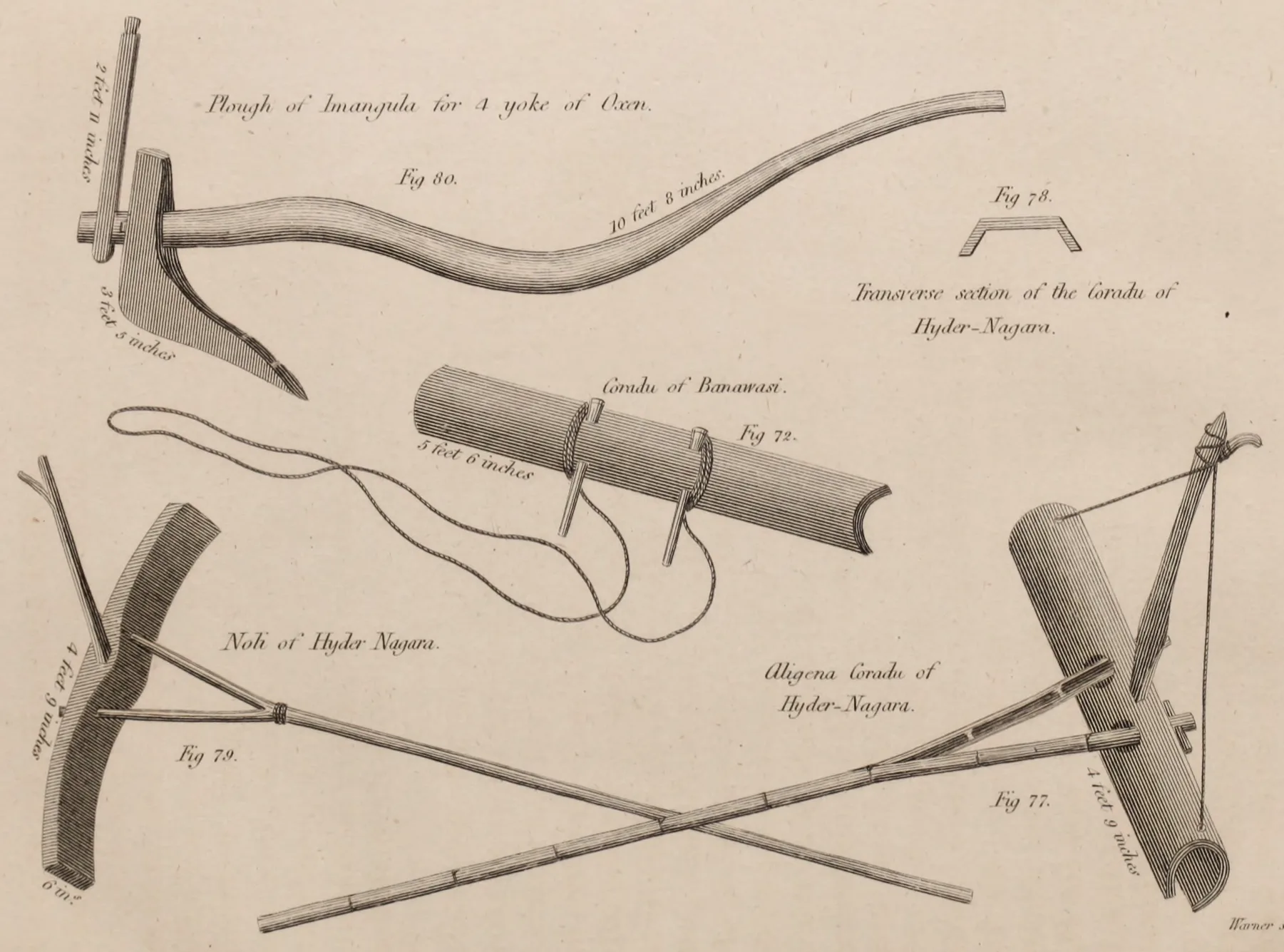
April 19th.—I went three cosses to Heriuru, near which a great change takes place in the appearance of the country. The soil is mostly stony, and at this season exceedingly parched; so that there is scarcely any grass, and the only green things to be seen are a few scattered Mimosas.
Owing to the sickness among my people, and an accident having befallen my horse, it became impossible for me to proceed farther; and as I had found it impracticable, when at Sira, to procure a palanquin bearer there, it became necessary to wait until some conveyance should be sent from Seringapatam. This delayed me fourteen days, nor could a set of bearers by any means be procured at Seringapatam. I should have been reduced to the necessity of walking, had not the Dewan obligingly sent a positive order for the bearers of Sira to enter into my service. The common bearers of India are unwilling to enter into the service of a traveller, although the wages he gives are immense, when compared with what they get at home ; for he takes them far from their families, to places which they consider as another world. All objects of enquiry having been soon exhausted, while the desert nature of the country precluded any resource from botany, my stay at Heriuru proved very tedious.
The winds in the day-time were hot, and came generally from the south. Slight whirlwinds from the same quarter were common. At night the winds were westerly, and tolerably cool. There were a few slight showers of rain, with some heavy squalls of wind, which changed all round the compass, and were accompanied by a terrible cloud of dust.
I procured much comfort from a small clear stream, called the Vedawáti, in which I cooled myself every evening, and whence I procured the three species of Cyprinus from which the accompanying figures (Plates XXX. XXXI. XXXII.) were taken, and of which the following are the scientific characters:
1. Cyprinus Carmuca B.
C. cirrhis duobus ; corpore elongato ; capite callis tuberculato ; radiis pinnæ analis octo, dorsalis undecem.
Karmuka Telingorum.
Habitat in fluviis Karnatæ. Piscis aliquando tres pedes longus.
2. Cyprinus Ariza B.
C. imberbis cauda bifida ; corpore elongato ; maxilla inferiore carinata ; radiis pinnæ analis septem, dorsalis duodecem.
Kincla Minu Tamulorum Bangun Batta Bengalensium. Arija Telingorum.
Habitat in fluviis Indiæ australis. Pisces hos numquam vidi trium palmorum longiores.
3. Cyprinus Bendelisis B. C. cirrhis duobus; cauda biloba, corpore elongato, semi-fasciato; radiis pinnæ dorsalis novem, ani undecim.
Bendelisi Telingorum. Habitat in fluviis Karnatæ. Pisciculus digiti longitudinem vix exsuperans.
This fine little river seldom or never dries up, and comes from Sakra-pattana. Its water is clear, and is reckoned wholesome. Four cosses below Heriuru it is joined by the Cuttay-holay, which comes from Muga-Nayakana-Cotay and Hagalawadi, and forms the boundary between the Chatrakal principality and Sira. Although this receives a small stream from Sira, yet in the hot season it commonly becomes dry. The natives here say, that the Vedawáti joins the Utara Pinákani, or northern Pennar, after having received the Jaya-mangala river, which comes from Nandi-durga; but this is a clear proof of their extreme ignorance in topography. The Vedawáti is the river which Major Rennell calls Hogree, and it joins the Tungabhadra.
Heriuru signifies “ a head place.” It is situated on the east side of the Vedawáti, and during the government of the Chatrakal Rájás contained 2000 houses, with an outer and inner fort, and several temples of the great gods, one of which is of considerable size. This temple, called Gunavunti, possesses an inscription engraven on stone, dated Sal. 1332, in the reign of Deva Ráya; of which a copy has been delivered to the Bengal government. In the reign of Hyder, the town suffered considerably from the Marattahs, and was plundered by Purseram Bow. The ravages of this chief were followed by a dreadful famine, which swept away all the inhabitants. When the British army arrived last before Seringapatam, about 50 or 60 houses had again been occupied. Some of the dealers in grain that followed the camp found their way even to this distance, and plundered the wretched inhabitants. At the same time Barama Nayaka, a chief of the Chatrakal family, assembled some banditti, and entered the territories of his ancestors, to try what could be done. He had constant skirmishes with the Sultan's garrison in Chatrakal, and in each of these two or three villages were plundered by one or other of the parties. After the capture of Seringapatam, this chief wisely entered into the service of the Mysore Rájá, and is now employed in the command of 3000 men acting against a Polygar, who by us is called the Bool Rájá. When Colonel Dalrymple arrived with his detachment, giving protection to this part of the country, the number of inhabited houses in Heriuru was reduced to seven. About 300 have since been rebuilt, and the place is the chief town of a (Taluc) district.
The strata at Heriuru run nearly north and south, and are almost quite vertical. The basis of the country is somewhat between an argillite and schistose hornblende. It contains no veins that I observed; but in some places I saw large amorphous masses of reddish fat quartz imbedded in its substance. When exposed to the air, it readily decays, and is then covered with a cinereous crust. For building, it is a very poor stone; at least what is near the surface; but in a temple of Iswara without the walls I observed some pieces of it that have been squared, and resemble much the fine hornblende slate from Batuculla. It is probable, therefore, that by digging quarries excellent materials for building might be procured. Of these, however, there is no want any where in Karnata.
The only other common rock here is called the Black stone, and it may be considered as forming large beds between the strata of the argillaceous hornblende slate. This is an earthy quartz or hornstone, impregnated with hornblende. When exposed to the air, its masses do not readily acquire a crust, but separate into irregular quadrangular pieces, truncated at both ends. In the fissures may sometimes be observed yellow shining nodules, which I take to be the mica aurata. It contains no other venigenous matter, and does not cut with the tools of the natives; but from the angular shape of its fragments, the smooth surface with which they break, and its great durability, it is excellently fitted for rough walls.
The Seer measure used in the market (Bazar) here for grain contains 76½ cubical inches; 72 Seers make one Wocula or Colaga. The farmers measure is founded on another plan: 2 Seers make 1 Arecal which contains 176⅖ cubical inches; 2 Arecals make one Gydna; 16 Gydnas make one Wocula; and 20 Woculas, or Colagas, make one Candaca, which therefore contains a little more than 52½ bushels. The Wocula of the (Bazar) market, and that of the farmers, are commonly considered as the same; but in fact the former contains 5508 cubical inches, and the latter 5652.
The following is the average price of grain, calculated to the nearest farthing.
| Canter' Ráya Pagodas. | pence | ||
|---|---|---|---|
| 1 Candaca of Sujjay worth | 8 | The bushel is worth | 11½ |
| Huruli | 8 | 11½ | |
| Navonay | 8 | 11½ | |
| Harica | 5 | 7¼ | |
| Wheat | 18 | 26 | |
| Ellu | 15 | 21¾ | |
| Callay worth | 12 | 17¼ | |
| Ragy | 8 | 11½ | |
| Paddy, or rough rice | 8 | 11½ | |
| Rice cleared from the husk | 18 | 26 |
Cotton, cleared of the seed, is worth 12 Fanams for the Maund of 48 Seers, each weighing 22 Dudus, or 1l. 10s. 8½d. a hundred weight.
In this neighbourhood, the cultivation of dry field is the grand object, and differs very considerably from that in the western parts of the principality, where the black mould prevails. Here all the land is a poor stony soil. In some places it contains nodules of lime-stone; but these are considered as unfit for any kind of cultivation.
The whole lands are the property of the government. Some are still called Enam, but this is merely in remembrance of their former tenure; for the holder of the Enam has no fuller right than any other tenant. No lands can be sold, mortgaged, or let to sub-tenants. They are let from year to year, and the possessions are changed from man to man at the pleasure of the officers of revenue; but the rent of each field is fixed by an old valuation. The cultivators never at any time gave more than this rent; and being at present few in number, considerably less is exacted, in order to encourage them to cultivate as much land as possible; for they are totally inadequate to the cultivation of the whole.
The extent of dry-field is estimated by the plough, and all ploughs are said to be of nearly the same dimensions. I measured one, which I found contained 562,280 square feet, that is, very little less than 13 acres. One plough can not only cultivate this extent, but also a little of the watered land, the rent of which is paid by a division of crops. In doing this, the officers of revenue (Amildars) say, that it is impossible for the government to be defrauded, which appears to me incomprehensible. I have myself no doubt, partly from the division of crops, and partly from the power which they have of changing the cultivators possessions, that the officers of revenue have very lucrative appointments. The rent on dry-field at present amounts to from 10 to 60 Fanams a plough, or at from 5¾ to 34¾ pence an acre. That which I measured was an exceedingly poor stony field, and paid 34 Fanams a year, or 18½ pence an acre.
The rent paid to Tippoo did not amount to one half of the valuation; for all parties united to defraud him, each getting a share. Although, during the Sultan's government, the rent fell thus light on the cultivators, they were, even by their own account, much worse off than they are at present; for there was no end to the arbitrary exactions which the lord lieutenants (Asophs) levied. The most intolerable of these, however, arose from the contribution which the Sultan demanded, to make good the sum that he was bound to pay to Lord Cornwallis by the treaty of Seringapatam. Tippoo ordered three millions (crores) to be collected; and the people here say, that by paying their share of this they would not have been distressed. In place of three crores, however, ten were collected, and of these seven were embezzled by the officers of revenue. These again were obliged to bribe their superiors; but Tippoo did not molest them, and many of the Bráhmans are said still to possess very considerable sums which were then accumulated. Hyder and his son acted on totally different plans. The father protected the cultivator, but was very apt to squeeze his officers in an arbitrary manner. The Sultan seldom molested his officers, but he cared not how much they fleeced the people. He, however, was probably ignorant of the lengths to which they went, especially after his unsuccessful war with Lord Cornwallis; from which period he was almost inaccessible to his subjects, and continued to brood over his misfortunes in sullen solitude.
Four ploughs are here reckoned a large stock. Two ploughs are common; but by far the greater part of the farmers have one only; and many, as is indeed usual in every part of the country, are necessitated to unite their stocks before they can furnish two oxen, and the miserable implements which are necessary to accompany one plough. The extent of land cultivated here by one plough is greater than usual in India; for it requires little labour. I am persuaded, however, that in every part of Karnata a plough, fully wrought, is capable of labouring at least thirteen acres of dry field; from six to seven acres may be taken as the average extent of a plough of watered-land. Each plough requires two oxen and one man, and additional women must be occasionally hired.
At Heriuru there are no slaves. Most of the labour is performed by the families of the tenants; but a few hire men servants by the year, and in seed time and harvest employ women by the week. A man gets from 50 to 70 Fanams a year, or from 1l. 11s. 2½d. to 2l. 3s. 8¼d. This is paid entirely in money, without any addition, except that, for himself and family, he generally obtains room in his master’s house. Women get one Fanam, or 7 1/2d. a week. Advances to servants are not common, and of course they are entirely free.
The hours of labour in this country are from eight in the morning until noon, and from two o’clock till sunset; in all, about eight hours. The labourers get up about sun rise; but an hour is spent in their evacuations, in which all Hindus are excessively tardy; and another hour is spent in ablutions, prayer, marking their faces with consecrated ashes or clay, and in eating their breakfast. They eat three times a day, their principal meal being at noon.
The most common article of cultivation is the Holcus spicatus of Linnæus, called by the natives Sujjay, or Cambu. It is generally accompanied by Huruli (Dolichos biflorus). The custom here is, to cultivate the Cambu fields three years, and then to give them a fallow of the same duration; and while thus allowed to rest, they pay no rent. Each man’s farm is therefore divided into two portions; one of which is cultivated, and the other fallow. Other dry grains are also sown on the Cambu field, and that without any attention to rotation. The only manure that is given is, for some nights, to make a flock of sheep sleep on the field. They are not folded, but merely gathered together by the shepherds and their dogs. After the first heavy rain in the two months following the vernal equinox, the Cambu field is ploughed, lengthwise and across, with two oxen in the yoke. After the next rain this is repeated. It must be observed, that the rain must be of considerable duration; for in this arid soil and season the heaviest shower produces no sensible effect. After the second ploughing, the field is hoed with a Heg Cuntay drawn by four oxen. When the rainy season has fairly commenced, which happens about the summer solstice, the seed is sown with the drill, the Cambu being put in the Curigy, and the Huruli in the Sudiky. After having been sown one month, the field is weeded with the Edday Cuntay; and after an interval of eight days this is again repeated. The Cambu in five months ripens; the Huruli is a month later. Thirty-two Seers of Cambu, and six Seers of Huruli, are sown on one plough of land, and produce about 1280 Seers of the former, and 128 of the latter. The produce is therefore worth 80 Fanams for Sujjay, and 8 for Huruli; in all, 88. The seed and rent may on an average amount to about 36 Fanams, or about 40 per cent. of the gross produce. An acre of ground, at this rate, will produce nearly four bushels of Cambu, and 4/10 of a bushel of Huruli; a strong proof of a miserable soil and wretched cultivation, yet the former is allowed to produce 40, and the latter above 21 fold; but I have already pointed out the fallacy of judging, concerning the productiveness of either soil or crop, by means of the increase on the seed that has been sown.
In a few places of this district (Taluc) cotton is put in the (Acadies) rows between the drills of Cambu; but it requires a much richer soil than is to be usually found, and is thought to exhaust the land. The quantity raised in the country is not equal to the consumption. In a few places Harulu, or Ricinus, is put in the drills with Cambu.
The next most considerable crop is Navonay, or the Panicum italicum. The field is ploughed twice in the month following the summer solstice, and at the end of the month it is hoed with the Heg Cuntay. In the following month, after a heavy rain, the seed is sown with the drill; and a month afterwards the weeds are removed by the Eddey Cuntay. In three months it ripens, but is a very uncertain crop; for it is liable to be spoiled by either too much or too little rain. A farmer who has a plough, and sows 32 Seers of Sujjay, commonly sows 2 Seers of Navonay, and, when the season is favourable, will get 3 Colagas, or 96 seeds; which, after deducting the seed, is worth 11 3/4 Fanams. This, I suspect, ought to be considered as a part of what the plough of land produces, and will make its gross amount 100 Fanams; from which is to be deducted less than 36 1/2 Fanams for seed; and rent. The gross value of the produce of an acre of poor land, such as that I measured, by this estimate, will be about 4s. 10d. By the people here, the straw of Navonay is reckoned better fodder than that of Cambu, which is indeed exceedingly coarse. The grain of the Cambu is reckoned the most nourishing food for labouring men; while that of Navonay is preferred by the Bráhmans, and others, who are not under the necessity of performing hard work.
With respect to quantity, the other crops are very trifling; but, as each man cultivates some of them, at seasons when his stock would be otherwise idle, they are of importance, as reducing the price of labour. The most considerable of them is that of Huruli, or Horse-gram, which Purnea has lately encouraged, in order to procure a plentiful supply for the cavalry that are stationed towards the Marattah frontier. The land employed for the purpose is the poorest in the country, and gets no manure. In the second month after the autumnal equinox, the field is once ploughed. About the beginning of the following month, it is ploughed again, and the seed is dropped into the furrows, after the plough, by a sharp pointed bamboo (Sudiky). It is then covered by a hoeing with the Heg Cuntay. The seed is sown twice as thick as that of Cambu, ripens in three months, and produces five folds; one half of which goes to the public revenue. The produce of an extent of land equal to one plough is therefore worth twenty Fanams; of which ten go for rent, two for seed, and eight to the farmer. The produce of an acre is about one bushel, and is worth less than a shilling.
On the same kind of soil, and in the year following the Horse-gram, is sown Harica, or the Paspalum frumentaceum Roxb. MSS. In the second month after the vernal equinox, the field is ploughed, and the seed is dropped into the furrow, after the plough, with the sharp bamboo, and covered with the Bolu Cuntay. Three months afterwards, the weeds are removed by the Eddey Cuntay. It requires much rain, and eight months elapse before it ripens. Four Seers of seed produce two Woculas; but I do not know the extent of ground required. The rent is ten Fanams for the plough of land.
In the bottoms of reservoirs, when they are dry, are sown wheat, Ellu, or Sesamum, and Callay, or Cicer arietinum. For rent the government takes one third part of the produce.
The quantity of rice-land in the Chatrakal principality is very small. In this district (Taluc), eight or ten villages are partly employed in this kind of agriculture; and in favourable years they have two crops from the same field, which is not the case any where to the westward. There were formerly five reservoirs. Two of them have lately been put into repair; one is now undergoing that operation; and money has been allotted for the two others. There are many places in which new ones might be formed with great advantage, were there stock sufficient to cultivate the lands which they would irrigate; but, in the present desolate state of the country, all expense bestowed on erecting new reservoirs would be fruitless. In the principality there are a few Betel-nut gardens, which are cultivated in the same manner as those to the southward, which I have already described; but the soil here is little favourable for the Areca. Having formerly given a full account of the cultivation of rice in the neighbouring Taluc of Sira, it would in this place be superfluous to say any thing on the subject. The revenue is paid by a division of the crop.
The village cattle during the whole year are kept in the house, but are not littered. Their dung is collected in pits, and mixed with the ashes and other soil of the family. This manure is reserved for the rice-land. The dry field gets nothing, except the dung of the sheep, which, at any season, are herded on it at night. A flock of 500 in two nights are supposed to manure fully a plough of land. The farmers say, that when they have not sheep of their own they hire in the flocks of the shepherds, and give them two or three Fanams for manuring the plough of land. But this is denied by the shepherds, who allege, that, except permission to feed their flocks on the fallow lands, they get nothing; and this, I believe, is true. The want of attention to increase the quantity of manure is a gross defect in the agriculture of Heriuru, and may account for the wretched produce of its field.
The Donigars in this neighbourhood keep a good many sheep. Some very rich families possess 1000 ewes, and 200 Maycays. Those in middling circumstances have four or five hundred ewes. Those who have from fifty to a hundred only are reckoned poor. The wool is much coarser than at Dávana-giri, nor will even the first shearing make fine Cumlies. The sheep are also smaller, and by the natives are reckoned inferior meat; but, whether or not this would coincide with European taste, I cannot say. This inferiority of the sheep and wool is attributed to the difference of soil; for all over the good sheep country, especially in the Harapunya-hully district, the Eray, or black soil, is prevalent. The natives, when asked how much it is usual for the meat or fat of a good sheep to weigh, stare with as much astonishment, probably, as that with which an English feeder would behold a butcher who was ignorant of what he considered to be so obvious a matter of enquiry. The sheep here are never driven into a house. In the rainy season they are taken to the wastes, and at night are secured by a fence of dry thorns, to keep off the tigers, which are very numerous among the bushes; for in the neighbouring forests there are no trees. In the dry season, the flocks are at night brought near the villages, and kept on the arable lands. Even there, according to the account of the shepherds, it is necessary to surround them with a fence of thorns. At this season the sheep must have drink twice a day, at noon and in the evening. In the rainy season they are never brought from the wilds; but folds are raised in the driest spots that can be found, and within the enclosure of thorns the shepherds erect for themselves small huts. The rent is on the same footing as at Dávana-giri, and varies from 1 to 40 Fanams, or from 7½ pence to almost 25 shillings a year, according to the value of the flock. A flock containing, young and old, 500 sheep and 50 Maycays, requires four men and four dogs. These are able to drive away small animals of the feline kind, but have no arms that would enable them to attack the tiger or leopard. In the rainy season, the ewes are milked, and four of them give daily a Seer, which contains 72 cubical inches, or a little more than an ale quart. It sells for three Dudus a Seer, or 1½d. a quart. It is of the same value with cow's milk, and is made in a similar manner into Ghee, of which 22 Rupees weight requires eight Seers of milk; that is to say, to make one pound of butter, boiled into Ghee, requires 14¾ quarts of milk, ale measure. Cheese, for which ewes milk is best fitted, is not known at Heriuru; nor any where, I believe, in India, except where it has been introduced by Europeans. The ewes breed once a year, but at all seasons indifferently. After having given five lambs, they are sold, and then bring from 2½ to 3 Fanams, or from 18¾ to 22½ pence. The males are emasculated at eighteen months old, and are sold from six to eighteen months afterwards. They are never fattened, except by the natural pasture; and it is only during the rainy season that they are in tolerable condition. In the dry season the fields produce scarcely a green herb. A wether at two years old brings five Fanams, and one three years old brings six Fanams, or double the price of a ewe. Lamb is never used. Seven Fanams, or 4s. 4½d., is reckoned a high price for a breeding ram; which ill-judged œconomy, probably, contributes to render the breed worse than that of Chatrakal.
In the wastes of this part of the country some Goalas keep herds of breeding cows. They are never brought near the villages, and are exceedingly fierce; so that no dog nor stranger can with safety approach them, and the males attack and kill the tiger. To the Goalas, however, they are very tractable, and follow, like dogs, the man who leads the herd to pasture; while the other Goalas follow, to bring up the young, and the stragglers. Some of the cows are however so vicious, that no milk can be taken from them. They are all white, but are not fit for carriage, being too small. They are very hardy in the plough, or machine for raising water called Capily; but are rather unruly, even after emasculation; so that an ox of this breed does not bring more than 40 Fanams, 1l. 4s. 11½d.; while the more tractable, but weaker cattle, bred in the villages, sell for from 60 to 70 Fanams, or from 1l. 17s. 5¼d. to 2l. 3s. 8d. Bulls for breeding sell for from 50 to 80 Fanams, or from 1l. 11s. 2½d. to 2l. 9s. 11d. The forest males are emasculated when between two and three years old; and are sold off at four, when they are fit for labour. The cows have a calf once in two years, and generally breed five times. In the rainy season, a cow gives daily 1¼ Seer, or 90 cubical inches, and in the hot season ½ Seer, or 36 cubical inches. The village cows being kept in the house at night, and being fed there, give about two Seers a day, or rather more than two ale quarts. These forest cattle are always kept in herds, which contain about 150 young and old, male and female. A herd of this kind requires the attendance of five men. One man carries the milk home to the village, and brings provisions; for the women dare not approach. The other four men lead the herd to pasture. The calves are secured in a fold strongly defended by thorns; and on the outside of this the (Goalas) cowherds build a small hut, in which they sleep surrounded by the cattle, and defended by them from the tigers. When water or grass fail in one part of the country, they remove to another, and are under the grass renter (Hulubundi) of Chatrakal, exactly on the same footing with the (Donigars) shepherds.
In the wastes buffaloes are never kept; but in every house the women of the (Goalas) cowherds, and the people of the villages, keep at least one or two female buffaloes; for the greater part of the milk used in the country is procured from this kind of cattle. Each female ought daily to give three Seers, or a little more than three ale quarts. In the rainy season, this sells at three half pence a quart, in the dry season at two-pence. The village cows and buffaloes are pregnant one year, and give milk the other. During the latter, the cow, besides supporting her calf, should give 30 Seers of butter, or 22½ of Ghee, worth about 7½ Fanams; that is, she gives 16 68⁄100lb. of butter, or 12½lb. of Ghee worth, 4s. 4½d. The female buffalo, besides rearing her calf, should give 35 Seers of butter, or 24¼ of Ghee, worth 8¾ Fanams, or ⅙ more than the cow. If this be accurate, the buffalo milk must be poorer than the cow's, as she gives one half more. The contrary opinion is commonly entertained.
Although the air and water of Heriuru are reckoned salutary, and my people were well accommodated, they did not recover their health, and all my stock of medicines had been long expended. My cook died rather unexpectedly. His fever never had been severe; the paroxysms had come on as usual in the morning, and, after it was over, had left him tolerably well; but in the evening he suddenly became insensible, was convulsed, and died in about an hour. He was a very thoughtless man, and much addicted to intoxication; those, therefore, who fancy that all spirituous liquors are pernicious, especially in warm climates, will have no difficulty in accounting for his death:
But let me add,
Fata; quod immeriti crimen habent cyathi.
For my own part, I am persuaded, that intoxication is much seldomer a cause of disease, than is commonly alleged; and that it chiefly proves injurious to the health of our seamen and soldiers in warm climates by making them imprudently expose themselves to other causes of sickness. The two persons in my service that are most subject to fevers, are my interpreter and painter, although from their situation in life they are exempted from all hardships; but from their cast they ought never to taste spirituous liquor, and are really sober men, avoiding not only liquor, but every intoxicating drug. At the same time, a man who takes care of my tents, although he is exposed to all weathers, and at times to much fatigue, enjoys perfect health, and probably keeps off the fever by copiously drinking spirituous liquors, to the use of which he is exceedingly addicted.
The arrival of a set of fresh men, and the consequent preparations for our departure, caused great joy among my people, notwithstanding their weak state. When the cook was taken ill, I had given orders to secure his effects for the benefit of his wife and children; but, on inspection after his death, no money could be found. Whether he had been plundered as soon as he became insensible, and that a guilty conscience occasioned fears among his companions, or whether the sudden manner of his death occasioned suspicions, I cannot say; but it was immediately believed that he would become a Pysachi, and all my people were filled with terror. The butler imagined, that the Pysachi appeared to him at night with a black silk handkerchief tied round its head, and gave him instructions to take all the effects of the deceased to his family; upon this, the butler, being a man of courage, put his shoes at the right side of the door, which he considered to be a sure preventive against such intruders. Next night a cattle-driver, lying in all the agonies of nocturnal terror, saw the appearance of a dog enter, and smell round the place where the man had died; when, to his utter dismay, the spectre gradually grew larger and larger, and at length, having assumed the form of the cook, vanished with a shriek. The poor man had not the courage to use the slippers, but lay till morning in a kind of stupor. After this, even the minds of the Sepoys were appalled; and when I happened to be awake, I heard the sentries, by way of keeping up their courage, singing with a tremulous voice.
Notes
- *. Query—10,135?