May 2d, 1801.—In the morning I went four cosses to Ellady-caray, which is situated among the low hills running S. E. from Chatrakal. I saw no houses by the way; but some must have been near my route, as in different places I observed a few fields that were cultivated. I passed through several ruined villages. The appearance of the country is desolate, and it is said never to have been much better, in the memory of man. The soil is entirely poor stony land; and the naked rocks, in a state of decay, come frequently to the surface. The grass in many places is long, but at this season it is quite withered; and the only things green, that are visible, are a few wild date palms (Elate sylvestris), most of which are young. In moist places they grow spontaneously, and produce juice, which is often boiled into Jagory. The hills are of no considerable height, and among them there is much plain ground. By the natives this is considered as of very little use; but to me, much of it appears to be very capable of being rendered productive, whenever labourers and stock can be found.
Between Heriuru and Ellady-caray, the strata are all nearly vertical, and of a slaty structure; but near the surface they are in such a state of decay, that it would be difficult to determine the species. Some appeared to be the same with the quartz impregnated with hornblende, that is found in the western Ghats. The layers or plates are in general very thin. There are no veins of quartz; but many of the strata, or rather thin plates, of which united the strata are composed, are fat quartz. These strata or beds of quartz are from a quarter of an inch to two feet in thickness, and are often stained of a livid colour, which I have no where else observed.
The talcose argillite of Heriuru is here very common, and passes at times entirely into pure argillite, like the slate used for the roofs of houses. The transitions from the one stone to the other are so gradual, that it would be difficult to say where the one ends, and the other begins. The slate here is grey, blue, and purple. All that I saw, being near the surface, was in a state of decay, and therefore useless; but that is the case on the surface of the best slate quarries in Scotland.
Iron was formerly smelted at Ellady-caray from black sand, which was brought from a hill about two miles to the westward. Much of the vitreous scoriæ remains where the furnaces stood; but the work has been abandoned these sixty years: the want of fewel is indeed a sufficient reason.
Ellady-caray is a small fort with about thirty houses. It has a plantation, containing a few coco-nut palms; and a garden, containing betel-leaf and plantain trees, the verdure of which is very refreshing to the eye of a person coming from Heriuru. Near it there is a pond of dirty water full of reeds; but no tank, as its name would seem to imply. The cultivation consists of Sujjay, (Holcus spicatus), Harica, (Paspalum frumentaceum Roxb:) Navonay, (Panicum italicum), and Huruli (Dolichos biflorus).
This day has been cloudy and cool, with a threatening of rain. The natives are persuaded, that it is the commencement of the two months of showery weather which precede the rainy season.
May 3d.—I went three short cosses to Chica-bayli-caray; that is, the little hedge tank. The country is very hilly, as we crossed the highest part of the ridge coming from Chatrakal. The soil in general is very poor, and incapable of being rendered arable. I passed a ruined village surrounded by some good land, and a small fort with eight or ten houses. On the hills, there are a good many stunted trees.
Chica-bayli-caray is a small fort containing about forty houses. The fields around, although very stony, are arable; and between the stones the soil is good. Near it is a torrent, which comes from the hills, and runs toward the Vedawáti. It is dry in the hot season, but during the rains fills a large reservoir. On its bank is a fine coco-nut garden, where the trees grow to a large size, are well loaded with fruit, and are allowed no water after having been transplanted, and having fairly taken root. The ground of the garden is ploughed every year, and produces Horse-gram, Harica, and other dry grains.
At Chica-bayli-caray is a furnace for smelting iron ore, brought from a mine called Cudera Canavay, and which is supplied with charcoal from the hills to the westward. The ore is brought upon buffaloes and asses. It is in small slaty fragments, that are broken to pieces with a stone, and thus separated from much sand and earth. These small pieces, when fit for the furnace, are about the size of a hazel-nut. The operation ought to be performed at the mine, to lessen the expense of carriage; but the danger from tigers prevents the people from staying there longer than is absolutely necessary. The number of these ferocious animals having increased of late, has forced the people to relinquish a mine named Buca Sagurada Canavay, which is distant from the other one coss toward the N.W. Even Cudera Canavay has now become very dangerous, and in the course of the last year three people have been destroyed.
The manner of smelting and forging the iron is exactly similar to that used at Doray-guda, which I have described in the seventh chapter of this Journal, Vol. II. p. 35, 38. At the two furnaces here are employed twenty-two men: nine to make charcoal, one to dig the ore, one to bring it from the hill (he is supplied by the proprietor with two buffaloes), one iron-smith at the forging furnace, six bellows-men, and four hammer-men. They can smelt twice a day; but the sickness of any one of the party stops the whole operation, and they meet also with frequent interruptions from holidays, and from heavy rain. On such occasions, some of the workmen remain entirely idle, and others take day labour from the farmers. Each smelting requires five baskets of prepared ore, one basket weighing 1172 Dudus, or rather more than 29½ lb. The smelting also requires ten baskets of charcoal; each weighing 514 Dudus, or 13 83/100 lb. The weight of the charcoal is therefore nearly equal to that of the ore; but the imperfection of the furnace renders the operation very incomplete. The metal is never liquefied by the greatest heat which the natives can excite; the particles are only so softened as to adhere together, while the earthy matters are half vitrified. When the smelting succeeds properly, the mass of iron is forged into twenty-one plough-shares; when it succeeds ill, it yields only fifteen. Those pieces of iron weigh on an average 75 Dudus; so that the greatest produce of the ore is less than 27 per cent. of malleable iron; while the workmen sometimes are able to extract little more than 19 per cent.; but this is probably more owing to their want of skill, than to the poverty of the ore. The plough-share is worth ¼ Fanam; so that the iron sells for rather more than 7s. 3¾d. a hundred weight. The workmen are paid by a division of the iron. Every 42 plough-shares are thus distributed ;
| To the proprietor | 11 |
| To the 9 charcoal makers | 9 |
| To the iron-smith | 3½ |
| To the 4 hammer-men | 7 |
| To the 6 bellows-men | 8 |
| To the miner | 1 |
| To the buffalo driver | 2½ |
| 42 |
By this it would appear, that the expense of the fire amounts to 9/42 parts of the whole value of the iron. The utmost that a common labourer can make at this work is 1 1/2 penny a day; but should the operation succeed ill, he may get only 1 35/100 penny. This being very small wages, the workmen have probably concealed some part of their profit. The expenses of the proprietors are as follow;
| For bellows | Fanams 100 |
| For sacrifices | 30 |
| For tax to government | 375 |
| 505 |
For this, when the operations succeed, he is repaid by 45 daysworking, and all the remainder of what he receives is clear profit; for the workmen build the huts and furnaces, which are exceedingly rude; and the iron-smith provides hammers, anvils, forceps, and every implement except the bellows.
There is here a small manufacture of horse-shoes and hob-nails. It contains three anvils, at each of which are employed five men; one who manages the iron, and who furnishes all the tools; one who manages the fire; one to work the bellows; one to hammer the iron, as it is held by the foreman; and one who finishes the nail by giving it a head. The utmost that five men at one anvil can make in a day is 1200 nails. The four last mentioned workmen provide charcoal. Their wages are,
To the foreman 2 Jumshiry Pagodas for the month of 30 working days, or rather less than 6 1/4 pence a day.
To each of the other workmen 1 Pagoda, or 3 1/8 pence a day. One half of their time is probably employed in preparing charcoal. 36,000 hob-nails cost for manufacturing 6 Pagodas, or almost 2l. 6s. 9 3/4d.
4th May.—I went one coss south, to see the mine at Cudera Canavay; and having examined it, I returned to Chica-bayli-caray. The road passes through a valley surrounded by low hills, and about half way there is a fortified village. At the bottom of the hill on which the mine is, there is a plain of a very good soil, which would be the most proper place of residence for the smelters.
On the road, I met with an image of Hanumanta, going on an annual visit that he makes to his master at a temple called Raméswara. From the neighbouring villages he was attended by all the better sort of inhabitants, male and female, young and old; the Sivabhactars excepted, who abominate both this idol and that of his master Vishnu. The people composing the train of the god were very irregular and disorderly; but they had collected together a number of flags, and insignia of honour, with every thing that could be found in the country capable of making a noise. The men who carried the idol said, that the god would rest himself at a Mandapum near Raméswara, and allow his followers to assemble, and form themselves into some order; after which he would visit the image of Ráma; and, having returned to the Mandapam, he would sit in state, while for his amusement the people played before this building. The Bráhmans would then sell them some victuals, which were consecrated by having been dressed in the temple, and offered to the god with the proper incantations (Mantrams). Having feasted on these, the image would return to his own temple, attended as on his outset. This is what is called a Jatram; and had the image been that of one of the great gods, it would have been carried in a Rath, or chariot; but for Hanumanta a litter is sufficient.
Cudera Canavay, or the horse-hill, is a hummock about a hundred and fifty feet in perpendicular height. The north end is steepest, the slope toward the south being gentle. The east and west sides also are pretty steep. The natives say, that Doray-guda is about ten cosses to the S.E. and that there is a continued ridge of low hills extending the whole way between the two mines; but none of them contain ore.
The surface of Cudera Canavay is smooth, and is not interrupted by rocks. The soil is a poor red earth. I saw only one lump of hæmatites; and that, when compared with the fine masses lying on the surface of Doray-guda, is very poor, and ill-formed. The whole extent of the hill is not great, and the miners have contented themselves with digging the ore from the surface of the hill near its summit. No shaft nor pit having been made, I cannot form any estimate of the quantity of ore remaining. The mine appears to be much richer than that of Doray; for the quantity of barren stone intermixed with the ore is very small. This barren stone resembles the ore very much; and, no doubt, could the natives extract it, contains much iron. The specimen which I have brought away, has concentric layers somewhat like a log of wood. The superficial earth in most places is not above a foot thick. On digging into it, the miner comes to a mixture of ochres, earth, and ore, in a tabular form. This mixture sometimes extends in depth so far as has been wrought, which no where, that I saw, exceeded five or six feet. In other places the miner meets with large masses of ore, consisting of a number of plates united together like schistus. This by the miners is called black iron-stone. These masses have a tendency to divide into rhomboidal fragments. In other places, the ore is found in a number of flat pieces, divided by fissures into parallelograms, perhaps three inches long, two broad, and one thick. These fragments are placed in layers contiguous to one another; but they are separated by the slightest force, the fissures being filled up with reddish ochre. By the workmen this is called red-ore; and because it is taken out of the mine with the least trouble, it is most esteemed. All the kinds, when broken to small pieces, and rendered proper for the furnace, are quite the same. The manner of working is very simple. The miner forms a cut with a perpendicular surface, and throws all the rubbish down the declivity. He then continues cutting down from the hill, with his perpendicular surface, two or three feet in height. He works with a pick-ax, and cuts promiscuously through earth, stones, and ore. Having brought down a sufficient quantity, he rubs the fragments; and, having picked out the smaller pieces of ore, he throws down the hill all the earth, ochres, barren stone, and larger masses of ore ; for the trouble of breaking any of these into lumps the size of the fist, is greater than that of cutting down more from the hill. I observed nothing like strata in the mine, and look upon the present shape assumed by the ore, as of very recent date. From the rubbish thrown down by former miners, which consists in a great measure of ferrugineous particles, these have, I imagine, united into their present form; and the layers may be often observed intermixed with the roots of vegetables. Indeed, the process is probably now regularly going on; and until the hill be entirely consumed, the mine may be continued to be wrought in the same manner as it is at present.
On the N.E. side of the hill, from which I ascended, the strata are in general vertical, and run from S. easterly to N. westerly. They are of quartz blended with hornblende, forming a hard, very tough, and sonorous stone, intersected with fissures, but free from venigenous matters, and having a slaty structure, with plates from an inch to a foot in thickness. In other places, this stone is not vertical, but has only a dip toward the east. In this I frequently observed the quartz and hornblende disposed in alternate layers ; that is to say, certain alternate thin portions of the quartz were less impregnated with the hornblende than those that intervened. From the disposition of these, the stone looked as if at one time it had been fluid, and had then undergone an undulating motion; for the different coloured portions were disposed somewhat like the colours on marbled paper, or like the fibres in a knot of timber. To give a proper idea of this would require a specimen ten feet in diameter; but even in the specimen which I brought away, it is observable, although that has suffered a considerable decay. I had no means of breaking a specimen from the centre of the rock.
Here I also observed a rock of a similar nature, but divided into rhomboidal fragments by wide fissures, some of which were empty, and others filled with veins of fat quartz, which must therefore be of later origin. This resembled the rock described in the seventh chapter of my Journal, Vol. II. p. 43, at Malaiswara Pagoda, near Madana Mada, which is about eight cosses from hence toward the S.E. There, however, the veins of quartz formed a complete network, involving the fragments of the original stone, which contained little or no hornblende.
5th May.—I went to Muteodu, distant three cosses. On the way I passed through three little vallies, containing a good deal of rice-ground, with plantations of coco and betel nut palms. These seemed to be very ruinous. In the first valley I passed a large fortified village, named Cagala Cutty, which on each side had a fine tank. Where I crossed the second valley, there were also two fine tanks, that supplied the rice-grounds of thirty villages, among which the most distinguished was called Lacky hully. These villages having been laid waste, the valley has since become so infested by tigers, that the few remaining inhabitants are daily deserting it. The third valley is the smallest.
Muteodu is situated in a valley similar to the others, but much wider. Near it is a fine reservoir, which however at a moderate expense might be greatly improved. When the rainy season commences early, this tank supplies water for two crops of rice in the year, and never fails to afford a supply for one crop. The farmers do not commence cultivation until the Tank is full, as then they are secure from all accidents. The Vedawáti is distant one coss to the west. Its banks, according to the natives, afford many places where dams might be formed to great advantage. At a place called Mari Canavay, they say, that by building a mound between two hills 500 yards distant, an immense reservoir might be formed, which would convert a large proportion of the Heriuru district (Taluc) into rice-grounds. It would, however, inundate the present situation of many villages. At Cangundy, in the Garuda giri district, a dam might be constructed for 3000 Pagodas, that in three years would repay itself by the increase of revenue.
In the reign of Krishna Ráya, a native of Lacky hully, named Ghiriuppa Nayaka, was in the service of the king at Anagundi, and was a person of extraordinary strength and courage. An elephant, having broken loose, had got into the court-house, and could not be secured, until Ghiriuppa boldly seized on him by the tusks, and, having fastened a rope to his trunk, led him to the stables. As a reward for his intrepidity, the king created Ghiriuppa Polygar of his native town Lacky hully, with villages in the neighbourhood to the annual value of 9000 Pagodas, or 3120l. 8s. 4d. His tribute was 300 Pagodas a year, and he was bound to support 700 foot soldiers. In case of war, he left 300 of these in the country for its defence, and for the maintenance of order; and he was bound to join the king's standard with 400 men, whom he commanded in person. While on this service, he received five Pagodas a day, or about 31s. 3d. for his own subsistence; and the same sum for the subsistence of his whole corps. There have been twelve Polygars of this family; and Haluppa Nayaka, the present representative, from whom I have this account, is an elderly man. He says, that the nephew of Ghiriuppa removed the seat of government to Muteodu. When the Chatrakal Polygars became powerful, those of Muteodu, who, although they wear the Linga, are of the same family, submitted to the authority of their kinsmen. Their tribute was increased to 500 Pagodas a year, and they supported the former military establishment. Haluppa married a daughter of the last Chatrakal Rájá; but although she is still living, he has no children. When he observed the power of Hyder increasing, he was induced to assist that artful chief in the first siege of Chatrakal. After that was raised, his father-in-law, justly enraged at his conduct, attacked his country. In the month Ashádha of the year Velumbi, he laid siege to Muteodu, and three days afterwards took it by assault. Having plundered the town, he carried his rebellious son-in-law to Chatrakal, where he was kept in close confinement, but without ill usage, until he was released by Hyder, who took that city in Mágha of the same year, or about the beginning of the year of our Lord 1778. Haluppa, although released from prison, was entirely neglected by Hyder, and never was restored to any part of his territory; a treatment that he richly merited. He retired at first to Hagalawadi; but twelve years ago he returned to Muteodu, where he occupies a hut, and lives in great poverty. His palace has in a great measure gone to ruin; but some portion of it has been lately repaired for a public office, and for the residence of the Amildar.
The fort of Muteodu never was strong: but in Haluppa's government it contained about 2000 houses, which are now reduced to 120.
The most remarkable thing about the place is a manufacture of the glass that is used for making the rings which are worn round the wrists of the native women, and are called Ballay in the language of Karnata, and Bangri, or Bangadi, in that of the Mussulmans. The glass is very coarse and opaque, and much more of it is made than is here wrought up into ornaments. Great quantities of it are bought by the Bangri-makers from the westward. It is of five colours; black, green, red, blue, and yellow: the first is in most demand.
All the materials for making the glass are found in the neighbourhood; but their value cannot be ascertained, as the glass-makers pay a rent for them, and collect them by means of their own workmen; so that they are never sold.
In the hot season, the Soulu Munnu, or soda in the form of a white efflorescence, is found in several places near this, on the surface of sandy fields. Little of it now remains; for there have been several showers, which have washed away the greater part. For the exclusive privilege of collecting it, the glass-makers pay 48 Ca. Pagodas (14l. 19s. 8¾d.) They make it into cakes, in the same manner as the people of Chena-pattana do; a process that I have described in the third chapter of this Journal, Vol. I. p. 150, &c. The intention of making it into these cakes is probably to free it from earthy matter; but for making glass, this is perhaps no advantage, as the earth with which it is mixed is chiefly a quartzose sand. These cakes contain at least one half of their bulk of cow-dung, and from that cause are in fact inflammable. They are prepared for making glass by being burned, and of course afford an exceedingly impure alkali. It might be procured pure by lixiviation, and filtrating it through barrows of earth, as is usually done in India with culinary salt. The only objection to this is the scarcity of fewel, although much of the evaporation might be performed by the sun.
The glass-maker's furnace here is rather better than that of Chena-pattana; but still it is extremely rude. The manufacturers say, that when the army of Lord Cornwallis left Seringapatam, they gathered with much pains a great number of broken bottles, which they found where he had encamped. These they thought a treasure; but, after having been at the expense of bringing the bottles to Muteodu, they found, that their furnace was not sufficiently strong to liquefy European glass. The bottles were then reduced to powder, and mixed with alkali; but these materials produced only an useless white mass. Our glass, therefore, is considered by them as useless as our cast iron; for neither of these substances are in a state upon which the fires of the natives have any effect.
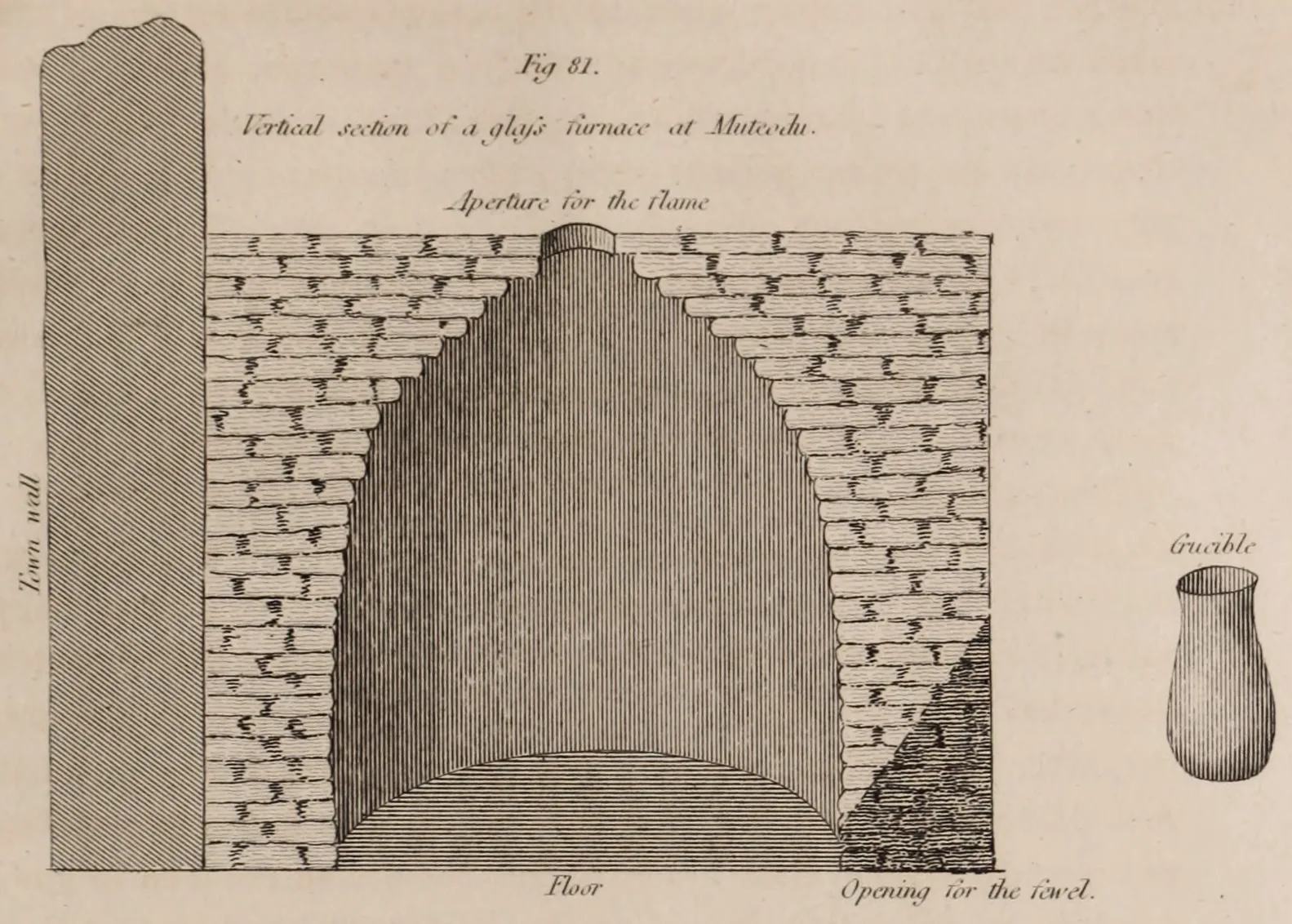
The furnaces are constructed in a high terrace, which is built against the inside of the town-wall, and are in form of a dome, or like an oven, eight feet in diameter, and about ten feet in height. The annexed section of one furnace (Plate XXXIII. Figure 81) will assist the reader to comprehend the description. The oven is not arched, but contracted above into a circular opening, about eighteen inches in diameter, by making the upper rows of stones project beyond those below them. At the bottom of the furnace, in the side opposite to the town-wall, is a small opening, through which the fewel is supplied. The crucibles are oblong, as in the figure, and would contain about 5 1/2 Winchester gallons. Having been filled with the materials, they are lowered down into the furnace by the aperture in the top, by which also the workmen descend. They first place a row of the crucibles all round the furnace, with their bottoms to the wall, and their mouths sloping inwards. In this position they are secured by a bed of clay, which covers the crucibles entirely, leaving their open mouths only exposed. Above this row another is placed in a similar manner, and then a third and a fourth. The furnaces vary in size, from such as can contain fifty crucibles thus disposed, to such as can contain twice that number. The fewel consists of small sticks, which having been gathered a year are quite dry. A quantity having been put in the bottom of the furnace, the workmen ascend, and some burning coals are thrown upon the fewel. By the opening below, fresh fewel is added night and day, until the time allowed for vitrifying the materials has expired. The fire is then allowed to burn out, and the furnace to cool. Afterwards the workmen descend, and take out the crucibles, which must be broken to get at their contents.
The first operation is to make a frit, called Bilizu. The materials for this are, powdered white fat quartz 1 part; and prepared soda, or Soulu, 6 parts: the crucibles are filled with these mixed; and the fire is kept up five days. Every crucible gives a Maund of 40 Cucha Seers, or 24 1/4lb. of Bilizu.
To make the black glass: for every 40 crucibles, take prepared soda 1 Candy, or 18 08/100 bushels; and powdered frit 1/4 Candy, or 4 32/100 bushels: mix them, and fill the crucibles. The crucibles having been put into the furnace, a fire is kept up for eight days and nights; so that the flame rises three cubits above the aperture at the top of the dome. Each crucible gives a Maund, or 24 1/4 pounds of glass, of a black, or rather of an intensely dark grass-green colour. It sells for 4 Fanams the Maund, or 11s. 6 1/4d. a cwt. It is evident from this, that only 2/35 of the materials employed are silicious earth; the remainder is the impure salt called prepared Soulu. During the operation, part of this is dissipated; and part of it forms on the surface of the glass a pure white crust, an inch in thickness. This is used by the inhabitants for culinary salt, but in fact it is chiefly soda.
To make green glass: for 40 crucibles, take 1 Candaca, or 18 08⁄100 bushels of prepared Soulu; 5 Colagas, or 4 52⁄100 bushels of powdered frit; 1 Maund, or 24 1⁄2lb. of the powder of an ore called Kemudu; 4 Seers, or 2 3⁄10lb. of an ore called Cari-cullu; and 24 Seers, or 13 9⁄10lb. of calcined copper reduced to powder. These materials having been mixed and put into the crucibles, these are properly disposed in the furnace, and a fire is kept up for nine days and nine nights. For the first five days the fewel is added slowly, so that the flame just rises to the aperture; and afterwards it is not necessary to occasion quite so great a heat as for the frit, or black glass. The copper is calcined by burning it, on the fire-place in the bottom of the furnace, during the whole nine days that are required to make this glass. Each crucible produces 1 Maund and 12 Seers of green glass, which sells at 6 Fanams the Maund, or 17s. 3 1⁄4d. a cwt. The saline crust, formed on the surface of this glass, is considered by the natives as unfit for eating.
To make the red glass: for every 40 crucibles, take the same quantity of prepared Soulu, and frit, together with 5 Maunds, or 121 1⁄4lb. of powdered Kemudu. For fifteen days and nights these must be fused with a moderate fire. Each crucible gives 1 1⁄4 Maund of glass, which sells for 6 Fanams a Maund, or 17s. 3 1⁄4d. a hundred weight.
To make the blue glass: for every 40 crucibles, take the same quantity of prepared soda, and powdered frit, as for the others. To these add 24 Seers, or 13 9⁄10lb. of calcined copper, and an equal quantity of powdered Cari-cullu. For fifteen days and nights these materials also must be burned, with a moderate fire. Formerly, the workmen used to put in only twelve Seers of calcined copper, with an equal quantity of a blue substance called Runga. The merchant, however, who supplied them with this article, having died, they have not for some time past procured any, and have been obliged to make up the deficiency by a double proportion of copper. What the Runga is, I cannot say. The natives know that it is not blue vitriol: it may perhaps be smalts.
To make Hulledi, or yellow glass : for every 40 crucibles, take the usual quantity of prepared soda ; add to it 5 Colagas, or 4 52/100 bushels of native soda, from which all the small stones have been picked, but which of course contains a good deal of sand. For fifteen days these are burned with a slow fire. Each crucible gives a Maund of a wax-coloured glass, which sells for four Fanams a Maund, or 11s. 6¼d. a cwt. When this glass is wrought up into rings (Bangris), it receives a bright yellow colour by enamelling it with the melted calces of the following metals : 5 parts of lead, and one of tin are calcined together. Then one part of Sotu, or zinc, is calcined in a separate crucible. The two calces are then mixed, and farther calcined, until they begin to adhere together. They are then powdered in a mortar. When the (Bangri) ring-maker is at work, he melts some of this powder ; and, while the ring is hot, with an iron rod he applies a little of the powder to the surface of the glass.
6th May.—In the evening of the 5th there was much thunder, with heavy squalls of wind from every quarter of the compass, and some severe showers of rain. The thunder continued all night, and the morning looked so threatening that I did not set out till after breakfast. The weather, however, has now become so cool, that I did not feel the least inconvenience from being all day in the open air.
I had intended going to Hosso-durga, and had sent my spare tents to that place ; but, finding it necessary to look after the mines, which produce the ores called Kemodu and Cari-cullu, I was obliged to alter my plan. Neither could I get any accurate information concerning the situation of these mines ; some of those even, who were employed in bringing the ore, called them two cosses distant, while others stated their distance at three times as much.
I went first in search of the Cari-cullu, and proceeded on the way by which I came yesterday, till I reached the small valley nearest Muteodu, distant from thence about 3/4 of a coss, or two miles. Here I passed a small village named Sida Gondana hully, and came to a low hill, which is called Malaya Maluppa, after a temple dedicated to Siva. This hill forms the eastern boundary of the valley, and is of no considerable height. The mine of Cari-cullu is on its ascent, and is readily discernible from a number of bluish-black stones, that lie on the surface of the ground. No excavation has been made. The Cari-cullu is found, in detached masses, on the surface, mixed with the stones. These stones are often so much tinged by the metal, as hardly to be distinguishable from it; but are known by being broken, when their stony nature appears evident. Some of them, when broken, appear internally to have undergone little change, and are evidently fat white quartz; the appearance of the internal parts of others has been so much altered, that had I not observed them in all intermediate gradations, I should never have supposed them to have been of a quartzy nature. The masses of stone are much more numerous than those of the Cari-cullu, owing probably to the quantity of the last that has been removed from the surface. Deeper in the earth it is probably found in a great proportion, but there has been no occasion to make any experiment by digging. The extent of ground which the mine occupies may be about 200 yards square. The Cari-cullu literally signifies the black stone. It is found in masses about the size of the fist, and has a very strong resemblance to the black ore of Manganese. By the usual process, however, for discovering the calx of that metal, I have not been able to obtain any; nor indeed any thing else, except a brown calx of iron. The ore however, when heated, readily gives out a considerable quantity of oxygene.
Immediately N.W. from the mine, and on the declivity of the same hill, is a singular stratum of rock. It has every appearance of a rock that has formed the channel of a river, being water-worn, and excavated into round pits or pots, exactly like the rocks on which a rapid stream has long acted. This is an appearance, concerning which any one, who has been accustomed to a mountainous, well-watered country, can hardly be mistaken; yet, as the rock is situated on the declivity of a hill, and has a valley immediately below it, and parallel to its course, it is impossible, without a total change having taken place in the face of the country, that it could have formed the bottom of a river. At present there is no stream in the valley. This rock runs nearly north and south, and is quite vertical. It is a Sienite; sometimes of a homogeneous grey colour, and at other times composed of alternate grey and white layers, which last consist of the quartz and felspar entirely. These layers are of very various thicknesses, and are sometimes straight, and sometimes disposed in swirls, like a knot of timber. Although it has the appearance of having suffered much decay, this stone possesses a very high degree of toughness.
Having examined this mine, I returned almost to Muteodu, and then proceeded south to a small village, named Cadu-caray, three cosses distant. The country is not hilly, and in most places is fit for the plough; but almost the whole is waste. I saw only one village, named Chica Taycu-lawati; but I passed several small collections of huts belonging to Goalaru, or keepers of cattle. Toward the east was a range of hills, running from Chatrakal to Chica Nayakana hully. Toward the west is a level country, interspersed with a few low detached hills. On the most remarkable of these is placed Hosso-durga, or the new castle.
The soil is in general poor, and the rocky strata frequently come to view. Among these are very extensive strata of quartz, and of quartz intermixed with felspar of a white colour. Intermixed with these are strata of white quartz, and black mica, disposed in alternate layers, firmly united, and forming a very hard stone.
Cadu-caray is in Budihalu district, and is under the management of the Amildar of Muteodu, although it does not form a part of the Chatrakal principality. The Amildar, therefore, accounts to the Subadar of Chatrakal for Muteodu, and to the Dewan of Mysore for Budihalu. In the time of the kings of Anagundi the districts of Budihalu formed the territory of a Polygar, named Shirmia Nayaka, who was of the Goala cast. It was then valued at 12,000 C. Pagodas, or 3744l. 9s. 7d. a year; but of this he paid one half as tribute. After the Mussulmans had taken Sira from the Ratna-giri Polygars, and had made it the residence of a Nabob, or Subadar, they seized on Budihalu, and soon afterwards it was given in Jaghire to Ismael Mummud Khan; he transmitted it to his son of the same name; from whom it was taken by Hyder, after he had conquered Sira. Ismael Mummud Khan raised the revenue to 20,000 Pagodas a year (6240l. 15s. 11¾). Owing to a want of inhabitants, Purnea has reduced the revenue to 15,000 Pagodas; but were there plenty of cultivators, the former revenue, it is said, would not bear hard on them. North from Cadu-caray is a small river, that never entirely dries, and is named Mavana Canavay holay. It comes from the hills to the westward; and after filling two tanks, runs into the Vedáwati at Niruvugullu.
7th May—I went in the morning to examine the mine of Kemodu, and another of iron, concerning which I had received intelligence on the preceding evening. The ore is smelted here in the same manner as at Chica-bayli-caray. When the process fails, a brittle porous mass is obtained, which has a greater resemblance to our cast iron than any thing that I have seen produced in India. This mass is fused in a furnace of lower power, and gives an iron softer than the common kind; and from this soft iron are usually formed the hoes, and other digging instruments of the natives.
Doda Rashy Guda, or great heap hill, which contains the mines, is a peak about three hundred feet in height, and a mile in length, that forms part of a ridge running nearly north and south, and lying east from Cadu-caray. Between the mine and this village is another ridge, on the northern extremity of which is a temple dedicated to Ranga, and named Mavana Canavay, from which the rivulet so called has its source.
As I ascended this nearest ridge, the first rock which I met was an earthy quartz, or hornstone, divided by fissures in all directions, and having some of these fissures filled with veins of white quartz. This rock is not vertical, but dips much toward the east. Further on, the common rock consists of alternate parallel layers, firmly united, of white arid quartz, and of brown iron shot quartz, or hornstone. These layers are sometimes plain, and at others disposed in swirls; and as the stone in decay, by the attrition of its longitudinal angles, has a great tendency to assume a cylindrical form, and always breaks in masses truncated at right angles to the layers, it is often found in pieces which have a strong resemblance to petrified wood. The stone does not break regularly in the direction of the layers, which are disposed in the same line with the strata. These are vertical, and run nearly north and south. I am by no means sure of the nature of the brown part of this stone. It may very possibly be hornblende overcharged with iron; and the Sienite found yesterday nearly in the direction of its strata, strongly confirms this opinion.
Between the two ridges I came to the channel of a rivulet, named Aladi-holay, which at present is quite dry. Here I found the place whence the glass-makers procure the ore called Kemodu. For about three quarters of a mile the bed of the rivulet is filled with stones of a steel-grey colour. Many of these are the iron ore called Kemodu. It is in water-worn masses, from the size of a man's head downwards, and possesses the external characters of the grey ore of Manganese. When powdered, it is attracted by the magnet. Intermixed with the Kemodu are other masses of a similar appearance, but which are useless. On breaking these, they are found to be in all intermediate stages of maturation, from the common rock before described, to almost perfect ore.
On ascending the eastern bank of the rivulet, beyond the mine of Kemodu, I came to a conical peak on the eastern ridge; and observed, that all the stones on its side were stained with the steel grey of that ore. I saw none perfect on it; but on breaking the stones I found them in all stages, from the rude rock, to a state approaching to maturity. Indeed, many grains of pure Kemodu were very discernible, imbedded thickly in the substance of these stones.
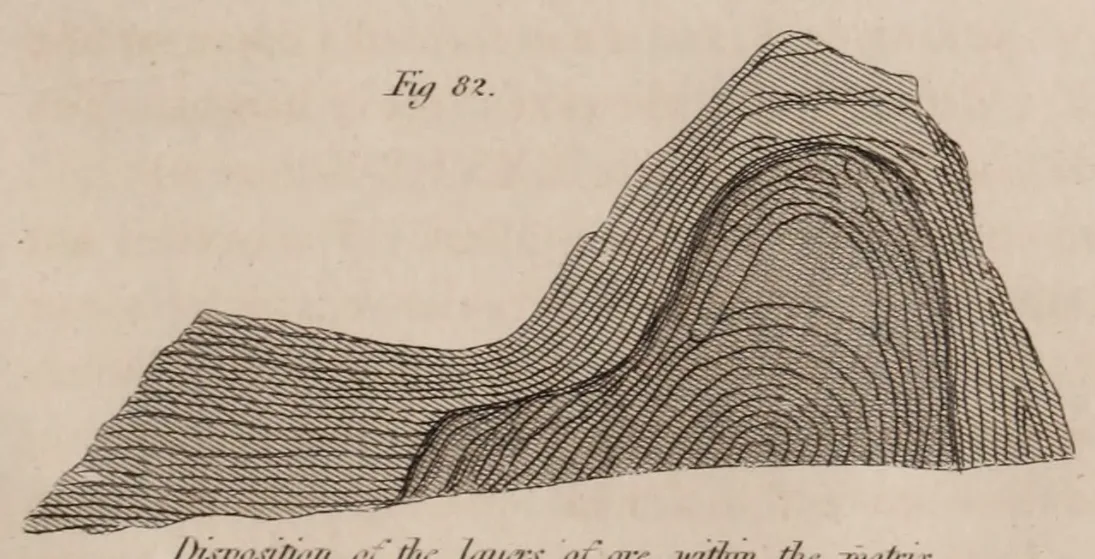
Immediately south from this, is the peak called Doda Rashy Guda, whence the iron ore which supplies the forges is procured. This ore is quite the same with the black kind at Cudera Canivay, but it is disposed in a different manner. It is imbedded in large irregular cavities of the barren stone, or matrix. This consists of plates that are separable without much difficulty, and which, I have no doubt, are the brown layers of the common stone of the hill separated by the white ones having been corroded by iron. It is, no doubt, a primeval rock; and its strata may be traced running in the direction of the meridian, and in general vertically. The ore is similarly composed of plates; and fibres of the roots of plants are found to have penetrated into the interstices; but this, I am inclined to think, has happened after the surface has been exposed by the miners. I also suppose, that the ore has once been the common stone of the hill, and has afterwards been more and more impregnated with iron by some process unknown to us; in the same manner as, I suppose, has taken place in the ore called Kemodu. The various gradations from the perfect stone to the perfect ore is the circumstance that induces me to form this opinion. A portion of the rock, having been cut down with a vertical smooth face about three feet deep, presented an appearance similar to that in Plate XXXIII. Fig. 82. The central parts are of the ore, and contain the roots of plants between their plates. The upper layers are of the barren matrix. I brought away, as a specimen, the upper extremity of the ore, with part of the matrix adhering. Owing to the nature of the mine, the manner of working it is somewhat different from that used at Cudera Canivay, and the workmen are forced to dig the ore from under the caverns of the matrix. I no where saw that they had ventured in farther than ten or twelve feet; so that I cannot say, whether or not the internal parts of the hill contain any veins, or rather beds, of ore. Openings have been made in various places for about a quarter of a mile in length, which seems to be the extent of the mine.
Having examined Doda Rashy, I descended by the banks of the Aladi-holay, till it came opposite to the temple of Ranga, where it joins the Mavana Canavay. Here both streams pass between the hill on which the temple stands, and one placed at no great distance to the north. The opening has been filled up by a mound, which, so long as it remained entire, formed a fine reservoir that watered a hundred Candacas of rice-land. The mound has long ago been broken; and it is said, that to repair it would cost three thousand Pagodas, or 936l. 2s. 4½d. As Paddy, when very cheap, sells at one Pagoda a Candaca, and as the government receives one half of the produce, which is here on an average forty seeds, even allowing that there should be only one crop in the year, the expense of rebuilding the tank would be repaid by less than two years rent.
All over the Chatrakal principality, of which Hosso-durga forms a part, the rice crop is of little importance; the rent is no higher than that for dry grains, and little labour has been bestowed on irrigation. Here the rent is high, being one half, or even more, of the produce; the fields are very productive, and many excellent Tanks have been constructed. Most of these were made during the government of the Shirmia family.
From this ruinous Tank I went about two cosses to a fortified village, containing about forty houses, and called Doda Tayculawati. It is situated in the open country of the Budihalu district. The country is at present extremely unhealthy, even to those born in it. Almost every family has some person ill with the fever; and no less than eight persons in the house of the Amildar of Budihalu are now labouring under that disorder. The natives say, that the fever will stop immediately after the commencement of the rainy season. This year has been uncommonly unhealthy, owing to its having been unusually hot.
In every part of the Budihalu district the wild date (Elate sylvestris) is very common, but is of little use except for fuel. The present number of inhabitants cannot consume a hundredth part of the juice that could be extracted from it. This tree might be a source of considerable advantage, could a good spirit be extracted from its Jagory, of which I think there is little doubt; but from the wretched stills of the natives this can never be expected.
8th May.—I went three cosses to Belluguru, and by the way passed two Tanks and villages. All the country near the road is level enough for the plough, and clear from trees; but, the army of Purseram Bow having passed this way, very little of it is cultivated. Some of the soil is rocky; a good deal is rich land; but by far the greater part is poor gravelly land; fit enough, however, for raising Huruli (Dolichos biflorus), Shamay (Panicum miliare E. M.) and other such crops.
Belluguru is a small fortified village with 150 houses. It suffered less than usual from the Marattahs, as before the invasion of Purseram its houses amounted to only two hundred. It is a part of the Garuda-giri district, which has long formed a part of the dominions of the Mysore family. Near it is a very large reservoir.
Owing to the mud deposited by the water, these Tanks fill gradually at the bottom; so that once in three or four years this mud must either be removed, or an addition must be made to the height of the bank; otherwise the reservoir becomes useless. The mud being an excellent manure for the neighbouring dry lands, as much of it as possible should be taken away, and spread on them. In other respects, the raising of the bank is the most advantageous manner of repairing a Tank, as it requires the least outlay of money. It offers also another advantage. If the sluice, through which the water is let out to irrigate the fields, were always raised to a level with the mud in the bottom of the Tank, as that was deposited, the extent of ground, which the Tank could irrigate, would always increase. This, it is true, would be attended with a considerable expense, and is never practised; so, in order that the plug which shuts the sluice may be kept clear, there is often a necessity of sinking a well ten or twelve feet in depth. The Tank here receives a stream forced by a dam from a rivulet, that comes from Garuda-giri, and which afterwards falls into a Tank called Belallu Samudra, which is one coss and a half N.W. from Belluguru.
In this district, and in the neighbouring one of Budihalu, all the rice-ground is cultivated as sprouted-seed. The seed, the natives here say, is sown equally thick in the two districts; yet in Budihalu the land often produces sixty fold, and the ordinary crop is forty seeds; while in this district of Garuda-giri, the usual produce is twenty seeds. I measured a field, said to sow three Colagas of seed, or 2673 cubical inches. It contained 46,636 square feet. The acre, therefore, requires 1 161/1000 bushel for seed, and produces here, in an ordinary crop, almost 23 1/4 bushels of rough rice; while in Budihalu it produces twice, or even three times, as much. In the course of one year, there are frequently from the same field two crops of rice. The grain in the husk is worth one Bahadery Pagoda a Candaca, or 11 66/100 pence a bushel. The produce of one crop is, therefore, worth about a guinea an acre.
9th May.—In the evening and night there was much loud thunder, with heavy rain from the southward, but little wind. I went four cosses to Garuda-giri, or the hill of Garuda, the eagle on which Vishnu rides. It is often pronounced in the oblique case Garudana-giri, which, by the Mussulmans, is usually corrupted to Gurruna-giri; and in a map which I received, I find it called Gurgan-droog. The country through which I passed is flat, but the soil is rather poor. Almost the whole of it, however, is capable of being cultivated; but by the Marattah invasion it has been quite depopulated, and I passed only two small villages.
At one of these villages, named Ana-giri, in the Yagati Taluc, I met the Amildar. He says, that his district produces an annual revenue of 10,000 Pagodas, or 3120l. 8s. 4d. It formerly made a part of the Garuda-giri district, and belonged to the Mysore Rájás. On the occasion of an invasion by the Nizam, Hunnama Nayaka, Polygar of Terri-caray, rendered such assistance to the (Curtur) sovereign of Mysore, that he was rewarded by a cession of the Yagati Taluc. Hyder deprived the Terri-caray family of all their territories, ordered them to reside at Manzúr-ábád, and allowed them an annual pension of 2000 Pagodas, or 625l. 1s. 8d. They were by cast Baydaru, but of a different family from the Rájás of Chatrakal. During the reign of the Sultan, the present heir of the family enjoyed his pension. On the fall of Seringapatam he joined Dundia, and hanged three or four Bráhmans, who were his servants, and who refused to follow him in his mad enterprise. He afterwards repented, and, having submitted, was kept in irons for some time at Seringapatam. About two months ago, the Amildar says, this Polygar was liberated, and received the grant of a pension of thirty Pagodas a month.
Garuda-giri at one time belonged to the Ikeri Polygars, from whom it was conquered by the family of Mysore. These built the Durga, or fort, which occupies the highest part of a short abrupt ridge, that by a strong imagination has been fancied to resemble one of the rude images of Garuda. The suburb (Petta) stands at the foot of the hill, and is fortified. During the government of Tippoo, it was the nominal capital (Kasba) of an Asoph; but that officer resided at Chica-Nayakana-hully, which is twelve cosses distant. Garuda-giri never was a large place, and at present contains only about forty houses. The Amildar is a Sivabhactar; as are also, according to him, by far the greater part of the neighbouring people; but in the public accompts, to be hereafter mentioned, very few of this sect are reported.
In all the country between this and Seringapatam, Ragy is the most common crop; and the cultivation of that grain prevails all the way towards Baba Bodeens hills, where the rice and betel-nut country begins. The rice-ground, according to the Amildar, produces on an average twenty fold.
In this part of the country there are many sheep, but few black cattle. The shepherds and their families live with their flocks. The men wrap themselves in a blanket, and sleep in the open air among the sheep. The women and children sleep under hemispherical baskets, about six feet in diameter, and wrought with leaves so as to turn the rain. At one side a small hole is left open, through which the poor creatures can creep, and this is always turned to leeward, there being nothing to cover it. I have not in any other country seen a habitation so very wretched.
Throughout the Chatrakal principality the roofs of the houses are terraced with mud, and this custom also commonly prevails over the eastern parts of Mysore, Sira, and Colar; but the fashion here is pent roofs. Although in every part of Karnata the materials for building huts are excellent, yet those with pent, and those with terraced roofs, look equally mean and rugged.
In a hill lying south from Garuda-giri, and called Hiricul, there are found both sandal-wood and lac. Owing to the increasing number of tigers, the collecting of this last has of late been given up.
10th May.—I went two long cosses to Banawara. The country through which I passed is scarcely any where too steep for the plough; but it is almost entirely waste, and much of it is overgrown with the wild date, which at present is only used for firewood. The chief cause of the desolation which is here visible is said to be the rapacity of the Marattahs. Within the memory of man this country has suffered two inroads, one about thirty years ago by Trumbaca Mama, and another by Purseram Bow.
Banawara is one of the best mud forts that I have seen; and, owing to its strength, it escaped from the fangs of the Marattahs. It is situated in a fine open country, on the side of a large Tank which is at present dry. The people are very subject to fevers, which cannot be attributed to the black clay; for the soil is dry and sandy. It formerly belonged to Hari Hara Swaméswara Ráyá, a Polygar descended from Belalla Ráyá, and of course of a most ancient family of the Jain religion. The ruins of their palace still occupy a considerable space, and are surrounded by a very high wall, which even now is in good repair. The buildings within have been mean, and are almost entirely ruinous. This family was destroyed by Ballu Khan, a Mussulman chief. He was expelled by a Bayda named Timuppa Nayaka; he again was driven out by the Shivabhactars of Ikeri; and from them the place was taken by Chica Deva Ráya Wodear of Mysore, the 7th in ascent from the Curtur whom Hyder confined. On that chief’s getting possession of the government, Banawara contained about 2000 houses; but most of the inhabitants, with those of five other towns, were removed to occupy a new city, named Naga-puri.
In order, probably, to secure these people and their effects from the Marattahs, Hyder built the fort of Naga-puri in a small valley, which is about half a coss in extent each way, and is surrounded on all sides by low hills, like those of Chatrakal. These hills appear to extend about two cosses from east to west, and three cosses from north to south. Naga-puri, which stood three cosses from Banawara, was found to be excessively unhealthy; and its situation did not prevent it from being plundered by the Marattahs. Hyder, therefore, eighteen months after having built it, allowed the people to return to their former abodes.
Tippoo bestowed some attention in encouraging the people of Banawara. On the fall of Seringapatam, Hunnama Nayaka, an uncle of the Polygar of Terri-caray, seized on the fort, and kept possession for two months and a half. On the approach of a detachment of British troops, his followers dispersed; and the newly appointed Amildar, who was in the neighbourhood with 300 Candashara, seized him, and hung him up directly. At present, Banawara contains 500 houses, many of which are inhabited by Bráhmans.
The cultivators being scarce, the officers of revenue fall on a curious plan of increasing the appearance of cultivation, and of thus getting credit for having their districts in good condition. This is a very common practice, I am told, in every part of the south of India, and is as follows. In place of letting at the full rent, to the few inhabitants that remain, as much land as they can cultivate, the Amildars give no man more than what his family originally possessed; but, when he has finished the cultivation of his paternal farm, the tenant is forced to plough and sow as much of the waste fields as he can; and, in order to increase the quantity, no money rent is demanded; but the government is contented with a share of the produce, which is very small, the cultivation having been performed in a very imperfect manner.
Some of the rice-lands here are let for a money rent, and some by a division of crops, which the Amildars allege is much the best mode of assessment in a country where the quantity of rain is so uncertain. If the rains do not come, the tenant cannot pay his rent; and if they come in abundance, it is but fair, that the government should reap a part of the benefit. This reasoning is specious; but the division of crops, except under the immediate inspection of a small proprietor, gives such opening to fraud, that it ought to be utterly discarded. For the uncertainty of the seasons an easy remedy occurs. As, before the cultivation commences, it is exactly known, what extent of ground the water in the Tank will irrigate, those persons, in case of a scarcity of rain, may be exempted from rent, who cannot cultivate their fields ; and there is no occasion for any favour being shown to those who can get a supply of water.
In this district (Taluc) good rice-land lets at twenty Bahadury Pagodas a Candaca, which the cultivators say is equal to the value of one half of the grain produced ; for they acknowledge, that this ground produces forty fold, and value each Candaca at one Pagoda. This, however, is a low valuation ; for the Candaca here contains 24,480 cubical inches ; so that at this rate the bushel of rough rice would cost rather under 8 1/2d. The produce of the soil here, and in the Budihalu district, is acknowledged to be nearly the same ; while in the intermediate district of Garuda-giri, the people acknowledge only half the quantity. The people of Banawara say, that their neighbours did not impose upon me ; but that their soil is actually inferior. I measured a plot, which was said to require a Colaga of seed, and found that it contained 23,255 square feet. At this rate, the acre will require for seed 1 067/1000 bushel nearly, which agrees very well with the measurement at Belluguru. The acre here produces 42 67/100 bushels of rough rice, and pays 15s. 1d. of rent, which is reckoned the value of one half of the grain produced ; but this is valued by at least one fourth too little.
In the neighbouring districts of Garuda-giri, Banawara, Caduru, Hárana-hully, Honawully, and Chin’-ráya-pattana, the cultivation of tobacco is very considerable. It is exported in large quantities to all the countries toward the north and west. It is sown in the dry field, cultivated for Ragy and other similar grains, of which a crop must intervene between every two crops of tobacco. When the season proves very wet, it cannot be cultivated, and it requires a good Ragy soil. A few small stones do no harm, but it will not grow on the hard soil called Darray; and, in fact, the soil of the first quality is that usually employed, though sometimes the tobacco is planted on the best fields of the second quality. In the three months following the vernal equinox, the field ought, if possible, to be ploughed ten times; but some of these ploughings are often neglected. After the 4th or 5th time, sheep and cattle must for some nights be kept on the field for manure. During the last fifteen days of the second month after midsummer, small holes are made throughout the field. They are formed with the hand, and disposed in rows distant from each other 1½ cubit; and in every hole a young tobacco plant is set. This being the rainy season, the tobacco requires no watering, unless during the first ten days from its having been transplanted there should happen to be two succesive fair days. In this case, on the second fair day, water must be given with a pot. On the 15th day a little dung is put into each hole, and the field is hoed with the Cuntay. Every fourth or fifth day, until the tobacco is cut, this is repeated, so as to keep the soil open and well pulverized. At the end of a month and a half, the top shoots of the plants are pinched off, and every eight or ten days this is repeated; so that six or seven leaves only are permitted to remain on each stem. In the month preceding the shortest day, it is fit for cutting. The stems are cut about four or five inches from the ground, and are then split lengthwise; so that each portion has three or four leaves. These half stems are strung upon a line, which is passed through their root ends; and then for twenty days they are spread out to the sun and air. Every third day they are turned, and they must be covered with mats should there happen to be rain; but at this season that seldom comes. The tobacco is then taken into the house, put into a heap, and turned four or five times, with an interval of three days between each time. It is then fit for sale, and by the merchants is made up into bundles, which include the stems. It is sold by weight; and on an average the farmer gets one Sultany Pagoda for every four Maunds, each containing 40 Seers of 24 Rupees weight. This is at the rate of very nearly a penny a pound, being 9s. 3½d. a hundred weight. In order to prepare the seedlings, a plot of ground must be dug in the month which precedes the longest day. It must be then cleared from stones, and separated by little banks into squares for watering, in the same manner as in this country is done to kitchen gardens. The tobacco seed is then mixed with dung, and sown in the squares, which are smoothed with the hand, sprinkled with water, and then covered with branches of the wild date. Every third day it must be watered. On the 8th day the plants come up, and then the palm branches must be removed. If the plants be wanted soon, they ought to have more dung, and to be kept clear from weeds. With this management, they are fit for transplanting in from a month to six weeks. If they are not wanted for two months, or ten weeks, the second dunging is omitted, and the growth of the plants is checked by giving them no water for eight days after they come up.
A Wocula of Ragy land plants 4000 tobacco stems, and in a good crop produces 16 Maunds, worth four Sultany Pagodas. This ground would sow one Colaga of Ragy, and produce two Candacas, or forty fold, worth 2 Pagodas. The Colaga or Wocula-land, of the first quality used for tobacco, pays a tax of one Pagoda; of the 2d quality it pays ¾ of a Pagoda; of the 3d, or worst quality, it pays half a Pagoda. I measured a field said to require 1½ Colaga of Ragy for seed, and found it to contain 15,000 square feet. The Wocula land, therefore, should contain 100,000 square feet; but, if a Wocula plants 4000 tobacco stems at 1½ cubit distance, which I found to be the actual thickness, more than one fourth of this extent cannot be allowed for it. The number of 4000 plants, that can be put in a Wocula of land, was afterwards confirmed to me at Jamagullu. I am quite uncertain, however, whether the actual measurement, or a calculation founded on the number of plants, ought to be preferred. By the former, the acre of the first quality of land would pay a little more than 3s. 6d. as land tax, and would produce 169 lb. of dried tobacco, worth 14s. 0½d.; or it would sow almost two gallons of Ragy seed, and produce almost ten bushels, worth 7s. 0¼d. On the other supposition, the rent, seed, and produce, would be four times as great; but that would render this land almost as valuable as rice ground, which cannot be the case.
11th May.—I went three long cosses to Jamagullu. The country is rather more broken than that through which I have come for the last two days, and is equally deserted. The wild date has even overgrown much of the rice-land. Jamagullu at present contains about eighty houses, and has a fort. Before the invasion of Triumbaca Mama, it was a large place, but has never since recovered.
Here is a temple dedicated to Narasingha, and built entirely of Balapum, or potstone. It is highly ornamented after the Hindu fashion, and on the outside every part of its walls is covered with small images in full relievo. Both the general structure of the fabric, and the execution of the component figures, are utterly destitute of either grandeur or elegance; indeed, I have not yet had the good fortune to meet with a Hindu image that was tolerable. This temple is said to have been built by Sholun Ráya, and the architect that he employed was named Jacanachery. This prince lived about a thousand years ago; and having killed a Bráhman, in order to wash away his sin, he employed twenty years in travelling between Kási and Raméswara, and in rebuilding temples. The one here entirely resembles in its style the others that I have seen which are attributed to the repentance of this personage. It has an inscription on stone, but that has been defaced. The annual revenues formerly belonging to the temple amounted to 250 Ikeri Pagodas (100l. 6s. 4½d.). These were entirely removed by the Sultan. Purnea allows it 50 Canter’ Ráya Pagodas a year in money, or 15l. 12s. 0½d.
Many of the strata around this are of potstone. They are quite vertical, and run north and south in the usual direction of the other strata of the country. In general, the potstone breaks into small fragments, and is full of fissures; but in the neighbouring country there are many quarries, where masses of great size may be procured. It forms an excellent material for building, being very easily cut, and at the same time being excessively tough. The good kinds resemble entirely the stone at Maru-Hully, described in the eighth chapter of my Journal, Vol. II. p. 146; and, in fact, are somewhat between a hornblende and a potstone.
For the two last nights there has been much thunder, but no rain. To-night there was both thunder and very heavy rain. The soil here is very fertile; for the farmers acknowledge 50 fold to be the usual crop of both Ragy and rice, that have been sown on good ground properly cultivated. From what I have stated at Banawara, the produce by the acre, at this rate, may be easily estimated.
The fort of Jamagullu was built by a Baydaru Polygar, named Eijuru Vencatuppa Nayaka. His family were related to the Polygars of Raya-durga, and south and west from hence possessed very considerable territories. Jamagullu was taken from them by the Mysore family, who annexed it to Banawara, under which it has ever since continued. In the reign of the Sultan, the descendants of Eijuru Vencatuppa had no lands, but still retained the title of Bull Rájás, and had an annual pension of 5000 Pagodas (1560l. 3s. 9½d.). On the fall of Seringapatam, Kristuppa Nayaka, the heir of the family, seized on Manzúr-ábád, Bailuru, and other parts of his ancestors dominions, and has made an obstinate struggle to retain them. In this he has had little success, and he has lately been forced to retire to the almost inaccessible forests near the Ghats.
12th May.—I went to Hullybedu, a stage of about 10 miles, but it is called only two cosses. By the last night's rain the rivulets were swollen, and the natives consider the rainy season as commenced; but for the first two months, showers once only in four or five days are expected. On this day's route much of the soil is good, but the country is quite deserted. By the way I observed some small hills, consisting entirely of calcarious tufa, mixed with a little earth. Hullybedu, at present, is a small mud fort, with a suburb (Petta) containing about eighty houses, and abounding with beggars. It stands on the side of a large Tank, that waters a great deal of fine rice-ground, much of which is planted with sugar-cane, and some with palm gardens. This Tank was formerly in the centre of a great city, which was named Dorasamudra, and was the residence of several of the Belalla Ráyas, who once reigned over a great part of the peninsula of India. According to the natives, the walls of this city may be traced, extending three cosses in circumference; and the site of the palace is shown, and is readily distinguishable by having been placed in an inner fort, or citadel.
The Belallu family having been originally Jain, some traces of that religion still remain. There are here several people of that persuasion; and within a common inclosure there are three of the temples called Busties. Here are three inscriptions; one defaced, and two legible. I had the latter copied, and left the copies that they might be written in a fair hand; but they were not forwarded, according to promise.
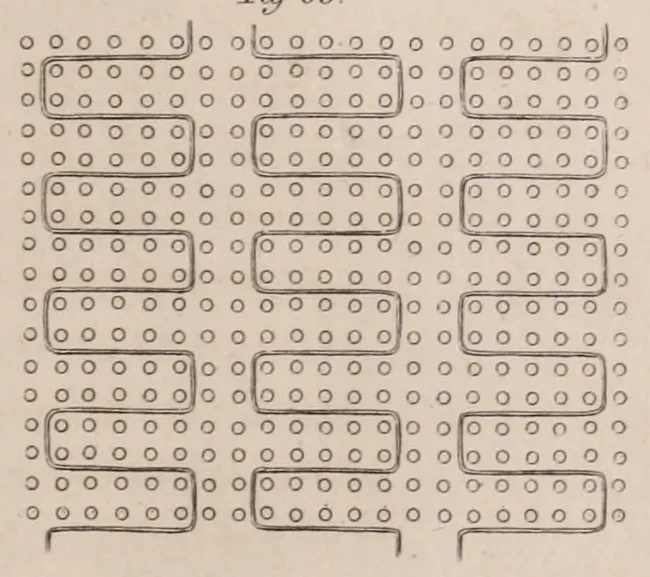
The most remarkable building at Hullybedu is a temple of Siva erected by Vishnu Verdana Ráya. From an inscription on the wall, this must have been before the year of Sal. 1203, or A. D. 128 0⁄1. A copy of this inscription has been delivered to the Bengal government. This temple is built of similar materials, and in a similar style of architecture, with that at Jamagullu; but is larger, and more crowded with ornaments. Its walls contain a very ample delineation of Hindu mythology; which, in the representation of human or animal forms, is as destitute of elegance as usual; but some of the foliages possess great neatness, as may be seen by a drawing made of part of one, and given in Plate XXVII. figure 83. The temple has long been without a Pújári, or public worship, and has gone so far to decay, that it would be repaired with great difficulty. This is a pity, as it much exceeds any Hindu building that I have elsewhere seen.
Before the temple are placed two images of the Baswa, or bull of Siva. The one is of Balapum, or the potstone impregnated with hornblende, of which the temple is built, and which does not admit of a marble polish. This stone, which as usual represents the bull in a lying posture, is sixteen feet long, ten feet high, and seven feet broad. The other image is not quite so large; but its materials are finer, and admit of a marble polish. It seems also to be a potstone, or perhaps a talc impregnated with hornblende, and contains small irregular veins of a green shining matter. Its general colour is black, with a tinge of green. Some of the pillars in the inner part of the temple are of the same fine black hornblende that is used in Hyder's monument, and are highly polished. Some of them reflect objects double, which by the natives is looked upon as miraculous. These temples having been built when this was the seat of empire, and the inhabitants for many centuries having had no occasion for such costly materials in their buildings, the knowledge of the quarries from which they were supplied has been lost; and the natives believe that the stones were brought from Kási, on the banks of the Ganges.
A very common rock here is called by the natives the black-stone (Caricullu). It seems to be a hornblende porphyry; but the basis, having a slight degree of transparency, probably consists of an intimate union of hornstone, or quartz, with hornblende. It is black, with a greenish tinge, and greasy appearance, and contains white felspar in pieces of various sizes. It sometimes also contains veins of quartz, and on that account might perhaps be called a Sienite. It does not cut well for fine buildings; but breaks into quadrangular masses, which, from their being excessively tough and durable, make excellent rough work. For the same reason it is frequently hollowed out into the mortars of oil mills.
13th May.—I went three cosses to Bailuru. The country is very bare; some of it is hilly, and full of stones; much of it is a good Ragy soil; but very little is cultivated. I crossed a small river called the Bhadri, which comes from Baba Bodeens hills, and runs into the Cavery. It never dries entirely, and receives the water from all the country south from Banawara. To the west of the Bhadri river the country is called Malayar, or the hills; while that on the eastern side is called Meidán, or the open country. I remained at Bailuru, taking an account of the cultivation there, as an example of that which prevails in the hilly region whence the Cavery has its sources.
The nature of the Malayar country resembles that of the sea coast below the western Ghats, in so far as rice is the principal object of cultivation, and as little attention is paid to the rearing of dry grains upon which the people to the north and west of the Bhadri chiefly subsist. In the Malayar country, however, there are no pepper gardens, nor plantations of betel-nut palms, for which it seems as well fitted as the Nagara principality. It is said entirely to resemble the Codagu Ráyáda, or Coorg country. At Bailuru there is no brickstone, and the country abounds with the calcareous tufa. The hills are overgrown with wood, and are considered as quite useless. The vallies only are cultivated.
On the Bhadri there was formerly a dam, the water from which irrigated forty Candacas of rice-land; but this has gone to decay, and to repair it would require two or three thousand Pagodas, or about ten years rent. The rains in all the Malayar country are very heavy, and in general bring one crop of rice to maturity; but unless there be small Tanks to give a supply for any intervals of fair weather that may occasionally happen, the crops are rather uncertain. This circumstance occasions the rice-lands to be divided into two kinds; the one, called Niravery, is supplied from Tanks; and the other, called Mackey, depends entirely on the rains.
Each kind of rice-ground, according to its soil, is divided into three qualities. The extent is estimated by what are called Candacas; but these vary much in size, and in general require much more seed than one Candaca. A Candaca of Mackey is always larger than one of Niravery; and the rent not only depends on the nature of the soil, but on the extent of the Candaca. The Candaca of grain, it must be observed, contains 4095 cubical inches, and consists of twenty Colagas, each divided into nine Cucha Seers. I measured a field of rich Mackey land, which was called a Candaca, and required thirty Colagas of rice-seed. It not only produced annually a crop of rice, but one also of Callay (Cicer arietinum); on which account it paid a rent of three Ikeri Pagodas a year, which is the highest rate in this district (Taluc). I found that it measured 64932 square feet. At this rate, an acre would sow 1 9155⁄10000 bushel, and pay 16s. 2 1⁄2d. as rent. I then measured a field of Niravery, of a very poor soil, but well supplied with water. It is said to require thirty-three Colagas of seed, and its rent is also three Pagodas. In order to make up for the poverty of soil, a quantity of dry-field is thrown into the field, and pays no additional rent. This dry-field sows four Seers of Ragy, (Cynosurus corocanus), and two of Huts' Ellu (Verbesina sativa, Roxb: MSS.). I found, that the Niravery contained 28566 square feet, and the Ragy ground 7100 square feet. The rent upon the acre, including both kinds of ground, is therefore 1l. 9s. 6 1⁄2d. The seed of rice is at the rate of 4 792⁄1000 bushels an acre; that of Ragy at the rate of rather more than one peck 1 17⁄100; and that of Huts' Ellu at the rate of about half a peck an acre. In the following table will be seen the kinds of rice cultivated here.
| Kind. | Land. | Cultivation. | Quality. | Months required to ripen. |
|---|---|---|---|---|
| Hassoday | Niravery | Dry-seed | Large | 8 |
| Chipiga | do. | do. | do. | 7 |
| Kiaseri | do. | do. | do. | 7 |
| Cumbara Kiaseri | Both | do. | do. | 7 |
| Balla Mulligay | Niravery | do. | Middle sized | 8 |
| Sana Butta Bily | do. | do. | Small | 8 |
| Do. Kempu | do. | do. | do. | 7 |
| Modara | Both | All 3 methods | Coarse | 7 |
| Kirwiunna | Niravery | Dry-seed transplanted | do. | 8 |
| Putta Butta | do. | Dry and sprouted-seed | Small | 8 |
On Niravery land, or that which has a supply of water from Tanks, the rices most commonly cultivated are Kiriwunna and Hassoday. All the three kinds of cultivation are in use; but in ordinary seasons the dry-seed is by far the most prevalent. In extraordinary wet seasons a good deal is transplanted, and some is sown sprouted.
The cultivation of the dry-seed is conducted as follows. In the month following the winter solstice, the ploughing commences, and in the course of two months the operation is eight times repeated. The little banks, inclosing the plots for confining the water, are then repaired, and the field is manured. In the month preceding the vernal equinox, after a shower of rain, the clods are smoothed with the Ada, or Gydday Maram, which is the same implement with that which at Nagara is called Noli, Plate XXIX. Figure 79. Eight days afterwards the field is again ploughed, and again smoothed with the Ada. The seed is sown by the drill, according as the rainy season commences, during the two months and a half which follow the vernal equinox. It is then covered by the Ada. On the 23d day after having been sown, the field is hoed with the Edday Cuntay, Plate XXVIII. Figure 76, and this is repeated twice, with an interval of four days between each time. The field is then inundated by confining the water, and the Cuntay is drawn a 4th time in the mud. On the day following, the soil is smoothed with the Ada. Eight days afterwards, the field is drained until the weeds can be removed by the hand. After a month or six weeks, this must be repeated. The rice is cut with the straw, and trodden out by oxen. It is sometimes sold by the cultivators in the husk, and sometimes after having been cleaned, eight parts of which are equal in value to twenty parts in the husk. The farmers estimate their rough rice at six Candacas for a Bahadury Pagoda, or their rice at 30 Seers for the Rupee; but in the market (Bazar) none is sold lower than 23 Seers for a Rupee. The wholesale price for rough-rice, therefore, is a small fraction less than 8½d. and for rice a small fraction more than 1s. 9d. a bushel. This, however, is only the price for which necessitous persons sell it at harvest-time; the average value is probably a fifth part more. The farmers say, that on a good soil the crop is about 25 Candacas on a Candaca land, which, according to my measurement, is about 72½ bushels an acre, worth 2l. 11s. 2½d. deduct for seed 3s. 4½d. and for rent 1l. 9s. 6½d. and there remain to the tenants, for stock and labour, 18s. 2½d.
Nothing can better show the great error into which the Hindu farmers fall, in sowing too little seed; a practice which seems to have arisen from their usual poverty, and from the constant cropping of their land, which, without plentiful irrigation, or rich manuring, is thereby too much exhausted to produce a full crop. The farmers here, probably, under-rate their produce as much as their neighbours; but as they sow their seed almost four times as thick, they have from the same extent of land at least three times as much produce. It is true, that here they speak of a small increase of seventeen or eighteen fold, while in other places they talk largely of an increase of forty, and even sixty seeds; but here an acre produces for the support of man from sixty-five to seventy bushels of rough rice; while in the others from twenty to twenty-four may be considered as a usual crop.
When the rains are heavy, a good deal of rice is raised by transplantation. For every Candaca land, two Candacas of seed must be sown; and the produce of this, on the best land, is only twenty-one or twenty-two Candacas.
Very little sprouted-seed is sown; but it seems to be the cultivation that would answer best. For a Candaca land fifteen Colagas of seed are sufficient, and the produce is little less than in the dry-seed. The reason that the natives assign for neglecting the sprouted-seed cultivation is, that it requires the ploughing to be performed while the field has by irrigation been reduced to mud, and that their cattle are not adequate to this labour. The cattle however, are not worse than those of the sea-coast, where the dry seed is seldom sown.
On the Mackey land, or that which depends entirely on rain for a supply of water, the seed is always sown without preparation, and managed exactly in the same manner as on the Niravery. The produce, on the best land, is 22 Candacas from thirty Colagas sown on a Candaca field. According to my measurement, this makes the produce of the acre rather more than 28 bushels, worth 19s. 10d. deduct 1s. 4½d. for seed, and 6s. 2½d. for rent, and there would only remain 2s. 3d. for stock and labour; but it must be observed, that my estimate of the rent is formed from a very rich field, that produces a second crop of Callay, and that the rent of fields giving only a crop of rice is not more than half as much as what I have here stated.
The Callay, or Cicer arietinum, is sold as it ripens; so that the farmers cannot, or at least will not, say what the produce is.
The only dry crop cultivated here is Ragy mixed with Huts' Ellu. When the rains are scanty, these thrive very well; but the seasons are often so wet, as to destroy them all together. The whole quantity sown is very small. The ground is ploughed four times, and then manured during the month following the vernal equinox, or in the beginning of the next month. The field is then ploughed twice more. The Ragy seed is sown with the Curigy, or drill; while the Huts' Ellu is disposed in rows, by means of the Sudiky, or sharp pointed Bamboo tied to the drill. After this, the field is smoothed with a plank, and harrowed with a bunch of thorns. On the 12th day it is hoed with the Cuntay, and this is repeated four times, with intervals between every two, of from five to eight days. The produce in a good crop is said to be forty seeds of Ragy, and nine of Huts' Ellu. According to my measurement, this will make the produce of an acre 16 7/10 bushels of Ragy, and 1⅛ bushel of Huts' Ellu.
The lands here, both dry and watered, are let by a fixed rent in money, according to an old valuation. They are seldom kept separate; but a little of the dry field is thrown into the contiguous plots of rice land. In this district, the Bráhmans have lands in free gift (Enam) to the annual value of 500 Pagodas; and a Mussulman has an estate of the same nature worth 24 Pagodas. These lands may be transferred by sale. All the remainder is the property of the Government; but, if a farmer pay the full valuation, he cannot legally be turned out of his possession. Many of them, however, will not consent to give the full rent, and these may be dispossessed whenever a better tenant offers. The Niravery is valued at from two to three Bahadury Pagodas a Candaca. The Mackey, except where it is extraordinarily rich, is only valued at from 1 to 1½ Pagoda.
In the Malayar there are no slaves. Most of the labour is carried on by the farmers, and their own families. Servants are hired by the year, month, or day. A man's wages when hired by the year are annually three Pagodas, a pair of sandals, a blanket, and daily a meal of ready-dressed rice; worth all together about five Pagodas, or about 2l. He eats another time daily, but this is at his own expense. A servant hired by the month gets half a Pagoda, or about four shillings, without any addition. The daily hire is ⅓ of a Canter'-ráya Fanam, or 2½d. Hired servants work from eight in the morning until six in the afternoon; but half an hour's intermission is granted, to give them time to eat some ready-prepared victuals.
Each plough requires two oxen, and one man, and can cultivate two Candacas of land. Suppose these to be of the best quality, then the rent will be six Pagodas, the man's hire five Pagodas, extra labour at seed-time and harvest three Pagodas, seed half a Pagoda: total expense, besides interest for the stock, fourteen Pagodas and a half. The produce, according to the farmers, is fifty Candacas, worth 8⅓ Pagodas. From this it is evident, either that the farmers greatly over-rate their expenses, or under-rate the produce and extent of the land cultivated by one plough; and probably they do both; but what the real state is, I could not ascertain.
The only manure used here is from the dunghill, in which, with all the cow-dung, the ashes and sweepings of the house are collected. The cattle sleep the whole year in the house, but are never littered, which is a very great defect in the agriculture of a country. On the Malayar side of the Bhadri rivulet, the size of the cattle diminishes, and sheep will not thrive; and in that country neither asses nor swine are bred.
A considerable trade is carried on between Bailuru and Jamál-ábád. The goods imported from the country below the Ghats are betel-nut, ginger, pepper, Cassia (Laurus), Cachora (Acorus), Casturi (a kind of turmeric), turmeric, and salt. The goods sent from Bailuru are tobacco, Jagory, capsicum, cummin-seed, Danya, (a seed like anise), tamarinds, iron, grain, buffaloes, onions, mustard, cotton cloth and thread, and blankets (Cumlies).
I found here two men whom an officer now stationed at Arcot employed in rearing cochineal. They have been in this country one year, have sent to their employer fifteen Maunds, have fifteen Maunds ready for sale, and, before the insects have consumed all the Nopals (Cactus) that are near the town, they expect to have ten Maunds more. When this happens, they will carry two men's load of branches filled with the insect, and apply these to the Nopals of some other place; where they will remain until the insects breed, and consume all the plants. The Nopals have been raised by the farmers as fences round their gardens, but were sold by the officers of revenue for four Bahadury Pagodas, or about a guinea and a half. So soon as all the plants have been consumed, such of the insects as have not been collected will perish; and the Amildar says, that he will then compel the farmers to plant new hedges of the Nopal; but I suspect that few plants will be reared, unless the farmers get a large share of the profits, as indeed they ought in reason to do. The hedges will grow up in three years, when it is expected that some other person rearing the insect will come and buy the plants.
This seems to me to be the most rational plan of any that has been hitherto proposed for rearing the cochineal in India; and to be deserving of the attention and encouragement of government. The men employed here say, that the young insects ought to be put upon the new hedges immediately after the rainy season is past. In six months they will have increased so, that they may begin to be collected; and a year more will elapse before the whole plants are consumed. During the course of this year, whenever a leaf is fully loaded, it ought to be cut, and the insects scraped from it with a small stick, and collected in a basket. While they are in this, a little boiling water is poured on them, by which they are killed. They are then well agitated in the basket, to remove the hair with which they are covered, and dried for two days in the sun, when they are fit for sale. These men say, that, all expenses included, the cochineal, thus prepared, will cost here three Madras Pagodas a Maund of forty Seers, each weighing twenty-four Rupees; which is rather less than 11d. a pound. The cochineal is of the bad kind that has lately been introduced into India, and the plant is the Cactus that is the aboriginal of the country.
Bailuru, or Bailapuri, as it is called in the Sanskrit, is situated at a little distance from the Bhadri river, and has a good fort built of stone, and a suburb (Petta) which contains about six hundred houses.
In order to get some historical information, I assembled the Bráhmans who are proprietors of free estates (Enams); but I found them, as usual, grossly ignorant. They either could not or would not read any of the inscriptions that are at their temple; and I was obliged to employ my interpreter to get one of them copied. It contains a grant of lands from Narasingha Ráya, son of Vishnu Verdana, to Narasingha Swami, one of the incarnations of Vishnu), and is dated in the year of Sal. 1095. A copy has been given to the Bengal government. I found among the Bráhmans a poor man who had no Enam, and whose poverty had sharpened his understanding : he read the inscriptions with the utmost facility, and I set him to work at them on the second morning of my stay ; but I found his industry not equal to his intelligence ; and in the evening, when I went to see what progress he had made, I found that he had scarcely commenced ; and all the idle Bráhmans of the place having asembled on the occasion, the day had been passed in conversation. I found, however, that he possessed a manuscript that had been written by his ancestors, and which, he says, contains an account, collected from the inscriptions here, of the repairing the temple of Cayshava Permal by Vishnu Verdana Ráya in the year of Salivahanam 1039 ; and of all the gifts made to that celebrated place of worship by the three sons of this prince. This manuscript was in a very old character ; but the Bráhman's necessities induced him to follow me to the next stage, and to give me a copy, which has been presented to the government of Bengal.
The temple in its present form was built by Vishnu Verdana, after his conversion by Ráma Anuja Acháryá, of which I have given an account in the seventh chapter of this Journal, Vol. II. p. 81. It is in good repair, and is a large building, which, although inferior to those of Hully-bedu and Jamagullu, is much ornamented after the Hindu fashion.
The Bráhmans whom I had assembled say from tradition, that this country, meaning Karnata, was divided among nine brothers of the Belalla family, who were all destroyed by the Turcs, except one young man. The Mussulmans found it afterwards necessary to restore this prince to the dominions of his ancestors ; and on his first accession he was called Bita Deva Ráya ; but afterwards, having rebuilt the temple here, and that of Siva at Hully-bedu, he took the name of Vishnu Verdana. He sometimes resided at the one place, and sometimes at the other ; but Hully-bedu seems to have been by far the largest town. He had great success against the Mussulmans, and expelled them entirely from all the country south from the Krishna. His son Narasingha governed quietly, and was succeeded by his son Vira Belalla, who was destroyed by a Mussulman prince that Baba Bodeen invited. His residence had been chiefly at Bellagami. The Mussulman prince is by the Bráhmans called Hussein Khan. He took up his abode in the great temple here, and was succeeded by his son Runnadulla Khan. This Mussulman was expelled by two of his Hindu officers, named Rama Ráya and Achuta Ráya, who established themselves at Anagundi. They were succeeded by their two brothers Krishna and Narasingha Ráyáru. Here these Bráhmans are jumbling together all the traditions of the country. What follows has more resemblance to probability.
The Ráyaru distributed all their dominions among their servants. The ancestor of the Mysore Rájás, for instance, was the person who made the king’s bed. The person who carried the Betel box was Vencatadri Nayaka, ancestor of Krishtuppa, the present Bull Rájá. The chiefs descended from Vencatadri were originally of considerable note in the country, and had three places of residence, Bailuru, Sakra-pattana, and Narasingha-pura. When driven from these by the Mysore family, they retired to the hills of Manzúr-ábád, around which they possessed a territory worth annually 18,000 Pagodas, or 5616l. 13s. 4d. Hyder rendered them tributary, and the present heir was driven by Tippoo into the Marattah dominions. Five years afterwards he solicited a pardon, which was granted, and he was taken into the service on an allowance of 2000 Pagodas a year. This was afterwards increased to 5000. On the fall of Seringapatam, he demanded the restoration of his ancient family domains; which was refused, and he was offered the same allowance that he received from the Sultan. The people here think that he would be satisfied with being put on the same footing that he was in the reign of Hyder; but, as a war has commenced, he is not likely to get any thing. At first he had some success, and seized on Bailuru, but he is now cooped up in the woods of the western Ghats.
15th May.—I went three cosses to Haltoray. I first recrossed the Bhadri, and then proceeded through a country fine by nature, but very bare. It does not seem so destitute of cultivators as most parts through which I have lately come; but at least one half of the arable lands are waste. There is much rice-land. Some of the Tanks are large; and the crop which they irrigate is raised chiefly in the dry season, after the quantity of water which they are to collect for the season has been ascertained. A great part of the rice-land is Mackey, which is cultivated in the rainy season, without a supply from Tanks. The farmers here acknowledge forty seeds as the usual produce of good rice-lands. The dry ground is very fit for Ragy; and on the east of the Bhadri much of that grain is raised.
Near Haltoray are some fine Betel-nut gardens, the property of a kind of Sri Vaishnavam Bráhmans, called Sankety. They are all Vaidika; but are not on that account exempted from gross ignorance, and they never read any thing, except accompts, or letters on business. They are originally from Dravada proper, and now speak a strange mixture of the Tamul and Karnata languages.
Having assembled these Bráhmans, they gave me the following account of their gardens.
Betel-nut plantations are found no farther west than Haltoray, and from thence they extend all the way to Sira. As soon as the garden begins to produce, the proprietors pay one half of the nut, as rent to government, and are at the whole expense, not only of rearing the plantations, but of forming the wells and Tanks by which these are watered. The government gets no share of any other part of the produce, which consists of plantains and Betel leaf. A man may sell his garden; but if he allows it to become waste, the soil is public property. The plantation is not allowed to die out; but, when one tree decays, a new one is planted in its stead. After the trees have grown up, they are allowed neither dung nor water; but the garden is hoed three times in the year; and once in five years the channels for carrying off superfluous water are cleared, and some fresh earth is put on the beds. When Betel leaf is reared upon the palms, the garden must be regularly watered and manured, and on that account becomes more productive. Pepper vines, it is said, have been tried here, but without success. The Bráhmans say, that in the Malayar district they have in vain tried to rear the Betel-nut palm. How this should have happened I cannot understand, as the climate there very exactly resembles that of Nagara. Perhaps the Bráhmans have neglected to shelter the young plantations from the setting sun, which in the open country, owing to its greater coolness, is not requisite. A garden of 300 bearing Arecas produces ten Maunds of boiled Betel-nut, worth one Bahadury Pagoda a Maund, or 1l. 17s. 2½d. a cwt. To give one Maund of prepared Betel requires 4000 nuts; so that the average produce, acknowledged by the proprietors, for each tree of a bearing age, is 133⅓ nuts, that are worth, when boiled, 3¼ pence, of which one half is paid for rent. That this may be the amount received by government is very probable; but few will be inclined to credit that it really exacts the fair half of the produce.
Sandal-wood trees are planted in the hedges that surround these gardens. The government has the sole right of cutting and disposing of this article of commerce; but the proprietor of the garden expects for his trouble in rearing it, and with justice receives, a gratuity. The planted Sandal is here reckoned of as good a quality as that which has grown spontaneously.
Haltoray is a ruinous mud fort, but it contains some good houses, which belong to the Sankety Bráhmans. Most of the other houses are in ruins, and were reduced to that state by the troops of the Sultan; who, in their marches to and from Mangalore and Nagara, frequently passed this way. The discipline of this prince did not extend to prevent his troops from being rapacious, even in his own territory. In Hyder's government the people had no reason to complain of the army. Haltoray was never a large place. Its name is thus explained: Hal signifies milk, and Toray a stair leading down to a Tank or river. It formerly belonged to the Hásina district; but when the conquests of the Mysore family extended that length, it was annexed to Bailuru. Before this family rose to power, Hásina, Gráma, Chin’-raya-pattana, and Narasingha-pura, belonged to the ancestors of Krishtuppa Nayaka, the Bull Rájá. At Haltoray are the ruins of a temple dedicated to Bira Linga, a deity of the Curubaru. There are at it two inscriptions on stone. One of them is partly legible; and of all that could be made out in a connected form I procured a copy, which has been delivered to the government of Bengal. It is dated in the year of Sal. 1116, and in the reign of Boca Rájá, of whom I have no where else heard.
In this vicinity robbers have for many years been very numerous. They are the farmers in the Malayar, or hilly country to the westward, and are all of Marattah extraction, on which account they are by the Bráhmans called Aray; for, in the Arabi or Tamul language, that is the name of a Marattah. These ruffians come in bands of from twelve to twenty men, and steal, or rob, whatever comes in their way. Murder and torture are frequently added to their other outrages. At present, this class of men have entirely given up agriculture, and have entered into the service of Krishtuppa, the Bull Rájá; nor are the troops of the Mysore Rájá able to prevent small parties of them from issuing out of the woods, and committing occasional depredations.
16th May.—I went three Sultany cosses to Hásina, which derives its name from one of the Saktis that is the village deity (Gráma Devata). The country through which I passed is fine Ragy land, but very little of it is cultivated.
In good rice-land at Hásina, twenty seeds are reckoned the usual produce. In this district, since the Marattah invasion, not above a fourth part of the former cultivators remain.
The natives say, that formerly the rains were so copious, that by means of small Tanks a great part of the country could be cultivated for rice. These Tanks were only sufficient to contain eight or ten days water, and to supply the fields when such short intervals of fair weather occurred. For forty years past, however, a change having taken place in the climate, no rice has been cultivated, except by means of large reservoirs. The truth of this allegation is confirmed by the number of small Tanks, the ruins of which are now visible; and by the plots of ground levelled for rice that are near these Tanks, and which are now quite waste.
Hásina formerly stood at some distance from its present situation, toward the south; but one of the Anagundi Ráyarus, being here on a hunting party, discovered, by the usual means of the hare turning on his dogs, that the place where it now stands was male ground. He therefore built a fort on the auspicious ground; and, while he was thus employed, an image of Siva rose out of the ground, and was called Virupacshéswara, after the celebrated idol at Anagundi. A temple was of course built over the image, and it is called Siddhéswara. At this temple two inscriptions on stone remain. The one, in the reign of Achuta and Krishna Ráyaru, is dated in the year of Sal. 1454. The other is in the reign of Sedasiva Ráya, son of Achuta Ráya, and is dated in the year of Sal. 1412, but that is evidently a mistake of the copyist for 1512, the Karnata cyphers for four and five having a strong resemblance. Copies of these inscriptions also have been delivered to the government of Bengal. The place was originally in the Polyum, or feudatory estate of the ancestors of the Bull Rájá. It was taken from them by Renadulla Khan, a Pattan, whose family held it sixty years. This family of Mussulmans seems to be the same with that which the Bráhmans of Bailuru confounded with the prince who destroyed Vira Belalla Ráya. The Mussulmans were expelled by the Sivabhactars of Ikeri, who held Hásina a hundred years. The Mysore family then kept it ten years; but were obliged to restore it again to the descendants of Sedasiva, the chief of Ikeri. Thirty years afterwards, however, they finally annexed it to their territories, and this happened 180 years ago. The whole of the periods in this tradition seem to be lengthened out greatly beyond the truth.
The fort at Hásina is by far the best that I have ever seen constructed of mud and rough stones, and is in excellent repair. Hyder made the covered way, and a central battery, or cavalier, which serves as a citadel. In his reign the fort contained about fifteen hundred houses, and in the suburbs (Petta) there were five hundred. At present, in both places there are only five hundred houses, of which one hundred are occupied by Bráhmans, and twenty by Jain. These have a temple of the kind called Busty, which is by far the neatest place of worship in the town. At Hásina there are scarcely either trade or manufactures.
17th May.—I went two Sultany cosses to Gráma, which signifies merely a village. It is, however, the Kasba, or capital of a Taluc (district), and is a considerable mud fort, containing about two hundred houses. It would not appear to have ever been more populous. It was not taken by Purseram Bhow, but suffered exceedingly in Triumbaca Mama's invasion. The officers of revenue say, that only one fourth part of the arable lands are waste. The rains never were so copious here as to admit of the cultivation of rice without large reservoirs; but the soil is abundantly good, and, according to its quality, produces from 15 to 40 seeds, both of rice and Ragy. The best Ragy land lets for eight Sultany Fanams a Colaga; which of course, at forty seeds, produces two Candacas.
18th May.—I went, what appeared a long stage, to Chin'-raya-pattana. It was called four Sultany cosses. The country is naturally pretty; but, like all that between Bailuru and Seringapatam, it is exceedingly bare, and has hardly either trees or fences. Some of it is hilly, and much of it poor land; but, to me, by far the greater part of it appears to be arable. Not above one fourth part is now cultivated. On the way, there is one considerable village. Near the road are several fine Tanks; and the quantity of rice which this district produces almost equals that of Ragy. These Tanks also supply water to several palm gardens; and a considerable quantity of sugar-cane is raised on the land that they water.
Chin’-raya-pattana signifies the city of the little prince, one of the names of Vishnu, who has a temple there. At this is an inscription on stone, of which a copy has been given to the Bengal government. It is dated in the year of Sal. 1400, in the reign of Virapacsha Maha Ráyaru.
The fort is well built of stone and lime, and was made by a man named Baswa-rajya, in the service of Canterua Nursa Rájá Wodear. This was the first prince of the Mysore family who acquired great power. From the inscription, of which a copy has been given to the Bengal government, and which is engraved on a stone at Chin’- raya-pattana, it would appear, that this Rájá had acquired this town on or before the year of Sal. 1561, or of Christ 163 8⁄9, and that then he acknowledged no superior. Here is also another inscription by the Mysore family, a copy of which has been delivered with the former. It is dated in the year of Sal. 1585, and in the reign of Deva Rájá Wodear, who, I believe, was the prince that extended the conquests of this family to Banawara, Garuda-giri, Budihalu, and other districts toward the north-west. Previous to the conquest by the Mysore family, Chin’-ráya-pattana was a Grámam belonging to the Bráhmans of Vishnu’s temple; and it was subject to a Polygar, whose name the present inhabitants do not remember, but who must have been the ancestor of the Bull Rájá. Purseram Bhow did not attempt to take it, although the garrison consisted only of 500 Candashara ; but the taking of towns was not his object. With a small suburb (Petta) it contains between eight and nine hundred houses, of which sixty are inhabited by Bráhmans, and 200 by the Candashara that form the garrison. It has a weekly fair, but no considerable trade.
I procured from the Bráhmans here a table of the years that compose their cycle, to which I have often referred. I annex the years of Salivahanam, and of the Christian era, in which, according to the Bráhmans of this town, each year of the present cycle commences. It must, however, be observed, that very great variations take place concerning this in different parts, and also apparently in the same part at different times; which renders this chronology of cycles of very little use to the historical antiquary.
| Year of Christ. | Year of Cycle. | Year of Salivahanam. | Year of Christ. | Year of Cycle. | Year of Salivahanam. |
|---|---|---|---|---|---|
| 1747 | Prabava | 1669 | 1777 | Hevalumbi | 1699 |
| 1748 | Vibava | 1670 | 1778 | Velumbi | 1700 |
| 1749 | Sucla | 1671 | 1779 | Vicari | 1701 |
| 1750 | Promoduta | 1672 | 1780 | Shervari | 1702 |
| 1751 | Prejotapati | 1673 | 1781 | Pluvva | 1703 |
| 1752 | Anghirsa | 1674 | 1782 | Chubucrutu | 1704 |
| 1753 | Srimoca | 1675 | 1783 | Shobacrutu | 1705 |
| 1754 | Bava | 1676 | 1784 | Crodi | 1706 |
| 1755 | Iva | 1677 | 1785 | Visuavasu | 1707 |
| 1756 | Dat'hu | 1678 | 1786 | Parabava | 1708 |
| 1757 | Ishura | 1679 | 1787 | Plavunga | 1709 |
| 1758 | Bohudania | 1680 | 1788 | Kilaca | 1710 |
| 1759 | Primadi | 1681 | 1789 | Sovumia | 1711 |
| 1760 | Vicrama | 1682 | 1790 | Satarana | 1712 |
| 1761 | Vishu | 1683 | 1791 | Virodicrutu | 1713 |
| 1762 | Chitrabanu | 1684 | 1792 | Paridavi | 1714 |
| 1763 | Suabanu | 1685 | 1793 | Premmdicha | 1715 |
| 1764 | Tarana | 1686 | 1794 | Anunda | 1716 |
| 1765 | Partiva | 1687 | 1795 | Racshasa | 1717 |
| 1766 | Veya | 1688 | 1796 | Nalla | 1718 |
| 1767 | Servajittu | 1689 | 1797 | Peingala | 1719 |
| 1768 | Servadavi | 1690 | 1798 | Calayucti | 1720 |
| 1769 | Virodi | 1691 | 1799 | Sidarti | 1721 |
| 1770 | Vicrotu | 1692 | 1800 | Raudri | 1722 |
| 1771 | Cara | 1693 | 1801 | Durmati | 1723 |
| 1772 | Nundina | 1694 | 1802 | Dundubi | 1724 |
| 1773 | Juja | 1695 | 1803 | Rudrodagari | 1725 |
| 1774 | Visia | 1696 | 1804 | Ructachi | 1726 |
| 1775 | Munmuttu | 1697 | 1805 | Crodona | 1727 |
| 1776 | Durmutti | 1698 | 1806 | Acchaya | 1728 |
In Nepal, the year 1802 was Srimoca ; whereas at Chinroy p attana it was Dundubi ; a difference of 11 years.
19th May.—I went two Sultany cosses to Sravana Belgula. To me the country appears to be almost entirely waste, although the Amildar will only allow that one fourth part of all the arable land in his district is unoccupied; but it must be always remembered, that very few of the native officers have an idea of any lands being arable, except such as are rated in public accompts. By the way I passed several fine Tanks; and the rains have already been so considerable, that one of the Tanks has been filled, so as unexpectedly to overflow, and break down its bank, which has deluged all the subjacent fields.
Sravana Belgula is a village containing 120 houses, and its name is said to signify here is the white Solanum; for in its neighbourhood a species of that plant grows very copiously.
This place is celebrated, as being now the principal seat of the Jain worship, which once was so prevalent over the greater part of India. In the village is a Matam belonging to a Sannyási, who claims a precedency over the person with whom I conversed at Carculla. This Sannyási and his chief disciples were absent when I was at Sravana Belgula. Near the village is a Tank, a very handsome work. It was built by a Jain merchant of Seringapatam. Near the village also are two rocky hills. On the one, named Indra Betta, is a temple of the kind called Busty, named Bundara; and a high place (Betta), with a colossal image of Gomuta Ráya. This I was not able to visit, owing to an inflammation that attacked my eyes the day before, and rendered the light almost intolerable. I sent my painter and interpreter to inspect the hill. The painter gave me the accompanying sketch of the image, Plate XXXIV. Figure 84, for the accuracy of which I cannot answer. Its height is seventy feet 3 inches. Sir Arthur Wellesley, who has visited the place lately, thinks the drawing rather more clumsy than the image. He is of opinion, that the rock has been cut until nothing but the image remained. The interpreter brought copies of six inscriptions on stone, which have been given to the Bengal government. I then sent him to the other hill, named Chandra-giri, on which there are said to be fifteen Busties, or temples belonging to the Jain. There he found many inscriptions on stone; but having no time to copy them, he contented himself by noting down the dates and princes reigns of those which were in best condition. A copy of these notes also has been given to the Bengal government. From two of these dates it would appear, that Vishnu Verdana Ráya continued to reign in the years of Sal. 1045 and 1050.
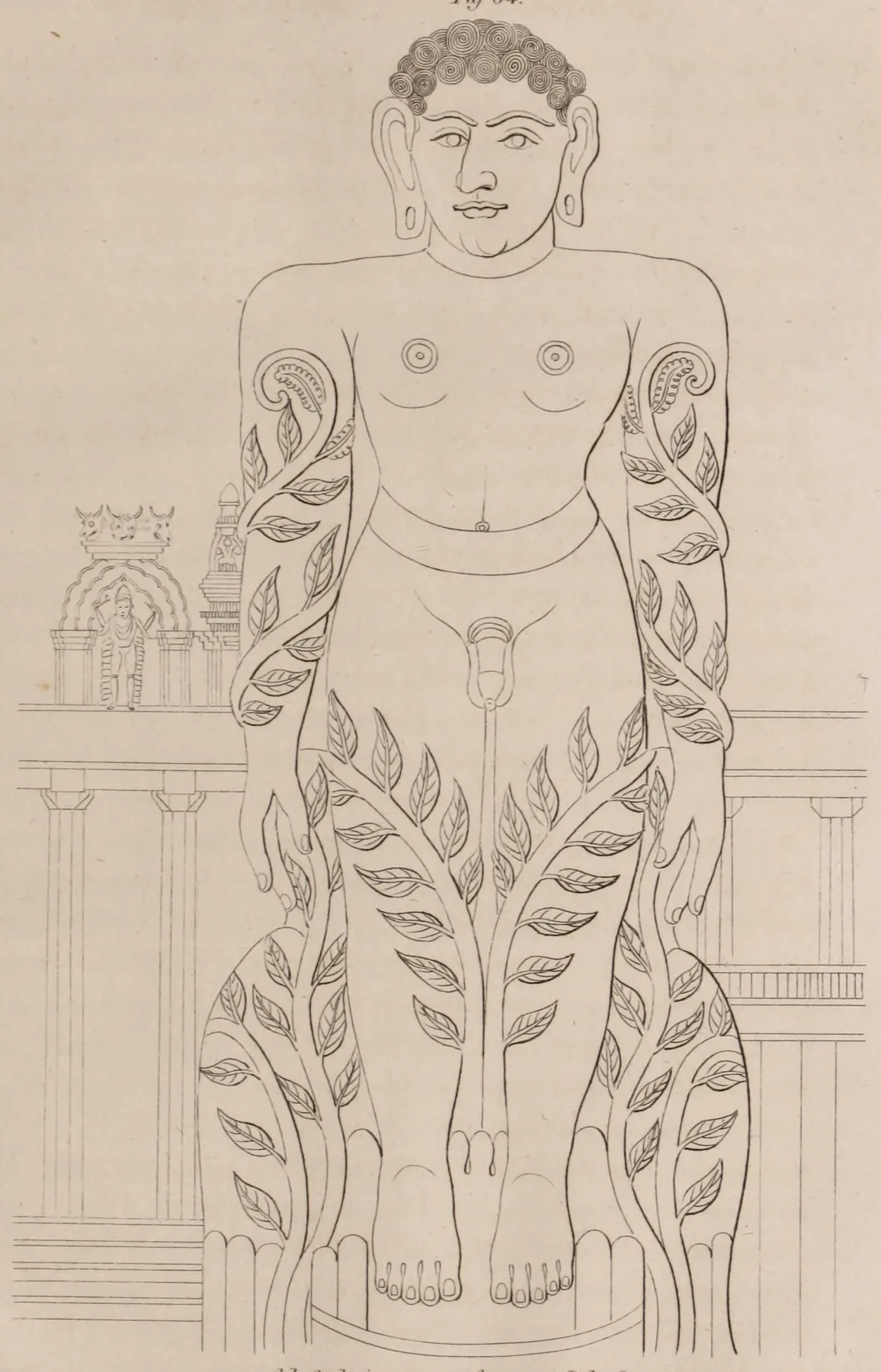
Having assembled the most learned Jain here, they gave me a copy of a writing on Palmira leaves, which they said was a copy of an inscription on copper belonging to the Sannyási, their Guru. It is dated in the year of the Kaliyugam 600, and in the reign of Rájá Mulla, king of the south. A copy has been delivered to the Bengal government. They say, that the Betta, or high place, with its colossal image, were made by a certain Chamunda Ráya, descended from whom were the nine Belalla Rájás. The first eight of these princes resided chiefly at Hully-bedu. The 9th lived at Tonuru, and changed his religion to become a worshipper of Vishnu. I have already given the history of his conversion, according to the Bráhmans of Tonuru. I shall now relate what the Jain say on the subject. This prince had become enamoured of a dancing girl, who, having been educated in the temples of Vishnu, had a great respect for the Bráhmans that follow the doctrines of Vyasa. This prostitute one day artfully upbraided the king, by saying that his Guru would not receive any thing out of his hands. The king insisted that the Guru respected him more; and at length it was determined, that if the Guru accepted the present of the king, then the favourite should change her religion; but if the present was rejected, that the king should receive the Sri Vaishnavam Bráhmans as his spiritual guides. On the first visit that the Guru made to court, the matter was decided. The king had lost a finger; and it being an abomination with the Jain Bráhmans to take any thing from the hands of a mutilated person, the offerings of the prince were rejected with obstinacy. The king then, according to his promise, destroyed all the Jain and their temples, and, having taken the name of Vishnu Verdana, built many temples in honour of his new god. Among these is that at Bailuru, which, according to an inscription already mentioned, was built, or repaired, in the year of Sal. 1039, which must have been after the conversion of this prince.
The Jain of this place differ considerably from those of Tulava. They deny that the Bunts of Tulava are Sudras, and say that they are Vaisyas. They will not indeed acknowledge that any Sudras belong to their sect. A person of any of the three casts into which they are divided may become a Sannyási, or act as a Pújári. The office of Puróhita only is exclusively in possession of the Bráhmans. The Jain originally inhabited all the six Khandas of the world. This, in which we live, is Aria, or Bharata-khanda; and at present few Jain remain in it; but there are still many in two Khandas, named Puruovideha, and Aprovideha; which, they say, mean the east and west. They judge of these places from their books; for they have had no communication with the Jain there, nor can they give any geographical account of their situation. The books in highest authority among the Jain are called Sara, and they are three in number; the Gomuta, the Triloca, and the Lubda Saras. These they consider as holy, as the other Bráhmans do the Vedas. They were composed by Ady Brahma, or Adyswara, one of the perfect beings who has become a Sidaru, and who must not be confounded with the Brahma of the followers of Vyasa, who is looked upon by the Jain as a Devata only, and is the chief servant of Gomuta Ráya. Next in authority to the Saras, is a commentary on them in 24 Puranas, or books, composed about 1700 years ago by Jenaseanu Acharieru, a Sannyási.
My eyes now became so very painful, that I could bear the light no longer. I was obliged to leave this place, therefore, with a much less perfect knowledge of its antiquities than I could have wished; and I proceeded to Seringapatam, where I continued some days in great pain, and unable to read or write. By the way I passed one night at Sindy-gutta, and another at Tonuru. At this last place I obtained from the Bráhmans an extract from a book called Guru Para, written by Rám’Anuja Achárya, partly in Sanskrit, and partly in the Tamul. The words of the former in the Grantha character, those of the latter in the Arabi, or vulgar letters. This extract, of which a copy has been delivered to government, contains a life of this extraordinary personage; who, according to his own account, was born in the year of Sal. 939. It is therefore certain, that both he and his convert, Vishnu Verdana, must have lived to great ages; as the king would appear, from the inscriptions above mentioned, to have been living in the year of Sal. 1050.
3d June.—My eyes having now so far recovered as to allow me to write, I resolved to set out on my return; and accordingly sent my tents a little way, intending to sleep at them, and in the morning to proceed; but in the afternoon there came a severe storm of thunder, wind, and rain, which kept me another night with my kind and hospitable friends in Seringapatam.
During my stay there, I procured the Caneh Sumareh of the Mysore Rájá’s dominions. It contains a list of villages, public edifices, houses, families, ploughs, and a few other particulars, with a classification of the inhabitants in each Taluc, or district. In this, due attention is neither paid to cast nor possession; nor can great reliance be placed on the accuracy of its statements. I have, however, thrown as much as relates to the population and stock into the form of a table; as a nearer approximation to the truth than any that has been yet given.
| Talucs in the Chatrakal Ráyada. | Families. | Houses. | Ploughs. |
|---|---|---|---|
| Kasba Chatrakal | 3824 | 3859 | 1330 |
| Onaji | 2014 | 2043 | 1338 |
| Mola-calu-muri | 1510 | 1533 | 669 |
| Mahi-conda | 2995 | 3080 | 2417 |
| Heriuru | 2305 | 2403 | 2224 |
| Gudi-cotay | 2967 | 3019 | 1620 |
| Cánacupay | 2918 | 3072 | 1915 |
| Bhima-samudra | 1186 | 1382 | 602 |
| Tulloc | 1656 | 1645 | 903½ |
| Holalu-caray | 2143 | 2414 | 1528 |
| Doddery | 2297 | 2297 | 1144 |
| Muteodu | 1355 | 1409 | 994 |
| Hosso-durga | 2109 | 3164 | 3021 |
| 29289 | 31320 | 19705½ | |
| Talucs in the Nagara Ráyada. | |||
| Hyder Nagara Kasba | 4870 | 4960 | 2696 |
| Shiva-mogay, or Shimogay, | 5368 | 5368 | 3209 |
| Surabha | 1584 | 1584 | 1055 |
| Chandra-gupti | 3119 | 3150 | 1302 |
| Tavanundy | 1354 | 1455 | 904 |
| Ananta-para | 1896 | 1899 | 1303 |
| Honali | 2963 | 2973 | 2305 |
| Holay-honuru | 3219 | 3219 | 2413 |
| Udaguni | 4452 | 4452 | 3098 |
| Shíkári-pura | 3760 | 3768 | 1931 |
| Ikeri and Sagar | 4691 | 4691 | 3365 |
| Cumashi | 3091 | 3585 | 1649 |
| China-giri and Baswa-pattana | 9071 | 9071 | 6224 |
| Daniwasa and Lacky-hully | 4138 | 4138 | 2582 |
| Hari-hara | 1931 | 2164 | 1011 |
| Holalu | 595 | 700 | 321 |
| Copa | 6612 | 6612 | 3944 |
| Anawatí | 3544 | 3544 | 2138 |
| Cowl-durga | 6615 | 6615 | 5017 |
| 72873 | 73948 | 46467 | |
| Mahásura Nagara | 5653 | 5748 | 3352 |
| Mahásura Ashta-grám | 4527 | 4527 | 2280 |
| Pattana Ashta-grám | 5075 | 5075 | 3078 |
| Hardena-hully | 3701 | 3701 | 1592 |
| Bucana-caray | 1512 | 1394 | 1098 |
| Bettada-pura | 3252 | 3105 | 2500 |
| Taiuru and Moguru | 5054 | 5056 | 2770½ |
| Arculagodu Conanuru | 4416 | 4337 | 3707 |
| Nunjinagodu | 963 | 960 | 445 |
| Edatory | 2188 | 2188 | 1678 |
| Priya-pattana | 2507 | 2431 | 1569 |
| Goruru | 2627 | 2612 | 2473 |
| Kanyakarna-hully vulgo Cancan-hully | 3728 | 3633 | 2996 |
| Honganuru | 1186 | 1186 | 513½ |
| Ellanduru | 2652 | 4464 | 829 |
| Callalay | 3893 | 6265 | 1999 |
| Ki-caray | 2079 | 2114 | 1664 |
| Cayragodu | 4731 | 4932 | 2708 |
| Sosila and Talacadu | 4204 | 4324 | 2338 |
| Gundal and Tirucanambi | 7025 | 7235 | 3914 |
| Capala-durga | 583 | 604 | 453 |
| Tonuru and Mail-cotay | 3153 | 3196 | 2385 |
| Mahá-ráyana-durga | 2071 | 2071 | 1136 |
| Malawully | 4033 | 4075 | 2743 |
| Cuttay Malalawady | 2142 | 2162 | 1481 |
| Cotagala | 1589 | 1590 | 1050 |
| Hegodu-devana-cotay | 6251 | 6251 | 4123 |
| Sali-gráma | 1177 | 1261 | 1015 |
| Narasingha-pura | 5664 | 5893 | 3448 |
| Maduru | 4415 | 4415 | 2621 |
| Deva-Ráya-Durga | 5359 | 5364 | 4052 |
| Budhi-cotay | 2971 | 4347 | 2297 |
| Ercalavy | 2873 | 4432 | 2089 |
| Magadi | 4426 | 4326 | 3522 |
| Sunacul | 1092 | 1557 | 687 |
| Silagutta | 5566 | 7848 | 3729 |
| Devund-hully | 4449 | 4976 | 3857 |
| Bhairawana-durga | 934 | 934 | 931 |
| Coruta-giri | 2092 | 2182 | 1152 |
| Total carried over | 131813 | 142771 | 86275 |
| Brought over | 131813 | 142771 | 86275 |
| Chin’-ráyan’-durga | 2399 | 2849 | 1838 |
| Chica Bala-pura | 5503 | 8184 | 3652 |
| China-pattana, vulgo Chenapatam | 5069 | 4950 | 3514 |
| Colar | 7059 | 10209 | 4922 |
| Hosso-cotay | 8408 | 14681 | 5666 |
| Madhu-giri | 4803 | 4950 | 2540 |
| Pauguda | 4452 | 4981 | 1596 |
| Ambaji-durga | 5188 | 8472 | 3574 |
| Hulicullu | 923 | 1251 | 796 |
| Nidjagul | 3146 | 5165 | 2807 |
| Nellavungul | 2766 | 4498 | 2416 |
| Gudibunda | 4160 | 4879 | 2346 |
| Anicul | 2484 | 4147 | 1599 |
| Doda Bala-pura | 7166 | 10187 | 5201 |
| Hangaluru | 11532 | 17506 | 8245 |
| Mahá-kálí-durga | 1766 | 2320 | 1497 |
| Jangama-Cotay | 2684 | 3909 | 1596 |
| Guma-Naiada-Pallia | 3187 | 4147 | 2005 |
| Malavagul | 7623 | 10012 | 5990 |
| Rama-giri | 1757 | 1798 | 1905 |
| Huliuru-durga | 4803 | 4803 | 3394 |
| Tayculum or Maluro | 5988 | 8783 | 4081 |
| Tamcuru | 3855 | 3840 | 2854 |
| Honawully | 3492 | 2664 | 4545 |
| Budihalu | 1598 | 2181 | 1130 |
| Niddygul | 2598 | 2601 | 1207 |
| Sira | 6673 | 6593 | 2756 |
| Nughi-hully | 1786 | 1786 | 1416 |
| Caduba | 3992 | 3998 | 3336 |
| Bailuru | 7447 | 7447 | 5741 |
| Gubi | 1237 | 1319 | 781 |
| Gráma | 1817 | 1881 | 1609 |
| Hebburu | 2754 | 4131 | 2122 |
| Garudana-giri | 1449 | 1673 | 1103 |
| Banawara | 2483 | 2611 | 1875 |
| Sakra-pattana | 2270 | 2265 | 1526 |
| Turiva-caray | 3738 | 4782 | 2658 |
| Hárana-hully | 2598 | 3071 | 2280 |
| Chin’-raya-pattana | 3684 | 3994 | 3731 |
| Cunda-Caray | 1481 | 1483 | 1216 |
| Carried over | 289551 | 343772 | 198341 |
| Brought forward | 289551 | 343772 | 198341 |
| Belluru | 2329 | 3315 | 1919 |
| Cunigul | 3604 | 3716 | 2357 |
| Chica-Náyakana-hully | 2266 | 2461 | 1697 |
| Naga-mangala | 4268 | 4992 | 2963 |
| Hasina | 4505 | 4459 | 3484 |
| Hagalawadi | 5832 | 7317 | 3878 |
| Wostara | 3013 | 3013 | 2317 |
| Ajim-pura | 3536 | 3855 | 3011 |
| Terri-caray | 3422 | 3606 | 2333 |
| Chica Moguluru | 4893 | 5175 | 3528 |
| Caduru | 1782 | 1833 | 1106 |
| Yagati | 2128 | 2638 | 1708 |
| Total | 331129 | 390152 | 228642 |
| Recapitulation. | |||
| 13 Talucs in Chatrakal Ráyada | 29289 | 31320 | 19705½ |
| 19 Ditto in Nagara Ráyada | 72873 | 73948 | 46467 |
| 91 Ditto in Pattana Ráyada | 331129 | 390152 | 228642 |
| Total | 433291 | 495420 | 294814½ |
I also procured from my friend Captain Marriote a history of the Mysore Rájás, which the present Dalawai composed in the Marattah language. A copy has been presented to the government of Bengal.
Seringapatam I found recovering apace. Some more openings for parades, and other public uses, have been made in the town; but it still continues to be a sink of nastiness. The suburb called Shahar Ganjam is increasing rapidly, and care has been taken to form the streets wide and straight. A new magistracy has just now been established, under the superintendance of Captain Symmonds, an establishment that was much wanted; for the officers of the garrison have neither time nor inclination to investigate civil affairs. Provisions are good, and, bread excepted, are cheap. Artificers have been assembled, and are now busy in preparing military stores; such as gun-carriages, leather accoutrements, tents, and cordage of the aloe leaves (Agave vivipara). This employs many people, and will turn out a great saving to the Company. Trade is beginning to be restored, and considerable quantities of the produce of Malabar again pass this way. The lands are increasing in value; and people, who had formerly deserted to adjacent districts, are now returning, and with the utmost eagerness are reclaiming their former possessions. This climate, however, continues to be very unhealthy; and a damp is thrown on every thing by the sickness of the Resident, Colonel Close. Owing to this, I have been much disappointed by not receiving any answers to the queries which I proposed.