At the beginning of our third chapter we noted the rise in India about 1870 of a new spirit, which generated many religious movements, roughly divisible into two series, one marked by defence of the old, tempered by reform, the other eager to defend the old in almost every particular. We deal with this latter series in this chapter.
I. Beginnings
The earliest stirrings of the new spirit appeared in and around Calcutta. In 1872 Raj Narayan Bose, one of the leaders of the Ādi Brāhma Samāj,1 delivered a lecture on The Superiority of Hinduism over all other Forms of Faith,2 which attracted a good deal of attention. The very next year, the idea of the equality of all religions, which has become so closely associated these last thirty years with the defence of Hinduism, found organized expression at Barahanagar, a few miles to the north of Calcutta. Mr. Sasipada Banurji, a Kulīn Brāhman, who had early turned to various forms of social service, and had become a member of the Brāhma Samāj in 1865, established a religious association, which he called the Sādhāran Dharma Sabhā, or General Religious Association, in which Hindus, Brāhmas, Christians, Buddhists and Muslims were allowed freely to express their own religious beliefs, so long as they condemned no one. The following is a description of its work :
Its two main features were, first, a spiritual union, held every week, of the followers of various religions on the basis of commonly-accepted principles — a union in which prayers and other spiritual exercises took place and were joined in by all ; and, secondly, a platform for the preaching of diverse opinions by their advocates, a platform where the most perfect freedom and toleration were allowed consistently with brotherly feeling and general co-operation ; for no one was allowed to vilify or ridicule the beliefs and practices of another.1
The work has died out at Barahanagar. But, within recent years, Mr. Banurji has started it again in Calcutta. The institution is named the Devālaya, or “ Divine House.”2 The building is his own, and stands in the compound of the Sādhāran Brahma Samāj. He has made over this property to a group of trustees, so that it may be used for the purposes described by the donor. It is most curious to note how similar Sasipada’s original idea is to those which, a few years later, were expressed by Rāmakṛishṇa, and later still, by Theosophists.
We may also note that in 1873, at the very time when he was starting his General Religious Association at Barahanagar, a group of Hindus formed in Calcutta the Sanātana Dharma Rakshinī Sabhā, or Association for the Defence of the Eternal Religion. They were anxious to found a Sanskrit School in the city to counteract modern tendencies. One of the reasons why Dayānanda Sarasvatī visited Calcutta was that he hoped to help this society.3 A few years later the Hindus of the South began to move in the same direction, as we shall see.
2. Rāmakṛishṇa Paramahaṁsa
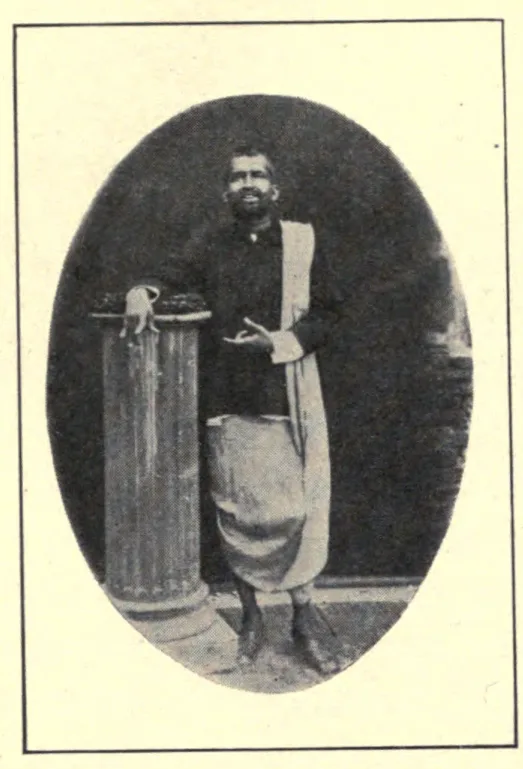
But the man who really made these ideas current coin in India was a Bengali ascetic, known as Rāmakṛishṇa Paramahaṁsa.
1. Gadādhar Chatterji1 was born in the village of Kamarpukur in the Hoogly district of Bengal, on the 20th of February, 1834,2 in a poor but orthodox Brāhman family. The accounts which are published of his life already tend to be mythical. Even the best biography that exists, which was written by one of his pupils, and published by Max Müller, decidedly tends here and there towards the marvellous ; and a large volume, published by another of his disciples, and called the Gospel of Śrī Rāmakṛishṇa, imitates the Christian Gospels so carefully in many minor points that one wonders how far the assimilation has gone. Yet the main events of his life stand out quite clear, so that we can trace, in large measure, the growth of this gifted man's mind.
Even when quite a boy, he showed wonderful powers of memory and considerable interest in religious books and stories. He received no education. His father died when he was about seventeen ; and he then went with his elder brother, Paṇḍit Ram Kumar, down to Calcutta, to try to make a living. For some time he was employed as pūjārī, or ministrant, in certain Hindu families in the northern part of the city, his duty being to see to the worship of the household idols. But a wealthy Bengali lady built rather a striking temple at Dakshineśvara, four miles north of Calcutta, on the bank of the Hugli River ; and, when this temple was opened on the 31st of May, 1855, his elder brother was appointed chief priest. Soon after, Gadādhar was appointed one of the assistant priests.
The two brothers were now in comfortable circumstances; but almost at once religion began to assert itself in Gadādhar’s life. The form which his religious passion took was a fervent worship of the image of Kālī in the temple. He thought of her as the mother of the universe, and as his own mother. The following quotation is from Max Müller’s life :1
He now began to look upon the image of the goddess Kālī as his mother and the mother of the universe. He believed it to be living and breathing and taking food out of his hand. After the regular forms of worship he would sit there for hours and hours, singing hymns and talking and praying to her as a child to his mother, till he lost all consciousness of the outward world.
In his religious ecstasy he would pass into that form of trance which is called in Hinduism samādhi. When this came on him, he became unconscious. He would sit in a fixed position for a short time, or it might be for hours, and would then slowly return to consciousness. When he was in this condition, the best doctors could find no trace of pulse or of heartaction.2 It is also said that he already had the power of inducing samādhi in others. This trance is clearly a form of hypnotism.
His mother and brothers, thinking that marriage would make him more like ordinary people, took him home, and had him married. This was in 1859. He was then twenty-five years of age, while his little bride was only six. This Hindu marriage-ceremony is a full Hindu marriage, and completely binding : but the husband and wife do not live together until the little girl-wife is eleven or twelve years old.
Then he returned to the temple, leaving his little wife in her father’s home. But, instead of getting rid of his religious ecstasy, he developed a new phase. He now had an overpowering desire to realize the existence and the presence of his mother, the goddess. The following is from one of his disciples :
“Oh Mother !” he would cry, “show me the truth ! Art Thou there ? Art Thou there ? Dost Thou exist ? Why then should I be left in ignorance ? Why can I not realize ? Words and philosophy are vain. Vain all this talk of things ! Truth ! It is truth alone I want to realize. Truth I would touch ! Truth I seek to feel !” 1
He believed that God can be seen. He felt that, until he had seen Kālī, he had not realized her, and that there was something wrong with his devotion. He would fall into samādhi, and remain unconscious for hours. His neglect of his duties as priest of the temple was so serious, that he had to be deprived of his position. He left the temple, and lived in a little wood near by. From now onwards for about twelve years he lived a life of prayer and supplication, of severe self-repression, and of unceasing effort to reach union with God :
Looking back to these years of self-torture in his later days, he said, ‘that a great religious tornado, as it were, raged within him during these years and made everything topsy-turvy.’ He had no idea then that it lasted for so long a time. He never had a wink of sound sleep during these years, could not even doze, but his eyes would remain always open and fixed.2
The first person who understood him and helped him, was a Brāhman nun (sannyāsinī), who came and resided in the temple for some time. She was a woman of great beauty, and considerable learning. She knew and practised yoga, that is, various bodily postures, breathing exercises, and forms of intellectual drill, meant for the progressive restraint of both body and mind and the development of supernatural powers. The books she knew were the Tantras, old manuals written for the worship of Kālī, and the exposition of the theology connected with her name. She understood Gadādhar’s religious condition, and her sympathy was of great service to him. She showed his friends old Vaishṇava books from which it appeared that the saints of Bengal of former days were afflicted just as he was. She taught him all she knew; and then, after a stay of some years, departed and was never seen again.
Gadādhar was still dissatisfied. He longed for higher knowledge; and, fortunately, there came to the temple a man named Totā-puri who was able to help him. He was a tall, strong, muscular ascetic, who wore no clothing, and never slept under a roof, but kept up the use of the sacred fire. He was some sort of monk, sannyāsī, but he cannot have belonged to any of the great orders, else he would not have had a fire. The system of philosophy which he followed was the monistic Vedānta, as taught by Śaṅkarāchārya. The doctrines are that God is impersonal, that the human spirit is identical with God, and that the world is an illusion. This he expounded to Gadādhar; and the latter proved a quick pupil. He also taught him the highest stage of religious trance, nirvikalpa samādhi, in which not a trace of consciousness remains. But the master also learned much from the pupil; so that he stayed eleven months with him. He initiated Gadādhar as a monk, sannyāsī. As we have already seen, the sannyāsī gives up home, property, caste, ornaments, the work of the world, money and marriage. Gadādhar was able to take this vow, because he had forgotten that he was married. When a man becomes a sannyāsī, he takes a new name. From this time forward, then, he was known as Rāmakṛishṇa. At a later date his friends called him Paramahaṁsa, a title bestowed only on sannyāsīs of the most advanced knowledge and sanctity.
After the departure of Totā-puri, Rāmakṛishṇa desired to remain continuously in the exalted form of trance he had learnt; and we are told that, for six months, almost without a break, he lived in religious unconsciousness. His own account of these days is as follows :
In those days I was quite unconscious of the outer world. My body would have died for want of nourishment, but for a sādhu (religious ascetic) who came at that time and stayed there for three days for my sake. He recognized my state of Samadhi, and took much interest to preserve this body, while I was unconscious of its very existence. He used to bring some food every day, and when all methods failed to restore sensation or consciousness to this body of mine, he would even strike me with a heavy club, so that the pain might bring me back to consciousness. Sometimes he succeeded in awakening a sort of partial consciousness in me, and he would immediately force down one or two mouthfuls of food before I was lost again in deep Samadhi. Some days when he could not produce any response, even after a severe beating, he was very sorrowful.1
The trance period passed away, ending in a serious illness, but Rāmakṛishṇa recovered.
He next sought to attain the Vaishṇava ideal of love for God. The method by which he tried to rouse the right feelings was to imagine he was some one of the great devotees of the old stories. For example, he imagined himself Rādhā, Kṛishṇa’s cowherd mistress, wore woman’s attire, spoke like a woman, and lived among the women of his own family, until he experienced something like her passionate love for Kṛishṇa. After some time he felt he had attained his ideal : he saw the beautiful form of Kṛishṇa in a trance, and was satisfied.
The twelve years of storm and stress had passed. He was at peace. It was the year 1871. His wife, who was now eighteen years of age, and had heard of his fame, came to see him. Rāmakṛishṇa explained that he could never be a husband to her. She replied that she was quite satisfied to live with him on his own terms, if he would only enlighten her mind, and enable her to see and serve God. So she took up her residence in the temple, and became one of his most devoted pupils. She survived him, and spoke in the warmest way of him afterwards. She revered him as a divine being.
The next impulse that came to him was to conquer his own feelings in matters of caste. Since he was a sannyāsī, he had no caste of his own left, according to the rules of his religion ; yet the prejudices and instinctive feelings of his Brāhman birth remained ; and he felt he must overcome his natural abhorrence of low-caste people. One of his disciples describes what he did :
In order, then, that he might stand above none, our Brahmin sought to identify himself with the Chandāla, by doing his work. He is the street-cleaner, and the scavenger, touched by no one ; and so, in the night, this man possessed himself of his brooms and utensils, and entering those hidden offices of the temple which it was the duty of pariahs to cleanse, he knelt down, and did the work of purification with his own hands, wiping the place with his hair ! Nor was this the only abasement that he imposed upon himself. The temple gave food daily to many beggars, and amongst these were Mahommedans, outcasts, and people of no character. Waiting till all had finished eating, our Brahmin would collect the green leaves that had formed their plates, would gather together the broken fragments of food that they had left, would even eat from amongst their rejected morsels, and would finally cleanse the place where all sorts and conditions of men had had their meal.1
He was next seized by the desire to know and understand other religions. Here are two quotations which tell how he proceeded :
He found a Mahommedan saint and went to live with him ; he underwent the discipline prescribed by him, became a Mahommedan for the time being, lived like a Mahommedan, dressed like a Mahommedan, and did everything laid down in their codes.2 He had seen Jesus in a vision, and for three days he could think of nothing and speak of nothing but Jesus and His love.1
The result was that he came to the conclusion that all religions were true, that they were simply various paths leading to the same goal.
2. People now began to visit him. One of his chief friends was a paṇḍit, named Vaishṇava Charan, who often went to see him, and now and then brought him to Calcutta.2 Dayānanda Sarasvatī met him during the time which he spent in Calcutta at the end of 1872 and the beginning of 1873.3 About the year 1875, Keshab Chandra Sen made his acquaintance,4 and became deeply interested in him. He talked about him to his friends, and also wrote about him. In consequence, educated men from Calcutta began to go to the temple to see Rāmakṛishṇa. From this time onward, he made the acquaintance of those young men who became his devoted disciples, and carried on his work after his death. Many famous Indians went to see him, and to listen to his brilliant conversation.5 For seven years, from 1879 to his death in 1886, he talked almost incessantly. He wrote nothing, but his disciples took down his sayings in Bengali ; and several collections of them have been published. The most convenient collection is that contained in Max Müller’s Rāmakṛishṇa. The Gospel of Śrī Rāmakṛishṇa, written by Prof. M. N. Gupta, one of his disciples, consists of a brief introduction, containing the merest outline of his life, and a description of the temple precincts where he lived, and then 350 pages of conversations with friends and disciples. A good deal of the language is modelled on the language of the Gospels.
According to his most famous disciple, Narendra Nath Dutt, usually called Svāmī Vivekānanda, he had two types of conversation, as may be seen from the following paragraph :1
He was a wonderful mixture of God and man. In his ordinary state he would talk of himself as servant of all men and women. He looked upon them all as God. He himself would never be addressed as Guru, or teacher. Never would he claim for himself any high position. He would touch the ground reverently where his disciples had trodden. But every now and then strange fits of God-consciousness came upon him. He then spoke of himself as being able to do and know everything. He spoke as if he had the power of giving anything to anybody. He would speak of himself as the same soul that had been born before as Rama, as Krishna, as Jesus, or as Buddha, born again as Ramakrishna. He told Mathuranatha long before anybody knew him, that he had many disciples who would come to him shortly, and he knew all of them. He said that he was free from all eternity, and the practices and struggles after religion which he went through were only meant to show the people the way to salvation. He had done all for them alone. He would say he was a Nitya-mukta, or eternally free, and an incarnation of God Himself.
3. The character of Rāmakṛishṇa was singularly simple. He seemed to be capable of only a single motive, namely, a passion for God. That ruled and filled him. So completely did it dominate him that many regarded him as a useless, ineffective man, while others said he was mad. His idea of God seems crude and thin to a Christian ; yet it had mastered him ; and, when we follow that clue, every detail of his character and life falls into place. For this end he became a sannyāsī, renouncing caste, marriage, property, money. In order that his renunciation might be utterly real, he put himself through a tremendous discipline of repression, until his hatred of money had become so instinctive that his body would shrink back convulsively if he were touched with a coin, when asleep ;2 and he had so conquered the sex instinct that every woman was to him a mother. On this latter point P. C. Mozoomdar,1 the Brāhma, says :
For long years, therefore, he says, he made the utmost efforts to be delivered from the influence of women. His heartrending supplications and prayers for such deliverance sometimes uttered aloud in his retreat on the river-side, brought crowds of people who bitterly cried when he cried, and could not help blessing him and wishing him success with their whole hearts.
This same passion for God, taken along with the Hindu idea of God, will explain also the more curious and eccentric points of his character. One of his own sayings is :
A true devotee who has drunk deep of the Divine Love is like a veritable drunkard, and, as such, cannot always observe the rules of propriety.2
It is from this point of view that we can understand another of Mozoomdar's statements about him :
His speech at times was abominably filthy.3
He believed God in His true essence to be impersonal, unknowable, beyond the reach of man. On the other hand, every human being, indeed everything that is, is a manifestation of God. Everything that happens is, in a sense, done by Him :
God tells the thief to go and steal, and at the same time warns the householder against the thief.4
God is thus so truly all that is, that in Him moral distinctions become obliterated.5 Here we get a glimpse of the radical distinction between Christianity and Hinduism. Another point in his conduct will enable us to understand still more clearly. Since every human being is a manifestation of God, if Rāmakṛishṇa happened to meet an unfortunate, he would bow down before her in adoration. Contrast with this the mind of Christ, who loved the unfortunate as a child of God, but could not be content, unless she came to repentance.
Like every ordinary Hindu, Rāmakṛishṇa regarded all deities as manifestations of the impersonal Supreme. He recognizes the goddess Kālī as one of the chief manifestations of God. She was to him the divine mother of the universe, and he worshipped her more than any other divinity. He worshipped her by means of idols; for he implicitly believed the Hindu doctrine, that the divinity fills every one of his own idols with his presence.1 He also held the ordinary Hindu idea of the guru. Here is one of his sayings:
The disciple should never criticise his own Guru. He must implicitly obey whatever his Guru says. Says a Bengali couplet:
My Guru is holy Rai Nityānanda still.2
He was thus a true Hindu, and was ready at any moment to defend the whole of Hinduism.
Thus far Rāmakṛishṇa was simply a very devoted Hindu. Had there been nothing more in him, he might have lived at any time during the last two thousand years. There have been multitudes of men like him in India. But the living forces which are making the new India pressed in upon him from every side. Though he had no English education, the new thought came to him by many channels. Christianity was demanding acceptance from Hindus, claiming to be the one religion for the whole world, urging its ethics on all men. Islam was also present, but far less active. What was his response to the situation? He declared that all religions were true, that in their inner essence they were identical, and that each man should remain in the religion in which he had been born :
A truly religious man should think that other religions also are paths leading to the truth.1
Every man should follow his own religion. A Christian should follow Christianity, a Mohammedan should follow Mohammedanism, and so on. For the Hindus the ancient path, the path of the Aryan Rishis, is the best.2
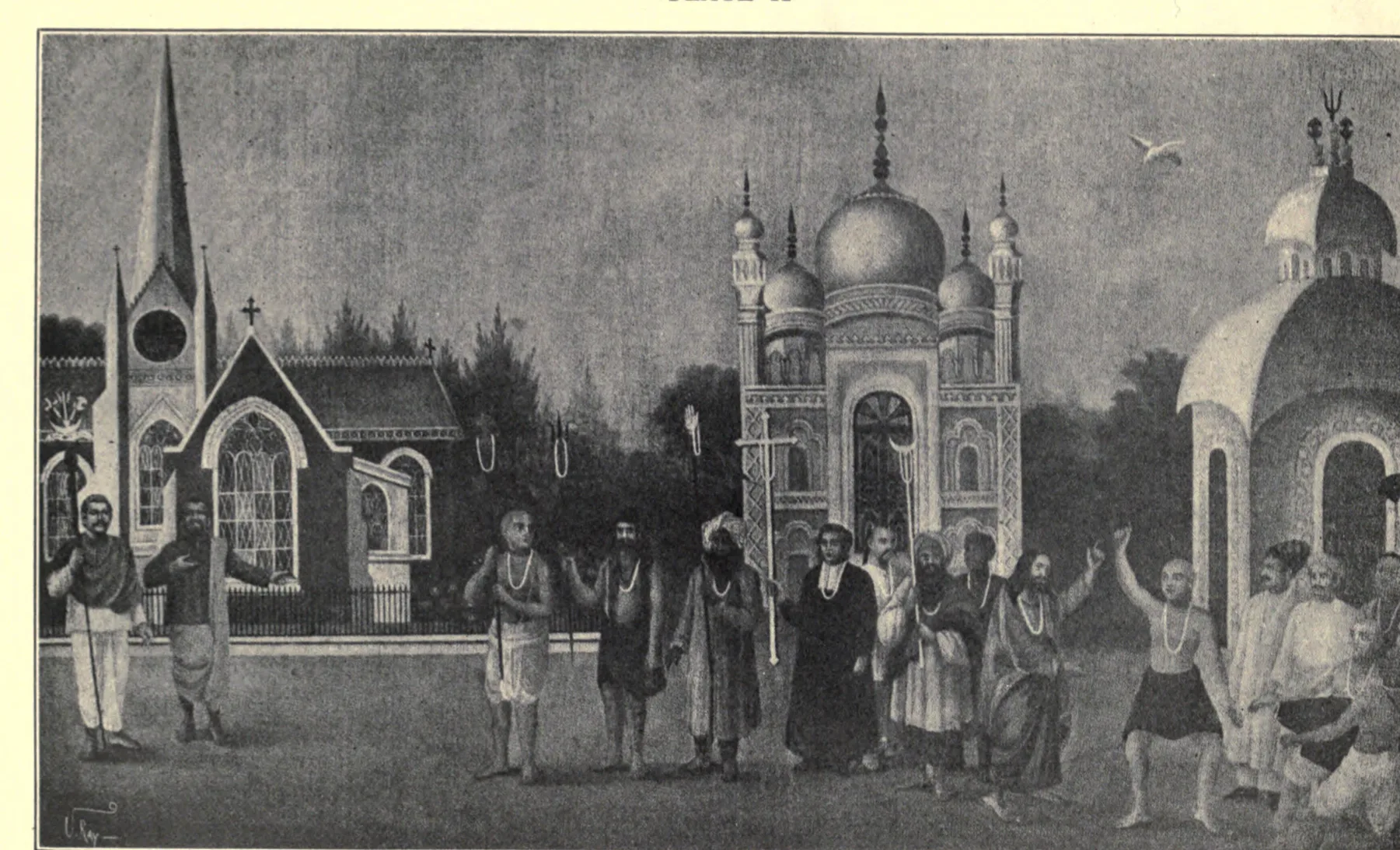
4. One of Rāmakṛishṇa’s disciples, a wealthy Calcutta man, named Surendranath Mitter, was keenly interested in the result produced on Keshab Chandra Sen by his master’s teaching on this point,3 and employed a painter to produce a symbolical picture, embodying the idea of the harmony of all religions and of the part played by Rāmakṛishṇa in introducing it to Keshab.4 I have not been able to discover with certainty when the picture was painted, but it was already in existence on the 27th of October, 1882.5 When it was shewn to Keshab, he exclaimed, “Blessed is the man who conceived the idea of this picture.” At a later date the picture was reproduced and published as a supplement to Unity and the Minister, a weekly paper representing one of the sub-divisions into which the Church of the New Dispensation split up after the great leader’s death. This picture is reproduced here. In the background are a Christian church, a Muḥammadan mosque, and a Hindu temple. In front of the church stand Keshab and Rāmakṛishṇa, Keshab carrying the symbol of the New Dispensation described above,6 and Rāmakṛishṇa calling Keshab’s attention to the group of figures arranged in front of the mosque and the temple. In the middle of this group Christ and Chaitanya, a Bengali religious leader of the sixteenth century,7 are represented dancing together, while a Muslim, a Confucian, a Sikh, a Parsee, an Anglican clergyman and various Hindus stand round them, each carrying some symbol of his faith. It seems to me that nothing could be more fitting (for I am writing in Oxford and the subject is most apposite) than to dedicate this interesting piece of theological art to the versatile author of Reunion All Round.
5. It was his teaching on the religions that laid hold of his disciples. He impressed all who came in contact with him as a most sincere soul, a God-intoxicated man; but what distinguished his message from the teaching of others was his defence of everything Hindu and his theory that all religions are true. This gave his teaching a universalistic turn, and provided the ordinary Hindu with a defence which he could use to meet Christian criticism and the Brāhma Samāj.
His personal influence over all who came within his range was very remarkable. Mozoomdar says:
My mind is still floating in the luminous atmosphere which that wonderful man diffuses around him whenever and wherever he goes. My mind is not yet disenchanted of the mysterious and indefinable pathos which he pours into it whenever he meets me.1
Over his personal disciples he exercised a still more wonderful power. Their love and reverence for him was boundless. They worshipped him. Vivekānanda once remarked to a well-known Calcutta citizen of high character, Dr. Sircar:
We look upon the Master as a Person who is like God.2 We offer to Him worship bordering on divine worship.3
Here we have ancient Hindu guru-worship checked in Vivekānanda's mind by the Christian teaching he had got in his college course. Apart from Christian influence, he would have said, “He is God, and we worship him as God.”
The picture given of him by his disciples is very pleasing and very vivid ; yet there are not many personal traits to notice. Though he was a sannyāsī, he dressed like an ordinary Bengali, and lived like one.1 Mozoomdar in describing him uses the words :
a child-like tenderness, a profound visible humbleness, an unspeakable sweetness of expression and a smile that I have seen on no other face that I can remember.2
He knew no Sanskrit and scarcely any English. His disciples would smile when he used the English words, “Thank you.” Indeed he had no scholarly knowledge even of Bengali.3 But his conversation was full of quaint, good sense, expressed in vivid homely phrases, and lighted up here and there with a broad kindly humour. He was fond of certain short alliterative phrases, which he had coined,4 expressive of his main religious ideas, such as :
Nāham, nāham : Tuhu, tuhu.
that is, “Not I, not I, Thou, Thou.” He was no formal teacher. Indeed he used to say, “I am nobody’s teacher : I am everybody’s disciple.”5 He was a conversationalist, pouring out his riches like Samuel Johnson.
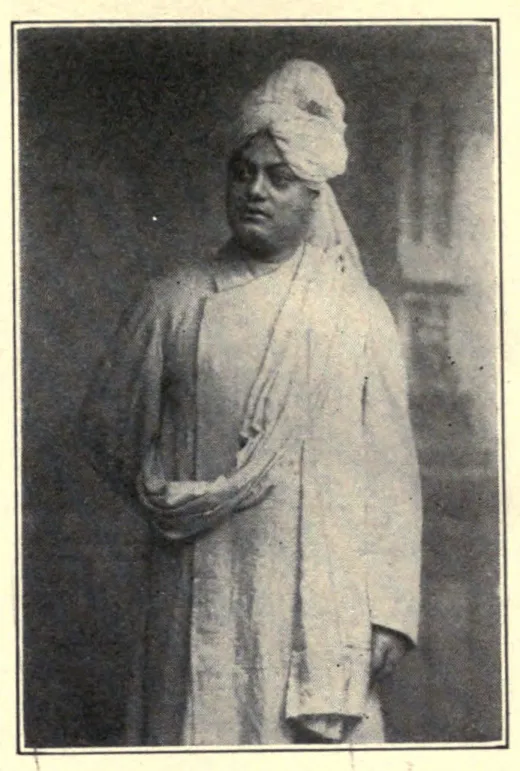
6. After Rāmakṛishṇa’s death,6 his chief disciples decided that they must devote their lives to the spread of his teaching. So a group of them renounced the world and became sannyāsīs. Amongst these by far the most prominent has been Narenda Nath Datta, who took the name Vivekānanda, when he became a sannyāsī. Svāmī is a title of respect given to any sannyāsī. He was a Bengali, belonging to Calcutta, a Kāyastha by caste, born on the 9th of January, 1862.7 He received a good English education, taking his degree from a Mission College in Calcutta, and distinguishing himself in philosophy. As a student, he came a good deal under the influence of the Brāhma Samāj. He had a fine voice, and wherever he went was in great request for the singing of Bengali hymns. After taking his degree, he began the study of law ; but, early in 1882, an uncle took him to see Rāmakṛishṇa ; and that moment became the turning-point in his life.
From the first Rāmakṛishṇa singled him out as one destined to do great things for God, and gave him a great deal of attention. On his master's death he became a sannyāsī, as we have said, and then spent some six years in retirement on the Himalayas, doubtless studying and thinking about many things. Among other places he is said to have visited Tibet, in order to study Buddhism. In 1892 he emerged from his retirement, and toured all down the western coast of India, going as far south as Trevandrum, whence he turned north again and went to Madras. Preparations were being made at that time for holding the Parliament of Religions in Chicago. Some friends in Madras proposed that Vivekānanda should be sent to the Parliament to represent Hinduism. Funds were collected, and he travelled to America by way of Japan.
The gathering was held in September, 1893 ; and Vivekānanda made a great impression, partly by his eloquence, partly by his striking figure and picturesque dress, but mainly by his new, unheard-of presentation of Hinduism. We shall deal with his thought later ; so that we need not delay over it here. The following quotations from American papers show how far those who were most deeply influenced by the Svāmī went :
He is an orator by divine right, and his strong, intelligent face in its picturesque setting of yellow and orange was hardly less interesting than those earnest words, and the rich, rhythmical utterance he gave them.1
Vivekananda is undoubtedly the greatest figure in the Parliament of Religions. After hearing him we feel how foolish it is to send missionaries to this learned nation.1
He stayed some time in America, lecturing and founding Vedānta societies in several places. Two American disciples joined him, Madame Louise, who became Svāmī Abhayānanda, and Mr. Sandsberg, who became Svāmī Kṛipānanda. From America he crossed to England, where he was joined by his most notable disciple, Miss Margaret Noble, who took the name Sister Niveditā (i.e. dedicated).
In January, 1897, the Svāmī arrived in Colombo with his small group of Western disciples, and from there made a triumphal progress all the way up through India. He was everywhere acclaimed by vast audiences of Hindus as the Saviour of the ancient faith; and it was generally believed that America and England were being rapidly converted to Hinduism. There was no limit to the thousands of disciples with which the Svāmī was credited.
He at once set about organizing regular work. Two monasteries were opened, one at Belur, near Calcutta, the other at Mayavati on the Himalayas, near Almora. These monasteries are meant to receive young men who have become sannyāsīs of the Rāmakṛishṇa Mission, as it is called, and to give them a training for their work. The monastery at Belur near Calcutta is the headquarters of all the work. The same year one of the most outstanding features of the Rāmakṛishṇa Mission, its philanthropic activity, was started. There was widespread famine in India then; and Vivekānanda was able to gather money, and to organize a number of enthusiastic followers at several centres for the relief of the famine-stricken.
But in 1898 Vivekānanda’s health gave way, and he was advised to go to Britain and America for a change. He and Sister Niveditā sailed together. He spent but a short time in England, and went on to America. The climate of California helped his strength a good deal, and he soon began work again. It was at this time that the Vedānta Society was founded in San Francisco, and also the Śānti Āśrama, the Peace Retreat. He went to New York, and founded the Vedānta society there. It was then arranged that he should attend the Congress of Religions, which was to be held in Paris in 1900. After attending the Congress, he returned to India, but in very poor health.
Yet he could not be still; and, during the next two years, he organized a good deal of fresh work. A third monastery was founded, in Madras; and centres of philanthropic effort were formed in Madras, Benares and in the Murshidabad district of Bengal. He was deeply impressed with the need of work and self-sacrifice. He would not deliver lectures, but did all he could to set men to work.1 He passed away rather unexpectedly on the 4th of July, 1902, at the early age of forty.
We may grasp his message most distinctly, if we take it in four parts.
A. All religions are true and good; and, therefore, every man ought to remain in his own religion.
B. God is impersonal, unknowable, non-moral. He is manifested in the whole world, in all men, in all gods and in all incarnations. The human soul is truly divine. All men are saints. It is a calumny and a sin to say that any human being can be guilty of sin. Idolatry is a very healthy and spiritual form of worship. Every particle of Hinduism is of value and must be retained. The reformers are mistaken. In trying to uproot the weeds, they are tearing up the precious wheat also : The old ideas may be all superstition, but within these masses of superstition are nuggets of gold and truth. Have you discovered means by which to keep that gold alone, without any of the dross ?1
C. Hindu civilization, since it springs from the oldest and noblest of religions, is good, beautiful and spiritual in every part. The foreigner fails altogether to understand it. All the criticism of European scholars is erroneous, and everything that missionaries say on the subject is wickedly slanderous. The Hindu nation is a spiritual nation. It has taught the world in the past, and will yet teach the whole world again.
D. European nations and Western civilization are gross, material, selfish and sensual ; and therefore their influence is most seriously degrading to the Hindu. It is of the utmost importance that every Hindu should do all in his power to defend his religion and civilization, and save Hindu society from the poison of Western influence. Yet the Hindu requires to use Western methods and Western education. Nay, the Hindu must even give up his vegetarianism, and become a meat-eater, it may be a beef-eater, in order to become strong, and build up a powerful civilization once more on the soil of India.
Vivekānanda has no historical conscience whatsoever. He is ready to re-write the whole history of antiquity in a paragraph, to demonstrate in a sentence that China, in the East, and Greece and Rome, in the West, owed all their philosophical acumen and every spiritual thought they had to the teachers of ancient India. He learned the appeal to history from his Western education ; but there is not the faintest reflection in his writings of the accuracy and careful research which are the very life-breath of modern scholarship.
He exercised a fine influence on young India in one direction. He summoned his fellow-countrymen to stand on their own feet, to trust themselves and to play the man ; and his words were not without fruit.
It is striking to note the harvest that appeared in Vivekānanda from the seed sown by his master Rāmakṛishṇa. The latter dropped every moral restriction when thinking of God and his manifestations. Vivekānanda frankly drew the natural inference : “sin is impossible ; there is no such thing as human responsibility ; man can do no wrong.” Rāmakṛishṇa’s indiscriminate acceptance and uncritical defence of everything Hindu expanded in his disciple into unbounded laudation of everything Indian ; and, while Vivekānanda himself bears witness that his master was genial and kindly, and condemned no one, the disciple, not unnaturally, was led by his unmixed praise of everything Hindu to the most violent and unjust condemnation of everything Western.
The final outcome of Vivekānanda’s teaching will be discussed in another connection.1
7. Vivekānanda’s English disciple, Sister Niveditā, settled in a small Hindu house in the northern part of Calcutta, and lived there a life of simple service for several years, visiting the Hindu homes around about her, conducting a school for girls in her own house, and leading young Hindus into practical service. She was a woman of deep romantic feeling and of considerable literary power. She readily picked up her master’s method of glorifying Hinduism and Hindu life, and far exceeded him. Her chief work, The Web of Indian Life, shows, on the one hand, most remarkable sympathy with both the ideals and the actualities of Hindu life, and proves to every capable reader what a priceless help towards interpretation sympathy is, but, on the other hand, contains such exaggerated language in praise of Hindu customs and institutions, that many orthodox Hindus have protested against the book as altogether untrustworthy and as thoroughly unhealthy reading for young Hindus themselves. Yet Sister Niveditā had her reward. Though her book is unwise, she loved the Hindu people and served them; and they gave her their love. At her death, in October, 1911, there was an extraordinary outburst of feeling in the Hindu community of Bengal.
8. The work of the Rāmakṛishṇa Mission1 has grown slowly since Vivekānanda’s death. There have been no such results as one would have expected to spring from the unbounded enthusiasm with which the Svāmī was welcomed, when he returned from America. He summoned his countrymen to practical service, to self-sacrificing work for India. Had the myriads who acclaimed him really responded to his call, the work would soon have attained very great dimensions; but the truth is that ancient Hinduism does not teach the duty of service at all, and that all that the average educated Hindu wants is to get somebody to assure him that Hinduism is as good as Christianity, and that he does not need to become a Christian. Having heard this, amidst the flare of trumpets with which Vivekānanda returned from America, the average man gave a sigh of relief, and returned to his vegetating life as an ordinary Hindu. Vivekānanda’s call to self-sacrificing service was just another of those troublesome appeals which they had heard over and over again from the missionaries and the Brāhma leaders; and they paid no more attention to it. Only a few responded; and these continue to carry on the work. There are now five monasteries, Belur, near Calcutta, Benares, Allahabad, Mayavati, on the Himalayas, and Bangalore. These institutions are meant for the residence and training of sannyāsīs. The whole mission is governed from the Belur monastery. At Benares, Hardwar, Allahabad and Brindaban, the four chief centres of Hindu pilgrimage, permanent charitable institutions, called Sevāśrams, Homes of Service, have grown up. Care for the poor and medical relief are their chief activities. Educational work is also attempted in a few places; and the mission is sensitive to need and ready to help, when distress arises through famine, plague or flood. There is a desire in the mission to build up a large educational activity, but this has not yet been found possible. Vivekānanda wished to combine Western and Hindu education.
The founder of the Ramakrishna Mission, Svāmī Vivekānanda, had his own ideal of national education. For, to him, as is evident from his Indian utterances, the national ideal was a thing already realized within. It is claimed by many, like the late Sister Nivedita, that he was the first representative of the synthetic culture which India must evolve, if she is to live.1
Vivekānanda’s influence still lives in America. There are societies that teach Hinduism in various ways in New York, Boston, Washington, Pittsburg and San Francisco. His influence seems to be far stronger in San Francisco than anywhere else. There is a picturesque Hindu Temple there, in which classes are held and addresses given, and the literature of the mission sold. They have a little monthly magazine, called the Voice of Freedom. Two Svāmīs are in charge. There are three lectures every Sunday; and classes for the study of the Gītā, the Upanishads and Yoga are held on week days.
Vivekānanda started several magazines, which are still published in India. The Brahmavādin, which is published in Madras, and the Prabuddha Bhārata, which is published at Mayavati in the Himalayas, are both in English, and contain a good deal of useful matter on Hindu philosophy. A Bengali monthly, named Udbodhan, is published in Calcutta. Books written by Vivekānanda during his lifetime, and a few others, published by other members of the mission since then, are sold in the various centres.
LITERATURE. — LIFE: Rāmakṛishṇa, His Life and Sayings, by F. Max Müller, London, Longmans, 1910, 5s. (This book contains the best biography, and also a collection of his sayings.) Gospel of Sri Ramakrishna, according to M. (i.e. Prof. M. N. Gupta), Part I, Madras, Ramakrishna Mission, 1912, Rs. 2–8. (A picture of Rāmakṛishṇa’s life with his disciples and his teaching: see above, p. 194.) My Master (a lecture), by Swami Vivekananda, Calcutta, Udbodhan Office, 1911, 8 as. VIVEKĀNANDA: Swami Vivekananda, His Life and Teachings, Madras, Natesan, 4 as. Speeches and Writings of Swami Vivekananda. Madras, Natesan, Rs. 2. NIVEDITĀ: Sister Nivedita, A Sketch of her Life and Her Services to India, Madras, Natesan, 4 as. The Web of Indian Life, by Sister Nivedita, London, Heinemann, 5s. An account of the Rāmakṛishṇa Mission appeared in the Hindu Patriot of October, 1912.
3. THEOSOPHY
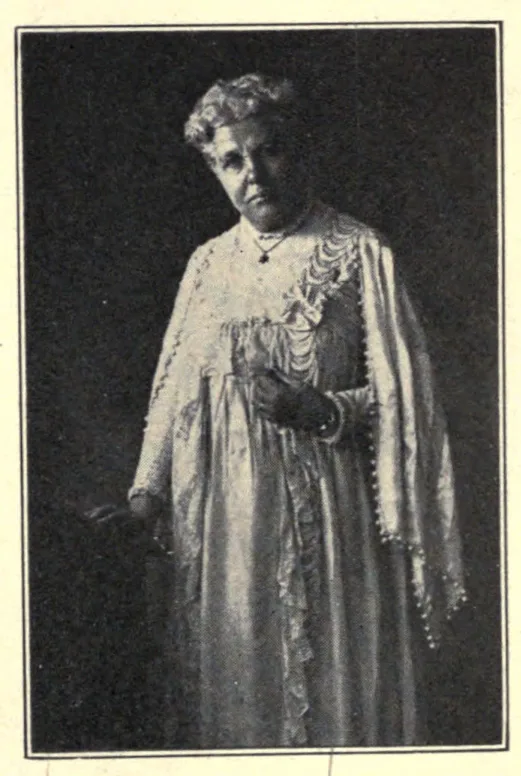
Theosophy is a system of religion, science and practical life, first taught by Madame Blavatsky, and incorporated in a society founded by her and Colonel Olcott in New York in 1875, but carried much farther by Mrs. Besant and C. W. Leadbeater in recent years. It purports to be the final truth of the universe, taught in different lands and at different times by various founders of religion and teachers of philosophy, but revealed anew to Madame Blavatsky by certain Masters, or Mahātmas (i.e. Great Souls), said to live in Tibet and elsewhere. The system and the society are both of great interest because of the large literature which has sprung from the movement, and the very remarkable growth of the society in many parts of the world.
The attempt to write an unvarnished account of Theosophy is beset by a number of tantalizing difficulties. No trustworthy history of the movement, no reliable biography of the foundress, is in existence. Theosophic accounts both of Madame Blavatsky’s life and of the history of the society are extremely unreliable.1 Colonel Olcott and other leaders of the movement themselves tell us with the utmost frankness that Madame Blavatsky was a liar, that she told lies at any time, both in fun and in earnest.1 This habit of hers issued in two extraordinary myths, the story of the pretended Mahātmas in Tibet and their communications to her,2 and the legend of her own virginity.3 Since 1879 and 1885, respectively, these two myths have very seriously contaminated Theosophic literature. Every statement has to be checked by reference to other documents and authorities.
Fortunately, after her death, a number of letters, which she had written to two well-known Russian men of letters between 1874 and 1886, were published in Russia, and shortly afterwards were translated into English. These give us a great many peeps into her life. The first of these correspondents was M. A. N. Aksakoff, editor of the Leipzig Psychische Studien, who had long taken an interest in every kind of psychical question. Her letters to him run from the 28th of October, 1874, to the 6th of November, 1877, and there are a few from 1879 also. Her second Russian correspondent was M. V. S. Solovyoff, whose acquaintance she made in Paris in May, 1884. Her numerous letters to him all fall between that date and the spring of 1886. There is not the slightest question about the genuineness of these letters. They appeared originally in a series of articles, entitled A Modern Priestess of Isis, by M. Solovyoff in a Russian magazine. Madame Blavatsky’s sister, Madame Jelihovsky, denied several of M. Solovyoff’s own statements, but she did not challenge the authenticity of any of the documents which he had reproduced. The articles were published in book-form in Russia ; and the book was then translated into English by Mr. Walter Leaf. Whoever wishes to understand Madame Blavatsky ought to read this brilliant and reliable work. We shall not use anything challenged by Madame Jelihovsky, and indeed shall rely almost entirely on the letters.
Similarly, for later periods, documentary evidence which enables the student to get somewhat nearer the facts, has become available in various ways. Thus, the full exposure of Judge would have been quite impossible, had it not been that one of the officials of the society, disgusted at the course of events, resigned, and then handed over copies of all the incriminating documents for publication ;1 and, in the Alcyone trials in Madras,2 Mrs. Besant inadvertently handed over to the prosecution a bundle of letters written by Mr. Leadbeater, which threw much light on certain events.
It is very unfortunate that, at present, so far as I can make out, there is no scholar in England or America, outside the Theosophic circle itself, who has made any serious study of the literature and history of Theosophy. Hodgson, Coleman and Solovyoff are dead ; and every scholar to whom I have spoken on the subject has said that the quality of Theosophic literature has altogether driven him away from the subject. This is greatly to be regretted.
I have had interviews with scores of people who are, or who were, Theosophists, and have learned much from them ; but it is harder to get information of a helpful and reliable kind from Theosophists than from members of any other religious movement I have dealt with, except possibly the Rādhā Soāmis ; and the pledge of secrecy exacted from those who join the Esoteric School makes it impossible to get light on Theosophic methods of occultism. I have learnt most of all from a few individuals who were once at the centre of things, but are now outside. Some have returned to Christianity, but most retain a larger or smaller amount of Theosophic belief.
I have been seriously hampered in writing my account of Theosophy for want of space. An adequate outline of its history would fill the whole volume.
Madame Blavatsky
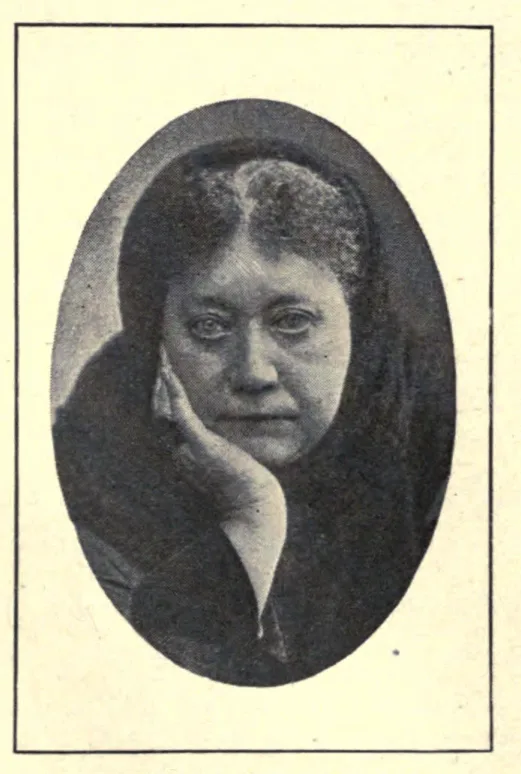
1. Helena Petrovna was born on the 12th of August, 1831, the daughter of Col. Peter Hahn, a member of a German family settled in Russia. She was connected with a number of the best Russian families. From her childhood she seems to have been a medium. Spiritualistic phenomena are said to have constantly attended her.1 In 1848, when she was but seventeen, she married N. V. Blavatsky, a Russian official, a man a good deal older than herself,2 but ran away from him three months after the marriage.
2. Of her life from 1848 to 1872 we have no connected and reliable account. It is clear that she travelled a great deal in many lands, but both dates and places are altogether doubtful. Two facts, however, are absolutely certain, both of great importance.
The first of these is that for many years she lived a very wild and evil life. Her relatives in Russia knew quite well the kind of life she led. M. Aksakoff wrote in the autumn of 1874, to Andrew Jackson Davis, an American journalist, interested in spiritualism :
J’ai entendu parler de Madame Blavatsky par un de ses parents, qui la dit un medium assez fort. Malheureusement ses communications ressentent de son moral qui n’a pas été des plus sévères.3 (I have heard Madame Blavatsky spoken of by one of her relatives, who said she was rather a powerful medium. Unfortunately her communications bear marks of her morality, which has not been of the severest type.)
Mr. Davis handed this letter to Madame Blavatsky herself to translate. Naturally the reference to her past caused her intense excitement; and she at once wrote a letter to M. Aksakoff from which we give a few sentences:
Whoever it was told you about me, they told you the truth in essence, if not in detail. God only knows how I have suffered for my past. It is clearly my fate to gain no absolution upon earth. The past, like the brand of the curse of Cain, has pursued me all my life, and pursues me even here, in America, where I came to be far from it and from the people who knew me in my youth. . . . I hated hypocrisy in whatever form it shewed itself; ergo, I ran amuck against society and the established proprieties. Result: three lines in your letter, which have awakened all the past within me and torn open all the old wounds. . . .
I have only one refuge left in the world, and that is the respect of the spiritualists of America, who despise nothing so much as ‘free love.’1
Later she wrote again:
I really cannot, just because the devil got me into trouble in my youth, go and rip up my stomach now like a Japanese suicide in order to please the mediums. My position is very cheerless; simply helpless. There is nothing left but to start for Australia and change my name for ever.2
In February, 1886, she sent a document, headed “My Confession,” to M. Solovyoff, in which the following sentences occur:
I have already written a letter to Sinnett forbidding him to publish my mémoires at his own discretion. I myself will publish them with all the truth. So there will be the truth about H. P. Blavatsky, in which psychology and her own and others’ immorality and Rome and politics and all her own and others’ filth once more will be set out to God’s world. I shall conceal nothing. It will be a Saturnalia of the moral depravity of mankind, this confession of mine, a worthy epilogue of my stormy life.1
Her sister, Madame Jelihovsky, also spoke and wrote to M. Solovyoff quite frankly on the subject.2 Amongst her letters to Madame Coulomb3 was one consisting of twelve closely written quarto pages, giving a detailed account of her life from 1851 to 1875. She spoke of it as a page which she wished to see “torn out of the book” of her life. For some considerable time she lived with a man named Metrovitch, and was known as Madame Metrovitch. There was also a boy whom she acknowledged as her son for several years; but in 1885, when she created the virginity myth, she told a new and wonderful tale about him.4 There is thus the most irrefragable evidence that she lived a very immoral life for many years.
The other fact which stands out clear in these years is that in 1858 she returned to Russia for some time, and that spiritualistic phenomena followed wherever she went.5
3. From 1872 onward we can trace her life in outline without much difficulty. Some part of that year she spent in Cairo, endeavouring to make a livelihood by giving spiritualistic séances. There, she met an Englishwoman who later married a Frenchman, named M. Coulomb. This lady went to one of the séances, in the hope of hearing the voice of a dearly loved brother who had just died. The spirit-show was a complete failure, but the two women became friends. Madame Blavatsky was in great need of money, and the Englishwoman gave her a loan, which she was unable to repay during her stay in Egypt. In 1884, when the Coulomb letters made these facts public,6 Madame Blavatsky denied them, but her own correspondence shews clearly that the séances were held and proved a failure.1 A paragraph also appeared in The Medium for April 26, 1872, inviting mediums ready for engagements to apply to Madame Blawatsky (sic) in Cairo.
On the 7th of July, 1873, she arrived in New York, and settled down there. In her first letter to M. Aksakoff, written on the 28th of October, 1874, she said :
I have been living in America for about a year and a half, and have no intention of leaving.2
She continued to reside in the States until the end of 1878, becoming a naturalized citizen in the interval. Clearly there was some reason for this decision to give up her wandering life and to settle down, not in Russia, but in an alien land. In her letters to M. Aksakoff she gives a clear intelligible reason for this policy. Her youth was now over; she was forty-two years of age. She wanted to escape from the results of her dissolute life; but that was impossible in Europe, above all in Russia, where her past was so well known.3 So she decided to go to America “to be far from” the curse of her past life and “from the people who knew” her in her youth.4
No detailed account of how she spent her first fifteen months in America has been published. Events are clearly traceable only from October, 1874, onwards, when she began to correspond with M. Aksakoff. But her plan seems to have been to live by writing on spiritualism, which at that time was making a great noise in America. It is probable that it was this consideration which drew her to New York rather than to Melbourne, Calcutta, or some other city equally distant from the Russia which she longed for but dared not approach. At any rate, she made the acquaintance of several journalists and writers, one of whom was Andrew Jackson Davis, who has been already mentioned, and kept in close touch with spiritualism.
During the summer and autumn of 1874, a group of people interested in spiritualism had gathered round a family named Eddy, at Chittenden in the State of Vermont. Amongst those who were there to watch and to see what was to be seen was Henry Steel Olcott, who had served in the federal army during the Civil war and bore the title of Colonel, but who was now a journalist, and had been sent by the New York Graphic to report the happenings at Chittenden. Thither went Madame Blavatsky; and there, in October, she met Olcott.
On the 28th of the same month, at the advice of Davis, she wrote to M. Aksakoff, telling him of the great vogue of spiritualism in America, and asking whether she might not send him for publication from time to time Russian translations of articles on spiritist subjects appearing in American magazines. The proposal was accepted, and the correspondence continued for some years. In her first letter, the boom in spiritualism is represented as very great,1 and the phenomena at Chittenden are described as most wonderful.2
The letter was scarcely despatched when Aksakoff’s French letter to Davis about Madame Blavatsky’s character already quoted,3 arrived; and in her reply, an extract from which has been also quoted, she declares that she is a convinced spiritualist and has been such for more than ten years:
I am a ‘spiritist’ and ‘spiritualist’ in the full significance of the two titles. . . . I have now been a spiritist for more than ten years, and now all my life is devoted to the doctrine. I am struggling for it and trying to consecrate to it every moment of my life. Were I rich, I would spend all my money to the last farthing pour la propagande de cette divine vérité. But my means are very poor, and I am obliged to live by my work, by translating and writing in the papers.1
In later letters she wrote :
I was in deepest darkness, but I have seen the light, and to this light I have given myself up entirely. Spiritism is a great truth, and I will serve it to the grave. . . .
For spiritism I am ready to work night and day, so long as I have a morsel of bread, and that only because it is hard to work when one is hungry. . . .
I have already sacrificed myself for spiritualism, and in defence of my faith and the truth I am ready at any moment to lay my head on the block. . . .2
If you hear that the sinful Blavatsky has perished, not in the bloom of years and beauty, by some surprising death, and that she has dematerialised ‘for ever,’ then you will know that it is for spiritualism. In thee, Lord, do we put our trust, and we shall not be confounded for ever. . . .
I have quite ceased to get any letters from my aunts and sisters ; they have evidently all forgotten me, and so much the better for them. I am no credit to them, to tell the truth. I shall now never go back again to Russia. My father is dead, nobody wants me, and I am altogether superfluous in the world. Here I am at least a human being ; there, I am — Blavatsky. I know that everybody respects me here, and I am needed for spiritualism. Now the spirits are my brothers and sisters, my father and mother.3
From her letters it is plain that Olcott used every possible means to bring her into notoriety and popularity, raising her to the rank of Countess, mixing her up with “princes, boyards and imaginary governors-general,”4 and making her out a second Livingstone in her travels in Africa and the Soudan;1 and she did him a like service. While the vogue of spiritualism lasted, things went well. Everything that they wrote was widely read, and they rose steadily in public estimation. There was a spirit who was peculiarly friendly with her. Here is what she says about him :
My John King alone is a sufficient recompense for all ; he is a host in himself to me. And yet they call him the double of the medium, him and Crookes’s Katie King. What sort of double can he be when the medium Williams is not here at all, but John King in his own person, with his own black beard and his white Chinese saucer-upside-down cap, going about here in America from one medium to another, and doing me the honour of visiting me incessantly, though he has not the least resemblance to me ? No, John King is a personality, a definite, living, spiritual personality. Whether devil or good spirit, he is at all events a spirit, and not the medium’s prototype.2
Olcott tells us that she had known John King since 1860, and had seen him and talked with him in different countries.3
But a peculiarly odious piece of fraudulent spiritism was exposed early in 1875, and public interest in the subject began to die down. The comrades tried various plans to keep their hold on the people, but it was useless. On May 24th, Madame Blavatsky writes :
Disaster has come upon us. Dr. Child has appeared in the character of the spiritist Antichrist, and, as the Judas of the seven councils, has destroyed spiritualism. Even the most advanced spiritualists begin to be afraid of public opinion, and their ‘high respectability’ induces many to continue to believe in spirits in secret only, and privately. . . .
I am ready to give my life for the spread of the sacred truth. Olcott is helping me as much as he can, both with his pen and with pecuniary sacrifices for the cause. He is as passionately devoted to spiritism as I am. But he is far from rich and has nothing to live on but his literary labours, and he has to keep a wife and a whole lot of children. Olcott is sitting on heaps of his People from the Other World, like Marius on the ruins of Carthage, and thinking bitter things. Not a thousand copies of his book have been sold in five months.1
On the 18th of July she writes again:
Here, you see, is my trouble, to-morrow there will be nothing to eat. Something quite out of the way must be invented. It is doubtful if Olcott’s ‘Miracle Club’ will help; I will fight to the last.2
Things were in a very bad way. Spiritualism was worked out, and the partners were threatened with want. Some new source of income had to be found. The Miracle Club was clearly meant to be something new and startling to catch public attention. But it did not succeed. Her letter of the 10th September is still very despondent.
4. Such were the circumstances in which the Theosophical Society was founded. Colonel Olcott gives us the dates and the steps in the following passage :
The formation of such a society was suggested by myself on the evening of September 7th, 1875, in the rooms of Madame Blavatsky, at 46 Irving Place, New York City, where a small gathering of her friends had assembled to listen to a discourse by a Mr. G. H. Felt on the lost canon of proportion of the Ancient Egyptians. My views as to the necessity of such a society were embodied in a short impromptu address and, receiving general assent, a motion was made by Mr. W. Q. Judge and adopted, nem. con., that I be elected chairman of the meeting, and on my motion Mr. Judge was elected secretary. A committee to frame Bye-laws was chosen. A report of the proceedings including a digest of my little speech, was published in a local daily paper, copied into the Spiritual Scientist, of Boston, and thence transferred by Mrs. E. H. Britten into her large work, “Nineteenth Century Miracles” (p. 296), where the curious reader may find it in detail. No previous consultation had been held about the matter between Madame Blavatsky and myself or any body else; the suggestion was entirely unpremeditated and grew out of the discussion provoked by Mr. Felt’s lecture. . . .
On the 17th November, the Society was launched as a perfected organization.1
Olcott became President, Judge Vice-president, and Madame Blavatsky Corresponding Secretary. To her friend in Russia Madame Blavatsky wrote on the 20th of September:
Olcott is now organising the Theosophical Society in New York. It will be composed of learned occultists and cabbalists, of philosophes Hermétiques of the nineteenth century, and of passionate antiquaries and Egyptologists generally. We want to make an experimental comparison between spiritualism and the magic of the ancients by following literally the instructions of the old Cabbalas, both Jewish and Egyptian. I have for many years been studying la philosophie Hermétique in theory and practice, and am every day coming to the conclusion that spiritualism in its physical manifestations is nothing but the Python of Paracelsus, i.e., the intangible ether which Reichenbach calls Od. The Pythonesses of the ancients used to magnetise themselves—read Plutarch and his account of the oracular currents, read Cornelius Agrippa, Paracelsus, the Magia Adamica of Eugenius Philalethes, and others. You will always see better, and can communicate with the spirits by this means1— self-magnetisation.2
On December 6th she wrote:
It is the same spiritualism, but under another name. Now you will see if we shall not start the most learned investigations. Our vice-treasurer, Newton, is a millionare, and president of the New York spiritualists.3
These are most instructive paragraphs. It is, above all, to be noted that the purpose of the Theosophical Society is “to make an experimental comparison between spiritualism and the magic of the ancients.” There is as yet no mention of Buddhism or Hinduism. There is no suggestion that the foundress receives her wisdom in ample measure, without trouble, through “Masters” from the ancient sources. She still struggles forward by experimental comparison; and her occult communications are not with living Masters in Tibet, but with the spirits of the dead. “Mahātma Morya” has not yet appeared above the horizon. “John King” is still “the Master of her dreams.”1
The facts are simple and natural. Madame Blavatsky had been a medium from childhood, and had practised spiritualism since 1858, if not from an earlier date, though it does not appear that she ever worked as a hired medium. She started a spiritualist show in Cairo in 1872. She lived by spiritualist writing, and made the most serious protestations of belief in spiritualism from 1873 to September, 1875. The Miracle Club and the Theosophic Society were successive attempts to start something new and successful, when public interest in spiritualism declined. Theosophical doctrine at a later date became a blend of Buddhism, Hinduism and various forms of occultism; but, when first launched, it was merely an addition of the magic and mysticism of Egypt and of mediæval Judaism to spiritualism, with a view to stimulating the jaded appetite of the people of New York.
It is clear that she had been interested to some extent in all these mysterious things for years. She was a woman of most unusual temperament, possessing the powers of the medium, the clairvoyant, the clairaudient and probably also of the automatic writer. She had met “Eliphaz Lévy” in Paris; and she had probably given some attention to juggling, devil-dancing and such like in Egypt and the East. The following sentences are probably quite reliable. We should not have had this curious passage in her letters at all, had it not been that her correspondent took in the American papers, and she felt she must apologize once more for Colonel Olcott’s outrageous exaggerations :
In a detailed account of the story of Katie King Olcott makes out of me something mysteriously terrible, and almost leads the public to suspect that I have either sold my soul to the devil or am the direct heiress of Count Germain and Cagliostro. Do not believe it; I have merely learnt in Egypt and Africa, in India and in the East generally, a great deal of what other people do not know. I have made friends with dervishes, and I do indeed belong to one mystic society, but it does not follow that I have become an Apollonius of Tyana in petticoats.1
She now began to study modern works on occultism seriously. About the same time she began to draw away from her old full belief in spiritualism and to hint that it was not spirits, but merely “ shells ” that caused the marvels. This theory comes from “ Eliphaz Lévy.” He taught that when a man dies, the spirit departs completely, leaving behind in this world only an empty “ shell,” which, however, has the power of producing phenomena.
Five months before the foundation of the Theosophical Society, on the third of April, 1875, Madame Blavatsky married in Philadelphia an Armenian, a Russian subject, named Michael Bettalay.2 Yet N. V. Blavatsky was still alive; and there had been no divorce. It was a case of bigamy pure and simple. Doubtless she said she was a widow; for she practised that piece of deceit for many years. She put down her age in the marriage-register as thirty-six, while she was actually forty-three.1
The new society was scarcely started when serious trouble arose from her old spiritualist allies; for they felt that she was faithless to them. She had publicly declared that the spirits had brought her a medal and clasp from her father’s grave, and Olcott had published in his People from the Other World a drawing of the medal and clasp. This enabled the medium Home to trace her antecedents and to obtain information about her private life. He had also got to the bottom of some of her fraudulent spiritualistic phenomena. He then attacked her publicly on both counts.2
The new society went fairly well for a time, and then interest steadily waned. Yet the comrades held on, never allowing the organization to fall to pieces.3
5. For two years Madame Blavatsky toiled at her new studies, and on the 2nd of October, 1877, her Isis Unveiled was published. It is a really noteworthy book, and that for two reasons. First, it was the earliest vigorous attempt made to defend the ancient religions against the harsh judgments still only too common at the time. Secondly, it took up a striking attitude to that great shady border-land which lies between jugglery and religion. Everything mysterious, weird, occult or magical, the unexplored powers of the human mind, and all suggestive, or symbolic words, acts or things, had an overpowering fascination for her. It is also clear that at a fairly early date she began to realize, in a more or less hazy way, certain facts which science has only recently perceived and acknowledged. The most important of these are (a) that spiritualism, clairvoyance, hypnotic trances, faith-healing and many of the phenomena of dreams and apparitions are, in essentials, identical with practices and occurrences which are vouched for in the literature of Classical and early Christian times, and with much which happens among modern savages; (b) that a considerable proportion of the marvels are genuine, whatever the ultimate explanation of their reality may be; and (c) that those who make such practices their profession sooner or later have recourse to fraud.1 In the Isis these questions are not raised or treated in any scholarly fashion; and the evidence, good, bad and indifferent, is simply thrown down in indiscriminate heaps; so that the book as it stands is practically of no scientific value; yet the personal knowledge the authoress had of many of the practices dealt with, and her perception that there was something genuine in them, gave the book a certain value, and made it very attractive to many people.
One of the most notable characteristics of the book is its violent polemic against modern science and Christianity.
The authoress so wrote as to lead her readers to understand that she was a woman of vast learning, and that she had mastered all the great works on occultism in existence; while the truth is that all the learning it contains is borrowed, or rather stolen, from modern books; for in most cases there is no acknowledgment. Mr. Wm. Emmette Coleman of San Francisco spent three years in making an exhaustive analysis of the contents of Madame Blavatsky's writings. The following is his statement with regard to the Isis : 2
By careful analysis I found that in compiling Isis about 100 books were used. About 1,400 books are quoted from and referred to in this work; but, from the 100 books which its author possessed, she copied everything in Isis taken from and relating to the other 1,300. There are in Isis about 2,100 quotations from and references to books that were copied, at second-hand, from books other than the original, and of this number only about 140 are credited to the books from which Madame Blavatsky copied them at second-hand, The others are quoted in such a manner as to lead the reader to think that Madame Blavatsky had read and utilized the original works, and had quoted from them at first-hand, — the truth being that these originals had evidently never been read by Madame Blavatsky.
Col. Olcott stated in the Theosophist1 that Madame Blavatsky’s library contained about 100 books when she wrote the Isis; so that Mr. Coleman’s critical judgment is confirmed. The following is a list of the books from which the largest numbers of quotations were taken :2
| Passages | |
|---|---|
| Dunlap’s Sod: the Son of the Man | 134 |
| Ennemoser’s History of Magic, English Trans. | 107 |
| Demonologia | 85 |
| Dunlap’s Spirit History of Man | 77 |
| Salverte’s Philosophy of Magic, English Trans. | 68 |
| Dunlap’s Sod: the Mysteries of Adoni | 65 |
| Des Mousseaux’s Magie au Dix-neuvième Siècle | 63 |
| Des Mousseaux’s Hauts Phénomènes de la Magie | 45 |
| King’s Gnostics, 1st edition | 42 |
| Supernatural religion | 40 |
| Mackenzie’s Masonic Cyclopaedia | 36 |
| Zeller’s Plato and the Old Academy | 35 |
There are some students who, while recognizing frankly that the bulk of the Isis is built out of materials from modern works, are yet inclined to think that it may be true, as was stated by Madame Blavatsky and Col. Olcott, that large sections of the book were written automatically. If this be true, then the explanation must be that her sub-conscious mind had retained all that she had read on these subjects, and gave out the materials when each fit of automatic writing came on.
The book contains innumerable errors, many of them of the most rudimentary type. The commonest Sanskrit words are misspelt; the Buddhist doctrine of transmigration is grossly misrepresented; and the Bhagavadgītā is confused with the Bhāgavata Purāṇa. The following sentences give a sample of the scholarship of the book :
Apart from the now-discovered fact that the whole story of such a massacre of the Innocents is bodily taken from the Hindu Bagavedgitta, and Brahmanical traditions, the legend refers, moreover, allegorically to an historical fact. King Herod is the type of Kansa, the tyrant of Madura.1
Yet, to-day, we are asked to believe that all this is the wisdom of the Mahātmas. When Madame Blavatsky went to India, an elaborate myth was created, to the effect that for many years she had been receiving her wisdom from these Masters in Tibet. Thus all who accept this myth are compelled to explain the Isis as an early exposition of orthodox Theosophy. As a matter of fact, it represents the state of the writer's mind in 1877 : it does not teach the doctrine of reincarnation;2 it teaches that man is a being of a threefold nature, while the orthodox doctrine makes him sevenfold; there is no mention of the great doctrine of brotherhood; and a great deal of the furious attack on Christianity is contrary to the professed standards of to-day.
6. About the time when the Isis was published, Home's Lights and Shadows of Spiritualism also appeared, and its exposures of her frauds agitated her so much, and influenced public opinion so seriously, that she decided to leave America for ever and go to India. Here is how she wrote in December, 1877, two months after the publication of the Isis:
It is for this that I am going for ever to India, and for very shame and vexation I want to go where no one will know my name. Home’s malignity has ruined me for ever in Europe.1
Home’s evidence must have been irrefragable; for Olcott did not attempt to meet it, though asked to do so.2
In anticipation of their voyage to India, Olcott wrote to a Hindu friend, whom he had met some time before on a voyage across the Atlantic, and through him got into correspondence with Svāmī Dayānanda Sarasvatī, the founder of the Ārya Samāj. As a result of an interchange of letters, the two societies were connected the one with the other. This continued after the Theosophists reached India; but finally they separated in anger.3
On the 25th of May, 1878, Madame Blavatsky was divorced from her Armenian husband.4 Olcott says that the husband obtained the divorce on the ground of desertion.5
7. In December, 1878, “the Theosophical Twins,” as Madame Blavatsky had named herself and Olcott, sailed from New York. They arrived in Bombay in January; and that city, for almost three years, was the headquarters of the society. Madame Coulomb and her husband, who had meantime lost all their money, reached Bombay late in the spring of 1880, and were established at headquarters as friends and assistants of Madame Blavatsky.
The opinions and the teaching of the Twins now became much more distinctively Indian than they had been in America. They declared themselves Buddhists, and entered into close relations with Buddhism in Ceylon.
The Theosophic Myth also began to take definite shape.
They diligently taught the existence of the Great White Brotherhood and their Lodge in Tibet. The theory took shape gradually, and some of the more showy parts have been added only recently. The completed myth is as follows: A large number of men have reached the stage of Adepts in the Wisdom; and many have become members of the Hierarchy which governs this world.1 These beings are far beyond death and transmigration; yet they live upon earth, mostly in Tibet; and a few of them are willing to take as apprentices those who have resolved to devote themselves to humanity. Since they take pupils, they are known as Masters. On account of their greatness they are called Mahātmas, great souls. Madame Blavatsky, we are told, was selected from the whole human race in our days to receive the ancient wisdom from these Masters. Her own particular master was Mahātma Morya; but Koot Hoomi and others were also ready to help. From them she received Theosophy: it was in no sense her own creation. As far back as 1851 she had met Mahātma Morya, “the Master of her dreams”;2 she had spent seven years in unremitting study in Tibet; and in the intervening years the wisdom had been poured into her mind in amplest measure.
Our narrative has provided sufficient disproof of the myth. As late as 1874 she was neither Buddhist nor Theosophist, but a Spiritualist, and was ready at any moment to lay her head on the block in defence of her faith.3 Instead of learning from a living Master, she was the confidant of a disembodied spirit, John King.4 Even when the Theosophical Society was founded, there was no mention of India but only of the Kabbala and the Hermetic system.5
The two travelled a great deal in various parts of India, and were usually received by the Hindu community with acclamation. The society steadily grew in numbers and popularity, largely as a result of the new theory of the Masters. For, wherever they went, miraculous events, which they called “ phenomena,” appeared; and Madame Blavatsky attributed all to her Masters, or to the occult knowledge she had derived from them. If some prominent European were inquiring about Theosophy, a letter from Koot Hoomi would be sure to fall on his head. Telegrams from the Masters would come tumbling through the air — “precipitated” in Theosophic phrase — but, strangely enough, bearing the stamp of the British Telegraph office. The Masters shewed themselves now and then in one of their bodies to selected people. Lost articles were found, and new things arrived in unheard-of ways. Half a cigarette, or a lock of Madame Blavatsky’s hair, would be transported from one place to another by “ occult ” means. Probably a percentage of the phenomena were genuine, as we should expect in the case of a woman of Madame Blavatsky’s powers; but no carefully sifted evidence has ever been given for any of them; while evidence exists which proves clearly that many of them were fraudulent; and, as to the Masters, nothing worth the name of evidence has ever been produced for their existence.1
8. One of the most famous occurrences took place at Simla. There was a dinner-party there one evening, in the house of Mr. A. O. Hume, a distinguished Indian Civilian, holding very high office under Government. After dinner it was proposed that Madame Blavatsky should give an example of her powers. After some talk she asked Mrs. Hume whether she had lost anything she would like very much to recover. In reply she described a brooch, which some little time before had passed out of the family. Madame Blavatsky indicated a spot in the garden where they might look for it. They looked, and the brooch was found.
Mr. and Mrs. Hume accepted the occurrence as a genuine occult phenomenon. It was described in glowing terms in the papers; and it has been continuously used by Theosophists ever since as evidence of the truth of their system. Yet the explanation is simple and undeniable. The truth came out in the following way:
The publication of the incident in the Pioneer gave rise to a good deal of discussion in the daily papers of the period. The Englishman pointed out a number of awkward lacunæ in the account given, and was especially anxious to know something of the “person” who had allowed the brooch “to pass out of their possession.” It remarked —
“There is nothing to show to whom Mrs. Hume’s friend, to whom she had given the brooch, parted with it. It might have been to some one who had communicated the fact and given the brooch to Madame. A very slight hint in the conversation might have turned Mrs. Hume’s thoughts, almost unconsciously, towards her lost brooch,” etc.
The Bombay Gazette, of October 13th, 1880, after noticing this article, went on —
“We can furnish the Englishman with a small item of intelligence. At the end of last and the commencement of this year, a young gentleman who had resided at Simla previously, and was, we believe, well known to the Hume family, sojourned for some months in Bombay, and was part of the time a guest of Madame Blavatsky at Girgaum. The latter lady’s connection with this gentleman may or may not have had anything to do with the affair of the brooch, though to our mind it is as probable as that the presence of the brooch in the flower bed was due to ‘occult’ phenomena.”
Three days later a correspondent of The Times of India wrote —
“It may interest some of your readers on the other side of India to learn that some months ago an individual who had been immediately connected with some of the members of Mr. Hume’s family at Simla arrived in Bombay. He was, I believe, hospitably received by Madame Blavatsky, if, indeed, he did not spend some weeks at her house in Girgaum, and when he left for England eventually, the arrangements for his passage were made through the agency of Colonel Olcott.”
All this is very suggestive; but still more so is a pretty idyll narrated by the Civil and Military Gazette a month or two later :—
“Once upon a time a certain Daphnis had received as a gage d’amour from his Chloe, a brooch, an ancestral gem, formerly the property of Chloe’s Mamma, which probably poor Chloe considered would in the course of happy time revert to her possession, when Daphnis and all that was his should be her own. But the course of true love never did run smooth, and the unhappy Daphnis, separated from Chloe, and driven by impecuniosity, deposited his pretty gift with an accommodating pawn-broker — for a consideration — meaning doubtless in future time to redeem the precious pledge. The trinket chanced, however, to attract the notice of a very famous spiritualist and medium, a lady who dealt in mysteries of psychic force and powers of disintegration and reintegration of matter. There is nothing to prevent a spiritualist, however magically endowed, from dealing also in mundane affairs after the usual humdrum and worldly fashion, and in this instance the famous lady chose to achieve the possession of the object of her fancy by the ordinary method of paying for it. Time rolled on, and it happened in the fulness thereof that the celebrated medium and Chloe’s Mamma became acquainted, and under some circumstances, which attained perhaps an undeserved notoriety, the brooch became again the property of its original possessor.1 ”
Two further points came out after this account was printed. Mr. Hormusji Seervai, a Bombay jeweller, saw an account of the miracle in the papers, and realized from the description of the brooch that he had repaired it for Madame Blavatsky.1 Finally, the Rev. George Patterson, when on a visit to Bombay at the end of 1884, learned that Madame Blavatsky bought the pawn-ticket from the young man and redeemed the trinket.
There cannot be the slightest question as to the truth of the explanation ; for not one of the facts has ever been so much as questioned. Mr. Hume himself publicly acknowledged that the famous phenomenon was a piece of well-planned fraud. Yet the Theosophical Society still uses this fraud, indefensible and undefended, as an example of occult agency.2
9. The Theosophic conception of the world, man and religion, which is nowhere given in the Isis, now gradually took shape. A brief analysis of the system is given below.3 The main channel through which the fresh teaching found its way to Theosophists and the public was a series of long letters, which Madame Blavatsky averred were written and sent by the Master known as Koot Hoomi. Parts of these letters were published by Mr. Sinnett, an Englishman who was editor of the Pioneer and had become a Theosophist, in his books, Esoteric Buddhism and The Occult World ; but much of the material was so poor that it had to be eliminated as rubbish.4
The Occult World was published in June, 1881. Mr. H. Kiddle of New York read the volume, and discovered in one of the letters a long passage copied almost verbatim from an address delivered by him at Lake Pleasant, August 15, 1880, and reported the same month in The Banner of Light. The date of the letter was two months later. When this was made public, a ridiculous reply, purporting to come from the Mahātma, was published, but no one was deceived. It was a case of deliberate plagiarism; and the final proof that it was so is found in the fact that in the more recent editions of The Occult World the passage is omitted.1
10. In December, 1882, the headquarters of the society were moved to Adyar, Madras. The Coulombs went along with the rest of the staff. M. Coulomb was Librarian, while his wife was Assistant Corresponding Secretary of the society. Besides that, Madame Coulomb acted as housekeeper, while her husband took charge of all repairs or additions to the buildings.
Madame Blavatsky occupied a large upper room in the main bungalow. See plan B on page 235. Early in 1883 a new room for occult purposes was built against the west wall of her room. There were two windows in the west wall. The south window, transformed into a door, became the ordinary entrance into the new room, which was called the Occult Room. The north window was removed, and a single layer of bricks filled up the aperture on the Occult Room side, leaving a recess about 15 in. deep on the other side, in Madame Blavatsky’s bedroom. Part of the Occult Room was screened off by means of a curtain to form a small room for the Shrine. This was a wooden cupboard which, by means of two stout wires, was hung on the wall over the thin brick partition where the north window had been. In the Shrine was placed a portrait of the Master, Koot Hoomi. The doors of the Shrine were occasionally thrown open to Theosophists, that they might see the master’s portrait. Hindus bowed reverently before him and burned incense to him.1 Both Indians and Europeans were accustomed to present their requests in the form of letters. The door would then be shut; and, when it was re-opened, a reply from the Master would be found within it. On one occasion a broken saucer was put in beside him. When the Shrine was re-opened, it was found intact. From this time onward many of the most striking phenomena were connected with the Shrine.
By the year 1884 the Theosophical Society had attained great proportions. There were over a hundred branches in India, and Hindus everywhere rejoiced in its work. Nor is their enthusiasm hard to understand. Theosophy provided a new defence of Hinduism for the thousands of educated men whose Western education had filled them with shivering doubts about their religion. It condemned Christian missionaries as impudent and ignorant intruders, who dared to criticize Hinduism and Buddhism, the two faiths which alone among all the religions of the world still taught clearly the truths of the Ancient Wisdom. All the great and good of every age had known and taught this wisdom; but, while it had been lost or beclouded elsewhere, Hinduism and Buddhism still retained its priceless principles; and in Tibet lived immortal teachers who were now, through Madame Blavatsky, revealing the Wisdom in all its glory to the whole human race. Yet even this most flattering proclamation would not have won its way as it did apart from the phenomena. There can be no question that it was these marvels that trumpeted the cause throughout India, and convinced the Hindu of the truth of the new propaganda.
11. In 1884 a great crisis in the history of Theosophy occurred. As Theosophists still assert that the whole was a missionary plot, and that Madame Blavatsky came out of it triumphant, we cannot dismiss it in a paragraph. In order to place our readers in a position to judge for themselves, we shall give, in as brief a form as possible, an orderly outline of the significant events of the crisis and shall also indicate where the detailed evidence produced on both sides may be seen and examined.
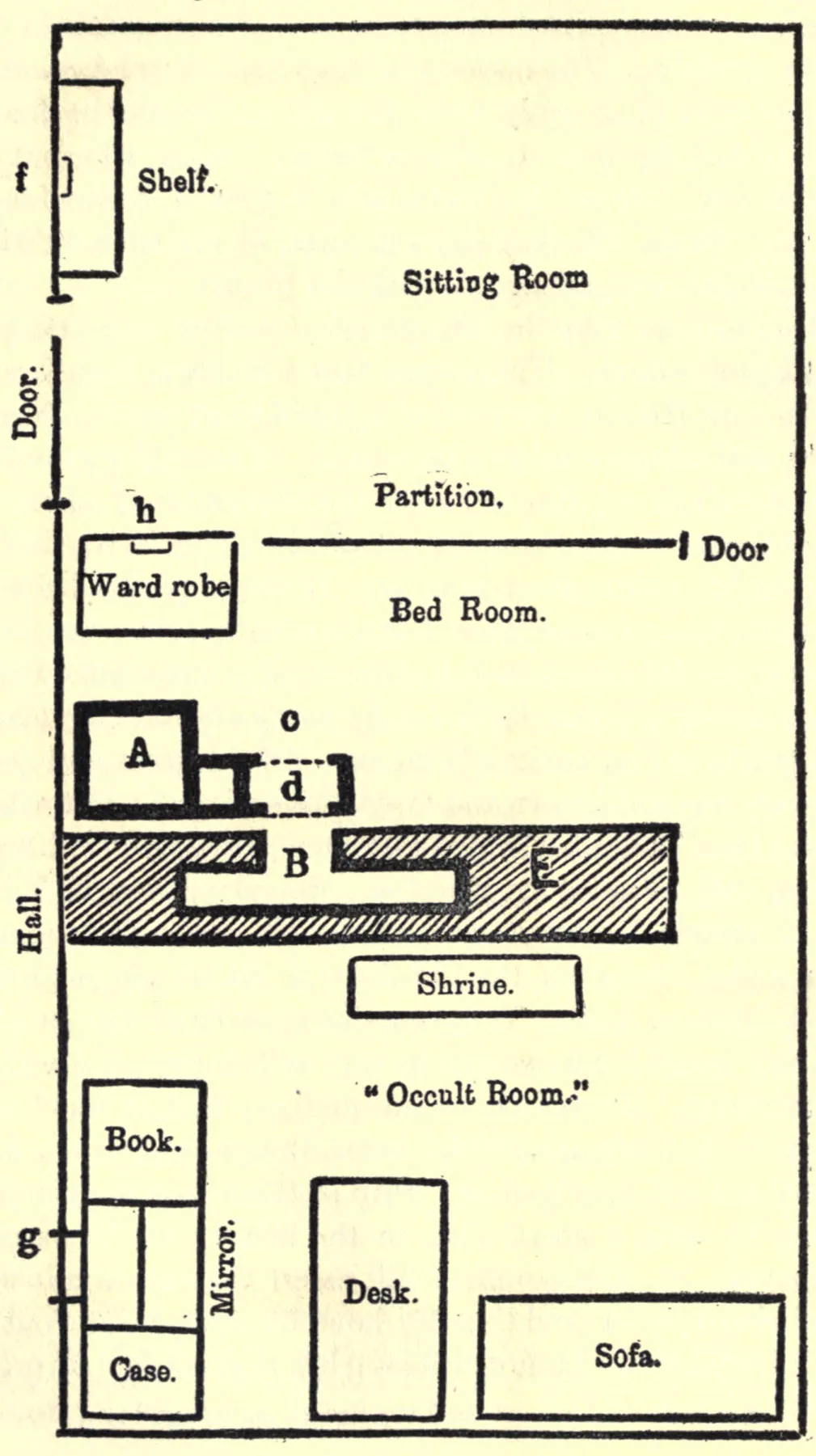
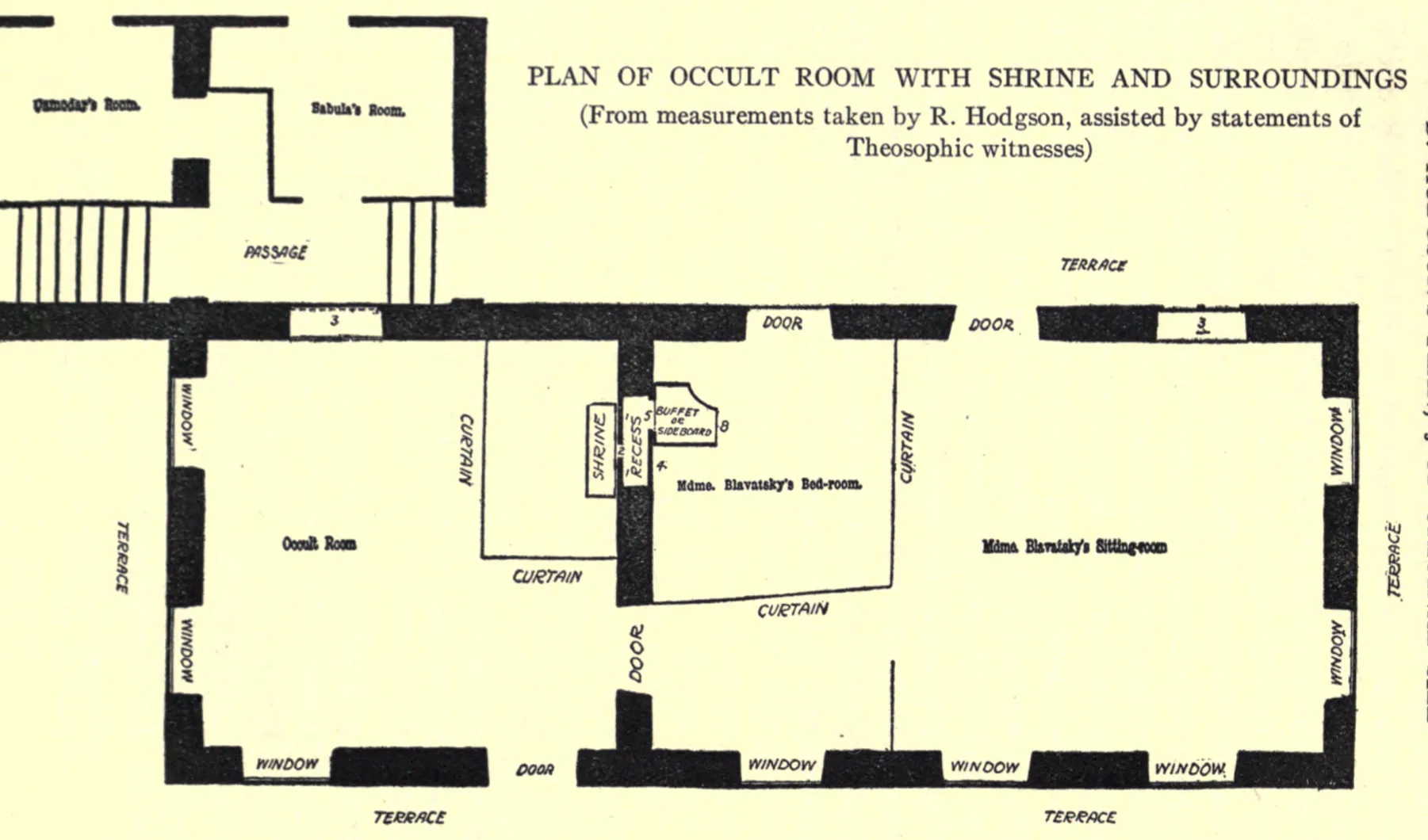
a. On the 21st of February, 1884, Madame Blavatsky, Colonel Olcott and a young Calcutta Brāhman, Mohini Mohan Chatterji, sailed from Bombay for Europe. By Madame Blavatsky’s explicit instructions, the Coulombs were left in charge of her rooms at the headquarters, Madras. They were to reside in them, and to look after her furniture and dogs. No one was to disturb them. There is the best evidence possible for these statements. The written instructions have been published;1 and the following is a letter written by Madame Blavatsky, and printed in Dr. Hartmann’s pamphlet published in September:2
46 Rue Notre Dame des Champs, Paris, April, 2–84. She swore to me that she would take care of my rooms, only asking me to let it be known that she alone had the right over all, and would have and keep the key. Having told Dr. Hartmann that he was welcome to my books and my desk in my absence, she made a vow when alone with me, and declared that if I allowed one single person to have access to my rooms, she would answer for nothing; — that the ‘shrine’ would be desecrated, etc.3
Damodar, a Hindu who had become a Theosophist and was one of Madame Blavatsky’s secretaries, had the keys of the Occult Room and the Shrine.4 Only these three had free access to the penetralia at headquarters. The affairs of the society were left by Colonel Olcott, the President, in the hands of a Committee of seven.
b. On the 29th of February one member of this Committee, Dr. Hartmann by name, arrived at headquarters; and two or three days later a meeting of the Committee was held. In order that they might sit in quiet, Dr. Hartmann proposed that they should meet in Madame Blavatsky's room upstairs; but, to his amazement, the Coulombs refused to give them admittance. The consequence was a bitter quarrel between the Coulombs, on the one side, and the members of the Committee and the other residents at headquarters, on the other. Madame Coulomb said that she had many secrets which she would tell, if they continued to molest her.1 She said there were sliding panels in the walls by which phenomena were created, and secret panels in the Shrine, by mean of which the letters from the Master and other things were introduced from Madame Blavatsky's room behind. She also talked of the money which she had lent Madame Blavatsky in Egypt and which had not been repaid.2 Hence Dr. Hartmann and others wrote to Madame Blavatsky and Colonel Olcott, complaining of the Coulombs.
So serious did matters become in the meantime, that the Committee decided to impeach them in an informal manner, and expel them from headquarters. But on March 22nd, while they were drawing up the charges against them, Damodar laid before them a letter,3 which he declared had been brought from Koot Hoomi by a chela in his astral body, advising them not to turn out the Coulombs. Naturally, the Committee were rather upset to find such an authority interfering to save the traitors. Yet, in the face of a message direct from the Master, they dared not turn them out of doors. Consequently, as Dr. Hartman says, an armistice was concluded with them.
After the peace was patched up, the Coulombs, Mr. Lane Fox and Damodar went to Ootacamund for a holiday. Meanwhile, the letters despatched early in March, reached the founders in Paris; and they replied, in letters written on the 1st and 2nd of April, to the Coulombs and to others. These letters reached Madras on the 25th of April. On the 26th, the very day when the mail from Europe reached Ootacamund, a letter1 purporting to come from the Master, and directed to Dr. Hartmann, was forwarded to the latter by Damodar, from Ootacamund. This letter said that the Coulombs were plotting. Therefore, when they returned from Ootacamund, the Committee decided to expel them. On the 17th of May, M. Coulomb gave up the keys he held, and several of the sliding doors and panels which Madame Coulomb had talked about were discovered.2 On the 23rd of May they were finally forced to leave headquarters.
c. We now turn to Europe for a moment. The Theosophical Society had by this time attained so much notoriety that the London Society for Psychical Research appointed, in May, 1884,3 a Committee for the taking of such evidence as to the alleged phenomena as might be offered by members of that body at the time in England, or as could be collected elsewhere. The journey of the founders to Europe thus came at a very fortunate time, and the Research Society took full advantage of it.4
d. On the 9th of August Madame Coulomb called on the Editor of The Madras Christian College Magazine, and placed in his hands some forty letters, and asked him whether he cared to publish them, as they contained sufficient evidence to expose the fraudulent nature of the phenomena which had made so much stir in India. The Editor asked for a few days to look into the matter.1
A few days later the General Council of the Theosophical Society through their Chairman, Dr. Hartmann, sent out a circular letter of inquiry to a number of Theosophists who had visited headquarters, asking them what they knew about the Shrine.2
Meantime the Editor of the Christian College Magazine was examining the documents left in his hands. Most of them were letters from Madame Blavatsky to Madame Coulomb, but there were several other things, a letter from Mrs. Carmichael (the wife of an Indian Civilian) to Madame Blavatsky with a letter to Madame Coulomb written on the back, a receipt for a telegram, etc. The Editor submitted the documents to the most skilled opinion available in Madras, among others to certain bankers, and they pronounced them genuine.3 But the letters authenticated themselves. No one could look through them and believe them to be forgeries. The question of the handwriting was quite a subordinate one. The letters contained scores of references to leading Hindus and Government Officials all over India with details of what happened when Madame Blavatsky was in their houses and when she met them casually. No forger would have dared to invent such details. If they had been forged, a few personal inquiries would have at once exposed them. The style was also Madame Blavatsky’s, brilliant, vivacious, full of surprises and sudden changes. The documents were thus manifestly genuine. As they contained numerous instructions to Madame Coulomb for the production of phenomena, the Editor decided to publish a number of extracts from them, so as to expose Madame Blavatsky and her frauds.
Accordingly, an article appeared in the Christian College Magazine, on September 10th,1 containing extracts from some dozen letters, with sufficient comment to make them comprehensible. The letters were almost all in French. The text and the English translation were given in parallel columns. The Editor quoted only such paragraphs as were necessary to prove the fraud, and omitted numerous passages dealing with the private affairs of individuals, both European and Indian; and most of the letters were not used at all.
The publication of this article caused immense excitement throughout India. Most of the newspapers recognized that it was a genuine exposure, but some doubted whether the Editor had not been hoaxed by forgeries. The leading Theosophists, on the other hand, put the whole matter down as a conspiracy on the part of the missionaries.
e. Mr. W. Q. Judge, who took part in the foundation of the society in 1875,2 was in Europe in 1884, and was sent by Olcott from Paris to Madras.3 He arrived there sometime in May or June.
f. Dr. Hartmann now drew up as vigorous a defence of Madame Blavatsky as he could and published it, sometime in September, with the title, Report of Observations made during a nine-months' stay at the Head-quarters of the Theosophical Society at Adyar (Madras), India.4 A rough and inaccurate plan of the chief rooms at headquarters, probably the work of Judge,5 appeared in it. It is reproduced above, plan A, page 234. Hartmann denied that the letters which had been published were genuine, and charged the missionaries with forming a conspiracy against the Theosophical Society. He confesses the existence at headquarters of such sliding panels, trapdoors, holes in the wall, etc., as could be used for the production of occult phenomena ; but he asserts, that M. Coulomb made all these after Madame Blavatsky’s departure, in order to ruin her reputation. The whole conspiracy, however, would be unmasked and the innocence of Madame Blavatsky established in a court of law.
We have noted Judge’s arrival above because of the following grave incident in which he was concerned. The chief facts are given in a written statement by Dr. Hartmann from which we quote the following :
Of the existence of a movable back to the Shrine and a filledup aperture in the wall, none of us knew anything, and although superficial examinations were made, they divulged nothing ; because to make a thorough examination, it would have been necessary to take the Shrine down, and we were prevented from doing this by the superstitious awe with which Mr. Damodar K. Mavalankar regarded the Shrine, and who looked upon every European who dared to touch or handle the “sacred ” shrine as a desecration.
At about the time when Major-General Morgan sent his invitation to Mr. Patterson to come to headquarters, that examination was made, and it was found that the back of the Shrine could be removed, and on moistening the wall behind the Shrine with a wet cloth, it was found that an aperture had existed, which had been plastered up. . . .
I must confess that it seemed to me that if at that inopportune moment this new discovery, to which I then alluded in the papers (see Madras Mail), would have been made public, it would have had a bad effect on the public mind . . .
A gentleman who was present, and who shared my opinions, was of the opinion that the Shrine had been too much desecrated to be of any more use, and he burned the Shrine in my presence.1
What they found was that the back of the Shrine consisted of three movable panels, and that there had been an aperture in the thin brick partition behind;1 so that there had actually been direct communication between Madame Blavatsky’s room and the interior of the Shrine, precisely as Madame Coulomb had said.2 The aperture had been plastered up when Madame Blavatsky sailed for Europe. Among those who examined the Shrine and made the discovery were Dr. Hartmann, Mr. Judge and Mr. T. Vijayaraghava Charloo (known as Ānanda);3 and it was Judge who burned the Shrine.4 The date of the discovery was September 20th.5
Dr. Hartmann and Theosophists generally have always maintained that the sliding panels in the back of the Shrine and the hole in the wall behind it, which made it possible to get access to the Shrine surreptitiously from Madame Blavatsky’s room, were made by M. Coulomb after Madame Blavatsky sailed for Europe in February, 1884. It is passing strange that they destroyed the Shrine, if they were really convinced that M. Coulomb had made these arrangements in order to ruin Madame Blavatsky. Why did they not preserve this most notable piece of evidence of his villainy?
The truth is that it is totally impossible to believe that the sliding panels in the Shrine and the hole in the wall were made by M. Coulomb after Madame Blavatsky’s departure; for while the Coulombs had charge of her rooms, Damodar had the keys of the Occult Room and the Shrine.6 How then could M. Coulomb insert sliding panels in the back of the shrine, and dig a hole through the wall without the knowledge of Damodar? The burning of the Shrine shows that Judge and Hartmann had had some glimpse of this truth. Clearly they were conscious that no defence of Madame Blavatsky was possible while the Shrine remained in existence.
g. It is important that Hartmann’s bold promise of a lawsuit should be kept in mind. In making it Dr. Hartmann did not stand alone. Judge was especially bold in promising a full exposure in court;1 and Theosophists in every part of India loudly proclaimed that the missionaries would be prosecuted, and their conspiracy laid bare. So strong was confidence at headquarters that again and again it was prophesied that they would rue the day when first they accepted the lying evidence of two dismissed servants.2 The London Lodge published a pamphlet in which it was stated that the matter would go to Court; and Madame Blavatsky also stated in an interview with a representative of The Pall Mall Gazette that she was hurrying to India to commence proceedings against the missionaries.2
But, while this was what she said in public, she wrote in a very different strain to M. Solovyoff. We quote part of her letter. The date is early in October, 1884:
“First of all, you can say to each and all in Paris that since, in spite of all my efforts, in spite of my having sacrificed to the society life and health and my whole future, I am suspected not only by my enemies but even by my own theosophists. I shall cut off the infected limb from the sound body; that is, I shall cut myself off from the society. They have all clutched at the idea with such delight, Olcott and Madame Gebhard and the rest, that I have not even met with any pity. I leave the moral to you. Of course, I shall not depart into the ‘wilderness’ till Olcott, who starts for India by the first steamer, has arranged matters at Adyar, and exposed and proved the conspiracy —they gave the Coulomb woman 10,000 rupees3 as is now proved, in order to destroy the society; but when all this has settled down, then I shall go off, —where, I do not know yet; it is all the same, besides, so long as it is somewhere that nobody knows.1
h. In October a second article appeared in The Christian College Magazine,2 in which the missionaries, in reply to Dr. Hartmann’s pamphlet and to other criticisms which Theosophists had raised against them, published a further instalment of letters, and indicated still more clearly the great strength of their position.
i. So keen was the interest in the Psychical Society on the question of the Theosophical phenomena and of the genuineness of the letters published in The Christian College Magazine that the Committee appointed by them to consider the phenomena determined to send one of their number to India to make careful scientific investigations on the spot. Mr. Richard Hodgson, B.A., of St. John’s College, Cambridge, was sent out at the expense of Prof. Henry Sidgwick. He arrived in Madras on the 18th of December. On the 20th of December Madame Blavatsky and Colonel Olcott arrived at the headquarters in Madras.
The following is Mr. Hodgson’s own statement of his attitude of mind :
Before proceeding it may be well for me to state that the general attitude which I have for years maintained with respect to various classes of alleged phenomena which form the subject of investigation by our Society enabled me, as I believe, to approach the task I had before me with complete impartiality ; while the conclusions which I held and still hold concerning the important positive results achieved by our Society in connection with the phenomena of Telepathy, — of which, moreover, I have had instances in my own experience, both spontaneous and experimental, and both as agent and percipient, — formed a further safeguard of my readiness to deal with the evidence set before me without prejudice as to the principles involved. Indeed, whatever prepossessions I may have held were distinctly in favour of Occultism and Madame Blavatsky—a fact which, I think I may venture to say, is well known to several leading Theosophists.1
Mr. Hodgson’s actions fully bear out his statement. When he arrived in Madras, the Editor of The Christian College Magazine offered him hospitality, but he declined it; and a day or two later the Editor heard that he had gone to reside at the Theosophic headquarters; and there he resided all the time he was in India (nearly three months), except when he went on short visits to places at a distance from Madras. Madame Blavatsky acknowledges frankly that he was friendly to the Theosophist cause when he arrived in India. She writes to M. Solovyoff:
It was he (i.e. Hartmann) who turned Hodgson, the representative sent by the London Psychical Society to inquire into the phenomena in India, from a friend, as he was at first, into an enemy.2
Mr. Hodgson acted wisely, I believe, in putting up at headquarters. He thus gave Madame Blavatsky, Colonel Olcott and all their followers the fullest possible opportunity of explaining every suspicious circumstance and giving all the evidence they possessed to prove that the letters which had been published were forgeries; while he himself was able to become acquainted with every corner of the rooms at headquarters, except in so far as the Theosophic leaders had destroyed the evidence.3
The Editor of The Christian College Magazine handed the incriminating letters to Mr. Hodgson for examination, on condition that they should be returned, as they were the property of Madame Coulomb, and were to be handed back to her as soon as all danger of a prosecution should have passed away.1
Mr. Hodgson interviewed the people who supplied the materials for building and repairs, traced the vases, saucers, flowers, etc., which appeared in the phenomena, to the shops or other places whence they came, and endeavoured to fit these facts into the accounts given by those who witnessed the phenomena. He tested all the details of the incriminating letters, cross-questioned witnesses, examined the places referred to, and compared the documents with acknowledged specimens of Madame Blavatsky’s handwriting in matters of spelling, phraseology,1 style, etc. No other person, whether Theosophist or not, had the opportunity of examining all the witnesses personally, of seeing all the rooms and other places involved in the matters at issue, and of handling all the documents. Any one who, from a sincere desire to get at what actually happened in these matters, will work patiently and carefully through the multitude of details supplied in all the sources, will realize with what extreme honesty and with what infinite pains Hodgson collected and sifted the evidence.
As he proceeded with this persistent scientific search for the facts, it became evident that the Theosophic leaders were not trustworthy witnesses, that they contradicted themselves and each other in multitudes of particulars. Each new piece of cross-questioning on Mr. Hodgson’s part produced a new version of some occurrence. Madame Blavatsky,2 Colonel Olcott,3 Hartmann4 and Damodar5 all produced a very bad impression.
Here is what happened when Mr. Hodgson asked his first questions about the shrine in December, 1884 :
Madame Blavatsky professed ignorance on the subject, saying she had been unable to discover what had been done with the Shrine. Mr. Damodar and Mr. Hartmann both denied having any knowledge of it, and it was only after repeated and urgent requests to be told what had happened that I learnt from the halting account given by Mr. Damodar and Dr. Hartmann that the Shrine had been removed from the Occult Room (see Plan6) into Mr. Damodar’s room at about mid-day of September 20th, that on the following morning, at 9 o’clock, they found the Shrine had been taken away, and they had not seen it since. They threw out suggestions implying that the Coulombs or the missionaries might have stolen it.1
Mr. Hodgson questioned every Theosophist who had sent in written answers to Dr. Hartmann about the Shrine and any other one who could throw any light on its history, and in this way gradually pieced together a certain amount of information about it. All the evidence showed that no one had examined the Shrine carefully before the 20th of September. Every statement made about examinations before that date proved altogether untrustworthy. But he was kept in ignorance of the burning of the Shrine until the 13th of March.2
j. We may next see what Madame Blavatsky herself wrote about Dr. Hartmann. The letter was written from Naples in May, 1885, to M. Solovyoff, after her final return from India, but six months before Mr. Hodgson’s report appeared :
If your heart is not attracted to Hartmann, you are quite right. This dreadful man has done me more harm by his defence, and often by his deceit, than the Coulombs by open lying. One moment he was defending me in the papers, the next he was writing such ‘equivokes’ that even the papers hostile to me could only open their mouths and say : ‘There is a friend for you !’ One day he defended me in letters to Hume and other theosophists, and then hinted at such infamies that all his correspondents went against me. It was he who turned Hodgson, the representative sent by the London Psychical Society to inquire into the phenomena in India, from a friend as he was at first, into an enemy. He is a cynic, a liar, cunning and vindictive, and his jealousy of the Master, and his envy for any one on whom the Master bestows the least attention, are simply repulsive. He has turned our devoted Judge, when despatched by Olcott from Paris to Adyar, into our enemy. He set against me at one time all the Europeans in Adyar, Lane Fox, Mr. and Mrs. Oakley, Brown; the Hindus alone, who hate him and have long since taken his measure, he was unable to stir. Now I have been able to save the society from him, by agreeing to take him with me under the plea that he is a doctor. The society, and Olcott at their head, were so afraid of him that they did not dare expel him.1
There thus need be no doubt as to Dr. Hartmann’s character as a witness.
k. From the time that Madame Blavatsky and Colonel Olcott reached Madras, on the 20th December, 1884 (two days after Hodgson’s arrival), the missionaries and the Coulombs watched and waited eagerly, looking for the promised suit-at-law which was to establish the innocence of Madame Blavatsky, prove the Coulombs forgers and expose the missionaries as conspirators. But week after week passed, and nothing happened. The blustering ceased. Hartmann, who had boasted by word of mouth and in print, did nothing. Colonel Olcott and Judge were mute. Madame Blavatsky initiated no proceedings in the Law Courts to clear her character. Finally, in February, there was issued from headquarters a pamphlet, the work of Dr. Hartmann in the main, and bearing the following title, Report of the Result of an Investigation into the charges against Madame Blavatsky, brought by the Missionaries of the Scottish Free Church at Madras and examined by a Committee appointed for that purpose by the General Council of the Theosophical Society. Madras, Scottish Press, 1885.2 This pamphlet contains the written replies sent in by Theosophists in response to the letter circulated in August,3 but no mention is made of the discoveries made by Dr. Hartmann and Mr. Judge in September,4 nor of the effect of Hodgson’s examination on those who had sent in replies.1 It is stated in the pamphlet that there is to be no prosecution of the missionaries. What a fiasco! A pamphlet instead of a prosecution!
What was it that choked the bluster of the Theosophists and stilled the last threat of a prosecution? In the inner circles of Theosophy it is acknowledged that Sinnett, Olcott and the others were afraid to have Madame Blavatsky with her unbridled tongue go into the witness-box: as a witness she was impossible. That doubtless weighed also, but the real cause of their terror, without any doubt, was the searching examination made by Hodgson. Until he came and subjected them to his trained scientific mode of inquiry, they doubtless believed they had an irrefragable case. But that ordeal made everybody at headquarters realize that no Theosophic leader could stand cross-examination for a quarter of an hour, and that many of the phenomena could be shewn to be fraudulent by a few carefully directed inquiries. To go to court would be black ruin. The following quotation will make this plain and will also explain the events that followed. Hodgson writes:
It was on the evening of March 13th, at a conference between Dr. Hartmann, Mr. and Mrs. Cooper-Oakley, Mr. Hume and myself, that Dr. Hartmann finally confessed that “nobody was allowed to touch that d—— Shrine,” and he then related the incident described on p. 224 of my Report,2 concerning the discovery of the sliding panel of the Shrine and the subsequent destruction of the Shrine itself. I had learned from Mr. A. D. Ezekiel, in Bombay, that he had discovered independently that there had once been a hole in the wall behind the Shrine, but that it had been carefully blocked up. Dr. Hartmann then admitted that traces of this hole had been discovered previously, but the discovery was kept a secret. On the following morning Mr. Hume drew up some statements to form proposed resolutions for an informal meeting to be held in the evening by himself, the Oakleys, Hartmann, Ragoonath Row, Subba Row, and P. Sreenvas Row. These were to the effect that most of the phenomena in connection with the Theosophical Society were fraudulent, as appears from such of the Coulombs’ statements as have been verified, and the independent investigations by myself, that the Society be reconstituted, that Madame Blavatsky, Olcott, Damodar, Babajee and Bhavani Shankar should resign their connection with it, that the disputed letters are genuine, and that Hartmann’s pamphlet as well as the Defence pamphlet should be withdrawn, as being founded on an imperfect knowledge of the circumstances. These resolutions, as I was informed by Mr. Hume, were not carried, the Oakleys and Dr. Hartmann being unwilling to go so far as to condemn the phenomena as fraudulent. It was decided, however, that the pamphlets should be withdrawn.1
Hartmann confessed that the pamphlet published in February was thoroughly untrustworthy,2 and gave Mr. Hodgson a written statement about the Shrine.3 Finally, Madame Blavatsky herself confessed that the Shrine was made with three sliding panels in the back.4
The result of Mr. Hodgson’s long patient inquiry was that he was driven to these conclusions : that every phenomenon, so far as he had been able to trace it, was fraudulent ; that the letters handed over by Madame Coulomb were genuine ; and that most of the Koot Hoomi letters were written by Madame Blavatsky herself, though a few were probably written by Damodar.5
A few days after the conference just described Hodgson left for home. About the same time Judge slunk away to America without fulfilling his boasts;1 and Damodar, knowing that his course was run, took a journey to the Himalayas, and was seen no more.2
l. When Madame Coulomb saw that Madame Blavatsky and her friends were afraid to prosecute and give her the opportunity of proving the truth of her statements, she determined to bring the matter before a court of law herself. But, since Madame Blavatsky had not publicly charged Madame Coulomb with forging the letters, it was impossible to prosecute her. Consequently, she instructed Messrs. Barclay and Morgan to proceed against General Morgan of Ootacamund, as he had been foremost in charging her with forgery. But at this juncture Madame Blavatsky's lady doctor went and begged Madame Coulomb's friends to postpone the case: Madame Blavatsky was so ill that it would inevitably kill her. They agreed. Several postponements were asked for and obtained; but finally the patient recovered. It was then decided to proceed with the case. As a preliminary measure, Madame Coulomb's solicitors wrote to General Morgan on March 25th, threatening him with criminal proceedings, should he fail to make an apology before April 2nd. General Morgan replied, in a letter dated March 31st, declining to apologize.
The very next day, the Theosophical Society gave Madame Blavatsky permission to leave India; and she embarked on a French steamer, the Tibre, at Madras on the 2nd of April, never to return. In order that no one might know beforehand that she was to sail, her passage and that of Miss Flynn, who went with her, were taken under the name of “Madame Helen and maid.” She sailed on a medical certificate of dishealth ; for her doctor thought that she ought not to stay through the hot weather. It was kidney-trouble she had suffered from. She had had a very similar attack in Elberfeld seven months earlier,1 and she had another at Würzburg five months later.2 But it is also perfectly clear that it was not this sickness that was the reason for her sudden and secret departure. Had she been ready to clear her character, she could have stayed a little longer without the slightest danger. As soon as it was rumoured that she had escaped, a representative of Messrs. Barclay and Morgan went down by rail to Pondicherry, where the French steamer had to call, went on board, and found the lady well and happy on deck, surrounded by a crowd of admirers. She unquestionably fled from India, in order to escape the ordeal of cross-examination as a witness in the Coulomb-Morgan trial. In a letter to M. Solovyoff, written at Naples on the 29th of the month, she says that she had been called a Russian spy, and adds :
They certainly could not prove anything, but meanwhile, on mere suspicion, it might have been a matter of sending me to jail, arresting me, and doing who knows what to me. I have only now heard all this in detail ; they did not tell me, and packed me off straight from my bed on to the French steamer.3
Dr. Hartmann also sailed in the same steamer. Thus, Judge, Damodar, Madame Blavatsky and Dr. Hartmann had all fled from Madras.
Two days after the steamer sailed the following note appeared in the Madras Mail : The Theosophists :— Colonel Olcott writes on behalf of the General Council of the Theosophist Society to say that “as a number of copies of a pamphlet entitled ‘Report of the result of the investigations into the charges brought against Madame Blavatsky,’1 have been circulated, it is my duty to state that the issue has not been ordered by the General Council, nor authorized by the Committee.”2
Clearly, this action can have resulted only from a conviction on the part of the leaders that the pamphlet was untrustworthy ; and that is precisely what Hodgson says they had come to.3 The Theosophists of India thereby absolutely gave up the attempt to defend Madame Blavatsky.
On the 22nd of April a letter from Madame Coulomb appeared in the Madras Mail in which she explained that, since Madame Blavatsky had left the country, it was impossible to have the question of the authenticity of the letters satisfactorily settled, and she had in consequence decided to drop the case against General Morgan.
m. How sick the Theosophic leaders were of phenomena is patent from the fact that from this time these most useful miracles were banned. They were unnecessary ; and they were dangerous. Every book labours to show that they are no essential element of the Theosophist programme. But has no one realized what the cessation of the phenomena means ? Many of them were supposed to be the work of the Masters themselves. Hence, if we accept the Theosophic explanation of the Coulomb affair, we must conclude that those great Adepts, who, in the fulness of their omniscience, had planned them and carried them out, were compelled by a pair of forgers and a few conspiring missionaries to give up the policy they had adopted for the establishment of the truth in India !
n. Meantime, the Committee appointed by the Society for Psychical Research to inquire into the phenomena of Theosophy had been dealing with certain parallel cases which had taken place in Europe, and had been led by all the evidence adduced to declare that they had been fraudulently arranged by Madame Blavatsky. This conclusion was based solely on the evidence available in Europe,1 and is thus altogether independent of the Coulomb letters and the masses of evidence gathered by Hodgson.
o. When his report was laid before the Committee, they carefully weighed all the evidence and unanimously accepted his main conclusions. The report was published in December, 1885.2
No man is in a position to decide any one of the most important questions at issue until he has worked his way patiently through the mass of detailed evidence accumulated in this report. We cannot, in the space at our disposal, give any outline of the masses of evidence set forth in it. We simply note the most outstanding facts, and refer readers to all the relevant documents.
p. With regard to the phenomena, two points must be noticed here. First, the famous brooch case, detailed above,3 was unmasked by journalists long before Hodgson had anything to do with the question. This affords us, then, undeniable evidence, quite apart from Hodgson, the missionaries and the Coulomb letters, that Madame Blavatsky, on one occasion at least, was guilty of a most impudent piece of fraud, and that she had made the most careful arrangements beforehand to deceive her hosts, an Indian Civilian and his wife. Secondly, the evidence which Hodgson offers to prove that other phenomena were fraudulent is of the same nature as that which exposed the brooch-trick, simple matters of fact, requiring no knowledge of telepathy or any form of occultism for their appreciation, but understandable by all. Let readers turn to the Report.
q. As to the letters handed over by Madame Coulomb, the handwriting proved them to be Madame Blavatsky’s; but it was not merely the handwriting that convinced every one who handled them of their genuineness and made it utterly impossible for the Theosophic leaders to prove them forgeries, but the masses of detailed allusions in them to Indian Civilians, prominent Hindus and other people,1 details the truth of which no one could deny and no forger could have invented, details which proved absolutely true so far as Hodgson was able to probe them in each case. The instructions for the production of phenomena contained in the letters were proved genuine by the sliding panels and other arrangements found in the Shrine and in Madame Blavatsky’s rooms and by many circumstances discovered by Hodgson.
r. In the case of the long philosophic letters purporting to come from the Masters, there is abundance of evidence to prove that most of them were written by Madame Blavatsky. The plagiarism from Mr. Kiddle and the stupid fictitious defence set up afterwards,2 taken along with what we know of how Isis Unveiled was produced,3 would suggest that the same mind produced both; but there is direct and convincing evidence as well. There are multitudes of errors in the English of these letters, errors in spelling, errors in dividing words at the end of a line, and errors in idiom; and almost every one of them can be paralleled in Madame Blavatsky’s acknowledged correspondence. This was one of the forms of evidence which convinced Mr. Hodgson as to their authorship. Here are lists of some of the more noticeable of these errors : a. Misspells. your’s, her’s, fulfill, dispell, thiefs, leasure, quarreling, marshaling, alloted, in totto, circumstancial, defense.
b. Faulty division of words at the end of a line. incessan-tly, direc-tly, una-cquainted, fun-ctions, discer-ning, rea-ding, rea-dily, po-werless, atmos-phere, des-pite, corres-pondence, En-glishman, En-glish, misunders-tood.
c. Faulty idioms. I give you an advice; who, ever since he is here, has been influencing him; we mortals never have and will agree on any subject entirely; one who understands tolerably well English; you felt impatient and believed having reasons to complain; to take care of themselves and of their hereafter the best they know how; — the best she knew how; that the world will not believe in our philosophy unless it is convinced of it proceeding from reliable —; there are those, who, rather than to yield to the evidence of fact; in a direct course or along hundred of side-furrows; their active mentality preventing them to receive clear outside impressions; provided you consent to wait and did not abuse of the situation; Immutable laws cannot arise since they are eternal and uncreated, propelled in the Eternity and that God himself — if such a thing existed — could never have the power of stopping them; so more the pity for him.1
It must also be noticed here that Mr. Sinnett’s books are no faithful representation of the Ms. letters. Most of the above errors, and many other awkward words and phrases, have been corrected;2 and the passage plagiarized from Mr. Kiddle3 is dropped altogether from the text in the later editions, and no note is appended to tell readers of the omission. This way of dealing with the Mss. is the more serious because Mr. Sinnett says on p. 100:4
The reader must be careful to remember, however, as I now most unequivocally affirm, that I shall in no case alter one syllable of the passages actually quoted.
Readers will form their own opinion of Theosophic editorial methods.1 At a later date, Mr. W. Emmette Coleman, whom we have already mentioned,2 brought forward a great mass of evidence of a different kind, which completely confirms Mr. Hodgson’s conclusion. Here is his general statement :
Esoteric Buddhism, by A. P. Sinnett, was based upon statements in letters received by Mr. Sinnett and Mr. A. O. Hume, through Madame Blavatsky, purporting to be written by the Mahatmas Koot Hoomi and Morya, — principally the former. Mr. Richard Hodgson has kindly lent me a considerable number of the original letters of the Mahatmas leading to the production of Esoteric Buddhism. I find in them overwhelming evidence that all of them were written by Madame Blavatsky, which evidence will be presented in full in my book. In these letters are a number of extracts from Buddhist books, alleged to be translations from the originals by the Mahatmic writers themselves. These letters claim for the adepts a knowledge of Sanskrit, Thibetan, Pali, and Chinese. I have traced to its source each quotation from the Buddhist scriptures in the letters, and they were all copied from current English translations, including even the notes and explanations of the English translators. They were principally copied from Beal’s Catena of Buddhist Scriptures from the Chinese. In other places where the adept (?) is using his own language in explanation of Buddhistic terms and ideas, I find that his presumed original language was copied nearly word for word from Rhys Davids’s Buddhism, and other books. I have traced every Buddhistic idea in these letters and in Esoteric Buddhism, and every Buddhistic term, such as Devachan, Avitchi, etc., to the books whence Helena Petrovna Blavatsky derived them. Although said to be proficient in the knowledge of Thibetan and Sanskrit, the words and terms in these languages in the letters of the adepts were nearly all used in a ludicrously erroneous and absurd manner. The writer of these letters was an ignoramus in Sanskrit and Thibetan; and the mistakes and blunders in them, in these languages, are in exact accordance with the known ignorance of Madame Blavatsky thereanent. Esoteric Buddhism, like all of Madame Blavatsky’s works, was based upon wholesale plagiarism and ignorance.1
There is another fact. Most of these letters were written on a peculiar sort of hand-made rice-paper. After Madame Blavatsky’s death, Judge fabricated a large number of Mahātma letters, as we shall see; and they too were written on this peculiar paper. Olcott then told his Theosophic friends that he himself had bought a quantity of this paper in Jummoo, Cashmere, in 1883; that Madame Blavatsky always carried a supply of it about with her; and that Judge must have abstracted some of it from her rooms in London.2 M. Solovyoff tells us that, in a drawer of Madame Blavatsky’s writing-table in Würzburg, he saw a packet of envelopes of this very paper.3 Hence no serious student will doubt how these letters were composed.
s. Mr. Sinnett published a defence of the occult phenomena in 1886. Then Mrs. Besant attempted to answer Hodgson’s Report in an article in Time in March, 1891. It is astounding to discover that for most of the evidence which Mr. Sinnett and Mrs. Besant bring, they rely on the pamphlet, Report of the Result of an Investigation, etc.,4 which was chiefly compiled by Dr. Hartmann, Madame Blavatsky’s “liar, cunning and vindictive,”5 and which, within two months of its publication, was publicly repudiated by the leaders of Theosophy in India,6 Dr. Hartmann himself having acknowledged it to be untrustworthy.7
Mr. Hodgson overwhelmed these articles with a reply in 1893.8 Yet Mrs. Besant published H. P. Blavatsky and the Masters of the Wisdom in 1907, using the old repudiated source, and repeating certain shameful slanders, without even mentioning Hodgson’s replies. Nothing has done so much to shake my confidence in Mrs. Besant’s honesty as my study of this dreadful document. All later attempts at defence depend almost entirely on its statements. These books and pamphlets are by far the most unreliable literature that it has ever been my sad fate to have to study. A few samples of their quality are given in the Appendix, p. 447.
12. A new myth was created in 1885. According to the teaching of all the wise and good of the ancient world, the goddess Isis lifted her veil only to those who had lived lives of perfect chastity. Now Madame Blavatsky, according to Theosophic legend, was chosen by the Masters from amongst all modern men and women to receive the ancient wisdom in limitless measure from the highest sources. She unveiled Isis. Hence during the autumn of 1885, while she was at Würzburg, Germany, she began to tell her friends, that, despite her marriage to M. Blavatsky, despite many stories told of her after life, and despite her American marriage,1 she had through all remained a spotless virgin.2 Yet this is the woman whose confessions of gross and long-continued immorality live in her own letters to M. Aksakoff and to M. Solovyoff.3 We are thus driven to acknowledge that she was capable of stupendous hypocrisy in addition to everything else. This myth has to be carefully borne in mind in the study of Theosophic literature written after 1885.
13. 1888 proved one of the most remarkable years in Madame Blavatsky’s life. From that year dates the Esoteric School of Theosophy, which since then has been the kernel and the strength of the society. In the same year she published her greatest work, The Secret Doctrine. Then also Mr. G. R. S. Mead, now editor of The Quest, became her private secretary. He retained the position until her death in 1891.
The Esoteric School was created in order to initiate young Theosophists into the practice of occultism. The work was carried on in classes, each under the guidance of a secretary. A good deal of the instruction was taken from Ms. material prepared by Madame Blavatsky and afterwards published in the third volume of The Secret Doctrine. Each person initiated had to take two vows: to defend and advance the cause of Theosophy as far as lay in his power; and not to reveal anything taught in the Esoteric School. Each pupil received also a photograph1 of a (pretended) portrait of one of the Masters and was bid gaze on it fixedly during meditation and try to visualize it in the corners of the room. The occultism of the school at this time seems to have been rather different to what it has become under Mrs. Besant and Mr. Leadbeater.
It was in October, 1888, that The Secret Doctrine was published. In the Introduction the authoress assures us that the teaching it contains comes from her Masters, who reside beyond the Himalayas. The truth it contains is now “permitted to see the light after long milleniums of the most profound silence and secrecy.” The reason why “the outline of a few fundamental truths from the Secret Doctrine of the Archaic Ages” is now revealed is because European scholars during the nineteenth century have been studying the religions of Egypt, India and other lands and have been publishing to the world utterly false and misleading accounts of these great systems.2
The whole book is founded on what she calls “The Book of Dzyan,” which consists of nineteen stanzas, and, according to Madame Blavatsky, is a very ancient work. It is altogether unknown to European scholars; no copy of it lies in any European library; yet, she asserts, that it exists in one of the mysterious libraries of Tibet, in which are concealed all the sacred and philosophical works that have ever been written, in whatever language or characters, since the art of writing began.1
The Secret Doctrine is in two volumes, the first, on Cosmogenesis, being founded on the first seven stanzas of the Book of Dzyan, and the second, on Anthropogenesis, being founded on the remaining twelve. In this work readers will find Theosophy as it is actually taught to-day. The doctrine is much more developed and definite than it is in Isis Unveiled. Here the formation of the worlds and the evolution of man are treated in detail. As in the Isis, the treatment is unscientific in character throughout.
Analysis has shewn that large portions of the book were compiled in the same way as so much of the Isis was built up.2 Hundreds of passages were borrowed without acknowledgment from modern books. Mr. Coleman writes as follows:
A specimen of the wholesale plagiarisms in this book appears in Vol. II, pp. 599–603. Nearly the whole of four pages was copied from Oliver's Pythagorean Triangle, while only a few lines were credited to that work. Considerable other matter in Secret Doctrine was copied, uncredited, from Oliver's work. Donnelly's Atlantis was largely plagiarised from. Madame Blavatsky not only borrowed from this writer the general idea of the derivation of Eastern civilization, mythology, etc., from Atlantis; but she coolly appropriated from him a number of the alleged detailed evidences of this derivation, without crediting him therewith. Vol. II, pp. 790–793, contains a number of facts, numbered seriatim, said to prove this Atlantean derivation. These facts were almost wholly copied from Donnelly's book, ch. IV., where they are also numbered seriatim; but there is no intimation in Secret Doctrine that its author was indebted to Donnelly’s book for this mass of matter. In addition to those credited, there are 130 passages from Wilson’s Vishnu Purana copied uncredited; and there are some 70 passages from Winchell’s World Life not credited. From Dowson’s Hindu Classical Dictionary, 123 passages were plagiarised. From Decharme’s Mythologie de la Grèce Antique, about 60 passages were plagiarised; from Myer’s Qabbala, 34. These are some of the other books plagiarised from: Kenealy’s Book of God, Faber’s Cabiri, Wake’s Great Pyramid, Gould’s Mythical Monsters, Joly’s Man before Metals, Stallo’s Modern Physics, Massey’s Natural Genesis, Mackey’s Mythological Astronomy, Schmidt’s Descent and Darwinism, Quatrefage’s Human Species, Laing’s Modern Science and Modern Thought, Mather’s Cabbala Unveiled, Maspéro’s Musée de Boulaq, Ragon’s Maçonnerie Occulte, Lefevre’s Philosophy, and Buchner’s Force and Matter.
The Book of Dzyan was the work of Madame Blavatsky — a compilation, in her own language, from a variety of scources, embracing the general principles of the doctrines and dogmas taught in the Secret Doctrine. I find in this “oldest book in the world” statements copied from nineteenth century books, and in the usual blundering manner of Madame Blavatsky. Letters and other writings of the adepts are found in the Secret Doctrine. In these Mahatmic productions I have traced various plagiarised passages from Wilson’s Vishnu Purana and Winchell’s World Life,—of like character to those in Madame Blavatsky’s acknowledged writings. Detailed proofs of this will be given in my book. I have also traced the source whence she derived the word Dzyan.1
It is greatly to be regretted that Coleman’s promised book never appeared. The evidence he had accumulated would have been interesting in the extreme. His library was destroyed in the fire which followed the great earthquake in San Francisco in 1906; and he died in 1909. The third edition of The Secret Doctrine, edited and published in London in 1897, gives references to a considerable proportion of the borrowed passages which Coleman speaks of ; so that there is no question about them. But Theosophists who have studied the work carefully, while willing to acknowledge the presence of these recognized quotations, believe that the book of Dzyan and certain other passages cannot be traced to modern works. Since Mr. Coleman did not publish his studies, the question is still undecided.
14. Madame Blavatsky1 died at the age of sixty on the 8th of May, 1891.
It may be well to introduce here a pen-and-ink portrait of her which appeared recently :
She was playing her usual game of “Patience” when I came upon her first of all one evening. She looked up and arrested your attention by the steady gaze of her large, pale blue eyes. Most people regarded them as the redeeming feature of an otherwise excessively plain face. They were set to advantage in a somewhat wide angle on either side of what did duty for a nose but which she playfully described as “no nose at all, but a button.” Her mouth was wide with lips that were close-set, thin, and mobile, and when she laughed she opened her mouth and eyes wide with the abandon of a child. I have never seen a woman of mature years laugh with such child-like naturalness as she. Her complexion may be described as coffeecoloured, a yellowish brown, and the face had no square inch that was not scored by a thousand wrinkles. This and the whites of her eyes, which were not white at all but yellow, gave one the impression of “liver” or the tropics, and either would have been a safe guess. The size and shape of her head was very remarkable. No student of phrenology would convict her of material tendencies or attribute to her anything but a highly spiritual and intellectual nature, for the vault of the head from the bore of the ear upwards was exceptionally high, as was also the forward development, and these were sustained by an adequately broad base, while the lateral development was comparatively insignificant. Her iron-grey crinkly hair ran in fascinating little ripples to where it was gathered in the most unconventional of knots on the nape of the neck, as if it were something to be got out of the way merely, and stuck through with a broad comb. The inevitable cigarette called immediate attention to her hands. They were really beautiful hands, but uncanny; so like a child’s with their dimples and soft cushions; and every phalange of her lithe, tapering fingers was doublejointed. They seemed to be endowed with a life of their own. They were seldom still for more than a few seconds together. Later on she gave some sort of reason for this. Holding her hands perfectly still over a table, the palms curved so as to form a sort of inverted cup, she remained so for perhaps two minutes or more, when suddenly there was a loud explosion like the crack of a rifle and one expected to see that the table itself had split from end to end.1
She was a woman of very unusual powers. Her personality was potent and attractive in a very high degree. She had great gifts as a story-teller and conversationalist. She was greatly loved by her friends, and was most affectionate to them in turn. She drew people towards her, and won their confidence, influencing every one who came within her radius so deeply that people found it hard to escape from her control. She had the genius to will and to rule. She was what Theosophists call “a psychic” of a very high order. This word denotes those little-understood sympathies and faculties which make the spiritualistic medium, the telepathist, the thought-reader, the clairvoyant, the hypnotist. Probably some of the lesser phenomena which she exhibited were quite real. She was also a woman of great energy and industry; for, in spite of frequent illness and racking pain, she worked almost incessantly for many years. She had the shaping gift of imagination, which, combined with a natural power of direct and telling expression, enabled her to produce books which have captivated thousands.
In character she was an extraordinary mixture. She was bountifully generous to her friends and to every one in need. She was devoted to her family and her country. She must have had sterling qualities to inspire friends as she did. Yet Colonel Olcott tells us that she was not loyal to her friends, that she used them all as pawns;1 and another unimpeachable witness says, “You never knew when you had her.” We have already seen how far she was from being truthful; and all who knew her say she was extremely unguarded with her tongue, and also with her pen.2 She was liable to outbursts of furious rage, when her great face became livid with passion and almost demonic in expression.3 She would then execrate every one in appalling language, and make the most outrageous statements which were not meant to be taken seriously.4 She expected those who loved her to do for her whatever she asked: conscience had no rights as compared with friendship.5 Seen against this background of elemental character, the colossal frauds and pretences of her Theosophic career seem a little more credible than they do at first sight.
The truth is, she is best described as a Bohemian. She was always smoking,6 was loose in speech and in manner, took her freedom in everything.7 She was as far as possible from being a saint.8 She hated all conventions, and enjoyed nothing so much as tilting at them and breaking through them. Indeed, from her own point of view, the whole propaganda was but a half-serious, half-comic attack on the solemn sobrieties and stupidities of modern science and the strait-laced ideas of Christianity. Her volcanic temperament and surging senses rebelled against all such things. Yet she was serious also. She saw that there was much more in ancient occultism and magic than the middle nineteenth century could believe, and she was convinced that Hinduism and Buddhism deserved better treatment than they had received. Despite all that she wrote about Christianity, the Orthodox Greek Church still touched her heart.
Literature.— N.B. Books marked with an asterisk to be used with extreme caution. — History: * Old Diary Leaves, by H. S. Olcott, New York, Putnam's Sons, four vols., 1895, 1900, 1904, 1906, 6s. net each. * Incidents in the Life of Madame Blavatsky, by A. P. Sinnett, London, Redway, 1886, new edition, T. P. S. 1913. A Modern Priestess of Isis, by V. S. Solovyoff, translated by Walter Leaf, London, Longmans, 1895, out of print. Teaching and Phenomena: * The Occult World, by A. P. Sinnett, London, Trübner, 1881. * Esoteric Buddhism, by A. P. Sinnett, London, Trübner, 1883. The Madras Exposure: The Collapse of Koot Hoomi, Madras, C. L. S. I., 1904, as. 4. Proceedings of the Society for Psychical Research, IX, pp. 201–400, London, Trübner, 1885, 4s. 6d.; XXIV, 129–159, London, Trübner, 1893, 3s. 6d. Also Solovyoff's Modern Priestess of Isis. For Theosophic Defences, see Appendix. Madame Blavatsky's Works: Isis Unveiled, New York, Bouton, London, Quaritch, 1877, 2 vols. (Point Loma Edition, 18 Bartlett's Buildings, London, E. C., 17s.) The Secret Doctrine, London, T. P. S., 1888, 2 vols. (A reprint of this edition, Point Loma, 1909, 42s.) Third volume, London, T. P. S., 1897. Third edition revised and annotated, London, T. P. S., 3 vols. 50s.
Mrs. Besant
In 1888 Mr. W. T. Stead, editor of The Review of Reviews, handed Mrs. Besant a copy of The Secret Doctrine to review ; and that book made her a follower of Madame Blavatsky. She passed at one leap from Atheism to Theosophy ; and, since the death of the foundress, she has been by far the most potent personality within the society.
From the beginning Olcott had been President and Judge Vice-President, while Madame Blavatsky herself had only held the position of Corresponding Secretary. When she died, Judge cabled from America to the London office, “Do nothing till I come.” Within a few days after his arrival in London, he produced two messages which he declared had been sent by the Master Morya, Madame Blavatsky’s own special monitor. Mrs. Besant accepted the missives as genuine, and publicly proclaimed in a great meeting in London that there could be no doubt about the existence of the Mahātmas, as communications had been received from them since the death of Madame Blavatsky. These messages continued to arrive. Mr. Judge’s wisdom and the high place which he ought to have in the Society was their constant burden. Mrs. Besant was convinced of their genuineness; Olcott was in India; and in consequence Judge rose to great prominence in the movement. As a result of some of these wonderful epistles Olcott was so cowed that he actually resigned his position as President of the Society early in 1892. Shortly afterwards he withdrew his resignation, but at first without effect; for at the Annual Convention of 1892 Judge was elected President for life. This election, however, does not appear to have been ratified. A little later Mrs. Besant went to India. When all the documents were laid before Olcott, it became clear to him that Judge had forged them, and that he had abstracted from Madame Blavatsky’s rooms in London the hand-made rice-paper 1 on which they were written and the seal with which most of them were sealed. Mrs. Besant examined all the evidence and recognized Judge’s guilt. Olcott then wrote to Judge on the 12th of February, 1894, giving him the option of (a) retiring from all the offices he held in the Theosophical Society, and leaving Olcott to make a general public explanation or (b) having a Judicial Committee convened and the whole of the proceedings made public. Judge refused to resign. It was therefore decided that all the documents should be placed in Mrs. Besant’s hands, that she should preside over a judicial inquiry to be held at the Annual Convention in London in July, 1894, and that all the evidence should be published. This latter pledge was given in order to satisfy Indian Theosophists, who were insistent that the fraud should be exposed.
But, when the Judicial Committee met, Olcott and Judge being present as well as Mrs. Besant, a most extraordinary thing happened. After most serious deliberation, the Committee came to the conclusion that it was contrary to Theosophic principles to decide whether Judge was guilty or not. The trial was impossible! It was also agreed that the evidence which had been gathered should not be published. Clearly, the inner history of this most shameful transaction is that Judge, who knew all that had happened in Madras in 1884 and much else, threatened that, if he were exposed, he would expose everybody, but agreed to continue to work with the Colonel and Mrs. Besant on condition that the affair should be hushed up in such a way that his character should not suffer. All this the leaders endeavoured to carry out.
But many Theosophists felt that such immorality must not be condoned and concealed. One of the officials, Mr. W. R. Gorn Old, therefore urged the leaders at the London headquarters to have the evidence published. He was told that that was impossible: Mrs. Besant had burned all the documents! Like Judge in Madras,1 she had found fire a most convenient means for getting rid of inconvenient evidence. But she did not know that, before the incriminating documents were handed over to her in India, facsimile copies of all had been taken by Mr. Old. Even when he made this fact known at headquarters, and offered to hand the copies over for publication, the leaders refused to act. Then, Mr. Old, disgusted beyond measure because the officials would not carry out the promise made in India, that all the evidence should be published, and were determined as far as possible to hide the fraud, resigned his position and left the society. He then handed over the facsimiles of the documents to his friend, Mr. Edmund Garrett ; and the whole story was published in The Westminster Gazette, October 29–November 8, 1894. It was thereafter republished in book form under the title Isis Very Much Unveiled. For his action Mr. Old was vehemently attacked by Theosophists as a traitor and a pledge-breaker ; but, if Mrs. Besant and Colonel Olcott were justified in promising to publish all the evidence, how did Mr. Old do wrong in doing what they had promised to do ? It was they who broke their pledges. He was also charged with having done it from sordid motives. As a matter of fact, through resignation of his offices in the Society, he lost a comfortable income, and he refused the honorarium of £80 offered him by the editor of The Westminster Gazette for his services.
It was probably this most unexpected publication of the evidence, blazoning his forgery to all the world, that drove Judge to the next step. He had agreed to work along with Olcott and Mrs. Besant ; but, now that the evidence, which they had gathered against him, and which they could not repudiate, had been published, the only course open to him was to deny the facts and pose as a martyr. This he did. He broke away from the main Theosophical Society, carrying with him a majority of American Theosophists. These he formed into the Universal Brotherhood and Theosophical Society, and was elected their President for life. He lived, however, only eleven months longer. His place was taken by Mrs. Katherine Tingley. The headquarters of this rival organization are at Point Loma, California.
Neither Mrs. Besant nor Colonel Olcott ever attempted to deny any of the statements made in The Westminster Gazette. The whole fabric of gross and shameful fraud and concealment stands undeniable.
Since 1893 Mrs. Besant has spent most of her time in India, and has been very successful in building up Theosophy there. Her activity has run in the main along four lines. She has lectured a great deal in every part of India, making the defence and exposition of Hinduism her chief theme. Secondly, she has done a great deal for the education of Hindus. Hindus had established many colleges between 1879 and 1898; but, like Government colleges, they gave no religious instruction. The Central Hindu College, which she founded in Benares in 1898, is modelled on a missionary college, Hinduism taking the place of Christianity. From that centre she strove to spread this type of education throughout the Hindu community, founding schools in many places for both boys and girls. Thirdly, she has proved a most prolific and most effective writer. Tens of thousands of her books have been sold in many other lands as well as India. Lastly, she has given a good deal of time to occultism; but that we shall deal with later.
Mr. C. W. Leadbeater, who had been a curate of the Church of England, became a Theosophist in 1884, and since that time, with the exception of a break of some four years, he has been one of the officials of the society. He has worked in India, Ceylon, America and England. He is a very able writer.
He has also become notorious because of his occult investigations. We have seen that a secret society for the practice of occultism was formed within the Theosophic Society by Madame Blavatsky in 1888. Since her death Mrs. Besant and Mr. Leadbeater have been the leaders of the Esoteric School. They have re-organized the School, introduced a hierarchy of gurus and systematized the instruction, keeping certain very definite ends in view. They have also conducted a long series of occult investigations themselves, the results of which have been published from time to time. One of their chief methods is to read what they call the Etheric Record of past events,1 and thereby reconstruct portions of ancient history.
Mr. Leadbeater on one occasion, on consulting the record, came to the startling conclusions, that Jesus and Christ were two distinct persons; that both were men, neither being the Logos, or the Son of God; that Jesus was born in 105 B.C.; that Christ was the great Master; that Jesus, wise and devoted though he was, merely yielded up his body for Christ to use; that the twelve Apostles never lived; and that there is scarcely a scrap of historical matter in the Gospels. The teaching now is that one ego was incarnated at a very early date as Hermes, again as Zoroaster, then as Orpheus, finally as Gautama the Buddha. Another ego was Christ. He used the body of Jesus as his vehicle. Jesus was born in 105 B.C., and was again incarnated as Apollonius of Tyana.
Much of this Mrs. Besant published in her book, Esoteric Christianity. It is also embodied in Mr. Leadbeater’s own work, The Christian Creed, published in 1904. In 1903 Mr. G. R. S. Mead published Did Jesus Live 100 B.C.?, an attempt to collect and estimate all the evidence contained in Talmudic and Christian sources, bearing on the time when Jesus lived. He does not come to any decision on the main question.
5. In 1905 certain very serious charges were brought against Mr. Leadbeater. He was then in England, and held the office of Presidential Delegate in the British section of the society. It was said that he had given immoral teaching to boys in America, and had even gone the length of immoral acts. The leaders of the American Section of the society were greatly disturbed over the matter, and wished to have him expelled from the society. Since they did not possess this power themselves, it was decided that they should send a Commissioner to London to lay the matter before Colonel Olcott, the President-founder. Colonel Olcott called a special meeting, consisting of the Executive Committee of the British Section, the Commissioner from America, and a representative from France. The whole matter was carefully discussed and Mr. Leadbeater was examined. He confessed frankly enough to the charge of having given a number of boys the teaching complained of; and, under great pressure, he acknowledged that he might have been guilty also of some of the acts complained of. The printed minutes, legally authenticated, lie before me, as I write; so that there can be no question as to the absolute accuracy of these statements. Finally, Mr. Leadbeater's resignation was accepted, and he dropped out of the society. Mrs. Besant declared that he would not be restored until he repudiated his opinions on these matters.
6. Colonel Olcott died early in 1907, and Mrs. Besant became President of the Theosophic Society.
7. In January, 1909, Mrs. Besant announced in the Theosophist that the General Council had decided to allow Mr. Leadbeater to return to the society. Since then he has resided at the headquarters in Madras. He had not repudiated his teaching, nor has he yet done so. About the same time a defence of his teaching, written by an American Theosophist named Van Hoek, was circulated in the Society. Two of the English leaders, backed by many members, appealed to the General Council to withdraw this document, but they refused. The result was that, under the leadership of Mr. G. R. S. Mead, a body of some 700 British Theosophists, including nearly all the cultured and influential members in the country, and a number in other lands, left the society.
8. Since the moment when Mr. Leadbeater settled at headquarters, occultism has come to the front, and is now the main activity of the society. Nor is that all. Mr. Leadbeater had already published most amazing accounts of what, as he asserted, he had seen in clairvoyance. But these were readings of the records of the past; while prophecy is now held to be one of the chief functions of occultism. We are told that the world is just about to enter on a new era of history. A great World-teacher will very soon enter upon his work. The human being whose body is to be the physical vehicle for the ego of this World-teacher is already in the Theosophical Society, and is to be trained for his task by Mrs. Besant and Mr. Leadbeater. Mrs. Besant will soon be seen to be one of the greatest rulers of the world of gods and men. Even those who stand nearest to her scarcely realize how great she is, and will be. Mrs. Besant, in turn, affirms that Mr. Leadbeater is a most exalted being, on the very threshold of divinity. In consequence, both these leaders and the Madrasi boy who is to be the vehicle of the coming Teacher are adored and praised by lowly bending groups of Theosophic initiates.
It was only gradually that all this was made public. Clearly, however, most careful preparation had been made for the supreme announcement. The new policy is meant to be a master-stroke to capture at once Christianity, Buddhism and Hinduism for the Theosophical Society. In England the coming one was called Christ, while in India and Ceylon he was called the Bodhisattva or Maitreya. He is said to be the ego which used the body of Jesus and was then called Christ. A new world-wide organization was created to prepare people for the Epiphany. At first it was called the Order of the Rising Sun, but three months later1 was changed to the Order of the Star in the East. A most urgent propaganda was launched among the students of the Hindu College, Benares, in all the Theosophic lodges of the world, and among Christian people in England and elsewhere.
One of the most extraordinary accompaniments of this startling movement has been the publication of a book, written by Mrs. Besant and Mr. Leadbeater in collaboration, and called Man: Whence, How and Whither. This work is essentially a vast mythology, stretching away back some thirty thousand years. It is the pretended record of the repeated incarnations of the small group of people at present resident at the Theosophic headquarters at Adyar, Madras; and what we are asked to believe is that we have in the history represented in this record the preparation for the great events that will take place, when the great World-teacher makes his appearance. For example, we are told that in 13,500 B.C. “Jesus” was the wife of an emperor of southern India, while in 12,800 B.C. he was the brother of Madame Marie-Louise Kirby, and the father of Mrs. S. Maude Sharpe (General Secretary of the English Section), of Julius Cæsar, and of T. Subba Rao, the Teshu Lama being at that time his daughter.2
9. The new propaganda with its outrageous statements and limitless claims has led to considerable upheavals within Theosophy. The persistent preaching of the new doctrine to the students of the Hindu College, Benares, and the formation of numerous societies and classes for the study of its literature and other such purposes, enraged the mass of solid Hindus connected with the College. They protested seriously for some time, but got no redress. Finally, they were able to make things so hot for Mrs. Besant’s personal followers on the teaching staff, that they resigned in a body and left. Mrs. Besant has thus lost nearly all her influence in the citadel of Hinduism.
There were also many members of the Society in India who resigned, probably as many as 500; but she still retains her hold over the great bulk of the Indian membership. A few seceded in England and in America. On account of a sharp disagreement between Mrs. Besant and Herr Steiner, the German leader, all the lodges in Germany, consisting of 2400 members, and several in Switzerland, were driven out of the movement. Germany has thus been forced to form a fresh organization. The new name is the Anthroposophical Society.
The third result has been a crop of lawsuits in Madras. The chief case arose from the fact that a Madrasi Brāhman, named G. Nārāyaṇa Aiyer, handed over his two sons to Mrs. Besant to be educated. The elder of these boys, J. Kṛishṇamurti, is called Alcyone in Mr. Leadbeater’s occult investigations; and he is said to have been chosen as the vehicle of the coming Christ. Mrs. Besant placed the boys under Mr. Leadbeater’s care in the matter of their studies. The father objected on the ground that Mr. Leadbeater is an immoral man.1 Mrs. Besant consented to keep the boys apart from Mr. Leadbeater, but put them again under his care, and finally refused to separate them from him. The father then raised an action against her in the Madras courts, and won his case.2 Mrs. Besant appealed, but lost again. She then appealed to the Privy Council in England; and the original case has been upset on a technical point.1 Mrs. Besant brought lawsuits for defamation of character against two citizens of Madras, but both were dismissed. In the course of the four trials in Madras a great deal of very unfavourable evidence was produced against Leadbeater and Mrs. Besant. The following is an extract from the Judgment in the first case :
Mr. Leadbeater admitted in his evidence that he has held, and even now holds, opinions which I need only describe as certainly immoral and such as to unfit him to be the tutor of the boys, and, taken in conjunction with his professed power to detect the approach of impure thoughts, render him a highly dangerous associate for children.2
In one case the judge declared that Mrs. Besant had defended Leadbeater's immoral teaching. In another the judge said Mrs. Besant had not shewn common honesty in her dealings with the father of the boys.
10. The Theosophic cause has suffered so seriously in India through the new propaganda and these lawsuits that Mrs. Besant has been making frantic efforts during the last nine months to achieve a new position by means of new activities. The first of these is a Theosophic movement in favour of social reform. This is a very noticeable change; for, until now, the Society has been reactionary on all social questions with the exception of early marriage, and Mrs. Besant has published long, elaborate defences of many superstitious observances in Hinduism connected with caste and the family. Hindus are being enrolled for the purpose of advancing social reform; and each stalwart appends his name to seven pledges.3
Another proposal has been to form a Young Men’s Indian Association, confessedly in imitation of the Young Men’s Christian Association, and for the purpose of saving young men from Christian influence. The original idea was to make it a Hindu organization of a Theosophic type, but several of the Madras leaders refused to have anything to do with an organization that touched religion ; and, in consequence, the proposal is now a purely secular one. There have been great difficulties in getting the project launched. When I was last in Madras,1 all that had been done was to arrange for the opening of a small hostel, containing a reading room, but without a Superintendent.
11. We give next a very brief outline of the teaching given by Theosophists. Our sketch is drawn from Mr. C. W. Leadbeater’s Textbook of Theosophy, and consists largely of quotations from it. We begin with a couple of sentences, descriptive of ‘the Etheric Record,’ which, we fancy, are necessary as a sort of preface to the whole :
Theosophy has much to tell us of the past history of man — of how in the course of evolution he has come to be what he now is. This also is a matter of observation, because of the fact that there exists an indelible record of all that has taken place — a sort of memory of Nature — by examining which the scenes of earlier evolution may be made to pass before the eyes of the investigator as though they were happening at this moment.
We can now plunge into the major principles of the system :
Of the Absolute, the Infinite, the All-embracing, we can at our present stage know nothing, except that It is ; we can say nothing that is not a limitation, and therefore inaccurate.
In It are innumerable universes ; in each universe countless solar systems. Each solar system is the expression of a mighty Being, whom we call the LOGOS, the Word of God, the Solar Deity. He is to it all that men mean by God.
Out of Himself He has called this mighty system into being. We who are in it are evolving fragments of His life, Sparks of His divine Fire; from Him we all have come; into Him we shall all return.
Next below this Solar Deity, yet also in some mysterious manner part of Him, come His seven Ministers, sometimes called the Planetary Spirits.
Under Them in turn come vast hosts or orders of spiritual Beings, whom we call Angels or Devas.
Here in our world there is a great Official who represents the Solar Deity, and is in absolute control of all the evolution that takes place upon this planet. We may imagine Him as the true KING of this world, and under Him are ministers in charge of different departments. One of these departments is concerned with the evolution of the different races of humanity, so that for each great race there is a Head who founds it, differentiates it from all others, and watches over its development. Another department is that of religion and education, and it is from this that all the greatest teachers of history have come — that all religions have been sent forth. The great Official at the head of this department either comes Himself or sends one of His pupils to found a new religion when He decides that one is needed.
Therefore all religions, at the time of their first presentation to the world, have contained a definite statement of the Truth, and in its fundamentals this Truth has been always the same.
It is foolish for men to wrangle over the question of the superiority of one teacher or one form of teaching to another, for the teacher is always one sent by the Great Brotherhood of Adepts, and in all its important points, in its ethical and moral principles, the teaching has always been the same.
In the earlier stages of the development of humanity, the great Officials of the Hierarchy are provided from outside, from other and more highly evolved parts of the system, but as soon as men can be trained to the necessary level of power and wisdom, these offices are held by them. In order to be fit to hold such an office a man must raise himself to a very high level, and must become what is called an Adept.
A large number of men have attained the Adept level . . . but always some of them remain within touch of our earth as members of this Hierarchy which has in charge the administration of the affairs of our world and of the spiritual evolution of our humanity.
This august body is often called the Great White Brotherhood.
A few of these great Adepts, who are thus working for the good of the world, are willing to take as apprentices those who have resolved to devote themselves utterly to the service of mankind; such Adepts are called Masters.
One of these apprentices was Helena Petrovna Blavatsky.
To attain the honour of being accepted as an apprentice of one of the Masters of the Wisdom is the object set before himself by every earnest Theosophical student. But it means a determined effort. There have always been men who were willing to make the necessary effort, and therefore there have always been men who knew. The knowledge is so transcendent that when a man grasps it fully he becomes more than man, and he passes beyond our ken.
Mr. Leadbeater next gives a chapter describing certain intricate chemical processes whereby a solar system is said to be formed from “ the æther of space.” Our own globe is a fair sample of all the planets; and it is said to be really seven interpenetrating worlds; the physical earth and six others which are beyond the ken of our ordinary senses but are visible to the eye of the clairvoyant or occultist, when far enough advanced. These six suprasensual worlds do not stand apart from the physical earth, but interpenetrate it at every point, occupying the same space which it occupies but also stretching far beyond it. The seven worlds are named in descending order, Divine, Monadic, Spiritual, Intuitional, Mental, Emotional (or Astral), Physical. Each of these worlds has its inhabitants. The evolution of life is described in another chapter.
Man, according to Theosophy, is in essence a Spark of the divine Fire, belonging to the Monadic world mentioned above, and is called a Monad. For the purposes of human evolution the Monad manifests itself in lower worlds. It manifests itself in three aspects in the Spiritual, Intuitional and higher Mental worlds. This is the Theosophic soul, a Monad, a trinity, a self. This Monad is immortal, is born and dies many times, but is in no way affected by birth or death. Before birth he draws round him veils from the lower mental and astral worlds, and only then obtains his physical body. During life man in his bodies makes progress, slow or rapid : and according to his behaviour is his experience. As to death and the hereafter we read :
Death is the laying aside of the physical body : but it makes no more difference to the ego than does the laying aside of an overcoat to the physical man. Having put off his physical body, the ego continues to live in his astral body until the force has become exhausted which has been generated by such emotions and passions as he has allowed himself to feel during earth-life. When that has happened, the second death takes place ; the astral body also falls away from him, and he finds himself living in the mental body and in the lower mental world. In that condition he remains until the thought-forces generated during his physical and astral lives have worn themselves out ; then he drops the third vehicle in its turn and remains once more an ego in his own world, inhabiting his causal body.
Man makes for himself his own purgatory and heaven, and these are not places, but states of consciousness. Hell does not exist ; it is only a figment of the theological imagination ; but a man who lives foolishly may make for himself a very unpleasant and long-enduring purgatory. Neither purgatory nor heaven can ever be eternal, for a finite cause cannot produce an infinite result. After life for a shorter or longer time in the higher worlds the man is reborn, in order to make more progress. According to Theosophy, a man can never be born an animal. Nor is any final failure possible:
This is a school in which no pupil ever fails; every one must go on to the end.
There is one further point which it is necessary to express here. As all religions are held to be in reality the same, Theosophy is said to place us at the standpoint where this unity becomes visible; and its function, we are told, is to strengthen every religion and to antagonize none.
12. But hitherto we have said nothing about that which is the core of the whole, namely occultism. We have seen that Madame Blavatsky started a secret society within the Society for the practical study of occultism in 1888.1 Since then this Esoteric School has contained all the most convinced Theosophists. It seems clear, that under Mrs. Besant and Mr. Leadbeater, the organization has been greatly developed and the work of the school transformed. At present there is within the school an inner group called the Esoteric Section, and within that again a smaller group who have given special pledges to Mrs. Besant.2 The chief investigations are carried on at headquarters in Madras by Mr. Leadbeater and Mrs. Besant: but the members of the school are found all over the world; and in most of the lodges classes are held in which young members receive their earliest lessons.
As members are bound by a pledge not to divulge what goes on in the school, it is extremely difficult for an outsider to realize what the aims, the methods and the results of Theosophic Occultism are. Even those who have broken absolutely with Theosophy feel they are still bound by the old pledges and will not speak out. Several things, however, may be said :
A. There is a regular hierarchy of gurus (i.e. teachers). They teach forms of meditation which are meant to still the mind and to make it receptive, receptive not only to teaching but to impressions on the sub-conscious plane. There are secret manuals which are put into the hands of junior members, and they are taught to practise this meditative discipline privately. The gurus use telepathic impressions and hypnotic suggestions to bring the minds of their disciples under their control. Everything that is taught must be accepted on the authority of the teacher : nothing can be tested. When these processes have been continued for some time, the mind becomes almost paralyzed, and is ready to receive and believe anything that comes through the teacher, and to disbelieve everything adverse.
The pupil as he advances meets the leaders in the esoteric section of his lodge.
B. The word which Leadbeater uses to describe his methods of research is Clairvoyance; but from many hints in the literature, and from words which have dropped from Theosophists in conversation I am convinced that hypnotic methods are much used.
C. We are frankly told that clairvoyant powers have no connection with intelligence, spirituality or purity of character :
A constantly growing minority, however, of fairly intelligent people believe clairvoyance to be a fact, and regard it as a perfectly natural power, which will become universal in the course of evolution. They do not regard it as a miraculous gift, nor as an outgrowth from high spirituality, lofty intelligence, or purity of character. . . . They know that it is a power latent in all men, and that it can be developed by anyone who is able and willing to pay the price demanded for its forcing, ahead of the general evolution.1
D. Results. In the process of working through masses of Theosophic literature and interviewing scores of individuals who have been connected with Theosophy I have become convinced that the following results arise from occultism: i. On pupils the result is their complete subjugation to their gurus2 and through their gurus to the leaders of the Theosophical Society. Scarcely anything is read except Theosophic literature; and the mind becomes incapable of believing that the guru or the leader can be wrong. We may realize how eager the leaders are to obtain this result from the fact that the members of the innermost group of all have each taken a personal pledge to Mrs. Besant, a pledge of “absolute obedience without cavil or delay.” Apart from this result on the mind, it would be hard to understand how, in spite of the frequent exposures of the leaders, the mass of Theosophists continue their adhesion without a break.
ii. It is well known that the continued practice of spiritualism drives all mediums to fraud. However honest they may be, however real the bulk of the phenomena appearing through them may be, a moment comes when reality fails them, and the temptation to pretend and to deceive is overwhelming. The same danger haunts the Theosophic leaders. The pursuit of occultism necessarily involves them in a constant straining after results and the consequent acceptance of illusions. They live in a world half-true, half-false. Necessarily, the mind ceases to distinguish sharply between truth and falsehood. A clear case from Mrs. Besant’s own life may be cited here. One evening in a lecture in London she declared, to the amazement of the whole audience, that Madame Blavatsky had been again incarnated. After the lecture her own friends asked her how she had come to say such a thing. She replied, “O, I just felt like it.” She had not a particle of evidence. Probably she did not realize that she was romancing and misleading her audience. Another instance is her pamphlet in defence of Madame Blavatsky.1 Similarly, the Theosophists felt sure they had an irrefragable case until Hodgson cross-examined them: they had not realized in the slightest their own extreme inaccuracy. Necessarily, the blurring of the distinction between truth and falsehood weakens the conscience in other directions also. This sheds a little more light on the Theosophic mind. Madame Blavatsky’s frauds, Olcott’s inaccuracy and lies,2 Judge’s shrine-burning3 and forgeries,4 Sinnett’s editorial achievements,5 Leadbeater’s immoralities,6 and Mrs. Besant’s behaviour in the Judge case,7 all are made a little more intelligible. There was loose morality in some of these cases to begin with; but occultism and its attendant phenomena did the rest.
13. The enslaving of the minds of the members, however, will not stand as a full explanation of the survival of the system. If in spite of exposures which would destroy almost any society, members still remain true to Theosophy, it is clear that it must meet certain needs of our day which otherwise do not find satisfaction. It will therefore be worth while to attempt to discover what its chief attractions are.
A. One of the most outstanding features of the nineteenth century was the rise of accurate knowledge of the religions of the world. The religions of antiquity, especially of Egypt, Babylonia, Assyria, Persia, India and China, have been explored by a great company of scholarly Orientalists. The faiths of the ruder peoples have been described by an army of missionaries, travellers, traders and anthropologists. The whole has been built up into a new and most imposing science, the science of religions. Further, during the last half-century our knowledge of the human mind, and especially of its more abnormal activities, has grown very rapidly. In consequence, psychological interests and methods of study hold a great place in modern thought.
The thinking men of our time are vividly conscious of these masses of fresh knowledge. Even if they do not care to study psychology and the religions in detail, they want to know what practical attitude a reasonable man ought to take towards the religions, and also towards telepathy, hypnotism, clairvoyance and such like. The Church of Christ thus far has failed to give clear expression to her mind on these matters. Yet, it is high time she should do so, for guidance is wanted; and if the Church is not able to suggest a reasonable attitude, thinking men will follow the guidance of other schools of thought.
Now the Theosophical Society is first of all sympathetic to all religions. It has assumed a generous attitude, the attitude of appreciation and friendliness. Nor is that all. The society has its text-books and classes, its teachers and lecturers, and invites men and women to come and study, to come and enjoy the rich feast which Oriental religions offer to the student. The Christian doctrine of the brotherhood of men is also taught: Theosophists are bid receive men of all religions as brothers. The bulk of the work they have done in the exposition of religions is unscientific and seriously misleading. They have usually filled men’s heads with froth instead of knowledge. Yet the fact remains that they have attempted to do in a wrong way the work the Church of Christ ought to have done in the right way. This is unquestionably the first attraction which Theosophy presents to the outsider; and it is the attraction which has drawn to it the great majority of the more intellectual men who at one time or another have belonged to it.
B. The second attraction is the promise of occult knowledge and secret power. A very small number of really notable men, e.g. Sir William Crookes and M. V. S. Solovyoff, the Russian man of letters, were attracted to Madame Blavatsky by this side of her work, although they soon discovered the hollowness of her pretences.1 But it is this aspect of the system also which draws the mass of the devoted Theosophists of the West. The sheer fascination of secrecy lays hold of them, the hope of exclusive knowledge, the promise of a path to occult development. Then, once these people enter the Esoteric School, the system holds them like a vice. One friend who has escaped from the toils describes most vividly the fierce mental and spiritual struggle which it cost to regain freedom.
C. In India and Ceylon it is perfectly clear that the great mass of members have been drawn by neither of these two attractions but simply and solely by the Theosophic defence of Hinduism and Buddhism. Thousands of Orientals, whose minds had been filled with shivering doubts about their religion by the Western education they had received, have fled to Theosophy for refuge with great joy and relief. The defence goes a very long way. The depths to which Mrs. Besant habitually descends in defending Hinduism will hardly be believed. There is scarcely an exploded doctrine, scarcely a superstitious observance, which she has not defended with the silliest and most shameful arguments. No one who has not scanned the files of The Central Hindu College Magazine or the reports of Mrs. Besant’s lectures in India has any idea of the indescribable rubbish which Theosophy has presented to its Hindu members. But there is another side to all this. It is a simple matter of fact that for several decades Hindu and Buddhist thought and civilization were most unjustly depreciated and unmercifully condemned by missionaries, by Europeans in general and even by some Hindus. Only a few Orientalists escape this censure. There was thus really good reason for a crusade in defence of these systems.
14. To estimate the value of the work done by Theosophy is rather a difficult task. It has certainly popularized, in Europe and America, a number of the best Oriental books, such as the Upanishads and the Gītā, and has taught Theosophists to sympathize with Orientals and to think of them as brothers; while in India it has helped to restore to the Hindu and the Buddhist that self-respect which tended to evaporate amid the almost universal depreciation of Oriental thought, life and art.
But there is a vast amount to be placed on the other side of the account. Theosophy under Madame Blavatsky condemned and ridiculed Orientalists, and yet took from them, almost without acknowledgment, practically all the trustworthy knowledge of the East it possessed. Further in spite of all its pretences and all its noise, Theosophy has made no contribution whatever to our knowledge of Oriental religions. It has not discovered a single fresh historical fact, nor brought a fresh text to the notice of scholars, nor produced a notable translation or commentary. Thousands of copies of Mrs. Besant’s translation of the Gītā have been sold; but no scholar would dream of referring to it for the translation of a difficult line. Apart from the writings of Mr. G. R. S. Mead and one or two others, we must pronounce the whole vast literature of the Theosophical Societies worthless from the point of view of scientific knowledge. Where is there a single scholar, historian or philosopher to be found amongst its members? One and all are repelled by the charlatanism of the literature. There is, last of all, the gross disservice it renders by filling the heads of its ordinary members with the cosmological and historical rubbish which is dumped in such heaps by the high-priests of occultism at headquarters, and with the impudently worthless trash published in defence of superstitions which thoughtful Hindus would do anything to get rid of.
15. Mrs. Besant constantly proclaims both in India and in England that a man can become a Theosophist and yet remain a true Christian; nay, she goes further and says that Theosophy will make a man a better Christian. Is this contention justifiable? The facts contained in the following paragraphs will enable readers to judge:
(1) Instead of the Heavenly Father of Jesus Christ, with whom every man may come into closest personal relationships in worship, prayer and communion, Theosophy offers us, as the Supreme, an unknowable IT.1
(2) Theosophy detaches religion from God. The ancient wisdom which it teaches is not a revelation from the Unknowable, but proceeds from the human Masters who are in charge of the department of religion in our world.2
(3) Necessarily there is no prayer in Theosophy, since the Supreme is unknowable.
(4) There is no worship of God in Theosophy. It is the Masters, and such people as Alcyone, Mrs. Besant and Mr. Leadbeater who receive adoration.
- (5) The Gospels are condemned as utterly unhistorical.1
- (6) Jesus and Christ are declared to be distinct persons.2
- (7) Neither Jesus nor Christ is the Son of God: they are said to be mere men.3
- (8) The whole story of Jesus as given in the Gospels, and also by Tacitus, is made unhistorical; for He was not born under Augustus, in the days of Herod the King, but a century earlier, in B.C. 105.4 He is said to be one of the Masters on earth now and to spend most of his time in the Lebanon.
- (9) It was another quite obscure fanatical preacher who was condemned to death and executed in Jerusalem about 30 A.D.5
- (10) According to Theosophic teaching, Jesus was not crucified for the sins of men. No such death could be an atonement for the sins of others. It could only be punishment for His own sins in a former life; for the sway of the doctrine of Karma knows no exception.
- (11) The Second Coming of Christ which Mrs. Besant refers to is not the Second Coming of the crucified Jesus, the Son of God, but the return of a man named Christ, who, according to Mrs. Besant's story, for a time used as His vehicle the body of a man named Jesus, who was born 105 B.C.
- (12) Christianity teaches that, “It is appointed unto men once to die; and after death cometh judgment”; while Theosophy teaches that every human being is born and dies many times.
This catalogue might be made much longer; but we believe it is quite long enough. We ask our readers to consider seriously whether Mrs. Besant acts rightly, when she stands up before a great audience of Christian people in England, who know nothing of these Theosophic doctrines which she has in her mind, and tells them that to become Theosophists will not make them disloyal Christians. Every Christian teacher and minister ought to inform himself of the true nature of this poisonous anti-Christian system; for attempts are being made in many places to introduce it into the Church.
For the relation between Theosophy and the Rādhā Soāmi system, see above, p. 172, and for its influence on the Parsees, p. 344, below.
LITERATURE. — JUDGE: Isis Very Much Unveiled, by Edmund Garrett, London, Westminster Gazette Office, 1894, 1s. THE LEADBEATER CASE: See The Alcyone Case (below). TEACHING: Esoteric Christianity, by Annie Besant, London, T. P. S., 1901, 5s. net. Did Jesus Live 100 B.C.? by G. R. S. Mead, London, T. P. S., 1903, 9s. net. The Christian Creed, by C. W. Leadbeater, London, T. P. S., 1904, 3s. 6d. net. A Textbook of Theosophy, by C. W. Leadbeater, Madras, Theosophist Office, 1912, 1s. 6d. net. Man; Whence, How, and Whither, by Annie Besant and C. W. Leadbeater, Madras, T. P. H., 1913. ALCYONE: Mrs. Besant and the Alcyone Case, by Veritas, Madras, Goodwin and Co., 1913, 3s. (A detailed account of the first trial in Madras.) Mrs. Besant and the Present Crisis in the Theosophical Society, by Eugène Lévy, London, Heywood Smith, 1913, 1s. net.
4. SECTARIAN MOVEMENTS IN HINDUISM
The rise of the modern spirit and the example set by the great movements we have already discussed had the effect of stirring each of the chief Hindu sects to self-defence and to various efforts for the strengthening of the community.
A. The Mādhvas
It was the Mādhvas of South India who first bestirred themselves to mutual help and organization. They are a Vishṇuite sect, and are followers of Madhva, a philosophic thinker, who formed his system and created his sect, in the Canarese country in Western India, in the thirteenth century. The sect is strongest in the part of the country where it arose, but it is found scattered throughout the South; and the Chaitanya sect of Bengal and Brindaban sprang from its influence. Like all the other theistic sects, they are Vedāntists, their form of the Vedānta being dualistic. Kṛishṇa is their favourite incarnation. A considerable number of cultured and well-to-do men are Mādhvas.
Thirty-seven years ago, a member of the sect, Mr. Kanchi Sabba Raoji, who had had a good English education, and was a Deputy-Collector of the First Grade under the Madras Government, conceived the idea of forming a society to unite the Mādhvas, to stimulate the systematic study of Mādhva literature, and to look after the Mādhva temples. In 1877 he succeeded in forming the Mādhva Siddhāntonnahinī Sabhā, or Association for the Strengthening of the Mādhva System. An annual Conference is held, at which speeches are delivered, examinations in the sacred books conducted, and prizes and honours conferred. A well-managed Bank, with a capital of three lacs of rupees, is connected with the society, and is able to give an annual grant in aid of its work. The Mahārājas of Travancore and Mysore, and a large number of wealthy titled gentlemen, are patrons and life-members of the society; and all the leading educated Mādhvas of the South are members. The Conference meets at Chirtanur, near Tirupati, in the Madras Presidency.
From the Thirty-Fourth Annual Report1 it appears that the founder of the society did all he could to stimulate the paṇḍits of the sect to study the literature. His hope was that, if the paṇḍits could be made educated men, it would be possible to bring the mass of the people to an intelligent knowledge of their religion, and to raise the whole standard of thought and life throughout the sect. The Report says that most of the men whom the founder dealt with have passed away, and that worthy successors are hard to find. All capable young Mādhvas seek an English education, and are altogether unwilling to become paṇḍits.
In recent years, the sect has produced a number of books to help its people in the circumstances of to-day. Most of these are in the vernaculars, but a few are in English. S. Subba Rao has translated Madhva’s Commentary on the Vedānta-sūtras,1 and has done the work well ; but the most noteworthy book is the Life and Teachings of Sri Madhvacharyar, by C. M. Padmanabha Char, of Coimbatore.2
B. The Chaitanyas
1. Early in the sixteenth century, a young Bengali sannyāsī, named Kṛishṇa Chaitanya, belonging to Nuddea (then, as now, celebrated as a seat of Sanskrit learning), founded a new sect which worships Kṛishṇa and Rādhā. The theology he taught was the system of Madhva, but in other matters he was a follower of the earlier Vishṇuites of Bengal. He was a man of extremely emotional temperament, and won his success by a tempest of devotion. He would repeat the sweet name of his Lord till he lost all self-consciousness, and imagined himself Kṛishṇa or his beloved Rādhā. He and his followers would sit together for hours, singing hymns in praise of Kṛishṇa with instrumental accompaniment, until they lost themselves in ecstasy and love. This was called saṅkīrtana, united praise. Then they would sally out, drums beating and flags flying, and would march through the streets, dancing and singing to Kṛishṇa with such contagious joy and holy rapture, that the whole town would be swept along on the tide of devotion. This was called nagarkīrtana, town-praise. The composition of popular hymns was thus as characteristic of Chaitanya’s followers as it is of the Salvation Army. In consequence there arose from his movement a new rich literature of religious song in the vernacular.1 These poems and hymns did much to mould the mind of Rabindra Nath Tagore.2 During Chaitanya’s lifetime, the movement was wholesome and uplifting, but it soon degenerated to carelessness and uncleanness. The pure flame was kept burning in a few families; but the fall had been so serious that during the first half of the nineteenth century, the sect was very little thought of in Bengal.
2. We have already seen that Keshab Chandra Sen belonged to one of the good old Vaishṇava families, that one of his earliest associates in his religious work was Bijay Kṛishṇa Gosvāmī, a lineal descendant of one of the personal companions of Chaitanya, and that they successfully introduced into the Brāhma Samāj the enthusiastic devotional methods which we have just described.3
Both these forms of praise have also been adopted by the Christian Church in Bengal. Saṅkīrtana may be witnessed in any gathering; and, when the annual united Conference is held in Calcutta in October, a nagarkīrtana procession passes through the northern parts of the city.
3. But the Neo-Kṛishṇa movement of Bengal is above all things a literary movement. When Bijay Kṛishṇa Gosvāmī finally left the Brāhma Samāj in 1886, he and some friends sought to create a modernized Vaishṇavism, a mystic Hinduism meant to be a revival of the Chaitanya spirit; and their preaching was not without result; but no organization resulted from their labours. The literary revival, on the other hand, has been very successful. It was Christianity and Christian criticism that led to the movement. The steady toil of the Mission Colleges of Calcutta had produced among educated Bengalis a distinct liking for the Gospels and a craving for a perfect character such as Christ’s for daily contemplation and imitation. The official Librarian of the Bengal Government wrote in 1899:
There is no denying the fact that all this revolution in the religious belief of the educated Hindu has been brought about as much by the dissemination of Christian thought by Missionaries as by the study of Hindu scriptures; for Christian influence is plainly detectable in many of the Hindu publications of the year.
On the other hand, Orientalists and missionaries had openly declared that the incarnation-stories of Rāma and Kṛishṇa were myths, and that the Gītā did not come from Kṛishṇa. The aim of the whole movement is to destroy this criticism, and to persuade the Bengali to put Kṛishṇa in the place of Christ and the Gītā in the place of the Gospels.
The new literature falls into three groups, dealing respectively with (a) the historicity of the traditional life of Kṛishṇa, (b) his life and character, regarded as an example for imitation, (c) the Gītā. Of all the books of the Neo-Kṛishṇa literature Kṛishṇacharitra, a Bengali prose work by the great novelist Baṅkim Chandra Chatterji, has been by far the most influential. The main purpose of the work is to prove the historicity of the man-God Kṛishṇa; and, though its reasoning is but a house of cards, it has been used as the critical arsenal of the whole movement. Many books have also been written in English on the life and character of Kṛishṇa, notably Lord Gaurāṅga by Sishir Kumar Ghose. A daily text-book, called The Imitation of Śree Kṛishṇa, acknowledges by its title and its form the Christian influence which inspired it. Of texts and translations of the Gītā there is an endless catalogue; and there have been several books written to prove that the Gītā lays the foundations of a universal religion.
But there is a wider interest connected with this literature. The Gītā has won its way to recognition throughout the world, and is widely read in Europe and America. It was one of the first Sanskrit books introduced to Europe; for it was translated into English in 1785 by Charles Wilkins. Since then it has received a great deal of attention from Western Scholars. Edwin Arnold’s translation, The Song Celestial, did much to make it known; and the Theosophical Society has introduced it to thousands.
A Bengali, named Surendranath Mukerji, a nephew of Mr. Justice Anukul Chandra Mukerji of Calcutta, had rather a romantic history in America. He was a follower of Chaitanya, and became a sannyāsī, taking the name Premānanda Bhāratī. He was usually called Bābā Bhāratī. He went to New York in 1902, and lectured on Kṛishṇa with great success not only in New York, but in Boston, Los Angeles (where he built a Hindu temple), and elsewhere. In 1907 he returned to India with a few American disciples, and opened a Mission in Calcutta. But funds failed, and he returned to America. He published two books, one on Kṛishṇa and one on Light on Life. He died in Calcutta in January, 1914.
The Vaishṇavas of Orissa and the Northern Telugu country held a Convention at least once. It took place at Berhampore, Ganjam, in December, 1910. The Chairman was Bābā Bhāratī. Religious education in schools and the translation of Vaishṇava literature into the vernacular seem to have been the chief matters under discussion.
Literature.—Chaitanya’s Pilgrimages and Teachings, translated into English by Jadunath Sarkar, London, Luzac, 1913, 3s. net. (A translation of the central portion of the best of the early Bengali biographies of Chaitanya.) Gītā and Gospel, by J. N. Farquhar, Madras, C. L. S., 6 as. (The Appendix gives an account of the Neo-Kṛishṇa Movement in Bengal and a list of the chief books down to 1903.) Kṛishṇacharitra by Baṅkim Chandra Chatterji, Calcutta, 1886 and 1892. (Bengali prose. Meant to prove Kṛishṇa historical.) The Bhagavadgītā, translated by M. M. Chatterji, New York, 1887. (A Theosophic attempt to put the Gītā on a level with the New Testament.) Lord Gauraṅga, by Shishir Kumar Ghose, Calcutta, 1897. Two vols. (A life of Chaitanya in English prose. A very inflated work.)
C. The Śrī-Vaishṇavas
The sect of Rāmānuja, called the Śrī-Vaishṇavas, holds a very striking position among the Hindus of the South. They own many of the greatest and wealthiest temples ; a large proportion of the members of the sect are Brāhmans ; and English education has made great headway amongst them. One would not have been surprised if they had become organized for self-defence and advance much earlier than most sects. But they are divided into a pair of very hostile sub-sects, called Vaḍa-galais, and Teṅ-galais ; and many of the members of both subdivisions are strictly orthodox. They were thus rather late in developing modern movements.
They have had one scholar, however, who has done his very utmost to uphold the dignity of the sect by his writings both in English and the vernacular, Mr. A. Govindāchārya Svāmī of Mysore City. Since 1898 he has published a long list of books, the most noteworthy of which are : Rāmānuja's Commentary on the Gītā, the Holy Lives of the Āzhvārs, and the Life of Rāmānuja. A little monthly in English, named the Viśishṭādvaitin, was also published for some time, but it has been discontinued.
Then in 1902 a group of Śrī-Vaishṇavas resident in the Mysore State formed a society named the Ubhayavedānta Pravartana Sabhā, or Association for the Promotion of both forms of the Vedānta, which has continued to do good work ever since. It is clearly modelled on the Mādhva Sabhā, as will be seen from the following statement of aims :
- (1) To encourage the study of Viśishṭādvaita works in Sanskrit and Tamil ;
- (2) To hold an annual examination at Melkote (Tirunārāyanapuram), the most sacred Vaishṇava Shrine in the Mysore State, and to award prizes to successful candidates ; and
- (3) To facilitate the propagation of Viśishṭādvaita philosophy by providing, as funds permit, for the holding of religious classes, delivery of lectures, employment of itinerant teachers and preachers, etc.
Another society with similar aims was recently formed in Madras, the Śrī Viśishṭādvaita Siddhānta Saṅgam. From a report of a general meeting published in the Hindu on March 3rd, 1914, it seems clear that the society wishes to encourage religious education in the vernacular among the young people of the community, so that they may not lose their religion.
Literature. — Śrī Bhagavadgītā with Śrī Rāmānuja's Commentary, translated by A. Govindāchārya, Madras, Vaijayanti Press, 1898, Rs. 5. The Holy Lives of the Āzhvārs (i.e. the Ālvārs), by A. Govindāchārya, Mysore, G. T. A. Press, 1902, Rs. 1 as. 8. The Divine Wisdom of the Drāvida Saints (i.e. the Āḷvārs), by A. Govindāchārya, Madras, C. N. Press, 1902, Rs. 2. The Life of Rāmānuja, by A. Govindāchārya, Madras, Murthy & Co., 1906, Rs. 2 as. 12. (A translation of a thirteenth-century Tamil life.)
D. Four Vaishṇava Sects
In the month of May, 1911, the four chief Vaishṇava sects, the Śrī-Vaishṇavas, the Mādhvas, the Vallabhas and the Nimbārkas, took part in a united Vaishṇava Conference held at Allahabad. Several papers of considerable interest were read, and were afterwards published in the Brahmavādin for October and November, 1912. The Conference met also in 1913, at Jaora in Malwa, but no Report has yet been published.
E. The Śaiva Siddhānta
Among the many sects which honour Śiva the Śaiva Siddhānta is decidedly the most interesting; for it has a great history, and possesses a very rich literature, both in Sanskrit and Tamil. It is also one of the largest and most influential bodies in South India. A considerable proportion of its people are now cultured men of position and influence. English education is spreading steadily amongst them; and the pressure of European thought is keenly felt.
Śaiva Sabhās, i.e. Śivaite Associations, have sprung up in several places, notably at Palamcottah and Tuticorin. The Śaiva Sabhā of Palamcottah dates from 1886, and has had an honourable history. Its objects are the propagation of the principles of the Śaiva Siddhānta among Śaivas and others, the supervision of religious institutions, when funds are mismanaged, the cultivation of the Dravidian languages and the betterment of social conditions in South India. The means employed are classes, lectures, the publication of literature, a library, and in recent years, an annual Conference (see below). The Sabhā owns a printing press.
The sect has been fortunate in drawing the attention of a number of scholarly missionaries; and in recent years they have had several scholars of their own, who have worked faithfully for the elucidation of the literature. Of these the chief have been Mr. V. V. Ramanan and Mr. J. M. Nallasvāmī Piḷḷai.
Until 1895 very little was known about the sect. A few essays had appeared by Hoisington, Pope and Cobban, but that was all. In that year, however, Mr. Nallasvāmī Piḷḷai published an English translation1 of what is regarded as the fundamental scripture of the Siddhānta, the Śiva-jñāna-bodha, “Instruction in Śiva-Knowledge.” It is a short manual of dogma in Sanskrit, accompanied by an elaborate Tamil commentary by Mey-kaṇḍa-devar, a famous theologian of the thirteenth century. In 1900 Mr. Nallasvāmī Piḷḷai and his friends succeeded in starting a monthly English magazine, The Siddhānta Dīpikā, or Lamp of the Siddhānta, for the purpose of giving expression to the best thought of the sect. It has done good work. Many translations are published in it. An English translation of the Śivaite commentary on the Vedānta-sūtras, which is by Nīlakaṇṭhāchārya and is called the Śaiva Bhāshya, appeared in its pages, and is now being issued in book form. In 1900 Dr. G. U. Pope’s edition and translation of Māṇikka Vāchakar’s Tiruvāchakam2 drew wide attention to the sect. Three years ago Mr. Nallasvāmī Piḷḷai published a very useful volume, called Studies in Śaiva Siddhānta.3 We ought also to mention a booklet by the Hon. Mr. P. Arunachulam, of the Ceylon Civil Service, Studies and Translations from the Tamil.4
Since 1906 the sect has held an annual Conference, the Śaiva Siddhānta Mahāsamājam, at various towns in the north of the Tamil country. The last for which a Report has reached me was held at Conjeeveram in December, 1912. Papers are read and resolutions passed, and the whole Conference helps to encourage and uplift the sect. The last Conference was held at Vellore on the 26th, 27th, and 28th December, 1913. An interesting appreciation of the gathering appeared in The Harvest Field for January, 1914. Since 1909 the Śaiva Sabhā of Palamcottah has held an Annual Conference in Palamcottah, which is very similar in character to the Mahāsamājam. The latter draws its supporters mainly from the north, while the former influences the south of the Tamil country.
In March last I had the privilege and pleasure of interviewing the head of the Tirujnāna Sambandha Svāmī Maṭha in Madura. His name is Svāminātha Deśika. He received me most courteously, explained the course of instruction followed in the monastery, and also told me about his own tours among his disciples. He said that he sympathized with the Śaiva Siddhānta Mahāsamājam, but could not agree with it in all things, and that he did not attend the annual gathering, because, among other reasons, he does not feel that, as a sannyāsī, he can travel by railway.
F. The Liṅgāyats
In the twelfth century, at Kalyān in the south of the Bombay Presidency, Basava, the prime minister of the state, founded a new Śaiva sect called the Vīra Śaivas, i.e. the heroic, or excellent Śaivas. No Brāhman was allowed to act as priest in the sect,1 and the members renounced caste altogether; but the old poison has crept in amongst them again, and they demand recognition for their caste distinctions in the census papers. There seems to be no theological doctrine marking them off from other Śivaites; but each person wears a miniature liṅga (Śiva’s phallic symbol) in a reliquary hung around his neck, and holds it in the palm of his left hand during his private worship. Hence they are usually called Liṅgāyats. The men who act as their priests and gurus are called Jaṅgamas and may belong to any caste. Jaṅgama-worship is one of the most essential parts of the cult of the sect. The Jaṅgama sits down in yoga-posture, and his disciple sits down before him and performs the sixteen operations of worship, precisely as is done in the case of an idol. The chief books of the sect are Siddhānta Śikhāmaṇi, Kriyasāra, Liṅgadhārana Chandrikā, Vīra Śaiva Dharma Śiromaṇi, and the bhāshya mentioned below. The Basava Purāṇas are popular books of far less consequence.
Thirty years ago the Liṅgāyat Education Association was formed for the promotion of modern education within the community. Large gifts from the wealthiest members of the sect, supplemented by smaller sums from others, sufficed to create an endowment (now amounting to Rs. 225,000), the proceeds of which are used to help poor Liṅgāyat boys to get an education. This central fund has its office in Dharwar. In recent years other organizations have arisen elsewhere, notably the Mysore Liṅgāyat Education Fund, which was organized in Bangalore in 1905, and a hostel for Liṅgāyat students, the Virashaiva Ashram, Kalbadevi, Bombay. In consequence, the community is making progress in education, and many of the younger Liṅgāyats are getting into Government service.
Some ten years ago the All-India Liṅgāyat Conference met for the first time to discuss problems, both religious and secular, which affect the life and standing of the sect. In 1905 the Conference met at Bangalore, and the organization of the Mysore Education Fund was one of the results of the gathering. The Conference of 1913 met at Belgaum. There have been divisions of opinion on various questions, especially religious questions; and, in consequence the Conference has resolved to restrict itself to educational, economic and other secular problems; and all religious subjects are to be dealt with by the Śivayogmandir, which is clearly under the control of the Jaṅgamas.
Literature is not being neglected. The Liṅgāyat commentary on the Vedānta-sūtras is by Śrīpati Paṇḍitārādhya and is called Śrīkara Bhāshya. One-half of this commentary was printed many years ago in Canarese character, but, until recently, no copy, either manuscript or printed, of the second half was known to exist. A good Ms. of the latter has now been found, and Dewan Bahadur Putana Chetty, until recently one of the Councillors of the Mysore State, has arranged to have the whole text edited by competent paṇḍits and printed in devanāgarī. The philosophic standpoint of this commentary is said to be śakti-viśishṭādvaita. Liṅgāyats state that there were two earlier Liṅgāyat commentaries, by Renukāchārya and Nīlakaṇṭhāchārya respectively, but no Mss. of these works now exist.
G. The Left-hand Śāktas
Śakti is a Sanskrit word meaning strength, energy. It is used in every Hindu sect to designate the wife of a god as his energy in action. Lakshmī is the śakti of Vishṇu ; while Umā is the śakti of Śiva. But a number of sects give nearly all their attention to the śakti of Śiva, to the neglect of Śiva himself. These sects are known as Śāktas. They usually call the śakti Devī, i.e. the Goddess ; but Kālī, or Durgā, is also frequently used. Their sectarian books are called Tantras.
These Devī-worshipping sects fall into two groups, distinguished the one from the other as the Right-hand Śāktas and the Left-hand Śāktas. The Right-hand Śāktas are scarcely distinguishable from ordinary Hindus, except in this that they worship Kālī ; but the Left-hand Śāktas have several very distinct characteristics. We need not discuss their theology here in detail : for us the significant point is their worship. According to them Moksha, i.e. release from transmigration, can be achieved in this evil age only by their peculiar ritual. They meet in private houses, and worship in secret. A group of worshippers is known as a chakra or circle. In the room there is either an image of the goddess or a yantra, that is, a diagram which mystically represents the goddess. The actual cult consists in partaking of the Pañchatattva, i.e. the five elements. They are also called the Pañchamakāra, i.e. the five m’s, because the Sanskrit names of the elements all begin with the letter m : they are wine, meat, fish, parched grain and sexual intercourse. A worship-circle always consists of both men and women; and people of any caste or of no caste are admitted. The actual observances are foul beyond description, always involving promiscuity, and often incest.
No modern organization, so far as the writer is aware, has undertaken to modernize or defend this system; yet there have been tentative defences by two individuals. By far the greatest and best book belonging to the sect is the Mahānirvāṇa Tantra. A translation of this work was published in 1900 by Manmatha Nath Dutt Śāstrī, M.A.1 In his Introduction2 the following paragraph occurs :
However abhorrent these rites may appear on the face of them, there is no doubt that there is a great esoteric meaning behind them. All these, meat, wine, fish and women are objects of temptation. If a worshipper can overcome this temptation, the road to eternal bliss is clear for him. It is not an easy affair for a man to have a youthful and beautiful damsel before him and worship her as a goddess without feeling the least lustful impulse within him. He is to take wine, after dedicating it to the goddess, not for the purpose of intoxicating but for that of concentrating his mind on the object of his devotions. He is to take meat and fish, not because they are palatable dishes but because he must be in good health for performing religious rites.
Thus we see that in Tantrik religion, a worshipper is to approach God through diverse objects of pleasure. He is to relinquish his desire and self and convert the various pursuits of enjoyment into instruments of spiritual discipline.
Last year, a European published, under a nom de plume, a new translation1 of the same work, with an Introduction, in which, while he does not openly state that he regards the system as good or right, he yet suggests some sort of defence at every point.
H. The Smārtas
The word smārta is an adjective formed from smṛiti. The Smārtas are those Hindus found in many parts of India who follow Śaṅkara, the great mediæval exponent of the Vedānta, in his monistic exposition of the Vedānta, his unsectarian recognition of all the gods of Hinduism, and his insistence on strict adherence to the rules of ritual and of conduct laid down in the ancient sūtras, which come under that section of Hindu sacred literature which is called smṛiti.
Many Hindu scholars seek to commend Śaṅkara’s philosophy to the world. Here we mention briefly an organization of a more practical character, which seeks to strengthen and defend the whole Smārta position, namely, the Advaita Sabhā of Kumbakonam. The best thing I can do to bring this movement vividly before readers is to transcribe the following passage from a most courteous letter which reached me last January from Mr. K. Sundararaman, who was a Professor of History in a college, but has now retired and lives in Kumbakonam.
The Society was started in 1895 — chiefly at the instigation of some of the learned Pandits of the Tanjore District — among whom must be mentioned first and foremost, the greatest modern Vedantist of South India, Raju Sastri of Mannargudi town.
An annual assembly of Brahman Pandits of the school of Sankaracharya is convened usually in the month of July. It has always met in the town of Kumbakonam, where there is a Mutt (or monastery) presided over by one who claims to be a lineal successor of the famous founder of the Advaita School of Vedanta. The Pandits who attend are chiefly drawn from the Southern or Tamil Districts of the Madras Presidency. Others are welcome, and there have been years during which Pandits have come in from Godavery and Krishna Districts which form part of the Telugu country. In the year 1911, the Annual Session met at Palghat, as an exceptional case.
There are four permanent Examiners for the Sabha, who are all of them men of great merit and fame. They prefer to conduct their examinations orally, on the ground that such examinations are more efficacious as a test of worth. They also set papers to such as are unwilling or unable to stand the searching oral test. Some time is also given to the older and abler Pandits to carry on Vakyartha or scholastic disputations on selected topics under the superintendence of the four Examiners.
In the evenings, popular lectures are given by Pandits to spread a knowledge of the Vedanta religion among the lay members and the women of the Brahman Community, and also to interest them in the work of the society.
The annual session lasts usually for a week, but sometimes it has lasted 2 or 3 days more. During its course, the assembled Pandits are fed at the Society’s expense. At its close, presents are made to them according to merit, and their travelling expenses are also paid. The Examiners are at present paid Rs. 50 each, besides their travelling expenses.
The Pandits are attracted, not by the money gifts, but by their devotion to the branch of learning for the cultivation of which they spend their time and energy, and by their earnest desire to help forward its more systematic and thorough study. The spectacle is one rare in an age when men’s interests are predominantly materialistic.
The sabha has engaged a learned Pandit — who is one of the four Examiners of the Sabha and who resides at Kumbakonam — to teach the Vedanta philosophy as contained in the writings of Sankaracharya and of some of the later writers of his school. He has also the obligation to deliver every year a course of lectures on a selected topic or work in two leading centres of one of the Tamil Districts. There is a small endowment of Rs. 5,000 out of which this Pandit is paid one half of his salary. The other half of his salary is met from the subscriptions sporadically collected each year. The entire annual income from all sources does not exceed Rs. 2,000.
The work of the society is very humble in its character, and it also works too much on antique lines. Its work may, in course of time, get modernized; and then it will live. As at present carried on, it gives not much of a promise for the future.
Professor Sundararaman’s own position will also be of interest. He believes that the whole of the ritualistic system of Hinduism comes from God, that every detail of it is right, that the punctilious observance of all its rules would bring health, strength and prosperity to the Indian people, and that the decline of India during the last two thousand years is the direct outcome of the neglect of these rules by large masses of the population. The following is a paragraph from one of his letters to the press :1
The consequences of rebellion against ritualistic Hinduism are writ plainly on the face of the history of India for two thousand years and more. Buddha began the first revolt, and since then he has had many successors and imitators. The unity and might of the once glorious fabric of Hindu society and civilization have been shattered, but not beyond hope of recovery. That recovery must be effected not by further doses of “Protestant” revolt,2 but by the persistent and patient endeavour to observe the injunctions and precepts of the ancient Dharma3 in its entirety.
I have been informed that, in Kathiawar, there is another Smārta organization, the leader of which is Mr. Nathu Sarma of Porebandar and Bilkha.
5. Caste Organizations
A. Caste Conferences
The modern spirit and the difficulties of the times have stirred the leading castes, as well as the leading sects, of Hinduism to united action. The earliest of all the Caste organizations was the Kāyastha Conference, which was first held in 1887. These gatherings were already very common by 1897; for Ranade refers to them in an address delivered that year.1 Caste Conferences may be local, or provincial, or may represent all India. Like other conferences, they are held during the cold season, very often during the Christmas week. Printed reports of these gatherings are very seldom issued; so that I have had to rely on notices in the newspapers for my information.
I have noted Conferences of Brāhmans and of Brāhman sub-castes, Kshatriyas, Rājputs, Vaiśyas, Kāyasthas and Kāyastha sub-castes, Vellālas, Reddys, Nairs, Jats, Patidars, Daivadnyas, Namaśūdras, etc.
There are two main motives in these conferences. On the one hand, they share the widespread impulse to defend the whole of Hinduism, and, very naturally, within that wider object, their own caste privileges. But on the other, there is a strong desire to promote the prosperity of the caste; and that of necessity demands the introduction of such reforms as may help the caste in the difficult circumstances of the present. Frequently the caste appeals to the Government for special privileges which they once enjoyed or which they would like to obtain. Resolutions are passed on the subject of the age of marriage, of funeral expenses, and of marriage expenses. Education usually bulks rather large, and female education is frequently advocated. There is a great desire to attain greater unity in the caste. Frequent proposals are made for making marriages possible between sub-castes which at present do not intermarry.
For some time social reformers were inclined to disapprove of these Caste Conferences. The following is from a leader in the Indian Social Reformer :
The idea of caste conferences has always been repugnant to us, even when they have for their object the prosecution of social reforms. The caste sentiment is so ingrained in the Hindu mind, it so deeply permeates every fibre of our being, and it so thoroughly colours our outlook, that it seems to us that the only effective course for those who wish to see this state of mind altered, is resolutely to cut themselves off from anything savouring of the idea. . . .
An occasional European like Mrs. Annie Besant may allow her intellect to play with the idea of caste without much practical effect. Her nervous system is strung to different social ideals, and mere intellection does not produce conduct. But with one who is born a Hindu and who believes caste to be the great monster we have to kill, only one attitude is safe and possible. He must not associate himself with any movement which, under whatever name or pretext, aims at setting up caste as its goal and standard. To the subtle poison of caste, its self-compla-cency, and its pharisaism, the Hindu nervous system has for centuries been accustomed to respond. Unconsciously, the best and most resolute of reformers are apt to have the old monster taking liberties with them if they slide into the attitude of acquiescence in such movements. These observations apply to caste conferences which meet with the object of effecting reforms in the habits and customs of their respective castes. They apply more forcibly to such movements as the Saraswat Conference recently held at Belgaum, whose sole object is to amalgamate and perpetuate this particular caste. The character of the movement is sufficiently clear from the fact that the one resolution about social reform, regarding the marriageable age, which was sought to be introduced, had to be dropped for fear of breaking up the Conference.1
But experience seems to show that the progressive tendency is in most Conferences stronger than the conservative. The following is from the same journal as the above:
Judging however by the broad lines on which the resolutions passed at the annual gatherings of most of these bodies are based, there is good reason to think that they all tend to the propagation of liberal ideas on religious and social questions throughout the land.2
Most magazines are inclined to take quite a hopeful view of these gatherings. How the leaven works even among rather backward communities, may be seen from the following brief report of a meeting of one group of Sikhs in the Panjab:
The Sikh Jats assembled the other day in a meeting held at Budhi, District Jullundar, with the object of giving up the evil customs prevalent among them and effecting useful and necessary reforms. Resolutions were passed enjoining the curtailment of expense on occasions of marriages and other festivities and forbidding drink and nautches on such occasions. It was further resolved that the siapa should also be abolished, and that on no occasion should indecent songs be allowed.3
Two groups of people which, strictly speaking, belong to the great Outcaste population of India must find mention here; and that for two reasons. First, both of these communities are amongst the very best of the Outcastes. Secondly, there have arisen among them organizations of sufficient energy and value to raise them to a place in modern India alongside caste people. See the other Outcaste stirrings below.4
B. The Tiyas
Scattered up and down the west coast of Southern India there live three Outcaste communities which are of the same stock, and which, taken together, number 1,800,000. In South Kanara they are called Villavas, in Malabar Tiyas and in Travancore Elavas. They now differ from each other in a variety of ways, and neither intermarry nor dine together, but originally they were one. The new movement aims at emancipating them from the disabilities of their position as Outcastes, advancing them economically and educationally, and fusing the three groups into one body. The spirit of the race and the position in which the awakening found them are both clearly reflected in the following extracts from an address presented by them to Mrs. Besant, the Theosophic leader, in 1904:
We are very pleased to hear that although born a Christian you are prepared to die a Hindu. . . . When you visited Calicut you were admitted as a guest in one of the palaces belonging to a member of the Zamorin's family. This was rendered possible by the fact of your having become a convert to Hinduism. But as we are Hindus by very birth we are prevented from approaching the place. . . . Even the sight of us within close proximity is a source of pollution. . . . If under such circumstances we are to gain admission to places accessible to you, we find a way to it through you. And it is this :— It is impossible for us to be born Christians. We shall therefore become Christian converts first and then turn Hindus as you have done. This will relieve us of our disability as you have cured yourself of your disability.
Although they are Outcastes, they have long been recognized as possessing the right of studying and practising the old Hindu medicine, and also Astrology. Consequently, in many families a knowledge of Sanskrit is handed down from father to son. For this and other reasons they have not been nearly so crushed and depressed as most Outcaste tribes are.
In one of the old medical families, settled three miles north of Trivandrum in Travancore, a boy was born who was called Nanu Ashan. He knew a little Sanskrit, having been taught the medical lore traditional in his family. But, besides that, he managed one way or another to persuade some Hindu scholar or scholars to give him something of a Hindu theological training. I have failed to learn who his teachers were, or what sect or school they belonged to. He became an ascetic, taking the name of Nārāyaṇa. He is now known as Śrī Nārāyaṇa Gurusvāmī.
About 1890 he began to urge his community to make a new beginning religiously. Hitherto they had been devilworshippers like the mass of the Outcastes. He urged them to build temples for themselves, and to worship the Hindu gods in orthodox fashion, but to appoint members of their own community as priests. Gradually the movement caught on. It has spread to the North and the South; and there are now thirty temples in all. A small Sanskrit school is usually attached to each temple. The movement is thoroughly orthodox in everything except in its non-Brahman priests. So much for the religious leader.
The other leader is a layman. Within Travancore State the Eḷavas were under serious disabilities. Government service was closed to them, and their children were not allowed to study in the schools. A young man (now Dr. Palpu of the Mysore Medical Service) succeeded, in extremely difficult circumstances, in getting an education for himself; and then set to work to get the disabilities removed. Government service under the Travancore Government is now open to the community, and most of the schools are open also.
An organization was started in 1903 to draw the people together and to work for their betterment. It is called the S. N. D. P. Yogam, or in full, the Śrī Nārāyaṇa Dharma Paripālana Yogam, i.e. Union for the Protection of the Śrī Nārāyaṇa Religion. This union, which represents the three sections of the community, has its headquarters in Trivandrum. Local Yogams have been started in some thirty-three places, notably in Parur, Calicut and Tellicherry. An Annual Conference is held, now at one place, now at another. Sometimes an Industrial Exhibition accompanies the Conference. The Yogam supports a number of preachers, some of whom are sannyāsīs. They move about the country, giving lectures in the temples and elsewhere, and teaching the people. Most of the temples are related one way or another to the Yogam, and some are directly managed by it. They have an educational fund, from which money is advanced as loans to poor students. At Alwaye, where Śaṅkara, the great Vedāntist, was born, they have a monastery which they wish to transform into a Sanskrit-English College. A good deal of money and effort is being used to spread industrial and agricultural education and to advance the community economically. Social reform is also sought. A magazine, the Vivekodaya, is published from the office in Trivandrum.
The religious side of the movement has very little reality in it. Most of the leaders have adopted it, as some of them said to me, merely to catch the interest of the masses,1 and to keep them from becoming Christians. On the other hand, the new system is perhaps a little better than the old devil-worship. It is also of considerable interest to the student as a modern parallel to the rise of the Liṅgāyats.2
C. The Vokkaligas
The Vokkaligas also are technically Outcastes, but really are as fine a people as great masses of Śudras are. They are the peasant class of the Mysore State, and number about a million and a quarter, one fourth of the whole population of the State. They are a simple, hardy, kindly people, but, otherwise, they were very backward until the new movement waked them.
In 1906 seven individuals came together, and said, “It is time that we bestir ourselves to see that the poor have the benefit of education.” They found a rich man, and promised to work, if he would provide money. He promised to give Rs. 10,000.
It was resolved to hold a Conference in Bangalore. The peasants came in thousands; enthusiasm grew; and Rs. 50,000 were subscribed on the spot. Thus the Vokkaligara Sangha, or union, was formed, and the work began. The aims of the movement are as follows :
- (1) To adopt means for the awakening of the people by sending lecturers into the villages to preach to them the value of education, the advantage of improving their methods of cultivation, the benefit accruing from paying attention to sanitation, hygiene, domestic science, etc.
- (2) To hold periodical Conferences in different parts of the State, at which all questions relating to the amelioration of the community are dealt with. A spirit of unity, concord, and brotherly feeling is sure to result from such meetings.
- (3) To establish the headquarters of the Association in Bangalore, where arrangements will be made for the boarding and lodging of the students coming from the country for study. It is intended to make it the centre of activity. Courses of illustrated lectures on all useful subjects, a reading room, a library, a museum, on a small scale, of the arts and crafts of the community, a gymnasium, athletic grounds, evening classes in technical subjects, are all proposed to be instituted. Similar institutions on a smaller scale may be erected in the principal towns of the State as funds permit.
- (4) To establish and maintain Demonstration Farms, showing modern methods of cultivation and machinery employed for the purpose. The organisation of exhibitions to show to the people how to secure better housing conditions, and better sanitary and healthy surroundings are also intended.
- (5) The publication of a newspaper and other periodicals to educate the people and to spread among them wholesome and progressive ideas. It is intended to make illustrated journalism a feature of this branch of work.
- (6) To work in co-operation with the Government in their efforts to bring about the progress of the State.
The Sangha now owns a press which does printing in both English and Canarese, a building worth Rs. 30,000, with a hostel for one hundred boys on a site given by Government, and a newspaper, the Vokkaligara Patrika, one of the best in the State. The aim of the movement is to get the peasant boys to come for education. They live at the hostel ; those who can afford it pay ; those who cannot are paid for by the Society. The boys attend the Government schools ; there is the closest coöperation and good will between the Government and the Peasants’ Movement. The best methods of Western organization have been adapted to the needs of the organization and the spirit of service dominates all the work. After seven years, with its position now well established, the Peasants’ Movement realizes how much work is yet to be done. The special development now to be undertaken is the improvement of agricultural education and methods, and the simple, sober, religious, intelligent character of the peasants makes them good material on which to work. Four Conferences have been held. Lecturers go into the interior on the occasions of fairs and festivals where large numbers of people collect to make known to them the aims and objects of the Association, to enrol new subscribers for the Association's newspaper, and also new members of the Association.1
6. The Bhārata Dharma Mahāmaṇḍala
A bold attempt has been made during recent years to gather together the whole of the Hindu people in a single organization, partly in self-defence, partly for further instruction in religion.
1. By the year 1890, as a result of the work of the Ārya Samāj, of Rāmakṛishṇa and the Theosophists, there was a general uprising of the educated Hindu spirit in defence of Hinduism. Out of this widespread desire to strengthen the old faith there sprang a number of organizations. In the Panjab the movement was started by Paṇḍit Dīn Dayāl Śarma, who has proved an energetic and successful organizer. Infuriated by the attacks of the Ārya Samāj on orthodox Hinduism, he attacked the Samāj in turn, and taught the people to retain their idols and live in orthodox fashion. He had had no Sanskrit training nor English education, but he was a brilliant speaker and he was so successful that a number of paṇḍits and titled men gathered round him. Then in 1895 they founded the Sanātan Dharma Sabhā in Hardwar and Delhi. In 1896 Svāmī Gyānānandaji started in Muttra a movement called the Nigamāgama Maṇḍalī. In Bengal the Dharma Mahāmaṇḍalī2 arose. In Southern India Paṇḍit Śāstrīji Pade founded the Bhārata Dharma Mahāparishad. All these organizations aimed at defending orthodox Hinduism, but they were not connected with one another.3
By 1900 these movements had made so much progress that a national Conference was held at Delhi under the presidency of the Mahārāja of Darbhaṅga. One noteworthy episode in the Conference was a great procession in which the President walked barefooted, carrying a copy of the Vedas, and attended by nearly a hundred thousand people.1
2. In 1902 it became possible to unite the various bodies in one large organization, and the Bhārata Dharma Mahāmaṇḍala was formed at Muttra. Svāmī Gyānānandaji became Organizing Secretary, and Gopīnāth, a graduate, worked along with him. Paṇḍit Dīn Dayāl continued to do very valuable work for the movement. The Mahāmaṇḍala was registered, and a constitution was drawn up. In 1905 the headquarters of the Association were moved to Benares, where they are to-day.
The following are said to be the objects of the Association :
- (a) To promote Hindu religious education in accordance with the Sanatan Dharma, to diffuse the knowledge of the Vedas, Smritis, Purans and other Hindu Shastras and to introduce, in the light of such knowledge, useful reforms into Hindu Life and Society.
- (b) To promote and enrich the Sanskrit and Hindi literatures in all the branches.
- (c) To introduce such useful reforms as may be warranted by the Shastras in the management of the Hindu Charitable and religious institutions and Tirthas, i.e. sacred places.
- (d) To establish, affiliate and control Branch Sabhas in different parts of India.
- (e) To found and maintain new and to support the existing Hindu Colleges, Schools, Libraries and publishing establishments in consonance with the object of the Association.
- (f) To adopt all proper and lawful means and measures to carry out the above objects.
The work of the Association is distributed among five departments, The Preaching Department, The Religious Endowments Department, The Department of Sacred Learning, The Library and Research Department, and The Publishing Department.
The Mahāmaṇḍala publishes an Anglo-Hindī monthly, the Mahāmaṇḍal Magazine, and several provincial magazines, in the vernacular; and the Research Department has its own organ, called Vidyā Ratnakar. One of the chief difficulties of the Association is to find preachers "worthy of the name" : an attempt is being made to meet this need by means of a training-school at headquarters.
The Mahāmaṇḍala advertises a long list of books for sale; and the following note comes at the end of the advertisement :
For UPANISHADS VEDAS SMRITIS PURANAS TANTRAS HINDI PHILOSOPHICAL WORKS and all kinds of Sanskrit and Hindu religious books, Apply to the Manager, Gurudham, Benares City.
Numerous booklets for free distribution are also appearing.
Under the general supervision of this great national body come a number of Provincial Associations, and under these in turn are some 600 local societies, called Sabhās in the towns and villages. There are provincial offices and organizations in Calcutta, Bombay, Lahore, Ajmere, Muttra and Darbhanga. There is no provincial organization in Madras.
For eight years the newly formed organization enjoyed abounding prosperity under the guidance of Svāmī Gyānānandaji. In 1910, however, he decided to retire from the position of organizing secretary. He was able to give a very satisfactory account of his stewardship during the eight years. The Association had been recognized as a body representing the whole Hindu community by the heads of the chief Hindu sects and religious orders. Some 600 branches had been opened, and about 400 institutions had become affiliated. Nearly 200 preachers were employed; a considerable literature had been put into circulation; and large sums of money had been subscribed.
The Mahāmaṇḍala has never recovered from the loss of this organizer's work. For two years after his retirement there was constant weakness, and bickering. In 1912 the chief secretary was forced to resign through vigorous action taken by the Bengal Provincial Organization, and Mr. Sarada Charan Mitra, who was until recently a Justice of the High Court of Calcutta, became Chief Secretary in his place; and it is hoped that work will now go on satisfactorily. The Mahārāja of Darbhaṅga is the General President of the Mahāmaṇḍala, and by his wealth and prestige adds greatly to its strength; but the leading personality in the movement at present is Paṇḍit Madan Mohan Malavīya, who is one of the most prominent men in the United Provinces as an educationalist and politician, and who has been the leading spirit in all that has been done to found a Hindu University.
3. Through its extreme orthodoxy the Mahāmaṇḍala has won the adherence of numerous ruling princes and sectarian pontiffs; and tens of thousands of young Hindus are ready to applaud both its theological position and its propaganda; but of the many thousands who shout approval there are very few indeed who are willing to lay a hand to the work. The contrast between orthodoxy and such bodies as the Brāhma Samāj or the Ārya Samāj in this regard is very striking, and very significant: there is no spontaneous living energy in the orthodox community. Then, thinking Hindus all over the country disapprove very seriously of the reactionary character of its teaching. The editor of the Indian Social Reformer, referring to the fact that the Mahāmaṇḍala wishes to uphold the old rule, that no Hindu may cross the sea, comments severely on the unhealthy character of the whole propaganda;1 while the Leader of Allahabad says:
We receive from time to time papers relating to the internal strife in the Bharat Dharma Mahamandal with the request that we should express our opinion on the merits of the personal controversies that have been going on. We are sorry we must decline the courteous invitation. To our mind the best that could happen to the country, the Hindu community and the Mahamandal itself is that that organization should decree its own abolition. It is so very reactionary in its religious and social tendencies and activities that far from promoting the well-being and advancement of the community, it does a lot of harm — whenever it does anything at all, that is to say. Its members are so wealthy and influential that if they are so minded they can make themselves a powerful help to progress. But the misfortune and mischief is that they do not.2
The Mahāmaṇḍala stands above all things for the defence of the whole of Hinduism, the Sanātana Dharma, the Eternal Religion, as they call it. The foundation of such an organization is in itself almost a portent. Hinduism has never in the course of its whole history been a single organization. It has been a natural growth, springing up and spreading like the grass, the flowers and the forests of India. No one has ever been able to count its sects, or to classify its multitudes of wandering ascetics. Nor until now has the Hindu ever felt the need of union for defence. Apologetic against Jains and Buddhists one does find in the ancient literature; and there are frequent references to persecution also; but these things were left to philosophers and kings: the ordinary Hindu went his way unheeding. How great then is the pressure of the modern spirit and of Christian criticism to-day!
It is also worthy of notice that, although the purpose of the organization is to defend and maintain the ancient religion unchanged, the modern spirit shows itself in much of the work of the Association. First of all, like every other modern religious movement in India, the Mahāmaṇḍala finds itself driven to set forth the Hindu system as the religion for all mankind. To defend a religion which is but the religion of the Hindus is felt to be impossible for the modern mind. Hence we have the extraordinary spectacle of this organization, created for the express purpose of defending the religion which in all its own sacred books is expressly restricted to the four highest castes — Brāhmans, Kshatriyas, Vaiśyas and Śūdras, — making the following declaration :
But the Sanatan Dharma is not marked by any such spirit of narrowness or exclusiveness. It is not a particular creed promising salvation to its followers alone; it is the universal Dharma for all mankind.1
Again, in all the sacred literature of Hinduism the rule is laid down that the Vedas must not be made known to any one except initiated members of the three twice-born castes, Brāhmans, Kshatriyas and Vaiśyas. No woman, and no Śūdra may hear the sacred words, not to speak of Outcastes and foreigners. This rule may be found thousands of times in all the great books, legal and philosophical. In the earliest of Hindu law-books we read :
If a Śūdra listens intentionally to a recitation of the Veda, his ears shall be filled with some molten tin or lac. If he recites Veda texts, his tongue shall be cut out. If he remembers them, his body shall be split in twain.1
Yet this most orthodox movement, backed by the heads of all the greatest Hindu sects, sells copies of any part of the Vedas to any one who cares to buy them, and encourages their study, no matter what a man’s caste may be.2 Clearly, the freedom as well as the universality of Christianity is working with irresistible force within the very citadel of Hinduism.
Perhaps the most striking evidence of the working of the leaven that has yet appeared is a paper which occurs in the first number of the official organ of the movement, The Mahāmaṇḍal Magazine. It is a clear, well-written, forcible paper by Professor Phani Bhusan Adhikari, M.A., on The Need of a Critical History of Hinduism. The following quotations from this article will show where this thoughtful defender of orthodox Hinduism stands; but the paper as a whole is most significant and well worth study :
But Hinduism has erred too much on the side of its catholicity. Its philosophy has made it unpractical, as every philosophy does its adherents. What would have otherwise been an excellent virtue has proved to be a pernicious vice. Hinduism is unpractical, and who knows to what extent the unpractical nature of the Hindu character may have been due to the catholicity of its religious spirit ? In adopting everything within itself, it does not appear to have made a selection between the useful and the useless; and in cases where this selection has been of the useful, it is reluctant to give up what, once so useful, has now become not only useless but positively injurious. . . .
Now, if we take a somewhat wide survey of what popularly goes by the name of Hinduism (and Hinduism is now too much popular), we find that it consists mostly in the observance of certain practices, the meaning of the use of which is hardly known to or can be explained even by those who pose as authorities on the religion. . . .
Those who have eyes to see will observe that the present-day Hinduism of the popular type consists in the scrupulous performance of certain rites and the unquestioning maintenance of certain forms the meaning of which is almost unknown. It is these which under the name of Sanatana Dharma is the all of popular Hinduism. . . .
For permanent results of a beneficial nature, some other method of action has become desirable to adopt. The method that suggests itself for the purpose is historical and critical (although both go hand-in-hand in a subject like religion). This is the method which has been found highly useful in preserving the essentials of Christianity.
The Hindu nation is passing now through what may be called a transition-period. The situation is very critical. There are signs all around of a break with the old which has been found to be effete and in some cases positively unhealthy for the life of the nation in the present altered conditions. . . .
What is wanted is a band of scholars forming an association with a common object. . . .
7. The All-India Śuddhi Sabhā
In the nineties a movement arose in the Panjab for readmitting to the Hindu community people who had passed over to other faiths.1 Since a Hindu becomes impure through embracing another religion, the method adopted is to subject those who return to a purifying ceremony. Hence the name Śuddhi Sabhā, purification society. At a later date other provinces formed similar organizations; and now there is an All-India Śuddhi Sabhā, which holds an annual Conference. In 1913 the Conference was held at Karachi in the Christmas holidays. The Ārya Samāj still take a large share in the work; but other bodies, and notably the Prārthanā Samāj, are interested.
8. The Jains
The Jain system arose within Hinduism in the sixth century B.C., a little before Buddhism; and, like Buddhism, broke away from the parent faith at an early date and became a distinct religion. It is, like Buddhism, an atheistic system. The supreme religious aim of the system is to free the soul from matter. Its chief doctrine is that there are souls in every particle of earth, air, water and fire, as well as in men, animals and plants; and its first ethical precept is, Do not destroy life. In consequence, the Jain has to obey many rules in order to avoid taking life in any of its forms. Another of the original beliefs is that the endurance of austerities is a great help towards salvation. From the very beginning, the community was divided into monks and laymen, the former alone subjecting themselves to the severest discipline. In Jainism the Tīrthakaras hold the place which the Buddhas hold in Buddhism. By the Christian era the Jains, like the Buddhists, had begun to use idols. Images of the Tīrthakaras are worshipped in their temples.
The above brief account of the rise of Jainism is drawn from the writings of Western scholars who have studied the original authorities. But there is a group of scholarly Jains who do not accept these statements. Their account of the history runs as follows:
The Jain system was founded in Ayodhyā untold ages ago by Ṛishabha. It was reformed by Pārśvanāth in the eighth century. The last reformer, Mahāvīra, rose in the sixth century. Jainism has been a rival of Hinduism from the beginning.
All my information about modern movements among the Jains I owe to two friends, Mrs. Sinclair Stevenson of Rajkot, Kathiawar, and Mr. J. L. Jaini, Barrister-at-Law. Mr. Jaini has revised and accepted as correct the whole of my essay from this point onwards.
At an early date the Jain community broke into two sects. What divided them was the question whether Jain monks should wear clothes or not; and the names of the sects still indicate this difference. One sect is called Śvetāmbara, that is, clothed-in-white; the other Digambara, that is, clothed-in-atmosphere, because their monks wear no clothes.
After the Christian era the Jain community seems to have grown rapidly in numbers and influence. They were prosperous and wealthy business people. In various parts of India they obtained royal patronage, and abundance of resources. In both the North and the South there are remains of architecture from the early centuries which show that the sect was very prominent. They had numerous scholars who created a great literature on the original sacred books of the sect, and also cultivated with success all the sciences which were current in India in mediæval times.
But their power was broken in the South by the rise of the Śivaite and Vishṇuite sects; and at a later date the same cause steadily weakened and depressed them in the North. It seems clear that for many centuries there has been a continuous drift of the Jain population into Hinduism; while Hindu thought and practice have as continuously found their way into Jain temples and homes. In Śvetāmbara temples to-day the ministrants are usually Hindus; and nearly all Jain families call in Brāhmans to assist them in their domestic ceremonies.
The steady drift towards Hinduism is still in progress, as the following table will show. The three last Reports of the Census of India give the following as the figures for the Jain population :
| 1891 | 1,500,000 |
| 1901 | 1,334,000 |
| 1911 | 1,248,000 |
In 1473 A.D. a movement arose amongst Śvetāmbara Jains in Ahmabadad against idolatry, with the result that a group broke away and formed a non-idolatrous sect. They are called Sthānakavāsīs. The three sects, Digambaras, Śvetāmbaras and Sthānakavāsīs, divide the Jain community fairly evenly between them, each numbering about 400,000 souls.
Colebrooke published a certain amount of information about the Jain sect early in the nineteenth century, but their early history was not understood until the Pali literature of Ceylonese Buddhism became available towards the end of the century. A number of the Jain texts have been translated into English in recent years, and many Jain inscriptions have been deciphered; but much still remains to be done to make the history and the teaching of the sect fully intelligible.
2. Jains began to take advantage of Western education both in Bengal and in Bombay almost as early as any other community; and they have prospered exceedingly in business under British rule. They are a very wealthy community. The pearl trade of the East is almost altogether in their own hands. Hence Jains are scattered in many parts of the world, notably in Britain, France and South Africa. One Jain has received the honour of knighthood, Sir Vasonji Tricumji of Bombay.
Yet the better men of the community are deeply conscious that the Jains are in a very perilous position. The following quotations will show what some of the leaders think :
Are we on our way to attain that level of life? I think we are not. Firstly, because we are dwindling down year after year. Secondly, our little community is a house divided against itself. Thirdly, we have reduced our power to the lowest limit by cutting the community into numberless castes.1
Alas ! the body of Jainism is in a very bad way. It is not only ill, but perhaps it is already lifeless. . . . Knowledge of Jainism is almost extinct. Very few original texts are extant; they are unknown to the Jaina masses, even to their learned leaders, and are very rarely read even in private, not to speak of public meetings. The spiritual or rather anti-spiritual food of the masses is derived partly from crude half Jaina, half non-Jaina truths or half truths and partly superstitions upon which their lives are based in our towns and villages. . . . The Jaina community is dying; perhaps it is already dead; at any rate its condition is very serious.2
In consequence, a keen desire for organization and reform began to manifest itself about 1890; and rather valuable results have followed. There has been no movement created comparable with the Brāhma Samāj or the Ārya Samāj; nor have the Jains had noteworthy leaders like Ram Mohan Ray or Dayānanda Sarasvatī. Yet for the last twenty years there have been groups of young men who have earnestly worked for the uplifting of the community, and there has been one Jain leader who is well worthy of mention here.
This notable man, Rajchandra Ravjibhai,3 was a Sthānakavāsī, and was born in Morvi State, Kathiawar, in 1868. He received no English education. He was a jeweller in Bombay for some eight or nine years and died in 1900. He was a gifted man and a poet, and so is usually called Rajchandra Kavi: “Kavi” means poet. A good deal of his influence was due to his extraordinary memory which enabled him to attend to one hundred things at once. He was a reformer, and yet more of an idealist than a reformer. Although a Sthānakavāsī, he was so eager to see the three sects united that he used to say there was no harm in worshipping in a Śvetāmbara temple. He declared that neither mūrti (idol) nor mumati (mouth-cloth 1) led to moksa (release) but a good life. He held that the moral ideal underlying the legends was the great thing, not the legends themselves. He thus sought to weaken the religious sanction of old customs rather than to produce any immediate and radical change in conduct. The following quotation gives his attitude towards reform :
His views on the social and political questions of the day were liberal. He said that there ought not to be anything like caste distinctions amongst the Jains, as those who were Jains were all ordered to lead a similar life. Among all the agencies for reform, he assigned the highest place to the religious reformer, working with the purest of motives and without ostentation. He found fault with the religious teachers of the present day, because they preached sectarianism, did not realise the change of the times, and often forgot their real sphere in the desire to proclaim themselves as avatars (incarnations) of God, and arrogated to themselves powers which they did not possess. In his later years, it was clear that he was preparing to fulfil his life’s mission in that capacity. But unfortunately death intervened and the mission remained unfulfilled.2
As a result of English education and the influence of such advanced men as Kavi, there is a common leaven working throughout the Jain community, and especially among the educated men. This new spirit manifests itself in various ways, first of all, in sectarian conferences.
3. The Digambara sect were first in the field. They held their first annual Conference about 1893. A year or eighteen months later, as a result of the work of the Conference, a group of the younger men belonging to all the three sects organized themselves as the Jain Young Men's Association. Then in 1903 the Śvetāmbara sect began to hold a Conference; and the Sthānakavāsīs followed in 1906. These three sectarian conferences have proved on the whole the most successful of all the efforts made during this period; but a good deal has also been done by local groups unconnected with any conference; and it is probable that in the future still greater things will be accomplished by those who are seeking to unite the three sects in one.
The aims which these organizations have in view are, in the main, to unite, strengthen and build up the community, so that individuals may not drift away from it, and to introduce such education and fresh life as will adapt the Jains to modern conditions. All parties seem to recognize that these great ends cannot be achieved unless their religious teachers, whether sādhus (celibate ascetics) or priests, receive a good modern education, so as to enable them to lead the community in the difficult circumstances of to-day, and to meet, on the one hand, the assaults of materialism, and, on the other, the criticism of the Ārya Samāj and of Christianity. Jains want their sādhus to become educated, capable, modern men like missionaries. All realize also that it is of the utmost importance that the boys and girls of the community should receive not only a modern education, but such religious and moral training as shall make them good Jains. There is also a clear realization that the old religion must be uplifted; but as to how this is to be done there is no unanimity. The policy advocated by the educated young men is a good deal different from that favoured by conservatives, whether sādhus, priests or laymen.
The chief methods employed by the various organizations are (a) institutions for giving a religious education to the sādhus and priests, (b) hostels for students, in which each student is required to study Jain books and live a Jain life, (c) newspapers in the vernaculars and in English, (d) the publication of literature, both the ancient sacred texts and modern books, and (e) the introduction of religious and social reform. We had better now look at the leading organizations in turn.
4. The All-India Digambara Jain Conference, Bhāratvarshīya Digambara Jain Mahāsabhā, the office of which is at Khurai, C.P., was founded about 1893. It has proved a very useful organization; yet it has had its difficulties. At the annual gathering at Muzaffarnagar in 1911 there was a tremendous dispute, which ended in a suspension of the Conference. Later on peace was made. It has succeeded in creating several valuable institutions, notably the Syādvāda Mahāvidyālaya at Benares, in which the priests of the sect receive something of a modern training, an orphanage in Delhi, a number of Hostels in various parts of the country, and a Widows’ Home in Bombay. The Digambaras support a number of newspapers, the Digambara Jain, a monthly magazine, published in Surat, and containing articles in several languages, the Hindi Jain Gazette, the Jain Mitra, and a woman’s paper called the Jain Nārī Hitkārī.
5. The Śvetāmbaras met for the first time in Conference at Marwar in 1903, and they have met seven times since then. The Conference has an office in Bombay, and issues a paper, the Conference Herald. Books for the moral and religious training of Jains in school and college are being produced in five grades. Hostels for students have been organized in several places, and a training college for sādhus at Benares, the Yasovijaya Jain Pāṭhśāla, in which they receive an English education and a training in the sacred books. The Conference has also undertaken to index the books in the Treasure-houses, i.e. libraries, at Cambay, Jessalmir, Patan, and elsewhere. This work is attended with considerable difficulty, owing to the Jain habit of concealing their sacred books.
One of the chief points of Jain devotion is the building of temples. These are not erected to meet the needs of the population, but as works of piety. Consequently, there are vast numbers of Jain temples, quite out of proportion to the number of Jains. The Conference sees to the restoration and repair of the most important of these.
Like Hindus, the Śvetāmbara Jains have discovered that a large amount of the income of their temples is misused, and various plans are being tried by the Conference to rectify the matter. At Palitana and Junagadh Committees have been formed to supervise the disbursement of these monies.
There is a desire among certain laymen to lessen the prominence given to idol-worship. Two well-known men ventured to publish something on this subject about five years ago, but the result was a storm of opposition, which has not yet died down.
Laymen are also rather eager to lessen the power of the sādhus in the Conference, because they are uneducated and reactionary. This too has led to quarrelling.
Śvetāmbara laymen are doing a good deal of useful work apart from the Conference. They issue four or five monthly papers, and one vernacular fortnightly, the Jain Śāsana, published at Benares. They also are doing what they can in the way of bringing out versions of their Scriptures, and revising and correcting them. Rich merchants provide the necessary funds. They depend a good deal on English and German scholars for the work of editing and translating these texts.
6. The Sthānakavāsīs met first in Conference in 1906. The office of Conference is at Ajmere, and their paper is called Conference Prakāsh. The subjects discussed at the Conferences fall under the following heads, education (boarding schools, religious education for boys and girls, orphanages, a training college for teachers), libraries, publication of sacred texts and a proposed union of all Jains. Though idolatry is the subject on which this sect feels most keenly, it is never mentioned in Conference, because there are always members of the other sects present whom they do not wish to offend. Many feel also the need of dealing with caste, but they do not venture to raise the question. Certain other aspects of social reform are, however, eagerly pressed. A Jain history from the Sthānakavāsī point of view is being prepared. The Conference sends out itinerant preachers to acquaint the people with the decisions of Conference and to collect fourpence from every house towards the expenses of the annual gathering and the preaching scheme.
Outside the Conference, small groups of Sthānakavāsīs are doing useful work. In many towns and large villages libraries are being founded. They are meant specially for Jain books, but secular works are also admitted. Local Jain societies establish hostels for Jain boys, and arrange for religious teaching to be given an hour before the ordinary schools meet. A monthly paper, the Jain Hitecchi, is supported; and another is being started. The objects sought by these papers are, to remove the superstitions and increase the knowledge of the people, and to insist on a higher standard of training for sādhus.
7. But the more advanced men are by no means satisfied with what is being done in the Conferences belonging to the three sects. They feel that the three groups must become united, if the community is to survive, and that there is far greater need for reform and modernization than the average Jain realizes. The following quotations will show what these leaders think :
Obviously our orthodox people are very anxious about our religion ; and could they grasp the situation, we should not be far from a satisfactory solution of the crucial problem of Jain progress. The failure of the orthodox is due to one cause. They are attempting the hopeless task of transforming the twentieth century into the days of Shri Mahaveer. They would forget the history of twenty-six centuries. By founding Pathashalas of the primeval type, they would think of producing our Akalanks and Nikalanks. What is the result? They hardly attract any intelligent boys to these antiquated seminaries and after years of arduous toiling, they find themselves as far from their ideal as ever before. The experience is discouraging not only to the orthodox but to every one who cherishes the sublime hope of vivifying Jain ideals.
What is the remedy? To my mind it consists in modernising the institutions where we have to train up typical Jain spirituality through the ages to come. That is not done by the absurd insertion of a few readers or book-keeping in the curriculum of our Pathashalas. The aim of these nurseries of Jain lives ought to be to associate the best in the discoveries of the West with the highest in the lore of the past. They should be Colleges in which the Jain boys would imbibe Jain principles in their best form and yet would become able to hold their own against the literary and scientific savants of the west. Such should be the place from which Jain types would be evolved — types that shall not be at a disadvantage in any walk of life and shall yet live up to Jain ideals. That would be the Aligarh of the Jains.1
Like certain Muḥammadan leaders whom we have mentioned above,2 these men think it necessary to lay stress on the spirit of Jainism, rather than on the literal observance of all the old rules. Here is an attempt to state what the spirit of Jainism is:
Well, then, what is the Light left in our custody by Lord Mahavira? . . . Briefly characterised the Light teaches us (1) Spiritual independence which connotes individual freedom and unlimited responsibility. The soul depends upon none else for its progress, and none else is responsible for the degradation and distress which the soul may be affected with. . . . (2) It teaches us the essential universality of the Brotherhood of not only all men but of all that lives. The current of life in the lowest living organism is as sacred, subtle, sensitive, mighty and eternal as in Juliet, Cleopatra, Cæsar, Alexander, Christ, Mahomet, and Lord Mahavira himself. This is the undying basis of our fraternity for all.1
This advanced group became organized in 1894 or 1895 as the Jain Young Men’s Association. It is now called the Bhārata Jaina Mahāmaṇḍala, or All-India Jain Association. Its office is in Lucknow, and it is governed by its Officers and a Managing Committee. The chief officer is the General Secretary, but he is assisted by three Joint Secretaries, one from each of the three sects. The objects of the Association are :
- (a) The union and progress of the Jaina community.
- (b) The propagation of Jainism.
The Association holds an anniversary, usually about Christmas. There are also provincial and local organizations affiliated to the main body. Special men are told off to do departmental work of several types, one of the most prominent being female education. The Association issues a monthly magazine in English, the Jain Gazette.
The Association has been peculiarly active during the last three years. The energy of Mr. J. L. Jaini, Barrister-at-Law, has proved of very great value to it in various directions. In 1910 the International Jain Literature Society was founded in London. All the leading Jains in Europe and all the chief European Jain scholars have become members. They propose to edit and publish Jain literature. In 1911 the Ṛishabha Brahmacharya Āśrama was founded at Meerut for the training of sādhus. The same year a branch of the Jain Literature Society was formed in India ; and the Central Jain Library was founded at Arrah in Behar, for the purpose of collecting books and manuscripts, and cataloguing Jain literature. The Library issues a monthly magazine in Hindi, which is named the Jaina Siddhānta Bhāskara, and is published in Calcutta. Finally, as these words are being written, August 24, 1913, the Mahāvīra Brotherhood is being founded in London, for the purpose of uniting Jains resident in Europe and helping them to live the Jain life.
It may be well to notice that books in English are being published by Jains to introduce Jainism to Europeans. Of these we may mention an Introduction to Jainism, by A. B. Latthe,1 M.A., Jainism in Western Garb, as a Solution to Life’s Great Problems,2 by Herbert Warren, an Englishman who has become a Jain, and a third volume by Mr. J. L. Jaini, which is about to be issued by the Jain Literary Society.
Modern Indian religious movements find very close parallels among the Buddhists of Burma and Ceylon ; but my knowledge of the religion and of the local conditions is too scanty to enable me to sketch the religious situation in those lands with accuracy.
9. The Sikhs
1. Nānak (1469–1538), the founder of the Sikh sect, was a disciple of the famous teacher Kabīr. Except in two matters, his system is practically identical with that of many other Vaishṇava sects. It is a theism, and the main teaching of the founder is highly spiritual in character. Yet the whole Hindu pantheon is retained. The doctrine of transmigration and karma and the Indian social system remain unaltered. The guru holds the great place which he has in all the later Vaishṇava and Śaiva systems. He is not only a teacher but a saviour, and receives worship. The two points on which Kabīr and Nānak were unlike earlier teachers were these: they condemned the whole doctrine of divine incarnations; and they never ceased to protest against idolatry, thus preventing their followers from using Hindu temples. On one other point the two men seem to have been agreed: they did not wish their followers to become ascetics, but advised them to go on with their ordinary avocations.
Since the guru held such a great place in Nānak's teaching, it was necessary to appoint another man to succeed him at his death. Nine gurus were thus appointed, one after the other; and the series would have gone on indefinitely, had it not been for a momentous change introduced by the tenth guru. Nānak had left behind him a liturgy for the sect called the Japjī, and also a considerable body of religious poetry. In this matter he was like many of the teachers of North India who lived before him. These poems were carefully treasured by the Sikhs; the second guru invented the Panjābī alphabet, called Gurumukhī, as the script for them; and the fifth guru gathered them together and made a book of them, including also a large number of pieces from Kabīr and fifteen other saints. This volume is called the Ādi Granth, or “Original Book.” The tenth guru added a great deal of fresh material; and the result is the Granth Sahib, or Noble Book of the Sikhs. Before he died, this guru told the Sikhs that they must not appoint another guru, but must take the Granth for their guru. Since that time this sacred book has been the centre and the inspiration of the sect.
But Govind Singh, the tenth guru, introduced another change of still greater importance. At the time when he was Sikh leader, at the end of the seventeenth and the beginning of the eighteenth century, Aurangzeb, the last great Mughal Emperor, was pressing the sect very hard. He did all in his power, by means of persecution and administrative pressure, to turn them into Muslims. Govind Singh had the genius to perceive how the Sikhs could be organized so as to be able to resist the Mughals. He formed all those who were willing to enter into a covenant with him into what he called the Khālsā. The ceremony of initiation, Khanda-di-Pāhul, Baptism of the Sword, gave it a religious character. Within this league Caste disappeared, and each man became a warrior, vowed to fight for his faith to the death, and to regard every other member of the league as a brother. They called themselves “Lions,” each adding the word Singh to his name. The result was an army of heroes as unconquerable as Cromwell’s Ironsides. Certain definite customs were laid upon them, which marked them off from other men, and increased the feeling of brotherhood among them. Infanticide, widow-burning and pilgrimage were prohibited. Wine and tobacco were proscribed. The consequences were two. The Khālsā became strong to resist the Mughals, but their organization cut them off from their fellow-countrymen, and made them practically a new caste.
The transformation of the Church into an army produced another evil result; living preaching ceased among the Sikhs, and their religious life began to go down. Hinduism began to reappear among them. Though their founder had condemned the doctrine of incarnations, they soon came to regard each of their ten gurus as an incarnation of the Supreme; and, in spite of his advice, orders of ascetics began to appear among them.
The recognition of the Granth Sahib as the guru of the community has also proved unhealthy. The book is worshipped like an idol in the Golden Temple at Amṛitsār : a priest fans it, while the people throw offerings of flowers to it, and bow down before it. At night it is put to bed, to be waked in the morning for another day of worship. In a Sikh monastery in Conjeeveram, I was shown the altar where fire-sacrifice is regularly performed to the Granth. Nor is the rule against pilgrimage kept. Here and there one meets groups of Sikh ascetics on pilgrimage, visiting all the chief Hindu temples. When asked how they, as Sikhs, opposed to all idolatry, go to idolatrous temples, they answer that they go to look at the idols, not to worship them. This is surely as clear a case of the fascination of idols as one could wish to have.
After the fall of the Mughal Empire, the Sikhs became organized in two small democratic republics, called Taran Dal and Budha Dal. Then these subdivided into twelve missils, or petty states. Finally, Ranjit Singh united them all, and became the king of the Panjab. He ruled from 1800 to 1839. To their religious memories and warlike pride there was thus added the consciousness of nationality.
2. Ranjit Singh had been statesman enough to keep the peace with the British, who already held all the territory to the east of the Panjab; but he was not long dead before the Sikh leaders, in the pride of their old military prowess, began to make raids on British territory. This the British would not endure. War followed in 1845, and the Sikhs were defeated; but even that was not sufficient. They would not keep the peace. Hence a second war, in 1848–1849, resulted in the annexation of the Panjab to British India.
The province was singularly fortunate in the British officers sent to administer it. John Lawrence, Eadwardes, Nicholson, Montgomery, Reynell Taylor were men of striking character, of great capacity and of Christian life. Hence the Panjab remained quite loyal throughout the Mutiny in 1857–1858; and the Sikhs have been one of the stoutest and most valuable elements in the Indian army ever since the annexation of the province.
3. Fresh religious influences came in with the empire. Christian missionaries entered the province in 1849, and since then have spread all over it; the Brāhma Samāj appeared in Lahore in 1863; the Ārya Samāj began its aggressive and stormy career in 1877; and since 1898 the atheistic Deva Samāj has made its influence felt not only in Lahore city but in some of the country districts.
4. The Sikh community, for various reasons, has tended to become weak and impoverished. The following paragraphs are from their own paper:
They are poorer than their Hindu or Moslem brothers. They borrow money from the village Sahukars or money-lenders, to carry on their agricultural occupation, under very hard and exacting terms. All grain in excess of their bare necessities is snatched from them by some device or another. ‘A person who has to be anxious for his livelihood cannot aspire to be wealthy’ goes the Punjabi saying. Sikh peasantry could, therefore, hardly support their children for higher education. There are very few Sikh merchants and traders, and Sikh banking and trading companies hardly exist. This general state of poverty prevailing among them is the greatest hindrance in their way to progress and prosperity. Calamities, such as famine, locusts, plague, war, etc., have added to their burdens and anxieties and rendered the condition of the Sikhs indescribably wretched.
We have often been drawing the attention of our leaders to the comparatively backward state of education, and daily decreasing number of the Sikh young men who receive instruction in the public and private schools of the Punjab.
With the decline of spiritual religion among them, there has come to them what has come to every other reformed Hindu sect, an overpowering tendency to drift back into ordinary Hinduism. Hatred of Muḥammadans is traditional amongst them, and quite strong enough to influence conduct. The Hindu community is big and influential; and Hindu worship is showy and attractive, and appeals to the feelings, while Sikh worship is exceedingly simple. There are only four places of worship of any size belonging to the sect in the whole of the Panjab. For a long time very little was done to strengthen the Sikhs in their religion. The chiefs tended to become cold. The Gyānīs, or learned men, who knew the Granth and interpreted it, had lost a great deal of their fervour and learning. The drift towards Hinduism thus became almost irresistible. Idols found their way not only into the homes of the people but into the Sikh temples. Caste crept back, and all the evils of Hindu social life. Education was not increasing among them.
5. But the new forces set in motion by the British Government, Christian Missions and the Samājes at last began to tell upon the Sikhs. Above all, the provocative attacks of Dayānanda and the Ārya Samāj stirred them to fury. About 1890 a body of reformers arose amongst them, and summoned their leaders to action for the revival of Sikhism and the uplifting of the community. A college for Sikhs called the Khālsā College was founded at Amṛitsār. A central association called the Chief Khālsā Dīwan, with its office at Amṛitsār, was created; and local associations, called Singh Sabhās, were formed all over the country for the strengthening and purification of Sikh life. An agitation was started in favour of the extension of education and of social reform.
Considerable results have already arisen from this reforming policy. A weekly paper in English, the Khālsā Advocate was started in 1903, and still continues to express the views of the progressives. In 1869 the Government of India commissioned a German missionary, Dr. Ernest Trumpp, to translate the Ādi Granth into English, in order that they might understand their Sikh subjects better; and the volume was published in 1877. Trumpp found the work exceedingly difficult for various reasons, and acknowledged that his translation must be imperfect in many particulars. When Western education spread among the Sikhs, they became very dissatisfied with his work; and in 1893 they asked Mr. A. M. Macauliffe, a member of of the Indian Civil Service, to make a new translation for them. Mr. Macauliffe, who was deeply impressed with the value of the Sikh religion, agreed to do so. He worked in the closest possible collaboration with the Sikh Gyānīs, and published his work in six volumes in 1910.
By 1905 the reforming spirit had gone so far that the Sikh leaders found it possible to cast out the Hindu idols which had found their way into the central place of Sikh worship, the Golden Temple at Amṛitsār. By word and action they have shewn that they wish to revive the spirit of their military organizer, the tenth guru. They want to reincarnate the courage, the freedom and the independence of these days. They wish to be truly Sikhs. They realize that they must resist Hinduism as well as the Ārya Samāj, if they are to escape from caste and the other social evils of the Hindu system.
The chief lines of reform which are being pressed by the leaders are the same as those advocated by Hindu social reformers. They protest against caste and child-marriage; they plead that widows ought to be allowed to remarry, if they choose to do so: they agitate against expensive weddings; they plead for temperance; and a good deal of progress has been made. They have a Widows' Home with thirty inmates at Amṛitsār; also Orphanages; and attempts are made to help the Depressed Classes.
It is in education that the Sikhs have made most progress. The Khālsā College in Amṛitsār is under a European Principal and is carefully governed by a representative Committee. It has done good service to the community. The latest available report, that for 1911–1912, gives the number of students as 159. Everything seems satisfactory except the religious instruction. There is a large hostel in connection with the college, and another in Lahore. In addition to the college, the community supports 46 boys' schools, High, Middle and Primary.
There is a large and very successful Boarding School for Girls at Ferozepore. It has 305 pupils, 273 of them boarders. There are 32 other girls' schools.
Two Theological Seminaries, one at Tarn Tarn and another at Gujranwala, receive grants from the Chief Khālsā Dīwan.
For many years Sikh educational institutions languished for lack of financial support. In 1908 the leaders started a Sikh Educational Conference, which meets annually, now in one town, now in another. It reviews the educational situation, suggests improvements, and keeps Government informed of its wishes; but the chief service it renders to the community is the raising of funds. About Rs. 15,000 are now handed to the Chief Khālsā Dīwan every year to be divided amongst their educational institutions.
The Chief Khālsā Dīwan also publishes a fair amount of literature, mainly in Panjābī, but partly in English, setting forth the lives of the gurus and the Sikh faith in its early purity. It has a Tract Society with a dépôt for the sale of this literature in Amṛitsār, and another in Lahore. There is a Sikh Bank. There is a Young Men’s Sikh Association in Lahore and a Khālsā Young Men’s Association in Amṛitsār, imitations of the Y. M. C. A.; and a young men’s paper, The Khalsa Young Men’s Magazine, is published. Finally the Chief Khālsā Dīwan has some twelve or fifteen missionaries in the Punjab, and about as many more in other parts of India, who preach to Sikhs and others.
Fresh life is stirring in the Sikh community, and the activities we have detailed all tend towards progress. Yet a very great deal remains to be done. The chief question of all is, Can the Sikh faith be made a living and inspiring force in the circumstances of modern India or not?
Literature.—The Ādi Granth, by Dr. Ernest Trumpp, London, Trübner, 1877, 63s. The Sikh Religion, a translation of the Granth, with lives of the Gurus, by M. A. Macauliffe, Oxford University Press, 1912, 63s. net. Sri Guru Nanak Dev, by Sewaram Singh Thapar, Rawalpindi, Commercial Union Press, 1904, Re. 1 as. 4. Sikhism, A Universal Religion, by Rup Singh, Amritsar, Coronation Printing Works. Bhai Mahnga or the Search after Truth, Amritsar, The Chief Khalsa Diwan, 1911.
10. The Parsees
1. There were certain parts of the programme of the Rahnumai Mazdayasnan Sabhā1 and of the teaching of Mr. K. R. Cama2 which many Parsees thought rather dangerous. They were afraid that the removal of certain parts of the traditional system as superstitions, the laying of extreme emphasis on the Gathas and on the moral elements of Zoroastrianism, and the proposal to pray in Gujarātī instead of in the ancient sacred language of the Avesta, would weaken the religion itself and shatter the faith of the masses.
One of the leaders of this party in early days was Mr. Hormusji Cama (a member of the same family to which Mr. K. R. Cama belonged), who in Europe in the sixties came into contact with the best Zoroastrian scholars and published, at his own expense for gratuitous distribution, Professor Bleeck’s English rendering of Professor Spiegel’s German translation of the Avesta. A society, the Rahe Rust, or True Way, was organized to oppose the reformers ; and a journal, the Suryodaya, or Sunrise, carried on vigorous controversy with the Rast Goftar 1 on all the chief points of dispute. Mr. Hormusji Cama was the conservative protagonist in this long-continued fight.
2. When the Theosophical Society transferred its headquarters to India in 1879,2 a number of this type of Parsees joined it, and in the course of years the new system got a firm hold. The Theosophic policy in Zoroastrianism was the same as in Hinduism,— full defence of the whole religion. The crudest and most superstitious observances were allegorically explained as expressions of the highest spiritual wisdom :
They preach to the less educated classes of people that there is high efficacy in offering flowers and milk and cocoanuts to the waters ; they preach to the people as an act of special religious merit to fall prostrate before and kiss imaginary pictures of their prophet ; they exhort people to make a show of penitence by a vigorous slapping of cheeks. They represent to the people that the sole efficacy of their prayers consist in the material form resultant upon the physical vibrations created by their utterances.1
As in Hinduism, so here, the mounting spirit of nationalism and community-feeling coalesced with the impulse to defend the whole of the traditional faith; and there arose the cry: “Everything Zoroastrian is good; everything Western is bad; we must defend ourselves against the pestilential materialism of Europe.” Behind this bulwark of patriotic communal feeling all the conservative elements of the Parsee race ranged themselves; and the tide of nationalism swept for a time the mass of the young educated men into the party, and carried away even a few of the older members of the reforming group.
Gradually this party began to pose as the expounders of orthodox Zoroastrianism. The original message of the prophet, they asserted, was identical with the Ancient Wisdom, and included pantheism, the practice of yoga, and the doctrine of reincarnation and karma. They flouted the scientific methods of exegesis pursued by scholarly Parsees, and endeavoured to defend superstitious and even idolatrous practices in the light of Theosophy. They stood by Mrs. Besant when she brought Mr. Leadbeater back into the Theosophical Society in January 1909.2 A clear expression of the position of this group of Parsees will be found in The Message of Zoroaster, by A. S. N. Wadia, published by Dent.
It was this group that caused the violent scenes that marred the first and second Zoroastrian Conferences.3 After that Conference, they separated themselves from the reformers; and, in consequence, the Parsee community has been rent into two parties.
This conservative group works mostly through the Zoroastrian Association, an old organization which has fallen into their hands. They are toiling eagerly for the amelioration of the community. They are doing good work by erecting houses for the poorer classes; and they have started a Census to discover how much poverty there is in the community. The paper which represents their position is The Jami Jamshed.
3. A Zoroastrian propaganda has arisen in America. The name used for the system is Mazdaznan. The founder, who calls himself His Humbleness Zar-Adusht Hannish, is said to be a man of German and Russian parentage, whose real name is Otto Hannisch. He called himself a Persian, and said he had come from Tibet (like Madame Blavatsky and M. Nicolai Notovitch), where he had penetrated the deepest secrets of the Dalai Lama.1 His teaching is a mixture of Zoroastrian, Hindu, Buddhist, Christian and Muslim elements. The side most emphasized in America seems to be the effect of breathing and other exercises on health. They celebrate the birth of Jesus on the 23rd of May. Mazdaznan Temples have been erected in a few places. In the Boston temple there is a brilliant representation of the sun. Perhaps the following may serve as a sample of Mazdaznan teaching:
As an introductory step Mazdaznan offers the formula of “Assurance, or Ahura’s Prayer,” which when uttered on the breath, assures oxygenation and purification of the blood, increased circulation and rhythmic heart action.
Assurance, or Ahura’s Prayer
Intoned be Thy name;
Thy realm arise;
This day impart Thy Word
And remember not our offenses
That we may forgive those who offend us.
Thru temptation guide us
And from error deliver us. Be it so.
The movement seems to have a few adherents in India.
II. The Muḥammadans
The rise of the spirit which finds expression in the Hindu movements we have dealt with above led to similar activity among Muḥammadans. Many observers agree in saying that most educated Muslims are turning away from the rationalism of Sir Syed Ahmad Khan1 to orthodoxy.
1. In 1885 there was founded in the city of Lahore the Anjuman-i-Himayet-i-Islam, i.e. the Society for the Defence of Islam ; and since that date branch associations have been formed in many towns throughout India. The objects of the Association are set forth as follows in a prospectus of the society :
- I. (a) Rationally and intelligently to answer, through verbal discussion or in writing, any accusations advanced against Islam, and to further its propagation.
- (b) To impart suitable and necessary education to Muslim boys and girls, and save them from abjuring their own true faith.
- (c) To take upon itself the maintenance and education, to the best of its ability, of Muhammadan orphans, and to render all possible educational aid to poor Muslim boys and girls, so as to save them from falling into the hands of the followers of other religions.
- (d) To improve the social, moral and intellectual condition of the Muslim community and initiate measures conducive to the creation and preservation of friendly feelings and concord between the different sects of Islam.
- (e) To bring home to the Muhammadans the advantages of loyalty to the British Government.
- II. For the realisation of its objects, the Anjuman shall appoint preachers, issue a monthly magazine, establish educational institutions and orphanages, and make use of other necessary means.
Several accounts of the working of the parent Association in Lahore have been placed in my hands, which give information about its educational activities. The purpose, clearly, is to give Muslims a good modern education, and, along with it, religious instruction of a more orthodox type than is given in Aligarh institutions. They are eager to increase female education, and have nine girls’ schools in Lahore. They have two very large boys’ schools in the same city, and also an Arts College, called the Islamia College, with 200 pupils on the rolls and a European Principal. Islamic Theology is taught daily in each of the classes. Attached to the College is the Rivaz Hostel with 131 boarders. There is then the Hamidia School with 27 pupils, an academy for advanced Arabic scholarship. They have also an Orphanage in the city in which some simple industrial training is given. Of the educational efforts of the associations in other towns I have failed to get reports.
Nor have my Muslim correspondents told me anything about the other activities of the Anjuman. I am therefore driven to give here the experience of missionaries :
The methods of defence adopted by this great organisation have been, in brief, the establishment of Muhammadan vernacular and Anglo-vernacular schools for the education of Muslim youth, the publication of a literature, books, tracts and newspapers, for the refutation of anti-Muslim publications as well as for the commendation and propagation of the religion of Islam. In addition to this a Muslim propaganda has been organized, especially to withstand and hinder the work of missions. Even Zenana teachers are supported, whose first duty is to break up, if possible, the missionary Zenana and Girls’ Schools. Pressure is brought to bear upon Muslim parents and families to exclude the Christian ladies and workers. Moreover, preachers are supported and sent here and there to preach against the Christian religion and to use every effort to bring back to the Muslim fold any who have been converted to Christianity. Christian perverts are sent out as the chosen agents of this propaganda.
The results of the labours of the Anjuman-i-Himayat-ul-Islam are apparent in a revival of interest among Muslims in their own religion. The Mosques have been repaired and efforts have not been fruitless in securing a better attendance. The boycott inaugurated against missionary work has reduced the attendance of Muslims at the chapels and schools, and has no doubt closed many doors once open to Christian teaching.1
Clearly this organization is a Muslim parallel to the Bhārata Dharma Mahamaṇḍala, though it has not gained so much publicity.
2. In recent years the chief efforts made by Muslims in defence of their religion have had as their object the production of preachers, teachers and missionaries of a more modern type. They wish them to be cultured men, fit to lead and teach those who have had an English education ; and they wish them to be well-trained theologians, able to defend Islam against Christian, Ārya and Hindu criticism, and to carry the war into the enemy’s territory.
In 1894 a Defence Association was formed, the Nadwat-ul-Ulama, or Society of Muslim Theologians, which has its central office in Lucknow. The principal objects of the Association are stated as follows :
- (1) The advancement and reform of education in Arabic Schools.
- (2) The suppression of religious quarrels.
- (3) Social reform.
- (4) The pursuit of the general welfare of Mussulmans and the spread of Islam.
The methods which this society employ for the defence and strengthening of Islam are five:
- (1) Most of their money and activity has been spent in founding and maintaining in Lucknow a divinity school of a new type meant to provide a more enlightened education for the Muḥammadan clergy. It is called the Dar-ul-ulum (i.e. School of Theology) of the Nadwat-ul-Ulama and dates from 1898. They wish to establish such institutions elsewhere. A branch has already been opened at Shahjahanpur, and another in Madras. The young men undergo a very serious training, lasting at least eight years, in all branches of Muḥammadan theology; and in addition they are taught English, Geography and Mathematics. They receive no training in Christianity or Hinduism. The curriculum as a whole is a great advance on the old education. There are about 100 students at present; but much larger numbers are expected in future. A great building is being erected for the Seminary on the north bank of the Goomti River.
- (2) Missionaries are sent out to preach.
- (3) An Urdu monthly magazine, En Nadwa, is published, in which attempts are made to reconcile Muslim thought with modern science and thought.
- (4) There is an orphanage in Cawnpore.
- (5) An Annual Conference is held.
Under another society a theological seminary, the Madrasa-i-Ilāhiyāt, has been organized in Cawnpore. I understand it owes its existence mainly to a desire to repel the attacks of the Ārya Samāj, several Muslims, including one Moulvie at least, having gone over to Hinduism under Ārya influence. The aims of the institution are two:
- a. To protect Islam from external attacks.
- b. To send missionaries to preach Islam among Non-Muslims, and ignorant Muslims.
Six subjects are taught, the Koran, Islamic theology and philosophy, the defence of Islam, Christianity, Western science, and Sanskrit. There are seven students at present. None of them know English; but I was told that some of the missionaries already sent out do know English. A printing press is attached to the school; and a series of tracts has already been published against the Ārya Samāj.
A third seminary recently founded is the Anjuman-i-Naumania, which is carried on in the Shahi Mosque, Lahore. The Secretary writes, “Ours is a purely religious school teaching Arabic literature and sciences through the medium of our vernacular.” From another source I learn that the institution receives considerable financial help from Muslims who have had a university education.
Fourthly, a learned Muḥammadan, named Hakim Ajmal Haziq-ul-Mulk, who is a doctor and resides in Delhi, has the idea of combining Orthodox Muḥammadanism with Western culture. He has already trained four graduates of Aligarh as Moulvies.
The most important and most orthodox of all Muslim seminaries in India is the Dar-ul-ulum, or School of Theology, at Deoband, near Saharanpur. It has about 500 students. All Muslims acknowledge that it is very oldfashioned. Yet even here the pressure of modern times is being felt: an English class has recently been opened, and attempts are being made to reform the divinity course in several directions.
In Jubbulpore there is a little group of Muslims who have had an English education and are very eager to defend their religion. They told me that they had already started a High School in the town, the purpose of which is to preserve and to spread Muḥammadanism. They have also opened a little school on the same lines as the seminary in Lucknow. It is as yet but a little venture ; but they hope to raise the standard and train young men to know the Koran thoroughly, and also to deal with men of other religions.
An All-India Muslim Students’ Brotherhood with its headquarters at Aligarh has just been formed.
Finally, there is a Muḥammadan Book and Tract Depot in Lahore, where a large variety of volumes, both in Urdu and English, are offered for sale. Any English work which can be used apologetically, e.g. Carlyle’s Hero as Prophet, is published and sold cheap.
3. The movements already dealt with are all among Sunnis ; but the Shiahs are also active. They hold an annual Conference1 which is meant mainly to rouse their community on the subject of education and to find money for its extension. I am told also that there is at present a great upward movement of the Feringhi Mahal School. Their work is mostly literary. They translate English works into Urdu. They are approaching far more than formerly the philosophy of the West.
12. Sectarian Universities
The most successful of the educational efforts yet made for the defence and strengthening of Hinduism has been the Central Hindu College, Benares, founded by Hindus under the leadership of Mrs. Besant and the Theosophical Society. It is strong, efficient, successful, and it actually teaches Hinduism. Hence a desire has arisen to take the further forward step of creating a Hindu University which should arrange curricula, hold examinations and confer degrees. In this way, not the actual work of teaching only, but the aims of education, the subjects taught and the standards demanded would be under Hindu control. Naturally the Muḥammadan community at once followed suit and proposed a Muslim University. Both parties began the collection of funds.
These proposals are so contrary to the spirit of University culture and so likely to stand in the way of every movement for the increasing of friendliness and harmony amongst the various religious communities of India that it seems certain that the Government of India would have vetoed them absolutely, had there not been something (all unknown to the public) to hinder their action. They have, however, definitely decided that, if such Universities are set up, they shall be local teaching Universities, and not territorial organizations like the existing Universities. This obviates the most serious dangers. Meantime Mrs. Besant has fallen from her high place in Benares ;1 and the proposals for the present seem to hang fire.
Notes
- 1. P. 46, above.
- 2. HBS., I, 248.
- 1. The Devālaya, by S. N. Tattvabhushan, 19.
- 2. Ib., 26.
- 3. Swami Dayanand Saraswati, 28, Madras, Natesan. Cf. above, p.109.
- 1. The details of his life are taken mainly from Max Müller's Rāmakṛishṇa. Where I differ from him, I give my authority.
- 2. See the Gospel of R., p. 1. Müller's date is clearly wrong.
- 1. P. 36.
- 2. Rāmakṛishṇa, 57.
- 1. My Master, 30.
- 2. Rāmaskṛishṇa, 41.
- 1. Rāmakṛishṇa, 49.
- 1. My Master, 38–40.
- 2. Ib., 41.
- 1. Rāmakṛishṇa, 51.
- 2. Gospel of R., 6.
- 3. Ib., 9, 182.
- 4. Ib., 7. Müller’s date, p. 55, is manifestly wrong. P. 51, above.
- 5. Gospel of R., 8–10, 135, 182.
- 1. Rāmakṛishna, 58.
- 2. My Master, 61.
- 1. Paramahaṁsa Rāmakṛishṇa, 13.
- 3. Ib., 62.
- 4. Ib., 103.
- 2. Rāmakṛishṇa, 121.
- 5. Gospel of R., 72.
- 1. See above, p. 189, and Gospel of R., 187.
- 2. Rāmakṛishṇa, 133.
- 1. Rāmakṛishṇa, 153.
- 4. Janmabhumi, Āsāṛha, 1317 Sal.
- 5. Gospel of R., 132, 164.
- 2. Ib., 177.
- 6. P. 56, above.
- 3. See above, pp. 57–8.
- 7. P. 293, below.
- 1. Paramahaṁsa Rāmakṛishṇa, 1.
- 2. Gospel of R., 357.
- 3. Ib., 360.
- 1. Gospel of R., 133.
- 3. Rāmakṛishṇa, 62 ; Gospel of R., 194.
- 5. Ib., 337.
- 7. See a brief biography published by Natesan, Madras.
- 2. Paramahaṁsa Rāmakṛishṇa, 3.
- 4. Gospel of R., 196–7.
- 6. On the 15th March, 1886.
- 1. The New York Critique.
- 1. The New York Herald.
- 1. ISR., XXI, 114.
- 1. My Master, 13.
- 1. Below, pp. 357–8.
- 1. It is described in the Hindoo Patriot, October 14, 1912.
- 1. The Hindoo Patriot, October 14, 1912, p. 7.
- 1. See Appendix, p. 447 ff.
- 1. Hints on Esoteric Theosophy, No. 1 ; ODL., I, 264–5.
- 2. P. 227, below.
- 3. P. 260, below.
- 1. See p. 270, below.
- 2. See pp. 276–7, below.
- 1. Sinnett, Incidents, 33–37 (edition of 1913); Aksakoff in MPI., 227.
- 2. According to her story, he was nearer seventy than sixty in 1848 (Sinnett, Incidents, 39), but as he was still alive in 1892 (MPI., 116), she must have greatly exaggerated his age.
- 3. MPI., 227.
- 1. MPI., 228, 229, 230. Cf. also her later letters, 233, 268.
- 2. Ib., 268.
- 1. MPI., 181.
- 2. Ib., 193, 195, 202.
- 3. See below, p. 239; also Proceedings, IX, 314–5.
- 4. MPI., 141.
- 5. Sinnett, Incidents, chaps. III–VI.
- 6. See below, p. 239.
- 1. MPI., 131.
- 2. Ib., 225.
- 3. Ib., 228.
- 4. Above, p. 212.
- 1. MPI., 225.
- 2. Ib., 226.
- 3. Above, p. 211.
- 1. MPI., 228, 229.
- 2. Ib., 236, 240-1.
- 3. Ib., 242, 243.
- 4. Ib., 244.
- 1. Ib., 245.
- 2. Ib., 243. Cf. also 247 ; 253, 254.
- 3. People from the Other World, 454.
- 1. MPI., 251, 250, 252.
- 2. Ib., 253.
- 1. A Historical Retrospect, 2.
- 2. MPI., 256–7.
- 3. Ib., 265.
- 1. MPI., 254. See below, p. 447.
- 1. MPI., 246–7. The date is the 12th of April, 1875.
- 2. The account of this marriage given by Olcott in ODL., I, 54–57, having been written after the creation of the virginity myth (see below, p. 260), cannot be trusted. He is wrong even with the date. Solovyoff (MPI., 165) tells how Madame once described the match to him. For the end of the marriage see below, p. 226.
- 1. I owe the facts in the text to Mr. W. Irving Lewis of the Young Men’s Christian Association of Philadelphia, who did me the great kindness of searching the public records and copying out the details.
- 2. MPI., 267–8.
- 3. A Historical Retrospect, 3.
- 1. See art. Clairvoyance by Andrew Lang in ERE.
- 2. MPI., 354.
- 1. April, 1893, p. 387 f.
- 2. MPI., 356.
- 1. II, 199.
- 2. Olcott acknowledges this frankly, ODL., I, 278.
- 1. MPI., 278.
- 2. Ib., 278.
- 3. ODL., I, 394–407. Above, p. 110.
- 4. P. 221, above.
- 5. ODL., I, 57. Cf. MPI., 165.
- 1. See below, pp. 279–80.
- 2. P. 447, below.
- 3. Pp. 215–6, above.
- 4. P. 217, above.
- 5. P. 219, above.
- 1. P. 447, below.
- 1. Collapse, 46–7.
- 1. Mr. Hodgson called and learned the facts from him personally. Proceedings, IX, 267.
- 2. Sinnett’s Occult World, pp. 66–79 (eighth edition, 1906).
- 3. P. 278 ff.
- 4. Proceedings, IX, 304.
- 1. Let any one compare pp. 101–2 of the third edition with pp. 125–6 of the eighth edition. The plagiarized passage begins at “Ideas rule the world,” and runs down to “speck of dirt.” No acknowledgment of the omission is made. I owe this point to the Rev. John Hackett of Hampstead. Cf. also what occurs on p. 257, below.
- 1. Cf. the Rādhā Soāmis and the Deva Samāj, pp. 170 and 179, above.
- 1. Collapse, 19.
- 2. Below, p. 240.
- 3. Report of Observations, 32.
- 4. Proceedings, IX, 225, 373–4.
- 1. Collapse, 24, 25, 34 ff. She had spoken earlier to many people in the same strain.
- 2. Above, p. 213.
- 3. Given in full in Proceedings, IX, 278.
- 1. Parts of it were published by Dr. Hartmann in his September pamphlet (p. 240, below) and these are reproduced in Proceedings, IX, 279.
- 2. Proceedings, IX, 223.
- 3. Ib., IX, 201.
- 4. Ib., IX, 202.
- 1. Collapse, 29.
- 2. Proceedings, IX, 223, 325.
- 3. Ib., IX, 277.
- 1. Reproduced in Collapse, 1–15.
- 2. See above, p. 218.
- 3. MPI., 125. The passage is quoted below, p. 248.
- 4. Proceedings, IX, 230.
- 5. See pp. 452–3, below.
- 1. Proceedings, IX, 225.
- 1. See p. 232, above, and plan B, page 235.
- 2. See p. 237, above.
- 3. Proceedings, IX, 224. On this page a full and clear account is given of the removal of the Shrine.
- 4. Ib., XXIV, 141.
- 5. Ib., IX, 227. See p. 247, below.
- 6. P. 236, above.
- 1. Collapse, 51–2.
- 2. Ib., 49.
- 3. See below, p. 246.
- 1. MPI., 94–95.
- 2. Reproduced in Collapse, 15–42.
- 1. Proceedings, IX, 208.
- 2. MPI., 124. Quoted below, p. 248. Cf. also Proceedings, XXIV, 135.
- 3. See above, pp. 241–2.
- 1. As Theosophists have persistently declared that the Missionaries bought the letters for a very large price, the truth must be set down here. The Editor of The Christian College Magazine writes in April, 1885 (Collapse, 54–5): “We did not buy the letters. They are still Madame Coulomb’s property and will remain so. Two, at least, of the members of the Committee of Investigation — Dr. Hartmann and Mr. Subba Row — know this, and have known it since Sept. 27th of last year. On that date the Editor of The Christian College Magazine, accompanied by Mr. Gribble, the Rev. A. Alexander and the Rev. J. E. Padfield, visited the Headquarters of the Theosophical Society, where they met Messrs. Hartmann, Judge, Subba Row and Damodar. At the close of the interview Dr. Hartmann asked what we had paid Madame Coulomb, and remarked that it was rumoured we had purchased the letters for Rs. 10,000. He was informed that such a rumour was wholly false, that we had not purchased the letters, and that Madame Coulomb had only been paid at our ordinary rates for work done. On our return we asked the gentlemen who had accompanied us to write down separately their recollections of the interview. On reference to these documents we find the following remarks of Dr. Hartmann’s recorded. We quote from Mr. Alexander’s account :— “‘Dr. Hartmann replied . . . that this confirmed what he had always thought, that Madame Coulomb was acting not for money but for revenge.’ “We may add to this that the letters were put into our hands absolutely and unconditionally, with the single proviso that they should be returned when we were done with them. The first suggestion as to payment for work done came not from Madame Coulomb but from us; and from first to last we have paid her the comparatively paltry sum of Rs. 150.” One of the letters was lent to Mr. W. Emmette Coleman of San Francisco. He promised to return it, but did not do so. It was probably burned, along with his other papers, in the great fire in San Francisco. See p. 263.
- 1. See below, pp. 256–7.
- 2. Proceedings, XXIV, 133.
- 3. Ib., IX, 210, 237–239, 309, 311, 335–6.
- 4. Ib., IX, 220–226.
- 5. Ib., IX, 210, 226–237, 312.
- 6. Above, p. 235.
- 1. Proceedings, IX, 220. See the truth, above, pp. 241–2.
- 2. Below, p. 250.
- 1. MPI., 124–5.
- 2. Collapse, 48; Proceedings, XXIV, 134 n.
- 3. See above, p. 239.
- 4. See above, pp. 241–2.
- 1. See above, p. 248.
- 2. See above, pp. 241–2.
- 1. Proceedings, XXIV, 134.
- 2. Ib., XXIV, 145.
- 3. Reproduced in part, Proceedings, IX, 225, and quoted above, p. 241.
- 4. Proceedings, IX, 221.
- 5. For example, Damodar, who knew everything, wrote the letter, which pretends to come from Koot Hoomi, referred to above on p. 237, to prevent the Committee from expelling the Coulombs and discovering the shrine and the sliding panels, at least until orders should come from Europe. The letter from M., referred to above on p. 238, was clearly written by Madame Blavatsky in Europe and sent by the mail to Damodar to be delivered to [p. 252] Dr. Hartmann. If it was sent by Morya himself, how did he require to use Damodar as his postman? Why did he not send it direct to Hartmann in Madras?
- 1. Proceedings, XXIV, 141.
- 2. The reason for his flight may be found in Proceedings, IX, 226–237.
- 1. MPI., 77, 87.
- 2. Ib., 144.
- 3. Ib., 119.
- 1. See above, p. 249.
- 2. Proceedings, XXIV, 135.
- 3. See above, p. 251.
- 1. Proceedings, IX, 397-400.
- 2. Ib., IX, 201-396.
- 3. Pp. 228-31.
- 1. See, for example, the letter reproduced in Collapse, pp. 32–34, and the first letter on p. 211 of Proceedings, IX.
- 2. Pp. 231–2, above.
- 3. Pp. 223–5, above.
- 1. Proceedings, IX, 306–7.
- 2. Ib., IX, 305.
- 3. See p. 231, above.
- 4. I.e. of the 1st edition, p. 69 of the 3rd and p. 85 of the 8th edition.
- 1. See also what M. Solovyoff reports, MPI., 157.
- 2. See above, pp. 223–4.
- 1. MPI., 363-4.
- 2. Isis Very Much Unveiled, 49; below, p. 268.
- 3. MPI., 152.
- 4. Above, p. 249.
- 5. Above, p. 248.
- 6. Above, p. 254.
- 7. Proceedings, XXIV, 145; above, p. 251.
- 8. Ib., XXIV, 129-159.
- 1. See above, p. 221.
- 2. MPI., 139–141.
- 3. See above, pp. 211–3.
- 1. See above, pp. 169, 170, 179.
- 2. Pp. xxi–xxii.
- 1. Pp. xxiii–xxiv.
- 2. Above, pp. 223–5.
- 1. MPI., pp. 358–9.
- 1. See her portrait, Plate IX, facing p. 195.
- 1. W. R. Gorn Old in the Occult Review of March, 1914.
- 1. ODL., I, 463.
- 2. MPI., 71. This accounts in some degree for the recklessness with which she wrote masses of compromising material to Madame Coulomb. Most of her letters show this characteristic.
- 3. Sinnett, Incidents, 18, 19; ODL., I, 463; MPI., 152.
- 4. ODL., I, 463.
- 5. MPI., 59.
- 6. ODL., I, 449–453.
- 7. Ib., 440–462.
- 8. Cf. her own words to M. Solovyoff, “I am by no means a saint; I am far from being one, little father.” MPI., 19.
- 1. It was the same paper as the Koot Hoomi letters were written on. See above, p. 259.
- 1. See above, pp. 241–2.
- 1. See below, p. 278.
- 1. April, 1911.
- 2. For some account of the book see Mrs. Besant and the Present Crisis in the Theosophical Society, by Eugène Lévy.
- 1. See p. 273, above.
- 2. See The Alcyone Case.
- 1. The Times, Weekly Edition, May 8, 1914.
- 2. The Alcyone Case, p. 260.
- 3. ISR., XXIV, 43.
- 1. In March, 1914.
- 1. P. 261, above.
- 2. See her portrait, Plate IX, facing p. 195.
- 1. Man: Whence, How, and Whither, quoted in Lévy, 110.
- 2. Madame Blavatsky used the word “psychologize” for this process. In a letter written from America to a Hindu in Bombay, she called Olcott “a psychologized baby” (Proceedings, IX, 311); and writing of Bavaji to M. Solovyoff in 1886, she says, “He is an obedient and clever boy ! He is an obedient weapon in my hands ! ‘Je l’ai psychologisé.’” (MPI., 184.)
- 1. Appendix, p. 447.
- 2. Proceedings, IX, 237–239.
- 3. Pp. 241–2, above.
- 4. See above, pp. 268–9.
- 5. Pp. 232, 257, above, and MPI., 157.
- 6. P. 273, above.
- 7. Pp. 268–70, above.
- 1. MPI., 7.
- 1. Above, p. 278.
- 2. Above, p. 279.
- 1. Leadbeater, The Christian Creed, 15.
- 2. Ib., 13, 29.
- 3. Ib., 15, 27, 29.
- 4. Above, p. 272.
- 5. Leadbeater, The Inner Life, I, 183.
- 1. Published by Thompson & Co., Madras, 1912.
- 1. Madras, Natesan, Rs. 3, as. 8.
- 2. To be had of the author. Rs. 3.
- 1. Sen’s History of Bengali Language and Literature, chap. V.
- 2. See p. 385, below.
- 3. See pp. 41 and 47, above.
- 1. Madras, Somasundara Nayagar.
- 2. Oxford, the University Press.
- 3. Madras, Meykandan Press, 1911, Rs. 3.
- 4. Madras, Siddhānta Dipika Office, 1898, as. 4.
- 1. Cf. the Tiyas, below, p. 312.
- 1. Calcutta, the Elysium Press. Rs. 10.
- 2. P. xxi.
- 1. Tantra of the Great Liberation, by Arthur Avalon, London, Luzac, 10s. net.
- 1. ISR., XXII, 23.
- 2. This is a reference to the samājes, especially the Brāhma and Prārthanā Samājes.
- 3. I.e. the religious law.
- 1. Essays, 165.
- 1. ISR., XX, 423.
- 2. Ib., XXI, 241.
- 3. Ib., XX, 557.
- 4. Pp. 368–70.
- 1. Cf. the Ārya Samāj, above, pp. 118–20.
- 2. P. 301, above.
- 1. See ISR., May 17th, 1914, pp. 435 and 438.
- 2. A Sanātana Dharma Rakshinī Sabhā had been formed in Calcutta as early as 1873. See Dayanand Sarasvati (Natesan) 28.
- 3. Mahamaṇḍal Magazine, vol. I, no. 4, pp. 1–2.
- 1. Madras Decennial Missionary Conference Report, 306–7.
- 1. ISR., XXII, 121.
- 2. Ib., XXII, 518.
- 1. Mahāmaṇḍal Magazine, vol. I, no. 1, p. 8.
- 1. Gautama Dharmasūtra, XII, 4–6.
- 2. See above, p. 318.
- 1. Ranade, Essays, 164. Census of India, 1911, vol. I, 128.
- 1. Digambar Jain, Kartik, 1969, p. 33.
- 2. Jain Gazette, May, 1911, pp. 74–75.
- 3. See his portrait, Plate XI, facing page 376.
- 1. The mouth-cloth is worn by Jain ascetics, lest they should inadvertently swallow an insect.
- 2. Pioneer, 22nd May, 1901.
- 1. Digambar Jain, Kartik, 1969, pp. 33–34.
- 2. P. 98.
- 1. Digambar Jain, Kartik, 1969, pp. 26-27.
- 1. Bombay, Natha Rangaji, 1905.
- 2. Madras, Thompson & Co., 1912, 1s.
- 1. See above, p. 84.
- 2. See above, p. 85.
- 1. See above, p. 84.
- 2. See above, p. 226.
- 1. Journal of the Iranian Association, March, 1913, p. 247.
- 2. See above, p. 273.
- 3. See above, p. 89.
- 1. P. 27, above.
- 1. P. 99, above.
- 1. Madras Decennial Miss. Conf. Rep., 334.
- 1. ISR., XX, 234.
- 1. P. 276, above.