Originally published: 1911 · Oxford: Clarendon Press
Akshara Digital Library · Machine Checked Edition · Public Domain (CC0 1.0)
Frontmatter
[p. 1]
[p. 6]
The English Factory at Surat in 1638
[p. i]
IN INDIA
1634–1636
A CALENDAR OF DOCUMENTS IN THE INDIA OFFICE, BRITISH MUSEUM AND PUBLIC RECORD OFFICE
by
WILLIAM FOSTER
editor of ‘letters received by the east india company, 1615–17’ ‘the embassy of sir thomas roe to the great mogul,’ etc.
published under the patronage of his majesty’s secretary of state for india in council
OXFORD
AT THE CLARENDON PRESS
1911
[p. ii]
HENRY FROWDE, M.A.
Publisher to the University of Oxford
LONDON, EDINBURGH, NEW YORK
TORONTO AND MELBOURNE
PREFACE
[p. iii]
PREFACE
The present volume covers only three years, as compared with the previous average of four; but it contains the same number of documents as the last instalment, viz. 320, and some of these are so important that it has been found necessary to deal with them at considerable length. Naturally, the chief source has been the India Office collections—particularly the Original Correspondence series, the Surat Factory Records, and the Marine Records. The Public Record Office has contributed only three documents; and the MSS. Department of the British Museum nineteen. No Indian Record Office has any for this period.
As the preceding volumes contain many references to what has hitherto been known as the East Indies series at the Public Record Office, it may be well to note that that series has recently been renamed Colonial Office 77.
Thirteen of the letters here dealt with have already been summarized in Mr. W. N. Sainsbury's Calendar of State Papers, Colonial, East Indies and Persia, 1630–34. With that volume Mr. Sainsbury's admirable series came to an end; and consequently in the present instalment we break ground which has been practically untouched by previous workers. Moreover, the period was a particularly eventful one. The agreement with the Portuguese, which terminated the long-standing feud between the two nations in the East: the grant of the Golden Farmān for Masulipatam and other parts of the Golconda kingdom: the opening-up of commerce with Sind: the dispatch of a ship from Surat to Macao (the first English voyage to China): [p. iv] the piratical exploits of William Ayres, and the consequent imprisonment of the Company's factors : the appearance in Indian waters of Captain Weddell, with a fleet fitted out by a rival trading association, under the patronage of King Charles : all these are matters of great interest and importance, and as regards some of them one could wish for yet fuller information.
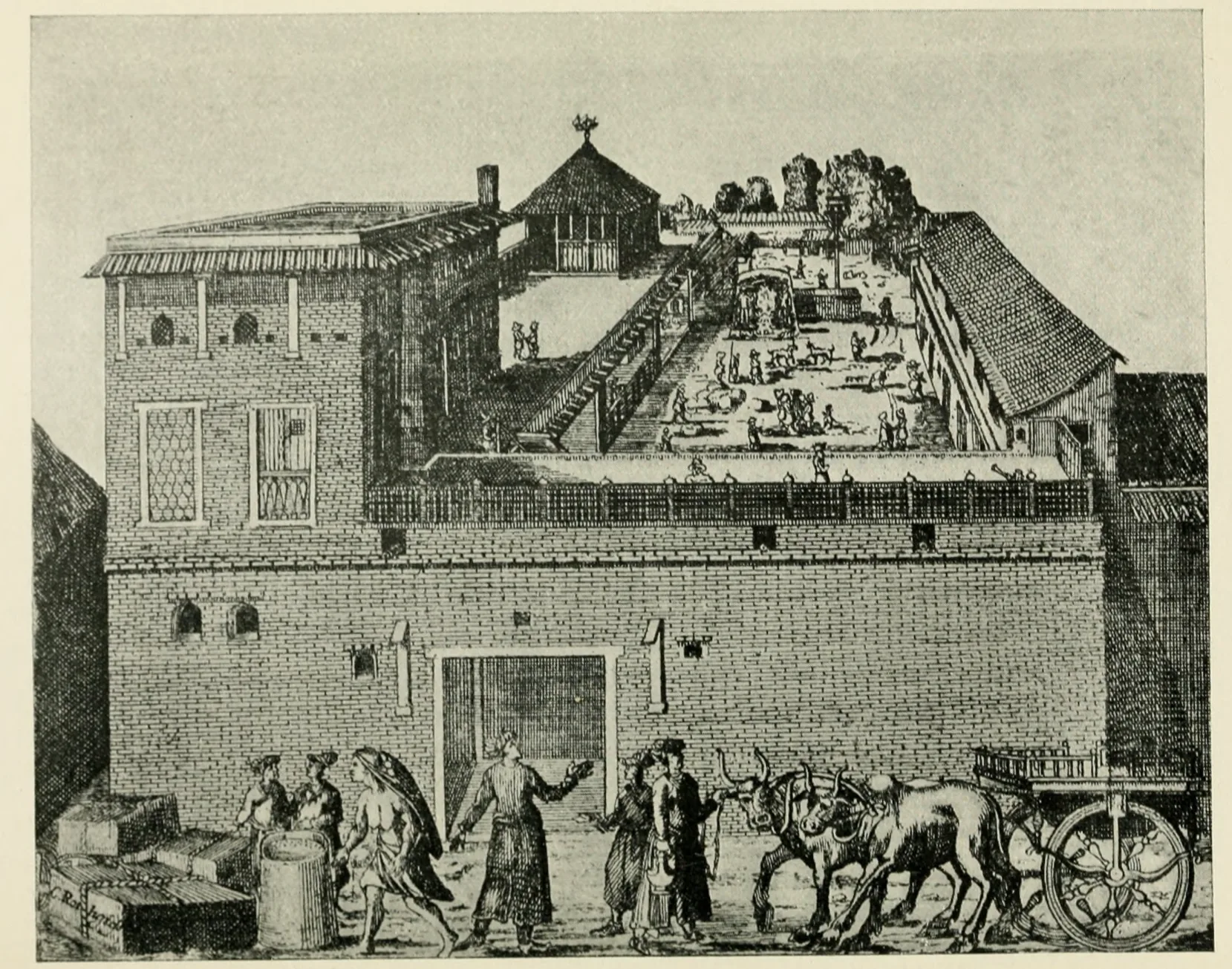
The frontispiece is taken from the rare Schleswig edition (1658) of Von Mandelslo's account of his travels in the East. From the preface to that work it appears probable that the engraving was based upon a sketch made by Mandelslo himself during his stay at the Surat factory in 1638 ; and this lends to it a special interest and value. The drawing is rather crude, and the three cannon shown as mounted over the entrance can scarcely be accepted as authentic, for all the evidence available negatives the supposition that the factory was in any way fortified. The building was evidently of a very substantial character. The elevated portion on the left contained the living and sleeping rooms, behind which, on a large terrace, stood the chapel, surmounted by a weathercock in the shape of a ship. On the opposite side of the courtyard was a two-storied warehouse ; while in the open space between a pigeon-house is discernible, near which two men, in a kind of tent, are apparently engaged in packing cottonwool. The buildings at the back of the courtyard were probably the servants' quarters.
Most of those gentlemen whose help was acknowledged in the previous volume have also co-operated in this ; while others have been thanked in footnotes. The editor would, however, specially mention the assistance he has received from Mr. H. G. Bull, of the India Office, in passing the volume through the press and compiling the index.
INTRODUCTION
[p. v]
INTRODUCTION
At the commencement of 1634 President Methwold and his colleagues at Surat were chiefly anxious about the provision of a cargo for the Mary, which was preparing to return to England. As explained in the last volume, such a task was far from easy, owing to their great indebtedness, the small demand for the imported goods, the dearness of calicoes, and the agreement recently made with the Dutch to refrain from purchasing indigo (in order to break down the monopoly which had been established in that article). When, therefore, at the beginning of February, the Mary at last put to sea, she was laden chiefly with the indigo and saltpetre which had been bought at Agra long before and had been an unconscionable time in coming down from thence.
With the Mary departed the Reformation and the Intelligence, both bound for the West Coast of Sumatra, and four other vessels under Captain Weddell (the Jonas being the flagship) for Gombroon. This fleet returned early in April, and in the same month was dispatched on the usual cruise to the southwards. One of the four—the Hart—was, however, to quit the rest near Ceylon and proceed to the Coromandel Coast; while a second—the Discovery— was to be dispatched to the same destination at a later period of the voyage. The remaining two were to effect a junction at the Comoros with the fleet expected from England and return with them; but Weddell had orders to diverge from the rest to Gombroon, in order to pick up some silk which was expected to be lying there awaiting transport to Surat.
The Mary having been dispatched, Methwold and his Counci were at leisure to devote their attention to internal affairs. Their hopes of defeating the indigo monopolists by the joint abstention of the Dutch and English from making any purchases had been upset by some unfortunate proceedings on the part of the factors of the two nations at Agra. Before the news of the agreement reached that place, the Dutch chief bought from the monopolists [p. vi] a large quantity at a high price. On receipt of this intelligence his superiors at Surat 'with some shew of sorrow' informed the English merchants, at the same time tendering them the opportunity of sharing in the bargain. This offer the English declined; but, as there was now no hope of breaking down the monopoly for the present, they insisted on being released from the obligation not to ship indigo for native traders. Apparently they were not altogether sorry to think that their rivals had locked up so much capital in indigo bought at an unheard-of price; and it was with no little dismay that they learned, early in February, that Fremlen, the English chief at Agra, had agreed to take a third of the indigo purchased by the Dutch factors. The President and Council were very indignant; but there was no possibility of repudiating the bargain, and so they had to make the best of the situation. Fremlen's action in the matter was severely censured; and he was ordered to dissolve the factory at Agra and return to Surat. To the Company the factors wrote overland on February 21, narrating these occurrences and urging the dispatch of the necessary funds to free them from the 'vast debt' that embarrassed them.
The Intelligence got back from Bantam on September 7. At the beginning of October two ships from England, viz. the London and the Hopewell (a pinnace) arrived at Swally, accompanied by the Palsgrave of Weddell's fleet, which had met the other two at the Comoros, as arranged. A few days later the Reformation returned from Sumatra. This vessel was found to have on board a large quantity of pepper belonging to the officers and crew, and Methwold would no doubt have liked to seize it all; but it was no easy matter to enforce such a policy without raising a mutiny, and so it was judged wiser to purchase the pepper at an advance of about 30 per cent. on the cost. The Blessing (the third vessel of the new fleet) seems to have arrived some time in November; and in the same month Weddell brought in the Jonas from Gombroon. The Surat Council had thus seven vessels at their disposal, but in the middle of December the number was reduced by the departure of the Reformation for Gombroon with freight goods and a consignment of tobacco.
A long and interesting letter was written to the Company at the close of the year. Trade was still very bad, on account both of the [p. vii] high price of calicoes and of the small demand for European goods, and there was little hope of profitable employment for the ships now at Surat. The burden of debt, however, had been to a great extent lifted from the shoulders of the factors by the money brought by the new fleet, though the result was to leave them almost destitute of funds for investment; and private trade had been considerably diminished. Signs were not wanting that the indigo monopoly was likely to be broken before long, especially as the Governor of Surat, finding that the revenues of his port were suffering, had petitioned the Emperor to restore freedom of trade in that commodity. The Dutch, impatient of the unfavourable aspect of affairs, had reduced their establishments and transferred their capital to Persia.1 In compliance with a request from King Charles some Persian MSS. were forwarded, while some Arabic ones were promised later.2 By the King’s order a piece of white cloth had been sent out to be ‘staynd into severall colours’; the cloth was ruined before the dyeing could be undertaken, but some account is given of the process (p. 82). All other factories having been dissolved, Surat was ‘stuft’ with merchants; some of these, however, were being sent home, and for the rest the President and Council hoped to find employment shortly; nevertheless, they much needed factors who could speak Dutch and Portuguese, as the ‘Negro Portugese’ employed in conversing with the natives was useless for communication with Goa (p. 74).
Another topic dwelt upon in this letter is the long-debated truce with the Portuguese, to which we must now turn our attention. The steps previously taken, and the advantages expected to result from this pacification, were explained in the 1630–33 volume. There was a good deal of preliminary manœuvring for position, as neither party wished (in the event of failure) to be left exposed to the charge of having begged in vain for peace. When, therefore, the Portuguese sent a safe-conduct for one or more Englishmen to come to Damān to treat upon the matter, Methwold asked, as a preliminary, for information as to the view taken by the Portuguese [p. viii] of the bearing of the Treaty of Madrid upon the point at issue. In January, 1634, the Viceroy forwarded a second safe-conduct, this time for Goa. Replying at the end of February, Methwold expressed his readiness to send representatives thither to negotiate, provided that the Viceroy and his Council would undertake beforehand to agree to that Treaty being extended to the East Indies. The answer of the Viceroy (p. 22) was frank and explicit. He considered that clearly the Treaty did not apply to the Indies ; but he was willing to conclude a truce, pending reference to Europe, and to undertake that, should the agreement be disapproved there, a reasonable period should be allowed before hostilities were resumed. This offer was debated at a consultation held in Surat on April 15, and it was unanimously resolved to accept it ; whereupon the President wrote to the Viceroy to that effect and intimated that, as soon as the rains were over, he would come in person to Goa to conclude the negotiations. In November Methwold wrote again, saying that he was anxious to start at the earliest possible moment, but that he must first see to the lading of the ships destined for England, etc. He seems to have feared that the Governor of Surat (from whom, as also from the Dutch,1 these negotiations were kept secret) would be incensed at the idea of any such agreement and would manifest his anger by hindering the embarkation of the English goods. Moreover, he proposed to take with him the vessel intended for England, in order that she might carry home the news of the pacification. It was, therefore, the end of December before the final arrangements were made. Fremlen was to be left in charge at Surat as provisional President ; and Methwold was to proceed to Goa with the Jonas (bound for England under Captain Weddell), the Palsgrave and Intelligence (both intended for Bantam), and the Hopewell, which was to bring him back. Meanwhile the London and Blessing were dispatched on a voyage to Gombroon with freight goods.
A letter to the Company written by Methwold in Goa Road (p. 89) gives a full account of the visit. The English vessels reached that place on January 6, 1635, and were received with [p. ix] every sign of welcome. Next day the President went ashore, where he was met by the Viceroy’s son and the chief officials, and conducted with much ceremony to a stately house in Panjim (New Goa), where the English were to lodge during their abode on land. On the 8th the credentials of both parties were examined, and on that or the following day the wording of the agreement was settled to their mutual satisfaction. This provided for a cessation of arms until the Kings of England and Spain should denounce the Accord, in which case six months’ notice was to be given before hostilities were recommenced, in order to allow the merchants on both sides to secure themselves from loss. All being ready, on Saturday, January 10, the English representatives were conducted to the palace at Goa itself, and admitted to the presence of the Viceroy, who received them with much affability. He then, though far from well, held a private conference with Methwold of two hours’ duration, in the course of which he made many inquiries concerning the Dutch and their trade, and manifested a great desire for cordial relations with the English, offering them the use of all the Portuguese harbours, supplies of naval stores, and every other accommodation in his power. After this, the Accord was solemnly sworn and subscribed on both sides; and thus the attitude of hostility in which Portuguese and English in the East had stood for more than thirty years was changed into one of friendliness and mutual assistance. The pacification thus effected has lasted without a break down to the present time.
Another week was spent in business and recreation, and then, after a further interview with the Viceroy, Methwold and his companions embarked for Surat, while Weddell in the Jonas, accompanied by Nathaniel Mountney and other home-seeking members of the Surat factory, set sail for England, where they arrived at the beginning of August, 1635. In the letters which she carried, Methwold and his colleagues made some noteworthy suggestions. It was proposed to abandon Surat and transfer the English headquarters to Ahmadābād, as being a more convenient centre of trade, using Cambay and Goghā as the corresponding ports; in this way, it was pointed out, the expensive and dangerous land journey down to Surat would be saved. The Company was urged to send out annually four ships, two of which were to carry English goods [p. x] direct to Goa and there lade Malabar pepper for the return voyage ; while the other two were to go on to Gujarāt, where, it was hoped, sufficient cargo could be obtained to dispatch that number of vessels to England yearly. A factor was to be stationed at Goa, and it was even thought that, once a permanent peace was concluded, the Company's 'cheife residency might be established' in that city. Further, it was suggested that, under the new conditions of trade, the Committees might find it advantageous to freight ships for India instead of building their own ; and this experiment was duly made a few years later (Court Minutes, 1635-39, p. xxix).
The letters in which the Conde de Linhares on his side announced to King Philip the conclusion of the truce have been printed in Biker's Collecçao de Tratados (vol. i. pp. 264, 269). Towards the end of 1635 the arrival of a new Viceroy, in the person of Pero da Silva, created some anxiety as to his attitude towards the agreement ; but, although he found much to criticize in the administration of his predecessor, he deemed it prudent to abstain from interference in this respect, since, as he explained to his royal master, it was undoubtedly better to have one enemy to fight than two (Lisbon Transcripts, Doc. Remett., book 33, ff. 61, 247). In point of fact, the aggressive attitude of the Hollanders did much to consolidate the Anglo-Portuguese understanding ; while private interests assisted materially. The fact that Portuguese goods in English vessels were generally safe from Dutch attacks was quickly turned to advantage ; and we find constant reference to ventures made in this way to various ports by the Portuguese officials, or goods demanded for their use.
In England the truce was warmly approved by the Company, who were only too glad to be rid of an expensive feud; and at their instigation King Charles directed his ambassador at Madrid to endeavour to obtain the ratification of the agreement. But in the Peninsula they seldom do things in a hurry ; and no positive decision had been reached when in 1640 the Portuguese nation relieved the Spanish King of any need of further attention to its affairs in the East Indies or elsewhere. Once the independence of Portugal was established, the desire for English support quickly brought about a treaty between the two countries (May, 1642), and by clause xii of this document the pacification concluded by Methwold [p. xi] and Linhares seven years earlier was formerly approved and continued.
Reverting to India and to 1635, we find the Hopewell dispatched in March to Gombroon with freight goods, and with instructions to proceed thence to meet the fleet from England; while in the same month the Reformation departed for Goa (where she was to leave some copper for sale to the Portuguese), Sumatra, and Bantam. Shortly afterwards the London started for Macao, in China, with Bornford and two other merchants as supercargoes. This voyage—the first English venture to China—was the outcome of the Anglo-Portuguese accord, and had in fact been suggested to Methwold by the Viceroy, who was willing to pay handsomely for the transport from Macao of a quantity of goods and ordnance which had long been lying there but could not be brought away in a Portuguese vessel, owing to the presence of a Dutch squadron in the Straits of Malacca. On this errand (which was naturally kept secret from the Dutch) she sailed on April 9. In the middle of the same month the Blessing left Swally for Bantam, carrying a quantity of silk for transmission to England from the latter port. She returned in November with a small cargo, and was then sent to Gombroon.
Another result of the Anglo-Portuguese entente was the building of two pinnaces—the Francis and Michael—at Damān, and two smaller boats—the Bassein and the Kit—at Bassein. These proved very useful for coasting voyages and river work, and may be said to have been to some extent the precursors of the famous Bombay Marine of later days. For similar purposes the President and Council asked the Company (p. 149) to provide them with two English-built pinnaces, armed with eight or ten guns, which they thought could be built at home for a third of what they would cost in India. An interesting project for employing vessels of this class in keeping the mouth of the Tāptī free of the Malabar pirates that infested it at certain seasons is mentioned at p. 312. Nothing came of it at the time, but it foreshadowed later developments of considerable importance.
On April 14, 1635, news reached Surat that the indigo monopoly had been dissolved and that the purchase of that commodity was consequently open once again to all comers. However, prices were [p. xii] still too high to tempt the English merchants to invest, especially as it would be many months before they could send a ship for England. Later in the year some purchases were made at Ahmadābād, but these were chiefly entered into for the purpose of interfering with the investments of the Dutch. The same unfriendly rivalry took place at Agra.
The changed attitude of the English towards the Portuguese, and Methwold’s schemes in relation to Ahmadābād and Cambay, excited both anger and apprehension in the minds of the Surat officials and merchants. Their port had benefited largely by the commerce of the foreigners, and the prospect of any portion of it being diverted to other localities was not to be contemplated with equanimity. Naturally, the Dutch did not miss the opportunity of pointing out the injurious effects likely to result from the Accord ; and, thus encouraged, Mīr Mūsā, the Governor of Surat, submitted a hostile report on the subject to the Emperor. But the latter needed no incitement ; the ambition he cherished of bringing the whole of India under his sceptre involved the subjugation at some time or other of the territory occupied by the Portuguese, and anything that tended to thwart this scheme was likely to be distasteful. He wrote, therefore, a reply (April, 1635) in which he expressed strong disapproval of the new alliance and directed Mīr Mūsā to inquire from the Dutch chief at Surat whether his superiors at Batavia were prepared to take the place of the English in India, if the latter were excluded from all trade both in the dominions of the Mogul and (by his influence) in those of the Kings of Golconda and Bījāpur ; and further, whether the Dutch would join in an attack on the Portuguese settlements at Diu and Damān. If they were willing to agree to these terms, he was quite prepared to give the English the alternatives of cancelling the treaty or of being expelled from his dominions. The King of Persia, he said, was likewise much disturbed by the news, fearing a Portuguese attack on Ormus. In forwarding to the Governor-General a copy of this letter, Pieterszoon made no secret of his own wish to see the English thus excluded from the commerce of India, though he recognized that awkward complications might ensue. The authorities at Batavia, however, were not inclined to allow themselves to be drawn into any entanglements of the kind. Obviously the [p. xiii] English would retaliate upon Indian shipping and then the Dutch would be called upon to protect the latter, which could only be done at the risk of war. Pieterszoon was therefore instructed (August 21/31, 1635) to inform Shāh Jahān that the Dutch could not engage in hostilities against the English without permission from Holland, but the matter would be submitted to the home authorities. This indefinite postponement put an end to the scheme.1
The advantage of being able now to make use of the Portuguese harbours as places of shelter was strikingly demonstrated about this time. The Discovery and Speedwell, which had reached Gombroon on March 28, 1635, bringing passengers and freight goods from Masulipatam, left again in the middle of April; and as it was hopeless to expect to get to Surat at that period of the year, it was decided that the former should go into Bombay, where she was warmly welcomed by the Portuguese. The Speedwell, after visiting Goa for the purpose of obtaining a new mainmast, held on her voyage for Masulipatam. The Discovery remained at her place of refuge, snugly berthed at Trombay, during the whole of the rainy reason; while her men enjoyed themselves hugely on shore, though with fatal consequences to most of them. It was nearly the end of September when the ship took her departure for Surat, where she arrived a month later.
In order to provide calico for England and the Southwards, the factories at Baroda and Ahmadābād were reopened (with borrowed money) in September, 1635, the former under Thomas Thimbleby and the latter under Benjamin Robinson. Orders were also sent to an Indian broker at Agra to invest 10,000 rupees in the piece-goods of the neighbouring districts; while at Surat itself similar purchases were set on foot.
Towards the end of 1635 a particularly interesting experiment was entered upon by the dispatch of a couple of vessels to Lārībandar (termed by the Portuguese Diul-Sind), the port of Tatta in the Indus Delta. The first (and until the present venture the only) English ship to visit that port was the Expedition (260 tons), which, under the command of Christopher Newport, landed Sir Robert Sherley there in the autumn of 1613, but failed to obtain permission [p. xiv] to trade, owing to the opposition of the Portuguese (Purchas His Pilgrimes, vol. i. pp. 495, 530). A further attempt was contemplated by Sir Thomas Roe, and Āsaf Khān promised his assistance; but the strength of the Portuguese in those waters was held to be an insuperable obstacle. Still, the project was always borne in mind; and in 1629, on receipt of some overtures from the Tatta merchants, a native broker was dispatched from Surat to investigate and report (see the 1624–29 volume, p. 326). After an absence of several months he returned with patterns of piece-goods, indigo, etc., which were sent to England for the information of the Company. It was probably in connexion with that venture that the royal farmān and the letters from Āsaf Khān referred to on p. 117 were obtained. Nothing, however, came of this at the time, though a Dutch vessel paid a visit to Lārībandar in 1631 (see the last volume, p. 207). Now that the agreement with the Portuguese had removed the fear of violence on their part, the scheme was revived; and letters were written to some brokers in Tatta, commissioning them to buy a quantity of calicoes in anticipation of the coming of an English ship later in the year. Shortly after arrived a parwāna from Āsaf Khān, who was Sūbadār of the province of Sind, guaranteeing the English the same privileges there as they enjoyed in other parts of the Mogul’s dominions; and in September a letter was received from the Company expressly directing that the attempt should be made. Thereupon it was determined to send thither the Discovery and the Bassein. The direction of the enterprise was entrusted to William Fremlen, assisted by two other factors; and the vessels sailed at the beginning of November. The Discovery, it was arranged, was to go on to Gombroon, after landing the merchants and taking in any freight that could be obtained.
On the 19th of the same month the William reached Surat from England. Another vessel, the Crispiana, had started with her for the same destination, but had met with baffling winds that finally obliged her to bear up for Masulipatam, where she arrived at the end of May, 1636, after a voyage of over fourteen months. Her failure to reach Surat was embarrassing, not only because she was suspected by the Indians of the piracies shortly to be related, but also because she had on board a considerable portion of the treasure intended for that place. The Hopewell had met the William at [p. xv] St. Augustine's Bay (in Madagascar), but lost company and did not arrive at Swally till November 21. On the same day a Dutch fleet came in from Persia ; and, finding that they were offering copper and redwood at a cheap rate, the English bought a considerable quantity of each. The latter commodity was dispatched to Sind in the Hopewell, while the copper was sent to Goa by the William, under the charge of George Peirson, who had come out in that vessel and had been appointed on arrival Warehousekeeper and Member of Council. The main purpose of his mission, however, was to fetch a quantity of pepper which the Portuguese had promised to provide ; in this he was unsuccessful, though he brought back hopes that half the stipulated quantity would be forthcoming later. The William was then (February 4, 1636) sent on to Gombroon with native merchants and their goods.
Towards the end of 1635 a change of Governors occurred at Surat. Mīr Mūsā (Muizz-ul-Mulk), who had occupied the post since the spring of 1629, was recalled and the Hakīm Masīh-uz-Zamān appointed in his place. In a Dutch letter of the time we have the following account of the new official : 'He is about sixty years of age, very grey, and of a grave and venerable aspect. A Persian by birth, he has served the late and the present King for many years as a physician, as well as in carrying His Majesty's offerings to the grave of the Prophet and in other offices. He is highly esteemed by the King, who has given him a jāgīr of five lakhs of mahmūdīs, out of which he is supposed to provide three or four thousand horsemen, though he really keeps only from two to three hundred in his service. He is a great friend of the Nawāb Āsaf Khān' (Hague Transcripts, series i. vol. x. no. 333 ; also Dagh-Register, 1636, p. 49). It was rather a bad omen for the English that the Hakīm had been one of the returning pilgrims captured by them in the Surat junks in 1623 (see the 1622–23 volume, p. 273) ; and there were other reasons for his maintaining an attitude of suspicion, if not of hostility, towards them. The recent expeditions to Tatta, Goa, Dābhol, etc., had increased the alarm felt at Surat regarding the intentions of the English ; and moreover it was known that they were in correspondence with the late Governor (who appears to have retained control of Cambay, Broach, etc.), and that Methwold was still bent upon embarking goods from Ahmadābād [p. xvi] and up-country at Cambay, to the obvious detriment of the customs revenue of Surat. To keep the latter up to its normal figure, and if possible to increase it, was a matter of the utmost importance to the local officials; nor could the leading merchants view with equanimity the prospect of any diversion of trade from their port. A Dutch letter written from Surat in January, 1636, summarized in the Batavia Dagh-Register, 1636 (p. 49), declared that the new Governor had already obtained a farmān from the Emperor forbidding the use of Cambay or Broach as ports for the embarkation of goods. It appears, however, that the writer was misinformed; for no reference to the matter can be traced in the English records, and on the contrary we find Methwold dispatching the Kit to Cambay at a later date to fetch some goods. In any case, steps had evidently been taken to frustrate any measures of this kind; for in February the Dutch and English at Surat were summoned to hear the contents of two royal farmāns. The first repeated the announcement that the indigo trade was open to all comers. The second ordered each nation to deposit twelve lakhs of rupees at Surat: forbade their ships visiting that port to anchor elsewhere than in Swally Hole: prohibited the building of frigates in India: and required that the English and Dutch chiefs should remain permanently in the city until relieved by their successors. Methwold at once declared that for their part the English would never submit to any conditions of the kind; the Dutch, too, remonstrated strongly, though they were privately assured that the farmān was only intended to curb their rivals; and in the face of this joint opposition the demands were quietly dropped.
Meanwhile the Discovery, after much trouble, had with the opportune aid of some Portuguese frigates found her way to the mouth of the Indus, and on December 3, 1635, Fremlen and his companions landed at Lārībandar. They were well received by the officials and merchants, who were in hopes that by sending their goods to Gombroon in English vessels they would be able to escape the payment of the duty levied by the Portuguese on ships navigating those waters. In this, however, they were disappointed, for the President and Council had given strict orders that nothing should be done which would deprive their new allies of any dues they had hitherto received. After staying a few days at the port, the English factors [p. xvii] proceeded to Tatta, where again they were cordially welcomed. However, the merchants could not be induced to put any goods aboard the Discovery for Persia, as they feared that by so doing they would expose themselves to reprisals at the hands of the Portuguese ; and Fremlen found himself forced to buy instead a quantity of rice and cotton wool for sale at Gombroon. With this merchandise the Discovery departed for Persia on January 6, 1636, leaving behind her the Bassein and also the Hopewell, which had arrived a week before Christmas. Meanwhile Fremlen had dispatched overland to Surat a letter (p. 126) giving a hopeful account of the trade of the district, and dwelling on the additional advantage of bringing goods from Agra by way of Multān and thence down the Indus. The Bassein was sent back to Surat with a few goods ; and was immediately dispatched again to Lārībandar with a quantity of lead, etc. She failed, however, to reach that port, owing to contrary winds, and returned to Surat on March 8. Fremlen mentions a project of employing the Hopewell, while waiting, in a voyage to Cutch 'for discovery'; but apparently this intention was not carried out. The factors, after placing the remainder of their goods and cash in the hands of an Indian broker, left Tatta on February 23, and embarked a few days later in the Hopewell. After a hazardous voyage they reached Surat early in April.
At the beginning of 1636 William Pitt started in the Francis for Dābhol with a stock of goods for sale and letters soliciting the grant of trading privileges from the King of Bījāpur. He returned early in February without the desired farmān, and was again dispatched to the same place a month later. At the end of April Joseph Downham was sent to assist him, and both factors were still there when the volume closes.
Another attempt made at this time to open up a fresh trading centre was a venture to Basrā, in the Persian Gulf. However, the Michael, which had been told off for this service, started too late in the season and, being also in a very leaky state, was forced to abandon the attempt (April, 1636).
In the middle of February news reached Surat that the London had got back to Goa from China. Of the events of the voyage an interesting account is given in a letter from Bornford printed at p. 226. Macao was reached on July 23, 1635. There had [p. xviii] been no difficulty in securing a good freight at Goa, for every one, from the Viceroy downwards, was eager to profit by the opportunity of so safe a conveyance; nor was there any backwardness on the part of the Macao merchants in providing a return cargo. In fact, so anxious were they to send their goods to Goa that the English were unable to lade all they intended to carry on their own account. However, they did not lose any opportunity either of buying commodities or of making observations which might be useful at a later date. The Viceroy had been careful to take precautions in the latter respect, for strict orders had been given that the English were not to be allowed to land or to have any dealings with the Chinese except through the Portuguese officials. But it was easier to make regulations than to enforce them. Bornford and his companions had not come five thousand miles to act as carriers merely. Not only did they insist on living ashore, but they took every opportunity of communicating with the Chinese; and they even did their best to obtain permission from the latter to trade on a future occasion at some spot nearer Canton. This behaviour gave great umbrage to the Portuguese, and the new Viceroy wrote home censuring his predecessor for permitting the English to make such a voyage; while even Linhares himself expressed doubts whether it would be wise to repeat the experiment.1
Having spent close upon three months at Macao, the London sailed again on October 20, and after touching at Malacca (which was found to be ‘wholey ruined’ by the Dutch blockade of the Straits) reached Goa on January 27, 1636. The delivery of her goods and the recovery of the sums due for freight proved a tedious business; and when, in obedience to orders from the President and Council, the London quitted Goa for Swally, two of the merchants had to be left behind to clear accounts. The Portuguese had insisted on the customs of Malacca being paid, as well as those of Macao and Goa; and this considerably reduced the profit on the voyage. In the opinion of the Surat factors (p. 211) a second venture would not be worth making if they had to depend on freight alone; but if allowed to trade freely at Macao ‘it would be worth the following’. Bornford himself was optimistic on the [p. xix] point; but he thought that another time it would be desirable to ignore Macao and endeavour to open up trade at some place nearer to Canton (p. 228). However, Weddell's voyage in that direction, together with the opposition of the Portuguese, prevented the attempt being followed up by the Company's servants.
The President and Council had meanwhile been pushing forward their arrangements for lading the Discovery for her return voyage to England. Part of her cargo had been provided by the arrival of the Blessing from Gombroon on January 28, 1636, with a good quantity of silk; the rest was to be composed partly of the commodities the vessel herself was expected to bring from Persia and Sind, and partly of the purchases made in India. But the weeks wore on without news of her, and it was not until the middle of March that she put in an appearance. In the meantime the Blessing had made a voyage to Goa in quest of pepper, but only to be disappointed, as the Portuguese had still none to spare. The Hopewell had yet to be waited for and, as we have seen, she did not arrive till early in April. With the aid of her cargo and the caravan of indigo and saltpetre from Ahmadābād which was rapidly nearing Surat, the lading of the Discovery would be completed; and on April 6 Methwold returned from Swally to Surat to finish the letters which were to be sent in her to the Company. Little did he dream, as his coach bumped over the rough road between the two places, of what was in store for him on arrival.
For the beginning of the story we must look back to the summer of 1633, when, as related in the last volume, His Majesty's ship Seahorse returned to England after a marauding cruise in the East Indies, in the course of which some native junks had been plundered of all their more valuable goods. In spite of this, the financial result of the voyage appears to have been far from satisfactory; and, in addition, the fact that peace had now been concluded with Spain and Portugal removed the sole pretext under which a vessel of the Royal Navy could decently be sent to those waters for warlike purposes. Accordingly we hear nothing of any repetition of the venture on the part of the King. This, however, did not deter others from laying plans for a similar enterprise. Two young London merchants, Thomas Kynaston and Samuel [p. xx] Bonnell,1 provided the funds; while the task of obtaining a royal commission, without which it would be dangerous to infringe the East India Company's monopoly, was undertaken by Endymion Porter, an influential member of the royal household. Apparently the King made no difficulty in the matter. Trading was not the object of the expedition, and so it might plausibly be argued that no injury would be done to the Company's commerce. The constant warfare waged against all Christians by the Barbary corsairs, and the fact that hundreds of English captives were living in slavery in Northern Africa, would be held sufficient justification for attacking the subjects of any Muhammadan nation with whom this country had no settled commerce; whilst in the case where such relations existed the wording of the commission might be considered to afford the requisite protection. A wiser monarch would have reflected that men whose object was to plunder were not likely to be scrupulous in this respect; but apparently Charles gave the subject little attention and granted without demur the request of his favourite. Thereupon two small ships—the Samaritan (250 tons) and the Roebuck (100)—were hired and equipped with the greatest secrecy. As a blind, a royal commission was issued to Richard Ofield or Oldfield, master of the former vessel, authorizing him to 'range and discover' the coast of America; but a further commission, dated only two days later (February 27, 1635), made out in the name of William Cobb as commander of both vessels, widened the sphere of operations to 'all the wourld over', and warranted the capture of the goods of all 'infidells or of anie other prince, potentat, or state not in league or amitie with Us beyond the lyne equinoctiall' (p. 268).2 Both vessels were permitted to wear the colours of the Royal Navy, and all English subjects were commanded to render their commander any assistance he might require. With these powerful credentials, they sailed from the Thames in April, 1635, without the East India Company having the slightest inkling of their intentions.
[p. xxi]
Misfortunes soon befel the expedition, for the two ships got separated after passing the Cape, and the Samaritan went to pieces on the island of Mohilla, one of the Comoro group. The crew, however, reached the shore in safety, where Cobb set them to work to build a small sloop in which to get away. Meanwhile the Roebuck had continued her voyage, under the master, William Ayres. Early in September, 1635, she was in the Gulf of Aden and had taken and plundered an Arabian junk. On the evening of the fifth, she fell in with the Taufīqī of Surat, and at once attacked her; but the Indian vessel was provided with ordnance and maintained a spirited defence. Next morning the stranger hoisted an English flag, to the joy of the Indians, who little suspected her real character. The skipper of the Taufīqī at once went on board and exhibited his pass from the factory at Surat. Ayres and his officers appear to have been rather taken aback by this document; but an excuse was quickly found for disregarding it.1 They pointed out that it was not signed by Methwold and did not bear the seal of the factory; this was true, but it was merely due to the fact that the document had been issued during Methwold's absence at Goa. However, though a pretext was thus found for disregarding the pass, it is clear that some doubt was felt as to the advisability of plundering a vessel belonging to Surat. Probably the consideration that Cobb alone was named in the royal commission, and that Ayres had consequently no authority except as his subordinate, had some weight in the decision, which was to take the prize, without interfering with anything on board, to Filuk, on the Abyssinian seaboard, where it was hoped that the Samaritan would be found. On the day after the two set sail with this purpose, another vessel was overhauled, viz. the Mahmūdī of Diu. She was provided with a Portuguese pass; but this was pronounced to be out of date, and the vessel was ordered to accompany the Roebuck and the Taufīqī. At Filuk there was of course no sign of the Samaritan, and after some delay it was resolved to seek her at Socotra. First, however, the Taufīqī was overhauled and all her goods and valuables were taken on board the [p. xxii] English vessel. Some show of regularity was kept up, for most of the things taken were registered, as also the names of the owners; but the sailors evidently got a considerable amount of plunder in addition. In case the Taufīqī should lose company during the voyage to Socotra and should fall in with Cobb's vessel, a pass was given to her, addressed to 'The Captain', and signed with a fictitious Dutch name. Naturally, she took the earliest opportunity of escaping; and when, after vainly essaying to reach Socotra, the Roebuck anchored at the neighbouring island of Abdulkūrī, she had only the Mahmūdī in company. A boat was sent to Socotra, and returned with the news that the Samaritan was not there; whereupon it was resolved to return to the coast of Arabia. Meanwhile, a minute inquisition was made on board the Diu junk for the money which was believed to be there; and failing to discover this, the officers of the Roebuck proceeded to more rigorous measures. They probably felt small scruple in dealing harshly with a vessel coming from a Portuguese settlement, for they were of course ignorant of the recent agreement between Methwold and the Viceroy. With scandalous inhumanity, they tortured the skipper and others until they revealed the place where the treasure was hidden. This appropriated, the junk was carried to the Arabian coast, and there released; while the Roebuck, after a further cruise, made her way to the Comoros.
A period of about six months elapsed before these outrages were known at Surat. The two junks put into Arabian ports, and from one of these the skipper of the Taufīqī, who had been carried to Abdulkūrī, and then put on board the Mahmūdī, wrote a long account of the piracies to Mīrzā Mahmūd, the principal of the merchants concerned (p. 197). This was received early in April, 1636, at a most unfortunate moment for the English factors, for (as already related) the Discovery was on the point of sailing for England, and the indigo and saltpetre which were to complete her lading had just reached Rānder, near Surat. Of the events which followed, we have a vivid description from the pen of Methwold himself (p. 232). On reaching Surat (April 6) he found the city in an uproar over the news. Thereupon he boldly went to the Governor, who was sitting in darbār with the chief sufferers around him, 'some lookeing thorough mee with eyes sparkling with [p. xxiii] indignation, others halfe dead in the sense of their losses.’ The President was closely questioned as to the whereabouts of the Company’s ships, particularly the Crispiana, which was known to have been for a long time expected by the English. His explanations were received with rage and incredulity; but he coolly pointed out the injustice of requiring compensation from the Company until it was ascertained that the piracy was committed by their shipping, and suggested that the arrival of the Taufīqī (which was expected every day) should be awaited before anything further was done. This appeared to be reasonable, and Methwold was allowed to depart to the English factory, though a strong guard was placed upon him there, and the English goods at Rānder were detained. In order to secure the release of these and the consequent sailing of the Discovery, Methwold agreed to deposit a lakh of rupees to meet any claims that might be established against the Company, should it be proved that one of their ships had been guilty of the outrage; and, for the purpose of settling the transaction, on the 8th he and Peirson (the only other Member of Council in Surat) proceeded to the Governor’s house. There it was suggested that the claims should be paid forthwith; but Methwold neatly countered this by declaring his readiness to do so, provided that the Governor, or some other man of substance, would undertake to reimburse the English, should they be found to be innocent after all. Of course no one was willing to incur this responsibility, and so the proposal was dropped. The Governor, however, professed himself dissatisfied with the amount of the deposit and demanded that it should be raised to three lakhs. This was refused; and thereupon the President and his companion were thrust into a dungeon filthy with vermin, where they were almost suffocated for want of air. Three days later, their sufferings were alleviated by the provision of a little ventilation; but they had still to endure the revilings and threats of the populace. On April 15 the Taufīqī arrived, and the story told by the crew increased the general indignation. Next day Methwold was summoned to the Governor’s presence and allowed to cross-examine the skipper, but without any satisfactory result, as the latter persisted that the men who had robbed his vessel were English; and the President was roundly told that he would have to make [p. xxiv] good all the losses, in accordance with the agreement concluded in 1624 (see the volume for 1624–29, p. 28), by which the Company's servants had undertaken full responsibility for any offences committed by Englishmen. For the present he was remanded to prison. That same evening he learnt from a friendly Dutch factor that the pass given by the pirates (the production of which he had vainly demanded from the Indian skipper) had been brought to the Dutch house for translation. By the help of the Shāhbandar, this document was traced and shown to the President; and an examination of it shattered the theory he had till then stoutly maintained that the piracy was the work of one of two French vessels which had been seen in Indian waters in the autumn of 1634. The claims of those who had been robbed were now investigated (though Methwold refused to take any part in the proceedings), with the result that the total was found to be 107,000 rupees.1 The English goods and money at Surat were estimated at 75,000 rupees, and this sum was made up to 125,000 rupees by drawing on the stock aboard the ships. Thereupon the claims were paid; and then the indigo and saltpetre detained at Rānder were released and put on board the Discovery. Methwold and Peirson were still treated as prisoners, pending the decision of the Mogul on the further claims arising from the capture of the Diu junk; but they were permitted to go daily under guard to the English factory to deal with current business. Meanwhile, at Ahmadābād, where the Governor and some of the principal merchants alleged that they were interested in the cargo of the Diu ship, Robinson, the chief factor, had been arrested and the factory placed under a guard, until security was given that the English would not leave the city before the arrival of orders from the Great Mogul. In addition, the Company's goods which were in the hands of native brokers at Agra and Tatta were inventoried and sequestrated until further orders.
The Discovery sailed for England on May 4; and with her went the Blessing, which had been ordered to search for and seize the pirates, in order to prevent their doing any further mischief. The Hopewell was also dispatched to the West Coast of Sumatra and [p. xxv] the London to Masulipatam and Bantam; while the pinnace Michael was sent to Dābhol, to be laid up there for the rainy season.
A farmān from the Emperor reached Surat on May 4 (p. 256), which made no allusion to the claims on account of the Diu junk, but directed that the English should be kept under surveillance; however, Methwold's daily resort to the factory was stopped and he was once again kept in close confinement. The Governor was incensed by the news that the William, on her return from Persia, had put into Dābhol instead of coming to Surat, and had proceeded thence direct to Masulipatam, to the detriment of his customs revenue; while his anger was not lessened by the President's refusal to admit his personal claim for the repayment of a sum of money taken from him in 1623, at the time when he was a passenger on the junks seized by the English (see the 1622–23 volume, p. 273). However, the hour of at least formal reconciliation was near. Investigation showed that the Governor's claim was probably correct, and clearly it was not desirable to incur his continued resentment for a matter of about 850l. On the other hand, the Surat merchants had a number of ships ready for dispatch to various ports, and they were disturbed at the threats which Methwold had used of redressing the wrongs of the English by action at sea. On June 1, therefore, overtures were made for a settlement. Methwold was to be released, provided he would swear to two conditions: first, that he would not leave Surat without acquainting the Governor; and secondly, that no seizure should be made of the Surat shipping. He insisted that the latter restriction should not apply in the event of orders to the contrary arriving from England; and this being conceded, on the following day he took the required oath. Then he was conducted to the Governor, who professed pleasure at the termination of the dispute and distributed gifts to the English merchants and their broker. Finally, Methwold was escorted to the factory by the chief officials and merchants, and a salute was fired to announce the reconciliation. Thus, after eight weeks' imprisonment, he was once more a free man (p. 254).
Shortly after, a representative of those who had been plundered in the Diu junk applied to the Governor for redress; but the Suratīs, having recovered their own losses, were indifferent to those of others and did not intend to quarrel with the English on their [p. xxvi] account; the complainant was therefore referred to the Viceroy of Goa. Representations had already been made in that quarter, for on May 11 Methwold received from that official a bundle of attestations, with a demand for 117,000 rials of eight in compensation. For the present the Viceroy was put off with excuses; but the English were rather disturbed at the probable consequences, inasmuch as they had a large sum deposited in the hands of the Vedor da Fazenda at Goa and feared that it would be seized in satisfaction.
Methwold had entertained the idea of paying a visit to the Emperor in the Deccan, partly to place the position of the English on a more satisfactory footing, and partly in order to secure the payment of a sum claimed from the Rājā of Būndī for tapestry sold to his grandfather some years before. The events at Surat had put this out of the question; and so in the middle of May, 1636, John Drake was dispatched instead. His special errand was the recovery of the aforesaid debt—a matter with which he was already conversant, as he had been sent to Burhānpur for the same purpose in November, 1634 (p. 54), though without success; but the President and Council took the opportunity of writing to Āsaf Khān and Afzal Khān to complain of the treatment they had received from the Governor of Surat, whose predecessor, Mīr Mūsā, was (as they well knew) busily intriguing against him at court. Drake found the Mogul army encamped near Aurangābād (June, 1636). The Deccan campaign was practically over, for the King of Bījāpur had submitted and had agreed to pay a large sum as arrears of tribute (p. 263); and before long the Emperor proceeded to Māndū to shoot tigers (p. 287). Drake followed the army, which was moving thither more slowly. According to him, in the crossing of the Tāptī at Burhānpur over 2,000 lives were lost, besides a much valued elephant which had come from Bījāpur (p. 281). The English factor's negotiations dragged on very slowly. Āsaf Khān showed himself well disposed and granted parwānas for the release of the English goods at Tatta and other places; but he would not hear of their embarking goods at Cambay, nor would he listen to anything to the detriment of the Governor of Surat. As regards the tapestry debt, Drake was promised a farmān directing its payment, but later on he was told that the Emperor would be passing [p. xxvii] through the Rājā's territory and that it would be better to wait till then before taking any steps. Drake saw nothing for it but to follow the royal camp, and this he decided to do, while grumbling bitterly at the consequent hardships. Mention is made (p. 288) of a royal command procured by the Governor of Surat, prohibiting the English and Dutch from carrying weapons of any kind while within the city; Methwold and his colleagues determined not to submit to any regulation of the kind, but we hear nothing more on the subject. Towards the end of November Drake wrote from Ajmer, announcing his intention of departing for Agra. He had been unable to get any assistance from Āsaf Khān in the matter of the tapestry debt; and, although the Rājā's infant son had arrived in the camp with a present for the Emperor, no satisfaction could be obtained from the members of his retinue (p. 320). Evidently Drake carried out his intention before long, for he was at Agra in the early part of 1637, and it was just after leaving that city for Surat in March of that year that he received his death-wound in a brawl with some villagers.
In July, 1636, intelligence reached the Surat factory that the pirates, of whom the Blessing was in search, had been seen at the Comoro Islands by the Crispiana. That vessel reached Johanna on February 20 and Ayres arrived there with the Roebuck nine days later. He exhibited the royal commission, and Thomas Lee, the master of the Crispiana, though the doings of Ayres were common talk, preferred to follow Dogberry's method of dealing with a thief. However, there were other servants of the Company who were made of sterner stuff. In June the Swan, outward-bound, reached the same island. The Roebuck was still there, and Ayres had been joined by Cobb, who had come over from Mohilla with the survivors of his crew. John Proud, the young commander of the Swan, was at first satisfied (as Lee had been) by the terms of the royal commission; but, hearing afterwards of the captures that had been made, he took the opportunity of Cobb and Ayres coming on board for supplies to arrest them both. A boat was then sent ashore to fetch the money and goods of the Roebuck, which was being careened; but her crew stoutly refused to part with their plunder, and threatened to fire on the men of the Swan, who thereupon returned. Next day a fresh attempt was made, [p. xxviii] when David Jones,1 the mate of the Roebuck, declined to hand over anything except under the orders of his captain; and those orders Cobb refused to give. Proud thereupon offered to set the latter free, if he would give a written declaration that King Charles would be responsible for all damages accruing to the Company from the proceedings of his ships. To this Cobb at first assented; but on seeing that the draft made mention of the seizure of the junks he refused to sign, saying that Ayres must be responsible for his own actions. He was willing, however, that Ayres should be carried to India, together with the money taken from the Surat junk. This was agreed to, and on the following day Cobb and Ayres sent ashore a written order for the surrender of the plunder. Jones and his men, however, swore that they would part with nothing; and when Cobb went himself to enforce his order, they fired on him and his companions. This led to further negotiations, and in the end it was arranged that the money and goods taken from the Taufīqī should be handed over to Proud, on condition that, should it be found that they were after all lawful prize, they should revert to the promoters of the voyage. It was also agreed that, instead of Ayres, the recalcitrant Jones and another member of the Roebuck's crew should be taken to India as witnesses; but as the former flatly refused to go, Proud had in the end to be content with the coxswain, John Vincent. This settled, the pirates' booty, amounting to nearly 39,000 rials,2 was handed over to Proud, and by him carried to Masulipatam. The plunder from the Diu junk was, it would seem, left in the possession of the pirates.
Proud had acted with great vigour and courage, and on his return to England the Company presented him with 100l. in token of its appreciation. Some dissatisfaction was expressed in India that he did not seize the Roebuck as well as her ill-gotten booty; but he probably acted wisely in contenting himself with the latter. It would have been a risky matter to impound a vessel bearing [p. xxix] a royal commission and sailing under the royal flag ; and, moreover, it is by no means certain that his crew would have supported him in attacking a band of desperate men.
The Mary from England reached Swally at the beginning of October, 1636 ; and a few days later the Blessing came in. She had arrived at Johanna too late to achieve her errand, for the Roebuck had sailed a fortnight before, bound for the Red Sea. White followed as far as Socotra, and then, finding no trace of the pirates, made for Surat. Ominous rumours were soon afloat that several more junks had been captured, including two of Diu ; and on the news being confirmed by a complaint from the Captain of that city, it was decided to send the Blessing once more to the Comoros—this time to Mohilla, where Cobb's stores were known to be deposited. On this errand she departed October 20. Mohilla was reached four days before Christmas. Learning that Cobb was at Johanna, White endeavoured next day to make that island, but was unable to do so, owing to contrary winds and currents. Cobb, however, put to sea in alarm, and soon placed a safe distance between himself and his pursuers. The chase was given up as hopeless, and the Blessing went to Mozambique to refit. There she remained for nearly three months, and then proceeded, by way of the Comoros, to Masulipatam, which was reached on June 12, 1637. Meanwhile, the Roebuck had made her way home and had arrived at Falmouth early in May, 1637.
On October 25, 1636, Bornford was sent to Goa to recover the money which had been left in the hands of the Vedor da Fazenda there. How far he succeeded in his errand is not stated in the documents here calendared ; but it appears from other sources that the authorities detained the money pending the result of an action which had been brought against the English for the losses consequent on the piracies. The Mary sailed for Persia on November 29, chiefly laden with freight goods—that ‘ very carriers trade ’ which the Company were denouncing about this time in a letter to Masulipatam (p. 317). Ten days later news came of the arrival of the Swan from Masulipatam. Towards the close of December she departed for Dābhol.
It was not until December, 1636, that the East India Company learnt (from letters brought by the Discovery) of the depredations [p. xxx] of the Roebuck and the consequent imprisonment of the President at Surat. After some preliminary inquiries, a petition was presented to the Privy Council, praying for redress ; and the King thereupon consented to write a letter to the Great Mogul, disavowing this 'infamous piracie' and declaring his intention of punishing the guilty parties. The indignant Company pursued the matter with vigour and, disregarding all hints from court, brought an action in the Admiralty Court against Kynaston and Bonnell for promoting the voyage. The latter fled to France, but his associate was arrested and lodged in prison, until Charles (no doubt at the instigation of Porter) interfered and ordered his release on bail. Other devices were made use of for delaying the issue, and even when the Roebuck got back to England (May, 1637) with, it was said, 30,000l. or 40,000l. on board, no satisfaction could be obtained ; and gradually the case passed into the long catalogue of unredressed grievances.1
But long before they heard of the piracies of Cobb and Ayres, the members of the Company had been startled by a far more important development of the schemes of Porter and his associates, namely, the establishment under royal patronage of what was practically a rival trading body ; and this invasion of their privileges was all the harder to bear because the intention was largely to exploit the benefits obtained by Methwold's agreement with the Viceroy of Goa. As the reader will remember, Captain John Weddell and Nathaniel Mountney had accompanied the President to Goa on that occasion, and had then proceeded to England with the news, the one as captain and the other as chief merchant of the Jonas. Both—and especially Weddell—had grievances against their employers, and on the voyage home they seem to have framed a plan for using the new situation for their own advantage. The ship arrived in August, 1635, and Weddell evidently lost no time in getting into touch with Porter and his two City associates, to whom—as a large sum would be needed to launch the business on a sufficient scale—was soon added Sir William Courteen, one of the richest merchant-adventurers of the time. The King was easily induced to lend his countenance to the project. No doubt it was [p. xxxi] argued that the existing Company could hardly keep their present factories going, and certainly could not raise the necessary funds for a large extension of business : that their failure was due to faulty methods and lack of enterprise : that in any case there was plenty of room in the East for two English trading bodies : and that it was a patriotic duty to prevent the commerce of Portuguese India from being destroyed by the Dutch. By December, 1635, matters had so far advanced that a royal commission was issued to Weddell and Mountney for a voyage to Goa and elsewhere on the coast of India, and thereafter to Macao and possibly to Japan, notwithstanding any grant or patent formerly given to the East India Company or others; and in April, 1636, they sailed on this errand with six vessels—the Dragon (Captain Weddell), the Sun (Captain Richard Swanley), the Katherine (Captain John Carter), the Planter (Captain Edward Hall), and two pinnaces, the Anne and the Discovery. These four captains had all been in the service of the Company, as had also many of the factors employed in the expedition, including Nathaniel Mountney (cape merchant), John Mountney (accountant), Thomas Robinson, Edward Knipe, Anthony Vernworthy, Henry Glascock, and Peter Mundy. The equipment of the fleet is said to have cost over 120,000l.
Thus was initiated the so-called ‘ Courteen’s Association ’, which was destined to do a great deal of harm to the existing Company and still more to its own promoters. On the latter result the Committees confidently counted—‘ wee hope ’ they wrote (p. 261) ‘ the East India Companie maie stand and florish when these new undertakers maie bee wearie of what they have taken in hand, when they have (to their cost) well paid for the same ’—but meanwhile the blow was a severe one. The attitude of the King was especially discouraging. He knew very well the difficulties under which the Company was labouring, and the struggle they had had to find enough money to carry on a trade which was of great importance to the realm; yet he had not only allowed a powerful band of competitors to break the monopoly solemnly secured to the Company by a royal charter, but had further done everything in his power to secure the success of these interlopers. He had enrolled his name in the list of shareholders : had authorized their ships to use the royal flag : had written letters on their behalf to the Viceroy of [p. xxxii] Goa (to whom he at the same time sent a handsome present) and to the Dutch authorities at Batavia and elsewhere: and had ordered all British subjects to render them any assistance they might require. It was true that, upon complaining to His Majesty, the Governor and Deputy had been assured (through Lord Cottington), ‘upon the word of a King, and as hee is a Christian King,’ that no hindrance or damage was intended to the Company’s trade, and that Weddell’s fleet would not go to any place where the Company had commerce; but they had learnt by sad experience how little reliance could be placed on such assurances. As a matter of fact, Weddell’s commission permitted him to go to any place he pleased on the coast of India; and it is evident, both from the royal letters he carried, addressed to the President at Surat (p. 284 n.), and from a passage on p. 330, that a visit to the ports of Gujarāt was contemplated.1
Weddell’s fleet reached the Comoros in August, and the two principals wrote thence in friendly terms to Methwold and his colleagues at Surat (p. 284). To this letter replies were received at Goa, which was reached in October. The hand of Methwold is as visible in the official letter as in a private one which he addressed to Weddell at the same time; and his frank indignation with the promoters of the new venture roused the Captain’s wrath to boiling point. He answered in a furious epistle (p. 321), the tone of which contrasted oddly with the polite, yet sarcastic, reply which he signed in common with Mountney (p. 322). Methwold retorted briefly and forcibly on December 28 (p. 329); and there the correspondence ended.
The Agency of Masulipatam and its dependencies had reverted in 1633 to the control of the President and Council at Bantam, and it is therefore convenient once again to separate the transactions of the factories of the East coast from those of the establishments on the other side of India. We may premise that the records for the period now under review are regrettably meagre, especially as regards events in the new settlements in the Bay of Bengal. This is to some extent explained by the fact that all these were subordinate stations: so that the Bay factors gave account to the [p. xxxiii] Masulipatam Agent, who in turn reported to the President at Bantam, whose business it was to advise the Company. In this filtration much of value was doubtless lost.
When, in April, 1633, Thomas Joyce was sent from Surat to Masulipatam as Agent, one of the matters specially commended to his attention was the proposal previously made 1 that the English should follow the example of the Dutch in compounding with the King of Golconda for all tolls and customs levied on their goods throughout his kingdom, both inland and at the port towns. The necessity of making a journey to the capital for this purpose postponed the attempt until the cold weather; and it seems to have been the beginning of 1634 when Joyce set out with a large train upon his mission to court. The letters describing the events of the embassy are no longer extant; but in a later one written to the Company on October 25, 1634 (p. 40), Joyce and Wyche referred to them as showing ‘how gratiosly His Majesty admitted us to his presence six severall times: what honour he did us in behalfe of our nation so longe as we remained in Gulcondah, and with what content and extraordinary freedome he gave us leave at last to depart from his royall citty, givinge us an ample firmaun for quiet trade in all parts of his kingdome without paying of any duties whatsoever’. They mention also the ‘unspeakeable courtesie’ received by them from ‘Elchibeague, a Persian borne, but now a chiefe peere of this kingdome’. ‘He entertaind us in his owne house (by the Kings leave, who had ordaind us a stately lodginge elswhere); tooke uppon him the pleading of our cause; continually accompanied us to His Majesties presence; gave us dyet for ourselves, servants, and cattell all the time that we were at court; saved the Company at least 5 or 600 pagodes, that was in a manner demanded as a due to the Kings officers at such times as we were invested; would never let us ride abroad without 50, 60, yea sometimes 100 of his owne horsemen to attend us; presented your Agent with a stately Persian horse, valued at 150l. sterling, and with an amberchee or necke jewell worth at least 50l. more, which were both the same day given to the King (beinge the second time [p. xxxiv] that we saw him), who in leiw thereof returned a faire horse of this country breed of a farre inferiour price. . . . He alone was our mainest helpe we had for the procuration of those immunityes you are now possest of.’ In spite of this liberal assistance, the embassy cost the Company over 8,000 pagodas (p. 16); but the factors claimed that this amount was saved soon after in the duties that would otherwise have been paid on the cargo of a single ship (the Jewel).
The grant thus obtained, which was dated February 26, 1634,1 and was known as ‘The Golden Farmān’ from its bearing ‘the Kings great seale, impressed upon a leafe of gold’—possibly also with reference to the valuable nature of its contents—will be found on p. 14. It secured to the English complete exemption from all manner of duties in the Golconda kingdom, and only stipulated in return that the royal officials should be allowed the first opportunity of purchasing whatever horses and curiosities the English might bring from Persia or elsewhere.2 To compensate them for the consequent loss, the farmers of the Masulipatam customs were allowed to pay 800 pagodas (about 400l.) less per annum to the royal treasury. According to the Dutch (Dagh-Register, 1631–34, p. 366) the farmān was to lose its vaiidity if the duties payable by the English exceeded that amount; but although it was certainly provided that any such excess was to be reported to Golconda, and (as already noted) the limit was passed the same year, it is clear that the concession was not withdrawn in consequence. Still, the substantial preference thus given to the English over their trade competitors was viewed with considerable jealousy, and the loss to the customs revenues became also a matter of concern; the result will be seen later.
The grant of this concession greatly encouraged Joyce and his companions, who at once planned the establishment of factories at various inland centres, besides one at Golconda itself.3 By thus [p. xxxv] buying their goods in the country instead of at Masulipatam, now that transit duties were no longer leviable, they expected to make a great saving; and they were confident not only of establishing a lucrative trade with Persia but also of regularly dispatching ships direct to England laden with products of the Coast and of Bengal; and all this in addition to the normal supply of goods to ‘the southwards’ (i. e. Bantam and its dependencies). These dreams, however, were not to be fulfilled. The effects of the famine and the subsequent floods were still to be seen in the high price of piece-goods; the want of suitable vessels and the shortcomings of the factors employed made the Bengal trade a disappointment; the goods consigned to Persia came to a poor market; and on the Coast itself money for investment was none too abundant.
At first, however, the Masulipatam factors had no cause to complain of want of supplies. The President and Council at Surat responded to their call by dispatching to them a quantity of goods in the Hart (which was then to proceed to Bantam) and promised to send the Discovery later to carry the proceeds to Gombroon. On June 29, 1634, the Jewel arrived from England with a cargo invoiced at 25,033l.; and on August 12 the Speedwell came in from Bantam. Both vessels were sent on to Bengal, whence they returned in November. By this time the Discovery had arrived, and it was arranged that the Speedwell should accompany her to Persia. Of the inland trade we hear scarcely anything at this time, except that two factors had been sent to Golconda with a quantity of goods and had been well received. From this time forth—at least for some years—the English had continually a representative at the capital.
Turning our attention for a moment to the factories in the Bay, we infer, from an entry on p. 12, that the President and Council at Surat had, some time in 1633, instructed their subordinates at Agra to procure from the Emperor a farmān authorizing the English to trade in the ports of Bengal. On February 2, 1634, the desired [p. xxxvi] grant was received at Surat. No copy of it is extant1; but we are told that it ‘gives libertye of trade unto us in his whole country of Bengala, but restraines our shipinge only unto the porte of Piplye’. No practical use, however, was made of this concession. The restriction to Pipplī would be reason enough for not exhibiting the document when the English had established a factory at Balasore; while the small value to be placed upon a royal command of this nature is evident enough from the caustic remarks made on p. 204.
Meanwhile, for information as to what was taking place in Bengal itself in 1634, we are chiefly dependent upon the Dutch records. If these may be trusted, Cartwright, the English chief at Hariharpur, had involved himself and his nation in a serious difficulty with the Nawāb. Cartwright, it is stated (Dagh-Register, 1631–34, p. 415), was detected in an intrigue with the wife of a Muhammadan dwelling next door to the new English factory; whereupon the Nawāb not only imprisoned the offender and fined him a thousand rupees, but also ordered the factory building to be pulled down. Probably means were found of averting this doom, for otherwise the Company would have had something to say on the subject. In later letters from the Coast (Ibid., p. 445) the statement is made that the Jewel had instructions to proceed to Hūglī and there establish a factory; but of this again there is no mention in the English records.
Of the transactions on the Coast and in the Bay during 1635 we can glean but little from English sources; and, as the Batavia Dagh-Register for that period is no longer extant, we are also deprived of the aid of that useful record. We learn, however, that the Speedwell on her arrival at Masulipatam from Persia was sent into the Bay, and returned from thence on June 2. Cartwright and Clark came back in her (p. 204), but it would seem that they went again to the Bay in the same vessel shortly after. As regards the Coast in general, we know that the President and Council at Bantam were very dissatisfied with Joyce’s proceedings. They [p. xxxvii] complained particularly of his diverting to Bengal and Persia the stock which should have been sent to Bantam and England : of his detaining the Speedwell on the Coast, in spite of positive orders to the contrary : and of his delaying the Jewel to such an extent that she reached Bantam too late to be of any service that season. For these reasons they decided to dispatch John Hunter in the Coaster to supersede him ; but before the vessel started Hunter was appointed chief at Macassar, and so it was resolved to leave Joyce unmolested for another year. Gerald Pinson, however, was to go to the Coast to look into the accounts and see to the investments for Bantam, returning in the same ship. The vessel reached Armagon on July 26 and Masulipatam eight days later ; and she sailed again on her return voyage in the middle of September, leaving Pinson behind. At the close of the year (December 29) Joyce died, and Pinson succeeded to the post of Agent. Early in January, 1636, Cartwright and Clark returned from the Bay of Bengal in the Speedwell. According to the Dagh-Register, 1636 (p. 124) they had spent a long time at Balasore, looking after their own interests rather than the Company's. The capital remaining in the Bay at their departure was only about 1,000 pagodas (equal to 500l. : see p. 162). After being repaired, the Speedwell proceeded to Bantam with Cartwright on board. From the fact that his accounts were made up to December 17, 1635 (O. C. 1585) we gather that he gave up charge of the Bengal factories on that date. His successor, it seems, was John Yard (pp. 180, 329).
At the close of January, 1636, we find the President and Council of Bantam, in the course of a review of the state of affairs on the Coromandel Coast, protesting vigorously against the orders received from home to demolish the fort at Armagon and withdraw the factory. They assured the Company that the former was absolutely necessary to keep in awe ‘those imperious Moores that governe the kingdome of Golcondah’ ; while the factory was of the greatest service in facilitating the provision of the piece-goods required for Sumatra and Macassar. They had therefore ventured, they said, to defer the execution of these orders until the matter had been further considered in London. Reference may be made in passing to some troubles at Armagon with the Nāyak in the preceding November, which had necessitated Joyce's repair thither [p. xxxviii] to compose them (p. 318). What these were is not clearly explained.
On May 20, 1636, the William arrived at Masulipatam from Persia, while at the end of the month the Crispiana came in from England, as already noted. The London from Surat anchored at the same place on June 6; and thus the Agent and Council, who had been complaining of lack of funds, found themselves amply supplied. On the 28th of that month they sent the Thomas to the Bengal settlements with a good supply of money and goods. They also used some of the money brought in the Crispiana for the purchase of piece-goods for Bantam; and these were dispatched in the London, which sailed in August.
A short time before, there had been serious trouble at Masulipatam with an ambassador from the Mogul. One of his attendants had burnt a piece of longcloth which was English property; and, as his master refused to pay for the damage, the offender was imprisoned by the factors for several days. In revenge, one of the chief servants of the factory was seized and beaten; and on a party of Englishmen being sent to demand his release, they were fired upon and driven back with some loss. However, by the mediation of the Dutch and others, a reconciliation was effected, and the ambassador apologized for his servants' behaviour (p. 277).
On August 10 the Expedition arrived from Bantam and after landing some goods proceeded to Bengal. On the 14th the Swan appeared from England with a good supply of money (nearly 30,000l.). This vessel, after taking in part of the cargo of the Crispiana, sailed for Surat towards the end of September, the William departing at the same time for Persia. The Expedition got back from Bengal on November 16, leaving the Thomas still in the Bay; but the returns by the former vessel were disappointing, and the result was that the Crispiana did not start for Bantam until the beginning of December. It is interesting to note that the English at this time had been making investments in Pondicherry and Porto Novo (p. 325); also that attention had been drawn to the fact that the English trade at Masulipatam was far in excess of that contemplated in the Golden Farmān, with the result that the factors, to stop any demands upon them, were proposing to imitate the Dutch in sending a present to Golconda (p. 326). We [p. xxxix] notice, too, that Francis Day was at this time chief at Armagon. He is mentioned as being there in December, 1634 (p. 86), but the date and circumstances of his appointment are not stated.
One or two miscellaneous matters remain to be noticed. Of the Emperor Shāh Jahān and his doings we learn far too little; but it is perhaps worth while to underline the references (p. 241) to his enmity towards Christianity, for he is generally spoken of as being of a more tolerant disposition. One interesting measure of internal regulation is mentioned, viz. the order that henceforth the seer in Gujarāt should be made twenty pice instead of eighteen. This measure took effect at Ahmadābād early in 1635, but was not adopted at Surat till a year later (pp. 143, 156). Some details are given on p. 151 of the wages paid to the Indian servants at the latter place; while the references to the Surat and Ahmadābād mints on p. 217, and to the coinage of mahmūdīs on p. 225, are worth noting. The extent to which Hindū merchants throve under Musalmān rule is shown by the allusions to the position of Sānti Dās at Ahmadābād (pp. 196, 259) and of Vīrjī Vōra at Surat (pp. 24, 218). The latter, be it noted, ‘even in the cheifest brunt of those broyles,’ offered to lend the English factors 200,000 rupees (p. 216).
Of matters more closely concerning the English factors, we are told (pp. 2, 66, 208, 224) that, up to the time of Methwold’s arrival, bonds given at Surat for money borrowed were signed only by the President or one of the members of Council, with the result that the debts of the Company were found to be inextricably mingled with the private borrowings of the individuals who had died while holding those posts. Methwold initiated the reform of requiring the signatures of the members of Council, as well as his own, to make valid any official obligation. In the same connexion we may note Methwold’s trenchant remarks on the neglect of the English merchants to make themselves acquainted with the Indian languages (pp. 208, 272).
The good health enjoyed by Methwold whilst in India lends point to his scepticism concerning the value of English drugs for diseases induced by the climate (p. 74) and to the opinion expressed that ‘in things indifferent it is safest for an Englishman to Indianize, and, so conforming himselfe in some measure to the diett of the [p. xl] country, the ordinarie phisick of the country will bee the best cure when any sicknesse shall overtake him’ (p. 210). Attention may also be drawn to the accounts given in his valuable diary of a slight earthquake at Surat (p. 300), of the stoicism with which a Brahman boy endured a painful amputation (p. 301), of the dramatic assassination of a prominent Hindū (p. 304), and of the burning of part of Surat Castle (p. 311). Finally, we may note the strong desire expressed (p. 222) by the Surat factors to procure permission from the Portuguese to use Goa, Bombay, Damān, or (better still) Diu, as a wintering place for the ships and the site of a magazine for stores, etc.; also the suggestion that possibly in the case of Bombay, leave might be obtained to build a ‘defencible house, with fitting storehouses’, and to rent one of the adjacent villages for the purpose of fattening cattle for supply to their shipping.
The English Factories in India, 1634
[p. 1]
THE ENGLISH FACTORIES IN INDIA
1634–36
Consultation held in Surat by President Methwold and Council,1January 2, 1634 (Factory Records, Surat, vol. i. p. 259).
Joseph Keeling, Nathaniel Kingsland, and Philip Wylde are appointed factors for the voyage of the Reformation to Sumatra. By a contract signed on November 19 last, the Dutch and English agreed to buy no indigo until the price should fall to a certain level; but it is found that ‘after all this projecting these designes are now crossed by the proceedings of the Dutch, who came this day and with some shew of sorrow presented to this Councell their principall factours letter from Agra, advertizeing that he hath (as it seemes upon some former orders sent him long before the knowledge of any treaty) bought a percell of 1,500 fardles, amounting to 6,000 maen, of Byana indicoe, at 61 rupees the maen; which inconsiderate act of his hath quite frustrated the possibility of reduceing that commodity this yeare to the desyred pitche.’ In conformity with the agreement, the Dutch now offer the English half the said indigo; but in view of the high price of the same, their want of funds, the Company’s injunctions not to borrow at interest (except when there is a prospect of early repayment from the proceeds of sales of English goods), and the quantity of indigo already sent or being sent home, the President and Council decide to decline the offer. At the same time, as the Dutch themselves have broken the main article in the contract, it is thought that they may reasonably be asked to abrogate the twelfth clause, which prohibits the freighting of any indigo for Persia; to this the Dutch agree,2 and also undertake to write to their factor at Agra, directing [p. 2] him to annul his bargain, if possible. Thomas Wilbraham's request to be freed from a charge of 250 rupees is referred to the decision of the Company. Some inconvenience having been caused by former Presidents taking up money for their own use in the name of the Company, it is ordered that no bills of interest be taken up or renewed except under the hands of the President and the whole Council. Allowances for sea provisions granted to the merchants bound home in the Mary. (Copy. 3½ pp.)
President Methwold at Surat to the Portuguese Councillors1 [at Damān], January 4, 1634 (Factory Records, Surat, vol. lxxxiv. part iii. p. 232).
Has lately received, through the Fathers resident here, a letter from the Father Provincial, and with it a safe-conduct from the Councillors for one or more Englishmen to repair to Damān ‘or other parts of India’. Before making use of this, however, he desires a definite answer on the point whether the Portuguese authorities understand the phrase ‘beyond the Line’ in the second article of the treaty of peace to extend to these parts. If so, the English are willing to observe the treaty faithfully; if not, ‘we will make good, if we can, what you will not grant.’ (Copy. 1 p.)
Father Tavares at Goa to President Methwold at Surat, January 17/27, 1634 (Ibid., p. 243).
As soon as the Viceroy was better in health, the writer solicited him for the required safe-conduct, which he immediately granted. This is sent herewith, and Tavares trusts it will assist in securing the desired concord between the two nations. Enclosure: The Viceroy's letter of safe-conduct for any number of Englishmen up to ten to come to Goa for the purpose of treating for peace. Dated in Goa, January 16/26, 1634. (Copies. Portuguese. Together 1¾ pp.)
[p. 3]
Consultation held in Surat by President Methwold and Council, January1 24, 1634 (Ibid., vol. i. p. 262).
John Bangham, who arrived yesterday with the caravan from Agra, after a long detention at Burhānpur, is questioned about his neglect to write for over five months, and his taking up by exchange a sum of 8,500 rupees. He avers that sickness was the cause of his omission to write, and that he had desired the broker to send word instead : that the goods were detained in the hope of escaping payment of duties and of a great bribe to the Governor of Burhānpur : and that the money was needed for the Company's occasions, as will be shown in an account which he promises to produce. These statements are regarded as mere excuses, and it is resolved to bring the matter to the notice of the Company; in the meantime he is ordered to prepare his accounts and then to embark in the Palsgrave for Persia, to take up the post to which the Company has appointed him. (Copy. 1½ pp.)
Consultation held aboard thePalsgraveby President Methwold and Council, January 30, 1634 (Ibid., p. 264).
Bangham represents that the Banyan who was his accountant has fled with all his papers and that consequently he cannot give any account of the 28,455 mahmūdīs charged against him. His dispatch for Persia is thereupon countermanded, and he is ordered to remain and prepare a satisfactory account; until he produces this, his salary is to be suspended and he is to be charged with the interest of such moneys as have remained in his hands without good reason given for the same. (Copy. 1 p.)
Consultation held aboard thePalsgraveby President Methwold and his Council and the Chief Officers of the Fleet,2January 31, 1634 (Ibid., p. 265).
During the recent detention of certain Cambay frigates bound for Damān3 (which it was hoped would prove to belong to the Portuguese) many articles were stolen from them, for which compensation [p. 4] amounting to over 1,800 rupees had to be paid when the vessels were released. The commanders aver that they placed a mate in each frigate with orders to see that nothing was embezzled, but it appears that the robberies were committed at night. The detection of the offenders is left to the commanders, but it is ordered that those guilty shall be forced to pay out of their wages the value of the goods stolen, at the rate of 6s. per rial, any one detected in selling the said goods to pay double. As the time of the fleet's departure for Persia is unusually late, it is decided that, should there be any doubt as to the possibility of their all returning to Surat before the change of the monsoon, the Hart and one other ship shall be sent away in advance. (Copy. 1½ pp.)
Commission and Instructions from the President and Council at Surat to Captain Weddell for his Voyage to Persia, January 31, 1634 (Factory Records, Surat, vol. i. p. 267).
Though the commission he received from the Company was lost in the disaster to the Charles, they fully recognize the authority it conferred upon him, and now 're-invest' him with 'the accustomed title of cheife captaine and commander' during the ensuing voyage, granting him full authority over the four ships (Jonas, Palsgrave, Hart, and Discovery) and all employed therein. He is empowered to use martial law in case of capital offences, subject to trial by a jury; but extraordinary punishments are interdicted, unless by consent of his council. Waste of gunpowder in salutes is forbidden; any commander or master guilty of this will be required to make good the value. No seaman is to be allowed to take up more than one-third of his wages. Private trade absolutely prohibited. The Dutch to be treated with amity. Any pilfering of passengers' belongings to be made good out of the seamen's wages. Rules for purchasing provisions. Portuguese vessels to be seized, a careful account being kept of all prize goods. (Copy. 3 pp.)
Commission and Instructions from the Same to Captain James Slade for the Homeward Voyage of theMARY, January 31, 1634 (Ibid., p. 270).
Refer him to the Company's instructions for his general guidance. His ship having been detained for some time in expectation of the [p. 5] Burhānpur caravan, he is to make as speedy a course as possible for England. His council is to consist of John Norris, John Jay (master), Henry Glascock, Peter Mundy, Thomas Wilbraham, William Slade (purser), and all the master's mates. Any private trade discovered to be reported to the Company. Should Slade die, the master is to take charge of the ship; in the case of Jay's death, Thomas Porter is to succeed; any further vacancy to be filled by the council. On passing 'the Westerne Islands',1 he is to be on his guard against attacks by pirates or others; and he is to make the Downs his first port if possible. (Copy. 2 pp.)
A similar Commission to Nicholas Norbury, January 31, 16342 (Ibid., p. 272).
To proceed in his ship, the Reformation, accompanied by the pinnace Intelligence, to the west coast of Sumatra. He is given authority over all employed therein, except the merchants. Detailed instructions for trading. He is to return by October 15. All matters of importance to be settled by a council, composed of himself, Joseph Keeling, Nathaniel Kingsland, Richard Andrew (purser), and his master's mates, together with John Jones (master of the pinnace) and Robert Heath (purser of the same). To make prize of Portuguese vessels and goods. The pinnace may be sent to Bantam with letters. Private trade prohibited. In the event of Norbury's death, John Shilling, master's mate, is to succeed; while in case of a further vacancy, the council shall elect. (Copy. 3 pp.)
Instructions to Joseph Keeling, etc., for the same Voyage, January 31, 1634 (Ibid., p. 275).
Methods of trade. Behaviour to the natives. Order of precedence amongst the merchants. Philip Wylde and Thomas Ashwell sent as assistants. The pinnace to be employed in discovering fresh places for trade, and in carrying letters to Bantam. Private trade to be prevented. (Copy. 3 pp.)
[p. 6]
Captain Richard Allnutt, aboard thePalsgraveat Swally, to the Company, January 31, 1634 (O.C. 1518).
Recounts the events of their voyage from England. Lost sight of the Lizard on April 10, 1633; fell with the Canaries on the 24th; crossed the Line on May 24; saw the African coast July 8; passed the Cape next day; and reached St. Augustine’s Bay July 22. Obtained there cattle and sheep in exchange for beads. Found a letter from the master of the Intelligence, who had departed some five days before. Sailed again on August 1 and reached Johanna on the 12th, finding there the aforesaid frigate. From her master Allnutt received several letters, and learnt with regret the disaster to the Charles and Swallow. The President’s letter enjoined him to proceed direct to Persia to meet the Jonas, Mary, and Hart; so, after obtaining some provisions, he sailed on August 23 for Jask. Arriving there on September 10 [should be 19], he was apprised by a letter from Capt. Weddell that the latter’s fleet was at Gombroon. Proceeded thither accordingly, and on the 21st anchored in that road. Weddell’s ships were almost ready to depart, but decided to wait for the newcomers. The whole fleet remained at Gombroon till October 9, which was longer than was requisite in Allnutt’s judgement, and caused an undue outlay for food and water. The climate is very unwholesome at that time of the year, and he never felt more heat in any part of the Indies. Owing to this cause no merchants come down out of the country; nothing is to be had but provisions, and those not very cheap, for his three ships spent 400 rials of eight, of which a quarter went for brackish water that caused many of the sailors to fall sick and some to die before they reached Surat. Thinks no more ships should be sent to Persia at that period of the year. The broadcloth was landed in such good condition that he supposes some of the factors were offended at the sight thereof, for it lay on the ground with nothing under it all the time the ships were there and God knows how long after. Sailed on October 9 and reached Swally Hole November 5. Found there seven Dutch ships, whereof some had come from Persia and the rest from Batavia. The latter were commanded by ‘Phillip Lukcus’,1 who brought a very great [p. 7] present for the Governor of Surat, viz. two elephants and several sorts of spice ; ‘the which did soe contente the sayde Governar that hee cald the Dutch commedore his brothar, and by reporte gave hime a farr more respecktive entartainemente att his first comminge to Surratt then hee gave unto Mastare Methwold. . . . Inded, hee did not much regard the English sence the deth of Mr. Rasdell. A resone for the same I cannot here relate, unlest ytt were the wekenes of Mr. Hopkins[on] and the rest of his Counsell, that should have complid with him bettar then they did ; for I ame suare att our arrivall your busnes laye in a disstrackted fasshone for want of good manneginge or good men to mannege the same.’ The Governor had detained the Company’s lead in the customhouse for nearly two years, because he was not allowed to have it at 5½ mahmūdīs a maund, when it was worth nearly double ; and some goods were lying at Burhānpur which had been on their way from Agra for almost a year and a half. Of these and other disorders the Dutch took notice and endeavoured to turn them to their own advantage. Allnutt heard from brokers that the Hollanders had agreed with the Governor to buy all the indigo in the country at a certain price, provided that the English should not have any ; and thereupon the King, at the suggestion of the Governor, took that trade into his own hands, with the idea of forcing all merchants to buy from him at his own price, pay a year in advance, and take whatever trash he might please to give them. Hopkinson, shortly before his death, yielded to this contract, but Methwold has now stood out against it. ‘In the first place ytt would have ruinated the country wherein ytt growethe and is made, by the Kings takinge the same fram the manuarars thareof att his owne prise and paiing them for the same att his owne plesure ; upon which thay could not subsest to manuare 1 thare land, but many of them were forst to leve the countrye and run awaye to sum othare place ; upon which the Kinge leet the same oute to farme to one of his noblemen, who tooke ytt upon those termes that in case the Dutch and English should forbare to bye of the indygoe att his prise for two or three yeers togethare, that then the Kinge should bare the loss of that time himselfe.’ What the event will be, God knows ; but [p. 8] what with the King's 'meserablenes', the Governor's baseness, and the cunning projects of the Dutch, nothing is to be expected but a great charge to little purpose, unless the trade grows better when the country is more populated. At present the Portuguese forces are not much to be feared, by reason of their poverty and a great mortality which has befallen them in Goa and other parts since the beginning of the famine. In consequence they profess a great desire for peace with the English; and if their heart means what their tongue expresses, it would be advantageous to both parties. As the case stands, they cannot long subsist, for the Dutch send every year, ten, twelve, or fourteen ships; 'soe that the pore Portingall cannot goe out of any thaire portes but the Dutch presantly takethe them.' Fears that, if the Portuguese are crushed, the Company's trade will next be destroyed; 'for allredye the Dutch hath as faire quartar in Surratt and Persia as the English have, and doth not faile to supplie those places with more goods then you doe of the same sorte, and also such as you have none, viz. spises and Cheina ware of all sorts, to the value of a hundred thousan pounds in Persia by reporte; for all the which thay paye noe custom to the Kinge nor othars, nethar is thare any Englishman that can tell what goods or how much thaye have landed in Persia sence thaire first time of trade thare; by reson of the which prevelege itt tis supposd thay land Mors goods alsoe in thaire one nams.' Thus far his three ships have proved tight and very well conditioned; and most of the stores and provisions were satisfactory. The meal, however, grew mouldy; while some of the beer stunk, and the best of it had a scurvy taste, as if 'colaguinta'1 had been put into it, besides going flat and dead soon after it was broached, or if it were stirred in the hold. The Palsgrave has lost ten men since leaving England, eight of whom died between Persia and Surat; amongst them were Francis Eyre, a merchant, and their preacher [Mr. Crossthwaite], who died in Swally Hole. The Discovery has lost four men, and the Reformation one. Four ships are now bound for Persia with freight goods; while the Reformation and Intelligence are going to Sumatra and back. Begs to be excused for the errors in this letter 'for want of true English, for indeed [p. 9] I conffes myselfe to bee noe greete schollare’. (8 pp. Received by the Mary, September 12, 1634.)
RICHARD FORDER'S ACCOUNT OF THE VOYAGE TO PERSIA AND BACK (Marine Records, vol. lx).1
1634, January 15. The Discovery began to take in goods for Persia. January 19. Six Malabar frigates attacked a Surat junk returning from Persia, but she was rescued by some Portuguese vessels, who went with her into Surat River. The English kept vigilant watch at Swally, as they heard that the Portuguese had fireboats with them for an attack on the English ships. January 24. A Dutch ship from Batavia and Jambi came in, bringing news that the Exchange and Dolphin had sailed for England. January 28. The Dutch fleet left Swally Hole. Two of their number were to join four more that were blockading Goa, to prevent the sailing of a carrack bound for Portugal. January 29. The Dutch sailed for Persia. January 31. The English left the Hole, the Discovery having on board 34 native passengers. The Persia fleet was accompanied by the Mary, bound for England,2 and the Reformation and Intelligence, bound for Sumatra. February 1. The President was escorted ashore and the fleet sailed. February 2. Pepper obtained from some Malabar frigates, in exchange for a brass gun. The Mary and the other two ships left the rest of the fleet. February 23. Sighted the coast of Persia. February 28. Anchored at Gombroon. Found there a great Masulipatam junk and two small ones. March 1. A Dutch ship from Surat came in, followed by four more on the next morning. March 5. ‘This nighte there came a Mesolopotan junk;3 and as shee came to the eastward of Armouse Castle, shooting of some gunnes, was blowne uppe; soe burnte, beeing one of 300 tunnes. Shee was mand with Moores and some Dutch and Danes. Her lading was cloath and tobacco. Some six or seven of theire men were saved, haveing some 300 in [p. 10] her.' March 18. The fleet sailed, the Discovery carrying 56 passengers. One of the Dutch ships departed also. March 21. Overhauled a junk from 'Rachepore' [Rājāpur], but released her. She had on board an Englishman that had run away from the William. Saw three of the Dutch ships. March 29. Lost sight of the Dutch. April 4. 'Our commaunder, Captain Morris, dyed.' April 5. He was buried. April 8. Anchored in Swally Hole. April 9. The President and Council went on board the Jonas, where Mr. Monk was chosen commander of the Discovery. April 10. He was installed in his post, under a salute of seven guns. April 14. The Dutch admiral sailed. April 17. The other two Dutch ships sailed. April 21. Finished their preparations for departure. (22 pp.)
The Portuguese Councillors at Damān to President Methwold at Surat, February 2/12, 1634 (Factory Records, Surat, vol. lxxxiv. part iii. p. 261).
The holy zeal of the Jesuit Fathers led them to address Methwold's predecessor on the subject of extending to India the treaty recently concluded in Europe; and finding him well-disposed towards this object, they informed the Viceroy of the state of affairs. Accordingly the latter, when dispatching the writers to these parts, authorized them to treat with the English President, should he manifest a wish to follow up the proposal. When therefore Father Reimão informed them of the President's desire for a pacification, they willingly sent to the Father a safe-conduct to enable an Englishman to come to Damān and treat about this matter. It appears, however, from the President's letter that he requires, as a preliminary, a declaration of what they understand by the words 'beyond the Line' used in the treaty; to which they answer that they conceive that the said words extend the treaty to the whole world. The text bears this meaning; and moreover they understand that such would be the legal interpretation of a public document of that kind. The same view induced the Viceroy to listen to the propositions of the Father Provincial, although no specific mention is made in the treaty of either the East or the West Indies, nor has the King made any declaration on the subject.
[p. 11]
They now in turn wish to inquire what the President supposes to be meant by the words in the first [seventh?] article 'in the same manner as was established by the treaty of 1604, article 9'; this seems to imply that the recent agreement is to be governed by that of 1604, of which they have no certain knowledge, though the President is no doubt fully acquainted with its contents. Inasmuch as that treaty will throw light upon the present one, it is necessary that they should ascertain its meaning, and not depart from the deliberate intention of their King while awaiting the declaration for which they have asked him. The contents of this letter have been communicated to the bearer, Father Jacobo de Abreu, who will explain, if necessary, the views of the writers at greater length. The affairs committed to their charge require their speedy departure, but this need not prevent the continuance of the correspondence. (Copy. Latin. 2 pp.)
Consultation held in Surat by President Methwold and Council, February 6, 1634 (Ibid., vol. i. p. 279).
It is decided to stop the investment at Ahmadābād, etc., for the Hart's lading for Bantam and Jambi; first, because advice has been received from the latter place that it will be useless to send piece-goods thither unless they are better and cheaper than those of last season, and secondly because the Agra factors, by their contract with the Dutch for the joint purchase of indigo, have absorbed the funds which were to have been remitted to Ahmadābād from thence. The Hart must therefore content herself with the goods already provided and three chests of money. Mr. Wyche is to be instructed to dissolve the factory at Ahmadābād. (Copy. 1 p.)
President Methwold and Messrs. Mountney, Giffard, Chew, and Turner at Surat to the Company, February 21, 1634 (O.C. 1519).
Wrote by the Dutch ships that sailed on December 23, and also by the Mary; and so they need not repeat what was said therein except once more to beseech the Company 'to comiserate yourselves and us in your expeditious care to exonerate the most intollerable burthen of your muche increased and increasinge debt', which is likely to be aggravated by an improvident act committed by the Agra [p. 12] factors. The letter from that place of December 9, 1633 (enclosed in their last), dwelt at length on the great inconvenience caused to the indigo trade by the contract entered into by the Dutch factors there; and this ‘tooke from us all feare or imagination’ that Fremlen and the rest would associate themselves in any bargain of the kind, especially as the President and Council, in a letter of November 21, expressly prohibited the buying of any indigo pending the conclusion of the agreement then in course of negotiation with the Dutch at Surat. ‘Howsoever, it is come to passe that, infattuated by wee knowe not what reasons or perswations, it seemes that William Fremlen hath contracted with the Dutch to take of there hands a third part of wee knowe not what nor howe much indico as shall be received according to the contents of that soe much dispised bargaine made with Mannoardas [Manōhar Dās], wherof we have noe further knowledge then by a joint subscription signed by William Fremlen and Salomon Voorknekt . . . the coppie wherof in Dutch, as we receaved from ther Directour, we are bould to enclose. The 2d present we received from Agra the Kings firmand, which gives libertye of trade unto us in his whole country of Bengala, but restraines our shipinge only unto the porte of Piplye; which firmaine was sent unto us by a servaunt of our owne which was speeded unto Agra with prohibition of the 21th November formerlye mentioned; by which servant soe returned we received noe one English letter or sillable, private or publique, directly or indirectly concerning yours or any other busines, except that the English broker advised unto ours in this place that Mr. Fremlen, much against ther advise, had most improvidently bought 3,000 m[aun]d Echobaer [Akbarī] of Byana indicoe at 64 rup[ee]s per m[aun]d, reconinge the prime cost to be 62 rup[ee]s and 2 rup[ee]s upon the m[aun]d the charge of collectinge it wher it was made.’ This statement they cannot reconcile with the enclosed agreement with the Dutch, wherein a third of the indigo received is assigned to the English. As the Dutch have only arranged for 6,000 maunds, it would seem that Fremlen has really undertaken to receive 2,000, which at the price mentioned will amount to 128,000 rupees, or 14,400l.,1 besides the cost of carriage to Surat and the uncertainty of its arrival in time to be [p. 13] sent to England next year, ‘occationed by the Kings progresse unto Lohore and imployment of all the camels in his service.’ Adding the cost of interest, the President and Council find themselves so much damaged by this bargain that they have disclaimed and disavowed it, so far as monetary assistance from Surat is concerned. They have, however, left the factors free to pay the requisite sum from the funds at Agra, ‘which wilbe more then enough, if they cann putt of ther clothe and quicksilver, which we have enordred them to doe, and, disolving that factorye, to repaire all of them unto this place ; for, untill our joint resolutions reduce the price of indicoe to some more reasonable conditions, it wilbe a most unnescessarye charge to continue a residence there, whilst wee have nether meanes to invest nor comodities to be had at prises fitt to be invested.’ Meanwhile, it will be necessary to return to Agra a sum of 50,000 rupees which had been drawn to Ahmadābād for the purchase of goods for Bantam ; and so Surat will be ‘deprived of soe much as would have stopped a gapp in our vast debt, which in this place we have soe little lessoned by all that was landed from this last yeares fleete1 that we conceive, if necessitye should soe require, we have noe further creditt left us to take up any more moneye ; and if there feare or discontent should induce ther… (as they have somtymes formerly done) to fall uppon us with one consent in the requirye of ther severall debts, we must pay them with our persons, for all we have in India, computated to our most advantage, cannot satisfie soe much interest as is and wilbe due before you can supplye us with meanes to discharge the principall.’ Much regret this unhappy state of affairs, whereby not only is actual loss incurred but often they are obliged to submit to conditions against which they would otherwise make a stand. Fear that their former advices will have led the Company to expect no indigo next year, but it will be seen that they were justified in writing as they did. Trust that the present letter will come to the Company’s hands in time to enable sufficient means to be sent by the next fleet to extinguish the debt and provide for the indigo investment. Refer to their advices by the Mary for ‘the bulke of your busines’. (Copy. 3 pp. Received overland May 12, 1635.)
[p. 14]
The Golden Farmān for Trade in the Kingdom of Golconda, February 26, 1634.1
A. The Contemporary Version (O.C. 1521).
‘Firmaun given and graunted unto the couragious, fortun[ate and] wourthy Mr. Thomas Joyce, Capteyne of the English and [ ] Companie of that nation, whome of our royall grace and [ ] favor being confident, maie hereby understand that whereas they, out of great hopes, repaired to our high court and [made request?] unto us that if it shold seeme expedient in the eyes [of our] Royall Majestie, Gods Deputie of the time, to be gratious [and] favowrable in their negotion [sic], that soe their designes [ ] maie be the better effected, and their request according[ly ] and consequentlie theie maie be animated to demonstrate [their?] service and best respect on all occasion whatsoever [ ] plentifull increase of the trade of our severall ports, viz. Mesu[lapattann], Nezam Puttaun,2 Ishank Pattann,3 Bimley Pattann, and all [the ports?] of India, etc., in generall : to which benifit of trade and c[ommerce?] they will yearely bring from Bander Abbasse (or Gumbaroone) in the Gulfe of Persia certeyne shipps and vessells laden with [rarities?] and excellent horses, such as have not yet come thence, uppon which designe their shipps may set sayle for [sic] the ports of Hindistann unto the said Bander Abbasse and thence to proceede to our ports to augment the trade [ ] and dominions. And for toafa4 or rareties, with other fine and rich [commodities?], such as wee have desired to bee brought us (such as they can [bring from?] farr and neere), shall bee accordingly brought for our [service?]. Also in anie thing else which maie conduce to our honour and [ ] their endeavours will not be wanting to pleasure and [ .] (as promised); conditionally that such goods and horses as the English shall bring for their Companies accompt, the custom and other duties and charge of the waigher and porter, with other officers of the customhouse, and whatsoever accustomed [p. 15] demaunds [at?] Mesulaputam and Nezam Pattnann and the places the[y ], the which are usually paid by other merchants, both in buying [and] selling, theis customs duties and charges, etc., we have [in our?] gracious favor remitted unto them; that soe [none shall?] entermeddle with the goods, etc., of the English upon anie p[retence?] or demaund whatsoever; neyther that they maie bee urged [or forced to?] sell their goods to anie private men, limiting a certeyne quantetie to one man and soe much to another. Onelie if our service require anie their commodities, etc., our officers giveing notice thereof unto them, they will afford them principallie for our service. And for that our will and comand is, out of our princely care for the generall good and benifitt of all our countries and people, we doe ordeyne therefore that our present and future governours of our happie ports, Mesulaputann and Nezam Puttann, doe not molest the English for such customs, incoms, and duties as other merchants paie; the which out of our grace and especiall favour wee doe remitt unto them; therefore noe person shall trouble and molest them concerning the same anie waie at all. Because our subjects have commerce with the foremencioned Capt[eyne] of the English nation, out of our royall grace and favour we have remitted unto the English as afore is said. Now for such horses as they shall bring to our ports, we will that perticuler notice be given to us, that such of them as are requisite for our service order shalbee given for their delivery to our subs[t]itutes; who shall not prejudice the English in their price but performe with them according to their demands, soe as price be made as at that present time current. But if we have noe neede of them, they maie sell them where they please. This article concerninge horses, let it be duelie observed. Our meaning is that when our service requireth them they be not otherwise disposed off, unless they bee presents and comitted only to trust and custody, whereby the officers claime of them maie seeme voyde; yet howesoever we will and command that particuler advertizement be given to our court, that our pleasure herein maie bee duely knowne and performed. Theis favors and priviledges premised are granted on condicion that on all occasions the English have referrence and correspondence to and with our deputie officers, that if other persons (the inhabitents of the port) shall prejudice them or have anie difference or controversie with [p. 16] them, the said officers maie compose and deside the same. Concerning Persian merchants, etc., that shall come in the English shipps, the said merchants peradventure will (for their owne profitable ends) indeavor to have their goods coulered under name of the English, that soe they cann pass without paieing of duties which they are liable unto; the which the English shall not protect nor father, or mingle anie goods at all (to the wourth of a penny) with their owne Companies goods, coulouring them by name or pretence; which if at anie time shalbee discovered, all the forementioned favours and priviledges shalbe voyde and of none effect, and they shall paie all duties to the uttermost, as generally all other merchants. And whereas hitherto the customs, duties, and charges which the English have yerely paid hath not exceeded above 500 or 600 pag[odas] per annum, therefore in favor and behalfe of the farmours of the customs, etc., they shalbe allowed in accompt the some of 800 pag[odas] for the said customs and duties of the English; but if hereafter the said duties shall exceede the some of 800 pag[odas] by a newe proceeding, it shall not concerne the revennues of the port; but theis officers being doubtfull or suspecting [anie?] difference concerning the mentioned allowance, they shall acquaint our co[uncillors?] and prime officers at court therewith, that they themselves [maie?] deside the diffirence. Soe that the Kings deputies and officers [shall?] not molest or laie claime to the English at all, whome we w[ish] in all [ ] fully to proceede with courage and content, and to deeme [ ] grace and favour to themward daielie to encrease and to give [ ] to this our coule [Arabic qaul, a safe-conduct or grant] and firmaune, and in all occurrants touching our wealth and honour to be diligent in their service. Dated on Wednesdaie, the 8th of the blessed mo[nth] Remzaune in the yeare of Mahomett 104[3].’
‘Abstract of presents and other charges which Mr. Joyce, Agent in Mesulaputan, gave and [spent?] in his journey from Mesulapatan to Golcondah: Accompt of presents, 6,118 pag. 15 fa. 7 cash; pettie guifts, 529 pag.; charges merchandize, 546 pag. [ ]; accompt diett, 261 pag. [ ]; servants wages, 562 pag. [ ]; some totall is 8,018 pag. 14 fa. 1 cash.’ (In all 3 pp. Damaged. Endorsed as sent by the Swan and received August 15, 1635.)
‘ Cowle phirmaund of the King, unalterable ; for the valiant, undaunted, and noble commander, Thomas Joice, Captain of the English, and all his people, is this, through the Kings great favour and courtesie. You must therefore take notice that hee hath been with the King to seeke favour and protection, promising that on graunt thereof hee will performe what the King shall commaund him, to the benefitt and improvement of his ports of Metchlepatnam, Nisiampatnam, Nisiagapatam, Bimlipatnam, and all others in his kingdome ; and that his shipps shall bring from Persia and other places seavarall rich commodities to sell in his port of Metchlepatnam, and that hee will bring great rarityes to the said port ; allso that all shipps shall first touch at the said port before they goe to any other in his kingdom, afterwards having liberty to goe where they please ; that they shall allso touch [here] at theire returne ; and whatever rarities hee hath that are for the Kings occasion, hee will not deny him [or say he has them not]. The agreement therefore is on these tearmes : that any goods whatsoever or horses that are his owne or any of his people under him, the charges and customes, as Jaggand, Ushure, Thrasdarre, Derwazza, Buncca, Banksoll,2 and all other duties, either in Metchlepatnam, Visiampatnam [Nizampatam?], or any other ports or places in his dominions where customers are used to take customes, or wherever they buy and sell theire goods, that in buying or selling allso in [sic] the dutyes forementioned and all other the King does gratiously give them free, and gives order [p. 18] that none shall demaund any thing of them, nor when they sell any of theire goods to disturb, stop, force, or enorder them to sell them either to one or other. Allso, if the King should send for any thinge hee hath occasion for his owne use or expence, they themselves may send it to him immediatly, and not bee obliged to deliver or entrust it to any of his people whatsoever. This is the Kings order, that his country may flourish, to all his governours that are at present, or those that shall succeed them, in his said ports of Metchlepatnam, Nisiampatam, or any other ports, places, or wayes in all his dominions or on theire shipps, that none doe impede them [demand custome of their goods] or stop any of theire affaires or of theire factors or peoples; the King having given all free to the said Captaine and all his people, and does command that none shall molest them. Allso whatsoever goods they bring or horses, they are to acquaint the King with, and what part thereof hee hath occasion for, he will and does enorder that they shall have there just price paid them for the same, and that no occasion of discontent bee given them; with which if they are not content, you are to returne them theire goods and give way to theire selling them where they please; but till they have given an account to the King of what they had brought, that hee may have the refusall of them, they are not to dispose of them to any other. Allso whatever goods or rarityes they send up for the Kings use, no Aveldar [Hind. havildār, commander] or Governour must stop, but they themselves must send it upp directly with theire account. This is the Kings order and command, which you must all observe and perform, which out of his courtesie hee hath graunted to them; therefore you and they must hold a friendly correspondence together. Allso they are not to joyne or give any asistance to the Kings enemies, nor to owne the goods of any merchants (that come from Persia or any other places) as theirs, or to give them asisstance or to intermix any goods of others with theirs to save or defraud the King of his duties; which if it once appeare they doe, the King disclaimes his privilidges graunted, and declares that thereby they must forfeit, and you are to take customes and duties of them as of any others. Allso in consideration the King has let goe his customes and graunted them these privilidges, they are to give the Governour of Metchlepatam the vallue of 4 or 500 pagothes for his owne [p. 19] use,1 the King allso, in lieu of his losse, allowing or abating him 800 pag[othe]s yearely, not raising or abating any of the said summe at any time to his governours, though hee may alter theire rent. Therefore, if at any time the Governour should make any pretences or demaunds on the English upon the said account, let them advise the King of it, and they shall have redresse; the Governour not beeing to meddle with them or theire affaires, as they allso are not to concerne themselves with him, that they may preserve themselves in the Kings favour, and not loose theire honour. This is the Kings cowle phirmaund, which you must observe and trust in. Given in the yeare 1043, in the moneth Ramazan.' (2¼ pp. Endorsed as received April 20, 1671.)
'A coule phirmaund (i. e. a grant with a command). Sultan Obdula Cuttop Shaw [Sultān Abdullah Qutb Shāh] King. A coule phirmaund, never to be altered. Of my great love to the valiant and honorable Captain Joyce and all the English, I doe frely give this, that under the shaddow of me the King they shall sett downe at rest and in safety. Forasmuch as the English have declared that when they shall set downe quietly under my shaddow and their businesse shall pass free and well that then they will serve the King; that in Metchlepatam, Nesampatam, Izapatam, Bimlapatam, and all other his seaport townes they will bring horses from Persia and other places and all other goods of the best sort, and of what [p. 20] they bring, paying for them, shall have what they [sic] please : it is agreed that the Bancksall customes and all other duties, both of the towne and customehouse, which is paid by other merchants the English shall be free from ; and that neither the Governour nor any of our servants shall come near the English goods, and that in their selling their goods they shall not molest them, but they may sell their goods to whom they please ; and when the King shall send any of his people with an order for any of the goods, the English shall deliver the goods to whom the King soe appoint. Upon which the Kings orders and commands the Governours and their successors of Metchlepatam and Pettepolly and all other places that they shall not take jucan or other dutyes of them or of any of their people ; and all such customes or dutyes that other people pay the English are to be freed from and shall not pay duties for any comodities they bring. And that when the horses, goods, or good things [shall come] they shall send a list, that the King may choose what liketh him, which shall be delivered to such as the King appoint to receive the same, paying the full value of them as they shall be at that time worth, and the Kings people shall offer noe force upon the price but shall pay the full price according to the markett price ; and if the King have noe occasion for the good things, then they may sell them to whom they please, but that for which the King shall have occasion for the use of his court shall not be sold for [to ?] any others. And that what presents shall be sent to the King they must not write to any other Governour about the same, but write their letters and send their present directly to the King. That if any other people should rise up against his Governour the English must help his Governour. That they must not owne any straingers goods, which if they doe he will take juncan from them as he doth from other people. That whereas the English used to pay 5 or 600 pago[da]s yearly, the which that the Governour doe not expect anything [of], the King doth deduct out of the Governours rent 800 pago[da]s old yearely ; and if the Governour shall pretend to the King that the custome of the English goods amount to more then 800 pago[da]s old yearly, that upon the Governours information they shall write to the King and give an account ; but the Governour must not molest them [there]. You must remaine here and doe your business. You must rest satisfyed and be confident it shall be [p. 21] according to this phirmaund. You must rejoyce in the Kings prosperity. Granted November, 1632.’1 (2 pp.)
President Methwold at Surat to the Viceroy at Goa, February 28, 1634 (Factory Records, Surat, vol. lxxxiv. part iii. p. 282).
A few days ago he received the Viceroy’s safe-conduct, through the two Jesuits resident here, and is glad to infer that the Viceroy is well-disposed towards the negotiations initiated by the Fathers. For his own part he is ready to dispatch some representatives to follow up the matter; but he must require the Viceroy and his Council to give beforehand a formal assurance of their readiness to observe the treaty in the East Indies. He and his Council are prepared to give the like assurance on behalf of the English, and to swear to its continuance for such a period as may be agreed upon. Until an answer is received they must beg to be excused from repairing to Goa or any other Portuguese settlement, ‘least, the effects not answering the bruit of such a negotiation, some dishonour might befall us and our nation, in haveing sought and failed in the pursuit of such a peace as we onely desire so farr as that it may be equally beneficiall and advantagious to both nations.’ Congratulates him on his recovery from so dangerous a sickness. (Copy. 1¼ pp.)
The Same to the Portuguese Councillors, February 28, 1634 (Ibid., p. 30).
Has duly received their letter. Agrees that the general sense of the words ‘beyond the Line’ is restrained by the reference made to the seventh article ‘and a limittation in that to all such places where the English had commerce with the subjects of the King of Spaine before the warres between Phillip the Second and Queen Elizabeth’; otherwise he supposes the Portuguese would not so often have interrupted the commerce of the English in these neutral parts of India. ‘And this (according to my accustomed plainnes) I conceive to be the genuin sence of the 7th article; the which unlesse you shall please to thinke fitt to qualefy by your readines to observe the like peace here in East India as hath bin so hapily [p. 22] begun and continued betwixt our illustrious Princes and their subjects respectively in the parts of Europe, we cannot reap the benefitt of an assured peace nor lay downe our offensive and defensive armes.' If, however, the Portuguese authorities are willing to observe the treaty in these regions, the English will gladly (on the return of their ships from Persia) send representatives to conclude an agreement; and he has notified the Viceroy to this effect. Assures them that he does not doubt the validity of their safe-conduct, but he thinks it necessary to have the point already mentioned settled before any further step is taken. (Copy. 2 pp.)
President Methwold at Surat to Father Tavares, February 28, 1634 (Factory Records, Surat, vol. lxxxiv. part iii. p. 32).
Has written to the Viceroy and the Councillors of State. The decision now lies in their hands; but peace can only be made on the same conditions as in Europe. Cannot conceive that this can be prejudicial to the Portuguese; while a reconciliation will put an end to the scandal of hostilities between two Christian nations. (Copy. 1 p.)
The Viceroy at Goa to President Methwold at Surat, March20/30, 1634 (Ibid., p. 331).
Thanks him for his congratulations on the writer's recovery. In reply to his letter, declares that, as regards the proposition made on Methwold's behalf by the Father Provincial, he assents to it, as in effect he had already done by forwarding the safe-conduct. To make matters quite clear, he thinks it well to explain that he understands the proposal to be that, inasmuch as the treaty made in Europe does not lay down definitely what is to be done in the Indies as regards peace and war, a truce should be observed (on the same conditions as in the treaty) until the Kings of Spain and England shall declare their pleasures thereupon; and that, in the event of the truce not being approved in Europe, a certain period shall be allowed for the merchants on both sides to cease their operations. This proposal he, the Viceroy, accepts; and he invites the President to send his representatives to this city to conclude the [p. 23] agreement, bringing with them the President's commission [from the East India Company] and also that which he holds from the King of England. (Copy. Portuguese. 1¼ pp.)
Consultation held in Surat by President Methwold and Council, March 25, 1634 (Ibid., vol. i. p. 280).
Mr. Wyche having reported from Ahmadābād an offer of 49 rupees per maund for their quicksilver, it is resolved to accept this price, in view of the unlikelihood of a better bargain being made. A quantity of coarse coral, which was sent to Masulipatam in the Mary but was returned, is sold for two mahmūdīs per seer, 'to quitt the house of it.' 'Nannabie [Nānābhāi], the Moodie [house-steward: modī] of the house,' is to be paid a certain sum due to him. (Copy. 1¼ pp.)
A similar Consultation, April 8, 1634 (Ibid., p. 290).
In the first place a solemn oath is administered to all present to keep secret the matters now to be discussed, and the Secretary is ordered to register separately the consultations thereupon1. The letters received from the Agent, etc., at Golconda are next considered, and are found 'to harp upon their usuall urgent request for a ship to freight goods from Mesulapatam to Persia'. The objections previously urged were: (1) that the ships formerly sent were twice deluded with a freight which was only a fourth of that promised; (2) that they reached Gombroon at an unhealthy season, which caused much mortality; (3) that 'strangers merchants' were thereby encouraged to compete with the Company in that traffic. To these arguments the factors now reply: (1) that they are confident of freight to the value of 20,000 rials at least, and in addition they propose to send a cargo of Bengal commodities (sugar, gum-lac, etc.) to be purchased with the proceeds of Europe goods expected from Surat; (2) that the ship would be speeded at such a date as to arrive at Gombroon 'in the healthfull tymes of January or February', there to join with the fleet from Surat; (3) that strangers meddle not with the commodities required by the Company [p. 24] for England or Bantam. The only remaining objection is the dislike of the enterprise entertained by the Governor of Surat, and this 'block (seeing it cannot easily be remooved) the Counsaile conceives it no great difficulty to leap over, makeing no scruple of his displeasure'. It is therefore absolutely determined, both for the reasons already given and also because of the factors' promise to the King of Golconda, 'who hath given the English their customes, with other immunities on the same condition,' to send a ship to Masulipatam for that purpose, and the Discovery is thought to be the fittest for the enterprise. Meanwhile the Hart is to carry thither a quantity of lead, cloth, and coral for investment in goods suitable for Persia. The proceeds of these, brought back to Surat by the Discovery, will, it is hoped, ease part of the burden of the Company's debts. 'The potency of Virgee Vorah (who hath bene the usuall merchant, and is now become the sole monopolist of all Europian commodities) is observed to beare such sway amongst the inferiour merchants of this towne that when they would oftentymes buy (and give greater prices) they are still restrayned, not dareing to betray their intents to his knowledge and their owne sufferance, insomuch that the tyme and price is still in his will and at his owne disposure. This makes the Councell weary of his unprofitable correspondence, which they intend to shake of by degrees and inclyne to others that promise more fairely.' It is therefore decided to accept an offer made by 'Tappidas Sheroff'1 of 9⅛ rupees per seer for 30 chests of fine coral. Intelligence being received that the fleet has arrived from Persia, the consideration of other matters is deferred. (Copy. 2¼ pp.)
Consultation held aboard theJONASby President Methwold and Council and Captains Weddell, Allnutt, and Swanley, April 9, 1634 (Factory Records, Surat, vol. i. p. 281).
William Morris having died on the voyage from Persia, Richard Monk is transferred to the Discovery as master. John Proud is thereupon made master of the Jonas, to which ship John Stanford is appointed as purser's mate. (Copy. 1¼ pp.)
[p. 25]
Consultation held in Surat by the President and Council, April 11, 1634 (Ibid., p. 283).
The Agent at Masulipatam having requested a supply of factors for that place and Bengal (where Messrs. Banester, Colley, and others have recently died), it is resolved to send thither in the Hart John Yard, Henry Clark, Robert Hatch, and Richard Belfield. Nathaniel Wyche, whose period of service expired a year ago, is permitted to take passage in the same ship to Bantam, on his way to England, he agreeing that if, on arrival at Masulipatam, he finds his services needed there, he will remain for a year longer. (Copy. 1 p.)
A similar Consultation1, April 15, 1634 (Ibid., p. 292).
‘Two Portugall letters read and debated on, th’ one from the Viceroye, the other from the Padre Provincial of Goa, wherein they freely proffer, and accordingly doe resolve, that a solemne truce between the Portugall and the English nation (whereof themselves made the first overture, and hath bene since by sundry letters mutually negotiated) should on their parts be firmely held and observed here in India, according to every point and article mentioned in the sworne treaty of peace between their Majesties of England and Spaine, untill their pleasures be knowne out of Europe whether the same shalbe continued or dissolved; and in case it should not seeme good unto their Highness[es] to ratify the same, that then there be convenient respite allowed for the shipps, goods, and persons of both nations to depart unto their owne ports without dammage or disturbance. This their acceptable proffer haveing for many yeares past bene as earnestly wished for as the designe is now happily advanced even to perfection with the approbation of this Counsaile, who doe so clearly foresee the many conveniences which will thereby accrue unto the English nation, they spent not much tyme in contraverting the business or praejudicateing the bad events as could not easily be discerned likely to insue, but with one free voice immediately concluded to imbrace this opportunity, which happneth so fitly to accomodate the dejected estate of the [p. 26] Honourable Companies affaires in theis parts, and that in divers respects ; for now the great charge of their annuall fleets of defence wilbe hereby saved, so that every ship may securely and seasonably pursue her severall designement, and consequently the Company receive farr more speedy returnes, which these many yeares hostility hath so much retarded. The large expence likewise in the land carriage of our goods betweene Amadavad and this place, besides the danger of robbery (which the Dutch lately suffered 1), wilbe much asswaged by the transport of our caphilaes by sea from Cambaiett (according to the practize of other merchants) or downe Baroch River upon occasion. These, together with the benefitt of commerce and other priviledges which tyme will demonstrate, were no small incouragements to entertaine this occasion. But whereas it was formerly intended that one of the ships now arrived, with some of the Councell, should presently bee speeded unto Goa to make a finall conclusion, the tempestuous season of the yeare will not so permitt ; neither indeed would it stand with the honour of our nation to be so overcredulous of their integrity as to expose our safety so suddenly to a hazard before the action come to more maturity ; and therefore this project is deferred till October or November next, and in the interim the President and Counsaile will indeavour by severall missives to assure the Viceroy's, etc. expectacions how resolutely they are bent to hould this freindly correspondence with them on the proposed conditions ; and at the ships departure the commanders shalbe charged in commission to exercise no hostility against the vessells of the Portugalls, wheresoever they shall incounter them, unless they on the other syde shall begin first to assault them.' On considering the best time to dispatch the Discovery to Masulipatam, it is decided, on Weddell's advice, to send her away 'from the Islands'. The 800 bales of silk expected from Persia proved to be only 111, but the remainder is promised to be ready by the autumn. It is therefore suggested that the Jonas should be sent to Gombroon in November to receive it and then go straight to England. The Agra factors write, however, that their indigo cannot be got down to Surat before the end of November ; and as the Jonas must take this home, it is decided that on her way back from the Islands she shall make a special [p. 27] voyage to Gombroon to fetch the silk, returning to Surat about the end of October. Meanwhile Allnutt in the Palsgrave is to accompany the Europe fleet to this port. (Copy. 2¼ pp.)
President Methwold at Surat to the Viceroy at Goa, April 21, 1634 (Factory Records, Surat, vol. lxxxiv. part iii. p. 341).
Received His Excellency's welcome letter on April 10, and would have wished to set out at once to visit him; but the 'winter' is at hand and the ships (which recently lost eight anchors here in a single night) would be unable to approach a lee shore at this time of the year. He has, however, entrusted this letter to them, in the hope that it may come to His Excellency's hands and assure him of Methwold's readiness to agree to the proposed truce. For this purpose it is his intention to proceed to Goa in October or November next, bringing with him the royal commission. Meanwhile he has instructed all English ships to refrain from attacking the Portuguese.2 (Copy. 1 p.)
Commission and Instructions from the President and Council of Surat to Captain Weddell, April 21, 1634 (O.C. 15223).
He is constituted 'admirall' of the present fleet, consisting of the Jonas, Palsgrave, Hart, and Discovery. All four are to sail in company, but on arriving off Ceylon the Hart is to depart for Armagon and Masulipatam. The others are to proceed to Mauritius, at which island Weddell is to assemble a council and announce his intention of dispatching the Discovery to Masulipatam, in time to arrive there by September 10. The voyage should then be continued to St. Augustine's Bay and the Comoros, in order to meet the fleet from England. At the former place fresh meat should be salted for the homeward voyage, and a stock of firewood should be laid in, that article being difficult to procure at Gombroon, Swally, or Masulipatam; while at Johanna all their water casks should be filled. Beads, cotton wool, and chequered stuffs [p. 28] sent for barter. Having been joined by the new fleet, they are to set sail as soon as possible after August 20. Weddell, however, with the Jonas, is to separate from the rest and go direct to Persia, pick up the silk awaiting him there, and then come on to Surat to prepare for the return voyage to England. A letter has been written to the commanders and merchants of the new fleet, suggesting that any goods or money they have for Persia should be sent thither in the Jonas. Powers of punishment granted, including the death penalty (after conviction by a jury) if necessary. In view of the impending treaty with the Viceroy, Weddell is not to fire upon any Portuguese vessel, unless he is first attacked. (Copy. 3½ pp. Received by the Dolphin, January 30, 1635.)
Commission and Instructions from the President and Council at Surat to Captain Allnutt, April 21, 1634 (Factory Records, Surat, vol. i. p. 287).
On Weddell's departure for Gombroon, Allnutt is to accompany the 'Europe fleet' to Swally. Should nothing be seen of either it or the Dutch fleet, the Palsgrave must come on alone. Will probably send her to Bantam in the autumn. Regret that he takes so ill their directions 'concerning admiralls and flaggs'; this being so, they will not press the point to his greater discontent, but they warn him that he will have to answer at home for his contumacy. In view of the treaty now in agitation, he is to treat as friends any Portuguese vessels he may meet. (Copy. 1¾ pp.)
Commission and Instructions from the Same to Captain Swanley [April 21, 1634?] (Ibid., p. 289).
The Hart is to accompany the other ships as far as Ceylon, and then proceed to Armagon. After staying two days there, she is to go on to Masulipatam, land her lead, coral, and broadcloth, and take in any goods that may be ready for Bantam or England. During his stay there, Swanley is to obey any directions he may receive from the Agent. He should sail at such a date as will enable him to reach Bantam by about the beginning of September, to take in his lading for England. Several merchants sent for service at Masulipatam. He is not to attack any vessels unless he is first assaulted. (Copy. 1¼ pp.)
[p. 29]
Commission and Instructions from the Same to Richard Monk for the Voyage of theDiscovery, April 21, 1634 (Ibid., p. 295).
Could not acquaint him with their intentions before he left Surat, as they wished to conceal his voyage from the Governor; but he will receive this commission from Weddell at the proper time. He is then to make his way to Masulipatam, arriving there by the 10th or middle of September. While at that port he is to observe all directions given by Agent Joyce. He should endeavour to reach Gombroon about February 10, and then return to Surat with the ships intended to be speeded to Persia in that month. Wood and water to be provided beforehand. The silk now aboard to be transferred to the Jonas or the Palsgrave. No Portuguese to be attacked unless they first provoke hostilities. (Copy. 1¾ pp.)
Richard Forder's Account of the Voyage of theDiscovery (Marine Records, vol. lx. p. 90).1
1634, April 23. The fleet sailed. April 27. Off Damān some Portuguese in a ‘curry curry’ brought a letter from the President of Surat. May 14. The Hart departed for Masulipatam. June 20. Anchored at Mauritius, in the next bay to Turtle Bay. June 22. Letters found, left by the Exchange in January. June 29. The fleet sailed. July 1. Saw what they at first took to be ‘a blazing star’, but decided that it was a fire on the island of ‘Don Mascareena’ [see the 1624–29 volume, p. 263], which they sighted soon after. July 10. Saw land. July 13. Reached St. Augustine's Bay, and found there the Dolphin, homeward bound from Bantam; she had got as far as the Cape, but a storm and her leakiness had compelled her to return to this place, where she arrived on June 3. July 17. The Discovery departed, leaving the Palsgrave, Jonas, and Dolphin awaiting the fleet from England. July 25. Anchored at Johanna. July 26. A letter was brought aboard, left by Roberts, master of the Jewel, which had sailed on May 9 for Masulipatam. July 30. Set sail. August 19. Looked out for ‘one of the ilandes called Cubbelowe,2 that lyeth to the northward of the Maldeevas’, [p. 30] but could not discover any land. August 26. Saw the coast of India ; so steered away SSE. August 28. Rounded Ceylon. September 6. Were off Armagon, ‘and sawe the round hill called the Kettles Bottome1 that is the mark that wee take to goe into the roade by’. September 8. Anchored at Masulipatam, where they found the Speedwell. The Agent and Christopher Morris came on board. September 15. A small Dutch vessel arrived. September 16. The Dutch ship and the Speedwell sailed for the Bay of Bengal, whither the Jewel had already proceeded. The Speedwell was to trim there and bring back rack and rice for the Discovery. September 24. Two Dutch ships passed, bound for Pulicat. October 4. The merchant went in a country boat to Armagon, with six of the crew to act as soldiers. November 5. ‘There came in a ship from Nassapore [Narsapur] that beelonged to Bangall, that had a passe from our marchant and an English flag uppon her poope.’ November 27. The Jewel, the Speedwell, and a small frigate called the John, arrived from Bengal. November 28. Roberts [master of the Jewel] was taken ashore, being very ill, but he died four or five hours later. November 29. He was buried ‘ashoare by Sir Thomas Dale’.2 (51 pp.)
Consultation held in Surat by President Methwold and Council, April 23, 1634 (Factory Records, Surat, vol. i. p. 297).
The place of Warehousekeeper being void through the death of Thomas Chew, and Richard Cooper having declined it, as he wishes to go home at the earliest opportunity, it is decided to appoint Thomas Thimbleby, whose qualifications have been shown during his employment at Broach, where he was principal for a whole year. He is therefore made Warehousekeeper and Fifth in Council, on condition that he will take up his former post at Broach whenever required to do so. Thomas Smith is appointed his assistant. (Copy. ¾ p.)
[p. 31]
A similar Consultation, May 6, 1634 (Ibid., p. 297).
A letter received to-day from the Agent in Persia requests instructions regarding the English house at Gombroon. It was rented about six months ago at 25 tūmāns [see the 1622–23 volume, pp. 35, 342] a year; but the owner having died and his estate having been seized by the Shāh, it is likely to be put up for sale. It can probably be bought for 400 tūmāns, and the Dutch are anxious to possess it. The matter is long disputed, but in the end it is decided that the Company's stock is too small to permit of such an outlay; if, however, the house can be obtained for the 200 tūmāns formerly advanced on the security of the rent, the factors may purchase it. Punishment of certain runaway sailors. (Copy. 1¾pp.)
Father Tavares at Goa to President Methwold at Surat, May16/26, 1634 (Ibid., vol. lxxxiv. part iii. p. 38 1).
Acknowledges with joy the receipt yesterday of Methwold's letters of April 21. Rejoices at the prospect of the latter's arrival this winter, and is confident that he will be warmly received by the Portuguese here. Is preparing for his accommodation the three houses belonging to the Company [of Jesus] in this city, and trusts the President will make use of them. The Viceroy awaits his coming with all friendliness. (Copy. Portuguese.¾p.)
The Viceroy at Goa to the Same, May17/27, 1634 (Ibid., p. 37 1).
Received his letter with great satisfaction, and now looks forward with equal pleasure to the President's coming, as he much desires to treat with him concerning the proposed truce, which he trusts will be of great benefit to both nations. Has given directions to all fleets now sent forth as to the manner in which they are to treat the English, and he will shortly issue general orders to the same effect. Anything Methwold may desire from these parts will be gladly sent. (Copy. Portuguese.¾p.)
[p. 32]
Agent Gibson, William Fall, and Philip Dickinson at Ispahān to the Company, May 23, 1634 (O.C. 15251).
. . . The fleet arriving at the port in the unseasonable time of heats has brought such mortality upon them that only two survive out of the seven factors left ashore by President Methwold, and they are both sickly. Estate of Edward Heynes. . . . Weddell's fleet returned to Gombroon at the end of February, the latest date yet known. News from Surat. . . . Pearls and silk sent to that port for England. . . . Wranglings over their share of the customs at Gombroon, which the Persians are anxious to compound, and with that object are doing their best to weary the English by cheating them of their dues. No redress can be obtained from the court. Think it would be well to agree to the proposed composition, but refer the question to the decision of the Company. . . . Trust to get a good quantity of silk down to the port, as promised, by the end of September or middle of October, to be taken in by some ship to be sent from Surat partly laden, and so taken direct to England. . . . (Extracts only, totalling 3½ pp.)
Father Reimão at Bassein to the President at Surat, June3⁄13, 1634 (Factory Records, Surat, vol. lxxxiv. part iii. p. 36).
Forwards a letter from the Viceroy in answer to that from the President, which was taken into Goa by an 'almadia' [see the previous volume, p. 101 n.] that went alongside the English ships. It will be seen that the Viceroy looks forward with pleasure to Methwold's visit, and the writer trusts that a happy conclusion will be reached. The Captain of Bassein has promised to send two vessels of war to escort the English ships. Reached this place much fatigued by his journey, but has now recovered and is at the President's disposal. The winter continues to afford good rain for the crops. The ships from China and Ceylon have arrived in safety, though they passed close by the Dutch fleet. One galliot, having become separated from the rest, was attacked by a Dutch ship; but she defended herself vigorously, and on the pinnace of Dom Antonio Soutomayor bearing down upon them the Hollanders fled, as they always do when they see no prospect of success.
[p. 33]
Twenty Dutch ships went to ‘Chincheo’ [Changchau] to build a fortified factory there. The inhabitants gave them leave to disembark and then attacked them unexpectedly, capturing a hundred and fifty, and killing many others. They burnt two ships and took possession of two more that had been left without men. The rest departed, but were caught by a typhoon, which destroyed three of their vessels and drove the rest in a shattered condition to Formosa.1 This is the China they went to seek! The galliots from that country brought rich cargoes, insomuch that two thousand loaves2 of gold were registered in the royal customhouse [at Goa], to say nothing of the gold and merchandise that escape registration. Desires to be remembered to his friends at Surat, and hopes to see the President before long. PS.—The Rector of the College here and the other Fathers send their good wishes. (Copy. Portuguese. 1¼ pp.)
William Gibson, William Fall, and Philip Dickinson at Ispahān to the Company, June 10, 1634 (O.C. 1526).
Transmit a letter received from Surat for dispatch overland. . . . No news yet of any silk, and Gibson has been too ill to repair to the court, which is still at Tabrīz. Willoughby writes from Gombroon of continued abuses in the customs, which are likely to amount to no more this year than last. ‘If soe, trewly it is not worth the followinge. Besides, they have got a tricke now for vessels that come in to land all theer goods at Ormous (excusing it with sleveles pretences), and soe by that meanes we are defeated of our shares therof, for they will not suffer us to have anything to doe with ought that is not landed on Gombroone shoare; nor scarce that nether.’ . . . (Extracts only. ¾ p.)
[p. 34]
President Methwold at Surat to the Viceroy at Goa, June 13, 1634 (Factory Records, Surat, vol. lxxxiv. part iii. p. 40 1).
Thanks him for his letters of May 17/27. Looks forward with eagerness to the conclusion of the desired truce and to making the acquaintance of the Viceroy. (Copy. 1 p.)
The Same to Father Reimão [at Bassein], June 18, 1634 (Ibid., p. 39 2).
Sent him a short note three days ago by Miguel Banestre, who was going to Damān. Since then he has received Reimão’s letter of June 3/13, for which he thanks him. The failure of the Dutch will probably lead to a war with the Chinese and thus divert their shipping from this coast, to the benefit of both Portuguese and English. Was delighted to see from the Viceroy’s letters how well disposed he was towards peace, and hopes that this will be fully effected as soon as the season permits. If in the interim the ships from Portugal should bring instructions which would make an agreement impossible, Methwold depends upon his correspondent to advise him at once, as he has no wish to expose himself to trouble and danger for nothing. For his own part he promises immediate information should any prohibition arrive from England. All the Father’s friends in Surat are well, except Mr. Giffard, who ‘hath left this miserable world to inhabite no doubt a much more happie mansion’. Forwards a letter for the Viceroy, translated into Portuguese by Francisco de Costa. Sends his commendations to the Rector and his collegiates. (Copy. 1½ pp.)
Consultation held in Surat by President Methwold and Council, June 27, 1634 (Ibid., vol. i. p. 299).
Richard Cooper accepts the post of Accountant and Fourth in Council, vacant owing to the death yesterday of Roger Giffard. The accounts being much in arrear Nathaniel Mountney and Benjamin Robinson are appointed to perfect them. (Copy. 1 p.)
[p. 35]
A SIMILAR CONSULTATION, JUNE 30, 1634 (Ibid., p. 300).
John Bangham having at last presented an account, it is found that, although his disbursements were exceedingly profuse, yet their total comes short of the money delivered him. Moreover, he withheld (on the pretext that they were defective) the goods delivered to him for presents, substituting for them articles of his own, which he charged at extraordinary rates; and he carried up to Burhānpur without authority 10,000 mahmūdīs received by him at the Marine for freight, etc., and yet drew a bill on Surat for 8,500 rupees at 15 per cent. loss. After making certain allowances, his debt to the Company is 6,267 mahmūdīs. He professes inability to discharge any of this; whereupon it is resolved to seize his estate and papers, confiscate his wages, and send him home. As Bangham was sent to Burhānpur chiefly on behalf of Sir Francis Crane, it is thought just that half his expenses (with certain deductions) should be charged to Crane's account. Interest to be added to certain accounts at the rate of 1⅛ per cent. per month. A letter is read from the late John Leachland, dated June 22, desiring that any money due to him for wages may be divided between ‘Manna’ [Mānyā] and his daughter Mary; that some allowance be given them; and that the girl be ‘Christianly brought up’. It is decided to grant a small allowance until the Company decide concerning his wages. They are inclined to send the girl to England, but a decision is deferred. (Copy. 2½ pp.)
A SIMILAR CONSULTATION, JULY 22, 1634 (Ibid., p. 303).
It is resolved to defer making any investment for Sumatra, Bantam, and Jambi. All piece-goods are rather dearer than those bought last year, which yielded no profit at Jambi, owing to their badness and high prices; hence it will be wiser to send only money in the Palsgrave. It is also decided not to send the Reformation again to Sumatra until the new fleet shall arrive, as her assistance may be needed against the Portuguese. (Copy. 1¼ pp.)
[p. 36]
Captain Weddell at St. Augustine's Bay to the Company, July 31, 1634 (Extract only. Public Record Office: C.O. 77, vol. iv. nos. 114, 115).
At their departure from Surat a truce had been concluded with the Portuguese, after a conference (which Weddell attended) with a Jesuit deputed by the Viceroy. While the fleet was off Damān, a Portuguese in a ‘curricurre’ came aboard and desired them to stop at Goa to deliver the letters of the agreement to the Viceroy; but, as it was late in the season, Weddell gave them to him instead. In the enclosed copy of a commission from the President, he speaks of the truce as only in agitation; but probably this was because he did not wish the conclusion known. Hopes the Company will approve. (Two copies. ½ p.)
Consultation held in Surat by President Methwold and Council, September 1, 1634 (Factory Records, Surat, vol. i. p. 305).
The Council assembles to consider letters received from England (via Masulipatam) on August 30. The first clause requiring action is that ordering Edward Knipe to be sent home. They grieve to learn the Company's displeasure against him, which has perhaps been aggravated by false information; and they hope that the next letters may mitigate the present orders. He is now engaged upon the general accounts, and it had been intended to send him as chief to Ahmadābād, where he formerly resided. As his services cannot be spared, it is decided not to seize his estate for the present; but he is informed of the Company's orders and warned to be ready to submit to them unless they are altered in the next advices. The orders to send home the person and estate of George Gosnoll, purser of the Jonas, shall be executed on the arrival of that vessel. Consideration of the Company's complaint regarding the shortage discovered here in their broadcloth; it is determined to measure three or four pieces in the presence of the sea commanders, and send home their attestations as to the result. The Company approve the brown dutties sent home in the Blessing and James, which were twelve yards long and one yard wide and very well made. They now order from 3,000 to 5,000 pieces of the same sort, but to [p. 37] be three inches broader (if procurable), as the linendrapers in England declare that these would sell in great quantities. A letter is to be written to John Drake at Ahmadābād to consult the brokers as to the possibility of effecting this. (Copy. 1¾ pp.)
A SIMILAR CONSULTATION, SEPTEMBER 8, 1634 (Ibid., p. 306).
The Intelligence, which arrived yesterday from Bantam with letters, is ordered to proceed to sea and await the fleet from England in the latitude of Diu Head, returning hither if she fails to find them by the 20th instant. (Copy. ¾ p.)
THE VICEROY AT GOA TO PRESIDENT METHWOLD AT SURAT, OCTOBER 4⁄14, 1634 (Ibid., vol. lxxxiv. part iii. p. 431).
Having seen a letter written by the President to Father Reimão, he desires to say with what pleasure he awaits the former's arrival here for the purpose of concluding the negotiations. Meanwhile instructions have been given to all Portuguese to abstain from hostilities. Has sent Father Reimão to accompany Methwold to Goa. (Copy. Portuguese. ¾ p.)
CONSULTATION HELD IN SURAT BY PRESIDENT METHWOLD AND COUNCIL, OCTOBER 8, 1634 (Ibid., vol. i. p. 307).
The Reformation having arrived four days ago from the West Coast of Sumatra with a full lading of pepper, it is determined to commence an investment for a fresh voyage thither. Thimbleby, Keeling, and Kingsland are ordered to repair to Broach for this purpose. The goods required from Ahmadābād are not sufficient to warrant the reopening of a factory; so they will be ordered through 'Panjew', the broker there. Thomas Smith is to take charge of the warehouse during Thimbleby's absence. (Copy. 1 p.)
[p. 38]
Consultation held aboard theLondonat Swally by President Methwold and Council and the Commanders1, October 18, 1634 (Factory Records, Surat, vol. i. p. 308).
The consultation is occasioned by the arrival of the London and Hopewell from England, of the Palsgrave from ‘the Islands’ (on October 3), and of the Reformation from Sumatra (on the 7th). For the due preservation of order it is decided that, while in this road, all the ships shall be under one command; and as, by the Company’s orders, this post belongs to ‘the auncientest cheif commander’, Capt. Allnutt is appointed admiral, ‘to beare the flagg in the Palsgraves mainetop (till Captain Weddells arivall), and all the rest of the shipps pendants.’ As rigid economy is necessary ‘in these sad deplorable tymes, whenas India affoardeth litle or nothing whereon to begett a profitable trade for the Honourable Company’, the commanders are charged to be as frugal as possible in regard to harbour provisions. They are to deliver lists of their men and the number of their messes, ‘and accordingly a computated proporcion of what they may spend in such diett for Banyan daies2 (so called) as this place affoards and the Company allowes, with promise that for the other daies care shalbe taken at Suratt that fresh meat be provided conveniently sufficient.’ All these provisions shall be consigned to one purser or purser’s mate, who is to check them and then distribute them in due proportion. Robert Piggott and Richard Middleton are selected for this duty. (Copy. 1½ pp.)
Consultation held aboard theReformationby President Methwold and Council, October 18, 1634 (Ibid., p. 310).
The master and crew having upon demand delivered up all the pepper they had brought in private trade, it is resolved that it would be unwise to take it without compensation or even at cost price. It is therefore agreed that, as the pepper cost 22½ rials per bahar, payment shall be made at the rate of 10 mahmūdīs3 the maund [p. 39] of 33 lb. At this rate the bahar of 12 maunds will cost 29 rials, which is 40 per cent. cheaper than the present price at Surat. Kingsland is accused by Ashwell of misdemeanours in his employment, of disposing of private trade goods at Priaman, and of selling pepper since his return. Being found guilty, he is ordered to be detained on board this ship, and his papers and estate at Surat to be confiscated. (Copy. 1 3/4pp.)
CONSULTATION HELD IN SURAT BY THE PRESIDENT AND COUNCIL, OCTOBER 22, 1634 (Ibid., p. 312).
Malachi Martin is summoned to the consultation (as formerly) in the absence of Thomas Thimbleby. The pending vacancies in Council are considered; and it is decided to designate Francis Breton1 to succeed to the post of Accountant and Benjamin Robinson to that of Purser-General. Henry Bornford is considered a likely candidate for admission to the Council, and both he and Breton are to attend future consultations in order to gain experience. As the letters now received reiterate the orders for Knipe's return, he is directed to prepare to embark in the Jonas. It is decided to suspend the allowance formerly granted to Leachland's family. They would be glad to send the daughter to England, but the mother threatens to appeal to the Governor, and so it is thought best to do nothing until instructions are received from the Company. The question of taking steps to recover the money due for Crane's tapestry is deferred. The commissions given by the Company to the present sea commanders are found to differ from former ones, especially as regards the disposal of dead men's goods, the unnecessary shooting of ordnance, and the suppression of private trade. [p. 40] Copies are therefore to be made of Capt. Wills's commission and given to each ship (including the Jonas) that every one may know the Court's orders. No mariner to be allowed to come up to Surat without a ticket from his commander, to be delivered to the steward of this house. (Copy. 2½ pp.)
Thomas Joyce and Nathaniel Wyche at Masulipatam to the Company, October 25, 1634 (O.C. 1536).
By the Swan, which left for Bantam on December 31 last, they gave to the Agent there a detailed reply to the Company's letter of September 29, 1632, received by that ship. Will now briefly rehearse the same, and then advise the arrival of the Jewel on June 29 last. The Swan reached Armagon on June 13, 1633, landed there gold, coral, and lead to the value of 2,458l., sailed on the 17th, and arrived here on the 19th of that month. They took ashore for this factory 7,588l.; sent to Bantam on a Dutch ship two chests of rials (2,000l.); and dispatched the remainder, viz. 10,772l., to Bengal. The Company's order for investing 12,000l. of this money in goods suitable for the southwards has been performed as punctually as these barren times would permit; but their best efforts could not raise the total beyond 21,934 Masulipatam ‘pagodes’. The piece-goods required for England have for the last twenty months been from 50 to 100 per cent. dearer than usual, and so they have been able to buy scarcely any. Similarly they will not be able to supply Bantam by the Jewel with half of those listed for that place. Norris, if he has reached home, will have explained the cause of this dearness, ‘which was an extraordinary drought for a whole yeare together, that causd a scarsity of cotton wooll and raisd its price from 4 to 8 and 10 f[anam]s this maune. The next yeare followinge (which was since our comming to this place) here fell such aboundance of raine as rotted not onely a great part of the corne in the fields ere twas halfe ripe but also spyold most of the cotton wooll that then was growinge in this countrey.’ In consequence the price has risen to 25 and 26 fanams per maund, equivalent to a shilling per pound.1 The [p. 41] present year has been temperate and there are signs of a plentiful harvest, which will bring down prices to their usual level. Of the three factors sent on the Swan, Mr. Budd proceeded in her to Bantam, and Messrs. Banester and Littler went with her to Bengal, where the former died soon after his arrival and the latter on [blank]. Now answer the Company's letter of October 25, 1633, received by the Jewel. The letters intended for Surat and Bantam were at once dispeeded, the former overland and the latter ('with His Majesties commission' 1) by the Hart. Hope to dispatch the Jewel by the end of next month with the 12,000l. appointed for the southwards, and by a year from that date to have the goods for Europe ready for shipment. The 4,000l. or 5,000l. ordained for Persia is now (with a far greater sum) in a fair readiness for that employment. Coarse cotton cloth is at present too dear for England; but they are sending some of the narrows to Persia, where high prices are still obtainable. Half the patterns received have been sent to Bengal, as cotton cloth is said to be wondrous cheap there; if the factors can induce the people to make the like sizes, some samples will be sent home in March or April next. Presume the Company has heard of the settlement of 'the Bengala factory', which was 'the first thinge of note that was acted after our comminge unto this coast'. 'It was the prementioned scarsity of cloth here that gave the prime motion (as by a consultacion to that effect held the 27th June, 1633); and then 'twas determined for a voyage onely. But after more deliberation it was computed how beneficiall to the Company a continuall residence there might be in many kinds. First, for the trade 'twixt that and this place in rice, sugar, butter and divers other sorts of provisions and course commodities, which will not only produce a sufficient gaine to cleare the charge of such small vessells as shall be imployed for its transport but also raise an able overplus to quitt the great expence that Your Worships are at yearely in these factoryes of Mesulapatam and Armagon. Secondly, it affordes store of white cloth at cheape rates, such as is sutable for England, Persia, and the Southwards; [p. 42] although the Swanns invoyce from thence the last yeare gave noe great testimony thereof, beinge fraighted with divers sorts of odde ends that were scrap't together in two or three rainy moneths by unskillfull buyers and in a place that they were then altogether unaquainted withall. Besides, it yealds store of exceeding good powder sugar, which cost's not there above two pence halfe penny the English pound with all charges aboard.' They propose to send some of this commodity to Persia in the Discovery, etc., and also a supply to Bantam to help lade the Palsgrave. 'Gumlacke uppon stickes is there to be had very cheape and is much required, as well for Macassarr and Persia as for England.' 'Silke may there be bought likewise yearely, to a great summe, at 4 in 5 f[anam]s the English pound.' Sample sent by the Mary. 'Divers other things it affords for Persia, as shashes, stuffes, allyjahs, fine white cloth, and the like. . . . These are the staple commodities that Bengala yealds, and of which we hope Your Worships will in short time receive such profitable content as shall perswade your good liking for the continuance of that factory. Now what goods are there vendible experience must better tutor us ere we can rightly enforme you. Most of the broadcloth and lead you laded on the Swann for this place was sent thither for a tryall; and for want of factors (through mortality) it lay in Ballasara (the port towne) till Aprill last, when 'twas thence speeded for sale to Puttann [Patna], a months journey into the countrey; so as it seemes there 's noe great hopes of sellinge such commodities neare the seaside, and what markets they meet withall further within the land we have not as yet bene advis'd of.' Meanwhile they will send none of the Jewel's cargo that way. 'Spice of all sorts sells there to good profitt, but the Dutch freemen from Battavia and Portugalls from Macasserr did so stuffe the markets therewith last yeare as now theres little or none required. Hereafter the Dutch Company (we beleeve) will doe the like; so we see not any great hope of gaines by that commodity. Tobacco, iron, tinn, and sundry other petty goods is yearly carried thither on the juncks that saile from this place; and if we receive any encouragement from our freinds there to be tradinge in the like we shall not omitt to put it in practice. . . . If you resolve the prosecution of this trade, it is very requisite that you send out two small pinnaces to remaine on this coast, of [p. 43] some 80 to 120 tunnes, such as may draw but little water and carry some 12 or 14 gunns apeece. The Dutch are never without three or four such vessells here; wherewith they trade from port to port all the yeare longe, sometimes buyinge rice and other provisions where they are cheape and transport it to better markets, otherwhiles they are imployed as men of warr (but never idle); and by these meanes they cleare at yeares end all the great charges they are at uppon this coast. And now both their and our small vessells will be more usefull then ever, for there ’s noe thought of trade into the Bay without them, our greater shipps ridinge so farre from the shoare, and the Kinge of Arrackans jelliaes1 (or small boats of warre) ever scoutinge ’twixt them and the land, insomuch as neither goods nor provisions cann be brought of without pinnaces of some defence, such as we have nam’d, which may goe up the rivers for the same without feare and transport it to the bigger vessells. To this end it was thought very needfull by the forementioned consultation that in the meane time a pinnace of some 100 tunnes burthen should be either built or bought in the Bay for that use; which was effected in this manner. The Governour of Ballasara havinge at that time a small vessell on the stocke of some 100 tunnes, not halfe finisht, sold her to your servants that were there at that time, who built her up as fast as possibly they could, filld her with sugar, rice, and other provisions, and sent her this wayes. But the monsone, changinge sooner by a moneth and halfe then usually, tooke her short; yet shee made shift to get within 15 or 16 leagues of this place, where we unladed her and transported part of her goods hither by boats, and the rest (beinge 177 fardles sugar) was put into a little pinnace of the Danes that we borrowed for that purpose; which pinnace was in sight of this towne oversett in the night with a gust of the shoare, where all the said sugar was lost, three Danes, one English, and a blacke drown’d, and the rest that were in her got to land on rafts that they made with her topmasts and yards.2 . . . Your owne pinnace aforesaid (called the Thomas) was returnd into the Bay, and there attends [p. 44] such imployment as she was cheifly built for; which beinge finisht we shall dispose of her another way. . . . Another small frigott was likewise bought in Bengala about the same time (named the Marigold) of some 30 tunns (cost rupees 900); the which did very acceptable service there the last yeare in ladinge and wateringe of the Swan, and without whome nothinge at all could have bene performed. This yeare we hope that she and her consort will likewise act their parts for the Jewell and Speedwell, who are now in the Bay, that they may returne hither in safety by the time prescribed them, which is the middle of the next month at farthest. One thinge more is yet to be added touchinge the setlinge of this Bengala trade. . . . That's the mortality of your people there, which is the alone object that opposeth the action; for the last yeare there died five of the six factors that were left in that place; whose roomes were againe supplyed by four that were spared us from Suratt on the Hart, whome we sent into the Bay on the Thomas, and are told by late advises from thence that one of them is likewise dead since his arrivall thither; the rest (praysed be God) doe yet remaine in health. Your seamen also are subject to the same infirmity, for most part of the Swans men were there visited with sickness and many of them died. The Thomas has likewise (we heare) buried four of her small company since her last goinge thither, and the greatest part of the survivinge lye dangerously weake. The cheife occasion of this disease is doubtless intemperancy (Mr. Cartwrights letters averr noe less), for 'tis a place that abounds with racke and fruitt, and these immoderately taken cannot chuse but ingender surfeits. Those that hereafter may receive imployments that wayes will, we hope, practize a more warier diett and live to report better of the country.' For their negotiations with the King of Golconda they refer to their letters to Surat, especially those of January 25 and February 28, 1634 [both missing].
From these will be learnt 'how gratiously His Majesty admitted us to his presence six severall times: what honour he did us in behalfe of our nation so longe as we remained in Gulcondah, and with what content and extraordinary freedome he gave us leave at last to depart from his royall citty, givinge us an ample firmaun for quiet trade in all parts of his kingdome without paying of any duties whatsoever; so as since that time your busines is performed with [p. 45] such freenes from molestation as it cannot be sayd that there's any other priviledge to be askt for.' The charge has certainly been very great, but they are confident that it will be found to be justified. In a letter to Bantam of July 11 last they gave reasons for the outlay, and pointed out that it was already covered by the saving made in the duties that would otherwise have been paid on the cargo of the Jewel. They also showed that it would no longer be necessary to buy their goods in Masulipatam instead of at inland stations. The former practice was due to the many duties levied in almost every village which had to be passed; but now that all these taxes are abrogated, 'it highly concernes the Company to take the same course as the Dutch have done ever since they agreed with this Kinges father for their generall customes at 3,000 pagodes per annum1; that is, to settle factoryes abroad in the countrey, where they live at a reasonable charge, buy their cloth at the best hand, and peaceably transport it hither, cleare of all dutyes whatsoever, portage only excepted. This tracke have we likewise trode for the short time we have enjoyd the Kings firmaun; and it is very requisite that we so continue.... A factory ought to be established in Virasheroon [Vīravāsaram] (some 40 English miles to the northwards of Mesulapatam), a towne that is not only inhabited for the most part with weavers itselfe but (by reason of a Dutch residence for many years not farr distant2) is environed with many other villages that are fill'd with people of the like occupation; and from thence must you expect most of your course cloth that is required either for Europe or the southwards. But there's yet one thinge wantinge for the firme setlinge thereof, and thats a convenient house, which may be handsomely built with timber in a secure strength enough to safeguard your money and goods that must be there intrusted; and such a one, we compute, will cost some 80 or at most 100l. sterling. Pettipolee must likewise be continued, cheifly for redds, 'cause noe other place affords the like collour; and there we shall also be fitted with the finer sorts of cloth that is required for the Southward factoryes. Moreover, we are now in sute to the Kinge for the sole government of a small [p. 46] towne1 that's some five English miles from this place; the which if we can but obtaine by firmaun will after a yeare or two cleare the Company a thousand pound per annum in their purses, fitt them quickly with store of cloath of all sorts, and adde honour to our nation by the enjoyment of so great a priviledge. Wee have the rule of it at present for this yeare (beginninge in May last), payinge 600 pagodes, as twas usually set for to other men; and in this short time it has more then doubled itselfe in magnitude, so fast doe the poore people flocke thither from the Moorish tirranny; and twice as fast would it increase, were it but made sure to us by His Majesties seale. In Gulcondah it is very pertinent likewise that you keepe a continuall residence, for divers requisites doe strongly depend theron. As first, the sale of all your Europe, Southward, and Persian commodities, which may be thither transported in 10 or 12 dayes time free from danger (with a convenient guard) cleare of all dutyes on the way (which amounts to noe less then 30 per cent.), and there sold to farr greater profitt then can be ever expected in this towne. Secondly, it will be a maine stay to the quiet of your busines to have an able man at all times so neare the Kings elbow, that may uppon any occasion of difference whatsoever be ready to render a reason thereof unto His Majesty. But that which does yet more precisely press the setling of your people in this citty is the investments for Persia, for in some townes neare adjacent therunto is the greatest part of the goods made that is most proper for that trade. And it is farr more beneficiall for the Company to have their commodities bought there at the best hand then to contract for the same here in Mesulapatam, after it has payd at least 30 per cent. customs on the way, besides the profitt that the seller will justly expect to put into his owne purse; which difference of price will amount yearly to a large sum of money in the laying out of 15 or 20,000l. sterling.' To keep the trade 'in frame' they desire the Company to 'remember this King yearly with some acceptable present' to the value of about 100l.; they enclose a list of suitable articles, the chief of which is Canary wine ('a commoditie likewise of better esteeme amongst most of the [p. 47] nobility at court then to give five times its valewe in any thinge else’). Relate the ‘unspeakeable courtesie’ received, both during the embassy and since, from ‘Elchibeague [Elchi Beg], a Persian borne, but now a chiefe peere of this kingdome’. ‘He entertaind us in his owne house (by the Kings leave, who had ordaind us a stately lodginge elswhere); tooke uppon him the pleading of our cause; continually accompanied us to His Majesties presence; gave us dyet for ourselves, servants, and cattell all the time that we were at court; saved the Company at least 5 or 600 pagodes, that was in a manner demanded as a due to the Kings officers at such times as we were invested; would never let us ride abroad without 50, 60, yea sometimes 100 of his owne horsemen to attend us; presented your Agent with a stately Persian horse, valued at 150l. sterling, and with an amberchee1 or necke jewell worth at least 50l. more, which were both the same day given to the King (beinge the second time that we saw him), who in leiw thereof returned a faire horse of this country breed of a farre inferiour price. But, omittinge the aboundance of his other favours, at last he alone was our mainest helpe we had for the procuration of those immunityes you are now possest of.’ They sent him some presents at their departure, but he returned half of them. Will now say somewhat about Armagon, whither the Agent intends to repair about the beginning of December next. The maintenance of this station has been much discussed, some declaring that it is ‘a poore indefensible heape of mudd’; and certainly it was ‘scarse worth the name of a fortification when we first beheld it.’ Mr. Norris has probably given the Company full information concerning it. ‘Questionles he saw some great defect therein, or else would never have resolv’d to a given the Nague of that countrey to the valew of 1,000 pagodes for his licence to a built it stronger.’ Captain Altham has now brought it to a somewhat better pass, though he was wrong in doing so without the Agent’s permission. ‘He, observinge a time (as he tells us) when the Nague was farr from thence, busied in warre, pul’d downe the small weake fort that was first built (and of itselfe ready to fall), and in the roome thereof raisd another with a round body of a farr greater strength and altitude, wheron is mounted 12 peeces of ordinance; so as, by report of your sea commanders and others [p. 48] that have seene it, 'tis now able to defend itselfe against any suddaine assault that may be practized by the poore blacke souldiers of that countrey; but whether fitt to repulse a seige or noe, we are yet to learne.' The praise or blame for this action is entirely Altham's. The cost was about 1,000 Armagon pagodas. As regards the benefit from the trade of that place the Bantam authorities can best resolve the Company, but apparently they find the goods procured there a source of profit, since they have demanded a supply this year to the value of 8,000l. (which cannot be provided, except by 'slacking' the investment here). For their own part, they are 'firmely conceited' that the fortification should be maintained and that in addition the present 'mudd fence' should be replaced by a 'fenceable brick wall'. The possession of Armagon is a great advantage in that 'the situation of it soe neare this place does awe these people, and was (we dare say) a maine stepp to the freedome we now rejoyce in; and whensoever the same shall be demolisht, Your Worships will find that it will give a vild shake to the peace of your Mesulapatam trade.' Some aver that it would be better to rely on small ships 'to curbe these people uppon any occasion of discontent'; but they are of opinion that both fort and shipping are necessary, for mutual support in the event of a quarrel with either the King of Golconda or the Nāyak. Now pass on to 'your new trade from hence to Persia'. This has been objected to from Surat as likely to injure the investments for Europe and the southwards, but these fears are now set at rest. Consider that 20,000l. (in gold, either coin or bullion) would be a suitable yearly supply for this purpose; and it should reach Masulipatam by May or June. They could invest triple that sum, 'for we are to deale only in fine goods, such as in four or five months time may be procured to an extraordinary amount, witnes the aboundance of rich bales that are yearely bought by Moores, etc., about Gulcondah and transported on your ships for Gumberoon.' This year they intend to employ 10,000l. in that way, 5,000l. of which was brought by the Jewel and the rest they hope to receive for freight of goods in the Discovery, which has been sent hither from Surat for 'the transportation of Moores goods'. The whole proceeds of this investment are to be left in Persia at the disposal of the President and Council for the purpose of helping to clear off [p. 49] the great debt at Surat. As the Company cannot receive this advice in time to send a supply for next year, the factors have asked the President and Council of Surat to spare them 8,000l. or 10,000l. out of the money expected in the next fleet. This can be managed by instructing the ship they appoint for this place to proceed in the first instance to the Comoros to meet the ‘Europe fleet’, receive the treasure, and take it on to Masulipatam. In the meantime they can be buying goods for Persia with part of the money the Company promise to send them direct. On August 12 the Speedwell arrived from Bantam with a cargo of cloves, sugar, tortoise-shells, etc., to the amount of 11,275 rials. This vessel, owing to the abundance of passengers and freight goods for Persia, they intend to send thither with the Discovery. She is to take with her all the sugar, part of the gum-lac, and some other coarse goods likely to sell at Gombroon; the proceeds she is to bring back by April or May. On her return she will proceed to Bengal, where she will be newsheathed in a dry dock, and sent hither again with a lading of rice, etc.; then she will be ready for a fresh voyage to Persia. The pinnace Thomas is to remain in the Bay until the middle of January and then to come hither with cloth, cotton yarn, sugar, and gum-lac, take in what cloth is here available, and go on to Bantam to help lade the Palsgrave for England. The Marigold will be employed between this place and the Bay, ‘as well to acquaint ourselves throughly with that part of the Coast as to try whether it be possible or noe to ply from Mesulapatam to Bengala against the monsoone.’ Part of the lead brought by the Swan was disposed of in Bengal at 10 rupees the ‘Jahangeere maund’. The coral was sold to profit, part in Masulipatam at 45 pagodas ‘this maune (which is about 25 English pounds)’ and the rest in Golconda at 50 Masulipatam pagodas for the same maund. At their request a supply of coral, broadcloth, and lead was sent them from Surat in the Hart; and these goods, together with the cloth, lead, and coral brought by the Jewel, were lately speeded to Golconda under the charge of two factors (Thomas Rogers and Aaron Baker). The latter have written announcing their safe arrival and courteous entertainment by ‘Elchibeague’, who has insisted on their lodging with him until he can fit up another house of his for their use. Request a supply by the next ships of coral, cloth, lead, rials, and [p. 50] gold to continue that trade. Most of the cloth brought by the Swan was moth-eaten, but that in the Jewel is better. The gold received by the Swan 'found so dead a vend as we were forc't to runn at interest all the yeare'. The Jewel's gold has been put off upon contracts for piece-goods. Matters being now settled on this coast, and the trade 'spreadinge itselfe into so many unwonted limbes', a supply of factors is urgently needed, especially as the time-expired ones are anxious to go home. Agent Joyce, who has been in their service (on his last contract) for nearly seven years at very small means, awaits only 'the firme setlinge of those new actions' to resign. Wyche was on his way home in the Hart, but was persuaded to take charge of the accounts here until he could be relieved. Cartwright, 'who has bene cheife in Bengala ever since that trade has bene afoot,' last year earnestly entreated leave to return, but was induced to remain; they have now again begged him to stop another twelvemonth, but do not know whether he will consent. Others desire 'to be homeward', but must wait till their places can be filled. Enclose a list [missing] of the factors now here and of the numbers required for the Coast and Bengal. Suggest that as the ships from Bantam often arrive on the English coast in very weak condition, some of them might with advantage be sent home direct from Masulipatam. Intend to write to Bantam on this point. The Discovery might next year be sent here from Surat; and if a couple of small vessels were dispatched from Bantam with pepper, etc., to put into her, the rest of her lading for England could be provided on this coast. 'Last yeare, when the Swann was in Bengalla, her boat beinge sent on shoare for water was suddainely surprized by some of the Kinge of Arackans gelliaes of warr, three of her men killd, and the rest taken and carryed to a place in Bengala called Piplee, where a Portugall captain, that came thither on a small vessell from Maccassar, redeem'd them for 400 ruppes, which money was presently sent him from Ballasarra and your people returnd to the shipp.' Intend therefore to capture all junks from Arakan till satisfaction be made. Some that were here last year solicited passes 'for their quiet returne', but these were only granted on payment of the 400 rupees; and next monsoon they shall be again awaited on this coast. The Speedwell having arrived here before the receipt at Bantam of notice of the [p. 51] Company's displeasure against her master, William Minors, they thought it their duty to execute the orders received,1 and therefore arrested Minors and seized his papers and goods. His mate, Christopher Morris, was appointed to the command of the vessel; he himself will be sent to Bantam in the Jewel; and his goods (only sugar) have been put to the Company's account. Entreat a supply of paper and quills, for they are forced to buy from seamen and others at treble the cost in England. (17 pp. Received by the Jonas August 3, 1635).
Ralph Cartwright at [Balasore?] to 'Mr. Pouring2' [ ], 1634 (O.C. 1544).
The bearer, formerly a servant in the English house at Masulipatam, is to be taken thither again and meanwhile to do duty on board. Requests him to 'curteously entertayne your laskers [lascars]: elce will they leave the shipp'. Will send aboard with all expedition both goods and provisions—'some by the pynnace, others by porks3, and it may be that the Dutch sloope will helpe us.' A cable sent by 'our dungaes4'. (¼ p.)
The Same at 'Ballisara' to the Same [ ] (O.C. 1546).
Rice and butter sent 'in three mallings5'. Hugh Braddock should check their receipt. Seaton will also deliver two jars of arrack for use while in the road. The sugar put on board is on account of Ewryn and other men. The Dutch anchor should be sent on shore; also the carpenters and caulkers, if they can be spared. It is alleged that they have been ill-used and almost starved; 'which must not be soe, except you meane to have the shipp sayle without blacks.' The vessel shall not be detained longer than this week ('the Allmighty saying Amen to it'). Seaton will supply him with nails. PS.—Requests a list of articles belonging [p. 52] to each officer, that he may the better account to the Governor. The ‘Seranga’1 and others should not be allowed to bring more aboard ‘then the contrey custome’. (1 p.)
Father Reimão at Damān to President Methwold at Surat, November3/13, 1634 (Factory Records, Surat, vol. lxxxiv. part iii. p. 412).
Three ships have arrived from Portugal with many men and soldiers; but no ordinance3 has come, and there is no change of Viceroy. The present holder of that office awaits Methwold’s coming, and has entrusted to the writer a letter for him, which shall be delivered when they meet. Hopes that the President will pick him up here on his way to Goa, as he dares not enter Surat for fear the Governor will detain him. Suggests that Methwold should bring with him Francisco de Costa, for he is a good fellow. (Copy. Partly in Dutch and partly in Latin. 1 p.)
President Methwold at Surat to Father Reimão [at Damān], November 7, 1634 (Ibid., p. 422).
Thanks him for his letter, from which Methwold was glad to hear of Reimão’s arrival at Damān. Like his correspondent, he is distrustful of the Governor [of Surat]; not for fear that he would endeavour to prevent his leaving (for he knows nothing of these negotiations), but because he may in Methwold’s absence stop the embarkation of the English goods. Most of this year’s lading is already in Surat; the rest is near Ahmadābād on its way down from Agra, and twenty days must elapse before its receipt. The ships are also expected from the Persian Gulf any day. When everything is finished, Methwold will not merely ‘come’ but ‘fly’. Meanwhile there seems to be no reason why they should not correspond freely. Would be glad to have a translation of the Viceroy’s letter if Reimão is afraid to risk the original, as he wishes to write to His Excellency and explain the delay; but he leaves this to his correspondent’s discretion. (Copy. Latin. 1 p.)
[p. 53]
Consultation held aboard theJonasby President Methwold and Council and the Sea Commanders, November 14, 1634 (Ibid., vol. i. p. 321).
The President produces a letter from Capt. Swanley at Masulipatam, mentioning a report that the President had, in the passage of the Palsgrave from Persia, made use of the Company's money for his private occasions. At Methwold's request the captain, master, and purser of that ship are examined, whereupon they solemnly protest their ignorance of any such transaction. Nicholas 'Norber' [Norbury] having died yesterday, Henry Dunn is made master of the Reformation in his place, while John Shilling is appointed to succeed Dunn as master of the Palsgrave. It is decided that Gosnoll's papers and goods need not be seized until the fleet is near the coast of England. Robert Hall and Humphrey Butler, who wilfully stayed behind the Jonas, are to be flogged round the fleet. Ellis Roberts, who was by his own fault left behind at Gombroon, and went thence to Goa with some Portuguese, applies for his wages during that time, but his application is refused. Nathaniel Kingsland requests leave to go home by way of Bantam, pretending that the Jonas will be too crowded; he is told that he has only himself to blame for any inconvenience he may suffer. At the intercession of the mates and crew of the Jonas, the punishment of Hall and Butler is remitted. (Copy. 3 pp.)
President Methwold at Surat to the Viceroy at Goa, November 14, 1634 (Ibid., vol. lxxxiv. part iii. p. 441).
Thanks him for his letter of October 4⁄14. Is most anxious to repair to Goa, but it is necessary that he should see the lading of the ships completed first. Fears it will be the 10th or middle of next month before he can embark. (Copy. 1 p.)
Consultation held in Surat by President Methwold and Council, November 18, 1634 (Ibid., vol. i. p. 324).
The deadness of trade has caused the dissolution of all 'the upper factories' and consequently Surat is overburdened with men; [p. 54] it is therefore decided to send Edward Vickars back to the ships and to employ Ambrose Taylor as house-steward in his place. Thomas Ashwell petitions for an advance of wages, and is given 100 mahmūdīs. Weddell requests some allowance because he gave ‘the Sultan’ at Gombroon two Madagascar slaves (whom he might have sold there for three tūmāns apiece) in requital for some presents of wine; this wine was used on board ship, and thereby (he represents) expense was saved to the Company. He is allowed 40 rials. (Copy. 1 1/2pp.)
Consultation held in Surat by the President and Council, November 28, 1634 (Factory Records, Surat, vol. i. p. 315).
Although Sir Francis Crane has already been put to considerable expense by the efforts made (for three years together) to obtain from ‘Rajah Chettur Sall1’ the price of some tapestry sold to his grandfather, yet as the Company desire a further attempt, and ‘Culliangee’ [Kalyānjī], the broker at Burhānpur, has written that payment would be tendered ‘at the Moores [sic] Duallee [Hind. Dīwālī] or feast some few daies past’, it is resolved to send thither John Drake, who has just arrived with a caravan from Agra. For the sake of economy he is to go ‘as a private man’, without presents or attendants other than ‘a porter or mesure [Hind. mazūr]’, a horsekeeper, and five other peons for the journey. His statement of expenses incurred in coming down from Agra is examined and approved. Benjamin Robinson having applied for an increase of salary, the Company's letters are searched to see whether the President and Council have authority to grant augmentations. None is found, but it is concluded that the Company cannot intend to withhold from Surat what has lately been yielded to ‘the Presidency of Bantam’, and so they venture to raise Robinson's salary from 24l. to 60l. per annum for three years, subject to confirmation from England. John Bradshaw, who came out with Weddell in the Charles and was taken ashore about seven months since, is appointed ‘Register’ and his wages increased in like manner from 9l. to 20l. per annum, one-half to be paid here. It is decided [p. 55] to sell their silver to ‘Tappidas Parrack’ [Tapī Dās Pārak] at the following rates : old rials at 100 for 215¼ new rupees ; new rials for seven mahmūdīs per hundred less than the old ; silver bullion at one rupee per tolā. (Copy. 2¾ pp.)
Instructions given by President Methwold and Council to John Drake, November 29, 1634 (Ibid., p. 318).
He is allowed a horse for riding, with a small coach for his bedding, luggage, etc. On arrival at Burhānpur he is to deliver letters to ‘Cassidas [Kāsī Dās], the vaqueile [wakīl, agent] of Virgee Vorah’, and to ‘Culliangee’, the broker. Should the Rājā have left Burhānpur, Drake is to repair to his present abode and deliver the Council’s letter importuning him to pay for the tapestry. The giving of presents is left to Drake’s discretion, but he is to be as economical as possible. On first visiting the Rājā he may give ‘5 or 7 or 9 rupees in specie according to custome’, or a ‘toye’ of the same value; while to any one who renders real assistance he may promise a vest of cloth, a few knives, or some strong waters, to be sent from Surat. He should remind the Rājā of his promise to clear the debt, ‘and with assiduous importunity weary him unto satisfaction.’ If necessary, ‘the accustomed destury’ [discount or commission : dastūrī] may be allowed in order to secure payment. He is to write frequently about this business and also advise of the prices current. In the accompanying letter they have begged the Rājā to pay the debt, threatening otherwise to appeal to the Great Mogul. Any money he may require is to be drawn from ‘Cassidas’. Should the debt, or any part thereof, be recovered, he is to remit the same to Surat by bill of exchange. (Copy. 3 pp.)
Consultation held in Surat by the President and Council, Captains Weddell, Allnutt, and Wills, and John White, November 29, 1634 (Ibid., p. 325).
The commissioners for examining witnesses concerning the burning of the Charles and Swallow having finished their business, this consultation is held to decide as to the provisioning and manning of the Jonas for her voyage home. Weddell proposes a crew of 150 [p. 56] and an allowance of 1½ lb. of bread a day to each mess ; one flesh meal daily, 'so much being allowed to all homeward bound shipps' ; rice, butter, and sugar for the other meals : one quart of wine a day to each mess, 'besides extraordinaryes in fowle weather' ; and 2½ lb. of meal per mess each day. This is approved, and orders are given for a supply for eight months. Mons. Violett [see p. 78], a Frenchman, is granted a passage in the Jonas. (Copy. 1½ pp.)
President Willoughby and Council at Bantam to the Company, December 1, 1634 (O.C. 15401).
. . . The orders for the restriction of private trade will be carried out, and a beginning made with William Minors, who was sent to the Coromandel Coast in the Speedwell on July 1 and whose return is daily expected. . . . Note the 'ample cargazoone' sent in the Jewel to the Coast, and heartily wish Agent Joyce had obeyed the orders for the speedy sending hither of the proceeds. . . . The Hart arrived on September 28 from Surat with piece-goods and money amounting to 206,160 mahmūdīs 22¾ pice; but the price and quality of the calico clearly show 'the greate decay of weavers and trade in those parts' ; 'the which want of India clothing Choromandell ought to supply untill tyme reduce it unto its former prices and goodness.' The Hart brought hither only six bales of Coast goods. It is understood that Joyce intends to send his goods direct to England in a small vessel, 'as well to make returnes from thence as to give you some seeming satisfaction for his extraordinary greate expences there, thereby to antecede the just complaints from hence of his needless stately journey to Golcondah, etc., wherein he hath spent you neere foure thousand pound sterling '.2 . . . A supply of able factors needed. 'On Choromandell you have foure principall factories, which ought to be supplyed with discreet cheifes and seconds and not greene heads ; being Musulpatnam, Armagon, and two in the Bay of Bangalla; which latter factories have a good reporte both from Suratt and Mesulaputnam; which, although not requisite for these parts, wee may not disparrage untill we see its [p. 57] fruits and the profitts thereof, not yet acquainted withall, for want of that Coast accompts, which we shall expect by the Jewell.’ The minor factories at Petapoli, Vīravāsaram, etc., must also be provided with able men. The President of Surat has sent to the Coast four merchants and the Agent; and the latter intends to detain the merchants and purser of the Jewel.... The Company should send a double stock to the Coast ‘for the southerne investments’, with orders that the goods are to be dispatched to Bantam by the beginning of September each year, and not diverted to the Bay of Bengal, ‘which it seemes hath soe ingulphed your estate that its returnes thence comes to late.’ As supplies of piece-goods from Surat have failed, an increased quantity must be drawn from the Coast.... (Extracts only. 1¼ pp.)
Consultation held in Surat by the President and Council, December 4, 1634 (Factory Records, Surat, vol. i. p. 327).
Some beer and strong waters left in the Blessing by her late master, Mr. Elsmore, are ordered to be sold and the proceeds to be paid into the Company’s cash. It is decided to send the Reformation to Gombroon with freight goods and 100 maunds of tobacco lately bought for the Company. Guy Bath, Thomas Adler, Thomas Codrington, and Henry Chapman, factors, to be sent in her for service in Persia. (Copy. 1 p.)
A similar Consultation, December 8, 1634 (Ibid., p. 330).
Fremlen having yesterday arrived with a caravan from Agra, the President proposes that he be requested to remain a year longer in India as a member of this Council. This is unanimously approved; and Fremlen’s ‘unwillingnes at first became afterwards a contented resolution’. Philip Wylde applies to be relieved of his liability for some broadcloth charged to his account, because it was stolen out of his chamber at Ahmadābād; but he is referred to the Company at home. (Copy. 1 p.)
[p. 58]
Commission and Instructions from President Methwold and Council to Henry Dunn, December [16?] 16341 (Factory Records, Surat, vol. i. p. 328).
The Reformation is to proceed direct to Gombroon and return as soon as possible. No vessels belonging to the Portuguese, Moors, Malabars, etc., are to be interfered with. Thomas Stevens is to succeed in the event of Dunn's death. (Copy. 1½ pp.)
Consultation held in Surat by President Methwold and Council, December 23, 1634 (Ibid., p. 333).
The Governor refuses to allow Sir Francis Crane's tapestry to be reshipped without the payment of customs duties. It is decided to use all possible means to get it aboard duty-free; failing this, the tapestry is to be kept another year, as Crane has not asked for its return. John Robinson is granted leave to embark for England, his covenanted period of service having expired. 'Tappidas Sheroff making request to this Counsaile for some yearely allowance for his service in the house upon all occasions, in regard his father had such and now himself is become of ability to performe the like imployment: they, considering of his faire carriage to the English, his honesty and readiness to accomodate the Companies occasions with money, when elsewhere it was not procurable but upon farr worse conditions, wherein he hath prevented many inconveniences by seeking to strangers, conceived his request very reasonable, and have hereby conferred upon him the annuall allowance of 500 mam., being lesse by two hundred then his father had, till further tyme enable him to experience himself unto better deserts'. (Copy. 1 p.)
Consultation held aboard theJONASin Swally Road by President Methwold and Council and the Sea Commanders, December 27, 1634 (Ibid., p. 334).
Having considered the recent correspondence with the Portuguese, it is agreed that the President himself shall proceed to Goa, accompanied by Messrs. Mountney, Turner, Martin, Cooper, and Robinson, in order to settle the matter. In the meantime Fremlen is to act [p. 59] as ‘Provisionall President’ at Surat, assisted by a council consisting of Francis Breton, Henry Bornford, John Wylde, and Abel Druce. Stores to be supplied to the Palsgrave. Signor Venant1 is allowed to take some cloth and gum-lac to Persia, the latter freight-free. (Copy. 1½ pp.)
President Methwold and Messrs. Mountney, Fremlen, Turner, and Cooper in Swally Road to the Company, December 29, 1634 (O.C. 1543 A).
Refer to previous letters of December 10, 1633, January 31 and February 21, 1634, and acknowledge the receipt on August 29 of one from the Company of October 25, 1633. To this they now reply. Explain the circumstances in which the Jonas was directed to visit Gombroon during the hot weather, in spite of previous losses. Think it desirable that a ship from England should touch there in September, unlade her goods, take in silk, and come on to Surat. The Dutch this last year sent two vessels thither direct from Holland; these arrived ‘in the extremitye of heate’, and stayed a long while; yet there was no remarkable loss or sickness among them. However, the decision on this point might well be left to the President and Council, who will take into account the information received from Persia. Note the Company’s sorrow for their servants deceased and their just indignation against some others that survive. ‘We wante arithmetique to computate the losses which you have sustayned, and doe still continue to beare, by the miserable stand in trade befalne this almost desolated kingdome of Guzurat. Where to better it, or how to mend ourselves, we cannot possibly foresee. Your shipps are here in India without hopes of ladeing from hence; yet here they spend your meanes, and must doe so, whilest onely necessaries are demaunded. But that which hath most ruyned your action hath bene the long continued interest which you have unwillingly paid, whereof you were fully advised by the Marie, and have now by good happ sent out treasure enough to sincke it almost unto nothing. Private trade was in it’s season also a most undoubted prejudice.’ No one defends it; but [p. 60] they think its prevalence has been exaggerated. ‘The great misleaders that miscarried so many by their example are departed from hence; others that lived here in those tymes will not abjure their delinquencyes in some lesse measure; but all thinke it most safe to confesse that they have erred, and doe hartily begge your pardon. The manner of private trade hath also it’s aggravacion; for to divert your stocke unto particular occasion is a fraud not to be better termed then flatt felony, and deserves as much punishment. To take your creditt and make it their owne is not therefore no offence because they themselves pay the interest, for we have seene that for want of successe your estate hath paid both principall and interest. The accompts will shew who have offended this way. Mr. Skibbow was certainely one; and that the proceed was annually made over into England to satisfy some creditors, or entrusted unto some freind privately that he might defeate his creditors, is condfidently beleeved here (though it cannot be well prooved); for how he should otherwise fall so farr behind hand cannot be imagined.’ These, however, are ‘remediless juryes’ so far as the guilty parties are dead; while as regards the living, ‘we are so warned by your great discontent that wee vowe to avoyde your just displeasure in such or any other like courses.’ Cannot explain why the accounts were not sent home regularly in former years, unless ‘Hopkinson’s infirmity may salve the neglect’. Giffard, his successor, failed either from age, weakness, or ‘his too much opinion of his owne way’; and at his decease the accounts were found to be ‘much perplexed’. Nathaniel Mountney has now produced a perfect statement, and will in person ‘make them speake plaine to the auditors’. It is necessary to remember the confusion caused by several Voyages running at the same time as the Joint Stock; to which may be added the carelessness of subordinates in recording transactions, and remissness in the recovery of debts. In view of the Company’s ‘passionate letters’, they ‘tremble to thinke what will follow upon your further view’; but they beg that they may not be held responsible for the faults of their predecessors. ‘You were not sufficiently informed of the dangers which accompanied your caphilaes in all their wayes dureing those desperate tymes, when want made men more resolute then their naturall disposition; dureing which tyme your caphilae was assaulted neere Cambaya, but the [p. 61] theeves were repulsed without any losse. Betwixt Baroch and Suratt another caphila was assaulted, where an Englishman (an armourer) was wounded, whereof hee dyed in Suratt three dayes after [see the previous volume, p. 217]; and then was lost a bale of Baroach baftaes entirely, and two other bales cutt open and some taken out. . . . That which you are pleased to take notice of concerning the Rashpootes did indeed (as you are truly informed) for the greatest part concerne private men, being the returne of private trade sent for Persia, where (if the interessed may be credited) some of them lost 20 per cent. of their principall; but, as it fell out, to gett or loose there was all one; for here on shore, in the midway betweene the sea and Suratt, the cart, which carried 63,000 ma[hmūdīs], was sett upon by the Rashpootes and with the death of one blacke which was about it, whom they slewe with a lance, they carried away the money past recovery. Afterwards the English, in company of the Governour, Mezer Mulck,1 makeing a shew as if they intended to have assaulted the towne, they came to composicion and restored 9,000 mam., which were devided in proporcion to every mans losse, and did amount unto a seventh part thereof . . . but that this should occasion Your Worships any charge in the recovery wee have not at any tyme understood.' John Leachland was dismissed long since. He died miserably poor, bequeathing to 'his woman and his daughter' certain claims on account of wages which he alleged to be due to him from the Company. In consideration of their poverty, a small allowance was made to them, but this has now been stopped until the Company's pleasure is known. It is a pity that the girl 'should perish in the mothers education, who is undoubtedly a most wicked woman'; they have sometimes thought of forcing her from her mother and sending her home to her father's kindred, but they await orders herein. 'She is now about nine yeares of age, and it would be an act of charity to add to her baptisme Christian education. Bee confident, we beseech you, that her house shalbe proscribed. Whilest hee lived there might be couler for a visitt; now, according to the custome of this countrey, there can be nothing but suspition.' As for John [p. 62] Willoughby, they cannot understand how he should be dangerous in respect of his debts in India, unless the amount due in respect of the tapestry belonging to Sir Francis Crane is meant. This, having been sold by him to ‘Raw Ruttan’1 on trust (contrary to orders), was put to Willoughby's account, ‘and so it stands to this tyme, farr beyond his ability ever to satisfy.’ Explanations regarding the private trade found in the James and delivered to the Agent at Bantam. The five carpets supposed to have been ordered by Capt. Morton for Sir John Wolstenholme and Mr. Bell [see previous volume, p. 277] were really provided by Mr. Rastell and sent home to those gentlemen at their request. Cannot discover whether they were paid for, or when they were shipped. Most of the broadcloth received has been disposed of, either by sale or gift. Cannot remember what quality ‘Mezer Mulck’ desired, but are of opinion that ‘courser cloth would as well serve the turne, and that the sorts of Spanish cloth now usually made (and of late much worne in England by the most youthfull gentlemen), being of very light and quicke colours, betwixt 20 and 30s. the yard, would so well please him that ten clothes might be putt off unto him at good prices ; if there were more at once, he would seeme to slight them, as being our onely customer and a most perfidious Mahumetane. For his defalkation of measure, wee beleeve it was unjust in respect of wants, yet his accustomed violence makes that one of his wayes of profitt.’ It is certain, however, that the broadcloth shrinks, for they have found on remeasuring four cloths a shortage of 6½ yards out of 140; and although there is an allowance of an inch in the yard, while ‘the gaz or measure of this countrey’ is about 35½ inches, ‘some of the clothes doe not hould out so many gaz as they are marked yards.’ ‘The attempt against Muskatt fell with the Duke of Xiraz ; and so, we hope, will all others of the like kind. A quiett trade doth better befitt the condition of your servants and shipping, that have bene alwaies more intent to get money then ground in India ; and such a one we have hopes you may once enjoy, if the Portugalls be as serious as they seeme desirous to enjoy a perfect peace by the commencement of a truce heere in India.’ Long red cornelian beads sent in the Mary for use in the next fleet. A further supply shall be provided for the Jonas ; as for quality, ‘Cambaia, where they are [p. 63] made, is so miserably decayed in those kind of artificers that we must take what we can have, if wee will hould ourselves to such a number as you commaund.’ The Palsgrave will also be furnished with some, in case she fails to get round the Cape and has to go to St. Augustine’s, as the Dolphin recently did. ‘Itt was Captain Weddells industry that first discovered the preservation of the flesh of that place, which he hath since somewhat perfected by adding peppar unto the salt, and hath so published it and informed others that we will beleive it will not be neglected in their future practize.’ It would be a great furtherance in this respect if the ships from England could arrive in Madagascar earlier. Steps should also be taken to restrain individuals from carrying beads thither and buying provisions independently. Another growing abuse is the practice of carrying live animals in the Company’s ships. Formerly ‘if the cheif commander in any shipp tooke the liberty to carry any swine, it should peradventure be a sowe and a bore, so coopt up and kept cleane that no place was engrossed or annoyance issued; whereas now ... all officers of all qualities from the Downes into India carry swine and other cattle, insomuch that the wast of your shipps doe more resemble the penns in Romford then what they are or should be.’ Have spoken to the commanders about the matter, but they maintain that ‘it brings no inconvenience’. As regards Crane’s tapestry, two suits were sold by John Willoughby to ‘Raw Ruttan’ on credit, contrary to instructions. Willoughby was so foolish as to deny some small fees to a servant of the Rājā, which would have procured payment; and so returned after fifteen months without the money. Later on John Bangham was sent purposely to Burhānpur about the same business; ‘where he lived like himself, an idle young fellow, and so lost himself, both in body and estate.’ He brought only ‘an imperfect answer that the Rajah [Chhatarsāl, see p. 54] had promised to pay part of this dept at Duwalley [see p. 54], which is a feast of the Banians which falles out about the beginning of October.’ Having no one ‘of judgment and language fitting’, they were obliged to let the matter rest until this autumn, when, John Drake arriving from Agra with a caravan, it was decided to send him up to recover the money. He has reached his destination in safety, and is hopeful of success. The remainder of the tapestry will be sent back to England, as there is [p. 64] no likelihood of its sale or barter. That with the story of Vulcan and Venus was twice sold to 'Mezer Mulck', who returned it each time. Altogether Crane's tapestry has been a source of considerable trouble and no small expense. The piece last sent was sold to the Governor for 1,600 mahmūdīs, though he expressed dissatisfaction that the groundwork was not of green, red, yellow, 'or such like lively colours.' The tapestry belonging to Alderman Perry and Alderman Andrews was returned with the exception of one suit. The charges are shown in the accounts. Note the Company's dislike of the price and quality of the calicoes sent home in the Star and the James. As regards a fresh supply, 'we can send you none, not onely because wee have no meanes (although that cause is impulsive enough) but because none of any sort can be had in any proportion for any reason.' The scarcity of calico is shown by the experiences of Thimbleby and Keeling, who are now making an investment at Broach. 'They wright from thence their feares that they shall not finish it, because that more then two corge [score: Hind. korī] of baftaes in a day are not brought unto the bazar, although that they are at this tyme the onely buyers; if 20 corge a weeke, they conceive it a great weekes worke; but at no better rates then the last yeare afforded.' The reasons of this are as follows. First, 'the scarcity and consequently the deareness of cotton wooll, which we conceive doth cheifely arise from the great price which all sorts of graine hath yeilded for some forepast yeares, which hath undoubtedly disposed of the country people to those courses which hath bene most profitable for them, and so discontinued the planting of cotton, which could not have bene vented in proporcion of former tymes, because the artificers and mechaniques of all sorts were so miserably dead or fledd from all parts of the kingdome of Guzeratt; which is the second cause that hath occasioned this great stand in the callico trade, and cannot be so restored to its pristine estate as that we may hope to see it in it's former lustre for many yeares to come (we conceive for five yeares at least). Yet the plenty of this presente yeare diffused generally through all the vast parts of this kingdome, occasioned by the seasonable raines which have falne universally, in a more fruitfull proporcion upwards into the countrey then hereabouts Suratt, which is somewhat a hotter clymate and requires therefore more abundantly [p. 65] the latter rayne, doth summon downe againe those fugitives which famine forced from their owne habitations; and we are eyewitnesses of a much greater concourse of people frequenting the citties. The villages fill but slowly, yet it betters with them also; and if the excessive tiranny and covetuousness of the governors of all sorts would give the poore people leave but to lift up their heads in one yeares vacancye from oppression, they would be enabled to keepe cattle about them, and so to advance the plenty which the earth produceth that all things would be much more abundant, and there would be no want but of tyme to make the children capable to exercise the functions of their fathers, whereunto the custome of this countrey doth necessarily oblige them. Other accidents are also accessary to the deareness of cotton wooll, vizt., the great transportacion thereof unto the Coast of Malabarr by the Malabars themselves who trade unto this place; as also [by?] the merchants of this towne who trade unto the Red Sea, unto Seire [i. e. Shuhair] and [ ] upon the coast of Arabia; unto all which places great store of cotton is carried and sould to great advantage.’ As the Company approved the brown duties bought in Ahmadābād, the broker there has been asked to forward samples. These he has promised to supply; ‘but withall writeth plainely that, as the tymes now rule, they absolutely refuse to alter their loomes in makeing them broader.’ Patterns have also been procured from Broach of ‘broad neccanees, capparees, populees, chucharees, and hussanees’; ‘not that they can be profitable to bee sent home into England,’ but because the Agent at Masulipatam wrote that he thought he could procure a cheaper supply there, if he were provided with samples, which will be forwarded to him accordingly. Regret to learn that the Biāna indigo came to so bad a market, especially as they know at what excessive prices it was procured. Find from a letter from ‘the Dutch Generall and Counsell’ that similarly, when their Sarkhej indigo yielded 40 ‘styvers’ the Biāna produced only 35. Wish that they could comply with the Company’s desires ‘in the other sort’; and indeed they are yet in hopes of doing so. ‘Agra hath prooved like that curst cowe . . . which hath given a good soope of milck and kickt it downe with her heele.’ As regards the great loss of weight in the indigo sent home in the James, ‘wee cannot say but that sort of indicoe [p. 66] bought greene in the monthes of October and November looseth much by drought, which occasions the difference in price betwixt new and ould indicoe'; but in point of fact the defect in this consignment was due to the caravan being overtaken by the rains between 'Beara' [Viāra] and 'Barnolee' [Bārdoli], with the result that most of the bales got very wet. This might have been avoided had the caravan remained at the former place, but it was judged unsafe, 'lyeing but 7 course from Pimplewaty1, the receptacle of the Rashpootes and the resydeing place of their Rajah.' Gum-lac on sticks 'is not heere to be had'; and besides they hear from Masulipatam that a plentiful supply can there be obtained from Bengal, Arakan, and Pegu. 'Seriaes' 'cannot be had as formerly, to content you with the prices.' Saltpetre they 'doe not nor dare not buy'; that which is now come from Agra was received on account of moneys disbursed long since. They hope that 'in these wretched tymes' a reasonable liberty will be allowed them to purchase any commodity that will help to fill the ships; but they promise to forbear refined gum-lac or anything else which is positively forbidden. Bloodstones, 'in regard of the mortality of the workemen in Cambayett' [Cambay], are not procurable. 'Cotton being worth in this place 12 mam. per m[au]nd, cotton yarne beareth price in proporcion, according to the weight, and doth also exceed former tymes in regard of the spinning, insomuch that the yarne which you have formerly bought at 16 ma[hmūdīs] per maen is not now to be had under 23; and that not heere neither, but about Brodera and Baroach; and if it beareth anywhere a lesse price, it is so much further off that when it is brought together the value is equall. But this also promised to be supplied from Bengala.' As regards the prohibition of taking up money in the name of the Company, except under the joint signatures of the President and Council, they had anticipated the orders from home. President Wylde restricted this privilege to the President and Councillors; so that, 'untill the Palsgraves arrivall, the President's single signature was the Companies ingagement, and every one of the Councells credit the Companies proper dept. We resolved the contrary, and did then publish unto you our resolutions.' Will endeavour to keep within the bounds set them, and will only borrow when obliged to [p. 67] do so. 'Some new credit hath bene taken, but ould depts have occasioned it; so that we have, as the proverb saith, onely rob'd Peeter to pay Paul.' In future all such borrowings will be entered in the consultation book. Every effort will be made to send home accounts regularly. Captain Weddell's disposure into the Jonas proceeded from his own desire; they were glad to gratify him, and wish the Company had granted his request for another ship. He is 'a gentleman that from hence hath alwaies deserved the commendacion of as much valour and resolution as might befitt the quality of such a commander. The care of his charge, especially at sea, submitts to no man that ever you imployed. But his tractability unto all direccions that doe any waies concerne your affaires doe so farr exceed many of those churlish commanders, who conceive all things that you pay for to be peculiar unto their disposure, and themselves onely created for the sole good of the fleete which they commaund, that we for our parts, whilst wee shalbe interessed in the direccion and sett at the helme of your affaires, we should desyre no better or other man to conne [i.e. direct] the fleet. If he hath charged your accompt in giveing of any presents, you may please to take notice it was at Ormuz, where to our knowledge (as in this place also) he still retaynes with much reputacion the respect and esteeme, as well as the title, of Captaine-Generall; nor hath he done this without presents of victualls received, which, being brought aboard by them, were eaten for the Companies account.' As regards George Gosnoll, purser of the Jonas, whom the Company ordered to be displaced and sent home for private trade, Methwold has presumed, in consideration of his former services, to leave him in his post for the homeward voyage, on the understanding that he will submit himself to the Company's censure on arrival. Repudiate the suggestion that they 'so much dishonour your famous government as to repute one mans conceptions your generall act, where they doe not concurre with your direccions and approbacions.' They are well aware of Andrew Ellam's experience and industry; but they are free from the 'heresy' mentioned, and if the seamen have published such a rumour 'we will apply ourselves unto their conversion'. Their letterbook will show that they maintain a constant correspondence with the Agent on the Coromandel Coast. Advices from thence are sent herewith; and transcripts will be forwarded [p. 68] by way of Persia. Having answered the letter brought by the Jewel, they now proceed to deal with those received by the London's fleet, dated March 12, 1634. Here again they encounter complaints of calicoes missing from the bales. As they were not in charge at the time, they cannot be held responsible; but they suppose the deficiencies to be due either to robberies on the way, or while the goods lie on the Marine, or else to trickery on the part of the brokers, packers, or servants. Will do their best to avoid such losses in future. Note the orders given for the packing of calicoes. Have landed most of the treasure consigned to this place, viz. 20 chests of silver bullion, 30 chests of rials, all the rix dollars, and one chest of gold; also two pieces of broadcloth and some knives for presents, leaving the rest on board. The rials of eight (the best that are remembered to have been sent hither) have been sold to ‘the sheraffs of the towne’ at 215¼ rupees the old, and 212⅛ rupees the new, per hundred rials. ‘The silver in bullion we sould at one rup[ee] per toll. [i. e. tolā], which doth at the rate produce a better reckning then the r[ial] doth at 5s. per r[ial]; and being very good is much desyred. Thus much of your silver was sould for new rupees, to be paid daily out of the mynt as it could be coyned; whereout we had hoped to have coyned some advantage, in gayneing the exchange betwixt them and mamooths, here called buttaw [Hind. battā], which hath bene some yeares 13 or 14 per 100 rup[ee]s, was the last yeare 6, but is now nothing at all. Notwithstanding, as we receive them, rup[ee]s doe pay depts in rup[ee]s, in which denomination we stand much ingaged. Our greatest trouble, and no small losse (yet unavoideable) is the slowness of the mint, from whence we doe not receive one day with another, since our silver was carryed in, above 6,000 rup[ee]s. It was once brought to 9,000; but since the Dutch became competitors, they have 3,000 daily and our number is now discended to 5,000; which money, when it becomes a summe, wee presently pay it in and sincke so much dept.’ On their complaining to the Governor, ‘Mezer Mulck,’ of the loss caused to them by this slowness in minting, he voluntarily lent them 75,000 rupees gratis, with which they at once paid off so much debt. They are gradually discharging the loan from the newly-coined money, but the greater part is still owing. The rix dollars were sold at 216 rupees per [p. 69] hundred ; and the ‘ryders’ and ‘albertynes’ [see the 1624–29 volume, p. 156] at 21½ mahmūdīs ‘the double peece’. The gold in bullion fetched from 22 mahmūdīs 23 pice to 25 mahmūdīs 20 pice per tolā. There are still 13 chests of rials aboard the ships. They are not permitted to sell lead to any one but the Governor, who is sufficiently provided with that sold to him last year ; so they must find another market. The coral now come was concealed until they had put off a bad parcel received by the James's fleet ; which was at last effected at 32 rupees (equal to 72 mahmūdīs) per maund. The strong waters will be sent to the places which most desire them ; here they are so little used that there is an accumulation from past years. The knives were so rusted, owing to ‘the new invention of putting them in huskes of paddy’, that difficulty is found in even giving them away. Some broadcloth and rials remain aboard the fleet. The suggested consignment to Persia of 20,000l. worth of Indian goods is not feasible, ‘in regard of the barrenness of the tymes,’ nor advisable, on account of their debts, ‘which cry out for discharge.’ It is true that if (as formerly) 50 per cent. could be made in four months by sending goods to Persia, it would be well worth continuing their liabilities for that period ; ‘but, as the tymes doe now rule, or have done for three yeares together, there hath not bene proffitt made in Gumbroon answerable to the trouble and charge of merchants which have exported the same, but on the contrary in some of the aforementioned yeares there was a certaine losse.’ Therefore the factors in Persia must depend entirely on remittances from England. Doubtless, silk bought with ready money produces no great profit ; ‘yet from this meanes the Dutch make all their great investments,’ and some of the little now aboard the Jonas was bought last February with money landed out of the Palsgrave's fleet. It is for the same reasons impossible to invest 40,000 rials for the southern factories ; and the advice from Bantam that the Hart's cargo was sold below cost has induced them to resolve to send no more thither for the present ; they are, however, providing goods for the coast of Sumatra. The rest, which they are ordered to invest for England, was virtually invested some years ago, and they have since been paying heavy interest, it is feared for unprofitable commodities. For indigo (‘which you esteeme the prime or principall commodity of all others ’) they can [p. 70] only say ‘that in the little which you will receive now, you will receive too much; and when you may have more, at such prices and such proporcions as you require, wee cannot foresee, that have not now in this business to doe with merchants, whose profitt or occasions will induce them to sell as they see good, but we have to strugle with monopolists that are backt from the treasury of one of the richest monarchs in the world, and have no other meanes to prevaile better then abstinence; which if observed punctually (as was hoped when the last yeare we finished our treaty with the Dutch) it is the opinion of all men that the monopoly had fayled in the first yeare of it’s ereccion and we had now bene free to have bought, if the price had bene brought downe unto that which wee thinke reasonable.’ How it failed they have already advised; and their letterbook will show what passed between them and Agra concerning the business. The factors there admit the unfortunate result, ‘but would qualify that which we call their error with order from hence’; in this view they cannot agree. The receipts from Agra this year are 543 bales of Biāna indigo, which cost 61 rupees per maund, and not only exhausted all the cash remitted thither by exchange, with all the proceeds of the sale of quicksilver and broadcloth, but also caused the factors to charge 33,000 rupees upon Surat by two bills of exchange, at a loss of 8⁵⁄₈ per cent. Adding the cost of caravans and customs, they find that ‘the amount of a good ships ladeing is contracted into a few fardles of Byana indicoe (the sort which you forbid, or at least restraine unto a small proportion)’. Can only endeavour a better result in future. Hope that next year ‘Serquez [Sarkhej] will furnish good plenty (as is said) of excellent good indicoe, made there this season. That which was made the yeare before was both litle and bad; yet the contractor bought the greatest part at 18½ rup[ee]s per maen, which at the first he inforced upon the dyers at 27 rup[ee]s per maen, but since that tyme they have had greater freedome graunted them, and now they may for their uses buy where they please. Mezer Mulck, Governour of Suratt, as he was the first projectour of this business unto the King, from the proposicion (as he saith) of Mr. Hopkinson, which made an overture unto him of a contract for indicoe, in imitacion of the contracts in Persia: hee subtilly foreseeing the ruyne of all our trade, which in the deadness of these [p. 71] tymes depending wholy upon jindicoe and, that shut up from us under these hard conditions, wee could not continue long here, from whence must needs ensue the ruyne also of his port at least, if no worse events, hee hath since bene himself the greatest sollicitor unto the King for a totall inlargement or some such relaxation at least as might concerne us or the Dutch nation; from whence their followed the Kings firmaen or severall firmaens, one to the Governour, another unto us, a third to the Hollanders, all tending unto this purpose that wee should heere in Suratt make an agreement with Mezer Mulck for such indico as we would receive in Agra, beyond which we should not pay any charge at all to any other persons; wherewith neither hee nor we were anything satisfied, as being a proposicion most unreasonable, to buy jindicoe at such a distance, when the best survay and tryall thereof was not for the most part so exact as to give you sattisfaccion in the matter of goodness; where besides every village yeeldeth different sorts considerable in their severall kinds, which being agreed for under the generall title of so many maens of indico would open a way to so much carelessness in the makeing thereof that after a small tyme stones or dirt coloured blew must passe in contract, because the King would be a party, against whom wee should have no redress; the consideration whereof induced both the Dutch and ourselves to reply unto the Governour that we could not by any meanes consent unto such a forme of trade and therefore desyred to be excused. Hee denyed not the equity of our refusall, but advised it unto the King, who is in his progress towards Cashmeir, so many leagues distant from this place that it is 2½ moneths journey for a pattamar or footman to goe from hence thether, and therefore there is not yet any answer thereunto. The Dutch and wee peticioned by our letters unto Asaph Ckaun and Avezell Ckaun1, two of the most eminent and powerfull noblemen about the King, that, as we had for almost thirty yeares enjoyed the liberty of free merchants, under the government of this King and his father, permitted in all places to trade with all merchants for all comodities whatsoever, so now also wee might bee restored unto the like freedom concerning jindicoe, the sole merchandize now remayning in these his domynions which wee could returne for our country, or that otherwise [p. 72] we might have leave to depart from hence, in prosecution of some more profitable designe; in which course we were the rather incouraged because we were advised that, howsoever Monoardas, a Banyan, bore the name of the prime monopolist, yet Meir Jombelo1, High Steward to the King, was principally ingaged in the project; who did not onely cherish but hatch it for his owne advantage, because the yeare before he had sent for his owne accompt 1,200 f[ardle]s of indico into Persia overland; which Meir Jombelo and Asaph Ckan being of different factions in court, Asaph Ckaun would be the more forward to advance our desyres in his opposition; wherein we heare hee hath assisted very effectually. Not long after, another firmaen from the King came to the Governors hands, who no sooner perused it but in seeming extasye hee presently repayred unto the Shabanders house, which is our next neighbour, and sending for us to come thether, hee declared unto us with much exultacion that the King had released the indicoe unto the accustomed liberty; which hee pretends was written with the Kings owne hand in the margent of the firmaen; from whence hee grounds certaine assurance that all this business will returne unto the pristine condition. Wee, that know nothing more then what wee find, cannot judge of this business beyond what wee see. When wee shall heare that the King by his firmaen doth once unloose what he hath already so fast bound up, then we shall beleive what now is most uncertayne; for the King is so basely covetuous that all appearanc's of profitt hoodwinkes him so much that he cannot see those inconveniences which goe hand in hand therewith. The tyme of our contract with the Dutch expired in November last; which was punctually observed on both sides after it was knowne. The mishapp fell out but few daies before; and, if it had not so falne out, wee had bene undoubtedly free of this incombrance before this tyme. Wee wrote unto the Dutch Generall of the conveniency that it should bee still continued. They reply, as will appeare by their letter, that such is their opinion also, but that they beleive they have no power to consent unto such an obligacion, because they doe not know what their masters shall thinke fitt to commaund [p. 73] them; yet they promise that without especiall direccions they will not buy any indicoe at such unreasonable prices; and the probability doth appeare in their dissolution of all their factories, Suratt alone excepted; where, in place of a Directeur Generall, they have placed one that beares onely the name of a Cheif Merchant, accompanyed but with 7 or 8 persons of all conditions.1 Their money and goods they have diverted unto Persia; and they publiquely report that, although silke bought with ready money affoards no competency of profitt, yet that it is more profitable then any thing that can be bought and laden from this place; which is undoubtedly a most certaine position.' There is every probability of a fall in the price of indigo, for it is said that Sarkhej and neighbourhood have this year yielded not less than 9,000 maunds, while 'the occasions of this countrey never required lesse, in regard of the litle cloth made and dyed in these parts.' The only disturbing factor would be competition on the part of the Dutch. 'If they can prejudice us by any act of intervention, we know their affeccions and can guess at what they would willingly loose to weary us totally out of the whole trade; witness the seiges and troubles they willingly undergoe to infest those places where we have amity, free trade, and praeference in esteeme before them; the particulars whereof will best appeare unto you from your President at Bantam, against which place they have brought great force; against Macassar the like; and if we were any where elce without them, it would be cause enough for them to picke a quarrell. Wee on the contrary syde doe pursue peace on all parts, and would willingly have alwaies observed it, if it could have bene injoyed without interruption.' Have already replied to the Company's observations regarding piece-goods, gum-lac, cotton yarn, saltpetre, etc. These commodities cannot be had here at any reasonable price, nor in any great quantity. Could wish therefore that, instead of the eleven fresh factors sent out, many of those now in India were at home. Malachi [p. 74] Martin might have been of great assistance here in buying goods for the southwards ; but, as times now are, they will not detain him from better employment. The other newcomers ‘ are more hopefull then usefull ’. Wish the Company had entertained ‘ some Spanish or Portugall merchant that could write those languages in any reasonable measure. As things now stand, wee should have great use of such a man, and hereafter peradventure much more.’ One or two that could speak Dutch would be serviceable.1 ‘ But especially the Spanish or Portugall languages written in some perfection would be of great use amongst us ; for the language which is used heere in India, called Negro Portugese, such as we attayne unto by conversing with our brokers and other people, is neither proper nor significant to bee written, and by a naturall Portugese hardly understood.’ Four of the factors appointed for Persia ‘ came this way ’. Have detained Francis Breton, ‘ to undertake the accompts and to supply the place of one of the Counsell ’ ; in his place they have sent Henry Chapman, and can supply more if necessary. The physic and chirurgery asked for by the former President are not now wanted. A surgeon is necessary, and also such salves and instruments as are requisite in dealing with accidental hurts. ‘ For phisicke, more then a purge or bloodletting, litle is used ; and in such cases the druggs of this countrey, which are to be had here in some plenty, are more effectuall then those brought out of England ; insomuch that, God willing, wee will not fall heavy upon the chirurgions chests. Wee are exceedingly greived that we cannot in all points accomplish His Majesties royall pleasure.2 Heere is no want of Persian bookes of all sorts, most men of quality in this citty and kingdome being either Persians borne, discended from them, or educated in the knowledge of that language ; so that Persian bookes are plentifully to be had, and we have sent 10 such, of severall subjects, although we doe beleive that there are few in England that will understand them ; for howsoever the character resembles the Arabique (every letter carryeing the same denomination and pronunciation) yet for want of those pricks, both above and [p. 75] below, which point out the vowells, and are alwaies used in the Arabian character, the Persian is very difficulty read and understood but by them which are conversant therein. But we will hope that some industrious young man will make use of the opportunity he may injoy, and attayne to so much perfection as to give some light at least to direct more able linguists. Wee purpose to take care that by the juncks of this place which goe this yeare for Mocha in the Redd Sea we may be furnished against the next shipping. In the meane tyme all we can buy or begg we will send upon the Jonah.’ Intend to write direct to Sir Francis Crane about his tapestry. ‘The commission out of the High Court [of] Admiralty1 wee have also speeded with as much formality as our understandings could picke out of the direccions, which were all punctually observed; Captain Weddell, who was nominated in the commission, exempted because a witness; an oath solemnly given, and the witnesses singly and seriously examyn’d upon every article; Watermans proctors pronounced contumacious; and all these proceedings and examinations witnessed according to direction and sealed with the seales of William Methwold, Nathaniell Mounteny, Richard Alnutts, and Matthews Wills. The commission itself was overthrowne with the coach in the water betwixt Suratt and Swalley with many other papers, which hath somewhat disfigured both the parchment and seale. Wee did constitute John Bradshaw notary; who may erre in the forme, because he is unaccustomed, but hee hath kept himself to the truth of their answers, and hath so recorded them. To have had a Dutch notary, except he had also understood and written English, might have bene more authenticall, but withall farre more troublesome. We hope we have done legally; we are sure as carefully as our judgments could direct us.’ [‘Thus farr the former letter, sent by the Dutch2: the ensuinge a newe addition.’—Marginal note.] Now proceed to relate what has passed during this last year in such matters as concern the Company’s affairs. Buried eight persons out of the house during the ships’ [p. 76] absence, among them Thomas Chew, ‘a man of able parts and singular good comportment towards all men.’ He was a busy private trader, owing probably to his ‘great ingagements’; ‘and truly it is a misery for a man to come into India for his creditors satisfaction, whilst all his sallary is made over to content them.’ A little book which he gave to Thomas Smith ‘to be concealed’ is sent herewith, containing particulars of his transactions. This will clear an aspersion cast upon Methwold in Persia, in connexion with certain indigo sent thither in the Jonas. Weddell entreated the Agent there to let these bales pass, as they belonged to ‘the President and his Company’. On the matter being reported to Surat an inquiry was held, when Weddell cleared Methwold from the imputation, but the owners could not be discovered, ‘whilst a Banyan was brought in and undertooke to father them, promiseing to pay fraight according to custom.’ The book now shows that (as was suspected) they belonged to Nathaniel Wyche. This was not known when he embarked in the Hart, or he would have been detained. Will advise the President at Bantam of the matter, and also request assistance in recovering money from Wyche for the payment of the debts he incurred at Ahmadābād while principal there. Have been obliged to pay what they could find of his estate to ‘Cullian Parrack, sheroff of Amadavad’, but there is still a remainder owing. Giffard was the next to die. No trace can be found of any private trading on his part; but he was in the Company’s debt, occasioned by his necessities on his arrival, and also by the fact that his brother-in-law, Bell Potter, was dependent upon him. Passing over the rest of the dead, they come to John Bangham, who likewise departed in the Company’s debt, besides the large sums put to his account as improvidently spent by him at Burhānpur. As ‘factor at the Maryne’ he had previously received freight money and dead men’s estates to the value of 10,000 mahmūdīs; of this sum he gave no account, but either left it at Surat, or lost it at play, or took it to Burhānpur. His papers, which are sent herewith, throw no light upon its disposal. Of those departing in the Jonas for home, Nathaniel Mountney ‘hath or will have expired 10 yeares in your service, and borne the brunt of these late miserable tymes’; he can give the Company full particulars of their affairs. Richard Cooper returned from a second employment in Persia with good commendations from thence, [p. 77] which have been verified while he remained at Surat as one of the Council. Thomas Turner has served with credit in the post of Purser-General from the time of the disaster to the Charles. John Robinson, entertained for three years at 20l. per annum, has outlived his contract and now desires to present himself to the Company for further employment. Edward Vickars was first landed to repair broadcloth; was then made steward's mate; and, on Richard Belfield's departure, succeeded him as steward. On the arrival of the fleet he was superseded by Ambrose Taylor, and is now permitted to go home. Bell Potter returns in consequence of his brother-in-law's death; also Philip Wylde, nephew of President Rastell, with whom he landed. His wages, being but 10s. a month, have been paid to him in full. He was formerly employed at Ahmadābād, but last year was sent to Sumatra in the Reformation. ‘Amongst the delinquents (in respect of our better opinion) wee are bould first to ranke Edward Knipe: who being faine under your censure, we will not rescue but returne him unto you according to your commaund.’ He ‘may have erred in the generall abuse of private trade’; but he protests that he was only guilty in respect of a small parcel of sugar sent to Persia, and they cannot convict him of more. ‘Hee is otherwise an active, able, sprightly young man, tractable and disposed unto imployment; such a man as we should have continued in Amadavad, if occasion had so required; from whence we had the testimony of all the merchants written in his favour.’ He was advised privately from Masulipatam of the Company's displeasure, and so had time to remove his papers, ‘if he had any that were offensive.’ His good behaviour at Surat induces them to recommend him for forgiveness and for a second employment. Kingsland was sent to Sumatra as a factor in the Reformation. He brought back on his own account a quantity of pepper, which he landed secretly and sold, thereby setting a bad example. He was accused by his assistant, Thomas Ashwell, of ‘insufficiency, infidelity, and plenty of private trade’; and, being found guilty, was adjudged to be dismissed and sent home. Among his papers was found a contract of private trade with Thomas Smith; but it was for no great sum, and no action has been taken against the latter, who was only ‘the passive party’. Ashwell goes home to accuse Kingsland. He is ‘a youth of person and ability that promise faire hopes’; but, since [p. 78] the death of his guardian, President Rastell, so exceedingly debauched that on his return from Sumatra they were obliged to prohibit his coming to Surat, lest he should mislead the newly arrived factors. Besides, he is so much indebted that they fear the seizure of his person. Yet he had been made a steward and has given an account, ‘such a one as it is; it may be imagined how honest, that had no other meanes to supply his ryott.’ Passages granted, ‘at their instant intreaty,’ to ‘Signor Violett1’ and ‘one Montaigne, a Frenchman, sometymes joyner to the Queene of England, who came hether overland but, finding hee cannot live by his trade, hee returnes presently to avoide the feare of poverty.’ Send a list of the factors remaining. ‘Wee principally intend to settle a Counsaile; for, whilst your affaires are so distracted and disturbed as at this presente tyme, itt will require more mature and sound deliberation to order and direct them unto some good issue.’ Thomas Thimbleby is the senior, having been two years in India. When at Surat he is in charge of the warehouse and is one of the Council. He is careful and able ‘in the lynnendrapers trade’, but has little experience in other matters here. Francis Breton, the Accountant, is ‘hopefull’ but a newcomer. Benjamin Robinson, who succeeds Turner as General Purser, has behaved well, and they have ventured to augment his salary to 60l., subject to the Company’s approval and to his agreeing to serve for three years. John Bradshaw, the new ‘Register’, has been granted 20l. per annum; he is not only a good but a ready writer. Mr. Bornford might have been made the fourth councillor, but he is as yet too inexperienced. Thinking it necessary to have ‘some able man, both in language and experience’, to be second to the President, they have prevailed upon William Fremlen to remain a year longer. Though the Company may be somewhat prejudiced against him by his connexion with the indigo business, he is otherwise free from aspersion and a very able man. ‘He hath served you nine yeares, and hath attayned to very good perfection in the Hindestan language. Hee is in all things a compleat merchant.’ ‘This factory at [p. 79] Suratt you will find stuft with a great number of persons; which we know not well how to lessen. All others are dissolved, and their number disburthened upon this. We will hope that some of them may bee suddenly usefull; and if Amadavad be thought fitt to be resetled, in expectation of indicoe or to accomplish any other investment, if Mr. Fremlen were not heere we know not who would be fitting to undertake it. As for Agra, whilst the indicoe is so deare bought and farre fetcht, especially when it is required in no greater proporcion, we cannot conceive how it should support th'expence of a chargeable factory. It is not improbable but that as much may be bought in this place as you have bene pleased to desire; for where there is vend there is alwaies resort of comodity. If not, you have an able broker in those parts, one Dangee [Dhanji], to whose care and trust your house in Agra and all outstanding depts are recomended; this man may accomplish your business, and according to the custome of this country it is most usuall to effect business which is at distance by a faithfull broker. Baroch and Brodera [Baroda] have bene both discontinued, in regard of the misery of the tymes'; but endeavours are being made to obtain some piece-goods from those parts for the West Coast of Sumatra, ‘for without peppar we cannot dreame of ladeing for the many shipps which you have now in India. As for Persia, it hath lately fayled so exceedingly that we desist from placeing any more affiance thereupon.’ The Company's estate in that country was reckoned in the accounts for 1632 at no less than 150,000l., and since then cargoes have been landed by the Charles, Palsgrave, and London, while the only silk received is that now laden in the Jonas. ‘So that, if you reckon of any capitall abroad, itt must be there or nowhere.’ The expenses are in proportion to the stock and are far more than the trade can bear. Time will show what the new Agent will effect, but they doubt whether a new contract is either feasible or desirable. Grieve to ‘see your whole affaires declyneing in all places’. Their last letters proposed ways of reducing expenses. ‘Heere are now six shipps and a small pynnace, all of them attending no other business then each others security and an unprofitable freight for Persia; the Jonah, which doth returne, necessitated to depart with much dead fraight, howsoever assisted with the Reformations ladeing.’ They must await with patience [p. 80] a revival of trade; and meanwhile they are doing their best to lessen charges. No dependence can be placed upon the Dutch, who evidently ‘litle value the tradeless misery of these times, in proportion to their hopes that it will weary you unto direliction’. This ‘puts us (against their will) upon some way that will much more advantage your affaires, and not onely despight but weaken them also, in remooveing from them our proportion of defence’. Their previous letters will have advised the Company of their negotiations with the Portuguese for a truce in India, with the result that ‘it is by the consent of the Viceroy and his Counsell agreed that, upon the selfsame articles and conditions accorded betweene our soveraigne princes, there should a truce be continued heere in India betwixt our and the Portugall nation, untill such tyme as answer should returne out of Europe of the confirmation; or, if otherwise, six monthes tymes given afterwards for each nation to cleare their ingagements in each others power or possession; and that this seemeth to be most sincere, the Viceroy’s letter, signed by himself, doth plainely witness in all particulars, and his directions to all his armadoes, together with some letters intercepted by the Dutch unto Malacca and Macawe, doth sufficiently confirme. It was required on his part that wee should doe the like; and our commissions doe beare witness that wee defended [i. e. forbade] the surprizall of any Portugalls, except they did first provoke us by any act of hostility. But to accomplish the full treaty, hee demaunded, not unreasonably, the sight of our commission which qualifieth us in the commaund and direction of our owne people in India; and to that purpose graunted his safeconduct royall for the repaire, residence, and departure of any such English as should be sent in this behalf, to the number of 10 persons. In confidence whereof, seeing the conclusion doth so much concerne your ensueing trade, with millions of conveniences which will arise thereout, your President, William Methwold, hath taken the opportunity of the vacancye of all other important affaires and, together with Nathaniell Mounteny, Malachy Martyn, Thomas Turnour, Richard Cooper, and Benjamyn Robinson, intend, God willing, within few daies to dispeed ourselves for Goa; in which voyage we shall ingage the Jonah (bound for England) and the Palsgrave (for Bantam), who departing thence within few daies after our arrivall shall, we hope, at their several [p. 81] welcome to their desyred ports give full assurance of the good issue of this negotiation. They being dispeeded, the Hopewell will remayne to returne William Methwold and Benjamyn Robinson unto Suratt; whilst the London and Blessing doe attend the transportacion of the Persians goods unto Gumbroone.’ The benefits to be expected from the truce have been often pointed out to the Company, whose silence upon the subject is probably due to doubts of the possibility of such an arrangement. Have no fear of being circumvented by the Portuguese in the negotiations, for the terms proposed are quite simple; the result shall be advised from Goa. ‘The Dutch, who in their imaginations would engrosse the whole worlds commerce, provide for it in one of the most important furtherances; for they have shipping in India [i. e. the Indies] above a hundred saile; with which they doe not onely infest all places but trade as it were in triumph. Witness their late Governour of Amboyna, Peeter Vlack, commander of a fleet of ten saile, small and great, who arrived heere in the road of Swally, as you shall find elswhere journallized. What they landed heere require no such tonnage; and what they gave here might have become a better trade.’1 The English are obliged to follow suit in the matter of presents, or lose reputation. Methwold thinks it his duty to present to the Company herewith a ring, with a diamond of 8½ carats, given to him by ‘Mezer Mulck’ as a personal present. ‘The Governour, to honour our nation, invited himself unto your house. His welcome was expressed in our best entertaynment, and the custome of the countrey observed in presenting unto him a present of some value. Not long after, when he departed for Amadavad, hee retributed an Arabian and Persian horse to the President and Mr. Mounteny, both which are brought to your account (the worst sould for 900 mam.), besides the ring now mentioned and a coat and pamorine2 to the two persons beforenamed, which is all that is appropriated of this retribution, which may be estimated to amount unto the summe of 5,625 mam., of which summe the diamond was bought in this town for 1,300 rup[ee]s.’ The accounts [p. 82] will show that they have no goods of value left on hand. All they can hope to sell is the amber beads and some of the broadcloth. The quicksilver was sold at 49 rupees per maund, to be delivered in Ahmadābād. No rise in price could be expected, for Vīrjī Vōra has a large stock on hand. The Dutch have since sold their quicksilver and vermilion at 42 rupees per maund, ‘a price whereunto it never yet discended.’ Have consulted on this subject Vīrjī Vōra (‘the greatest and richest generall merchant that inhabiteth this vast kingdome’), who agrees that the only cause for the depression in price is the importation of too large a quantity. As, however, no limitation can be made effective without the concurrence of the Hollanders, they will merely advise the dispatch of coral (‘your onely commodity never yet brought by the Dutch’); of this, 55 chests might be sent. Prices of amber, quicksilver, copper, spices, etc. The reason for keeping their rials on board ship, as before mentioned, is that they are in hopes of buying a quantity of Malabar pepper to lade in the Jonas, either from the Portuguese or from the Malabars, ‘with whom the Dutch about two yeares since had a good commerce, untill the Portugalls, attending them with their frigotts, prevented their boates recourse on shore.’ The lead remaining in the Jonas has been transferred to the Hopewell. They hope to sell it at Goa; possibly also some of the lead now aboard the London and Blessing. Two bales of Masulipatam cloth have been included in the invoice; it is believed that they belong to the estate of some deceased Englishman. ‘The druggs mencioned in the invoice doe concerne the Hospitall at Blackwall, invested from the proceed of 1,000 mam. given at mens arrivalls and departure for England, as at the communion and penalties for breach of order.’ There will later be a further remittance of the same nature, on account of some olibanum which has been sent to Persia for sale. ‘Mr. William Fremlen, in his returne from Agra passed through Mirta [Merta, in Jodhpur] the onely place where woollen cloth is staynd into severall colours according to that forme which was desyred by His Majesty to be practized upon an English white cloth sent out hether to that purpose. What befell that cloth, and how it perished totally past triall of the experiment, hath bene formerly advised [see previous volume, p. 275]. Nothwithstanding, wee intreated Mr. Fremlen to informe himself of the order thereof and [p. 83] whether it might not be done upon coulored cloth as well as white cloth; whereunto hee replies that it cannot be done but upon white cloth onely, and that in peeces not above 4 or 5 yards at the most, which is stayned after the forme of the fine paintings of Mesulapatan, and put into so many dyefatts as there are severall colours, that part of it which must not take the dye being covered with a kind of earth; the rest which is uncovered takes the colour of the dye whereunto it is put.’ After much trouble, Giffard’s books have been made up, and the balance delivered to Robinson, who was in charge of the accounts from Giffard’s death until the arrival of the fleet. He promises to perfect them to that date; and any obscurities Mountney must make plain. The death of so many factors has produced a great confusion in the accounts; of which several debtors have taken advantage to repudiate their liabilities. ‘Mezer Mulck,’ for instance, who is charged in their books with a debt of 31,000 mahmūdīs, declares that he paid it long since; and ‘this is all the satisfaccion that ever you are likely to receive’. There is a tradition amongst their broker’s servants that ‘Mezer Mulck’ stopped 10,000 mahmūdīs of that debt for a penalty which he imposed upon Heynes for trying to smuggle his quicksilver through the customs. Cannot discover the truth of this, but think the Company should know of it before they part with Heynes’s estate.1 ‘You will find more then a few bad deptors also amongst your servants, and some of them for great summes, as well in Persia as India. Private trade, and a desyre to be suddenly rich, layd the foundation to these great inconveniences, which have bene piled upon your stocke unto such prejudice as is unsupportable.’ The accounts will show what their debts were in November, 1633. Since then they have paid off all they can, but they remain indebted about 360,000 mahmūdīs; towards which they have only the rials remaining on board and their ‘expectacions from Persia by the proceed of the Discoverye’s adventure from Mesulapatan’. Still, they hope to be out of debt before the arrival of the next fleet. Finding that the sailors in the Reformation had brought a quantity of pepper, they issued a stringent order requiring its surrender and promising to pay a fair price for it. As already related, Kingsland disobeyed this order; but the rest brought in theirs and were given 12 mahmūdīs per maund of 33 lb., the current [p. 84] price at Surat being 17 mahmūdīs. They may be blamed for not confiscating it without compensation; but such rigour towards ‘ a whole shipps company, whilst they are yet here in India, intended to severall ports and to that place againe, might have incensed them unto some desperate resolution of dangerous consequence, wherein peradventure wee ourselves had not bene safe; a loose rope goeing downe the ladder will serve the turne, where such a tyde runns away with a mans life swiftly enough to be suddenly seene no more; and the condition of some of that generation bad enough to practize it. . . . To seize private trade in England, where the authority of the lawe giveth countenance and incouragement, and that the voyage is ended and the offending parties dismissed of course from their further service, is very faesible (though as troublesome); whereas in this place we cannot ourselves discover private trade by almost any meanes heere in Suratt; and the captain and officers whom you have intrusted on board are so silent as if they were dumbe because they are blind. Wee hould correspondence with an officer in the Customehouse, but hee can discover no more then what is brought thether, which is either really bought of the English at the watersyde, or colourablely brought up hether by the brokers, to be sould by them for the accompt of the Englishman whom they doe concerne ; in which case for our lives we can discover nothing which is not discovered aboard the shipps. Itt is true that in tymes of former liberty the private traders themselves owned their own goods in customhouse, and so Gosnell was catched with his quicksilver; but since not a man appeares in his owne right, neither buying nor selling; but are assisted by a swarme of brokers, which are able in their numerous company to furnish one to every sailor in your shipps. And such a liberty was taken herein that they followed their masters even to your house heere in Suratt, which they made a Burse to meet in and negotiate their trade; and not the youngest factor, much more the grounded private trader, but would familiarly manage his business by his peculiar broker; which caused such a resort unto the house that made all our words, resolutions, and actions as publique as the bazar, and conduced unto many more inconveniences by contriveing their affaires with so much facility. In consideration whereof, wee expulsed the house all brokers but such as have long served your proper occasions; and such are [p. 85] Chout, brother to Gourdas [Gurdās], deceased, who is the cheif and our linguist at such tymes as we have business or visitts with the Governour or others : Somgee [Somajī], who hath long served you, especially in the business of baftaes, wherein hee is very able and (it is thought) as honest : a third which is a youth named Nannaby [Nānābhāi], sonne to Kissoo [Keso], deceased, which was in his tyme your servant also, and this serves to dispatch triviall errands. And these are all which, God willing, shall any more fraequent this house ; whilst if our English shall now as long followe their brokers, their absence out of the house must be accompted for, which in many particulars may justly implye suspicion, at least if it be fraequent and unseasonable.’ According to their intelligence, the only private trade landed this year was eight broadcloths and 45 maunds of quicksilver. When the Reformation's pepper was transferred to the Jonas, to prevent embezzlement a notice was issued requiring all owners of pepper in either ship to sell it to the Company or else register it with the pursers, under penalty of the confiscation of any found unregistered. This brought in more pepper, and will give the Company an opportunity for punishing anyone landing some from the Jonas. If they hear of any in the Reformation, they will proceed vigorously against the delinquent. John Drake has paid in 2,993 mahmūdīs 13 pice on account of Boothby ; so that, with the 1,654½ mahmūdīs paid by Captain Slade the former year, his account is cleared ‘in the principall’. Nathaniel Mountney has also paid into the Company’s cash 4,563½ mahmūdīs on account of Gregory Clement. (36 pp. Received by the Jonas, August 3, 1635.)
Commission and Instructions from President Methwold and Council to William Fremlen and his Council, December 30, 16341 (Factory Records, Surat, vol. i. p. 335).
The most urgent business on hand is the dispatch of the ships to Persia. The Governor has promised to help them in the augmentation of freight. No one is to be granted a passage without paying at least 30 mahmūdīs. Fremlen and his assistants are authorized to act on behalf of the President and Council, ‘to which purpose wee [p. 86] have left you the Kings commission directed unto this Presidency ;' and all the Company's servants are enjoined to obey them accordingly. (Copy. 1 p.)
Commission and Instructions from President Methwold and Council to Captain Weddell, December 30, 1634 (Factory Records, Surat, vol. i. p. 337).
For general instructions refer him to a copy of Capt. Wills's sea commission from the Company. As his departure has been delayed, he is to take the speediest course for England. His Council is to be composed of Messrs. Mountney, Turner, Cooper, and (John) Robinson, merchants : John Proud, master ; George Gosnoll, Purser : and all the master's mates. He is urged to do his best to detect private trade. In the event of his death, the master is to succeed. When drawing near the English coast, he is to be on his watch against attacks by pirates or others. If possible, he should make the Downs his first port. (Copy. 2¼ pp.)
Commission and Instructions from the same to Captain Allnutt, December 30, 1634 (Ibid., p. 339).
The Palsgrave is to accompany the Jonas as far as is thought convenient, and then proceed to Bantam. No attacks to be made on vessels belonging to the Portuguese, Moors, or Malabars. Martin is to be treated with due consideration. (Copy. 1½ pp.)
Richard Forder's Account of the Voyage of the Discovery to Gombroon (Marine Records, vol. lx. p. 138).1
1634, December 15. Sailed from Masulipatam (in company with the Speedwell) for Persia, having on board 236 native passengers. December 16. Anchored at night off Armagon 'Castle', when Mr. Day came aboard. December 18. Having picked up some of their crew, they departed again. December 29. Sighted Ceylon. 1635, January 13. Saw an island to the north of the Maldives. The Speedwell sent a boat towards the shore, but the crew did not venture to land. January 18. Saw the coast of India to the north of Cochin. January 20. Some Malabars came off to sell [p. 87] fish. January 21. Bought more fish and coco-nuts from the Malabars, and inquired for water. January 23. They were near Cannanore. January 24. Met the Palsgrave, Jonas, and Intelligence coming from Goa, and learned of the truce with the Portuguese.1January 29. Decided to go to Anjidīv Island for water, the Speedwell being very short. February 1. Were near Honāwar. February 4. Sent the purser ashore there to see whether the Portuguese would let them have water. February 5. He returned with assurances of supplies; but meanwhile the country people had brought off water and fruit. February 6. The master went ashore to interview the captain of the fort. February 11. Having filled all their casks, they set sail again. February 12. Met a fleet of six Portuguese ships and many frigates, which had been sent from Goa to take them, under the impression that they were Dutch. February 13. The master visited the Portuguese Admiral; and then the two fleets sailed towards Goa. February 14. They parted off Goa. February 16. Saluted two carracks, homeward bound from Goa. March 10. Saw the coast of Arabia to the north of Ras-al-hadd. March 22. Spoke a junk from Dābhol, bound for Gombroon, and having an English pass. March 28. Anchored in Gombroon Road. Learnt from a fishing boat that all the English and Dutch ships had departed a month before, and that the Masulipatam ship, which sailed later than the Discovery, had arrived twenty days ago. (27 pp.)
The English Factories in India, 1635
Commission and Instructions from the Provisional President and Council at Surat2to Captain Matthew Wills, January 10, 1635 (Factory Records, Surat, vol. i. p. 341).
He is appointed chief commander of the London (900 tons; master, Thomas Williamson) and the Blessing (800 tons; master, John White) for the purpose of this voyage to Gombroon and back. The native passengers (who are mostly Persians) and their goods are commended to his care. He is not to attack any Portuguese, Malabar, or other vessels, but to proceed direct to Persia with all possible expedition. Guy Bath, who goes in the Blessing as factor, is to be well treated. (Copy. 1¼ pp.)
[p. 88]
The Accord between the Viceroy of Goa and the English President and Council, January10/20, 1635 (Public Record Office: C.O. 77, vol. vi. nos. 1, 1 I–V).1
The Fathers Provincial Andrade and Tavares having represented to the Viceroy, on behalf of the English, the profit and advantage likely to ensue to both nations in these eastern parts 'not onely by a cessation of armes but an union thereof against the comon enemyes', His Excellency, after conferring with his Council, has decided to agree to these propositions on the basis of the Treaty of Madrid of 1630. It is consequently determined that 'there shalbe a truce and cessation of armes till such times as the said most illustrious Kings of England and Spaine shall reciprocally declare themselves each to other that they are not pleased therewith; and it shall soe continue six monthes after such notice shalbe given unto the Viceroy of India and the President of the English nation then being in India, that soe the merchants may have time to retire and withdraw their merchandizes.' This accord has been written out by Benjamin Robinson, Secretary, and signed on the one hand by the Viceroy, with his Council for witnesses, and on the other by President Methwold and Messrs. Mountney, Turner, Martin, and Cooper. Two copies have been made, one to be taken to Surat and the other to remain at Goa. To the latter will be annexed the articles of the 1630 treaty and copies of the commissions of the Viceroy and the President. (1 p. Three copies in English and two in Spanish. Also an extract in English.)
Consultation held in Surat by Messrs. Fremlen, Breton, Bornford, Wylde, and Druce, January 14, 1635 (Factory Records, Surat, vol. i. p. 342).
In consequence of a letter written by Mr. Drake from Burhānpur on December 28 [not extant], it is decided to send thither sixteen [p. 89] broadcloths, together with six knives for presents. The goods are to be sent on six camels (‘brought downe from Agra to this place’), which are then to be sold there; and they are to travel in the company of ‘Monsieur Towella, a Frenchman travelling thether, and Signor Tristrens1 by that way to Agra.’ (Copy. ½ p.)
President Methwold and Messrs. Mountney, Turner, Martin, and Cooper, aboard theJonasin Goa Road, to the Company, January 19, 1635 (O.C. 1543 B).
Send a copy of the correspondence with the Viceroy, etc., concerning the conclusion of a truce with the Portuguese. By a consultation held on board the fleet it was unanimously resolved that the President, Malachi Martin, and such of the Council as are now returning home, should proceed to Goa. Fearing that the Governor might think they were making their escape, they wrote to him, explaining that their intention was to complete the lading of the Jonas on the Malabar Coast, and to visit the Viceroy at Goa in consequence of a peace made between the two nations in Europe, which was also to be observed in these parts. ‘The newes seemed strange, and his reply did presently followe. He apprehended some unkindnes at our departure without leave, and conceived that a small want of pepper was not an imployment fitt to direct the President, nor the Viceroy of Goa worthy of so far a voiage to be visited. He supposed that our discontent in respect of the monopoly of indico was our greatest motive; which yet he laboured to make us beleeve was totally relinquished by the King. In conclusion, he desired that we would returne unto Suratt and, takeing leave of him, depart with reputation and his favour; if not, we might make use of the time, and should have the companie of his good wishes; all which, in the whole course of his letter, seemed to be expressed with some passion and perturbation.’ Wrote also to the leading merchants to explain matters; though they had guarded against misconstruction by paying off all their debts except that due to their shroff, who had already been informed of their intentions. Replied to the Governor that time would not permit of their visiting him till their return, which they hoped would be in twenty days; [p. 90] in the meantime they recommended to his favour the Englishmen left behind. So on December 29 they weighed anchor and went over the bar, having on the previous day dispatched the Hopewell and Intelligence to Damān to pick up Father Reimão. On December 31 they were off Damān, when Reimão and Martin came on board, and some Portuguese brought a present of victuals from the Captain. At Bassein on January 2 more provisions were sent aboard, and they were invited ashore but excused themselves on the ground of want of time. ‘The 6th in the morning we had sight of Goa Rode, where we found riding six galleons and two caracks, and had presently aboard us visitants from the Viceroy to pronounce us welcome, with pilotts and invitations to come to an ancher within the galeons, under safegard of the castle; which we refused in as much as concerned the greater shipps, because they were laden and suddenly to depart; but the Hopewell and Intelligence went in the next day and tooke of so much of the suspition or distrust which they conceived we had in the sincerity of their safeconduct. When we approched a good way within shott of the Admirall, we strooke our topsales and tooke in our flaggs, which they also did aboard their ships at the same instant; and then the Palsgrave saluted them with nine peece of ordnance, the Jonah seven, Hopewell five, pinnace three; which were answered from all their shipps without order or number. At our comeing to ancher we saluted the port with 21 peeces of ordnance from the Palsgrave and the rest in proportion; which were answered from the castles on all sides and the ships and caracks in the rode past any account from them, though we beleeve yow will find it a large one in your gunners stores. On Wedenesday morning Don Ferdinando, the Cameroies sonne, accompanied with the Councellours of State of India, embarqued in the Cameroies gally, came neare the barre, and rode within, neare the carracks; unto whome, after knowledge therof by the Padre Paulo Remaon, we sent of our barge, excusing our great ships not coming in, for reasons before expressed, and resenting [i.e. expressing appreciation of] their great trouble that were come so farre to conduct us; which message they seemed to apprehend well, and presently together with our owne returned the Cameroies barge, and in her the Veadore de Fazendo,1 one of the Counsell and an officer of great [p. 91] trust and imployment. Him we welcomed with ordnance; and presently after, as many of us as pretended anything unto this buisines prepared ourselves in our best equipage to go on shore; and now againe the shipps of both nations shott no small nomber of ordnance, with all the castles which were within sight or hearing. Being come to shore, the Viceroies guard with the captaine mett us at the landing; and from the waterside unto the house where we lodged Don Ferdinando with the rest accompanied us, forcing (notwithstanding his most importunate refusall) the right hand upon the President; and so they conducted us unto the lodging which was there prepared for us in Panijne1; whence after some small stay they departed, leaveing the Veadore de Fazenda to accompanie us, who hath not often missed us at meales nor departed not commonly untill the night called him to sleep. Of the order of our enterteinment we shall say little, though it deserves much; it will better befitt the beholders relation. The house is a stately one, and honorably furnished; our diett plentifull and accommodated with an abundance of goodly plate; the care of our enterteinment committed to persons of great quality both for office and estate; whilest the captaine of the guard and his whole company attended us; wherin we could all wish they would have been lesse officious, yet we conceive that to honour and serve us they received this imployment. The next day after our landing Don Ferdinando and the Councell repaired to our lodging; against which time, in conformity to that agreement which was the ground of our addresse unto this place, we prepared a draught of our intendments. And after we had presented His Majesties commission granted unto the President and Councell [see note on p. 88] and made knowen unto them the principall parts that do concerne our jurisdiction, they seemed stumbled that we wanted power to make truce or peace; which unto the Viceroy (by his reade unto us) was fully granted; wherin they were easily satisfied that it was not absolutely [necessary?] in this case, since in all points we do conforme unto what our soveraigne princes have bin pleased to agree upon in Europe, and not undertake [p. 92] to make peace or truce by any peculiar jurisdiction. Our forme which we presented unto them, when it spake Portugueze seemed too tedious, although in the substance they did not except against it.’ . . . Its terms ‘will sufficiently appeare by the coppies as they are signed; which being their draught, yow will find how farre they make us solicitors in the first proposition of the cessation of armes here intended; in which punctilio we made no great difficulty to gratify the Viceroy in point of honour, who could not shew so well a propositor of peace in the first place; although I do beleeve the Jesuits knew his meaning before they waded so farre in the matter. The word[s] “not onelie cessation but union of armes” we somewhat controverted; and at last we made the doubt cleare by adding “against the common enimies”. And so we agreed upon the forme, and on Saturday morning resolved to present ourselves before the Viceroy to witnes our readines to observe them by swearing and signing therunto; at which time Don Ferdinando and Councell landed with the Viceroies barge to conduct us, and were comeing up, but we prevented much of their way by coming out to meet them. Being embarqued, the gally first, and then all the castles, discharged their ordnance. When we came unto the towne there were also seven great ordnance discharged. And so landing at the Viceroies pallace1, we mounted unto the height therof by many degrees; and, passing through the presence chamber, were brought into another, where he lay upon his bed. His countenance shewed that his body was indisposed, for he had bin seven times within four or five daies before lett bloud, and now his fevour had given him two daies intermission. Custome [and?] the qualety of his dignity commanded us upon our knee, where we endeavoured to have kist his hand; but he permitted it not, but embracing us raised us up one after another. And then, dismissing all but your President, he commanded a chaire to be brought, and him to sitt downe by him; and then, excluding all but Padre Paulo Reimaon, he spake and heard out full two houres conference; during which time, although much must be conceived to have past in complement, yet in his discourse of the trade of India, both in the forepast [p. 93] and present times, he gave testimony of great experience ; glancing upon all occasions at the Dutch, concerning whose trade, government, shipping, and castles he propounded many questions ; and receiving information of all, according to the weaknes of him who was to answer, he seemed confounded with admiration how they could possiblie support so great a charge with so small a trade, and yet subsist and continue to trouble so much of the world. For us and our buisines now in agitation, he often endeavoured to assure us that it was not any feare of any prejudice that we could adferre unto his government in India that induced his willingnes unto this truce : but rather a benefitt which might ensue by mutuall commerce, wherin he saith he hath well observed a visible diminution for many yeares together, not onely by the publick hostility, as formerly amongst our nations, but even also by an aemulation betwixt the Dutch and us under the appearance of a seeming amity. To conclude, he tooke notice of our exclusion from the trade of East India by the peace of 1604, which in this last is nothing enlarged ; yet he professeth that he hath his Kings perticuler warrant to use his owne discretion in this buisines, fortefied with a priviledge which hath bin granted to few or none before him (without which notwithstanding he would not have undertaken the charge) that whatsoever he shall solemnly enact in India may not, on paine of death, be violated by any of his successors without the Kings especiall warrant by writeing to that purpose. In fine he offered his port to receive us, his castles to secure us, a peculier place unto ourselves to winter in here about Goa, supplies of sailes, masts, cordage, cables, powder, or anything elce which we might have occasion to want ; and that with such a freedome of spiritt so often and so cordially uttered, that we for our parts are confident that he intends it really. He hath written to the Spanish embassadour in England, which goeth here enclosed1 and will require (if yow so think fitting) a due acknowledgment of the many favours and honours which yow have received from the King of Spaine by the Viceroy his dispensation in India unto our shipps and persons. He did also propose unto us the like conveniency, to be speeded by a carrack now shortly intended to be laden for Portugall ; and, that he might not see we are insensible of such an offer, we addressed also our letters [p. 94] unto the English embassadour ledger at the court of Spaine; unto whom we inclosed the coppy of that instrument in both languages; which, in the order as followeth was signed and sworne, first by the Viceroy, subscribing to both languages and then swearing upon the missall, in the hands of the Bishop of Ethiopia, the due observation according to the contents; as also by your President, after the same manner; which haveing done, the Councell of Estate did all subscribe, and after them ours also in their severall courses. And here endeth for two yeares certainly (we hope for ever) the unproffittable hostility which for so long together hath so much troubled, if not endangered, either nation. And now it wilbe time to project the conveniences which will manie waies ensue unto your affaires from the assurance of this quiett, if Your Worships can make it perpetuall in Europe; wherin especially consisteth the life of these following propositions, not to be put in execution untill the receipt of your commission which may be returned in answer hereunto. Where in the first place we will project that your affaires shall not require more then one constant factorie in the Mogull's dominions; which we will place in Amadavad, the centre of all trade in the kingdome of Guzuratt; from whence, as investments shall necessarily require, Brodera and Baroch may be supplied, and Cambaia with a Factor Maryne after the ships shalbe arived, which now must anchor in Goga1, in place of Suratt formerly, and from thence with small boates of Cambaia land and embarque all their goods; wherby infinite sommes wilbe saved which have been expended in caphilaes too and fro from Amadavad and Suratt, besides the customes of Baroch and manie other most remarkeable advantages. Your shipping shall not exceed four saile, wherof two (if the times do anything mend) will easily be laden from hence with the assistance of pepper promised from the Portugalls, even by the Viceroy himselfe, and that of his owne accord; to which purpose, the better to comply with him, it wilbe absolutely necessary to continue in Goa a qualified person, both in education, condition, and government, unto whome, as the ships shall fall neare the coast of India, two of the four may be consigned with such lading as shalbe required by the Portugalls, which will redound unto your certaine proffit, and the other two shall saile for Diu or Goga, with [p. 95] your directions concerning your generall affaires unto your President and Counsell; unto whome the two which arived in Goa shall come time enough unto Cambaia to transport (we hope) your adventure (not passengers) into Persia, and returne time enough from thence to be imploied unto the West Coast of Sumatra and Bantam; whilest in the meane time we will still hope that two shipps shalbe annually laden for England, from whence we will expect every yeare fower, and so dispatch them (in manner aforesaid) as to have none of the last remaining; but if the times in India shall continue to be thus malevolent, three ships wilbe sufficient, and those also not to exceed 500 tonnes burthen. For if there needes no defence, smaller shipping wilbe of much lesse charge; and whilest yow may so certainly computate their stay, as being thus freed from anie interuption or the necessity of mutuall defence, it wilbe a most convenient season to make triall of the freighting of shipping, where we conceive much of your great charge may be reduced, and your quick stock here in India be more proffittably imploied. It rests principally that yow should be well enformed of the road of Goga; wherof we are not so certainly assured at this time as to advise positively of the fitnes therof, but we have heard that Captain Best in the Dragon rode there when he first encountered the Portugalls, and that it is the place where the greatest shipps that are in this countrie are built and harboured when they returne from their voiages. We make no doubt to ascertaine yow, purposing (God willing) as soone as the Hopewell shall returne to Suratt to make a more exact discovery. It is otherwaies projected, and that even by the Viceroy himselfe, that, when this truce shalbe a perfect peace, your cheife residency might be established in Goa, where his ports shall receive yow and his convenient harbours give yow fitt place to winter, in a place by yourselves that shall avoid all perturbation; from whence in the summer season you may disperse the smaller shipping with their caphilaes, and congregate from severall places lading for greater shipps; although in our opinions this is not conveniently faesible without a greater charge of friggotts and smaller shipping, whilest your owne will ly idle, removed far from their maine trade, which wilbe the indico of the Mogulls dominions. It wilbe no doubt matter of amazement when it shalbe first understood that we have beene at [p. 96] Goa; but the contents of our negotiation will (we hope) take of the wonder. Yet when the efficient causes which on their parts should conduce hereunto shall come to be considered, we beleeve that many will remaine unsatisfied in the sinceritie of their intendments. Many undoubtedly may be the conveniences, in point of trade and freedome, which may be mutuall unto both nations when and wheresoever we shall encounter ech other; but ours is still the better part, since we have no ports to advantage them: they have many wherof upon occasion we may make proffittable use. As for their pretences of auncient amity and alliance betwixt the Crownes of England and Portugall, with their acknowledgment that much English bloud continues still to runne in many of their most honorable veines, we must acknowledge the verity, but have cause to suspect the praetence; for whilest they are tainted with so much contradiction in religion as makes us unto them even an abhomination, we may feare the auncient position of the Jesuits: cum haereticis fides non est observanda. And so we will rather beleeve that not love towards us but hate to the Hollanders hath in pollicy humbled them; that, our opposition being taken of by a newtrality, they may the better vanquish them first; whilest we shall have the favour which was promised unto Ulisses from Poliphemus, in being last devoured. And herein we should little doubt of their benevolence, if this could be thus easily accomplished; but the Hollanders are not so suddenly overrunne, though peradventure (in dependance upon our associations) more dispersed at this time then may well stand with their safety. It is not long since that a fleet of theirs, consisting of 10 saile, braved them in this rode, and so continued a long time, treating and trucking for prisoners on both sides. The last yeare they fetcht of a friggott riding under one of their castles; and in all places, especially in the Streights of Malacca, they do so farre interrupt their trade that hardly anything passeth which they do not intercept. This vexeth them, even unto madnes; so that now they certainly intend that the six galleons which are now in a readines shall presently sett saile to encounter four Holland shipps expected to returne from Persia unto Suratt; at which time our truce takes us of to attend the issue of their conflict; wherin we have no great cause to take much care who shalbe victorious, if we may have quiett enough betwixt them to negotiate our verie little [p. 97] buisines in takeing the opertunity of two yeares securety to devide our shipping and buske out for imployment. And if in so much time the trade doth not so farre mend as to encourage yow to maintaine it as yow have hetherto done, yow must depend upon a finall peace, or resolve, in case of hostility, to relinquish it for alltogether.’ After the dispersal of the present ships, wintering-places must be found for the London, Blessing, Discovery, and Hopewell. The first three will probably go to St. Augustine’s Bay, whence the Discovery (and possibly the London) will be sent in due season to Masulipatam, the latter to carry freight to Gombroon and the former to lade for England. The Blessing will come on to Surat with the new fleet, which is not likely to exceed one ship and one pinnace. Nothing can be settled regarding the way in which the Hopewell is to spend her time until October; ‘and then, if the monopoly of indico be not dissolved, and that Your Worships please not to supply us with proportionable meanes, we do not see how we can possibly from Suratt returne yow a greater shipp.’ In a year from this date they hope that all the vessels now at their disposal will have left for England; and there will only remain the fleet expected this year, which cannot be large if the Mary arrives in good time. ‘And with them, if they be not inconvenient, wee will not be idle, for (God willing) we will attempt Sindy, and try in all places what advantage may arise from industry.’ Besides, if the truce be secure (which they do not doubt), ‘some one or other action wilbe alwaies readie to propose itselfe.’ ‘It was some difficulty to provide Arabian bookes, according to His Majesties command [see p. 74]; yet some we have procured. Persian bookes are more frequent; and those which we have sent are choise ones for the neatnes of the character. We purpose to use our freinds assistance that trade unto the Redd Sea; and by the next shipps we wilbe better provided of Arabian bookes. In the meane time we beleeve these will find worke enough before they will be well understood. Virgee Vorah, our onely great merchant in Suratt, and your costly creditor for many yeares together, hath in the due respect which he acknowledgeth unto Your Worships presented the tender of his affection unto the Company in nine fine peeces of white cloth, which he desireth may prove acceptable; and so do we also that yow may please to vouchsafe so much in your acknowledgment [p. 98] and (if yow so thinke fitt) anything directly unto him that may witnes retribution. Thus much we conceive did proceed from a complement which we presumed to deliver in your names after we had cleared his great engagement; at which time we acknowledged as from yow the favour which we had found in so large creditt; and then he resolved that he would send some present, which proves to be what we have formerly mentioned.' They will find aboard the Jonas two chests of China silk, sent by the Dutch commander 'John Casterson' [Jan Carstenszoon] to his father-in-law, 'Harman Brockart, a diamond cutter in London1'. The Company may charge or remit the freight as they see best. 'Upon Saturdaie, the 17th, we all prepared to go on shore to take our leaves of the Viceroie; but before we could be ready, the Veadore de Fazendo came aboard the Palsgrave, and in the name of the Viceroy presented unto the Kings Most Excellent Majesty a hundred fardles of cinnamon for the service of his kitchin, and to your President a faire chaine of gold weighing 39½ rialls of eight.' The cinnamon (94 cwt. 1 qr. 22 lb.) was put into the hold of the Jonas. For the provisions sent to them in Damān, Bassein, and Goa, no charge was made. Enclose a list [missing] of presents given to the Viceroy, his son, the Jesuits, and divers others, besides gratuities in money amounting to about 300 rials of eight. 'When wee landed in Goa, wee were received and dined at Sr. Jeronimo de Sozah's house, who is Auditor Generall, a man of qualitie and great estate, unto whome we were much obliged. And about three of the clock in the afternoone were admitted into the Viceroies presence, where he vouchsafed unto the President and Captaine Weddell a long conference, renovating for the most part his former discourse, and assuring us that, although the King of Spaine might seeme to dislike this act of his, yet he would confirme it because the Viceroy had done it. Somewhat he let fall concerning his intendment to attempt Ormus; but he will first be certaine of eight galleons which he expecteth out of Portugall, fower from the Manilhas, two new which we saw upon the stocks at Goa, and two old which are now on reparacions in the river. So that these intendments might produce some trouble to your trade in Persia (at least if it should seeme unto yow to be worth the continuance); but these forces not [p. 99] being yet brought together, and the Dutch not yett beaten away (as is first projected), we shall have time enough to withdraw the greatest part of our engagements, although it were not convenient to endanger more untill yow heare of the event. He made offer againe of his ports to winter in, and in generall anything elce that we should desire of him. We on the other side offered our service, and desired to be instructed wherin we might be usefull unto him in furnishing of anie Europe commodities which are the naturall grouth of our countrie; at which time he referred us unto the Theadore [sic] de Fazendo, from whome we received the enclosed note of his desires, both in the prices and proportion.' Think that fine black bayes, such as are usually sent to Spain and Portugal, kerseys, sayes, and perpetuanoes, white and black, ‘for the swarme of Augustines and Jesuits,' would sell well if ‘made light and accommodated to the heate of India.’ Dark-coloured broadcloth and kerseys ought to yield good profit; also some light-coloured ones for the neighbouring Moorish kingdoms. But all this depends on whether the truce is to be confirmed. Send prices of Malabar pepper. These seem high as valued in rials of eight; it is said, however, that if gold be paid the price is much more reasonable. ‘Mr. Mounteny carieth with him for England a peece of gold (a St. Thomas1) with the value which it is worth in the purchase of pepper.’ A small galleon was sent to Europe about a month ago with advices, and two carracks are now lading. They are not likely to be ready for another month, and then it may be too late to get round the Cape. ‘No Europe commoditie paies at Goa anie custome inwards.’ Have sold 400 quintals of lead at six rials of eight the quintal; and might have got rid of more had not 5,000 quintals arrived this year from Portugal. (9½ pp. Received by the Jonas, August 3, 1635.)
[p. 100]
President Willoughby and Council at Bantam to the East India Company, January 31, 1635 (O.C. 15401).
. . . The capital on the Coast is reckoned at 161,033 rials, out of which (it is expected) goods to the value of 74,000 rials are on their way hither. Intend to dispatch 10,000 rials to Armagon. . . . The Jewel and Speedwell have not yet arrived from those parts, which is a great hindrance to their plans. . . . The last letters received thence (through the Dutch) were partly filled with excuses for the great cost of the embassy to Golconda. They judge the privileges obtained by Joyce to be ‘of little consequence, considering the freedome you there enjoyed before’ and the inconvenient condition now imposed of fetching horses from Persia and rarities from other parts for the use of the King. Besides, if a single sailor is detected in passing a pennyworth of a stranger’s goods through the customs, all privileges are to be forfeited. . . . To amend the abuse in neglecting the timely sending of the investments, and because Joyce’s time is expired, John Hunter (according to the Company’s orders) will be dispatched thither in the Coaster in April next. The trade in these parts depends wholly on the supply of goods from the Coast, especially now that Surat fails them. The Bengal goods are mostly unsaleable. They have been returned from Jambi and the West Coast of Sumatra, and are now being sent to Macassar as a last resource. Fear that the Jewel and Speedwell are being detained by Joyce for private ends. Some think he has sent the latter direct to England; if so, he has done very wrong. . . . Another theory is that the Speedwell has gone to Persia with freight goods. . . . Being short of sailors, they intend to write to Surat for some, and also to hire at Masulipatam ‘some of those country seamen, if to be had’. . . . (Extracts only. 1½ pp.)
Consultation held in Surat by President Methwold and Council, February 24, 1635 (Factory Records, Surat, vol. i. p. 343).
The Hopewell is to go with freight goods to Gombroon, and thence to ‘the Islands’ to meet the ships expected from England. Having heard by the Reformation that sugar is at a good price in Persia, [p. 101] it is determined to send 800 maunds in the Hopewell for sale there. If possible, she is to call here on her way back and land the proceeds of her cargo. The ‘Overseer Generall’ [i. e. the Vedor] at Goa desiring a supply of copper, 900 quintals are to be bought from the Dutch (‘by the name of Virgee Vorah’) and sent to that place in the Reformation, which can call there on her way to Sumatra. The proceeds (about 20,000 rials) will be fetched by a later ship. For this purpose ten chests of rials are to be taken ashore here from the Hopewell; and the remaining two are to be transferred to the Reformation to further her lading on the coast of Sumatra. Twenty nobles advanced to Thomas Leaning and Thomas Wetherall respectively, on account of wages. (Copy. 1½ pp.)
Commission and Instructions from ‘the President and Counsaile of India, Persia, etc.’ to Thomas Godfrey, Master of the Hopewell, March 6, 1635 (Ibid., p. 344).
To make the best of his way to Gombroon and there deliver to the Agent the goods consigned to him. He is to take special care that the freight goods are not embezzled, and that the passengers are well used, ‘affoarding them fire and water befitting their necessary occasions according to custome,1 for every one amongst them hath paid for his passage.’ As the monsoon is far spent, he may not be able to touch at Swally on his return voyage; in that case he may go on to St. Augustine’s Bay and wait there till July 31 for the ships from England. If they have not arrived by that date, he is to leave letters for them and proceed to Johanna, where he is to remain until August 31 and then (after leaving the accompanying letter with ‘the King of the further towne’) he is to follow such directions as he may have received from the Agent in Persia. If, however, he should meet the expected ships, the disposal of his vessel is to be settled by a general consultation. Beads delivered to him for barter. He is also while waiting to salt a good quantity of meat (taking salt with him from Ormus for that purpose), and to lay in a stock of firewood. He is to treat the Portuguese with ‘all fitting favour’. (Copy. 3 pp.)
[p. 102]
Commission and Instructions from President Methwold and Council to Henry Dunn, commanding theReformation, March 24, 1635 (Factory Records, Surat, vol. i. p. 347).
He is to call at Damān for a Jesuit and a servant of the Captain there, to whom passages to Goa have been promised. Then he is to proceed to that port, present the accompanying letters to the Viceroy, the ‘Veador de Fazenda’, etc., and await instructions for the landing of the copper he has on board. Have asked that the ship should be supplied with two ‘baste cables’. These matters having been settled, he is to sail to Tiku and other ports in Sumatra. In matters of importance he is to be assisted by a council composed of Joseph Keeling, Thomas Smith, Thomas Leaning, Thomas Wetherall, Richard Andrews, and the master’s mates. No private trade to be permitted. When their business is done at Sumatra, he is to go on to Bantam and place himself under the orders of the President and Council there. He is to render any assistance in his power to Portuguese vessels; and also to abstain from attacking those of any other nation. In the event of his death, the first mate, Thomas Steevens, is to succeed; and should he die in turn, the rest of the council must elect a new master.1 (Copy. 3¼ pp.)
Consultation held in Surat by President Methwold and Council, March 28, 1635 (Ibid., p. 355).
The President reveals to the Council, ‘with injunction of secresie’ (lest the Dutch should hear of it), a proposition which was made to him by the Viceroy of Goa and which he has recommended to the Company in a private letter by the Jonas, viz. that an English ship ‘should be sent from Goa to Macao in China for freight goods, which are said to be there in great quantities of severall sorts [of] commodities (according to a list given the President, with the rates of freightage) awaiting such conveighance as might secure them from the Dutch, by whom their small vessells are often surprized in the Streights of Malacca. The voiadge in itselfe was generally approoved of at the very first motion, were it but to experience the trade in those parts, which hath ever bene desired,’ and especially in view of the freight now offered. It is therefore decided to send [p. 103] the London, as being a ship ‘of better force and countenance’ than the Blessing and having a more experienced commander. Also to put into her about 6,000l. in silver (‘for that’s the staple commodity there’), of which 1,000l. is already on board (in abbāsīs received as freight money from Persia) and the rest is to be received at Goa for the copper sent there in the Reformation. Her silk is to be transferred to the Blessing. The Viceroy has promised to provide a couple of pilots. Her departure is to be hastened, that she may leave Goa by April 20, which is the time when the Portuguese begin that voyage in order to reach Macao by the end of June, and so to return to Goa in December. Bornford is appointed chief merchant, with John Wylde as second and Abraham Aldington as third; and they are warned to keep their preparations secret from the Dutch. It is further determined to dispatch the Blessing to Bantam by April 20, to return hither (or a smaller vessel in her place) by the end of September, bringing pepper for England and arrack, sugar, and other provisions (which are far cheaper there than here); for which purpose 4,000 rials are to be borrowed from ‘Tappidas’. ‘This presente peace with the Portugalls admitting of the benefitt of trade to their severall ports with small shipping,’ it is considered advisable to build at Damān two small vessels of about 50 tons ‘for the service of this coast along from Goa to Cambaya or (if occasion shall invite) to Syndah, etc.’ Two carpenters, two smiths, and two sawyers are therefore to be put on board the London and landed at Damān, together with William Pitt ‘to oversee the worke, disburse the moneies, and keep accompt of all the expences’. These vessels will be manned by sailors drawn temporarily from the fleet. It is also ‘enacted that no brokers should be permitted to come into the English house, except such as are the Company’s brokers, viz. Chout, Sumgee, Nannabie, and certaine knowne servants of theirs, unlesse that they have business that doth concerne the Company and shall first require leave to be admitted; the contrary whereof hath occasioned many inconveniences, not onely by furthering all mens private trade of all conditions and qualities, but also by discovering our business, which by that meanes hath bene made as publique as the bazar before the affaire might be so permitted.’ (Copy. 2¾ pp.)
[p. 104]
COMMISSION AND INSTRUCTIONS FROM PRESIDENT METHWOLD AND COUNCIL TO CAPTAIN WILLS, APRIL 7, 1635 (Factory Records, Surat, vol. i. p. 358).
Commend to his assistance the merchants employed in this voyage to Macao in the London, for the purpose (among other things) of bringing thence to Goa 5,000 quintals of copper and certain iron ordnance, for which the Viceroy has agreed to pay as freight ten per cent. of the estimated value. On his way he is to land Pitt and others at Damān, and to receive on board a servant of the Captain of that place, with any Portuguese passengers for Goa. At the latter city he is to put ashore some lead and take on board some pilots to be provided by the Viceroy. If required by the latter, he may touch at Malacca. At Macao he is to take care that his sailors give no offence by deriding or disturbing religious ceremonies, getting drunk, etc.; and any thus offending should be rigorously punished. An exact account to be taken, if possible, of all goods received on board. They trust that the Dutch will not interfere with him. If he meets any on the voyage out, he may tell them that he is bound for Siam, Japan, or the coast of China, as he sees fit. ‘If they shall goe about to oppose or intercept you, you shall first protest against them for all dammages and losse of goods or blood which may ensue, and then defend yourselves by all meanes of hostility, if they shall first provoke you thereunto by any hostile action, not permitting them by any meanes to come aboard your shipp out of pretence to search for Portugalls or their goods, nor you yourself or any of your people of quallity to goe aboard of them, either by commaund or upon invitation, but reserving the liberty and honour of our nation, that doe owe no hommage nor know no superiour in any of these Easterne Seas, you shall, wee hope, in good season and safety return unto Goa.’ At that port he will receive instructions from Surat as to his further proceedings. Since the Dutch have threatened to blockade Goa next year, the Viceroy has been asked to indicate some place on the Malabar coast at which Wills may call in the first instance, and there receive intelligence and directions from the Viceroy. He is on all needful occasions to consult his council, which is to consist of Bornford and Wylde, the master (Thomas Williamson), the purser (Richard Barry), and [p. 105] such of the mates as Wills considers capable. Wills is to have a casting vote. Private trade forbidden, except so far as is allowed in His Majesty’s proclamation.1 In the event of Wills’s death, Williamson is to take charge; and should he die in turn, a successor is to be chosen by the Council. (Copy. 5½ pp.)
INSTRUCTIONS TO MESSRS. BORNFORD AND WYLDE FOR THE SAME VOYAGE, APRIL 9, 1635 (Ibid., p. 363).
The servant of the Captain of Damān will accompany them to Malacca and Macao. At both of those places certain goods belonging to the Captain are to be taken on board, marked as belonging to the Company, and brought to Surat for delivery to him. At Goa they are to receive the money due for the copper left there by the Reformation; and also to sell two horses on the Company’s account. Had these been worthy, they should have been presented to the Viceroy; but, to avoid misconstruction, the merchants must pretend them to be their private property. While at Goa, diligent inquiry should be made of the ‘Veador de Fazenda’ on all points likely to be useful to them in the voyage. Letters, recounting all that has passed, should be left there in duplicate for transmission to Surat. A diary should be kept during the voyage; and, should they touch at Malacca, information should be gathered regarding the trade and customs of that place. On arriving at Macao, permission will no doubt be granted to the three merchants and two or three more to live on shore; ‘to which purpose you shall take a house, and cohabite lovingly together.’ ‘And that no scandall may be given or taken in point of religion (wherein that nation is very tender) lett your exercises of devotion be constant but private, without singing of psalmes, which is nowhere permitted unto our nation in the King of Spaines domynions, except in embassadors houses. Lett our religion appeare in our good conversation amongst men, which will best expresse us to be Reform’d Christians. Howsoever, let not your opinions disturbe their practise, nor your curiosity to prye into their ceremonies distast them in your irregularity or unconformity. In briefe, doe not yourselves, nor permitt not any others to give, any offence in matters of religion; but, observing of daies and all other [p. 106] indifferent ordinances, indeavour such comportment as may ingratiate yourselves in their good opinions and honour your nation by your affable, civill, and discreete demeanour.’ In lading the ship, priority should be given to freight goods, that being the main object of the voyage. If they have then plenty of room left, they may buy such goods as alum, China roots, porcelain, brass, green ginger, sugar, and sugar candy; but if the available space be small, it may be wiser to invest in silk, silk stuffs, musk, lignum aloes, camphor, benzoin, gold, pearls, and curiosities. However, all this is left to their discretion. Warn them to prevent private trade, which cannot be permitted when (as in the present case) the freight on bulky goods is 33 per cent. and on ‘solidd mettalls’ 10 per cent. Care must also be taken to prevent the Portuguese merchants from cheating the Company by false entries of bulky goods or concealment of smaller articles, possibly with the connivance of some of the English. They should find out the practice of the Portuguese in such matters and follow it. The rates of freight are laid down in the agreement with the Viceroy; and in the case of passengers a charge should be made at the customary rates, unless the factors see good reason to remit the demand. They are to leave Macao, if possible, in time to get to Goa by December, in order that the ship may be laden and dispatched to England in the following month. The Dutch must not be suffered to interfere with the voyage. ‘Wee owe no homage to any nation in India; but, haveing now peace with all, doe expect to passe peaceably unto all places whether trade or profitt doth invite. If they or any others should interrupt us, Captain Wills is instructed how to behave himself. Wee resolve to defend our liberties with our lives; and, if oppressed with nomber, wee will leave unto our honourable imployers praetences sufficient to seeke satisfaction neerer home.’ On returning to India they are to write to Surat by all possible conveyances; a small ship will probably be sent to Goa to meet them and to bring the merchants at once to Surat. The accompanying invoice will give particulars of the goods put on board, which are chiefly ‘musters’ of those commodities believed to be most vendible. Diligent inquiry should be made as to the demand for broadcloth, coral, and other goods usually exported by the Company; also as to other commodities that are ‘best requested’. (Copy. 5½ pp.)
[p. 107]
Commission and Instructions from President Methwold and Council to John White, Master of theBlessing, April 9, 1635 (Factory Records, Surat, vol. i. p. 369).
He is to observe the regulations laid down in the Company's commission sent out by Captain Wills in the London. To proceed straight to Bantam, and depart thence so as to arrive at Surat in September, unless he receives orders to the contrary from the President and Council there. Private trade is prohibited. Should need arise, he is to hold a consultation with the purser and all the master's mates. In the event of White's death, the chief mate is to take command until Bantam is reached. No vessel whatever is to be attacked or pillaged. (Copy. 2 pp.)
Consultation held aboard theLondonat Swally Bar by President Methwold and Council, Captain Wills, John White, and Edward Faulkner, April 9, 1635 (Ibid., p. 371).
Henry Blinkhorne, master's mate of the Blessing, and Thomas Faulkner, boatswain of the same ship, are fined a year's wages apiece ('to charitable uses') for fighting a duel at Gombroon, in which the former lost his left hand. John Shones, quartermaster of the Blessing, is to receive 39 stripes on the bare back for interposing in the quarrel. Edward Southern, also belonging to the said ship, is charged with having stolen a box of gold weights from some Persian passengers, with having twice absconded, and with attempting to do so a third time. It is ordered that, when his wounds are cured, he shall receive 39 stripes in this Road, 39 more at the next port, and a further 39 at the arrival of the fleet from England; 'as also to swabb the shipp, and weare a bolt dureing the voiadge'. Certain creditors of the late George Turner, surgeon of the London, are to be paid the money due to him in the purser's books. (Copy. 1½ pp.)
Instructions from President Methwold and Council to William Pitt, April 9, 1635 (Ibid., p. 373).
To proceed to Damān to superintend the building of two frigates, to defray the expenses, and to govern the men employed therein. A bill of exchange for 3,000 mahmūdīs is delivered him herewith; [p. 108] when more is wanted, the assistance of Padre Reimão and of the Captain of Damān may be sought. He is to report progress frequently. The work of building the vessels is entrusted to Daniel Burred.1 A peon is sent to act as interpreter. (Copy. 1¼ pp.)
Richard Forder's Account of the Voyage of theDiscoveryfrom Gombroon (Marine Records, vol. lx. p. 165).2
1635, April 16. Set sail for India, 'to stopp at Bombay,' intending there to await orders from Surat. The Speedwell and the Masulipatam ship set sail also, the former being bound for Masulipatam. April 17. The Masulipatam ship was almost out of sight astern. April 23. The Speedwell parted company for Goa, there to get a new mainmast. April 29. The master, Richard Monk, died this morning. May 1. At night anchored off the entrance to Bombay Harbour. May 2. With the help of a pilot obtained from a Portuguese frigate, bound for Rājāpur with salt, they entered the harbour and anchored off the castle. May 3. Some Portuguese came aboard to welcome them, and at their suggestion the ship was moved a mile to the northwards. 'In this bay their may two or three hundred ships ried; very even ground.' May 5. The Captain of Bassein, 'being governor of this place also,' paid them a visit and promised his assistance in the matter of supplies. May 6. Moved further to the northward. May 11. Went up to 'Trumbowe',3 'wher we are to winter'; anchored about three-quarters of a mile above the town, in the usual wintering-place of the Portuguese ships. There is a 'friery' upon a hill over the town, and near the anchorage 'it is all loe ground, al fulle of saltt poones and great heappes of saltt'. May 12. Unrigged the ship. The carpenters were to go to Bassein to build a couple of boats. September 8. Began to re-sheathe the ship. September 23. The ship was towed down to Bombay, with the help of the Captain of Bassein. September 24. [p. 109] Took in a supply of water. September 26. Sailed for Surat. September 29. Called at Bassein for some timber for the frigates at Damān, but it was not ready. October 2. Anchored off Damān. October 3. Mr. Pitt came on board, and then returned to shore. October 18. Sailed for Surat. October 20. Anchored near the mouth of the Tāptī. October 21. Sent the barge up to Surat to fetch the President, but she met him coming down in one of the boats built at Bassein. (9 pp.)
Consultation held in Bantam by President Willoughby and Council, May 8, 1635 (Factory Records, Java, vol. iii. part ii. p. 679).
The President and Council of Surat have in several letters exceedingly commended Thomas Joyce and have seemed to urge his continuance in the post of Agent on the Coast, although they are aware that the Company have sent out John Hunter to succeed Mr. Norris in that capacity. On consideration it appears that Joyce is blameworthy both for his wasteful expenditure and for his neglect to make returns to England and this Presidency. The stock sent out by the Company in the Swan he 'diverted (without any order and, as may be doubted, for his owne ends) into the Bay of Bengalla', where it was detained so long that at Masulipatam he was forced to borrow at interest, with the result that the Hart brought scarcely any cargo from the Coast. The Jewel was speeded so late that her lading could not be sent in time to Jambi and Macassar. Last July the Speedwell carried goods to the Coast to the value of 11,000 rials, with instructions to bring back at once such cloth as was in readiness; but Joyce dispatched her to Bengal instead, and afterwards to Persia; and now he seems to intend to keep her on the Coast for port to port trade. Last year the return of about 63,000 rials was expected from thence, but scarce half of that arrived, and then it was four months late. Joyce's expenditure on his journey to Golconda, which resulted only in 'worthless priveledges', and his great display while there ('two flags and many pikes with pendants, and needless horses, etc.') are severely condemned. It is therefore ordered that Hunter shall on arrival take over the post of Agent from Joyce, who is to come to Bantam in the Coaster. In the interim, however, he is to act as Second in Council; and Hunter [p. 110] is to yield him 'the upper hand at board and abroad, that his reputacion may seeme to continue in the eyes of those people for his better setling of what priviledges etc. lately procured from that King for the benefite of the Honourable Company and honour of the nation.' Wyche is to be third, Cartwright fourth, and Grove fifth; and in the absence of any of these Hudson is to be employed. Further vacancies are to be filled by Hunter. Thomas Clark is considered too young and inexperienced to take charge of the two factories in the Bay, and he is therefore to return to Masulipatam as Second in Council and Accountant. Wyche is to replace him in the Bay, if he will agree to remain on the Coast for three years longer; if not, some one else is to be chosen by consultation. 'The merchant that resideth Chiefe at Armagon is appointed next in succession unto the Agent, and he that is director of the factories in the Bay to be the third person; for, by reason of the garrison and yearly constant investment at Armagon, that place is to be esteemed before the other new factories, who [sic] hitherto have seemed not onely unprofitable but alsoe unnecessary for these parts.' . . . (Signed copy. 4½ pp.)
COMMISSION AND INSTRUCTIONS FROM PRESIDENT METHWOLD AND COUNCIL TO RICHARD LUCAS [AT BOMBAY], MAY 12, 1635 (Factory Records, Surat, vol. i. p. 374).
He is appointed master and commander of the Discovery, in succession to the late Richard Monk; to govern according to the direction of the Company in their 'sea-commission, which wee know they faile not to deliver unto every of their shipps which are designed to these remote imployments'. Warn him not to allow his sailors to give offence or scandal to the Portuguese while in their present quarters, and to be frugal in his expenditure. (Copy. 1½ pp.)
CONSULTATION HELD IN BANTAM BY PRESIDENT WILLOUGHBY AND COUNCIL, MAY 20, 1635 (Factory Records, Java, vol. iii. part ii. p. 686).
As Hunter has been obliged to take up the post of Chief at Macassar, and Christopher Read is to be sent to Jambi, it is decided that Gerald Pinson shall proceed in the Coaster to Masulipatam to [p. 111] look into the accounts, and to return hither again this year; while Joyce is to be allowed to remain as Agent until next year. Besides lead and other merchandise, 43,700 rials of eight in silver and gold coins to the value of 3,785 rials are to be sent to the Coast; and Thomas Grove and William Favour are to proceed thither as merchants. No cloves to be forwarded. The Coaster is to sail on her return voyage not later than the middle of September. Planks cannot be spared, but some arrack is to be sent. . . . Wheat and butter to be yearly consigned hither from the Coast. . . . It being thought desirable to double the stock on the Coast, the President and Council at Surat are to be asked to send thither all they can spare, and further to ‘double the usuall 40,000 [rials] invested at Suratt for these parts’; of this amount 52,000 rials should be in goods and the rest in silver. . . . (Signed copy. 2½ pp.)
A similar Consultation, June 1, 1635 (Ibid., p. 695).
Carpenters, sailors, etc., for the Coaster. Two ‘Cojaes1’ and three servants granted passage in that ship. She is not to be sent into the Bay of Bengal. . . . One-fourth of her cargo is intended for Armagon. Her return lading of calico is to be one-fourth in ‘paintings’ and the rest in white cloth. (Signed copy. 1½ pp.)
A similar Consultation, June 11, 1635 (Ibid., p. 702).
Pinson is to rank as Second while on the Coast. Porcelain, copper, and wine to be sent thither in the Coaster. A letter and token received from the Company for transmission to Mīr Kamāldīn are to be kept back for the present, because Joyce has complained that he has dealt treacherously with him. Meanwhile, however, the President is to write a friendly letter to Mīr Kamāldīn, and send him some wine and oil. . . . John Clark, lately arrived from Masulipatam, is engaged as surgeon here for three years at 50s. a month. . . . (Signed copy. 1½ pp.)
A similar Consultation, June 18, 1635 (Ibid., p. 713).
In the event of Joyce being dead when the Coaster reaches Masulipatam, Pinson is to succeed him as Agent. ‘Being that diverse of the Mallabarr and Decanee captives that here serve the [p. 112] Honourable Company as slaves have many times bene promised leave to returne unto their countrey, for which they are now againe earnest sutors, it is thought fit and ordered to release them all as soone as the Companies service of lascares may be otherwase supplyed; and at this present to release two of them, namely Callander [Qalandar] and Hassangee [Hasanjī], and give them fifteene rialls [of] eight and passes for the better helping them home againe.’ . . . (Signed copy. ½ p.)
John Mucknell’s1Account of the Voyage of theCoasterfrom Bantam to the Coromandel Coast and back (Marine Records, vol. lxi. p. 15).
1635, June 24. Sailed from Bantam in company with a Danish ship (bound for Masulipatam) and the Expedition (bound for Sumatra). June 26. Parted from the Dane. July 18. Sighted Ceylon. July 26. Reached Armagon. August 1. Sailed. August 3. Anchored at Masulipatam. September 14. Sailed again. September 18. Anchored off Petapoli. September 22. Departed. November 23. Arrived at Bantam. (9½ pp.)
Consultation held in Surat by President Methwold and Council2, August 22, 1635 (Factory Records, Surat, vol. i. p. 376).
The President, having gone through the Agra accounts received some time back, has found therein many preposterous charges and excessive expenses, ‘insupportable by a petty and unprofitable trade, such as that of that place hath at all tymes bene adjudged, and therefore so often conceived fitting to have bene dissolved, especially this last yeare by that fatall and foolish investment of 2,000 maens indicoe at 63 rupees or neere thereabouts the first peny.’ Fremlen, as the person responsible, is ‘convented’ before the Council and required to explain the items queried. Exception is taken to many entries in his cash accounts and to certain expenses [p. 113] incurred by him; but as in previous cases such charges have been left to the Company's consideration, it is resolved to follow the same course now. A sum of 400 rupees is found charged to the Company under the title of ‘Oppression and wrong’; the Council, being well assured that the ground ‘was not such as hee relates it’, orders the amount, with interest and charges of exchange, to be put to Fremlen’s account. Noticing that, in addition to three tents provided for John Drake, John Robinson, and himself, he brought down from Agra a ‘faire tent’ for which he charges 328 rupees, the Council rejects the item, returns the tent to him, and requires payment of the loss by interest and exchange. In the expenses of two caravans, they find 68 rupees for a cart allowed to Drake for ‘his private occasions’, besides 37 rupees for duties on the way to Ahmadābād; while John Robinson was likewise permitted to charge for two carts laden with tents, necessaries, and private goods. Fremlen himself brought with him from Agra a horse and coach, and four camels laden with his own provisions, to which he added on the road two more, purchased at very dear rates. He justifies himself by pointing out that Gregory Clement brought down a similar number, and that the expenditure was then passed at Surat without demur. This being so, the Council allows him 120 rupees, which is slightly more than the hire of the camels; and they also allow the half of one cart, ‘with its custome or rahdaree’ [see p. 17], to each of the factors concerned. The rest of the charges, including all other expenses of the camels, are to be made good by Fremlen. Among the house expenses occur charges for saltpetre ‘imployed in cooling their water in the tyme of heats’,1 the cost being 49 rupees 50 pice the first year, and 107 rupees 63 pice the second year (when refined saltpetre was used instead of coarse). Both these sums are ‘wholie returned upon his owne head’, as unwarrantable extravagancies. Attention is next directed to an entry of over 8,000 rupees advanced on account of indigo, ‘without reason and without warrant, nay, wholie contrary to commission, as appeareth by the letters from hence.’ It is resolved that all such debts ‘doe belong unto his proper account’, and that he shall repay the amount to the Company, with charges of [p. 114] interest, etc., bringing it up to 8,103 rupees. He is accordingly required to give a bill of debt to the Company for that sum; and further to make immediate payment of all other items disallowed. (Copy. 3 pp.)
Consultation held in Surat by President Methwold and Council, September 21, 1635 (Factory Records, Surat, vol. i. p. 379).
Letters from Bantam and the Company are read; and, finding in both demands for calicoes, the Council determines to re-establish the factories at Ahmadābād and ‘Burowda’ [Baroda] for the ‘acquiry’ of such goods. Benjamin Robinson is appointed chief of the former, with Abel Druce as second, and Edward Abbot as assistant. To supply them with funds, a letter of credit is to be obtained from Vīrjī Vōra for 20,000 rupees, at one per cent. per month interest. Thomas Thimbleby and Joseph Downham are to be sent to Baroda, which is chosen as their headquarters ‘in regard Baroach is not so well peopled with weavers, and consequently small quantities of cloth made, whereas (according to certaine informacion) wee find the other place indifferently well furnished with both kinds’. They are to carry with them 10,000 mahmūdīs, which are to be taken up at interest for that purpose. ‘Haveing notice also that Scife Ckaun,1 our ancient acquaintance and of more then common eminency, is by the King appointed to the government of this province of Guzaratt, and that the current of our affaires there will much depend upon his favour and assistance, as also for renewing our former acquaintance, it is thought fitting (in that at present wee are not otherwaies furnished) that 6 coveds of stammell cloth, 6 ditto greene, and 6½ yards of cloth of gould should be given him.’ (Copy. 1½ pp.)
Instructions to Messrs. Robinson and Druce, proceeding to Ahmadābād, September 25, 1635 (Ibid., p. 381).
‘Wee doe enjoyn you morning and evening to meet together and to conjoyne yourselves in praier unto Almighty God’; also to love one another, and serve the Honourable Company ‘with all faithfull sedulity.’ Robinson is appointed chief, and is recommended to [p. 115] avoid harshness in dealing with his fellow-countrymen and ‘that oceanicall rigour which is too frequent in respect of the people of this country.’ Druce is to be second and to keep the accounts and the cash, Robinson being entreated to assist him with needful advice. In accordance with the Company’s orders, a monthly cash statement is to be sent regularly to Surat; also an account of all expenses. Abbot may be allowed to keep the petty cash; he should be fully employed, to keep him out of mischief. Warn them to be frugal in housekeeping. ‘Wee know wee serve the most renowned of all other societies, a companie of adventurers that are interested in the mannadge of the greatest stock of our kingdome; yet wee know also that, in their practize as well as injunctions, they are pleased to descend even unto petty thrifts, as well knoweing that too much liberty in the least makes way to greater, untill that nothing at all be stumbled at. They doe allowe us, besides our covenanted sallary, faire promises of remuneration, where there is meritt that outvalueth contract; they allow us competency of meat and drinke, with such attendants of servants and cattell for our use as, with the addition of content, would make us the happiest of all other servants; they denie us nothing that in aequity may seeme fitting; and, if there were no other reason, this their goodness should oblige us unto all moderation.’ Considering the badness of the times, the regular staff of servants should not exceed ten, viz. a ‘casmatdar’ [Hind. khidmatgār, a personal servant] apiece for the chief and second factors, a cook, a porter, a waterman, a coachman, and four for ‘accidental imployments’, ‘besides the washer and ahalcore [halālkhor, sweeper], which are not valued house servants.’ The President and Council are ready to sanction more, if convinced of the necessity; but should any be added without their permission, the wages of such servants will be charged to the chief’s account. On arrival the factors should furnish themselves with a coach and oxen, taking care that the latter are ‘young and good’. They should at once proceed to buy, with the assistance of the broker ‘Panjew’, the kinds of calico required for Bantam, as also white cloth for England. They are also to inquire the price of refined saltpetre, with the quantity likely to be available; and the same with cotton yarn and indigo. Money is to be procured from Vīrjī Vōra’s ‘vaqueil’ [see p. 55] in Ahmadābād, giving in [p. 116] exchange bills for both principal and interest. They are to communicate to each other all disbursements, with the ‘true causes’ thereof, ‘that so all suspect may be avoyded.’ PS.—Desire them, on their second visit to Saif Khān, to point out to him (as from the President) the advantage it would be to the trade of Ahmadābād if the English were allowed to land and embark their goods at Cambay, now that a truce has been arranged with the Portuguese. ‘You may therefore propose the great conveniency, profitt, and honour which would ensue unto him if Cambaya, which is the port of that great citty of Amadavad, were restored unto his government, and that we might be priviledged as farr as our freinds the Portugals to land and lade our goods upon the same customes and conditions usually taken in that place; whereby it might come to pass that, our great ships rydeing before Goga, wee might from Cambaia give convayance unto all merchants which doe ordinarily trade unto Gumbroone in Persia, returninge them againe unto the same place; whereby not onely the trade of Guzaratt should be exceedingly advanced in generall, but more particularly His Excellency should have the sight and refusall of all such tofa [see p. 14] as we should bring for his service, besides the pearles and all other Persian goods which are ordinarily returned from thence. . . . Wee desire to heare from you with the first how hee doth apprehend it, for if wee find that he swallowes it eagerly, we will second your motion with our peticion; if he seemes onely to play with the proposition, we will make our peace with Mezer Mulck as well as we may.’ (Copy. 5 pp.)
Instructions to Messrs. Thimbleby and Downham, proceeding to Baroda, September 25, 1635 (Factory Records, Surat, vol. i. p. 386).
Enjoin care in the examination of all piece-goods bought. In passing through Broach, they are to confer with ‘Deodocy’ [Deodāsī?] concerning the quantities of baftas procurable there weekly, and to take on with them the patterns he has been asked to procure, for comparison with those at Baroda. If they find the prices reasonable, they may commission him to buy some, leaving him money for that purpose. They are also to provide a supply of ‘white callicoes’ for England, suitable for the Guinea trade. A sum of 10,000 mahmūdīs is delivered them; more money and [p. 117] more assistance will be provided if necessary. They are to hold ‘good correspondence’ with Broach, ‘Deboy’ [Dabhoi], and other places producing piece-goods. Enjoin daily devotions and frugality in expenses. Thimbleby is appointed ‘cheif merchant’. (Copy. 2 pp.)
Consultation held in Surat by President Methwold and Messrs. Fremlen and Breton, October 10, 1635 (Ibid., p. 388).
It having been determined to ‘attempt the trade of Sinda’ this year, letters were sent to ‘Lickmidas’ [Lakshmī Dās] and other brokers there resident, who returned encouraging replies ; and soon after came a parwāna from Āsaf Khān, ‘who of his owne accord made free offer of that port, subsisting under his goverment, with such priviledges as wee enjoyed in other places.’ In reply they promised to repair thither ; ‘which from that time forward was constantly resolved,’ as soon as the fleet from England should bring the necessary means. Meanwhile arrived the Company’s letters of October 10, 1634 ; and finding therein a clause ‘expressly directing our search of Sinda’, with promise of a supply of means, they proceeded at once to make preparations. The fleet not having arrived, it is resolved to wait no longer. The Discovery is to be summoned to the Bar of Surat from Damān, and Messrs. Fremlen, Spiller, and Moyle are nominated for that employment. A sum of 30,000 rupees is to be taken up at interest, out of which 25,000 rupees are to be embarked on the Discovery. Instructions are also drawn up for the merchants, etc., employed. John Bradshaw, ‘Register’ at Surat, is appointed purser of the Discovery, in the place of the late Adrian Montgomery. (Copy. 2 pp.)
Instructions to Messrs. Fremlen, etc., October [25 ?]1, 1635 (Ibid., p. 390).
They are aware ‘how auncient our honourable employers commands have bin to attempt’ the trade of ‘Sinda’, and that the ‘one only impediment’ has now been removed by the peace concluded with the Portuguese. ‘Wee have (to make way for our more wellcome receipt) this Kings firmaen, granted about five yeares since ; [p. 118] and to those peruannaes which were procured at that time from Asaph Chaune, hee of his owne accord hath added one of a fresher date, lately received.' Have therefore, relying upon the Company's promise of means, borrowed a sum of money to enable them to commence operations, intending to send them a further supply on a small ship when the fleet arrives. On reaching their destination, they should inquire chiefly for piece-goods suitable for the English market. As a guide, some samples procured from Nosārī are delivered to them. These are judged to be 20 per cent. cheaper than last year, and yet 50 per cent. dearer than 'in the times of plenty'; they should remember, however, that 'in Sinda there hath bin noe such mishapp as in the province of Guzeratt hath occationed soe great alteration.' Of the samples of indigo formerly received some were very good, and the worst was passable; but at present want of means prevents their ordering more than a bale of each sort to be sent to England for trial. A good quantity of cotton yarn may be bought, if to be had cheap. As regards saltpetre, the price should be advised to Surat before anything is done. Promise further means and instructions, either by a small ship to be dispatched on the arrival of the fleet, or by the Hopewell on her return from Gombroon. Chequered stuffs for Guinea and piece-goods for the southwards are also wanted. Desire patterns of these, together with full particulars of the value of Europe goods, gold and silver coins, and provisions. The master is to obey their orders in the disposal of his ship. By former letters from Surat the merchants of 'Sinda' were promised the transportation of their goods to Gombroon; this must be performed, and at the customary freight, 'although in some thinges it should appeare too little.' 'But forasmuch as doth concerne any duties formerly paid unto the Portugalls, wee would not by any meanes that you should undertake to protect or acquitt them.' It is true that in the former time of war these duties were not paid by natives embarking on English ships; but now the case is altered and they see no reason to 'induce us to undertake Mahumitans exemption to the prejudice of Christians with whom wee are in present amitye.' Should there be a Portuguese factor resident there, he should be consulted as to the best way of collecting the dues; 'and if you please, you may pretend that it is a principall article in our peace that wee shall not encroach [p. 119] upon nor prejudice their royalties or revenewes.’ This is likely to be very acceptable to the Portuguese, and ‘may incline and facillitate unto the lasting peace which wee doe soe much longe to heare confirmed.’ As yet they have made no move at Surat in this direction; but, should the peace be confirmed in Europe, they may very possibly insist there also upon native passengers paying dues to the Portuguese, in which case they might well ‘expect some proportion to our honourable employers advantage.’ Evidently it will not be possible for the Discovery to sail for England in December, as was first intended; but they hope she will be back in time to start the following month. Urge therefore her speedy dispatch from ‘Sinda’ to Gombroon. If the freight goods available do not fill her, they may employ at least the freight-money in rice, oil, butter, cotton wool, or anything else likely to prove profitable. Care to be taken that ‘our owne people, for their owne private benefitt, doe not preoccupie the hould nor oppresse other places of the ship.’ Any goods sent to Persia should be sold at once and the proceeds in specie returned in the Discovery to ‘Sinda’ by the end of December. Fremlen and his colleagues should then put aboard the ship such goods as they have bought, together with provisions enough to lade her fully; and, embarking themselves, should leave in such time as to be at Surat before January 15. If possible, the fleet from England will be kept back from starting for Persia till after her arrival, in order that they may supply her with anything she may need for her homeward voyage. Spiller is to be second in the factory, and to keep the cash and the accounts; while Richard Moyle, a youth well born and educated, who came out as an attendant upon Captain Wills, may help in writing and keeping the petty cash accounts. The employment of servants, etc., is left to Fremlen’s discretion; but he is enjoined to be frugal herein, as also in other expenses and presents. PS.—The larger of the two boats built at Bassein is to accompany the Discovery. She should be laden at ‘Sinda’ for Gombroon, but with provisions such as will not take much hurt. As the Captain of Damān is importunate for horses, a couple should be got for him, either at Gombroon or ‘Sinda’, where it is said that plenty may be obtained, ‘in regard of its vicinitie to Calcho.’1 Packing stuff, such as gunny, ropes, thread, [p. 120] etc., should also be provided, if much cheaper than at Surat. (Copy. 8 pp.)
Commission and Instructions from President Methwold and Council to John White, Commander of theBlessing, November 20, 1635 (Factory Records, Surat, vol. i. p. 401).
He is to proceed to Gombroon with a cargo of sugar, rice, cotton wool, tobacco, etc., on account of the Company. On his way, he is to call first at Damān, to embark some planks belonging to the Captain of that place, and then, if possible, at Muskat, where he is to present the accompanying letter to the Captain of the fort. Should it be found that their goods will sell there at not less than 50 per cent. profit, he and his purser, Edward Faulkner, may dispose of them at that place. Thence he is to proceed to Gombroon, embark what goods are ready, and sail again on his return voyage, during which he may call again at Muskat, if desired to do so by the Captain, in order to embark some horses for the Viceroy. He is not, however, to touch there, either outwards or homewards, if he finds ‘the windes to hange soe that’ the port cannot be reached without unduly delaying his voyage. (Copy. 2¾ pp.)
Consultation held in Surat by President Methwold and Messrs. Breton and Peirson, November 25, 1635 (Ibid., p. 404).
The ship William arrived on the 19th current, bringing letters from the Company dated March 20. Of the two factors who have arrived therein, George Peirson is appointed Warehousekeeper, and Samuel Pauncefote Secretary. John Drake is to officiate as General Purser. It is further decided to take on shore Thomas Wilson,1 purser’s mate of the William, and Richard Fisher, purser of the Hopewell. Five Dutch ships arrived from Persia on the 21st current, bringing a quantity of redwood and Japanese copper, both which commodities they have offered to the President at reasonable prices. It is resolved to buy the copper for Goa, the Viceroy desiring to have all that can be procured; and to take two thousand [p. 121] maunds of the redwood for sale at ‘Sinda’, to which place they have determined to send the Hopewell with a cargo of 8,500l. to assist Fremlen in lading the Discovery. The William is to be dispatched to Goa within ten days, to fetch the pepper contracted for there, and to return by January 10 to meet the Discovery. (Copy. 2½ pp.)
INSTRUCTIONS TO MR. PEIRSON FOR HIS VOYAGE TO GOA, DECEMBER 7, 1635 (Ibid., p. 406).
He is to proceed to Goa in the William; and, arriving there, to present the accompanying letters to the Vedor, with whom he is to treat concerning his goods. For the copper the Portuguese have agreed to pay 23¾ rials of eight per quintal, ‘which is just 4 maunds Surratt, each maund being accompted to bee 32 lb. English.’ He is further to receive the money due for the lead left there by the London. For the wheat now sent he may take what the Vedor pleases to give. The price of the broadcloth is left to his discretion; but at Surat the stammels are usually sold at 10 rupees, ‘which is 22s. 6d.’, the yard, and other colours at about 8 rupees, or 18s., the yard. The gold is the most important part of this cargo. The 20s. pieces will here yield but 20 mahmūdīs; but gold is believed to be in better esteem at Goa. They should have coined into ‘St. Tomaes’ [see p. 99] as much as will be needed to pay for the pepper; the rest may be sold or changed into rials of eight, which are to be brought back on the ship. He is to procure 3,000 or more quintals of Malabar pepper, following herein the advice of the Vedor. At Damān a bale of broadcloth and 50 pigs of lead should be transferred to one of the small ships for trial at Dābhol. To inquire the price of sappanwood, and other matters of interest; but to be careful not to survey the fortifications or give scandal in respect of religion. (Copy. 4 pp.)
COMMISSION AND INSTRUCTIONS TO CHRISTOPHER BROWN, CAPTAIN OF THE WILLIAM, DECEMBER 7, 1635 (Ibid., p. 410).
To proceed first to Damān, and there supply the two frigates with such necessaries as he can spare; then to go straight to Goa, and there follow Mr. Peirson’s directions. He must return without fail [p. 122] in January, to meet the Discovery and to prepare for a voyage to Gombroon. He is to take special care of the behaviour of his crew at Goa. If desired, he may supply the Portuguese with such provisions, cordage, etc., as his own requirements permit. Send with him a small frigate, and have asked the Vedor for ‘two small brasse peeces to lay in her head’. He is to advise Surat of any intelligence of importance, either by means of the frigate or by some ‘almadees’ [see p. 32]. (Copy. 2½ pp.)
William Fremlen's Account of his Voyage from Swally to Tatta (O.C. 1549).
1635, November 2. The President and the rest went on shore. November 3. The ship sailed. November 4. Anchored off Damān, where the Blessing was lying. Fremlen landed and was met by the Rector and by Father Reimão. November 5. Visited the Captain of the town and delivered the President's letters, offering the services of the English to procure him goods from Tatta. He replied that he would draw up a list. November 9. The Blessing and the pinnace Francis departed for Surat. Fourteen Portuguese frigates arrived from Diu. The English vessels sailed the same evening. November 14. Not far from Diu met five Dutch ships,1 who asked for news. In reply to inquiries, they stated that they had been dispatched from Batavia in the previous January to waylay the carracks about Mozambique: and that, failing in this, they had proceeded to Gombroon and embarked some silk, with which they were now bound for Surat. November 22. Saw some ‘very high land, whereon the sunne shineing made it seeme like chalkie cliffes and appeare as if by the sea it was seperated into three parts, these by the Portugalls [called?] Satta Gaam.’2November 23. Sighted an island supposed to be that marked ‘Camela’3 in the ‘platt’. November 26. Saw divers Portuguese frigates belonging to the [p. 123] ‘Muskatt Armado’, but they took the English for Dutch and made inshore. November 27. Dispatched a boat to the frigates to ask for a pilot, who was sent on board accordingly. November 28. Anchored ‘right against the rivers mouth. All this day we sailed in five or six fathoms water; which is the surest marke to find the road, for the land all alongst is alike lowe, without any marke or other to know any place more then another by; onely on one side of the rivers mouth there is a tree, which in the morning shewes very plaine, as the river itself doth. At high water we had 6½ fathoms and at low water 5½ fathoms. The river water at the ebbe enters into the sea as farr beyond the place where we rode as tis from the shipp to the river; so that it becomes of a whitish colour.’ Some Portuguese from the frigates came on board and gave them news of the arrival of the Hopewell at Gombroon; also of the capture of a rich Portuguese frigate by the Dutch fleet which the English had met. Letters were sent on shore to the Shāhbandar (to announce their arrival) and to their brokers (requesting them to repair on board). November 30. The former replied, expressing gratification at their coming. December 2. The brokers arrived from Tatta. December 3. ‘About midday I left the ship. . . . About two houres before night we came to the rivers mouth, and found it devided into divers creekes, which severally fall into the sea. There is a poore fisher towne at the entrance into the river. We had not sailed a league further but the tyde sett so hard against us that, notwithstanding a good gale of wind we had, we could hardly stemm it. We continued so, gayneing little till the tyde was spent, and then the wind slacked; yet with help of tyde and oares we arrived at Bundar1 about midnight, where we found divers Portugall frigotts and other vessells of this countrey, some ladeing and some unladeing.’
[p. 124]
December 4. 'The Shabander, being come to the customhouse, sent his sonne with another principall merchant to the rivers side to welcome me on shore and to accompany me to his father, who received mee with all respect and courtesie; and haveing discoursed a while with him, hee ordered one of the best houses in the towne to be praepared for us, and had caused 7 or 8 horses to be in readiness to carry us thether. The customhouse is an open place upon the rivers side, and betwixt it and the towne is nigh two flight shott. The towne well inhabited, though ill built, the houses being most of mudd, supported with such poore tymbers that it is a wonder how they stand; to their roomes they have Kita Ventos.1 Otherwise, the towne is well provided of all necessaries; fish and fruite in abundance and incredibly cheap: henns at four pice each, sheep at a rupee each, rice and butter very cheap, and all other victualling. Waxe is scarce to be had, and therefore extraordinary deare. The customes and government of the towne are taken and exercised by Asaph Ckan's substitutes. The countrey thereabouts is governed by one Rawnah Jeeah,2 sonne to that Rawnah Ummer, to whom Asaph Ckauns perwanna was directed which we received in Brampore joyntly with the Kings firmaen. His auncestours have formerly bene owners of all the countries bordering on that part of the sea; though now since the generall dissolution it be reduced under the Mogulls domynion. There are three or four padrees, who have a very meane place to exercise their devotions in; and the Portugall factor that wee found hath (considering the place) a reasonable good house to dwell in.' December 6. 'The Portugalls heareing that we treated with the merchants of the towne for carrieing their goods to Bundar Abassee [i. e. Gombroon], and feareing that we would accordingly undertake it, came to the port with their four frigotts of warre, threatning the merchants to robb their goods in the river before ever they should arrive to the shipp, [p. 125] if they indeavored to lade them on our shipp. The Capt. More [Capitão Mór : chief commander] of the frigotts wrote Wm. Fremlen also concerning the same business, and was aunswered imediately, as [by] their transcripts extant in our coppy bookes of letters [missing] will appeare.' December 7. 'The Shabander sent us for a feast divers goates, henns, meale, flower, rice, butter, and sugar. And haveing spent five daies there and nothing concluded on betwixt the merchants, Portugalls, and us toucheing ladeing their goods on our shipp ; and being generally intreated, as well by the Shabander as merchants there then present to repaire to Tuttah, where Ogga Avezell Bucksee [i. e. Āghā Afzal, the Bakhshī or Paymaster] (who hath the direccion of the buisnesse at Bundar) and the cheifest merchants were resident, would doubtless determyne something or other' : December 9. 'About three a clock in the afternoone we set forwards ; and haveing travailed about as much ground as is twixt Suratt and Beriaw,1 we came to pass the river that runns under the port; which, like the river of Suratt, incompasseth so much ground as (being by the said river invironed on the other side and joyning againe below the Bandur) makes an island. We hired camells to carry six maunds pucka to Tuttah for 1½ rup[ees] per cammell. It was an houre within night before we gott all our things over, being ferried over by one onely boate, which is kept there to that purpose ; yet thence we travailed in the night tyme about 5 course to a towne called Hingora,2 aequall with that of Bundar Laharee.' December 10. 'Next morning, being Thursday, we remooved thence and passed underneath the towne a creeke of the river pretty deepe. Wee also found on the way in severall places divers companies of watchmen, who exacts some petty guifts from these country merchants travaileing to and fro. About three a clock in the afternoone we passed the said river againe, haveing travailed about 14 course. Thence to Tuttah is 6 course ; so that towards nine a clock at night we arrived there ; being from our passage from the citty gate to our house welcomed, even by the poore mechaniques, with their accustomed well wishes.' Fremlen was troubled with fever every other day. (Copy. 4½ pp.)
[p. 126]
RICHARD FORDER'S ACCOUNT OF THE VOYAGE OF THE DISCOVERY TO LĀRĪBANDAR AND GOMBROON (Marine Records, vol. lx. p. 174).1
1635, November 3. Sailed, in company with the Bassein. November 4. Anchored at Damān, where they found the Blessing. November 9. The Discovery and her consort departed and stood S.S.W. ‘as loe as Sonn Johns’ [Sanjān]. November 13. Saw the town of Diu. November 15. Spoke a Dutch fleet of five ships coming from Persia. Heard that they had taken two vessels in the Gulf, but had seen nothing of the English ships. November 22. Saw land ‘to the westward of Cindy . . . high land and ragged withall’. November 25 [sic]. Sighted ‘the iland cald the Cammell’. November 27. Obtained a pilot from some Portuguese frigates. November 28. Anchored at the mouth of the river and sent the skiff ashore to ‘Banderlarrye . . . beeing 12 or 14 mill up the riever’. December 18. The Hopewell arrived from Surat. 1636, January 6. The Discovery sailed for Persia, leaving the frigate behind to help unlade the Hopewell. January 14. Passed the Blessing, returning from Gombroon to Surat. January 15. Saw the Arabian coast. January 23. Made the Persian shore, some distance below Jask. February 4. Anchored at Gombroon. (11½ pp.)
WILLIAM FREMLEN AND JOHN SPILLER AT ‘TUTTA’ TO THE PRESIDENT AND COUNCIL AT SURAT, DECEMBER 18, 1635 (O.C. 1549).
Wrote from Damān, and also by the Dutch fleet. On November 28, after a tedious passage, their vessel managed to reach an anchorage about two leagues from the mouth of the river. Sent letters ashore, and received replies, ‘expressing much content for our arrivall.’ On December 2 the broker arrived from Tatta, and the following night they landed at ‘the towne called Bundar Laharee’. They were warmly received by ‘the Customer, who (with such merchants as were at Bundar) expressed much joy and content for our comeing, so long as they knew not but that we would transport their goods custom free of Muskatt; but when [p. 127] they heard the contrary, they were as much aggreived.' After five days had been wasted in negotiations for freight, it was decided to go to Tatta; and on December 9 they set out for that place, Fremlen being carried in a 'pallankeene' lent for that purpose by the Customer. On the night of the following day, after a journey of more than 20 kos, they reached their destination. On the 11th his fever forced Fremlen to keep to the house; but on the next day he visited both the Governor 'Dowlett Ckaun' [Daulat Khān] and the Bakhshī 'Agga Avezell'; from each of whom 'hee received extraordinary welcome, from the Governour in regard of former acquaintance in Agra; from the Bucksee because of Asaph Ckauns peremptory injunction of affoarding all courteous usage towards us.' Bought 300 maunds of butter and 200 of oil, to lade in the Bassein for Surat; other provisions (wheat, rice, etc.) are dearer here than in the latter place. Beg that the boat may be sent back to them as soon as possible, as she will be of great service in carrying down goods to the ship. At the port they found not only a Portuguese factor, but two galliots laden for 'Congo' [Kangūn in Persia] and two others which had arrived with the four frigates of the Muskat 'armadoe'. Fremlen treated with the factor 'how the merchants might be accomodated in ladeing their goods on our ships and the Muskatt customes secured to the Portugall. Hee replied hee had no order to receive customes heere, nor durst. So that wee determyned, if the merchants would have laden their goods on our shipp and paid the Muskatt customes, to have received them to the Viceroye's use, according to your order.' The Bassein may be again laden with provisions here upon her return, if this be thought worth while; but her present cargo has cost a whole week's labour. 'One day was spent in councell twixt the Bucksee and cheif merchants of this towne. The Bucksee was very earnest with them to lade their goods on our shipp; they as willing, if the payment of the Muskatt custome had not interposed, for except they were freed of them they conceived their goods as safe and as cheap[ly] carried in the Portugall vessells as in ours. Besides, the greate[r] and better part of them have their factors and warehouses in Muskatt; so that, fearing to displease the Portugalls by ladeing their goods on our ships, they joyntly determyned this yeare to transport them on the Portugall vessells; and as nigh as they can to withdraw both their [p. 128] people and goods out of the Portugalls possessions. So that by the next yeare they hope that some course wilbe taken at court for expelling the Portugalls; conditionally our ships shall certainly arrive heere by the entring of the easterly monsoone, when they, relyeing assuredly hereon, will provide their goods and have them readie at Bundar by that tyme; whereas now they doe all their business commonly after the vessells are arrived to transport them; so that many tymes the Portugalls with their vessells attend the comeing of their goods, sometymes two, yea three months, and often to the losse of their monsoone. The Bucksee and Customer we find most contented when most ships arrive to their port, not so much careing whence they come or whose they are; for as they seriously invited us, so (notwithstanding that last yeares bloody fact of the Portugalls) they did alike sollicite their arrivall this yeare; for till these frigatts came there was not a vessell to be seene at port, nor any trade stirring. So that they could be best contented if some agreement were made betwixt the Viceroy and you, that not onely their and our ships and frigatts might indifferently trade hether, but also that the merchants might be in part eased of the Muskatt customes.’ As no freight can be obtained, they are providing 1,000 maunds of rice and 500 of cotton wool, with which they hope to dispatch the ship by Christmas at the latest. Even if the merchants had agreed to put freight on board, it would have been impossible to get her away this month, as ‘neither at port nor here are any goods ready fardled, but lye loose in the merchants houses.’ Besides, ‘this is a new business,’ and they cannot expect to find everything ready and settled, as in other places. Fremlen’s illness is not urged as an excuse, because he has not allowed it to interfere with his work, though his fever has undoubtedly been aggravated thereby. Enclose his account of the voyage hither. ‘The neerest adjoyneing citty unto this of Tuttah is Nassurpore,1 being the cheifest place for clotheing in these parts. Report saies neere upon 3,000 families of weavers inhabite there. The citty itself is as bigg, if not greater then this, about 30 course distant from this place and scituated on this river; so that, comeing downe with the current, charges of transportacion must be very little. The [p. 129] baftaes there made, called joories [see p. 133], are in length 17 coveds1 Tuttah (make Guzaratt coveds 20¾ nearest) and in breadth ¾ coveds, which make tussus of Guzaratt coveds 22; yet will the weavers be induced to frame the lengths and breadths to our wills; so that an Englishman being there setled might doubtless make as large investments of cloth as have formerly bene, even in Baroch. The cloth is very substantiall, thredd even spunne and well woven.' Samples will be sent by the Bassein. Saltpetre is also said to be made there in good quantities; while butter, grain, etc., are brought thence to this place for sale. 'Seahwaun2 is a cittie seated also on this river, and in distance from this place 60 course by land. The cheifest commodity there made and in the adjacent townes is indicoe, in forme like to that of Byana, yet nothing so good, because in the making they are accustomed to mingle sand with it, which not onely makes it hard but heavie withall; yet doubtless they might be brought to make it pure and good, as that of Byana, if the merchants there resident would condiscend to allow them somewhat more upon the maund. About 2,000 maunds are yearely made; the weight there 36 pice per seare, though in Tuttah at resale it be weighed at 40 pice per seare. About 1,000 households of weavers live there also, who make a very good sort of baftaes, shorter then those of Nussurpore 3 Tuttah coveds, yet larger 1½ inches; howsoever, the weavers might facily be induced to proporcion their worke to such lengthes and breadthes as should be inordered them. Butter and oyle is brought thence hether in great abundance. Ophium is also made there in great quantities. And the greatest part of these commodities is brought hether for sale per via [sic] river; which arrive thence commonly in 10 daies. The fraight is usually 6 maunds of 40 pice per seer per rupee. Other charges of customes in divers places is about 18 or 20 rupees upon a boat that carries 100 maunds or more; whereof 6 rupees are paid in Seahwaun. Buckur [Bukkur], another cittie scituated on this said river and about 250 course from this place, yeilds baftaes in good quantities, being aequall in length and breadth with those of Seahwaun. Besides clotheing litle elce [p. 130] comes thence, excepting wheat, butter, oyle, and the like. The cheifest of the port townes in the country of Cutch is Rean Mundy,1 whether the Portugalls trade, bringing thether cokernutts and carrieing thence cotton wooll. Beyond Rean Mundy, about six daies journey by land, is Naangana,2 scituated about 20 course within the land from the sea; but neither thence nor in other parts of Cutch is ought but cotton wooll and graine brought hether. Tuttah, distant from Bundar Laharee about 28 course by land, hath in itself about 3,000 families of weavers; yet the greatest part of them make not other then divers sorts of checkerd alejaes vendible in Persia and Turkey, whether they are in great quantities transported by the merchants of this place to the ports of Congo and Bussara. Others weave diaper clotheing, and very few baftaes, and those very fine, most part for the citty use, the great bulke of clotheing comeing from the places prementioned. Heere also is a course sort of ginghams, which they call seriaes, made of purpose for sailes, of double thredd, containing in length about 20 coveds Guzaratt and 19 tussaes Guzaratt broad.’ The diapers are of various sizes, but could no doubt be made to order. The saltpetre made here is very good, but very dear, viz. 6 rupees per maund. Cotton yarn also (its quality considered) is 30 or 40 per cent. dearer here than in Surat or Ahmadābād; and this is due to the fact that the only cotton wool procurable is that brought from Cutch. ‘The merchants of this place that constantly trade to Congo and Bussara doe (and that necessarily) provide themselves of indicoe and sugar from Agra; which, in consideration of the immense charge the Honorable Company is at in transportacion of their caphilaes [qāfila, a caravan] from Agra to Suratt, arrives to them hether gratis. Their custome is to hire carts from Agra to Multan (because betwixt Laharee [Lahore] and Multan the river is in divers places somewhat shallow) [p. 131] at 2 or 2¼ rupees per maund ; there they imbarque it, and, with all charges of customes included, costs them not above one rupee per maund from thence to Tuttah.' The silk from Agra belonging to Jādū has made 25 per cent. profit, and might have made 10 per cent. more had it not got wet during the voyage. At present there is no sale for this commodity, owing to the arrival of great quantities. They think, however, that ' on some small quantities (about 100 maunds of this place), yearely brought from Bengala, good profitt might arise ; but it must be of the sorts termed in Agra Poolie and Churra.' Sugar and lac would sell to advantage here, but not to so much profit as in Persia. Rūnās [madder] is in good esteem. As regards commodities from England, Bantam, etc., the enclosed list will show the current prices. Very little of any will vend, and least of all the Europe goods, some of which (as coral and amber beads) are not known or used here. Gold is cheaper and less desired than silver. The rupees they brought are worth less than those of this place by one pice on each rupee. Had the money been remitted by exchange from Ahmadābād they would have gained two per cent., besides avoiding the risk of carrying coin. ' The exchanges hence to Ahmudabaud at presente is one per cent. losse, and 61 daies of payment. Prices of interest are commonly 1¼ and 1 per cent.' [per month ?]. In view of the shortness of their stay, they will not be able to get any baftas except of the lengths and breadths usually made. 'By the former relacions of the severall places where cloth etc. is made you will, we hope, resolve of settling a factory heere, a yeare onely for a triall, and afterwards either dissolve or continue it as you shall by the investment be incouraged or disswaded ; for, however our ships in regard of the Portugalls may not take in freight goods (for not indamageing their Muskatt customes), yet they, comeing from Suratt laden for Persia, may take this place in their way and sett ashore such men and meanes as shalbe thought fitt to be assigned for the imployment ; and, returning from Persia to Suratt, may also visitt this place and take in such goods and provisions as shalbe prepared.' Commodities of this place would yield competent profit in Persia ; the cost of freight is given in the list enclosed. Will bring samples of each kind with them, and will send by the boat patterns of ' cannikeens' and baftas dyed blue for Basrā. Have given the weavers [p. 132] specimens of ‘niccanees’, and will report prices later. Mr. Lucas complains much of ‘the ships disability for performing the voiage’, on account of the lack of cables and other stores, and want of men; his own letter will give details. ‘Although here be no great need of firmaens or perwannaes, being so kindly entertained as no such things were enquired after, yet we doubt not but you have inviated [i. e. dispatched] hether such other (if any) as have arrived since our departure.’ They would have been much more welcome had they been able to transport these merchants’ goods free of the Muskat customs; and they believe that in that case double or treble the rate of freight could have been obtained. It is not merely the amount of the customs that is resented, but the long delay (ordinarily a month) that is entailed. ‘The merchants of this place, as well natives as strangers, when they fardle their goods, doe alwaies advise the Customers vaqueil, who is constantly resident in this citty (at present his sonne supplyeing the place), who sends with them a scrivan [writer: Port. escrivão] and takes in writeing as well the quality as the quantity of the goods so packed, and upon dispeed of them to the port sends the particulars of each mans goods, whereon they make their reckning and dispatch them.’ ‘Tappidas’ and ‘Chohut’ have overrated their goods at least 80 per cent. Horses are very scarce and dear; inquire whether they are to supply the Captain of Damān with any, in accordance with his request. ‘If you resolve of setling a factory in this place, you cannot well accomodate the severall imployments heere and in the adjacent townes with fewer then five factors, three whereof should be able merchants, and thus disposed of: the cheife to remaine heere and negotiate as well the buisness at port as direct the rest and comply with your factory in continued advices of what passeth: another to bee imployed at Nussurpoore, whose investments may be continued all the whole yeare long; a third for Seahwaun, because the indico season is just the tyme of the monsoone, even till December; besides investing of cloth of that place, which (as we said) might doubtless be plentifully there atcheived; the fourth to be a good pennman, who also may keep the cash, and with the fifth (who may keep the petty expences) be ready for all other services of packing, etc. Heere are also divers petty customes which the merchants in generall pay to the Governour of this citty, [p. 133] as on all provisions one quarter pice per rup[ee] and one seare of the sort invested upon each corwar [see below]; on all sorts of cloth brought from other places and sould in this citty the buyer paies 3⁄4 pice per rupy and the seller 1⁄4 pice; and many the like; which although we denied to pay, and opposeing it as much as might bee, yet they to maintayne their customes would not remitt it, proffering us otherwise seemingly the gift of twice as much in ready money. However, these might facily. at court be remooved, if once Asaph Ckaun were acquainted that it disgusts us.’ (Copy. 8 1⁄4pp.)
The cost of freight from ‘Scinda’ to Persia varies with the number of vessels available. The usual charge for indigo, sugar, etc., is 7 rupees or 17 lārīs (‘for in that denominacion they make their reckning’) per ‘corwaur’2, which is equivalent to 8 maunds of this place, or pucka of 40 pice per seare. For piece-goods the rate is the same, a certain number of pieces (list given) being reckoned to the ‘curwar’. The list of piece-goods includes ‘joories’, ‘cudds, whether silke or thredd’, ‘taffseeles’, ‘jamawars’, ‘cudburgees’, ‘alaboolaes’, coarse ‘duties’, black baftas, ‘Fettipoores’, ‘lungees hommomy’3, ‘cambooles’, ‘dustars Armeniaes’, ‘dustarrs Gullamies’, ‘cannikeens’, ‘burtungeers, or redd joories’, and ‘woollen clothes of Mirta, Lahoare, etc.’4 (3⁄4p.) Prices at Tatta (per maund of 40 pice per seer) of vermilion, quicksilver, elephants’ teeth, lead, tin, spices, cinnamon, sugar, indigo, Bengala silk (‘churra’ and ‘poohly’), ‘nowsoddur’ [sal-ammoniac: nausadar], rice, wheat, [p. 134] piece-goods, etc. Venetians [sequins] are valued at 12⅜ rupees per tolā of 11 ‘mass’1; 100 rials of eight are reckoned as equivalent to 205½ rupees; ‘abassees’ are worth 100 rupees for 110½ tolās; and 112 tolās of silver in bullion have the same value. (1 p.)
Instructions from President Methwold and Council to William Pitt, December 31, 1635 (Factory Records, Surat, vol. i. p. 413).
To proceed to Dābhol in the pinnace Francis, the cargo of which is committed to his charge. On arrival, he is to deliver the accompanying letters to the Governor, with a present; also to desire him to send their other letters and a present to ‘Aga Raja’ [see p. 149] at Bījāpur, with a request for a speedy answer, for which the Michael will call on her way back from Goa. He is to tell the Governor that his principal business is to deliver the letter to ‘Aga Raja’, requesting licence from the King to establish a factory there; and that consequently he has only brought a few commodities ‘to make tryall of the marketts’. The lead is at present worth at Ahmadābād 5½ rupees per maund; in fixing its price, he must remember that at Surat the seer contains 18 pice, but at Dābhol only 15. Broadcloth is worth at Surat 8 to 10 rupees per ‘gaz’, and at Agra 12 to 14 rupees; ‘the gaz of this place is about two inches lesse then an English yard.’ Dates are selling here for 5 mahmūdīs the maund; while the raisins and almonds may be worth double that price. The rates for the tobacco and the cotton wool they leave to him. The proceeds are to be invested in pepper, dry ginger, or gum-lac. He may use for the same purpose the 500l. (in English gold pieces) which they have added to his stock; otherwise he is to try to sell the gold pieces for silver, at the rate of 4½ rials of eight (or somewhat less) for each 20s. To procure a good supply of gunny, ropes, thread, and dutty for packing, all of which are much cheaper there than at Surat. In regard of Pitt’s small experience of the language and customs of the place, they have induced Francisco de Costa to accompany him. Pitt is on no account to remain longer than January 20. PS.—The accompanying packet of letters to the Viceroy and Vedor should be dispatched to Goa from Damān. Samples should be brought back of all commodities procurable at [p. 135] the latter place. Owing to a request just received from the Captain of Damān, the Francis, after landing her goods, is to proceed to Chaul, to escort a Portuguese vessel to Damān, and then to return to Surat. She will afterwards call again at Dābhol to bring Pitt away. (Copy. 4½ pp.)
Commission and Instructions to Andrew Warden, December 31, 1635 (Ibid., p. 417).
He is appointed commander of the Francis. To be vigilant against attacks by the 'Mallabars', for 'although they bee not mightie, they are many'. To give Pitt all due assistance. At Bassein he is to land a Portuguese passenger. Not to remain at Dābhol longer than January 20. PS.—Letters have been received from the Captain of Damān, desiring a convoy for a vessel of his from Basrā, laden with horses. Warden is therefore, after landing Pitt and his goods at Dābhol, to proceed to Chaul for this purpose. He is then to return to Surat, where further instructions will be given him. (Copy. 2 pp.)
Instructions to Richard Fisher, December 31, 1635 (Ibid., p. 419).
To proceed in the Michael to Diu, to look after the sale of her cargo. The butter, 'badgeree' [Hind. bājrī, a species of millet], and tobacco should be sold at current prices, remembering that the Diu seer contains only 15 pice. The sale of the dates, almonds, and raisins is left to his discretion. Some broadcloth and a case of knives sent as a present for the Captain of Diu,1 who is to be asked to lend Fisher the services of his broker. The proceeds of the cargo may be invested in ambergris or brought back in gold. PS.—If requested to do so, a passage from Diu to Damān may be granted to 'Donato de Morais, brother to the wives of the Captain of Dio and Veadore de Fazenda General'. Any private merchants embarking must pay freight as usual. (Copy. 2½ pp.)
Commission and Instructions to Thomas Byam, Master of theMICHAEL, December 31, 1635 (Ibid., p. 422).
His dispatch to Diu was first projected for the purpose of carrying thither from Damān the wife of the Captain of the former place, [p. 136] but she has since taken passage in a Portuguese fleet ; nevertheless he is to proceed in the projected voyage. Warn him to be on his guard against the Malabars, and to assist Mr. Fisher as much as possible. On his return he may land at Damān any ‘ Portugalls of quallety ’ that desire passage thither. (Copy. 1¾ pp.)
The English Factories in India, 1636
[President Methwold and Council at Surat to the Company, January 2, 1636] (O.C. 1552 I).1
. . . Decided to send the Blessing to Bantam to fetch arrack, sugar, pepper, sheathing-boards, etc. For this purpose they took up 4,000 rials of eight at interest, and forwarded them to the President and Council, together with two Persian horses, and 152 bales of silk to be put on board some ship for England. She sailed on April 13 [1635]. When the truce was concluded with the Portuguese, it was determined, for ‘ conveniency and frugality ’, to try carrying goods to and from the ships at Swally by water the whole way. The only enemies now to be feared were the Malabar frigates who infested the river mouth ; and to guard against these it was thought desirable to build a couple of frigates of about 50 or 60 tons. It was suggested that these should be constructed at Gandevī or Nosārī, which are both ‘ under this goverment ’ ; but, as it seemed unwise to depend upon ‘ the inconstant promise of our perfidious Governor ’, they decided to give the preference to ‘ Danu,2 a river some five leaugs distant from Damaon and subject to the Portugall goverment ’. They therefore applied through Father Paulo [Reimão] to the Captain of Damān, who in reply suggested that the vessels should be built at Damān itself, promising to assist with materials and workmen. This course was adopted. Captain Wills lent the services of two smiths, two sawyers, and an able carpenter, named Daniel Burrell, to superintend the work ; while William Pitt was nominated to make all necessary disbursements. The party was landed at Damān by the London, with orders to set to work immediately. They have now nearly finished ‘ two dainty vessells . . . of very good capacity, so built as not to drawe above five foote water, being laden ; framed of excellent good timber, [p. 137] such as the wormes will not ruine, as they doe that of England; so firmely conjoyned and spiked together that, if God be pleased to preserve them from misadventures, they may serve you in India this 20 yeares’. The few men needed to sail them will cost nothing extra, as they can be drawn from a ship lying at Swally; when no longer required, these men will be returned on board, and the frigates laid up at Damān till the next fleet arrives. This presupposes that the peace with the Portuguese will be confirmed, as they heartily hope will be the case; but in any event the frigates are likely to earn their cost before the truce expires. Confess that the outlay has exceeded their expectations, though the accounts are as yet incomplete. Have named the vessels the Michael and the Francis, in compliment to the Viceroy and the Captain of Damān.1 Wrote to Bantam by the Blessing for masts and yards, but she brought back only some which Mr. White had cut in the Straits of Sunda. The Discovery wintered at Bombay. ‘Theire reception was faire by the Portugalls, by whome they were directed unto Trumbo [Trombay] Roade, the most convenient place to winter in; and according to the indigence of the time and place were furnished with all thinges fitting for theire sheathinge and provisions, but at deare rates. . . . Wee were not present to observe our peoples misdemeanors; but wee have heard enough to beleive that the Portugalls desires to gratify them with all convenient freedome, and that liberty too much abused in excessive drinking of toddy and arracke, shortend the lives of many which expired there, and so weakened the rest that wee are perswaded a more infirme company of men never [was] brought unto this port.’ While the ship was at Bombay, the Captain of Bassein, ‘under whose goverment it doth subsist,’ rendered great assistance; and as, on hearing of their building frigates at Damān, he offered his services for the same purpose, it was decided to put in hand at Bassein two smaller vessels, viz. ‘a strong boate of 25 tonnes to lade our goods from Surratt to carry downe the river, and a small friggott, such as they in this country call a manchooa,2 which might not only lade goods also as occation should require, but being fortified with two small peeces in the prowe and a murderer or two in the sterne should [p. 138] convoy all such goods as were carried downe against such pilfring Mallabarrs as might peradventure by night steale into the river with a purpose to intercept them; in the building of which boates our carpenters were employed, but the materialls furnished wholly from the Captaine of Bacaine, who fitted them upp unto the least want and sent them safely unto us unto the towne of Surratt, but withall such an accompt of theire cost as will fright us for ever from building at Bacaine.’ Indeed the sum spent on these and the two larger vessels would make them exceedingly repine, were it not for the fact that they have gained nearly the amount by selling to the Portuguese two parcels of Japanese copper bought from the Dutch. The proceed of the first of these parcels was sent for China, thus saving the dispatch of ready money from Surat. ‘The 14th of Aprill [1635] wee received the Kings firmaen, which assured us of the dissolution of the [indigo] monopoly1; but withall wee heard of no lower price then 50 or 48 rup[ees] per maen, which was [not ?] encouragment sufficient unto us to take upp mony to buy at those rates, notwithstanding it was bought in some quantityes by Armenians and other merchants, who transported it unto Persia overland, where it hath yeelded this last yeare a very great price— wee heare from other merchants (not our owne) 200 lar[is] the Surratt maen. Wee for our partes were more intent upon the trade of Sinda,’ finding encouragement thereto in letters written to Surat by the Company in former times, when difficulties existed which have since been removed. Relying upon ‘seasonable and plentifull supply out of England’, they decided to ‘prepare for our entertainment by given knowledg unto certaine Bannyans brokers theare, which are the brethren of Panjew your broker in Amadavad (one of whome two yeares since attended upon your buisness at Baroach) that in October following wee purposed to visitt that port with a shipp and friggott, in which wee would send merchants to settle a factory; and whilest they negotiated there imployments theare the shipp should transport goods unto Gombroone upon fraught, and from thence returne againe to carry away such goods as wee should have bought in the interim; to which purpose wee wrote effectually unto them that, taking up two or three thousand rupees [p. 139] at interrest, they should make a comencement in buying of baftaes, both broad and narrowe, such as for length, breadth, and making strong wee were accustomed to buy in Baroach, Brodera, etc. . . . This letter of ours being yett under way, before wee could have there answer wee received a perwanna or letter from Asaph Chaune, which invited us with the promise of faire entertainment and free trade unto his port of Larre. And here for your better informacion you may be pleased to understand that Sinda is the name of the river, Tuta the towne or citty of trade, and Larree the port, where all goods which are imported, especially in great shippes, are landed and transported to Tata, the river [running?] with so swift a streame that with much difficulty any vessells can gett up by water; but from Tata to the shipps they come ordinarily to with boates and that in a very short time. Not long after, wee received full answer unto our letters from Tata, and such faire encouragment that wee were confirmed in our former resolutions and attended only time and meanes to put them in execution.’ Meanwhile they wrote to the brokers, assuring them of their determination, and to Āsaf Khān, informing him with thanks that they intended to send ships to his port and that they relied on his protection and countenance. On September 20 they received the Company’s letter of October 10 [1634], to which they now reply in detail. They note the Company’s continued dislike to making Gombroon the fleet’s first port. Undoubtedly it is inconvenient for the whole fleet to go thither; but for one ship, either from England or from Masulipatam, to call there at that time of the year has certain advantages. That the climate is then unwholesome is admitted, but it is most dangerous to newcomers; and, while the President and Council regret the loss of life that has occurred, they do not consider themselves blameworthy, as the suggestion came from the Persia factors and the latter were left to choose among themselves who should go down to the port. Joyce and others last year advised the Company largely of the state of Masulipatam, Bengal, etc., and no doubt this year they have done the same by the Coaster. At Surat nothing has been heard from the Coast for three months. Have already narrated the voyage of the Discovery [from Masulipatam to Persia] and her wintering at Bombay; the freight received for goods and passengers embarked in her amounted to 6,716 pagodas, besides [p. 140] piece-goods ‘bought about Gulcondah’ and sent on the Company’s account. These, however, came to so bad a market at Gombroon that they would not fetch their prime cost, and they are still lying unsold at Ispahān. The Speedwell disposed of her Bengal sugar to very great profit, and carried back the proceeds in specie. When it was decided to send the Discovery to Masulipatam a second time, the President and Council wrote to the factors there to provide a fitting cargo; whereupon the latter borrowed ten or twelve thousand pagodas at 2 and 2½ per cent. per month; but owing to the Discovery wintering at Bombay this money has been lying idle. Know nothing of Bengal save what they hear from Bantam, where the sorts of cloth obtained from thence seem to have given little satisfaction. Are accused at Bantam of joining Mr. Norris in contriving the dissolution of Armagon. ‘The bounds of presidency are tender and may not be encroached upon. They are of opinion it should be continued; and wee, that will not undertake to be too wise in other mens affaires, doe submitt our opinions to theire better reasons.’ Hope that they have convinced the Company of their innocence as regards the payment for the 77 bales of private trade, which was settled when Hopkinson was President. Assure the Company that ‘since it was ordered that noe debt should be accompted yours which was not signed by the President and Counsell joyntly, no man that would be so villanous hath power to reach at your estate to praejudice it’. Acknowledge that the Company has just cause to be displeased at the backwardness of the accounts, and promise to do their best to remedy it. Giffard was ‘perpetually conversant and plodding to perfect them’; but ‘India, age,’ and sickness broke him down. No accounts have been received from Persia since 1632, owing to the death of four accountants there in three years; and those then received were sent home in the Jonas uncopied, with the result that fresh transcripts had to be written for. They hear that two years’ accounts are waiting (as also a quantity of silk) at Gombroon; but it is to be feared they will not arrive in time to be sent home by this conveyance. ‘The nameless man to whom wee attributed the confusion of your accompts could not bee understood to be any man but Mr. Hopkinson, who deserves no name but with obloquy, which wee doe not willingly fasten upon any man, in respect of the sence which wee have of our owne [p. 141] infirmities. The caution which you are pleased to give concerning your Accomptant shalbe therfore duly observed ; and, under correction of your better judgments, wee are of opinion that whilest you have any faith in your President and Counsell the care of distributing these severall offices is best and most properly referred unto them. Wee know that generally all your servants are better knowne unto you by recomendation then experience. Without prejudice to your better judgments, you may be sooner mistaken then wee that, cohabiting and conferring daily together, have therby oppertunity to observe the inclinations and abilityes of those which are imployed. Your affaires in India are not such as will give way to private deviations ; they require in every one the whole man ; from whence wee doe confidently pronounce that whosoever he be that disposeth himself to his particular profitt or pleasure during his engagement in the principall offices of charge will come so much short of his duty and consequently fall foule in your good opinion, which (as wee hope to live) wee desire to conserve above all other considerations.’ Their letters by the Jonas related the miscarriage of the contract with the Dutch owing to the improvident purchase of indigo at Agra. The King has since informed both the Dutch and the English that he has dissolved the monopoly ; yet, although neither nation entered the market, the price for old indigo remains as high as 48 rupees per maund, and that for the new at 40–42 rupees. The President and Council awaited both means and instructions from the Company, relying upon getting Sarkhej indigo, which is better esteemed, more easily obtained, and cheaper in price. ‘You were advertised by the Jonah that the Generall and Counsell of Battavia had by theire letters intimated there resolucions to be no longer tyed up by contract then the time prefixed, and yet they resolved to bound themselves within moderate prizes to be given for that comodity ; from when[ce] ensued theire desistance the last yeare, insomuch that there was no more returned by both nations then that which was so dearly paid for in Agra. Since that time untill now within this moneth they have bine also very continent, dissolving, as wee [hear ?], theire factoryes at Agra and Amadavad, excepting one only man at Agra, whom they imployed there in sale of spices which lay heavy upon theire hands, as in pursuite of there many debtors unto whome they had imprested mony divers yeares [p. 142] since upon accompt of indico [see p. 73 n.]. But now of late having received [letters?] overland from Mesulapatnam which gave them (it seemes) encouragement by the great prizes which both sortes of indico yeelded in Holland, they privately dispeeded factors to Amadavad and Agra with comission to buy at such rates as hath bine seldome given, in Amadavad at least. . . . Wee had nor then nor since any warrant to invest much mony in that comodity; yet somewhat wee did enorder that might interrupt there proceedings; and, by an appearance of buying more, wee put them upon the worst parcell of indigo that ever was made in Amadavad, remayning upon the monopolists hand and conceaved that, now the comodity was inlarged, would never be put off; yet notwithstanding, to prevent us, they presently bargayned for [it], and to the price which he paid the last yeare of 18½ rupees they added 30 per cent. profitt. . . . There they bought new indico at 27 rupees per maen. In all 900 fardles wee bayted for them in bying some small parcells not exceeding 240 maens; all which wee sometimes thinke to send for Persia, but are more inclyned to send it home unto you, yf Sinda doth not furnish the greater quantity. Howsoever, some of all sortes wee doe intend to send you, that you may see how with the great improvement of the price the comodity is debased.' The high price of indigo is entirely due to the competition between the English and Dutch and to their allowing their ships to be used by native merchants for its transportation, for although it is not unusual to send Biāna indigo overland to Persia via Lahore, no one would dream of dispatching any from Sarkhej by that route. Hence arose the scheme of the monopoly, which was greatly helped by the foolish bargain made by the Agra factors. Had both nations abstained this year from buying or transporting the commodity, its price would have come down to under 20 rupees per maund. 'Wee have, in those shippes of ours which are allready [gone] unto Persia, resolutely oppose[d] its transportacion, and doe intend the continuance. They promise as much; which if they doe not observe they shall not mislead us.' Would be glad if some agreement could be made with the Dutch. 'Wee heare that Sr. Phillip Lucas is returned for India 1 to officiate the charge of Director Generall, and that, Generall Brewer returning for Holland this yeare, Sr. Deimens doth [p. 143] succeed him in the goverment.1 Wee are confident of the inclination of Phillip Lucas; and wee heare a great good report of the new Generalls great abilityes and moderation. It were good that wee did unanimously oppose the Moores in these theire plotts, which they ground upon our aemulation, although it did extend no further then this owne [i.e. one] comodity. Yf not, but that the Hollanders will still oppose, God makes [make?] us happy in the confirmacion of peace with the Portugalls and wee shall weary them out of this trade and beate them at theire owne weapon. Wee heare that in Agra also they have given order for the investment of indico; where wee have a frind, a minister, that will make them pay for theire privacy.’ Wrote thither on November 10, authorizing the purchase of 1,000 maunds at a price not exceeding 48 rupees for the best old indigo, provided that it can be sent down by February 1, in order that it may go to England in the Discovery. Otherwise it is not to be bought; but they have ‘given comission enough to perplexe theire [i. e. the Dutch] investment in buyeing of small parcells at dearer rates; and this wee conceived to be the best way to make them sensible of theire improvident proceedings’. Intend to refrain from landing any lead here at all, unless they can agree for a suitable price and for payment on delivery; for in their previous sales to the Governor they have not only been prejudiced in the price and cheated in the weighing, but have then had to wait a long time for their money. For these reasons they refused to take any ashore from the William (though the new Governor pressed them to do so), intending to send it all to Goa in the first instance. Mountney has, they hope, by this time arrived in England. Wyche is still at Masulipatam, but proposes to go home next year and to take his passage from hence; the latter course will hardly be approved, ‘since private consideracions are the principall inducements.’ ‘Europe comodityes are nothing improved, either in there vend or esteeme.’ Quicksilver has been sold at Ahmadābād for 47 [rupees] per maund and vermilion at 42; ‘and now the maen there is encreased 10 per cent.; for wheras before the seare was (as it is yet in this place) but 18 pice, it is nowe made 20 pice.’ No satisfactory offer has been [p. 144] received for their amber beads; and their coral is still on hand. They sent to Agra most of their remnants of broadcloth, which were there sold to the King for 12 rupees the ‘covett’; and their broker advises that 1,000 ‘covetts’ of reds and greens would sell readily. They have accordingly landed 60 cloths from the William; but the Governor detains these at present under pretence of buying them. Will observe the orders restricting the purchase of saltpetre; cannot advise what quantity will be sent until they hear what has been done at ‘Sinda’. Will say no more at present regarding the truce with the Portuguese (‘which is hitherto faithfully observed’), except that they did not enter upon it rashly and that, when ‘better builders’ shall ‘erect it unto a perfect peace’, they look forward to a ‘most flourishing and profitable imployment’. Rejoice in the news of the safe arrival of the Exchange, Mary, and Dolphin. Had anticipated the Company’s desires concerning ‘Sinda’; and are sorry they cannot at present give ‘better assurance then our faire hopes’. Have ‘sought in all places for that instrument drawne in the presidency of Mr. Wild and signed by the Governor and merchants [see previous volume, pp. 14, 23], but cannot possibly find it’. The occasion of it was the action of Boothby in borrowing a large sum for purposes of private trade, which liability, as he was unable to make it good, had to be assumed by the Company; whereupon an order was made that no one should lend money or sell goods on credit to any Englishman without the consent of the President and one or two of his Council. ‘But this being exhibited unto the Governor, merchants, etc., for theire signature at such a time when you were much indebted heere in the country (and that properly for your owne accompt), it was demanded who might take mony or what debts should be accompted good; at what time it was answered (for the credditt of your action) that the debts of the President and Counsell should be only allowed; wherin wee for our parts doe beleeve that the President and Counsell joyntly [was?] intended, and that only in your behalf; but it was otherwise in practize, for from that time forward untill November, 1633, the President did only signe [i. e. alone signed] unto the billes which made your debt; and these have bine paid without any meanes to distinguish whither they concernd you or them in particular, since the forme of the bill and subscription to it are the same; and this ... hath praejudiced [p. 145] you so farr as to pay Mr. Rastells and Mr. [Hopkinson's ?] debts which were made in theire presidencyes. Other men, though they were of the Counsell at the time of their deathes and are pretended by the aforesaid order to have theire debts made good, yet wee have paid none unto this hower, nor shall not doe without enforcement.' At the same time it is reasonable that any just claim should be paid, if the Company has the means of recouping itself from the estate of the debtor. When they wrote that certain private debts had become liabilities of the Company, they only referred to the late Presidents, 'who signing singly to all billes alike made all theire billes your debts.' 'Private trade is without question lessened in a very great proportion.' Cannot hear of any considerable quantity landed at Surat by the last fleet or by the William now; and yet they suspect 'that somewhat passeth'. The pursers, etc., must know all about it; but they dare not inform against their superior officers, who would be sure to find means to punish them later on some pretext or other. Will do all they can to keep private trade within bounds, but utter extirpation is an impossibility. Regarding Suffield's estate they refer to the accounts sent home in the Jonas; they cannot be held accountable for what passed before their time. Methwold thanks the Company for its favourable acceptance of his promised industry and frugality in its affairs. His offer to serve the Company in some other place, though of inferior dignity, was only made in despair of sufficient trade to make suitable return for the danger and charge of shipping necessarily incurred at Surat; nor did he mean that this factory should be wholly abandoned. 'It was neither feare of his owne person, dislike of this place, or desire unto any other that put him upon the proposicion. He gave his reasons, and submitted them unto your better judgments; and whilest you please to acquitt him of particuler consideracions he is nothing troubled, but rather overjoyed to find so noble a courage spring out of so barren a trade, which being witnessed in the great supplyes intended unto us for now two yeares together, your dejected and disconsolate servants doe also take heart, and in the liberty which wee doe now enjoy on every side doe cast about which way your shipps may be imployed to your most advantage, since the times are not yet reverted unto theire former currant as to give us any hopes of returning more then one shipp [p. 146] this yeare from hence,’ in spite of the permission now received to send home coarse goods. For some time they held steadfastly to their determination not to plunge themselves again into debt in order to procure commodities at unprofitable rates ; but since then they have found prices falling ‘by small yet sensible degrees . . . through the cheapness of graine and the accesse of more inhabitants unto this allmost depopulated country’; and on the receipt last September of the Company’s advices of October 10, 1634, ‘wee rouzed ourselves and, shaking off the dull rustinesse which was allmost growne upon us unto a disease, wee resolved afresh to take up so much mony as would put us into action for some small time, in expectacion to sattisfy it suddainly againe at our shipps arrivall, which was now time to expect.’ The factories at Ahmadābād and Baroda were thereupon re-established. ‘Wee heere tooke musters from Nausarre [Nosārī] and bergained for as many baftaes as should be brought in conformity therunto; and instantly dispeeded advise unto Dongee in Agra that he should with all convenient expedition buy and send downe unto Suratt Derriabauds, Kerriabauds, and Echbaryes1 (sortes of white cloth, and brought downe from that place in great quantityes) to the value of 10,000 rupees.’ Some of these are already on their way. They are also purchasing for England several kinds of piece-goods averred by Druce to be suitable for Guinea. The prices, though lower than last year, will yet be much higher than in former times; but before the arrival of the next fleet a considerable fall is expected. Gum-lac on sticks is dear, because it yields so much profit in Persia. Last year it fetched 30 ‘larees’ the Surat maund; at present the price is 18 mahmūdīs. ‘This sorte commeth all from Bengala, where it is cheape and plentifull; insomuch that wee doe sometimes admire that you are no better furnished from thence. Mesulapatnam, wee thinke, should also supply you with that which commeth from Arracan and Pegu, which doth affoord to our knowledg a farr deeper tincture and would therfore be more valued in the generall use wherunto it is now imployed.’ Have already mentioned their plans for a venture to ‘Sinda’. The Discovery arrived at Damān on [p. 147] October 7, where she was ordered to remain to help launch the frigates and await the fleet from England. No news being received of the latter, the President and Council resolved to stay no longer ; and, going to Vīrjī Vōra, borrowed from him 30,000 rupees at one per cent. per month for three months certain. Of this sum they put on board the Discovery 25,000 rupees, besides a few articles for presents. They likewise accepted freight goods for Gombroon, for which they received the sum of 3,209 mahmūdīs ; reserving the rest of the hold ‘ to be laden by merchants of Sinda ’. And so, accompanied by the larger of the two boats built at Bassein, the ship set sail from the mouth of Surat River on November 2. The charge of all business on shore has been assigned to William Fremlen, who is well qualified for the task both by experience and by knowledge of the language ; it is true that he has been blamed for the miscarriage at Agra, but otherwise he has always been well esteemed. As assistants John Spiller and Richard Moyle have been sent. Before the departure of the Discovery, news came of the arrival of the Blessing at Damān, where all ships had been ordered to touch and furnish what they could towards the fitting-up of the pinnaces. She reached the Bar of Surat on November 11, bringing from Bantam some arrack, sugar, boards, ‘ damarr ’ [Malay damar, ‘ resin ’], and a ‘ quittasall ’ [Port. quita-sol, (Chinese) umbrella], all invoiced at 7,985 mahmūdīs. As it was undesirable to let her lie idle, they put on board rice, cotton wool, sugar, tobacco, and gum-lac to the value of 36,835 mahmūdīs (besides freight goods producing 4,844½ mahmūdīs), and dispatched her on November 26 for Gombroon, with orders to touch at Muskat if possible and sell part of her cargo. To their great joy the William arrived from England on November 19. She had lost her consort [the Crispiana] a few days after quitting the Downs and had seen nothing of her since. She touched at the Isle of ‘ May ’ [Maio, one of the Cape Verd Islands] on May 8 and stayed four days ; then at the island of ‘ Trinidado ’ [see the 1630–33 volume, p. 45] on June 31 [sic] and remained another four days ; then at St. Augustine’s Bay, where she arrived on August 6 and met the Hopewell; and finally at Johanna, whence both sailed together on August 31, after a stay of ten days. It is thought that the Crispiana may have been forced to stop at the Cape for water and detained there by contrary winds, [p. 148] and that, finding the season too late to reach India, she has either gone to Bantam or is wintering at the Comoros. The monsoon failed the William in 9° north latitude, and she was becalmed for 28 days. On October 27 she sighted the coast of Arabia, and sailed along it for three days; saw Diu Head on November 13, and the mainland three days later. The letters she brought will be answered by the next conveyance. On November 21 came in the Hopewell, which had lost company with the William in the latitude of 14° north. As already narrated, she had left Surat on March 8 [1635] for Gombroon. She reached that place at the end of April, and sailed for Madagascar on May 3, escaping on her way 'very great dangers amongst the Maldiva Ilands'. The arrival of the William before the departure of the Blessing enabled them to send in the latter for Gombroon the goods, money, and letters from England intended for that place, excepting some of the broadcloth. 'The rest of [the] sylver which was shipt aboard the William (except five chests sent for Sinda, two chests sent for Persia, two reserved for the West Coast, and 23 for accidentall occations) together with two chests of gould containing 16,000l. sterling, wee tooke ashoare at Surratt, with 60 clothes, besides those intended for presents.1 The rest of the gould and cloth, together with all the lead, wee sent to Goa, being well assured that gould in that place doth yeeld a better price then heere at Surratt, where the 20 shilling peece will not sell for one pice more that 20 m[ahmūdi]s; and therfore wee have directed that, the pepper being paid, the gould should bee converted into rials of eight, which shall bee brought backe againe upon the William time enough to furnish our occations, which are now every day supplyed with rupees received out of the minte for rials of eight sould at the prices of the last yeare.' Advised by the Jonas the offer of pepper from Goa. Contracted on those terms for 3,000 quintals (half of Malabar, and half of Cochin and 'Coulon' [Quilon]). The William has therefore been dispatched to fetch this pepper, and to carry to Goa a parcel of Japan copper bought from the Dutch at 20 mahmūdīs per maund, which the 'Veador de Fazenda Generall' has promised to take at 28 mahmūdīs. The profit will help to make good the excessive cost of the pinnaces built at Damān. If the peace with the Portuguese be continued, [p. 149] it would be well if the Company would send out two small pinnaces of 100 or 200 tons with roomy holds, but 'built shippfashion with a half decke and forecastle for there better defence against the Mallabarrs; in which there may be mounted 8 or 10 of the new sort of iron ordinance, which are light and yet very serviceable.'1 These vessels should draw as little water as possible and be strong enough to lie aground if necessary. They could probably be built in England at a third of what they would cost in India; and, if sheathed on arrival 'with boards of this country', the worms may be kept out of them and they will last a long time. At the request of the Vedor they also sent to Goa on the William 3,000 maunds of wheat, which cost 2½ mahmūdīs per maund. The management of this business has been entrusted to George Peirson. He is at a disadvantage from 'want of language', but certain Flemings resident at Goa will assist him. Both pinnaces are now ready to set sail. The Francis goes to Dābhol with a cargo of lead, broadcloth, tobacco, cotton wool, dates, and some almonds and raisins bought from the Dutch. Have also sent 500l. in English gold, in case the sales of goods should not provide sufficient cash to purchase the desired quantities of pepper, ginger, and gum-lac. William Pitt has been placed in charge, and has been given letters addressed to 'Ag Raja, a man of great esteeme with Adell Shaw [Mahmūd Ādil Shāh, King of Bījāpur], King of that port and part of Decan; the same which 19 yeeres since governed Dabull when Captaine Pepwell touched there;2 to whom wee sould lead and iron; who, being now restored unto that goverment, hath much desired to renew the commerce.' (Here the copy breaks off. 28 pp.)
President Methwold and Francis Breton at Surat to the Factors at Baroda, January 5, 1636 (Brit. Mus. Egerton MS. 2086, f. 114).
Urge them to buy all the good calicoes they can get, even at fairly high prices. Jāmbusar indigo has only been bought on one occasion, [p. 150] and then it was disliked and prohibited. ‘The Company require the best of all sorts.’ Presents for the Governor and the Kotwāl of Baroda. (Copy. 2 pp.)
President Methwold and Francis Breton at Surat to the Factors in Persia, January 5, 1636 (Brit. Mus. Egerton MS. 2086, f. 115).
[First part missing.] Ships to be sent to Gombroon. The London is shortly expected from China. The Dutch are much troubled by the non-arrival of their fleet from Batavia. Of the Dutch ships that went to Mozambique one has been sent home from this place, laden with silk and other goods left here last year, with the addition of a bad and dear parcel of indigo. She sailed on January 1. In these three ships they have laden a good quantity of freight goods, besides rice for their own account. If they land anything else, it will be the property of others ‘cullored under their name’; and this should be watched. Beyond the two subscribers, the only English at Surat are Drake, Pauncefote, Pearse, Thomas Wilson, a preacher, a surgeon, a [ ], a baker, and two ‘voluntaries’ (Hearne and Ellam). Enumerate the merchants employed in the subordinate factories and in the ships. As they are ‘in some distresse for men of action’, they would be glad if Persia could spare them Griffith and Honeywood. (Copy. 2 pp.)
[President Methwold and Council] to the Factors at Ahmadābād, January 11, 1636 (Ibid., f. 120).
Understand from their letters that the impediments thrown in their way by ‘that troublesome Bullchand’ [Bālchand] may frustrate the factors’ bargain for indigo, which will disappoint the Company of the parcel promised. To show their resentment at these and other injuries, an agreement has been made with the Dutch that neither nation shall transport indigo to Gombroon for native merchants. The Governor of Surat has written to that effect to Saif Khān, and it may be well for the factors to seek an interview with the latter on the subject. For this purpose a certified copy of the King’s latest farmān is sent. Would be glad to have the indigo if it can be got, although it is neither good nor cheap. As for cotton yarn and saltpetre, it is impossible to give any advice until letters come from ‘Sinda’. Still, the factors may buy up to [p. 151] 100 bales of the former commodity. Urge further efforts to obtain baftas and dutties. Intend to dispatch one of the pinnaces to Basrā. As regards the wages of the Company's peons, until two years ago they received from five to seven mahmūdīs per mensem. The rates were then increased by three mahmūdīs; and although recently an attempt was made to reduce them to the former level, it was successfully resisted by the peons on the plea that, although food prices had dropped, clothing still remained expensive. Approve the payment of similar rates at Ahmadābād. 'Wee are glad that your appolligie and your visitts have soe well contented Mazell Mulck. He is a man undoubtedlie of soe great abillities that they will conserve him in the Kings favours; peradventure somuch as may returne him againe unto his goverment, at least confirme him in that of Cambaia, where much of our busines will be negotiated, if our desired peace with the Portugalls may bee continued.' His letters of compliment to the President were intercepted and read before being delivered; this is 'an accustomed injury' for which they hope to right themselves some day. Commend the purchase of the 'abluck [Arabic ablaq, 'piebald'] horse', which will gratify the Captain of Damān; he should be sent with the first caravan. Thank them for their advice of the goods landed at Cambay by the Portuguese. As regards 'Sinda', the King's and Āsaf Khān's parwānas are powerful enough to overcome 'the discontent of our Governour at Surratt, or any other inland opposition'; and so they hope for much success if the truce with the Portuguese be continued. The purser of the William has just arrived with news that the ship has returned from Goa, but without the expected pepper. She will be sent immediately to Gombroon, 'for merchants doe presse us thereunto with much importunity.' (Copy. 4¼ pp.)
The Same to the Factors at Baroda, January 11, 1636 (Ibid., f. 122).
Their lazy messenger left the presents behind, but it is believed they will be found at Broach. Rates of wages for peons. All their piece-goods for England that are 'cured' should be ready to accompany the Ahmadābād caravan, which is to start on the 15th; and the rest should be ready by the end of the month. Remittance of money. Return of the William. (Copy. 1¼ pp.)
[p. 152]
President Methwold and Council to the Factors at Tatta, January 15, 1636 (Brit. Mus. Egerton MS. 2086, f. 122).1
Received two days ago their letter of December 18, and were exceedingly comforted to hear of their safe arrival. Although the present investment is not likely to come up to expectations, they trust that a longer experience will yield profitable and happy results. Letters received by their broker report the arrival at the bar of another English ship, which must be the Hopewell; it is needless, therefore, to repeat what was said in the letters dispatched in her. Regret to learn that the Discovery was not to leave Lārībandar for Gombroon until December 25: urge that not a moment be lost, in lading her on her return. There is no reason to grieve that the native merchants have not put much freight on board; ‘it is a profitt wherin our honourable imployers were never much delighted.’ Suppose that the Hopewell will be speedily returned to Surat, as there will now be no need for her to go to Gombroon as well as the Discovery. Would be glad of the proposed supply of horses. Visit of the William to Goa. The new Viceroy is ‘an ancient and well approved souldiour, of councell to the King of Spaine, and brother unto him who, under the Marquesse of Mantua, governeth the kingdome of Portugall’. He arrived with two carracks on November 29, a small ‘pataxo’ [Port. patacho, a pinnace] belonging to his fleet having preceded him by about twenty days. The William will now proceed to Gombroon, leaving men and stores at Swally for the Discovery. Both the old and the new Viceroy have written friendly letters to the President. The promised pepper will probably be put on board the London when she reaches Goa. The Francis has been sent to Dābhol. Rejoice to hear that lead is in such demand. Without relinquishing the trade of ‘Sinda’, they expect that ‘the next discovery will bee made from Agra to Multan, and soe downe the river’. Have received from ‘Dangee’ [see p. 79] copies of two farmāns granted by the King for the ‘Sinda’ trade, ‘one of them unto the Governor, which commands your faire useadge; another unto you, which giveth delassa [p. 153] [dilāsā, encouragement] an[d] incouragement to follow this trade’; also copies of Āsaf Khān’s parwānas to his servants there, besides one to the President, ‘which doth most curtiouslie promise his aboundant favour and assistance in all causes uppon all occasions.’ No doubt these documents will help to overcome any petty difficulties. Desire them to hasten hither on the Discovery. PS.—‘Millick Beage’ [Malik Beg] is said to have stolen away from Biāna without paying his debt, and to have gone to Tatta. If so, an endeavour should be made to recover the money. (Copy. 4½ pp.)
The Same to the Factors at AhmadĀbĀd, January 15, 1636 (Ibid., ff. 116, 125).
Provision of cotton yarn and indigo. Cannot decide yet as to saltpetre. Purchase of broad baftas. Nothing should be bought for England after January 31, if intended for transmission to Surat by land. Anything required later must be shipped at Cambay, for which purpose some country boats and the pinnace Kit (named after Capt. Brown, who so ‘handsomely accommodated’ her) will be used. The sample of gum-lac is good but dear; cannot decide until it is known whether any will be forthcoming from Dābhol. ‘The Portugalls, wee beleeve, have done theire w[orst] at Cambaia, and are now with this spring depar[ted] thence’; so there is no longer need to fear interruption from them. Trust their first caravan will have started from Ahmadābād before this letter arrives, as they are anxious that the Francis shall get to Basrā and back before the monsoon changes. The William came back from Goa without any pepper, and brought intelligence that not more than half the quantity formerly promised may now be expected. The only news of the London yet received is that she had safely passed the Straits of Malacca on her outward way. As her early arrival cannot be depended upon, they propose to send the Michael [to Goa] to fetch as much as she can carry of the pepper, in order to help fill up the Discovery. The new Viceroy has sent a ‘respective answare’ to their letter of congratulation, ‘with his faithfull promise to observe inviolably the conditions of truce agreed upon by his predecessor, untill from Europ it shalbee otherwise ordered by our severall [p. 154] princes.'1 The old Viceroy is expected to go home with the two carracks which arrived this year. Request early advice of the number of bales they expect to procure for England, in order that the Discovery's cargo may be calculated. (Copy. 2¾ pp.)
President Methwold and Council to the Factors at Baroda, January 15, 1636 (Brit. Mus. Egerton MS. 2086, f. 116).
Advise them to draw bills on Surat when money is needed, 'for in regard of a great sheraff [see p. 24] lately failed at Choule, the generallity of that tribe are soe disturbed that wee cannot safely remitt any monies to you.' Urge the purchase of cotton yarn and piece-goods. Arrangements for the caravan from Ahmadābād. The Discovery is not expected before February 10; and they trust to lade her by the 20th. 'In generall tearmes the trade of Sinda is very hopefull; but this yeare it will not answare our hopes.' Return of the William from Goa. The Francis is not yet back from Dābhol; so they cannot tell what that place will furnish. However, they hope to get plenty of lading for the Discovery, if she arrives in time to take it. Request information as to the number of bales likely to come from Baroda and Broach. Have managed after all to procure bills of exchange for 5,000 mahmūdīs, at 7/8 per cent. loss; but perhaps the Baroda factors can do better than this. (Copy. 2 pp.)
The Same to Capt. Brown, aboard theWilliam [at Swally], January 15, 1636 (Ibid., f. 117).
Letters from Fremlen and the rest make it evident that the Discovery will not be back before the William starts for Persia. He is therefore requested to leave at Surat such provisions and stores as he can spare for the former vessel, besides a master's mate and twenty men at least to reinforce her crew for the homeward voyage. Will send down two tents for the men and goods. The frigate Kit is to be dispatched to Surat with some lead and some water casks. (Copy. 1 p.)
[p. 155]
The Same to the Same, January 18, 1636 (Ibid., f. 117).
Order the two chests of gold to be landed and brought to Surat under guard. Request him to come up at the same time to confer on matters of importance; and to bring with him an account of stores received and expended on board. (Copy. ½ p.)
President Methwold's Diary, January 22—April 6, 16361 (Factory Records, Surat, vol. i. p. 491).
January 22. The President and Council went down to Swally to examine the freight-goods brought by native merchants for transportation to Gombroon in the William. 'In all wee shipt goodes and passingers amounting to the some of 22,000 m[ahmūdī]s or theareaboutes, whereof some part must bee remitted in respect of the quality of some great persons and the relation which others have unto the Customehouse and the Companies service.' January 28. The Blessing arrived from Gombroon, having left that place on January 2. She brought 204 bales of silk, three chests of rhubarb, and 'abashees' amounting to 800 'tomans'. Of freight-goods she had only to the value of about 800 'larrees'. January 30. The Amboina sailed for Holland. A letter to the Company was sent in her. It was decided to dispatch the Blessing to Goa for pepper. February 3. The Francis returned from Chaul and Dābhol. February 4. The William and Blessing set sail. The Bassein had started the previous evening for Lārībandar. February 10. 'From the castile of Surratt theare were shott diverse peeces of ordenance in triumph for the certaine newes that the heades of Jug Raja and his son,2 two potent and rebellious Rashpoates, were brought unto [p. 156] the Kinge.' February 11. The Francis sailed for Dābhol 'to fetch off our people'. February 12. 'By order from the King, who sent his firman to that purpose, the seare of this place, which hath in all former times beene but 18 pice waight, was now made 20 pice; according whereunto all weights were rectified. In Amadavad it hath beene soe for more then a yeare; and now the maen of this place is just the halfe of a maen Jehann, which consisteth of 40 se[ares], and every seare 40 pice weight.' February 15. Letters were received from Goa announcing the arrival there of the London on January 27. She left that place on April 25, 1635, and reached Malacca on June 5. Owing to the ignorance of the Portuguese pilot the ship ran aground in the Straits of Singapore, 'where they lay very dangerously 10 howers time, haveing 5 fatham water one the one side and but 10 foote one the other side, yett by Gods greate mercy they came off at the next high water.' Later they encountered a violent 'harrecane', which lasted three days and nights and (as they heard afterwards) destroyed two thousand vessels. Macao was reached on July 23, and after much opposition and dispute the merchants were permitted to live on shore. They departed on October 20, and in the Straits met two Dutch ships but did not speak with them. They arrived at Malacca on November 26 and sailed again the following day. February 21. The Michael came in from Diu. February 22. The 'Rooparell'1 arrived from Gombroon. February 24. A Dutch fleet anchored in Swally Hole, consisting of two great ships (Der Veer and Zeepaard) and the rest all 'yachts [as] they call them'. They left Batavia on October 24 (N.S.) and in the Straits of Malacca captured and burnt a small galliot from Goa bound for Malacca. Their tedious voyage had occasioned great mortality in the ships, and by report the Der Veer alone lost 25 men.2February 26. The Blessing returned from Goa, but without the expected pepper, owing to the drought of the previous year and the wars amongst 'the petty kinges of the country'. The Portuguese, however, promised to send 1,500 quintals by the [p. 157]London, which was to sail on the 20th. February 22.1 ‘Wee and the Dutch nation were sumoned unto the Bondar [Bandar], where in a full company of Moores the Governor opened and read two severall firmans receaved from the Kinge ; one whereof did containe the inlargement of the trade of indico, which no man should presume to monopolize or to impose any exactions theareupon, but that it may be brought [sic] and sould by every man according to his severall occasion ; the other did enjoyne that both English and Dutch should allwaies deposite heere in Surratt 12 lackes of ropias ; that the principalls of both nations shall remaine allwaies in Surratt, without permission to goe aboard their shipps at aney time ; that wee should neither of us resort unto any other portes of his territories ; nor when our shipps arrive may they ride in any other place but Swally Hole, where it shall not be laufull for them to build aney friggatts; and some such more such ridiculous stuffe as I cannot remember ; wherof the Governor himselfe was soe much ashamed as to deny the coppy unto me when I earnistly demaunded it. At what time, accordinge to the little knowledg which I have of the Persian languadge, I replied therin stoutly unto the Governor that in the behalfe of the English nation I did utterly reject the conditions, whereunto I would in no perticuler consent, as haveinge an agreement and previledges of long continewance, according whereunto wee had conformed for allmost 30 yeares and would not now submitt unto so much slavery. I proffesed myselfe a free man and subject to the Kinge of England, noe slave to this, nor lyable [p. 158] to those comaunds which shall oppose our former priviledges; and therefore I required a contradiction to this firmaen or leave to departe the countrie. To conclude, there past much dispute, with some anger and threatninge wordes on both sides, which the Shabandar indeavored to qualifie by pretending unto me privatly that nothing theare written was intended, but that it was onely a formality procured by this Governor from the Kinge for the benefitt of his porte. In fine I demaunded the coppy of the firmaen, but it would not be graunted unto mee, insomuch that I left them with discontent.’ March 1. The Francis returned from Dābhol, having left most of her goods there unsold. She had on board some pepper belonging to private individuals; this Methwold seized for the Company’s use, but ‘after submission and suite’ bought it from the owners at the price it cost in Dābhol. ‘By her I received a perwanna from Aga Raja, who was now newly put out of the goverment, and yett he promised faire quarter to such of our people as should arrive.’ She brought also a letter from Mīr Kamāldīn, entreating conveyance to Gombroon; whereupon it was decided to employ the Francis for this purpose. March 8. The Bassein returned, having failed to reach her destination owing to contrary winds. She had lost her only anchor and had been forced to obtain a fresh one at Diu. Letters were received from the factors at Gombroon, stating that the Discovery arrived there on February 4 and was now waiting for some silk which the Agent was bringing down. These letters came in a native junk, which left Gombroon on February 11 and reached the river’s mouth on March 5. There she was assaulted by three ‘Malabaree’ frigates but was rescued by the Michael. March 14. News came that the Discovery had set sail from Gombroon; also that three Dutch ships had reached that place, after a voyage of 42 days. March 17. The Discovery arrived, having left Gombroon on February 26. She brought 98 bales of silk and a freight of Persians and their goods producing 7,000 lārīs. ‘The same day I went aboard, after a formall deniall of the Governor to give leave, which notwithstanding, after some dispute, hee easily graunted.’ March 21. Returned to Surat. March 31. Bornford arrived with tidings that the London was at the Bar of Swally. Methwold went on board the same evening and received an account of the voyage. She left Goa on February [p. 159] 23, but was much delayed by northerly winds. At her departure the carracks were not fully laden, yet intended to depart before the end of February. The galleons were expected to start immediately, ‘but no man knew when nor whether.’ April 4. The Hopewell anchored at the Bar of Swally. Her cargo fell short of expectation, but the season of the year and the short time of her stay might well excuse this. April 5. The Michael sailed for Basrā, but contrary winds forced her to anchor. April 6. Methwold returned to Surat alone.1 (Signed copy. 5 pp.)
[President Methwold and Council] to the Company, [January 29, 16362] (Brit. Mus. Egerton MS. 2086, f. 118).
Wrote last by the Hendrik Frederik, which sailed on January 2. Enclose letters from Goa, ‘Sinda,’ and Gombroon, which will advise of affairs in those parts. Voyage of the William to Goa, where she arrived on December 17, and found the new Viceroy, Pero da Silva de Meneses, settled in his government, and his predecessor preparing to depart. She brought back no pepper, and is now to take a freight for Persia. The gold was not sold at Goa, owing to
Mr. Peirson's inexperience and 'want of languadge'. A few pieces sold to the mint there fetched 44 'tangoes' each, which is equivalent to 22 mahmūdīs, or two mahmūdīs more than the 20s. piece will fetch here. Intend next time to send as many 'Venetians' as they can get. Advise the Company to send in future 'rather gould then silver, and withall some able, staid, well governed man, that hath been bred at Lisborne, to reside constantlie at Goa'. It would be very useful for the Company to have a house in that city; and only the uncertainty of the continuance of the truce and the want of a suitable man have prevented the President and Council from making the necessary arrangements. Relations with the new Viceroy. Commend to the Company the request of the Conde de Linhares to be furnished with a coach and six horses to be sent from London to Lisbon, for which purpose he has left with the [p. 160] Vedor da Fazenda 3,000 ‘pardawes’1, each valued at 5 ‘tangoes’, of which 9½ are equivalent to a rial of eight. Any surplus he desires to have invested in fine holland shirts, as appears from his accompanying letter. ‘This kinde of transportation’ will need a special licence from the King or from his Master of the Horse; possibly, in consideration of the cinnamon which the Count sent home as a present to His Majesty, the King may be willing ‘to furnish him from the Mewes2’. On examining the samples received from ‘Tatha, alius Sinda’, they find the prices higher than they expected; but they hope that, choosing time and place, and buying in quantities, better terms may be obtainable. ‘Above all [other] conveniences, transportation from Agra thither, soe much better cheape, will bee a happie opportunity to weary, if not to weare out, the D[utch] from giveing those excessive prices for Agra indico, when wee shall in meere carriadge save 5 rup[ees] per maen of that place’. Five Dutch ships arrived at Swally on the 18th present, and brought letters from John Willoughby at Gombroon; copies are sent herewith. The Michael was dispeeded to Diu, and the Francis to Dābhol, on the 1st of this month. Neither has yet returned, but they have heard that the latter has reached her port, where her goods ‘came to a good market’. (The rest is missing. Copy. 3¾ pp.)
President Willoughby and Council at Bantam to the Company, January 31, 1636 (O.C. 1552).
. . . The stock on the Coromandel Coast is estimated at 118,421 rials 57 5⁄12. Of this they hope to receive 45,000 rials in a ship expected here next month; but, as the Coast accounts show more loss than profit, the amount may not be more than 20,000 rials. . . . Have asked Surat for 80,000 rials [see p. 111], though they hardly expect a supply from thence, as the Surat factors lately complained of being in debt to the extent of nearly 20,000l. . . . The Expedition and the pinnace Intelligence will be sent to the Coast this season. . . . No India goods or moneys (except 4,000 rials) have been received here this year from Surat; and the returns from the Coast last year [p. 161] were small and late. . . . Express regret at the orders received for the demolition of the fort of Armagon. ‘As the castell which the Dutch have at Pullicat with very great cost and charge built doeth by its countinance keepe those imperious Moores that governe the kingdome of Golcondah (whereof Musulpatnam is the port) in awe from proffering disturbance unto their trade, soe doeth your fort of Armagon the same in your trade, by having that place for a reception and free rendevouse, where your shipping can have refreshing and other needfull necessaries to confront them and revenge your wrongs on occasion upon their ships and people, and alsoe remove your trade from Musulpatnam thither if justly compelled soe [to] doe ; where are plenty of paintings and alsoe white cloth procureable. . . . The which consideration doeth cause that imperious people to unwillingly admit your commerce with the natives etc. of that country of Musulpatnam without disturbance ; which is unto the great accomodation of your spice trade, who [which ?] yearly requireth one third part of that Coast investment to be in painted linnen and two third parts in white linnen. The which paintings in former times were procured nere Musulpatnam ; which (as it seemes) was before the Great Magore and Persian tooke soe great affection unto fine paintings ; but after that they delighted therein, the said places adjacent Musulpatnam were wholly taken up for their use, with command from the King of Golcondah (whose country it is) that the painters should onely worke for them ; whereupon the Dutch provided their paintings at Pullicatt and Pooloesere [Pondicherri (Pulcharī)], and the English . . . procured (not without both charge and difficulty) a factory in Armagon, to there provide their proportions allsoe ; where a fort was built to secure your goods from inroads of the Portugall frigatts etc. and reasons aforesaid. The which proportion of payntings if you should cease to provide, it would much damnifie your here trade, and thereby add unto the Hollanders benefit. Therefore for the yearly procuring of paintings onely you may perceive how needfull it is to continue your fort and factory in Armagon untill those paintings may without fayle be procured elsewhere. And for the charge thereof, it is not soe great but that the gaines by sale in these parts of those paintings will produce twice as much yearly ; besides the conveniency of your here trade having sorted cloth as well as the Dutch, who much [p. 162] endeavour to have all trade unto themselves. For which important causes wee, for the good of your trade, have bene constrayned to demurre on the demollishing thereof’ until further orders. . . . Of the goods received from the Coromandel Coast they send home some baftas and some Bengal cloth unsaleable here. These goods are rated at ten shillings the Masulipatam pagoda, which the factors there assert to be the true value, though they have hitherto rated it at 8s. 4d. . . . ‘The former presumption of your Choromandell Agent in turning the imployment of ship Speedwell unto Persia, contrary to the express order sent on her from this place, and protracting the timely returne hither of other ships, sending them out of the way into Bengalla etc., hath extracted from us stricter orders then formerly, and alsoe unto the masters of such ships as goeth thither from hence; whereby the Coaster (who we forbod to be imployed into the Bay) had a seasonable dispatch hither, namely in September (at which time should yearly be dispeeded thence the first ship that bringeth supply for these spice factories), and hath alsoe brought us their accompts.’ . . . Propose to send some sugar, pepper, etc. to Surat, if a vessel can be spared. . . . ‘Your President and Counsell at Suratt have entred into a contract of truce with the Portugall, which much disliketh the Dutch [and] the Kings of Acheene and Jambee; whereby it seemes that your ships doe famillyarly frequent the Portugall townes and castles and that the London is freighted by the Portuguall for Macao in China; of which your said President and Counsell sent us privat notice, which was kept very close untill some of the Dutch men-of-warr mett her at Mallacka, where it seemes all her designe was opened unto them; who presently gave their Generall notice thereof, and it is rumoured that the Dutch have sent to waylay her and take her.1 But wee hope that her employment is not on soe daingerous conditions, nor the Dutch soe presumptious. For our parts, we dare not subject your shipps under the Portugall castells (although invited thereto by the Governour of Mallucoe to helpe lade them with cloves) untill wee have warrant therefore.’ . . . William Minors, master of the Speedwell, was, [p. 163] in accordance with the Company’s orders, seized on the Coast and sent hither in the Jewel. He is now dispatched to England, with his papers, in the Palsgrave. . . . (Extracts only. 3 pp.)
President Methwold and Council at Surat to [THE Company], February 2, 1636 (Factory Records, Surat, vol. lxxxiv. part iii. p. 47).
[First part missing.] The William is bound for Gombroon. Two Dutch ships have gone to Holland and one to Batavia; three have departed for Persia, and the remaining four are to follow. Arrival of the new Viceroy, who has assured them of his intention to continue the truce pending orders from Spain. The Conde de Linhares is preparing to depart, and has promised to assist in the confirmation of peace. His desire for a coach and horses. Have written to the English Agent at Madrid, requesting him to compliment the Conde on his return. The present letter is sent under cover to the Agent for transmission to England; it should arrive about the same time as that sent in the Dutch ships. (Copy. 1¾ pp.)
The Same at Swally Bar to the Factors at Tatta, February 3, 1636 (Ibid., p. 48).
Acknowledge receipt of a bill of exchange. Any goods they cannot sell may be left in the hands of a broker; but ‘a country so vast and populous’ ought to be able to absorb the small quantity of sappan-wood sent, which is only as much ‘as wee spent in one of there foolish festivals of Hewly’ [Holī]. The factors may use their discretions about the rice; and they need not stand out for a high price for their lead. The broadcloth is not as good as could be wished. Urge the purchase of calicoes, saltpetre, etc. Approve the idea of sending the Hopewell ‘unto Cutch for discovery’; but a pilot should be provided, as they hear that the coast is dangerous. Understand that horses may be obtained there at profitable rates. Approve the return of the quicksilver, which they hope to sell at better rates at Surat. The rials should also be returned, unless the remainder is only 8,000 or 10,000 rupees, which may be left with the broker (if trustworthy) to buy piece-goods during the rains. Urge them to depart in the Hopewell not later than February 15, as it is important to lade the Discovery for England as soon as possible.
[p. 164]
Have heard so good a report of the trade of Basrā that they have ordered an investment to be made at Ahmadābād and Cambay, and hope to send the Francis thither. The returns will be mostly in horses, dates, or pearls. As regards the patterns of piece-goods forwarded from Sind, the 'carolees' and 'populees' are found to be much better made than those of Gujarāt, and cheaper also than the latter were until recently; 'nekanees', on the other hand, can be bought in Broach at cheaper rates and of as good a quality; the 'redd joory' is thought good value; the 'cannekeenes and baftaes' are about on a par with those of Ahmadābād; the 'Joodpore' [Jodhpur] can be equalled at Surat at the same rate; the 'broad bafta' seems thin and dear; the 'narrow baftaes' are very good, but it is more profitable to buy those of Nosārī at Surat than to bring others from Sind. On the whole, unless the prices in Sind fall during the rains, they think they can buy to better advantage in Gujarāt, especially as cotton wool is at present abundant and cheap. The Bassein is now sent back to Sind with lead and casks; also pice to the value of 200 rupees, at 58 pice to the rupee, 'which is a very great advance, if many of them might bee procured heere or readily put off theare.' Spiller may be left at Tatta, if this be thought advisable. Any rials they may bring back will be coined into rupees and transferred with the rest of the capital to Ahmadābād, 'together with the President and Counsell, with the greatest part of our family, where wee thinke to continue the whole raynes untill September bee neare expired, and from thence supply all places, and from thence take the benefitt of the exchange, which from thence giveth proffitt but heere in Surratt losse.' The prices of provisions are about the same here and in Sind, but some butter, oil, rice, and wheat may be laden in the Bassein to show the quality. The Hopewell should also be furnished with six months' supplies of such provisions, together with some goats, sheep, and hens. Arrival of the Blessing in Swally Road on January 28, having left Gombroon on the 4th of that month. Her tobacco, cotton wool, and rice 'came to a very ill markett in Persia'. She is now ready to sail for Goa, and the William for Persia. (Copy. 7¾ pp.)
[p. 165]
President Methwold and Council, aboard theWilliamat Surat Bar, to the Agent and Factors in Persia, February 3, 1636 (Factory Records, Surat, vol. lxxxiv. part iii. p. 56).
Wrote last by the Dutch fleet, which sailed on January 12. No news yet received of the Crispiana. Have sold part of their broadcloth to the Governor of Surat, though it is of bad quality and short in measure. Most of the rest now sent in the William to Gombroon, with 1,500 rials. Regret they cannot spare more, in the absence of the Crispiana, owing to their ‘weake and poore condicion’. Are counting on a good return from Persia by this ship. Answer in detail the letter brought by the Blessing. Request horses for presentation to the new Viceroy of Goa and the new Governor of Surat, ‘which some say is in great esteeme with the King;’ also a supply for the King of Golconda, which the Masulipatam factors are always urging. Refer to the abuse discovered in merchants shipping aboard the Blessing last year ‘zarbaffes [zar-bāf, cloth of gold], camerbands [kamarband, a girdle], velvetts, taffataes, etc., in place or under the appearance of rosewater’. As the Company is thus defrauded both in freight and customs, it is suggested that either a few packages should be opened as a test, or else the merchant should be required to sign a declaration that the merchandise is only rose-water, and then, should it ‘bee discovered to bee gomaash’ [Pers. qumāsh, fine goods], the proper freight should be exacted. Suspect some fraud in the freight-goods now laden on the William, but have not opened any bales, as that would drive the merchants to ship by the Dutch instead. However, should there be any fighting between the Dutch and the Portuguese, the natives would ‘so fawne upon us to transport them that wee might well introduce a reformacion’. Advise consultation with the Shāhbandar at Gombroon to check the fraud on the customs. Entreat them to dispose to advantage of the goods belonging to the Captain of Damān, and return the proceeds in horses. Request them to buy the Japanese copper, if it may be had at 30 or 31 lārīs the Surat maund, as it will fetch at Goa 23¾ rials the quintal (which is four maunds). This would be better than sending money to Surat. Intended dispatch of the Francis (80 tons) to Basrā. Note the silk and rhubarb laden on the Blessing.
[p. 166]
Regret to learn the ill success of the goods received from Masulipatam. Censure their remissness in not sending their accounts (which are now three years behind), and ‘peremptorily require’ the dispatch of those for 1633 and 1634 by the William without fail. That vessel has commission to take a freight for Surat, Dābhol, or Masulipatam, whichever may be most profitable. Of the Dutch fleet from Gombroon, the admiral, the Amboina, is destined for Holland, and went over the bar on January 30 ; the other four are waiting here for freight. Movements of the English ships. Request a supply of rosewater, Shīrāz wine, and pistachios. Have sent the Agent for his table three bags of the finest rice, ‘heere called commoot 1,’ and will gladly forward anything else of the kind which the factors may desire. Find now that they cannot spare any rials ; and, as they are likely to be very short of money, they must require the dispatch by the William of whatever the Masulipatam consignment has produced, and also the return of the two chests of rials forwarded in the Blessing. Will send back the proceeds later in the year without fail. In buying rice, tobacco, etc., they are always required to pay extra for the bags or wrappings, or else provide new ones ; suggest therefore that when these goods are sold an equivalent charge may be made. Certain bales to be disposed of on behalf of the Vedor da Fazenda at Goa, and the proceeds to be returned in horses, carpets, or money. Dispute as to a bale of sugar. Claim by Mr. White on account of a present to the Sultan of Gombroon. Would be glad of some ‘acharr [pickle : Pers. āchār] of onyons, garlick, and capers’. PS. (February 4)—The Francis has arrived from Dābhol. Enclose a list of prices current there. Lead to be returned by the William. The passengers to be numbered and care taken that they do not land goods as personal baggage. PPS.—Their tin, if not vendible in Persia, can be disposed of in India or at Basrā. (Copy. 14¼ pp.)
INSTRUCTIONS FROM PRESIDENT METHWOLD AND COUNCIL TO JOHN DRAKE, FEBRUARY 3, 1636 (Factory Records, Surat, vol. i. p. 424).
To proceed to Goa in the Blessing to fetch the promised pepper. On arrival he should deliver the accompanying letters to the Viceroy [p. 167] and the Vedor, requesting its early delivery; and while waiting he may dispose of the oil, cotton wool, and tobacco. The last-named being 'monopolized' at Goa, he may only sell to the 'contractor'; if he will not take it, Drake may either get rid of it at Dābhol or bring it back. It was arranged last year that payment for the pepper should be made either in pagodas or in 'St. Tomaes' (at 102 for 100 pagodas); this is more profitable than paying in rials of eight at 9½ 'tangoes'. The Vedor has been asked to deliver to Drake the rials due for the copper previously delivered; and in addition he will receive herewith 2,000 'Venetians' and 3,000 English 20s. pieces. The former, which can be bought at Surat for 8½ mahmūdīs 2 pice, 'were lately woorth in Goa 18½ tangoes the peece, which is but half a tangoe (which wee vallew to bee neerest 3d. sterling) lesse then two rialls of eight.' Drake should pay for the pepper in gold; and then demand of the Vedor the 11,844 rials due for the copper, 4,088 'seraphims' for the wheat, and 3,000 'pardoaes' left there by the late Viceroy to pay for a coach and horses to be provided in London. The latter amount should be received in rials of eight. The Vedor had also a quantity of lead from the London; the proceeds and any remainder should be demanded. The London left two anchors which the Vedor wished to buy, and a supply of pitch and tar is now sent at his request; an account should be taken, allowing him at his own rates for certain stores supplied to English ships. Drake is not to stay longer at Goa than February 14, unless they decide (on hearing from him) to let the Discovery call there on her way to England. If no pepper is to be had, the Blessing must return at once. Should she meet the London on her way, her silk, etc., may be transferred to that vessel. At Goa use may be made of a Banyan named 'Harry Metta' [Hari Mehtā], to whom his master, 'our broker Chout,' has sent instructions to assist them. A number of dutty wheat sacks were left in the charge of the 'Guardian Major'; these may be used for the pepper. The invoice gives full particulars of the cargo. (Copy. 5 pp.)
Commission and Instructions to John White, Commander of theBlessing, February 3, 1636 (Ibid., p. 429).
To do his best to return by the end of the month, in order that his goods may be transferred to the Discovery for dispatch to [p. 168] England. He should, if possible, call at Dāman to receive on board a servant of the Captain of that town. The management of affairs at Goa is committed to Drake. Should the London be met, with the pepper on board, he is to return with her. If possible, inquiry should be made at Dābhol for the Francis, of which no news has been heard. To take care of the behaviour of his crew at Goa. Not to remain there after February 14. If he is delayed, the Discovery will be sent to meet him. (Copy. 3 pp.)
Commission and Instructions to Christopher Brown, Commander of theWILLIAM, February 3, 1636 (Factory Records, Surat, vol. i. p. 432).
To sail at once for Gombroon, and there to embark any freight-goods that may be ready, including goods for Dābhol or Masulipatam, to which place he is to proceed on his return. As the King of Golconda has granted the English exemption from customs, it will be advantageous to give a preference to goods for Masulipatam. Returning, he is, if possible, to anchor at the Bar of Surat, and send up his letters; but should the weather be unfavourable, he may proceed to Dābhol instead and dispatch letters to Surat overland. If absolutely necessary, he may go straight to Masulipatam. From the latter place he will be sent to Gombroon and Surat again. The Company's sea commission is to be read to the crew the first Monday in every month. Private trade to be prevented. (Copy. 4 pp.)
Pass issued by President Methwold and Council at Surat, February 8, 16361 (Ibid., vol. lxxxiv. part iii. p. 174).
To Nākhudā Daulat Mahmūd, of the Salāmatī, belonging to Hakīm Masīh-uz-Zamān, and bound for Basrā. (Copy. ½ p.)
President Methwold and Council at Surat to the Factors at Ahmadābād, February 12, 1636 (Ibid., p. 71).
Wrote two days ago2 instructing them to remit 50,000 rupees to Agra before the Dutch could arrive there. The latter intend to dispatch a caravan of 15 Hollanders in four days hence, and it was [p. 169] at first in contemplation to send three Englishmen with them to carry up 80,000 rupees; now, however, they have accepted an offer from Tapī Dās to give them bills on Agra for 50,000 rupees ‘at one half per cent. losse’, and accordingly they cancel their former instructions. Will still send with the Dutch caravan 20,000 rupees for Ahmadābād and 10,000 for Baroda. If the remittance to Agra has already been made, they must write to ‘Dangee’ to send the money back again by exchange. PS.—‘Cullian Parrack [Kalyān Pārak] is come hither to Surratt and doth much lament his condition that, having beene now 25 yeares the Companies sheroff in Amadavad, and from whence hee reaped some creditt though little profitt, hee is now in a manner expulsed and so much disgrasd. It is the Companies positive order that there cash should bee kept in theire owne house and by there owne servants, which wee will not dispense withall’; but as he already ‘receiveth the mony, peruseth it, and delivers it into your custody, soe, when you have occation to pay it out, hee desires to doe it, in your sight and in your owne house’. He wishes this ‘for his reputations sake’; and, as they are willing to gratify an ancient servant, they would be glad to learn whether the factors see any objection. (Copy. 1½ pp.)
INSTRUCTIONS FROM PRESIDENT METHWOLD AND COUNCIL TO WILLIAM COLLARD, FEBRUARY 18, 1636 (Ibid., p. 72).
He is placed in command of the other Englishmen accompanying the caravan to Ahmadābād. Of the eight chests, containing 80,000 new rupees, he is to leave one at Baroda and take on the rest to his destination, keeping company with the Dutch. No trouble is expected at the Broach customhouse, ‘since mony paies nothing there,’ and his only goods are a few bales for the Padres at Agra. He must keep close to the treasure, though it is not likely that any assault will be made, ‘especially if you doe but seeme resolute and watchfull.’ The movements of the caravan will be settled by the Dutch merchant, Arent Barentszoon, ‘who is a discreet and temperate man and hath many times past that way with caphilaes of great charge.’ For expenses on the journey 200 rupees are delivered him. He is to be back by March 10. (Copy. 1 p.)
[p. 170]
President Methwold and Council at Surat to the Merchants of theLondon [at Goa], February 19, 1636 (Factory Records, Surat, vol. lxxxiv. part iii. p. 74).
Welcome their return, and look forward to their speedy arrival at this port. If they have not started before the receipt of the present letter, they must at once set sail. Any money due for freight should be brought hither in rials. Will supply them with provisions and stores on arrival. (Copy. 2½ pp.)
The Same to the Factors at Baroda, February 19, 1636 (Ibid., p. 73).
Trust that they have reached Baroda safely and have made good progress with their business, for which purpose they now send them 10,000 rupees. Have paid their bill of exchange. Calicoes to be sent from Broach. Some blue baftas bought at Surat; so fewer will be wanted from Baroda. Transmit a letter from Goa announcing the return of the London. News has arrived from Masulipatam of the death of Agent Joyce on December 29. The caravan, attended by fourteen Hollanders and three Englishmen, passed ‘the river of Beriaw’ [Variao] last night. (Copy. 1¼ pp.)
The Same to the Factors at Ahmadābād, February 20, 1636 (Ibid., p. 77).
Send them 20,000 rupees for investment, and 50,000 to discharge their engagements for the sum remitted to Agra. Hope to join them after the dispatch of the ships. Desire the speedy return of Collard and his companions. The London has reached Goa. As she may possibly be sent home immediately, a quantity of saltpetre should be bought and sent to Cambay, for shipment to Swally. Agent Joyce is dead at Masulipatam. Certain packs sent by the caravan for transmission to the Padres at Agra, containing books, church ornaments, wine, strong waters, physic, and ‘one tynne pott sowed upp in gunny, which conteyneth a composition which they call chuculatte1.’ (Copy. 2¾ pp.)
[p. 171]
Richard Forder's Account of the Voyage of the Discovery from Gombroon to Surat (Marine Records, vol. lx. p. 185).1
1636, February 22. Took in silk and passengers for Surat. February 23. Three Dutch ships arrived. February 25. Set sail, having 73 passengers on board. Two Surat frigates set sail with them. March 14. Saw the coast of India near Sanjān. March 16. Anchored in Swally Road. In the Hole were the Blessing, five Dutch ships, and two Surat junks. March 17. The Discovery went into the Hole, and the President came on board. March 30. The London anchored in the Road. March 31. She came into the Hole. (5 pp.)
President Methwold and Council at Surat to the Factors at Baroda, February 26, 1636 (Factory Records, Surat, vol. lxxxiv. part iii. p. 80).
The caravan has arrived in company of Wilson. Regret Collard's detention by sickness. Answer various points in their letters. The Governor of Surat has farmed the customs of Broach, which means the appointment of a new Customer. Calico to be viewed at Broach. Six Dutch vessels arrived at Swally yesterday. The Blessing has returned from Goa without any pepper. (Copy. 1½ pp.)
The Same to John White, Commander of theBlessing[at Swally], February 27, 1636 (Ibid., p. 81).
Congratulate his safe arrival. Expect the London shortly, and will then come down. Supply of sailcloth, called 'narrowe sareiaes' [see p. 130]. Regret that White has not been able to procure any pepper, but this cannot be helped. (Copy. ½ p.)
The Same to the Factors at Ahmadābād, February 27, 1636 (Ibid., p. 82).
The caravan has arrived. The brokers should be punished for their frauds; 'only take care that you fall not too heavy uppon theire persons in corporall punishment, wee meane in chawbucking2 them, least, being guilty and in that respect desperate persons, they may consent to loose themselves that you may find trouble; in which [p. 172] particuler wee doe rather approove that you should deliver them over unto the Mahumetan power; but therin also wee would not have you to bee too forward, since wee know that nothing will bee taken from them in that way which will bee returned for our sattisfaction.' Those who gave information should in the meantime be employed (if capable). Have long suspected a combination 'amongst our tribe of brokers', and are resolved to 'dissolve the knott'. Although 'Panjew' has been the Company's servant for over twenty years, if anything can be proved against him he shall never be employed again. It seems that the 'addowayes1' are in league with the brokers, and there is reason to fear that these frauds have been long practised in divers places, and have been connived at by factors, whose private trade has been in consequence transported either gratis or for very little. To bring goods from Sind or by way of Cambay would remedy much of this, and if peace be continued with the Portuguese they will try those ways next year. Approve the excess of indigo and blue baftas. No further news from 'Dangee' at Agra; but the Hollanders report that 'Signor Tymeers' [François Timmers] sent off an indigo caravan on January 10; probably the English goods come therewith and are now not far from Ahmadābād. Thank them for information regarding the value of gold. On the last rupees the 'vatawe' [see p. 68] was four mahmūdīs the hundred rupees. Await a full report concerning the brokers, together with Panjew's defence, 'for wee will heare with both eares.' Will be watchful as regards 'Chout', and 'if wee can tripp him, hee shall fall with his cozen german'. Nothing is said here about Saif Khān; but it is supposed that the King will winter at Ahmadābād, 'and so hee may bee ecclipsed by the greater light.' 'It is said that some officers of the Kings past not long since neere unto this towne to measure the distance and most comodious places of the Kings gifts [sic], from whence the opinion of his returning through Guzeratt is much confirmed.' May find it necessary to send some person of quality to him to remonstrate about a farmān lately procured by the Governor of Surat, imposing a number of restraints upon them. Will never consent to such conditions of captivity, but must temporize until their goods are embarked for England; after which they will 'sue for redresse above or enforce it hereabouts', in [p. 173] association with the Dutch, who are equally indignant. At the same time was read another parwāna, declaring the indigo trade free to all traders. Arrival yesterday of a Dutch fleet from Batavia. Great mortality among them. The Michael has returned from Diu, ‘where wee have turned the penny and gotten only the sight and acquaintaince of another Portugall Captayne and his towne and castle.’ (Copy. 5¾ pp.)
The Company to the President and Council at Bantam, February 29, 1636 (Letter Books, vol. i. p. 82).
Wrote on November 301 by the Swan, which, however, did not sail until February 5. Now send them the Hart of 500 tons, under John Scallon. . . . Cloves and sugar to be sent to the Coast for sale there or transport to Persia. . . . Are writing by the Mary to Surat, directing the dispatch of some factors from thence to Bantam. . . . A youth named Henry Greenhill2 went out in the Jonas on her last voyage as an attendant upon Captain Swanley, and was left at Masulipatam. His friends desire his return, which is accordingly ordered. . . . Edward Collett, who is at the Coast, is to be given preferment if found worthy. Four ships (the Dragon, Sun, Katherine, and Planter) are about to start, as is suspected, for the East, as Captain Weddell and Swanley and some lately returned factors are going in them. It is reported that their voyage is for Goa, Malacca, and China. Warn them to furnish no supplies to any such English (or Dutch) vessels, but to reserve them for the Company’s ships. (Extracts only. 1¼ pp.)
Consultation held in Surat by President Methwold and Messrs. Breton and Peirson, March 1, 1636 (Factory Records, Surat, vol. i. p. 436).
The frigate Francis is to be employed in a voyage to Masulipatam when the season permits. Meanwhile she is to proceed to Dābhol, where Mīr Kamāldīn and other merchants will freight her with pepper for Gombroon. She will then take in any freight-goods that may be ready there and proceed either to Dābhol or to [p. 174] Masulipatam. John Oldfield is appointed her purser and steward. (Copy. 1 p.)
President Methwold and Council at Surat to the Factors at Ahmadābād, March 1, 1636 (Factory Records, Surat, vol. lxxxiv. part iii. p. 87).
Send back their house servant who came with the caravan, as he is 'to us only chargeable by his roza' [Hind. rozī, daily allowance]. Have given him five rupees 'enaeme' [Arabic inām, a gift]. Heard to-day of the death of William Collard. Trust that the money has been remitted to Agra as directed, and that the indigo so dearly purchased is now near or at Ahmadābād; some of it they may send to Basrā and the rest to England. News from Persia. Inquire whether any saltpetre has been bought. (Copy. 1¼ pp.)
The Same to the Factors at Baroda, March 1, 1636 (Ibid., p. 89).
Lament the death of Collard. Disposal of his effects. Provision of piece-goods for dispatch to England. (Copy. 1 p.)
The Same to Andrew Warden, Master of theFRANCIS [March 1 ?, 1636] (Ibid., p. 90).
He is to prepare for a voyage of some months. Provisions sent down, and boards to make bulkheads. The bearer, John Oldfield, has been appointed purser and steward. Goods to be transferred to the Blessing. Mr. White will provide him with a mate. (The rest is missing. Copy. 1 p.)
Thomas Lee, Thomas Fletcher, John Hitchins, Richard Fitch, and Robert Carpenter, aboard theCRISPIANA [at Johanna], to [the Commanders of the next ships], March 2, 1636 (O.C. 1574).
Left St. Augustine's Bay on January 22, but owing to bad weather they did not reach this road till February 20. Hearing of the wreck of an English ship at Mohilla, they sent a boat thither, which brought back news that the vessel was the Samaritan of London, commanded by William Cobb. The latter's colleague, William Ayres, came into this road the last day of February in the Roebuck. On examining his commission, they found that he had been sent out by [p. 175] the King's authority, and so they desisted from further interference; but they have heard from the natives that the Roebuck has taken three junks in the Red Sea and intends (after visiting Madagascar) to go thither once more; also that Cobb is building a small vessel at Mohilla for the same design. Are now about to set sail for Surat; should they fail to gain that port, they will put into some harbour in Portuguese India. (Copy.3/4p.)
Commission and Instructions from the President and Council at Surat to Andrew Warden, Master of the Francis, March 4, 1636 (Factory Records, Surat, vol. i. p. 437).
To proceed to Dābhol, and there embark 'a fraight of Moores goods' for Gombroon, and 'an auntient Persian named Mier Camaladyne, whome some of us have knowne almost 20 yeares to have bin a powerfull and most constant freind to our whole nation in Mesulapatam'. Every attention is to be shown to him. At Gombroon Warden will receive directions for his further proceedings. Should he be sent to Dābhol, he is to leave letters for Surat there with 'Vemuldas' [Vimal Dās]; if to Masulipatam, the Agent there will take charge of them. At the latter place Warden will find instructions from Surat for his next employment, which will probably be to Bengal. Pitt goes with him to Dābhol to supervise the lading of the vessel. Private trade is to be prevented by every means in his power. (Copy. 2 1/4pp.)
Instructions to William Pitt, proceeding to Dābhol, March 5, 1636 (Ibid., p. 439).
He is to go again to Dābhol, partly to finish the sale of the goods previously sent, but chiefly to see to the lading of the Francis for Gombroon. On arrival he is to resume possession of the goods he left with 'Vemuldas', sell them on the best terms he can, and either invest the proceeds in pepper or await instructions. The same course is to be followed with the money received for freight. As regards the latter, he is to demand 50 'larrees' per candy of pepper, 'or more or lesse as the custome of the country will affoard.' For passengers the usual rates should be charged, except in the case of Mīr Kamāldīn, who has been offered free accommodation. No private trade to be stowed in the hold. He is to send information [p. 176] what goods are vendible either at Dābhol or ‘above in the country’, for if his report be favourable it is probable that he will be sent inland, ‘where you may remaine untill the winter shalbe past over, and make a full tryall what the country will affoard.’ Should Mīr Kamāldīn and the other merchants have departed before the Francis arrives, Pitt is merely to sell the goods and bring back the proceeds, either in pepper or in ‘larrees’. ‘The frequent resort of Mallabarr merchants unto that port hath put into our thoughts an imaginacion that in proba[bi]llitie they may bringe thither quantety of such Guiney shells as herewithall wee give unto you a muster. They are in this country called cawries [see the last volume, pp. 275, 287], and above at Agra passe for small mony, as badams [bitter almonds: Hind. badām] in these parts. They are required for England in good quantetyes, and in Bengala they are most currant. Wee bought about twelve months since a parcell at ma[hmūdīs] 4⅞ the maen of this place.’ He may take all he can get at about that price. The ships bound for Bantam will call at Dābhol; he should therefore keep Surat informed of the prices, etc., of commodities, and of the progress of his business. He is to endeavour to procure a farmān from the King with a grant of privileges. Another factor will possibly be sent to assist him. Recommend ‘frugallity in all things’ and attention to his religious duties. (Copy. 3½ pp.)
President Methwold and Council1at Surat to the Company, March 6, 1636 (O.C. 1553).
Wrote on November 25 by the Blessing, on January 2 by the Hendrik Frederik, on January 29 by the Amboina, and on February 3 [sic] by the Portuguese carracks; now send a further letter by way of Persia. Owing to the non-arrival of the Discovery, Hopewell, and London, they fear that they will not be able to dispatch a ship to England before March 20. This may make it impossible for her to get round the Cape in time, and in that case she must winter at either Mauritius or St. Augustine’s Bay. Briefly recapitulate the course of events since the Jonas and her consorts left Goa on January 21, 1635. The President returned to Surat in the Hopewell on February 21; and on March 8 that ship was dispatched to Gombroon with freight-goods producing ‘neere 7,000 [p. 177] mamothes', besides a quantity of sugar on the Company's account, which cost 13¾ mahmūdīs and realized 28 'larrees' per maund at Gombroon. The Reformation started on March 25 for Sumatra with a cargo invoiced at 118,520 mahmūdīs. On the following day the London got back from Persia, and on the day after that the Blessing arrived. On April 9 the London set sail for Goa and 'Macau in China'; while four days later the Blessing departed for Bantam. The Discovery and Speedwell, having made a tedious passage from Masulipatam, arrived at Gombroon so late that they resolved to winter at 'Bombayee'. The Discovery anchored there on May 2; but the Speedwell failed to get in and was forced to proceed to Goa. There she obtained supplies and, sailing again on the 8th, arrived in safety at Masulipatam, whence she was at once sent on to 'Bengala'. 'Conceive the winter monzoone now blowne over, and this disconsolate province of Guzeratt exceedeingly refreshed with aboundant raines; which have falne soe seasonably as to produce aboundance of all sorts of graine, which hath occationed a cheapnesse of them under the price of those times which preceeded the late great calamety.' Built two pinnaces at Damān of 80 or 100 tons burden, named the Michael and the Francis; also two smaller boats at Bassein. The Discovery reached Swally on October 21, and on November 2 was sent with the Bassein to 'Sinda'. On November 11 the Blessing returned from Bantam; whereupon she was at once laden for Gombroon. Before she left, the William came in from England, followed by the Hopewell on November 21. Both vessels sailed again on December 9, the former for Goa and the latter for 'Sinda'. The William returned on January 10 [1636] without the pepper she went to fetch. She brought news that none was to be hoped for from Cochin and Quilon, owing to the great drought; also a complimentary letter from the new Viceroy, Pero da Silva, who had reached Goa with two carracks and one small ship. On January 19 the Bassein arrived from 'Sinda', bringing intelligence that the Discovery had left for Persia on January 6, and that the Hopewell, which had reached that port in safety, proposed to make a voyage to 'Cacha' [Cutch] before starting for Surat. On January 28 the Blessing returned from Gombroon with a lading of silk and rhubarb. Five days later the William sailed for that port with a freight of nearly 20,000 mahmūdīs in Moors' goods; [p. 178] and at the same time the Blessing started for Goa to fetch the promised pepper. The two pinnaces, Michael and Francis, came into Swally Road on December 19, and were then sent, the former to Diu and the latter to Dābhol; ‘which, being more intended for discovery then proffit, had their ends, for they are returned with more satisfaction then advance.’ On February 26 the Blessing came back from Goa without any pepper. The London was found at Goa, having arrived there January 27 on her way back from China with a miscellaneous cargo, including goods for the Company invoiced at 30,479 rials of eight. The Francis brought back from Dābhol ‘a loveing invitation to resort unto, or to reside in, that port or any place of the country; but wee have noe great encouragement, for, notwithstanding the small proportion of goodes which wee sent in the Francis, and allmost two months time which our merchant attended their sale, hee is returned leaveing the greater parte undisposed of; as allso without the Kinges firmaen, which wee purposely sent to seeke. But in place thereof (besides our expectation) hee bringes a letter from an auntient and assured freind unto our nation, Meere Camaladyne, whom you have soe often heard named from Mesulapatam; which letter, togather with the profer of considerable fraight, doth exceedeingly importune some accomodation for to transport him from thence unto Gombroone, whether hee is permitted by the Kinge of Golcundah to passe (after great sollicitation of himselfe and freinds) that hee may visitt the toombe of a certaine prophett unto which hee is much devoted. Wee considered the motion, and presently apprehended the probable benefitt of 10,000 larees fraight to bee gotten (togather with this opertunitie of advise) without any other inconvenience or losse of other employment, since wee had almost resolved before to have sent her to Mesulapatam, and from thence to Bengall, from whence wee expect her back againe here in January following with lacke, sugar, and such other goodes as in probabillitie will yeald in Balsora [Basrā] exceedeing great profitt. And this course wee did rather make choyce of then to lay her up to winter here unprofitably the whole season of the raines; wherein wee are now confirmed, and doe not doubt but from Dabull to Gombroone and from Gombroone back unto Dabull or Mesulapatam, shee may very well advance in fraight at least 800l. sterling, and yet be at Mesulapatam in May or June, in a [p. 179] very good season (yea the best season) to goe for Bengala; from whence shee may returne againe in October by the way of Mesulapatam, and arrive here at Surratt in December or January.’ The Persian accounts are now three years in arrear. Express doubts as to the wisdom of continuing the contract with the Shāh. ‘The trade of India hath of late daies bin desperate enough’; but it is improving and they trust it will return by degrees to its pristine condition. Cannot tell at present what they will be able to send home; but will consider the matter on the arrival of the London, Discovery, and Hopewell. One of the three ships1 will go home; the other two will be sent to Bantam, one going direct and the other by way of Masulipatam. The President and Council at Bantam are confident of being able to lade both of them; and have also demanded goods and money from Surat to the value of 80,000 rials of eight, ‘in which poynt wee must interpose your more prevalent comands.’ The Hopewell is destined for Sumatra, unless some more profitable employment presents itself. The William will go to Masulipatam and thence with freight-goods to Gombroon, returning to Surat in November to lade for England. Before the following February they hope to be in a position to send home also the Crispiana2 (should she arrive) or some other ship. Stock only is wanting; but they count on the Company supplying them, and in the meantime will borrow with discretion. ‘Wee have in some of our former letters touched upon an intent which wee had to dispeede away one of our pinnaces unto Balsora [Basrā], which lyes in the bottome of the Persian Gulphe; and now being confirmed in the assured hopes of desired profitt by the concurrence of all intelligence which wee have sought from severall persons and places, wee have gott togather from Amadavad and elsewhere an apt cargazoone, according as wee have bin instructed; which by Gods assistance wee doe intend to lade upon the Michaell and to dispeede her from hence within tenn dayes after date hereof.’ By her they will send a copy of the present letter (with additions), as, ‘for the certainety and expedition of the conveighance, wee heare that way is much better then this of Persia.’ The Portuguese continually use that route, and it is stated that letters from Goa so sent have reached Madrid within [p. 180] four months. The Bassein, which is about 25 tons, will accompany the Michael thither; and then the only vessel left at Surat will be the smaller boat (of about eight tons) of the two built at Bassein, which they have named the Kit. She is ordinarily employed in the river between Surat and Swally; and when well manned, is ‘a shipp of warr, which the Mallabarrs dare but looke upon, and that at distance.’ ‘For your factoryes, they are lame in all places for want of better or almost any assistance.’ Bornford, Wylde, and Aldington will be back shortly; ‘yet you will want experienced men, both here and in most of your subordinate factoryes. Some time wilbe required in them which are most capable. In the meane time some doe still drop away; which should bee supplyed from a stock of ingenious young men, bredd up one under another. Thomas Thimbleby, Ambrose Taylor, and Richard Swanly wee have elsewhere advised to have paid their debts to nature in these parts; whom William Collard hath lately followed, and in him wee have lost a helpefull and hopefull young man. In Mesulapatam your Agent, Thomas Joyce, deceased the 29th of December last; whose losse wee lamment with affectionate sorrow, for surely hee was a man of very great abillities, exceedeingly loved and esteemed in that place where hee last served you, both in his life and death; whom now Gerald Pinson doth succeede. About the same time William Favor died at Golcondah; and how many of the Speedewells company in Bengala, our former by one of the Dutch ships hath informed you.’ They understand that John Hunter has died at Macassar, and that he has been succeeded by Malachi Martin. Their informant, a Portuguese, ‘jested out this description . . . There is dead (saith hee) at Macasser the English Captaine. I cannott name him, butt it is hee that wore his head on one side and his hatt on the other: hee that could play on the lute and dance; whom a very little man doth succeede.’ Some of the older factors here are anxious to go home; among whom they have prevailed upon John Drake to stay, by giving him a gratification of 40l. per annum, which they trust will be approved. Fremlen prepares for England; but they cannot do without him, on account of his experience and his linguistic abilities, and so ‘will either win his stay or enforce it’. Nathaniel Wyche and Ralph Cartwright both expect to go home from Masulipatam; while John Yard, who succeeds Cartwright in [p. 181] Bengal, pretends that his time is expired and desires leave to return. This intelligence is sent in order that the Company may take the necessary measures to supply the vacancies in good time. Methwold avails himself of the opportunity to entreat the Company to provide a successor to his own post. ‘A second vow made to a greived wife procured him consent to contract for a time of absence, with condition, sollemnely protested before wittnesse, not to exceede that time. Hee accompts his vow sanctemonious, and dare not consent to infringe it ; although hee professeth that in all other respects of health, esteeme, and reward hee is soe happely (though undeservedly) gratefied that hee should rather make it his suite to renew his covenant, and willingly end his daies in the performance of his endlesse obligations.’ He would have written a private letter to this effect, but ‘such are not proper for land conveighances’. He has yet, however, almost two years to serve, at the end of which hee will make bold to embark for England. (8 pp. Received September 16, 1637.)
William Fremlen aboard theHOPEWELL [near Lārībandar] to the President and Council at Surat, March 10, 1636 (Factory Records, Surat, vol. cii. p. 590).
Left Tatta on February 23, reached ‘Bandur’ [Lārībandar] two days later, and sent the goods on board next day. They have tried in vain to get over the bar, owing to violent winds, but trust to sail shortly. The goods laden aboard the ship are calicoes, cotton yarn, and indigo for England, and ‘googur1’, ‘hing [Hind. hīng] or arsefœtida’, ‘purwasse’, and ‘combera’, which are gross commodities vendible in Gujarāt. Spiller has been dangerously ill but is now better. The goods, etc., at Tatta have been left in the charge of ‘Lickmidas’. (Copy. 1¾ pp. Received overland March 27.)
President Methwold and Council at Surat to John Drake at Swally Marine, March 13, 1636 (Factory Records, Surat, vol. lxxxiv. part iii. p. 91).
Lading of the Michael. When this is arranged, he may return to Surat to prepare for his voyage. (Copy. ½ p.)
[p. 182]
President Methwold and Council at Surat to John White [AT SWALLY], March 13, 1636 (Factory Records, Surat, vol. lxxxiv. part iii. p. 91).
Repair, lading, and provisioning of the Michael. Dispatch of the Kit to Cambay to fetch indigo and saltpetre. The Bassein is to come to Surat for some casks and rice. (Copy. 1¼ pp.)
The Same to the Factors at Ahmadābād, March 15, 1636 (Ibid., p. 93).
Wrote last on the 13th. Dispatch of the indigo and saltpetre. Trust that they have not refused the latter on account of the Nawāb’s stipulation for a gratuity of 200 rupees. ‘Saltpeeter is a prohibited commodity, and hath allwaies in all places paid some acknowledgment to the Governer of the place where it was bought.’ Are satisfied of the guilt of the brokers; but, if it be true that Robinson has beaten ‘Panjewe’ or kept him imprisoned for three days without rice or water till he gave his ‘screet’ for 2,000 rupees, he has done wrong and it is not unreasonable that the Governor should question it. Cannot believe that he has practised such rigour when they had expressly forbidden it. As matters stand, they direct that ‘Panjewe’ be dismissed from the Company’s service at Ahmadābād; and, if he can be proved guilty of fraud, he shall never be employed elsewhere. No bribes should be given; they have already been bountiful to Saif Khān, and will probably have to make him a present if they come to Ahmadābād. Note the remittance of 50,000 rupees to Agra. The Discovery is on her way back from Persia. (Copy. 3½ pp.)
The Same to the Factors at Baroda, March 15, 1636 (Ibid., p. 97).
Approve of their purchases of piece-goods. The Broach cloth is very poor. Request information as to the commission taken by the brokers at each place. (Copy. 1 p.)
The Same to John White [AT SWALLY], March 16, 1636 (Ibid., p. 98).
Enclose a letter to be given to the commander of the Discovery on arrival. Provisioning of the Michael. Supply of boards. (Copy. 1 p.)
[p. 183]
The Same to Richard Lucas, Master of the Discovery, March 16, 1636 (Ibid., p. 99).
He is not to land any passengers or their goods until further order. (Copy. ½ p.)
Benjamin Robinson and Edward Abbot at Ahmadābād to the President and Council at Surat, March 17, 1636 (Factory Records, Surat, vol. cii. p. 587).
The twenty bales of Agra indigo were dispatched by the Dutch caravan yesterday. Cannot get licence to transport the saltpetre. The trouble with the brokers. Desire that one be sent them from Surat. Medicine wanted for a native with sore eyes. ‘The Governor this day hath sent out a lasker [army: Pers. lashkar] of 1,000 horses against the Cuttees1 towards Dulkah [Dholka] where Mirza Isay’s2 lasker of Soratt meets him.’ (Copy. 2¼ pp. Received March 23.)
Abel Druce and Joseph Downham at Broach to the Same, March 21, 1636 (Ibid., p. 587).
(First part missing.) ‘Tulcedas’ [Tulsī Dās] will give no information against ‘Dew Doce’. (Copy. ¼ p.)
The Same to the Same, March 22, 1636 (Ibid., p. 589).
Trouble in getting their goods passed through the customhouse. (Copy. ½ p. Received March 24.)
Benjamin Robinson and Edward Abbot at Ahmadābād to the Same, March 22, 1636 (Ibid., p. 592).
The caravan from Agra was sent on to Surat yesterday. The saltpetre was dispatched at the same time, as they could not get licence for its transportation via Cambay, and moreover that route is at least as expensive as the other. Deny that ‘Panjew’ was so ill-treated as is alleged. The Governor has forced the Dutch to pay [p. 184] 500 rupees and still keeps their broker in prison. His covetousness has made him generally hated. (Copy. 3¾ pp. Received March 28.)
PRESIDENT METHWOLD AND COUNCIL AT SURAT TO THE FACTORS AT BARODA, MARCH 23, 1636 (Factory Records, Surat, vol. lxxxiv. part iii. p. 99).
Send a parwāna from the Governor of Surat for the clearing of their goods at Broach. Will settle later as to a bribe for the Customer. Purchase of certain cloth. The Discovery arrived on the 17th. No duties should be paid at Ankleswar or elsewhere on the route. (Copy. 1 p.)
THE SAME TO THE FACTORS AT AHMADĀBĀD, MARCH 24, 1636 (Ibid., p. 100).
The Michael will not sail before April 1, and so the indigo is likely to be down in time. Wish that the rest and the saltpetre were well on the road. The Kit is not yet back from Cambay. As for the business of the brokers, ‘what you must be forced to pay, doe it without clamour. A new broker need not be appointed yet awhile. News from Persia brought by the Discovery. (Copy. 1½ pp.)
BENJAMIN ROBINSON AND EDWARD ABBOT AT AHMADĀBĀD TO THE PRESIDENT AND COUNCIL AT SURAT, MARCH 25, 1636 (Factory Records, Surat, vol. cii. p. 596).
Hear that the Kit has left Cambay. The trouble with the brokers. (Copy. 1¼ pp. Received March 30.)
ABEL DRUCE AND JOSEPH DOWNHAM AT ‘CARROLE’1 TO THE SAME, MARCH 27, 1636 (Ibid., p. 597).
With the aid of the parwāna, got their goods ‘customed’ and over the river. Hear nothing of ‘the Banian Drew’,2 but there is another knave in his place, who takes the same course. Payment to ‘Tulcidas’, who is in trouble with his creditors. Hope to reach ‘Raneale’ to-morrow. (Copy. 1¼ pp. Received March 30.)
[p. 185]
President Methwold at Surat to the English Consul at Aleppo,1March 28, 1636 (Factory Records, Surat, vol. lxxxiv. part iii. p. 102).
Requests him to transmit to the Company the enclosed letters, which are sent by a new route, viz. via Basrā. Reminds him of their former acquaintance in England. (Copy. 1 p.)
Instructions from President Methwold and Council to John Drake, March 28, 1636 (Factory Records, Surat, vol. i. p. 443).
To proceed in the pinnace Michael to Basrā, with Joseph Downham as his assistant. The goods on board are shown in the invoice; and the accompanying list (procured from the Captain of Damān) gives the prices current at Basrā last year, which will be a rough guide. What weight is current there they cannot learn, ‘nor more of the mony then that they are larrees, wherein you may bee deceived, since (as wee heare) they have of late much abased them in their alloy.’ Have written to the ‘Bashaw’ intimating the great amity that exists between the King of England and the ‘Emperour of Turkie’; and have also sent him a valuable present of Indian stuffs. ‘If wee may beleive the relacion of one of his owne people now lately departed from hence, you wilbe exceedeingly wellcome unto him, that hath longe desired to have commerce with our nacion. For the conditions of our trade, wee may not expect better or other then those whereunto the Portugalls doe submitt, and withall you may not willingly consent unto worse. Wee doe not certainely know what customes they pay.’ Have written to ‘Padree Frero Basilio, a Carmelite who hath lived many years in that place’, begging his assistance; at the delivery of the letter a present should be given him. Have also addressed a letter to the ‘Captaine Major of the Portugalls, who hath the charge of those straights,’ assuring him that the pinnace has no goods on board ‘apperteyneing to any Moores or heathens, whereby the revenewes of the port of Muscatt should bee any wayes defrauded.’ If necessary, he may be shown the invoice, ‘the steele alone omitted, for that [p. 186] is a prohibitted comodety, as wee have since understood.' A suitable present should be offered to him. During the voyage, and also at Basrā, precautions should be taken against treachery; but it is hoped that ‘you shall have to doe with civill and rationall men, though Mahumetans’, who will not do anything to damage the trade of their port. Letters for the Company are herewith delivered to him, to be forwarded (with his own) to Aleppo by means of ‘cassetts [couriers: Arabic qāsid] of that country’; and duplicates should be sent by a separate conveyance, as it is important that the Company should receive intelligence of the dispatch of the Discovery. To return to Surat some time in September. While waiting, the Michael may be employed to ‘Catiffe’1 or some other place in Persia or Arabia, provided that this can be done without giving offence to the Portuguese. If ‘larrees’ be taken in payment, these should be changed into rials of eight, ‘Venetians’, ‘Ebrahins’,2 etc. Young horses from thence are of very great esteem in India, and some may be brought if they can be got reasonably; also a supply of dates. As regards pearls, trial may be made both of the round sort and such as are called ‘kitchery’3; the latter are sold by ‘the mitscall4 (which is the waight of a larree) for 6, 7, and more larrees’. Should the Michael return empty, or only partially filled, a call may be made at Muskat, to offer to transport any horses, etc., which the Captain there may wish to send to Goa or elsewhere. (Copy. 6 pp.)
Commission and Instructions to Thomas Byam, Master of theMichael, March 28, 1636 (Factory Records, Surat, vol. i. p. 449).
A pilot should be procured at the island of Larak or at Kangūn, and another at the ‘Ila de Carga’5. While at Basrā he is to take special care of the behaviour of his crew. The interim employment of the Michael is to be settled with Drake. Private trade to be prevented. (Copy. 3 pp.)
[p. 187]
PRESIDENT METHWOLD AND COUNCIL AT SURAT TO JOHN WHITE [AT SWALLY], MARCH 29, 1636 (Factory Records, Surat, vol. lxxxiv. part iii. p. 103).
The Bassein is to be fitted out to carry horses and carpets to the Captain of Damān and bring back some arrack. Will come down shortly to dispeed the Michael. (Copy. ¾ p.)
THOMAS BYAM, ABOARD THE MICHAEL IN SWALLY ROAD, TO THE PRESIDENT AND COUNCIL AT SURAT, MARCH 30, 1636 (Factory Records, Surat, vol. cii. p. 595).
Requesting a supply of medicine and coloured calico. (Copy. ¼ p.)
WILLIAM GIBSON AND JOHN WILLOUGHBY, ABOARD THE WILLIAM AT GOMBROON, TO THE SAME, MARCH 30, 1636 (Ibid., p. 617).
If a ship be sent to Gombroon from Surat, she should be laden with sugar, sugar candy, coffee, gum-lac, butter, pepper, rice, lamp-oil, cotton wool, and indigo. These commodities they could vend to the value of 5,000 or 6,000 tūmāns yearly. The Dutch have sold spices at this port to the value of upwards of 10,000 tūmāns annually for the last three years; but it would not pay to buy such goods at Surat (pepper excepted) for this purpose. Arrival of the William on March 13. Answer various points in the letter from Surat. Describe the devices used to defraud the English of their share of the customs. Suggest that before a pass is issued to any vessel bound for Gombroon, a list of the cargo should be required, which should then be forwarded to them. Approve the dispatch of a vessel to Basrā; it is said, however, that prices there depend much upon the arrival of caravans. Cannot send the required accounts, owing to the death of one accountant after another, and the illness of Mr. Griffith, who has them now in charge. Will endeavour to remit by exchange the 500 tūmāns received for freight of the goods in the William. A letter arrived from Masulipatam on March 18 by the junk which used to belong to Mīr Kamāldīn, but is now the property of the King of Golconda. She carried English colours and was ‘guarded by six1 of our English’. Four more Dutch [p. 188] ships arrived on March 20 under the command of ‘Batack’ [Jacob Janszoon Patacca]. They are endeavouring to ‘gett away our fraught from us’, but with scant success; so they are now gone to Ormus to lade stones for ballast. Have just heard of the death of Thomas Griffith at Lar. The ‘semiano’1 formerly sent for Willoughby’s use is grown old and rotten; desire that another may be sent. Find that they cannot get bills of exchange, as intended. Deficiency in abbāsīs sent to Masulipatam. Two horses dispatched thither; there was not room for more. Dispute as to a bale of sugar sold by the surgeon of the William.2 (Copy. 8 1⁄4 pp. Received May 7.)
Consultation held in Surat by President Methwold and Messrs. Breton, Peirson, Bornford, Wills, White, Lucas, and Williamson, April 1, 1636 (Factory Records, Surat, vol. i. p. 452).
It is decided that the Discovery shall be the ship to return to England. Provisions for the voyage. (Copy. 1 p.)
Benjamin Robinson and Edward Abbot at Ahmadābād to the President and Council at Surat, April 2, 1636 (Ibid., vol. cii. p. 598).
The ‘puttolaes’3 have been sent by the Dutch caravan. No long beads could be procured at Cambay. Have been ordered by the Dīwān to pay part of the money claimed by ‘Panjew’. A broker much needed; suggest the appointment of ‘Midas’ [Mahī Dās]. The Dutch declare that they will have procured in all 1,200 bales of Persian silk this season; wish the Company had so good a quantity. (Copy. 1 1⁄2 pp. Received April 8.)
[p. 189]
The Same to the Same, April 4, 1636 (Ibid., p. 600).
The enclosed letters arrived yesterday from Fremlen at ‘Bandur Laree’. Send also letters from ‘Dongee’ at Agra, notifying the receipt of their bills of exchange. The Dutch, having sold their cloves, etc., are buying all the cotton yarn they can get and are inquiring for indigo. Some broadcloth wanted. (Copy. 1 p. Received April 10.)
President Methwold and Council at Surat to the Agent and Factors in Persia, April 4, 1636 (Ibid., vol. lxxxiv. part iii. p. 103).
Reply to their letter brought by the Discovery. The Hopewell has not yet returned. Disposal of the Masulipatam goods and their proceeds. Justify their former censure on the backwardness of the Persia accounts. Seven horses received by the Discovery; would be glad of more, if possible in better condition. Remarks on the new contract with the Shāh. The Governor of Surat has lately been changed. The newcomer they conceive to be a better man than ‘Merza Mulke’, though most people complain that he is a worse Governor. Detail the farmān he recently procured concerning the English and the Dutch. He pretends it is a mere form; but they have shown their resentment by abstaining from the usual visits. He at first refused to permit the President to go on board the Discovery, but consented on learning that the native passengers would be detained in consequence. Intend to get the farmān abrogated at court. Will not insist upon a charge being made for wrappers etc., though the rice bags cost a mahmūdī apiece. It does not matter whether they buy the copper or not. Civilities shown to certain Portuguese. Suggest the purchase of some of the mace and nutmegs brought by the Dutch; but this must be done through an agent, as the Dutch are forbidden by the Council of Batavia to sell these spices to the English. Money found to be missing from the bags. The bales of silk should be numbered, to obviate their being stolen on the road. Thank them for the particulars concerning Rastell’s estate.1 The London arrived on March 31, but [p. 190] they are still awaiting the Hopewell before dispatching the Discovery. Letters to be transmitted to the Company. (Copy. 8 pp.)
William Gibson and John Willoughby at Gombroon to the President and Council at Surat, April 8, 1636 (Factory Records, Surat, vol. cii. p. 627).
Send copies of the letters dispatched by the William. Now answer the Surat postscript of February 4. The lead has all been sold long since. Have paid special care to the baggage of the passengers in that vessel. Hope to include their tin in the next contract at a remunerative price. (Copy. 1 p. Received by a Surat junk on May 8.)
President Methwold and George Peirson at Surat to the Factors at Ahmadābād, April 8, 1636 (Ibid., vol. lxxxiv. part iii. p. 112).
Arrival of the London and the Hopewell; also of the indigo and saltpetre caravan. Clamour in Surat on account of the robbery of some junks by an English ship,1 the captain of which is said to be 'the kinsman of the captain in Agra'. A guard has been placed in the factory, and the caravan has been stopped. Payment has been claimed of losses pretended to amount to 100,000 rupees; but they intend to resist this. (Copy. 2¾ pp.)
Consultation held aboard theLondon [at Swally] by Messrs. Fremlen, Breton, Bornford, Drake, Wills, White, and Godfrey, April 8, 1636 (Ibid., vol. i. p. 453).
President Methwold has been confined to his chamber in Surat, with a guard of fifty soldiers on the house, owing to his refusal to pay a large sum which the Governor and merchants allege they have lost in three [sic] junks supposed to have been taken by English ships. It is therefore resolved: (1) that the guard over the goods on the Marine be increased, in order to secure them while water and provisions are taken on board; (2) that, as the Hopewell is suspected of the robbery, the commander and crew shall be strictly examined; (3) that the Blessing and Kit shall go down to the mouth of the Surat River and there seize all junks attempting [p. 191] to go in or out, in order that the crews may be examined and 'this scandalous report to the disparadgement of the nation may appeare out of their owne mouthes nothinge but fixions'; (4) that, on the arrival of the William from Persia, Capt. Brown shall be instructed to detain all passengers and their goods until further orders. (Copy. 1½ pp.)
[President Methwold and George Peirson at Surat] to [the Factors] aboard theLondon [April 9 or 10, 1636] (Ibid., vol. lxxxiv. part iii. p. 114).
Relate their negotiations with the Governor and others, and their present confinement in a prison just vacated by 'Nonavassie' [Nānā Vaisya], who 'hath left soe many of his attendance (besides his guard) that wee can hardlie sleepe for chintches' [bugs: Sp. chinche]. The guard has been withdrawn from the factory, which is now quiet, save for eight sailors, who have been 'roaguing about the towne untill famine brought them in'. Are 'nothing dejected', but beseech the factors to consult frequently of the most suitable 'wayes of reparation', and above all to consider the necessities of the Company's affairs. (The rest is missing. Copy. 2¼ pp.)
[Messrs. Fremlen, Breton and others] aboard theLondonat Swally to the Company, April 12, 1636 (O.C. 1556).
The return of the Michael, owing to her springing a leak soon after sailing, has enabled them to make an addition to the letter sent by her. Arrival of the Hopewell [from Lārībandar] on April 3, bringing 79 bales of piece-goods, one of indigo, and 60 of cotton yarn; also a quantity of 'arseffætida', 'purwasse', 'googur', and 'cambeera', these being usually brought thence by native merchants. The country yields all sorts of commodities vendible in England, Persia, and Turkey; 'more espetiallie the latter, whether the cheifest parte of goods procureable in Synda are yeerelie laden. Those, seasonably invested, doe doubtlesse retorne their owners good proffitt; for of all sorts of Indian goods none are in such request as those of Synda nor finde more reddie vend, as being in reguarde of their substance and coullers most requireable. For the roade, it is far from shore, and a most daungerous barre interplaced, [p. 192] denieing passage to ships that drawe above 12 foote water in the easterlie monzone, and in the westerly 10 or 11 foote, for then the winds off the sea are most violent and, meeting with that strong outlett of the river, raiseth the sands upon the barre and maketh one or two foote differrence in depth of water thereon. Notwithstanding from the beginning October to the middle February the land winds keepe the barre so smooth that shipps of what burthen soever may imbarque their goods with as much conveniency as may bee desired; and being fitted with vessells of such a drought as mencioned, namelie 9, 10, or 11 foote water, may freely from the fine [i. e. end] September to the fine March goe and retorne at their pleasure. For watering and woodding nature hath provided abundantly and conveniently gratis to all such as please to make use of it. Provisions of all sorts are there most plentifullie to be acquierd, and cheaper by farre then any other place of India at present affoards them. Besides these, the accustomary manner of conveyance of goods bought in Agra by Synda marchants, being first transported to Lahoare or Multan on carts and thence by river to their place of embarquing, not comeing to cost them above three rup[ee]s per m[aun]d of 72 lb., is considerable, whenas your goods bought in Agra, besides the daungerous and tedious passage they have by Amadabad or Brampore, heape up to their prime cost such unavoydable and excessive charges that it cannot but cause admiracion in all such as behould it.’ On Fremlen’s departure he left the remaining goods and money (nearly 10,000 rupees) in the hands of the brokers, to be invested in calicoes. For the alleged piracy committed by some English vessel and the consequent imprisonment of the President, they refer to his own letters and to the copy of one written to Mīrzā Mahmūd by the master of his junk [see p. 197]. The lateness of the season hinders them from taking any measures to secure redress, for, although it was decided to send the Blessing to blockade the river, the state of the weather has prevented this. Certain goods from Ahmadābād and Agra have been stopped, and the ships are in need of water and provisions. Unless the Ahmadābād goods are released, the Discovery must sail partly empty; and in that case they may send her to Bantam on her way home. The rest of the ships will be disposed of in the manner first intended; but they will be detained until the 20th current, in the [p. 193] hope of ‘enforcing this people to some more reasonable composicion’ by seizing their junks, and also in expectation of the arrival of the William. If provisions are not then available, they must rely upon procuring a supply at Damān, Dābhol, or Goa. (Copy, unsigned. 3 pp.)
William Pitt at Dābhol to the President and Council at Surat, April 15, 1636 (Factory Records, Surat, vol. cii. p. 604).
No goods should be sent here, for yesterday came news that the Mogul with his army was within three days of this place. Alarm in the town. If any English ships come, he will embark his goods and go to [Goa]. Hopes to buy some pepper. (Copy. 1 p. Received April 23.)
The Same to the Same, April 17, 1636 (Ibid., p. 615).
The William arrived yesterday from Persia, laden with freight-goods, mostly for Masulipatam, whither she will proceed after landing the portion of her cargo consigned to this place. The King’s farmān is expected daily. (Copy. ½ p. Received May 7.)
Richard Gilson and Thomas Wilbraham, aboard the William at Dābhol, to the Same, April 17, 1636 (Ibid., p. 616).
Owing to contrary winds, the ship did not reach Gombroon until March 13. Difficulty in obtaining freight, as the native merchants resent the customs duties extorted at Surat. Found in the road the three Dutch ships which left Swally on January 14; the other four arrived on March 20. Rice borrowed from them. On March 16 came in the vessel belonging to the Governor of Surat; she had been forced by a storm to throw overboard great part of her cargo. The following day a junk arrived from Masulipatam, wearing English colours and having some Englishmen aboard [see p. 187]. As they had lost their pilot, one of the William’s mates, named Henry Terrell, was lent to them in his place. On April 5 Captain Christopher Brown died of a fever; he was buried next day at sea. Richard Gilson, the master, succeeded him. Enclose letters from the Agent in Persia. Left Gombroon on March 30, and arrived here on April 16. Intend to depart as soon as possible for Masulipatam. [p. 194] Many of the crew are sick. Only one of the master's mates is left, and he the least experienced. (Copy. 1¾pp. Damaged. Received May 7.)
John Drake at Damān to the President and Council at Surat, April 17, 1636 (Factory Records, Surat, vol. cii. p. 601).
Has just arrived. Found, on coming ashore, that the Captain was away and that his ship had given up the attempt to get to Basrā, owing to the lateness of the monsoon. The Michael is in a very bad state and short of men, while the master is timorous and desponding. Hardly knows what to do as regards proceeding with the voyage.1 (Copy. ¾ p. Received April 20.)
Benjamin Robinson and Edward Abbot at Ahmadābād to the Same, April 18, 1636 (Ibid., p. 605).
Condole with them on their misfortunes. The Governor for the same cause imprisoned Robinson for one day and then placed a guard of soldiers over the factory until 'Panjewe' gave a written undertaking that they would not leave the city. The Dutch were also forced, after a day's confinement, to give the like security. Letters from Cambay report that a junk which escaped from the pirates in foul weather has arrived at Diu, bringing six of the pirates who had been put aboard to keep possession. Hope the news is true.2 (Copy. 1½ pp. Received April 23.)
Consultation held aboard theLondonby Messrs. Fremlen, Wills, White, Godfrey, and Williamson, April 18, 1636 (Factory Records, Surat, vol. i. p. 454).
Inquiry is made into the stranding of the Bassein and the consequent loss of the saltpetre on board. On examination of Robert Bowen (the master) and others, it is found that she was blown on shore owing to her anchor breaking. (Copy. ½ p.)
[p. 195]
John Drake and Joseph Downham at Damān to the President and Council at Surat, April 19, 1636 (Ibid., vol. cii. p. 602).
All here agree that it is impossible to get to Basrā at this season. Request instructions. The ship is evidently unfit to proceed. (Copy. 1¼ pp. Received April 21.)
Thomas Byam, aboard theMICHAELin Damān Road, to the President at Surat, April 20, 1636 (Ibid., p. 603).
Complains of the unseaworthy state of his vessel. Awaits instructions. (Copy. ¾ p. Received April 23.)
Andrew Warden at Chaul to the President and Council at Surat, April 20, 1636 (Ibid., p. 615).
Announces his arrival at this port. His vessel got within nine leagues of Jask; but finding the wind ‘trad’1 at N.W. and W.N.W. and the sea running very high, he upon Mīr Kamāldīn’s entreaties consented to turn back to this place. Begs that some money may be sent him. Mīr Kamāldīn has hired a house on shore, where he has fallen down the stairs, straining his ankle and bruising himself ‘vilely’. (Copy. ½ p. Received May 4.)
William Pitt at Dābhol to the Same, April 22, 1636 (Ibid., p. 613).
Sends a copy of the King’s farmān, which arrived yesterday. Pepper bought. Trade is bad in the town, but ‘Bemuldas’ alleges that much good may be done ‘above in the country’ by the commodities already advised. ‘Newes at present is that the Mogull and the Kinge of this place hath concluded a peace, and that the Mogull hath sent out his firmaen to have his armie returned back.’ Will therefore remain here till further order. The William sailed two days ago. (Copy. ¾ p. Received April 30.)
Consultation held in Surat by President Methwold and Messrs. Fremlen, Breton, and Bornford, April 23, 1636 (Ibid., vol. i. p. 455).
Having been forced to pay 110,000 rupees in satisfaction for the alleged robbery of a Surat junk by Englishmen, and fearing further [p. 196] claims, the Council decides to send the Blessing to search for and seize the offenders. George Peirson and Thomas Wilson are to go in her to assist the master and to take account of any seizures; and she is to proceed in turn to the Mauritius, St. Augustine's Bay, the Comoros, Socotra, and the Red Sea. Any Indian junks encountered during the return voyage should be taken possession of, 'for the procureing of our liberties in case of imprisonment.' The Blessing being thus employed, the London is to go in her stead to Masulipatam with rice, wheat, cotton wool, etc., these commodities being at present at high prices there; she is then to proceed to Bantam and lade for England. The Discovery is to endeavour to double the Cape and thus get home without wintering on the way. The Hopewell is to be sent to Sumatra. The Michael, having lost her voyage for Basrā, must winter at Dābhol, and Downham is to proceed thither in her to assist Pitt. The goods for which room cannot be found in the Discovery must be put on board the London. (Copy. 2 pp.)
John Drake at Swally to the President and Council at Surat, April 24, 1636 (Factory Records, Surat, vol. cii. p. 606).
Arrived at noon to-day. Will carry out the instructions as to the transfer of the cargo. (Copy. ½ p.)
Benjamin Robinson and Edward Abbot at Ahmadābād to the Same, April 24, 1636 (Ibid., p. 609).
'All this citty is full of tumult, curses, and exclamations against us before this Governor about the junck of Dio by divers Banian merchants the proprieters of her ladeing, wherof Santidas1 here is a cheife one and hath earnestly requested us to acquaint you with his losse of 10,000 rupees; so that wee howerly expect to be haled to prizon, and doe wonder wee are not shutt up before this tyme. The Governor sent and threatened us the other day and, after much pretended kindnes towards us for our liberty, hee charged us to send [p. 197] an expresse with advise unto you of these peoples demands, which is 200,000 rupees, and must presently bee satisfied.' Nevertheless, they are of opinion that, if the Surat losses are made good and the Portuguese satisfied, nothing much will be done about the Diu junk, 'because 'tis none of the Kings ports.' Suggest that intelligence of the piracy should be sent overland to the Company, and that a ship should be dispatched in quest of the pirates. (Copy. 1¾ pp. Received April 29.)
Matthew Wills, Richard Lucas, and John Drake, aboard the Michael at Swally, to the Same, April 25, 1636 (Ibid., p. 607).
Transfer of the cargo of the Michael. Disposal of some cotton wool. (Copy. ½ p.)
Benjamin Robinson and Edward Abbot at Ahmadābād to the Same, April 26, 1636 (Ibid., p. 613).
Are still at liberty, but hourly expect imprisonment. Earnestly beg that letters may be procured from the Governor and Shāhbandar of Surat to Saif Khān, desiring him to allow them to go down to Surat, as they would rather share the President's restraint than remain here. (Copy. 1¼ pp. Received May 2.)
Matthew Wills, John White, and Richard Lucas, aboard theDiscovery in Swally Hole, to the Same, April 27, 1636 (Ibid., p. 607).
Desire instructions regarding the lading of the Michael. The weather is bad and the speedy departure of the ships is desirable. Bartering ware wanted for the Blessing. (Copy. 1½ pp.)
Two Accounts of the Capture of the Junks.
A. The Letter written to Mīrzā Mahmūd by Nākhudā Nūr-uddīn (O.C. 1554)1.
They left Aden on Rabi-al-awal 27, and on Rabi-al-ākhir 2 [see p. 200] were near 'Canakanee' [see the 1624–29 volume, p. 70].
[p. 198]
About evening they saw a ship, which drew near and fired on them. They cried out that they belonged to Surat and had a pass ; but the stranger continued to fire and, thinking they had to do with Portuguese or Turkish pirates, they began to ply their own ordnance in return. 'Wee fought the whole night, soe that divers of our people were slaine. And nowe it beganne to bee two houres day, when wee all thought and resolved to dye ; at which tyme Cojah Abull Hosun [see note on p. 201] bidde us bee of good courage and, yf God were soe pleased, to dye resolutely. Our enemies seeing that they could gaine nothing by fighting, they put out an English flagge and called out unto us, saying : Wee are English. As soone as wee sawe that they were English wee were exceedingly joyed, and purposed presently to send our passe unto them, and accordingly wee did.' The nākhudā being called for, he went on board the English ship ; where the captain told him that the pass had neither the seal of the Company nor that of the President,1 and that consequently the junk must go with him to 'Felucke',2 to learn the pleasure of his commander. Next day the ship Mamadee [Mahmūdī] of Diu, under 'Nochada Amagee'3, was captured, and all three reached 'Falucque' five days later. The English captain told them to take in any water they needed. He searched those who went ashore, and afterwards took the merchants into his own vessel. Then he sent sailors on board the Taufīqī to fetch away all the arms and ammunition on board. Next day all chests and 'sapettoes' [Hind. sampaṭī, a casket] with money were taken on board the English ship. The nākhudā protested, but was assured that there was no intention of robbery : that the keys should be left in the hands of the owners and the boxes kept safely until they all reached Socotra, whither they were going in search of the English commander. The return of the arms and the pass was refused, but the Captain wrote another pass [see Methwold's narrative] which was handed to 'Cojee Mansur' [Khwāja Mansūr], who was placed in charge of the Taufīqī, and ordered to follow the [p. 199] English ship. Nūr-uddīn and ‘Momogee Cassum’ [Mahmūdjī Kāsim] were detained on board the latter. Four days after leaving Filuk the Taufīqī lost company. The Diu junk was taken to the island of Abdulkūrī, the wind preventing them from reaching Socotra. A boat was sent to the latter island, and brought back word that the commander was not there. Next day the Mahmūdī was examined, but little money was found in her. ‘Tenn dayes after they continually scerched her and found nothing. Then they tooke the nochada and bound both his hands and tyed match to his fingers, which burnt them unto the bones; and then hee confessed where the mony lay, and soe brought aboord all the rialls ... Then the English sayd: Heere bee the rialls; where bee the ebrahims [see p. 186], for you have store of ebrahims? And then they burnt the nochada, the boatswaines, the merchants, and carpenters untill they were neare dead and then they confest all whatsoever they knewe.’ The English captain then required Nūr-uddīn to take account of the money removed from the two ships; but he and Mahmūdjī Kāsim replied that this was useless: that they intended to go with the English to Surat, or if necessary to England and seek redress from the King. The Captain replied that he did not intend to take them to England. The chests and ‘sapetto’ containing money were broken open and emptied, a note being placed in each of the amount taken, and Nūr-uddīn and his colleague being required to give a certificate of the same. They were then sent on board the Mahmūdī, having been two months and twenty days in the English ship. The Mahmūdī took them to ‘Kissum’ [Kishin], where they hired a boat and came to Makalla. Intend to sail shortly for Surat. The English rummaged the Taufīqī for seven days, ‘and every day ten English with gimletts boared holes in the timber to find mony.’ The voyage from Filuk to Abdulkūrī took seven days. The passengers for Mokha returned in this ship. The English plundered all on board of money, jewellery, clothes, and everything else of value. Of the money, ‘the captain reserved the one part; halfe the other was devided amongst the generalety, and much the English saylors consealed. Such violence was never done to any Musulman by any Portugall or other English before.’ Trusts that justice will be obtained from the King and Governor for this outrage. (Copy. 3 pp.)
[p. 200]
B. NŪR-UDDĪN'S ORAL NARRATIVE, APRIL 27, 1636 (O.C. 1557)1.
They were overtaken by the pirate about eight o'clock on the night of the second of Rabī-al-ākhir2. Those on board the junk protested that they had passes from the English, Dutch, and Portuguese; but the other vessel continued to fire, and so a fight commenced which lasted all night. In the morning, seeing that their opponent had an English flag, the Moors sent their pass on board. The English captain declared that he must carry the vessel to his admiral at Filuk, or he would be thought to have privately taken a bribe to let her go. Next day they fired at a Diu junk, the nākhudā of which came on board and exhibited his pass, but was told that it was useless, as it was three years old. The captain said that both junks must accompany him to Filuk, and there 'they should all bee enlarged'. The English ship had previously surprised and plundered a junk belonging to 'Neamun of Arabia', and had released her the same day the Surat junk was overtaken. Not finding his Admiral at Filuk, the English captain ordered them to water and come with him to Socotra. Seven days were spent at Filuk, and during this time the Surat junk was searched, and all arms, money, etc., were taken on board the English ship. The money was counted and replaced in the several boxes, which were locked and sealed by both the English and the Moors, with each man's name inscribed. No account was taken of the clothes and other articles pillaged. Some forty Persians ran away on shore. After leaving Filuk it was found that the Surat junk could not keep up with the other two vessels. Nūr-uddīn asked the English captain to wait for her; but he replied that, 'having the monyes and cheife men on board, he doubted not but the vessell would follow him.' On the third day they lost sight of her, and two days later they reached 'Bandur Mooza', where they watered. Waited three days at Cape Guardafui and then proceeded to Abdulkūrī Island, where the captain and others spent their time in hunting goats and fishing. On hearing that their admiral was not at Socotra, the Diu junk was searched for treasure; and not finding what they expected, they tormented the nākhudā [p. 201] and others, especially a jeweller from Diu, until they discovered all. After careening the vessels, they set sail together. On reaching the Arabian coast, the captain took two men out of the junk, ‘intending yett further surprizall of such other as should encounter him.’ An account was then taken of the money received from the Surat junk, ‘but they made theire owne reckonings and writt what they pleased. Those of Surratt often tymes tould him that imediately upon the arrivall of the Tofeekee, and on her this newes, the English shipps would bee sent in their scearch and surprizall. He answered: I belong to the King, whose commission I have. They are merchants, and dare not meddle with me.’ Then the junk was told to depart, but to keep inshore, to prevent her warning others. So they went to Kishin, and thence to Makalla, where they found the Taufīqī. As regards the pirate, ‘the captain’s name is Collergo1; the leiuetenante Frunglee, with a ring in his left eare; the purser Symon, with a starr in his face on the left side; the master’s mates or pilates Hassalee and Dower; John Chubb the steward, or rather cooper; the carpenter Tom. The flagg in the missen. Aboute 28 men in the vessell. They had provisions for two yeares.’2
(Copy. 3 pp.)
[p. 202]
Summary of a Memorial delivered to the Governor of Surat [by President Methwold] regarding the Piracy [April, 1636] (O.C. 15551).
In the beginning of October, 1634, the Palsgrave, returning from Madagascar, encountered about the height of Diu two French ships from Dieppe, one large and the other very small, and learnt from them that they intended to spend two or three months on the coast, then to range the coast of Sumatra, and so proceed to Mauritius. Three or four days later the Reformation met the same two ships and heard the same tale. Thereupon Methwold informed the Surat authorities and warned them to take care of their shipping, as he feared the intentions of the French. The Governor, however, thought that the strangers were really merchants, whom the English and Dutch wished to discredit; and he thereupon dispatched a Frenchman named ‘Burgeo’ (a watchmaker or goldsmith) with a broker to invite the French to Surat, but they failed to find the ships.2 ‘The greater of these French shipps arived afterwards at the Mauritias, where she was cast away in a harrocan, the shipp, goods, and all persons perishing which did belong unto hir, excepting only 14 menn which were on shoare cutting wood or hunting for provissions, which were afterwards carryed from thence by Captain Buine [Claes Bruijn], whoe was commander of the five Dutch shipps which did first arrive at this porte this yeare. Theese menn were found to have veneatians or ebrahims about them, and, beinge demanded where they had them, they replyed that the last yeare they had taken a junck neare the Redd Sea, and this gould out of it; and thus much Commander Barin reported unto mee.’3 The Dutch can confirm the story; and some of the Frenchmen are yet aboard the Dutch fleet which has gone to Gombroon. On their return full information can be got from them. It is not known [p. 203] what became of the small ship, but probably it is she who has committed this mischief, especially as the pirate is described as being in search of a consort of larger size. All the Company's ships in Indian waters are now here, except the William (shortly expected). The ship which is known to have sailed from England but has not yet arrived [i. e. the Crispiana] is as big as the Blessing, with 30 guns and at least 100 men, whereas the pirate is described as being a small vessel with a crew of thirty. Some of those who have been robbed might be sent down to Swally to see whether they can recognize any of the offenders on board the English ships. It is impossible that one of the Company's vessels could have done anything of the kind without the President hearing of it. Frenchmen and Englishmen are very much alike, except in language. Some information may be obtained by examining the pass given to the nākhudā by the pirate. Points out how unlikely it is that the English here would wrong the merchants of Surat in this manner. 'The Kinge is just; and in place of him you are heer seated, religeous in your lawe, alwaies practizing a pious life. You have visited twice or thrice Mocka [Mecca]. I hope you will neyther leane to the right nor incline to the left hand, because in fyne you are to give account to God.' Appeals for release, in order to dispatch the ship intended for England. (3 pp.)
President Methwold and Messrs. Fremlen, Breton, Peirson, and Bornford at Surat to the Company, April 28, 1636 (O.C. 1558).1
Now proceed to answer the letter of March 21, 1635, brought by the William, which arrived on November 18. No tidings yet heard of her consort, the Crispiana. As regards the bargain for indigo at Agra, they refer to the correspondence which ensued with Fremlen and the other factors. Advised by the Jonas that the factory there had been dissolved, leaving the recovery of certain debts to a broker named 'Dongee', at a monthly allowance of 38 rupees, besides his horse and horse-meat. It is true he has recovered none as yet, but then it is thought that they are hardly recoverable. Some have been carried to Fremlen's account, as [p. 204] having been incurred without authority. Broadcloth sent to ‘Dongee’, which he has sold at a good price, though 12½ per cent. was deducted on payment by the royal treasury. As regards the farmān procured for Bengal, ‘the Kings commands (for so much the word firman doth imply) are as easily procured as other princes; for, if there bee no powerfull opposer, they are almost as easily had as the charges are disbursed. And, when you have them, they are no more esteemed then things so easily purchased; whilest every man honors the Kinge, but no man obeyes him. And so it comes to passe that his firmaen doth neither inforce us to Piply nor yet exclude us Harriupore [Harriapore in one copy], which latter place wee doe only frequent. Soe that it matters not much, if peace be made with the Governor, what the Kinge shall please to command or forbid, except some neibour Governor find himselfe prejudiced; which is at present our case betwixt Hakim Messiah Ulzeman, now Governor at Surratt, and Mezer Molk, who is Governor of Cambaya.’ Have heard little of what has been done in Bengal this last year. The Speedwell returned to Masulipatam on June 2, bringing gum-lac and sugar; Cartwright and Clark came back in her and, according to Pinson, the new Agent, have given ‘but a bade account of their employment.’ ‘It is a country abounding with admired plentie, witnesed in all things which are ordinarily exported from thence; but what the mischeife should bee that our people should find no better successe, but that such a shipe as the Speedwell should loyter in that plentifull place so many moneths to returne at last (when shee could well stay no longer) with such a poore cargazoone, wee doe much admire; and have heard (although in truth we know no certaintie, nor can we tell where to be better informed) that private trade that way hath bin excessive, and so abundantly prejudiciall to your returnes that the ships have bin alwayes laden, though your account hath had so litle in them.’ Among other Bengal products, gum-lac is very vendible in all parts of India, Persia, and Arabia; they are not sending any home from Surat, first, because there is no quantity available, and secondly, because the price is so much higher than formerly. The Bengal sugar carried to Persia produced good profit; but the accompanying piece-goods were so dearly bought on the Coast that they could not be sold to advantage, and two-thirds of them are still on hand.
[p. 205]
The President and Council at Bantam are offended that a supply of 80,000 rials, in money and goods, was not sent from Surat in the Palsgrave to lade her home. Mr. Hall, the minister, was sent to Armagon at Mr. Joyce's request; commend his ability. The other minister, Mr. Collins, came from Persia in the fleet and was allowed, at his own request, to go home; a passage in the Hart, by way of Bantam, was the only course available. Joyce's 'overacted journey to Golcundah' was advised by the Jonas. 'He defended the vanitie of his charge by the successe of his undertakings, which is in truth of some importance, if the trade of the Coast might once againe flourish.' Disposal of the broadcloths brought by the William. Complain once more of short measure, which may be due (like the stains and rottenness also noticed) to their being dyed and dressed in the winter season or to the heat of the hold. The quicksilver was returned from 'Synda' unsold, and was found to be 'the worst that ever yet was heard of in India'. The Dutch have sold some at Ahmadābād at 38 rupees per maund of 20 pice, which is ten per cent. higher than former prices. Most of the lead was sold to the Governor of Surat for 6¾ mahmūdīs per maund of 18 pice. Disposal of the specie brought by the William. Of that sent to 'Synda' (including 1,340 'querdeques'1), 17,000 rupees were left there for investment and three chests of rials returned. The knives received were so rusted, owing to their being packed up with 'paddye huskes', that they were unfit for sale or presentation. Strong waters are useless here; four cases sent to Persia. The paper sent for Surat is not large enough for books or invoices; so they have helped themselves to half of that consigned to Bantam. The ink had all leaked away, and the quills were rotten. The stores sent came seasonably for the use of the Discovery. Now explain why they have exceeded the Company's commission in the matter of indigo. Before the arrival of the William, the Dutch, on receipt of orders from their superiors, borrowed money at interest and speeded factors to Ahmadābād. Robinson was thereupon instructed to watch them and, if he found them engrossing indigo, to buy up some in order to raise the price. Next it was found that they had sent a factor from Ahmadābād to Agra, to join the one already resident there in buying 4,000 maunds of Biāna indigo [p. 206] ‘before the English should bee awake’. Hereupon 50,000 rupees were borrowed and instructions were sent to ‘Dongee’ to buy instantly 1,000 maunds at a price not exceeding 50 rupees. Unfortunately the messengers of the Dutch reached Agra first, and competition ensued, which resulted in the English agent buying at prices ranging from 45 to 56 rupees. ‘Dongee’ claims that ‘hee hath sauced the Hollanders’ by making them pay still higher prices, but this does not justify his action. It is hoped, however, that the English parcel will come first to market; and for one thing the expense to which the Dutch have been put has exhausted their capital and prevented them from investing in other commodities. The factor responsible has been sent to Batavia to account for his improvidence.1 In accordance with the Company’s orders, large purchases have been made of piece-goods and cotton yarn. Those procured in Surat are the best and cheapest; those of Baroda and Broach are coarse and dear, and much inferior to those of ‘Synda’. ‘The Agra cloth of all sorts seemes fine . . . but it is for the most part so beaten and sleekt that it is fitter for saile then use, and so knowne to bee by good experienc in this country.’ The duties and broad baftas of Ahmadābād are few and dear, compared with the prices of former times; yet they are fifty per cent. cheaper than the musters sent by the Mary. Saltpetre bought owing to their disappointment in respect of pepper. The price of cotton yarn at Surat has fallen almost to the normal level; ‘for though it may seeme to have cost fewer pice, yet (as we are informed) for two or three yeares before the famine the ma[hmūdī] was not worth above 20, 21, and 22 pice, which is now worth 25 and 25½. Cotten wooll riseth and faleth at an instant, as ships are disposed unto severall places; and yet at the greatest price which it costeth it would bee a profitable commoditie, if the bulke did not so much exceede the value, or that wee had the art or meanes to stive [compress] it as they doe in Turkie.’ Hope to send some sugar, ‘white, drie, and good.’ Gum-lac is priced at 14 or 15 mahmūdīs [per maund] here, but it can be procured much more cheaply from Bengal, and so they will buy none. Dry ginger is much more plentiful in the Deccan than at Surat; they hope to obtain a supply from Dābhol. Are destitute of means to help [p. 207] the Bantam factors; regret that ‘there hath always bin to much speritt of contradiction betweene these two residences, which wee presume you doe not approve, and therefore wee resolve to leave it out of our practice.’ Have, however, sent a cargo to the value of 118,000 mahmūdīs to the factors at Tiku; and have also forwarded to Bantam some of the goods received from ‘Synda’. Trust that none of the ships now in Indian waters (except perhaps the Hopewell) will need to be sold or broken up here; and in the future they will take care not to keep vessels out too long. Hoare’s going to Persia was a voluntary act; the Company’s remarks thereon are ‘answered by his death’. ‘The quantities of tinne are to great to find vend in India; and amongst the Portugalls not at all, for neere unto Malacca [cf. the 1624–29 volume, p. 181] they have a sort of tinne so much better then ours that it is worth here at this time 26 ma[hmūdīs] per m[aun]d, whilest English is not worth above 22 and 23 ma[hmūdīs].’ Regret they cannot give the desired information about the estate of Richard Predys. It is believed that he and George Page had a joint adventure to Bantam, but what became of the proceeds is not known. Barrie, who was then purser of the Great James, might have been able to say, but he died recently between Goa and Surat. On the death of Predys, Skibbow undertook to look after his estate, but there are considerable debts still unsatisfied. ‘Mr. Tredescant,1 besides your commands, is in our perticuler thoughts for whatsoever raritie shall come to our possession. Such cocks and hennes as hee desires of both sorts are not the proper breed of this place or country; yet of the lesser sort cauled Champore 2 wee have a cock and henne in the house, which [p. 208] was the gift of a Dutch commander; which wee would now have sent, if the passage in appearence did not seeme teadious; but if they live they shall bee sent the next yeare.’ Arrival of Messrs. Peirson and Pauncefote. Francis Breton is now in charge of the accounts. Pauncefote commended. ‘Of such you should have a seminarie . . . one bred up under another, and all of them emulating each other in their endeavours to attaine unto preferment; and so after some few yeares you should not neede to depend wholy upon your ancient servants; wheras now, except Mr. Fremlin, you have none that we know in India that can understand or speake (to bee understoode) any languadge butt their owne; so that when wee shall have occasion to devide and branch forth ourselves to doe your businesse, wee have found by late experience what grosse trickes are practised upon us; and therefore we shall not need to entreat you to encourage your ancient servants untill you may better spare them, or others lately come may be esteemed so. What an infinite trouble it is to answere Portugall letters, to give directions for Persian and Ingestan letters, and to translate such as are directed unto us in those languadges, which would bee many times very factorie unto you, may well bee computated to bee a trouble incompatible to them which shall bee engaged under the weight of your affaires; yet, Mr. Fremlin excepted, here is no other remidie, and therefore you may please to consider and accept of his stay as a freewill offering to the necessity of your service. How joyfull wee were that now at the last we had extinguished your debt, provided lading for the Discovery, satisfied 20,000 rupees which your factory at Mesulapatam charged upon us from Gulcundah, and yet had some prettie computencie of meanes about us to busie ourselves in buying of baftaes and cotten yearne in that season of the yeare when they are best cheape and we nowayes so disturbed but to be wholy intent upon the employment. But God is not so pleased, as you will to soone understand, though we omitt it in this place. Wee doe not know of any amongst us that take creditt; the lenders of late have bin to much bitten by bade payment; unto whom wee have published the danger wherein they doe subsist; and by the constant order which we have observed by [p. 209] signing all of us, President and Counsell, unto the Companies debt, and no other approved of, wee have provided for your indemnitie, and by the helpe of God you shall never heare of further losse in this particular. And therefore there shall neede no further order in this case then your owne, whereunto wee shall give life when wee discover delinquents.' Note the enlarged authority given for borrowing money. The non-arrival of the Crispiana will probably force them to act upon it; but they will proceed with all due caution. Trust that, as regards the accounts, the explanations sent by the Jonas have proved satisfactory. The queries made thereupon have been answered by Francis Breton, as directed [see p. 224]. Steel is so much dearer, owing to the Deccan wars and the difficulty of transportation, that its price is nearly the same as in England; they have sent patterns of different sorts and, if these are approved, they hope, by the time they receive fresh instructions, to find it cheaper here or to procure it from Dābhol, 'which is neerer to the springe head from whenc it is derived.' Refer to their previous observations on private trade. 'You are very well informed how Surratt is situated in respect of Swally, and what favour and assistance private traders find in respect of the benifitt which they adferre unto the custome house, and the particuler advantage which the multitude of brokers suckes from such kind of hazards; so that to seeke the knowledge anywhere but from those officers which are entrusted in the ships to take notisse of all that comes in and out is a hopelesse endeavour and (not to dissemble our judgments) a thinge wholy impossible.' No doubt, next to the competition of the Dutch, it is the chief hindrance to the Company's trade, and the writers would gladly see it eradicated. While on board the Discovery, preparing her for departure, two country boats laden with private trade came off to the ship. 'We were more watchfull then they expected, which made the owners give order that the boates should putt ofe and so continue till, the ships setting saile, wee should be necessitated to depart. Enquiring into the bussinesse and reveiling the impudencie of the manner, wee found a generall grumble, and one of the ordinarie men bold enough to bee mouth for the rest and to defend it, saying: Shall not a poore man carry a litle goods to furnish him with cloaths when hee is well and fresh victuall when hee is sicke? In which wayes, hee said, they had almost undone [p. 210] themselves already in Bombaye, and might they not now improve the little that was left? Wee answered them with authoritie on our sides and, before wee had done, found owners for the goods, being for the most part belonging to the officers of the shipe, who pretended to distribute it into their severall storeroomes without any prejudice unto the hould, which at that time we reserved in hopes to have filled with freight from Synda to Gombroone. When wee perused the quality of them, wee found them to be cotten wooll, tobacco, and rice etc., of more bulck then value, which (to avoyd further prejudice) we caused the purser to register in their quantities and to whom they belonged, and so they remaine upon record to account with you at home . . . To conclude this poynt, there are circumstances of times, places, and persons which are considerable in all causes; no place so proper to punish private trade as England, where the law is one your side and everyone helpfull to see it executed. Here it is cleane contrary, and therefore wee continue to say that wee can adferr little remidie but by our owne example, and herein we resolve to be rigorous.’ In last year’s letters they differed from Mr. Hoare as to the need for a surgeon; and apparently the Persia factors agree with them, for they have sent hither an English surgeon, one Constantine Young, who has now been placed in the Hopewell. The utility of drugs is not to be doubted; ‘but being farr fetcht and longe kept, applied by an unskilfull hand, without the consideration of the temprature of a mans body by the alteration of climats, they peradventure produce small or contrary effects; and therefore wee for our parts doe hold that in things indifferent it is safest for an Englishman to Indianize, and, so conforming himselfe in some measure to the diett of the country,1 the ordinarie phisick of the country will bee the best cure when any sicknesse shall overtake him.’ Nevertheless, they humbly thank the Company for the medical chests dispatched in the Crispiana, and will take care that the contents are not wasted when received. William Walgrave, who arrived in the William, was put into the Hopewell; ‘and she left him in Sinda, to cure the Governor of an infirmitie, wherein he hath begun to give him much ease.’ Acknowledge the receipt of ‘your better phisick in two butts of very good [p. 211] wine’. Both had been partly emptied on the voyage, and so they have taken ashore another pipe out of the William. ‘These (with much good husbandrie) we computate to be one yeares allowance ; yet without much water they would not suffice ; and otherwise we assure you very little is drunke amongest us.’ Would be glad to show their respect to Mr. Spurstow1; Dābhol will probably be the best port for the purpose. Will inquire of the Portuguese regarding indigo, as advised. Send a bale of ‘Sinda’ indigo as a sample. If the truce with the Portuguese becomes a settled peace, ‘you shall finde such a certaine benifitt to result unto you that you shall now begin to value your trade.’ Robert Morse has already left India. As regards the London’s voyage to China, hitherto they have been unable to get definite particulars, as Bornford has left all his papers behind him. From a perusal of Barrie’s accounts they find that the freight received on the outward voyage ‘hath bin equalled almost betwixt this and Gombroone ; and sinc we find no better recompence, we are of opinion that to freight for China only is not worth the following . . . If you could procure in Europe that we might trade frely to Machau, paying the customes of Malacca, or (rather then faile) of Malacca and Goa, it would be worth the following, although it should cost you 20 per cent. in both places.’ In respect of the navigation, this could best be attempted from Bantam ; but other considerations, such as corresponding with the Viceroy, providing fitting merchants, etc., make Surat a more suitable starting-point. Captain Wills doubtless will give the Company an account of his navigation thither, and he has promised to leave a copy at Surat. The merchants employed will also deliver a narrative and a statement of account. ‘It seemes they arrived in a bade time, and staid not longe enough to better it ; for the course goodes which some of us doe yet remember to have seene brought to Bantam are bought as dere at Machau as they were wont to bee sold at Bantam, and such are China rootes, sugar, allome, etc. ; but these also were had at secound hand at this time, and primum tempus doth always carrie with it some excuse. The hopes we had to have turned our sylver into gold with good advance induced us to send almost all your table plate that [p. 212] way. Wee had heard that it came first hether by accident and not being entended soe [see the 1624–29 volume, p. 210]; and therefore wee will not supply it againe without your order.’ The Hopewell arrived from ‘Synda’ on April 5, having had two narrow escapes of being cast away. Her sheathing is much wormeaten, but she may have an opportunity at Tiku or Priaman (whither she is now bound) to remedy this. Have laden in her goods to the value of 78,000 mahmūdīs, besides 8,000 rials of eight. The pinnace Francis sailed from Dābhol for Persia on March 22, having been engaged by Mīr Kamāldīn to carry him and ten others thither for the sum of 11,000 ‘larres’. From Gombroon she is to be sent with a cargo of salt to Masulipatam and Bengal, and thence to bring to Surat a return cargo of sugar, gum-lac, wax, etc. Pitt remains at Dābhol for the winter. ‘He adviseth of a good quantity of peper to bee procured at Rabob,1 about some ten days joyrney landwards from Dabull; he saith 1,500 candies of that place, which is 20 maunds and every maund about 26lb. English. The price also, as hee relates it, is not unreasonable: about 10 or 11 lares the maund, and at Dabull 13½ and 14 lares.’ Intend to furnish him with a supply of goods for sale. Have also authorized him to draw upon them by exchange for 10,000 mahmūdīs, if pepper be plentiful and cheap. Masulipatam complains exceedingly of poverty, caused by their buying last year (by direction from Surat) a cargo for the Discovery (then intended thither) and borrowing for that purpose at two per cent. per month and over. Consented to their drawing upon Surat to the value of 20,000 rials, to make up for this; whereupon Mr. Rogers at Golconda borrowed 8,000 pagodas and gave in satisfaction bills on Surat for 32,000 rupees. In recompense they are promised the proceeds of the aforesaid cargo, which is to be laden now upon the William for Gombroon. Trust it will yield better results than the previous consignment, ‘or we shall surcease that trade, to depend upon freight for the future.’ Payment made by Mr. Wyche. Details of a private trade adventure to Gombroon in which he was concerned with others. Disposal of certain pearls left by [Adrian] Montgomery, in which Mr. Lucas claims an interest. Estate of Mr. Monk sent to England. Cannot yet perfect the inventories of Messrs. Thimbleby and Collard, who died at Baroda.
[p. 213]
The Michael disappointed of her voyage to Basrā; the westerly winds commenced this year much sooner than expected, and she was obliged to return after getting as far as Damān. Part of her goods will be put into the Discovery, and others sent to the southwards. The Michael will probably winter at Damān. She is a fine vessel; but is ‘so flatt and floatie’ (being intended for river work) and so ‘overmasted and yearded’ that she rolls exceedingly and is unfit for heavy seas. Request a supply of small masts and yards, for, if the peace with the Portuguese continues, ‘undoubtedly we shall doe much good with small vessells.’ The tapestry belonging to Alderman Andrews or Alderman Perry (or both) has been smuggled aboard as returned broadcloth, to save customs. Charges incurred thereon. Patterns sent of ‘colours of painting for the Kinge of Persia’. Now proceed to relate the interruption of the lading of the Discovery by an act of villainy ‘unparraleld in respect of India’. ‘You 1 shall understand that for some piracies committed by a certaine shipe, which the surprized doe univocally affirme to be English and manned with Englishmen, your estate in India is seazed and your servants to this hower imprisoned. The act itselfe, with such circumstances as did accompany it, you will finde at large expressed in the translation of the nochadaes letter, which hee doth since (being arrived himselfe) constantly affirme, backed with the depositions of some hundred of witnesses. How the Governor and such as are intressed in the government of Surratt have dealt with you in us upon this occation William Methwold, who hath borne the brunt of their indignation, hath singly and sincerely related [see later].’ The English have been sentenced to make good all the demands, in accordance with the agreement concluded in September, 1624 [cf. the 1624–29 volume, p. 28]. ‘And now that every man hath brought in his demands, we finde the totall to amount unto the sume of 107,000 [sic] rupees, the perticulers whereof are herewithall presented to your perusall; wherein we have desired that justice might bee done us, least, to the great wronge which wee sustaine in being condemned to pay the losse in generall tearmes, the pretendors may not make a voyage upon us by setting their owne rates upon their owne goodes and [p. 214] moneis, without any defalcation for want of weight in rialls and chekeenes, and the like in other goods which they doe avouch to have binn taken from them; wherein wee are promised conscionable redresse, which will be best wrangled out of [after?] the ships departure.’ For details refer to the enclosed narrative and correspondence. All their plans have of course been upset by this occurrence. Cannot doubt from the evidence that those responsible for the piracy are English. ‘Wee doe not expect that this people should bee able to judge betwixt French and English; or, if they could they would be willfully ignorant, since, if they were French, they must bee contented with Sants1 satisfaction. An English flagge, an English writting, the appellation of Master, Tom the captains boy, and some other circumstances are not communicable unto the French, much lesse to the Dutch; so that without all scruple they must bee English. And to that purpose there doth concurr a discourse which Captain Wills had with Captain Porter, who tould him hee might perhapes bee in India as soone as Captain Wills; and this secounded by a motion made unto Thomas Byam about the same time, who was largely offred good place and meanes if hee would proceede upon a voyage wherein hee was well experienced, but it would not bee communicated unto him unlesse hee would engage himselfe by obligation to undertake the employment. So that all put togeather must needs spell out some decaied captain who would repaire himselfe with the ruines of the East India Company, though the honor of the English nation should fall with them, to the scandall of Christianitie amongst the multitudes of heathens [and] Mahumitans which inhabitt these great kingdomes of Asia. Wee are unwilling to beleeve that any of our nation so inclined should find countenanc from the Prince or State; and yett Captain Quales employment this way is so fresh in memorie, and the inconveniences which did insue thereupon soe dangerous to your trade (althought hee never proceeded unto this excesse), that wee have just cause to feare some such like undertaker, who, having projected that which hee could not performe, hath made bold to straine a poynt in his commission and to fly at all, whereas wee doe [p. 215] beleeve that hee was lett loose only to some particular game. His crueltie to those of Dio, in tormenting them only to discover their full treasure, and civilitie to them of Surratt, in teling their moneies before their faces and taking a receit of the totall, their leaving of the women unransackt, and restoring to a Seid1 200 ebrahims which were his, because hee was a man of reverent esteeme, as also the leaving of six chests of corrall, 20 fardles choho seed, 50 fardles of ruinas, 100 cwt. of safforne, and whatsoever else which was not mony or armes. But lett them bee what they will bee, enlarged or restrained by what authoritie soever, they have done enough to undoe your trade; 110,000 [sic] rupees is already paid, and yett your President, with as many of the Counsell as were then in Surratt (where this thunderclape bracke upon us), continue to bee imprisoned untill the Kinge, who hath bin advised of the proceeding and sollisited on all hands for satisfaction, shall please to determine what shall bee donne conserninge the shipe of Dio; which if he shall award us to make good, besides such corporall punishment as may expiate the cruelties which were committed, wee are lost for ever in estate, trade, and person, unlesse it shall please God to dispose the heart of His Majestie to enorder you satisfaction if they returne for England, and by his letters to this Kinge to disavow the proceedinge in the execution of the actors2; whilest in the meane time wee suffer restraint at best, with desistance from trade, to the ruine of your shiping for want of lading to returne upon them.' These, however, are matters to be left to the Company, whose invincible fortitude has already vanquished so many and so great discouragements. For their own part, they have decided to send the Blessing (in company with the Discovery) to Mauritius and St. Augustine's Bay in search of the pirates, to prevent them from doing further mischief. Peirson and Wilson are to go in the ships to prevent such purloining 'as might make robb theife almost as bade and prejudiciall as robe frinde'. Suggest that in future a ship of about 120 tons should be dispatched from England annually to trade and winter in the Red Sea, 'whereby wee should both awe and ingratiate ourselves with these perfidious Moores, and prevent [p. 216] the piracies of these beggerly captaines by transporting the treasure upon our ships, which for a reasonable consideration you may undertake to insure unto them safe in Surratt. Butt this implies peace with the Portugalls, or otherwise it is not constantly feasable with so small or one greater shipe.’ They are in hopes that, whatever the complaints of the merchants of Diu may be, no further satisfaction will be exacted; for, although they are kept under guard pending the King’s decision, ‘wee know that some that have advised unto him of the passage of this businesse have acquitted us of being accessarie to the fact, so much as consernes our direction or knowledge’; and moreover those interested in the trade of Surat are afraid that if the English be pushed too far they will blockade the port. Expect therefore to be liberated as soon as the ships depart; and if so, with the money expected from Goa and some they have concealed, besides the proceeds of the goods on hand, they will be able to go on purchasing piece-goods and cotton yarn. Evidently their credit has not suffered; for ‘Verge Vora hath of his owne accord offered, even in the cheifest brunt of those broyles, 200,000 rupees to supply our occasions. Wee are assured of your resolution to support this trade; and (this businesse excepted) you had never more encouragment.’ Expect a plentiful supply by the next fleet from England, and will then think of buying indigo. Meanwhile the capital of 17,000 rupees left at Tatta is to be invested in calicoes; and more money can be remitted thither from Ahmadābād, if necessary. ‘In Brodra [Baroda] we would willingly resettle againe, for there is made good cloth in some plenty, and now we have time and leasure we may pick and choose, buying only that which is good and good cheape. For Barroch [Broach] it is so broken, and the cloth which is made there of late so deficient, that it will not be worth a residence; nor can our people in time of raines travell from Brodra thether to oversee the brokers; soe that we conceive that litle will be done there untill September next. Guiney stufs provided in Synda are much better then those of Baroach and Brodra, and we conceive that now in this vacation they may bee bought better cheape.’ Assure the Company that they will do their uttermost to make the trade more flourishing. ‘The Kinge is yett at Dowlattabad [Daulatābād], from whenc it is not yett divulged whether [i. e. whither] he will remove to winter. [p. 217] Mando is the likliest place; some say Amadavad.' Had almost resolved to visit him at either place, carrying thither some Persian horses, scarlet and violet broadcloth, and some China commodities, 'with confidence to have at least received the debt bakinge by Cultor Saile [Chhatarsāl: see p. 54] for the tapestrie belonging to Sir Francis Craine, and to have setled our businesse in India according to the conveniencie of the present times.' The recent 'accident' has dashed their hopes in this respect, at least so far as the President is concerned; but if the intention be carried out, Fremlen will be the fittest man to send. 'Wee advised the last yeare that, presupposing a peace with the Portugall, Amadavad would be most properly the center of your affaires; wherein we persist, without meeting hetherto any scruple to convince us, except the opposition of Surratt, that doe foresee a great part of the profitt and trade of this port to bee removed unto that of Cambaya. Amadavad holds weekly correspondence with Agra and Synda, and [is] so much nerer to both as it is distant from this place. Amadavad is such a soile as to be fitt for travells in the winter season; from whence we might pass to Brodra and Cambaya upon everie occasion, whereas here in Surratt we remaine coopt up whilst the raines continue, not able to remove one halfe mile, if wee should be fired ['freed' in copy], out of the cittie. It is true that the barr of Cambaya is dangerous; but surely it is more or lesse so according to the times, persones, and vessells that are employed, insomuch as wee would not doubt to carrie in the biggest of those frigotts which were built at Daman and bringe them out againe upon a springe tide laden and safe, with lesse danger then a caphila undergoes by land and so much lesse charge in transportation, radarees [see p. 17 n.], customes at Barroch, gard of English and souldiers of the countrie, imbezeling of goods by the carters, tumbling, teareinge, and tossing them in ladeing and unlading them, and diverse other accommodations which may amount on our wild estimate unto ten per cent. at least; which will advance a masse of mony in continuanc of such a plentifull trade as wee propose to ourselves when this country is perfectly recovered and we have peace with the Portugalls, which may give opertunitie of enlarging it into all places. The like conveniencie it will afford for treasures and goods inwards; for though it be true that the mint in Amadavad [p. 218] takes a greater allowance then this in Surratt by almost two per cent., yet commonly so much will be saved by the losse of exchange betweene that and this place, which is generally 1½, 1¾, and 2 per cent. Besides, we shall have there suddaine dispach, and our mony quoined to serve our occasions ; whilst here we must attend diverse moneths, if we have any competitors, or, if wee have the mint alone, we doe not receive above 6,000 rupees dayly. Our lead would sell readily there for 5 rupees the maund, and we should be free to take a better markett if it were offred. Here the Governor will buy at his owne price and, if we doe not accept of it, it must lye by untill one of our stomakes be brought downe. All other commodities which wee shall land will finde (besides the saving so much charge) infinite libertie in a free markett. Here in Surratt all merchants, as well towne dwellers as those that come from abroad, are so overawed by the overgrowne greatnesse of Verge Vora that, if it be a commoditie which he is accustomed or doth intend to buy, no man dares looke upon it, nor the broker (even our owne, which have sole dependance upon your businesse) dare not accompanie such a merchant into our house ; from whenc it comes to passe that although we sould the fine corrall unto Tapidas almost two yeares since [see p. 24], which he not dareing to avowch, for feare of Verge Vora, continues still in our possession under our names, there hath not bin in all this time one man that hath desired to see or buy it, butt here it lies still unrequested and unregarded.’ The decision as to the transfer to Ahmadābād need not be influenced by ‘ a nice respect to give content unto him who shall farme this government. In the meane time we made only an offer at it ; and, when we found it so much disliked, we did not thinke fitt to proceed, least we might loose ourselves here before we had assurance of continuance of peace with the Portugall.’ Have at last got together a lading for the Discovery. The letters from Goa will explain why the pepper was not forthcoming ; the vacant spaces have now been filled with cotton wool instead. The command has been given to Richard Lucas, who came out as master’s mate, and was afterwards made master by Morris and Monk, ‘ when they intended to aspire unto the degree of captaines ’ ; he has served the Company for twenty years, and his abilities and comportment deserve this recognition. The crew being rather unruly, John Checkley and William Holbrock [p. 219] have been substituted for two of the master's mates. John Bradshaw has been appointed purser, though they would gladly have retained him on shore in respect of his ability and usefulness. Richard Orsby1 has been sent home in accordance with the Company's orders. He has behaved so well in the London that he has been appointed to assist the purser of the Discovery; but, 'because wee will not countenance with place where you are pleased to frowne,' he is not to be termed purser's mate nor given any other allowance than the Company may decide to grant him. The goods put on board are specified in the invoice and epitomized in an abstract.2 A quantity of saltpetre lost owing to the Bassein being driven ashore. A bale of indigo stolen. Have paid all their debts with interest, and 'hope never againe to be so much ingaged'. There is one liability outstanding, for 17 months' interest, which cannot be paid until answer be returned from England to the enclosed particulars, as they think it may have been brought to account in book S, of which they have no copy. Among the goods first intended for Basrā but now sent to England are some 'guldarees, which are white shashes, much worne by the Turkes', indigo, gum-lac, powdered sugar, and sal-ammoniac. The goods remaining here must be sold for what they will fetch, for 'the marketts in India doe not better by expectation' and their Dutch competitors 'refuse no mony for goods which they have to sell, nor spare for no price when they have commission to buy'. An agreement with them for limiting this competition is not to be hoped for here; but 'if wee might send of our Amadavad and Agra goods by the way of Cambaya and Synda, and safly prosecute the trade of India and Persia with three shipes everie yeare (whereof two might facilly bee laden home the same yeare and the third sent for the West Coast or Bantam, to follow with the first conveniencie), we should finde (or rather they) such a differenc in charge, both by sea and land, as would make the trade profitable to us, whilst they shall hardly be savers; for if they shall hereafter imploy this way, as they have done this yeare, 16 saile of ships, vizt. 12 great and 4 small, wee can [p. 220] computate a little more or lesse what is likly to bee their charge, and how the trade of this countrie and Persia will support it.’ List of the goods (spices, broadcloth, lignum aloes, dates, sappan-wood, almonds, porcelain, ivory, quicksilver, vermilion, wax, brimstone, long pepper, rattans, China roots, and 13,200 rials in silver) landed in Surat this year by the Dutch, and their prices. The spices, quicksilver, and vermilion were sent to Ahmadābād and sold at such low prices as were never formerly known. ‘Yet this they doe even here, where they have no competitors; and all conduceth only to wearie all other men for [from] seeking the commoditie; for since they have found that by all their industrie they cannot hinder the Mollaians [Malayans] from bringing cloves to Macassar, nor the English and Daines for [from] buying of them there, they have resolved to spoyle the marketts everiewhere. They say that they have in Holland made a division of cloves unto the adventurers which brought them presently from 19s. Fles.1 to 11s. str. [sterling], and yet they were declininge; which consideration induced us especially to land at Dabull 11 fardles that came from China.’ Have heard nothing yet of the two merchants left at Goa to clear the account of the London. Trust they will arrive soon, ‘for with them remaines the best part of our stocke to provide for the next years investment. The new Viceroye hath had a good stomack to encounter the Hollenders, and he hath had many faire opertunities, for although the Hollenders have had 16 saile upon the coast this monsoone, devided into three fleetes, yet could they never come togeather, although it was so intended, with order (as they say) to have beseiged Goa, the roade or river at least, that no carrack should have returned this yeare; in which their resolution you are much bound unto their Generall [i. e. Governor-General] and Counsell, whose order it was that, if they had rode before Goa, they should not have interrupted the English from goeing or coming, although they had knowne that the English shipes had taken in the Portugalls goodes to have bin transported unto Lixbon [see p. 162]. It was longe before the galleouns could be made ready; yett presently after the London sett saile they followed, and came up as high as Danow [see p. 136], where they anchored, attending the Hollands ships that should returne from Persia, or the coming out [p. 221] of those which were now riding in Swally Hole. Those from Persia came not, as conceived to bee gone from thenc directly for Batavia. These here sett saile from hence the 18th present, resolved to putt to sea before they came as low as Danoo. Wee conceive they meett not, for hetherto wee heare no newes of any conflict.1 Whatsoever be the impediment, the Portugalls affaires goe very slowly forward. It is true that it is the Kings businesse, and never Viceroye yett came into India with fewer shipes and worse accommodated; which is a remarkable signe of the declination of their affaires.' Their friendly correspondence with the Portuguese continues. Some alteration may ensue in consequence of the ransacking of the Diu junk, but they trust to satisfy the Viceroy of their innocence. 'If peace bee prolonged with them, it would bee a great conveniencie to have a magazine in some of their residences, where all stores and provisions belonging to the ships might be landed at their first arrivall in India, and no more left aboard then the necessitie of the voyage should require wherein they should bee employed.' At present the officers always under-state the amount of stores etc. on board, and are very unwilling to spare any to another ship; while an attempt to make an independent survey would be resented as an affront by even 'the most inferiour master'. The course proposed would not only prevent waste, but also save the provisions from being damaged by heat or vermin. 'This the Dutch doe know so well in Batavia that at the instant of the shipes arrivall she unlades whatsoever is in her into the severall storehouses; and then whilest she rides there her boates doe fetch everie week just one weekes provisions, untill she be designed unto some employment, and then a computation is made of the voyage, with a respect had unto what may bee supplied in the place whether shee is bound; and according thereunto (with peradventure one moneths overplus) they send them away to persue their voyage.' Besides, by taking out unnecessary lumber, the vessel would be lightened and made capable of carrying more cargo. 'Butt where to place this magazine will require some further consideration. Goa in some respects is indubitably the most convenient, where the [p. 222] ships may ride neere the shoare and safly, having excelent water and plenty of it, running almost into their caske as it lies in their boates; and thereabouts wee are of opinion they would permitt you a storehouse. If not, they would allott it unto you further within the river, where you could not want almost any accommodation that you would desire. And thus in a manner the Viceroy which is returned made offer unto your President, when hee himselfe proposed that hee would appoynt a convenient place where your shipes might safely winter upon all occasions. Butt Goa is to farr removed from Surratt, if you doe still intend that to bee the residence of your President and Counsell. So that next Bombaye presents itselfe; where wee are verily perswaded that you might prevaile to build a defencible house with fitting storehouses, which will be absolutely necessarie in that place, because there is no Portugall fortification to secure you; to which purpose there is no want of materialls, either stone or timber; where, renting one of the adjacent vilages, you may have cattle of all kinds for the refressing of your people upon all occasions. And this is so secure a place to winter in; and so neere unto Surratt that in two dayes by sea and by land you may have frequent and certaine advises. If this should be denied you, from any jealousies that you would fortefie too strongly to bee removed, to our knowledge Daman would gladly receive you, and give you accommodation within their towne and fortt, instantly after knowledge of the Kinge of Spaines consent; and this were yett neerer. Only the barr is bade, and the roade farr from the river; yett with such flatt-bottomed boates as wee could have to that purpose the businesse would suddenly bee dispached. But before all (for what we have heard) Dio would bee the most convenient; for there is a port of trade, and somewhat might bee advanced that way: a roade and haven so proper for employment that it would bee as it were the center unto all the ports which wee should have occasion to frequent; free of the sands which trouble us so much here within the baye, and free of wormes to (it is said), which doe our ships in this place so much prejudice: a port that, before the Portugalls were interrupted, flowrished before all others upon the coast of India. And hether wee have bin invited in the way of trade, if wee come with leave to inhabitt amongst them. We confesse that in the uncertaintie of peace [p. 223] these are castles in the aire, which wee have first fraimed in our braines. Whether you have or have not such, it is most certaine that it were verie convenient you had.' The ships are now weakly and (what is worse) ill manned, particularly as regards the masters' mates. The best among them have been put into the Discovery. 'Some of the worst are turned before the mast, and deserve no better: such drunken, debaucht, irregular companions that they cannot be trusted to accompanie a boate ashoare or up the river to Surratt with any expectation to see them againe in ten dayes after, or more if their mony will hold longer out, which keeps them continually soused in rack and toddy, if they bee not worse (if worse may bee) employed; whereof wee have bin so weary and asshamed latly that we resolved rather to relinquish the conveniencie of the river then to endure this scandall to our nation. How they have behaved themselves also in severall of the Portugalls ports our eares have tingled to heare related; all which proceeds from the misgoverment of the masters mates, who in place of regulating the rest debauch them by their bade example.' Many of these men are well-known 'to have bin thus condicioned', but on promise of reformation they are re-engaged in England by 'your good natured comander and masters, who will have the libertie to nominate their owne mates'. There are, however, exceptions, such as John Shilling in the Palsgrave, Thomas Williamson in the London, and Richard Gilson in the William; 'who deserve to bee taken notisse of, as men aspiring unto preferment; the rest looke only downeward, to find the bottome of a rack bottle or toddy pott.' The pursers manage or abet the private trade of the seamen, and it is difficult to detect them, as they have constant opportunities of being on shore on the ship's business. Some of this 'sharking generation' they hope to convict, but have not yet got sufficient information. William Slade, George Gosnoll, Thomas Reynolds, and the late Richard Barrie may, however, be counted 'honest and sufficient men' (private trade excepted). The rest make profit by lending out money, and openly ignore the Company's orders not to advance to the seamen more than a third of their wages, thus not only cherishing private trade but encouraging drunkenness. Still, the state of things cannot be remedied here, for, if the pursers be dismissed, their mates are unfit to fill the vacancies. The stewards are no less faulty (with the exception [p. 224] of the one in the William), for they waste more than would serve half a ship's company; but if they were discharged there are no others to put in their places, and so 'the remidie would bee worse then the disease'. The commanders and masters are too remiss and indulgent 'in respect of their mens unwarranted absence and disorder.... The Dutch have much better discipline'. No doubt these strictures will be resented by those affected, but they disclaim all malice in this 'publique, just taxation'. Have now sold Montgomery's pearls at nine rupees each and have paid Lucas his proportion, reserving the rest as part of Montgomery's estate. The Michael is to winter at Dābhol, whither she is to carry a stock of 11,576 mahmūdīs; her men will then be turned over to the Blessing, except one left to take care of her furniture and rigging. Fremlen makes known that his covenants, whereby he engaged to serve for three years at 80l. per annum, expired two years ago. Recommend him to the Company's consideration.1 (38¾ pp.)
Francis Breton at Surat to the Company, April 29, 1636 (O.C. 1559).
Replies to their queries to the best of his ability; but there is no one now in India who can speak from personal knowledge. With regard to Rastell's business, the President has undertaken to answer. Hopkinson no doubt was guilty of using the Company's money for his private purposes, which he could easily do, as he alone signed the bills for money borrowed during his presidency; but all that is shown in the books as due from him is 564 mahmūdīs 16½. Explains a series of errors in account made by Mr. Giffard and others. The imperfect books complained of have doubtless now been replaced by the perfect ones which Mountney took home with him. Explains that it has always been the custom here to receive mahmūdīs in payment for goods, even though the price has been made in rupees. This does not apply to gold and silver, which are paid for according to agreement; 'howsoever, of late yeares the ryalls that have bene sould for mamods were paid for in rupes att 2¼ withoute any allowance of vatteau' [see p. 68]. 'I find not any moneyes paid in other species then the same they were borrowed, [p. 225] without allowance of vatteau, which in tyme of famine and scarcity in this place was growne to excessive rates, not less then 13½ m[ahmūdīs] per 100 rup[ee]s.’ The reason is that mahmūdīs ‘are none of the Kings coyne, but coyned by the Rajah of Mallore,1 a place distant from hence 70 course or myles, and are onely currant in these adjacent countries, not further then Brodera; so that, according to mens occasions for rup[ee]s to send to Agra, Amadavad, or any other parts, the vatteau doth rise and fall. But that which raised it to the prementioned rate in tyme of f[amine] was the Benjares [Banjārās] or carriers, which brought corne and provisions [in] abundance from other parts, which they sould here for mamood[ies and] changed them for rup[ee]s at any rate. The merchants also of Surratt sent what money they could possible get to Brampore to procure graine; so that scarcely a rupe could bee found.’ Since that time the ‘vatteau’ has daily declined and is now only one mahmūdī per 100 rupees. ‘Concerning the coyneing of your gould and silver into the species of this countrey, [it] is free for us, though not safe. Wee should have to doe with such dangerous people in the mint that wee dare not adventure; nor will the most cunning merchants of these parts upon any occasion, but sell all to the sharoffes, to whom it is most proper and are in that perticular content with very small profitt; or if they should in anything bee unreasonable, wee have presente recourse unto the Governour, who will commaund speedy redresse, whereof we have not long since had experience.’ He admits that there has been an error in applying the term ‘old rials’ to those with a ‘plaine white crosse, being Civell [Seville] money’;2 this was a traditional rule, but the practice shall be abandoned. As, however, the Company acknowledges that these coins are of better silver and weightier than the Peru and Mexico rials, it is clear that the shroffs are justified in drawing a distinction between them. Although they are sold by the hundred, allowance has always been made for light coins. The tickets sent from England in the bags are never shown to the shroffs, except when the latter make out the coins to be lighter than stated [p. 226] thereon. Will endeavour to do away with the allowance; but there is little hope of effecting this. As shown by the books, their cash has of late years been kept in the hands of their shroff Tapī Dās, who for the most part (while they were so deeply in debt) has been spending his own money on their account; now, however, as they have paid their debts and have a stock in hand, it shall be kept in their own custody, according to order. The nine articles sent out as instructions shall be duly observed. Information regarding the quicksilver sold to Vīrjī Vōra in Ahmadābād will be found in the books of account. Cannot say whether it was formerly the custom of the Accountant to make up his books in his private chamber; but certainly, upon his own arrival here, Breton ‘found Mr. Mountney busied in your accounts publiquely in the hall’. Since his own appointment he has had an office (near his lodging chamber) which stands as open as his books, which he is always ready to show and explain to any proper person. The orders as to dead men’s estates will be duly observed. Notifies an error in Mr. Barber’s books. (5 pp.)
Henry Bornford at Surat to the Company, April 29, 1636 (O.C. 1560).
His main employment since he arrived in India has been his voyage to Macao in China; and ‘beinge the first that negotiated any your businesse in those parts’, a detailed account will no doubt be expected from him. The pretext for the voyage was to gratify the Viceroy of Goa by bringing from Macao certain copper belonging to the King of Spain and the goods of divers merchants, which had been waiting long for transport and could not be brought away by the Portuguese themselves, owing to the Dutch blockading the Straits of Malacca; but the main object was to gain an entrance into the China trade. ‘The one barr that hath hetherto hindered is the jealouse Chinas timorusnesse and shinesse of strangers (strenthned by their superstitious proficies1), which they strictly [p. 227] continue towards the Portugalls, although it be now more then 80 yeares since their first setling there, cooping them up in their iland of Machau, not permitting them the freedome of passing into the country, unless one at a tyme by speciall license upon urged occasions, as against the time of their shipping for Japon and the Monilias [Philippines] to provide and buy their commodities in Canton, the prime cittie and seate of the Vicroye or Governor of that province. That the Portugalls have no further in this longe time ingratiated themselves into their favour and better liking, wee conceive partly the cause (for what wee have seene and heard) in their insolent and disrespective comportment and usage towards the nation, a disease which is not unknowne to bee epidemically pracktissed by them in all places of their residence.’ So far as the English could see, the averseness of the Chinese to intercourse with foreigners is exaggerated by the Portuguese, who also abuse other nations to the Chinese in order to keep the trade to themselves. ‘When the Manderyn came downe for the [measuring] of the shipp, wee closed more neerly with those that were cheif about him, as to question whether the Kings firman or license were not procurable to our further and free trade with them; who to this answered that itt was in the power of the Mandaryn to effect, provided two there must bee a sume of money bribitorily given him, which he nominated 2,000 teen.1 Butt time would not give us leave to experience the reallitie of this; nor durst wee be to busie in this worke, in regard of the Portugall, who still had a wachfull eie and jealousie over us,2 and since our returne in letters to your President have complained in this particular that we sought to be inward with the Chinas and to acquaint ourselves with those passages of the trade and customes which withall their desire and endea[vour was] we should still remaine ignorante ofe.’ At the arrival of the London, on July 23 [p. 228] [1635], the Portuguese made great objection to the English coming on shore, pretending that this would give offence to the Chinese, though the real reason was that the Viceroy of Goa had forbidden it1; but, after a fortnight spent in arguing the point, the factors and three attendants were permitted to live on shore. The opposition came, not from the merchants inhabiting the place (who were very courteous and conciliatory) but from those who had come in the London from Goa. If this official antagonism be removed by the confirmation of the truce, ‘I doe not see butt in short time you may have better intrest in the trade then they now have, for it is not the meere feare of strangers that makes the natives so scrupulous in giving free and open commerce but the preventing of fortifications on their sea coast, as the Portugall hath donne, which makes them timorous of further conquest then only desire of traffique.’ He himself does not doubt, if he be allowed to make a second trial, ‘to doe some acceptable service heerein, and to experience so farr as that you might know another way better to that trade then Machau, there beinge many convenient ilands and ports in the mouth of the river of Canton.’ The commodities most in demand in China are ‘pucho’2, incense, myrrh, ‘rosamalis3 or selares’, elephants’ teeth, red sandal-wood, coral in large branches (for these an equivalent weight in silver will be given), and ‘catta,4 a draug growing in these parts’. Their prices at Surat compared with those at Macao; also the quantities likely to vend. Their broadcloth was in little demand, except the green, which is a colour worn by the Mandarins. Altogether they found slight encouragement for this commodity, ‘being informed that in the northen parts they make it themselves, which is not unlikly, for, having the meanes, they are a nation ingenious enough to find the use and benifitt, the climate also forcing them to a warmer habitt, streching into 52 degrees of northerly latitude.’ The Portuguese at Macao would be customers for calico and provisions, especially wine, of which the London sold a good quantity. The best commodity of all is silver, especially the rial of eight, ‘the Chinas following this with [p. 229] such an earnest eagernesse as not to [be] beaten from the place where they know it is, offringe their commodities to saile with an extraordinarie importunitie, and will as soone part with their bloode as it, having once possession. It is incredible to report unto you their generall boundlesse desires in acquisition of itt.’ The invoice will show how their capital was invested. They brought back samples of all the commodities there procurable. Time did not permit of their sending to Canton to buy goods, and had it not happened that some ships had lost their voyage for the Philippines, with the result that Macao was well stored with goods, some trouble would have been experienced in making an investment. The Portuguese were the more willing to sell, because news came that markets were bad in the Philippines, the Spanish fleet not going that year to the West Indies. This intelligence decided many of the merchants to send their goods to Goa instead, and led to some grumbling at English purchases. It was therefore deemed advisable to pause awhile, until they could ascertain what freight was to be expected. Prices of Chinese goods at Goa. Touched at Malacca, both going and returning, but found little doing there, ‘it being wholey ruined by the Flemins [Dutch] continuall keeping those streights. Formerly it became the magazein for all the southward parts, and greate resort with shipping from Bengala with cloth and other commodities of that gulfe, everie yeare a shipp being laden thenc directly to Europe. But this in the Portugalls declining is quite ruined, being neither buyers nor sellers of any commoditie; for the trade of China, which formerly was followed to and from those parts of India, hath of later yeares binn diverted to Japon and Monelias, to which parts they make the benifitt of dubling their principall in those short voyages; whence they returne little from both places but sylver (so greatly desired by the Chinas). The silkes and stufes, etc. which they transport for Japon are vended in the country itselfe to large and greate quantities; from the Monileas they are in great quantites transported to the West Indies. By these meanes of [ ] those that live in China have abandoned in a manner [trade] to the northwarde to the parts of India etc., finding these extraordinarie benifitts, with a great deale more saftie and shorter times to returne unto them the benifitt.’ If peace be established, it is hoped that the English will obtain [p. 230] a share in this lucrative commerce. An account of the freight received for the outward voyage is sent herewith. The amount is not large, considering the length and danger of the voyage. The fact that custom duties have to be paid at the valuation fixed at the port where the goods are landed makes the benefit uncertain, and this is aggravated by the freight depending upon the rise and fall of the market. The London left Macao on October 20 and reached Goa on January 27. In spite of their efforts to hasten the unlading, twenty days were spent in this and in recovering the money due for freight; and after all, Wylde and Aldington had to be left behind to clear accounts and either remit the money or bring it to Surat. They have not yet appeared; but, as Captain Wills is to touch at Goa, he will no doubt be able to inform the Company of the reason. The account of the return freight on the London is still incomplete, as the amount depends on the valuation at Goa. There is no customhouse at Macao, and freight was fixed on delivery of the goods. He estimates the amount of freight at 28,000 rials of eight, which is much less than was expected. This is partly due to the fact that the customs at Malacca (9 per cent.) and Goa (10 per cent.) had to be paid out of the money received. Still, with the profit made on the Company's goods, the voyage is likely to show a reasonable gain. The Portuguese, both at Malacca and Goa, demanded payment of customs on the Company's own cargo, though no part of it was landed; they were, however, referred to the President and Council at Surat, and the matter is not yet settled. 'Wee thought it sufficient that you had paid the Kinge of Chinaes custome in Machau, which is and hath binn alwayes imposed upon the shipes, and hath cost you (all pettie charges included) 1,456½ rials of eight.' The imprisonment of the President has prevented the full consideration of these affairs. Trusts that the Company will be satisfied with his diligence in the voyage. (Holograph. 8 pp. Received December 19, 1636.)
Richard Lucas, aboard theDISCOVERY [at Swally], to the President and Council at Surat, April 29, 1636 (Factory Records, Surat, vol. cii. p. 611).
Has tried in vain to get over the bar. Requests that Capt. Wills and Mr. White be ordered to help the Discovery. (Copy. ½ p.)
[p. 231]
Captain Wills, aboard the London, to the Same, April 29, 1636 (Ibid., p. 611).
Embarkation of the wheat. Suggests that the Hopewell should procure her arrack, etc., at Goa instead of at Damān. Hopes the Discovery will get out to-morrow. The weather is trying their cables exceedingly. (Copy. ¾ p.)
John White, aboard the Blessing, to the Same, April 29, 1636 (Ibid., p. 612).
Provision to be made for re-sheathing the ship on her return. (Copy. ½ p.)
President Methwold and Council at Surat to [the Commanders of the Fleet from England], April 30, 1636 (Factory Records, Surat, vol. lxxxiv. part iii. p. 117).
(First part missing.) How long they shall search for the pirates is left to them. Request them to aid the Discovery in her voyage, should they meet her, and to give her any beads they have left. Wood should be procured at St. Augustine’s Bay. (Copy. 1 p.)
The Same to William Pitt at Dābhol, April 30, 1636 (Ibid., p. 158).
The invoice will show what goods are now forwarded. Have sent Joseph Downham to assist him in their sale. The Michael is to be laid up for the winter at Dābhol, her crew being then transferred to the Blessing, except Marles Twine, who is to be left in charge of the vessel. He is ‘a pretty younge man and a good linguiste’, and so may be useful to the factors. Urge the sale of their China roots, alum, silk, and cloves; the proceeds are to be invested in pepper. (Copy. 1½ pp.)
The Same to the Company’s Auditors, April 30, 1636 (Ibid., p. 159).
Reply regarding Rastell’s estate. Peter Mundy is in England and can give information about the quicksilver, etc. Refer to the accounts for further items. ‘Cassidas in those miserable times dyed insolvant,’ and so all that was debited to him is lost. John [p. 232] Drake was Rastell's servant and accounted to him for the money he received. The venture to ‘Sinda’ was in a junk which was overset in the ‘river of Surratt’. At that time Rastell and others concerned lay dangerously sick, and the goods, which were mostly provisions, were partly pillaged by ‘wretched, hunger-starved peons’. The rest were sold by Tapī Dās Khwāja, who fled to Agra; there Fremlen arrested him and kept him prisoner many days, but at last released him on finding him utterly unable to pay; he is now ‘a profest begger’ there. Other items explained. Can say little about Rastell's ‘undertakings in the matter of aug 1’, but probably all that is outstanding is lost. Enclose Gibson's answer [see note on p. 189] on this point.
President Methwold's Narrative, April 30, 1636 (O.C. 1561).2
The Discovery having completed her lading, Methwold [April 6] returned to Surat from Swally to finish his letters to be sent in her. On arrival he was told privately that the English had committed piracies near the Red Sea, but he was so confident that the report was false that he at once went to visit the Governor. There ‘I found a sadde assembly of dejected merchants, some lookeing thorough mee with eyes sparkling with indignation, others halfe dead in the sense of their losses; and soe I satt a small tyme with a generall silence, untill the Governor brake it by enquireing what shippes were lately arrived and from whence, what shippes of ours were yett abroad and where, and what was become in our opinion of that one shippe which wee had so many monthes since reported to expect out of England. I answered him in all according to the trueth of my knowledge; and for the last (where I could but give my opinion) I tould him that I thought her defects made her to put roome for England, or (loosing her monsoone by following soe farre behind [p. 233] her admiral) shee might bee gone for Bantam, to arrive heere in September next. In the next place hee tould mee what had happened aboute Aden, and instantly produced volumes of letters which did all beare witnesse that an English shippe or pinnace had taken the Tofakee belonging to this port of Suratt and more perticulerly to Merza Mahmud, a knowne freind to our nation, as alsoe the Mahmudee of Diu. Soe that nowe the whole company (which had all this while bitt in their anger) mouthed at once a generall invective against mee and the whole English nation; which continued some tyme with such a confusion as I knewe not to whome to address myselfe unto to give a reply, untill they had runne themselves out of breath. Then they produced their letters and (as most materiall) that of the Nochadaes the first, which (contayning more perticulers then aney of the rest) I have faithfully translated, according to my little understanding of the Persian languadge and the other helpes of Portugese which I could gett, and herewithall sent it unto you, truely (I dare say) though roughly drawne. I required suspension of soe much choller untill the arrivall of the shippe (which was nowe every day expected) might bring certainety of the accusation ; and voluntaryly promised that, yf it did apeare to bee aney shippe belonging to the English East India Company, I would make satisfaction or lay myself to pawne untill the next shippes arrivall should redeeme me ; yf it weere aney other nation, that had assumed the flagge and appearance of the English to enrich themselves or disgrace us (since it is probable ennough that wee have enemyes that would doe eyther), or that it should bee an English pirate who, without commission of His Most Excellent Majesty had encroached or broken into the bounds of the Honorable Companies trade, I hoped that the lawes of nature and their religion would not permitt them to punnish the innocent for the guilty nor warrant them to robbe the Company because themselves were robbed. Uppon which argument arose some different dispute, whilest they professed that, yf the fact were affirmed to bee committed by the English nation, wee should surely pay for it ; which I againe endeavoured to avoyde, by the maney robberyes, and that late greatest, which was done uppon our people at Itchapoore,1 betwixt Swally and this place, which beeing committed by the [p. 234] Rashpootes, whom they esteeme outlawes, wee could never gett aney satisfaction; as alsoe by the practize of a petty pirate called Daood Bahooia [Dāūd Bahuyā], who, beeing a Guzeratt belonging to Goga, hath gotten together a crewe of villains and robbeth alongst this coast such smaller vessells as hee can master, without aney pursuite by such as are in prime governement, much lesse satisfaction to those which sustaine losse. But what may reason or praecedent prevaile, when the parties which should judge of it are loosers, and the lawes by which they should judge written onely in their corrupt consciences? They read the testemony of soe many Musulmen, and every one (though of the most base condition) is esteemed an oracle when the question depends betwixt them and Christians. Soe that they doe nowe vehemently suspect the Hopewell to have done the fact; which, beeing employed from hence to Gombroone in March, 1634 [1635], sayled from thence unto St. Laurance to meete the Europe fleete; where she found the William and accompanied her most part of the voyage hetherwards, yett loosing her by accident shee arrived att the barre of Suratt three or four dayes after.' To dispel this idea, Methwold sent for Richard Fisher, who had been purser's mate of the Hopewell during that voyage; but his testimony was discredited, on the ground that those who did such things would naturally deny them. On a rumour of gold having been brought overland, the books of the Company's shroff were seized and examined, when it was found that this money had been sent from the Discovery while at Bombay. Then 'they grewe could in their suspect of the Hopewell and fixed it now wholy uppon the Chrispino, which they conceaved to bee arrived soe farre, and there to have acted this businesse; wherein they pleased themselves by ruminateing uppon the better usadge which was affoorded unto the Guzerate and theueltyes practized uppon those of Diu, which was a port of the Portugalls, with whome they could not knowe that wee were at present in peace and therefore they exercised such unaccustomed rigour; and in this opinion they continued resolute untill the Tophakee arrived and the people in generall tearmes accorded that it was a small English shippe, wherein there was not more then at the most 30 or 25 English. To proceede: I was freely dismissed and returned home; but the Cotwall presently followed, and a guard was first placed without, [p. 235] afterwards brought into the house in great nombers and dispersed all over it ; then commaunded to sett, goe, or lie by mee weresoever I was ; in which last perticuler I resolutely opposed, not permitting them, beeing men of such inferiour ranke, to bee soe inseparably joyned unto me by day and night, although I resisted not that they might guard round about the place where I slept or satte or where otherwise employed ; from which refusall ensued a redoubled guard of horse and foote, and nowe the house was full of armed solders, and multiplicity of words seemed to have produced wonders ; but noe violence was offered unto aney mans person or goods, nor no restreint of victualls or servants ; only such of the latter as were of this country were summoned to give their names and sureties for their foorthcoming. And this continued thus the 6th and 7th of Aprill, in the evening of which day the captain (as I may say) of our guard required to have the keyes of the doores of the house ; which I permitted not unlesse hee would take them from me by violence, but according to custome reserved them in my hands untill the morning, and then after prayers opened the doores as formerly. This refusall of mine occasioned some woords, which were multiplied on both sides ; yett all ended in a seemeing calme, and that night wee slept soe neare together as yf wee had beene better freinds, whilest hee to that of ours clapt another locke uppon the doore ; wherein hee was not opposed, nor in any other thing, myselfe nor aney others of the English soe much as makeing shewe of sword, pistoll, launce, or aney other armes in our defence. In the meane tyme maney treatyes were proposed of composition, whilest in trueth (confirmed in the innocency of our nation) I consented to none that implyed guilt, resolute in this perticuler that I would part with noe mony voluntarily uppon the bare accusation of a bundle of Persian letters but, yf they would take it by force, I was soe farre in there power as to bee vanquished by violence, whereunto it was lawfull to apply the like practize. It was next required of mee that, yf it were prooved at the arivall of the shippe, where should the pretenders find satisfaction after our goods were all embarqued? And heerein I was desired to deposit such a somme as would give every man content, and soe this trouble should end untill the shippes arrivall should renewe it. This seemed not unreasonable, conditionally that the indicoe and saltpeeter might bee licensed to bee sent [p. 236] downe to Swally; which was brought to Raneall unhappely but the night before. Soe that in the necessety of the shippes dispatch I sawe noe fairer issue out of this trouble; and therefore I caused Tappidas Sheraffe to acknowledge that in his hands were 50,000 rupees, and in the shippes were three chests of rialls, which would amount to 25,000 rupees, and the rest I would take up at interest untill I could make sale of such goods as were in the house, which was computated to bee about 25,000 more: in all a lacke of rupees, according to every mans demaund. And this beeing reported unto the Governor seemed soe reasonable that his aunswer invited mee to visitt him; wherein hee imployed some persons of esteeme and qualety, whome I presently accompanied in my best equipage, as not willing to seeme dismayed in appearance, since I was confident in my soule of the inocency of the East India Company, and not suspitious in the least of the guilt of aney of my nation; and soe Mr. Pearson and myselfe rode to the derbare. Beeing come, wee found the Governor, Duuan1, [and] Shabunder, with the principall of the merchants assembled, who had beene before acquainted with our consent unto their propositions; only some circumstances were yett to bee conferred uppon, and to that purpose another place allotted unto us, and Amyre Beague with Virgee Vorah and one or two Banians more deputed to conferre with us concerning the same; wherein their was soe little difficulty on our parts that, when they propounded unto us that the clamor of the pretenders could not be satisfied without ready mony, wee consented unto that alsoe, provided that the Governor or some one of woorth would undertake to make restitution yf it were afterwards discovered to bee forced from us; which aunswer tooke off this proposition, for noe man would undertake to bee surety for the repayment of mony disbursed amongst soe many men. They were therefore contented that soe mony should remaine deposited and our sheraffe enjoyned not to enlarge that somme which was resting in his hands.' Soon, however, the Governor came in and made fresh demands, viz. that the English ships should land ready money to the value of two lakhs of rupees, or else that evidence should be produced that the English had [p. 237] three lakhs in all ashore. Methwold replied that this was both unreasonable and impossible, but he offered to put ashore other goods equivalent in value to the indigo and saltpetre now detained, on receiving a written promise that the latter commodities should then be permitted to be sent on board. This, however, was refused.
‘Soe they departed, one after another, without praenouncing our doome, leaveing us alone, that would have left the place soe, butt offering to depart wee were denyed the dore without further order; which when wee sought for, wee found that wee were become prisonners by commaund; which wee apprehended chearefully, for (to the good cause for which wee should suffer) wee found ourselves in a chearefull place, compassed with a tanke and garden, too good for us to continue long in, for before night wee were removed into a lower chamber scituated next to the Duuan Khanah [dīwān-khāna, council chamber], where the Governor doeth ordinarily sett out in publique occasions; which beeing made close on all sides but the doore whereat wee entered, wee found ourselves to bee almost suffocated for want of aire; but that which was woorse, when the night should have given rest to our perplexed thoughts, wee found ourselves allmost eaten up with chinches [see p. 191], a vermine well knowne to swarme about nasty roomes, which ceased that day to bee the prison of a mockadam [mukaddam] or cheife farmer of a village, that wee might bee admitted unto the reversion. The next day, which was the ninth, wee were visited by some cheife Moores, whoe promised present liberty and, finding the inconvenience of the heate and closness of the roome, promised to moove the Governor in our behalfe that in the night another doore might bee opened which looked towards the river. And two dayes after it was consented unto; soe that in the night wee had more aire, but noe fewer vermine nor better rest. But that which was most insupportable, they brought upon us the clamourous swarme of the offended multitude of praetenders; and nowe wee sate the scorne and object of their opprobrious revileings untill they had wearied themselves with the confusion of noise and most insolent languadge, and then they suffered themselves to bee taken off, but untill then no authority which seemed to interpose could remoove them from glutting their eys with behoulding our despicable condition. And thus wee continued somewhat lesse fraequented, because the woonder [p. 238] was now almost over; every daye promised that wee should bee returned home to our house, and in these hopes the better enabled to overcome these difficultyes which assaulted us that we[r]e nowe more familier, and the sea sicknesse which accompanies the first entrance into a prison overcome by considering that there was noe remedy but in patience.’ Thus matters continued till the 15th, when the Taufīqī arrived in the river; ‘from whence the passengers were noe sooner landed but the towne resounded with our nations dishonor, which wee might not choose but heare of, since they knewe soe well where to finde us.’ The following day Methwold was called before the Governor, where he was allowed to cross-examine the nākhudā of the junk, who persisted that the vessel which robbed him was English. Asked whether he could distinguish an Englishman from a Frenchman, he replied that he had seen many of the former in Surat. He said that the pirate captain, who was the only one on board that could speak a little Portuguese, was named ‘Gouliargoo’ and had lost some of his front teeth; also that the purser, whose name was Simon, wore a gold ring in his ear. Methwold demanded to see the pass given by the captain, whereupon the nākhudā prevaricated, declaring in the end that he knew not what had become of it. Methwold, suspecting that it had been read and suppressed because it did not support their case, persisted in his demand; ‘untill the Governor called the whole rable to bee assembled, and then I was mastered, soe bayted and outbauld, soe reviled and threatned, that soe much disorder in such a presence, soe much insolence against a man whoe they all acknowledge was not personally in the action, was never knowne nor suffered amongst a multitude of the most insolent rebells. Yett all this I was enforced to suffer and (which was woorse) presently censured to give satisfaction unto all this unreasonable people, who shewed their teeth and their fists, whilest amongst others a couple of blacke capons vowed to drinke my bloud yf they had not present restitution. And then with one voice they applyed themselves to the Governor for sudden justice, who had some trouble with them, which hee tooke off with promise of speedy satisfaction, and soe dismissed them, telling mee that I must praepare to give it; which I would have avoided by protesting my innocency, the English shippes which were under my [p. 239] commaund beeing all in Swally Roade at this instant, and the uncertainety of this peoples knowledge and judgement in distinguishing betwixt different nations, and (that which was most considerable) that wee had lately in diverse of our shippes transported their merchants to and from Gombroone to every mans content; but all I could say (which seemed unto mee both lawe and conscience) was answered in this one confutation : they were Musulmen that had unanimously affirmed that they were robbed by the English nation, and they must satisfie it, by agreement long since made betwixt the President and Counsell of those tymes and the merchants of Suratt.’ On referring to a consultation of September 2, 1624, Methwold found that this was so, though the stipulation was clearly unreasonable. However, he still maintained his resolute denial, though this only provoked his assailants to greater ‘bitterness of languadge; whereunto I replyed accordinge to my weake expression in the Persian tongue (for in this cause my innocence and their injustice supported mee past feare of aney of their faces or whatsoever they could doe or threaten).’ He demanded to be set at liberty, or at least to be allowed to return to the factory under guard; but he was sent back to prison until either answer came from the Court or the English ships departed. The same night Giles Venant1 told Methwold that certain Banyans had brought to the Dutch house for translation a writing which they pretended to be a bill given by an Englishman at Gombroon; and from Venant’s recollection of its nature and contents Methwold was convinced that it was really the pirates’ pass, and moreover that, as it was said to be written in bad English and signed with a counterfeit name, it must have emanated from ‘the French pinnace’. He therefore applied to the Shāhbandar, who was more friendly than the Governor, and with his help the document was discovered and shown to Methwold. It was on half a sheet of paper doubled in quarto, written in a natural English hand and ‘signed Hauns Vandericke, but with an English charackter and false in respect of the Dutch, who wright Hans and not Hauns, directed by a third English hand (though absurdly spelld): To the Captan.’ From this it was evident that three of the small number [p. 240] on board could write English. The nākhudā affirmed that the pass was written by the purser, whom Methwold therefore conjectures to be W. A.1 The text was as follows : ‘ 29th September, anno 1635. Captayne, Theise are to certefie you that this juncke is mett withall by us, which wee have examined and ordered her to meete us att Socotora in case wee lost company. Therefore wee desire you not aney waye to trouble her ; onely cause her to repaire thether. Wee have another in our costodie. W. A. Hauns Vanderick.’2 From this Methwold is convinced that the robbery was done by an English vessel, though not one of the Company’s; and he can only conclude that the King’s goodness has been abused, as in the case of Captain Quail, ‘ who intended more mischeife then hee was able to performe.’ ‘ Sentence beeing nowe past, and not a scruple appeareing amongst them why judgment of execution should not be pronounced against us, they sommoned mee to send an Englishman to take an accompt of every mans perticuler demaunds.’ On Methwold’s refusal (lest he should seem in any way to recognize the justice of the proceedings), the Shāhbandar, Vīrjī Vōra, and certain other merchants were appointed to examine the claims. The amount was found to be 107,000 rupees, for payment of which Tapī Dās and other Banyans became sureties ; whereupon, as goods and money had been landed from the ships to the value of 50,000 rupees, the indigo and saltpetre were permitted to be laden, and provisions to be bought. ‘ In Amadavad our freinds there have tasted of the same sauce ; but after one nights detention they were permitted to returne unto their house, and uppon no better assurance then their late brokers promise that they should not depart the towne they are enlarged, without soe much as a guard kept about their house. What will ensue of the Diu businesse I cannot foresee. It is very certaine that Saiffe Ckaune, who is Saheb Sooba [Sāhibsūbah] or Viceroy of the province of Guzeratt, hath written unto the Kinge and aggravated it as much as the tiranny practized uppon the people of the shippe will extend unto. [p. 241] What operation it may have in his unlimited will and power I can better feare then judge of. The generall letter in one passadge thereof tells you howe great an enemy hee is to Christianety;1 which beeing nowe encreased by the relation of this cruelty, who knowes what hee may enorder concerning our persons and the remaines of your estate?’ To improve the aspect of affairs, especially as rumour said that out of the Diu ship twice as much had been taken as out of that of Surat, Methwold judged it prudent to solicit the assistance of Mīrzā Mahmūd, the owner of the Taufīqī, pointing out that the Diu junk was ‘not sayling with our passe, and soe out of our protection’, and moreover that Diu belonged to the Portuguese and the matter should therefore be left to the Viceroy of Goa. In reply Mīrzā Mahmūd assured him of his friendship for the English, and said that the Surat authorities would never consent to exactions which would ‘ruine their owne port by ruinating the English nation’. Similar assurances were obtained from Amīr Beg (the Dīwān) and the Shāhbandar, who both declared that they had written to court, testifying that the English at Surat were innocent of any complicity in the robbery. Methwold is therefore hopeful of a happy result, especially as the Surat merchants are alive to the risks they would incur through a breach with the English. ‘That the Dutch have blowne the coale I have receaved from no woorse intelligence then Amyre Beage (who is Duuan and second in this governement), who sent mee word that the Dutch Director had the day before sate in counsell diverse howres privately with the Governor, and then made offer unto him of protection of all their shipping against whatsoever the English should attempt, and for transportation of merchants goods for Gombroone and other places they would furnish it in such manner that they should not depend uppon the English, who had now the fourth tyme robbed their junckes, they never; from which proffer of theirs (which I doe veryly beleeve) I conceave the Governor hath proceeded against us with the more rigour. I questioned the Hollanders, who deny all but that they were with the Governor (beeing sent for) and that hee required from them assistance, which they said they could not promise, as beeing subordinate to the Generall [p. 242] of Batavia, unto whom the Governor, Shabander, and Mirza Mahmud resolved to wright, and therfore desired the Hollanders to transcribe their letters into that languadge; which the Directer saith hee refused, as beeing then bound downe to Swally to dispeede away their shippes, but yf they would send them downe hee promised to accomplish their desires; which (saith hee) hee could not refuse.’1 Methwold, however, believes that the Dutch are really as hostile as they were on the previous occasion, when they hoisted their colours on the junks to protect them while the English were in irons [see the 1624–29 volume, p. vi]. Refers to the general letters for the dispatch of the Blessing to surprise the pirate. Their imprisonment is now partially relaxed. ‘After the mediation of maney freinds, in respect of the necessety of our businesse ..... the 20th present with a strong guard of horse and foote wee were in the morning accompanied from the Governors to our owne house, and theare wayted uppon into everi corner untill the evening commanded us backe againe to our lodging at the Governors. And heere is verefyed that even the mercyes of the wicked are crueltyes; for what is our passadge thorough the streets every day twice in this manner but soe offten leading us in triumph to content our enemyes with our captivity? Yett because the necessety of businesse will have it soe, we acknowledge it is a favour and are very well pleased that it is continued unto us.’ PS. by Methwold.—‘God geve a faire issue. Whatsoever it bee, I am bound to see it, and thearefore attend it with much resolution. Theare can bee no feare wheare theare is so much innocence; nor in my opinion much further trouble or losse then is allreadey past’. (9 pp. Received in London December 19, 1636, by the Discovery.)
[p. 243]
William Fremlen at Surat to the Company, May 1, 1636 (O. C. 1562).
Wrote last from 'Sinda Road' by the Discovery, then about to start for Gombroon. Was at that time confident of sending the Hopewell back to Surat fully laden by the middle of February, and of accompanying her himself in order to embark in the Discovery for England. After dispatching that ship for Gombroon, he returned to 'Bandurlaree' [Lārībandar], with two chests of treasure, some broadcloth, sappan wood, and lead; while the Hopewell followed him into the river. His first business was to dispeed the Bassein to Surat with advices, copies of which, he understands, have been sent to England. Proceeding next to Tatta, he found there a farmān, 'procured and sent by Asaph Ckaun, whose port that of Bandurlaree is, and who exceedingly desires a continued setled residence there, comanding our favourable recepcion and accomodacion; as allso peremptorily inordering that whatsoever manner of trade and merchandizing wee used in Surratt should bee left free to us to exercise there, if those allready practized in citty or port [did not content?] us. This being come to our hands (allthough in respect of our receipt it was needlesse, as having been accomodated in whatsoever wee would or could desire with modesty), became a great incouragement unto mee to exact the performance of whatsoever it imported as touching the customes.' Busied himself in collecting suitable calicoes and 'had quickly cleared the towne of all such'. Found also some others of a narrower sort, 'such as the Portugalls and other merchants of that citty usually buy and dye into a deepe blew and transport to Bussora,' of which 'infinite quanteties' were available; but after examining a large number of different kinds of piece-goods, he pitched upon a cloth made at Sehwān, which he trusts will be found satisfactory. There being still room in the ship, he then bought a quantity of goods suitable for Surat, where they afterwards sold to good profit. His broadcloth was not much in demand; but the lead fetched a good price, though its sale was upset by the competition of a quantity brought by the ship's company. Fremlen was unable to discover the names of the owners, but the master of the Hopewell can doubtless give this information. Most of the trade is done by way of barter, [p. 244] for there is little money stirring. ‘About the latter end of February (and seldome sooner) very great flatt-bottomd boates, of 100 tonnes burthen and upwards, come downe from Lahoare, laden with sugar, sugar-candy, nowshodder [see p. 133], ginger dry and conservd, and the like comodities; and those they comonly barter away for pepper, tinn, lead, spices, broadcloath, dates, cokernutts, and the like, or whatsoever elce vendible up in the country . . . . Neyther is the gaines contemptible which they get by their boates, for by them they usually make 50 per cent. proffitt. In or about Tuttha groweth no timber fitt for aedifices, nor have they any but what is thus brought them.’ Fremlen is convinced that much expense would be saved to the Company by bringing down their Agra goods via Lahore to Tatta instead of by way of Burhānpur or Ahmadābād to Surat. ‘To this may bee added another conveniency of the port itselfe, which is contrary to what here practized. For here the Governors will is a law; so that hee setts what prices hee pleaseth on comodities, that thereby it cometh to passe that, whiles you thinke you pay but 3½ per cent., your customes stands you in twice as much, for the goods are oftentimes rated at double the prizes they cost, as was that indico I bought in Agra, which costing 61 ruppees per maund was here rated by Mazel Mulk at 110 ruppees, because (hee said) it was worth so much in Persia. But at Bandur Laree it is not so; for there the prizes are knowne and sett downe in a rate booke, not to bee innovated or altered at every covetous or unjust Governors will, as appeareth in this noate inclosed. In the rating of your callicoes etc., you will enjoy the same priviledge which the Feytor or Agent only for the Portugalls doth for so much goods as himselfe buyeth, which are underrated 30, yea 40 per cent. lesse then the rest of the Portugall nation or natives of that country have their goods valued, yea, so much lesse then in the booke of rates specified.’ Left Tatta on February 23, reached ‘Bandur Laree’ the third day after, and by March 2 was ready to embark. ‘Goeing to take leave of the Shawbunder, Customer, or Governor (for hee exerciseth all these three offices) most courteously hee accompanied mee to the waterside, whilest the Portugalls complayned much of the discourtesy done them, who (having so many yeares frequented their port) never received such enterteynement nor ever had their goods such dispatch as those of the Englishes [p. 245] had; which because they publiquely taxed the Governor with, in his behalfe (wherewith hee was very well content) I replyed that the Governor did no more then was comanded him by the King and Asaph Ckaun his master, and if hee had done lesse I would have returned the firmaen and declared both to the King and Asaph Ckaun his disobedience, which could not have produced other effects then imediate displacing.’ For what has since occurred, he refers to the letter of April 12, intended to be sent by the Michael to Basrā and so overland. Reminds the Company that ten years have passed since he was engaged as a factor 1 at a salary of 10 l. per annum for the first three years, and ‘10 l. rising’ for four more. He came out in the Blessing, and served at Ahmadābād for about 16 months, when he was sent to Agra to keep the accounts there at a salary of 30 l. per annum for three years. About six months later, Clement was recalled to Surat and Fremlen was left in charge for 14 months. His wages were increased by President Rastell and his Council to 80 l. per annum for another three years. This term being expired (and the indigo monopoly established) he obtained permission to come down to Surat in order to embark for England in the Jonas; but on his arrival at the port he was ordered by consultation to remain in India. His accounts being audited, the President objected to his expenses and divers other things, but (as he hopes to show) undeservedly and unjustly. Alleges that under his management the Agra factory never cost the Company more than 600 rupees per annum, while Clement’s ordinary expenditure in 1628 exceeded this amount, and in addition upwards of 2,000 rupees were given away in presents. If 8,000 or 10,000 rupees have remained in hand unemployed (though interest was being paid on it), it was unavoidable and ‘is not much unreasonable’. Maintains that the debts unfairly charged to his account were made under proper authority, and that the advances to indigo-makers were absolutely necessary. The Dutch used to advance 100,000 or 150,000 rupees in this way every year, and still have debts owing to them for 70,000 florins. The total owing to the Company was less than 12,000 rupees, and half of this has been recovered in the present year, while there are very fair hopes of the remainder. If any loss ensues, it is due to ‘that fatall farming of indico’, which [p. 246] ‘brake the backs of one and all that made it, and left them nothing but their stately aedifices to looke on, which formerly by the gaines only of indico they had erected’. Trusts that upon examination his accounts will be found just and reasonable. Two years have passed since his covenanted time expired, and he knows not what his salary now is; but he is gratified that he has been considered ‘so apted to your service’ that he has been detained for another year. Intends to perform his duties to the utmost of his ability and doubts not at one time or other to receive a plenary recompense. PS.—Sends the invoice of goods bought at Tatta, and excuses his omission to do so by the Discovery. (Signed copy. 6 pp.)
List of Englishmen in the Mogul Dominions, May 1, 1636 (Factory Records, Surat, vol. lxxxiv. part iii. p. 156).
At Surat: William Methwold, President; William Fremlen, Francis Breton (Accountant), George Peirson, and Henry Bornford, Members of Council; Theodore Holditch, Minister; John Drake; Abel Druce; Samuel Pauncefote, Secretary; John Spiller; Robert Surtees, Steward and Surgeon; Edward Pearce, Thomas Ditchfield, Richard Moyle, Richard Herne, and Andrew Ellam, ‘writers in the office’; John Juce, baker; Henry Walfree, tailor. At Ahmadābād: Benjamin Robinson, Edward Abbot, and George Oxenden. At Goa: John Wylde and Abraham Aldington. At Dābhol: William Pitt. Going to Dābhol: Joseph Downham. (¾ p.)
President Methwold and Council at Surat to the President and Council at Bantam, May 1, 1636 (Ibid., p. 118).
Enclose letters for transmission to the Company. Goods sent to Sumatra in the Hopewell and to Bantam in the London; the latter include some ‘Sinda’ goods for trial. Explain why the Blessing has not been sent to Bantam. The Masulipatam factory has recently drawn upon Surat for 32,000 rupees. Voyage of the Francis. The Javanese who were given passage from Bantam have gone to the Red Sea, except one who has embarked in the London. (Copy. 2½ pp.)
[p. 247]
The Same to the Agent and Factors at Masulipatam, May 1, 1636 (Ibid., p. 120).
Have forwarded them a supply of wheat and rice; also some lead for sale. The Francis will be dispatched to Masulipatam on her return; and she is then to be sent to Bengal and laden with gum-lac, sugar, beeswax, gunny, etc. Movements of other ships. (Copy. 2 pp.)
The Same to the Factors at Tiku, May 1, 1636 (Ibid., p. 122).
Explain the delay in sending them a ship. Recount the troubles at Surat, and other news. (Copy. 2¼ pp.)
Commission and Instructions from President Methwold and Council to John White, Commander of theBlessing, May 1, 1636 (O.C. 1564).1
He is aware of the robberies lately committed by an English ship, with the result that the Company's estate at Surat is likely to be wholly ruined unless he can succeed in finding and apprehending 'these abhorred pirates'. For that purpose, and to prevent further depredations this year, he is to proceed in search of 'these enemies to commerce and their owne nacion'. Promise him 'all just supportation' to the extent of their 'lives, goods, and liberties', in anything he may do in carrying out this commission. At first they thought that the pirates must be Frenchmen ('which were seen the last yeare upon this coast') or else that the Dutch had 'sowen these tares of dissencion... under the appearance of English'; but since the arrival of the Taufīqī and the production of the pirates' pass no doubt remains that the delinquents are English. It can scarcely be imagined that King Charles can have authorized such an infraction of the Company's charter, much less the robbery of merchants with whom the Company has quiet commerce; yet although 'kings are gods in some sense, they are men in others', and His Majesty's confidence may have been abused, as [p. 248] it was in the case of Captain Quail. The Blessing is to proceed first to Mauritius and search that island thoroughly ; and then to go to St. Augustine's Bay, where it is hoped the fleet from England will be found. Letters have been written to the commanders of those ships to help White in searching all the Comoro Islands, especially Mohilla. Failing to discover the pirates there, he is to sail for the Red Sea, visiting Socotra and Abdulkūrī on the way. Wherever found they should be seized and brought to Surat, in spite of any commission they may produce ; and if they resist he is authorized ‘ to exercise the uttermost of hostility ’ against them. ‘ Their bloud bee upon our heads, if any be shedd.’ Care should be taken to prevent his own crew from embezzling the pirates' treasure. To help in this and other matters, Mr. Peirson is sent, with Mr. Wilson as his assistant. No violence is to be done to junks of this country having an English or Portuguese pass ; any others met with may be brought to Surat. As, however, ‘ you will leave us imprisoned,’ it would be well to take ten or twenty ‘ persons of qualety ’ out of any junks they may meet, as also the bulk of the treasure, to be kept as hostages for the release of the English. The course to be steered, and the time to stay at each place, they leave to his discretion. Long beads provided for barter in Madagascar. (Copy. 43⁄4pp.)
Commission and Instructions from President Methwold and Council to Richard Lucas, Master of theDiscovery, May 1, 1636 (Factory Records, Surat, vol. i. p. 463).
He is constituted commander of the ship during the voyage to England. To keep company with the Blessing as far as Mauritius, and then to endeavour to fall with ‘ Terra de Natall ’, where (according to the Dutch and Portuguese) he is likely to find a current which will help him round the Cape. He is warned to suppress private trade as far as possible. In the event of Lucas's death, John Checkley, his chief mate, is to take charge. To be on his guard against pirates and other enemies, and to make the Downs his first English port. (Copy. 3½ pp.)
[p. 249]
The Same to Thomas Godfrey, Master of theHopewell, May 1, 1636 (Ibid., p. 466).
To sail in company with the London as far as Captain Wills thinks fitting, and then to proceed to Tiku and Priaman. All matters of importance to be settled by a council composed of his mates, Hercules Hayward, and other prime officers. Private trade to be suppressed. To do no injury to Dutch, Portuguese, or any native vessels. In the event of a vacancy, Nicholas Sharp, chief mate, is to take command; and should he die, his successor is to be chosen by the council. (Copy. 3½ pp.)
Richard Forder's Account of the Homeward Voyage of theDiscovery (Marine Records, vol. lx. p. 190).
1636, April 4. The Hopewell anchored in Swally Road. The Michael started for Basrā, but broke her maintopsailyard and so came in again. April 5. The Hopewell came over the bar. The Michael sailed, but returned next day owing to a leak. April 7. Their goods were stopped at 'Rannell' [Rānder] and the President was put into prison by the Governor of Surat, on account of some junks having been taken in the Red Sea by an English man-of-war. April 14. The Michael was dispatched once more. April 16. The Hopewell was to have gone down to the bar to detain the Surat junks; but, news coming that the goods had been released, she was stayed. April 17. Learning that the indigo had been stopped, the Hopewell and the Kit went down to arrest any Surat vessels. The Dutch fleet departed. April 19. The Hopewell and the Kit returned. April 21. The Blessing went over the bar. April 22. The London followed her. April 24. The Michael returned, the change of monsoon having rendered her voyage hopeless. April 30. The Discovery got over the bar. May 3. The Hopewell and Michael sailed for Dābhol, where the latter was to winter, while the former went on to Goa. May 4. The Discovery set sail, accompanied by the London and Blessing, the former being bound for Masulipatam and the latter for the Mauritius. May 12. Anchored in Goa Road, and found there the Hopewell. May 14. The Blessing arrived with news that the William had called at Dābhol on her way back from Persia and was now bound for Masulipatam; that Captain Brown was dead and had been buried ashore at Dābhol; and that the [p. 250]Francis was still at Chaul. May 16. The Discovery and Blessing set sail, leaving the London and Hopewell in the road. May 19. Lost sight of the Blessing. July 8. Passed the island of Rodriguez. July 11. Anchored in Carpenter Bay, Mauritius. In going in they saw a ship under sail a great way to leeward of the island, which proved to be the Blessing departing. 'She had goods in her for us, silk and cotton yaren.' July 12. Sent the sick men ashore, and landed parties to cut wood and bring water on board. Found letters left by the Blessing, stating that she arrived on July 3, and intended to sail on the 9th. Found also one of the crew of that ship, who had lost his way in the woods. July 24. Sailed again. July 26. Passed 'the iland that we see a fier upon it, when we went for Saint Lorrienso [Madagascar] with the Jonas and the Palsgrave1.' August 22. Saw the South African coast. September 4. Passed the Cape. September 26. Anchored at St. Helena. October 3. Departed. October 10. Passed Ascension. December 9. Overtook a ship which proved to be the George of London, 'one Mr. Sotheron master of her.' She was bound for New England with emigrants, but had been so damaged in a storm that she was returning to England. December 11. Letters were sent on board her to the Company, she sailing faster than the Discovery. Soon after she was out of sight. December 15. Saw the Scilly Islands. December 16. Overtook the George and went into Plymouth with her. December 21. Took in some of the silk salved from the Palsgrave. 1637, January 7. The Company's vessel Advice came in. She had 'cutt her masts by the board in the Downs' and had been forced by bad weather to put into Plymouth. January 19. The Discovery sailed. January 21. Anchored in the Downs. January 28. Departed. January 30. Reached Gravesend. January 31. Anchored at Erith. (35½ pp.)
William Speare's Account of the Voyage of theLondonfrom Swally to Masulipatam and Bantam (Marine Records, vol. lix. p. 175).
1636, April 30. Went out into Swally Road. May 4. Sailed, in company with the Blessing. May 7. Lost sight of the Blessing and [p. 251] the Michael. May 10. Anchored in Goa Road. May 16. Departed. June 6. Anchored off Masulipatam. Found there the William, Crispiana, and Thomas. Two Dutch ships were also in the road, and the same night they were joined by a third. August 6. The Expedition arrived from Bantam. August 14. The Swan came in from England. August 18. The London departed, leaving in the road the William, Crispiana, Swan, Expedition, and a Danish ship. August 21. Met a ship from Denmark bound for Masulipatam. August 23. The Danish admiral anchored by the London. August 25. Reached Petapoli. September 7. Sailed for Bantam. October 1. Saw the coast of Sumatra. October 10. Reached the northern end of the Sunda Straits. (9½ pp.)1
President Methwold's Diary, April 17—July 22, 16362 (Factory Records, Surat, vol. i. p. 508).
April 17. A junk belonging to the Shāhbandar returned from Aden. She had been attacked by Portuguese pirates and had lost her master and one or two more in the fight. April 18. Another junk of his arrived from Achin, bringing pepper, tin, brimstone, etc. For freight the charge is 25 per cent., paid in kind. The Michael was obliged to give up her voyage to Basrā, the westerly monsoon being now well established. May 4. The following ships sailed : the London for Goa, Masulipatam, and Bantam ; the Blessing in search of the pirates ; the Discovery for England ; the Hopewell for Sumatra and Bantam ; and the Michael for Dābhol, to winter there. May 7 [? 5]. Letters were received from Andrew Warden at Chaul, advising that the Francis sailed from Dābhol on March 22, and had got as far as Jask when a storm endangered the vessel so much that Mīr Kamāldīn ‘importuned upon his knees’ that she should return, and she was accordingly brought to Chaul. ‘This day the Governor, maligning soe much liberty unto mee as that I should dayly retourne unto the house, comaunded my continewed stay at his.’ ‘About this time [see p. 256] came the Kinges firmaen, which directed in our cause that, yf wee had not made satisfaction, the Governor should have an eye upon us that wee made no escape. [p. 252] The woord was nazarband,1 which doeth emplye a guard upon us in our owne house, not to keepe us in prison; yet I am still continewed, without any reason geven of what he would further desier.’ May 9. News arrived from Dābhol that the William reached that port on April 15, and sailed for Masulipatam five days later. ‘This shipps putting by this port exceedingly incensed this Governor, as conceiveing that wee had purposely done it to misleede the merchants from hence;2 for which consideration he rayled his pleasuer and threatned woonders.’ May 10. A junk belonging to the Governor returned from Gombroon and brought letters from the English factors. May 11. A letter came from the Viceroy of Goa, forwarding attestations taken at Diu of the robbery of a junk of that place by an English ship, and demanding restitution of the amount, viz. 107,0003 rials of eight. May 16. Methwold answered ‘as appereth by the coppies’.4May 20. The Governor produced a receipt dated December 13, 1623, for certain money taken out of the Gandgaur [Ganjāwar], and demanded repayment, declaring that the money was his. It was pointed out that the receipt stated that the money belonged to Saif Khān, who was then Governor and whose claims were fully satisfied at the time; also that he himself had never made any claim, though he was here about four years ago (‘when he went for Mocha’) and had before and since had his agents here. Methwold therefore determined not to pay, although the Governor ‘persisteth dayly with base languadge of us and to our brokers to solicitt payment, and threatneth sometimes to prohibitt all accesse unto mee, then the privation of meate and drinke’.5 The monsoon has changed this year much earlier than usual, thus forcing back many vessels, including the two English frigates; and the rains are nearly a month before their time, ‘the skey continewing cloudy, which in the superstition of the Banians observations did [p. 253] foreboad (said they) that it would not raine againe in 72 dayes ; but wee founde it contrary.' May 18 [sic]. They had a most violent gust of wind, with thunder and lightning and some rain. May 23. A frigate arrived from Dābhol, but brought no letters from the English there. May 25. The Governor complained to their broker that to his predecessors the English gave presents and bribes, while to him they would not pay a debt justly due. He has threatened to deduct the amount from what he owes for lead and broadcloth bought by him ; if this be done, and no redress be procured on complaint, 'wee must stay the time untill wee may bee our owne carver; and so much wee have not beene backward to tell his buissy ministers whilest they have thus eagerly pursued us.' May 27. A small frigate reached Surat from Dābhol. Methwold saw it before the customhouse at four in the afternoon, and was told that the voyage had been made since dawn that morning. May 29. He received letters from Pitt at Dābhol, advising that the Blessing and Michael arrived on May 10 ; that the latter was brought into the river, and her crew of 15 men ordered to join the Blessing, but they were unable to get on board and consequently remained there : and that Pitt and Downham were preparing to go up to 'Rabeb' [Rāybāg] with a quantity of goods. June 1. 'The merchants and oficers of the towne sent me woord that they had effectually interceded with the Governor for my liberty, and had at last brought it so farre that he was contented I should bee inlarged and retourne home, yeelding to reasonable conditions, to the observation whereof I should be obliged by an oath taken upon the holy Evangalists. The first wherof was that I should not departe from Surrat without the Governors knowledge or making him first acquainted therewithall ; wheareunto I made noe scruple to geve my present consent. Next, that I should so remitt whatsoever was past as not to remember it to the praejudice of this porte by seizeing their shippinge or attempting any other violence ; but this I absolutely opposed, and rather submitted to perpetuall imprisonment then to forsweare my duty whensoever the Honourable Company should commaund me to take or seeke satisfaction for such monyes as these had most unjustly forced from them ; from which my most resolute refusall ensued a second consultation, and that proposed so much qualification that I readyly consented theareunto ; for now they were all contented [p. 254] that I should onely forbeare to practize any seziure upon their shippes untill I received instructions out of England; and heereof I made noe scruple, for without warrant I shall not dare to commence any act of hostilyty.’ June 2. ‘So that, being fully agreed in the perticulers, the Bible was brought, and in the presence of the Duuan, Shabander, Merza Mahmud, Merza Cossum [Mīrzā Kāsim], Verge Vorah, and divers other merchants of the citty, I solemnely sware the praecedinge conditions. And then, haveing past mutuall imbracins and congratulations, they conducted me unto the Governor, who received me kindly, seeminge sorrowfull for the occasion of this difference and well pleased that it was reconsiled; which according to custome he wittnised by investinge mee with two pamrynes [see p. 81] as many to Mr. Fremlen, no fewer to Mr. Britton, and one to Chout, our broker; besides which he gave unto mee a horse, two peeces of Persia milikes,1 two peeces of Persian taffaties, two Barroch alleejaes [see the 1624–29 vol., p. 337], and one cuttany2 of Amadavad. And so, accompanied with most of the aforesaid persons, I was conducted home, and the towne advised of it by a peale of three chambers, which were purposely enordered. And after full eight weekes imprisonment I was thus enlarged, with promise that wee might frely and safely proceede in the prosecution of all our affaires.’ June 4. A ‘Moore’ belonging to the plundered Diu junk arrived as representative of the other sufferers to demand satisfaction. The Governor, however, gave him ‘but could comfort in his suit, for now they of Surratt haveing saved their owne stakes, they tooke little care how the game went, but plainely and directly aunswered them that Dio was a porte belonginge to the Portugalls, with whome wee are now in peace, and therfore it would be fitt for them to seeke redresse from the Viceroy at Goa.’3 The same man brought Methwold letters from the Captain of Diu, ‘whose contents were both loveing and respective.’ He also had much dispute with the President over the outrage, but the latter repudiated all responsibility. June 7. Wylde, Aldington, and ‘one William Taylor’ arrived from Goa, having been 36 days in coming. June 9. Druce and Spiller started for Baroda, accompanied by a broker. June 13. ‘Wee [p. 255] were invited by the Governor unto the Derbarr, where, the merchants of the hole towne being assembled, theare was festivity held with musique and sweetemeates according to the custome of this country, and at last a nomination of seven severall shippes intended for severall voyadges, vizt., first, the Shahe [Shāhī], belonging to the Kinge, for Gidde [Jiddah], a porte within the Redd Sea: another lesser shipp belonging to the Kinge for Achyne: the Governors owne shipp for Bengala: Merza Mahmud for Maldives: the Shabandar for Ormus, and one other for the same place: and lastely, one for Balsora; which being agreed, the ordinance from the castile and certaine chambers alongst the rivers side were discharged. The Dutch and wee had comfitts, and so retorned home.’ June 17. Letters were received from Padre Paulo [Reimão], advising that the four English ships had been at Goa, and that Capt. Wills had recovered. June 19. Thomas Bridges, who had stayed behind the London, died and was buried ‘in the outward garden’. July 9. A letter from Thomas Rogers, dated at Golconda on June 15, announced the arrival of the Crispiana at Masulipatam from England on May 31. July 18. William Smith, another of the London’s crew, died. The Dutch received letters mentioning that three English ships were at Masulipatam. July 20. Letters arrived from that place, dated June 17, advising the arrival of the William on May 20, of the Crispiana on May 31, and of the London on June 6; also forwarding an account of the doings of the Samaritan and Roebuck, with a copy of the King’s commission. This account gave rise to hopes that the Blessing would find the pirates ‘where the Crispino left them’. July 21. Wrote to Masulipatam, ordering the Crispiana to come to Surat. Fazl Khān, Governor of Baroda, arrived and was received by the Governor and principal inhabitants. Methwold visited him, and presented four pieces of damask, six knives, and three yards of violet cloth. ‘Hee is a man of approved valour and justice, and of a very grave aspect. The Kinge hath sent for him to recommend his third sonne, called Orengzeebe, into his protection1; which doeth witnisse his exceeding good opinion of him.’ July 22. Fazl Khān departed for the court. (Signed copy. 5¾ pp.)
[p. 256]
President Methwold and Council at Surat to Andrew Warden at Chaul, May 5, 1636 (Factory Records, Surat, vol. lxxxiv. part iii. p. 161).
Regret to learn that he has missed his port, but wonder that he did not go into Muskat instead of Chaul. Send him a letter of credit to provide victuals, which are to be expended with due regard to economy. Warn him to remember that he is ‘amongst the Portugall, who doe abhminate drunkennesse’. Regret Mīr Kamāldīn's accident. On his recovery Warden is again to set sail, if the season permits, to take him to Gombroon; but should he die, then the pinnace must come to Surat for orders. (Copy. 2 pp.)
The Same to the Agent and Factors at Masulipatam, May 6, 1636 (Ibid., p. 163).
Return of the Francis. Methwold ‘is still the Governours prisoner, under guard at home by day and at the Governours house by night’, though the King's farmān (received two days ago1) merely ordered that ‘they should have an eye upon us, that wee made no escape’. Have just heard that an English ship arrived twenty days ago at Dābhol from Gombroon; this is probably the William. (Copy. 1 p.)
The Same to the Factors at Ahmadābād, May 11, 1636 (Ibid., p. 164).
‘If your liberty doth consiste in our mediation you are faste for ever ... for wee have a Governour so unstable in his judgment that everyones advise directes him in anything which tendes to our prejudice, and hee pleaseth him best who shewes the way howe wee may bee despighted. Hee hath not forgotten that 12 yeares since hee was prisoner 40 daies aboard our shipps, and that aboute 4 yeares since one of his servants was slaine here in Surratt by the Englishe, for which Mr. Joyce suffered.... Hee is a moste bitter and inveterate enemy to our whole nation and, though undeservedly, yet so particularly offended with William Methwold, because hee knowes [p. 257] that hee respects and houlds a good correspondence with Mezer Mulcke, that nothing but his uttermoste despight can bee expected against him in particular and the whole nation in generall.' Advise them not to think of leaving Ahmadābād, but to live as privately as possible and to dismiss all their servants. Movements of the ships and other intelligence. News from Goa. The Viceroy has demanded satisfaction for the robbery of the Diu junk, the losses being placed at 117,000 rials of eight. Methwold has now been prevented from going daily to the English factory; this is probably due to the offence given by the William passing by this port. Hear that Saif Khān is superseded by 'Chaun Azem'.1 (Copy. 3 pp.)
The Same to William Pitt at Dābhol, May 11, 1636 (Ibid., p. 167).
Suppose that he has gone on to Goa, as he intended. Will send him instructions later. 'Bemuldas' writes that Dābhol is not likely to be attacked, 'in respecte of the mountanous passage, which keepeth the Mogulls army [from] thence.' (Copy. ¾ p.)
Consultation held in the Governor's House at Surat by President Methwold and Council, May 11, 1636 (Factory Records, Surat, vol. i. p. 469).
It is resolved to take the opportunity of the return to court of 'Jehan Quille Beage' [Jam Qulī Beg] to send John Drake thither to recover the money due from Rājā Chhatarsāl for Crane's tapestry. He is also to deliver the following presents: to Āsaf Khān a gold chain and two jars of China roots; to Afzal Khān a smaller chain and two jars of China roots; and to Mīr Mūsā one jar of the same. He is allowed a horse, a camel (for his provisions), a tent, and six peons. (Copy. 1 p.)
[p. 258]
Instructions to John Drake for his Journey to Daulatābād, May 14, 1636 (Factory Records, Surat, vol. i. p. 470).
He is to proceed in company with Jam Qulī Beg, who has promised to help him in all things. On arrival at court, he should deliver a letter and present to Mīr Mūsā, and entreat his advice and assistance. He may also inform him of what the President and Council have written to Āsaf Khān and Afzal Khān ‘against our Governor heere, wherein wee knowe hee will imploy his uttermost credditt and industry’. The letters and presents for those two ‘great personages’ should next be delivered, and their aid entreated for the release of the President and the recovery of the tapestry debt. Directions for Drake’s procedure herein. Frugality in expenses enjoined. As linguist he may employ either Eduardo Fernandez (whose services have already been used here in translating into Portuguese) or ‘a Portugall Jesuite which followes the court’. He should return, if possible, before the rains. (Copy. 2 pp.)
President Methwold and Council at Surat to the Agent and Factors in Persia [May 14, 1636] (Ibid., vol. lxxxiv. part iii. p. 168).
Note their advice as to the supply of goods from Surat. Intended dispatch of the Michael to Gombroon in October. May send some pepper, but other spices are not to be expected. Desire a constant supply of horses. Abuses in the Gombroon customs. Think that a special freight should be charged for transporting money. Again press for the overdue accounts. The Governor is angry that the William should carry passengers to Dābhol instead of to Surat. (Copy. 4¼ pp. The rest is wanting.)
Benjamin Robinson and Edward Abbot at Ahmadābād to the President and Council at Surat, May 15, 1636 (Ibid., vol. cii. p. 628).
Are still at liberty, but their house has been strictly searched and an inventory made, which Robinson and ‘Panjew’ were forced to sign; and they are not allowed to go outside the city. The Portuguese Padres’ goods are detained among the rest. Have been forced to pay 192 rupees to the carters of the last caravan. ‘The [p. 259] King, it seemes, is displeased with Sceif Ckaune, having called him away from this governement and appointed Eradutt Caune1 to succeed him; who hath such a badd report that the people, feareing worse usage (though Sceif Ckaune hath sufficiently abused them), have (the cheifest of them) joyned together in a petition to His Majestie in Sceife Ckaune[s] behalfe that hee may continue heere still; which is this day sent away in post, but yett is feared will come to late, for wee heare the newe Governor is allready come out of Agra, haveing sent his sonne before him, who is expected heere within 15 dayes.' PS. (16th)—'Santidas, the great Banian', who is 'very powerfull at court', declares that he will force them to satisfy what he has lost in the Diu junk. They have endeavoured in vain to pacify him, and now suggest that a letter be written him from Surat. His claim is lowered to 35,000 [sic] rupees. Have just received the Surat letter of May 11. Will reduce their house servants, as ordered. Have been forced to borrow 1,000 rupees more. (Copy. 3 pp. Received May 22.)
Thomas Byam at Dābhol to President Methwold at Surat, May 15, 1636 (Ibid., p. 633).
All the Michael's men have been left here. They rowed out to the Blessing, but she was under sail and they could not reach her. Complains of having been abused and assaulted by Ralph Potts. Awaits instructions. (Copy. 1½ pp. Received May 29.)
William Pitt at Dābhol to the President and Council at Surat, May 19, 1636 (Ibid., p. 631).
Sale and purchase of goods. The Blessing and the Michael arrived eight days ago; the former departed eight hours later, leaving a number of her men behind. As the country above is reported to be peaceable, he and Downham are preparing to start in two days with their goods, in company with a large 'caphila'. 'Bemuldas' is sending two of his kinsmen with them as brokers. He pretends that he dare not go himself, because the Mogul is incensed against him 'for lending of mony to the Mogulls brother which fledd into Persia'2; but the real reason is that the goods are [p. 260] not likely to yield sufficient brokerage. Allowances to the two brokers. Has been obliged to borrow to meet the cost of carriage, which will be heavy in proportion to the value of the goods. Pepper and eagle-wood left at Dābhol. News from Warden at Chaul. Some Persians left here by the William would be glad to freight the Francis or the Michael for Gombroon. Guinea shells are not to be had at present. The Governor's deputy is to be superseded. 'Heere is writeing from Vizapore [Bījāpur] that the Mogull hath concluded a peace with the Kinge of this country [see p. 263] and that his army is returned back.' (Copy. 2 pp. Received May 29.)
THE COMPANY TO THE AGENT AND FACTORS IN PERSIA, MAY 25, 1636 (Letter Books, vol. i. p. 119).
... Note that they were in doubt how the peace made in India with the Portuguese would be taken by the King of Persia and his ministers, as the English could not now oppose any attempt made by the Portuguese to recover Ormus; and they expected that the Dutch would not lose the opportunity of aggravating the King and nobles against them on this account. Much desire to learn what has resulted.... Inquire as to the sale of the remainder of the 5,000l. worth of Coast goods landed by the Discovery and Speedwell. The proceeds of all such consignments should be forwarded to the Coast factors. Have previously mentioned 'certeyne shipps which were then makeing readie for Sir William Curteene in the Thames, but for what imployment, that was concealed from us with all the secricie (and protestacions also) could be devised. But att the last, when noe sweareing of Captine Weddell noe nor his cr[e]we would prevaill but that tyme, the discoverer of truth, made it knowne unto us; for noe sooner did our shipp Mary sett sale for the Downes but presently followed those shipps, being four, and two pinaces; wharein were Captaine Weddell, Captaine Swanly, John Carter for cheife of the seamen, and for marchants Nathaniell and John Mountney, Knipe, Glascocke, Thomas Robinson, Vernworthie, and others. The merchandize and provisions they carrie doe nowe apparently shew that they are intended for Goa and the parts thereabouts; and there is noe doubt but some of them maie uppon one occasion or other visitt your port of Gombroone, where wee hope they will find small trade to bid them wellcome or incourage [p. 261] them to come again, but if anie of them should come thither, you or the factors at the Mareene will be soe carefull of our good as to prevent them both in selling and buying or in transporting of Moores and Persians goods from that port unto anie other place. You maie see the honesty and good affections of the aforenamed captaines and marchants, whoe, if it laye in their power, would, as it appeareth nowe by their dealeings, ruine our whole trade, allthough their is not one of them but have had his bringing up, mantenance, and preferment by us and in our service; yet thus ungratefully they deale with us, and wee suppose worse wee might expect att their hands if it lay in their power. Yet this shall nothing discom-fort us, but wee hope the East India Companie maie stand and florish when these new undertakers maie bee wearie of what they have taken in hand, when they have (to their cost) well paid for the same.' Trust that the factors will do their best to sell their goods and make speedy returns, in order to encourage the Company, who will not leave their services unrewarded. Enclose letters for Surat, which after perusal should be sealed and transmitted. Have no intention of joining the Portuguese in any attempt against Persia; and the factors should assure the King to this effect. Enclose correspondence with the English Ambassador at Madrid, which will show that 'the Spanish State is contented that what is agreed upon in the Indies by their ministers and ours shall stand good; but, for further confirmacion of the said peace, that they will respite for another yeare'. (Two copies. 2 pp. The rest of the letter deals with Persian affairs.)
Benjamin Robinson and Edward Abbot at Ahmadābād to the President and Council at Surat, May 28, 1636 (Factory Records, Surat, vol. cii. p. 634).
Will deliver Amīr Beg's letter to Fazl Khān as soon as he arrives. Saif Khān left the city yesterday, 'sooner by many dayes then was generally reported, and sooner then himselfe had resolved, till his augure or moola [mullā] otherwise perswaded him, havein found out such a good howre for his departure as might not bee pretermitted.1 Soe that wee were prevented of visiting him, as wee fully entended, to entreat his favourable mention of us to Cojah [p. 262] Jehaun [Khwāja Jahān: see the 1624–29 volume, p. 273], the Duan (on whome the governement of the citty is confirmed till Caun Azems arrivall), who seemes backeward ennough to pleasure us in any the least occasions.’ Have little hope, therefore, of being allowed to repair to Baroda, though they will urge this to the uttermost. Note the sale of the four chests of ‘curras’1; they are now in the custody of ‘Panjewe’, but shall be weighed and delivered to the merchant on his arrival. (Copy. 1 p. Received June 4.)
Benjamin Robinson and Edward Abbot at Ahmadābād to the President and Council at Surat, May 30, 1636 (Factory Records, Surat, vol. cii. p. 635).
Have sent the ‘cassett’ [see p. 186] on to Tatta, as desired. ‘The newes from Agra is allready sent you by the brokers letter, intimateing Dongees imprisonment and the sealeing up of the Companies house; and wee feare the like cruelty will shortly extend to Tatha, and peradventure to Bengala, unlesse the Kinge shalbe pascefied as well as the merchants of Suratt. Fauzell Caune is not yett arrived. . . . The newe Governors people are expected heere very shortly; at whome the whole citty is terrified, in expectation of bad usadge, according to his wonted disposition.’ (Copy. ½ p. Received June 5.)
John Drake at Kirkī to the Same, June 4, 1636 (Ibid., p. 637).
Arrived yesterday at ‘the lasker, which nowe is at Kerkey,2 six course wide of Dowletabaud’. All the way he has had ‘great stores of raines’, which have much damaged his apparel. Delivered their letter to the Padre, who is living with ‘Mirza Zulkerne’ [Zulqarnain]. The latter has given Drake good advice, and proffered his services with Āsaf Khān; but he answered that he had come under the protection of Jam Qulī Beg, who might be annoyed if he should ‘seeke to any other’. Mīrzā Zulqarnain also advised him not to visit Mīr Mūsā until he knew Āsaf Khān’s inclination, ‘for they two are deadly enemies, and Asaph Ckaune is the right hand of the Hackeeme your Governor [and] would then contrary whatsoever [p. 263] Meere Moza should prosecute. Therefore I intend to make my first appeale to Asaph Ckaune, which Jam Cully Beage hath promised to bee there himselfe in presents to further whatsoever you have declared in your letter to him. The successe you shall imediately bee advised hereafter. The second I intent to visett shalbe Avezell Ckaune [see p. 71], which will not take any thinge of what you have sent (as I am tould), but yett I shall follow your order to proove it. The third shalbe Meere Moza, who also will bee gladde of this occasion against your Governor.’ ‘Rajah Chutter Salle is with the rest of the army in Decan neere Vissapoore; whose returne wilbe shortly. However, in the interim Jam Cully Beage hath promised to procure the Kings firmaen for the tapistries satisfaction. The Kinge is determined to depart hence towards Brampore within six dayes; but whether his wintering place will bee is uncertaine, yett thought for Agra. The Decannes have prepared a great present, and [it] is on the way hetherwards; which hath stopt the Kings mouth for [the] present, beeing thought 40 lacks of hones1; which the Kings army that is theare is accompanying it hether. I hope to knowe suddenly the successe of my businesse, for heere in the lasker is noe abideing place. My horse dayly stands mee 1 1/4 rupees ... and mans provision is in like proportion. ... Hackeeme Cushall [Hākim Khush-hāl] is in disgrace and not suffered to come to court and cashseered of all his jageeres.’ (Copy. 1 1/2pp. Received June 11.)
The Same to the Same, June 5 (Ibid., p. 636).
Has had an interview with Āsaf Khān. He was very well contented with the present, and read the letter through to the end. However, he is evidently so favourably inclined towards the Governor that he will not believe anything against him. ‘For your vessells to trade for Cambaia or Tutha, it never hath beene before and therefore saies hee knowes noe reason it should be [now]. This is because Cambaia belongs to Meere Moza. For Tuttah you have his firmaen. But for Chutter Salles businesse, hee hath promised it shalbe paid, which hee will procure. As likewise, yf you shalbe contented with [p. 264] what priviledges was confirmed you formerly, it shall still be continued; which hee will procure by a firmaen from the Kinge; yf not, hee will procure your lisence [to depart?].' Requests instructions. Sends a letter from the Padre. The King's intentions are still uncertain, but Drake fears that he will winter here. (Copy. 1 p. Received June 9.)
Consultation held in Surat by President Methwold and Council, June 10, 1636 (Factory Records, Surat, vol. i. p. 472).
Their troubles being for the present calmed, it is decided to dispatch Druce and Spiller to Baroda to buy calicoes for England. The broker there having been dismissed for knavery and falsehood, 'Midas [Mahī Dās], that hath aunciently served in Suratt', is appointed to accompany them in that capacity. (Copy. ¾ p.)
Instructions to Messrs. Druce and Spiller, June 10, 1636 (Ibid., p. 473).
In passing through Broach, patterns of low-priced baftas should be procured, for comparison with those of Baroda. Inquiries should also be made what the Dutch do there, and what kinds they usually buy. At Baroda they should take a suitable house, but not that of 'Culliangee' [Kalyānjī], who is accused of having most grossly cozened them by taking 6½ per cent. for brokerage, in spite of his written engagement to take no more than 2 per cent. His 'screet' to that effect is herewith delivered them; also a bill given by him for 2,000 mahmūdīs, in part recompense of a greater sum which President Rastell found that he had 'couzened in cotton yarne'. Proofs should be obtained of his guilt, and then, if restitution cannot be obtained privately, application should be made to 'Fazell Ckaune' [Fazl Khān], the Governor, for justice. A present for him of a China jar, containing conserved China roots, is sent herewith, as also a letter of recommendation from his brother, Amīr Beg. On looking back to earlier times, they find that at Baroda 'for the consideration of one per cent. the English had alwayes a broker of their owne, who had imediate dependance upon them alone, and in their behalfes bargained, measured, kept accompts, and delivered unto the washers, and performed all other offices on our behalfe. The weavers have alsoe their perticuler brokers who are well contented [p. 265] with the like allowance of one per cent. ; soe that they never paid more then two on both sides, untill one man gott creditt to negotiate all, and soe taketh what hee pleaseth.’ Have therefore sent with them ‘Midas Surgee’ [Mahī Dās Sūrjī], who has served the Company ‘alternately’ for more than twenty years, and who is willing to accept one per cent., though, if it be found that the investment is too small to give him a sufficient reward at this rate, it may be raised to two per cent. To check extortion and encourage sellers, it is advisable that the factors themselves should pay for all cloth purchased. In the choice of goods the Company’s directions should be followed. Baftas may be bought freely, but for Guinea stuffs ‘Sinda’ seems a more promising field. Arrangements for supplies of money. Samples of cotton yarn required. Druce is to be chief, but Spiller may keep the petty cash. Monthly statements of expenditure expected. Religious devotion, civil behaviour, and frugality enjoined. The horse lately presented by the Governor of Surat may be sold at Baroda, if a good price can be obtained ; he cost 700 mahmūdīs here. (Copy. 4½ pp.)
ABEL DRUCE AND JOHN SPILLER AT BROACH TO THE PRESIDENT AND COUNCIL AT SURAT, JUNE 12, 1636 (Ibid., vol. cii. p. 638).
Arrived here Saturday morning [11th]. Find that the amount of cloth comes so far short of expectation that it is not worth looking after. ‘Signor Silvis1 is heere, and buyes all that comes to his bazar, which hath not beene above 30 pieces per day ; only this day hee bought 40 pieces.’ Prices have risen by ten per cent. ‘Wee had a bazar the last night and another this morning.’ Patterns sent herewith. Have taken up some money for use here and at Baroda. ‘Dew Doce’ denies that he ever allowed ‘Chout’ a pice. They are now starting for Baroda. (Copy. ½ p. Received June 13.)
THE PROCEEDINGS AGAINST THE PIRATES AT JOHANNA (O.C. 1565).2
1636, June 21. The Company’s ship Swan arrived at Johanna. On going ashore a number of Englishmen were found there, who [p. 266] said that they belonged to Captain Cobb's two ships, the Samaritan and Roebuck. The former vessel had been wrecked at Mohilla, whereupon Cobb set to work to build a pinnace; but before this was finished, the Roebuck came in, having made a voyage to the Red Sea. Thereupon Cobb and some of his men had come over to Johanna. John Proud, master of the Swan, went on shore and conferred with Cobb. June 23. It was decided at a consultation to demand sight of Cobb's commission, and, if this proved unsatisfactory, to seize him and his ship. Thereupon the commission was produced and read in the hearing of both ships' companies; and, as it seemed to be of sufficient force, 'we desisted further to question him or his proceedings', and decided to give him any supplies that could be spared. Afterwards, however, it was understood from Ayres and some of his men that they had taken a junk belonging to Diu, which had a pass from the English merchants at Surat and had on board several who had been servants to the English in those parts. Concluding that this junk must belong to 'the Guzeratts our freinds' and that its seizure had probably placed in jeopardy the Company's servants and estate, it was decided to arrest Cobb and Ayres and carry them to India to make satisfaction. The same day those two came on board and, producing His Majesty's commission, desired a supply of stores and the assistance of the Swan's carpenters to help off the Roebuck (which was lying on the shore). Both requests were refused, on the ground that provisions could not be spared and that the carpenters were needed to caulk the Swan herself. June 24, 25. While watering and ballasting the ship, further inquiries were made; and a rumour was heard that Ayres had also taken 8,000l. from a Surat junk, and was keeping the money 'to restore againe if occasion should require'. June 26. Cobb and Ayres came on board and, after reading the King's commission, delivered to Proud a protest against him for refusing supplies and other assistance. Thereupon Proud caused his own commission to be read, and 'arrested the same Captain Cobb with Mr. Ayres and all under his command, by virtue of his commission and in His Majesties name, and forthwith gave order that John Wilson, our purser, and Arthur Kenistone, purser of the Roebuck aforesaid, should goe ashoare and take notice of the monies, what there was, and bring it aboard to bee kept under Captain Cobbs owne custody [p. 267] in the roundhouse, where hee was accommodated.' Cobb, however, refused to give orders for the surrender of the money; 'but on the contrary, by Mr. Ayres his instigation, commanded his coxon with the rest of his crew to goe ashoare, there to resist any of us that should goe to demaund either monies, goods, or anything elce there: hee would make some of our gutts fly about our heeles. Our two boats forthwith went on shoare to the same intent as aforesaid . . . but before we came neare unto the place where their ship lay on shoare, we were charged upon our lives not to come any nearer, all their men being up in armes, their drum beating, their ship well mannd, a fort raised upon the side of a hill, where they had planted four great peeces to command the ship, and also some small shot, every man having three musketts ready laden standing by him, and all of them binding themselves one to another by their oathes to loosse their lives before they would part or surrender the monies. Whereupon, night growing on, and we seeing them so resolute that we could not accomplish nor obteyne the thing we desired without bloodshed, and likewise considering wee were subjects all of us under one King (whome God preserve), we retourned againe on board, meaning (if possible might bee) to take some other course.' June 27. Andrew Trumball, master's mate of the Swan, was sent on shore to demand of David Jones, the mate of the Roebuck, the reason of his resistance. He replied that he would surrender nothing without directions from Captain Cobb. On the latter again refusing to send the necessary order, a protest1 [quoted] was drawn up and delivered to him, declaring that he and Ayres were responsible for all consequences. Hereupon Cobb desired Proud and his officers to have a care how they meddled with His Majesty's business; to which Proud replied that if Cobb would give him under his hand and seal an assurance that 'what was or should bee done was according unto His Majesties order, and furthermore [p. 268] whatsoever should bee or was already taken should redound to His Majesties proper use, and likewise what damadges the Company have or should sustaine by the same His Majestie would be lyable to make satisfacion : if he would give the aforesaid propositions under his hand, he would supply him with things whatsoever hee stood in neede of (so farr forth as he was able) and would not have so much as a thought of questioning him any further; which proposicions Captain Cobb most willingly accepted of, Mr. William Ayres also approoving of it to be a reasonable demand, and that it would be a very good discharge unto the master.’ Cobb was then asked for, and gave, a copy of his commission.1 Perusing this, they found that for any captures account was to be given to Endymion Porter and two others, not to the King; but on mentioning this to Cobb he replied ‘that perhapes it might be agitated for the King by other men’. June 28. A draft [quoted] in accordance with the agreement was tendered to Cobb for signature, but he objected to it ‘in regarde wee mentioned the vessell Mr. Ayers tooke, which Captain Cobb sayd Mr. Ayers must answer for himselfe; Mr. Ayers replying that what he had done Captain Cobb was to answer for, in regard he had noe private instructions from him, onely a coppie of his commission, which he, being noe good clarke, might misconsture.' [p. 269] As Cobb would not sign, he was asked what he was willing to do ; whereupon he proposed that Ayres should be carried to India, together with the money (nearly 8,000 l.) taken from the Surat junk, there to answer for what he had done. This was gladly agreed to. June 29. A boat was sent ashore, carrying a written order from Cobb and Ayres to Jones and the rest to deliver the said money, but to this a flat denial was returned. On this being reported, ‘Captain Cobb was much mooved and went ashore with our master in the skiffe. Besides went our longboate mand, and some fewe small shott allsoe in our skiffe. The boates were no sooner within shott of them but of comes one from their forte att them ; upon which Captain Cobb stood up in the boate and called to Mr. Joanes, standing in the shipp, and bid him have a care what he did ; but notwithstanding his commaund by him was slighted, and instead of obaying it gave order for two more peeces to be shott at our boates wherein his captain was, which was performed according to Mr. Joanes his order ; after which Captain Cobb commaunded him to surrender. His answer was that he would not, for what he defended was His Majesties and for his accompt ; whereunto his captain charged him not to father his theeverie upon His Majestie.' On returning to the ship an account of what had taken place was drawn up and signed by Cobb, Proud, and others ;1 and a consultation was then held, at which it was decided to accept a proposal made by Cobb that the money and goods taken from the Surat junk should be handed over for the use of the Company, on an undertaking that, if they were subsequently found to be lawful prize and no damage had been sustained by the capture, they should be restored to the promoters of the voyage ; and that only David Jones and one other man who was present at the taking of the junk should be carried to Surat in the Swan.2 Subsequently, as Jones refused to go, it was agreed to take [p. 270] only John Vincent, coxswain, who had been in the Roebuck when the junk was captured, and was now entertained in the Company's service at 21s. per month. June 30. The money, jewels, bullion, etc., were brought on board and sealed up in casks. Inventory of the same, and copy of the receipt given to Cobb. The total (estimated) is 38,850 rials of eight. (13¾ pp.)
Certificate by President Willoughby and Robert Coulson at Bantam, June 27, 1636 (O.C. 1567).
That Ralph Cartwright has been sent back to the Coast upon the Expedition merely to give account to the Agent and Council there of 'his late imployments in the Bay of Bengala', etc. This being done, he is to be allowed to return to Bantam at once, to take passage for England. (Copy. ½ p.)
President Methwold and Council at Surat to [William Pitt at Dābhol], June 30, 1636 (Factory Records, Surat, vol. lxxxiv. part iii. p. 173).
[First part wanting.] Remarks on the goods sent to him. The silk is such as has been sold 'for 45 pagodes or hoanes [see p. 263 n] at Messulapatam, where the maen is just as yours but the hoane of better worth'. As he has been unable to go up into the country to spend the time of the rains there, he should now remain at port in expectation of a further consignment of goods. Boards to be provided for sheathing the Blessing. He is to bring as much pepper as he can get. The President is now at liberty 'and all things seemeingly setled as before'. The William reached Masulipatam about the middle of May. PS.—Enclose a bill of exchange for 1,000 lārīs. (Copy. 1½ pp.)
The Same to the Factors at Baroda, July 1, 1636 (Ibid., p. 175).
'It is the custome of this country to allowe the Governour a fourth parte when a badd debt is recovered'; and this course should always be followed. Steps taken to punish the late broker at Baroda1 for his dishonesty and for 'adhearing to our malitious competitors [p. 271] the Dutch’. The latter are complaining that preference is shown to the English at Baroda, and their chief here is trying to stir up feeling against them; ‘which wee shall question the gentleman for.’ (Copy. 2¼ pp.)
The Same to [Thomas] Rogers [at Golconda], July 2, 1636 (Ibid., p. 178).
Have received his letter of June 7 and accepted his bill. (Copy. ½ p.)
John Proud, Robert Phipps, John Wilson, and William Bradbent at Johanna to [the Commanders of the next Ships], July 3, 1636 (O.C. 1574).
Left Madagascar on June 12 and arrived at this place on the 21st. Narrate their proceedings with Cobb and Ayres. Are now setting sail for Masulipatam. (Copy. 1¼ pp.)
President Methwold and Council at Surat to John
Drake [at Court], July 4, 1636 (Factory Records, Surat, vol. lxxxiv. part iii. p. 178).
Narrate the reconciliation at Surat and the President's release, after a detention of eight weeks. In spite of Āsaf Khān's parwāna, the Governor persists in his unreasonable demands, which may force them to appeal again to the former. If so, they will ask him for another parwāna for Tatta, where they intend to 'settle a constant factory'. Meanwhile Drake should procure orders for the release of the factors at Ahmadābād and the servants at Agra; and he should further urge the recovery of Chhatarsāl's debt. If necessary, the gold chain may be given to 'Merza Cusher Beague [Mīrzā Khusrū Beg], Bucksee [see p. 125] to the Nabob' [Āsaf Khān], provided he renders effectual assistance. They will not grudge any necessary expenditure incurred by Drake in following the court. If Āsaf Khān really desires wine, they will send the best they have. The London etc. quitted Goa on May 20, leaving behind Fenn and two more Englishmen. News from other quarters. PS.—Another of his letters has just come to hand. He must persevere in the recovery of the debt. (Copy. 4¾ pp.)
[p. 272]
President Methwold and Council at Surat to the Factors at Baroda, July 4, 1636 (Factory Records, Surat, vol. lxxxiv. part iii. p. 183).
Have sent them 9,000 mahmūdīs; also 30 'sunnees' [see the 1624–29 volume, p. 235] for trial. They are worth here 29 1/8 mahmūdīs; request information as to their value at Baroda. Troubles with their late broker and the Dutch. (Copy. 1 1/2pp.)
The Same to John Drake at Court, July 13, 1636 (Ibid., p. 185).
Send a petition for presentation to Āsaf Khān, regarding Chhatarsāl's debt. Have satisfied the Governor about his claim (having found on investigation that the money had not been repaid), and he has withdrawn the demand for mintage. Āsaf Khān should be asked to procure the King's farmān for the business at Agra and Ahmadābād. News from Golconda. PS. (14th)—His letter of July 3 is just received. The China roots may be returned to Surat. PPS. (17th)—News has come that the English goods and money at Tatta have been sequestrated. Asaf Khān should be entreated to dispatch 'one of his own jellibdares' [jilaudar, a horseman] with a parwāna for their release. (Copy. 3 pp.)
The Same to the Factors at Ahmadābād, July 17, 1636 (Ibid., p. 188).
Purchase of indigo. Think that George Oxenden must know enough 'Indostan, if not Persian,' to act as their interpreter. Employment of 'Panjew' and 'Cullian Parracke'. Regret that 'the vacations which the active parte of the Companies businesse admitts are not better employed in acquiring language to theire behoofe, wherein wee finde an abundante praejudice that amongst us all which have relatione unto India there is one onely man that can tell his owne tale and understand another mans . . . whereas in all other forraigne employments nearer home wee accompte him a dunce that in a twelvemoneths time understands not enough to make himselfe understood'. This deficiency leads to many tricks and abuses. Representations have been made to Āsaf Khān, and they expect 'present releife in all places'. Promise a supply of money. Regret [p. 273] the offence taken at the tone of previous letters, but think this was unjustifiable. Sale of amber beads. PS. (18th)—Authorize the purchase of indigo. PPS. (20th)—News from Masulipatam. The Dutch chief here denies that he has bought indigo at the price alleged. (Copy. 8¾ pp.)
THE SAME TO THE FACTORS AT BARODA, JULY 18, 1636 (Ibid., p. 196).
Allowances to the brokers. Urge the steady purchase of calicoes. PS. (20th)—News from Masulipatam. (Copy. 2¼ pp.)
THE SAME TO ANDREW WARDEN [AT CHAUL], JULY 20, 1636 (Ibid., p. 199).
Supply of money and men. He is to sail when Mīr Kamāldīn pleases. (Copy. 1 p.)
THE SAME TO [THE AGENT AND FACTORS AT MASULIPATAM], JULY 21, 1636 (Ibid., p. 200).
Refer to various points in their letter of July 17, received yesterday. Request that the Crispiana be at once dispatched to Surat. No more money than the 20,000l. already landed should be taken out of her, as the rest is urgently needed at Surat. The dispute between Lee and Gibson cannot be decided until both have been heard. The unvendible tortoise shells may be sent in the Crispiana for sale here. Understand that Fenn and Wilson, who left their ships at Goa, have travelled overland to Masulipatam at the Company's charge. They spent their time at the former place in drinking and other excesses; after which they ‘fell to profaninge churches and were imprisoned for theire demeritts’. The Viceroy has made special complaint of their ill behaviour. Fenn, they hope, is already dismissed; at all events, he should be called strictly to account. Wilson should be put into the bilbows until a ship is ready and then returned in her to Surat for punishment. PS.— Desire that certain broadcloth intended for Surat be left aboard the Crispiana. The letters shall be forwarded to Mīr Kamāldīn. (Copy. 5½ pp.)
[p. 274]
PRESIDENT METHWOLD AND COUNCIL AT SURAT TO THOMAS LEE AT MASULIPATAM, JULY 21, 1636 (Factory Records, Surat, vol. lxxxiv. part iii. p. 205).
Authorize the landing of 20,000l. if necessary (but no more); and beg him to come on with the rest as quickly as possible to Surat, where they will be forced to borrow more than the Crispiana will bring. Wish he had remained at Johanna until the arrival of the fleet and had then come straight to Surat. (Copy. 1¼ pp.)
PRESIDENT METHWOLD AT SURAT TO [THOMAS] FLETCHER [MATE OF THE CRISPIANA AT MASULIPATAM], JULY 22, 1636 (Ibid., p. 206).
His complaint against Lee shall be investigated when the ship arrives. Meanwhile he is warned against insubordination. (Copy. ½ p.)
PRESIDENT METHWOLD AND COUNCIL AT SURAT TO JOHN DRAKE [AT COURT], JULY 22, 1636 (Ibid., p. 207).
Send the news received by the Crispiana concerning the pirates. Supply of money. (Copy. ½ p.)
THE SAME TO THE FACTORS AT AHMADĀBĀD, JULY 22, 1636 (Ibid., p. 208).
Forward a ‘cheet’ [note: Hind. chitthī] from Vīrjī Vōra, ordering his agent not to press the factors for payment. Indigo to be purchased, though the price is high, owing to the scarcity and to the competition of the Dutch. Will be forced to borrow before long, as the Masulipatam factors have drawn a fresh bill on Surat for 10,000 rials of eight. Will supply Ahmadābād with money when the ships arrive. News from Masulipatam. (Copy. 2 pp.)
THE SAME TO THE FACTORS AT BARODA, JULY 23, 1636 (Ibid., p. 210).
Supply of money. News from Masulipatam. Fazl Khān arrived here on the 21st. Visited him the same evening; next day gave him a present and accompanied him out of the town. (Copy. 1¼ pp.)
[p. 275]
The Same to the Same, July 28, 1636 (Ibid., p. 211).
Prices of piece-goods. Punishment of the late broker, ‘Rewedas’ [Rewā Dās]. No bills should be drawn on Ahmadābād. Have sent them 6,000 mahmūdīs; also a supply of paper. Inquiry should be made as to the interest the Company have in a house there, as the site at least will be worth money ‘in these mendinge tymes, when townes and citties doe beginne againe to people’. The trouble with the brokers seems to have cost both sides dear; but ‘in all busines of publique difference the custome of this country is such that what the lawyers in Europe take for wranglinge the judge here takes as his due or for connivency’. (Copy. 3 1/4 pp.)
Consultation held in Surat by President Methwold and Council, August 1, 1636 (Factory Records, Surat, vol. i. p. 478).
Many doubtful items having been found in the accounts of the China voyage, Abraham Aldington, who was appointed to keep them, is ‘convented’ before the Council. He had to see to the delivery at Goa of 9,000 corge of ‘chavernaes’1 and collect the freight due for them; yet he has failed to account for 700 corge out of this number. His papers have been seized and examined, but nothing satisfactory has been found therein, while in several accounts there is ‘much discordance’. He is evidently guilty of remissness, if not of actual fraud; but the latter cannot be decided until further information arrives from Goa. His account of petty expenses at Macao is palpably false, not only in overrating the household expenditure but in charging several things which (according to Wylde) were never provided. He is accordingly condemned to pay 300 rials of eight out of the money he acknowledges to have left in the hands of the ‘Padre Rector of Damaon’; and the rest of his estate is to be kept in the Company’s possession until advice is received from Goa concerning the ‘chavernaes’, when it will likewise be decided whether he shall be sent home or not. (Copy. 1 1/2 pp.)
[p. 276]
Gerald Pinson, Nathaniel Wyche, and Thomas Clark at Masulipatam to the President and Council at Surat, August 3, 1636 (Factory Records, Surat, vol. cii. p. 655).
Wrote to Rogers on June 4, ordering him not to draw any more bills on Surat; but before the letter arrived he had taken up 3,000 pagodas 'by a bill of 12,060 rupees past on you'. Have no means of repayment except by way of Persia. Were not able to send much thither on the William; but the Thomas is expected from the Bay by November 10 with a good cargo of gum-lac, sugar, wax, etc., and will then be sent after the William. The remains in the Bay at the time of Cartwright's departure were about 1,000 pagodas, to which they have now added upwards of 5,368 pagodas, sent thither in the Thomas on June 28. Want of means prevented their making any purchases before the arrival of the Crispiana. They have since bought 60 bales in Masulipatam and Petapoli; the untimely rains have delayed the 'curing' of these, but they are now ready to be put on board the ship [London] for Bantam. Lead landed from that vessel. Thomas Wilson, Robert Fenn, and four more Englishmen who were left behind at Goa, started overland for this place. Two either returned or ran away; one died in Golconda, where Wilson remains at present; and Fenn and another arrived here on July 3. Were glad to learn the President's release. 'Since the newes of their pyracy and your imprisonment came into this country the Moores, which formerly appeared more courteous to us then to any other Christians that lived amongst them, begunn to insult and dispise us as unworthy of all honest society. Amongst the rest one Mulla Shuckee [Mullā Sakhī?], who stiles himselfe the Mogulls ambassadore, upheld his servants in abusing us so long, till att length one of them grewe so stoute as to throw fier amongst our cloth as it lay at the washers, and burnt one peece [of] longcloth cleane through. This newes came to us, and forthwith our servants were sent out, who tooke the rogue and brought him to our house. But because wee would have noe difference with his master, [wee] sent his servant to him and the remainder of the burnt cloth; who presently returned him againe, saying hee would not pay for the cloth his servant burnt and therfore wee might use him as wee pleased. Upon this, without any other punishment, hee was put [p. 277] into irons till hee could satisfie us for this abuse; and theare remained 8 or 10 dayes. His master, it seemes, tooke this to heart, though hee would not acquaint us with it; and when wee little dreamt of any treachery, haveing placed small shott and bowes in most of the houses betweene ours and his, by a wyle sent for the cheifest servant of ours, took 9 gold chaines from him and exchanged them for irons, which were put about his necke, hands, and feete, and withall drub'd him unmercifully. The newes came presently to our house, at which tyme theare were about 20 English men one shoare; which were fitted with such weapons as our house affoarded and sent with Mr. Wyche to knowe for what occasion our servant was soe abused. Capt. Willes, beeing then on shore, desired to accompany Mr. Wyche, least any of the saylors should bee unruly and sett upon that mans servant for revenge. Our people thus fitted went forth, with order not to medle with any man unlesse Mr. Wyche or the Captain commaund them. But they were not gone 10 doores from our owne house before they were assaulted with musketts and arrowes, which were placed (contrary to our knowledge) as aforesaid, and Capt. Wills shott with an arrowe into the head right over his eye, one of our peons killed with a muskett shott, and 2 or 3 other hurt. Our people, seeing themselves thus beetrayed, retreated to our owne house and kept off Mulla Shuckees souldiers with their small shott. The next day, not knowing their intents that had thus treacherously beguild us, wee made ourselves strong ennough for the old knave, least he should assault our howse, and withall to revenge the injury offered us the day before. But when he perceaved our strength, hee presently made suite to the Danes and Dutch to mediate the businesse, promiseing us all the content that might bee. By these perswasions wee mett him the next day at the Bancksale [see the 1624–29 volume, p. 318] before the Governor, Seere Summatt 1, Shabunder, and others, where he confessed what hee had done was by instigation of some badd servants about him, desireing that what was past might bee forgotten: wee should have our owne content, and hee would ever after show himselfe our especiall freind. And soe, with fewe more words, by perswasion of the Danes, Dutch, Governor, etc., peace was made. Hee cannot bragg of his treachery, for some of his people [p. 278] paid dearly for the broyle.' This was seven days ago, and Capt. Wills's wound is 'reasonable well'. The London and William are to sail by the 10th. No ships, English, Dutch, or Danish, have come in. (Copy. 2¼ pp. Received September 18.)
President Methwold and Council at Surat to the Factors at Ahmadābād [? August 9, 1636] (Factory Records, Surat, vol. lxxxiv. part iii. p. 214).
Have sent them as broker 'Midas' [Mahī Dās], who served in the same capacity here twenty years ago. 'Cullian Perracke' is to be their 'house sheraffe'. Purchase of indigo. (Copy. 1¼ pp.)
The Same to the Factors at Baroda, August 9, 1636 (Ibid., p. 216).
Brokerage and other allowances. Purchase of piece-goods. Supply of money. Commend their frugality. 'Midas' is to proceed to Ahmadābād. (Copy. 2¼ pp.)
The Same to the Company, August 9, 1636 (Ibid., p. 218).
Narrate the course of events since the departure of the Discovery. On the complaint of the merchants interested in the cargo of the Diu junk taken by the pirates, the factors at Ahmadābād were imprisoned till they found sureties and then were forbidden to go outside the walls; their effects were also sequestrated until the King's pleasure were known. At Agra, though no English were there, the English house was seized; and 'Dangee', their broker, is still under surveillance, at a cost to the Company of four rupees a day. In 'Sinda' their goods and money were likewise sequestrated, and yet remain so. Further, the Diu merchants have complained to the Viceroy, claiming 117,000 rials of eight, and he has transmitted the depositions to Surat and required an answer. Unfortunately, the Company's property in the hands of the Vedor da Fazenda at Goa amounts to 66,476 'seraphims' [see p. 160 n], or 34,987 rials of eight. Explain the reasons for this. Have already narrated the losses and sufferings caused by Cobb's proceedings. Trust that, when the Company represent to the King the damages inflicted on their trade, they will 'submitt alsoe our personall sufferance'. Forward copies of letters relating the [p. 279] meeting of the Crispiana with the pirates, who, they doubt not, will be brought prisoners to Swally by the Blessing. Hope to send the latter vessel home in December. Narrate the negotiations that ended in the release of the President. As regards the Diu junk, it is not expected that any loss will be caused at Surat; but the effects at Ahmadābād, etc., are likely to remain liable for the damages. If they meet with the delinquents, they will not fail to extort full satisfaction. Movements of the ships. This letter is sent to Gombroon by the Francis. All the factors at Surat are well, but of three deserters from the London two have since died. PS. (September 1)—The Francis has not yet departed. Send a translation of a letter from Āsaf Khān, written three months since, from which it will be seen that ‘our trade at Sinda is allready at an end; and here is another effecte of the piraticall voyadge. Howsoever, wee will not so easily bee outed. Wee have instantly, therefore, directed our peticion unto Asaph Chaune and hope to prevaile, since wee conceave that hee is now better enformed.’ Drake is still at court, which is at present at Māndū. The Arabs are said to have driven the Turks from Mokha, Aden, and all other places thereabouts. A ship may possibly be sent to winter at Mokha to see what trade may be had. (Copy. 7¾ pp.)
The Same to [the Agent and Factors in Persia], August 9, 1636 (Ibid., p. 226).
Have written in detail by the William, but now send a copy by the Francis, together with letters to be forwarded to the Company. Carpets desired by the Vedor da Fazenda at Goa. The Blessing will probably be sent to Gombroon shortly for silk. Rūnās wanted for Dābhol; also a supply of lārīs. (Copy. 3 pp.)
Consultation held in Surat by President Methwold and Council, August 20, 1636 (Factory Records, Surat, vol. i. p. 481).
The rains being over, the employment of the frigate Bassein is considered. The only enemies to be feared are the Malabars, but they are seldom abroad so early in the year; it is thought therefore that she may safely be sent to Bassein with a cargo of wheat, oil, cotton wool, etc., under the charge of John Juce and William [p. 280] Taylor, who with the help of the Captain of that place will doubtless be able to dispose of the goods to great advantage. In returning they are to bring timber and bamboos from 'the river of Danu' [see p. 136]. (Copy. 1 p.)
Instructions to Messrs. Juce and Taylor, August 25, 1636 (Factory Records, Surat, vol. i. p. 479).
To proceed in the frigate to the port of Bassein. On arrival the President's letter should be presented to Ruy Diaz de Cunha, the Captain of that place, who is to be allowed to buy as much as he pleases of the cargo. He has been asked to provide them with a broker whose advice they may safely follow. Having received payment in 'larees', or preferably in rials of eight, they are in returning to put into the river of 'Danu' and buy a lading of bamboos and small timber. No time should be lost in getting back to Surat, as the frigate may possibly then be dispatched to Bassein a second time. While at that place they must be circumspect in their behaviour, especially when 'the towne is full of souldiers belonging to the armado of gallions which are at Bombayee'; to avoid these, and particularly the English runaways among them, it would be well for them to lie aboard their vessel every night. In selling the wheat and oil, allowance should be claimed for the sacks and jars. Advice should be sent overland to Surat as early as possible of the prices of all commodities. A present to be delivered to the Captain. (Copy. 2¼ pp.)
John Drake at the Royal Camp on the Narbadā1to the President and Council at Surat, August 25, 1636 (Ibid., vol. cii. p. 647).
Encloses the parwānas; but has had much trouble in procuring them, as 'all in generall heere at the durbarrs wants and must have bribes'. Khusrū Beg demanded 500 rupees; Drake gave him the gold chain, but was obliged to add 100 rupees in money. This is on condition that 'hee should performe my businesse'. In return he has promised that, if Chhatarsāl fails to pay, his wakīl in the royal camp shall be imprisoned. Hopes to receive the royal [p. 281] farmān in four or five days : it ‘wants but the Kings chopp’ [stamp : Hind. chhāp]. ‘The hinderance is the passing of this river ; the Kinge beeing gone before to Mandoa [Māndū], as likewise the Nabaob, and Cushroubeage is left to passe his lasker.’ Will never again undertake a duty of this kind without a broker. Sends letters from Āsaf Khān and Khusrū Beg. Another to the Governor of Agra he has forwarded thither. On receipt of the farmān he will return to Burhānpur and await orders. The Rājā is at ‘Juneere’ [Junnar], 12 days journey beyond Daulatābād, and the ways are too dangerous for Drake to go with only six servants. He is also out of cash and his horse is not fit for travel. It is reported that Mīr Mūsā is to go to Surat. The Dutch peon is waiting in hopes that Mīr Mūsā will procure a farmān for them,1 but this is not likely to be done in a hurry. ‘Where the King is determined to proceede is unknowne as yett . . . Hee hath lost of the nomber of his lasker, which were drowned in the passing of Brampore River2, 2,000 persons and upwards, which have beene taken up and the account brought to the King. Likewise hee hath lost one of the greatest and best of his elephants, which was brought from Vissapore [Bījāpur]. The feeding of him cost 90,000 rupees before it came to this Kings custodie. Heere at Nerbadah have beene but fewe drowned to the quantety of those at Brampore.’ PS.— The parwānas sent are for Tatta, Ahmadābād, and Lahore. That for Agra has been dispatched to ‘Dongee’. The one for Lahore was procured by Khusrū Beg of his own accord ; it may prove of some service, ‘the Governor theare beeing Saheb Subah [see p. 281] to Tuttah.’ (Copy. 1¾ pp. Received September 11.)
Benjamin Robinson and Edward Abbot at Ahmadābād to the Same, August 26, 1636 (Ibid., p. 639).
(First part illegible.) Amount of their purchases up to the present time. Proceedings of the Dutch. Quantity of indigo likely to be available. Misdoings of ‘Panjew’. (Part illegible.) Looking glasses, etc., needed for presents. Cannot learn what the Dutch are doing at Cambay. PS. (29th)—Report an offer for China silk. (Copy. 3½ pp. Much damaged. Received September 5.)
[p. 282]
William Pitt and Joseph Downham at Dābhol to the President and Council at Surat, August 27, 1636 (Factory Records, Surat, vol. cii. p. 644).
Purchase of pepper. English 20s. pieces are worth only 22 lārīs, the rial of eight being equal to 5½ or 6 lārīs. Send a list of Europe goods vendible here. No more money needed at present. Complaint by Persians of goods stolen aboard the William1. ‘Wee perceave the Kings firmaen doth not please you; of which wee told the Deputy of this towne, who wished us to desire a forme from you howe you will have it, and accordingly it shall bee done.’ Sale of China goods. The Michael is nearly ready to proceed to Surat, but it will be necessary to hire ‘blacks’ to man her, as Marles Twine and a boy are the only members of her crew who are fit to sail. The pagoda here is worth 8¾ lārīs, ‘and sometymes 2 seganes [see p. 292] more.’ (Copy. 1½ pp. Received September 7.)
Consultation held in Surat by President Methwold and Council, August 28, 1636 (Ibid., vol. i. p. 482).
Letters have been received from Mīr Kamāldīn, complaining of the debauched carriage of Warden, the master of the Francis, and also of her want of provisions. As, unless these defects can be remedied, her voyage to Gombroon will be hindered, it is resolved to send the Kit to Chaul with provisions, and in her John Wylde, who is to displace Warden and take command of the Francis for the said voyage. (Copy. 1¼ pp.)
Thomas Lee, Master of theCrispiana, at Masulipatam to the Company, August 29, 1636 (O.C. 1570).
Left Sierra Leone on July 11 [1635], and after a tedious passage reached the Cape on November 4. Sailed again a week later and sighted Madagascar on December 23, but owing to bad weather could not get into St. Augustine’s Bay till January 2. Johanna was reached on February 20, and there they found the Roebuck, commanded by William Ayres. She had lost her consort, the Samaritan, off the Cape of Good Hope, and that vessel had been wrecked at Mohilla while Captain Brown [of the William] was at [p. 283] Johanna. ‘Wee were so unhappy that wee understood not of what the Roebucke had done, and could not by any meanes learne that hee had injured any of our frinds. I had him aboard our shippe, with an intent to have brought him with us; but by reason of the Kings letter with his hand and seale, as also his commission and letter of assistance which hee showed, it was thought fitt, in a consultation wee had about it, to cleare him. Since I understand by the Swan, who here arived the 14th present, that they were in desperation by reason of the losse of their men, and that some of them confessed they had taken a Surrat junke, whereupon they have brought away part of their treasure.’ At Johanna Lee obtained some rice and sailed on March 4, hoping to reach Surat or else some part of Portuguese India. He was, however, much delayed by calms, and at last decided to go for Masulipatam, where he arrived on May 30, having lost on the way Robert Carpenter and eight of the ship’s company. ‘I hope wee here arived fortunately, insomuch that the factoryes were utterly destitute of monyes and were at an extreordinary charge by interest, and the London and shippe William were to be sent away. In consideration of their necessitye wee had delivered them before the Swanns arivall 2 chests of gold and 5 of ryalls. The suply the Swanne brought was utterly inexpected.’ Had intended, after watering, to go on to Surat, but was ordered by the Agent to remain, pending reply to a reference he had made to Surat to know whether the Crispiana might be disposed of at Masulipatam. The ship is extremely overmasted and goes very badly. The broadcloth is in good condition; part transferred to the William. Their provisions proved very bad. Cordage supplied to the Thomas and William, and stores sent to Bantam on the London. Great mortality among his crew. Thomas Fletcher transferred to the William for mutinous behaviour; papers forwarded concerning his case. President Methwold’s answer (received on the 24th present) directs the Crispiana to come to Surat. Lee wishes she might have gone to Bantam instead to refit and lade pepper for England. Fears that the voyage to Surat will be a slow one, as, owing to the delay, they must now make their way thither against the monsoon. (2 pp.)
[p. 284]
Captain John Weddell and Nathaniel Mountney, aboard theDragonat Johanna, to [the President at Surat], August 29, 1636 (O.C. 15711).
Out of affection and respect to their ancient fellow-servants, they notify their arrival at this place with the better part of their fleet on their way to Goa. Their employment upon ‘a new designe’ may cause some surprise; ‘but let His Majesties pleasure and the good tearmes and sattisfaction which wee received in England suffice to resolve you (as it hath done us) that all our intendments are both faire, just, and honest.’ Have heard with regret of the scandalous proceedings of some Englishmen in the Red Sea, and of the indignities suffered at Surat in consequence. Would gladly do anything in their power to redress or revenge these wrongs, as they ‘cannot forget to wish well unto our ancient masters’. Enclose a copy of a letter from the King2, and would be glad to hear at Goa from the President, ‘if in aught you please to command us.’ (Copy. ¾ pp.)
William Gibson and Guy Bath at Ispahān to the President and Council at Surat [ 3] (O.C. 1547).
Wrote last from Gombroon by a junk on April 8. Regret that there is no likelihood of being able to supply the William with silk. Gibson has not found it possible to get to court yet, having spent all his time in making up the accounts. Those for 1633 are sent herewith. Forward also six good horses. Both the ‘Veadore of Goa’ and the ‘Captain of Damon’ asked that the proceeds of their goods (which have been duly sold) should be returned in horses; but the English have only licence to export twelve yearly, and so the President and Council must satisfy their Portuguese friends out of those now sent. Fremlen wrote by the Discovery for certain goods [p. 285] desired by the ‘Bucksee of Sinda’; these are now forwarded. The Masulipatam goods lie still unsold. All trade is bad by reason of the wars and pestilence. Position of affairs regarding a new contract with the King for silk. Gibson must start very soon for the court. Willoughby at Gombroon complains incessantly of abuses in the customs, but representations to the King produce no effect. Need a supply of factors. The Shāh has taken ‘Erewan’ [Erivan?] from the Turks with the loss of many thousands of lives. Entreat that a copy of this letter may be sent to England. (Copy. 5 pp.)
ABEL DRUCE AND JOHN SPILLER AT BARODA TO THE SAME, SEPTEMBER 1, 1636 (Factory Records, Surat, vol. cii. p. 643).
Wrote on August 20, 23, and 26.1 Money urgently needed, as there is plenty of cloth to be had. ‘The house you write of stands voide of tennants and not like to bee put off, by reason these people are possest with opinion that the Devill lives in it.’ Complaints against the Dutch. Calicoes offered by the Governor at dear rates. Money borrowed from ‘Tulcidas Parrack’. Druce visits Broach to-morrow. (Copy. 1½ pp. Damaged. Received September 4.)
WILLIAM PITT AND JOSEPH DOWNHAM AT DĀBHOL TO THE SAME, [SEPTEMBER 2?], 1636 (Ibid., p. 658).
White arrack is sold here at 50 lārīs the candy; red at 60 lārīs. Gunny cannot be got under 31 or 32 lārīs per corge. It could be had cheaper before the rains from ‘the men of Baligatt2’, but they have now gone home. ‘Cairo or bast’ is not available here, but they expect a small parcel from ‘Archeree3’, where the price is said to be 50 lārīs per candy. They will buy what packthread they can get. Timber is not plentiful, but some may be had. Note that they are not to go up into the country till April next. ‘Bemuldas,’ however, says that if they go thither in about two months they will be able to buy pepper without difficulty, whereas in April there will [p. 286] be many buyers. Request instructions. If the lead at present in ‘Chipton’1 is to be sent up country, it will be necessary to furnish some more for sale here. Explain why they allowed ‘the Deputy of this towne’ to lade his pepper on the Michael. Have sold all their last consignment of cotton. Hope to dispatch the Michael within eight days. (Copy. 1¾ pp. Received September 18.)
Commission from President Methwold and Council to John Wylde, September 3, 1636 (Factory Records, Surat, vol. i. p. 484).
He is appointed to command the Francis in her voyage to Persia in lieu of Andrew Warden. (Copy. 1 p.)
Instructions from the Same to the Same, September 3, 1636 (Ibid., p. 485).
To proceed in the Kit to Chaul, and there take over the command of the Francis. If on inquiry he sees cause to suspend Warden from his post of master as well, that duty may be entrusted to the mate, Robert Tindall, until the vessel returns to Surat. An account should be demanded from Warden of the 1,000 ‘larees’ remitted to him from Surat, and any balance should be taken over, as also the jewels deposited by Mīr Kamāldīn as security for the promised payment for freight. Any deficiency in victuals on board the Francis may be supplied from those now sent. The remaining wheat, if not required by Mīr Kamāldīn, should be sold at Chaul; the rice and sugar may either be disposed of there or carried to Gombroon. He may engage a number of ‘saylors of this country’, and, if he pleases, a pilot (though this ought not to be necessary). The Kit should be sent to Bassein; if she finds that Juce has departed thence, she must follow him to ‘Danu’, there to lade timber and bamboos. An endeavour should be made to entice back an English runaway said to be in the Portuguese service at Chaul. Any spare money should be remitted to Dābhol. In case of need, a letter of credit for 2,000 ‘larees’ is delivered to him herewith. He is to start back from Gombroon as early as possible, taking in a freight cargo (if to be had) or horses. If desirable, a call [p. 287] may be made at Muskat; but he must not stop too long away from Surat. As ‘caire [coir] or India hempe (the best sort, that which cometh from the Maldivas)’ is very scarce and dear at Surat, he is to endeavour to purchase enough at Chaul (at a moderate price) to lade the Kit, in which case she may be sent back to Surat instead of going to Bassein. Other matters are left to his discretion, but he is advised to consult with Mīr Kamāldīn as far as possible. (Copy. 4¼ pp.)
Abel Druce at Broach to the President and Council at Surat, September 5, 1636 (Factory Records, Surat, vol. cii. p. 646).
Left Baroda on the 2nd, and arrived here next day. Has bought a quantity of calico and delivered it to the washers, who are to return it ‘to our house, into Tulcidas his keepeing’. Intrigues of the brokers against one another. They prevent the weavers bringing their cloth direct to the English. If a factory were settled here all the year round, as formerly, it would be possible to dispense with the brokers; but at present the weavers dare not offend them. ‘Heere is one Dutchman that can doe but litle, and another at Brodera that doeth nothing.’ The price of calico is falling. Is about to return to Baroda. (Copy. 1¼ pp. Received September 7.)
John Drake at Māndū to the Same, September 7, 1636 (Ibid., p. 650).
The parwānas to Tatta and Ahmadābād were only to command the release of the Company’s goods. ‘The Kings beeing heere in Mandoa was caused by reason of the abundance of tygers, which have had constantly their habitation in the citty, which is a wonderfull great and ruinous place, fitt for those cretures to live in it, who have ravenously killed infinits of people; which the Kings dayly exercise is in their destroying.’ Has been waiting in expectation of the royal farmān; ‘but the Naboab hath since told mee the Kings lasker was to goe thorough the Rajahs country, where hee would seaze on his Vaquyle theare, which shall satisfie the debt before hee release him. The Kings firmaen would bee to little effect, as Your Worships may perceave by Martins estate, which cannot bee procured [p. 288] though they [i. e. the Dutch] have the Kings firmaen; which they againe a second tyme have sent to complaine.' Drake will follow the King in the hope of recovering the debt; but he would be glad if 'Donjee' could come to his assistance. The Portuguese Padre cannot render any help, and there is no one else to give him any advice. Has recalled half of what he gave to Khusrū Beg, but has promised to recommend a good present to him when the debt is recovered. Encloses a letter from Mīr Mūsā, who yesterday 'bid mee to write you to stay your investments or send any goods or monyes to Amadavad, Baraoch, etc., for the Hackeeme hath received letters from Dio that those people which have lost their shippe will give the King 50,000 rupees of that which is taken to make the English pay for their sustained losse'. Encloses letters which the Padre wishes to be forwarded to Damān; he is about to depart for Agra temporarily. The King is to leave in 25 days. PS. (9th)—The chain and money had not been handed over to Khusrū Beg, but deposited in the hands of a third party. 'The King, heareing of Monuvassee [Mana Vaisya] and the rest of the Desyds1 imprisonment at Suratt by the Hackeeme, is much displeased, and Meir Moza contented, who hath still hopes of that place; and likewise tells mee hee hath on our behalfe procured the like firmaen as the Dutch have required for their good usage in Bengala.' PPS. (12th)—After waiting in vain for a 'cossett' to Surat, he sends this letter to Burhānpur for transmission. 'From Meir Moza I was enjoyned to give you notice of one that is coming to Suratt sent from the King, but Jaffur Ckauns1 servant; who is sent to see howe businesse passeth with the Hackeeme, merchants as commons, but very secret, in such a manner as the Hackeeme doeth not knowe of it, in the way of buying of English cloth, Europe toyes, millickes [see p. 254], etc., for his master; unto whome Your Worships may converse, as declare your grevances; who is to give an account heere, and, yf the King find all true as is reported of him, Meir Mooza, as hee saith, is to bee sent imediately. The Hackeeme likewise have desired a firmaen, and is granted, that [p. 289] no English and Dutch shall bring into the towne of Suratt any armes, yea, soe farre as a knife; which was answered by Meir Mooza unto Avezell Ckaune that what they b[r]ought was to secure their caphilaes to and againe; yett his answer prevailed not. Asaph Ckaune tould mee two dayes since hee was procureing for us a firmaen to confirme all priviledges, which was graunted in the Kings first; which when it comes to my hands I shall better knowe thereof. . . . The Nabaob hath sent his perwanna for Bandur Laree, to the Shabunder, that for the tyme of monsoones the English may come and trade, but not to settle a factory.’ Drake doubts whether Āsaf Khān will fulfil his promises regarding Chhatarsāl’s debt. ‘They are all Moores and heathens, and no trust to be given to their words.’ ‘The Dutches firmaen1 is gotten; wherein is as much mencioned in the behalfe of the English as the Dutch.’ The King is likely to remain at Māndū for a month and a half, or more. (Copy. 2½ pp. Received September 16.)
JOHN WYLDE AT DAMĀN TO THE PRESIDENT AND COUNCIL AT SURAT, SEPTEMBER 8, 1636 (Factory Records, Surat, vol. cii. p. 653).
Bad weather has forced the vessel into this place. Visited the Captain, and procured a fresh pilot, their former one having proved inefficient. Hopes to set sail in a few hours. Two boats have been taken at Bassein and Chaul ‘by the Danda Rajapore men’; and he has been advised to put in at Bassein ‘and soe goe through the river of Bombaye’ for greater safety. Much regrets the delay in his voyage; but it is the fault of the mariners. (Copy. 1 p. Received September 18.)
THE SAME TO THE SAME, SEPTEMBER 9, 1636 (Ibid., p. 660).
Sailed yesterday but, after battling for some hours with wind and waves, was forced to put into the harbour again. Grounded on the bar, but got off without damage. Is now about to depart once more. (Copy. ¾ p. Received September 18.)
[p. 290]
Andrew Warden at Chaul to the President and Council at Surat, September 9, 1636 (Factory Records, Surat, vol. cii. p. 654).
His vessel is ready to start for Gombroon as soon as Mīr Kamāldīn pleases. The Captain of the town, besides other assistance, has advanced him 200 lārīs, to be repaid from Surat in knives and ‘toyes that come out of England’. (Copy. ½ p. Received September 18.)
John Juce and William Taylor at Bassein to the Same, September 10, 1636 (Ibid., p. 654).
Have done their best to get away, but the Captain still delays them. Goods suitable for sale here. Disposal of their cotton and wheat. (Copy. ¾ p. Received September 18.)
Abel Druce and John Spiller at Baroda to the Same, September 11, 1636 (Ibid., p. 649).
‘Our Governor hath lately sent for the weavers brokers of this towne and hath put them in prison and caused them to [be] beaten; and all the reason hee gives for it is that hee wants cloth for his slaves, which the weavers refuse to sell him at his slavish prizes; therefore would keepe those brokers and force them. But hee came short of his will, for the weavers presently upon notice thereof did forsake the towne and departed together for Amadavad; and were two coorse on the way, where they were overtaken by messengers that the Governor sent to entreat their returne, and that they should have noe more cause of discontent given them for the future; which ended their journy.’ Signor Silvis arrived on the 3rd, and left after one day’s stay for Ahmadābād. ‘Panjewe’ passed through the town two days ago on his way to Surat. Progress of their investments. Money much wanted. Cannot get rid of their ‘sunnees’. (Copy. 1 p. Received September 16.)
The Same to the Same, September 12, 1636 (Ibid., p. 652).
Advise their having drawn a bill of exchange on Surat for money to continue their purchases of calico. Have not yet found means [p. 291] of sending their ‘ sunnees ’ to Ahmadābād. (Copy. 1/2 p. Received September 17.)
The Same to the Same, September 13, 1636 (Ibid., p. 657).
Acknowledge the receipt of a supply of money, but need more ; also a supply of gunny for packing. (Copy. 1/2 p. Received September 18.)
President Methwold and Council at Surat to the Factors at Ahmadābād, September 14, 1636 (Brit. Mus. Egerton MS. 2086, f. 126).
(First part missing.) Goods wanted for dispatch to Persia in the Blessing. ‘ Surgee Naicke [Sūrjī Nāik], our much employed adoway,’ intends to go to Ahmadābād shortly. A carpet wanted. (Copy. 3/4 p.)
The Same to the Factors at Baroda, September 14, 1636 (Ibid., f. 126).
The house at Broach was ordered to be given up two years ago. Inquire whether any use has been made of it since, as the landlord is demanding his rent. Hope to re-establish the factory there before long. ‘ This bearer carries the Kings pleasure, expreste in perwannaes written by Avezell Ckaune, that our goods and persons should bee enlarged at Agra, Tutha, and Amadavad ; and therefore, wee pray, detaine him not.’ (Copy. 1 1/4 pp.)
William Pitt and Joseph Downham at Dābhol to the President and Council at Surat, September 16, 1636 (Factory Records, Surat, vol. cii. p. 664).
Gunny, pepper, packthread, and ‘ lanquash ’1 laden on the Michael, together with a quantity of pepper on account of the Deputy of this town. He expected to have this carried gratis, but they insisted on a freight of 15 lārīs per candy. Have allowed him to send three men with it. Desire to know how far they may favour him in the price of their commodities, which he expects to [p. 292] have at a lower rate than others; his assistance is very necessary, and they are unwilling to offend him. Coco-nuts cannot be obtained under 50 lārīs per candy. Have hired twenty ‘blacks’ as sailors at 10 lārīs per month. The expenditure on the frigate and the sick English sailors amounts to 1,006 lārīs 27 ‘seganes’1. ‘Bemuldas’ is now willing to accompany them up country, where he declares they can procure 1,500 candies of pepper. Request a further supply of alum. Enclose a list of prices of commodities at ‘Rabeb’. PS.—Have granted passages to a Moor and three ‘nigors’. (Copy. 2 pp. Received September 24.)
Benjamin Robinson and Edward Abbot at Ahmadābād to the President and Council at Surat, September 17, 1636 (Factory Records, Surat, vol. cii. p. 660).
The horse claimed by the brokers is dead. ‘Of this yeares indico 7,000 maunds is computated to bee of the finer sort that swims; and the rest bannawe or coorse jindicoe2.’ ‘Of that litle which is allready made the leafe costs a rupee for 30 seares, whereof 30 maens make 1½ maen of indico, which produceth according to the goodnes of the leafe 25 and 26 rupees per maen prime cost, besides labourers hyer and other charges whilest it is in the managing of the jindicoe makers; and they likewise will expect some proffitt at sale of it.’ Cannot hope, therefore, to buy at less than 28 rupees per maund. Request instant notice when any is required, in order that the Dutch and other merchants may not forestall them. Hear that the Dutch are endeavouring to buy the whole crop at Agra, Biāna, and thereabouts. The news of the good sale of commodities in Arabia has raised the prices of calicoes considerably, while the number of buyers increases daily. ‘Cullian Parracke’ unwisely bargained for the making of baftas by the corge, and now the weavers insist upon the factors receiving them in that way, instead of pricing them singly according to their goodness, as used to be the custom. Doubt whether ‘Cullian Parrack’ can give the requisite attention to their business, as he is also agent for Mīrzā [p. 293] Mahmūd and others. Request that a letter be written him on the subject, as he regards himself as directly employed by the President and Council and acts quite independently of the factors. He has also employed an under-broker, who exacts double brokerage; desire authority to engage 'Tulcīdas' instead. Acknowledge their error about the silk. 'Our Governor is nowe at Cirqueze [Sarkhej] with a great lasker of 7 or 8,000 horse, ready to goe out upon the Cooles [see note on p. 257], whome hee meanes to subdue totally before his returne (about 3 months hence), haveing carried multitudes of laborers with axes to cutt downe their woods and make all plaine, that they may have no refuge to fly to. But it is generally feared hee will faile of his wished successe, in regard his long preparation and 8 dayes lying idle at Sirquese to accomodate his state hath published the newes of his coming over all the country and given the enemy opportunety to strengthen themselves in a joint defence.' Want of rain is likely to make 'bagaree [see p. 135], juar [Hind. juār, millet], and all kinds of such coorse corne' scarce and dear. (Copy. 3½ pp. Received September 23.)
[Abel Druce and John Spiller at Baroda] to the Same, [September 18, 1636] (Ibid., p. 666).
'Sunnees' sent to Ahmadābād. The house at Broach was used by the Company for many years; at the departure of Thimbleby and the rest the key is believed to have been left with 'Dewe Doce', and some of the 'household stuffe' is still in the building. Part of the house has fallen down and it will cost 200 mahmūdīs to repair. Druce heard that the landlord would be glad to sell it for a very small matter. Broach yields little cloth at present, 'for the people are fled and dead, and nowe want of employment makes men afraid to returne; but if the English resided theare, people and cloth would soone increase.' (The rest is missing. Copy. ½ p.)
President Methwold and Council at Surat to John Drake at Court, September 19, 1636 (Brit. Mus. Egerton MS. 2086, f. 127).
Received his letter of August 25 on the 11th current. Have distributed the parwānas, but know not their contents, as no copies were sent. These might easily have been procured, and without [p. 294] ‘such a pudder [i. e. pother, or fuss] of presents’ as he seems to imply. However, they will not grudge the expenditure if it leads to the recovery of the money due from Chhatarsāl. Cannot understand why he should want a broker. Have received the letters from Āsaf Khān and Khusrū Beg. ‘In the first wee find a praeamble of faint friendshipp, which followes in confirming our expultion from Bander Laree.’ Have written to Khusrū Beg, requesting his intercession in this business, ‘that wee may at leaste fetch off our goods.’ Meanwhile he is to ‘pursue Cutter Sale with alacrity and resolution’, taking the King’s farmān and a ‘haddee’ [ahadī, a royal messenger] to give countenance to the business. If the Rājā fails to give satisfaction, Drake must return to court at Agra or elsewhere, and complain afresh, for he must ‘finishe this businesse’. A claim should be made on the Rājā for interest and expenses, even if this be dropped afterwards. ‘Cassidas’ will furnish him with money. (Copy. 2 pp.)
President Methwold and Council at Surat to [the Agent and Factors at Masulipatam], September 20, 1636 (Brit. Mus. Egerton MS. 2086, f. 128).
Send this letter by the ‘leane, lazy knave’ that brought theirs of June 17 two months ago. While waiting, he has been allowed three pice a day, ‘and so comes to cost more brasse then his body weighs.’ Theirs of August 3 did not arrive till the 18th present. Have paid Mr. Rogers’s two bills of exchange, though that and other occasions have run them deeply into debt, contrary to the Company’s orders. Expect to be reimbursed from Masulipatam ‘by way of Persia, and that also in vendible comodityes such as you expect from Bengala in the Thomas, for, as for the cargazoone provided in Gulcondah, wee have no hopes thereof, since the first of that kind succeeded so unluckily’ [see p. 140]. Movements of the London, William, and Crispiana. Answer various points in their letters. Praise their discreet handling of the broil with the Mogul ambassador. Lest the incident be misrepresented at court, it would be well to procure an attestation from the Governor, ‘Sarsammad’ [see note on p. 277], and Shāhbandar. The King has ordered the release of their goods and persons at Ahmadābād, Agra, and Tatta; ‘but wee are absolutely forbidden by Asaph [p. 295] Chawnes perwannna to repayre any more unto Bandar Laree.' This is the result of the pirates' depredations. Mīr Kamāldīn is still at Chaul. The Michael is expected shortly from Dābhol. News from the Red Sea. Three junks of this town have sold their goods at profitable rates there, tobacco fetching seven rials of eight the maund, though it cost not much more than one. Many junks are preparing to go thither, including the Mngul's Shāhī, 'a vessell of immense bigness.' May possibly send a ship to winter there. P.S. (September 29)—No news yet from Europe. (Copy. 4 pp.)
The Factors at Masulipatam to the Company, September 20, 1636 (O. C. 1572).
Lament the death of Agent Joyce, which occurred on December 29, 1635. He was succeeded by Gerald Pinson. The Speedwell arrived from Bengal on January 5, and after being repaired was dispatched on February 5 to Bantam, in company with the Thomas. In beating up the coast the latter proved so leaky that she was forced to transfer her cargo to her consort and to return to Masulipatam. Could do nothing to repair her, for want of men and means. 'Wee were now not only destitute of monyes and goodes, but also deeply indebted for neare hand 16,000 pago[das], most parte taken upp 8 or 10 monthes before at 2½ and 3 per cent. monethly; so that our cheife time for procuring this yeares investment was for want of meanes spent in care to cleare ourselves of these debts, that seemed to devoure our future supplyes before they arrived.' From this situation they were extricated by the President and Council at Surat, by whose direction the necessary sum was drawn from Surat by bills of exchange and the debts thus cleared. Send a statement of receipts and expenditure from the time of Norris's departure. Last year's charges were swollen by payments for interest and the writing-off of bad debts. On May 20 the William arrived from Persia; while eleven days later the Crispiana came in from England. Piracies committed by the Roebuck, and consequent troubles at Surat. 'Although in this place our persons and estates are free, yet our reputations are equally inthraulled by this robbery; and if hereafter the like accident should happen there will bee no living for any of our nation in these partes.' The [p. 296]Crispiana did not interfere with the pirates at Johanna, for want of commission. They were then expecting a ship from England to carry their treasure thither; but their design has since been crossed. Part of the money landed from the Crispiana was immediately sent into the Bay upon the Thomas, ‘to forward your buisness there’; the rest was invested at ‘your severall factories hereabouts’ in goods for England and Bantam. The London arrived on June 6, and after a stay of two and a half months proceeded to Bantam. On August 101 the Expedition came in from that port, bringing sand gold, sandalwood, and tortoise-shells. After landing her goods she was at once dispatched to the Bay with five chests of rials; but she was ordered not to stay there longer than October 25, as it was necessary that she should get back to Bantam before the sailing of the London for England. On August 182 the Swan arrived with letters from the Company. They are now in possession of ‘no small estate’, but are confident of their ability to return it seasonably in suitable commodities. They much need eight or ten factors, ‘well governed and able men,’ fit to take charge of factories; also two small vessels, well fitted, for the port-to-port trade. It may be thought that they have two such in the Thomas and the Marigold; but ‘the latter was long since layd upp in the Bay, and the former, which hath cost you fifteene hundred pounds ready mony in the country, never yet made voyage without losse of her monzoones, great damage to your goods transported in her, or some other unlucky accident by her ill quallityes in sayling’. It will cost 300l. to repair her; and they think of sending her then on one voyage to Persia, and afterwards dispatching her to the southwards, for service in Jambi River. Ralph Cartwright went to Bantam on the Speedwell, but has been sent back to put his accounts straight. Nathaniel Wyche took passage for England in the London, having balanced his accounts and made them over to Thomas Clark. Would gladly have kept him another year, and he had consented to stop; but this was altered by the receipt of the Company’s orders for his return. In the last year the following have died: Agent Joyce, George Parphrey, William Favour, Emanuel Altham, William [p. 297] Cooke, William Hall (minister), John Mould, and Robert Phipps. There are also two or three whose period of service has expired ; and this increases the need for an early supply of factors. In the Company's advices concerning certain piece-goods there is a great mistake ; ‘for wheras you say they cost heere so much the corge [i.e. 20 pieces], wee find that corge to bee but one chuckeree,1 which is but 8 peeces single. You may likewise take notice that the guldaree and Ferratt Canne are one sort of cloth ; the former having sylver or gold threed in the heads, and the latter silke, makes theire distinction, but the cloth is of one goodness, both of them twelve yards long and thirty ynches broad.’ The remains of the Crispiana's cargo have been transferred to the Swan, which is now sailing for Surat, in company with the William. The Crispiana will start for Bantam about the middle of October, if not sooner. Forty or fifty thousand pounds (or even more) might yearly be invested in these parts. The goods sent should include twenty or thirty chests of coral, costing in England 14s. 6d. per lb. and selling in Masulipatam for 100 pagodas the maund of 26 lb. ; also twenty or thirty red broadcloths would sell to profit, but they must be packed with great care. Lead fetches 15 or 16 pagodas the candy of 520 lb. Of vermilion and quicksilver a small quantity would sell. The rest of the stock should be made up of gold and rials of eight, two-thirds being in the former species. Presents amount to 2,000 pagodas yearly ; but a great saving could be effected by the Company sending out for this purpose canary wine, strong waters, looking-glasses, knives, and a piece of good scarlet cloth. ‘The Danes have two shipps2 arrived out of Europe with a large cargazoone of silver, virmillion, quicksilver, lead, and broad cloth ; and notwithstanding they pay all customes of this country (from which wee are free) have presented the King with one suite [of] rich armor, with lances etc., one peece [of] fine scarlett, and [ ] great suckles [of] cloves. Theire supply may perhapps make the price of cloth somewhat dearer, but not any way hinder our intended investments.’ Money taken from the pirates by the Swan and now [p. 298] sent to Surat. Urge the Company to 'stirr effectually in this buisness'. Mortality last year among the factors at Bantam, etc. Pepper, cloves, and piece-goods waiting there for transport to England. (Copy. 4 pp.)
President Methwold and Council at Surat to the Factors at Ahmadābād, September 21, 1636 (Brit. Mus. Egerton MS. 2086, f. 130).
Recommending the bearer, Sūrjī Nāik, for employment. (Copy. 1/2 p.)
The Same to the Same, September 22, 1636 (Ibid., f. 130).
Purchase of sugar. Would be glad to receive some piece-goods suitable for the southwards. Money to be borrowed at Ahmadābād and remitted to Agra, to enable 'Dangee' to purchase calicoes. Overtures from 'Panjew' rejected. He shall never be employed at Ahmadābād again. P.S. — Two 'semianaes' [see p. 188] wanted by the Agent in Persia. They must use their discretion as to the dimensions. (Copy. 2 pp.)
The Same to the Factors at Baroda, September 22, 1636 (Ibid., f. 131).
Supply of money. Letters have come from Masulipatam, but they bring no news of any shipping arrived. A junk which has returned from Aden has found a moderately good market there. (Copy. 1 p.)
The Same to the Same, September 26, 1636 (Ibid., f. 131).
Have sent by the bearers 9,000 mahmūdīs. Doubt whether any rent is due for the house at Broach; but the amount cannot be much, and they would rather pay it than purchase the landlord's title. 'The Company have more houses in India then they make use of; and untill Baroach bee better inhabited wee shall never feare to find our accomodation.' The question of re-settling there cannot be decided until they hear from England. Urge the purchase of calicoes, as there are many buyers in the market, and they believe that 'more will followe with greater sommes'. (Copy. 1 p.)
[p. 299]
The Same to John Drake at Court, September 27, 1636 (Ibid., f. 132).
Note Āsaf Khān's resolution concerning Chhatarsāl's debt. Send another petition for presentation to him, and urge Drake to persevere in his suit. The Dutch have lately obtained two farmāns, ‘one for Martins estate and another for Bengala’ [see p. 289] and are seeking a third of greater validity concerning Martin. ‘Dangee’ cannot be spared from Agra, where he has been ordered to make an investment in piece-goods. Cannot understand why Drake should be so discontented. ‘As for the inconvenience of following the durbarre, remember that Sir Thomas Roe hath done more and longer, and many more of the Companies servants besides.’ Will not grudge what he has given to Khusrū Beg, if it makes a sure friend; ‘but the perwannas are deare if they cost anything, for they are thinges of course, written by Avezell Chawne, who will take nothing.’ Mīr Mūsā's letter contains no such advice as Drake gives; still, they will ‘bee doing’, in anticipation of the arrival of the fleet. ‘If Jaffur Chawnes servant arrives according to relation, wee shall apply ourselves unto him according to our occations; and if such a firmaen bee graunted to disarme us as you foretell, wee shall beginne with that, and that only in respect of our caphilaes; for heere in Surratt a sword is seldome seene to accompany an Englishman in the street (for indeed there needes none); yet to bee forbidden becomes such a servitude as wee would not willingly consent unto. It is somewhat to our purpose if the Nabob hath sent such a perwanna to Bandar Laree as you mention, that wee may come theare in the time of the monzoone.’ Will forward the Padre's letter, and will write to him shortly. The widow of ‘Harryvassee’ [Hari Vaisya] has fled with her son; whereupon the Governor ‘imprisonned Monavassee, Ragavassee [Raghu Vaisya], and the other brother in the takanah [Hind. tah-khāna, a cellar] or dungeon, dealing some blowes among them and threatning more unless they would produce her or give theire screet to pay 30,000 mamo[dies] if she returned not in six dayes.’ As she failed to appear and they pleaded inability to pay the money, they were severely beaten and forced to beg the amount from their friends, including the English. The woman is supposed to have gone to court; they would be glad to learn whether this is so. (Copy. 2½ pp.)
[p. 300]
President Methwold's Diary, August 8—October 11, 16361 (Factory Records, Surat, vol. i. p. 514).
August 8. ‘Our Governor received a firmaen and serpawe [Hind. sarāpā, a dress of honour] from the Kinge, consistinge of a coate, shash [turban-cloth] and girdle. Custome invites such as are of quality to vissitt and congratulate his honor with a mombarake [mubārak] or “God give him joy”; and I for companie made one amoungst the haloweharted visitants.’ August 25. A junk belonging to the Shāhbandar returned from Mokha, with news that all the junks which sailed thither from Surat last March had safely arrived, ‘and that they are freindly received at Mocha and Aden by the Arabians, who are certainlye said to have beaten the Turkes out of those parts, and have reduced the customes of those portes, which were before 20 per cent., to 2½ per cent.; from whence the merchants propose unto themselves much more liberty of trade then they formerly found from the Turke.’ Indian commodities were fetching good prices; coarse baftas, costing about three mahmūdīs per corge, sold for 30 [3?] rials, and tobacco bought at five mahmūdīs [per maund?], was worth five rials of eight. In April eight ships in all reached Mokha, and six arrived at Aden. Probably next year so many vessels will go that prices will fall very much. This junk brought back only coral and madder. August 27. The Bassein was sent to Bassein under the charge of Juce and Taylor. August 29. ‘Whilest I sat writing, Chout our broker and our Persian scribe being both neare unto mee, the flower of the chamber under me and the wall against which I leaned continewed to moove soe longe as to geve me occasion to seeke what might be the cause; but finding none visible, I demaunded of them which were with me what they felte; which were not yet recovered from their woonder; who answered that they felte the like motion; and so did divers others that satt so neare as to answer unto the said question, and so many more in the house and towne besides as to confirme me that it was the first earthquake that ever I was sensible of. It continewed whilest a man might deliberatly tell sixty, with a gentele aequall motion, and therefore I heare of no hurt that happened by it.’ September 3. Mīr [p. 301] Kamāldīn having written that the pinnace Francis, which had wintered at Chaul, could not proceed to Gombroon for want of men and provisions, it was resolved to send the Kit thither with the necessary stores, and in her John Wylde to take over the command from Warden, who was sickly and at best a stupid, drunken fellow. The Kit sailed on the 3rd, but got no further that night than ‘Umber’ [Umra], which is about two leagues from Surat. September 7. The Kit left the river, having been detained all this time by bad weather. September 10. ‘Heere arrived at this porte a tawrin [Hind. tarī] from Mocha, which is a shippe without aney decke, made to carry the greater quantity of goodes in expectation of faire weather.’ September 18. A junk belonging to ‘Hadgee Zehad Beage’ [Hājī Jihād Beg], Shāhbandar of Surat, arrived from Aden. Prices of Indian commodities there. October 1. ‘A younge Bramene aboute the age of 14 yeares, washing himselfe in the river not farr from the customehouse, a fish or crocadile (I conceave rather a sharke) sheered off his right arme in the middest betwixt the elbowe and shoulder; who being the onely childe of his mother, a poore widdowe, I commaunded the surgion to undertake the care for Gods sake; who sawed of the boone, being shatered, and clipping of some torne flesh and then, applyeing such powders and other meanes as the case required, he bound it up very hard to stoppe the bledinge; all which the boy indured with manlike patience.’ October 2. Methwold went as far as Variao with ‘Stenislao Malpechee, an Italian Jesuite’1, who was bound for Ahmadābād and Agra. Returning he heard that an English ship was in sight, which proved to be the Mary; and that evening arrived at Surat her purser, William Slade. October 3. ‘Having first taken leave of the Governor, according to my sworne duety, I roade towards Swally,’ and proceeded on board. October 6. Went back to Surat with the treasure. October 7. News came that a ship and two smaller vessels were in sight. The ship proved to be the Blessing; the other two were at first thought to be the Roebuck and ‘Capt. Cobbes damned crewe’, but they turned out to be the Bassein and Kit. October 8. Letters from White reported that his search had been fruitless, ‘the Roebucke being departed [p. 302] from Johanna 15 dayes before his comming thither and from Mohila 12 dayes, bound againe to the Redd Sea in prosecution of their mischevous designes. And now even this very day the towne was full of neiwes (dispeeded heether from Cambaia) that diverse shippes were taken in the Redd Sea, amonst others two of Dio which were said to have lost 150,000 or 200,000 ryalls of eight, but by how many shippes or whome it was not certainly related, onely the English are most suspected, and so they shall bee allwaies for the last yeares woorke, whosoever be faulty; which is not the least mischife which hath proceeded from this cursed Cobbes practizes.' October 9. This intelligence being repeated in letters from Robinson at Ahmadābād, a consultation was held at which it was decided to summon the masters of the two ships to a conference, the unanimous opinion being that 'all was lost in India yf this wicked piratt were not prevented and surprized'. October 10. Whilst conferring with the two masters on this business, Methwold received letters from the Captain of Diu, 'wherin he bitterly complayneth of the continewed robberyes perpetrated by the English, that had now againe this yeare in the latitude of Cape Guardefoy taken two shippes belonging to that port, wherin were laden the proceede of goodes belonginge to Guzeratt merchants of Amadavad and Cambaia, importing 90,000 ryalls of eight in gould and silver, and thus much was taken out of one of them; the other was not yet arrived and therfore her losse could not be certyfied.1 Hee advised besides that there was taken a vessell of Pore, which is a port belonging to this Kinge, as also a junke belonginge to Dabull, with other circomstances extant in his letters; and all done by a small English shippe and a boate: he saieth the same shippe that robbed theareabouts the former yeare, assisted with the Samaritans boate, built up higher and accomodated to this wicked purpose. And now the Governor sent, and other Moores (our very good freindes) flocked to our house, to condole our apparent troubles and to receive farther information of the Blessinges successe, which was imployed in search of these rovers; unto whome wee easily communicated what wee knewe.....; from whence some received good satisfaction, other wavoured; onely the Governor was well [p. 303] confirmed, in that wee landed our ryalls of eight and other treasure; from whence he gathered that yf wee had bine faulty wee would not have bine so improvident as to have engaged soe greate a somme into hucksters hands. But leaveing them to their severall oppinions, which were unanimously vented in their most opprobrius railings against Christians and the English nation, wee proceeded to consult what coorse might best be taken to winde the Companies estate and ourselves out of that certaine thraldome which in all probability was likely to ensue, when the clamor of the wronged merchants should reach unto the Kinges knowledge and his absolute and peremptory commaund direct us unto satisfaction. At which time noe other way could be thought upon but that way which might conduce unto Cobbes surprizall; and that at first was conceaved might best be done by settinge foorth a vessell of this country, visibly manned with this country people and privatly with 30 or 40 Englishmen well armed, which passing that way, as bound to the Redd Sea, and encountered by Cobbe and boarded in expectation of purchase [booty], the English should issue foorth, first mastering those which were come aboard, and then the rest in the boate, and afterwards the Roebucke herselfe, which must now be conceaved to bee very weakely manned.’ On consideration, however, it was thought unlikely that the pirates would remain in those waters so late, as the junks would all have returned from the Red Sea, and those outward bound would have only coarse goods on board, too bulky for storage in the Roebuck. They would more probably be found at Mohilla, for there they had left guns and stores saved from the Samaritan, besides a vessel half built, in which it was thought they intended to return to England; besides, they had promised the native chief there that they would return in about four months. As regards the ship to be sent for this purpose, it was considered that the Mary was too large, and that it would be better to send her to Gombroon first and then to the Red Sea, ‘whether (to ingratiate ourselves with this country people, in securing their shippes against these or any other theeves) wee made offer and intended to send her.’ The Blessing was therefore chosen, and, as she was much wormeaten, it was decided that she should carry with her a quantity of sheathing boards and be repaired at Mohilla before returning to Surat or (if that be impossible) proceeding [p. 304] to Masulipatam. To convince the Governor (‘and from him the Kinge and all his little world’) of their sincerity, Methwold asked him to send in the ship ‘some one of this place, a Mahumitan of some reasonable quality, such a one as is expert in the Arabian languadge (for so is the Kinge or Governor of Mohila)’, and to give him a letter to that individual, relating the damage done to ‘Muslemen’ by the pirates and entreating him to aid the English in securing them. This letter, with a present of calico and tobacco, the Governor sent by [blank], to whom the English gave 500 mahmūdīs as remuneration. October 11. ‘Aboute ten of the clocke at night, our doores being shutt, they were beaten at with importunity and our surgion in all hast intreated to come to a Banian called Cullian Vesse [Kalyān Vaisya], a greate farmer within this goverment, or rather an undertaker betwixt the rustickes and the Governor concerning the payment of their rents, who had received a greate wound upon his heade and another upon his legge. Robert Surtis went and not longe after retourned, haveinge used his best meanes but dispairing of the cure; and accordingly before midnight the Banian dyed. The manner was straunge, and therefore I noate it. This Cullian Vassee retourning from the Governors house to his owne, riding in his coach and accompanied with a Moore his naighbor of good quality, with torches according to custome and necessity (for it was then darke), he lighted before his owne house, sendinge the coach forward with his neighbour, yet reserving one torch with himselfe; and being entered his first doore, one in the habitt of a peon (which are the ordinary servants that attend and are employed in carryinge of letters) called him by his name and tould him that he had letters to him from Viara, which was the villidg whereunto he belonged. So Cullian Vessee staied, and the light by him; whilest the fellowe, seeming to seeke for letters bound up in his girdle, suddainely drue out his sword, sayeing: Heere is one letter, and with that gave him his deaths wound upon the head, wherewith he fell; and then he gave a wound upon the legge, cutting of the bone of the knee, saieing: There is another letter; and soe, putting up his swoorde, he departed unseene or unsought for, noe man knoweinge what he was, from whence he came, whether he went, or for what cause he was induced to undertake this desperate and bloudy fact; from whence the verity of this [p. 305] sayeing is confirmed, that hee which contemneth his owne life is master of another mans; which in this country is easily ennough performed, since no man pursues the malafacter, and no serius inquiery is made after this, although the murdered man was in very greate esteeme with the Governor.' (Signed copy. 5¾ pp.)
William Bayley's1Journal of the Voyage of the Mary to Surat (Marine Records, vol. lxii. p. 1).
1636, March 25. Sailed from Gravesend. April 1. Anchored in the Downs. April 14. Departed. April 18. Lost sight of the Lizard. April 27. Saw some of the Canary Islands. June 2. Their captain, James Slade, died of 'a strong burning feavour', after ten days' illness. June 3. He was buried this morning, with a salute of fifteen guns and three volleys of small shot. Each mess was given a quart of sack. On the Company's sealed orders being opened, it was found that Bayley was to succeed to the command, whereupon nine guns were fired. June 4. A consultation was called, and Bayley's appointment was recognized and 'published unto all our company'. July 12. Anchored at Cony Island [now Dassen Island, 35 miles N. of Cape Town], and sent the 'jolliwatt' ashore with twenty men. The boat came off again in the evening, but the wind prevented her from reaching the ship and she put back for the island. July 13. The shallop was sent ashore, and brought off eight men who had not embarked in the other boat the previous night; but they knew nothing as to the fate of their companions. July 14. The shallop went to the mainland but could find no trace of the missing boat; all hope was now abandoned, and the voyage was resumed.2 Names of the twelve men missing, including William Price, cape merchant for Surat, Benjamin Webb, 'picture drawer for the King of [Persia]',3 and Joseph Swanley, master's mate.
[p. 306]
August 4. Madagascar sighted. August 6. Anchored in St. Augustine's Bay, and found letters left by the Blessing, which had been there in search of ships from England, but had departed for Johanna. Letters were also discovered which had been left by the Swan and by a Danish ship bound for the Coromandel Coast; and traces of the Crispiana (but no letters) were found. August 13. Sailed. August 26. Reached Johanna. August 27. Captain Weddell arrived with the [Drago]n, Sun, and Planter, having touched nowhere on his way from England. August 31. The Mary departed. September 28. Saw the coast of India. October 2. Anchored in Swally Road. October 4. Went into the Hole. October 7. The Blessing arrived. October 20. She departed for the Comoros. October 29. The Michael came in. November 8. Four Dutch ships arrived from Batavia. November 22. The Hollanders departed for Gombroon. (29 pp.)
John White, aboard the Blessing at Swally, to [President Methwold and Council at Surat], October 6, 1636 (O. C. 1574).
The ship left Swally on May 4 and a week later reached Dābhol. Mr. Pitt sent off the crew of the Michael, 'but they being in a combustion among themselves came not,' and so the Blessing departed without them. Anchored at Goa on May 14, and on the 16th sailed again, in company with the Discovery, leaving the London and Hopewell there. Two or three days later the Discovery lost company. On June 29 Rodriguez was sighted, and on July 3 they anchored at Mauritius. After sending a boat to the western side of the island in an unsuccessful search for the pirates, on July 11 they took their departure. At that moment the Discovery rounded the point and anchored in the bay, but the wind and current prevented any communication with her. Arrived at St. Augustine's Bay on July 27 and at Johanna on August 13. A boat was sent first to Mayotta and then to Mohilla, whence she returned with intelligence that Cobb was cast away there in September, 1635, and had left good store of provisions, etc., some of which were brought away. The Roebuck, having been trimmed at Johanna, had left fifteen days before the Blessing came thither. Cobb, however, had promised the King of Mohilla that he would return in about four [p. 307] months. The Blessing sailed again on August 23. Abdūlkurī was reached on September 10, and Socotra on the 15th. No trace being found of the pirates at either place, on the 18th the ship departed for Surat. Copies of all letters, etc. have been delivered to Mr. Peirson. The only place where the pirates are likely to be caught seems to be Mohilla. Begs that arrangements may be made for trimming his ship and lading her for England. Sends a note of stores required, and will supply later similar information about provisions. (Copy. 2 pp.)
Guy Bath and Nicholas Gove at Ispahān to [the President and Council at Surat], October 9, 1636 (O. C. 1575).
Transmit a packet received yesterday overland from the Company. The Agent departed for the court about 34 days since, and is now on his way back. It is reported that the King intends to return to this city to receive the Mogul Ambassador, who has been three years in the country and has not yet seen His Majesty.1 They have only about 42 bales of silk in the house, but hope to receive 200 from Ghilān. The Dutch have this year bought nearly 100 loads at 50 tūmāns each. Great preparations made for the King's entertainment to the Ambassador; 'by reporte it will cost this cittie 60,000 tom[an]es and Julfa 500.' (Copy. 1 p.)
Narrative by George Peirson of the Voyage of theBlessing, October 13, 1636 (O. C. 1574).
Departed from Swally Road on May 4. Trouble at Dābhol with the men from the Michael. [Thomas] Wilson and Richard Fisher (purser's mate) landed at Goa and failed to return. At Mauritius Robert Bowen and certain sailors were set ashore at the south-eastern harbour, with orders to search all the harbours upon that end of the island for signs of the pirates. They spent eight days in this task without result. Departed on July 11, after vainly endeavouring to communicate with a newly arrived ship which was thought to be the Discovery. At St. Augustine's Bay they found letters left by Mr. Lee and Mr. Proud. Having obtained water and [p. 308] cattle, they sailed on the 30th, leaving a letter for Captain Slade; desiring him to join them at Johanna. On August 10 the Blessing reached Mayotta and sent a boat ashore to inquire for the pirates, but without result. At Johanna letters were found from Mr. Lee and Mr. Proud [see pp. 174, 271], relating their dealings with Cobb and Ayres. On August 15 John Brown, master's mate, was sent to Mohilla to leave a letter for Captain Slade and to make inquiries there. The Blessing left another letter at Johanna, desiring Slade to follow to the Red Sea, if possible. Inquiries made at Abdulkūrī and Socotra. The price of aloes at the latter island was 26 rials of eight per quintal of about 126 lb. The monsoon was so far spent that they durst not go into the Red Sea, and therefore they returned to India, reaching the coast on October 2. (Copy. 3¾ pp.)
John Brown's Account of his Search at Mohilla1 (O. C. 1574).
Reached the island on August 16, and landed with three of the sailors, leaving the boat anchored in a sandy bay two or three miles from the King's town. The King was away, but they were taken to his house to await his return, and meanwhile they were entertained by his interpreter, who had dwelt twelve years at Goa. He told them that Captain Cobb had been cast away there some thirteen months before. His ship was admiral of a squadron of three, and carried 24 guns; the vice-admiral was said to have been lost off ‘Cape Rosallgete’2 [Ras-al-hadd, in Arabia]. Cobb had left Mohilla in the Roebuck some twelve days ago. At the suggestion of the interpreter, Brown and his companions went to view the goods left behind by Cobb; and on the way the interpreter told them that the crew of the wrecked ship numbered 78 men, that 50 died at Mohilla, and that the rest had now gone in the Roebuck, which had in her much money, plate, cloth, etc. The goods were found to be in two slight houses covered with ‘leaves of trees comonly there called kedgans’ [kajan or palm-leaves], and consisted of barrels of pork and beef, some empty butts, planks, sails, cordage, etc. Half a dozen pieces of ordnance, an anchor, some [p. 309] pieces of timber, gun-carriages, etc., were lying near the houses. Two pieces of ordnance were uncovered at low water, and thirteen more were reported to be lying in two fathoms of water at the scene of the wreck. Near the yard was a pinnace of about 50 or 60 tons half built and covered with ‘kedgans’. They then returned and waited for the King’s arrival. On his appearance they did him reverence, and handed him a present and the letter for Captain Slade. He thanked them and inquired about their ship and about certain commanders known to him. On being asked whether they might take away some of Cobb’s stores, he freely consented, saying that Cobb had told him that he would be back again within four months and that in the meantime any English or Dutchmen might be allowed to take what they wanted on leaving a receipt. Brown and his comrades returned to the boat for the night; and next day met the King at the place where the stores lay. Brown selected certain oars, boards, sails, ropes, etc., and gave what purported to be a receipt. ‘It is compounded of certaine letters conteyning nonsense, by reason there were few or no vowells amongst them; yet it gave him good content by his ignorance in Christian letters.’ The King remained by them all the time, apparently in order to prevent his people stealing from the English. Then they took leave of him and departed, getting back to the ship about noon on the 18th. (Copy. 3¾ pp.)
Commission and Instructions from [PRESIDENT METHWOLD and Council] to John White [October, 1636] (O. C. 1574).
Lament the ill-success of his search for the pirates. Would not have troubled further in the matter, but they have now heard of a fresh seizure of a Diu junk near Aden, from which it is said the pirates have taken 150,000 or 200,000 rials of eight. Consequently it has been determined by consultation to send the Blessing to make another attempt to seize that ‘cursed captaine Cobb and his company’. Confirm White’s former commission for that purpose. Although they find, from letters received from Masulipatam, that Cobb holds the King’s commission, it is clear that he has broken it by seizing the ships of Diu, which is a Portuguese settlement, while the goods belonged to subjects of the Great Mogul, with whom the King is in amity. Charge White to sail at once for Mohilla and, [p. 310] finding Cobb and the rest there, to seize their persons and goods. Take full responsibility for any violence that may be necessary to this end. If the pirates are not at Mohilla, the rest of the Comoro Islands should be searched. The Blessing is then to return to Surat or, if this be found impossible, to Masulipatam, where White is to await instructions. (Copy. Unfinished. 3 pp.)
President Methwold's Diary, October 12—December 29, 1636 (Factory Records, Surat, vol. i. p. 519).
October 12. Letters were received from the master and purser of the Mary, accusing Abraham Bryer of committing an offence with a youth named Thomas Mountjoy. October 15. Methwold went to Swally to dispeed the Blessing; and remained there ‘the Sabaoth, there being that day a communion on board’. October 17. The accused were brought to trial before the President and Council. ‘A table being sett foorth upon the halfe decke and a barr made neare to the maine maste, the whole shipps company were called upp, and with them the prisoners were brought to the barre.’ Methwold read the royal commission empowering trial by martial law [see the 1624–29 volume, p. 65], and a jury of twelve men was empanelled, the boatswain being the only person objected to by the accused. The witnesses having been examined, Bryer was called upon for his defence. He denied the charge, but admitted that he was drunk at the time. The President then addressed the jury, explaining ‘by a statute booke’ that the offence was ‘felony without the benifitt of clergy’, and citing a previous case which occurred in the same ship on her homeward voyage, when the offender was duly punished with death. He proved by the Scriptures that this was the appropriate penalty, and warned them of the fearful judgements likely to befall those conniving at such abhorred sins. He also reminded them that the casting away of the Ascension, ‘the first English shippe that ever vissited these coasts,’ was attributed by some to ‘this very fact committed by the master’.1 The jury found Bryer and Mountjoy both guilty, holding, however, that the latter was not aware of the gravity of the offence. Bryer pleaded for mercy; but the President sentenced him to be hanged at the yardarm. The care of his soul was referred to ‘our minister, [p. 311] Mr. Holditch, who was then aboard’. Mountjoy was sentenced to receive each day for three days 39 stripes ‘well laid on upon his bare breech’. Samuel Eaglesfield, who was present at the time and did not interfere, was ordered 39 lashes.1October 19. Methwold proceeded to Surat. October 20. The Blessing set sail. October 23. ‘The Castile was on fier, and one of the bullwoorks, the next to that wherein was conteyned 1500 mans [of] pouder, was burnt downe without any reamedye, so much of it at least as was of combustable matter, vizt., the beames and pillers, which were timber (by relation) of an imence bignesse, such as will not easily bee supplyed again in these times. The powder they secured by building up a wall of mudde, which they keept continually wett.’ October 25. Bornford was dispeeded to Goa to recover the money left in the hands of the Vedor da Fazenda; for want of a better vessel he went in the Kit, with ten ‘blackes’ and one English sailor. She sailed in company with the Portuguese fleet from Cambay, for fear of the Malabars, who ‘followe in the reare to snap up them which lagge’, and thus recently carried off a boat which the Governor of Surat had dispatched to Goa with wheat. October 29. The Michael returned from Dābhol, whence she sailed on September 16. She called at Chaul and Bassein and arrived so weak that she might easily have been taken by the Malabars. Of the English who went in her to Dābhol only three (Thomas Byam, Marles Twine, and a boy) returned in health, with three more very sick; the rest all died at Dābhol. November 8. Four Dutch ships (the Middelburg, Emilia, Swol, and Harderwijck) arrived in Swally Road. They had sailed from Batavia on August 26 (N. S.) with ten others, who were supposed to be now blockading Goa. November 15. ‘Our Governor, Mesiah ul Zeman, repairing to our house to vissitt Meere Camaldyne, whome wee accomodated in a distinct part thereof, devided from the maine house, finding him to be abroade, or whether he had purposely so contrived it, he came to my chamber, being then about two of the clocke in the afternoone and according to the custome of this country the ordinary sleeping season. The neiwes startled mee; yet roused [myself and] prepared for his entertainement. And being advised by Merza Mahmud that [a] present was his errand, I conceaved (and in that point concurred [p. 312] with the rest of the Councell) that it was fitt, as times now stood, to gratifie his desiers.' He was therefore presented with a marble table and cabinet from England, which had cost in all 70l. 'Such thinges are in this place of very good esteeme. He had taken possession of it before with a purpose to buy it, but seemed well content that it should be sent for, when he perceaved he should have it for nothinge. To conclude, wee gave it and he receiveed it gladly; which done, as yf it had beene his onely buisinisse, he presently departed and seemed exceedingly well satisfied.' November 21. Methwold went to the Marine, to examine the freight-goods for Persia by the Mary. November 23. The Dutch fleet sailed for Gombroon, whence two were to proceed to Holland. Letters were sent by them to the Company. November 27. The Michael departed for Damān, 'Sinda', and Gombroon. November 28. The Mary was ready to sail, but the Governor insisted on her waiting for a junk of his, which he feared the Malabars would attack. November 29. The Mary sailed, carrying rice and cotton wool, with enough freight-goods to produce about 8,000 mahmūdīs. On returning to Surat, Methwold found the Governor very angry with the Malabars, who had taken a boat of his in the river. In reply to his inquiry whether the English would undertake the defence of the river against the Malabars, 'receaveinge such consideration as might defray the charge and gratifie the undertakers,' Methwold declared their readiness to do so, as long as they had peace with the Portuguese; but at the same time he said that this could not be done for the moment, for want of men. 'The Governor seemed eager in the proposition, and would needes knowe my demaundes. I aunswered that what I would undertake should bee for the service of the Kinge, security of this porte, and honor of my nation; which yf he would gratefie by acquittinge the customes which wee pay heere, in whole or in part as should [seem?] reasonable, I would use my best meanes to make good my undertakins; but at this time for want of men and convenient shippinge, I could not presently undertake it.' The following day the Governor sent his broker to inquire Methwold's terms for this service; but nothing more was done for the time, owing to the want of means. December 9. News came that the Swan had arrived at Swally. Methwold went to the Governor to solicit leave to go next morning. This obtained, [p. 313] ‘I lett him knowe that I had understood that the Kinges firmaen was procured by some of our enimies and sent heether by an officer, with order to seize our persons and estats untill satisfaction should bee made for goodes taken out of a shippe of Dio, which wee never medled withall; now, although it be true that he, knoweing our innocense, was not pleased to exicute the firmaen upon us, but doeth undertake to give satisfaction unto His Magistie, yett since wee finde that our enimies are so powerfull and the King inclines so easily to heere and beleeve them, it could not stand with good discretion in us to ingage ourselves further in this country without farther or better assurance; yet wee were so confident in our owne innocence and his justice that, yf in the presence of all that assembly he would faithfully promise to undertake our protection, that nothing which wee had allready or should nowe bring on shoare should suffer any violence in his goverment, wee would then land such goodes as weere arrived in this new come shippe; otherwise not. The motion seemed reasonable and welcome; whereunto he consented in the presence of many qualified persons, and gave me his hand for confirmation; wherein I doe confide, since I veryly beleeve he feares to doe otherwise, least the Mocha trade should be spoyled yf wee were to farr provoked.’ December 10. Methwold went on board. December 11. He returned to Surat with the treasure. December 18. The Governor was very importunate that the Swan should ride at the mouth of the river, to guard it against the Malabars (‘who begann to swarme heereabouts in great nombers’) and to secure a vessel he was expecting from Basrā with horses for the King. ‘He allso fitted up three friggotts and prest a creue of poore unexperienced cotton beaters, [ ] etc., who had never seene the sea and therfore could bee of no greate use unto him; yet sometimes they would rowe out of the river, and then, riding under the security of our shippe, or rather on boarde her, they would retourne into the river againe at night.’ It was partly in order to protect this ‘armado’ that the Governor was so anxious for the presence of the Swan. December 25. The Governor heard a rumour that his expected vessel had been chased by the Malabars into Dio; ‘and now, all respects unto the day (being both Sunday and Chrismasse Day) being sett apart, the Swann must instantly sett saile for Dio to convoy his friggatt unto this place,’ and he sent [p. 314] the Customer, ‘Meere Mahmud Amyne,’ to urge this upon the President. Methwold did his best to avoid compliance, but, finding the Governor very angry, and conceiving himself obliged ‘to hould a candle to the Devill [and] deale by him accordinge to the custome of the Chineses, observing him that he may doe noe hurte’, he consented, with the proviso that, should the junk be not found at Diu, the Swan should then be at liberty to proceed on her intended voyage for Dābhol. December 28. The Swan sailed. December 29. ‘Santidas,’ the Governor’s broker, brought a letter from the Captain of Chaul, announcing the arrival of the junk at that port; and demanded that an order should be sent to the Swan to go thither and convoy her back to Surat. This, however, Methwold refused to do, in spite of the Governor’s angry words; but he consented to fit up the Bassein and dispatch her upon this errand. (Signed copy. 6¾ pp.)
President Methwold and Council at Surat to Messrs. Weddell and Mountney [at Goa?], October 24, 1636 (O. C. 1571).
Received their letter of August 28 [sic] by the Mary, and therein with great amazement found explained ‘that which was soe farr concealed from our honourable imployers that all which they advised ended in uncertaineties, confirmed onely by His Majestie in this one poynt, that your designe should not conduce unto the detriment of theire trade’. Weddell and Mountney, however, know by experience that the commerce of India ‘will not indure competition of the same nation’, and it is strange that they should undertake a venture of this kind. Do not anticipate that they will be very successful. ‘You will not finde Goa such as you formed to yourselves in your private counsailes; neither will you finde the Conde Linhare Vize Roy there. You will not finde the Coast of Mallabarr to abound with pepper and the Portugalls readie to lade away at least the halfe of your fleet with that commoditie for England. You will not finde the trade of China lade open to you by vertue of His Majesties recommendations, nor the trade between that and Japan entrusted unto you by the Portugalls, which is the best pepper1 left unto them at this tyme to support theire declining [p. 315] condition. The rest of your intendments are faire in your Norwest discoverie, but withall difficult, and such as exceeds our capacities; and therefore wee cannot soe much as deliver our opinions of your successe.’ If the scheme which in England bore the name of Sir William Courteen is now the King’s own affair, ‘our duties commands us to submitt with silence’; nor will they reproach those concerned in the voyage with ingratitude for the favours and honours they received from the Company. If, however, any have transferred their services to Courteen simply because he offered better terms, ‘those men are onely mercinarie, and wee have no more to saie unto them.’ ‘But there must have bin projectors and (not to goe about the bush) they must have bin such as were at Goa when the truce was concluded and sworne. Many in England are soe confident hereof that some of us which continued here in India are conceaved to be in councell in contriveing of the order of it; for whose satisfaction wee are the better [bolder?] to disclaime it even to you, that can condemne or acquitt us.’ Weddell and Mountney are well aware at what cost the Company fought for this trade for full twenty-five years, and they also know how poor that trade has been since the famine. Then ‘it pleased God to incline the Portugalls to motion peace in India’, and ‘in this unexpected beatitude wee thought wee saw a glimps of comfort’; now, however, ‘this imployment of yours is come betweene and hath exclipsed all our hopes.’ When the Company hear of it, ‘with what else is befallen theire estates from the prancks of others of our countrymen authorized in another way, wee conceave a desolution will insue; and soe this dispute will bee ended. The trade will be wholy yours; and God make it more prosperous then it hath bin to them that have binne soe long intituled unto it.’ Thank them for their offer of assistance in redressing the injuries suffered at Surat; but peace has now been bought and an undertaking given that no junks should be molested on this account pending instructions from England. ‘How the busines of Dio depends at Goa’ their correspondents have probably heard. At first they could only answer the Viceroy with protestations of ignorance; but since the arrival of the Crispiana at Masulipatam they have sent him copies of Cobb’s commission and recommendations, which clearly acquit the Company. ‘Yet how they there are satisfied wee are not fully assured.’ Do not know [p. 316] what will result from Cobb’s latest act of piracy. ‘The best wee can expect is the seisure of our persons and goods in all places, for the interess[e]d parties are departed, many of them, towards the court, wher theire clamour will prevaile to get the Kings order; and then wee must expect noe favour, since the very name of an Englishman is become an abomination in all places of this vast king[d]ome.’ Their correspondents are happily free from personal risks; but it is likely that such of their designs as depend upon the favour of the Portuguese will find a cold reception. The Blessing returned on the 6th present, having had no success in her search. She was to be laden for England; but, as nothing can be done till Cobb is caught or his piracies paid for, they are sending her to Mohilla on a fresh attempt. Nothing in Cobb’s commission seems to warrant his making prize of vessels belonging to Portuguese settlements or to the ports of the Great Mogul. They conceive, therefore, that he cannot claim King Charles’s protection, and that Weddell and Mountney are no less bound than they to vindicate the honour of their nation. It is true that Endymion Porter, who with Messrs. Kynaston and Bonnell projected or abetted Cobb’s voyage, is also a favourer of the present enterprise, and that Bonnell is Sir William Courteen’s servant; still, Weddell and Mountney must be conscious of the harm done by such piracies. Intend themselves to do their utmost to apprehend the guilty parties. Refer for other information to the bearer, Henry Bornford, who has been sent chiefly to clear accounts with the Vedor da Fazenda. Should the Diu affair give further trouble, it is hoped that Weddell and Mountney will assist him as far as possible. Would be glad to see a copy of His Majesty’s instructions, in order that they may learn ‘what part of the Indian trade he alotteth to the East India Company .... as alsoe where alone you are privilidged’; and further, whether the Company’s servants, if ‘invited thether by occation, may not allso repaire unto those places’. Beg that no harsh construction may be made of this letter. ‘The Honourable East India Company are lost neither1 trade, theire servants and estates; and loosers you know will speake.’ (Copy. 3½ pp.)
[p. 317]
President Methwold [at Surat] to Captain Weddell [at Goa], October 24, 1636 (O. C. 1576).
Sends these lines to congratulate his safe arrival in India; ‘I cannot say wellcome, because you bring ruine to the Honourable Company whom I serve.’ Weddell has cut the last string in the Company’s bow, probably to his own prejudice, since the trade which properly belongs to the Company cannot with success be diverted to another until their charter is dissolved. Knowing from good experience His Majesty’s favour to the Company, Methwold ‘will never beleeve that it could proceede from his justice and goodnesse that Captain Cobbe should take all the shippes and you should have all the trade of India. Theare must of necessety have beene badde instruments that have done badde offices in abusing His Majestyes favour; and let them bee who they will bee, they must one day expect to geve a sadde accompt’. The bearer will relate their ‘disconsolate praedicament’, some part of which may extend also to Weddell. Cannot tell whether the latter will approve the course taken, but for his own part he had rather answer in England than perish in India. Congratulates the good fortune of Weddell’s son; ‘I understand that hee is entred uppon a double charge, in both which I wishe that hee may well acquitt himselfe.’ Sends herewith Weddell’s bill cancelled, as desired. (Copy, in Methwold’s handwriting. ½ p.)
The Company to the Agent and Factors at Masulipatam, October 27, 1636 (Letter Books, vol. i. p. 127).
Are surprised not to have heard from them since October 25, 1634. Remind them that they are subordinate to Bantam and must not attempt ‘new trade and discovery into anie parts’ without the permission of the President and Council there; further, no member of the factory is to depart for England unless he has given account to the said President and Council and obtained their consent. If no letters from the Coast arrive by the Discovery, the Company must conclude that the factors are ashamed of their unfulfilled promises in their last of ‘soe manie mountaines of trade and such expectacion of rich and proffittable commerce in those parts as would redound much to our advantage’. They accordingly [p. 318] expected to receive this summer a large and plentiful supply, either direct from the Coast or by way of Bantam; but they are now persuaded that those ‘glorious pretences’ were only meant ‘to draw more monies from us’. Remind them that since November, 1631, the following sums have been sent them: by the Pearl (November 26, 1631) 10,380l. 9s. 4d.; by the Swan (September 29, 1632) 22,454l. 10s. 7d.; by the Jewel (October 20, 1633) 25,033l. 18s. 11d.; by the Coaster (August, 1635) 11,000l.; and by the Swan (October 30, 1635) 29,449l. 16s. 4d.; making a total of 98,318l. 15s. 2d., in addition to what has been received from Bantam and Surat. Moreover, as the stock of 122,329l. 13s. 7d. sent to the latter place in the William and Crispiana (March, 1635) would probably more than suffice for ‘that decayed trade’, the master of the Swan was authorized, if he overtook the Crispiana (which was known to have been delayed), to demand from her 10,000l. out of her 48,000l. and carry it to the Coast. No doubt this has been done, and so the factors have had in all over 108,000l. Of this amount, the Company ordered 32,500l. to be invested in calicoes for England; but all that has been received is a parcel by the Mary invoiced at 1,269l. Demand to know by whose orders the factors have ‘taken up a very carriers trade’ by transporting Moors’ and Persians’ goods to Gombroon. Believe that this is a mere pretext for carrying on private trade with the Company’s capital. Censure the dispatch of the Speedwell to Persia, and still more the borrowing of money at 30 per cent. per annum for a second venture, when the first had turned out so badly. For the future, stock that is sent out for return to England is not to be used for any other purpose; and voyages to Persia and elsewhere are not to be undertaken save with the approbation of the President and Council at Bantam. In the expenditure of nearly 4,000l. on Joyce’s mission to Golconda, ‘you have to the life expressed your owne vanitie, follie, and riott unto those people, and wasted soe much of our estate in such a lavish manner as if wee sent our shipps and monies thither for you to make shewes and pagents for those people to scorne att’. And notwithstanding this boasted grant of freedom of trade throughout that kingdom, it appears from a Masulipatam letter of November 4, 1635 (as reported from Surat) that Joyce had then gone to Armagon ‘for the composeing of some troubles of that place, where the [p. 319] Naycke had taken prisoner Raya Chitty [Rājā Chetti] and others whoe are our greate debtors, and demaunded ransomes beyound reason or their power to paye; notwithstanding, it is thought that our estates must disburse it, to hedge in or secure our greater debts; hee demaunds likewise besides 1,000 pagodas promised (he saith) by Mr. Norris [as] satisfaction for some late buildings erected without his leave’. ‘Wee supposed you had soe setled our trade and busines for all that coast that wee should have found none that would have done us anie damage; but by this Naicks accions it seemeth to be otherwise, and that wee are in noe better condicion then formerly before you spent that greate summe.’1 They gather from the Surat letters that ‘the priviledges by you taken are for your owne tyme, and if you should be remooved would endanger the losse of them all; which if it should be soe, wee must then out of a necessity contynue you in that place, except we intend to loose all our cost and trade togither’. Suspect, however, that this is only a device of the Surat factors, who have probably private reasons for not desiring a change of correspondents. Were much disappointed to find so little Coast calico brought by the Palsgrave, which is now at Plymouth. Note that Pinson was dispatched from Bantam in the Coaster to be second at Masulipatam, and that injunctions were then given not to send that vessel to Bengal. Had calicoes been sent home, as ordered, ‘they would have found quick marketts and tourned well to accompt; and more especially because that dearth and mortallity had soe devoured the trade of Suratt as that place for some yeares have afforded us noe supplyes; by which meanes of intermission our callico trade hath suffered much in its wounted use and expence, and will require some tyme to bring that commodity into worth and reputacion againe’. The cessation of the supply has ‘caused our linnen drapers here to find out other sorts of cloath to supplie the wants of their accustomed sorts of callicoes’. Trust that in future the factors will not neglect the home trade for ‘Persia and those other strange imployments’, ‘for this tumbling of our estate from one place to another gives noe life to our trade here, nor incouragement to the adventurers to see you plentifully supplied’. Are informed ‘that it is a gennerall custome with you [p. 320] (and more common then with the Dutch) to lend or imprest our monies beforehand unto such people there with whom you have to doe’. This appears to be a dangerous practice, and it would surely be better to pay on receipt of the goods. Cannot see what advantage the fort at Armagon is, if the Nāyak can extort from them what he pleases. The President and Council at Surat ‘crye it downe and wish the demolishing thereof’, while others affirm that its maintenance is a necessity; require the opinion of the Agent and factors on this point in their next. As soon as this pinnace Advice arrives, the letters for Surat are to be dispatched overland. She has been specially built, at their request, for service in the Bay of Bengal; but her employment is to be as directed from Bantam. (Copy. 15 pp.)
William Bayley’s Account of the First Voyage of theMARYto Gombroon (Marine Records, vol. lxii. p. 30).
1636, November 28. Left Swally Hole. November 29. Sailed, in company with certain junks. November 30. Anchored at Damān. December 2. Departed. December 13. Sighted the coast of Arabia. December 27. Anchored off Gombroon, and found three Dutch ships in the road. 1637, January 6. The William arrived from Masulipatam. January 7. The Mary sailed. January 28. Anchored in Swally Hole. (8¼ pp.)
John Drake at Ajmer to [the President and Council at Surat], November 28, 1636 (O. C. 1579).
Since the King’s arrival in ‘the Rajahes country’ [Būndī], Drake has not failed to solicit the ‘Nabob’ [Āsaf Khān] concerning the debt; but the latter declared that the English have only themselves to blame for any loss, since they refused his proffer and sold the tapestry to Rao Ratan instead, and, now that the Rājā is dead, the debt is ‘consumed with him’. Clearly his promises were only a blind to keep Drake at court in order that he might answer for the behaviour of the English at Surat. Intends therefore to take his departure within three or four days for Agra, where he will punctually follow any directions he may receive. ‘The Rajahes sonne of 8 yeares old with many of his kindred are heere arrived in the laskar, and brought for a present to the King two elephants, [p. 321] 8,000 rupees in money, some lances and daggers of the fashion of this country; which the King gladly received, as likewise demanded 150,000 rupees which remaynes unpaid of what his father was fined, and doth not intend to licence his departure before the said some is satisfyed.' Drake visited the party and showed the Rājā's acknowledgement of the debt; but while they admitted the purchase of the tapestry, they declared that it had been seized by the King, to whom the English must look for the money. They professed inability to pay, 'as the King have robd them since of 6 lackes rupees, which they say they have nothing but theire lives left, and that they will give next.' The 'screet' for 4,000 rupees given by the Rājā [Chhatarsāl] to Drake two years ago was sent by 'Cullian' to the Rājā's territories, and was there endorsed with an order to one of his towns to pay 1,100 rupees. 'Cullian' declares that this sum was not paid, but Drake believes that he did receive it. Thinks he should be written to from Surat about the matter. (Extract. 1 p.)
Captain Weddell, aboard the Dragon in Goa Road, to President Methwold at Surat, November 29, 1636 (O. C. 1576).
'By yours of the 24th of October I understand of your estate and proceedings, which I could wish were no more prosperous then you desire and seeke to make so miserable; for I must tell you that wee are not taken with a fewe flashes and peremptory jeering menaces, nor ledde away with unnecessary verball complementall congratulations. But bee assured that yf ever you attempt the least underhand injury by your suppositious trickes, though it never come to perfection (which indeed wee feare not) eyther you or yours shall answer it to no mercenary man. You doe mee wrong to taxe mee with cutting the Companeys stringe of trade; and you wronge a noble gentleman, Mr. Endimion Porter, whome you scoffingly call my supporter, and wee [? mee] his Generall. But every cocke will crowe, etc. For telling you that it is His Majesties action, I have told you little more then the contents of His Highness[e]s letter directed to so unworthy a subject as yourselfe, who, cyther out of contempt or want of good tutoring, have so much slighted it as that you take no notice of the receipt theareof. And for your instant [p. 322] answer out of your supposed good experience, I pray you reserve it warm to bee served in at the Councell table. The rest of your letter (as indeed all your letters heth[er], both generall and particuler) is patched and cobled with Cobbes prankes, whome you likewise falsely taxe mee in your particuler letters to have supplyed beyond what was fitt. I must heere inacte my patience to suffer for a while this insufferable slaunder. I abhorre to bee a favourer of aney unjust action, nor have I ever seene the face of Cobb for this full 15 yeares; but it seemes you take priviledge (as you also alledge) out of your pretended misery to say aney thing. I must take the like out of my just vexation to advertize you that your suger heereafter bee as much as your gall in all your letters; else I shall never hold your phisicke to bee well tempred. For the coorse you have taken with Cobbe, it nothing concerneth mee; nor will I give approbation or disallowance to aney of your actions, no more then I will expect or crave the like from you in our occasions.’ (Copy, in Methwold’s handwriting. ½ p.)
Captain Weddell and Nathaniel Mountney [at Goa] to [the President and Council at Surat] (O.C. 1578).1
Received their letter of October 24 from Messrs. Bornford and Herne, who arrived on the 22nd present. Wonder at the amazement they express; for ‘to have related the whole scope and drift of our project either to the Honorable Companie at home or to yourselves here in India (further then in some generalities) might justlie insimulate both the adventurers and us their servants of small knowledge in merchants afaires’. They recognize the drawbacks of competition, and therefore ‘intend not to trade in anie place where the Honorable Companie have factories, unlesse we be either thether invited by the prince of the countrie or impulsed by urgent necessitie. . . . Wee disclaime the title of projectors of anie thing which may turne to the detriment of our sometimes masters; but, as yourselves say in the followeinge clause of your letter, if the King command, what subject dares disobey? And such a command, and not our owne projects, put us upon this imployment.’ They [p. 323] were well aware that the Conde de Linhares had left Goa. ‘We should indeed be miserable if we depended either on one port or one person. The liberty of India is before us, and little doth it import our successe whether either Mallabar or the Portingall yeild us a graine of pepper; for the truth is that both the amplitude of our capitall and our owne ambitions ayme at richer lading. Nor matters it much in what termes the afaires and trade of Chyna and Japan stands; nor have wee at anie time in the least sort craved your opinions of the successe of our supposed Norwest Passage.’ Repudiate the accusation of ingratitude towards the Company. ‘If fines and publique underserved reproches, instead of remuneration for honest service, be the East India Companies favours and honours (as nowadaies they are) wee praie God keepe both you and us from such indulgences. Nor have we gone about in the least kinde (as you taxe us) to ruyne them. It were too inhumaine in us. But blame us not, nor brand us with the title of mercenaries, if, beinge comanded upon an honest and lawfull designe, we have imbraced a better masters better pay; which we beleive yourselves would have done, especially after such unkinde (that wee give it no worse epethite) and unconscionable usage.’ They have not caused, nor can they remedy, the bad state of the Company’s affairs; and, while condoling with their correspondents in their troubles, they can see no way of helping them. Heard on arrival at Goa of Methwold’s release; and have since been informed of ‘Cobbs second pranckes and your eminent troubles, to which God in His mercie grant a good and speedy end’. Do not anticipate any ill effects to themselves, for they are innocent of any connexion with Cobb; nor does the success of their voyage depend upon Portuguese assistance. The ill-success of the Blessing ‘hath begotten a most vile (though we knowe a most unjust) censure upon your actions amongst these men; as also hath the ill-advised letting passe of his shipp by Mr. Proud at Joana, after he had taken away his money. The Viceroy declared himselfe thus farre in Councell upon this point that he could not beleive but that you were confederate with Cobb; else whie should you take from him his stolne treasure and not his vessell likewise, being in your command; and permitting her to proceed againe, he taxeth you as the abbettours of all their future piracies; and strengthneth this his opinion and (we feare) positive [p. 324] doome against you by the Blessings lyinge at the mouth of the Redd Sea, when she understood that Cobb was within, and yett would neither proceed to his surprise, which might (as they alleadge) have bene easily effected, nor yett awaite his comeing forth; but without any thing attempted in that kinde retourned too sodenly for Surratt'. Have done their best to exculpate them in this respect, and will continue to do so. Are wholly ignorant of Cobb's commissions or his setters forth; and 'should he happen to fall into our catch, we dare assure you he should be the author of no farther mischeife. As for Mr. Endimion Porter, Mr. Kynnaston, and Mr. Bonnell, they are all gentlemen in their severall qualities with whom we have had little converse, and may boldlie avouch that wee never heard of Cobbs kyllanies till our arrivall at Joana, and then only by the Maries relation'. The King has not divided the trade of the Indies between them and the Company; 'all parts and ports of India, China, Japan, etc., are as free to the one of us as to the other, and if there be anie prioritie it inclyneth to your side; and soe farr will we be from giveinge you disturbance in your trade as that, unlesse some extraordinary accident compell us, we will not touch in any of your ports.' (3½ pp.)
Gerald Pinson and Thomas Clark at Masulipatam to [the President and Council at Bantam], December 1, 1636 (O.C. 1580).
Send a copy of their last letter, dispeeded by the London. Had expected the Expedition from Bengal by October 25 at the latest, with a cargo provided from the old remains and the 5,500 pagodas sent in the Thomas last June; but, owing either to the weather (as the factors allege) or to negligence, the ship did not arrive until November 16, and then brought little more than what was last year provided for the Speedwell. It was therefore necessary to detain the Crispiana a month longer, in order to 'salve that neglect'. They have now laded on her such goods as this place would afford, and to-day she sails for Petapoli and Armagon to complete her cargo and then depart for Bantam. Could not supply salampores or longcloth, as most of the weavers have devoted themselves to making 'betteelas' and other thin sorts; but this will be remedied next year. Goods and money sent to Surat and Persia; also the [p. 325]Swan. The Thomas, which was to go to Persia, remains in the Bay; and any goods she may bring will have to lie here till a ship arrives from Surat to transport them. Should the Swan be detained at Surat, it will be a great hindrance to business here; 'for in June and July, when they intend her dispeed for Pearsia, more then one third of our investment for England will lye in Bangala, another part in Porta Nova,1 another at Pullacheere [see p. 161]; which cannot bee brought together before the midle of October, and then it will bee to late to transporte those goods for Surratt and lade them the same yeare for England.' They have not deserved the censures so liberally cast upon them from Surat, nor have they, as asserted, been backward in advising that place of their proceedings; but 'as wee are subordinate to Bantam, soe shall wee expect our direccions from thence for the disposeing of our investments, more then what belongs to Pearsia'. If the trade here be enlarged next year, they will need two small ships for coasting voyages to Bengal and Armagon. 'Had wee but meanes, factors, and shipping, wee dare confidently promis the returnes of 80,000l. sterling (if not more) yearly from this coast; and that with as little charge (for our owne expence) as one fourth of the same. The Governor and other officers of Mesulapatam and Pettipolee have a spetiall eye over all our buisinese. The privilidge wee here injoy doeth not a litle trouble them, and could they contrive it wee should not long continue in this estate. Some of them have begun allready, and aquainted the King that our customes this last year amounts to upwards of 4,000 pagodas; and have proceeded soe farr in it that the Sircale2 and the Malliveece,3 two eminent persons in court (and our utter enemyes) have demaunded of Mr. Rogers soe much as that some overvallewes 800 pagodas mencioned in our firmand [p. 326] yearly abated from the government of Mesulapatam for our customes. If wee kill not this in its infancy, it will growe too strong for our powerfull cowle. The best remidy wee can yet thinke upon is to pishcash1 the King and aquaint him with our greivances, which wee hope will salve all; for it is a common custome in this country when great men are not remembred in that kind they quickly turne theire favours into frownes, and then every petty raskall will imitate them.’ But of this ‘and some other discurtesyes offered us in Gulcundah’ they hope shortly to send authentic details. The Dutch are preparing a mission to Golconda, and it is rumoured that ‘Signor Charles,2 theire Governor’, will go himself with a large present intended for the King. ‘In the interim they are very bountifull to all the great ones hereabouts.’ Cartwright has been found to owe 4,483 rupees on account of dead men’s estates, besides 180 pagodas due to the Company on the Petapoli accounts.3 He shall clear off all scores before he leaves the Coast; ‘and then wee hope his extravagant courses shall never disparage our Honorable Company more in these parts.’ The debts recovered by John Milward belonged to the Company and not to Cartwright. Richard Hudson found culpable in the matter of the debt of the late George Parphrey. Hudson also owes the Company a considerable sum, and for his dishonesty they would gladly have dismissed him; but in the want of other assistance they are obliged to keep him, and so he and George Travell have been sent with 1,000 pagodas to buy longcloth at ‘Jeive’, a place some three days’ journey away. Padre Hall’s estate consists chiefly of paddy, which they will sell as opportunity offers. William Favour’s estate remains at Golconda. ‘The painters which wrought those musters sent upon the Speedwell are by the Governors ill useage gon to some other place’ and cannot be traced; but it is hoped that the work may be done at Armagon. Francis Day has much improved his knowledge ‘in Armagon goods’. ‘We doubt not but his care and experience will dayly add to the Companies benifitt and rayse the walls of that decaying fort.’ Expect that the 70 bales of goods [p. 327] provided there this year will give content. Planks, casks, etc., wanted. Humphrey Weston taken ashore as Steward, and Richard Fitch as Warehouse and Cash Keeper. Desire three or four more, ‘but espetially one that may take charge of our Bangall factoryes, where for want of good government and care the Companies buisines lyes bleeding and will consequently perish if it bee not sudenly revived.’ A supply of arrack needed, as here it is both bad and dear. ‘Such children and other rarietyes as you desyre from this place, as wee can procure them, shall bee sent towards you; intreating you to remember us likewise with a cassawarwin [cassowary], an English mastiffe, or any other toyes this country affoards not.’ Thomas Lee died on October 5, and William Bradbent was made master of the Crispiana in his place. Provisions supplied to that vessel. Desire assistance for a native in the recovery of a debt. The Arabs have expelled the Turks from Mokha, and the customs there are much reduced. Have been promised a good freight if they would send a ship thither; but have not yet decided. ‘The Danes Generall sett sayle for Denmark in November last, leaveing one Gerratt Pester1 (a free burger in Batavia) to succeed him with the title of President.’ (Copy. 4½ pp.)
President Coulson and Thomas Ivy at Bantam to the Company, December 20, 1636 (O.C. 15822).
. . . The Agent and factors on the Coast are to blame for the short supply of Masulipatam and Bengal cloth sent home in the Palsgrave last year. The Agent has been ordered to provide good quantities of cotton yarn and gum-lac, as desired. . . . Complaints of the bad quality of the piece-goods received from India. This must be due to want of judgement in buying; therefore desire to be supplied with abler factors. . . . Refer to their correspondence for the value of the privileges obtained in Golconda. Part of the coral sent from Surat to Masulipatam was sold at Golconda. The Coast is bare of able factors. Joyce died there on December 29, 1635, and Captain Altham on the 19th of the following month. Wyche has [p. 328] returned, and Cartwright is expected in the Crispiana... The two ministers sent in the Hart from Surat are both dead, Mr. Collins during the homeward voyage, and Mr. Hall at Masulipatam on July 15 last. Humphrey Weston detained at the latter place... The Jewel arrived here from the Coast on March 24, 1636, and the Speedwell on June 21. The Thomas started with the latter, but was forced by a leak to return to Masulipatam... The Swan reached that place on August 14... The Jewel was delayed in the Bay of Bengal. ‘As yet wee are ignorrant of the benifitt that place yeildeth you our employers.’ Joyce’s expenditure at Golconda. The Coaster was sent to Masulipatam on June 20, with Gerald Pinson to succeed as Agent... Slaves expected to be furnished from Surat.... President Willoughby died on August 21, and Robert Coulson was elected his successor.... Rejoice that the Company approves the continuance of the fort and factory at Armagon, ‘it being soe needefull for the advanceing of that Coast trade as they cannot be without it.’ Think that the ships for England can be better supplied with provisions and stores at Bantam than at the Coast.... More piece-goods needed from India by the southern factories.... Macassar alone could take to the value of 100,000 or 120,000 rials yearly in such goods and return double the value in cloves.... Fear that they will not be able to spare cloves to Masulipatam for transport to Gombroon, as desired. ... Henry Greenhill is now at the Coast and is doing good service; will advise the Agent of the Company’s orders concerning him.... According to Willoughby’s accounts, the stock on the Coast at the end of last July was 94,848 rials 17d.... Enclose a list of the factors on the Coast.... The Speedwell and Thomas left Armagon on March 17 last, but were forced by adverse winds to put into Pulicat for water. There the goods of the Thomas were transferred to her consort and the former sent back to Masulipatam. The Coromandel and Bengal goods brought by the Speedwell were invoiced at 41,511 rials 24d., but the goods are so bad that the loss must be reckoned at 20,000 rials. Of the piece-goods 78 bales were rotten, while the Bengal sugar was much damaged by water and deficient in weight, owing to the vessel being leaky. Christopher Morris, her master, died on August 18. The Company’s letter and token to Mīr Kamāldīn were sent to Masulipatam by the Expedition[p. 329] on June 27 last. . . . Nathaniel Wyche arrived from the Coast in the London on October 12 last and now proceeds to England. They desired him to remain at Bantam for a year, but he has refused. He is praised by the Agent and factors on the Coast, and they must also commend his civil carriage. . . . PS. (December 30) . . . A Dutch fleet has gone ‘to the northwards’, with the intention (it is supposed) of capturing Muskat. Complaints from Surat against Robert Fenn, purser of the London. . . . (Extracts only. 6½ pp.)
Enclosure: List of Factors etc., on the Coast (O. C. 1595).
At Masulipatam: Gerald Pinson (Agent), Thomas Clark (Accountant), Richard Hudson, Humphrey Weston (Steward), and Robert Phipps, Thomas Winter, and Gerald Metcalfe (Assistants). At Armagon: Francis Day and John Turner (Steward). At Petapoli: John Milward and Thomas Peniston. At Vīravāsaram: Aaron Baker and Thomas Grove. At Golconda: Thomas Rogers. In Bengal: John Yard, John [should be Robert] Hatch, Richard Bedfield, and George Hopkins. At ‘Malloole’ [see p. 46]: Henry Greenhill. (1 p.)
President Methwold aboard theSWANto Captain Weddell [at Goa], December 28, 1636 (O. C. 1584).
Regrets to find Weddell so angered by his letter. Is still of opinion that Mr. Endymion Porter has much to answer for in the matter of Cobb’s piracies. His Majesty’s interest in the present voyage is no reason why Methwold should fall down and worship Weddell because he is employed therein. As for the Council table, he knows the wisdom and justice of ‘that most honorable Boord’, and does not fear to meet Weddell there. He did not accuse him of having either met or assisted Cobb; though he certainly feared he might supply him, should they meet, on account of his intimacy with Porter and Bonnell. Methwold’s misery is not pretended, but real. Confesses that in mixing the medicine he had no great regard for Weddell’s palate; ‘they please daungerously who administer phisicke with that consideration.’ ‘I am sorry wee mistooke one another: not that you are angry for my independance.’ (Copy, in Methwold’s handwriting. 1¼ pp.)
[p. 330]
The Voyage of Captain Weddell's Fleet1 (Public Record Office: Dom. Chas. I, vol. cccli. No. 30).
1636, April 14. Sailed from the Downs. Landed Kynaston and Bonnell at Dover. April 18. Fired on a French ship for 'neglecting his dutie to the Kings flagg'. April 30. Sighted some of the Canary Islands. The Katharine and the Planter lost company. May 23. The Planter rejoined. June 4. The Discovery proving very slow, it was decided to leave her behind. June 19. The same course was adopted with the Anne. July 26. Passed the Cape. August 20. Spoke a carrack bound for Goa with a new archbishop. She had overtaken near the Cape the Company's ship Hart, bound for Bantam, which had left the Downs three months before Weddell but had been becalmed off the coast of Brazil. The Portuguese also told them that the Conde de Linhares had quitted India. August 27. Anchored at Johanna, and found there the Mary. Learnt the loss of the Samaritan: the death of Ofield, occasioned, it was said, through discontent at being circumvented by an underhand private commission given to Capt. Cobb: the outrages committed by the Roebuck, and the consequent imprisonment of the Company's servants at Surat: the mission of the Blessing: and the recovery of part of the plunder by the Swan. This news destroyed all hopes of Weddell's fleet visiting the Mogul's ports and there procuring indigo etc. to send home this year. September 2. Sailed. September 26. A considerable quantity of private trade having been found aboard the ships, an order was published prohibiting the landing of any such goods.2October 6. Saw the coast of India. October 7. Anchored in Goa Road, and sent three men ashore with a letter to the Viceroy. On their way they paid a visit to the General of the Portuguese fleet, Don Francisco Telles de Meneses. On reaching the city, they 'found the new old [sic] Viceroy much disturbed with the newes of his brothers death, which he had latelie received out of Portugall; and being at all times inclyning to [p. 331] a dotinge kinde of melancholie, he was now, as it seemd, in an extraordinary fitt’. After they had waited some hours, a page came to inquire whether there was a captain among them, as the Viceroy would not speak with one of less rank. So Robert Moulton was presented and delivered the letter, to which His Excellency returned ‘onlie a verball welcome’. ‘One Padre Paulo [Reimão], a Dutchman of the Societie of Jesus’, who had helped to bring about the accord, took them to dine at the Jesuit College, and then they returned on board. October 8. Weddell landed, accompanied by the chief men of his fleet, and went up to the city, where he ‘was kindlie welcomed by the Viceroy under his cloth of state in a full presence of all the prime persons of India; at which instant he delivered His Majesties letter and token,1 which were kindlie accepted’. October 13. The factors took up their residence at a house appointed for them ashore, and began to unlade their goods. October 24. News came of the arrival of the Katharine; she had reached Johanna the day after Weddell left. The Anne joined her there, but lost company again on the coast of India. October 25. The Anne came in. She had spoken the previous night with four Dutch ships bound for Surat. October 30. Ten Dutch ships anchored in the road.2 The Portuguese prepared to attack them, and sent Father Paulo to solicit the assistance of the English. When the latter replied that they durst not, ‘upon the danger of our lives,’ the Viceroy was angry and sent word that they might depart when they pleased; but afterwards he atoned for this by special courtesies. November 21. An English frigate arrived from Surat with Bornford, Herne, and two others. December 13. Requested the Viceroy either to dismiss them or to afford a lading of pepper and cinnamon for one of the smaller vessels. The reply was that none had yet arrived but some was expected shortly. December 24. ‘The nunnery of St. Monica,3 being the goodliest fabrique in the whole cittie and the sole cloister of women, by [p. 332] negligence tooke fire and in two daies was wholie consumed with much tresure, both in plate, jewells, and church stuffe.’ December 28. A Portuguese boat, which went out to the Dutch under a flag of truce about ransoming two prisoners, brought back a letter addressed to the English from Peter Brachart, son of Harman Brachart,1 jeweller to King Charles. To avoid suspicion, the letter was shown to the Viceroy.2 (7½ pp.)
Abdullah Qutb Shāh, Sultān, King of Golconda, 19, 100, 161; grants the English
freedom of trade, etc., xxxiii, 14–21, 24,
44, 110, 318, 325, 327; desires Persian
horses and rarities, xxxiv, 15, 18, 20, 165;
negotiations with, 14–46; presents for,
xxxiii, xxxviii, 46, 47, 326; junk of,
187; present from the Dutch for, 297;
Dutch mission to, 326.
Ablaq, 151.
Abūl Husain, Khwājā, 198, 201 n.
Āchār, 166.
Achin, Indian trade to, 251, 255; commodities from, 251; King of, 162.
Aden, Surat junks at, 197, 251, 298; commodities procurable and vendible at, 300,
301; Turks driven from, by Arabs, 279,
300; customs duties at, 300.
Adhovāyo (adoway), 172, 291.
Adler, Thomas, 57.
Advice, the, 250, 320.
Afzal, Aghā, 125, 127.
Afzal Khān, 289, 291, 299; petitions to,
71, 72, 258; presents for, 257, 263.
Āghā Razā. See (as also in similar cases)
Razā, Aghā.
Agharī, 285.
Agra, Governor of, 281; brokers at (see also
Dhanjī), 146, 262; factor at, see Fremlen;
complaints against factors at, vi, 11, 12,
70, 113; factory accounts, 112, 113;
factory expenses, 113; debts at, 79, 203;
English house at, 278; trade at, in indigo and other commodities, 11, 13, 26,
66, 70, 71, 79, 112, 113, 130, 141, 142,
160, 174, 183, 203, 206, 292, 298, 299;
state of trade, etc., at, 65, 70, 144, 245;
supplies for, 168, 169, 170; remittance
of money between Ahmadābād and, 11,
13, 168, 170, 174, 182, 298; weekly
correspondence between Ahmadābād and,
217; caravans from, 3, 52, 54, 57, 63,
130, 174, 183, 244; detention of, 192;
expenses of, 70, 113, 192; new route to
coast from, 152, 219; overland trade
between Tatta and, 192, 244; dissolution of factory at, 13, 79, 203; priests at, 169,
170, 301; trouble at, owing to English
piracies, xxiv, 262, 271, 272, 278; Shāh
Jahān to winter at, 263; parwāna for,
281; Shāh Jahān orders release of English
goods at, 291, 294; Dutch factors at,
73 n., 89, 141; Dutch factor recalled
from, 206; Dutch debts at, 73 n., 141;
their trade at, in indigo, 1, 12, 142, 143,
160, 205, 245, 292; their caravans to
and from, 168, 172; dissolution of Dutch
factory at, 141.
Ahadī, 294.
Ahmadābād, 81, 172, 244; letters to and
from, passim; Governor of, see Gujarāt,
Governor of; Dīwān of, see Jahān, Khwāja; brokers at (see also Kalyān Pārak,
Mahī Dās, Pangue, and Tulsī Dās), 293;
complaint against brokers at, 171, 172,
182, 184 (2); factors at, see Abbot, Drake,
Druce, Oxenden, Robinson (Benj.); factory accounts, 115; debts at, 76; borrowing of money at, 259; remittance of
money between Agra, Tatta and, 11, 13,
168, 170, 174, 182, 216, 298; trade at,
in cotton and other goods, 23, 37, 65,
79, 143, 150, 151, 153, 164, 182, 183,
190, 206, 226, 272, 274, 278, 281, 291,
292, 298; supplies for, 114, 164, 169,
170, 272, 274, 293; theft of broadcloth
at, 57; caravans to and from, 94, 151,
153, 154, 169, 170, 171, 174, 190; detention of, 192; expenses of, 258; new
route to Surat from, 26, 153, 219; suggested removal of President and Council
to, ix, 164, 170, 217, 218; trouble at,
owing to English piracies, xxiv, 194, 196,
197, 240, 256–259, 271, 272, 278, 279,
302; parwāna for, 281, 287; Shāh Jahān
orders release of English goods at, 291,
294; dissolution of factory at, 11, 37, 79;
advantages of, as a centre of trade, 94,
217; re-establishment of factory at, 114,
164, 169, 170, 272, 274; minting of coins
at, xxxix, 217, 218; priests at, 258, 301;
imprisonment of English and Dutch factors at, 194; dissolution of Dutch factory
at, 141; Dutch trade at, 142, 189, 205,
220, 281, 292; their caravans to and
from, 169 (2), 170, 183, 188; robbery [p. 334] of, 26; extortions from the Dutch at, 183.
Aleppo, letter to the English Consul at, 185; dispatch of letters to England via, 185, 186.
‘Algee’. See Ahmadjī, Nākhudā.
Al-Katif, 186.
‘Allejas’, 42, 130, 254.
Allnutt, Captain Richard, 3 n., 24, 27, 38 n., 55, 75; letter from, 6–8; instructions to, 28, 86; appointed commander of the fleet, 38.
Almadia, 32, 122.
Almonds, 135, 149, 220; price of, 134; used as money, see Badām.
Aloes, price of, 308; lignum, 106, 220.
Altham, Captain Emanuel, 47; death of, 296, 327.
Alum, 106, 211, 231, 292.
Ambarcha, 47.
Amber, price of, 82; beads, 82, 131, 144, 273.
Ambergris, 135.
Amboyna, Dutch Governor of, see Vlack.
Amboyna, the, 155, 166, 176.
Amīn, 236.
Amīr Beg, 236 n., 241, 261, 264.
Andrews, Richard, 5, 102.
Andrews, Alderman, sale of tapestry for, 64, 213.
Anjidīv, 87.
Ankleswar, customs duties at, 184.
Anne, the, voyage to India, etc., xxxi, 284 n., 330; at Goa, 331.
Arabia, Indian trade to, 65; books and MSS. from, 74, 75, 97; horses from, xxxiv n., 81, 186; commodities vendible in, 204, 292; junk of, plundered by English pirates, 200. See also Aden, etc.
Arabs at war with the Turks, 279, 300, 327.
Arakan, gumlac from, 66, 146; King of, endeavours to hinder English trade, 43; encounter with his shipping, 50; English prisoners in the hands of, 50.
Armagon, Nāyak of, 47, 48; extortions from the English by, 319, 320; Joyce’s mission to, xxxvii, 318; Chief at, to be Second on the Coast, 110; factors at, see Coromandel Coast; want of factors at, 56; factory expenses at, 41; question of the continuance of a factory and fort at, xxxvii, 47, 140, 161, 162, 320, 328; fortification of, 47, 48; English ships at, 40, 112, 328; dispatch of ships to, 27, 28, 324; state of trade at, 48, 110; supplies for, 100, 111; ‘paintings’ from, 161, 326.
Asaf Khān, the Nawāb, 262 (2), 263, 281, 287; his Bakhshī, see Khusrū Beg; his nephew and son-in-law, see Jāfar Khān; English and Dutch petitions to, 71, 72, 133, 258, 263, 272 (2), 279, 299; grants parwānas, 117, 118, 151, 153, 271; invites the English to trade to Lārībandar, 124, 139, 243, 245, 289, 299; withdraws his permission, 279, 294, 295; presents for, 182, 257, 263, 271; assists the English, 289; withdraws his support, 320.
Ascension Island, 250.
Ascension, the, 310.
Ashmole, Elias, 207 n.
Ashwell, Thomas, 5, 39, 54, 77, 78.
Auditors, The Company’s, letter to, 231.
Auge (‘aug’), 232.
Aurangābād. See Kirkī.
Aurangzīb, 255, 288 n.
Ayres, Thomas, 201 n.
Ayres, William, master of the Roebuck (q.v.), xx, 271, 308; Charles I’s commission to, 174, 175; acts of piracy by, xxi, 175, 197–201, 240, 266; gives a pass to native junks, 239, 240, 247; at the Comoros, 174, 282; arrest of, xxvii, 266–269.
Āzim Khān, 183 n.; supersedes Saīf Khān as Governor of Gujarāt, 257 n., 259, 262 (2).
Azores, the, 5.
Badām, 176.
Baftas. See Cotton goods.
Bahar, 38, 39.
Bājrī, 135, 293.
Baker, Aaron, 49, 329.
Bakhshī, 125, 127, 128, 271.
Bālāghāt, gunny from, 285.
Balasore, 42, 50; factors at, see Bengal; English factory at, xxxvi; Governor of, purchase of the Thomas (q.v.) from, 43.
Bālchand, 150.
Bandar, 157.
Bandar Abbāsī. See Gombroon.
‘Bandur Mooza’, 200.
Banester, Alexander, death of, 25, 41.
Banestre, Miguel, 34.
Bangham, John, complaints against, 3, 35, 63, 76.
Banjārās, 225.
Bankāh, 17.
[p. 335]
Banksāl, 17, 20, 27.
Bantam, President at, see Coulson and
Willoughby; President and Council at,
consultations by, 109, 110, 111 (3); letters
to and from, 56, 100, 160, 173, 246, 324,
327; jurisdiction over Coromandel Coast,
xxxii, 317, 318, 320, 325; complaint
against Surat Council, 140; factors for
(see also Budd, Coulson, and Ivy), 173;
increase in salaries of factors at, 54; want
of factors at, 56; quarrels between factors
at Surat and, 207; mortality at, 298;
private trade at, 62, 207; made an Agency,
41 n.; Presidency restored, 41 n.; state of
trade at, 69, 179; goods provided at, 49,
50, 103, 111, 162, 298; supplies for and
from, passim; want of supplies at, 179,
205; proposed trade to China from, 211;
Indian prisoners at, 111; dispatch of
ships to and from, passim; Asiatics given
passages from, 111; provisioning of ships
at, 328; Danish ship at, 112; Dutch
opposition to the English at, 73.
Baroda, letters to and from, passim; Governor of, see Fazl Khān; Kotwāl of, present
for, 150; factors for (see also Downham,
Druce, Spiller, Thimbleby), 114, 262,
264; factory accounts, 265; English
house at, 275, 285; troubles with brokers
at (see also Kalyānjī, Mahī Dās, and
Rewā Dās), 264, 265, 272, 275; allowance to brokers at, 273; trade at, passim;
dissolution of factory at, 79; re-establishment of factory, 114, 146; supplies for,
94, 114, 116, 117, 151, 154, 169, 170,
265, 272, 275, 278, 290, 291, 298; want
of supplies at, 285, 290, 291; caravan
from, 171; currency at, 225; recovery of
a debt at, 270; Dutch at, 287; complaints
by and against, 271, 272, 285.
Barry (or Barrie), Richard, 104, 211, 223;
death of, 207.
Basilio, Padre, 185.
Basrā, present for Bāshā of, 185; trade
to, from Sind, 130, 131, 243; state of
trade at, 164, 185, 187; goods provided
for, 166, 174, 178; horses from, 164,
313; dispatch of ships to, 151, 153, 159,
164, 165, 179, 185, 186, 187; voyage of
the Michael to, abandoned,`xvii, 194–196,
213, 219, 249, 251; dispatch of letters
to England via, 179, 185, 186, 245;
Surat junks sail for and from, 168, 255,
313; customs duties at, 185; Portuguese
priest at, 185; Portuguese trade to, 135,
185, 194, 243.
Bassein, 32, 98; letter from, 290; dispatch
of ships to, 279, 286, 300; English ships
at, 90, 109, 135, 311; shipbuilding at,
108, 109, 119, 137, 138, 147, 177; natives
seize a boat at, 289; English trade at,
290; Captain of, 32, 108 (2), 280, 290;
assists the English, 137, 138. See also
De Cunha.
Bassein, the, 158, 180, 182, 187; master
of, see Bowen; voyage to Sind and back,
126, 127, 155, 164, 177 (2), 243; driven
ashore, 219; inquiry into stranding of,
194; voyage to Bassein and back, 279,
300, 301; to convoy Surat junks from
Chaul, 314.
Bast. See Coir.
Batavia, spices from, 42; Dutch ships at
and from, 9, 150, 311; Dutch store ships’
provisions, etc. at, 221; Dutch Governor-General, see Brouwer and Van Diemen.
Bath, Guy, 57, 87, 307.
Battā, 68, 172, 224, 225.
‘Bayes’, 99.
Bayley, William, master of the Mary, 284 n.;
account of outward voyage, 305; account
of voyage to Gombroon, 320.
Bengal, factors for (see also Belfield, Cartwright, Hatch, Hopkins, and Yard), 25,
41, 110; mortality in, 42, 44, 180; want
of factors in, 50, 56, 327; farmāns for
English and Dutch trade in, xxxv, 12,
204, 281, 288, 289, 299; settlement of
factories in, 41, 42, 56; trade in, in
various commodities, 23, 30, 41, 42, 43,
49, 66, 131, 133, 140, 146, 178, 204, 206,
212, 247, 276, 294, 327, 328; complaints
as to commodities from, 100, 140, 162,
328; supplies for, 40, 109, 276, 296;
state of trade, etc. in, xxxvi, xxxvii, 139,
204, 327, 328; trade to Malacca and
Masulipatam from, 30, 229, private trade
in, xxxvii, 109, 204; dispatch of English
and Dutch ships for, xxxv, 30, 109, 162,
175, 177, 179, 212, 247, 296, 318, 324,
328; ships required for trade to, xxxv,
43, 325; the Advice provided for service
in Bay of, 320; shells, etc., used as money
in, 176; Surat junk sails for, 255; expected trouble in, owing to English
piracies, 264. See also Balasore, Hariharpur, Pipplī, etc.
Benzoin, 106.
Best, Captain Thomas, 95.
[p. 336]
‘Betteelas’, 324.
Bhūj. See Cuts Nagana.
Biāna indigo, 9 n., 129, 142, 205, 292; price of, 1, 12, 65, 70; restrictions on trade in, 70.
Biguel, Jacob, 78 n.
Bījāpur, King of, see Mahmūd Ādil Shāh; proposed establishment of English factory in, 134; prospects of trade in, 195, 259, 285; English brokers in (see also Vimal Dās), 259, 260; cost of transporting goods in, 260; Mogul army near, 263; pepper from, 212, 231, 270, 285, 291, 292. See also Dābhol, Rāybāg, etc.
Bimlapatam, 14, 17, 19.
Bīr Singh, 155 n.
Blackwall Hospital, 82.
Blessing, the, master of, see Elsmore and White; punishment of sailors aboard, 107; voyage to Gombroon and back, 81, 87; voyage to Bantam and back, 103, 107, 136, 137, 177; at Damān, 122, 126, 147; returns to Swally, 147; second voyage to Gombroon and back, 120, 126, 147, 148, 155, 164, 177; voyage to Goa and back, 155, 156, 164, 166–168, 171; sent in search of English pirates, xxiv, 196, 215, 242, 247, 248 (2), 249, 250 (3), 251, 255, 279, 306–309, 323, 324, 330; at Dābhol, 231, 253, 259 (2); designed for Gombroon and England, 279, 291, 316; fails to find pirates and returns to Swally, 301, 316; again dispatched in search of pirates, xxix, 302, 303, 309–311, 316.
Blinkhorne, Henry, 107.
Bloodstones, 66.
Bombay, factor at, see Lucas; the Discovery at, 108, 137, 139, 140, 177, 234; casualties among sailors at, 137; description of, 108, 108 n., 222; proposal to build a storehouse at, 222; Portuguese Governor of, 108; Portuguese shipping at, 280.
Breton, Francis, 39, 59, 74, 78, 87 n., 88, 112 n., 117, 120, 149, 150, 173, 176 n., 188, 190, 191, 195, 203, 208, 246, 254; letter from, 224; replies to queries on Surat factory accounts, 209, 224–226.
Bridges, Thomas, death of, 255.
Brimstone, 220, 251.
Broach, letters from, 183 (2), 265, 287; factors at, see Downham, Druce, and Spiller; investment for Sumatra at, 37; attack on caravan from, 61; brokers at, 138, 287; trade at, passim; complaint as to quality of goods from, 182, 265; state of trade at, 114, 216, 265, 293; supplies for, 94; customs duties at, 94, 169, 171, 183, 184, 217; dissolution of factory at, 79; question of re-establishment of factory at, 287, 291, 298; English house at, 291, 293, 298; Dutch at, 264, 265, 287.
Broach River (Narbadā), 26.
Broadcloth, references to and trade in, passim; complaints as to quality, etc. of, 36, 50, 62, 163, 165, 205; theft of, 57; private trade in, 85; for presents, 135, 148, 255; manufacture of, in China, 228; price of, 121, 134. See also Stammell.
Brockart, Harman, 98, 332.
Brockart, Peter, 332.
Brouwer, Hendrik, 141, 142, 143 n.
Brown, Captain Christopher, 282; letters and instructions to, 121, 154, 155, 168; death of, 193, 249.
Brown, John, 308; his account of the search for pirates at the Comoros, 308–309.
Bruijn, Claes, 122 n., 202.
Bryer, Abraham, 310.
Budd, William, 41.
Bukkur, baftas from, 129.
Bulāqī. See Dāwar Bakhsh.
Būndī, Shāh Jahān at, 320; Rājā of, see Rao Chhatarsāl and Rao Ratan.
‘Bunnah’, 292.
Burgeo, —, 202.
Burhānpur, 76, 192, 244, 263, 281 n.; Governor of, 3; broker at, see Kalyānjī; caravan detained at, 3, 5, 7; trade at and supplies for, 35; recovery of a debt at, 55, 63; gifts for officials at, 88, 89.
Cartwright, Ralph, xxxvi, 44, 50, 110, 276;
letters from, 51 (2); desires to go home,
180; goes to Coromandel Coast and
thence to Bantam, 270; returns to the
Coast, 296, 328; claim against, 326.
‘Cassidas’. See Kāsī Dās.
Cassowary, 327.
Catavento, 124.
Catta (catechu), 228.
Cattle, shipment of live, objected to, 63.
Ceylon, 27, 28, 30, 32, 86.
Chābuk, 171.
Chakar, 297.
Champore (‘Champa’) cocks, 207.
Changchau, Dutch at, 33.
Chapman, Henry, 57, 74.
Charles I, 88, 268, 269, 278; letter from,
284 n.; requests Arabic and Persian MSS.,
etc., 74, 97; dyeing of cloth for, vii, 82;
commission to President and Council at
Surat from, 88, 91; gift to Viceroy of
Goa from, xxxii, 331; Portuguese gift to,
98; and Courteen’s Association, 315;
gives commissions to and assists interlopers, xx, xxxi, 174, 175, 255, 266, 268 n.,
315, 316, 317, 321, 322, 324, 329.
Charles, the, 4, 6, 77, 79; inquiry into the
burning of, 55.
Chaul, letter from, 195; dispatch of ships
for, 135 (2), 155, 282, 286; English ships
at, 195, 250, 251, 256, 260, 273, 286, 290,
295, 301, 311; failure of a sarrāf at, 154;
capture of a boat by natives of, 289;
Surat junk at, 314; Captain of, 314;
assists the English, 290.
China, trade with, in various commodities,
8, 98, 106, 211, 217, 219 n., 220, 226,
228, 229, 231, 257, 264, 272, 281; supplies for, 138; goods provided for, 228;
state of trade in, 314, 323; voyage of
English ship to, see London; interlopers
sail for, 173; queries respecting accounts
for the voyage, 275; English attempt to
establish trade in, xi, xviii, 226–230;
Portuguese in, xviii, 227; their trade
there, 32; they endeavour to prevent
English trade in, 228; Dutch attempt to
establish trade in, 34. See also Canton,
Changchau, Macao.
Chinche, 191, 237.
Chiplūn, 286.
Chitthī, 274.
Chocolate, 170.
‘Chucharees’. See Cotton goods.
Chungam, 17, 20.
Clark, Henry, 25, 204.
Clark, John, 111.
Clark, Thomas, 110, 276, 296, 324, 329.
Clement, Gregory, 85, 113, 245.
Coaster, the, 139, 318; outward voyage to
Bantam, 112 n.; voyage to Masulipatam
and back to Bantam, 100, 109, 110, 111,
112, 162, 319, 328.
Cobb, William, 271, 301, 302, 303, 309,
317, 322, 324; at the Comoros, 174,
266–270, 306, 308; builds a new vessel
there, 175; Charles I’s commission to,
xx, 266, 268 n., 309, 315, 330; arrest of,
xxvii, 266–269; negotiates for the surrender of booty from junks, xxviii, 267,
269, 330; the Roebuck’s crew resist his
authority, 269; pledges the King to indemnify the Company, xxviii, 268, 269;
reported further depredations by, 302,
316, 323.
Cochin, 86; pepper, 148, 177.
Coconuts, 87, 130, 244, 292.
Codrington, Thomas, 57.
[p. 338]
Coffee (or coho), 187, 201 n., 215.
Coins, minting of, 68, 225 ; value of, 68, 121 ; currency of various, 224, 225. See also under the various denominations.
Coromandel Coast, Mogul ambassador at, 276 ; Agent on (see also Hudson, Joyce, and Pinson), 67 ; factors at, see Cartwright, Clark (Thos.), Day, Grove, Hudson, Metcalfe, Morris, Phipps, Turner, Weston, Winter, Wyche ; factors for, 57, 328, 329 ; want of factors at, 50, 327 ; complaint against Agent and factors at, 320, 327 ; factories subordinate to Bantam, xxxii, 317, 318, 325 ; factory expenses, 56 ; customs duties at, 46 ; debts on, 283, 319, 326 ; borrowing of money at, 318 ; trade at, in cotton and other goods, 49, 57, 109, 111, 161, 162, 164, 204, 319, 324 ; value of stock on, 100, 160, 328 ; supplies for, 109, 111 (2), 173, 318 ; want of supplies on, 283 ; complaint of poor returns from, 317, 318, 328 ; trade between Persia and (see also Masulipatam), 14, 17, 173 ; Persian merchants at, 16 ; want of ships at, 42, 43, 48 ; dispatch of ships to and from, 56, 160, 162 ; control of shipping on, 162 ; shipment of freight goods to Persia from, see Masulipatam ; provisioning of ships at, 328 ; trouble at, owing to English piracies, 276–278 ; Dutch trade on, 43, 161, 162 ; Dutch Governor on, see Renierszoon ; Danish chief on, see Pessaert. See also Armagon, Golconda, Masulipatam, etc.
Courteen’s Association, xxxi ; designs of, xxxii, 322–324 ; attempt to thwart plans of, 261 ; dispatch ships to India, etc., xxxi, 173, 260, 261, 284 n. ; account of outward voyage, 330 ; offer terms to Company’s servants, 214 ; Company’s late servants employed by, xxxi, 260, 315 ; Methwold criticizes their enterprise, xxxii, 314–316 ; ships of, at Goa, 330, 331 ; East India Company takes action against, xxx.
Covado, 129, 130, 144.
Cowries, 176.
[p. 339]
Crane, Sir Francis, sale of tapestry for, 35,
39, 54, 58, 62, 63, 64, 75, 217, 257, 258.
Crispiana, the, 210, 294, 306, 318, 328;
master of, see Bradbent and Lee; letter
from, 174; mortality aboard, 283; outward voyage of, 147, 174, 282, 283; delayed on voyage, 165, 203, 209; suspected
of piracy, 201 n., 234; designed for
England, 179; at Masulipatam, 251, 255,
273, 274, 276, 282, 283, 295, 324; brings
news of pirates, 279, 282, 283, 296, 315;
voyage to Petapoli, Armagon and Bantam,
297, 324.
Crossthwaite, Rev. William, death of, 8.
Cubbelowe (de Cubeli) Island, 29.
‘Cudburgees’ (or culbuleys), 133.
‘Cudds’. See Cotton goods.
Curras. See Korā.
‘Curry curry’, 29, 36.
Customs duties (including caravan tolls) in
India, 3, 46, 58, 70, 94, 113, 131, 168,
169, 171, 183, 193, 211, 230, 244, 252 n.,
325; in Sind, 124, 132, 133; at Mokha
and Aden, 300, 327; English exempted
from, 14, 15, 17, 20, 24, 44, 297; defrauding of, 33, 165 (2), 213, 258;
penalties for defrauding, 16, 83; payment
of a sum in lieu of, 16, 18, 19, 20, 45,
325, 326; method of insuring payment
of, 132; Dutch exempted from, 8. See also Gombroon, Malacca, Muskat, etc. and Rāhdārī.
Cutch, 130 n.; horses from, 119 n., 163;
cotton wool from, 130; dispatch of ships
for, 163, 177.
Cuts Nagana (‘Naangana’), 130.
Cuttenees, 133.
Da Silva de Meneses, Pero, Viceroy of Goa,
152, 159, 163, 177.
Da Silveira, Francisco, 135.
Dabhoi, 117.
Dābhol, 167, 168, 211; letters from, 193 (3),
195, 282, 285, 291; Governor of, see
Razā, Aghā; Deputy Governor of, 260,
282; English trade with and ship goods
for, 286, 291, 292; proposed English
factory at, 134; factors at, see Downham and Pitt; junk of, 87; seizure of junk of,
by pirates, 302; dispatch of English ships
to and from, 121, 134, 135, 149, 152, 154–
156, 158, 160, 166, 168, 173, 175, 176,
178, 251, 253, 259, 314; passengers
shipped to and from, 258, 292; English
ships at, 193, 195, 196, 224, 231, 249,
252, 253, 256, 259, 282, 291, 295, 306,
307; provisioning of ships at, 193; shipment of freight goods between Persia
and, 166, 168, 175, 178, 212, 260; the
English invited to trade to, 178; trade at, in various commodities, 153, 158, 206,
209, 220, 231, 282, 285, 291, 292; state
of trade at, 160, 166, 195; supplies for,
212, 224, 231, 270, 279, 286; currency
at, 282; expenses at, 292; Mogul army
near, 257.
Dāhānu, 136, 220, 221, 280 (2), 286.
Dale, Sir Thomas, 30.
Damān, 3, 134, 231, 288; letters from, 194,
195, 289; factors at, see Downham,
Drake, and Pitt; English ships at, 29, 36,
90, 109, 117, 121 (2), 122, 126, 136, 146,
147 (2), 213, 289; English ships to call
at, 102, 120, 168, 187, 312; shipbuilding
at, 103, 107, 108, 136, 137, 148, 177,
217; suggested English storehouse at,
222; English and Portuguese at, interchange supplies, 98, 122, 193; Portuguese at, 36, 52, 90, 135, 136; letters to
and from, 2, 10; Portuguese fleet at,
122; Captain of (de Souza de Castro),
102, 104, 105, 108, 119, 120, 122, 132,
135 (2), 136, 137, 151, 165, 168, 185,
187, 194, 284, 289; Rector of, 275.
Damar, 147.
Damask, 255.
Danda Rajpūrī, boats captured by natives of,
289.
Danes, 9, 43, 112, 220, 297, 306, 327.
Darbār, 236, 255, 280, 299.
Darwāza, 17.
Daryābād, 146.
Daryā Khān, 155 n.
Dassen Island, 305.
Dastārs, 133.
Dastūrī, 55.
Dates, 81 n., 134, 135, 149, 164, 186, 220,
244.
Dāūd Bahuyā, 234.
Daulatābād, 216, 258, 262, 281.
Daulat Khān, Governor of Tatta, 127.
Daulat Mahmud, Nākhudā, 168.
‘Davy Jones’s locker’, xxviii.
Dāwar Bakhsh, 259.
Day, Francis, xxxix, 86, 326, 329.
De Abreu, Father Jacobo, 11.
De Andrade, Father Antonio, 88.
De Costa, Francisco, 34, 52, 134.
De Cubeli Island, 29 n.
De Cunha, Ruy Diaz, 280.
De Fonseca, Gonçalo Pinto, 2.
De Meneses, Don Francisco Telles, 330.
De Morais, Donato, 135.
De Moura, Francisco, 2.
De Noronha, Fernando, 90, 91, 98.
De Noronha, Miguel, Conde de Linhares,
Viceroy of Goa, 314, 323; leaves for
Spain, 163, 330; presents from and for,
159, 160; buys an English coach and
horses, 159, 163, 167.
[p. 340]
De Souza de Castro, Francisco, Captain of
Damān (q.v.), 137.
De Sozah, Jeronimo, 98.
Deccan, the, 149; natives of, at Bantam,
111; ginger from, 206; wars in, 209,
257 n.; Aurangzīb made Governor of,
255; gift to the Mogul secures withdrawal of his army from, 263.
Discovery, the, master of, see Lucas, Monk,
and Morris; letters from, 182, 183, 197,
230; voyage to Mauritius and Masulipatam, 26, 27, 29, 177; and thence to
Persia and back, 24, 29, 42, 48, 83, 86,
108, 139, 177; at Damān, 146, 147; voyage to Sind, 117, 119, 121, 126, 147, 177;
and thence to Persia and Swally, 152,
158, 171, 177, 182, 184 (2), 243; voyage to England, 163, 167 (2), 186, 188,
190, 192, 196, 209, 215, 218, 219, 231,
248, 249, 251, 306.
Discovery (pinnace), the, voyage to India,
xxxi, 284 n., 330.
Ditchfield, Thomas, 246.
Diu, 122, 126; dispatch of ships to and
from, 94, 135 (2), 156, 160, 178; English ships at, 158, 173; robbery of a junk
of (see also Mahmūdī, the), 194, 196, 216,
221, 240, 241, 266, 302, 309; restitution
demanded from the English, 196, 197,
254, 256 n., 259, 279, 288, 302, 309, 313;
Viceroy of Goa supports demands, xxvi,
252, 257, 278, 315; suggested English
storehouse at, 222; the English invited to
trade at, 222; Surat junk at, 313; Captain
of (Da Silveira), 135, 173, 254, 302.
Dunn, Henry, 3, 38 n.; appointed master of Reformation, 53; instructions to, 58, 102.
Dutch, the, exempted from customs duties,
8; farmāns for, 299; break terms of indigo agreement, v, 1, 7, 12, 72, 73, 141;
proposed fresh agreement with, 142, 143;
agreement with, as to shipment of indigo,
150; competition with the English in
shipment of freight goods, etc., 142, 165,
166, 188, 209, 219, 220, 241; harass
Portuguese shipping, xviii, 8, 32, 102,
122, 123, 126, 156, 226, 229, 331; attempt to blockade Goa, 9, 104, 220, 311;
and Portuguese hostility to one another,
87, 96, 104, 162, 220, 222; fail to establish trade in China. 34; trade in various
commodities (see also Indigo), 8, 42, 73,
81 n., 82, 141, 150, 187, 188, 189; dissolution of their factories in India, 73;
attitude of English and, towards one another, 4, 73, 80, 104, 106, 249; ship
letters and goods for the English, 40, 75,
100, 126, 150, 155, 159, 163, 165, 176,
180; ship goods on English vessels, 59;
the English obtain supplies from, 193;
prodigality in gifts to natives, 81 n.; disaster to shipping of, 33; strength of shipping of, 81, 219, 220; mortality aboard
ships of, 156, 173; kept in ignorance of
English designs, 102, 103, 104; English
trade with, 138, 148, 149, 189; object to
Anglo-Portuguese truce, xii, 162; but refuse to assist Shāh Jahān against the
English, xiii; and the robbery of junks
by English pirates. 202, 239, 241, 242;
method of controlling ships’ stores, 221;
sailors commended, 224; design against
Muskat, 329; Portuguese prisoners ransomed from, 332.
Dutties. See Cotton goods.
Eaglesfield, Samuel, 311.
Eagle-wood, 260.
[p. 341]
Earthquake, 300.
East India Company, letters to and from, 6, 11, 32, 33, 36, 40, 56, 59, 89, 100, 136, 159, 160, 163, 173, 176, 191, 203, 224, 243, 260, 278, 282, 295, 317, 327; commissions to Commanders, etc., 39, 40, 88, 107, 110, 168; declining state of affairs of, 79, 316; commendation of, and complaint against, 115, 323; instructions by, with regard to: disbursements, 169; interlopers, 173; and the employment of capital, 318; denounce Courteen’s Association, 260, 261; Courteen’s Association said not to be in competition with, 322–324; servants of, offered terms to join interlopers, 214; late servants of, join interlopers, xxxi, 260, 315; complain that Persian trade interferes with home trade, 319; object to shipment of freight, xxix, 318; take action against Courteen’s Association, xxx, xxxi.
Elchi Beg, xxxiii, 47, 49.
Elephants, 7, 281.
Elephants’ teeth (ivory), 133, 220, 228.
Ellam, Andrew, 67, 150, 246.
Elsmore, John (master of Blessing), 57.
Emilia, the, 311.
Erivan, 285.
Escrivão, 132.
Ethiopia, Bishop of, 94.
Ewryn, Thomas, 51 n.
Exchange, the, 9, 29, 144.
Exchange, rate of, 131, 154, 164, 169, 218.
Expedition, the, voyage to Sumatra from Bantam, 112; voyage from Bantam to Coromandel Coast, 160, 251, 270, 296, 328; and thence to Bengal, 296, 324.
Eyre, Francis, death of, 8.
Factors, list of, 78, 246, 329; allowance to, for homeward voyage, 2; criticism of newly arrived, 73, 74; want of linguists among, vii, xxxix, 74, 208, 272; want of experienced, 180, 181, 208; debts of, 83, 145.
Fahmān, references to, passim; the Golden, xxxiv, 14–21.
Fall, William, 32, 33,
Famine, results of, 8, 64, 65, 118.
Fanam, value of, 40 n.
Farhat Khānīs, 297.
Faulkner, Edward, 107, 120.
Faulkner, Thomas, 107.
Favour, William, 111, 326; death of, 180, 296.
Fazl Khān, Governor of Baroda, 261, 262, 285; presents for, 150, 255, 264, 270, 274; ill-treats natives, 290.
Felix, Mount. See Filuk.
Fenn, Robert, 271, 273, 276, 329.
Fernandez, Edouardo, 258.
‘Fettipoores’, 133.
Filuk, Ras, 198, 199 (2), 200.
Fireships, 9.
Fisher, Richard, 120, 135, 234, 307.
Fitch, Richard, 174, 327.
Flemish shillings, 220.
Fletcher, Thomas, 283; letters from and to, 174, 274.
Forder, Richard, accounts of the Discovery’s voyages, 9, 29, 86, 108, 126, 171, 249.
Formosa, 33.
Francis, the, 122, 137, 165, 174, 176, 177, 246, 247, 260, 279, 286; master of, see Warden and Wylde; voyages to Dābhol, Chaul, and Damān, 134, 135 (2), 149, 152, 154–156, 158, 160, 166, 168, 173, 178; projected voyage to Basrā, 153, 164, 165; sails for Persia, 175, 212, 279; but is delayed at Chaul, 195, 250, 251, 256, 286, 290, 301.
Franklin, —, xxi n., 201 n.
Freight, frauds in connexion with shipment of, 165; East India Company’s objections to shipment of, xxix, 318; rates, 106, 251, 258, 291.
Fremlen, William, 57, 78, 79, 82, 154, 180, 192, 194, 195, 203, 217, 232, 246, 254, 284; letters from, see Surat; wages of, 224; provisional President at Surat, 59, 85, 87 n., 88, 190, 191; complaint against, vi, 12, 112, 113; claim against, 113, 114, 203; mission to Sind, xvi, xvii, 117, 121, 122, 126, 147, 181, 189, 243; commendation of, 147, 208; defends his proceedings at Agra, 245, 246.
French, allegations of piracy against, 202, 203; ship wrecked, 202; ship fired on, 330.
Galangal (‘lanquash’), 291.
Gandevī, shipbuilding at, 136.
Ganjāwar, the, 252.
Gaz, 62, 129 n., 134.
‘Gelliaes’. See Jelliaes.
George, the, 250.
Ghilān, 307.
Ghulāms, 133.
Gibson, William, 32, 33, 187, 190; private trade of, 189 n., 232; goes to Persian Court, 284, 285, 307.
Glascock, Henry, 5; employed by Courteen’s Association, xxxi, 26.
Glover, —, xxi n., 201 n.
Goa, Archbishop of, 330.
[p. 342]
Goa, Viceroy of, references to, passim; letters to and from, 21, 22, 27, 31, 34, 37,
53, 134, 166; his attitude towards the
English, 31; peace negotiations with, 80,
88, 89–99; the English carry letters for,
102; presents for, xxxii, 98, 165, 331;
horses for, 120; new Viceroy confirms
provisional truce, 153, 154; complains
against English sailors, 273; demands
restitution from the English for robbery
of Diu junk, xxvi, 221, 252, 257, 278,
315. See also De Noronha and Da Silva
de Meneses.
Goa, ‘Guardian Major’ at, 167; other
officials at, see De Sozah and Vedor da
Fazenda; castle at, 90; palace at, 92;
convent at, destroyed by fire, 331, 332;
mortality at, 8; Portuguese fleet at, 87,
90; shipbuilding at, 98; customhouse at,
33; customs duties at, 99, 211, 230;
mint at, 159; state of affairs at, 159;
tobacco monopoly at, 167; proposed
English residency at, 95; English
resident at, 94, 159; English factors
at (see also Aldington and Wylde),
220; letter to, 170; English trade to,
82, 103, 105, 121, 143, 148, 152, 167,
231; suggested English storehouse at,
221; dispatch of English ships for, 94,
95, 101, 121, 153, 155, 166–168, 177,
249, 251; English ships at, 87, 89, 90,
152, 154, 156 (2), 159, 164, 167, 170 (3),
171, 177, 178, 220, 250, 251, 255, 271,
306; provisioning of ships at, 193; suggestion that English ships should winter
at, 222; failure of supply of pepper from,
xv, xix, 177, 178, 218; shipment of freight
goods between China and (see also the London), 226, 229, 275; native trade
from Surat to, 311; interlopers voyage to,
173, 284, 314, 321, 330, 331; Dutch
residents at, 149; Dutch fleet anchors off,
96; the English refuse to act against
Dutch ships off, 331; blockade of, by
the Dutch, 9, 104, 220, 311.
Goats, 125, 164.
Godfrey, Thomas, 38 n., 190, 194; instructions and letters to, 101, 249.
Goghā, 94, 95, 116, 234.
Golconda, 161, 272; King of, see Abdullah
Qutb Shāh; English factors in, see Favour and Rogers; Persian merchants in, 16;
want of ships in, 23; Joyce’s mission to,
xxxiii, 100, 109, 205; cost of, 16, 208,
318, 328; English exempted from customs duties in, 44, 168, 297; penalty for
defrauding customs, 100; payment of fixed
sum in lieu of customs, xxxiv, 16, 45, 325,
326; English residence in, xxxiv n., xxxv,
46; commodities from, 46, 140, 294; supplies for, 212, 276, 294; criticism of
state of affairs in, 319; ill-treatment of
English in, 326; Dutch compound the
customs in, 45; Danes’ ships and trade
in, 297.
Gombroon, letters from and factors at, see
Persia; Sultan at, 54, 166; Shāhbandar
at, 165; housing of factors at, 31; factory
accounts, 140; climate of, 6, 23; best
time for ships to call at, 59; customs
duties at, 187, 258, 285; English moiety
of customs withheld, 32, 33, 187; commodities vendible and provided at, 49,
155, 177, 187; state of trade at, 69, 140,
159, 212; supplies for, 165, 258; dispatch of English ships to and from, passim; mortality at, 23; outward-bound
ships to call first at, 6, 139; shipment of
freight-goods and passengers to and from, passim; trade between Sind and Masulipatam and, 168, 189, 243; Indian trade
to, 9, 87 (2), 108, 116, 187, 193, 252;
natives trade to India from, 156, 158;
private trade to, 212; Dutch trade at, 59,
122, 187; Dutch desire to purchase English house at, 31; dispatch of Dutch
ships for and from, 9, 120, 306, 312;
Dutch ships at, 9, 87, 122, 166, 171, 187,
188, 193, 320; Portuguese ships at, 108 n.
Gujarāt, trade in, 59, 94, 164, 179, 181; results of famine in, 64, 118; piece-goods
from, 164; cheapness of foodstuffs in,
177; pirates, 234; Governor of, see Azīm
Khān, Isa Tarkhān, and Saīf Khān.
Guldārīs, 219, 297.
Gunny, 119, 134, 170, 247, 285, 291.
Gunpowder, 4.
Gurdās, 85.
Hākim Khush-hāl. See (as also in similar cases) Khush-hāl, Hākim.
Hakīm Sadra. See Masīh-uz-Zamān.
Halālkhor, 115.
Hall, Robert, 53.
Hall, Rev. William, 205, 326; death of,
297, 328.
[p. 343]
Hammām, 133.
Harderwijck, the, 311.
Hariharpur, 204; English factory at, xxxvi.
Hari Mehtā, 167.
Hari Vaisya, 299.
Harris, Philip, 308 n.
Hart, the, 4, 6, 44, 173, 328; master of, see Scallon and Swanley; voyage to Coromandel Coast, 24, 25, 27, 28, 29, 49; and thence to Bantam and Jambi, 11, 28, 41, 109; homeward voyage of, 205; outward voyage to Bantam, 173, 330.
Hasanji, 112.
Hatch, Robert, 25, 329.
Havildār, 18.
Hayward, Hercules, 249.
Heath, Robert, 5.
‘Hempe, India’, 287.
Hendrik Frederik, the, 159, 176.
Herne (or Hearne), Richard, 150, 246, 322, 331.
Heynes, Edward, 32, 83.
Hīng, 181.
Hingora, 125.
Hitchins, John, 174.
Hoare, William, 210, 219 n.; death of, 207.
Holbrook, William, 218.
Holditch, Rev. Theodore, 246, 311.
Holī, 163.
‘Hommomy’, 133.
Honāwar, 87.
Honeywood, Francis, 150.
Hopewell, the, 81, 82, 97, 118, 176 (2), 179, 189, 190, 207, 231; master of, see Godfrey; arrives at Swally from England, 38; at Goa, 90; proposed voyage to Goghā, 95; to sail for Gombroon, 100, 101, 123; and thence to St. Augustine’s Bay and the Comoros, 100, 101, 147; at Lārībandar, 126, 152, 177, 181, 243; proposed voyage to Cutch, 163, 177; returns to Swally, 148, 159, 164, 177, 190, 191, 212, 249; sails for Dābhol and Goa, 249, 250, 306; voyage to Sumatra, etc., 179, 196, 212, 246, 249, 251; suspected of piracy, 190, 234; private trade on, 243.
Horses, 105, 163, 187; price of, 265; ablaq, 151; from Arabia, xxxiv n., 81, 186; Basrā, 164, 313; Cutch, 119 n., 163; Sind, 119, 132, 152. See also Persia.
Hudson, Richard, 110, 326, 329.
Hūglī, xxxvi.
Hūn, 263, 270.
Hunter, John, appointed Agent at the Coast, 100, 109, 110; becomes Chief at Macassar, 110; death of, 180.
‘Hussanees’. See Cotton goods.
Ibrāhīmī, 186, 199, 201 n., 202, 215.
Ichhāpur, robbery of caravan by Rajputs at, 233, 234.
Inām, 174.
Incense, 228.
Indigo monopoly, 7, 97; Anglo-Dutch agreement to oppose, 69, 141; Dutch break terms of, v, 1, 7, 12, 72, 73, 141; endeavours to obtain the abolition of, vii, 70–72, 89; dissolution of the monopoly, xi, xvi, 138, 141, 157, 158, 173; trade in, passim; price of, 1, 73, 133, 138, 141, 143, 206, 292; reasons for loss of weight in, 65, 66; adulteration of, 71; private trade in, 76; freight rate for, 133; Dutch trade in, 142, 143, 150, 160, 172, 189, 273, 274, 292; effect of Anglo-Dutch competition in, 205, 206. See also Agra, Ahmadābād, Biāna, Sarkhej, Sind, etc., and Bunnah.
Intelligence, the, 6, 87, 160; master of, see Jones; voyage to Sumatra, 5, 9; at Swally, 37; at Goa, 90.
Interlopers, make friendly advances to Company’s factors, xxxii, 284; assisted and encouraged by Charles I, xxx, xxxi, 174, 175, 255, 266, 268 n., 315, 316, 317, 321, 322, 324, 329. See also Ayres, Bonnell, Cobb, Courteen, Courteen’s Association, Kynaston, Porter, Swanley, Weddell, etc.
Irādat Khān. See Azīm Khān.
Iron, trade in, 42, 149.
Īsa Tarkhān, Mīrzā, 183.
Ispahān, mortality at, 32; state of trade at, 140; letters from and factories at, see Persia.
Ivory. See Elephants’ Teeth.
Ivy, Thomas, 327.
Jādū, 131.
Jāfar Khān, 288, 299.
Jāgīr, 263.
Jag-rāj, 155 n.
Jahān, Khwāja, 262.
Jajhār Singh, Bundelā of Orchhā, 155 n.
Jambi, 9, 100; supplies for, 11, 35, 109; factor for, 110; dispatch of ships for, 11, 296; King of, 162.
Jāmbusar, 149.
James, the. See Royal James.
Jam Qulī Beg, 257, 258, 262, 263.
Japan wood, 81 n.; copper, 120, 138, 148, 165; goods vendible in, 229; English and Portuguese trade to, 227, 229, 314, 323; state of trade in, 314.
Jask, 6.
Javanese sail to Red Sea on English ships, 246.
Jay, John, 5.
‘Jeeah’, Rānā, 124.
[p. 344]
‘Jeive’, 326.
Jelliaes (or ‘gelliaes’), 43, 50.
Jemawaars, 133.
Jenkinson, Henry, 308 n.
Jesuits, 2, 10, 21, 22, 31, 33, 34, 36, 88,
92, 96, 98, 102, 258. See also De Abreu,
Malpica, Reimão and Tavares.
Jewel, the, 29, 40, 42, 45, 48, 49, 50, 56, 57,
68, 100, 109, 163, 318; master of, see
Roberts; voyage to Bengal, 30, 44, 328;
returns to Bantam, 328; homeward voyage
of, 112 n., 251 n.
Jiddah, 255.
Jihād Beg, Hājī, 301.
Jilaudar, 272.
Jodhpurs. See Cotton goods.
Johanna. See Comoro Islands.
John, the, 30.
Joint Stocks, 60.
‘Joliwatt,’ 305.
Jonas, the, 4, 6, 27, 29, 39, 40, 59, 62, 69,
79, 82, 87, 90, 140, 141 (2), 145, 148,
176, 209, 250; master of, see Proud; at
Swally, 10; consultations aboard, 24, 53,
58; at St. Augustine’s Bay, 29; designed
for Gombroon and England, 26, 28, 55,
76, 80, 86; punishment of deserters from,
53; Weddell transfers his flag to, 67;
lading of, for home, 75, 79, 82, 85, 89,
98; private trade on, 76.
Jones, David, xxi n., xxviii, 267, 269.
Jones, John, 5.
Joyce, Thomas, 29, 40, 50, 56, 111, 256;
mission to Golconda, xxxiii, 16, 100, 109,
205, 208, 318, 328; obtains privileges for
the English, 14–21; complaints against,
xxxvi, 56, 100, 109; recalled to Bantam,
109; but allowed to remain on the Coast,
111; commendation of, 109; mission to
Armagon, xxxvii, 318; death of, 170, 180,
295, 296, 327.
Leachland, John, 35, 39, 61; his wife and
child, 35, 61.
Lead, trade in and references to, passim;
price of, 49, 133, 134, 205, 218, 297; detained by Governor of Surak, 7.
Leaning, Thomas, 101, 102.
Lee, Thomas, 273, 307, 308; letters from
and to, 174, 274, 282; death of, 327.
Littler, Robert, death of, 41.
London, the, 37 n., 82, 97, 121, 136, 153,
157, 167, 168, 171, 176, 179, 191, 220,
294; master of, see Williamson; arrives
at Swally from England, 38, 68, 79; consultations aboard, 38, 107, 190, 194;
letters to and from, 170, 191, 231; Surat
factors aboard, 191; voyage to Persia and
back, 81, 87, 177; voyage to Macao and
back, xi, 103, 104, 150, 156, 158, 162,
170, 177, 178, 189, 190, 211, 219 n., 226–
230, 275; designed for England, 170, 196,
296; voyage to Masulipatam and Bantam, 196, 246, 249, 250, 251, 255, 271,
276, 283, 296, 306, 324, 329; homeward
voyage of, 251 n.; deserters from, 273,
276, 279.
Looking-glasses, 281, 297.
Lucas, Richard, 132, 188, 212, 218, 224;
letters to and from, 110, 183, 197 (2), 230,
248.
Lucaszoon, Philip, 6, 142, 143.
Lūngīs, 133.
Macao, 80; voyage of English ship to, 102,
103, 104–106, 156, 162, 177, 226–230;
275; commodities from and vendible at,
211, 219 n., 228; Portuguese at, 227;
currency at, 227 n.; customs duties at,
230.
Macassar, 50; chief at, see Hunter and Martin; commodities for and from, 42, 100,
109, 220, 328; Portuguese at, 42; Dutch
oppose the English at, 73.
Madagascar (St. Lawrence), 63, 234, 250;
slaves from, 54; beads used in barter at,
248; English ships at, 282. See also St.
Augustine's Bay.
Madrid, Treaty of, viii, 88; English Agent
at, 163; English Ambassador at, 261.
Mahī Dās Sūrjī, 188, 264, 265, 278 (2).
Mahmūd Ādil Shāh, King of Bījāpur, 149;
negotiations with, xvii, 134, 176, 178,
193; grants the English a farmān, 195,
282; concludes peace with Shāh Jahān,
195, 260.
Mahmūd, Mīrzā, xxii, 157 n., 192, 241, 242,
254, 293, 311; his junk (see also Taufīqī),
255.
Mary, the, 6, 11, 13, 23, 42, 59, 62, 97, [p. 346] 206, 310, 314, 318; master of, see Bayley
and Slade; homeward voyage of, 2, 4, 5,
9, 144; outward voyage of, 173, 260, 301,
305-306; at the Comoros, 330; voyage
to Persia, 303, 312, 320.
Mascarenhas. See Réunion.
Māshas, 134.
Masīh-uz-Zamān, Governor of Surat, xv,
168, 189, 204, 255, 262; places restrictions on English and Dutch, xxvii, 157,
158, 172, 173, 189, 288, 289, 299; grants
the English a parwāna, 184 (2); offended
with the English, xxv, 256; requests
Dutch assistance against the English, 242;
complaint against, 256, 257, 258, 263;
objects to the use by the English of ports
other than Swally, xvi, xxv, 252, 257,
288; claim against the English, xxv, 252,
253, 271, 272; Dutch criticism of, 288 n.;
unpopularity of, 288; honoured by Shāh
Jahān, 300; visits the English factory,
311; presents for and from, xxv, 165, 254,
265, 312; junk of (see also Salāmatī)
taken by Malabars, 312; desires English
ship to guard Taptī River and to convoy
junks, 312, 314; agrees to protect the
English against unjust demands for piracy,
313.
Mastiff, 327.
Masulipatam, 14, 17, 18, 19, 273 (2), 274 (2);
letters from and to, 40-51, 247, 256, 273,
276, 294, 295, 317-320, 324; Governor
of, 18, 20, 277, 294, 325; Shāhbandar at,
277, 294; junk at Gombroon, 9, 87, 108,
187, 193; junk destroyed near Ormuz, 9;
factors for (see also Coromandel Coast),
25, 28; factors censured, 317-320, 326;
want of factors at, 56, 296, 297, 325;
appointments at, 326; factory accounts
and expenses, 41, 295; debts at, 208, 295,
327; borrowing of money at, 109, 140;
English exempted from customs duties at,
14, 15, 17; trade at, in various commodities, 45, 46, 65, 82, 139, 161, 196, 276,
297, 327; state of trade, etc., at, 161,
325; 'paintings' from, 83, 161; trade between Persia, etc., and, 48, 49, 139, 166,
168, 189, 260, 276, 284, 294; shipment
of passengers and freight-goods to Persia
from, 23, 24, 48, 49, 83, 86, 100, 139,
166, 168, 179, 190 (2), 318; the Company object to freight-carrying, xxix, 318;
want of money, etc., at, 49, 212, 276,
295, 325; supplies for, xxxv, 40, 212,
246, 247, 273, 274 (2), 276, 283, 295,
296; English ships at, 30, 40, 109, 112,
204, 251, 255, 270, 276, 282, 283, 295,
296, 324, 328; dispatch of ships to, 24,
25, 26, 27, 28, 110, 140, 173, 174, 178,
179, 196, 212, 246, 249, 250, 251, 252, 319, 328; want of ships at, 296, 325;
dispatch of ships direct to England from,
50; coinage and weights at, 270; trouble
at, with Mogul ambassador's servants,
xxxviii, 276-278, 294; effect of English
piracies on affairs at, 295; cost of presents at, 297; Dutch ships at, 30, 251;
Danes' trade to, 112; Danish ships at,
251; Danes' pinnace wrecked near, 43;
Dutch and Danes mediate between natives and English at, 277.
Mauritius, 27, 176, 196, 215, 248; English
ships at, 29, 250, 306; provisioning of
ships at, 250; search for pirates at, 307;
French ship wrecked at, 202. See also
Carpenter Bay.
Mayotta. See Comoro Islands.
Mazūr, 54.
Mecca, 203.
Merta, 82.
Metcalfe, Gerald, 329.
Methwold, William, President at Surat
(q.v.), 7, 74 n., 75, 81, 145, 246, 329;
letters from and to, passim; diary of, 155-
159, 232-242, 251-255, 300-305, 310-
314; visit to Goa, 27, 31, 32, 52, 53, 58,
80, 88, 89; accusation against, 53; and
private trade, 76; gift from the Governor
of Surat to, 81, 254; Portuguese gift to,
98; desires to go home, 181; offends the
Governor of Surat, 256; imprisoned at
Surat as the result of English piracies,
xxiii, 190-192, 213, 230, 237, 238, 248,
249, 251, 252, 256, 257, 258; refuses to
agree not to leave Surat if released, 253;
released on agreeing not to make reprisals, xxiv, xxv, 254, 270, 271, 279, 315;
criticizes Courteen's Association, xxxii,
314-316, 329.
Michael, the, 137, 177, 181, 182, 187, 197,
213, 306, 311; master of, see Byam;
voyage to Goa, 134, 153; voyage to Diu,
135, 136, 156, 160, 173, 178; proposed
voyage to Basrā, 159, 179, 184, 185, 186,
245; puts back to Swally, 191; puts
into Damān, 194, 195, 213; voyage to
Basrā abandoned, 196, 213, 249, 251;
winters at Dābhol, 224, 231, 249, 251,
253, 259 (2), 282, 286, 291, 295, 306,
307, 311; designed for Gombroon, 258,
260; voyage to Damān, Sind, and Gombroon, 312.
Middelburg, the, 311.
Middleton, Richard, 38.
Mīlaks, 254, 288.
Milward, John, 326, 329.
[p. 347]
Minicoy, 29 n.
Ministers, 150. See also Collins, Crossthwaite, Hall and Holditch.
Mīr Mūsā (Muizz-ul-Mulk), Governor of
Surat (q.v.), xv, 3 n., 116, 151, 189, 204,
244, 257, 262, 263 (2), 281, 288, 289,
299; co-operates with the English against
the Rājpūts, 61; trades with the English,
62; returns tapestry, 64; lends money
to the English, 68; and the lead trade,
69, 143; presents from and for, 81, 257,
258; goes to Ahmadābād, 81; and the
indigo monopoly, 70, 72, 89; indebtedness to the Company, 83; requests Dutch
help against pirates, 202 n.; rumoured
re-appointment as Governor of Surat, 281,
288.
Mīrzā Mahmūd. See (as also in similar cases) Mahmūd, Mīrzā.
Monk, Richard, 3 n., 212, 218; becomes
master of the Discovery, 10, 24; instructions to, 29; death of, 108, 110.
Montaigne, —, 78.
Montgomery, Adrian, 212, 224; death of,
117.
Morris, Christopher, 30; appointed master
of the Speedwell, 51; death of, 328.
Morris, William, 3 n., 218; death of, 10, 24.
Morse, Robert, 211.
Mould, John, death of, 297.
Moulton, Robert, 331.
Mountjoy, Thomas, 310, 311.
Mountney, John, xxxi, 260, 330 n.
Mountney, Nathaniel, 1, 11, 34, 60, 75, 81,
83, 85, 224, 226; letters to and from (see also Surat), 284, 314, 322; visit to Goa,
58, 80, 88, 89; leaves for England, 76,
86, 143; employed by Courteen's Association, xxx, xxxi, 260, 314, 330 n.
Moyle, Richard, 117, 119, 147, 246.
Mozambique, 122, 150.
Muāri, Ras, 122 n.
Mubārak, 300.
Mucknell, John, 112.
Muizz-ul-Mulk. See Mīr Mūsā.
Mukaddam, 237.
Mulher, Rājā of, 225.
Mullā, 261.
Mullā Sakhī, 276.
Mullavole. See Mallavol.
Multan, 130, 152, 192.
Mundy, Peter, 5, 231; employed by Courteen's Association, xxxi, 330 n.
‘Murderer’, 137.
Musk, 106.
Muskat, Persian designs on, abandoned, 62;
English ship to call at, 120, 147, 186,
287; Portuguese ‘armado’ from, 123,
127; customs duties at, 127, 128, 131,
132, 185; Captain of, 120, 186; rumoured Dutch design on, 329.
Pepper, trade in and references to, passim; price of, 38, 39, 83, 175; private trade in, 38, 77. See also Bantam, Malabar, etc.
Pepwell, Captain Henry, 249.
Perak tin, 207.
Pereira, José Pinto, 2.
Perpetuanoes. See Cotton goods.
Perry, Alderman Hugh, 64, 213.
Persia, letters to and from, 32, 33, 150, 165, 187, 189, 190, 258, 260, 279, 284, 307; dispatch of letters to England from India via, 176, 179, 279; Chief in, see Gibson; factors for (see also Adler, Bath, Chapman, Codrington, Dickinson, Fall, Gove, and Willoughby), 57, 74; want of factors in, 285; factory accounts, 140, 166, 179, 187, 189, 258, 284; books and MSS. from, 74, 75, 97; merchants on Coromandel Coast from, 16; passages on English ships for merchants from and for, 10, 86, 87, 166, 190 (2); theft of their goods, 282; shipment of freightgoods to and from, 23, 24, 48, 49, 79, 81, 83, 85, 100, 103, 132, 139, 152, 155, 159, 165, 166, 168, 179, 193 (2), 260, 312, 318; silk from, 26, 27, 28, 29, 32, 33, 59, 69, 73, 79, 122, 140, 155, 158, 171, 177, 188, 189, 219 n., 284, 285, 307; horses from, xxxiv n., 14, 15, 17, 18, 19, 47, 81, 100, 119, 120, 135, 136, 165, 166, 186, 188, 189, 217, 258, 284, 286; carpets from, 166, 279; trade in, in other commodities, 24, 41, 100, 101, 146, 166, 204; trade to, from Surat, not to interfere with home trade, 319; supplies for, 28, 41, 42, 46, 69, 148, 166, 291, 324; state of trade, etc., in, 69, 79, 80, 164, 174, 179, 219, 285; trade between Coromandel Coast, Sind, etc., and, 14, 17, 48, 49, 119, 127, 131, 139, 166 (2), 173, 191, 260, 276, 285, 294; effect in, of peace with Portuguese, 260; Dutch in, vii, 260, 307; their trade there, 8, 73, 187, 189. See also Gombroon, Ispahān, etc.
Persia, Shāh of, English contract with, 179, 189; trade on behalf of, 213; at war with the Turks, 285; English complaint to, 285; Gibson goes to court of, 307; Mogul ambassador to, 307.
Pessaert, Barent, 327.
Petapoli (Nizāmpatam), 17, 18, 19, 112; Governor of, 20, 325; factors at, see Millward and Peniston; English factory at, 57; factory accounts, 326; English exempted from customs at, 14, 15, 17; cotton goods from, 45, 276; dispatch of ship to, 324.
Pinson, Gerald, letters from, 276, 324; goes
to Masulipatam, 110, 111, 319; becomes
Agent on the Coast, 180, 204, 295, 328,
329.
Pipplī, xxxvi, 12, 50, 204.
Pirates, 5, 86, 194, 234, 248; proposed
steps to circumvent, 215; Portuguese,
251. See also Ayres, Cobb, Roebuck, Samaritan and Surat.
Pishkash, 326.
Pistachios, 166.
Pitt, William, letters from and to, 193 (2),
195, 231, 257, 270, 282, 285, 291; goes
to Damān, 103, 104, 107, 109; goes to
Dābhol, 134, 149; second voyage to
Dābhol, 175 (2), 176; at Dābhol, 212,
246, 306.
Porter, Endymion, xx, 268, 268 n., 316,
321, 324; blamed by Methwold for Cobb’s
depredations, 317, 329.
Porter, Thomas, 5, 214.
Porto Novo, xxxviii, 325.
Portuguese, the, declining state of their
affairs, 8, 221, 314; peace negotiations
between the English and, vii, viii, 2, 10,
11, 21, 22, 31, 32, 34, 37, 52, 58, 80, 89–
99; conclusion of provisional agreement,
ix, x, 25, 27, 34, 36, 37, 62, 80, 81, 87,
88, 89, 137, 143, 144, 153, 154, 261, 315;
advantages of, xiii, 26, 96, 116, 117, 136,
151, 162, 172, 211, 217, 218; English
attitude towards, 4, 5, 26, 27, 28 (3), 29,
58, 80, 86, 87, 101, 102, 249; rescue
Surat junks from pirates, 9; English protect junks from, 108 n.; natives object to
friendly intercourse between the English
and, xii, 157 n.; threatened attack on
English ships by, 9; ransom English
prisoners from King of Arakan, 50; trade
in spice and indigo, 42, 211; English
trade with, 82, 100, 120, 121, 138, 148,
156, 207, 228, 229, 280, 284; strength of
shipping in India, 98, 221; reinforcements
for, 52; interchange of supplies, etc., between the English and, 87, 90, 94, 101,
102, 122, 137, 149, 167, 177, 189; exchange presents with the English, 98; the
English agree to assist, against common enemies, 88, 92; but decline to co-operate
against Persians, 261; carry letters for
the English, 93, 94, 176; send letters to
Madrid via Basrā, 179; English ship
freight-goods and passengers for, 102,
104, 105, 106, 120, 135, 136, 162, 168,
186, 187, 211, 220, 226, 229, 230; object
to shipment of freight-goods for natives
by the English, 131; shipping harassed
by the Dutch, 8, 32, 102, 122, 123, 126,
156, 162 n., 226, 229; hostility towards
the Dutch, 87, 96, 221, 222; pilots for
English ships, 103, 104, 108, 123, 126,
156; shipping escorted by the English,
135 (2); the English endeavour to avoid
offending, 105, 106, 110, 118, 119, 121,
122, 168, 185, 186, 256, 280; and the
robbery of junks by English pirates, 197,
221, 234, 241, 254, 257, 278, 315; proposed English storehouses in ports belonging to, xl, 221, 222; complain of
behaviour of English sailors, 223; demand customs from the English, 230;
pirates attack native vessels, 251; English runaways in the service of, 280, 286;
prisoners ransomed from the Dutch,
332. See also Bassein, Damān, Goa,
De Meneses, De Noronha, etc.
Potter, Bell, 76, 77.
Potts, Ralph, 259.
Predys, Richard, 207.
Priaman, 39, 212, 249.
Price, William, death of, 305.
Proud, John, 24, 86, 307; his proceedings
against the pirates at the Comoros, xxvii,
xxviii, 265–271, 308, 323; rewarded by
the Company, xxviii.
Provisions, ships’, rules for purchase of, 4;
complaint as to quality, etc., of, 8, 283;
commanders instructed to be frugal with,
38; allowance for homeward-bound ships,
55, 56; storing and control of, 221.
‘Pucka’, 125, 133.
Pulicat, 30, 161, 328.
‘Purwasse’, 181, 191.
Qāfila. See Caphila.
Qalandar, 112.
Qāsid (‘cossett’), 186, 262, 288.
Quail, Captain, 120, 214, 240, 248.
Qual (‘cowle’), 16, 17, 19, 326.
Quart d’écu, 205 n.
Queda, the, wreck of, 43 n.
Quicksilver, trade in, 13, 70, 163, 226, 231,
297; price of, 23, 82 (2), 133, 143, 205;
private trade in, 83, 84, 85; Dutch trade
in, 81, 82, 205, 220.
Quilon, pepper from, 148, 177.
Quintal, 99, 101, 104, 121, 156, 165, 308.
Quita-sol, 147.
[p. 350]
Qumāsh, 165.
Qutnī, 254.
Rabi-al-ākhir, 197, 200.
Rabi-al-awal, 197.
Raghu Vaisya, 299.
Rāhdārī, 17, 113, 217.
Raisins, 135, 149; price of, 134.
Rājā Chetti, 319.
Rājāpur, 10, 108.
Rājpūts, 66, 155; robbery of caravan by,
61, 233, 234.
Ramadan (‘Ramazan’), 16, 19.
Rānder (‘Raneale’), 184, 236, 249.
Rao Rājā Chhatarsāl, Rājā of Būndī, recovery of money due from, xxvi, xxvii,
54, 55, 63, 217, 257, 258, 263, 271, 272,
280, 287, 288, 289, 294, 299, 320, 321;
present to Shāh Jahān from son of, 320,
321.
Rao Ratan Singh Hāra, Rājā of Būndī, 62,
63.
Ras-al-hadd, 87, 308.
Rasa-mālā (‘rosamalis’), 228.
Rastell, Thomas, 7, 62, 145, 224, 232; estate of, 189, 231, 232; his nephew, see
Wylde.
Ratan Singh. See Rao Ratan.
Rattans, 220.
Rāybāg, 212, 253, 292.
Razā, Āghā, Governor of Dābhol, 134, 149,
158.
Read, Christopher, 110.
‘Rean’ (Riyān) Māndvi, 130.
Red Sea, Surat merchants trade to, 65, 75,
255, 295; piracy by Englishmen in (see also Roebuck), 175, 249; French ships rob
junks in, 202; proposal for preventing
piracy in, 215; ship sent to search for
pirates in, see Blessing; reported further
piracies in, 302, 309. See also Mokha.
Redwood, 120, 121.
Reformation, the, 35, 79, 202, 250 n.; master of, see Dunn and Norbury; consultation aboard, 38; voyage to Sumatra and
back, 1, 5, 9, 37, 77 (2); designed for
Gombroon, 57, 58; private trade on, 83,
85; second voyage to Goa and Sumatra,
101, 102, 105, 177; and thence to Bantam, 102.
Reimão, Father Paulo, 10, 37, 90 (2), 108,
122, 136, 255, 331; letters to and from,
32, 34, 52 (2).
Reis, 99 n.
Renierszoon, Carel, 326.
Réunion (‘Mascarenhas’), 29, 250.
Rewā Dās, 275.
Reynolds, Thomas, 223.
Rhubarb, 155, 165, 177.
Rials, value of, 4, 55, 68, 134, 282; chests of, 68, 69, 101, 205, 283, 296; difference
between ‘old’ and ‘new’, etc., 225.
Rice, trade in and references to, passim;
price of, 133; bags, price of, 189. See also Kamod and Paddy.
‘Riders’, Dutch, 69.
Roberts, Ellis, 53.
Roberts, John, 29; death of, 30.
Robinson, Benjamin, 34, 39, 78, 81, 83,
112 n., 205, 302; letters to and from, see
Ahmadābād; salary of, 54, 78; visit to
Goa, 58, 80, 88; chief at Ahmadābād,
114 (2), 115, 246; imprisoned there, 194;
complaint against, 182.
Robinson, John, 58, 77, 86, 113.
Robinson, Thomas, employed by Courteen’s
Association, xxxi, 260, 330 n.
Rodriguez, 250, 306.
Roe, Sir Thomas, 299.
Roebuck, the, xx, 303; master of, see Ayres;
acts of piracy by, xxi, 159 n., 197–201,
249, 255, 295, 330; at the Comoros, xxii,
174, 266–270, 282, 283, 306; crew of,
refuse to surrender booty, xxvii, 267, 269;
and resist Cobb’s authority, xxvii, 269;
leaves Comoro Islands on further piratical
expedition, 301, 302, 308.
Rogers, Thomas, 49, 212, 255, 279, 294,
325, 329; letter to, 271.
Rosewater, 165, 166.
Royal James, the, 36, 62, 64, 65.
Rozī, 174.
Rūnās, 131, 201 n., 215, 279, 300.
Rūpārel, the, 156.
Rupee, value of, 12 n., 326 n.; korā, 262.
Sadrā, Hakīm. See Masīh-uz-Zamān.
Saffron, 201 n., 215.
Sāhibsūbah, 240, 281.
Saīf Khān, Governor of Gujarāt, 114, 116,
150, 157 n., 172, 182, 183, 196, 197, 240,
252; present for, 114, 182; superseded
as Governor, 257, 259, 261; at Sarkhej,
293.
Sailors, accused of pilfering, 3, 4; commanders empowered to punish, 4, 28;
punishment of deserters, etc., 31, 53, 107,
310; not to go ashore at Surat without
permission, 40; private trade of, 38, 51,
83, 209, 210, 223; want of, 100; warned
against offending the Portuguese, 104,
110, 280; punished for duelling, 107;
complaints against, 223, 224, 273; employment of ‘blacks’ as, see Lascars.
St. Anna, the, 297 n.
St. Augustine’s Bay, 176, 196, 215, 248;
English ships at, 6, 29, 36, 63, 147, 174,
282, 306 (2); provisioning of ships at, 27,
63, 101, 231, 307; rendezvous for English
ships, 101; Danish ship at, 306.
[p. 351]
St. Helena, 250.
St. Jacob, the, 297 n.
St. Lawrence. See Madagascar.
‘Saints’ satisfaction’, 214.
Saiyid, 215.
Sajganī, 282, 292.
Salāmatī, the, 168.
Sal-ammoniac, 133, 219.
Salampores. See Cotton goods.
Salt trade, 108, 212.
Saltpetre, trade in and references to, passim;
price of, 130; use of, 113; restrictions on
trade in, 182, 183.
Samāna, 188.
Samaritan, the, xx, 201 n., 303; master of, see Cobb and Ofield; acts of piracy by,
255, 302; wrecked at Mohilla, xxi, 174,
266, 282, 306, 308, 330.
Shāh Jahān, the Emperor, 55, 264; grants farmāns and parwānas, 12, 71, 72, 117,
124, 138, 150, 151, 152, 156, 157, 172,
189, 204, 243, 245, 280, 281, 287, 291,
293, 294, 299; goes to Lahore, 13; and
the indigo monopoly, 70, 72, 89, 173;
journey towards Kashmīr, 71; trade on
behalf of, 144; to winter at Ahmadābād,
172; concludes peace with King of Bījāpur, 195, 260; and the English piracies, 215, 216, 240, 241, 251, 256, 262, 278,
313, 316; at Daulatābād, 212; his enmity
to Christianity, xxxix, 241; junks belonging to (see also Shāhī), 255; gift to,
secures the withdrawal of his army from
the Deccan, 263; to go to Burhānpur and
Agra, 263; at Kirkī, 262, 263, 264;
English factors to visit, xxvi, 217; English factors appeal to, 263, 272; endeavour to obtain his confirmation of English
privileges, 264, 289; disaster to his troops,
xxvi, 281; goes to Māndū, 281, 287, 289;
Dutch appeal to, 288; desires Dutch
assistance against the English, xii; presents for, 320, 321; extortions by, 321;
at Būndī, 320; his ambassador to the
Coromandel Coast, see Mullā Sakhī; his
ambassador to Persia, 307.
Sharp, Nicholas, 249.
Shashes, 42, 300. See also Guldārīs.
Sheep, 6, 164; price of, 124.
Shells, Guinea, 176, 260; tortoise, 49, 273,
296. See also Cowries.
Shilling, John, 5, 53, 223.
Shīrāz, wine of, 166; Khān of, 62.
Shones, John, 107.
Shuhair, 65.
Sierra Leone, 282.
Silā-ras (‘selares’), 228.
Silk, references to and trade in, passim;
Bengal, 42, 131, 133; China, 98, 106,
219 n., 281; ‘Poohly and churra’, 131,
133; Dutch trade in, 65, 150, 188, 307. See also Persia.
Sind, Governor of, 210; Bakhshī of, 285;
want of factors in, 132; brokers in, 139;
amount of stock in, 192; endeavour to
establish English trade in (see also Fremlen), xiii, xiv, xvi, xvii, 97, 103, 117 (2),
122–125, 131, 132, 138, 139, 144, 146,
151, 152, 153, 243–245; parwānas and farmāns for trade, etc., 243, 281, 287;
trade in, in various commodities, 119, 126–
134, 139, 150, 163, 164, 172, 191, 192,
205, 206, 211, 216, 243, 244, 265; state
of trade, etc., in, 154, 159, 160, 164; supplies for, 121, 147, 148, 164, 205; trade
between Surat, Persia, etc., and, 119, 127,
130, 131, 191, 192, 243, 244; transport
of goods from Agra, etc., via, 219; weekly correspondence between Ahmadābād
and, 217; commodities from, sent to Bantam, 246; customs duties in, 118, 119;
private trade to, 232; troubles in, owing
to English piracies, xxiv, 278, 279; Portuguese trade in, 243. See also Lāribandar, Tatta, etc.
Speedwell, the, 87, 100, 109, 204, 260, 324,
326; master of, see Minors and Morris;
voyage to Masulipatam from Bantam, 49,
56; voyage to Bengal and back, 30, 44;
voyage to Persia and back, 86, 108, 140,
162, 177, 318; sails again to Bengal and
back, 177, 180, 295; returns to Bantam,
295, 328.
Spices (including cinnamon, cloves, mace,
nutmegs, etc.), trade in and references to, passim; price of, 82, 133; Dutch and
Portuguese trade in, 42, 141, 187.
Spiller, John, 119, 164, 181, 246; letters
from and to, see Baroda and Broach;
voyage to Sind, 117, 147; proceedings
at Tatta, 126–133; goes to Baroda, 254,
264, 265.
Spurstow, William, 211.
Stammell, price of, 121.
Stanford, John, 24.
Star, the, 64.
Steel, 185; price of, 209.
Stevens, Thomas, 58, 102.
‘Stive’, to, 206.
Storax, 228 n.
Strong waters, 55, 57, 69, 170, 205, 297.
‘Styvers’, 65.
Suffield, Arthur, 145.
Sugar, trade in and references to, passim;
price of, 42, 133, 177; from Bantam, 49,
103; from Bengal, 23, 42, 49, 140, 204,
212, 276, 328; candy, 106, 187, 244.
Sumatra, dispatch of ships for and from, 1,
5, 9, 37, 38, 77, 95, 101, 102, 112, 177,
179, 196, 219, 246, 251; investment for,
37, 40; supplies for, 35, 41, 69, 79, 101,
148, 177; pepper from, 37, 77, 79; trade
at, in cotton goods, etc., 41, 100. See also Achin, Jambi, etc.
Surat, letters to and from, passim; Governor
of (see also Mīr Mūsā and Masīh-uz-Zamān), xv, 8, 24, 136, 150, 151, 197,
225; entertains English and Dutch factors,
7, 255; Dutch present for, 7; detains
English goods, 7, 144; movements of
English ships concealed from, 29; and
Anglo-Portuguese peace negotiations, 52;
trades with the English, 165, 205, 218;
farms Broach customs, 171; Shāhbandar
of (see also Jihād Beg), 72, 157, 197, 239,
251, 254, 255, 300; Dīwān of (see also
Amīr Beg), 236, 254; customer at, see
Mīr Muhammad Amīn; customhouse at,
84, 155, 253, 301; customs duties at, xvi,
50, 193, 244, 252 n.; President (see
Methwold) and Council at: consultations
by, passim; and the borrowing of money,
xxxix, 2, 66, 67, 140, 144, 147, 179, 206,
208, 209, 216, 224, 232 n.; candidates
for Council to attend consultations, 39;
control of Bantam withdrawn from, 41 n.;
style and title of, 101; distribution of
appointments by, 141; complain of letters
having been tampered with, 151; forbidden to go aboard ships without the
Governor’s permission, xxv, 89, 157, 158,
189, 301, 312; proposed removal to
Ahmadābād, ix, 164, 170, 217, 218;
ill-feeling between Bantam factors and,
207; advice by, on preservation of health,
xxxix, 74, 210; letter from Charles I to,
xxxii, 284 n.; account of a trial by, 310;
complaint against, 319, 323; Provisional
President and Council appointed, 59, 85,
86, 87 n., 88; reconstruction of Council
at, 78; factors at, see Bornford, Breton,
Fremlen, Mountney, etc.; disposal of
supernumerary factors at, 53, 54, 79;
debts of factors at, 145; factory accounts,
34, 60, 67, 68, 81, 82, 83, 140, 209, 219,
224–226; consultation and letter book,
67; brokers at (see also Tapī Dās, Chhotā,
etc.), 85, 103, 218; climate, etc., of, 64,
65, 217; mortality at, 75; letters sent
to England from, via Aleppo and Basrā,
179, 185, 186, 245; zoological and other
specimens from, 207, 208; earthquake at,
300; junks of, trade to Persia, Red Sea,
etc., 75, 168, 171, 193, 197, 251, 252,
255, 295, 298, 300, 301, 314; junks of,
attacked by Malabar and Portuguese
pirates, 9, 251, 311, 312, 313; English
convoy junks of, 312, 320; troubles at,
owing to Roebuck’s (q.v.) piracies, xxii,
xxiii, xxiv, 159 n., 190–192, 195–197, [p. 353] 203, 213, 216, 235–242, 247–249, 251,
252, 254–255; dispatch of ship in search
of pirates, see Blessing; minting of coins
at, xxxix, 68, 148, 164, 217, 218, 225;
currency at, 224, 225; debts at, v, vii,
11, 13, 24, 49, 60, 67, 69, 83, 89, 146,
160, 208, 219, 226, 294; English factors
unable to obtain credit at, 13; private
trade at, 83, 84, 209; trade at, in various
commodities, passim; state of trade, etc.,
at, v, 24, 38, 69–72, 82, 145, 146, 208,
209, 216, 218, 319; agreement for regulating English trade, etc., at, 239; want
of money, etc., at, 13, 59, 166, 179, 273,
274; supplies for and from, xxxv, 68, 111,
246, 318, 324; shipment of freight-goods
and passengers between Persia, etc., and, passim; example of native fortitude at,
301; murder of a Banyan at, 304, 305;
burning of castle at, 311; Dutch chief at,
273; Dutch establishment at, 73; Dutch
borrow money at, 205.
Surgeons, 150; required at Surat, 74. See also Clark, Glover, Surtees, Turner,
Walgrave, and Young.
Sūrjī Nāik, 291, 298.
Surtees, Robert, 246, 304.
Swallow, the, 6; master of, see Waterman; inquiry into the burning of, 55,
75.
Swally, port of Surat, references to, and
English and Dutch ships at, passim;
Goghā to supersede, as port for English
ships, 94; guard ships for (see also Francis and Michael), 136, 137, 138, 149,
180; shipbuilding at, forbidden, 157;
native junks at, 156, 158, 255, 301; wreck
of a junk off, 232; the English detain
junks at, 190, 191; private trade aboard
ships at, 209; complaint against sailors
at, 223.
Swan, the, 42, 50, 306, 318; master of, see
Proud; voyage to Bengal and back, to
Masulipatam, 40, 44, 109; casualties
among crew of, 44, 50; voyage to Bantam, 40; outward voyage of, 173; seizure
of pirates and their booty at the Comoros,
xxvii, xxviii, 265–270, 283, 297, 330; at
Masulipatam, 251, 283, 296, 328; sails
for Swally, 297, 325; at Swally, 313, 329;
sent to Diu to convoy junks, 313, 314;
designed for Persia, 325.
Swanley, Joseph, 305.
Swanley, Richard, 3, 24, 28, 53; employed
by Courteen’s Association, xxxi, 173, 260;
death of, 180.
Taptī River, 109, 313; disaster to Mogul
army at, xxvi, 281; project for providing
guard ship for, xi, 312.
Tarī, 301.
Tarsūs, 129, 130.
Tatta, letters from and to, 126, 152, 163; Sāhibsubāh of, 281; Governor of (Daulat
Khān), 127, 132, 152; factors at, see
Fremlen and Spiller; brokers at, 123,
126; freight rates and prices at, 133, 134;
English trade at, 139, 181, 216; attempt
to prevent English trade at, 256 n., 263;
settlement of factory at, 271; trouble at,
owing to English piracies, xxiv, 262, 272;
release of factors and goods at, xxvi, 287,
291, 294; Portuguese trade to, 122. See also Sind.
Taufīqī, the, 234; owner of, see Mahmūd,
Mīrzā; robbery of, by English pirates,
xxi, 192, 197–199, 200–201, 233; arrives
at Swally, 238, 247.
Tavares, Father Alvaro, 88; letters from,
2, 22, 31.
Thomas, the, 276, 283, 296; voyage to
Bengal, 43, 44, 49; designed for Bantam,
49; at Masulipatam, 251; second voyage
to Bengal and back, 276, 294, 296, 324,
325; delayed at Masulipatam on voyage
to Bantam, 295, 328.
Trade, private, references to, and attempts
to suppress, passim; punishment of
offenders, 39, 67; proclamation to regulate, 105.
Tradescant, John, 207.
Trade-winds, 195.
Travell, George, 326.
Trijssens, Lodewijck, 89.
Trinidad, 147.
Trombay, 108, 137.
Trumball, Andrew, 267.
Tuhfa, 14, 16.
Tulsī Dās Pārak, 183, 285, 287, 293.
Tūmāns, 54, 155, 187, 307.
Turkey, trade between Sind and, 191; cotton
wool from, 206.
— ‘Emperor’ of, 185; at war with Arabs,
279, 300, 327; Shāh of Persia at war
with, 285.
Turner, George, 107.
Turner, John, 329.
Turner, Thomas, 1 n., 77, 78; letters from, see Surat; visit to Goa, 58, 80, 88, 89;
sails for England, 86.
Turtle Bay, 29.
Twine, Marles, 231, 282, 311.
‘Ummer’, Rānā, 124.
Umra, 301.
Ushr, 17.
Vandericke, Hans, 239, 240.
Van Diemen, Anton, 143 n.
Variao, 125, 170, 301.
Vedor da Fazenda at Goa, the, 90 n., 91,
98, 105, 122, 134, 135; English trade
with and on behalf of, 99, 101, 102, 121,
148, 149, 160, 166, 279, 284; money due
to the English from, xxvi, xxix, 167, 230,
278, 311, 316.
Velvets, 165.
Venant, Giles, 59, 239.
Venetians. See Sequins.
Vermilion, 220, 297; price of, 82, 133, 143.
Vernworthy, Anthony, employed by Courteen’s Association, xxxi, 260.
Viāra, 66.
Vickars, Edward, 54, 77.
Vimal Dās, 175 (2), 195, 257, 259, 285, 292.
Vincent, John, 270.
Violett, Elias, 56, 78.
Vīravāsaram, factors at, see Baker and
Grove; English factory at, 45, 57.
Warden, Andrew, instructions to, and letters
to and from, 135, 174, 175, 195, 256,
273, 290; at Chaul, 251, 260, 290; complaint against, 282; removed from the
command of the Francis, 282, 286, 301.
Waterman, Giles, 75 n.
Watson, William, 308 n.
Wax, 124, 212, 220, 247, 276.
Wazīr, 288 n.
Webb, Benjamin, 305.
Weddell, Captain John, xxx, 3 n., 24, 25 n.,
38, 54, 55, 75; instructions to and letters
from and to, 4, 27, 36, 86, 284, 314, 317,
321, 322, 329; re-appointed commander
of the fleet, 4; at Gombroon, 6; invents
method of preserving meat, 63; transfers
his flag to the Jonas, 67; commendation
of, 67; entitled Captain-General, 67;
visits Viceroy of Goa, 98; sails for
England, 86; outward voyage in command of fleet of Courteen’s Association,
xxxi, 173, 260, 330–332; Charles I’s
commission to, xxxii; at the Comoros,
306; at Goa, 314, 331; Methwold’s
criticism of, xxxii, 315, 317, 329; resents
Methwold’s accusations, xxxii, 321, 322,
323; his son, 317.
‘Western Islands’. See Azores, the.
West Indies, 229 (2).
Weston, Humphrey, 327, 328, 329.
Wetherall, Thomas, 101, 102.
Wheat, references to and trade in, 111, 121,
127, 129, 130, 164, 167, 196, 231, 247,
279, 280, 286, 290, 293, 311; price of,
133, 149.
White, John, 55, 87, 137, 174, 188, 190,
194, 230; instructions to, and letters to
and from, 107, 120, 167, 171, 182 (2),
187, 197, 231, 247, 306, 309; claim by,
166; his expedition in search of pirates, see Blessing.
Wilbraham, Thomas, 2, 5, 193.
William, the, 10, 144, 190, 193, 203 (2),
205, 210, 212, 234, 257, 258, 260, 282 (2),
294, 297; master of, see Brown and
Gilson; arrives at Swally from England,
120, 147, 148, 177, 318; private trade
on, 145, 188; voyage to Goa and back,
121 (2), 143, 148, 149, 151–154, 159,
177; voyage to Gombroon, 122, 151,
152, 154, 155, 163, 164, 165, 177, 187,
193; returns to Swally, Masulipatam, etc.,
166, 168, 179, 188 n., 191, 193, 194;
designed again for Persia and thence for
[p. 355]
England, 179; at Dābhol, 193, 195, 249, 252, 256; at Masulipatam, 251, 255, 270, 283, 295; second voyage to Persia, 276, 279, 284, 320.
Williamson, Thomas, 87, 104, 188, 194,
223.
Willoughby, George, President at Bantam,
41 n., 56; death of, 328.
Wyche, Nathaniel, at Ahmadābād, 11; sails for Masulipatam, Bantam, and England,
25; letters from, 40, 276; at Masulipatam, 50, 110, 143, 277; private trade of,
76, 212; desires to return to England,
180; sails for England, 296, 327, 329;
commendation of, 329.
Wylde, John, 59, 87 n., 88, 275; letters
from, 289 (2); voyage to China, 103, 104,
105, 180; at Goa, 230, 246; returns to
Surat, 254; appointed to command the Francis, 282, 286, 301.
Wylde, Philip, voyage to Sumatra, 1, 5;
claim against, 57; returns to England, 77.
Wylde, Richard, 144.
Xerafin (or pardao), 160 n., 167, 278.
Yard, John, xxxvii, 25, 180, 329.
Young, Constantine, 210.
‘Youring’. See Ewryn, Thomas.
Zar-bāf, 165.
Zeepaard, the, 156.
Zulqarnain, Mīrzā, 262.
Zutphen, the, 305 n.
ADDENDUM TO PREVIOUS VOLUME
ADDENDUM TO PREVIOUS VOLUME.
Note should have been taken of two manuscripts in the British Museum, viz. Additional MS. 18649, which contains copies of a journal of the voyages of the Mary, from February 2, 1631, to November 28, 1632; and Sloane MS. 3492, which records the voyage of Weddell’s fleet to India, etc., in 1632, ending with the arrival of the Dolphin at Bantam in January, 1634. The latter volume also contains a voyage from Bantam to Jambi in the Dove (March–May, 1634), and a portion of the homeward voyage of the Hart from Bantam in 1635. None of these accounts adds anything material.
[p. 356]
OXFORD: HORACE HART, M.A.
PRINTER TO THE UNIVERSITY