A Calendar of Documents in the India Office, British Museum and Public Record Office
William Foster
Originally published: 1921 · Oxford: Clarendon Press
Akshara Digital Library · Community Edition · Public Domain (CC0 1.0)
Frontmatter
[p. 1]
[p. 6]
THE MALABAR COAST
[p. 7]
THE ENGLISH FACTORIES
IN INDIA
1655–1660
BY
WILLIAM FOSTER, C.I.E.
Published under the Patronage of His Majesty's Secretary of State for India in Council
OXFORD
AT THE CLARENDON PRESS
1921
[p. 8]
OXFORD UNIVERSITY PRESS
LONDON EDINBURGH GLASGOW NEW YORK
TORONTO MELBOURNE CAPE TOWN BOMBAY
HUMPHREY MILFORD
publisher to the university
PREFACE
[p. 9]
PREFACE
The changed plan on which this series has been resumed, after the pause imposed by the war, requires a few words of explanation. In the earlier volumes the method followed was that of the calendars prepared by the Public Record Office, that is to say, a detailed analysis was given of every document available, and these summaries were arranged in strict chronological order, a unifying element being supplied in the shape of an introduction. Now, however, a point has been reached at which the materials rapidly increase; for example, the documents available for the year 1659 number nearly five hundred and those for 1660 about three hundred, as compared with a yearly average of seventy-five in the volumes already published. At the same time, as the increase is mainly due to the survival of certain letter-books, &c., transcribed from the records kept at particular factories, many of the documents are concerned with commercial details which have lost their importance, and there is a considerable amount of repetition. In these circumstances, to persevere on the old lines would have greatly retarded progress and would have entailed an expenditure difficult to justify. It was decided, therefore, to change the method of procedure: to extract merely those passages which seemed to merit preservation, and to connect them by a narrative which would at the same time embody the information obtained from other documents which it was not thought necessary to quote in full. This plan admits of an arrangement, partly chronological and partly geographical, which makes it easier for the reader to follow the course of events. The outcome of the change is that the present volume covers a period of six years instead of four (the average hitherto), and contains the results of an examination of over eleven hundred documents, few of which have been utilized before.
A full calendar of all the documents available for 1655–9, which had been prepared before the new system was adopted, has been [p. 6] placed among the Factory Records, Miscellaneous, series at the India Office, as vols. 28–31.
Since extracts from the same document often appear on different pages, it has been thought advisable to concentrate the references in a table at the end of the volume. This not only saves a large number of footnotes, but also avoids distracting the reader's attention with information probably not wanted at the moment.
The materials for the volume have been found mostly amongst the India Office records, particularly the Letter Books, the Original Correspondence, and the various sections of the Factory Records. Use has also been made of a volume containing copies of letters received at Madras, 1658–60, which is now among the Rawlinson MSS. in the Bodleian Library. The only Indian Record Office possessing documents of the period is that at Bombay; and the Bombay Government kindly furnished transcripts of these for the purpose of the present work. The transcripts have been added to the Surat section of the Factory Records as vol. 102 B.
Throughout the volume the factories in Persia receive almost as much attention as those in India. This is in accordance with the practice in the previous volumes; and in fact English trade in the former country was so closely bound up with the fortunes of the Surat Presidency (of which those factories formed part) that no other course would be satisfactory.
In making quotations, contractions have been extended and modern practice has been followed in regard to punctuation, capital letters, and the use of u for v and of j for i. In the spelling of names the method of the Imperial Gazetteer of India has been adopted.
CONTENTS
[p. 11]
CONTENTS
Preliminary . . . . . . . 1
1655. The Surat Presidency . . . . . 6
Events in Persia . . . . . . 20
The Coromandel Coast and Bengal . . . 31
1656. Western India . . . . . . 49
The Inland Factories . . . . . 61
Events in Persia . . . . . . 81
The Coromandel Coast . . . . . 90
The English in Bengal . . . . . 104
1657. Western India . . . . . . 112
Persia and Basra . . . . . . 124
The Coast and Bay . . . . . . 135
1658. The Surat Presidency . . . . . 140
The Inland Factories . . . . . 162
The Persia Agency . . . . . . 168
The Madras Agency . . . . . . 173
The Bengal Agency . . . . . . 188
1659. The Surat Presidency . . . . . 195
The Persia Agency, and the Muskat Project . 221
The Deccan Factories . . . . . 233
The Madras Agency . . . . . . 252
The Bengal Agency . . . . . . 275
1660. The Surat Presidency . . . . . 299
The Persia Agency and Basra . . . 346
The Deccan Factories . . . . . 352
The Coast and Bay . . . . . . 388
Addendum . . . . . . . . 410
Appendix. Some Bengal Farmāns, 1633–60 . . . 411
References to Documents Quoted . . . 417
Index . . . . . . . . . 423
Preliminary
[p. 1]
THE ENGLISH FACTORIES IN INDIA
1655–60
PRELIMINARY
Although the result may be to trouble the reader with information he already possesses, it seems desirable, in making a fresh start, to begin by giving some account, however brief, of the general political state of India at the time when our chronicle commences. We shall thus, as it were, set the scene and introduce certain august personages who will figure thereon, though not often in the foreground. Fuller particulars will of course be found in the contemporary narratives of Bernier, Tavernier, and Manucci, and in such works as Professor Jadunath Sarkar’s excellent History of Aurangzib.
The reigning Emperor in 1655 was Shāh Jahān, whose dominions stretched from Kābul on the west to the confines of Bengal on the east, and from Kashmīr in the north to a line which may be roughly described as running from a point opposite Bombay to the Chilka Lake on the other side of the peninsula. On the whole his reign had been one of peaceful prosperity, though the failure of the three attempts made (1649–53) to retake Kandahār from the Persians was still a bitter memory. The details of administration were safe in the hands of the capable and upright Wazīr, Sadullah Khān; and the Emperor himself was free to indulge his passion for building, the results of which are still seen in the Tāj Mahal, in the additions to the fort at Agra, and in the New Delhi which he erected to the north of the ruined capitals of preceding monarchs and named after himself Shāhjahānābād. All the writers of the time extol the splendour of his court, the liberality of his rule, and his personal popularity. At the same time they do not conceal the fact that this spendid façade hid a crumbling interior. Such extravagant expenditure was a crushing burden upon the resources of the country; while the venality of the officials, and the tyrannical [p. 2] caprice of the local governors, added to the misery of the people, who had little or no means of obtaining redress. Foreign merchants suffered in like manner from the greed of those in authority, and many complaints on the subject will be found in the pages that follow.
There was, moreover, an ominous cloud hanging over the Emperor and his subjects. This was the question of the succession —always a troublesome one in oriental states, and particularly so in the Mogul Empire. Akbar's last days had been embittered by the rebellion of his son, afterwards the Emperor Jahāngīr; Shāh Jahān had revolted against Jahāngīr; and now it was his turn to see his sons dispute the succession even in his own lifetime. He was at this time over sixty years of age and in weak health; and it was notorious that each of the four princes was on the watch to secure the throne. The Emperor had done his best to prevent their rivalries from breaking into open warfare by separating them as far as possible. Shuja, his second son, had been placed in charge of Bengal; Aurangzeb, the third, had been assigned the frontier province of the Deccan; and the youngest, Murād Bakhsh, had been made Viceroy of Gujarāt. Dāra Shikoh, the eldest, was nominally in charge of Kābul and Multān; but he governed those provinces by deputies, and remained himself with his father, who evidently intended him to succeed to the throne. Titles and honours were heaped upon him, and more and more the management of affairs was left in his hands. But Dāra was his own worst enemy. He was indiscreet and self-opinionated, and his pride and quarrelsome nature made more opponents than his generosity and frankness made friends. Of his brothers, Shuja and Murād Bakhsh were pleasure-loving and indolent; and the far-seeing predicted the ultimate success of Aurangzeb, who was as astute as he was able, and had moreover the reputation of being a zealous and devout Musalman, while all his brothers inclined to heterodoxy.
To the south of the dominions of the Great Mogul lay two other Muhammadan kingdoms, Bījāpur and Golconda, which together formed a belt stretching across the peninsula, Bījāpur occupying the western portion and Golconda the eastern, the dividing line being roughly at 78° longitude. Both were still practically independent, though acknowledging vaguely the suzerainty of the Mogul [p. 3] Emperor, to whom Golconda paid an annual tribute. Each had a capital bearing the same name as the state itself; but it may be well to mention that in the case of Golconda, the name was more commonly applied at this time to the city of Bhāgnagar (now Hyderābād) than to the fortress-palace (five miles distant) to which it really belonged, and which continued to be the seat of government. To the south of these two kingdoms were various Hindu principalities, of which the most important was the territory in the Carnatic under the rulership of the Rāja of Chandragiri, the representative of the ancient dynasty of Vijayanagar, acting through the Nāyaks or chiefs of the various districts.
For a vivid description of the Bījāpur kingdom at this epoch the reader may be referred to the pages of Col. Meadows Taylor's novel, Tara. The throne was occupied by Muhammad Ādil Shāh, who had succeeded his father nearly thirty years before, while still a boy. Like Shāh Jahān, he was fond of building; and the stately mausoleum (the Gol Gumbaz) which he erected for himself still keeps his memory green in his ancient capital. Since the war of 1636 Muhammad had succeeded in avoiding further strife with his powerful northern neighbour; but the outlook was a dubious one, as Prince Aurangzeb was bent on subduing both Golconda and Bījāpur, and was only waiting for a suitable pretext. More threatening still was the danger of internal strife, for the Marāthas, who inhabited the north-westerly and westerly parts of the kingdom, were turbulent and impatient of the Muhammadan yoke. Occupation had been found for some of their leading chiefs, such as Shāhji Bhonsla, in carrying the arms of Bījāpur into Mysore and the Carnatic, the southern portion of which, from Gingi to Tanjore, had now been subdued; but Shāhji's successes only made him still more an object of suspicion at court, and his son, the celebrated Sivāji, had broadened his father's jāgīr at Poona into a chiefdom of which he was practically the independent ruler, though yielding a nominal submission to the Bījāpur monarch. With Sivāji the English merchants had not yet come into actual contact, since their operations in Bījāpur territory were mainly confined to its principal port, Rājāpur, which lay to the south of the district dominated by the Marātha leader; but later we shall hear from them a great deal concerning him.
[p. 4]
The reigning King of Golconda was Abdullah Kutb Shāh. He, too, had a refractory vassal who was causing him much anxiety, in the person of Muhammad Saīd, Mīr Jumla. The latter, however, was of a very different stamp from Sivāji, and his estrangement from his master was mainly the fault of the king himself. The son of an oil merchant of Ispahān, the youthful Muhammad came to Golconda in 1630 to seek his fortune. By trading ventures (especially at sea) and by farming the diamond mines, he amassed much wealth; and having thus attracted the notice of the king, he rapidly rose to a foremost position at court. When Abdullah decided to extend his boundaries into the Carnatic, at the expense of his Hindu neighbours, it was to Mīr Jumla that the task was committed; and he set about it with his usual energy and thoroughness. In addition to the forces placed at his disposal by his royal master, he organized an army of his own, well provided with artillery, which was served in part by European gunners.1 With these troops he had no difficulty in overrunning a vast tract of country, including (1646) the districts round Madras, which thus passed under the overlordship of the Golconda monarch, though the existing privileges of the English were confirmed to them by Mīr Jumla (June, 1647).
The plunder of numerous Hindu temples in the Carnatic enabled Mīr Jumla not only to pay his soldiery but also to add largely to his own wealth; and as he took care to keep the conquered districts in his own hands, he was virtually independent of his master. How great were his resources at this period may be seen from the letter printed at p. 12 of The English Factories in India, 1651–4. But his position was one of great difficulty and even danger. The eminence to which he had attained had aroused the fears and jealousy of the Golconda king, and these were diligently fanned by Mīr Jumla's enemies at court. Attempts were made to lure him to Golconda, where he was to be seized and imprisoned; but he was much too astute to place himself thus in the power of his sovereign, of whose intentions he was fully aware; and so he responded merely with dilatory promises, meanwhile opening up communications with the King of Bījāpur, with Prince Aurangzeb [p. 5] in the Deccan, and with Shāh Jahān himself, in order to learn on what terms he would be received into either service. The rumours of these overtures so alarmed Abdullah Kutb Shāh that he did his best to win back the confidence of Mīr Jumla. It was, however, too late; and although at the beginning of 1655 the ‘Nabob’— as the English generally termed him—was still hesitating, it was fairly obvious that he would not for long remain, even nominally, the subject of the monarch who had treated him so badly.
To the consummate ability of Mīr Jumla, Tavernier (Les Six Voyages, Paris, 1676–7, vol. ii. p. 106) pays a tribute of admiration:
Au reste Mirgimola estoit un homme de grand esprit, et qui entendoit également bien la guerre et les affaires d’Estat. J’ay eu occasion de lui parler plusieurs fois, et j’ay admiré la justesse et la promptitude avec laquelle il répondoit aux requestes qu’on lui presentoit; donnant ses ordres par tout, et signant plusieurs dépesches, comme s’il n’eut eu qu’une seule affaire à expedier.
Of his character one receives an equally favourable impression. He was honest and straightforward, and his promises, when he made any, were implicitly to be trusted. His defection from the King of Golconda was forced upon him; and he never gave either Shāh Jahān or Aurangzeb reason to regret the confidence they placed in him. It is necessary to say this, because in the following pages the English factors often speak ill of him; but they were prejudiced witnesses, especially after they had provoked his just resentment by their seizure of a ship of his in 1656.
Before concluding our rapid survey, something may be said concerning the position of the European nations that were competing with the English for the trade of the East, viz. the Danes, the Dutch, and the Portuguese. Of these the Danes had but one settlement in India—Tranquebar, on the Coromandel Coast—and their commerce was small. That of the Dutch, on the other hand, was much larger than the English. They traded wherever the English did—in Bengal, Golconda, Gujarāt, Sind, and at Agra; they employed abundant capital (see The English Factories, 1651–4, p. 304) and a large number of ships. One special advantage they possessed was their mastery of the trade of the Far East. This enabled them to supply India with goods from China and Japan, as well as with spices and pepper from Java and Sumatra, thus [p. 6] obviating the necessity of relying, like the English, mainly on the importation of money and European commodities. In India itself their only territorial possession was at Pulicat, on the Coromandel Coast, 25 miles north of Madras. Here they had a fort outside the native town, in similar fashion to Fort St. George; and this formed their head-quarters in that region.
In 1655 the Portuguese, though retaining in India their ancient possessions, were rapidly declining in power and resources; and the renewal of the war with Holland rendered their prospects gloomy in the extreme. The Dutch were determined, if possible, to drive them from Ceylon, in order to add the monopoly of the cinnamon trade to that they had virtually obtained of other spices; and with this object they were now vigorously attacking the Portuguese settlements in that island. Should they succeed in their purpose, it was expected that they would then endeavour to master the towns on the south-western side of India itself from which the Portuguese drew their supplies of pepper, and indeed to drive their rivals from the East altogether. The weakness of the Portuguese rendered it by no means improbable that such a result would be speedily attained; and it was this alarming prospect, quite as much as the desire to secure a fortified base for themselves, that had prompted the English to endeavour to secure from the Portuguese the cession of Bombay or some other suitable possession on the west coast, as related in the preceding volume.
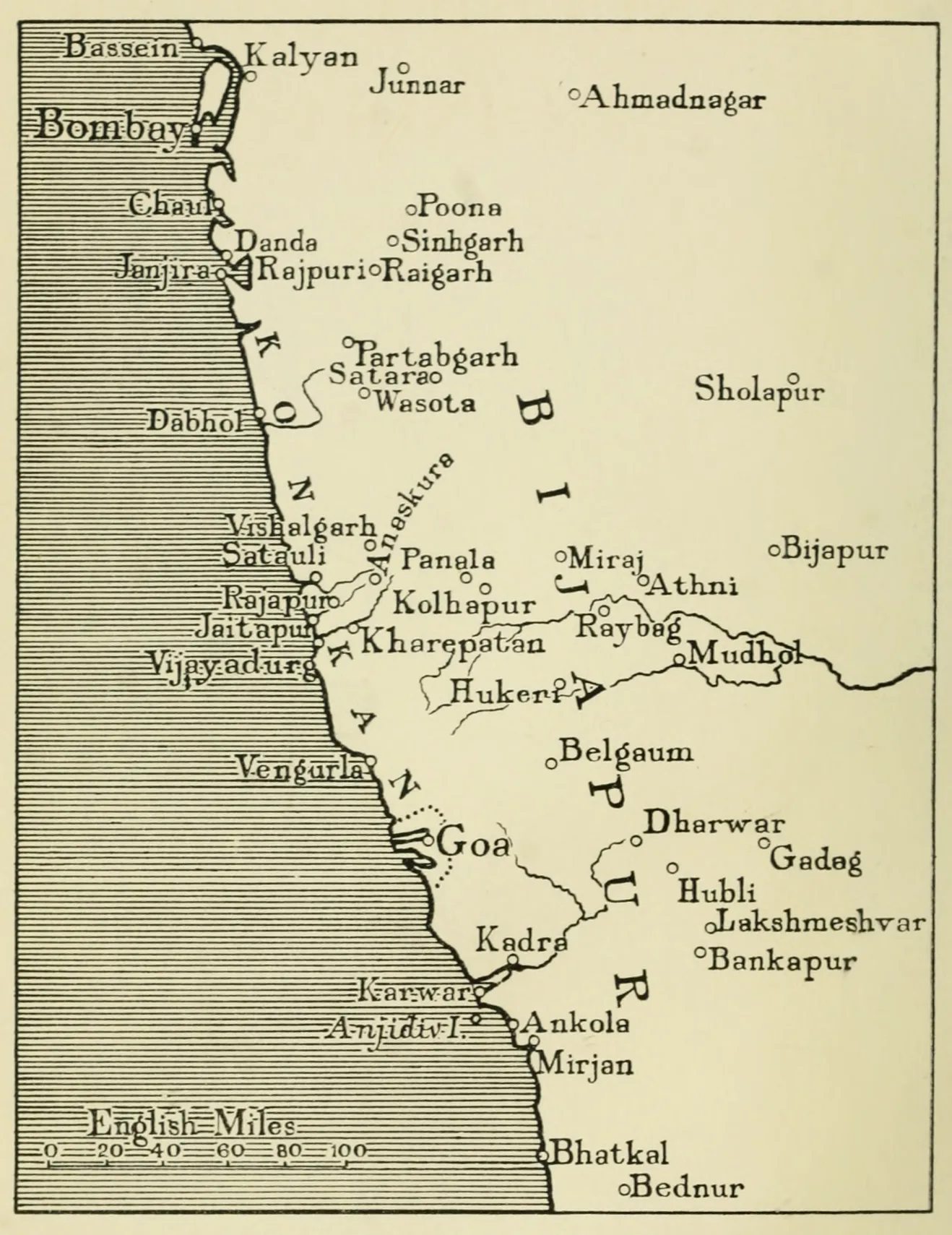
As regards geographical details, the reader may be reminded of the maps given in the 1618–21 and 1642–5 volumes of The English Factories. The boundaries shown in the former will of course require adjustment.
1655. The Surat Presidency
THE SURAT PRESIDENCY, 1655
At the beginning of this year the English East India Company's factories in the East were still fairly numerous. They were organized under two Presidents, of whom one, seated at Surat, controlled the establishments in western and north-western India and in Persia, besides superintending such commerce as there was with Rājāpur in the Deccan, Mokha in the Red Sea, and Basra, at the [p. 7] head of the Persian Gulf; the other, whose head-quarters had been at Bantam (in Java) until the autumn of 1652, when (under orders from home) President Baker transferred himself to Madras, looked after trade on the Coast of Coromandel (usually termed ‘the Coast’), in Orissa and Bengal (‘the Bay’), and in the various settlements in the Far East. Coming to details, the regular factories in the Surat Presidency were stationed in Surat itself (with its port of Swally), Ahmadābād, Agra, and Tatta (Sind) in India, and of Gombroon (now Bandar Abbās) and Ispahān in Persia. Those under the Madras President were Fort St. George and Masulipatam on the Coast, Balasore in Orissa, Hūgli in Bengal, Bantam in Java, Jambi in Sumatra, Macassar in Celebes, Syriam in Pegu, and Camboja in Indo-China.
This list, however, was in process of curtailment, for, under pressure of its difficulties at home, the Company had sent out orders (received in May, 1654) that the factories in the Western Presidency were to be reduced to Surat, Agra, Ispahān, and Gombroon, and those in the Eastern to Madras and Masulipatam; and although these orders were not (and indeed could not be) carried out immediately, it was clearly understood that, unless the situation at home improved, the Company’s operations in the East— already much impaired by the losses sustained during the recent war with the Dutch—could only continue, if at all, on a very reduced scale. Of an early improvement of the position in England there was little hope. The United Joint Stock, which represented the Company at this time, had run out its allotted span of five years, and was merely carrying on the trade until a new Stock could be raised. In view of the dislocation of commerce caused first by the Civil War and then by the war with Holland, a new subscription was not likely to succeed unless an exclusive charter could be obtained from the Protector; and this he hesitated to grant, partly because an influential section of the London merchants interested in the Eastern trade was pressing for the abandonment of the joint-stock system in favour of a ‘regulated’ trade, while others again were arguing for some form of State control. Meanwhile, many of these merchants were openly disregarding the monopoly granted by the existing charter and were sending ships freely to the East, especially to Bengal, the saltpetre from whence [p. 8] was much in demand. All that in fact held the East India Company together was the necessity, before dissolution, of realizing such assets as remained (some of which were of permanent value, e.g. the privileges at Gombroon and Masulipatam), and the faint hope that the Protector would after all be induced to continue the trade on its old basis.
Turning to the records themselves, we find that, towards the end of January, 1655, Jeremy Blackman, who had been President at Surat during the last three years, made over his charge to Edward Pearce, and sailed for England in the Eagle.1 The letter he carried home, detailing the transactions of 1654, is unfortunately missing.
Pearce, who now assumed the direction of affairs at Surat (though he would willingly have gone home instead), had been nearly twenty-one years in the East. The son of Edward Pearce, water-bailiff of the City of London, he was apprenticed to the Company for seven years at the close of 1633 and dispatched to the Surat counting-house in the following spring. After voyages to Mokha and Basra, he was employed in 1644 as chief in a venture to Manilla. His subsequent service was chiefly at Surat, where he became Accountant and Member of Council in 1648, and held this post until his succession to the higher one of President.
It had long been the practice of the Company to keep a few vessels of light burden in Eastern waters, for the purpose of collecting cargo and carrying on the port-to-port trade. This allowed the freighted ships from England to return without much delay, and while their hulls and tackle were still strong enough to stand the buffeting of the Cape storms. Moreover, these smaller vessels could be easily repaired in the river at Surat or by the shipwrights of Bassein; they were not expensive to maintain, being manned chiefly by lascars; and their cost was partly defrayed by the money earned by carrying freight goods for Indian and Persian merchants, who fully appreciated the security conferred by a European flag and European seamanship. The hostilities with [p. 9] the Dutch had deprived the Surat Council of some of these useful auxiliaries, and they had now remaining only two, viz. the Seahorse and the Assada Merchant, the latter of which was in so bad a condition that later on in the year she was sold and the proceeds were used towards the cost of partially rebuilding her consort. Before, however, undertaking these repairs, Pearce and his colleagues determined to use the Seahorse for one more voyage to Gombroon, carrying thither William Weale and two other factors to fill the gap left by John Spiller’s departure. She sailed accordingly on 13 February, 1655.
Three days later the Dove reached Swally, bringing Spiller from Gombroon and three supernumerary factors from Sind, where Nicholas Scrivener now remained alone to carry out the season’s investment. The Dove departed for England the following month, bearing a letter from the President and his Council (the latter consisting of John Spiller and Henry Gary), dated 15 March, 1655. In view of the full report sent home by the Eagle, this communication gave little fresh information. It intimated that the factors’ resources were being carefully husbanded. The factors sent to Persia had been ordered to turn, as far as possible, their remaining stock into money, which was to be remitted to Surat for investment there; while any goods which they were unable to sell were to be forwarded to Basra for disposal. Similarly, the two factors at Agra—William Jesson and Thomas Andrews—had been instructed to press the sale of their broadcloth and other goods, investing the proceeds in indigo for England; they were not on any account to borrow money for this purpose or to raise funds by drawing bills on Surat. Andrews had recently confessed (English Factories, 1651–4, p. 301) that he had made use of the Company’s money for his own private trade and now owed them 24,000 rupees, besides being in debt to private persons in Agra to the extent of 11,000 rupees. As an offset, the President and Council had seized some cochineal and money (about 366l.) which had arrived on Andrews’s behalf from Persia.
So low had the Company fallen at home that it had resolved to send out only one ship to the East, and that merely to fetch away the goods expected to be awaiting shipment on the Coromandel Coast and at Macassar. The Three Brothers was accordingly [p. 10] hired and dispatched on this errand; but, owing to a leak, it was late in March, 1655, before she got clear of the English Channel. She carried a letter for Surat (to be forwarded overland from Madras), of 31 January, 1655, which answered two received from that Presidency, dated 26 November, 1653, and 18 January, 1654, respectively (see The English Factories, 1651-4, pp. 214, 221). Replying to the information conveyed in these communications, the Committees censured the action of the Surat factors in sending the Falcon and her consorts to Gombroon with such disastrous results, and hinted a suspicion that this had been done from motives of self-interest. They hoped that some further recovery would be made from the factors lately at Lucknow, who had run themselves into debt with the Company by an illicit use of its funds. Should Pearce persist in his unwillingness to delay his return home by taking over the post of President, Jesson was to be recalled from Agra in order to succeed Blackman. The factory at that place was to be dissolved, everything being sold except the Company's house, which was to be retained until further order. The behaviour of the Bengal factors in borrowing money in the Company's name for employment in private trade to Persia was reprobated, and satisfaction was expressed at the steps taken to seize the proceeds.
The many abuses which have been put upon you by the Governour in Surratt, inforceing you to give your passe to the Dutches ships, and his non-assisting you for the recovering in of those debts which were owing unto us, with his takeing part with those who had made an ensurance upon the Supply and denied payment1: these his unsufferable injuries wee know not how to remeddy, being the condition wee now are in renders us not in a capacitie to vindicate ourselves; therefore by force wee must undergoe it.
The Committees trusted that the orders previously given for the reduction of the number of factories had been acted upon and all surplus employees sent home.
Our discouragments are still soe many, through the libertie that is at present taken by severall persons to send out ships for India, [p. 11] both to the northards and southwards,1 of which some are already gone and more are providing to follow, that our worke is now only to contrive to ease our charge and draw home what estate wee have in your partes and all other our factories in India [i. e. the East Indies]. To which purpose wee must still presse upon you that all superfluous and unnecessary expences whatsoever be absolutely avoided, and that you seriously lay to heart our great sufferings in the many sadd losses which, both in your partes and elcewhere, wee have undergone; and, in consideration thereof, soe to act and manadge our affaires that, at the winding up and clearing of this accompt, your good husbandry may be obvious unto us, and wee thereby encouraged to acknowledge you to be good and faithfull servants. The three ships Eagle, Wellcome, and Dove being dispeeded for England, yet wee conclude there will be resting within the lymitts of your Presidencie severall remaines belonging to us; all which, wee hope, long before this shall come to your handes, will be collected and gathered in, and invested into commoddities fitting for England, that is to say, in indicoe, callicoes, cotten yarne, or what elce was usually sent for these partes; all which wee order (being wee shall not send you any ship of our owne) that you lade on some ship or ships which shall arrive in your port belonging to perticuler [i. e. private] men, agreeing with them for the fraight, and consigne them unto us by bill of lading. Wee doe further order that you also, upon receipt hereof, make sale of your horses, plate, and all other things, reserving noe more by you then what are absolutly necessary for a very private, civill, and frugall living; the proceede whereof wee doe also require to be invested into such commodities as above, and by the same conveighance retourned unto us. Had wee not some hope that, before much time will be runn out, that the trade to East India would be againe setled in some way of honour and proffitt to the nation, wee had at this time sent you our positive order for dissolving of all, both your and other, our factories; but wee have therefore deferred the same by this conveighance. In the meane time let us prevaile upon you that shall remaine at Surrat, to live privately and frugally, puting us to noe more charges in your expences then neede shall require, avoiding all manner of pompe or vanitie whatsoever. And notwithstanding wee formerly allotted six factors to continue in Surratt, yet now wee doe conceive one halfe of them will be more then usefull, being wee have noe imployment to put upon them; and therefore wee pray you also to ease us in this and all other waies whatsoever; that soe hereafter, when the trade of India shall be resolved to be [p. 12] prosecuted, the new undertakers may have but a very small accompt of remaines to take of from this Stock, but beginn upon a fresh foundation, which will the more encourage them. Though our neighbours and deare freinds the Hollanders have long been our debtors and would render us noe satisfaction, yet now at last they have been enforced to come to an accompt, both with us and others, referring the arbitrament unto four persons chosen by the English and the like nomber by themselves. The determination and conclusion whereof was that the Hollanders should restore unto us the island of Polleroone [Pulo Run, in the Bandas], and also pay unto us the some of 85,000l. sterling in full satisfaction and recompence for all our sufferings by them before the last breach1; which though it be nothing answerable to what wee might expect from them, yet something hath some savour, and a little is better then nothing. Our monies will ere long be due, and wee hope to find a faire complyance. And for our island [Pulo Run], wee intend very suddainly to send out shipping and men to take posession thereof.
A brief letter from the Company, dated 27 March, 1655, enclosing a copy of the above communication, was sent to Surat in the Constantinople Merchant, a private vessel bound for that port and commanded by Robert Brown. This second letter was significantly addressed, not (like its predecessor) to ‘Our President and Counsell’, but to ‘Our Agent or Factors now resident in Surratt’, though no reference to the change of style was made in the communication itself, which merely announced that a settlement had been reached with Richard Davidge (a former chief at Agra who had set the example of cheating the Company in various ways), and forwarded some papers for transmission to the Coast factors. By the same ship was sent a letter to the merchants at Gombroon, notifying that her owners had agreed to recompense the Company at home for the admission of her cargo to the exemption from customs dues which strictly extended only to the Company's goods. Other private vessels, it was intimated, should not be allowed the same privilege, except on an understanding that a similar payment would be made in England.
The Constantinople Merchant reached Swally early in September, 1655, and on the 20th of the following month Pearce and his two colleagues replied to the letter of 31 January. They expressed confidence [p. 13] that Blackman had satisfied the Company about the loss of the Falcon and the Endeavour. Pearce had complied with his employers' wishes by remaining for a while, but he was fully resolved to go home at the end of the year. Spiller had intended to do the same, but, as (for reasons to be mentioned presently) it was impossible that Jesson should be left in charge, he had agreed to remain for twelve months longer. They hoped to send home six or seven factors by private ships, if they could spare so many; for two must be sent to Agra (if Jesson should return to Surat) in order to wind up matters there; two or three would probably be needed in Persia; and one or two desired to 'leave your service here'. In any case the number remaining would not be large.
For what you are pleas'd to write concerning pompe and vanity, such things have beene straingers unto us for many yeares, and Captain Blackman can bee witnesse for us that hee left us in a very private condicion; to which wee have added nothing, but have rather lived a more private life. For attendants, wee have but few that have not lived, some 20, some 30, yeares in your service; and as for horses, wee have but three in our stable, two of them soe old that both of them are not worth 200 ma[moodies].1 As for plate, wee have noe more then what is necessary; which, being ready mony, when you leave this trade, will soone bee turned into goods proper for England.
The writers then expressed their pleasure at hearing of the indemnity obtained from the Dutch;
Which wee hope wilbee an encouragment unto you to follow this trade, as formerly, in a joint stock; otherwise wee are of opinion this trade will fall to ruine. Here is arrived to this port four shipps and a pinnace on particular [i. e. private] designes; who intend home this yeare, and wee beleeve they will, by the course they take; for they sell cheape and buy deare, and when they come to England, if they finde a glutt markett, they will finde but little encouragment to follow this trade in so many small companies. They are all gon downe the coast to procure saltpeeter and pepper; which they may have in great quantities and, if they doe not raise the price, they may buy very cheape.
With the captain (Henry Benn) and supercargoes of one of these private ships, the Merchant Adventure, the Surat Council had [p. 14] concluded an agreement, by which she was to proceed to Rājāpur to fetch the Company's saltpetre and pepper, and was afterwards to carry home from Surat, on account of the Company, 150 tons of goods, at the rate of 15l. 10s. per ton for pepper or saltpetre, and 18l. per ton for other merchandize.
In the same letter the Surat Council gave the Company an account of their proceedings since the departure of the Dove. A supply of money had been remitted to Tatta by exchange from Ahmadābād (where it had been borrowed), in order to pay for the piece-goods collected in Sind. At Ahmadābād itself the purchase of indigo had been deferred until the new season's production was ready, as the supply then in the market was poor, though it was being bought at high prices by the interlopers' agents. The funds received from Persia were being invested at Surat, Gandevi, and Nosāri in piece-goods and cotton yarn. From the Agra factory serious news had been received. Jesson, the Chief there, had surpassed in iniquity his colleague Andrews; for, on the credit of his position, he had borrowed for his own purposes over 100,000 rupees, and, finding himself unable to meet his liabilities, he had pacified the more importunate of his creditors by pledging to them the proceeds of the Company's stock of broadcloth at Agra and Delhi. Having bought and sent down some indigo on the Company's account, he had in March drawn a bill on the Surat Council for 25,000 rupees; but they, fearing lest he should use the money, not to pay for the indigo, but to discharge his own arrears of interest, refused to accept the bill. As, however, Jesson demanded that they should either pay the money or return the indigo (which was already in the Company's warehouse at Ahmadābād), Pearce and his colleagues found themselves obliged to temporize. They therefore employed their broker, Chhota Dās, to treat privately with the holder of the bill, promising to pay the amount within a reasonable time if Jesson could not be induced to discharge the liability out of his own funds at Agra (Consultation, 1 August, 1665). Jesson had since been instructed to dissolve the factory there and hand over any remaining stock to an Indian agent; but at the time of writing nothing more had been heard of his proceedings. Some fear was entertained lest his creditors should procure from the Emperor an order to the Company's servants to discharge his liabilities.
[p. 15]
As regards the prospects of a supply of saltpetre, the Surat factors were not hopeful.
The King hath made it his owne comodity; who hath lying ready in Ahmada[vad] 10,000 double maunds, once refined, very full of salt, and (tis report'd) cost him 6⅞ rupees the maund. Soe long as any of this parcell lies unsold, wee shall not bee suffered to buy in this kingdome, nor gather in what is due unto you from the peetermen.
However, Jesson had promised some from Agra: there was a small quantity at Ahmadābād, which they hoped to smuggle away among the indigo; and there were 200 bales (besides some pepper) at Rājāpur awaiting shipment.
This letter, it was stated, was being taken by the Seahorse to Gombroon, whence it would be dispatched overland via Basra and Aleppo. On her return voyage, the vessel was to call at Lahrībandar (the port of Tatta), to bring away any goods Scrivener might have ready. After that, she was to make a fresh voyage to Gombroon, and later she would be sent to Basra. After mentioning the sale of the Assada Merchant, the letter proceeded:
Wee were alsoe forced to sell your old howse in Brodra [Baroda] for ma[moodies] 4,500; which wee the sooner consent'd unto, because there was a necessity of bestowing 500 ma[moodies] for keeping it from falling to the ground. And yet you have in that towne a small tennement, and a platt of ground, which if you have a desire to build upon, there may bee a pritty little howse erected for your use; which wee shall not undertake to doe without your order.
Andrews's cochineal had been sent, at his urgent request, to Agra, insured at 2½ per cent.; but its delivery was subject to the payment by him of 5,000 rupees, to be applied in part liquidation of his debt to the Company.
As yet wee cannot procure any justice from our Suratt Governour [Hāfiz Nasr] about the insurance bussinesse, notwithstanding wee have procured many letters from both the Kings and Begums1 dewans; but all to noe purpose, unlesse you can right yourselves at sea. This affaire wee referr to your most serious consideracion. For our parts, wee give the mony for lost, without a strict course.
[p. 16]
Towards the end of August, 1655, the Company dispatched to Surat, overland via Aleppo, a fresh batch of letters, including one for Madras. In these they answered four letters from Surat, including the one brought by the Eagle. Regret was expressed at the slow rate at which the reduction of factories was proceeding, since Lucknow appeared to be the only one that had actually been dissolved.
Wee againe hereby require the performance thereof; and if there shall be any found amongst you that shall refuse to retourne home, wee doe lett them know that wee shall not allow unto them any sallarie, but doe absolutely discharge them from our imployment. And though you write that there are many able young men that deserve our favour and are very loath to leave India, having spent much time and gained little, yet must not this be an argument for us to continue them at our charge without imployment. Therefore let them be retourned, or live upon their owne expences; for wee are resolved not to admitt of their remaining in India upon our accompt.
After some further comment upon the intelligence conveyed in the letters under reply, the Committees announced that, as they calculated that the stock remaining to be brought home from Surat would be about 25,000l., they had decided to arrange for the necessary space to be provided in the Eagle, which would be dispatched to Surat early in 1656 upon private account. They enumerated the goods to be provided for this purpose, especially calicoes, ‘they being at present the most requestable commoditie which comes from your partes’.
In the same packet went a letter to Pearce, thanking him for consenting to remain at Surat; also one addressed to Vīrji Vora, an eminent Hindu merchant at Surat. This wealthy individual had had trading relations with the Company’s factors over a long period of years, and had lent them considerable sums of money. A dispute had, however, arisen over the amount to be paid for some coral and quicksilver which he had bought from them, and on which he claimed a rebate amounting to about 2,500l. President Blackman, before leaving Surat, persuaded him to pay over the money and to leave to the Company at home the decision whether the whole or any part thereof should be refunded. Vīrji Vora’s letter to this effect, under date of 25 January, 1655, written in [p. 17] English and signed in Gujarātī characters ‘Vīrji Vohora Kendua’, is still among the India Office records.1 In reply (27 August, 1655) the Company intimated that the matter had been carefully considered and it had been decided that no abatement could be made, as the long period for which the money had been owing had caused them considerable loss; however, to manifest their appreciation of his behaviour and their desire to maintain friendly relations, they intended to send him by the next ship a present ‘soe considerable as will become us to give and be worthy of your acceptance’. Accordingly by the Eagle they dispatched (with a fresh letter dated 27 March, 1656) several pieces of broadcloth and satin, two large looking-glasses, and a piece of double gilt plate, engraved with the Company’s arms. From later references, however, we gather that Vīrji Vora was far from satisfied with the result of his appeal.
A further letter from the Committees of the United Joint Stock to the factors at Surat, dated 24 September, 1655, and sent overland, advised them that, on reconsideration, it had been determined to take up the whole of the tonnage of the Eagle, and to send out in her about 8,000l. in money to make sure of a full return cargo. Apparently a wave of optimism was passing over the authorities at home; for just after the dispatch of this letter they decided to open a subscription for a new Stock of 200,000l. The attempt, however, proved a failure, probably because of the uncertainty whether the charter would be renewed. Meantime the Council of State was freely granting to private merchants licences for the export of silver to the East Indies, and the trade in fact lay open to all comers.
On 13 December, 1655, Anthony Smith wrote from Ahmadābād, advising the Surat factors that,
Haveing, after much trouble with the petulant Dewan, Rymutt Ckawne [Rahmat Khān], who is almost madd hee cannot force neither the English nor Dutch to take the Kings saltpeter, gott leave to send away the caphila [caravan: kāfila],
he had dispatched to them the goods provided at Ahmadābād, together with those received from Agra. They were under the escort [p. 18] of twenty-five soldiers, who were to be paid one rupee each on arrival at Surat. As regards indigo, that already manufactured was too poor to be worth buying:
The makers of that comodity, in hopes of present vend, haveing putt great store of oyle, pimple,1 and durt or mowry2 into it, which will make it in lesse then four months breed store of wormes. However, I heerewith send you a muster [i. e. sample] of it, because some of the interlopers factors have bought a parte of it at 13⅛ rupees; and when the indicoe makers can sell such as this, that is halfe durte, at soe good a price, they will not make that which is pure for four rupees advance in a maund, it being lesse proffitable unto them. I have therefore bought a parcell of leafe, and caused it to bee made into indicoe, putting but 5 seare mowry to 1¼ maunds of the indicoe leafes juice or russ [ras: juice]; which wilbee ready in two or three dayes, and will, [I] suppose, produce 4½ or 4¾ maunds pure indicoe.
This he would bring down to Surat, after arranging for the manufacture of more, should it be approved.
While good indigo was scarce and dear at Sarkhej and Ahmadābād, it was cheap in Agra and its neighbourhood. Jesson wrote thence to Surat on 20 December, stating that the Dutch had bought 200 bales at Khurja for 33 and 38 rupees per maund, and were finishing their investment at Biāna also. The price was falling daily, buyers being few, and after a month indigo would probably be procurable at under 30 rupees the maund. Cotton cloth had also fallen 14 per cent. The delivery of the saltpetre contracted for had been delayed by unseasonable rains. Andrews's cochineal had arrived, but could not be sold at present, as the price had declined from 70 to 45 rupees per seer, 'which is 40 pice and not 36, as we were formerly made to beleive; that custom being three yeares since altered'. Nor had Andrews been able to borrow the money to pay the 5,000 rupees demanded from Surat:
The sheroffs3 findeing more proffitt by exchange, for which some pay hence to Surratt 11 and 9 per cent.; the Dutch 5¾, and for [p. 19] some (I am informed) 6¾ ; and not without much adoo have they procured sufficient to performe their indico investment.
Jesson promised to lessen expenses as much as possible, but said not a word about his indebtedness or his return to Surat. Writing again four days later, however, after the receipt of fresh letters from that place, he gave assurances that the factory should be closed as soon as the outstanding business could be wound up.
Among the Company’s records of this time is a faded document which hints at romantic adventures. It is dated on Christmas Day, 1655, and is from an English sailor who had taken service (probably as a gunner) under Prince Aurangzeb, the Viceroy of the Deccan, and was then at Daulatābād. Though the earlier part is of no special interest, the letter may be quoted in full as a specimen of the correspondence of the period:
Most loving and kind father and mother, My humble dutye to you both, trusting in God that you are both in good health, as (thanks bee to God) I am at this present. These are to certiefie you that I sent home upon the good shipp Smerna Merchant the produce of Mrs. Margreat Freemans adventure, in the custodie of Mr. John Lyons and Mr. Robert Andrews his mate. In [16]54 [-55] I sent home upon shipp Eagell a full accompt of all buisnes whatsoever. At present I have sent home the coppie of my accompts; which when you shall receive, I shall desire that my mother will seek or use some remmedy to get my wages; and if you shall receive, desire you to keep it tell such time I come home. I desire that my father in law1 will please to receive my wages for mee, in case that my mother shall be dead. By vertue of this letter I doe give ether of you both power and athoritie to receive all such wages that is due to mee from the Honourable English East India Company Merchants. For my part I never left the Companies service duering all the time of warres between the Dutch and the English. I was taken by the Dutch in the shipp Faulken in the yeare of our Lord 1653[-54]. Which when wee arived at Suratt, I swome one shore from the Duch with the danger of my life, which through Gods providenc I scaped very narroly. After that I had made that enescape, I went to our President for sucker. Hee gave mee very ill langage, and tould mee I might have kept mee where I was. Receiveing such could entertay[nment] from my owne nation, I tooke my progres and came to the Mogull Prince which at present I am servant to. This Prince entertayned mee, and made mee wages four rupees a daye. I have bin in his [p. 20] service about a yeare and a halfe; which (I thank God) I doe live well and get mony. Deare mother, I desire that you will wright to mee. I shall be very glad to here from you: more glader to see you. Thus, haveing not else to inlarge, I conclude with the tender of [my] dutye and prayers to Allmighty God for your helths both, with all the rest of my frends [ ]; and rest your obedient and dutyfull sonne, John Lewes.
From the Court Minutes of 4 August, 1659, we learn that Lewis's mother, Elizabeth Viccars, duly petitioned for his wages. The Committees were evidently doubtful whether any money was due; but in compassion for her poverty, they advanced her 5l., taking security from a third party to repay that sum if it should prove that Lewis was not entitled to any wages. Probably the letter was retained by the Company as the authority for the claim. Of Lewis's further adventures, and whether he lived to return to England, no record has been found.
Events in Persia
EVENTS IN PERSIA, 1655
The letters from Persia at this period contain much that is of interest. In the 1651–4 volume of The English Factories some account was given of the arrival of Lord Bellomont as ambassador from the exiled King Charles to Shāh Abbās II; and the story is now continued and carried to its close. The main authority on this subject is the Storia do Mogor, by Niccolao Manucci, who was in attendance upon the ambassador; but Manucci wrote long afterwards, when his memory was hazy as to dates and details, and the evidence now given from contemporary correspondence is therefore all the more valuable.1 The envoy's object was to obtain monetary assistance from the Persian monarch for his needy master, and incidentally to divert into the latter's coffers the East India Company's share of the customs at Gombroon. He found the Shāh a sympathetic listener to the story of the fate which had befallen a brother sovereign whose autocratic rule had made him unpopular with his subjects, but less interested in the pecuniary needs of that sovereign's son. After long and wearisome negotiations Bellomont concluded that it was hopeless to extract from [p. 21] the Persians anything more substantial than compliments and promises; and so, with studied brusqueness, he departed from Ispahān and proceeded to India, to see whether the Great Mogul would prove more liberal.
The first reference to the subject in the 1655 letters is contained in one of 15 March from the Surat Council to the Company. Adverting to certain overland advices from Spiller in Persia, they said that therein
You will reade that my Lord Bella-mount, the pretended embassadore from wee know not whome, and supposed brother to one Mr. Bard,1 silkman in Paternoster Row, was lodged four daies before hee2 left Spahaun; since which time wee reade from our broker that hee hath shutt up his doores and takes physick. Wee are perswaded hee will never prejudice your affaires, now wee have peace with the Dutch; but had the warrs continued, by theire assistance hee might have troubled you much in your customes at Gombroone, which (as wee hear) is the only thing hee aymes at.
None of the Company's servants was at Ispahān during the greater part of Bellomont's stay there; but Weale complains from Shirāz on 31 July, 1655, that
This pretended English embassadour hath made us much slighted (though not much advantaged himselfe thereby) by glowing into these grandees eares strange things, as that the customes are his masters by right, who hath sent him to receive it. Soe that Etamaan Dowlatt [i.e. the Itimād-uddaula] tells us that hee knowes not what wee are: one comes and demaunds the customes, and wee come: hee doth not knowe what to make of us.
However, the royal chancellor was not so ignorant as he pretended to be; he was well aware of the facts of the case, and was clever enough to play off one claimant against the other. Weale writes again from Shirāz on 31 August:
I have alsoe advise from some Armenians in this place that the pretended English embassadour hath beene very earnest with the Etamon Dowlett for licence to departe; which would not bee graunted him, receiveing answer that hee would send for the English Captain to knowe what hee was; with which hee left Etamon Dowlett. But of the certainety of this news I cannot assure you, not giveing over much creditt to bazar news.
[p. 22]
On the 12th of the following month Henry Young, who was then representing the Company at Ispahān, informed Weale that
Notwithstanding the pretended English embassadours former demaunds at Casbeene [Kasbin] for the moiety of customes belonging to the Company (touching which hee could not at that time receive any positive answer), and Etamon Dowlats very often pressing him now of late to accept thereof, with many promises that hee should now receive a considerable [sum?] on that accompt and that heereafter it should annually bee sent unto his grand master, yett have I found him soe noble that for my sake (as hee hath protested) that hee hath absolutely refused it or to doe the Company any injury; whereupon Etamon Dowlatt demaunded why at first hee made itt his suite; who replyed that hee had since found the Company and theire servants to bee his masters freinds, and therefore would not seak to injure them in the least. And indeed I am even confident that, if hee had accepted thereof, the Company would never have received more on that accompt, and in a very shorte time hee should have found them serve him in the same manner; soe it would have [proved?] losse to both. And soe much I told him; whose maine businesse was to borrow mony of this King, but hath failed in his expectacions, haveing beene putt of with very weak reasons, as that it was very hazardous to venture it through the Turk and other countryes, and advised to returne and desire his grand master to write how hee would have it sent and they would not faile him thereof; with many other such complements after the Persian manner; though I suppose the King is not soe well stored with ready moneys as to spare such a considerable some as might bee acceptable; and soe much the embasadour in a manner told the Etamon Dowlett. But now the business is even concluded; the King haveing given him 100 tomands in mony and zerbafs,1 and hee is suddainely to receive his vest,2 when in few dayes hee resolves to leave this place.
The story that Bellomont was actually offered, but declined, a payment on account of the Gombroon customs, is inconsistent with Manucci's narrative and with the account given in the Dutch records (Hague Transcripts at the India Office, ser. i. vol. xx. no. 582); but it is possible that the Itimād-uddaula (for the reasons suggested by Young) had offered to have the future customs paid to Bellomont, if the latter would remain at Gombroon to receive them.
[p. 23]
The next reference to the ambassador is contained in a letter from the Gombroon factors to Surat dated 3 December, 1655:
The 30th [November] (beeing Sunday1) at night the pretended English embassador, whoe goeth under the stile of the Lord Bellamount, arrived heere from Asphahaune; whoe pretendeth he is bound for India after a moneth or toos stay heere. But his linguist (whoe was formerly a Jessuitt) saith he hath a phirmaan from the King of Persia for the Companies customes, and that hee stayeth heere in expectacion of ten sayle of shipps that should come from we cannot imagine whence. Also the Kings officers heere say that the Kings commaund is on them that, in case he will accept of the customes, they should turne us out and settle them on him; if not, continue them as they are to us. But there are soe many reports in towne, and soe little appearance of his acting anything therein, that we cannot beleive anything thereof. . . . PS. (4 Dec.)— . . . In a former clause we acquainted you of the Lord Bellamounts arrivall heere; whoe, to shew that he hath noe intent to injure the Company or trouble their servants heere, hath desired his passage on the Seahorse for Surratt; which we the willinger graunted, that his presents heere might not cause any more rumours. For of a certayne the Atamaam Dowlaatt would faine have him accepted [sic] of the customes a while; thereby to have an occasion to turne us out, as he would alsoe him in a very short time afterwards. Soe that we hope you will not take it ill that we gave him his passage. Mr. Young can acquaint you more fully how much hee protested never to indeavour to injure the Company in Spahaune or any place; to whose relacion please to be referred.
The Seahorse sailed on 4 December and reached Swally 6 January, 1656. On the 29th of the same month the Surat factors wrote to Weale:
The Lord Bellamount is in Surat; where hee hath taken a house, so it should seem that hee intends to remain ther for some time. Wee wish that his remoove from Persia may be a meanes to free you from all trouble aboutt the customes, and allso cause of a greater annuall inlargement.
No further mention of the ambassador is found in the Company's records; and for the rest of the story the reader must go to the pages of Manucci, who relates Bellomont's journey up country [p. 24] through Burhānpur to Agra, whence he set out for Delhi, but died suddenly at Hodal in June, 1656. The body was hastily buried on the banks of a small reservoir, but fifteen months later was disinterred and carried to Agra, where it doubtless rests in an unmarked grave in the old Roman Catholic cemetery. Thus ended this remarkable mission.
The alarm excited by Bellomont's embassy in the minds of the Company's servants in Persia is easily comprehensible. That country afforded a certain market for broadcloth and other commodities ; but as the Company had now ceased to buy the raw silk (a royal monopoly) which was its chief product, the English factors' main concern was to secure their share of the Gombroon customs. Their claim to this was based upon the agreement made at the time of the capture of Ormus (1622), when it was stipulated that, in return for English co-operation in that enterprise, the Company should not only be excused all import duties but should also receive half the net customs revenues. Gradually, however, as the memory of that event faded and the need of English help against the Portuguese passed away, the Persian officials lowered the payment on this account to a mere fraction of what was really due, meeting all remonstrances with allegations that the original treaty had contemplated the maintenance of an English fleet for the defence of the Persian coast and that the Gombroon revenues were being systematically defrauded by the English merchants and mariners passing off as their own property the goods of Asiatic passengers in their ships. Complaints to the Shāh were of little use, since the tendency at Court was to argue that the reigning monarch was in no way bound by so antiquated an arrangement, and that any payment made must be regarded as a mark of the royal bounty, which ought to be reciprocated by liberal presents and by the purchase of the royal silk, especially as, in regard to the latter, the English had by no means fulfilled the lavish promises they had made at the time of the commencement of the trade. Doubtless the payment would have been withheld altogether, but for the fear that in such case the English would destroy the customs revenue altogether, by blockading the port from the sea. At one time there had been a hope at Court that the Dutch, whose trade in Persia was far larger than that of the [p. 25] English, would take the commerce under their protection and prevent any strong measures of the kind; but there was now no prospect of this, for the authorities in Holland, however bellicose their servants in the East might be, were determined not to risk a second conflict with England. Thus thrown on their own resources, the Persian officials could do nothing but continue the policy of making each year at Gombroon an altogether inadequate payment, and referring the factors to Court for the balance; with the result that the latter found themselves in the dilemma of either making an expensive journey to the Shāh's head-quarters, with the certainty of having then to spend a round sum in presents and bribes to secure an uncertain result, or of putting up with the underpayment, with a probability that in the following year the amount would be lowered still further. The only remedy they could see was to appeal to force, and they were accordingly urging their employers to send a strong fleet to Gombroon for that purpose; but the Company shrank from such decided measures, and replied gloomily (in a letter to Surat of 27 August, 1655) :
Wee take notice that, notwithstanding Mr. Spillers tedious and chargeable journey to the King of Persia and solliciting his favour concerning the dammage wee received from the Dutch, as also for our due allowance of customes at Gombroone, that wee are still in the same condicion as formerlie, and that wee must either accept of what they will please to give or elce have nothing at all. The 500 tomaunds which was the last yeare received, though it be a small some in respect to what wee may justly challenge, yet better that then nothing; for wee know not how to force our right from them. Therefore, upon necessitie wee must be constrained to lye at their mercie and receive what they will be pleased to give; and, being wee cannot compell them to give us our due, you must by faire meanes worke as much from them as you can for the present, till it shall please God that wee may be in such a condicion as may bring them to a better accompt.
As already mentioned, in February, 1655, William Weale had been dispatched from Surat to be Chief in Persia. He arrived at Gombroon on 10 April, where he found Henry Young, who had been left by Spiller in charge. To him he communicated the orders from the Surat Council, which were that Young should be Weale's Second. Young, however, who is described to us by Manucci (vol. i. p. 35) as 'a very short man, but most generous and very [p. 26] liberal’—characteristics which suggest a sensitiveness on points of dignity and at the same time an impulsive disposition—felt himself affronted and at once quitted the Company’s service, declaring that he would travel up to Ispahān to recover his health and settle some business there, and would then proceed to India. By the time the Seahorse departed (25 April), the factors had sold goods to the value of over 4,600l.; but the bulk of this money was sent to Masulipatam (by order from Surat) in a junk belonging to Mīr Jumla. Then all the merchants fell ill. On 16 May Weale dispatched a letter after Young, stating that the two who had accompanied him from Surat were dead, ‘and the Lord knowes how soone I, William Weale, may followe’. In that event he adjured Young to resume charge of the Company’s affairs, and meanwhile to ‘apeare as Cheife’ at Ispahān and dispose of the goods there. If necessary, he might also employ Daniel Otgher, his travelling companion, who had recently left the service. To this Young replied in a letter from Shīrāz of 3 June, agreeing to the request, although he was still in bad health. He would not hear of returning to the Company’s service, if this meant subordination to anybody; but he was willing to take charge, should it be necessary, and to leave the question of his remuneration to higher authority. He requested early instructions as to giving presents to the King and the chief officials.
The Aspahaune and Armenian Governours, you will finde, are anually piscashed,1 and would take it very ill if they should this yeare bee neglected. . . . I tould Mr. Weale at Bunder [i.e. at Gombroon] that hee would bee forced to bee at such charge, as I conceived, if hee came up to Spahaune; yet heereby I promise to withstand it what possible I can, soe it may stand with the Companies honour now in these ticklish times. You well knowe wee have one lyeing at courte that will lay hold on all adventages to injure the Company; who is the embassadore. . . . Wee give you thanks for the order you gave us to accomidate ourselves in Spahaune with every thing of the Companies as wee have occasion for; but wee know not of nothing there but a little cookroome ware and a few large pillowes; there not being a carpett fitt to lay before any man, or any other necessaryes, as wee can call to minde. Soe that wee must supply the defect as wee finde occasion.
[p. 27]
Meanwhile Weale, finding that his only chance of recovering his health was to seek better air, had decided to quit Gombroon, leaving Anthony Daniel in charge, and to set out for Shīrāz, whence he could go on to Ispahān should his presence at Court be absolutely necessary. On his way he wrote (18 June) to Young and Otgher, promising to dispatch a linguist, Ibrāhīm, to their assistance, and begging them to defend the Company's interests
In case that pretended embassadour should indeavour anything to the Companies detriment ; and to peticion Etamon Dowlett for our share of this yeares custome of Gombroone, the Shabunder [Shāhbandar, the Head of the Customs] denying to pay us any more then 400 tomands, which I have given him a receipt to have taken in parte on accompt, hee referring us to Etamon Dowlett for what elce can bee procured, and it was a long time before I could gett him to heare of more then 300 tomaunds. . . . How necessary it should bee that wee have the Meere Accore Basshawes screett 1 for the shipping of our horses, you are very sencible ; therefore it must bee procured with a piscash, noe other way being able to gett itt. For to present the King etc. at this time I cannot answer ; nor can I see soe necessary, except myselfe were there. Mr. Pitts were three yeares in Spahaune, and never presented the King all that time ; and yett, though with some trouble, hee did his businesse, for all vaporing Constant, the Dutchman, was there.2 In case any buying of silk bee propounded by the Etamon Dowlett, the old answer must serve, that wee want order from our masters, but expect it very shortely, and soe stop his mouth ; or, if that will not, rather then indanger a greater damage to the Company, [you ?] must contrive a piscash for him to doe the businesse, with faire words and promises of strange things, till wee shall heare what the Company will say to this theire lost credit in Persia. For presenting the Aspahaune and Armenian Governour[s], I conceive it may easely bee excused for one yeare, except (as you say) these ticklish times should urge a necessity ; therefore then it must bee submitted to.
From Shīrāz Weale, who was still very sick, wrote to the Company (31 July), reporting what had happened. On the general situation he said :
Abuses heere in custome house are growne to such a hight that, unlesse Your Worships doe shew yourselves by a certaine nomber of shipps apearing in Gombroone very suddainely, its most [p. 28] certainely true wee shalbee turned out of customehouse; for, what with the Dutch, who, every visitt they give a great man, tell them that it is a great discreditt to the King that wee should share in theire customes (wee being but theire prisoners); soe that the Etaman Dowlatt doth tell us that, when wee deliver any peticion concerning our abuses in customehouse, this wilbee broken off: what service wee had done, it was in great Abasses time. Hee saith: doe this King service, by buying his silk, and then you may chance to receive those old previlidges freely. . . . The losse you would receive by being putt out of customehouse, if you reccon onely what now you receive from them, is a small matter; but if you will please seriously to take this business into hand, it would bee better worth to you then 10,000 tomands a yeare; for the Shabunder could tell mee that the King last yeare had 16,000 tomands, but this yeare (by reason of very few vessels arriveall) the King will not have above halfe soe much; soe that in proporcion wee were to have 250 tomands, but in respect of Etamaan Dowlat[s] letter (which I produced) for our respective [i.e. respectful] usage in custome house, hee would agree to 350 tomands. But at last hee came to 400 tomands; which I thought good to take of him, having heard that the passed yeare they profferred 500 tomands to your servant in Bunder, who would not accept thereof, but referred to the Agent at Spahaune; who, after hee had beene at the charge in peticioning the Ataman Dowlatt, and our linguists four months charges at court, could gett not one farthing more.
After some further detail, Weale goes on to say :
Bussorah is againe quiett, and the old Bashaw againe seated there; soe that merchants flock thither as formerly. And thither should one of your servants have gon, with the goods that now lye in Gombroone, if it had pleased God to affoard life. The Padrees thence write mee that your house there is like to bee lost to you, if an Englishman apeare not; soe that (God willing) I intend, as soone as I have gott any assistance and the President and Counsells aprobacion thereof, to send one to sell it, for it is both a charge and trouble to keepe itt. If you would please from England to send such things for presents as you have beene often writt to for, as fine Holland cambrick, broad cloth, etc. raretyes (as they heere count them), you would finde your accompt of pishcashes would not bee raised to halfe what it is unavoydabley now by presenting of gold. Mr. Lewis can well informe you what the King etc. told him was raretyes to them; who, at his being in Spahaune, received more favour by giveing the King a good mastive dogg then if hee had given 100 tomands in gold.1 Soe [p. 29] likewise in all places would your charge bee much eased, if you laid out a considerable somm in England on such things fitting to bee presented heere to great men; who, since it hath beene a custome, looks for it as a dew debt, and, if you desire to speak with any of them, theire servant will first ask the broker or your linguist whither you have brought a piscash; as doth constantly this Etaman Dowlett. When wee have any businesse with him, the first word is: Have you brought a present for the King? If not, you are not welcome. Its that, or the buying of silk, that does any thing in this country.
After a period of anxious waiting, Weale heard on 1 September that Young had visited the Itimād-uddaula and delivered a present and a petition, but had not received an answer. Weale wrote to Gombroon that he would wait a few days longer before setting out for Ispahān, as he hoped that further intelligence would relieve him from the necessity of proceeding thither. One reason for delay was that
I have news from others that Etamon Dowlett is in disgrace with the King; which is the reason hee keeps house, pretending sicknesse; soe that I feare that piscash wilbee lost, if hee performes not somewhat before hee is outed. For it is generally reported that the brother of the late deceased Etamon Dowlett is to have the place; whome all saith is a much better man.
This report, however, was contradicted in a letter of 12 September received from Young, who was hopeful of a favourable answer to his suit and spoke of quitting Ispahān in eight days. As a matter of fact, he did not get away until the 26th. Writing to Weale on 1 October from ‘Degardoe’ (Dehgardu), he announced that he had obtained the desired permit for the exportation of horses, and also fifty tūmāns as the King’s present to the Agent.1 As regards the petition on the subject of the customs, the Itimād-uddaula had refused an immediate reply, but had promised to give one to the linguist (Ibrāhīm), who was accordingly left behind for that purpose. Deeming it unnecessary to remain any longer, Weale quitted Shirāz at the beginning of October, and reached Gombroon on the 29th. On 20 November he and the other factors there sent a letter to Surat, reporting the events of the past season and requesting sanction for the payment of Young’s expenses. Owing [p. 30] to the death of two of the factors, Otgher had been made Second and Accountant. It was fortunate, they said, that no goods had been sent to Basra, as prices there were reported to be at least 40 per cent. below the rates ruling at Gombroon; 'that Basshaw tyranizeing much, soe that noe merchants will come thither to buy goods'.
The Seahorse arrived from Surat on 21 November, 1655. As we have seen, she brought some letters to be forwarded overland to the Company; and so the Gombroon factors took the opportunity to make a report to the latter on the 24th. In the course of this they intimated that
On the Seahorse came many Banian merchants letters to their factors heere, which hath caused them to report to this Governour and Customer that the ships now come [to Surat] are for severall new Companies; upon which the Shawbunder sent us word that the King had remitted the customes onely to the old Company: what others came should pay. Soe that we feare [we] shall have a great deale of trouble, if any of them comes hither and bring other then Mores and Banians goods; and our trouble wilbe the more (at least, more difficult for us to lessen), because neither from Your Worships nor your President and Counsell have we order how to behave our selves therein. Therefore [we] desire your lysence or prohibition of owning more then yours, now their is so many private men voyages to and againe in India.
We have already noted (p. 12) that the Company had arranged at home with the owners of such private vessels to permit them (on payment) to claim exemption from customs at Gombroon. It does not seem to have occurred to the Committees that the Persian authorities might object to this extension to outsiders of privileges granted to the Company itself.
From a subsequent letter to Surat (3 December) we learn that Young sailed from Gombroon for that place on 20 November in a junk called the Diamond. The factors had heard nothing more about 'the court business'; but in reply to some observations from Surat they wrote:
You are pleased to say it will not quitt cost to keepe shipps to commaund the vessells that pas by. Yet wee are certayne, tell they [i. e. the Company] doe soe, we must not expect more then they will please to give. However, (with you) [we] hope to see better dayes in Persia; in the meane time shall by our faire carryage indeavour to winn them to deale better by us.
[p. 31]
This letter was sent in the Seahorse, which carried also six horses and money to the value of about 5,450l. As already mentioned, Lord Bellomont proceeded to India in the same vessel.
The Coromandel Coast and Bengal
THE COROMANDEL COAST AND BENGAL, 1655
If the outlook in the western Presidency was dark at this period, the situation on the eastern side of India was even worse, for dissensions within and disturbances without added to the troubles of the Company's servants. Of the disputes between President Baker and his Second, Henry Greenhill, an account has been given in the last volume (pp. xxxi et seq.). The departure of Baker in the Katherine on 20 January, 1655, leaving Greenhill in charge, put an end to these so far as Madras itself was concerned; but some of the factors had taken Baker's side, and time was needed to assuage the feelings aroused by the controversy. Greenhill himself and his adherent, John Leigh, pursued the late President to England with elaborate indictments. As, however, the subject has already been dealt with at some length, it will suffice if we refer those interested in the matter to Greenhill's letters of 20 January and 21 April, 1655, from the former of which extracts have been printed in Col. Love's Vestiges of Old Madras (vol. i. pp. 134, 139).
Nor need we linger over the charges against the two Brahmans employed by Baker, or the accusations brought by them against Greenhill. Col. Love has printed part of Greenhill's answer, and the subject has already lost its interest. The Brahmans had been left in custody by Baker, and in March, 1655, the accusations against them were investigated by Greenhill and his Council, with the result that they were declared guilty on most of the points. One curious piece of evidence is perhaps worth mentioning, as showing the general belief in the power of witchcraft. The Brahmans, being charged with sorcery, retorted the charge on Greenhill's native agents :
Who, being commanded to answer, proposed a search on both sides; which the Bramenes not undertakeing, and divers people averring that they had some in their chamber where they weer prisoners in the Forte, command was given to search what could bee found in that place; wher was a strange kinde of pouch, [p. 32] with many severall divisions in it, soe compacted that wee were forcte to cutt it all to peeces before [wee] could come to peruse it ; in which was severall peeces of our [i.e. the factors'] clothes, trinckets, and charmes ; also all our names sett downe on a paper ; which many Bramenes (called to veiw them) declared to be sorceryes.
The same incident is described by John Leigh in a letter to the Company of 20 April, 1655 :
That they should bee wiches the church [i.e. pagoda] Bramonees in the towne did justifie to their faces ; for wee found a bagg of theirs, quilted as thick as my hand is long, which was an houre in ripping ; where wee found little holes, some with one thing in them and some with another. In fine, wee found three square peeces of plate, three fingers over each, one of gould, one of gold and silver, and one of silver, all written on, but what wee know not (these were in silver cases) : one peece of spare paper, with carractors but noe letters : one other paper, with all the names of the better sort of English which were in the Fort : and one peece of stuff or other of every mans clothes that they had nominated. Alsoe wee found by proofes that the Bramonees had layd a copper plate with carractors in a small pagod or idoll temple, some little way in the ground, valted, and over that sett an idoll or little divell ; which aboute a yeare agoe, more or less, they did remove and take away. Wee demanded of them why they tooke it away. They said they put them their to hurt their enimes and their freinds dyed ; and therefore they tooke it away. Now I hope Your Worships will beleeve that they are wiches, villanous rascalls, and deserve rather death then favour.
Another interesting document belonging to the case is the declaration of the Right Hand Caste, the salient passages of which have been quoted in Col. Love's work (vol. i. p. 122).
What punishment (other than the loss of their employment) was actually inflicted on the Brahmans is not recorded ; but the Company, in a letter of 27 August, 1655, while approving of their being obliged to pay whatever was due from them, warned the factors to
Take notice that wee are sencible that the said Bramines have done us some good and acceptable services, and therefore wee require that you neither doe, or suffer to be done by any others, any violence or injurie to the persons of them, but on the contrary to secure and protect them what possibly you may.
[p. 33]
Col. Love has also saved us from the necessity of devoting space to the charges brought against Thomas Paine, steward of Fort St. George, and to the groundless scandal raised against Greenhill by Mrs. Bland. We may therefore pass on at once to other matters. A summary of consultations held in March, 1655, at Fort St. George, informs us that the pinnace Mariner was dispatched to Bengal in that month, and that it was decided to send the Expedition (daily expected from Pegu) to Bantam with a cargo of goods under the charge of William Johnson, who was to resign his post of Accountant to Thomas Chamber. Richard Minors, who had commanded the garrison in 1649–51, and had since been unemployed, was paid his arrears and allowed to resign. Charles Wylde,1 who had arrived in the Katherine as pilot, was permitted to go to the Bay in the Mariner. The remains of the wrecked Bonito were sold to a merchant of Madras for 100 pagodas; also five guns for 160 pagodas. From other documents we learn that the Expedition duly sailed for Bantam on 1 June, but, encountering stormy weather, was forced to abandon the voyage and put back to Masulipatam. Her master, John Boyer, went to Vīravāsaram, ‘and there out of discontent pistold himself the 25th [June]’ (O.C. 2537).
Before dealing further with commercial topics, it may be well to say something about the currency of the Golconda kingdom, and thus make clear to the reader the constantly recurring allusions to new and old pagodas. For this purpose Tavernier, as a contemporary authority, is our principal guide (Voyages, ed. 1676–7, vol. ii. pp. 11, 313). The ‘old’ pagodas were the gold coins struck by the Vijayanagar rulers who preceded the Musalman dynasty of Golconda; the ‘new’—also of gold—were those coined by the latter, as well as those issued by the English and the Dutch, those of the Bījāpur kingdom, and those of the ‘Raja de Carnatica’ and the ‘Raja de Vellouche’.2 Although of no greater weight or fineness than the new, the old pagodas were worth about 25 per [p. 34] cent. more (4½ rupees as against 3½). For this Tavernier gives two reasons. One is that the shroffs had a superstition that, if these ancient coins were melted down, a disaster would befall the country, to avert which they annually gave the king a heavy subsidy on condition that he took no steps to recoin them; the other, that the shroffs found considerable profit in maintaining the double currency. The old pagodas were generally worn or for other reasons deficient in weight, and the adjustment of value between them and the new pagodas was an elaborate business; while there were also many bad coins in circulation, the detection of which required the assistance of an expert. In the older part of the kingdom bargains were usually made in old pagodas; but new pagodas appear to have been freely used, especially in the Carnatic. In addition to the pagoda and half pagoda, there were fanams of different values, some as low as threepence; these also were nominally gold coins, but the proportion of alloy was of course very high. Below the fanam were copper coins, known as ‘cash’. Tavernier adds that a silver rupee was issued by the King of Golconda, and another by the Dutch at Pulicat.
When in 1626 the English settled at Armagon (Durgarāzpatnam), they obtained from the local Nāyak the right to coin pagodas and fanams; and a similar concession was made in the grant under which they transferred their factory to Madras. The pagoda they coined at Armagon was rated by them at 6s. 8d., and the fanam at 4d. The old pagoda (of 15 fanams) was valued by the Masulipatam factors in 1630 at 9s. 4½d.; but this rate was admittedly too high, and in 1633 it was reduced to 8s. 4d. Increasing trade seems to have brought about an appreciation, for in 1642 we find the same coin rated at 10s.—a valuation which was long maintained, the new pagoda being reckoned at 8s. Fryer gives the latter rate, with 32 fanams to the pagoda, and six cash to the fanam. The value of the Madras pagoda remained at 8s. until 1676, when it was raised to 9s. by order of the Company (Diaries of Streynsham Master, vol. i. pp. 254, 277).1 It was a very rough coin, plain on one side and bearing on the other a vague image of a Hindu deity.
[p. 35]
The dispatch of the Three Brothers from England to the Coast has been already noted on p. 9. She reached Madras in the middle of September, 1655, and from her commander Greenhill received a letter written by the Company on 31 January. Its chief burden was the necessity of retrenchment, owing to ‘the great sufferings and losses that this Stock hath undergone’.
Having taken a view of the great charge which wee lie under in the maintinance of many factors and others, both in Fort St. George and other factories under that Presidencie, even at this time, when wee have little or noe occasion to make use of them, wee have thereupon resolved and doe enorder that, for the manadgment of our affaires in Fort St. George and in the factorie of Mesulapatan, that noe more but three factors shall be continued in both places, namly, two at the Fort and one at Mesulapatan; which nomber wee conceive will be sufficient, wee having at present noe other occasion wherein to imploy them, except to preserve and maintaine those priviledges and immunities which wee have in those partes.
The salaries of these factors were not to exceed 60l. per annum for the three. A preference should be given to Thomas Chamber, William Palmer, and Martin Bradgate, if these were available and willing; if not, others must be chosen.
The maintinance of soe many debauched and wicked persons as have been continued under the name of souldiers in the Fort hath not only been a great charge unto us, but by their unchristianlike living hath also brought a scandall to our nation and religion, and calls upon us for a reformation. Wee doe therefore hereby absolutely order that noe more but 10 souldiers shall be there continued, and one chirurgcon; which persons wee desire you to make choice off and cull out of the rest, that they may be such (if possible) whose lives and conversations may adorne the profession of our Christian religion. And let not any of them be such as are married men and have broken that contract by defiling themselves and having children there which they have unlawfully begotten; of which sort wee may feare there are too many. . . . All other factories upon the Coast must be deserted, and the remainder of our people to be retourned; all which wee doe hereby ordaine to be with all convenient expedition performed. And what of our estates shall be in any of them remaining, either in debts, plate, horses, houshold stuffe or what elce, let them be sold, collected in, and gathered together, and (with the factors) be conveighed to the Fort, there to be ready to be invested and sent [p. 36] on this ship for Maccasser; and what cannot be made ready by the departure of this ship, to be laden on some other ship on fraight that shall come for England; that soe wee may draw home all or as much of our estate as may be procured.... These our preceeding orders being by you performed... we conclude our charge which will then remaine upon us will be defrayed (with an overplus) by the advance of custome, rents, and the improvement of those immunities which wee have purchased in those places; wherefore wee desire those, to whose lott it shall fall to be residents in the premencioned places, that they doe endeavour and bend their spirits to live in such frugall and civill waies that noe superfluous charges be drawne upon us in any kind whatsoever. Now peradventure it may seeme strange unto you that wee are thus resolved.... Therefore it will not be amisse in one word to hint unto you the occasion, namly, the libertie that is here taken by severall perticuler persons to send out shipping for all partes of India; of which many have already set saile and are proceeded on their designes, and more are preparing suddainly to follow. This is the maine discouragment that hath wrought upon us to draw home what part of our estates, both in your partes and others, that wee can possibly atteyne unto. Notwithstanding, wee are not yet quite out of hopes but that ere long some accommodation may be found out, that the trade of India may againe be setled and manadged to the honour and proffitt of the English nation; therefore have wee concluded not to disert all our factories, but that you keepe a footing in the twoe premencioned of the Fort and Mesulapatan, till our further order.
The rest of the letter is taken up with directions for providing a cargo of piece-goods for the Three Brothers to carry to Macassar, from which place she was to return direct to England. As a matter of fact she did not follow this course, but came back via Bantam to Madras in the summer of 1656, and then went home towards the end of that year.
With this letter came another from the Company, dated 10 March. This had been intended to catch the Three Brothers (which had been detained by contrary winds); failing this, it was put aboard the Constantinople Merchant, which overtook the Three Brothers off the Cape and handed over the letter. In it the Committees wrote:
Wee have further taken into our considerations that, being there are severall perticuler ships now intended to come for the Coast, and that, wee having obteyned and purchased the priviledge of not [p. 37] paying of custome, both at the Fort and Mesulapatan, it standes with very much reason and justice that noe perticuler persons should reape and enjoy that proffitt which only belongeth unto us the Company; to which purpose wee doe therefore require you that you demaund, of every English ship that shall arrive with you, the custome which is usuall[y] paid upon all such goodes and merchandizes which shall be by them either imported or exported from your ports; which that they may the more willingly satisfie unto you, wee are contented that you abate them the one halfe and only receive the moyetie of the duty for our accompt; which being soe reasonable, wee cannot conceive that it will be refused by any of them, but that they will rather make choice to pay us the said halfe part of the custome then be left lyable (by being disowned by you) to pay the whole unto the natives.
A further communication was sent overland on 27 August, 1655, replying to one from Madras brought by the Katherine, and reiterating the previous orders for realizing the Company’s effects and sending home the proceeds. The original of this letter failed to reach Madras, and its contents were only made known to the factors by the receipt of a copy in June, 1656. It was addressed simply to the ‘Agent and Factors at Fort St. George’, not (as before) to the ‘President and Council’.
The orders from the Company for the immediate reduction of establishments obviously required consideration by as large a number of the factors as possible, especially as no mention was made in the letters of Greenhill (who, the Committees probably thought, was returning with Baker). As soon, therefore, as the gold brought by the Three Brothers had been coined at Madras, Greenhill, Chamber, and Bradgate embarked in her for Masulipatam, leaving the Fort under the care of the chaplain (the Rev. Joseph Thomson). On 16 October a consultation was held at Vīravāsaram, at which the subject was fully debated. It was decided to recall all the factors from Bengal, and all but one from Syriarn (Pegu). With respect to the Coast itself:
It was with a gennerall consultation concluded that the Worshipfull Henry Greenhill should bee entreated to continew in the place of President at Fort St. George,1 being a necessity to make this [p. 38] earnest request to him, considering the present differences wee have with the Nabob [i.e. Mīr Jumla] about the Companies privilidges in Maddraspatam, and the Companies stock they have and will have shortly to invest on this coast, by computacion to amount to 15,000 pagodas old. Upon these intreatyes President Greenhill was pleased to condisend to stay in ditto place some small tyme longer, till the Companies affaires may better dispence with his service. Upon question made of the nomber of souldiers requisite to guard the Companies fort att Maddraspatam, it was gennerally voted that noe less then 25 officers and souldiers must bee kept in pay for the said service; which was agreed to bee whit men and blacks;1 and yet there will bee but halfe guard.
It was resolved that Chamber should be Accountant, and Bradgate an Assistant in Council, at Fort St. George, and that Edward Winter and William Palmer should look after affairs in Masulipatam and Vīravāsaram. One question remained, viz. the disposal of the chaplain, concerning whom nothing had been said in the letters from home. It was agreed that, if he could not this season obtain passages to England for himself and his wife, the pair should be allowed their diet at the Company's table, but as regards salary he was to be referred to the home authorities.
At a subsequent consultation, held at Masulipatam on 4 December, 1655,
Was had into consideracion what proportion of meanes was thought needfull to bee allowed for such of the Companies servants as are to reside at Madraspatan and Metchlepatam2 and the subordinate factories for theire necessary exspences (charges merchandize and charges garrison excepted). It was agreed that 30 old pagodas [per month] should bee allowed Mr. Winter etc. to uphold the Companies houses at Metchlepatam, Verasherone, Pettepole, and Dulepunde;3 and 60 new pagodas for the President and two factors, [p. 39] the minister and his wife, and chirurgion at Fort St. George. In regard of the decease of Mr. William Palmer,1 there was motioned who was thought most fitt to reside with Mr. Winter in Mr. Palmers roome. And Mr. Bradgate being nominated, hee was contented to accept thereof; which was concluded on accordingly.
This arrangement reduced the Council at Madras to Greenhill and Chamber; but Bradgate's transfer was made an excuse for retaining in the service William Dawes, who seems to have acted as Secretary. His retention is mentioned in a letter to the Company from William Curtis and John Chambers, the supercargoes of the Three Brothers, in which they report their proceedings up to the date of writing (27 December, 1655), when they were about to sail from Madras to Bantam. They state also that, in the event of the Rev. Mr. Thomson's departure, the allowance for household expenses at Madras was to be cut down to 50 new pagodas per month; and they explain why it was thought necessary to retain the factory at Vīravāsaram, contrary to the orders of the Company.
As for the factory of Verasheroone, it is soe nessesary a place (and espetially on a pinch) that, had it not bin for that factory, wee should not have invested halfe our mony. Metchlepatam is the head place; but most of the white cloth that hath bin provided theire was bought out of those small vileges that are adjacent to Verasheroone. Besides, Metchlepatam is under the Nabob [i.e. Mīr Jumla] and Verasheroone under the King; soe that, if the Nabab be crose (as hee was about six months agoe) and will not lett you have fare quarter att Metchlepatam, you may goe to Verasheroone and in halfe the tyme compleat all your buisnes. The Duch doth endeaver to settle a factory there, the which cannot bee obtained, in respect of the English; and if wee deserte and they gaine posestion of it, it will be hard getting it out of ther hands. Therefore, to looke after Metchlepatam and Verasheroone wee appointed Mr. Edward Winter and Mr. William Palmer, and have allowed them, to mainetaine both the factories, all charges included (reperation eccapted), 30 pagodas old per month; and out of that stipent they are to keepe Pettepole house and your house att Dulepunde in reperation for the matter of walls and tyles, and to allowe men wages to looke to them.
With regard to the relations subsisting between the factors and Mīr Jumla, the letter says :
For Fort St. George, the Nabob hath and doth still lissenc[e] [p. 40] other governors to infring on our libertis in these parts ; for they will not lett the Forts padde 1 and other nessesares com through thayer goverments as formerly without custom ; for in the uplandes padde is at 48 measures the small fanam, and wee are compeld to by att 30 and 32 per fanam. Likewise, hee hath thretned to take our Fort from us ; the which wee conceive would have bin esily don, had Mr. Baker stayed. For it was his wisdome (unknowne to any man) to desire a governor or a desider of causes from the Nabob, for a place that had bin governed by the English ever sinc the Fort was bilt ; and when the Nabob had sent one, the President that now is [Greenhill] would not lett him com into that towne ; hee not knowing of any shuch thing till Mr. Baker would have him goe to meat the governor that was sent. Att present the King of Golconda and the Nabob are att varienc, and noe man can tell who will have the preheminenc.
From their detached position the writers were able to deal faithfully with the private trade that was rampant on the Coast. Baker was accused of having brought from Bantam a quantity of gold thread and China roots, the latter being sent on to Persia for sale. Thomas Chamber had hindered the investment at Masulipatam by purchasing a large stock of piece-goods on his own account ; and he had also made further advances, out of the Company's cash, to a native merchant who was already unable to discharge his liabilities to the Company, though he was thereby enabled to pay what he owed to Chamber. Bradgate had made so many debts in Pegu
That on his accompt alone you are forsed to keepe that nedles factory ; and at his returne to the Fort his cash, his credits in Pegu, and all his sallary will not ballanc his accompts.
That the factors had now little to do but trade on their own account appears also from a Dutch letter from Pulicat in January, 1656 (Hague Transcripts, ser. i. vol. xxi. no. 604). This says :
The beforementioned Three Brothers seems to have brought little capital on the Company's account, as is shown by the fact that the President, Henry Greenhill, has since her arrival made no investment at all, either for the Far East or for England. The factors are, however, buying on their own account and on behalf of the private traders, in the latter case making good profits by way of brokerage.
[p. 41]
The allusions in the foregoing pages to troubles with Mīr Jumla and his representatives are to some extent explained in a narrative of events at Madras, 1639–58, written, apparently, by Thomas Chamber, a copy of which is preserved in Factory Records, Miscellaneous, vol iii (p. 15). In this we are told that matters remained on an amicable footing until the Nawāb appointed Bāla Rau to the government of Poonamallee, a town 13 miles west of Madras and the centre of the administration of that tract of country. At this time Timmaji was the ‘Adigar’, or representative of the Nawāb, at Madras. Bāla Rau wrote to Mīr Jumla, suggesting that he might sell the corne that grew in his dominions in Madraspatan, and that the government thereof might be under him; which accordingly was granted him; he bringing a letter from the Nabob specifieing the same to Agent Greenhill, and tooke Tymmage out of the towne; the Agent answeringe Ballaraw that this towne was alwayes a government of it selfe, and that it was never joyned with the government of Punnamelle; which if it should, would not be with his likeinge. Soe he departing from hence, leaving one of his people here, to whom he had given order to breed distraccions both in the government of the towne and alsoe in [the] Compainyes affairs; he continually writeing to the Nabob that which was false, whereby to cause his displeasure against us; alsoe hindring our merchants that provided goods for the Companye, demanding customes that were never heard of before; causeing in severall places houses to be made for juncanners,1 purposely to injure them, and putting paddy uppon our townes people, rateing it 25 per cent. more then the bazar price; stopping all other paddy from coming to towne but his owne; not suffering our merchants to buy paddy in any other parts where they might have it cheaper. Which was the occasion of all the distractions that happened in the Companyes affairs and amongst the townespeople. Of which we writt to the Nabob, who gave us noe answere; which caused the other the more to insult over us. After, hearing of the Nabobs being att Cumbum,2 we writt to him again, but as formerly received noe answere; which was a great trouble to us, we being faine afterwards to deliver money to some of our people and send them to a place out of his government to buy paddye; which, when it was bought, he tooke away, we never receiving any of it. Alsoe we sent gunce3 to Oringall4 (having the Nabobs letter for their transportacion) [at a cost of?] 100 pagothes; he the aforesaid [p. 42] Ballaraw stopping them att Terrawalawashe, where they lay a long tyme, to our great losse, we haveing lost the 100 pagothes paid for their transportacion, and faine to fetch them backe again. Such letts in our affairs we had never in any place before; wherefor, to know the reason thereof, we writt a letter to the Nabob in the Persian language from Metchlepatan, when he was going to Brampore; which we received noe answere off.
Mīr Jumla was evidently too much engrossed in his own affairs, at this critical juncture, to pay attention to the complaints of the English; but his neglect was one of the reasons put forward for seizing his junk in the following year—an episode which brought so much trouble upon the factors both on the Coast and in Bengal.
A letter from Greenhill and the other factors at Masulipatam to Surat, dated 18 November, 1655, contains some interesting particulars. It states that the money brought by the Nawāb's junk from Persia had discharged all debts and left a considerable surplus; while there was still some goods remaining for sale at Golconda and in various factories. From these sources, supplemented by a further remittance expected from Persia by way of Surat, they hoped to make up a cargo with which the Expedition (now repaired) was to start again for Bantam, and thence to go home in company with the Three Brothers. The voyage could, however, only be undertaken
If wee can keep her men aboard to saile her; who repine at theire owne small wages in respect of thes orrambarrowes,1 from whome they have alsoe learned disobeidyence.
The money to be remitted to the Coast from Surat was proposed to be sent in ibrāhīmis (Turkish gold coins), insured at 1 per cent. This course the writers approved, in view of the present state of the exchange, viz. 5½ rupees for one old pagoda.2
To such a poore esteeme is silver fallen in thes parts, or rather the said old pagoda enhaunced, because gold and new pagodas are both much undervalued; for the latter, which not many months since went at 130 or at most 132 per cent., are changed now but at 10½ fan[ams], which is neare 143 per cent. Yett are they better to putt of then unquoyned gould.
[p. 43]
The Expedition did not go to Bantam after all. A fresh leak developed, necessitating further repairs; and thereupon it was decided to sell her to Edward Winter for 2,000 old pagodas, he binding himself to provide a suitable vessel, when required, to carry the Company's goods to Bantam at a reasonable freight (O.C. 2537).
Winter, whom we have already mentioned more than once, is one of the most interesting figures of the time; and since he was destined to become still more prominent in the history of the Coast Agency, some account of his early career will not be out of place. The son of William Winter (who was himself grandson of the famous Elizabethan admiral), he was born in 1622 or 1623, and went out to the East as a boy of about eight, probably under the charge of an elder brother, Thomas, who served for many years upon the Coromandel Coast and at Bantam, returning to England in 1651. Brought up thus amid Indian surroundings, the boy grew into a headstrong, passionate man, full of energy, but intensely combative and intolerant of opposition. He evidently possessed great physical strength, if we may credit an achievement recorded in doggerel verse upon his monument in Battersea Parish Church :
Alone, unarm'd, a tygre he opprest,
And crusht to death the monster of a beast.
This incident, which was probably one of Winter's favourite after-dinner stories in later life, is also sculptured in relief on the monument (an engraving of which will be found in J. T. Smith's Antiquities of London). This shows the future Agent wrestling vigorously with a creature strongly resembling a pantomime cat.
At what period, and in what circumstances, Winter was taken into the Company's service on the Coast, is not recorded; but it was easy for any one on the spot to obtain such employment, especially with a brother already in a position of authority. He is mentioned at Armagon in 1639, and at Masulipatam in 1644. Early in 1651 he is described as Chief at Vīravāsaram, which town he seems to have rented (with two other towns) from the Golconda authorities. He possessed houses at Madapollam and at Madras ; and it was doubtless at the latter place that he met and married his first wife, who was probably of Portuguese extraction,1 since [p. 44] one of the charges brought later against Winter was that he favoured Papists. As we have seen, he was now in charge of the Company's interests at Masulipatam and its dependencies; but the dwindling of the business of the United Joint Stock left him little to do but attend to his private trade, by which he had already amassed a considerable fortune.
Returning to our chronicle, we may note that the saltpetre from Bengal and the piece-goods bought on the Coast were put on board the private ship Goodwill and dispatched to England early in February, 1656.1 With them went home a letter from Greenhill and Chamber, dated 4 February, in which they reviewed briefly the course of events since the preceding April and answered the letters received by the Three Brothers. In this they said that the sale of goods brought by that vessel had been seriously hindered by competition on the part of the private ships.2
These publick tra[ders have] much abased the value of those said commodities, being not [able to wait] tyme for sale, but forced by necessity to vend it at any [price; and on the] contrary by the same reason must pay extraordinary [dear for what] they buy. Soe that in short tyme, if the trade continue th[us, it must] needs fall to ruine and bee destroyed; for if it bee soe diff[icult to main]- taine it in a Company, who have all possible advantages, [what is to] bee expected when the servants or factors for each particuler [venture] seeke to undermine and overthrow one anothers voiage? But if [wee] may beleeve some of them that now came out, they themselves begin [to bee] weary of this indigested or confused manner of trade.
As regards the reductions desired by the Company :
Now for what you are pleased to enorder concerning the Coast residencies and their reduction to the two places, Fort St. George and Metchlepatam, and their factors to three persons, vizt. two at the first and one at the latter, discharging all the rest from your service and turning them loose to get home as well as they can, or live upon their owne accompt in these parts; which conditions seeme very hard unto many, for though your wiser and better disposed servants submitt thereto with patience, yet all are not of temper. With some of whome wee had noe small trouble, especially [p. 45] the common sort aboard ship Expedicion,1 giving us [very bad] language and scandalizing the Company in gennerall for not makeing [arrangements] for their returne home; who have not to pay 2 for their passage. [For Capt.] Parker 3 will take none into him but such as hee needs for the [ships] service, not beeing therto obliged by charterpartie; and on the [contrary] who would pay soe deare for somuch trouble as such a rou[ndabout] voyage cannot but put him to; which makes us beleeve very f[ew of your] servants will returne this yeare for England, but rather pass away [the time] on their owne charge till a better opportunity. Againe, th[ere are some] abroad that cannot bee called in upon soe short a warning f[or their] conveyance, as your three factors in Pegu, two whereof ... have been writt for ... the other, named Francis Yardley, is appointed to remain there ... to gather in as many of such debts standing out as are [not] desperate and to looke after the howses and dock (which are of value and importance); all which upon the utter desertion of those factoryes would bee lost and seized on.
After expressing gratification at the result of the award of damages from the Dutch, the writers say that they trust the Company will not be
Againe circumvented by that politick nation, who aspire to the sole trade of India, especially that of spice; which the better to compass, they have for these four months invested Columbo on Zealon with a streight seige, by sea and land assaulted it, and entred the citty, but were suddenly beaten back with great loss;4 also four of their ships [lost] by fowle weather there; which have been recrewted from Paleacatt [with] much provizion, the seige still continuing, and tis thought they [will go] neere to carry it at last by storme, the Portugall having not eq[ual forces] to oppose or strength by sea to releive it. And for Amboyna, tis wholy reduced to obedience; and the Maccassers utterly routed [with] great slaughter of their people.
Answering the Company's remarks on the revenues of the Coast, apart from trade, the factors observe :
Your Worshipps are further pleased to conceive that your customes [alone] would mainteyne your factors nominated for this place and Metchl[epatam], though in the best tymes it never [p. 46] yeilded (cleare of charge thereon depending) 300 pagodas per annum. What then can bee now expected, [seeing] here is little or noe trade, and that most of these cust[omes fall] on these merchants, of whome wee formerly bought [goods, who] must needes sell the dearer; soe that upon the matter [you pay the] whole and receive halfe, and when you doe not trade, [you receive] little customes.
Finally, they refer to the troubles with Mīr Jumla :
In the booke1 of transactions with the Nabob [you will] read how hee hath intrenched on our priviledges [in Madras]patam; which was begunn by the Braminees me[ntioned in Mr.] Bakers tyme, who would take no notice of their [actions, but] supported them. . . . In the meane tyme weele str[ive to keep what] wee have, untill better tymes. The said Nabob is [in opposition] to the King his master; nor can wee devine the i[ssue of this un]certaine warr from such varrious reports as pass in [these parts; but] suppose, if the King oremaster him, heele fly to the [Mogull for] shelter, who already begins to take his part.
From Bengal not a single letter bearing date in 1655 has survived, and the references to the subject in other correspondence throw but little light on what was going on there. At the opening of the year two of the Company's factors, Waldegrave and Stevenson, were at Balasore, while Blake, Denny, and Pitt were presumably up country, at Hūgli or elsewhere. Of their transactions on the Company's behalf we hear nothing, but evidently they were busily employed in trading on their own account. The Company's letter to Madras of 31 January, 1655, brought by the Three Brothers, said :
In the Bay of Bengala wee presume wee have a considerable stock; which (if not already done) wee would have invested into silke. And being there are many ships of private persons now coming for those partes, who peradventure may not be soe overprest with lading but that they would willingly accept off some tonnadge upon freight, you may therefore give order to Powle Waldegrave (or whom elce shall be there) to lade the same upon some good ship and consigne it unto us by bill of lading, agreeing for the fraight thereof; which having performed, and cleared all accompts in that place, let them (wee meane all our people in that factory) take their passage upon the same ship on which the silke shall be laden, and come directly in her for England, and bring the accompts (perfected) along with them.
[p. 47]
These instructions were taken into consideration at the consultation held on 16 October, as already mentioned.
It was agreed, touching the Companies factories in Bay Bengala, that all the factors shall take passage from thence on some ship that shall touch at Metchlepatam, or on pinnace Marrinar, bringing with them all the Companies goods that shall bee there invested, and all the plate and other househould stufe of consequence ; and for shuch goods, debts, or houses that shall bee there remaining, [they] shalbe left in charge of Narrana 1 the broker, takeing a note of his hand for what shall bee left with him. And that if William Pitt will except [accept] to live in the Companies house in Hugly, provided hee will looke after it, hee may have licence to live there with his family, not puting the Company to any charge. . . . Now if Mr. Waldegrave bee refractory and not [willing] to come upp, Mr. Stephenson shall bee impowred with a private commission to compell him, and Capt. Gostlines 2 assistance bee desired to ayde him in this particuler.
William Pitt, it may be mentioned, had married Gabriel Boughton's widow (an Indian woman); and it seems to have been taken for granted that, on his discharge from the Company's service, he would refuse to quit Bengal.
Writing to Surat on 28 November, 1655, the Madras factors said that the Bengal factors had advised that saltpetre was plentiful and that 200 tons were ready for shipment on the Company's account, if freight could be procured.
Silke (to use theire owne phrase) is monstrous deare in those parts, because the price is high in Agra; soe that wee cannot expect any quantety of that comodity. And the Companies sugar hath beene disposed as formerly advised. Yett wee hope the saltpeter will not follow on the same tearmes (though some particulers seeme to explicate as much) towards the payment of Bridgmans etcs. engagements, nor that the proceed of our truck gance and quicksilver, amounting to 15,000 rupees or thereabouts (for yett wee have noe exact accompt of its sale) will bee otherwise disposed but (as Mr. Walgrave promiseth) according to your order.
They go on to say that they expect soon 'that precious toole ', the Mariner, with the factors from Bengal, and then they will 'know those proceedings, and differences betweene one another '.
The allusion to the Company's sugar having been sold by the [p. 48] factors to pay their private debts is repeated in the letter from Curtis and Chambers (27 Dec.), from which some quotations have already been given.
Wee have withdrawne all your servants from Ballasore, and left the house and what cannot bee sould in the hands of Naran broker, conceveing it to be the cheapest and safeest way. But I feare Mr. Bridgman,1 Mr. Waldegrave, and others are soe depely in debt that all your estate there will hardly pay theire score. Yet had you a ship there of your owne, wee question not but the countinance of her would have procured your goods; the which, wee understand, will bee sould to pay theire bills of 50,000 rupes owing att intrest, but taken up in your names and seled with your seale. Wee question not but you have heard how they have allready sould 666 bailes of suger to pay another debt, or the intrest of the supra.
The next account we have of the Bengal factors' proceedings is contained in a letter from Madras to the Company of 4 February, 1656.2
Touching Bengala 'twas jointly agreed in ditto [consultation that] all your servants should bee recalled thence, as well in rela[tion to your] comaunds as to end some differences and disputes amon[g them, prin]cipally concerning Mr. Bridgmans debts, to pay which [your] sugar was sold last yeare by William Blake; soe that tw[as well part] of his estate fell into your hands by way of the Surrat P[residency for] making good such damages as hath or may accrew by [his actions] there beefore hee left that place. As for your goods resting [there, wee gave] order for its transport hither upon such ships as ca[me thither and] could take it in, together with pinace Marriner, or, if p[ossible, to lade] a jounck therewith; which last was putt in practice, and [what was] formerly your owne ship Ruby, fitted for that purpose an[d laden with salt]peeter, came up in the Vines company, who hath also broug[ht another] parcell in her, and assisted the other with an English pylott; the [saltpeeter] beeing 1847 baggs, besides 187 ditto sugar, but noe in- [voice], occasioned through Mr. Waldegraves extreame sick[ness keeping] him ashore, after hee had imbarked himselfe with the [goods in the] Ruby; all the rest beeing not come downe from Huglee, and [hee, being] soe weake in Ballasore, could not performe it. Soe that wee cannot expect those factors, nor the rest of your salpeeter, with the Bay accompts, untill the Good Hope, Lyon, [p. 49] or your owne pinace Marriner, brings them away; which wee feare wilbee too late for this yeare, especially to reach this place, the monz[oon] being soe farr spent.
Considerable interest, so far as the Bengal trade was concerned, attaches to the proceedings of the interlopers, as some of the Company were disposed to regard them, although, in point of fact, most of those concerned in this irregular commerce were freemen of the Company and some were even prominent officials of that body. Thus, the syndicate which went by the name of ‘The Adventurers in the William’ was headed by the Governor (William Cokayne), and included Thomas Andrews, Thomas Burnell, Sir Jacob Garrard, William Meggs (all of them Committees).1 This body, about August, 1655, put up a stock of 46,200l., and arranged to charter the William for dispatch to Surat early in the new year, besides sending in November, 1655, the Hopeful (or Alum) frigate to Guinea and Surat and the Benjamin to Madras. Another syndicate, of which Robert Abdy was the leading spirit, chartered the Aleppo Merchant and a pinnace called the Rose, and dispatched them to Surat in April, 1655. One of the factors employed in this venture was Peter Mundy, whose journals are now being published by the Hakluyt Society. Of private ships sent to the Coast and Bengal several seem to have been set out by Maurice Thomson, a leading member of the United Joint Stock, and his associates. In one of these vessels, the Lion, a number of factors were sent to reside in Bengal, including George Gawton and Thomas Billidge, of both of whom more will be heard hereafter. The Madras letters mention the arrival of several private vessels, such as the Vine, the Good Hope, the aforesaid Lion, the Goodwill, and the Love, all of which (with the possible exception of the Goodwill) passed on to Bengal to secure cargoes; but precise accounts of their proceedings are lacking.
1656. Western India
WESTERN INDIA, 1656
In obedience to the Company’s instructions, the goods purchased at Surat and Tatta for England during the past season, to the value of over 14,000l., were put on board two private ships, the [p. 50]Constantinople Merchant and the Merchant Adventure, on freight terms. Both vessels sailed from Swally on 19 January, 1656, accompanied by a third interloper, the Adventure, commanded by Joseph Taylor. In the Constantinople Merchant went home Edward Pearce,1 leaving John Spiller in charge as ‘Agent’. With Pearce departed John Goodyear, Walter Gollofer, Robert Masters, and Hugh Prythrich (surgeon); while Nicholas Buckeridge left the Company’s service to trade on his own account, and others were preparing to follow his example. There was thus a very considerable reduction in the establishment at Surat and its dependencies.
On board the Adventure (which seems to have been sent out by Maurice Thomson) was a certain Edward Pate, a private individual who, on the pretext that he was ‘desirous to travell’, had been allowed by the Company to go out to Surat in the 1651 fleet and proceed thence to Persia, on condition that he paid for his passage and diet, and gave a bond not to engage in private trade. Hitherto we have heard nothing of his movements after his arrival in India, except an announcement, in a letter from Jesson, that he had left Agra for Surat on 18 November, 1655. Now, however, we find a letter from him of 29 January, 1656, written from Goa (into which port his ship had been forced by a leak), in which he refers to his experiences in Bengal. He is answering a protest from the Surat Council against his leaving India without satisfying his creditors. As regards this, he admits that he
Was forced to withdraw my selfe in a more clandestine manner then I was willing to have done, had I not beene forced to it by an indisputable power of my Jewish persecutors, whome I with noe reason could content. . . . Being on board (whither I retyred to bring them to reasonable composition) . . . I gave three of them [p. 51] good satisfaction, and was ready to have done the like to the rest, but they refuseing the offer.
He protests that he will pay all his debts in time, with interest, and he begs the factors to discharge for him one due to a merchant at Sironj, promising to refund the amount in due course. He is particularly hurt by the accusation that he has abused the Company's hospitality by his proceedings, and insists that on several occasions he has shown his gratitude to them by assistance rendered to their servants,
Some in which I have hazarded my life, others my health, fortune, and (which is more) losse of time. . . . Both in Puttana and Rajamoll I have both fervently and as fruitefully done them almost three yeares service, and that in as great exigencies as could bee; where theire servants have beene imprisoned, the Governours locks hung upon theire warehouse, and all theire previlledges violated and infringed, whereas I, being happely in those parts, gained a generall redresse to all these grevances; which I could never have done, had I not had that credit which seemes to bee grudged mee, for I was forced to borrowe all that was spent in three severall negotiations in the Prince of Bengalah his courte; which how great it must bee I referr my selfe to any that have heard of the corruptions of it; yett to this day have not beene paid these expences, or scarce thanks for my paines, and further have lent above 900 rupees to pay a debt of the Honourable Companies, which to this day I am not paid, such hath beene theire condicion in Bengalah since our warrs with the Dutch.
As regards the negotiations which Pate says he conducted in Bengal, it can only be surmised that they related to the imprisonment of the Company's servants at Hūgli referred to at p. 303 of English Factories, 1651–4. At this point Pate disappears from view; but before leaving the subject, a conjecture may be hazarded that he may have been the mysterious ‘Mestre Pit’, who is mentioned by Manucci as being in Persia at the time of Bellomont's embassy. Mr. Irvine, failing to find any name of the kind among the Company's servants in Persia at that period, presumed (Storia do Mogor, vol. iv. p. 416) that the reference was to a William Pitt (not to be confused with the factor of that name in Bengal) who had previously been employed in Persia (see p. 27). We know now, however, that this Pitt died on his way home in 1647 (English Factories, 1646–50, pp. 91, 204, and Court Minutes, 1644–9, p. 220); [p. 52] and as the Bengal factor (who may have been a son of the one in Persia) was certainly not the person met with by Manucci, it is at least possible that Edward Pate is intended. It is true that Pate could not have been in Persia when Bellomont was there; but he was at Surat at the same time as the ambassador, and it is not improbable that Manucci, writing long afterwards, confused him with one of the Company's servants who actually was in Persia, though the meagre particulars given do not enable us to identify him.
Pearce's last official act was to sign, with his colleagues, a letter to the Company (19 January) which he was to take with him. This briefly narrated the course of events since the previous report of October, 1655, and gave details of the goods forwarded, consisting chiefly of pepper, saltpetre, cotton yarn, piece-goods, and Agra indigo.
When wee wrote unto you last, wee did not in the leest doubt of supplying you with 100 fardles of extraordinary good Surquiz [Sarkhej] indico; but now cannot comply with our desires, by reason there is none good to bee procured of the last yeares cropp, nor will there bee any ready of this yeares growth to bee here time enough to bee sent you by these shipping; for the indico makers have byn much obstruct'd by the Kings Duan (purposely to crosse us and the Dutch, because wee would not buy His Majesties saltpeeter, which lies on great quantities on his hands), who would not suffer the planters to plant untill it was almost spoiled on the ground. But, God willing, against the next yeare wee shall not faile you.
Jesson and Andrews were still at Agra, in spite of the orders sent to them to close that factory. The former had paid part of the money due on the disputed bill of exchange, and the Surat Council had been obliged to discharge the rest. Endeavours were still being made to recover whatever was possible from Andrews on account of his liability to the Company. The stock in hand at Surat amounted to about 10,000l., and this would be invested chiefly by Scrivener in Sind. The Seahorse had just brought from Persia a further stock of money, with some piece-goods picked up on the way at Lahrībandar. The factors intended to dispatch her again to Persia with freight goods, and later on to send her to Basra.
Pearce having departed and Spiller having taken up the post of [p. 53] Agent, the only other Member of Council left was Henry Gary; it was therefore decided (24 January, 1656) to strengthen that body by the appointment of Thomas Reynardson and Anthony Smith as Third and Fourth Members respectively. Spiller, the new Chief, had had a long experience in the Company’s service. The son of Charles Spiller, and probably a relative of John Spiller, the Company’s beadle, he had been sent out to Surat in the spring of 1630, as a youth of seventeen or eighteen. He served at Surat, Baroda, Tatta, and Broach, until in June, 1640, he was dispatched to Sind as chief factor. There he remained until 1652. In the following year he was made Chief in Persia, and in that capacity undertook the toilsome and unsuccessful journey to Court described in English Factories, 1651–4 (p. xviii), and referred to on p. 25 of the present volume. His intimate knowledge of the trade and his solid integrity were guarantees that the Company’s interests would not suffer in his hands.
At a consultation held at Swally on 26 January the plans for the employment of the Seahorse were altered. She was now to make a round voyage, going first to Mokha with a mixed cargo, the proceeds of which were to be invested in coffee; this was then to be taken to Gombroon or (if necessary) to Basra for sale, Reynardson being in charge of these trading operations. In the event of his going to Basra, he was to make representations to the Bāsha about the English house there, as it was understood that the Bāsha had already appropriated part of the premises and was likely to seize the rest. To allay the discontent excited by the higher rates paid to sailors in the private ships that had arrived from England, increased wages were given to certain of the Seahorse’s officers and men. The date of her departure on her voyage was 26 February.
This change of plan had already been reported to the Company in a letter sent home on 28 January by a private ship called the Aleppo Merchant. In this the factors also advised the receipt of letters from Jesson, promising to quit Agra at the beginning of April. Some dissatisfaction was expressed at the proceedings of Weale in Persia, as a result of which it had been decided to send Charles Milward thither as Second, especially as news had come of the death there, on 26 December, 1655, of Hopton Martin, of a fever [p. 54] ‘which in a very short time put a period to his young hopefull yeares’.
Of this new open trade wee could (and would) write you something, but that there are soe many of your servants this yeare left India, from whome, if you bee desireous, you may receive larg and punctuall informacions. Onely thus much: that if it continues a free bussinesse and some course of government bee not thought on, it cannot in all probabillity and likelyhood but in a short time breed a great deale of distracion and confusion. But wee hope ere long wee shalbee blest with the glad tidings of a new Joint Company as formerly, and alsoe bee happied with your comaunds for the enlargment of our investments in all your factory’s; and that in a few yeares, after this soe low an ebb, wee shall see Your Worships trade in these orientall parts flourish, prosper, and bee caried on as well as ever, if not better.
A letter from Surat to the factors in Persia, 15 March, 1656, reflects the anxiety that was beginning to be felt at the success of the Dutch in their operations against the Portuguese. The rumour that Colombo had already fallen was, however, incorrect.
The Hollandars expected ships from the southwards are not as yett arrived, but have bine for some months at Selone, where they indeavor to take the other castel and towne from the Portugeze, with whome wee heare they have had some skyrmishes and lost some of ther men and ships, but of late (and that within these few daies) the Dutch report that they have won the castle; but how trew it is we know not. But we feare that in the end they will have the better of it, for the Vice Roy that came this yeare out of Portugall is dead, and many of there cheife men that had a hand in deposeing and sending home the other Vice Roy are either imprisoned or shiped away for there country;1 soe that now is hardly any goverment amongst them; which cannot but ad much to the Hollanders procedings.
The same subject is touched upon in a letter from the Gombroon factors to Surat dated 28 March:
They [the Dutch] pretend to have gott a greate victory at Zeland, even to the being possest of the whole island and killing of 1,300 men; but we question the truth thereof, they not relateing the story with that life as a victory should be.
[p. 55]
And a reference to the unhappy state of the Portuguese at Goa is included in a letter from the Surat Council to the Company, dated 2 April, 1656, and sent by way of Basra:
The Dutch this yeare have brought great strenth of men and shipping to Zeloane, to drive the Portuguez there quite out, if possible. Siedg to Columbay (the chief place now remaining in theire possession) the Hollanders have laid, and tis thought, before they leave it, they wilbee masters therof; which if soe, they will soone bee doing with the Portugueze elsewhere, and wee suppose the next wilbee somewhere on this coast. For the Portuguez are in a very bad condicion; and the worse by reason of discord amongst themselves. A new Vice Rey came out this yeare, who dyed in January last; and now they have a Governour againe, who hath shipped away for Lisboa all those men that the premencioned Vice Rey deceas’d laid hold on and imprisoned for deposeing the former Vice Rey and sending him for Portugall. With this new Governours rule wee heare that they are already discontent’d, and will select another.1 Indeed wee think they know not well what to doe, the thought of Zeloan does soe trouble them; which cannot but much further the Dutchs designes against them.
Colombo surrendered on 1 May, 1656, and the Dutch entered it the following day. They had lost heavily during the siege, and among the killed was their commander, Gerard Hulft. Their success is recorded in a letter from Madras to Surat, dated 7 July:
Noe question but, before these can arrive, the Dutch will have sufficiently boasted theire conquest of Zealone, though with losse of theire Generall and 1200 men, by reduction of Collumba, which, haveing held out neare eight months seidg, was the second of May last rendred on composition; though not soe well kept as became Christians or honest men, by pillaging the vanquist, who by agreement were to departe with theire clothes, jewells, etc. necessaries; to which end four ships were apointed for theire transport to severall places on this coast, though a great nomber remaine still in this country amongst the Chingalaes; whose king assisted the Dutch in theire conquest, but is now fallen out with them about shareing the price [i.e. prize], and hath demanded ditto Collumbo upon agreement betweene them; which denyed by the other, hee hath drawne an army that confines them to theire garrissons, as [p. 56] is reported by severall vessells lately arrived from those parts. Soe as it seems they are not like to reape any great fruites of such a chargeable victory. Since when they have had divers ships on this coast, the greatest parte whereof have beene laden away with rice for Jaccatra [i.e. Batavia], though abundance of cloth etc. Coast goods hath likewise accompanied the same.
How much greater the Dutch trade with Western India and Persia was than the English at this time may be shown by a further extract from the Surat letter of 2 April already quoted.
From Zeloan the 16th ultimo arrived three [Dutch] ships laden with all sorts of spice, broad-cloth, quicksilver, tinn, copper, chaw,1 China roots, benjamin [i.e. benzoin], turtleshels, sandall wood, China silk, allam, etc. Of these sorts they have landed as much already as by computacion amounts unto rupees 300,000; and the report goes that ther is still as much aboard as will make up such another sume. With these sett out five more, which they say are gon for Persia, laden with spice, sugar, etc. comodities for that place; whither, and for Bussora, they are a dispeeding away from hence two more, and have still as many remaining to voiag to Battavia, which wilbee all, or very nigh, compleat’d with goods of this countrey.
Of matters more nearly concerning Surat, the same letter mentions the appointment of a new Governor, Shaikh Mahmūd Amīn (see p. 62):
Our old Governour is turned out, and lately a new one come in his place, who for lucre of wealth hath beene and visited all the men of greatest ranck in the citty, and amongst the rest came to us; but by reason of his short warning and our being worse furnish’d with presents, wee had nothing in the howse to present him with; soe wee were forced to promise him the first Persian horse wee should have come from thence; for in our stable wee had none fitting, for those wee had were either taken by the late Governour for the King or delivered to our brokers; which President Blackman gave them when hee went away for England.
The rest of the letter is chiefly occupied with commercial details, particularly regarding the investments for England, in which they were being much hindered by speculative purchases made in anticipation of the arrival of private ships.
In hopes of an open-trade, there is so many that hath given out mony on Nasseree [Nosāri] and Gundavee [Gandevi] baftaes, that wee shall have somewhat to doe to procure you any quantity, [p. 57] especially of that which is good, for the price is not only enhaunced (which is an infallable signe of bad cloth), but wee are credibly inform'd the buyers have covenanted to take lesse dimencions ; which if soe, wee must in a short time expect that it wilbe lesser. However, wee are resolved to come in for a share, having imprest'd [i.e. advanced] some mony ; and within these few daies wee intend that Mr. Mathew Andrews shall journey thither with more, and remaine a little while there to experiment what may bee done. . . . Scynd is the only place that wee have now to depend on. Therfore it shall not want supply of meanes ; and if none of the opentraders vakeeles [agents : wakīl] doe not there alsoe interrupt us, wee doe not in the leest doubt but that you will have very good cheap cloth from thence, to goe home in the next shipping. On tapseeles,1 broad and narrow, and on Guyney stuffs2 we have in this place etc. given out mony, and the weavers are hard on work ; soe hope to obtaine a considerable quantity, for that wee doe not heare that the brokers are soe desireous as yet of these stuffes as white cloth, by reason (wee conceive) that, if the open trade should bee stopt, they will not (being course bulky goods and for noebodies turne but ours) know what to doe with them. Cotton yarne wee are alsoe a buying, and hope to select togeather such a proporcion as was this yeare sent you, in case newes comes not overland that particuler designes goes forwards, for if soe, then in a short time wee shall meete with many important competitours, which will much obstruct and hinder all our negociacions.
Broadcloth was in no demand at Surat, owing to the great quantity remaining of the stocks lately imported; and so they intended to send some up to Agra for sale. The factors were looking anxiously for letters from the Company overland :
Wee cannot but imagine but you will have some care of your bussinesse and us, notwithstanding both at present are in soe meane condicion that little more then the name of government being left amonghst us, through want of authority to commaund better. And yet that is in a manner as much as John Spiller expect'd . . . though hee hath received but small encouragment, and lesse content, since his arrivall from Persia.
Some complaint was made that the Company had neglected to arrange for the return to England of the factors they had discarded :
Next yeare, if you break up all, wee hope you will have us in some remembrance, by sending out a small ship to transport your goods remaining and us for our countrey.
[p. 58]
With this letter was forwarded a list of the Company's servants and others residing at the various factories. In Surat itself, besides Spiller and Gary (who is described as General Purser), we find the names of Anthony Smith, Henry Revington (Accountant), Matthew Andrews (Warehouse Keeper), John Lambton (Secretary), William Tyrwhitt, John Sledd (Steward), and James Ford (Carpenter). At Agra were William Jesson, Thomas Andrews (now on his own account), and William Bell; at Ahmadābād, Richard Craddock ('who is sentt for downe'); in Sind, Nicholas Scrivener. The factors in Persia were William Weale, Charles Milward, Daniel Otgher ('a factour att large'), and Anthony Daniel. Three more— Thomas Reynardson, Augustine Swallow, and Edward Swinglehurst—had gone to Mokha in the Seahorse. Of men who had come from England in private ships and had remained to trade on their own account, two—Charles Goldsmith and John Beresford—were in Surat; three—Isaac Jennings, John Lewis, and Roger James— had gone on a voyage to Persia; and three more—John Mould, Elisha Burgess, and Francis Scarlet ('travailer')—had sailed in the Assada Merchant (now in private hands) to Bantam, Macassar, &c., under the leadership of Nicholas Buckeridge, who, as already mentioned, had quitted the Company's service. Finally, there was Edward Lloyd, 'one of Squire Curteenes servants, on his own accompt in Surat'.
From a letter written at Gombroon on 2 December, 1656, we learn that a private ship, named the Agreement and commanded by Joseph Wall, reached Surat on 5 June. She had left England in January, in company with several ships bound for the Coromandel Coast, including one, the Mayflower, freighted by the Company. By that vessel the Committees forwarded a letter for transmission to Surat, dated 14 December, 1655, and this document reached its destination from Masulipatam on 17 August, 1656. It contained, however, nothing of importance, being merely a reply to the Surat letter of 15 March, 1655.
At the beginning of September, 1656, the Surat factors received two letters from Mokha—one from William Newland, the master of the Seahorse, dated 15 July, and the other from her supercargo, Thomas Reynardson, written five days later. The former announced that the ship had reached Mokha on 28 March, and that nineteen [p. 59] junks from India had arrived during the following six weeks. Reynardson on his part reported that, in spite of much trouble with the Governor, he had sold enough goods to lade the Seahorse with coffee; the remainder he was leaving in the hands of a broker. He was about to start for Gombroon; but whether it would be advisable to go on to Basra was doubtful, as rumour said that the Bāsha was at war with the Turks. A postscript added that
The last yeare a French pyratt was forced by foule weather and want of provisions into Aden, where they were all put in prison and afterwards sent up to the Great Emaun, where they were all circumsized; but afterwards the greatest parte of them came downe hither. By some of which there wee were informed that they had another ship, which was theire admirall, being a ship of 26 (English built) guns; but they say they cannot tell what is become of her, they have[ing] lost her compainy in a storme.1
The Eagle, which (as already noted) was the only ship sent by the East India Company to Surat in 1656, did not reach that port until 22 November. She brought for investment 29,000 rials of eight and 3,600 ‘crusadoes’;2 also a long letter from the Committees, dated 27 March, addressed to ‘Our Agent and Factors in Surratt’. This ordered that all subordinate factories, including those at Ispahān and Gombroon, should be dissolved, leaving Surat as the sole station of the Company’s servants, of whom only eight were to be retained. It was assumed that Pearce and Spiller were already on their way home; while Jesson, Gary, and Young were set aside on the ground that the Company could not afford to pay such large salaries as they were drawing. Weale was to be offered the post of ‘Principall’ at Surat (apparently on his existing salary of 40l.), while Revington, Matthew Andrews, and Lambton were to be allowed to continue in the service there, taking rank in [p. 60] the order named. The other four factors were to be Buckeridge, Gollofer, Tyrwhitt, and Swinglehurst; and three of these were to be employed in voyaging to and from Gombroon, if necessary. Should any of those named be unavailable, a choice might be made from among Milward, Scrivener, Swallow, Bell, and Craddock; but none of these was to be kept on in expectation of vacancies. All factors beyond the eight selected were either to come home (at their own expense) or to be ‘absolutely discharged and dismissed’. From the time of the Eagle's departure from Surat, the amount spent on houses, diet, etc., was not to exceed 500l. per annum. With respect to the relading of that ship the factors were referred to previous instructions; and they were informed that they might later on expect the Endymion from Bantam, on her way to England. She would bring pepper, sugar, etc., the proceeds of which were to be invested in calicoes and other goods suitable for her to carry home. One passage in the letter is of special interest, in view of subsequent references to the person named :
On this ship Eagle there is lycensed to take his passage for India a gentleman named Mr. Henry Raynsford, whom wee desire you to use with such civill curtesies at his arriveall as may become one Englishman to shew unto another, but withall to take notice that he commeth not forth upon our but his owne accompt, and therefore you are not to permitt him to be in any respect or measure chargeable unto the Company.
If the year was one of depression for the Company’s factors in the East, it was equally so for their employers, whose efforts to obtain a fresh charter from the Protector remained unsuccessful. The negotiations are detailed in Court Minutes of the East India Company, 1655–9; and the result is summarized in a letter addressed from London to Henry Bornford on 24 December, 1656, by ‘The Adventurers in the William etc.’
Notwithstanding the East India Company have often sollicited the Lord Protector and his Counsell that the trade to India might bee carried on in a joynt stock, yet their successe hitherto hath not answered their desires, but the said trade lies open and free for any persons to send shiping to India; soe that this yeare very many ships have and will set saile for all partes of India.
The effect of the open trade upon the home market is shown by another passage in the same letter.
[p. 61]
Since your departure hence the large quantities of East India commodities which are arrived into England have much declined their vallue; as you may perceive by the present prices ... vizt. cotton yarne, 1s. 10d. or 2s. the best per lb.; jindicoe Lahore (the best), 4s. per lb.; jindicoe Cirques, round, 2s. 6d.; jindicoe Cirques, flatt, 3s. 4d.; cardamons, 2s. 3d.; saltpeeter, refined, 3l. 10s. per cwt.; saltpeeter Rajapore, unrefined, 1l. 15s.; cloves, 6s. per lb.; nuttmeggs, 4s. 6d.; pepper Mallabar, 9d.; cynomon, 3s. 8d.; mace, 11s.
Calicoes were fetching from 10s. to 14s. the piece; but chintz, ‘niccannees’, ‘tapseils’, and Guinea stuffs were in no demand. Of Coromandel piece-goods, longcloth and coarse ‘sallampores’ ‘tourne best to accompt’; other kinds had fallen in price 20 per cent.
By what preceedes you will understand that East India commodities gennerally are downe the wind in price, and espetially pepper; and therefore, if other goods bee wanting to compleate your ships lading, wee conceive cotton wooll, cleane pickt, will bee a more benificiall commoditie then many other sortes of goodes usually retourned.
One point specially impressed was the importance of an early start from Surat, in order that his
May bee the first ship that arrives from India anno 1658, and consequently your lading come to the first markett, which is usually the best; as this yeare it was, for the ship Constantinople Merchant, arriving first this yeare from Surratt, advanced 20 per cent. on her goodes more then any other ship this yeare retourned from thence.
This letter, it is interesting to note, was forwarded in
The ship called the King Farnandoes, Roger Griffen commander and Christopher Oxenden cape merchant, bound (as wee are informed) for the coast of Chyna, and now fitted to saile.
The Inland Factories
THE INLAND FACTORIES, 1656
Owing to the survival at home of a ‘copie booke’ of letters received at Surat from December, 1655, to November, 1656 (Surat Factory Records at the India Office, vol. 103), and of a similar volume at Bombay (transcripts from which form vol. 102 b of the India Office Series) continuing the series for a year longer, we learn much about what was happening at the various factories subordinate to Surat. Pre-eminent in interest are the letters [p. 62] received from Jesson at Agra, of which the first, dated 6 February, 1656, contained the intelligence that a new Governor had been appointed to Surat.
Hoffus Nossur, Governour of Surrat, is tageered, and one formerly called Sheak Boodun, now new named Sheak Mahmud Ummee,1 apointed to succeed him; who is already departed from Dilly [Delhi] towards Surrat. Hee was three yeares agoe some few months Duan of Agra, and for his covetuousnesse was removed and made Amin of Somber; which office he hath ever since continued, till now that hee was (to take upon him this goverment) called to courte, and uppon his arrivall presented by Sadula Ckawne (whose favourite hee is) to the King, vested with a sirpaw, and the next day dispeeded. Soe that Annuntidas2 had not time to speake with him about the insureance businesse; but Sadula Ckawne promiseth, when hee is assured of his arrivall to Surrat, to write to him, either to make the shroff[s] pay the mony there, or send them to courte, which voyage, I beleive, they will hardly undertake.... The premencioned new Governour is held to bee a very covetuous man; one that will doe nothing without, but any thing with, money. Of this I thought good to give you notice, that you may knowe how to deale with him.
Sadullah Khān, as already mentioned, was at this time Wazīr at Delhi and had great influence with Shāh Jahān. He now desired (Jesson reported)
Two excellent English swords of this country fashion, large, with broad backs. If you will please to furnish mee with such to present him, theire cost would happely not bee lost, for hee would more esteeme of them then 20 times the valew. And if hee bee not pleasured, hee may perhaps doe the Company a discourtesie, in forceing payment of the hassell [hāsil, tax] of broadcloth in Jehanabaud,3 which is 1½ per cent., pretended not to bee pardoned by the firmaund,4 because Sha Jahanabaud was builded since the firmaund was given; soe that Anuntidas hath much adoe to avoide its payment, and that by the favour of Sadula Ckawne.
The latter went on to say that The reports runs that this King will send an army against Golcunda and Decan [i.e. Bījāpur] in favour of Meire Jimla, lately [p. 63] generall of the King of Gulcondah[s] forces, who, haveing subdued the large territory of Ram Rajah,1 is reported now to bee in rebellion, profferring Sha Jehan to doe his best to subject the whole country of Gulcondah to his more absolute comand. If this warr goe forwards, it may perhaps bee as dangerous to send the saltpeeter by the way of Brampore [Burhānpur] as Ahmahdabad, for if the Prince Oran Zeab have occasion for any, noe doubt but hee will stop it, and then it may bee a businesse very troublesome to gett mony for it.
On this point Jesson desired early instructions, as he already had 120 maunds in hand, and expected to make the amount up to about 200 bales. He had heard from Ananti Dās that most of the broadcloth at Delhi had already been sold. Part of the proceeds would be absorbed in paying for the saltpetre; the rest ‘shalbee disposed of as you please to commaund’, but Jesson deprecated its being handed over to the broker, Morār Dās, ‘hee being a man well enough knowne to bee none of the wisest or ablest’. The Dutch factors, having provided 450 bales of indigo at Khurja and Bīana, had now returned to Agra; but ‘Franq Vanderburgh’ had been sent back to buy 100 more. The price at Hindaun was 33 rupees per maund, and would have fallen lower but for this and other fresh demands. On the question when he would be able to close the factory and proceed to Surat, Jesson was significantly silent.
This letter was speedily followed by another (dated 23 Feb.), in which Jesson announced that he had made an agreement for the transportation of the saltpetre to Surat by
A parcell of Decan oxen bound back to Brampore, willing to accept of a freight to Surratt at a very cheap rate. I caused the owners to bee called before mee, and have come to an agreement with them for transporte of our saltpeter at 11½ rupees for 4 maunds 8 seare, they paying the jaggatt2 and the Company to allowe onely two peons to accompanie it; covenanting that they shall not come within 40 course [kos] of Brampore, whereby our feare expressed in our last of the Princes seizure of [it] is removed, and a great deale of mony saved of what the freight or jaggatt, either upon camells or carts, would have amounted unto. . . . Your order I cannot with safety stay for, in reguard I dare not [p. 64] lett the saltpeter ly soe long, either where it is made or in Agra, for feare the Kings officers should seize it for theire masters occasions, as they have heeretofore done; which to avoid, as any quantetie is ready, I cause it on the same oxen to bee removed to Ibramabaud,1 where it may lie more secure untill the remainder of what wee are to have of the saltpetermen bee gotten in, and then from thence it shalbee laden away altogeather.
With regard to the war in the Deccan, Jesson supposed that more was known at Surat than at Agra.
All that wee know is that Raja Chittersall2 is already speeded that wayes. The King hath alsoe sent Cossum Ckawne,3 generall of artillery, and 22 other umbrawes4 against the Rajah of Serunger,5 commonly called Nuckterrannee. His Majestie is very jealous of his eldest sonn, Dorrasha, who (if reporte speaks truth) would gladly have his father removed out of this world, that hee might enjoy his throne; and some (tis fained) for that purpose imployed, miscarrying in the action, have lost theire lives for it. I wish the old King long to live, for noe doubt upon his death unspeakable troubles will arrise by the dissentions of the four princes; there being hardly one of the umbrawes that cares for the eldest prince, but hates him deadly, and hee them as much.
The references in these letters to the ambitious rivalry of Shāh Jahān's four sons and the defection of the Nawāb Mīr Jumla from his suspicious master, the King of Golconda, have already been explained. A definite rupture had occurred between the two latter. Incensed by an act of presumption on the part of Mīr Jumla's son, Muhammad Amīn, who was being held at Golconda as a hostage for his father's good behaviour, the King in November, 1655, threw the young man into prison and seized his property. Thereupon the Nawāb, who had been for some time secretly in correspondence with Prince Aurangzeb, invoked the Emperor's protection, and a letter was sent from Court to the King of Golconda, ordering the release of Muhammad Amīn. Aurangzeb, who had been longing for a pretext for conquering Golconda, now dispatched his eldest son, [p. 65] Muhammad Sultān, with an army to Hyderābād, following himself towards the end of January, 1656. The Golconda monarch had already released his prisoner and returned a humble reply to the imperial letter; but Muhammad Sultān pressed on, captured and looted Hyderābād, and blockaded the King in his fortress-palace at Golconda. On the arrival of Aurangzeb (early in February), the siege was commenced; and the operations were continued until the end of March, when, in consequence of the receipt of peremptory orders from the emperor, the Golconda monarch's offers of submission were accepted. The latter was forced to agree to pay an indemnity, to cede certain territory, and to give his second daughter in marriage to Muhammad Sultān, to whom the succession to the throne is said to have been promised at the same time. Aurangzeb, who had been sharply censured by his father for the deception he had practised in suppressing the offers received from the King, withdrew in dudgeon to his post in the Deccan.1 Mīr Jumla, who had joined the Prince's camp before the raising of the siege, accompanied him part of the way, and then proceeded to the imperial Court, to which he had been summoned by Shāh Jahān.
At Delhi the great topic of interest was the mortal sickness of the Wazīr and the changes his death was likely to produce. Writing from Agra on 9 April, 1656, Jesson says :
Sadula Ckawne hath bin many dayes very sick, and twice even at the last gaspe, soe that a generall reporte gave him for dead; in soe much that the gomors [villagers: gāonwār] of severall his townes neare Agra rose in armes. But it proved to theire own distruction; for they were suddainely surprized by Abdall Nubby,2 his fouzdarr, theire townes sacked, and such as escaped not by flight either slaine or imprisoned. Wee heare hee is now reasonable well recovered, and that Christopher St. Jaquees3 in the extremety of his sicknesse by the Kings command administred unto him the phisick that gave him ease; if soe, hee wilbee in favour both with [p. 66] His Majestie and Sadula Ckawne, and by his meanes wee may happelie procure better writeings about the insureance businesse upon your new Governour then wee could upon the old. . . . Twice Sha Jehaun went to visitt him, and shed teares to see him (as hee supposed) past recovery, neare his end. How hee came by his sicknesse there runs severall reports. Most men will have him poisoned by the Prince; and Robert Smith1 undertakes to sett downe the day the poison was given him, to witt, the 2d March. On Annuntidas his arriveall I may happely learne the truth.
As regards commercial matters, the letter announces the dispatch of part of the saltpetre from ‘Sadabaud’, and adds that the caravan will be joined at ‘Caggarowle’2 by sixty more oxen carrying the portion
Formerly housed at Ibramabad to avoid the search of the Kings officers, who had command for the makeing 1000 maunds powder, besides the provision of a great quantety of saltpeter for the cooleing the Kings drinking water; yett Sadabaud being Sadula Ckawnes jaggeere, the Kings officers presume not as yett to molest our businesse. Soe that I hope wee may have 400 maunds more. . . . Indicoe there is little left, the greatest parte of the abundance this yeares cropp produced being bought up and sent downe by merchants to Surrat, and some by the planters themselves adventured thither, rather then they would sell at such extreame under rates. Deryabauds3 are [cheap?], there being as yett but few buyers.
At the time when the letter was sent off, Sadullah Khān was in fact dead. The news reached Agra just as the messenger was starting, and Jesson scrawled an intimation of it on the outside of the packet. A month later (7 May) he wrote to Surat, confirming the intelligence:
On Twesday the 8th ditto [April]4 in the morneing, to the Kings great greife and the Princes noe lesse content, hee deceased, leaveing to bee accompt [sic] of men and mony in this world to goe and give an accompt in the other of his life and actions to a Judg that knowes better how to judg of them then Sha Jehan did; who (if reportes speakes not a lye) hath since his death acknowledged himselfe much [p. 67] mistaken in his opinion of him. And though some suppose the Kings speech to have beene uttered in that particuler onely to please the Prince, in whose eares hee knew his dispraise would sound sweetly, yett seemeth it not altogeather falce; for His Majestie sheweth not noe such extraordinary favours to his young children as was by all men expected; and tis generally known hee was extreeme negligent in gathering in the Kings mutalba [mutālaba, ‘demand’] (which are moneyes lent out of the Kings cussanah [khazāna, treasury] to umbrawes when they are imployed in any warr, to bee repaid out of theire jaggeeres); which upon his death was made knowne unto him [i.e. the King] by Ra Rugnate,1 a Hendoe dewan under Sadula Ckawne, the man that now agitates all businesse; while the cheife place is (as tis beleived) reserved for Meire Jimla, an umbraw that hath left the King of Golcundahs service to come to him; whose discontent with his former master was cause of the late warr. But if hee, on his arriveall to court, bee not judged by the King capeable to manage soe great and troublesome an office, tis then supposed the Duanshipp wilbe conferred upon Shasta Ckawne.2 In the meane time writeings of greatest consequence are signed by the King himselfe.
Funds being available from the proceeds of broadcloth sold at Delhi, Jesson was arranging to buy indigo and piece-goods, but he could not hope to dispatch these before the rains set in. The saltpetre caravan had started for Surat in the middle of April, under the charge of two house-servants and an escort of six soldiers:
Jaggatt of the way is to bee defreyed by the oxen men, all excepting one place belonging to Brampore, which is, upon the Companies accompt, reported to bee 10/16 rupees per oxe. . . . Had Sadula Ckawne lived but 20 dayes longer, I had recovered Mockoos3 whole debt; whereas now there will remaine upwards of 400 rupees, besides what is owing from others, who as yett, for feare of the Kings officers, playes least in sight. Those pergannahs4 that were Sadula Ckawnes neare Agra the King hath bestowed upon the Prince, whose fouzdar is on[e] Doudee Ckawne,5 former[ly] under Gyratt Ckawne, Sooba of Amudabad, a very courteous man to our nation; by whose assistance Mockoos remaines might [p. 68] quickly bee gotten in, were not the raines soe neare. What saltpeter was upon the ground when news arrived of Sadula Ckawnes death, the gomors carryed away.
With regard to his leaving Agra himself Jesson said nothing definite, but he promised to take advantage of the approaching departure of some Dutch factors to send down William Bell, the junior factor (Andrews being no longer recognized as in the Company's service) :
Wee that stay untill dispeed of our next caphila will lessen our expences as much more as possible, keeping onely 8 or 10 peons and a water oxe. The coach shall serve to transporte William Bell, by whome such letters of the Companies as are found heere shall alsoe bee remitted you.
With the letter was sent an account of the broadcloth sold at Delhi. This contains the names of many of the principal nobles, and mentions the delivery of cloth 'to the Kings botade' [household: būtāt is an account of household expense]. From the gross prices of such as was sold either to the king or to the prince, a deduction of about 20 per cent. appears to have been made for 'duties of the sircar' (see note on p. 160 of English Factories, 1618–21).
Jesson's next letter (3 July) advised the postponement of Bell's departure, and the results of visits paid to Mīr Jumla (then on his way to Delhi) and to the late Governor of Surat:
William Bell was intended to have accompanied the Cheife of the Dutch, who, wee were informed, was in few dayes to journy to Surrat. At lenght (though later by much then was expected) arrived hither Signor Peter de Bee,1 with an assistant and a chirurgion; and Signor John Tack, with two assistants, prepared to departe, makeing theire fairewell feast on Satturday the 21th passed, resolveing to sett out the Tewsday following. But that day, after theire things were laden upon carts, arrived two expresses from theire Comandore2 etc. commanding John Tacks stay untill the raines bee over, and in the meane time with all expedicion to repaire for Dilly, and there (on theire arrivall) to present to the King certaine horses which are upon the way. In complyance to [p. 69] which theire order, hee the 30th June, accompanied with one assistant and theire broker, comenced his journy towards the court; where what hee agitates you shalbee advised heereafter. By this meanes William Bell, disapointed, is forced to stay against his will till the raines bee expired, the way of Seroy1 being extreeme daingerous to bee travelled with soe few men as hee is to bee allowed, and the way of Brampore utterly unpassable by reason of the many rivers and nollaes.2 The 27th, being seven dayes after his arriveall to Agra, I visitted Meere Joomla, presenting him the value of 150 rupees; which every man beleived hee would not accept of, because hee received noe piscashes of any man; but wee found the contrary, for hee received ours very courteously (if it may bee soe tearmed), promiseing to doe our nation all the courtesie that lyes in his power. The day following hee proceeded for Dilly, intending to see the King the 8th July, which is (it seems) his sait.3 Hee came with very few people, his laskar4 and treasure (which is thought to bee as great as the Kings) is behind with his sonne. When hee will arrive, it is not knowne. On the 29th June wee vissited Hoffus Nassur, cheaper then Meire Joomla, for it cost us nothing; yett had wee as much from him as the other, to witt, faire words and kinde promises of his assistance in any affaire wee should have with the King, especially in the insureance businesse. How hee will performe wee knowe not. Hee is by this time advanced halfe way to Dilly.
Bell did not quit Agra until 5 August. Jesson, in a letter of that date carried by Bell, explained that the latter had been unable to find suitable travelling companions
Untill now that severall Banian merchants of quallity, which came up to Matra and Gocall5 to worship, are retourning to Amahdabad, soe well attended with souldiers that it is conceived he may with them travaile safely, and therefor is with his good will dismissed, receiveing what was judged necessary for his accomodation, vizt., two oxon and the howse coach; one clock, given the factory by Mr. Knipe;6 one silver spoone, poiz 3 tol[as] 2½ vals; 12 parcell citching ware, poiz 15 seers copper; one paule;7 cash in species, 171½ rupees.
Ten days later, Jesson addressed a long letter to Surat, detailing his proceedings in the purchase and sale of goods, explaining why the Agra factory had not been closed, and incidentally describing [p. 70] Mīr Jumla's reception at Court. The following extracts may be given :
Cudioo Meerah is in provision of 3,000 pieces deryabauds at Lucknow ; which hee is enordered to send away suddainely cuddied,1 which is onelie the stifning stuff washed out, whereby they become 5 or 6 seares upon a corge 2 lighter, and, if they bee wett, will not soone receive dammage. If wee can gett the remaines from Dilly (which is 7,300 rupees) time enough, soe many more shalbee provided and sent you as that sum will acquire ; for as for the 50 bales indicoe I writt you I was intended to buy, the bargaine went not forward for want of mony ; which had I not needed, I could have furnished you with as many deriabauds as you could have desired from Lucknow ; for though they were deare and scarce heere, they might have beene procured there cheap and good, by giveing out a little money to the weavers, who, findeing bad bought up by other men at an inconsiderable difference, will make noe good ; soe that what deryabauds come thence this yeare into the Jagegundy 3 are such base trash that I never saw the like, nor can conceive they will sell in England to any proffitt ; and yett are the open traders like to gett noe better, soe long as they provide theire goods, or by Bannyans heere in Agra. Mercooles there comes none of the demencions wee used to buy for the Company, but a sort of narrow slight cloth and shorte, not worth the buying ; nor doe the weavers of Lucknowe or Corsett 4 make any but when wee bespeake them. . . . Meir Jimla, upon his arrivall into the presence of the King, was very courteously by him entertained and made Dewon,5 haveing given him by His Majestie two ellephants, [p. 71] 202 lackeys, and five lacks of rupees for his expences; hee presenting the King with a dyamond uncutt weighing 160 ruttees, besides other precious stones of great value; which hee still continues to doe. Tis reported hee does good justice; but I feare hee will doe us none in the insureance businesse, for when hee was in Agra I spoke to him of it, and hee, as if hee had beene before informed thereof (as tis likely hee was by Hoffuz Nasser about it, and intreated him well to consider that businesse) made answer that hee thought there was little reason that the shrofs should make satisfaction, seeing the goods were lost upon our owne ships, given up by our owne people to the Dutch, with whome wee were at peace when the ship departed from Swally. Besides, Anuntidas writes that hee spake with Hoffuz Nassur about it and intreated him to move the businesse in our behalfe to Meire Jimla (new named by the King Nuwab Mayzumckawne [Muazzam Khān]); but hee replyed hee could not, for that in his opinion our demand was unjust. Soe that tis to bee feared nothing wilbee gotten but by such a course as the Dutch tooke about the robberry of theire house, when theire complaints were (as ours now are) nothing reguarded.1 . . . Thomas Andrews is very sorry to heare the Company soe much resent his mishap in comeing theire debtor, calling it an act of dishonestie. It is his cheifest care now how to gett out of it, and hopes that, with what hee expects from England this yeare and the next, to make an end thereof. . . . I am sorry to see that Agra and its factors must bee made the odium of India, and every of theire actions presented to the Company attended with such a censure as both place and persons are not thought worthy to bee continued; whenas, if it please God our masters can reobtaine theire pattent and just previledges (which I heartelie wish them), they and theire servants in Surrat will finde theire occasions cannot dispence with the want of Agra, and that theire businesse will never bee carryed on well by brokers, as it was the aime perchance of some now deprived to have it done. . . . For any thing that [has] befalne in Agra, it may with a little charity bee imputed to the misfortune of humaine affaires; and if things bee well examined, they will finde that the Company have had very ill successe in theire businesse in all places since [the] departure of President Merry. God graunt them better in the future. I perceive it is the desire and your intent to disolve this factorie. All that wee now have heere to doe is to gett in the broadcloth money and remitt it you in such goods as you desire; which being done as soone as possible I can, the books shalbee closed and sent you; which effected, wee would gladlie, according to your command, come away, but (not to hold you longer in suspence) wee are necessitated now to tell you that [p. 72] wee cannot, as well my selfe as Mr. Andrews . . . being to deep indebted soe as to thinke it safe (considering how of late some English have departed India, heere well knowne) to desire our creditors to licence our departure for Surrat; whenas they are willing, whilest wee motion noe such thing, to awaite for theire money untill wee are able to pay them. And therefore you are humblie intreated not to impute our stay to disobeidiance. . . . There is nothing in the world which I more desire then to leave this place; but yett I would doe it with the conservation of my reputacion, which I would not have blemished by a base way of departeing, upon any feare or condicion whatsoever. Besides, it wilbee for the Companies credit and our nations that wee, that have served in such qualetie, doe come of honestly with all men; and therefore wee rather hope for your help then hinderance, seeing that neither the Company nor your selfe may receive any prejudice or trouble through our meanes, wee haveing made our creditors acquainted that the debt is our owne, and noe man any wayes ingaged to answer for a penny thereof; with which they rest well satisfied. And now, seeing wee must remaine heere, though upon our owne charge, it is my humble request that you would permitt us to live in the Companies house, untill that either (in case they desert theire trade) they inorder it to bee sould, or that (renewing it) there occasions move you to send up some other English to take possession thereof. And as for the plate and householdstuff, if you please to permitt it to bee charged to my accompt at as much as it wilbee really worth, at ballance of our books I will allowe it out of my sallarey . . . Eighteene dayes agoe departed from Agra, by the way of Brampore, one Mirza Mahmud Cossum, apointed Fousedar of Surratt.
Then came a long silence, until on 4 December Jesson wrote once more to Surat, forwarding the final accounts of the factory, and admitting himself indebted to the Company for the balance shown therein. He declared that his difficulties had been rendered acute by the action of the Surat factors in protesting his bill of exchange, as this led Vīrji Vora, his chief creditor, to press him for payment of 20,000 rupees. This sum he could only raise by borrowing a portion from a Delhi shroff on the security of the Company's broadcloth—an expedient of which he had availed himself in the assured belief that he would, by the time the cloth was sold, have sufficient funds of his own to clear off the liability. Unhappily this expectation had not been fulfilled; but he was still confident of being able in time to repay the Company both principal [p. 73] and interest. Meanwhile he besought the Surat factors to ‘take little notice thereof’, lest his position should be still further prejudiced. With regard to the insurance business, he was unwilling to employ at Court Ananti Dās, who had now been discharged.
But heere is in Agra on[e] Tulcidas [Tulsi Dās], a Hindoo, a man in greate favour with all the umbrawes and in especiall manner with Hooree Konnum [Hūri Khānum], Begum Sahabs nurse, who can doe in court what she pleaseth. He, if the Companies occassions had any neede of a broker, being imployed (without wages), would, I veryly beleive, be a meanes to recover that mony in a very little time and with little charge.
As for himself and Andrews, the factory being closed,
We must now live upon our owne charge, and finde our selves victualls as well as we cann; for wee cannott in conscience live upon the Company, unless we had imployment sufficient to deserve it, which we knowe we are not to hope for. I render you humble thanks for permitting us to have the use of the Companies house.
The sensation of the moment was the abandonment of a projected expedition against Kandahār, in favour of an attack upon Bījāpur, the king of which had recently died. This new war was instigated by Prince Aurangzeb, who was still set upon the subjugation of both Bījāpur and Golconda, and had found a pretext in the alleged right of Shāh Jahān to settle the disputed question of the succession to the throne of the former.
The King, being resolved to renue the warr against Candahor, speeded Cossom Ckawn [see p. 64] with the tobeconah [top-khāna, artillery] for Lahore, and with him went all the druncken English that entertained themselves at Surratt into the Kings service, being of seamen turned gunners. The Prince [Dāra] was to have followed, but he would not stirr without the King, though his father were very urgent with him. While this dispute past betwixt father and sonn, the King goeing one day abroad a hunting with a hauke upon his fist, his horse, frighted with the noise of the bells, started, and rising up threw the King to the ground. This was taken to be an ill omen, at leastwise so interpreted by those that liked not of the Candahore warr; and it wrought somuch with the King as to alter his resolution and call back Cossom Ckawn, who is returned to Dilly. And now an army is raised to goe against Decann (whose King is reported to be dead), the generall wherof is Maizum Ckawn or Mere Jimla, with whom goes 22 umbrawes and 20,000 horse, under the comand of Calleeloola Ckawn [Khalīlullah Khān].
[p. 74]
Should Mīr Jumla pass through Agra (as expected), Jesson would endeavour to find out whether he was really displeased with the English, as advised by the Madras Agent, for taking a ship or town of his near Fort St. George.
Allabux [Allah Bakhsh] writes that Meire Jimla at his departure presented the King with a crower of rupees worth of pretious stones, a lack of sherafeens,1 and 112 elephants. Methinkes it is to much to be beleived.
Reverting to the question of the insurance claim, Jesson reported that Tulsi Dās had just brought to him one of Hūri Khānum's servants, who was bound for Surat on his mistress's business:
The man is a very understanding bould man, and promiseth, if you will imploy him in the insureance buisnesse, he will dispute our right with the Governor against the sherroffs untill such time as Begum Sahabs neshan [nishān, order], which Hooree Connum hath promised to procure when Tulcidas comes to Dilly (whether he is suddainely intended), arrives; and then the sherroffs shall be forced to pay downe the mony, or he will bring them bound to court; and, rather then be soe used, I beleive they will yeild to any thing.
Nothing seems to have come of the claim for the insurance money, though its non-payment remained for some years a shadowy grievance.
It is now time to review the course of events at the other factories in India dependent on Surat. It had been intended to close the one at Ahmadābād as soon as the indigo was cleared from thence; but when, on 25 February, 1656, Richard Craddock, the only factor left there, attempted to start for Surat, he was prevented by the indigo makers, who insisted upon his first weighing what he had received from them :
Notwithstanding I told them that the brokers, after my departure, would have order to weigh it, yett they were not content therewith, saying that, whilest there was an Englishman heere, there was some hopes, but if I went, they then knew not what to trust to.
He was accordingly forced to write to Surat for permission to remain until the indigo was weighed and packed. As a matter of fact he did not quit Ahmadābād until the middle of June, when he was relieved by Anthony Smith, whose principal business on behalf [p. 75] of the Company was to recover debts due from Hardeo Pāndi and others for advances made for the provision of saltpetre (Ahmadābād to Surat, 18 June). Smith was shortly to quit the Company's service in consequence of the orders for reduction of staff, and he was now at Ahmadābād chiefly on his private business. Writing on 6 September, 1656, he said that he had done his best to make the desired recoveries, but the debtors
Being exceeding poore, it is impossible for them to pay, either in species or comodities. I will (no other remedy being left unattempted) therefore, if you approove of it, give one-fourth parte to the Durbarr (as accustomary in such desperate debts); and then the Catwall [Kotwāl] will tare it out of the sides of them, or sell their howse, wife, and children to pay it. And I thinke it is far better to recover three fourths, though by this rigorous meanes, then to loose the whole debt.
Evidently the Surat factors had asked Smith to arrange for the purchase of a quantity of indigo, for he goes on to say that, although it involves his remaining until the middle or end of November, he will undertake the commission,
The Company beareing my charges for dyett and accomodation whilst I am here in Amah dabad; which is no more then just and reasonable. And for the threescore and two daies time that Mr. Young was here with me, I put them not to a pice charges, more then for the porter of their howse. I doubt not but the Companies coach and oxen which belonged to this factory you have safely received and in good condition, being sent per Mr. Richard Craddock. . . . The Persian horse which was in this factory I sent downe with Mr. Henry Young.
Illness prevented Smith from writing again until 22 October. He then announced that he had procured the imprisonment of Hardeo Pāndi (who was preparing to abscond) and had thus obliged him to pay half the amount due. Answering an inquiry from Surat as to the possibility of procuring saltpetre from the banjāras (itinerant dealers) who came to Ahmadābād from time to time, he said :
As for our bying saltpeeter of the Bunjaries, either now or in the future, there is no hope of it; for since they have bin soe plagued by the Dewan and this Prince [i.e. Murād Bakhsh] his officers, they have quite left the trade and bring no more of that comodity.
[p. 76]
There were, however, some ‘Borahs’ (trader : bohra) who had a considerable quantity, though it was not refined to the degree usually required for England; but the price demanded was so high that he would not give it without instructions from Surat.
There is this yeare a plentifull crop of indico leafe, and it is by report very good; . . . but to this day there is not a sear made of either sort, except of the green leafe, of which herewith I send you a sample. It is very good, but not such as is usually sent home nor bought by other merchants to export, it being onely for dyers, beaters, and chinters1 use here. . . . It is reasonably prized, being 17½ or 18 rupees per maund. And now to tell you true, the time being soe farr spent in which the indico makers use annually to be at worke, and yett the leafe not bought, I feare this yeares indico wilbe very late, yea, too late to accomodate the Company or any other of the English occasions to be sent for Europe this yeare. The reason is, the Prince haveing a great quantety of leafe, the Dewan etc. officers would force the indico makers to take it at a very unreasonable price, or otherwise will not give them leave to buy any leafe nor to make indico. Soe that 15 daies of the principall time for makeing the comodity here and in Surqueez is now lost and nothing donn. If they make not an end of the busines and fall to worke in lesse then these 10 or 12 daies more, there will not bee any new indico here untill towards the end of December; and then to be weighed off before it be drie will loose 4 or 5 sear in a maund.
He promised, however, to be on the watch for the earliest and best parcels, should any be made in time. The letter notices the arrival of several private ships at Swally, and concludes :
I am hartely sorry for the sad and fatall accident that happened to our new come English freinds in Swally Hole, and congratulate Agent Bornfords fortunate escape.
This incident (which is not referred to elsewhere in the records) is mentioned in two passages in Peter Mundy’s journal (now in course of publication by the Hakluyt Society). My attention was called to them by Miss Anstey, and they are now quoted by the permission of the editor, Sir Richard Temple, C.I.E. :
Aboutt this tyme [Sept. 1657] came sad tidings from India : thatt Captaine Bayly, comander of the William . . . with nine or ten more were drowned in Swally Hole. Coming from the shore late in the barge, [they] fell thwart of the shipps hause and were [p. 77] unfortunately oversett and the company all drowned, excepting two or three that caughtt hold of the long boate asterne. Among the rest that perished was one Slade; whose widdow Mr. Nathaniell Wyche married, who went with him for India this last spring, hee beeing chosen President for those parts.
This summer [1658] wee had newes from East India ... of the losse of sundry East India shipps, viz. the William, the Persian Merchant, the Allum Frigat, the Freindshippe, the Dove, and Expedition in the East Indies (the William near the Manillas in sight of her port). The men saved themselves in their boates, and arriving on shore made a little fortification and planted theron six peeces of ordnance; butt were cutt of by the inhabitants; among the rest Mr. William Burnford, supercargo or cape merchant (with whome I was well acquainted in London). Hee was one of the three that escaped drowning in Swally Hole, having then lost his hatte and cloke; yet at length both hee with ship, goods, and company came to their appointed end.
The dispatch of the William to Surat by a private syndicate has been mentioned on p. 49. Her supercargo, Henry (not William) Bornford, had been in the service of the Company from 1634 to 1643.
At Tatta Nicholas Scrivener remained throughout the year, though probably, in the absence of sufficient employment, he was working more on his own account than on the Company's. A letter from him to Surat dated 21 February, 1656, refers to the sale of wheat and lead, and the purchase of cotton goods and saltpetre. Its most interesting passage is the following :
This Bucksee [Bakhshī] haveing abused a cheife man of the Curmuttes1 or Bulchees [Baluchis], he getting free hath raised what force hee could make of his owne men and turned rebell, and to his aid hath caled anothers compainy of Blochees from about Corah Bollah;2 soe both togeather make a considerable army. They have not left a towne betweene Bunder [i.e. Lahrībandar] and this place unplundered, carrying cattle, people, and all away; and yesterday they robbed a towne on this side the river. And yett I see noe order taken to withstand them; soe that, if they doe noe more mischeife yett, it is there owne fault.
Scrivener's next letter (3 March) mentions that the Dutch merchants have finished their investments and are expecting a ship.
[p. 78]
He acknowledges the receipt of a sum of money, but considers it insufficient to provide the piece-goods desired, for the purchase of which he proposes to go to Nasarpur and Kandiāro, remaining at one or other of these places until the end of September. About five weeks later (8 April) he writes again, announcing that he is about to depart for Nasarpur, and adding :
Heere is lately t[w]o Portugall vessells arrived from Cocheene and Goa, whose people reporte that the Portugalls have well beaten the Dutch; but how true this news is I am not certaine. This day is news come that Cossee Abraham [Kāzi Ibrāhīm], who comes Ameine of this place for the Prince,1 is arrived at Nasserpore ; but as yett noe news of the new Governour.
A further letter (24 April) to Surat shows how traders were inconvenienced by the arbitrary actions of the Mogul officials.
You may peradventure at receipt of these admire to finde mee still in Tuttah ; but ... Jeffar Ckawne [Jafar Khān] being displaced and goeing for Lahore, hath seased on all the boates hee could light on for his accomidacion, not leaveing one behinde him fitt for service; soe that my stay thus long heere hath beene much against my will. But now some of the new Governours companie are arrived, boates wilbe plentifull ; soe hope to bee on my journy very suddainely. . . . The new Governour being now arrived within few miles from this place, my stay heere is onely to meet him and gett some writeings confirmed by him for the gaahts2 etc., as alsoe his recommendatory letters for Kanderah, which will not bee amiss, the basenesse of those officers considered. How that the Hollanders had laden theire goods on these country vessells I advised in my last; which vessells, being three in company, sett out of this road about the fine [i.e. end] March ; which haveing beene but one night at sea, mett with the Voddellers3 come from Cutch. . . . They have taken but one vessell belonging to this porte and three or four Mallabar merchants men laden with rice and bound for Muscatt. The vessell belonging to this porte they have onely pillaged of what lay above deck, but what was in hould is not meddled with, nor will any buy the goods of them, especially whilest they finde a great many bales with the Dutches mark ; soe that these merchants have some hopes that both ship and goods wilbe retourned them againe. But had the first reports beene true, [p. 79] most of these merchant[s] would have shutt up shop and have given over trade perforce.
On 5 June, 1656, Scrivener wrote from Nasarpur, reporting the progress he had made in his investments, and intimating his speedy departure for Kandiāro,
Whence that broker hath advised that hee is already troubled about the chellaheark,1 which is indeed the cheife occasion of my journying thither this yeare ; for although they gave mee theire writeing last yeare that I should pay none, yett it seems they now againe demaund it. . . . I shall indeavour what possible may bee to bring them to reason ; but if I cannot prevaile with them, it wilbee to little purpose for the future to shew our phirmaund or neshan any more there, seeing none will obey them. . . . The Tuttah new Governour was arrived before I came thence ; whose great state suites not with that citties present poore condicion. Besides, hee hath brought such an unruley masterlesse company along with him that the people are already weary of them. But amongst the rest the Governors wife beares the greatest sway and comands all, the Governour not dareing to controule her, although shee does abundance of wrong to all trades men etc., in takeing away theire goods from them, not paying halfe the worth of them. Soe there is a madd kinde of goverment at present in Tatah.
A further letter, written from Kandiāro on 8 July, shows that Scrivener was then busy buying cloth, but was hampered by want of money :
I have sent for more from Tuttah ; which I, as soone as [I] heare upon the way, shall send what servants and peons I have to encounter it about Sume2 and guard it from the Sumeages, who doe not faile to pilladge such boates as they can master ; but I shall take such care that it may come safe to my hands, for, besides my owne peons, shall write to Sume and Sewanna for a choukee to accompany them.
For the Company's lead it was hard to find a customer :
Could I meet with a chapman, it should goe at any reasonable price ; for to keep it untill the King have occasion for it, it may chance to lye by a while longer, hee being supplyed with some quantetie from about Bekaneere.
[p. 80]
The prices of cotton goods had risen at Nasarpur, owing to the presence of many buyers from Tatta, who were providing quantities for export to Basra, where there was a great demand for Sind cloth.
Nor is it any better heere in Kanderah, the Bussorah news haveing spred it selfe all over Scind . . . and to help the matter, heere is not full 45 pice to the rupee ; which makes the cloth 2½ rupees in a corge dearer then otherwise it would bee.
According to intelligence from Tatta, Although the Dutch goods are not fallen into the Portugells hands, yett the Vaddellers have taken just the one halfe of them, and have since made sale of them. And when some of the ships company had thought to have scared them with the name of the Dutch, theire answer was that they should kindly remember them to the Dutch and bidd them make hast and buy more goods, and they would not faile to bee theire chapmen for them ; which is all the satisfaction the Hollanders can gett from them as yett.
A postscript follows (dated the next day) : Not paying any chellaheach heere the last yeare, by which means some officers missing of such large fees as they usually take, have informed the Governour of Bucker [Bukkur] that hee does not doe well to lett soe much proffitt goe, telling him wee alwayes paid chellaheack and all other duties. Soe that they intend to demaund all other duties of us againe, and that wee shall pay all charges as all other men doe. But about this businesse I have sent a broker to Bucker, with some broadcloth etc. for presents, that soe, if possible, hee may gitt the last yeares writeings confirmed ; which, if can bee effected, will save us a great deale of trouble, besides charges. . . .
Nothing more is then heard from Scrivener until 30 September, by which time he was back in Tatta, engaged in getting ready for dispatch to Surat the cotton goods he had bought, amounting to about 20,000 pieces. In the course of a long letter to the Surat factors he has something further to say about the proceedings of the impudent Gwādar pirates and about the misgovernment of Sind by the Mogul officials :
The Hollanders here sent a broker about their goods to the Vaddellers, who all the anser they gave him was that, if his master would have the goods, he must buy them, and he should be favored half a ma[moody] in a corge of cloath. And with this answer their [p. 81] broker is retourned.1 . . . To write you of the badd goverment at Bucker, Derbella [Darbēlo], and those partes, all I cann say wilbe too little, and therefore you may imagine it as badd as cann be ; at least when you come to know that a boat, whose dueties to the Prince came to be but 3/4 of a rupee, should pay 6 rupees officers fees (or rather bribes) ; which kind of usadge have caused all Multan men to leave the place, and alsoe most of the Tahtah men. The usage I found there was that after the broker had gon two months after those officers from one to another about the chellahearh and could gett nothing from them but promises and delayes, yett at the last the Droga [chief : dārogha] of the chellaheark, for a bribe of 88 rupees to himselfe and companions, consented I should pay noe chellaheark ; which I would never have consented to, but then he said plainly that if I paid cellaheark, yett he would have as much for his fees as what you paid him. Soe I thought it was better to save somewhat then nothing at all, after soe much trouble and charges ; soe gave him his demands, but paid no chellaherk, or ought elce besides 18 rupees more att Derbella jaggatt to those officers befor I could gett thence. Soe you may perceive by the aforementioned what spetiall servants the Prince have in those partes and what pretty doeings there is amongst them. As it is now little better here ; for at cleareing a boat at the gahatt here is no small doe, besides a great deale of time spent before cann cleare one without paying moree.2 Yett now at last they have given their wrighting we shall pay none ; yett every officer wilbe knowne in his place.
Of the last letter received at Surat from Scrivener during this year only a portion is extant. It is dated 10 November, 1656, and contains merely commercial details, apart from a mention of a great scarcity of money at Tatta and a renewed complaint of the exactions of the officials up country.
Events in Persia
EVENTS IN PERSIA, 1656
Copies are available of a number of letters from or to Persia during the year 1656. The first of these, written by Weale and Otgher at Gombroon on 3 January, describes the reception of the new Governor.
[p. 82]
The 22th passed we went to Bundally1 to meete the Ckaune. The 23th he came to Govendas2 garden, wheare he stayed, awayting a good hower, tell the 27th dittoe. We have often vissitted him, and finde him very courteous to us, with fine complements and faire promises in the Persian moode. But he told the Dutch in our presents that he had some thing to say to them before hee were soe much their friend as ours; he haveing received in Asphahaun some affront from Signor Jacobus3 (whoe is now provissional Cheife) about their silke business, which it seemes hee hath not yet forgott. The next day after his comeing into towne, the Ckaune came to vissitt us; and the 29th we sent him a present in cloath and gold and silver lace and wyne (which he is a greate drinker off), to the vallue of neere 14 tomands.... The Dutch sent him a present the time hee was at Govendas garden, and another since hee came in. The latter is not as yet received, though in the Ckauns howse, because of the perpetuall raynes, which have continud these five dayes with greate voyolence, in soe much that it hath washed downe many of the mud walls and howses in towne.
The reply from Surat (29 Jan.) to this and some previous letters contains nothing of importance beyond the reference to Lord Bellomont already quoted. On 30 January the Gombroon factors wrote again, mentioning, among other items of intelligence, that
Noe Shawbander is as yet arived, nor is it certainely knowne whoe will have the place. But he that supplyeth it heere would play the knave with us to palpably, had we not the Ckaune very much our friend; for in one night [he] would have stole three trankeys4 of the Nugdees ladeing; which we haveing notice of, acquainted the Jannazeene [deputy: jā-nishīn] therewith, whoe caused the waterside to be guarded with his owne men, and the next morning the trankeys with their full ladeing to be brought to our custome howse; which accion hath some what awed this fellow, for we pretended he did not steale it for the King but for himselfe; which pretence tooke some good effect.
In their next letter (21 Feb.) the factors complained that the same trickery was being continued, and that the Khān, in spite of presents of strong waters, did not interfere; to which the [p. 83] Surat Council replied (15 March) by counselling patience, since they understood that the new Shāhbandar had powerful friends at Court. Weale and his colleagues wrote again on 28 March, announcing that
The Shawbander arrived heere the 5th instant. His behavior hitherto hath ben such that we have greate hopes to make a better conclusion with him then we could with the last yeares, although the one third of the goods [that] came on Mirza Mahmuds junck . . . was not brought to our custome howse. But we are quite out of capacitie to helpe that; therefore shall, according to the Companies and your order, get what we can from them by all faire meanes. The 17th instant arrived a chuper 1 heere with a phirman from the King, expresly ordering the takeing off the merchants goods a dutie the Shawbander and Vizeere of custome howse used to take, which amounted to four per cent.; hopeing thereby to make this bunder [port] to florish againe. . . . The 25th . . . we were invited to the Shawbanders, to receive the Kings phirmaan sent on the English and Dutch to transport his merchants and treasure for India. We not haveing any vessells heere, the Dutch are like to serve the King in that business. . . . PS. The Dutch have since declared that none of their shipps can sayle for India; in regard of which, this vessell,2 which goes in the Englishis name and under their cullours, must of necessitie serve the King. . . .
Weale and his companions wrote again to Surat on 12 April:
The day after departure of the Dyamont, the Dutch landed their Portugall prisoners that came from Zealoane (five of their shipps being arrived in the road thence). Most of them had bine captaines, and one gentleman of great quallity; also a padre. In number their was 30, who, being cast on the shoare and not haveing wherwithall to buy themselves foode, came to the Companies house and desired us to furnish them with a place to lodge in, till wee could procure them a tranky to transport them to Cong; 3 the which in sivelity we could not deny. Therfore hired a house in the towne, where they lodged two dayes and had their dyett from us; and haveing furnished them with a tranckett and provisions for a day or two, dispeeded them the 31th March. This [p. 84] courtesy shewed them in their extremity wee expect the Companies and your allowance of.
The factors then announced that they had decided to proceed to Ispahān for the summer:
Finding itt a thing so absolutely necessary as not to be avoyded without the hazarding of all the Companies prevelidges; for wee are informed, not only by our linguist, but by severall others, how much the King, Ettoman Dowlatt etc. enquiers after us; and should wee not now shew our selves in this condicion the Company is in, assuredly wee can hardly expect otherwise then premencioned.
They promised, however, to be as frugal as possible, both in their expenses and in the article of presents. They went on to say that two Englishmen, named Jennings and Lewis (see p. 58) had arrived at Gombroon in an Indian junk; and fearing lest the appearance of two independent traders ‘might cause these people to question us in what nature the Companies affaires stands’, they had taken them into the English house, upon their agreeing to pay for their diet and to satisfy (if required) the Company for its share of the customs on their goods, which had been passed off as the Company’s property. Jennings had died on 11 April, and Lewis was now returning to Surat. The Dutch chief of Ispahān
Arrived heere the 7th instant; who, before his departure thence, was called by the Etamon Dowlatt to buy the Kings silke; who gave answere that hee wanted [i.e. lacked] order.
On 7 June Weale, Milward, and Daniel proceeded accordingly to Ispahān, arriving 19 July; and from that city they dispatched a fresh letter to Surat on 11 August, 1656. Otgher, whom the Surat Council had refused to recognize as being still in the Company’s service, had proceeded from Gombroon to Basra on his own account, but with a commission to sell the Company’s house at that port, if possible. The Shāhbandar at Gombroon had proved more amenable than his predecessors, for he had paid over to Weale 700 tūmāns on account of the Company’s share of the customs. At Ispahān the factors had found silk so scarce and dear that they dared not purchase any; while as for horses, the competition of the Dutch was making them very expensive. Prices of Europe goods were low, but they had decided to get rid of their stock at whatever rates they could secure.
[p. 85]
This King takes his pleasure neere Spahaune in the country, at present being at quiett and noe rumore of warrs. It is reported for certaine that about ten dayes hence he will come into the cittie; when of necessitie we must goe forth to meete him, and feare shall be inforced to pishcash him and Attamaam Dowlaatt; which if we be, we shall frame our petition soe as to make the best use of it for the Companies benifitt.
This letter was enclosed in one sent to Gombroon to await the arrival of the Seahorse from Mokha. In the latter the factors advised Reynardson to sell his coffee at Gombroon instead of carrying it to Basra, where prices were said to be low. They expressed a hope of sending down a supply of money about the end of September, and begged him to wait for it. They also enclosed a note of the latest ‘Europe newes’ received, and directed his attention to the fear expressed therein of a rupture with the Dutch. The enclosure gave such intelligence as had reached Consul Riley at Aleppo up to 9 May, and its contents are sufficiently interesting to warrant a brief summary. At the beginning of March, 1656, a fleet of nearly fifty sail, under Generals Blake and ‘Mountacute’ [Montagu], was about to depart from England for the Straits. General Lawson had resigned his commission and had been replaced by Captain Boddiloe. The Love, from Sillebar and Bantam, originally intended for Leghorn, had reached London only two-thirds laden, owing to the death of her commander, Elias Jourdain, and thirty-two of her crew. The Spaniards had proclaimed war against England; all the English in Spain had been ordered to depart within a month, and the importation of English commodities had been prohibited. The Dutch had sold to the Spaniards thirty-six new frigates and (it was said) had made the young Prince of Orange their general by land and by sea; this had ‘begott bad bloud’ in England, and a fresh rupture was feared. The Protector had concluded a treaty with the King of Sweden, who had reduced most of Poland and was expected to make war against the Emperor. The Apollo and another French man-of-war had been taken by Ruiter; according to rumour, all Dutch goods in France had been sequestrated in reprisal. Sedgwick’s fleet had sacked Santa Maria and other places in the West Indies and had returned to Jamaica. The Portuguese were treating with the Spaniards for peace, and it was thought that both powers would combine [p. 86] with the Emperor, Denmark, Holland, and the Pope against England, France, and Sweden. The Pope had endeavoured to make a general peace among the Catholic princes, but this had fallen through and the French ambassadors had left Rome in disgust. Disturbances were expected in Italy, and the Pope was strengthening his port of Civita Vecchia.
To the Company itself Weale and his colleagues dispatched a report on 28 August, forwarding transcripts of their correspondence with Surat.
We have not other busines to inlarge these then to advise you in what a poore esteeme the Company is now in this place, nay, the English nation likwise; and how after serious consideracion we have resolved to indeavour the continueing your priviledg in custome howse untell you are pleased to shew these people that you will command your right, or cause us to suffer our selves to be kickt out of this Kings countrey; for at present it is almost come to that. . . . Since that time [July, 1655] the King, the Atamaam Dowlaatt, and some other cheife men have made greate inquirie after us, saying they thought there were no such in the kingdome of Persia; with some other expressions not well likeing us; upon which newes we tooke it into consideracion what was best to be don to uphould and maintayne Your Worships creditt in as greate splender as possible now in this low ebb of trad; [and] at last resolved there was noe course better then to voyage [to] Spahaun, to shew our selves unto the King, etc. . . . Since our arrive, this King is come out of the countrey to his howse in this cittie; soe that of necessitie we must ere long vissitt him etc., and that not empty handed . . . wherein wee shall be as frugall as possible.
After mentioning the receipt of 700 tūmāns out of the Gombroon customs, they stated that, in obedience to orders from Surat, they had intended to invest their available funds in silk, but found it too bad and too dear to be worth buying.
This yeare, before our leaveing Gumbroone, the Ckaune of that place caled the Cheife of the Dutch unto him, desireing on the Kings behalfe to know how many ships they could furnish him with for an expedicion they intended against the Arabians, as the takeing of Muskaatt and some other places. He gave answere that he conceived about 15; which we thinke is more then he can performe, yet beleive (if againe desired) with 5 or 6 they may. Not long after, he invited William Weale to his howse, when hee tooke occasion to demaund the like from him; who gave answere that he could not promise any thing, but must first advise thereof [p. 87] to Your Worships and receive answere, which would take up above a yeares time before [he] could procure it; but he conceived you might furnish him with two or three ships; with which answere he seemed satisfied and said hee would wryte thereof to Atamaam Dowlaatt what might be done and in what time. Now, should the Dutch hereafter help them with ships and doe some noteable peece of service, and wee not in a capacitie to doe any thing, it might be a meanes to take from us what priviledge hetherto we have injoyed and be given unto them, being done in this Kings time, who is a young man and ruled by his owne will. But this we leave to your mature judgements, desireing your resolucion herein. If they are furnished with any, they will allow what [is] reasonable, boeth for ship and men.
The next letter (17 Sept.) to Surat was signed by Milward and Daniel only, and announced the death of their chief.
The 11th present, about noone, it pleased God to take out of this life (and, we hope, unto Himselfe) our worthy good friend, Mr. William Weale, after a long and tedious sicknes, which was of above six monthes continuance, still more and more consumeing away; which consumption could not be taken away by helpe of phisitions, nor left him not till his vitalls were quite wasted. The 12th in the afternoone we buried him, in as decent a manner as we could. The Dutch and French, with all the cheife Armenians in this cittie, accompanied his corpes to the grave,1 and then returned back with us to our howse. We tooke to our selves, and gave to all the servants in the howse (with some Armenians), mourning, as hee before his death desired.
Particulars were then given of Weale's wishes concerning his estate and its disposal. Most of the Company's goods had been sold, and the proceeds would be carried down to Gombroon.
This King came into this cittie from his long progress the 20th past; when we went out to meete him, and Mr. Weale also, though weake. About a league out of towne we incountred him; when we made our salam to him, and he saluted us with a nod; which done, we accompanied him part of the way into the cittie. Since which time Abraham goeing to the Atamaam Dowlaatts howse (as is necessary once in two or three dayes), he demaunded of him whither the English intended to vissitt the King and pishcash him; to which answere was given, by Mr. Weales order, that we [p. 88] purposed to pishcash boeth the King and himselfe. Soe that, though Mr. Weale be dead, yet we cannot but performe what he promised. . . .
The letter also gave the intelligence that Otgher had died at Basra on 8 August. He had sold the English house to the Bāsha, but the latter repented of his bargain, took back his money, and ‘ would none of the howse ’.
The story is continued in a letter from Milward and Daniel to the Company, dated at Shirāz 7 November, 1656. After mentioning the death of Weale, they announced that, having sold all their goods, they left Ispahān on 23 October and reached Shirāz on 3 November. Their further journey to Gombroon was being hindered by rain,
That hath continued ever since our comeing hither, in such violence that there is above a thousand howses falen down and many people killed. . . . The 30th September we . . . presented this King to the amount of 23,000 and odd shahees, and to the Atamaam Dowlaatt 8,399 shahees ;1 which was of boeth well accepted, though much more expected from us, by reason the English that were in Asphahaune the last yeare promised that this yeare would be presented a large pishcash. The King admitted us into his presence and gave us that honour to kiss his foote, and then invited us to sup with him ; wheare we satt in his presence about three howers. He spake but little to us ; onely this, that we were wellcome, but wondred hee had not seene us in so long time before ; promiseing us that we should bee used with courtesie and receive what priviledges we formerly have had. In respect of which his faire promises and our courteous usage in custome howse the passed yeare by the Shawbander, caused us not to preferr any petition to His Majestie, houlding it altogether unnecessary. Attamaam Dowlaatt alsoe hath not ben sparing verbally to tell us that we shall not faile of those priviledges and respect which we have alwayes enjoyed, and if any busines happen with him, hee will manifest himselfe our friend. There is one Zimsheere Beague [Shamsher Beg] chosen Shawbander for this insueing yeare. Hee hath ben an officer in the Kings howse many yeares, and hath a good report for an honest man. Some few dayes before oure leaveing Asphahaune, we gave him a visit att his howse ; whoe entertained us very respectively with a bankett, and tould us that Aatamam Dowlaatt had spoke much unto him on our behalfes for our sivill and well usage at Bunder [Gombroon] ; which his injunction hee [p. 89] would not faile to comply with, and att his comeing into Bunder we should finde that he will rather add then deminish thereunto. We wish he prove but according to his words. It is the custome of a Persian to promise much, but in performance to come farr short.
Meanwhile Reynardson in the Seahorse had reached Gombroon in the middle of August. He disposed of all his coffee at 60 shāhīs per maund of 33 lb., and then sailed for Surat, without waiting for the money from Ispahān. He was obsessed by a fear that hostilities had broken out between England and Holland; and finding, when he got as far as Cape Musandam, that he was apparently being followed by a Dutch ship, he put back again to Gombroon. He then sent to the Dutch factors to know whether they had heard of any outbreak of war. Their reply was in the negative, but they declined to give a written assurance; and Reynardson's fears were increased by the fact that the Dutch were warning the merchants who had put their money and goods on board the Seahorse that, if the latter were captured, everything in her would be confiscated. Thereupon the merchants insisted on disembarking their property; and Reynardson, in an equal panic, landed his treasure and sent away the Seahorse empty on 20 September. On 2 October he wrote afresh to Surat, saying that
Our neighbours the Dutch have given out that they have received advices that there is warrs againe with us, but that it will not be of any continuance, their Estates haveing sent ambassadors to the Lord Protector to salve up the busines if possible, alleadging that what vessells were sould the Spaniard was by particular men and without the States knowledge.
Reynardson's anxiety on this score was soon relieved, for, writing to Surat on 17 October, he was able to announce that the Dutch had declared that 'all is well againe, and that there is no warrs'. The strain, however, had doubtless told upon him and had assisted the pestilential climate of Gombroon to do its deadly work. Milward and Daniel, journeying leisurely down from Shirāz with their caravan, were met at Lar by a messenger who presented a note from Reynardson, in which he said that he feared he should not live three days. On receipt of this, Milward hurried down to Gombroon, where he arrived 24 November, only to find that Reynardson had died four days earlier. This intelligence was sent to Surat (29 Nov.) and to the Company (2 Dec.).
[p. 90]
In the second of these letters Milward and Daniel agreed that three factors would be sufficient to perform all the business the Company was likely to have in Persia; but they demurred to the orders issued that these factors were to reside constantly at Gombroon:
Except we shew our selves some times at court, we shall not long enjoy those priviledges in Bunder which hitherto we have, espetially in this ebb of your trade, as formerly advised you. And besides we question not but, in comiseracion of your poore servants heere, which in the best time of the yeare undergoes many sore brunts of sicknes in this unwholesome clyment, in times of the heates you will lycence our departure for three or four monthes, if not to Asphahaune, yet so farr from Bunder as the infectious aire may not reach us; from whence the verry inhabitants fly to preserve their lives.
The Gombroon factors were not without hopes that the Seahorse, which reached Surat on 17 October, would be sent back again to fetch them and their money; but that vessel, ten days after her arrival, was condemned as unseaworthy. On learning this, they, in December, embarked the treasure on board the Agreement and another vessel bound for Surat. Augustine Swallow, who had stayed with Reynardson when the Seahorse departed, took his passage in the Agreement, carrying with him a letter from the other two factors (15 Dec.), which contains nothing of interest, save perhaps the intimation that, under orders from Surat, the money expended by Weale in relieving the Portuguese refugees had been charged to his estate.
The Coromandel Coast
THE COROMANDEL COAST, 1656
Some account has already been given of the startling events that marked the close of 1655 and the beginning of the following year— the defection of Mīr Jumla, the invasion of Golconda by Aurangzeb, and the conclusion by Abdullah Kutb Shāh of a humiliating peace; and it has been remarked that, but for the disappearance of the Madras register of letters received, we might have had some interesting particulars from the pen of Thomas Symonds, who was in Golconda at this period. From two letters, however, of rather [p. 91] later date, we learn something of the subsequent events there. The first of these is a note from Madras to the Surat factors, dated 16 July, 1656, which says :
By the late news from Mr. Simonds in Gulcondah (and confirmed by two of our English formerly lent the Nabob, and with much adoe obteined leave to return), that King is much busied in fortefieing his castle and levelling all the houses and hills for four miles compasse, to prevent any advantage [that] may acrew to the enemy towards its annoyance. As for the citty, it is in a manner desolate, especiallie of merchants.
Symonds had, therefore, been directed to return to Masulipatam, leaving his remaining goods in the hands of a broker for sale, or else taking them with him. The second letter (2 Aug.) is from Symonds himself, written when forwarding the first to Surat. In this he reports that he is about to start for Masulipatam, after experiencing much trouble in getting his money, owing to the King having imprisoned the shroffs. He adds :
This long imprisoned King at last returned to his citty, after (by reporte) the receipt of good news from the Mogull, who they say keepes the Nabob by him and will not permitt him to returne to these countryes againe, and hath given him all the Curnatt [Carnatic] country to his disposall and seven yeares tribitt free. This is reported for truth; whither soe or noe, [I] knowe not. But for certaine hee [i.e. Mīr Jumla] hath lately sent an army of neare 10,000 horse to take possession of Curnatt, and at his comeing into the citty had not lesse then 50,000 horse and foote, richly acoutred, which are all in pay, that marched before him.
The story regarding the disposal of the Carnatic was in effect true. Abdullah Kutb Shāh had done his best to retain that rich province, which had been conquered on his behalf by the Nawāb; but Shāh Jahān decided that it must be treated as Mīr Jumla's jāgīr, held directly from the emperor, and the Golconda monarch was ordered to recall his officers from the province.1 As a Madras letter of 7 July, 1656 (written, it is true, before the decision was known there), says :
As for this country about us, tis indifferrent quiett; continueing yett under the Nabobs goverment, whose officers still remaine in theire places of command, though the army bee much lessned by his departure.
[p. 92]
Nor was this the only mortification inflicted upon the defeated monarch; for he was forced to allow his revolted vassal to continue, through his agents, his vast trading operations in the kingdom of Golconda. This is noted in a letter from Madras of 10 November, 1656, which remarks, speaking of the Nawāb :
Yet doe his factors negotiate in Pallecatt, Metchlepatam etc. places of Cuttubshawes dominion, by vertue of the Moghors power.
As we have seen, it was on 8 July, 1656, that Mīr Jumla was received with such favour at Delhi and had high honours conferred upon him by the emperor. That within about a month the English factors at Madras should have inflicted upon the new Wazīr a serious affront might seem incredible ; and it is only to be accounted for a mixture of ignorance and recklessness. For one thing, the uncertainty as to the continuance of the Company may have made its servants less careful of its interests ; for another, Delhi was far distant, and the factors were not without hopes that the Nawāb would never see the Carnatic again. On 30 July their colleagues at Masulipatam wrote to Surat that rumours were current of the death of Mīr Jumla ; and in any case as late as 10 November, 1656, Greenhill and Chambers believed that he had been sent by Aurangzeb to Shāh Jahān virtually as a prisoner, and that ‘ hee’s now in the hands of one that knowes how to rule him and his estate better then the Gholcondah king ’. Moreover, the Hindus in the Carnatic, encouraged (it is said) from Golconda, were beginning to revolt against the Nawāb’s officials, and there was a strong expectation that the Chandragiri Rāja would recover his ancestral throne. In these circumstances the two factors, abetted by Edward Winter, determined to seize a vessel belonging to the Nawāb as it passed Madras on its way back from the Red Sea with (they hoped) a large amount of money on board, and to hold it as security for the claims they had against him. Ostensibly these were for wrongs inflicted upon the Company, but there is little doubt that the factors’ private interests were chiefly concerned.
The plan thus formed was quickly put into execution. As the junk came lumbering past Fort St. George, a boat borrowed from a private ship shot out with a number of Englishmen, who quickly mastered the astonished crew and brought the vessel into the road. The full story, as written to the Company by Greenhill and [p. 93] Chambers on 10 November, 1656, may be given in their own words. The Nawāb's absence, they said,
gave occasion to Gentues riseing in severall places of this kingdome, some part whereof is reduced to the King and Nagues obedience, who hath sent forces into these quarters and are now at the seidge of Pallecatt and Punnamalee. What the issue wilbee, wee know not; but tis certaine the Nabobs party are very much disheartned and weake; the Vizadores (here called Talliarrs1) not only falling from their late obedience, but togither betraying their lords. As those about Santomay did by Balliraw, the Nabobs Governour of that place and Punnamalee, and after they had pillaged him to his cloathes and seized the Nabobs elephants, to the number of 20, besides 16 of other particuler Moore merchants, brought him and them to this towne as prisoners; where they yet remaine, and soe are like, till the countrey bee better settled. At which wee have much more reason to rejoyce then complaine, in respect of the intollerable injuries and affronts offred us by the Nabobs ministers in all places, but more especially by the said Balliraw, as in stopping our goods, abuseing our merchants, raiseing the juncans or customes round about, not suffering our people or selves to buy any paddy or rice in the countrey, not so much as to serve the expence of our Fort or kitchin, nor ought must bee sold here but what his people brings, and that at their owne rates, which is 50 per cent. or thereabouts more than what it might bee had for in 3 or 4 English miles of this place; to which end hee procured the government of Punnamalee, surrounding and feeding us from hand to mouth, that if at any time wee should not conforme to his will, hee might force a complyance; of which and many other indignities wee complained divers tymes to the Nabob, but could never have reddress. Whereupon, finding a convenient oppertunity by the Gentues riseing, and his Mocho junck riding before Santomey, wee resolved to seize upon her. [And this, upon her] weighing from thence and passing by this road, was by the Jonathans assistance put in execution, and [she] brought to an anchor before the Fort, hopeing to meete with store of the Nabobs treasure; but neither by searching the ship or examining the laskarrs and passengers can wee find any belonging to him; and this they have given under their hands, saying the Nabob, by way of Surrat, enordered all his estate to stay at Mocho; upon which the treasure that had been shipt aboard was remanded on shoare. How true the story is, wee know not; for there may bee wealth enough hidden aboard and wee nere the wiser, shee having in her (by estimation) above 300 tunnes [p. 94] of ballast, and so many divisions or bulke heads filld with old ropes, caulking stuffe, etc. lumber, which wee had not tyme to cleare her of here ; for, [shee] wanting cables and anchors, [wee] durst not detaine her longer, [and] therefore sent her to winter at Jafnapatam upon Ceilon, perteyning to the Portugall ; where wee hope shee is safely arrived, with 3,000 rials put aboard her, to trimme and fitt her with grownd tackle, rigging, etc. . . . and the remaining stock to bee invested in chey,1 elephants, betelenutts, etc. course trade, and to returne hither with the first of the monsone, in January or February next.
They added rather ruefully that the ship was the only booty they had secured ; for though certain parcels of silver had been brought ashore by the master and crew, these were claimed to be the personal property of the former :
In which respect wee have not as yett broake their seales, but deferre their opening untill wee bee better informed to whome they belong, or the countrey settled in the Gentue Kings possession, which would not only secure us from future trouble but much advance your affaires in these parts, for some good service wee have done him in assisting Conar Cittee [Koneri Chetti], his generall for these quarters ; which busines, if the success bee sutable to the beginning, this place will bee better worth your owning then ever.
This account may be supplemented by an extract from Chamber’s narrative, a portion of which has been already quoted on p. 41. It must be remembered, however, that Chamber was one of those concerned in the seizure of the junk, and he is therefore by no means an impartial witness. After mentioning the frequent applications made to Mīr Jumla for redress of grievances and his failure to answer them, the narrative continues :
In the interim we hearinge that Sidelee [Mīr Sayyid Ali] was come from the Nabob to take the government of these parts uppon him, therefor we writt to him, acquainting him with our greevances ; who answered that the Nabob had shewen him all the letters we writt to him, and that within ten dayes he would come to our towne and heare how things went, and settle them as formerly they were. Whose comeing we expecting for four moneths together, writeing severall tymes to him that, if he would not come himselfe, to give order that these differences may be ended ; which neither by his cominge himselfe nor by any other means he endeavoured [p. 95] to effect; Ballaraw still more and more increasinge in his insolencyes. In which tyme arrived the Nabobs jounke from Mecca, the taking of which we thought would be a means to end all this strife; which accordingly we tooke. Mersidelee, hearing thereof, writt to us to lett the shipp goe; to whom we answered that, unles our affairs could goe forward without hinderance as formerly, we would not lett her goe. He sending his kinsman Mamdalee Beague [Mahmūd Alī Beg] hither to tell us that he would be here shortly to decide all differences, in the interim desireing the jounke may be freed; to which we told him we would not agree till Mersidelee came here himselfe and end all. Who afterwards came here himselfe, not with any intent to right our wrongs we dayly suffered, but to inquire about the jounke; whom we asked what course we should take, if he, being now here, would not doe us right; who answered that whatsoever was done here to us was done by the Nabobs order and that, till he had order from him to the contrarye, he could not doe anythinge in our businesse; to whom we answered that, if he could doe nothinge in our affairs till the Nabobs order, why [had] he demanded the jounke before his order; who, being angry, went from hence to St. Thoma, where he and Ballaraw taking councell together besieged the towne; att which tyme the Nabob was arrived att Dultabab.1 Alsoe it was reported that the King of Gulcondah had lett the countrey of Carnaticum again to the Roylaes;2 uppon which the Kinge of the Jentues father in law, called Vengum Rajah, with a partye of souldiers tooke parte of the countrye, and came to Peddapollium;3 which newes when Sidelee heard, not raising the siege nor comeing hither, returned to Pullecatt. The aforesaid Vengum Rajah, having gathered the Tallyers together, went thither alsoe to fight against it; who writt hither to Cannar Shette, he being formerly a servant to the Roylaes, that he should gather people together and seize uppon the countrey of Pinnamelle; who, according to this order, went and layd hold on Ballaraw, keeping him prisoner; which when Agent Greenhill heard, he required the said Connar Shette, being an inhabitant in our towne, least he should hurt the aforesaid Ballaraw and it should be thought (he being an enemye to us) that it was through our doeings, that he would deliver him into his proteccion; to whom afterward we allowed an house and maintenance. Which newes when Kishnapa Nague4 heard, he sent Lingum Naindu with a partye of horse and foot to take Connar Shette; with whom neare Punnamelle for two or three dayes they [p. 96] had severall skirmishes; after which Vingum Rajah, that lay before Pullecatt, went and joyned with Connar Shette; and being not able to give fight to the said Lingum Nague, came hither, the other partye following them, the one pitching on this side the river and the other on the other side; Lingum Nague sending a pewne to the Agent to informe him that he was not come against the towne, but to make peace with Connar Shette and Vingum Rajah, and carry them with him; wherefor he would that we should not oppose him, he having nothing to say to us. Uppon which the Agent gave order that there should be noe guns fired till he saw further what would come of it. After which, about three of the clocke, Lingum Nague fell uppon Connar Shettes and Vengum Naindues partie, driveing them into the towne and pursueing after them into the towne, burning and robbing of houses and taking the Companies cloth and goods; to whom the Agent sent to tell them that this was not as they promised; wherefor he would use means to force them out of the towne; uppon which they retreated out of shott of the Fort. Sidelee afterwards coming hither to make peace between Lingum Nague and us, saying that he was a merchant and, if we would take his councell, he would make upp the difference between us; to whom we answered that, if there was satisfaccion made for the Companies goods taken away, the debt Connar Shette owed, and what was plundred in the towne, we would take his councell; which he promised he would see made, if we would deliver the green stone to him; alsoe telling us that the Nabob was a cominge, att whose arrivall he would speake to him in our behalfe that satisfaccion should be made for our losses; but for that was plundred in the towne, when the jounke we tooke was returned from Japhnapatam, he would agree about it; as alsoe that, if the Nabob arrived not here in two moneths, he would returne the stone again. Uppon whose word, he being a merchant, whom we thought would not lye, we delivered upp Connar Shette, Vengum Rajah, Ballaraw, with the noquoda [master: nākhuda] and goods that came in the jounke, alsoe the stone, paintings, and clay [chay?] Connar Shette brought hither; affording him his desires in any thinge that lay in our power. Who after the receiving of these things, returned to his tent, where making a search amongst his people for the cloth of the Companies and goods plundred in the towne, gathering them together under pretence of delivering them to us again, went his way with them, sending backe Mamdalee Beague to require an accompt of all things between us; to whom we gave an accompt of what the Company had lost, what was plundred in the towne, alsoe an accompt of the customes; who told us that he would carry it to Sidelee and send us what was our due; but we never as yet received any thinge from him.
[p. 97]
This narrative, it will be seen, gives no dates, and hence we are unable to determine exactly how far it carries us. Some additional light, however, is thrown on the course of events by references in the factors' letters. Thus, one addressed from Madras to Surat on 21 October, 1656, after narrating the seizure of the Nawāb's junk, says :
This act of ours was much resented by his governors, especially him of Punnamalee and Myleapore [i.e. Maliapur], who, not prevaling by treaty for our surrender back of the shipp, debarr[ed] people from bringing any provisions to our towne; but he soone after sued for pacification and drew away his guards which he had placed in villages round about us. And about three dayes after himselfe was seized upon and brought to this towne, with 36 elephants, great and smale, belonging to the Nabob ; and all the country here abouts (Punnamalee castle excepted) rendred to the Jentu Kings obedience, who now, in the Nabobs absence, is up in armes for the recovering of his kingdome, and hath already recovered a large part.
Next, from a letter sent by the Madras factors to Bantam, dated 5 November, we learn that
All these countries that were formerly conquered by the Nabob are now of late (in his absence at the Mogulls court) upon the revolt, the Jentue King with diverse Nagues being in armes; some of whose forces are now at the seidge of Paleacatt, where tis said most of the Nabobs riches are stowed. Here is nothing but takeing and retakeing of places, with parties of both sides in all places; soe that tis very dangerous giving out monies for goods in these tymes. But wee hope ere long 'twilbe better settled, especially for us, if the King recovers his countrey.
And finally we have the report made to the Company by Greenhill and Chamber on 28 January, 1657 :
The warres in these parts have been an exceeding hinderance to the progress of your busines in this place; and the more through the treachery of Conarcitty, whome the Jentue King made his generall in these parts about Punnomelee; which castle might have been easily brought in subjection, but hee delayed the time untill the Nabobs party had united their forces and formed a body to overpower him; whereupon hee basely fledd to this towne with his army. The enemy pursuing him at the heeles entred with them the 18th passed month, burning some thatch furthest of and plundering others, to the great dammage of the Jentue inhabitants, who for the most part immediatly left the [p. 98] towne and their howses for a prey; which might have bin preserved by Conar Cittees souldiers, that were as numerious as the others, had they but stayed to make good the outworkes, which were lately made defencible and four pieces of ordnance out of the Nabobs junck planted thereon. But the amazed wretches came all aboute the Fort for shelter, and the enemy retreated (having lost about 30 men in this broyle) about a mile of on the further side of the river by the toddy trees of Vippere [Vepery]; with whom the next day wee began to treate, which continued a fortnight, and at last it was agreed that wee should restore whatsoever wee had of the Nabobs in our custody, and on the other side wee to enjoy our priviledges as formerly; which, considering our present weaknes for want of Englishmen, though wee tooke a competent number of mestizes [half-castes: Port. mestiço] and blacks into pay, whome wee could not soe well confide on, [wee] thought best to submitt unto and awayt a fitter opportunity of vindication. Notwithstanding, in this suddaine and unexpected hurly wee susteyned a double damage, whereof one was in monies lent Conarcittee at the Kings request upon pawnes (after forced from us): the other, all our cloth at the washers was plundered, being a large quantity . . . besides the loss of time for curing the remaining cloth. And although the army hereupon presently rose and disperst themselves, leaving us at liberty, yet have wee litle trust in the promises on their part, who already begin to breake covenant, and wee are confident, should they prevaile against the Gentue King, would put us to further trouble; which makes to retaine in pay such of the townes people as are serviceable for defence of the Fort, seeing wee have but a dozen English that can beare armes, and these freighted ships (especially the Mayflower) will not spare us in this necessity somuch as one man, or ought else conduceing to the preservation of this your Fort. . . . [Wee] cannot but remember Your Worshipps of our sadd and weake condition in these troublesome times, when sometimes the one, sometime the other party prove alternatly victorious, and betweene them both draw a miserable ruine on the countrey. Nor are our Dutch neighbours in Pullecatt altogether secure, for all their strength, should the Gentue King overcome, who yet is able to counterpoize the Nabobs party and may happily gett the day at last, if the Nabob come not in person to conserve his conquest; which is much to bee doubted, though his party report that hee is on the way from Agra as farre as Brampore with a formidable army; but tis supposed Vizapore [Bījāpur] will take him up by the way. As for Conarcittee, hee renderd himselfe up to the Moores as a prisoner, but was received in state by the comanders with more then accustomed honour in such cases; which, considered with his alliance and neere relation [p. 99] to Topa Kistnapa, the Nabobs generall, togither with other circumstances and observations in his present deport and continued respect from ditto Kistnapa, are sufficient to ground the generall suspicion of his betraying the Kings army; as perchance hee would have done this Fort, under pretence of defending it against the enemy, had wee let him in with 2 or 300 men, as hee very importunately desired, and threatned to kill all his women, should wee deny it. But it pleased God to direct us better then to trust him with such a power, that wee might too soone have repented.
It will be seen from the above extract that, while the English sympathized with and to some extent aided the Hindus in their revolt against Mīr Jumla, the Dutch at Pulicat, though not actively interfering, leant to the side of the latter. A letter from Batavia, written towards the end of January, 1657 (Hague Transcripts, ser. i. vol. xxi. no. 612), gives some additional particulars. It says that the Chandragiri Rāja with an army of 8,000 men captured the pagoda of Tirupati, and then designed the conquest of the districts of Conjeeveram, Chingleput, ‘Carmigaelypatam’, and Pulicat. He wrote secretly to the Dutch chief at the last-named place, asking him to secure for him the Nawāb's treasure (which had presumably been hurried thither for safety), or at least to prevent its being carried away by sea. Reply was made that the Dutch had no jurisdiction in the town of Pulicat, which was guarded by the Nawāb's troops. The Rāja then besought the Dutch to remain neutral in the event of his attacking the place; but to this they answered that they were under a contract with the Nawāb to assist him in such a case.
From these warlike themes we turn now to the more prosaic subject of commerce. For the first five months of 1656 the factors on the Coromandel Coast had little to record. At the beginning of June arrived (by way of Surat) a letter from the Company dated 24 September, 1655, announcing that they had hired the Mayflower for a voyage to Madras and Bengal, and giving directions for an investment for her return cargo. During June a number of private ships made their appearance from England on their way to Bengal, and with them came the aforesaid Mayflower, with Henry Watkins as supercargo. She brought about 20,000 rials of eight, but no goods; and from her captain was received another [p. 100] letter from the Company, dated 14 December, 1655. This directed that the return lading should consist chiefly of fine calicoes (which were in demand at home), supplemented, if necessary, by Bengal goods, for which purpose the ship might be sent on to the Bay. The factors at Madras were exhorted to keep down their expenses and to do their best to forestall the interlopers both in the provision of goods and in the dispatch of the vessel on her homeward voyage, in order that she might ‘take the benifitt of the first markett’.
Though the Committees had made no allusion in these letters to the fact that they now recognized no ‘President and Council’ but only an ‘Agent and Factors’ at Madras or Surat, the change was not left unnoticed by Greenhill and Chamber, who, writing to their Surat colleagues on 7 July, 1656, said:
It seems the Company will have noe Presidents, haveing declyned that title to all places; and to say the truth, the condicion of theire trade and proporcion of wages to theire servants doth not become the name, nor will whilest the trade of India lyes open to all interlopers; whereof about 20 saile are reported to come out this yeare for your parts, this coast, and the Southwards, besides the Companies three, vizt. Eagle, Endimion, and the Mayflower.
Similarly, in answering the Company on 10 November, 1656, the Madras factors wrote that the Agent at Bantam had informed them of his resignation,
That wee might take some order for your affaires in those parts; but for giveing them any orders, wee conceive ourselves deprived of that power by your letters overland, and each Agency left to accompt for its owne accions; or, should wee have presumed so farre, yet might wee have just cause to suspect their obedience.
The same view was evidently taken at Bantam, the factors at which place informed the Company (9 March, 1657) that, learning by letters recently received from the Court that Madras had been reduced to ‘its former Agency’, they assumed that henceforth Bantam was to be independent, and they had consequently made out their account current direct with London.
For the relading of the Mayflower about 100 tons of goods had already been secured on the Coast; the remaining 150 were to be obtained in Bengal, in the shape of saltpetre, piece-goods, and white sugar. To provide these, 10,000 rials of eight were set aside, [p. 101] and the Mayflower sailed for Masulipatam and Bengal about 9 July, the management of the voyage being committed to Watkins, Leigh, and Stevenson. She duly reached Masulipatam, where on 24 July a sad accident occurred. Her master, William White, and others were going on board in a country boat, when it overset on the bar and Leigh, Watkins, and Bradgate were drowned. Their companions managed with much difficulty to get ashore, having owed their escape to the fact that they were imprisoned under the overturned boat, which retained sufficient air to keep them alive until the boat floated near the shore, when they crept from under her and waded through the surf.1 Edward Winter, as the Company's representative at Masulipatam, thereupon appointed Thomas Stevenson and William Taylor to take over the management of the voyage, with the assistance of Timothy Cartwright; and the Mayflower left for Bengal on 26 July.
On 22 August the Three Brothers returned to Madras from Bantam (via Masulipatam); and on the following evening a private ship, the Marigold, from the same port anchored in the roads. On board of her was Frederick Skinner, the late Agent at Bantam, who had resigned his post in consequence of charges made against him by the supercargoes of the Three Brothers. Skinner was invited to come ashore, but refused, evidently fearing a trap; and the Marigold departed for Masulipatam 'without saluting the Fort with any ordnance, according to the usuall custome observed by all other shipping' (Madras to Bantam, 5 November, 1656). A consultation was held and orders were dispatched to Masulipatam to demand from Skinner the deposit of a large sum of money as security for the claims made against him on behalf of the Company, failing which he was to be arrested and sent to Madras. The Masulipatam factors accordingly seized him and placed him on board the Benjamin, another private ship, for conveyance to Fort St. George; but on the way Skinner, finding the Marigold close at hand, escaped to her (23 Sept.) by sliding down a rope into her boat. Her captain refused to give up the fugitive and bore up for the Danish settlement of Tranquebar, the authorities of which also declined to surrender him. From thence Skinner [p. 102] relieved his mind by writing to the Madras factors in terms which the latter found ‘scandalous’, and then he sailed for Bantam with the intention of resuming his post as Agent.
These and other matters were dwelt upon in a letter from Madras to the Company (10 November, 1656), portions of which have been quoted elsewhere. The miscellaneous topics mentioned included the dissolution of the factory in Pegu, whither Edward Winter had sent the Expedition (now named the Prosperity), which he had bought from the Company in 1655. Of the factors at Syriam, Robert Cooper obeyed orders by coming away in a Dutch ship; but William Jearsey insisted on waiting to return in the Prosperity, ‘for the creditt of the nation (as hee said), beeing an English ship’. Up to the time of writing, however, nothing had been heard of her at Madras, and the factors gloomily remembered that Winter’s vessels were mostly unlucky. As already noted, when buying the Expedition, Winter had bound himself to find a ship which should carry a cargo to Bantam for the Company; and he had therefore fitted out the Winter Frigate and dispatched her for that port on 16 May, 1656. Bad weather, however, forced her to give over the voyage and land her cargo again. The Madras factors proceeded to narrate the arrival of several private ships, of which the Virgin
Spent a months tyme on this coast before shee appeared in this road, having touched at all the considerable ports, as Negapatam, Trigambarr [i.e. Tranquebar], and Porto Novo, buying up all sortes of cloth, white or browne, though never so badd conditioned, enhaunceing the prizes of these manufactures and abasing the value of lead and broadcloth that it will hardly yeild them their prime cost in England. Also ryalls of eight and all silver in generall are at a very low esteeme; for though those Your Worshipps sent out on the ship Mayflower bee very good, yet can wee hardly put them off at 18 for 10 new pagodas, and in Metchlepatam scarse 2½ for an old pagoda; by which rates you may perceive the loss on that specie, and on the other side computate your gaines, had you beene pleased to convert the same into gold, the one yeilding here 5 or 6 per cent. proffitt according to booke rate,1 and the other at ditto rate 12 per cent. loss.
[p. 103]
The gold coins brought from Macassar by the Three Brothers produced, when coined into new pagodas, a profit of about 12 per cent. That vessel, after leaving her pepper to be sent home in the Mayflower, took in piece-goods, saltpetre, and indigo, and on 22 November sailed for England, carrying the letter from which we have been quoting. She reached Plymouth towards the end of May, 1657.
The Mayflower did not return to Madras from Balasore and Masulipatam until 15 January, 1657. She was already partly laden, and the task of embarking the piece-goods, &c., awaiting her at the Fort was soon completed. She was therefore able to start at the end of January on her homeward voyage, which took seven months. By her Greenhill and Chamber sent a letter, dated 28 January, 1657, in which they supplemented their recent report and answered further the letters received from the Company by the Mayflower. In obedience to the instructions from home, they had endeavoured to sell the houses at Madras belonging to the late William Gurney; 'but chapmen for such ware are not easily found in these troublesome tymes', and meanwhile they were using them as warehouses for the Company's goods. Greenhill was evidently much annoyed at the favourable view taken by his employers of the two Brahmans, and at the threatened enforcement of his guarantee of certain debts. If the Company expected him to make good these, he thought that his salary should be raised to the amount allowed to his predecessors, 'being assured (and can prove it), that hee hath done you as good service as any other'. The piece-goods provided for the Mayflower at Masulipatam had cost about 5,334 old pagodas, which Winter had brought to account in his books at 10½ fanams the new pagoda and 5½ fanams per rial of eight:
Whereby you may please easily to compute the high value of old pagodes and the abasement of rialls; and soe not bee mistaken in the just price of your goods bought in these severall factories, every 10 pagodes old being above 14¼ ditto new and above 27¼ rialls; which, according to booke rate, maketh great loss in these bookes now sent unto us on the Mayflower, which wee have not time to transcribe. . . . To avoyde this great apparance of loss in accompts and errours in reduction of monies, [wee shall] enorder Mr. Winter to keepe the accompts of that factory in new pagodes; [p. 104] which may bee called the only standard money of the countrey, for all other coynes rise and fall at the pleasure of sheroffs and mony changers.
There had been fresh trouble with the two Brahmans, who had been placed under restraint at Masulipatam, and had then made certain accusations against Christopher Yardley. Thereupon they were ordered to come to Madras and prove their charges; but instead of doing so, they ‘slipt out of the way’ at the time of the ship’s departure. William Jearsey had at last reached Masulipatam from Pegu in the Prosperity, leaving behind him, however, Francis Yardley. The Madras surgeon, Edward Whiting, had been allowed to go home, partly because the Company had neglected to send out any ‘chirurgery meanes’ for four years and none could be obtained from the ships.
The face of warr and continued appearance of hostility in these countreys hath enforced us to increase our garrizon with Portugalls, mestizoes, and blackes, for our defence and preservation of your estates, being wee cannot procure on[e] Englishman out of these freighted shipps to increase our small number of 10 souldiers, a weake crew for such times. . . . When you please to thinke this Coast worthy of somuch charge, ’twere fitt that men and meanes came together; not for this cause alone, but for merchandize and to supply your factories and Fort also. If God bee pleased, our weake strength shall soe long preserve it. For who would not, either friend or foe, in such times indeavour to bee master of such a convenient and defencible place?
A duplicate of this letter was sent by the Dethick (a private ship), which sailed about the same time as the Mayflower.
The English in Bengal
THE ENGLISH IN BENGAL, 1656
As in the case of the preceding year, not a single letter written by any Englishman in Bengal during 1656 has survived, either in original or in transcript; and we are dependent mainly upon the reports made from Madras for such information as can be gleaned concerning the course of events in ‘the Bay’.
A quotation already given (p. 48) from a letter of 4 February, 1656, shows that at that date the Madras factors were still expecting the arrival of their Bengal colleagues with the remainder of the [p. 105] Company’s estate in those parts. The story is continued in a letter from Madras to Surat of 7 July, 1656:
Nor have wee beene exempted altogeather from trouble and difficultie in getting the Companies servants and goods from Bengalah, by freighting the same on severall vessells for Metchlapatam, being all in a manner saltpeter and sugar. . . . Twenty tonns of ditto peeter and sugar was comeing from the Bay on ditto Mariner, who by contrary winds was putt back with her ladeing for Ballasore and (as wee heare) rides there in safetie. As for the factors, Mr. Blake stayes in the Bay, haveing deserted the Companies service for feare, it seems, hee should bee called to accompt for his owne or some others misdemeanours. Mr. Stevenson and Daniell Denny came from Metchlapatam with Captain Goslin on the Good Hope, who from thence sett saile with the last for England. The former, after two dayes stay for company, came hither overland, and is now returneing into the Bay to assist in the Mayflowers ladeing and to help examine some ill preceeding passages. Mr. Waldgrave was soe sick that hee could not come by sea; but after a little recovery sett out from Ballasore Roade and at [blank] was overtaken by Captain Durson and Thomas Wilson, who followed him; keeping company togeather untill two dayes journey on this side Vizagapatam, where they were all sett upon by Rashbootes,1 wounded, and robbed of all, not soe much as saveing theire papers; which amongst many other injuries wee have great cause to resent, espetiallie for losse of the Bay phirmaunds and accompts of those factories; which disables us for the present from rectifieing some things which wee conceive were amisse; Mr. Waldgrave alsoe lyeing extreamely weake at Metchlapatam, that our freinds there much doubt his recovery. By our accompts wee should have remaineing in those factories 9,467 new pagodes, includeing what is returned there on the Mariner (amounting to 1,267 ditto); there being nothing to bee deducted that wee knowe, but theire expences for the last yeare; of which as yett have noe accompt, though hope that hath not consumed soe vast a somm but the greatest parte may bee remaineing.
A similar account of the disaster to Waldegrave’s party is given in the Madras letter to the Company of 10 November, 1656, which adds that the lost documents could never since bee heard of, though Mr. Waldegrave himselfe staied some daies behind to make enquiry after them, and Mr. Winter [p. 106] since by our order sent purposely others to looke for them. Thus Your Worshipps may see how our intentions of examining those untoward passages in the Bay are frustrated for the present by the loss of their accompts, with Blakes stay and desertion of your service and Mr. Waldegraves sicknes; who suddenly after his arrivall at Mechlepatam fell into a languishing disease, which hath ever since held him, though hee hath changed the ayre by comming hither on the Three Brothers, but soe weake as not able to stand or rise from his bedd without helpe, and wee feare his disease is incurable.
The factors also blame Waldegrave's remissness in not leaving copies of the accounts, &c., in the charge of the Balasore broker, especially as none had been sent by sea. Later on in the same letter they say that, as regards charges and stock in Bengal, from Waldegrave
Wee can gett noe other answare then that Your Worships hath nothing remaining in those partes, but are rather indebted to himselfe and Blake about 1000 ruppees; at which rate their expences will appeare excessive large, as to the amount of pagodes 8,200. 0. 2, which is impossible. Therefore wee rather conjecture a good part thereof is gone to pay the ingagments left by Mr. Bridgman and Mr. Stephens; for which Surrat ought to creditt us, having seized on their estates. Besides, they may have happily [i.e. haply] undercharged the salpeeter which came upp last yeare, for wee never knew any invoiced at such cheape rates by the one halfe at least, and therefore suppose it may bee some errour. Yet doe not thinke it fitting to declare as much to Mr. Waldegrave, but leave it to his owne finding out, when it shall please God to restore him to health, or attend the returne of your Bay factors on the Mayflower; by which time wee shall one or the other way bee better enabled to resolve you.
The dispatch of the Mayflower to Bengal has already been recorded (p. 101). In the instructions given to the merchants aboard (9 July, 1656) occur the following passages:
Tis not unknowne to some of you what distractions of late hath beene in the Bay, and how the Company have beene injured by the miscarriage of some theire servants; which [wee] were in good hope heere to have examined and rectified, but that it pleased the Lord soe to visitt Mr. Waldgrave with sicknesse that hee could not convenientlie come hither, and William Blake, who had a cheife hand in selling 666 bales of the Companies sugar to pay other mens debts, came not out of the Bay according to order. Wee [are therefore] forced to referr this businesse jointlie unto you.
[p. 107]
And when you have perused throughlie such papers as Mr. Stevenson hath concerning the buying and disposeing of the sugar, as alsoe touching the expences etc., you are to call ditto Blake to accompt accordinglie; alsoe to exact a reason from him for not complying with order in comeing up hither, but deserting the Companies service before hee had given accompt of his actions; for wee doe not beleive Mr. Waldgrave cleared him, or could doe soe. Yett, haveing formerly wrote against him, hee was to blame not to send him up per force, if faire meanes would not serve. Soe was hee alsoe in giveing him a particuler order to bee Cheife in Hughly, who thereupon affronted Mr. Stevenson, that was his superior and Second in Bengalah by comand of President Baker and Counsell; besides divers other passages come to our notice, too long heere to relate (nor is it needfull, seing they goe along with you); which [wee] desire [you to] take into consideracion, and examine the brokers and such other servants as have had imployment these late yeares since the last comeing of Mr. Bridgman, who, wee feare, was the originall of these misdemeanours. Wee would not bee understood heereby to judg Mr. Waldgrave unheard, whome wee have and doe still esteeme to bee an able, honest man, however hee (as others) may bee transported with passion through sicknesse; which wee hope doth not continue violentlie, but that hee wilbee able to accompany you into the Bay; in which case give unto him the respect due unto his qualletie and treat him with all civillety. And though wee cannot for some reasons returne him Cheife over all as before, haveing apointed you, Mr. John Leigh, to that imployment as supervizor for this present voyage and businesse, yett wee apointe him the next place, and soe recommend him to you specially that noe disgracefull usage bee putt upon him; for wee must bee tender of the reputes of our Cheifes in such places where they have commanded. . . . Mr. Steevenson wee doe apoint for Hugly, where wee suppose the greatest parte of your saltpeter and sugar is to bee procured. . . . Lett the Marriner bee sent up with the first of the moonzoone, unlesse you detaine her to bring downe the Hughly goods. Yett pray keep her not soe long as againe to loose her moonzoones.
The hope that Waldegrave would have sufficiently recovered to join the Mayflower at Masulipatam was not fulfilled, and the vessel went on without him to Balasore, where she arrived 8 August, 1656. From the Madras letter of 28 January, 1657, to the Company, we learn that, ‘by reason of sickness’, the factors aboard her were unable to procure the full quantity of piece-goods and saltpetre desired.
[p. 108]
Thomas Steevenson, William Taylor, and Tymothy Cartwright were imployed thither to manage that investment; whereof the two first have beene sick the most part of the tyme that the ship staied in those parts, which not only retarded her too long there, but hath likewise made them come short of their proportion; for they sent up but to the amount of rupees 20,562. 10 an[nas], including what was last yeare provided and driven back thither on the Marriner. But what stock you have there remaining wee cannot now resolve you, for the aforesaid factors came not back on the ship according to order, nor sent their accompts; which is also imputed by them to the said sickness; whereof William Taylor was very weake at the ships comming thence. As for Mr. Powle Waldegrave, after a long languishing [he] breathed his last about the beginning of this month; being never able in all this time to give us any accompt of the old remaines. And whereas wee supposed hee might have beene mistaken in the rate of salpeeter, being soe cheape bought, wee find from some accompts received from William Blake that noe such errour was as wee imagined; and Your Worshipps may perceive by this invoice that the 105 baggs salpeeter refined bought last yeare and intended hither with the sugar and silke on the Marriner doth not stand in so much as the course peeter bought this yeare by 60 per cent.; to such a price is that commodity risen through the abundance of shipping that went thither (cheifly for that commodity as the maine bulke of their lading), striving to outvy one another, both in prices and piscashes, to the great benefitt of the natives, who this yeare have reaped a glorious harvest. Moreover, your said servants in the Bay are much troubled by one William Pitts, who, having married a Mogullana 1 or Morish woman, the relict of Gabriell Boughton, becomes thereby interessed in the adventure hee sent on those junckes that went under Bridgmans name and were seized on by the Surrat President; 2 which said adventure was provided with monies taken up at interest of the Moores, who are very importunate for justice against us, and tis to bee feared will force a payment, as they did formerly for Mr. Edward Steevens debt; and all that our friends could alleadge to deferre present satisfaccion was that ditto Pitts had written to England about it, and 'twas not reason hee should demaund it in both places. And this is all wee can as yet informe you of the Bay affaires.
Some additional information concerning these troubles is afforded by two documents in Factory Records, Miscellaneous, vol. xxxiii (ff. 12, 13). From these it appears that Stevenson and [p. 109] Taylor were arrested in consequence of suits brought against them, but in February, 1657, it was agreed that they should be allowed to remain unmolested at Hūgli for four months, while they communicated with Madras about the debts.
A particularly interesting development at this time was the establishment in Bengal of a fresh set of factors working for a body independent of the regular East India Company. Mention has already been made (p. 49) of the arrival in the Lion, some time in the summer of 1655, of a number of merchants sent out by Maurice Thomson and his associates, and headed by George Gawton and Thomas Billidge.1 Of their proceedings during the rest of that year we have no record ; but evidently they were active in procuring cargoes for the various ships consigned to their care. A difficulty soon arose over the question of the liability of the newcomers to pay full customs duties, since they were not employed by the East India Company,2 to whose servants the existing privileges had been granted. The history of that concession has been given at p. xxvi of The English Factories in India, 1651–4, and it is only necessary to add that the subsequent discovery of a Persian copy (as recorded in the appendix to the present volume) has now made it clear that the nishān (order) obtained by James Bridgman from Sultān Shuja, Viceroy of Bengal, in August, 1651, was founded upon a farmān procured by Davidge from the emperor a year earlier. The obvious intention of the latter document was merely to release the English from the payment of road-dues on their goods collected in Oudh, Agra, &c., and sent down to the west coast for shipment ; it could not have been intended at Delhi to excuse them for paying the usual customs duties on goods shipped from the Bengal ports.
[p. 110]
Nevertheless, Bridgman succeeded, by giving a present of 3,000 rupees, in obtaining a nishān from Sultān Shuja which adopted the English contention that the imperial farmān had freed them from all demands in Bengal. This nishān, by the way, was the one of which Waldegrave was robbed, as already related. So long as the Company's trade in Bengal was small, the Mogul officials were not greatly concerned at its exemption from customs duties; and if any difficulties were raised, these were probably removed by presents and bribes. The case was, however, altered when private ships appeared in considerable force; and evidently Gawton and his fellow factors found that the only way to escape payment was to procure a nishān on their own account from the Viceroy. In the spring of 1656, therefore, Thomas Billidge was dispatched to the Prince's Court at Rājmahāl, and there obtained without difficulty the coveted privileges. His success (together with the desertion of William Blake to the newcomers) was reported to the Company by their Madras factors on 10 November, 1656:
As for Mr. Blake, whome wee most desired hither, being able to give us better satisfaction then any other in Bridgmans busines, [hee] would not bee drawne thence to give any accompt; but, leaving your service before hee had clear'd himselfe fairely, went to reside with Mr. George Gawton, who hath also settled a factory in Ballasore with 8 or 9 assistants and procured a new phirmand for trade.
A somewhat fuller account, based on tradition, is contained in a memorandum written in 1685 and entered in Factory Records, Fort St. George, vol. xxx (p. 35)1:
When the United Company [i.e. the United Joint Stock] broke up, there was one Mr. Paul Walgrave Cheif of Bengall, who went from Ballasore over land to Metchlepatam, and in the way was rob'd and lost the Princes neshaun, with severall perwannas [parwāna, a grant or order] grounded upon it. There was at that time a Company that went under the name of Maurice Thompsons Company here; for whom there was Mr. Billadge, Gardon and Chamberlaine, to whom joyned Mr. Blak, one that was the old Companies servant. But they haveing neither neshaun nor perwanna, and Mr. Boughton dying about that time, they apply themselves to James Price, that was Mr. Boughtons servant [p. 111] and well acquainted at the Princes court, to endeavour to procure the Princes neshaun; which said James Price undertook to do them what service he could, and went up with Mr. Billadge from Ballasore to Rajamaulle, and did solicite for the Princes neshaun now in our hands, which they and this present Company after them had and did hold those priviledges during the Prince Shaw Sujahs time.
Of the nishān thus obtained, dated 6 April, 1656, a translation was made twenty years later and entered in Streynsham Masters' diary (Factory Records, Miscellaneous, vol. xiv. p. 346). This has been printed in Stewart's History of Bengal (appendix), in Hedges' Diary (vol. iii. p. 189), and in Sir Richard Temple's Diaries of Streynsham Masters (vol. ii. p. 21). For purposes of comparison, it may be well to give here the translation recently made at Calcutta from the copy in the British Museum (see the appendix to the present volume):
Be it known to the present and future mutasaddis [accountants] and managers of affairs, jāgīrdārs, faujdārs, karoris [revenue collectors], zamīndārs, rāhdārs,1guzarbāns,2chaukīdārs and the guards of the imperial highways extending from Akbarnagar [Rājmahāl] to the boundaries of the provinces of Bengal and Orissa and the ports of the said provinces, that now Mr. Thomas Billidge 3 through the courtiers has represented to His Highness that, although the goods of the English Company are exempted from duties, in accordance with the inexorable commands, throughout His Majesty's dominions, still in some places they (the officials) open them to purchase by force, and prevent the local traders from dealing with them (the English Company); they realize four per cent. from the gumāshtas [factors] of the English, and make a demand for anchorage as well. His Highness now orders that, according to the commands of His Majesty, none shall molest the gumāshtas of the English on account of anchorage etc. They (the officials) shall not open the goods of the English, either on roads or on ferries, to buy them forcibly. Considering their goods as exempted from duties on the strength of the said commands, no impediments shall be offered to the gumāshtas of the English in any circumstances in passing them; so that they may, with their minds at ease, bring the goods from the neighbouring ports and sell them to local traders and such other persons as are acquainted with them and willingly desire to have transactions with them. [p. 112] Every assistance shall be given to the gumāshtas of the English in whatever place they store their goods and sell them. If the traders and weavers be in debt to these English people, every facility shall be offered to them to realize the amount actually due. At no time concession shall be allowed or favour shown to any particular person; so that none may oppress the gumāshtas of the English. All are required to act up to the positive command and august nishān, which they must never infringe.
1657. Western India
WESTERN INDIA, 1657
At the beginning of 1657 the fortunes of the East India Company had reached their lowest ebb. In India their servants were merely holding on, in hopes of better days, and had little to do except to serve their own interests; at home the shareholders of the two existing Stocks were growing desperate at the long delay of the Council of State in deciding whether or not to grant a new charter. So black did the outlook appear that at a general court held on 14 January it was resolved to set up notices on the Exchange that a month later all the Company's property and rights in the East would be sold to the highest bidder. This drastic step quickly produced the desired result. The prospect of the disappearance of the only body that was holding the trade together created alarm amongst those interested in it. Moreover, the opposition to the monopoly had been weakening even among those merchants who had been the most prominent of the 'interlopers', for experience had taught them that unrestricted competition, both in the Eastern and in the home markets, was less profitable than co-ordinated efforts. They now decided to throw in their lot with those who were agitating for the continuance of the trade on its old basis, and to join in pressing for the necessary charter. The Council, whose hesitation appears to have been chiefly due to the division of opinion among the merchants themselves, promptly decided (6 Feb.) to recommend to the Protector the grant of the desired monopoly, and four days later Cromwell signified his approval. The notice of sale was accordingly withdrawn, and preparations were begun for the flotation of a new Stock as soon as the charter should be sealed. Several months, however, elapsed before the terms of the document were finally settled, and it was not until [p. 113] 19 October, 1657, that the Great Seal was affixed.1 This was followed by an appeal for a new capital, which resulted in about 740,000l. being subscribed, though only one-half was ever called up. One striking difference between this ‘New General Stock’ and its predecessors was that it was not to be wound up after a limited period; instead thereof, a valuation was to be made at the end of seven years (and every third year after), and any shareholder wishing to withdraw was to be paid out on this basis and others admitted in his place. As a matter of fact, by 1664 the free sale of shares made this cumbrous arrangement unnecessary; and the new stock became the permanent capital of the Company.
It has often been noticed by those interested in such coincidences that the Mutiny of 1857, which had the main share in bringing about the termination of the Company’s existence, took place just a century after the battle of Plassey, which had marked the commencement of its territorial power in India. It may be pointed out, in passing, that the year 1657 had also been a turning-point in the Company’s history, when its imperilled monopoly was reaffirmed and it started afresh on a more permanent basis. In the annals of India itself the year is memorable for the commencement of the fratricidal struggle which resulted in placing Aurangzeb upon his father’s throne.
From Surat, at the beginning of 1657, Agent Spiller and his two colleagues, Gary and Smith, dispatched a reply to the Company’s letter of 27 March, 1656. This document, of which no copy is extant, was evidently sent by the private ship Rose, which sailed on 7 January, and was followed a fortnight later by another interloper, the Benjamin. On 28 January the Company’s vessel, the Eagle, which had come out the previous year, likewise departed for England; and in her went Spiller, who now said goodbye to India, after an uninterrupted service of over twenty-six years.2
[p. 114]
On Spiller's departure the economies ordered by the Company in its letter of 27 March, 1656, took effect. Gary and Smith quitted the service and devoted themselves to trading on their own account.1 Weale, who had been nominated to take charge, was dead; and the succession therefore devolved upon Henry Revington, with Matthew Andrews and John Lambton as his assistants. Revington, who had been brought out to Surat by President Blackman in the autumn of 1651, was still quite young, and he was only receiving his original salary of 20l. per annum, to the inadequacy of which he promptly drew the Company's attention. His junior, Andrews, who had come out in 1650, was drawing 25l., and he too complained that the pay was not proportionate to either his station or his merits. Of Revington's early history we know nothing, except that he had been educated by Mr. Fox, 'a writing-maister'; but that he was a man of parts, energetic and ambitious, will fully appear in the following pages.
The first letter addressed to the Company by Revington and his two colleagues was dated 28 January, 1657, and was carried home by the Eagle. In this they assured their employers of their appreciation of the trust reposed in them, which they would endeavour to justify by industry and carefulness. The limit of 500l. placed upon their total expenditure for wages and housekeeping would be strictly observed, though they hoped that on reconsideration the Company would approve some relaxation of the restriction placed on the salary list. It was thought necessary to maintain a factory at Ahmadābād, and Craddock would be kept there for that purpose, as his wages were only 10l. per annum. Similarly, Bell was being retained, at his existing salary of 25l. Should the Company object to this, the writers would themselves pay the two merchants, but they hoped that this would not be required of them. Milward had been instructed to return from Persia at the end of the monsoon; and Swallow was about to be sent thither to take his place. Daniel, though not mentioned in the Company's list of factors to be retained, would be left at Gombroon for a while to make up the accounts, which were much in arrears. Scrivener was [p. 115] still in Sind, as he had been unable to clear up matters in time to come away with the goods recently brought from thence.
Therfore will continue there untill next yeare; but soe that noe expences is to bee brought to your accompt but in proportion to what goods hee shall buy for you, and the rest to bee charged to particuler mens accompts that shall employ him; which wee conceive wilbee noe prejudice to you, since hee could not come away, nor hope prove injurious to us, since you have given us leave to serve our freinds as well as your selves our masters; in which liberty wee assure you to preferr your generall before all particulars, as this yeare some of us hath manifested it.
Reference was next made (as already mentioned) to the small salaries paid to Revington and Andrews; and the letter went on to say :
However, all this is not soe great a discouragment to us in your service as the losse of this trade and making it (as they miscall it) a free trade; which there is none that understand it well but will conclude a few yeares will render it none at all, or at leest with such limitacions imposed upon us as the dishonour will reach not only to your selves but to the nation and those that sitt at the helme, if theire justice doe not prevent our being reduced to such an exigency. For the trade being now not carried on by any Joint Society or Stock, affronts are often put upon us; who being not under one head, wee know not how to remidy our selves; by which meanes wee are trampled on by the greatest enimies, as well as envyers, to our trade and nation, the Dutch; which through our divisions have prevailed over the Portugalls weaknesse and attempted things our intrest would never have permitted, in yearly gaining severall forts from him, and it is to bee feared, wil, before many yeares passe, bee master of all his places here, unlesse you endeavour to prevent it by a reuniting and takeing possession of some of their holds; which wee well remember some few year[s] past there was some such bussinesse in hand;1 and noe better time to looke after it then now. Last yeare they took Zeloan, and at this present ly before Goa with 19 saile,2 and its already reported they have taken the fort that comaunds the havens entrance; which if soe, the citty wilbee compelled in a little time to follow. And then theire next designe is Dio, a place that all ships that come into the roade of Swally and goeth from must passe; and though in it self very strong, yet, through the poverty and weaknesse of the Portugalls [p. 116] in these parts, will necessarily follow the same fate of the former. And this being effected, wee are not to expect at the best any trade here without paying them whatever custome they will impose upon us. Therfore judg your selves how necessary it is for you to endeavour a reuniteing, that you loose not your trade in India. In Persia you have suffered, and will more and more, in your customes etc. priviledges which was graunted us upon our assisting the Persian for the recovery of Ormoos, which was not only an exemption of dutys to you, but the moiety of the customes of all goods and merchandize imported by the Dutch and other nations whatever into the port of Gumbroone, the place whither from Ormoos the mart was carried; which, besides the honnour of our nation, produced in former yeares (as by our books will appeare) 10 or 12,000l. per annum; but now they pay us what they please, and was pleased to tell us latly that, since wee were noe longer a Company, they were noe longer oblidg'd. Thus you see the declining estate of your trade at present, and into how desperate one a little delay is like to bring it; and all occasioned through a private and perticuler selfe intrest, which will prove sudainly a publick and generall losse. Therfore, these consideracions often presenting themselves to our understandings, wee think it requisite for Your Worships knowledg to present unto your enquiry and more mature judgments: (1) whither the inhauncing the prizes of all these countrey comodities by the natives and the depressing of yours unto (nay, below) theire prime cost, as will appeare by some perticuler mens accompts this yeare, may not upon publick and nationall intrest bee one argument for a speedy uniting; (2) whither those injuries and affronts wee often suffer, to the dishonnour and disparagment of you our masters (whose reputacion hath formerly beene soe high) are not likely to encrease rather then diminish, since the people and governours of this countrey see dayly so much care more taken in the advanceing of new stock then in continuing or improving the old; (3) whither the wrongs and oppressions received from, and those debts owing to you on accompt of ensureance etc. in this countrey, bee ever like to bee revenged or recovered without a uniting; and if soe, whither by your withdrawing your factors into some shipps sent out but for one moonzoon may not effect all this, and establish your trade upon surer and more advantageous tearmes then ever; (4) whither your priviledges, already impaired, and totall losse of all advantages from Persia likely to ensue, bee not to bee recovered by the same fleete and same charg, and if soe, whither it bee not worthy Your Worships consideracion to prosecute the same with speede; (5) and whither those townes and forts the Dutch have already taken, and those they ly now before and are like to take, tend not to the utter exterpation of [p. 117] your factories and trade here. . . . If this course bee taken that is here laid before you, or any other, which will regulate and reduce us to our former manner of trading, that Your Worships shall think more fitt, none shalbee more desireous to serve you then our selves. But if the prevalency of some perticular persons with some in authority doth soe farr prevaile against you that you cannot, then lett us desire thus much from Your Worships, that upon returne of this Eagle or any other ship or ships in her roome, you would licence our passage for England, if wee shall desire it ; and in the intrim wee assure you wee will not bee wanting in bringing all your bussinesse to a good end. There are some credites stands out in your books which wilbee necessary to bee paid in, and your debts (which are few and small) wee shall get in ; and for the Bantam remaines, wee hope to have an oppertunity wherby wee may sell them, or send them to theire proper mart to bee sold.
The factors noted that the Endymion had been instructed to bring them a cargo from Bantam, but they scarcely expected to see her, as they understood that the Dutch had prevented her from going into that port, and that she had thereupon sailed for Jambi.1 The instructions for the dissolution of the Agra factory had been disobeyed by Jesson, ‘ whose engagments will not suffer his departure ’. Rainsford had arrived and would be entertained in the Company’s house as long as he cared to remain, without expense to them. A few minor matters were then mentioned, and for further information the Committees were referred to Spiller himself.
The voyage of the Eagle proved a long one. She lost her monsoon and was forced to winter at Madagascar, in company with six private ships, viz. the Benjamin and Smyrna Merchant from Surat, the Society, Dethick, and African from the Coromandel Coast, and the John and Thomas from Bengal (Surat to the Company, 5 November, 1657). In consequence the letter quoted above did not reach London until Christmas Eve.
One of the first matters to demand the attention of the new Surat Council was the regulation of the Company’s affairs in Persia. News had arrived that Milward was dead, and that Daniel was taking charge, pending the arrival of a new chief. It was consequently decided, at a consultation held on 9 March, 1657, that [p. 118] Matthew Andrews and William Bell should proceed to Gombroon in the Seaflower (a privately-owned vessel), which was also to voyage to Basra with one of the factors. She evidently carried to the latter port, for transmission via Aleppo, another letter from the Surat factors to the Company, dated April 4; but of this no copy is extant.
Revington and his colleagues had put in hand an investment for England, in case the Endymion should arrive after all. In July, however, news came from the Coromandel Coast that she was returning direct to England; and thereupon the investments were stopped. In addition, the factors had ordered some saltpetre and piece-goods from Agra, of which the latter reached Ahmadābād about the end of August or early in September. Craddock, writing to Surat on 4 September, mentioned that the cloth was still lying at ‘Coesumpore’ (i.e. Kāsimpur, a suburb of Ahmadābād), the river being impassable by reason of the rains. Two other passages of interest in the same letter are :
I should bee glad to heare of a chapman for the Companies house in Ahmudabad Pore (City : pur); and you may bee confident, if any one comes to treat about it, I shall not faile to make it theirs, in case they proffer any thing reasonable. . . . The new Governour which is to be in Suratt is arrived to this place, and intends sudainelie to sett forward. Hee is generally reported to bee a very honest man ; and if hee soe prove, I suppose your change will not be bad.
On the 20th of the same month arrived a letter from Jesson at Agra, dated 24 August, and forwarding the long-expected accounts of that factory. He wrote :
The like raines to the present hath not been in many yeares, in so much that the cropps of indico, sugar, cotten, and corne are like to bee exceeding plentifull, and consequently cheaper then the last yeare. So that many sheroffs and others who, allured with the sweetness of former yeares gaines, have ingrossed great quantity of sugar, corne, and cotten, are like to bee [see ?] scarce one third part of the mony they disbarced. . . . Tis reported the King intends for Lahoore. How true it is, I cannot tell; nor yet whether (as some speaks) it bee certaine that a peace is concluded with the King of Deccan.
The reference here is to the conclusion of the campaign against Bījāpur, in which the forces of Aurangzeb and Mīr Jumla had been engaged. Bīdar had been captured at the end of March, and
[p. 119]
Kalyāni was stormed at the end of July. Thereupon the King of Bījāpur opened negotiations for peace; and to these overtures Aurangzeb was forced to listen, since his brother Dāra, jealous of his success, had induced Shāh Jahān to write commanding that peace should be made. Terms were accordingly agreed upon, by which certain districts were ceded and an indemnity was to be paid. In the troubles which followed, however, the Bījāpuris managed to retain a considerable portion of the territory they had agreed to surrender.
Meanwhile, the English factors at Surat had on 15 September received a letter from the Company, dated 21 March, 1657, and dispatched in duplicate by two private ships, the Merchant Adventure and the Richard and Martha. This was chiefly taken up by comments on the letters sent from Surat in January, 1656. The Committees said that the goods then forwarded had fetched very poor prices, owing to the competition of those brought back by private merchants; and they disapproved of the instructions given to the factors in Persia to buy silk, for that commodity was little in demand in England. They reaffirmed their orders for the reduction of establishments and expenses, and directed that
If any parte of our estates . . . shall still bee remaining . . . wee desire you to bee very dilligent and earnest in the present collecting it together, as also what may arise from our customes in Gombroone, and retourne all unto us on some of those ships which are now comming to your port, and agree with them for the fraight; that soe this Stock may have noe laggs or remaines of debts or goodes to bee disposed of in your partes. This if you shall performe (as wee doubt not but you will), it will bee not only acceptably acknowledged by us the present adventurers, but will also bee an incitement unto the succeeding undertakers to take notice of your industry and faithfullnesse in the winding up and concluding of this present Stock, and (if you shall desire it) to preferre your persons in the future in their affaires and imployment; soe that you will not only at present come off with creditt, but its likely may againe lead up with much esteeme and reputation. For now, after experience had of the prosecution of the East India trade in an open way, it is found that very little proffitt hath arisen to the undertakers; and therefore it is now very probable that after this yeare noe more ships will goe out upon particuler designes, but that the trade will bee manadged in a Joint Stock, exclusive to all others. Some good progresse is already made in relation [p. 120] hereunto with His Highnesse the Lord Protector and his Counsell; and therefore wee doubt not, when the businesse is perfected, but that a considerable stock will bee underwritten against the next yeare for the carrying on of the trade, both for the honour of the nation and proffitt of the adventurers, if they shall meete with faithfull, honest, and able persons to manadge their businesse.
To this letter Revington and his associates replied in one dated 5 November, and dispatched overland, though as a matter of fact it was returned from Sind and then sent home in the Merchant Adventure (26 Jan., 1658), arriving 19 August, 1658. In it they promised obedience to the Company’s orders regarding the reduction of expenses, assured them that every endeavour would be made to wind up the affairs of the existing Stock, and expressed a hope that the attempt to float a new one would prove successful. They also gave some particulars of their proceedings since April. At the beginning of May they received from Persia silver to the value of 250 tūmāns, of which 200 were on account of customs and the rest the proceeds of some pepper left there by the Seahorse.
This mony being received by us, wee found some difficulty in the sale of it at the usuall price, there being an order come from the King to make the rupee finer; which was demaunded of the shroafes by the Governour of this citty; who declared, out of the small gaine they had coming to them by coining it, they could not raise the allay, except the merchant would lower the price of his silver; upon which they were all imprisoned, and the bussinesse in suspence for one month. All which time our mony lay dorment, till the Dutch and wee making a publicke complaint at the durbarr (where wee disputed the bussinesse in making them senceable of the losse wee had already sustained, and what more wee were likely to suffer, by these mens imprisonments, whose restraints was an obstruction to our bussinesse in remiting exchanges etc., and that this exaction on them was an oppression to us) at last prevailed soe farr that they were all released and the mint opned and your mony sold at the old and usuall prices. Soe that for the present the difference was ended, and a vacca1 or letter writt up to the King, wherin they informed him how ill the merchant[s] resented it; which proved not at all effectuall, as particular persons [i.e. the English private traders] will understand, they now having sold their moneys at 1¼ per cent. lesse then ever.
After the settlement of this dispute, directions were sent to Jesson [p. 121] at Agra (as already mentioned) to provide a quantity of saltpetre. He replied that his funds were insufficient to meet all the charges ; whereupon he was told that, if he would pay the prime cost, the charges for sending down the saltpetre would be defrayed at Surat. Though no insurance could be effected, owing to the disturbed state of the country, Jesson had been ordered to venture the consignment, if he could hear of any caravan coming down.
What saltpeeter was provided by particular persons at Ahmadabad is all seized on by the Prince there [i.e. Murād Bakhsh], who tooke it from the English by force.
This being so, it would be unsafe to count upon procuring any goods from Ahmadābād in time for dispatch by the next fleet. Little stock remained in the country, and what there was would only suffice to pay a debt due to Mīrza Arab. For their Indian commodities remaining from the previous year they hoped to find a ready sale,
Since the ships come out this year will want goods, through the non-arrivall of caphillaes out of the countrey, occasioned through a report of Shaw-Jahauns death, which hath continued very credible for this month ; insomuch that all trade is laid aside and caphillaes stopt, and many robberies committed, and severall armies abroad ; which hath caused such a distraction in the course of trade that there is at present nothing to bee done but calling in what cloth was formerly delivered to the washers, and hideing and secureing other goods from the dainger of the times; and all persons soe amazed that none thinke of anything more then to secure what they already have, by hiding it under ground and flying away themselves with their wives and children, leaving only their walls standing to defend what they have within. And in this condition is this citty at present ; and for certaine the King is dead, by the common report of all men. . . . What the event of these civill dissentions wilbee wee cannot foretell, but thus much wee know : if the three youngest sonns will not subordinate themselves to the authority of the elder, it will not bee a year, two, or three that will end the difference; and then all trades wilbee spoiled, both inland and forraigne. Therfore what advantage to make of these troublesome times wee know not, unlesse a new Company unites ; and then it may bee good fishing for them in these troubled waters, for their are severall overtures made to us by Orangzeeb to assist him in the taking of Danda Rajapore Castle,1 which, if you had a strenth [p. 122] here, you might doe the bussinesse for yourselves. The like Moraud-Bux desired against Suratt Castle, upon condicion of giving you half customes, but want of meanes made us uncapable to doe any-thing more then adviseing you; which having done, wee leave it to your mature consideracions.
The references made in this letter to the serious illness of the emperor and the resulting disturbances may be amplified from other contemporary sources. Jesson, on 7 October, 1657, wrote from Agra to Surat as follows:
In my last of the 5 current [missing] I advised you in a letter received from an English man in Dilly twas written : heare is now a reporte that Sha Jehaun is dead, and that the Prince will repare for Agra very suddainly. The like was writen to divers of the Kings officers, marchants, and sherofs of this citty; so that it was not in the least doubted. But yesterday (thankes be to God) arrived better news, confermed this day by the same English man that penned the former, that the King is not only alive but much on the mending hand; which hath brought a great joy to all mens harts, before even distracted with feare and expectation of what miseries might happen uppon the ould Kings decease, through the ambitious discencion of his four sonnes. The 30th of September was the date of the first premencioned letter; which day and Thursday (by reporte) the King lay almost breathless, thare appering smale or noe hopes of his life. Wharefore the Prince and Fozzell Khaun (Fazl Khān] sent heare an officer to see the Kings grave prepared; but while he, with some others appointed to that imployment, weare a hole day consulting how to do it with the most secresy possibell, the King recovering, order arrived from courte for his speedy returne; whareuppon he imediatly left Agra; whareby peoples fears ware much lessned, suspecting (notwithstanding that he pretended the contrary) what he came for.
A short note from Jesson, written fifteen days later, confirmed the news that Shāh Jahān was still alive, adding :
Yet is his dissease in all mens oppinnion very daingerous. However, for cartaine he hath left Dilly, and is (for the more ease of his sicke boddy) coming doune the rever Jemina by bote for Agra, whare he is to arrive the 28th of this present mounth. The Prince, with the laskar, came by land. On the Kings arrivall hether, noe question but care will be soone taken to make the waies secure; and then shall the saltpeeter be dispeeded.
[p. 123]
The Emperor left Delhi on 18 October, and reached Agra on 26 November, much improved in health by the journey. Meanwhile the rumour that he was dead, and that his decease was being concealed by Prince Dāra for his own purposes, had spread rapidly through the empire; and both Shuja in Bengal and Murād Bakhsh in Gujarāt had assumed the imperial dignity. To provide the necessary funds, Murād resolved to plunder Surat; and a force was dispatched for that purpose, under Shahbāz Khān. The city was occupied without difficulty, but the commander of the castle made a prolonged defence. As we have seen, overtures to the English to lend their assistance in its reduction had been met by a civil evasion. A similar offer in regard to the customs was made to the Dutch factors, but they also, feeling little confidence in Murād's prospects of success, maintained an attitude of neutrality. Towards the end of December, however, the explosion of a mine, prepared, it is said, by some Dutchmen (probably deserters), destroyed a part of the outer wall, and the castle then capitulated. Shahbāz Khān, having compelled the merchants of Surat to lend a large sum of money, returned in triumph to Ahmadābād in the middle of January, 1658.1 Some account of the operations is given in a letter from the Surat Council to the Company, dated the 16th of that month.
The approching dainger which our last accquainted you this towne soe much feared is allreddy fallen upon them; being an army of 5,000 horse, who came onely to take the castle, or rather the mony in the castle, and withall requested the English and Dutchs personall asistance in the business; which wee positively denied. Afterward hee desired us to afford the meanes and to furnish him with gunns, of which good store hee knew was lying upon the Marine; but wee excused our selves in haveing none of the Companies shipps here, neither any great gunns, but a few smale ones, which [hee] seised on (belonging to the Seahorse) and digged them out of the ground where wee had buried them. Soe that wee have keept our selves cleare from assisting him in any thing of this business; and although hee promised us halfe our customes should [p. 124] bee remitted and severall other immunities and previlidges graunted, yett wee liked not the conditions of the obligations; therefore wee thought it best in this storme of exegencees to bee newtors, and to have continued endevouring to doe our business, with a great deale of submission and not much charge, not amounting to above 3,000 ma[hmudi]s; which wee could not avoid. The Prince sending his serpawes [see p. 22] both to Dutch and English, and the castle being taken and himselfe crowned, wee could doe noe less then send him some smale present, being two horses to him and two to the Generall, with some fine cloath. Soe that wee have now cleared your stable of your ould horses, there being but one left for the accomodation of Henry Revington, which hee hopes you will alowe. Its not long since the castle was taken, and but few daies since the Generall parted the cittie; who hath fleced all the merchants in towne, espetially those that runn away at the news of his comeing, which put all the towne in a fright and made the cheifest of them desert the citty; which hath been a great hinderance to us in your accompts.
The statement here made as to the amount of assistance rendered to Shahbāz Khān in his siege of the castle was not strictly correct. We learn from a subsequent letter (O.C. 2905) and from the Dutch records (Dagh-Register, Batavia, 1661, p. 411) that Revington seized the opportunity of doing a little business on his own account, by selling to the general a number of iron guns which were the property of himself or his associates. The price agreed upon was nearly 24,000 rials of eight, of which 5,000 were paid down and the remainder was to be discharged by instalments out of the sums falling due from the English on account of customs. This bargain led to difficulties in 1661, as will be narrated hereafter.
Only one letter from Sind during 1657 is now extant. This is dated 13 October, and was written by Scrivener from Tatta. It describes the manœuvres by which the officials had tried to force him to sell his lead to them at their own price; but it contains nothing that calls for quotation.
Persia and Basra
PERSIA AND BASRA, 1657
Reference has been already made to the death of Milward and the dispatch to Gombroon of Andrews and Bell. The instructions [p. 125] to the former, dated 31 March, 1657, show that the main objects of his mission were to collect the Company's share of the customs and to reaffirm their claims to the continuance of this privilege. For the latter purpose he was furnished with a letter from the Surat Council, together with copies, in English and Persian, of the original agreement, and was instructed to require a written reply, in order that ' we may know what we have to trust to '. If necessary, Andrews might go up to Ispahān on the business; it was hoped, however, that this might be avoided. In the latter case he was to leave Daniel in charge at Gombroon, while he himself and Bell proceeded in the Seaflower to Basra. Returning to Gombroon, he was to bring away all surplus plate etc. from the factory, settle either Bell or Daniel as Chief at that place, and then sail for Surat.
The Seaflower reached Gombroon on 17 May, and found Daniel the only Englishman there, his associate, Maximilian Fleetwood (who was not in the Company's service), having died that very day. Andrews quickly concluded that it would be necessary for him to remain, and, when the vessel sailed for Basra (26 May), Bell was sent in her as the Company's representative. She carried, for dispatch overland, a letter from Andrews to his employers, dated 25 May, 1657, in which he explained the state of their affairs in Persia. He found that the Shāhbandar had
Resolv'd to pay into your cash but 500 or 600 tomands at the most, being soe commanded to doe from the Kings Ettamon Dowlett before hee left Spahawn to officiat in this port as Customer. . . . After many disputes I raised him to 650 tomands, which is as much as [was] attained the last yeare; 1 though this yeare hath beene too much presented to him the Shawbunder, Duke,2 etc. officers of this place, more then in former yeares, to the amount of almost 40,000 shahes. My endeavours shalbee (God granting life) to make your broker pay some of it before I part from this place; hee haveing cleared many goodes in your name that did not concerne nor had noe relation unto Your Worshipps. There was in the rhode at my arrivall a shipp formerly belonging unto Your Worships, called the Expedition, now Mr. Edward Winters, who had most part freighted her out unto More merchants that came passengers [p. 126] on her. Some cargo hee had on her, which being brought into your house before my arrivall, uppon promise of paiment of your share of customes it remained there. The accomptts of this place are soe confused and disperst in loose papers that it requires some tyme to shape them into any forme; and when the most of paines hath beene taken, they wilbee defective, being three yeares behind hand, and all dead who kept or made any of them. And indeed, such is the unhealthfullness of the place that a feavour hath caught hold on mee at this tyme, haveing beene on shore but eight dayes; which makes mee come to begg your pardon and lycense that wee all leave Bunder for Spahawn, not only for our healths sake (though that is a great reason, and much of your busness depends uppon your servants life in this place, all in India refusing the employment because of the unhealthfullness of the climate), but the Shawbunder advized mee alsoe to goe upp to answere many objections that were raised against your receaving of any more customes, being the Company (as hee said) were many Companies; and alsoe to cleare your accomptts and what remaines in your house in Spahawn, the broker below [i.e. at Gombroon] putting many sumes of mony, which cannot be here found, to the accomptt of the Spahawne broker; likewise to demand answere to Your Worshipps desires and receave the Kings or Ettamon Dowletts answere. Being here uppon dispute with the Shawbunder concerning your just share, hee replyed that hee could doe noe more then what hee was commanded from thence to doe, and twas to small purpose to argue with him or the Governour of this place, for hee could but advize upp; and that, if I were not there to solicit my selfe, there would bee but a very small allowance. The preservations of our healthes may begin and end our plea for jorneying upp; that were it not to preserve them, the jorney it selfe would deterr any for taking uppon them soe tedious irkesome a travaile. The sad example of soe many of our freinds lost before and owne sickness now, I hope, tis enough, with assurance of good husbandry as much as possible, will attaine your pardon, being wee cannot follow Your Worshipps order in returning to Surratt.
From Ispahān on 15 September Andrews sent both to the Company and to his colleagues at Surat an account of his proceedings. Of these only the letter to Surat has survived. The first part repeats, with some additional details, what has been already recorded above; and then, after a mention of the dispatch of Bell to Basra in the Seaflower, the narrative is continued:
The 30th of June [I] arrived to Spahawn, still crazey, and so continueud tell almost this tyme. My first busness was to salute [p. 127] the Ettamon Dowlat ; who, after tow or three slight questions made of India, gave me a wellcum and departed. Some few dayes after [I] waited upon him againe, having the opertunity to speake with him when all his greatness of attendance ware not about him ; he wanting only the name of King, his power being more, all being in his hand. Many questiones he asked concerning the Lord Bellamont : why he was no better attended : and concluded he knew well what he was : noe embassadore, but a souldier of fortune. And not only that, but proceeded twas a shame for his master, the King of Persia, to pay custome to the people of England, for now we hade no king, and the agreement was made with and in the name of the King of England, as we might reade in [the] articles ; but now neither (saith he) is their King nor Company, for thay are dispersed and there is many Companies ; concluding that the English and his master are freinds, and long we had beene guests and received customes, but never did any service for any king but Greate Abbas ; this King hade now accasion to use [from ?] us four or five shipps for a short time, and tharefore desired they might be ready this monzoone. Two dayes after our departure out of Bunder died the Shawbunder, the Companies loving and very good freind, having beene dearly purchased by Mr. Daniels folly. He often, in that smale time I was with him in Bunder, professed his reall affection to the English, and that we should finde him abell to doe what he promised when he came upp to Spahawn, having the Kings eare every day at liberty, being Master of his Wardrope, the King puting not any clothes on but what brought by him ; but he is dead. His brothers sonne was to be Shawbunder, because of the weighty busness which was in hand, and should be made knowne at Bunder. Likewise he [i.e. the Itimād-uddaula] said twas the Kings request and desire to send tow marchants into England, not to trouble our shipps with much goods, only tow passengers, which ware to buy some varitie[s] for the King and returne ; concluding that twas more curtes[i]e the King paid custome unto the English, and tharefore reason we should be curteous to them. Unto the first of his demands conserning shipping, I tould him that I must write to Surratt for them ; and you have heard somthing of this before from Mr. Weale [see p. 86], the Dutch haveing promised four. To his secund demand I answered that I knew not what hendered but that he might send such as he described and might have welcome thare ; concluding that those that received the customes (though but a smale part) would maintaine thare right, and his marchants would see more of the force of England then ever he heard reported. He told me he need[ed] not more informacion, for he knew well how [the] busnes was ; and so we parted for the tyme. Twice since I have [p. 128] had large discource with him concerning England and his marchants, as also how he might sende goods by us into India and not be opened; in all his discource sifting our maner of trade in other places, that if we should denie his request, he would as certainly denie us custome.
Andrews then urged that ships should be sent to meet the Itimād-uddaula's demand. He supposed that they were required to carry Persian troops to attack Muskat, and that a reasonable payment would be made for the service. The transport of the Persian merchants to England was also a requirement that could not be evaded. The letter continues:
The Dutch warr and the ill reporte of our nacion and Company given out by the Lord Bellamount, with the ill behaviour of Mr. Spiller at court, when he went to demande justis on the Dutch for taking our goodes, hath brought the name of the English into very low esteme. Twice since my arrivall hath he [i.e. the Itimād-uddaula] sent for the Kings piscash; and the next yeare it cannot be avoided, unless we will avoid the customes; for plainly it appeared that he seeks a way to breake with us. [So] that, if the Company resolve by force to maintaine thare one [i.e. own], then inded it may be [avoided]; else thay must be presented. But it shall be cheaper then formerly. The Dutch are still buszeing in the eares of the grandee[s] tales to our disgrace of thare beating us, that none of them will beleive to the contrarie; informing them of all passages concerning our nacion. This I know to be true. The opertunity is presented them at thare frequeint being in the house of Ettamon Dowlett to dispatch thare negotiasion of silke. . . . I shall follow your advice in demanding the Companies share of custome of Ettamon Dowlett himselfe; but having before aquainted you with what his drift is, I shall do it in as smoth a manner as I can, till I have your further advice what the Company is pleased to doe; for, as the juncture of times is, should I goe ruggedly to worke, I might quickly gaine nothing at all; being it hath lately beene disputed in the Kings Counsell that the English can do them but little harme at sea; the trade cannot be stopt, for we shall have supply enough (say thay) by the way of Candahor. And indeed, in the artickells of agrement with the Persion and those wise men that would make them then, thare is not one worde of custome mentioned; but what we receave is by vertue of the successive Kings phirmand[s].1 How I shall part with him [I] shall give a full accompt from Bunder.
[p. 129]
The letter also refers to the arrears in the accounts, on which Andrews had bestowed much labour ; announces the receipt of a letter from Bell at Basra, dated 25 August ; charges Daniel and Weale with dishonesty ; explains what has been done in realizing the latter's estate ; and mentions Andrews's intention of leaving Ispahān towards the end of September. The story is continued in a long letter sent from Gombroon to the Company on 12 December, 1657, and signed by Andrews, Daniel, and Bell :
Before wee left Spahawn, Ettamon Dowlett call'd us into his presence, where hee had (as hee said) three thinges to recomend unto us : 1. that care should bee had of the Kings port, being wee had part customes ; 2. that our broker had abus'd the privilidge which wee enjoi'd, by bringing soe many of his goodes into our house, and therefore must bee left to his justice ; and 3. that the King recomended one earnest busness to bee acted by us, which was the conveighance of his marchant (as hee then termed him) for India with some parcells of goodes ; concluding with many more words of extolling the curtesies and favours that wee received from the King, though wee had not presented the King this yeare ; slighting much any power compared with his masters, saying that wee remained here on the accompt of those [that] made agrement with Shaw Abbas first ; but noe letters appeared to testifie either what wee were or in what condition ; but wee were English, and guests to the King, and therefore must take care of this busness of transporting the Kings marchant. To the first was answered tis true wee had part of customes, but not according to agreement, which now wee demanded as Your Worshipps right ; uppon which hee said wee might keepe our agreement, if wee would : hee heard of a King in England, but where was his letters, and what were wee ? Twas curtesie that wee had any custome. Twas noe tyme for us in this confusion to retort ; though truth being their conceipt of themselves, hithned by being courted by Turke of one side and Indian on the other, puffes them upp to an esteeme of their force and power above all others ; and tis truth they never flourish[ed] as now. Yett I told him that those with whome the King contracted with, in the name of the King of England, would maintaine their privilidges and preserve their agreement. And soe proceeded to desire him that wee might bee used as wee ought in share of customes at port this yeare, being that his kinesman was to bee Shawbunder for this yeare (hee sitting then in the place) ; uppon which [p. 130] hee spoke unto him to use us curteously (Cozelbash 1 fashion : to the face fare, and nothing of performance) ; being hee shew'd his evill inclination towards us, by his furious reply uppon our answere to Ettamon Dowlett his second desire to leave our broker to his justice ; when that reply was made him the broker was our servant, and if that hee had offended in that kind, the death of soe many Cheifes successively caus'd my soe sudden coming, and sickness soe small stay in Bunder that [I] had not tyme to enquire into all actions ; but it should not bee soe any more, and what was just hee might expect from us, who were masters of our servants ; the like wee expected from him. His kinesman, Mahumud Emeane Beague [Mahmūd Amīn Beg], now Shawbunder, thunderd out soe many ill words and slighting expressions of us ; which receaving with a careless notice toward him, and viewing the Ettamon Dowlett with respect, caus'd him to comand him to bee silent ; which mutteringly hee was, but finding that wee fear'd not his frounes (which others trembled at) caus'd him to say that hee would deale well enough with us at Bunder, though hee admired what kind of people wee were. This fury [is] to long to trouble Your Worshipps with each circumstance, it being to tedious, and shewes their true intentions to seeke a way that wee may receave noe more customes nor enjoy privilidges in Persia ; this very yeare haveing turn'd the Portugall out of Congo [see p. 83], where hee receaved customes as wee at Gombroone ; [they] waiting at Spahawn uppon this great man, spending their tyme to noe purpose. The last busness, being answere to his desire of transport to his marchant, [we] shall aquaint you in another section, finishing this with our parting from Ettamon Dowlett, who then said hee expected our Kings letter and a present ; shutting upp his discourse in doubtfull disrespective expressions.
As it was certain that otherwise their share of the customs would be little or none, the factors had made up their minds to offer a present to the King and to remain for a time in Persia ;
In which our onely aime is to preserve our small creditt and keepe up a languishing name of the English in Persia till you please to revive it by force ; for nothing can bee done without shewing of that, which, without executing much, wee see plainly would bring them to better tearmes in accompt of customes and esteme of reputation.
The accounts had been made up, and the factory cleared of all remaining goods, leaving only some old household stuff and plate, [p. 131] to the value of nearly 200l. Expenses had been reduced to the lowest limit that was reasonable. Were the factors to return to Surat (as ordered from thence), the result would certainly be the withholding of any payment on account of the customs; while for them to voyage to Basra, in the interim of making up accounts with the Shāhbandar, would entail as much expense as if they stayed in Persia, besides hindering their business. The annual visit to Ispahān was also a necessity, this being a means of overawing the Gombroon authorities, who were much afraid of the English complaining to the King; but the favour of the latter could only be maintained by giving him a present every third year (as promised), and oftener when necessary. After mentioning the decision of the Persian monarch 'to assault Muscatt this yeare', and his desire to make use of English and Dutch shipping to carry his army thither, the factors resumed their narrative:
The 23rd October wee left Spahawn, and the 14th November arriv'd at Bunder; where wee found William Bell arriv'd from Bussorah, with accompt of what hee had acted there in your busness; haveing sold the small remaines of agala1 and not prevail'd with the Bashaw concerning your house their, either to deliver it into your possession or repay the mony Mr. Cranmore gave for it; repliing that the English Company had left trading there some yeares past, and had neither sent his anuall present or a certaine duty of three per cent. on goodes not paid soe many years alsoe; and untill that was paid (which amounted unto more mony then given for the house), hee would not part with it; which was his finall answere. Uppon our arrivall to this place alsoe came in the William and John, and two dayes after the Constantinople Merchant. The former had but very few goodes, either of freight or their owne; the latter full laden with freight. After ten dayes stay [they] were dispeeded from hince with small freight; haveing only laden on the William and John two horses for your accomptt. They brought newes of the distractions in India caused by the newes of the death of Shaw Jehan, impeding the compleating of their investments for England; fearing it might bee a great hinderance to the dispeeding of the Europe shipping soe tymely as desired, if at all; being uppon his death all wilbee in an uproare and noe caphila, either from Agra or Am[a]da[bad], wilbee suffered to pass. Since wee have newes of the certeine death of the King, that tis feared will both hinder the shipping intended for England, as any from arriving here; which wee find by experience, not one [p. 132] shipp from India being arriv'd, exceept a small junke from a port nere Dabull, whoes lading is not worth 1000l. sterling; that wee feare the small trad which will certainly bee droven this yeare will cause small customes. As yett wee have noe certeine newes of the proceeding of the Kings sonnes, or who succeeds; but all fowr strive to possess themselves of their fathers treasure, which obtained by any one is the way to give him alsoe possession of the greatest army, and consequently of the lives of his brothers; which till then, noe peaceable trading is to bee expected in the inland country of India. The King of Persia, a young gallant prince, knowing the age of Shaw Jehan would not permitt him to live many yeares more, indeavored to make a party in India, that by the way of Candahore hee might enter and, in the confusion which hee knew would follow the Kings death, gett what share hee could; endeavoring to maintaine a correspondencie with some of the nobles belonging to the severall princes, or rather buying their freindshipp by anuall presents. In order to which designe the marchant formerly mentioned, under that name, negotiates affaires of this nature in India; and now more especially was recomended by Ettamon Dowlett. And that hee thought not enough; but ten dayes after our being in Bunder, the King with his marchant (or embassador rather) sent his letter or phirmand to assist his marchant in the sending him either for Dabull or to deliver him his goodes in Amdavad free from the view of Surrat customehouse. Hee arrivd just as the Constantinople was setting sale, and soe mist the oppertunity of going to Surrat. Since when hee hath opened his busness to bee such as described; urging how much it imports both us, in respect of reputation with his master, and his master, in respect of his designe, that wee further his busness; which of force must waite for the oppertunity of shipping; when hee must have accomadation for his voiadge and recomendation for furthering of his affaires, soe farr as relates to his usage on board shipp and the securing of his masters letters from Surrat customehouse, with some small bundles of (wee beleive) presents. The man haveing in former yeares beene vizier of the custome house in this place; very respectfull toward us; as alsoe made his choice to putt himselfe rather on us then on the Dutch. His reason was that hee tooke the English for a nation of ancient date, which a King govern'd (as hee said); the other a bad cast, and, though powerfull, yett not good. . . . Dayly wee expect the great Shawbunder; of whose coming the Governour and the rest of the towne is in noe small feare. Hee threateneth us alsoe, for stealing custome (as hee saith), that hee will trouble us sufficiently. All is but to find pretences that wee may sitt noe more in the custome house. Our endeavour, according to our abbillity, must bee by faire words to [p. 133] continue our privilidges, leaving the establishing and encreasing unto the more mature considerations of Your Worshipps ; which by force must bee effected suddenly, or taken leave of ; their is noe more delaying. To conclud this theame : they expect more, above and at port (to the officers of the citty and custome house), then the custome amounts unto which they are pleas’d to afford us ; and that not continued putts a period to our power here ; that if you please not by force to obtaine more, nor by trade to make use of the place, the charge will (as it is now) but contervaile the gaine. And that will not last. Wee having talk’d of force, and they seeing none, causeth them to cutt us short.
A postscript, dated five days later, adds that, besides the two private ships already mentioned, three others—the Adventure, the Reformation, and the Richard and Martha—had reached Surat ; whither also had arrived the John and Thomas (which had returned after wintering at Madagascar) and the Dove (from Guinea). Captain Broadbent, of the Two Sisters, had died upon the Coromandel Coast in his voyage from Gombroon. This letter, which was sent overland via Aleppo and Leghorn, was received in London in September, 1658.
The references made above to Bell’s abortive mission to Basra are amplified in a letter from that factor to Surat, dated 16 October, 1657, sent probably by the Seaflower. In this he refers to a previous letter of 6 September (not extant), in which he had expressed a fear that he would not be able to obtain from the Bāsha either the restitution of the Company’s house or the repayment of the money paid for it, as the broker refused to go with Bell to present the letter written by the Surat Council on the subject :
He not dareing (as I plainely perceved) to speake to the Bashaw about a busness which would drawe mony from him, and tharefore much displeasen[g] to him. So that, faileing of my hopes in his assistance, I was advis[ed] by Padre Barnaba to becum accquanted with one Dervis Lussem,1 s[c]holemaster to the Bashaws children, and the only man in towne who durst motion the buisness unto him ; with whom he brought me aquainted. To whom I gave a pisca[s]h to the value of 320 sha[his] or thare abouts, and also to him I gave your letter, and entreated him to deliver it to the Bashaw and effectually move him in the buisness ; which he promised, and so farr bestirred himselfe tharein that the Bashaw [p. 134] deputed the Shawbunder to dispute the buisness with Padere Barnaba and my selfe; with which answar I was forsed to rest satisfied till the Shawbunder was at leisure; in the intrem whareof the Bashaw againe departed the towne and went to Gurnah [Kurnah], three dayes jurney of.
At the interview which followed, the Shāhbandar told Bell and the Padre that the house was really the Bāsha's property, though it had been mortgaged to the English by ‘his slave who built it’; further, that Robert Cranmer, who made the arrangement, agreed to pay yearly about 1,100 lārīs1
In consideration of a duty due to the owner called by them booabie;2 which (as they say) hath not [been] paid in more then 11 yeares time, and according to that accompt amounts to more then we demande for the house; which if the Company will pay, they shall freely injoy theire house againe.
To the second demand of the English for the return of certain money taken by the Bāsha from their former broker, it was answered that if the latter would return to Basra and swear that this sum was the property of the Company, clearing himself also of other charges, satisfaction would be made. Lastly, the Shāhbandar pointed out that Bell's name was not mentioned in the letter he had brought, and said that he must produce a certificate from the Kāzi of Surat before he could be considered an authorized representative of the Company.
With which answer I was forced to rest contented, since the Bashaw was absent and his sonn, who was in the towne, would not admitt me to his presence, no, not to take a civall leave of him at my departur. However, notwithstanding the aforesaid answar of the Shawbunder, I did importune the scholemaster to write to the ould Bashaw that he would be pleased to write an answare to your letter; which he tould me he hade don, but how truly I cannott tell, since no answare came while I was thare.
Bell was very apologetic about his failure, which he attributed in part to Andrews's prohibition of any present to the Bāsha unless he granted Bell's demands.
Besides, a greate hinderance to my buisness was that we ware so many English thare, and disunited, whareof undoubt[ed]ly thay tooke notice and such advantage as to give the former answare.
[p. 135]
Besides, Mr. Gary sought to hinder me what he might; otherwise, shurely he wolde never have don as he did; for when I desired him to let Pedre C. K.1 goe with me to the Bashaw[s] sone to speake for me, he willingly bide him goe, becaues he could not tell how handsomly to deny it (knowing I went about the buisness of the house), yet privately, before he went, he forbidd him that when he came thare he should not speake what I bidd him. And thus much Pedre C. K. himselfe tells me, and more he will relate to you in Surratt, he saith. So that you will finde that on[e] who, under the notion of an Englishman (though indeed he is none2), endeavored to spoyle my buisness as much as in him lay.
Bell added that no letters had arrived from the Company during his stay in Basra, and that on the voyage thence to Gombroon he had made little more than 900 rials of eight on account of freight money. He hoped, however, to obtain a full freight of goods and passengers for the Seaflower's further voyage to Surat. In her he was sending, by direction from Andrews, '400 tomands novedunga3 mony' out of the receipts of the Gombroon custom-house.
The Coast and Bay
THE COAST AND BAY, 1657
The contents of the letter carried home from Fort St. George by the Mayflower in January, 1657, have been summarized on p. 103. The next we hear from Greenhill and Chamber at that place is in a letter addressed by them to the Surat factors on 10 September, in answer to one dated 11 July. They forwarded a statement of their 'aggrievances against the Nabob' (Mīr Jumla), brought down to 13 June:
Since when the nuse heare touching the Nabobs proceeding in Decan differs littell from your relationes, only the takeing of Colburge,4 reported by that party, is contradicted; but tis said [p. 136] he is now at the siege of another strong place, called Callinarra [Kalyāni], where many bloody conflicts hath pased on both sides, which hath much retarded the expectation of his speedy conquest, and detained him from succoring his party in thes quarters; who were lately so invironed by the Gentues that they could not have long subsisted, had not the gennerall, Topa Kitsnapa, an old souldier, layed an ambuscada for a greate party of the Kings horse that hath bene plundring, and returning confidently (or rather carelesly) fell therinto; where though they lost not 100 men killed, yet fled so amazedley that thay put all the company in such a feare as most of them disbanded and fled, leaving the King and [his?] adjutant Shangee [Shānji] only with 1000 horse [and] foote; who stade behind two dayes and then retreated two miles to Arni, a strong castell on the borders of Chinge [Gingi]; whar thay are recruiteing the army with the Vizaporians [i.e. Bījāpuris'] assistance, and intended er long to be in the field with greater force then before. In the meane time Topa Kisna sterengthens himselfe by all possible menes and Leiknrely [leisurely?] followes them, to see if he can get another advantage before thare whole powers be united. This unexpected defeate was about 40 miles from this place; which is now so well provided as [we] do not much feare the worst [that] can happen, espetially [as] our cause is soe just.
Two private ships had arrived from England, in addition to the Vine, whose coming had been reported already. These were the Virgin, under Capt. Daniel, and the East India Merchant, under Anthony Newport; they had left the Downs on 8 March, and they reached Madras on 12 August. The Company had sent no letter by either vessel; but the factors understood that the East India Merchant is the last particuler [i.e. private] shippe licenced for India. The Company, having thaire pattent renewed by His Highnesse, are prepareing to send out shippes with as [all?] possible expidition for Pollaroone, and in November for this cost.
From Bantam another 'particuler' ship, the Jonathan, had brought news that Skinner had resumed his post as Agent, having quarrelled with and imprisoned his great friend, Roger Andrews, the commander of the Marigold. Andrews, however, had made his escape to his own vessel and had sailed for England, carrying with him many goods belonging to Skinner.
The allusion in the above letter to the strengthening of Madras [p. 137] is amplified by a passage in a Dutch letter from Batavia of 7/17 December, 1657 (Hague Transcripts, ser. i. vol. xxi. no. 613), in which it is stated that the English, fearing the vengeance of Mīr Jumla, had built a wall round the town. Col. Love conjectures this to mean the north and south walls of the White Town (Vestiges, vol. i. p. 169). The precaution was taken none too soon. From the middle of September Madras was blockaded by the Nawāb's troops, and the beleaguering—for the operations could not have amounted to a regular siege—lasted until April, 1658.
The same Dutch letter mentions that six private ships had reached the Coromandel Coast from England in the summer of 1657, one of which, the Katherine, had been dispatched to Bengal in May. It also records the loss, in February, of a vessel named the Tiger, belonging to Edward Winter. She capsized in the road at Masulipatam, when about to sail for Pegu with a full freight of passengers and goods. Besides a great number of lives, the loss was reckoned at 50,000 pagodas.
A letter from the Company, dated 21 March, 1657, was sent on from Surat in the middle of September, and presumably reached the hands of the Fort St. George factors some time during the following month. It was occupied chiefly by comments on the letters received from Madras, and these are of no special importance. Directions were given that any stock remaining after the departure of the Mayflower should be invested and the goods sent home by some private ship. As in the case of the letter written to Surat at the same time (p. 119), a hope was expressed that the trade would shortly be again carried on by an exclusive Joint Stock, and the factors were reminded that any diligence and care shown by them in winding up the affairs of the existing stock would be likely to induce succeeding adventurers ' to have an eye of regard and respect unto you '.
Before leaving the subject of the Coast factories, allusion may be made to two letters written by George Bradshaw to James Pickering at Balasore. These strike a new note of modish gallantry, due in part to the increasing practice of Englishmen bringing their wives with them to India. Neither Bradshaw nor Pickering was in the service of the Company. The latter had just come out from England, apparently in a private vessel named the Peter and Jane, [p. 138] in which he had proceeded to Balasore. Bradshaw, when writing his first letter (10 Sept., 1657), seems to have been living in Edward Winter's house at Madapollam (45 miles north-east of Masulipatam); his second was dated from Masulipatam. In the former Bradshaw reminds his 'dear Jemmy' of their 'cradle freindship', offers him any assistance in his power, and expresses an eagerness to see him 'in theese parts'. He goes on :
Let me enjoyne you to prostrate my humble service to that immaculate goddesse, that holy s[aint], Madam Billidge, and let her understand with how much devotion my selfe and others shall endeavour to serve her, were we blest with her presence in these parts. Mr. Winter tenders his service to her, and hopes she'l not forgett to come back againe, being much desirous to see her. Remember my dutie to Mr. Ken, the memorie of whom causeth us often times [to] rejoice. I hope he'l accompany the ladie. His welcom to Mr. Winter needs not question.
His second letter (26 Sept.) is in the same strain, with similar messages to Mrs. Billidge and to Ken, but is chiefly concerned with Pickering's interests. Bradshaw tells him that Captain (Richard?) Minors, who arrived some three weeks previously from Macassar and is about to return thither in the East India Merchant, is willing to assist him if he will come to Masulipatam. Pickering is accordingly urged to leave Bengal by the first ship, unless he conceives that his interests will be better served by remaining in those parts.
Of what was happening in Bengal during 1657 we have but meagre information. We have seen (p. 108) that Stevenson and Taylor had remained behind after the dispatch of the Mayflower, and had been arrested (but subsequently released) in consequence of suits brought against them as the Company's representatives. The letter of 10 September, 1657, from Madras to Surat already quoted gives some further information :
Yours of the 11th of July, with Henry Cherrys accompt etc. annexed coppyes, came to hand the 6th current; which (also your first clause touching the Bay) we have caused to be transcribed and sent forward thither unto Mr. William Isaacson, whom for want of able factors we were necessitated to imploy for the takeing accompt of the Companies estate and divers untoward actions among the factors thare, as also to compose the troubles raised by Pitte and his confederate[s], for divers [p. 139] Mores and Portugalls are tharein ingaged, as our last advized you. . . . Since when, vizt. the 6th current, we received other advizes and some parcelles of accompt from Mr. Stevenson, dated in May last, of noe greate importaince, nor can we say any thing more of this business till we heare from Mr. Isaacson, who the 13th of June last tooke passage on the Greyhound from Metchlepatam ; of whose arrivall in the Bay as yet have no notice.
The troubles which the Madras chaplain had been sent to compose had originated in the dishonest behaviour of James Bridgman and Edward Stephens, who in 1651 borrowed money in the name of the Company for the purpose of carrying on their own private trade. As already related at p. xxix of the 1651–4 volume, part of this money was used in equipping, with other Englishmen, two vessels which were sent from Bengal to Persia early in 1652 under the command of Henry Cherry. In pursuance of orders from Surat, part of the money in Cherry’s possession was seized by the Gombroon factors ; and on his death at Ispahān (Sept. 1653) his remaining estate was confiscated, and one of the vessels sold, to meet the Company’s claims. Unfortunately, certain goods belonging to Indian and Portuguese merchants at Hūglī had been entrusted to Cherry for sale ; and the owners claimed that the proceeds of these were included in the money seized by the factors. They therefore set the law in motion to recover from the Company’s representatives in Bengal the value of their property. Some delay was obtained by pleading the necessity of referring to Madras and Surat for accounts and directions ; but this did not avail for long, and it became evident that, unless some effort was made to adjust the dispute, the Company’s servants would pay the penalty. Hence the dispatch of Isaacson from Madras. Of the action taken by him we have only the evidence of a letter which he wrote (in Portuguese) from Balasore on 23 November, 1657, to João Gomez de Soito, one of the principal complainants. In this he says that he had previously written to England and Surat, but has not yet received the necessary accounts : he has now communicated with the Agent at Madras, and meanwhile, as it is clear that Cherry carried with him certain goods belonging to De Soito, he tenders 500 ‘ tangas ’ (i.e. tākas, or rupees) in part satisfaction, on condition [p. 140] that the latter will procure the release of Stevenson and his companions, in order that they may proceed to Madras, where they will be able to investigate the accounts with a view to settling the matter. The result of this overture is not recorded, but we know that a sum of 500 rupees was paid to De Soito. Long afterwards, in 1675, the claim was revived by De Soito's son, who produced among other papers a copy of Isaacson's letter, as evidence that the justice of his case had been recognized. The English factors at Dacca, either from ignorance or from guile, denied that Isaacson had ever had an official standing in Bengal. Finding, however, that the case was likely to go against them, they endeavoured to settle it by bribing the Nawāb and his servants to the extent of over 9,000 rupees; but in March, 1677, the matter was brought up again and the factors were compelled by the Nawāb to pay the complainant 1,000 rupees. The subject is exhaustively treated in Sir Richard Temple's edition of The Diaries of Streynsham Master (vol. i. pp. 175-85, vol. ii. pp. 49-64), where Isaacson's letter is printed in full. The Madras letter quoted above was, however, not then available, and the editor entertained some doubts as to Isaacson's standing in the matter. It is now clear that he had been duly authorized to act on the Company's behalf.
That Stevenson and Taylor, as well as Isaacson, had got back to Madras by January, 1658, is shown by the inclusion of their names in a list of men in Fort St. George at that time.
1658. The Surat Presidency
THE SURAT PRESIDENCY, 1658
As we have seen, the East India Company had been re-established by a fresh charter in October, 1657, and a 'New General Stock' had thereupon been subscribed, providing a plentiful supply of capital with which to reorganize the trade. This eagerness on the part of the public to invest, despite the political uncertainty and the heavy pressure of taxation, shows what high hopes were entertained of the future of the Company's commerce; though doubtless it was due in part to the general depression in other branches of trade (see Scott's Joint Stock Companies to 1720, vol. i. p. 261), and possibly also to an unwillingness to put money into landed property (then the favourite form of investment), [p. 141] in view of the fact that so much of this had been sold after confiscation by the Commonwealth authorities and had therefore a dubious title as events were tending.
With part of the money provided by the new subscription the Company purchased the rights and assets of the Guinea Company, it having been decided to unite the two trades and carry to India for sale there the gold dust and ivory obtainable on the Guinea coast. By this means it was hoped to lessen the export of precious metals from England (to which so much objection was made by the Company’s opponents) and at the same time to increase the profits of the trade. The new Stock also arranged to take over at a valuation all goods in the East belonging to its predecessor, the United Joint Stock, besides purchasing from the latter, for the sum of 20,000l., its privileges, buildings, &c. These included the island of Pulo Run, in the Bandas, which was to be restored by the Dutch under the Treaty of Westminster (1654); houses at Ispahān and Gombroon, with the right to half the customs at the latter place; houses at Agra and Ahmadābād, with a garden at Surat (the building there occupied by the factory belonged to the emperor); the right of exemption from customs at Masulipatam and in other parts of the Golconda kingdom; houses at Masulipatam, Vīravāsaram, and Petapoli, as also in Bengal and Pegu; Fort St. George (Madras), with its artillery and ammunition, and all privileges there; and houses at Bantam, Jambi, Macassar, and a few other places in the Far East.
Great part, however, of the paid-up funds went in providing ships and cargoes for the renewal of the trade; and it is a proof of the vigour infused into the Company’s operations by its altered prospects that in the first five months of 1658 no less than thirteen ships were dispatched, viz. six for the Coromandel Coast (and Bengal), four for Surat, and three for Bantam (one of which was to call at Madras on its way). A fifth vessel was sent to Surat in July, and yet another sailed in October for the Coromandel Coast. Three of the ships were to touch on the Guinea Coast, to procure goods suitable for India. The value of the commerce which had developed on the eastern side of India, particularly in Bengal, is well shown by this allocation of shipping.
Surat, however, retained its traditional primacy among the [p. 142] Company's Indian settlements; and when the Committees of the new Stock came to shape its administrative policy, they decided (24 Dec., 1657) to group all their Eastern establishments under one President and Council, seated at Surat, with four branches, viz. the Coromandel Coast, Bengal, Persia, and Bantam (Java),1 each under an Agent and Council. The factories under Bantam were to be Jambi and Macassar; those comprising the Bengal Agency were to consist of Hūgli (the head station), Balasore, Patna, and Kāsimbāzār; the Agent at Madras was to supervise Masulipatam, Petapoli, and Vīravāsaram; for Persia no particular stations were mentioned, but the continuance of the Gombroon factory was taken for granted; while the President at Surat was to have a special charge over the factories of Ahmadābād, Tatta, and Rājāpur (on the Malabar coast). Whether in addition factories should be maintained at Agra and Lucknow was left to his discretion.
For the Bengal and Madras Agencies choice was made of George Gawton and Henry Greenhill, each of whom was on the spot. The post of Agent in Persia was given to William Garway, a merchant and shipowner who had for some years been a prominent member of the home administration; while to the important position of President at Surat the Committees, disregarding the Protector's recommendation of a certain John Browne, elected Nathaniel Wyche, who had served in the East from 1627 to 1636, and had been one of the Committees of the United Joint Stock from 1650 to 1654.2 The term of office was to be four years, commencing from the date of his arrival. His salary was fixed at 500l. per annum, and he was permitted to take with him to Surat his wife (for whose previous history see p. 77), a ‘gentlewoman’, and two servants. He sailed in the Eagle, accompanied by the Smyrna Merchant and the Society, early in April, 1658, reached Swally on 10 September, and took charge at Surat four days later. That [p. 143] he intended to maintain his post in all its ancient dignity is shown by the fact that he obtained a licence to take with him household plate to the value of 600l. (Court Minutes, 1655–9, p. 246).
Of the course of events there during the preceding nine months we have but the scantiest information so far as the Company's records are concerned. A quotation has already been given (p. 123) from a short letter sent home from Surat on 16 January, 1658, by Revington and his two associates, John Lambton and William Tyrwhitt. The remaining contents are not of much importance. The factors said that they would have dispatched part of their remaining goods to England in the Constantinople Merchant (which carried the letter), but she had no tonnage to spare, and so the Reformation and the Merchant Adventure must be made use of instead. The Assada Merchant1 had brought them some benzoin, copper, elephants' teeth, and wax from Camboja. These goods, the Surat factors wrote,
Are very welcome, and wee wish the Dutches envie may never prejudice us worse, since it hath been your orders to them to send there remaines hether; which although this is a smale parte, yett is very acceptable to us, because it makes us capeable of sending you home that which before wee had resolved not to doe, haveing noe more here then what will pay your debts, and that in goods to[o], and these goods most of them being old remaines.
The list of packet of the Merchant Adventure (O.C. 2645) mentions another Surat letter sent by that ship, dated 26 January; but of this no copy is extant.
That Revington, Lambton, and Tyrwhitt wrote overland to the Company on 9 April, 1658, we are informed by the latter's reply (23 March, 1659); but the document is missing, and all that we know of its contents is derived from the Company's answer:
Wee principally take cognizance (as that which most concernes us) of the continuance of the warrs betweene the sonns of the deceased Mogull, which hath caused great oppression and unreasonable taxes on the merchants, and that a continuance thereof is much feared, being the Princes necessitie hath noe other supplyment [p. 144] but in that which he forceth from the people; which gives us much occasion to feare that commodities will be scarce and trading badd, if these warrs doe continue. Wee therefore concurre in opinion with them that Surratt, in regard of those troubles, will be noe secure place to continue a residence.
The first intimation of the reconstitution of the Company reached Surat on 14 May, 1658, when a letter from the Committees of the New General Stock, dated 9 November, 1657, arrived overland. This was addressed to 'the Cheife of the English Factors and his Assistants in Surratt', and informed them that
It having pleased His Highnesse the Lord Protector, after sundry hearings before himselfe and his Counsell relating to the future carrying on of the trade for India, to conclude that the best way, as to the honour of the nation and proffitt to the adventurers, would bee to have it regulated and manadged for the future in one Joynt Stock, His Highnesse hath therefore been pleased to give and graunt a new charter, under the broad seale of England, for the encorporating of an East India Company, excluding all others whatsoever for driving any particuler trade in any parte of India; and thereby hath given such encouragment that the drooping trade of India is now againe reviving, and by the Allmighties assistance is resolved to bee actively pursued. A large stock for that purpose is subscribed, amounting to upwards of 600,000l., and ships preparing for all partes of India. And that you may have timely notice hereof, as also of what wee purpose in shipping and stock to send for your partes, wee have thought it convenient to transmitt these our letters overland unto you (as wee shall also doe by the ship Blackmore, who is suddainlie intended for the Coast of Coromondell), that hereby you may goe suddainlie in hand in the provision of such goodes, both for retourne for England and for sale in Persia, as in the following wee shall order.
The Committees then announced their intention of sending to Surat in the following March two ships with a stock of 55,000l., of which 40,000l. was to be invested in goods for England and the rest spent in providing a cargo to be taken to Persia (for which purpose a third ship would be dispatched). Particulars were given of the calicoes, saltpetre, indigo, &c., required for the London market; and to avoid delay in the dispatch of the ships (a point strongly insisted upon),
You have hereby power given unto you to engage us, either at Surratt or Amadavad, upon the best termes it can bee procured [p. 145] (which wee hope will not exceede 7½ per cent. per annum) in the usurers bookes for such a some of money as your occasions (in relation to our affaires) shall necessarilie require, and to continue the same at interest till the arriveall of our next shipping unto you, and noe longer upon any pretence whatsoever; for by them you will bee enabled to cleare us from that eating canker, which hath been very prejudiciall to some former Stocks, and therefore it shall bee our carefull endeavours to prevent thel ike in the future.
This letter was sent via Gombroon, in order that the factors there might acquaint themselves with its contents. Another was dispatched from London under date of 31 December, 1657, by the fleet for the Coromandel Coast, and probably reached Surat in July or August. It announced that, as 'our stock is encreased to neare 800,000l.', the Committees had decided to increase by 20,000l. the amount to be invested at Surat for England; and it ordered among other goods ten tons of 'coho seede', i.e. coffee berries (the first instance of the Company's importation of that commodity). The factors were reminded that the recent open trade had not only debased the prices of all Europe commodities in the East, but had also raised the prices there of all sorts of goods usually bought for England.
And not only soe, but the said commodities are also much different (espetially callicoes) in goodnesse and conditions from what they formerlie used to be. And all these inconveniences hath arisen because the said trade for selling and buying of all commodities hath been dispersed into soe many hands; which now being contracted and reduced solely to us, the Company, and whom wee shall imploy, wee hope it will be farr from any matter of difficultie unto you not only to bring our Europe commodities to their pristine reputacion, but also to procure us retourneable commodities at the former usuall rates and goodnesse. . . . Notwithstanding it hath pleased His Highnesse the Lord Protector to appropriate the whole trade of India unto us, and to exclude all others from sending any ships or adventures thither, yet peradventure some persons, who have formerlie found the sweetnesse thereof, may againe attempt to send some shipping into your partes in a private way; which if it should soe fall out (though wee have noe great cause to feare it), wee doe hereby desire you not to enterteyne or assist any such commissions, from whomsoever they shall come, but on the contrarie endeavour to obstruct and hinder their proceedings as much as possibly you may. For all remaines that shall be left in India of what already is sent forth from hence, libertie is given to the [p. 146] interessed till the last of January 1658 [i.e. 1659] to retourne the same for England; and what shall not be retourned by that time, it is to be passed over to our accompt.
Matthew Andrews was to be allowed, should he so desire, to return to India, another factor being sent to Persia in his place. Finally, the letter announced the arrival of the Eagle, Smyrna Merchant, and Benjamin from Surat; of the Society, Dethick, and African Frigate from the Coromandel Coast; and of the Olive Branch from Bantam.
The Company’s next letter to Surat was dated 27 February, 1658, and was dispatched by the Welcome, a small vessel which the Company had bought with an intention of sending her to China. This plan had been altered, and she was now to call on the Mozambique coast (to procure gold and ivory), and then to proceed to Cochin, Kārwār, and Rājāpur (to buy pepper, &c.), and so to Surat. As the result of this lengthy programme, the original of the letter she carried did not arrive until some time after the copy which was taken out by Wyche. It announced the latter’s appointment as President, and formulated the future establishment for that side of India and Persia. This was afterwards modified in a few respects, as noted in a letter of 6 April which Wyche carried with him, and the following is the list as finally settled. The Council was to consist of the President and three others, viz. Christopher Oxenden (Accountant, at 150l.), Matthew Andrews (General Purser, at 100l.), John Lambton (Warehouse Keeper, at 70l.). In addition, there were to be a Minister (the Rev. Thomas Thomson) at 100l., a Secretary (Matthew Forster) at 40l., and a surgeon (Robert Ward) at 36l. Then came the names of eight men—John Beresford, Thomas Rolt,1 Robert Carlton, Ephraim Widdrington, Walter Travers (all at 30l. a year), Edward Flyer, Thomas Atkins, and John Mould (all at 20l.)—whose stations were to be settled by the President and Council; while Matthew Gray, Robert Sainthill, Richard Bladwell, John Harrington, Richard Wylde (20l. each), and Philip Giffard (10l.) were to be writers in the factory at Surat. For the outlying stations the following appointments were made: [p. 147] at Ahmadābād, Anthony Smith (50l.), Richard Craddock (30l.), William Parker (20l.), and Valentine Nurse (20l.); at Tatta, Nicholas Scrivener (50l.), William Bell (30l.), Humphrey Fox (20l.), John Man (20l.), and John Widdrington (10l.); at ‘Decan’ (Rājāpur), Henry Revington (50l.), Robert Herbert (30l.), Randolph Taylor (20l.), Richard Napier,1 and Richard Taylor (20l.). The staff in Persia was to consist of William Garway (Agent, at 125l.), Nicholas Buckeridge (50l.), John Hoddesdon (30l.), George Morton (25l.), William Jennings (25l.), and Peter Samway (25l.); the last two being intended to voyage to and fro between Gombroon and Surat. In the event of vacancies occurring, a selection might be made from Thomas Carver, Robert Masters, Ralph Lambton, Samuel Breton, Abraham Hopegood, George Gibbon, Richard Smithson, and Edward Swinglehurst, all of whom were believed to be in Surat. James Rich might also be employed, either at Surat or on the Coromandel Coast, where he then was. Henry Gary was understood to be in debt; but if he could clear himself of these entanglements, the President and Council were authorized to entertain him, and the Company would then fix his salary. All persons entering the service in India must sign the required covenants, and their friends at home would be expected to give due security for them. Their salaries were to commence from the date of their establishment by the President and Council, and to continue until they resigned, were dismissed, or embarked for England. Those sent out by the Company would not draw pay until they arrived. The President must give a bond for 4,000l.; an Agent for 2,000l.; the Second at Surat for the same amount, and the Third for 1,500l.; the Chief of any factory for 1,500l.; others, in receipt of more than 20l. per annum, for 1,000l.; and those drawing less, for 500l. Any one promoted to a higher post must give increased security. As regards housekeeping expenses, for the factory at Surat an annual allowance of 20l. a head was made, with an addition of 260l. a year for extraordinary charges. The Persia Agency was allowed 100l. for four members, and 100l. for extra expenses; while for the two factors to be employed in voyaging between Surat and Persia 25l. each per annum was [p. 148] sanctioned. At Ahmadābād 100l. should cover the expenses of four factors. ‘Synda’ and ‘Decan’, with five factors in each, were limited to 120l. apiece.
Other points of interest in the letter of 6 April, 1658, are the following :
That this present New Stock may not any waies become loosers or suffer by such who either already have or hereafter shall endeavour to runn themselves in debt for the carrying on and supporting of their private trading or any other way, wee doe earnestly desire that you, imediatelie upon receipt hereof, cause a gennerall publication to be made, both to the Governour and people in Surratt as also to those in all your subordinate factories, therin declaring that it is our resolution not to be liable to make any sattisfaction for any particuler debts or engagements of any man whatsoever ; and therefore, if at this your declaration it shall appeare that any English, either our servants or others, shall stand indebted to any of those people, let them use such meanes against such particuler persons for the recoverie thereof as they shall thinke most convenient, for that the Company will not owne any debt that shall be made in India, by any of their servants whomsoever, but only such as their President and Counsell shall contract for our use, and for the same passe their obligation, with our seale affixed thereunto. But if, notwithstanding this our order and your publique declaration hereof, any of our factors or servants or others shall take up any monies and become indebted to any of the natives, wee doe require you that, imediatelie upon notice thereof, you cause the persons and estates of all such to be secured, and accordinglie to advise us thereof, that soe, if possibly, the Company may not by any such their indirect and unwarrantable proceedings come to any dammage or be enforced to make good their engagements. And that in this particuler our desires may be the more effectually and substantially performed, wee conclude it verie necessarie that hereafter, when you shall have a fitting opportunitie presented to make any new capitulacions or agreements with any Princes or Governours for the future manadgment and ordering of our trade, that amongst others you be mindfull of this particuler, that it may be graunted and confirmed by them that if any of their subjects or people shall lend any somme or sommes of monies, or give creditt, to any particuler person of our nation, or permitt any of them to become engaged unto them in any manner whatsoever, either for monies or merchandizes, that the Company may not in any measure be liable to satisfaction, but that it shall rest singly upon the score of the partie or parties that shall have procured and engaged for the same, from whom they are to seeke for reparation [p. 149] and satisfaction, and not otherwaies. And if in this particuler you shall conceive any thing more then we have before intimated which may tend to the suppressing of this evill practize, wee pray you to make use of it, and endeavour by all meanes that the Company may be secured. . . . The trade to East India being now againe setled and confirmed unto us, the Company, by virtue of His Highnesse letters pattents in that behalfe to us graunted, by the power of which wee have the libertie given us to reteyne such of our nation in India as wee shall thinke fitt, and to cause all others to quitt the countrie, wee doe therefore require you, our President and Counsell, that you give warning to all such that wee have not here enterteyned into our service or that you (according to that latitude wee have in the preceeding parte hereof given unto you) shall admitt thereunto, that they prepare themselves to retourne for England. And if any shall refuse to conforme themselves, in submitting unto this our order, let us be advised from you who they are, and wee shall further direct you how to proceede with them. . . . Wee have not only enterteyned Mr. Thomas Thomson, a minister of the Word of God, to come unto you on the ship Eagle, to instruct and direct you in the knowledge and service of the Allmightie and to performe such other duties as ought to be celebrated by him, but wee have further ordered the bestowing of the somme of 40l. in severall godly and divine bookes, and recommend them unto you to be kept in our factorie of Surratt, for the publique use of the minister and all our factors, and such other our servants in that place as you, our President and Counsell, shall thinke fitt; and that the said bookes be kept in a roome appointed purposely for the same, and not at any time removed thence into any perticuler mans chamber, without a receipt first to be given to the minister for the same.
Directions were also given for the keeping in each factory of a full record of all mercantile transactions, for fixing the responsibility of the factor for the goods packed by him, and for the making of invoices, &c. The goods, household stuff, &c., belonging to the United Joint Stock were to be impartially valued and taken over, payment being made by bills drawn on the New Stock at 6s. 6d. the rial of eight. The outstanding debts of the Old Stock were also to be realized, and the proceeds (less any charges incurred) remitted to England in the same way and at the same rate. Any remains belonging to private traders after 31 January, 1659, were to be taken over at a fair valuation, and bills drawn for the value at 5s. 6d. per rial. Jesson was to be helped to recover any debts due to him, in order that he might be enabled to clear himself [p. 150] from his engagements and return to England. In case of need, the President and Council might borrow up to 20,000l., but any such debts were to be paid off directly funds became available.
If any of our Agents, factors, marriners, or any other of our people shall prove any way vitious or debauched, as drunkerds, swearers, uncleane persons, sabboth breakers, etc., or what elce may render them unfitt persons for a civill and Christian societie, or if they be such as shall slight the authoritie of our President and Counsell, or abuse his or any of their persons, wee doe hereby require that all such person or persons whomsoever be punished and corrected, according to the nature of the offence which he shall be found guiltie off; and that in case they shall continue obstinate and persevere in their lewd and wicked courses, wee require you to dismisse them from our service and imployment and retourne them home for England, with their particuler crimes and accusations.
To these instructions, the commission given to Wyche, under date of 7 April, 1658, added some concerning private trade:
Wee desire you that you endeavour by all meanes possible to suppresse all extravagant private trading in any commoditie whatsoever, and espetially to take care that noe trade at all be driven in any of the commodities which are here by us prohibited, and that nither you your selfe or any other whomsoever be permitted or tollerated to practice the same in any factorie or in any shipping from port to port within the lymitts of our charter. The particuler commodities which wee have appropriated to our selves and prohibited all others from trading in, both such as may not be imported hither from India or exported hence for India, are as followeth, viz.: from India and all other places within the lymitts aforesaid, wee doe prohibite all callicoes, indicoe, cynomon, cloves, cardamons, benjamen, saltpeeter, pepper black or white, nuttmeggs, maces, and cotton yarne, or any of them; and outward from England for India etc.: broad cloth, lead, quicksilver, vermillion, corrall, and ellephants teeth, or any of them. And therefore wee doe hereby require you not to suffer any whatsoever to trade in any one of the commodities premencioned; and if you shall find any person or persons that shall transgresse herein and presume to infring and breake this our order in practizing any trade in the said commodities before prohibited, wee doe hereby give you power, according to the priviledge in our charter, to make seizure of all such goods and merchandizes, converting them to our use and accompt, giving us advise from time to time of your proceedings touching the premises.
[p. 151]
Authority was also given to Wyche and his Council,
If any person or persons whatsoever shall, contrarie to our charter, send out any ships, or use any trade or traffique in India, except under the government of us the Company, after the fine [i.e. end] of January 1658 [1659], that you make seizure and confiscation of the ships and estates of all such persons as shall presume to transgresse herein, according as in the formencioned charter is directed and warranted, and for the uses and accompts therein exprest. And for what you shall act in the premises premencioned according to our authoritie herein given unto you, wee doe hereby oblige our selves to save you, and all others which shall execute the same by your order, harmelesse and indemnified in all respects and upon all occasions for the same.
This did not exhaust the list of instructions given to the new President. While waiting in the Downs for a wind, he received a further letter from his employers, dated 9 April, 1658, which was evidently prompted by a belated consideration of the arguments of the Surat factors (p. 115) in favour of the acquisition of a stronghold on the western coast of India. Since closing their letter of the 6th, they wrote, they had considered a former proposal for obtaining the cession of Danda Rājpuri; and as a result,
Wee doe hereby give you power to treate for the obteyning of the said port of Danda Rajapore, Basseene, Bombay, or Carapatam,1 or such other healthfull place upon the coast of Mallabarr as you shall upon certaine knowledge or information know to be fitt for securing of our shipping, and that hath a good inlett into the countrie and trade, and such other conveniences and accommodations as are necessarie for a settlement; provided that such a place or port may be procured on such reasonable termes as formerlie hath been proposed, or not exceeding the somme of four, five, or six thousand pounds in the purchase; but if the place answere all the ends before expressed, wee give you further commission as you shall see occasion, not exceeding 8,000l. at the uttmost: soe that also you may be in a condition or capacitie to keep posession of the same, and that the charge will probably be maintained by the custome and revennue of the place.
The letter contained also a warning to Wyche to have the ships thoroughly searched on their arrival at Surat, as there was reason to believe that the owners had much exceeded the limits fixed by [p. 152] charter-party for the amount of private goods allowed to be carried ; while a postscript added three names—Edward Doughty, John Boll, and Francis Cobb—to the list of ‘ supernumeraries ’ whose engagement was permitted, if necessary.
When Wyche arrived at Surat he found that, of his appointed colleagues on the Council, only John Lambton was on the spot. Christopher Oxenden was absent on a private venture to China and the Persian Gulf as supercargo of the King Fernandez, while Matthew Andrews was still in Persia. In point of fact the former did not take up his new post until towards the end of November, 1658 ; the latter, until January, 1659. Meanwhile William Garway (the Agent for Persia) and Henry Revington appear to have acted as temporary members of Council, signing the letters before Lambton. Revington, indeed, seems to have continued to assist in this capacity up to the time of his departure (March, 1659) for his post in the Deccan.
The stock brought out by the Eagle, Smyrna Merchant, and Society amounted to 71,182l., of which 65,540l. was in silver bullion, 1,500l. in rials of eight (invoiced at 5s. each), and 785l. in crusados. The first business of the new Council was to prepare cargoes for the return voyage of the Eagle and the Smyrna Merchant, and with this object the latter vessel was dispatched on 4 October to Rājāpur, carrying a stock of 50,000 rupees, in money and goods, entrusted to the care of Randolph Taylor and Edward Flyer, with whom went Richard Napier and Philip Giffard. A factor named Robert Ferrand was already at Rājāpur, providing goods on the Company’s account ; and he, with Napier and Giffard, was to proceed with this task, while Taylor and Flyer sailed further along the coast to buy pepper and cardamoms. On the return voyage they were to pick up the goods provided at Rājāpur. In the middle of October the Society departed for Gombroon, carrying Agent Garway and Nicholas Buckeridge ; also four factors who were to be landed on the way at Lahrībandar, to assist Scrivener in Sind. Of these, three were Bell, Fox, and John Widdrington, appointed by the Company ; the fourth was Thomas Atkins, sent in place of John Man (no longer in India). A sum of 30,000 rupees was forwarded for investment.
By the Society was sent, for transmission overland, a letter to [p. 153] the Company, dated 16 October, 1658, announcing the President's arrival and the measures already taken. Owing to the disturbed state of the country, goods were scarce and not more than two vessels could be laden for England this season. No commodities were expected from Agra; but the factors had managed to secure at Surat 300 bales of indigo from thence at 38 rupees per maund. The last season's indigo crop in Gujarāt had been scanty and poor. Calicoes, however, were abundant and cheaper than usual. Saltpetre was particularly scarce; the Ahmadābād factors could not promise any refined; while from Rājāpur, which was ‘the onlie place where particuler men make their investment of that commodity this yeare’, not more than 60 tons could be expected.
Wee find by the ingotts of silver you sent out there will arrise a great losse of what [there] would be upon rials of eight; for though in their essay they proove Sevill and Mexico, yet is there in the cutting and melting above 1½ per cent. loss; which wee thought fitt to acquaint you with, that for the future you maie rather send out rials then ingotts, they being more propper for to send alongst the coast. But gould will turne better to accompt then either.
Jesson was still in Agra, and his engagements were so large that they could do nothing to help him. His debt to the United Joint Stock was believed to be upwards of 20,000 rupees, and report said that he owed above 100,000 more to other creditors.
Reference was next made to the war between the Dutch and the Portuguese, and to the Company's desire of obtaining from the latter the cession of one of their ports.
The Dutch now (though with the loss of a great many of their men) hath purchased all Zelone to themselves. It is said they are before Goa with nine shipps; which is more to prevent the Portugall from trading then anie hopes wee conceive they can have of taking that place. The government of Goa is betweene two of the cheife Portugalls since the death of the Vice-Roy [see p. 55]; who, wee beleeve, have no power to treat with us about what you desire; but of this wee shall acquaint you more by the shipps. They have arrived from Lisbone two gallions, which, it seems, doth much raise their drooping spirritts, being supplied with ammunition and other necessaries they much wanted.
The letter then resumed the narrative of the commercial operations of the Council:
Wee were in hopes, here being two jounks lading of goods that [p. 154] lost their passage for Persia the last yeare, to have procured a good freight for the Societie; but such hath been the corruption of those that are in power here, expecting wee should have bribed them, as of late yeares they have been upon that accompt (which wee are unwilling to give way to, now the trade of India is in your owne hands), that it comes farr short of what wee expected, not exceeding 12,000 mamoodoes. However, wee have the conveniencie of the timelie sending the Agent and factors for Persia, which otherwise could not be untill December next, and have an opportunitie of supplying your Scinda factory with money and those factors you have appointed, and at her retourne to bring hether what goods are there provided for Europe; otherwise wee must have sent a ship for them. Wee can give you no encouragement as yet for to send anie Europe commodities; here having been a verie great glutt latelie. But wee hope, when the warrs are ended, they will goe off better, especially broad cloth, for it is more in esteeme amoungst these people then formerlie. The gunns you sent out by these shipps will, we fear, lie by us a long time; here being of particuler mens at least 300 unsould. Mr. Henry Revington hath been verie ill ever since the shipps arrivall; but (God be praised) hee is now upon the mending hand in Surat.
A postscript gave the names of the dead or absent factors whose names were included in the Company’s list. In the former category were Beresford, Herbert, Wylde, and Ephraim Widdrington; in the latter, Oxenden, Parker, and Richard Taylor (all at Basra); Andrews (in Persia); Hoddesdon and Harrington (at Cochin); Carlton (in China); Mould (at Bantam); and Man (‘gone for England’).
In accordance with the Company’s instructions, Wyche and his colleagues published a notice repudiating liability for debts incurred by private individuals; and also issued a warning to all Englishmen not in the Company’s service to cease trading and to repair to England. The arrival of a junk called the Pearl, with English sailors on board, induced the President and Council to send down to Swally a similar notification, dated 15 November, 1658, which Captain Richard Langford (of the Eagle) was directed to see published aboard all such vessels. This ran as follows:
Countrymen, That you maie not plead ignorance, wee have thought good to give you notice that the trade of India is reduced againe into one body, and that no English is to trade nor be [p. 155] imployed into any part therof but those appointed by the East India Company. Wee doe therfore require you, by virtue of a power received from them, that yee remayne no longer in the service of these country people, but repare home to your owne country, to prevent what may happen, if the Companies shipps meete yee, either at sea or in any port of India or Persia.
These steps, and the results, were reported to the Company in the general letter of 18 January, 1659 :
By the copie of our declaration set up in this custome-howse concerning particuler mens engagements, you maie please to take notice how farr wee have proceeded. It hath caused divers to call for their mony, and wee hope will be a sufficient warning to these people not to trust them hereafter ; wherin our care shall not bee wanting. . . . With this goes copie of a letter that wee sent downe to Captain Langford, for to be read aboard all jounks in Swally Hole. Wee have likewise sent to the owners of all shipping belonging to this place not to entertaine any English into their service. If they doe, wee intend to give commission to all commaunders of your shipps to take them out wheresoever thay meet with them ; but find so little regard given by all, that they say they will venture it and stay in their imployments untill they see a power under My Lord Protectors hand and seale for to commaund them home ; which wee desire you will be pleasd to procure ; otherwise you will sufferr much in the freight of your shipps and sales of your goods in severall parts of India. But be pleased, when you send a power to remove them out of these parts, to agree with the owners of what shipps you freight, for to take the seamen into their service, or give them their passage for the service they doe whilst they are aboard ; otherwise wee feare it may make them take some desperate course, and make them fly into the country, where they are ready enough to receive them ; which may be prevented by providing for them, and invite them to goe home with the more cheerfullness. Wee have likewise declared to English factors that are imployed upon particuler mens accompts, that the trade of India being reduced againe into one body (which is the East India Company), they are to repaire home and to send their estates home out of India by the last of this month, and for what shall remaine in the country after that time, it is to be rated by indifferrent men, for which you are to allow them 5s. 6d. per rial of eight. But wee find that many of them will remayne to dispose of their estates, saying that the allowance is not considerable. Therfore wee may believe there will be but little brought in upon that accompt ; and being you are pleased to give us no more power then to acquaint you therwith, wee have gone with the factors and seamen so farr as wee conceive our power reaches.
[p. 156]
The Welcome, whose dispatch from England has been mentioned on p. 146, appears to have reached Swally about the end of November, 1658. As reported in the President and Council's letter to the Company of 18 January, 1659, she had found the Portuguese at Mozambique 'verie poore', and her trading there consisted only of selling a little broadcloth and some lead, and buying a quantity of elephants' tusks. The vessel then proceeded to Cochin, where no pepper or cardamoms could be procured, though some cassia lignum was purchased.
From thence Mr. Percivall1 went overland to Quilone, where hee trucked away all your lead and brimstone for pepper, weight for weight; which, though cheaper then any hath ben bought, yet wee feare you will finde great losse in its weight, it being a very light sort of pepper and wee feare will tourne much to dust.
At Christmas the Smyrna Merchant returned from her voyage down the Malabar Coast. She had visited Mirjān, Bhatkal, and Cannanore, but could procure neither pepper nor cardamoms at any of these places. Returning to Rājāpur, she took on board some pepper provided there (at a very high price), and with this made her way back to Swally, to finish her lading for England. Meanwhile the Eagle had been steadily taking in such goods as the Surat Council could obtain locally, and on 20 January, 1659, she sailed on her homeward voyage, carrying with her a long letter to the Company, dated two days earlier, from which quotations have already been made. This document, which was signed by Wyche, Oxenden, Andrews, Lambton, and Revington, stated that great difficulty had been experienced in providing a cargo for the Eagle, as the civil war had prevented them from obtaining goods 'up in the country'. They had therefore bought several commodities originally intended for shipment in two private vessels; and to these they had added some aloes for a trial, some benzoin which had belonged to the United Joint Stock, and the cassia lignum which had been acquired at Cochin. The last might, they thought, prove profitable, 'now the Dutch have all the trade of cinnamon to themselves'. Their stock of broadcloth was still unsold, but they expected,
When the Agra etc. merchants makes their retourne, to sell all that is saleable; for wee are already profferred 6 rupees per [p. 157] yard, and wee hold it up at 7. And though the prices of all Europe commodities have been brought verie lowe since the open trade begann, yet (in hopes, now the trade of India is in your owne hands, your preventing particuler men sending out any of those commodities, their valew may be in more esteeme) wee desire you will be pleased to send out yearly 200 broad clothes, whereof ⅔ red, ⅓ greene, of the usuall prices . . . : 300 pigs [of] lead, cast into small barrs (the better to transport into the country) : 8,000 weight of quicksilver : 5,000 waight of vermillion : 4 chests fine and 2 chests of course corrall : 1000 weight of amber beads, such as you used formerlie to send : as much in great lumps. These quantityes of each commoditie wee hope to put off to good proffitt.
A Dutch vessel had brought from Batavia a stock of spices, but with strict injunctions not to sell them below certain fixed rates. These were so high that the English factors had not felt justified in making any purchases ; but they thought that the Dutch would be obliged in future to lower their price, and in that case it might be worth while to buy some cloves etc. for the home market.
The Dutch continnues before Goa with eight saile of shipps ; but wee cannot heare of any thing they have done, more then to keepe them from trade ; for want of which the Portugalls beginn to be verie poore, both there and all along the coast. Yet their spirritts are so high that wee find wee shall not be able to compass what you desire ; nor has any here power to treat about it. Be pleased, therfore, to thinke of making some address to the King of Portugall, for that is the safest and surest way.
This advice was sound enough ; but when the letter reached the hands of the Company (towards the end of June, 1659), it was hopeless to approach the English Government with any proposal of the kind, since its whole attention was concentrated on the difficulties of the political position at home.
The letter went on to deal with the provision of shipping for local traffic :
If you intend that wee shall make use of the trade of India from port to port (as wee may to your great benefitt), wee desire that you will never let us be without two or three small shipps of 200 or 250 tunns, to stay in the country ; for besides the proffitt which wee hope to make for you by Gods assistance, your business will require small shipping to touch, as they retourne from other parts, upon this coast, for to bring from thence what goods shall be there provided ; which wee hope to make more considerable then [p. 158] hitherto it hath been. And for what goods are bought at Scinda, you must have shipping to bring them hither. And that your shipping maie no wayes suffer for want of seamen, be pleas'd to send out some yearlie, or agree with the owners of the fraighted shipps you send out to spare (if need bee) a certaine number to supplie the places of those God maie please to deprive of this life; for wee may expect none out of your freighted shipps unless they are ingaged to it.
The next paragraph noticed a report that the Dutch had seized three private English ships bound for Bantam, but added that, presuming that an order had been obtained from the Dutch East India Company to permit unmolested trade in those parts, a cargo was being provided for Bantam, according to order, to be sent in the ship expected from England in the following April. The President and Council then informed the Company that so far they had not engaged any of the supernumeraries recommended to them from home. Only three of these were still at Surat, viz. Robert Masters, Ralph Lambton, and Francis Cobb.
The attention of the Company was drawn to the financial position at Surat. The amount received from England, in money and goods, was 78,404l. The cargoes of the two ships now returning had cost about 58,000l.; 10,000l. was being invested for Persia, 6,000l. for Bantam, and another 6,000l. for Mokha (to be sent in the Society). This left the President and Council in debt to the extent of 1,600l., and destitute of funds to begin a new investment for England.
So that, unless you have been pleased for to send us a considerable stocke upon the shipp wee expect from Ginney, wee must runn further into the usurers bookes, or sitt still; which wee conceive can no wayes bee honourable or profitable for so plentifull a stocke as is underwritten, when you can take up what you please in England at 4 per cent. and here you pay (when least) 7½, if not 9 (as most of the money that hath been taken up for your accompt before the shipps arrivall). Bee pleased, therfore, not to starve your business here, but send us out yearly such a plentifull stocke as that, after your shipps are dispeeded for England, wee may take time before us to provide at best hand what goods you shall require home the next yeare; that so wee may not be subject, upon the least discontent of these usurers, to be necessitated to pay in their mony, or forced to sell unto them what goods they have a mind to buy, at such rates as they please; as formerlie your servants have [p. 159] been forced unto by Virge Vora etc. money lenders. And although you have not been pleased to mention what tunnage you will send out the next yeare, yet doe wee intend to goe on providing, in all parts where callicoes are made, the quantity wee now send you, except chints and quilts, of the which wee will forbeare sending anie. And this must be done with money at interest, rather then to bee put to buy them at the second hand to lade your shipps home, and then to take what wee can get at deare rates.
Passing over several paragraphs which are either quoted elsewhere or are not of sufficient importance to notice here, we come to a section which requires some preliminary explanation. Soon after the departure of Wyche from England the Committees of the Company discovered, to their great annoyance, that aboard the Eagle and Smyrna Merchant had been shipped, as private trade, three mortars, eight brass guns, and about 2,600 shells. These were the property, partly of the shipowners, partly of Jeremy Blackman, and partly of Wyche and others at Surat; and the licence for their export had been obtained by Thomas Rolt from his kinsman, the Protector. Further, it was learnt that Colonel Rainsford (see p. 60) had made a contract with Prince Aurangzeb to supply him with 2,000 of the shells at 38 rupees per maund. There was some excuse to be made for those concerned in the business, inasmuch as ordnance and ammunition did not figure in the Company's list of prohibited goods, and moreover Blackman had apparently sent out a similar consignment in 1656 without any objection being raised. However, the Committees acted with much vigour. They brought such pressure to bear upon Blackman that he consented to hand over his interest to the Company; and they resolved to exact from the owners of the rest a payment of 40l. per ton as freight. Such goods were also to be regarded for the future as prohibited. A letter was dispatched overland to Surat on 31 May, 1658, intimating the Company's displeasure at the transaction, demanding the names of those concerned (who were to be required to pay the freight mentioned), and ordering that the shells taken over from Blackman should be delivered to Aurangzeb in part fulfilment of the contract. It was to this letter (received 5 Jan., 1659) that Wyche and his colleagues now had to reply. They declared that Rainsford denied emphatically [p. 160] having made any such contract, or being in any way interested in the business. For himself, Wyche acknowledged having bought at Dover an eighth share in the mortars and shells aboard the Smyrna Merchant, but protested that he had no idea that the Company would concern itself with such non-prohibited goods. He hoped that the high rate of 40l. a ton would not be insisted upon in his case, but, if it were, he would submit.1 As regards the other proprietors, the freight would be demanded as soon as the goods were sold. The brass guns had been sent out as a separate transaction and nothing could be discovered concerning them; the Company must therefore exact satisfaction from the owners in London. In addition to some other ordnance sent out by the Company in the Eagle and Society, the Surat Council wrote that they had at least 300 guns remaining unsold ‘of the old stores’; so for the present they could not encourage their employers to consign to them any guns, mortars, or shells, ‘this place being glutted with all sorts of these commodityes’. In the letter of 31 May, 1658, already mentioned, the Committees had written :
If, upon the retourne of the William or King Farnando from Chyna, you shall be assured that their voyages have proved proffitable, and that the trade is worthy the prosecuting, wee then give you our order to provide a carga[zoon] of such goods as will fitt those marketts, according to your knowledge and discretion, and to lade them on board our ship Wellcome,2 committing the [p. 161] manadgment of the voyage to some such able person or persons as you shall know best quallified to performe and act therein, according to such orders and directions as he or they shall receive from you. To this Wyche and his Council now replied :
Wee can neither receive from Mr. Christopher Oxinden, nor anie other that have been at Chyna, anie incouragement for a free or proffitable trade thither. Wee shall not, therfore, as yet thinke of sending any shipp that way.
The rest of the letter touches upon minor topics which have lost their interest ; though we may perhaps take note of a declaration that the goods of the United Joint Stock remaining in the Presidency would not suffice to pay what it owed. This matter is dealt with in detail in a letter to the Committees of that Stock, dated 20 January, 1659. From the reply (dated 29 Aug., 1659) we learn that the value of the plate, household stuff, &c., transferred from the Old to the New Stock was 21,760 mahmūdīs.
The return of the Society from Persia and Sind enabled the Smyrna Merchant to be dispatched to England a week after the Eagle. By her was sent another letter from the Surat Council, dated 27 January, 1659, in which they put the blame for the delay on Robert Fisher, the commander of the vessel, who had lingered ‘ out of covetuousness to steeve cotton yarne ’ (presumably to make more room for private goods). They also complained of his leaving goods behind at Rājāpur. Thomas Atkins was returning in the ship at his own request, in consequence of the death of his uncle, Alderman Tems. The letter continued :
If you intend to trade in India with freighted shipps, be pleased to have it entered into their charter parties that you are to receive the benefitt of all passengers that goes upon them from port to port ; otherwise they will expect it here, as Captain Bushell 1 hath done for those hee carried for Persia, pretending it is the owners due, upon the same accompt that you allow them 10l. a head out of England for thos that are not mentioned in charter partie. But wee conceive you, paying so much a day demurrage, ought to have the whole benefitt your selves ; the passengers makeing no [p. 162] use of anie of the shipps provisions but wood and water; which if it were not carried to supply their occations, the shipp might carry more freight goods.
The letter also mentioned the dispatch of the Welcome to Gombroon, and the intended voyage of the Society to Mokha, &c.; but these are topics which must be reserved for a later chapter.
The Inland Factories
THE INLAND FACTORIES, 1658
It was perhaps as well that the Committees of the New Stock showed themselves determined at the outset to tolerate no competition from private English adventurers, for a few of the former servants of the Company displayed some unwillingness to quit their independent positions. Thus, Smith and Craddock at Ahmadābād objected to sign the required indentures, on account of the clause prohibiting private trade; and further expressed a reluctance to be bound for more than two years. The President and Council, however, took a firm line on both points. They pointed out (9 Nov., 1658) that the Company allowed all men to send home their goods without restriction up to the end of January, 1659, and at the expiration of that period would take over any private stock of prohibited goods at a fair rate; while, as to the stipulated term of service, they warned the two factors that, if they would not agree to the usual five years, there were others ready to take their places. Thus admonished, Smith and Craddock gave way and signed the bonds; but the former protested that the salary allotted to him was quite insufficient, and the President and Council recommended the Company to increase it.
The letters from Surat to Ahmadābād at this time contain other passages deserving of notice. In one of 18 October the President and Council urged that any goods not procurable at Nariād should be provided at Ahmadābād itself:
For till the Governour, Shaw Nawas Ckaun,1 be arrived with [p. 163] you (which wee beleeve will not bee under a months time), wee have no hopes that the passage betweene you and Neriad will be cleare of Rashpoots. For chints and quilts, though wee have not the quantitie required, the Company will be no loosers, the glut of them being so great in England that there is but little to be gott by them. . . . If the Borahs bring downe their refined saltpeeter hither, wee beleeve they will get but little more by its sale here then if they had sould it to you there; for particuler men are provided, and wee shall not (as neere as wee can) give them in the buying of it encouragement to send anie downe hereafter. When the parcell you expect from Malpore1 is arrived, you will doe well to lay hold on it and begin providing what you can to be refined against the next yeare. You write that your engagements there is but 24,000 rupees, for which you pay ¾ per cent. per month. That rate of interest wee doe not allow of, Mr. Revington etc. having agreed with Conge Ragoge [Kānhji Raghuji] for to furnish you with what the Companies occations shall require at ⅝ per cent. What you pay more then that, hee is to allow. . . . Wee doe approove of what you have laid out for oxen to supplie the place of those you furnished Mr. Scrivener with; and desire, if you can meete with a pare of good oxen at that rate, you will furnish this factory, for here are none but what are past use, being fitter to be killd then the imployment they are put to.
The oxen were of course required for drawing the President's coach. The letter went on to forward a list of goods to be purchased for Bantam the following spring, when a vessel was expected from England to convey them thither. Reverting to the investment for home, the Council continued:
You have quite dasht our hopes of providing anie good indico of last years cropp. Wee will thinke of it no more, being you write there is none good to be had; in hopes you maie supplie that want with new, to be here by the end of December at furthest; of which let your next satisfie us. Shaw Nawas Ckaun is expected here within 5 or 6 daies. When hee comes, wee intend to give him a vissett, and to send along with him unto you 80,000 or 100,000 rupees, in charge of some English, for to pay what you owe at interest, and to supplie you with a sufficient stock for the compassing of the parcell of indico desired. Wee are sorrie to heare that Mr. Scrivener mett with so bad a passage as you write of. If his bill should come upon him, pray paie it not, it being so unjustlie forced from him.
[p. 164]
Scrivener, it seems, had been paying a visit to Ahmadābād, and, while returning overland to his post at Tatta, had been held up by robbers and forced to ransom himself. A later letter (13 November) says that the robbery was committed by 'the Raja's men of Nanganah1 and Cutch', who 'forced from him about 500 rupees'; and since the incident took place within the jurisdiction of Gujarāt, the Ahmadābād factors were instructed (9 Nov.) to apply to
Shaw Nawas Ckaun, who is now going over this river towards Ahmad[abad]. Wee have been often with him, and find him to be a very great friend to our nation; but, seeming doubtfull that what presents hee received from anie would be writt up of to the court and made farr greater then they were, hee retourned what wee gave him of valew, and kept onlie what was of little worth. Therfore, when hee comes neere the towne, you are to give him a visset; and when hee is in the towne, be not backward in seeing him. But you need not present him with anie thing, but make it your plea that you had advice from us that hee would accept of no present; so that wee hoped to doe him service some other way. There are two of his cheife Scrivans,2 by name Raja Ram and Gunga Ram, [to] whome wee have presented something here; those, wee beleive, if you have occasion to use, you will find very ready, for a small matter, to stand your friends.
In the same letter the factors were warned to keep within the sanctioned limit of expenses:
Whereas you write that the Companies allowance of 100l. per annum will be no more then to satisfie for howse expences and cattells meat, they have appointed servants wages to be included, understanding that in their factories there are more servants kept for state then their occations require; which they expect shall be rectified, and wee desire that it maie.
On 20 November the President and Council pointed out that the monthly account of expenses received from Ahmadābād, converted at 2s. 3d. the rupee, gave an annual rate of over 150l., though it included nothing for food. This was far in excess of the rate sanctioned by the home authorities. However, they directed the factors to place in a separate account certain 'charges merchant'; to enter under the head of 'presents' the cost of arrack given to 'the officers of the Durbar and Catwall' [Kotwāl]; and to reduce to [p. 165] one the three peons employed ‘for the quickning up of your dyers, washers, beaters, etc.’ If these changes were made, and the expenses of diet should prove ‘not extraordinary’, they trusted that the Company would allow the amount. They approved the purchase of new indigo, but desired that a preference should be given to the flat variety, as the round was not esteemed in England. They also ordered the provision of piece-goods and spikenard for Mokha, observing that the coarse baftas should be made into ‘cannikeens mussaphees’, while the fine ones would serve for ‘cannikeens moravades’.
The two ex-factors at Agra, Jesson and Andrews, could not of course hope for re-employment by the Company, whose money they had used and lost in bolstering up their own private trade. That they were sincerely anxious to redeem their credit by repaying this money, and also by satisfying their local creditors, does not admit of doubt; but their liabilities were so heavy that their position seemed almost hopeless. One resource they had in certain claims against Henry Young, who, while in Persia, had received goods from them for sale on their private account. Young had advised Andrews that from the proceeds of his share 100 tūmāns had been dispatched to him by the Roebuck, and had consequently been lost when that vessel was captured by the Dutch (Feb. 1653). Andrews was evidently suspicious of the truth of this story, for on 24 December, 1655, he wrote to Surat, asking that an investigation might be made. Soon after, he obtained evidence from the former Gombroon broker that not only was the statement false, but that Young had also sent him a fraudulent account of the sale of some indigo. He therefore again pressed the Surat factors (23 Feb., 1656) to bring the delinquent to book; and his plea was backed up by Jesson, who had similar claims against Young. Later still (4 Nov., 1656) Andrews renewed his suit, declaring that he now had evidence from London that no money had been sent to him on the Roebuck. As both he and Jesson were willing that any money recovered from Young should be applied to the reduction of their liabilities to the Company, the Surat factors had a strong motive for helping them if possible; but Young’s abandonment of the service and his absence from India proved effective obstacles. In the latter part of 1658, however, he appeared at [p. 166] Surat; and on the receipt of a further letter from Agra he was called before the Council and questioned. He persisted that he had actually dispatched the money by the captured vessel; and as they had no evidence to the contrary, they were forced to let the matter rest. They wrote, however, to Andrews on 24 November, telling him of what they had done, and advising him to come to Surat before Young could depart for Persia. Apparently Andrews could not leave Agra, and so Jesson came down in his place. The result is recorded in a letter from Surat to the Company dated 18 January, 1659 :
Mr. William Jesson is newly come downe from Agra. Wee shall not be wanting to lend him our assistance in recovering in his debts, for to satisfie the United Stocke what hee owes them. His greatest debtor that wee can heare of is Mr. Henry Young, who, the next night after hee heard hee was come downe, tooke his flight in a Dutch ship for Persia, unknowne to anie English.1
A letter from the President and Council to the Committees of the United Joint Stock, 14 February, 1659, stated that, on examining the Agra accounts, it appeared that the balance due from Jesson was only 1,272 rupees, for which sum he had given a bill on a friend in England. He still owed a large amount in India, and was destitute of means to meet these claims. There was accordingly no intention of employing him in the Company’s service again.
Five letters addressed by the President and Council to the Rājāpur factors during the latter part of 1658 have survived; but the only one that calls for notice is that of 30 December, which complains of the delay in dispatching the Smyrna Merchant from that port, forbids any further investment until the arrival of Revington (who will start shortly for his post), and advises the factors to get rid of their remaining goods, except saltpetre, should any private English ship touch at Rājāpur. In the letter to the Company of 18 January, 1659, already quoted, the President and Council say :
What goods have been provided at Rojapore was by Mr. Robert Ferrand ; wherin wee hope you will find his care hath bin such that [p. 167] it will invite you to confirme our taking of him into your service, at such a sallary as you shall thinke fitt. There are none that are appointed for that place that ever lived there; and being that wee are informed that hee is a civill man and able to doe you service, invites us to take this boldness upon us. . . . Wee find that the Smirna Merchant left behind at Rojapore in goods to the amount of 2106l. sterling . . . which being added to the 1600l. (our calculation), will make us to be indebted 3706l. sterling. Bee pleased therfore to consider what a poore foundation wee have to begin an investment for the next yeare.
The dispatch of factors and money to Sind has already been noted; also Scrivener's visit to Ahmadābād and its unhappy sequel. No letter from him during 1658 is extant; but we have copies of several sent to him by the President and Council. One of these (27 Sept.) urges him to provide as much refined saltpetre as possible, and inquires what quantity can be procured there yearly; the others relate chiefly to the re-engagement of Scrivener and to the provision and dispatch of goods.
While the English merchants were thus quietly pursuing their business, Northern India was being convulsed by the contest for the imperial throne. The main course of events is familiar. Prince Shuja, having crowned himself at Rājmahāl, the capital of his province of Bengal, marched on Agra to make good his claim; but he was routed by the imperial forces near Benares in February, 1658, and driven back into Bengal, where he busied himself in recruiting his army for a renewal of the campaign. More serious, however, for the emperor and his eldest son was the danger threatening from the other side of India, where Murād and Aurangzeb had leagued together for the overthrow of Dāra. They united their forces in April, 1658, near Ujjain, and defeated the troops sent to oppose their advance. Continuing their march on Agra, the two princes on 29 May encountered Dāra himself at Samugarh, near that city, and gained a decisive victory. Dāra fled to Delhi; the city of Agra was occupied; and after a short resistance the fort itself capitulated (8 June), and the aged emperor became the captive of his two rebellious sons. Murād had now sufficiently served the purpose of stalking-horse for his crafty brother, and towards the close of the same month he was seized and imprisoned by Aurangzeb, who crowned himself emperor at Delhi on 21 July, [p. 168] 1658. Dāra was pursued from Delhi to Lahore, from Lahore to Multān, and thence down the Indus to Tatta. From that place he made his way through Cutch to Gujarāt, where he gained possession of Ahmadābād, won over to his side the new governor, Shāh Nawāz Khān, and thus procured the means of raising fresh forces. Meanwhile, the close of the year saw Shuja, who had again advanced from Bengal, facing at Khajwah (near Korah) an army commanded by Muhammad Sultān, the eldest son of Aurangzeb. The latter arrived himself in the camp on 2 January, 1659, and was joined on the same day by Mīr Jumla, who had come from the Deccan by forced marches. Battle was joined on the following morning, and the result was that, after a hard fight, Shuja was completely routed.
To these stirring events the only allusions in such English letters of 1658 as have remained to us are contained in two addressed by the Surat Council to Smith at Ahmadābād, reflecting intelligence received from the latter place. The first of these, dated 19 December, notes that a letter from 'Scinda' to Ahmadābād had been temporarily stopped on its way 'by Dorashaws people'. The other (22 Dec.) contains a more interesting passage:
Your long expected letter of the 17th present is newly come to our hands, with copie of a former of the 6th, which is miscarried.... Wee take notice of Doroshaws people taking of Ahmadavad, and are sorry that our good friend Shaw Nawas Ckaun is so soone displaced. After you have been with the Prince, faile not to lett us heare from you.
The account usually given is that Shāh Nawāz Khān went out to welcome Dāra, and admitted him into the fort on 9 January, 1659; but the above reference seems to show that the city had been occupied (possibly by some advance guard) at least three weeks earlier. That the Governor had thereupon been displaced may of course have been an inference drawn by the Surat factors, who did not expect that he would change sides so rapidly.
The Persia Agency
THE PERSIA AGENCY, 1658
The non-survival of any letter written from Persia during this year and the general silence of the Surat Council on the subject prevent us from learning what the three factors—Andrews, Daniel, and Bell—who were there at the opening of 1658, were [p. 169] doing during its course. On the other hand we have full information concerning the views of the Company in the spring of 1658 on the policy to be pursued in that country, as set forth in the instructions given to William Garway,1 who, as we have seen (p. 142), had been selected for the post of Agent in Persia. Garway went out to Surat with President Wyche, and thence proceeded in the Society to Gombroon (Oct. 1658), accompanied by his second, Nicholas Buckeridge; probably also by George Morton, whom the Company had designated for employment in Persia. They reached their destination on 29 November. Garway had brought with him from London detailed instructions from the Company, and to these Wyche and his Council had added others. The former (6 April, 1658) contained, besides general admonitions, the following special instructions:
When it shall please God you shall arrive in Persia, endeavour to continue and encrease a faire correspondencie betweene the English and Persians; and to that purpose, in a convenient time, to make addresses to the King, intimating unto him the Companies expectation to receive the moyetie of the customes in Gombroone, according to the severall phirmaunds given unto them by his predecessors, a coppie whereof is here inclosed.2
Copies should be obtained of the privileges granted by the king to the Dutch; and these, with any other particulars likely to be useful, should be dispatched home, both overland and via Surat, for the consideration of the Company.
In the meane time that you use all dilligence and carefullnes in the having an inspection at the custome howse in Gombroone, in the collecting and sattisfying of yourselves what the amount of that custome may annually bee; which wee are enformed by advice from Surratt in the yeare 1651 the custome only of the goods from that port of Surratt amounted to 89,000l. in the whole, whereof one moyetie is 44,500l., besides the custome of goods from [p. 170] other places ; and in the yeare Mr. Spiller was in Persia the officers for the King received for custome for that one yeare to the amount of 118,000l. Therefore wee desire you to treate, and fairely and peaceably to demaund the full moyetie of the said customes for our accompt. However, refuse not to accept of such parte thereof as they shall tender unto you ; yet capitulating with them for the encreasing thereof as much as may be, alleadging such arguments and reasons unto them as you shall conceive may be most probable to incline them to enlarge our proportion of the said customes. And this to continue untill from the Company you shall receive further directions and instructions.
The Committees, however, did not rely entirely upon the eloquence of Garway and his companions, for they also tried their own persuasive powers in a letter (14 April) which they delivered to the factors for presentation to the Persian king. This was addressed to ‘the high and mightie monarch, Shaw Abbas, Emperour of Persia, Media, Armenia, and other great and populous countries and dominions ’ ; and it commenced by humbly reminding His Majesty of the agreement made by his royal predecessor with the English at the time of the capture of Ormus.
Now may it please Your Majestie to take knowledge that, notwithstanding by our assistance the conquest was obteyned, with the expence of much blood and treasure, to the great advantage of the crowne of Persia, yet have wee not received yearelie the one tenth part of what hath arisen by the said customes, and which ought in honnor and justice to have been duely paid unto us. Wee are most willing to beleive that this hath been acted, not only without Your Majesties knowledge, but also contrarie to your royall will and pleasure ; and therefore earnestly desire that Your Majestie will now be pleased to impose such strict commands and injunctions upon your ministers and officers, who are or shall be entrusted with the manadgment of this affaire, that for the future a more due and just observance may be had to the performance of the said articles, and that wee, by our agents, may yearlie receive the full moyetie of the said customes, according to the true intent and meaning of the said agreement. As wee have a just and undeniable interest and proprietie to the said moyetie of customes, soe is it verie consistent with equitie and reason that wee should demaund and expect the same, and doubt not but that Your Majestie will be pleased to enjoyne and command its performance ; which will be acknowledged for a singuler act of your justice, and eternize your name in the world amongst the nomber of the most famous and glorious princes.
[p. 171]
The instructions given by the President and Council (16 Oct.) were naturally of a more practical character. These enjoined upon the factors the speedy appraisement and taking over of the goods belonging to the United Joint Stock; promised an early supply of Indian commodities; and gave directions for the sale of their English broadcloth.
Wee are informed that the Companies broker, Jechand, hath been imprisoned, and that the Shawbunder hath taken from him 1500 tomand, for his unjust practises to countenaunce straungers goods in Englishmens names; which wee desire you will verie seriouslie enquire into. And although you ought to require justice, if it hath been wrongfully extorted from him (being the Companies servant), yet if you find that hee is guiltie of so great an offence, wee conceive it but just that hee should pay the Companie the same summ, and require you to force it from him. Hee hath, wee heare, a verie ill name; and it is reported that hee will not sufferr anie merchant to come into the Companies howse but whome hee pleases for to buy goods, and those shall be his owne creatures; so that the Companie cannot have the benefitt of the marketts that other men have. This wee desire you will search into; and if you find him guiltie of this or anie unjust dealing, wee give you full power to turne him out of the Companies service, and imploy another that shall be more faithfull.
Reference was then made to an account obtained from the Surat custom-house of the value of goods exported to Persia during the past two years; and similar information was promised yearly, ‘that you maie the better demand from them the Companies right’. The letter intended for the king was made over to Garway; but he was told that it would be necessary at the same time to offer presents to His Majesty and to the Itimād-uddaula. He was instructed to ascertain (and advise by the Society) what English goods would be most suitable for that purpose; these would then be forwarded by the next ship, and would ‘arrive time enough for you to carry up along with you’. The Society was to be sent back to Surat as quickly as possible, with any freight she could procure, calling on her way at Lahrībandar, in Sind.
If Mr. Matthew Andrews be not come awaie from Gombrone before you arrive, pray acquaint him the Companie hath graunted his desire for to leave Persia, and hath appointed him to be here Generall Purser of the Marine. Wee desire, therfore, hee will not faile to retourne hether by this shipp to take that charge upon him.
[p. 172]
Garway was then asked to supply Surat with five or six horses. The factory had only one, 'and that scarse worth the riding'; and it was hoped that the profit made by selling the rest would pay the cost of the one retained. Care was to be taken to see that the freight goods on board the Society were not landed until the freight money and customs had been paid.
By the two years accompt, which with some difficultie wee have procured from the officers of this custome howse, it doth appeare that in anno 1656 here was cleared for Persia to the amount of 332,000l. sterling worth of goods, and the last year 112,500l.; which together is 444,500l. At 10 per cent. custome (as is paid in Gombrone) [this] amounts to 44,450l. The Companies due, being the halfe, ought to bee 22,225l., besides what is brought from, and sent to, other parts. Comparing that with what hath been received from those ministers, you will see how the Companie hath been abused; which wee hope your care will for the future prevent.
By the autumn of 1658 the Committees of the Company were beginning to waver in their resolution to rely upon peaceful methods in dealing with the Persians. This was due to the receipt of the letters written by Andrews in September and December, 1657. Referring to them in a postscript to a letter to Surat, dated 13 September, 1658, the Company said :
Wee take notice that, notwithstanding he [Andrews] hath used his uttmost endeavours, yet wee are in hazard to loose our priviledges in Persia and our proportion of customes there. Yet wee are not out of hope that, when that King shall heare of our resetling of our Presidencie in Surratt, and sending a person of worth and quallitie as our Agent into Persia, that he will be perswaded by faire meanes to establish our former priviledges; which if he shall refuse to doe, wee have some thoughts of maintaining our just rights, though with some hazards. And therefore, unlesse you shall find a faire complyance with him, wee desire you to be very cautious that you engage not our estates in sending it up to Spahan, but rather to take the present markett at Gombroone, from whence wee can more easilie withdraw the same, if wee see occasion.
This letter was sent in duplicate, overland and by the Samaritan; but when either copy reached Surat is not recorded.
In a subsequent communication (23 March, 1659) to Surat, the Company acknowledged the receipt of a letter (now missing) written by Andrews on 2 July, 1658, in which (they stated) he [p. 173] Gives us a relation how the Companies affaires then stood in Persia, and what a meane esteeme they had of our nation, not sufferring our people to sitt in the customehowse1 but when they were pleased to permitt the same; and that notwithstanding the Kings share of customes for that yeare amounted to about 8,000 tomaunds, besides the Shawbanders fees etc., yet noe more then 500 tomaunds would be afforded for our proportion, and that purchased with great presents and much trouble. Soe that wee are very sencible of those great abuses which wee lye under, though wee hope that, when it shall appeare unto the King that wee are againe conjoyned, and our desires (by our letter sent unto him) shall be made knowne unto him, wee shall find a more faire and better complyance, by his commaund unto his ministers, then formerly wee have done; but if not, wee shall then further consider, and give you order how to proceede in this businesse.
That Garway and his associates wrote overland to the Company on 10 and 31 December, 1658, appears from the latter's reply, which will be noticed in due course. The letters themselves are no longer extant. We know also that Andrews returned in the Society to Surat, arriving about the middle of January, 1659. Of his former colleagues, Bell was probably left by the same vessel at Lahrībandar, to take up his post in Sind; while, as the name of Anthony Daniel henceforth disappears from the records, it may be opined that the climate of Gombroon had proved as fatal to him as it had to so many other Europeans.
The Madras Agency
THE MADRAS AGENCY, 1658
Our information concerning the history of the Coast factories during the first half of this year is of the vaguest description. That Greenhill and his colleagues sent home some goods to the Company early in January by the Coast Frigate (a private vessel) is shown by references in the Court Minutes to the payment of freight for the same. That a letter accompanied the goods is also evident; but all that has survived of it is an enclosure, dated 18 January, 1658, giving a list of men in Fort St. George. This includes Greenhill, Chamber, and Isaacson; Stevenson and Taylor, 'Bay factors' (see p. 140); Shem Bridges and Andrew [p. 174] Clapper, 'assistants, but not in the Companies pay'; Robert Cowper, surgeon; Arthur Herris, 'to command the out guards'; a sergeant, gunner, two corporals, and twenty privates of the garrison; and '49 Portugall and mistezaes imployed'. The absence from this list of the name of William Dawes, the whilom Secretary (see p. 39), is explained by two letters from him, one of 14 June, 1658, and the other of two months later, in which he refers to the fact that he had been imprisoned in Fort St. George since July, 1657, and implores Greenhill to bring him to trial. Why he was thus detained, and when or how he was released, we do not know.
Small as was the garrison of Fort St. George, it sufficed to keep at bay the Nawāb's troops, who, as already mentioned (p. 137), had beleaguered the settlement from September, 1657. In the absence of artillery the besiegers could make no impression on the fortifications; and since the sea was open to supply the inhabitants with food, the blockade caused merely inconvenience and stoppage of trade, which in turn affected the revenue-paying capacity of the districts round. In April, 1658, the enemy, tired of his fruitless operations, came to terms. It was agreed that the English should be left in peaceable possession of Madras, paying an annual sum of 380 pagodas in satisfaction of all demands. The claim of the native government, it may be noted, remained at this figure until 1672, when it was raised to 1,200 pagodas per annum. That sum continued to be paid until the middle of the eighteenth century, when it was finally remitted by Muhammad Ali, the Nawāb of the Carnatic.
In this connexion we may quote the rest of Chamber's account, continuing from the portion given on pp. 94–6. As before, the chronology is uncertain.
Afterward Sidellee sent us word that hereafter he would talke about our losses, but in the interim would have us to send him what was his due uppon accompt of custome, coynage, etc.; to which we answered that, there being soe great a summe due to us and his being soe small, how he could demand it before we were satisfied. He afterward sending us word that the Nabob had conferrd all the affairs of these parts uppon Tupake Kishnapa; wherefor [he] would that we should write noe more to him (he having written many lying storyes to Tupake Kishnapa, whereby we were [p. 175] besieged 8 [sic] moneths). In tyme of which siege he sent to us word that the Nabobs jounkes were to goe to sea; wherefor he desired our passe. To whom we returned answere that, they having besieged us and not makeing satisfaccion for what [was] taken from us, nor returned the stone according to promise, what reason had we to give any passe for his jounkes? After the denyall whereof they making the siege stronger, daylie fighting with us, driveing away our cattell and abuseing our people they mett, putting fines uppon them, whereby accrewed great damage to the towne; alsoe, through the not vendinge of their commodityes which were usually vended in this towne, the annuall rent of the countrey of Punnamelle could not be raised; which Kishnapa Nague and Japa Nague1 hearing of, sent order to Ballaraw to make peace with us and raise the siege; saying that it was not profitable for them to warr with merchants, and that, when the Nabob came, he might decide the differences; till which tyme desired there might be a friendshipp concluded between us; which accordingly was agreed uppon. And because noe differences should arrise as formerly, we agreed to pay them 380 pagothes per annum for their share of the customes of the towne. After which Kishnapa Nagu sent Chintombe Muddalare [Chinnatambi Mudaliyār] with a partie of souldiers to Pullecatt; who killed Sidellee and tooke the towne under their government. The said partie, after pitching before Punnamelle, sent hither for gunns to take the fort, alsoe to borrow some money for expences; which we writt them word we had none. Chintombe Muddalare cominge afterwards hither himselfe, saying that the Dutch had lent them 10,000 pagothes, and why could not we lend them some? Which after we considering off, lent him 2,000 pagothes, uppon a pawne of paintings, he giving his bond to pay 1½ pagothes per moneth interest. We afterward sending broad cloth into the campe to sell to the value of 1000 pagothes; which Tupake Kishnapa tooke, promising to pay for it, but never did yet. Soe that this 1000 pagothes and the other 2,000 pagothes, with the interest, is due to us.
This somewhat confused account may be supplemented by extracts from two letters addressed by Greenhill and Chamber at Fort St. George to the factors at Bantam. In the first of these, dated 12 July, 1658, they say:
And now we shall conclude with a short relacion of our own troubles. After many disputes with the Nabob and his ministers about our priviledges and other abuses, and some bickeerings, with [p. 176] the sustaining neere seven [sic] months siege, the enemy rose the 19th Aprill last, frustrate in his main designs and leaving us in a better condicion then formerly; which he promiseth to continue inviolably, and is (at least seemingly) become our great friend, having rendred up his interest in our town and customes for the rent of 380 pagodes per annum; which will be a great ease to us, especially for matter of further disputes and troubles. We hope, and they promise, not to begin new differences, having by their own confession sped so ill in this last, which hath been maintained and decided to the Companies and nations honour.
The second (28 August) contains the following passage:
We for our parts hitherto enjoy all freedome and quietnesse, though the noyse of warre and thundering of ordinance are day and night within our hearing. The castle of Pulomolee, about ten miles off, having revolted to the King of Gulcondah, is beleagred by Topakisna's forces, that formerly besieged us and Pulicatt; to whom it had been rendred ere this time, but that they expect help from the Gulcondah forces, which are said to be marching this wayes.1 So as you may easily guesse at the misery these countryes suffer, being covered with many severall armyes, and is very destructive to the trade thereof and consequently to our present affaires; so as we are forced for the most part to fetch our goods 30 leagues on each side from this place.
The same two letters had something to say also about the continued success of the Dutch in their hostilities against the Portuguese, and the consequent alarm of the latter. Thus in that of 12 July we read:
The Dutch are now become lords of all Zeylon, having taken Japhnapatan2 under command of Signor Ryckloffe van Godes [Goens], and threaten both St. Thoma and Negapatan on this coast, to extirpate the Portugall utterly in these parts. What will be the issue, time must determine; but our poore neighbours are in a terrible feare.
The second refers to a fear that the Dutch may have intercepted the Company's ships sent to Bantam:
[p. 177]
We know them insolent enough ; not only by what we have heard them act in your parts, but heere they have taken three vessells belonging to some of our nation in the Bay, as they were trading to Zeylon and Jafnapatan, seizing upon the goods, imprisoning the men, and traversing them from ship to ship ; some whereof are now at Pulicat and like to be carryed to Batavia on this ship, unlesse our letter to the Governor there procure their freedome.1 Our said last told you of their design upon all Negapatan and San Thoma. The first was rendred up unto them by the Portugalls without any dispute, having been much distressed before their coming by the Nague of Tangjour, who pretended thereunto ; whereupon there arose a quarrell betwixt him and the Dutch, which is not yet reconciled. They also brought their fleet before San Thoma ; which had runne the same fortune, but that they submitted to Topakisna's protection, who sent a captain and some souldiers to take possession of the city in his name, that prohibited the Dutch landing there ; who, perceiving how the world went, bent their course, some to Pulicat and some to Negapatan, much displeased they should be so deceived in their expectacion.2
If the materials for local history are scanty, the same complaint cannot be made concerning the commercial side, particularly as regards letters from the Company. It was the practice to dispatch the ships for Madras and Bengal considerably earlier than those intended for Surat ; and the first three vessels sent out to the East by the New General Stock—the Marigold (Captain John Connis), the Blackamoor (Captain John Price), and the Anne (Captain Robert Knox) 3—were all bound for the Coromandel Coast, the last two direct, and the first by way of Guinea. They left the Downs on 21 January, 1658, the Blackamoor and Anne having on board two letters addressed to the Agent and Factors at Fort St. George, both dated 31 December, 1657. The first of these was from the Committees of the United Joint Stock, and answered the two letters from Madras of 10 November, 1656, and 28 January, 1657.
[p. 178]
The account given in those letters of the seizure of the Nawāb Mīr Jumla's junk and the troubles thereby occasioned moved the Committees to a stern rebuke :
Wee cannot but wonder that you, which might have lived quietly, had you stood as newters, should unadvisedly, upon a bare supposition that the Nabob would be worsted in those warrs, make seizure of his jounck, in expectation to find store of the Nabobs treasure aboard ; which, if it had soe falne out, might (as the scale is now tourned) have cost us farr dearer then yet it hath done ; having already suffered the losse of a considerable quantitie of callicoes, which, whether ours or belonging to others, is passed to our accompt. But wee hope you will better examine the businesse, and charge noe more upon us then belongeth to our accompt.
The same suspicious attitude was displayed in some comments on the reports made concerning affairs in Bengal. In Blake's desertion of their service and Waldegrave's alleged loss of his papers the Committees inclined to see a sinister design intended to cover up ' Mr. Bridgmans and their owne unwarrantable actions ' ; and a hope was expressed that the Madras factors would persist in getting at the truth of ' these untoward passages in the Bay ', especially as the Company was being pressed in London by the administrator of Cherry's estate to repay what was seized in Persia.
In answere to what is written in relation to the Brammines, whom, according to the description you have given of them and their actions, are questionlesse very unworthy and wicked people, wee can say noe more then this : that, though wee formerlie in our letters gave you order to protect them from violence and abuse, it was upon this consideration, that wee were informed they had done us good and acceptable service. It was never our intent to protect such as should practize sorcerie and witchcraft, foment discords, forge plotts and conspiracies, and the like, being abominable practizes, and deserves the greatest of punishments, if really true and proved. But as wee would not have the innocent to suffer, soe neither is it fitt the guiltie should goe unpunished ; therefore wee doe desire that (being wee find Mr. Greenhill to expresse something of discontent) noe mans passion may overrule his reason, but that all actions may be governed and manadged with discretion and justicie. And as for Mr. Greenhills particuler, who, as he saith, hopes ere long to appeare before us and vindicate himselfe from all assertyons, and that he expects that wee should doe him justice against Mr. Baker : to this wee say, when it shall please God here [p. 179] to arrive him, he shall assuredly find that wee shall noe way discountinance but owne him in all such actions as to us shall appeare just and equitable.
The Committees also suspected sharp practice on the part of the Madras factors in the lading of the Mayflower. They had discovered that certain goods brought from Bengal had been taken out at the Fort; and they wished to know the reason of this. The sugar provided in Hūgli was invoiced at about 11s. a bale, while some shipped at Madras (suspected to be part of the goods previously taken out of the vessel there) was charged at 28s.; as both consignments seemed to be of about the same quality, it looked as though the Company had been grossly abused. Certain overrated calicoes were also believed to have been originally private property, but turned over to the Company because they were unsaleable at Madras. The letter then went on to refer to the formation of the New General Stock, and to the arrangements made with the latter body to take over the effects of the United Joint Stock. Greenhill, Chamber, and Christopher Yardley had been appointed to make the necessary valuation; and they were also urged to make a special effort to realize all outstanding debts, a promise being added that their exertions would be suitably rewarded. Finally, if a loan of 200 rials of eight would enable William Pitt to return to England, authority was given to advance that amount, on his bond to repay it in London.
The second letter, from the Governor, Deputy, and Committees elected by the subscribers to the New General Stock, announced the hiring of the Blackamoor for a voyage to the Coast and Bay, carrying about 15,500l. in rials of eight and gold ingots. As the Stock had as yet no servants of its own in India, the management of her cargo was entrusted to Greenhill and Chamber at Madras, to Winter, Christopher Yardley, and Johnson at Masulipatam, and to Gawton and other merchants in Bengal. Detailed instructions were given as to the goods to be provided; and the Committees also enlarged upon their plans for the dispatch of other vessels, &c. The factors were asked to hinder the trading operations of any private vessels that might arrive in defiance of the Company's charter, and to facilitate the transfer of the remains of the United Joint Stock to the new body. The rest of the letter [p. 180] gave directions as to the disposal of the Anne and Marigold when they should arrive.
The Blackamoor reached Madras on 19 June, 1658, and was followed by the Anne (some time in July), the Love (14 Aug.), the Marigold (also in August), and the Merchant’s Delight (5 Sept.). All of these were sent on to Bengal, except the Marigold, which was destined for Jambi. The Love, whose cargo consisted of gold and silver to the value of 21,560l., some alum, and a few sword blades, brought a letter from the Company, dated 27 February, 1658, detailing the arrangements which had been decided upon for the future administration of the Coast factories. Greenhill was appointed Agent (at 100l. a year) and Chamber Second (at 40l.) ; Thomas Shingler (who was apparently on the spot, though he had not gone out in the Company’s service) and Stephen Charlton (dispatched in the Persia Merchant) were nominated for Third and Fifth (at 30l. and 20l. respectively) ; while William Gifford and Francis Rushworth were sent out in the Love to be Fourth and Sixth at Fort St. George. At Masulipatam William Johnson was to be Chief (50l.), assisted by William Pearce (30l.), John Ellis, and Ralph Coningsby (20l. each), of whom Pearce and Coningsby were likewise passengers in the same ship. The factory at Vīravāsaram was to consist of three merchants (not named) at 40l., 30l., and 25l. respectively ; and the staff at Petapoli was to consist of Jonathan Trevisa (30l.) and Ambrose Salisbury 1 (20l.), both of whom were coming out in the Persia Merchant. For housekeeping expenses the Company allotted to Madras 200l. per annum, to Masulipatam 100l., and to the two minor factories 50l. each. The amount of security to be required was on the scale fixed for the Surat Presidency (the amount in the case of the Agent being fixed at 2,000l.), and other arrangements, such as the date of the commencement of service, were on the same model. As at Surat, all Englishmen not in the Company’s service were to be warned to wind up their affairs and quit the country. One exception, however, was to be made :
There is remaining with you, either at Fort St. George or some other place on the Coast, an English gentleman named Sir Henry [p. 181] Skipwith. The occasion of his leaving of his native countrie is questionlesse knowne unto you. This gentleman in particuler wee recommend unto you, to use him with that civillitie and curtesie as becometh a person of his quallitie; and that you afford him any such lawfull favour as is due and requireable from one Christian to another. Wee entend not hereby that he should be chargeable either to you or ourselves; but that he may be permitted to remaine with you and under your protection during his pleasure and not sooner be sent home without our further order.
To this individual no further reference is made in the Company’s records; but a letter from William Smyth at Vīravāsaram, dated 24 December, 1658 (from which some extracts are quoted on a later page), mentions that he had died about a year and a half previously, at Sir Edward Winter’s house at Madapollam, of grief at having lost all his money in a vessel that had been cast away (probably the Tiger; see p. 137). Sir Henry Yule (Diary of William Hedges, vol. ii. p. 346) identifies him with the second baronet of the Prestwould branch of the Skipwiths. Nothing is known of his reasons for going to India.
The Merchant’s Delight brought also the originals or copies of three other letters from the New Stock to the Madras factors. The first of these, dated 15 March, 1658, related solely to the voyage of the Persia Merchant for Madras and Jambi, and its original had been put aboard that unfortunate vessel. The second, dated a week later, prohibited the borrowing of money at interest by any of the factories on the Coast or in Bengal; and directed that, as in the case of the Western Presidency, any responsibility of the Company for the debts of private individuals should be publicly repudiated, while any factor incurring such liabilities in order to carry on private trade was to be seized and his estate confiscated. In all future agreements with princes or governors a clause was to be inserted, exempting the Company for any responsibility for private debts. The third, of 27 March, announced the dispatch of the Mayflower and the Merchant’s Delight, of which the former, under William Curtis, was to go straight to Achin, to negotiate for the establishment of an English factory there, and was then to complete her lading on the Coromandel Coast. Certain changes were notified in the recent appointments. Trevisa was to be Second in Bengal instead of Chief at Petapoli—a post now given to William [p. 182] Daniel; while the staff at Vīravāsaram was to consist of William à Court (Chief), Roger Seymour, and William Smyth. In a concluding passage, doubtless penned by the Governor, Maurice Thomson, the factors were exhorted to
Manifest and make glorious your profession and Christian religion, in ordering your lives and conversations according to the rule of Gods holy word, living honestly, soberly, and lovingly one towards another, that the blessing of the Allmightie may abide with you; and in the next place wee desire you to lay out your selves in upright and faithfull endeavours in the manadgment of all our affaires, keeping and observing an amicable correspondencie one with another, and what elce may redound to the advancement thereof.
A letter from Madras to Bantam of 12 July, 1658, mentions the arrival of two private ships, the William and Thomas and the Virgin, both of which had gone on to Bengal. It also spoke of the Barbadoes Merchant as recently arrived from Persia, while the East India Merchant was shortly expected from Macassar. A fear was expressed that the war of succession, now about to be terminated (it was rumoured) by ‘a friendly peace’, would extend to Bengal and thus disappoint the Company of its anticipated supply of saltpetre from thence.
During the summer and autumn some anxiety was felt at Madras for the safety of the Persia Merchant, which was much overdue. She had on board, as passengers, four factors, viz. Trevisa, Charlton, Salisbury, and William Vassall (nominated Third at Patna), besides Captain Roger Middleton (who was to command the garrison of Fort St. George) and four soldiers engaged to serve under him. On 6 October, 1658, Trevisa, Middleton, and a few other survivors reached Madras and related the loss of the vessel, which had been cast away on the Maldives on the evening of 9 August. Fifty of those on board got safely ashore, where they were hospitably treated by the natives. After a stay of twenty-four days they bought a couple of boats and set sail for Colombo, but reached instead the harbour of Kalpitiya, about ninety miles to the north of that city. Here Vassall and two others were made prisoners; while ten more resolved to proceed by land to Colombo (only to fall also into the hands of the Singalese). The rest put to sea again, but suffered a second shipwreck at ‘a plase called Adams bridge’.
[p. 183]
However, they managed to reach the shore and, with the assistance of some Dutchmen, proceeded to Manar, whence they were sent on to Jafnapatam. There the kindness of the Dutch governor, Rijklof van Goens, provided them with a boat in which they got to Porto Novo, and so by land to Madras.1 Orders were sent to Masulipatam to hire a sloop to proceed to the Maldives, apparently for the purpose of recovering the treasure aboard the wrecked vessel; but after one had been procured and dispatched to Fort St. George, the expedition was abandoned (Masulipatam to Madras, 15 Nov. and 14 Dec., 1658).
The Mayflower, as already mentioned, had left England with orders to proceed straight to Achin. She failed, however, to reach that port, and consequently bore up for the Coast of Coromandel, arriving off Masulipatam on 11 November. Her commander, seeing no prospect of a lading for England, was desirous of making a voyage to either Gombroon or Mokha; and the Masulipatam factors (Johnson and Pearce) wrote to Madras on 15 November, proposing to send the vessel to Persia, as several ‘Moores’ merchants had offered to take freight in any English ship not belonging to Edward Winter, dealings with whom had been forbidden by the King of Golconda. Winter himself had arrived in his great junk, and had insolently given out that he would not allow goods to be laden aboard any other vessel for Persia until his was full; but his blustering was making no impression. He then offered to accept a rate of half a pagoda a maund. In spite of this, Curtis was able on 15 December to announce to the Madras Council (whose consent to the Persia voyage he had obtained) that he was promised a full freight for the Mayflower at three-quarters of an old pagoda per maund for goods and 7½ old pagodas a head for passengers.
Winter, who by this time had amassed a handsome fortune, had contemplated returning to England to enjoy it; and the discovery that the New Company had not seen fit to offer him employment quickened his resolve. A private letter from Masulipatam to Pickering in Bengal of 16 August, 1658 (O.C. 2661), says that his [p. 184] intention was to go by sea to Persia and so overland to Europe; and another of 6 September (O.C. 2664) gives similar news :
The Love with hir new-cast paper ordinances hath so scoured us fore and aft that, William Johnson (who is made Cheife here) lying sicke at Pettipolly, nobody of the old edition appeares. Here is a totall rout, as for the principalls there is with you, Mr. Billidge and Mr. Blake being both discarded. This neglect throwne upon Mr. Winter hath given spurs to him that was flying before, and hee is most resolute for the land voyage.
However, Winter's intention was apparently to send his estate home by a private ship, the East India Merchant, and her delay in arriving from Macassar upset his plans. A third letter, of 16 October (O.C. 2674), says that the ship's late arrival has
Broken our land voyage for this yeere, Mr. Winter having not time to sell his returnes and to invest for England.
A letter from Surat of 27 November, answering one (not extant) from Madras of 1 October, contains several passages of interest :
Our Messlepatan friends confirme what you have wrote concerning the howse they live in, and wee cannot but thinke it very needfull they should be better provided; but wee doe not thinke it propper to lay out 1500 pagodoes into dead stocke of the Companies, conceiving that the interest of that mony may bee sufficient for to pay the rent of a verie good howse. Wee doe therfore rather give our consent that they should repaire that they live in, or hire another. And if Mr. Winter hath not paid for the Nabobs jounk you sold him, wee thinke it is time for you to require it of him, being it was long since sold him. For what godownes and other necessaries you want in the Fort, as well for the accommodation of your persons as securing the Companies estate, wee thinke it verie fitt it should be made, so as the Companies servants may content themselves to live in the Fort; for wee beleeve the Company will resent verie ill that any of their servants, especially their Cheife, should give so ill an example as to lie out of the strongest place they have in India.
Evidently Greenhill and his colleagues were not pleased with their new employers (probably they resented being placed under Surat), and had hinted an unwillingness to sign the covenants required of them. In reply, Wyche and his Council urged them to comply for at least a period of two years, which would give the Company time to appoint their successors.
It seems strange to us that you should thinke the Company [p. 185] will not pay for the Ministers dyet. To the Presidents knowledge, they confirmed Mr. Thompson in the place of Minister for the Fort, but at 50l. per annum; then sure you could not thinke that hee should pay out of that small allowance for his dyett. Let not that, therfore, trouble Mr. Issackson, if hee hath a mind to stay in the country; for rather then you should be left destitute of so able a man as wee heare hee is, the President will engage hee shall have the same allowance of 50l. per annum, and his dyet paid for.1
In the same letter Greenhill and his colleagues were instructed to give notice to all Englishmen not in the Company's service to quit the country; and were also to warn the owners of 'jounks' that any English seamen found in them would be taken out by the commanders of the Company's ships.
On 29 November the Masulipatam factors, replying to some missing letter from Fort St. George, noted the instructions that the factories at Vīravāsaram and Petapoli were no longer to be regarded as subordinate to that at Masulipatam; also that the accounts of all three factories were henceforth to be kept in new pagodas instead of old. They saw no advantage in the latter arrangement, but did not wish to dispute it. Similarly À Court and Seymour wrote from Vīravāsaram (7 Dec.) that they would observe the rule, though new pagodas were seldom heard of there. They also said that they were awaiting orders from Madras whether they were to repair their existing premises or to buy another house from Winter; and they desired to know what ground belonged to the Company, for Winter was claiming 'not only the great garden without the towne which is usually (though it seemes improperly) called the Companies garden, but also part of the yard and some of the outhouses that are within the factory'. They supposed that the Madras Council were aware that
Neither hee nor Mr. Jearsey intend to goe home this yeare, but meane to confront the Companies servants in all these parts with scorne and derision, knowing that wee have noe order to curbe them, and that the most that wee can doe against them is but to make them pay custome, by informeing that they are not of the Company.
[p. 186]
The factors went on to say that recently, on some petty interlopers coming to Vīravāsaram to buy goods, À Court visited ‘the great Governour, Mamoody Beag’, and told him that they were using the Company’s name to escape the payment of customs. Mahmūdi Beg replied that he could not prevent their trading, but that, on learning who they were, he would certainly demand customs from them. À Court refused to give names, but said that the interlopers might easily be detected, as all the Company’s cloth bore its mark, prints of which he promised to supply for distribution to the officials concerned. However, on hearing of this, the interloper chiefly concerned at once packed up and departed.
Fresh trouble now arose over the question of the Nawāb Mīr Jumla’s junk which, as we have seen, had been seized by the Madras factors in August, 1656. This unwarrantable action had been taken under the impression that, once the vessel and its contents were in the hands of the English, Mīr Jumla would come to an arrangement satisfactory to the captors. But in that Greenhill and his associates were disappointed; the Nawāb was not the man to compromise in this weak fashion, and he could afford to bide his time. For the moment he had his hands full of matters of more importance, and was obliged to leave his claim to the care of his local representatives, whose attention to it was likewise distracted by the Hindu revolt. However, the subject was not forgotten, and the two sieges of Madras by the Nawāb’s troops were episodes in the long controversy. By the agreement that terminated the first of these (p. 98) it was stipulated that the English should restore whatever they had in their possession belonging to Mīr Jumla; and (although nothing is said upon the point in the factors’ letters) it is probable that the second agreement in April, 1658, included a similar provision. But it was not in the power of Greenhill and Chamber to deliver up the junk, for they had sold it (on credit) to Winter, who had repaired it, christened it the St. George, and was making use of it in his trading operations; and so matters were allowed to drift. In December, 1658, came a fresh development. Mīr Jumla had obtained a farmān from the emperor, ordering the restoration of the vessel, and his representative at Masulipatam at once took action. A letter from the factors [p. 187] there, dated 22 December, apprised the Fort St. George Council that four days earlier
Tapa Tapa1 came to this towne with Orange Zebes firmaund, demaunding of Mr. Winter the Nabobs juncke; which he denying, secondaryly required her of us, as also the Persia[n] comonly called Cajee [Kājī], who Mr. Winter conveyed to your port, to whome the Nabob, upon his leaveing Carnatt, left him Cheife Salaskaree [sar-lashkar, head of the troops] in those parts, on whome is pretended very large somes to be in his hands of the Nabobs; of whome, as well as the juncke, if there be not a surrender made, the Company, as well as their servants, are like to be sufferers in these parts.
As a first result all weighing of freight goods for the Mayflower had been stopped, and it was doubtful whether that vessel would be allowed to sail. In a postscript the factors added that ‘Tapa Tapa’ had warned them that ‘whatever abuse or extravagant accion was acted by any English should be layd upon the Companies score’.
The situation was an unpleasant one for Greenhill and Chamber. Unless satisfaction were given, the trade of the English at Masulipatam (and possibly elsewhere) would suffer, if not be stopped altogether. But how was satisfaction to be given? Winter, who was angered by his exclusion from the New Stock’s service and by the threatened interference with his trade, had spent a considerable sum in repairing and refitting the vessel, and was not likely to surrender it without compensation; while the money to compensate him could hardly be taken from the cash of either the United Joint Stock or the New General Stock. The Committees of the former had already censured the seizure of the junk (p. 178); and the latter could not in any way be made responsible for what had been done in 1656. Neither Greenhill nor Chamber was prepared to pay out of his own pocket; and so, as before, matters were left to take their course.
The Bengal Agency
[p. 188]
THE BENGAL AGENCY, 1658
When, on the last day of 1657, ‘the Governour, Deputie, and Committees for the new Joint Stock for India’ penned their first letter to Bengal, the only Englishmen in that country were a few private adventurers and the merchants who had been sent out by the syndicate promoted by Maurice Thomson (now the Governor of the resuscitated East India Company). It was therefore to a number of these merchants, viz. George Gawton, Thomas Billidge, William Blake, Thomas Hopkins, Richard Chamberlain, and Ion Ken, that the letter was addressed. It informed them of the grant of an exclusive charter and the subscription of a new stock; announced the dispatch of the Blackamoor and other ships; and empowered them to dispose of the cargoes of these vessels, and to arrange for their relading, ‘without having any subordinacy to our Agent etc. at the Coast’. The goods to be sent home were to consist of saltpetre, sugar, raw silk, cotton yarn, turmeric, ‘bowgees’ [cowries: Port. buzios], gumlac, taffetas, ‘sannoes1 adaties’, and any cinnamon the factors could procure (from the Dutch or other merchants). Gawton and his colleagues were warned that ‘the whole trade aperteyneth singly unto us, exclusive unto all others’, and were charged not only to refuse any commissions from private adventurers, but also to hinder any investment being made on behalf of such interlopers.
These instructions were sent by the Blackamoor, which, after calling at Madras, appears to have reached Balasore towards the end of July, 1658. Another copy went by the Anne, which quickly followed her consort from the Coast to Bengal. The Love, which was the next vessel to arrive from England, brought out the list of the new establishment, as settled by the Committees in the middle of January, 1658. As already noted, the factories in Bengal were formed into an Agency, independent of Madras, but under the control of the President and Council at Surat. Of the merchants available in the country George Gawton was chosen to be Agent, at 100l. per annum, with his head-quarters at Hūglī; Matthias Halstead to be Third there (30l.), and Thomas Davies Fifth [p. 189] (20l.). At Balasore Thomas Hopkins was to be Chief (40l.) and William Daniel Third (30l.). At Kāsimbāzār Ion Ken was made Chief (40l.) and Job Charnock Fourth (20l.). At Patna the post of Chief was given to Richard Chamberlain (40l.). To fill the remaining posts, the Company dispatched in the Love William Ragdell to be Fourth at Hūgli (20l.), Walter Rogers to be Second at Balasore (30l.), Joshua Wright to be Fourth there (20l.), Daniel Sheldon to be Second at Kāsimbāzār (30l.), and Samuel Cutler (a youth) to serve at Balasore. William Vassall was also sent in the Persia Merchant to be Third at Patna (30l.), and John Priddy, intended for Third at Kāsimbāzār (30l.), went out by some ship not named. For the post of Second at Hūgli (40l.), William à Court was at first nominated; but a dispute over his taking a servant with him caused the Company to cancel his appointment. They were induced, however, to reconsider the matter, and on 8 March, 1658, appointed him to be Chief at Vīravāsaram, and nominated Jonathan Trevisa to go out to Bengal in his place. Trevisa, as already mentioned, embarked in the Persia Merchant, and was much delayed by the shipwreck of that vessel. Even when he reached Madras, he was in no hurry to proceed to his post at Hūgli; and since Gawton was already dead when the Love arrived, the Bengal factors were left without a head for more than a year.
The appointment of Trevisa was notified in a letter of 27 March, 1658, sent in the Merchant’s Delight. This made certain other changes. Vassall was promoted to be Second at Patna, Samuel Bayley (now sent out) was appointed Third there, and Henry Aldworth (already in Bengal) was made Fourth. Daniel was transferred to Petapoli, Wright succeeding him as Third at Balasore, and John Offley being appointed Fourth. A postscript authorized the engagement, for any vacancy, of ‘one Mr. Pickring, of whom wee have had some good report’, and who was understood to be on the spot. The list of factors, as thus altered, had suffered considerable changes by the end of the year. Apart from the substitution of Trevisa for Gawton, there were gaps caused by the non-arrival of Vassall (now a prisoner in Ceylon), by the transfer of Daniel to Petapoli, and the deaths of Ragdell, Wright, Offley, and Bayley. A letter from Balasore to Madras of 3 December, [p. 190] 1658, gives the actual arrangement as follows : at Hūgli, Hopkins, Rogers, Charnock, and Thomas Gifford ; at Balasore, Ken, Sheldon, and Cutler ; at Kāsimbāzār, Halstead, Davies, and Priddy ; and at Patna, Chamberlain, Aldworth, and James Pickering. Of these, Gifford and Pickering had been recruited on the spot, the latter in consequence of the permission received from the Company.
It is curious to notice that two of these factors were closely related to prominent ecclesiastics. Ion Ken (whose Christian name is often given wrongly as John) was the elder brother of the celebrated bishop. After his return from India, he was employed in the home service of the Company, beginning as an assistant to the auditor (Oct. 1673) and rising to the post of Cashier-General (April, 1682) ; in the following year, however, he got into trouble and was dismissed.1 Sheldon was a son of Ralph Sheldon (see a pedigree in Le Neve's Knights), and nephew of Gilbert Sheldon, the well-known Archbishop of Canterbury. Daniel and his brother Joseph (knighted in 1666 and Lord Mayor ten years later) were the archbishop's executors and residuary legatees (as Professor Oman has kindly informed me). On Daniel's arrival in India he was introduced to Pickering, in a letter from Thomas Otway at Masulipatam (O.C. 2664), as 'nephew to the learned and loyall Dr. Sheldon, and cannot bee imagined but richly stored with ingenuity and honesty'. He returned to England (doubtless with a fortune) in 1666, and served as a Committee of the East India Company in 1672–4, 1676–8, and 1680. He married Judith, daughter of George Rose and relict of Sir Maurice Diggs, and settled at Ham Court in Surrey. Evelyn visited him there on 25 August, 1678, and noticed the 'many curiosities of India' in his house. At the end of 1697 Sheldon became one of the securities for Thomas Pitt, on the latter's appointment as Governor of Fort St. George.
Reverting to the letter (dated 27 Feb., 1658) carried out by the Love, in which the new establishment was fixed, we note [p. 191] that the allowance for housekeeping (for all four factories) was 300l. per annum, with an addition of 15l. for each factor above the number of fourteen. Rules were laid down as to the giving of security, the signing of covenants, &c., on similar lines to those prescribed to Surat and Madras; and instructions were given for valuing and turning over to the New General Stock any remaining goods, &c., of the United Joint Stock. Of the directions concerning merchandize we need only notice those relating to the purchase of silk:
In our preceeding letter you will perceive that wee gave you order to furnish us with Bengala silke to the vallue of 3000l. sterling, and desired that it might be sent us in long skaynes, if soe procureable. But since the dispeeding of those advices, wee have had some conference and received direction from a workeman, who from experience adviseth us to contradict that our order of having the silke in long skaynes, because their lengths causeth them in the winding very much to breake, and will not part without much trouble. Wee therefore herewith send you a skayne of silke for a patterne, of which length wee desire that our parcell may be procured; and entreate you to take espetiall care that it be well sorted and chosen, that the insides of the skaynes may be answerable in goodnesse to the outsides, and that it may be made a perfect thred, singly reeled, and not two threads together. And if you shall send us any of that sort of silke which usually goes here under the names of Piggtailes, alter not the lengths of the skaynes from what formerlie, but take a more then ordinarie inspection into this sort, which useth to come very artificially covered with fine silke, and the middle of the skaynes extraordinarie course and fowle, to the great disparagment of the commoditie when it comes to sale.
The Love reached Balasore on 22 September, 1658, and the Merchant’s Delight on 11 October. The money and goods brought by these two vessels, added to what had been consigned by the Blackamoor and Anne, made up a stock of just over 23,000l. (O.C. 2665). Of this stock William Blake (both Gawton and Billidge being dead) took possession, on the strength of the Company’s letter of 31 December, 1657, although later dispatches showed that he was not included in the new establishment. On discovering this, Hopkins and the other factors protested, with the result that Blake yielded to them the management of the stock of the Merchant’s Delight, retaining, however, that of the preceding three [p. 192] vessels. This was reported to Madras in a letter of 7 November, 1658, which also announced that
Wee have now a mint in Ballasore; which doth somewhat advance the price of silver in reference to sale; so that now a piece of eight will yeild (if it be weighty) rupees chellena [chalani, current] two and one anna.
The Merchant's Delight was sent back to the Coromandel Coast on 15 November, 1658, carrying a letter from Hopkins, Halstead, Rogers, and Davies (of that date), in which complaint was made against her commander (Thomas Bell) for not sailing nine days earlier. A fear was expressed that anchorage dues would have to be paid for that vessel; but the factors intended to evade this, if possible, and the next year, by addresses to the prince, &c., ' to breake this new custome, at first brought on perticuler ships and now demanded of all '.1 With this went a private letter from Hopkins and Ken, complaining of Blake's action in excluding them from the control of the cargoes of the three remaining ships. He had now, however, promised to give them an account of all his transactions in the matter and to hand over any balance remaining. This being so, they deemed it advisable to maintain a show of friendship with him for the present season, ' that the natives might not take notice of any alteracions and so expect double visitacions with presents '.
The next of the Company's ships to quit Balasore was the Blackamoor, which sailed on 5 December, with two letters for Madras (dated two days earlier), one from Blake and the other from Hopkins and his colleagues. The former reported that the governor, Malik Beg, had been ' very abusive, exacting what presents he pleases; if not, hinders all proceedings '. The latter told a similar tale of trouble, but added that they hoped to be allowed to trade the following year, ' by complying somewhat more then ordinary with the governours in these parts '. Blake had attributed the short supply of saltpetre sent in the Love to an unwillingness on their parts to assist; but the real reasons were (according to the factors) [p. 193] that ‘ the last yeare his brother Billedge (deceased) and himselfe sent hence a great part of their estates ’; that what Blake had left was in broadcloth, &c., which could not be trucked for saltpetre ; and that he had borrowed so freely before that he could not get credit ‘ in these troublesome tymes ’. With a view to the next season’s shipping, Hopkins and his colleagues proposed to give out orders at Patna for 25,000 maunds of saltpetre, and ‘ about Hughly or Chandrecone ’ 1 for 3,000 bales of sugar. They added :
Captain John Durson and Mr. William Pitts, wee feare, will be somwhat troublesome to us ; and how to convey them away perforce wee know not, the one [i.e. Pitt] being married here to one accompted a Moorish woman, and the other being enterteyned in the Prince of Bengala’s service.
Durson had some sixteen years earlier commanded one of the vessels sent out by Courteen’s Association, and had now been for a long period trading on his own account in India. He had a standing grievance against the Company’s factors on account of some chank shells of his which had been seized and sent to Bengal for sale. In a letter of 20 December, 1658, the Balasore factors reported that Durson had complained to the Governor about the matter, but that functionary had refused to interfere. They on their side had exhibited the Company’s letter, ordering the withdrawal of all unauthorized Englishmen, and had asked the Governor to seize and deliver Durson to them, to be sent home. Malik Beg declined to do this, though he assured the factors that he would not hinder them from seizing Durson themselves. However, they feared lest in that case they would be made responsible for the money he owed in Bengal ; besides, his funds were running low and his credit was declining, and so he was not likely to give much further trouble. If the Madras Agent thought differently, they suggested that he should write himself to Malik Beg, desiring him to arrest Durson and send him to the Coast ; or else a power of attorney should be obtained from some of Durson’s creditors, authorizing the Bengal factors to demand an account from him. The same letter announced that the remains of the United Joint Stock at Hūgli, Balasore, and Kāsimbāzār had been duly valued [p. 194] and bills drawn on the New General Stock for the amount. Mention was also made that Blake was preparing to send a sloop to Pegu, carrying chiefly freighted goods, but also certain prohibited commodities of his own; but the factors would endeavour to frighten the Moors from lading any goods, by warning them that these would probably be seized on arrival.
On 29 December, 1658, Blake managed to dispatch the Anne to the Coast, with a cargo to the value of 34,832 rupees. The Love must have quitted Balasore a few days later, as we find that she reached Masulipatam on 9 January, 1659, and Madras on the 14th.
The documents of the year include a further batch (ten in all) of private letters addressed by various individuals to James Pickering, mostly from Masulipatam or the neighbouring factories. To the contents of one or two of these letters allusion has already been made. Others are taken up with matters of private trade and the sad condition of his correspondent of 1657, George Bradshaw, who was reported, in a letter of 16 August, 1658, to be lying at Winter's house in Madapollam 'mad as any in Bedlam', though some of the later communications gave hopes of his recovery. An extract from one of these epistles is worth quoting as reflecting the convivial habits of the factors. It is from a certain Thomas Bateman at Balasore, and bears no date except August, 1658.1 It is addressed to Kāsimbāzār.
You have been frequently remembred here by your freinds when upon the bubbing [i.e. drinking] designe, which since your absence is not so well carried on as it ought to bee. Wee are all generally so sensible of the want of your company that you have been often wisht for. Your freind Mr. Ken is not yet recovered, but has every other day his wonted fitts; and poore Job [Charnock] begins to droope and simpathize with Ions sicknes. I hope by this time you are acquainted with the carowsing Dutchmen, that you may bee able to beare up against those melancholy thoughts that assault the solitary. This day I meane to drinke your health, with a Vivat Jacobus Pickering, that hee may suddainly and safely returne to exhilerate the hearts of those that love him.
A subsequent letter of 14 October from the same correspondent (then at Hūgli) is in a different vein. Bateman had evidently [p. 195] received one from Pickering making some display of erudition, and he retorted in kind, as follows :
Ciceronian Sir, Your elaborate lines have so puzled my incultivated intellect that it was some time ere I resolv[ed] whether by silence to incurr the censure of uncivill negligence, or by writing to discover my foolish impertinence. At length, because therby I shall least wrong my freind, and ex malis minimum eligendum, I fell on the latter, choosing rather to render my selfe rediculous then my freind displeased. But from a chip of a rough hew'n logg hee that looks for better then wooden phrases will starve his expectation ; ex quovis enim ligno non fit Mercurius. I was never yet so good a proficient in the schoole of litterature as to know what deity to invoke for those Heliconian irrigations which should so sublimate my thoughts as to make mee capable of returning an answer suitable to the sublimity of your style ; but in their stead Heaven has been so propitious as to afford mee some divine irrorations, sufficient to advise you that hereafter you accompt not your solitude a curse, since it produced such rare effects in our late soveraigne. Remember Dr. Browne : nunquam minus solus quam cum solus. Now is the only time for you to commune with your owne heart, and by the publishing of your pious soliloquies there may bee hope in time you may bee preferr'd to bee one of Maurice Thomsons planters and propagatours of the Gospell in these heathenish parts ; which that you may so proove, you shall not want the prayers of him who is Pathetically yours, Thomas Bateman.
As Sir Henry Yule remarks, this letter shows recent familiarity with the works of Sir Thomas Browne ; and we are not surprised to find that in January, 1659, Bateman sent to Pickering copies of the Religio Medici and of Enquiries into Vulgar Errors, as also a Treatise of Bodies.
1659. The Surat Presidency
THE SURAT PRESIDENCY, 1659
After dispatching the Eagle and Smyrna Merchant to England and the Welcome to Persia (19 January), President Wyche and his colleagues proceeded to complete the lading of the Society, which was to go to Rājāpur and Mokha, returning by way of the Malabar Coast. To take charge of the venture Anthony Smith was called [p. 196] down from Ahmadābād (31 Jan.), the factory of which place was left under the superintendence of Craddock, with injunctions that, until Smith returned, ‘all those ceremonyes that belongs to the Cheife of your factory are not to be used’.1 The vessel sailed on 16 March, carrying, besides freight goods, a stock for the Company costing about 5,000l., the returns for which were to be made in coffee, aloes, myrrh, and olibanum. Two assistants—Edmund Percival and Ralph Lambton—embarked with Smith.
The departure for England of a private vessel (the Richard and Martha) on 17 February, 1659, enabled the President and Council to forward a letter to the Company (dated three days earlier), in which they supplemented the information already given. Hoddesdon had died on 28 January, leaving debts to the amount of nearly 63,000 mahmūdīs, which he had borrowed at 9 per cent. to buy goods for England. A list was transmitted of the consignees, and a request was made that the money necessary to clear the debts should be transmitted to Surat.2 It was hoped that the Company would also send out a large stock by the next shipping, for meanwhile it would be necessary for the factors to borrow at 9 per cent. ;
And at that rate little to be had ; every one rather burying of their mony then adventuring to trust it out in this tyme of warr.
The general outlook was far from favourable.
Want of raine the last yeare hath made all sorts of provisions to rise to double the price they use to be at. Wee feare the next yeare wee shall not be able to send you anie Agra goods ; that place being now the seat of the warr, three of the Princes lying round about it with very great armyes, and it is said they will give battle to each other suddainly. Shaw Jehan, their father, contynu’s still a prisoner to Oran Zeeb, who endeavours to gaine the crowne from his two eldest brothers. From Ahmadavad wee can expect no indico the next yeare, unless the cropp proves great ; for wee heare there will be very little or none of this years stocks remayning, though it hath prooved the worst that hath been made in many years.
[p. 197]
The civil war continued with unabated fury. On the very day that this letter was written, Prince Dāra, who had not yet heard of Shuja’s defeat, started with his army for Ajmer. Aurangzeb hastened back to meet him, and a desperate encounter took place (12–14 March) at Deorāi, four miles south of the city, which ended in the defeat and dispersal of Dāra’s forces. Shāh Nawāz Khān was among the many notables who perished on this fateful day. The prince himself became once more a fugitive; and a few months later he was betrayed into the hands of his pursuers, brought to Delhi, and put to death. Shuja yet maintained himself in Bengal; but his chances had much diminished, and Aurangzeb felt his position so secure that on 5 June, 1659, he was publicly enthroned at Delhi with much pomp and magnificence.
Of these stirring events the English factors tell us little, and that only from hearsay. One reference has already been quoted, and the others are of no great importance. Apparently, during Dāra’s stay at Ahmadābād a nishān in favour of English trade at Surat was obtained from him and sent down thither; but we know nothing of its contents, and the only record of its grant is contained in the following letter of reproof, addressed by the Surat Council to the Ahmadābād factors on 2 February, 1659:
. . . The next morning [1 Feb.] came to our hands yours of the 22th [January] per a bazar cosset [letter-carrier: kāsid], with Dorashaws neshaun; which when wee saw, could not but admire you should send it downe so slightly, and not send it per a servant of your owne, or at lestwise per an express that should have given us notice of it before it came to towne. However, though you have been so remiss in sending of it to us, wee sent it presently to our Garden, and went thither to receive it, with the greatest ceremony that the shortness of our time would permitt. . . .
Nine days later, another letter from Surat to Ahmadābād said :
Wee take notice of a perwana that you have procured from your new Governour for the continnuance of the Companies privilledges with you. Pray let us receive the copie of it per your next.
To the battle of Deorāi the following reference was made in a letter from Surat to the Company, dated 12 April, 1659:
The warrs multiline continue about Agra very hott; here being newes newly come to towne that Dorishaw and Oran Zeeb hath met on this side Agra with two great army’s, and that many people of [p. 198] great quallity are kill’d, and that Dorishaw was forced to fly; which wee have some cause to beleeve, being at Ahmada[bad] and at this place are new Governors come from Oran Zeeb. These often alterations of government doth cause our accompt of presents to rise, being wee cannot avoid giveing them something at their first coming; which hath caused that wee have had no stop in your business hitherto.
On 6 June the President and Council wrote to Rāybāg :
Wee have some flying news here of Oran Zeebs being crowned : his now being in Dilly : from thence hee is to remove very suddenly to Lahore, there to waite the motion of the Persian army, which, with the aid of the Ouzbeage Tartar, is entered the Indian territory. Dorishaw is fled within 70 course [kos] of Tahtah with a small armie.
The rumour of a Persian invasion was unfounded ; as was also the greater part of the news conveyed in the following passage from another letter to Rāybāg of 7 July :
Newes of passages at court wee suppose you are furnisht with their as soone as wee here ; yet wee will give you accompt of that wee esteeme certaine. Six dayes since came newes of the crowning of Oran Zeeb ; and this day from Tuttah of the flight of Doroshaw into Persia : the agrement of Sultan Susa with this king that now is : and wee hope (as now wee heare) the death of Meirjumla, but feare that too good to be true.
Of Mīr Jumla, and the campaign in Bengal against Shāh Shuja, we shall hear in a subsequent chapter. Meanwhile, we return to the doings of the English factors at Surat. With a view to the provision of cotton goods for England and elsewhere, on 28 March, 1659, Francis Cobb was sent to Baroda, where he was to take up his residence and carry out such instructions as he should receive from the President and Council. About 12 April the Welcome, which had returned from Gombroon a month earlier, was dispatched on a fresh voyage to that place and to Basra, under the charge of William Parker and George Cranmer. She carried a stock of the Company’s goods to the value of about 2,250l., and also freight goods yielding for the carriage 1,750l., ‘which is more then hath been knowne to bee made a great while ’. This intelligence is taken from a letter of 12 April which the President and Council addressed to the Company by that vessel (to be sent overland from Basra). In it a general account was given of the state of trade. The factors [p. 199] had not succeeded in selling either the ‘granado shells’ or the guns sent out. They feared that the latter, which were small, would remain long on hand, as there were plenty available belonging to private traders. The shells were more likely to be got rid of; and the Company was advised to send out 1,000 or 1,500 more, together with two brass mortars. Their remaining broadcloth was so spotted as to be unsaleable; otherwise it would have found ready purchasers. Indeed, ‘all Europe commodities would bee in esteeme, were the wayes open’. The lead had fetched 9¼ mahmūdis per maund; quicksilver was worth 110, and vermilion 106 rupees per maund. The investment for Bantam was well advanced, but the promised ship from England (the Surat Frigate), which was to convey the goods, had not yet appeared.
God graunt shee may arrive in safety; for the mony that you send will be very welcome unto us, being very scarse to be had here upon any tearmes. Wee humbly beseech you will not streighten your business in these parts so much as to force us to run into the usurers bookes, being you can be no loosers by sending hither a double stocke. For what cash is remayning the sheroff allowes you the same interest you give, which (when the least) is 7½ per cent.; and if you can take up there what you please at 4 per cent., be pleased to consider how proffitable it will be unto you for to have mony here for to buy goods at the first hand, and how much it will further the timely dispatch of your shipps home.
With regard to their foreign rivals, the factors continued:
The Dutch, with their bribing the Governors of the country, get footing upon this coast of India more and more, having lately, with the assistance of the Rajah of the place, taken the castle of Quilone from the Portugalls, and with their small shipping commaund already those vessailes that were bound for Cochin to goe to Quilone and trade there. And if there comes no Vice Roy this yeare from Portugall with shipping, souldiers, and ammunition, they will proceed a pace, taking possession of their small houlds upon the coast; which when they have done, the great ones cannot continnue long. Although the Portugalls are very low, yet can wee find no hopes of compassing any of their houlds worth the acceptance.
Thomas Harby, who had come out with Wyche as one of his ‘servants’, had died on 21 March; and the President begged that the vacancy might be filled by his kinsman, Thomas Hoskins, who was already at Surat. Of the supernumeraries named by the [p. 200] Company, Francis Cobb had been engaged for Baroda, Ralph Lambton for Mokha, and Stephen Flower ‘ to write under the Accomptant ’ ; while Robert Masters had been sent to Calicut. The engagement of Hoskins was authorized by the Company in its reply of 9 April, 1660, which also confirmed the appointment of the four other factors, and assigned them each a salary of 20l.
On 27 April arrived overland a packet from the Company, containing two letters dated 13 and 20 September, 1658, respectively. The second of these contained only an intimation that two vessels might be expected in the spring, which were to make a voyage to Persia before returning to England. The other was more lengthy and contained the following instructions :
The greate quantitie of callicoes which are retourned on the premencioned ships from your port, with the remaines of former shipping, hath soe exceedingly debased the commoditie in its price that they will not produce the one halfe of the vallue which they formerly did. Therefore, considering with our selves that the last yeare wee gave you commission to provide a very large quantitie for our accompt, to be retourned on our next yeares shipping, besides what may be expected on the William, King Farnandoes, etc., for particuler mens accompts, wee have thereupon concluded to shorten your provision in that commoditie for such shipping as in the spring wee intend you, and doe hereby give you order not to exceede 1/4 parte of what wee formerly advised for, in the severall sortes, because that hereby wee conclude that it will againe in some measure bring the commoditie unto its former prizes and request here, when the marketts shall not be glutted as now they are and the next yeare will be. And also wee desire you that you take espetiall care that for what you shall provide, that you doe not only reduce the weavers to their former prizes for them, but also to see that the cloth be well made and of the full lengths and breadths as formerlie they have been ; which since the trade hath been laid open have been much falcified in every respect. Therefore wee earnestly require you to see it reformed ; and if any sorts of callicoes which shall be brought unto you from the weavers shall not be condicioned according to our desires herein, let not such be accepted off or received by you, but retourned upon them to dispose off elce where, as they shall see occasion.
These instructions were doubtless a disappointment to Wyche and his colleagues ; but there was nothing to be done but to obey them, and directions were sent to the various factories to reduce their investments in accordance with the Company’s orders.
[p. 201]
President Wyche's administration came to an end in little more than eight months after his arrival, and before he had had time to show how far he was capable of grappling with the difficulties of his task. The hot weather of 1659 was evidently a sickly season. Amongst other losses, a letter to Rāybāg on 24 April announces the death, six days before, of Christopher Oxenden, ‘being not above six dayes ill of a feavour. God prepare us all for the same houre, for the diseases that now raigne take away men very suddenly’. He was still comparatively young, having been born in 1626. On 23 May Wyche died also, ‘having been sick no more then eight dayes’ (Surat to Madras, 28 May); and he was buried two days later.1 If a tomb was erected over his remains, it has long since disappeared; but Oxenden's monument is still to be seen in the English graveyard at Surat, enclosed in a grandiose structure which forms the tomb of his elder brother, Sir George Oxenden, who died as President in July, 1669. The Latin inscription on Christopher's monument came probably from the pen of the chaplain, the Rev. Thomas Thomson.
On the death of Wyche, Matthew Andrews,2 as next in Council, succeeded provisionally to the post of President, pending confirmation from England. John Lambton became Accountant and Second in Council; while a little later (apparently in August, 1659) Matthew Forster was promoted to be Warehouse Keeper and Third in Council, Matthew Gray succeeding him as Secretary. The post of Purser-General was either left vacant or absorbed into Lambton's. These and other changes were challenged by Revington, who naturally could not forget that he had been at the head of the Surat factory before Wyche's arrival; and in reply the new President and Council wrote on 25 July :
Wee will give you some reasons. . . . Before the death of the late President, at a consultacion held after the death of Mr. Oxinden, the now President was desired to take the accompts; upon which was desired to know the sence of the Company in point of succession. [p. 202] He [Wyche] there rendered it that each, in title and wages, was in case of mortallity to succeed (and read unto us the Honourable Companies letters to that purpose), they giveing bonds accordingly; which then Matthew Andrews, as Accomptant, and John Lambton, as Purser Generall, did then, reserving the Fourth in Councell for Anthony Smith. It pleased God by His providence to call President Wyche out of this vale of trouble, and Mathew Andrews to succeed . . . [and he] signed bonds [and] accordingly received the comission, by the joint consent of all, as well as the Companies possitive order.
And later on (16 September) Andrews and his colleagues, in reply to another letter from Rāybāg, said :
We have chosen Mr. Forster into Mr. Lambtons place, and setled the wages, as we have chose others into the Honourable Companies service, referring all to them; being soe necessitated by the death of others that, if we did not, we could not act as we should.
In their letter to the Company of 30 September, Andrews and his colleagues solicited the Company's approval of these promotions, as also of three fresh appointments, viz. :
William Tyrwhitt to assist Mr. Lambton, Edward Oldfeild [to help] Mr. Gray, and a young lad,1 brother to Mr. Forster, to write in the office, three being all wee have for that employment, Mr. Hoskins being in the cloth warehowse. These at present are in your howse at Surat, wanting no business to keepe them in action; having referred their confirmation and sallary's to your allowance, when their friends there [i.e. in England] have given security. In the meane time wee have taken some here, that there may no prejudice accrew to Your Honours in any of their severall trusts.
In October, 1659, Hoskins was sent up to Ahmadābād, to take the place of Bladwell, who was summoned to Surat.
We may here take notice of an appointment made early in 1660, though it is not recorded in the official documents. This was the engagement of a young man, a nephew of the Oxendens, named Streynsham Master, of whom much was to be heard later. In an autobiographical fragment2 he says :
[p. 203]
I went to Surratt with my unckle, Mr. George Oxinden, in the year 1656 upon a private stocke which imployed three shipps.1 . . . The first ships upon this Companys accompt arrived at Surratt in September, 1658. The January following Mr. George Oxinden, my unckle, returned to England,2 leaving me with his brother, Mr. Christopher Oxinden (then Second to the President at Surratt), who in March 1658–59 sent me supra cargo of a shipp3 to Mocha in the Red Sea; and from thence I went to Gombroone, Congo, and Bussora in the Gulph of Persia. . . . Returning to Surratt in December 1659, I found the President, Mr. Nathaniell Wyche and my unckle, Mr. Christopher Oxinden, were both dead. Mr. Matthew Andrewes (since Sir Matthew Andrewes), then President, finding a want of factors for the Companys busynes, took me into the service, January, 1659–60. I continued at Surratt for above two yeares, writeing in the office all the letters sent and received in the Presidency, which before was allways the worke of two writers.
The last month of Wyche's administration, and the opening of that of his successor, were clouded by anxiety lest dissensions in Europe should have brought about a renewal of the war between England and Holland. Some news on the subject, which had filtered overland, was received by the Anne, which on 23 April, 1659, arrived at Swally Bar from Gombroon and departed soon after for Madras. This intelligence is reflected in the following extract from a letter written at Rāybāg on 2 May :
The Lord Protector died the 3rd of September and was burried with great magnifficence. The next day the Lord Richard was placed in his stead by the souldiers, and they all sworn to him. There is a Parliament called for the confirming thereof ; they were to sitt in January last. . . . Callicoes of all sorts are despicable in England by reason of their glutt, hardly affording their prime cost ; the like for diamonds and cuffee.4 Att present the greatest accions [p. 204] in Europe is between the Sweed and the Danes. I think you are accquainted that the Sweed hath possession of the Sound from the Danes, which is all one as half his kingdome, it being half his revenue; the which being done, he returned to his warrs in Poland againe. And being in the height of his accions and conquest there, the Danes, by the assistance and incitement of the Dutch, broake his articles of peace and endeavourd the recovery of the Sound from him. The Sweed hereupon left those cittyes which he had by great industry and courage conquered in Poland to the assault of this enemy, and speedily assaults the Dane, overthrew him, and like a victorious prince beseiges the King in his royall cittye Cophaven, the possession whereof would make him sole commander of the Sound and all the kingdome. Whilest these accions were adoeing, all the princes of Europe were spectators, the Emperor of Germany, the Pole, the Spaniard, and the Dutch principally, who for severall reasons joynd their forces of 25,000 men and raised the seige; for should the Sweed possesse the Sound, he would be troublesome to them all, his kingdome lying amidst of theirs; but greater reason procured the assistance of the Dutch, who have their sustenance from thence, vizt., all corne, cordage and other millitary instruments, and had rather loose their interest in those Eastern parts then loose the accomodation of the Sound; which they will certainly doe, if the Sweed (their enemies and our friends) possesse it. All this while the Protector was observant of the accions of those princes against his friends the Sweed and, resolving to stand noe longer neuter, did send to his assistance (he being destitute of shipping) for gaining the Sound 25 friggotts, commanded by Sir George Askue; which arrived there after the seige was raised. Yett by their coming he had overthrown his enemies and beseiged the cittye of Cophaven again;1 with the assistance of our fleete we hope he will take it, and consequently be master of all the Sound. The Dutch and we stand upon very tickleish termes; and if they dare shew their teeth, it will be in a short time. We charge them with breach of their articles, which was that they should not assist our enemies nor furnish them either with shipping, ammunicion etc.; which they have been found guilty of, and for the same many of their ships have been taken by us, and we hold them soe by the nose that if we meet with any of their ships they are searched, and if we find any goods belonging to Spain or goeing thither, or soe much as a Spanish writing, they seize on them and carry them for England. One thing remarkable touching them, and soe have done with them. There was lying under a Spanish castle neare the Streights mouth a handsome Dutch ship; which being espied by one of our frigotts, she run in under [p. 205] the castle and clapped her on board; and searching her, found her to have a Spanish commission and lately come from the West Indies, being full laden with silver, coucheneale, hides, tobaccoe, and other rich commodities. She was sent a prize for England. There was likewise a pyrott taken in the Streights which had done us and the French great mischeife, having taken the Eastland Merchant and Ann Pearcy etc.1 Both he and all his familly were in a stately French ship and taken by one of our frigotts. They proferrd great riches for their ransome, but will loose their heads. The Alleppo Merchant was lost, and 80,000l. in her; she was voyaging to the Streights. News from Alleppo is this. The Bashaw rebelld against the Grand Seignor and raised a great army and was by him overthrown; whereupon he beseiged Alleppo, but another great army of the Grand Seignors coming on him, he distrusted his strength, compounding with the other Bashaw that he should procure him grace from the Grand Seignor; whereupon he yeilded himselfe, and he was noe sooner in his possession but he cutt of his head, with twelve others; and soe things are quiett.
Having thus been warned of the possibility of hostilities having broken out between the English and the Dutch, it was with some anxiety that the President and his Council awaited the arrival of shipping from home. On 7 June they learned that the Surat Frigate, a small vessel which the Company had purchased and dispatched to India (via the Guinea Coast) in July, 1658, had reached Indian waters but had put into the Portuguese harbour of Diu, evidently fearing to find the English and the Dutch at open war. On hearing of this, the President and Council ordered the immediate dispatch of the Company's letters to Surat; but this being done by a roundabout route, the packet was lost on the way, owing to a boat accident. As, however, a copy was sent out by the Samaritan (which reached the Coromandel Coast in July), it may be well to mention the chief points of the letter, which was dated 16 July, 1658. It announced that the intention of sending the Surat Frigate to Bantam from Surat had been abandoned, owing to the blockade of that port by the Dutch, and that she was consequently placed at the disposal of the President and Council, who would perhaps send her to Macassar and Jambi. On the way out, her commander (Henry Tyrrell) had instructions to call at Sokotra, [p. 206] to sell certain goods and buy aloes; and the Committees suggested that a contract should be made with the Governor of that island for a yearly supply. The President and Council were asked to inquire what success had been attained by the King Fernandez and the William in their ventures to China, as, if the report were favourable, the Company would dispatch shipping thither direct from England. Though the Company's letter was lost, a private one addressed to Wyche by the Governor (Maurice Thomson) duly came to hand; and this appears to have furnished some guide to the Committees' intentions.
Towards the close of June the Vine, which, like the Surat Frigate, had been purchased by the Company for service in Eastern waters, imitated the action of that vessel by putting into a Portuguese harbour—in this case Bombay; whence her captain (Edward Mason) sent word to Surat of her arrival. She brought a cargo invoiced at 6,326l. and consisting of broadcloth, coral, quicksilver, lead, mirrors, silver ingots (to the value of a little over 4,000l.), ‘granadoe shells’, and two mortars. In a letter put on board her (dated 3 Jan. 1659) the Committees advised the dispatch at the same time of another vessel, the Coast Frigate, which was to carry to Guinea a cargo worth nearly 9,000l., there convert it into gold and ivory, and then proceed to Surat. Two more ships were being prepared for the same destination, viz. the Constantinople Merchant and the London, the latter being a new vessel purchased with the idea of sending her to Japan (a project now abandoned owing to the fear of a war with Holland). To fill the season's shipping about 1,000 tons of merchandize would be necessary, and the list of goods required included calicoes, cotton yarn, indigo (but only of good quality), cardamoms, cinnamon and spices (if procurable), coffee (20 tons), and pepper.
For saltpeeter, it beares not above half the price in the Bay [of Bengal] as it doth in your partes, and yet it is better liked and sells to more proffitt here then the other doth. Therefore, if you shall understand that there is noe obstruction of trade in those partes by reason of the warrs betweene the sonns of the deceased Mogull or others, but that there is a free commerce without inter-ruptions, as formerlie, in this case wee would have you to be the more sparing in the provision of this commoditie, and to send us not above 50 tonns, unlesse you have a greater quantitie already [p. 207] on your handes. But if a stoppage of trade shall be in the Bay, then you may enlarge to the quantitie of 200 tonns, provided it be very well refined.
The Vine herself was not to return to England, but was to be employed from port to port. As regards relations with the Dutch, the letter mentioned the siege of Copenhagen by the Swedes (Aug.–Oct., 1658) and its relief by a Dutch fleet, adding :
To the assistance of the Sweedes our State have sent a fleete of about 20 saile, who at their meeting with the Hollanders or Danes ships, wee beleive some hott dispute will follow, and wee feare may hazard, if not breake, the peace betweene England and Holland.
The Committees hoped to send more definite information by the Constantinople Merchant ;
But in the meane time wee desire you to have a vigillant and carefull eye upon the proceedings of the Hollanders, and not to permitt any parte of our estate to come under their command.
For further news the Surat Council had not long to wait. On 19 August the Constantinople Merchant (Robert Brown commander) arrived from England with a cargo invoiced at 18,766l., of which 11,216l. was in money or bullion ; while about the same time the Vine came in from Bombay and the Surat Frigate from Diu. The Constantinople Merchant brought a letter from the Company, dated 23 March, 1659, which stated that no rupture with Holland had yet occurred, though relations were still strained.
All things betweene us and the Hollanders continue as formerlie, and our State have now fitted betweene 40 and 50 saile of gallant ships for the Sound, who may probably meete with the Hollanders fleete. What the issue may be, God only knowes. Therefore (as formerlie wee advised) wee desire you to continue watchfull over their actions.
The Committees had now heard of the outbreak of civil war in India and the consequent danger to the Company's factories. This had stimulated their desire to secure a safe place for their head-quarters in Western India, and so, after expressing (see p. 144) their concurrence in the factors' fears as to the security of Surat, they continued :
Wee question not but you well remember what commission wee gave you in our letter of the 9 Aprill last . . . concerning the treating for the obteyning of the port of Danda Rajapore, Basseene, Bombay, etc., and the somme therein lymitted to be disbursed on that [p. 208] imployment. Wee have some hopes that you have already made some progresse herein, as you have seen occasion administred. But if you have not, then wee desire you to take notice that wee have here againe reassumed the debate of this businesse, and doe conclude that Danda Rajapore will be a very commodious and secure place to settle upon, being soe scituated as that in respect of trade, both to Persia, Mocha, Acheene, etc., and the freenesse from troubles and dangers, that it is to be preferred farr belore Surratt. And therefore wee earnestly require that you take this subject into your considerations and to prosecute the same what possibly may be, having reference to our prelymitted somme of money . . . which wee would not have you to exceede. The Company have formerlie been sufferers by the people of Rajapore, having susteyned a losse of 40,000 rup[ees] by the robbing of their caphilaes by Jacob Chawne and the goodes sent by him to Melick Amber into the castle of Danda Rajapore.1 Some sattisfaction for this losse was recovered by the reprizeall of somme vessells of Decan, but not sufficient to discharge their debt; and therefore wee have a warrantable occasion in our handes to endeavour a forced restitution from them, which elce will never be obteyned; which wee hereby referre to your manadgment, if you shall find it facile and likely to be brought to our desired issue, namly [i.e. especially] in relation to the getting into our posession the premencioned place of Danda Rajapore, by some such stratageme as you shall conclude most fitting for the accomplishment thereof.2
On 24 September, 1659, two more vessels from England reached Swally—the London (under Robert Bowen) and the Coast Frigate (under Henry Risby).3 The former of these brought a short letter from the Company, dated 11 January, 1659, specifying her cargo, which consisted of lead to the value of 246l. and treasure (in rials of eight and silver ingots) invoiced at about 5,600l.
[p. 209]
Having now five ships at their disposal, President Andrews and his Council took into consideration how best to employ them. The chief cause for anxiety was the uncertainty as to the political situation in Europe; but on this point the captain of the Constantinople Merchant was more confident than his employers, assuring the factors (according to a letter to Rāybāg of 4 Oct.) that
The Dutch, though they braged much, did not sett out to helpe the Dane against ours that went to the assistance of the Sweed, but that on the contrary their plumes were fallen.
As this information was slightly later than the date of the Company's letter, Andrews and his colleagues felt that they might safely act upon it; and so they decided to send the Constantinople Merchant down the Malabar Coast to fetch pepper, cardamoms, &c., from Cannanore, with Henry Gary in her as supercargo, while the London and the Coast Frigate were to go to Rājāpur to lade the goods accumulated there. The Surat Frigate was reserved for a voyage to Achin and Macassar, should peace be maintained with the Dutch. The Vine was laden with a quantity of wheat for Lahrībandar, where she was to take in goods for Persia.
Before the vessels scattered on their several errands, the President and Council deemed it wise to repeat the warning against unauthorized Englishmen remaining in the East. They thereupon issued a declaration (5 Sept.), calling upon all who were not in the Company's service to report themselves, when as many as were capable and willing would be engaged, so far as the needs of business would warrant. All others were ordered to depart for England by the end of the following January, on penalty of the seizure of their persons and estates. Owners and freighters of vessels were warned against employing defaulters, as not only would passes be denied to any ship in which they sailed, but the Company's commanders would be ordered to search suspected vessels and to take out of them such interlopers and their goods. This declaration, in English, Persian, and 'Bannian', was posted up at the Surat custom-house and other places of public resort, and also at Swally Marine. A similar notification was sent shortly afterwards to Bengal and the Coromandel Coast, for publication in those parts.
The Vine sailed for Sind and Persia at the end of September. In a letter to the Company which she carried to Gombroon for [p. 210] transmission overland, it was stated that the goods to be embarked at Lahrībandar would be fewer than usual, 'being the famine and plague in Scinda is so great that it hath swept away most part of the people,1 and those that are left are few, and what they make is bought by the country merchant at any price, that causeth them not to take care it be good'. The same letter advised that in April, 1659 (see p. 198), a new Governor had reached Surat in the person of Mīrza Arab, who, during a previous tenure of the same post, had lent the English a considerable sum of money, the return of which, with interest, he had promptly demanded; and, as no cash was available, the President and Council had been obliged to borrow about 60,000 rupees for the purpose. The supply brought by the new fleet was so meagre that there was no hope of paying off their indebtedness and also providing cargoes for four ships, as the Company expected. This showed, wrote the Council:
The inconvenience of not having a double stock, and starving so hopefull a begining as (God be thanked) wee are in, every sort of goods running into the old channell of goodness and price, if wee had money to encourage; which will both keepe up your high lookt upon credit and (being bought at the best hand) your proffit; as also fredome from the usurer, that may not commaund us at there pleasure, nor your goods at their price.
Concerning the danger from the Dutch, the Council wrote that the Vine was expected to meet at Lahrībandar the Welcome, and if the latter brought intelligence from Basra of a declaration [p. 211] of war, both vessels were to make at once for Swally, 'being the Dutch are with eight ["twelve" in another copy] sayle of men of warr lying betwixt Basseen and Goa, now waiting for Portugall vessailes, but on the least news (wee beleeve) will not spare to affront us'. In reference to the Company's desire for the acquisition of a fortified settlement, the President and Council remarked:
Wee live (God be thanked) in as good correspondence with these people as ever and as much fredome, both in the procury of goods and ready saile of those [that] arrive. However, wee have and shall obey your commaund in the procury (if possible) of any of those places named in your advices received by the Constantinople Merchant, and by the shipping shall give you, wee hope, a satisfactory accompt of what you expect as desire.
As regards the goods received from England, the coral, it was stated, was being sent to the Malabar Coast as being the best market for that commodity: the broadcloth was in little demand at Surat, and still less in Persia: no buyers could be found for the shells, and the only chance of disposing of them seemed to be in the event of Aurangzeb deciding to make a fresh attempt to recover Kandahār. This would mean a regular siege of the city.
That is the only employment hee puts them to. And that hee is not likely to doe these many years, being but newly enthron'd, and that not secure, by reason of his two brothers lirking about the kingdome, the father a prisoner in Agra Castle alive, and the younger (who began the broile) likewise in another castle.1
A further item of intelligence was that
the new king, Oran Zeeb, hath rais'd his coine to 5/8 per cent. finer then formerly;2 which hath causd much trouble and contention betwixt the merchants of Surat and the Governor; among which wee had our share, and though they could not prevaile, yet wee [p. 212] did, to sell your money received on the Constantinople at the old rate and pay your debts at the same; but for the future must submitt to the same price that is at present currant.
No further opportunity occurred of communicating with the Company until the fleet went home in January, 1660. In the interim the Surat Frigate was dispatched on a voyage to Bantam, and the ships which had been sent to various ports returned to Swally. Of these the Constantinople Merchant had had a noteworthy experience. In her voyage down the Malabar Coast she arrived off Goa on 10 September, and on attempting to enter that port was stopped by the Dutch blockading squadron, the commander of which (Pieter de Bitter) intimated that he could not allow her to go into the harbour, as she had munitions of war on board. These were the guns and shells which the vessel had brought from England and was now carrying to Rājāpur on the chance of sales being effected there. On being thus challenged, the English admitted that they had these munitions on board, but declared that they were not (as the Dutch suspected) intended for sale to the Portuguese, and that they would in fact have been left at Swally, had not bad weather and want of time prevented the substitution of other ballast. The situation was a delicate one for the Dutch, whose employers had recently been forced by the insistence of the English Government to pay smartly for seizing some English ships which had attempted to enter Bantam whilst it was under blockade (Court Minutes, 1655–9, pp. xxviii, xxxi); but it was obviously of importance to prevent the Portuguese from acquiring fresh guns and ammunition, and De Bitter remained firm on the point. He permitted the vessel to anchor off the port and her non-contraband goods to be taken to Goa by boats; but, before she sailed again, he forcibly removed the guns and shells from her, possibly in order to prevent their being carried to other Portuguese settlements along the coast. In acting thus, the Dutch appear to have been within their rights, since it had been agreed during the negotiations in Europe that contraband of war was liable to seizure if an attempt were made to take it into a blockaded port. This was pointed out in a conciliatory reply1 which the [p. 213] Dutch commander sent to Surat in answer to a protest lodged with him by Gary and his associates (O.C. 2811); but the President and Council, in reporting the matter to the Company, complained bitterly of the affront and urged that satisfaction should be demanded in Holland.
Meanwhile at home public affairs were in a very unsettled condition. The recall of the Long Parliament and the retirement of Richard Cromwell into private life (May, 1659) had been followed by a Royalist rising; and, although this had been crushed, events seemed rapidly to be tending towards the restoration of King Charles. The news, brought by the Welcome from Basra (whither it had come overland from the English consul at Aleppo), of ' the great changes of the goverment of our native soyle at home ', made the President and Council anxious as to the security of the homeward-bound fleet; and when, early in January, 1660, the four vessels—the London, Constantinople Merchant, Coast Frigate, and Society—were ready to start, the commanders were placed under bond to sail in company to St. Helena,1 whence, if no news had been received from home and no convoy was awaiting them, they were to proceed together to Barbadoes, and then act according to such intelligence as they could procure.
By this fleet Andrews and his colleagues sent the Company a long letter, dated 10 January, 1660, portions of which are quoted on other pages. Further passages of interest are the following :
From Mr. Nicholas Buckeridge in Persia wee have received briefe advices, dated in Spahawne, hoping that he hath been more satisfactorily large unto Your Honours overland, for unto us here he hath given none; nor indeed expect not much, knowing him not able for such an imployment as to treate in a Princes court for customes of his cheife port at soe farre a distance; they being a nation that feare nothinge but what they feele, and then a little smart makes them to comply readily. To wave the discription both of prince and people, grounded uppon experience, and only on this subject to give you our opinions, that though there is [p. 214] a greate difference in the wise mannadging of affaires of that nature as yours in Persia, yet the wisest shall neaver prevaile for their due part of customes without force ; therefore hope you will please to command the practice. You will quickly finde the successe. In order unto which must be considered also a place on this coast to reside in. If you will breake to any purpose and goe through with the worke, you must also forbeare trading in Suratt ; for they will neaver suffer us to hinder their jouncks trade thither and lett us be free here. Therefore, as wee are not idle to informe our selves of the accomplishment of your desires for Danda Rajapore, soe wee are not able to doe more then informe, because wee have neither men nor moneys to prosecute any such designe. Tis not beyond our reach ; for, had wee the meanes, wee could soone make you masters of the place. And in the meane tyme will informe our selves of Bombay and another place, called Vissava,1 neare to that bay, which is worth the notice ; that, if wee faile of one, wee may not of all. To that purpose wee shall now goe downe to viewe it, and overland give you a discription of the place ; the latter places being the Portugalls, who are willing to entertaine us their neighbours, but dare not without leave from the Kinge of Portugall ; which please you to procure there,2 a good port may easily be obteyned here, before the insulting Dutch gaine all; they now lyinge before Goa with seven sayle, and gone to Dio with three men of warre, to see if the necessitye of the fewe Portugall inhabitants will offerr any occasion for them to make use of to their advantage (which they neaver loose). Those that inhabitt Danda Rajapore are pyrates and rogues, and maintaine vessells abroad to robb all that they master ; and it is but justice to roote out such roagues. Wee shall obey your order, and hope for force to answeare expectation. . . . This newe kinge Orang Zeebe expects a Mumbarike [mubārak] or a congratulating of his cominge to the throne of his yett living father ; and therefore wee intend Mr. Forster (one of the Councell now) upp thether with a fittinge present, and instructions to confirme former agreements and priviledges and to require some others that are wantinge ; also, if the debts of Mr. Jesson and Mr. Andrews hinder not, to settle a factorye, if uppon due consideration wee shall finde it necessarye. . . . Wee come now to that which is not only in rehearsall a sadninge to our endeavours to act to the most of benefitt in the mannadginge of your affaires, but also an unexpressable trouble, in sufferinge the want of moneys to prosecute your designes by your selves commanded. [p. 215] For if you please to take notice of the enclosed abstract [missing] of your estates here, you will finde how much you are in debt;1 to satisfye which wee are not only railed at, but tyred out with attendances of importunate shroffes. Necessitye, which hath no lawe, inforced us to make them or lay upp your shipping; for if wee borrowed money to trade in the countrey (as wee must if wee trade) it would be worse, because that noe marketts are here so quick, or buzzar2 proffitable, as to encourage us to buy goodes usually vending at the ports to the northward, no freight to this day presentinge, not one bale for Persia, that wee are forced to send four shippes now home unto you, and sorrye wee are that they must be laden with such greate quantityes of druggs.3 But wee knowing you our masters, and hoping your favourable censure of our endeavours will remedye soone this present intollerable evill of want of moneys to mannadge your buisnesse with creditt and comfort. The towne is very emptye of moneys; Virgee Vorah [Vīrjī Vora] is the only master of it, and he is so close fisted that for the consideration of no intrest it cannot yet be procured of him; that if the sooner wee are not enabled to pay your debts, wee shall be wearye of our lives. Pardon our passionate expression, and consider your owne credits and benefitts wee plead for. Intrest is small with you and high here; goodes bought here for ready money are 10 and 15 per cent. cheaper, besides the honour of your name. You need not feare bad debts, for you may for money at intrest neaver faile of good securitye; but had wee money, wee could soone imploy it to more benifitt then the highest intrest gives. Wee hope you will trust us with double stocks, and that you have so much confidence in us that wee will be just; if not, 'tis better to send them you will, and money enough, then to lett us remaine and the nation, and particularly your selves, loose your good name.... Were you pleased that the shipping that are now in the countrey that are your owne were called home, and others sent in their roomes, you would both preserve the shippes (which cannot be so well repaired here) as encouradge your commanders and make many men more experienced in this countrey. This wee humbly offerr, leaving all to your discreet conclusion. ... To conclude, though the affaires of the state of India hinders the quick dispatch of Your Honours buisnesse in the Bay of Bengalah, [p. 216] yet here wee only heare of warres, not seing of it; living in as much quietnesse with the people as formerly. Only Meirza Arab, the Governour, is the same man as formerly, allwaies troublesome; and tis no newes to have all Moore governours soe. This new kinge is now gone against his brother Sultan Sujah in person towards the Bay of Bengalah, leaving all the rest of the countrey quiett behinde him. Wee know not yet what the success will be, but this only: it hinders the merchants in the countrey from coming downe, and consequently no freight (as there is not) for any vessell; Meirza Arab resolving to engrosse all the goodes when they come for three shippes now here in the Hole designed for Persia, four shipps for Mocha, two for Bussora, and one for Acheen. This is the state of India here.
The last paragraph quoted makes it clear that there had been trouble with Mīrza Arab, the Governor of Surat; and one is not surprised to find among the India Office records1 a letter from that individual to the Company, written in Portuguese on the giltspangled paper of ceremony, inveighing against Andrews as a frivolous and evil-disposed man who had been guilty of defrauding the imperial customs,2 and advising that he should be replaced by some one of the stamp of the previous Presidents, if his employers wished their affairs to prosper. This document was sent to England in the London, doubtless without the knowledge of the President and Council.
Reserving the factories in Persia and the Deccan for separate treatment, something may here be said regarding the remaining dependencies which were immediately under the control of the President. Of the factories at Tatta and Ahmadābād some details have already been given in the preceding pages, and the extant records (consisting almost entirely of copies of letters sent to those places from Surat) yield nothing else worthy of special notice. The dispatch of Cobb to Baroda at the end of March has been already mentioned. In the middle of June he was again sent thither, with instructions to stay at Broach on the way for a time, in order to set in hand an investment in that town. Two months later (12 Aug.) he was ordered to quit Baroda for Broach, in order to superintend the sorting and bleaching of cloth there. He seems [p. 217] to have returned to Surat at the end of the year, when the investment was finished. Apparently, the experiment of renewing trade at Baroda was judged to be a failure, for on 15 December, the President and Council wrote to Cobb :
It is the first time of many years that cloath hath beene bought in Brodera; but if investments there cannot be made without being soe much abused by the broker, we shall forbare buying goods there hereafter.
The factory at Agra had ceased to exist, and, as already noted, Jesson had come down to Surat at the beginning of 1659. Thomas Andrews remained behind, struggling vainly to find the means of discharging his debts. Copies of two letters addressed to him by the President and Council during the year have survived. The first, dated 12 May, notified that they had appointed a broker to make sale of Andrews's broadcloth and cochineal, with a view to satisfying in part the Company's claim.
Wee have likewise given order to the said partie for to recover for the Company what debts Mr. Jesson hath left oweing unto them upon the ballance of his accompts, and that hee takes an accompt of what howsehold stuffe is remayning in the Companyes howse; which that hee may with the more conveniencie doe, and the people of the country take notice that you are none of the Companyes servants (to prevent future trouble), wee desire that you will remove out of the Companyes howse and deliver up the keys unto the said Lalla Kissundas [Lāla Kisundās].
The second is a very brief note of 28 October, acquainting Andrews of some fresh arrangements about the sale of his cochineal. The matter dragged on, and in the following spring he appealed for leave to sell the goods himself, desiring also, it would seem, to be allowed to remain in the Company's house. To this the President and Council replied coldly on 21 May, 1660 :
Wee received your letters of the 18 Aprill and 2d of May; wherin wee read a large story of a little cocheneale, that hath been six years a selling. It is high tyme it were concluded, and not disputed on so long who must sell it and the differrence in price; to end which wee have enordered you now (as formerly) to sell it and the Bannian to receive the money. And that you may know the Bannians name, tis Tulce Gonde [Tulsi Ganda], and unto him wee have writ to receive the money and render us accompt. Tis strange that hee will, in the tryall of his actions or entertainment, out himselfe of [p. 218] his expectation, to cozen you of a few rupees. The truth is wee read more passion then reason. You desire 600 rupees to be delivered. Wee cannot answere it to our masters that you being so much in debt to them, and staying in Agra contrary to order, that wee should maintaine you there also. Wee suppose you master of more reason. You say that you must and will pay it; but wee cannot tell when, nor you neither. Therfore wee conclude as begunn, that you suddenly sell the cGeneral that remaynes to whome you please, provided you call Tulcee to see and heare the bargaine, as order the buyer to pay the money unto him. Wee are possitive in this our order; and if not observed, wee shall take it out of your hand and dispose of it without so many peevish disputes. Wee are not ignorant of the reason; but more money upon the Companyes accompt wee shall not trust you with. You have been permitted to stay in the Companyes howse in Agra to this tyme, hopeing that you would have been so rationall as to consider the Companyes business sufferrs much by your staying there, as [well from] the company you permitt to be in the howse at divers tymes, as [from] abuse of the bitchanna [bichhauna, bedding] etc. howsehold stuffe that is there. Therfore wee enorder that, one month after the receipt of these, you depart the howse and deliver the howsehold stuff, as it was a yeare since, to Tulce Gonde. Wee shall admit of no reply, but that this our order be observed. Wee shall not feare any Moores inhabiting there, by Gondees making muzra 1 with them, or others seizing of it. . . .
From Agra we now travel to the south of the peninsula, where during 1659 two new factories were established under the orders of the President and Council. It was probably the activity of the Dutch in those parts that drew the attention of the English to the desirability of establishing themselves there before their rivals succeeded in monopolizing the pepper trade of the south; but the early history of the factory which was founded at Old Kāyal, near Tuticorin, is somewhat obscure. As Revington claimed (in a letter to the Company, 19 Nov., 1659) to have 'planted' this factory, it seems probable that he had been concerned in the dispatch of some merchants in that direction as a private venture before the arrival of President Wyche; and this is borne out by an entry in a Surat letter of 16 October, 1658 (see p. 154), which shows that John Hoddesdon and John Harrington were then absent on an expedition to Cochin.2 That Hoddesdon went from [p. 219] that place round Cape Comorin to the ports in the Gulf of Manar appears from a Surat letter of 18 January, 1659 :
Mr. Hoddesdon is newly arrived from a port called Caile Velha,1 that lies towards Coast Cormandell, neere Cape Comorin. Hee had been at a place called Tutticoree [Tuticorin], three leagues further, but the Dutch had newlie made an agreement with the people to settle there and would not suffer them to receive any benefitt of the shoare, not so much as water. But no sooner had the people understood of the arrivall of the shipp at Cale Velha but all the cheife merchants came downe to Mr. Hoddesdon, much rejoycing to see an English shipp, and promised, if the English would settle a factory there, they would procure them great privilledges there from the King, and what cloth they would desire of all sorts, being to be had there in great plenty, and likewise saltpeeter. Besides, they were confident from Zealone they could procure store of cinnamon to be brought in small vessells that comes from thence to their ports, the King of Zealone being much discontented with the Dutch for their false dealing after they had assisted them to take Columbo. The President hath likewise received a verie kind letter signed by eight of the cheife merchants of those parts, wherin they give great encouragement for trade ; which, with Mr. Hodesdons large relacion of those parts, will invite us to retourne him thither againe with two other English for to settle a factory there in the most convenient place for shipping ; by whome wee intend to send 4,000l. estate in mony and all sorts of Europe commodities for a tryall, in hopes it maie proove in tyme very profifitable to Your Worshipps ; to which wee desire the Lord to send His blessing. Wee send you, packed up in one bale, musters of what cloth was bought there ; and desire to understand from you, so soone as you cann, what incouragement you find by them, that wee may proceed accordingly.
To this the Committees replied promptly on 22 August, 1659 :
Wee have taken a view of those musters which you have procured from your new factorie of Caile Velha, and find them to be good and well made cloth and such as wee doubt not, considering their cheapnesse, will find a markett here. And therefore you may goe on in the provision of them, in severall sortes, as much as you can [p. 220] with conveniencie; giving charge to those factors who shall there reside that they take espetiall care that they be not falcified, either in their lengths, breadths, or good making, but that they be such as you have now sent us for patternes. And give them order to procure them as cheape as possibly they can, under the prizes these now sent are rated; and that none of them be starched nor stiffned with rice water, but handsomly made up and well whited; in which condicion let them come unto us.
Hoddesdon's death prevented his being sent back to Kāyal, as intended; but on 26 February, 1659, three merchants—Walter Travers, John Harrington, and Alexander Grigsby—were dispatched in a small vessel to that place with a stock of about 4,500l. in money and various 'Europe commodities'. They were told that the Society would call at the port on her way back from Mokha, to take in any goods provided for England and leave a fresh stock, if the factors found their prospects sufficiently encouraging to warrant their stay; if not, they were to return in that vessel to Surat (letter to the Company, 12 April, 1659). In the autumn the Society duly appeared at the new settlement, and a quantity of calico was put on board, in addition to some pearls from the Manar fishery. The Surat Council were but moderately satisfied with the quality of the cotton goods, but judged them to be good enough for Bantam and other Asiatic markets; on the whole they decided to continue the factory for another year, and instructions were sent to Travers to procure supplies of pepper, saltpetre, cowries, betelnuts, and red wood, for which the Surat Frigate was to call on her way back from Bantam (letters of 8 and 15 Dec., 1659).
Besides the factory at Kāyal, one was started about the same time at Calicut, whither in March, 1659, Robert Masters was dispatched from Surat to procure red wood and cardamoms. He embarked in a junk named the Salāmati (i.e. the Safety). Masters was well received by the Rāja, who made certain concessions in the matter of customs dues (letter of 14 Oct.); and at the end of the season he was able to provide the Salāmati with a full lading of cardamoms, red wood, &c. (Rājāpur to Company, 30 Nov.). Masters returned in her to Surat,
bringing us a letter from the Kinge or Rajah of the place [with] some incouradgment, as invitation to settle there, by assuring us [p. 221] of all the comodityes (or as many as wee please) of his port at reasonable prises ; an experience of which wee have had, the wood, though but little quantitye, selling now for more then two for one, and the pepper 70 and 80 per cent. ; that wee, apprehending the convenient lying of the factorye, the quiet trading in it (though amongst Mallabars), returned Mr. Masters at short warninge on the Suratt Frigott with effects amounting unto m[ahmūdī]s 118,741, to procure the lading of the Vine for Mocho, of pepper, cardamons, beetlenuts, and ginger, before her arrivall ; because, when any vessell is in port, the difference of prizes is 40 per cent. dearer then when absent. So that wee hope the Vine (which wee now dispeed with the Europe shipping) will finde her goods ready, that shee may not long stay there. Wee intend two persons to reside there, and, if so bee one of them have occasion to journey to Cannanore (the best place to procure cardamons), this may be done in the raine tymes, ready for the shippes to fetch of[f] at the beginning of the monzoones. (Surat to the Company, 10 Jan., 1660.)
The instructions given to Masters (16 Dec., 1659) were certainly not lacking in vigour. The Rāja's letter was apparently to be treated as conferring upon the English a monopoly of the trade, for Masters was directed to seize any vessel found trading at Calicut not belonging to that port or to places confederate with the English, unless he judged that such action was likely to prejudice the establishment of a factory. In that case he was to content himself with hindering as much as possible the trade of such competitors.
The Persia Agency, and the Muskat Project
THE PERSIA AGENCY, AND THE MUSKAT PROJECT, 1659
At the close of 1658 we left William Garway at Gombroon, waiting for the presents which the President and Council were to send him with a view to his journey to the Court. On 19 January, 1659, the Welcome was dispatched to that port from Surat, carrying goods for sale to the value of about 4,500l. and a letter stating that the presents were being provided, in accordance with a list furnished by Andrews. Writing to the Company a day earlier, the President and Council had said that the cost of the presents would be 1,338l. 15s.,
Besides the charges going up and severall other expences ; which puts us to a stand, not knowing well what to doe ; and was it not [p. 222] for the honour of our nation, which hath been much impaired of late, and the customes you have received of small valew in consideration of what is your due, wee should forbeare sending anie, or at least not neere that import. But being you have great cause to demaund your due for many years past, and in hopes that, by the Agents etc. carriage in the business, you will have a settlement of your customes, wherby you may receive your owne for the future, wee shall goe on providing of the presents, and send them upon the last ship; which will be time enough for them to carry up along with them. Wee find by the Persian bookes that the charges of your servants hath been as much as the income of your customes; which if it contynnues, you can have but little encouragement to contynnue anie of your servants ashoare, unless you drive a farr greater trade thether then hitherto any of your predecessors have done.
Such of the presents as were ready were forwarded in February, 1659, by a country vessel named the Ahmadābād, with a promise that the rest should come by the Welcome on her next trip. A little later, however, the President and Council, being in urgent need of funds, decided to ship a quantity of Sind calico to Persia for sale; this was put aboard another junk, named the Ezidi, and the opportunity was taken to send also the remainder of the presents. In the letter advising this (7 March), Wyche and his colleagues pressed the Gombroon factors to remit to Surat all the funds that were available, including any money received on account of the customs; and added
Pray send us by the first the copies of the two great row[ls], made up in red, which were delivered to the Agent by Mr. Andrews, being the articles of agreement made with Shaw Sophee1 and this present King Shaw Atlas [sic] (or Shaw Abas the Great) with the Companyes Agent.
Three days later an opportunity occurred of sending a letter by another vessel, and in this the President and Council wrote:
The copie of the Companies letter to the King of Persia wee have received from you, and retourne it herewith translated in Latine and Persian, for you to make use of as you shall see occation; though wee are very well inform'd that your linguist is capable to have it done there. You write that by the commission you have received from the Company you are to capitulate for the increase [p. 223] of the customes, but you are not satisfied what will please them, but desire to know from us whether you should make anie new agreement or not. To which wee answere that wee conceive it is the Companies desire to receive the half of custom’s which is their due, and it is that which would content them; but if you cannot receive all their due, you are to gett of the King what you cann for the arrears, as well as what is their due for the time to come, without making any new agreement with the King. For the President never understood (all the time hee sate as one of the Committee) that you should make any new agreement with the King, but endeavour to recover what you can upon the old; for if they will not make the former contract good, that was graunted upon so good a foundation, wee cannot expect but they will soone under valew what agreement you can make with them. Doe therfore desire you will not alter the former, but proceed upon that, and what phirmaunds have been since graunted. And that you may see wee desire to further what wee can, wee have sent you all that Mr. Andrews thought was fitt to present unto the King and nobles, except scarlet, with which (being the Company sent out none fine enough) hee tells us that you may better fitt your selfe there. Wee desire you will be very serious in the business.
Just after this letter was sealed, the Welcome appeared from Persia; and in answer to two communications which she brought, the President and Council wrote another letter, also dated 10 March. They noted that, owing to the little demand for their goods, the Gombroon factors had been unable to make any returns by the Welcome, though they hoped to do so by the following ship. A request was made for a supply of Shirāz wine, rosewater, and fruit, for use at Surat; and various other topics were touched upon, including the fact that the death of Jaichand, the Gombroon broker, had put an end to the dispute with the Persian authorities as to the right of the latter to imprison a servant of the English. With regard to the translation of the Company’s letter, the President and Council said :
Wee have, to satisfie you, got Mr. Thomson, our minister, to translate the Companies letter into Latine, and by means of a French padre have procured another in Persian; but wee feare that letter is not so well done as it may be done by your owne linguist and padres means that live in Spahaun. Doe therfore desire you will there receive better satisfaction concerning it then the short time wee had to send it to you would admitt of.
[p. 224]
Garway, however, was not destined to visit Ispahān and present the letter to the king. A letter from Buckeridge and Morton at Gombroon to Madras on 2 April announced that the Agent had died on 23 March, adding: ‘Wee are very sensible of our unhappynes at his losse.’ Buckeridge assumed the vacant post, pending further instructions.1
The same letter mentions the arrival of the Mayflower on 8 March and of the Anne two days later, both from Madras. The resulting burden on an already overloaded market was a great trouble to the factors, who wrote that
The merchants of this place are so terrifyed with a powerfull and troublesome Shawbunder that they dare not as yett adventure to buy. So that from hence wee feare the Anne will not carry away any part of her returnes for the Companies accompt. Yett wee hope by the Mayflower, who is shortlie intended hence for your port, to send you returnes of both their cargazons.
This letter was carried by the Anne, which sailed on 4 April. She called at Surat, where the President and Council endeavoured to persuade her commander to take her to Bantam; but Captain Knox would not hear of any change of plan, and resumed his voyage to Fort St. George. On 7 May the Gombroon factors dispatched the Mayflower, and in her a further letter to Madras, in which they dwelt on the difficulties they were experiencing in disposing of the goods brought by the two vessels.
Sugar proves such a drugg that the Anns is all unsold, being Pattana sugar, which is much disliked here. All the cloth shee brought is unsold, and will not yeild the prizes cost; wee fear it is overrated. And good part of the Mayflowers cargo is yett unsold; soe that wee cannot now returne you above 30,000 abisses. . . . Wee have further trespassed on your patience in keeping the Mayflower soe long; which wee could not avoyd, for the King of Persia comanded her stay to transport his embassadour.2 Yett he, out of superstition, is gone upon the Nabobs juncke; and his second now takes his passage on the Mayflower. And wee are forced to [p. 225] carry the Kings horses, goods, and servants freight free, by the Dutch their contrivance, who proffered of them selves soe to doe, after they were laden on our shipp. But wee hope their malice therin will be noe prejudice to the Company ; for wee have taken the embassadours certificate how much the freight imported ;1 which wee intend to present to the King, and lessen what formerly intended him ; yett question not his kind acceptance therof, as well as if presented in other speties.
By the Welcome, the dispatch of which to Gombroon and Basra has been already mentioned (p. 198), the President and Council sent a letter to the factors at the former place, dated 12 April, 1659. In this they again urged the remittance of any money available, as in Surat they were quite unable to procure a loan. They added :
Wee are informed that there is a place called Carmon, 15 dayes journey from Gombroone, where there is a sort of woole or haire, which in the Persian language is called [blank], that may be of very good and great use in England. Doe therfore desire that you will send an English man thither, for to provide for the Companies accompt about 2 or 300 maunds Surat, to be ready in Gombroone against the Welcomes retourne from Bussora, that wee may send it home upon the next years shipps to our masters for a tryall.
The reference here is to the wool or goat's hair from which shawls and carpets are still woven at Karmān, in Eastern Persia. In a later letter to Gombroon (30 Sept., 1659), President Andrews and his colleagues recurred to the subject :
Wee hope to heare of some settlement and progress you have made in buying woole (according to the muster sent) in Carmon ; for we are informed of its worth in Europe, and that 'twill be worth your care to procure 100 loads yearly, provided it be fine hairs, not the long ones.
The wool was bought and forwarded to Surat, as appears from a letter of 15 February, 1660, in which the President and Council say :
The Carmaune wooll wee have received, and expect in September next 100 loads more ; and not the quantitye that would have made upp this yeare 100, taken to perticular mens accompts.
Thus commenced what was to prove a lucrative branch of the Company's trade with Persia.
In a letter sent to the Company by the Welcome on 12 April, [p. 226] 1659, the President and Council mentioned that they had dispatched to Gombroon the presents intended for the king. They feared that
The journey will proove very chargeable unto you; and unless you thinke of some other way with shipping to recover your right of custome, you will recover little or no benefitt by it; for [by] the three years accompts there made up by Mr. Matthew Andrews, and sent you home the last yeare, wee find that the charges have come to above 150l. more then all your income of custome, besides your servants wages which lived there; whereas, could wee compass Muscat,1 your right would be recovered upon farr easier termes. Wee have sent for Your Worshipps accompt to your Agent etc. in Gombroone goods to the amount of 151,669 m[ahmūdī]s, and desired them to make sale of them at the port and send us retourns this season; but as yet have received none, the market (as they write) prooved so bad. By the Anne (which wee dayly expect) wee hope better from them; otherwise they will disapoint our intentions in Your Worshipps service very much.
That Buckeridge actually went up to Ispahān we know from references in the Surat letters, but of his proceedings there we have no detailed information. Writing to the Company on 30 September, 1659, the President and Council said:
The violet and rose collour cloth, and cloth rashes of the same collour, that you have sent out, will not vend for any mony here; and in Persia all sorts of cloth are so plentifull that they have enough for these ten yeares, besides what comes yearly by the way of Smirna, that last yeare it was sold in Spahaun for 7 abasses a Persian covid2 (longer then ours one inch).... Concerning what acted in Persia, wee hope Mr. Nicholas Buckerridg will not be wanting in advices; as wee shall not in assisting when wee heare how hee hath sped at court; fearing his little experience of the place may not answere your expectation.
By the same conveyance (the Vine), Andrews and his colleagues addressed a letter to the Gombroon factors, in which they first explained why they did not address Buckeridge as Agent:
Tis their [i.e. the Company's] order that none doe act in higher place of trust, or receive the wages or title belonging unto that place, before they have signed bonds accordingly; and because Mr. Buckeridge, in the generall letter dated the 7 Aprill [not extant], advises that on the Wellcome he will leave the place, we have forbore title and sending of bond and indenture; which, if his resolution hold not, we shall send both unto him, as confirmacion [p. 227] also. . . . Tis noe newes with us to heare of the trouble you have had with the Shawbunder of Gumbroone, when we heare his name ; hopeing that, though the beginning was soe bad, the conclution will be better ; though we know twill be to noe purpose to dispute, nor (till we have heard from you how you have sped at court) write much on the subject. Only wee wish that you have not carried any of the Companies goods to Spahawne (except the broadcloth), that wee may the better follow our masters orders. . . . Wee are sufficiently sencible that, in the condition wee are in now and tearme upon which we reside in Persia, we cannot avoid such inconveniences as the transport of their embassadors ; but you must be sure to make them sencible of it, as demaund freight. . . . Wee have sent John Norwood an indenture to signe ; desiring you to advise the Honourable Company overland, as hee his freinds, that they may give in their security, and have his sallery by them settled ; the Honourable Companies orders to us being to confirme none but those that succeed in employment. Wee both approve of your taking up the money sent on the Ann at interest, and you may practice it (if there be necessity for it) hereafter. But, without our order, venture noe money on jouncks. You may on any English shipping, though not the Companies owne ; because for what they carry, from or to any port, of the Honourable Companies in the time of their demoraqe, pay's no freight ; though Mr. Bushell tooke freight unjustly for the passage of Mr. Garway etc. to Persia. But wee shall prevent it (as 'tis reason) for the future. Wee received the four horses sent ; but desire you to send better or none, they being not worth the trouble. Two good ones we want ; them (as bad as they were) being by a greate Nabob, here at the same time, forc't out of our hands. . . . We take notice of the merchants dealing with that proud humorous Shawbunder ; and the same way our masters must take with the Persian, or elce their gaine will not quitt their expence. . . . You give us a sufficient reason why you could not gett noe money of the Shawbunder, but we hope you gain'd some before you left Bunder ; for we know 'tis but to small purpose, and very uncertaine addition, to hope for more in Spahawne, besides the certaine charge and trouble. . . . Though you cannot keepe an exact accompt of customes, we know very well (nor none before you ever did) ; yet you doe well to keepe a punctuall accompt of what you clear, the halfe of which we are sure will amount to more then they will pay ; and if noe accompt is kept, we can have noe pretence ; for suddenly we shall call them to such an one as they will not like. . . .
The proposal (hinted at in the concluding sentence) to use force to secure payment of the Company's claims is more fully developed [p. 228] in the President and Council's letter to their employers, dated 10 January, 1660, quoted on p. 213. This shows that Andrews had convinced himself and his colleagues that the only way to obtain payment from the Persians was to blockade Gombroon. He had yet, however, to convince the home authorities, who, judging from a letter of 22 August, 1659, sent overland to the Gombroon factors, were still hopeful of gaining their ends by peaceable methods.
If the person deputed to be Shawbander in Gombroone bee a madd-capp humorist (as you terme him), wee hope you will soe demeane your selves as not to give him any just cause of offence, but soe to observe his temper as thereby to worke upon him for our advantage.
The expenditure on presents for the Court the Committees censured as ‘ very extravagant ’.
And this to be presented before wee have any assurance that wee shall have our just dues of the customes, or inlargment of any priviledges in Persia. Wee shall be glad to heare that it hath produced that effect for which it was intended. However, wee cannot approve of the expending and presenting such a large somme, only upon hopes and expectation.
The Committees, like the President and Council (p. 222), expressed surprise that the factors should feel any doubt as to the exact meaning of the instructions given to them regarding the demand they were to make for the Company's share of the customs.
Our commission gave you order to demaund the full moyetie, but not to refuse such parte as they would tender unto you. Wee hope you have better considered of this particuler, and that you have not neglected to receive part, because you could not atteyne all or soe much thereof as you might make demaund off ; for truly, if you have soe done, you have very much prejudiced us, and absolutely broken our commission.
To Garway himself (of whose death they were yet ignorant) the Committees wrote by the same conveyance a letter which shows that the possibility of having in the end to use force was not entirely absent from their minds.
Wee have for many yeares been abused by the Persians, by their depriving and defrauding us of that our just and undeniable right of a full moyetie of the customes at Gombroone, and wee cannot yet assure our selves how they intend to deale with us therein, though [p. 229] our hopes are that by your applycations and addresses to the King, declareing our former sufferings and expectation of redresse for the future, that he will be pleased to command its performance. But if this should faile and not find its desired issue, wee must then consider how and in what manner to right our selves with most securitie and advantage; to which purpose wee desire you (the case being thus stated) to advise and give us your opinion which may probably be the best way to bring about our end in this particuler, either by sending a considerable strength to force them thereunto, or in making some proposalls unto them for a certaine some to be given us in liew of our whole right to the said moyetie of customes, or some valluable allowance yearelie to be duely paid us, besides the customes of all our owne goodes to be free in that port, or what other way you conceive may be most honourable and proffitable unto us; which your advise when wee shall have received, wee shall verie seriously consider thereof, as a matter which much concernes us, and suddainelie proceede to some resolution thereon.
At the same time the Committees answered a complaint by Garway that when proceeding to Gombroon he was refused by the President a reduction in the freight of some sugar and tin he was taking with him, Wyche
Alleadging that the Companies servants ought not to trade at all; whereupon it is your desire that wee would signifie both to him and your selfe how wee understand this matter, and whether at any time you may have ease from the severitie of that fraight which strangers pay. To which wee reply that to graunt unto you a libertie to take fraight upon our shipping from port to port will absolutely imploy [i.e. imply] our countinanceing, or at least wise conniving at, private trade, though exercised in such commodities as are not prohibited in your indentures, and may upon that accompt be expected by others as well as by your selfe. You further advise us that, if you might yearelie have some little proportion of tonnadge (paying freight for it) in our ships homeward, that you shall be able to find out severall commodities which may hereafter be of good concernment unto us. To this particuler at present wee must retourne an absolute deniall; though peradventure hereafter, when by your industrie and ingenuitie wee shall be made sencible that you have done us some eminent service, wee may bee induced to take your desire into our consideration and accommodate you in reason. In the meane time wee desire that you would send us some small quantities of those commodities which you mention for our owne accompt, that wee may make tryall of them in our marketts here, and thereby be able to advise you how to proceede.
[p. 230]
At what date this packet reached Gombroon we are not informed ; but it was probably not until the early part of 1660, for we know that the Surat letters included therein were not received by the President and Council until 17 April, 1660.
Meanwhile the latter were waiting for a reply to a proposal which had been laid by them before the home authorities in April, 1659. Though we have no evidence on the point, there can be little doubt that Andrews was the originator of the scheme, which aimed at an English settlement in Muskat, on the southern shore of the Gulf of Omān. This stronghold had been taken from the Portuguese by the Sultān of Omān in January, 1650 ; but its advantageous position made it an object of desire both to the Persians (see p. 128) and to the Dutch, while the Portuguese had by no means relinquished the hope of recapturing it. In these circumstances the Arabs, conscious of the difficulty of defending the town against attacks from any of these quarters, were not indisposed to enlist the aid of the English. Immediately after they had gained possession, they made overtures for commercial intercourse (English Factories, 1650–4, p. 73) ; and these, it would appear, had recently been renewed, possibly whilst Andrews was still at Gombroon. That impetuous individual seems to have taken up the project with enthusiasm, and on his return to Surat to have induced the more cautious Wyche to send to Muskat Colonel Rainsford, who was doubtless chosen with the idea that his military knowledge would enable him to make a useful report on the fortifications existing there. His mission was announced to the Company in a Surat letter of 12 April, 1659. In this, after explaining (in a passage already quoted on p. 199) the difficulty of acquiring any of the Portuguese strongholds in India, the President and Council go on to say that they
Have therfore made a tryall to treat with the Arrabs about Muscat, upon the encouragement wee have received from severall English who have been kindly treated and much desired that wee would settle a factory there ; which hath invited us to entertaine, and send upon a jounk, Colonell Henry Rainsford (whome wee found very willing to be imployed in your service) with our letter to the King, to treat with him about it. Copie of the commission wee gave him wee send you herewith [missing] ; and if it pleases God to make him so happy as to compass the commaund of the [p. 231] castle upon any reasonable tearmes, wee are confident there is no place upon these northerne seas that can prove so profitable for you as that will; for it will not only be a means for to gaine your right of the customes due to you in Persia, but commaund all princes hereabouts to carry a faire correspondence with your people; otherwise you may right your selves upon their jounks, as they enter the Gulfe of Persia. Wee pray the Lord to give a blessing to our endeavours therin, and hope, if it should not prove so succesfull as wee desire, you will not thinke amiss of our good intents therin, being a place wee apprehend would proove in severall respects of very great concernment unto you. Wee have appointed the Welcome to touch ther in her passage to Bussora, and desired in our letters to Colonell Rainsford that hee would advise you of his proceedings therin; upon which wee hope you will find encouragement to supply the place with all things needfull for preserving it, or else our hopes are at an end, which wee should bee heartily sorry for.
The tone of this passage shows that the writers were apprehensive lest their action should be disapproved by the Company; and such was indeed the case, as will be seen later. In point of fact, the project had little to recommend it. Muskat is extremely hot and unhealthy; its occupation would require a garrison of soldiers, which would be both expensive and difficult to maintain; and the local trade was of no great value.
However, the scheme fell through of itself, before the Company could interpose its veto. On 6 June, 1659, a letter from Surat to Rāybāg mentioned that:
Colonell Rainsford died in Muscat the third of May last, when hee had brought the business hee went about into a very good posture.
And the letter to the Company of 30 September following added some details:
In March (as we formerly advised Your Honours) was sent unto Muskatt Collonel Rainsford upon a jounk1 to treate with the King of that place for a settlement. Upon the same jounke was laded on freight 63 bales of Scinda goods for Persia; which she carried thither and, findeing a good as speedy sale, on her was returned the proceed in 10 daies stay there. Calling at Muskatt for the Collonel and his servants at returne, which were left there going, encountered with the Collonells death. The young man that accompanied him, Marke Bossley, brought us his papers, that [p. 232] acquainted us with his proceedings and agreement with the King, drawne up ready to confirme by each signing the contracts : that a castle should be deliverd unto the English, in which should remaine noe more then 100 souldiers at present, and parte of the towne for other English to live in: the customes to be shared, augmented as the English please. This was the effect of what then treated on.1 After the Collonels death the King writt unto the President, and the Shawbunder of the place, inviting to another treaty, which this monsoon (God willing) we shall endeavour the prosecuting it, if not hindered by the Dutch warr or want of persons to send that will be wise and carefull in managment, as others to take possession. Over land, we suppose, you have heard somthing of this, and therfore hope of a sudden advice how to proceed, as Your Honours approbation and encouragment by sending souldiers and persons to man it.
In another part of the same letter it was stated that the Vine had been directed to call at Muskat on her way back from Persia ‘to keepe ourselves in the King’s memorye till we can doe more, as we shall in few daies’. A letter to the Gombroon factors of the same date says that the President and Council were anxious ‘to goe through with the hopefull beginning we have made at Muskatt. . . . We had now sent to take possession, according to agreement, but that we want both one to mannage the affaire, as men to reside on the place’.
To remedy, if possible, the latter defect, the President and Council wrote on 7 September to Madras
If you have any comanders or souldiers that can be spared, or others that will be employed in the Companies service to reside in Muskatt, we shall give them entertainment; the King of that place having, at the end of last monzoone, allready graunted us a castle, as by his letter appears, and would have concluded for more privileidges, had not the death of Collonel Rainsford hindered the sealing of agreement; which this yeare, if possible, we shall finish.
The invitation was accepted by Roger Middleton, the commander of the Madras garrison, who repaired to Surat accordingly.
The intelligence brought by the Vine on her return to Surat [p. 233] (26 Dec., 1659) was very disappointing. In a letter to the Company, dated 10 January, 1660, the President and Council said :
On her wee sent our cheife house servant (that accompanyed Collonell Rainsford the last yeare) that in the Vines returne from Persia she might toutch at Muskatt to finish the last yeares begunn treatye ; having enordered to procure men from the [Coromandel] Coast, and all places in India, to furnish the promised fort. But in stead of a performance, the King of the place denyed his promis, though his letter wee have will testifye his falshood. No perswasion that could be used by our said servant could so much as procure another letter. Only the Shawbunder of the port sent a slight one, that wee might trade as merchants and settle a factory, but no possession of fort. In this affaire wee shall waite your further order, and only more advise that wee were soe confident of this benificiall place, it being the Kings first seeking and not ours, that not only some moneys were expended in treaty with him, but timber wee had bought to build two or three small vessells of 70 or 80 tonns, to carrye 10 gunns each, that might keep the port and not only force the Persian to pay his due part of customes but also take custome of all jounckes at the mouth of the Gulph (the port lying soe) as the Portugall did. And it is no hard thinge, please you to command it and send out meanes to make him keepe his word and performe his promise. Wee shall wayte your commands concerning it, and in the meane tyme, that wee may execute what you order, keepe a faire correspondencie.
The subject is also alluded to in a letter to Gombroon, dated 15 February, 1660 :
Our faire promises and proffers of a fort at Muscatt are denyed by the Kinge. Wee shall waite an opportunitye per force to compell him to the same, wee having his writing to confirme his promises.
Eight months after came the Company's emphatic condemnation of the project (as quoted later), and with this the scheme of an English settlement in Muskat vanished.
The Deccan Factories
THE DECCAN FACTORIES, 1659
An interesting feature of this year's chronicle is the vigorous attempt which was made to develop English commerce in the dominions of the King of Bījāpur. On this topic we have unusually full information, for not only does the India Office possess the Rājāpur register of letters sent from October, 1659, to November, [p. 234] 1660, but it has also the corresponding series for Surat covering that period and more. We have thus detailed accounts of the factors' operations, and learn moreover the views of both sides in what became an embittered controversy. Unfortunately the writers were so absorbed in one or other of these topics that they say little on other matters concerning which we should have been glad of information.
For a long time the Portuguese, who, besides their block of territory round Goa, possessed Bassein, Bombay, and Chaul, were the only Europeans having relations with the Bījāpur kingdom; and these relations were generally hostile, for the Ādil Shāhs were never reconciled to the occupation by a foreign power of important points on their sea-coast. It was chiefly owing to hopes of their assistance against the Portuguese that the Dutch (about 1638) obtained permission to settle a factory at Vengurla, some thirty-five miles north of Goa. The English had made attempts at various times to open up trade with Dābhol, the principal port of the Northern Konkan; and in 1628 Captain Hall's fleet visited Jaitāpur, the port of Rājāpur, further to the south. Little, however, could be done in the face of Portuguese hostility, and it was not until the conclusion of the Convention of Goa in 1635 that English commerce had a chance of getting into real touch with the dominions of the Ādil Shāhs. We then hear of the East India Company's servants visiting Dābhol, Rājāpur, Rāybāg, and even Bījāpur itself; while Courteen's Association founded factories at Rājāpur and Kārwār. These did not last long; but nevertheless English ships continued to call regularly on the coast, particularly at Jaitāpur, to obtain saltpetre and pepper. During the period of open trade, the increasing demand in England for both these commodities, and the obstructions placed by the Dutch in the way of obtaining pepper from Bantam or Achin, led private traders to pay particular attention to the ports above named; and this was doubtless the reason why the Committees of the New General Stock, when drawing up their scheme of factories (p. 147), included one for the 'Decan' and appointed as its Chief Henry Revington, who, as we have seen, was Wyche's predecessor at Surat.
The outlook was scarcely propitious, for Bījāpur was at this time in a very unsettled state. Muhammad Ādil Shāh had died [p. 235] in November, 1656, and his widow, while keeping the reins of power in her own hands, had set up as king, under the title of Ali Ādil Shāh (II), a youth of eighteen, concerning whose paternity there was considerable doubt; and this action, besides being made the pretext for Aurangzeb's invasion (p. 73) on the score that the new king was illegitimate and that the Mogul Emperor's confirmation had not been sought, produced much dissatisfaction among the nobles, many of whom broke loose from the control of the Queen Regent. Shāhji Bhonsla made himself practically independent in his new possessions (p. 3); while his son Sivāji openly defied his nominal sovereign by attacking Janjīra (Danda Rājpuri).1 The only bright feature in the outlook for the Bījāpur court was the fact that, owing to the struggle for the throne of Delhi, the menace of Mughal aggression was for a time withdrawn.
Revington proceeded to his post in the Society, which left Swally on 16 March and reached Rājāpur about a week later.2 Among the instructions given to him by the President and Council (7 March), it was laid down that Randolph Taylor was to be Second at Rājāpur, Rowland Garway Third, and Robert Ferrand Fourth; while Richard Napier, Richard Taylor, and Philip Giffard were to 'succeed in place'. Revington was young and energetic—he says himself that to him 'idlenesse is a disease'—and he was evidently ambitious of distinguishing himself by developing the branch which had been committed to his charge. A factory had already been settled at Rājāpur for the Company by the factors who had gone [p. 236] thither in advance of Revington (see pp. 152, 166); but he himself pushed inland to Rāybāg (now in Kolhāpur State), and there fixed his head-quarters.1 As he explained to the Company (19 Nov., 1659), this place respects Goa and Vingola and Rajapore all alike, they lying trianguler; and its but three or four dayes journy from Raybagg to either of theis port townes, which buyes nothing but what they send up to Raybagg, the greatest market in Decan.
There Revington got into touch with Rustam Zamān, to whose charge that part of the kingdom, including Rājāpur, had been committed, and from whom he obtained a grant of privileges and a promise to provide an ample supply of saltpetre (Surat to Rāybāg, 6 June, 1659). Revington then projected a journey to Bījāpur itself, for the purpose of getting these privileges confirmed by the Queen; but this was vetoed from Surat, on the ground of expense. Another suggestion of his—that the pepper gathered inland should be shipped from Kārwār instead of from Rājāpur— was more favourably received, and he was encouraged to negotiate for the settlement of a factory at the former port (Surat to Rāybāg, 7 July, 1659).
Unfortunately a bitter quarrel developed between Revington and his superiors at Surat. While Wyche lived, all was well; but when he died and Andrews, Revington's former subordinate, stepped into the vacant chair and filled up his Council at Surat without taking any notice of Revington, the latter felt himself aggrieved.2 The letter from Surat of 7 July already mentioned widened the breach, for while it promised to report to the Company Revington's zealous endeavours, it disallowed a claim of his for brokerage and criticized his former management of affairs at Surat. This was crossed by a letter from Rāybāg, which seems to [p. 237] have reiterated the necessity of Revington's going to Bījāpur and to have protested against the recent changes in the Council. In reply (25 July) Andrews and his colleagues characterized the tone of this communication as uncivil and disrespectful, and reminded the factors that they were absolutely under the control of the Council. Thus commenced a wordy warfare, in the course of which many hard hits were exchanged. Andrews had the advantage of being able to take an imperious tone, though it must be admitted that he repeatedly exhorted his opponent to adopt a more friendly attitude. Revington made great play with a blunder by which Surat ordered gum-lac in mistake for seed-lac; hinted that the dispatch of a ship to Cochin had been prompted more by Andrews's private interests than by any need of the Company's; and found fault generally with the President's administration of affairs. Revington was in turn charged with opening letters received for transmission to Surat, and was tartly forbidden to repeat the offence 'unless 'tis soe accustomary you cannot avoid it'; and he was further blamed for writing to the Coromandel Coast and other factories, with whose affairs (he was told) he had no right to meddle. A suggestion from Revington that a ship should be sent home direct from Rājāpur was similarly regarded at Surat as an attempt to exceed his proper limits.
At last the Surat Council began to lose patience, and at a consultation held on 13 October, 1659 (O.C. 2825) the question was debated whether Revington should not be summoned to Surat to answer for his recalcitrancy; but it was finally resolved to defer this action and to try to bring the Deccan factors (for Revington's colleagues had steadily supported him) to a 'dutifull and becoming complyance'. However, the correspondence merely took on a sharper tone. A letter from Surat of 24 October, after inquiring whether Revington and the other factors 'ever knew a petty factory, whose conceited cheife is allowed but 50l. per annum salary, dare protest against a President and Councell', intimated that their behaviour would be reported to the Company. 'Our honourable masters, wee feare, will scorne the notice of it, and you to; and therfore, because you so saucily acquaint us you will write home to the Honourable Company, spitt your mallice. But have a care of bursting; you have done enough to deserve it.' Revington, [p. 238] on the other hand (28 Oct.), was sarcastic as to the absurdity of supplying him with silver for use in a country with a gold coinage. ‘The like action was neaver done by any body before, and I am ashamed one should have noe more understandinge in him that takes the name of President soe confidently on him.’ Andrews and his colleagues now determined to bring matters to a head. On 15 November they sent a secret packet, addressed to the captain of the Constantinople Merchant or the Society, one or other of which vessels would, they judged, be lying off Rājāpur, containing (1) instructions that, when the ship was ready to sail, Revington was to be inveigled on board on some pretext, and then seized and brought to Surat; (2) a letter to the remaining factors, appointing Randolph Taylor to be Chief in Revington’s place; (3) another to Revington himself, commanding him to come to Surat, and, in the event of his refusing, dismissing him from his post (Factory Records, Surat, vol. lxxxiv. part iii. pp. 491–3). The plot failed; for though Captain Bushell of the Society duly invited Revington to an entertainment on board, yet, ‘the following day being the Sabbath’, the invitation was declined. Bushell, who had probably no liking for the task which had been thrust upon him, thereupon delivered the letters and departed. Revington was naturally furious when he discovered the snare which had been set for him, and wrote a strong complaint to the Company (12 Dec.), together with a letter to Surat, declining to obey the summons until he could do so without injury to the Company’s business. His colleagues at the same time sent a firm refusal to desert their chief, who, they said, had committed, so far as they were aware, no fault deserving of such punishment. A little later (30 Dec.) Revington and the other factors drew up, doubtless for transmission privately to England, a series of charges against Andrews. The Surat Council, on their part, included in their next letter to the Company (10 Jan., 1660), a strong indictment of Revington.
Here we must leave for a time the story of this quarrel, and turn to the less exciting topic of trade. We find abundant evidence of the energetic endeavours of the factors to procure goods in the cheapest markets, namely, the districts in which they were produced. A letter of 4 October, 1659, refers to a plan (foiled by the ‘refractorinesse’ [p. 239] of the Surat Council) of removing ‘Collopore1 factory upp to Lickmiser [Lakshmeshvar], Hubelly [Hubli] etc. places, for the cheaper provision of cloth, cotton yarne, saltpeeter, etc.’ ‘You complaine’, they wrote to Surat (18 Oct.),
Of our goinge to Hautiny [Hotni], because its a charge unto the Company. Wee answeare wee goe no where but it is to the Companies profitt, and no more charge then if wee sate still in our owne house. Therefore please to knowe wee will see our buisness done our selves, and goe where our buisness lyes, and not trust to Bannyans.2 And in many of our journeys to Nemtovad, Arby,3 Hautiney etc. wee have no pallanqueens, trumpeter, nor flagg neyther, many a tyme, nor more peons then what meere necessity requires. . . . Mr. Tyrwhit and Bennidas can tell you what it is to travayle in this countrey, where many a tyme wee have purchased a fuckeers [fakīr’s] habitation. If wee meete with a pagod [temple] by the way, its a palace in comparison to the rest of the towne, but a dammed stinkinge one. However, all this wee have undergone to doe our masters service.
In a further letter (to the Company, 19 Nov.), speaking of another factor’s purchases of saltpetre at ‘Gudduck’ [Gadag], of calicoes at ‘Lickmaseer’ and ‘Muddull’ [Mudhol], and of pepper at Hubli, they say that at the last-named place he ‘lay att stake ther, eating nothing but rice amoung Banians and drinking water that is not very healthfull’. And besides the ordinary difficulties of travel, there were others due to the misgovernment of the country.
It seems strange to us that there should be four governours in one towne, and more strange that one should contradict the other; but it is there as it is here—no government, but every one doth what is good in his owne eyes, and might takes place of right. For its not long since (when wee kept but four or five peons) wee were affronted in the bezar by the Governours and another merchant in towne souldyers, which overpowering us wee were forced to submitt; but now having 25 horssmen sent us from our good friend Rustan Jemah,4 wee will make the Governour and the other merchant, Demosa by name, with all the rest, come and give us [p. 240] satisfaction, or elce wee will force it ; for if wee should putt upp this affront at first, wee should have worss put uppon us afterwards. (Rāybāg to Kolhāpur, 27 Oct., 1659.)
As a result of their exertions, Revington and his associates were able to provide during the season no less than nine hundred tons of goods, including pepper, saltpetre, coffee, calicoes, gum-lac, and cotton yarn. This was stated in a letter to the Company of 19 November, which gives some interesting information about the commerce of the Bījāpur territories. The district round Hubli was declared to be the only suitable place on the whole of the Malabar Coast for procuring really good pepper at reasonable prices.
For take all the coast along from Cape Comreen till you come to Baticola [Bhatkal], and you shall meet with nothing but light husky pepper that hath little substance within and is not fitt for Europe but Asia, and therefore is carried to Mocho and Bussora and sold to the Turk and Arrab by measure and not weight. And when you come to Batticola, ther you'le finde a Raja1 whose estate lies in pepper, and hee commands a great part of the country which produces large weighty pepper; unto whome wee writt this yeare to buy some of him, but his price was 15 pagodas per gunny,2 and under hee would not sell, although hee hath 100,000 pounds worth lying by him; for his fathers fathers sold so for many generations, and why (saith hee) should hee sell for lesse. So that till you come up so high to the northward as the Queene of Decanns governers, you can buy no pepper but of the Rajaes, and they will hold up the price, being petty kings of the country, tributary to the Queene of Decann, and the onely merchants that deales in pepper. So that till you come to Ancola and Carwarr you can buy noe pepper of a merchant. And yet it is not Ancola or Carwarr that yealds it, nor in Ancola or Carwarr that you can buy it; but it is Raybagg, Hubelly, Asby, Hautiny, Lickmaseer, Cuddra [Kadra], and twenty severall other places that lyes a day, two or three, off of one another; which Raybagg lies very convenient for, had wee ready money to send to theis places, as theis merchant[s] doth.
Of seed-lac no great quantity could be obtained unless bespoken, and then the price would be at least as high as in Surat.
The reason is because heere they dye no cloath read, as they doe att Surat; so that they can make no benifitt of the water in which [p. 241] they steepe there gumlack, as they doe at Surat by selling it to dyers that dyes read sealaes etc. But if wee did dye our selves heere, then wee might gaine very well in sending the commodyty to Mocho, Bussora, and Persia from hence, and have seed lack enough at easy rates.
Calicoes, the factors averred, might be had in large quantities; but the weavers had been so accustomed to making short dimensions only, ‘in time of open trade’, that it would be difficult to induce them to provide the sizes demanded by the Company. The manufacture of longcloth might be introduced, if a few weavers could be procured from Masulipatam—an experiment they proposed to try. For cotton yarn the best place was Kolhāpur; but wee must have time to provide it, because thes country peaple twist it the wrong way; so that it must bee all untwisted againe, or else bespooke right hand twisted att first.
Of saltpetre they had furnished 200 tons, bought at a lower price than formerly; and they hoped next year to bring down the cost to 3½ rupees per maund; ‘but then wee must have some of the Queenes costomes remitted us’, which might be obtained by going to Bījāpur. As for coffee, a supply of which they had procured in obedience to orders from Surat, the proper course was to obtain it from Arabia.
If England will vend a considerable quantity, its worth setling a factory att Beetlefucky,1 which lyes higher up then Mocho; and then you may sell your goods better that you send from Surat, and buy what quantitie of coho seed you please, which seles for good profitt in Bussora and Persia.
As regards English goods, they declared that broadcloth, lead, vermilion, quicksilver, coral, and brimstone would sell in good quantities. As regards imported silver, the factors thought that ingots would be more profitable than rials of eight, inasmuch as the Company had paid ‘Mr. Backwell’ (the well-known London goldsmith) 4s. 11d. each for those sent out, while an equivalent weight of bar silver cost only 4s. 5d. Mexican dollars, though costing less in England, sold at Rājāpur at the same rate as Seville. The gold ingot received had realized a better price than it would have done at Surat. Some 20s. pieces had been forwarded from that place, but it was declared that these were evidently not [p. 242] consigned by the Company, the insinuation being either that the Company's pieces had been changed at Surat for lighter coins, or else that coins had been substituted for bar gold. The sand gold from Guinea had not yet been disposed of.
Finally the factory proposed the erection of a fort at (presumably) Jaitāpur.
The next business is a fort for the security of our shipping in this port within the river, which is able to contain 50 saile [of] shipps, all land lockt. The thing is feezible, would Your Worshipps enorder it and send out those that are knowing in fortification ; and then wee can procure the meanes, heere being stone enough and oyster shels etc. for lyme.
In this roseate view of the possibilities of trade at Rājāpur the Surat President and Council did not concur. Writing to the Company on 10 January, 1660, they declared that the pepper and cardamoms procured there were ' not the growth of the place, but brought from Carwarr and Cannanore ' ; that saltpetre could be obtained more cheaply from Agra or Sind ; that the calicoes of that neighbourhood were slight and ill-wrought, not to be compared with those of Nosāri and Gandevi (near Surat) ; and that the vend of English goods was disappointing. They concluded that
It is but an unnecessary charge to maintaine so many factours to so small purpose. . . . For theise reasons wee conceive that a factorye at Carwarr for pepper and cardamons, as two or three persons, without so much expences as at Rajapore, will procure enough. . . . If wee forbeare buying of saltpeeter there but one or two yeares, wee shall bring downe the price very much. This yeare, therefore, wee shall provide none, but take of what is now ready boyled, for the next yeares lading.
So little is known concerning the coinage of Bījāpur1 that the factors' references to the subject are of peculiar interest. The current coinage was mainly of gold and copper, the former consisting of the pagoda or hūn—a small coin of little more than one-third of an inch in diameter and equivalent in value to rather less than 8s. in English money. The only silver coins minted were lāris, made of silver wire, doubled somewhat like a hairpin, with inscriptions stamped on the prongs (see p. 134). Fryer (ed. 1698, p. 206), [p. 243] in speaking of the coins of Rājāpur, says : ‘ the pagod is 3 and ½ rupees ; 48 jattals [jītals] is 1 pagod ; 10 and ½ larees, 1 pagod ’ ; while under the coins of ‘ Duccan ’ he includes the ‘ Sungar pagod ’, value 8s. 9d. ; the ‘ Tipkee ’ pagoda, equal to four rupees (‘ but in vattaw [i.e. batta, or difference in exchange] differs from 100 Sungar to 118 and 123 ’) ; and the ‘ Asmeloh ’ pagoda, which was reckoned at 1 per cent less than the ‘ Sungaree ’. The factors write of ‘ Sangarry ’, ‘ Joulky ’, ‘ Asmolah ’, and ‘ Neshanny ’ pagodas, the last-named being, they say, coined at Bankāpur (about 40 miles SSE. of Dhārwār) ; but they do not explain these terms or give definite information as to the value of the coins. We are, however, told, in a letter of 23 October, 1659, that 1,000 ‘ Sangary ’ pagodas had been entered as equivalent to 7,825 mahmūdīs,1 and that an ingot of gold weighed ‘ tolaes Suratt 457½, which makes 19 seers 20 tolaes Ashmola, or 19 seers 16½ tolaes Joulky ’.2 Further, in an estimate forwarded to Surat with a letter of 4 October, 10,000l. in gold is brought to account as 25,396 pagodas 36 [jītals]. Doubtless in this case the factors reduced the English amount into rupees at 2s. 3d., and then into pagodas at 3½ rupees apiece.
The inconvenience caused to traders by the absence of any silver coinage in the Bījāpur territories (for the lāri seems to have been used merely on the coast) had evidently impressed Revington, and he determined to induce Rustam Zamān, if possible, to procure permission for the English to establish a mint in Rājāpur, to strike a coin answering to the Mughal rupee. This scheme he seems to have mentioned to the Surat Council in a letter not on record ; but the quarrel was almost at its height, and Andrews answered scornfully (24 Oct.) :
You forgett what you ought to doe, and run into new projets which are rotten before they are ripe ; soe will bee your tancksall [taksāl, mint] agreement with Rustan Jemah. But the last you mencion of [Danda ?] Rojapore [see p. 250], we charge you to act nothing without adviseing us, that soe, through your vaine immaginacions of doing something without power, you hinder not the endeavors of those that are commanded by their masters to use theirs.
[p. 244]
Almost simultaneously (28 Oct.) Revington, in blaming the President for sending him bar silver instead of gold, wrote :
You must knowe that the further you send sylver downe the coast, the further you send it from the tancksall at Suratt, and therefore the more charge it is to bringe it upp againe by land, and soe the lesse will be given for it; for what can youdrawString any shroffe should doe with barre sylver, which will neyther buy any thinge or sell here to any body but shroffes, who sends it to Suratt againe, and soe will pay a price accordingly. . . . If that you thought the tannksall in Rajapore would take them of, you are more mistaken, for that [the lāri?] is a tagg that's currant noe where but there (I cannot call it a coyne).
Evidently Revington did broach the subject to Rustam Zamān, with the result that his suggestion was favourably received. This appears from the following passage in a letter to the Company of 19 November, 1659, in which, characteristically enough, the establishment of a mint was linked with a plan for thereupon making Rājāpur the centre of trade while an English fleet waged war upon both the Persian King and the Mughal Emperor :
Your Worshipps knowes that there is only Shaw Jehanns tancksall that stamps a silver current coyne; so that, sell your silver (sent out to these parts) where you please, it runns at last into his mint and passes through Decann without bennifitting or enriching this kingdom; which wee have endeavored to make the Queene by letters, and Rustu[m] Jemah by words, sencible of; and wee finde the latter already resolved to gaine licence for a tancksall in Rajapore, to make a quoyne that shall bee of equall weight and finenesse as the rupee of Surat is; so that for its intrinsicall valew it shall bee one and the same with the rupee, but shall not have the same stampe and name given, for that would bee a dishoner to her as an absalute prince. However, by her command it will not onely bee currant in this kingdome in buying, selling, paying, and receiving, but currant likewise in Shaw Jehauns country amoung the merchants in exchange; which will turne to Your Worshipps profitt in the following respects, vizt. : first, by having a tancksall in Rajapore you may coyne your owne silver by your owne servants, and other merchant[s] to[o], paying onely mintage, and gaine that to your selves which now the sheroffs in Surat gaine; secondly, wee shall save two per cent. custom1 by paying none heere, and you will make more of your silver heere then the intrinsicall valew is in England; thirdly, all other merchants [p. 245] shall pay custome, of which halfe shall be coming into the East India Company; fourthly and cheifely, you will make the King of India so sencible of the benifitt of your former trade in bringing moneys, by your not bringing moneys heerafter, that hee will presently proffer you to bring in your mony costome free; which [it] is unreasonable the East India Company should pay, who hath enriched the country so much. For Your Worshipps may please to know that all those artificiall mynes of money that were made in tyme of peace are now exhausted through a civill warr; and what better time then now to make them sencible of the benifit they have for many yeares received from you, and likewise of the injuries oppressions, and wrongs that you have received from them; which would bee a good tyme to call them to accompt. For when Your Worshipps shall thinke fitt to call the Persian to accompt for his (and both together must bee, if ever you call the latter to accompt), will it not bee nessessary to have a tancksall in Decann and a coyne that shall be current, to carry on a trade heere as large as you please during your warr with India, which will continue no longer then you please? And farther you may please to know that the King and his Counsell (as all other kings and theirs in Europe) lookes upon 10,000l. of money, in regard of substantiall wealth, more then 100,000l. in estimation of cloath, corrall, quicksilver, and vermilion, that consumes in one yeare; for in the need and perill of a kingdome none of theis will mainetayne an army. For the wise Moores and statesman of India, that considers generall good, considers not, like the Bannian (who is onely covetous and crafty), that ther will more money come into the Kings coffers by custome of 100,000l. in English goods then by [custome of?] 10,000l. of money; but hee lookes upon 10,000l. in money [as] more estemable then all the goods you can bring in, because whatsoever is paid and comes in by custome is the Kings owne, and is paid by the money already in the land, but the silver that is brought to the mint is as it were new begotten and added to the stock of the kingdome; and although it is the property of divers Banians etc., being enfranchised and naturalisd by the Kings stamp and impression, yet upon any occation of warr the King will either have their purses or else purss and head (as H.R. hath lately seene). Now, if the subject have no money, the King cannot have it. Therefore, when Your Worshipps shall thinke fitt to demaund satisfaction and your right from the Persian and from the Moore, by which meanes no jounckes will bee suffered to trade and bring in moneys, and the Dutch they bring litle or none of there owne (and wee presume you would not let them bring others), then judge if you would not make the tancksall of Surat['s] cry as mournefull in the King of India's eares as if the liver (the fountaine of bloud) should complaine [p. 246] in a naturall body ;1 and then what conditions you may bring him to is easy to foretell.
Nothing came of this scheme, but it is of interest as foreshadowing the establishment at Bombay, some thirteen years later, of a mint for the coinage of rupees, pice, and buzerooks, intended partly for circulation in the Bījāpur dominions.
The visit to Rustam Zamān, during which the mint project was discussed, took place at the end of October, 1659. The factors found him at Hukeri, where he had established his head-quarters, ostensibly for a campaign against Sivāji. Their more immediate object was to negotiate concerning the payment of customs on the portion of the pepper which had been sent down to Kārwār for shipment. After smoothing the way by the presentation of articles valued at a hundred pagodas, they obtained a grant in accordance with their desires ; and writing to Hubli (31 Oct.) they announced :
Wee have procured Rustan Jemahs phyrmand [farmān], which wee herewith send you ; the contents being to lade our pepper aboard without payinge any custome there, but to pay the custome here, deducting one fourth part, according to Rajapore custome ; the Governour there being Rustan Jemahs servant, to whome he gave Carwarr for the maintainance of himself and souldyers.
While in a letter to Surat of 19 November, they said :
Least wee should buy hereafter where wee have done now, wee have gained the Company this priviledge from Rustan Jemah : that what goodes the Company shall have come downe to Carwarr shall not pay any custome there, but the custome is to be paid at Rajapore, deductinge one fourth part out. Severall other priviledges in way charges downe thither wee have given us, which wee have the benifitt of this yeare.
The action of the English in buying pepper at Hubli and shipping it at Kārwār caused some resentment at Rāybāg.
As soone as wee were gone, the towne broker and the towne shroffe, who were both our servants, were clapt in prison, beaten, and a mulct layd on the former of 2000 pagodas and 5000 pagodas on the latter, which they paid ; and for no other reason (as wee can learne yet) but because wee bought pepper at Hubelly and sent [p. 247] it to Carwarr, by which meanes the Queene lost the custome of soe much pepper in Raybagg, which is her towne. This is the Governours pretence, but the truth is because the merchants of the towne hath lost soe much; for our pepper bought in Hubelly etc. places stands us in not above 10 pagodas 3/8 alltogeather, whereas our pepper bought in Raybagg stands us in above 11 1/2 pagodas; soe that both togeather it cost nearest 11 pagodas per gunny, which is one pagoda cheaper then wee bought last yeare. But wee could buy cheaper then this, and in Raybagg to, had wee moneys. The abuse that theise merchants and Governour have given to our shroff and towne broker wee should not take soe hainously, were it not for the pretence they have given for it, which makes us resolve to right them; and therefore desire your letter unto the Queene concerninge it, and send it us, that soe shee may take notice that the President and Councell of Suratt will not suffer any of their servants abroad to be abused for doing them service, allthough they are her subjects. (Rājāpur to Surat, 30 Nov., 1659.)
Towards the close of the year (10 Dec.) Revington wrote to the Company a long letter (signed also by Randolph Taylor) in which he reviewed the state of political affairs, giving an account, among other things, of the recent murder of Afzal Khān, the Bījāpur general, by Sivāji, and the latter's subsequent capture of Panāla. Though lengthy, the document is of sufficient importance to warrant its being quoted in full.
Our businese at this present is not soe much about your present busines as your future, if you thinke fitt to make it soe. Therefore wee come to speake of things that may bee, and not what is already done, as followeth. Into what an exigency the Portugalls all alongst this coast are now reduced unto by their and our common enemy the Dutch, wee beleive Your Worshipps are advised somthing of, but whether fully or no is uncertaine; therfore wee shall, being soe neare their head and having held correspondence with it and received information from it, advise you the condicion of it, by which you may easyly judge of the members or other townes belonging to it. From Goa hath binn sent this yeare an embassador unto the Queene of Decann,1 who hath binn an enemy unto them through the instigation of the Dutch at Vingola, whose bribes (shee being a mercenary queene) made her to send formerly an [p. 248] army against it; which so much animated the Dutch, there enemy at sea, and so much discouradged there owne souldyers in the citty, as made them send the premention[ed] embassador, with a pishcash of 100,000 serapheens [sic], to prevent her intencions of sending an army this yeare; who, wee beleive, made peace with her, because there embassador, coming through the towne of Raibagg, advisd us as much. But no sooner was hee gonn, but the Dutch with another pishcash supplantts them in the favour of this princess againe, being (as before said) a mercenary queene, and obtaines her command for 1000 horss to goe against it; which was sent and, the army coming by Raibagg, the Generall desiring to see us, wee gathered in discorse from him as followeth. That the reasons of his going against Goa was first to demaund the Kings right, which was the two fortifyed places of Bardeis and Salceets [sic],1 which formerly belongd to a king of Vizapore, who dying and leaving foure brothers, they warrd each with other, and the eldest, having distroyed the two youngest and overcome the third, forced him to fly; and hee making Goa his citty of refuge, hee was soone afterward converted into the Christian faith; upon which the King his brother, because hee might live like the brother of a prince, gave him the two premencioned places; which hee enjoyed, and dying left them by testament unto his sonn; who being baptized into the Romish faith, and dying without an heire, left them by testament unto the King of Portugall; and ever since they enjoyed and received the revenues of them very peaceably and quietly untill now, the Dutch being there enemy and keeping all manner of releife from them at sea, the Queene laies clame to theis places and demaunds 20,000 pagodas yearely of them for the revenues of such places as they inhabitt on the borders of her country; which at this tyme they are not able to pay, having no releif from Portugall; so that what the yearely revenue comes to is spent in the maintayning of souldyers for there owne defence, and a great deale more to, because there is now no trade and therfore there cann bee no custome. So that at present they have more holds then they cann long hold; and wee are informd from themselves that, unless there happens a warr with [between?] the Dutch and English, or a releif comes from Portugall, its impossible for them to subsist in Goa itself above three yeares more; for the Governours of Goa [see p. 55] are not beloved [p. 249] amoung the peaple in Goa, and all the feadolgos [fidalgos, gentlemen] in Goa etc. places, that are the props and maintainers of theis places yet, are now conveying there estates away as fast as they cann; and when they have don that (which will not bee long a doing), they will desert the places and leive them to those that will take them. Therfore, if Your Worshipps please to take it into your consideration and finde out some way to treate with the King of Portugall, wee are well assured by wise men heere that you may have what places you desire upon honourable tearmes; for thats the thing they stand upon, and say that they had rather loose there citties and castles unto there enemies honourably then deliver them up to there freinds dishonourably; although they are inclynd to the latter, were the conditions agreable with the former. The army that lay before Goa made an assault upon Bardeis, worsted them, and tooke possession of some part of the outer works; but by a supply of souldyers out of the citty they beate the Moare back, regaind what they had lost, and kild him 4 or 500 men with little loss to themselves.1 This yeare the Dutch expected land souldyers to come upon there shipps; but wee heare they wanted men in Batavia. Yet wee beleive they will not want long, and if they once bring but 500 or 1000 men before Goa, as they may very well doe, by landing them at Vingola to joyne with the Moore, its very probable that they will take it. But if Rustum Jemah etc. prooves succesfull in his present designe, the Dutch will faile of assistance from the Moore, if the Portugall bee but as liberall to him as they have binn to the Queene, because he is a man of his word; and then if the Portugalls should bee driven to desert the place through necessity, and declare that they deliver it up to the English, and wee therupon enter it with a feiw men, it may bee a sufficient ground for us heerafter to claime it, though wee were forced out of it by the Dutch. It was beleivd and told us by Rustum Jemah himself, who is much the Englishes freind, that hee should have binn sent this yeare against Goa, as formerly hee hath bin, but the Queene suspects him to bee her enemy, and so indead hee is; which leads us to another subject, as worthy of your consideration as the former. The person that is cald King of this country is knowne to bee the bastard of this Queenes husband,2 and she, notwithstanding that, would have the crowne setled on him; [p. 250] but some of the Umbrawes of this country, knowing him to bee spuriously begotten, will not give him homadge and refuses to goe to court; and these are Rustum Jemah, Bull. Ckaune,1 Shawgee [Shāhji Bhonsla], and Sevagy; which latter lyes with an army to the no[rth]ward and commands all alongst the cost from the upper Choul2 unto Dabull; against whom the Queene this yeare sent Abdle Ckaune3 with an army of 10,000 horss and foote; and because shee knew with that strength hee was not able to resist Sevagy, shee councelld him to pretend freindshipp with his enemy; which hee did. And the other (whether through intelligence or suspicion its not knowne) dissembled his love toward him, and sent his mother as a hostadge, assuring him of his reality; upon which Abdle Ckaune advances, and the two armies lay within little distance of each other, while with a party from each theis two went to meete and imbrace each other. And having had some discourss publiquely, they desired to bee private; when Sevagy with a dagger from out of his bosome stabd the other to the hart. After which, the signe being given, his army, consisting of Rashpootes, Hendooes, etc., fell upon the Moors, kild about 3,000, and put the rest to flight; which they pursuing, in there pursute tooke the great castle of Panella, some eight miles from Collopore, where wee livd; which was the onely place of refuge for the King and Queene to fly unto in tyme of perrill; and hath taken possession of all the port and inland townes; which hath made some of the port towne governours fly from there goverments unto this port of Rajapore, which is at peace, because it belongs to Rustum Jemah, who is a freind of Sevagies and is now upon his march toward him, and within feiw dayes wee shall heare of his joyning with him, and then wee shall (according to H[enry] R[evingtons] promise unto him at his coming downe) send him all the granadoes which last yeare hee desired, and advised us to spare Sevagy some, promising that, if wee would lye with our shipps before Danda Rajapore Castle, that Sevagyes men should assist us ashoare, hee having already taken the town of Danda Rajapore, but not the castle, wherein there is a great treasure, part of which wee may have and the castle to, give him but the rest. And this is the buisness that wee have to recommend unto you; which H. R. hinted unto Mr. Mathew Andrews in a particuler [i.e. private] letter, but hee presently putts it into his next generall, whereunto Mr. Forster sighnes, and [p. 251] Mr. Gray writes for every office boy to take notice of, and commands us to act nothing in it [see p. 243] ; which hee need not have donn, for how cann wee or hee act any thing in this buisnesse before you send out two or three shipps and men for the purpose ? But wee may bring things in the meane tyme to such maturity and ripenesse as that heereafter they may bee ready for you to pluck ; and so much wee are resolved to doe. One months tyme more will, wee beleive, put an end to this trouble ; for Sevagyes father, Shawjee, that lyes to the southward, is expected within eight dayes with his army, consisting of 17,000 men, and then thay intend for Vizapore [Bījāpur], the King and Queenes residence, whose streng[t]h consists onely in men, and they are not above 10,000 souldyers ; so that in probability the kingdome will bee lost. And if it proves so, all that Rustum Jemah hath promisd us, of a tancksall, of remitting you part of the saltpeeter costomes, and of assisting you in taking Danda Rajapore Castle, which are three things wee doe desire to bee instrumentall in, will as certainly bee performed. Wee onely want power and means, and a good head at Suratt.
The alarm excited by Sivājī's victorious progress is shown in a letter of 9 December, 1659, from the Rājāpur factors to Surat, explaining why they had been unable to wash, as promised, some 'browne bafta cloath' brought by the Coast Frigate. Since the departure of that vessel on 1 December, they say :
Sevagy, a great Rashpoote and as great an enemy to the Queene, hath taken the great castle of Panella, within six courss [kos] of Collapore ; which must needs startle the King and Queene at Vizapore. Wee wish his good success heartyly, because it workes all for the Companies good, hee and Rustum Jemah being close f[r]einds. . . . This cloath wee could not wash, because the washers and other poore peaple were struck with the noyse [i.e. rumour] of an army being so neare into such a pannick feare as made them all runn away.
These hostilities offered the English factors an opportunity of disposing of some of the ordnance and ammunition that was in so little demand at Surat. A mortar, with a supply of 'granadoes' (shells), was sent thence to Rājāpur, with a gunner whose inefficiency afforded Revington a chance of more sarcasm at the expense of the President and Council (19 Nov.) :
You enordered (as Capt. Bowen saieth) one Mr. Burges to tarry here for the shootinge of a granado ; which he knowes no more [p. 252] of then H. R., for he only knowes that the fooze of the granadoo must be fired before the morter peice, but what belongs to the squadron [i.e. quadrant] he knowes not, by which he must raise the morter peice to such a degree as to send the granadoo to the place intended. Therefore wee have taken a shoare Mr. Wm. Mingham, gunners mate of the London. . . . For his 30l. per annum, that will soone be taken of by Rustan Jemah, who will give him more then that comes to.
The Madras Agency
THE MADRAS AGENCY, 1659
That Europeans resident in the East staked life and health against the chance of making a fortune is a familiar fact; and how heavy was the toll thus paid is shown by the deaths, already recorded, of Agent Gawton in Bengal (1658), of Agent Garway in Persia (March, 1659), and of Christopher Oxenden and President Wyche at Surat (April and May, 1659), besides many others of less eminence. To this roll we must now add the name of Henry Greenhill, the Company's Agent on the Coromandel Coast.
His death took place at Madras on 4 January, 1659, from dropsy; ‘haveing infurtiated his corpus magnum with an overplus of beverage, and so being tapt for it, hee dyed the next morning’ (O.C. 2688). He was interred in the usual burying-ground (part of the Company's Garden, in the north-western angle of the native town), the site of which is now occupied by the Madras Law College. The huge tombs in this enclosure having provided shelter for the French during the siege of Madras in 1758, they were dismantled, many of the stones being transferred to the compound of St. Mary's Church in the Fort. One of these, built into the wall of the external staircase of that church, still preserves the memory of Henry Greenhill. It bears a shield and crest (a drawing of which is given in Mrs. Penny's Fort St. George, Madras, p. 194) with a Latin inscription1 which is largely identical with the one commemorating Francis Breton at Surat. As the Rev. William Isaacson was chaplain at each place at the time of the burial, we may confidently ascribe the wording to him.
[p. 253]
Greenhill, who had gone out in the humble capacity of an attendant on the captain of a ship, is said to have left a fortune of over 40,000l., all made of course by private trading. His domestic arrangements in 1643 are described at p. 76 of English Factories, 1642–5; and from what is there stated we may infer that he was not legally married and that his consort was of either Portuguese or Indian extraction—probably the former. As no provision was made for her in his will, she may be assumed to have predeceased him. This will (P.C.C., 94 Nabbs), dated 1 January, 1659, mentions a daughter Mary (married to John Gurney: see English Factories, 1646–50, p. 337) and three sons, George, Thomas, and Henry, none of whom was yet of age. It includes bequests to Edward Winter, Richard Minors, Thomas Chamber, the Rev. William Isaacson, Seshādri Nāyak, the French padres in Madras (60 pagodas), and the soldiers of the garrison (100 pagodas). John Gurney (son-in-law) and John Greenhill (brother) are named as executors, and Chamber and Isaacson as overseers. The will was proved in England by John Greenhill on 26 May, 1660, but the estate took many years to realize. In March, 1675, administration was granted to James Innes, nephew and attorney of Mary Vincent,1 daughter of the testator; and in January, 1714, both Innes and Lady Vincent being dead, a fresh grant was made to Greenvill Greenhill, son of Thomas (also dead) and grandson of the testator.2 About 1680 the will had been the subject of a lawsuit, the aforesaid Thomas alleging that it was a forgery, but he lost his case (Historical MSS. Commission's Eleventh Report, part ii. p. 216). Finally, on 16 June, 1731, we find a petition presented to the Court of Directors on behalf of Thomas Greenhill (an infant), praying for relief on the score of the services of his great-grandfather, Henry Greenhill, and of his great-uncle, Sir Matthias Vincent. The result is not recorded; but we may well believe that the Directors felt themselves to be under no obligation on either count.
[p. 254]
On the death of Greenhill, Thomas Chamber1 assumed the post of Agent, and held it until he was dismissed three years later. His first business was to complete the lading of the Blackamoor and Love. The former sailed for England in the middle of January, 1659, and the latter departed at the beginning of February. Having thus exhausted the stock of goods suitable for England, he could not send home the Merchant's Delight as well; so she was dispatched early in February on a voyage to Bantam, whither the Marigold had preceded her. The Anne and the Mayflower had started for Persia on 18 January (Madras to Bantam, 6 Feb.).
In his correspondence with other factories, Chamber appears to have been very lax. More than two months after Greenhill's death the factors at Vīravāsaram had had no direct news from Madras of that event, and wrote (11 March) that it seemed as if 'all the factory is dead with him'; they had bought some saltpetre, but were without instructions as to the quantity expected from them that season.2 Five days later, Daniel sent a similar complaint from Petapoli, stating also that he had no funds in hand; while on 26 April the Masulipatam factors wrote to Madras that they had been forced to borrow 'to stop the mouthes' of their creditors and were looking anxiously for a supply of money. Cash, however, was equally scarce at Fort St. George, where the expenditure necessary for the dispatch of so many ships to England and elsewhere had practically exhausted their funds. As shown by a letter from Maurice Thomson, Governor of the Company, dated 29 January, 1659,3 the Committees at home were under the [p. 255] impression that there was a stock of about 15,000l. on the Coast and a like amount in Bengal, and that it was unnecessary, therefore, to send out more in each ship than would suffice to provide for her return cargo; but the accounts received in England probably included many outstanding debts of doubtful value. Moreover, part of the money was in the hands either of Edward Winter at Masulipatam or of William Blake in Bengal, they having been employed in making the investments in 1658; and since they had been omitted from the list of factors to be employed on behalf of the New General Stock, they were in no hurry to hand over any balance in their custody. Further, when the Anne and Mayflower returned from Persia in May and June respectively, it was found that Buckeridge had made but a slight return for the stocks sent in those vessels. The arrival of these two ships with little money on board increased Chamber's anxieties; they could not be left lying idle, and so he decided to send them to Achin, providing cargoes by borrowing still further at Madras and Masulipatam (Madras to Bengal, 11 June).
Some relief was afforded by the arrival of the Samaritan (Captain Thomas Clark) from England and Guinea early in July, bringing 10,000l. in gold, half of which, however, was earmarked for Bengal. This vessel was told off to accompany the Anne and Mayflower to Achin, as the Dutch were threatening to debar the English from trading there, on the pretext that the Queen had made them an exclusive grant. The Madras Merchant (commanded by Cobham Doves), which reached Madras from England at the beginning of August,1 was sent on to the Bay of Bengal; while the Merchant's[p. 256]Delight, which had returned from Bantam in July, was also ordered to the Bay. She was followed by the Merchant Adventure, which had been dispatched from home in January, 1659, under the command of Robert Tindall. The Katherine (Captain Jarvis Russell) arrived from England early in August, and the Discovery (under John Gosnoll) about a fortnight later; both proceeded to Masulipatam to take in cargoes, the one for Macassar and the other for Jambi, for which place she sailed on 17 September. To Masulipatam came also (24 Sept.) the Marigold, which had returned from Macassar to Madras in August, and (20 Oct.) the Merchant Adventure, which had been driven back from Bengal. The Anne, from Achin, got into the roadstead on 25 October, and four days later the Samaritan, from the same port, announced her arrival at 'Emeldee' (see English Factories, 1637–41, p. 314 n.), after a vain struggle to reach Bengal.
There was thus a considerable assemblage of vessels at Masulipatam and its neighbourhood when on 19–20 November a furious cyclone fell upon them. From all sides came reports of great damage. The Petapoli factors wrote on 22 November :
For this three or four dayes past wee have had the violentest stormes that hath hapned since our arrivall into India, insomuch that it broke up severall trees in our garden by the rootes.
Three days later their colleagues at Vīravāsaram reported that
The mansion house wee bought of Mr. Winter suncke all at one end a foot into the ground, which gave way under it by reason of the excessive moysture; and thereupon part of the wall on one side fell downe, and another part of the wall much washed away, being only sun-dryed bricks; so it is at present unhabitable, and wee fear irreparable without much charge.
In addition several of the outhouses had also fallen. At Masulipatam (letter of 25 Nov.)
Halfe the Companies home is fallen to the ground; not any house in all this towne escapeing without some manyfestacion of the violence of the weather.
[p. 257]
Still greater havoc had been wrought at sea. Of the English vessels, the Samaritan ran ashore between Masulipatam and Madapollam and was totally wrecked, with the loss of nine lives. The Merchant Adventure was driven on ‘the point of Due’ (i.e. Diu or Divi Island), but was saved by the cutting away of her masts and managed to get back into the road. The Marigold and the Katherine were driven out to sea, but escaped with considerable damage and the loss of their cables and anchors. The Anne was missing for some time, having last been seen scudding before the gale with her mainmast gone; but she managed to live out the tempest and to crawl, badly damaged, into the roadstead at Madras.
On 5 December, 1659, the Mayflower reached Masulipatam from Achin with a poor cargo. On the 14th the Merchant’s Delight arrived from Bengal, as did also the Madras Merchant about a month later. Both these vessels were sent on to Madras, the former to complete her lading for England; and thither went the Mayflower and the Marigold, also destined for home. The Merchant Adventure was ordered to proceed from Masulipatam to Achin.
Such was the commercial history of the Agency during the year. Of political events we hear nothing, except for a reference in a letter to Bengal of 8 August to the relief afforded by the rains, which had mitigated the previous scarcity and had brought down the price of grain. This scarcity had been partly due to ‘the feeding of two great armys neare us’—presumably the troops of the King of Golconda and of the Rāja of Chandragiri respectively; and the effect of these disturbances is seen in the fact that for much of the cotton goods sent home in 1659 it was necessary to go to Porto Novo and Pondicherri. Concerning the relations with the former ruler we have more information. Under date of 17 June, 1659, the Masulipatam factors wrote to Fort St. George:
The Dutch have lately presented the King of Gulcondah with large piscashes; and if wee are not furnisht with a considerable one to present him with, wee gather (by what wee have already observed in our affaires) that his firmand formerly granted us by him wilbe slighted by his Governour, and wee cannot but thereby expect grand obstruccions in the Companies affaires.
And on 6 July they wrote in a similar strain to Surat :
There wilbe a necessity of our presenting the King of Gulcondah [p. 258] with a pishcash, in regard his firmand, by which wee have such large fredomes allowed us, specifies that he is to have an anuall pishcash of soe many Persian horses and Europe comodityes, which have not beene presented him these many yeares; so that, if there be no course taken, the Companies priviledges here wilbe infringed; the which a present may yet renew.
A week later, however, they were able to make (to Madras) a more satisfactory report. In view of the abuses received from the local officials
Wee desired Mr. Cropley (then being at Gulcondah) to make an addresse to the King with our letter; and by him wee have received a firmand from the King that there shalbe no molestacion made in the Companies trade and that his Governours shall assist us in all things. Wee hope this firmand will not any wise retard the designed present to the King, but rather hasten it.
The reply from Surat has not been preserved; but in a letter to Masulipatam of 13 October, 1659, the President and Council wrote:
In our last wee licenced you to present the King of Golcundah, to procure what more priviledges wanting, and that your present be with as much frugallity as necessity will permitt.
Whether the present was sent to Golconda does not appear; but in a letter to Madras of 14 January, 1660, the Masulipatam factors said:
The King of Gulcondahs cheife Braminy [Brahman] is sent downe hither by His Majestie to settle the country in these parts. At his first comeing he was mett by us and the Dutch, and after [we were?] civilly enterteyned by him and [he?] doth uphold our priviledges. The Dutch lately entreated him to come to their house; which he did, and there they piscashed him to the value of 1500 pagodas old (as wee are credibly informed). He expects that wee must doe the like; which cannot be denyed, and [we?] feare it will cost our honourable employers four or five hundred pagodas old.
The fact that the Dutch gave three times as much as was expected from the English is an index to the value of their commerce as compared with that of their rivals, and a further proof of how flourishing their trade was at this period.
In the early part of 1659 occurred a quarrel between Masulipatam and the two neighbouring factories of Petapoli and Vīravāsaram as to their mutual relations. Petapoli or Peddapalli— [p. 259] now represented by Nizāmpatam—lay about thirty-six miles to the south-west of Masulipatam, while Vīravāsaram (‘Verasheroon’) was situated some forty miles to the north-east of the same port; and both À Court and Daniel complained that the Masulipatam factors sent agents to buy up saltpetre and calicoes ‘under our noses’, thus raising prices and discrediting their authority (letter of 8 Jan.). They also objected to the funds for the whole group being sent from Madras to Masulipatam for distribution at Johnson’s discretion, and to the requirement that their accounts should be passed through the Masulipatam books. They contended that the intention of the Company was that the three factories should be absolutely distinct; and À Court in particular was much aggrieved at finding himself deprived of that independence which (as he declared) he had been led to expect. An appeal was made to the President and Council at Surat, who in reply upheld the existing arrangement. Writing to À Court on 23 March, 1659, they regretted the differences that had arisen
through your mistake in not knowing that your factory and Pettipole are subordinate to that of Metchlepatan. . . . It was ever, and it ought to be understood, that all those factoryes about Metchlepatan are to have there accompts entered into Metchlepatan bookes, and the Agent etc. to write to Metchlepatan what the Company requires from those parts; which is to be distributed by those there to the severall factoryes, and to supply them with mony as the Companies occations require. If those of Mechlepatan should send to those places where you are buying cloth, they doe very ill . . . and wee hope those at Mechlepatan understands the Companyes business better.
With a view, possibly, to removing this friction, another letter from Surat (25 April) ordered the transfer of Johnson to Madras as Accountant (on the plea that Thomas Shingler, who had provisionally succeeded to the post, was without the necessary experience), and appointed À Court to replace him at Masulipatam, and Daniel to take charge at Vīravāsaram. À Court proceeded accordingly to Masulipatam, but Johnson refused to surrender his position until further instructions, declaring that the Company’s business was in too unsettled a state (letter to Madras, 30 July); and on reconsidering the matter, the Surat Council wrote (11 August) that they had decided to leave Johnson at Masulipatan. To make [p. 260] amends to À Court, they later on appointed him to be Second at Fort St. George, while Shingler was to go to Petapoli (letter to Madras, 12 October), Daniel taking charge at Vīravāsaram, as before proposed. À Court took his passage for his new post in the Mayflower, which left Masulipatam in the middle of January, 1660. The Madras Council had already acquired a third member in the person of William Gifford. He had come out in the Love to be Fourth at Fort St. George; but in January, 1659, he had been dispatched to Bantam, &c., in the Marigold. From this voyage he returned in August, and thereupon resumed his post on the Council.
Concurrently with the dispute concerning status, there was some trouble early in 1659 over an order received from Madras that the northern factories were to keep their accounts in new pagodas instead of old. This letter is no longer extant; but the reason given is stated to have been that the home authorities would then be in no danger of confusing the two kinds. To this À Court and his Vīravāsaram colleague rejoined (8 January, 1659) that the change would provide no remedy, ‘for, in respect of the variablenes of the exchange, your new pagoda is as irreconcileable with pagodas of 12 fanam old as of 15 fanam old’. Possibly (they added) the real reason was a hope that the new pagoda would be made current in all the factors’ dealings at Vīravāsaram; but the natives in remembrance of the late irreguler minting at Verashar[oone], are generally averse from accepting our new pagodas; so that they will not yeild with us so much as at Metchlepatam by half a fanam, nor so much as those of the Dutch stamp; and the more wee seeke to obtrude them upon them, the more shie they would be, unles wee should farme the towne, as the Dutch doe Policull.1
Since new pagodas were never used in their dealings, the factors contended that it would be misleading to enter these as though they were made in that species. Apparently the arguments thus employed convinced the authorities at Madras; for in a letter of 29 March the Vīravāsaram factors express their satisfaction at receiving permission for all three factories to keep their accounts as before in old pagodas.
[p. 261]
Before quitting the subject of this group of factories, some notice may be taken of three letters written from Vīravāsaram on 24 December, 1658, 29 December, 1659, and 12 January, 1661, by one of the Company's servants, William Smyth, to his father, John Smyth. In 1876 these letters were in the possession of Mr. Reginald Cholmondeley, of Condover Hall ; but his collections have since been dispersed, and the present ownership of these interesting documents is not known. We quote, therefore, from the account of them given in the Fifth Report of the Historical MSS. Commission (Sessional volume no. 40 of 1876, p. 360), omitting a few passages relating to matters with which we are not here concerned.
In the first the writer says that the country agrees with him very well, ' it being at present not much hotter than with you in the midst of summer ; but we are in the autumn, and therefore must expect it hotter. . . . I am placed in the healthiest place in all India, or 1 the coast of Cormondell. It is an inland town, some 40 English miles from the metropolitan port and factory, which is called Metchlupatam. This country is level for 100 miles and more, not one hill to be seen. Abundance of wild fowl ; the chiefest of our diet all the year long is wild ducks and such like. Mr. Acourt, our chief, and Mr. Seymour, our second, do very well agree, which is the life of our trade. . . . Had I a good cloth coat with a large silver lace, which is all the wear here and the badge of an Englishman ; and on the contrary without it and other things answerable to it, not esteemed nor regarded. The chiefest thing needful is a good hat. . . . This country is a very cheap place of residence, were it not for the state and multiplicity of servants we strangers are constrained to keep ; all men being respected according to his train and habit. We have at present belonging to our factory near 70 persons, to whom we covenant to pay between 4s. and 5s. sterling per month each, they finding themselves all provisions and necessaries. These servants are allowed, when they travel or are sent abroad on our business, 2d. per diem, which is the rate we give to all day labourers and porters we usually employ to carry burdens 50, 60, or 100 miles outright, which is the usual conveyance we make use of for all sorts of goods. . . . All sorts of provisions are extreme cheap. The usual rates of beast 2 is from 5s. to 8s. (He says they can rarely get them, because the people believe that their souls go into calves, cows, etc.) Goats and sheep in great plenty from 6d. to 10d. apiece ; hens, 2d.' 3
[p. 262]
In the second letter he says that he has written twice since leaving England, the last time by the William and Thomas, which, as the Dutch say, foundered in the sea near the Cape of Good Hope. He says : ‘I find not India to answer to mine and other men’s expectations.... It is as difficult a thing to get a livelihood as in any other country, especially if a man have but a small beginning.... The last night I received news that I was in mention to go for Acheene in commission with one Mr. Ralph Conyngsby, a very accomplished gentleman and formerly a student in one of the Inns of Court.’
In the third letter it appears that he started for Acheene, but they were driven down to Bay Bengalla, where their ship was cast away and their goods much damaged. In the month of June last Mr. Roger Seymour, second of Verasherone, was drowned while attempting to pass a river on horseback.
The vessel referred to in the last paragraph was the Muskat Frigate (formerly the Winter Rose), which sailed for Achin, with Smyth on board, in May, 1660, and was wrecked off Balasore as here described. This is recorded in a letter from Madras to the Court of 11 January, 1661, which mentions also that Seymour ‘was drowned neare Emeldee in passing over a river’. These dates prove that Smyth’s letter was written in January, 1661, and not a year earlier, as stated in the Commission’s report. The error is due, of course, to the compiler of the latter omitting to convert the date from the Old Style to the New.
Smyth’s allusion to the difficulty he found in getting a livelihood (his salary was only 25l. per annum) shows that he had either insufficient capital or little opportunity to indulge in private trade. Others were more fortunately situated, and such of their private letters as have found their way into the India Office archives contain many references to this absorbing topic. Thus Daniel writes from Masulipatam to Thomas Davies at Hūgli (17 January, 1659), promising to buy chintz for him and regretting the loss of a consignment of sugar from Bengal. He refers to the disposal of some ‘Long Lane comodities’1 of his which are in Davies’s hands, and adds: ‘Pettepolees a brave, healthy, pleasant place, but affords nothing of private trade.’ Johnson, in a letter to James Pickering at Patna (8 March), alludes to some ‘paintings’ [chintz] which he is to send him later, and says that he has advised Chamberlain to dispatch a vessel to Masulipatam with rice, butter, wax, [p. 263] and sugar, 'here being much feare of a famine this yeare '.1 The Petapoli factors write (16 April) that they have been using their own money to buy saltpetre for the Company's purposes, and that they expect compensation for so doing, seeing that, if they had employed it in bringing corn from 'Due [i.e. Divi] Island', they could have made 15 or 20 per cent. profit in a month. The scarcity which was offering the English merchants such chances of gain seems, by the way, to have been as bad in the districts round Masulipatam as at Madras. 'Wee have at present', say the Masulipatam factors on 13 October, 'soe great a famine in these parts, the people dying dayly for want of food, that wee cannot have goods brought in as wee expected.'
The apprehensions excited by the news from Masulipatam (p. 187) of Mīr Jumla's renewed demand for the surrender of his junk were increased by the consciousness that the Madras factors' share in the transaction was sternly reprobated in England. We have already quoted (p. 178) the views of the Committees of the United Joint Stock on this point, and we may now cite those of the Committees of the New General Stock, as expressed in a letter dated 13 September, 1658, and sent by the Samaritan :
By letters [not extant] from Mr. Revington etc. in Surratt, dated the 26 January, 1657[–58], directed to the Company, hee giveth notice (amongst other passages) how the gennerall affaires of India as then stoode since the death of the Mogull; from which wee gather that there is a probabillitie of a long contention and warr betweene the four sonns of the deceased Mogull, and consequently a great hinderance and disturbance to trade, not only in those partes of India but also with you and in the Bay; which wee are sorry to heare but know not how to remeddy. The Nabob, wee also understand, is imprisoned by Orange Zeebe for practizing with the King of Gulcondah to start a broyle and come in for a share of the crowne.2 Wee hope, upon the arriveall of this newes unto you ... [p. 264] it will cause the Nabobs partie to raise their seidge and leave you at libertie and more securitie to manadge our affaires; and it is our desire unto you that in the future you carry your selves in such inoffensive waies that noe just cause may be given to any partie to put the like or any other trouble upon you, or losse upon the Company, as hath succeeded by your unadvised seizure of the said Nabobs jounck and engaging us in a broyle; which (as wee are informed) was occasioned by some particuler differences which arose betweene the Nabob and your selves about some jewells which were pawned unto you by the Nabob and your seizing on his ellephants. Soe that the quarrell was your owne and not ours; and therefore it is just and reasonable that what dammage hath been susteyned by the Company ought to be made good by you; they having noe quarrell nor pretence upon the Nabob, but desire love and peace with all princes and governours; and soe therefore require you that upon any occasion of difference that may hereafter happen betweene any parties, that you continue as newters and side with neither.1
Evidently Chamber was at a loss what to do in this dilemma. He appears to have made an attempt to shift the responsibility on to the shoulders of Winter by sending him a formal order to surrender the junk to the Nawāb’s representative at Masulipatam. Winter complied, but straightway took possession of it again (Trevisa to Bengal, 8 July, 1659),2 relying, it would seem, upon a letter of 22 July, 1657, in which Greenhill and Chamber had authorized him, if molested, to seize any of the Nawāb’s vessels (Winter to Madras, 15 August, 1659).
Soon came a further complication. Aurangzeb had dispatched Mīr Jumla to Bengal to conduct the campaign against Prince Shuja, and one of the Nawāb’s first acts, after occupying Bihār, was to stop the English from procuring saltpetre at Patna, pending satisfaction of his claims. On this being reported to Surat, the President and Council wrote to Madras (3 June, 1659), ordering [p. 265] that full restitution should be made without delay, and adding that they had advised Mīr Jumla that these directions had been given. Winter, in a letter to Madras of 12 July, declared that he had offered to restore the junk to Johnson, on condition of being compensated for all that he had spent upon her; but without authority from Chamber, Johnson would have nothing to do with the business, as he had contended all along that it did not concern the existing Stock.
The Nabobs agents are incessantly demanding the juncke of us. Wee still disclaime the accion, it belonging not to this Companies accompt and utterly disowned by them.
Thus wrote the Masulipatam factors to Surat on 15 June, adding that Winter justified his title to the junk by a bill of sale in his possession, signed by Greenhill and Chamber. Two days later they reminded the last-named that he had sent them no positive order to demand or receive the junk from Winter, or to recover from him the 1,500 old pagodas which he had undertaken to pay for her. Chamber still endeavoured to place the blame on Winter, alleging (letter to Bengal, 20 July) that he had undertaken, when buying the junk, to secure the Company from all resulting damages (an assertion which Winter hotly denied); as for making any payment to Mīr Jumla, he declared that this would only encourage him to advance fresh demands, for ‘he will be never contented’.
The matter still dragged on, and at last the Surat Council sent a letter to Fort St. George (12 October), peremptorily ordering that the junk should be handed over, and that any money it might be necessary to pay to the Nawāb should be recovered from Greenhill’s estate; if Winter had paid for the vessel, the amount was to be refunded to him; if he refused to surrender her, possession was to be taken by force. This part of the programme could not in any case be carried out, for Winter had sent the junk on a voyage to the eastwards; and no attempt was made to adjust matters in other respects. Chamber was evidently in a defiant mood; perhaps because the Surat letter had hinted an intention to hold him personally responsible. At the beginning of November he and his colleagues wrote to the Bengal factors that nothing could be done until they knew the Nawāb’s utmost demands, in order that the settlement might be final; and advising them to warn him that, [p. 266] if he took any action there to the prejudice of the Company, ‘you had power to vindicate your selves as Agent Greenhill hath done’. This truculent tone seems to have been adopted on the strength of rumours that Mīr Jumla had met with disaster in his military operations; but these reports were untrue, and to the recipients of the letter, acutely conscious of the power of the offended Nawāb, such advice, tendered from the security of Fort St. George, must have seemed a bitter mockery. Strangely enough, the Surat Council, though better informed as to the course of events in Bengal, acquiesced in the shelving of the question. Writing to Madras on 20 December, they said that they could give no directions about negotiating further with the Nawāb ‘till wee heare from our friends in the Bay’. One reason for this suspension of action seems to have been a fear of a double settlement—of Mīr Jumla extorting satisfaction from the Bengal factors, while restitution was at the same time being made upon the Coast.
Meanwhile Winter’s position as a private individual competing with the Company’s servants in their trading operations had led to a sharp correspondence between the Surat Council and Agent Chamber, whom they suspected of favouring Winter, and who certainly showed no readiness to take any steps against him. We have already noted the determination of the Company to put an end to competition of this kind, and the measures which the President and Council had accordingly taken at Surat and other places under their immediate jurisdiction. They were not less vigorous in dealing with offenders elsewhere; and in the case of Winter they were stimulated by complaints from Masulipatam that he was impeding the factors’ operations at that port. On 11 August they addressed a remonstrance to the offender, admonishing him in a not unfriendly tone ‘to forbeare such unhandsome actions’, and expressing a hope that on reflection he would adopt a more reasonable attitude. A letter sent at the same time to Madras was more vigorous in its language.
If Mr. Winter doe not forbeare, uppon a civell warning, then (as premencioned) we order you to ceize uppon him and his estate, sending him home to England, there to answer these his misdemeanours. And this wee require you not to faile of, as you respect the Companies commands and warrant that whatsoe’re you, or any other of their servants, act of this nature, they will [p. 267] beare them harmless (which are the words of their commission unto us and you); which we hope you will not faile in performance, for 'tis insufferable that the power of a single person of the same nation should affront and impede the Companies affaires, as we are credibly informed he doth.
Winter himself seems to have been by no means desirous of coming into conflict with the Company's representatives. He was still anxious to go home, and was well aware that trouble might await him there, if he pushed matters too far. Writing on 15 August to Madras, he took up the attitude of a much maligned individual. The trouble at Masulipatam, he said, was all due to the unreasonableness of the factors there. For himself, as soon as objection was made to his taking goods on freight in one of his vessels, he had at once dispatched her as she was, after vainly offering to abandon the voyage if Johnson would take over the goods at prime cost. The Company's factors were quite at liberty to appropriate any merchandise bought by him other than that for which he had made advances ‘before the new Companies tyme’. It was true that he had seized and punished some defaulting debtors; but no one had authority to prevent him from thus recovering what was justly due to him. He protested that hitherto he had done his best to avoid friction with the Company's servants; now, however, since the Masulipatam factors had treated him so badly, he was determined to stand upon his rights.
Meanwhile the resentment of the Surat Council at the silence of the Fort St. George Agent had been sharpened by the receipt of a private letter (dated 4 July) from Trevisa and À Court at Masulipatam, in which a suspicion was hinted that Chamber had some dark design against the Company's interests. Their information came, they said, from
a person of creditt, newly come from Madrasse, that desires not to be named, though [he] will be ready to testifie when call'd therto. Hee tells us that Mr. Shingler and the rest of the Companies servants there are soe narrowly watched, and soe many of their letters intercepted, that they dare not write the truth of their minds to their freinds; but many times, when the Agents packetts goe, they put in letters quite contrary, to cleare themselves of suspition. And though Mr. Shingler, in several letters to us and others of his freinds, hath written that he hath had of late a better correspondence with the Agent then formerly (which we know was [p. 268] soe bad that not only he, but all the new factors there, desired to be dismist and would have returned for England by last shipping), and though in a generall letter to his freinds here (whereof you have coppie from Metchlepatam) he writes that he had taken care of the goodownes [i.e. warehouses] and was willing to continue there in that employment, yet this relator (whom Mr. Shingler writs us to beleive) saith that Mr. Shingler bid him tell us by word of mouth that he is still soe much abused by the Agent’s not giveing him any employment at all, and checking him if he enquire into any thing of the Companies affaires, saying he is too inquissitive, that, unlesse it be remedied, or he removed, he will be utterly unserviceable to the Company. And this relator confirmes, upon his knowledge, that neither Mr. Shingler nor any other of the Companies servants know more of their affaires then himselfe (who is a freeman 1), excepting that Mr. Shingler sometimes sees the letters; but that all the businesse is man’ged by blackes and the Agents particular servants; which servants (in a generall letter from Maddras by last shipps) are nominated and recomended to the Company for imployment there. By which, and his unwillingnesse to entertaine a Second of Your Worships election, whom he cannot pretend to keepe from businesse for unacquaintedness (as he doth Mr. Shingler, though an experienced merchant), it seemes he meanes to act all in private. And I, Jonathan Trevisa, remember that, upon discource of the new commers, he said, in hearing of mee and of the abovesaid relator, that he could doe the businesse by blackes without their helpe. Next, whereas Captain Midleton, being comander of the garrison souldiers, ought to have respect and obedience from those that [are] under him and countenance from those that are above him, this relator saith that the Agent upon severall petty occasions gives him (in publique to) the scornfull appellacion of Sirrah; wherby he looseth much of the awe that is due from souldiers to their comander. We speake not this out of any particular favour to the said Captain (for we could heartily wish he could better carry himselfe then we heare he doth), but out of a doubt that, he being enured to such slavish termes, he may not be able to command his men, nor be in a capacity to resist such attempts as we have some cause to doubt may be made to the Companies prejudice.2 There are some other circumstances [p. 269] which concurr to our jealousy [suspicion], but we forbeare to touch farther at present on this unpleasant string; desiring Your Worship to keepe this private, and make such use thereof as may seeme best to your more approved judgment.
The effect of this letter is seen in the stern language in which Andrews and his colleagues addressed the Madras Agency on 7 September, 1659 :
Wee are not ignorant of the abuses and hinderances of the Companies affairs on the Coast of Corromondell; therfore doe now enorder you speedily to remedy them. And you would doe best to proceed in order, which, begun at home, will the better goe abroad and serve for example unto the rest. What the goverment of the Fort hath beene, we are not ignorant of, nor what it should be. That it hath beene very disorderly is too apparent; what it should be, all wise men know. First, that, as the feare of God is the begining of wisdome, soe to begin with His service in practice, which as in particulars will demonstrate it selfe, soe in the generall. That noe business which concernes the Honourable Company but be acted by the Agent and Councell, not by one but with the joint consent of all. Wee doe it here, and desire you to follow it there; that as others signe the letters besides the Agent, soe they may know what goods are bought and sould for accompt of the Honourable Company; for the Agent is not absolute, and therfore we expect you that you should act according to reason, not will.
. . . Our masters will have little cause to approve of your wisdomes, when you take soe little care of their affaires that it appears plainly you favour others and your owne more then theires; which we desire you suddenly to remedie, least we doe it in a way will not please you. For as it behooves us, and [we] are comanded, soe we shall act, and will not be frighted with greate wordes, or bribed with any gaines, to abuse our trust and dishonour our honourable employers. The reason of our thus writing is the constant complaints of all cheifes of factories of Mr. Edward Winter, as also your countenancing of him; or elce how dare he come to the Fort with two shipps lading of goods, to dispose as he pleaseth, to the prejudice of our masters proffitt by the making sale of soe many comodityes (that are forbidden by them) unto comanders of shipps, as marriners? . . . They have by their comission given the [p. 270] President, comanded the priveleidges graunted them in their charter to be preserved; which is by the keeping, as maintaining, the whole trade of India unto and by themselves. The former being hindered and themselves abused by diverse of our nation that are resident in your parts, we require you to see this their commission performed; to force all such to forbeare tradeing in any comodityes which are named in the Honourable Companies contracts; likwise that noe persons, masters, or pilates, or others more or less capable of the marriners art, be permitted to serve any person or persons but the Honourable Company in their shipping or on their occasions; and that, if any shall disobey this command of our masters, graunted unto them, as by former charter, soe in this new charter, by the supreame authority of our nation, then you are to ceaze on their shipps and estates, sending them home to give accompt of their actions to the Honourable Company. A declaracion we have sent unto you, and another unto Metchlepatan, desiring you to read it in a place of concourse, that all our owne nation and others may understand the contents, and afterward paste it upp in a publicke place that none may plead ignorance.
Feeling that it was hopeless to expect effective assistance from Chamber, Andrews and his colleagues sent at the same time instructions to the Masulipatam factors to seize Winter and his estate.
We are not ignorant of the sway that Mr. Edward Winter carries in your partes. Therfore, upon the receipt of these, advize with the most of secrecy which may be the best way to intrapp him; for we feare by force he will not be overpowered, you not being able to make so much. Therfore it must be done by surprizall on board shipp; and to encourage all commanders and officers of shipps to assist you, you may shew them this clause of our order, acquainting them (as we doe you) that whatsoe're you act of this nature, or as hereafter is advised, the Honourable Company have warranted both us and you (as them) harmless and indempnified. . . . As we would have you in this affaire to proceed with secrecy, soe to all elce use justice and follow order; for we suppose, he being seized on and without dispute sent home (acquainting our masters with his crimes, leave him there to answer), the rest will fall in peeces. We have writen to the Agent to take care of our masters affaires as to the generall of interlopers, that they be suppressed; but this we commend unto you, hoping that by your dilligence and courradge you will bring it to pass; and have ordered the Agent to give comission to all comanders of the Companies shipps to seize on all English merchants or marriners trading in India, not being the Honourable Companies servants and without our pass. The same we shall practice here.
[p. 271]
A declaration was enclosed for publication; but this was not to be done until after the apprehension of Winter, 'least he be forearmed as well as forewarned'. They went on :
We are resolved none shall drive any trade there to the prejudice of our masters, if all the power we can make will prevent it. The reason formerly that it was not put in practice was the hopes that men would be rationall and conforme themselves to the orders of superiors; and therfore till now have been silent. If Agent Chambers doth not obey our orders in this particular, advise us, and we shall quickly remedye it.
A postscript explains that only Winter and his estate should be sent home. In the case of others their goods should be seized, but not their persons, 'unless met at sea', when they should be taken out of any vessel and carried home with their goods.
These instructions met with no better success than the orders sent to Rājāpur for the apprehension of Revington. We may well believe that the Masulipatam factors felt some repugnance to use deceit against a fellow-countryman with whom they were on more or less friendly terms; while probably an excuse was found in the want of opportunity and a hope that the dispute would be settled in a more amicable fashion.
Apparently the Fort St. George Agency had already taken some action before the receipt of the reiterated instructions from Surat; for on 28 September the Masulipatam factors, writing to Madras, reported that, in obedience to Chamber's orders, they had stopped Samuel Cropley and Francis Yardley, two of the interlopers, from making a voyage to Pegu. They objected, however, to seizing Cropley and sending him to Madras, as they had been instructed to do, since it would be unfair to treat him so rigorously, while leaving Winter unmolested.
On 12 October another letter, rather milder in tone, was addressed from Surat to Madras, dealing not only with Winter's liability in the matter of Mīr Jumla's junk, but his delay in settling accounts with the Company for the 1658 investment. This outstanding debt Chamber was directed to realize
By faire or foule means; not to pro and con to noe purpose; for though might in justice is not to overcome right, yet right and might joined are to gett possession of their owne.... In short we finde Mr. Winter by report on all hands not to be suffered to [p. 272] remaine in the country any longer, upon any pretence of debts he saith he hath to gett in, but that he suddenly cleare the Honourable Companies accompts of both Stocks and goe home fairly without being forced; for 'tis he only that encouraged others to the practice of trade in the country, soe much to the loss of our masters.
In a postscript, dealing with a Madras letter just received, it was laid down that for the future none but the Company's ships were to be allowed to trade to Achin, Bantam, or elsewhere.
You suffering noe private man's shipp of our nacion whatsoever to voiage to and fro, neither to the ports the Honourable Company trade not unto, as well as where they doe; nay, not suffer Bannians or Moores [vessels] (except the Kings) to trade at the ports the Company doth, to their prejudice. The Dutch doe not, and why wee? Tis our practice here, and twill be the better for our masters proffitt that you doe it there also.
To the Masulipatam factors Andrews and his colleagues wrote the following day :
Wee hope what desired of you jointly in reference to Mr. Winter is executed; and then 'twill not be enough for him to say the Honourable Company must stay till his jounke come from Acheene, but his estate shall make good the Honourable Companies loss, that can be proved he hath caused; and not to thinke to brave it out with nonsence, or those about him that can write sence; for he being once sent out of the country, all the rest will follow, and shall.
To Winter himself, who had evidently sent a conciliatory reply to the previous letter from Surat, the President and Council wrote (13 October), acknowledging that his explanations were ‘in the generall civell and plausible’, but declaring that the evidence before them left them no option but to conclude that ‘the Honourable Company have noe greater enimy then yourselfe, according to your power’. They did not wish to be hard upon him but the instructions from home were imperative and they must obey them.
By 29 November it was known at Surat that the instructions sent to Masulipatam regarding Winter had not been carried out. Writing thither, the Council said :
We are sencible that what we have enordered concerning Mr. Winter and other interlopers must not be acted rashly; as also of your delaies and disobedience; which required you, [p. 273] after receipt of our letter, to consult and contrive how our intencion might be executed, and not put off till we know not what and whose ships arrive ; in the meane time you, Mr. Johnson, feasting with him on board the Adventure. Such practices of shewing two faces, one to us here and another to him there, to our masters prejudice, we shall soone remedie ; if you the sooner conforme not yourselves unto what is desired, and that all his ships, or any other that are belonging to any English out of the Honourable Companies service, are not the sooner seized on, we will send some that shall doe it ; not only their ships and estates at sea, but their estates on shoar also. Let them trade either to Pegu, Maldivas, or any other place in India, 'tis the Companies order they should be seized on for their use ; and without disputing, we once more require you to act it, being 'tis noe more then their charter warrants them to comand to be executed.
But Winter had already decided to contest no longer. On 2 November he wrote to Madras, requesting permission to carry home his wife and estate in one of the Company's ships, he paying freight on the usual terms and being assured that the Company would not interfere with his goods on arrival ; if room could not be found in this season's ships, he desired leave to fit up one of his own vessels for that purpose against the following year, and an assurance that he should not then be hindered from leaving, nor molested on reaching England. Such an assurance could not be given, and Chamber appears to have returned an unfavourable reply to Winter's other requests, though the Masulipatam factors, who had now become reconciled to him, urged compliance with his demands, as a good way of getting rid of him. However, in the early part of January, 1660, Winter embarked in the Marigold and proceeded to Madras, where he soon came to terms with the Agent about the money due from him on account of the 1658 investment. This arranged, he was allowed to continue his voyage to England in the same vessel, paying for his passage and the freight of his goods. He had already, it seems, promised the Masulipatam factors that the Nawāb's junk should be surrendered to them on her return to that port. Thus the long dispute came to an end, so far as the factors in India were concerned.
Besides the Marigold, the Merchant's Delight and the Mayflower sailed for England from Madras in January, 1660. We know that they carried three letters from the Agent and Council to the [p. 274] Company, but none of these is extant. The two former vessels reached home the following August; the fate of the third is related in a subsequent chapter.
The long dispute had left a soreness between the Madras factors and their superiors at Surat, as is evidenced by sundry passages in a letter from the President and Council, dated 20 December, 1659:
Wee take notice of the proffession you make of observance, but withall [are] sensible in what manner it is; which wee shall endeavour to remedye. . . . Wee see plainly how you worke togeather for the worst and not for the best. Private designes, pretend what you will, puts aside those which might take place to the Honourable Companies advantage. . . . Twas not the dating of a letter that troubled you, but twas the telling you of what was truly informed us, and hope you will reforme.
Evidently Chamber and his colleagues had insinuated that Andrews, while pressing for the vigorous enforcement elsewhere of the Company's orders regarding interlopers, was tolerating the employment of Englishmen in private vessels at Surat; for the letter continues :
Wee have not any shipp here belonging to any English, or wherein to our knowledg any English have share; only three vessells that are our brokers, unto which wee have spared some English to sale them, but now intend to take them all out, haveing occasion to use them for the Companies service more immediatly.
Another clause in the Madras letter had equally given offence:
You say wee should vindicate the honour of the Presidencye. Wee shall not returne you answeare in your owne dialect, but resolve to send the clause home unto the Honourable Company to vindicate us; for wee resent it as tis, being you are so confident to bid us to be more cautious that have the command of all factoryes of English sent out by the Honourable East India Company.
The letter concluded with some home news just received :
Wee are advised of strange alterations in England, as that the Protectour is deposed and confined, allowed 20,000l. per annum; his mother 8,000l., and the Lord Fleetwood made Generall of the armye; the old Parliament reinstated, and acting as presently after the Kings death. This wee have rumours on. When tis confirmed, shall acquaint you.
The Bengal Agency
[p. 275]
THE BENGAL AGENCY, 1659
The trading operations of the Company's servants in Bengal during this year were carried on under the gravest disadvantages, owing to the civil war that was desolating that province and the ill-will displayed towards them by Mīr Jumla, who was in command of Aurangzeb's forces; added to which, for the greater part of the period the factors were without a head, for (as we have seen) Trevisa, on whom the post of Agent had devolved owing to the death of Gawton, was an unconscionable time in taking up his duties. After reaching Madras in October, 1658, he lingered for some time there, and again at Masulipatam, alleging want of opportunity for a passage to Bengal and the necessity of waiting for money to provide presents. Thus it was not until 23 August, 1659, that he arrived at Balasore, and then he did not proceed to Hūglī (his head-quarters) until November.
Meanwhile the merchants on the spot had laden and dispatched the various vessels which, as already noted, had been sent on from the Coromandel Coast to seek part at least of their lading in Bengal. The views of the Company regarding the merchandise to be provided there are given in a letter of 28 January, 1659. The place of honour is naturally accorded to saltpetre, for the purchase of which 5,000l. was to be remitted annually to Patna, where, it was stated, that commodity could be bought at rates 40 or 50 per cent. cheaper than at Hūglī. To Kāsimbāzār 4,000l. was to be sent each year, for investment in raw silk, taffetas, and cotton yarn. The prices anticipated there were about 9s. per piece for taffetas 1 and 5d. or 6d. per lb. for cotton yarn; and the factors were warned to see that, in the case of the former, the warp as well as the woof was boiled before dyeing. The taffetas, it was added, would be gummed in England, and would then be as glossy as Italian silks. Any spare space in the ships was to be utilized for sugar (for sale on the Coromandel Coast), turmeric, cowries, and rice. In order to provide [p. 276] cargoes in good time, authority was given to purchase yearly 8,000–10,000 pieces of long taffetas, 5,000 pieces of narrow, 800 tons of saltpetre (at about 6l. per ton), 700 tons of sugar, 100 bales of silk (at 90–100 rupees the maund), 400 bales of cotton yarn (in short skeins and not cross-reeled), 30 tons of turmeric, 1,000 pieces of ‘adatay sannoes’, 2,000 of ‘sannoes Harrapore’,1 and as much cinnamon as could be procured.
As in the case of the previous year, a considerable number of private letters from one factor to another have found their way into the official collection.2 In one of these (21 Sept., 1659) Sheldon presses for a sample of tea to send home to England:
I must desier you to procure the chaw, if possible. I care not what it cost. Tis for a good uncle of mine, Dr. Sheldon, whome some body hath perswaded to studdy the divinity of that herbe, leafe, or what els it is ; and I am soe oblig’d to satisfy his curiousity that I could willingely undertake a viage to Japan or China to doe it.
His correspondent answered that he had already endeavoured to obtain some from a Portuguese merchant at Bandel, but had been assured that there was no tea for sale, either among the Portuguese or the Dutch. To this Sheldon replied (11 Oct.) :
For Gods sake, good or badd, buy the chaw, if to be sold. Pray favor me likewise with advise what tis good for, and how to be us’d. Mr. Ken tells me we did not order ours at Casnabuzar right; and it may well be, for I thinke it disordred all us.
The sequel is not recorded ; but, as tea was on sale in London at this period (or shortly after), it may be presumed that Dr. Sheldon had no difficulty in gratifying his curiosity.
Other letters deal with literary topics. The most erudite member of the fraternity seems to have been Thomas Davies, a factor at Hūgli, whose possession of a collection of Greek books is mentioned in a letter of 5 February. His stilted style is shown in a letter of 17 March, addressed to Pickering, in the course of which he says :
Sir, Your owne disavowing an ability, or rather not desiring, to compliment will, I hope, alwaies for the future pleade with you an excuse for my Dorick dialect.
[p. 277]
To which Pickering replied (23 March) :
Sir, Your Dorick dialect trancends my intellect. I beeseech you, therfore, lett your next bee in a language intelligible, for I beleive all Pattanah affords not a lexicon.
Ken, however, was not so irreverent, and he writes to Davies with an unfailing deference that was evidently sincere ; witness this note of 2 March :
I desire you would ever abase your stile, that I might bee in a capacity of corresponding ; for to the height of this you now write I shall never bee able to soare, except my unfledg'd wings are strengthned by the warmth of your understanding.
Later (21 May) he begs Davies to lend him Seneca's Epistles ; and five days after he desires to know his opinion of
Mr. Hobbs his booke of Humane Nature.1 In my small intellect, it is the only thinge I ever saw that was truth ; and if by you comended, I am resolv'd never more to reade any bookes but the Bible and the mathematiques, all antiquity either having bene erroneus in fundamentalls, or wee in this latter age have bene unfortunate in the loss of their knowledge.
Davies's reply has not been preserved ; but Ken (14 June) is fervid in his admiration of his correspondent's wisdom :
I neede not Senecaes Epistles nor Balzacks 2Letters where you are pleased to comunicate your minde by writing. . . . Nevertheless, you will oblidge mee much to send it [the Seneca] by the next boate, and the rather because you mention annotations and, being yours, I am greedy after the sight of them. As for Hobbs, if I mistake not, his Leviathan and some others are indeede misterious enough ; but that small treatise I mencioned is (if I may soe speake) naturall philosophy demonstrated logically and mathematically.
Evidently Davies was flattered by his young disciple's enthusiasm ; but he replied with affected modesty (20 June) :
As for those embryos of my braine, or rather those budds and blossomes of my heart, my letters which I frequently send you, I never canne thinke 'em in any other respect to be valued but because yours are thereby occasioned. . . . What thoughts were created in me by your discourse of Hobbs were the meere shaddow [p. 278] of your owne substance. I shall thinke I sufficiently oblige the world by being the post against which you strike your pregnant he d (like Jove) to produce your Minervas.
On 14 October Ken writes to his ‘ deare tutour ’ : To my sadness you are burrage, to my melancholly hellebore, and to my whole body Dr. Burton (or Democritus Junior 1). Your letters fill mee with the streames of Aganippe’s font.2 I am madde with my selfe I am not like you. But it won’t bee!
Others of these letters strike a less serious note. Here, for instance, is one from Henry Aldworth, dated at Rājmahāl, 1 Feb. 1659 :
Mr. Chamberlayne and Mr. Charnock are goeing tomorrow for Pattana. Mr. Charnocke, for the quicke dispatch of his voyage, is now cutting of his haire, and intends to enter into the Moores fashion this day. I would have sent you one of his lockes too keepe for a antique, but Mr. Chamberlayne hath promised to doe it.
Evidently it was not unusual for the English merchants, when travelling up country, to adopt Indian dress, as being at once more comfortable and less conspicuous than their ordinary habit.
Chamberlain, it appears, had been down at Balasore seeing to the dispatch of the ships, and was now repairing to his post at Patna. Ken, who had been also at Balasore, returned likewise to his station at Kāsimbāzār. According to Pickering, one of their troubles was the demand made by the Dutch upon their hospitality. He writes from that factory in the middle of February :
When I am sober, I may unhappily bee so vaine as to conceit I can write sense ; but now I make affidavit against it. Wee are so pester’d with the visits of the Belgians [i.e. Dutch] that wee are forc’d dayly to send them home in couples like rabbitts in dorcers.3 When any thing is worthy the enforming you, it shall not escape my bamboo pen. At present this place is so barren of novells [news], it affords not a line. . . . If your comprador 4 can find any achar 5 or fish sable,6 you will oblige us by sending a little.
Later Davies arrived on a visit to what he describes (13 March) as Mr. Ken’s chank and mudd [house ?] at Cassembazar ; where, if there had beene but two more of as strong an appetite as myselfe, [p. 279] wee had made an absolute famine for a fortnight. . . . I am at present forct to be content with the Prophets furniture : a cott, a table, a stoole, and a candlestick.
But entries such as those we have cited are comparatively infrequent. The mass of the correspondence is devoted to graver topics, especially the civil war which, throughout the year, was desolating Bihār and Bengal, and incidentally stopping the trade of the English merchants and even threatening their personal safety. A letter from the Balasore factors to Madras, dated 12 February, 1659, expressed a hope that the year would prove to be as quiet as the preceding one; but this expectation— except perhaps as regards Balasore itself—was soon disappointed. Already, as mentioned in the same letter, rumours were prevalent that
The Prince of Bengala was gotten within some 15 dayes journey of Agra; but being enformed that the sonne of Oramzeeb [i.e. Sultān Muhammad] was comeing upon him with a powerfull armey, he retreated backe to a great fort called Alabas, which formerly belonged to Dorosecore [Dāra Shikoh], the eldest sonn of the Mogull, which was lately delivered to this Prince, where wee understand he resides; which is about 35 dayes march beyond Pattana.
The story about the surrender of Allahābād was incorrect, as is acknowledged in a later letter from the same place. The ‘Prince of Bengala’ was of course Shāh Shuja (Shāh Jahān’s second son), whose share in the contest for the throne has already been recorded. His defeat at Khajwah is referred to in a letter from Balasore of 2 March, 1659 :
This Prince of Bengalah hath received a very great overthrow,1 and this day came newes that he was retreated into Pattana, not for a seige, and Oramzeeb his sonn was with an army of 80,000 horse within three dayes march of Pattana, pursueing him; whose force this prince is not able to resist, but must retreate still. Here, as wee conceive, in these parts are no forts or cittyes of strength to resist a potent enemy.
[p. 280]
It is added that people at Balasore show great uneasiness about Shuja's defeat, but more from the want of traffique and peaceable tymes then for any love or respect to him.
Shuja had fled along the Ganges valley, first to Patna, and then to Monghyr, which was reached on 19 February, 1659.1 He was closely followed by the imperial forces under Sultān Muhammad (Aurangzeb's eldest son) and Mīr Jumla, the latter being really in charge of the operations. Chamberlain, who reached Patna on 11 February, writes nine days later that
The Sultan Mamood is here, but its sayd will march forward toward Mungeere speedily, where wilbee good fyting, it being the last refuge of our prince.
Chamberlain's succeeding letters have not been preserved; but his difficulties in the face of Mīr Jumla's anger against the English are reflected in the correspondence between Balasore and Madras. On 14 March the factors at the former place report that they have heard from Chamberlain that Sultān Muhammad and Mīr Jumla reached Patna two days after Shāh Shuja had quitted the city. Learning that Mīr Jumla had been made Governor of the province, Chamberlain paid him two visits, and found him full of resentment on account of the treatment he had received in the matter of his junk. The factors feared that he would retaliate by stopping their trade; but in any case the purchase of saltpetre at Patna was for the time out of the question. The merchants had fled on the approach of the contending armies; while, should they venture back, it was unlikely that the officials would allow any saltpetre to be sent down the river, for fear of its falling into the hands of Shāh Shuja. A week later a second letter gave fuller details. From this it appears that Chamberlain's second visit was paid on 21 February—the day on which Sultān Muhammad and Mīr Jumla started for Monghyr. He offered the Nawāb a present costing 600 rupees, and solicited his dusticke2 (to say, license) for traffique; which present was by [p. 281] him in scorne refused, answering that he would not accept any thing from the English by way of guift (who were no better then pyratts and robbers) before he received full satisfaccion for the losse of his ship and goods taken from him at the Coast; withall affirming that he did him a great favour that he had not seized upon what effects was there of the Englishes and deteyning their persons prisoners; admiring with what face the English (considering their accions to him) could appeare before him. Mr. Chamberlaine in the meane tyme endeavouring to possesse him with a beleife that wee were perticuler [i.e. private] people and divided from them of the Coast, and that there [was] no reason wee should suffer for what [was] perpetrated by others; but in vaine, he persisting still that wee were all one Company, or at leastwise English, who would of them be paid wheresoever he found them; resolveing not to lett any goods be carryed by any English from Pattana before he be satisfied.
Chamberlain was at last forced to undertake that the Coast factors would return the junk to the Nawāb's agents there, or make him satisfaction otherwise; and that this arrangement should be confirmed from the Coast within four and a half months from that date.1 He wrote at once to Balasore, urging the factors to press the Madras Agent to take the necessary action to fulfil the agreement.
Another letter from Balasore of 12 April reports that the Imperialists had made a turning movement through the hills, with the result that they had forced Shāh Shuja to evacuate Monghyr (6 March) and to continue his retreat eastwards.
Meirjumbela with half of this army came from Pattana downe to Mongere, where the Prince of Bengala was; and in the interim Sultan Mamood with the other halfe of the army fetched a large circumference through the woods to come on this side of the said Mongere. The issue of what at present knowne is that Mongere by the Meirjumbela is taken, the Prince of Bengala retreating within five leagues of Rojamaul, and Sultan Mamood come to Burdwayne,2 some 50 leagues from Ballasore, some 25 leagues from Cassanbazar, and some 40 leagues from Rojamaul. So that now the country is lost to the Prince of Bengala, his enemies being in the hart of it; and the next newes wee expect to heare is of his [p. 282] flight to Decen [Dacca?], where he cannot be intercepted among the hills and rocks; only he may continue to be a thorne in the sides of the people of these parts, when the raines are over, by intruding againe.
This success made it all the more urgent to pacify the powerful Nawāb; and so the Balasore factors again urged Chamber to settle the claim about the junk, and to forward ‘authentique papers signed by the Meirjumbela's servants there, which is his desire for his satisfaccion’.
A second turning movement through Bīrbhūm so alarmed Shāh Shuja that he decided to quit Rājmahāl and place the Ganges between him and his pursuers. Writing on 30 April, the Balasore factors declare that Sultān Muhammad and Mīr Jumla had entered that city about twenty-two days earlier.
The Prince of Bengala, with his women and all the boats thereabouts, haveing before hand withdrawne himselfe, with what army he had left (which [we] conceive not above 8,000 horse) on the other side of the Gangees opposite to Rojamaul, where he hath encamped himselfe, and dayly fires off his great gunns into the citty, but to little purpose. By his ceizing and manning of the boats he hath as yett the comaund of Gangees; so that Sultan Mamood cannot gett over to him. What stratagems he will use to effect the conquest wee know not; which must (if this yeare) be done before the raine comes. It was not by any here expected that the Prince of Bengala, after his losse of Rojamaul, should have stayed any longer, but should have fled directly for Decca, which borders on Arracan; but it seemes he will trye the utmost first, and can but fly at the last. The misery of all is to the natives and people tradeing here; both armies now lying soe neare, and their daily bickering causeth a stopp on all sides of trade.
The factors add that, according to general report Mīr Jumla is to be left at Rojamaul Governour of Bengall and Oriza; so that wee shall be all under his comand. Sultan Mamood and the Nabob Meirjumbela are about some 20,000 horsemen, able Moores, all souldiers. Hee had in his campe about 14,000 horse of Rashboots, which made up 34,000; but upon some discontent or other a moneth since1 all the Rashboots left him and are departed to their home, which is about Pattana [sic]. This is as the report goes.
[p. 283]
As indicated above, Shuja’s transfer of his troops to the northern bank of the Ganges placed the Imperialists in a difficulty. All the boats suitable for transport or for fighting were in the hands of the enemy, who had destroyed the rest to prevent their being used. Shāh Shuja occupied a strong position at Tanda (about four miles west of the ruined city of Gaur), and his troops held all the likely crossings, while his fleet dominated the river. The imperial forces were distributed along the opposite bank from Rājmahāl to Suti, a distance of twenty-eight miles. The situation is thus described in the Balasore letter of 15 December from which we have already quoted :
The Prince of Bengall flying downe as farr as a fort of his called Mongere, some 40 leagues above Rojamaul, hee held that out a little, and so retreated to Rojamaul, his chiefe citty. But finding no security there, hee left that also, and passed over the Ganges, with what army hee had left, to the opposite part of Rojamaul, and there incamped himselfe. His enemies, viz. Sultan Mamood and the Nabob Merjumbeloe, suddenly after his retreat seized upon Rojamaul, the Prince of Bengall in the meane time playing upon the citty from his campe with his great gunns, of which hee was indifferently well stored and his enemies not any, only a flying army of some 50,000 horse. But notwithstanding the Prince of Bengalls weakness by land, yet by his seizure of the boats hee was master of the Ganges, which gave att present a stop to his enemies farther pursuite of their victory ; and withall one accident happening which did very much secure the Prince of Bengall from any farther flight att present, which was, a sudden rising of the waters in the Ganges some 14 daies sooner then customary. Otherwise, its reported, Sultan Mamood and the Merjumbeloe would have marched over at a place in the Ganges called Sooty, where att the dry season of the yeare it is fordable for horse ; which if they had passed, the Prince must of necessity have fled to Decca, the extreamest border of his kingdome, joyning upon Arracan, here not being in all the Bay any fort of consequence, neither will the Great Mogull, although his sonne governed in these parts, suffer any to be built, for feare of rebellions of his owne children. Sultan Mamood and the Merjumbeloe having gotten so much of Bengall and seated in Rojamaul, they were esteemed in a manner as conquerours of the countrey. So they devided themselvs, finding the waters risen and the rains come. Sultan Mamood stayed att Rojamaul, and Merjumbeloe came to a place called Sooty, some 15 leagues on this side Rojamaul, indeavouring to gett what boats hee could, and sent Governours to severall places, as Hughly and [p. 284] Cassembuzar etc.; but here to Ballasore as yet his power is not come. So that the Prince of Bengall had lost all command on one side of the river, and had on the other some 40 to 50 leagues power by his roving upp and downe with his boats.
Mīr Jumla, as mentioned above, bent all his efforts to the collecting of boats. Having managed to secure a certain number, he on 3 May sent a force to effect a lodgment on the opposite bank; but Shuja's troops were on the alert, and most of the assailants were killed or captured. This incident is referred to in a letter from Edmund Foster at Kāsimbāzār (8 May):
The newes of this place at present is that the Merjumbler have lost about 1000 men with goeing to fitt with Sussuaw [Shāh Shuja] by water, they beeing in small boates and the others in jellares.1 But hee have sent for all the carpenters hee can gett to make boates, and all the boatemen hee can; and likewise doe stopp all greatt boates which come downe the river; soe that none can pass Muxadavad.2 It is likewise reported here Momon Sheriffe3 is to bee Governer off Hugley againe, iff hee bee not allready; and that all the Portuguish are to departe from thence. This I su[ppose] was done by the Dutch when they went to [visit the?] Merjumbler, they beeing soe much there enemy. [I sup]pose, if it lyes in there powers, they will doe as much by us. I feare that, if old gray beard [Mīr Jumla] be not sattisfied for what they at the Coast did inger him, the buissines will not goe well one our sides this yeare; for Mr. Ken was asked by the new Governer of Muxadavad if hee w[as] not afraide to goe see the Merjumbler, and likewise by a nother merchant, which came to the house to by cloth, if the English were not sorry that hee is come; but Mr. Ken made the best of it [he] could. Hee [Mīr Jumla] have likewise sent to the Dutch for all there gunners and there doctor.
Also in a letter from Balasore to Masulipatam on 18 May, 1659 :
Sultan Mahmood, with part of the army, [is] in Rojamaul; Meir Jumbela, with the other part, at Sooty, 15 leagues on this side Rojamaul towards Cassanbazar. The Prince of Bengala [is] incamped on the other side of the Gangees, opposite to Rojamaul, and hath the commaund of the river, being strong in boats; so that Sultan Mahmood nor Meir Jumbela cannot passe the river. Lately they endeavourd, but [were] beaten backe [with a loss?], as report goes, of nigh 1000 men. But Sultan Mahmood is master [p. 285] of all the country on this side, and the other side of the river except that place the Prince of Bengala is encamped in, and the way to Deccah. The conquerours have sent severall governours to townes here, and orders to others to acknowledge Oramzeeb; but as yett not reached Ballasore, but expected; which when come, the Governour here will willing[ly] embrace the surer side.
The chief hope of the Imperialists for an early success rested upon a diversion attempted by Dāūd Khān, who was in charge of Bihār. He had been directed by Aurangzeb to cross the river at Patna and march along the northern bank in order to assail Shuja's right wing. Pickering writes from Patna on 16 May :
The Nabob of this place with 5,000 horse are crossing the river to gett on the same side with Shashuja. What the event will bee, must referr to fate.
And Chamberlain adds the next day :
Our Nabob is this day gone over one the other side of the river; its sayd, to encounter with Cojo Muskee [Khwāja Mishki], who is one of Sawshuja[s] nabob[s] and lyes with some 30 galliars and stopps the passage, soe that not soe much as one dingey 1 can pass to the assistance of Sultan Mamood.
However, the flooded state of the rivers and the strength of Shuja's flotilla put a stop to Dāūd Khān's progress, and he was forced to halt opposite Bhagalpur. Here he remained until towards the close of the year.
Meanwhile, the tide of battle having rolled away to the eastwards, trade had been resumed at Patna, and Chamberlain had made a contract for over 20,000 maunds of saltpetre, at an average price of 1 rupee 2 annas per maund of 75 lb. This is mentioned in a Balasore letter to Madras of 18 May; and the factors go on to remark that, unless the Imperialists should succeed in forcing a passage across the river and routing Shāh Shuja, there would be little chance of bringing the saltpetre down the river, as usual; it might possibly be carried overland to Suti and there embarked, but otherwise it would have to be transported to Hūgli by land, at great expense. Even if the river passage were made available, there would be a difficulty in procuring the necessary boats, so many having been burnt by Shāh Shuja and the remainder having been requisitioned by Sultān Muhammad.
[p. 286]
At Suti Mīr Jumla was only about thirty-five miles from Kāsimbāzār. Doubtless for the purpose of procuring their assistance in the provision of artillery, he summoned the Dutch factors from thence to his head-quarters. He expected that the English would wait upon him without being sent for; but they were by no means anxious for an interview, and decided to make no move until forced to do so. Thereupon the Nawāb dispatched orders to Kāsimbāzār 'that their doores should be closed up and no man buy or sell with them, before they had bin to visitt him'. A gift to the messenger restrained him from actually shutting up the factory; but Ken was obliged to undertake to proceed at once to Suti (Balasore to Madras, 18 May). The result of the visit is related in a letter from Ken and Sheldon to Hūgli (18 May):
Yesterday I, Ion Ken, arriv'd here from him; hee denying us any trade, and alsoe his dustick, till hee had satisfaction for his shipp, which was laden with rice, and three voyadges freight, which hee saide the English had made in her. Wee have wrott to Ballasore to all our freinds there, and by four cossetts [see p. 197] have desir'd their approvall of what wee shall act; which they must give us, that noe more troubles ensue and that our persons may not suffer, for wee are in the countrey like enemies and may bee abused by every roague. . . . Merju[mbelo] expects wee should vizitt him againe shortly, giving mee, Ion Ken, leave to goe to Casn[abaza]r, that I might gett orders from the English with speede to come to a conclusion with him.
In a private letter to Davies of the same date, Ken says :
You may now know in what a strange unlucky time wee live in, and that our persons are every houre in danger of violence. It was ill done of the Company not to cleere all troubles in India before wee engaged in there service, which inevitably draws us to theis inconveniencys. Merjumbelo is a verry civill person and the cheife generall of Oram Zeebe. What hee saies is a law, and therefore hee must bee satisfyed in some reasonable manner.
While his colleague, Sheldon, writes (18 May) to the same correspondent :
If the news be true, I wish I was in England. Ide venture one broken pate more, which I dare not doe against Jumbler.
Additional particulars of the negotiations are given in a Balasore letter of 5 June. At his first interview Ken tendered, in gold, the customary nazar, but, as before, the Nawāb refused to receive [p. 287] anything from the English while his claims were still unsatisfied. Asked how much he expected, he demanded 30,000 pagodas for his actual loss and as much again for interest. At a second interview, however, which took place four days later, he lowered the amount to 40,000 rupees, contingent, it would seem, on the ship itself being returned. In order to give the English time to communicate with Madras, Mīr Jumla agreed to wait two months (from 14 May) for the payment of the money; but he required Ken to pledge himself in writing that it would be paid, threatening otherwise to stop all trade and to seize the English saltpetre in part satisfaction. Ken pleaded that he could do nothing without the assent of his colleagues at Hūglī and Balasore, and so he was allowed eighteen or twenty days to get an answer from them. The letter adds that
the Meirjumbela hath privately sent letters to the Governour here to come and visitt Sultan Mamood; but the Nabob of Shaw Sujās, Prince of Bengala, lying at Getache, some 50 leagues from this place, with about 3,000 horse and foot, and not as yett forsooke his old master, occasions a feare in our Governovr to act any thing as yett for Oramzeebs party.
On 23 May Matthias Halstead arrived at Kāsimbāzār from Hūglī, bringing a letter from one of the officials there to Mīr Jumla, interceding for the English. This was forwarded to the Nawāb, and evoked a reply in which 'hee did not give us full satisfaction of all things wee demanded, but according as hee pleased' (Ken to Davies, 26 May). The letter adds:
Noe news att present but expectations of the remoovall of the lascarr [see p. 69], seeing this rayne hinders them to eate choule [chāwal, rice] upon the dry ground.
A reply had come from Balasore which assured Ken of the concurrence of the factors there in any arrangement he might make 'to end with Jumbler, if any can be made with 25,000 r[upees]' (Sheldon to Davies, 4 June); while Halstead was probably empowered by his colleagues at Hūglī to pledge their support. On 2 June he and Ken set out for Suti to continue the negotiations; and a letter from him, dated two days later, describes their first interview:
This morning wee visited Merjumbelow. Upon our admittance wee made our salames and sate downe upon the carpett about [p. 288] six yeards from him, close by Mahomet Chariffe, our late Governour. Wee acquainted him that, according to his command, letters was dispeeded to our frends in these partes to know theire advice concerning the businesse in question; who answered they had expressed to the Coast by six severall conveyances the trouble was like to fall upon us, if they did not speedily advise how the case stood and what course to take; and that wee could not possibly make an end till wee had an answer from the Coast. His expressions by way of answer was verie civill, insoemuch that there is hopes of a faire conclusion.
On 8 June Halstead and Ken wrote a joint letter advising that Merjumbelo hath offred us his dustick, if wee would give him a noate that hee should bee by us satisfyed for all his damages, vizt. his shipps lading of rice, freight of three voyadges, and the shipp it selfe, within a month (in circa), whether or noe our Agent [i.e. Trevisa], letters, or shipps arrive. This wee being not able to give him, wee remayne as formerly. The summ totall as yet wee know not; but the next time the weather permitts him to sitt out, wee shall demand it and know the utmost (if hee will tell us), which as yet hee hath conceald. Wee much doubt the Directore's1 arrivall will doe us a greate prejudice, especially being the Nabobs Duan [dīwān] told us in the durbarr the Dutch were not our freinds, and that hee thought their coming would doe us hurt, if wee concluded not with Merjumbelo. As any thing worth notice, of our actions in this business, or of Merjumbelos removall hence, which (as they say) [will be] to a place neere Muxidevad at the new moone, wee shall informe you.
What conclusion was reached does not appear; but Ken was back at Kāsimbāzār by 14 June. In any case Mīr Jumla could have had little time or attention to bestow upon his European visitors, for he had received the startling news that on 8 June Sultān Muhammad had fled to Shāh Shuja's camp. For some time the Prince had been chafing at the subordinate position assigned to him in the conduct of the campaign; and secret overtures from his uncle, offering him the hand of his daughter, Gulrukh Bānu (to whom the Prince had many years before been betrothed), and [p. 289] the succession to the throne, seduced him from his duty to his father. The news is given in a letter from Sheldon to Davies (11 June):
Just now comes a letter from Mr. Ken with news that Sultan Mamode and four or five of his women with some few jewells have left his lascar and are gon to Sashuja; his intent beinge to marry the Princes daughter. Merr Jumbler hath seasd on all his treasure which he left behinde.
A fuller account is contained in the Balasore letter of 15 December:
Sultan Mamood (lying in Rojamaul) was formerly in love with his uncle the Prince of Bengalls daughter, which then was denyed him; but now the Prince, finding him selfe declyning, made means to have the suite renewed. So all parties being agreed, provided Sultan Mamood would come in person him selfe to hir, hee, forgetting his place of command and his fathers orders, stole privately with some two or three with him in the night, carriying some few jewells; so into a boate hee went away to his said uncle the Prince of Bengall; which gave matter of admiration [i.e. wonder] to all. Merjumbeloe, having advice of this, came presently to Rojamaul and, calling the grandees etc. together, informed them that this was a rash youthfull enterprise, which hee had undertaken to fulfill his present pleasures, or that hee was charmed thither by witchcraft; but, however, hee ordered everyone to keepe quietly in his particuler command, him selfe seizing upon all the treasure left and would be responsible for itt to his father. So this Nabob being a person of that great worth among the souldiers and indeed all (the other having but a name, and not being above 21 years old), they were all quieted, and the Merjumbeloe returned to his quarters att Sooty. Now although Sultan Mamood brought not with him any souldiers, yet his presence gave such an incouragement to his uncle, the Prince of Bengall, that hee was resolved now to abide the utmost extremity of the war, having at the last cast a good pledge by him as the eldest sonne of his brother Oramzeeb; which resolution have so farr profitted him that by intercepting still provisions which Merjumbeloe sent to Rojamaul, which in the depth of the waters could not be done but by boats, Rojamaul being in the rains invironed in a manner with water (at leastwise that part where provisions were to come), that they in the citty were necessitated to abide in a manner a famine. So att the last the Prince of Bengall sent Sultan Mamood against those which formerly hee commanded; wher hee overpowred them and againe gave possession of Rojamaul to the Prince of Bengall.
The recapture of Rājmahāl took place on 22 August. Mīr Jumla had some two months before withdrawn the rest of his troops from [p. 290] the river and had fixed his camp near Maksūdābād, where he was on fairly high ground, and could spend the rest of the rainy season in comparative comfort and await reinforcements before commencing a fresh campaign.
We must now go back to the English factors and their doings. At Patna Chamberlain had been anxiously looking for a chance of passing his saltpetre down to the ships. He had managed to secure the necessary boats, and it had been arranged that these should take it as far as Monghyr, whence it was to be transported by land to Suti (thus avoiding the strip of river under Shuja's control), and so by water again to Hūgli. The flight of Sultān Muhammad, and the withdrawal of Mīr Jumla's forces from Suti, upset this plan, and as a matter of fact the saltpetre was not brought down at all during the season.
On 5 July Edmund Foster wrote to Davies from Kāsimbāzār :
It is reported here that Sussuaw [Shāh Shuja] have sent to all the jemmadares 1 in the country that, if they will fitte for him, they shall have all they gett, both money and horses or goods from ayther merchant or souldeir ; onely what elephants they take they must returne to him. The jemmadares have begun allreaddy to stopp the way betweene us and you, soe that noe merchants dare pass with goods for feare of beeinge taken from him, nor a pune [peon, messenger] cannot pass with a letter. This I send by James [Price ?], because hee is a man well knowne, and hee sayes hee doe not feare but to gett to Hugly. Yesterday another fusdar 2 came towards you with 500 horse, which perhaps may cleare the way for the present. Hee hopes to congcure your towne of Hugly againe, and then to goe to Maydnapoore [Midnapur] and take that ; but I beleeve hee will finde more trouble then hee is aware off. It is reported here that Major Splindar [Mīrza Ispandiār], who is Governer of Engilee,3 is a comming towards you with 6,000 foote and 500 horse and some gelliares [see p. 284], in cause that your Governer should not bee stronge enough to hould out the towne. The Merrjumbler is a comeing very neare us with a great part of his army. Hee have begun to make bunguloues 4 and some houses [p. 291] within 9 course [kos] of this place, by a great tanke called Sheck Tanke1; which at the sight of the new moone intend to remove thether.
As Mīrza Ispandiār was one of Shāh Shuja's officers, it is clear that Mīr Jumla had not succeeded in subduing the southern part of Bengal. The expedition seems, however, to have proved successful. A letter from Ken on 22 September shows that Mīr Jumla's troops were then in possession of Hūgli; and on 6 September Hopkins writes from Balasore to Hūgli:
Merjumbelaes souldiers at Mednapoore; the Prince of Bengalls att Narrangur2; the way wholly stopt.
Ken and Sheldon had had some idea of quitting Kāsimbāzār and going down to Hūgli, returning when the season for investment came; and on 16 (?) July the former asked Davies's advice on the point:
Here wee live at a greate expenss in all respects. Rice is now but 30 seeres for a rupee, and will bee much dearer; by that you may guess at all other things.... Our expenses here, being not extravagigant, yet amount to above 300 rupees per month.... I am quite out of hart as to my imployment. Since my arrivall here it hath cost mee in severall expenses above 1400 rupees, of which I charge the Company not with one cowrey; and all this to beare up the credit of my place and understand the trade of the cuntrey.
A few days later, however, he wrote that he had given up the idea of removing and had resolved to 'beare up in the imployment I am now in'. The next letter that is extant from him (8 Sept.) shows him at a place he calls 'Muxmabazar',3 whither, it would seem, he had been summoned by Mīr Jumla:
You are before this (I hope) certified in what a condition I was forc't to this unhappy vizitt of Merjumbelo.... I am here as a person not taken notice off. I vizitt the Nabob every day once or twice, but hee neither speakes to mee of his shipp etc. nor any thinge else. I know not what is in his minde to doe with us. Enemies wee have, but noe freinds, and that's a sadd condition. Well, doe not our freinds at Ballasore enjoy themselves, whilst wee here in theis parts are in a verry badd condition, God knowes? [p. 292] . . . A fidler lives better then the Cheife of Casnabazar. I protest I am at my witts end. God keepe mee from a calenture ; yet (if ever) I have now reason to expect it. I am more fitt for a cott and chamber then the feildes and vexations. God, I hope, will some way or other deliver mee from my present condition ; yet I shall alwaies remember theis thinges. I am in a condition now that noe body of my quallity and trade could ever expect to bee plung'd into. The Nabob, without all doubt, will keepe mee here 'till our Agent [Trevisa] comes, if that bee all. . . . If His Worshipp miscarries (which God forbidd), wee are all undone. I am sure I am, end for end.1 The Prince is in Rojamall and Sultan Mamud at Dowgatchee.2 It's reported Merjumbelo will goe to Sooty in two or three dayes. Hee is verry stronge, 20,000 horse and about 30 to 40 elephants, and for ought I see feares noebody. If I heare His Worshipp is on the waye from Hugley (and hee must bee hast'ned), I [will crave ?] the Nabob[s] leave to meete him. . . . At 3/4 day I must to the durbarr, where I have noe thing but to expect the Nabob's frownes. However, I beare up.
Evidently Ken obtained leave on some pretext or other to visit Hūgli, for on 22 September he writes thither while on his way back to Mīr Jumla's camp,3 where, he feared, a long detention awaited him :
I am (and wee all may bee) confident hee will keepe mee there prisoner till not only promise of satisfaction, but payment alsoe of at least a 100,000 rupees.
A subsequent letter, dated at ' Muxmabazar ' (6 Oct.), is rather more cheerful in tone :
I feare wee shall shipp off nothing this yeare. God send the Agent to please the Nabob ; else wee are undone. . . . Merjumbelo is 20,000 stronge in horse. The other day hee gave 1000 horse to the new Saib Suba4 that would borrow mony of mee, as I wrott the Agent. . . . Rice is cheape : one rupee per maund. All other thinges excessive deare : oyle, 8 rupees ; butter, 16 rupees [per maund]. . . . My rack [i.e. arrack] is almost gone, and I am not verry well. This is a verry good ayre : the best, I thinke, in Bengall. . . . I will now drinke a small cupp (though not a boule) of punch, in remembrance of you and honest Dan Sheldon.
[p. 293]
In the meantime Agent Trevisa, regardless of Ken's predicament and the urgent appeals to him from Hūgli, was lingering at Balasore. Writing on 26 September he explained that, as it was uncertain whether Shāh Shuja or Mīr Jumla would gain the upper hand, and in view of the danger of travelling, he had resolved to wait a little longer before setting out for Hūgli; adding that in any case he could not pay a visit to the Nawāb, since he had no suitable present to offer him. Meanwhile he forwarded a letter from President Andrews to Mīr Jumla, promising satisfaction in the matter of the junk, and another from the latter's agent in Masulipatam; these, he thought, might be presented, and, if necessary, a Persian letter might be written in Trevisa's name, assuring Mīr Jumla of his eagerness to see him. That and the President's letter would perhaps pacify the Nawāb. In any case Trevisa was not prepared to part with any money, especially as the issue of the war was still doubtful.
Though he found his surroundings trying, Ken did his best to keep up his spirits. On 10 October he wrote to his 'honoured tutour', Davies:
Though it's October, I am now (I thinke) upon the March. God send I am not taken for a spie; if I once come upon suspition, I am gone, for I never in all my life looked soe like one. God forbid you should bee here, for they hate all tall leane men like the Devill. Without a man hath a paunch six times as bigg as Falstaff, hee cannot bee a Sir John....
His dwelling, he said, was close to a piece of ground used as a public latrine.
And if that bee not a good sent, I have the odor of severall dead oxen and camells to helpe it. All that dyes lyes stinking above ground; and if this were not the best ayre in Bengall, there would certainly a plauge follow. Yesterday, at two minits past three in the afternoone, severall kites flew neere Merjumbelos bungelo. Of what a sadd and ominous portent theis things may bee, I leave to the understanding augurs.
To other discomforts was added a want of money; for on the same day Sheldon wrote from Kāsimbāzār to Hūgli, urging that 400 or 500 rupees should be sent up, if only to enable Ken to defray the excessive charges hes at; for he pays the punes batte [bhatta: extra allowance] all the while they stay at the lascar, [p. 294] or els none would have gon with him. Pray write him some comfortable letter, for by his to me (although in all he beares up) I finde hes extreamely cast downe.
And on 19 October he begged again for a remittance:
I have not six rupees in the house, nor, if my life lay ont, cannot procure 100 rupees.
An order from the Nawāb to the Governor of Balasore to send up Trevisa put an end to the latter's delays; and apparently the news that he was actually on his way to Hūgli enabled Ken a little later to get permission to repair thither to meet him. Before leaving Balasore Trevisa addressed (28 Oct.) a vigorous remonstrance to the Madras Agent, pointing out the mischief likely to ensue from the delay in satisfying Mīr Jumla's demands. Already the saltpetre trade had been stopped, and the Governor of Balasore had been instructed to levy 4 per cent.1 on all English exports, besides anchorage dues on their ships. A postscript added that the President's letter had failed to pacify the Nawāb, who would be satisfied with nothing less than immediate payment; while, unless he were pacified, the English were likely to lose all their privileges.
This postscript, dated 3 November, states also that Trevisa was then leaving Balasore for Hūgli in a sloop. The date of his arrival at the latter place is not recorded, but the voyage cannot have occupied more than a few days. Of what had been happening at Hūgli during the preceding months we have a summary in a letter written by Matthias Halstead to President Andrews nearly a year later (13 Sept. 1660), pleading his good services at that time:
The last yeare the mannagment of the Companies affairs at Heugley, from the first of Januarie to the last of November, was in my charge, and then there was twice the tr[ouble] and danger to what is now; being betweene two armies and bound to pleese both; each demanding gunns and amunition, and when were assisted, the opposite partie was greived and sought reveng; yet I behaved myselfe so to both parties that I delivered to neither gunns nor amunition, and yet got love and rep[u]tation of them both; whereas the Duch had all theire goods seized on at Dacka upon this accompt and theire persons grossly abused. At Heugley alsoe the Second of the Duch was imprisoned ten dayes, and narrowly saved [p. 295] his life; nay, they could not have a letter passe but under my covert. I am the first Englishman that ever conveyed Chandera-Cona [see p. 193] commodities by water; besides the discoverie of the trade of Oudagunjay1 and places adjacent, abounding in sugers, silk, and other commodities proper both for Persia and Guinne, as cherconnas, checolas, rommalls, cattaries [?], all varietie of silken, cotten, and herba [grass-cloth] clouts; beside the convenience of lying neere the sea and upon a branch of the Ganges. The Governour of Heugley had a strict order from Merjumbelo the last yeare to hinder the shipping off of our goods and s[t]opp our trade;Filter nevertheless, I sent downe the sloope to Ballasore to fetch up Agent Trevisa (for there was noe possibilitie of coming by land) to treate with Merjumbelo, and afterwards shipped off and conveyed all the goods safly to Ballasore. A good part of this time I had noe Englishman to assist me; Mr. Thomas Davies, my consort, being deseased.2
On 23 November both he and Ken joined the other Hūgli factors in signing a general letter to the Company (written by Ken), which contains some interesting passages on matters of trade. They had found little or no sale for their English goods, especially broadcloth; and as a result
All the goodes wee have bought this yeare for Your Worshipps account hath bene with rupees borrowed at interest, upon pawnes of pieces of eight; the Banians fearinge to lend it otherwise, by reason of Merjumbeloes former threatnings to seize on all Your Worshipps estates, for that hee hath not satisfaction for his juncke etc. Soe that thereby [wee] have had extraordinary troubles in procuringe those goods sent home this yeare, and bene at greate expenses, besides the hazard of being imbarg’d.3 But, thankes bee to God, [wee] have hopes that wee are secure at present. Wee have advized yee of the death of severall freindes, the most of which dyed in the time of the raines, when most of the countrey is overflowed; and cannot impute it to nothinge more then our ill accomodation by lying in low roomes, having in this house noe [p. 296] other. Besides this, the river is come soe neare this house that it threatens its ruine the next yeare. Soe that there is a necessity of putting Your Worshipps to the chardge of buildinge a house here ; in which [wee] shall use our utmost frugallity. And alsoe in Casambazar some conveniencyes must bee made (besides what already built for lodging) for silke winders, weavers, and warehouserome, if yee intend to trade in those comodities ; which wee doubt not but [yee] will bee incouradged thereto by the musters [samples] of taffetyes mentioned in our last, and of that silke wee herewith send, being 9½ seeres, which wee gott wounde off in your house at Casambazar, and is only to lett Your Worshipps see what sortes can bee made there ; because the silke of Bengall hath bene formerly thought to bee verry course and starkey [stiff] ; but wee doubt not but in a small time (theis troubles beinge over and wee all setled) [wee] shall bee able to procure better goods then hitherto have bene procured by any that have formerly lived in Casambazar. The saide silke comes out to us at five rupees per seere, the courser being all taken out of it. But by our next [wee] shall give Your Worshipps a more exact accounte of the trade of theis partes, which (wee are glad for it) is the rising’st trade in India, if God send us peceable times and a conclusion of this unhappy, troublesome, and chardgeable business with the Nabob Merjumbeloe. . . . Wee shall take care for the future that there bee noe moneys given into the weavers hands as formerly, and, they being poore men, those that trusted them were forc’t to receave any taffetyes, though never soe badd ; but wee shall buy the silke rough and winde it in your house, cleanse it, and dye it our selves, and give it by waight to the weavers, which will prevent the taffetyes being rewy [streaky] and of severall collers. . . . Hereinclosed wee send yee a muster for taffetyes, which wee gott made at Casambazar, and send it only to shew Your Worshipps that the weavers may bee brought to make good worke, if wee had a stock before hande, that wee might continually imploy workemen ; for if they are not kep’t all the yeare in imployment, they will not serve us, nor make taffetyes better then they were formerly made. . . .
This letter doubtless went home by the Merchant’s Delight, which sailed from Balasore on 15 December. By the same vessel the factors at that port also wrote to the Company, giving an account of their doings during the year. The Merchant’s Delight had brought them a stock of about 5,000l., while Blake had handed over a few goods and 2,425 rupees in cash ; but as they had furnished Chamberlain with 4,000l. for investment at Patna, they had little capital left to procure cargoes for the returning ships.
[p. 297]
They had had, moreover, partially to rebuild the factory dwelling, at a cost of about 1,000 rupees. Soon after the arrival of Trevisa the Governor of Balasore announced that he had received an order from Mīr Jumla
to cause the English to pay 5 per cent. of what goods soever they shipped from this place, allthough most of the goods (nay, all wee buy aboute Ballasore) hath paid custome by the natives aforehand; by which meanes wee are now worse then any Hollander, Moore, or Gentew [Hindu], and this upon the Nabobs difference with the English aboute his junke. . . . The Governour of this towne, not knowing how to deny the Nabob Merjumbeloes order, yett withall fearing to declare openly for him untill the Prince of Bengall be routed, or some other power come hither, hee acquainted your Worships Agent that as yet hee would not receive the 5 per cent., only booke it in the Kings books; and if the English could cleare this with the Merjumbeloe, it should be all unvalid. . . . Before the Agents departure, wee being molested with a rebell, one Calpee [Kalapi] (who came likewise the last yeare), the Governour here, to save the towne and him selfe, presented a Gentew Roja an elephant, whose value hee placed att rupees 5,000; for repayment of which hee taxed Your Worships factory att rupees 500. Your Worships said Agent Trevisa spake to the Governour, desiring him not [to] levy upon the English, who were merchants strangers, such unwarrantable taxes; but hee would not release itt. This happening just att Mr. Trevisas departing for Hughly, some two daies afterwards the Governour sent for the mony. So Thomas Hopkins went to him, desiring his desisting for some time, untell wee could acquaint the Agent att Hughly; att which hee was verry angry that wee should scruple such a matter, which hee had once motioned before the Agents departure; withall wondering wee should question to be sharers in the charges of remidying a common evill; and withall would not suffer the least buissiness to be done or effected before hee was sattisfied by payment of said summe; of which finding no avoyding, wee have paid.
Cotton yarn was procurable (at the best season) for 14 rupees the maund of 75 lb. Little gumlac was to be had. Some sticklac forwarded had cost, when cleansed, 7½ rupees per maund. Sugar had been all the year at about 9 to 9½ rupees per bale.
Saltpeeter, none is made here, but what comes from Pattanah; some years 1000 maund, sometimes 2 or 3,000 maunds. Its brought downe by oxen, who cary up salt in returne; but this yeare little come downe. The Roja of the woods etc. Gentews, meeting with them by the way, buy up the saltpeeter, and knowing that [p. 298] this two or three years the English are verry desirous of itt, will not sell it againe in the vacancy of shipping, but keepe itt untell the shipps come, and then inhance the price according as they finde our necessity, as they have done by us this yeare.
A supplementary letter from Balasore, dispatched by the Madras Merchant on 26 December, provides the interesting information that
Pieces of eight, for lack of a mint, goeth very lowe here in respect of rupees; att present difference 10 per cent. in buying comodities with the one and the other.
It also gives the news that Trevisa and Ken had left Hūgli on 1 December for the Nawāb's camp. He could not, however, have had much time to attend to the business in which they had come, for, the rainy season being over, Shāh Shuja had again taken the field, with the intention of crushing Mīr Jumla before reinforcements could reach him. The Nawāb's forces were posted at Beliaghata, about eight miles south of Suti, and there on 15 December they were attacked by Shuja. The engagement was indecisive; but Mīr Jumla, who was weak in artillery, found himself compelled to withdraw towards his former position near Maksūdābād. Shuja crossed the Bhāgīrathi and marched down the eastern bank, hoping to cross again lower down and intercept his opponent. He had just transferred his forces to the other side, at a point about twelve miles north of Maksūdābād, when (26 Dec.) he heard the alarming intelligence that Dāūd Khān (see p. 285) who had resumed his eastward march early in December, had brushed aside the troops sent to hold him, and was advancing rapidly upon Mālda. Shāh Shuja at once retreated towards Suti, pursued by Mīr Jumla, who had just received the expected reinforcements, including a number of heavy guns. The enemy was overtaken at Chilmari, near Suti, on 28 December. A few skirmishes followed, and then on 1 January, 1660, Shuja continued his retreat to Dogachi. Eight days later he managed to get his army across the Ganges, abandoning all attempts to hold the country on the right bank. On 11 January, Mīr Jumla's troops occupied Rājmahāl. Thus the contending forces were once again in the positions which they had held before the flight of Sultān Muhammad to his uncle.
Here we must break off our narrative for a time; but before concluding, some mention may be made of a letter written to [p. 299] Trevisa by Chamberlain at Patna, dated 1 December, 1659. In this he explains the impossibility of sending down his saltpetre, and suggests that he should now keep it back till the next summer, and then bring it down himself. He has no fear of any difficulty being made, seeing that he has parwānas from Mīr Jumla, Dāūd Khān, and the Emperor's Dīwān. Of general news he reports that
The 25 past departed hence Muslus Cawne [Mukhlis Khān], an umbraw [see p. 64] of Oram Shaws, with 40 lack of rupees and 6,000 [horse ?] towards Meere Jumbler. There are more two umbraws with monie and horse uppon the way. If Sawshuja cannot fight Meere Jumbler alone, hele hardly bee able to encounter the force thats coming downe uppon him. Wee have newes that there went a laskarr [army] to take Sellemasecore [Sulaimān Shikoh], Dorasecore[s] sonn; whome hee receivd soe much to theire disadvantage that hee quite routed them [and] tooke all there moneys and artillery. Since Norumshaw [Naurang Shāh] hath left Dilly, and is gone toward him. The truth of this I much question, it being onely a report.
Chamberlain was wise in being sceptical as to the accuracy of the report he mentions. Since the summer of 1658 the unhappy son of Dāra Shikoh had been a fugitive in Garhwāl, and the story of his success over the imperial troops was obviously false.
1660. The Surat Presidency
THE SURAT PRESIDENCY, 1660
As we have seen (p. 214), President Andrews had decided to utilize part of the leisure provided by the dispatch of the annual fleet for England (Jan. 1660) in making a voyage down the coast, to spy out the land with a view to the acquisition of a new centre for English trade which could also be converted into a fortified base. John Lambton was left in charge at Surat; while Andrews took with him his colleague Matthew Forster, the Secretary (Matthew Gray), a factor named Thomas Rolt (who was destined to become President later), and Henry Gary, whose acquaintance with Portuguese and other languages was likely to prove useful. As secrecy was essential, it was given out that the party was merely going to escort off the coast the homeward-bound fleet, out of respect to President Wyche's widow, who was a passenger therein. They embarked in the Vine; but, in order not to delay that [p. 300] vessel, they took with them a pinnace, in which they could survey at leisure Danda Rājpuri and the other places thought to be suitable, and return in her to Surat (letter to Company, 13 Jan., 1660). The result was reported in a letter sent home via Persia on 16 February:
Wee proceeded unto Basseine ; and from thence Mr. Forster and Mr. Henry Garye sett forward for Vissava, to veiwe it, that a more exact relation might be rendered. The description given allready is agreeing to that now given ; and if the place is procured, 'twill proove a safe harbour for shipping that shall goe in so tymely as that the southerly moonzone is not begunne. Wee have since treated with the Governors of Goa for the setling of a factorye there (but could not obtaine our desires), that wee might have beene nearer, in order to the accomplishing your commands on Danda Rajapore ; which wee intended our selves to have veiwed (and was one of our ends in going downe), had not the consideration of the rumour that it would make in the world (for the Portugalls would have knowne of it) [prevented us ?] ; therefore shall make use of others to render us an accompt. And also wee are [were ?] not willing to detaine the Vine from the prosecuting her designed voyadge for Callicutt and from thence to Mocha, but dispeeded her the 16 January from us, our selves returning to Swally the 28 of the same month.
The attitude of the Portuguese is more fully described in the record of a consultation held at Surat on 22 June, 1660, which recites that Andrews and his companions on this occasion visited
Bassein, Bombay etc., to experience how the Portugalls stood affected with the parting from any of their ports unto us. Their civillity to us was great ; and they complementally declared a seeming willingness to enjoy such good neighbours. But they joyntly declared it was not in their power to part from any port of their Kings without his commission first received so to doe ; but, as wee were their friends, their ports were always open unto us.
The acquisition of a new settlement for the English head-quarters, to be made secure by adequate fortification, was only part of a scheme of which Andrews had already given the Company some inkling. On a survey of the general situation he saw no hope of an improvement in the position of the English save by the employment of force. In Persia there was no appearance of any compliance with their demands in the matter of the Gombroon customs ; at Surat there was constant trouble with the Governor, Mīrza [p. 301] Arab; and in the Bay of Bengal Mīr Jumla's demands threatened a heavy loss to the Company. The only remedy, in his opinion, was to break off relations for a time and bring both the Shāh and the Mogul Emperor to terms by stopping all traffic by sea; but to effect this two things were necessary—a place for the English to retire unto, on quitting Surat, and an adequate force. These views he developed in the letter to the Company of 16 February already quoted:
'Tis tyme to remedye these ills by commanding us to use force; for though wee seeke redresse at courte (to satisfye the world, and to finde it, if possible), yet the way is soe tediously expensive that it will be but just to make them understand the wrongs and abuses offered Your Honours your owne way, in lowder dialects; which may be done as easily as commanded, your trade maintained and reentertained with greater priviledges, and consequently a better trade, when you please to call to accompt both India and Persia. In the action many junkes will be consumed, and an agreement for fewer for the tyme to come to be employed; they multiplying now so fast that, where[as] in Suratt ten yeares past there were but 15 or 20, there is now 80, and the most part of greate burthen.1 Wee desire but your commands, and means to effect them, and wee should not faile to doe it to your honour and proffit. In the meane tyme, if possible, shall procure a place to reside in, that, when you please to command, wee may have nothing to doe but to act. And that wee may doe the better, wee humbly entreate that you will not starve a trade that you may be plentifull gainers by, for want of supplyes of moneys, which by the scarcitye that wee now suffer you will remedye your losse in exchange; which wee cannot, for they will trust us with exchanges when no ready money is procurable (as in that of Raybag). Wee have humbly offered our thoughts and that which is necessary, if ever you will have a gainfull and credible [creditable?] trade here; and without any loss it may be procured. Therefore entreate your answeare how wee may proceed in refference to treatye or force; being, without use of the latter, Your Honours will neaver in Persia or India have your owne rendered.
In confident expectation of a favourable reception at home of these suggestions, Andrews and his Council wrote at the same time (15 Feb.) to the factors in Persia, instructing them to prepare for a suspension of the trade, adding:
Such hath beene the small quantitye of goodes that have come [p. 302] downe out of the countrey that there were not enough to lade any shipp or junck. Though now enough (and too many) are arrived, yet Meirza Arab, that first broke this port and now continues his oppressinge of merchants, constraines them all to lade the Kinges junckes,1 not suffering one bale of goodes to be laden on any other vessell.
After directing the Agent to send three horses to Masulipatam for presentation to the King of Golconda, the letter proceeds :
That wee may be enabled to congratulate this new King here, and knowe how his affections are towards us, wee desire you to furnish us with what horses you can possible, to present him, that here wee may knowe also what to trust unto ; for the abuses and losses that wee receive by Meir Jumbley in the Bay are unsufferable, and a suddaine remedye must be endeavoured. Faire meanes wee shall use first, and if wee are forced to another methode wee cannot help it.
The same truculent note had already been sounded in a communication to Madras of 6 February, 1660, in which the President and Council said :
Wee shall now write unto Persia, that our friends there furnish you with horses (though they send none to us), that so you may keep a sure correspondence with the King of Golcundah, that wee may not faile of some place for refuge. For wee are at worke on buisnesse of such consequence as many mens lives depends on ; which is not to be done rashly ; but what wee have warrant for, that wee shall act, and nothing elce.
For a resort to force, however, either in India or in Persia, it was necessary to await the sanction of the Company ; and meanwhile Andrews and his Council turned to the humdrum details of trade. At a consultation held in Surat on 1 February, 1660, the following decisions were taken :
The mannadgment of our honourable employers affaires, as it required the admittance of severall persons into their service (in defect of those lately deceased),2 so the disposall of the said persons to their severall employments was considered and concluded on as followeth :—
To the assistance of Mr. Henry Gary (whome wee formerly made [p. 303] choice of to goe Cheife to Acheen and there to settle a factory, as hee shall find encouragement) wee have appointed Robert Sainthill (Second and to keepe the accompts), John Widdrington (Third), Benjamin Clapton, John Atkins, John Child (assistants). To Persia: by reason of setling a factory in Carmaun [i.e. Karmān] assistance will be wanting; wee have therfore constituted Edward Flyer Third of that Agencie and of Councell, and John Smith an assistant. To Bussora, Georg Cranmore, Streinsham Master. To Ahmadavad, Edward Oldfeild, Second and to keepe the accompts. To Cale Velho, Francis Nelthrope, Third.
The aforesaid disposure being concluded on, the President declared to the rest of Councell the necessity of a judicious person to goe up to court to congratulate the new King, Oran Zeeb: to procure his phirmaunds for renewing our priviledges, which by his usurping the throne are become invalide: to require justice for those great abuses our masters receive in the Bay of Bengala by Meir Jumla, his Agent: and to setle a factory at Agra and Lucknow, if it may be done without prejudice to our honourable employers. But in regard none could be presented whose experience (in relation to affairs of this Kings court) might more clearly informe, Mr. William Jesson was desired to give his opinion in writing [as to] the best and safest way to proceed in the premises; upon which the aforesaid choyce was referred, and this consultation concluded.
The proposed embassy to Court has already been mentioned (p. 214). Nothing more is heard of it for some time, probably owing to the difficulty of finding a suitable envoy. Meanwhile, as a preliminary, an Indian agent had been dispatched to see what he could do. In a letter to Bengal, dated 7 February, 1660, the Surat Council say:
Of this advise by the way of Agra. Thither wee have sent allready a Bannian, to acquaint the King Orange Zeeb with our aggreivances. As yet wee heare not of the successe, but dayly expect answeare of our desires, both for you and ourselves, that wee may knowe how to proceed.
The subject is again referred to in a letter of 6 April, quoted later.
Gary and his colleagues sailed for Achin in the Welcome (captain, William Hargrave) on 1 March, after a squabble with the Governor, who declared his intention of detaining Gary until he had cleared a debt alleged to be due to the Emperor. The dispute was settled by the President and Council undertaking to be responsible for the money, which, according to Gary, had already been repaid at [p. 304] court. In the Welcome departed also Francis Nelthrop, who was to be landed at Cochin and thence make his way to Kāyal, to which factory (as we have seen) he had been posted.
The mention of John Child among Gary's assistants is interesting as being the first trace yet discovered in the Company's records of the future baronet, whose administration of their affairs in Western India has brought so much obloquy upon him. Hitherto our only information about his early years was derived from Alexander Hamilton's New Account of the East Indies (1727), in which (vol. i. p. 241) Rājāpur is mentioned as having been 'the place where General Child had his education from ten years old to eighteen, under his uncle, Mr. Goodshaw, who was Chief there; and, having betrayed some of his uncle's secrets in making use of the Company's cash in his own private trade, his uncle was cashier'd, and, before the nephew was come to four and twenty, he had the honour to fill his chair'. Mr. and Mrs. Oliver Strachey, in their work on Keigwin's Rebellion (1916), besides proving that John Child was not (as had been generally assumed) the brother of the celebrated Sir Josia, have shown that in the passage quoted 'Goodshaw' is a mistake for 'Goodier' (the 'John Goodyear' of earlier volumes in this series), and that the story of his treachery was unfounded, since the relations between uncle and nephew continued to be cordial until the end. We may add that the conclusion that John Child joined the Company's service in 1659 is borne out by his own statement, made in January, 1677 (O.C. 4264):
I was in anno 1667 made choyce of as a factor in England by the Honourable Company, and signed my bonds in anno 1668... and before that received wages in President Andrew's time; always imployed a shoare in mercanteall affaires, and that wholly in the Honourable Company's service for now eighteen yeares.
Goodier's first term of service in the East lasted from about 1643 to January, 1656, when he returned to England. It is quite probable that Child was sent out to him at the age of ten, and remained under his charge for eight years; but Goodier does not appear to have been employed at Rājāpur during this period, and that part of the story must also be wrong. Assuming that Child was eighteen when his uncle went home, he must have been born [p. 305] about 1637. His father, as Mr. and Mrs. Strachey have discovered, was a certain Theophilus Child.
Another vessel that was dispatched early in March, 1660, was a pinnace called the Swally and commanded by John Scott. Her destination was Mokha, whither she carried some pepper and a quantity of freight goods, with orders to return in August with myrrh, aloes, olibanum, and possibly coffee. Anthony Smith, the chief of that factory, was granted permission to take his passage in her, unless he preferred to make use of one of the Indian junks (letter to Mokha, 3 March).
The dispatch of the Rūpārel to Basra (as related later) afforded Andrews an opportunity of addressing fresh letters to his employers. The first of these was dated 6 April, 1660, and a large part of it was devoted to the contumacy of the Rājāpur factors, and the remissness of the Madras Agent in not supplying the desired shipping. Complaint was also made of the Council's ‘exceeding want of moneys’ and the resultant difficulty in providing goods for England. Sympathy was expressed with the Bengal factors in their troubles.
Wee faile not on all occasions to assist them with our advices by the way of Agra, in 80 or 90 daies having answeare of our letters to them. Wee feare a worse behaviour of Meir Jumblaes unto our friends there, so soone as the warre is finished; yet he hath not leasure, the Prince Sultan Sujahs still keeping the feild and opposinge himself on the other side of Ganges, which is between them. For this Meir Jumbla is a miserable coveteous person, a friend to our false ones the Dutch, and urged by them to offerr abuses unto us; his power over all this new Kings dominions being so greate that his word the Kinge obeyes. Yet wee have by a Bannian sent on purpose presented our grievances to his master; wayting for your order how to proceed in the sending of English to his courte to congratulate his coming to the crowne, to confirme our antient priviledges and gaine newe, for the custome of all these easterne countreys is not to regard any phyrmaunds if they be not under the name of the present Kinge. Therefore of necessitye he must be presented. And our endeavours shall not be wanting to prevent growing evills; though our judgments are 'twill be but of little consequence untill you are pleased to command by force your right and redress of your wrongs, formerly (as now) offered. Yet, to acquaint the world with your faire proceedings, conclude, according to the custome of nations, he is first to be treated with; [p. 306] which [wee] shall soone goe in hand with. . . . Wee shall wayte Your Honours order how wee shall proceed in the affaire of Muskatt, and are providing two small vessells to that purpose; it being very facill to be obtained, so you please to furnish us with souldiers. 'Twill be a very benificiall place, and keepe both India and Persia in awe; but withall very unwholesome, that its commanders and cheif officers must be changed often, and the place supplyed with common soldiers largly, for death is very familiar there. The King both inviting and promising the place, 'twill be but reason to accept his courtesey; which if denyed, ['twill be but] justice to cause him to keep his word. Wee conclude that, untill you are pleased to call India and Persia to accompt, for debts and wronges, detained and offered, which must be by procuring a residence of your owne here (which wee cannot do without men: and, they sent out, tis easily effected), twill be but of little proffit to trade from port to port. 'Tis you that have made this port of Suratt, and can make any other where you please. Wee wayte your commands, and they shall be cheerfully putt in execution.
A second letter to the Company (13 April) touched upon the following topics (amongst others).
Copper at this tyme is exceeding deare, and a greate quantitye will vend. Considering, therefore, the losse that Your Honours have in sylver, please you to send out a quantity of that sort as the sugar vessells are made of, twill sell at this tyme for 45 ma[h-mūdis] per maund. Tis not likely to fall; 5,000 maunds is ready money; 10,000 maunds will vend; but it must be of that sort, the finer the better. Wee offer this, because the Kinge and Governour of the place, with the roguery of the shroffes, in the abasing of sylver is apparant; and when it cometh out in ingotts, the shroffes will cozen notoriously, and there is no remedye for it. The other comoditye being sould as readily and as easily, we humbly propound it for the more profitable; gold being also in its sale accompanied with little losse. Provisions are more then usually deare; that, though our expences are contracted soe neare as necessitye will give leave, yet your allowance [see p. 147] will be exceeded; that wee humbly intreate that you would give us more libertye, for it shall be apparent that wee will not abuse it nor in any thinge be extravagant. Our expence booke will speake our frugalitye and (the tymes scarcitye considered) our good husbandrye; for should wee sett downe the rates of provisions formerly and now, 'tis more then 50 per cent. in many or most thinges; that wee hope you will be pleased to allowe our reasonable accompts given, that wee may not eat in feare of paying for what wee exceed your appointment. And as wee plead for our selves, soe wee must for [p. 307] our friends in Ahmadavad, and especially in Scindye. In the former provisions are dearer; but in the latter neaver famine raged worse in any place, the living being hardly able to burye the dead.
The third letter to the Company was dated 18 April; but before dealing with its contents, some account must be given of the one (dated 22 August, 1659) to which it was an answer. This replied to letters from Surat of 16 October, 1658, and 18 and 27 January, 1659. It expressed a hope that the President and Council had carried out the instructions previously sent for a reduction in the supply of calicoes :
The extraordinarie quantities whereof now in England hath caused them soe exceedingly to fall in price that, all charges of fraight, custome etc. being added, they will scarcely make their prime cost in India. Wherefore wee againe require you that, for our next yeares retourne, you doe not exceede the premencioned proportion; soe that thereby, the quantities being shortned, it may not only be a meanes to bring the commoditie againe into reputacion and advance here, but also you may have an oppertunitie to cause the weavers to make them of their full lengths, breadthes, and goodnesse as formerlie, and to reduce their prices as much as may be.
After complaining strongly of the non-receipt of any accounts from Surat, and issuing strict orders for the regular transmission of such information in future, the Committees went on to observe :
It hath beene an evill carriadge in some of our factories, and wee feare that it is still continued, that the Cheife, and such only as he pleaseth to admitt thereto, have the sole manadgment of our affaires and insight or view into our bookes of accompts etc., and all others our servants not permitted to acquaint themselves or suffered to have an inspection thereinto; soe that, if it should please God to take away such persons, those that must succeede them will be totally ignorant how the state of our affaires stand, and wee thereby may suffer very much by such their predecessors proceedings. Wee therefore require that all such whom wee have appointed to be of your Counsell, or such others as may hereafter succeede therein, be acquainted with all and every transaction in the manadgment of our businesse, and that each of them may at any time have recourse and take a view of our bookes of accompts, letters, etc., that soe upon any accident whatsoever they may be in a capacitie to carrie on our affaires more knowingly and to our best advantage. And this wee require you to give order to be also observed in all subfactories as well as in your owne.
[p. 308]
The President and Council were also reproved for engaging factors on the spot, and were forbidden to give precedence to any such to the detriment of those sent out by the Company. The price demanded by the Dutch at Surat for cinnamon was declared to be too high; but the factors were authorized to procure and send home a supply of mace and nutmegs from the same source. The samples of cotton cloth procured at the new factory at Kāyal were approved and orders were given for the provision of a supply, subject to the condition that 'none of them be starched nor stiffned with rice water, but handsomly made up and well whited'. As regards saltpetre, unless procurable at Kāyal at cheaper rates than the last consignment from Surat,
Wee desire to have none of that commoditie, because wee find it to stand us in neare 40s. per cwt. and will not yeild here above 3l. per cwt., which, with charges and our double adventure out and home, will scarce yeild us our prime cost; and from the Bay [of Bengal] wee doubt not but wee shall be furnished at 12 or 13l. per tonn with what quantities wee shall desire.
Further on in the letter, however, permission was given to send home 100 or 120 tons of saltpetre, if it could be obtained at a price not exceeding 20s. per cwt. Failing this or sugar, red earth (a kind of gypsum obtained from Ormus) might be used for ballast. Should it be found possible to obtain cinnamon at Kāyal (brought from Ceylon in small vessels), then as much as could be procured at reasonable rates should be sent home. As regards the indebtedness of the Surat factors, a hope was expressed that the gold brought from Guinea by the Surat Frigate had already freed them from that embarrassment, and a promise was given that for the future a competent stock should be supplied, to enable the factors to avoid being 'subjected to the lash of those unconscionable usurers'. The presents intended to be made to the King of Persia and his nobles were characterized as extravagant, and disapprobation was expressed that anything should be given before a satisfactory settlement of the Company's demands had been secured. A postscript mentioned that the following prices had been realized by the cargo of the King Fernandez: cotton yarn, 1s. 7¾d. to 2s. 6½d. [per lb.]; Lahore indigo, 3s. 10d. to 4s. 1d. per lb.; Sarkhej indigo, 2s. to 2s. 1d. per lb.; seedlac, 11l. 6s. per cwt.; red earth, 20s.[p. 309] per cwt. ; nutmegs, 3s. 5d. to 3s. 7d. a lb. ; saltpetre, 3l. per cwt. ; narrow baftas, 5s. to 6s. apiece ; broad baftas, 7s. to 8s. apiece. A final clause ran :
The Lord Tichborne1 hath made knowne unto us that it is the desire of Mr. Mathew Andrews to have libertie to come for England at the expiration of three yeares service in this Stocks imployment ; to which his desire wee condiscend, and doe lycense his retourne accordingly.
To these instructions and admonitions the Surat Council now replied that the calicoes sent home by the last fleet were, they feared, in excess of the Company's requirements, but this was the fault of the Rājāpur factors. Mace and nutmegs were so dear that they would not venture to buy any. The accounts, made up as far as possible, had been forwarded by the fleet ; but those from Persia, Sind, and Rājāpur had not arrived in time to be included.
Wee shall not faile to answere your expectations, to the utmost of our power, in keeping them open so long as there is time enough left to ballance and transcribe them, for wee are never behind hand with them. And though you are pleased to mention so much assistance sent, and in no wise wee must detaine the accompts, the assistants sent were hopefull young men, and many proove good servants to Your Honours ; but withall wee say (as truly as wee desire to render it humbly) that the mannadgment of your affaires hath layen upon the shoulders of three or four persons and no more. The rest must have a time to learne, and it is well if they will, many of them being fitter for other employments then merchandize. They want [i.e. lack] no encouragement, nor wee no worke, and more then wee can do is not possible to be effected, for wee mind not private trade in the least, but your publique business (as tis our duty) to the utmost of our power. . . . What hath been the faults of others, either Chiefes or Seconds (as wee know tis of too many), in keeping your servants so ignorant of your accompts or business in their severall factories, is none of our practice . . . for wee endeavour to give a good example, and not only the accompts are knowne unto those here that ought to be acquainted with them (vizt. all the Councell), but your business is so divided into severall mens hands that, if they be ingenious, they need not be ignorant with what integrity and singleness of heart [p. 310] your benefitt is saught. And this example wee have set to other factories, and exhorted them to the practice; but pride, and feare that others should in a short tyme be wiser then themselves, will not suffer them to doe their duty. But now your commaunds shall be put in execution.
Information having been received from Trevisa that ‘some composition with the said Meirjumla is now made, and leave for that saltpeeter to be sent down ready for this years shipping’, no more than about fifty tons would be provided in Sind, Surat, and Rājāpur.
Cinnamon, according unto order, shall be provided, though it will be dearer then what hath been sent home; caused by the esteeme of it now, by reason the Dutch will not vend any of the better sort. Since their taking of Collumba they, having all in their owne hands, will not vend any till it cometh to their desired price. Experience also hath frustrated our hopes in the attaining any Zealone cinnamon in Cale Velha, as Mr. Travers acquaints us.
With regard to the admonition to avoid borrowing, ‘wee wish it heartily; then wee should not live in a hell upon earth, as wee doe’. But if the Company would consider the cargoes provided, they would see that some borrowing was necessary.
Our reasons given in our severall advices, wee hope, will satisfie, and hasten your mission of such a quantity of moneys as may deliver us from the intollerable burthen of bawling creditors: that wee maie procure goods cheaper [and] keepe your creddit cleare; which will cause us to act in all cheerfullness. For wee shall provide no goods this raine time but what will sell at other marketts, and those for but one shipp, till wee know what wee shall receive, avoiding (what you so earnestly desire) the usurers bookes. And if no more cometh out then will pay our debts, you cannot expect any great vessaile home from us; for all but saltpeeter and cotten yarne wee can dispose off here to advantage. . . .
The present sent to Persia was no larger than in previous years. It was hoped that Buckeridge had sent to the Company a more satisfactory report than he had furnished to Surat.
The tyme nor custome of Persia is not altered. Had resolution and dilligence been practiced, so much money to no purpose had not been spent as Mr. Buckerridg hath now fool’d away. But Matthew Andrews humbly presents his opinion, grounded on experience, as hee did when there on the place, that ’tis in vaine to seeke your right the way you take. . . . Unless you put in practice that they so [p. 311] much feare, a blocking up their ports, and give us both power and means to procure a fort at Muscat (which may easily be effected), you will never have your right, but [be] suddenly turn’d out of all.
The engagement of fresh factors in India was defended on the ground of necessity, owing to the settling of new factories and the death of so many of the Company’s servants. No salaries had been assigned to the newcomers, pending orders from home, though some, ‘who want clothes’, had been given gratuities of 200 mahmūdis.
And this action being caused by necessity, wee hope you will approove and not blame us; being death hath been extraordinarily familliar amoung us and sickness escaped none of us, Surat never being known so unwholsome.
Punctual obedience was promised to all orders received from home, though little attention was paid to them by Revington, who was still keeping nine persons in his factory, in the hope that ‘his irregular courses will be approoved’. Finally, the Council renewed their request for a larger allowance for housekeeping expenses, ‘provissions in all places being never so deare; that wee never dare either feast it or keepe two tables, etc.’
In accordance with the Company’s desires, orders were at once (20 April) sent to Scrivener in Sind to cease buying cotton goods and to procure a stock of saltpetre instead. A sharp reproof was at the same time administered for some ‘peremptory lines’ received from that factory.
The Honourable Company have appointed this Presidency to take care of all their affaires in India, and ordered all factoryes to observe the commands of this the chiefe; and also to put in execution the penaltie, which is, that if the subordinate factoryes be not conformable, or that the factors shall disrespect or abuse either President or Councell, or any of their persons, to send them home. Wee tould you (as tis our duty) of your faults. . . . You retort in language not fitt for us to receive, and, to be short, wee will not; and if you think your selves under valued and opprest, the way is open, and you may repaire hether, and so home.
One item of intelligence, gleaned evidently from private letters, either from home or from Aleppo, is the following :
A Parliament governs England, and some commotions were raised against it, but soone suppressed; that now the three kingdomes are in peace under said government.
[p. 312]
On 23 April, 1660, a consultation was held, at which it was decided, ‘considering the unproffitable trade of these northern parts’ and the fact that the letters from England made no mention of the probability of any breach of the peace with Holland, to provide a cargo for Bantam against the arrival of the ships expected from home in the autumn. Further, as the Company, in a letter of 31 May, 1658 (see p. 160), had encouraged them to make a venture to China, the Council,
having certaine knowledg of the profitable voyadg lately made thither by the Richard and Martha, doe (conformable to said order) enorder the provission of a cargo for the said place; intending to send thither a freighted shipp expected this yeare from England, and a small vessayle now in the country, with the said cargo, so soone as it may conveniently be provided; intending also to looke into the trade of Japan and Cantan, and thoroughly to prosecute the said trade, they of all other being now the most profitable.
This project, however, came to nothing.
Early in May Valentine Nurse was dispatched to Achin on a junk called the Mahmūdi, carrying some goods (for which a freight was paid of 22 per cent. of their value) and a letter to Gary, advising that the Merchant Adventure and the Winter Rose had been sent to him from Masulipatam.
Now came serious trouble with the local authorities, as unfolded in the following letter of 23 May, 1660, addressed to Agent Trevisa.
Wee would not let slipp this occation, as tis most necessary to acquaint you with the affronts and abuses that here in Surat are dayly put upon us. Besides the disrespect in words which this Governor hath commonly practiced, hee now proceeds to deeds, and proclaymes none English servants should ware either sword, dagger, or knife. The penaltie was seizing on the peons wives and children and abusing them. In referrence to that, the gard of launce that wee kept wee were forced to discharge. Yet in the open street but yesterday, by the command of him, the Catwall [Kotwāl] of the towne sent his peons to begin a quarrell by stopping the way in the streets of the citty with their drawne swords; who set upon us as wee passed, and though they could not wound us (though but six to more then twenty), yet they did divers of our servants; an affront of that nature and consequence not to be borne. Yet this Governor and others slight it, and wee have not so much as a word for recompence. Next hee stopps the Companies goods in the [p. 313] custome howse, for payment of customes, before ever the accompt is made up or the mony demaunded, as though the Company were insolvent; being an affront only to get us disesteeme in the towne and spoile our credit, though hee consider not the vast summs oweing in this Kings dominions unto our honourable employers and their predecessors. Next will not sufferr us to finish a small vessayle not [now?] begunn and almost halfe finnished, nor to errect a bambo howse for accommodation of our marriners that the raines constraine to stay here. Nay, in every thing that an abuse can be fastned, the opportunity is not let slip; that wee are resolved to be patient untill our shipping arrive, and no longer, but in another dialect to demaund satisfaction for these affronts and payment of all our debts, an accompt of which wee have made up in Persian, and if you there have any to add, send them us in English. This, so long before wee come to action, wee advise you of while wee have time, for wee know not what this rouging Governors next affront will be or of what nature. Therfore you will do well for to keepe all goods in a readiness to be gonn on board shipp when they arrive, upon our warning given, and in the meane time to be very silent in this affaire, it being of so great consequence. As wee proceed, wee shall not faile to advise you, if possible, for wee feare the worst.
A similar warning was sent to Chamberlain at Patna in a letter of the same date, covering the one to Trevisa. The factors at Tatta were also instructed (14 June) to prepare to withdraw at short notice unless redress could be obtained from the Court.
Wee doe intend on the morrow also to write unto the King . . . and hope a satisfactory answere and retourned satisfaction. If not, wee must take some other course. . . . Wee shall strike, when wee goe about it, both home and unawarr. 'Tis not time yet, though it will not be long.
The same letter contains—besides many of the taunting expressions too frequently employed by Andrews when dealing with his subordinates—a passage which shows that the English factors claimed for their Indian servants the same privileges as they themselves enjoyed.
Unto your Governor wee have wrote a letter, desireing him to retourne satisfaction for what our broker Chout is robbed of in his purgan[a], according to our agreement with the King in such case and phirmaunds received from him to that purpose; which if hee complyes with, our business is done; if not, wee shall complaine at court.
[p. 314]
The letter to the Emperor was duly dispatched. Writing to Trevisa in Bengal on 28 June, the President and Council said :
Wee are not without troubles enough here, caused by the baseness of the present Governour; which to remedy wee intended an Englishman or two up to court, but have been hindered; though lately have sent two of our howse servants with a letter to the King, to be delivered by them [in] forma pauperis, that the King without delay may know our abuses. And if hee will not remedy them, or according to his answere, wee shall proceed.
The situation seems to have improved during the next few weeks, for on 24 July Andrews and his Council wrote to Trevisa :
The Moores are discourteous, as wee have given you accompt. They now earnestly seeke our friendshipp, fearing our force, and will certainly comply, and graunt more then wee formerly did enjoy, because they see wee will take it (and wee will), if they doe not give it. . . . Every day wee wait answere from the King of our desires.
It is evident that his intentions were not kept as secret as Andrews desired, for when, about the middle of August, 1660, the news came that the Surat Frigate, returning from Bantam and Macassar, had reached Bombay and would be at Surat shortly, the Governor seized all the small vessels the English had already in the river, hauled them on shore, and made them unserviceable; he also forbade Andrews to quit the city, and ordered that the horses belonging to the English should not be allowed to leave their stables. Thereupon the President and Council on the 25th presented to him a solemn protest, enumerating the injuries received and declaring him responsible for any consequences that might ensue. In their alarm at the steps taken by Mīrza Arab to forestall any hostile action on their part, Andrews and his colleagues did not scruple to publikely profess that wee neither have acted nor attempted, nor know wee at this tyme anie resolutions or intents to act or attempt, any violence or other injurie to any the jounks, vessails, goods or estates belonging to his said Imperiall Majestie of India, or the said Mirza Arab, Governor, or other subjects to his said Majestie, or to any their persons, although it should please God to give into our hands an oportunitie and power to do the same, as may perhapps (though unjustly and without any ground besides that of his provocation) be doubted or pretended by the said Mirza Arab, Governor, against us.
[p. 315]
These protestations failed to convince; and when the Surat Frigate, at the end of the month, anchored in Swally Hole, further pressure was brought to bear upon the English by the denial of the usual facilities for unloading. President Andrews favoured the adoption of vigorous measures; but he found that his two colleagues, who had for some time been restive under his domination, were determined that his impetuosity should not rush them into disaster. This is shown in the following record of a consultation held in Surat on 11 September, 1660.
The President, upon receipt of a letter from Mr. Rolt at the Marine, whose contents were that the Customer had commaunded the Muckadams [village headmen: mukaddam] not to furnish us either with carts or coolyes for the unlading of the Surat Frigat, lately arrived from Bantam, or any other use, conveend his Councell; where laying before them the insufferable abuses already received, so much to the dishonour of our nation, and that by this last action it plainly appears that wee were denyed trade in this country, desired their advice how they should now proceed, and whither they should carry the Companies goods for sale; declaring moreover that hee had often times, and before the raines, shewed them the means [that] might have been used to redress thes past injuries and bring these people to a fairer complyance, had they not from time to tyme, by consent, rejected his councell. The President, after a long silence, desired Mr. Forster to speake; 1 whose answere was that hee was sorry hee must speak that [which] would not be to the Presidents content; and proceeded no further. The President, being somewhat mooved by their long silence, tould them, if they did not give their advice, for the which they were called, hee would protest against them; but not in writing, because it would be a shame that any, either our nation or forreigners, should know of a division between the President and his Councell; and that hee did perceive their intentions were to lay all these troubles upon his shoulders. Mr. Forster replyed that thes troubles might be abated by patience; and thereupon told him what the Governor said the last time hee was with him (which hee had forgot to tell the President at his retourne): that if the President were not so hasty, hee might have any thing, and that graunted the second day which sometymes is deferred ten dayes, because hee is so importunate to send 5 or 6 tymes a day, demaunding whether it shall be done or no; and this hee doth because hee will be known to be Governour. The President answered that hee was indeed [p. 316] hasty about his business, which is no crime; but when hee sent him to the Governour to speak but 3 or 4 words, hee hath entertained an howers discours, and spake what concerned him not, yet omitted to utter what hee was sent for. Such like discourses (differrent to the intent of their convocation) being entertained, the President, to come home to the present purpose, declared his opinion as followeth as the only means of redress: that those injuries already received are unparalleld, and much worse may be expected: wee have now a ship in the Hole, able to take those jounks [that] shall come from Mocha and Bussora; which being done, these people might be brought to any composition, especially at this time, when there is no money in the towne; and for security of our persons, this course might be taken: the young men might be sent downe to Swally one by one (that no notice would be taken of them), and for himselfe, the Councell etc. remayning, they might get over the river at Baracha1 and be on board the shipp before the Governour could hinder us. Mr. Forster replyed that in case wee were all on board shipp (which yet seemed improbable), yet did hee not think it fitting, neither would hee consent, that wee should meddle with any their jounks; for that when former Presidents have so done and brought these people to a new agreement, yet have the Company been still loosers, they having been forct to pay more money upon these peoples demaunds then was taken in their jounks.2 Upon which answere was retourned by the President that it was by reason of the ill mannadging of it, not securing themselves by more then bare bills of petty governours, which were altered by others; but a remedy might be found for that, by keeping hostages on board one of our shipps, which might remayne in Mallabarr Hole all the raines and they forc'd to pay the charge, and this for them to agree to in the first place; with many other reasons declared that there was no other remedie but to use force, for to save our nations honour and masters benefitt. But none of these reasons satisfied. So that the President declared himself faultless from any dammadge that might accrew to our honourable employers by reason of this delatory course, trade [p. 317] being stopped and interest still running on, and Mr. Lambton and Mr. Forster only guilty, for hindering the President to proceed in that just, feisable way and free from danger. Mr. Lambton and Mr. Forster joyntly desired that they might once more vissit the Governour, in expectation of a remedy ; which was consented to by the President, and was the result of this consultation.
The outcome of these negotiations is not recorded ; but evidently no decided action was taken. Possibly the intelligence which had lately been received from Agra helped the counsels of moderation urged by Andrews’s colleagues, since it held out some hope of relief by means of negotiations at court.
Some few days since, the King sent for both Dutch and English from Agra to the court ; wee suppose (as tis reported) to treat with them for the stopping of Shaw Sujah. The Englishman is Mr. Thomas Andrewes, formerly the Companies servant and Second in Agra, but not now ; yet hee went up, and as yet not heard from him. The occation shall not be let slipp, that, if any opportunity can be made use of to quiet Jumla but this yeare (that the saltpeeter may be carried off), ’twill be well ; and for the future, either remedie it or leave it to be remedied by force ; for wee shall so awe them here, if wee break, that, nothwithstanding the Dutch, they will be glad to take you in there againe, as wee doubt it not here. Therfore hee shall be writ to accordingly at Dille [Delhi]. (Surat to Bengal, 29 August, 1660.)
This decision to make use of Thomas Andrews was evidently the result of reconsideration ; for when, at the end of July, Andrews wrote that, by the order of the Governor of Agra, he was proceeding to Court, demanding also a sum of 1,000 rupees on account of the necessary expenses, the Surat Council had replied (18 Aug.) expressing surprise at his presumption and refusing either to countenance him or to permit any payment to be made to him. Perhaps the expectation that Andrews was already at Delhi had led them to think that they might as well endeavour to make use of him. This did not, however, divert the Council from their plan of sending a special representative to Court, for in a letter to Bengal of 3 October, 1660, they said :
More wee have not to acquaint you, but that wee wish, and shall endeavour, thinges may not growe worse but better, and that by sendinge an Englishman to this Kinge so soone as wee have tyme.
[p. 318]
Nor were any instructions or credentials sent to Andrews, as seems to have been contemplated; on the contrary the Surat Council wrote to him (16 Oct.), declining to 'take any notice of your action at courte, as not concerning us, being not sent upp by our order', and refusing to pay a bill of exchange he had drawn upon them.
Meanwhile the troubles at Surat continued. On 19 September another consultation was held, at which the President stated that instead of a reconciliation (which by all means hath been endeavoured), abuses have been contynnued; and at this time, when the Honourable Companies occations necessarily require the Presidents presence at the Marine, for reconcileing the commaunders and men of the Surat Frigat and dispeeding her to Cale Velho, to bring away such goods which are there provided for the Europe marketts, and will come too late if the shipp be not suddenly dispeeded, hee hath received an absolute denyall, and all others of our nation refused to goe over this river. The dammage that in all probability will befall our masters by this unjust embargo moved the President to propose to his Councell two wayes for his escape downe to the Marine; the one, foording the river, the other, to bring the sloope up the river with 20 armed men to the custome howse, and there at noone day1 to get on board her. This latter, as most honourable, hee thought fitt to put in execution; but his Councell, considering the danger, by reason of the opposition these people might make, gave no perticuler assent to the enterprizing of either, but in generall tearms left it to the President to take that way his judgment should best direct. Their further consideration was a demaund from this Governour of 42,000 rupees as a debt from the Company, when they owe no more then 7,000 rupees, and that for customes. This his unreasonable demaund being unknowne to this Councell upon what pretence, Mr. Lambton was desired to goe to the Governour and require the reason. And whereas severall goods are unjustly deteyned in the custome howse upon the same pretence, this Councell doe therfore resolve to bring no more goods hither, untill better security.
From the extracts given it is clear that the President's arrogant and blustering ways were largely responsible for the trouble with Mīrza Arab, who was determined to 'be known to be Governour'. No doubt the efforts of his colleagues to smooth over matters were seconded on the other side by the principal merchants of Surat, who were nervous lest the incoming junks should be seized. The [p. 319] result is seen in the preamble to a consultation held on Swally Marine 26 September, 1660.
This Governour, Mirza Arab, being conscious of the injuries hee had done us, was ready to become our friend; which was readily accepted on our part, our masters business moving us therunto. The President hereupon repaired downe to the Marine.
And in a letter to Bengal of 3 October, the President and Council wrote :
Here wee are in a better condition then our last informed. This Governour hinders our buisnesse noe more; but the affronts suffered are not to be forgott, unlesse the Company will be allwayes tame.
The business which had called Andrews to Swally was of a two-fold nature. His first preoccupation was to dispatch the Surat Frigate to Cochin and Kāyal, and this was effected before the end of September. The next was to deal with the problems presented by the unexpected appearance of the Mayflower. This vessel had left the Coromandel Coast for England early in the year, but owing to her leaky condition had been forced to abandon her voyage and put in first at St. Augustine’s Bay (Madagascar) and then at the Comoro Islands, where she met with the survivors of the Smyrna Merchant, outward bound for Madras. Their ship had been wrecked on the island of Juan de Nova between Madagascar and Mozambique, with the loss of fourteen lives and of all her cargo except ten chests of silver. These, together with the remainder of the crew, were taken into the Mayflower, which then made for Surat, arriving 24 September, 1660. Robert Fisher, the captain of the Smyrna Merchant, was offered and accepted the command of a new vessel which the Council was building at Surat; while the crew was doubtless utilized in similar fashion. The money that had been saved, though consigned to Madras, was taken possession of by the President and Council, on the plea that it was needed to meet their liabilities, now increased by the necessity of repairing the damage to the Mayflower’s cargo, half of which had suffered from the leakage. A question arose whether the owners of the vessel were not responsible for any loss arising from its defective condition; and the Council refused to take any action until the captain signed an undertaking that this should not prejudice any [p. 320] claim the Company might have on that account (Surat Consultations, 26 Sept. and 8 Oct.).
A letter from the Dutch Chief at Surat to Batavia, dated 4 October, 1659 (Dagh-Register, Batavia, 1661, p. 5), gave some account of these events, adding that the English, who were greatly in debt to the merchants, were much disliked in Gujarāt and were enduring many affronts. Business was slack, owing to the great drought which had afflicted the country for some time, and to the delay in the arrival of the Emperor's ships from Mokha.
On 11 October, 1660, three ships—the Richard and Martha, the America, and the Blackamoor—arrived from England; and from these it was learnt that a fourth—the Eagle—was also on its way to Surat, but had lost company with the rest of the fleet off the coast of Guinea. To the disappointment of the President and Council, the cargoes of all three vessels did not amount to more than 22,000l.; though it was understood that the Eagle would bring 12,000l. more. By these ships letters were received from the Company dated 21 December, 1659, and 9 April, 1660; while a third letter, of 22 February, 1660, had already reached the hands of the President and Council at the end of August, having been brought to Madras by the vessels which had arrived there from England in July, 1660. Of the contents of these letters some account must now be given. The first was sent by the Blackamoor (which was dispatched in advance of the others because she was to call at Guinea), and it contained little more than a strong expression of disapproval of the action of the President and Council in the matter of Muskat:
From a letter dated in Bussora 15 July last, subscribed by William Parker and George Cranmer, wee have a relation of this businesse, of the death of Colonell Rainsford and what progresse hee had made therein, and also that the Kings letters was sealed up and sent you to Surratt, and that all had succeeded according to the Colonells demaunds. Now if this your designe have taken effect (as wee hope it hath not), wee doe hereby declare that it is altogither to our dislike, and that wee disowne this your undertaking, it being contrary to that commission which wee gave unto you, which directed and impowred you to treate for the obteyning of Danda Rajapore, Basseene, Bombay, or Carapatan, or such other healthfull place on the coast of Mallabar as upon certeine knowledg or information you should find fitt for the securing of [p. 321] our shipping, and that had a good inlett into the country and trade, and other conveniences therein mencioned; not giving you libertie to engage us in this place, which (for ought wee can collect) is not onely a very unhealthfull but an inconvenient and a chargeable place and not consistant with our advantage and proffitt; and therefore, as before wee have said, wee cannot give our aprobation thereof, it being acted and carried on without any commission from us to warrant you therein, and cannot in any probabillitie prove such a port as wee intended, namely such a one that trade from India might bee brought and drawne downe thereunto, and also bee able to defray its owne charge. But being our hopes are that this project hath not taken effect, wee shall not at present further inlarge till wee know the cereteinty. In the meane time wee herewith send you copie of an agreement made by the Governor of Carapatan with Capt. Blackman,1 wherein is inscerted the rates of custome of goodes to be imported and exported and also the inland customes; of which you may make use if you shall find oportunity.
The Committees returned to the subject in the letter of 22 February, 1660.
Wee have had some conference with the ambassadors2 of Portugall for the resigning of some one of their holds in India unto us, but have found them very high and exceeding unwilling to part with any thinge whilst there is the least hope or probabillitie to keepe it to themselves. In our premencioned letter you will perceive that wee have disowned your proceedings concerning Muscatt, and that wee therein repeated unto you the severall places which wee gave you a commission to treate for; amongst which was that of Carapatan, which place was sometime past proffered by the Governour to Captain Blackman for our nation to settle upon. Wee therefore desire that, if you have not already gained posession of Danda Rajapore, or some one of the other places which wee recomended unto you, that you then apoint some fitting person to treate with the Governour of Carapatan. In the mouth of which river of Carapatan, wee are informed that there is an island, whereon a fort might be built with noe great charge, which would bee sufficient to secure the river; and if you can compasse the same, wee believe it would bee of great concernement unto us; for wee are assured that from that place and Carwar verie large quantities of pepper may yearly bee procured.
The Committees then proceeded to deal with other topics which had been touched upon in the Surat letters of 14 February and 12 April, 1659.
[p. 322]
Your [You?] desire that power might bee sent you to comaund all English home that are not in our service, which elce will prove prejuditiall unto us; to this wee answere that, when you shall give us an accompt whoe those persons bee, wee shall take care to procure such authoritie for you as shall comaund them for England.
With regard to the fear expressed at Surat that little or no indigo would be procurable, the Company said :
Wee shall bee very well content if you send us but a small quantitie of jindicoe by our next expected shipping; the greatest part of what wee received the last yeare on the Eagle and Smirna Merchant remayning still in our warehowse unsold, and there is also in towne aboundance of that comoditie, which came from the plantacions in the Barbadoes and West Indies. So that for the future, if the Lahore 1 or rich jindicoe may not bee procured in India at about 18d. per pound, and the Cirques [Sarkhej] at about 9d., wee doe require that noe more bee sent us till our further order.
Of calicoes the Company had also in hand a stock sufficient to last for two or three years, the markets being at present glutted with such goods. And, their requirements in these main commodities being thus reduced, the Committees concluded that there will bee noe ocasion of sending you from hence any great stock (according as you desire); neither will there be a necessitie of engaging us in the usurers bookes. Wee shall take care to furnish you with stock sufficient for the provision of such comodities as wee shall require.
The goods to be provided for England for the next season were to be : unstarched calicoes from Kāyal; 200 'pintadoe' (i.e. chintz) quilts; certain coarse cottons for sale in Guinea; cardamoms; lac (20 or 25 tons); saltpetre (30 or 40 tons); a reduced quantity of olibanum, myrrh, and aloes; all the cinnamon procurable; camphor and other drugs. Any space available in the ships was to be filled with pepper. 'Cotton yarne is not requested, nor will vend to any considerable advance'. No 'booke callicoes' were to be sent; and no 'coho-seed' (coffee), in view of the quantity expected by the 1659 fleet.
[p. 323]
The third letter (9 April, 1660) gave details of the cargoes of the outward-bound ships, and dealt with a number of topics in the Surat letters to which no answers had yet been returned. The President and Council had advised that a factor named John Hoddesdon had borrowed from several persons in India sums amounting to 62,775 mahmūdīs, to buy goods which he sent to England. He had since died, and the Company had been asked to trace the recipients of these goods, with a view to satisfying his Indian creditors.
To this wee reply that it is to our dislike that you have recomended this businesse unto us, being wee doe not hold our selves in the least measure to bee therein concerned; neither shall wee in any kind intermedle in the same. You know that in our letters of 6 Aprill, 1658 wee then resolved that the Company would not bee lyable to sattisfie any debt but such onely as should bee contracted for their use by the President and Counsell joyntly, and their seale passed for the same; and then also ordered that a gennerall publication should bee made thereof, that soe, if any debts were oweing by any perticuler [i.e. private] persons, the creditors might take notice thereof and indeavour their sattisfaction. This our order wee will not in any manner give consent to have infringed; and therefore, as to this businesse of Mr. Hodesdons, it wholie rests upon those gentlemen to whome the goodes were consigned, to take some course that his debts may bee paid and his creditors sattisfied. . . . That our former order . . . may not bee forgotten, but that the natives may bee forwarned thereof, wee require that you yearly cause the same publiquely to bee proclaymed, that thereby, if any of the natives shall give creditt to any person whatsoever, they may have noe expectation, in case it prove a badd debt, to receive any sattisfaction from us.
After confirming the employment of the factors mentioned on p. 200, the Committees continued :
But wee require you to take notice that wee will not admitt that these, or any others whomesoever that may hereafter upon your recomendations bee taken into our service, shall preceed or take place of any of those whome wee our selves have here before interteyned, but that all our factors bee gradually and succesively promoted (except there bee aparent reason of inabillities in them to induce the contrary); that so hereby none of our industrious servants, whomesoever they bee, may in any manner bee dishartned, when they shall see other of lesser deserts then themselves (by favour or affection) preferred before them.
[p. 324]
Here we have the initial stage of the Covenanted Service, with its rule of promotion by seniority.
The letter went on to refer to two matters in which Revington was concerned, one of these being the estate of William Weale, the administrator of which had sought the help of the Company in obtaining the proceeds from Revington. It had been the practice hitherto, when a factor died, for one of his colleagues to take over his effects and settle matters with the executors or next-of-kin, meanwhile retaining the money in his own hands and often using it for trading purposes. This practice the Company decided to stop.
For the avoiding of future clamors, and that the executors or heires of all such as shall happen to decease in our service may have a true and reall accompt of their estates, wee require that, with all conveniency after the decease of any one, our President and Counsell doe cause all the estate of the said deceased to bee collected togither, and a true and just valuation to bee made thereof, and thereout to sattisfie what just debts shall apeare to bee owing by the deceased, and the remainder to bring into our cash, which wee shall sattisfie and make payment of to such as shall be impowred to receive it. And wee hereby forbidd and prohibite any perticuler person to take posession of the estate of any person whatsoever that shall dye in our imployment, but that all their estates (as before ordered) be brought into our cash, giving the deceaseds accompt creditt for the same.
An interesting presentation is next recorded.
It hath pleased our good freind Mr. Thomas Rich1 to present unto us six volumes of bookes, containing the Old and New Testaments in the Hebrew, Caldee, Greeke and severall other languages; it being his desire that they might bee sent to remayne in your factorie. Wee have therefore put them on board the ship Eagle, and recommend them unto you, hoping that such use will bee made of them that thereby the Gospell may be propogated and made knowne in your parts; which wee earnestly desire, and that by all effectuall meanes you indeavour to advance the same.
By other paragraphs, approval was given to the re-engagement of Henry Gary, contingent on his clearing himself from debt; and it was ordered that ‘one Richard Lambton’, who was understood to be ‘in your parts’, should be received into the factory [p. 325] and his abilities reported upon, with a view to a salary being assigned to him. Further, the factors' private trade came in for severe reproof.
Heere is a currant report that some of our factors, notwithstanding our prohibicion of all private trade, have assumed that liberty to themselves as to fraight and imploy vessells upon their owne perticuler accompts from port to port. Wee desire that you make a dilligent inquirie whoe those parties bee that have or shall excercise such unlawfull and unwarrantable courses, and give us a true and full accompt thereof ; being wee are resolved not to permitt any person whatsoever to drive on a private trade, which hath beene, and, if not supressed, will bee, distructive to our publique. Therefore whomesoever they bee that shall apeare to bee guilty of this crime shall assuredly, upon notice given us, be dismissed our imployment and retourned for England ; and wee shall proceed against them according to their demerritts.
With these letters came a sealed box, addressed to President Wyche (of whose decease the Company had not yet heard) and containing a document of a more exciting character. The Committees had at last decided to act upon the suggestions from Surat and Persia, and to make a warlike demonstration to enforce their demands upon the Persian monarch. They therefore forwarded, with all secrecy, a commission under their seal, dated 9 April, 1660, giving instructions to the President (or his substitute) for the prosecution of the plan decided upon. This commences by reciting the wrongs received from the Persians for many years past in withholding the Company's proper share of the Gombroon customs, and announces that
Wee have therefore now resolved that, by the assisstance of the Almightie, wee will indeavour, not only to call them to accompt for all arears of our said moyety of customes, but also to bring them to such termes, for the time to come, as may bee consonant to equitie and justice and to our reasonable sattisfaction.
For that purpose they have sent to Surat the Eagle, Richard and Martha, and America, and have ordered the Madras Agent to dispatch the Concord to meet them at Gombroon ; while to these four are to be added two of the vessels already at Surat. The command of the fleet thus formed is entrusted to President Wyche, who is to embark in the Eagle, taking with him three or more assistants ; but should he be unable to undertake the task, he and [p. 326] his Council are to choose either Andrews or Revington to take charge of it in his place. The fleet is to sail early enough to reach Gombroon before any of the usual country shipping.
At which port when it shall please the Almightie to arrive you, wee require that our letter herewith sent you, directed to the King of Persia, bee imediately delivered to the hands of the Kings cheife minister at that port, to bee dispeeded up for Spahawne unto the King; and that you awaite a retorne in answere to our said letter for the space of 35 or 40 daies, which time, wee conclude, will bee sufficient to accomplish the same, if His Majesty of Persia shall bee inclyneable thereunto. In the meane time wee require that with our ships you lye before the port of Gombroone (keeping out of all comaund) and about the entrance of the Gulph, and make stay of all ships and vessells whatsoever that shall come thither for trade or otherwise, and keepe them under your comaund, untill in probabillitie an answere of our letter may be retorned you.
Should no satisfactory answer be received within the period fixed, seizure is to be made of all goods belonging to Persian subjects which may be found in the captured vessels, a careful inventory being taken of them for future use. In the case of goods belonging to merchants of other nationalities, these are to be detained until the owners agree to pay at once the English share of the customs leviable upon them at Gombroon. As regards the Dutch, however,
The King of Persia having given them his owne halfe of the customes [i.e. on their goods], and that in the late treaty here wee have condiscended [agreed] not to require our half of them, you are therefore (when you cleare other ships) to suffer them freely to goe into port; you having first strictly examined and made search of them, and, finding any goodes that is not for their owne accompts, if Persians, to take them into your owne custody, and of all others to secure the moyety of halfe customes as aforesaid.
As a guide, a list should be compiled from the books of the Surat custom-house of all goods exported to Persia during the previous season; and instructions should be left behind for full particulars to be forwarded of any cargoes entered for the same destination after the departure of the fleet. Similar information should be sought from Rājāpur, Chaul, Lahrībandar, and other ports.
It is without question that these your proceedings will bee very offensive, espetially to the Persians, when they shall see their goodes seized on and carried aboard our ships, and will doubtlesse provoake [p. 327] them to make their aplications and complaints thereof unto the King. Wee therefore hereby require you that you cause severall copies of our letter to the King of Persia, which wee now send you, to bee exactly translated into the Persian language, and to disperse them amongst the cheife of the Persian merchants (sealed up), that when they shall apeare before the King and exhibite their complaints unto him, they may at the same time also present him with our said letter, wherein wee have manifested our unsufferable damages, which for many yeares wee have undergone without any reparations, and that now, wee having noe hopes to recover our just dues but by this manner of proceeding, wee were necessitated (contrary to our desires) to make seizure of their said goodes (the King and his people, by the law of nations, being but one) till such time as the King shall bee pleased to make due satisfaction for what in equitie doth most rightly apertaine unto us. And this, or something to this purpose, wee require you, upon your first seizure, to publish to all merchants at the port.
It is next intimated that a clause has been inserted in the charterparties of the vessels sent out, binding them to serve the Company at sea, ‘both offensive and defensive’; and commissions are accordingly forwarded, addressed to the respective commanders, enjoining them to follow such instructions as they shall receive from the President or his representative. These commissions, which are to be kept secret till the fleet is on its way to Gombroon, provide that, should warlike operations prove unavoidable,
Wee will save them indempnified, and make a reasonable provision for such as shall be maymed, and that the comanders and ships company that shall ingage therein shall have allowed them, over and above their wages, some reasonable consideracion suiteable to their service.
Before any of the confiscated goods are removed from the ships they are in, the owners are to be invited to sign the inventories, in confirmation of their correctness; in the event of refusal, witness is to be taken of this fact. All such goods are to be kept intact pending a settlement of the dispute; but
if the proprietors shall desire to redeeme their said goodes on reasonable termes of half of the prime cost, more or lesse, as you shall see cause, you may accept thereof and give them receipts, for what mony shall be received, for so much on accompt of arears of customes due to us from the King of Persia; or otherwise to keepe them in your ships untill the end of the monsoone (if in the meane [p. 328] time the proprietors shall not compound), and then to dispose of them to the best advantage you can, vizt., of such as are vendible in India, to the places there most fitt for them, and if any shall bee propper for Europe, to send them hither.
It is hoped, however, that matters will not need to be pushed to this extremity, but that the Persian monarch will appoint commissioners to settle the dispute. In that case it must be borne in mind that, according to a statement received in 1653,1 the Company's share of customs on goods sent from Surat to Gombroon during the preceding year would have been upwards of 40,000l.; and to this must be added the proceeds of the duties on imports from Rājāpur and other places. It would be reasonable, therefore, to fix their demands for the arrears at 20,000 tūmāns, to be abated, if necessary, to 12,000 tūmāns. The same payment should be claimed for the present and future years; and a like sum for the relinquishment, if desired, of the Company's privilege of entering their own goods custom free. This gives a total of 60,000 tūmāns, reducible to 36,000.
If all the former proposealls faile, then wee desire you to demaund this yeares whole customes of all goodes, in sattisfaction for our arears of customes, and 5,000 tomaunds per annum certeine to bee paid us for the future for our half customes of strangers goodes. Or if that cannot bee obteyned, wee are willing to accept of 4,000 tomaunds per annum and to reserve our priviledges of entring our owne goodes custome free to ourselves.
As, however, it is desired to make an end of the dispute without delay, the commissioners are empowered to accept any terms they may think suitable. Still, there are limits to the Company's patience.
If it should so fall out that, by the obstinacy of the King of Persia in not giving waie and condiscention to a treaty, you should not put a period to this businesse this ensuing season, and that the said King shall peradventure take a resolution to make a league or combinacion with the Hollanders to opose us, if wee should in the following yeare apeare againe before his port with our warlike shipping, wee have resolved, and shall, by the asistance of the Almighty, goe on with our worke, and to that purpose shall send you twoe or three very good ships and of good force, to joyne with such other of our shipping as shall bee remayning with you [p. 329] in the prosecution of this action, if need shall require; for our resolucions are now so fixed thereon that wee will indeavour, as much as in us lyeth, to perfect the same with honnor and reparation.
Finally, the need for maintaining the strictest secrecy is pointed out, and (evidently as an afterthought) Buckeridge is added to the number of the President's counsellors for the affair.
The letter for the King of Persia refers to the previous applications made for the redress of the Company's grievances, and again implores His Majesty to issue orders to his officers to make satisfaction for the arrears due, and for the future to pay the full proportion of the customs. Should, however, the King prefer to extinguish all claims by the payment of reasonable compensation, the Company will be prepared to accept this, and will 'still frequent your ports in an amicable waie of trade, as other nations doe'.
Andrews had now secured the desired permission to force a settlement of the English claims upon the Persians; yet the circumstances were such that the Company's injunctions must have seemed little better than a mockery. Of the six vessels that were to compose the fleet, the largest (the Eagle) was missing; the Concord might, or might not, put in an appearance from the Coromandel Coast; while not one of the local ships named by the Company was immediately available. To attempt the task with only the America and the Richard and Martha was out of the question; yet no authority was given to take for this purpose the Blackamoor, and to do so would probably mean that no ship would be returned to England this season. Next, the commissions to the commanders of the vessels to be employed were on board the Eagle, and without these both the captains and the crews would probably refuse to engage in a warlike enterprise. And finally there was to be considered the risk to the factors in India and their goods when news should arrive that the Surat junks had been seized at Gombroon. Already Mīrza Arab had shown an unpleasant readiness to deal sternly with the English; and should he be given a pretext, he would be sure to take swift action to their detriment. We have no record of the deliberations of the Surat Council on the matter (owing probably to the need of preserving the utmost secrecy); but it may readily be believed that no arguments were necessary [p. 330] on the part of the President’s more pacific colleagues to convince him that to carry out the scheme propounded was for the present impracticable.1
The situation was doubtless eased for a time by the death of Mīrza Arab, which occurred (according to the Dutch records) on 28 October. He was succeeded by Mustafa Khān, who did not reach Surat until 22 December (Dagh-Register, Batavia, 1661, p. 105).
Once it had become evident that warlike operations were out of the question, there was no need to detain the ships at Swally; and so towards the end of October the Blackamoor was sent to Rājāpur and the Richard and Martha to Calicut, &c., the object being in both cases to carry to those places goods for sale and to bring back any others that might be ready. The America (also termed the American Frigate) was dispatched to Sind and Gombroon, carrying Matthew Forster to succeed Buckeridge as Agent. By that vessel the Surat Council sent a letter to the Company dated 24 October, 1660, to be transmitted via Gombroon, Basra, and Aleppo. In this they communicated briefly the loss of the Smyrna Merchant, the damage to the Mayflower, and the dispatch of the America to Gombroon, excusing their silence on other topics by saying that their next letter by the home-going fleet would doubtless come to hand before the present communication. No allusion was made to the Persia design, but this may possibly have been made the subject of a separate letter, which is no longer extant.
These vessels having been dispatched, the Council once again turned their attention to the possibility of acquiring by peaceable means a fortified settlement on the Malabar coastline. Already on 22 June, 1660, in the heat of their quarrel with the Surat Governor, they had decided to send a representative to Danda Rājpuri at the first opportunity.
No such accommodation as our honourable employers expect being attainable from the Portugalls, without license first received from their King . . . our expectations are now wholy bent to the attaining of Danda Rojapore. And it is high tyme to seeke a place of refuge, when the honour of our nation, nay our lives are even at [p. 331] stake.... Which being considered of by the President etc. Councell, it was after serious debate concluded (that wee might have a place for security of our persons and employers shipping, whensoever they shall detirmine our breach with these people) to send Captain Roger Middleton, with a few attendants and a small present, in the forme of an Agent, to salute the Governor of Danda Rojapore Castle in a friendly manner, desireing him to give harbour to our shipping, if our occasions should so require; and to proceed further according unto such instructions as wee shall give him. But our main scope is that, under this forme, hee may take a veiw of the strength of the place, how scituated, the best way to be assailed, etc., that, if wee cannot fairly obtaine it, wee may forcibly by our shipping, and that lawfully, considering them as pirats. It was finally concluded that, in regard of the raines, which are yet to fall, the many rivers to be passed, and great expence in the journey at present, notwithstanding our desires to have sent them speedily away, that wee might know how to proceed while our shipping are here, that it be deferr’d untill August next, when our pinnace is expected, which may give them speedy transport with small expence.
The pinnace (the Swally) was now available, and it was decided to proceed with the project, giving Middleton a colleague in the person of Edward Lloyd. The latter had come out to India in the service of Courteen’s Association about 1645 and was at Kārwār until that factory was seized by the natives five years later. After that he seems to have traded on his own account until he was enrolled in the service of the Company. He was therefore familiar with the Malabar ports and could usefully supply any want of experience on the part of Middleton, who was of course employed for the sake of his military knowledge. The instructions given to the two envoys, dated 8 November, 1660, are worth quoting at some length. Nothing, it will be seen, was said about visiting Khārepātan, although this place had been specially mentioned by the Company.
In the month of June last, at a full consultation, it was resolved and concluded that a place of residence, according to the order of our honourable employers, should be sought out to settle upon and build a fortification etc. Wee then pitched on both of you,1 as esteeming you the fittest persons, one to observe what accommodation for a fort, the others experience in those parts now directed [p. 332] unto being very much, and therfore best able to informe. In the first place, therfore, wee desire you to put into Danda Rojapore, there to salute the Governour or commaunder of the castle, as to observe the port, scituation, and accommodation of the place; but with the most of care of your owne persons, sending the boat on shore well man’d, and observing the countenaunces of the shore before landing; acquainting them that from us you are only desired to present a piscash delivered you, of sattin and cloth, with a complement (for write wee could not, not knowing his titles), and that uppon only a desire of correspondence, as also lycense to vissit his port, if occation present; and other words of courtesie that may gaine you the time of veiwing what wee have desired. You may discourse of what tends unto a knowledg of his condition, now force, or willingness to sell the fort, if that you find you may doe it without danger to your persons, which wee desire you to take care of. Which done, and that you have accomplish’d our desires (if possible) of veiwing the fort and island so much as possible, set saile for the mouth of the river of Carwarr, where Mr. Lloyd informes lyeth two islands three leagues to the southward of it, one of which is well watered, the other wooded.1 That on which is the water wee desire you to fully veiw, both the conveniencies for a fort and towne, as also if about the island there be any harbour or road that shipping may ride all the yeare, the true distance of it from the mouth of Carwarr river, the distance from the shore, the bigness of it, the length, and what distance the fountaine head of water is from the sea side; as also the distance of the other island from this named, how wooded. But this that hath the water on it wee desire to be most punctually satisfied in; and Mr. Lloyd to lay it downe in a platt [i.e. map]; to veiw the ground well, whether fitt to bare any corne if mannur’d [i.e. cultivated], or of what constitution it is. And if you encounter with any boats thereabouts, to enquire the best you can if that any prince of the neighbouring country ownes it or makes any accompt of it, or useth it at any tyme. Which done and dispatched in a day or two, retourne back to Goa. There, if the Dutch will give you leave, you may goe in to salute the Governours of the place and the officers. Next, to provide 20 butts of arrack, which Mr. Lloyd is desired to buy and pay for so cheap as possible; if they are procureable at 20 ryalls, pipe and all, not to faile the buying of them. This wee desire may be dispatched in five dayes at the farthest. And while doing, at your vissiting of the Governours, if [p. 333] occation present, discourse of the island called the Ellephant,1 lying in Bombay; if you see time, craving leave to reside on it, with the consent of the owner; using such arguments unto them as your experience will best dictate. Wee suppose the Dutch will not hinder your going in, being only for arrack, and you giving of them civill respect will cause them to be more courteous; for wee would not have you forget nor loose the opportunitie of discoursing with the Governours concerning the island premention'd. . . . Fifty ryalls 8/8 is delivered you for expences as you see occation; also five yards sattin and three yards of scarlet for a present at Danda Rojapore.
The records are silent as to the results of this interesting expedition. Presumably some account was given to the Company in the letter sent home by the ships early in 1661; but this is not extant, and the Surat Factory Records also fail us at the end of 1660. The only reference to the matter is contained in a note written at Swally by Andrews to Lambton at Surat on 27 December, 1660, in which it is stated that
The pinnace is arrived safe, and that Captain Middleton is very sick; but expectation is very well answeared, and shall be made knowne unto you at meeting.
From the Dagh-Register, Batavia, 1661 (p. 96), we learn, however, that the Swally on 21 November passed through the Dutch fleet blockading Goa on her way to Kārwār, where she landed two Englishmen and some Indian merchants. She then, with the permission of the Dutch admiral, went into Goa, and again passed through the blockading fleet on 11 December, bound for Surat.
A letter to Tatta of 12 November, 1660, announces the arrival of the Vine from Lahrībandar, and mentions that the Eagle has not yet appeared. To help pay for the goods bought in Sind a quantity of gold is forwarded (apparently some brought from Guinea by the Blackamoor). A similar consignment, sent to Ahmadābād, produced a yield much below the expectations of the President and Council, who, in a letter of 21 November to Craddock and his associates, expressed their dissatisfaction on that and other points.
Here, before wee sent it [the gold] towards you, wee might have had 1/8 rupee more on each tola; and therefore cannot but wonder at the price you write unto us, both of that and what remaines [p. 334] unsold, being wee knowe that gold will sell for more in Ahmadavad then in Suratt, and sylver also . . . and make noe doubt, when dilligence is used, it may affoard a better price then mentioned. You are earnest for moneys, and wee as much want. Whose fault is it but the Companies, that will send out 10,000l. to lade a shipp of 500 tonns? Yet wee cannot but admire that Mr. Cradock cannot come downe before all the debt be paid, Mr. Oldfeild remaining. Wee are not a clearing the factorye; though wee shall doe it, if wee receive such another letter; for wee knowe Mr. Cradock loves Ahmadavad, but the Companies buisnesse without disputes requires him elcewhere, and wee require him downe, either with goodes or without.
Apparently Craddock persisted in his refusal to quit his post until the Company's liabilities were discharged, for a letter of 24 December, written in a much milder tone, promises a remittance as soon as funds are available, and urges that the goods be sent down, ‘though Mr. Cradock remaine there’.
The Mayflower having been found on survey to be so much damaged that there was no hope of repairing her in time for her to go home with the other ships in January, 1661, her captain, William Curtis, was at a loss what to do. She was a chartered ship, not consigned to Surat, and therefore the President and Council had no responsibility for her; but on 14 November, 1660, he besought their friendly advice. He had no funds from which to pay for the repairs, and the only alternatives appeared to be either to leave the vessel at Surat, under the charge of the Council, or to sell her outright. A consultation was thereupon held on 1 December, at which, after repudiating any responsibility in the matter, Andrews and Lambton concluded to advise Curtis to dispose of her at any price that might be offered. The sequel is related in a letter from the Rājāpur factors to the Company of 16 February, 1661. This averred that the Mayflower had been bought by one of the Surat brokers, acting for some one else whose name was concealed (President Andrews is clearly hinted at); and the Company was warned that, unless steps were taken to prevent it, ‘she will rayne1 so long here as may prove more prejudiciall to you then her going home could have done’ (O.C. 2869).
At Christmas the Welcome returned from Achin, where Gary had [p. 335] succeeded in securing a grant of privileges from the Queen. At this point there is a gap in the Surat Factory Records; but it appears that the Richard and Martha and the Blackamoor were duly laden and dispatched on 20 January, 1661, to England,1 where they arrived six months later. Their cargoes had cost 22,740l. (O.C. 2921).
The America must have returned to Surat either at the close of 1660 or at the beginning of 1661. Presumably she brought a copy of the following letter, which the Company dispatched overland on 11 June, 1660, addressing it to ‘our verie loving freinds the comanders of the English ships, or any of them, at Gombroone, to bee by themFly comunicated to our Agent and factors, both aboard and ashore’. That its contents were not known at Surat by 27 December, 1660, is shown by the absence of any reference to the subject in the extant Surat Letters Sent, which go down to that date.
It having pleased the Almightie, by His good and gratious providence, to restore our Soveraigne, Charles the Second, to his native and just rights, and setled him most miracliously in the government of his kingdomes in peace and honnor, to the great joy of all his loyall subjects, even without any the least shedding of bloud (for which wee blesse His holy name), wee have thereupon thought it expedient to make it knowne by these few lynes unto you; which wee doubt not will bee as joyfully received by you as the mercy is thanckfully acknowledged by us. It is exceeding probable that there will bee a happy and blessed setlement in these our nations, and a right understanding betweene His Majestie, his present Parliament, and people; His Majestie having declared that there shall be nothing tendred unto him, as to the establishing of the nations upon a sure foundation of honnor and peace, but hee will most readily confirme the same; whereby wee have very great hopes that wee here shall not onely bee happy in the injoying of soe pious and good a prince, but that the lost honnor and repute of our English nation in all parts will bee restored to its former lustre and glorie; and in perticuler that wee the Company shall receive such asistance and power from His Majestie as wee shall thereby bee encoraged and inabled to carry on all our just and lawfull designes. Wee therefore desire you, in consideracion hereof, to proceed on with courage and chearefullnes to the putting in execution that designe for which wee gave our directions and comission by our ship Eagle etc., and to manadge the same to our [p. 336] best advantage; being wee are confident that you may now insist upon and capitulate in that negotiation upon a better and surer foundacion then before. Wee hope that, when this shall come unto you, you will bee in hand with the worke, and that in due time wee shall receive a good and desired accompt of your actions. . . .
Another letter from the Company which probably reached Surat late in 1660 or early in 1661 was one dated 24 September, 1660. This answered the President and Council's letter of 10 January. It noted with displeasure the bickerings between Andrews and Revington; expressed satisfaction at the failure of the Muskat design; and hoped that the schemes regarding Persia and Danda Rājpuri would be successfully carried through.
It having pleased the Almighty to restore our Kings Majestie to the government of his kingdoms, wee are intended very spedily to present unto him our humble remonstrance of the many unsufferable indignities, injuries, and losses which wee have susteined, both in your and other parts in India, by the Hollanders; wherein wee are very confident His Royall Majestie will not onely excercise his power in bringing them to render us all due satisfaction, but also take such an effectuall course that for the future no such affronts shall bee put upon us, either in your persons or our estates.
The directions as to merchandise to be sent home show that the London market was still cloyed by indigo.
The large quantities of indicoe which the former yeare came from you (which yet remaines in our warehouses unsold), and that addition which on the four shipps is now returned, hath debased that commodity to so low a price that it is not worth the bringing home; the Agra by your invoice being rated at about 26d. per lb. and the Amadavad at about 12½d. The Agra will not yeild here above 3s. and 2d. per pound, and the Amadavad not above 20d. per pound; so that, reckoning freight, custome, and other charges, it turnes to no accompt of proffitt. . . . Wee, now being glutted with that commodity, doe require that you buy none, unlesse you can have it delivered you at the Mareene, the Agra at 16d. and the Cirqueaze at 8d. per lb. Wee therefore hope that, notwithstanding you write that you entended to settle a factory at Agra, that upon due consideration you have forborne to put it in execution; and wee require that you quit that factory and Amadavad untill further order.
The Company, however, ordered a good quantity of piece-goods to be sent home, as well as cowries (for the Guinea trade), lac, [p. 337] cotton yarn, aloes, turmeric, Persian wool, spices, pepper, saltpetre, &c. With regard to the complaints made against the Governor of Surat, Andrews was told of the accusations of the Governor against him.
Wee only at present give you a hint hereof, and desire that you endeavour so to carry your selves toward the said Governour that hee may have no just cause to bee your enemy or to obstruct you in the manadgement of our buisnesse.
The Company then announced their intention of sending only one ship to Surat the ensuing spring, with 20,000l. in coin or bullion, and 15,000l. in goods. Directions followed as to the disposal of the shipping available; and an order was given that one of the returning vessels should be laden at Rājāpur and come home straight from thence.
Not enjoyning her to stay at St. Hellena for the rest of our ships longer then to refresh the ships company, being there is now (thancks to God) no great danger in comming upon our coast, being all hostility betweene England and Spaine is now ceased.
A final injunction runs as follows :
Our Kings Majestie (as before mentioned) being restored to the rule and government of his kingdomes, to the great content of us and all his loyall subjects, it pleased His Majestie to repaire on board some of the ships now returned from India; where were presented unto him some pleasing rarieties. Wee therefore desire you to endeavour to procure and send us what you thincke fitt, either of rare beast or birds, that wee may present them to His Majestie.
The long overdue Eagle reached Swally on 19 February, 1661. Her captain, Richard Langford, and many of her crew, had died during the protracted voyage, and the vessel was now under the charge of Thomas Rickman, who handed to the President a sealed box and a private letter from the Company, dated 9 April, 1660. This, after enjoining the strictest secrecy, proceeds :
What wee have enordred concerninge our designe for Persia you will perceive by our instrucions herewith sent you; which being effected, you will find another comission, which is not to be opened untill the departure of our fleete out of the Gulph; wherein wee have given direction for the future disposure of our ships; which designe, neverthelesse, wee have thought fitt (confiding in your secresy) to make knowne unto you; which is, that our whole [p. 338] fleete shall saile, by the blessing of God, directly from the Gulph of Persia to Danda Rajapore, and endeavour to make a surprizeall of that castle. And therefore, for the better effecting thereof, wee require that you cause to bee shipt upon the Eagle and Richard and Martha twoe morter peeces (one of the large and another of the smaller size), with 100 of the smaller sort and 50 of the larger sort of granadoe shells, or more, if you conceive it requesite, with an able person that knowes how to use them. If it shall please God to blesse us in this designe, it will doubtlesse bee a meanes to make a nationall setlement upon that coast. Otherwise, wee very much feare that in a short time the Hollanders will bee master of all ; wee having received advice that hee is making great preparation, both of men and ships, for India against the next yeare. And therefore it concernes you, both for the honnor of the nation and the good of the Companie, to use your utmost endeavours for the effecting hereof. And if these designes doe succeed, wee hope also to make a better setlement at Surratt (according to the instructions in the aforesaid comission) ; and therefore it will bee your wisdome so to order our affaires there that our estates may as little as possible bee within their power.
The sealed box contained, among other subsidiary documents, the commission and instructions referred to in the letter. As this document was sealed up and marked 'not to bee opened till the departure of the fleete out of the Gulph', Andrews was not at liberty to make himself acquainted with its contents, though they would have interested him greatly, for they disclosed a plan not only for making an assault upon Danda Rājpuri (or rather Jānjīra) but also for dealing afterwards vigorously with the Surat authorities. As regards the former stronghold, the document, after raking up the old claim for compensation on account of the robbery of a caravan (see p. 208) and stigmatizing the inhabitants of that place as 'a crew of captors and pyrates, whoe are obnoxious both to their owne Prince and country, and all merchants about them', orders the President and his associates, on the return voyage from Persia, to make for Danda Rājpuri and
use the best of your endeavours for the surprizeall and taking in of the said castle ; which wee conceive will the easier bee effected by the clapping in one or twoe of the smaller ships betweene the island and the mayne, to cutt off all succor and supply which they may expect from anie parts adjacent. And if they shall bee willing to surrender the castle up to you upon peaceable and reasonable [p. 339] composicion, and desire to bee transported with their treasure by you for Mocha (which hath bin their former desires to President Fremlen 1), that then you make the best termes for the Company with them that you can. But if they shall stand out and refuse reasonable termes, then wee doe order that you advise in Counsell togither and use your utmost indeavours for the gayning of the said castle.
As regards the spoils obtained, the fortifications, guns, and all warlike stores are to be reserved for the use of the Company; but of the rest of the plunder one-third is to be distributed amongst those taking part in the expedition.
And being once posessed of the castle, wee question not but the townes and parts of the countrie formerly under subjection of the said castle, will soone come in and submitt themselves to your government.
Then an attempt is to be made to bring the Governor of Surat to a better frame of mind.
Having soe proceeded, and, as in probabillitie (by the blessing of God) wee may conclude, brought our businesse, both of Persia and Danda Rajapore, to a good issue, wee would have you, with such of the ships as you shall conceive fitt, to saile by the first oportunitie to Surratt and demaund sattisfaction for the damages and abuses wee have formerly susteyned by the Governors or people there ... as also to make new and more advantagious capitulacions with them for the time to come and better assurance for their future good usage; which was the advice of President Blackman and the Counsell of Surratt unto us.2
It was a curious oversight on the part of the Company not to have sent duplicates of these two documents by one of the other vessels of the fleet; but even if President Andrews had been fully acquainted with the Company’s designs as regards Danda Rājpurī and Surat, nothing could have been done, owing to the delay in the arrival of the Eagle; while evidently some nervousness was felt respecting the power of the Committees to authorize their servants to make war in such wholesale fashion without the assent of the new King of England. This appears from a letter sent overland from Surat, dated 10 April, 1661, and signed by Andrews and Lambton (O.C. 2881). As will be seen, it refers only to the proposed [p. 340] blockade of Gombroon. Whether Andrews replied privately to the letter regarding the other enterprise, we have no means of ascertaining.
As hitherto though wee could not put in execution your commission for blocking upp the ports of Persia, yet wee have still keept it private and as yet it is not publikely knowne. Therefore, if your order by the September shipping is confirmed, God willing, wee shall not faile to put it in practice; hopeing that more shipping then one wilbe sent out, for wee much feare that the Eagle will not be able, because of her soe ill fitting out; as wee are informed, the late commander endeavoring to fitt out her soe cheape as possible, that her long voyage and his death hath very much disinabled her. But if wee can possible remedie it, it shalbe our endevors; and to add to our force wee shall desire the Agent on the Coast not to faile in assisting us with one shipp from thence, and then wee hope to have six in readyness, vizt. the Eagle, Wellcome, Surratt Frigott, Hopewell, and the Vine; which with one from the Coast may be six. But wee thought good to acquaint you that the time to goe about it will not be untill January; for not a shipp from any part considerable is dispeeded for Persia untill then, and from hence untill this time and in March noe quantities of goods wilbe sent. Soe that in Aprill and May wilbe all the worke, though wee shall treat assoone as in January wee doe arrive. But if before the month of January the voyage bee begun, the news will hinder all merchants from frequenting the port and soe render the designe unvaluied [invalid?]. Therefore wee shall in January send the fleett one after another, as occassion presents, and as soone as dispeeded, on the America (God willing) Mathew Andrewes (if noething hinder) will voyage theather; where if he can answer your expectation and bring the King unto your conditions, the fleet must to the Coast of Cormandell for safety, for India is very daingerous. Wee shall then act as the most and best shall advance, observing your commands to act them if possible, or [give?] good reasons to the contrary. But wee humbly crave leave to hint one thing in your commission, which is concerning the relinkguishing wholy your share of custome for a valluable consideration there mentioned. Tis not the present sume that will countervaile the loss; for it is not only the great privilidge and honour of receiving custome in soe great a Kings port that is all, but the many inland privilidges that wilbe ruin'd alsoe; 15 per cent. for the future they will exact, besides the delays in clearing goods, sometimes not in three or four months time after there arrivall, by reason of the absence of a Shawbunder, that comes downe and remayns there but three or four months in the yeare at farthest. And not that only, but the [p. 341] dishonour, disrepute, and disrispect that will follow for all people in these partes. The Dutch may justly, and will, triumph ; with many more reasons wee feare may be troublesome to rehersse, that Mathew Andrewes by experiance knowes Wee shall waite for your order in September as concerning our certaine proceedings in this perticuler ; in the meane time provide the Americaes ladeing, though to pay our debts now standing out wee have not moneys, and, if not credditt, must be idle. . . . Humbly craveing that you will please to take into consideration that a commission from his Royall Majesty is exceeding nessisary, as a more pleneary power then wee can find in the commission given unto your late President ; that which you command requireing it, as alsoe the rudeness of seamen constraining ; which with what power wee have cannot be hindred otherways then by faire means, which will not prevaile. And though it is not either our desire or inclination to take any other course, yet if you please to trust us with a commission from His Majesty to that purpose, it is enough to confirme us in our acting with Governors etc., as keepe in awe all unruly persons.
All action, therefore, was deferred until the next season, when, it was hoped, the necessary ships would be available and full authority would arrive from England.
We have now to deal with the two factories established during 1659 in the south of the Indian peninsula—the one at Calicut, under Robert Masters, and the other at Kāyal (near Tuticorin) under Walter Travers. The first vessel sent in that direction in 1660 from Surat was the Vine, which left about the middle of January for Calicut, where she was to take in a cargo of goods for Mokha. On board of her went Richard Ball to be assistant to Masters, with a stock of about 1,250l. in gold, silver, and coral. In a letter which he carried, the President and Council authorized Masters, in the event of there being any difficulty in procuring sufficient cargo at Calicut, to send on the Vine to ‘Porcat’ (Porakād). When she was gone, he was to busy himself in procuring pepper, redwood, cardamoms, and betel nuts ; also, if possible, a supply of gunpowder, which was very dear at Surat, ‘by reason that one person is the only maker and seller of it’. To Kāyal was at the same time dispatched a small hired vessel, to bring away any goods that were ready, and to call on the return voyage at Calicut for the same purpose.
The next letter to Kāyal (22 Feb.) was sent by the Welcome, [p. 342] which, as already noted, was to land Francis Nelthrop at Cochin, whence he was to proceed by land to his post at Kāyal. From the latter place, should an opportunity occur, he was to proceed in a junk to the Bay of Bengal, in order to discover whether a trade could be developed in that direction.
From neither factory is any letter of 1660 extant; but from one addressed to Masters from Surat on 1 May we learn that the desired goods had been procured and sent by the junk already mentioned, but that the President and Council had no funds at the moment to pay for them. Masters was therefore directed to draw on Surat by bills of exchange, if possible; otherwise he must wait until August or September. One interesting passage in the letter is the following:
Wee having certaine notice that severall of our nation were cast on shore the Maldiva Islands, the Persia Merchant being there lost, wee have wrote therfore to the King of Cannanore, under whose jurisdiction the said islands are, that hee would enquire after the said men and retourne them unto us; for the performance therof wee would have you often solicite him, promising him on our behalfe respective thankfullness.
This letter was entrusted to some Malabar vessels that were bound to Calicut with cotton, cummin seed, and other goods; but they were forced back to Surat by bad weather, and did not sail again until about 20 August. By them the President and Council sent a further letter to Masters, acknowledging the receipt of one from him, dated 24 May, and regretting that he had been troubled by ‘such a clamour for so small a debt’. They promised him a supply of money at the earliest possible moment, and a little ‘ophium’ for sale. Saltpetre might be bought, but only if it could be got, well refined, at or under three rupees per Surat maund. In answer, apparently, to a request from Masters, the Council said:
What merchants jounks belong to the ports of Cochin and Cannanore, passes shall be given them; but you must take care that they be none but those ports, and also merchants, not robbers. Blanks accordingly shall be sent you downe, and our Secretaries fees must be sent up to him, as is requisite and necessary, it being ten rupees each one. And doe you take care to declare that you are not liable to answere for those taken that have not passes; but for [p. 343] those that have authentique ones, that is fresh and yearly dated, you may assure them that, as to any wrong they need feare from us, they are safe.
The unsold coral and wheat were to be returned by the ship intended to be sent from Surat, which would also bring the required supplies of cooking utensils, paper, &c.
Though wee cannot but wonder that your cookrome ware is so often stole from you. Tis well that the meate stayes behind.
The next entry in the Surat Letter-book is of one to Travers at Kāyal, dated 26 September and dispatched by the Surat Frigate. This advised that
Our masters are pleased both with the setling of the factory and also to contynnue it; the cloth that comes from thence, and is made in those parts, baring a price now in England something better then baftaes of thes parts.
As, however, there were no other commodities procurable at Kāyal than these cotton goods (of which only 2,000l. or 3,000l. worth were needed yearly) and possibly some cinnamon, it was thought that two factors only would be needed. Travers was therefore to hand over charge to Harrington, leaving with him either Grigsby or Nelthrop; and was then to embark in the ship with the remaining factor and proceed to Cochin. At that place he was to put himself into communication with Signor Antonio Galvão, ‘who is our vackeele [see p. 57] there’, and settle with him concerning the establishment of a factory at Quilon, Cochin, or Porakād, ‘for the procury of pepper and beetlenutts’. At whichever of these places was chosen, Travers was to leave his English companion; and he himself was to come on to Surat, the Council ‘having a considerable imployment here to entertaine him’. While at Cochin he was to procure a quantity of ‘canella d[e] matto, called so there; by us, cassia lignum or course cinamon’.1
On 18 October the Surat Council wrote both to Masters at Calicut and to Travers at Cochin, advising that, the fleet from England having arrived, one of the ships would be dispatched almost immediately for those ports. Travers was accordingly directed to stay at Cochin, in order to provide a lading of pepper &c., [p. 344] for her, and take his passage in her instead of the Surat Frigate. The vessel chosen was the Richard and Martha, which sailed about 23 October, carrying a letter to Masters, and also two factors, Francis Jacobs and William Shipman, with a quantity of sand gold to pay the outstanding debts and provide fresh goods. From Calicut the vessel was to proceed to Cochin, where it was hoped that Travers would be found. In a letter dated 23 October he was bidden to procure a supply of pepper, cassia lignum, and cinnamon at Cochin, and then to take the ship to Porakād.
Wee, considering the invitation given us by the King of Porcatt, as also the attaining of better pepper there then at Cochin, if not cheaper, doe desire you, with the summe of gold mentioned in the invoyce, to voyadge thither and endeavour the procurye of the amount of what the gold produces.
For his assistance a native broker, well known in those parts, was sent, who in his absence could undertake the business of buying the pepper; and a letter to the King of Porakād, in answer to his of the previous year, was also forwarded.
Three days before Christmas, 1660, another letter was dispatched to Calicut, in answer to one from Masters of 20 November, in which he seems to have complained that he could not sell the sand gold except at a loss, and that in any case the amount was insufficient. In reply he was told that this was the fault of the Company in being so sparing of its remittances, and that he must do the best he could. A small vessel would be sent to him shortly to be laden with pepper, &c.; ‘moneys shall accompanye, but theise commodityes must be a providing in the meane tyme’. And here the correspondence abruptly closes.
Before taking our leave for a time of the Surat Council, some mention must be made of their controversy with the factors at Bantam concerning private trade and the authority of the President and Council over the latter Agency. As we have seen (p. 142), this control was little more than nominal; yet Andrews was resolute in asserting his power, if only to intimidate those at Bantam from further revelations concerning the private trade which was being carried on between India and the Far East, to the manifest detriment of the Company. The controversy originated in the reproaches levelled at the Bantam factors for not [p. 345] making better returns on their employers' behalf. They retorted, on 5 June, 1660, that this was due to the ships, both from the Coast and from Surat, being stuffed with private and freight goods, which spoilt the sale of the Company's commodities, instancing the case of the Surat Frigate. Andrews and his colleagues were furious at the implication that they were personally concerned, and early in October they rejoined :
Wee take notice of your disobedience in slighting our authoritye, who are the only Presidencye in India,1 and to whome all other factoryes whatsoever are to give an accompt. . . . Other factoryes gives us an accompt of their actions, what they receive, what they send home or to other places, how they thrive in trade, what hinderances, what estates remaining, how disposed of, copies of all letters and other transactions ; they sending that soe as in a grand register, according to the Companies order, all their affaires may be found joyned in one place. But you say you are absolute. . . . Next, wee take notice of your complaint of private trade. Wee were not in the lest sensible of any laden outwards bound . . . but wee finde true what you say homeward too too much, though wee scorne by such unworthy persons as your selves to be taxed of untruth. . . . Tis well you are at such a distance, or else more then your toungues should be toutched for slander ; and you spitt your base practice (if possible) to defile others. Knowe that your untruthes toutch us [not ?], not one of us having, directly or indirectly, in our owne names or others, one pennyworth of goodes in the shipp. . . .
It was, however, impossible wholly to dismiss the charges in this cavalier fashion, and in a letter to Madras (29 Sept.) the Surat Council wrote :
Our friendes at Bantam (or rather fooles) can complaine of private trade both from you and us. The practizers in both [are] much to blame, and here shall pay their freight to the Companies advantadge.
On their parts the Madras factors thought it advisable to slur over the charges as though they related only to goods carried on freight terms for Indian traders, and, writing to the Company on 11 January, 1661, they said :
Our freinds in the South Seas doe much complayne of us for our enterteyning bales on freight, saying that it is a meanes to abate the prizes and make slow marketts of your goods. So that if Your [p. 346] Worships shall enorder us henceforward to lade nothing but your owne, wee shall accept of noe goods on accompt freight for any part in the South Seas (O.C. 2865).
Thus the matter was shelved for the time being.
The Persia Agency and Basra
THE PERSIA AGENCY AND BASRA, 1660
Though much has been said in the previous chapter concerning Persia, there still remains a certain amount of detail which may fitly be grouped, as before, under a separate heading.
As we have seen, the President and Council decided on 1 February, 1660, to strengthen the Persia Agency by dispatching thither two more factors, Flyer and Smith. To carry these men to their destination, a small vessel, called the Salāmati, was hired and placed under the command of Worsley Hobson. She sailed about 20 February, taking with her the letters to the Company (16 Feb.) and to the Agent in Persia (15 Feb.), from which we have already quoted. In the second of these, replying to a letter (not extant) written by Buckeridge from Ispahān, Andrews and his colleagues said :
The behaviour of Mahmud Ameene Beague [the Shāhbandar at Gombroon] is no newes, experience having taught M. Andrewes so much; though [we] suppose more moneys might have beene obtained at Bundarr, had not two calamachees1 beene imployed to noe purpose, unlesse the discouradging of one, that is Abram [Ibrāhīm], who for so manye yeares hath beene a faithfull servant of the Honourable Companies. And wee are not ignorant what might by him have beene done belowe [i. e. at Gombroon]; for though at your visiting aloft [i.e. at court] of Ettoman Dowlett, he promised a conclusion of the accompt of customes, yet wee beleive (and have good reason for it) that you obtained not one goz2 more from him on that accompt in Spahawne. The Persian is a nation as full of words and complements as scarce of good deeds and performances; and wee wish that for our masters benifit and your owne credits that your expectation may be answeared. But 'tis not a letter or a present will procure it; another way must be taken. All the rest are to no purpose to discourse of. Though many wayes to treate with them, yet but one to prevaile, and that [p. 347] must be by force, stopping their ports; and to that purpose have wrote unto the Honourable Company. For when you have followed the King from post to pillar, to the greate charge of the Company, both in your dayly expences and presents, you shall have a letter and faire words, but no money nor more customes then usuall, 6 or 700 tomands at the most, when (one yeare with another) the least that is due is 6 or 7,000 tomands. In short, you say you were advised in what you acted by friends. It is good to take advise when it can be obtained. There is none better then experienced persons; and there is none there but Abram or his brother. That carryed over by Agent Garway (a Jesuite that appeared against the Honourable Companies priviledges in Persia for the Lord Bellamont) is a very unfitt, as unacquainted, person in and for our affaires; therefore you do ill, if you imploy him. But (as prementioned) there is roome enough in the court of Persia and easy audience for us, and with no small civilitye (though wee pay deare for it) wee are entertained; but there is but one way to bring them to the payment of what is due, and that is by force. . . . The trade . . . is now so poore in proffit, though rich in the multiplicitye of goodes, that, unless there is a cutting of these Banians and Moores shipps off (which wee have just cause enough), the advantadg of transport of goodes, customes, and other priviledges considered, yet the proffit will not pay the charges of the factorye. Therefore, till further remedye, wee have thought fitt (as wee have received advice from England) to send no goodes to sell in the markett of Spahawne; but dispatch all belowe this yeare, that Spahawne may be cleared and the Agent the better attended and enabled to treate with the Kinge, that wee may knowe his answeare. Though now no strangers to what the successe will be, yet, that wee use our endeavours to answeare expectation, you may all goe upp to Spahawne and cleare the factorye, that the Honorable Company with the lest of prejudice to themselves may execute their just revenge on such a deceitfull nation for the next yeare.
As noted on p. 303, the President and Council had selected George Cranmer and Streynsham Master to proceed to Basra. This was in anticipation of the arrival of a vessel from the Coromandel Coast, which it was intended to utilize for a voyage in that direction. Weeks passed, however, without any news of her, and at last Andrews decided to wait no longer, since he had collected a quantity of goods suitable for Basra, which, if the monsoon were lost, would have to be kept on hand until the next season. Cranmer was accordingly directed to embark with these in a country vessel called the Rūpārel, and proceed in her to Basra, where, it was [p. 348] hoped, he would meet the Vine from Mokha. Master, it seems, remained at Surat.
The instructions given (11 April) to Cranmer (of whose proceedings at Basra no account has survived) including the following :
At your arrivall unto Bussorah, you are to present our letter unto the Bashawe &c. ; whose import is the demanding our house, or satisfaction for its deteyninge, or another as good, for you etc. to reside in. His answeare positively wee desire you to procure. To that purpose you may, if you see occasion, present him ; but if you can obtaine no satisfaction, at your coming away give a relation of your proceedings unto the Honourable Company, that they may the sooner command to force their right, and not dayly, by the forbearance of it, suffer affronts. . . . Wee leave it to your choice to returne either on the Seaflower or the vessell you now goe on. The proceed, both of what goodes accompany you, as also of the coho [brought by the Vine], invest in gold and lett it accompanye you in that shipp you come on.
The Vine was to be instructed to call at Gombroon and Sind on her way back from Basra, carrying freight goods to those places and bringing away from them any commodities provided by the factors there.
Whilst thus arranging for the dispatch of goods to Basra in the Rūpārel, the President and Council had also assisted their broker, Beni Dās, to freight the Seaflower for the same destination, by way of Gombroon. Letters (dated 7 April) were sent in her to the factors at both places, but they contain nothing of special importance.
The detention of the Rūpārel by bad weather afforded an opportunity to the Surat Council of addressing further letters to the Persian factors and to the Company (see p. 307), consequent upon the receipt of advices from both, brought by the Salāmati two days previous. The one sent to Gombroon (dated 19 April) contained, besides a tart rebuke to Buckeridge for daring to question the valuation made by Andrews (while in Persia) of the remains taken over from the United Joint Stock, some interesting references to the Agent's reports (not extant) of his proceedings at court.
Yours of the 20 November speakes the little progresse you had made then as to the deliverye of the Honourable Companies letter or procuring audience. Abraim knowes Matthew Andrews used not to be soe putt of, but in soe many monthes tyme, whither [p. 349] Abraim would or no, speake with Ettoman Dowlett ; and soe must you also. They will not respect your buisnesse the worse, but it will be done the sooner. . . . Wee now come to yours of the 9 January past, dated in Asharoff,1 a greate way off of Spahawne, and to as much purpose as Mr. Spiller went ; though he was commanded to doe soe, and could not avoyd itt, because the King was there before he came upp, and he knewe not how long he would stay there ; but you have done as much, kist your hand, made a legg, and exit. You need not entreate our patience for courte affaires, for wee have enough ; but wee cannot but wonder at you to stay in Spahawne so long and then wander soe farre and stay there also to noe purpose. Wee beleive the Honourable Company will not be soe contented, nor is it reason they should, with so much charges of presents etc. for nothinge. . . . Your next letter of the 3d. February gives us a relation of the discourse with Ettoman Dowlett, which wee hope you will acquaint the Company, that they may see and understand tis to no purpose to treate with the Persian after this manner. Wee can only add [our hope ?] that at your returne to Spahaune you would not be delayed any more, but presse the Ettoman Dowlett for answeare both unto the Companies letters and your last yeares accompt of customes ; for you need not feare the want of wordes, but deedes are scarce (good ones or just ones). And so wee come to your last letter, dated in Gombroone, of the 4th current. . . . Wee have not supposed amiss that you imploy that person brought thither by Agent Garway ; though you doe not as linguist, you doe as nazar,2 and report speakes him not fitt for a Christian family. Jesuites are noe company for Protestants, and therefore you do well to discharge him. Abram is knowne to be both honest and able, though timorous and slowe ; and your care is to be commended that you give not creditt allwayes to him in respect of piscashing greate persons. . . .
To the complaint from Surat (see p. 225) that the full quantity of Karmān wool had not been supplied, Buckeridge had evidently retorted by charging Andrews with hindering the shipment to England of the quantity actually received. This assertion was now characterized as 'a lye', and Buckeridge's colleagues were sternly rebuked for joining in such an affront to the President.
The Agent hath liberty to come away (according to his desire) the next monzoone, or to stay ; wee leave him to his choyce. The Ckauwne shall not want the next monzoone what parratts procurable etc. what desired ; as the President also requests the horse [p. 350] presented him by the said Ckawne may be sent hither by first opportunitye, if not effected allreadye.
A couple of letters from Gombroon, of 7 and 8 June, 1660, sent by the Madras Merchant and addressed to Jonathan Trevisa, have survived (O.C. 2850, 2851). The first is a private one from Buckeridge, in which he says :
My fortune is not soe good as to bee sent for home, nor yett to have any body with me live that is fitting to resigne to. I obliged to serve but one yeare, and two are past already. I intend, God willing, to leave this place next May.
He adds that, if ‘ 8 or 10 minas 1 that are already taught to speak ’ could be sent from Bengal, they would prove ‘ very acceptable presents ’. The second letter, which is signed also by John Norwood, mentions that the value of the return cargo of the vessel was about 8,275l.
A letter from Buckeridge to the Company, dated 25 January, 1661 (O.C. 2868), gives some account of his proceedings.
By reason of ship Madrass Merchant her late arivall from Fort St. George, it was the 8th June before I could dispatch her from Gombroone; after which I used all possible diligence to gett thence myselfe, haveing disposed of very nere all your goods. But wanting assistance, by reason of the sicknesse and mortalitie of all your factors in Persia, I could not leave the place before the 19th June, haveing buried Mr. Edward Flyar and Mr. John Smith there. I was accompanied with Mr. Peeter Samways and Mr. John Norwood, both then sick and since dead; John Norwood dying on the way about four days after we left Gombroone, but Peeter Samways arived at Siraz, thogh sick and weake; soe that I was forced to leave him there with the Padrys Carmeleets, by whose care hee was recovered, but fell againe into a relaps by eating of fruite, and dyed there the 30th of August. It pleased God to bring me to Spahaune the last of July, but soe sick and weake that there was smale hopes of my recoverie then; though God hath since pleased to restore me to health againe.
The rest of the year Buckeridge spent at court, soliciting the Itimād-uddaula and awaiting the arrival of the Shāhbandar from Gombroon.
Meanwhile the President and Council at Surat, hearing of the deaths of so many factors and of the illness of Buckeridge himself, [p. 351] had decided to send a fresh staff to Persia. This was communicated to Buckeridge in a letter of 24 October, 1660, which announced the dispatch of the America to Gombroon (see p. 330), carrying Matthew Forster to relieve Buckeridge (or replace him, if he had already left), together with three factors, viz. Stephen Flower, Edward Swinglehurst, and Richard Brough, a surgeon, and a minister. The instructions given to Forster (24 Oct. 1660) made it clear that he was to take over the Agency from Buckeridge, and that the latter was to repair to Surat as soon as possible.
The America reached Gombroon on 10 December (O.C. 2871); and that Forster actually assumed the office is shown by a reference to him as Agent which occurs in O.C. 2887. Buckeridge, who was still at Court, continued also to act as Agent, as otherwise the success of his negotiations would have been imperilled.
From the Dutch records we gather a few more particulars concerning the transactions of the English in Persia during 1660. These tell us that Buckeridge returned to Gombroon from Court early in April (N.S.), having failed to obtain a satisfactory settlement of his claims on account of the customs, and that the non-appearance of the great fleet expected from England had much lowered the credit of the factors (Hague Transcripts, ser. i. vol. xxiii. no. 651): that the Vine reached Gombroon from Mokha on 17 July with a lading of coffee, which was promptly sold, and that the Shāhbandar had refused to pay the English more than 350 tūmāns,1 and in consequence Buckeridge had started again for the Court in June to obtain satisfaction (ibid., vol. xxiv. no. 665): and that the factors had bought a large quantity of wool at Karmān, both for the Company and for private trade (Dagh-Register, Batavia, 1661, p. 153).
After his retirement from the Company's service, Buckeridge married Sarah, daughter of William Baynbrigge, and settled at Northaw, in Hertfordshire. He had a son, Baynbrigge Buckeridge, who figures in the British Museum catalogue as the author of part of the English edition of L'Art de Peinture, by R. de Piles. This [p. 352] son, in 1713, bound together such papers as he could find belonging to his father; and the volume passed in time into the collections of the late Mr. J. E. Hodgkin. While there, a short description of its contents was published in the Fifteenth Report of the Historical MSS. Commission (part ii). In 1914 the Hodgkin collections were sold, and a year later the Buckeridge volume was acquired by the Bodleian Library. It is now split into two separate volumes—one containing the Persian, &c., documents (MS. Polyglot Or., C. 3), and the other (MS. Eng. Hist., C. 63) the papers in English. The former includes transcripts of Buckeridge's petition to the Itimād-uddaula and of the latter's order to him to come to the Court; also copies in Persian of earlier farmāns, which he doubtless took with him to enforce his demands. The latter is a miscellaneous collection, covering the greater part of Buckeridge's service in the East; and amongst its contents we find the following translation of a farmān obtained by him in the year under review.
Itt is the Kings command to them that keepe the customes of Bundar Abassee to act according to the contents of this his phirmand, which concernes the English Captain, who is to bee satisfyed in his demands concerning the customes, according to former yeares; assisting him in all freindly requests to his good content. Refuse not by any excuse to performe my comands, but carefully comply therin, that you may not forgett your selfe in the omission therof; this being to signifie the Kings good heart and reall affection. To which hee hath putt his signett or chopp. Given at Ashroff, anno 1071 Pertian and anno Domini 1660.
Since a.h. 1071 began in August, 1660, this farmān was evidently given to Buckeridge on his second visit to the Persian Court. Its receipt is mentioned by him in the letter of 25 January, 1661, already quoted.
The Deccan Factories
THE DECCAN FACTORIES, 1660
The opening of the year found the English factors concentrated at Rājāpur, the purchases for the season having been completed and the goods dispatched. Revington, their energetic chief, was still full of ambitious schemes for the development of trade in the Bījāpur dominions. In his dreams of the future he saw Rājāpur [p. 353] the centre of a large trade in saltpetre, pepper, calicoes, cotton yarn, &c.: the site of a mint providing coinage for use all along the west coast: the head-quarters of the Presidency, in place of Surat, during the war with the Great Mogul which he, like Andrews, thought to be advisable, if not inevitable: nay, possibly even the permanent head-quarters, if, as he hoped (p. 242), permission could be obtained to build a fort near the mouth of the river. True, there were clouds in the prospect. The cross-grained President at Surat and his obedient Council seemed bent on thwarting all Revington's plans, and had actually dismissed him from the Company's service; though the support of his colleagues had enabled him to set his superiors at defiance, pending the result of his appeal to the Company. More serious was the civil war now raging, which threatened to paralyse all commerce. Still, even as to this Revington was sanguine. He was on excellent terms with Rustam Zamān, who controlled the district round Rājāpur in the name of the Bījāpur monarch; while as to Sivāji, he had every confidence that the Marātha leader would desire to maintain good relations with the English, particularly as it was believed that there was a secret understanding between him and their friend, Rustam Zamān. Revington even had hopes that, in return for English aid in capturing Janjīra, Sivāji would agree to place that coveted fortress in their hands (p. 250). In fact, so sure were the English merchants of their prospects that they were engaged in erecting a substantial dwelling at Rājāpur.1
These pleasing anticipations soon proved unfounded. Sivāji was bent on establishing his independence and on exploiting to the full the weakness of the Bījāpur monarchy. As we have seen, his murder of Afzal Khān and the rout of that unfortunate general's army had been followed by the capture of the strong fortress of Panāla and of several port towns, including Dābhol; and, following up these successes, he marched upon Bījāpur, at the same time sending a small force to occupy Rājāpur. These troops arrived [p. 354] early in January, 1660, and what followed is related in a long letter from the factors to Surat, dated 4 February, 1660.
Since our last, Sevagyes forces (whose actions you can not but heere of, being so neare us1) hath gonn on succesfully and possessed them selves of severall port townes on the coast; amoungst which Dabull being one, the Governour2 runn from thence hether to Rajapore with three of Abdell Ckaunes [i.e. Afzal Khān's] jounkes (whom Sevagy kild) . . .; where being come, his sonn, Fozell Ckaune,3 joyning forces with Rustum Jemah, lord of this towne, they both write to the Governour of Rajapore4 to receive what goods were in theis jounkes (as the Governour informd us), while they marched towards Sevagyes forces, then lying at Panella; and in the way encounters with each other,5 in which encounter Fozell Chaune, being in the front, was first routed and many of his men kild, and afterwards persued; while Rustum Jemah had only some of his men slaine and him selfe suffered to retreat back unto Hookery. Which newes coming downe to Rajapore put the Governour into such a fright that hee would presently have runn from hence, without making up any accompt with us or the towne; but wee perswaded him to stay till hee heard from his master, who wee are informd, and doe beleive, is Sevagyes friend, because the Queene was not his nor hee hers, and his syding with Fozell Ckaune against Sevagy was lookt on only as a warlike pollicy, for hee now sitts still while Sevagy proceeds beyond him to Vizapore. But all this did not really (though semingly) prevaile with this Governour to stay; for hee told us hee would come to us the next morning and give us a note upon the towne for monyes that our broker had disbursed upon our house6 (being already about 700 pagodas) and for 2,000 pagodas that our sheroff Timogy [Timoji] sent unto Rustum Jemah and had taken a bill for it in the Englishes name (unknowne to us); which bill, at his being imprisoned at Raybagg, . . . hee sent downe to us, desiring us to receive it of the aforesaid Governour. Now, it was no more then reason in us to demaund this mony of the Governour, because that Tymogy, our sheroff, owed us about the same some . . .; and besides, how doe wee know but, our sheroff being imprisoned (as before), and 4 or 5,000 pagodas forced from him so unjustly, might make him become insolvent and not able to pay what hee owed the Company? Therefore wee, finding this Governour the next morning not so [p. 355] good as his promise, sent for him, and heard that hee [had ?] runn away in the night downe to Jettapore [Jaitāpur], aboard the Dabull jounkes, intending to bee gonn; upon which wee presently sent downe to the Diamond (who was then lying ashoare triming) to haule off and fall downe belowe the Dabull jouncks; which accordingly she did, and being mand with about 20 lascarres and halfe a dozen of our selves, desired the Governour of Rajapore to come aboard us; when wee demaunded a reason for his running away in that nature. And hee not given [giving] any reason, wee demaunded our mony; which hee paid us in goods to the vallew of 1200 pagodas, as per the inclosed list, and for the rest hee said hee would pay us afterward. But at this instant comes 500 or 600 men to Rajapore, and 200 downe to Jettapore to take theis jouncks of Abdle Ckaunes, and desired our asistance; which wee denyed, and returned answer that wee came downe only to even our accompt with the Rajapore Governour, and after wee had donn our owne businesse, they might doe what they pleased. Afterward they required us to deliver up the Dabull Governour, the Rajapore Governour, and the Suttaly1 Governour, who came all aboard; which wee denyed, being not consistent with our religion to deliver up any man to his enemy that comes under our protection; and besides, there being aboard of us was only to make up an accompt depending betweene the Rajapore Governour and the English; which when that was donn, they had liberty to goe where they pleased. This angred them, but pleased the Governours, in so much that, upon the newes and sight of Sevagyes men, they presently desired us to take possession of two of there jounks and to owne them. But that wee would not doe; only, if they would deliver into our hands the jounk of about 300 tonns, wee would [keep ?] possession of her till the rest of the mony was paid, and that wee would have liberty to imploy her this monsoone on the Companies accompt, without any detriment to the Company for any damage that should happen to her; with which they were content, and drew up a writing amoung themselves, for us to shew unto Sevagyes forces, that this jounk was the Englishes; which being donn, they desired us to carry them to Vingola [Vengurla]; but that wee could not answer to Sevagy; therefore desired excuse, and encuraged them to goe aboard there other two jounkes and sayle for Surrat or some towne under the Mogulls command. But they would not goe, the souldyers in the great jounk (being upwards of 50, with there weomen, being 150) declaring for Sevagy; upon which hee [the Rājāpur Governor ?] protested against them and hired one amydea,2 wherein, with a letter of recommendation from [p. 356] H.R. to the Cheif of the Dutch in Vingola, hee went; where hee is under there protection. Thus having donn our buisness the best we could, H.R. went ashoare, to accquaint Sevagyes men that, as wee were strangers in this country and merchants, wee weare not to meddle or side in fighting with any party, but to trade with all, if wee could; and that the Governours were gonn and left two of there shipps (the other being ours, for mony oweing us), which wee beleived would yeild to them. And the next day wee went up to Rojapore, leaving Mr. Mingham commander of the jounk, whom wee have named the Rojapore Merchant, and intended to have fild her with rice, beetlenutt etc. and so sent her to Persia and Coung, which must neads have gaind the Company mony, wee paying nothing for her hull, and lascarrs wages heere being 50 per cent. less then in Surrat, and there provissions too; but having no mony, this our intention was frustrated, and now wee think of sending her up to you at Basseene, from whence (or Chaule) she might gaine the Company a considerable peece of mony unto Persia. But when wee are thinking of this, another thought arises: how wee shall get mony to pay lascarrs and to buy shipps provisions suffitient to carry her up to you? and a little pouder etc. necessaries shee wants; for heere is no mony to bee had, Vouggy and all the merchants and exchange men being gonn. Which leads us to Rojapore, where being come up, the next morning the Generall desird to speak with us. And the next day R[andolph] T[aylor] went over the river to know his minde; which was made knowne by demanding the aforesaid Governours, but it was told him they were certainely gonn. Then hee required us to take the jounks; which was denied him. Afterwards hee demaunded of H.R. the goods and jounk wee had; of which the former was offerd him, provided hee would give us a bill upon the towne with Vouggy Sheppotts,1 the Desies,2 etc. merchants hands for the payment of as much mony as wee had them delivered us for; which hee promised, and desired the goods to bee sent for up; but untill the writing was made and delivered, wee would not send for or deliver the goods. And upon that, and some other discourse about D[anda] R[ajapore] C[astle], which his master hath a great minde for us to helpe him in taking it, or rather the mony in it (of which the Companye is largely advised), wee parted; and afterward went downe to Jettapore about the Rojapore Merchant; in which tyme the souldyers in the great jounck, being fearefull of having there weomen abused by the souldyers of Sevagy, altered there prementioned resolution of delivering there shipp up to Sevagy, and stood upon there owne defence, and tooke the men belonging to the other [p. 357] of there shipps and weyhd anchor, falling downe belowe us and Sevagyes forces, who lay on both sides watching there motion, but she fired through them and came to an anchor beyond the command of there gunns. Upon which Vouggy and Velgy [Vālji] being in Jettapore, Sevagyes men ceises on them, because the English would not take the jounke for them but lett her goe ; which caused us to send them word that wee would fire the towne about them, if they delivered us not our broker. And upon that they all runn up the hill, sending Velgy away before them ; which made us follow them to the topp of the hill ; where being come, they were all below the hill ; unto whom wee sent Mr. Gyfard and the commander of the Diamond to demand our broker. But instead of delivering him, they kept Mr. Gyffard to, and sent the Diamond[s] commander back to bid us to come no further ; and in the meane tyme they marched away with about 200 souldyers as farr as Carrapatann [Khārepātān] that night ; from whence wee have received letters from Mr. Gyffard that they say, unless wee take theis jounkes and deliver them our goods, they will keepe him and Velgy. Now wee recommend this business . . . unto your consideration, whither it bee fitt for us to take theis jounkes for them, one of which lyes in the river empty, and the other full of men and weomen ; or whether wee should deliver the jounke and goods in our possession to them whom it concernes not. In our reasons it appeares unreasonable, although they doe detayne Mr. Gyffard and our broker ; whom they cann but keepe prisoners so long as wee cann have a letter carryed to there master Sevagy, who is so great and noble a person as wee beleive hee will never maintaine this action of deteyning any of us upon so unreasonable accompt. And wee thinke it more fitt that Mr. Gyffard suffers imprisonment in a just cause by them then wee unjustly to doe anything that might cause a just imprisonment by others ; besides the dishonour that would redound to our nation by delivering up so many soules into the hands of there enemyes who are no otherwaies to us then freinds, and the looseing of so many weomens lives (for any thing wee know) by pining and greiving in extremity, if not by mercyless cruelty, for the redemtion of one Englishman from imprisonment, who heareafter, wee hope, will bee rewarded for his suffering. . . . Your letters to Cale Velho could not as yett bee sent forward by land, theis poore people being afraid to pass through or by souldyers ; yett this cossett will venture up the coast, for the trouble is now running downe, and wee hope in one months tyme it will bee gonn so farr, as our business will bee donn ; for wee are now boyling peeter in Rojapore and are sending up to boyle more at Nemtovad, which wee hope to have all downe before the raines falls. . . . As for the other goods, they are and might bee now bought cheape, [p. 358] notwithstanding theis troubles, and without trouble might bee brought to port after the raines; but as wee begunn, so wee end, your not sending mony to pay our debts or to buy more goods makes us uncapable of doeing any other buisness (besides the saltpeeter) for our imployers against next yeare. . . . Intrest of one per cent [per month ?] runns deepe in a principall of 5,000l. . . .
This letter was brought back to Rājāpur ten days later, the bearer being too timorous to complete his journey; whereupon it was again dispatched, in the charge of another messenger, on 15 February, 1660, accompanied by a further report to the effect that
Our broker writt a letter to Rustum Jemah and Sevagy when hee was imprisoned with Mr. Gyfard; and afterward a maldarr1 from Rustum Jemah was sent downe, with one man of Sevagyes, with order that what had bin taken from the towne of Rajapore should bee restored, and that our Englishman and broker bee released. After which our broker was sent us; but Mr. Gyffard is kept by a rogue Bramman in Carrapatan Castle, out of lucre and expectation of a bribe. Wee have writt to Sevagy and Rustum Jemah againe about him (they being certainly freinds), acquainting them with there roguery, who may chance to bee turnd out for it, as Dorogy [Daruji], the cheife commander of the forces that carryed him away first, is.
The letter adds that the Rājāpur Merchant will shortly be ready for a venture to Persia, but, as no money is available to lade her for the Company, it will probably be necessary to fill her with freight goods. The factors cannot go on with their saltpetre boiling for want of funds; while their difficulties have been aggravated by reports that most or all of their bills of exchange are being returned from Surat unaccepted.
The letter to Rustam Zamān (enclosing one for Fazl Khān of like tenor), complaining of Giffard's imprisonment, contains nothing of special note; but that to Sivāji (of the same date as the other two, viz. 13 February, 1660) is worth transcribing, as the earliest recorded communication from the English to that remarkable chieftain.
To Sevagy, Generall of the Hendoo Forces.
How much freindshipp the English hath promised to act for you against Danda Rajapore Castle your servants Dorogy etc. [p. 359] wee beleive hath informd you; but how much injury wee have received from them wee are ashamed to tell you. Only thus much bee pleased to understand: that because wee would not take the jounkes lying in Rajapore River, and bee enemies to thoss who were our freinds, therefore hath our broker and one English man binn carryed away by your servants and kept and abused in prison for 25 dayes; and although now our broker is released, yet still the English man is detayned and imprisoned in Carrapatann Castle, to the sorrow of us and feare of all merchants in the port townes under your command, beleiveing that this action will hinder there and our trading. But wee are patient and hope for satisfaction by a letter from you unto the cheife of theis your forces. Therefore wee pray that theis may come to your hands, and intreat your answer to this for the restoring of our English man and what else hath binn taken, against your command.
The factors did not wait for an answer to this letter, but took an opportunity to rescue their colleague from his guards while he was being transferred to a fresh place of imprisonment.
Since our last generall wee received advice from Mr. Phillipp Gyffard of the Governour of Carrapatann Castles intention to send him from thence (where wee supplyed him every day with meate and drinke) unto Suttoly or Chelna1 Castle; and having notice which way they intended to steere, wee waylayd them with about 30 men, some ten miles up from Rajapore, and (thanks bee to God) mett him in a towne, tended upon by 25 souldyers, from whom wee rescued him without any prejudice on eyther side. This action, wee confess, was done out of passion, because wee had not patience to stay till our freind S[e]vagyes answer came unto our letter in our last mentiond, having so good oppertunity before. (Rājāpur to Surat, 23 Feb. 1660.)
No ill-effects followed this bold action, which was indeed justified by the fact that orders had already been given for Giffard’s release. If the matter was brought to the notice of Sivāji, it is not likely that he felt any resentment at the English employing a method of righting themselves so much in accordance with his own practice.
Meanwhile the wrangle between Surat and Rājāpur continued. The letter of 10 December, 1659, in which Revington’s colleagues intimated that, having been placed by the Company under his orders, they ‘dare not but respect him’ as their chief until he was [p. 360] proved guilty of some high misdemeanour, had naturally irritated President Andrews, who saw in it an absolute defiance of his authority. He and his Council replied on 3 February, 1660, in a furious epistle addressed to Randolph Taylor and the remaining factors, demanding to know whether they intended to obey orders or not and threatening, unless a satisfactory reply were received, to regard them as dismissed from the date of their contumacious letter. The closing of so unprofitable a factory would, it was declared, be a distinct gain to the Company; while in any case two persons could provide all the goods likely to be wanted during the coming season. The inability to borrow money at Surat for remittance to Rājāpur was attributed largely to the fault of Revington, who
Hath spoiled the Companies creditt here. When he was cheife of their empty house, he had but little buisness of theirs to doe, yet made use of their name to borrowe money to imploy to his owne benifitt; that, it now being not paid, they suffer for it; and how much, wee to our inexpressable trouble can relate, though must undergoe. The excuse that you are not furnished being given, will but little ease you of the trouble; therfore wee mention the only remedye also, that is, Virgee Vorah. How H.R. dealt with him about the piscash sent from the United Joint Stock to him,1 he can best tell. This wee can: that the remainder of the present directed to him he will not accept. Who hath that which he expects, and detaines it uppon pretences, Mr. Revington knowes. Hee expected a larger present from the Company; twas reason he should, and not part of that little sent to be stopped. That so angers him that hee will not heare of lending any moneys uppon accompt of any intrest.
The letter goes on to animadvert upon the factors' presumption in writing direct to the Company.
Wee would offerr you one question: whither any factory subordinate to the Presidencye (which is their commission, and have no other) dare write unto the Honourable Company, or ever did. You say you have, contrary to all government; which if our masters suffer, the next thing will be their orders broke in pieces, and every particular factory a faction (as you are), if they be but crossed in their ambitious designes.
As for Revington himself, he
fooles himself by his conceipt into crime after crime, and thinkes [p. 361] to style himself the Honourable Companies faithfull servant is enough to wipe out all his baseness and abuses to them that practice what he professes. But wee have done with him ; and wish, when he hath paid the Bannians in Suratt, he may be wiser. And nowe [wee] come to take our leaves of you also, if you persist in your owning of him and maintaining a faction, to the disjointing of government. Only thus much : wee shall pay the Honourable Companies debts for goodes, and desire you to keepe the 10 December in minde for your owne wages. Wee hope the best, and that you will not run yourselves into that ruine H.R. so often threatens us with. . . .
To this fulmination the Rājāpur factors (with Revington at their head) replied tranquilly on 23 February, 1660 :
Yours of the 3d. instant was received and by us delivered unto our cheif, to give answer therunto as hee pleased, because wee are to him subordinate ; which is all wee have to say, and the rest is his. . . . Wee are very sorry that our actions findes no more acceptance from you. . . . Concerning your manner of wryting in the last section of taking your leives of us, wee in answer desire you to pay the Companies debts before you doe that. And after that is donn, Mr. Mathew Andrewes, our Cheif, must or ought to know that the persons hee hath entertaind into the Companies service since President Wyches death are no more the Companies servants then H.R. is not, or wee eyther, if you should write so ; for there is nothing now donn (in things of this nature) that is authentique before the Companie confermes it. And why ? Because Mr. Mathew Andrewes himselfe is not absolute, but provisionall, Cheif or President, call him what you will. . . . Mr. H.R. hath accused himself to the Company of more then you have taxed him with, and answered thereunto. . . . Concerning what you write about the deceased President Blackmans particuler buisness, it concernes not this Company ; only thus much you ought to know, that just promises are due debts, and that H.R. acquainted President Wiche with the buisness when Chout Tocker [Chhota Thākur] brought the rest of [the] Companies piscash into the house ; which the President would very willingly have fingered, and those are fooles that will not doe it, if it bee sent back on such an accompt as you write it was.
In a postscript, the factors advised that they had been able to obtain a small sum of money by drawing a bill on the President and Council, which they desired the latter to accept. More they could not procure,
Because our bills are returnd ; therfore are in a manner imprisoned [p. 362] in Rajapore for the Companies debts, contracted and drawen on us by your contrivances ; which is reason sufficient to perswade unhandsome men to desert the Companies service voluntarily, without compulcion. But wee are not so, nor so short sighted but cann foresee the effects of 18 months tyme.1 Till then wee shall bee armd with patience.
It is amusing to notice in this correspondence the pains taken on each side to avoid the necessity of using the customary subscription of ‘your loving friends’. In the letter of 15 February the Rājāpur factors merely describe themselves as ‘your fellow servants’; while that of 23 February ends with a hope that they may so transact the Company’s business as to prove themselves ‘there faithfull servants’. With equal ingenuity Andrews and his colleagues wind up their letter of 3 February with a hope that the factors at Rājāpur will on reflection give cause to respect them as the Company’s servants and ‘our loving friends’. Later still (20 April), in writing to Revington and Randolph Taylor, they end with a stern : ‘so wee take our leaves’.
Three days before they answered the Surat letter, the factors wrote (20 Feb.) to the Company, bitterly complaining of ‘the ignorance and wilfulness of your accidentall President’ in employing his resources so badly as to leave both Surat and Rājāpur heavily in debt and thus ruining the Company’s credit; and further explaining why they have disobeyed his order to turn Revington out of the factory. The latter also addressed a long letter to the Company (26 Feb.), answering some of Andrews’s charges against him and regretting the mess the President had made of their affairs.
Your Worshipps may please to know it is not every person that hath binn tenn yeares in India that knowes India as they should. And whats the reason ? Because they have not binn active ; neyther doe they understand more (some of them) but to buy ambergreece, pearls, cuff, and diamonds ;2 which if you made your trade, they would doe you as good service therein as they doe you now, because its by the helpe of Banians ; but of themselves what have they donn ? I am bold to say that I have donn more with seven men then all your servants in any factory of India hath donn. And, if you will give mee any creditt, you may doe [p. 363] your buisness in India (for what concernes the trade of factoryes) with halfe the persons that are now in them. President Wych was perswaded soe, and therefore would entertaine none; but Mr. Mathew Andrewes since his decease hath refusd neyther knave nor foole, but entertaind all, upon pretence of imploying them in your service, when hee hath no mony to imploy them.
A rumour that bills for Rs. 52,000 were being returned from Surat unaccepted—for which the shroffs demanded the customary 5 per cent. as compensation—roused the Rājāpur factors to address a further sharp expostulation to the President and Council (29 Feb., 1660). From some passages in the correspondence it may be inferred that one of these bills had reached Surat during Andrews's absence at Bassein, and that Lambton would not take the responsibility of accepting it. The rest, according to the Surat Council, were duly accepted.
Wee cannot but wonder with ourselves what ground you had to promise us monyes to pay the 5 or 6,000l. wee owed more, when you had not mony to pay theis bills. As for the 4,000l. remayning in Scyndy and Persia, you might depend upon what remaynd in the latter place, and thats all wee find you have. Therefore, was it discreetly donn in you to send home 80,000l., when the Company sent out not halfe so much and there was but 20,000l. left last yeare, so that the most you could have was but about 60,000l., by which accompt you have plundgd the Company into about 20,000l. debt, contrary to there orders, brought yourselves into trouble contrary to reason, and us, togather with yourselves, into disgrace against our wills? But wee shall enlarge no further of this to you more then thus much: leave off your incentive expressions and those commands without reason which at first of all gave us reason to tell you better, and understand yourselves what you are; and since you have committed one error, be not Cattilin like to runn yourselves into more and worss, least in the end you fare the worss for it. It would bee a pleasure to us in the midst of this trouble to bee out of the Companies service for 16 or 18 months; but because wee know that then wee shall bee there servants, wee will not leave there service now at your bidding us goe out of it, for the reasons in our former written; but as wee begann there buisness heere, so wee will end it, or lye at stake for it; which is all wee cann doe till wee heare from the Company. . . .
They also (1 March) wrote again to the Company, complaining of the action of the Surat Council in refusing to accept their bills, [p. 364] and urging that a ship should be sent direct from England to Rājāpur, to be returned again from that place, as one means of restoring their credit. With regard to their own situation they said :
Wee are now reduced to that extremity that none will lend us one pice of mony ; that, if it were not for our broker, Velgy Chaungy [Vālji Chaunji], wee might starve, unless wee should sell your plate etc. necessaries.
In the middle of the month (19 March) a further budget of bad news was sent to Surat, doubtless by the Diamond, which reached Swally on 24 March. Since they last wrote, said the factors,
Wee have livd heere upon poore mens charity, in the midst of great envy. For you may please to know that now Vauggy Shippott [Bhāji Shivpat], hearing that his bills of exchange is not paid in Surrat, and that Limbo Potell is likely to loose his mony (as justly hee deserves), and that wee have found him to bee a treacherous person, that laughs and smiles in our faces, when behind us hee endeavours to cutt our throats, and contrives all wayes to roote us from hence, hee now cannot desemble longer, but appeares in his owne coulours and hates the sight of us, as much as a monster doth a looking glace. And because our being heere should not put him in minde of his owne baseness, hee hath acted as followeth, vizt. Rustum Jemah being (as before wee informd you) freind to Sevagy, hee still enjoyes his owne towne of Rajapore, and hath two or three more given him by Sevagy, which Abdle Careeme, the former Governour of Rajapore, is come downe to governe ; with whom came about 100 souldyers. At whose coming Vauggy accquainted him with the poore condition wee were in, that wee had not mony to buy bread, only some plate in the house (which stood us in no stead), and that the Rajapore Merchant lay below with the goods, only four or five lascars in her, the rest having deserted the shipp for want of mony ; therefore advisd him to bee revengd of us for stoping him (notwithstanding hee was one that advised us to it) ; which hee presently harkned to, and privately sent downe men, who went aboard and tooke possession, of shipp and goods to. This being donn, they knew that wee had no place to fly unto, and therefore Vauggy proceedes, resolving (as the saying is) to breake the Englishes teeth, and, malisciously troubling himself with anothers estate, calls all the merchants of the towne to him and demaunds an accompt of them what the English Company owed ; upon which Lockasa [Lakha Shāh] and Beccalas1 vackeele brought in there accompts, unto which hee adds his owne [p. 365] and the 52,000 rupees bills of exchange returnd (as Timogy our sheroff writt), and afterwards calls our moody [modi: housesteward], unto whom wee owe about 100 pagodas for provisions, and adds that, and carryes the accompt to the Governour and perswades him to putt the English in prison for the debts. This being informd against us, wee were threatned to the death as well as to prison; but wee kept our house with about 30 men and two granadoes1 with two brass gunns, which made us formidable. But they presently found out a way to make us conformidable [sic], and that was by denying us victualls; for when our servants went into the bezar to buy rice with mony, they were denyed, because they were the Englishes servants. Upon which wee sent to the Governour and told him wee would visitt him; but hee was by Vauggy in the open choutry2 perswaded not to suffer us to come. But the next day wee were resolved to goe; and as wee sett forth, the Governour no sooner saw us but hee runn away unto his castle, where hee issued out orders that no townsman should serve the English; upon which 15 servants left us, and wee had but six Raspoots more, whom hee commanded away likewise, but they stood by us and would not goe. But this was but little encouradgment when wee wanted nutriment. Therefore, being reduced to this extremity, wee considered of a remedy; and knowing that Vauggy worked all this mischeif, wee sent our broker Velgy to the Governour privately, who told that, although wee owed mony at present, yet wee expected every day to receive some from Surrat, and that those bills of exchange that were returnd was causd by the rougery of the sheroffs in Surrat, who because the English ableseted [absented?] themselves for a while, therefore they sent them back there bills. But this worked little with him till such tyme as the vallew of 100 pagodas in a gold chaine, one peece of zerbaff [see p. 22], and four yards of scarlett etc. made him our freind; which the next morning hee shewd to us by not running away at our coming (as indead hee had no reason, having 50 souldyers about him); while Vouggy staid in his house, fretting himselfe at our freindshipp. But how long this freindshipp will hold wee know not; for the Governour and all his men are now gonn downe to Jettapore to looke upon the prize (the Rajapore Merchant) and the goods in her; where meeting with a curry curry3 or almadea, which was bound for Goa with severall fedolgoes on her, who coming ashore they first seized on the boate, afterwards on the gentlemen, and demanded monyes from them, upon pretence that the Portugalls had made many borne Moores professed [p. 366] Christians; and by force broke open there chests and tooke away 5 in 6,000 xphens [zerafins] worth in wine and goods. This present action makes us jealous of future mischeifs. They are not come up yet, but wee expect them every day, and what they will doe wee know not. Wee have writt Rustum Jemah all the buisness; but wee feare that, now Sevagy and hee are joynd, that great matters at present will not admitt of smaller to enter his consideration. And besides wee see how Sevagy sends 3 in 4,000 men all along this coast, not to take townes but to gett mony to maintaine his army; and so wee beleive Rustum Jemah may doe, for this is a true begining (though not a faire one) to the purpose. Wee have received letters from Rustum Jemah, who bids us not bee afraid; but wee finde that if a Governour cann bring but mony to his master (per fas aut nefas) in a tyme of necessity, there will bee no dispute made where had you it, or how did you gett it, but Shawbash,1 and well donn, thou good and faithfull servant, when hee hath brought it. Thus wee have acquainted you with our condicion, which will grow worser and worser, in so much as you are longer and longer from supplying us with mony; or, if you cann not doe that, send us a small vessell with provisions, that thereby wee may live heere and not bee forced to runn away, leaving the Companies goods and houses to any one that will take them; which wee must bee forced to doe, if a supply comes not suddainely, for wee are at this present driven to that extremity that wee must convert the Companies plate into larrees to buy food. Were the Companies debts paid heere, wee would come for Surrat, for to what purpose should so many live heere and doe nothing, for wee cannot boyle the peeter that wee have bought, and thats all the buisness wee have to doe. The Companies granadoes wee could sell to Rustum Jemah for great proffitt, but hee would pay for them out of the customes of Rajapore2; which wee accquaint you with and desire an answer whether wee shall sell them on such termes or no. Wee desire you so to consider of this as that your actions may rather remedy evills past then augment them. Wee write you now, and hope in answer to this wee shall have some vessell or other sent us to stay by us. Tymes are dangerous, and although Rustum Jemah bee our freind, yet letters miscarries to him and his to us, as some feiw dayes since his letters to us was taken away by some of Sevagyes forces and the fellow drubd, for the comman souldyer they understand not there masters mindes. . . . If you shall object and say wee are none of the Companies servants (because you have said so) and therefore will [p. 367] have nothing to doe with us, wee only desire this: pay the Companies debts, for which wee are now imprisond in Rajapore for (although in our owne house), and then, upon your discarding letter, you shall see and heare how wee will leave the Companies service. . . .
This was followed by two more letters, dated 23 and 27 March, 1660, but sent together for the reason given. In the first of these the factors say :
Our owne debts on the Companies accompt gives us matter enough to sorrow; which Vouggy proceeds on still to augment, by threatning the merchants in towne that shall lend us any. But wee are resolvd to make him pay 10,000 rupees to the Company for the abuses and affronts hee hath put upon them and for what hee hath cheated the English, and will make him such an example as shall make him and all Banians else heere not dare to speake the least ill of an English man. The cheifest thing that animated him to that impudence was a letter of Limo Potells to him from Surrat, who writt to him that the President told him wee are all turnd out of the Companies service, and that hee should bee sent againe hether to boyle the Companies peeter, and that Bhimgies1 servant should bee sent broker and Vauggy Shippott made sheroff. Now if such a thing bee intended, you did very ill in speaking of it before you had cleared us of our engadgment. Theis things are very unhandsome, and will light heavy on some body. . . .
The second letter (in which the factors, under the stress of their troubles, brought themselves to resume the formula of ‘your loving freinds’) ran :
Our pacquitt hath binn made up now three dayes, in all which tyme wee could not gett so much mony as to beare the cossetts charges to Surrat, till such tyme as wee were forced to pawne the Companies plate for monyes to dispatch them and to buy ourselves victualls. Our sheroffs servant is imprisond in Vizapore upon accompt of the bills of exchange returnd, and our saltpeeter lyes here and at Nemtovad and wee not able to imploy the boylers; in all which wee still are patient, expecting to heare from you every day. But if wee finde ourselves neglected in a tyme when wee lye engaged (by your inconsiderate actions) for the Companies debts, you may expect another protest from us. Wee have received a freindly letter from Rustum Jemah, and beleive the Governour would lett us have the jounk againe; but wee care not to take itt, because wee know not what to doe with it.
President Andrews must have contemplated with grim satisfaction [p. 368] the straits to which his rebellious subordinates had been reduced; but their unhappy situation did not soften his rancour, as is evident from the terms in which he gave the Company (6 April, 1660) a much distorted account of the proceedings at Rājāpur.
Savagee, a Jentowe of greate power in Decann, raiseth an army in January last to oppose the now reigning Kinge there, and [hath?] taken many townes there, among which was Rajapore. A shroffe employed by H.R. etc. had some monthes before lent a greate person, Rustan Jemah, [ ] pagodas, [and?] tooke a bill (as is the custome of many Bannians that are in your service) in the Englishes name; therefore desires Mr. Revington to assist, in this hurly-burly, to procure him his money. He proclaimes warre, and flyes Rajapore, with the rest of the English, into a small shipp of Bennidashes 1 lying in the river; engadges your servants; puts you to charges excessive of peons and lascars wages for the vessell detained; seizes on three junckes there riding in the river also; and in treatinge with the prementioned Savagees soldiers, Phillip Gyffard is seized on and Velgye the broker, both carryed away to prison; keepes one of the junkes, on pretence of moneys owing by them unto you (when they owe not one pice), and intends to make use of her. The consequence is left unto Your Honours to judge. Wee feare another Meir Jumblaes buisnesse, unlesse you please to goe to warre with them; for none urged him to this action; only he would be medling with that which concerned him not. Mr. Gyffard sometime after was released, and the junke still kept, to trade (say they) when they can gett moneys; which because wee send them not (for reasons wee shall now render) their censures come apace. For (say they) you send us back our bills of exchanges non accepted, which will be losse to the Company. There is not one bill sent back; all are accepted, except one of 2,000 rupees or thereabouts, which was not accepted in January last; and the shroffes on our promises depending with much civilitye and no such clamour as wee have from them.
The letter goes on to comment in acrid terms upon the incivility and insubordination of Revington and his associates, and to warn the Company that, if such conduct be tolerated, 'the consequence will be faction over all India'. That Surat had promised to accept bills from Rājāpur up to 50,000 rupees is admitted.
Wee were then treatinge with Virgee Vorah for moneys, who promised us 100,000 rupees ready downe and 50,000 more some small tyme after. Wee might well, therefore, bidd them charge us. This [p. 369] wee had performed, had not Choutes carelessnesse and Virgee Vorahs covetousnesse (seeing our necessitye) raised his intrest so high that wee could not meddle with it; therefore forbore till moneys expected come from Persia ten daies hence, and then the bills shall be paid. None but Virgee Vorah hath monye to lend. or will lend; all but he havinge beene so abused by perticular persons borrowing and not paying, as Mr. Revington knowes well.
The detention of the vessel which was to carry this letter to Basra enabled the Surat Council to address a further communication to the Company on 13 April, in the course of which they repeated rumours—happily unfounded—of disasters having overtaken the English at Rājāpur.
It is wrote from Daman etc. places neare Rajapore that he [i. e. Revington] with the rest by the countrey people of Decann are put in prison, the house on which he layd out so much of your money (uppon promiss of repaiement by Rustan Jemah) is burnt, the horses which he carryed away with him from hence, under notion of his owne, and without leave or lycense (scorning it) put to Your Honours accompt, are taken away, and they restrained; all proceeding from his rash precipitating himself into those dangers rehearsed, which concerned him not. Wee heare as yet nothing from them, knowing they will not write unto us so long as they can have any hope of deliverye, because they have so much abused and slighted our power as persons, at our letter making a Maygame (which wee are informed of by eye witnesses). Yet our charitye shall not be in word only, but in deed, and so soone as wee are ascertained of their condition, shall not faile to remedie and deliver them; but withall shall not imploy those in your service which by your orders are secluded, till further order.
Andrews and his colleagues now proceeded to take drastic measures in regard to their refractory subordinates. At a consultation held on 16 April, 1660, it was agreed, lest Revington’s proceedings should lead to a breach with the local authorities,
To send our declarations to the governours of that country, disowning the hostile and unwarrantable acts of the said H. Revington and his adherents. And, as wee have formerly disowned Henry Revington, the chief actor, so doe wee now discard Randolph Taylor from the Honourable Companies service, for refusing to comply with our orders when wee appointed him chief there, but contrarily contynnuing the only maintainour of H. Revington in his unwarrantable courses; and shall write to the rest (whome wee are so charitable as to think misled by the other) to repaire [p. 370] unto us, there being no employment for them there. And least the pretence of their engagements there for the Honourable Company should impeed their coming, wee shall send to the merchants of that towne a certificate, under the hands of the sheroffs of this place, that they are contented to stay for their mony till such time that wee are accommodated, which wee expect suddenly from Persia, and then shall wee cleare our employers debt in that factory.
Accordingly, four days later, two letters were sent to Rājāpur, one addressed to Revington and Taylor, the other to Rowland Garway and the remaining factors. The former notified Taylor’s dismissal; the latter ordered Garway and his juniors to make over the Company’s plate and goods to Bhāji Shivpat and then repair to Surat, ‘without takeing notice of Henry Revington and Randolph Taylor’. In the event of contumacy, the factors were threatened with the withholding of their wages and allowances from the previous December. Letters were enclosed for delivery to Rustam Zamān, the Governor of Rājāpur, and others, as well as the certificate already mentioned from the Surat shroffs.
The scene now shifts to Rājāpur again, where a turn of Fortune’s wheel had produced a situation more favourable to the English. As already mentioned (p. 354), Sivāji, after scattering the forces opposed to him by Rustam Zamān and Fazl Khān, had marched upon Bījāpur. But the government was still strong enough to place a large army in the field, commanded by an Abyssinian named Sidi Johār, and Sivāji was compelled to retreat to Panāla, where he was invested by the Bījāpur troops. Revington had been quick to seize the opportunity of offering to sell his mortars and shells to Sidi Johār for the reduction of that fortress, and on a favourable reply being received from the general, he started on 2 April, 1660, for his camp, carrying with him one of the mortars and a quantity of shells. Three days later we find a letter addressed to Revington by his colleagues at Rājāpur to the following effect.
Yours of the 2d. instant from Rayapatan and another of the 3d. ditto from Aniscorah1 were delivered us yesterday; the first by the peuon you returnd, and the latter by the maldar that came from the King; who misinformd you that the phirmaund hee [p. 371] brought was for the English, for that at his arrivall here it was delivered to the Governour, Abdell Careem (to whom itt was directed), in same place and forme that you received yours in. The importe thereof is cheifely to command the Governour to assist and furnish the English with all things necessary for transportation of the morter peeces and granadoes whether Syddy Jore shall require them to bee sent, and that with all expedition possible; for the better effecting whereof hee is likewise required to assist himselfe in person and accompany them to Syddy Jores residence; which if hee shall deny to obay, hee shall bee proceeded against as an enemy to his prince, in being disobedient to his commands. To this Abdle Careeme hath answered that with all readyness hee will observe the Kings commands conteyned in his phirmaunds, by assisting us with what needfull for our purpose in this affaire; but there is no heed to bee taken to what hee saith. Therefore, if you dispose of the rest of the shells and morter peeces, it will bee necessary meesures [carriers: Hind. mazūr] and oxen bee sent thence to fetch them, for otherwise by one meanes or other they will bee wanting here, as before; though the Governour tells the maldars that hee furnished meisures etc. to carry up them already sent, which (according to the custome of the countrye) they seeme to beleive, though they know hee lyes. I have acquainted the maldars with what quantity is allready gon towards Syddy Jore, and of your going thether purposely to treat about them; whereof if said Syddy desires a greater quantity (as wee hope hee will), that upon your advice thereof and order for the same, they shall bee sent up; with which they are very well satisfied. Wee sent this morning to the Governour for a receipt for the morter peece and four granadoes hee received for his master; but hee refuzeth to give any acknowlidgment thereof, alledging that they were sent up by vertue of a letter from Rustum Jemah unto you and therefore his receipt is needless; which answer, as hee is a rogue, and wee in the condition wee are, must accept of. The Governour tells Tapidas that the two men that came last night from Rustum Jemah brought him a coppy of the letter you first wrote to Syddy Jore, and that his master is much displeased with the English for selling the granadoes to Syddy Jore, when they were first promised him; for which cause hee intends to remove the English from all his ports and entertaine the Dutch, having for that end sent them some clothes etc. to Vingola. But this is so like the rest of this gent[lemans?] fables that wee cannot beleive more of this story then that the coppy of said letters is sent him; which how it comes to pass, itt would bee worth enquiring after. Wee are now glad to heare of the victory you say the King hath obteyned against Sevagy, and hope your next will conferme the truth thereof. . . .
[p. 372]
To Surat Taylor and his colleagues wrote on 16 April, 1660 (the very day on which the President and Council decided to dismiss Taylor and recall the rest), advising that before his departure Revington, to satisfy the more importunate of their creditors, had undertaken that, should no money arrive from Surat in a fortnight, fresh bills should be given them on that factory. They daily expected to be called upon for these, and hoped that the President and Council would not fail to accept them on presentation. As regards Revington's journey up country, this
Was caused partely by the severall affronts wee heere dayly received by the instigation of Vauggy Sheppott (as formerly advised you), which wee all beleivd Mr. Revingtons goeing and appearing to persons of more noblenesse and authorety then those by whom wee were thus abused would put a period unto, and partely through hopes of disposing of some of the Companys granadoes with Siddy Jore, genrall of the Kings forces (about 15,000 men, now lying before Panella Castell), to whom Mr. Revington had wrote concerning them, and hee sent some of his men to Rajapore for a muster [i.e. sample] of; which accordingly was sent in a morter peece and 50 granado shells; which Mr. Revinton likewise accompanyd, taking Mr. Mingham and Mr. Gyffard, together with our broker Velgy, along with him to conclude for their price, in case they were lyked of by said genrall. Since which his departure (being the 2 instant) wee have received sundry letters from him, signifying his most courtious and noble reception unto the camp of said genrall, Syddy Jore; being conducted thether from Collapore [Kolhāpur] (some 8 or 10 miles thence) by some of the genralls men which were sent thether, togather with his pallanken and a horse for same purpose, and about 100 persons with an ellephant etc. attending his nearer approch to the genralls owne tent; where hee was received in such curtious manner that suffitiently declares the defference betweene such noble dispositions and those rascallones wee so often are abused by for want of acquaintance with the former. As yett the granadoes are not sould; but when they are, and any thing else offers there worthy your notice, you will bee punctually informd therof by Mr. Revington himselfe.
The factors then announced that they had succeeded in selling part of their stock of brimstone, and that retribution had fallen on their enemy, Bhāji Shivpat.
The 9th instant about 100 of Rustum Jemahs men, comeing hether for same purpose, layd hould on Vauggy Sheppott and conveyed him with all expedition towards Hookery; where wee [p. 373] this day have newes hee is safe arrivd, but beleive 10,000 pagodas will scarsly ransome him thence; which punishment how justly hee hath merrited from Rustum Jemah wee know no more of then that they say in genrall hee hath cheated him severall wayes, having alwayes his Governour at his beck, and rueling him as hee pleases. . . .
It is much to be regretted that we have not Revington's own accounts of his experiences, which must have been interesting. However, his colleagues' letters to him give us some glimpses of his doings. Thus, on 17 April they write
Yours of the 13 instant arrivd unto us yesterday; . . . hoping this will find the person returnd from Vizapore that went to the King about the granadoes, which wee should bee very glad were sould; being joyfull that the shell you have broke so much pleasd the Genrall. Wee can but wonder at the fredome of Rustum Jemah[s] brothers coming into the camp, concluding that they have been as much concernd in their brothers actions as hee himself.1 But wee beleive, by what you write, its agreable with the genrall dicrecion [discretion ?] to conceale there misdeeds in this trublesome tyme then to call them to accompt and aflict the punishment due for such offences as they are questionless guilty of. Pray advice if the Meir Mahmod Cossim bee the same that was Governour formerly of Rajapore. Wee are very glad for your incounter with Fazell Ckawn, hoping his discourse unto you was reall, though when hee sayth hee wrote to his Governour, Mahmod Sheriffe, to deliver what hee had of his fathers to the English, wee beleive hee ether complemented or elce expects to have from the English what was delivered out of his jounks. Wee shall bee glad to know the effect of Velgyes discourse with his Banian, who doubtlesse knowes the whole buisnesse better then his master. . . . Yesterday came a letter from Vaugy to a Bramani of this towne, wherein hee writes of his safe arrivall to Hookery and kinde reception there, Rustum Jemah sending a coach to meete him and two doolyes to light him to Madonias [Madāniya's] house, where hees permitted to remaine at present. When further punishment will bee inflickted, wee know not; but wee heare that Timogy, for feare of bearing Vaugy company, is privately gott away from Hookery; which wee rather beleive, for that his servant here hath sterd the same course, having caryed his wyfe and children and what elce hee could with him. Wee should bee very glad that Sevagys forces that were at Vizapore were gonn towards home, as is reported, that so there might bee the more hopes of gayning that castle out of his hands, [p. 374] and concequently of an end of these troubles. Please to advise the opinion you have of Panella, and whether there is any probability of redemcion. . . .
The next letter, of 23 April, 1660, is specifically addressed to Revington at Panāla.
Yours of the 19th and 20th instant were delivered us last night. . . . The ardas [Arzdāsht, a petition] mentiond in the front of the first of yours wee received enclosed in Mr. Gyffards; which, though useless at present, the Rajahs [Sivāji's ?] men haveing not appeared this way since the tyme wee formerly advisd you of ther departure, yett may pleasure us upon any such occasion as that was for which wee desired it, and prevent what inconveniences then seemingly threatned us. Wee take notice of what Rustum Jemah hath wrote you, parte whereof, as his desire to have your company in Hookery or your returne to Rajapore, this Bramyny that hee hath sent downe signified unto Tapidas, to the end hee might acquaint us therewith; which what to think of wee know not, being soe much jugling and baseness amoungst the best of them in this country; but wee beleive your answer thereto will oblidge him to declare his minde a little more fully, and if you could bee assured that hee had no ill meaning in his inviting you to Hookery, in respect to our future quiett (upon any alteration of the tymes) it would bee very convenient that you accepted of his invitation and give him a vissitt, by which wee should bee cleared of all jealouzies that his misinformation may have caused a conception of; but this wee doubt not but you will seriously consider of before you put it in execution. Wee beleive from what you write of Vauggys buisness at Hookery, that it goes not soe well on as Rustum Jemahs men themselves yesterday were made to beleive itt did, and that by a letter that was said to come from Norrindas [Narāyan Dās] at Hookery, wherein hee advises his correspondent here that Vauggy was sett at lyberty, having made his composition, but upon what conditions hee could not then (but would suddainely) advise him; at sight of which letters the Governour and souldiers desisted from searching Vauggyes house and plundring it of what they could have found therein; which worke they were just about to have begunn when said letters came, and had not the merchants etc. hindred them by demaunding Rustum Jemahs order for such an action, itt had come too late; unless itt bee (as wee beleive) a counterfeit one framed here by him that it is sayd to come to, being Vauggys freind. Wee wonder hee should send to implore your helpe, when hee must needs bee contious to himself how ill hee hath deserved that or any kindnesse from us; but it is like the rest of there impudent tricks, which wee hope now hee and the [p. 375] other rogue, Abdle Carreeme, will bee chastised for; being glad the latter likewise is in restraint and that soe round a some is demaunded of him. . . . Wee are sorry you have received so much prejudice by the badnesse of that water, and wish wee could contribute any thing to ease you thereof; but you having the doctor with you, wee cann only pray for a blessing on those meanes which hee may use for your recovery. The next buisness wee meat withall is that about the granadoes, wherein you desire our openions, which wee incert to bee agreeable with yours, provided the agreement may bee made authentique by the Queens signifying unto you her approvall thereof, which upon any alteration of goverment wee conceive may bee an assistance to us for the recovery of our right, in case any enemyes of the present genralls (Syddy Jore) should for the future roguisly alledge that hee abused his trust with those blanks the Queene had given him her chop [seal: chhāp] toe; or least upon change of the goverment unto Sevagy, hee as our enemy may plead the like, although all unreasonable. . . . The putting off of so dull a comodity here at present upon soe good termes will doubtless prove a very acceptable peece of service to our honourable imployers; for if their occations requires 2,000 candy of peeter per annum (the quantity you sett downe), as tis probable they may, the Kings halfe custome at the pitts (which is ⅞ of a pagoda per candy), being what wee conclude you meane (though then there is an error in setting downe the amounts of the custome), will amount to a considerable parte of the vallew of the Companys 1000 shells and there morter peece, which [wee] supose, little more or less, will bee what you have incerted, 3,500 pagodas; and then the purchase of said halfe custome for ever is soone disernd the difference for the Companies benifitt betweene this way of disposing of their granadoes and for ready mony, could itt bee procured.1 But if this agreement cannot bee concluded, wee should bee glad any other way could bee thought on for their disposall, which wee doubt not but you will endeavour to effect. . . . Since writing hereof, wee have newes that Vauggy hath made his composition at Hookery for 18,000 pagodas, vizt. 15,000 to Rustum Jemah and 3,000 to some of his servants; whereof [wee] beleive you will have notice before this cann arrive unto you. As yett they doe not make show of intentions to abuse any elce of this towne; but now having done with Vouggy, if any such designe is in hand, it will quickly appeare. . . .
Five days later, Taylor and Garway wrote again to Revington, [p. 376] advising that their creditors had declined to take the promised bills on Surat, alleging that, according to intelligence received from Burhānpur, there was no hope of their being accepted, and that they were now claiming to be paid in cash at Rājāpur—a demand which the factors were totally unable to meet. The letter added :
The small vessell wee formerly advised you was going to Surrat is heere still, the laskarrs denyeing to goe through feare of the Syddyes vessalls of Danda Rajapore, who are said to bee abroad, lookeing out for the Persia etc. vessalls that belong unto this port ; but the owner of the vessell, who is one of this townes merchants, having promised them to gett the Englishes noat unto said Syddy, they are contented to proceed, provided hee cann procure the same ; for the effecting whereof hee makes it his suitt for three or four words under our hands, which if you please to grant and draw out, wee will likewise signe thereto, hee being a poore man and having imployed a great part of his stock in this small boate and her cargoe. Heere is no newes worth advising you, Rustum Jemahs men sitting all heere still ; only it is said that Syddy Jore hath sent men to take possession of Carrapatann, Sandall,1 etc. townes, the certainty whereof wee beleive you are better acquainted with then wee.
From the next letter (30 April) we learn that Revington, owing perhaps to his continued indisposition, has summoned Taylor and Garway to join him at Panāla, leaving the rest of the factors at Rājāpur. Among other matters the writers mention that
As yett the Bramine Governour hath not had the manners to vissitt us, nor wee an opertunity to speake with him ; but before our comeing up [wee] shall take an occation to see him and discourse with him about our house, its finishing, and what elce needfull. Wee are glad that Tymogee hath beene so courteouse in this tyme of necessity to spare you a little mony, and hope, when hee comes there himselfe, hee will more largely furnish you, that so, if occation, you may bee able to releive them that may remaine heere ; Tappidash begining to mutter out a feare of being able to supply us with what may bee needfull for this house expences and the rent thereof, etc. . . . The favour the Queenes scrivevan [see p. 164] promised you in procuring a quick dispatch to your buisness wee are glad to heare, and the kindnesse hee hath donn you in giveing you a vissitt is generally taken notice of heere as a perticuler favour, being lookt upon by all as a very eminent person ; which questionless [p. 377] the Dutch finde to bee accordingly, or elce they would not allow him so large a sallery as 1000l. per annum to drive on there buisness with his King against the Portugall, though I hope they will find but ill success to such endeavours, and that by one trick or other hee will assure them hee is a Bramine.
By 15 May Taylor and Garway had joined Revington at Panāla, having on the way received the letters from Surat dismissing Taylor and ordering Garway to bring the rest of the factors to the Presidency. Revington and his two colleagues wrote on that date two letters to Richard Napier and the other factors at Rājāpur, acquainting them with these orders and directing them to come to Panāla, where they would be on the route to Surat, if the journey should be found possible during the rains. If, however, the junks from Persia had not arrived, some of the factors must remain to receive any goods, &c., these might bring. The juniors were bidden not to be dismayed at Andrews's threats, and were assured that their superiors would look after their welfare.
A fortnight later Revington, Taylor, and Garway write from Kolhāpur (where probably Sidi Johār had established his head-quarters) to Napier at Rājāpur in the following terms :
Yours of the 19th May wee have received, and approve very well of your denying Rustum Jemahs maldars the granadoes, for it was a trick that they intended, to gett them from Syddy Joar and not to carry them to him. Wee come now to answer unto your other letter (which hath no date), wherein wee read as much as wee heare here, that Rustum Jemah is very sorry the English hath been disgusted by his servants, and to satisfie us hath commanded his two brothers and son in law to court H. R. highly, which they have donn; but at this tyme great actions are in agitation, and wee are jealous hee hath some snake under his hearbe, that there is some thing in his hart which his tounge hides by fare languadge. Otherwise, why should hee pretend to fetch away the granadoes in Syddy Joars name, and desire H. R. to returne to Rajapore, now that the tyme of yeare calls all merchants up into the country? ...
By 5 June, 1660, Napier had joined Revington and the rest at Kolhāpur, for he then signs with them a letter to Fort St. George, forwarding a packet received from Persia for that factory, and mentioning that
The Panella Castle is closly beseidgd and Sevagy, the Queens grand enemy, in it with about 5 or 6,000 men. The Queens [p. 378] genrall, Sallibut Ckawn,1 a Syddy, hath promisd to buy some granadoes, which undoubtedly will bee the cheifest disturbers of the beseidged.
Now comes a string of letters to Surat. On 13 June, 1660, Revington and Taylor write to the President and Council from Kolhāpur:
Mr. Garraway etc. hath lycence to goe for Surrat upon the next years shipping, and, were the wayes passable and hee well, [would ?] goe now; but you did not consider the raines when you writt for them, which makes us beleive your charity would have proveed a malicious revenge, which wee are sure will not predominate long, since the Company hath enordered Mr. Andrewes comeing home January come 12 month. ... The granadoes are in Rojapore, for Vauggy to receive when hee cann gett out of prison; and your letter to the Governour, Abdle Careeme, shall bee delivered when wee please to have him so, hee being at present tageerd [see p. 62] and now Vauggy and hee, instead of breaking of teeths, hath there owne neckes broken, such power H. R. etc. hath heere. So that you may see our buisness is not, as you would have it, Meir Jumlized, and so the Company will finde. ...
Two days later, Napier, (Richard) Taylor, and Giffard answered (also from Kolhāpur) the letter addressed to them by the Surat Council.
Yours of the 20th Aprill was received by Mr. Rowland Garraway the 7th May, 1660, in his way from Rajapore, where Richard Napeir etc. then remayned; which had bin answered ere this, had not a violent sickness seized on Mr. Rowland Garraway, whereof hee is still dangerously ill; and that is cause of his not signing to theis. ... What you write of discarding Mr. Revington and Mr. Taylor the Honourable Companies service wee take notice of; yett cannot forgett they were placed heere our superiours by our honourable imployers in England, by whom wee were appointed to act under and must then accordingly respect them. However, since you are pleased to enorder our removall hence, wee shall observe your commands and waite on you by the next fitting opertunity, which wee esteeme the next yeares shipping will bee; there being an imposibility to observe your orders now, Mr. Garraways sicknesse having so farr debilited him that hee is not able to remove out of his chamber, much less to undertake such a voyadge. But were hee well, here were the like imposibility of our ever getting to [p. 379] Surrat overland, the rains being so farr entred that, besides the danger insident on the way through the impudence of rascally souldyers lirking therein, the wayes are not passible by horse or pallankeene, could wee bee furnished therewith, of which wee should make no small doubt, were wee necessitated to take so hazardous a voyadge; but the charritye that promted you to send for us wee doubt not but will excuse our not comeing untell a more safe and convenient opertunitye presents, when wee shall repaire unto you, unless the Companies occations and your future commands requires our longer stay here. And hope in the meane tyme you will please to take care to supply us with effects for our maintaynance heere, which wee before this had wanted of, had not wee beene furnished therewith by Mr. H. R. etc. our freinds, our creditt being so much deminished here of late that nothing but ready mony will procure us victualls. The Companies granadoes etc. remaine still in Rajapore; but Vauggy is not there to receive them, being, for his rougish practizes against Rustum Jemah and the English, carryed up to Hookery, where hee accompanies Abdle Creame, the former Governour, in restrant; who was likewise discarded the goverment of said towne for the like abuses towards Mr. H. R. etc., and a new Governour sent downe in his place; but when Vauggy will returne wee know not. There is no newes here merriting your notice; but if any profers at Panella, where Mr. Revington now is, wee doubt not but hee will acquaint you therewith. Wee (God bee thanked) remayne sure from all troubles, though the country is still disquieted with what occasioned by the rebellion of Sevagy....
On 4 July a short note from Revington and Taylor at Panāla advised that two bills on Surat for Rs. 5,000 had been taken by a shroff who was ‘willing to trie his good fortune’. A hasty postscript conveyed the intelligence that ‘Mr. Garraway is dead’. Two days later the same factors wrote again, upbraiding Andrews for not replying to the reference made to him about the sale of the ‘granadoes’ to Rustam Zamān and holding him responsible for any loss that might accrue to the Company in consequence. Another letter from Panāla on 29 July announced that, having been put in funds by the sale of their lead at Hubli, the factors had again employed the saltpetre boilers at Rājāpur and hoped to have a suitable quantity ready for shipment before long. They added:
Pray, whatever your brest prompts you to concerning us, let not the Company bee indebted longer then you can receive mony and can send it to us, or any other, to discharge them. Wee still [p. 380] remaine heere, and so intend till the shipps departure and the Companies debts paid ; and then on resonable termes you may expect to see some of
Your loving freinds, H.R. R.T. R.N. P.G.
Meanwhile Andrews and his colleagues had received the letter of 15 June, in which the junior factors had excused themselves for not complying immediately with the orders received from Surat. To this the President and Council replied in a long letter dated 16 July, in which they did not forget to make a sly allusion to Revington's boast of the influence he was wielding. First, however, they reproved the recalcitrant juniors.
You say that you cannot forget the placing of Mr. Revington and Mr. Taylor there your superiours ; but you easily forget your superiours in other places, both of them and you, and what you have signed to is sufficient. Next, you say that you were placed there by the Honourable Company ; you can againe forget that none that signed the letter, but Richard Taylor, was enordered out of England to reside there; the other[s] sent from hence. And you forget that neither the persons you mention nor any other factory under us, have any commission but from us. . . . Wee leave you to your choice, and desire you to send us word suddenly what it is. . . . Wee sent for you away . . . and then did beleeve some opportunity might offer of currecurre or small vessaile to make use of for the accomplishing our desires of having your company before the raines hindered ; and wonder any rascally souldiers (as you call them) dare hinder an Englishman where Mr. Revington etc. hath so much power. Wee suppose 'tis only to truck away his owne granadoes and leave the Companies unsold. Hee shewes his mallice, as you your folly, for all your conceiptedness, in this, that you say you cannot come, but afterwards that you make no question of finding conveniences to bring you, if necessity urged you. Tis well you are so cunning to your owne loss. But wee shall not trouble our selves with comments, though wee are not ignorant who wrote the letter. Velge acquainted us that he proffered you moneys for your travailing charges hether and you refused it. But that you may know our charity in action is more then in expression, wee have writ unto him to supply your wants for what you have desired, till a month and a halfe more be runn out ; and (God willing) wee will not faile you, both in payment of the Companies debts there here, and furnishing you with money for what wee now desire (if it can be effected), which is 250 or 300 tunns of pepper.
[p. 381]
Directions are then given for purchasing the pepper (on credit) either at Rāybāg or Hubli, and a promise is made to dispatch a vessel in the autumn to fetch away that commodity, as well as the saltpetre already provided, and the Company's 'granadoes'.
To this letter Napier, Richard Taylor, and Giffard replied on 15 August, 1660, from Kolhāpur, denying that they had refused obedience to the President and Council and promising to repair to Surat 'when wee can come with saftie'.
You say that Velgy proffered us mony for our transport; but that is not so, for hee sayes hee did not write any such thing. If you please to read his letter, you will finde it to bee otherwise; for hee had no mony then, nyther hath hee any now, but what Mr. Revington lets him have of his owne.
To go to Hubli or Rāybāg without money would but expose their poverty and send up the price of the pepper; still, they will endeavour to procure some. The saltpetre and 'granadoes' will be ready for shipment when the promised vessel arrives.
On 20 August Revington and Randolph Taylor (now again merely 'your fellow servants') write from Panāla, complaining of the silence of the Surat Council and advising that they have drawn a fresh bill on them for Rs. 3,000 to silence the most importunate of their creditors.
A further letter was sent from Surat on 2 August, 1660, addressed to Napier and his juniors, since it was now known that Garway was dead. In this the Council first lamented that sad event.
Wee are heartily sorry for the loss, as also for the sad affliction on that family, that of three brothers [see p. 169] is left now but one, and hee sick here with us also. None can avoid death. Wee all repaire to its gates, which are alwayes open; and therfore tis wisdome to be prepared for that wee cannot shunn.
They then promised an early remittance of money, from funds expected shortly from Mokha. In the meantime they intimated that they would accept any bills drawn by Napier and the rest, but not any signed by Revington. A letter (of the same date) addressed to him was forwarded for delivery. This was written by Andrews, but the rest of the Council concurred in its contents so far as these concerned the Company's business. As it was intended mainly for the eyes of his employers, the President [p. 382] writes with much restraint and argues rather than condemns. The letter traverses familiar ground, and a detailed analysis is unnecessary. Andrews corrects the assertion that he has been recalled by the Company, who have merely, at his request, given him leave to go home; 'and, God willing, had they or not (it being my agreement), at that time I should have left India'. He regrets his inability to furnish the factors with money or to pay their bills in full, but asserts that half of these have been paid and that the shroffs are willing to wait for the rest of the amount due. With regard to the charge that he failed to authorize the sale of the Company's 'granadoes' to Rustam Zamān, he says:
Consider what little reason there was for such a dispose; hee but a subject; the country all in an uprore; no certainty what party would prevaile, there being on foote at that time so many; and last of all the small faith of Moores or Hindoes prompted mee not to advise to the practic of that I saw so little probability to prosper, but rather to wait another opportunity. Though hee was your friend then, yet hee might be overpowred by the Queen, whose subject hee was, and shee not his friend.
Andrews then defends himself against the allegation that he had sent home an excessive amount of goods, and repudiates the charge that he had ordered the factors to travel overland through the rains out of 'a mallicious revenge'. He intimates that no further notice will be taken of Revington, and that bills drawn by him and Taylor will not be accepted.
To this Revington replies on 12 October (from Kolhāpur) in vigorous terms. As regards Rustam Zamān, he declares that, even if that functionary were to die or be dismissed from office, his bills on Rājāpur would still be valid, 'according to the lawes of the country'; and in any case the factors could recoup themselves by deducting the amount from whatever they had to pay for customs. After defending himself on other points, particularly as to the sale of his own 'granadoes', he carries the war into the enemy's country by alleging that the President has written in unbecoming terms to the Portuguese authorities at Goa
About your particuler [i.e. private] buisness of corne to Cocheene and a vessell building to the northward. But I know not with whom in India that you cann live quietly with; for you have had difference with those of the Fort [St. George], difference with the [p. 383] Agent of Persia, differences with us, differences with the Portugalls in Goa, differences with the Governour in Surrat, and the next difference, I can tell you, will bee with the Company; unto whom you writt us that you had sent home about 80,000l.; therefore, if it bee a lye, you are the auther of it.
Revington winds up by declaring that unless Lambton and Forster expressly disavow participation in the accusation made by Andrews, he will hold them equally responsible and will complain to the Company accordingly.
This letter was accompanied by another, signed by all the factors but avowedly drawn up by their exasperated chief. In this Andrews is upbraided for promising money by the end of August and then not fulfilling his engagement.
Intention without a stock of mony and reason is like a adjective without a substantive, which cannot stand; therefore you have made your selfe guilty of much rashnesse by acting and inordering buisness to bee donn before you know how it should bee donn. Its now the 10th October, and wee heare of no shipp come yett with mony to buy pepper or to pay our debts; and wee beginn to feare the Company, through your last yeares actions, will want pepper this yeare. Wee heare that wee are not only idle, but Mr. Masters at Callicutt likewise, for want of mony.
The certificate from the Surat shroffs is declared to be worded otherwise than as described in the Council's letter and likely to do more harm than good. Only one of the two bills last drawn was signed by Napier, as he was absent when the other was issued; but if they are refused acceptance on this account, Andrews must be held responsible for any damage thereby caused. The question of Revington's continuance in office has been referred to the Company, and
Wee could hartily wish you would preferr the Companies good before your owne pleasures, and wait there order for discarding any servants of theres. . . . And till then, wee can assure you, nothing will bee donn in the Companies buisness by any other then him selfe etc. that hath already acted with much advantadge to the Company. . . . If any loss come to them by your not writing to our Cheife etc., wee cleare our selves of it by an ingenuous confession that without them wee are not able to doe what may bee done, and what more Mr. Revington etc. hath promised the Company, which is of more concernment.
[p. 384]
Any orders the Company may issue through Surat will be carried out as far as possible, provided ready money is sent,
Without which wee cannot promice any thing possitively ; although its probable the love wee have gaind amoungst the best sort of people may make us capable of doing something upon creditt. But wee meane not merchandizing, because Mr. Andrewes hath spoyld our creditt therin, but privilidges ; to gaine which its a common custome in this country to present a court jewell of what vallew your buisness shall require, upon creditt of future payment. And if this way, through your want of present mony, cann benifitt the Company, write us, and wee question not but to manifest our selves
There profitable servants, H.R. R.T. R.N. R.T. P.G.
Four days later Revington wrote on his own account to Mīrza Arab, Governor of Surat, complaining that payment had been stopped of an amount due to him for guns sold to the former Governor (see p. 124). He added :
If any wrong bee donn you by any English, advise mee of it, and I shall advise my masters in England, who are so much freinds to your country as wee expect an extraordinary person to come out for India to continue that love and amity with Orangzeeb as wee had with Shaw Jehaunn.
In writing thus, Revington no doubt desired to draw from Mīrza Arab fresh materials for accusations against President Andrews.
To the letters of 15 August the Surat Council replied on 20 September by two short notes, one addressed to Revington and Taylor, the other to Napier and the remaining factors. The former intimated that their bill for Rs. 3,000 had been rejected, and that future bills or letters from them (‘ in the same humour ’) would be ignored entirely. The latter refused to ‘ answere fooles in their folly ’ : declared that Vāljī’s letter in their possession bore out what they had stated : and cancelled the former orders for the provision of pepper. On receipt of these communications, Revington and his colleagues sent Giffard down to Rājāpur to await the arrival of a vessel from Surat. On 3 November, 1660, news having come to Kolhāpur that the Blackamoor had reached Rājāpur, it was decided that Randolph Taylor and Napier should proceed thither at once. Richard Taylor was at Nemtovad, clearing the [p. 385] saltpetre there with a view to his taking it to the port; and Revington intended ‘suddainely to bee downe at Rajapore’ also.
Here the Rājāpur Register of Letters Sent comes to an abrupt conclusion, and we are left dependent on references in other series for further information. The Blackamoor brought two letters from the President and Council. The first of these (23 Oct.), addressed to Napier, Richard Taylor, and Giffard, announced that goods were now sent for sale which, with certain sums to be recovered from Revington for charges disallowed, would suffice to discharge the debts and pay for the saltpetre and pepper (if any had been bought). The ‘granadoes’ were to be sold, if possible; if not, they were either to be returned to Surat, or to be left behind in the charge of Richard Taylor and Vālji. Napier and Giffard were to embark in the Blackamoor for Surat, where they were assured of a favourable reception. In the other letter (27 Oct.) Revington and Randolph Taylor were reminded that
Notwithstandinge your abuses, wee have invited you to a compliance and a Christian practice, as also proffered privately good employments, provided you will performe your dutyes, our designes being nothinge but the Honourable Companies benifit, not any mans ruine . . . yet you have slighted all with pride and scorne that doth now cause us to be silent in publike; and when you have submitted to our masters power and owned it as you ought, you may heare more from us on that subject.
Revington is told that his ‘factoridge’ and certain other charges1 entered in the factory accounts have been disallowed, and that he must also take back the horses and plate which he had charged to the Company. Both are then desired to make their choice.
If you like not what propounded, you will stay there till you heare what the Company sayes to you, for on this shipp wee dare not desire your company, till wee knowe your mindes better.
Nevertheless, Randolph Taylor is informed that, if he cares to accept the post of Second in Persia, the Blackamoor will bring him to Surat.
By that vessel Revington doubtless received the letter which the Company had written to him on 9 April, 1660. His employers were then ignorant of the dissensions between the President and [p. 386] Revington, and the only letter they had received from the latter was one of February, 1659, written from Swally and expressing his satisfaction at being appointed to Rājāpur. The Committees noted with some disapproval that he intended to take a doctor with him at their expense, without obtaining the President's permission; but intimated that, if the latter and his Council now concurred in this measure, the charge would be allowed. The main cause of their writing, however, was to inform him of a charge brought by Chhota Thākur, the late broker at Surat, who alleged that Revington, when Chief at that place, had forced him to transfer to his (Revington's) private account a large sum which had been borrowed from the broker in the name of the Company; and that, on Chhota's refusal to advance him more money, Revington had in revenge induced President Wyche to dismiss him from his post. These charges had now been referred to the President and Council for examination. Finally, Revington was directed to proceed at once to Surat, where, as we know, the Company intended him to take part in the expedition against Gombroon.
The letters which the factors had sent overland from Kolhāpur on 12 October appear to have reached Surat about a month later, before the return of the Blackamoor. On 14 November the President and Council replied to Revington and Taylor in a very different tone from that adopted in their last letter.
Theis are only to tell you wee have received your base unworthy lines, and shall reply no more, but acquaint you that wee send this expresse to knowe whither, according to our Honourable Companies commands, you will pay the freight for the granadoes you received out of the Eagle in anno 1659 [1658]. Wee have order to demand and receive it; if you will not pay it, wee will proceed to execute the Companies commands.
At this point the curtain drops, before we have learnt whether Revington and his associates had decided to return to Surat in the Blackamoor or not; but as, when it rises again some months later,1 we find them still in the Deccan, we conclude that they had remained at Rājāpur during the interval. We may note, before leaving them for a time, that on 29 October, 1660, the Company, [p. 387] having heard from Surat of Revington's insubordination, dispatched to him overland a letter conveying their displeasure at the conflict and ordering him to submit to the directions of the President and Council. When this letter reached Revington is not recorded. By the same conveyance and on the same date the Company wrote to Surat, deploring the differences between the two factories, and desiring the President and Council to use all means in their power to effect a reconciliation; adding
You may also make knowne to Mr. Revington that wee are resolved that all our factors or others, whomesoever they bee, that are or shalbe placed by us as subordinates, shall yeild all due obedience to the orders of our Cheife and Counsell at all times; or otherwise that wee (upon notice of their contempt) shall give order for the dismissing of them from our imployment.
It will be seen that in this the right of dismissal from the service was reserved for the Company alone; and so far Revington and his associates were justified in denying the authority of Andrews to take such a step on his own responsibility.
It is advisable perhaps, before concluding, to round off the story of the siege of Panāla. The English mortars did not have the effect expected; but famine began to threaten, and by September, 1660, Sivāji saw that his position was hopeless. With great cunning he opened negotiations with Sidi Johār for the surrender of the fortress; and then, after a personal interview which led the Bījāpur commander to believe that the prize was within his grasp, he took the opportunity of the relaxed vigilance of the besiegers to make his escape at midnight with a few followers. Though closely pursued by Fazl Khān, he succeeded in escaping to his stronghold at Vishālgarh (Kincaid's History of the Maratha People, vol. i. p. 168), thanks to the devotion of his rearguard. The ‘Mountain Rat’ was thus once more free to gnaw at the vitals of the Bījāpur kingdom; and, as will be seen, he took an early opportunity to revenge himself upon the English factors for the aid they had afforded to his enemies.
The Coast and Bay
[p. 388]
THE COAST AND BAY, 1660
While materials for the elucidation of the history of the factories directly under the Surat President are fairly abundant for 1660, there is a striking dearth for that year of documents relating to the Madras and Bengal Agencies. The records kept at the several factories of consultations and of letters received or sent during this period have all perished; and we are left dependent upon the Surat records (which include copies of letters dispatched to the Coast or to the Bay) and upon a scanty number of documents scattered through various collections. The Original Correspondence series, for example, contains for 1660 only two documents originating at the Coast settlements and only five from Bengal. Fortunately, however, it includes also a letter from Madras to the Company of 11 January, 1661, which reviews briefly the events of the previous year; and this, combined with the letters from Surat (which reflect the contents of those received from the Coast), and occasional contributions from other series, will enable us to give a summary of the principal events.
In Bengal the campaign against Shāh Shuja was pressed with vigour and carried to a successful conclusion. Early in the year Mīr Jumla crossed the Ganges above Rājmahāl and effected a junction with Dāūd Khān. Their forces were five times the number of Shuja's army, and the latter was slowly forced back eastwards. On 8 February Prince Muhammad, the son of Aurangzeb, changed sides once more, returning secretly to the Imperialist camp, only to spend the rest of his life as a state prisoner. Mīr Jumla took possession of Mālda on 6 March, and a month later succeeded in forcing a passage over the Mahānanda. This proved decisive. Shuja fled to Tanda, and thence to Dacca. Recognizing that his position was hopeless, he decided to take refuge with the King of Arakan; and on 6 May he left Dacca by boat for Chittagong. His subsequent fate was for long a mystery, but there seems to be little reason to doubt that he was killed by the Arakanese in February, 1661 (Dagh-Register, Batavia, 1661, p. 115). Mīr Jumla was rewarded with the title of Khānkhānān or commander-in-chief (ibid., p. 6).
[p. 389]
We must now resume the story of the English negotiations with Mīr Jumla. The settlement made with Winter, including the purchase from him of his Winter Rose, excited no small indignation at Surat, and on 25 February, 1660, the President and Council addressed the Masulipatam factors in severe terms.
The deliverye of the Nabobs junke uppon a promise, when you have all written formerly that his [Winter’s] word is not to be beleived in any thinge, yet a buisnesse of such consequence as the wellfare of all our friends in the Bay and priveledges of the Honorable Company is to depend uppon a bare promise. You will say the junck is not in Metchlepatam ; but wee say you are to blame that shee is not, and the only cause of all theis troubles and disputes. Had you followed order, you need not have taken any mans word . . . for had you seised on the vessell, as ordered, and the rest of Mr. Winters, as also the estate of interloopers (among the rest his), then the Honorable Companies affaires had not beene hindered. Therefore wee positively enorder you to seize on the jounck at arrivall, and deliver it upp ; as also what estate shall returne on it of Mr. Winters, that the Honorable Company may be the lesse dammaged in the Bay, or a recompence taken for such expences as are caused there by reason of his detaininge and imployinge the jounck . . . giving us an exact accompt of it, that wee may acquaint our masters of yours and our proceedings. The reason they themselves will be sensible soone enough of : their losse in the Bay, caused by Mr. Winters action, as appeares by a letter received from the Agent the 22d. currant, complaininge of the Nabobs discourteous entertaininge him, and the reason is what mentioned.
The (non-extant) letter from Agent Trevisa, referred to above, was dated 26 December, 1659. On 24 February, 1660, the Surat Council replied, acquainting him that Winter had promised the redelivery of the junk, and adding :
Wee are very sensible of the troubles you are involved in. The courts of these princes affoardes nothinge elce. Remedye is not in our handes. What the event of warre is, Providence only produceth. . . . As to his [Mīr Jumla’s] unreasonable demands of the lading of her, it is to noe purpose to enlarge. . . . If his power be soe greate with this newe Kinge, for only this injurie done him to continue his practice of abuses to you and losses to the Honourable Company, notwithstanding our petitioning the King for right, and intention to send a person of qualitye to treate with [the] Kinge on this buisnesse, wee say, if theis courses will not prevaile, that [p. 390] wee may injoy our priveledges in the Bay and trade freely as formerly, wee shall then soone enorder your leavinge of the place; and wee shall also to the northward doe the same, if constrained, and then act much more to the benifit of our masters, first, by seizing on their shipping, spoiling both those that goe to sea and in harbour; which in the next place will constraine them to seeke a peace, for the poore weavers, being such multitudes, without trade at sea cannot live. Therefore our advice is, if that possibly you cannot agree with the Nabob on reasonable tearmes (and that which wee meane by reasonable tearmes is, not to pay for any lading, but to deliver the shipp and present him a piscash of vallue something extraordinary of what hath beene formerly given to a person of his qualitye), for a little more or less of that nature to conclude, and not to prejudice the Honourable Company soe farr in their estates as to pay for the folly of another (for wee cannot but resent his calling of us pirates, and hope our worthy masters will give us power to teach such unmannerly persons better: had wee heard it, wee should have given him answeare, but shall be patient and put it in the front of affronts, to remember it and seek remedye), wee shall suddainly advise the Kinge, and (according as the tymes produce event, for warres are uncertaine) so take hold of opportunityes to proceed to the assisting of you with our advice and help att courte... hoping that, having the armye removed, the way will be open to carrye the saltpeeter from Puttana to the port.
A letter from Surat to Fort St. George of 27 February, 1660, mentions the receipt of one from Trevisa, dated 12 January, ‘wherein he adviseth us of the agreement made with the Nabob’. Some details of this are given in a letter from the Bengal Agent to the factors at Bantam, 24 February, 1660.
My last unto you was the 28 November.... At that time I were going for the laskar, to treat with Merjumbler, the Great Kings generall, about a junke Agent Greenhill and Mr. Winter tooke from him about four years since, and being in great power [he] has troubled the affaires of the Bay, to the dishonour of our nation and losse of our honourable employers; we haveing been deteind in his army and our factory common to the will of every rogueing officer, soe that [I] wer forst to goe to the laskar and conclude the busines with Merjumbler; which, after my being 30 and odd daies with him (in which time there were severall fights betwixt the Great Kings party and the Prince of Bengala, whose armies lay very nigh each other, soe that many men wer slayn), [I] brought it to this conclusion, that his junke is to be returned him, and all things else which [it] shall be made appeare the Agent etc. upon the Coast took from [p. 391] him; referring the busines for the ending thereof to his friend at Metchlepatam, called Taptap, and I to Mr. Wm. a Court and Mr. Wm. Jersip [Jearsey], and that they weer to end it in four months. This bussines hath cost me much trouble, as well as other friends heer, and our nation much villified about that business; soe as I thought [I] should have got noe liberty till he had received satisfaction of all his demmands. But (thanks be to God) it proved otherwise. So [I] have got his dustick,1 in which he confermed the former privilidges we enjoyed, which were granted to us by the old King and the Prince; the former of which Oram Sha, his sonne, who now sitts Great King, has imprisoned, and the latter, the Prince of Bengala, Oram Shaw[s] brother, [is] likely to be beaten out of his cuntrey. But, however, them privilidges our nation formerly had here are confirmed, and [I] hope will not be deminished for the future.... The warrs in these countrys and troubles of Meerjumbler hindreth our saltpeter coming from Pattana; so that the small stock sent us hither this yeare [I] was forst to lay out for this years kintillidge to a small matter. Soe that for any busines wee have (except that formerly mentioned) [we] may keep evry day holly day; but I beleeve our masters will resent it, when [they] have knowledge thereof.... Newes we have none, more then the warr is not yet concluded, but hopes [it] may suddenly, which God grant....
In a letter from Surat to Madras of 10 May, 1660, exception was taken to the exclusion of Johnson, the Chief at Masulipatam, from the negotiations, and he was ordered to be substituted for one of the two arbitrators nominated by Trevisa. Evidently the business was protracted in the usual oriental fashion, the demands made on the part of the Nawāb being, according to a letter of 19 May from Masulipatam to Bantam, 'upwards of 20,000 pagodas, besides the denying of payment of 32,000 pagodas which hee owes the Company'. At last the Surat factors wrote to Trevisa (21 June), expressing their dissatisfaction with the trend of the negotiations.
Therfore are resolved and have concluded that, if the Meirjumla will be satisfied with the retourne of his vessaile as shee is now, well repaired and made fashionable at the expence of much money, it shall be delivered, and hee, waving all other demaunds or disputes, give us a full discharge, sufferring us to trade quietly without affronts or abuses.... If the Nabob will not be satisfied with this... but shall proceed to molest you in your trade or abuse you in your persons, wee hope, being forewarnd, you are forearm'd, [p. 392] and ready to leave the country, that so wee may proceed against the Moores in another manner of language. . . . And should they seiz on all the Companies estate with you, yet doe you all endeavour to leave the country, though you loose all the estate; for wee shall soone recover it.
A week later Andrews and his colleagues wrote again to Bengal, announcing their intention of making representations at court, and desiring a full statement of the factors' grievances.
Meirjumla, wee suppose, will deceive you, and [wee] beleive that hee will not be satisfied but with what wee cannot give. That therfore wee may the better back our intended purpose of using force for our right, [wee] desire that you furnish us with what just aggreivances you lie under, what abuses have been offerred. And state the business of the customes so fully that wee may understand it; as, for example, whether by graunt from the former King you were to pay none, or whether 'tis only the courtesie of the Governour, and for how long time you have not paid it, etc. As for the anchoradg of our shipping, wee will not allow of the payment of any, because in no port under this King is any demaunded, nor in any other port in this part of the world where wee trade are wee so dishonoured; and therfore upon no consideration will wee submitt to pay an unworthy custome. If it hath been the practice formerly in open trade, yet the Honourable Company are not to be so dealt with.
This shows that the Bengal factors had become involved in another dispute over the question of their exemption from customs, and as to their payment of anchorage dues.
A letter from Trevisa of 4 July, 1660, acquainted the President and Council that Mīr Jumla, dissatisfied with the result of the conference at Masulipatam, had stopped English trade at Kāsimbāzār. When this news arrived (26 Aug.), Andrews was still contemplating the use of force for obtaining the redress of grievances; but, as negotiations were pending at court, which might secure a favourable settlement, he urged Trevisa (29 Aug.) to proceed cautiously in the matter.
The shipps appointed to your port will be with you before these arrive, and something acted also. Wee can only desire you to take such care that the saltpeeter may be brought downe and what now bought not left up in the country; which must be for the present to stop Meirjumla's mouth with a present, and that something larg, as also promises of restoring his vessaile, and that [p. 393] without faile. You may also give him good words to cause a hope from him of the rest; but give no promise of things you nere meane nor there is no reason to performe. It may be, they seing shipping so large to arrive (and also, if possible, brought up the river), 'twill affright them into complyance, because now also they may have occation to desire your assisstance to stop the flying Prince1; which you may promise largely, but have a great care of giving any thing under your hand; and there be many wayes to escape such a promise fairly, for hee will bee certainly out of your way, and if hee flyes to sea, excuses are enough. Wee can say no more then this: you must piscash, and peice the foxes skinn to the lyon. And if you find, when your business is done (that is, the saltpeeter etc. goods downe), that hee shall persist in his unreasonable demaunds and not be content with what wee have rehersed, you must follow what formerly advised. Call downe your factors; keepe your selves together, ready to be out of danger; to that purpose keepe a sloope by you to be ready on all occasions and well victualled. This is all wee can advise at the present. For the loss of the trade, wee must redeeme hereafter as wee can; for if this Governour stays here, wee are not to stay, and without doubt must break also.
An undated postscript to a letter of 29 September, 1660, from Surat to Madras says:
This day wee received letters from the Agent in the Bay [of] 16 August, which advise us that all trade is stopped at present in the Bay, and that Mier Jumbla hath commanded the Agent upp to him, who hath sent Mr. Kenne. What the issue will be, as yet knowe not. There is allready provided in Pattana, Cassambazar, etc., 1200 tonns saltpeeter. Soe you see what shipping will be required to fetch it of, and what ladinge there will be. Soe that, if you can furnish them with a little money extraordnary, their buisnesse will be done, notwithstanding their rumour of warre.
A copy was also enclosed of an answer made (1 Oct.) to a protest received from Winter's representatives in Masulipatam. In this the Surat Council acknowledged that they had authorized the factors to seize Winter's house in that town ('which since wee understand is effected'), as also any estate of his that might be found on board the Nawāb's junk.
A further Surat letter of 3 November, 1660, replies to one (undated) from Trevisa, which mentioned an impending visit to [p. 394] Mīr Jumla. The Council express a hope that the latter will not persist in his demands; if he does, and the factors have to quit Bengal, they are invited to repair to Surat. Apparently Trevisa had found himself compelled to make the customary annual present in lieu of customs, for the Surat letter continues :
You doe very ill to continue the ill custome begunn by interloopers, of soe greate presents to petty governours as 3,000 rupees— as much as wee give to the Kinge. Beside, wee have advised wee will not pay anchouradge, nor doe wee in any porte wherein wee trade.
The only other reference discoverable as to the course of the negotiations with Mīr Jumla is contained in the Madras letter of 11 January, 1661, already mentioned, which says that Trevisa has reported that ‘their buisnes is like to runn well with the Nabob’; also that 15,000 maunds of saltpetre are awaiting shipment in Bengal.
Here we cease following the dispute with Mīr Jumla (in which both Bengal and Masulipatam were concerned), and return to examine the course of events at Madras.
After dispatching to England, in January, 1660, the Marigold, Merchant's Delight, and Mayflower,1 Agent Chamber and his Council had at their disposal the Anne and the Madras Merchant; while they also expected back, some time in the summer, the Katherine from Macassar. Of the two ships immediately available, the Madras Merchant was sent at the beginning of February to Gombroon, where after a tedious voyage she arrived on 11 May; she returned to Madras in the middle of July, bringing a cargo invoiced at nearly 8,300l.; and she was then sent on to Bengal. Meanwhile the Anne, which had been badly damaged in the cyclone of the previous November, had been dispatched in February, 1660, to Kottiar Bay (now called Trinkomali Bay), on the north-east coast of Ceylon, there to make the necessary repairs. By agreement with the merchants who had freighted her for a voyage to Achin, she called on her way at Porto Novo to procure calicoes for trade with the natives, and she was instructed to procure betel-nuts in return, which she was to leave at Porto Novo on her [p. 395] way back to Madras. The sequel is told in the letter from the latter place to the Company of 11 January, 1661.1
After her arrivall to that port and had landed the freighters goods, shee mended the greatest part of her defects that could be outwardly discerned, with the timber and knees that they cutt in the woods adjacent. And Capt. Knox with his men were treated by the countrey people with noe small courtesy ; for dureing their stay in said place (which was about 4 months) they were dayly presented, both on shoare and board, with cowes, bufflowes, deere, hoggs, antelopps, fowle, and all sorts of fruite ; in recompence of which the countrey people were soe free that they would receive nothing, but still (as is said) pressing one guift upon another on the comander and ships company. Which was but a meere baite and delusion to entrapp Capt. Knox and his men ; for by his indiscretion, sufferring soe many of his men to be on shoare at one tyme, the Chingulaes (the natives of that countrey) under pretence to goe up to the King of Candy to fetch a letter and present for us, surprized Capt. Knox, Mr. John Loveland, and 15 more of the ships company ; and it is a wonder a greater number were not taken, for sometymes so many of his men were permitted ashoare at once that there were not above three or four aboard to keepe the ship. A few dayes after their apprehension, Capt. Knox had liberty to write a note to Mr. John Burford, pilott of the ship, to saile away with the ship without any longer stay. It is now about 9 months since their surprizall, and can heare nothing of them ; but have remitted them letters of creditt to furnish them with necessaryes and redeeme their persons, if it may be done with money. It hath bin a usuall thing for ships to goe in there and refresh and trim, both of ours and the Danes, for not farr off (or close by) the harbour there is a Christian towne ; and in the yeare 1648 Capt. Charles Wylde and Mr. John Burford, with Mr. Grimstone in the Seaflower, in their voyage to Bantam, stayed there many dayes, and many of their men travelled up in the countrey more then 30 miles.2 Nor was it knowne that those people were enemyes to any nation except the Dutch. Captaine Knox had warning given him from us, by Mr. Vassell and others of the Persian Merchants men, whome he was desired to enquire after. Wee doubt not but to force the freighters to make good their condicions, but they alledge withall that 40 of their men, as well as their goods, that went upon the Anne are likewise in custody ; but gives us great hopes that all will very suddenly be redeemed.
[p. 396]
It was the 20th day of May that the Anne returned backe to Porto Novo, where and in this place shee tooke in 445 bales of goods on accompt freight and 30 bales of yours to fill her up, and so departed towards Achaene the 16th day of August, according to the contract aforemencioned.
Later on in the letter Chamber and his colleagues say that, according to report, the Dutch have since built a fort at Kottiar, ‘being the best harbour in India’. Mr. D. W. Ferguson, who first published the above letter in his Captain Robert Knox (1896–7), states, from the Ceylon records, that the Dutch, fearing that the incident was the outcome of a plan on the part of the English to occupy Kottiar, sent thither a detachment of troops, but withdrew them on finding that their rivals had no such intention.
Thus commenced the captivity of the two Knoxes, father and son, which has been rendered famous by the account published by the latter in 1681.
During the month of July, 1660, no less than four ships reached Madras from England, the Truro (captain, George Swanley) and the Barbadoes Merchant (under Charles Wylde) arriving on the 6th, the East India Merchant on the 16th, and the Concord1 on the 25th. Of these, the first two had been dispatched in August and December, 1659, respectively, but had been delayed by having to call at the Guinea settlements on their way; the other two had sailed in March, 1660. The Smyrna Merchant had started with them, but, as already related, had been lost on an island in the Mozambique Channel, with practically all her cargo. She had on board nearly 10,000l. in silver, and to the value of 2,270l. in goods.
By these vessels the Agent and Council received letters from the Company dated 23 June and 8 November, 1659, and 22 February, 1660. In the first of these, after giving directions for the disposal of the Truro, the Committees said :
All sortes of callicoes are here very much declined in price; soe that, although the rest of this ships cargazoon must be made up in that comoditie, wee know not well how to order you in what sortes to furnish them; . . . but being wee find that long cloth and sallampores are at present most requestable, wee desire that the remainder of this ships tonnadge may be compleated in those sortes. . . . And if you also send us to the quantitie of 1000 pieces [p. 397] of moores, wee hope they may come to a reasonable markett. In our letter of 31 December, 1657, to you directed, you may find that it was our desires, if any particuler ships, such as should not from us, the East India Company, be consigned unto you, should arrive upon the Coast and there endeavour to carrie on a trade, that you would to the uttmost of your power by all meanes possible oppose and hinder the same; and wee now againe renew our said desires, earnestly requiring you that if any such shipping (to whomsoever they may appertaine) shall come unto your partes, that you doe not in the least measure countinance them, but use all waies that may be to frustrate and circumvent their designes; and upon all occasions of this nature to advise with our President in Surratt, and take his directions how to proceede in puting in execution the power which is given unto us by our charter, of which he hath the coppie. Wee question not your care and faithfullnesse herein, and therefore [leave?] it unto your dilligent and due performance.
Similarly, the letter of 8 November, 1659, was chiefly occupied by directions for the dispatch of the Barbadoes Merchant to Macassar and Bantam and for her lading for England on her return. The Committees were much perturbed by the absence of news of the Love, which had left Madras in February, 1659, and had, as afterwards appeared, perished on her homeward way. They roundly blamed the Agent and Council for delaying her by ordering her to call at Porto Novo for part of her lading; and they hinted a suspicion that this was done purposely to prevent her from reaching England as early as her consorts, 'in which ships some of you were interessed'. The third letter (22 Feb. 1660) also contained several complaints, including one of the behaviour of the Bengal factors in supplying saltpetre to private ships, such as the Virgin and the Thomas and William, while sending none in the Blackamoor (1659), on the plea that Shāh Shuja had seized that commodity for his own use. Fault was also found with the Madras factors for venturing as much as 10,636l. worth of goods in one ship (the Marigold), and for the future they were ordered not to exceed the amount allotted by the Company by more than 1,000l. in any one vessel.
That you have prevailed with Mr. William Isaackson for his longer stay with you, wee are therewith content, not doubting but that during his abode with you it hath and will bee his endeavour and studie to promote the glory of God and to instruct our people in the knowledg and feare of the Almightie.
[p. 398]
The dispatch was then advised of a set of the polyglot bible presented by Mr. Thomas Rich (see p. 324). This was, however, put aboard the Smyrna Merchant, and must have been lost with that vessel. The next paragraph intimated that the adventurers in the defunct United Joint Stock had been paid the equivalent of 5,472 new pagodas, which was the amount fixed by valuation for 'the stores and moveables . . . tourned over . . . to this present Stock'. Noting that some of the survivors of the Persia Merchant have been engaged to serve in the garrison of Fort St. George, the Committees expressed a hope that the number of soldiers maintained would be limited strictly to what was absolutely necessary. It was then remarked that the letter received by the Blackamoor was signed only by Chamber and Trevisa (who was not actually employed at Madras).
Wee require for the future that all such letters as shall bee directed unto us bee subscribed joyntly by our Agent and two or three of our factors that are asistants in Counsell with him, that they may come as the joynt act of them all, and not as the act of our Cheife only. Wee also require that all letters that shall bee received from, or sent to, any place whatsoever bee comunicated unto our said factors, and that they have a view and inspection into all our bookes and into the manadgment of all our affaires, that so they may thereby bee in a capacitie upon all occasions to carry on our businesse with the more discretion and advantage unto us.
After ordering the more punctual transmission of the Agency accounts, &c., the letter continued:
Wee have received information that there is liberty given to some perticuler persons to quoyne gold out of our Fort; which wee cannot allow off, being it not onely tends to our disadvantage, but may also bee a meanes to falcifie and debase the quoyne. Therefore wee require you that all such gold as shall come to your hands bee all quoyned within our Fort and noe part thereof permitted to bee quoyned in any other place. And that also you keepe a perticuler and true accompt thereof in your bookes, that wee may at all times see what advance arriseth unto us by the same.
Particulars were then given of the cargoes of the ships, followed by directions for the disposal of the latter. The Truro and Barbadoes Merchant, it was hoped, would bring from Guinea gold to the value of about 25,000l.; and so the total amount at the disposal [p. 399] of the factors ought to be amply sufficient to provide all the goods for England. Greenhill's death was noted with resignation.
And wee also take notice that Mr. Thomas Chamber doth tender us his service for his successor; which for the present wee accept of, hoping that this next yeares shipping will give us better sattisfaction then wee had the former, and that Mr. Chamber will faithfully and industriously imploy himselfe to the manadgment and carrying on of our affaires to our better advantage, for wee cannot but exceedingly blame him for his verie great indiscretion in sending our ship Love so late to Porto Nova, which ship is not yet arived.
After some further details about ships and goods, the Committees went on to say :
Wee have received information that there are certeine paintings [i.e. chintz] made at the Coast, which will sell in the Bay at about 30 per cent. proffitt. If any such bee, wee desire that you procure some of them, to the value of about 500l., and send them thither to make tryall of the marketts.
Next they answered an application for permission to engage certain men as factors.
As touching those three young men, James Noell, Robert Dearing, and Shem Bridges,1 whome you recommend to us, wee cannot as yet give our consent to interteyne them, being wee sent out from hence sufficient for the suply of all our factories, with an overplus ; yet if, at the ariveall of our next shipping, wee shall find that if by mortallitie there will bee any want of factors, wee shall then either suply you from hence or enorder their enterteynment. In the meane time wee doe expect that those whome wee have heere interteyned, and for whome wee have taken good securitie, bee preferred in our imployment.
By the fleet were sent ten men, engaged at from 14s. to 25s. per month, who were intended to be employed as soldiers in Fort St. George.
The optimistic estimate made in this letter of the resources placed at the factors' disposal must have jarred upon Chamber and his Council when contrasted with the actual facts. Apart from the loss of the Smyrna Merchant (the cargo of which, however, had been destined for Bengal, not Madras), the gold brought from Guinea by the Truro and the Barbadoes Merchant totalled only 17,500l. instead of 25,000l. ; and out of this 15,000l. was to be [p. 400] spent in providing cargoes for those vessels to carry to Jambi and Macassar respectively. The East India Merchant was to be sent to Bengal with her lading intact; while the Concord, which brought only about 8,300l. in all, was to go to Persia with a cargo costing 4,000l. or 5,000l. However, there was nothing to be done but to make the best of the situation. The gold was taken ashore and coined into new pagodas (of 10s. apiece), a supply of which was then sent to Masulipatam for the provision of goods. The Barbadoes Merchant proceeded at once to that port, and early in January, 1661, sailed for the South Seas. The Truro departed also for Masulipatam, and thence on 7 September for Jambi. The East India Merchant sailed for Masulipatam and the Bay of Bengal on 26 July, and was followed by the Concord on 6 September. On 9 August the Katherine reached Madras from Macassar and Bantam with a poor cargo, and was sent on to Masulipatam to lade for England. The Anne, on her return from Achin, proceeded to the same port with ‘a freight of ellephants’. She returned to Madras on 20 December, but in such a condition (owing to lack of men and stores) that she was declared unfit for a voyage to England. The Agent and Council thereupon recorded a protest against the captain and owners for their failure to carry out the conditions of their charter-party, and at the time of writing to the Company in January, 1661, they expected that the ship, which was still in the road, ‘at last must fall into Your Worships hands’. The Concord returned from Bengal to Madras on 9 January, 1661, and was thereupon ordered to Persia, in accordance with the Company’s instructions.
These facts were communicated to the home authorities in the letter from Madras of 11 January, 1661, already cited, which also answered the criticisms and directions contained in the Company’s letters received in July, 1660. Into most of the excuses and explanations offered we need not enter, but one or two passages may be quoted as being of special interest.
Wee could never yett learne that any quantity of paintings would sell in Bengalah. It is true some Portugalls that goe downe, for an adventure, will carry a corge or two of sarassees, which probably may goe off amongst their women. Therefore forbore to buy any till wee shalbe further advised from our freinds in Bengalah.
[p. 401]
Regarding the alleged illicit coinage at Madras, the factors said :
It is impossible that any gold should be coyned in your towne of Madraspatam but what is stamped in your Fort. The merchants may melt their gold and have essayes taken without ; which is all. Otherwise, by your lawes the offenders wilbe as criminall as if any should presume in London to coyne out of the Tower. Wee have heard indeed that some have attempted to counterfeite your stampe about the parts of Metchlepatam ; but the falce coyne was soone discovered by the people, for though the gold was of the same weight and finenes as yours, yet it would not produce in payment soe much by 10 per cent. as your owne pagodas, of such repute is the Honourable Companies moneys in these countreys.
A promise was given that the accounts should be sent home punctually in future. The present year's books would have been made up earlier, but for the death of John Ellis, the accountant at Masulipatam. The decease of other factors (such as William Pearce and Roger Seymour), and the dispatch of some as supercargoes in various vessels, had occasioned such a shortage of staff that the Agent and Council had been constrained to engage James Noell and Shem Bridges as assistants at Madras and John Burnell as assistant at Vīravāsaram, referring to the Company the salaries to be given to them. After some details about shipping, mention is made of the departure for Surat of Captain Roger Middleton, the commander of the garrison of Fort St. George ;
Which wee easily graunted, being faine a little before to restraine his person upon some misdemeanours. In his stead wee placed Mr. William Hull, who hath since ended his dayes of a languishing sicknes commonly called the barbeers.1
With regard to shipping for England, the East India Merchant and the Truro (which had evidently got back from Jambi) were under orders to leave Masulipatam for home by 15 January, 1661 ; the Madras Merchant was expected shortly from Bengal, and 'wee shall not be long in dispeeding her' ; and the Katherine was ready to start with the letter from which the above quotations have been taken. The last-named vessel, in spite of the Company's criticisms on a similar arrangement in the case of the Love, was to call at Colone,2 Pullecherry, and Porto Novo, to gleane in such goods as are there provided ; for there is a necessity now of imploying all [p. 402] places in these parts, for the continuance of the famine hath caused our freinds in and about Metchlepatam to remitt us part of the moneys that wee had consigned them, for that but little cloth of full demencions was there to be procured.1 And wee doubt not but you will find the goods that are provided here and at Porto Novo to be equall in goodnes at least with those of other places ; which is very good reason for our giveing your merchants imployement, aswell here as at Porto Novo, as far as our meanes will extend; which otherwise would be taken up by the Dutch and would be no easy matter to bring your trade againe into that posture as now it is.
This letter, which is signed by Chamber, À Court, and Gifford, reached the Company on 22 July, 1661.
An item of domestic interest at this period is a squabble which occurred over the proceedings of the Roman Catholic priests who were domiciled at Madras, viz. Ephraim de Nevers and Zenon de Baugé, the former of whom had been there since 1642, and the latter since 1652. In the early days of the settlement, by reason of its security and the opportunities it afforded for trade and employment, it had attracted many Portuguese half-castes from San Thomé ; while the garrison of Fort St. George was largely recruited from this class. The consequent necessity of making some provision for their spiritual welfare had led the English authorities to welcome the advent of Father Ephraim, especially as both he and his later colleague were French Capuchin friars, who refused to acknowledge any authority over them on the part of the Portuguese hierarchy in India or the Inquisition at Goa. The fact that many of the English factors—including, probably, Cogan, Winter, Greenhill, and Chamber—found wives among the Portuguese inhabitants naturally increased the sympathy with which the Fathers were regarded ; while Father Ephraim's sanctity and learning earned him the respect of all. The influence wielded by the two ecclesiastics naturally roused the professional jealousy of the English chaplain, the Rev. William Isaacson, who found no difficulty in working upon the Protestant susceptibilities of some of the more recently appointed factors—themselves not [p. 403] indisposed on other grounds to put a spoke in Chamber's wheel— with a view of appealing to the equally fervid Protestantism of the Committees at home. As Chamber was notoriously sympathetic towards the Fathers, the design was sedulously kept from his knowledge; and it was perhaps for the same reason that Isaacson remained in the background, merely attesting two of the allegations, and leaving the letter to be signed by À Court, Shingler, Gifford, Daniel, and Thurscross. It complains that
there are severall persons whoe are falne from our congregations, haveing bin seduced by two French mendicant fryers whoe, by the assistance of the English, formerly built them a church in the heart of Your Honours towne, and by the encouragement of your present Agent dare boldly performe their idolatrous rites and ceremonies, to the greate scandall of our nation that suffers them. For, first, they are allowed, at the buryall of their dead, to march before the corps with bell, booke, candle, and crosse, to the greate discontent of those that knowe not how to remedy it, liveing under the arbitrary governement of one man, which will not advise with his Councill in matters which concerne the govvernement of Your Honours towne. In the second place, if any Christians belonging to our congregation are visited with any sicknesse, they will bee soe bold as to intrude into our Minister's office of visiting them. . . . to seduce them, if they can. . . . Thirdly, they have likewise in the night gone to Englishmen's howses (when they have bin upon their duty in the Fort), whose wives are newly delivered, to baptize young infants, pretending them to bee very weake, which hath bin found false. . . .
The Company was therefore implored
To free us from these two idolatrous fryers; for it is certaine, soe long as they are permitted to reside in this place, whatsoever Minister Your Honours shall send out shall finde but litle comfort in his labours, and as litle respect from him that now reignes in this place.
A warning is given, however, that,
If Your Honours please to condiscend to this our reasonable and conscionable request, it will bee necessary to send out your positive commands, like the lawes of the Medes and Persians, not to bee altered or contradicted by any power in this place. Wee are bold to give this caution, by reason that Agent Chamber hath declared publiquely that the fryers shall not bee turned out soe long as hee stayes in this place. . . .
[p. 404]
This document1, which was dated 24 January, 1660, was intended to be presented to the Company by Isaacson, who was then about to return to England; but in the following month a copy of it was transmitted to the President at Surat. Andrews, who was probably not sorry to have an opportunity of administering a reproof to his colleague at Madras, thereupon wrote (10 May, 1660), advising the receipt of a petition
concerning your countenauncing of Papistry and lycensing of fryers in the Honourable Companies towne of Madras, as permitting their saying of Mass in a church built for that purpose, when you have none built to serve God in a better manner. Wee cannot but take especiall notice of it; and doe require you, upon receipt of this, that such practices be no more, but that you tourne the padres out of towne, sending them to their owne jurisdiction; for tis not to serve God with a face and a face, but singly, as wee profess so to act. Wee shall strictly enquire how you observe this our order, for wee will not suffer their residence on no pretences.
To this Chamber replied that the residence of the padres at Madras had been approved by President Merry (1649–52), and that their services could not be dispensed with, in view of the large Portuguese population and the number of soldiers of that nation employed in the Fort; adding some reflections on the part played by Isaacson in the matter. The Surat Council retorted (31 Aug.) that no President had power to disannul a positive prohibition on the part of the Company; while, as for the other reasons alleged:
Wee doe not read or heare, nor can conjecture, any benefitt, either how or where it accrews to the Company by permitting such a medly of nations in the towne and as many superstitions and paganismes. . . . Sure wee are that the Honourable Company will allow no Popish priests in the towne. And there is no necessity for it; for the mustezas that reside with you are not beneficiall to the Company. You say that they are part of your guard. Wee suppose that they are not so gratis; if not, then English may as well be entertaind as they. In fine, wee shall not be censorious . . . and [wee] conclude that if you cannot live without the mustezas (for Portugalls there are none, as wee are informed, or few at the least), there must be a submission at present; but if the Honourable Companies trade may be there drove, and the Fort and government [p. 405] secured without them, wee absolutely conclude they are, upon receipt of these, to be dismissed the towne and their church converted into a place for more true worshipp, contenting them for it. If the mustezas will stay without them, they may; if not, wee cannot judge it loss to the Honourable Company. . . . ’Twill be better for persons that profess the Protestant religion . . . to serve God in some publique place (and in such a place as that mention’d in towne), that so strangers may see and heare wee doe it orderly, reverently, and decently . . . [and] that those that serve God in the Popish way may doe it out of towne and by themselves.
Then follow some scriptural allusions to sheep and goats and to tares growing amid corn, and the Agent and Council are bidden to
Take notice the Dutch sufferr none : the Portugalls themselves sufferr none : nor the Moores sufferr no churches in any of their jurisdictions.
Isaacson is defended against Chamber’s strictures and pronounced to be ‘ a quiet, sober peacemaker, and painfull in his calling ’. To this letter Chamber returned no immediate reply. He had already demanded an explanation from Isaacson of his share in the petition. The latter replied on 10 August, 1660,1 recalling a conversation between the Agent and several of the factors (Isaacson being present), in which Shingler had urged the expulsion of the padres and Chamber had replied that this should not be done while he retained his authority. Isaacson averred that thereupon Shingler drew up the document in question and submitted it to him, who made some additions which he promised to attest before delivering the letter to the Company. Isaacson then gave some instances of intrusion of the priests into what he deemed his sphere, and finally referred the Agent to the writers of the letter in regard to other points. À Court had already, in a letter addressed to the Company (6 Aug.), recorded a change of opinion. He said that, when still ‘ a stranger ’ to the town, he had accepted the statements of Isaacson and others ; but
Haveing, since my aboade here, succeeded soe well in my complaints to the Agent against the exorbitant proceedings of the two French fryers that hee hath forbidden, and they have promised to forbeare, any more processions and carrying of crosses about the streetes, or endeavour the seducing of any from our congregations, or to doe any thing ells that may give a scandall or offence, otherwhere [p. 406] then within their owne church walls; and being well informd that Your Worships guarison would bee disfurnished and your towne depopulated, in case such liberty should bee denyed to exercise their religion privately with their padrees, I can doe noe lesse then certify Your Worships thereof.
Shingler followed on 16 August, avowing a similar change of views; and so did Daniel from Vīravāsaram (3 Oct.). Finally (23 Oct.), Gifford, the only other signatory remaining in the country, while sturdily declaring that he adhered to the contention that the padres ought not to be countenanced ‘within a Protestant’s jurisdiction’, agreed that it would be both unjust and inexpedient, now that they had promised to confine their ceremonies to their own church, to take any steps to expel them. Thus the matter was left until the following year.
We have seen (p. 302) that in 1659 the Masulipatam factors had asked for some Persian horses for presentation to the King of Golconda in order to obtain a confirmation of the Company’s privileges. Four were accordingly obtained from Gombroon for this purpose, but Chamber took them out of the vessel, on her reaching Madras, and sold them, declaring that they were too lean for presentation. The Surat Council censured his action, but could do nothing except write to Persia for a further supply. Another matter in connexion with Masulipatam which excited the attention of Andrews and his colleagues was the fact that English private traders were enjoying without payment to the Company that freedom from customs duties which had been granted to the latter. On 10 May, 1660, they wrote to Madras:
There is a business worth consideration in Metchlepatam, which hath not been much taken notice of; and that is, the custome of that place. The Honourable Company with the expence of bloud and treasure hath procured (as in other places, so there) many privilledges, which they have a great deale of reason to enjoy themselves, and not every perticular person without any consideration or acknowledgment. Therfore wee desire you seriously to consider of it with Mr. Johnson, Chiefe of the place there resident, and to retourne us your answere.
A suggestion of this sort was not likely to be palatable to the Coast factors, who were all on friendly terms with the private merchants still trading there in defiance of the Company. The reply [p. 407] from Madras was evidently unsatisfactory, for on 31 August the Surat Council wrote :
Wee are not unacquainted that the Honourable Companies privilledges in Metchlepatam cost enough ; but wee are ignorant of any license given those you tearme free men to stay or trade there. Our letters testifie it, and wee know of none wee have writ in a clandestine way. It may be you accuse us of your practice ; but tis as slight as your advice to Mr. Johnson on that subject, to acquaint us with more of that subject if hee knowes it. You say you have enough, when you have writ nothing. Soe that wee our selves have wrote to him, not to trouble you about it.
Andrews did not pursue the subject with the Masulipatam factors. Possibly this was due to a fear that, if he pressed the matter, his own private trading, which was notorious, might in retaliation be brought to the notice of the home authorities.
As regards Bengal, there is little to add to what has already been said concerning the fortunes of that Agency. A letter of some interest was received from the Company by the East India Merchant about August, 1660. This was dated 22 February, 1660, and answered a missing letter from Hūgli of 3 December, 1658. It noted the complaints made by the factors against William Blake and promised to investigate these upon Blake's arrival in England. It approved the engagement of James Pickering and Thomas Gifford as factors, whose salaries would be settled on hearing from the Agent a report as to their abilities.
Wee have concluded to reserve unto our selves the increasing and confirming of sallaries ; and therefore, whereas you say that your hopes are that, as you shall come into greater places of trust, your sallaries shall bee advanced accordingly, wee doe hereby assure you that wee shall bee verie readie and willing to gratifie all such our servants whome wee shall find faithfull and industrious in the manadgment and discharge of those affaires with which they shall be intrusted.
In reply to a representation that 300l. per annum was insufficient to defray the household expenses of the four factories, ‘ because provisions are now three times as deare as formerly ’, the Committees desired a detailed account, on receipt of which the matter should be reconsidered. After some mercantile details, mention is made of a threatened closure of the mint.
If the Governor of Ballasore shall put downe the mint, and will [p. 408] not permitt you to coyne any monies, if you conceive you may find redresse by exhibiting your complaint thereof (or of any other greviances) to the Prince, you may proceed accordingly; otherwise you must submitt.
A request for some Hūgli stuffs suitable for Guinea was followed by the announcement that the longstanding dispute over Henry Cherry's interloping voyage to Persia had been settled at home with Cherry's executors and others interested; William Pitt's share (208l. 17s. 10d.) was accordingly to be paid him in Bengal at the rate of 5s. per rial of eight. Still answering the Hūgli letter, the Committees next observed:
If it bee necessarie that a sloope bee provided to goe up to Hughly [i. e. from Balasore] as a convoy from the rovers, wee give our consent thereunto. And for our shipping goeing up into the river of Gangees, thereby to reduce the Governor of Ballasore to better freindship and breake off his demaund for anchorage, wee also aprove thereof and recommend its prosecution unto you. But wee would willingly that a tryall might first bee made with shipping of small burthen, before you venture on such great shiping as the Smirna Merchant or the like. However, if upon consultacion with the masters and the experiences which you have made of the depths of the river, you shall conclude it to bee feaceable and without hazard, wee leave it unto your discretions. If the procuring of a new phirmaund from the Prince bee of such consequence unto our affaires as you inferr it to bee, wee hope, if you have or shall obteyne the same, you have or will take espetiall care that all convenient priviledges which may bee advantagious unto us shall bee therein inscerted and confirmed, and that also you have bin and will bee as good husbands for us, in all perticulers, as may bee.
Notice was then taken of complaints from Persia regarding unsuitable goods sent thither in the Anne: an order for the supply of cowries for England was given: and reductions were made in the demands for sugar and cotton yarn. Finally, particulars were given of the cargoes of the ships sent for Bengal.
A few communications originating in the Bengal Agency itself have been preserved. Henry Aldworth, who was then alone at Patna, wrote to Trevisa on 12 July, 1660, promising to dispatch about 15,000 maunds of saltpetre to Hūgli shortly, and desiring the Agent
To send Meerejumlers dustuck soe soone as may bee, because [I] have none heere. The Dutch have nine pattelloes1 of petar, with [p. 409] some 25 in 26,000 maunds, which have beene at Pun Pun1 some 16 daies, which will in three or four daies more leave this place and goe for Hugely, there dustuckes being now, I thinke, all ready. . . . Here is one No-sery Cawne,2 that is come from the King and is goeing too bee Governour of Kateck [Cuttack (Orissa)]. . . .
Here, as elsewhere, we find the Dutch well ahead of our countrymen in the amount of business they were doing.
We have also two private letters from Richard Chamberlain, written at Hūglī 15 and 17 December, 1660. The first, to some correspondent in London (possibly the Governor of the Company), is full of the difficulties experienced at Patna owing to want of money. The second, addressed to Alderman John Robinson, contains an outspoken criticism of Agent Trevisa.
Our books of accompts have bin here with him this nine months, and still remayne unregistred. A greater procrastinator I never mett with. His owne books I dare say he is ignorant off, and ashamd to shew them. Wee doe our duety when [wee] deliver them here; but when hele send them home wee knowe not. . . . His abillityes as to the place hee hath undertaken [are] farr short; and if ever Your Worship etc. exspect a good and ample accompt of your buisnes, hee must bee supplyed with an able sollid man for his second, that may carry it one, for hee himselfe never can. He is the carelessest man, both in his books and papers, as ever I saw; nothing but confusions, blottings, etc. Every thing thats acted is like himselfe. He is as fitt for the employment hee hath undertaken as I am to bee King of this country.
Chamberlain, however, was not the only colleague of Trevisa who had reason to be dissatisfied with his conduct. Halstead had far more cause for complaint. The difference between him and the Agent seems to have arisen from the latter refusing (most unreasonably) to recognize Halstead as his Second until he should be formally confirmed in that post by the Company. As stated in a letter from Halstead (3 July, 1660), their disputes culminated in a scuffle, in consequence of which Halstead was put in irons and kept in confinement for some months
upon pretence I threw him downe, when as himselfe was the peace breaker, by endeavouring to kick me out of his chamber for noe other reason then delivering my opinion upon a necessarie occation [p. 410] Trevisa seems to have reported Halstead's misdemeanour to Surat in a letter of 21 April, 1660, and the President and Council replied on 28 June, fully approving of strong action being taken against any factor who should presume to rebel against his superior. On the third of the following month Halstead made a piteous appeal to Ken, Chamberlain, and Charnock to secure for him a trial or release. The sequel appears from another letter written by him at Kāsimbāzār on 13 September, in which he says that Trevisa set him at liberty ‘with as much reason as committed, that is, without counsell or advice, only upon a suddain motion and dictate of passion’; wherefore, thinking it impossible that he can live contentedly with Trevisa, he makes a humble appeal to President Andrews to be transferred to a post in some other Agency or else sent home.
One small piece of information has been preserved in the Dagh-Register, 1661 (p. 240). This is that Trevisa, in August, 1660, went up from Hūgli to Dacca in a small vessel manned by six or seven English sailors, and that these men were detained by Mīr Jumla and employed in his service. The object of the Agent's visit is not stated.
Addendum
ADDENDUM
While this work was in the press, Sir Richard Temple kindly communicated, from papers in the possession of the Master family, some further particulars regarding the early career of Streynsham Master. In 1655 he ‘went to schoole at London to writ and cipher to Mr. Thomas Fox’. The date of his departure for India in the Smyrna Merchant was 4 April, 1656. In October, 1657, he sailed from Surat in the Dove, with Colonel Rainsford, to Rājāpur and Cannanore, returning in the following December. Blake, the captain of the vessel, died and was buried at Rājāpur. He was succeeded by Jeremy Weddell (son of the famous John Weddell), ‘and the ship goeing to Legorne never heard of’. During 1658 Master lay ill for many months, apparently at Surat.
Appendix. Some Bengal Farmāns, 1633–60
[p. 411]
APPENDIX
SOME BENGAL FARMĀNS, 1633–60
Soon after the appearance of the 1651–4 volume, my attention was drawn by the late Mr. J. S. Cotton to an entry in Dr. Rieu's Catalogue of the Persian MSS. at the British Museum (vol. i. p. 407), from which it appeared that in that collection there was a volume containing copies in Persian of farmāns, &c., relating to English trade in India, ranging in date from a.d. 1633 to 1712. These copies, written on Indian paper, apparently in the late eighteenth century, came from the collection of Horace Hayman Wilson, who had presumably acquired them during his residence in India (1808–32).
An examination of the volume (Addl. MSS., no. 24039), made with the assistance of Mr. E. Edwards and Mr. A. G. Ellis, showed that it included several documents of considerable importance for the present series. Rotograph copies of these were accordingly prepared and dispatched to Calcutta, where Mr. A. F. Scholfield, the officer in charge of the Imperial Record Office, was good enough to arrange for their translation by Maulavi Muhammad Isrāīl Khān, who is specially skilled in reading the shikasta script in which they are written. From his versions (which have been placed in the India Office Library, together with a rotograph copy of the whole volume) the following abstracts have been made.
Folio 1
Copy of a parwāna under the seal of the Nawāb,1 dated 25 Ardībihist in the sixth year of the reign.
Upon the suit of the English captain, Mr. Cartwright, permission is granted for English vessels to trade in the ports of Orissa, without payment of any dues whatsoever. The English merchants are to be allowed to sell their goods and to carry the remainder wherever they please. If they buy goods in the province, no one is to hinder [p. 412] them from exporting the same freely. They are to be permitted to purchase or repair vessels, and for such work payment is to be accepted at the usual rates. A wooden house may be erected at any place which Cartwright may choose, but no compound is to be attached to it. Order is given to all officials to treat the English well and not to molest them for duties. Any dispute arising among them is to be settled by themselves without interference. No obstacle is to be placed in the way of their returning to England when they please. Cartwright is enjoined to bring into the province curiosities and articles of European manufacture from Wazīrābād [not identified] and Masulipatam; and for such services he will be honoured and amply rewarded.
This is evidently the grant obtained by Ralph Cartwright in 1633 (see The English Factories, 1630–3, p. xxxi, and C. R. Wilson's Early Annals of the English in Bengal, vol. i. p. 8). The date agrees closely with that given by William Bruton, who says that the grant was drawn on May 3 and sealed two days later. His account of its contents corresponds in the main with the present document, except that in the latter there is no trace of the 'free leave of coining moneys', which, according to Bruton, was added by the Nawāb at the last moment. Such a concession is in fact improbable, and it can only be concluded that Bruton was mistaken on the point.
There seems to be some doubt as to which of the two Nawābs granted the parwāna. Bruton does not give any name, and there is no indication in the contemporary English records. However, in a list of farmāns, &c., entered in the Bengal Consultations for 19 February, 1704, Dr. C. R. Wilson found the present document described as having been granted by Āgha Muhammad Zamān, and he therefore concluded that this individual was Nawāb of Orissa from 1631–2 to 1634–5 as well as from 1640–1 to 1645–6 (op. cit., p. 8 n.). Dr. Wilson admitted that the contemporary Indian historians were against him, but he thought that they were in error. It must, however, be pointed out that the entry in the 1704 Consultations may have been an imperfect one, and that the Pādshāh Nāmah, which gives the list of Nawābs as Bākir Khān (to 1631–2), Mutakid Khān (to 1639–40), Nawāz Khān (to 1640–1), Muhammad Zamān (to 1645–6), Mutakid Khān, may [p. 413] be correct after all, particularly as Muhammad Zamān appears to have been serving in Bengal from 1630–1 to 1634–5. The mention of Mutakid Khān’s name first in the parwāna seems to suggest that it was really granted by him1 and confirmed by Muhammad Zamān at a later date.
Folio 2
Copy of a farmān from the Emperor Shāh Jahān, dated 24 Jumāda II in the eleventh year, a.h. 1047 [i.e. 3 Nov., 1637, O.S.].
It has been represented to the Emperor that the English merchants frequenting the ports of Surat and Broach pay there the customary duties, and that they hold a farmān from His Majesty to the effect that no one shall make any other demands in respect of their goods in any place. Now the mutasaddis [accountants] of Mumtāzābād,2 which is by Akbarābād [i.e. Agra], demand the same payments from them on their goods brought from and taken to Pūrab,3 &c., as are paid by other merchants. Order is therefore given to those and other officials not to molest the English for duties or other payments on their goods, but to allow them to pass freely from Mumtāzābād Ghāt and other ferries on the Jumna.
Attached is a copy of a memorandum, dated 2 Jumāda I (10 Sept., 1637, O.S.), by the Wazīr Makramat Khān and the news-writer Ināyatullah, recording the Emperor’s orders, together with endorsements by various officials in the course of the preparation of the farmān.
The existence of this grant was known from the list of 19 February, 1704, in the Bengal Consultations already mentioned, but no copy has hitherto been traced. It was procured by Henry Bornford during his residence at court in 1637–9 (see The English Factories, 1637–41, p. xx).
Folio 3
Copy of a nishān from Sultān Shuja [Governor of Bengal], dated in the month of Dai in the twenty-second year, a.h. 1059. [p. 414] Makes known to all officials, and to the guards of the imperial highways between His Highness’s residence and Agra and the port of Surat, that Captain Gabriel Boughton, the English physician, is going to those parts to purchase goods for His Highness. Enjoins them to be very attentive to him, to provide him with escort, and not to delay him or molest him for duties.
Folio 4
Copy of a similar nishān, addressed to the officials on the routes to the ports of Pegu, Tenasserim, Kharapattam, and Negapatam.
In the introduction (p. xxvi) to the 1650–4 volume, reference was made to Boughton’s sojourn at the court of Sultān Shuja, and the favour with which he was regarded by that prince, owing to his success in curing a lady of the haram. The traditional account, written in February, 1685, which is there mentioned, says : ‘This Prince . . . offers Mr. Boughton, if he would trade, he should be free from paying of custom and all other duties, and gave Mr. Boughton two neshauns to that end.’ Evidently we have here the two documents referred to, and we now know for certain that, as surmised in my article in the Indian Antiquary for September, 1911, they were personal to Boughton and not general to the English nation, as has been so often affirmed. It is true that the traditional account goes on to say that in 1650 Brookhaven’s vessel ‘upon the account of Mr. Boughton’s neshauns was free of all duties’; but this, if true, may have been due to the factors making out that their goods belonged to Boughton.
The date given appears to correspond with January, 1649, since a.h. 1059 did not begin till then, while Dai in the twenty-second year cannot be placed later than that month.
Folio 5
Copy of a farmān from the Emperor Shāh Jahān, dated 23 Shabān in the twenty-fourth year, a.h. 1060 [i.e. 11 Aug., 1650, O.S.].1
Order is given to the various officials, including those having charge of the roads between Agra and Bengal and between Agra [p. 415] and Surat, either by way of Burhānpur or via Ahmadābād, that the English, having paid the usual customs at Surat, Broach, or Lahrī [bandar], are not to be troubled with any further demands. This injunction is to be considered as perpetual. Should any robbery be committed, the jagīrdar of the place is to use his best endeavours to recover the goods, paying every attention to the English.
This is the ‘phirmand prohibiting the takeing of radarres in the provinces and parts of Porab, Brampor, and Ahmada[bad]’ mentioned on p. 320 of the 1646–50 volume as having been obtained by Richard Davidge at Delhi in 1650.
Folio 6
Copy of a nishān from Sultān Shuja, dated 6 Ramazān in the twenty-fifth year, a.h. 1061 [i.e. 13 August, 1651, O.S.].
It has been represented to His Highness that the goods of the English Company are by an imperial farmān exempt from duties, but that nevertheless the mutasaddis of Balasore and other ports of Orissa molest the merchants on that account, hindering them from buying and selling, and giving them trouble on the roads His Highness now orders that none of the officials shall demand any duties from them, either at the ports or on the roads, nor obstruct them in any way.
The grant of this nishān is recorded in the passage quoted on p. xxvii of the 1650–4 volume. As there stated, no copy has hitherto been known.
Folio 7
Copy of a nishān from Sultān Shuja, dated 21 Jumāda II, a.h. 1066 (i.e. 6 April, 1656, O.S.), corresponding with 29 Farwardīn in the twenty-eighth year.
This document is dealt with on p. 111 of the present volume. There has been some controversy over the date (see Wilson’s Early Annals of the English in Bengal, p. 28 n.), owing to the difficulty of reconciling the twenty-eighth regnal year (which began in March, 1654) with the Hijra date. There can be no doubt, however, that the latter is right.
[p. 416]
Folio 8
Copy of a parwāna from Muazzam Khān [i.e. Mīr Jumla], dated 7 Jumāda II in the first year of the reign [of Aurangzeb].
Jonathan Trevisa, the English Agent, has represented that the goods of the English Company are by imperial farmān free from all duties. It is therefore ordered that, in obedience to that command, all officials in Bengal and Orissa shall refrain from demanding anything from the English on this account.
On the margin is a note by the Dīwān, Rāy Bhagwati Dās, that the order of the deceased Nawāb must be carried out in the same way as in the past.
From p. 391 it is evident that the date is 7 Jumāda II, a.h. 1070, i.e. 9 February, 1660, O.S. Evidently the regnal year is in this case dated from Aurangzeb's formal accession in Ramazān 1069.
The endorsement by the Dīwān appears to have been written after the death of Mīr Jumla in March, 1663.
The remaining grants are of dates considerably later than those described above.
References to Documents Quoted
[p. 417]
REFERENCES TO DOCUMENTS QUOTED
In the list given below the letters refer to the following volumes, and the figures give the page, folio, or number.
A. The Company's Letter Books, vol. 1 B. The Company's Letter Books, vol. 2 C. Original Correspondence, vol. 24 D. Original Correspondence, vol. 25 E. Original Correspondence, vol. 26 F. Factory Records, Surat, vol. 2 G. Factory Records, Surat, vol. 84, part 3 H. Factory Records, Surat, vol. 85
I. Factory Records, Surat, vol. 102 B J. Factory Records, Surat, vol. 103 K. Factory Records, Rājāpur L. Factory Records, Fort St. George, vol. 1 M. Factory Records, Fort St. George, vol. 14 N. Factory Records, Java, vol. 3, part 3 O. Home Series, Miscellaneous, vol. 32 P. Rawlinson MS. C 395 (Bodleian)
With the exception of the last named, all these volumes are in the India Office. Some of the documents under C-E are represented also in the Duplicate O.C. series.
1655
January 10. Greenhill's Answer. C, 2442 20. Greenhill to Company. C, 2445 25. Vīrji Vora to Company. C, 2448 31. Company to Madras. A, 276 31. Company to Surat. A, 283
March 10. Company to Madras. A, 297 15. Surat to Company. C, 2455 27. Company to Gombroon. A, 298 27. Company to Surat. A, 299 31. Consultation at Madras. L, 1 31. Examination of the Brahmans. L, 4
April 20. Leigh to Company. C, 2464 21. Greenhill to Company. C, 2466
—. Declaration of Right Hand Caste.
C, 2467
May 16. Weale to Young. J, 53
June 3. Shīrāz to Gombroon. J, 47 18. Weale to Ispahān. J, 56
July 31. Shīrāz to Company. J, 12
August 1. Consultation at Shīrāz. C, 2497 27. Company to Surat. A, 305 27. Company to Vīrji Vora. A, 310 27. Company to Pearce. A, 311 27. Company to Madras. A, 312 31. Shīrāz to Gombroon. J, 50
September 12. Young to Weale. J, 21 24. Company to Surat. A, 316 24. Company to Madras. A, 318
October 1. Young to Weale. J, 28 16. Consultation at Vīravāsaram. C, 2502;
J, 138; L, 34 20. Surat to Company. C, 2503-4
November 18. Masulipatam to Surat. J, 1 20. Gombroon to Surat. J, 9 24. Gombroon to Company. C, 2508 28. Masulipatam to Surat. J, 33
December 3. Gombroon to Surat. C, 2509; J, 36 4. Consultation at Masulipatam. C, 2510;
J, 140; L, 37 13. Ahmadābād to Surat. J, 7 14. Company to Madras. A, 321 20. Agra to Surat. C, 2512 24. Agra to Surat. C, 2513 24. Surat to Agra. J, 81 25. John Lewis to his parents. C, 2514 27. Curtis and Chambers to Company.
C, 2515
[p. 418]
1656
January 3. Gombroon to Surat. C, 2517 ; J, 59 19. Surat to Company. C, 2525 24. Consultation at Swally. C, 2528 26. Consultation at Swally. C, 2530 28. Surat to Company. C, 2532 29. Surat to Persia. C, 2534 29. Pate to Surat. J, 90 30. Gombroon to Surat. C, 2536 ; J, 69 February 4. Madras to Company. C, 2537 6. Agra to Surat. J, 72 21. Gombroon to Surat. C, 2538 ; J, 78 21. Tatta to Surat. J, 80 23. Agra to Surat (two). J, 101, 103 A 25. Ahmadābād to Surat. J, 75 March 3. Tatta to Surat. J, 86 15. Surat to Persia. C, 2539 27. Company to Surat. A, 339 27. Company to Vīrji Vora. A, 345 28. Gombroon to Surat. D, 2544 ; J, 93 April 2. List of factors. D, 2545 2. Surat to Company. D, 2546 8. Tatta to Surat. J, 113 9. Agra to Surat. J, 107 12. Gombroon to Surat. D, 2548 ; J, 110 24. Tatta to Surat. J, 114 May 7. Agra to Surat. J, 118 June 5. Nasarpur to Surat. J, 125 18. Ahmadābād to Surat. J, 124 July 3. Agra to Surat. J, 124 7. Madras to Surat. J, 133 ; D, 2550
8. Kandiāro to Surat. J, 129 9. Instructions for Bengal. J, 144 15. Mokha to Surat. J, 154 16. Madras to Surat. J, 127 20. Mokha to Surat. J, 154 30. Masulipatam to Surat. J, 177 August 2. Golconda to Surat. J, 128 5. Agra to Surat. J, 167 11. Ispahān to Surat. D, 2559 ; J, 180 11. Ispahān to Gombroon. J, 186, 189 15. Agra to Surat. J, 160 28. Ispahān to Company. D, 2560 September 6. Ahmadābād to Surat. J, 191 17. Ispahān to Surat. D, 2563 ; J, 205 30. Tatta to Surat. J, 196 October 2. Gombroon to Surat. J, 210 17. Gombroon to Surat. J, 204 21. Madras to Surat. I, 5 22. Ahmadābād to Surat. J, 199 November 4. Agra to Surat. J, 211 5. Madras to Bantam. D, 2576 7. Shīrāz to Company. D, 2577 ; I, 41 10. Madras to Company. D, 2579 10. Tatta to Surat. I, 1 29. Gombroon to Surat. I, 27 December 2. Gombroon to Company. D, 2587 ; I, 45 4. Agra to Surat. D, 2589 ; I, 19 14. Company to Madras. A, 321 15. Gombroon to Surat. I, 33, 53 24. Advrs. in William to Bornford. O, 32
1657
January 10. Chamber to Tomlins, &c. D, 2605 28. Surat to Company. D, 2608 28. Madras to Company. D, 2610 March 9. Bantam to Company. D, 2620 21. Company to Surat. A, 355 21. Company to Madras. A, 358 31. Instructions for Persia. D, 2623 May 25. Gombroon to Company. D, 2629 ; I, 73 August 24 Agra to Surat. I, 67 September 4. Ahmadābād to Surat. I, 65 10. Madras to Surat. I, 69 10. Bradshaw to Pickering. D, 2634 15. Ispahān to Surat. I, 83 26. Bradshaw to Pickering. D, 2636
October 7. Agra to Surat. I, 95 13. Tatta to Surat. I, 97 16. Gombroon to Surat. I, 77 22. Agra to Surat. I, 103 November 5. Surat to Company. D, 2638, 2642 9. Company to Surat. B, 1 9. Company to Gombroon. B, 5 23. Isaacson to De Soito. D, 2639 December 12. Gombroon to Company. D, 2641 31. United Joint Stock to Madras. A, 371 31. Company to Madras. B, 12 31. Company to Bengal. A, 385, 390 ; B, 21 31. Company to Surat. B, 24
[p. 419]
1658
January 16. Surat to Company. D, 2642 18. List of men at Madras. D, 2643 February 27. Company to Madras. B, 47 27. Company to Surat. B, 55 27. Company to Bengal. A, 394, 400; B, 51 March 15. Company to Madras. B, 71 22. Company to Madras and Bengal. B, 76 27. Company to Madras. B, 81 27. Company to Bengal. A, 405; B, 83 April 6. Company to Surat. B, 90 6. Instructions for Persia. B, 97 7. Wyche's Commission. B, 99 9. Company to Surat. B, 102 14. Company to King of Persia. B, 104 May 31. Company to Surat, B, 124 June 14. Dawes to Greenhill. D, 2654 July 12. Madras to Bantam. N, 96, 624 16. Company to Surat. B, 142; P, 46 August 16. Jearsey to Pickering. D, 2661 28. Madras to Bantam. N, 97, 626 —. Dawes to Greenhill. D, 2654 —. Bateman to Pickering. D, 2663 September 6. Otway to Pickering. D, 2664
13. Company to Madras. B, 153; P, 40 13. Company to Surat. B, 156; P, 47 20. Company to Surat. B, 158 27. Surat to Sind. G, 233 October 14. Bateman to Pickering. D, 2673 16. Otway to Pickering. D, 2674 16. Surat to Company. G, 236 16. Instructions for Persia. G, 241 18. Surat to Ahmadābād. G, 244 November 7. Balasore to Madras. P, 19 9. Surat to Ahmadābād. G, 249 13. Surat to Ahmadābād. G, 254 15. Notification to sailors. G, 257 15. Masulipatam to Madras. P, 1 15. Balasore to Madras (two). P, 20 20. Surat to Ahmadābād. G, 260 24. Surat to Agra. G, 262 27. Surat to Madras. G, 263; P, 8 29. Masulipatam to Madras. P, 3 December 3. Balasore to Madras. P, 17 3. Blake to Madras. P, 25 7. Vīravāsaram to Madras. P, 5 14. Masulipatam to Madras. P, 3 15. Curtis to Madras. P, 4 19. Surat to Ahmadābād. G, 271 20. Balasore to Madras. P, 10 22. Surat to Ahmadābād. G, 272 22. Masulipatam to Madras. P, 9 30. Surat to Rājāpur. G, 276 30. Trevisa to Company. D, 2682
1659
January 3. Company to Surat. B, 173 8. Masulipatam to Madras. P, 15 11. Company to Surat. B, 183 12. Hopkins to Pickering. D, 2685 17. Johnson to Pickering. D, 2688 17. Daniel to Davies. D, 2689 18. Surat to Company. G, 282 19. Surat to Persia. G, 297 20. Surat to United Joint Stock. G, 299 27. Surat to Company. G, 302 28. Company to Bengal. A, 410; B, 198; P, 59 28. Company to Madras. A, 414; B, 194 29. Thomson to Madras. P, 61 31. Surat to Ahmadābād. G, 304 February 1. Aldworth to Davies. D, 2690 2. Surat to Ahmadābād. G, 310 5. Hopkins to Davies. D, 2693 6. Madras to Bantam. N, 249 7. Surat to Persia. G, 310 11. Surat to Ahmadābād. G, 311
12. Balasore to Madras. P, 27 [14]. Pickering to Davies. D, 2698 14. Surat to United Joint Stock. G, 312 14. Surat to Company. G, 312 20. Chamberlain to Davies. D, 2705 March 2. Ken to Davies. D, 2714 2. Balasore to Madras. P, 32 7. Surat to Masters. G, 317 7. Instructions to Revington. G, 318 7. Surat to Persia. G, 319 8. Johnson to Pickering. D, 2719 10. Surat to Persia (two). G, 320, 323 11. Vīravāsaram to Madras. P, 26 11. Revington to Lambton and Gray. D, 2720 13. Davies to Daniel. D, 2689 14. Balasore to Madras. P, 33 16. Petapoli to Madras. P, 26 17. Davies to Pickering. D, 2724 21. Balasore to Madras. P, 34 23. Pickering to Davies. D, 2725
[p. 420]
23. Surat to Viravāsaram. G, 329; P, 35 23. Company to Surat. B, 215 26. Ken to Davies. E, 2727 29. Viravāsaram to Madras. P, 28
April
2. Gombroon to Madras. E, 2729; P, 36 4. Ken to Davies. E, 2731 12. Balasore to Madras. P, 62 12. Surat to Company. G, 337 12. Surat to Persia. G, 335 16. Petapoli to Madras. P, 32 24. Surat to Rāybāg. G, 345 25. Surat to Madras. G, 350; P, 37 26. Masulipatam to Madras. P, 36 30. Balasore to Madras. P, 62
May
2. Rāybāg to Madras (?). N, 382 7. Persia to Madras. E, 2741; P, 43 8. Foster to Davies. E, 2742 12. Surat to Agra. G, 357 16. Pickering to Davies. E, 2744 17. Chamberlain to Davies. E, 2745 18. Kāsimbāzār to Hūgli. E, 2747 18. Sheldon to Davies. E, 2748 18. Ken to Davies. E, 2749 18. Balasore to Masulipatam. P, 52 18. Balasore to Madras. P, 52 21. Ken to Davies. E, 2751 26. Ken to Davies. E, 2755 28. Surat to Madras. G, 358
June
3. Surat to Madras. E, 2759; G, 363; P, 64 3. Surat to Ahmadābād. G, 365 3. Halstead to Davies. E, 2760 4. Sheldon to Davies. E, 2761 4. Halstead to Davies. E, 2762 5. Balasore to Madras. P, 63 6. Surat to Rāybāg. G, 367 8. Ken and Halstead to Davies. E, 2764 11. Sheldon to Davies. E, 2767 11. Madras to Bengal. E, 2768 14. Ken to Davies. E, 2769 14. Instructions to Cobb. G, 378 15. Masulipatam to Surat. P, 55 17. Masulipatam to Madras. P, 45 20. Davies to Ken. E, 2769 23. Company to Madras. B, 229
July
4. Trevisa and À'Court to Andrews. E, 2778 5. Foster to Davies. E, 2780 5. Sheldon to Davies. E, 2781 6. Masulipatam to Surat. P, 66 7. Surat to Rāybāg. G, 385 8. Trevisa to Bengal. E, 2782 12. Winter to Madras. P, 67 13. Masulipatam to Madras. P, 66 14. Ken to Davies. E, 2785 [16]. Ken to Davies. E, 2787 19. Ken to Davies. E, 2788 20. Madras to Bengal. E, 2789
25. Surat to Rāybāg. G, 398 30. Masulipatam to Madras. P, 68
August
6. Surat to Sind. G, 403 8. Madras to Bengal. E, 2792 11. Surat to Masulipatam. G, 406 11. Surat to Madras. G, 409; P, 74 11. Surat to Winter. G, 411 12. Surat to Baroda. G, 412 15. Winter to Madras. P, 72 22. Company to Persia. B, 241 22. Company to Surat. B, 235 23. Company to Garway. B, 242 29. United Joint Stock to Surat. A, 381
September
5. Notification to interlopers. E, 2797 6. Hopkins to Davies. E, 2798 7. Surat to Madras. G, 421; P, 80 7. Surat to Masulipatam. G, 426 8. Notification to interlopers. E, 2799; P, 79 8. Ken to Davies. E, 2800 11. Surat to Ahmadābād. G, 429 15. Davies to De Campos. E, 2802 16. Surat to Rāybāg. G, 430 17. Surat to Sind. G, 436 21. Sheldon to Davies. E, 2805 22. Ken to Hūgli. E, 2807 26. Trevisa and Hopkins to Hūgli. E, 2810 28. Masulipatam to Madras. P, 76 30. Surat to Persia. G, 447 30. Surat to Company. E, 2813; G, 437
October
4. Rāybāg to Surat. K, 1, 5 4. Surat to Rāybāg. G, 456 6. Ken to Davies. E, 2816 10. Rāybāg to Hubli. K, 13 10. Ken to Davies. E, 2821 10. Sheldon to Davies. E, 2829 11. Sheldon to Davies. E, 2822 12. Surat to Madras. G, 463; P, 88 13. Surat to Masulipatam. G, 469 13. Surat to Winter. G, 474 13. Masulipatam to Bengal. P, 82 14. Ken to Davies. E, 2826 14. Surat to Calicut. G, 478 17. Surat to Sind. G, 478 18. Rāybāg to Surat. K, 23 19. Sheldon to Davies. E, 2827 23. Rāybāg to Hubli. K, 37 24. Surat to Rāybāg. G, 482 24. Rāybāg to Kolhāpur. K, 43 27. Rāybāg to Kolhāpur. K, 48 28. Surat to Agra. G, 486 28. Revington to Andrews. K, 53 28. Balasore to Madras. P, 95 31. Hukeri to Hubli. K, 54
November
1. Madras to Bengal. E, 2828 2. Winter to Madras. P, 87 8. Company to Madras. B, 258
[p. 421]
19. Rājāpur to Surat. K, 55, 63 [19]. Rājāpur to Company. K, 66 22. Petapoli to Madras. P, 91 23. Hūgli to Company. E, 2830 25. Masulipatam to Surat. P, 92 25. Vīravāsaram to Madras. P, 97 28. Masulipatam to Madras. P, 93 29. Surat to Masulipatam. G, 497 30. Rājāpur to Surat. K, 60, 82 30. Rājāpur to Company. K, 79
December
1. Chamberlain to Trevisa. E, 2832
1660
January
10. Surat to Company. H, 14 13. Surat to Company. E, 2839; H, 34 14. Masulipatam to Madras. P, 110 16. Surat to Calicut. H, 36 16. Surat to Kāyal. H, 38 16. Surat to Mokha. H, 39 21. Agreement with Winter. P, 109 24. Complaints against Madras priests. E, 2840
February
1. Consultation at Surat. F, 4 3. Surat to Rājāpur. H, 43 4. Rājāpur to Surat. K, 104 6. Surat to Madras. H, 50 6. Surat to Masulipatam. H, 57 7. Surat to Bengal. H, 61 13. Revington to Sivāji. K, 109 15. Rājāpur to Surat. K, 110 15. Surat to Persia. H, 72 16. Surat to Company. H, 78 20. Rājāpur to Company. K, 112 22. Company to Madras. B, 276 22. Company to Bengal. B, 281 22. Company to Surat. B, 285 22. Surat to Kāyal. H, 84 23. Rājāpur to Surat. K, 114 24. Bengal to Bantam. N, 309 24. Surat to Bengal. H, 86 25. Surat to Masulipatam. H, 66 26. Revington to Company. K, 116 27. Surat to Madras. H, 90 29. Rājāpur to Surat. K, 119
March
1. Rājāpur to Company. K, 121 3. Surat to Mokha. H, 96 11. Madras to Bantam. N, 328 19. Rājāpur to Surat. K, 122 23. Rājāpur to Surat. K, 125 27. Rājāpur to Surat. K, 126
April
2. Surat to Bengal. H, 104 5. Rājāpur to Revington. K, 127 6. Surat to Company. H, 106 7. Surat to Persia. H, 113
8. Surat to Tuticorin. G, 509 9. Rājāpur to Surat. K, 84 10. Rājāpur to Company. K, 89 12. Revington to Company. K, 93 15. Surat to Broach. G, 512 15. Surat to Tuticorin. G, 515 15. Balasore to Company. E, 2833 16. Instructions to Masters. H, 1 20. Surat to Madras. H, 5 21. Company to Surat. B, 269 26. Balasore to Company. E, 2833 30. Charges against Andrews. K, 99
7. Surat to Basra. H, 114 9. Company to Surat. B, 292 9. Instructions for Persia. B, 299 9. Letter to King of Persia. B, 304 9. Company to Wyche. B, 307 9. Instructions for Danda Rājpuri. B, 306 9. Company to Revington. B, 297 11. Instructions for Basra. H, 115 13. Surat to Company. H, 119 16. Consultation at Surat. F, 16 16. Rājāpur to Surat. K, 129 17. Rājāpur to Revington. K, 131 17. Surat to Madras. H, 127 18. Surat to Company. H, 132 19. Surat to Persia. H, 121 20. Surat to Sind. H, 137 20. Surat to Rājāpur (two). H, 140, 141 23. Consultation at Surat. F, 18 23. Rājāpur to Revington. K, 133 28. Rājāpur to Revington. K, 136 30. Rājāpur to Revington. K, 137
May
1. Surat to Calicut. H, 142 5. Surat to Achin. H, 143 10. Surat to Madras. H, 145 15. Panāla to Rājāpur (two). K, 138 19. Masulipatam to Bantam. N, 334 21. Surat to Agra. H, 148 23. Surat to Patna. H, 149 23. Surat to Bengal. H, 150 29. Kolhāpur to Rājāpur. K, 139
June
5. Kolhāpur to Madras. K, 139 5. Bantam to Surat. N, 692 7. Gombroon to Bengal. E, 2850 8. Gombroon to Bengal. E, 2851 11. Company to Gombroon. B, 319 13. Kolhāpur to Surat. K, 140 14. Surat to Sind. H, 151 15. Kolhāpur to Surat. K, 144 21. Surat to Bengal. H, 161; E, 2852 22. Consultation at Surat. F, 20 28. Surat to Bengal. H, 163
July
3. Halstead to Ken, &c. E, 2854
[p. 422]
4. Panāla to Surat. K, 141
6. Panāla to Surat. K, 142
12. Patna to Hūgli. E, 2855
16. Surat to Rājāpur. H, 168
24. Masulipatam to Bantam. N, 342
24. Surat to Bengal. H, 173
29. Panāla to Surat. K, 143
August
2. Surat to Napier, &c. H, 174
2. Surat to Revington. H, 175
6. A Court to Company. E, 2840
10. Isaacson to Chamber. E, 2856
15. Kolhāpur to Surat. K, 145
16. Shingler to Company. E, 2840
18. Surat to Agra. H, 185
20. Panāla to Surat. K, 146
20. Surat to Calicut. H, 186
25. Protest against Governor of Surat. F, 23
29. Surat to Bengal. H, 190
31. Surat to Madras. H, 193
September
11. Consultation at Surat. F, 26
13. Halstead to Andrews. E, 2858
19. Consultation at Surat. F, 28
20. Surat to Revington, &c. H, 205
20. Surat to Napier, &c. H, 205
24. Company to Surat. B, 337
26. Consultation at Swally. F, 31
26. Surat to Kāyal. H, 206
29. Surat to Madras. H, 209
October
1. Answer to Winter's assigns. H, 214
3. Surat to Bengal. H, 219
3. Daniel to Company. E, 2840
—. Surat to Bantam. H, 221
8. Consultation at Surat. F, 32
12. Revington to Surat. K, 147
12. Kolhāpur to Surat. K, 149
16. Revington to Mīrza Arab. K, 151
16. Surat to Agra. H, 227
18. Surat to Calicut. H, 232
18. Surat to Cochin. H, 233
20. Surat to Calicut. H, 236
23. Surat to Rājāpur. H, 238
23. Surat to Cochin. H, 240
23. Gifford to Company. E, 2840
24. Instructions to Forster. F, 39
24. Surat to Company. H, 241
24. Surat to Persia. H, 243
27. Surat to Rājāpur. H, 237
29. Company to Surat. B, 342
29. Company to Revington. B, 344
November
3. Surat to Bengal. H, 244
8. Instructions to Middleton and Lloyd. F, 42
12. Surat to Sind. H, 247
14. Surat to Rājāpur. H, 248
14. Curtis to Surat. F, 47
21. Surat to Ahmadābād. H, 249
December
1. Consultation at Surat. F, 48
15. Chamberlain to ——. E, 2861
17. Chamberlain to Robinson. E, 2862
22. Surat to Calicut. H, 252
24. Surat to Ahmadābād. H, 253
27. Andrews to Lambton. H, 253
Index
[p. 423]
INDEX
Abbāsis, 224, 226.
Abdul Karīm, 354–5, 364, 371, 375, 378–9.
Abdullah Kutb Shāh, King of Golconda, 4, 5,
34, 91 (3), 92, 95; presents for, 257–8, 302
(2), 406.
Abdul Nabi, Shaikh, 65.
Abdy, Robert, 49.
Achār, 278.
Achin, 216; English trade with, 181, 208–9,
255–7, 262, 272, 312, 334, 394, 396, 400;
reserved to Company, 272; factors sent to,
262, 303, 312; Dutch at, 255; Queen of,
255, 335.
À Court, William, at Vīravāsaram, 182, 185–6,
189, 259–61, 268 n.; at Masulipatam, 259,
267, 391; at Madras, 260, 402–3, 405.
Aleppo, letters sent via, 133, 135 n., 311, 330;
consul at, 85, 213; rebellion at, 205.
Aleppo Merchant, the, 49, 53, 205.
Ali Ādil Shāh II, King of Bījāpur, 118–19,
235, 370–1, 373, 375–6; legitimacy of, 235,
249; helps Chandragiri Rāja, 136; Mīr
Jumla and, 98, 118, 135; embassy from
Persia to, 224.
Allahābād, 279.
Allah Bakhsh, 74.
Almadia, 355, 365.
Aloes, 156, 196, 206, 305, 322, 337.
Alum, 56, 180.
Alum, the, 49, 77.
Amaldār, 358, 370–1, 377.
Amber, 157.
Ambergris, 362.
Amboyna, 45.
America, the, 320, 325, 329–30, 335, 340–1,
351.
Amīn, 62, 78.
Amity, the, 114 n., 135 n.
Ammunition. See Granadoes.
Ananti Dās, 62 (2), 63, 66, 71, 73.
Anaskura, 370.
Anchorage dues, 111, 192, 294, 392, 394, 408.
Andrews, Matthew, notice of, 201 n.; at
Surat, 57–9, 114–15; in Persia, 118, 125–31,
134–5, 152–4, 168, 172, 222, 226, 348–9;
returns to India, 146, 171; member of
council at Surat, 146, 152, 156, 173; accountant, 202; president, 201–3; his
administration, 201–33, 299–346; and
Mīrza Arab, 216, 312–19, 337, 383, 393;
and the Coast factors, 264–72, 274, 305,
389–94, 404, 406–7; and the Bengal
factors, 389–94, 410; his quarrel with
Revington, see Revington; advises forcible
measures, 300–2, 305–6, 310; charges
against, 238; his private trade, 237, 274,
334, 345, 382, 407; goes to Bassein, 299,
300, 354 n., 356, 363; to return to England, 309, 378, 382.
Andrews, Robert, 19.
Andrews, Roger, 136.
Andrews, Alderman Thomas, 49, 201 n.
Andrews, Thomas, at Agra, 9, 58, 68, 73,
201 n.; goes to Delhi, 317–18; his claim
against Young, 165–6; his cochineal, 9,
15, 18, 217–18; his debt to the Company,
9, 15, 52, 71–2, 165, 214, 217–18.
[p. 424]
Anjidiv Island, 332 n.
Ankola, 240.
Ann Percy, the, 205.
Anne, the, goes to the Coast, 177 (2), 180 (2); to Bengal, 188, 191, 194; to Persia, 203, 224, 226-7, 255, 408; to Achin, 255-6; damaged, 257; sent to Ceylon, 394; her captain and others captured, 395; goes to Achin, 396; returns, 400; unfit for further service, 400.
Apollo, the, 85.
Arab, Mīrza, 121; Governor of Surat, 123 n., 198, 210, 211n., 216; troubles with, 210-11, 216, 301-3, 312-19, 329, 337, 383, 393; Revington and, 384; writes to Company, 216; death of, 330.
Armagon, 34, 43.
Armenians, 21, 26-7, 87.
Arni, 136.
Arrack, 164, 292, 332-3.
Arzdāsht, 374.
Asby, 239-40.
Ashrāf, 349, 352.
Askew, Sir George, 204.
Asmeloh pagodas, 243.
Assada Merchant, the, 9, 15, 58, 143.
Athni, 239-40.
Atkins, John, 303.
Atkins, Thomas, 146, 152, 161.
Aurangzeb, Prince, Viceroy of the Deccan, 2, 19, 63 (2); his design upon Danda Rājpuri, 121; his campaign against Bījāpur, 3, 62, 73, 118-19, 135, 235, 263 n.; and Golconda, 3, 64-5; rebels, 167, 182; imprisons Shāh Nawāz Khān, 162 n.; imprisons Shāh Jahān and Murād Bakhsh, 167, 196, 211, 391; crowned, 167; enthroned, 197-8; defeats Dāra, 197 (2); appoints new governors, 198; his campaign against Shuja, 216; imprisons Mīr Jumla, 263; sends him to Bengal, 264; Mīr Jumla's influence with, 305, 389; possible attempt against Kandahār, 211; alters the rupee, 211; English negotiations with, 214, 301-3, 305, 313-14, 317, 389, 392 (2); supply of shells to, 159 (2), 211; his trading operations, 302, 320; an avaricious prince, 211 n.
Avogg, 235 n.
Ayappa Nāyak, 175.
Backwell, Edward, 241.
Baftas. See Cotton goods.
Bahlol Khān, 250.
Bait-al-Fakīh, 241.
Baker, President Aaron, 7, 31, 40, 46, 107, 178; his private trade, 40.
Buckeridge, Nicholas, 60; trades on his own
account, 50, 58, 143 n.; employed in
Persia, 147, 152, 169, 213, 224; becomes
Agent, 224; his proceedings, 224–8, 255,
310, 329, 346–8; letters to and from, 346,
348–51; his papers, 352; successor
appointed, 330.
Buckeridge, Thomas, 224 n.
Buddhan, Shaikh, 62.
Bugden, Edmund, 109 n.
Bukkur, 80–1.
Bungalow, 290.
Burdwān, 281.
Burford, John, 395 (2).
Burgess, Elisha, 58.
Burgess,—, 251.
Burhānpur, 63 (3), 98, 162 n., 415.
Burnell, John, 401.
Burnell, Thomas, 49.
Burton, Robert, 278.
Bushell, Leonard, 161, 227, 238.
Būtāt, 68.
Butter, 262; price of, 292.
Buzios, 188, 255. See Cowries.
‘Byraches’, 235 n.
Cadjans, 254 n.
Caile Velha. See Kāyal.
Calicoes. See Cotton goods.
Calicut, factory started at, 200, 220–1; ships
sent to, 330, 341–2, 344; Masters at, 200,
220–1, 341–4, 383; Rāja of, 220–1.
Colombo, siege and capture of, 8, 45, 54–5, 83,
90.
Commandeur, 68.
Comorin, Cape, 240.
Comoro Islands, 319.
Comprador, 278.
Concord, the, 325, 329, 396, 400 (3).
Congo. See Kung.
Coningsby, Ralph, 180, 262.
Conjeeveram, 99.
Connis, John, 177.
Constant, Charles, 27.
Constantinople Merchant, the, voyage of
1655–6, 12 (2), 36, 50, 61; voyage of
1657–8, 131–2, 143; voyage of 1659–60,
206–9, 211–13, 215, 235 n., 238.
Coolies, 315.
Cooper, Robert, 162.
Copenhagen, 204 (2), 207.
Copper, 56, 143, 306; price of, 306.
Corah Bollah, 77.
Coral, trade in, 157, 206, 211, 241, 341, 343;
restricted to Company, 150.
Corge, 70.
Coromandel Coast, reductions on, 35–7;
made an Agency, 37, 142; establishment for,
180; events on, 31–46, 90–104, 135–8,
173–87, 252–74, 388–407; famine on, 257,
263, 402. See Madras, Masulipatam, &c.
Daniel, William, in Bengal, 189; at Petapoli,
182, 189 (2), 254, 259; at Vīravāsaram,
259, 260, 403, 406; private trade of, 262.
Dāra Shikoh, 67, 73, 279; position and
character, 2, 64; his relations with his
father, 64, 119, 122-3; his enmity to
Sadullah Khān, 66-7; in charge of Sind,
78, 81 (2); defeated at Samugarh, 167;
in Gujarāt, 162 n., 168, 197; defeated at
Deorāi, 162 n., 197-8, 282 n.; put to death,
197; his son, 299.
Darbār, 75, 120, 164, 292.
Darbēlo, 81 (2).
Dārogha, 81.
Daruji, 358 (2).
Darvesh, 133.
Daryābāds. See Cotton goods.
Dastak, 280, 286, 288, 391, 408-9.
Dāūd Khān, 285, 298-9, 388.
Dāūdi Khān, 67.
Daulatābād, 95.
Davidge, Richard, 12, 109, 415.
Davies, Thomas, in Bengal, 188, 190, 278;
letters to and from, 192, 262, 276-8,
286-7, 289-91, 293; death of, 295.
Dawes, William, 39, 174.
Dearing, Robert, 399.
De Baugé, Zenon, 253, 402-6.
De Bie, Pieter, 68.
De Bitter, Pieter, 212-13.
De Castro, Braz, 54 n.
Deccan factories, 233-52, 352-87. See Rājāpur, &c.
Dutch, the position of, in India, 5, 6; importance of their trade, 56, 245; embassy
to Delhi, 68-9; try to monopolize the spice
and pepper trade, 156-7, 218; their Indian
coinage, 33-4; their war with the Portuguese, 6, 45, 78, 83, 115-16, 153, 157, 176-7,
199, 208 n., 211-12, 214, 247-9, 332-3; war
with England in 1652-4, 7, 8, 10 n., 12-13;
fear of a renewal of hostilities, 85-6, 89,
203-8, 232, 312; interfere with English,
115, 143 n., 158, 176-7, 336; blockade
Bantam, 205, 208 n.; relations with
Bījāpur, 234, 247-8, 377; and Muskat,
230; Europe news concerning, 85, 89, 204,
207, 209. See Batavia, Bengal, Colombo,
Persia, Masulipatam, Pulicat, Surat, &c.
East India Company, serious position of,
7, 8, 10, 11, 17, 60, 112; obtain a charter,
112, 136, 140, 144, 188; buy the rights of
the Guinea Company, 141; relations with
the Dutch, 7, 12; new stock started, 113,
119, 120, 140, 144-5, 179, 188; repudiate
responsibility for private debts, 148, 154-5,
323; Vīrjī Vora and, 16-17, 360-1. See
Joint Stock.
East India Merchant, the, voyage of 1657-8,
136 (2), 138, 182, 184; voyage of 1660-1,
396, 400 (2), 401, 407.
Elephants' teeth, trade in, 143, 146, 156, 206;
restricted to Company, 150.
Ellis, John, 180, 401.
Emeldee, 256, 262.
[p. 429]
Endeavour, the, 13.
Endymion, the, 60, 100, 117-18.
England, events in, 85, 89, 203-4, 207, 274,
311.
Ephraim, Father. See De Nevers.
Evelyn, John, 190.
Expedition, the, 33 (2), 42-3, 45, 45 n.; sold
to Winter, 43, 102; renamed the Prosperity (q. v.), 102; lost, 77.
Ezidi, the, 222, 231.
Factors, punishment of, 150; promotion of,
226-7, 323; precedence of, 308, 323, 399;
salaries and gratuities, 311, 407; bonds and
covenants, 147, 180, 191; not to write
direct to Company, 360; to sign letters
and see accounts, 307, 309, 398; dismissal
reserved to Company, 387; estates of, 324.
Fakīr, 239.
Falcon, the, 10, 13, 19.
Famine in Sind, 210, 307; on Coromandel
Coast, 257, 263, 402.
Fanams, 34, 103, 260; value of, 261 n.
Farmāns, passim; none valid save those of
reigning monarch, 305.
Faujdār, 65, 67, 72, 111, 290.
Fazl Khān, 122, 354 (3), 358, 370, 373, 387.
Ferrand, Robert, 152, 166, 235.
Fidalgo, 249, 365.
Fisher, Robert, 161, 319.
'Fish sable', 278.
Fleetwood, General, 274.
Fleetwood, Maximilian, 125.
Flower, Stephen, 200, 351.
Flyer, Edward, 146, 152 (2), 303, 346, 350.
Food prices, 261.
Ford, James, 58.
Forster, Matthew, Secretary at Surat, 146;
Warehouse-keeper, 201-2, 250, 299, 300,
315-17, 383; proposed deputation to
Delhi, 214; Agent in Persia, 330, 351.
Gifford, William, at Madras, 180, 260, 402-3,
406.
Ginger, 221.
Ginghams. See Cotton goods.
Gingi, 3, 136.
Goa, 55, 234, 236; blockaded by Dutch, 115,
153, 157, 211-12, 214, 332-3; proposed
English occupation, 249; Bījāpur and,
247-9; English visits to, 160 n., 212, 332-3;
Governors of, 55, 153, 199, 248, 300, 332-3,
382-3; Viceroys of, see De Obidos and De
Sarzedas.
Gobind Dās, 82 (2).
Godowns, 268.
Gokul, 69.
Golconda, kingdom of, 2-4; currency of,
33-4; Aurangzeb's campaign against, 3,
64-5; Hindus and, 176, 257; English
privileges in, 257-8; fresh farmān obtained,
258; King of, see Abdullah Kutb Shāh.
Golconda, city of, 3; besieged, 65; Symonds
at, 42, 90-1.
Gold, sent to India, 37, 179-80; from Guinea,
146, 206, 242, 255, 308, 333, 344 (2), 398-9;
value of, 42, 153, 241, 306, 333-4; coined
at Madras, 37, 398, 400-1.
Gold thread, 40.
[p. 430]
Golden Fleece, the, 109 n.
Goldsmith, Charles, 58.
Gollofer, Walter, 50, 60.
Gombroon, 7; unhealthiness of, 89, 90, 126;
private ships at, 12, 30; Company's ships
go to, passim; factory to be dissolved, 59;
continued, 142; expenditure reduced, 131;
allowance for housekeeping, 147; cost of
factory, 222, 226; Agency at, 142; English
house, 141; customs at, 83, 172; annual
value of, 28, 169, 170-3; English claim to
share of, 20-5, 29, 30, 82-3, 90, 116, 125-8,
141, 169-73, 328, 347; farmāns for, 222,
352; payments on account of, 25, 27-8,
84, 86, 120, 125, 170, 173, 222, 227, 351;
present to Agent, 29, 351 n.; factors
urge use of force, 25, 27-8, 30, 86, 116,
128, 172, 214, 226-9, 244-5, 300-1, 306,
310, 325, 330, 335-41, 347; broker at,
125-6, 129-30, 165, 171, 222-3; Agents at, see Buckeridge, Forster, and Garway;
Dutch at, 82-3, 86-7, 116, 127, 131-2, 225;
Governor of, 81-2, 86, 125, 132, 349, 350;
Shāhbandar of, 27-8, 30, 82-4, 88 (2), 125-
7, 129-32, 171, 173, 224, 227-8, 340, 344,
350-2. See Persia.
Greenhill, Henry, Agent at Madras, 31-44,
92-104, 135-7, 142, 173-87, 252; and the
Brahmans, 31, 103, 178; and the Nawāb's
junk, 264-6, 390; bequest to, 253; death
of, 252-4, 399; his estate, 253, 254 n.; his
wife and family, 253, 402.
Indigo, from Coromandel Coast, 103; makers
oppressed by officials, 52, 76; round and
flat, 165; trade restricted to Company, 150;
consignment ordered, 206; not wanted,
322, 336; prices for, 322, 336; price in
London, 61, 308; competition of West
Indian, 322. See Agra, Ahmadābād, Lahore, and Sarkhej.
Isaacson, Rev. William, in Bengal, 138–40;
at Madras, 173, 185, 185 n., 252–3, 397;
leaves for England, 394 n.; and the French
padres, 402–6.
Ispahān, factory at, 7, 59; English house at,
26, 141; English go to, see Andrews
(Matthew), Buckeridge, &c.; Dutch at,
82, 84 (2), 87, 128; French at, 87;
Armenians at, 87; padres at, 223; broker
at, 126.
Ispandiār, Mīrza, 290–1.
Italy, 86.
Itimād-uddaula, the, of Persia, 29, 127; and
Lord Bellomont, 21–3, 127; and the
Dutch, 128; and the English, 21, 27–9,
84–8, 125–32, 171, 346, 349–50, 352.
Jacobs, Francis, 344.
Jafar Khān, 78.
Jafnapatam, 94, 96, 176–7, 183.
Jāgīr, 66–7.
Jāgīrdār, 111, 415.
Jahānāra, Princess, 15, 73–4; and the Surat
customs, 15 n.
Johnson, William, 33, 262, 265; at Masulipatam, 179, 183; Chief there, 180, 184,
259, 273, 391, 406–7; proposed transfer
to Madras, 259.
Joint Stock, United, assets in the East, 153,
156, 161, 165–6, 179; turned over to the
new Stock, 149, 171, 179 (2), 191, 193, 398;
letters to and from, 17, 161, 166, 177.
Mīr Jumla, 4, 5, 39, 74; joins Aurangzeb, 4, 40, 46, 63–5; proceeds to Delhi, 65; Jesson visits, 86–9; received by the Emperor, 69–71; his presents to him, 71, 74; his diamond, 70 n., 71; made Wazīr, 67, 70; entitled Muazzam Khān, 71, 73, 416; to command in the Deccan, 73; the Carnatic given to, 91; his troops, 91; rumours of his death, 92, 198; Hindu revolt, 93, 97–9, 136; his troops blockade Madras, 137; his campaign against Bījāpur, 98, 118, 135, 263 n.; his troops in the Carnatic, 174–6; at battle of Khajwah, 168; imprisoned by Aurangzeb, 263; his campaign in Bengal, 264, 275, 279–99, 305, 388, 390–1; Governor of Bihār, 280; and of Bengal and Orissa, 282; made Khānkhānān, 388; at Dacca, 410; his influence with Aurangzeb, 305, 389; his trading operations, 26, 42, 92, 175, 224; his character, 286, 289, 305; employs English gunners, 4, 91; English grievances against, 38–42, 46, 93–6, 135; his junk seized, 74, 92–5, 97–8, 178, 184; negotiations concerning, 96, 186–7, 263–6, 273, 280–2, 286–8, 291–8, 301–3, 305, 317, 389–94, 408, 410, 416; agreement with, 310, 390; parwāna from 416; relations with the Dutch, 284 (2), 286, 288, 305; his death, 416.
Mīr Mahmūd Kāsim, 373.
Mīr Sayyid Ali, 94–6, 174–5.
Mishki, Khwāja, 285.
Modi, 365.
‘Mogullana’, 108.
Mokha, 339; English trade with, 6, 114 n., 200, 203, 208, 381; ships sent to, 305 (see also Seahorse, Society, and Vine); factors at, 305; investments for, 158, 165, 210 n., 221, 240–1; Indian trade with, 93, 216, 302 n., 305, 316, 320.
Monghyr, 280–1, 283, 290.
Montagu, Edward, Earl of Sandwich, 85.
‘Moores’. See Cotton goods.
Morār Dās, 63.
‘Moree’ rupees, 192 n.
Mortars, 159–60, 199, 206, 251, 264 n., 338, 387.
Morton, George, 147, 169, 224.
Mould, John, 58, 146, 154.
‘Mowry’, 18.
Mozambique, 146, 156, 214 n.
Muazzam Khān. See Mīr Jumla.
Mubārak, 214.
Mudhol, 239.
Muhammad Ādil Shāh, King of Bījāpur, 3, 73, 234.
Muhammad Amīn, 64, 69, 187 n.
[p. 434]
Muhammad Sharīf, 284, 288, 290 n.
Muhammad, Sultān, 65 (2), 168; his campaign in Bengal, 279-88; deserts to Shuja, 288-90, 292; returns, 388; his fate, 388.
Muhammad Zamān, Āgha, 411-13.
Muhri, 81.
Mukaddam, 315.
Mukhlis Khān, 299.
Mukku, 67 (2).
Multān, 81, 168.
Mumtāzābād, 413 (2).
Mundy, Peter, 49, 76.
Murād Bakhsh, Viceroy of Gujarāt, 2, 75-6; rebels, 123-4, 143; seizes saltpetre, 121; raids Surat, 122-4; marches on Agra, 167; imprisoned by Aurangzeb, 167, 211; Shāh Nawāz Khān and, 162 n.
Muskat, 78; Persian schemes against, 86, 127-8, 131, 230; negotiations for English settlement at, 226, 230-3, 306, 320-1, 336; unhealthy, 306; King of, 230-3, 306, 320; Shāhbandar of, 232-3.
Negapatam, 102, 255 n., 414; taken by Dutch, 176-7; claimed by Tanjore, 177.
Nelthrop, Francis, 303-4, 342-3.
Nemtovad, 239, 357, 367, 384.
‘Neshanny’ pagodas, 243.
Newland, William, 58.
Newport, Anthony, 136.
‘Niccanees’. See Cotton goods.
Nishān, 74, 109-12, 197, 413-15.
Nizāmpatam, 259.
Noell, James, 399, 401.
Norwood, John, 227, 350.
Nosāri, 14, 56, 242.
‘Northwards’, the, 11.
‘Novedunga’ money, 135.
‘Novells’, 278.
Nugdee, the, 82.
Nurse, Valentine, 147, 312.
Nutmegs, trade in, 308-9; restricted to Company, 150; price of, 61, 309.
Offley, John, 189 (2).
Oil, price of, 292.
Oldfield, Edward, 202, 303, 334.
Olibanum, 196, 305, 322.
Olive Branch, the, 146.
Omān. See Muskat.
Opium, 342.
Orange, Prince of, 85.
Oringall. See Warangal.
Orissa, 409, 411-13, 415-16.
Ormus, 24, 116, 125, 127, 169, 170.
‘Orrambarrowes’, 42.
Otgher, Daniel, 26-7, 30, 58, 81, 84, 88.
Otway, Thomas, 190.
Oudagunjay, 295.
Oxen, draught, 163; rates for hire of, 63.
Oxenden, Christopher, 44 n.; his voyage to China, 61, 152, 154, 161; member of council at Surat, 146, 152, 156, 203; his death, 201 (2), 203; and monument, 201.
Oxenden, George, 201, 203 (2).
Paddy, 40-1, 93.
Padres, at Basra, 28, 133, 135; in Persia, 83, 223; at Madras, 253, 402-6; at Surat, 223, 235 n.
‘Pagod’, 239.
Pagodas, in Golconda, 33; value of, 33-4, 42, 102-3; in Bījāpur, 242-3; value of, 243; new versus old, 104, 185, 260; English, 33, 401; Dutch, 33, 260.
Paine, Thomas, 33.
Pāl, 69.
Pālakollu, 260.
Palanquins, 239, 372, 379.
Palmer, William, 35, 38-9.
Panāla, taken by Sivāji, 247, 250-1, 353-4; he is besieged there, 370, 373-4, 377; escapes, 387; Revington at, 374, 376-7, 379 (3), 381.
Papachino, Victorio, 205 n.
Parāchas, 235 n.
Pargana, 67, 313.
Parker, Bence, 45.
Parker, William, 147, 154, 198, 320.
Parrots, 349.
Parwāna, 110, 197, 299, 411, 416.
[p. 435]
Passengers, rates for, 183, 227; all payments
to accrue to the Company, 161.
Portuguese, the, in India, 6; relations with
Bijāpur, 234, 247–8, 377; and Sivāji, 365;
and Muskat, 230, 233; in Bengal, 276,
284, 400; in Madras, 402, 404; Dutch
attacks upon, see Ceylon and Dutch;
English desire to obtain a port from, 151,
153, 157, 199, 207, 208 n., 211, 214, 249,
300, 321, 330; peace with Spain, 85;
ambassadors in London, 321. See Goa,
Damān, Diu, &c.
Price, James, 110–11, 290.
Price, John, 177.
Priddy, John, 189–90.
Prosperity, the (formerly the Expedition),
102, 104, 125.
Revington, Henry, at Surat, 58–9, 152, 156,
163, 218, 263, 360–1, 386; Chief there,
114, 120, 123, 143 (2); salary of, 114–15;
his deal with Shahbāz Khān, 124, 384; appointed to Rājāpur, 147, 166; Chief in the
Deccan, 234; his administration, 235–52,
352–87; his quarrel with Andrews, 201–2,
236–8, 243, 250, 305, 311, 336, 353, 359–
63, 367–87; plan to entrap him, 238; his
dealings with Sidi Johār, 370–8; ill, 154,
375–6; character of, 235; his private
trade, 235 n.; and Weale's estate, 324;
to take part in expedition against Gombroon, 326.
‘Rewy’, 296.
Reynardson, Thomas, at Surat, 53, 58;
voyage in Seahorse, 53, 58–9, 85, 89;
death of, 89.
Rials of eight, passim; value of, 102–3,
152, 192, 298; compared with bullion,
153, 241; kinds of, 241; cost of, 241.
Richard and Martha, the, 119, 133, 160 n.,
196, 312, 320, 325, 329–30, 335, 338, 344.
Rickman, Thomas, 337.
Riley, Consul, 85.
Risby, Henry, 208.
Robinson, John, 409.
Roe, Sir Thomas, 246 n.
Roebuck, the, 165.
Rogers, Walter, 189–90, 192.
Rolt, Edward, 146 n.
Rolt, Thomas, 146, 159, 299, 315.
‘Rommalls’. See Cotton goods.
Rose, George, 190.
Rose, the, 49, 113.
Rosewater, 223.
Ruby, the, 48.
Ruiter, Admiral, 85.
Rūpārel, the, 305, 347–8.
Rupees, passim; fineness of, 120; Golconda, 34; value of, 164; increased, 211;
‘brada’ and ‘moree’, 192 n.; ‘chellena’,
192.
Rushworth, Francis, 180.
Russell, Jarvis, 256.
Rustam Zamān and the Bījāpur government,
249–50, 353–4; and Sivāji, 246, 250–1,
353–4, 364, 366, 370; the English and,
236, 239, 353–4, 358, 366–70, 374, 377,
382; privileges obtained from, 245, 251;
and the mint project, 243–5, 251; and
Bhāji Shivpat, 372–5, 379; and Danda
Rājpurī, 250–1; guns and gunners for,
252, 371, 377, 379, 382; his brothers,
373–7.
Sadābād, 66.
Sadullah Khān, 1, 62 (3); death of, 65–6;
his jāgīrs, 66–7.
Sāhib sūba, 292.
Saīd, 69.
Sailors, pay of, 42, 53; for Company's ships,
158; others to go home, 154–5, 185, 209;
passages for, 155; not to be allowed to
pilot junks, 270.
St. Augustine's Bay, 319.
St. George, the, 186.
St. Helena, 213, 337; rice for, 213 n.
St. Jaques, Christopher, 65.
Sainthill, Robert, 146, 303.
Salābat Khān. See Sidi Johār.
Salām, 287.
Salāmati, the, 220 (2), 346, 348.
Salampores. See Cotton goods.
Salisbury, Ambrose, 180, 182.
Salsette, 248.
Saltpetre, purchase of, see Agra, Ahmadābad, Patna, Rājāpur, &c.; an imperial
monopoly, 15; a royal monopoly in
Bījāpur, 375 n.; price of, 15, 61, 308–9,
342; Bengal the cheapest, 206; trade
restricted to Company, 150.
Seymour, Roger, 180, 185, 261; death of,
262 (2), 401.
Shād-bāsh, 366.
Shāh Abbās II, King of Persia, 28, 85–7,
131, 347, 349; sends merchants to India,
129, 132; intrigues in that country, 132;
sends embassy to Bījāpur, 224–5, 227;
rumoured invasion by, 198; character of,
87, 132; and the English, 24–5, 83–4,
86–8, 126–8, 169, 172, 229; proposes to
send merchants to England, 127–8;
wants loan of ships to attack Muskat, 86,
127–8, 131; letter from Company to,
170–1, 173, 222–3, 326–7, 329; presents
for, 27, 29, 129–31, 171, 221–3, 225–6, 228,
308, 310; agreement with, 222. See
Bellomont, Lord.
Shahbāz Khan, 123–4.
Shāhī, 88.
Shāh Jahān, 1, 2; and Sadullah Khān,
66–7; and the Kandahār expedition, 73;
jealous of Dāra, 64; Dutch embassy to,
68; goes to Lahore, 118; and the
Bījāpur campaign, 62, 119; reported
death of, 121–2, 131; recovers, 122;
goes to Agra, 122–3; imprisoned, 167,
196, 211, 391; grants from, 391, 413–14.
Shāhjahānābād, 1, 62. See Delhi.
Shāhji Bhonsla, 3, 235, 300–1.
Shāh Nawāz Khān, 162–4, 168 (3), 197.
Shāh Safī, 222.
Shāista Khān, 67.
Shamsher Beg, 88.
Shānji, 136.
Sheikhdighi, the, 291.
Sheldon, Archbishop, 190 (2), 276.
Sheldon, Daniel, 189–90, 292; letters
to and from, 276, 286–7, 289–91, 293–4.
Sheldon, Sir Joseph, 190.
Sheldon, Ralph, 190.
Shells, 159–60, 211–12, 264 n. See Granadoes.
Shingler, Thomas, 180, 259–60, 267–8, 403,
405–6.
Shipbuilding, 233, 382.
Shipman, William, 344.
Ships, to go home, 215; for port to port
trade, 157; freighted, and passage money,
161, 227.
Silver, value of, 102–3, 120, 211 n., 306;
ingots, 152, 206–8; loss on, 153; price of,
241; compared with rials, 153, 241.
Sind, rebellion in, 77; famine and plague
in, 210, 307; misgovernment in, 78–81;
trade in, 57, 77, 79, 80, 158, 222, 231,
242, 310–11, 330, 333; factors in (see
Scrivener), 9, 148, 152, 154, 309. See
Tatta, &c.
‘Sircar’, 68.
Sirohi, 69.
Sironj, 51.
Sivāji, 3; his dominions, 250; and Bījāpur,
350–1; and Danda Rājpuri, 235, 250,
353, 356, 358; and Rustam Zamān, 246,
250–1, 353, 364, 366; murders Afzal
Khān, 235 n., 247, 250; takes Panāla, 247,
250, 354; marches on Bījāpur, 353–4;
besieged in Panāla, 370–3, 377, 379;
escapes, 387; occupies Rājāpur, &c., [p. 438] 353–8, 366, 368, 374; dealings with the English, 353, 355–7, 375; letters to, 357–8.
Skinner, Frederick, 100–1, 136.
Skipwith, Sir Henry, 180–1.
Slade, —, 77; his widow, 77.
Sledd, John, 58.
Smith, Anthony, at Ahmadābād, 17, 74–5; at Surat, 53, 58, 113; leaves the service, 75, 114; appointed to Ahmadābād, 147, 162, 168, 196; goes to Mokha, 195, 305; member of Council at Surat, 202.
Trade, private, passim; Company disclaim
responsibility for debts, 148, 154–5, 323;
measures for prevention, 150–2, 157,
181, 229, 273–4, 325; list of prohibited
goods, 150.
Trankeys, 82–3.
Tranquebar, 5, 101–2, 255 n.
Travers, Walter, 146; at Kāyal, 220 (2),
310, 341, 343–4; to go to Cochin, 343;
and Porakād, 344; to proceed to Surat,
343.
Trevisa, Jonathan, appointed to Petapoli,
180; to be Second in Bengal, 181, 189;
wrecked, 182, 183 n., 189; Chief in
Bengal, 189; proceedings there, 275,
288, 292–5, 297; letters to and from, 264,
267, 293–4, 310, 312, 314 (2), 317, 319,
350, 389–93, 398, 408; negotiations
with Mīr Jumla, 293–4, 298, 389–90, 393–4,
410; criticized, 40; Halstead and, 409–10.
William, the, 49, 76-7, 160, 160 n., 200, 206;
the adventurers in, 49, 60, 77.
William and John, the, 131 (2).
William and Thomas, the, 182, 262.
Wilson, Thomas, 105.
Wine, 82, 223.
Winter, Edward, early history of, 43;
Chief at Vīravāsaram, 43; in charge at
Masulipatam, 38-9, 44, 101, 103, 105, 179,
255, 273; his various houses, 43, 138, 181,
185, 194, 254 n., 256, 393; his ships, 43,
102 (2), 125, 137, 183, 186, 265, 267, 269 n.,
272-3; bequest to, 253; thinks of
returning to England, 183-5; dispute over
the Nawāb's junk, 92, 184, 186-7, 264-6,
273, 389-90, 393; attempts to stop his
trading, 266-72; goes home, 273, 394 n.;
his wife, 43, 273, 402; his brother, 269 n.
Winter, Thomas, 43.
Winter Frigate, the, 102.
Winter Rose, the, 262, 312, 389. See Muskat Frigate.
Wool. See Karmān.
Wright, Joshua, 189 (2).
Wyche, Nathaniel, appointed President,
142, 146; reaches Surat, 142; his
administration, 146-68, 195-203, 229,
325, 361, 363, 386; his commission, 150,
341; his salary, 142; his private trade,
159-60; his death, 201-3; his estate,
201 n.; his wife, 77, 142, 201 n., 299.
Wyche, Sir Peter, 142 n.
Wyche, Richard, 142 n.
Wylde, Charles, 33, 395-6.
Wylde, Richard, 146, 154.
Yākūt Khān, 208.
Yardley, Christopher, 104, 179 (2).
Yardley, Francis, 45, 104, 271.
Young, Henry, in Persia, 22-3, 25-7, 29 (3);
in India, 30, 59, 75, 165-6.