A Journey from Madras through the Countries of Mysore, Canara, and Malabar
Volume II — Southern Mysore, Coimbatore, Malabar, Agriculture, Commerce, and Tenures
Francis Buchanan
Originally published: 1807 · London: T. Cadell and W. Davies (By Authority of the East India Company)
Akshara Digital Library · Community Edition · Public Domain (CC0 1.0)
Frontmatter
[p. 5]
A JOURNEY FROM MADRAS THROUGH THE COUNTRIES OF MYSORE, CANARA, AND MALABAR,
PERFORMED UNDER THE ORDERS OF THE MOST NOBLE THE MARQUIS WELLESLEY, GOVERNOR GENERAL OF INDIA,
FOR THE EXPRESS PURPOSE OF INVESTIGATING THE STATE OF AGRICULTURE, ARTS, AND COMMERCE; THE RELIGION, MANNERS, AND CUSTOMS; THE HISTORY NATURAL AND CIVIL, AND ANTIQUITIES,
IN THE DOMINIONS OF THE RAJAH OF MYSORE, AND THE COUNTRIES ACQUIRED BY THE HONOURABLE EAST INDIA COMPANY, IN THE LATE AND FORMER WARS, FROM TIPPOO SULTAUN.
BY FRANCIS BUCHANAN, M. D. FELLOW OF THE ROYAL SOCIETY, AND OF THE SOCIETY OF ANTIQUARIES OF LONDON; FELLOW OF THE ASIATIC SOCIETY OF CALCUTTA; AND IN THE MEDICAL SERVICE OF THE HONOURABLE COMPANY ON THE BENGAL ESTABLISHMENT.
PUBLISHED UNDER THE AUTHORITY AND PATRONAGE OF THE HONOURABLE THE DIRECTORS OF THE EAST INDIA COMPANY. ILLUSTRATED BY A MAP AND NUMEROUS OTHER ENGRAVINGS.
IN THREE VOLUMES. VOL. II.
LONDON:
PRINTED FOR T. CADELL AND W. DAVIES (BOOKSELLERS TO THE ASIATIC SOCIETY),
IN THE STRAND; AND BLACK, PARRY, AND KINGSBURY (BOOKSELLERS TO
THE EAST INDIA COMPANY), IN LEADENHALL STREET;
BY W. BULMER AND CO. CLEVELAND ROW, ST. JAMES'S.
1807.
CONTENTS
[p. 7]
CONTENTS.
CHAPTER VII.
From Sira to Seringapatam, - - - - - page 1
CHAPTER VIII.
Journey through the Part of Karnata south from the Cavery, - - 87
CHAPTER IX.
From the Kaveri-pura Ghat to Coimbetore, - - - - 185
CHAPTER X.
From Coimbetore to the Frontier of Malabar, - - - 275
CHAPTER XI.
Journey through the South of Malabar, - - - - 345
CHAPTER XII.
Route from Valiencodu to Coduwully, through Panyani and the central Parts of
Malabar, - - - - - - - - 419
CHAPTER XIII.
Journey through the Northern Part of Malabar, - - - 490
[p. 8]
ERRATA TO VOL. II.
Page. line. 106 15, for Minimos, read Minimoo. 117 15, for roduces, read produces. 155 4, for none, read some. 171 22, for Madura, read Muduru. 191 12, for Coliagala, read Coleagala. 228 4, for Bahwani, read Bhawani. 232 4, for Frotalaria, read Crotalaria. 342 17, for Pelon, read Pelou. 347 22, for Malaya, read Malayála. 352 18, for In, read An. 355, &c. in the Calendar of Malayala, for Tamul months, read Malabar months. 368 6, for Vir’ Pato, read Vir’ Patom. 370 22, for one-twenty-first, read a one-and-twentieth. 408 20, and 25, for Kirüm, read Kiriim. 436 10, for Trimbucum, read Irimbucum. 445 13, for 5 Fanams, read 50 Fanams. 453 3, for land, read bond. 491 27, 493 12, 16, 17, 18, 30. } for Pariar and Parian, read 494 5, Parriar and Parrian. 497 last,
CHAPTER VII. From Sira to Seringapatam
[p. 1]
A JOURNEY FROM MADRAS, &c.
CHAPTER VII.
FROM SIRA TO SERINGAPATAM.
AUGUST 7th, 1800.—Having been informed, that in the woods to the north and north-east of Sira many cattle are bred, and that in the hills to the eastward much steel is made, I determined to take a short journey in these directions, although it was in some measure retracing my steps. For the cattle, Pauguda and Niddygul are the principal places; there being twelve large herds in the one district, and ten in the other. These places, however, being much out of my way, I determined to proceed to Madigheshy, where, I was told, there were several herds. In the morning I went five cosses to Chandra-giri, or Moon-hill, which is a poor village at the foot of a high rock east from Badavana-hully. Of course, I had before travelled the greater part of the road. In the neighbourhood of Chandra-giri are some fine betel-nut gardens. Formerly these amounted to five Candacas of land, or 150 acres. In the time of a dreadful famine, which happened about thirty-six years ago, these gardens suffered much, owing to the wells having become dry; for they are all watered by the machine called Capily. They suffered still more owing to the desertion of their proprietors, on account [p. 2] of the assessment which was imposed by Tippoo, to enable him to pay the contribution which Lord Cornwallis exacted. They are now reduced to about 45 acres, or 1½ Candaca.
The tank here ought to water 6 Candacas of land, or 180 acres; but, from being out of repair, it at present supplies one sixth part only of that extent. The farmers here allege, that in the last twenty years they have had only one season in which there was as much rain as they wanted. In this district of Madhu-giri some of the villages want ¼, some ½, and some ⅔ of the cultivators which would be necessary to labour their arable lands, and some have been totally deserted.
8th August.—I went three cosses to Madigheshy. Part of the road lay in the country ceded to the Nizam, who in the neighbourhood of Ratna-giri has got an insulated district, in the same manner as the Rája of Mysore has one round Pauguda. The whole country through which I passed was laid waste by the Marattah army under Purseram Bhow; and as yet has recovered very little. In the Nizam’s territory the villages were totally deserted. The greater part of the country is now covered with low trees, but much of it is fit for cultivation. On my arrival at Madigheshy, I was not a little disappointed on being told by the civil officers, that in the whole district there was not a single cow kept for breeding; and that the only cattle in the place were a few cows to give the village people milk, and the oxen necessary for agriculture.
Madigheshy is a fortress situated on a rock of very difficult access, and garrisoned by a few Company’s seapoys; in order, I suppose, to prevent any of the ruffians in the Nizam’s country from seizing on it, and rendering it a strong-hold to protect them in their robberies. At the foot of the hill is a well fortified town, which was said to contain 100 houses; but that account was evidently greatly under-rated. In it were 12 houses of farmers, and twenty of Bráhmans, who, except two officers of government, were all supported by the contributions of the industrious part of the community; for [p. 3]Tippoo had entirely resumed the extensive charity lands which they formerly possessed. Their houses were, however, by far the best in the town, and occupied, as usual, the most distinguished quarter. The place is now dependant on Madhu-giri ; but during the former government was the residence of an Asoph, or lord-lieutenant. His house, which is dignified with the title of a Mahal, or palace, is a very mean place indeed. The Mussulman Sirdars under Tippoo were too uncertain of their property to lay out much on buildings; and every thing that they acquired was in general immediately expended on dress, equipage, and amusement.
The place originally belonged to a Polygar family; a lady of which, named Madigheshy, having burned herself with her husband’s corpse, her name was given to the town ; for, above the Ghats, this practice, so far as I can learn, has been always very rare, and consequently gave the individuals who suffered a greater reputation than where it is constantly used. Madigheshy was afterwards governed by Ránís, or princesses, of the same family with the heroine from whom it derived its name. From them it was conquered by the family of Chicuppa Gauda, who retained it long after the Polygars of Mysore had deprived them of their original possessions, Madhu-giri and Chin’-náráyan’-durga. During the invasion of Lord Cornwallis, a descendant of Chicuppa Gauda came into this country; and, when he found that the place must return to the Sultan’s dominion, he cruelly plundered it of the little that had escaped Marattah rapacity. He did not leave the place, which is extremely strong, till Commur ud’ Deen Khan came into the neighbourhood with a considerable force.
In the vicinity there is very little cultivation ; owing, as the natives say, to the want of rain. The late Sultan three years ago expended 700 Pagodas (about 230l.) in repairing a tank, that ought to water 8 Candacas, or 240 acres of rice-land : but in no year since has the rain filled it, so as to water more than what sows two Candacas. The wells here are too deep for the use of the machine called Capily.
[p. 4]
9th August.—The native officer commanding the sepoys in the fort having informed me that I was deceived concerning the herds of breeding cattle, and the village officers being called, he gave such particular information where the herds were, that it became impossible for them to be any longer concealed. The people, in excuse for themselves, said, they were afraid that I had come to take away their cattle for the use of Colonel Wellesley’s army, then in the field against Dundia; and, although they had no fear about the payment, yet they could not be accessory to the crime of giving up oxen to slaughter. In the morning I took the village officers with me, and visited some of the herds; but the whole people in the place were in such agitation, that I could little depend on the truth of the accounts which they gave; and I do not copy what they said, as I had an opportunity soon after of getting more satisfactory information.
The country round Madigheshy is full of little hills, and is overgrown with copse wood. The villages of the Goalas, or cow-keepers, are scattered about in the woods, and surrounded by a little cultivation of dry-field. The want of water is every where severely felt, and the poor people live chiefly on Horse-gram, their Ragy having failed. In many places the soil seems capable of admitting the cultivation to be much extended.
Near the town is a fine quarry, of a stone which, like that found at Ráma-giri, may be called a granitic porphyry.
Here also may be easily quarried fine masses of gray granite.
10th August.—In the morning I went three cosses to Madhu-giri. The road led through pretty vallies, surrounded by detached rocky hills. These vallies showed marks of having once been in a great measure cultivated, and contained the ruinous villages of their former inhabitants. Ever since the devastation committed by Purseram Bhow, and the subsequent famine, they have been nearly waste; and many of the fields are overgrown with young trees. A few wretched inhabitants remain, and a few fields are cultivated; [p. 5] and it is said, that this year greater progress would have been made\n toward the recovery of the country, had not the season been re-\n markably dry and unfavourable.
On my arrival at Madhu-giri, and questioning Trimula Náyaka\n on the subject, I found, that every town and village in this hilly\n country had herds of breeding cattle. One of the herds I had met\n on the road; but they were so fierce, that, without protection from\n the keepers, it would have been unsafe to approach them. I deter-\n mined, therefore, to remain a day at Madhu-giri and examine the\n particulars.
11th August.—I went with Trimula Náyaka, and examined three\n herds of breeding cows, one of them chiefly his own property.\n From him, and from some of the most sensible Goalas, I afterwards\n took the following account.
In this country the Cadu Goalas, or Goalaru, are those who breed\n cattle. Their families live in small villages near the skirts of the\n woods, where they cultivate a little ground, and keep some of their\n cattle, selling in the towns the produce of the dairy. Their families\n are very numerous, seven or eight young men in each being com-\n mon. Two or three of these attend the flocks in the woods, while\n the remainder cultivate their fields, and supply the towns with fire-\n wood, and with straw for thatch. Some of them also hire themselves\n to the farmers as servants. They are a very dirty people, much\n worse than even the generality of the people of Karnáta; for they\n wear no cloathing but a blanket, and generally sleep among the\n cattle; which, joined to a warm climate, and rare ablutions, with\n vermin, itch, ring-worms, and other cutaneous disorders, render\n them very offensive.
In criminal matters relating to cast, the Goalas are under the ju-\n risdiction of a renter, who in the language of Karnáta is called Beny\n Chavadi, or in the Mussulman dialect Musca Chavadi, which signifies\n the head of the butter-office. He resides at the capital, and pays to\n government an annual revenue. He goes to every village where any [p. 6] regular families of Goalas are established, and from each levies the tax which they pay to government for liberty to pasture their flocks on its property. In this neighbourhood, every family, whether it consists of many persons or of few, or whether it be rich or poor, pays the same tax; which is indeed a mere trifle, being only six Fanams, or about 4s. a year. For this small sum they are exempted from any tax or rent for grass, and may feed their cattle in whatever woods they please. In some villages there is often only one family of privileged Goalas, in others there are two. If a family change its place of abode, it must always pay its tax, and also certain dues owing to the temples, at its original village. The same happens to the individuals of a family, which sometimes may occupy ten houses; the whole of them, wherever settled, must send their share of the tax to the head of the family. The head man of the family is generally the eldest son of the last man who held the office; but in case of his being incapable, from stupidity, of transacting business, the Beny Chavadi appoints an acting chief, or Ijyamána. There are some Goalas, who are not privileged, nor under the authority of the Beny Chavadi, who in proportion to the extent of their flocks pay a rent for the grass to the Gydda Cavila, or keeper of the forest. This also is very moderate; 100 cows paying annually five Fanams, or 3s. 4d.
The Ijyamánas, or hereditary chiefs of Goala families, settle all disputes; but the Beny Chavadi punishes all transgressions against the rules of cast. When the flocks of any family have perished, either by war or pestilence, the sufferers go and solicit a new stock from the other persons of the cast, each of whom will give a beast or two for that purpose. Should they be so unreasonable as to refuse this bounty, the Beny Chavadi will compel them to assist their distressed neighbours.
There are a great many different races of Goalas, with whom the Cadu Goalas neither eat nor intermarry. These last are a tribe of Karnáta; and persons, who consider themselves as of any rank, [p. 7] marry into such families only, with the purity of whose origin they are well acquainted; for in this tribe there is a very numerous race of Cutigás, or bastards. Widows who prefer disgrace to celibacy, and women who commit adultery, connect themselves with the bastard race, who also keep Hadras, or concubines; a practice that is not permitted to Goalas of a pure descent. These, however, may keep as many wives as they please. A woman who is incontinent with a man of any other cast, is inevitably excommunicated. If the adultery has been committed with a Goala, she will be received as a Cutiga; and both the man who seduced her, and her husband, are fined in twelve Fanams, or about 8s. The Goalas are not permitted to drink spirituous liquors, nor to eat fish, or hogs; but they may eat sheep, goats, deer, and fowls. They bury the dead, and have no knowledge of a future life, except believing that those who die unmarried will become Virigas, whom they worship in the usual manner. The gods peculiar to their cast are, Jinjuppa and Ramuppa. The Bráhmans say, that the former is the same with Lechmana, the younger brother of Ráma; but of this the Goalas are ignorant. These poor people have a small temple, containing two shapeless stones; one of which they call Jinjuppa, and the other Ramuppa. The Pujári, or priest, is a Goala, whose office is hereditary; but who intermarries with the laity. Sacrifices are not offered to these idols; they are worshipped by offerings of fruit, flowers, and the like. There is a forest called Gyddada Mutráya, to which the Goalas repair, and sacrifice animals to Mutráya, who is represented by the first stone which the votaries find in a convenient place. On this occasion there is a great feast; and any Dáséri (religious mendicant) that attends obtains the head of the sacrifice, and some bread. They sacrifice also to the goddess Marima. Some of the Cadu Goalas take the vow of Dáséri; but none of them can either read or write. Their Guru is a Sri Vaishnavam Bráhman; but they neither know his name nor where he lives. He comes once in two or three years, admonishes them to wear the mark of Vishnu, and gives them holy [p. 8] water. Each person presents him with a Fanam; and, if he happen to be present at a marriage, he gets a measure of rice. Although these people call their Guru a Bráhman, it is more probable that he is a Vaishnavam or Satánana; for the Panchánga, or astrologer of the village, does not act as Puróhita at any of their ceremonies, and they are not a tribe that can claim to be of Súdra origin.
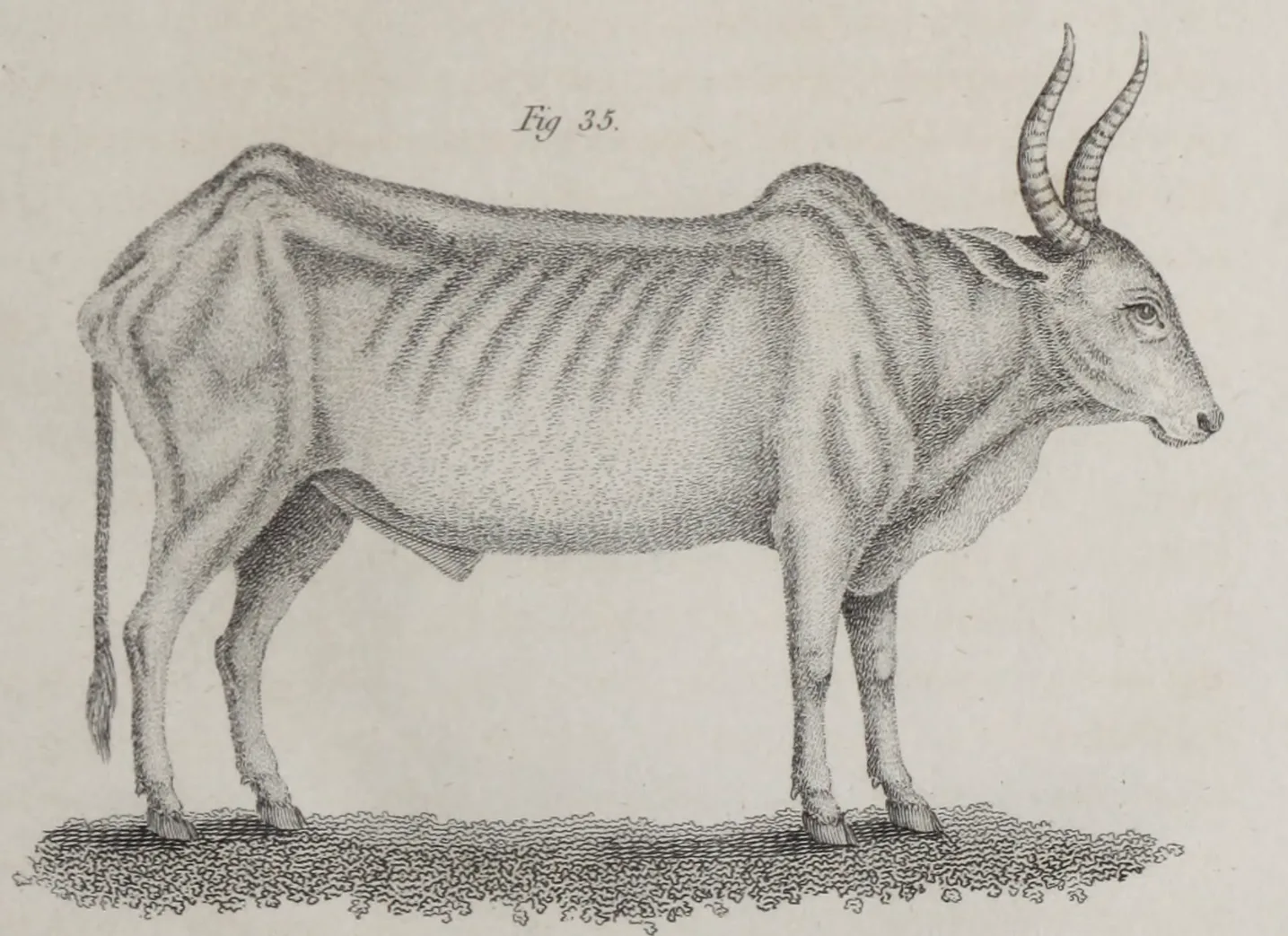
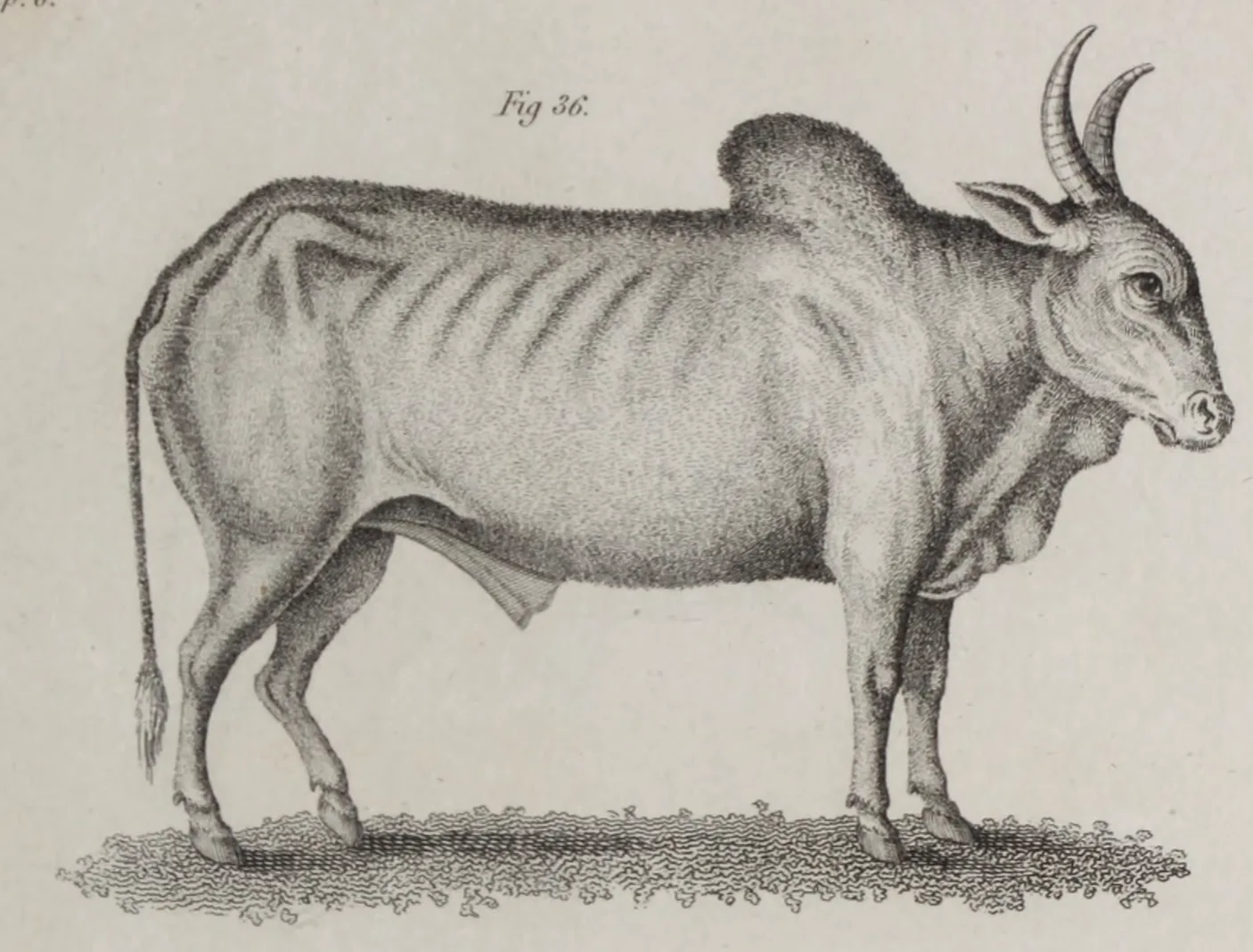
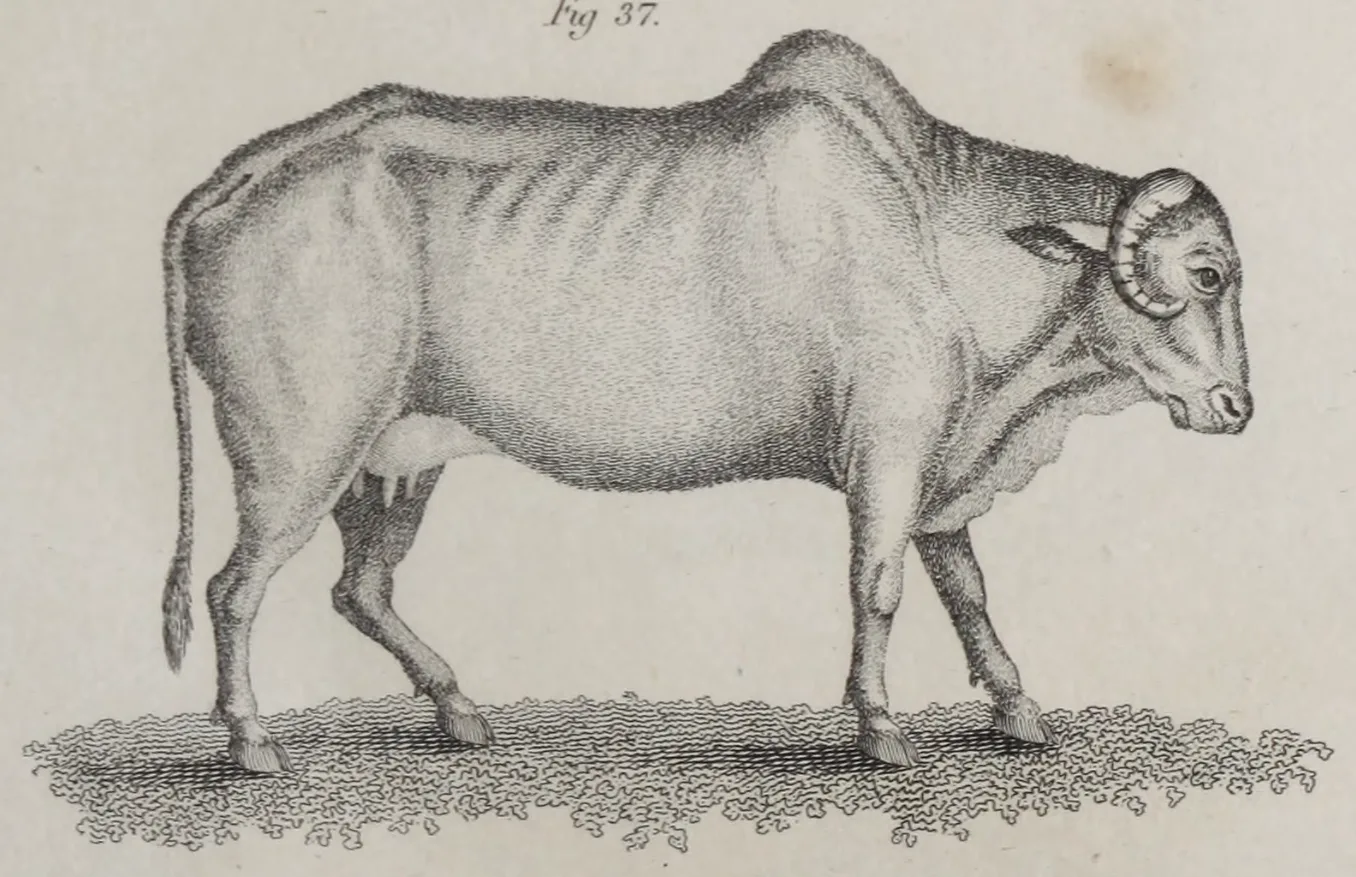
The race of oxen in this country may be readily distinguished from the European species, by the same marks that distinguish all the cattle of India; namely, by a hump on the back between the shoulders, by a deep undulated dewlap, and by the remarkable declivity of the os sacrum. But the cattle of the south are easily distinguished from those of Bengal by the position of the horns. In those of Bengal the horns project forward, and form a considerable angle with the forehead; whereas in those of the south the horns are placed nearly in the same line with the os frontis. In this breed also, the prepuce is remarkably large; and vestiges of this organ are often visible in females; but this is not a constant mark.
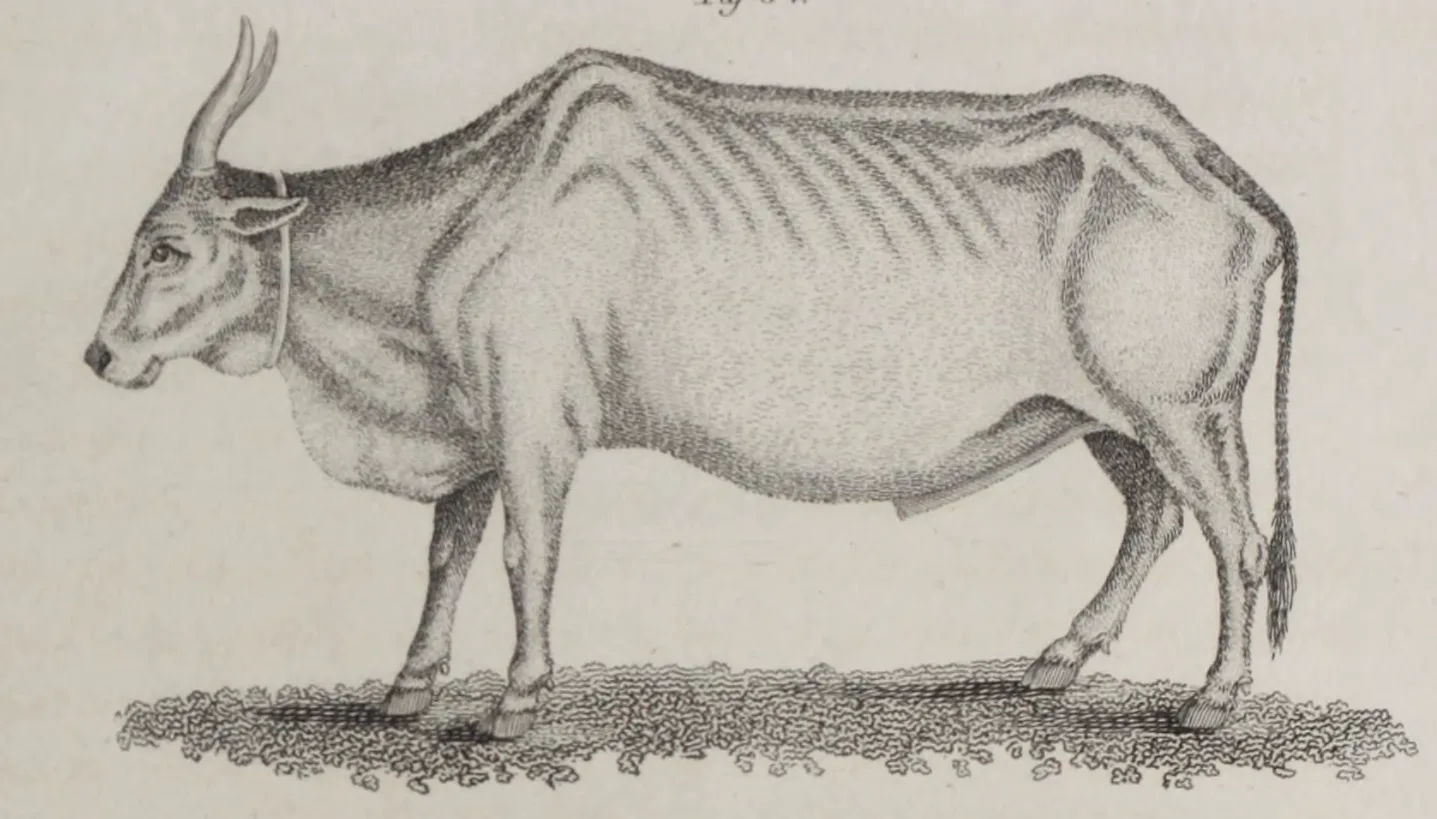
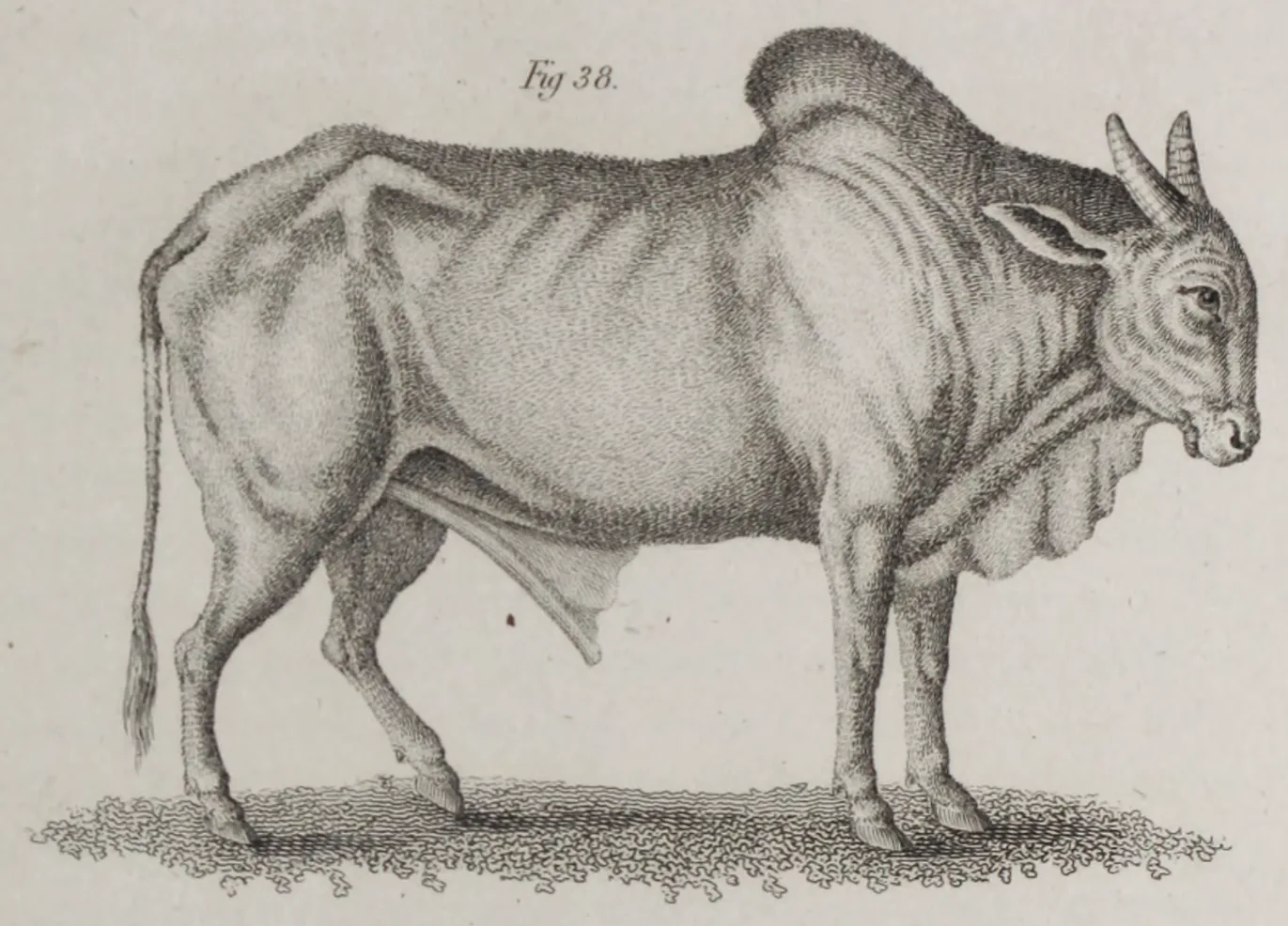
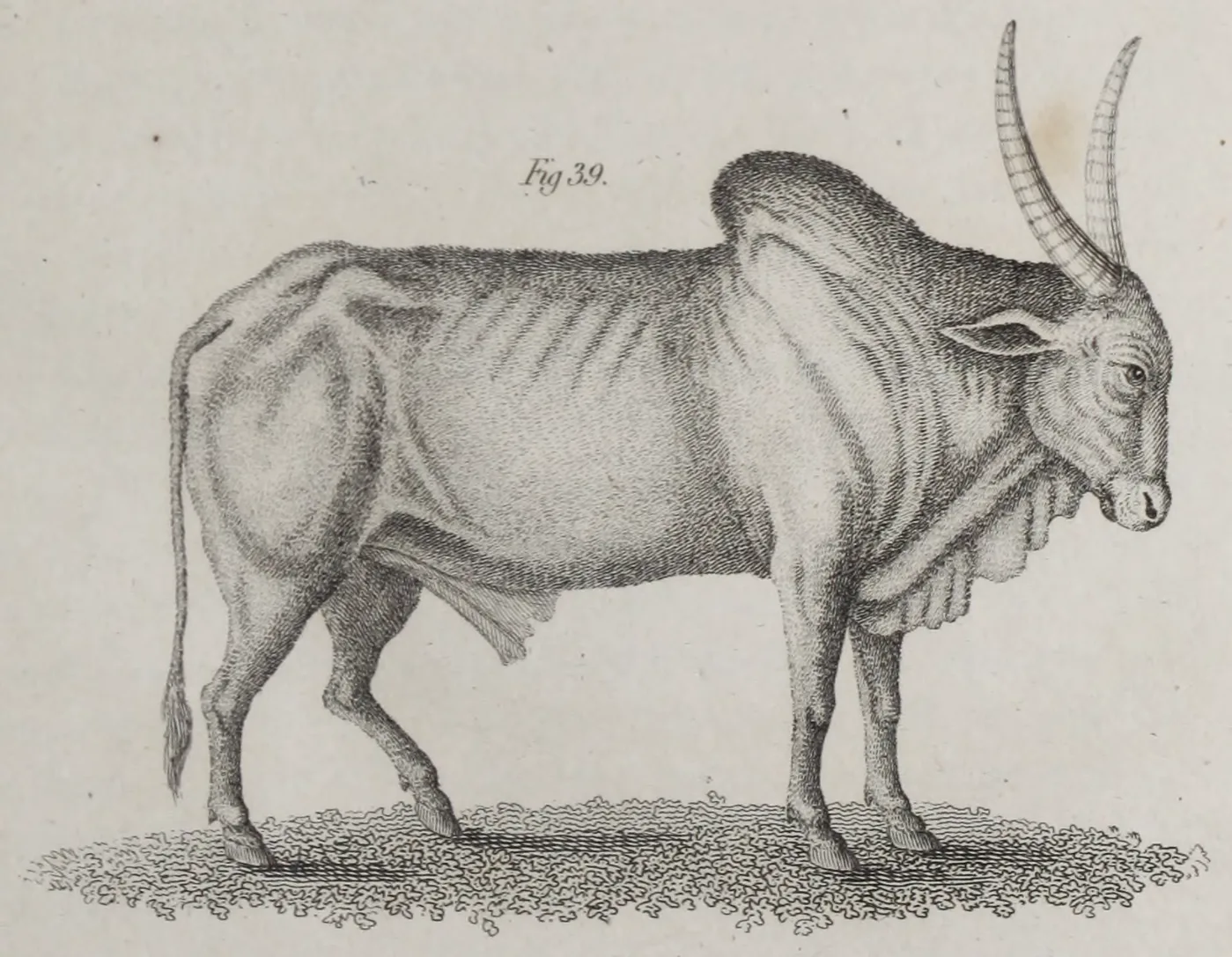
Of this southern species there are several breeds of very different qualities. Plates XIII. XIV. and XV. contain sketches of some of them. Above the Ghats, however, two breeds are most prevalent. The one is a small, gentle, brown, or black animal: the females are kept in the villages for giving milk, and the oxen are those chiefly employed in the plough; their short, thick make enabling them to labour easily in the small rice-plots, which are often but a few yards in length. This breed seems to owe its degeneracy to a want of proper bulls. As each person in the village keeps only two or three cows for supplying his own family with milk, it is not an object with any one to keep a proper bull; and as the males are not emasculated until three years old, and are not kept separate from the cows, these are impregnated without any attention to improvement, or even to prevent degeneracy. Wealthy farmers, however, who are anxious to improve their stock, send some cows to be kept in the folds of the large kind, and to breed from good bulls. The cows
[p. 9]
Vol. II. p. 8. — PLATE XIII. — Fig 34. — MADRAS OX. — Fig 35.MADHU-GIRI OX. — Warner sc.
[p. 11]
Vol. II. p. 8. — PLATE XIV. — Fig 36. — MADHU-GIRI BULL. — Fig 37.MADHU-GIRI COW. — Warner sc.
[p. 7]
Vol. II. p. 8. — PLATE XV. — Fig. 38. — SERINGAPATAM BULL.from the late Sultan's herd. — Fig. 39.SERINGAPATAM OX. — Warner sc.
[p. 9]
sprung from these always remain at the fold, and in the third generation lose all marks of their parents degeneracy. The males are brought home for labour, especially in drawing water by the Capily; and about every village may be perceived all kinds of intermediate mongrels between the two breeds.
In the morning the village cows are milked, and are then collected in a body, on the outside of the wall, with all the buffaloes and oxen that are not employed in labour. About eight or nine in the morning the village herdsman, attended by some boys or girls, drives them to the pasture. If the flock exceeds 120, two herdsmen must be kept, and their herds go in different directions. The pastures are such waste lands as are not more than two miles distant from the village, and are in general poor; the tufts of grass are but thinly scattered, and the bare soil occupies the greater space. This grass, however, seems to be of a very nourishing quality, and the most common species is the Andropogon Martini of Dr. Roxburgh’s manuscripts. At noon, and at four o’clock, they are driven to water, to raise which the Capily is often employed. At sun-set they are brought home; and in the rainy season the cow-house is smoked, to keep away the flies. In the back yard of every house stands a large earthen pot, in which the water used for boiling the grain consumed by the family is collected; and to this are added the remains of curdled milk, of puddings, and a little flour, oil-cake, or cotton seed. This water becomes very sour, and is given as a drink to the cows in the evening, when they are again milked. At night, in the rainy season, the cattle get cut grass, which is collected in the woods, and about road sides: this last is the most nutritious, the very succulent roots being cut up with the leaves, and the situation preventing the harsh stems from growing. In dry weather, the cattle at night have straw. Those who can afford it, chiefly Bráhmans, give their milch-cows cotton-seed and Avaray. The working cattle ought to have Horse-gram. After the [p. 10] milk for the family has been taken, the calves are allowed to suck; and unless they be present, as is usual with all the Indian race of cattle, the cows will give no milk. The cows here go nine months with calf, begin to breed at three years of age, and continue until 15 years old. They breed once a year, but give milk for six months only. A good cow of the village kind gives twice a day from four to six Cucha Seers, or from about 2½ to 3¾ pints ale measure.
The cattle of the other breed are very fierce to strangers, and nobody can approach the herd with safety, unless he be surrounded by Goalas, to whom they are very tractable; and the whole herd follows, like dogs, the man who conducts it to pasture. The bulls and cows of this breed never enter a house; but at night are shut up in folds, which are strongly fortified with thorny bushes, to defend the cattle from tigers. At 5 years old the oxen are sold, and continue to labour for twelve years. Being very long in the body, and capable of travelling far on little nourishment, the merchants purchase all the best for carriage. To break in one of them requires three months labour, and many of them continue always very unruly. The bulls and cows were so restless, that, even with the assistance of the Goalas, I could not get them measured; but the dimensions of a middle sized ox were as follow: From the nose to the root of the horn, 21 inches. From the root of the horn to the highest part of the hump, 30 inches. From the height of the hump to the projecting part of the ossa ischia, 45 inches. From the hump to the ground 46 inches. From the top of the hip-bones to the ground 51 inches.
The cows of this breed are pure white; but the bulls have generally an admixture of black on the neck and hind quarters. These cattle are more subject to the disease than the cattle living in villages; and once in three years an epidemic generally prevails among them. It is reckoned severe when one-third of a man’s stock perishes, although sometimes the whole is lost; but in general, as all [p. 11] the cows are reserved for breeding, the loss occasioned by one epidemic is made up before another comes.
These cattle are entirely managed by Goalas; and some of these people have a considerable property of this kind: but the greater part of these breeding flocks belong to the rich inhabitants of towns or villages, who hire the Goalas to take care of them; and, for the advantage of better bulls, send to the fold all their spare cows of the village breed. In procuring bulls of a good kind, some expense is incurred: for the price given for them is from 10 to 20 Pagodas (3l. 7s. 1d. to 6l. 14s. 2d.), while from 8 to 15 Pagodas is the price of an ox of this kind. Care is taken to emasculate all the young males that are not intended for breeding, before they can injure the flock.
The Goalas live in huts near the small villages, in parts of the country that contain much uncultivated land, and are surrounded by the folds, in which they always keep as many cattle as will cultivate a little land, and as the pasture near the place will maintain. But as local failures of rain frequently occasion a want of forage near their huts, some of the men drive their flocks to other places where the season has been more favourable, and either take up their abode near the huts of some other Goalas, giving them the dung of their fold for the trouble which they occasion, or live in the midst of woods, in places where the small reservoirs, called Cuttays, have been formed to supply their cattle with water. All the breeding and young cattle, with all the sheep and goats, are carried on these expeditions; but a few labouring cattle and the buffaloes are left at home in charge of the women, and of the men who can be spared from accompanying the flocks. During the whole time that they are absent the Goalas never sleep in a hut; but, wrapped up in their blankets, and accompanied by their dogs, they lie down among the cattle within the folds, where all night they burn fires to keep away the tigers. This however is not always sufficient, and these ferocious animals sometimes break through the fence, and [p. 12] kill or wound the cattle. The men have no fire-arms, the report of which would terrify the cattle; and for driving away the tiger, they trust to the noise which they and their dogs make. They are also much distressed by robbers, who kill or carry away the sheep and goats; but unless it be a numerous rabble that call themselves the army of a Polygar, no thieves can annoy their black cattle; for these are too unruly to be driven by any persons but their keepers, and the most hardened villain would not dare to slaughter an animal of this sacred species.
Exclusive of the buffaloes, which are managed as I have described at Seringapatam, the cattle of the Goalas have nothing to eat, except what they pick up in the wastes. The cows and sheep eat grass, and the goats the leaves of every kind of tree, bush, or climber, those of the Periploca emetica W: excepted. Each kind of cattle must have a separate fold. From this, when at a distance from home, they are driven out at sun-rise, as then the calves get all the milk, except a little used by the herdsmen; but near the village the cows are milked every morning; and this operation, which is performed by the men, takes up two hours. From each about two Seers, or 1¼ pint, only are taken. They are indeed miserably lean, and at twenty yards distance their ribs may be distinctly counted. The cattle are once a day conducted to the water; and the calves, after they are a month old, follow their mothers to pasture: before that they remain in the fold, under the charge of the man who cooks.
When a rich man sends a flock of a hundred cows under the care of the Goalas, he allows wages for two men, each of whom has annually 60 Fanams, with a blanket and pair of shoes; in all, worth about 2l. 5s. 1d.; and when they come on business to their master's house, they get their victuals. For grass he pays also five Fanams a year to the keeper of the forest. These (3s. 4d.) with the two men's wages, making in all 4l. 13s. 2d. are the whole of his annual expence. The profits, when no disaster happens, will be: for Ghee, [p. 13] or boiled butter, 8 Pagodas; for sour curds, butter-milk, &c. 4 Pagodas; for 20 three-year-old bullocks 60 Pagodas; in all 72 Pagodas, or 720 Fanams, or 24l. 3s. 6d.: from this deduct the expense, and there will remain 19l. 10s. as the gain upon the original stock, which may be estimated at 150 Pagodas for the 100 cows, and 30 Pagodas for the two bulls; in all, 1300 Fanams, or 43l. 13s. which is almost 45 per cent. annually on the original value of the stock.
The Goalas keep many Curis, and Maykays, or sheep and goats. These always accompany them in their expeditions; and even those who are servants to the rich men generally carry with them flocks of sheep and goats, or are accompanied by some men possessed of that stock; so that less than four men never go together. The sheep are more subject to the disease than the cows, and the goats still more so than the sheep. A flock of a hundred small cattle requires the attendance of two men, and two dogs; and these have more profit from their own small herd, than the men who serve the rich to take care of cows. This they acknowledge themselves; yet they will only allow the profits of the 100 goats to amount to 100 Fanams a year; that is to say, 80 Fanams for 30 three-year-old males, and 20 Fanams for boiled butter. They eat the old females, and give the keeper of the forest two males for every hundred, in order to obtain his permission to cut the trees, that the goats may procure leaves.
A Goala, that is reckoned rich, will have 200 cows, 30 female buffaloes, 50 ewes, and 100 she goats; and will keep as many labouring oxen as will work three ploughs. Such a man, Trimula Náyaka says, besides paying rent, and finding his family in provisions, will annually make 100 Pagodas, or 33l. 10s. 10d. His clothing, being a blanket, costs a mere trifle; and part of the money he expends in the marriages of the younger branches of the family, and in religious ceremonies; the remainder is in general buried, and a great deal of money is in this way lost; as when the men get [p. 14] old, and stupid, they forget where their treasures are hidden, and sometimes die without divulging the secret.
The farmers also keep small flocks of goats and sheep, which are sent, under the charge of a boy, to the pastures near the village. In the evening they are brought home; when the goats are taken into the house, and the sheep are folded on the field of their proprietor.
The cattle in this country, as I have already mentioned, are milked by the men, who carry the produce home to the women; for they prepare the butter. The milk, on its arrival, is immediately boiled for at least one hour; but two or three hours are reckoned better. The earthen pots, in which this is done, are in general so nasty, that after this operation no part of the produce of the dairy is tolerable to an European; and whatever they use, their own servants must prepare. The natives never use raw milk, alleging that it has no flavour. The boiled milk, that the family has not used, is allowed to cool in the same vessel; and a little of the former days Tyre, or curdled milk, is added to promote its coagulation, and the acid fermentation. Next morning it has become Tyre, or coagulated acid milk. From the top of each potful, five or six inches of the Tyre are taken, and put into an earthen jar, where it is churned by turning round in it a split Bamboo. This is done very expertly by a rope, which, like that of a turner’s lathe, is passed two or three times round the Bamboo, and a quick motion in contrary directions is given by pulling first one end of the rope, and then the other. After half an hour’s churning, some hot water is added, and the operation is repeated for about half an hour more; when the butter forms. The natives never use butter; but prefer, what is called Ghee, not only as that keeps better, but also as it has more taste and smell. In order to collect a quantity sufficient for making Ghee, the butter is often kept two or three days; and in that time a warm climate renders it highly rancid. When a sufficient quantity has been collected, it is melted in an earthen pot, [p. 15] and boiled until all the water mixed with the butter has evaporated. It is then taken from the fire; and, for what reason I could not learn, a little Tyre and salt, or Betel-leaf and reddle, are added. It is kept in pots, has a very strong smell, and is best preserved from spoiling by a little tamarind and salt, which at any rate enter into the dishes of all the natives that can afford to use Ghee. It is eaten when even a year old. Three Pucka Seers, or 252 Rupees weight of buffaloes milk, give 100 Rupees weight of Ghee; the same quantity of cow and buffalo milk mixed, as usual, give 80 Rupees weight; cow milk alone gives 60 Rupees weight, and goat milk only 40 Rupees weight.
12th August.—Having been informed, that Chin’-náráyan’-durga was distant three cosses, I ordered my tents to be pitched at that place; but on coming up, I found that the distance was only one coss. In this country, it is indeed very difficult to get any accurate information concerning routes and distances. The road leads through a very narrow rugged valley, capable of very little cultivation. It is situated in the highest part of the country, the water from its north end running into the northern Pinákaní, while the Cávéri receives the torrent flowing from its southern extremity. Chin’- náráyan’-durga, by its situation, is a strong place, and is garrisoned by the troops of the Mysore Rája. It is greatly inferior in appearance to Madhu-giri, although it is said to have been the favourite residence of Chicuppa Gauda. The town is the Kasba, or capital of a district, but is very poor. Nothing can be rougher than the neighbouring country, which at first sight appears a mass of rocks and bare hills thrown confusedly together; but on a nearer inspection, many fertile spots are observed.
In the neighbouring woods is found abundance of the Popli bark, which I have frequently mentioned as a dye, and as an article of export. It is the bark of the root of a large scandent plant, which climbs to the top of the highest trees. I saw neither flower nor fruit, so can say nothing of its botanical affinities; and the specimens [p. 16] of the stem and leaves were not known to Dr. Roxburgh. It is collected by some Baydarus, who are in the service of the Gydda Cavila, or keeper of the forest.
13th August.—I went three cosses to Tavina Caray, in company with the Amildar, who seems to be a very industrious man. He says, that last year he brought 200 ploughs into his district, and that 200 more would be required for its full cultivation. Near Chin’-náráyan’-durga the country, for the most part, consists of a rugged valley surrounded by hills; but the fields between the rocks were formerly cleared, and well cultivated, and are said to be very favourable for Ragy, the rock enabling the soil to retain moisture. Among these rugged spots we visited some iron and steel forges, which had indeed induced me to come this way. The information procured on this subject, is as follows.
Iron is smelted in various places of the following Talucs, or districts; Madhu-giri, Chin’-náráyan’-durga, Hagalawadi, and Déva-ráya-durga. In the first two districts the iron is chiefly made from the black-sand which the small torrents formed in the rainy season bring down from the rocks. In the two latter districts, it is made from an ore called here Cany Callu, which is found on the hill Kindalay Guda, near Muga-Náyakana-Cotay in the Hagalawadi district. A little of the same iron ore is also procured from a hill, called Kaymutty, near Muso-conda in the district of Chica-Náyakana-Hully.
The manner of smelting the iron ore, and rendering it fit for the use of the blacksmith, is the same here as near Magadi. The people belonging to the smelting-house are four bellows-men, three men who make charcoal, and three women and one man who collect and wash the sand. They work only during the four months in which the sand is to be found; and for the remainder of the year they cultivate the ground, or supply the inhabitants of towns with fire-wood. The four men relieve each other at the bellows; but the most skilful person takes out the iron, and builds up the furnace; [p. 17] on which account his allowance is greater. In each furnace the workman puts first a basket (about half a bushel) of charcoal. He then takes up as much of the black sand as he can lift with both his hands joined, and puts in double that quantity. He next puts in another basket of charcoal, and the fire is urged with the bellows. When the first charcoal that has been given burns down, he puts in the same quantity of sand, and one basket of charcoal; and does this again, so soon as the furnace will receive a farther supply. The whole quantity of sand put in at one smelting measures 617 cubical inches, and weighs, when dry, about 42 1/2 lb. avoirdupois. This gives a mass of iron, which, when forged, makes 11 wedges, each intended to make a ploughshare, and weighing fully 1 82/100 lb. The workmen here, therefore, procure from the ore about 47 per cent. of malleable iron; but, as usual in India, their iron is very impure.
In the forging-house are required 3 hammer-men, one man to manage the forceps, 2 bellows-men, and 4 men to supply charcoal, which for this purpose is always made of the Bamboo. Every day three furnaces are smelted, and 33 wedges forged. The workmen are always paid by a division of the produce of their labour; and every fourth day, or when 132 pieces have been prepared, the division is made as follows.
Pieces.
To the proprietor
35
To the Panchála, who is the fore-man at the forge
10
To the fore-man at the smelting-house
8
To one of the bellows-men, who removes the ashes and dross
5
To two of the women, who wash the sand, at 5 each
10
To the remaining 16 persons, at 4 each
64
132
The Panchála, or black-smith, out of his wages, is bound to find all the iron instruments, such as the anvil, the hammers, and the forceps. The proprietor defrays all other expenses; and these are,
[p. 18]
Fanams.
To the keeper of the forest, for permission to make charcoal
100
To the Gauda, or chief of the village, for leave to gather iron sand
40
To ditto for furnace rent
15
To the Sunca, or collector of customs
30
To a pair of bellows for the smelting-house
42
To ditto for the forge
24
To sacrifices
15
To charity for the Bráhmans
10
Fanams
276
The buildings are so mean that they go for nothing; and at the beginning of the season are put up by the workmen in the course of a day.
The stone-ore is made into iron exactly in the same manner; the quantity put into the furnace, and the produce, being nearly the same. The iron from the stone ore is reckoned better for all the purposes to which malleable iron is applied, but it sells lower than the iron made from the sand; for this last is the only kind that can be made into steel. The stone-iron sells at 6 pieces for the Fanam; and the people who work it are paid by daily wages. The wedges that it forms are larger than those of the sand iron, and weigh from 3 to 4 Seers each; so that this iron costs about 6s. 10d. a hundred-weight. The iron made from the sand sells at four pieces for the Fanam, or about 10s. 4d. a hundred-weight, the pieces weighing, according to estimate, only three Seers. I am inclined, however, to think, that on an average they weigh at least a tenth part more; but it would be difficult to ascertain this, as the pieces differ considerably in size, and are never sold by weight.
It must be evident, that in this account the head-man, wishing to conceal his profit, deceived us. For thirty dividends can only take place in the course of four months; and, each dividend giving [p. 19] him 35 wedges of iron, he will receive in all 1050 pieces, which, at the usual price, are worth only 262½ Fanams; so that in the course of the year, his expenses being 276 Fanams, he would lose 13½ Fanams, while the lowest workman gets monthly 7½ Fanams, or about 5s. which is more than is earned by the common labourers of the country. The point in which I think he attempted to deceive was in the number of days that the people wrought. If they smelted every day in the year, his profits would be very great; but allowing for many interruptions, owing to the avocations of agriculture, and to occasional deficiencies of sand, we may safely suppose that the forge is employed 6 months in the year; and then the profits of the proprietor will be about 100 Fanams, which is nearly in the same proportion to his stock, as the gains of the breeder of cattle are to his property. At this rate, the quantity smelted in each set of works, taking my estimate of the weight of each piece, will be about 106 hundred-weight; and the 19 forges, stated in the public accompts to be in this district, and that of Madhu-giri, will yearly produce about 100 tons of iron, worth nearly 1000l.
[p. 18]
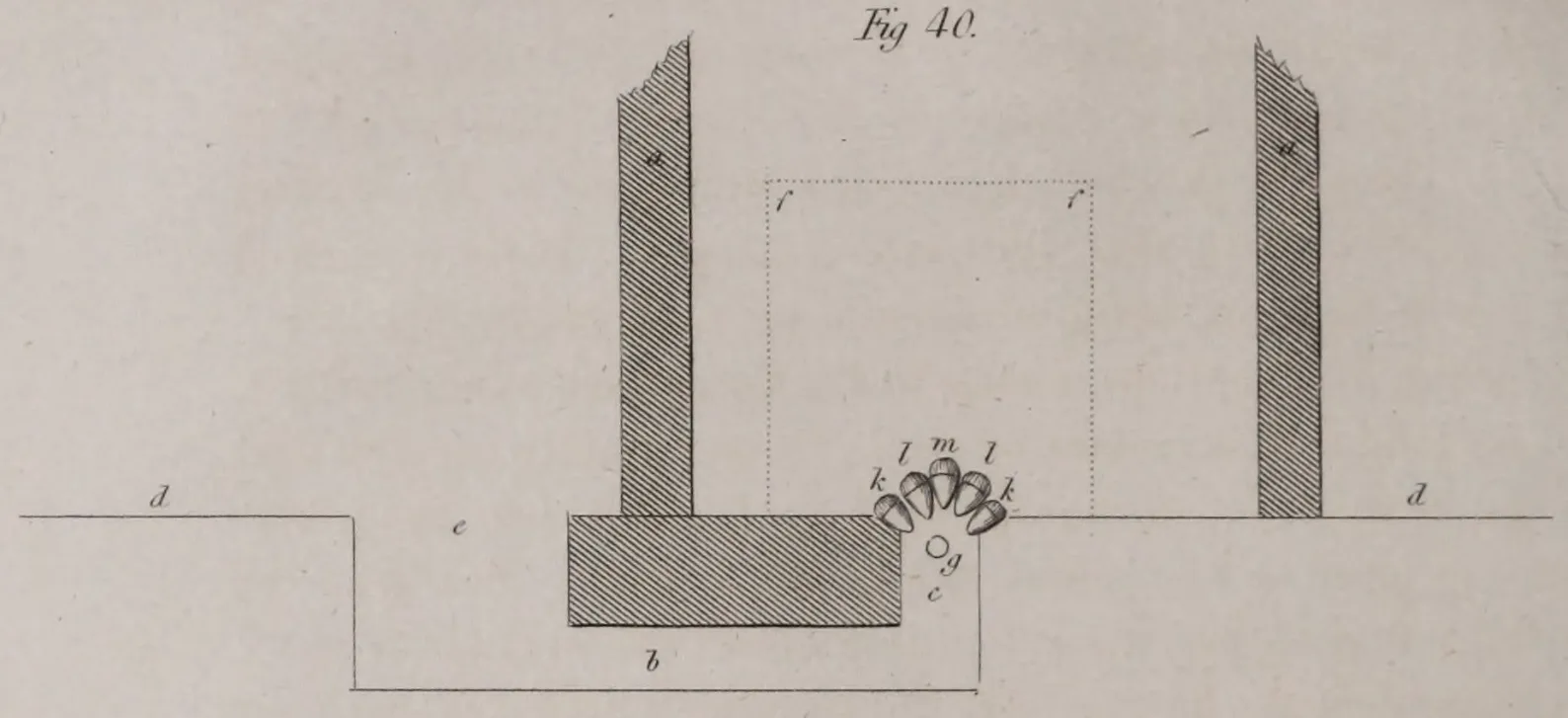
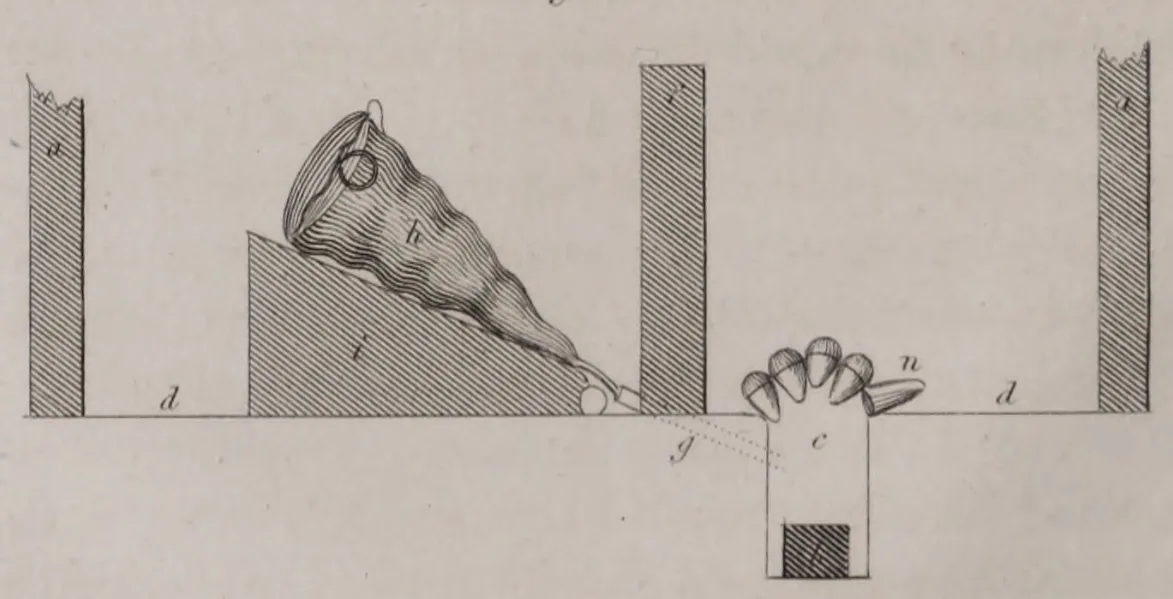
Section of a steel furnace in the direction of the Ash-pit. — Fig 40. — Section of a steel furnace at right angles to the Ash-pit. — Fig 41.
For making steel, there are in this vicinity five forges; four in this district, and one in Déva-Ráya-Durga. To enable the workmen to give them a supply, the merchants frequently make advances; for almost the whole is exported. It is used for making stone-cutters-chisels, sword-blades, and the strings of musical instruments. The furnace (see Plate XVI. Fig. 40, 41.) is constructed in a hut (a); and consists of a horizontal ash-pit (b), and a vertical fire-place (c), both sunk below the level of the ground (d). The ash-pit is about ¾ of a cubit in width and height, and conducts from the lower part of the fire-place to the outer side of the hut, where it ends in a square pit (e), in which a man can sit, and with a proper instrument draw out the ashes. The fire-place is a circular pit, a cubit in diameter, and descends from the surface of the ground to the bottom of the ash-pit, being in all two cubits deep. Its mouth is a little dilated. Parallel to the ash-pit, and at a little distance from the [p. 20] mouth of the fire-place, in order to keep the workman from the sparks and the glare of the fire, is erected a mud wall (f) about five feet high. Through the bottom of this passes an earthen tube (g) which conducts into the fire-place the wind of two bellows (h). The bellows are as usual supported on a bank of earth (i), and consist each of a bullock's hide; they are wrought, as in other places of this country, by the workman passing his arm through a leather ring.
The crucibles are made, in a conical form, of unbaked clay, and each would contain about a pint of water. In each is put one third part of a wedge of iron, with three Rupees weight (531 grains) of the stem of the Tayngada or Cassia auriculata, and two green leaves of the Huginay, which is no doubt a Convolvulus, or an Ipomea with a large smooth leaf; but never having seen the flower, I could not in such a difficult class of plants attempt to ascertain the species. The mouth of the crucible is then covered with a round cap of unbaked clay, and the junction is well luted. The crucibles, thus loaded, are well dried near the fire, and are then fit for the furnace. A row of them (k) is first laid round the sloping mouth of the fire-place; then within these another row is placed (l); and the center of this kind of arch is occupied by a single crucible (m), which makes in all fifteen. That crucible in the outer row (k) which occupies the place opposite to the muzzle of the bellows, is then taken out, and in its stead is placed horizontally an empty crucible (n). This the workman, who manages the fire, can draw out when he pleases, and throw fewel into the fire-place. The fuel used is charcoal prepared from any kind of tree that grows in the country, except the Ficus Bengalensis, and the Chloroxylon Dupada of my manuscripts. The fire-place being filled with charcoal, and the arch of crucibles being covered with the same fewel, the bellows are plied for four hours; when the operation is completed. A new arch is then constructed, and the work goes on night and day; five sets, of 14 crucibles each, being every day converted into steel. When the crucibles are opened, the steel is found melted into a button, [p. 21] with evident marks on its superior surface of a tendency to crystallization; which shows clearly, that it has undergone a complete fusion. It is surrounded by some vitrified matter, proceeding from the impurities of the iron, and probably nearly equal to the quantity of carbon absorbed from the sticks and leaves shut up in the crucible; for the steel in each crucible is by the workmen reckoned to weigh 1¼ Seer. These buttons, however, are never sold by weight, and those that I tried weighed very little more than one Seer of 24 Rupees. In some crucibles the fusion is not complete; in which case, the steel is of a very inferior quality, and differs but little from common iron.
The number of people employed at one of these works is thirteen; a head workman, who makes the crucibles, loads them, and builds up the arch; and four reliefs of inferior workmen, each consisting of three persons, one to attend the fire, and two to work the bellows. Each set therefore, in the working season, labours only four hours in the day; except every fourth day, when they must attend double that time. They are all cultivators; and in the leisure time which they have from the furnace, they manage their fields. There is also a proprietor, who advances all the money required, and who receives payment when the steel is sold. Fifteen Pagodas worth of iron is purchased; two for the head workman, and one for each labourer, and for the proprietor. This iron is then given to the head workman, who for three months is occupied in making the crucibles, loading them, and preparing the furnace. During this time the twelve workmen bring him clay, repair the buildings, and make charcoal; but these labours occupy only intervals, that could not be employed on their small fields of Ragy. In the fourth month, when all has been prepared, they convert the 15 Pagodas worth of iron into steel, as above described. Every man then takes the steel which his iron has produced; and the proprietor is repaid for his advances. Another quantity of iron is then purchased, and the same process is repeated; so that by each furnace 45 Pagodas worth [p. 22] of iron is, in the course of the year, converted into steel. Besides the money advanced for iron, the proprietor, for the immediate subsistence of the workmen, is occasionally under the necessity of advancing them money; and he must also pay the general expenses attending the forge. These are:
Fanams.
To the keeper of the forest, for leave to make charcoal
110
To the Sunca, or collector of the customs
30
To the Gauda, or chief of the village, for house-rent
15
To sacrifices
30
To bellows
42
To the Bráhmans as charity
20
Fanams 247
Every man, however, repays his share of this, in proportion to his quantity of steel; and the whole profit of the proprietor is the having three Pagodas worth of iron converted into steel, for which he will in general be in advance about 40 Pagodas. He therefore requires a capital to that extent; unless he can borrow it from some merchant, which indeed he generally does.
The 45 Pagodas procure 1800 wedges of iron, and on an average procure 4500 pieces of good steel; which, at 2½ for the Fanam, are equal to - - - - Fanams 1800
900 pieces of bad steel, at 6 Fanams
150
1950
Deduct general charges
Fanams 247
Price of iron
450
697
Neat gain
1253
The neat gain, 1253 Fanams, divided by 15, gives 83½ Fanams clear profit for each share. The workman's wages are equal to one share, and thus amount to about 7 Fanams a month; with double that for the foreman, because he gives up his whole time to the [p. 23] business. These wages are good; but the allowance for the proprietor is small, unless we consider, that he in general gets the money from the merchant, and that his only claim for reward is some trouble in settling the accompts, and the risk of some of the people running away with the advances made to them. Among the natives themselves, however, very little danger arises from this cause, as they are perfectly acquainted with the characters of the individuals employed.
Taking the estimate of the natives, of 30 Rupees weight being the true average of the pieces of steel, the quantity of stee, fit for exportation, that is annually made in this vicinity, will be about 152 hundred weight, and its value about 300l. or 2l. a hundred weight.
Having examined the iron and steel works, the Amildar and I visited a fine tank, which is said to have been constructed by Krishna Ráyalu of Vijaya-nagara; and it is the finest work of the kind that I have yet seen above the Ghats: unfortunately, it has long been out of repair, and lofty trees now cover all the fields which it watered. It is said, that it would require 10,000 Pagodas (about 3354l.) to remove all the mud collected in its bottom, and to put it in complete order. A partial repair has just now been given, and it will be able to water some part of its former fields: the remainder will be cleared, and cultivated for Ragy, until other more urgent demands shall allow the repair to be completed.
As we approached Tavina-Caray, the country becomes open; and I observed that every field was cultivated. Tavina-Caray is a small town; but several additions to it are making. Some streets in the Petta are well laid out; and, as an ornament before each shop, a coco-nut palm has been planted. The fortress, or citadel, is as usual almost entirely occupied by Bráhmans. This might seem to be an improper place for men dedicated to study and religion; but in cases of invasion their whole property is here secure from marauders; while the Súdras, who are admitted during the attack as defenders, [p. 24] must lose all their effects, except such moveables as in the hurry they can remove.
14th August.—I went to Tumcuru, the chief place of a district, called also Chaluru. The country is the most level, and the freest from rocks, of any that I have yet seen above the Ghats. I observed only one place in which the granite showed itself above the surface. The soil in most places is good, and might be entirely cultivated. Near Tavina-Caray it is so; but as I approached Tumcuru, I observed more and more waste land. I understand, that the late Amildar did not give the people proper encouragement; and about twenty days ago he was removed from his office. By the way I passed nine or ten villages, all fortified with mud walls and strong hedges. At some distance on my left were hills; and the prospect would have been very beautiful, had the country been better wooded; but, except some small palm gardens scattered at great distances, it has very few trees. Tumcuru is a town containing five or six hundred houses. The fort is well built, and by the late Amildar was put in excellent repair. The Petta stands at some distance. The great cultivation here is Ragy, but there are also many rice-fields. This year there will be no Kártika crop, as at present the tanks contain only eight or ten days water.
Here, as in several other parts of the country, there are people of a Karnáta tribe of Bestaru, who, although they do not intermarry with the Telinga Bestas, are so nearly allied, that they will eat together. They never carry the Palankeen, their principal occupation being the burning of lime-stone. Some of them are small farmers; but they never hire themselves out as hinds, or Batigaru. This tribe are called also Cubbaru. They have hereditary chiefs, called Ijyamánas, who, with a council of the heads of families, settle disputes, and excommunicate those who, notwithstanding admonition and reprimand, obstinately persist in bad practices. If a woman commit adultery with a strange man, she is excommunicated; but if it be with a Cubba, both the adulterer and the husband are fined; the [p. 25] one as a corrupter, and the other for having been negligent. An assembly of at least ten of the tribe is called, and the woman is asked before the people, whether or not she chooses to return to her husband. If she consents, and he agrees to receive her, as is usually the case, he gives the assembly a dinner, and no one afterwards mentions the affair. If the parties cannot agree, the marriage is dissolved. This cast does not admit the connection called Cutiga. The women are extremely industrious, and hence are very valuable to their husbands, and are independent of them for support; which seems to be the reason of their possessing such a licence in their amours. After the age of puberty they continue to be marriageable. Except a few rich men, the Bestas of Karnáta generally content themselves with one wife, unless the first has no children, or has had only daughters. In such cases, even the poor struggle to procure a second wife, to keep up the family. They are allowed to drink spirituous liquors and to eat animal food. None of them can either read or write. They bury the dead, and seem to have no knowledge nor belief in a future state; but they appeared very willing to assent to any thing that either I or my interpreter said on the subject. This, however, did not proceed from any conviction of its truth; but merely from civility, they being unwilling to contradict persons who were supposed to be better informed than themselves. They neither make the vow of Dáséri, nor believe in the spirits called Virika. The goddess of the cast is Yellama, one of the Saktis, in whose temples the Pujáris are persons of this tribe. They offer sacrifices to her, and to all the other destructive spirits; but say that they are of Vishnu's side. They have a Guru; yet, although he was here fifteen days ago, they know very little about him. He is a married man, is named Linguppa, and was attended by servants of the Curuba cast. His disciples here were Cubbaru, Curubas, and some other cultivators. He slept in one of the temples of the Saktis. All these circumstances would point him out to be a worshipper of Siva, and one of the Curubaru Jangamas; but he [p. 26] wore a thread, and marked his forehead with turmeric, like a woshipper of Jaina. He gave the Cubbas turmeric to mark their foreheads, and accepted of their Dharma, or charity. His Matam, or college, is at Meilar, near Savanuru. The Panchánga acts as Puróhita at marriages, Mala-paksha, and births. For his trouble, he receives rice, or other provisions, but is sometimes paid in lime; money being rather scarce among this tribe.
The Curubas here say, that, at a temple of Bhairawa at Hervay Samudra, which is near Mercasera, to the north of this place, and where one of their cast acts as Pújári, the image represents a man sitting on horseback, with the Linga round his neck, and a drawn sword in his hand. They offer sacrifices to this image, and eat the flesh. The family of Rávana have now spread all over the country; but Sarur is still considered as the proper family seat. Their Guru has the power of restoring any outcast to the enjoyment of full communion. They have a book peculiar to the cast, called Jiraga Chapagodu. It is written in the language of Karnáta, and gives an account of the tribe. The Curubaru buy their wives; a girl of a good family costs from 30 to 40 Fanams; a girl of the bastard or Cutiga breed costs 15 Fanams, or 10s.
The Panchama Cumbharu, or Cumbharu that wear the Linga, are an original tribe of Karnáta. They say that they are of the Gunda Brimmia family, and claim no connection with Sáliváhanam, as the other Cumbharu do. They follow no other profession than the making of earthen-ware. Their hereditary chiefs are called Ijyamanas, and pay annually to government a certain sum for the clay used in their manufacture. The Ijyamana divides this assessment upon the families that are under his authority, so that each pays its proportion. They must also furnish with pots all persons travelling on public business. Each house, besides, pays annually three Fanams, or 2s. The Ijyamanas assemble four persons as a council, and with their assistance settle disputes, and punish transgressions. No higher punishment is inflicted on men than a temporary [p. 27] excommunication. Women, who commit adultery, are entirely excommunicated, and are never allowed to remain as concubines; and the man who seduces another's wife is obliged to pay a fine to the public. They, and the Pancham Banijigas, although they do not intermarry, can eat together; of course, they neither can eat animal food nor drink spirituous liquors. They can marry into any of the forty families descended from Gunda Brimmia; but a man and woman of the same family cannot be married together. The men are allowed to take several wives, who are very industrious in bringing clay, and making cups. The girls continue to be marriageable after the age of puberty; but a widow is not allowed to take a second husband. None of them can read. Like all other persons who wear the Linga, they bury the dead. The men of this cast have no knowledge of a future state, and neither believe in the Vírika, nor take Dáséri. Their principal object of worship is Iswara, represented as usual by the Linga; in sickness they pray to the Saktis, who are supposed to inflict disorders; and they make vows of presenting their temples with money, fruit, and flowers, provided these vengeful powers will relent, and allow them to recover; but they never appease the wrath of the Saktis by bloody sacrifices. Their Guru is an hereditary Jangama, who resides at Gubi, and is called Sank’-ráya. He comes once a year, eats in their houses, accepts of their charity, gives them consecrated ashes, and advises them to follow the duties and labours of their cast. If any of them are in distress, he bestows alms on them. The Panchánga, or village astrologer, reads Mantrams at their marriages, and on the building of a new house, and is thus supposed to render it lucky. The Jangamas attend to receive charity at the Mala-paksha, or annual commemoration of their deceased parents, at births, and at funerals; but do not either read or pray on these occasions.
There are many of the Woculigas, or Súdra cultivators of Karnáta extraction, who wear the Linga. In this neighbourhood these are of the following tribes: Cunsa, Gangricara, Sadru, or Sadu, and Nona. [p. 28] But many of each of these tribes worship Siva without wearing his badge; and still more are worshippers of Vishnu. All those who wear the Linga can eat together, and with the Pancham Banijigas; but they only marry in their own tribes.
The Nona Woculigaru, who are here called Nonabur by the Mussulmans, consider themselves as Súdras, and their hereditary chief is the male representative of a person called Honapa Gauda. This chief always lives at Hosso-hully; but he sends agents to act for him in different parts of the country. He wears the Linga, but many of the tribe worship Vishnu. This, however, produces no separation in cast, the woman always following the religion of her husband. My informants are wearers of the Linga; and say, that besides the worship of this emblem, they pray and offer fruit and flowers to the Saktis, but never sacrifice animals. When any explanation of a future state of rewards and punishments is given by a more learned neighbour, they say that they believe it; but this is done merely out of compliment to his superior endowments; and their worship of the gods seems to be performed entirely with a view of procuring temporal blessings, or of avoiding present evil. They believe that the Vírika, or spirits of men who have died chaste, can cure diseases. The married Jangamas are their Gurus, give them the Linga, and receive contributions in money or grain. At all ceremonies they attend for charity, but do not pray. It is at marriages only that the Panchánga reads his Mantrams. Like most other persons who wear the Linga, they never take Dáséri, and they bury the dead. Some of them can read the Baswa Purána, and many of them understand accompts. They are not allowed to eat animal food, nor to drink spirituous liquors. Their chief, or his deputies, with the assistance of a council, settle disputes, and expel from the cast all transgressors of its rules. These, as usual, are, men who eat forbidden meat, and women who are forgetful of their duty to their husbands. This cast does not admit of concubines of the kind called Cutigas, nor are widows allowed to marry again. The [p. 29] girls, however, continue marriageable after the age of puberty, and all the women are industrious in the labours of the field. The men take as many wives as they can procure.
15th August.—I went three cosses to Gubi; which, although a small town, containing only 360 houses, is a mart of some importance, and has 154 shops. The houses in their external appearance are very mean, and the place is extremely dirty; but many of the inhabitants are thriving, and the trade is considerable. It is said to have been founded about 400 years ago, by a family of Polygars, who resided at Hosso-hully, two miles from hence, and who traced their descent from Honapa Gauda, the hereditary chief of the Nona Woculigaru that I lately mentioned. Honapa Gauda lived about 700 years ago, and his family possessed a country which annually produced about 3000 Pagodas. They were first brought under subjection by the Mysore Rájas, who imposed a tribute of 500 Pagodas. Hyder increased this to 2500, leaving them little better than renters. They were entirely dispossessed by his son, and have returned to their original profession of cultivators; but in their own tribe they still retain their hereditary rank.
From the pride of two contending sects, the Comaties, and the Banijigas, Gubi has lately been in a very disorderly state, and has even been in danger of destruction. The former having erected a temple to a sainted virgin of their tribe, who threw herself into the flames, rather than gratify the lust of a tyrannic Rája, the Banijigas took offence, pretending that such a temple was contrary to the customs of the town; there never before having been in that place any such building. Both parties being obstinate, the one to retain the temple, and the other to destroy it, Purnea last year ordered the town to be divided by a wall; on one side of which the Comaties and their adherents should live, and on the other their adversaries. The Comaties hitherto had on their side some show of reason, as they did not attempt to force any one to honour their saint; but now they became exorbitant in their pretensions; they would not [p. 30] submit to the order of Purnea; and said, that the custom of the town was for all parties to live together, the Bráhmans excepted, who occupied the fort; and that it would be an infringement of the rules of cast for them to be forced into a separate quarter. The Banijigas, to show their moderation, now offered to leave the town altogether, and to build a suburb on the opposite side of the fort, where at present there are no houses. To this also the Comaties, on the same grounds, refused their consent. The quarrel has lately been inflamed, by the chief of the Comaties having, during a procession, entered the town on horseback with an umbrella carried over his head; which are assumptions of rank, that the Banijigas have beheld with the utmost indignation. Purnea, I suppose, thinks that they are least in the wrong, and has appointed one of this cast to be Amildar. He arrived here yesterday with positive orders to assemble a council of wise men; and, these having determined what the custom originally was, to enforce that with the utmost rigour. The Amildar seems to be a prudent man, and not at all heated with the dispute; in which moderation he is not imitated by any one of the inhabitants, except the Bráhmans, who look with perfect indifference upon all the disputes of the low casts. How far the plan proposed will be successful, however, it is difficult to say. Both sides are extremely violent and obstinate; for in defence of its conduct neither party has any thing like reason to advance. If justice be done, both sides will complain of partiality, and murmurs are now current about the necessity of killing a jack-ass in the street. This may be considered as a slight matter; but it is not so, for it would be attended by the immediate desolation of the place. There is not a Hindu in Karnáta that would remain another night in it, unless by compulsion. Even the adversaries of the party who killed the ass would think themselves bound in honour to fly. This singular custom seems to be one of the resources, upon which the natives have fallen to resist arbitrary oppression; and may be had recourse to, whenever the government infringes, or is considered [p. 31] to have infringed upon the customs of any cast. It is of no avail against any other kind of oppression.
At Gubi is one of the greatest weekly fairs in the country, and it is frequented by merchants from great distances. The country, for ten or twelve cosses round, produces for sale coarse cotton cloth both white and coloured, blankets, sackcloth, betel-nut of the kind called wallagram, or neighbouring, coco-nuts, jagory, tamarinds, capsicum, wheat, rice, ragy, and other grains, lac, steel, and iron. Beside the sale of these articles, and of those imported for the consumption of the neighbourhood, this is also an intermediate mart for the goods passing through the peninsula.
From Mudo-Biddery, and Subhramani, two places in the country which we call Canara; from Codagu Bogundi, some place in what we call Coorg; and from a place in Malayála called Calesa, are brought black pepper, cardamoms, rol, the gum, and dupa, the wood, of the Chloroxylon Dupada, Buch: MSS. ginger, betel-nut of Bengal, cinnamon, cabob-china, or cassia-buds; casturi-china, or wild turmeric; capili flour, and a sweet smelling root called cachora. These people take away jirigay, one of the carminative seeds, blankets, sack-cloth, cotton cloths of many kinds, but chiefly coarse; sugar-candy, sugar, the pulse called tovary, tamarinds, and cash.
From Tellichery are brought dates, raisins, nutmegs, saffron, borax, pepper, and terra japonica. The returns are the same as those above mentioned.
The merchants of Gubi frequent a weekly fair, at a place called Biruru, which is east from thence 24 cosses. This is a great resort of the merchants of Nagara, and of Malayala, who sell to those of Gubi black pepper, Deshavara betel-nut, terra japonica, dates, ginger, danya, an umbelliferous seed, garlic, fenugreek, wheat, the pulse called hessaru, and capsicum. They buy sugar and sugar-candy, lac, coarse cotton cloth, sack-cloth, and bagy, or calamus aromaticus, and receive a large balance in money.
[p. 32]
From Seringapatam is brought money to purchase betel-nut, sugar-candy, sugar, jirigay-seed, Madras goods, and blankets.
The merchants of Bangalore, Colar, and other adjacent places, bring cotton cloths, and a few of silk, and take away betel-nut both Deshavara and Wallagram, black pepper, coco-nuts, cinnamon, ginger, terra japonica, capili flour, and carthamus, or cossumba. If the demand be sudden, they bring ready money: but commonly they bring as much cloth, as, when sold, procures their investment backwards; and sometimes even more.
From Namagundla, Gudibunda, and Pallia, which are places near Bala-pura, the merchants bring sugar, sugar-candy, and jagory. They take back betel-nut, coco-nuts, terra japonica, and ginger. The exchange is about equal.
From Pamudi near Gutti, and other places in the country ceded to the Nizam, merchants bring a variety of cotton cloths, and take away coco-nuts, and lac, with a balance in money.
From Haveri, in the Marattah country, merchants bring cossumba, terra japonica, opium, tent-cloth, mailtuta, or blue vitriol for colouring the teeth, borax, sajira, the seed of an umbelliferous plant, and asafœtida. They take away coco-nuts, lac, and money.
Merchants from Gubi, and its neighbourhood, go to Wallaja Petta, near Arcot, with Deshavara betel-nut, and black pepper; and bring back cloth, and all kinds of goods imported by sea at Madras.
Merchants from Saliem, and Krishna-giri bring cloths, and take away betel-nut, pepper, and money.
Trade is allowed to be flourishing at present. At every fair there are sold from 50 to 100 loads of betel-nut, produced in the neighbouring districts of Sira, Hagalawadi, Chica-Náyakana-Hully, Budihalu, Honawully, and Gubi: with about from 20 to 40 loads of Copra, or dried coco-nut, from the same districts. Much, however, of these articles, the produce of these districts, is sold at other places. The load is 8 Maunds, each of 40 Sultany Seers. The average rate of this [p. 33] would give 31,000 Maunds, or 6698 hundred weight of betel-nut; and 12,480 Maunds, or 2704 hundred weight of coco-nut, the produce of these districts, sold annually at Gubi.
The coarse cloths made in the neighbourhood by the Dévángas, Togotas, and Whalliaru, sell from 2 to 6 Fanams for each piece called Shiray. About 100 pieces are sold at each fair, worth in the whole year about 20,000 Fanams, or nearly 666l. In the neighbourhood, however, there are many fairs, where these manufactures are also sold.
Although this is a very short distance from Sira, the Candaca of grain contains only 320 Seers, and the shells called Cowries are not at all current. The Batta, or allowance made for exchanging gold to copper, is 1/52, or not quite 1/2 per cent. on the regulated price.
The country, between Tumcuru and Gubi, consists of gently swelling lands, entirely resembling that through which I came yesterday. A very considerable proportion of it is not cultivated. The soil near Tumcuru is rather sandy. Near Gubi it is in general good, with a large proportion of rice lands. This is now cultivating chiefly for the crop called Puneji. The tanks are too small to retain a supply of water for the Vaisákha crop. They answer only for cultivation in the rainy season; as they merely preserve a quantity sufficient to supply the fields, when there may be an interval of eight or ten days of dry weather. The rains seem to have been here more copious than towards the north and east; but still the people complain. In no place between this and Madhu-giri is water raised by the Capily, although no reason is assigned for this neglect, except that it is not the custom.
16th August.—I went three cosses to Muga-Náyakana-Cotay, a village in the Hagalawadi district. It is strongly fortified with mud walls, and contains 190 houses. Before the last Marattah invasion, it had, in the Petta, a handsome market, consisting of a wide street, which on each side had a row of coco-nut palms. While Purseram Bhow was at Sira, he sent 500 horse and 2000 irregular foot, with [p. 34] one gun, to take the place, which was defended by 500 peasants from the neighbourhood. They had two small guns, and 100 matchlocks; the remainder were armed with slings and stones. The siege lasted two months, during which the Marattahs fired their gun several times, but they never succeeded in hitting the place. On some occasions they had the boldness to venture within musket shot of the walls; but two or three of their men having been killed, they afterwards desisted from such deeds of hardihood, and finally retired without one of the defendants being hurt. The peasants destroyed the market, to prevent the Marattahs from availing themselves of the houses in their approach. Nothing can equal the contempt which the inhabitants of Karnáta have for the prowess of a Marattah army, but the horror which they have at its cruelty. When Purseram Bhow left this neighbourhood, his people carried off all the handsome girls that fell into their hands; and they swept the country so clean of provisions, that three fourths of the people perished of hunger.
The country through which I have come to-day, is much like that which I saw yesterday. For three years the crop of Ragy has almost entirely failed. Last year the rain coming in plenty, after the crop of Ragy had been burnt up, they had a good crop of rice. The year before, there being in the reservoir only a small quantity of water, the people had no rice; but applied the water to the cultivation of sugar. Hitherto this year the Ragy looks well; but there has been no rain for twenty days. There has been water enough, however, to enable them to sow one fourth of the Kártika crop of rice. If in ten days any rain should come, the crop of Ragy will be good, and much of it would still endure a drought of three weeks. Notwithstanding this scarcity, the natives are not absolutely in want of provisions; for they bring a supply of grain from other places that have been more favoured.
17th August.—In the morning I went two and a half cosses to Conli. About three miles from my last night’s quarters, the country [p. 35] is hilly; but the hills are lower, and not near so rugged as those to the eastward among the Durgas. Owing probably to the vicinity of the iron mines, they are very bare of trees, and their surface is covered with small stones intermixed with bare rock; but this, not being granite, never appears in those immense naked masses so common in the hills running north from Capala-durga, or near the eastern Ghats. The hills here, as well as the others above the Ghats, do not form long uninterrupted ridges, but are almost every where surrounded by level ground; so that in travelling among them, there is little occasion to ascend any great heights. The vallies in some places are narrow, and torn up by the empty channels of torrents; in other places they are wide, and well cultivated. I am informed, that this range of low hills extends all the way north to Chatrakal, and in its course comes near to Sira. It seems to extend about three miles south from Conli; and beyond that I can see quite a level country, extending to a low range of hills at Miasamudra. In the vallies here are many palm-gardens. The people complain much of the want of rain; but their crops have not suffered, and I suspect that they exaggerate the dryness of the country. A Bráhman here would not allow that he had ever seen a season in which rain had fallen in tolerable plenty.
On my way I passed over Doray Guda, the hill producing iron-ore; but, not being satisfied with the view which I then took, I determined to stay another day to examine it more fully; and in the mean while I investigated the process that is used for smelting the ore.
At each set of works twenty men are employed. In the smelting-house there are,
1 man to put in the ore and charcoal, and to take out the iron.
3 men to blow the bellows.
6 men to supply the charcoal.
1 man to supply ore. In a forge that is about two miles from the mine, he must keep 5 asses.
[p. 36]
In the forging-house there are, 1 blacksmith to manage the fire and furnace. 2 bellows-men. 3 hammer-men. 3 charcoal-men. No Bamboos are to be procured; the charcoal of trees, therefore, must be used; but were the other obtainable, it would be preferred.
The ore is smelted twice a day. At each time, about 166 Cucha Seers of cleaned ore are put into the furnace; and the two smeltings, on an average, should produce 65 Seers of wrought iron, which is about 20 per cent. of the ore. The two blocks of iron from the smelting-furnace are heated, and then cut into five wedges, each about three Seers; and twenty-five, each about two Seers. These, having been heated in the forging-furnace (which is open above, and does not seem to give more heat than a good blacksmith’s forge), are beaten once by three men, with hammers weighing about 12 or 14 pounds, and are then fit for sale. The iron from the first, therefore, is very malleable, and the fusion is never so complete as to form a button of the metal. The iron, according to the demand, sells at from three to five small pieces, or from 6 to 10 Seers, for the Fanam; and is bought up by the merchants of Chin’-ráya-pattana, and Narasingha-pura, who carry most of it to Seringapatam. At the first price it brings 20 s. 8 d. a hundred weight; at the second price, it brings rather more than 12 s. 2 d. It must be observed, that this account entirely contradicts that which was given in the Chin’-ráyan’-durga district; the quantity of iron produced from the ore here, being infinitely smaller and higher priced than that produced from the black-sand. The wedges are also smaller, and the workmen are paid by a division; all of which are contrary to the assertions of the people of Chin’-ráyan’-durga.
The manner of division is as follows: the master gets the produce of one day’s labour, and the workmen get that of three, and divide each day’s work thus:
[p. 37]
Large Pieces.
To the man who furnishes ore, for himself and cattle
2
To each of the bellows-men at the smelting-furnace 1 large piece
3
Large pieces
5
Small Pieces.
To the head-man at the smelting-furnace
3
To each of the 9 charcoal makers 1 small piece
9
To the blacksmith
5
To each of the bellows-men at the forge 1 piece
2
To each of the hammer-men 2 pieces
6
Small pieces
25
The labourers do no other work; and, when the master can make the necessary advances, are employed the whole year. Allowing that they smelt in all 320 days in the year, the lower workmen, at a medium price of 4 pieces of iron for the Fanam, make only 5 Fanams a month, out of which they must pay ground-rent for their huts. This is low wages. The blacksmith has high wages; but he must find the hammers, anvils, forceps, &c.
The annual expenses of the master are:
Fanams.
To the renter of mines and woods
130
To ground-rent for the forge
50
For bellows
180
For an annual sacrifice to Gudada Umma, the mother of the hill
10
For two sacrifices to Hombalu Déváru, the god of furnaces
30
To a feast given by the labourers at Gauri, in honour of the anvil, 150 coco-nuts, and one Rupee's worth of legumes
20
A new cloth to the blacksmith at Sivarátrí
10
Fanams
430
[p. 38]
As, at the rate of working above stated, 80 days produce of the forge comes to his share, he gets 2600 pieces of iron, which at the average price are worth 450 Fanams, leaving only a profit of 20 Fanams. From the smallness of this profit, I doubt the accuracy of the account; especially as, by way of a retainer, the master must advance from 50 to 70 Fanams to each man, say in all 1200 Fanams, and must make them occasional advances of 20 or 30 Fanams, to enable them to subsist till they can sell their iron. They are by this means bound to his service; and, without repaying the advance, which very few of them are ever able to do, they can follow no other employment. If he cannot employ them, they may for a subsistence work with the farmers. He is obliged to build their huts, which is done in the intervals of other labour. It is probable, in fact, that all the advances are made by the merchant, in which case his profit is sufficient.
18th August.—In the morning I went all over Doray Guda, which is about a mile in length, from five to six hundred yards in width, and is divided into three hummocks. The northernmost of these is the most considerable, and rises to the perpendicular height of four or five hundred feet. It is situated in the Hagalawadi district; but, for what reason I know not, pays its rent to the Amildar of Chica Nayakana Hully. This is the only hill in this vicinity that produces the iron ore; but as the same hill in different villages is called by different names, I at one time imagined that the mines had been numerous. The people here were ignorant of there being any other mine in this range of hills; but that I afterwards found to be the case. At Conli this hill is called Doray Guda, which name I have adopted. On all sides it is surrounded by other low hills; but these produce no iron.
The whole strata of these hills are vertical, and, like all others that I have seen in the country, run nearly north and south. Where they have been exposed to the weather on a level nearly [p. 39] with the ground, which is generally the case, these strata divide into plates like schistus, and seem to moulder very quickly. In a few places they rise into rocks above the surface, and then they decay into roundish or angular masses. All that I saw were in a state of great decay, so that it was difficult to ascertain their nature; but, no doubt, they are either earthy quartz, or hornstone variously impregnated with iron, and perhaps sometimes with manganese. Within, the masses are whitish, with a fine grained earthy texture; but outwardly they are covered with a metallic efflorescence, in some places black, in others inclined to blue.
A ledge of this rock passes through the longer diameter of Doray Guda, and seems to form the basis of that hill; but the whole superstratum, both of the sides and summit, seems to be composed of a confused mass of ore and clay. The surface only is at present wrought; so that very little knowledge can be obtained of the interior structure of the hill. In its sides the miners make small excavations, like gravel-pits, but seldom go deeper than five or six feet. On the perpendicular surface of these the appearance is very various. In some places the ore is in considerable beds, disposed in thin brittle vertical plates, which are separated by a kind of harsh sand, yellow, bluish, or green. In one place I observed this sand of a pure white, and forming little cakes, readily crumbling between the fingers. In other places the ore is hard, forming irregular concretions, with various admixtures of earth, clay, and ochres. This kind has a tendency to assume regular forms, botroidal, and reniform, which inwardly are striated with rays diverging from a center. Sometimes plates are formed of this kind of ore, which consist internally of parallel striæ. Another form of the ore is bluish, and very brittle. The whole is mixed with what the natives call Cari-cul, or black-stone, which is brown hæmatites. This is also scattered all over the surface of the ground, and there especially assumes botroidal and reniform shapes. By the natives it is considered as totally useless. In some pits I could observe nothing like [p. 40] a regular disposition of the component parts; in others, the various substances are evidently stratified, both in straight and waved dispositions.
The manner of mining the ore is extremely rude and unthrifty. A man with a pick-axe digs on the side of the hill, until he gets a perpendicular face five or six feet wide, and as much high, having before it a level spot that is formed from what he has dug. Before him he has then a face containing ore, more or less intermixed with clay, sand, and hæmatites, and covered with two or three feet of the external soil. He then scoops out the ore, and matters with which it is mixed; and having beaten them well with the pick-axe, and rubbed them with his hands, he picks out the small pieces of ore, and throws away the hæmatites, sand, clay, ochre, and large pieces of ore; assigning as a reason for so doing, that, as he can get plenty of small pieces there is no occasion for him to be at the trouble of breaking the large ones. The crumbling ores are also much neglected, as they are transported with difficulty. When they have dug as far as they choose to venture, which is indeed a very little way, the miners go to another spot, and form a new pit. The ore, broken as I have now mentioned, is carried down on asses backs, and farther cleaned from earth, and broken into very small pieces, before it is put into the furnace. If it is to be carried far, it is generally transported by buffaloes: but this unwieldy animal is incapable of ascending the hill, which in many places is very steep, and the paths are formed on the mouldering materials that have been thrown away by the miners. There is no person who prepares the ore for those who come from a distance: they remain here for sometime with their asses; and, when they have collected a considerable quantity, a number of buffaloes are brought to carry it away. The renter has no occasion to come near the mine. He knows the men that get a supply of ore, and each pays yearly a certain sum, and takes as much ore as he pleases. The renter states the furnaces that are supplied from hence to be six in Tumcuru, ten [p. 41] in Hagalæwadi, seven in Chica Nayakana Hully, and three in Sira; but I have access to know that he conceals part of them; yet he is much more correct than the revenue accompts that are kept in Purnea's office at Seringapatam.
No tradition remains concerning the time when this mine began to be wrought, for the natives think that ore has been taken from it ever since the creation of the world; or, as they express themselves, since the hill was born; and, as above 100 ass-loads are daily carried from it, I think it probable that the miners have repeatedly gone over the surface. At each time the natives remove only a very small proportion of the iron; and after a certain number of years, new decompositions, and recompositions of the materials seem capable of rendering the surface again fit for their manner of working.
The miners have a tradition, that formerly there had been dug into the southern face of the largest hummock an immense cavern, from whence the whole neighbourhood was supplied with ore. The roof of this is said to have given way, and to have buried the miners of seven villages, with all their cattle. The appearance of the hill confirms the truth of this tradition, there being evident proofs of a part of it having fallen in; and in the perpendicular surface, left by this convulsion, may be seen the mouth of a cavern, probably a part of the old mine. The time when this happened, is likely to have been very remote; as, lower down than this convulsed surface, there is another mine, which the natives believe to be a natural cavern, and into which, not without some reason, they are afraid to enter. Indeed, none of them have attempted it; for they are persuaded that it extends a great way into the earth, which made me curious to examine it.
The miners have evidently wrought into this part of the mine from the westward; and until they came to the ledge of earthy quartz, or hornstone, before mentioned, they have carried on a regular face of considerable width and depth. This ledge cutting [p. 42] off the mine, they had by the side of the barren rock made a horizontal cavity into the hill, and thus formed a cavern about fifty feet long, twelve feet high, and nine wide. It is probable, that they had then met with some obstruction ; for under this they have formed another mine, which cuts off the communication between the ground and the first mentioned cavern. As there were evident marks of the feet of a large beast of prey at the mouth of the cave, I took the precaution of making a Seapoy fire his musket into it ; and, nothing but a large flock of bats having appeared, I went in, accompanied by two armed men. We soon came to a place where a bed had been formed in the sand by some of the tiger kind ; and having advanced about 100 feet we reached the end of the cave, where another wild beast had formed its bed. This, therefore, was probably the usual haunt of a pair of leopards. We found also a porcupine's quill ; but were uncertain, whether the animal had fallen a prey to the leopards ; or whether, protected by its prickles, it ventured to shelter itself in their company. The sides of the mine consist partly of the ore, and partly of the rock already mentioned, which is much intermixed with the Caricul, or brown hæmatites. The place is perfectly dry. It is probable that the work was deserted when the poor people in the higher mine suffered. Ever since, the miners have contented themselves with working on the surface, and even there are in constant fear. An annual sacrifice is offered to prevent the spirit of the hill from overwhelming the miner. She is called Canicul Déváru, or the goddess of ironstone, and Gudada Umma, the mother of the hill ; and is represented by the first convenient stone that the workmen find when they come to offer the sacrifice. They also put themselves under the protection of a benevolent male spirit, named Muti Raya, or the pearl king. He is worshipped by offerings of flowers and fruits only, and is represented by a shapeless stone, that is hid in the obscurity of a shrine, which is composed of stones and flags, and which in all its dimensions extends about six feet.
[p. 43]
19th August.—In the morning I went two cosses to a village named Madana Mada, having been detained on the way by examining the minerals of a hill, which, from a temple situated near it, and dedicated to Siva, is named Malaiswara Betta. Owing to the vicinity of this temple, a white Lithomarga that is found on the hill is considered as holy, and is used in place of the consecrated ashes which the followers of Siva employ to make the marks of their religion. The strata are nearly the same as near Doray Guda, and consist of a schistose decaying rock disposed vertically. Parallel to this I observed strata of white fat quartz, from one inch to twenty feet in thickness. Near the temple I found the veins or strata of quartz running parallel to each other, and from six to twelve inches distant, and at similar distances sending off transverse bands which united the strata. The interstices of this kind of network were filled up with the common stone of the country, not much decayed. It seems to be a hornstone, containing a good deal of iron, and some mica. The surface of this rock had a curious appearance. The ferrugineous brown of the hornstone being checquered with the gray quartz; while this, resisting the weather best, stood up considerably above the surface, and represented in miniature the whin-dykes of the island of Mull, as described in the Philosophical Transactions. In some places I saw the white quartz decaying into sand, and forming masses that on the slightest touch crumbled between the fingers. As I ascended the hill, I met with a curious concretion of brown calcareous tufa. It resembled very exactly a decayed white-ant's (termes) nest changed into lime; and amongst its branches were impacted some pieces of decayed hornstone, round which it had evidently been formed. In these hills such concretions, I was afterwards informed, are very common; and some of them are of a pure white, in which case they are burned into lime. But this information I did not receive in time to ascertain the fact. I saw also several detached lumps of brown hæmatites; but on the hill there is no ore of iron, that is by the natives considered as workable.
[p. 44]
The Lithomarga is found in large masses heaped together, and incumbent on the rocky strata, with various fragments of which it is intermixed; and it appears to me to have been formed from the hornstone in a particular state of decay. Its surface is generally shining, polished, and conchoidal. The masses, so far as I observed, are not disposed in strata; but, internally, some of the pieces are composed of alternate thin plates of different colours. That used for superstitious purposes is of a pure white colour, and indurated substance; some is red, being coloured by an oxyde of iron; some, as I have observed before, is internally stratified, and consists of alternate layers of the Lithomarga and of a yellow ochre; some is black, resembling very dark vegetable mould in an indurated state; some again of the Lithomarga is of a pure white colour, and friable nature; and nearly approaching to this is another clay, which is evidently decomposed white mica. Among the Lithomarga is found a black friable substance, in its appearance much resembling charcoal; but it is undoubtedly of a fossile nature, and probably is an iron ore. It has a bluish tinge, which it probably derives from manganese.
The temple of Malaiswara is a very poor building; but is much frequented at a festival in the month of Magha. Some of the figures on the chariot of the image are exceedingly indecent. The woods above the temple are rather taller than usual in these barren hills, and contain many trees of the Dupada, Chloroxylon Dupada, Buch: MSS. The resin is used as incense; and musical instruments, somewhat resembling the guitar, are made of the wood. From the top of the hill the view is very fine; the country being composed of hills, cultivated fields, reservoirs like small lakes, and palm gardens, all intermixed. In this hilly country are some considerable flocks of sheep, but no herds of breeding cows.
Madana Mada contains 40 or 50 houses, and is placed between two reservoirs; one belonging to itself, and the other to a neighbouring village. So partial are the rains in this country, that the one reservoir is now half full, while the other has not above a [p. 45] quarter of its water; the two hills, from whence they are supplied, being on opposite sides of a very narrow valley. Madana Mada has a very fine palm garden, for the use of which the water of its reservoir is entirely reserved. When that fails, the proprietors have recourse to the machine called Capily. Three thousand Pagodas have been granted by Purnea for enlarging their reservoir; by which means the machinery is expected to become unnecessary, and of course the revenue will be greatly augmented. The gardens here contain 48,000 palm trees.
At night I was awaked by a prodigious noise in the village, which was at some distance from my tents. On inquiry of the sentry, I was told, that there was no one near except himself; every other person having gone into the village as soon as the uproar commenced. I lay for some hours in great uneasiness, supposing that my people had quarrelled with the natives; but, it being a rainy night, I did not venture out, and was unwilling to part with the sentry. Soon after all was quiet, and the people returned. In the morning my interpreter told me with a good deal of exultation, that one of the cattle-drivers had been possessed by a Pysachi, or evil spirit, and had been for some time senseless, and foaming at the mouth. On this occasion the whole people, Mussulmans and Pagans, had assembled; and, in hopes of frightening away the devil, had made all the noise that they could: but he had continued obstinately to keep possession, till the arrival of the Bráhman, who, having thrown some consecrated ashes on the man, and offered up the prayers proper for the occasion, at length procured a release. The interpreter, I suspect, made the most of his story, in order to remove my infidelity; as the day before I had refused my assent to believe, that certain Mantrams pronounced by a Bráhman could compel the gods to be present in whatever place he chose. It is almost unnecessary to observe, that the poor cattle-driver was subject to the epilepsy, the recurrence of which this night had, I believe, been occasioned by a violent paroxysm of intoxication, in [p. 46] which the whole party had been so deeply engaged, that until morning I could not get a man to tie up the baggage.
20th August.—In the morning I went to Chica Nayakana Hully; and by the way visited a hill called Gajina Guta, which produces much Cavi cullu, or reddle. This hill is reckoned 1 1/2 coss from Chica Nayakanahully. The part of it which I examined consists of Caricul, or brown hæmatites, and clay. In some places the hæmatites forms a kind of rock; in others, it is found only in small lumps immersed in the clay. In this hill it has every where a strong tendency to decomposition, and then in most places forms red ochre, but in some parts it falls into a yellow oxyde. I observed nothing in it like strata. Those masses which consist of clay mixed with lumps of the hæmatites, in various stages of decomposition, bear a strong resemblance, except in hardness, to the hornstone porphyry found near Seringapatam; for many of the lumps of hæmatites are angular, and have a glassy longitudinal fracture, while their transverse fracture is earthy. Whoever sees these masses, I am persuaded, will be struck with the resemblance, and will believe that from the one kind of mineral the other derives its origin. In all this chain of hills, however, I confess, I saw no porphyry, nor even granite. The reddle is found in large veins, or irregular masses, running through the rock of hæmatites, or masses of clay, in very irregular directions; and seems to be nothing more than the hornstone of the country dissolved into clay, and then strongly impregnated with the red oxyde of iron, from a similar dissolution of the hæmatites. It always contains specks of yellow ochre. People come to dig it from Hegodu Devana Cotay, Chin'-ráya-pattana, Narasingha-pura, Gubi, and all the intermediate country toward the south and west, and they send it still farther toward the frontiers. For every ox-load of about 5 Cucha Maunds, or about 130 lb. they pay to the renter 12 Dudus, or about 6d. He says, that about 30 loads only are annually required. He keeps no person on the spot, and is either attempting to deceive me, [p. 47] or is himself defrauded; for the excavations made to collect it are very considerable. It is used to paint walls, and to dye Goni, or sackcloth, and the cloth used by Sannyásis and Jangamas. The dye comes out with the least water, but the colour is easily restored.
In the same places are found Lithomargas of several colours, which seem to me to be portions of the clay less impregnated with iron than the reddle; and which perhaps derived their origin from hornstone, that contained magnesia, as some are known to do.
In one of the excavations that have been made by digging out the hæmatites, and which forms a cave, I found the nests of a flock of wild pigeons, exactly resembling those of the caves of Europe. This bird therefore, is perhaps one of the most universally diffused kinds in the old world, at least of such as are in a wild state. The common sparrow is equally universal.
Chica Nayakana Hully is a large square town strongly fortified with mud walls, and having Bruches, or cavaliers, at the angles. In its center is a square citadel fortified in a similar manner. In the outer town a wide street runs all round, and on both hands sends off short lanes to the outer and inner walls. The houses are at present very mean and ruinous, and do not nearly occupy the whole space within the walls. They are in number about 600, of which 80 are occupied by Bráhmans. It contains a garden which belongs to the government, is in great disorder, and is rendered disgusting by two Banyan-trees (Ficus Bengalensis) loaded with large bats, whom the people will not disturb. To the south of the town, there was formerly a large suburb; but about forty years ago it was destroyed in an invasion of the Marattahs. It was plundered by Purseram Bhow, when he was going to join Lord Cornwallis at Seringapatam; but at that time he obtained very little, the inhabitants having hidden their most valuable effects, and withdrawn into the hilly country. When the Marattah army retired to Sira, [p. 48] they sent to the inhabitants assurances of protection, and began by making small daily distributions of charity to the Bráhmans. By this means they inveigled back a considerable number of the inhabitants; and no sooner had they got the leading men into their power, than they put them to the torture, until the wretched men discovered where their effects were hid, and thus they procured 500,000 Rupees. During the remainder of Tippoo's reign the place continued languishing, the inhabitants of 300 houses only having ventured back. It possesses a small manufacture of coarse cotton cloth, both white and coloured, and made by Dévángas and Togotaru. It has also a weekly fair, at which these goods, and the produce of the numerous palm-gardens in the neighbourhood, are sold. Many of its inhabitants act as carriers, transporting goods to different places for the merchants of Naggara and Bangaluru. Its name signifies the town of the little chief; which was the title assumed by the Polygars of Hagalawadi, its former masters, and who about 300 years ago first fortified it. About a century afterwards they were overcome by the Polygars of Mysore; and, in order to retain Hagalawadi free from tribute, gave up entirely this part of their dominions. Hyder made them tributaries even for Hagalawadi, and his son stripped them of every thing.
21st August.—I remained at Chica Nayakana Hully, investigating the management of the palm-gardens in its vicinity. These occupy by far the greater part of the watered land in the districts called Honawully, Budihalu, Hagalawadi, and Chica Nayakana Hully, with a considerable portion in Sira and Gubi. In the dry season they require the assistance of the Capily, the water in the reservoirs seldom lasting throughout the year.
Coco-nut palms are planted in rows round the Betel-nut gardens, and also separately in spots that would not answer for the cultivation of this article. The situation for these gardens must be rather low; but it is not necessary that it should be under a [p. 49] reservoir; any place will answer, in which water can be had by digging to the depth of two men's stature. The soil which is here reckoned most favourable for the coco-nut, is a red clay mixed with sand. It must be free of lime and saline substances. Other soils, however, are employed; but black mould is reckoned very bad. The coco-nuts intended for seed are cut in the second month after the winter solstice. A square pit is then dug, which is sufficiently large to hold them, and is about a cubit in depth. In this, fifteen days after being cut, are placed the seed nuts, with the eyes uppermost, and contiguous to each other; and then earth is thrown in so as just to cover them, upon which is spread a little dung. In this bed, every second day for six months, the seed must be watered with a pot, and then the young palms are fit for being transplanted. Whenever, during the two months following the vernal equinox, an occasional shower gives an opportunity by softening the soil, the garden must be ploughed five times. All the next month it is allowed to rest. In the month following the summer solstice, the ground must again be ploughed twice; and next month, at the distance of 48 cubits in every direction, there must be dug pits a cubit wide, and as much deep. In the bottom of each a little dung is put; and the young plants, having been previously well watered to loosen the soil, are taken up, and one is placed in each pit. The shell still adheres to the young palm, and the pit must be filled with earth, so far as to cover the nut. Over this is put a little dung. For three months the young plants must be watered every other day; afterwards every fourth day until they are four years old, except when there is rain. Afterwards they require no water. Every year the garden is cultivated for Ragy, Udu, Hessaru, or whatever other grain the soil is fitted for, and is well dunged; and at the same time four ox-loads of red mud are laid on the garden, for every tree that it contains, while a little fresh earth is gathered up toward the roots of the palms. The crop of grain is but poor, and injures the palms; it is always taken, however; as, in order to keep down the weeds, the ground [p. 50] must at any rate be ploughed; as the manure must be given; and as no rent is paid for the grain. On this kind of ground the coco-nut palm begins to bear in twelve or thirteen years, and continues in perfection about 60 years. It dies altogether after bearing for about a hundred years. They are always allowed to die; and when they begin to decay, a young one is planted near the old one, to supply its place. In this country, wine is never extracted from this palm, for that operation destroys the fruit; and these, when ripe, are considered as the valuable part of the produce. A few green nuts are cut in the hot season, on account of the refreshing juice which they then contain, and to make coir rope: but this also is thought to injure the crop. The coir made from the ripe nuts is very bad, and their husks are commonly burned for fewel. A sufficient quantity of coir for country use is made by people of the low cast called Whalliaru, who collect the green husks of the nuts, which have been cut for juice, or thrown down by the monkies. In order to rot the substance connecting the fibres, they steep the husks for six months in water; and then having placed them on a stone, they beat them with a stick, and finally rub off with their hands all the adhering substance. The fibrous part, or coir, is then fit for being twisted into yarns. The crop begins in the second month after the summer solstice, and continues four months. A bunch is known to be ripe when a nut falls down, and it is then cut. Each palm produces from three to six bunches, which ripen successively. A middling palm produces from 60 to 70 nuts. As the nuts are gathered, they are collected in small huts raised from the ground on posts. When a merchant offers, the rind is removed, at his expense, by a man who fixes an iron rod in the ground, and forces its upper end, which is sharp, through the fibres; by which means the whole husk is speedily removed. He then, by a single blow with a crooked knife, breaks the shell, without hurting the kernel, which is then fit for sale, and is called Copra. A man can daily clean 1300 nuts. From 20 to 30 per cent. of them are found rotten. These kernels sell to [p. 51] the merchant at from 30 to 40 Fanams a thousand. The merchants frequently advance to the whole amount of the expected produce, and sometimes are forced to wait for repayment till a second crop: but the price, they allow, is in general low; and the proprietors of gardens, that are in easy circumstances, prefer taking their chance of the market.
The old branches and leaves, of which a certain number annually perish, are allowed to drop spontaneously; and are here used chiefly for fewel. They are also used to thatch the huts in the garden; but in this country are seldom, if ever, employed in the houses of the natives. The shells are made into charcoal, which is the only kind that the goldsmiths use.
To stock a garden of 200 trees, requires two men, three oxen, and a buffalo. These do no other work, but are sufficient for the whole cultivation. It must be observed, that if the palms are planted at the distance stated by the cultivators, a garden containing 200 trees would occupy above 23 acres; and the dry crop of grain may be considered as fully equal to the whole expense of cultivation. A garden of good soil pays 70 Fanams for the hundred trees; and of a very bad soil, such as that containing lime, the hundred trees pay only 20 Fanams; and all intermediate rents are paid according to the value of the soil. At the first rate, the tree pays as rent about 5½d. and the acre not quite 4s. Take the average produce of a middling tree, as the neat produce of a tree on a good soil, and we have 65 nuts, the average price of which, at 35 Fanams a thousand, will be 18⅓ pence; from which deducting the rent, each tree is worth about 13d. a year to the proprietor. To judge from appearance, however, I am inclined to think that the trees are in general planted nearer to each other.
The coco-nuts that are planted around betel-nut gardens are not so productive, but pay a similar rent; which, however, is always low, in proportion as the soil is bad. They are planted in order to shelter the betel-nut palms.
[p. 52]
The Betel-nut palm, or Areca, thrives best in the rich black mould called by the natives Eray, or Krishna Bumi. The natives here look upon it as a matter of indifference, whether or not, on digging a little depth, water may be found in the soil. All that is required, is to have a proper supply of water either from the reservoir, or by means of machinery.
In the second month after the winter solstice, the nut intended for seed is cut; and, having been put in a heap, is for eight or ten days kept in the house. A seed-bed is then dug to the depth of a foot, and three inches of the mould is removed from the surface, which is then covered with a little dung. On this the nuts are placed with their eyes uppermost, and close to each other. They are then covered with an inch of mould, and for three months are watered every other day. The seedlings are then three or four inches high, and must be transplanted into a fresh bed that is prepared in the same manner; but in this they are placed a cubit distant from each other. Here they grow for three years, receiving water once every other day; and once a month they are cleaned from weeds, and have a little dung.
One year after planting the seed, the ground that is intended for the garden must be dug to the depth of a cubit, and the soil exposed for two months. Young plantain trees (Musa) are then placed in it at 16 cubits distance from each other, and it is surrounded by a screen of coco-nut palms, and of Jack (Artocarpus integrifolia), lime, and orange trees, which are defended by a hedge of the Euphorbium Tirucalli, or milk-bush. At the same time seeds of the Agashay, or Æschynomene grandiflora, are planted throughout the garden, at the distance of four cubits. When there is no rain, the garden must once in fifteen days be watered by channels made for the purpose. In the second month after the summer solstice of the third year, the young Arecas are fit for transplantation. Then throughout the garden, at the distance of 16 cubits, and in the middle between every two plantain trees, are formed pits, a cubit [p. 53] deep and a cubit wide. In each of these pits a young Areca is put, and it must be carefully raised from the seed-bed with much earth adhering to its roots; and, after it is placed, the pit must be filled with earth, and then receive a pot of water. The young Arecas are then between two and three feet high, and have four or five branches. If there be water in the reservoir, an irrigation once a month is sufficient; but the Capily must be used once in ten days, as the waterings given by it are but scanty. For three years afterwards the whole garden must be completely hoed twice annually. At the one hoeing, for every four Arecas, it must have a bullockload of dung; and at the other hoeing, every tree must be allowed an ox-load of red soil. The mud of reservoirs is here thought to be very bad for a betel-nut garden. Ever afterwards the garden is hoed completely once a year only, and is then manured with dung and red earth. At the intermediate period of six months, it is hoed near the trees, and has a little dung. At the end of the first three years, the Agashay trees are cut. The plantains are always reserved; but, as the old stems are cut, which is always done in from 12 to 18 months, the young shoots are conducted to a distance from where the parent was originally placed; and when the garden is twenty years old, in these spots are planted other young Arecas, to supply the places of the old ones when they decay. This second set are again supplanted by a third, growing where the first set did, and thus a constant succession is preserved. In a new garden, the Areca begins to bear fruit in nine years; but fourteen or fifteen years are required to bring forward those which are planted among old trees. They continue to bear for sixty or seventy years; but after having been twenty-five or thirty years in perfection, they begin to decay.
In a few gardens here, the mode of raising betel-nut that is in use at Madhu-giri has been adopted; and it is said to be preferable, but is attended with much trouble. The plantain tree, however, is always preserved, and is considered as useful to the old palms. [p. 54]Yams, or Dioscoreas, are considered as prejudicial; but I observed them in several gardens, the proprietors of which said that they allowed them only to climb on the old palms, and to these they did little harm.
There are annually two crops of betel-nut: one in the second month after the summer solstice; the other in the two months which precede the shortest day. The last crop is superior both in quantity and quality. The nut, on being cut, is skinned in the course of two days, and put into a large pot with as much water as will cover it two inches. It is then boiled for about three quarters of an hour, until a white scum rises. The largest are then cut into eight pieces, and the smallest into two, with the others in proportion to their size. During the four following days they are spread out in the sun to dry, and every night they are gathered in a heap. When the fruit has been allowed to approach too near to maturity, the nut loses its colour; and a deceit is attempted, by adding a little reddle to the water in which it is boiled. This frequently deceives the consumer, but never the experienced dealer; and seems to be done purposely to enable him to defraud the unwary.
A garden of 1000 trees, allowing eight cubits square for each tree, ought to contain rather more than 3 1⁄3 acres; but a young garden, containing trees at sixteen cubits, will require 8 1⁄2 acres. If it receive a sufficient supply of water from a reservoir, it requires the constant attendance of two men and two buffaloes; but if it be watered entirely by the Capily, it requires an addition of two men and four oxen. The rent in the first case is 25 Fanams for the hundred trees, and in the latter case only 12. The labour of two men and four oxen is therefore estimated at 130 Fanams a year, and we may allow 120 for two men and two buffaloes. The great digging of the garden requires additional labourers to the amount of 40 Fanams. The nut is prepared by a man who receives two Dudus for every Maund, or about 6 Fanams for the garden. The bunches of nuts are cut by a person of the Bayda cast, who [p. 55] gets 3 Fanams for the thousand bunches, or about 10 Fanams for the garden. The whole annual expense therefore of a garden of 1000 trees is about 426 Fanams. The produce is reckoned from 40 to 60 Maunds; the average is 50, which, for each tree, is exactly the same quantity that was said to be procured at Madhu-giri. Nothing is paid to the Amildar for the plantains or other fruit; but on this account the custom-house, according to the size of the garden, charges annually from three to five Fanams. Where the Capily is used, the rent for each tree is rather under a penny. When the reservoir supplies the water, it is rather above two pence. Even in this case, when the trees are at 16 cubits distance, the rent of an acre does not exceed 20 s.; which is less than rice would give, and not a third part of what is paid for the same quantity of ground at Madhu-giri. On the same produce, the rent is rather greater here; so much superior at the former place is the skill of the cultivator. The Areca tree is never cut till its leaves have turned brown. Its stem has then acquired great hardness, and in building cottages is very useful.
The monkies and squirrels are very destructive, but it is reckoned criminal to kill either of them. They are under the immediate protection of the Dáséris, who assemble round any person guilty of this offence, and allow him no rest, until he bestows on the animal a funeral, that will cost from 100 to 200 Fanams, according to the number of Dáséris that have assembled. The proprietors of the gardens used formerly to hire a particular class of men, who took these animals in nets, and then by stealth conveyed them into the gardens of some distant village; but, as the people there had recourse to the same means, all parties have become tired of this practice. If any person freed the poor people by killing these mischievous vermin, they would think themselves bound in decency to make a clamour; but inwardly they would be very well pleased; and the government might do it, by hiring men whose consciences [p. 56] would not suffer by the action, and who might be repaid by a small tax on the proprietors.
The Marattah invasion has ruined one half of the gardens; the trees having been cut for the cabbage, which is composed of the young leaves collected, at the summit of the tree, in a large bud. New gardens are now planting without advances from government. Many of the old proprietors, having been reduced to poverty, have sold their right of replanting to others, who were in better circumstances; for all palm-gardens become private property, and may be sold or mortgaged, which, in the Rája's dominions, is not the case with any land that is cultivated for grain. The proprietors complain, that for old trees they are obliged to pay the same rent as for young ones. An old garden thus becomes much more valuable to the government, as on the acre there will be more trees that pay rent. If allowed to live to the full age of 80 years, 13/16 will pay rent; but, if cut at 45 years of age, when they begin to decay, 2/3 only would pay. The produce of the country however suffers by allowing the trees to live after they begin to decay; and as the profits of the cultivator are at present sufficiently great, they might be allowed to cut the trees whenever they pleased, by fixing on the ground a rent equal to the present: the fixing the rent on the tree, is indeed a bad custom for all parties.
In the country between Sira and Seringapatam, there are scarcely any kitchen gardens. The farmers have a few spots, where for family use they raise greens; but I see no gardeners who make this business a profession, except in the island of Seringapatam, and in the country to the eastward of the Durgas, as it is called, or that which lies to the eastward of the chain of hills which runs north from Capala-Durga, and on which there are so many fortified strong-holds.
22d August.—I went three cosses to Arulu Gupay. Except the ridge of hornstone hills on my left, and a short detached ridge on my right, the country was free from hills. The soil was however [p. 57] by no means so good as that in the level country which lies between the Durgas and the ridge of hornstone; for in many places the rock appeared above ground, and lumps of white quartz almost intirely covered many fields. The rock here was gray granite. I believe the hornstone is confined to the ridge in which Doray Betta is situated. In the small ridge to my right, the rocks were gray granite; the black-stone already described as accompanying this in the eastern Ghats; and the same containing white spots, which probably were quartz.
At a small village by the way, I was shown a well, from whence what the natives call Shidy munnu had been taken. It was in the back yard of a Bráhman's house. About two months ago he had dug 20 feet through the common soil of the country, which in many places is very deep. He then came to a stratum of this substance, which he continued to procure until prevented by water. It is a loose scaly earth, of a silvery white colour, and is mixed with small fragments of quartz. It is so friable, that it cannot be handled without falling to pieces, and is no doubt Schistose Mica in a state of decay. The micaceous matter is washed off by water, and, in the houses of inferior persons, serves the same purposes that the powdered mica, or abracum, does in the palaces of the great. They are in fact the same, only the abracum is purer. Shidy munnu is said to be found in great quantity near Colar.
Arulu Gupay is a large village in the Hagalawadi district. It is fortified with a mud wall and ditch; but its market, which is a street running the whole length of one side of the town, is quite defenceless. It contains about a hundred houses, and a temple of curious workmanship dedicated to Narasingha. It is not of great size, but the whole is built of what the natives call Sila Cullu, or image-stone, which is indurated pot-stone. This has been cut and carved with great pains and industry, but is totally devoid of elegance or grandeur. The general design is clumsy, and the execution of the figures miserable. It wants even strength, the usual [p. 58] concomitant of clumsiness among the buildings of rude nations; and the walls, although not above fourteen feet high, and built of large stones which have suffered no injury, are yielding to the pressure of the roof, and probably will soon fall. It is said to have been built by one of the Sholun Ráyas.
23d August.—In the morning I was detained by a very heavy rain, which has given the people high spirits. In the afternoon I went two cosses to Turiva-Caray, the residence of an Amildar. The country afforded a melancholy prospect. Like that near Bangalore, and the other places toward the eastern Ghats, it rises into gentle swells, and occasionally projects a mass of naked granite, or of quartz blackened by iron; but it has once been completely cultivated; and every spot, except those covered by rock, bears marks of the plough. Scattered clumps of trees denote the former situations of numerous villages: all now, however, are nearly deserted. I saw only two houses; and a few fields ploughing for Horse-gram seemed to be the commencement of cultivation, from the time the country had been laid desolate by the merciless army of Purseram Bhow.
Turiva-Caray consists of an outer and an inner fort, strongly defended by a ditch and mud wall. It has besides, at a little distance, an open suburb, and contains 700 houses; but is by no means completely rebuilt. It has no merchants of any note; but contains 20 houses of Dévánga weavers, and 150 of farmers. It possesses two small temples, similar to that at Arulu Gupay; and which, like it, are said to have been built by a Sholun Raya, who was contemporary with Sankara Achárya, the restorer of the doctrine of the Vedas.
This prince is very celebrated, by having built temples throughout the country south from the Krishna river. All of them that I have seen are small, and entirely built of stone. Their architecture is very different from the great temples, such as that at Kunji; the upper parts of which are always formed of bricks, and whose most conspicuous part is the gateway. This last mentioned system of [p. 59] architecture seems to have been introduced by Krishna raya, of Vijaya-nagara; at least, the 18 most celebrated temples in the lower Carnatic are commonly said, by the Bráhmans, to have been rebuilt by that prince: for it must be observed, that scarcely any temple of celebrity is admitted to have been founded in this Yugam, or age of the world; and many of them are supposed to be coeval with the universe. The small rude temples so common in the country, and which, from the simplicity of their form, are probably of great antiquity, are all dedicated to Saktis, or to spirits worshipped by the low casts, and never to any of the great gods. Many of them, no doubt, are of very late erection; but they seem to me to preserve the simple form of temples erected by rude tribes; and the worship performed in them appears to be that which prevailed throughout India before the introduction of the 21 sects which the Bráhmans reckon heretical; although some of them were probably antecedent, at least in southern India, to the three sects of Bráhmans who follow the doctrine of the Vedas.
This place formerly belonged to the Hagalawadi Polygars, who, although called Chica Náyakas, or little chiefs, seem to have been a powerful family. One of them, who lived about 250 years ago, constructed in this neighbourhood four temples, and four great reservoirs. According to the legend, Ganésa supplied him with money for carrying on these. This god appeared to the chief in a dream, informed him that a treasure was hidden under an image which stood in the suburbs, and directed him to take the money and construct these works. The treasure was accordingly found, and applied as directed. The image, from under which the treasure had been taken, was shown to me; and I was surprised at finding it lying at one of the gates quite neglected. On asking the reason, why the people allowed their benefactor to remain in such aplight, they informed me, that, the finger of the image having been broken, the divinity had deserted it; for no mutilated image is considered as habitable by a god. At one of the temples built with this money, [p. 60] I saw a very fine black stone, well polished, and cut into a rude imitation of a bull. It was about eight feet long, six high, and four broad; and seemed to be of the same kind with the pillars in Hyder's monument at Seringapatam. The quarry is six miles distant. The reservoir here is in very fine condition, and was constructed with Ganesa's treasure. It formerly watered some excellent Areca gardens; but, in consequence of Purseram Bhow's invasion, most of the trees perished. For some days his head quarters were at this place. The coco-nut palms, that formerly surrounded the betel-nut gardens, still remain, and mark their extent. The Amildar says, that he has only one half of the people that would be necessary to cultivate his district, and that most of them are destitute of the necessary stock.
24th August.—I was detained all day at Turiva-Caray by the violence of the rain. The strata here consist chiefly of gray granite, or gneiss; for the matters composing it are sometimes nearly stratified, the dark green mica, or talc, being in some strata much more predominant than in other. This gives it a veined appearance; but it is perfectly solid, and, except this appearance, has nothing of a slaty texture. Here may be observed beds parallel to the strata of granite, and consisting entirely of this green matter in a state of decay. Its very greasy feel makes me suspect that it is rather talc than mica. Here also, as well as in many parts of the country, the gray granite is intersected in all directions by veins of reddish felspar, intermixed with fragments of white quartz. These veins are frequently a foot wide; and sometimes, in place of being disposed in veins, the felspar runs in beds, or strata, which are parallel to those of the granite, and are several feet in width.
25th August.—In the morning I went two cosses to Cada-hully, a small village fortified with a mud wall. The country nearly resembles that between Arulu Gupay and Turiva-Caray; but the soil is more inclined to be stony. It is, however, in a rather better state of cultivation, and perhaps a fourth part of the arable fields is now [p. 61] occupied. At this village there was a sheep-fold, strongly fortified by a hedge of dry thorns, and containing four huts, which the shepherds usually occupied. These people, alarmed at my appearance, and suspecting that I came to take away their flocks for the use of the army, did not approach the village all night; but preferred exposing their cattle to the danger of tigers. These beasts of prey are said to be numerous here, and at night frequently prowl under the walls; we therefore burned fires round the tents, as was our usual practice in suspicious places. My motive for stopping at this poor place was, to examine the quarry from whence the fine black stone used in Hyder's monument was taken. When I assigned this reason to the people, it appeared so absurd to them, that their fears were greatly increased.
This quarry is situated about half a mile east from the village, and rises in a small ridge about half a mile long, a hundred yards wide, and from twenty to fifty feet in perpendicular height. This ridge runs nearly north and south, in the common direction of the strata of the country, and is surrounded on all sides by the common gray granite, which, as usual, is penetrated in all directions by veins of quartz and felspar; but neither of these enter the quarry.
This stone is called Caricullu, or black-stone, by the natives, who give the same appellation to the quartz impregnated with iron, and to the brown hæmatites; and in fact they all run very much into one another, and differ chiefly in the various proportions of the same component parts; but have a certain general similitude easily defined, and are found in similar masses and strata. The black-stone of this place is an amorphous hornblend, containing minute, but distinct rhomboidal lamellar concretions of basaltine. I imagine that it is the same stone with that which by the antients was called Basaltes, and which was by them sometimes formed into images, as it is now by the idolaters of India.
The surface of the ridge is covered with large irregular masses, [p. 62] which, where they have been long exposed to the air in the natural process of decay, lose their angles first. When these masses have thus become rounded, they decay in concentric lamellæ; but where the rock itself is exposed to the air, it separates into plates of various thicknesses, nearly vertical, and running north and south. In the sound stone, there is not the smallest appearance of a slaty texture, and it splits with wedges in all directions. The north end of the ridge is the lowest, and has on its surface the largest masses. It is there only that the natives have wrought it; they have always contented themselves with splitting detached blocks, and have never ventured on the solid rock, where much finer pieces might be procured than has ever yet been obtained. The Baswa, or bull, at Turiva-Caray, is the finest piece that I have seen.
Immediately north from the village is a quarry of Ballapum, or pot-stone, which is used by the natives for making small vessels; and is so soft, that pencils are formed of it to write upon books, which are made of cloth blackened, and stiffened with gum. Both the books, and the neatness of the writing, are very inferior to the similar ones of the people of Ava, who, in fact, are much farther advanced in the arts than the Hindus of this country. This pot-stone separates into large amorphous masses, each covered with a crust in a decaying state; and some of them are entirely penetrated with long slender needles of schorlaceous actynolite.
In the same place I found the calcareous tufa in a solid mass, and procured a specimen distinctly marked with the impression of a leaf.
Immediately parallel, and contiguous to the pot-stone, is a stratum of quartz in a state of decay; which separates into schistose plates, disposed vertically, and running north and south.
At Haduna Betta, or Kite-hill, a coss east from Belluru, masses of a harder pot-stone, called Sila Cullu, may be procured; and from thence probably Sholun Ráya conveyed it to build his temples at Arulu Gupay, and Turiva-Caray.
[p. 63]
26th August.—In the morning I went three cosses to Belluru. The greater part of the country consists of barren heights covered with low bushes, and has never been cultivated. More than one half of the arable fields appear to be now waste; but near Belluru there is a good deal of fine rice-ground, and more of it is under the Kártika crop than I have seen in any other place. The tank of Belluru is a fine work, and at present contains water to ripen 40 Candacas of seed, sowing at 200 Seers a Candaca. Another heavy rain will secure them in 30 Candacas of the Vaisákha crop. Here the sprouted-seed cultivation is preferred to all others. One half of the cattle died last year of the epidemic distemper. There was plenty of forage. The people have not suffered from famine since the invasion of the country by Lord Cornwallis; but on that occasion their misery was terrible. On the approach of the British army, the Sultan laid waste the whole country between this and the capital, and forced the inhabitants of the open country to retire to the hills, where they built huts, and procured provisions in the best manner that they could; no steps having been taken by their prince to obviate the famine likely to ensue. They were chiefly supported by the grain of the small villages that are hid among the hills and woods, and which it was not thought necessary to destroy. A large proportion, however, perished of hunger, or of the diseases following too scanty a diet; and in the whole Nágamangala country, of which this forms a part, one half of the inhabitants are now wanting, although they have had eight years to recover. This is the calculation of the officers of government. To judge from the desolation that I see around me, I should conclude the loss to have been greater.
In this part of the country a good many sheep are bred: in the morning I met with three large folds of them.
To the eastward of Belluru is a range of barren rocky hills. One of them rises to a considerable height, and is called Haduna Cullu Betta, or Kite-rock hill, from its abounding with that kind of bird. [p. 64] So far as is known to the natives, these hills produce neither wood nor ore of any use.
Belluru is a large town, and both suburbs and citadel are strongly fortified with a mud-wall, and ditch. The walls of the citadel have been lately repaired; but those of the suburb are in the same ruinous state in which, on the approach of Purseram Bhow, they were left by Tippoo's troops.
In all this part of the country it has been customary, when a new village was founded, for the person appointed to be hereditary Gauda, or chief, to place a large stone in or near the village. This stone is called the Curuvu Cullu, or calf-stone, and is considered as representing the Gráma Déváru, or god of the village. The hereditary Gauda always officiates as Pújari, or priest; and at the annual village feast, after having rubbed it with oil, offers a sacrifice, with which he feasts his relations and the chief men of the place.
The Cummays, or as they are called by the Mussulmans, the Cummavar, are a kind of Bráhmans different from the others of the country; but I could not learn whence the difference arose. They eat in common with the others, but do not intermarry. They consist of four tribes, which never intermarry, and are called Canara, Arava-Tocala, Urichy, and Boburu Cummays. The three first tribes are of Karnáta descent; the last are of Telinga extraction. They are of the same Gótrams, or families, with the other Bráhmans, and like them are divided into three sects, the Smartal, Sri Vaishnavam, and Madual; but some of them are of a sect called Bhágavata. These, although they follow Sankara Achárya, wear the mark of Vishnu; and their name implies that they are worshippers of that god. They observe the Ekadasi fasts at the same time with the Tayngala Sri Vaishnavam Bráhmans, which occasionally differ some hours from those observed by the Smartal. These fasts have given still farther room for differences among the Bráhmans, the Vadagalay Sri Vaishnavam, the Vaisráya Mata Maduals, and Utraya Mata[p. 65]Maduals, all differing from each other, and from those before mentioned; and, as might reasonably be expected on such a subject, they dispute about the proper time with great bitterness. The length of time for which the fast should last has given rise to other disputes; some thinking that they ought to abstain from eating 24 hours; others, that the fast should be protracted to two days. In these fasts, all those who aim at being thought good men abstain totally from both food and drink. Lokika people, or those who prefer to their duty the gratification of their appetites, satisfy the cravings of their stomachs with fruit. The greater part of the Vaidika Bráhmans here, although they employ much of their time in reading the Vedas, or eighteen Puránas, do not pretend to understand either. They get a copy of some portion of either of these books, and every day employ a certain number of hours in reading it aloud, which they perform with a most disagreeable cant, and twang through the nose. This, however, they consider as sufficiently meritorious to entitle them to the love of god, and the veneration of men; and a large proportion of their countrymen are of the same opinion.
27th August.—I went three cosses to Nágamangala. The country through which I came resembles what I saw yesterday; but the greater part of the heights, although barren, appear as if they had been formerly cultivated. At present very little of the country is under cultivation, and it looks very bare. Within sight were many ruinous villages.
Nágamangala is a large square mud fort, and contains in its center a square citadel, which, like that of Chica Nayakana Hully, leaves room in the outer town for one street with short lanes on each side. In the inner fort are two large temples, and some other religious buildings, in good repair; and a Mahal, or palace, a Cutchery, or public office, and several large granaries, in ruins. The town and all these public buildings were erected by a prince named Jagadéva Ráya, who seems to have been of the same family with the Rájas[p. 66] of Mysore; for the two houses had frequent intermarriages. According to tradition, Jagadéva Ráya, who founded this city, lived about 600 years ago. His dominions extended from Jagadéva-Pattana on the east, to the frontiers of the Manzur-ábád Polygar and of the Ikeri Rája on the west. They were bounded by Hagalawadi on the north, and included the Belluru district. On the south they were bounded by the territories of the Rája of Mysore, and of the Vir'-Ráya, who possesses the country that we call Coorg, and who was then proprietor of Mahá-Ráyana-Durga. About three centuries ago, the successor of Jagadéva Ráya, dying without children, was succeeded by his kinsman, the Curtur of Mysore. This town was originally called P'hani-pura, or the city of snakes; but its name has been changed into Nágamangala, which signifies the blessed with serpents. Before the invasion of Purseram Bhow it contained 1500 houses, which are now reduced to 200, that are scattered amid the ruins. At the same time the Marattahs destroyed 150,000 palm trees. In the whole district there are only about one half of the necessary cultivators, and they come in slowly, the Nizam's country being at too great a distance. Forty houses only have been built since the place received Cowl, or protection from the English. It possesses three fine reservoirs; but for the last four years so little rain has fallen, that very little of the rice-ground has been cultivated, and the proprietors have not been able to replant their palm-gardens.
I observed the people fishing in the small quantity of water that is in the reservoirs; and was told, that small fishes are to be found in all the tanks of the country, although they frequently dry up, and have no communication with streams from whence they might get a supply. The eggs, no doubt, remain dry in the mud, and are not hatched until they have been moistened by the return of the water.
The greater part of the inhabitants of Nágamangala are what are here called Tigularu, or Taycularu; that is to say, are descended [p. 67] from persons who came from countries where the Tamul language is spoken. According to tradition, they left Kunji about 700 years ago; but they can give no account as to the occasion of their ancestors deserting their native country. Most of them have lost their original language: but they never intermarry with the native Karnátas. Some of them can read the books in the Tamul language that belong to their cast.
In this district the Gaudas, or chief farmers, partly rent the village, and partly collect, on the public account, whatever can be had from the inhabitants. If a renter receives from them a much greater sum than what he agreed to give to the Amildar, part is taken from him; but a small or reasonable profit is allowed. In every village a piece of ground is allotted for the Gauda. If he rents the village, he pays nothing for this land, and has it free on account of his trouble; but if another person manages the village, the hereditary Gauda pays rent like any other farmer. If the crop be very deficient, the renter is not obliged to fulfil his agreement, as he can raise little or nothing from the farmers; but if he can raise 80 or 90 per cent. of his expected collections, he must make up the balance. The farmers have a fixed property in the fields, which are let according to a valuation made by Jagadéva Ráya; and so long as a man pays his rent according to that valuation, he cannot be turned out of his possession. The Sultan made a new valuation, but never realized it; for the outstanding balances always at least equalled the additional imposts. The rice ground always pays by a division, and the dry-field by a money-rent. Ground that has not been occupied for some time pays no rent for the first year that it is brought into cultivation; a fourth part of the valued rent is laid on every succeeding year; so that on the fourth year it pays a full rent. Almost every where in India somewhat similar prevails; and the custom arises from a conviction that rest injures the soil. In some places it is necessary to cut trees; but that is not the case here.
[p. 68]
Immediately west from Nágamangala is a hill, which consists chiefly of a talcose argillite, approaching very near to a slaty pot-stone; the natives indeed call it by the same name; and they use it for pencils as they do the other. Its structure is slaty, and it is disposed in strata much inclined to the horizon, and running north and south. Some of it is reddish, and some has a greenish hue. Intermixed with it are several large masses of white quartz. The rock at the town is granite.
28th August.—In the morning I went three cosses to Chinna. The country is more barren than any that I have seen for some time, and the heights rise into low rocky hills. Some parts of it are covered with low trees, especially with the Elate sylvestris, or wilddate. Chinna is a poor ruinous place. It was formerly of some note; but about 30 years ago it was destroyed by the Marattah army, then attacking Hyder, and it has never since recovered.
I found near this a herd of draught oxen belonging to the Company, and in excellent condition. This seems to be owing to the care which is bestowed, during the rainy season, on collecting hay. By taking the same trouble, the herds of the natives might be kept in a very different state from that in which they now are.
Here are a set of people, among whom is the chief of the village, that are called Jaina Banijigas. They seem to be different from those called Jainu, as they do not wear the Linga. There are about forty families of them, scattered through the villages north and east from Seringapatam. The Gauda relates, that Ráma Anuja Achárya, having obtained the victory in a great dispute with the priests of Jaina at Tonuru, caused these, with as many of their followers as were obstinate, to be ground in oil-mills. The remainder, who had been converted by this powerful mode of argument, received Chakrántikam from the Bráhman, and their descendants are these Jaina Banijigas. They neither eat nor intermarry with Jainas who retain their former worship; but adore Vishnu, and are disciples of one of the hereditary chiefs of the Sri Vaishnavam Bráhmans, who gives [p. 69] them Chakrántikam and holy water, and accepts of their Dharma. They are traders, farmers, and cultivators.
29th August.—I went one coss to Mail-cotay, or the lofty fortress. The country is steep, and nearly uninhabited. There are, however, many places on the ascent that have a good soil, and that have formerly been cultivated. The other lands are covered with copse wood.
Mail-cotay, in the Sanskrit language, is called by the uncouth name of Dakshina Bhadarikásramam. It is situated on a high rocky hill, and commands a noble view of the valley watered by the Cávéri, and of the hills of Mysore to the south; of those of the Ghats to the west; and toward the east, Savana-Durga and Siva-Gangá close the prospect. It is one of the most celebrated places of Hindu worship, both as having been honoured with the actual presence of an Avatára, or incarnation of Vishnu, who founded one of the temples; and also as being one of the principal seats of the Sri Vaishnavam Bráhmans, and having possessed very large revenues. About forty years ago, it contained almost a thousand houses inhabited by Bráhmans, who did not allow many of the Súdras to remain in the place. A few shop-keepers and Satánanas composed the remainder of the inhabitants. Soon after this period the Marattahs gained a victory over Hyder, and encamped for some time on the south side of the hill. The Bráhmans here were too cunning to be caught, and the place was entirely deserted; but even the temples of their gods did not escape Marattah rapacity. For the sake of the iron-work, and to get at it easily, they burned the immense wooden Raths, or chariots on which the idols are carried in procession; and the fire spread to the religious buildings, some of which were entirely consumed. A sufficient number, however, still remain. The three principal are, a temple placed on the very summit of the rock, and dedicated to Narasingha, one of the Avatáras of Vishnu; the great temple of Chillapulla Ráya; and a noble tank.
[p. 70]
The large temple is a square building of great dimensions, and entirely surrounded by a colonnade; but it is a mean piece of architecture, at least outwardly. The columns are very rude, and only about six feet high. Above the entablature, in place of a balustrade, is a clumsy mass of brick and plaster, much higher than the columns, and excavated with numerous niches; in which are huddled together many thousand images composed of the same materials, and most rudely formed. Unwilling to give offence, I did not see any of the interior parts of it, although no remonstrance would have been made against my entering the inner courts; but I wished to get some information from the Bráhmans; and my not presuming to approach so holy a place evidently gave satisfaction. The present structure was built, or at least put into its present form, by Ráma Anuja Achárya; but, as I have before mentioned, the temple itself is alleged to be of wonderful antiquity, and to have been not only built by a god, but to be dedicated to Krishna on the very spot where that Avatára performed some of his great works. Although the image represents Krishna, it is commonly called Chillapulla Ráya, or the darling prince; for Chillapulla is a term of endearment, which mothers give to their infants, somewhat like our word darling. The reason of such an uncommon appellation being given to a mighty warrior is said to be as follows: on Ráma Anuja’s going to Mail-cotay, to perform his devotions at that celebrated shrine, he was informed that the place had been attacked by the Turc king of Dehli, who had carried away the idol. The Bráhman immediately set out for that capital; and on his arrival he found that the king had made a present of the image to his daughter; for it is said to be very handsome, and she asked for it as a plaything. All day the princess played with the image; at night the god assumed his own beautiful form, and enjoyed her bed; for Krishna is addicted to such kinds of adventures. This had continued for some time when Ráma Anuja arrived, and called on the image, repeating at the same time [p. 71] some powerful Mantrams; on which the idol immediately placed itself on the Bráhman's knee. Having clasped it in his arms, he called it his Chillapulla, and they were both instantaneously conveyed to Mail-cotay. The princess, quite disconsolate for the loss of her image, mounted a horse, and followed as fast as she was able. She no sooner came near the idol than she disappeared, and is supposed to have been taken into its immediate substance; which, in this country, is a common way of the gods disposing of their favourites. A monument was built for the princess; but as she was a Turc, it would have been improper to place this building within the walls of the holy place; it has therefore been erected at the foot of the hill, under the most abrupt part of the rock.
The tank is a very fine one, and is surrounded by many buildings for the accommodation of religious persons, and for the intended recreation of the idols when they are carried in procession. Were these kept in good order, they would have a grand appearance; but the buildings are filthy and ruinous. The natives believe, that every year, at the time of the grand festival, the water of the Ganges is conveyed by subterranean passages, and fills this tank; yet they candidly acknowledge, that not the smallest external mark of any change takes place. On this occasion it is customary to throw in bits of money. My attendant messenger, who is a Bráhman, says, that he was present when all the water was taken out by orders from the Sultan, who expected by this means to find a great treasure. All that was found, however, was a potful of copper money.
The jewels belonging to the great temple are very valuable; and even the Sultan was afraid to seize them. They are never exposed to the risk of being carried away by any desperate ruffian, but are always kept in the treasury at Seringapatam; and during the time of the festival are sent to Mail-cotay, under a strong military guard. This property was respected by the British captors, and the jewels are sent to the place as formerly. [p. 72] The town has never recovered itself since the first Marattah invasion. Hyder, indeed, allowed to the Bráhmans the full enjoyment of their revenues; but his son first reduced their lands to 6000 Pagodas a year; then to four; then to two, and at length to one thousand; finally, he entirely took away their land, and gave them an annual pension of 1000 Pagodas. After his fall, General Harris granted them lands to the amount of 6000 Pagodas; but at present, from want of cultivators, they produce only 4000, or 1343l. 3s. 5d. These lands are managed by an Amildar, appointed by the government, and accountable to it for his conduct. The houses at present amount to 300, of which 200 are inhabited by Bráhmans. The only people here who live by industry are twenty families of weavers, and a few shopkeepers. In the great temple four hundred Bráhmans form the higher class of the servants; and from thence they receive a daily allowance. There is also a class of servants of a Súdra extraction, and consisting of musicians, dancing-girls, and Vaishnavam, or Satánanas. The houses here are better than any belonging to Hindus that I have seen above the Ghats; for the begging of the Bráhmans is a lucrative employment, and several Gurus make this their chief place of residence. The houses are roofed with tiles, and have an odd look, from being entirely covered with thorns. This is done to prevent the monkies from unroofing the houses; for those mischievous animals are here very numerous, and to destroy them is reckoned a grievous sin. The very person who applauds his Guru for having ground the Jainas in an oil-mill, will shudder with horror at the thought of a monkey’s being killed.
I expected here to be able to get some account of the Mysore family, who long had been generous benefactors to the Bráhmans of Mail-cotay; but in this I was entirely disappointed. I was told, that they gave themselves no concern about worldly affairs; and that to them the history of the low casts was of no consequence. They [p. 73] seem not at all interested about their young Rája; and the family has been so long in obscurity, that it is no longer looked up to with awe; which among the natives in general is the only thing that supplies the place of loyalty. Their military men are the only class that seem to have a strong attachment to their princes; and they serve faithfully, so long as they are regularly paid, or gratified by a permission to plunder; but provided these pay them better, they are equally willing to serve a Mussulman or Christian leader, as a Hindu prince. Terror is therefore the leading principle of every Indian government; and among the people, in place of loyalty and patriotism, the chief principles are, an abject devotion to their spiritual masters, and an obstinate adherence to custom, chiefly in matters of ceremony and cast.
30th August.—I remained at Mail-cotay, endeavouring to get a fuller account of the Sri Vaishnavam Bráhmans, or Aayngar; but I had not so much success as I expected. I could not procure an interview with any of the Gurus; for each of them an excuse was made; some were sick, some were fasting, and most of them were absent on their duty of begging, as it is called. I, however, met with a Vaidika Bráhman, who was a very accurate man; and it was not owing to either want of abilities or inclination in him, that I did not procure the information which I wanted. He was of the Tayngala sect, and said that the Wadagalay separated from them in the time of Védánta Achárya, who was born about 30 years after the death of Ráma Anuja. Tayngala signifies southern language, while Wadagalay signifies that of the north. In the country where the Tamul language prevails, the former are most numerous; and the Wadagalay are most numerous in Telingana; but there are Bráhmans of both sects in either country; nor does the difference in opinion prevent them from intermarrying, if they be of the same nation.
The books of the Bráhmans do not mention the time when the heretical sects arose; they only notice the persons by whom the [p. 74] false doctrines were first promulgated. These sects are, or were, eighteen in number; and their authors, according to this Bráhman, extracted their doctrine from the six books of the eighteen Puránas that are reckoned of a bad nature. These sects were very prevalent, and the Bráhmans very low, till the time of Sankara Achárya, whom even this Sri Vaishnavam acknowledges to have been Iswara himself, who about 1520 years ago entered a woman of the sacred cast, and was born at Sringa-giri, near the western Ghats. He had great success against the heretical sects, and entirely destroyed twelve of them; but was contented to permit six of them to exist for some time longer. These six sects were, Páshandi, Charvaca, Buddha, Jaina, Vamana, and Pashu or Ganapatyam. The Pashandi include all the people who wear the Linga; and the Pundarums, or all those that worship Siva, and pretend to be exempted from the authority of the Bráhmans. These are still very numerous, but consider this name as a reproach. The Charvaca worship a bull. There are many Jainas about Chin’-ráya-pattana. A few Buddhas remain in the Codagu country, which we call Coorg. The Vamanas are followers of a person of that name, and deny altogether the existence of a deity. The Ganapatyam believe in God; but allege, that the Védas and Sástrams, with all the books esteemed sacred by the Hindus, are mere fables. These two last sects are very thinly scattered, and are held in great abhorrence; on which account they do not openly profess their doctrine, but call themselves by some other name. My informant does not know whether any of the other twelve sects now remain and profess their doctrine; but he says, that at any rate by far the greater part were obliged to adopt some of the six doctrines permitted by Sankara Achárya to remain, as being true. How this could happen, or how a Smartal Bráhman could admit the truth of the doctrines of an atheist or deist, I do not profess to understand. The fact, I suppose, is, that these six sects had influence enough with the governing powers to prevent [p. 75] the intrigues of Sankara Achárya from having effect. It is certain, that long after his time by far the greater part of the people were not followers of his college, or Mata.
About six hundred years after the time of Sankara Achárya, the snake Sésha entered a woman of the sacred cast at Sri Permaturu, and was born as Ráma Anuja Achárya. At that time the greater part of the people who lived below the eastern Ghats were Páshandis; and of those who lived above the Ghats, the greater part were Jainas: but Ráma Anuja not only converted a great many Bráhmans from the doctrine of Sankara Achárya, but also persuaded many of the heretics to become followers of the Bráhmans. Among others was Vishnu Vardana Ráya, a Jaina prince, and king of the whole country, who resided at Yadava-puri; that is to say, the city of the cow-keeper, a place that is now called Tonuru. By the assistance of this king, he converted the Jainas, and ground their obstinate priests in an oil-mill. As a Bráhman, he could not put these people to death; but having publicly convicted them of heresy, it became the king’s duty to punish their infidelity. This great leader of the Bráhmans made 700 Matas, or colleges, for Sannyásis; all of which, except four, have gone to ruin. He also appointed 74 hereditary chiefs, of every one of which the representative in the male line continues at present to enjoy his elevated dignity. The Sannyásis are considered as of the highest rank; but the hereditary chiefs will not receive from them either Chakrántikam or Upadésa; for this would be too humiliating an acknowledgment of superiority. Each Guru, married or unmarried, has a certain number of families, both Bráhmans and Súdras, that are hereditarily subjected to the authority of his college, or house. The Sannyásis are addressed by the title of Swámalu, or Swámyalu; the hereditary chiefs by that of Achárya. Every Bráhman in this country is called Swámi, or lord.
The appearance of Ráma Anuja being one of the most important eras in the history of southern India, I was anxious to ascertain the [p. 76] exact time of that event. The Bráhman who had hitherto given me information was not in possession of the book that contained an account of the life and actions of the founder of his sect, and which, I found, was considered as too sacred for profane eyes to behold. Having sent for the owner of the book, and requested permission for my informant to copy the date, he replied that he would not venture to take such a step without the advice and consent of the leading men in the place. A council was accordingly assembled at my tent, and it was judged allowable to give me the information which I wanted. To avoid delay, and to encourage the man, I offered the owner a small sum of money to pay the writer for copying the date, and of this he readily accepted. At two o’clock the whole party went to consult the book; and at seven in the evening, no one of them having returned, I sent for my first informant. He told me, that, this having been a fast day, none of them, when I saw them, had eaten any thing; and that, immediately on leaving the tent, they had all dispersed, and could not be assembled without an order from the Parputty, or civil officer; and that singly no man would do any thing. Application having been made to the Parputty, he immediately called an assembly, and they agreed to copy for me a life or journal of the proceedings of Ráma Anuja, leaving out only such Mantrams and passages as were fit only for the ear of a Bráhman. Four or five hours, they said, would be sufficient; and my interpreter was ordered, until the work was finished, to attend his brethren the Bráhmans at the temple.
There is here a Matam, or convent of Vairágis, who claimed being my countrymen, as I belonged to the Bengal establishment. They said, that their cast was descended from the children of persons of all kinds, who, not having had any heirs, have made a vow to the image of Ráma at Ayódya (Oude) to consecrate to his service their eldest son, should the god interpose, and grant them a family. Many of these consecrated persons have married, and the whole of [p. 77] their descendants are Vairágis. Their chief convents are at Ayódya, and Jaya-pura; but smaller ones are scattered in every part of India. Their Gurus are also Vairágis, but are always descended from the children of Bráhmans. They say, that in Hindustan proper the only Pújáris in the temples of Vishnu are the Bráhmans of their cast. In that country many of them are learned; but those here acknowledged their ignorance. They abstain from animal food, and hold in abhorrence the custom, which prevails here, of marrying their aunt's daughter. In every part of India a man's marrying his uncle's daughter is looked upon as incestuous. The Vairágis of Súdra origin always assume the appearance of beggars; but they frequently trade from place to place in horses, arms, pearls, shawls, and other valuable articles; and on such occasions, to secure their property, they travel in large bodies well armed; not trusting entirely to their professions of poverty. They never trade in shops. They are at constant variance with the people of a tribe called here Gossain (properly Góswámi); and in the engagements that take place between these two sets of vagrants, lives are frequently lost. The forms assumed by the Vairágis in begging are various. Some of them constantly remain in some painful or difficult posture; and, according to the postures which they assume, are called Urdabáhu, or Ticrawalla. Some of them, called Paramahansa, or Digambara, go quite naked, with their hair matted, and thickened with dirt; these beg from door to door, frequently pretending to be idiots, and to live in wastes and woods on leaves and wild fruits. The remainder are called Rámanandi. There is in this country a set of scoundrels who call themselves Vairágis; but who are disowned by those who pretend to be really so, and are by them called Bersta. These fellows extort compassion by burning themselves with torches, and cutting themselves with swords. If possible, they surround a woman who is with child, and threaten to torment themselves before her, unless she gives them money. The woman in general complies, being commonly tender-hearted, and [p. 78] also being afraid lest her child should be disfigured by her looking at their distortions and agonies.
The hill on which Mail-cotay stands consists of many different kinds of rock; but to most of them, the French term Roche feuilletée seems applicable. They are all aggregates, with their component parts disposed in a striated or foliated manner. They are of very great tenacity, being extremely difficult to break, especially across the fibre; they split somewhat more easily in its direction, but even in that strongly resist all external violence. These rocks are disposed in vertical strata running north and south, and the fibres or laminæ are placed in the same direction. In small pieces this structure is often not easily discernible; but it is always very conspicuous in large masses, or when the rock begins to decay. The strata are intercepted by fissures crossing them at right angles; but never, so far as I observed, containing any extraneous fossil, such as quartz or felspar. In decay, this rock has a tendency to form long cylindrical masses, which from their fibrous nature have somewhat the appearance of petrified logs of timber. The most common of these strata are various kinds of gneiss, which may be cut here into pillars of any size, and afford admirable materials for fine buildings. Some of it is very small grained, and assumes the form which by some mineralogists is called regenerated granite. In some of the buildings here are columns of this kind, which are of an excellent quality, and cut remarkably well. The people could not tell from whence they had been brought. Many other strata consist of a granitel, composed of hornblend-slate, quite black, and mixed with white quartz. When broken longitudinally, the quartz forms veins; when transversely, it forms spots. It might perhaps be called a hornblend porphyry. Here are also strata of schistose Mica; one of which is decayed into a kind of earth called Nama, and is a source of some profit to the place. It is supposed to have been created by Garuda, or the mythological eagle on which Krishna rides; and near this is used by all the Sri Vaishnavam[p. 79]Brahmans, and their followers, to mark their foreheads. Some of it is, for this purpose, sent even to Kási, or Benares. Some Vaishnavams work it by digging the whole substance out of the beds in which it lies, and throwing it into large vessels of water. It is well stirred about; and, while the mica swims, the fragments of quartz remain at the bottom, and are taken out by the hand. The mica is then allowed to subside, and forms into a mass, which is divided into small pieces, and afterwards made into balls by being moistened in water. These are sold for use, and are perfectly white.
31st August.—In the morning my interpreter informed me, that last night, until a late hour, he had attended the council of Bráhmans at the temple. After a long deliberation, it was determined that they would give him a verse, or Slókam containing the era that I wanted to know, enigmatically expressed, as is usual in these verses. They also explained the enigma to him in the vulgar language, and gave him a copy of this, which he might show; but they enjoined him by no means to expose to profane eyes the Slókam, a request that he treated with great contempt. It was also determined, that they would neither copy any part of the book, nor permit it to be seen, under pretence of its having been carried away by the Marattahs. What could induce them to adopt such an excuse, I cannot tell. Before a hundred people at my tent, and these the chief inhabitants of the place, a man venerated for his years, his learning, and his piety, declared himself possessed of the book, and received money to defray the expense of copying a part of it; and now he was not ashamed to declare, that thirty years ago he had been robbed of it. To do him justice, he offered to refund the money; but my interpreter refused it, having no orders to rescind the bargain. It had, indeed, been by his advice that I had made the advance. He alleged, that in his cast no promises of reward are looked upon as good for any thing; but that the immediate view of [p. 80] the money produces strong effects; and, after receiving the money, the faithful performance of what a Bráhman undertakes may very generally be expected.
I then went to Tonuru-Caray, by the Mussulmans called Muti Talau, or the pearl-tank, a name given to it by one of the Mogul officers who visited the place. From Mail-cotay it is distant three cosses. The intermediate country is very rough, containing only a narrow fertile band on the sides of a water-course, which, after heavy rain, conveys some water from Mail-cotay into the reservoir of Tonuru. This band is at present cultivated only in part, all the dry fields being entirely unoccupied. Although these are almost a continued bed of loose nodules of white quartz, they have formerly been cultivated; and to make room for the plough, the stones have in many places been gathered up into ridges. At present, the country is quite bare; but the remaining stumps show, that the whole way between the two places an avenue of trees formerly sheltered the road.
At Tonuru I found some intelligent Bráhmans, who told me that the translation of the verses given me at Mail-cotay was a false one; and that the real meaning of them is, that Ráma Anuja Achárya was born in the year of the Kali-yugam 4118, or the year 1025 of the Christian era. These Bráhmans repeated another Slókam, which makes the birth of Ráma Anuja to have happened in the year of Sáliváhanam 932, or A. D. 1010, a difference only of 15 years.
The account of Ráma Anuja, given here, is as follows. Yadavi Puri, now called Tonuru, was formerly a place of great note, and the residence of a powerful king named Belalla Ráya. Nine princes of the same name had preceded him, and his empire extended to a great distance. Like his ancestors, he was a worshipper of Jaina; and it is said, that in his capital city seven hundred temples were dedicated to that god. At this time Ráma Anuja, having taught new opinions in the country below the Ghats, was persecuted by Shola Rája, or [p. 81] the king of Tanjore, who was a strenuous supporter of the Smartal Bráhmans. Ráma Anuja was obliged to retreat from this persecution, and come to the court of Belalla Ráya. The daughter of this prince was then possessed by Brimma Racshasu, a female devil, who rendered the princess so foolish, that she was unable even to dress herself. The king had carried his daughter to all the temples of his idol; and all his priests, who were generally admitted to be very skilful magicians, had attempted to free the princess from the monster; but all these efforts were vain. Ráma Anuja having obtained permission to try his power, he presented the princess with some consecrated ocymum (Tulsi), and sprinkled her with holy water; on which she was immediately restored to her understanding. The king then declared, that he would follow Ráma Anuja as his Guru, and worship Vishnu; whereupon the Bráhman gave him the name of Vishnu Vardana Ráya, and bestowed on him Chakrántikam and Upadésa.
The priests of Jaina, as may be naturally supposed, were enraged with the Bráhman for having converted their king; and a grand dispute took place before the whole court. After eighteen days of disputation, the Jainas were fully confuted: some of them took Chakrántikam, some made their escape, and the remainder were put to the terrible death which I formerly mentioned. The king then presented a large sum of money to his new Guru. With this that Bráhman pulled down all the temples of the Jainas, and with the materials built the great reservoir. He also repaired three temples of Vishnu that had long been quite deserted, and in one of them he resided three years. He then had a dream, in which Náráyana ordered him to go to Mail-cotay, and to repair the temple of Rámapriya. This is the original name of the idol now called Chillapulla Ráya; and I have already related the fable concerning the origin of that name; which was told here also, with very little variation. On his return from Dehli with the image, Ráma Anuja repaired the temple, and [p. 82] promulgated the laws that are now observed by the A'ayngar Bráhmans. He resided there fourteen years; when, the Shola Rája that had persecuted him having died, he went to Sri Rangam, near Tritchenopoly, and there also had very great success against the infidels, converting them by means similar to those which were used at Tonuru.
The only remains of the ancient city are some ruins of the walls, which are sufficient to show that they were of great extent. The three temples said to have been repaired by Ráma Anuja are in good preservation, and must either have been founded by him, or entirely rebuilt; which last is the most probable opinion. Before that time, they were perhaps small buildings belonging to a persecuted or newly established sect. Their present size is very considerable. The Sultán had converted one of them into a fort, and made it the residence of an Asoph, or lord lieutenant; but it has now been purified, and I found that an infidel could not be admitted within the gate. At no place in the peninsula have I found that a European could get admission into the shrine, or chamber in which the idol is placed. In most cases, indeed, the door will be opened; but as there is no light in any of these places, except that of a glimmering lamp, I have never been able to discern the form of any of the idols that are worshipped by the Bráhmans: they are said, however, to be of the same form with the images without, thousands of which are placed about the temples as ornaments, and which any one may see, handle, or purchase. These are not at all objects of adoration; the divinity not having been placed in them by the powerful Mantrams of a Bráhman.
The reservoir, or Yadavi Nuddi, is a very great work. Two mountain torrents here had united their streams, and forced a way through a gap between two rocky hills. Ráma Anuja stopped up this gap by a mound, said to be 78 cubits high, 150 cubits long, and at the base 250 cubits thick. The superfluous water is let off [p. 83] by a channel, which has been cut with great labour through one of the hills, at such a height, as to enable it to water a great deal of the subjacent plain, which is three or four miles in extent. When the reservoir is full, it contains a sufficient quantity of water to supply the cultivators for two years; but owing to failures of rain, the water frequently continues lower than the opening of the out-let. Although the torrents bring down much sand, it so happens that the reservoir is never affected by that circumstance; for the two streams enter in such directions, as to force all the sand toward the extreme corners, without diminishing the main depth. A few years ago the Sultan destroyed this favourite monument of the great Hindu doctor, which had been built with the spoils of refuted heretics, and was hence doubly valued by every true follower of the Puránas. Tippoo cut a narrow trench through the mound; and the water, having got vent, rushed forth with such violence as to sweep away two thirds of the whole. Although the demolition of this work by Tippoo was but a just retaliation for the enormities by which it had been erected, nothing could be more absurd or impolitic, both as giving offence to his subjects, and as injuring the resources of the country. The motive that induced him to act so foolishly is doubtful. Some say, that he expected by draining the reservoir to find a great treasure, and that he thought he should be able to effect this without the demolition of the work, which, contrary to his wishes, was swept away by the violence of the torrent undermining the foundations. Others attribute the action to a sudden ebullition of bigotry, which was his ruling passion. Near the place there is a monument dedicated to one of the fanatical followers of Mahmud Ghizni, who had penetrated this length, and had here suffered martyrdom. Very early a monument had been erected over his grave, and the Sultan had buried one of the ladies of his family by the side of the stair which leads up to the tomb of the reputed saint. When he destroyed the reservoir, he had been on a [p. 84] visit to this sacred place; and his zeal against the infidels had been inflamed into rage by the recollection of the martyrdom: the monument of the Mussulman was enlarged, and endowed with the spoils which the Bráhmans had torn from the priests of Jaina. The former establishment in the mausoleum of this fanatic is supported at the Company's expense; and a robust intelligent saint (Peer) receives annually 200 Pagodas, and performs the proper ceremonies. From the Mysore government the temples annually receive 300 Pagodas.
The town is increasing fast, and will, no doubt, be soon a considerable place; for orders were given by General Harris for the immediate rebuilding of the tank, and the Amildar has already made great progress in the work. This Bráhman, whom Hyder, in one of his invasions of the dominions of Arcot, carried away from Kunji, has been appointed Amildar of the lands which were restored to the Bráhmans of Mail-cotay. When informed of their conduct, he was greatly enraged, and sent immediately for the leaders of the council. He did this, partly to inform them of the necessity there was for performing their engagements with me; and partly, by the journey, to punish their folly. He told them, that as the English gentlemen had always protected the Bráhmans, there could be no reason for concealing their books, of which no one would attempt to deprive them. He then told me, that under the former government these poor people had got into such habits of lying, as a kind of skreen from oppression, that they were now utterly incapable of speaking the truth. The Bráhmans of Tonuru are very communicative, which the Amildar attributed to their poverty.
The strata here are similar to those at Mail-cotay; but are so intersected by fissures, as to be of no use for building.
On the rising ground north from the reservoir a severe battle was fought between the Marattahs and Hyder. The latter was completely defeated, and all his army destroyed, except one corps, with [p. 85] which he fled into Seringapatam, passing by the western end of the hills.
1st September.—I went three cosses to the northern bank of the Cavery, at Seringapatam. By the way, I examined the quarry of gray granite at Chica Mally Betta, which is the best in the neighbourhood. It is about six miles north from Seringapatam. The workmen have never cut upon the solid rock, but have contented themselves with splitting the lower blocks that cover the surface of the hill, and a stone 12 cubits long is reckoned a very large one. Longer ones, if wanted, might no doubt be obtained by cutting into the solid rock. This granite, in its appearance, has nothing either of a fibrous or foliated texture; but in fact its parts are so disposed, that the stone splits much easier in one direction than in any other. The workmen cannot judge of this by external appearance; but they try the block by chipping it in various parts, until they find out the direction in which the wedge will have its most powerful effects. In decay, the plates of which the rock consists are abundantly conspicuous. This stone is easier wrought than that of Mail-cotay; but, owing to the coarseness of its grain, cannot be cut into such fine figures.
Chica Mally Betta and the French rocks, as we call them, are two small rocky hills, which rise up in the middle of the country between Tonuru and the Cavery. In no other place, except the Kari-ghat hill, is the surface too steep for the plough. All the low ground has formerly been cultivated, though in many places the declivity of the fields is great. North from the canals a very small portion of the arable land is at present in cultivation; and even under the canals there is waste land, although these noble works are now full of water, and send forth copious streams to all the fields between them and the river. Owing to the steepness of the ground, many of the rice plots are not above six feet square; and the ingenuity and labour with which they have been formed almost equal those of the Chinese terraces.
[p. 86]
1st—4th September 1800.—I remained at Seringapatam repairing my equipage, and making ready for the journey. The Cavery is now full, and contains a large rapid stream ; but its water is by no means clear, and is reckoned unwholesome. The town is so low, that at this season many of the houses are damp and unhealthy ; and the air of the eastern end of the island is still more prejudicial to the human constitution.
CHAPTER VIII. Journey through the Part of Karnata south from the Cavery
[p. 87]
CHAPTER VIII.
JOURNEY THROUGH THE PART OF KARNATA SOUTH FROM THE CAVERY.
ON the 5th of September, I went one coss to Pal-hully. Owing to some mistake, my baggage missed the way; and, after having wandered the whole day, arrived in the evening with the cattle so fatigued, that on the day following it was impossible to move.
6th September.—Pal-hully formerly contained a thousand houses; but during the siege of Seringapatam, as it was in the immediate rear of the camp of General Harris, it was entirely destroyed. A hundred houses have been rebuilt, and the inhabitants are daily returning. It is situated on the bank of the lower of the two canals that are forced by dams from the Cavery to water the district called Mahásura Ashta-grám. This canal now contains a fine stream, like a small river. It never becomes entirely dry, and enables the farmer, even in the dry season, to have a crop of rice on part of his fields. Here were formerly many palm-gardens; but the army, in order to procure fire-wood, and materials for the trenches, destroyed the whole. They have now been planted again. In this district a good deal of sugar-cane is raised; and some persons have lately come here to make sugar. Formerly all the juice was made into Jagory. The present stock is sufficient to cultivate the greater part of the watered-land, but more than half of the dry field is waste.
Although the river abounds with fish, very few are caught by the natives; for that kind of food is not a favourite one with the people of Mysore.
About the villages swine are now beginning to accumulate, as a [p. 88] great proportion of the farmers eat pork. Under the Sultan's government it was necessary to conceal these impure animals.
7th September.—I went three cosses to Gungural-Chatur, which is situated in the Mahásura Nagara Taluc, or district of the city of Mysore, and distant three cosses from that place. The country is uneven, but contains no hills. Its strata consist of gneiss, schistose hornblende, and schistose mica, and run nearly north and south.
Much of the surface, especially toward the west, is broken, stony, and barren; but a great proportion has been formerly cultivated. This, however, is by no means the case at present; for I have seen no part of the country that has suffered more by the operations of war. It has never, indeed, recovered since it was ravaged by a Marattah, whose forces the terror of the natives has augmented to a hundred thousand cavalry. This part of the country contains scarcely any reservoirs or rice-ground, and is very bare, having few or no trees. At all the villages in this neighbourhood there have been palm-gardens, which were watered by the hand, for machinery has never been employed here. All the villages between Gungural-Chatur and Seringapatam are open; but the former, although it has always been a sorry place, is fortified.
8th September.—I went three Sultany cosses to Muluro. At the distance of one coss from Gungural-Chatur I came to Sicany-pura, which by the Mussulmans was called Husseinpoor. It had been given in Jaghir to Meer Saduc, the favourite minister of Tippoo Sultan; and, although an open town, it has been a neat place with wide streets, which crossed each other at right angles. More than half of the houses are now in ruins. On the approach of one of our foraging parties, it was entirely destroyed by Purnea and Cummur ud’ Deen Khan, and a few only of the houses have been rebuilt.
At a short distance west from Sicany-pura is a fine little river called the Lakshmana tirta, which comes from the south-west, and rises among the hills of the country which we call Coorg. At all times [p. 89] it contains a stream of water, and in the rainy season is not fordable. It supplies six canals to water the country. The Anas, or dams, that force the water into these canals, are fine works, and produce beautiful cascades. One of them is broken down, but the other five are in good repair; and, in fact, one of them that I saw supplied more water than was wanted; for a quantity sufficient to turn a mill was allowed to run back into the river through a sluice. Owing to a want of cultivators, a great deal of rice-ground is waste. It is said, that the whole land formerly watered by the canals of the Lakshmana amounted to 7000 Candacas sowing; but the Candacas are small, and contain only from 100 to 140 Seers each. If the seed be sown here as thick as at Seringapatam, the 7000 Candacas would amount to about 18,000 acres.
The country on this day's route is no where steep, and rises into gentle acclivities; but near the road the soil is in general poor and hard, and from thence very little cultivation is visible. This part of the country is at present covered with low trees. The pasture is better than common, owing probably to a greater quantity of rain. On either hand, I am informed by the officers of government, the soil is much better, and about one half of the arable land is in cultivation. I am persuaded, however, that this is not the case, and that almost the whole of the country has been at one time ploughed. The custom here is to separate the fields either by hedges, or by leaving between them uncultivated spaces from four to ten feet wide, which are covered with Mimosas, or other trees; which adds greatly to the beauty of the country, and, by preserving the moisture, probably contributes to the fertility of the land. I think that I can every where observe traces either of the hedges, or of these woody spaces, except in a few spots covered with the Elate sylvestris, or wild date, and of these the soil is said to be saline. Perhaps, however, the devastation may have been committed before the memory of the present generation, and before the formation of the present village accompts, and one half of the [p. 90] whole lands entered in them as arable may be cultivated. The greater part of the cultivators perished during the invasion by Lord Cornwallis, chiefly owing to the ravages committed by a party of Marattahs, and to the consequent famine. None died last year owing to the war, although many lost their effects; and at present the inhabitants amount to about one half of the number that were living in the early part of Tippoo's reign. Last year, three fourths of the cattle perished by the epidemic distemper.
The Mussulmans who were in Tippoo's service are daily coming to this part of the country. Those who have any means carry on a small trade in grain; those who are poor hire themselves to the farmers, either as servants or day-labourers. Being unacquainted with agriculture, they are only hired when others cannot be procured. Their wages are, of course, low, and their monthly allowance is thirty Seers of grain (worth three Fanams) and one Fanam in cash; all together about 2s. 8d. They, however, prefer this to enlisting in the service of the Company along with the infidels who killed the royal martyr.
Muluro is an open village which contains about forty houses, and is pleasantly situated about two cosses south from the Cavery. On this river there are here Anacuts, or dams, watering as much land as those of the districts called Ashta-gráms do. The dams on the Lakshmana are said to be of greater antiquity than those which Chica Deva Ráya, the Curtur of Mysore, constructed on the Cavery; but the memory of the person's name by whom they were erected has perished.
In this part of the country there are no hereditary Gaudas, or chiefs of villages, whose duties are performed by renters. Some of these really rent their villages, and agree to pay annually a certain sum. Others receive wages, and account for what they collect. Neither can legally take from the cultivators more than the custom of the village permits. This custom was established by one of the Mysore Rájas.
[p. 91]
In Hyder's government two Bráhmans, with the title of Hircaras, resided in each district (Taluc). Their duty was, to hear all complaints, and to report these to the office of the revenue department. They were also bound to report all waste lands. This was found to be a considerable check to oppression, and to defalcations on the revenue; but, no doubt, was inferior to the visits of the Resident and Dewan, who in this part of their duty are indefatigable. Such visits were however impracticable to princes like Hyder or the Sultan.
Tippoo disused these Hircaras; and this measure of economy contributed much to the oppression of the people, and to the diminution of the revenue. It is not supposed that, during the latter part of his government, more than a fourth part of the nominal revenue entered the treasury; the country having been depopulated by various means, and every rascal through whose hands any of the public money passed having taken a share; for to such delinquents the Sultan was remarkably lenient, an error of government which flatterers call liberality.
Water for drinking is here very scarce and very bad, yet the people have never attempted to dig wells.
9th September.—I went to Emmaguma Cotagala. The country is nearly of a similar appearance to that which I saw yesterday, and has been equally desolated. In one place there is a small rocky hill; but every other part, near the road, seems capable of cultivation. As we approach the western Ghats, the vegetation becomes evidently stronger, and the fields have somewhat of a summer verdure. A large proportion of them have even the soil entirely hidden by grass. I am told, that this season the rains have been much less copious than usual, but yet the crops look well. The quantity of grain called Car-ragy gradually increases as we advance to the westward: about Seringapatam, and in the country toward the eastern Ghats, no such crop is known. Here the capsicum [p. 92] ripens with the natural moisture of the climate; there it requires to be watered.
About midway is Cuttay Malalawadi, a large mud fort, and the chief town (Kasba) of a district (Taluc). About thirty years ago it was fully inhabited, and had a large suburb (Petta); while the cultivation all around was complete. At that period a Marattah army, commanded by Badji Row, laid every thing waste, and most of the inhabitants perished of hunger. So complete was the destruction, that even the excellent government of Hyder did not restore to the district more than one half of its former cultivation. The town never regained its inhabitants, and was occupied by forty or fifty houses of Bráhmans, who lived scattered amid the ruins. The suburb, however, was completely rebuilt. In the invasion of Lord Cornwallis every thing was again ruined; nor could any place recover under the subsequent government of Tippoo. At the commencement of the late war, the population amounted to about a fourth of the former inhabitants, and few or none have since perished; but they lost much of their property, the town having been burned and the fort dismantled by the orders of Tippoo, as he retired after the unsuccessful attack which he made on the Bombay army at Seduseer (Siddhéswara).
Cotagala, although it gives its name to a district, is an open village containing about twenty houses, and situated about a mile from another called Emmaguma; whence the names of the two are commonly mentioned together.
The water for drinking is here also very bad and scarce. The wells have not been dug to a greater depth than twelve feet.
10th September.—I went three cosses to Priya-pattana, which in our maps is called Periapatam. The country strongly resembles that which I have seen on the two preceding days; but is still less cultivated. Some parts near Cotagala are rather hilly, and there are no remains to show that these have ever been cultivated. The [p. 93] trees there are high, and extend even to the summits of the hills; which I have not observed to be the case any where to the eastward. Near Priya-pattana are many small pools, that contain water all the year, although they never overflow so as to give origin to rivers. They are surrounded by meadows; but, on account of their diminutive size, cannot be called lakes. Near the villages on this day’s route there are many palm-gardens in a very neglected state. The tanks also are ruinous, although many in number; for even here the rain is not sufficient to bring a crop of rice to maturity. I am told, that in the Coduga, or Coorg country, the rains are fully sufficient for this purpose; accordingly, great quantities of rice are raised there, and much of it is exported, partly towards Chatrakal, and partly towards Seringapatam. Every day, on an average, seventy oxen loaded with this grain pass Cotagala.
Priya-pattana, or the chosen city, formerly belonged to a Polygar family named Nandi Ráj. These princes were related to the Vir’ Rájas, or Rájas of Coduga, and both families wore the Linga. The territories of Nandi Ráj included the two districts of Priya-pattana and Bettada-pura, producing an annual revenue of 30,000 Pagodas (9361 l. 3 s. 8¼ d.), and extending about twenty-four miles east from the frontier of Coduga, and about thirty miles south from the Cavery, which bounded them on the north. At that time the fort was a small square, defended only by a mud wall. It contained the Mahal, or palace of the Rája; and three temples, one of Siva, one of Jaina, and one of Veidéswara, who is one of the destructive spirits. This last was the largest. In the centre of the palace the Rája had built a hall, which is now unroofed; but many ornaments, of neatly carved teak-wood, still remain. As usual in Hindu houses, this Mahal was a square surrounded by a corridore; but the central area was covered with a dome, which is not common. Under the dome was suspended a swing, for the amusement of the Rája, and of his women; for the natives of India are very fond of [p. 94] this exercise, which is well fitted for vacant minds. Two years after having finished this building, and about 160 years ago, this Rája was attacked by Chica Deva Ráya, the Curtur of Mysore; and finding himself unable to resist so powerful an enemy, he killed his wives and children, and then died sword in hand in the midst of his enemies. With this, it would appear, the prosperity of the country ceased; as it was ever afterwards a subject of dispute between the princes of Mysore and the Vir’ Ráyas, or Coorg Rájas. Chica Deva, however, enlarged the place, and surrounded the mud fort by one built of stone, and placed at some distance without the old works. In this outer fort he settled a colony of Bráhmans, and built a temple dedicated to Vishnu.
On Tippoo’s accession, in order, I suppose, to distress the inhabitants of Coorg, and thus to make their prince, the Vir’ Ráya, submit to his authority, he interdicted all communication with that country; and ordered, that all such of its inhabitants as might be found in his dominions should be instantly put to death. This restraint was severely felt by the people of Coorg, who, being entirely surrounded by the dominions of the Sultan, had no means of selling their produce, nor of procuring foreign commodities. The Vir’ Ráya sent an embassy to the Sultan, and represented that it had always been customary for his merchants to trade with those of Mysore and Malayála, and that he was forced by necessity to require that this custom should not be abolished. He received no answer, but a contemptuous defiance; and immediately commenced a predatory warfare, at which his subjects are very expert, and which they had been accustomed to carry on even to the gates of Mysore, before the dread of Hyder’s vigorous government had repressed their insolence. In one of these incursions, seventeen years ago, the Vir Ráya fell into the hands of Tippoo, by whom he was confined four years in Priya-pattana, with a yearly allowance of 300 Pagodas for a subsistence. The walls of the hovel in which he was confined [p. 95] are still shown to strangers. One of his sisters was forced into the Zenana of Tippoo, and to her intercessions the Ráya probably owed his life.
The Coorg country, deprived of its active gallant prince, fell under the yoke of Tippoo, who built in it a fortress called Jaffer-ábád, and placed there a strong garrison. After the Vir' Ráya had been four years confined, he was set at liberty by twelve Gaudas, or chiefs of villages, who entered the town in a concealed manner, and carried their master into his own dominions, where he was instantly joined by all ranks of people; and Tippoo's possessions in that country were soon after confined within the walls of Jaffer-ábád. The Rája's troops were quite unfit for besieging the place; but he succeeded in cutting off all supplies, and was not only able to prevent any of Tippoo's forces from entering his country, but was also able to plunder the dominions of Mysore; to which in a great measure is owing the deplorable state of the neighbouring districts. After a long blockade, the Sultan, with much difficulty, conveyed an order to the garrison permitting them to withdraw; which they attempted to do, but on the route they were cut to pieces. Previous to this the Raja had made repeated demands of assistance from the Bombay government, requesting a few regular troops to enable him to destroy the enemy's fortress; and as General Abercromby's army ascended the Ghats about the time when Jaffer-ábád was evacuated, the Raja received them with every mark of kindness and attention. At the same time, he took an opportunity of plundering in the most cruel manner the enemy's country in their rear.
On the approach of General Abercromby's army to Priya-pattana the fort contained 500 houses of Brahmans, and the suburb or Petta, which is at some distance, contained 1000 houses, mostly inhabited by merchants of the sects that wear the Linga. Tippoo ordered the houses in both fort and suburb to be destroyed, and sprung some mines to render the fort useless to his enemy. The [p. 96]Bráhmans were dispersed through the country; but many of their beautiful girls became a prey to the lust of the Coorg soldiery, and were carried into captivity. The merchants voluntarily followed a prince of their own religion, who has built a large town for their reception, and for that of the people whom in his predatory excursions he had swept from Mysore. During the ten days that General Abercromby waited at Priya-pattana, the gunpowder of his army was kept in the temple of Jaina. On his retreat it was left behind; but Tippoo, instead of applying it to the purposes of war, caused the whole to be blown up, and thus had an opportunity of destroying an idolatrous temple, which was one of his favourite amusements. In the interval between the peace granted to Tippoo by Lord Cornwallis, and the advance of the Bombay army under General Stuart, a small proportion of the inhabitants had returned to both the fort and suburb; and, in order to overawe the Vir' Ráya, a strong garrison was kept in the former; but after the affair at Siddhéswara every thing was again destroyed by Tippoo. The Vir' Ráya did not fail again to plunder the country; and while he carried away a great number of the inhabitants, he got a large booty in sandal-wood. The neighbouring country does not now contain more than one fourth of the inhabitants that would be necessary to cultivate it; and the people have not yet recovered sufficient confidence to venture large flocks of cattle on their fine pastures. Such a temptation, they think, could not be resisted by the people of Coorg; and the territories of a notorious thief, the Cotay hutty Nair (Raja of Cotioté), are at no great distance.
The fortifications at Priya-pattana are quite ruinous, the late Sultan having blown up the best works. In the inner fort there are no inhabitants, and tigers have taken entire possession of its ruins. A horse that strayed in a few nights ago was destroyed; and even at mid-day it is considered as dangerous for a solitary person to enter. It was deemed imprudent for me, who was followed by a multitude, to enter into any of the temples, which serve the tigers [p. 97] as shelter from the heat of the day, by which these animals are much oppressed. The outer fort contains a few houses of Brahmans, who are forced to shut themselves up at sun-set; but who prefer this restraint to living in the suburb among the vulgar. The Petta is recovering faster; but ruins occupy by far the greater space; and the scanty population is only able to form pathways through the rank vegetation that occupies the streets.
The environs of Priya-pattana, although rich and beautiful, are not at this season pleasant to a person living in tents; for the moisture of the climate, the softness of the soil, and the rankness of the vegetation, render every thing damp and disagreeable. Toward the east, the uncultivated grounds are half covered with dry thin bushes, especially the Cassia auriculata, and Dodonea viscosa; but here they are thickly clothed with herbage; and near the villages, where the ground is manured by the soil of the inhabitants, and of their cattle, the whole is covered with rank weeds, especially the Ocymum molle, Willd.? the Datura metel, the Amaranthus spinosus, the Mirabilis jalappa, and the Tagetes erecta; which last, although originally a native of Peru, is now naturalized every where, from Hémada-giri to Raméswara.
The officers of government here had the impudence to inform me, that, according to Chica Deva Ráya's valuation of the country which belonged to Nandi Ráj, it contained 32,000 villages, or Gráms. Of these the Priya-pattana district ought to contain one half; but 2532 have been utterly deserted, and their sites are now covered with woods. The remaining ones are valued at 14,000 Pagodas a year; but now produce one half only of that sum. The country appears to be by nature excellently fitted for supporting a numerous population; but the account given here seems to be one of those gross exaggerations common in India, and is entirely contradicted by the accounts which I received from the revenue office at Seringapatam.
[p. 98]
11th, 12th, and 13th September.—I remained at Priya-pattana, investigating the state of the neighbouring country; in which I had great difficulty from the fears of the people, which were greater there, than in any place in which I had then been. The whole of what I wrote on the first day I was obliged to destroy, and was forced again to go over the same subjects, the first account having been evidently incorrect.
Near Priya-pattana, the wet lands are entirely irrigated from reservoirs; but in the southern parts of the district canals from the Lakshmana tirta afford much water to the farmers. There are none on the Cavery so far to the westward. Two crops are never taken from the same ground in the course of the year, and the only crops raised on watered-land are rice and sugar-cane. The rains in general set in early, and are copious; but they do not continue long enough to bring a crop of rice to maturity; for all the kinds that are cultivated in the rainy season require six months to grow. Small reservoirs, sufficient to contain six or eight weeks water, are therefore necessary; and the common crop, called here the Hainu crop, grows in the rainy season. When the rains fail in the early part of the year, a Caru crop can be taken, if the reservoirs are good; but, except those of Priya-pattana, few such are in the country.
In the annexed table will be seen many of the particulars relative to the cultivation of rice.
[p. 99]
Table explaining the cultivation of rice at Priya-pattana.
Kinds of Rice cultivated.
Months each requires to ripen.
Season
Seed.
Produce
Seers for a Candaca-land.
Bushels for an Acre.
In a good crop.
In a poor crop.
Increase, or folds.
Seers on a Candaca-land
Bushels for an Acre.
Folds.
Seers on a Candaca-land.
Bushels on an Acre.
Decimals.
Decimals.
Decimals.
Anaputti - -
6
Hainu
140
1,253685
30
4200
37,610833
16
2240
20,06
Caimbuti - -
6
ditto
147
1,316336
23 43/49
3500
31,342142
14 17/49
2100
18,804347
Conawaly - -
6
ditto
154
1,379062
18 14/77
2800
25,073888
13 49/77
2100
18,804347
Sanabutta - -
6
ditto
119
1,06565
21 21/119
2520
22,566315
Sana Caimbuti
6
ditto
119
1,06565
21 21/119
2520
22,566315
Caru - - -
5
Caru
- -
- - -
- - -
2800
25,073888
I shall now enter into a fuller detail. The only cultivation of any consequence that is used here is the transplanted, or Nati ; yet the natives allow, that if they used the Mola, or sprouted-seed cultivation, the quantity of seed required would be much smaller, and the produce somewhat greater. In their defence, for not adopting a manner of cultivation so superior to that now in use, the farmers allege, that it requires more labour, and that there is at present a deficiency of stock.
By far the greatest quantity of rice cultivated here is the Hainu crop of Anaputti ; on which accordingly Chica Deva Ráya formed his Shist, or valuation. I measured what was said to be a Candaca land, as rated in the accompts of the district, and found it to contain 3 875/1000 acres; on which my calculations in the foregoing table are founded.
The following is the manner of cultivating the Hainu Nati, or crop of transplanted rice growing in the rainy season. The ground, on which the seedlings are to be raised, gets seven or eight ploughings between the middle of Vaisákha and the tenth of Jyaishtha, which are the second and third months after the vernal equinox. In the intervals between the ploughings, the field is inundated; [p. 100] but at each time that operation is performed, the water is let off. After the last ploughing, manure with the leaves of the Chandra maligy (Mirabilis), or Womuttay (Datura metel); but, if these cannot be had, with the leaves of the Chaudingy (Solanum, not yet described, but which nearly resembles the Verbascifolium). Then tread the leaves into the mud, sow the seed very thick, and cover it with dung. The seed is in general prepared for sowing, by causing it to sprout; and the reason assigned for so doing is, that it is thereby secured from the birds. This precaution is however sometimes neglected. If the seed has been prepared, or Mola, the field has water during the third, sixth, and ninth days, the water being allowed to remain on the field all day, and being again let off at night. On the tenth day the field is filled with water an inch deep, and is kept so till the eighteenth, when that water is let off. Immediately afterwards the field is filled to three inches deep, and is kept thus inundated until the seedlings be fit for transplantation. If the seed be sown dry, it receives water on the first, second, and third days. On the fourth it has the manure which is given to the Mola, when that is sown. It receives water again on the seventh, which is let off on the ninth. Water is again given on the thirteenth, seventeenth, and twenty-first; and the field is then inundated, until the seedlings are fit for transplantation. They must be transplanted between the thirtieth and forty-sixth days.
The ploughings for the fields into which the seedlings are to be transplanted are performed during the time in which these are growing; and are done exactly in the same manner as for the field in which the seed has been sown. Stiff ground requires eight ploughings; in a light soil six are sufficient. The manure is given before the last ploughing. The seedlings are pulled in the evening, and kept in water all night. Next morning the field has the last ploughing, and the mud is smoothed by having a plank drawn over it. The seedlings are then planted, and get no water until the eighth day. On the eighth, twelfth, sixteenth, and twentieth days [p. 101] the water is kept on the field, and is let off at night. The yellow colour occasioned by the transplantation is then changed into a deep green; after which, until the crop ripens, the field is constantly inundated. In a bad soil, the weeds are removed on the thirtieth day; in a good soil, on the forty-fifth.
The Caru crop, or that raised in the dry season, being taken in bad years only, which do not often happen, the farmers are obliged to procure seed from places where the Caru rice is regularly cultivated. They are supplied from Saligráma, near the Cavery; a place which is esteemed holy, as Ráma Anuja threw into a tank there his Saligráma and copper pot. The place is also celebrated on account of its fine rice-grounds, which are supplied with water from the river. The ploughing season for the ground in which the seed is to be sown is the second month after the autumnal equinox. The manner of cultivating the Caru crop differs only in the season from that which is used for the Hainu.
The farmers here make their sprouted-seed in the following manner. The seed is soaked all night in water, and is then placed in a heap on a piece of sackcloth, or on some leaves of the plantain-tree (Musa). There it is mixed with some buffalo's dung, and the leaves of the Buricay (or Ocymum molle Willd.?), and covered with packsaddles. In the evening it is sprinkled with warm water, and covered again. In the morning and evening of the second day it is sprinkled with cold water, and next day it is fit for sowing.
Although the produce is great, the farmers of Priya-pattana never raise sugar-cane unless they receive advances. Jagory sells here at 1 Rupee, or 3¼ Fanams a Maund, or at about 9s. 4½d. a hundred-weight. The cane is watered from reservoirs; the natural moisture of the climate not being sufficient to raise it, and machinery being never employed. The kinds cultivated are Restalli and Maracabo, both of which grow nearly to the same length, which is in general about six feet. The Restalli ripens in twelve months; while eighteen are required to bring forward the Maracabo; so that, as a crop of [p. 102] rice must always intervene between two crops of sugar-cane, the rotation of the former occupies two years; while in that of the Maracabo three are consumed. A little Puttaputti has been lately introduced.
For the Maracabo plough twenty times, either in Aswaja and Kartika, the two months immediately following the autumnal equinox; or in Kartika and Margasírsha, which is of course one month later. The canes are planted in the second or third months after the winter solstice. In order to plant the cane, longitudinal and transverse furrows are drawn throughout the field, distant from each other one cubit and a half; at every intersection a hole is made, nine inches wide, and of the same depth; in each hole are laid horizontally two cuttings of cane, each containing three joints; finally under them is put a little dung, and above them an inch of mould. Then water each hole with a pot, from a channel running at the upper end of the field. On the two following days this must be repeated. Until the end of the third month, water every other day. From the third to the sixth month, the field must, once in eight days, be ploughed between the rows of holes; and at the same time, should there be any want of the usual rain, it must be watered. At the first ploughing a little dung must be given, and at the end of six months the field must be copiously manured. At this time channels are formed winding through among the canes; so that every row is between two channels. When the rainy season is over, these channels must be filled with water, once in eight days in hot weather, and once a month when it is cool. At the beginning of the eighth month the whole field is hoed, and at the end of two months more this is repeated. The cane here is never tied up. A Candaca-land is estimated to contain 7000 holes; but in this there must be some mistake; for allowing 1 1/2 cubit for each hole, 7000 would not plant an acre; whereas the Candaca of land that I measured contained 3 876/1000 acres. The produce of a Candaca of land is stated to be about 14,000 Seers, each of 24 Rupees weight; which, [p. 103] according to my measurement, would be about 19½ hundred-weight of Jagory per acre: but, if 7000 holes at the distance from each other of 1½ cubit produced this quantity, it would be at the rate of above 93 hundred-weight for the acre, which is much more than can be allowed.
The sugar-mill used here is the same with that which the farmers of Chenapatam employ. In the course of twenty-four hours it gives as much juice as produces three boilings, each of about a hundred-weight of Jagory.
A farmer, if he has four ploughs, and four constant labourers, can cultivate a Candaca-land alternately with sugar-cane and with rice; but at weedings, and such other occasions, he must hire additional workmen. He will, however, cultivate thirty-five Seers sowing of Ragy.
The Pyr-aurumba, or dry-crops, at Priya-pattana are, Ragy with its concomitants Avaray, Tovary, Navony, Harulu, Tadaguny, and mustard, Huruli, Udu, Car’ Ellu, Mar’ Ellu, wheat, Carlay, and Shamay.
The only Ragy cultivated here is called Caru; which does not differ in species, botanically speaking, from the Gyd’ Ragy cultivated to the eastward; but the seed of the Gyd’ Ragy, cultivated as the Caru kind is, will not thrive. There are three kinds of Car’ Ragy: the Balaga, or straight spiked Ragy, which is always sown separately from the others; the Bily Modgala, or white Ragy with incurved spikes, and the Cari Modgala, or incurved black Ragy: the two latter are sometimes kept separate, and sometimes sown intermixed. The cultivation for all the three is quite the same, and the value of the different kinds is equal; but the produce of the Cari Modgala is rather the greatest.
A rich black soil is here esteemed the best for Ragy; next to that the red soil usually preferred to the eastward; but it is sown also on sandy land, and grows there very well, if it have plenty of manure.
[p. 104]
A few days after reaping the former crop, the field is ploughed, and the ploughings are repeated once or twice a month, as opportunity offers, till within fifteen days of the sowing season, which lasts all the two months following the vernal equinox. In the course of these fifteen days two ploughings are given; and then the field is manured with dung, and ploughed again. After the first shower of rain that happens, sow the Ragy seed broad-cast, and plough it in; at the same time put in rows of the accompanying seeds, at two cubits distance, by dropping them in the furrow after a plough. On the fifteenth, twenty-second, and twenty-ninth days, draw the hoe called Cuntay through the field, in order to destroy superfluous plants. On the forty-fifth day remove weeds with a knife. The Ragy is ripe in four months. The fields rated in the public accompts, as being of a size sufficient to sow a Candaca of Ragy, in fact require somewhat more. I measured one, and found it to contain 7 656⁄1000 acres; and making allowance for the difference between the public accompts and the quantity said to be usually sown, we may estimate that 7 acres are sown with one Candaca of Ragy seed. One acre will therefore sow 2 78⁄100 pecks; and, thirty-two seeds being reckoned a good crop, will produce in favourable circumstances rather more than 22 1⁄5 bushels, beside what grows in the drills.
In very rich soils, nothing is put in drills along with Ragy; but immediately after that grain has been cut, a second crop of Carlay (Cicer arietinum) is sown, which does not injure the ground. Sometimes a second crop of Shamay (Panicum miliare E. M.), or of Huts' Ellu (Verbesina sativa Roxb: MSS.), is taken; but these exhaust the soil much. When rain does not come at the proper season, the Ragy fields are sown with Huruli, Carlay, Huts' Ellu, or Cari-Shamay. The two leguminous plants do not injure the soil; but the Huts' Ellu and Shamay render the succeeding crop of Ragy very poor. Ragy straw is here esteemed the best fodder for cattle; and, except in times of scarcity, that of rice is never used.
[p. 105]
The pulse called Huruli is, next to Ragy, the most considerable dry-crop. It is of two kinds, white and black; but they are never kept separate. It grows best on a light or stony soil, and the largest crops are had after a fallow of three years; but when there is a sufficient number of farmers, no ground is kept fallow; the fields of a poor soil, not fit for Ragy, are cultivated alternately with Huruli, and with Mar' Ellu, or Cari Shamay. The crop of Huruli that is sown on Ragy-land when the rain fails is very poor. For Huruli plough two or three times in the course of ten days, during the month immediately preceding the autumnal equinox. Then after the first rain sow the seed, and cover it with the plough. It ripens in three months. The husks are reckoned good fodder. The quantity of seed is half as much as that of Ragy, or about 1 33/100 peck an acre; and, twenty seeds being reckoned a good crop, an acre will produce rather less than 7 bushels.
Cari Shamay is the next most considerable dry-crop. How far this differs from the Sal Shamay, which is the Panicum miliare E. M., I had no opportunity of learning. However, it is probably a mere variety. It is commonly sown on the poorer soils alternately with Huruli; but is also occasionally sown on Ragy-fields, when in the early part of the season there has been a failure of rain. In the last case, the crop of Shamay is great; but the succeeding crop of Ragy is very bad. The cultivation commences in the month preceding the vernal equinox. Plough then three or four times, sow broad-cast, and harrow with the rake drawn by oxen. It ripens in three months without farther trouble. The straw is here never given to cattle. For the same extent of ground the same quantity of Shamay seed is required as of Ragy. The produce in a good crop is twenty fold, or rather less than fourteen bushels an acre.
The next most considerable crops are the leguminous plants called Carlay and Udu, of which about equal quantities are raised.
Carlay always requires a black mould; and is cultivated partly as a second crop after Ragy, and partly on fields that have given [p. 106] no other crop in the year. In this case, the produce is much greater, and the manner of cultivation is as follows. In the two months preceding the autumnal equinox, the Ragy having been cut, the field is ploughed once a month for fourteen or fifteen months. Then in the course of four or five days plough twice. After the last ploughing, drop the seed in the furrows at six inches distance from each other, and it ripens without farther trouble. The seed is sown as thick as that of Ragy, and a Candaca sowing in a good crop produces 1400 Seers, which is at the rate of rather less than seven bushels an acre.
There are here two kinds of the pulse called Udu; the Doda, or great, which is reaped in the dry season; and the Chittu, or little, which comes to maturity in the rains. I had no opportunity of learning how far the great differs from the little Udu, which is the Phaseolus minimos of Dr. Roxburgh’s MSS. It is cultivated on good Ragy-soils, and is taken as an alternate crop with that grain. After cutting the Ragy the field is ploughed once a month for a year. At the last ploughing some people sow the seed broad-cast, and cover it with the plough; others drop it into the furrow after the plough. In this last case, the young plants are always too thick; and when they are a month old, part of them must be destroyed by the hoe drawn by oxen. If sown broad-cast, the weeds at the end of a month must be removed by the hand. The seed required is 5/14 of that sown of Ragy, or rather less than a peck for the acre. The broad-cast sowing gives least trouble, and produces about 3 17/100 bushels an acre. The drilled Udu produces 1/8 more. It ripens in three months.
The Chittu, or lesser Udu, is cultivated at the same season with the Car’ Ragy, and requires four months to ripen. Owing to a more luxuriant growth, even when sown broad-cast, it requires the use of the hoe drawn by oxen. It is not, however, so productive as the great Udu; rather less than three bushels an acre being a good crop. The quantity of seed sown is the same. Cattle eat the straw [p. 107] of Udu, when mixed with the husks, and with those of Huruli, Carlay, Avaray, and Tovary, and with the spikes of Ragy, after these have been cleared of grain. This fodder is reckoned superior to even the straw of Ragy.
The next most considerable crop is Car’ Ellu, or Sesamum. It is sown on Ragy-fields that consist of a red soil, and does not exhaust them. The field is ploughed as for Ragy, but is not allowed manure. The seed is mixed with sand, sown broad-cast, and harrowed with the rake drawn by oxen. It ripens in four months without farther trouble. The seed is equal to 2⁄14 of the Ragy that would be sown on the same field, which is less than half a peck an acre. The produce is about twenty seeds, or about 2 1⁄2 bushels an acre. The straw is burned, and the ashes are used for manure.
The next most considerable crop is Mar’ Ellu, which is the same plant that in other places is called Huts’ Ellu, and which Dr. Roxburgh considers as a species of Verbesina. It is sown on poor soils alternately with Huruli, and is cultivated in the same manner. It is sown also on Ragy-fields, when the crop has failed for want of rain. The rich only can have recourse to this, as the next crop of Ragy would suffer unless it received an extraordinary quantity of manure. On this ground it produces most. On the poor soils it produces about twelve fold; but the quantity sown on an acre amounts to less than six Seers.
A very small quantity of the wheat called Juvi Godi (Triticum monococcum) is raised here on fields of a very rich soil, from which alternate crops of Carlay and of it are taken. The manure is given to the Carlay; the wheat requires none. From the winter to the summer solstice plough once a month. Then in the following month plough twice, sow broad-cast, and cover the seed with the plough. It ripens in four months without farther trouble. The seed required for an acre is about 4 77⁄100 pecks; the produce is ten seeds, or rather less than twelve bushels. [p. 108] I have reason to think that this account of the cultivation of dry grains is not materially erroneous.
The labouring servants of the farmers are here called Jitagara, or hired men. They eat once a day in their master's house : a good worker gets also 40 Fanams, or about 1l. 6s. 10d. a year; and an indifferent man gets only 30 Fanams, or about 1l. A woman gets yearly 5 Fanams worth of cloth, and 4 Fanams in money, and eats twice a day at her master's expense. Their diet consists of Ragyflour boiled into a kind of porridge. The seasoning consists of a few leaves bruised with capsicum and salt, and boiled in a little water. It is only the rich that use oil or Ghee (boiled butter) in their diet. Milk is in such plenty, that the Jitagara may have as much Tyre, or sour curds, as they please.
Owing to the devastations of war, the people near Priya-pattana are at present so poor, that they are cutting off the unripe ears of corn, and parching them to satisfy the cravings of appetite. Before the invasion of the Bombay army under General Abercromby, the poorest farmers had two ploughs; some rich men had fifteen; and men who had from eight to ten were reckoned in moderate circumstances. A man who had two ploughs would keep 40 oxen young and old, 50 cows, two or three male buffaloes, four females, and 100 sheep or goats. A rich man would have 200 cows, and other cattle in proportion. One plough can cultivate 10 Colagas of rice-land, and 5 Colagas of Ragy-field; altogether a little less than four acres. This is too small an allowance; and the farmers seem to under-rate the extent of a plough of land, as much as they exaggerate their former affluence. They pretend, that the officers of government are forcing them to cultivate more than their stock could do properly, by which means their crops are rendered poor. The officers deny the charge, and say, that since Tippoo's death this has not been practised. In Indian governments, however, it is a common usage.
[p. 109]
By the ancient custom, the Gaudas, or chiefs of villages, were hereditary, and the heirs still retain the dignity ; but the power is lodged with the renters, who offer the highest sum ; and every year, in the month preceding midsummer, a new Jummabunda, or agreement, is made. A farmer cannot be turned out of his possession so long as he pays the fixed rent ; but if he gives over cultivation, the officers of government may transfer his lands to any other person.
The rent for dry-field is paid in money, according to an old valuation made by Chica Déva Ráya of Mysore ; and most of it pays 40 Fanams a year for every Candaca, or almost 3s. 6d. an acre. This includes both good and bad soils ; care having been taken, in laying out the fields, to include in each nearly an equal proportion of the four different kinds of soil. In some high places, where there is no good soil, the Candaca lets at twenty Fanams, or at about 20d. an acre. Some land that is now cultivated for rice, having been dry-field at the time when the valuation was made, continues to pay the old rent.
By far the greater part, however, of the wet-land pays by a division of the crop, made as follows : the produce of a Candaca-land having been taken,
Cand.
Col.
The farmer gets for his labour
1
0
The Mety, or priest to the stake of Cassia Fistula
0
5
The Saktis, or destructive spirits
0
2
The watchman, Talliari, or Barica, as he is here called
0
2
The Shanaboga of the Hobly, or accomptant of the division
0
1
The Nirgunty, or conductor of water
0
2
The ironsmith
0
2
1
14
The remainder is equally divided between the government and farmer, the latter taking the sweepings at the bottom of the heap.
[p. 110]
In every village there are some free-lands that pay no rent. In this district there are free-lands to the annual value of seventy-eight Pagodas, which formerly belonged to the Panchángas, or village astrologers; but since Tippoo's death they have been given to Vaidika Bráhmans. These formerly had many villages entirely belonging to them, which were reassumed by Tippoo, and have not yet been given back. The same is the case with the lands that formerly belonged to the temples. The Talliari of each village, who is a kind of watchman and beadle, has, as pay, from twenty to thirty Fanams worth of land free from rent. Here this officer performs the annual sacrifice to the village god; for most of the hereditary Gaudas wear the Linga, and will not put any animal to death. The hereditary Gauda and ironsmith had each a portion of land, for which they paid only half rent. The full tax was imposed on these lands by Tippoo, and is still continued. Some Gaudas manage their villages on account of the government, and pay in the proceeds of their collections. These persons receive wages.
In this part of the country there are no professed gardeners; but every farmer, for his own use, raises a few greens and vegetables in a small spot behind his house.
The plantations of palm-trees were formerly extensive, and there is much soil fit for them; but they have been much reduced by the disasters of war. They belong chiefly to Bráhmans. Having assembled some of the proprietors, they gave me the following account. The Areca, or Betel-nut palm, requires an Eray, or black mould, on a substratum of lime-stone; and of such a nature that water may be had at no greater depth than three cubits. This soil does not agree with the coco-nut palm; but rows of these are always put round the plantations of Areca, in order to shelter them.
To make a new plantation of Areca, take a piece of proper ground, and surround it with a hedge of the Euphorbium Tirucalli, and some rows of young coco-nut palms. Then, at the distance of twelve cubits, dig rows of pits, two cubits deep, and one and a half in [p. 111] diameter. These pits are six cubits distant from the nearest in the same row. In the second month after the vernal equinox, set in these pits young plantain trees (Musa), and give them water once; after which, unless the weather be uncommonly dry, they require no more. Two months afterwards hoe the whole garden, and form a channel in the middle between every two rows of plantain-trees. The channels are intended to carry off superfluous water, and are a cubit wide, and two feet deep. In the month immediately following the winter solstice, hoe the whole garden a second time. In the following month, between every two rows of plantain-trees, make two rows of holes at six cubits distance, and one cubit wide and deep. Fill each hole half up with fine mould; and, in this, place two ripe nuts of the Areca, six inches asunder. Once in two days, for three months, water each hole with a pot. The shoots come up in Vaisákha; after which they get water once only in five days. The holes must be kept clear of the mud that is brought in by the rain; and for three years must, on this account, be daily inspected. In the month following the autumnal equinox, give a little dung. Ever afterwards, the whole garden must be hoed three times a year. After they are three years old, the Areca palms must be watered every other day in hot weather; when it is cool, once in every four or five days; and not at all in the rainy season. The waterings are performed by pouring a potful of water to the root of each plant. In the beginning of the seventh year the weakest plant is removed from each hole; and at each digging, for three years more, every tree must receive manure. After this, for three years, the young palms have neither dung nor water. In the fourteenth year they begin to bear, and in the fifteenth come to perfection, and continue in vigour until their forty-fifth year, when they are cut down.
When the Areca plantation is fifteen years old, in the month immediately following the vernal equinox a hole is dug near every tree, one cubit deep and one and a half in width. After having [p. 112] exposed the earth to the air for a month, return it into the holes, and allow it to remain for another month. Then take out a little of the earth, smooth the surface of the pit, and bury in it the ends of five cuttings of the Betel-leaf-vine, which are placed with their upper extremities sloping toward the palm. Once every two days, for a month, water the cuttings, and shade them with leaves. Then remove the leaves, and with the point of a sharp stick loosen the earth in the holes. In the first year the waterings must be repeated every other day, and the whole must once a month be hoed; while at the same time dung is given to every plant. In the second year, the vines are tied up to the palms; once in two months the garden is hoed and manured; and it is in the hot season only that the plants are watered. At the end of the second year the vines begin to produce saleable leaves. In the third year, and every other year afterwards, so much of the vines, next the root, as has no leaves, must be buried. Once in six months the garden must be hoed and manured; and in the hot season the vines must be watered every other day.
The owners of these plantations are annoyed by elephants, monkies, and squirrels; and, besides, both palms and vine are subject to diseases; one of which, the Aniby, in the course of two or three years kills the whole. Except when these causes of destruction occur, the vine continues always to flourish; but, as I have before mentioned, the palm begins to decay at forty-five years of age, and is then removed, care being taken not to injure the vine. Near this is made a fresh hole, in which some persons place two nuts for seed, and others plant a young seedling. In order to support the vine, during the fifteen years which are required to bring forward the new palm, a large branch of the Haruana, or Erythrina, is stuck in the ground, and watered for two or three days; when it strikes root, and supplies the place of an Areca. The plantain trees are always kept up. The crop-season of the Betel-nut lasts Aswaja, Kartika, and Márgasírsha.
[p. 113]
It is said, that a Candaca of land, rice-measure, will plant 1000 Areca trees; but it is evident, that, at six cubits distance, above 2000 trees ought to be placed in the Candaca of 3 876/1000 acres. Considerable allowances must, however, be made for the hedge, and for the ground occupied by the surrounding coco-nut palms. If for these we take forty feet, the remainder of the Candaca would plant 1200 Arecas. Of these, in an old garden, part are useless; as the young trees put in to supply the place of decayed ones do not bear fruit. Perhaps the 1000 trees may therefore be considered as a just account of the actual number of productive Arecas on a Candaca of land. The produce of these, stated by the proprietors, amounts to forty ox-loads of wet-nut, yielding thirty Maunds of the Betel as prepared for the market. The quality of the nut is equal to that of the Walagram; and it is bought up chiefly by the merchants of Mysore and Seringapatam. As these make no advances, it is evident that the proprietors are in easy circumstances.
On examining the people of the town on this subject, they said, that seven good trees, or ten ordinary ones, produce a load of fruit containing 6000 nuts. A good tree therefore gives 857, and an ordinary one 600 nuts. Sixty thousand nuts, when prepared for sale, make a load of between seven and eight Maunds. One thousand ordinary trees at this rate should procure 75 Maunds, or more than double of what was stated by the proprietors. I am indeed inclined to believe, that their statement was merely accommodated to the share which the government actually receives on a division, in which it must be always defrauded. The 75 Maunds from a Candaca-land agrees nearly with the produce that Trimula Nayaka stated at Madhu-giri, and on his veracity I depend. The towns-people also say, that the mode of cultivation, as stated to me by the proprietors, is only what ought to be done; but that the present cultivators never give themselves so much trouble, and very seldom hoe their plantations throughout; which is indeed confirmed by their slovenly condition. Purnea has here a garden containing [p. 114] 900 Arecas, which, his servants say, produce about 52 loads of raw fruit. This would make the produce of 1000 trees rather more than 42½ Maunds of prepared nut.
While a new plantation is forming, the owner pays for every hundred plantain trees, three Fanams a year, which will be fifteen Fanams, or about 10s. for the Candaca-land. After the garden grows up, the government gets what is called one half of the boiled Betel-nut, or about 15 Maunds of that commodity, for the Candaca-land. This is worth 75 Fanams; which makes the rent paid to the government about 15s. an acre, or 2l. 10s. 4d. for 1000 bearing trees. In an old garden nothing is paid for the plantains, or betel-leaf. Such a moderate tax will account for the Bráhmans being the chief proprietors.
I have already had occasion to mention the goodness of the pasture in this neighbourhood; and at this season, at least, it keeps the cattle in excellent condition. These are all bred in the house, and are of the small short kind. Formerly they were very numerous. A good cow gives daily two Pucka Seers of milk, or a little less than two ale quarts. A good buffalo gives three times that quantity.
The following is the account of the climate which was given me by the most intelligent natives of the place. The year is, as usual, divided into six seasons: I. Vasanta Ritu comprehends the two months following the vernal equinox. During this the air is in general very hot, with clear sun-shine, and strong winds from the eastward. No dew. Once in ten or twelve days squalls come from the east, accompanied by thunder, and heavy showers of rain or hail, and last three or four hours. II. Grishma Ritu contains the two months including the summer solstice. The air is very hot, and there is no dew. The winds are westerly; during the first month weak, but after the solstice strong. It is said, that formerly, during this period, the weather used to be constantly clouded, with a regular, unintermitting, drizzling rain; but for the last half [p. 115] century such seasons have occurred only once in four or five years; and in the intervening ones, although the cloudy weather continues, the constant rain has ceased, and in its place heavy showers have come at intervals of three or four days, and these are preceded by some thunder. III. Varshá Ritu includes the two months preceding the autumnal equinox. The air is cool. The winds are light, and come from the westward. Formerly the rains used to be incessant and heavy; but of late they have not been so copious oftener than about once in four or five years: still, however, they are almost always sufficient to produce a good crop of grass and dry grains, and one crop of rice. Priya-pattana has therefore been justly named the Chosen City by the natives of Karnáta, who frequently suffer from a scarcity of rain. At this season there is very little thunder. IV. Sarat Ritu contains the two months following the autumnal equinox. In this the air is colder, and in general clear; but once in three or four days there are heavy showers from the north-east, accompanied by thunder, but not with much wind. In the intervals the winds are gentle, and come from the westward. Moderate dews now begin. V. Hémanta Ritu includes the two months immediately before and after the winter solstice. The air is then very cold to the feelings of the natives. They have never seen snow nor ice, even on the summits of the hills; but to these they very seldom ascend. Bettada-pura I conjecture to be about 1800 or 2000 feet perpendicular above the level of the country, which is probably 4000 feet above the sea. It is a detached peak, and is reckoned higher than either Siddhéswara, or Saihia Paravata, from whence the Cavery springs. These two are the most conspicuous mountains of the Coorg country, and are surrounded by lower hills. At this season there are heavy dews and fogs; so that until ten o'clock the sun is seldom visible. There is very little wind; but the little that there is comes from the west. This is reckoned the most unhealthy season; and during its continuance intermittent [p. 116] fevers are very frequent. VI. Sayshu Ritu includes the two months immediately preceding the vernal equinox. The dews decrease gradually in the first, and disappear in the second month. There is no rain, and the atmosphere is clear, with remarkably fine moonshine nights. The air is cool and pleasant. The winds are from the eastward, and moderate. Except in Hémanta Ritu, fevers are very rare. In the Coorg country the air is hot and moist, and by the natives of this place is reckoned very unhealthy.
The Cucha Seer and Maund of the Sultany standard are here in use. The Candaca of grain contains 140 Seers, and is nearly 4 86/100 bushels. Accompts are kept in Canter' Ráya Pagodas, Fanams, and Dudus. Bombay cash is current; but Cowries are not used. The Madras and Sultany Rupees exchange for 3 1/4Fanams, although the latter is most valuable by about 4/9 per cent. The Bombay Rupee passes only for three Fanams.
Priya-pattana enjoys a considerable share of the trade between the Mysore dominions, and those of Coorg; but the place is now very poor, the Vir' Ráya having carried off all the rich merchants. For their accommodation he has built a new town called, after his own name, Vir' Ráya Petta; and, as he gives them good encouragement and protection, they are not likely to return. There is no trade at Modicarey and Nacnadu, the two places where the Rája usually resides. From Mysore are sent the dry grains, cloths, ghee, oil, jagory, coco-nuts, tobacco, garlic, capsicum, betel-leaf, iron, steel, blankets, and tamarinds. The returns are rice, salt, and all the kinds of goods which are imported at Tellicherry. The sales are chiefly made at a weekly market in Vir' Ráya Petta. The quantity of rice that passes the custom-house of Priya-pattana annually from Coorg, is between five and six thousand ox-loads, each containing from seven to eight Maunds, or about 182 lb. The only cloth made here, is a very small quantity of coarse cotton stuff of a thick fabric. It is manufactured by a cast of weavers called the Torearu.
[p. 117]
There is at present no Gyda Cavila, or forest-renter; but formerly there used to be one, who, having made friendship with the wild tribes called Cad' Eravaru, and Jainu Curubaru, procured from them honey and wax, Popli chica, a dye, Dupada wood, Gunti Beru, a root used in dyeing, Cad' Arsina, or wild turmeric, and Cadu Baly Aly, or the leaves of the wild plantain tree, which are used by the natives as dishes. For timber, or grass, no rent was demanded.
Sandal-wood grows in the skirts of the forest. The people of Coorg were in the habit of stealing a great part of it; but since the country received the Company's protection they have desisted from this insolence. It is often planted in gardens and hedges; and, from the richness of the soil, grows there to a large size; but in such places the timber has little smell, and is of no value. It is a Daray, or stony soil only, that ro duces fine sandal. It may be felled at any season; and once in twelve years, whatever has grown to a proper size is generally cut. On these occasions, this district produces about 10,000 Maunds, or above 2000 hundred-weight. The whole was lately sold to the agents of the Bombay government, and a relation of Purnea's was employed to deliver it. Much to the credit of the Dewan, this person was put in confinement, having been detected in selling to private traders some of what he cut, and also in having sold great quantities that were found buried. During the Sultan's government a great deal of it arrived at maturity, which he would not sell. In general, this was privately cut, and concealed under ground, till an opportunity offered of smuggling it into the Vir' Ráya's dominions. The Amildars have now received orders to cut all the sandal-wood in their respective districts, and to deliver it to the Bombay agents. They know nothing of the conditions of sale. At present, no sandal-oil is made at Priya-pattana.
The woods are infested by wild elephants, which do much injury to the crops. They are particularly destructive to the sugar-cane [p. 118] and palm-gardens; for these monstrous creatures break down the Betel-nut tree to get at its cabbage. The natives have not the art of catching the elephant in Kyddas, or folds, as is done in Bengal; but take them in pit-falls, by which a few only can be procured, and these are frequently injured by the fall.
The strata of rocks in this neighbourhood are much concealed; but, from what I have seen of them, I am persuaded that their direction is different from that of the strata toward the north-east. They run about west-north-west and east-south-east, a point or two more or less I cannot determine, as my compass was stolen at Bangalore, nor could I repair my loss at Seringapatam. The most common rock here is hornblende. In the buildings of the place there are two excellent stones: one is what the Germans call regenerated granite; the other is a granite, with gray quartz and reddish felspar disposed in flakes, or alternate plates; but in such an irregular manner, that it does not appear to me that they could be so arranged by any deposition from water, however agitated.
14th September.—In the morning I went three cosses to Hanagodu, the chief place of a division, called a Hobli, dependent on Priya-pattana. It has a mud fort; but the suburb is open, and contains about fifty houses. The country is naturally very fine; little of it is cultivated however, and it is infested with tigers and elephants that are very destructive. Hanagodu is one coss and a half distant from the southern frontier of Priya-pattana, and at a similar distance from the present boundary of Coorg. The Vir' Ráya is said to have made a ditch and hedge along the whole extent of the old eastern boundary of his dominions, which runs within three cosses of Hanagodu. One half of this distance, next to his hedge, was reckoned a common, or neutral territory; but the Rája lately claimed it as his own; and, the Bombay government having interfered, Tippoo was compelled to acknowledge the justice of the claim. The whole country between Hanagodu and the frontier of Coorg has for sixty years been waste.
[p. 119]
The Lakshmana river passes within a quarter of a mile to the eastward of Hanagodu, and at present contains much water. At all seasons it has a considerable stream; and at this place is the uppermost of its dams. Advantage has been taken of a natural ledge of rocks which cross the channel, and stones have been thrown in to fill up deficiencies. The whole now forms a fine dam, over which rushes a cascade about a hundred yards long, and fourteen feet high; which, in a verdant and finely wooded country, looks remarkably well. This dam sends off its canal to the eastward, and waters the ground that requires for seed 100,000 Seers of rice. If this be sown as thick as at Priya-pattana, the ground irrigated will amount to 2678 acres. On the ground above the canal, as the declivity in many places is very gentle, much might be done with the machine called Capily; but the use of that valuable instrument is here not known. It is probable, that on this river several additional dams might be formed. Here it is said, that of the seven, which have been built, three are now out of repair.
The Gungricara Woculigas are in this neighbourhood the most common race of cultivators, and are a Súdra tribe of Karnáta descent. Some of them wear the Linga, others do not. It is from these last that I take the following account. The two sects neither eat together nor intermarry. They act as labourers of the earth, and as porters. The head of every family is here called Gauda; and an assembly of these settles all small disputes, and punishes transgressions against the rules of cast. Affairs of moment are always referred to the officers of government. The business of the cast, as usual, is punishing the frailty of the women, and the intemperance of the men. If the adulterer be a Gungricara, or of a higher cast, both he and the husband are fined by the officers of government, from three to twelve Fanams, or from two to eight shillings, according to their circumstances. The husband may avoid this fine by turning away his wife, in which case she becomes a concubine of the kind called Cutiga; but this is a length to which the husband [p. 120] seldom chooses to proceed; the difficulty of procuring another wife being considered as a more urgent motive than the desire of revenge. If, however, the adulterer has been of a low cast, the woman is, without fail, divorced, and delivered over to the officers of government, who sell her to any low man that will purchase her for a wife. In this cast there are two kinds of Cutigas: the first are such women as have committed adultery and their descendants, with whom no person of a pure extraction will intermarry; the others are widows, who, having assembled their relations, obtain their consent to become lawful Cutigas to some respectable man. The children of these are legitimate, although the widows themselves are considered as inferior to virgin wives. A man never marries a woman who is of the same family in the male line with himself. The men are allowed a plurality of women, and the girls continue to be marriageable even after the age of puberty. None of them can lawfully drink spirituous liquors. Some of them eat meat, but others abstain from this indulgence. These two do not intermarry, and this division is hereditary. Some of them can keep accompts, and even read legends written in the vulgar tongue. Some worship Siva, without wearing the Linga; and some worship Vishnu; but this produces no division in cast. They do not offer bloody sacrifices to the Saktis; but pray to the images of the Baswa, or bull of Iswara, of Marima, and of the Caricul, or village god. They do not believe in the spirits called Vírika; but indeed that worship does not seem to extend to the south of the Cavery. They do not take the vow of Dáséri. They bury the dead, and believe that in a future state good men will sit at the feet of God. Even a bad man may obtain this happiness, if at his funeral his son bestow charity on the Dáséris. An unfortunate wicked man, who has no son to bestow charity, becomes as mud. By this, I suppose, they mean that his soul altogether perishes. Their Guru is an hereditary chief of the Sri Vaishnavam Bráhmans, and lives at Mail-cotay. He gives them Chakrántikam, holy-water, and [p. 121] consecrated rice, and from each person accepts of a Fanam a year, as Dharma. The Panchánga, or village astrologer, acts as Puróhita at marriages, at the building of a new house, and sometimes at the annual ceremony performed in commemoration of their deceased parents. On these occasions, he reads Mantrams, which the Gungricara do not understand, and of course value greatly. He is paid for his trouble.
15th September.—I set out very early with an intention of going to Hegodu Devana Cotay, where, as I had been informed, I should have an excellent opportunity of examining the forests that invest the western frontiers of the Mysore dominions. I was two hours employed in getting my baggage ferried over the Lakshmana; for there was only one leather boat, about six feet in diameter. During this time, I was informed that the forests were six cosses from Hegodu Devana Cotay; and that the nearest inhabited place to them was a miserable village half way from the town, which afforded no supplies of any kind. I was also informed, that, in the neighbourhood of where I then was, some people were employed in cutting timber for the garrison at Seringapatam, and that here I might see exactly the same kind of forest that I could at Hegodu Devana Cotay, In consequence of this information, I went half a coss up the right bank of the river, to a ruined village named Hejuru, where the workmen had taken up their abode in an old temple. At this place there are evident remains of a considerable fort, which about seventy years ago was destroyed by the Vir' Ráya. Twenty or thirty houses had been again assembled, when, on General Abercromby's coming up to Priya-pattana, the Vir' Ráya destroyed it again, and carried away all the inhabitants. One rich farmer has since returned. Part of the soil in this neighbourhood is the blackest that I have ever seen, some peat excepted. It is not very stiff, and is said to be remarkably productive of wheat and Carlay (Cicer arietinum); but at present it is waste.
[p. 122]
16th, 17th, and 18th September.—I remained at Hejuru, endeavouring to procure an account of the forests, in which I met with much less success than might reasonably have been expected. I went into them about three cosses, to a small tank, farther than which the natives rarely venture, and to which they do not go without being much alarmed on account of wild elephants. In this forest these animals are certainly more numerous, than either in Chittagong or Pegu. I have never seen any where so many traces of them. The natives, when they meet an elephant in the day-time, hide themselves in the grass, or behind bushes, and the animal does not search after them ; but were he to see them, even at a distance, he would run at them, and put them to death. It is stragglers only from the herds, that in the day-time frequent the outer parts of the forest. The herds that at night destroy the crops, retire with the dawn of day into the recesses of the forest ; and thither the natives do not venture, as they could not hide themselves from a number. It is said, that at the above-mentioned tank there was formerly a village ; but that both it and several others on the skirt of the forest have been lately withdrawn, owing to an increased number of elephants, and to the smaller means of resistance which the decrease of population allows.
The soil of these forests is in general very good, and much of it is very black. In places where the water has lodged, and then dried up, such as in the print of an elephant’s foot, this black soil assumes the appearance of indurated tar. The country is by no means steep, and is every where capable of cultivation ; but of this no traces are to be seen in any part of the forest. Near Hejuru the trees are very small ; for so soon as any one becomes of a useful size it is cut. As the distance and danger increase, the trees gradually are allowed to attain a larger growth ; and at the tank they are of considerable dimensions. Farther on, they are said to be very stately. The forest is free from underwood or creepers ; but the whole ground is [p. 123] covered with long grass, often as high as a man’s head. This makes walking rather disagreeable and dangerous, as one is always liable to stumble over rotten trunks, to rouse a tiger, or to tread on a snake. These latter are said to be found of great dimensions, and have been seen as thick as the body of a middle-sized man. The length of this kind is not in proportion to the thickness, and does not exceed seven cubits. Although I passed a great part of these three days in the forest, I saw neither elephant, tiger, nor serpent, and escaped without any other injury than a fall over a rotten tree.
These forests are very extensive, and reach to the foot of the western Ghats; but in this space there are many valuable and fertile tracts, belonging to the Rájas of Coorg and Wynaad. The trees on the Ghats are said to be the largest; yet in the dominions of Mysore there is much good timber. The kinds differ much less from those in the Magadi range of hills, than, considering the great difference of moisture and soil, might have been expected; for the rains are here copious, and the soil is rich; neither of which advantages are possessed by the central hills of the Mysore Rája's dominions. In the woods of Hejuru, however, there are very few of the prickly trees; whereas a large proportion of those at Magadi are mimosas. The following are the trees which I observed in the forest at Hejuru.
1. Doda Tayca. Tectona robusta. In great plenty.
2. and 3. Cadaba. Nauclea parvifolia, and Nauclea cordifolia Roxb. These two species, although very distinct, are by the woodmen of this place included under the same name. Both grow to a large size, and their timber is reckoned equal to that of the Teak, or more properly Tayc.
4. Honnay, or Whonnay. Pterocarpus santolinus. Is found in great plenty, and is a beautiful and useful tree.
[p. 124]
5. Biriday. Pterocarpus.
This is the same kind of tree with that at Magadi. By the Mussulmans it is called Sissu.
6. Dalbergia paniculata Roxb.
Being useless, it has obtained no native name.
7. Cagali. Mimosa Catechu Roxb. Fl. Cor. No. 174.
Grows in the skirts of the forest only, and never reaches to a large size.
8. Bunni. Mimosa.
This is very like the Cagali. Its timber is of no use. The tree is esteemed holy, as the shaft of Ráma's spear is said to have been made of its wood.
9. Biluara. Mimosa odoratissima.
At Magadi this tree was called Betta Sujalu. It is a large valuable timber-tree.
10. Mutti. Chuncoa Muttea Buch. MSS.
The natives here have several appellations which they give to this species; such as Cari, or black; Bily, or white; and Tor, by which name I knew it at Magadi.
11. Alalay. Myroballanus Arula Buch. MSS.
Grows to a very large size; but the fruit, or myrobalans, are the only valuable part; and, owing to the remote situation of the place, these are not collected.
12. Hulivay. Chuncoa Huliva Buch. MSS.
There is only one kind of this tree, although it has a great variety of names given to it by the natives. It is a large tree, and its timber is good.
13. Tari. Myroballanus Taria Buch. MSS.
Very large.
14. Nai Bayla. Mimosa leucophlea Roxb.
15. and 16. Muruculu. Chirongia sapida Roxb. MSS. and Chirongia glabra Buch. MSS.
These two trees, although they are lofty, do not grow to a great [p. 125] thickness. The woodmen talk of Hen and Ghindu Muruculus, or female and male; but they do it without precision, and do not apply one term to the one species, and another to the other.
17. Gumshia. Gumsia chloroxylon Buch. MSS. It does not grow to a large size; but the timber is said to be very strong, and has a singular green colour. Ropes are made of its bark.
18. Dinduga. Andersonia Panchmoun Roxb. MSS. Grows to a very large size. Its timber is valuable.
19. Shagudda. Shaguda Cussum Buch. MSS. A large tree. Its timber, being very rarely found sound at heart, is not much esteemed.
20. Gheru. Anacardium Juss.
21. Nelli. Phylanthus Emblica. It is the fruit only of these two trees that is of any use.
22. Goja. Clutia stipularis ? A large tree, of which the timber is reckoned good.
23. Schrebera albens Willd. Has here no name. It is, in fact, an Eleodendrum.
24. Tupru. Diospyrus Buch. MSS. Here it is always a large tree, and its timber is esteemed good.
25. Jugalagunti. Diospyrus. The same prejudice prevails here, as at Magadi, against this tree.
26. Culi. A large tree producing good timber.
27. Cad' Ipay. Bassia. The leaves are different in size and shape from those of the Bassia longifolia, which is planted near villages. The art of extracting a spirituous liquor from the flowers is here unknown.
28. Nærulu. Calyptranthes Jambulana Willd.
29. Gaula. Pelou Hort. Mal. The fruit is said to be as large as that of the Artocarpus integrifolia, and to be a favourite food with the elephant.
[p. 126]
[CHAPTER VIII. Sept.16—18.] 30. Budigayray. The fruit is said to poison fish.
31. Navulady. Vitex alata Buch. MSS. A large timber tree.
32. Jala. Shorea Jala Buch. MSS. A large timber tree. No lac is made here.
33. Nirany. An useless tree.
34. Gurivi. Ixora arborea Roxb. MSS. Used for torches.
35. Wudi. Schrebera Sweitenioides Roxb. A large tree.
36. Chadrunshi. Bauhinia. A small tree of no value.
37. Bamboos. Large, but not solid.
38. Chaningy. Lagerstromia parviflora Roxb.
39. Goda. The Amutty of Magadi. Large and in plenty. Here its timber is reckoned to be bad.
40. Shilla. A large excellent timber-tree, of which I could get no specimen. It is quite different from the Shalay of Magadi.
The Cad’ Curubaru are a rude tribe of Karnáta, who are exceedingly poor and wretched. In the fields near villages they build miserable low huts, have a few rags only for covering, and the hair of both sexes stands out matted like a mop, and swarms with vermin. Their persons and features are weak and unseemly, and their complexion is very dark. Some of them hire themselves as labouring servants to the farmers, and, like those of other casts, receive monthly wages. Others, in crop season, watch the fields at night, to keep off the elephants and wild hogs. These receive monthly one Fanam and ten Seers, or 1 38⁄100 peck of Ragy. In the intervals [p. 127] between crops, they work as day labourers, or go into the woods, and collect the roots of wild Yams (Dioscoreas); part of which they eat, and part exchange with the farmers for grain. Their manner of driving away the elephant is by running against him with a burning torch made of Bamboos. The animal sometimes turns, and waits till the Curubaru comes close up; but these poor people, taught by experience, push boldly on, and dash their torches against the elephant's head, who never fails to take immediate flight. Should their courage fail, and should they attempt to run away, the elephant would immediately pursue, and put them to death. The Curubaru have no means of killing so large an animal, and, on meeting with one in the day-time, are as much alarmed as any other of the inhabitants. During the Sultan's reign they caught a few in pit-falls. The wild hogs are driven out of the fields by slings; but they are too fierce and strong for the Curubaru to kill. These poor people frequently suffer from tigers, against which their wretched huts are a poor defence; and, when this wild beast is urged by hunger, he is regardless of their burning torches. These Curubaru have dogs, with which they catch deer, antelopes, and hares; and they have the art of taking in snares peacocks, and other esculent birds. They have no hereditary chiefs, but assemble occasionally to settle the business of their cast. They confine their marriages to their own tribe. The Gauda, or chief man of the village, presides at this ceremony, which consists of a feast. During this the bridegroom espouses his mistress, by tying a string of beads round her neck. The men are allowed to take several wives; and both girls after the age of puberty, and widows, are permitted to marry. In case of adultery, the husband flogs his wife severely, and, if he be able, beats her paramour. If he be not able, he applies to the Gauda, who does it for him. The adulteress has then her choice of following either of the men as her husband. They can eat every thing except beef; and have no objection to the animal having died a natural death. They will eat victuals dressed by any of the farmers, [p. 128] but would not touch any of my provisions. They do not drink spirituous liquors. None of them take the vow of Dáséri, nor attempt to read. Some of them burn, and others bury the dead. They believe that good men, after death, will become benevolent Dévas, and bad men destructive Dévas. A good man, according to them, is he who labours properly at his business, and who is kind to his family. The whole are of such known honesty, that on all occasions they are entrusted with provisions by the farmers; who are persuaded, that the Curubaru would rather starve, than take one grain of what was given to them in charge. They have no Guru, nor does the Panchánga, or any other kind of priest, attend any of their ceremonies. The spirits of the dead are believed to appear in dreams to their old people, and to direct them to make offerings of fruits to a female deity named Bettada Chicama; that is, the little mother of the hill. Unless these offerings are made, this goddess occasions sickness; but she is never supposed to do her votaries any good. She is not, however, appeased by bloody sacrifices. There is a temple dedicated to her near Nunjinagodu; but there is no occasion for the offering being made at that place.
There is also in this neighbourhood another rude tribe of Curubaru, called Betta, or Malaya, both words signifying mountain; the one in the Karnáta, and the other in the Tamul language. Their dialect is a mixture of these two languages, with a few words that are considered as peculiar, probably from their having become obsolete among their more refined neighbours. They are not so wretched nor ill looking as the Cad’ Curubaru, but are of diminutive stature. They live in poor huts near the villages, and the chief employment of the men is the cutting of timber, and making of baskets. With a sharp stick they also dig up spots of ground in the skirts of the forest, and sow them with Ragy. A family in this manner will sow nine Seers of that grain. The men watch at night the fields of the farmers; but are not so dexterous at this as the Cad’ Curubaru are. They neither take game, nor collect wild Yams. The women [p. 129] hire themselves to labour for the farmers. The Betta Curubaru have an hereditary chief called Ijyamána, who lives at Priya-pattana. With the assistance of a council of three or four persons, he settles disputes, and punishes all transgressions against the rules of cast. He can levy small fines, and can expel from the cast any woman that cohabits with a strange man. In this tribe, the concubines, or Cutigas, are women that prefer another man to their husband, or widows who do not wish to relinquish carnal enjoyment. Their children are not considered as illegitimate. If a man takes away another person's wife, to keep her as a Cutiga, he must pay one or two Fanams as a fine to the Ijyamána. Girls are not considered as marriageable until after the age of puberty, a custom that by the higher orders is considered as a beastly depravity. The men may take several wives, but never marry a woman of the same family with themselves in the male line. The Betta Curubaru never intoxicate themselves; but are permitted to eat every kind of animal food except beef, and they have no objection to carrion. They never take the vow of Dáséri, and none of them can read. Some of them burn, and others bury the dead. They understand nothing of a future state. The god of the cast is Ejuruppa, who seems to be the same with Hanumanta, the servant of Ráma; but they never pray to this last mentioned deity, although they sometimes address Siva. To the god of their cast they offer fruit, and a little money: they never sacrifice to the Saktis. Their Guru, they say, is of the cast Wotimeru, and from their description would appear to be of those people called Satánanas. He gives them holy water, and consecrated victuals, and receives their charity. At their marriages, he reads somewhat in a language which they do not understand.
19th September.—I went four cosses to Hegodu Dévana Cotay; that is, the Fortress of the mighty Déva. The two first cosses of the way led through a forest, as thick as that which is to the south-west of Hejuru, and is covered with longer grass. The road was a very narrow path. The trees are small, and stunted, probably from the [p. 130] poorness of the soil, which is in general very light. The elephants are said to be very numerous here also, but I did not see any. The former sites of several villages could readily be discovered. Farther on, the whole country has evidently been once under cultivation; but the greater part has been long waste, and is now covered with trees. Here a sudden change takes place. In the rich land to the westward, there are very few prickly trees or bushes; but here, and all towards the east, the most common are Mimosas and Rhamni. On the way I passed two villages which had some cultivation round them. The crops were mostly of the leguminous kind, and seemed to be very thriving.
The tradition concerning Hegodu Dévana Cotay is as follows. About four hundred years ago Hegodu Déva, a brother of the Ráyalu of Anagundi, having had a dispute with the king, came and settled here, the whole country being then one forest. He first built a fort at a place called Hegodu-pura, about half a coss west from hence. One day, as he was coursing, the hare turned on his dogs, and pursued them to this spot, which the prince therefore knew to be male ground, and a proper place for the foundation of a city. At this place he accordingly took up his residence, and fortified it with seven ditches. He brought inhabitants to cultivate the country which now forms this district, and was at the head of all the neighbouring Polygars. His son, Singuppa Wodear, was conquered by Betta Chama Rája Wodear, of Mysore ; and the present fort was built about 130 years ago by Chica Déva, one of that rebellious subject’s descendants. He made a Cundaia, or valuation of the country ; but I do not find that any person is possessed of a copy of the whole. The Shanaboga or accomptant of each village has a copy of its valuation, which, from want of a check, is very liable to be corrupted. The dominions of Hegodu Déva extended from the city four cosses to the east, six cosses to the south, four cosses to the west, and three cosses to the north. Formerly the whole country was cultivated ; but now three cosses toward the west, and two [p. 131] cosses toward the south are entirely desolate; and in the other two directions much land is waste. Near the place, indeed, I can no where see much cultivation. These devastations have been chiefly committed during the troubles with the Coorg Rájas, especially those which happened in Tippoo’s reign. The town itself first suffered considerably in the Marattah invasion during Hyder’s government. Previous to that, it contained a thousand houses; but they are now reduced to eighty.
The wretched inhabitants of this country have also had frequent trouble from the Bynadu Rája, who is besides possessed of a country called Cotay-huttay in Malayálam. This last territory is below the Ghats, and is a part of what we call Malabar; which derives its name from its hilly nature. Bynadu signifies the open country; and, although situated on the summits of the Ghats, and in many places over-run with forests, yet it is infinitely more accessible than the other territories of this chief. Cærulu Verma, the present Rája, is a younger branch of the family; but retains his country in absolute sovereignty, denying the authority of the Company, of the head of his family, and of all other persons. In the reign of Tippoo, this active chief assembled some of his Nairs, and regained possession of the territories which the former reigning prince had, on Hyder’s invasion, deserted. The Rája, who had so basely submitted to the Mussulman conqueror, succeeded afterwards to the territory of a relation, and now enjoys his share of the allowance which is made to the Rájas of Malabar by the Company, to whose authority he quietly submits. The Bynadu Rája has at present sent the Conga Nair, one of his officers, into the Mysore dominions, to cut sandal-wood, and to plunder the villages. In this vicinity there are now a hundred cavalry, and one hundred and fifty regular infantry, besides Candashara, belonging to the Mysore Rája: but these dare not face the Conga Nair, nor venture to repress his insolence. His master lays claim to all the country west from Nunjinagodu. Had I deferred visiting the forests till I came here, I should have been [p. 132] completely disappointed ; although the best information that I could procure at Seringapatam pointed this out as the place most proper for the purpose.
Hegodu Dévana Cotay is one of the most considerable districts for the produce of sandal-wood ; and I found there a Portuguese agent of the Commercial Resident at Mangalore, who was employed to collect a purchase of this article that had been made by the government of Bombay from the Dewan of Mysore. Two thousand Candies, each weighing 520 lb. were to have been delivered at a stipulated period ; but this has not been fulfilled. Orders, indeed, have long ago been issued to the Amildars for accomplishing it ; but a prompt execution of any such commands is by no means usual in an Indian government. The account which this agent gave is as follows : the Amildars, having no legal profit for this extraordinary trouble, endeavour to squeeze something out of the workmen. They charge the wages given to these poor people at 1/4 of a Fanam a day, which is the usual rate of the country ; and, in place of this, give them only half a Seer of Ragy. The labourers, being thus forced to work at a low allowance, throw in his way every obstacle in their power. It is the lowest and most ignorant of the peasantry, in place of tradesmen, that have been selected. A sufficient number having been seized, they are ordered each to bring a billet of sandal to the Cutchery, or office of the Amildar. Every man immediately seizes on the tree nearest him ; cuts it down, whether it be ripe or not ; neglects the part nearest the root, as being more troublesome to get at, and drags the tree to the appointed place, after having taken off the bark to render it lighter. Before the office the logs lie exposed to sun, wind, and rain, until other peasants, as ignorant as the former, can be pressed to cut off the white wood with their miserable hatchets. These cut the billets of all lengths, according as every man thinks it will be most convenient for him to clean them : by this means, being less fit for stowage, they are not so saleable. The whole is then hurried away to the place where [p. 133] the agent is to receive his purchase ; and when it comes there, the Amildar is astonished to find, that one half of what he had calculated upon is rejected, as being small, foul, or rent. The people are very docile; and the agent, so far as he has been able, has had the trees brought to him, just as they were cut, and freed from their branches and bark ; and he has superintended the cutting them into billets of a convenient size, and the cleaning them properly from white wood. Owing to a want of time, he has been obliged to have them dried in the sun ; and I observe, that in consequence of this a great many of the billets are rent in all directions. He suspects that the Amildars throw delays in his way, in order to force him to weigh the sandal while it is green. He thinks that, in order to instruct the villagers in the manner of cleaning the wood, it would be of advantage to send a carpenter, with proper tools, to each district.
The agent says, that the sandal-wood of Priya-pattana and Maha-Ráyana-Durga, although smaller, is of a much better quality than that of Naggara, which is inferior to that even of the districts south from Priya-pattana. None, or at least a very inconsiderable quantity, grows in Coorg, and Bynadu ; but in Tippoo’s reign the Tellicherry market was chiefly supplied by the Rájas of these two countries, to whom it was smuggled by the inhabitants of Mysore ; for the most violent orders had been issued prohibiting the sale. The people of Coorg understand the preparation of the sandal-wood much better than those of Mysore. The proper manner, according to the agent, is as follows : the trees ought to be felled in the wane of the moon ; the bark should be taken off immediately, and the trees cut into billets two feet long. These should be then buried in a piece of dry ground for two months, during which time the white ants will eat up all the outer wood, without touching the heart, which is the sandal. The billets ought then to be taken up and smoothed, and according to their size sorted into three kinds. The deeper the colour, the higher is the perfume ; and hence the [p. 134] merchants sometimes divide sandal into red, yellow, and white; but these are all different shades of the same colour, and do not arise from any difference in the species of the tree. The nearer the root, in general, the higher is the perfume; and care should be taken, by removing the earth, to cut as low as possible. The billet nearest the root, when this has been done, is commonly called root-sandal, and is of a superior quality. In smoothing the billets, chips of the sandal are of course cut off, as are also fragments in squaring their ends. These chips and fragments, with the smallest assortment of billets, answer best for the Arabian market; and from them the essential oil is distilled. The largest billets are sent to China; and the middle-sized billets are used in India. The sandal, when thus prepared and sorted, for at least three or four months before it is sold, ought to be shut up from the sun and wind in close warehouses; but the longer it is kept, with such precautions, the better; its weight diminishing more than its smell. Prepared in this way, it rarely either splits or warps, both of which accidents render it unfit for many of the purposes to which it is applied. If it be not buried in the ground, the entire trees ought to be brought into a shed at the warehouse, and there cut into proper billets, cleared of white wood, smoothed, and immediately shut up till thoroughly dry. The Vir’ Rája’s people, although they cure the sandal properly, have no notion of sorting it. The Rája is the principal dealer in this article, and insists on the merchants taking it good and bad, as it comes to hand, at the same price. He, no doubt, thus gets quit of the whole refuse; but, I believe, most merchants of experience would prefer selling their wares properly sorted.
The officers of government say, that the sandal tree seldom or never grows in the lofty forests. It delights in the skirts of the open country, where small intervals are left between the fields, or on the banks of mountain torrents. It prefers a light stony soil, and such only as grows there is of any value. In the soil which this tree requires there is, however, something peculiar; as it rises [p. 135] up in one place copiously, and not at all in another neighbouring spot, although there be no apparent difference in the situation or soil. It springs partly from seed, scattered by the birds that eat its berries; and partly from the roots of the trees, that have formerly been cut; and requires about twenty years to come to perfection. No pains, that I could discover, are taken to preserve the young plants from cattle; so that they always rise in a very straggling manner. If formely any systematic management was observed, it has of late been entirely neglected. To prevent any person from cutting sandal without permission from government, laws have long existed: but these never were enforced with rigour by Tippoo. They are excessively severe, and prevent the peasantry from ever stealing the tree. It is only Rájas, and men above the law, that venture on this kind of theft. The present plan adopted by the Dewan seems to me to be the worst that could have been chosen. The woods are as much destroyed as if they had been sold to a renter; and, I am assured, will produce no more for at least twelve years; while no pains have been taken to make the most of what has been cut. To the conduct of this minister, however, no blame is, on this account, to be attached. He had sold the wood to the Company; and the misconduct of the officer, whom he had entrusted to cut it down, rendered it necessary for him to adopt the means by which he would be most likely enabled to fulfil his engagements, without attending to any other circumstance of less importance.
Two means occur to me, as likely to ensure a considerable and regular income from sandal-wood. One means would be, to grant long leases to an individual, who would of course take every care of the trees, and employ every means proper to render what was cut fit for the market. The rent would be fixed at so much a year; and restrictive clauses, to prevent the renter from ruining the woods toward the end of his lease, would be necessary. The difficulty in exacting the performance of these restrictive clauses would make [p. 136] me prefer the other plan; which would be, to put the sandal-wood under the management of an agent, on a footing similar to the saltagents of Bengal. He would preserve the trees, when young, by destroying all the other plants that might choak them, and by watching against thefts, or the encroachments of farmers. He would yearly cut the trees that were ripe, and no others. He would take care that the billets were properly prepared and cured; and he would bring the whole to public sale at proper times and places. His pay ought to be a commission on the neat proceeds. For some years, it is probable, the quantity procured would not overstock the market; but with care the quantity raised would, no doubt, so lower the price, as to diminish the profit very much. In that event, the sandal of the least profitable districts might be entirely destroyed; and in the most convenient and profitable situation, a sufficient quantity would be raised. As it is a mere article of luxury, or rather of ostentation, there can be no doubt of the propriety of making it entirely subservient to the purpose of raising a revenue; and the whole sandal of India is now in the hands of the Honourable Company, and of the Rája of Mysore; between whom the necessary arrangements might be readily completed.
20th September.—I went three cosses to Humpa-pura. The country has formerly been almost entirely cultivated; but at present about three fourths of it are waste. The sandal-wood is very common here, growing in intervals between the corn fields, and by the sides of torrents. The Parputty, or revenue officer, of Humpa-pura had the impudence to tell me, that although the farmers were rather poor, owing to the depredations of the camp followers during the late war, yet there was abundance of stock; and that every field capable of it was actually cultivated. The same officer said, that cattle were never permitted to go near the young sandal-wood trees. Now the man must have known, that from the tent in which we were sitting, I had ocular demonstration of both affirmations being false; and what could induce him to make them I could not discover. [p. 137] Among the natives, however, similar departures from the truth are common.
Purnea has lately repaired a canal which comes from the dam at Hanagodu, and which in the rainy season conveys the superfluous water into a reservoir, where it is preserved for cultivating a considerable portion of rice-land in the dry weather. By similar means much water, that is now lost from the Cavery, might be preserved.
We have now again got into a dry soil, with short herbage intermixed with bushes of the Cassia auriculata: but the fields have a verdure unknown to the eastward, and Car’ Ragy is the common crop.
All the high grounds that I have seen south from the Cavery, as well as those in many places north from that river, have evidently been once fenced with quickset hedges. Some of these at this place are very fine; and the natives, being sensible of the advantage of shelter in preserving a moisture in their fields, have allowed the Tirucalli to grow twenty feet high. When from its height it has become too open at the roots, they plant in the openings the Euphorbium antiquorum, which grows well under the shade of the other; and both united make a good and a very beautiful fence. The hedges of the country in general, even where they are kept up as fences, are in a very slovenly condition, and are ruined by being overgrown with the Convolvulus, and other rank climbing plants.
Humpa-pura is a miserable open village. A little east from it is erected a stone, containing some small figures in bas-relief, which are much defaced. Concerning this the tradition is as follows: Canterua, Ráya of Mysore, having invaded Coorg with a large army, was entirely defeated, and pursued this length by the Vir’ Ráya. In the flight there perished three hundred and sixty of the Mysore nobles, each of whom had the privilege of using a palanquin. The conqueror having bestowed great Dharma, that is to say, having thrown away much money on religious mendicants, erected this [p. 138] stone as a monument of his victory, and to mark the new boundary of his dominions. It was but for a short time, however, that he retained these acquisitions.
Yesterday afternoon I was very unwell; and another day's stay in the woods would probably have given me a serious indisposition.
21st September.—I remained at Humpa-pura, to obtain an account of the iron mines in that neighbourhood.
The strata at Humpa-pura are vertical, and run nearly north and south. Many of them consist of pot-stone of a bad quality. These are of various breadths.
South from Humpa-pura is a cluster of high hills, named Chica Deva Betta, or the hill of the little spirit. It is sacred to Chicama, the deity of the Cad' Curubaru, lately mentioned. Over the elephant she has peculiar authority; and, before a hunt of that animal is undertaken, she is propitiated by a sacrifice.
On the north side of Chica Deva Betta are three low hills, which produce iron ore. Mota Betta is situated about three miles E. S. E. from Humpa-pura, immediately below the junction of the river Nuga with the Kapini, and to the right of both. Culia Betta is the most considerable mine, and is situated between the two rivers, being distant from Mota Betta one coss and a half. West from thence about half a coss, is Hitena Betta, which is on the left of the Kapini. I could only examine Mota Betta, without occasioning a delay of several days in my journey; which I did not think adviseable, as I was told that the ore in all the three places is nearly the same; and this is confirmed by the hills lying nearly in the direction of the strata at Mota Betta.
Mota Betta is a hill of no considerable height, about a mile in length, and extending from north to south. It is wrought at the south end only; but no trial has been made to ascertain how far the mine extends. The strata that are in view run from about north-west to south-east, or rather more toward the east and west; but I judge merely from the sun. They point directly toward the high [p. 139] peak called Bettada-pura; while those on the opposite side of the Kapini run nearly north and south. The strata dip toward the north at an angle of about 30 degrees. They consist of schistose plates; and, owing to their being penetrated by fissures at right angles to the strata, they break with a smooth surface into angular fragments. The internal structure of the plates is foliated, and these leaves being of different appearances, and sometimes straight, sometimes undulated, would seem to show that they have been deposited from water at different times. The strata are from one to three feet in thickness, and consist of granular quartz more or less impregnated with iron ore, which is of the same nature with the common ironsand of the country. In most of the strata the quartz predominates; and by the natives these are considered as useless. In others, although having nearly the same external appearance, the iron is more abundant, and these are the ore. From these last, ochres of various colours exude, by which they are readily distinguished from the barren strata. In the rainy season, the workmen content themselves with collecting the fragments of ore which the water brings down from the hill. These are like the black sand, but larger and more angular. From the earth with which they are mixed they are separated by being washed in long wooden troughs, made of hollow trees. In the dry season, the workmen are forced to have recourse to the strata; but never penetrate deeper than the surface. Before they begin to work upon any spot, they cover it with a coat of earth for a year; which seems to accelerate the decay, and to render the ore brittle. After it has been dug up with pick-axes, the ore is broken into small pieces, and the iron is separated from the stony matter by washing.
The smelting is said to be carried on in a manner similar to that used in other parts of the country. The iron, as it comes from the smelting-furnace, is sold to the farmers; and the common forges of the blacksmiths are sufficient to work it up into the implements of agriculture. The rent paid to government is in iron, and this [p. 140] must be formed into wedges at a forge. Hyder made an allowance for the expense of doing this, which amounts to a Fanam on the Maund; but his son stopped this allowance, which has not been restored. The rent paid for each furnace is 30 Maunds of 50 Seers, or about 300 pieces, or 910 lb. of wrought iron. For every ten pieces the owners pay, to the people who forge it, one Fanam, or in all 30 Fanams, worth 40 pieces of crude iron. The whole rent then is 340 pieces, or 255 Fanams. This and all other advances are made by the Pyragara, or superintendant, who pays all the workmen by wages. If we allow the furnace to work 320 days in the year, he pays as follows:
Fanams.
To rent
255
To ten makers of charcoal, at 1/5Fanam daily
640
To four miners, at ditto
240
To four washers of the ore, at ditto
240
To two principal bellows-men, at 1/3Fanam daily
213 1/3
To two inferior ditto, at 1/4Fanam daily
160
Total Fanams
1748 1/3
Fanams.
These melt four times a day, and at each time get three Fanams worth of iron, in all
3840
Deduct expenses
1748⅓
The profit will be
2101 1/3
From this, however, must be deducted the expense of bellows and other implements, with sacrifices, presents to mendicants, and other similar charges. Each melting is cut into four bars; and from eight to twelve, or on an average ten, of these make a Maund of forged iron. Its prime cost is therefore 7 1/2Fanams, with 1 Fanam to the workmen who forge it; in all, 8 1/2Fanams for a Maund of 50 Sultany Seers, or about 21s. a hundred-weight.
In the fork between the Nuga and Kapini rivers, is a stratum of [p. 141] a similar disposition to those of the mine. It consists of very shining black foliated hornblende, or perhaps basaltine, dotted with white felspar.
The pillars of a temple of Bhairawa Dévaru, at the same place, are of very fine gneiss, like some of the best at Mail-cotay. The priest could not inform me from whence they had been brought.
Bhairawa Dévaru is the god of the Curubas, and is a malevolent male spirit. His temple is built exactly like the smaller temples of the gods of the Bráhmans, and without spires, or high ornaments. Its roof, like those of the temples of Iswara (also a destructive spirit), is ornamented with images of the bull. The Pujári, or priest, is a Hal Curubaru, who can neither read nor write.
The Kapini river, at Humpa-pura, is about sixty yards wide, and at all seasons contains running water. Its channel is sandy, and considerably below the level of the country; which circumstances have prevented the natives from making dams. It takes its rise from a hill named Banasura, in the Bynadu. At this season the river is no where fordable. I crossed it on Bamboo floats, which with ease transport horses and palanquins, and which are a much better conveyance than the baskets, covered with leather, that are the usual ferry-boats in all parts of the peninsula.
The Nuga river is smaller and more rapid and rocky than the Kapini. It also rises in the Bynadu. Formerly there were two dams on it; but the fields which they watered have for twenty years been deserted. By the disturbances in the country the number of the people had then been so much diminished, that they were no longer able to resist the encroachments of the elephants. This year the Amildar of Hegodu Dévana Cotay has sent a party of armed men to protect the place, and some farmers have returned to their former abodes. The country, watered by these rivers coming from the western Ghats, is naturally by far the finest in Mysore, and would equal in beauty any in the world, were it decently cultivated; but ruin and misery every where stare the traveller in the face. [p. 142] I have no where met with the people so ignorant, and such gross liars, as in this vicinity. Except the accomptant, a Bráhman, I did not converse with one man who did not prevaricate; and very few of them would give an answer to the most simple question; while most of them pretended ignorance on all occasions and subjects. The accomptant's answers were rational, and never contradictory; and it was owing to him that I was able to procure any account of the iron manufacture. During my stay at Humpa-pura I could procure none that was in the least satisfactory; but, ashamed of his countrymen, he persuaded two of the workmen to follow me to the next stage, and to give me the account that I have inserted.
22d September.—In the morning I went three cosses to Maru-Hully. The road leads parallel to the valley which the Kapini waters, and runs along its north side at a considerable height above the river, and also at some distance from its banks. The valley is naturally beautiful. So far as I could judge from looking down upon it, the whole has been once cultivated, and inclosed with quick-set hedges; and it contains an abundance of trees, though few of them are large. The hills that bound it on the north and south are covered with bushes, so as to give them an uniform verdure; and, for the matter of prospect, look as well as if clothed with the most lofty forests. Near the road there was very little cultivation; and some of the soil is too poor to be fit for the plough; but I am told, that in the bottom of the valley there is a good deal of cultivation; for the small remainder of the inhabitants choose, of course, to employ their labour on the best soil.
By the way I turned out of the road; and in order to examine a quarry of the stone called Sila, or Pratimá Cullu, I went in among the hills on my left to a small village, named Arsina Caray. The first name in the Sanskrit language means stone; the latter appellation means image-stone, as it is used for making idols. The quarry is in a hollow, which is surrounded by low hills that are sacred to Chicama. Many stones have formerly been dug, and have left a [p. 143] considerable cavity; but, as the quarry has not lately been wrought, much rubbish has fallen in, and entirely hides the disposition of the strata. The whole of the strata that I observed between Maru-Hully and Humpa-pura, on both sides of the quarry, run nearly north and south, and are much inclined to the plane of the horizon. These strata consist of a bad kind of the Pratimá Cullu, which crumbles into irregular masses, and is disposed alternately with those of schistose mica, intermixed with parallel layers of pot-stone. All these strata are in a state of decay. I have little doubt, but that the quarry itself is disposed in a stratum parallel to the others; but thicker, more compact, and less decayed. Lying round the quarry were many half-formed images. The largest that I saw was about eight feet long, three broad, and one and a half thick; but by digging deeper, larger masses might probably be procured. It is an indurated pot-stone, or rather a pot-stone intimately united with hornblende, and is capable of a fine polish. It approaches very near to the hornblende of Hyder's monument, but is softer.
Arsina Caray, or the prince's reservoir, is a small village surrounded by hills, which are covered by low trees and bushes. From time immemorial it has belonged to the Sucar of the Khálsa; that is, to the master of the mint. The farmers supply, at a regulated price, whatever charcoal he may want; and if there be any balance of rent due, they pay it in money. They are subject to the jurisdiction of the Amildar of Mahásura Naggara, and hence this tenure of the mint-masters is not called a Jaghire.
Maru-Hully, commonly corrupted into Marwully, signifies the second village; for when the dominions of the reigning family were confined to their original fee (Polyam), this was, next to Mysore, the most considerable place in their possession. It is, however, entirely exempted from the jurisdiction of the Amildar, having been granted by Hyder as a Jaghire to Purnea, who still holds it by the same tenure, and manages it by an officer called a Parputty. It is an open village, containing thirty houses of farmers, and ten of [p. 144] labourers, with a few shop-keepers and artificers. They are very poor, having been completely plundered by the Lumbadies, a kind of traders in grain, that followed General Harris.
The chief cultivation here is Car' Ragy, although the people allege that the rains do not begin earlier here than at Seringapatam; but in this, I imagine, they must be mistaken.
Most of the cultivators in the Mysore district wear the Linga. Of these the Siv' Achárya Woculigas pretend to a much higher dignity than the others; and say, that only they and the Pancham Banijigas can be admitted to the order of priesthood. They are a tribe of pure Karnáta descent. They act as officers of government, as messengers, traders, farmers, and farmers servants. Disputes being settled by the Gauda, or chief of the village, and their Gurus taking cognizance of all transgressions against the rules of cast, they have no hereditary chiefs. The chief Guru, Swamalu, or throne (Singhásana), appoints an inferior Guru to a certain number of families. This person is a married Jangama, and attends at births and marriages, and takes cognizance of all transgressions. For less important ceremonies, such as bestowing the Linga and Upadésa, any Jangama suffices. On all these occasions the Jangama reads Mantrams in the vulgar language. At their marriages, and when he receives their Dhana, which is charity given in order to procure an absolution from sin, the Panchánga, or village astrologer, reads Mantrams in Sanskrit. The Jangamas cannot read the Mantrams which are necessary for this purpose. The Bráhmans, indeed, pretend that they are the only persons who have the power of taking away the sins of men; and they say, that, however willing, they cannot do it gratuitously; for the quantity of sin removed is exactly in proportion to the Dhana, or sum of money given. The performance of this ceremony is therefore one of the most essential duties of a Puróhita. The Jangama Gurus attend the Siv' Acháryas at the annual ceremony performed in honour of their deceased parents; and, besides getting provisions at their visits, and certain dues for [p. 145] performing all ceremonies, they get annually a Fanam or two from every person who is under their authority. None of this tribe acknowledge the Bráhmans as their Gurus; and all of them wear the Linga, and consider Siva as the proper deity of their cast. They offer fruits and flowers to the Saktis, but never appease their wrath by bloody sacrifices. They suppose, that after death bad men are punished in a hell called Nuraca; and that good men go to the feet of Iswara on mount Coilasa, and there become like gods. They call a man good, who prays constantly, who confers on religious mendicants great Dharma, or alms, who gives much Dhana, and who makes tanks or reservoirs, inns, and gardens. This tribe bury the dead, and abstain entirely from animal food, and all intoxicating substances. The men practise polygamy. A man and woman of the same family in the male line cannot intermarry. In order, therefore, to prevent incest, they always marry in certain families that are known to be distinct from their own. The girls are marriageable both before and after the age of puberty. A widow cannot marry, but she may become a concubine of the kind called Cutiga; her children, however, in this case are considered as belonging to a bastard race, although they are still much better than outcasts. An adulteress is not always divorced; the Guru commonly makes up the dispute; and the cuckold, having paid a fine, takes his wife quietly back again. Sometimes, however, the man will continue obstinate; in which case the adulterer pays the fine to the Guru, and keeps the woman that he has seduced as a Cutiga. A woman that cohabits with a person of any other tribe, even with a Bráhman or Jangama, inevitably becomes an outcast.
Near Maru-Hully also there is a quarry of Sila, or image-stone. The mass of rock is larger than that of Arsina-Caray, and has lately been wrought for the buildings that are now erecting at Mysore. Although it has been laid bare to a considerable extent, nothing stratified can be observed. The stone seemsto be of a middle nature between that of Hyder's monument and the Sila of Arsina-Caray, [p. 146] and to contain less hornblende than the former, but more than the latter. Large blocks may be procured, and perhaps of the whole it is the finest stone.
23d September.—In the morning I set out for Nunjinagodu, distant three cosses ; and I intended, by the way, to visit a place from whence pot-stone is dug. After having gone half way, I discovered that the guide had deserted me ; and, in order to procure another, I was forced to go back again to Maru-Hully. I found the quarry not a mile from that place ; and was informed, that the stone-cutter who works it lives there, although I had in vain solicited the officer of government to procure me a workman of that kind to break some specimens of the image-stone. It must be observed, that I find more difficulty in acquiring a knowledge of the quarries and forests, than of any other subject of my inquiries. On the revenue of the country the natives are more communicative than I desire ; and even in their accounts of the produce of their fields, the cultivators of the land adhere more to the truth than all ranks do, in answering queries relative to quarries and forests. It is evidently suspected, that my object in asking such questions is to find out materials for public works ; and the natives are terrified at the thought of being again harassed with the Corvées to which in the reign of the Sultan they were cruelly subjected.
The pot-stone of Maru-Hully is used for making pots, dishes, and pencils. It differs from the image-stone only in containing more earth of magnesia ; for it has hornblende as one of its component parts. It is readily scratched by the nail ; but retains an excessive toughness ; so that before it will break into fragments under the hammer, it is reduced to powder. Like those of the kindred stones that have been already described, its masses are irregularly angular. The surrounding strata are vertical, and run north and south.
The road, by which I travelled to-day, leads partly through among the small hills that bound the vale of the Kapini on the north, and partly through the valley itself. Among the hills, almost all the [p. 147] fields of a good soil are cultivated; but many of the poorer ones are waste: some of the land that would appear never to have been cultivated seems to have a tolerable soil; but by far the greater part can never be made to produce any thing, except a wretched pasture. In the valley, much good land is waste, much very poor land is interspersed, and the cultivation is extremely slovenly. The river winds much, and its course here is rapid. On its north side are several large temples in a ruinous condition. Near one of them is a village, which, from the comparative goodness of its houses, may be at once known to be chiefly inhabited by Bráhmans.
At some distance from this I crossed the Kapini by a bridge, which is here looked upon as a prodigy of grandeur; in Europe it would be considered as a disgrace to the architect of the meanest town. The arches are about five feet span; the piers are of nearly an equal thickness, and do not present an angle to the stream. The sides of the arches have scarcely any curvature, but are composed of two planes meeting at an acute angle. The parapet is rude, and the whole is composed of an irregular mixture of brick and stone. The pavement consists of rough and irregular flags, which form a very bad road. The bridge is, however, both long and wide, and is a great convenience for foot passengers, or merchants conveying their goods on oxen.
25th September.—Yesterday I had a febrile paroxysm, and at night found myself unwell. In order therefore to take medicine, I remained here another day.
Nunjinagodu signifies swallowing poison; for it is a place sacred to Iswara, who, on account of one of his exploits, is frequently called by this name. Originally there was a small temple ten cubits square, and of the greatest antiquity. About six or seven hundred years ago, the country was entirely covered with forests. The Rája then in power brought inhabitants, and enlarged the temple to 200 cubits square. From that time frequent donations were made to the Bráhmans; some Rájas giving them in charity a thousand [p. 148]Pagodas worth of land, and others giving lands to twice that annual value. Déva Ráya, the Dalawai of Mysore, built the bridge; and his brother, who succeeded him, and who was displaced by Hyder, was the greatest benefactor to this place of worship. This prince, named Carasur Nandi Ráya, adopted the mark of Siva, although his predecessors had been followers of the Sri Vaishnavam Bráhmans. He made Nunjinagodu his favourite place of abode, and enlarged the temple to its present size, which is a square of 400 cubits. In the time of this prince the Bráhmans of Nunjinagodu occupied 300 houses; and they possessed lands which gave an annual revenue of 14,000 Pagodas, or about 4700l. The houses of the Súdras amounted to 700. The town was fortified by Nandi Ráya, who dispersed the Súdras into the neighbouring villages, and permitted none to remain near the holy place, but the Bráhmans, and the servants who belonged to the temple. Tippoo Sultan gradually deprived the Bráhmans of the whole of their lands, and gave them a monthly pension of 100 Pagodas. On the re-establishment of the Rája’s government, they were put on the same footing with the Bráhmans of Mail-cotay; and they receive the income of a whole district, which has last year produced 4000 Pagodas, or about 1343l. This district is managed by an Amildar, who is accountable to government for his conduct. In the reign of Tippoo, the temple suffered much; but at the expense of Bucharow, the Naib Dewan, it is now undergoing a repair. The fort is ruinous. The town at present contains 120 houses of Bráhmans, and 200 of Súdras. It is situated in the fork formed by the junction of the Kaundini with the Kapini or Kapila river. The Kaundini has its source from under the feet of an image of Vishnu, on a hill named Hémada Gopala, in the district of Gundal, of the Rája’s dominions.
The temples on the north side of the river Kapini are of very great antiquity. They are ruinous, but the images are still attended by Bráhmans.
[p. 149]
26th September.—Having yesterday had a severe paroxysm, and being desirous of getting near assistance should my disorder have increased, I altered my intention of proceeding to Satteagala by Coulanda, Arcotar, Hardena-hully, Homa, and Ellanduru, and returned to Mysore, which is four cosses distant from Nunjinagodu. At Mysore I met with some friends, who informed me that Seringapatam was then dreadfully unhealthy; and Mysore being in a fine dry situation, I determined to remain there till my fever could be stopped.
The country through which I passed has formerly been mostly cultivated; but at present a very large proportion of the fields is waste. Were it in a good condition, it would be very beautiful. Several of the tanks are out of repair: near Mysore are two remarkably fine.
Except at Mysore and Seringapatam, I have in every part of the country experienced a difficulty in procuring forage. I have reason to think that this proceeds from the universal and long continued usage, of every person who belongs to the government taking without payment whatever forage he wants. At Seringapatam, and even here, the women of our Madras servants have been of great use. The officers of government are afraid to meddle with them, and they are very diligent, and bring in large supplies of grass.
27th, 28th, and 29th September.—While confined here, I sent for the stone-cutters; who, with the utmost obstinacy, would give me no information whatever on the subject of the quarries. In the buildings here, the three most common stones are, a gray granite with large spots of black mica; a reddish granite; and a fine grained yellowish gneiss, like that of Mail-cotay. They are all probably from the hill that overlooks the town, and many of the blocks are of large dimensions. While I was at Seringapatam I had seen specimens of them all.
30th September.—Having escaped two periods without any return of the fever, I went two Sultany cosses to Waracadu. The country [p. 150] has formerly been nearly all cultivated, and more than a half is now occupied. The fields are mostly inclosed, and are all high ground, or such as is fit for palm-gardens. There are some small tanks, the water of which is applied to the cultivation of sugar-cane and betel-leaf. The Gauda, or chief of the village, says, that there is a number of people sufficient to cultivate all the fields; but the want of stock prevents them from undertaking so much. They suffered greatly from the depredations of the Lumbadies, or traders in grain, that last year followed the besieging army; and also from the epidemic distemper which, after the fall of Seringapatam, raged among the cattle. During the invasion of Lord Cornwallis most of the palm-gardens were destroyed.
Waracadu is a Hobly, or division of Mahásura Ashta-grám district. It derives its name from Wara, wishes, and Cadu, to grant; from a temple in it, dedicated to Warada Ráya, or Vishnu, the granter of wishes. This temple was built about 120 years ago by Doda Déva Ráya. This person was a natural son of Krishna Ráya, the Curtur of Mysore, and held the office of Dalawai, or prime minister, between forty and fifty years. This village was his favourite retreat; and, besides the temple, he built a fine tank from which the inhabitants are supplied with drink. The village is not fortified, and is said to contain 150 houses; but I think that estimation grossly exaggerates their number.
1st October.—I went two cosses to Taiuru. Part of the road passes among low hills covered with bushes, and abounding with antelopes. The soil of these hills is in general poor, and full of small stones; but they are not occupied by naked rocks, like those on the north side of the Cavery. In some places the soil seems to be tolerable; and sufficient marks remain to show, that some of it, which is now overgrown with bushes, has formerly been cultivated. Among the hills are some level grounds that are now cultivated; and in the most extensive of these is a fortified village in a very ruinous condition. Towards the Kapini the soil becomes better, [p. 151] and is in a state nearly similar to that of the country through which I passed yesterday. Near the river is a canal, which comes from a dam on the Cavery at Madayena-hully, three cosses below Seringapatam; falls into the Kapini at Usocotta, a coss above Taiuru; and forms the space between it and the two rivers into rice fields, which are mostly under cultivation. The Kapini is here a fine broad river, and its basket ferry-boats occasioned a considerable delay in transporting my baggage. The cattle were obliged to swim.
Taiuru is a well-built mud fort, situated on the right bank of the Kapini, about two cosses from its junction with the Cavery. It contains 141 houses, with 11 in a suburb. Its Sanskrit name is Materu-pura, or mother-town; and its vulgar name, in the language of Karnata, has the same meaning. No tradition remains concerning its foundation, nor the princes who ruled it before the family of Mysore. It is the residence of an Amildar, whose district is separated from the Mahásura Ashta-grám by the Kapini river. It has no commerce; nor any manufactures, except the coarse cloth which the Whalliaru weave. In the two last wars, it met with no disturbance, nor did the inhabitants suffer from famine during the invasion of Lord Cornwallis. Last year more than usual of their cattle died of the distemper; but once in four or five years it generally prevails, more or less.
In some villages of this district, the Gaudas, or chiefs of villages, are hereditary; in others, the renter is called by that name. The hereditary Gaudas seem to be preferred both by the farmers, and by the officers of government. Being personally acquainted with all the inhabitants, their orders are more cheerfully obeyed; and having been long resident in the place, they have better credit to enable them occasionally to borrow money for making up their rent at the fixed terms of payment. The rent of the dry-field is paid by three Kists, or instalments, which all become due before the Ragy harvest. In case of failure in the payment of these instalments, the crops are seized, and sold by the Parputty, or accomptant [p. 152] of the division. This officer sells also the government’s share of the crops that are divided; and these sales are made at three different periods; as, by selling the whole at once, the market would be overstocked.
In this country there is a class of men called Cani, or Shaycana, who are generally Whalliaru, and always of some low cast, and who subsist by acting as sorcerers and diviners. Some of them derive their knowledge from the stars, and are considered as men of learning, but not as inspired by the deity; others rattle an iron instrument, and sing to invoke the gods, until their voice almost fails. They then appear as if drunk, and are considered as inspired. Concerning the causes and events of the diseases of men and beasts, both kinds are consulted. The causes which they assign are, the wrath of different gods; and at the same time they tell, whether or not the god will be pacified, and allow the object of his wrath to recover, and also how this may be obtained. In this part of the country the spirits of bad men are called Vírikas, and are believed frequently to torment the living. The diviners are supposed to be able, not only to tell what Vírika is afflicting a family, but also to expel the evil spirit. When a Vírika seizes on the persons of his own family, he is driven out with great difficulty, and requires a sacrifice, and many prayers; but a strange Vírika is not so troublesome; a diviner will take a Fanam and a half, and immediately dismiss him. Except the Bráhmans, Mussulmans, and those who pretend to the rank of Kshatri, every cast labours under this superstition.
The Toreas are a kind of the cast called Besta that in the southern parts of Mysore are very numerous, and are an original tribe of Karnata. They neither eat nor intermarry with the Bestas called Cabba, nor with those descended from families that originally spoke the Telinga and Tamul languages. They cultivate the fields, and gardens of Betel-leaf, Areca, and kitchen herbs; and act as ferry-men, armed messengers, palanquin-bearers, burners of lime, fishermen, and porters. They are a low kind of Súdras, and have no [p. 153] hereditary chiefs; but government appoints a renter, who collects four or five old men of the tribe, and by their advice settles all disputes; and by fines, laid on with their consent, punishes all transgressions against the rules of cast. The renter must always be a Torea, and he agrees to pay annually a certain sum. If the members of the cast behave themselves properly, he must pay this sum out of his own pocket; but this is seldom the case: the Toreas are apt to be irregular; and the fines which he levies, after paying the rent, leave in general a considerable profit, although they cannot be considered as heavy. They are as follow: for fighting, half a Fanam, or 4d.; for scolding, half a Fanam; for committing adultery with another man’s wife, two Fanams and a quarter; and for having a wife that chooses to commit adultery, one Fanam and a half. If the husband prefer giving up his wife to her seducer, he avoids the fine, which is then paid by the guilty man: but, as the women are bought by their husbands, the men are very unwilling to part with them, especially if they be good workers. The men buy as many wives as they can; for the women are very industrious, and assist even to support their husbands. A virgin costs thirty Fanams, and a widow from ten to fifteen. Both of these sums are given to the women’s parents or relations. A Torea who has connection with a woman of higher rank is flogged, but not fined. If a man of higher rank corrupts the wife of a Torea, and the husband should choose to part with her, he may pay a shilling to the renter and keep her. The widows, or adulteresses, that live with a second man are called Cutigas; but their children are perfectly legitimate. The Toreas are permitted to eat animal food, but ought not to drink spirituous liquors. None of them can read. They bury the dead, and believe in a future state of reward and punishment; but they assign no place for heaven or hell, nor do they pretend to know how the spirits of good men are employed. The spirits of bad men continue to do evil. Some of the Toreas take the vow of Dáséri. The deity peculiar to the cast is Marima, a goddess that inflicts the small-pox [p. 154] on those who offend her. The Pújáris in her temples are Toreas, and the office is hereditary ; but this order of priests are not above intermarrying with the laity. Some of the Toreas worship Vishnu also, and have for their Gurus the hereditary chiefs of the Sri Vaishnavam Bráhmans. Others again worship Siva, and, although they do not wear the Linga, consider the Jangamas as the persons to whom they ought to give Dharma ; but, by giving Dhana to the Smartal Bráhmans, the rich procure absolution ; the poor must of course trust to the mercy of God. At marriages, and at the building of a new house, the Panchánga, or village astrologer, reads Mantrams.
There is a tribe of oil-makers, who in their mill use only one ox, and who are called Heganigaru. They call themselves Jotyphanadas ; and, as they are not followers of the Bráhmans, do not acknowledge themselves to be Súdras. They will neither eat nor intermarry with the oil-makers who use two oxen. They eat with the other tribes that wear the Linga, but do not intermarry with any of them. They are a tribe of Karnata extraction ; and, besides their proper business of making oil, they cultivate the fields and gardens, and deal in grain and cloth. They have hereditary chiefs called Chittigaras, who with the advice of a council of ten settle all disputes, and punish transgressions against the rules of cast. They are not allowed to eat animal food, nor to drink spirituous liquors. The men take several wives. The women, even after the age of puberty, continue to be marriageable ; but widows are not permitted to marry, nor are any concubines of the kind called Cutigas allowed. Whenever, therefore, a woman commits adultery, she entirely loses cast. The Jotyphanada are divided into four or five families, and a man cannot marry a woman of his own family. These oil-makers can keep accompts, but they never read books. They bury the dead, and believe in a future state. Heaven is at the feet of Iswara ; but it is not known how the spirits of good men will there employ themselves ; nor can these people give any description of Nuraca, the [p. 155] residence of the spirits of wicked men. They do not believe in Vírikas, nor do they consult the diviners abovementioned. They all wear the Linga, and of course Siva is the principal object of their worship; yet none of them occasionally pray to Vishnu. The men are ashamed openly to worship Marima; but in sickness, their women and children privately carry offerings of money and fruit to the priest of that idol. Their Guru is Cari-Baswa-Uppa, the Nidamavudy Swamalu, who sends his disciples to receive their contributions, to eat their victuals, and to give them holy water. These priests also attempt to take Dhana, and thereby excite the indignation of the Bráhmans, who consider themselves as the only persons sufficiently in favour with God to be able to procure an absolution from sin. The oil-makers seem to be sometimes of the same way of thinking, and give Dhana to the village astrologer, or to some Vaidika Bráhman; and in proportion to the sum which they bestow, they expect a remission of sin. These Bráhmans, however, will not acknowledge that they perform the proper ceremonies for the heretics. They take the money, and mutter a few words in Sanskrit, which content the donor. The oil-makers receive the Linga from the Jangama of their village.
2d October.—I went five Sultany cosses to Malingy. From Taiuru to Narasingha-pura is three cosses. Near both places the country is very beautiful, and well cultivated. Every field is enclosed with quick-set hedges, the whole being high ground without rice-land. In the middle between these two places, the soil is poor; but formerly it has been all cultivated, and would produce good crops of Huruli and Shamay. The present stock is only adequate to cultivate the richer grounds near the villages, and the greater part of the country is waste.
Narasingha-pura contains about two hundred houses; and, many of its inhabitants being Bráhmans, it is better built than usual; it has two considerable temples, and stands on the bank of the Cavery, [p. 156] immediately below the junction of the Kapini, which is six Sultany cosses from Seringapatam.
About a mile below Narasingha-pura is a small village, named Nilasogy; and about two miles from Malingy a small rivulet enters the Cavery, after having passed the town of Moguru, from whence it derives its name. Between Nilasogy and the Moguru rivulet the road passes through one of the finest plains that I have ever seen. It consists of a rich black mould fit for the cultivation of cotton, wheat, Carlay, and Womum; but at present it is almost entirely waste. The people say, that they have never recovered from the devastation which was committed in the old Marattah invasions, especially in one that happened about forty years ago. In the last war also they suffered considerably from the allied armies. East from the Moguru rivulet the country is rather higher, and the soil is somewhat sandy, but still very good. Some part of the black mould contains calcarious nodules, and by the natives is then called Carulu.
The principal crop in this fine country is cotton, which here is never raised in soil that contains calcarious nodules. The black soil that is free from lime is divided into three qualities. The first gives annually two crops, one of Jola (Holcus sorghum), and one of cotton; the two inferior qualities produce cotton only. As, however, next to cotton, Jola is the most considerable crop, and is never sown but on black soil of the first quality, it must be evident, that the two poorer soils form but a small part of the whole.
In this part of the country a land measure was formerly in use; and in the revenue accompts the fields are all stated to contain a certain extent. According to this measurement, 4 3/4 cubits make an Alitycolu, or measuring-rod; and 60 rods square are a Nurmunnu, Nurguny, or Nurcumba. Wherever a foolish prince, under pretence of his arm being long, has not established a royal cubit longer than the natural, eighteen inches may be received as a general [p. 157] standard. Taking the cubit at this length, the Nurcumba will be 4 198/1000 acres. On measuring a field said to contain one Nurcumba, I found it to be 4 162/1000 acres, which comes so near as to establish the accuracy of the old measurement.
In this part of the country accompts are kept in an imaginary money, called Gytty Varaha, which contains twelve Canter' Ráya Fanams. The weight used by the farmers, in selling cotton, is as follows.
The Colaga of grain here contains only 4 1/2Seers, and the Candaca is nearly 3 123/1000 bushels.
So much having been premised, I proceed to state the account given by the farmers of the cultivation in this neighbourhood.
The best black soil produces annually two crops, the first of Jola, the second of cotton. In the month following the vernal equinox, after having manured the field with dung, plough twice. After the first good rain that happens in the two following months, sow the Jola seed three Colagas on a Nurcumba, or 0,111 decimal parts of a bushel on an acre. The seed is sometimes sown broad-cast, and ploughed in; or sometimes dropped in the furrow after the plough. On the 12th, 20th, and 28th days, superfluous plants must be destroyed by the hoe drawn by oxen; but if the rains are slight these hoeings must be somewhat later. In the intervals the weeds must be pulled out by the hand. In three months the Jola is ripe, and in a good crop produces 1800 Seers from a Nurcumba, or nearly twelve bushels from an acre.
In the month which immediately precedes, or in that which follows, the autumnal equinox, whenever the Jola has been cut down, plough the field, and hoe it twice with the Cuntay. The field is then dunged, and after the first rain is again ploughed. The cotton seed is then put in drills, distant from each other one cubit. [p. 158] A furrow is drawn with a plough ; at every three or four inches distance a seed is dropt into it, and is covered by another furrow. Then, to smooth the field, a harrow of thorny bushes is dragged over it. The hoe called Cuntay is drawn by oxen between the drills once every eight days until the cotton is ripe, which happens in the course of the two months immediately following the vernal equinox. At the end of the first month the earth is thrown up by the plough, in ridges, toward the drills of cotton. The moment the cotton has been gathered, the field is again ploughed for Jola. A Nurcumba of land requires between seven and eight Seers of seed, and in a good crop produces 150 Cuttus of cotton, worth, when cheap, 10 Varahas, or 120 Fanams ; and, when dear, 15 Varahas, or 180 Fanams. At this rate, a good crop will be about 271 lb. an acre ; which, of course, selling low, will be worth 1 l. 15 s. 8½ d. A poor crop is 60 Cuttus from a Nurcumba ; which, selling dear, is worth 72 Fanams, being at the rate of 108½ lb. from an acre, worth 10 s. 8½ d.
On the two inferior soils, that do not produce a crop of Jola, the cotton yields from 48 to 72 Fanams a Nurcumba, or from 7 s. 1½ d. to 10 s. 8½ d. an acre. In the two months following the vernal equinox this soil is hoed with the Col Kudali. It is then dunged and ploughed, and afterwards hoed with the Cuntay. At the seed season the cotton is sown, and afterwards managed exactly as in the first quality of soil. The quality of the cotton raised on the two poorer kinds of soil is preferable to that which is raised on the best. The whole is sold at weekly markets in Ganiganuru, Singanaluru, Cola-pura, Talacadu, Haymigay, Molura, Agara, Narasingha-pura, Taiuru, Coleagala, and other places on this side of the Cavery. It is all wrought up into coarse cloths, for country use, by the casts called Whalliaru, Dévangas, and Tricoluro Dasas, who reside in the neighbourhood. None is sent to Bangalore, Saliem, or the other manufacturing towns ; but were the whole country cultivated, a great supply of cotton might be procured.
[p. 159]
Next to Jola, Navony is the most considerable crop. It thrives best on the richest black soil; but it is raised also on that which contains lime, and on other inferior land. In the two months which follow the vernal equinox the field is dunged, and is then ploughed from two to four times. In the two following months, the seed is sown broad-cast, and covered with the plough. On the 15th day the hoe drawn by oxen is used. On the 30th the weeds are removed with the Calay Cudugulu (Plate II. Figure 2.). In four months it ripens. A Nurcumba of land sows six Seers, and in a good crop produces 900, and in a bad one 540 Seers. An acre, therefore, sows only 0,05 bushels; in a good crop it produces 7 446/1000 bushels, and in a bad one 4 467/1000 bushels. The Navony does not exhaust the soil.
The next most considerable crop here is Carlay, which so exhausts the soil of even the richest fields, that it is seldom taken from the same ground oftener than once in seven years. It is generally sown after Jola in place of cotton, and must be followed by wheat, Wull' Ellu, or Ragy. The two former may be followed by cotton, the Ragy cannot. In the third year, when Ragy has been used, the field is sown with Navony or Jola, succeeded as usual by cotton. Immediately after the Jola has been cut, which is about the autumnal equinox, the field is ploughed once, then dunged, and then ploughed three times, all in the course of a month. In the beginning of the second month after the autumnal equinox, the Carlay is sown in drills like the cotton; but the drills are only half a cubit distant. Between the drills, on the 15th day, the hoe drawn by oxen is used. On the 30th, the weeds are removed by the Calay Cudugulu. If the soil be rather hard, about the 33d day the hoe drawn by oxen must be again used. In four months the Carlay ripens. Its produce, from the same extent of ground, is the same with that of Navony; but a Nurcumba requires 45 Seers of seed, or an acre 1 489/1000 peck. Carlay is sometimes sown after a fallow; in which case the ground is prepared in a similar manner as for cotton [p. 160] in the two poorer soils. The produce in this case from a Nurcumba in a good crop is 1080 Seers, or of an acre almost nine bushels.
Wull’ Ellu is the next most considerable crop, and is sown after Carlay or Ragy, and before cotton. In the two months following the vernal equinox, the field is dunged, and, according to the hardness of the soil, is ploughed from once to three times. In the two months which precede midsummer, the seed is sown broad-cast. On the 15th day the superfluous plants are destroyed by the hoe drawn by oxen; and on the 30th the weeds are removed by the Calay Cudugulu. The Sesamum ripens in three months and a half. A Nurcumba requires six Seers of seed, and produces 360 Seers. An acre, therefore, gets 1 588/1000 quart of seed, and produces rather less than three bushels.
The quantities of wheat and Womum raised here are nearly equal. The wheat is of the kind called Hotay Godi, or the Triticum spelta ; and there are two seasons for its cultivation, the Hainu and Caru. It is sown on the best soil only, and always after a crop of Carlay. The Caru season, when the rains set in early, is always preferred, not only as the wheat is then more productive, but as in the same year it may be followed by a crop of cotton, which is not the case with the Hainu wheat. In the two months following the vernal equinox, the field for Caru wheat is dunged, ploughed two or three times, and then hoed with the Cuntay, which is drawn by oxen. The seed is then sown, in drills one cubit distant, by dropping it in the furrow after a plough. On the 15th, 28th, and 35th days the hoe is again used; and two or three days afterwards the weeds are removed by the Calay Cudugulu. This wheat ripens in three months and a half, and is immediately followed by a crop of cotton. A Nurcumba requires seven Colagas of seed, and in a good crop produces 540 Seers. An acre, therefore, sows a little more than one peck, and yields almost four bushels and a half. The wheat is liable to be spoiled by a disease called Ursina Mari ; owing to which, in the course of one day, it becomes yellow, and dies.
[p. 161]
When the rains are late in coming, the Hainu crop of wheat is taken after Carlay. Cotton cannot be taken in the same year. The manner of cultivation is the same as for the Caru crop, only the season is different. The ploughings are performed in the month which precedes the autumnal equinox, or in the beginning of that which follows. At the end of this month the seed is sown. The produce is about one half only of that of the Caru crop.
The Womum, or Anethum Sowa, of Dr. Roxburgh (MSS.), is sown indifferently on all soils, nor does it injure any succeeding crop; on the contrary, it is thought rather to improve the soil. The field is prepared as for the Hainu crop of wheat. In the beginning of the second month after the autumnal equinox, the seed is sown broad-cast, and covered by a ploughing. On the 15th day it is hoed with the Cuntay; and on the 30th the weeds are removed by the Calay Cudugulu. In four months it ripens. A Nurcumba requires for seed 22½ Seers; and 10 Candacas, or 900 Seers, are reckoned a good crop. The seed for an acre is therefore almost 1½ gallon, and the produce almost 7½ bushels.
On this side of the river, Cabbay Bumi, or the red soil proper for Ragy, is in very small quantities; so that this grain is sometimes sown on the Eray Bumi, or black soil; in which case the crop is poor. A Nurcumba requires 22½ Seers of seed, which is at the rate of 1½ gallon an acre. A Nurcumba of black soil in a good crop produces 1080 Seers, while the same extent of red soil yields 1800 Seers. The former is at the rate of almost ten bushels, the latter at almost fifteen bushels, an acre. Here the Hainu Ragy only is sown.
On red or the poorer soils Huruli is also sown. The seed is 31½ Seers a Nurcumba, or a trifle more than a peck for the acre. The produce in a good crop from a Nurcumba is 900 Seers, or from an acre seven bushels and a half.
It must be observed, that the farmers here allow a much smaller produce from the same extent of ground, than has as yet been done by those of any other place. It is true, that even on their dry-field [p. 162] they have in general two crops in the year; and it may therefore be supposed, that by this means the soil is exhausted, and produces little. This may in part account for the poverty of their crops; but I am inclined to believe, that the farmers wanted to deceive me, and alleged their lands to be less productive than they really are.
The mountainous tract which forms the western Ghats is visible from Malingy, and rises very high above the country to the westward.
There are two Malingys: this, called Tady; and another, which is called Hossa, and is situated in the Company’s territory. Tady Malingy is a small open village; but before the Marattah invasion it had a fort, and was a considerable place. The last war has occasioned several ruins. Concerning its governors before it became subject to the Rájas of Mysore, no tradition is current. It forms a part of the Talacadu district, the chief town of which is situated on the north bank of the river, and contains about two hundred houses, and a celebrated temple dedicated to Iswara. Between it and the present channel of the river were formerly situated a large fort, and a great number of temples, which for many years have been overwhelmed by sand-hills. The bank at Malingy is steep, and the principal stream of the river comes near it; yet these sand-hills appear to be higher; and, to the traveller, coming all the way from Narasingha-pura, they make a very conspicuous figure. They are said to be yearly increasing in height; and no part of the former city is now to be seen, except the tops of some of the temples, and cavaliers. This is a curious phenomenon; but circumstances would not permit me to investigate the particulars on the spot. The natives attribute it to the prayers of a woman, who was drowned while she was crossing the river to visit the place, and who, while dying, wished that it might be overwhelmed by sand. One temple only has escaped; the legend concerning which is extremely absurd. A mendicant came one day to Talacadu, intent on making an offering to [p. 163]Mahádéva, or Iswara. The temples dedicated to that idol were, however, so numerous, that he was much at a loss how to procure an offering for each, so as to avoid giving offence to any idol that might be omitted. With his whole means, which were very slender, the holy man purchased a bag of pease, and offered one at each temple; but all his pease were expended, and one idol still remained, to which no offering had been made. Of course it was highly offended at the preference given to the others by a person of his holiness; and, to avoid their insolent boasting, it transported itself across the river, where it now stands at Malingy, while its former companions are buried in sand. Near it is a Sila Sásana, or inscription engraved on stone; but unfortunately it is not legible, as it might probably have thrown some light on the history of Talacadu.
The Cavery here is at present a fine large and deep river, flowing with a gentle stream about a quarter of a mile in width. In the hot season it is fordable; but after heavy rains it rises above its present level ten or twelve feet perpendicular, and then its channel is completely filled. Once in nine or ten years it rises higher, and occasionally sweeps away a hut; but its floods are never very destructive.
The only ferry-boats on this large river are what are called Donies, or baskets of a circular form, eight or ten feet in diameter, and covered with leather. They transport with tolerable safety men and goods; but cattle must swim, which is both a fatiguing and a dangerous enterprise. Bamboo floats provided with a hawser, so as to form flying bridges, would make an excellent and cheap conveyance. From the north side of the Cavery a fine canal is taken by means of a dam, and waters much land near Talacadu.
3d October.—I went to Satteagala, distant from Malingy four Sultany cosses; but, owing to the deepness of the roads, I was obliged to take a circuitous route, a circumstance that never happened to me in any other place above the Ghats. A small village, named [p. 164]Catcuru, is the last in the present dominions of Mysore. Mulur, the first place in the Company's territory, is one coss and a half from Malingy, and is a pretty large open village.
From Mulur I went one coss to Coleagala, an open town which contains above 600 houses. It is the residence of a Tahsildar, or chief of a Taluc, or district; for the officers in the Company's territory differ from those in Mysore. It has two large temples, and is a considerable mart for the traders between Seringapatam and the country below the Ghats, and near the Cavery. Coleagala signifies the plundered town; which appellation was bestowed on it after it had been pillaged while under the dominion of Ganga Rája, to whom it formerly belonged.
From Coleagala to Satteagala the distance is two cosses and a half. The country through which I passed to-day is in general very fine, and much better cultivated than that between Narasingha-pura and Malingy. In fact, near Mulur and Coleagala the cultivation is equal to any that I have seen in India, and consists chiefly of rice-fields watered by means of several large reservoirs. In the Coleagala district there were between forty and fifty reservoirs, which about eighty years ago were put in good order by the Dalawai of Mysore, Doda Déva Ráya Wodear. From that time until the country came into the Company's possession, after the fall of Seringapatam, they have been neglected. Six of them have now been completely repaired; and orders have been issued for perfecting the remainder, as soon as the dryness of the season will permit. I passed through the grounds of only one of these decayed reservoirs, and found them entirely waste. I saw also many dry-fields waste, especially near Satteagala, where the soil is poor; but in most places it is capable of producing Huruli. In this part of the country there are very few fences. According to tradition, the god Ráma, when on his way to Lanká, formed the great reservoir at Satteagala, and a fine dam named Danaghiry, that waters much land below the town.
[p. 165]
Satteagala formerly belonged to Rájas who were of the same family with those of Mysore. On the death of Put' arsu, the last of them, without issue, he was succeeded quietly by his relation Canterua, the Curtur of Mysore. The fort is of considerable size, and in good repair; but at present contains very few houses: the whole number, both in the fort and suburbs, amounts only to about 250. In a Marattah invasion before the time of Hyder, it was entirely ruined, and most of the children and cattle were swept away. Before the invasion of Lord Cornwallis, about 1000 houses had been again assembled. At that time a party of Marattah plunderers ravaged all this neighbourhood; and they were followed by a dreadful famine, in which 400 of the families in Satteagala perished of hunger. In the last war, the town was first plundered by the Lumbadies, or dealers in grain, belonging to the British army, and then burned by orders from the Sultan. The inhabitants are now hardly able to defend themselves from the beasts of prey, with which, from its depopulated condition, the country abounds.
The black soil fit for the cultivation of cotton extends over the lands of the following towns and villages: Nunjinagodu, Moguru, Narasingha-pura, Ellanduru, Sosila, Malingy, Muluru, Cunturu, Ala-hully, Homa, and Mangala, and is mostly in the Rája's dominions. In the Coleagala district the soil is mostly red, and is fit for the cultivation of rice and Ragy; of which nearly equal quantities are raised.
In this part of the country the village god is Baswa, or the bull of Siva, whose Pújári, or priest, is quite distinct from the Gauda, or chief of the village. By Major Macleod, the collector, the Gaudas are not allowed to rent their villages; but they receive a fixed salary, and collect the revenue from the farmers. Here this office was never hereditary; but that of the Shanabogas, or accomptants, always was.
In the Coleagala district are some sandal-wood trees, which are now cutting by the collector, who employs a Mussulman agent. [p. 166] Fifteen years ago the Sultan cut the whole of the large trees. Like the sandal of Magadi, it thrives in the high forests of Mod-hully and Mahá-dévéswara, as well as in the skirts of the cultivated country ; but it is not of so good a quality as that on the western frontier.
The greater part of the mountains in this district produce only stunted trees, or bushes. Mod-hully and Mahá-dévéswara are the only ones that are clothed with timber trees ; but in size these are greatly inferior to those of the western Ghats. Some teak and Biriday of a good size may be procured.
4th October.—I went to visit the island of Sivana Samudra, or the sea of Siva, and its noble cataracts. From Satteagala, the upper end of the island is one Sultany coss ; and its whole length is said to be three cosses, or probably nine miles ; but in width it is no where above a mile. The island, at its upper end, is not much raised above the level of the river ; but, as its lower end does not sink, while the river falls very rapidly, toward its eastern end it appears to be very high. Owing to the rapidity of the river, and to deep cavities between the rocks and stones of its channels, even in the hot season, there is only one ford that leads to the island, and that is a very bad one in the southern branch. The island is therefore by nature very strong.
The northern branch of the river is the most considerable, and soon divides into two channels, which form a smaller island, named Nellaganatitu. The channel of this branch next the northern continent is the smallest, and is nearly level until it comes opposite to Gangana Chuki, a place on the large island about three miles from its upper end. There it precipitates its water over a perpendicular rock, I suppose nearly two hundred feet high. The stream is very considerable ; but is divided by a small island into two great branches, and by large rocks into four or five portions, which before they reach the bottom are quite broken into foam. The water which runs between the two islands is the most considerable portion [p. 167] of the northern branch of the river. It runs with vast rapidity over and among immense rocks, until it comes to Gangana Chuki, where it rushes down into the abyss, which a little way below receives also the other portion. There it is hidden from human view in a cloud of vapour, which is formed by its violence, and which is at times visible even from Satteagala. From this circumstance I could not ascertain how far this fall is entirely perpendicular. If it be quite so, the whole height will be about a hundred feet; but at times I thought I could see obscurely through the cloud a projection of the rock, which divided the fall into two stages. I have never seen any cataract that for grandeur could be compared with this; but I shall not attempt to describe its broken woody banks, its cloud of vapour, its rainbow, its thundering noise, nor the immense slippery rocks from whence the dizzy traveller views the awful whirlings of its tumultuous abyss. All these, except in magnitude and sublimity, exactly resemble those of the other water-falls that I have seen. The pencil of an artist might be well employed in imitating its magnificent scenery, and would convey a better idea of its grandeur than my power of description can venture to attempt.
The island of Sivana Samudra is in general rocky, with vertical strata running north and south. The principal stone is a gneiss, of which the great buildings of Ganga Rája are constructed, and which may be cut into blocks of large dimensions. Near the upper end of the island, bridges have been constructed across both branches of the river. They were formed, like that at Seringapatam, of long stones placed upright as pillars to support others laid horizontally, so as to form the road. Both bridges have long ago been broken, but many of the pillars still remain erect. Two dams and canals from the southern branch of the river supply the island with water, and, if in good repair, ought to supply with water as much ground as would sow 3510 Seers of rice. In order to magnify the wonders [p. 168] of the island, this quantity of seed in the accompts is called 90 Candacas, a nominal Candaca of 39 Seers having been purposely introduced. Owing to the disrepair of the dams, two thirds of this land is at present waste. On the island there is a good deal of land fit for the cultivation of dry grains; and it would be a fine situation for a village, were it not possessed by a Muni; on which account, and owing to the terrible disasters attributed to this demon's wrath, no Hindu will settle in the place. The people of Satteagala, at the time of cultivation, carry over their cattle, and sleep with them in one of the old temples, which is a defence against the tigers that are said to be very numerous. When they have committed the seed to the ground, they return home, and wait there until the time of harvest; when they again go to the island, and bring away their crops.
The Munis of Karnáta, who are demons of the first magnitude, must be carefully distinguished from a kind of Bráhmans of the same name, who have been saints of the greatest holiness, and whose memories persons of all ranks venerate. The Bráhmans never openly worship the Munis; although it is alleged, that in private many of them make offerings, in the same manner as they do to the Saktis, or destroying female spirits. Among the followers of the Bráhmans below the Ghats, the worship of the Munis, who are male destructive spirits, is very prevalent.
The only persons who defy this devil, and the tigers, are two Mussulman hermits, that dwell at Gangana Chuki. The hermitage is a hut open all round, placed opposite to the tomb of Pirca Wullay, an antient saint, and surrounded by some neat smooth areas, and a number of flowering and aromatic trees introduced from the neighbouring forests. One of these hermits was absent on business; the other had no defence from the tigers, but his confidence in the holiness of the place, and in his own sanctity, of which he seemed to have a very favourable opinion. He told me with great [p. 169] complacency, that he had offended Major Macleod by not answering that gentleman’s questions; having been at the time more inclined to read the Khorán than to converse with an infidel. He appears to be an ignorant bigot; but the man who is absent is said to possess more conciliating manners. In the reign of the Sultan, these hermits received very frequent visits and many presents from the Mussulman officers, and their families. They are now almost deserted, and subsist on a Candaca sowing of free-gift-land that they possessed on the island, and of which they have not been deprived.
5th October.—Having remained all night near the abode of the hermit, in the morning I crossed over to view the cataract of the southern branch of the Cavery, which is also about three miles from the upper end of the island. The river there is very wide, and in its channel contains a number of rocks and small islands, the largest of which is called Birra Chuki. The precipice at the southern cataract may be about a hundred feet high, and forms part of the arch of a large circle, down which the river is thrown in ten or twelve streams. In the center is a deep recess in form of a horse-shoe, down which the principal stream falls; and, having been collected into a narrow channel, rushes forward with prodigious violence, and again falls down about thirty feet into a capacious basin at the foot of the precipice. In the dry season two channels only contain water. The month immediately following the summer solstice is the most favourable for viewing these water-falls, as the river is then at its greatest height. The one on the southern branch contains many beauties; and as a stair has been made, so as to give easy access to the side of the basin, and to afford a fine view of the whole, I think it is by far the most agreeable object of contemplation. The access to Gangana Chuki is very bad; and a descent to the river there is both fatiguing and dangerous. Its cataract is, no doubt, more sublime than the other; but in viewing it the mind [p. 170] is impressed more with awe at its tremendous force, than with pleasure at its magnificence.
From the falls of Birra Chuki I went about a mile to the eastern gate of the old city of Ganga Rája. On the walls here some red stains are shown with great gravity, as the blood of the inhabitants who were killed when the place was taken. From this gate a straight wide street may be traced, for about a mile and a half, to another gate that leads to the ruinous bridge over the southern branch of the river. On one side of this bridge is a large temple, and on the other the ruins of the palace, where I was shown the baths in which the Rája sported with his women.
On my return to Satteagala, an old Bráhman, the historian of the place, was brought to me. He had no written documents; but related the following account, on the authority of tradition. About 600 years ago Ganga Rája, of the Anagundi family, was sent hither by his kinsman, the king of Vijaya-nagara, to govern the neighbouring country. On examining all the places in the vicinity, he found none so fit for erecting a city in which he might reside, as the island of Sivana Samudra, where there then were two or three small villages. The inhabitants of these informed the prince, that they lived there by the permission of the Muni; and unless that could be obtained, certain destruction would await the new built city. In order to obtain the favour of the Muni, the Rája made daily large offerings of fruits and rice, and prayed incessantly; till at length the demon appeared to him in a dream, and informed him, that he might lay the foundation of the new city whenever a signal was made by the blowing of a Conch. The Rája, having prepared every thing, was waiting for the signal, when an unlucky Dáséri passed by, blowing on his conch, as is usual with that kind of mendicants. This having been mistaken for the signal, the foundation of the city was immediately laid. Half an hour afterwards the Muni gave the true signal; at which the Rája, being alarmed, had again [p. 171] recourse to offerings and prayers. Moved by these, the Muni appeared to the Rája, and informed him, that, as he had begun to build the city at an improper time, it could not be permitted to stand long. Out of his personal regard for the prince, however, the Muni would cause the city to flourish for three generations. Ganga Rája accordingly reigned there in great magnificence, and died in peace.
Nandi Rája, the son of Ganga, met with many miraculous adventures, and at length was defiled by eating, unknowingly, with a certain servant of the Whallia cast, who had the power of rendering himself invisible, and who, while in this state, partook of his master's food. On this occasion, the prince consulted the Bráhmans, who advised him to put himself to death. He accordingly delivered the kingdom to his son, and, having persuaded his wife to accompany him, they blindfolded a horse, and, having mounted him, precipitated themselves into the cataract at Gangana Chuki.
Ganga Rája the second enlarged the city greatly, and lived with much splendour. He had two daughters, whom he gave in marriage to the two chief Polygars in the neighbourhood. The one was married to the Rája of Kilimaly, a place now in ruins, and about four cosses from Satteagala. The other daughter was married to Buc' Ráia, Rája of Nagara-Caray, one coss east from Madura. These marriages were very unhappy; for the pride of the ladies gave their husbands constant disgust. They were continually upbraided for not living in equal splendour with their father-in-law; and at length, having consulted together, they determined to humble their wives, by showing that their power was superior to that of Ganga Rája. Having assembled all their forces, they besieged Sivana Samudra; but for a time had very little success. The siege had continued twelve years, without their having been able to penetrate into the island, when the two Rájas found means to corrupt the Dalawai or minister of Ganga Rája. This traitor removed the guards from the only ford, and thus permitted the enemy to surprise [p. 172] the place, while he endeavoured to engage his master's attention at the game of chess. The shouts of the soldiery at length reaching their ears, the prince started up from the game. The Dalawai, who wished him to fall alive into the hands of his sons-in-law, endeavoured to persuade him that the noise arose merely from children at play; but the Rája, having drawn his sword, first killed all his women and children, and then, rushing into the midst of his enemies, fought, until he procured an honourable death. The sons-in-law, on seeing this, were struck with horror, and immediately threw themselves into the cataract at Gangana Chuki; and their example was followed by their wives, whose arrogance had been the cause of such disasters. Jagadéva Ráya of Chenapattana, and Sri Ranga Rája of Talacadu, the two most powerful of the neighbouring Polygars, then came, and removed all the people and wealth of the place; and ever since the Muni has remained in quiet possession of his island.
There can be no doubt, that the time of the foundation of the city in Sivana Samudra is later than its historian stated. Six hundred years from the present time would make Ganga Rája the first anterior to his ancestor Harihara, the first king of Vijaya-nagara. I afterwards learned, that Jagadéva's grandson was alive, and governed a large territory, in the year of Saliváhánam 1546. We may allow a hundred years for the reigns of the three princes of Sivana Samudra and of the three Polygars of Chenapattana, which will make the foundation of the city to have happened in the year of Saliváhánam 1446, or 188 years after the foundation of Vijaya-nagara, and 277 years before the present time.
At the time of the fall of Ganga Rája the second, it is said that the Mysore Rájas were very petty Polygars, and possessed in all thirty-two villages. Other Polygars governed Taiuru, Womaluru, Moguru, Mangala, Ellanduru, Hardena-hully, &c. &c. all places in what our maps call Mysore proper. The first rise of the family is said to have been their destroying the Rája of Sri-Ranga-Pattana, [p. 173] called by us Seringapatam. This prince possessed the two districts called Ashta-gráms, and was of the blood of the Ráyalus, the sovereigns of the country; for after the death of Ráma Rája, who was killed on the banks of the Krishna before the middle of the fifteenth century, several princes of the royal family retired to different strong holds, and for some time retained a certain power, until it was gradually overwhelmed by their rebellious subjects the Polygars, or by Mussulman and Marattah invaders.
It is said, that during the hot season some diaphanous shining stones are found in the channel of the Cavery above Gangana Chuki. I could procure no specimen; but from the description of the natives I suppose that they are rock crystal.
6th October.—I went three computed cosses, called Sultany, to Singanaluru. The distance could not be above nine or ten miles; so that the cosses called here Sultany are not longer than the usual computed cosses or Hardaries of the country above the Ghats.
On the road I came first to Pallia, a considerable open village, one coss and a half south from Satteagala, and one coss from Coleagala. The interjacent country is beautiful, and lies immediately west from the range of mountains that crown the summit of the eastern Ghats, and which are from about 1500 to 2000 feet, in perpendicular height, above the level of the upper country. Although there is here much waste land, the country is better cultivated than most parts of the Mysore dominions, and wants only fences, and a large supply of inhabitants, to be complete. There are many large tanks; but these not having been yet repaired, there is at present very little rice cultivated. From Pallia to Singanaluru the road leads east through a fine valley, but not so well cultivated as that to the westward of the hills. About nine-twentieths of the fields are uncultivated. All the tanks have been in ruins for thirty years; and their cavities, which consist of a fine black mould, are cultivated for Jola, wheat, Carlay, and cotton. In this mountainous [p. 174] tract, which extends from the Cavery to Gujulhatty, and includes the greater part of the Coleagala and Talemaly districts, that belong to the Company above the Ghats, it is said that the hills occupy one half of the space, and that arable vallies occupy the remainder. Viewed from a little distance to the westward, the hills appear to form a continued chain of mountains. The number of inhabitants in any part of this tract, especially toward the south, according to the report of the natives, is very inadequate to its cultivation ; but every where, at some distance, there are villages scattered. The hills are not so rocky as in the range extending north from Capala Durga, but they produce hardly any timber. At this season however, from the bushes and grass with which they are clothed, they possess considerable verdure. On these mountains the inhabitants pasture their cattle, and raise a considerable number, although they deny having any flocks for breeding, like the herds of Madhu-giri. The pasture is sufficient to support many more than the present stock. There is here no Gydda Cavila, or forest renter.
Singanaluru has a small ruined fort, which has been deserted ever since it was plundered by the Marattahs before the government of Hyder. Previous to the invasion by Lord Cornwallis, the suburb contained a hundred houses; but having been plundered by the Brinjáries, or Lumbádies, that brought grain to his army, the bulk of the inhabitants perished from hunger. It now contains thirty-five houses, and has a temple dedicated to Baswa, or the bull of Iswara.
The people in this part of the country consider the ox as a living god, who gives them their bread ; and in every village there are one or two bulls, to whom weekly or monthly worship is performed; and when one of these bulls dies, he is buried with great ceremony. These objects of worship are by no means Sannyásis, but serve to propagate the species. When a woman of the sacred cast has not a child so soon as she could wish, she purchases a young bull, [p. 175] carries him to the temple, where some ceremonies are performed; and ever afterwards he is allowed to range about at pleasure, and becomes one of these village gods. The Bráhmans, however, abstain from the absurd worship of these animals, although they are considered as possessed of a Bráhman's soul. On the north side of the Cavery this superstition is not prevalent. The bull is there considered as merely respectable, on account of Iswara's having chosen one of them for his steed, and as the animal is occupied by the soul of a Bráhman in a state of purgation.
Major Macleod, the collector, has just now sent up people with the seed of the Palmira tree, or Borassus flabelliformis, in order to instruct those here in the manner of cultivating that palm. They are forming a plantation on good land, a quarter of a coss in length, and 200 yards wide. The people here were formerly supplied with palm-wine from the wild date; but by the orders of the Sultan these were all cut; for the rigidity of this prince's morals would not allow him to permit, in his territory, the growth of an intoxicating substance.
7th October.—Following the same valley in which Singanaluru is situated, I went two cosses to Hanuru. The soil is rather poor, and in some places stony; but, owing to a want of cultivators, a great deal of good land is waste. Hanuru is an open straggling village, which contains between seventy and eighty houses. For the accommodation of travellers, a Choultry, or inn, has lately been erected. Before the invasion of Lord Cornwallis it contained five hundred houses; but, having been then plundered, most of the inhabitants were dispersed, or died of hunger. One coss and a half east from Hanuru is Hagi-pura, which in the government of the former Rájas was a fort that contained six hundred houses. Its works were allowed by Hyder to fall into decay, and it now contains only four or five houses. The Shanaboga, or accomptant of this village, estimates, that in the Coleagala district there is only [p. 176] one-fourth of the people that would be necessary to cultivate all the arable lands. The reservoir here has long been filled with mud.
Hanuru is estimated to be five cosses from Bud-hully, the nearest place on the Cavery. Below Sivana Samudra the immediate banks of the river are so steep and high, that there is no road near it, and very little cultivation : but villages are every where scattered in the vallies that lie among the hills, which are included in its great bend, as it descends the Ghats. A road passes from Hanuru to Kanya-karna-hully, vulgo Cancan-hully, and crosses the Cavery at a ford called Baswana Kydda, which is about half a coss below the place where the Ráma-giri river enters. In other places the Cavery tumbles over rocks and precipices, which, although not of great height, render the channel so uneven, that it is impassable.
The principal hill between the Cavery and the southern extremity of the eastern Ghats is called Hediny Betta; and on this chiefly grow the timber trees that are to be procured. It produces chiefly Tayka, Biriday, Whonay, and Jala, which have all been before mentioned. The sandal wood grows on a hill called Mahadevéswara.
On the east side of Hanuru is a small river of clear water, which some years, even in the hot weather, does not become dry. It is called Tati-holay, and falls into the Cavery two cosses below Baswana Kydda. On the banks of this, two cosses below Hanuru, is Rudra-pura, formerly a large place. It had rice and sugar grounds watered by a dam and canal, from the Tati-holay; but now the whole is in ruins. On this rivulet there are still four dams in repair; but the grounds which they supplied with water are entirely unoccupied. The rivulet is too inconsiderable to be depended on for a regular supply of water from its dams; so that the crops were uncertain: but this might be remedied by forming reservoirs to collect the water of its canals, and by sowing no more seed than the quantity collected would be able to mature.
[p. 177]
In this mountainous district there are two rainy seasons. The first is in the month following the vernal equinox, and is called Mungaru. During this the Wull’ Ellu, or Sesamum, is sown. The second lasts the two months before, and the two immediately following, the autumnal equinox. These rains bring to maturity the crops of Ragy, Shamay, Jola, Cambu, Udu, Hessaru, Huruli, and Carlay. Since the country has been under the management of Major Macleod, the solar year of the Tamuls has been introduced.
In this hilly tract are a number of people, of a rude tribe called Soligas, or Soligaru, who use a kind of cultivation called the Cotu-cadu, which a good deal resembles that which in the eastern parts of Bengal is called Jumea. In the hot season the men cut the bushes that grow on any spot of land on the side or top of a mountain, where between the stones there is a tolerable soil. They burn the bushes when these have become dry, and leave to the women the remainder of the labour. When the rains commence, these with a small hoe dig up the ground to the depth of three inches. They then clear it of weeds, and next day sow it broad-cast with Ragy, here and there dropping in a seed of Avaray, Tovary, mustard, maize, or pumpkin. The seed is covered by another hoeing. A woman in one day can hoe ten cubits square, and on the next can sow it. The sowing season lasts about two months; so that the quantity sown in a year by every woman may be estimated at somewhat less than the sixth part of an acre. The custom however is, for all the people of one village to work one day at one family’s ground, and the next day at another’s in regular succession. The villages in general contain four or five families. The women perform also the whole harvest.
These people have also plantain gardens. To form one of these, they cut down the bushes, and form pits with a sharp stick. In each of these they set a plantain-sucker, and ever afterwards keep down the grass and bushes, so as to prevent them from choking the [p. 178] garden. The plantains are very large and coarse, and are eaten partly when ripe, and partly when green. Every family of the Soligaru pays annually to government three Fanams, or about two shillings.
Such is the account given by themselves of their system of agriculture; I now proceed to detail, on the same authority, the customs of the Soligas.
The Soligas speak a bad, or old dialect of the Karnáta language; but have features a good deal resembling those of the rude tribes of Chittagong, to whom in many respects they are inferior in knowledge. They have scarcely any clothing, and sleep round a fire, lying on a few plantain leaves, and covering themselves with others. They live chiefly on the summits of the mountains, where the tigers do not frequent; but where their naked bodies are exposed to a disagreeable cold. Their huts are most wretched, and consist of Bamboos with both ends stuck in the ground, so as to form an arch, which is covered with plantain leaves. I have already explained the nature of their agriculture. The men supply the farmers with timber and Bamboos; and they gather various esculent leaves, and wild Yams (Dioscoreas). They also collect honey, which they immediately eat. They possess no domestic animals, and have not the art of killing game. They would willingly eat meat, but cannot get it. They are ignorant of the art of distilling, or fermenting any grain or liquor, and refuse to drink any thing that will intoxicate. They have hereditary chiefs, who manage the business of the tribe with the officers of government; these settle all disputes among their clients, and give good advice to those who are not disposed to observe the rules of cast; but they never fine, whip, nor excommunicate any offender. Every man takes as many wives as he can persuade to live with him after they have arrived at the age of puberty. Widows are permitted to marry again. When a girl consents to marry, the man runs away with her to some [p. 179] neighbouring village, and they live there until the honey-moon is over. They then return home, and give a feast to the people of their village. Among their women adultery is unknown. The sons remain in their father’s house until they are married. They then build a hut for themselves, and each contributes a share toward the support of their aged parents. The dead are buried; and all the rags, ornaments, and implements of the deceased are placed in his grave. On this occasion the family, if they are able, give a feast. Once a year each family celebrates a feast in commemoration of their deceased parents. If this be omitted, the parent becomes a Déva, or devil of low degree, and torments the undutiful children until they perform the proper ceremonies. The Soligas pray to Vishnu, under the name of Ranga Swámi; and on festivals they give some plantains to the priests at his temples. They are too poor to have either Guru, or Puróhita.
8th October.—I went four computed cosses to Caud-hully. The road is hilly, and on the whole descends considerably. There is scarcely any cultivation; and the soil of a great part of the valley is very poor: still there appears to be much now waste that possesses a good soil, and not a little that has formerly been cultivated. Even the fields immediately contiguous to Caud-hully are entirely waste. I passed many small torrents that convey the rain water into the Tati-holay. The two most considerable are the Ududaray, half a coss from Caud-hully; and the Caud-hully, close to the village of that name. From the former a canal gave a precarious supply of water to some rice grounds. Both might be easily employed to fill reservoirs. The water of the Caud-hully is excellent, and may be procured, even in the driest seasons, by digging a little depth in the sand of its channel.
In the last war General Floyd came here to meet a convoy coming up from Káverí-pura under Colonel Read, who was accompanied by a large body of Brinjáries, or dealers in grain, and a [p. 180] numerous rabble belonging to the Nizam's army. The country through which such ruffians passed is of course entirely ruined, and not a house is to be seen between Hanuru and Caud-hully.
This last place then contained two hundred houses. Of these ninety have been rebuilt, but not a single cultivator has returned. At present the inhabitants are traders, and their servants and dependents; for this is a principal thoroughfare between the country below and that above the Ghats. In the former Saliem, in the latter Gutalu near Mundium, and Seringapatam, are the principal marts. In going to Gutalu, the Cavery is crossed a little above Satteagala. Some merchants are settled here, who purchase investments below the Ghats, and carry them to Gutalu; where they again lay in goods that are in demand at Saliem. The goods that are sent from the upper country are turmeric, Betel-nut, black pepper, Cut, or terra japonica, Danya-seed, opium, Jagory, sugar, and Copra, or dried coco-nut kernel. Those that are brought up the Ghats are cotton-cloths, tobacco, boiled butter, rice, salt, Palmira-Jagory, and castor-oil. The custom-master, under pretence of having sent the books to his superior at Coleagala, will give me no account of the quantity: indeed, as he farms the customs, his showing them could not reasonably be expected. It is said, that in Tippoo's government the trade was much greater than it is at present.
The goods are all transported as back-loads on oxen or asses. A load for an ox weighs eight Maunds, or a little more than 194 lb. The hire for four computed Sultany cosses is one Fanam, or nearly 7½d. In the Ghats, owing to the badness of the roads, the cosses are very short. Good cattle travel four cosses a day, and middling ones three cosses. A good ox costs eighty Fanams, or about 2l. 9s. 11d. and must be fed with grain. The asses are only employed by persons of the lowest cast, who trade in grain and salt; yet, if any pains were taken with the breed, they would in this arid [p. 181] country be cheaper means of carriage than oxen are. A good ass, that costs five Rupees (10s. 10d.), will daily travel three cosses, and carry forty Seers of grain, weighing about eighty-five pounds. His keep is next to nothing.
Caud-hully is the first place of any note above the Ghats. Below them, the two places nearest it are Alumbady and Káverí-pura. Each is estimated to be twelve cosses distant; but the roads are bad, especially that to Alumbady, which is therefore never frequented by merchants.
The people of Caud-hully and Hanuru either pretend to be, or really are, the most stupid of any that I have ever seen, and the labouring class are most wretchedly poor.
9th October.—I went three computed Sultany cosses to Mat'- hully, or Marat-hully. The natives here begin to compute distances by hours, and call what we have come to-day six Urnalivulies, or hours' journies. The hour, as is usual all over India, is the sixtieth part of a day, or 24 minutes. This mode of computing distances is employed every where in the country of the Tamuls; and an hour's journey is by the Europeans of Madras called a Malabar-mile. I suppose it is the same with what Major Rennell calls a coss of the Carnatic: for coss is a word of Hindustan proper, and is not employed in the dialects of the south: but coss is a word now universally received among the English in India; for which reason I use it as a translation for the Hardary of Karnáta.
The road from Caud-hully to Mat'-hully is so surrounded by mountains, that the traveller has no view of the country below the Ghats. Except in a few places that might be easily avoided, the road is not very steep; but it is very stony, as is the case with the country through which it passes.
In several parts the country has formerly been cultivated, and much of the valley is capable of being rendered arable; but at present all near the road is quite waste. The natives say, that there [p. 182] are many small villages in the valley, both south and north from that part of it through which we came; but in the late war great numbers of the houses in them were ruined. Mat'-hully is totally deserted, except by the Pújári of its temple, which, he says, is dedicated to Brahméswara, a brother of Siva. With this god my Bráhman is not acquainted. A Choultry, or inn, has been lately built for the accommodation of passengers, whose resort will soon, no doubt, bring back inhabitants.
Two rivulets, that contain perennial streams, join at Mat'-hully; and, running down the valley, meet the Palar, which comes from the south. The united streams turn to the east, and join the Cavery below the Ghats. The western rivulet is the largest; it is named Bagali, and rises from the west side of Mahádévéswara hill. This hill is the only place in the Coleagala district that produces sandal-wood, and has on it a very celebrated temple, from whence it derives its name, and which is distant from Mat'-hully four cosses. It is surrounded by villages and cultivation. The smaller and eastern rivulet, from a fort that stood near it, is named Cotay.
The farmers from the neighbouring villages, that came to sell provisions, were miserably poor. Most of their stock having been carried off in the late war, the greater number of the survivors have been obliged to go down to the country below the Ghats to work as servants. Many died of hunger, and still more from the diseases brought on by want. The chief plunderers were the rabble belonging to the Nizam, and the Brinjaries, who are most ferocious ruffians, that not only plunder, but wantonly murder, every defenceless person that comes in their way. My interpreter, who was in the party coming up with Colonel Read, confirms the truth of what the natives say. No exertions of our officers could prevent the Brinjaries from plundering, not only the enemy, but the villages belonging to the Company that were in the neighbourhood of their route. Colonel Read's humanity and justice are too well known in the eastern [p. 183] parts of Mysore, for a single person there to imagine that every possible exertion for their safety was not employed.
10th October.—I went three computed cosses to Nidy Cavil, which in the Tamul language signifies the guard of the middle; this place being in the middle of the Ghats, and situated at the boundary of Karnáta from the Chéra Désam, which includes what we call the province of Coimbetore, and the district of Saliem.
Soon after leaving Mat'-hully, I reached the Palar, which comes from the south-west, and passes through a valley that is cultivated from its source downwards to Nelluru, which is four cosses from where we joined the river. From Nelluru to the bottom of the Ghats this valley is very narrow, and could scarcely admit of any cultivation. There are, however, some level spots that might be cultivated, and this would add greatly to the comfort of passengers. I am persuaded, that Palmira trees would thrive near the banks of the Palar the whole way; and their produce would find a ready sale. The channel of the Palar, so far as I have seen it to-day, has a very moderate declivity, and at present contains a good deal of water; but in many places it is fordable. For several days together, after heavy rains, it is frequently impassable, to the great distress of travellers. In the dry season there is no stream in its channel; but, by digging in the sand, good water may always be procured. The dry weather, however, is here of uncommon short duration; for the rains from the eastward commence as soon as those from the west have abated. I have now been out the whole of the rainy season above the Ghats, and to-day I met the violence of the monsoon coming from the eastern side of the peninsula.
The road passes by the side of the Palar, and frequently crosses its channel. In the dry season, indeed, this is generally used by travellers. A good road, and one of easy declivity, might without much trouble be constructed. At present, nothing can be worse. The hills on both sides are steep, and covered with trees; but few of them are of a size fit for timber.
[p. 184]
The strata of the Ghats run north and south, and are vertical. They are so much intersected by fissures, as to be of little use for building. In one place I found large concretions of lime-stone, resembling those found at Maléswara Betta, which have the appearance of the petrified nests of white ants: but here the masses were infinitely too large to have derived their origin from such a source. The ore of iron, in form of black sand, is very plentiful; but in this neighbourhood none is smelted.
CHAPTER IX. From the Kaveri-pura Ghat to Coimbetore
[p. 185]
CHAPTER IX.
FROM THE KAVERI-PURA GHAT TO COIMBETORE.
OCTOBER 11th, 1800.—Nidy Cavil, at which I have now arrived, is situated on the frontier between Karnáta and Chéra Désams, two of the ancient divisions in Hindu geography. It was formerly a small fort, and was occupied by a few Sepoys; but the fort is now in ruins, and the guard has been withdrawn. A commodious building for the convenience of passengers had long ago been erected by Guttimodaly, a person who seems to have had great influence in Chéra. This has lately been repaired, and placed under the care of a Bráhman, who receives from government four Rupees a month, and has seven cows allowed him to serve gratuitously all travellers with milk. This is perfectly according to Indian custom; but by no means answers the purpose of procuring milk for the passengers. The Bráhman, having no object to attain by attention to the cattle, is contented with drawing from them as much as will serve himself; and of this he will spare a little to any rich traveller, from whom, of course, he expects a present of five times its value. A shopkeeper has also been established here, with a monthly salary of two Rupees. He ought to keep a supply of provisions for all travellers who choose to purchase them; but he complains, that he has very few customers, every one bringing with him a supply of necessaries.
The Bráhman and shopkeeper say, that every day, on an average, about twenty oxen loaded with goods pass this way. During the government of Hyder, ten times that number usually passed. A company of the traders called Lumbadies, that employed 12,000 cattle, [p. 186] obtained from the Sultán a monopoly in every article of commerce, except cloth, tobacco, and boiled butter, which continued open. These Lumbadies dealt chiefly in grain, large quantities of which they brought from the low country for the supply of Seringapatam.
To-day I went three computed cosses to Chica Cavil, at the bottom of the Ghats. The road is by no means steep; but the day’s journey was laborious, as we were obliged to cross the Palar four times, and it was exceedingly swollen by the heavy rains. The road, I believe, might readily be conducted, the whole way, on one side of the river; but, as the stream for a great part of the year is inconsiderable, travellers have been in the habit of crossing it on the slightest difficulty; and thus the path has been formed in a manner very inconvenient for those who are compelled to pass it after heavy rain.
The hills on both sides of the river are steep, but afford abundance of pasture for cattle, and in a few places leave level spots, that might be made comfortable abodes for the managers of flocks, or for the cultivators of Palmira trees. From the hills on either side, several small clear streams run into the Palar. Chica Cavil, or the Small guard, is a house built for the accommodation of passengers, on a rising ground above the Palar, where it enters the valley watered by the Cavery, as that river comes south from Alumbady. From the rising ground, those who delight in rude scenes of nature may enjoy a most beautiful prospect. The valley watered by the Cavery is here very rough, and contains few people and little cultivation.
The inhabitants of this neighbourhood are a strange mixture of those who speak the languages of Karnáta and of Telingana. These last have probably been introduced by the Polygars of Alumbady, named Araluppa Naïdus, and who were of the Bui cast, who among the Telingas are the bearers of palanquins. They were troublesome ruffians, who possessed the rough country on both sides of the Cavery, as it descends the Ghats; until the last of them suffered [p. 187] himself to be deluded by the fair promises of Trimulaia, a Bráhman, who in the government of Hyder was Amildar of Káverí-pura. The Bráhman, after several visits, and many professions of friendship, at last induced the Polygar to make him a visit with few armed attendants. Immediately on his having got the Polygar in his power, regardless of the ties of hospitality, the Amildar hanged the ruffian; who met with a merited fate, had it been inflicted by honourable means. Such policy, however, is not unusual among the natives of Asia.
The chief of a neighbouring village, who supplied me with provisions, was exceedingly disposed to complain. He first told me, that, since the Company had acquired the government of the country, his rent had been raised from 6 to 11 Pagodas a year; but, as I knew that the rent was fixed on the fields, I soon brought him to confess, that he now occupied much more land than he did under Tippoo's government. He then complained, that now he could not cheat the government: in former times, by means of a small bribe, he could get excused from paying a large share of his rent.
These rents are all paid in money, the whole cultivation in this valley being that of dry grains. They are fixed on each field by a valuation made in the reign of the Sultán, which is very unequal; but people have lately been employed to measure all the arable lands, with a view of making a more just assessment. The Gauda, or chief of the village, prefers paying his present rent to an equal division of the crop; and says, that he would be contented to give government one third of the produce. Owing to the dilapidations to which such a mode of paying rent must be subject, it is evident, that the public, by what is called an equal division of the crops, would not in reality get one third of the produce: the present rent, therefore, is probably not excessive.
The Gauda complains also, and I believe with reason, of the great poverty to which the people are reduced by the plundering of the Lumbadies, who in the last war supplied the army with grain. He [p. 188] acknowledges that the collector offered to advance money to enable the farmers to carry on cultivation, and that none was accepted.
The reason he assigns for this is, that the money advanced, or Tacavy, was to have been repaid immediately after cutting down the crop: the farmers would therefore have been under the necessity of selling at once the whole of their grain; and thus, by glutting the market, they would have been great sufferers. A great many of them, who have now been forced to work as labourers, would have thankfully received Tacavy, to be repaid, by instalments, in the course of two or three years. It must, however, be evident, that such advances are extremely inconvenient to any government, and perhaps could not be made without doing injustice to those who paid the taxes necessary to raise the money advanced. Nor are such advances in general attended with any national advantage; they do not enable the people to cultivate one acre more, and are an assistance only to some individuals, who, if they did not receive advances to enable them to cultivate their own fields, must hire themselves out to work on the fields of those who have stock. They are, however, a favourite maxim of Indian policy; partly as having a popular appearance of liberality, and partly as opening a great field for corrupt partialities.
The hill producing sandal-wood is three cosses distant from Chica-Cavil. It is here called Punashy conda, which is its proper name; that by which it is commonly called above the Ghats is derived from Mahá-dévéswara, a temple built on it. The Mussulman who is employed to cut the sandal is said by the querulous Gauda to use the neighbouring people very ill, and to give them no pay. It appears to me, however, that the Gauda is not a man likely to suffer any injustice without complaining, and he does not say that he has ever in vain applied for redress.
In the Ghats above this place the most common strata are gneiss, and a quartz strongly impregnated with iron. Both are vertical, [p. 189] and run north and south. They are much intersected by veins and fissures; so that no large blocks could be procured. The most remarkable mineral phenomenon here is the lime-stone, or Tufa calcaria. In its nature it entirely resembles the Congcar of Hindustan proper. Some of it is whitish, and some of an earthy brown. It is found in very large masses, many feet in length, and often six or eight in thickness. It appears to me to have been once in a state of fluidity resembling thin mortar, and to have flowed irregularly over many large spaces of these Ghats; after which it has hardened into its present form. Where it flowed through earthy or vegetable matters, it filled up the interstices between their parts; and afterwards, having been freed from them by their gradual decay, and the action of the rains, masses of it are now exposed to the air perforated in all directions, like that which I found at Malaiswara Betta. In other places, this liquid has flowed among the decaying masses of rock and gravel. It has filled up all the veins and rents of the former, and united them again into a solid mass. With the gravel, it has formed a substance entirely resembling the mortar made of quick-lime and that matter, but of a very great hardness. This rock is therefore evidently of a much later formation than the strata of the mountains; having been formed after they began to decay, and even after the formation of mould and vegetables.
12th October.—I went five computed Malabar hours’ journey, which, I suppose, Major Rennell would call five cosses of the Carnatic, and came to Káverí-pura. The country in general is level, but very stony, and full of rocks even with the surface. About forty or fifty years ago it is said to have been wholly cultivated, so far as the rocks would permit; and the soil is a red clay and sand, very productive of dry grains. Ever since, from the unsettled state of the country, the cultivation has been gradually on the decline; and now the country is entirely waste and uninhabited, except in the immediate neighbourhood of Káverí-pura, where a little wretched cultivation is visible. The fences here are commonly [p. 190] built of loose stones, in a manner similar to the sheep-dykes of Galloway, which keep out cattle remarkably well. Those near Káverí-pura are badly constructed, and, as usual with Hindu fences, are kept in bad repair.
The mountains, viewed from the banks of the Cavery here, do not appear to be higher above the level of the country than they did from Satteagala above the Ghats. This is probably owing to their eastern ridges being lower than those to the westward, but yet sufficiently high to conceal the others from the view. The Cavery here is at present a wide and strong, but smooth stream, which is no where fordable; but in the dry season it has fords every where.
The fort of Káverí-pura is said to have been built by Guttimodaly, who was Polygar of much of the neighbouring country; and who also, in order to protect his territories from the Polygars of the hills, built Nidy-Cavil, and Chica-Cavil. The suburb is at some distance from the fort, and contains about a hundred houses, with the ruins of a much greater number. It is said, however, that the place was never larger, nor more populous, than at present; and that the ruins are houses, which were built by a Husséin Saheb, who wished to have enlarged the town, but never could induce inhabitants to occupy his buildings. The place did not suffer from the Lumbadies under Colonel Read, as he could spare a guard to repress their barbarity; but they are said to have plundered many villages on the opposite side of the river, which then belonged to the Company, and was under his government. The greater part of the populace inhabiting Káverí-pura speak the Tamul language. Most of the Bráhmans speak the language of Karnáta, or the Canarese as we call it. They seem to be still more brutally ignorant than the people of Mysore south from the Cavery; and I soon found the only two officers of the place, the chief, and the accomptant, to be inveterate liars.
The fort is separated from the suburb by a rivulet named Swayamvará-pallum, which formerly filled a large tank, named Swayamvará[p. 191]Eray, which is situated 2½ cosses, or about 5 miles, south-west from Káverí-pura. It supplied with water as much ground as sowed 16,000 Seers of rice, or probably about 520 acres; but unfortunately it burst down more than fifty years ago, and has never since been repaired. The Sultán ordered an estimate to be made of the expense necessary for the purpose; but finding it to amount to 18,000 Pagodas, or about 6000l., he desisted.
This is a considerable thorough-fare between Dalawai petta, Comara pallium, Pallaputti, Nerinja-petta, Ama-petta, Erodu, Tuduputti, Sitodu, Aravacurchy, Nangapulli, Womaluru, Saliem, Rashepuram, Namaculla, Sadamangalam, and Dindigul on the one hand; and on the other Gutalu, Naggara, Seringapatam, Gubi, Coliagala, Coud-hully, and Band-hully. A custom-house has accordingly been erected; but as the duties are farmed, I could not expect the officers to give me a fair account of the exports. In the course of the last two months, they say, there has passed nearly,
Loaded oxen.
Of cloth
50
Of tobacco
300
Of Ghee, or boiled butter,
70
Of castor oil
10
Of poppy seed
5
Of Goni, or hemp
5
Of Palmira Jagory
50
Of potstone vessels
5
495; or about eight loaded oxen daily. I have met between forty and fifty loaded cattle every day, since I left Coud-hully; but such a great number may have been accidental. By the account of the people at Nidy-Cavil, about 20 cattle passed that place daily; and one half of these being taken, as those going up, will agree tolerably well with the account which the officers of Káverí-pura gave. The [p. 192] trade in Tippoo's reign was, it is said, much more considerable; but then it consisted chiefly in grain, which the reduced population in Seringapatam renders no longer necessary.
13th October.—I went ten Malabar hours' journey to Navaputty; that is, the nine villages, having formerly been the principal of nine adjacent hamlets. It is a sorry place, containing about twenty houses. The huts of the country, called Chéra, are like bee-hives; and consist of a circular mud wall about three feet high, which is covered with a long conical roof of thatch. Contrary to what might have been expected in a hot climate, but agreeable to the custom of almost all Hindus, one small door is the only out-let for smoke, and the only inlet for air and light. Each family has a hut for sleeping, another for cooking, and a third for a storehouse. Wealthy men add more huts to their premises, but seldom attempt at any innovation in the architecture of the country.
To some distance from Káverí-pura the plain continues, but it is extremely rocky and poor. Afterwards there are many high mountains, reaching from the Ghats to the Cavery. These do not form a continued ridge, but are separated into detached hills by vallies, through which the traveller passes from Káverí-pura to the level country that is watered by the Bhawání. These vallies are less rugged, and contain a better soil, than the country near Káverí-pura; but in both, owing to a scarcity of cultivators, there is much arable land unoccupied. The people say, that the oppression of Tippoo, and of his officers, drove many of the cultivators to forsake their homes, and retire to the country, under the just and humane government of Colonel Read. Last year a great number of their cattle perished, owing to the epidemic distemper.
On the north side of the range of hills is a fine little river, named the Tumbula, or Colatur, from its having passed through a large reservoir named Colatur Eray. Between this, and where the river joins the Cavery, had been formed four reservoirs; and nearer the source Vencata Ráya had formed a fifth, called after his own name. About [p. 193] 50 years ago this gave way after a heavy rain, and the torrent broke down the mounds of all the reservoirs in the lower part of the rivulet. They have never since been repaired, although the quantity of ground which they watered is said to have been very considerable. A Bráhman has this year made a small dam on the Tumbula, and the cultivation of rice has again commenced.
Near this rivulet is a small town named Shamli, with a fort entirely in ruins. It was built by Guttimodaly, who lived at a place called Womaluru, distant 16 Malabar hours’ journey toward the east, and which is probably the Wombinellore of Major Rennell. About a hundred years ago this prince’s territory was conquered by the Mysore family, after an obstinate resistance. Shamli fort was at that time destroyed, and has never since been repaired.
In this country the cultivation of Palmira gardens is pretty extensive. This tree is the Borassus flabelliformis of Linnæus, the Tál or Tár of Bengal, and the Panna Maram of the Tamuls. In many parts of India it grows almost spontaneously, but here it is reared with some care. It thrives best in a strong black clay, next on the red soil commonly used for Ragy, and it will also grow on the poor sandy soil called here Manul; but its produce is then very small. When a new plantation is to be made, the ground in Adi (13th July to 13th August) is ploughed twice. The fruit for seed is gathered in the beginning of this month, and kept in a heap until the end; when the field is ploughed a third time, and the seeds, having been separated, are put into the ground at the mutual distance of three cubits. They are placed in the bottom of a furrow after the plough, and are covered by the next. For 9 or 10 years the young palms are secured from cattle by a fence, and require no farther care. At this age they are about six feet high; and, as cattle cannot then injure them, the fences are removed, and the garden is used for pasture. When the trees have been planted in a good soil, they begin in 30 years to produce Callu, or Palmira-wine; but in a poor soil 40 years are required. When they have arrived at maturity, the [p. 194] ground between the trees is cultivated every year for grain; but this, although it increases the quantity of Palmira-juice, yields not more than one half of what the field would do, were it not planted. This palm is supposed to live a thousand years; that is, it lives longer than can be ascertained by tradition. No care is taken to plant young trees in place of the old ones that have been destroyed by accident, or by old age; but young ones spring up in the empty spaces from the fruit that drops from maturity. I observe, however, that in most of the plantations the trees are at great distances; and it is said, that many of the young ones are cut down for their cabbage, or central young shoot; while the bears and wild hogs eat most of the fruit that falls.
This palm produces juice five months in the year, from about the 11th of January until the 11th of June. The stem must be cleared from all the roots of the branches, which is attended with a good deal of trouble; and the workman mounts by means of a strap passed round his back, and a rope round his two feet. An active man can manage forty trees, but an awkward fellow will only manage fifteen. They are all of the cast called Shanan, or in the plural Shanar. Before the bursting of the membrane which covers the flowering branch, and which botanists call the spatha, the workman bruises it between two sticks for three successive mornings. On each of the four following mornings he cuts from its tip a thin slice. These operations prevent the spatha from bursting; and on the 8th morning a clear sweet liquor begins to flow from the wound. A pot must then be suspended, so as to collect the liquor, as it drops from the spatha. A good tree will give daily about three ale quarts of juice, a bad one about a sixth of that quantity. If the juice is to be boiled into Jagory, a little quick-lime must be put into the bottom of the pot in which it is collected; in order, I suppose, to absorb any acidity, and thus to prevent fermentation. This is not done when the juice is intended for drinking, as then the stronger it ferments so much the better wine will be produced.
[p. 195]
In order to make Jagory, the juice of the Palmira tree is boiled down on the same day that it is collected. Four pots being placed with a fire under their common center, about three quarts of the juice is put into each, although they could contain four times that quantity; for, in boiling, this liquor is apt to overflow. The violence of ebullition is allayed by throwing in some bruised seed of the Ricinus, and by stirring about the juice with a branch of the Sunda, or Solanum pubescens Willd: When the juice has been boiled for two hours, a small quantity is taken out and tried. If it has been sufficiently boiled, it will form into a ball between the fingers; but, if it will not cohere, the evaporation must be continued. When ready, it is formed into a mass, or ball, by pouring it into a hole in the ground, or in a piece of timber. Every three quarts of liquor should give one Seer and a half, or a little less than one pound. This Jagory is used both for eating and distilling, and a great part of it is exported to the Mysore country. It sells at the rate of 32 Tucus for 7 Rupees, or for about 5s. 3d. for the hundred-weight.
The Shanar, or collectors of palm-wine, cultivate the ground among the trees, paying half rent for it; and every man takes as many trees as he can manage. For these he pays annually six Rupees; but this not by an actual poll tax. In the accompts of the villages, a certain number of trees are supposed to be in each; a certain number of Shanar is supposed to be able to manage these; and for this number the tax is paid. Although from nine to twelve men may be actually employed in a village which is rated as having three Shanars, the government receives only eighteen Rupees. It may in general, indeed, be observed respecting Hindu accompts, that, with a vast appearance of detail, they are extremely erroneous; for the minuteness is not intended to elucidate the state of revenue; but to enable the inferior officers to confuse matters, and thus to peculate without detection.
It is estimated, that a plantation of Palmira, including land rent and Shanar capitation, pays two and a half times as much, as the [p. 196] same ground cultivated for dry grains would do; but, in order to procure this, a total sacrifice of between 30 and 40 years rent must be made. Old gardens ought therefore to be most carefully supported; and the cultivators should be bound to plant young trees in the empty spaces; for a new garden can never be formed with advantage at such an expense, unless there be much more land in the country than the existing stock can cultivate. This being the case at present, it is very judicious in Major Macleod to make plantations now, as the land that he employs would at any rate pay no rent.
14th October.—Having been deceived about the distance, concerning which it is very difficult to get accurate information, I went a very short way to Nerinja-petta, which was said to be five Malabar hours' journey. I passed through a narrow plain, bounded on my left by the Cavery, and on my right by high hills. The soil of this plain, in some places, is covered with rock, and sand intermixed with calcarious Tufa; but much of it is good, although, from a want of inhabitants, very little is cultivated. There is no rice land.
Nerinja-petta is a poor open town, said to contain about two hundred families. The inhabitants of three hundred houses are said to have retired from it to the country under Colonel Read's management, in consequence of the contributions levied by Jemál Khán, to enable the Sultán to pay the sum which was exacted from him by Lord Cornwallis. Previous to that emigration, the place contained many traders and cotton weavers. These were of three kinds; Muca Chambadavar, Shaliar, and Coicular. The first have entirely deserted the place; and of the two last only eight houses remain. The Shaliar are a tribe of Telinga origin, and are the same with those who above the Ghats are called Padma Shalay.
The Cavery here begins to rise about the 26th of May. It is at the highest from the 13th of July until the 13th of August, before the rainy season commences. As this advances, it decreases in size, [p. 197] but does not become fordable until after the 11th of January. At Nerinja-petta a dam was built across the Cavery by Cada Ráya, one of the family of Chica Déva Rája of Mysore. It formerly sent a canal to each side of the river; that on the left ran five Malabar hours' journey; that on the right ran three hours' journey, watering the fields all the way between it and the river; both have been entirely ruinous from the breaking down of the dam, which happened at a period beyond the memory of the oldest inhabitant.
On Palla hill, which extends from Shamli to Nerinja-petta, are sixteen villages of Malayála, or hill people, who on the summit of their mountain cultivate all the dry grains of Mysore, and have the only Mango (Mangifera) and Jack (Artocarpus integrifolia) trees that are to be found in this neighbourhood. These villages are said each to contain from five to sixteen houses; but are so difficult of access, that I could not visit them without a day's halt. Several similar hills are scattered through Major Macleod's district on both sides of the Cavery. The inhabitants of the plains cannot live on these mountains; nor can the highlanders live on the plains, without the greatest danger to their health. They are a distinct cast from the people of the plains; but quite different from the people of Malayálam, or what we call the province of Malabar, although both people are known by the same name, from their both inhabiting hilly countries.
In the hills here are many black bears. These are harmless animals, living chiefly on white ants, wild fruit, and that of the Palmira tree. The only injury that they do is to the crops of Sholum (Holcus sorghum). If a man disturb or surprise a bear, he is liable to be killed by the animal, but not to be eaten. It is unsafe, therefore, to approach these animals, especially advancing straight before them; for, the bear's eyes being turned backwards, he does not see the person advancing towards him until he is alarmed by the man's near approach, and then attacks the sudden intruder. The bear is very strong, and is not afraid of the tiger. It lives in caves, and holes [p. 198] under large stones. Such is the account of the natives; for in the south of India I have not seen the animal, although there can be no doubt that it is the Bradypus ursinus of naturalists, which is a real bear.
The Cotu-cadu cultivation is carried on by the poor farmers of this neighbourhood, when they have not stock sufficient to enable them to plough the arable fields. Having assembled some of these, they told me, that the soil fit for their purpose is to be found both on the southern face of the great mountains, and on the smaller hills between these and the Cavery. It is known by its producing an abundance of trees, and is in general extremely steep, being always situated on the declivities of the hills. It is not reckoned worse for containing many large stones, and projecting rocks; as by these the soil is kept cool and moist. When a spot fit for the purpose has been determined, the trees are cut down in the first three months of the solar year, commencing on the 11th of April. Toward the middle of July they are burned; and from about the 28th of that month the seed is sown, and then covered by digging the ground with a small hoe. The seeds are Collu (Dolichos biflorus), Tenay (Panicum italicum), and Cambu (Holcus spicatus). These are all sown separately; but with each of them is intermixed a small quantity of cotton seed. The season for sowing the Tenay and Cambu continues until about the 13th of September; then commences the season for sowing the Collu, or Horse-gram, and it lasts for a month: after twenty or twenty-five days the crops are weeded. The Tenay and Cambu ripen in three months; but five are required to bring the Horse-gram to maturity. Next year the cotton produces, and the different grains are then sown, and hoed in between the cotton plants. In the third year a new spot must be cleared; and the former requires ten years for the trees to grow up again, the ashes of these being a necessary manure. This ground, when it has been cleared, is measured, and the rent is one-fourth of what would be paid in the plains for a similar extent of dry-field. Major Macleod [p. 199] discourages this kind of cultivation, as it takes away useful hands from the plough. A man can cut down and burn the trees growing on one culy of land, or rather less than one acre. When he sows, in order to do the whole quickly, he hires as many labourers as he can; but he is again hired to sow the field of his neighbour. On this extent of land, besides one puddy of cotton-seed, may be sown five puddies of Horse-gram, and eight puddies of Cambu, or Tenay. In the first year it will produce two hundred and forty puddies of Horse-gram, and two hundred and sixty of Cambu, or Tenay. The second year’s crop will be about one hundred and sixty puddies of Horse-gram, and one hundred and seventy-two of Cambu or Tenay, with four tucus of cotton-wool. One acre at this rate will in the first year produce about six bushels of Horse-gram, and six and a half of Cambu, or Tenay; in the second year four bushels of Horse-gram, a little more than four of Cambu, or Tenay, and about thirty-two pounds of cotton-wool.
15th October.—I went ten Malabar hours’ journey to Bhawání-kudal, called in our maps Boviny Coral. The country on the right of the Cavery is free from hills, except one conical mountain, which rises from the bank of the river near Bhawání. The soil in general is stony, or sandy; but in some places the stones are mixed with a strong red clay. At one reservoir, the people have recommenced the cultivation of rice, and have cleared about three acres for the purpose; all the other cultivation that I saw was that of dry-field. A very small proportion of the country is, however, cultivated. The Cambu (Holcus spicatus), which is here the prevailing crop, looks much better than it did above the Ghats. At Ama-petta, a town containing about forty houses, and full of inhabitants, not a single spot of ground was cultivated; the people being all merchants and weavers. I crossed two rivulets, the Sitaru and Punachi. The former supplied a large reservoir with water; but this was broken down by the flood that has destroyed so many others in the neighbourhood, and has never been repaired. The ground that it [p. 200] watered has been planted with Palmira trees, which are a poor substitute for rice. The Punachi fills a reservoir, from which some rice-grounds now receive a supply of water.
The strata run north and south, and are much intermixed with calcarious matter, that has diffused itself among them while it was in a fluid state. It is chiefly found near rivulets and torrents. On the banks of the Sitaru I observed it under an extensive stratum of white quartz; but I do not think it can be from thence inferred, that the quartz is of so recent a formation as the calcarious tufa. It may have been undermined by the rivulet, and the calcarious matter afterwards deposited under it, so as to fill up the empty space.
Bhawání-kudal is an old ruinous fort at the junction of the Bhawání with the Cavery. It contains two very celebrated temples; the one dedicated to Vishnu, and the other to Siva; and was built by a Polygar named Guttimodaly, who held all the neighbouring countries as a feudatory under the Rájas of Madura, whose dominions, including Saliem, Tritchenopoly, and all the country south of Sholia, or Tanjore, were called by the general title Angaraca, and comprehended the two countries called Chéra and Pándava. At one of the temples there is an inscription on stone, giving an account of its foundation; but as the hour, day, month, and year of the cycle are only mentioned, it is impossible to ascertain the date of its erection; and on this subject the most learned Bráhmans here profess ignorance; nor can they give any information concerning the time when the country became subject to Mysore. Their knowledge of the history of the country, they say, ceases with the overthrow of Rávana king of the Racshasa, to whom it belonged, by Ráma the king of Ayudya, which happened exactly 879,901 years ago. The only information that they can give concerning Guttimodaly, except the miraculous actions performed in erecting the temple, is, that he was contemporary with Dalawai Ráma Peya, prime minister to the Rája of Tritchenopoly, who was also a feudatory of the Rája[p. 201] of Madura. Both families intermarried with the old Sholia Rájas, or princes of Tanjore. It is probable, that all these families rose into great distinction after the overthrow of the kings of Vijaya-nagara; for the Bráhmans here are so little informed in history, as to think that the present Marattah dynasty has been in possession of Tanjore for an immense time.
The suburb of Bhawání-kudal is a very poor place; but, as it has become the head Cutchery, or office of all the district under the management of Major Macleod, it will increase very rapidly; as the situation is very fine, and a plan for building it regularly and handsomely has been laid down by that gentleman. Money has also been advanced to assist new settlers to build good houses, and it is to be repaid by moderate instalments. Many new houses are building, which promise to be better than any that I have yet seen in the course of my investigation.
The strata at Bhawání, although of the same nature with those near the Ghats, run about north-west and south-east, with a great dip towards the north.
16th and 17th October.—I remained at Bhawání-kudal, taking an account of the state of the country, and endeavouring to repair my tents, which, from having been long exposed to rain, had become very crazy; but I met with a severe loss in not finding Major Macleod at home. My information was much less complete than it would have been had I received his assistance; and the poverty of the place, joined to the obstinate and inhospitable disposition of its inhabitants, prevented my equipage from getting the repairs, and my servants and cattle from obtaining the refreshments, of which they were so much in need. Although very high prices were paid for every thing, no article could be procured, without long continued threats of instantly forwarding, to the collector, a complaint of the neglect which the native officers showed in obeying the orders of the government of Madras. I purchased the very articles sent from hence to Seringapatam cheaper there, than we were [p. 202] obliged to pay for them on the spot where they grew. I mention these difficulties, which are very frequently met with by travellers in all parts of India where Europeans have not resided long, to show the inhospitable nature of its inhabitants. From the strict attention which I paid in redressing every injury done by my followers to any person whatever, I am confident that no attempt was made to take any thing without full payment.
The health of my people is now beginning to suffer from the constant change of air and water, which the natives of India do not support so well as Europeans.
The Lokika, or vulgar men of the world, throughout the countries in which the Tamul language is spoken, use a solar year called Surya-mánam in the Sanskrit. The almanac here came from Tanjore, the great seat of learning in the southern part of India. The current year is as follows. It is reckoned the year 1722 of Sáliváhanam and the 4901 of the Kali-yugam. This, it must be observed, differs one year in the former era, and seven in the latter, from the reckoning in Karnáta.
Tamul Months.
European Months.
Tamul Months.
European Months.
Chitri 1722
1
11
April 1800.
Chitri 1722
20
30
April 1800.
2
12
21
1
May.
3
13
22
2
4
14
23
3
5
15
24
4
6
16
25
5
7
17
26
6
8
18
27
7
9
19
28
8
10
20
29
9
11
21
30
10
12
22
31
11
13
23
Vyashi
1
12
14
24
2
13
15
25
3
14
16
26
4
15
17
27
5
16
18
28
6
17
19
29
7
18
[p. 203]Vyashi 1722 -
8
19
May 1800.
Ani 1722 - -
26
7
July 1800.
9
20
27
8
10
21
28
9
11
22
29
10
12
23
30
11
13
24
31
12
14
25
Adi - - - -
1
13
15
26
2
14
16
27
3
15
17
28
4
16
18
29
5
17
19
30
6
18
20
31
7
19
21
1
June.
8
20
22
2
9
21
23
3
10
22
24
4
11
23
25
5
12
24
26
6
13
25
27
7
14
26
28
8
15
27
29
9
16
28
30
10
17
29
31
11
18
30
Ani - - -
1
12
19
31
2
13
20
1
August.
3
14
21
2
4
15
22
3
5
16
23
4
6
17
24
5
7
18
25
6
8
19
26
7
9
20
27
8
10
21
28
9
11
22
29
10
12
23
30
11
13
24
31
12
14
25
32
13
15
26
Avony - - -
1
14
16
27
2
15
17
28
3
16
18
29
4
17
19
30
5
18
20
1
July.
6
19
21
2
7
20
22
3
8
21
23
4
9
22
24
5
10
23
25
6
11
24
[p. 204]Avony 1722
12
25
August 1800.
Peratashi 1722
30
13
October 1800.
13
26
31
14
14
27
Alpishi
1
15
15
28
2
16
16
29
3
17
17
30
4
18
18
31
5
19
19
1
September.
6
20
20
2
7
21
21
3
8
22
22
4
9
23
23
5
10
24
24
6
11
25
25
7
12
26
26
8
13
27
27
9
14
28
28
10
15
29
29
11
16
30
30
12
17
31
31
13
18
1
November.
Peratashi
1
14
19
2
2
15
20
3
3
16
21
4
4
17
22
5
5
18
23
6
6
19
24
7
7
20
25
8
8
21
26
9
9
22
27
10
10
23
28
11
11
24
29
12
12
25
30
13
13
26
Carticay
1
14
14
27
2
15
15
28
3
16
16
29
4
17
17
30
5
18
18
1
October.
6
19
19
2
7
20
20
3
8
21
21
4
9
22
22
5
10
23
23
6
11
24
24
7
12
25
25
8
13
26
26
9
14
27
27
10
15
28
28
11
16
29
29
12
17
30
[p. 205]Carticay 1722
18
1
December 1800.
Tey 1722 - -
9
19
January 1801.
19
2
10
20
20
3
11
21
21
4
12
22
22
5
13
23
23
6
14
24
24
7
15
25
25
8
16
26
26
9
17
27
27
10
18
28
28
11
19
29
29
12
20
30
Margully - -
1
13
21
31
2
14
22
1
February.
3
15
23
2
4
16
24
3
5
17
25
4
6
18
26
5
7
19
27
6
8
20
28
7
9
21
29
8
10
22
30
9
11
23
Mashi - - -
1
10
12
24
2
11
13
25
3
12
14
26
4
13
15
27
5
14
16
28
6
15
17
29
7
16
18
30
8
17
19
31
9
18
20
1
January 1801.
10
19
21
2
11
20
22
3
12
21
23
4
13
22
24
5
14
23
25
6
15
24
26
7
16
25
27
8
17
26
28
9
18
27
29
10
19
28
Tey - - -
1
11
20
1
March.
2
12
21
2
3
13
22
3
4
14
23
4
5
15
24
5
6
16
25
6
7
17
26
7
8
18
27
8
[p. 206]Mashi 1722 -
28
9
March 1801.
Panguny 1
15
26
March 1801.
29
10
16
27
30
11
17
28
Panguny - -
1
12
18
29
2
13
19
30
3
14
20
31
4
15
21
1
April.
5
16
22
2
6
17
23
3
7
18
24
4
8
19
25
5
9
20
26
6
10
21
27
7
11
22
28
8
12
23
29
9
13
24
30
10
14
25
Owing to a different manner of introducing the intercalary days, the beginning of the Surya-mánam year varies from the ninth to the eleventh of April.
The following is the account given by the most intelligent persons of the weather in the different seasons, or Ritus.
I. Chitri and Vyashi form Vasanta Ritu. The winds are moderate, and from the southward, except about twice in the season ; when, for from ten to fifteen days, violent squalls come from the westward, accompanied with thunder and lightning, with pretty heavy showers, and sometimes with hail. Before the squalls the sky is red ; at other times it is clear, with warm sunshine, and neither fogs nor dews. At this season the trees flower.
II. Gríshma Ritu contains Ani and Adi. Once in eight or ten days heavy showers come from the westward, accompanied by much wind and thunder, but no hail. There are fogs on the hills, but not in the open country. In the intervals between the rains the heat is moderate, with cloudy weather, and strong westerly winds.
III. Varsha Ritu contains Avony and Peratashi. At this season [p. 207] heavy and incessant rains, for five or six days, come from the westward, with similar intervals of fair weather, and are attended with lightning, but no thunder, and very moderate winds.
IV. Sarat Ritu contains Alpishi and Carticay. In the former, heavy rains come, once in six or eight days, from the north-east. Each fall in general continues a whole day. There is very little wind, and the heats are by the natives reckoned moderate; that is, to an European they are not absolutely frying. In Carticay, there are usually only two or three days rain, which also comes from the eastward. The winds are moderate, and easterly. The air is cool. Toward the end of the month there are heavy dews.
V. Hémanta Ritu contains Margully and Tey. About the middle of Margully there are showers for three or four hours in the day, with moderate winds from the south, and some thunder. At other times there are heavy dews, with a very cold air, and south-easterly winds of very moderate strength. The sky is sometimes clear, and at others cloudy.
VI. Sayshu Ritu contains Mashi and Panguny. Towards the end of Panguny there are sometimes squalls from the westward, with thunder and rain; but the greater part of the season is clear and hot, with light breezes from the south, and moderate dews.
In the southern parts of the Coimbetore province, opposite to the breach in the mountains at Ani-malaya, the winds in the beginning of the south-west monsoon are excessively violent.
All the people here allege, that the rains are more regular and in greater quantity above the Ghats, than they are here. This however appears to me doubtful: although here, as well as above the Ghats, the westerly winds bring the strongest rains; yet here they enjoy a considerable portion of the rain from the other monsoon, which must prevent the country from ever being burnt up by a long drought.
Fevers and fluxes are epidemic from about the middle of October [p. 208] until the tenth of January; and generally at the same time the epidemic distemper prevails among the cattle.
Since this part of the country has been under the management of Major Macleod, that gentleman has endeavoured to introduce a regular standard of weights and measures, similar to those in the parts of his district that were formerly under Colonel Read. The shortness of the time has, however, hitherto prevented this salutary measure from being completely effected; and the weights and measures of almost every village differ from those of its neighbours.
Land Measure according to Regulation.
For rice-land. 24 Adies, or feet square = 1 Culy square feet 576 100 Culies - - - - = 1 Chei - - 57,600 The Chei is therefore = 1 322/1000 acre nearly. For dry-field. 6 1/2 feet - - - = 1 Mar 16 Mars - - - = 1 Chingali 4 Chingalis square = 1 Bulla = 173,050 square feet. The Bulla is, therefore, 3 972/1000 acres nearly.
The Chingali, or chain, belonging to the collector's office, I found to be actually 102 feet 8 inches long, and very rudely formed, some of the Mars being five or six inches longer than others; for in India such a piece of workmanship as a measuring chain is far beyond the skill of any native, who has not received long instruction from an European. On measuring a Bulla of land, I found it 3 888/1000 acres. These differences are trifling, however, and of no consequence in such accounts of the country as can be procured by a traveller, who is constantly liable to errors of much greater magnitude. In this part of Major Macleod's district, the old computed Cheis, and Bullas, are still continued in the accompts of every village, and every where vary from one another.
The Munnagu, by the English, is usually called Maund. The old weights, however, are in general use, and are as follow :
177 grains = 1 Dudu. 1416 grains, or 8 Dudus = 1 Polam. 4248 grains, or 3 Polams = 1 Seer = 00,6067⁄100000 lb. 21240 grains, or 5 Seers = 1 Visay. 141600 grains, or 100 Polams = 1 Tola = 20,2226⁄100000 lb.
By this are sold Betel-nut, black-pepper, Jagory, tamarinds, Siragum, or cummin-seed, Mendium, or fenugreek, mustard, sugar, spices, cotton-thread, raw-silk, poppy-seed, garlic, ginger, Ghee, or boiled butter, and medicines.
Cotton-wool is sold by the Tucu of 50 Polams = 10,111⁄1000 lb.
Dry Measures in use.
56 Dudus weight of Horse-gram (seed of Cubical inches. the Dolichos biflorus) - - - - 1 Puddy - = 45,305⁄10000 224 Dudus, or 4 Puddies - - - - = 1 Bulla = 181,22⁄100 8960 Dudus, or 40 Bullas - - - - - = 1 Candaca = 7248,8⁄10 The Candaca, therefore, contains 3,372⁄1000 bushels.
Coins.
Accompts are kept in Sultany Rupees, and fractions, 1⁄2, 1⁄4, 1⁄8, 1⁄16, &c. as usual in India. The sixteenths here are called Vishuns. The variety of coins current is very great, and hardly any of them are aliquot parts of the Sultany Rupee; nor is there any regulated price [p. 210] for their value, the money-changers managing the affair as they please. The following is the market-price at present, in Sultany Rupees, and decimal parts.
Gold Coins.
Varahun Sultany, or Tippoo's Pagoda
Sy. Rs. 3,625
V. Bahadury, or Hyder's ditto
3,625
Pu Varahun, or Star ditto
3,25
Feringy ditto, or Porto Novo ditto
2,75
Sultany Panam, or Fanam
0,2335
Vir'-Ráya ditto, or ditto
0,2222
Gopaly ditto, or ditto
0,125
Silver Coins.
Sultany Rupea
1,0
Pondicherry ditto
1,0
Company ditto, Rupee coined at Madras
0,9062
Arcot ditto
0,875
Myla Panam, double Fanam of Madras
0,1481
Shina ditto, or single Fanam of Madras
0,0740
Copper Coins.
Ani Dudu, or elephant Dub of Madras English
0,0146
Ani Cashi, or ditto - Cash of ditto
0,0029
The Sultany Rupea contains 165 grains of pure silver, and therefore would be worth, at the royal mint in the Tower, a little less than 2s. But 3¼ Rupees purchase one Star-Pagoda, containing 41 47/100 grains of pure gold, which are worth at the same 88¼d. nearly: besides, one Rupee exchanges for 4 + ¼ + ¼ of ⅛ Sultany Fanams, which reduced to decimals is 4,2812, and these at the mint price are worth 32d. Silver therefore, both here and at Seringapatam, is of considerably more value in proportion to gold, [p. 211] than it is by the standard of British coin. In all calculations I shall reduce the money to the British standard by the most common coins current in the province of Coimbetore; and these are the Sultany and Vir'-Ráya Fanams: the former is worth at the British mint 7 489/1000d. and the latter 5 952/1000d.; but where great precision is not wanted, the one may be taken at 7½d. and the other at 6d. For changing a Rupee into copper money, the dealers in coin take two Cash. If silver is wanted for gold, nothing is required; but if gold is wanted for silver, nine Cash are required for every Pagoda. The shells called Couries are not current.
Road Measure.
Distances are reckoned by the time a man ought to take in walking them. The distance a man can walk in the Hindu hour, or twenty-four European minutes, is called Urnalivully; which must be what Major Rennell means by a coss of the Carnatic, whereof 37½ go to a degree. 7½ Urnalivullies are reckoned 1 Cadam, or day's-journey with loaded cattle. 2½ Urnalivullies are equal to one Sultany Coss, or Hardary. Coss, it must be observed, is a word from the north of India.
The principal native officer here says, that people are now employed in measuring the lands which belong to all the villages in this lately acquired division of Major Macleod's district. The measurement, however, will be by no means complete; as large hills and wastes are not included within the boundaries of any village, and will not be comprehended in the accompts. Even within the village boundaries it is only the lands that are considered arable, or as capable of being made so, that are actually measured; steep and rocky places are taken by conjecture. The people employed to measure are called Peymashi (i. e. measurers); as while they measure the land they put on it a fair valued rent, which is to be that levied on the farmers, as soon as the valuation is complete. In the mean while the cultivators pay the tax to government by an old [p. 212] rental and measurement, which is extremely unequal and erroneous. The fields have been found to contain from ¼ more to double of what they ought to do, and their rents have been found to be not at all in proportion to the quality of the soil. The surveyors are dependent on the collector alone ; and their reports are made up into proper form by fifteen clerks called Mutasiddies, who reside at the principal office.
The old Bullas of dry-field let from eight to twenty-five Canter'- Ráya Fanams ; but it is impossible to say what this would amount to by the acre, owing to the inequality of their dimensions.
Formerly the watered lands were let by a division of the crops, and in the country below the Ghats the government took two-thirds of the crop, leaving one-third to the cultivator. About thirty years ago this was altered by Hyder, who introduced a fixed rent, the accompts being kept in Vir'-Ráya Fanams. On this many of the old farmers, who were mostly Bráhmans, ran away, and the ground was forced upon those who remained, and the Súdras, who had formerly been chiefly employed in cultivating dry-field. The Sultán raised the rents from Vir'-Ráya to Canter'-Ráya Fanams ; on which all the old farmers disappeared, and the lands fell entirely into the hands of the Súdras, who were obliged to betake themselves to a better mode of cultivation, that they might be able to pay the high rent. The watered lands are let by what is computed to be a Candaca sowing. The actual rent for one of these is from eighty to two hundred Canter'-Ráya Fanams ; but one hundred and twenty may be taken as the average, which is equal in value to twelve Candacas of rough rice. The whole additional rents imposed by the Sultán have been removed ; and, owing to the poverty of the farmers, an abatement of ten per cent. has been made, from what was demanded by Hyder. My informant does not think that the land-tax under that judicious prince was by any means exorbitant. He says, that the farmers always prefer the division of the crop, to a fixed rent ; partly from their being able to defraud the government ; [p. 213] and partly from those who are necessitous being obliged to sell off the whole of their grain immediately after harvest, in order to pay the rent. Such a large quantity brought into the market at once unavoidably depresses the price. The plan which Purnea has adopted in the vicinity of Seringapatam seems an excellent one; he has there fixed the quantity of grain to be paid annually; by which means fraud is avoided, and the farmer is not forced to sell his grain to a disadvantage. A farmer cannot be turned out of any field that he has cultivated, so long as he pays the fixed rent, but he may give it up whenever he pleases. Advances of money, for one year without interest, have been made by the Company to such of the poor farmers as chose to accept of this assistance, in order to enable them to carry on cultivation. The government keeps up all reservoirs or canals for watering the land; which is done by paying money wages to day-labourers, under the inspection of the district native officers, or, if the work be great, under the inspection of an officer (Daroga, or Mutasiddy) appointed for the purpose.
Every village had formerly an hereditary chief, or, as he is called in the Tamul language, a Munigar; and every large village, or every two or three small ones, had an hereditary accomptant, called here Canicapillay. An order was issued both by Hyder and Tippoo, that all offenders and peculators should be dismissed from these offices, and new men appointed in their stead; but these orders were never enforced until it was done by Major Macleod. The new men are considered as put in possession of an hereditary office, and are liable to forfeiture on account of misdemeanour.
On the fifteenth of November, and the forty-five following days, every farmer gives in to the Canicapillay, or village accomptant, a list of the fields which he undertakes to cultivate for that year. The accomptants then assemble, and deliver to the collector a list of all the lands that have been taken; the rental of the lands so taken is then made out from the fixed valuation, and the whole farmers of each village are jointly bound for the payment of its [p. 214] rent. This is the principal duty of the Canicapillay, but he is also bound to assist the Munigar in collecting the rent.
The Munigars are not now permitted to rent or farm their villages; as it was found that they spent the money, as it was raised from the cultivators, and were not able to fulfil their engagements. The rents are now paid by eight monthly instalments, which are received from the cultivators by the Munigar, and immediately transmitted to the chief officer of the district, called a Tahsildar. Whenever a farmer is deficient in the payment of an instalment, he is by the Munigar carried to the Tahsildar, who puts him in confinement until his effects are sold; and any deficiency that there may then be, is made up by a contribution from the other farmers. It becomes thus impossible for any man to conceal his property in order to defraud the government, as every neighbour is interested to watch over his conduct.
The only other village officer is the Toti, who serves as a messenger and watchman. In villages where there is rice ground, there is also a Nunjy, or man to distribute the water, and watch over the reservoirs and canals.
The whole of these are paid by government, and the proper allowance is for the Munigar two per cent. on the rental; for the Canicapillay two per cent.; for the Toti 1¼ per cent.; and for the Nunjy 1¼; in all, 6½ per cent.: but in small villages this allowance is increased, and in large ones it is diminished, so as to make the whole reasonable.
In every village there are charity lands belonging to the Grama Dévatas; that is to say, to their priests, who in this country are never Bráhmans. These lands are cultivated by the priest, who pays a small rent, but one very inadequate to their value. The Sultán ordered all these lands to be resumed; but he could not carry the order into execution, and Major Macleod does not attempt to enforce a measure so odious.
The officers of government, in travelling on public business, were [p. 215] formerly provided at the different villages with forage for their cattle, and with firewood, without payment; but Major Macleod has entirely abolished this vile practice.
This country, under Major Macleod's management, is divided into Talucs, paying annually from 28,000 to 45,000 Star Pagodas, or from about 10,293l. to 16,545l., if the Pagoda be taken at its mint value. The establishment of officers for a Taluc is one Tahsildar; one Sherishtadar; three Gomastas, Mutasiddies, clerks, or agents; one Saraf, or money-changer; one Gola, or treasurer; six Raiasa, or letter-writers; and from thirty to forty Attavanies, or messengers: besides a proportion of the five or six hundred Candashara, or armed men, that are kept in the whole country. All these receive monthly wages.
The duty of the Tahsildar is to travel through their districts, inspecting the conduct of the village officers; so as to prevent them from oppressing the farmers, and from cultivating any ground, except that which pays rent. He superintends the repairs of tanks and canals, receives the rents from the village officers, and transmits them with care to the general treasury. He acts as civil magistrate, in the first instance deciding all causes, but in every case there is an appeal to the collector. As officer of police, he takes up all criminals; and, having examined witnesses, sends an account of the proceedings to the collector, who either orders punishment, or, if not satisfied, personally investigates the matter. He has no power, without orders from the collector, to inflict corporal punishment. There is no jurisdiction in the province of a civil nature, that possesses the power of life and death; a want of which authority is much felt, as murders and robberies are very frequent. In order to punish the more daring attempts of this kind, recourse has necessarily been had to courts martial. Eight chiefs of villages went to the insurgent Dundia, and procured from him an order to plunder the country. Having returned with this commission, they collected about five hundred ruffians, and plundered Sati-mangala. Thirty of [p. 216] these people, having been taken, were hanged about four months ago. Had not very vigorous measures been taken to repress their barbarity, every farmer in the district was ready to have joined them, in order to share in the plunder of the towns. It must indeed be observed, that throughout India the military portion of the Súdra cast, who are the common class of cultivators, are all by inclination addicted to robbery.
The Serishtadar and Mutasiddies are accomptants. The accompts were formerly kept in the Canarese, or language of Karnáta; but, since the country came under the Company’s dominion, they have been changed into the Marattah. Both languages seem improper for the purpose. The accompts ought certainly to be kept in the language of the Tamuls, which is that of the country, and which would not require the revenue officers of Madras to become acquainted with an additional dialect.
Having assembled the most intelligent farmers in the neighbourhood, they told me, that, whatever government may choose to do with his power and emoluments, the real hereditary Munigar will always continue to enjoy his rank as chief; for he is the only person who can perform the annual sacrifice to the goddess Bhadra Káli, to whom in every village there is a temple, as being the Gráma Dévatá, or village deity.
When Tippoo stopped the allowances that had formerly been granted to the temples of the great gods, the revenue officers collected money from the people in order to celebrate the usual festivals. For the two last years of the Sultán’s reign the Mussulman officers pocketed one half of these collections, and gave the remainder to the Bráhmans; so that none of the festivals were celebrated. The people seem much pleased with the restoration of their ceremonies, for which an allowance is made by the collector.
In Hyder’s government a rich farmer would have, in constant employ, thirty men servants, and fifteen women. He would have also twelve ploughs, forty-eight oxen, one hundred and fifty cows, [p. 217] and two hundred Adu, or sheep and goats. Such a man would cultivate fifty Bullas of dry-field, or seventy-five Cheis of rice-land. Taking the average excess of the estimated contents of fields, above actual measurement, to be sixty per cent. this would make such a man’s farm about three hundred and seventy acres of dry-field, or one hundred and fifty-eight acres of rice-ground. The number of servants seems by this account to be greatly exaggerated, and also the quantity of land that was cultivated by one plough. A farmer is now reckoned rich who has four ploughs with two oxen to each. The generality have at present two ploughs, and cultivate about four Bullas of dry-field, or about twenty-five acres, following the same rate of size for the computed Bullas as before mentioned. Although these men complain thus of their want of stock, they must not be implicitly credited; for, when afterwards questioned concerning the manner of ploughing, they say, that one man is kept for every plough; that he goes out at sun-rise with two oxen, and ploughs until near noon, when he is allowed an hour for breakfast. He then ploughs, until sun-set, with another team; so that for every plough four oxen must be allowed.
The hinds, or servants hired for the year by the farmers, are here called Puddial, and are on the same footing with the Batigas of Karnáta. They sometimes bind themselves for a number of years, in which case the master advances money for their marriage expenses, and deducts so much from their monthly pay, until he is repaid. Unless tied down by some stipulation of this nature, they may change their service whenever they please. A servant gets from his master a house, and from fifteen to twenty Gópály Fanams, or from 5s. to 6s. 8d., a year, with a monthly allowance of twenty Bullas, or 1,685/1000 bushel of grain. Their wives, when they are able to work, have daily wages. Day-labourers at harvest time, whether men or women, get daily one Bulla and a half (rather more than 1/8 bushel) of the grain called Cambu. At weeding the crops, [p. 218] the daily wages are one Bulla of Cambu, or about 1/12 of a bushel. A man working with a hatchet or pickax gets one Gópály Fanam (about 4d.) a day; carrying earth in baskets, or the like, he gets 3/4 of a Gópály Fanam, or 3d.; and porters, for carrying a load eight Urnavullies, or Malabar hours' journey, get two Gópály Fanams, or nearly 8d.
The implements of husbandry are here more miserable, and fewer in number, than those used above the Ghats. The farmers of Chéra have no carts, no drill plough, no rake, nor hoe drawn by oxen, nor do they use even a bunch of thorns to supply the want of a harrow. Their plough is the same with that used in the vicinity of Seringapatam, and they have all the small iron instruments that are in use above the Ghats, except the Ujari, or weeding-iron. To plough a Bulla of dry-field once in one day, six ploughs are required.
The quantity of watered land, or of Nunjy as it is here called, being very small, I shall defer taking any account of its cultivation till I go to a place where it is in greater plenty. A fine canal is taken from the Bhawání here, by means of a dam; but the ground that it supplies with water is chiefly in the neighbourhood of Erodu.
The principal cultivation here is that of dry-field, which in this country is called Punjy.
Cambu, or Holcus spicatus, is by far the greatest article of culture. It is of two kinds, Arsi and Natu.
The Arsi Cambu is cultivated as follows. The field is manured with dung. From about the 16th of April to the 10th of June, it is ploughed four times, and after each ploughing the roots of grass and weeds are removed by the hand. The seed is then sown broad-cast, and covered by the plough. A month afterwards the field is ploughed again; and fifteen days afterwards this is repeated in a cross direction, the corn being then about six inches high. The intention of these two ploughings is to kill superfluous plants. Weeds, as they spring up, are removed by the hand. In three months and a half [p. 219] the Cambu ripens. The ears or spikes of grain are first cut off, and immediately trodden out by oxen, and the grain cleaned with a fan. If kept in bales, bound up with straw, the grain will preserve for ten years; but that intended for present use is put into pits, where it will not keep more than three months. The straw is afterwards cut down close to the ground, and is used both for thatch and as fodder, for which it is here preferred to the straw of rice; but I observe, that in every district the straw which is most common is preferred for fodder; merely from custom and prejudice, without any actual or rational experiment having been made to ascertain its comparative value. A Bulla land requires four Bullas of seed; or an acre, 0,08486 decimal parts of a bushel. In a good crop it should produce seventy-two fold, or two hundred and eighty-eight Bullas, which is at the rate of 6,11/1000 bushels an acre. The Arsi Cambu thrives best on a light sandy soil, called here Padagu; next best on Shin and Eram soils, or red and black moulds; next best on Callan Cumy, or soil containing rounded stones. For this object of culture, soil containing calcarious Tufa, or fixed rocks, is very bad. The farmers have no knowledge of the advantages to be derived from a change of crops. They know that some exhaust the ground more than others; but the remedy which they apply is giving a greater quantity of manure to the crop that follows one of an exhausting nature; and they often continue for many years successively to cultivate the same field with the same crop. They are here sensible of the advantage of fallow; but very rich people only have recourse to what is considered as a very expensive mode of improvement; as they must pay the rent for the field, whether they plough it or not. In general, it is thought that the difference in the crop after a fallow does not make up for the loss of a year’s rent. Cambu is not considered to be an exhausting crop.
The Natu Cambu seed is different from the Arsi, and is cultivated in a different manner. The field is manured and then ploughed once between the 10th of April and the 10th of May. [p. 220] Between the 10th of June and 10th of July it is ploughed a second time. It is sown with the commencement of the rainy season, which generally happens from the 10th of July to the 10th of September, though sometimes the rains do not commence until between the 10th of September and 10th of October; in which case, the sowing of the Cambu must be deferred until the rains begin. The sowing is preceded and followed by a ploughing; after which the crop is managed exactly like the Arsi Cambu. It requires five months to ripen, and is equal in quality to the other kind; but from the same quantity of seed, and extent of ground, yields only half of the produce.
With both kinds of Cambu are sown two kinds of pulse. The seed of Tata Pyru, or Dolichos Catsjang, is mixed with that of the Cambu, to the quantity of half a Puddy to the Bulla land, and then sown with it. If the Cambu does not thrive well, this pulse produces about twelve Bullas, or about ¼ bushel on the acre. If the Cambu is a good crop, the quantity of pulse will be about one fourth part less.
Muchu Cotay, or Dolichos Lablab, is also sown with Cambu. On the day after sowing the Cambu, furrows are drawn through the field, at the distance of six cubits, and about two Bullas of the Muchu Cotay seed is dropt into the furrows of one Bulla land. If the Cambu grows properly, this pulse will only produce about twelve Bullas; but, if the crop of Cambu be bad, that of the pulse will amount to twenty Bullas, or to less than ½ bushel on the acre.
Sesamum is sometimes sown mixed with Cambu; but in such small quantities, as not to be an object worth particular consideration.
Next to Cambu and its concomitants, the most considerable crop here is Colu, Horse-gram, or Dolichos biflorus. From about the middle of September to that of October, plough once, sow the seed broad-cast, and cover it with the plough. It requires no manure; but, if some dung be given, the crop will be greatly improved. It ripens in five months; a Bulla land requires six Bullas of seed, and [p. 221] in a good crop produces ninety-six Bullas. The seed for an acre, according to this, will be 1/8 bushel, and the produce two bushels.
The next most considerable crop is cotton. It is of two kinds, Upum Pirati, and Nadum Pirati.
The seed of the Nadum Pirati, to the quantity of six Bullas for the Bulla land, is mixed with the usual quantity of Cambu, Colu, or Sholum, and sown broad-cast, without any farther preparation than would be necessary for the single crop. After the crop of grain has been cut down, the field is ploughed four times between the plants. The intervals between these ploughings are from ten days to a month, according as rain happens to come; for each ploughing must be performed immediately after a copious rain. The cotton next year produces a small crop in the month which commences about the 12th of July; and a larger crop in that which commences about the 10th of January. On the third year the field is ploughed again in July, and gives then a small crop. It is ploughed again in the month commencing about the middle of November, and gives a good crop in January. The field is then manured, and cultivated for two years with grain. With the third crop the cotton seed may be again sown. The crop of grain accompanying the cotton on the first year is as good as that sown by itself. Some poor people sow a crop of Cambu among the growing cotton plants, in the second and third years; but it produces very little. The quality of the July and January crops of the same year is equal; but the crops of the second year are superior, both in quantity and quality, to those of the third. The cotton, as sold by the farmers, is mixed with the seed, and, according to the demand, varies from two to four Gópály Fanams a Tucu, for that of the first two crops. The produce of the two crops of the third year sells for about 1/4 of a Fanam lower than that of the second year.
[p. 222]
Produce of a Bulla land.
Gópály Fanams.
1st year, 288 Bullas of Cambu, average value
57⅗
2d year, July crop seven Tucus of cotton, January crop 8 Tucus
45
3d year, ditto - two ditto - - - - - - ditto two ditto
12
Gópály Fanams
114⅗
This, divided by three for the years employed, would give only 38⅕ Gópály Fanams for the yearly gross produce of a Bulla land of the worst quality, or 3 s. 2½ d. an acre.
The Upum cotton is raised on Erum bumy, or black mould; and in this kind of cultivation the following succession of crops is taken: first year cotton; second year cotton; third year Cambu (Holcus spicatus); fourth year Sholum (Holcus sorghum). The cotton ought to have dung, but this is sometimes omitted. The manure is first put on, and then the field is ploughed four times, from about the middle of August to that of October. With the first rain, in the following month, the cotton-seed is sown broad-cast, and ploughed down. From the 12th of December to the 12th of January, the weeds are removed by a small hoe named Cotu. The crop is collected from about the beginning of April until the 10th of May. If there come rain afterwards, there is from the middle of July to that of August another small crop, and then the field is ploughed up again for the second year's crop, which is managed exactly like the first. The two crops of cotton are nearly equal in quantity and quality. The Upum cotton sells for nearly the same price as the Nadum, although the wool is not of so good a quality; but then its seeds bear a smaller proportion to the wool, than those of the Nadum cotton do. A Bulla of land requires eight Bullas of seed, and in favourable seasons produces fifteen Tucus in April, and five Tucus in July. The merchants sell it, with the seed, to the women who spin. A woman takes two days to clean one Tucu of cotton, and to fit it for spinning. [p. 223] Near Bhawání-kudal these are by far the most considerable crops. But several other articles are cultivated.
Shamay, or Panicum miliare E. M. is cultivated as follows. The field is manured, and then ploughed from two to four times in the two months following the 12th of July. In the beginning of September, sow broad-cast, and plough in the seed. The weeds must be removed with a small hoe in the end of October, and again about the end of November; and in five months the crop ripens. The proper soil for this is a red mould called Shin bumy; nor does it here thrive on the sandy soil that is generally used for it above the Ghats. It does not exhaust the ground, and its straw is reckoned a better fodder than that of Cambu. A Bulla land requires six Bullas of seed, and produces three Podis, or two hundred and eighty-eight Bullas. The acre, therefore, requires 0,12729 bushel of seed, and produces 6 11/100 bushels.
Varagu, or the Paspalum frumentaceum of Dr. Roxburgh's MSS. and probably the Paspalum kora of Willdenow, is cultivated as follows. The field, having been previously manured, is ploughed twice or thrice, from the 10th of April to the 10th of June. The seed is sown broad-cast about the last mentioned time, and then covered by a ploughing. Next day the Tovary seed (Cytisus Cajan) is drilled in furrows six cubits distant. A month afterwards the plants will be a span high, and the superfluous ones must be destroyed by ploughing the field. Fifteen days afterwards this must be ploughed again in a direction crossing the former at right angles. The Varagu requires seven months to ripen, and the straw is bad fodder. A Bulla land requires for seed six Bullas of Varagu, and two of Tovary. In a good crop it produces one hundred and ninety-two Bullas of the former, and fifty of the latter. An acre, therefore, requires for seed 1/4 bushel of Varagu, and 1/12 bushel of Tovary, and produces 4 8/10 bushels of the former, and 1 1/4 of the latter.
Pani Varagu, or the Paspalum pilosum of Dr. Roxburgh's MSS. is cultivated as follows. Having manured the field from about the [p. 224] middle of August to the middle of October, plough it immediately twice or thrice; sow the seed broad-cast, and cover it with another ploughing. At the end of a month, weed with the small hoe called Cotu. It ripens in sixty days. The straw is very good for cattle. It is, however, sown in such small quantities, that no estimate can be formed of the produce of a Bulla land.
Here are three kinds of Ellu, or Sesamum, that are cultivated; and the seeds are always kept separate, and cultivated at different seasons.
The Car' Ellu has a black seed, and is sown with Cambu (Holcus spicatus), as I have already mentioned.
The Cur' Ellu has red seed. Between the 10th of April and 10th of May the ground is ploughed once, sown broad-cast, and then ploughed again. At the end of a month the weeds are pulled up by the hand. In three months the seed is ripe. A Bulla land requires 1½ Bulla of seed, and in a good crop produces ninety-six Bullas, or one Podi. An acre, therefore, requires 1/16 bushel of seed, and produces two bushels.
The Vullay Ellu has white seed. The field for this must be manured, and ploughed once or twice in August, or the beginning of September. About the middle of September the seed is sown, and covered by the plough. At the end of a month the weeds must be removed by the hand or hoe. The quantity sown on a Bulla is the same as of Car' Ellu. It ripens in four months, and a Bulla land in a good crop produces sixty-four Bullas; or an acre one bushel and a half. The soil proper for Ellu is Shin Bumy, or red mould; but a sandy soil also answers. This crop is reckoned very exhausting.
Sholum, or Holcus sorghum, is cultivated as follows. Having manured the field, it must be ploughed twice or thrice between the 10th of April and 12th of May, and between that time and the 10th of June it is sown broad-cast, and ploughed again. Next day drills are made for Avaray (Dolichos Lablab) and Tovary (Cytisus Cajan); and some seeds of a cucurbitaceous fruit, called Shucum Velari Cai, [p. 225] are often intermixed. At the end of a month the field is ploughed, and the weeds removed by the hand. In six months it ripens. A Bulla land, for seed, requires four Bullas of Sholum, and, besides the pulse, produces in a good crop two Podis of Sholum, or one hundred and ninety-two Bullas, which is at the rate of 4 8/10 bushels on the acre. Erum and Shin bumies, or black and red moulds, are equally well fitted for this grain. The straw is reckoned better fodder than that of Cambu.
Tenay, or Panicum italicum; Wulindu, or Phaseolus minimoo Roxburgh's MSS.; Pacha Pyru, or Phaseolus Mungo; and Cotay Mutu, or Ricinus Palma Christi, are also cultivated here; but in such very small quantities as to render them of no importance.
I suspect that the produce of these crops is under-rated by the persons who gave me this account.
The principal native officer here says, that in Major Macleod's district there is no forest-renter; and that any person who pleases may cut Bamboos, or forest trees. Nor is any rent exacted from those who feed cattle in waste lands, except where the pasture is very good; and there, for an exclusive privilege of keeping their herds, some people pay a trifle. The honey is collected by the farmers of each village, who keep the wax for their trouble, and ought to give the honey to the government. That which is produced on the high hills is rented by the tribe called Soligas. In this district there is no Lac.
At Baraguru and Punachi near Alumbady, and in one place near Gujul-hatty, sandal-wood is procured. People are hired by the collector to bring it here. It is cut, on the spot, into billets from one cubit to one and a half in length, and the white wood is immediately removed. The rough billets are then sent to Bhawání-kudal, and have as yet been all kept there just as they were brought, without being sorted or polished. It is reckoned inferior in quality to that which comes from the western part of the Mysore Rájá's dominions; but none has as yet been sold. None of it is stolen, and [p. 226] care is taken to cut that only which is ripe; so that there will be a certain quantity procured annually. My informant thinks that this will amount to about four hundred loads, each weighing eight Maunds of forty Seers of twenty-four Dudus; or in all about six hundred and ninety-three hundred weight.
18th October.—I went seven Indian hours’ journey along the northern bank of the Bhawání, to Apogodal. The country through which I passed is level, and well peopled; and the quantity of waste land is not considerable: it indeed seems too small to be able to afford pasture for the cattle. I saw eight or ten acres only of rice-ground, and one half of that was waste. The only fences were a few hedges made of dry bushes. The cultivation is extremely slovenly, more so even than in any place above the Ghats. It is said, that at any distance from the river one half of the fields is waste. Near the hills is Andeuru, the chief place of a large district comprehending Káverí-pura and Bhawání-kudal. In its vicinity are said to be seven reservoirs in repair, which supply with water a considerable quantity of rice-ground.
Apogodal contains a temple of Iswara, and about one hundred houses, but has not a single shop. Bazars, or shops, indeed, seem to be uncommon in this country; and the inhabitants supply themselves with necessaries at fairs, called here Shanday, and which resemble the Hauts and Gunges of Bengal. Apogodal was sold by Hyder to a banker named Valmun Doss, who gave sixty thousand Pagodas on condition of holding it as a Jaghire. It then contained between three and four hundred houses. The head man of the village says, that five years after this sale, and about thirty years ago, the Marattahs invaded the country, and laid every thing waste; since which it has never recovered its former prosperity. He remembers no other invasion; I therefore suspect that the Marattahs he speaks of was the army of General Meadows; all matter of history being in a sad confusion in the mind of a Hindu. He says, that after the invasion a famine followed, which destroyed [p. 227] a great part of the inhabitants. The epidemic distemper prevailed among their cattle last year, and carried off about three-eighths of their stock; but they met not with the smallest disturbance from the war.
When Hyder sold this place to Valmun Doss, a small land measure was introduced, and a Bulla land was called one and a quarter. Tippoo afterwards seized on this man’s property, which was then measured, and what his villainous officers called a Bulla is now found to contain twice that extent. I measured a Bulla here, and found it agreeable to the standard at Bhawání-kudal. It was of a very poor soil, fit for Cambu, and paid ten Fanams rent, or at the rate of 18¾ d. an acre. The best dry field here lets at thirty-five Canter’-raya Fanams, and the worst at five, for the Bulla. The acre therefore lets at from 6s. 6d. to nearly 9½ d.
Although the farmers of Bhawání-kudal omitted it in their account of the produce of the country, I found that on the banks of the river a great deal of Shanapu, or Crotolaria juncea, is cultivated. It is here raised by the farmers, and, when fit for being put into the water, is sold to the people called Telinga Chitties, who make the hemp, and work it up into Goni, or sack-cloth. The field is dunged, and ploughed twice, between the twelfth of July and the same day of August. At any time in the course of the two following months, after a rain, the seed is sown broad-cast, and covered by the plough. At the same time any bushes that have not been ploughed down must be removed by the hand. In order to prevent the plant from putting out side branches, the seed is sown very thick; ninety-six Bullas are therefore required for a Bulla land, or rather more than two bushels for an acre. It is sold by the thousand handfuls, or as much as a man can grasp between his finger and thumb. Tall plants sell at two Rupees for the thousand handfuls, short ones for one Rupee and an half. It thrives best on a poor sandy soil, but is also cultivated on black and red moulds. It is reckoned to improve the soil for every other kind of crop; but it cannot be cultivated on [p. 228] the same ground for two successive years. Cattle will eat the seed; but when given to cows with calf, it is said to produce abortion.
Near Apogodal, Tenay, or the Panicum italicum, is raised in greater quantities than at Bahwání-kudal. It is cultivated exactly like the Arsi Cambu, and ripens in three months. Its straw is worse fodder than that of Cambu. A Bulla land requires eight Bullas of seed, and in a good crop produces three Podis, or two hundred and eighty-eight Bullas: an acre, therefore, requires 1,18/1000 gallon of seed, and produces 6,11/100 bushels.
The principal dry crops here are explained in the following table:
Kinds.
Seed.
Produce.
Per Bulla.
Per Acre.
Per Bulla.
Per Acre.
Bullas.
Gallons. dec.
Podis.
Bushels. dec.
Cambu
6
1,018
3
6,11
Colu
10
1,697
2
4,073
Sholum
8
1,358
2 1/2
5,092
Varagu
8
1,358
4
8,147
Shamay
8
1,358
4
8,147
19th October.—I went a very long stage, called nine hours journey, to Nala-ráyana-pallyam, a small village on the bank of the river, which at all seasons contains running water, and has here many pools, which are always deep, and harbour crocodiles.
More than three-fourths of the country through which I travelled seemed to be waste. I passed a fine reservoir full of water. In the ground which it irrigates, cultivation was just commencing; for the whole had been waste last year. Several clear streams run down from the hills to the Bhawání. The soil is sandy, and contains many loose stones and rocks; but traces are to be seen of the whole having been formerly cultivated.
[p. 229]
There being much rice cultivated near this, I assembled the most intelligent farmers, and took from them the following account of the cultivation of Nunjy, or watered land. No rice can be made in this country by the rain water alone; the whole must be artificially supplied, either by canals or by reservoirs. A dam on the Bhawání, three Malabar hours’ journey below Satí-mangala, sends off a canal to each side of the river. That which goes on the south side, and passes through the district called Gópála Chitty Pallyam, waters a great extent of ground. This one, that comes on the north side through Satí-mangala, waters eleven hundred Candacas of rice-land, and one hundred and thirty-two Candacas of gardens. Two hundred of these Candacas are at present unoccupied; and a moderate repair given to the Dam, would enable it to water in all thirteen hundred and fifty Candacas of rice-land. The Candaca here is said to be as much ground as used to be sown with eighty Seers of sprouted seed, and to extend from 1¼ to 1⅜ of the new Cheis. It ought, therefore, to be on an average 75,600 square feet. The land watered by canals gives only one crop in the year, but that never fails. A little land watered from reservoirs, when the season is favourable, gives annually two crops; but as the supply in the tank often fails, owing to a want of rain, the rent of the two kinds of ground is nearly the same.
Thirty-years ago the dry-field was cultivated by one set of men, and the watered lands by another, who paid to government two-thirds of the produce. This was altered by Hyder, who introduced a fixed rent in money, even for watered land. On this many of the old farmers gave up their lands, which were forced on those who remained, and on those who formerly cultivated only dry grains. Tippoo raised the rents from Vir’-Ráya Fanams, in which the accompts had formerly been kept, to Sultany Fanams, of which one hundred are equal to about one hundred and twenty-five of the former. The whole of the old cultivators of the watered lands, who were mostly Bráhmans, now disappeared, and the lands were [p. 230] forced upon the cultivators of dry-field, who say that they have thereby been reduced to great poverty. Having a high rent to pay, they have been compelled to betake themselves to greater industry than formerly was practised. They have given up the sprouted-seed cultivation, which required little trouble; and, except on a small quantity of poor low-rented land, have adopted the more laborious culture by transplantation, owing to which the produce of the land has been almost doubled. Those farmers who still cultivate nothing but dry-field allege that they are worse off than those who have taken rice-grounds, as, owing to a regular supply of water from the river, the crop on these never fails. No one, however, could expect, that any of these poor people should confess that they were satisfied with their lot. A sandy loam is here reckoned the most favourable for rice, and, according to its four qualities, lets for 230, 200, 190, and 180 Sultany Fanams a Candaca; or for 4l. 2s. 8½d., 3l. 11s. 11d. 3l. 8s. 4d. and 3l. 4s. 8¾d. an acre. Black and red clay lands let, according to their quality, for 180, 160, 150, and 140 Sultany Fanams a Candaca; or 3l. 4s. 8¾d. 2l. 17s. 6½d. 2l. 13s. 11¼d. and 2l. 10s. 4d. an acre. Stony land lets for 140, 130, 120, and 100 Sultany Fanams a Candaca; or for 2l. 10s. 4d. 2l. 6s. 9d. 2l. 3s. 2¾d. and 1l. 15s. 11½d. an acre. A still inferior soil lets for 100, 80, 60, and 50 Sultany Fanams a Candaca; or 1l. 15s. 11½d. 1l. 8s. 9d¼. 1l. 1s. 7¼d. and 17s. 11¾d. an acre. These rents seemed so high in proportion to the extent of ground, that at the time I suspected the farmers of alleging the dimensions of the Candaca to be smaller than they really are; but I have now reason to think that the statements given here are not materially erroneous.
In Tippoo's government the farmers were ordered to pay for the whole lands, whether they were cultivated or not: but a small part only reached the treasury. In order to prevent the people from complaining, small balances were allowed to remain in their hands, while in the public accompts a very large proportion of the nominal [p. 231] revenue was stated to be outstanding, owing to bad seasons, the desolations of war, or other pretences; and, whatever was not allowed to remain with the farmers was embezzled by the officers of government. These, however, did not enjoy in quiet their ill-gotten wealth. They were in constant terror; and, in order to prevent information, were obliged to give very high bribes to Meer Saduc, and to officers who were sent round to inspect the state of the country. The illicit gains of even this description of officers did not enrich them. They were all Bráhmans, and spent the whole of their money on dancing-girls, and in what they called charity, that is, money given to men reputed holy. At present, no money is asked for waste lands; but the farmers must pay the full rent for what they cultivate, and all those of a village are bound for the rent of each individual. To this they seem to have no objection, and say, that they never scruple receiving any new cultivator on account of his poverty.
The farmers are very anxious to be put on the old footing of paying the two-thirds of the produce. In order to procure this indulgence, they say that they would undertake to cultivate every spot of rice-land; but confess that they would return to their old habits of indolence, and cultivate only the sprouted seed, by which not only the government would lose much, but the produce of the country would be diminished by at least one half. From the statement given by these men of the produce of their lands, it does not appear that at present they pay more than two-thirds of the produce; their great object, therefore, in the wished-for change is, to have an opportunity of defrauding government in the division of the crops.
Transplanted rice is here called Nadavu, and sprouted-seed is called Cai Varupu. The kinds raised, with several particulars attending their cultivation, will be seen in the accompanying table. The produce stated in this is that of the best soils, except in the case of the kind called Caru, which now is raised only on the very [p. 232] lowest rented fields. The first two kinds in the table are those by far most commonly cultivated ; the others, ripening in five months, are sown chiefly on rich lands, that give an after-crop of Ellu (Sesamum) or of Shanapu (Frotalaria juncea), which compensates the deficiency of their produce. All the kinds keep equally well, and the rough rice will keep four years in store-houses. Previous to being put up in these, it must be carefully dried in the sun for three days ; and the floors, walls, and roof of the house ought to be well lined with straw. It ought not to be opened again until wanted for consumption.
Table explaining the cultivation of Rice at Nala-ráyana-pallyam, in the Coimbatore Province.
Kinds.
Crop for which each is fitted.
Months required to ripen.
Quality.
Average Value of one Candaca in Vir’-Ráya Fanams.
Average Value of one Bushel.
Produce
On a Candaca-land.
On an Acre.
Quantity.
Value.
Quantity.
Value.
s. d. dec.
Candaca.
Vir’-Ráya Fan.
Bushels.
£. s. d. £. s. d.
Pishanum - - -
Transplanted
7
Coarse
8
1 5,16
60 to 55
480 to 440
96 to 88
6 17 3¾ to 6 5 10½
Jeda Mulligy - -
ditto
6
ditto
8
1 5,16
60 to 55
480 to 440
96 to 88
6 17 3¾ to 6 5 10½
Deva Ráya Sumbava
ditto
5½
Small
8½
1 6,24
50 to 45
425 to 382½
80 to 72
6 17 to 5 9 3
Gundu Mulligy -
ditto
5
Round & small
8½
1 6,24
50 to 45
425 to 382½
80 to 72
6 17 to 5 9 3
Shitta Vogum - -
ditto
5
Small
8½
1 6,24
35 to 30
298 to 255
56 to 48
4 5 1¼ to 3 12 11½
Caru - - -
Sprouted seed
3½
Coarse
7
1 3,02
30 to 20
210 to 140
48 to 32
3 0 1½ to 2 0 0½
The following is the manner of cultivating the Nadavu crop. In the month following the 12th of July, the ground for raising the seedlings is inundated, and ploughed twice. The labourers then tread into the mud a quantity of the leaves of the following plants. Colinji, or Galega purpurea ; Catcotay, or Jatropha Curcas ; and Eracyellay, or Asclepias gigantea. The seed, which is preserved in Cotays, or straw bags, is then put with its covering into water, [p. 233] where it soaks a whole night. Next day it is kept in the wet bag, and on the third day it is found ready for sowing, having pushed forth small sprouts. The field is sown on the third day after the leaves have been put in, being covered to the depth of one inch with water. The seed is sown broad-cast, and excessively thick, or at the rate of forty-eight Candacas of seed for one Candaca of land. This serves to transplant into thirty-two Candacas; so that one Candaca and a half of seed are required for a Candaca of land, or 2 4/10 bushels for an acre. On the day after sowing the seed the field is drained. Every other day, for four times, it is covered in the morning with water, which is let off again at night: afterwards it is kept constantly inundated, deeper and deeper as the plants grow. The proper time for transplanting is between the thirtieth and fortieth days; but poor people are often compelled, by want, to protract the operation until between the fortieth and fiftieth days, which injures their crops. In a few days after the seed is sown, the fields in which the seedlings are to ripen are inundated for three or four hours; then ploughed once; then inundated for eight days; then ploughed a second time, having been previously drained; and at similar intervals they must get a third and fourth ploughing, with intervening inundations: so that the fourth ploughing must be on the twenty-fourth day. The field is then kept inundated until the rice is going to be transplanted; and, superfluous water having been let off, the mud is then ploughed a fifth time, and smoothed with a plank (Parumbu) drawn by oxen. The seedlings are transplanted into it in the course of that and the following day. The seedlings, after being plucked, may be preserved in water five days before they are planted. After having been transplanted, they are allowed water, for the first time, on the fifth day. This water is drained as soon as the field has been filled; and for the next eight days it is allowed to run in at one side of the field, and out at another. The field is kept afterwards constantly inundated, except on the day when it is to be weeded, which is the [p. 234] fortieth after it has been transplanted. When the ears are full and from their weight begin to incline, the water is let off in order to ripen the grain. The rice is cut down close by the ground, and immediately afterwards is put up into stacks, without having been bound in sheaves. Next day it is threshed by striking handfuls of it against the ground. The straw is then exposed to the sun for three days, and then trodden by oxen, in order to procure the remaining grain. That intended for seed is exposed four or five days to the sun, and is then tied carefully up in bags of straw. A plough, with one man and four oxen, is said to be able to cultivate only one Candaca of land; and to the amount of five Candacas of rough rice is required for extra-labour at seed-time and harvest, and for other small charges.
The Cai Varapu, or sprouted seed cultivation, is as follows. In the month after the 13th of July, the field is watered, and then ploughed. Afterwards it has three other ploughings in the course of twenty-four days, and in the intervals is inundated. It is then watered for four days, ploughed a fifth time, and smoothed with the plank drawn by oxen. The seed is prepared in the same manner as for the other mode of cultivation, and is sown broad-cast, at the rate of one Candaca to one Candaca-land, or of 1,6/10 bushel to an acre. For the first three days it has no water, after which once in three days, for four times, it is watered an hour. On the thirtieth and forty-fifth days the weeds are removed, the field having at both times been drained. The crop is afterwards managed exactly as in the transplanted cultivation. It is allowed no manure.
Upon some of the best land a crop of Ellu, or Shanapu, may be taken in the same year with a crop of rice: the former is thought to exhaust the soil, the latter does no harm.
For Car’ Ellu the ground is ploughed between the 10th of March and the 11th of April. It is then sown broad-cast, and the seed is covered by a second ploughing. In three months it ripens without farther trouble, and is followed by a crop of any kind of rice. On [p. 235] a Candaca-land are sown five Seers, or two Bullas of seed, and the produce is four Candacas. An acre, therefore, sows 07963/10000 of a gallon, and produces 11,02/100 bushels. This is of an inferior quality to the Ellu, or Sesamum, that is produced on dry-field.
The Shanapu, or Crotolaria, is cultivated on fields that have produced a crop of rice, between the 12th of January and the 12th of February. In the following month, water the field, sow the seed, and cover it with the plough. Once a month it requires to be watered, and it takes four months to ripen. This is more valuable than the hemp cultivated on dry-field, and sells for about twenty Vir’-Raya Fanams for the thousand bundles. A Candaca-land requires three Candacas seed, and produces four thousand bundles. An acre, therefore, requires 4,8/10 bushels of seed, and its produce is worth about 1l. 2s. 10 1/2d.
20th October.—I went six Malabar hours’ journey to Anacodavery, the place where the canals are taken from the river Bhawání to water the rice grounds which I described yesterday. The dam by which the water is forced into these canals is said to have been built about one hundred and twenty years ago, by Nunjay Rájá, father of Canter Ráya of Mysore. It is a good work; but in the reign of the Sultan it had been nearly choaked up, and very little of the rice ground was then cultivated. It has lately been cleared, and, as I yesterday stated, the greater part of the fields has been brought into cultivation.
In the immediate neighbourhood of Codavery, most of the fields are not watered land, and not above a sixth part of them are at present occupied. The soil in some places is very good; and the remains of many hedges, and traces of cultivation, show not only that the whole country has once been cultivated, but also that the mode of cultivation was superior to any now practised. The devastation has been occasioned by the invasion of General Meadows. There was then no want of rain; but for two years cultivation was [p. 236] at a stop ; and whatever grain was in the country was equally swept away by the defending and invading armies. The inhabitants retired to the hills, to procure the small quantity of grain produced in places inaccessible to the military ; but there, partly from hunger, and partly from disease, great numbers of them died. On the face of the hills is much of the Cotu Cadu cultivation, which is carried on partly by poor people living on the low ground, and partly by the Soligaru, who live on the mountains, and who have already been described.
The tradition here is, that there were eight or ten Guttimodalies, to whom in succession this country belonged. About two hundred years ago they were deprived of it by the Mysore family. Chica Déva Ráya Wodear was the fifth in descent from the conqueror.
The farmers here say, that they now pay the same rent that they did in Tippoo's time, which is a Sultany Fanam for every Vir'-Ráya Fanam that they paid to Hyder. The revenue officers under the late government, although they in general left outstanding balances in the hands of the farmers, in order to prevent them from complaining, extorted every thing that they had from them, by demanding payment of their rents twice, or even oftener, in the year : the receipts granted for the former payments were always discovered to be forgeries. The people sent to inspect the state of the province were instantly bribed. In carrying on public works, it was the Sultan's orders, that every person should be fully paid for his labour. The wages were regularly charged by the superintendants, who gave nothing to the labourers, but just so much grain as would keep them in existence. Access to the Sultan was very seldom procurable by the people who suffered by such means ; but some few are said to have reached the presence, where they were kindly received, and sent to Meer Saduc for redress. They were instantly shut up in some dungeon, while the minister reported to his master that the delinquent had been [p. 237] punished; as of course he was, by being obliged to part with all that he had procured by his embezzlements. No man had the courage to complain of Meer Saduc.
21st October.—I went three Malabar hours’ journey to Sati-mangalam, which in the Sanskrit language signifies truly good. The fort is large, and constructed of uncut stone, and has a garrison, but contains very few houses. It is said to have been built, about two hundred years ago, by Trimula Náyaka, a relation of the Rája of Madura, who governed this part of the country for his kinsman. The merchants, who in general are the best-informed Hindus on historical subjects, say, that fifty years afterwards it became subject to Cantirava Nursa Rája of Mysore. From this long dependence on princes of Karnáta, the language of that country is now the most prevalent, although that of the Tamuls is the original dialect of the place, which is a part of Chéra Désam. It is said to have formerly depended on Pandia, which formed the continental possessions of Rávana king of Lanca, or Ceylon.
The Petta, or town of Sati-mangalam, is scattered about the plain at some distance from the fort, and in Hyder’s reign contained seven hundred and eighty-four houses. These are now reduced to five hundred and thirty-six. Here is a considerable temple dedicated to Vishnu. The Rath or chariot belonging to it is very large, and richly carved. The figures on it, representing the amours of that god in the form of Krishna, are the most indecent that I have ever seen.
The country is at present very unhealthy; and ever since we came through the Káverí-pura pass, some of my people have been daily seized with fevers. The days are intensely hot, with occasionally very heavy rains. The nights are tolerably cool; to the natives they appear cold.
The country through which I passed to-day is much in the same state with that through which I came yesterday. Above Codavery there are no canals; but there are several reservoirs for watering [p. 238] the ground. At Sati-mangalam there were four large ones, each of which watered one hundred and fifty Candacas of land, or upwards. One of these is half repaired, the others are totally ruinous. The Candaca here also contains eighty Seers, so that it ought to sow the same extent of land as at Nala-ráyana-pallyam; but the officers here say, that the Candacas of land contain from two and a half to four Cheis, or at a medium three and a quarter, which is at least double the size allowed to them by the farmers of that place. If any person be inclined to prefer the account of the officers, the quantity of seed, rent, and produce of an acre of the watered lands at Nala-ráyana-pallyam, as stated from the accounts given by the farmers there, would require to be reduced at least one half. These officers of revenue say also, that the farmers at Anacodavery, who stated that they now paid the same rent which they did in the reign of Tippoo, are liars; and that, in fact, the rents are now lower than in Hyder's government, whose assessments were seldom, if ever, exorbitant.
In all the rivulets of this part of the country, iron ore, in form of black sand, is common; and at a place seven Malabar hours' journey north-east from hence it is smelted.
I remained at Sati-mangalam two days, with a view chiefly of procuring specimens of the timber trees that grow on the neighbouring Ghats. In this, however, I failed, through the obstinacy or stupidity of the Serishtadar. In the forests of these Ghats are said to be the following kinds of trees, that produce good timber:
Moluga.
Velingy.
Calicotay Tayca.
Cad' Jehay.
Vaynga.
Chipily.
Vaycali Andersonia altissima Roxb: MSS.
The people here allege, that the rich merchants in this country [p. 239] never live in towns, but stay in the villages, and collect goods which they carry to Seringapatam by the Gujul-hatty pass, and go thither either this way, or by the Budigupa custom-house, two miles from Dan' Nayakana Cotay. The goods that are sent up are all the kinds of cotton cloths made in this neighbourhood, Sesamum and castor oils, Ghee, or boiled butter, tobacco, sackcloth, or Goni, sheep, and goats: all the returns are in cash.
The weavers in this district, including fifty Goni-makers, employ eight hundred looms. The cotton wool used by them is entirely the produce of the country; all the silk used for borders is brought from Saliem. The cloth is either used in the neighbourhood, or sent to Seringapatam. About five months ago the Commercial Resident at Saliem came round the villages in this vicinity, and from among the weavers in each appointed a head-man to make advances to the others. He advances to each family so much money as it will undertake to work for in one month. He is answerable for balances, and on each piece gets a commission of one Canter'- Râya Fanam, or about 7½d. The carriage is paid by the Commercial Resident, and he bleaches the cloth at Saliem. The only cloth that he advances for, is a coarse stuff called Shalambru. It resembles the Baftas of Bengal, and is thirty-six cubits long, by two and a quarter broad. It is divided into three degrees of fineness; the first contains nine Calls, and sells for four Rupees and a half, which are worth 9s. 1½d.; the second contains eight Calls, and sells for four Rupees, or 8s. 1¼d.; and the third contains seven Calls, and sells for three Rupees and a half, or 7s. 15/100d. The Call contains 2 punjas, and the punja 62 threads. This cloth seems to me to be cheap, and had never been made here until the commercial resident came.
Native merchants frequently make advances for the cloth intended for country use. These persons endeavour to keep the weavers constantly in their debt; for, so long as that is the case, they can work for no other merchant, and must give their goods [p. 240] at a low rate. When a merchant wishes to engage a new weaver, he must advance the sum owing to the former employer. With this the weaver buys goods to fulfil his old contract; but then he becomes equally bound to the person who has advanced the money. A few weavers are rich enough to be able to make cloth on their own account, and of consequence sell it to the best advantage. The cloth for the use of the natives is always sold unbleached.
The weavers in this district are of two kinds, Coicular, and Jadar; but both make the same kinds of cloth, which are as follow:
Shillas, or thin white muslins, 22 cubits long, and 2½ or 2¾ broad. They are very coarse, and are sometimes striped, and then are called Duputtas. They sell for from 7 to 20 Vir’-Ráya Fanams, or from 3s. 5¾d. to 9s. 11d. a piece. If commissioned, the pieces are sometimes made of double length.
Shoman is the same kind of cloth with silk borders. The pieces are from 22 to 24 cubits long, from 2½ to 3 cubits broad, and sell for from 8 to 40 Vir’-Ráya Fanams, or from 3s. 11½d. to 19s. 10¼d.
Shaylay is a thicker cotton cloth with red cotton borders. The pieces are 19 cubits long, from 2½ to 2¼ broad, and sell for from 6 to 20 Vir’-Ráya Fanams, or from 2s. 11¾d. to 9s. 11d.
Romála, or large handkerchiefs for tying round the head. They are of white cotton, measure from two to six cubits square, and sell for from 1½ to 10 Vir’-Ráya Fanams each, or from 8¾d. to 4s. 11½d.
Parcala is a coarse plain cloth, from 20 to 22 cubits long, and 2¼ broad, which sells for from 10 to 20 Fanams, or from 4s. 11½d. to 9s. 11d.
A new stamp duty, of ¾ + ⅛ of a Vir’-Ráya Fanam, or of about 5¼d., has been laid on every two pieces of fine cloth; and of (3+¾)/8 of a Vir’-Ráya Fanam, or about 2¾d. on every two pieces of coarse cloth. The weavers in consequence have given up work, and gone in a body to the collector, to represent their case. The tax is laid [p. 241] on in place of a duty, of four or five Fanams a year, that was formerly levied on every loom: by the weavers it is considered as heavier.
The weavers called here Jadar are the same with those who in the country above the Ghats are called Telinga Dévangas, and intermarry with those settled in Karnáta. They still retain the Telinga language. The greater part of those here wear the Linga. Some of them, however, are followers of the Bráhmans, and worship Vishnu; but this difference in religious opinion produces no separation of cast, and the two parties can eat together and intermarry. Those who wear the Linga have a Guru, called Seranga Dévaru, whose Matam is at Cumbu Conu, in Tanjore. Once in four or five years this Guru sends his agents to receive a small contribution. When he comes in person, he bestows Upadésa. Under the Guru are village Jangamas, who are married men holding their office by hereditary right, and subsisting upon charity, which they receive at all feasts and ceremonies. These Jangamas, and the Bráhmans, are by the Jadar considered as being equally portions of Iswara. The Panchanga, or village astrologer, reads Mantrams at their marriages, births, and fasts in commemoration of their deceased parents, both monthly and annual. The whole of the Jadar give Dhána to the Bráhmans, who inform them that their sins are thereby expiated. The hereditary chiefs of the Jadar are called Shittigar; these, with the assistance of a council, settle all disputes, and formerly used to levy weighty fines on all those who transgressed the rules of cast; but this authority has lately been curtailed. They still, however, continue to excommunicate transgressors. They are allowed to eat fowls, mutton, and the like; but ought not to drink spirituous liquors. They bury the dead, and are allowed a plurality of wives. The women continue to be marriageable after the age of puberty, and widows may take a second husband without disgrace. When a man commits adultery with another person’s wife, and is discovered, he takes her to live with him as a kind of concubine, [p. 242] called here Jatybidda; but their children are looked down upon, and form a kind of bastard, or Jatybidda race. A woman, who has connection with a person of any other tribe, is severely flogged, and turned entirely out of the cast.
23d October.—I went seven Malabar hours’ journey to Moducun-Dery, or the ferry of Moducun. This village is on the south bank of the Bhawání; but the people of Sati-mangalam were so stupid, or so malicious, as to inform us that it was on the north side; and although we had five guides from Sati-mangalam, the tents and baggage were separated. The people with the tents, having found out the true situation, went thither, while the persons conducting the baggage continued along the northern bank in search of the tents, till people were sent to recal them. Such accidents frequently occur; and the traveller, in questioning the persons brought him as guides, ought to be very particular to know, whether or not they are acquainted with the road; and he ought not only to promise them an adequate reward for their trouble, if they conduct him properly; but also to threaten them with a loss of pay, should they, either from ignorance or carelessness, mislead him. By means of a small basket covered with leather, I crossed the river at a place called Dodara pallyam, which contains fifty houses of weavers, who are all Canara Dévangas. They are quite clamorous about the new stamp duty; which, they say, will for every loom cost them twenty Fanams, in place of the five which they formerly paid.
In the western parts of Major Macleod’s district the Canara Dévangas are very numerous; but, unlike the parent stock, they have given up the Linga, and are followers of the Sri Vaishnavam Bráhmans. Some in a similar way of thinking are settled in Arcotar, and Coleagala, places toward the southern extremity of Karnáta. In consequence of a famine, those now here migrated from Namaculla about seventy years ago. They do not intermarry with the Canara Dévangas who wear the Linga, nor with the Telinga Dévangas who follow the Sri Vaishnavam Bráhmans. They are all weavers, or cloth [p. 243] merchants, and never follow any other business. Their Guru's office is hereditary. In his visits, which are not more frequent than once in eight or ten years, he receives the voluntary contributions of his followers, performs the ceremonies called Chakrántikam and Upadésa, and distributes holy water, and consecrated Tulsi (Ocymum). These people have an hereditary Puróhita, or Vaidika Bráhman, who ought to take their Dhána, and perform for them all other ceremonies, such as marriages.
Every Bráhman is hereditarily attached to some Puróhita; but in Karnáta few of the Súdras are considered as of sufficient consequence to be so far honoured, and the Panchánga, or astrologer, of each village performs the ceremonies of religion for every person of pure descent who happens to live in it. In the country below the Ghats, the Súdras, being more wealthy, have acquired more attention; and many of them, like these weavers, are the hereditary property of particular Bráhmans. The Puróhita has considerable authority over his dependents; and, if they be rich, receives a large share of their profits. A man, who has ten or twelve families in good circumstances, can sell his office for five hundred Pagodas; for this is an alienable property: the only restriction in the sale is, that the office must be sold to a Vaidika Bráhman of the same sect. The office may even be mortgaged; the person lending the money performing the ceremonies, and taking all the profits, until he has been repaid.
The Puróhita of the Dévangas comes to marriages, and bestows on the bridegrooms a thread like that of the Bráhmans, which they ever afterwards wear. He also takes their Dhána, and at funerals reads certain Mantrams. If these are duly performed, the soul of the deceased goes to heaven, whether he has been a good man or not; and if the proper ceremonies have been omitted, he becomes a devil, whatever his conduct in this world may have been. The profits for smaller ceremonies seldom induce the Puróhita to attend; and any Bráhman that chooses may perform them. These [p. 244]Dévangas have hereditary chiefs, who, with the assistance of a council, settle all disputes, and expel such as are obstinate, or who transgress the rules of cast. They burn the dead. Some of them eat animal food; but none of them are allowed to drink intoxicating liquors. They never offer sacrifices to the Saktis. They are allowed to take several wives. The women are marriageable after the age of puberty; and widows may, without scandal, marry again. In this cast, no bastard race is permitted; and women who go astray, even with a Dévanga, are inevitably excommunicated. There is no punishment for the seducer.
I went from Dodara-pallyam, and about a mile from the river saw a quarry of pot-stone. It is found in very large beds or masses among the usual vertical strata of the country, all of which near the Bhawání run east and west. The Balapum, or pot-stone, is of a better quality than that above the Ghats; and the vessels made of it are much used by the natives for cooking, as it resists the fire, and, although very soft, is by no means easily broken. Four men find a constant employment in making these vessels, which are sent as far as Seringapatam. They are very clumsy, and not polished.
The country through which I passed to-day is more rocky than that east from Sati-mangalam, but is better peopled. About one half only is waste. The only cultivation is that of dry grains. The country would look pretty if it were better wooded; but all the banks of the Bhawání are rather bare. The land here lets from five to forty Fanams the estimated Bulla. That which gives a high rent is in very small quantity, and the common rent is from ten to fifteen Fanams. By far the greater number of the people here are of Karnáta extraction. The sickness among my people continues to increase.
24th October.—I went five Malabar hours’ journey to Dan’ Nayakana Cotay, a fort situated on the north side of the Bhawání, a little above the junction of the Máyár. It is said to contain only about fifty houses, but it is large. In the suburb there are said to be [p. 245] 107 houses. Both statements seem to me to under-rate the population.
The fort is said to have been built by Dána, a Náyaka, or Polygar dependent on Madura. The name signifies the fortress of Dána the Náyaka, or chief. His descendents were deprived of it by Bal' Rája, another dependent on the princes of Madura. From him, or at least from a descendant of the same name, it was taken by the Rája of Mysore; and, from its having been long dependent on that family, by far the greater part of its inhabitants speak the language of Karnáta.
About two months ago thirty or forty Nairs from Wynaad, or from Nellala, as it is here called, persuaded the chief of one of the hill villages, subject to the Company, to join them with sixty or seventy men. This united force came down to the low country, and plundered three villages. A hundred Candashara, supported by a few Sepoys, were sent out; and after an engagement, in which nobody was killed, took the chief and seven men prisoners. Of these three were Nairs. About ten years ago these banditti made some disturbance among the hill villages, but never before ventured down into the low country.
The country through which I passed is rather rough, but contains much good land. It is almost entirely waste, which is attributed to the frequent marches made through it by Tippoo's troops, on their way between Seringapatam and Coimbetore. The only cultivation at present is that of dry grains; but formerly, three Malabar hours' journey above the fort, there was a dam which by a canal on the north side of the river, sent off water sufficient to supply five hundred Candacas of land, each containing one hundred Seers. This dam was built about a hundred years ago by a person named Lingaia. In the following year it was swept away by a flood, and has ever since been neglected. Major Macleod was repairing it, when the rainy season commenced, and put a stop to the work.
[p. 246]
The forests on the Ghats here contain the following trees :
Bamboos, Which are small, but very strong.
Carachu. Hardwickia Roxb: MSS.
Timber very hard, and black.
Biday.
This is called Sissu by the Mussulmans; but is probably a different species of Dalbergia, or Pterocarpus, from the Sissu of Hindustan proper.
Whonay. Pterocarpus Santalinus Willd:
A valuable timber tree.
Tayca, or Teak.
The only kind here is said to be different from the common Teak, and is called Cotay, Calicotay, or Cadicotay. The leaves and branches brought to me as belonging to it strongly resemble the Premna villosa Roxb: MSS.; but I suspect some mistake in this, and that the timber which was brought as a specimen was really that of the Tectona robusta.
Vaynga. Pterocarpus bilobus Herbarii Banksiani.
A good timber tree.
Sujalu. Mimosa Tuggula Buch: MSS.
Urugulu. Sweitenia Chloroxylon Roxb:
Arulay. Myrobalanus Arula Buch: MSS.
Nerulu. Myrtus Cumini.
Bagy. Mimosa speciosa Jacquini.
Wild Mango-tree, Mangifera.
Wild Jack-tree, Artocarpus.
Honey and wax are gathered by a cast called Budugar, who inhabit the hilly country between this and the province of Malabar, and which lies south from Nelleala, or the Wynaad of Major Rennell. They live in small villages, and huts, like the Eriligaru; and not only use the Cotu-cadu cultivation already described, but have [p. 247] also ploughs. The quantity of honey and wax which they procure is considerable, and they pay nothing for it, there being no forest-renter in this district.
25th October.—I remained at Dan' Nayakana Cotay, and took a very long and fatiguing walk to the top of the western hills, in order to see a Cambay, or village inhabited by Eriligaru. The love of the marvellous, so prevalent in India, has made it commonly reported, that these poor people go absolutely naked, sleep under trees without any covering, and possess the power of charming tigers, so as to prevent those ferocious animals from doing them any injury. My interpreter, although a very shrewd man, gravely related that the Eriligaru women, when they go into the woods to collect roots, entrust their children to the care of a tiger.
On the hills the Eriligaru have small villages. That which I visited contained seven or eight huts, with some pens for their goats; the whole built round a square, in which they burn a fire all night to keep away the tigers. The huts were very small, but tolerably neat, and constructed of Bamboos interwoven like basket-work, and plastered on the inside with clay. These people have abundance of poultry, a few goats, and in some villages a few cows, which are only used for giving milk, as the Eriligaru never use the plough. They possess the art of taking wild-fowl in nets, which adds to their stock of animal food; and sometimes they kill the tigers in spring traps, loaded with stones, and baited with a kid. Near their villages they have large gardens of plantain and lime trees, and they cultivate the neighbouring ground after the Cotu-cadu fashion, changing the fields every year. One of the articles raised by this means is a new species of Amaranthus, the seed of which they grind to flour, and use as a farinaceous substance. I have sent it to Dr. Roxburgh, under the name of Amaranthus fariniferus. Besides cultivating their gardens and fields, the Eriligaru gather wild Yams (Dioscoreæ), and cut timber and Bamboos for the people of the low country. Both men and women take an [p. 248] equal share of the labour in cultivating their fields. They have the advantage of a tolerably good soil, and a part of two rainy monsoons; yet, although they have fixed abodes, and of course gardens, they are greatly inferior to the subjects of the Pomang-gri, and other rude tribes, who inhabit the hilly parts of Chittagong. Their huts are much poorer, and their persons are miserable. Both men and women are clothed with dirty cotton stuffs, but in much smaller pieces than those used by the other inhabitants. They speak a bad or old dialect of the Karnáta language, and must be therefore of a different race from the Eriligaru that I saw at Ráma-giri, who spoke a dialect of the Tamul.
Although the atmosphere was rather hazy, I had from the hills a noble view of the whole course of the Bhawání, and of the country called Chéra as far as Sancli-durga, and other remote hills. Near the village I was refreshed by the cool water of a fine perennial spring, which in India is a great rarity.
26th October.—I went seven and a half Malabar hours’ journey to Sirumugá, on the east side of the Bhawání, which is here a fine clear stream coming from the south. Cultivation occupies a very small proportion of what has formerly been ploughed, and is confined chiefly to the banks of the river, where the soil is best. The higher grounds consist of a poor soil full of stones; and many of the fields, to judge from the size of the trees that have sprung up in them, seem to have been long deserted. Sirumugá is a poor village, with about twenty houses; but has some shops, which are not very common in this province. In the Sultan’s reign it was the residence of an Amildar dependent on the Asoph of Coimbetore, and contains the ruins of many huts. The people complain much of the scarcity of rain; and the dryness of the fields, and want of pasture, show their complaints to be well founded. Fifteen of my people are now ill with fevers.
27th October.—I went a long stage called seven and a half Malabar hours’ journey, and halted at Gulur, a village without a shop. [p. 249] By the way I passed Bellady, a mud fort which has a suburb at some distance. Two small streams cross the road toward the east; but it is said, that having united they turn round, and at Sirumugá join the Bhawání by a channel, which I did not observe. A small tank has been formed near these streams, and receives a supply of water from them, so as to enable the people to cultivate a little rice. The soil of the country through which I passed to-day is very poor, and there is scarcely any of it cultivated.
There has been rain twice only this season, and none for the last fifteen days, so that the country is quite parched; and it is said, that had there been more rain, the cultivation would have been more extensive. The rains seem here to be very partial. They have been plentiful all the way up the Bhawání, except at Sirumugá; and at Nellaturu, near its source, they are said to have been abundant. Most of the people here speak the Tamul language, a few use the Telinga, but that of Karnáta does not extend so far from the Ghats.
28th October.—I went eight Malabar hours’ journey to Coimbetore. The country is much freer of rocks and stones than that through which I have passed for some days, and the soil is in general good. The waste fields do not appear to amount to more than a half of all that is arable. There are few hedges, and the country is remarkably bare of trees. An avenue of a species of Ficus has been planted all the way from Dan’ Náyakana to Coimbetore, but it is not thriving; and, except these trees, the country is as bare as that in the vicinity of Seringapatam.
The hereditary chief of Coimbetore, as we call it, is of the Vaylalar tribe. Formerly his ancestors dwelt in a village at the foot of the hills, the site of the town being then a forest, in which there were four or five huts of a rude tribe called Malashir, and a temple of their goddess Conima, which still remains. The head man of these people was called Coia, and the name of the village Coiampuddi.
[p. 250]
The ancestor of the present chief, having obtained the consent of the Malashir, came to their village, and built a fort. Soon after all these people died, and their goddess appeared in a dream to the Vaylalar chief, and commanded him to enlarge her temple, and appoint a priest (Pujári), promising him a great increase of power, and desiring him to assume the name of Cotegara Calippa, and to change that of the place to Coiamuturu. The present chief, who gives me this information, says, that he is the twentieth in descent from the first founder of the town. The family originally paid tribute to the Rájás of Madura. The country was conquered by the Mysore family about one hundred and fifty years ago, and the fort was then enlarged. For some time before and after the accession of Hyder, it was governed by a person named Madana, who enjoyed his office forty years, and was a Lingabunt (one who wears the Linga). He built a house here, which by the natives is called a palace, and is considered as an immense work. It certainly is abundantly large; but it is a clumsy, inconvenient pile of mud; and at present serves as a barrack for the officer commanding a regiment of cavalry, who is very indifferently lodged. In the government of Madana the place was very flourishing. It suffered much by the subsequent wars; and about eight years ago the fort was destroyed by the late Sultan. Since it fell into the hands of the English, and especially since it became the quarters of a regiment of cavalry, the town has recovered considerably; and it now contains two thousand houses, which is about 5/8 of what it contained under Hyder's government. It has a tolerable mosque, built by Tippoo, who sometimes resided in the palace; but it has no large temple. Here I was most kindly received by the officers of the regiment, as indeed I was almost every where during my journey; for English hospitality is in no part of the world more eminently distinguished, than among the officers serving under the government of Madras.
[p. 251]
29th and 30th October.—I remained at Coimbetore, taking an account of the vicinity; and on the morning of the 30th I visited a celebrated temple at Peruru, which is two miles from Coimbetore. It is dedicated to Iswara, and called Mail (high) Chitumbra, in order to distinguish it from another Chitumbra, that is near Pondichery. The idol is said to have placed itself here many ages ago; but it is only three thousand years since the temple was erected over it by a Rája of Madura. It has four Raths, or chariots, and a very fine tank entirely lined with cut stone. The building is highly ornamented after the Hindu fashion; but the whole, as usual, is utterly destitute of elegance, and the figures are not only extremely rude, but some of them are indecent. The stone of which it is built is very fine. Some of the pillars intended for it are lying near, and are said never to have been erected; the work having been left incomplete, owing to the death of the Rája by whom it was undertaken. The freshness of the stones by no means corresponds with the era given by the Bráhmans for the work. The Bráhmans in the time of Hyder had very large endowments in lands; but these were entirely reassumed by Tippoo, who also plundered the temple of its gold and jewels. He was obliged, however, to respect it more than many others in his dominions; as, when he issued a general order for the destruction of all idolatrous buildings, he excepted only this, and the temples of Seringapatam and Mail-cotay. This order was never enforced, and few of the temples were injured, except those which were demolished by the Sultan in person, who delighted in this work of zeal. This temple is in the district of Mr. Hurdis, who gives for its support an allowance sufficient for keeping up a decent worship, but very inadequate to quiet the clamours of the Bráhmans. Even in the reign of the Sultan an allowance was clandestinely given; so that the Púja, or worship, never was entirely stopped, as happened in many less celebrated places. [p. 252] In the neighbourhood of Peruru, both culinary salt and saltpetre are procured by lixiviating the soil.
At Coimbetore the new weights and measures introduced by Major Macleod are coming fast into use; but still the cultivators in general reckon every thing about their farms by the old standards, which are as follow:
84 Dudus weight of grain make one Puddy, which is therefore equal to the Sultany Seer. 4 Puddies = 1 Bulla. 30 Bullas = 1 Mau = Bushels 4,165⁄1000.
The Mau of the Tamuls is called Salagá in the Telinga language; Candaca in that of Karnáta, and Candy by the Mussulmans.
Land Measure for watered ground.
The pole is 24 feet in length. A square of 16 poles by 15 makes a Mau, or Candaca-land, which requires 3 Maus of seed in the transplanted cultivation, and sows two Maus of sprouted seed. It is nearly equal to 3 173⁄1000 acres. The farmers here therefore sow 3,92⁄100 bushels on the acre; but at Nala Ráyana Pallyam they sow only at the rate of 1,6⁄16 of a bushel. Until I came here, I suspected that at the last mentioned place they had stated their Candaca-land to be less extensive than it actually is; and I was confirmed in this opinion by what was said at Satimangalam; but I am now inclined to [p. 253] believe in the accounts given me by the people of Nala Ráyana Pallyam, and in the great fertility of their rice lands.
Measure for high Lands.
The Mar is a fathom made by passing the rope round the shoulders, and bringing the hands forward, and is equal to six feet nine inches. 64 Mars square is one Bulla, or Vullam, as it is pronounced here. This is therefore equal to 4 284/1000 acres.
Once a month the Tahsildar assembles the money-changers, and by their advice establishes a Niruc Náma, or rate of exchange. In this, occasional alterations are made, if complaints are preferred by these persons, of an increased or diminished demand for any particular coin.
In this neighbourhood there is much rice ground watered by means of reservoirs, that are filled by canals drawn from the Noyel river. They produce only one crop in the year, which begins to be cultivated from about the 10th of June to the 10th of August. The cultivation that has always been most prevalent, is by transplanting, although it is reckoned by far the most troublesome. I have already stated the quantity of seed, which is at the rate of almost four bushels an acre. The produce of a Mau-land, of good soil, when there is plenty of water, is thirty-five Maus, or Candacas; and, when the water is scanty, twenty-five Candacas. The former is at the rate of forty-six bushels, and the latter at that of 32 8/10 bushels, an acre. One plough, wrought by a man and two oxen, ought to cultivate a Mau of rice land, or 3 173/1000 acres; and additional labourers must be hired at planting and weeding seasons. At this place very little sugar-cane is raised.
Near the town the principal articles cultivated in dry-field are Cambu, Sholum (Holci spicatus et sorghum), and cotton. On the black mould, the farmers sow alternately Upum cotton one year, and in the other any of the following grains; namely, Sholum, Cambu, Tenay (Panicum italicum), and Cadalay (Cicer arietinum). Two [p. 254] crops are never taken in the same year. The manner of cultivation is the same with that at Bhawání-kudal.
It must be observed, that in all this part of the country the farmers have no dunghills; they manure their rice-lands with leaves, and their dry-field by folding cattle on it, before the ploughing commences; for this purpose sheep or goats are reckoned best, and are kept by every farmer.
The following is the statement given by the cultivators, as the produce of their fields in a good crop, from one Vullam:
Nadum cotton is cultivated in one village only of the Coimbetore district. It lasts three years in the ground; but is inferior in quality to the Upum kind, and is in fact a wretched article.
Near the hills of Coimbetore, Kevir, or Ragy, is sown on dry-field; but in every other part of the province it is only cultivated in gardens. Cattle are folded on the field, which is afterwards ploughed four or five times between the 10th of April and the 10th of June. After a good rain in any of the three following months, it is sown broad-cast and ploughed in. To destroy superfluous plants, at the end of a month furrows are drawn throughout the field, at the distance of six inches. Ten days afterwards the weeds must be removed with a hoe. It requires six months to ripen. The seed for a Vullam land is fifteen Vullams; the produce in a good crop is thirty Mau. At this rate, the acre sows 0,486 bushel, and produces 29 16/100 bushels.
One plough, two oxen, and a man, in a proper season, can cultivate 3 Vullams, or 12 3/4 acres, of dry-field. A farmer, with four ploughs, five men, eight common oxen, and a large one or two for the machine called Capily, manages eight Vullams, or 33 1/3 acres, of [p. 255] dry-field, and one Vullam of garden, which is 4 165/1000 acres; in all, 37 1/2 acres.
A considerable quantity of the ground rated as dry-field is called here Capily Tota, or gardens watered by the Capily; and also Velami Tota, or cultivated gardens. Its rent is much higher than that of the other dry-field; as it lets for from 30 to 200 Canter’-Ráya Fanams a Vullam, or for from 4s. 4 1/2d. to 1l. 9s. 1 1/2d. an acre; while common dry-field lets for from five to sixty Fanams a Vullum, or for from 8 3/4d. to 8s. 9d. an acre. All kinds of soil are cultivated for gardens, and the variety in this respect occasions some difference in their value; but the depth below the surface, at which the water stands in the wells, is the chief cause of the variation in rent. In some gardens the water is within eight cubits of the surface, in others at eighteen. Some wells also contain only saline water, and this diminishes greatly the value of the land which they irrigate. The best soil for this purpose is called Krishna bumi, and is a black mould, that readily dissolves into mud when watered. The articles cultivated in these gardens are tobacco, Sholum, (Holcus sorghum), Kevir (Cynosurus corocanus), Cambu (Holcus spicatus), wheat, capsicum, onions, and other kitchen stuffs.
Tobacco preceded by Kevir, and followed by Sholum, is by far the most important rotation.
The Kevir raised in these gardens is the same with the Nat’ Ragy of Mysore. Between the 11th of April and the 12th of May cattle are folded on the ground, which is then ploughed four times, sprinkled with ashes, divided into square plots for confining the water, and then sowed. The plots are smoothed with the hand, and immediately watered. On the third day, and on every fifth day afterwards, for a month, the watering is repeated; and then the seedlings, which have been raised very thick, must be transplanted. The ground for this purpose is prepared exactly like that for the seed, in the interval between the sowing of this, and the seedlings being fit for transplantation. By watering the soil is then [p. 256] converted into mud, and the young plants are set at proper distances. On the third day they get water, which afterwards is given every sixth day. If the soil be good, no weeding is necessary; but in bad soils grass springs up, and, thirty days after the planting, must be removed by a small hoe. The Kevir, after being transplanted, requires four months to ripen; and a Vullam-land, in a good crop, produces thirty Maus, which is at the rate of 29 16⁄100 bushels an acre.
For raising the tobacco seedlings, a small plot of ground must be hoed between the 14th of August and the 14th of September, and formed into small squares for watering. The seed is sown, and covered with the hand. The plot is then watered, and, to keep off the sun, is covered with bushes. For the first month it must be watered every other day. On the tenth and twentieth days sow some more seed on the same plot, by which means a succession of seedlings is procured. After the first month water is only given every fifth day. In the end of August and beginning of September the field into which the seedlings are to be transplanted must be dunged, and then ploughed; and, if the cultivator has cattle, he folds them on the ploughed ground. He then ploughs four or five times, and takes out all the weeds. From the middle of September to the middle of October the ground is divided into small squares; the squares are watered, until the soil becomes mud; and at three o'clock the plants of the first sowing are taken up, and transplanted immediately at a cubit's distance. The whole seedlings of the first sowing must be removed in two or three days about the end of September. About ten days afterwards, transplant the seedlings of the second sowing, and ten days afterward those of the third. On the third day after transplanting, give them water, and repeat this every fifth or sixth day, until they are fit for cutting. At the end of a month the field must be hoed. A month afterwards the plants have grown high, and their tops must be pinched off, so as to leave only a cubit of each. Once a week, for three times, the young [p. 257] branches which shoot out must be pinched off. When four months old the tobacco is fit for cutting. In order to render the leaves sweet, the field must then be watered, and the plants are cut down close by the ground, and left on the field until next morning, when they are tied by the root-end to a rope, and hung up all round the hedges. If it be clear weather, the leaves dry in ten days; but when the sun is obscured by clouds fifteen are required. When dry, the tobacco is placed in a heap under a roof, is covered with bushes, and pressed with stones for five days. The leaves are then removed from the stems, and tied up in bunches, which are again heaped up, and pressed for four days. After this they are made up into bundles, each containing some small and some large leaves; and, when fully cured, weighing about twelve Polams, or nearly 2 427⁄1000 lbs. These are heaped up again, and pressed for twice five days, having at the end of the fifth day been opened out, and new heaped. The tobacco is then ready for sale. A good crop, from a Vullam-land, is one thousand bundles, or 566 1⁄2 lbs. from an acre. During the busiest part of this cultivation, eight oxen and ten men are required daily for one Vullam-land.
Immediately after cutting the tobacco, in the month commencing about the 10th of January, plough three times; and, after some days rest, plough again. Sow the Sholum seed broad-cast, and cover it by a fifth ploughing. With the hoe called Mamutty divide the field into squares for watering, each side being about four cubits. Fill the squares with water; repeat this on the fifth day, and ever afterwards every eighth day. At the end of a month hoe again with the Mamutty. In four months the Sholum ripens. A Vullam-land requires eight Vullams seed, and in a good crop produces thirty Maus: an acre, therefore, for seed requires 0,2551 bushel, and produces 29 16⁄100 bushels.
Part of the watered ground is cultivated for gardens, which are either of Betel-leaf or of palms.
[p. 258]
The Betel-leaf gardens are cultivated by a particular class of men, called Codi-cal-carun ; that is, Betel-trench-makers. For each plantation these rent a Mau of land, and pay for it three hundred Fanams a year, which is at the rate of 3l. 14s. 3⅕d. an acre. This must be of a very rich soil, either black, or black mixed with red. A new garden is thus formed. From the 13th of July until the 13th of August trenches are dug with the Mamutty one cubit wide, one cubit deep, and twenty-eight cubits long, at the distance of four cubits from each other. In the beds formed between these trenches are sown two rows of the seeds of the Agutty (Aschynomone grandiflora), and of the Guilandina Moringa. Every other day the trenches are filled with water, and from these the beds are sprinkled. This having been continued for four months, slips of the Betel-vine are planted in two rows. The slips are a cubit long, and one end of each is placed in a hole, distant one cubit from the others of the same row. At the first commencement of the garden it is surrounded by a hedge of Calli (Euphorbium Tirucalli). The channels, ever after planting the vines, must be kept constantly full of water, and in the dry season the beds must from thence be sprinkled once every other day. When the vines have been planted three months, they must be tied up to the trees, and the garden must be cleared of weeds with a knife : a little dung is then given to each plant. From the 12th of March to the 10th of April, or three months after the first weeding, the weeds are again removed, and the plants are manured. At the same time the opposite trees, of the two rows in each bed, are tied together in the form of the cross of St. Andrew, and the vines are tied up afresh. From January the 11th to February the 9th of the second year, the vines are untied ; two cubits next the root are buried in the earth, and then they are tied up again. Whenever weeds shoot up, they must be removed. In the month commencing with the 12th of May of the second year, the garden begins to produce leaves fit for use; and continues to do [p. 259] so for one year and a half, when it is ploughed up for rice. A garden of one Mau, equal to three acres and a half, requires the constant labour of thirty-two men.
The palm gardens contain the Betel and coco-nut palms, and the plantain tree, and are cultivated by the richer farmers. The most favourable situation is near the side of a river, or torrent, where the soil contains a good deal of sand, and where water may be found by digging to the depth of two cubits. Limestone in the soil is not reckoned of any advantage. A new plantation is thus formed. In the first month of the year, commencing on the 11th of April, the ground is ploughed twice, and manured either with dung, or by folding cattle on it. In the next month plough again twice, and then manure the field as before. Between the 14th of September and the 14th of October plough once, and at the distance of four cubits from each other dig trenches, one cubit broad, and about six inches deep, crossing each other at right angles through the whole extent of the garden. Near every channel, or trench, is set a row of the young shoots of the plantain tree, at the distance of four cubits from each other. Parallel to every fourth row of these, is formed a row of pits, distant from each other sixteen cubits, and a foot deep. In each of these is placed a coco-nut, with the eye up, and it is covered with four inches of fine mould. Once in six days the channels are then filled with water. Between the 13th of December and the 10th of January small pits are made, at the distance of one cubit, or of one cubit and a half from each other, and in rows on the opposite side of the channels from where the plantains were set. In each of these holes is placed a Betel-nut. In the following month, the whole garden must be hoed, and the channels formed again. Once in ten or fifteen days, when there is no rain, these must ever afterwards be filled with water. The garden must be hoed twice every year; once between the 11th of January and the 10th of February, and again between the 12th of June and the 12th of July. It is surrounded by hedges containing limes, Jacks[p. 260] (Artocarpus), oranges, pomegranates, &c. secured by the Euphorbium Tirucalli. In eighteen months the plantains yield fruit, and are never removed from the garden. The Arecas are thinned where they happen to grow too close; the proper distance for each tree being three cubits square. In eight years they begin to bear; but do not produce a full crop until they are twelve years old. In the twenty-second year new seed is put in, to supply the place of the trees that die. At twelve years of age the coco-nut palm begins to produce fruit; and, when they are fifty years old, seed is put in to supply the loss of the old ones. They are all used in the country, and sold in the shell; for the people here prepare no Copra, or dried kernel. The husks of the green nuts, that have been used for drinking, are thrown into water to soak. Once in five or six months the people called Parriar come and prepare the Coir (from which ropes are made) from what has been sufficiently soaked, giving one half to the farmer, and keeping the other half for their trouble. The husks of nuts that are allowed to ripen the kernel are of no use. Some of the Areca palms produce between the 12th of May and the 11th of June; many more of them produce in the month following, and a few produce between the 14th of November and the 12th of December; but no one tree produces two crops in the same year. The nuts, as they come from the tree, are sold by the farmers to people who make a separate profession of boiling them. The rent of a Mau of garden cultivated with palms varies from forty to two hundred and thirty Fanams, which amounts to from 7s. 10½d. to 2l. 5s. 2¾d. an acre. Until twelve years old it pays forty Fanams only, as a rent for the plantains. Two men take care of a garden of one Mau; but at each hoeing thirty or forty labourers must be hired. The proprietor cannot or will not give me any estimate of the produce. The Betel-nut is reckoned inferior to that of Malabar.
Iron is smelted from black sand at Topum Betta, about five miles north from Coimbetore; and at two places, at no great distance, in [p. 261] the district under Mr. Hurdis. This information I did not receive in time to be enabled to examine the process.
The principal merchants at Coimbetore are Comatties, or Vaisyas. They say, that the chief trade is carried on with the province of Malabar. The places that trade with this are, Pali-ghat, Calicut, Cochi, Wanarcot, Tellichery, and Angada-puram. The exports from hence are tobacco; cotton wool, thread, and cloth; sugar, and Jagory; capsicum, onions, Betel-leaf, and Jira and Danya, two of the carminative seeds. The imports from Malabar are Betel-nut, black pepper, turmeric, Sunt, or dried ginger, nutmegs, mace, cloves, and other spices, saffron, camphor, benjamin, assafœtida, Munjeetroot, Cut, or terra japonica, Piphul, or long pepper, raisins, dates; China sugar-candy, Bengal sugar, sulphur, red arsenic, Hurtal, or yellow orpiment, lead, copper, false gilded paper, paper, raw-silk, taffetas, silk cloths called Kingcobs, and Gulbudden, woollen cloths, cotton cloths called Mucmulls; Attalas; Nankeens and chintzes; towels, and shawls, with many smaller articles. Coimbetore has no direct trade with Travancore, nor with Catangady, as the Wynaad is here called. From the country above the Ghats are brought some Burrahunpour goods; and there are sent up tobacco, Ghee, or boiled butter, and cotton cloths. From the places in the eastern country below the Ghats, such as Saliem, Tanjore, and Negapatam, there come silk, and cloths. The returns are made in the Betel-nut and pepper of Malabar.
There are many weavers in the neighbourhood of Coimbetore; those in the town are Jadar, and Coicular; those in the villages are Bestas, Canara Dévangas, and Parriar. In the whole district there are four hundred and fifty-nine looms.
The Jadar make the finest cloths. They are of a very thin texture, like those called book muslin. Of these the following kinds are wrought for common sale:
[p. 262]
Cubits long.
Cubits broad.
Highest price. Vir'-Ráya Fanams.
Lowest price. Vir'-Ráya Fanams.
Highest price. Shillings and pence.
Lowest price. Shillings and pence.
Cloths of an open texture made by the Jadar.
Shillas, plain white muslin
24
2¾
22
12
10 11¾
5 11½
Ditto
36
2¾
32
18
15 10½
8 11¼
Ditto
24
2½
16
13½
7 11¼
6 8½
Ditto
24
3
30
25
14 10¾
12 5
Ditto
20
2
8
7
3 11½
3 5¾
Shirays, with coloured silk borders, gold ends, and figures wrought in the loom with silk thread
20
2¼
56
26
27 9¾
12 11
Ditto without the gold or figures
20
2¼
24
12
10 11
5 11½
Dotras, being also white muslin with coloured silk borders
24
2¾
40
15
19 10¼
7 5½
Dupatas. Plain white muslin worn round the shoulders like a shawl
8
2¾
6
3
2 11¾
1 5¾
Sada Shal. Same cloth with gold and silk borders in shawl patterns
8
2¾
64
32
31 9
15 10½
Pagu, or turbans, white with gold ends
30
¾
16
4
7 11¼
1 11¾
Shirays, dark blue with yellow or red silk borders
20
2¼
40
16
19 10¼
7 11¼
Cambawutty Shirays, or white muslin checquered with coarser thread and red cotton borders
20
2¼
32
20
15 10½
9 11
Cloths of a close texture.
Paracala, like the Humums of Bengal
20
2¼
24
10
11 11
4 11½
Dotras, of the same fabric, with red cotton borders
5
2¼
3
2
1 5¾
0 11¾
Shirays of various mixed colours, dark and light blues, and red, very coarse
19
2¼
22
12
10 11¾
5 11½
Ditto striped blue and white with red borders
16
2
- -
9
4 5¾
Ditto white with red and yellow borders
16
2
- -
7
3 5¾
Cloths made by the Coicular and country weavers.
Cadi. Plain cloth like Bengal Baftas
24
2½
11
- -
5 5¾
Ditto
20
2¼
7½
- -
3 8½
Ditto
17
2
5
- -
2 5¾
Shirays with red borders
16
1¾
5½
- -
2 8¾
Ditto with blue ends
16
1¾
4
- -
1 11¾
Of the cloths made by the Jadar, the plain ones appear to my Bengal servants to be cheap, the figured ones are dear. The cloths made by the Coicular are very coarse, and rather dear.
[p. 263]
The cotton growing in the country is not only sufficient for the consumption of the place, but is also exported in great quantities, both raw and spun, to the province of Malabar. The women of all the farmers and low casts are great spinners; but those of the Parriar are reckoned to make the best thread. The women of the weavers are chiefly employed in warping the webs. All the silk and gold thread, with the best of the red cotton yarn, is imported ready prepared from Saliem, Tanjore, Tranquebar, and other towns on the sea-coast.
The weavers dye cotton thread red with the Muddi, or Morinda; but it is a perishable colour. Those of this place are reckoned to excel in dying black, as they call it, but in fact a dark blue. They use indifferently the indigos prepared from the Nil, or Indigofera tinctoria, and from the Pala, or Nerium tinctorium Roxb: MSS. This kind of indigo is called Palac; and I was here told, that it was prepared at Palachy; but on going to that place, I found that this information was not true. Indeed, in that vicinity I did not see one of the trees. The colour given with both kinds of indigo is exactly the same, and in the same vat they are frequently intermixed. The account of the process given by the weavers is as follows.
Take ten Polam (2 022/1000 lb.) of Palac, pound it small, and soak it three days in 1/4Puddy of water (0,2433 quart). Saline water is not preferred here, as is the case at Bangalore. After having been soaked, the Palac is rubbed in a mortar, until it is reduced to a mud. Then take one Puddy (0,2777 Winchester gallon) of the seed of Tagashay (Cassia Tora), and boil it in one and a half Puddy (1 46/100 ale quart) of water, until it be soft. Pour this decoction upon the Palac that has been ground to mud, and for three days cover the vessel with a pan, until the mixture becomes sour. Then, by filtering water through the ashes of the Euphorbium Tirucalli (Calli Chumbul), make a strong solution of the carbonate of potash. Of this every morning and evening add 1/4Puddy (0,2433 quart) to the fermented vat, until the colour be dissolved, which will require [p. 264] eight or ten days. Then having added some quick-lime to the solution of potash, and having thus drawn from it the carbonic acid, take of the caustic ley ¼ Puddy, and morning and evening for two or three days add this to the vat, which will then be fit for dyeing. The thread, as it comes from the spinners, is dipt into a solution of carbonate of potash, and having been wrung is dyed in the vat. After the colour has been extracted from this, it is filled up again with caustic ley, and next day again produces some colour. This is repeated seven or eight times, until the colouring particles are quite exhausted. Two dips in a fresh vat give a full colour; but as the vat is exhausted, the number of immersions must be increased.
Of the cloth not consumed in the country about one half is sent to the province of Malabar, and the remainder to Seringapatam. The commercial resident at Saliem twice made advances to the weavers of Coimbetore for the coarse cloth called Paracalas, on terms similar to those which I have already mentioned. The weavers are very anxious to have a continuation of this employment. None of their cloth was rejected; but some, that they had rated as of the first quality, the resident reduced to the second, and the weavers were contented to receive this price.
Each of the different classes of weavers here forming, as it were, a kind of family, the richer assist the poor; so that those who work for country use are either able to make the cloth on their own account, or at least are not obliged to take advances from a native merchant for more than one piece at a time. Those who once get into the debt of a native merchant are ever afterwards little better than slaves, and must work for him at a very low rate.
The weavers here formerly paid a certain duty on every loom; which, in order to encourage large dealers, was lower on those who kept many looms, than on those who had few. Eight Fanams (3s. 11½d.) was paid annually for a single loom, and this revenue was collected by the Sunca, or custom-house. This duty has been [p. 265] taken off, together with all transit duties on cloth; and in place of these, a stamp duty has been imposed. The weavers say, that this will be harder on them than the former duties were, and they have requested the collector to restore the former mode of assessment, but without success.
None of the weavers here cultivate the land. Some of them, it is true, rent lands; but these are cultivated by servants of other tribes.
The Natami Carun, or hereditary chief, of the Coicular weavers here, informs me, that in this tribe there are the following divisions; namely, Siritali, Tataynatar, and Conga, to which last he belongs. In other districts other divisions are known; at Sati-mangalam, for instance, they are divided into Chóla, Culcundo, Murdea, and Conga. There the hereditary chief is a Murdea. Those divisions do not intermarry, but can eat in common. As the Coicular never marry persons of the same family in the male line with themselves, their marriages are confined to a few families, whose descents are known to each other. The men may marry several wives, and the women continue after the age of puberty to be marriageable. Except among the Siritali, a widow cannot marry again. They do not allow of that kind of inferior marriage, called Cutiga above the Ghats, and Wopati or Jaty-bidda in this country. A woman, who has any criminal connection with a strange man, is excommunicated; but when a married woman is seduced by a Coicular, both seducer and cuckold pay a fine of two Fanams, or almost a shilling, and the matter is settled in an amicable manner by the hereditary chief. The Coicular are allowed to eat animal food, and to drink intoxicating liquors. Many of them read legendary tales, and can keep accompts. Some of them bury, and some of them burn the dead. On both occasions, proper Mantrams must be read by a Bráhman; otherwise the departed soul inevitably becomes a Muni, or a low kind of devil; as is also the case with the souls of all those who are [p. 266] killed by accident, whether they may have been good or bad. If the proper ceremonies have been performed, the souls of good men are received into the heaven called Coilasa ; those of bad men are punished by being born again, either as men or animals. The Coicular are of Siva's side, but consider Camachuma, or Parvatí, as the proper deity of their cast. Some of the idols of this goddess are served by priests of the Coicular, others by Pundarum, and in some large temples by Bráhmans ; but these never join in the bloody sacrifices that are offered by the low tribes to the idol, and retire whenever the animals are going to be killed. The Coicular offer sacrifices also to the Saktis and Munis. These last are destructive spirits of the male sex, of whom the worship is very common throughout the province of Coimbetore. The Guru of the Coicular is a Smartal Bráhman, whose office is hereditary. He gives them Upadésa, and consecrated food, water, and ashes, and receives their annual contributions. He either comes round, or his disciples visit for him, once in the year. The Panchanga, or astrologer, acts for the Coicular as Puróhita, and reads Mantrams at the annual and monthly commemoration of their deceased parents, at the building of a new house, at marriages, and at funerals. The hereditary chief punishes transgressions against the rules of cast by fine and excommunication. He is assisted by a council, and pretends also to have a jurisdiction in disputes ; but in these an appeal is commonly made to the officers of government. The Coicular are weavers, writers, or accomptants, schoolmasters, and physicians ; and all the dancing women, and musicians attached to them in this country, formerly belonged to this cast ; but the decent part of the community have entirely given up all society with these abandoned characters.
These dancing women, and their musicians, thus now form a separate kind of cast ; and a certain number of them are attached to every temple of any consequence. The allowances which the musicians receive for their public duty is very small ; yet morning [p. 267] and evening they are bound to attend at the temple to perform before the image. They must also receive every person travelling on account of the government, meet him at some distance from the town, and conduct him to his quarters with music and dancing. All the handsome girls are instructed to dance and sing, and are all prostitutes, at least to the Bráhmans. In ordinary sets they are quite common ; but, under the Company’s government, those attached to temples of extraordinary sanctity are reserved entirely for the use of the native officers, who are all Bráhmans, and who would turn out from the set any girl that profaned herself by communication with persons of low cast, or of no cast at all, such as Christians or Mussulmans. Indeed, almost every one of these girls that is tolerably sightly is taken by some officer of revenue for his own special use, and is seldom permitted to go to the temple, except in his presence. Most of these officers have more than one wife, and the women of the Bráhmans are very beautiful ; but the insipidity of their conduct, from a total want of education or accomplishment, makes the dancing women be sought after by all natives with great avidity. The Mussulman officers in particular were exceedingly attached to this kind of company, and lavished away on these women a great part of their incomes. The women very much regret their loss, as the Mussulmans paid liberally, and the Bráhmans durst not presume to hinder any girl, who chose, from amusing an Asoph, or any of his friends. The Bráhmans are not near so lavish of their money, especially where it is secured by the Company’s government, but trust to their authority for obtaining the favours of the dancers. When a Mussulman called for a set, it procured from twenty to two hundred Fanams (from 12s. 6d. to 6l. 4s. 9d.), according to the number and liberality of his friends who were present ; for in this country it is customary for every spectator to give something. They are now seldom called upon to perform in private, except at marriages, where a set does not get [p. 268] more than ten Fanams, or about 6 s. 3 d. The girls belonging to this cast, who are ugly, or who cannot learn to sing, are married by the musicians. The Nutua, or person who performs on two small cymbals, is the chief of the set, and not only brings up the boys to be musicians, and instructs all the good-looking girls, born in the set, to sing and dance, but will purchase handsome girls of any cast whatever that he can procure. When a dancing girl becomes old, she is turned out from the temple without any provision, and is very destitute, unless she has a handsome daughter to succeed her; but if she has, the daughters are in general extremely attentive and kind to their aged parents. To my taste, nothing can be more silly and unanimated than the dancing of the women, nor more harsh and barbarous than their music. Some Europeans however, from long habit, I suppose, have taken a liking to it, and have even been captivated by the women. Most of them that I have had an opportunity of seeing have been very ordinary in their looks, very inelegant in their dress, and very dirty in their persons: a large proportion of them have the itch, and a still larger proportion are more severely diseased.
The Panchalar are a set of artists, who (as their name imports) are of five different trades; goldsmiths, blacksmiths, coppersmiths, carpenters, and masons. By the Bráhmans they are reckoned a low kind of Súdras; but this they do not readily acknowledge to be true, and say, that they are of the Vishwa Karma cast, being descended from the five sons of that person, who lives in heaven, and is the chief artist among the Brahmá Lóka, or angels. All the Panchalar in southern India wear a thread like the Bráhmans. In the dispute about precedency, their hereditary chiefs lead the right hand side. On this account Coimbetore has been long divided into separate quarters. In its own quarter, each party may perform its ceremonies in whatever manner it pleases; but it is not allowed to go into the adversary's quarters with any procession. This keeps [p. 269] the peace; and, although the killing of a jackass is known by report to the natives in this part of the country, it never has been practised. A Panchala may follow any of the five arts that he pleases; but there are many divisions among them, that prevent intermarriage. No man can marry a woman of a different nation; a Telinga Panchala, for instance, could not marry a woman of this country. Again, a man cannot marry any woman of the same family with himself; and, in order to prevent mistakes, marriages are always made with families who are well known to each other. The men are allowed a plurality of wives, and the women continue to be marriageable after the age of puberty. Widows are not allowed to marry again; nor are they permitted to live with another man in the kind of concubinage called Jaty-bidda, of whom none belong to this tribe. Widows, indeed, ought to burn themselves with the dead bodies of their husbands; but, for at least a century, the practice has gone into disuse. When two persons of the cast commit adultery, they are carried before the Guru. The man is fined, and the woman is flogged; but, after she has been purified by some consecrated food, and water, her husband receives her back again. If a woman has criminal connection with a man of any other cast, she is excommunicated. Some of these people eat animal food, others do not. They are allowed to drink intoxicating liquors. They never offer sacrifices to any of the destructive spirits, either male or female. The deity peculiar to the cast is Camachuma, or Kalima, who is, they say, the same with Parvati, the wife of Siva. The priests in her temples are all Bráhmans; but in the southern parts of India no sacrifices are offered to this idol, as is done in Bengal. The images of this goddess in the two countries are very differently shaped. The Panchalas are frequently instructed to read and write, and there is a book called Vishwa Puránam, which any of them may read. It is written in the vulgar languages. The Gurus of the Panchalas are not Bráhmans, but persons of the cast. They have [p. 270] four Matams, the authority of all which is equal. One Matam, situated beyond the Tunga-bhadra river, is under the government of a Sannyási, who appoints his successor from among his relations in the male line. The persons of this family who are not called upon to fill this sacred office work at the anvil as usual, and are not too proud to intermarry with ordinary families. The heads of the other three families marry, and their office is hereditary in the male line: one of them, named Parsamium, lives at Tinevelly; another, named Vepuru Vencata Achárya, lives at Andëuru; the name of the third, and his place of residence, are unknown to the people of Coimbetore. To their followers these Gurus read Mantrams and Charitra, or prayers and legends, in the Telinga language. They also bestow Upadésa, and receive the gifts called Dána and Dharma; for which purpose they once a year travel round, and receive from each person a Fanam at least.
The Panchánga of the village acts as Puróhita for the Panchalar, and reads to them Mantrams, in an unknown language, at marriages, births, the building of a new house, and at the monthly and annual celebrations of the ceremonies for their deceased parents. He also receives the charity called Dána.
The Toreas, or Torearu, are a tribe of Karnáta, although many of them have been long settled in this country. They are rather a low cast, and their proper duty is the cultivation of the Betel-leaf. Many of them formerly were armed messengers, employed to collect the revenue; but, having been deprived in a great measure of this resource by the reduction made in that body of troops, or rather rabble, they have become small dealers in grain, and cutters of firewood; both of which are considered as low employments. They have hereditary chiefs called Gotugaras, or Ijyamánas, who with the advice of a council reprimand all troublesome persons, and inflict slight punishments on those who transgress the rules of cast. The Toreas may eat animal food, but are not permitted to [p. 271] drink intoxicating liquors. They are not allowed to marry a second wife, without obtaining the consent of the first; and this is never asked for, if she has any children. The girls continue to be marriageable after the age of puberty, and widows may marry again without disgrace. The bridegroom generally gives his father-in-law forty Fanams (1l. 5s.); but this is only to assist in defraying the expense of the ceremony, which is performed at the father’s house, and which costs more money. In cases of adultery, the husband does not always turn his wife away, but contents himself with flogging her. A woman loses cast if she cohabits with a strange man. This cast has two deities peculiar to itself; the one a male, the other a female. The male is called Sidday Dévaru, and is usually represented by a stone placed in the Betel-leaf-garden. The eldest man of every house acts as priest for his own family, and offers up bloody sacrifices to this stone, in order to appease the wrath of the god which it represents. Once in three or four years a feast is celebrated in honour of Sidday Dévaru, in order to induce him to bestow prosperity on the cast. This is done by a contribution, and costs fifteen Pagodas (4l. 13s. 7d.). On this occasion Sidday Dévaru is represented by a pot, which is placed in a house, and has worship (Puja) performed in its honour; that is to say, flowers, and water dyed yellow with turmeric, are poured over it, and incense is burned before its throne. The female deity is named Urucate, and is represented by a stone placed in a wood. To this sacrifices and Puja are offered eight days after the great feast of Sidday Dévaru, and the goddess is solicited to bestow prosperity on her votaries. Although these are the peculiar deities of the Toreas, these poor people pray to any image that comes in their way, and use the mark of Siva. They have no Guru. The Panchánga acts as Puróhita, and reads Mantrams at marriages, and when they build a new house. His fee is a Fanam and a half (11¼d.). In cases of sickness, the Toreas frequently vow Dáséri one day in the week; that is to say, to live upon what they can procure by begging.
[p. 272]
The Pallí are a very numerous cast in all the countries where the Tamul language, their native tongue, is prevalent. They pretend to be Súdras, but are looked upon as rather a low tribe. They have many subdivisions, none of which intermarry with each other; but all can eat in common. Those from whom I have my information are called Arisha Pallí, and act as cultivators of fields, and of gardens watered by machinery, both as farmers and servants, and also as porters. They have hereditary chiefs, called here Ijyamána. On all public ceremonies these receive Betel first; and, with the assistance of an assembly of the people, settle disputes, when the members of their tribes are willing to refer the matter to their decision; but a reference to the officers of government is in general preferred. Some of this tribe are able to read and write accompts. They can lawfully eat animal food, and drink spirituous liquors. They are permitted to marry several women, and pay to the father of each from nine to eleven Pagodas. The father pays one third of the marriage expenses, and the bridegroom the remainder. Girls continue to be marriageable after the age of puberty; but after that period sell lower than while children. A widow may marry again without disgrace. In cases of adultery within the cast, the husband in general flogs the woman, and takes her back, giving a small fine to his relations; but sometimes he turns her away; in which case the man who seduced her keeps the woman as his wife, and pacifies his relations by a small fine. All this produces no disgrace, either to the woman or to her children. A woman loses cast by criminal communication with any man, except a Pallí; a man may without disgrace indulge himself with any woman, except those belonging to the Panchama, or impure casts.
The gods peculiar to the Pallís are a male named Manar Swámi, and Pachumma his mother. In the temples of these deities the priests are Pallís. They are represented by stone images, and, as usual in the province of Coimbetore, have placed in the yard belonging to their temple a great many figures in potter's work, which [p. 273] represent horses, elephants, and Munis, or devils, who are supposed to be the attendants of these gods. When a person is sick, he frequently vows to place some of these images of potter’s work at the temple of the spirit who is supposed to be the cause of his disease. None of these are ever presented to the great gods of the Bráhmans, but only to the deities peculiar to the casts of the lower tribes. No sacrifices are offered to Mannar, or Pachumma; but they are frequently presented to the attendant Munis, of whom a great many have appropriate names and characters; such as Val, Shem, Car, Vayda, Muttu, &c. They are all males. The Pallís frequently offer sacrifices to Marima, Putalima, and the other Saktis, and pray to Siva, Vishnu, or any thing which they meet, that is called a god.
The Panchánga, or astrologer of the village, acts as Puróhita for the Pallís, and reads Mantrams at their births and marriages, at the annual commemorations of their deceased parents, and at the building of a new house.
Some of the Pallís are of Siva’s side, and others of Vishnu’s. The former have a Guru peculiar to themselves, who is called Pallí Swámi, and lives at Andëuru. His office is hereditary, and he wears the Linga. He receives the charity of his followers, and gives them consecrated food, and holy water. On such as choose to wear the Linga, he bestows an Upadésa; but very few apply for this, as ever afterwards they must abstain from animal food. The Pallís who wear the mark of Vishnu have for Gurus the Sri Vaishnavam Bráhmans.
The hills west from Coimbetore are inhabited by Malasir, Mudu-gar, Eriligaru, and Todear. These last cultivate with the plough, and pay rent for their fields. The others cultivate after the Cotu-cadu fashion, and live like those whom I saw on the hills near Dan’ Náyakana Cotay. Besides plantains, they have for sale honey, and wild ginger, which is the same species with that cultivated. They pay no rent immediately to the government; but are compelled to sell their commodities to a man, who pays an annual duty for this [p. 274] exclusive trade. He may give what price he pleases for their commodities. Those who want timber, or Bamboos, hire the hill people to cut them.
31st October.—The sickness among my people had now increased so much, that the greater part of them could not proceed farther ; and I was forced to employ this day in providing a fresh set of servants.
CHAPTER X. From Coimbetore to the Frontier of Malabar
[p. 275]
CHAPTER X.
FROM COIMBETORE TO THE FRONTIER OF MALABAR.
ON the 1st of November I went ten Malabar hours’ journey to Kanya-uru, which is a small village without any shops, and is situated at some distance north from the Noyel river. The country near Coimbatore is fully cultivated, but very bare of trees. A few very fine hedges show how well they would thrive, if all the fields were inclosed. Towards Kanya-uru large proportions of the fields are unoccupied, but the country is better wooded. Much of the soil is poor, and all at any distance from the Noyel is dry-field.
2d November.—I went ten Malabar hours’ journey to Avanasi, the residence of a Tahsildar. The country looks well; about one half of the arable lands being under cultivation, and many of the fields being surrounded by good hedges, especially those of the Elanda Moula, or Euphorbium antiquorum. This kind of hedge requires to be annually repaired, by inserting cuttings in the places where old plants have decayed; but large cuttings being taken, and supported by Bamboos and thorns, they become immediately a fence sufficient against cattle.
The principal cultivation here is Horse-gram (Dolichos biflorus), with which very little trouble is taken. The ploughing is so rude, that hardly any of the bushes are overturned; and the field at a little distance appears as if it were waste. Many bushes resist even the repeated ploughings given to the fields of Cambu, but they are soon overtopped by this vigorous plant.
In the vicinity of Avanasi are many Palmira groves, which in a country so naked give it a good appearance. Here there are two [p. 276] reservoirs for watering rice-ground. The one receives all its supply of water from the rain which it collects. The ground irrigated by this tank amounted to eleven Candacas, equal to twenty-two Cheis, or twenty-nine acres; but, owing to its being out of repair, it now supplies only ten Cheis. The other reservoir receives a supply of water from a rivulet called the Semudir, which, after giving a supply to another large reservoir, falls into the Noyel at Tripura. The dam turning the water from the Semudir into the reservoir at Avanasi, is in such bad repair, that the supply is deficient, and thirty-two Cheis only are at present cultivated, of the eighty which formerly were irrigated.
Before the invasion of General Meadows, Avanasi contained two hundred houses, which are now reduced to about fifty, that are chiefly inhabited by the Bráhmans, musicians, and dancers belonging to a temple of Siva. These people pretend, that their temple is equal in sanctity to the celebrated Baranasi at Kási; but this pretension is laughed at by their neighbours. In this district there are many weavers, Coicular, Jadar, and Parriar.
Many sheep are bred throughout Coimbetore, and especially in this district. Under the term Bacri, the Mussulmans here include both the long-legged goat and the sheep. The former, in the native language of this country, is called Veladu; of the sheep there are in this place two kinds, the one called Curumbar, and the other Shaymbliar. The goats here are greatly inferior to those above the Ghats; but the sheep, though small, are of a good quality, fattening readily, and making most delicious meat. Even grass-mutton may be had here tolerably fat; for the pasture, although it looks very bare, seems to be more nutritious than that on the banks of the Ganges, where no tolerable mutton can be reared without the assistance of grain. Even the Mussulman officers never thought of fattening their sheep with grain, and indeed made very little difference between fat and lean mutton. A good female goat (Veladu), or a sheep of either kind, costs from 4 to 3 Fanams, or
[p. 278]
Vol. II. p. 277. — PLATE XVII. — CURUMBAR RAM AND EWE — Fig 42.Fig 43. — Warner sc.
[p. 276]
Vol. II. p. 277. — PLATE XVIII. — SHAYMBLIAR RAM AND EWE — Fig 44.Fig 45. — Warner sc.
[p. 277]
from 1s. 11¾d. to 1s. 5¾d. A good wether costs from 6 to 5 Fanams, or from 2s. 11¾d. to 2s. 6d.
The Curumbar (Plate XVII, Fig. 42, 43.) is a short bodied sheep, with a short small tail, like that of a hare, or goat: the rams have short horns turned back, and their ears are very short and pendulous. The ewes seldom have horns. The wool is thick and curly, and has little or no hair intermixed with it. Here they are in general white, with black heads; but above the Ghats they are frequently altogether black. It is of the wool of this kind only that blankets are made. They are shorn twice a year.
The Shaymbliar (Plate XVIII, Fig. 44, 45.) is of a thinner make than the Curumbar. Their horns and tails are similar; but their ears are longer, and their wool is very scanty, their principal covering being hair. In this country they are generally of a redish brown colour; but in Mysore they also are most commonly black.
Both kinds lamb once a year from the 15th October to the 15th of November. Twice a day, during the two following months, about ¼ of a Seer, or about seventeen cubical inches of milk, are taken from each. The long legged goat gives double that quantity for three months after each kid, and breeds twice a year. The milk of all the three, together with that of cows and buffaloes, is mixed for making butter. My Bengal servants acknowledge, that both the Ghee (boiled butter) and curdled milk of this country are superior to those of their own, where a preference is given to unmixed cow's milk. Wethers of all the three kinds are made by bruising the testicles of the animals when they are two years old, and never while they are young: the natives prefer the meat of the goat to that of the sheep, and the meat of the Shaymbliar to that of the Curumbar; which is directly in opposition to the taste of most Europeans. Owing to this, however, the cultivators in general keep only the goats and Shaymbliars; while the Curubas, or weavers of blankets, keep the Curumbars, as these only can supply them with wool.
[p. 278]
In Coimbetore no kind of cattle are housed at any season. Previous to the ploughing season, they are always folded on the lands that are to be cultivated. In order to increase the quantity of manure, the farmers every where keep sheep and goats; but it is chiefly in this neighbourhood, that the Curubas pasture their flocks of Curumbars. The Curubas, who by the Mussulmans are called Donigars, are all of Karnáta extraction, and in Coimbetore never cultivate the ground. Their sole occupation is feeding their flocks, and weaving their wool into coarse blankets; none of which made here, exceed in value four Vir’-Ráya Fanams, or 1s. 11¾d. Each man possesses from fifty to one hundred sheep, which he pastures on the fields all day without paying any rent; and at night he folds them on the arable lands of the cultivators, who might each give a Bulla of grain to the proprietor of one hundred sheep for the manure. Every family of the Curubas pays a poll-tax, and there is a duty on their blankets.
3d November.—I went five Malabar hours’ journey to Tripura, fording the Noyel at that town. The country is not so well occupied as that through which I came yesterday; and in every village there are many ruinous houses. The soil is rather poor, but the fields are well fenced. The Noyel is a river very inferior to the Bhawání, and was easily fordable, although much swollen by a very heavy rain that lasted all night. On crossing this river, I entered the district under Mr. Hurdis. Tripura is an open town, containing three hundred houses, with a large weekly market or fair. I observed, that the women here did not conceal themselves when their curiosity prompted them to view me as a stranger. This is also the case in all the country above the Ghats; but in the part of Coimbetore north from the Noyel river, the women in general ran out of my way, and satisfied their curiosity by peeping from behind walls and hedges, as is usual in the country of Bengal.
The Tahsildar of this district resides at a place called Palar, where there is a fort, but only thirty houses, of which fifteen are [p. 279] inhabited by Bráhmans. The district is fifteen Malabar hours’ journey from north to south, and twelve from east to west. The Tahsildar met me with great readiness, to give me an account of his district. He says, that none of it is absolutely waste; as the fields that are not cultivated pay a trifle as a rent for grass. The country suffered little during the invasion of General Meadows, as it lay at some distance from the routes of the contending armies. Last year many of their cattle died of the epidemic distemper.
The land-measure differs every where in the province under Mr. Hurdis; and all the revenue accompts are kept according to an old measurement made by Chica Déva Ráya. In this district no less than three different land-measures prevail. 1st, at Palar, thirty-two Vaums or fathoms make one Russy, Caur, or chain; which is, therefore, two hundred and sixteen feet. Three chains by two make a Bulla-sowing, which is 6 426/1000 acres. 2dly, at Madupura hobly, the Bulla is a square of sixty-four Vaums each side, or contains 4,284 acres. 3dly, at Tripura, forty-eight Vaums square make a Bulla-land, equal to 2,41 acres.
The Mau, or Candaca of watered land, is equal to two Cheis of the new measurement, or contains 2,644 acres.
The measures of grain also vary extremely. The Puddy varies from 64 to 72 Rupees weight of grain, or from 56 83/100 to 63 96/100 cubical inches: four Puddies make one Bulla, sixteen Bullas make one Morau, six Moraus make one Podi, which therefore varies from about 10 15/100 to 11 42/100 bushels.
The weights near this are every where the same. 8 Rupees=1 Pull, 3 Pulls=1 Seer=0,6067 lb.; also 33 1/3Seers, or 100 Pulls, are =1 Tolam=20 1/4 lb.
Here is established a Niruc, or regulation, by which all coins have a certain value affixed to them; and at this rate they are received in the payment of the revenue; but in dealings between private persons attention is not paid to this rule. Accompts are commonly kept in Chucris, or Canter'-Ráya Pagodas, and Fanams; [p. 280] but the coins commonly current are Pondichery and Sultany Rupees, and Vir'-Ráya Fanams.
On the rice land in this neighbourhood there is only one crop, which is sown after the sprouted manner, from between the 12th of July and the 18th of August. The land is watered partly from reservoirs, and partly from canals, which are brought from the Noyel by dams. It lets for from 9 Chucris to 4½ for the Candaca, or for from 1l. 1s. 3d. to 10s. 7½d. an acre. The dams on the Noyel are said to be 32 in number. Of these four were in this district; but two of them have been so long ruinous, that no accounts remain of the quantity of land to which they gave water. Owing to the want of repairs, rather more than a third of the land formerly watered by the two remaining dams, is now uncultivated. The water from some of the dams on the Noyel is applied directly to the fields from the canals; in others, it is previously collected in reservoirs, in order that no more ground may be cultivated than the supply of water is adequate to irrigate.
For six years past there has been a great scarcity of rain, which has injured considerably the cultivation of the dry-field. About ⅜ of what was formerly cultivated is now neglected; and for pasture it has always been customary to leave some of the fields fallow. The whole, however, are now let; but the rent given for those which are in grass is very trifling. The greatest article of cultivation here is Colu, or the Dolichos biflorus, called Horse-gram by the English of Madras; next to that, about equal quantities of Cambu (Holcus spicatus), mixed with Bullar (Dolichos Lablab), and of Sholum (Holcus sorghum); next to those, Upum cotton. The other articles cultivated on dry-field are inconsiderable.
The produce of a Bulla land, Palar measurement, is stated to be 200 Tolas of cotton, with the seed, or about 629 pounds an acre.
Cambu seed per Bulla, 52 Bullas produce 20 Podis. Bullar - - - - 16 - - - - 2¾
[p. 281]
Cambu seed per acre, 0,956⁄1000 bushel, produce 35,55⁄100 bushels. Bullar - - - - 0,294⁄1000 - - - - - - 4,82⁄100 Seed 1,25⁄100 bushel. Produce 40,43⁄100
Sholum seed per Bulla, 56 Bullas ; produce 28 Podis. Ditto per acre, - - 1,03⁄100 bushel ; ditto 49,78⁄100 bushels. Colu seed per Bulla, 64 Bullas ; produce 10 Podis. Ditto per acre, - - 1,17⁄100 bushel ; ditto 17,77 bushels.
This is the produce of a good soil, as stated by the Tahsildar ; but it seems to be over-rated.
A farmer who has four ploughs, wrought by four men and eight oxen, and who occasionally hires women labourers, can cultivate with dry grains four Bullas, Palar measurement. This is at the rate of rather less than six and a half acres for a plough.
The quantity of ground cultivated as garden, and watered by the Capily, is in this district very considerable.
In Palar and Chinghery subdivisions 180 Bullas, or 1156 acres. In Madupuru - - - - - - - - 187 ditto, or 801 ditto. In Tripura - - - - - - - - - - 159 ditto, or 383 ditto. 2340 acres.
It produces Sholum (Holcus sorghum), Cambu (Holcus spicatus), Kevir (Cynosurus corocanus), Meti, or fenugreek (Trigonella fænum græcum), wheat of the Hotay kind (Triticum spelta), Jiray and Danya, two of the carminative seeds, tobacco, garlic, onions, Tenay (Panicum italicum), Banguns (Solanum melongena), and capsicum. Almost every farmer cultivates some of this ground.
The whole land in this district is said to be arable ; but certain of the poorest fields are set aside for pasture, and pay a small rent. Some of them continue always in grass ; others are alternately cultivated for Horse-gram (Dolichos biflorus), and produce grass. Four Bullas of Palar measurement (25 3⁄4 acres) are reckoned sufficient pasture for 20 oxen. In the dry season, they must be either sent [p. 282] to the hilly country, or fed with the straw of Sholum, or Cambu, the two species of Holcus cultivated in this country.
A man who has four ploughs, four or five servants, with occasional labourers, and sixteen oxen, is said to cultivate ½ + ⅛ Bulla (4,163/1000 acres) of garden, and 3¾ Bullas (24,1/10 acres) of dry-field, and has 1½ Bulla (9,64/100 acres) of pasture: in all, 37,9 acres: for this he pays 1220 Sultany Fanams a year, which would be at the rate of 1l. an acre for the average rent of the whole district. Another man is said to have ¾ Bulla (4,82/100 acres) of garden, 1 Bulla (6,426/1000 acres) of dry-field, and ½ + ⅛ Bulla (4,163/1000 acres) of pasture; for which he pays 850 Fanams a year, which is at the rate of 1l. 14s. 5d. an acre. Both these statements were given me by the Tahsildar, with much seeming accuracy, from the public accompts; but they appear to me perfectly absurd. He was entirely a man of paper, and came prepared to show long statistical accompts, on which, it seemed to me, no reliance could be placed.
I did not wonder at the Tahsildar being ignorant of the neighbouring country, as he was not a native of the place; but in the whole town he could not find a person that could inform me of the place where the iron sold in their weekly markets was made: all agreed, that it came from the neighbouring district, called China Mali; but every one differed concerning the village.
4th November.—I went ten Malabar hours’ journey to Tallawai Pallyam, as being the most likely place to find the iron forges; but in this I was disappointed, no iron having been ever made there. Some parts of the country through which I passed were well cultivated, while others were quite waste. Although the soil is in general poor; yet traces remain to show that the whole has once been cultivated; and there are many excellent fences even in places where the fields are waste. The quantity of rice ground is very small, and I saw none of it cultivated, although I passed under the bank of a large reservoir, containing much water. I passed another large reservoir, with a stream of water running through it; [p. 283] but its bank was broken. The canals from the Noyel and its branches are very small, and would be employed to most advantage in filling reservoirs. As I approached Tallawai Pallyam, I saw some small conical hills scattered through the country, which derives its name from that circumstance, China Mali signifying little hills. Tallawai Pallyam is a poor village without a shop, and contains only twenty houses. The cultivators say, that for five years past there has not once been enough of rain to fill their tank, and this has been the case with a great part of the province. The produce of dry grains during the same space of time has not been more than one half of the usual quantity.
The names of plants in Coimbetore are quite different from those given to the same at Tritchenopoly, although in both countries the language of the Tamuls is spoken. The Tamul of Coimbetore is perfectly intelligible to my Madras servants, although natives of a different Désa. Among the Mussulmans it is called the Arabi language, and their own northern dialect is here called the Asmani.
5th November.—I went a short stage to China Mali, and by the way examined a forge for smelting iron, at a village named Cottumbally. It is wrought by the low people called Siclars; and the plan is nearly the same with that of the forges above the Ghats; but it is in every respect more miserable. The furnaces are built in the open air; so that in the rainy season they cannot be used; and the bellows, being made of a goat’s skin, give very little wind. The man who works it sits on a stone, and, holding the bag between his legs, presses down the end with his right arm, and raises it with the same. The bag at each time is not half emptied, and in fact a pair of common kitchen bellows would give as much wind. The furnace has a lateral slit, close to the ground, for letting out the vitrified matter. The iron is taken out in front. The furnace is first filled with charcoal, then a small cupful of black sand is put on the top. As it burns down a scoopful of charcoal and another cupful of sand are added; and this is continued from [p. 284] early in the morning until three or four in the afternoon, when a mass of iron is formed and removed ; and this is the whole day's work. The cup contains about half a pint, and the scoop about three quarts ; so that the expenditure of fewel is immense. The mass of iron is very imperfectly fused. The sand is found in the channels of little torrents, which wash it down from the hills in the rainy season. Much of it, I am told, comes from a village called Vir' Sholavarum, in Canghium district, which is on the south side of the Noyel.
Some people of the Shanar tribe, who make iron near China Mali, tell me, that when they take the mass of iron from the furnace, they immediately cut it in two with a strong Kudali, or hatchet. In this state it is sold to the blacksmiths, who by repeated heatings and beatings reduce each portion to a small bar. Four Shanar work at each furnace, every one performing a part at each stage of the business. In the rainy season they collect the sand. Then they make the charcoal ; and finally, in an interval of about three months between the crop seasons of the Palmira and coco-nut palms (Borassus flabelliformis and Cocos nucifera), they smelt the iron. They pay a thirtieth part of the iron smelted to the government, besides a duty for permission to cut timber for fewel.
At almost every village in the Perinduru district, iron is also smelted from black sand.
Throughout the country watered by the Noyelar, the strata are vertical, and composed in general of aggregate stones in a slaty form. The strata run nearly east and west ; and in many places, especially near rivers or torrents, have been over-flowed by the Tufa calcaria, already frequently mentioned. The sporadic concretions usually found above the Ghats, and the great diffused masses found in Coimbetore, seem to consist exactly of the same materials. The whole calcarious matter, however, in Coimbetore is by no means in large beds ; many sporadic concretions are every where to be found.
[p. 285]
The country through which I passed to-day, except where occupied by the small conical hills, is nearly in the same state with that described yesterday. Although the people complain of a want of rain, I passed a large reservoir full of water, which is not applied to irrigate the fields.
Many of the hedges here, and in other parts of Coimbetore, are made of a thorn called Mulu-kilivay. It seems, from its habit, to be a Rhus; but, not having found the fructification, I am very uncertain concerning its place in the botanical system. It makes a very good fence: cuttings, three or four cubits long, are put in the ground between the 12th of March and the 10th of April. The ends are buried in the earth about a span, and very soon shoot out roots. From the moment it is planted, it forms a fence against cattle; but seems to require a better soil than either the Euphorbium Tirucalli, or the Euphorbium antiquorum, which are the most common hedges here, and will grow any where.
The people of China Mali are either unwilling to give me any information, or are in a beastly state of ignorance. In the whole town I could not procure means to weigh a piece of iron half the produce of one smelting. The inhabitants of this province, indeed, appear to be as far behind those of Mysore in intelligence, and in most of the arts, as these again are behind the natives of Calcutta or Madras. As is the case in every part of Bengal where arts have not been introduced by foreigners, the only one that has been carried to tolerable perfection is that of weaving.
In the reign of Hyder, China Mali contained above 200 houses. These are now reduced to 125, of which 17 belong to Bráhmans, who keep 18 houses of dancing-girls and musicians, leaving 90 houses for those who are supported by honest industry. Of these, 41 are inhabited by weavers, 5 by shop-keepers, and 7 by cultivators.
The small-pox has been lately raging in the town, and is said to have proved fatal to 100 persons; a very terrible mortality in so [p. 286] small a place! Inoculation is unknown to the natives; and the mention of it excites their astonishment and abhorrence. They trust for cure to the application of the leaves of the Melia Azadirichta, a tree that is sacred to the goddess Marima, who inflicts this dreadful distemper. The priest (Pujári) at her temple is a Handy, a person of very low cast; yet in these times of affliction he gets presents even from the Bráhmans. The disease having now stopped, a grand sacrifice is to be performed at night, in order to thank the angry deity for having restrained her wrath. In this, however, the Bráhmans do not join. The number of singers, drums, horns, and other powerful sources of noisy discord, which have been assembled for the occasion, leave me no room to hope for sleep.
6th November.—I went five Malabar hours’ journey to Perinduru. The soil of the country through which I passed is in general poor, and not much of it cultivated. There are few fences, but a good many gardens of the Palmira tree, or Borassus. The Tahsildar says, that the whole rice-ground in the district is of very little extent. Two canals from the Noyel come through it. The one fills a reservoir, the water from the other is applied directly to the fields; but the extent watered by both means is inconsiderable. In the district of China Mali there is no rice-ground. In this district there is also much land watered by the Capily, and cultivated for what is called here Tarkári. The rent of such land is higher than that of dry-field. The Tahsildar says, that three quarters of the district are now waste, owing to a want of people. To me it appears, that he over-rates the population greatly; but he says, that many of the waste fields are of a very poor soil; and, although they have been once or twice cultivated, they were found not to repay the labour bestowed on them, and have ever since been neglected. I doubt much the accuracy of this statement; for I see fields now cultivated, that are apparently of as bad a soil as those which are waste. By the way, I passed one village totally in ruins. The people say, that since the death of Hyder they have not had one year with a [p. 287] proper fall of rain. This year there has been abundance, but it came too late by two months.
In this district there about 800 looms. Perinduru, the chief town, contains at present 118 houses, of which 24 are inhabited by Bráhmans, most of whom are attached to a temple. It has a mud fort, which is not inhabited; and there are many ruins in the town. The temple had formerly lands producing 10,000 Gópály Fanams (139l. 13s. 3d.) a year. It is now allowed 1018 Rupees (103l. 1s. 4½d.) a year to support its establishment. The village gods have small Enams, or lands for which they pay half-rent. There are besides lands, belonging both to Mussulmans and Bráhmans, dedicated to the service of God; and these lands are either free, or pay a very trifling rent. The Mussulmans, on account of their lands, are bound to perform certain ceremonies; but the Bráhmans may do as they please. These free lands (Enams) may be mortgaged by what is called Bhógyam: the money is advanced for a certain term of years, the lender taking the produce of the land for interest; and the property is entirely forfeited, if at the stipulated time the money be not repaid. By this means, as is usual all over India, the lands originally intended for the support of religion are now perverted to quite different purposes.
7th November.—I went eight Malabar hours’ journey to Erodu, or, as it is called in our maps, Eroad. The country through which I passed is in a state similar to that between China Mali and Perinduru, and contains no rice lands.
Erodu has a large mud fort, occupied by a battalion of Sepoys, which, in this part of the country, now procures a ready supply of recruits. Tippoo’s soldiers now begin to enter readily into the Company’s service, the late augmentation of the Sepoys’ allowances having had a most excellent effect. In the government of Hyder the suburb contained about 3000 houses. Tippoo’s government had reduced them one third part, and the whole was entirely destroyed during the invasion of General Meadows. It is now rising up again, [p. 288] and contains about 400 houses. The situation is fine, and healthy; and the place will probably soon attain its former importance, its centrical position rendering it very fit for a military station. The weavers in this district amount to 2050 persons, Coicular, Jadar, and Parriar. These last are said to make the best cloth; but the whole is very coarse.
The canal, coming by Erodu from the Bhawání, is an excellent work, and waters a narrow space of ground fifteen Malabar hours’ journey long, and of various breadths. At this place the canal is carried over a small rivulet by means of an aqueduct. It is said that formerly it extended all the way to Caruru, and was carried over the Noyel river by means of an aqueduct, that must have been a great work. The whole is said to have been made by a Vaylalar farmer, named Caling Ráya, who being a rich man, and of great influence, raised from among the people of his cast a sum sufficient for the purpose. This was more than 400 years ago. His family is extinct, and never seems to have received any reward in lands on account of the grand work that he completed. The lands watered by it at present amount to 1045 Mau, or Candacas, which have been found to measure from 2 to 3 Cheis each; and, taking the medium, the whole will be 3459 acres, of which about 83 only are waste. In this district the waste dry-field amounts to 400 Bullas, or about 1713 acres.
8th November.—I remained at Erodu, and procured the following statements from the Tahsildar, a very intelligent Bráhman.
A Mau or Candaca of watered land is here so much as will sow 100 Seers of rice in the sprouted-seed cultivation. The Seer is equal to 80 Rupees weight, and therefore the quantity of seed for an acre will be very little less than one bushel. The best land lets at 250 Sultany Fanams, and the worst at 60 for the Mau; which is at the rate of from 2l. 7s. 1½d. to 11s. 4d. an acre. Both sprouted seed and transplanted cultivations are in use, and the former is most prevalent. One kind of rice called Mulaghi requires eight [p. 289] months to ripen, and is sown between the 13th of July and the 19th of August. No other crop can follow it in the same year. In a good crop it produces 30 Mau from a Candaca land, or about 30 bushels an acre.
The other kinds admit of two crops in the year; producing in both, when they are good, from 45 to 49 bushels an acre. The first crop is of a kind of rice called Anadanum, which is sown between the 12th of May and the 12th of July, and ripens in five months. It produces about 25 bushels an acre. Three kinds of rice, Sambau, Déva Ráya Sambau, and Shindalay, are sown as a second crop, between the 14th of November and the 10th of January, and ripen in six months. The first in a good crop produces 24 bushels, the two latter about 20 bushels, an acre.
Although the supply of water here is equally good and regular with that at Nala Ráyana Pallyam, and the produce here is very much less than at that place, yet we need not thence conclude that the statements given at the two places are erroneous; for the greater fertility of the rice ground at Nala Ráyana Pallyam may arise from the transplanted cultivation having been there adopted; while here the sprouted-seed is still retained, the inhabitants not having been forced by a high rent to exert themselves.
The dry-field here lets for from 40 to 10 Sultany Fanams the Vullam, which is of the same extent as that of Coimbetore. The rent for the acre is therefore from 5 s. 10 d. to 1 s. 5¾ d. In the following Table will be seen an estimate of the seed and produce of one Vullam, and one acre, cultivated with the different articles raised on this kind of ground.
[p. 290]
Table explaining the cultivation of dry-field at Erodu.
Of one Vullam.
Of one Acre.
Seed.
Produce.
Seed.
Produce.
Cambu, or Holcus spicatus -
6 Vullams
2 Podis -
dec. Bushels 0,1852
dec. Bushels 5,926
Muchu-cotay, or Dolichos Lablab - - - - -
1 ditto -
2 Moraus
- - 0,0308
- - 0,247
Total - -
- - -
- - -
- - 0,216
- - 6,173
Sholum, or Holcus sorghum
6 Vullams
8 Moraus
- - 0,1852
- - 0,988
Tat' Ellu, or Sesamum - -
1⁄4Vullam
6 Vullams
- - 0,0077
- - 0,185
Total - -
- - -
- - -
- - 0,1929
- - 1,173
Shamay, or Panicum miliare
6 Vullams
8 Moraus
- - 0,1852
- - 0,988
Wulindu, or Phaseolus minimoo - - - - -
6 ditto -
3 ditto -
- - 0,1852
- - 0,37
Pacha Pyru, or Phaseolus Mungo - - - -
6 ditto -
3 ditto -
- - 0,1852
- - 0,37
Tovaray, or Cytisus Cajan
3 Puddies
1 ditto -
- - 0,0023
- - 0,123
Nadum cotton - -
1 Tolam -
5 Tolams
- lb. 4,7619
lb. 23,8095
No Upum cotton is raised here. The produce of the Sholum, Shamay, &c. seems to be greatly under-rated.
The garden ground watered by the Capily lets for from 260 to 30 Sultany Fanams a Vullam, or from 37s. 10 1⁄2d. to 4s. 4 1⁄2d. an acre. The chief articles of produce in them are as follow :
Sholum, or Holcus sorghum.
Seed per Vullam 6 Vullams. Produce in good ground 4 Podis. Ditto per acre 0,1852⁄10000 bushels. Ditto ditto - 11,851⁄1000 bushels.
Kevir, or Cynosurus corocanus.
Seed per Vullam 6 Vullams. Produce in good ground 4 Podis. Ditto per acre 0,1852⁄10000 bushels. Ditto ditto - 11,851⁄1000 bushels.
[p. 291]
Tobacco.
Produce per Vullam, in good ground - - 7 Tolams. Ditto per acre - - - - - 49½ lb.
The produce of this kind of ground seems also to be greatly under-rated by the Tahsildar.
In the beginning of Tippoo's reign there were here a few plantations of coco and Betel palms; but they have since been ruined. Orders have now been given to plant 20,000 of these palms, and 100,000 Palmiras (Borassi). In a country so bare of trees, this last is very useful for building. In a good soil it grows up in thirty years, in a bad one it requires fifty.
9th November.—I went a very long stage, called ten Malabar hours' journey, to Pashar. The canal from the Bhawání continued near my route on the left, and goes on three Malabar hours' journey farther, to a place called Colanelly. The high ground on my right was in general very poor. Of what is tolerably good a large proportion is cultivated. Pashar is an open village, containing 130 houses, of which 40 are inhabited by Bráhmans. There is, however, only one small temple that has a Bráhman Pújári, or priest. The others have betaken themselves to honest industry, and rent the lands which they formerly held in Enam; that is to say, almost the whole rice-ground belonging to the place. They are said actually to have put their hands to the plough. Great complaints are made here, of a want of rain.
I observed near Pashar very large rocks of white quartz, in which it is evidently disposed in plates, like schistus, from one quarter of an inch to one inch in thickness, standing vertically, and running east and west in the direction of the common strata of the country.
10th November.—I went eight Malabar hours' journey to Codo-mudi, a town on the bank of the Cavery. The road is interrupted by several torrents, swelled much by the heavy rains. A great part [p. 292] of the route led me through a country fully cultivated and inclosed; and, although not so well wooded as England, yet I think, on the whole, the most beautiful that I have seen in India. The Cavery, which at present is a noble river, and many hills scattered through the country, add much to the beauty of the scenery. The soil is however in general poor, and near Codo-mudi many of the fields are waste. Codo-mudi has a temple, said as usual to be of great antiquity, and provided with an establishment of 11 Bráhmans, and 21 musicians and dancing-women. It is a poor building; but, this being a holiday, it was crowded with multitudes of all ages and both sexes, many of whom were prostrated before the images. The houses in Codo-mudi are 118, of which 28 are occupied by Bráhmans. It is a new town, and money has been advanced to assist the people to build houses. Colanelly, which we passed on the way, has been deserted. At this place a canal is taken off from the Cavery, without the assistance of a dam. A canal of this kind is called a Corum. In the dry season this is carried across the channel of the Noyel, and waters the fields near Pogolur.
The Bráhmans, who now live here, were formerly all Vaidíkas, or men dedicated to religious meditation; and in Hyder's government lived on the opposite bank of the Cavery, where they had Enams, or free lands. Having lost this property, they have been obliged to rent some lands, which they cultivate by means of their servants.
11th November.—I went seven and a half Malabar hours' journey to Pogolur, in the district under the management of Mr. Hurdis. By the way, I visited the place where the Corum, or canal taken from the Cavery at Codo-mudi, is conducted over the river Noyel. In the rainy season, the water taken from the Cavery at A, in the annexed plan, is allowed to fall again into that river by the passage B; for the quantity of water in the Noyelar is then sufficient to supply the canal DE. But in the dry season, when the Noyel is absorbed by the sands of its extensive channel, the water of the Cavery is conducted to D by the canal A. C. D, and is conveyed across the [p. 293] channel of the Noyel by a temporary dam of earth (D), erected immediately below the course of the canal.
In Pogolur village, this canal supplied with water 200 Canays, or 265 acres of rice-land, besides much in some other places. The whole of the rice-lands are cultivated; and, according to the village accompts, three-fifths of the dry-field in Pogolur are also cultivated. Pogolur is a small village without shops, and contains only about one half of the houses that it did in Hyder's government. Few of the fences near it are good; but there is much good soil, especially near the Noyelar.
The whole of the rice-lands are occupied by the Bráhmans, to whom they formerly belonged in Enam, or free gift. Tippoo made them pay a moderate rent of four-tenths of the produce. Last year this was converted to money, at the rate of 22 Rupees for the ten Canays, which is about 3s. 5 3/4d. an acre. Their Enams may therefore be considered as still valuable property. The rent for this year has not yet been fixed. One half of these lands produce annually two crops of rice. Four Bráhmans hold the whole, and are called Potails. These let them out to other Bráhmans, who cultivate them by means of servants.
12th November.—I went to visit Major Macleod, the collector of the northern division of the Coimbetore province; and having passed the day with him at Pramatí, on the east side of the Cavery, [p. 294] I returned at night to Pogolur. The river here is about six or eight hundred yards wide, with a strong but smooth current. It is shallow; and, even at this season, not above forty yards of it exceed the depth in which a man could walk.
Major Macleod is a gentleman extremely beloved by the natives under his authority, and very conversant in the manners of the Hindus, to whose prejudices he shows every reasonable attention. He thinks, however, that Europeans in general give too much credit to the assertions of the natives concerning the rules of their cast; which are commonly alleged as an excuse for declining any duty that is disagreeable. He does not permit the hereditary chiefs of casts to settle the disputes of their followers by fine or excommunication; and has had no difficulty in making persons be again received into society, who had been made outcasts owing to the pique or caprice of leading men. In cases of complaint against any one for his having infringed the rules of cast, he orders an assembly of the most respectable people of the tribe to meet in the public office before the Tahsildar, who inquires into the business; and, after having consulted the assembly concerning their real customs, decides on the nature of the guilt, and its appropriate punishment. Any person who is troublesome, and refuses to submit to the decision of the Tahsildar and assembly, is immediately banished from the district. He has had no great difficulty in allaying the disputes between the right and left hand sides. He has caused arbitrators from both sides, men of prudence and temper, to meet in the public office, and there to come to an agreement concerning what the custom should be. A copy of this agreement is given to each of the parties, and another to the Tahsildar, who is ordered to enforce it both by fine and corporal punishment. When it has been necessary to divide any town into separate quarters for the two sides, the party insisting on any adversary's removing to his own quarter must build for him a new house. Any man may retire from his adversary's quarter, whenever he pleases.
[p. 295]
Major Macleod says, that the custom of the country has always been understood to be, that no tenant could be turned out of his possession so long as he paid his rent. Under the former government, however, the officers of revenue removed the tenants as they pleased, and gave the best land to their favourites. This will always be the case, wherever the principal officer of a province is not very alert in redressing injustice, and very accessible to the lower classes of inhabitants; which is rarely the case among the natives of rank. Every village had a register, containing a valuation of its arable lands, which is always said to have been made by some prince, or governor, and called by his name; there having, however, been no other copy than that in the possession of the village accomptant, there was no check upon him and the head-man. These officers therefore were constantly varying, for corrupt purposes, the rates of the different fields; and, if they took care to keep the total amount the same, they might make the assessment on the fields held by themselves and friends quite light, and lay what they ought to pay on their neighbours, or on lands that were not occupied. Major Macleod thinks, therefore, that in justice no attention ought to be paid to these valuations; and accordingly, in the Saliem part of his district, has made a new valuation of the whole. He is also of opinion, that this valuation should only be continued for a specific number of years; at the end of which the government may have an option of increasing the rent, in proportion to the improvement of the country, and to the progressive diminution of the value of the precious metals. This he would do by laying a per-centage upon the whole, which seems to me liable to many objections. He admits, that in the course of a few years the present valuation must become an unequal tax; but he thinks that a new valuation at the end of every lease would be attended with great difficulty, and open a door for numerous abuses. Under the administration of a weak or corrupt collector, it no doubt would do so; [p. 296] but with such men as the collectors brought up under Colonel Read, I have no doubt of its being attended with the greatest benefit, both to the government and to the tenant.
Major Macleod thinks it impracticable for the government to avoid the most excessive embezzlement, in receiving rent by a division of the crops. It might be done by a petty Polygar, but not in any large government. When the Company obtained possession of the Saliem country, the rice grounds that are watered by the fine canals from the Cavery were rented by a division of the crops. At that time a great part of these grounds was waste, and the rents were low, and collected with difficulty. The changing them into a fixed revenue, to be paid in money, occasioned murmurs at first; but the whole lands are now cultivated; tenants are eager to procure them, and the revenue is greatly increased. In fact, the stimulus of rent raised with moderation, according to circumstances, is the best source of industry in every country, and hence contributes equally to improve the revenue and the condition of the tenantry.
At present, the whole public lands are held immediately of the government, and none are farmed out to collectors, or hereditary Zemindars. The former are always oppressors; and, although the latter give a security and ease in collecting the revenue, there can be little doubt, that hereditary proprietors of large landed estates are a political evil in a country governed by foreigners. The regulations introduced by Colonel Read for collecting the revenue, seem to me sufficient to secure the regular payment of more than can ever be procured from Zemindars; and I am persuaded, that any deficiencies must arise either from a neglect of duty, or from dishonesty in the collectors. I here allude to hereditary Zemindars, merely as affecting the revenue, and political state of the country: they must be considered as useful toward the improvement of agriculture.
[p. 297]
There are some small Enams, or private properties in land, but none of great extent. Major Macleod proposes, that the lands formerly belonging to the Bráhmans should be restored to them, at a rent somewhat lower than could be procured by letting them to the best bidder; but their extent, and the rent to be paid for them, should be defined in the usual manner. The Enams, as well as the pensions granted by Hyder and Tippoo to Mussulman establishments, have been continued. The Enams belonging to the Gráma Dévatas, or village gods, have been all measured, and valued on actual inspection by Major Macleod, who has reduced their size where they seemed more than was necessary to support the expense of the usual ceremonies. The lands belonging to the temples of the great gods have been entirely reassumed; and in their stead monthly pay is given to the necessary attendants. On the whole, the quantity of Enam, or land not belonging to the public, is very small; but it is looked upon by Major Macleod as highly injurious. He allows, that it is better cultivated than the land belonging to the public; but this arises from the Enamdars letting the whole of their lands at a very low rent, and thus seducing away the tenants of the government. In the present state of the country, the Enamdars are content to get any rent, rather than allow their lands to be waste; and when the population recovers, they will raise their lands as high as the government does.
Major Macleod alleges, that the chiefs and accomptants of villages have no just right to the hereditary possession of their offices; and says, that it was always by means of bribery and corruption, that the son of a person who had been turned out for mismanagement, was permitted to enjoy his father's office. I admit the utility of Major Macleod's system; but am persuaded, that it is contrary to the customary law of the natives.
The cultivators and peasantry continue exactly in the same dress, and same houses, that they used in Tippoo's government, and have a prejudice against changes. Major Macleod thinks, that their women [p. 298] are beginning to wear more gold and silver in their ornaments than they formerly did. The merchants and manufacturers are evidently improving in their manner of living, are forsaking their pyramidical or conical huts, and are erecting tiled houses. To enable them to do this, government, without charging interest, advances money, which is repaid by instalments.
The manufacturers are now satisfied, that the stamp-tax will be on the whole easier to them, than the different duties on looms, houses, and transit, which it supplants; and, from the ease of collection, it will be more productive to government. The custom-houses which are at present farmed, do not in Major Macleod’s opinion impede trade, and the revenue which they produce is considerable. Fixed rates are pasted up at every custom-house; and a copy is given to the Tahsildar, who is bound to protect every trader from delay or imposition on the part of the farmer.
All disputes are settled in open court, by arbitrators mutually chosen; and these are not permitted to retire until they decide the cause, in order to leave no room for corruption and intrigue; against which, among the natives, it is necessary to guard with the utmost vigilance. This seems an admirable plan, and much superior to the commissioners in Bengal. In fact, the Tahsildar, with this assistance, seems fully adequate to manage the collection of the revenue, the police, and the judicial department; but without the active inspection of an intelligent superior, there is great room for abuse.
The present state of the coin is a serious grievance, and bears heavy on the poor. Major Macleod thinks, that a uniform coinage, with pieces forming aliquot parts of each other, would be so willingly received by the inhabitants, that, without a murmur, they would, for new money, pay into the collector’s treasury all their old coin, at such a discount as would defray the expence of the mint. The only difficulty in the whole measure would be, to procure a sufficient quantity of new coin.
[p. 299]
The Bagait, or gardens watered by the machines called Capily and Yatam, are of great importance. This manner of cultivation enables a small extent of ground to support many people, and to pay a high rent; and it is less liable to fail, from a want of rain, than the common cultivation of the dry-fields. Major Macleod therefore advances money to every farmer who engages to dig a well. This advance is repaid in between eighteen months and two years. For the first year a garden pays only the rent which it did while cultivated as dry-field; in the second year, one half of the additional rent is laid on; and in the third year it pays the full rent.
Where the water is near the surface, Major Macleod prefers the Yatam, as the cheapest manner of irrigating a garden; but where the water is far from the surface, he prefers the Capily. He has not however ascertained, by actual experiment, the relative advantages of these two machines.
13th November.—I went ten Malabar hours’ journey to Caruru, or Caroor. A considerable proportion of the country is not cultivated, and there are very few fences. The soil is in general poor, with many projecting rocks, especially of pure white quartz, among which are found irregular masses perfectly pellucid. There is a quarry near Caroor, of a stone called Carum-gull, or the black stone. It differs from the hornblende of Mysore, being mixed with felspar; but is used for the same purposes, and is called by the same name.
Caruru is a considerable town, situated on the northern bank of the Amara-wati river, and having at a little distance from it a neat fort, containing a large temple, and a garrison of Sepoys. The town contains 1000 houses. Its merchants seem, however, to be chiefly petty dealers, nor are the weavers in the place numerous.
Lands now waste, but formerly cultivated, in this part of the country, are in the language of the Tamuls called Tirsi; by the Mussulmans they are called Banjur. The lands in cultivation are called Sagwulli. Lands not watered are called Kiet; and those which [p. 300] are watered are called Danwudi. In this district almost the whole of the latter are cultivated, and belong entirely to the Bráhmans. Last year one half of the dry-field was waste; the quantity that will be occupied this year is not yet ascertained. The proportion occupied by rivers, roads, rocks, woods, &c. in the opinion of the Tahsildar, does not exceed one tenth part of the whole.
In this district there are below Pogolur two canals (Corums) from the Cavery, that water much rice-land, and are full throughout the year. Several canals for watering the ground are also brought from the Amara-wati, both by means of dams (Anacuts), and by simple canals, or Corums. The supply of water in this river does not always last the whole year; so that, in some seasons, there is only one crop of rice.
In this district a great deal of sugar-cane is raised. It is cultivated nearly in the same manner as at Bala-pura, and ripens in ten months. A crop of Ratoons is sometimes taken, but it is very poor. Between every two crops of sugar-cane it is customary to take two or three crops of rice. Two thousand holes are formed in every Canay of ground, which is equal to 100 Culies of 32 Adies square. Three cuttings are put in each hole. In a good crop, a Canay of land produces of Jagory 120 Tolams of 27½ Seers of 28 Rupees. This is at the rate of only 8¾ cwt. from an acre. When cheap, the Jagory sells at half a Rupee a Tolam, or 6s. 4½d. a hundred-weight. The whole value of the produce of an acre, at this rate, is 2l. 16s.; but the Jagory often sells at double the price here stated. A Mr. Campbell has lately undertaken to make the Jagory into sugar, and has received from the Company considerable encouragement. He advances 20 Rupees for every Canay of land which the farmers plant, and is to receive one half of the Jagory. Out of this half he is to pay the rent to the government. The twenty Rupees are to be repaid him out of the farmer’s half. The farmer’s share is therefore one half of the produce, and he receives money in advance to enable him to cultivate the land.
[p. 301]
14th November.—I went seven and a half Malabar hours’ journey to Cutamboor, a small village without a shop. The river Amara-wati is at least 400 yards wide; but its stream is very gentle, and almost always fordable. To-day it was about two feet deep. The channel is entirely of sand, and the banks are very low; so that, for watering the rice-grounds, canals (Corums) are easily taken from it.
Near the river the rice-grounds are extensive, and fully cultivated. Farther on, the soil becomes poor, and has many large projecting rocks; but they do not rise high above the surface. There are few inclosures, and much of the dry-field is waste. The country south from the river Noyel is remarkably bare of trees.
15th November.—I went seven and a half Malabar hours’ journey to Arava-courchy. The road passes through a pretty country; but the soil is poor, and there are very few inclosures. I saw very little cultivation; but the Tahsildar insists that two-thirds of the whole of his district are cultivated, and the remainder pays a small rent for grass. To judge from what I have seen of the country, I should conclude that not more than a quarter of the dry-field is cultivated.
The articles of any importance that are cultivated here on this kind of ground are about equal quantities of Sholum (Holcus sorghum), and Cambu (Holcus spicatus), with some accompanying legumes; a smaller quantity of Colu, or Horse-gram (Dolichos biflorus), and a small quantity of Shamay (Panicum miliare E. M.), and nearly the same of cotton called Nadum.
The best dry-field lets here at 40 Sultany Fanams for the Vullam of 64 Vaums square; the second at 30; the third at 20; and the fourth at 10. The best grass land at 6 Fanams, the worst at 3. These, reduced to English money and measure, are as follow:
s.
d.
One acre of arable land of the 1st quality lets for
5
10
2d ditto - - -
4
4½
3d ditto - - -
2
11
4th ditto - - -
1
5½
[p. 302] One acre of the best pasture land lets for
0
10½
One ditto of the worst ditto
0
5¼
The produce of the best land is as follows :
Of Sholum, or Cambu, per Vullam 4 Moraus per acre, bushels
5,63
with the legumes. Muchu Cotay.
0
10 Vullams
0,44
Tata Pyru,
0
10
0,44
Mutu Cotay,
0
10
0,44
5
14
Bushels 6,95
Colu, or Horse-gram,
3
3,51
Shamay
2
2,81
Cotton
9
Tolams
lb.42½
In this district there are four dams (Anacuts) on the Amara-wati; and these water the rice grounds of four villages, which are rented entirely by Bráhmans. Between Cutamboor and Arava-courchy are two torrents, that in the dry season contain no water. The most considerable, named Coduganar, is not applied, in this district at least, to the purposes of agriculture. The other, named Nunganji, supplies two villages with water : one by the intervention of a reservoir, and another by means of a canal. The Potails, or renters of these villages, are Sudras. None of the rice-ground in this district produces annually two crops.
In every village of this district the measures differ ; which seems to have been contrived purposely to enable the farmers, and lower officers of revenue, to confuse the accompts, and thus to defraud the government.
Arava-courchy signifies the seat of Arava, a person of the Baydar cast, who was the only inhabitant of the place, when a Polygar came from the north and built a town. This afterwards became subject to Madura, and then to Mysore; the Curtur or sovereign of which built near the town a neat fort, and gave it the name of Vijaya-mangalam, which by Mussulmans is called Bijamangle. About [p. 303] the end of Hyder's government, an English army, under the command of Colonel Laing, took the fort. His batteries were erected in the town, which was destroyed during the siege, and continued uninhabited until Mr. Hurdis took possession of the district. It now contains about 250 families, and a new market (Bazar) of well-built houses is rising up; but the people are very poor. The family of the Polygar who founded it has been long extinct. The tradition among the oldest Brahmans here does not reach back to the time when this country was subject to the kings of Vijaya-nagara; but they have all heard of these princes. The inhabitants of Arava-courchy mostly speak the Tamul language; but there are among them some Telingas, probably introduced by the Polygar; for the Veerpachry Rája and all the neighbouring Polygars are of Telinga extraction, and all originally came from the north. Tamul, it must be observed, is the proper national appellation of the Sudras of all the eastern side of the south end of the peninsula; and the Prakrit, Bhásham, or vulgar dialect of the country, is therefore called the language of the Tamuls. Both language and people are, by those of Karnáta, called Arabi and Tigular. The Bráhmans of the Tamuls are called Drávida; and the dialect spoken by their families, although considered as a vulgar tongue, has a much greater resemblance to the Sanskrit, than the common Tamul; from whence it may be reasonably concluded, that these Bráhmans have originally come from a country where the Sanskrit was more prevalent; and, in fact, they are said to have had their origin at Kalpi, a town of Hindustan proper, near the river Jumna.
In this part of the country, as well as above the Ghats, no Bráhman, except the Panchanga, or village astrologer, will condescend to act as Puróhita for the low casts. If the Panchanga's son can read, he always succeeds to the office of his father.
The Vaidika Bráhmans now act as renters for the lands which they formerly possessed in Enam. Even according to their account, they pay a lower rent than the Sudras do.
[p. 304]
I found some of them possessed of a considerable portion of learning. These gave me a list of the fifty-six Désas, or counties of Bharata-khandá, and an explanation of what was meant by such of the Désas as they knew. I here give a copy of it, and annex another list given me by a learned Bráhman from Sri Rangam, the celebrated temple near Tritchenopoly. This man, having been a great traveller, is much better acquainted, than the others, with the local situation of the Désas.
List given by the Bráhmans of Arava-courchy.
1 Anga.
2 Vanga.
3 Kalinga.
4 Kámbója.
5 Kámarúpa, (Assam.)
6 Sauvíra.
7 Sauvaráshtra.
8 Maháráshtra, (Marattahs.)
9 Magadha.
10 Málava.
11 Népála.
12 Kérala, (Malabar.)
13 Chéra, (Saliem and Coimbetore.)
14 Chóla, (Tanjore.)
15 Pándava, (Madura and Tinevelly.)
16 Panchála, (Panjáb ?)
17 Bangála (Bengal.)
18 Gauda, or Gaura.
19 Malayala, probably it ought to be read Malayachala.)
20 Singhala.
21 Dravida, or Dravíra, (Arcot, Madras.)
22 Karnáta, (Mysore, Sira, Colar.)
23 Láta.
24 Marata, (This probably ought to have been Marahata.)
25 Nata.
26 Pulinda.
27 Andhray, (Nellore, and the country north from Madras.)
28 Húna, Europe, (Huns ?)
29 Dasárnada.
30 Bojay, (Vijaya nagara.)
31 Kuru, (Delhi.)
32 Gandhára,
33 Vidarbha.
34 Vidéha.
35 Banleka.
36 Barbara
37 Kékaya.
38 Kósala, (Oude.)
39 Kanta.
40 Kiráta.
[p. 305]
[CHAPTER X. Nov. 15.] 41 Gurjara, (Guzerat.)
42 Hindu.
43 Tienkana.
44 Kankana.
45 Vankana.
46 Matsya.
47 Mathura.
48 Sálwa.
49 Chédi.
50 Sindhu, (Irán or Persia.)
51 Avanti, (Banares, or Kási.)
52 Mudday.
53 Yavana, (Mecca).
54 Chína, (China.)
55 Karushay.
56 Trikárta, (a part of Arabia.)
List of the 56 Désas, according to Náráyana Shastri of Sri Rangam.
1 Anga.
2 Vanga (country east from the Brahma-putra river.)
3 Kalinda, (Vijaya-nagara.)
4 Kalinga, (Muttura Binderabund.)
5 Kambója, (Thibet or Bootan.)
6 Kásmíra.
7 Súra, (Surat.)
8 Gurjara, (Guzerat.)
9 Barbara.
10 Murada.
11 Gandhára.
12 Sauvíra.
13 Sauvaráshtra.
14 Maharáshtra, (Marattahs.)
15 Mathura, (a place north from Oude.)
16 Magadha, (Gya, Patna, &c.)
17 Andhra (Telingána.)
18 Nisháda.
19 Sindhu.
20 Dasárnada.
21 Málava, (capital Barodra.)
22 Népála.
23 Panchála, Delhi, (Panjáb.)
24 Bangála, (from Boidinat to the Brahma-putra.
25 Malayáchala, (a hilly country producing sandal.)
26 Chóla, (Tanjore.)
27 Kérala, (Malabar.)
28 Singárá, (perhaps Singhala.)
29 Gauda, (Lakshmanapuram,) vulgo Lucknow.)
30 Gotáki.
31 Karnátaka, (Mysore, &c.)
32 Karahátaka.
33 Marahataka.
34 Panáta.
35 Pandava.
36 Pulinda.
37 Kanta.
38 Trika, (perhaps Trikarta?.)
[p. 306]
39 Trilavanti.
40 Avanti, (Ujina, or Ougein)
41 Vidéha, (Janucapuram, vulgo Janucpour, north from Bengal.)
42 Vidarbha, (Dinagepore, Rungpore.)
43 Kékaya.
44 Kósala, (Oude).
45 Kankana.
46 Tienkana, (Coorg.)
47 Hurnay.
[CHAPTER X. Nov. 15.] 48 Matsya, (Benares.)
49 Bachya.
50 Makala.
51 Páká.
52 Vahlika, (Vahli-konda-puram, or Kishkinda, south from Arcot.)
53 Yavana, Mussulmans.
54 Lavakya, (Dwáraká).
55 Drivéda, (Raméswara.)
56 Drávidà, (Arcot.)
These lists, as usual with all information received from Bráhmans, differ most essentially. It is clear, however, that Bharata-khanda contains all the habitable world, as far as was known to the authors of the books esteemed sacred among the Hindus, and is by no means applied to signify the country which we call Hindustan. Indeed, I have never been able to discover any name that the Bráhmans have for the country over which their doctrine has extended. They always describe it by a circumlocution, and say all the country between Himavat-giri and Raméswara. The Bráhmans speak of nine Khandas in this Jambu Dwipa, or world inhabited by men; but all that is said concerning them, Bharata-khanda excepted, seems to be the silly extravagance of a disordered imagination.
Bharata-khanda is surrounded by a sea of salt water, and its most celebrated river is the Bhágírathi, called by way of eminence the Gangá, or river. It is only that part of the river which lies in a line from Gangóttara to Ságara that is holy; and that is named the Gangá, or Bhágírathi. The Hoogley river of European geographers, therefore, is considered as the true Ganges; and the great branch that runs east to join the Mégna, or Bráhma-putra, is by the Hindus[p. 307] called Padma (vulgo Pada) or Padmawatí, and is not by them esteemed equally sacred. Although the water of the whole river from Gangóttara to Ságara is holy, yet there are five Tírthas, or places more eminently sacred than the rest; and to these, of course, all pilgrims from a distance resort to perform their ablutions, and to take up the water that is used in their ceremonies. These Tírthas are, Gangóttara; Haridwára, or Maya; Prayága (called by the Mussulmans Elahabad), Uttara Janagiri, a little below Monghir; and Ságar, at the mouth of what we call the Hoogley river. Náráyana Shastri, who has been at all these places, says, that at Gângóttara three small streams fall down from impassable snowy precipices, and unite into a small bason below, which is considered by the Hindus as the source of the Ganges, over which at that place a man can step. It is situated about twenty days journey north and west from Haridwára (Hurdwar); and the Bráhman's road lay on the west side of the river, until he came near Gangóttara. He observed no considerable stream joining the Bhágírathi from the east, until he came to the Alikanandra. Prayága, however, is the most celebrated Tírtha, or holy place by water; as Kási is the most sacred Kshétra, or place of worship by land.
In the district of Arava-courchy are some families of Mussulman farmers. They were formerly Candashara, or persons holding lands free of rent on condition of serving as private soldiers. After the invasion by Colonel Laing, Tippoo abolished this kind of militia; and the persons who composed it continue to occupy the lands, but pay rent like other farmers.
16th November.—I went ten Malabar hours’ journey to Mulinuru. The country is better enclosed, and less rocky, than that through which I came yesterday; but it is equally uncultivated. By the way I passed an iron forge, of the same structure with that seen in Major Macleod’s district, and, like it, calculated to smelt black sand. At Arava-courchy I had been informed, that at Mulinuru I should find a market; but on coming up I found, that the whole [p. 308] place had been destroyed by an invading army, probably that under Colonel Fullarton, and that it has never since been rebuilt. All that remains is a small temple, which has got an establishment of Bráhmans, dancing women, and musicians. The neighbouring country is adorned with many plantations of the Borassus. The calcareous Tufa abounds at least as much on the south side of the Noyel as it does toward the north, and in some places covers the whole surface of the ground in continued masses. West from Mulinuru is a field of this kind, where the calcareous masses assume a botryoidal form.
For some days the weather has become comparatively pleasant. It is very clear, and, although hot in the day and evening, is then by no means oppressive; while the mornings are delightful.
17th November.—I went a long stage to Daraporam. Near this are two fine canals, that water much rice-land in a good state of cultivation. The soil of the dry-field is poor, and but little of it is cultivated.
At Daraporam, or more properly Dharma-puram, is a large mud fort, the commandant of which, according to the report of the natives, agreed to surrender the place to Colonel Fullarton. As he wished, however, to make an appearance of resistance, some pioneers were sent into the ditch to undermine the wall; which they did very coolly, while over their heads the garrison kept up a tremendous fire. When the passage was open, the firing ceased, and our troops walked in quietly, without any injury having been done on either side. Previous to this the town was very large; but it is now only beginning to recover from a state of ruin. Mr. Hurdis having made it the head office (Cutchery) of his district, it will soon increase. He has laid out the plan of a new town, in which all the streets will be straight and wide; and in this a good many new houses have been built. The inland situation of the place is, however, a great disadvantage; and in favourable seasons the cultivators cannot find a market for their grain.
[p. 309]
18th to the 20th November.—I remained with Mr. Hurdis, a most intelligent and active young gentleman. He manages the disputes about cast, and those arising between the right and left hand sides, in the same manner as is done by Major Macleod. The nature, indeed, of the whole management of both their districts is nearly the same; and in place of a jealousy between them, as belonging to two different services, they live in the greatest cordiality, and the only struggle between them is an honourable emulation in the performance of their duty.
Both gentlemen make it a rule, that their Umlahs, or native officers, should not leave the court, until every cause that comes before it is decided.
Mr. Hurdis thinks that the present rents are greatly too high; and, no doubt, the peasantry here, as well as in almost every part of India, are miserably poor. I am inclined to think, however, that other causes contribute more to this than the greatness of the rents. Mr. Hurdis says, that all the land which is not cultivated is by no means unlet (Tirsi); but owing to the want of rain, and of stock, the farmers are not able to cultivate the whole of what they rent. This, in my opinion, shows, that the fields are by no means over-assessed; and that the farmers, if they would not grasp at more than they have stock to manage, might be in a much more comfortable situation. One great cause indeed of the poverty of the farmers, and consequent poverty of crops, in many parts of India, is the custom of forcing land upon people who have no means of cultivating it. Thus all the lands are apparently occupied; but it is in a manner that is worse than if one half of them were entirely waste. I believe every intelligent farmer in England will say, that one acre fully improved will give more profit than two that are half cultivated.
The Polygar government Mr. Hurdis considers as highly oppressive to the peasantry, who are always squeezed by irregular means, although nominally they pay a low rent. The Polygars, he says, [p. 310] were originally men who had the management of certain tracts of land, with all manner of jurisdiction over the inhabitants. Each was to keep up a certain number of armed men ready for the defence of the country ; and they were to account to the king for the whole revenue, deducting from the proceeds a certain sum for their own maintenance and that of their soldiers. Mr. Hurdis considers the headmen and accomptants of villages as having an hereditary right to their offices.
The Vir'-Ráya Fanam is here the most common currency among the people, who reduce all other coins to its standard. In the following table is given the number of Vir'-Ráya Fanams for which each coin passes, with the value of these at the Tower mint price.
Gold Coins.
V. R. F.
s.
d.
Sultany, Bahadury, and Ikeri Varahun, Huns, or Pagodas
16 1/4 + 1/32 =
8
1
Star-Pagoda
14 3/4 + 1/64 =
7
4
Porto-Novo, or Feringy ditto
12 1/2 =
6
2 1/2
Sultany Fanam
1 25/100 =
0
7 1/2
Silver Coins.
Pondichery, or Sultany Rupee
4 1/4 + 3/16 + 1/64 =
2
2 1/2
Company's Madras Rupee
4 3/16 + 1/32 =
2
1
These are calculated to the nearest farthing : all sums of money in Mr. Hurdis's district I value at this rate of exchange ; using, however, the exact fraction, in place of the foregoing approximation.
The rice lands in this neighbourhood are let to persons of all casts. That of the first quality pays 160 Fanams a year for the Mau; the second quality pays 140 Sultany Fanams; the third, 136 Fanams; and the fourth 118 Fanams. These, reduced to English money and measure, give 1l. 15s. 9½d.; 1l. 9s. 10½d.; 1l. 9s.; and 1l. 5s. 2d. an acre. If the rice land be cultivated for Betel-leaf (Piper Betle), it pays 360 Fanams, or at the rate of 3l. 16s. 9d. an acre. Land cultivated with sugar-cane pays no higher rent than that cultivated with rice; yet very little sugar is made here, while [p. 312] much is raised in other districts, where it is higher assessed. The accompanying Table, explaining the cultivation of wet-grains, has been compiled from the reports of the farmers and merchants assembled for the purpose. One crop only of the three first kinds of rice can be taken in the year. If the Caru Curivay be sown, a crop of Kevir (Cynosurus corocanus) follows. This is much used, the produce of the two crops, on the whole, being of greater value. It is evident, that the produce here is much under-rated; as the whole value of the crops, after deducting the seed, is little more than the rent paid to government. It must be observed, that the land here is much lower rented than at Nala Ráyana Pallyam; yet the farmers here do not acknowledge a greater produce than what will pay their low rent, while those of Nala Ráyana Pallyam acknowledge a produce, that, after paying the heavy tax imposed on them, leaves a considerable gain. Could entire reliance be placed on the accuracy of these statements, this would show in a very decisive manner the advantages of high rents; but it must be evident, that the data upon which a traveller can found his calculations are liable to innumerable objections; nor do I think, that less than a residence of ten years, with actual experiments on every crop, could enable a person to speak decidedly on the rate of productiveness which the land of any district possesses.
[p. 313]
Statement of the seed, produce, and value of the grains cultivated on Nunjy land at Darapuram.
Kinds.
Crop for which each is fitted.
Months each requires to ripen.
Quality.
Average value of Bazar Siliga.
Average value of farm Siliga.
Average Value of Bushel.
Seer per Mau land.
Seed per acre.
Produce.
Of a Mau land.
Of an Acre.
Siligas.
Value, deduct-ing seed.
Bushels.
Value, deducting seed.
V. R. F.
V. R. F.
s.
d.
Bullas
Bush.
V. R. F.
£.
s.
d.
Sambau Rice - -
Nadavu, or transplanted
6
Small
8½
9,714
0
11¾
40
1,579
30
281¾
47,35
2
8
1
Alaky Manawal do.
ditto
8
Coarse
7
8
0
8
40
1,579
30
232
47,35
1
19
7
Sri Ravabanum do.
ditto
6
Small
8½
9,714
0
11
40
1,579
30
281¾
47,35
2
8
1
Caru Curivay ditto
CaiVarapu, or sprouted seed
3
Coarse
7
8
0
8¾
80
3,157
25
184
39,46
1
11
4¾
Kevir, or Ragy
7¼
8,286
0
9½
3
0,118
15
123½
23½
1
1
1¼
I also received the following account of the Kiet, or dry-field cultivation of Darapuram.
The best fields let at 60 Canter'-Ráya Fanams a Vullam of 64 Vaums square; the worst lands at 4 Fanams. Grass land lets from 10 to 2 Fanams. These rents, when reduced to English money and measure, are as follow: arable land from 8s. 8¼d. to 7d. an acre. Grass land from 1s. 5¼d. to 3½d. an acre.
The quantity of cotton raised is considerable, and the kind most commonly cultivated is the Nadum Pirati, which requires a red soil. The ground is ploughed four times; and between the 10th of April and the 10th of May the seed is sown. No other grain is mixed with the cotton. For three seasons it produces a crop once a year, in April and May; after which a crop of grain is taken, before cotton is again sown on the same field. In a good year a Vullam land produces 5 Tolams, or an acre 20⁸⁄₁₀ lb. It sells at 2½ Vir'-Ráya Fanams a Tolam, when containing the seed; or at ⁸³⁵⁷⁄₁₀₀₀₀ [p. 314] of a penny a pound; so that the value of the produce of an acre is 1s. 5¼d.
The Upum cotton requires a black soil. It ripens in six months, and a Vullam land produces seven Tolams of raw cotton.
The following Articles are cultivated here on the Kiet, or Dry-field.
Kinds.
Seed.
Produce.
Per Vullam land.
Per Acre.
Per Vullam land.
Per Acre.
Vullams.
Dec. of Bush.
Podis.
Bushels.
Sholum (Holcus sorghum)
8
0,2144
4
10¼
Avaray (Dolichos Lablab) or Tovary (Cytisus Cajan)
1½
0,0402
1
2½
Total
9½
0,2546
5
12¾
Cambu (Holcus spicatus)
8
0,2144
4
10¼
Avaray or Tovary
1½
0,0402
1
2½
Total
9½
0,2546
5
12¾
Colu (Dolichos biflorus)
8
0,2144
1½
3¾
Shamay (Panicum miliare)
10
0,2681
2
5¼
Garden-ground rents here at 80, 60, 50, and 40 Canter'-Ráya Fanams a Vullam, or at 11s. 7d., 8s. 8¼d., 7s. 3d., and 5s. 9½d. an acre, according to its quality. When the water is far below the surface, it is raised by the Capily, one of which can supply a Vullam of land, or 4¼ acres. If the depth of the water be less, it is raised by the Yatam, on which four men walk along the balance. A Vullam of land requires from one to two Yatams, according to the [p. 315] distance the water has to be raised ; but two Yatams, wrought by ten men, are here reckoned cheaper than one Capily, wrought by one man and two oxen : the men, however, do other work in the garden.
The principal article cultivated is tobacco ; and a crop of grain is always procured in the course of the year from the same ground. The produce of a Vullam land of a good quality is 700 bundles of tobacco, weighing on an average 8 Polams, and worth 25 Vir'-Ráya Fanams a hundred. The crop of Sholum is estimated at 6 Podis, or at 15½ bushels an acre. The crop of Cambu from tobacco land is estimated at the same amount with that of Sholum ; that of Ragy is estimated at 7 Podis, or 18 bushels an acre.
The farmers who are in easy circumstances keep their grain until they can retail it in the weekly markets. Poor men, in order to discharge their rents, are under the necessity of selling it to dealers, and in general lose 20 per cent.
The servants employed here in agriculture are hired in the beginning of the year for twelve months. They may change their service when this term expires, if they be not in their master’s debt ; but, as he generally advances money for their marriages, and other ceremonies, they are seldom at liberty to go away. They get twenty Bullas of rough rice (Paddy) a month, with four Fanams and one Siliga of rough rice yearly ; and their master pays their house rent. The whole is about 31 bushels of rough rice, of which one half is husk, with two shillings in money, besides the house rent, which will not exceed one or two shillings a year. These servants generally have one wife, who at seed-time and harvest works for the master for daily wages. A woman’s daily wages are four Puddies of grain, worth about nine-tenths of a penny. A man gets 6 Puddies of grain. A servant with these wages can once or twice a month procure a little animal food. Milk is too expensive. His common diet consists of some boiled grain, with a little salt and [p. 316] capsicum, and perhaps some pickles. His drink is the water in which the grain was boiled. He has very little clothing, and that little is extremely dirty; his house is a hovel, and he is commonly over-run with vermin and cutaneous disorders. The women, although not clean, are fully-clothed.
Throughout the Coimbatore province there are earths impregnated with muriatic salts, and others with nitrates; both of which have occasionally been made into culinary salt, and nitre.
In Tippoo's reign the makers of saltpetre received advances from government, and prepared the saltpetre from the earth. It was twice boiled, and was delivered to the government at 1 Vir'-Ráya Fanam for the Bulla containing 4 Puddies of 72 Rupees weight each, or at about 7s. 6¾d. a hundred-weight. This earth seems to contain the nitre ready formed, as no potash was added to it by the makers. It is only to be found in the hot season; so that I had no opportunity of examining its contents. I saw the two places in this neighbourhood where it is collected. The soil in both is very sandy and rocky, and the ways passing over them are much frequented by men and cattle. From the 10th of January until the 10th of February the saline earth is scraped from the surface, and is lixiviated, boiled, and crystallized twice.
21st November.—I went about eleven miles to Puna-puram. By the way I saw very little cultivation, but the whole country has formerly been ploughed. From a want of trees and hedges it is very bare, and the soil is rather poor. Immense fields of lime-stone are every where to be seen; and the strata of it at Puna-puram are much thicker than I have observed any where else. Many wells having been dug through these strata, to the depth of twelve and fifteen feet, give the traveller a good view of them. The calcarious matter seems to have been gradually deposited in horizontal strata, or layers. It involves small angular masses of quartz, and other stones, which, I suppose, must have arisen from its having [p. 317] flowed over the surface of the original strata while it was in a soft state, and collected fragments of these as it rolled along. On the surface of the layers, or in cavities, some of it assumes a botryoidal form, while other parts of these cavities have a smooth undulating or conchoidal surface. The original strata are all aggregate rocks. Puna-puram is a small fort, of which the hereditary chief is a young boy. He was brought to me by his grandmother, and male relations, who are the chief farmers in the place. This season they have had scarcely any rain, to which some of the waste appearance of the country must be attributed ; but they say, that they have suffered much from the neighbouring Polygars, especially during a commotion that took place about three years ago.
22d November.—I went seven and a half Malabar hours’ journey to Mangalam, an open village belonging to a Polygar. The country is not so stony as that through which I passed yesterday ; but it is equally uncultivated. Mangalam is now reduced to forty houses. It formerly contained one hundred. This diminution is attributed to the oppression of Tippoo, and to want of rain ; for many of the cultivators have removed to places blessed with a more favourable climate. The Polygar is one of the most stupid looking men that I have ever seen, and goes about with very little attendance, or state.
Wherever wells have been dug into the lime-stone, water has been found at no great distance from the surface ; yet here there is little or no garden cultivation. Much of the well water has a saline taste ; and in almost every part of the neighbourhood culinary salt may be procured in the dry season by scraping the surface of the earth, and by lixiviation.
23d November.—I went seven Malabar hours’ journey to Pujar-petta, an open village with a few shops. Like almost all those in this neighbourhood, it is surrounded and intersected by many hedges, which serve as a defence against the thieves and robbers [p. 318] who come to drive away the cattle; and these miscreants, owing to the vicinity of the Polygars, have always been numerous. The village belongs immediately to the government, but is surrounded by the lands of Polygars.
This day's road led through a country which is in nearly a similar state with all that I have seen west from Darapuram; but the soil in some places is much better, and really very good. The hills of Coimbetore, and those that bound the Ani-malaya pass on the south, are both visible from Pujar-petta.
24th November.—I went six Malabar hours' journey to Palachy. As I approached it, the country became gradually more cultivated, and better inclosed; and its environs look well, being adorned with groves of coco-nut palms; but there are no other trees near it. The town contains 300 poor houses and a small temple, and derives its name from the second wife of a Vaylalar, who came to the place when the country was entirely covered with woods, and began to clear it by the Cotu-Cadu cultivation. The town is rising fast into importance, having been made the residence of a Tahsildar, and being placed in the line of the new road that has been opened to Pali-ghat. Near it is a small fort.
In this vicinity was lately dug up a pot, containing a great many Roman silver coins, of which Mr. Hurdis was so kind as to give me six. They were of two kinds, but all of the same value, each weighing 56 grains. One of the kinds is of Augustus. The legend round the head is CAESAR AVCVSTVS DIVI F PATER PATRIAE; that is, Cæsar Augustus Divi Filius Pater Patriæ. Above the reverse, representing two persons standing with two bucklers and spears placed between them, the legend is AVCVSTI F COS DESIC PRINC IVVENT; that is, Augusti Filio Consule designato, principe juventutis. Under the figures is written CAESARIA, or Cæsaria, at some city of which name it has been struck. The other coin is of the same weight, and belongs to Tiberius. The legend round the [p. 319] head is TI CAESAR DIVI ΛVC F ΛVCVSTVS; Tiberius Cæsar Divi Augusti Filius Augustus. On the reverse, representing a person seated, and holding a spear in one hand and a branch in the other, is the following legend: PONTIF MAXIM, or Pontifex Maximus.
The Tahsildar showed me a very regular account of the whole lands in his district, according to the mensuration and valuation made by Chica Déva Ráya of Mysore. The proportion of land not possibly arable is stated to be very small; and almost the whole face of the country, except in the immediate vicinity of Palachy, appears to the traveller to be waste; yet the Tahsildar's accompts state the whole arable lands to be occupied.
The manner of letting the lands here is very singular. The worst ground, being left for pasture as a common, pays no rent, and must be much more extensive than the Tahsildar states; as is clearly proveable by the immense extent of uncultivated land that is every where to be seen. The remainder of the ground belonging to each village, and which is reckoned all that is arable, has an average valuation fixed upon it. In some villages this is 20 Fanams a Bulla for the whole arable land, good or bad; in others, it is so high as 50 Fanams a Bulla. If the fields rated as Bullas contained no more than the proper measure, the first rent would be 2s. 10¾d. an acre, the latter 7s. 3d.; the average value of the whole lands of a village having been fixed, the fields are divided into three qualities, according to the goodness of their soil; and they are then divided among the cultivators by an assembly of these people; in which, in order to prevent partialities, the officers of revenue have no right to interfere. The farmers complain, that the land is forced on them, and that they are compelled to rent more than they have stock to enable them to cultivate. A man who rents 17 Bullas of land is able only to plough 9 of them; whereas, if he had full stock, he would plough between 11 and 12, leaving one third part in fallow. The rents, however, have been [p. 320] lowered; in some villages one-fifth, in others one-third, in order to compensate the loss which the farmer suffers by this manner of renting lands, where there is not a sufficient stock to cultivate the whole. This sort of tenure seems to be a great evil, and, in order to keep down the rent, will occasion constant clamours of poverty among the farmers.
One plough is reckoned here adequate to cultivate 2 Bullas of land, or 8,569/1000 acres. A few farmers possess 10 ploughs, but by far the greater number have only one.
There are here two kinds of servants employed by the farmers to cultivate the lands: they are called Pudial, and Pungal.
The Pudials receive yearly 3 Podis of grain (29 bushels), worth 48 Vir'-Ráya Fanams, with 10 Fanams in money, and a house. The 58 Fanams are equal to 1 l. 8 s. 9 1/2d. The wife and children of the Pudial are paid for whatever work they perform. He is hired by the year; but, if he contracts a debt with his master, he cannot quit the service till that be discharged.
The Pungals go to a rich farmer, and for a share of the crop undertake to cultivate his lands. He advances the cattle, implements, seed, and money or grain, that is necessary for the subsistence of the Pungals. He also gives each family a house. He takes no share in the labour, which is all performed by the Pungals and their wives and children; but he pays the rent out of his share on the division of the crop, which takes place when that is ripe. If a farmer employs six Pungals to cultivate his land, the produce is divided into 15 portions, which are distributed as follow:
6 to the farmer, or Punnadi, for rent, seed, &c.
1 to ditto for profit.
2 to ditto for interest of money advanced.
6 to the Pungals, or labourers.
15 portions.
[p. 321]
Out of their portions the Pungals must repay the farmer the money which he has advanced for their subsistence. The farmers prefer employing Pudials, when they can be procured; but among the labourers the condition of the Pungals is considered as preferable to that of the Pudials. Six-fifteenths of the whole produce is indeed a very large allowance for the manual labour bestowed on any land; and, as the farmer can afford to give it, the rents must be moderate.
The Grain Measure in use here is as follows :
63 Rupees weight of 9 grains, mixed in equal quantities, fill a Puddy, which measures 54 cubical inches.
4 Puddies = 1 Bulla, or Vullam = 0,1005/10000 bushel. 96 Bullas = 1 Podi - = 9,644/10000 30 Bullas = 1 Candy, or Siliga = 3,014/10000The Weights for Cotton are :
8 Rupees = 1 Pull = 0,19995/1000000 lb. 100 Pulls = 1 Tolam = 19,995/10000 The coins commonly current here are Vir’-Ráya Fanams, and Feringy, or Porto-novo Pagodas, equal in value to ten Vir’-Ráya Fanams. The revenue is estimated in Canter’-Ráya Fanams at the rate of 100 for 125 Vir’-Ráya Fanams.
The land measure is the same as at Coimbetore, the Bulla or Vullam land being a square of 64 Vaums or fathoms each way, and is therefore equal to 4,284/1000 acres; but, by the actual measurement of a field, I found that it contained 5,88/100 acres, or that the Vullams, by which the accompts are kept, are larger than they ought to be, as 1372 is to 1000. Not knowing, however, how far the other fields may exceed the true measurement, I have in all my calculations considered that as the standard; but I would warn the reader to think [p. 322] it probable, that the size of the computed Bullas is at least equal in general to that of the one which I measured.
In the accompanying TABLE will be seen many particulars relative to the cultivation of the dry-grains, which is here almost the sole occupation of the farmers. The produce is taken on the average of a good year, as allowed by the farmers in presence of the Tahsildar.
[p. 323]
Table explaining the value and quantity of Seed and Produce of the different Articles cultivated on dry-field at Palachy.
Kinds.
Average Value.
Seed.
Produce.
For One Vullam land.
For One Acre.
Of One Vullam land.
Of One Acre.
Quantity.
Value.
Quantity.
Value.
V.R.F.
s. d.
Pence.
s. d.
Sholum (Holcus sorghum)
Per Podi 16
Per Bushel 0 9¾
Bullas 12
Bushels 0,2814
2¾
Podis - 8
Bushels 18
14 10
Shamay (Panicum miliare E. M.)
ditto - 17½
ditto - 0 10¾
ditto 32
ditto 0,7504
8 1/10
ditto - 8
ditto - 18
16 2¾
Bajera, or Cambu (Holcus spicatus)
ditto - 16
ditto - 0 9¾
ditto 15
ditto 0,3517
3½
ditto - 10
ditto - 22½
18 6½
Tovary (Cytisus Cajan)
ditto - 24
ditto - 1 2¾
ditto 2
ditto 0,0469
7/10
ditto - 1
ditto - 2½
2 9¼
Muchu Cotay (Dolichos Lablab)
ditto - 16
ditto - 0 9¾
ditto ½
ditto 0,0117
11/100
ditto - ¼
ditto - 56/100
0 5½
Mutu Cotay (Ricinus palma Christi)
ditto - 24
ditto - 1 2¾
ditto ½
ditto 0,0117
17/100
ditto - 5/16
ditto - ¾
0 11
Tata Pyra (Dolichos catsjang)
ditto - 16
ditto - 0 9¾
ditto ½
ditto 0,0117
11/100
ditto - 3/16
ditto - 45/100
0 4½
Colu (Dolichos biflorus)
ditto - 7
ditto - 0 4¼
ditto 12
ditto 0,2814
1¼
ditto - 7
ditto - 15¾
5 8
Wulindu (Phaseolus minimoo Roxb:)
ditto - 24
ditto - 1 2¾
ditto 12
ditto 0,2814
4¼
ditto - 4
ditto - 9
11 1½
Pacha Pyra (Phaseolus mungo)
ditto - 32
ditto - 1 7¾
ditto 15
ditto 0,3517
7
ditto - 4
ditto - 9
14 10
Ellu (Sesamum)
ditto - 32
ditto - 1 7¾
ditto 3
ditto 0,0703
1 4/10
ditto - 5
ditto - 11¼
18 6
Carlay (Cicer arietinum)
ditto - 38 4/10
ditto - 1 11¾
ditto 20
ditto 0,469
18 18/100
ditto - 3½
ditto - 7½
14 5½
Cotton Upum
Per Tolam 2
Per lb. - 0 0 6/10
ditto 2
lbs. - 9,332
Tolams 20
lbs. - 93⅓
4 7½
Ditto Nadum
ditto - 2
ditto - 0 0 6/10
ditto 2
ditto 9,332
ditto - 20
ditto - 93⅓
4 7¼
[p. 324]
Except 240 Bullas, or 1029 acres, given in Enám, the whole arable lands in the subdivision immediately depending on Palachy are rented, and pay at the rate of 40 Fanams a Vullam, or 5s. 9½d. an acre. It formerly let for 50 Fanams a Vullam ; but the rents have been lowered one-fifth part, on account of the farmers' poverty. Almost the whole is fit for the cultivation of Cambu and Sholum, which renders it so valuable. Twenty-six Bullas only are cultivated with the machine called Capily, and that in a very slovenly manner. This pays no additional rent ; a strong proof of the advantage of rent as a stimulus to industry ; for in most places of this province, where a great additional rent is demanded, this kind of cultivation is carried on with great spirit and care.
The following statements will show the common manner of cropping the ground, which is done here with more judgment than is usual in India.
Value per acre.
I. First year Cambu, with accompanying grains
£. 1
3
0
Second year 1st crop Sholum — 14s. 10d.
2d crop Colu — 5s. 8d.
1
0
6
Third year grass manured by folding cattle on it
0
1
6
Total produce of three years
2
5
0
Deduct Rent — 17s. 4½d.
Seed — 0s. 7½d.
0
18
0
Remainder for stock and labour
£ 1
7
0
II. First year Cambu, with its accompanying grains
£ 1
3
0
Second year 1st crop Shamay — 16s. 4¾d.
2d crop Colu — 5s. 8d.
1
2
0¾
Third year grass
0
1
6
Total produce of three years
2
6
6¾
Deduct Rent — 17s. 4½d.
Seed — 1s. 0¾d.
0
18
1½
Remainder for stock and labour
£ 1
8
1½
[p. 325]
In place of Shamay, may be sown Wulindu, or Pacha-Pyŕa, or Ellu.
III. First year Cambu, with the accompanying grains
£1
3
0
Second ditto Sholum and Nadum cotton
0
19
5½
Third ditto cotton remains giving ¾ of a crop
0
3
5½
Fourth ditto grass
0
1
6
Total produce of four years
2
7
5
Deduct Rent
19s. 2d.
Seed
0s. 6½d.
0
19
8½
Remainder for stock and labour
£1
7
8½
Some farmers in the third year sow Sholum between the drills of cotton. The crop is very poor.
The manner of cultivating these crops is as follows: the field, while in grass, is manured by folding on it as many cattle as can be procured. Then between the 26th of May and the 27th of July it is ploughed five times. During this season there are slight showers of rain; but in a few days afterwards the heavy rains generally commence. When this happens, sow the Cambu broad-cast, and cover it with the plough. On the second or third day furrows are drawn through the field, at the distance from each other of six cubits. Into these a man, who follows the plough, drops the seeds of Tovary, Muchu-cotay, Mutu-cotay, and of Tata-Pyra (see the annexed Table), while another plough comes behind, and covers them with a second furrow. These accompanying seeds are never intermixed; one being sown in one part of the field, and another in another part: but in every field a proportion of each is sown. The Tata-Pyra is sometimes mixed with the Cambu seed, and sown broad-cast. At the end of one month, the young Cambu is about 4 or 5 inches high, and the field is then ploughed. In five months it ripens, and two months afterwards the accompanying grains come to maturity. The ears of the Cambu, when ripe, are cut off, and [p. 326] immediately trodden out. The grain, after being separated from the spikes, is dried in the sun two or three days, and put up in store-houses, so as to be secured from moisture and the circulation of air. After having been kept one year, its value is much diminished, and at the end of two years it becomes totally useless.
The Cambu straw is only used for thatch, and is allowed to stand on the field until between the 12th of March and the 10th of April, when it is pulled up by the roots. These being large, the ground is loosened by the operation, and, without having been ploughed, is immediately afterwards sown with Sholum, or Wulindu, or Pachapyra, or Ellu (see the Table). After these seeds have been sown broad-cast, the field is once ploughed. If Shamay is to be sown, the field is ploughed once, the seed is sown between the 12th of May and the 11th of June, and then covered by the plough. One month after having been sown, the Sholum field must be again ploughed ; the others ripen without any trouble. Sholum straw is here reckoned the best fodder. These crops ripen between the 14th of September and the 14th of October ; and immediately after they are reaped the field is ploughed, and sown with Colu, or Horse-gram, the seed of which is covered by a second ploughing. At the end of a month weeds ought to be removed by the hand. In five months more it is ripe.
When cotton is cultivated with Sholum, the seed of the latter is first sown, and then that of the cotton is scattered over the field. Both are then covered by the plough, and at the end of the first month the field is again ploughed. At the end of the second month the weeds are removed by a small hoe. After the Sholum has been reaped, the field is ploughed three times between the cotton plants, which grow quite irregularly three or four cubits from each other. Between the 10th of February and the 10th of April the cotton produces a full crop. Next year, according to the native reckoning, between the 15th of October and the 12th of December, the field is ploughed again three times, and at the usual season gives a crop of [p. 327] three fourths of what it produced in the first year. The plants are immediately pulled up, and the field is allowed a year’s fallow.
The soil here is partly a red, and partly a dark coloured sandy loam; but in some neighbouring villages there is a rich black soil, which every year produces a crop of Upum cotton, mixed with the Cicer arietinum, or with two umbelliferous plants, called Danya and and Cuderi Womum.
The Cuderi Womum, or Horse-womum, is used as a carminative for horses; and, such being considered by the natives of this country as necessary for these animals, a mixture of it with pepper, onions, and the like, is once a week given to every horse.
I have already mentioned, that besides the bad stony land, which is common, the farmers here keep in fallow for pasture one third of their whole land. They pay full rent for the latter, but nothing for the use of the commons. For pasture, they never are necessitated to send their cattle to the hills. The sickness that prevailed last year among the cattle over a great part of the country was not severely felt at Palachy; but the year before it had raged. The cattle of the cow kind in this neighbourhood are of the same breed with those above the Ghats, but are rather inferior in size.
The Ani-malaya Polygars are twelve in number. My information is taken from one of them, called the Gopina Gauda. He says, that six generations ago they were sent into the country by Trimula Náyaka, the Rájá of Madura. Several of them are of Telinga descent, but not any are of the Madura family. Each of them paid an annual tribute, and, according to the extent of his district, was bound to keep up a certain number of Candasharas, or foot soldiers. Whenever called upon, the Polygars were bound to serve in the field with all these infantry; but then they got Batta, or subsistence money, from the Rájá. Each Candashara had a small farm, which he or his family cultivated for his support in peace, and for his clothing. The head Candashara of every village had a large farm, and acted under the Polygar as captain; but out of the [p. 328] profit of his farm he was bound to provide arms for his company. Some of the villages in each district were thus divided among the Candasharas ; while others were let for a rent, out of which the Polygar maintained his family, and paid his tribute. Within his own district he possessed the power of life and death, with every kind of jurisdiction, civil and military. Of the twelve Polygars of Ani-malaya, five are of the Vaycliar cast, a Telinga tribe ; four are Vaylalar, a Tamul cast ; one is a Golar Totier, also of Telinga extraction ; one is a Poloa, which is a cast of Malayalam ; and the twelfth is of the Vir'-pachry family, the head of which is now in a kind of rebellion. The Gopina Gauda's district contained 60 villages, maintained 1000 Candasharas, and paid a tribute of 40,000 Vir'-Ráyá Fanams, or 951l. 7s. 2 1/4d. Things continued in this state until the government of Hyder, who entirely did away the military tenure, but left each Polygar some lands in Enám, or free of rent, in place of what it might be supposed they before enjoyed for the support of their families. The Enám left to the Gopina Gauda was six villages, or one-tenth of his district. In this Enám he retained the full jurisdiction that he formerly possessed over his district ; for, in eastern governments, the life and property of the subject are frequently intrusted to the discretion of the most petty officers, or land-holders. On Tippoo's accession, the Asoph or lieutenant of Coimbetore, Khadir Ali Khan, forced the Polygars to pay tribute for the lands which Hyder had allowed them to retain, and they were entirely disarmed ; but they were allowed to retain over their vassals both civil and criminal jurisdiction. Ten years ago Tippoo endeavoured to seize them, in order, by circumcision, to make them Mussulmans ; but they made their escape into the country of the Cochin Rájá, and continued there until the fall of Seringapatam. The lands left to them by Hyder as Enáms have now been restored for a tribute, amounting to three-fourths of what was exacted by Tippoo in the beginning of his reign ; and their jurisdiction is similar to that of the Tahsildars, except that the government does not [p. 329] interfere with the manner in which they let their lands. In fact, they are now almost on the same footing with the Zemindars of Bengal, only they possess a small authority in matters of police, and a limited civil jurisdiction, and their rents are more moderate. Gopina Gauda alleges, that he pays three-fourths of his collections; Mr. Hurdis estimates his profits at 40 per cent. Formerly, during the confusion which subsisted in the open country, the districts of these chiefs, being inaccessible without great trouble, were an asylum for those in distress; but since the Company’s government has given security to all well-disposed persons, most of the people who had retired thither have returned to their former places of residence; on which account the estates of the Polygars are now thinly inhabited. The Polygars collect their rents without the assistance of armed men. Candasharas are allowed to the Tahsildars; but they serve them rather in their capacity of officers of police, than in collecting the revenue.
Throughout the Coimbetore province the Vaylalar are a numerous tribe of the Tamul race, and are esteemed to be of pure Súdra cast. They are of several different kinds; such as Caracata, Palay, Chóla, Codical, Cotay, Pandáva, and Shayndalay Vaylalars: of this last kind are those who give me information. All Vaylalars can eat together; but these different kinds do not intermarry, nor can a man marry a woman of the same family with himself in the male line. The Vaylalar are farmers, day-labourers, and servants who cultivate the earth; many of them can keep accompts, and read books written in their native language. At Canghium resides Canghium Manadear, hereditary chief of all the Shayndalay Vaylalars. Formerly this person settled all disputes in the cast; but Mr. Hurdis, having found that the hereditary chiefs excommunicated unjustly the people of their clans, ordered that all cast business should be settled in public court by the Tahsildar, with the advice of a council of persons skilled in the rules and customs of the cast in question. The people seem to be satisfied with this change. The Vaylalars are not permitted to drink intoxicating liquors; but such of them as have not [p. 330] received Upadésa may eat animal food. If their first wife has children, they cannot marry another; nor do the men ever keep concubines in their houses. The women continue to be marriageable after the age of puberty; but widows are not allowed to take a second husband, nor to live with men as concubines. For adultery, if the fault has been committed with a person of the cast, a woman is seldom divorced, unless her shame has become very public. The widow ought to burn herself with her husband's corpse, and this is still sometimes, though very rarely, practised. The tombs of such women as have committed this action are considered as places of worship, and their memory is venerated as that of saints. They are all worshippers of Siva; but the proper penates, or family gods, are various Saktis, or female destructive spirits; such as Kálí, Bhadra-Kálí, and the like. The Vaylalar offer sacrifices at the temples of these idols, and, if they have not received Upadésa, eat the flesh; but in Chéra the Pújáris or priests in these temples are all Pundarums, who are the Súdras dedicated to the service of Siva's temples, in the same manner as the Satánanas are dedicated to those of Vishnu. In sickness, they make vows to ornament the temple of the Sakti who is supposed to occasion the disease; and if they recover, they employ the potter, who makes an image of a child or a horse, which is placed in the court of the temple. This kind of offering is extremely common in every part of Coimbetore, but I have not seen it in any other part of India. If the proper funeral ceremonies are performed, the Vaylalar believe that after their decease they will reside at the feet of Iswara. They do not know what becomes of those who after death are not burned with the due rites. They do not require a Puróhita to read Mantrams at any of the family ceremonies; but, if the Panchánga chooses to come and read, he receives something for his trouble. Their Gurus are the Siva Bráhmanas, or Bráhmans who act as Pújáris in the temples of Siva, and the great gods of his family. These are considered as greatly inferior to the Smartal, either Vaidíka, or Lokika. The Guru[p. 331] comes annually to each village, distributes consecrated leaves and holy water, and receives a Fanam from each person, with as much grain as they choose to give. Some of them purchase an Upadésa from the Guru; giving for it, according to their circumstances, from one to ten Fanams. Those who have procured this may make a Lingam of mud, and perform Puja or worship to this rude emblem of the deity, by pouring flowers and water over it while they repeat the Upadésa. Such persons must abstain entirely from animal food. Those who have no Upadésa must pray without any set form, but are allowed to eat the flesh of sacrifices.
The Handy Curubaru are settled in this country in small numbers, and are generally employed as armed messengers for the police. They are all of Karnátaca extraction, and came originally from Kana-giri and Anagundi.
The Totear are a Telinga tribe settled here in considerable numbers as cultivators. They are very poor, and remarkably ignorant, which prevented me from obtaining any rational account of their customs.
27th November.—I went seven Malabar hours’ journey to Ani-malaya. Until I came to the river Alima, the road passed through a country well cultivated and inclosed. I forded the Alima at a town called Umbrayen-pallyam, which has formerly been a large place, but is now mostly in ruins, having been destroyed by the Nairs in their wars with Tippoo. I then proceeded up the side of the Alima, having a fine canal with rice-fields to my left, and woods on my right. These occupy the grounds of a village, in which there was formerly much cultivation of dry grains. This also was destroyed by the Nairs, who are considered by the people here as fierce and cruel barbarians.
Ani-malaya, or Elephant-hill, is so called from the great number of elephants and hills in its neighbourhood. It is a town which contains about 400 houses, and is situated on the west side of the Alima. It is the common thoroughfare between Malabar and the [p. 332] southern part of the Arcot dominions, being placed opposite to the wide passage that is between the southern end of the Ghats of Karnáta, and the hills that run north from Cape Comorin. The Madura Rájás, the former lords of the country, built a fort close to the river; which having fallen to ruins, the materials were removed by the Mysore Rájás, and a new fort was built at some distance to the westward. Twelve years ago Tippoo gave it some repairs, and, to procure materials for the purpose, pulled down five large temples. It is still a very poor work, and is in the district of Palachy.
The greater part of the dry-field in the neighbourhood is now overgrown with woods; for eight entire villages to the westward have been completely destroyed by the Nairs, and have never been repeopled. There are three dams on the Alima, that water much rice-ground, the greater part of which is cultivated. There was formerly a fine tank, supplied with water from a branch of the Alima called the Shinar; but it fell into decay, and now the workmen are only beginning to put it in order. The whole watered-land in the village of Ani-malaya amounts, according to the measurement of Chica Déva Rájá, to 750 Candacas, which should be about 3100 acres. The dry-field is rated in the books at 400 Bullas; but of this three-fourths have become totally waste, and 70 Bullas only are actually cultivated. Ten villages in the immediate vicinity are without a single inhabitant. This shows how very inaccurate the accompts are that were shown to me at Palachy by the Tahsildar. Indeed, very little dependence is to be placed on the statements of native officers of revenue.
When the measurement of this district was made by the order of Chica Déva Rája of Mysore, a pole was taken, which was 25 Adies, or native feet, in length. Marks have been made on a long stone, which is preserved as a standard. These show the pole to have been 24 1/2 English feet in length. 20 poles in length, by 15 in breadth, are called a Candaca of watered-land, which is therefore 4,134/1000 acres. The Candaca of grain is rather more than 3 bushels. [p. 333] The whole rice-lands pay 72½ Canter'-Ráya Fanams a Candaca (10s. 10½d. an acre), whether the soil be good or bad. Every ten years the different farmers draw lots for the fields, each of which, being a long narrow stripe of land, contains all the varieties of soil.
The farmers of Ani-malaya are mostly Sudras; and, owing to the want of hands and stock, can only take one crop in the year from their lands; but there being plenty of water for two crops, one half of the farm is cultivated at one season, and the other at another. Rice and a little Betel-leaf (Piper Betle) are the only articles raised upon watered ground. The crop sown between the 13th of July and the 13th of August is cultivated after the dry-seed manner. The sprouted-seed may be sown at any time between the 10th of May and the 10th of December, and is attended with the least trouble. This year a little transplanted rice has been tried, but in the present want of labourers it is considered as requiring too much trouble.
In the accompanying Table will be seen the particulars of the cultivation of rice in this district. The estimate is formed on the average of good soils, according to the report of the cultivators, who say, that the smallest produce is about three quarters of that stated in the Table. I however think it rather probable, that what I have given may be considered as the average produce of the whole lands, good and bad. The Cutari rice is that most commonly cultivated, as it is less liable than the others to be injured by the herds of wild elephants; for these animals, although they eat rice, do not kill that kind when they tread on it. The Cartic Sambau is the best. At Ani-malaya no manure, either of leaves or dung, is used.
[p. 334]
Table explaining the cultivation of Rice at Ani-malaya, in Coimbetore.
Kinds.
Seed.
Time it requires to grow.
Value in the Husk,
Produce.
Amount of seed and rent for one acre.
For a Candaca land.
For an Acre
Per Candaca.
Per Bushel.
Of a Candaca land.
Of an Acre.
Candacas.
Bushels.
Months.
V.R.F.
s.
d.
Candacas.
Bushels.
£.
s.
d.
s.
d.
Punedi Rices, or those sown dry-seed.
Anacumba Sambau
5
3,645
6
6
0
11¾
45
32,8
1
12
5
14
5¾
Perum Sambau
5
3,645
7
5
0
9¾
45
32,8
1
7
0¼
13
10½
Molagy
3
2,187
7
5
0
9¾
45
32,8
1
7
0¼
12
8¼
Cai Vayrapu Rices, or those sown sprouted-seed.
Perum Sambau
5
3,645
6
5
0
9¾
37½
27,34
1
2
6¼
13
10½
Molagy
3
2,187
6
5
0
9¾
37½
27,34
1
2
6¼
12
8¼
Cutari
5
3,645
4
5
0
9¾
40
29,16
1
4
0¼
13
10½
Shurinavalin
5
3,645
4½
5
0
9¾
42½
30,98
1
5
6¼
13
10½
Cartic Sambau
2¾
2,004
5
6
0
11¾
42½
30,98
1
10
7½
12
10¼
Although this is in the Palachy district, the manner of letting the dry-field at the two places is quite different. The rent here is paid according to the kind of crop. A Bulla land, sown with Cambu or Sholum, pays 25 Canter’-Ráya Fanams, or 3s. 7½d. an acre; if cultivated for Shamay, Colu, &c. it pays 15 Fanams, or 2s. 2d. an acre; if left fallow for pasture, it pays 5 Fanams, or about 8½d. an acre.
Here is a person called Malaya-pudy, or hill-village-man. He rents the exclusive privilege of collecting drugs in the hills south from Ani-malaya. These are collected for him by a hill people called Cadar, of whom, among the hills two days journey hence, there is a village of 13 houses. The renter has there a small house, to which he occasionally goes to receive the drugs that the Cadar have collected, and brings them home on oxen. The men only work for him, and each daily receives in advance four Puddies of rice, [p. 335] worth half a Vir’-Ráya Fanam, or about 3d. At the end of the year the accompts are settled, every article having a fixed value; and the whole that each person has delivered having been estimated at this rate, he receives the balance, if any be due. In Tippoo’s government, the renter paid annually 30 Canter’-Ráyá Pagodas, or 6l. 4s. 1 1⁄2d. His rent has this year been raised to 150 Pagodas, or 31l. 0s. 8 1⁄2d.; but then he is allowed to take all the ivory that is found where elephants have died, and which formerly belonged to the government. The articles collected on account of the renter are as follow:
1. Nonaputta; the bark of a Morinda, which is used as a red dye.
2. Magali Calangu; the root of a non-descript Cynanchum, which is a favourite pickle with the natives, and smells exactly like bugs.
3. Inji; wild ginger.
4. Munjal; wild turmeric.
5. Mutti palu; the juice of a tree, which by long keeping concretes into a kind of gum; both juice and gum are used by the natives to fumigate their clothes.
6. Cunghi-lium; the resin of a non-descript tree, which I have called Chloroxylon Dupada, and which is a kind of frankincense.
7. Shica-gai; the fruit of the Mimosa saponaria, used by the natives to wash the oil out of their hair.
[CHAPTER X. Nov. 27.] 8. Honey and wax. There are here four kinds of honey-bee; 1st. Malan ten, a large bee which builds in cavities of rocks, and forms a large nest. One will produce four Puddies, or about 3 quarts of honey; and four Polams, or 12 8⁄10 ounces of wax. In procuring this there is much trouble, as the bee stings violently, and builds in places very difficult of access. A Bamboo-ladder is let down by means of a rope, from the summit of the rock, to where the honey is. The Cadar, taking a fire-brand in his hand, descends by the rope to the ladder, and, having chased away the bees by means of the fire, he [p. 336] collects the honey, and is then drawn up. Two men this year have been so violently stung by the bees, that they let go their hold, and were killed by the fall. 2d. Todugy ten, a middling sized bee, that builds in the hollow trunks of old trees. Its nest is but about a fourth part of the size of that of the Malan ten. The only trouble in collecting this is the enlarging the hole by which the bees enter, so as to get at the combs. Their sting is of no consequence. 3d. Coshu ten, a very small bee with a proportionably small quantity of honey, and that of a bad quality. It also builds in hollow trees. 4th. Cambu ten, a large bee which builds its nest round the branches of trees. The quantity of honey is small, but it is of the best quality. This bee is easily driven away by the twig of a tree switched round. The common price of wax is 30 Vir'-Ráya Fanams for the Tolam of 800 Rupees weight, or 4l. 2s. 6d. a hundred-weight.
9. Casturi Munjal; a kind of wild turmeric, which has a smell somewhat resembling musk. It is mixed with the powder of sandal-wood, with which the Hindu women of rank rub their skins.
10. Levanga putty; the bark of the Laurus Cassia. It is the Cassia lignea of India, which is very inferior to that of China.
11. Ivory.
The renter trades with villages belonging to Travancore, and inhabited by rude tribes called Visuar or Coravan, Vucamar, and Munnan. These tribes occupy a hilly tract ten days journey in length, and are scattered through this extent in villages of ten or twelve huts. They use the Cotu-cadu cultivation, and collect the same articles with those above mentioned, and have besides cardamoms, which is the only thing that they sell to the renter who lives at Ani-malaya. In January they are brought to him fit for the market, and he knows nothing of the manner in which they are [p. 337] prepared, only that they grow on the hills without cultivation. The Cadar inform me, that their neighbours in the hills of Travancore know the places fit for cardamoms, by observing in the woods places where some of the plants grow. There the hill-people cut all the trees, and give the sun access to the plants, which afterwards shoot up apace. It is three years, however, before they come to perfection. In the third and fourth years they produce abundantly, and then die; when the wood is allowed to grow up, and another part is cleared for a future crop. Between the 10th of January and the 9th of February the fruit is fit for cutting. If the seed be to be preserved in the capsules or husks, the scapi, or fruit-stems, before the fruit is quite ripe, are cut off by the root, and kept in a heap for some days; after which the capsules are separated from them by the hand. If the seed only be to be collected, the fruit-stems are allowed to ripen, until they become redish, and until the birds begin to eat the seed. They are then cut, dried under the pressure of a stone for three or four days, and rubbed with the hand to separate the seed. This sells in the market here for 6 Canter'-Ráya Pagodas a Tolam, or 10l. 6s. 5½d. a hundred-weight. The capsules are rarely brought hither for sale, and are higher priced.
Wild black-pepper is also found in these hills; but it is of a bad quality.
In some of the hills which belong to Erupa Náyaka, one of the Company's Polygars, a renter has the exclusive privilege of collecting the Myrobalans called Cadugai, which are the fruit of the Myrobalanus Arula Buch: MSS.
At Ani-malaya are three persons called tamarind-renters, who pay a trifling rent for the exclusive privilege of collecting the tamarinds, honey, wax, and Nonaputta, that are found in the woods, which lie near the town. The people employed by them are called Malasir, and are also the wood-cutters of the country.
[p. 338]
There is here plenty of the Pala-tree, or Nerium tinctorium Roxb: MSS.; but at present nobody makes it into Palac, or indigo. Fourteen years ago a man from Darapuram came for this purpose, but he was carried away by tigers.
In the gardens round the town a few sandal trees have been planted. It does not come to any perfection; but its leaves serve as an offering to the idols. It does not grow on the hills.
I could have wished to have passed some days among these hills in botanical investigations; but at this season my attendants would have been exposed to great danger from the unhealthy air, and one half of them would probably have been seized with fevers; as I experienced in the hills of the Káveri-pura pass, which are not reckoned so bad as those of Ani-malaya.
The elephants are increasing here in number, owing to no hunt having been made for some years past. They are very destructive and formidable, and kill many poor people who are travelling in a solitary manner.
The Cadar are a rude tribe inhabiting the hills in this neighbourhood, and speaking a dialect that differs in accent only from the Tamul. The men live by collecting drugs for the renter, as I have already mentioned. The women collect wild roots that are edible. They have no means of killing game, but eat any that they find dead. They rear no domestic animals, nor cultivate any thing whatever; but their clothing is as good as that of the neighbouring peasantry. They pay no taxes, and the renter settles all disputes among them. They live in villages called Malaya-pudy. They always marry in their own tribe, but cannot take a girl who is of the same family with themselves in the male line. They are allowed a plurality of wives. The lover presents the mother of his mistress with some cloth, and iron tools, and the ceremony consists in a feast given to the relations. The girls continue to be marriageable after the age of puberty, and a widow can without disgrace marry [p. 339] again. If a woman commit adultery, the tribe assembled deliver her over to her paramour, who pays a fine to the husband, and takes the woman to be his wife. They do not drink spirituous liquors; and they bury the dead. After death, the spirits of good men reside with a god named Mudivirum, while those of wicked men go to a bad place. Their temples are small huts, in which rude stones represent Mudivirum, and two female deities called Pay-cotu-Ummum, and Kali Ummum. These deities protect their votaries from tigers, elephants, and disease, but have no priests. Once a year the whole people assemble at the temple, and offer rice and flowers to the images, and sometimes sacrifice a goat. When in the low country, they say that they are of Vishnu's side; but they pray to every image that they see. They say, that the men of another tribe living in the hills, and called Visabun, or Corabun, are their Gurus, and are able to read and write. They make presents to their Guru, and he gives them consecrated ashes. They have nothing to do with the Bráhmans.
28th November.—I went seven Malabar hours' journey to Mingara, a place in the middle of the Ani-malaya forest, and on the frontier of the country which formerly belonged to the Tamuri Rája, where a guard of 15 armed men is placed by the Tahsildar of Palachy. The men are hutted on the banks of a mountain torrent; and, although relieved once a fortnight, suffer exceedingly from this unhealthful climate. They are stationed here to prevent the passage of thieves and armed vagabonds, to prevent smuggling, and to intercept unlawful correspondence. The three small huts which they occupy are the only habitations near the place.
On strong high trees the guard has constructed two stages, to which the men fly when they are attacked by solitary discontented male elephants, who are not to be driven away by firing at them, unless the ball takes place in some sensible part. Herds of [p. 340] elephants come very frequently to drink at the torrent; but are easily alarmed, and run away at the first shot. The guard meets with no annoyance from tigers. For the sake of water, merchants stop to breakfast at this place, and very often pass the night under protection of the guard. The road is a great thoroughfare, and between this and Ani-malaya is very good for loaded cattle. Carts might pass all the way, but in some places with difficulty. A very little expense would make the whole good.
The woods are stately, and clear of bushes or climbers; nor does the grass reach higher than the knee. The season for examining them would be March and April; at present they are extremely unhealthful. The greater part of the soil, in the woods between this and Ani-malaya is tolerably good, and consists of gently swelling lands, with a moderate descent towards Malabar; so that the whole might be cultivated. The forests are too remote from water carriage to be valuable on account of producing timber for exportation; and the hills afford a sufficient quantity of timber for the use of the country.
The following are the trees which I observed in passing through this forest; the names are Tamul; and the account of their qualities is given on the authority of some wood-cutters that I purposely hired to accompany me.
1. Buriga.
A lactescent tree, with leaves three-lobed, petioled, alternate, and without stipules. It has a strong disagreeable smell, like that of a dirty man at hard labour, and its timber is of no use.
2. Vagy, Mimosa speciosa Jacquini.
A large tree with black timber.
3. Vayda talla, Mimosa cinerea.
4. Parumba, Mimosa Tuggula Buch: MSS.
It grows here very large and straight, and its timber is reckoned very good.
[p. 341]
[CHAPTER X. Nov. 28.] 5. Carungali, Mimosa Sundra Roxb: MSS. A small tree, producing black wood, that is used by the natives for making the large pestles with which they beat rice to remove the husk.
6. Puchay, Shaguda Cussum Buch: MSS. A small but strong timber tree.
7. Caracuttay, Zizyphus Caracutta Buch: MSS. Used for beams in the huts of the natives.
8. Vaypa Maram, Melia azadirachta.
9. Calocutta Tayca, Premna tomentosa Willd. A small tree, and bad timber.
10. Tayca, Tectona grandis. In great abundance, and of the best quality.
11. Bamboo. Here are both the hollow and the solid kinds. When 15 years old, they are said to bear fruit, and then to die. The grain is collected by the rude tribe called Malasir, and is occasionally used by all ranks of people. What is reckoned a delicacy among the Hindus, is formed by taking equal quantities of honey and of the Bamboo seed, putting them in a joint of Bamboo coated outwardly with clay, and roasting them over the fire.
12. Bayla nava, Andersonia Panchmoun Roxb: MSS. Large, good timber.
13. Wodagu. Bad timber.
14. Aty Bauhinia. Its bark is used for matches.
15. Buruga. Perhaps an Aleurites? The timber is very soft, and used for making the scabbards of swords.
16. Patchely, Dalbergia paniculata Roxb: Reckoned good timber here; but that must be a mistake.
[p. 342]
[CHAPTER X. Nov. 28.] 17. Iruputtu or Carachu, Dalbergia or Pterocarpus. This is the black-wood of Bombay, and is called Viti by the people of Malabar.
18. Vaynga, Pterocarpus bilobus Herbarii Banksiani. This differs from the Pterocarpus santolinus which above the Ghats is sometimes called by the same name. It is a good black-wood.
19. Aia Maram. A good timber, taking a fine polish.
20. Tayta Maram, Strychnos potatorum.
21. Malaya Taynga, Sterculia foliis digitatis. It wants the offensive smell of the Sterculia fœtida. Its name signifies the hill coco-nut. The follicles are as large as the two hands joined, and contain many seeds about the size of nutmegs, which the natives eat.
22. Tanacu, Sterculia foliis lobatis, capsulis hirtis. A middle sized tree, but its wood is very soft.
23. Paylay, Pelon Hort: Mal: The timber makes beams for the huts of the natives. The elephant is very fond of its fruit.
24. Shorghilly, Sweitenia febrifuga Roxb: A very strong timber, but not large.
25. Calani, Clutia retusa. It strongly resembles the Clutia stipularis, but its fruit is disposed on long spikes. A small tree ; but its timber is strong, and is used for beams and posts in the huts of the natives.
26. Conay, Cassia fistula.
27. Valambery, Helicteres Isora indica. A small tree of no use.
28. Manjay Cadumbay. Used by the natives for stocks to their matchlocks.
29. Cadumbay Nauclea Daduga Roxb: MSS. A large tree and good timber.
31. Velly Madara, Chuncoa Huliva Buch: MSS. A large tree, and good timber.
32. Tani Cai Maram, Myrobalanus Taria Buch: MSS. A large tree, and good timber. The fruit is used in medicine.
33. Cari Marada, Chuncoa Marada Buch: MSS. A large tree, and good timber.
34. Peru Maram. This is the Doda Maram of Karnáta. Both names signify the great tree; not owing to its size, which is small, but to its great power in stopping alvine fluxes. The fresh bark is beaten with a little butter-milk; the juice is then squeezed out, and taken by the mouth.
35. Cat Elavu. Bombax. Probably the Ceiba. A soft wood, used for trunks and swordscabbards.
36. Tumbi Chirongia sapida Roxb: MSS. The timber is bad; the fruit is esculent.
37. Punga. Robinia mitis. A large tree with useless timber. Lamp oil is expressed from the seeds.
38. Bilputri Limonia crenulata Roxb.
39. Corunga Munji Maram, Rottleria tinctoria Roxb. The name signifies Monkey's-face-tree, or Mimusops; for these animals paint their faces red, by rubbing them with the fruit. The tree is small, and the timber bad. The natives deny all knowledge of the dyeing quality possessed by the red powder that covers the fruit; but at different places in Mysore, I was told that the dye was imported from this part of the country.
In the channel of a mountain torrent I here found the iron ore, of a nature exactly similar to the black sand, but in lumps [p. 344] about the size of peas. The surrounding strata were all aggregate stones of a foliated texture, running east and west, and strangely undulated, so as to resemble marbled paper. From these, while they are in a state of decay, the ore is probably derived.
CHAPTER XI. Journey through the South of Malabar
[p. 345]
CHAPTER XI.
JOURNEY THROUGH THE SOUTH OF MALABAR.
BEFORE entering Malabar, it may be necessary to premise, that this province is subject to the authority of three commissioners; under whom are employed a number of gentlemen, that act in their respective circles as magistrates and collectors. These officers, formerly appointed by the government of Bombay, have been lately placed under the Presidency of Fort St. George. With an establishment the expense of which has far exceeded the revenue, a complete protection from invaders, and a most tender regard to avoid the punishment of the innocent, it might have been expected, that this province would have been found in a situation very different from what I am compelled to represent it. No doubt, this has arisen from a lenity in punishing crimes, and an aversion to employ harsh measures to repress the turbulent, originating in a gentleness of disposition, which, however amiable in private life, in a government often produces the utmost distress to the peaceable and industrious subject.
November 29th, 1800.—Having crossed the rivulet immediately after leaving Mingara, I entered the province of Malabar, in that part of it which formerly belonged to the Tamura Rája, as the Zamorin is called by the natives. I found that they considered it unlawful to mention the real name of this personage, and always spoke of him by his titles.
The stage that I went to Colangodu is of moderate length, and the road crosses the rivulet five times, which from that circumstance is called Wunan-Ar. The woods through which we passed to-day are very fine; but the declivities are rather steeper, the roads worse, and the country is more rocky, than between Ani-malaya and Mingara. About half way to Colangodu are the ruins of a small [p. 346] mud fort which was built by the Tamuri Rájá, and destroyed by Tippoo. The circumjacent country has once been cultivated, as is evident from the remains of corn-fields. Teak and other forest trees are now fast springing up among the Banyan (Ficus bengalensis) and Palmira trees (Borassus flabelliformis), by which the houses of the natives have formerly been shaded; and this part of the country will soon be no longer distinguishable from the surrounding forests.
The environs of Colangodu are very beautiful. The high mountains on the south pour down cascades of a prodigious height; and the corn fields are intermixed with lofty forests, and plantations of fruit trees. The cultivation, however, is very poor. Most of the dry-field is neglected, and the quantity of rice-land is not great. Here the rain, without any assistance from art, is able to bring one crop of rice to maturity; and in a few places the natives have constructed small reservoirs, which enable them to have a second crop.
Colangodu has a resemblance to many of the villages in Bengal, although the structure of the houses is quite different; but each is surrounded by a small garden, and at a little distance nothing is to be seen, except a large grove of trees, mostly Mangoes (Mangifera) or Jacks (Artocarpus). The houses in Colangodu are about 1000 in number, and many of them are inhabited by Tamul weavers of the Coicular cast, who import all their cotton from Coimbetore. The Malayala language is, however, the prevalent one, and differs considerably from that of the Tamuls, or what among the Europeans at Madras is called the Malabar language. They are, nevertheless, both branches of the same dialect; and my Madras servants and the natives are, to a certain degree, able to understand each other. The accents are very different, and the Malayala language, containing a larger share of Sanskrit, and of the Paat, or poetical dialect, than the language prevailing to the eastward, is generally allowed to be the more perfect. The character used in Malayala is nearly the same with that used among the Tamuls for writing [p. 347] poetry; and the poetical language of both people is very nearly the same.
30th November.—I went a long stage to Pali-ghat. The country through which I passed is the most beautiful that I have ever seen. It resembles the finest parts of Bengal; but its trees are loftier, and its palms more numerous. In many places the rice grounds are interspersed with high swells, that are crowded with houses, while the view to the north is bounded by naked rocky mountains, and that to the south by the lofty forests of the Travancore hills. The cultivation of the high grounds is much neglected.
1st—4th December.—I remained with Mr. Warden, the collector of the district, taking an account of the neighbourhood; and from him I not only received every assistance during my stay, but have also been favoured with very satisfactory answers to queries which I proposed to him in writing. Of these I shall avail myself in the following account. Owing to Mr. Warden’s kind and hospitable attentions, I found myself perfectly at home while under his roof; which was indeed the case every where in Malabar, when I had the good fortune to meet with an English gentleman.
Pali-ghat is a beautiful fort, built by Hyder on his conquest of Malabar, and situated in the country called Pali-ghat-shery, which belonged to the Shekhury Rája, one of the petty chiefs of Malaya; a word from which, by sundry corruptions, Malabar is derived. In the list of the 56 Desas of Bharata-khanda, given me by the Bráhmans of Arava-courchy, Malayala and Kérala are laid down as two distinct Desas; but among the Bráhmans here they are considered as the same; or at least, that Malayala forms a part of Kérala. Some consider the words as synonymous, and say, that Malayala is the vulgar word, for what is called Kérala in the Sanskrit; while others allege, that Kérala comprehends the whole country below the western Ghats, from Cape Comorin to Surat; while Malayala includes that part only which is situated to the south of the [p. 348]Chandra-giri river. The Malayala of the list given me at Arava-courchy is probably a corruption for Malayáchala.
According to the accounts of the Bráhmans here, no part of Kérala is included in the 56 Désas of Bharata-khanda, and it is of a much later origin. They say, that when Pârasu-ráma, one of the incarnations of Vishnu, had conquered all Bharata-khanda, had destroyed all the Kshatri cast except the families of the Sun and Moon, and had divided the whole of their dominions among the Bráhmans, these favourites of heaven were still dissatisfied, and continued to importune the god for more charity. To free himself from their solicitations, which he could not resist, he created Kérala, and retired thither: but he was followed by the Bráhmans, who extorted from the god the whole also of this new creation. For many ages the Bráhmans retained possession of Kérala, and lived under a number of petty chiefs of their own cast, who were called Potties. Dissentions, petty wars, assassinations, and every other sort of disorder, became so common under this kind of government, that the Bráhmans of Malayala, who are called Namburis, were forced to apply for a viceroy to govern them under the Sholun Rájas, who were at that time the most powerful princes in the south. Each of these viceroys was continued in power for twelve years, and a successor was then appointed by the sovereign. This continued until about a thousand years ago; when Cheruman Permal, having acquired great popularity during his viceroyalty, retained his government for twenty years. The Sholun Rája, called also Permal, enraged at this disloyalty, marched with an army into Malayala, and, having forced Cheruman Permal to retire into the forests, established his court at Teravanji Callum, a place now belonging to the Cochi Rája. There he reigned for some time; but at length the Namburis, who were extremely attached to Cheruman Permal, persuaded some of their own cast to undertake the assassination of the king. The chief of these murderers, having, from [p. 349] his rank and sacred character, gained admission to Sholun Permal, soon ingratiated himself so far into the prince's favour, that he and his companions were admitted into the inner apartments of the palace, while none of the guards nor servants were present. They embraced their opportunity, and, having cut the king's throat, made their escape to Cheruman Permal; who, taking advantage of the confusion occasioned by their crime, re-established his authority over all Malayala. About this time the Arabs had settled on the coast, where they carried on a great trade, and were called by the natives Moplaymar. Some of their priests seem to have converted Cheruman Permal, who came to the resolution of retiring to Mecca. Having called a great assembly of the Namburis at a place called Trishu meru vacadu nada swami covil, he in their presence divided his dominions among his twelve principal chiefs, of whom five were of the Kshatri cast, and seven were Nairs, who are the Súdras of pure descent belonging to Malayala. He then retired to the place which we call Calicut, where he was to embark. He was met there by a Nair, who was a gallant chief; but who, having been absent at the division, had obtained no share of his master's dominions. Cheruman Permal therefore gave him his sword, and desired him to keep all he could conquer. From this person's sisters are descended the Tamuri Rájas, or Zamorins, who, although among the most powerful of the chiefs of Malabar, were never acknowledged as their superiors, as in Europe has been commonly supposed. From the time of Cheruman Permal, until the time of Hyder, Malayala continued to be governed by the descendants of these thirteen chiefs' sisters; among whom, and among the different branches of the same families, there subsisted a constant confusion, and change of property; which was greatly increased by many inferior chiefs assuming sovereign power, although they abstained from the title of Rája. Many also of the former Namburi Putties continued to enjoy every jurisdiction of a sovereign prince. The country became thus subdivided, in a manner, of which, I believe, there is [p. 350] no example; and it was a common saying, that in Malayala a man could not make a step, without going out of one chief's dominions into those of another. Hyder, taking advantage of these dissensions, subdued the northern part of Malayala, or what is now called the province of Malabar; while the Kerit Rám' Rája, and Cochi Rája rendered all the petty chiefs of the southern part obedient to their authority. Both of them are descended from sisters of chiefs appointed by Cheruman Permal. The former, whom we call the Rája of Travancore, has always retained his independence; but the Cochi Rája was compelled by Tippoo to pay tribute, as he does now to the Company. The violent bigotry and intolerance of Tippoo forced the greater part of the Rájas, Nairs and Namburis, either to fly to Travancore, or to retire into the forests, and other inaccessible places. On the landing of the British army, a good many of the Nairs and some of the Rájas joined it; and after the province was ceded to Lord Cornwallis, the Rájas were in general placed in authority over the countries that had formerly belonged to their families; but their government having been found such, that it could not be tolerated, or protected, consistent with the principles of humanity that influence Englishmen, they have in general been deprived of all authority, and are allowed one fifth part of their country's revenue to support their dignity, which is more than any sovereign of consequence in Europe can spare for that purpose. Some of them, however, are in actual rebellion; some are refractory, and all are undoubtedly discontented; although before the arrival of the British army they had been very wretchedly supported on the allowances which they received from the Rája of Travancore. It is alleged, that they are in some degree excusable; as promises, for corrupt purposes, were made to them by persons high in office, although perfectly unauthorised by government.
Pali-ghat-shery, on the division of Malayala, fell to the lot of the Shekhury Rája, of the Kshatri cast; but as this family invited Hyder into the country, they are considered by all the people of Malabar[p. 351] as having lost cast, and none of the Rájas of Kshatrya descent will admit them into their company. To an European the succession in this family appears very extraordinary; but it is similar to that which prevails in the families of all the chiefs of Malayala. The males of the Shekhury family are called Achuns, and never marry. The ladies are called Naitears, and live in the houses of their brothers, whose families they manage. They have no husbands; but are not expected to observe celibacy, and may grant their favours to any person of the Kshatri cast, who is not an Achun. All the male children of these ladies are Achuns, all the females are Naitears, and all are of equal rank according to seniority; but they are divided into two houses, descended from the two sisters of the first Shekhury Rájá. The oldest male of the family is called the Shekhury, or first Rájá; the second is called Ellea Rájá, the third Cavashiry Rájá, the fourth Talan Tamburan Rájá, and the fifth Tariputamura Rájá. On the death of the Shekhury, the Ellea Rájá succeeds to the highest dignity, each inferior Rájá gets a step, and the oldest Achun becomes Tariputamura. There are at present between one and two hundred Achuns, and each of them receives a certain proportion of the fifth of the revenue that has been granted for their support, and which amounts in all to 66,000 Vir’-Ráya Fanams a year (1638l. 9s. 8d.): but one sixth part of this has been appropriated for the support of the temples. Formerly the whole was given to the head of the family; but, it having been found that he defrauded his juniors, a division was made for each, according to his rank; and every one receives his own share from the collector. Every branch of the family is possessed of private estates, that are called Chericul lands; and several of them have the administration of lands belonging to temples; but in this they are too closely watched by the Namburis, to be able to make any profit. The present Shekhury Rájá is a poor looking, stupid old man, and his abode and attendance are the most wretched of any thing that I have seen, belonging to a person who claimed sovereignty. His [p. 352] principal house, or Colgum, is called Hatay Toray, and stands about three miles north from the fort. He is now engaged in rebuilding the temple of Bhagawat, at Callay Colam; which was pulled down by Tippoo; but that bigot did not venture to destroy the image, which is in the form of a human hand. Bhagawat is the mother of Parasu-ráma. She followed her son to the mountains above Pali-ghat, and sat down there on a three peaked hill. At the intercession of the Bráhmans, she consented to appear at a certain hour in the tank called Callay Colam. On going thither at the appointed time, the Bráhmans found the image projecting from the water of the tank, and there it has remained for these eight thousand centuries. Two marks on a rock are shown, as the print of the deity's feet as she descended to the tank. They are of the human size.
Around the fort of Pali-ghat are scattered many Desas (districts), Agrarums (villages), and two Angadies; all together containing a considerable population: but there is very little appearance of a town.
In Angady is a street occupied by shops, or what in many other places of India is called a Bazar. Those here are rather mean.
The Agrarums, or Gramams, are villages occupied by Puttar Bráhmans, as they are here called; that is to say, by Bráhmans, who, coming from other countries, are not Namburis, and who are looked upon by the people of Malayala as inferior in rank; at which they are of course exceedingly offended. The houses of the Gramas are built contiguous, in straight streets; and they are the neatest and cleanest villages that I have seen in India. The beauty, cleanness, and elegant dress of the girls of the Bráhmans add much to the look of these places. Their greatest defect is, that the houses are thatched with palm leaves, which never can be made to lie close, and which render them very liable to fires, that when they happen generally consume the whole Gramam.
Both Angadies and Gramams have been introduced by foreigners; the Namburis, Nairs, and all aboriginal natives of Malayala living [p. 353] in detached houses surrounded by gardens, and collectively called Désas. The houses of the Namburis, Nairs, and other wealthy persons, are much better than those usually met with in the villages of India. They are built of mud, so as generally to occupy two sides of a square area, that is a little raised, and kept clean, smooth, and free from grass. The mud is of an excellent quality, and in general is neatly smoothed, and either whitewashed or painted. These higher ranks of the people of Malayala use very little clothing, but they are remarkably clean in their persons. Cutaneous disorders are never observed, except among the slaves, and lowest orders; and the Nair women are remarkably careful, by repeated washings with various saponaceous plants, to keep their hair and skins free from every impurity, a thing very seldom sufficiently attended to among the natives of India.
Money.
Accompts are kept in Feringy, or Porto-novo Pagodas, or Varahuns; Pudameni, commonly called Vir'-Ráya Fanams; and Cash. I have already mentioned the intrinsic value of the two gold coins. No Vir'-Ráya Fanams are current, but those of the last coinage struck at Calicut. The Madras Rupee at present exchanges for 3¾ Vir'-Ráya Fanams, 2½ Cash. A vast variety of other coins are current in the country, but not in any considerable quantity: Couries are not in use. A Brâhman has the exclusive privilege of coining copper money, which is every year recoined. He pays a certain sum annually to government, and at the beginning of the year issues out his money at the rate of 22 Cash for the Vir'-Ráya Fanam. He buys in the old ones at the rate of 40 for the Fanam. The value of the Cash therefore gradually sinks toward the end of the year, until it falls to be the 40th part of a Fanam, below which it never can descend. The Company's Niruc, or rate of exchange, is necessarily varied occasionally, and is generally altered according to the representations of the money-changers. The exchange [p. 354] of the Pagoda into Fanams is very variable, and alters from 11¼ to 11¾; so that a profit of from 11¼ to 11¾ per cent. may be had by bringing Porto-novo Pagodas from Daraporam to Pali-ghat, and carrying back the Vir’-Ráya Fanams. The Batta, or allowance made to the money-changer, for giving Fanams for Pagodas, is 2 Cash for each Pagoda.
By this are sold Betel-nut, black pepper, turmeric, ginger, sugar, and other Sweets ; onions, tamarinds, sandal-wood, wax, Dupada gum ; tin and other metals ; cotton and thread.
Grain Measure.
The merchants sell by the following standard : 84 Pondichery Rupees (each weighing 177 grains) weight of rice fill a Puddy measure, which by actual measurement I found to contain 79,875/1000 cubical inches. 9 Puddies are equal to 1 Poray, which is therefore about 1,3375/10000 peck.
The farmers divide their Poray into 10 Edangallies ; and about 100 Puddies being equal to 111 or 110 Edangallies, the two Porays ought to be nearly the same. Government have affixed a stamp to the Tolam and Puddy, to ascertain their being according to standard. The other denominations of measures are made up in various rude manners, and differ so much from each other, that in all bargains for goods it is customary to specify the person’s weights and measures by which they are to be delivered.
By the grain measure are also sold mustard, capsicum, oil, and Ghee or boiled butter.
[p. 355]
Land Measure.
No land measure has ever existed at Pali-ghat; but the natives form computations of extent by saying, that such or such a space of ground is a Poray-candum, or what ought to be sown with a Poray of rice-seed. It being a matter of great importance to ascertain the extent of a Poray-candum, I used much pains in endeavouring to come at the truth; but I met with such opposition, from the fears of the natives of all ranks, that I could ascertain nothing to my own satisfaction. The field that seemed to me best ascertained as a Poray sowing measured 7622 square feet; but Mr. Warden informs me, that, after my departure, he made particular enquiries on this subject; and the result of these, which he considers as not liable to material error, is, that the Poray sows a field of 58 feet square. One acre therefore contains about 12 95/100Porays.
Time.
The people of Malayala reckon by the era of Parasu-ráma, and divide it into cycles of one thousand years. This is reckoned the 976th year of the cycle: but as their year consists of 365 days, without any means of intercalation, its commencement must constantly, though slowly, be varying through the seasons. The following is a TABLE of the current year, with the corresponding days of our calendar.
Tamul Months.
European Months.
Tamul Months.
European Months.
Canni 976 -
1
14
September 1800.
Canni 976 -
10
23
September 1800.
2
15
11
24
3
16
12
25
4
17
13
26
5
18
14
27
6
19
15
28
7
20
16
29
8
21
17
30
9
22
18
1
October.
[p. 356]Canni 976 -
19
2
October 1800.
Vrichica 976
7
20
November 1800.
20
3
8
21
21
4
9
22
22
5
10
23
23
6
11
24
24
7
12
25
25
8
13
26
26
9
14
27
27
10
15
28
28
11
16
29
29
12
17
30
30
13
18
1
December.
31
14
19
2
Tulam - -
1
15
20
3
2
16
21
4
3
17
22
5
4
18
23
6
5
19
24
7
6
20
25
8
7
21
26
9
8
22
27
10
9
23
28
11
10
24
29
12
11
25
Danu - -
1
13
12
26
2
14
13
27
3
15
14
28
4
16
15
29
5
17
16
30
6
18
17
31
7
19
18
1
November.
8
20
19
2
9
21
20
3
10
22
21
4
11
23
22
5
12
24
23
6
13
25
24
7
14
26
25
8
15
27
26
9
16
28
27
10
17
29
28
11
18
30
29
12
19
31
30
13
20
1
January 1801.
Vrichica - -
1
14
21
2
2
15
22
3
3
16
23
4
4
17
24
5
5
18
25
6
6
19
26
7
[p. 357]Danu 976 -
27
8
January 1801.
Cumbha 976
17
26
February 1801.
28
9
18
27
29
10
19
28
30
11
20
1
March.
Macara -
1
12
21
2
2
13
22
3
3
14
23
4
4
15
24
5
5
16
25
6
6
17
26
7
7
18
27
8
8
19
28
9
9
20
29
10
10
21
30
11
11
22
Mina - -
1
12
12
23
2
13
13
24
3
14
14
25
4
15
15
26
5
16
16
27
6
17
17
28
7
18
18
29
8
19
19
30
9
20
20
31
10
21
21
1
February.
11
22
22
2
12
23
23
3
13
24
24
4
14
25
25
5
15
26
26
6
16
27
27
7
17
28
28
8
18
29
29
9
19
30
Cumbha - -
1
10
20
31
2
11
21
1
April.
3
12
22
2
4
13
23
3
5
14
24
4
6
15
25
5
7
16
26
6
8
17
27
7
9
18
28
8
10
19
29
9
11
20
30
10
12
21
Mayda - -
1
11
13
22
2
12
14
23
3
13
15
24
4
14
16
25
5
15
[p. 358]Mayda 976 -
6
16
April 1801.
Ayduma 976
24
4
June 1801.
7
17
25
5
8
18
26
6
9
19
27
7
10
20
28
8
11
21
29
9
12
22
30
10
13
23
31
11
14
24
Maytuna -
1
12
15
25
2
13
16
26
3
14
17
27
4
15
18
28
5
16
19
29
6
17
20
30
7
18
21
1
May.
8
19
22
2
9
20
23
3
10
21
24
4
11
22
25
5
12
23
26
6
13
24
27
7
14
25
28
8
15
26
29
9
16
27
30
10
17
28
31
11
18
29
Ayduma - -
1
12
19
30
2
13
20
1
July.
3
14
21
2
4
15
22
3
5
16
23
4
6
17
24
5
7
18
25
6
8
19
26
7
9
20
27
8
10
21
28
9
11
22
29
10
12
23
30
11
13
24
31
12
14
25
32
13
15
26
Carcataca -
1
14
16
27
2
15
17
28
3
16
18
29
4
17
19
30
5
18
20
31
6
19
21
1
June.
7
20
22
2
8
21
23
3
9
22
[p. 359] Carcataca 976
10
23
July 1801.
Singhium 976
6
19
August 1801.
11
24
7
20
12
25
8
21
13
26
9
22
14
27
10
23
15
28
11
24
16
29
12
25
17
30
13
26
18
31
14
27
19
1
August.
15
28
20
2
16
29
21
3
17
30
22
4
18
31
23
5
19
1
September.
24
6
20
2
25
7
21
3
26
8
22
4
27
9
23
5
28
10
24
6
29
11
25
7
30
12
26
8
31
13
27
9
Singhium
1
14
28
10
2
15
29
11
3
16
30
12
4
17
31
13
5
18
Having assembled the principal merchants, they gave me the following account of their commerce. They are chiefly of the kind called Tarragamar, who are a sort of brokers, or rather warehouse-keepers. They have storehouses, in which the merchants coming from the east or west deposit their goods, until they can dispose of them to those coming from the opposite quarter. The principals in general remain to make in person their sales and purchases; but some of them, that are rich, employ the Tarragamar of this place to sell their goods. The merchants that frequent this mart are those of Colicodu (Calicut), Tiruvana-angady, Panyani-Wacul (Paniany), Parupa-nada, Tanur (Tannore), Manapuram, Valatire, Manjery, Puten-angady, Shavacadu (Chowghat), and Cochi (Cochin) on [p. 360] the west: and Coimbetore, Dindigul, Daraporam, Saliem, Sati-mangala, Palani (Pulni), Wudumalay-cotay, Tritchenopoly, Tanjore, Madura, Tinivelly, Madras, and Seringapatam from the east.
The broker is not answerable for fire, or theft; nor is he even bound to pay any loss that may happen from the badness of his storehouses. The commission is ¼ of a Fanam on every Tolam of weighable goods, whether they be stored seven days or one year, which is at the rate of 7⅕d. a hundred-weight. Cloth-merchants always sell their own goods. On each load, they pay as warehouse rent half a Fanam. The brokers say, that during the reign of Tippoo they had a more extensive trade than at present. Even after Malabar fell into the hands of the English, the trade with Coimbetore was not interrupted. These assertions appear to me highly improbable; but I am not able to ascertain the truth; for the reports of the custom-house, which Mr. Warden was so good as to send me, through the commissioners, have not reached my hands.
The weavers here are very few in number, and make only very coarse cloth: but at Colangodu all the kinds are made that are wrought at Coimbetore. The quantity, however, is very inadequate to the supply of the country. The weavers are all of foreign extraction, from above the Ghats, or from the eastward; and are all either Dévangas or Coicular. The looms employed in the whole district, according to the returns made to the collector, are 552.
I have already mentioned, that the Namburis pretend to have been possessed of all the landed property of Malayala, ever since its creation; and in fact it is well known, that before the conquest by Hyder they were the actual lords of the whole soil, except some small parts appropriated to the support of religious ceremonies, and called Déva-stánam; and other portions called Chericul, which were appropriated for supporting the families of the Rájas. All the remainder, forming by far the greater part, was the Jenm, or property, of the Namburi Bráhmans; and this right was, and by them is still considered as unalienable: nor will they allow, that any [p. 361] other person can with propriety be called a Jenmcar, or proprietor of land. As, however, both duty and inclination prevented the Namburis from attending to the management of their lands, they took various means of obtaining an income from the Súdras, to whom they granted a temporary right of occupancy.
The whole of this district may be divided into two portions; the one of which is well inhabited, and much cultivated; the other is covered with thick uninterrupted forests, among which are scattered a few villages of the rude tribes, who subsist by collecting the productions of these wilds.
I shall endeavour in the first place to describe the state of the cultivated part; and in doing so, I must express my thanks to Mr. Smee, one of the commissioners, who was so good as to give me a very satisfactory report, that he formed when employed in valuing the middle and southern divisions of Malabar; and also to Mr. Warden, for the pains which he bestowed in answering the statistical queries that I proposed to the collectors of Malabar.
Mr. Warden states the houses of the inhabited part of his district to be as follow :
Occupied by the families of Rájás
42
by Nazaranics
13
Mussulmans
1469
Namburis
137
Puttar Bráhmans
3309
Nairs
4292
Artificers, tradesmen, &c.
2329
Shanars, or Tiars
4287
Fishermen
539
People of Karnata, or Chéra
5054
Total houses
21,473
From an enumeration of the houses and persons in the southern district of Canara, who live in a state of society similar to that [p. 362] here, the number of houses may be multiplied by 4,961/1000 to give the number of persons. This will give - - 106,500 Add Churmar, or slaves - - - 16,574 Total population - 123,074
This is exclusive of military, camp followers, travellers, vagrants, &c. &c. From an enumeration of the inhabitants in one of the districts of Malabar, given by Mr. Baber, the number of persons in each house is 3,6755/10000 nearly. This would reduce the number of free persons in Mr. Warden's circle to - - 78,925 Add slaves - - - - 16,574 Total inhabitants - 95,499 but I think the estimate formed on the enumeration by Mr. Ravenshaw more likely to be true.
The extent of inhabited country, as stated by Mr. Warden, is given in the accompanying Table. He was at the pains to consult all the land-holders in this district, and to procure from each a computation of the different kinds of ground in the Désam to which he belonged. This computation was made by estimating how many Porays of rice such an extent would sow. From the extent contained in the Table, however, some deduction must be made in the article of Ubayum lands. Mr. Warden, in this article, followed Mr. Smee's calculation of the number of Porays of seed sown; without recollecting, that a considerable proportion of this kind of land is sown twice a year. Say that this is the case with one fourth part of it, and we must reduce the Ubayum land now cultivated to 581,021 Porays, and to 46,862 1/5 acres; and the general total to 792,941 1/2Porays, and to 60,540 acres; for it must be observed, that Mr. Warden, after much inquiry, fixes the land sown with a Poray of rice at 58 feet square. According to these estimates, we have a country containing 60,540 acres, and these by no means all cultivated, and yet maintaining 123,000 inhabitants. [p. 363] This is at the rate of 1300 inhabitants to the British square mile, which appears to me impossible; especially considering that there are few or no towns in the country, and few or no manufactures; and still more so, considering that large quantities of grain are exported. That the population is not exaggerated, I have strong reason to think. From Mr. Smee's valuation of the districts under Mr. Warden, it would appear, that the average quantity of rice in the husk annually produced there, after deducting seed, amounts in round numbers to 6,500,000 Porays. Now, allowing one Edangally daily for every person, which is a reasonable maintenance, the annual consumption of 123,000 persons in round numbers will be 4,500,000 Porays, leaving 2,000,000 Porays, or almost a third of the whole produce, for exportation. I omit bringing to account the other grains raised in these districts, as they are of no great importance, and are not more than sufficient to make up for the maintenance of strangers, vagrants, and cattle. I suspect, therefore, that Mr. Warden's estimate of the extent of a Poray land is inadmissible. Even taking the Poray lands to be all of the same size with the one that I measured, the population will amount to 567 souls to the square mile, and that is more than can be reasonably allowed. Mr. Baber's estimate of the numbers of persons being taken would indeed reduce the number to 440 persons in the square mile; but I am more inclined to think that the dimensions of the territory are diminished, than that the number of inhabitants is over-rated. However, as I have no better data to proceed on, I consider the Poray sowing of land to be equal to 7622 square feet, and, on that supposition, give a corrected Table.
[p. 364]
Table explaining the state of the inhabited part of Mr. Warden’s district in Malabar, according to his estimate of the Poray-candum.
Porays.
Acres.
A. Lands too rocky, steep, or barren, for cultivation
40,189½
3,103½
B. Lands that are arable, or that might be made so
I. Dhanmurry, or Paddum-land.
a. Now actually cultivated. 1. Palealil Porays 32,184, acres 2,485 2. Ubayum, ditto 726,276, ditto 56,092¾ Total cultivated 758,460 58,577¾ b. At present waste, but formerly cultivated 39,751 3,067½ c. That never have been cultivated 300 23¼
Total Dhanmurry or Paddum-land
798,511
61,668½
II. Parumba lands.
a. At present occupied by houses, gardens, and plantations 32,392 2,501½ b. At present in rotation for various kinds of grain 49,659 3,835 c. Not lately employed nor cultivated 15,445 1,192¾ d. That never has been cultivated 2,000 154¼
Total Parumba lands
99,496
7,683½
Total inhabited lands
938,196½
72,455½
The preceding Table corrected according to my Estimate of the Poray-candum.
Porays.
Acres.
A. Lands too rocky, steep, or barren, for cultivation
40,189½
7,032½
B. Lands arable, or that might be made so
I. Dhanmurry, or Paddum lands.
a. Now actually cultivated. 1. Palealil Porays 32,184, acres 5,631½ 2. Ubayum 581,021 101,667 Total Paddum land cultivated 613,205 107,298½ b. At present waste, but formerly cultivated 39,751 6,956 c. That never have been cultivated 300 52½
Total Paddum land
653,256
114,307
II. Parumba lands.
a. At present occupied by houses, gardens, and plantations 32,392 5,668 b. At present in rotation for various kinds of grain 49,659 8,690 c. Not lately cultivated 15,445 2,703 d. That never have been cultivated 2,000 350
Total Parumba land
99,496
17,411
Total inhabited land
792,941½
138,750½
[p. 365]
The lands capable of cultivation in this province are of two kinds : the one called by the natives Paddum, or Padda land ; the other Parum, or Parumba.
The Paddum land is by the Mussulmans called Dhanmurry, and Batty field by the English gentlemen of the Bombay establishment ; but there can be little doubt, that this is the origin of the word Paddy-field used by the gentlemen of Madras, and which from thence has been carried to Bengal, and extended to the grain usually cultivated in such fields. It comprehends all the lower grounds of the province, which are cultivated almost solely for rice.
The Parum land by the Mussulmans is corrupted into Perm, or Purm, in which they have been generally followed by Europeans. It consists of the higher grounds, generally formed into terraces, and is partly occupied by the houses, gardens, and orchards or plantations ; partly reserved for pasture ; and partly cultivated with a peculiar kind of rice, and with various pulses and grains.
There being very few plantations in the neighbourhood of Pali-ghat, I shall confine my account of the cultivation to the arable lands, and only state the extent of the plantations from the authority of Mr. Smee.
Coco-nut palms (Cocos nucifera).
Total 53,305.
In full bearing 26,027
Betel-nut ditto (Areca catechu)
101,897
35,556
Jack trees (Artocarpus integrifolia)
18,089
8,840
Pepper vines (Piper nigrum)
13,316
4,365
Brab palms (Borassus flabelliformis)
622,801
133,619
The palm, which in Malabar is called Brab by the English, is in such immense quantity, that the Jagory prepared from it commonly sells at 1 Fanam a Tolam, or about 2s. 7½d. for the hundred-weight. I am persuaded, that, with proper care, an excellent spirit might be extracted from this ; and no place seems more favourable for the experiment than Pali-ghat.
[p. 366]
I now return to the manner in which the Namburi proprietors managed their arable lands; for, as I have before mentioned, almost the whole of Malayala was the property of these Bráhmans.
Before the invasion of Hyder, a few of them cultivated their estates by means of their slaves, called in this country, in the singular, Churmun, but collectively Churmar or Churmacul. These industrious Bráhmans were said to receive the Jenm Patom, or full produce of their lands.
A much greater number of the landlords let their lands to farmers called Cudians, for what was called Vir'-Patom, or neat produce. The allowance made to these farmers was very small. They deducted from the gross produce the quantity of seed sown, and an equal quantity, which was the whole granted them for their stock and trouble; and they gave the remainder to the landlord under the name of Vir'-Patom, or neat produce. This was a tenure very unfavourable to agriculture. The farmer had no immediate interest in raising more than two seeds, of which he was always sure: and the only check upon him was the fear of being turned away from his farm, which was a very inadequate preventive against indolence, where the reward for industry was so scanty.
By far the greater part of the arable lands, however, had been long mortgaged, or granted on Canum. When a man agreed to advance money on a mortgage, the proprietor and he determined upon what was to be considered as the neat produce (Vir'-Patom) of the land to be mortgaged. The person who advanced the money, and who was called Canumcar, took upon himself the management of the estate, and gave a sum of money, the interest of which, at the usual rate of 10 per cent. per annum, was deducted from the neat produce; and the balance, if any remained, was paid to the proprietor of the estate. Sometimes the balance was fixed in money; at other times the proprietor was allowed, instead of it, a certain portion of the gross produce in kind, such as a fifth and a [p. 367] tenth. The proprietor always reserved a right of reassuming the estate whenever he pleased, by paying up the sum originally advanced, and no allowance was made for improvements. This tenure also is evidently unfavourable to agriculture; as no prudent man would lay out money on an estate, of which he might be deprived whenever he had rendered it more valuable. The fact is, however, that this right of redemption was rarely exercised by the Namburis; and from the existing bonds it is known, that the same family, for many generations, has continued to hold estates in mortgage. This I consider as a clear proof, that this tenure prevented improvement; and that agriculture, as an art, was at least not progressive. Before the conquest of Hyder, the mortgagees were mostly Nairs; but after this event many Moplays, and still more Puttar Bráhmans, acquired that kind of property; and now many Shanars, and other persons of low cast, have become Canumcars.
Under the government of the Rájás there was no land-tax; but the conqueror soon found the necessity of imposing one; as the expenses of his military establishment greatly exceeded the usual revenues. The low ground (Paddum) was the only part of the arable land on which this tax called Negadi was imposed. The reason of this seems to have been, that had the Parumba, or high grounds, been taxed, almost the whole property of the Namburis would have been annihilated. The Negadi of course fell upon them first, and the share which they had reserved in the mortgage bonds being totally inadequate to pay this tax, the interest of the proprietors in the assessed lands entirely ceased, and the balance fell upon the mortgagees (Canumcars), who were very well able to pay it. The small profits arising from the high (Parum) lands were left entire to the proprietors (Jenmcars), to prevent them from falling into absolute want; but they were all reduced to great comparative poverty.
The violent outrages of Tippoo having forced most of the Namburis, in order to avoid circumcision, to fly to Travancore, many of [p. 368] the families have perished, and the mortgagees on their estates have in general assumed the title of Jenmcars, and in fact enjoy all the rights belonging to that class of proprietors. It is pretended, that, when the Namburis fled, being in want of money, they sold their estates fully, and took the whole balance of the value of the (Vir’-Pato) neat produce.
Many of the mortgagees, and other landholders, now let their lands to (Cudians) tenants; but they can seldom procure any person who will give the (Vir’-Patom) neat produce. The leases in general are for three years, and the annual rent is fixed, and always paid in kind. This is what is commonly called the Patom, or produce of an estate. When the landholder is poor, he is under the necessity of allowing the farmer to pay the land-tax, who of course says, that he is obliged to sell his rice at the lowest rate, and therefore charges a large share of the produce as expended for this purpose; but landholders in tolerable circumstances keep their grain until it rises to a medium price, and discharge the land-tax themselves.
The Déva-stanum, or temple-lands, and those called Chericul, which belong to the Rájás, were under the management of these chiefs, and were let out exactly like those of the Namburis. The temple-lands were exempted by Hyder from the assessment: but the Chericul lands were considered as private property. Tippoo seized on the former, and they are now subject to the tax; but they still yield a profit, and are managed by the Rájá for the benefit of the temples.
According to the account of the principal proprietor here, the Patom, or rent paid for a Poray sowing of land, varies from 5 to 2 Porays of grain. That which pays the high rent produces two crops in the year; that which pays the low rent produces only one crop; so that the crops are considered as not varying greatly in value from a difference in soil; and the average rent for one crop may be about 2 1/4Porays for one Poray-sowing. According to [p. 369] Mr. Smee's estimate, in which I place great confidence, the average produce of rice in this district of Pali-ghat, after deducting 10 per cent. for contingencies, is 7⅛ seeds. This, deducting 4¼ for rent and expense of every kind, leaves 2⅞ for clear gain to the farmer, or rather more than 40 per cent. on the gross produce. The proprietor of the land therefore, were the land-tax to exhaust the whole rent, and were he in consequence reduced to the necessity of cultivating his estate on his own account, would be in a much better condition than farmers are in general in India; but they are by no means reduced to this state, although in general they now cultivate as much of their own lands as they can conveniently superintend. The whole (Dhanmurry) low land is assessed here at a tax of 1½ Fanam for what is called a Poray-land; but it is absurd to suppose, that land paying five seeds, and that paying two, could be equally assessed; these Porays are merely imaginary, and the tax imposed by Hyder was on the supposition that the land paid five seeds; and where that was not the case, so much land as made up the deficiency was included in the accompts as one Poray-land. Mr. Smee values the rice at 2 9/10Porays for a Fanam; which indeed is its price when lowest, and the market glutted, after harvest. According to this valuation, the proprietor of the land would pay 84 per cent. of his neat rent as land-tax, which is more than the Zemindars of Bengal in general pay; and some necessitous men may be forced to do this; but men of common prudence, unless the revenue be collected at unreasonable seasons, ought to expect a medium price for their grain, and that is two Porays for the Fanam; so that the land-tax would exhaust 60 per cent. of the neat rent. This is, no doubt, a heavy tax, and must have greatly distressed individuals not accustomed to pay a land-tax of any kind, and must also have annihilated the remaining property of those whose estates were involved in mortgages: still, however, the present occupants of the ground possess a much larger property in it than is usual in India.
[p. 370]
Some poor men, chiefly of the Shanar cast, cultivate with their own hands the lands which they hold as farmers (Cudians) ; but Bráhmans never labour, and the Nairs or Moplays very rarely.
By far the greater part of the labour in the field is performed by slaves, or Churmar. These are the absolute property of their Dévarus, or lords, and may be employed in any work that their masters please. They are not attached to the soil, but may be sold, or transferred in any manner that the master thinks fit, only a husband and wife cannot be sold separately ; but children may be separated from their parents, and brothers from their sisters. The slaves are of different casts, such as Parriar, Vullam, Canacun, Erilay, &c. ; and the differences in the customs by which the marriages of these casts are regulated occasion a considerable variation in the right of the master to the children of his slaves, according to the cast to which they belong. The master is considered as bound to give the slave a certain allowance of provisions : a man or woman, while capable of labour, receives two Edangallies of rice in the husk weekly, or two-sevenths of the allowance that I consider as reasonable for persons of all ages included. Children, and old persons past labour, get one half only of this pittance ; and no allowance whatever is made for infants. This would be totally inadequate to support them ; but the slaves on each estate get one-twenty-first part of the gross produce of the rice, in order to encourage them to care and industry. A male slave annually gets seven cubits of cloth, and a woman fourteen cubits. They erect for themselves small temporary huts, that are little better than large baskets. These are placed in the rice fields while the crop is on the ground, and near the stacks while it is thrashing.
There are three modes of transferring the usufruct of slaves. The first is by Jenmum, or sale, where the full value of the slave is given, and the property is entirely transferred to a new master, who is in some measure bound by his interest to attend to the welfare of his slave. A young man with his wife will sell for from 250 to [p. 371] 300 Fanams, or from 6l. 4s. 1½d. to 7l. 8s. 11½d. Two or three young children will add 100 Fanams, or 2l. 9s. 7¾d. to the value of the family. Four or five children, two of whom are beginning to work, will make the family worth from 500 to 600 Fanams, or from 12l. 8s. 3d. to 14l. 17s. 11d. The second manner of transferring the labour of slaves is by Canum, or mortgage. The proprietor receives a loan of money, generally two-thirds of the value of the slaves; he also receives annually a small quantity of rice, to show that his property in the slaves still exists; and he may reassume this property whenever he pleases to repay the money borrowed, for which in the mean while he pays no interest. In case of any of the slaves dying, he is held bound to supply another of equal value. The lender maintains the slaves, and has their labour for the interest of his money, and for their support. The third manner of employing slaves is by letting them for Patom, or rent. In this case, for a certain annual sum, the master gives them to another man; and the borrower commands their labour, and provides them with their maintenance. The annual hire is 8 Fanams (3s. 11½d.) for a man, and half as much for a woman. These two tenures are utterly abominable; for the person who exacts the labour, and furnishes the subsistence of the slave, is directly interested to increase the former and diminish the latter as much as possible. In fact, the slaves are very severely treated; and their diminutive stature and squalid appearance show evidently a want of adequate nourishment. There can be no comparison between their condition and that of the slaves in the West India islands, except that in Malabar there are a sufficient number of females, who are allowed to marry any person of the same cast with themselves, and whose labour is always exacted by their husband’s master, the master of the girl having no authority over her so long as she lives with another man’s slave. This is a custom that ought to be recommended to our West-India planters; and, if adopted, I am persuaded, would soon induce the Negro women to breed, and would give a sufficient [p. 372] supply of inhabitants, without having recourse to an annual importation from Africa.
Five families of slaves, probably amounting to 24 persons of all ages, are adequate to cultivate 200 Porays of rice-land, which according to my estimate is a little more than 35 acres. They require five ploughs and ten oxen, of which two ought to be of large size. Now I know, that in Bengal a plough cultivates about 7½ acres of rice-land, which confirms my opinion of the extent of a Poray of land. A farmer with such a stock as that above-mentioned is reckoned a substantial man, and hires a servant to superintend his slaves. All the morning he sits in his house, washes his head, and prays; then eats his dinner quietly at home, and once a day takes a walk round his farm, and gives his orders. The superintendant is a yearly servant, and is not expected to perform any labour with his hands. He gets 16 Fanams worth of cloth, and from 24 to 32 Fanams a year in cash, with from eight to ten Porays of rough rice a month, and one Puddy of Sesamum oil; so that he is able to maintain a family. This account is given me by the farmers themselves.
I shall now proceed to give an account of the cultivation of the land called Paddum, or Dhanmurry, which I took from three Shanar farmers, who were intelligent men, but who either actually were, or pretended to be, afraid of giving offence to the landlords. In all their estimates of seed, produce, and rent, they were guided by an average of the computed Porays, which I find impossible to reduce to any standard; and indeed for the same extent of ground, the different modes of culture require different quantities of seed.
If a Poray be sown on 58 feet square, according to Mr. Warden’s estimate, an acre would require almost 4¼ bushels of seed; but by my estimate, it will require rather less than two bushels, which is more than is usually sown in other parts of India. From what I afterwards learned, I am persuaded that the quantity of seed required for an acre in Malabar is from 2 to 2½ bushels an acre, and [p. 373] more commonly nearer the last than the first quantity. According to Mr. Smee's calculation, the average produce of a Poray sowing, ineluding all Mr. Warden's district, is 7½ Porays; which, according to Mr. Warden's estimate, would make the produce of an acre 32½ bushels; but according to my measurement 14⅓ bushels, and according to the last mentioned estimate 16¾ bushels.
The only article of any consequence that is cultivated in the Paddum land is rice. A little sugar-cane has been lately introduced; but it is planted only in small spots by the sides of tanks, or on the banks of rivulets. These places are not included in the lands assessed by government, but they pay rent to the landlord.
The rain is every where sufficient to bring one crop of rice to maturity; and in the lower grounds a second crop of rice may be depended on, wherever small reservoirs have been constructed to give a few weeks supply toward the ripening of the corn after the rainy season has abated. These have been formed, and are kept up, at the expense of the landlords. The declivity of the country is in general such, that, whenever the cultivators please, all superfluous water can be let off, and the fields may again at pleasure be inundated; and by custom, a regular plan of watering every valley has been established; so that the caprice or malice of those who occupy one part of it may not prevent their neighbours from receiving the usual supply. In some places, where there is not a sufficient level, the superfluous water is thrown off by a basket suspended between four ropes, and wrought by two men; a manner of raising water practised in China, as well as in every part of India.
The Dhanmurry, or rice-field, is divided into two kinds; the one called Palealil, and the other Ubayum.
The Palealil lands are the higher parts of the rice-ground, and never produce more than one crop in the year. On this kind of land two sorts of rice are cultivated, the Navara, and the Mundupailay.
[p. 374]
For Navara rice the field is ploughed ten times, between the 12th of May and the 12th of June, after the rain has reduced the soil to mud. The manure is given after the third ploughing. The field, having been ploughed, is smoothed with the Uricha Maram (Plate XIX. Fig. 46.), which is drawn by two oxen, yoked as usual by the yoke, or Nocum (Plate XIX. Fig. 47.). To drain off the water, two furrows are then drawn, with the usual plough of the country (Plate XIX. Fig. 48.). When drained, the field is smoothed by the women, who draw over it a small square stick called Pati. After this the seed is sown broad-cast, having been previously prepared so as to sprout. This prepared seed is here called Mola vittu. The field, after having been sown, is for fifteen days kept free of water. The female slaves then weed it, and with the hand separate the young plants to equal distances. This operation takes up four or five days, after which the field is inundated, until ripe, which happens in three months after it has been sown. The corn is cut about nine inches from the ground. The grain is separated from the straw by beating handfuls on the ground, or against a stone. That which is wanted for seed must be beaten immediately after being cut, and dried in the sun seven days. That intended for consumption must be all beaten in the course of three days, and requires only four days sun to be sufficiently dry. The straw is afterwards dried in the sun four or five days, and then trodden by the feet of oxen, or beaten with a stick, to separate the rice that, from having been less ripe, did not fall at the first beating. This second quality of rice is kept for the use of the slaves, and is considered as adequate to their maintenance. The grain in the husk is kept in large Bamboo baskets, from six to nine feet high, and from three to five feet in diameter. These baskets, called Vallavutti, are coated on the outside with a mixture of cow-dung and clay, and are covered with lids of the same materials. They are kept on planks, which are raised from the floor of the house upon stones. Rough rice is also preserved in larger baskets, called Vullam, [p. 375] which contain from two to four hundred Porays, or from 65 to 130 bushels, and are placed under sheds built for the purpose. In either of these rough rice will keep well for three years. All kinds of this grain keep equally well, and the harvest of all the kinds is managed in the same manner. This crop is apt to fail from drought, but excessive rain does it no injury.
[p. 375]
Vol. II, p. 374. — PLATE XIX. — Warner sc.
The rice called Mundu-pallay may be either cultivated, like the Navara, after the sprouted-seed manner; or the dry-seed may be sown broad-cast; or it may be transplanted. The only difference between it and the Navara, when cultivated after the sprouted-seed manner, is, that it requires four months to ripen. In this country, when the dry-seed is sown broad-cast, the cultivation is called Pudiaki. When this is to be performed, the ground is ploughed two or three times, immediately after the preceding crop has been reaped. Then, at any time in the course of six or seven months, it is manured. Between the 12th of March and the 10th of April, after a shower, it is ploughed again ten times. After a heavy rain, in either of the two following months, the seed is sown broad-cast, and covered with the plough. On the third day the field is ploughed across. At each ploughing the clods must be carefully broken with a stick, and smoothed with a hoe called Caicotu (Plate XXI. Fig. 55.). At the end of the month the weeds are removed, and the field is afterwards inundated. This is reckoned the least troublesome manner of cultivation. The seed requires to be sown a little thicker than in the sprouted-seed cultivation, and the produce is nearly the same.
The following is the manner of cultivating the transplanted Mundu-pallay, which method of cultivation is here called Naduga. The Maytan, or ground kept for raising seedlings, is chosen in a high situation and poor soil. It pays neither rent nor land tax. In the course of the preceding year it is ploughed three or four times. Some then give it dung, others do not. After rain, between the 11th of April and the 11th of June, it is ploughed again five or [p. 376] six times, no water being kept on it. The clods are then broken with a stick, and cleaned by a rake drawn by oxen, and called Varundy Maram (Plate XX. Fig. 49.), which is drawn twice over the field in different directions, and serves as a harrow. On one Poray-candum, three Porays of seed are sown, and covered by two harrowings with the rake drawn by oxen. On the third day the field has a slight ploughing, the plough-share being purposely drawn up, so as not to project beyond the timber part. The water is never allowed to inundate the seedlings until they are fit for transplanting, which they are in from 25 to 30 days. When the seed has been sown, the field into which it is to be transplanted begins to be cultivated. It is ploughed two or three times, then dunged, and afterwards ploughed again five or six times. It is always inundated, except when any operation is going to be performed, and then the water is let off. After the ploughings the clods are broken with the implement called Chavita Maram (Plate XX. Fig. 50.), which is drawn by two oxen, while the driver stands on it, to increase the weight. The field is then ploughed again twice, and smoothed with the implement called Uricha Maram. The seedlings are watered for a day to loosen the roots; then they are pulled, and for three days small bundles of them are placed in the mud, with the roots uppermost. On the fourth and fifth days they are planted. The seedlings raised on one Poray-candum serve to plant four fields of that extent. Fifteen days after planting the field is inundated. This is the most troublesome manner of cultivating rice.
The lower parts of the rice-land (Dhanmurry) are called Ubayum, and a great number of these produce annually two crops.
The kinds of rice cultivated in the first crop are Sambau, Shornali, Callma, and Carpali. The first crop is cultivated, in all the three manners, in about the following proportion: 65/100 as dry-seed, 25/100 as transplanted, and 10/100 as sprouted-seed.
The cultivatio is the same with that which is used for the rices called Navarà, and Mundu-pallay; only the soil, being stiffer, [p. 377] requires two more ploughings, and the seasons at which the operations are performed are somewhat different. The time for sowing the dry-seed is the same, and so is the harvest of the Carpali rice; but the Sambau is one month, the Shornali one month and a half, and the Callma two months later in coming to maturity. The quantity of seed sown on the same extent of ground is nearly equal; but the produce is more considerable, especially that of the Callma. In the transplanted cultivation the seed is sown toward the 11th of May, and the transplantation must be performed between the 11th and the 26th of June. The quantity of seed is the same as that of Mundu-pallay; the produce is rather more, especially that of the Callma. These kinds of rice, cultivated as sprouted-seed, produce very poor crops.
[p. 377]
Vol. II. p. 376. — PLATE XX. — Fig 50. — Chavita Maram of Malabar. — Fig 49. — Varundy Maram of Malabar. — Chakram of Chowgaut.Fig 51. — Warner sc.
The kinds of rice cultivated in the second crop are, Maliga or Shiriga Sambau, Shittany, Bally Shittany, and Nonan. It is almost entirely transplanted: for these kinds of rice, none but a few poor creatures use the sprouted-seed cultivation. The Maytan, or seedling bed, receives less seed at this season than for the first crop, especially of the Maliga Sambau. It may be sown at any time from the 28th of July until the 28th of August. The seedlings may be transplanted at any time between the 14th of August, and the 13th of November. Before the Maliga Sambau, the first crop is often omitted, and then it is sown early, and its produce is considerable. The crop of the other kinds is small, and very precarious. It depends upon rain coming from the eastward in December, which it sometimes fails to do.
In this country there is another set of rices, that require eight or nine months to ripen. The only one of these that is cultivated in this immediate neighbourhood is that called Ariviray. It is sown on land lower than the Palealil, but not so low as that which gives two crops. It is cultivated in the same manner as the Mundu-pallay, both as dry-seed, and as a transplanted crop. The former is sown about the 11th of April, and the crop is rather a scanty one. [p. 378] The seedlings, in the transplanted crop, are moved between the 12th of June and the 13th of July, and are planted very thin.
In some parts of the country there is a kind of rice called Cutaden, which requires a year to ripen, and grows in places where the water remains long, and is very deep. The persons from whom I have my information are not acquainted with the manner in which it is cultivated.
In the arable parts of the high or Parum lands, which pay no land tax, the following articles are cultivated:
[Produce.]Modun, Morun, or hill-rice.
Ellu, or Sesamum, by the English in India called Gingely.
Ulindu, Phaseolus minimoo Roxb: MSS.
Carum Pyro, Dolichos Catsjang semine nigro.
Shayro Pyro, Phaseolus mungo.
Shamay, Panicum miliare E. M.
This kind of land is in general cultivated once in two years only, and requires a year's fallow to recover its strength; but in places near villages, where it receives manure, or is much frequented by men and cattle, it gives a crop every year. Whatever crop is to be taken, the long grass and bushes growing on this ground are always cut down by the roots, and burned, before the first ploughing, for the ashes serve as a necessary manure.
For Modun rice the ground is ploughed two or three times between the 14th of November and the 12th of December. Between the 12th of March and the 10th of April, with the early rains, the field is manured with dung and ashes, and is ploughed again two or three times. Between the 12th of June and the 13th of July the seed, without preparation, is sown broad-cast, and covered with the plough, after which the clods are broken with a large stick. On the third day the field is ploughed across, and the clods are broken again, and made smooth with the hoe called Padana Caicotu (Plate XXI. Fig. 56.). At the end of a month the weeds are removed by the hand. If the rain does not come plentifully between [p. 379] the 14th of August and the 13th of September, the whole crop is lost; but, when the season is favourable, this crop is as good as is usual in the low or Paddum lands. For all the grains cultivated on this kind of land, the Patom, or neat rent, is one-fifth of the gross produce.
The most considerable crop here on Parum land is Sesamum, of which there are two kinds, the Shiray and Peri Ellus. These are always sown separately; but they are cultivated at the same season, in the same manner, and in the same kind of soil. Between the 14th of July and the 13th of August, the small bushes, growing on the fields are cut, dried for two days, and then burned. The field is then ploughed seven times. Between the 14th of August and the 13th of September, after seven days fair weather, the seed is sown, and covered with the plough. Twenty days afterwards, that is, about four weeks after the rains from the westward have ceased, the rains from the eastward ought to commence. If these come, there will be a good crop, which is ripe between the 13th of December and the 11th of January. The Shiray ripens ten days earlier than the Peri. Too much rain, when the plants are in flower, is very apt to injure the crop.
All the pulses called Ulindu, Carum Pyro, and Shayro Pyro, are cultivated in the same manner. The field is ploughed once between the 12th of January and the 9th of February; the seed is sown immediately afterwards, and covered with a cross ploughing. Between the 14th of September and the 14th of October these pulses ripen without farther trouble.
For Shamay the field is ploughed five times between the 11th of April and the 11th of May. After a shower of rain, it is harrowed with the rake drawn by oxen; then sown; and the seed is covered by another harrowing. It is ripe between the 14th of July and the 13th of August.
In such part of the high lands as is manured sufficiently to enable it to produce annually a crop of grain, a rotation has been [p. 380] introduced: 1st year Shamay, 2d year Ulindu, 3d year either of the Pyros. Another rotation is alternate crops of Sesamum and Shamay. The pulses and Sesamum can never be sown in the same field.
The cultivation of the arable part of the high lands is that which is by far the most neglected in this part of the country, yet no land-tax has been imposed on it; which in my opinion clearly shows, that the clamours raised against that tax, as injurious to cultivation, are groundless.
Ashes and cow-dung are carefully collected for manure; and the latter is preferred when dry and rotten. The quantity is therefore very small, as nothing is mixed with the dung, to rot, and increase its bulk. The leaves of every kind of bush and tree that is not prickly are, however, used as a manure for rice-land.
The native oxen of this country are of the same form or breed with those in Coimbetore and Mysore; but they are much smaller, and are indeed the most diminutive cattle that I have ever seen. A few good ones are imported from Coimbetore, generally when very young. Mr. Warden thinks the native cattle very inadequate to cultivate the land properly; and states, that upon inquiry he has been informed, that the produce of a field ploughed with large oxen is nearly double of that which has been tilled with the common oxen of Malabar.
In small huts contiguous to their houses the Puttar Bráhmans commonly keep four or five cows, and the farmers have generally one or two. When a man’s stock of cows is larger, they are kept, with the labouring cattle, in a house built at some distance from the abode of free-men, in the place where the slaves are permitted to dwell when the crop is not on the ground; for these poor creatures are considered as too impure to be permitted to approach the house of their Devaru, or lord. The cow, in her fourth or fifth year, has her first calf, and generally breeds five or six times. She gives milk about fourteen months, and is then dry about ten months [p. 381] before she has another calf; so that she lives about sixteen years. For the first fifteen days, the calf is allowed to suck the whole milk; for the first ten months it gets a share, but none afterwards. A good cow, fed by a Bráhman, besides what the calf gets, gives daily 1½ Puddy of milk, or about 80 cubical inches: but, if fed by a farmer, owing to his comparative poverty, she will give only one Puddy. The cows feed all day on the pasture, and at night have cut grass, or straw; but the Bráhmans give them oil-cake also during the time they are in milk.
The women of the Bráhmans, when they are afraid of not having children, carry a bull-calf to the temple of Siva, and dedicate it to that god, in hopes that he will avert, what they consider as a great evil. The bulls so dedicated are ever afterwards considered as sacred, are allowed to roam about wherever they please, and are in general very well fed, almost every one that has any grain to spare giving them some as they pass. These are properly the town-bulls; but their duties are often performed by the young cattle intended for labour, which are not emasculated until they are between four and five years of age. This want of selection, in the males intended to keep up the breed, seems one great cause of the degeneracy of the cattle.
The oxen are never wrought until after they have been emasculated, and they continue capable of labour for five or six years. Rich men feed their labouring cattle four months on grass, and eight months on straw. Poor people can only allow straw for one half of the year. Every man who occupies rice-land (Dhanmurry) has a certain part of the high land attached to it for pasture; and to this he has an exclusive right, without paying rent: but any man may cut grass wherever he pleases.
The buffaloes also of this country are of a very poor breed. Both males, and females when not giving milk, are put into the yoke, and, like the ox, are wrought from about six to nine in the [p. 382] morning, and from two to six in the evening. In the sowing season they are wrought an hour longer. In the same space of time the ox performs somewhat more labour than the buffalo; but the buffalo, having more strength, is capable of turning up stiffer soils than the ox can do. The male buffaloes, intended for labour, are emasculated when they are between five and six years of age. The two kinds of cattle are fed much in the same manner. The quantity of milk given by the female buffalo here does not exceed that given by the cow, and it is reckoned of an inferior quality: both are, however, generally mixed for making butter, which among the natives of Malabar is very bad and nasty.
Last year, for five months, the distemper prevailed among both kinds of cattle, but was most severe upon the buffaloes. It is said to have carried off about one half of the whole stock, but the loss is perhaps greatly exaggerated.
According to Mr. Warden’s returns, the number of cattle of the ox kind in his districts amounts to 39,575, and of the buffalo kind to 11,762, in all 51,337. The number of ploughs which these work amounts to 14,433. It must be observed, that the farmers estimated a plough to be capable of cultivating 40 Porays of low (Paddum) land, probably including the small portion of arable high (Parumba) land which falls to each man’s share, in proportion nearly to the extent of the low lands that he occupies, and which, requiring little comparative labour, would add about 2 Porays to each plough. Now on this supposition, which cannot be very erroneous, the number of ploughs in the district could only cultivate 577,320 Porays of low land (Dhanmurry). Mr. Warden’s estimate makes the Porays actually cultivated 758,460. This I have corrected, by allowing one fourth of the low land called Ubayum to be cultivated twice a year, to 613,205 Porays; but it is probable, that I have under-rated the extent of land producing two crops: the difference, however, on the data given is very small; in place of [p. 383] 2500/10000 of the Ubayum land being cultivated twice, as I supposed by the statement given of the number of ploughs, we ought to allow 2665/10000.
No horses, asses, swine, sheep, nor goats, are bred in Malayala, or at least the number is perfectly inconsiderable. All those required for the use of the inhabitants are imported from the eastward. The original natives had no poultry; but since Europeans have settled among them, the common fowl or pullet may be had in abundance. Geese, ducks, and turkeys, are confined to the sea coast, where they are reared by the Portuguese.
The part of Mr. Warden's districts occupied by thick forests, and almost uninhabited, is very extensive. The forest which is a continuation of the Ani-malaya woods, and which lies between the frontier and Colangodu, is about seven miles long, and nearly the same in breadth. To the eastward of Pali-ghat there is another extensive forest, and there is a long narrow space in the south-east corner of the district. The hills toward the south are covered with trees to the summit; while those toward the north, like all the other Ghats extending from thence to the east, are naked on the prominent parts, and only covered with trees in their recesses or glens.
The forests here are divided into Puddies, each of which has its boundary ascertained, and contains one or more families of a rude tribe, called Malasir. Both the Puddy and its inhabitants are considered as the property of some landlord, who farms out the labour of these poor people, with all that they collect, to some trader (Chitty, or Manadi), who treats the Malasirs much in the same manner as the Malypuddy of Ani-malaya does the rude tribes under his authority, and receives from them nearly the same articles. In fact, this is a most iniquitous mode of taxing the Malasir, and the produce of it is a mere trifle. The most productive Puddy in the whole district pays only four Rupees a year. A capitation tax on the [p. 384]Malasir might raise a greater income to the proprietors of the woods, and be much less oppressive.
Having sent for some of these poor Malasirs, they informed me, that they live in small villages of five or six huts, situated in the skirts of the woods on the hills of Daraporam, Ani-malaya, and Pali-ghat. They speak a mixture of the Tamul and Malayala languages. They are a better looking people than the slaves; but are ill clothed, nasty, and apparently ill fed. They collect drugs for the trader, to whom they are let; and receive from him a subsistence, when they can procure for him any thing of value. He has the exclusive right of purchasing all that they have for sale, and of supplying them with salt, and other necessaries. A great part of their food consists of wild Yams (Dioscoreas), which they dig when they have nothing to give to the trader for rice. They cultivate some small spots in the woods after the Cotu-cadu fashion, both on their own account and on that of the neighbouring farmers, who receive the produce, and give the Malasirs hire. The articles cultivated in this manner are Rali (Cynosurus corocanus), Avaray (Dolichos Lablab), and Tonda (Ricinus palma christi). They are also hired to cut timber and firewood. In this province they pay nothing to the government. They always marry girls of their own village, and never take a second wife unless the first dies. Marriage is indissoluble, except in case of infidelity on the part of the woman. When such a thing happens, the people of the village assemble; the woman is well flogged, and returned to her parents. The husband never receives her back; but any other person, that is inclined, may marry her. A widow may marry again; but a girl who has arrived at the age of puberty as a virgin is considered impure, and no person will take her for a wife. When a man wishes to marry his son to any girl of the village, he speaks to her parents, generally while both the parties are very young; the father of the girl must give her to the first suitor; and should the boy die, before [p. 385] the ceremony is performed, the poor girl cannot get a husband. The boy's father, when the proper time is arrived, gives a dinner to all the relations, with two Fanams to the bride's mother, two Fanams to the girl for a new dress, and one Fanam's worth of spirituous liquors for the guests. The girl is delivered over to the boy, and the marriage is considered as valid. The elder sons of a family, as they grow up and marry, build separate huts for themselves. The parents continue to live with the youngest son; but his elder brothers contribute to their parents support when they are no longer able to work. The Malasir burn the dead, and seem to have no knowledge of a future state. The god of their tribe is called Mallung, who is represented by a stone that is encircled by a wall, which serves for a temple. Once a year, in April, a sacrifice of goats, and offerings of rice, honey, and the like, are made by the Malasir to this rude idol. If this be neglected, the god sends elephants and tigers to destroy both them and their houses. There is no priest for this god, nor do the Malasir acknowledge any Guru, or a dependance on the Bráhmans. The wax that these poor people might collect in a year Mr. Warden estimates at 600 Tolams, or about 24¼ hundred-weight.
The most valuable production of these forests, however, is their timber, of which there are several good kinds; but the Teak is by far the most valuable. To the increase or preservation of this, little or no attention has been paid; but about two years ago an order was issued by the commissioners, prohibiting any trees from being cut that were under certain dimensions; and trees of the regulated girth are said by Mr. Warden to be too heavy for the native carriage. These forests possess a great advantage, in being intersected by many branches of the Panyáni river, which in the rainy season are large enough to float the timber down to the sea. All the hills near this river seem naturally fit for producing the Teak; and with a little pains, in the course of time, very valuable forests of that excellent tree might be reared. All that would be [p. 386] required would be to cut down every other kind of timber, allowing the Teak to spring up naturally, which it will every where do; and to enforce the commissioners’ regulation concerning the size of the trees. In the course of fifty or sixty years, very excellent forests might thus be formed near water carriage, very much to the advantage of their proprietors and of the nation; but these people are so ignorant, that, without compulsion, it could not be expected that any such plans should be carried into effect. At present, every man who chooses to give the landlord a Fanam may cut down a tree, and all the valuable trees being cut, while the useless ones are allowed to remain and come to seed, the consequence is, that in all places of easy access the valuable kinds have become almost entirely extinct. Mr. Warden thinks, that at present between four and five thousand Candies of Teak, fit for ship-building, might be annually procured from the forests in his districts; but that could only be done by a large body of trained elephants, an expense beyond the reach of individuals, and only to be undertaken by the Company. The Candy of Teak timber, when seasoned, measures 10¾ cubical feet.
The elephants are a dreadful nuisance to the farmers who live near these forests, and have prevented much land, formerly deserted, from being again cultivated. A regular hunting of them, carried on from Ani-malaya to Priya-pattana, would be a great relief, and might be done to advantage if the Company could afford to purchase the elephants.
Near Colangodu four forges are supplied with iron ore. The ore is the usual black sand, and is found mixed with clay in strata near the river.
An immense rock near the temple of Bhagawat consists of a good grey granite, very fit for building; and indeed the temple is constructed of this stone. The structure of this granite is evidently lamellar, the plates being vertical, and running east and west, as they do in Coimbetore: in some places the plates have a sort of circular disposition [p. 387] round a centre, somewhat like the layers round a knot in wood; in others they are undulating, and have a resemblance to the waving figures on marbled paper. Each of the plates containing different proportions of the felspar, quartz, and mica, they are more distinguishable by their colour, than by its being practicable to separate them. The rock here contains fewer veins of quartz than any granite that I have hitherto seen in the peninsula. Although the plates are vertical, the rock is divided by parallel horizontal fissures that have a smooth surface, and which is frequently the case with aggregate rocks in all the south of India. This greatly facilitates the cutting of stones for building; as wedges readily cut off large masses, by being driven in at right angles to the fissures.
5th December.—I set out, in company with Mr. Waddel, lately superintendant of the southern division of Malabar, whose activity as a magistrate, while his office lasted, had procured him many enemies among the ruffians who have long infested this part of the country. Mr. Warden was so good as to accompany us to our stage at Lacaday cotay. On our route we were joined by armed Nairs, who said they had come from all quarters to protect us from the ruffians, who are mostly Moplays. We saw nothing, however, to cause alarm. We first crossed the river which passes the south side of the fort, and is a fine clear stream. We afterwards crossed the same, after it had united with the northern river, forming one of the clearest and most beautiful streams that I have ever seen. The ford is at Mangada, called by Major Rennell Mangery cottay. The fort that was there has gone entirely to ruins, and there is no market at the place. The country is very beautiful; a mixture of little hills, swelling grounds, and rice fields, which seem to bear but a small proportion to the high lands. These are in a very bad state of culture. Sesamum is the most common crop, and it looks very well. Lacaday is in the territory formerly belonging to the Tamuri Rájá. The remains of the fort are now scarcely discernible. [p. 388] There is at this place a small market, chiefly inhabited by Tamuls; for the original natives of Malayala seem rarely, if ever, to have kept shops.
6th December.—In the morning Mr. Waddel and I went about ten miles toward the south, as it was dangerous for him to go by the direct road. We passed through a beautiful country, consisting of low hills intersected by narrow fertile vallies; the whole, like that which we saw yesterday, finely wooded and well peopled. The high grounds in a few places are rocky, but their soil is in general good. Their cultivation is exceedingly neglected. We first crossed the same river that we did yesterday at Mangada, and then a branch of the same coming from the south-east. Both of them are fine streams. At the first river we entered the dominions of the Cochi Rájá, and found the chief men of the country, called Nambirs, waiting for us with a numerous band of Nairs, who were commanded by an officer in a uniform resembling the Dutch. Every possible attention was shown not only to ourselves, but also to supply the wants of our followers; and we were escorted by the officer’s party to Paryunuru, where we encamped.
The Cochi Rájá pays an annual tribute to the Company, as he did to Hyder and Tippoo; but he retains full jurisdiction, civil and military; and his country is so far better administered than that more fully under the authority of the Company, that neither Moplays nor Nairs presume to make any disturbance. It is said, that this prince’s government is rather severe and cruel; but with a people so exceedingly turbulent, a vigorous government at least is necessary.
Both Nairs and inland Moplays pretend to be soldiers by birth, and disdain all industry. Their chief delight is in parading up and down fully armed. Each man has a firelock, and at least one sword; but all those who wish to be thought men of extraordinary courage carry two sabres. As every man walks about with his [p. 389] sword drawn, assassinations are very frequent; which indeed cannot be avoided among a barbarous people with weapons always ready:
Αυτος γαρ εφελκεται ανδρα σιδηρος.
It is said also, that the Rájá wrings much money from his people; but I see no appearance of their being reduced to poverty, either in their houses or persons.
Paryunuru is a large Désam without any market. It has a small temple, and a Colgum, or house belonging to the Rájá.
7th December.—We went a short stage to Shelacary. The road leads through a most beautiful country. The rice grounds are narrow valleys, but are extremely well watered by small perennial streams, that enable them annually to produce two crops. Very little of the high ground is cultivated. I observed, however, some fields, that contained the Cytisus Cajan, more luxuriant than I ever before saw. The houses of the natives are buried in the groves of palms, mangoes, jacks, and plantains, that skirt the bottoms of the little hills. Above these are woods of forest trees, which, though not quite so stately as those of Chittagong, are still very fine, and are pleasant to walk in, being free from Rattans and other climbers. The Teak, and Viti, or black-wood, abound in these woods; but all the large trees have been cut; and no care is used to encourage their growth, or to check that of useless timber.
We were escorted by many of the Rájá's Nairs, and were met by one of his officers of cavalry, well dressed in a blue uniform with white facings, and attended by two orderlies in a similar dress. They wore boots and helmets, and the officer had a gorget; the whole exactly after the European fashion. He informed us, that the Rájá had been very desirous of meeting us; but that at present he was so unwell, that he could not stand without support. This information, I believe, was merely complimentary. The Rájá has made tolerable roads through the hilly parts of the country [p. 390] all the way we have come, and for our accommodation they had been repaired; but we were always much obstructed when we came to a valley, as the roads have not been continued through the rice fields. In fact, the road has been made from ostentation alone, and not from any rational view of facilitating commerce or social intercourse. There are no shops at Shelacary, but people were sent by the Rájá to supply our wants. Indeed, nothing can be more polite or attentive than the whole of his conduct.
Near our tents was a Colgum, or house belonging to the Rájá. It is a large square building, composed partly of stone, and partly of mud. The greater part of it is only one story in height; but in some places there is an upper floor. It is roofed with tiles, and totally destitute of elegance or neatness, but is looked upon by the natives as a prodigy. Like the other houses of the country, it is surrounded by a grove of fruit trees. Some Sepoys were here on duty, the mud walls surrounding the house being considered as a fort.
8th December.—We went a long stage to Nellaway, through a country similar to that which we passed yesterday; but the hills are higher, and much of the road is very bad. From the people of the Rájá we continue to receive every possible attention. Nellaway has a small temple, but no shops.
9th December.—In the morning we went a short stage to Cacadu, through a country differing from that seen on the two preceding days, by its hills being much lower, and covered with grass in place of forest trees. Although the soil of these hills appears to be good. yet scarcely any part of them is cultivated; but the pasture seems to be tolerable, the cattle, though remarkably small, being in good condition. The country is very beautiful: its round hills covered with grass are separated by fine verdant fields of corn, skirted by the houses of the inhabitants, which are shaded by groves of fruit-trees.
[p. 391]
Opposite to our encampment was a Nazaren, or Christian village, named Cunnung colung curry Angady, which looks very well, being seated on a rising ground amid fine groves of the Betel-nut palm. The Papa or priest waited on us. He was attended by a pupil, who behaved to his superior with the utmost deference. The Papa was very well dressed in a blue robe ; and, though his ancestors have been settled in the country for many generations, he was very fair, with high Jewish features. The greater part of the sect, however, entirely resemble the aborigines of the country, from whom indeed they are descended.
The Papa informed me, that his sect are dependent on the Jacobite patriarch of Antioch ; but that they have a metropolitan, who resides in the dominions of Travancore, and who is sent by the patriarch on the death of his predecessor. None of the Papas, or inferior clergy, go to Antioch for their education, and all of them have been born in the country. My visitor understood no languages but the Syriac, and that of Malayala. He preaches in the latter ; but all the ceremonies of the church are performed in the Syriac. In their churches they have neither images nor pictures, but the Nazarens worship the cross. Their clergy are allowed to marry ; my visitor, however, seemed to be not a little proud of his observing celibacy, and a total abstinence from animal food. He said, that, so far as he remembers, the number of the sect seems neither to be increasing nor diminishing. Converts, however, are occasionally made of both Nairs and Shanars ; but no instance occurs of a Moplay having been converted, nor of a Namburi, unless he had previously lost cast.
The Papa says, that the Nazarens were introduced, 1740 years ago, by a certain saint named Thomas, who, landing at Meila-pura, took up his residence on a hill near Madras, and which is now called after his name. He afterwards made a voyage to Cochin, and in that neighbourhood settled a church, which is now the metropolitan, [p. 392] as the Portuguese drove all the Nazarens from the eastern coast. St. Thomas afterwards returned to Meila-pura, where he died. At that time Malayala belonged to the Bráhmans, who were governed by a Rájá sent by Sholun Permal, the sovereign king of the south. The Papa then related the history of Cheruman Permal, nearly as I have given it (page 348, 9.) on the authority of the Namburis; only he says, that this traitor, after having divided his usurped dominions, died before he reached Mecca. It was in his reign that the Mussulmans first arrived in India. They landed at Challiem, a place near Vaypura. The Papa says, that the metropolitan has an account of all his predecessors, from the time of Saint Thomas, with a history of the various persecutions that they have been subjected to by the governing powers, the worst of which would appear to have been that inflicted by the Portuguese. He promised to send me a copy of this kind of chronicle, but has not been so good as his word.
A Bráhman of the place says, that when any slaves are converted by the Nazarens, these people bestow on them their liberty, and give them daily or monthly wages. He said also, that the Nazarens are a very orderly, industrious people, who live chiefly by trade and agriculture.
In the afternoon we went to the Nazareny village, which contains many houses regularly disposed, and full of people. For an Indian town it is well built, and comparatively clean. It has a new church of considerable size. An old church is situated at some distance on a beautiful rising ground. It is now unroofed; but the walls, although built of indurated clay only, continue very fresh and strong. The altar is arched over with the same materials, and possesses some degree of elegance. The burying ground is at the west end of the church, where the principal door is placed. From its being very small, the graves must be opened long before the bones are consumed. As the graves are opened for new bodies, [p. 393] the old bones are collected, and thrown into an open pit near the corner of the church, where they are exposed to the view of all passengers.
From thence we went to Chowgaut, where we embarked in a canoe, and went to the house of Mr. Drummond, the collector, who resided then at the place called by us Chitwa, but by the natives Shetuwai.
10th and 11th December.—I remained with Mr. Drummond at Chitwa. This place is situated in an island, which is twenty-seven miles long, and in some places five miles wide, and which by Europeans is commonly called the island of Chitwa; but its proper name is Mana-puram. It consists of two districts, Shetuwai, and Atty-puram; and is separated from the continent by beautiful inlets of salt water, that form the northern part of one of the finest inland navigations imaginable. The soil of the island is in general poor; and, although the whole may be considered as a plain, the rice fields are very small in proportion to the Parum or elevated land, which rises a few feet only above the level of the sea. Water may every where be procured by digging to a little depth; there can be no doubt, therefore, but that with proper industry the whole might be made productive. The shores of the island are covered with coco-nut palms, from which the revenue is chiefly derived. The whole is rented by the Cochi Rájá of the Company, at 30,000 Rupees a year. He possesses no legal jurisdiction over the inhabitants; but daily complaints are preferred against him to the collector, to whom he is accused of great cruelty.
I here had a conversation with one of the Carigars, or ministers of the Tamuri Rájá, the person who manages the affairs of that chief. He says, that all the males of the family of the Tamuri are called Tamburans, and all the ladies are called Tamburettis: all the children of every Tamburetti are entitled to these appellations; and, according to seniority, rise to the highest dignities which belong to the family. These ladies are generally impregnated by Namburis; [p. 394] although, if they choose, they may employ the higher ranks of Nairs; but the sacred character of the Namburis almost always procures them a preference. The ladies live in the houses of their brothers; for any amorous intercourse between them and their husbands would be reckoned scandalous. The eldest man of the family is the Tamuri Rájá, called by Europeans the Zamorin. He is also called Mana Vicrama Samudri Rájá, and is crowned. The second male of the family is called Eralpata, the third Munalpata, the fourth Edatara Patana Rájá, the fifth Nirirupa Muta Eraleradi Tirumulpata Rájá, and the sixth Ellearadi Tirumulpata Rájá. The younger Tamburans are not distinguished by any particular title. If the eldest Tamburetti happen to be older than the Tamuri, she is considered as of higher rank. The Tamuri pretends to be of a higher rank than the Bráhmans, and to be inferior only to the invisible gods; a pretension that was acknowledged by his subjects, but which is held as absurd and abominable by the Bráhmans, by whom he is only treated as a Súdra.
During the government of the Tamuris, the business of the state was conducted, under his authority, by four Savadi Carigars, whose offices were hereditary, and by certain inferior Carigars, appointed and removed at the pleasure of the sovereign. The Savadi Carigars are, 1st. Mangutachan, a Nair of the tribe called Súdra; 2d. Tenancheri Elliadi, a Bráhmán; 3d. Bermamuta Panycary, also a Súdra Nair; and 4th. Paranambi, a Nair of the kind called Nambichan. The inferior Carigars managed the private estates, or Chericul lands, of the Tamuri, and collected the revenues. These consisted of the customs, of a fifth part of all the moveable estates of every person that died, and of fines; of course, the Carigars were the administrators of justice, or rather of what was called law. They were always assisted by four assessors; but, the selection of these being left to themselves, this provision gave little security to the subject. Eight tenths of all fines went to the Tamuri, and two tenths to the judge. For capital punishments, the mandate of the Tamuri was [p. 395] required. The defence of the country rested entirely on such of the Nairs as received arms from the Tamuri. These were under the orders of Nadawais, who commanded from 200 to 3000 men, and who held their authority by hereditary descent. The Carigar says, that these Nadawais had lands given them, in proportion to the number of men that each commanded; but how that could be, when the whole lands belonged to Namburi landlords, I do not understand. The soldiers, when on actual service, received a certain small subsistence.
In cases of emergency, certain tributary or dependent chiefs were also summoned to bring their men into the field. These chiefs, such as Punetur, Talapuli, Manacollatil, Ayenecutil, Tirumanachery, and many others, acknowledged the Tamuri as their superior; but they assumed the title of Rájá, and in their respective territories possessed full jurisdiction. They were merely bound to assist the Tamuri with military service. He never bestowed on any of them the title of Rájá, either in writing or conversation, and treated with contempt their pretension to such a dignity. The principal Colgum of the Tamuri is near the fort at Chowgaut; but at present he is absent on business at Calicut.
The Tolam, by which all weighable goods are here sold, contains 120 Polams, each of ten Pondichery Rupees, or is nearly 30,1/3 lb.; but it differs in almost every circle.
The Poray grain-measure is the same as at Pali-ghat, and is the same every where in Mr. Drummond's districts. By the merchants it is divided into ten Edangallies; but by the farmers it is divided into Naras, which differ in almost every Désam, and vary from five to ten in the Poray.
The Poray-candum, or Poray-land, is said, by the people here, to be nearly the same in extent all over Malayala; but the quantity of seed sown on a Poray-candum differs according to the soil. The proper extent of a Poray-candum is said to be 32 Varracolus square. The Varracolu is equal to 28 inches and 5/8 English measure; and [p. 396] the Poray-candum is therefore very nearly 5825 square feet. This I am inclined to think applicable to at least all the low rice land near the sea.
Mr. Drummond's answers to the statistical queries which I proposed to him through the commissioners, not having been received, in my account of his district I have no assistance, except from Mr. Smee's valuable communication.
The low land that lies near the sea is extremely sandy, and the quantity of rice-field is not very great. It is all of the kind called Paddum, no hill rice being cultivated except in the inland districts. A large proportion of it produces only one crop, and the second crop is always very precarious. The average produce of the whole rice lands in this district, according to Mr. Smee, is five Porays from one sown, or from one Poray-candum, which, according to the extent lately mentioned, will make the average produce a little more than 12 1/2 bushels an acre. But Mr. Smee deducted ten per cent. for contingencies, in order not to distress the cultivator; so that the actual average produce is a little more than 13 3/4 bushels an acre. According to the account of the people, every Poray-candum, on an average, pays two Porays of (Patom) rent; and the farmer, besides, discharges the land-tax. As this amounts on each Poray-candum to 1 1/4Fanam, which is worth at the cheap season 1,625/1000Porays of rough-rice, it is evident that the Poray-candum, by which the tax is paid, must be quite different from an actual Poray-candum; for, deducting two Porays for seed and expense of cultivation, two Porays for rent, and 1,625/1000 for taxes, the Poray-candum should on an average produce 5,625/1000Porays, besides what may be supposed necessary for the trouble of the farmer. On consulting these people, they explain this by saying, that it is only the best lands that are rated in the revenue accompts at their true extent, and that of the poor soils five Poray-candums are sometimes written as one. In middling soils two Poray-candums are rated in the revenue accompts as one, which reduces the medium Negadi to eight [p. 397]Endangallies, even when the rice is lowest. Thus the farmer deducting ten per cent. for contingencies, on an average, pays 4,8/10Porays for each Poray-land, and has 7/8 of a Poray for neat profit, after deducting seed and expense of labour. The profits of the landholder here are much greater, and those of the farmer much smaller, than at Pali-ghat.
All the three methods of cultivating rice, which I call dry-seed, sprouted-seed, and transplantation, are here in use.
For dry-seed, the field immediately after the preceding crop has been cut, between the 14th of November and the 12th of December, must be ploughed twice. Every month afterwards, for the five following times, the ploughings must be repeated twice, and at one of these times some ashes must be sprinkled on the field. Between the 11th of April and the 11th of May, after a shower of rain and a ploughing, the seed is sown broad-cast, one Poray to a Poray-candum, or 2 1/2 bushels to an acre. Some farmers plough in the seed, while others cover it with a hoe. It then gets a sprinkling of ashes, the whole cow-dung being burned. The weeds are removed by the hand one month after the seed has been sown; and at the same time, if possible, some more ashes should be given. After this the banks are repaired, and the water is confined on the field. About the middle of July the weeds must be again removed. The seed time is sometimes a month later than that here stated. The kinds of rice thus cultivated are Wonavuttun, Velletty vuttum, and Ericalay sambau, requiring four months to ripen; and Arien, which requires six months to come to maturity.
The sprouted seed cultivation is managed here as follows. The ploughing season lasts six months, commencing about the middle of May. During any thirty days of this period, the field is ploughed from twelve to eighteen times, and is always kept full of water, except when the plough is at work; then the field is drained until the water does not stand deeper than a hand's breadth. At each ploughing, some leaves of any bush or weed that can be procured [p. 398] are put into the mud. Then manure is given, twenty baskets to one Poray of land. After this the mud is smoothed, by dragging over it a plank yoked to two oxen; and the water is allowed to drain off completely, by two or three small channels formed with the hoe. The prepared seed is then sown, as thick as in the dry-seed cultivation. Ten days afterwards two or three inches of water are allowed to rest on the field, and as the corn grows the depth is increased. When it is a month old, some ashes are sprinkled on it. This requires no weeding. The kinds of rice thus cultivated are fifteen in number, and require from three to six months to ripen.
The manner of ploughing, and manuring, for the transplanted cultivation, is the same as for the sprouted-seed, and is performed at the same season. If the ground be clean, the seedlings are transplanted immediately from the field in which they were raised, into that in which they are to be reared to maturity; but if this be full of worms, they are exposed for three days in bundles on the little banks that separate the rice-plots; and there, in order to harden them, they are kept with their roots uppermost. When they are planted, the field contains about three inches depth of water. On the fourth day it gets nine inches, and ever after is kept inundated to that depth. Good farmers manure the field ten days after it has been planted. It requires no weeding.
The first crop may be cultivated after any of these three methods. The dry-seed cultivation requires by far the least trouble, and, if the early rains are copious, is equally productive with the others. Of the other two, the transplanted rice is rather the most troublesome; but, being most productive, it is much more commonly employed. In the second crop, the dry-seed cultivation cannot be used.
On the (Dhanmurry) low land no other article but rice is cultivated.
The only grains cultivated on the higher lands here are Carum Pyre (Dolichos catsjang), Wulindu (Phaseolus minimoo), and Ellu (Sesamum), and these in very small quantities. In the island of [p. 399]Mana-puram a large share of the whole land is of this kind, and by far the greatest part of it is totally waste. The whole might probably be cultivated for these grains, or planted with coco-nut trees, which in gardens near the sea coast are the principal object, and which indeed near the sea are the most valuable articles cultivated; for there is always a great demand for them from the countries to the northward, where they do not thrive; and, as they are a bulky article, a vast saving is made by raising them near water carriage.
Having assembled the most wealthy proprietors of coco-nut plantations, I obtained the following account of the manner in which these are formed.
The soil reckoned fittest for the coco-nut is a mixture of mud with a very large proportion of sand; and such is generally found in greatest quantity near the banks of rivers, where the tide flows; and near inlets from the sea, by which the whole coast is very much intersected, although they have not a depth of water sufficient to admit ships.
The Parum, or garden, called Oart by the English, having been inclosed, between the 12th of May and the 11th of June, holes are dug throughout for the reception of the young palms. These pits are 1 Varacolu (28⅝ inches) square, and the same in depth. They are placed at the distance from each other, in all directions, of 12 Varacolus, or 28 feet 7½ inches. In the bottom of each pit is then dug a small hole, in which is placed a young palm, or coco-nut tree, together with some ashes and salt. A little earth is then put round the roots, the young tree receives a little water, and some thorns are put round the pit. For the first three weeks water must be given three times a day; afterwards, until the garden is three years old, the trees must be watered once in two days. Once every month a little ashes must be put into each pit. Between the 12th of June and the 13th of July of the third year, a trench one cubit deep is dug round the young tree, at 1½ cubit from the root. The [p. 400] use of this is to confine the water near the tree during the rainy season. When this is over, between the 15th of October and the 13th of November, the whole garden is ploughed, and the trenches are levelled. Every year afterwards, before the rains commence, the trenches are renewed, and each tree is allowed a basket full of ashes. When the rainy season is over, the garden is ploughed again, and the trenches are filled. The cattle of the proprietor are always folded in the garden, and in the course of the year moved over the whole. The fold is covered with a roof. Between the 10th of February and the 10th of April the grass that has sprung up in the plantation is burned. The young plants are raised from the seed as follows. Between the 12th of June and the 13th of July, the nuts for seed are ripe. At that time a plot of ground is dug to the depth of three-fourths of a cubit. The nuts are placed on this, contiguous to each other, and sunk into the earth three fourths of their height, the eyes being placed uppermost. The plot is then sprinkled with ashes, and a bank of earth is formed round it to confine the water. The following day, if no rain falls, the plot must be watered. After the rainy season is over, it is watered every second day, and once a month gets some ashes. In three or four months the nuts begin to shoot. In three years the young plants are fit for being removed; and the nut even then adheres to some of them, although not to all. The gardens are not allowed to die out, and then formed anew, as in some places is the case with the coco-nut plantations; but, as one tree dies, a new one is set in its stead. The coco-nut palm, after having been transplanted, begins to bear in from thirteen to sixteen years. It continues in full vigour forty years, and lives for about thirty years more, but is then constantly on the decline.
When the trees begin to flower for the first time, a trial is made, by cutting a young flowering branch (spatha), to ascertain whether it will be fit for producing nuts, or for producing palm-wine. If the cut bleed, it is fit for the latter purpose, and is then more [p. 401] valuable than a tree whose spatha, when cut, continues dry, and which is fit only for producing nuts. The palms fit for wine are let to the Tiars, or Shanars, who extract the juice, and boil it down to Jagory, or distil it to extract arrack. In a good soil the trees yield juice all the year; but on a poor soil they are exhausted in six months. A clever workman can manage from 30 to 40 trees, and pays annually for each from 1 to ½ Fanam. Coco-nut Jagory is reckoned better than that of the Brab (Borassus), and on an average sells at 2 Fanams the Tolam, or 3s. 8d. the hundred-weight. This account must be compared with that which was afterwards given by the Tiars, or men who manage the palms.
The Cudian, or occupant of the garden, cultivates the soil, and collects the nuts. Each tree produces five or six bunches, and each bunch seven or eight full grown nuts, or fourteen or fifteen of an inferior size, and of very little value. A little bad Coir (or cordage) is made from the husks of the nuts that are used green in the country. A few of the nuts are exported with the husk on; but in general they are sent to the north inclosed in the shell only. They are bought up by the Moplay merchants, who make advances from six to three months before the time of delivery. The price advanced is from two to three Fanams for every hundred nuts which the garden is expected to produce. If the occupant be not necessitated to take advances, he will be able to sell his nuts at from 4 to 4½ Fanams the hundred. If the produce of the garden be greater than that for which advances have been made, the occupant sells the overplus as he pleases; but, if he has been too sanguine in his expectations, and has received advances for more than he can deliver, he must pay for the deficiency, not at the rate of the advance, but at the rate of the market. A proprietor, who lets his garden, gets from 8 to 15 Fanams rent (Patom) for every hundred trees; and the occupant (Cudian) pays the land-tax, which is half a Fanam for every tree that is in full bearing: old and young trees are exempted, as unproductive. Mr. Drummond says, that in [p. 402] fact not above ten trees in a hundred pay the tax; while all the others, under pretence of being aged or young, are excused. He also alleges, that the trees are much more productive than the proprietors acknowledge, and give annually from 80 to 100 nuts. Monkeys and mice (squirrels?) are very destructive in the plantations of Shetuwai.
Among the coco-nut trees are raised plantains, and a variety of kitchen stuffs, called here Caigari, on which no tax is exacted. There are also planted many fruit trees, especially Jacks (Artocarpus integrifolia) and Mangoes (Mangifera). The fruit of the former enters largely into the food of the natives, and has always a ready sale; so that, the tree being valuable, a tax is levied on it. The Mangoes are so numerous, that they are not saleable, and no tax is demanded for them.
In Malabar there are no Betel-leaf gardens; but every person who has a garden plants a few vines of the Betel (Piper Betle), and allows them to climb up the Mango trees, or any others that are most convenient. Once in three years the vines are renewed. Although in most parts of India the Betel-leaf is an object of taxation that produces a considerable and fair revenue, in Malabar no tax has been imposed on it; but this seems by no means to have been of service to the people; as very large quantities of the leaf are imported from Coimbetore, where a heavy tax is levied, and no drawback allowed.
The quantity of Betel-nut and pepper that is raised on the sandy levels near the sea is so small, that for the present I shall defer saying any thing concerning these valuable productions.
The tenures by which plantations are held differ considerably from those by which the Paddum, Dhanmurry, or low land, has been granted by the Namburís. When a man wishes to plant a space of Parum land, he obtains from the landlord a lease called Cuey Canum, which is granted for a time sufficient to allow him to have at least two years full produce from the garden, and often much longer. [p. 403] If the lease be for any considerable time, he in general pays some money in advance, which is called the Canum, or mortgage. When the term of the lease has expired, the landlord may reassume the plantation, by paying up the mortgage, and liquidating the amount of all the charges incurred by the Canumcar, or mortgagee, for buildings, wells, fences, &c. together with the value of the trees brought to maturity. The amount of these sums due to the mortgagee by the landlord, who wishes to reassume a plantation, is generally determined by arbitration. When the lease has expired, and the sum due to the (Cuey Canumcar) mortgagee has been determined, the landlord either reassumes the garden by liquidating the claims of the planter, or he grants it to the planter on proper Canum, or full mortgage. In this case, the Patom, or neat rent of the garden, having been ascertained to the satisfaction of both parties, the mortgagee agrees to pay the amount to the landlord, after deducting the land-tax, and the interest of his claims; which are then consolidated into one sum, called Canum, or mortgage.
In Mr. Smee’s valuable survey, the trees producing less than ten nuts are considered as altogether unproductive, and therefore it is proposed to exempt them entirely from taxes. Taking the average of all the trees yielding above ten nuts, the produce of each is stated by him to be 33 nuts. I confess, that Mr. Smee’s opportunities of information were in many respects superior to mine, and his assiduity could not be exceeded; yet I suspect, that he has very much under-rated the produce, and am induced to do so both from the confession of the natives, and from the appearance of the bunches on the trees. His inquiries were attended with one great disadvantage; namely, that they were avowedly made with a view to assessment; and of course all means possible were taken to conceal the truth, and to diminish the value of the produce.
When Arshid-Beg-Khán, by the orders of Hyder, imposed a tax on the plantations of Malabar, he formed an estimate of their produce; and then, having calculated the average amount of the [p. 404] produce of a tree, he imposed upon each what he considered as a fair tax. The amount of this on every coco-nut palm was half a Fanam. Old and young trees were exempted, which has given rise to immense frauds on government. The young trees, of course, ought in justice to be exempted, because they do not produce any fruit; but old trees ought either to be paid for, or to be cut, there being no possible means of ascertaining what trees are really productive enough to afford the tax. If the rate be found too heavy, it would be much better for government to lower it, and to exact the tax for every tree above a certain age that a person chose to have in his plantation. Mr. Smee thinks the tax on coco-nuts, imposed by Arshid-Beg-Khán, too high, and has proposed to reduce it to one third of a Fanam. According to his own estimate, the average produce of a tree is worth 1 155/1000Fanam : now above the Ghats the cultivators of gardens pay one half of the produce, in a less favourable soil and climate, and yet are reckoned to possess by far the most valuable property that is in the country, and new plantations are forming in every part that will admit of them. I do not see, therefore, why the people of Malabar should cry out against the tax in the manner they do : and I perfectly agree with Mr. Smee in thinking that the tax proposed by him is extremely moderate. Say, that a man has a garden containing 40 trees, rateable according to Mr. Smee’s plan of excluding all those which do not produce more than ten nuts; the produce of these, at 33 nuts a tree, will be 1320; which, according to Mr. Smee, are worth at the rate of 35 Fanams a thousand : the produce is therefore worth
Fanams
47
10
Deduct revenue
13
13⅓
Annual charges
8
0
21
13 1/3
Clear profit
25
36 2/3
Out of which is to be deducted the interest of the money employed [p. 405] in making the garden. But this is not the whole that the proprietor of the garden receives. In these gardens he cultivates plantain trees, and all kinds of kitchen stuffs, free from rent ; and, what is still more, he has the whole produce of the trees reckoned not productive. These, in a garden containing 40 productive trees, may safely be taken at 25 trees, each producing six nuts, which amount to 150, in all worth 5¼ Fanams : so that the proprietor's share, after deducting the expense of cultivation, amounts to nearly three fifths of the gross produce.
This whole system of finance, however, appears to me unfavourable to the revenue, and injurious to the morals of the people. It can only be exacted, either by suffering immense frauds, or by constant surveys carried on at a great expense ; while all the officers of revenue, and all the proprietors will be constantly exposed to temptations that are scarcely to be resisted, owing to the difficulty attending their detection. The quantity of the produce of these plantations that is consumed in this country, except that used for distillation, is inconsiderable, and in a fiscal view may be altogether neglected ; and that which is exported, being a bulky article, may, by means of an excise, be made a source of revenue to any extent, compatible with leaving such a profit to the cultivators, as to make it worth their while to raise the commodity. I understand, that the Rájás of Travancore have adopted a plan somewhat analogous with their pepper, which in the plantations of Malabar is one of the grand articles of produce. In their dominions, they are the only merchants who are permitted to deal with foreigners in that article. They take from the cultivator the whole pepper produced in their country, at a fixed price, and dispose of it in the best manner that they can. The Company have adopted in Bengal a similar management with respect to salt and opium, and even advance money to carry on the manufacture and cultivation of these articles of commerce ; and no doubt the same might be done with the pepper, coco-nut, and Betel of Malabar. I am [p. 406] inclined, however, to give the preference to duties levied on the export, and checked by an excise; it being dangerous, wherever it can be avoided, for the sovereign to act as a merchant. My opinion is, therefore, that all Negadi, or taxes on plantations, should be done away in Malabar; and, in place of them, either a tax should be imposed on the exportation of their produce; or the Company should agree to receive all that is brought to the sea coast, or frontier, at such a price as would allow them a profit, and the cultivator a reasonable encouragement. The latter plan, of course, implies an absolute monopoly; and the former, in order to avoid the frauds incident to duties levied by custom-houses, requires the establishment of an excise. Either plan, however, seems to me greatly preferable to that system of falsehood and deceit which is at present employed.
In order to judge of the value of ground cultivated with coco-nuts, let us suppose a plantation, as described by the proprietors of 100 trees, which will occupy 81,940 square feet. Among these the taxable trees, according to the general proportion of the country, as established by the survey, will be 34 trees, producing 1122 coco-nuts; to which we may safely add 128, for those produced by trees not taxable. The produce is then worth to the cultivator 43¾ Fanams, besides plantains, kitchen-stuff, coco-nut leaves, &c. &c. and the tax paid at Mr. Smee’s rate would be 11⅓ Fanams. Reducing these measures to the English standard, the produce of an acre will be 12s. 8½d., and the tax will be 3s. 3½d., taking the Fanam at 3½ for the Rupee.
I have already mentioned how far the tenure by mortgage (Canum) is prejudicial to improvement. In order to remedy this in some measure, Mr. Drummond compels all landlords, when sued for the payment of a mortgage, either to pay the money or to sell the estate. This seems to be contrary to the customary law of the country, but will no doubt be advantageous.
At Manapuram a slave, when 30 years old, costs about 100 Fanams, [p. 407] or 2l. 14s. 7d.; with a wife he costs double. Children sell at from 15 to 40 Fanams, or from 8s. 2¼d. to 21s. 10d. A working slave gets daily three-tenths of a Poray of rough rice, or about 36½ bushels a year. He also gets annually 1 Fanam for oil, and 1½ Fanam for cloth, which is just sufficient to wrap round his waist. If he be active, he gets cloth worth 2 Fanams, and at harvest time from 5 to 6 Porays of rough rice. Old people and children get from one to two-thirds of the above allowance, according to the work which they can perform.
12th December.—I went with Mr. Drummond to his house at Chowgaut, which, for what reason I do not know, is called by the natives Shavacadu, or deadly forest. The town is a small place, chiefly inhabited by Moplays and Nazarens, and is the sea-port belonging to the Nazareny town named Cunnung Colung Curry.
On the way I examined a machine, by which the natives remove superfluous water from their rice-grounds, when there is no level, by which these can be drained. It is called Chakram, or the wheel, and is represented in Plate XX. Figure 51. The arms of the wheel are 3 feet long, and 14 inches broad, and are confined in a case consisting of planks, and supported by four feet (a b, a b,). That part of the case (b b) which is farthest from the center of the wheel, being placed towards the bank inclosing the field; so that the upper part of the segment of a circle (c c c), that lines the bottom of the case, is on a level with the top of the bank; while all the lower part of the case is immersed in the water; it is evident, that each arm of the wheel moving from a to c will force out, by the opening b c, the volume of water contained between the lines a d, d c, and the segment of the circle c c c. The wheel is moved by six men, who support themselves on slight Bamboo stages, and push the upper arms of the wheel with their feet. Two sets relieve each other, and three Chakrams, or 36 men, will, in the course of a day, clear ten Porays of three feet of water. The ten [p. 408]Porays are 1⅓ acre, and the quantity of water thrown out is 174,800 cubical feet.
The Nazareny priest (Papa) of Chowgaut waited on us, to inform me, that my wishes for procuring the history of the sect in India had been communicated to the metropolitan, who desired him to say, that a copy of the chronicle would be sent to me through Mr. Drummond. Unfortunately, I have not received any account from that quarter. The Papa denied that the Nazarens give liberty to such of their slaves as are converted; probably thinking that the conversion might be attributed to this circumstance, more than to the apostolical virtues of his brethren. He also maintained, that the sect was rapidly increasing in numbers, and daily gaining proselytes. In these points he differed in his account from the Papa whom I had before seen.
Having assembled the most respectable of the Nairs in this neighbourhood, they gave me the following account of their customs.
The Nair, or in the plural the Naimar, are the pure Súdras of Malayala, and all pretend to be born soldiers; but they are of various ranks and professions. The highest in rank are the Kirüm, or Kirit Nairs. On all public occasions, these act as cooks, which among Hindus is a sure mark of transcendent rank; for every person can eat the food prepared by a person of higher birth than himself. In all disputes among the inferior orders, an assembly of four Kirüms, with some of the lower orders, endeavour to adjust the business. If they cannot accomplish this good end, the matter ought to be referred to the Namburis. The Kirit Naimar support themselves by agriculture, or by acting as officers of government, or accomptants. They never marry a woman of any of the lower Nairs, except those of the Súdras, or Charnadu, and these very rarely. The second rank of the Nairs are called Súdra, although the whole are allowed, and acknowledge themselves to be of pure [p. 409]Súdra origin. These Súdra Nairs are farmers, officers of government, and accomptants. They never marry any girls but those of their own rank; but their women may cohabit with any of the low people, without losing cast, or their children being disgraced. The third rank of Nairs are the Charnadu, who follow the same professions with their superiors. The fourth are the Villium, or Villiit Naimar, who carry the palanquins of the Namburis, of the Rájás, and of the persons on whom these chiefs have bestowed the privilege of using this kind of conveyance: they are also farmers. The fifth rank of Nairs are the Wattacata, or oil-makers, who are likewise farmers. The sixth rank, called Atticourchis, are rather a low class of people. When a Nair dies, his relations, as usual among the Hindus, are for fifteen days considered unclean, and no one approaches them but the Attacourchis, who come on the fifth, tenth, and fifteenth days, and purify them by pouring over their heads a mixture of water, milk, and cow's urine: the Attacourchis are also cultivators. The seventh in rank are the Wullacutra, who are properly barbers; but some of these also cultivate the ground. The eighth rank are the Wullaterata, or washermen, of whom a few are farmers. The ninth rank is formed of Tunar Naimar, or tailors. The tenth are the Andora, or pot-makers. The eleventh and lowest rank are the Taragon, or weavers; and their title to be considered as Naimar is doubtful; even a pot-maker is obliged to wash his head, and purify himself by prayer, if he be touched by a weaver.
The men of the three higher classes are allowed to eat in company; but their women, and both sexes of all the lower ranks, must eat only with those of their own rank.
Among the two highest classes are certain persons of a superior dignity, called Nambirs. These were originally the head men of Désams, or villages, who received this title from an assembly of Namburis and Tamburans, or of priests and princes; but all the children of Nambirs sisters are called by that title, and are considered as of a rank higher than common.
[p. 410]
The whole of these Nairs formed the militia of Malayala, directed by the Namburis, and governed by the Rájás. Their chief delight is in arms; but they are more inclined to use them for assassination, or surprise, than in the open field. Their submission to their superiors was great; but they exacted deference from those under them with a cruelty, and arrogance, rarely practised, but among Hindus in their state of independence. A Nair was expected instantly to cut down a Tiar, or Mucua, who presumed to defile him by touching his person; and a similar fate awaited a slave, who did not turn out of the road as a Nair passed.
The Nairs have no Puróhitas; but at all their ceremonies the Elleadu, or lowest of the Namburis, attend for charity (Dharma), although on such occasions they do not read prayers (Mantrams) nor portions of scripture (Sástrams). The Namburi Bráhmans are the Putteris or Gurus of the Naimar, and bestow on them holy water, and ashes, and receive their Dána, and other kinds of charity.
The proper deity of the Naimar cast is Vishnu; but they wear on their foreheads the mark of Siva. They offer frequent bloody sacrifices to Marima, and the other Saktis, in whose temples the Namburis disdain not to act as priests (Pújaris); but they perform no part of the sacrifices, and decline being present at the shedding of blood. The Nairs can very generally read and write. They never presume to read portions of the writings held sacred (Sástrams); but have several legends in the vulgar language. They burn the dead, and suppose that good men after death go to heaven, while bad men will suffer transmigration. Those, who have been charitable, that is to say, have given money to religious mendicants, will be born men; while those, who have neglected this greatest of Hindu virtues, will be born as lower animals. The proper road to heaven they describe as follows. The votary must go to Kási, and then perform the ceremony in commemoration of his ancestors at Gya. He is then to take up some water from the Bhágírathi, or [p. 411]Ganges, and pour it on the image of Siva at Raméswara. After this he must visit the principal Kshétras and Tírthas, or places of pilgrimage, such as Jagarnat, and Tripathi, and there he must wash in the Puscarunny, or pool of water that sprung forth at the actual presence of the god. He must always speak truth, and give much charity to learned and poor Bráhmans. He must have no carnal knowledge of any woman but his wife, which with a Nair confines him to a total abstinence from the sex. And lastly, in order to obtain a place in heaven, the votary must very frequently fast and pray.
The Nairs marry before they are ten years of age, in order that the girl may not be deflowered by the regular operations of nature; but the husband never afterwards cohabits with his wife. Such a circumstance, indeed, would be considered as very indecent. He allows her oil, clothing, ornaments, and food; but she lives in her mother's house, or, after her parents' death, with her brothers, and cohabits with any person that she chooses of an equal or higher rank than her own. If detected in bestowing her favours on any low man, she becomes an outcast. It is no kind of reflection on a woman's character to say, that she has formed the closest intimacy with many persons; on the contrary, the Nair women are proud of reckoning among their favoured lovers many Bráhmans, Rájás, or other persons of high birth: it would not appear, however, that this want of restraint has been injurious to population. When a lover receives admission into a house, he commonly gives his mistress some ornaments, and her mother a piece of cloth; but these presents are never of such value, as to give room for supposing that the women bestow their favours from mercenary motives. To this extraordinary manner of conducting the intercourse between the sexes in Malayala, may perhaps be attributed the total want, among its inhabitants, of that penurious disposition so common among other Hindus. All the young people vie with each other, who shall look best, and who shall secure the greatest share of [p. 412] favour from the other sex; and an extraordinary thoughtlessness concerning the future means of subsistence is very prevalent. A Nair man, who is detected in fornication with a Shanar woman, is put to death, and the woman is sold to the Moplays. If he have connection with a slave girl, both are put to death; a most shocking injustice to the female, who, in case of refusal to her lord, would be subject to all the violence of an enraged and despised master.
In consequence of this strange manner of propagating the species, no Nair knows his father; and every man looks upon his sisters’ children as his heirs. He, indeed, looks upon them with the same fondness that fathers in other parts of the world have for their own children; and he would be considered as an unnatural monster, were he to show such signs of grief at the death of a child, which, from long cohabitation and love with its mother, he might suppose to be his own, as he did at the death of a child of his sister. A man’s mother manages his family; and after her death his eldest sister assumes the direction. Brothers almost always live under the same roof; but, if one of the family separates from the rest, he is always accompanied by his favourite sister. Even cousins, to the most remote degree of kindred, in the female line, generally live together in great harmony; for in this part of the country love, jealousy, or disgust, never can disturb the peace of a Nair family. A man’s moveable property, after his death, is divided equally among the sons and daughters of all his sisters. His landed estate is managed by the eldest male of the family; but each individual has a right to a share of the income. In case of the eldest male being unable, from infirmity or incapacity, to manage the affairs of the family, the next in rank does it in the name of his senior.
The Naimar are excessively addicted to intoxicating liquors, and are permitted to eat venison, goats, fowls, and fish.
13th December.—Having taken leave of my kind friends, Messrs. Waddel and Drummond, I went about twelve miles to Valiencodu, [p. 413] which in our maps is called Billiancotta. The road passes over sandy downs near the sea, and on each side has a row of Banyan trees (Ficus bengalensis); but in such situations they do not thrive. To the right were large plantations of coco-nut trees and rice fields. Toward the sea were scattered a few groves of palms. The appearance of the country is very inferior to that of the inland parts of the province.
Valiencodu is a small open village, containing about 45 houses, and a few shops. Near it is a ruinous fort. It is situated in a district called Vaneri Nadu, which belonged to the Peneturu Rájá, one of those who were dependent on the Tamuri, and who now receives from the Company a fifth part of the revenue. Being a man of some abilities, he is entrusted, under the authority of the collector, with the management of the revenue. I was visited by a relation of his, called the Manacalatu Rájá, who came with a Namburi, and eight or ten Nairs, following his palanquin. He was a poor looking old man, stupified with drink. He said, that one-half of his own country, and that of his kinsman, had been situated in the Cochi Rájá's dominions, and that they had been entirely stript of this share ever since they fled to Travancore to avoid Tippoo's bigoted persecution. He afterwards began to talk as if the Company had taken from him the remainder; but he became sensible of his error, on being asked what he possessed when the Company conquered Malabar.
The province of Malabar has no very large temples; and even those which are dedicated to the great gods are of very miserable structure. Those dedicated to the Saktis are few in number, and are not ornamented with images of potter's work, like those of Coimbetore. There are no buildings for the accommodation of travellers. Near the sea-coast are many Meshids, or mosques, built by the Moplays. These are poor edifices with pent roofs.
The Niadis are an outcast tribe common in Malabar, but not numerous. They are reckoned so very impure, that even a slave will [p. 414] not touch them. They speak a very bad dialect, and have acquired a prodigious strength of voice, by being constantly necessitated to bawl aloud to those with whom they wish to speak. They absolutely refuse to perform any kind of labour; and almost the only means that they employ to procure a subsistence is by watching the crops, to drive away wild hogs and birds. Hunters also employ them to rouse game; and the Achumars, who hunt by profession, give the Niadis one fourth part of what they kill. They gather a few wild roots, but can neither catch fish, nor any kind of game. They sometimes procure a tortoise, and are able, by means of hooks, to kill a crocodile. Both of these amphibious animals they reckon delicious food. All these resources, however, are very inadequate to their support, and they subsist chiefly by begging. They have scarcely any clothing, and every thing about them discloses want and misery. They have some wretched huts built under trees in remote places; but they generally wander about in companies of ten or twelve persons, keeping at a little distance from the roads; and when they see any passenger, they set up a howl, like so many hungry dogs. Those who are moved by compassion lay down what they are inclined to bestow, and go away. The Niadis then put what has been left for them in the baskets which they always carry about. The Niadis worship a female deity called Maladeiva, and sacrifice fowls to her in March. When a person dies, all those in the neighbourhood assemble and bury the body. They have no marriage ceremony; but one man and one woman always cohabit together; and among them infidelity, they say, is utterly unknown.
A wretched tribe of this kind, buffeted and abused by every one, and subsisting on the labour of the industrious, is a disgrace to any country; and both compassion and justice seem to require, that they shouldbe compelled to gain a livelihood by honest industry, and be elevated somewhat more nearly to the rank of men. Perhaps Moravian missionaries might be employed with great success, and at little expense, in civilising and rendering industrious the rude [p. 415] and ignorant tribes that frequent the woods and hills of the peninsula of India? In the execution of such a plan, it would be necessary to transport the Niadis to some country east from Malabar, in order to remove them from the contempt in which they will always be held by the higher ranks of that country.
The Shanar, who in the dialect of Malayala are properly called Tiar, are in Malabar a very numerous tribe, and a stout, handsome, industrious race. They do not pretend to be of Súdra origin, and acknowledge themselves to be of the impure race called Panchamas; but still they retain all the pride of cast; and a Tiati, or female of this cast, although reduced to prostitution, has been known to refuse going into a gentleman’s palanquin, because the bearers were Mucuar, or fishermen, a still lower class of people. All Tiars can eat together, and intermarry. The proper duty of the cast is to extract the juice from palm trees, to boil it down to Jagory, and to distil it into spirituous liquors; but they are also very diligent as cultivators, porters, and cutters of firewood. They have no hereditary chiefs, and all disputes among them are referred to the Tamburan, or officers of government. In every Désam certain Tiars were formerly appointed to a low office, called Tondan, which gave them powers similar to those enjoyed by the Totis above the Ghats. At present, the duties of these officers are confined to an attendance at marriages and funerals, where they receive some trifling dues. The Tiars have certain families among them, who are called Panikin. These can read and write, and instruct the laity, so far as to enable some of them to keep accompts. They are the only Gurus received by this cast; and are supposed to dedicate their time to prayer and religious duties, on which account they receive charity. The Panikin intermarry with the laity. The deities of the cast are a male named Mundien, and a female named Bagawutty. On holy days these are represented by two rude stones, taken up for the occasion, and, during the ceremony, placed under a shed; but afterwards thrown away, or neglected. At these ceremonies a fowl is offered up as a [p. 416] sacrifice, and a Nair is employed to kill it before the idols. The same Nair acts as Pújári for the god Mundien, adorns the stone with flowers, anoints it with oil, and presents it with fruit. A Namburi is employed to be Pújári to Bagawutty, and this is the only occasion on which the Tiars give that class of men any employment. The Panikins attend at marriages, but do not read any thing on these occasions. The Tiars seem to be entirely ignorant of a state of existence after death. Some of them burn, and some of them bury the dead. They are permitted to eat swine, goats, fowls, and fish; and have no objection to eat animals that have died a natural death. They may also drink distilled liquors, but not palm wine. In fact, they are not so much addicted to intoxication as the Nairs. In wealthy families, each man takes a wife; but this being considered as expensive, in poor families the brothers marry one wife in common, and sleep with her by turns. If either of the brothers becomes discontented, he may marry another woman. The whole family lives in the same house, even should it contain two women; and it is reckoned a proof of a very bad temper, where two brothers live in separate houses. It must be observed, that in Malabar a family of children are not reckoned burthensome; so that the Tiars are induced to adopt this uncommon kind of wedlock, merely to save the trifling expense of several marriages, the whole amount of one of which is as follows: four Fanams (2s.) given to the girl’s parents, a piece of cloth given to herself, and a feast given to the relations. Many of the women are thus unprovided with husbands, a thing very uncommon in India; and, their remarkable beauty exposing them to much temptation, a great many Tiatis in the sea-port towns are reduced to prostitution. Women continue to be marriageable after the age of puberty, and after the death of a former husband. Adulteresses are flogged, but not divorced, unless the crime has been committed with a man of another cast. A Namburi, who condescended to commit fornication with a Tiati, would formerly have been deprived of his eyes, and the girl and all her [p. 417] relations would either have been put to death, or sold as slaves to the Moplays, who sent them beyond the sea; a banishment dreadful to every Hindu, and still more so to a native of Malabar, who is more attached to his native spot than any other person that I know.
Having examined the Tiars concerning their customs, I then questioned them about the coco-nut plantations; and the account which they gave ought to be compared with that which was given at Shetuwai by the proprietors. The Tiars say, that there is no distinction between palms that will produce juice, and those that will not; the trees that would produce a good crop of nuts will produce much juice, and sometimes continue to bleed the whole year. Poor trees give juice in the rainy season only, and even then in small quantity. They agree with the farmers in allowing, that trees giving juice are more profitable than those producing nuts; but the extraction of this liquor is apt to injure the palm, and, if continued for three years, will kill it. The rent paid by Tiars here for twelve good coco-nut trees is one Fanam for twelve months in the year. That paid for bad trees is at the same monthly rate, but is only paid for six months in the year. The proper management of a coco-nut palm requires, that it should be allowed to bear fruit two years; after which, toddy should be extracted from it for eighteen months, and never afterwards.
When the spadix, or flowering branch, is half shot, and the spatha, or covering of the flowers, has not yet opened, the Tiar cuts off its point, binds the stump round with a leaf, and beats the remaining part of the spadix with a small stick. For fifteen days this operation is repeated, a thin slice being daily removed. The stump then begins to bleed, and a pot is fixed under it to receive the juice, or Callu, which the English call Toddy. Every day afterwards, a thin slice is taken from the surface of the stump, which is then secured by a ligature; but after it has begun to bleed, the beating is omitted. The juice is removed once a day. If it be intended for drinking, [p. 418] nothing is put into the pot, and it will keep for three days. On the fourth day it becomes sour ; and what has not been sold to drink while fermenting, is distilled into arrack : the still is like that described at Malur, but the head is made of tin. The liquor is distilled without addition, and the spirit is not rectified. In the pots intended to receive juice that is to be boiled to Jagory, a little quick lime must be put, to prevent fermentation ; and the juice must be boiled on the same day that it is taken from the tree. Twelve trees daily fill with juice a large pot, which, when boiled down, gives six balls of Jagory, each worth one Caas ; that is, 180 Caas, or 5 Fanams, a month for the produce of twelve trees ; out of which the Tiar pays one Fanam to the proprietor of the trees, and has four Fanams for his trouble. The Tiars say, that a man cannot manage more than twelve trees ; the cultivators allege, that an active man can manage four times that number.
The coco-nut palm, during the season that it is productive, pushes out a new spadix once a month ; and after each spadix begins to bleed, it continues to produce freely for a month, by which time another is ready to supply its place. The old spadix continues to give a little juice for another month, after which it withers ; so that there are never more than two pots to one tree. Each of these spadices, if allowed to grow, would produce a bunch of nuts, containing from two to twenty. When the nuts are very numerous, they grow to an inconsiderable size, and are of little value ; and from seven to ten good nuts may be considered as the average produce of each bunch. Trees in a favourable soil produce twelve bunches in the year ; ordinary trees give only six bunches. From this it does not appear to me, that the gross average produce can be possibly calculated at less than fifty nuts a tree.
CHAPTER XII. Route from Valiencodu to Coduwully, through Panyani and the central Parts of Malabar
[p. 419]
CHAPTER XII.
ROUTE FROM VALIENCODU TO CODUWULLY, THROUGH PANYANI AND THE CENTRAL PARTS OF MALABAR.
DECEMBER 14th.—I went a short stage to Panyáni. Soon after leaving Valiencodu, I crossed the mouth of a small river, which, by the influx of salt water as it approaches the sea, is extended to a great width. I was ferried over it by means of two canoes lashed together, which forms a very safe conveyance for baggage, or foot passengers, but is not adapted for cattle, the latter being forced to swim. Orders have been issued by the commissioners to construct proper stages on canoes at every ferry; so that cattle, and even artillery, may be transported with safety. The canoes in this part of Malabar are among the best and handsomest that I have ever seen.
On the north side of the river is some level marshy ground, into which the tide is received, and salt is formed by the evaporation of the water by the heat of the sun. Between this and Panyáni the country is very beautiful, and thickly covered with groves of coco-nut trees, which are separated by rice-fields that are now covered with the second crop. This, however, by no means looks thriving. On the mere sand of the sea-shore may be here seen flourishing the coco-nut palm. It is said, that in such situations it produces fruit for ten years only; but that is of little consequence; as it seems to be reared at a very trifling expense, and is afterwards left entirely to nature.
Panyáni is also called by the natives Punany Wacul, and contains 500 houses belonging to traders, with above forty mosques, and at [p. 420] least 1000 huts inhabited by the lower orders of people. It is very irregularly built; but many of the houses are two stories high, and seem to be very comfortable dwellings. They are built of stone, and thatched with coco-nut leaves. The huts are inhabited by boatmen and fishermen, who were formerly Mucuas, a low cast of Hindus; but now they have all embraced the faith of Mahomet. All the mosques are thatched, and their principal entrance is at the east end, where the roof terminates abruptly in fanciful mouldings, and carved work, that by the natives are considered as ornamental. The town is scattered over a sandy plain, on the south side of a river, which descends from Ani-malaya, and enters the sea by a very wide channel. The mouth, however, is shut by a bar, which admits boats only to enter.
The trading boats are called Patemars, and on an average carry 50,000 coco-nuts, or 1000 Mudies of rice, equal to 500 Bengal bags. There are many Patemars larger, but these seldom frequent this port.
About fifty years ago the Moplays of this place were very rich, and possessed vessels that sailed to Surat, Mocha, Madras, and Bengal; but the oppression of Tippoo has reduced them to great poverty, and most of them are now under the necessity of acting as agents to Mousa, a Mussulman merchant of Tellichery. They have, however, a few small boats, that go to Tellichery and Calicut for supplies of European and Bengal goods. The port is also frequented by vessels (Patemars) from different places on the coast. Those from Bombay bring wheat, Meti, or fenugreek, the pulses called Wulindu, Pyru, and Avaray, sugar-cane, Jagory, and salt; they take back Teak-wood and coco-nuts. From Rája-puram, a town in the Marattah part of Kankána, vessels (Patemars) bring the same kinds of grain that are brought from Bombay, and also sugar-cane, Jagory, and Cut, or Terra Japonica: they take away the same returns. From Gheria, in the same country, are brought much Jagory and Cut, and coco-nuts are taken in return. Goa sends the same kind [p. 421] of goods that are brought from Bombay. Much rice is exported from hence to the northern parts of the province of Malabar. There is no trade between Panyáni and the Maldives. From Cochin are brought canoes, spices, sugar, sugar-cane, Jagory, wheat, and mustard-seed; and the returns are iron smelted in the interior parts of the country, and rice both rough and freed from the husk. From Anjengo are brought cotton cloths wrought there, and coco-nuts. No account is kept here of the arrivals or departures of vessels (Patemars); but in the custom-house books every article exported or imported ought to be entered. The returns of these, which I expected from Mr. Drummond the collector, have not reached me.
Panyáni is the residence of the Tangul, or chief priest of the Moplays, who says that he is descended from Ali and Fatima, the daughter of Mahomet. Both the Tangul, and his sister’s son, who according to the custom of Malayala is considered as the heir to this hereditary dignity, are very stout, handsome, fair men, but from their countenances would not be suspected to belong to the priesthood. The nephew is a middle-aged man, and at the jollity of a marriage, a few days ago, exerted himself so much, that he burst a blood vessel in his lungs, and could not venture to speak. The Tangul was remarkably civil, and, when I returned his visit in the evening, received me with great hospitality, and requested me to eat with him; a thing very uncommon with the natives of India. He promised to send me an account of the arrival of his sect in this country, and has kept his promise. It is written in Arabic, and is said to be the original from which Ferishta translated the account of this colony that is given in his works. The Tangul says, that his people are called Moplaymar in Malayala; and Lubbaymar at Madras; but among themselves they acknowledge no other name than that of Mussulmans. Being of Arabic extraction, they look upon themselves as of a more honourable birth than the Tartar Mussulmans from the north of India, who of course are of the [p. 422] contrary opinion. The Arabs settled in India soon after the promulgation of the faith of Mahomet, and have made very numerous converts; but in many families of distinction the Arab blood seems as yet uncontaminated. They use a written character peculiar to themselves, and totally different from the present Arabic. The language of their original country is known to few of them, except their priests; and they have never acquired the language of the country in which they live so as to speak it in decent purity, but use a jargon as corrupted as what Europeans in general speak for Hindustany. The Moplays of Malabar are both traders and farmers; the Lubbaymars of Madras confine themselves entirely to the former profession. As traders, they are remarkably quiet, industrious people; but those who in the interior parts of Malabar have become farmers, having been encouraged by Tippoo in a most licentious attack on the lives, persons, and property of the Hindus, are fierce, blood-thirsty, bigoted ruffians. In religious matters, the Tangul is the head of this sect, and his office is hereditary. Mosques are very numerous. In each presides an Imám, or Mulla, appointed by the Tangul. He usually bestows the office on the sister’s son, or heir of the person who last enjoyed the office, unless he should happen to be disqualified by ignorance, or immorality. The Tangul has some lands, for which he pays no tax; but the inferior clergy are supported entirely by the contributions of their followers. The late Sultán, who wished to make innovations in every thing, did not respect this descendant of his prophet; but appointed another head for the priests of his faith in Malabar. This person, called Arabi Tangul, resides at Panyáni; but his followers are now reduced to five or six families, and he has lost one half of the property that Tippoo bestowed on his new favourite.
15th December.—I went a long stage to Adanad. The country between Panyáni and Ternavay, although higher than the sea-shore, is level; and consists entirely of rice-grounds, which annually produce only one crop, and of which a great part seems to be waste.
[p. 423]
On leaving the sea-coast, the number of trees, especially of coco-nut palms, decreases fast. I crossed the Panyáni river at Ternavay, where there is a small temple, but no town. The channel of the river is very wide; but at this season most of it is occupied by dry sands. The water is clear, and the stream gentle; the fords are, however, bad, owing to the depth of water, which in most parts is four feet, and no where less than three. Cattle, in crossing it, must therefore be unloaded, and the baggage carried to the other side by the drivers. This river in the rainy season is navigable for canoes almost up to Pali-ghat.
After crossing this river, I came to a country like that near the Nazareny town in the Cochi Rájá's dominions, and consisting of narrow vallies surrounded by low bare hills. The vallies produce annually two crops of rice; each having a perennial stream, that is applied to the irrigation of the soil. The roots of the hills are occupied by the houses and plantations of the natives; and their sides in many places have been formed into terraces; but these are very badly cultivated, considering the abundance of rain in this country, which will ensure plenty of water for any crop that does not require more than four months to come to maturity. The soil, in many places of these hills, is very intractable, and consists of a kind of indurated clay, which, on exposure to the air, becomes as hard as a brick, and serves indeed all the purposes of stone.
Adanad is no town, but is celebrated as the throne of the Alvangheri Tamburacul, or chief of the Namburis, who are the Bráhmans of Malayala. Soon after my arrival I sent a message, by a Bráhmán, to know, whether it would be most agreeable to this person to receive a visit from me, or for him to come to my tent. The answer was, that he would be very happy to see me whenever I was ready. My politeness was lost on the Bráhman, who kept me waiting in an outer apartment until my patience was exhausted, and I returned to my tents without the honour of an interview. I then sent to him an order from the government of Madras, commanding all [p. 424] persons to give me such information as I wanted, and desired him to come to my tent. This was complied with, and he came attended by several Namburis. The Alvangheri Tamburacul having been seated on a chair, which he took care should be higher than mine, I soon discovered that he was an idiot, who grinned with a foolish laugh when the most serious questions were proposed to him. His attendants, however, were men of good sense, and apparently well informed; and from them the following account is taken.
The present Tamburacul is descended in the male line from the Bráhman who was appointed to that high dignity by Parasu-ráma, when he created Malayala and gave it to the Namburis. When a Tamburacul is likely to die without male children, he adopts a male of the same family, and appoints him successor; but, if he have sons, the eldest succeeds of course. Sankara Achárya, about 1000 years ago, came to Malabar, and made some reforms in the discipline of the Bráhmans; but the then Tamburacul was far from acknowledging the superiority of that personage, and the present one considers himself as much higher in dignity than the Sringa-giri Swami, who is the successor of Sankara Achárya, and chief of the Smartal Bráhmans. The Tamuri Rájá, as I have already mentioned, affected to consider himself as inferior only to the invisible gods; but this pretension is treated with the utmost contempt by the Namburis, the lowest of whom is of a much higher birth than any prince on earth. This high opinion of themselves is attributed to the power that they have of influencing the gods by their invocations (Mantrams), especially to the power which they have, by means of certain forms of prayer, of rendering an image the residence of a god. The Namburis pretend, that while this country was governed by princes appointed by the Sholun Rájás, these viceroys were entirely subject to the Alvangheri Tamburaculs, and did nothing more than, by means of the civil arm, carry their orders into execution. When the office of Rájá came to be hereditary, by the appointment of Cheruman Permal, the Tamburacul still pretended to have a right to [p. 425] dispose of the government; but his power was confined to the performance of a ceremony called Putapayshacum, which is somewhat analogous to the anointing that our kings use. On this occasion, the Tamburacul and his Namburis received much Dána, and other charities; but they had no authority to reject the next heir. All the Rájás, except the Velat family, had, for many generations before the conquest, given up the ceremony of Putapayshacum. The Rájás possessed no authority to punish any Namburi, farther than, in case of some very atrocious crime, to banish him from their dominions. The Namburis were subject to the jurisdiction of the Alvangheri, who in his judgments was always assisted by a council of learned men, and guided by the Hindu law. The book that they consult on this subject is the Asocha Prayaschittum, composed by Véda Vyása, one of the gods, who assumed the form of a Rishi, and was also the author of the eighteen Puránas. The laws of Menu seem to be totally unknown to the Namburis, who all pretend to be Vaidikas, nor do any of them follow lay professions. Few of them, however, are men of learning. The only book on astronomical subjects that those here could mention was the Jotis Sástram, which, from their account, is a work on astrology. They will neither eat nor drink with the Bráhmans of other countries, whom they call Puttar, and whom they consider as very inferior to themselves in dignity. The others are equally proud; and these allege, that Sankara Achárya, in consequence of their disobedience, cursed the Namburis, and degraded them below the faithful Bráhmans, who adhered to his council. The Namburis, like other Bráhmans, marry, and live with their wives, of whom they take as many as they are able to support. A Namburi’s children are also considered as his heirs. They do not lose cast on account of fornication with a Súdra woman; and indeed, in order to prevent themselves from losing dignity by becoming too numerous, the younger sons of a Namburi family seldom marry. They live with the elder brother, and assist the ladies of the Rájás, and of the Nairs of distinction, to keep up their families; [p. 426] and in general they are the most favoured lovers, the young women of rank and beauty seldom admitting any person to their bed, but a Bráhman, and more especially a Namburi. A Namburi woman loses cast for infidelity, even if the crime has been committed with a Namburi. Many Namburis have lost cast by having committed murder, or by having eaten forbidden things. In such cases, their children have in general become Mussulmans. The Namburis eat no kind of animal food, and drink no spirituous liquors. They burn the dead, but a widow is not expected to perish on the funeral pile with the body of her husband. The Namburis, like the Smartal, allege, that Siva, Brahmá, and Vishnu are the same god; and most of them, like the Smartal, wear the mark of Siva; but the Alvangheri Tamburacul uses the mark of Vishnu. They are not too proud to be Pújáris, or priests, in even the temples of the Saktis; a circumstance that the Bráhmans of the East do not fail to mention, in order to render their rivals contemptible.
On the accession of Tippoo, the Namburis met with much trouble; and many of them were caught and circumcised. Those, who could escape fled to Travancore. It was three years after the Company obtained possession of Malabar, before the Alvangheri Tamburacul would return to this his proper residence. The Matam is now rebuilt, and a throne is erecting for his seat. The Company allow 25,000 Rupees a year for the Namburis who officiate in the temples.
Every Namburi who stains his hands with blood ought to become an outcast; but an exception was made in favour of Putter, and his companions, who undertook to assassinate Sholun Permal, as I have already mentioned. Before he departed on this enterprize, the Namburis promised, that, in consideration of the laudable intention with which the deed was undertaken, the law should not be enforced against men who were acting for the good of a cast so favoured by the gods. After Putter and his companions, however, had murdered the unsuspecting prince, and had made their escape to the tank where the Bráhmans were performing their devotions, they [p. 427] became struck with horror, and, sitting down on the steps, exclaimed, “How can we with our bloody hands approach such pure beings!” The Bráhmans replied, that, in consequence of the promises which had been made, if they had come down they must have been received; but, as they had chosen to sit at a distance, conscious of their impurity, they must ever afterwards be considered as inferior to the Namburis. The descendants of these persons are to this day called Nambuddy, or sitting on steps, and are considered by the Namburis as not much higher in rank than Rájás, or other princes.
16th December.—I went to Tritalay, a small market (Bazar) of 40 or 50 houses, situated on the south bank of the river. It is inhabited by Hindus, brought by Tippoo from the country to the eastward, with a view of accommodating travellers by keeping shops. This is a business to which the original inhabitants of Malayala have a great dislike. The place is situated in the great route between Pali-ghat on one hand, and Calicut and Panyáni on the other. It is, of course, a very great thoroughfare; but the roads are exceedingly bad, or, rather, there is no road whatever. The country through which I passed consists of innumerable low hills, divided from each other by narrow vallies, which indeed is the case almost every where in Malayala, or the hilly country.
17th December.—I remained at Tritalay, endeavouring to obtain an account of the agriculture and produce of the neighbourhood; but found a great difficulty from the fears of the natives, who consider every inquiry as being made with a view of increasing their burthens, and therefore wish to make their condition appear as poor as they can.
The most intelligent farmers here give me the following account of the weather.
In Canni (14th September—14th October) they have strong winds from the westward, with a considerable quantity of rain, and much thunder.
[p. 428]
In Tulam (15th October—13th November) the westerly winds generally continue; but the rains abate, and come once only in four or five days. They are accompanied by much thunder.
In Vrichica (14th November—12th December), or sometimes in Tulam, the winds change to the eastward, and blow strong through the Ani-malaya passage. Three or four times in the course of this month there comes heavy rain from the eastward. By the natives, the air is reckoned very cold. To my feelings, the days were very hot, but the nights cool and pleasant. The cool air of the night, however, is apt to produce, on those who sleep exposed to its influence, a disease named Vatum. In this, the legs are drawn up to the buttocks, and become stiff and emaciated; and, if the patient escape with life, he never recovers the full use of his limbs. The disease, from the accounts of the natives, seems to be a violent rheumatism followed by palsy; I have, however, had no opportunity of tracing its progress.
In Danu (13th December—11th January) there are pretty strong winds from the south, and the air is still colder. These winds also produce the Vatum. All this month there are strong fogs and dews, but seldom rain.
In Macara (12th January—9th February) there is no rain, and less fog than before; but the dews continue heavy. The winds are easterly and strong, and the weather is cool. The Jack fruit, called Chaca by the natives (Artocarpus integrifolia), is ripe, which is about six weeks earlier than at Calcutta.
In Cumbha (10th February—11th March) there are very strong easterly winds, but no rain, and very slight dews. The weather begins to get hot. Mangoes are in season.
In Mina (12th March—10th April) there is very seldom any rain, and most of the rivulets become dry. The weather is hot, with slight breezes from the eastward. Mangoes continue in season.
In Mayda (11th April—11th May) the winds change to the westward, and there are four or five heavy showers, which are [p. 429] accompanied by thunder, and generally fall at night. The heat is great. This is the commencement of the ploughing season.
In Ayduma, or as it is also called Vrishuppa (12th May—11th June), the winds are westerly, and not strong. Moderate rains for the first half of the month, and these are sometimes accompanied by hail. The heat abates considerably. Toward the end of the month the rains become very heavy, and are accompanied by much thunder.
In Maytuna (12th June—13th July) the rains increase, with strong westerly winds, and much thunder: the heat is moderate.
In Carcataca (14th July—13th August) there is less thunder; but the westerly winds, and the rains, increase in violence. There is seldom a fair day, or even any considerable intermission from rain.
In Singhium (14th August—13th September) the rains and wind somewhat abate, and the thunder is moderate.
The low hills occupy a very large proportion of the country, and are clear from woods. Their sides are formed into terraces for the cultivation of hill-rice, Ellu (Sesamum), and Shamay (Panicum miliare E. M.). The violence of the rain is such, that it would sweep away any thing which was sown on a sloping surface; and it is merely to prevent this, that the terraces have been formed. They are seldom so level, however, as to enable the cultivator to confine the rain, and inundate their surface. The whole that can be cultivated has been divided into terraces; but that in a very slovenly manner, very different indeed from the hills in China. From the same field a good crop can be had once only in five years. This kind of land is here called Malaya, or hill; and is partly the property of the government, and partly that of the landlords (Jenmcars). That belonging to government is cultivated by the neighbouring farmers, rent free; that belonging to the private landlords pays them one fourth of the produce.
Dhanmurry, or Paddum, or low land, besides the tax to government, pays to the proprietor from one to four Porays of rough rice [p. 430] for every Poray candum. If a Poray candum pay four Porays to the proprietor, it is called a four Patom land; if it pay three Porays, it is called three Patom land; and so on. The two highest kinds of land produce two crops in the year, the others produce only one. The land-tax is in the proportion of 1¼ Vir’-Ráya Fanam for every Patom rent. Thus four Patom-land pays five Fanams land-tax, which is at the rate of 20s. 5d. an acre. The remainder left to the proprietor is at the rate of 16s. 3d. The worst land pays at the rate of one-fourth of the best. The people at first would not acknowledge that the best land produced more than ten Porays upon one Poray candum; but, by putting a number of questions to them, of which they could not perceive the tendency, they were soon induced to confess, that they had concealed the truth. The common interest of money is 12 per cent. per annum; but as money lent on mortgage (Canum) is perfectly secure, four Porays of rough rice are reckoned an adequate interest for 100 Vir’-Ráya Fanams advanced on mortgage. If the farmer (Cudian), therefore, as usual here, advance 100 Fanams on a Poray candum of the best land, the interest of the money is equal to the rent (Patom), and the landlord (Jenmcar) has no right to any thing, but a bunch of plantains, or some such trifle, as an acknowledgment of tenure: but it is customary, on account of the high rank of the landlord, for the farmer to give him, as a mark of respect, a small quantity of grain. On this account, on a Poray candum of the best quality, eight-tenths of a Poray of rough rice are usually given. The farmer therefore gives for a Poray of land of the first quality as follows:
Porays.
For Patom, or rent
4
For Negadi 5 Fanams For charges of collection ½ ditto } worth
7
For present to the landlord
0 8/10
For seed of two crops
2
For slaves, labour, &c.
2
Porays
15 8/10
[p. 431]
Allowing that the mortgagee (Canumcar), on account of the goodness of the security, were willing to undertake the trouble of superintending the cultivation without reward, it is evident, that the produce of the two crops on the best land must be on an average 15 3/10Porays on each Poray-candum. The people here, however, do not pretend to say, that the mortgagees have no farther profit ; and, after having considered the foregoing statement, they acknowledged 10 Porays for the first crop, and 7 for the second, leaving a gain of 1 2/10Porays of neat proceeds to the mortgagee for his trouble. If Mr. Drummond be right in his estimate of the extent of a Poray-candum, this will make the produce of an acre in the first crop 25 bushels, and in the second about 17 bushels ; and on each crop will leave a profit to the mortgagee of about 1 1/4 bushel. Reasoning on the same data, which cannot well be erroneous, the produce of the one crop on the worst land must be 5 6/10Porays from a Poray-candum, which will give about 13 bushels an acre. During Tippoo's government almost the whole of the landlords (Jenmcars) fled out of the province, and emigrated to avoid persecution. They have now returned, and are in nominal possession of their estates ; but as most of these have been alienated on full mortgage (Canum), they receive but a very small share of the produce.
In this part of the country there are few coco-nut palms, the produce being too bulky for being carried to the sea side for exportation. The palms that are planted round the houses of the natives are chiefly Betel-nut (Areca catechu) ; and these are intermixed with Jack, Mango, orange, lime, and plantain trees. The ground that is applied to the raising of these plantations is the best of what is called Parumba ; and, when a tenant (Cudian) pays the land-tax, and advances 25 Fanams on mortgage, for a Poray-candum, he is not expected to give any rent to the landlord (Jenmcar). A Poray-candum therefore of this land is worth to the landholder 1 Poray of rough rice a year, or about 2 1/2 bushels an acre.
[p. 432]
18th December.—After crossing the river about a mile above Tritalay, I went a long stage to Cherupalchery, which was the residence of the superintendant of the southern division of Malabar, while that office existed. Several good houses, or rather cottages, remain at the place as a monument, but there is no town nor shop. On this day's route the quantity of hill-ground is very great, and but a very small proportion of it is cultivated. Some of it has so gentle a slope, that it admits of being cultivated without being formed into terraces. To judge from the thickness of the grass, one would think that this ground was much more fertile than that of Coimbetore.
Cherupalchery is situated in a district called Nedunga nadu, which formed a part of the Tamuri Rájá's dominions. The Tamuri, although of a cast inferior to the Cochi Rájá, and although possessed of less extensive dominions, was commonly reckoned of equal rank; which is said to have been owing to the superior prowess of his people. This produced a confidence in themselves, which, when Hyder invaded the country, proved ruinous. The Cochi Rájá quietly submitted to pay a tribute, and still enjoys the government of his country; while the pride of the Tamuri refused any kind of submission to Hyder, and now he is reduced to a cypher, supported by the bounty of the Company. Hyder in person invaded the country, but was soon afterwards called away by a war in the dominions of Arcot. The Rájás embraced this opportunity, and, having repossessed themselves, held their lands for seven years. A Bráhman named Chinavas Row was then sent against them, and drove them into the dominions of Travancore. After nine years of his administration, an English army came, and took Pali-ghat; but, on the approach of Tippoo, was obliged to retreat by Panyáni. The Rájás continued in exile until 1790; when, a little before the battle of Tiruvana Angady, they joined Colonel Hartly with 5000 Nairs. The second personage of the Tamuri's family now resides at Carimporay, a Colgum, or palace, that is situated west from Cherupalchery, on the banks of the river. [p. 433] It must be observed, that in Malabar no river has any peculiar appellation; but each portion is called by the name of the most remarkable place near which it flows.
A Vaidika Bráhman gives me the following account of the weather here, which may be compared with that of the farmers that I have before detailed. This account is taken from a Sanskrit work composed by the serpent Subhramani, and illustrated by a commentary of Sankara Achárya. The year is, as usual, divided into six Ritus, or seasons.
The first, containing Macara and Cumbha (12th January—11th March), is called Sayshu Ritu. In this the prevailing winds are easterly and northerly, and are not strong. There is no rain. The old leaves fall from the trees.
The second, containing Mina and Mayda (12th March—11th May), is called Vasanta Ritu. The weather is hot, with light winds from the westward, and a few showers of rain. The new leaves come out on the trees.
The third, containing Ayduma and Maytuna (12th May—13th July), is called Gríshma Ritu. There are now thunder, wind, and rain; which, being all united together, though not very severe, make a great tumult in the air.
The fourth, containing Carcataca and Singhium (14th July—13th September), is called Varshá Ritu. In this the thunder, wind, and rain are very severe.
The fifth, containing Canni and Tulam (14th September—13th November), is called Sarat Ritu. In this, rain comes both from the east and from the west. The winds are easterly.
The sixth, containing Vrichica and Danu (14th November—11th January), is called Hémanta Ritu. In this there are heavy dews, but no rain.
The first three Ritus form Utráyana; in which the day-winds are easterly, and the night-winds westerly; the latter of which are the strongest. The last three Ritus form Dakshanáyana, in which the day-winds are westerly, and the night-winds easterly and the [p. 434] strongest. From this it would appear, that on shore the sea and land winds in some degree overcome even the violence of the monsoon; but at sea, near the coast, this is not observable during the strength of the south-west monsoon; at other seasons it is well known to seamen.
19th December.—I went about nine miles to Angada-puram, having crossed a fine little river, a branch of that which falls into the sea at Panyáni. The low rice-fields seem to occupy but a small proportion of the country. The roads are very bad; but Mr. Wye, the collector, has lately obtained leave to lay out on their repair a small revenue, the produce of some ferries. Although the sum is small, yet it will have a considerable effect in a country where the soil is in general favourable, and where there are no carriages. In Malabar even cattle are little used for the transportation of goods, which are generally carried by porters. Angada-puram, by Europeans commonly written Angrypar, is at present a military station, the troops being in cantonments at some distance from the old fort. The situation is very pleasant, and many camp followers, and traders from Coimbetore, having settled shops (Bazars), have been the means of introducing many conveniences that are not commonly to be found in the inner parts of Malabar.
20th and 21st December.—I remained with Mr. Wye, from whom, in making my inquiries, I received every possible attention and assistance. I have also received from him very satisfactory answers to the queries which I proposed in writing to the Commissioners, and of which I shall here avail myself.
Mr. Wye has the collection of four districts, namely Bettutanada, and Parupa-nada, on the sea coast; and Vellater, and Shirnada, toward the Ghats. Of the last two districts, Mr. Wye thinks that one half is too steep, rocky, or barren for cultivation. He estimates a third of Bettutanada, and a fourth of Parupa-nada to be of the same nature.
Besides these districts, there is a tract of land occupying part of the mountains which separate Malabar from Coimbetore. The [p. 435]Namburis or Nairs had no authority over its inhabitants, who speak the language of Karnáta. It is divided into two districts, Attapadi, and Ayrata Cadawa, each subject to a Gauda, or hereditary chief. The pass leading up to Attapadi goes by Manar-ghat, which was subject to the Tamuri, as chief of a district called Nerunganada; and the pass leading up to Ayrata Cadawa was named Cherumbil, and subject to the Rájá of Velater. Each Rájá took advantage of the hill chief, who could only have access to the commerce of the low country through his dominions, and forced him to pay a tribute for permission to trade. This tribute, for both chiefs, amounts to 1000 Rupees. The manner in which these chiefs manage their country, or raise the revenue, is here totally unknown; as the natives seldom venture up to the hills, on account of the unhealthiness of their air. The Cherumbil pass was reckoned the best; but, owing to the disturbances prevailing in the country, it has of late been neglected, and is now overgrown with trees. It might be cleared at the expense of three or four hundred Rupees. From these hilly districts there are roads, that lead to Dan'-Náyakana Cotay, and Coimbetore; and it would be of great importance to commerce to have these roads cleared, as also the passes which lead up from the Irnada district, in Malabar, to the southern parts of Mysore. For their respective productions, the two countries have a mutual demand, which at present is chiefly accommodated by the circuitous route of Coimbetore, and Pali-ghat; but, if direct roads were opened through the passes in the mountains, we might expect, says Mr. Wye, “that towns would spring up at the foot of every pass; that the customs would increase; and that small Bazars (towns containing shops), so much wanted, would be established on the different routes between the passes and the towns on the sea coast. The Moplays of the inland country, hitherto a most troublesome race of men, would, like their brethren on the sea coast, turn their attention to commerce, and procure a field of exertion for their restless spirit, which now so often interrupts the tranquillity of the country.”
The forests in every part of Malabar would appear to be private [p. 436] property. A person who wants to cut timber must first apply to the landlord (Jenmcar) for permission; which is granted in a writing called Cuticanum, in which is specified the price that is to be paid for each tree. This varies, according to the distance of the trees from water carriage, from two to eight Fanams for a Teak tree, from one to two Fanams for a Viti, or black-wood tree (Pterocarpus), and from one to four Fanams for an Aiony tree (Artocarpus hirsuta En: Meth:): these are the only trees for which the landlords demand a price; but there are two others reckoned valuable; the Vayntayca, which resists the white ant; and the Trimbucum, an iron-wood, which belongs to the genus that Dr. Roxburgh in his MSS. calls Hopea. After the bargain has been made, a small advance is given, and the wood-cutter goes and fells whatever trees he wants. When he is ready to take them away, he informs the landlord, who numbers those that have been cut, and, before he allows one to be moved, receives the full value. The quantity of Teak trees annually produced in this circle does not, in Mr. Wye's opinion, exceed a hundred. This valuable tree grows chiefly about Manar-ghat, and is therefore too remote from a navigable river to be carried for a market to the sea coast.
No lac nor sandal-wood is produced in the hills of Malabar; at least, the few trees of sandal that may be found are devoid of smell.
In Velater there are 34 forges for smelting iron. In company with Mr. Wye, I examined one of these belonging to a very active and sensible Moplay, who was anxious for improvement in his profession, and took great pains to show us every part of the process, with a laudable desire of obtaining advice to enable him to improve defects. These are indeed very numerous; and his process is less complete than even that used in Coimbetore, which is chiefly owing to the defects of the bellows; for the furnace is much better.
In all the hills of the country the ore is found forming beds, veins, or detached masses, in the stratum of indurated clay that is to be afterwards described, and of which the greater part of the [p. 437] hills of Malabar consists. This ore is composed of clay, quartz in form of sand, and of the common black iron sand. This mixture forms small angular nodules closely compacted together, and very friable. It is dug out with a pick-ax, and broken into powder with the same instrument. It is then washed in a wooden trough, about four feet in length, open at both ends, and placed in the current of a rivulet; so that a gentle stream of water runs constantly through it. The powdered ore is placed in the upper end of this trough; and as the water passes through the heap, a man continually stirs it about with his hand. The metallic sand remains in the upper end of the trough, the quartz is carried to the lower end, and the clay is suspended in the water, and washed entirely away. The Moplay in general collects the ore by means of his own slaves. At other times, he buys it ready washed for the furnace; and then what he puts in one furnace costs him 10 Fanams. Each smelting requires 2160 lb.; the price, therefore, is not quite 3½d. the hundred-weight. In this ore the quantity of metallic sand is small, in comparison with that of the earthy matter.
[p. 436]
Vol. II. p. 437. — PLATE XXI. — Horizontal section of a Mound containing three furnaces
Under the same roof are built two or three furnaces, of which the description will be rendered more intelligible by means of the sketches annexed, Plate XXI. Figures 52, 53, 54. The furnaces are excavated out of the front of a mound of clay, which is 4 feet high behind, and 5 feet four inches before; and about 7 feet wide, from front to back. The excavation made for each furnace is 2 feet 11 inches wide, and 2 feet deep; and is dug down from the top of the mound to the ground. From behind, opposite to each furnace, an arched cavity is dug into the mound; so as to leave a thin partition between the two excavations. For allowing the vitrified matter to run off, there is in this partition a hole one foot in diameter. Above the furnace is erected a chimney of clay, built with four plain sides, which in two different places is strengthened by four Bamboos, lashed together at the angles. The front of the chimney consists of baked clay, two inches in thickness. Behind, [p. 438] the clay is gradually thickened toward the summit; so that the upper mouth of the chimney is contracted to 8 inches in depth by 2 feet 11 inches in width. The front of the furnace is quite open.
Early in the morning, when going to smelt, the workmen put wet sand mixed with powdered charcoal into the bottom of the furnace; so as to fill it up as far as the hole in its back part, through which the vitrified matter is to run out. The sand and charcoal are well beaten, and formed so as to slope from the outer and upper edge, both toward the hole and toward the ground in front of the furnace. The hole is then well stopped with clay; and clay pipes are inserted at each corner of the furnace, for the reception of the muzzles of the bellows. A row of clay pipes, eight or ten in number, is then laid on the surface of the sand, at right angles to the back of the furnace. Their outer ends project a little beyond the front, and their inner ends reach about half way to the back. The front of the furnace is then shut up with moist clay; and stoppers of the same are put in the outer mouths of the pipes. By removing these stoppers, and looking through the pipes, the workmen judge how the operation is going forward. Ten baskets of charcoal, each weighing 63 lb., are then poured in by the chimney; and this having been kindled, the bellows are set to work. Then 16 Porays of prepared ore, weighing 2160 lb., and 20 baskets more of charcoal, as the fire makes room for them, are gradually added. The operation lasts 24 hours, two sets of men relieving each other at the bellows, and keeping up a constant blast. The principal workman who attends the fire adds the fewel and ore, and stops up breaches; and, when the mass of iron has formed, breaks the clay that shut up the hole in the back part of the furnace, and lets out much vitrified matter, that strongly resembles brown hæmatites, and no doubt contains much iron, which this imperfect operation is unable to reduce. The bellows are then removed, and the front of the furnace is broken down. A great part of the charcoal which has not been consumed is then pulled out with sticks or forks, and [p. 439] extinguished by water. The mass of iron is allowed to remain on the sand 24 hours, and to cool gradually. According to the success of the operation, it weighs from 8 to 12 Tolams, or from 256 to 384 lb. The mass, when cool, is broken in pieces with a large hammer, and sold for use, it being then malleable, although somewhat brittle. The mass is extremely porous, and irregular in its shape, and has never formed what chemists call a button; that is to say, the liquefaction produced on the iron has only been partial, sufficient to cause the particles to adhere in a mass, but not adequate to form a fluid that expels all matters of a different specific gravity. In fact, the mass, in its cavities, includes many pieces of charcoal enveloped by the iron. How these have not been consumed, I do not know; but this circumstance clearly shows, that combustible matter being contained in a stratum is no proof, that the particles of this have not been united by a fire capable of mollifying them, and of making them cohere.
I have already mentioned, that this process obtains only from 11 8/10 to 17 8/10 per cent. of iron from the ore, and that what is produced is very imperfect. The great defect in the process, that renders it so unproductive, seems to be the want of proper bellows. Each man works a pair, consisting of two cylindrical leather bags, about 18 inches high, and 9 inches in diameter. The top has a slit, the edges of which overlap, and serve as a valve. Each pair is placed, on a small platform of clay, at a corner of the furnace; and a man, taking hold of the outer flaps of their upper ends in his two hands, alternately pushes them down to expel the wind, and draws them up to get a supply of air, the one hand going up while the other goes down. The air is expelled through a muzzle common to both bags. Each furnace has two pair, which at the same time requires two men, and there must be two sets, one to relieve the other.
To the proprietor the profit of these works is considerable. The expense for each smelting is as follows.
[p. 440]
Fanams.
Poray.
Edangallies.
Each bellowsman 1 Fanam, and 1⁄10Poray of rice
4
0
4
The head workman
2
0
1
The hammerman
1
0
1
Charcoal
10
0
0
Ore
10
0
0
Fanams
27
0
6
Value of 6 Edangallies of rice
0,1⁄2
0
0
27,1⁄2
0
0
The iron sells at 4 Fanams a Tolam, or 7 s. 7 3⁄4d. a hundred-weight. When the operation is well performed, and the iron mass weighs 12 Tolams, the proprietor has 20 1⁄2Fanams profit; and at the worst, when he gets 8 Tolams only, his profit is 4 1⁄2Fanams.
The expense of implements and buildings, owing to their wretchedness, cannot be estimated at more than 50 Fanams a year; and neither the government nor the landlord demand any thing for fewel.
What I have called indurated clay is not the mineral so called by Mr. Kirwan, who has not described this of which I am now writing. It seems to be the Argilla lapidea of Wallerius I. 395, and is one of the most valuable materials for building. It is diffused in immense masses, without any appearance of stratification, and is placed over the granite that forms the basis of Malayala. It is full of cavities and pores, and contains a very large quantity of iron in the form of red and yellow ochres. In the mass, while excluded from the air, it is so soft, that any iron instrument readily cuts it, and is dug up in square masses with a pick-ax, and immediately cut into the shape wanted with a trowel, or large knife. It very soon after becomes as hard as brick, and resists the air and water much better than any bricks that I have seen in India. I have never observed any animal or vegetable exuvia contained in it, but I have heard [p. 441] that such have been found immersed in its substance. As it is usually cut into the form of bricks for building, in several of the native dialects, it is called the brick-stone (Itica cullu). Where, however, by the washing away of the soil, part of it has been exposed to the air, and has hardened into a rock, its colour becomes black, and its pores and inequalities give it a kind of resemblance to the skin of a person affected with cutaneous disorders; hence in the Tamul language it is called Shuri cull, or itch-stone. The most proper English name would be Laterite, from Lateritis, the appellation that may be given to it in science.
In the Irnada district, gold dust is collected in the river which passes Nelambur in the Mangery Taluc. A Nair has an exclusive privilege of the collection, and on that account pays a small annual tribute. I was very desirous to have visited the place; but, the district being in extreme confusion, I could not with prudence enter it, especially on such an errand. The Nelambur river is a branch of that which falls into the sea north from Parupa-nada.
Mr. Wye gives the following account of the population and stock of his district:
Houses inhabited by Mussulmans
12,581
Ditto by Namburis
297
Ditto by Puttar Bráhmans
44
Ditto by the families of Rájás
33
Ditto by Nairs
6747
Ditto by Tiars
4733
Ditto by Mucuas
608
Ditto by people from the country to the eastward
472
Total
25,515
It is evident, that Mr. Wye has not given the total number of houses, but only the total of those inhabited by the principal casts to which my queries referred. I imagine, that we may take the total number of houses to be, at least, 28,000. These, at the rate [p. 442] of population in Canara, will contain 146,800 persons; but Mr. Barber's estimate will reduce this number to 103,900.
The number of slaves are,
Males
8547
Females
7654
Total
16201
Add free persons by first estimate
146,800
Total population by first estimate
163,001
Total population by Mr. Barber's ditto
120,101
Cows
17,331
Oxen, large
2068
small
25,428
27,496
Total animals of the cow-kind
44,827
Animals of the buffalo kind 8900. Number of ploughs 18,000. Number of looms 329.
From the number of ploughs, which is not likely to be exaggerated, there can be little doubt that the native officers have concealed from Mr. Wye the real number of cattle. 18,000 ploughs require at least 36,000 oxen or buffaloes, to which must be added the young of both species, the cows, and the cattle employed for carriage and in mills. The returns of cattle made to Mr. Warden are apparently correct; and at their rate 18,000 ploughs would require 66,840, in place of 53,727 given by Mr. Wye.
The Dhanmurry, Paddum, or low land in Mr. Wye's circle is stated, in the revenue accompts, at 170,400 Porays; of which, in the two districts nearest the Ghats, 3500 were last year waste. Many parts of the districts near the sea, and near the rivers in Shirnada, are, in the rainy season, very liable to suffer by being [p. 443] overflooded. In the last rainy season many people were obliged, once or twice over, to transplant their Macara crop. In the last mentioned district, owing to an embankment having given way, some low land has been deserted, and is now overgrown with bushes. In the interior part of the country, there are large tracts which have been over-run with high grass and trees since they have been deserted by their inhabitants, owing to the persecutions of the Hindus by the late Sultan, and the subsequent depredations committed on the Nairs by the Moplays. These atrocities raged most violently in the Malabar years 970—974; and were somewhat checked two years ago by the vigorous justice of Mr. Waddel, then superintendent of the southern division; but in the country immediately north from Angada-puram, they have again commenced.
The ground called 166,900 Poray-candums, stated in Mr. Wye’s account to have been cultivated, can have no reference to the quantity of seed, which Mr. Smee estimates at 472,113 Porays: allowing one half to produce two crops in the year, the Poray-candums must at this rate be 314,742; but this would be only 17 Poray-candums for each plough to cultivate; whereas, by the account of the farmers at Pali-ghat, a plough ought to cultivate 40 Poray-candums. Whether the number of ploughs have been exaggerated, or whether, owing to the commotions in Velater, Mr. Smee was prevented from surveying the whole district, I cannot say; but it is evident that there is some error. The produce of the districts, as stated by Mr. Smee, cannot be well reconciled with the population, taken at the lowest estimate. Mr. Smee calculates the gross average produce of rice in these districts, deducting seed, at 2,928,751 Porays; but 120,000 inhabitants would require 4,180,000, at the rate which I allowed in Pali-ghat. The exportation of these districts is not considerable; but we must either allow, that the number of inhabitants and ploughs is greatly exaggerated, or that Mr. Smee’s survey did not extend to the whole of Mr. Wye’s district. I am indeed inclined to think this last to be the case.
[p. 444]
With regard to the Porays of land mentioned in the revenue accompts, a most fallacious opinion has been entertained, that they are so much land as will sow a Poray of seed, and this is defined to be 32 cubits square, which is still smaller than the allowance made by Mr. Warden. The fact at Angada-puram is, that, when the assessment was made by Arshid Beg Khán, so much land, good or bad, was called a Poray of land, as was supposed to produce to the landlord (Jenmcar) 10 Porays of Vir'-Patom, or of neat rent. The tax imposed on this was 5 Fanams, which, at harvest, is nearly the value of the whole rent; so that, unless the proprietor reserved the grain for a favourable market, he had no profit left him from his rice-lands. This, the people say, has been actually the case; but as people are still willing to advance money in mortgage on rice-lands, we may safely conclude, that Hyder did not so far deviate from his usual policy and justice, as to lay on a tax that would entirely absorb the property of the subject. It is true, that the inhabitants of Malabar speak of Hyder as of a rapacious tyrant; but little attention can be paid to what such people say, as they are universally discontented with the government of the English, by whom they have been indulged like sick children. To illustrate the matter more fully, let us consider what is usually done, according to the acknowledgment of the natives. For the mortgage of what is in the revenue accompts called ten Porays land, and of what among the proprietors is called a hundred Patoms, being estimated to produce 100 Porays of rack-rent (Vir'-Patom), a man, who has money is willing to advance on mortgage bond (Canum) 300 Fanams; and, after deducting the interest, to allow the landlord one-fifth of the rent (Patom). The mortgagee pays the land-tax; and for the trouble of cultivation, should he not occupy the land himself, allows the farmer a certain fixed amount in grain. This allowance is as follows.
[p. 445]
Porays.
For seed
20
For cattle, implements, and slaves
60
For neat profit to the farmer
20
Porays
100
From this it is evident, that what in the revenue accompts is called a ten-poray-land, on an average actually sows 20 Porays, although the whole cannot be land that produces two crops. After deducting the 100 Porays given to the farmer, it is supposed that an equal quantity remains to the mortgagee; but, if we consider what he has to pay, we must allow him more.
Porays.
The natives allow 5 Porays for the interest of 100 Fanams; so the interest of the bond is
15
Land-tax 5 Fanams, with 10 per cent. collector’s charges = 5, all together 55 Fanams, worth
110
One-fifth of rent, deducting interest
17
Total to be paid by the mortgagee
142
Farmers’ allowances
100
Porays
242
We may safely assert therefore, that in both crops, the average produce of what, in the revenue accompts, is called a ten-poray-land, is at least 242 Porays; otherwise nobody would be willing to advance money on mortgage. Perhaps somewhat might be added for the trouble of the mortgagees (Canumcars); but, considering that they have perfect security for their money, and that, as most of them cultivate the ground themselves, they have the large profits allowed here for the Cudian, or cultivator, I am inclined to think, that nothing ought to be added on that account. Mr. Smee’s estimate of the average produce of this district is 7 5/8 seeds for one : at this rate, the 242 Porays, which make the produce [p. 446] of what is called a ten-poray-land, will in fact be the produce of about 31 Porays sowing.
After the first invasion of Malabar by Hyder, an attempt was made, by Chinavas Row, to introduce a regular system of finance; but this could never be carried into execution. The present system was sometime afterwards introduced by Arshid Beg Khán. All the vigilance of this commander, and of his master, were certainly inadequate to prevent unjust inequalities in the original assessment; and there cannot be a doubt, that many landlords (Jenmcars) who chose to corrupt the officers of revenue had their lands valued at a low rate, and the deficiency which this occasioned was made up by valuing high the lands of those who were too poor, or too proud, to corrupt the assessors. Tippoo having heard frequent complaints of this, and having been misled by the improper use of the term Poray-land, which he conceived to signify, in the revenue accompts, a quantity of land capable of sowing a Poray of seed, endeavoured to equalize the tax by a measurement, conducted by Ram Lingam Pillay, who had previously ascertained the average extent of ground sown with one Poray. This made the matter infinitely worse; as his officers were much more liable to corruption than those of his father; for he was very lenient to such offenders.
In Velater there are a few spots of land, watered by perennial streams, that annually produce three crops of rice. The greater part of the vallies give two crops: the first by means of the rain in the south-west monsoon; and the second by means of the easterly rains, and of the small streams which wind through the vallies, and are forced out upon the low grounds by means of dams. About the end of January, these streams dry up, but the supply of water is sufficient to bring the second crop to maturity. The lower parts of the vallies are called Ubayum lands; but the whole does not produce two crops. This term signifies perfectly level ground; and in some places the water lies so deep on it, that one crop only can be procured.
[p. 447]
The higher borders of the vallies, which are too much elevated\n to receive a supply of water from the rivulets, but which are suffi-\n ciently level to admit of being inundated in the rainy season, are\n called Palealil, and annually produce only one crop. Mr. Wye\n thinks that the quantity of this does not amount to more than a\n twentieth part of the Dhanmurry, or rice-ground. The land which\n is higher than that called Palealil is Parum, and in this neighbour-\n hood pays no land-tax.
The three usual modes of cultivating rice are here in use. When\n the seed is sown without preparation, the cultivation is called Podi-\n wetha, i. e. dry-sowing; when, before sowing, it is sprouted, it is\n called wet-sowing, or Chetu-wetha; and when it is transplanted, it is\n called Nearra.
From the months in which the crops ripen, the first is called\n Canni, and the second Macara. The first is the most productive, in\n a proportion of 3 to 2; but, owing to its being cut in the rainy\n season, the grain is often injured.
In the Palealil, or higher parts of the level land, the most common\n cultivation is the sprouted seed. When, however, any fields of the\n Ubayum or low-land come up thin, the young rice is pulled up, and\n transplanted into a Palealil field; and there still remains time for\n having two crops on the former. On Palealil land the following\n kinds of rice are cultivated.
Navara
a 2½ months crop. Average produce
5 seeds
Watun
4
7 or 8
Calii
4
7 or 8
Caruma
3½
7
Ari Modun
3
7
Tua Punarin
4
7
Cheru Modun
3
7
Ari Caruma
3
5
[p. 448]
The average produce of this land may therefore be taken at 6 625⁄1000 seeds. If one Poray-candum measure only 32 cubits square, then the seed for an acre will be above 6 bushels, and the produce 32 4⁄10 bushels. I am inclined, however, to think that the Poray-candum is larger. The expenses of cultivation, and farmers (Cudians) profit, amount on this land to two thirds of the produce, leaving one third to the landholder and government.
The following is the manner of cultivating Palealil, or the higher parts of the level land, with sprouted-seed. Between the 2d and 11th of June plough twice while the field is dry, and afterwards inundate the ground, which in the course of the following month must be ploughed eight times, the plough going over the field, at each time, first length-wise, and then across. The field is all the while kept inundated, and before the fourth or fifth ploughing is manured with leaves and twigs. After the eighth ploughing the dung is given, and ploughed down. The mud is then smoothed with the feet; and about the 13th of July, the prepared seed is sown, the water being two or three inches deep. In twenty or thirty days the weeds must be removed by the hand. It ripens without any farther trouble than confining the water to the proper depth. The ears only are cut off; and, the rain making it impossible to preserve the straw for fodder, the cattle are allowed to eat it on the ground. The seed is made to sprout by putting it in baskets, and wetting it with water. Thrice a day afterwards, for from four to six days, it is watered, and is then fit for use.
On the Ubayum, or low level land, the first, or Canni crop, is in general sown in the same manner as on the fields called Palealil; only the season commences somewhat earlier, as the lowness of the situation affords a better supply of water. When the ears have been removed, the straw is immediately ploughed in for the second crop, which is always transplanted. For this the field is ploughed five or six times. If the farmer be not pushed for time, he allows [p. 449] for this operation from ten to twenty days; but, if the season be nearly over, he completes it in less than a week. After the second ploughing, the field is manured with leaves; and after the last with dung, which is ploughed in, and the seedlings are transplanted, the mud having been previously smoothed by the Uricha Maram (Plate XIX. Fig. 46.). The fields are always kept inundated, and require no weeding. The straw of this crop is cut down close by the ground, and kept four days in a heap. The grain is then rubbed off with the feet; for the Hindus, on such occasions, make as much use of their feet as we do of our hands. Twenty days afterwards the straw is beaten with sticks, and gives some more grain of an inferior quality. The seedlings are raised on a piece of high ground allowed for the purpose, and which pays no tax. Between the 14th of August and the 13th of September this is ploughed four or five times in the course of eight days, the field being in general inundated; this practice, however, is not always followed. The field is manured with leaves and dung; and the seed, after it has been prepared so as to sprout, is sown very thick. It seldom gets any water, except the rain, and before it is transplanted is often very nearly dead. Before the seedlings are pulled, the field must be well watered. After one month and a half, they are fit for transplantation, and continue in that state for fifteen days. The produce of good Ubayum land is reckoned twelve seeds for the first crop, and eight for the second, in all twenty seeds; which, should one Poray of seed require only 32 cubits square, would make the produce of the two crops on an acre 123 bushels.
In the Ubayum land, which, owing to too great a depth of water, produces only one crop, a particular kind of rice called Cuttaden is cultivated. To ripen it requires seven months, and its harvest is Macara (12th January—9th February). It is always transplanted, and in good seasons gives 15 seeds, which will make the produce of an acre 62¼ bushels, if 32 cubits square sow a Poray of seed.
[p. 450]
The kinds of rice cultivated on Ubayum ground for the Canni, or early crop, are,
[Dec. 20, 21. Kinds of rice cultivated on Ubayum land.]Walli Arien - a 6 months crop.
Cheru Arien - - 5½ ditto.
Ayduma Cari - 5 ditto.
Cartipun Arien - 4 ditto.
For the Macara, or late crop.
Cumbalum - - a 6 months crop,
Mundium pala - 5½ ditto.
Tecun - - - 4 ditto.
Bembala - - - 4 ditto.
The kind of rice must be adapted to the soil. On Ubayum land nothing but rice is ever cultivated.
In Mr. Wye's district, no estimate has been formed of the extent of the Parumba, or hilly lands. The lower parts of the hills bordering on the rice fields are occupied by the houses of the natives; these are surrounded by gardens, in which are planted fruit trees; and among them many different small articles, such as Shamay (Panicum miliare), Pyro (legumes), turmeric, and ginger, are raised. The higher parts, not too steep or rocky, are converted into terraces, or might be so; and, according to their fertility, are once in three, four, or five years cultivated for hill-rice, and Gingely (Sesamum). In the eastern parts of Velater, a great extent of this kind of ground has been allowed to be over-run with bushes and long grass; and Mr. Wye does not suppose that it would repay the expense of clearing. He thinks that on this kind of ground the culture of cotton might be introduced, by furnishing the collectors with seed to distribute. He thinks that the Company might show an example, by cultivating a small spot in each district, to initiate the natives in the manner in which new articles might be managed. The expense would be trifling. He thinks that, if the natives knew [p. 451] how to cultivate them, Sholum (Holcus sorghum), Dhal (Cytisus cajan), Coolty (Dolichos biflorus), and other dry grains, might be reared. I saw a field which Mr. Wye had sown with hill-rice mixed with Bourbon cotton seed. The crop of rice had been very good ; but, owing to his absence at the time, the weeds had been allowed to choke many of the cotton plants. Such of them as had struggled through were very thriving and productive. There can be no doubt, but that in this manner a very good crop of cotton might be obtained, if pains were taken, after the rice has been cut, to keep down the weeds by ploughing or hoeing. I have, however, some doubt, whether the cotton crop would equal in value that of Sesamum, which now always follows the hill-rice. Although the whole of the Parum, or hilly land, is private property, no one here prevents the cattle of his neighbours from feeding on his ground, or any person that pleases from cutting grass. The people of the country say, that it is customary for the landlords to grant hill land, free of rent for six years, to any person who will clear away the trees or bushes, and form terraces. Afterwards, when cultivated, it pays a rent to the landlord, but no land-tax has been exacted. The best soil on these hills is a red clay, like the soil used for Ragy in Mysore. Ellu or Sesamum is always sown immediately after the hill-rice has been reaped ; but, as this second crop is precarious, some fields are sown with Ellu alone.
For the Modun, or hill-rice, the Parum is ploughed three or four times between the 14th of July and the 13th of August. Afterwards, for eight times, it is ploughed once a month. Between the 11th of April and the 11th of May it is ploughed four or five times, and before the last is manured with ashes and dung. At the end of this period, the seed unprepared is sown broad-cast, and covered with the plough. When the rice is about a foot high the weeds ought to be removed by the hand ; but in general this is much neglected. In ninety days it is ripe. The ears are then cut, and the straw is immediately ploughed down for Sesamum. [p. 452] The field, after the rice harvest, is ploughed eight or ten times, and before the last is manured. Between the 14th of August and the 13th of September, the Ellu seed is sown, and covered with the plough. It ripens in four months.
This land is never alienated on mortgage, but pays to the landlord what is called Warrum, or rent. Before either crop is reaped, its amount is estimated, and the cultivator pays a certain share to the landlords. These consider themselves as entitled to a fifth part of the gross produce; but, in fact, a great many of the cultivators being Mussulmans, they will seldom give more than a tenth. The hill-rice is an extremely precarious crop, and five seeds are reckoned a good return; but this, if Mr. Wye be right in calling 32 cubits square a Poray-candum, is 30 bushels an acre; and as this rice comes in when that article is scarce and dear, it sells very high. One-sixtieth of a Poray of Ellu seed is required for a Poray-candum, and 24 seeds is a good crop; which makes the produce 2 4⁄10 bushels an acre.
The Shamay is sown in the plantations, or in the ground that serves for raising the seedlings of rice for transplantation. This requires four or five ploughings. The seed is sown about the beginning of May, and is covered by having bushes drawn over the field. There is no regular Warrum or rent for Shamay, but the landlord always gets some share. It ripens in 60 days, and produces very little; but it is ripe at a season when grain is always scarce and dear, and keeps the cultivators alive until the rice harvest.
The people of Malabar are indeed very improvident. As soon as the rice harvest is over, in order to drink and feast, they sell off their grain at a very low rate; and seven or eight months afterwards their stores are commonly exhausted, the price of rice is doubled, and they are reduced to eat many things which, while rice was in plenty, they would not taste.
The ground for plantations of palms, fruit trees, pepper, Betel-leaf, &c. must be free of rocks, and near a supply of water. It pays [p. 453] no land-tax; but a tax has been imposed on some of the articles that it produces. When a man wants to make a new plantation, he applies to some landlord, and gets, upon a land called Cuey Canum, a piece of ground fit for the purpose. According to the size of the garden, he advances from 30 to 50 Fanams, forms the plantation at his sole expense; and for two years after the garden or plantation becomes productive, in order to reward him for his trouble, he receives the whole profits. Afterwards he continues to cultivate the garden; and for his trouble, and for the interest of the money advanced to the landlord, and expended in forming the plantation, he receives one half of the produce. At any time, by paying up the money advanced, and the value of the trees planted, the landlord may entirely reassume the plantation. The value of the trees is fixed by long custom, and must be very nearly the real expense incurred in bringing them to maturity; otherwise no man would be so foolish as to advance money, or form plantations, on the tenure called Cuey Canum. A Betel-nut palm (Areca) is valued at three-tenths of a Poray of rice, worth about half a Fanam; a Jack tree (Artocarpus integrifolia) is valued at 8 Fanams; a coco-nut palm (Cocos) at 16 Fanams; a tree covered with pepper vines at 5 Fanams. These Fanams are the old Vir'-Ráya Fanams, worth ¼ Rupee, or about 6 d.
Before the Mussulman invasion, these gardens were to the landlords a very valuable property; but, when a tax was laid on, it was supposed to exhaust almost the whole of the landlord's share; and, where the garden is held by the tenure called Cuey Canum, he gets only from one to three Fanams yearly from the Canumcar, who pays the taxes. The plantations in Velater are on the decrease, which, like all other evils in Malabar, is usually attributed to the taxes, but it seems to me without justice. In the other districts under Mr. Wye, the plantations are increasing, and there is no reason to suppose that the tax is more oppressive in the one than in the other. Besides, although the tax, no doubt, bore excessively hard on the [p. 454] landlords, and may have nearly annihilated their property, as is alleged, it is not asserted, that it has infringed on the share of the persons possessing by the tenure called Cuey Canum; and it is by that class of people alone that gardens have been formed, and by them that they are most commonly kept in repair. But the oppression of the former government, and the turbulence and disorder that have prevailed in Velater since it fell under the Company’s management, are quite sufficient to account for the destruction of the plantations.
The trees most commonly planted in Velater are, the Betel-nut (Areca), and Jack (Artocarpus integrifolia). Betel-leaf (Piper Betle) is raised in a greater quantity than is consumed in the country; but it is all in the small way; every garden has eight or ten vines, for which the occupant pays nothing. Here are also many of the palms called by the natives Erimpanna, the Caryota urens of Linnæus. Its leaves are the favourite food of the elephant; and the palm wine most commonly used here is extracted from its young spadix, or flowering shoot. The Jagory prepared from this juice is inferior to that which is prepared from the juice of the coco-nut, but superior to the Jagory of the Brab, or Borassus. The natives, however, for drinking, greatly prefer the palm-wine of the coco-nut tree, but it is expensive. The seeds of the Erimpanna are planted, but it pays no tax. In general, it pushes out only one spadix annually; but that is so productive, that the Tiars pay yearly a Fanam for liberty to extract the juice of each palm. When this is old, and has become unfit for producing juice, it is cut; and the heart of the upper quarter of the stem is converted into a kind of sago, which the poor eat in the scarce season. This heart is divided into small pieces, and is exposed for five or six days to the sun. The pieces are then beaten in a large wooden mortar, like that used for removing the husks of rice. By this method a powder is separated from the stringy part. This powder is dried for another day in the sun; and in the evening, to separate some remaining strings, [p. 455] it is again beaten. From one tree, about a Poray of clean powder, or of a very coarse sago, is procured. This having been washed in water, and the larger part of the water having been poured off, it is boiled with the remainder into a kind of pudding, which is eaten with salt and tyre, or milk curdled by having become sour.
Mr. Wye says, that in the southern division of Malabar, the cultivation of black pepper (Piper nigrum), owing to Tippoo’s having destroyed the vines, is much less than it formerly was; but it is still considerable, and may produce 800 Candies of 640 lb. each, and worth at least 100,000 Rupees. All the gardens are small, and all the cultivators have other property. In June, July, or August, the traders go round to the cultivators, and advance them money, on condition, that in January or February the cultivators shall deliver their pepper at a given place. The money advanced is in proportion to the wants of the cultivator. If he be pressed for money, not above two thirds of the value will be given. In other cases, where the cultivator is not so necessitous, the money advanced is nearer the true value of the pepper. The condition of the bargain is also such, that, if the cultivator does not deliver the stipulated quantity of pepper, he must pay for the deficiency at the Calicut price, which is considerably greater than the common rate of the interior parts of the province. The advance is frequently made in cloth or other goods; but most commonly in old Fanams, worth ¼ Rupee. There are, however, several men, chiefly of the Moplay cast, who are prudent enough to be able to wait for their money until the produce of their gardens is ready for delivery. These, in general, let their gardens on Vir’ Patom, where the cultivator is in fact nothing more than a superintendant for the proprietor, who furnishes every expense, and allows a small per centage on the produce for the support of the tenant. The traders who make the advances to the farmers are mere factors for the merchants residing in the great towns, who furnish them with goods and cash to make the advances, and who have them in as great subjection as they [p. 456] have the inconsiderate cultivators. In the southern districts, there being several merchants who make advances, and of course there being some competition, the farmers get for their pepper something that approaches to a fair price, and they are daily increasing the cultivation; but in the northern district every thing is so much under the control of Mousa, the great monopolist at Tellichery, that it would be of very little importance to the cultivator were all the vines to be destroyed; and few are willing to plant new ones in place of those that decay.
Mr. Wye thinks that the most ready way of encouraging the cultivation of pepper would be, to allow the proprietors to pay it to government, in lieu of revenue, at a certain fixed rate, which, he thinks, need not exceed 100 Rupees a Candy. The average price given by the merchants to those not in distress is 125 Rupees; but of late it has cost the Company much more. Those who could dispose of their pepper to greater advantage than the Company's offer, might sell it as they pleased; by far the greater part of it would, however, go to the Company; which would gain considerably, and could be put to no inconvenience, by the plan in the southern district, where the amount of the revenue always greatly exceeds the value of all the pepper produced. In the northern districts it might perhaps, at times, be inconvenient for the Company to advance money, and the value of the pepper exceeds the amount of the revenue; but even there the pepper, to the extent of each man's land-tax, might be received, at a fixed price, which, if fair and reasonable, would effectually protect the industrious cultivator from monopolists, whose influence has been known to affect even the commercial interests of the Company.
Mr. Wye thinks that it might be very advisable for the Company to purchase the whole of the pepper raised in the province, and to make advances to the poorer tenants who may be in need of such assistance. Whatever the Company did not want for their own immediate commerce, might be sold by public sale at the great [p. 457] marts, such as Tannore, Calicut, and Tellichery; and the price to be given for the pepper should be regulated by the proceeds of these sales. Mr. Wye thinks that this would be an effectual mean of preventing smuggling, by which the revenue is at present excessively defrauded, there being a duty of 10 1/2 per cent. ad valorem on all the pepper exported. The whole of this business might be managed by the collectors, so far as the delivery of the pepper into the Company’s store-houses, after which it would of course be under the management of the commercial resident. In the bonds taken by the traders when they make advances, there is no particular precaution taken for the delivery of the pepper of certain qualities; so that we may safely conclude, that difference of curing, or other similar circumstances, make no considerable difference in its value; the receiving it by the collectors, therefore, would be attended with little trouble, and require no particular skill. I have already mentioned this, as one of the means that might be adopted to obviate the difficulties that must always attend a tax which is imposed upon plantations by the number of trees that they contain. I have in my possession a manuscript concerning Travancore, in which it is stated, that the Kerit Rám Rájá, in the year 1757, having received some assistance from the English, was willing to favour their commerce. On this occasion Mr. Spencer, the English chief, took an account of the pepper produced in the dominions of that prince, where there was no land-tax, but where the Rájá monopolized all the pepper, and gave the cultivators a fixed price for whatever they could raise. As the pepper trade of Travancore has always been more flourishing than any other, we may fairly infer, that this is the way in which a tax may be levied from it with the greatest advantage to the extent of cultivation. The whole pepper raised in the dominions of Travancore amounted to 11,752 Candies. For this the Rájá gave to the cultivators 30 Rupees a Candy, amounting to 3,52,560 Rupees. The amount of the sales, even including 2000 Candies that were given to the English Company at the low price [p. 458] of 82 Rupees, came to 13,12,260, or on an average 111½ Rupees a Candy. The Rájá did not, therefore, allow the cultivators more than 27 per cent. of the produce; and yet we know that the cultivation was carried on with the greatest spirit. But were the Company to monopolize the pepper, and allow the farmers 50 per cent. of the value, or 60 Rupees a Candy, I am persuaded that their profit would greatly exceed the amount of any revenue which they can derive from the present plan. How far a similar monopoly might be extended to coco-nut and Betel, or Areca, with advantage, I am not certain. I think it probable, however, that it would contribute greatly to the benefit both of the revenue and of the cultivator. But these being bulky articles, and not easily smuggled, an excise on them might answer the purpose very well, and leave the trade more open to competition.
The taxable trees which are planted in Mr. Wye’s districts, according to that gentleman, are,
Bearing.
Unproductive.
Total.
Jack trees
25,740
43,929
69,669
Coco-nut trees
2,94,025
4,26,548
7,20,573
Betel-nut trees
2,68,375
4,10,152
6,78,527
Pepper vines
8,484
24,026
32,510
According to Mr. Smee’s survey they are,
Bearing.
Unproductive.
Total.
Jack trees
34,428
72,117
1,06,545
Coco-nut trees
3,79,659
4,17,630
7,97,289
Betel-nut trees
2,06,699
4,37,833
6,44,532
Pepper vines
29,764
87,092
1,16,856
Brab trees
941
3,741
4,682
[p. 459]
Mr. Wye’s statement is that by which the revenues are at present collected, and was formed several years ago. If accurate, these details would show that every article of plantation was advancing in the districts under Mr. Wye, except the Betel-nut, which grows chiefly in the interior parts of the country, where the disturbances have prevailed; and this confirms my opinion, that it is owing to these disturbances chiefly, and not to the taxes, that the plantations in many parts of Malabar are on the decrease.
This seems to be a country well fitted by nature for rearing cattle; but no place, in fact, rears worse, or fewer. The hills over a great part of Malabar are clear of wood or bushes, and in the rainy season produce a thick coat of grass, which, as it ripens toward the beginning of the fair season, and is then about a cubit high, is fit for making hay. By the natives this is entirely neglected. Some of the grasses are indeed very coarse; but Mr. Wye has made good hay from one of the species, which I take to be Dr. Roxburgh’s Ischæmum geminatum. It grows very commonly, and with a little pains might be made universal. At present, there being the greatest abundance of grass, the cattle of Malabar are in better condition than any that I have seen in India; but, as that will soon wither up from the drought, I am told, that for three months before the commencement of the rainy season their condition will be deplorable. On the present system, no more cattle can be kept than what can be supported from the beginning of January until the end of May upon the straw of the second or smallest crop of rice. The straw of the first crop, owing to its being cut in the rainy season, cannot be preserved. If hay could be collected, or if on the higher Parum lands Ragy (Cynosurus corocanus) could be cultivated, merely for the straw, a great many more cattle might be kept, and the increased quantity of manure would be an immense advantage to the farmer.
Every where in the interior parts of Malabar a prodigious inconvenience is felt, from the want of Bazars or markets. A little [p. 460] encouragement given to the Nazarens might induce that industrious class of men to settle in small villages of 30 or 40 houses, at reasonable distances throughout the country, where they would keep shops greatly to the advantage of the natives.
The exports and imports, by sea and land, in the part of this province under Mr. Wye will be seen in extracts from the custom-house accompts, which were sent to me by that gentleman. See the APPENDIX at the end of the Third Volume.
Mr. Wye says, that in his districts there are 18,544 Cannies or plots of ground employed for making salt, and that the quantity might probably be increased, were the inhabitants rich enough to incur the necessary expense. According to the calculations procured at Calicut, the quantity of salt made will be about 2096 Winchester bushels. It will be seen, that the quantity of salt exported, especially by sea, is considerable: in the two last years, after allowing for the importation of a small quantity, an excess of 40,000 Parahs has been exported. I am not acquainted with the contents of a Parah of salt. If it be the same with a Poray of rice, the annual exportation would be double the quantity which, according to my calculation, is manufactured. The Canny of salt ground may, however, be different here from that in use at Calicut.
22d December.—In the morning I went a long stage to Vencata-cotay. The road, most of the way, passes along the ridge of a low hill, whence narrow vallies go off toward both sides, and are separated from each other by branches of the hill. These vallies are very beautiful; but the rest of the country, at this season, looks ill. It is only the declivities of the hills that are formed into terraces for cultivation; the level ground on the summits of the ridges, which occupies a large proportion of the country, is quite waste. The soil in some places is apparently good; but, in general, the Laterite, or brick-stone, comes very near the surface, and would impede the plough. In some places the granite appears. As usual in Malabar, it is entirely free from veins of quartz or felspar. The [p. 461] whole, however, is covered with long grass used for thatch and pasture; but not a thousandth part of it is employed for these purposes; and in December and January the remainder is burnt, which destroys the bushes that spring up in the rainy season, and keeps the country clear.
Vencata-cotay is in a district named Shirnada, and the land-tax is paid in kind. This appears to be owing to its having formerly been Chericul lands, that is, such as were appropriated for the support of a Rájá. When the Rájá of the Tamuri family, to whom it belonged, fled to Travancore, the whole was seized, and valued at the full rack-rent. By some error in the accompts, every Patom (portion equal to the quantity of seed sown) of rent was valued at a Fanam; which being more than its average value, the farmers would not have cultivated the ground, had the rent been demanded in money. It has therefore been taken in kind, as is usually done by landlords when they receive rack-rent. Last year the Company found a considerable deficiency from the amount rated in the public accompts, although the grain was kept until the dearest season before it was sold. A man has this year undertaken to pay the whole in money, on condition that the instalments of payment are made at favourable seasons. He is enabled to do this, by letting the ground to the most advantage; whereas the government allowed the farmers 100 seeds for every ten-poray-land, and agreed to receive what was given them as the remainder of the crop, in which, of course, they were enormously defrauded. The farmers of Vencata-cotay make annual agreements for their lands, and frequently change their possessions; but no rice grounds are unoccupied.
I observed one of the machines for raising water called a Yatam, which was made on a better construction than those above the Ghats. It was wrought by one man, who stood on a plank running parallel to the lever, and placed on one side; so that the side of the lever passed parallel to his face, and he was in no danger of being hurt by the bucket coming up between his legs, as happens [p. 462] where the man's face looks toward the end of the lever. The lever was made of a Bamboo, and the weight was a large stone fixed by a swivel. The bucket was made of an excavated piece of wood, shaped like the half of a cheshire cheese, and, when full of water, was lighter than the stone, which of course raised it without any exertion of the labourer. From a well 16 feet deep the man raised four buckets in a minute, each containing 209 3/10 cubical inches, or about 178 ale gallons in the hour.
At night I was visited by the sixth Rájá of the Tamuri family, who, as well as the third in rank, resides at Vencata-cotay. The third declined receiving a visit from me; and perhaps thought that his coming, as his relation did, would be derogatory to his rank. The Rájá who visited me was a good looking man of about 50 years of age. His suite was not numerous, but very well dressed. He said, that Shirnada, the country in which we then were, formerly belonged to the Rájá of Velater. About 400 years ago that chief, having been attacked by the northern Nairs, applied for assistance to the Tamuri, and by ceding Shirnada obtained the protection of that prince. The fort of Vencata was afterwards built by the Tamuris; but, although it was much enlarged by the late Sultan, it is still a place of no importance. The Rájás of Malabar, indeed, do not seem to have ever trusted to fortifications for the defence of their country. The Tamuri family, during the time they suffered exile in the Travancore dominions, were chiefly supported by the liberality of its prince. There are at present about 25 Tamburettis, or ladies of this noble family, and the males are nearly about the same number.
23d December,—I went a short journey to Tiruvana-Angady, and passed through a country similar to that which I saw yesterday. Tiruvana-Angady is a small Moplay town on the southern bank of a river which comes from Irnada, and in the rainy season is navigable with canoes for 32 miles upwards. It has no communication with the Baypour (Vaypura) river, as represented in Major Rennell's [p. 463] map. Tiruvana-Angady is the place which in our maps is called Tervanagary, and is remarkable for the decisive victory which in the year 1790 Colonel Hartley gained in its neighbourhood over the forces of Tippoo. Near the Angady, or market, there is a small fort, which was erected by the Sultán round a Colgum, or palace, belonging to the Tamuri Rájá. Both have now fallen into ruins; and the Tamuri, since his return from exile, has not visited the place.
In this district of Shirnada the Parumba land may be divided into three kinds. First, that which is fit for plantations. This kind of land pays a rent to the landlord, when cultivated for ginger, turmeric, plantains, or other articles that are not taxed: the rent amounts to 1 Fanam for every Poray-candum, of which nine-twenty-fourths go to government as land-tax. The second kind is land near the villages, which is cultivated once in three years for hill-rice, Sesamum, and Shamay (Panicum miliare). It pays the same rent as the first kind, and the same share of this is taken as land-tax. The third kind is cultivated in the same manner; but, on account of its distance from the villages, poverty, or other causes, such as the officers who valued it having been corrupted, it pays no tax. To the landlord it ought to pay a fifth part of the produce; but some farmers refuse to give more than one seventh.
I here examined the cultivators concerning the manner of raising the pepper vine. They say, that it does not thrive where planted close together; and therefore every man, in the garden near his house, has five or six trees only, which are intended as supports for this valuable plant. The Mango tree (Mangifera) is reckoned the best for the purpose, and its fruit is not injured by the pepper. The Jack tree (Artocarpus integrifolia) is sometimes employed; but its fruit is diminished in quantity, and is said to be injured in quality, the pepper communicating its flavour. This circumstance I have heard confirmed by Europeans; but I confess that I am still sceptical. The pepper-vine thrives also very well on the Erythrina; [p. 464] and, where there are no trees in the garden, this is preferred; as a large branch of it, being put in the ground in the rainy season, will in the course of a year be fit for receiving the vine; and in the mean time Mango trees may be raised, to serve after the Erythrinas have died; for the pepper vines, after bearing from six to fifteen years, kill this tree. The Mango tree ought to be at least twenty years old before any pepper vines are put on it. Suppose a Mango tree be fit for receiving the vine, the following is the manner in which that is planted. Between the 11th of June and the 12th of July, or at the commencement of the rainy season, the soil round the tree is dug; and a small bank, surrounding the root at a cubit’s distance, is formed to confine the water. Then from 8 to 12 shoots of the vine, in proportion to the size of the tree, are laid down within the bank, and with two or three inches of one end standing up against the trunk. They are then covered with about an inch of fine mould; and, if any length of time occurs without rain, they must be watered; but this is seldom required. The shoots are about a cubit long. As the vines grow, they must be tied up to the tree, and rank weeds must be pulled up from near their roots. In the hot season they require to be watered with a pot; and at the commencement of the rainy season some leaves, ashes, and dung, must be spread on the ground near their roots. The pepper vine begins to bear at six years of age; in four years more it is in full perfection, and continues so for twenty years, when it dies. The young amenta begin to form at a feast called Tiruvadaray Netvelly, which is accompanied by a certain conjunction of the stars, the period of which none but astrologers can tell. It happened this year on the 17th of June. The beginning of the rainy season may therefore be considered as the flowering time of the pepper. When the fruit is intended for black pepper, it is not allowed to ripen; but is collected green, so soon as the berries become hard and firm, which happens between the 13th of December and the 11th of January. As the amenta come to a proper [p. 465] maturity, they are pinched off by the fingers, placed on a mat, and rubbed with the hands and feet, until the berries separate from the stem. These are then spread out on mats, so that one does not lie upon another, and are dried two, or at the most three days in the sun; while at night they are collected in earthen jars, to keep them from the dew. The pepper is then put up in mat-bags, containing from 2 to 4 Tolams, or from 64 to 128 lb., and is fit for sale. The whole cost attending this process seems to be very trifling; and I have no doubt of Mr. Smee’s allowance, of one-ninth of the produce, being fully adequate to defray the annual expense. The original cost of planting can hardly be brought to an accompt, it is so small. What is intended for white pepper, is allowed to become quite ripe. The berries are then red, and, the pulp being washed off, the white seed is dried for sale. The vines in this case are very apt to die, and in this province little or none is now made.
The soil most esteemed here for pepper is red, and contains small stones. When a man wants to make a garden, he gives on a mortgage bond (Cuey Canum) from 15 to 40 Fanams to the landlord for three Poray-candums of a proper soil; and pays annually one Fanam for each Poray-candum, should he raise nothing in his garden but ginger, turmeric, plantains, Mangoes, or the like: but out of this the landlord pays the tax. Should the mortgagee plant any Jack, Betel-nut, or coco-nut trees, or pepper vines, as soon as these come into bearing, he must give an eighth part of the produce to the landlord, and pay the land-tax, which on pepper vines is 3 Fanams for every tree. This is only to be understood of the largest trees, supporting ten or twelve pepper vines. In the revenue accompts, a sufficient number of smaller trees are written as one, to make the tax equable, and not heavier than at the rate of three Fanams for a tree of the best quality. The three Fanams paid for the land-tax are new, of which 3½ are equal to 1 1/3½Rupee. But all other Fanams mentioned among the farmers are old, and equal to ¼ Rupee.
[p. 466]
The produce of the vines growing on a tree paying full revenue, the cultivators estimate at half a Tolam, or 16 lb.; but the collector’s agent says, that this is the produce of a very ordinary tree; that a middling one produces three quarters of a Tolam, or 24 lb.; and that a good one in fact produces one Tolam, or 32 lb. The land-tax, the farmers acknowledge, amounts to about a third part of the produce. Now we shall see that they frequently sell their pepper at 15 old Fanams a Tolam, equal to 13¼ new ones; and by this estimate the average produce should be 9/13¼ parts of a Tolam, or about 21¾ lb. In the revenue accompts of Mr. Wye’s districts, the number of trees bearing pepper vines is rated at 8484; and the average quantity exported is 4270 Tolams, which gives very nearly half a Tolam, or 16 lb. for the produce of each tree; to which we must add what is consumed in the country, and what is smuggled; and then 21¾ lb. will not, I am persuaded, be thought too great an allowance. Each tree actually producing pepper with vigour is, however, by no means to be conceived as producing that quantity. This is the produce of the best; and in the revenue accompts, four, or even five, are written as one, as I have before mentioned; still I am at a loss to explain the very small quantity of produce stated by Mr. Smee as the average of the trees in the southern and middle parts of Malabar. After rejecting all trees covered with old or young vines, as not productive, he estimates the average produce of the remainder at 4½ lb. of dried pepper. I am still farther staggered by the quantity of pepper stated by Mr. Wye to be exported from the southern division alone, and which that gentleman has good opportunities of knowing: this he stated, in round numbers, at 800 Candies of 640 lb. Now the whole productive pepper vines, in the southern and middle division of Malabar, by Mr. Smee’s valuation, amount to only 45,803, and at his average rate of produce could give only 322 Candies. By Mr. Wye’s estimate of the export, each of them ought certainly to give more than 11 pounds, exclusive [p. 467] of country consumption, smuggling, and the number of vines in the middle division; but, as these are very few, they need not be taken into consideration. The obstacles, indeed, that are thrown in the way of the most careful investigation of the produce of plantations are such, as should cause a mode of taxation founded on a supposed knowledge of its amount to be totally rejected. The present tax is three Fanams for every vine; that is to say, for as many vines as produce nine Fanams worth of pepper. Mr. Smee, in consequence of his finding the produce so small, proposes to reduce the tax to one half levied on the actual number of productive vines, which, by his account, amount to about one fourth of the whole. The present tax is certainly not oppressive, as the cultivation is extending; and the cultivators, besides giving a considerable loan on mortgage to the landlord, can afford to give him one eighth part of the produce, and a small ground-rent for the garden. It will be seen, that the principal evils attached to the cultivators arise from their own want of prudence.
Farmers of prudence and substance, such as the Moplays mostly are, receive no advances; but, when their pepper is fit for market, sell it to the best advantage, and deliver it at the sea-port towns at from 24 to 25 old Vir'-Ráya Fanams a Tolam, or at from 120 to 125 Rupees a Candy of 640 lb. The case, however, is very different with most of the Hindus, who in Malabar are as remarkable for a thoughtless profusion, as in other parts they are notoriously penurious. Between the 12th of June and the 13th of September, the Mussulman traders come from the coast, and enter into written agreements with those who are willing to receive advances. The cultivator agrees to deliver a certain quantity of pepper, for which the trader pays down immediately from 13 to 15 Fanams a Tolam, or from 65 to 75 Rupees a Candy. Should the cultivator, at the crop season, be unable to deliver the quantity for which he contracted, he must pay for the deficiency at the market price, which is generally 120 or 125 Rupees a Candy. As he is seldom or never able to [p. 468] pay this in cash, he gives a note of hand, engaging to deliver pepper for the amount of the price of the deficiency, at the rate of one Tolam for from 13 to 15 Fanams; but no interest is charged. Indeed, the profits of the trader are immense; as for an advance of 15 Fanams for six months, he gets a profit of ten; and it is evident that the risk is very small. Should a merchant not consent to receive the pepper, on account of its being bad, the cultivator may sell it to any person that he pleases, and give the proceeds to the merchant. Should these not amount to the market price, he gives a note of hand for the balance, which is considered as part of the advance for the next year. It is evidently the interest of the merchant to keep up a high nominal price, even should he, in selling the pepper to foreigners, be obliged to allow a large discount; for all the balances due by the farmer are paid at what is called the market price. The present market price is 125 Rupees a Candy, or 2l. 1s. 5d. a hundred-weight. It is sometimes so low as 100 Rupees, and at others rises to double that sum.
The cultivators, when questioned concerning the reason that can induce them to take up money on terms so disadvantageous, attribute it entirely to the land-tax; for every evil in Malabar is ascribed to that as its source. When asked, however, if they would be willing to pay in their pepper to the Company, in place of the land-tax, at 18 or 20 Fanams a Tolam, they start innumerable objections. At length I found out, that the real cause of the Hindus disposing of their pepper at this low rate, is a festival called Wona, which is celebrated in the month Singhium. At this the Hindus expend in drinking and finery every thing which they can raise. In their fits of intoxication there are constant scenes of fighting and abuse, which were a great source of revenue to the Rájás, as opening a way for law-suits and criminal prosecutions; and, with a view probably to encourage this source of revenue, the Rájás did not punish any murder that was committed during the festivities of Wona; but restricted themselves to fining those who gave abusive [p. 469] language, in the vehemence and indecency of which the Hindus exceed all other nations. It is hardly necessary to mention, that such an excuse for murder would not be admitted in the courts which are at present established in the country.
In the gardens of this neighbourhood much ginger and turmeric are cultivated. For this purpose a red soil, free from stones, is reckoned the best. Between the 11th of April and the 11th of May the garden is dug with the hoe, and formed into ridges, one cubit broad, one cubit high, and one cubit distant from each other, their sides being perpendicular. Two rows of the cuttings of ginger, or turmeric, are put in each ridge, and slightly covered with earth. The plot is then covered with bushes, to act as a manure, and to keep off the sun. Between the 12th of June and the 13th of July, the shoots appear above ground; and ten days afterwards the stems of the bushes are removed. Between every two rows of the plants, small twigs of trees are then put lengthwise and across, and weeds are removed by the hand. Between the 13th of December and the 11th of January, both roots are fit for pulling. Those intended for replanting are mixed with a little red mud, and immediately buried in a pit.
The ginger, intended for sale, is scraped with a knife to remove the outer skin; and, having been sprinkled with the ashes of cow-dung, is spread out on mats, and dried eight or ten days; when it is fit for sale.
The turmeric intended for sale, immediately after having been taken up, is boiled a whole day in water. The pieces that are large are then split, and for five or six days the whole is exposed on mats to the sun.
In the gardens and plantations toward the sea coast of the southern parts of Malabar, a species of Cycas, called Indu by the natives (Todda Panna Hort: Mal:), is very common; but it grows spontaneously from the nuts that accidentally fall. The nuts are collected; and, having been dried for a month in the sun, are beaten in a [p. 470] mortar, and the kernels formed into a flour, which the natives eat, and call Indum Podi. It is reckoned superior to the flour prepared from the stem of the Erimpanna (Caryota), but it is only used by the poor, who between the 14th of July and the 13th of September are in danger of perishing. It is prepared during the former month, and cannot be preserved longer than the end of the latter.
24th December.—I set out with an intention of stopping at Pa-rupa-nada, which in our maps is called Perperengarde; but, owing to the untowardness of my guides, I found, on my arrival there, that my tents had been carried on to Vay-pura. I was of course obliged to follow; but much of my baggage did not arrive until four in the afternoon, and the cattle were worn out with fatigue. From Tiruvana Angady to Parupa-nada is a plain, intersected in the middle by a deep creek running north and south, and forming the boundary between the Shirnada belonging to the Tamuri, and the dominions of a petty chief called the Parupa-nada Rájá. The country formerly belonging to this chief extended in a narrow tract along the sea side, from the river of Calicut to Tannore. At Tannore commenced another petty Rájáship, extending to the Panyáni river, and called Bettutanada. The family that governed this has become entirely extinct.
The plain between Tiruvana and Parupa-nada consists partly of high (Parum) and partly of very low, or Paddum land. Both are at present very much neglected. The higher land, being no where steep, seems capable of being wholly converted into plantations, or of being cultivated with hill-rice, and other dry-grains. The Paddum-land is very low; and so much inundated, that a great part of it does not become dry until the hot season. It is said to be of a very good quality. The neglected state of agriculture is attributed to the want of people, and to the poverty of those who remain. Near the sea coast runs a narrow border, well filled with coco-nut gardens, and highly productive. Between this and the sea are barren downs, on which is situated the Moplay town Parupa-nada.[p. 471] This contains about 700 houses, and is the best built native town that I have yet seen. The houses are built of stone; and, were they better aired, would be comfortable even for Europeans.
The Moplays on the sea coast are a most industrious quiet people, and will scarcely acknowledge as brethren those ruffians who live in the interior part of the country, and who, having been let loose upon the Nairs, have acquired a blood-thirsty, rapacious disposition, which they justify by considering their adversaries as infidels.
At some distance north from Parupa-nada, I passed over, in a very bad ferry boat, the mouth of the river which comes from Tiruvana; and about two miles farther, I crossed a still larger river, and came to Vay-pura, which in our maps is called Baypour. When compared with that at Madras, the surf on this coast is trifling; and, except where rocky head-lands run a little way into the sea, boats of any kind might, without danger, land on every part of the coast. I met people tracking boats along the shore, and observed men, who were walking on the outside of the surf, and pushing along floats of timber, while the water did not reach up to their shoulders.
The Parupa-nada Rájá resides at Vay-pura. He pretends to be of the Kshatri cast. Like those of the other noble families of Malabar, the ladies of this, who are called Tamburettis, cohabit with such of the Namburis as they choose, and all their male children are called Unitamban. The five eldest of these are called Rájás, each of whom has a peculiar title. That of the oldest, who is the head of the family, is Taycapadu.
Vay-pura was originally called north Parupa-nada. It is a small town, containing 120 houses of all casts, and has hardly any trade. The situation is most beautiful, on the north side of a river, where it enters the sea. Within, the river has deep water; but, like all those on the coast, has a bar at its mouth. At favourable seasons vessels drawing 14 feet may be floated over the bar by means of casks. Some projectors have here erected lofts, and other works [p. 472] accommodated for building ships of war; for which purpose no place seems to be worse fitted. Small vessels, however, might be built to considerable advantage, a good deal of timber coming down the river, which affords fine situations for slips, or docks. The native collector says, that two years ago 10,000 Teak trees were brought down the river; but this was the produce of the forests for four years, none having been exported during that time. The native collector thinks, that between two and three thousand trees may be annually procured. The timber is cut on the Ghats, and conveyed by elephants to the part of the river which in the rainy season has water sufficient to float it. Many of the best trees are cut in two, to enable the elephants to drag them; and in this operation many of them are rent, or otherwise materially injured. Teak timber, of an ordinary quality for ship-building, sells at 9 or 10 Rupees a Candy, which measures 10¾ English cubical feet. The foot, therefore, costs from about 18d. to 2s. Choice timber sells as high as 16 Rupees a Candy, or 34 2⁄10d. a cubical foot.
At Vay-pura some private gentlemen, with a view of supplying the dock yard at Bombay with Teak plank, have erected a saw mill; and a great deal of money has been expended in the project, with very little prospect of success. The power intended to have turned this mill was the wind; which appears to me to be by far too precarious a moving power for such heavy machinery.
No rice is exported from this river, the produce of the country being only sufficient for the maintenance of the inhabitants.
25th December.—I went a short journey to Calicut, and had a good road. By the way I crossed a river, much inferior to that at Vay-pura, but provided with excellent ferry-boats, composed of two canoes connected by a stage. The road passes through plantations of coco-nuts, some of which are thickly set; but in general, throughout the coast, not one half the number of trees are placed in the gardens that they are calculated to receive. Very little attention is any where paid to keep the gardens in order. The flat [p. 473]Parumba lands near the sea are never cultivated for hill-rice, and pay no land-tax, unless for the trees that may be planted on them; as is the case indeed every where, except in Shirnada. A man who wants a house and garden gives for a piece of suitable ground from 15 to 20 Fanams on mortgage. If the landlord wishes to reassume this ground, which he may at any time do, he must not only repay the mortgage, but also pay the value of the house, of the fences, and of any trees that have been planted. If a man wants to raise a plantation of coco-nut trees, he gives from 60 to 90 Fanams on mortgage for 10 Candies of land, and gives the landlord annually a piece of cloth, and a bunch of plantains, as an acknowledgment of tenure. The Candy is 12 Gajas (of 28⅛ inches each) square: so that the value of this kind of land, to the landlord, is from 8l. 4s. 0½d. to 12l. 6s. 0¾d. an acre. The farmer or mortgagee is at the whole expense of making and cultivating the garden, and pays the tax, which is half a Fanam for each good tree, old and young trees being exempted, and three or four bad ones being rated as one in the revenue accompts. The trees are planted in such a straggling manner, that it is impossible to say what the amount of the tax on any given space really is. It is said, that 20 trees may be planted on one Candy, of which ten ought to be in full bearing, and to produce on an average 23 nuts, worth at the cutting season three fourths of a Fanam; but, if dried, worth one Fanam. The Tiars give a Fanam yearly for each tree, for liberty to extract the juice. This account was given me by the native revenue officer at Vay-pura, while no cultivators were present; and if it be just, an acre would produce 1266 nuts, worth when green 1l. 0s. 6d., and when dried 1l. 7s. 4d.; and if the tax were strictly exacted, an acre would pay to government 13s. 8d.; but in fact the tax is not levied by an actual enumeration, nor are the trees ever planted so closely. For at the rate stated here, the trees would be distant from each other only about 6 feet. The produce stated by the collector, as the average rate of one tree, is 30 per cent. less than Mr. Smee’s [p. 472] accommodated for building ships of war; for which purpose no place seems to be worse fitted. Small vessels, however, might be built to considerable advantage, a good deal of timber coming down the river, which affords fine situations for slips, or docks. The native collector says, that two years ago 10,000 Teak trees were brought down the river; but this was the produce of the forests for four years, none having been exported during that time. The native collector thinks, that between two and three thousand trees may be annually procured. The timber is cut on the Ghats, and conveyed by elephants to the part of the river which in the rainy season has water sufficient to float it. Many of the best trees are cut in two, to enable the elephants to drag them; and in this operation many of them are rent, or otherwise materially injured. Teak timber, of an ordinary quality for ship-building, sells at 9 or 10 Rupees a Candy, which measures 10¾ English cubical feet. The foot, therefore, costs from about 18d. to 2s. Choice timber sells as high as 16 Rupees a Candy, or 34 2⁄10d. a cubical foot.
At Vay-pura some private gentlemen, with a view of supplying the dock yard at Bombay with Teak plank, have erected a saw mill; and a great deal of money has been expended in the project, with very little prospect of success. The power intended to have turned this mill was the wind; which appears to me to be by far too precarious a moving power for such heavy machinery.
No rice is exported from this river, the produce of the country being only sufficient for the maintenance of the inhabitants.
25th December.—I went a short journey to Calicut, and had a good road. By the way I crossed a river, much inferior to that at Vay-pura, but provided with excellent ferry-boats, composed of two canoes connected by a stage. The road passes through plantations of coco-nuts, some of which are thickly set; but in general, throughout the coast, not one half the number of trees are placed in the gardens that they are calculated to receive. Very little attention is any where paid to keep the gardens in order. The flat [p. 473]Parumba lands near the sea are never cultivated for hill-rice, and pay no land-tax, unless for the trees that may be planted on them; as is the case indeed every where, except in Shirnada. A man who wants a house and garden gives for a piece of suitable ground from 15 to 20 Fanams on mortgage. If the landlord wishes to reassume this ground, which he may at any time do, he must not only repay the mortgage, but also pay the value of the house, of the fences, and of any trees that have been planted. If a man wants to raise a plantation of coco-nut trees, he gives from 60 to 90 Fanams on mortgage for 10 Candies of land, and gives the landlord annually a piece of cloth, and a bunch of plantains, as an acknowledgment of tenure. The Candy is 12 Gajas (of 28⅛ inches each) square: so that the value of this kind of land, to the landlord, is from 8l. 4s. 0½d. to 12l. 6s. 0¾d. an acre. The farmer or mortgagee is at the whole expense of making and cultivating the garden, and pays the tax, which is half a Fanam for each good tree, old and young trees being exempted, and three or four bad ones being rated as one in the revenue accompts. The trees are planted in such a straggling manner, that it is impossible to say what the amount of the tax on any given space really is. It is said, that 20 trees may be planted on one Candy, of which ten ought to be in full bearing, and to produce on an average 23 nuts, worth at the cutting season three fourths of a Fanam; but, if dried, worth one Fanam. The Tiars give a Fanam yearly for each tree, for liberty to extract the juice. This account was given me by the native revenue officer at Vay-pura, while no cultivators were present; and if it be just, an acre would produce 1266 nuts, worth when green 1l. 0s. 6d., and when dried 1l. 7s. 4d.; and if the tax were strictly exacted, an acre would pay to government 13s. 8d.; but in fact the tax is not levied by an actual enumeration, nor are the trees ever planted so closely. For at the rate stated here, the trees would be distant from each other only about 6 feet. The produce stated by the collector, as the average rate of one tree, is 30 per cent. less than Mr. Smee's [p. 474] estimate; probably owing to his including every tree of a bearing age good or bad, whereas Mr. Smee rejects all that do not bear more than 10 nuts. The very great difference between the estimates founded on the collector’s information, and those founded on the information of the cultivators at Shetuwai, show the difficulty in this province of procuring statistical accounts. The account of the cultivators seems to agree best with the actual number of trees in any given space: that of the collector, with pains and industry, might perhaps be realised.
26th—30th December.—I remained at Calicut with Mr. Spencer, the president of the commission for the affairs of Malabar; and from that gentleman, and from Mr. Smee, the other commissioner, I received every assistance that I could require.
The proper name of the place is Colicodu. When Cheruman Permal had divided Malabar among his nobles, and had no principality remaining to bestow on the ancestor of the Tamuri, he gave that chief his sword, with all the territory in which a cock crowing at a small temple here could be heard. This formed the original dominions of the Tamuri, and was called Colicodu, or the cock-crowing. This place continued to be the chief residence of the Tamuri Rájás until the Mussulman invasion, and became a very flourishing city, owing to the success that its lords had in war, and the encouragement which they gave to commerce. Tippoo destroyed the town, and removed its inhabitants to Nelluru, the name of which he changed to Furruck-ábád; for, like all the Mussulmans of India, he was a mighty changer of old Pagan names. Fifteen months after this forced emigration, the English conquered the province, and the inhabitants returned with great joy to their old place of residence. The town now contains about five thousand houses, and is fast recovering. Before its destruction by Tippoo its houses amounted to between six and seven thousand. Most of its inhabitants are Moplays.
The people here say, that the whole country between Cape Comorin[p. 475] and Surat is, in their books, divided into Kéralam and Kankánam; both of which were created by Parasu-ráma, and therefore ought not to be included in the fifty-six Désams of Bharata-khanda. Of their country the people here have a history, which is called Kérala Ulpati, and is written in a pure and old dialect of the Ellacanum, or poetical language. It is understood with great difficulty; many passages are interpreted in different ways; and some of the copies are said to differ essentially from others. The author is supposed to have been Sankara Achárya.
At this place Mr. Torin, the commercial resident, has been endeavouring to establish a manufacture of the plain cotton goods which are called long cloth. It is of 6 Calls fineness (that is to say, contains in its warp 744 threads), and the pieces are 72 cubits long, by 2¼ in width. The prices given to the weavers are 34, 32, and 30 gold Fanams for the piece, according to its quality. Very few are made of the first quality. The prices reduced to Bombay Rupees, and these valued at the mint price, are 18s. 6¾d., 17s. 5½d., and 16s. 4½d. The cloth is afterwards bleached, and sent to Europe on the Company’s account. The weavers have been brought from the dominions of Travancore and Cochi; and Mr. Torin complains of their indolence, and want of honesty. They are 344 in number, but work 237 looms only, and bring in monthly 468 pieces of cloth. Within these two months Mr. Torin has established another manufactory of the same cloth at Pali-ghat, of which he has favourable expectations, as the cloths are better and cheaper. Pali-ghat is indeed the only part of the province that seems to be a fit situation for manufacturers, as its neighbourhood is the only part that affords a surplus of grain. The other parts of the province have, in their plantations more than sufficient employment for all the hands which they can support, and a constant demand for the produce of the labour which is so bestowed. I should, therefore, consider the introduction of manufactures as likely to prove injurious, by taking away labourers that might be more usefully employed. At present, [p. 476] by far the greater part of the clothing that is used in the country is imported. In every district a few weavers make coarse cotton cloth for the use of the lower classes; and at Tellichery a few make table-cloths, napkins, and towels for the Europeans and native Portuguese.
Some men of the Panchála tribe, which here is called Peringullan, paint and varnish wood by the following process. They take butter-milk, and boil it with a small quantity of quicklime, until strings form in the decoction and separate from the watery parts, which they decant. The stringy matter is then mixed with the paint, which has been well powdered. With these the wooden work is first painted; it is then allowed to dry for one day, and afterwards receives a coat of Pundum, which is the fresh juice of a tree called Peini Maram. The Pundum must be used while it is fresh, and will not keep for more than two or three days. After the first coat of Pundum has dried, another coat of paint is given, and that is followed by another of varnish. In the same manner leather may be painted and varnished. The varnish effectually resists the action of water. All my attempts, however, to find out the varnish-tree were vain.
Calicut and Vay-pura form a small district; and, unfortunately, I have received no answers to the statistical queries which I proposed relative to it; as has also been the case in the districts under the management of Mr. Drummond and Captain Osburn, which renders my account of Malabar much less complete than I expected to make it. From Mr. Smee's valuable communications I am persuaded, that from the southern and middle divisions of Malabar at least the following quantity of the produce of plantations is annually exported.
Rupees.
Coco-nuts
38,458 thousand, at 13½ Rupees,
519,048
Betel-nuts
58,392 thousand, at 3 Fanams,
32,916
Black pepper
340 Candies, at 125 Rupees,
42,500
Rupees
6,14,464
[p. 477]
Besides large quantities of ginger and turmeric; and I have already mentioned, that the quantity of black pepper is more than double that here stated.
In the Appendix at the end of the Third Volume, will be found a report, made by the commercial resident at Calicut, on the province having been ceded to the Company; which will throw considerable light on the trade of the country.
Having procured an intelligent native officer of revenue, I went with him to a rice field belonging to a man of substance; and, having measured this, found that it contained 27,893 square feet. The Poray here contains 607½ cubical inches. These preparatory measures having been taken, I, in presence of the native officer, obtained the following account from the proprietor of the field, and believe that what he stated may be depended on as true.
The field which I measured was of a poor soil, and in the revenue accompts was called a five-Poray-land; but in fact it sows 6 Porays in the first crop, and 5 Porays in the second. The person to whom it has been mortgaged stated its usual produce to be 36 Porays in the first crop, and 15 Porays in the second, in all 51 Porays.
This, he says, is disposed of as follows:
Porays.
Negadi, or land-tax
15
Charges of collection
1½
Seed
11
Slaves, and other stock
11
Landlord
2¼
Interest of 25 Fanams, which he has given on mortgage, and which ought to be considered as part of the landlord's profit
1¼
Farmer's profit
9
Porays
51
On the sea-coast the Poray at harvest time is worth one Fanam. Reducing the measures and money, we shall have, at this rate, for every acre,
[p. 478]
Produce. Bushels.
Value.
£.
s.
d
Negadi, or land-tax
6,619
0
12
9½
Charges of collection
0,6619
0
1
3¼
Seed
4,8639
0
9
4½
Expense of cultivation
4,8639
0
9
4½
Landlord
0,9928
0
1
11
Interest for money advanced to ditto
0,5516
0
1
0¾
Cultivator's profit
3,9713
0
7
8
Total of two crops
Bushels 22½
£. 2
3
5½
If the same extent of ground had been of the best quality, these people say, it would have been rated in the public accompts at six Porays, and would produce in the first crop 48 Porays, and in the second crop 35 Porays, in all 83 Porays. This would be divided as follows :
On the field.
By the Acre.
Bushels and dec. parts.
Value.
Porays.
.
s.
d.
Tax, and charges of collection
19¾
8,715
0
16
10
Seed
11
4,8639
0
9
4½
Charges of cultivation
11
4,8639
0
9
4½
Interest of mortgage
1¼
0,5516
0
1
0¾
Landlord
10
4,4126
0
8
6¼
Cultivator's gain
30
13,2378
1
5
6¾
Total
83
39,6448
3
10
8¾
The Poray-candum here is from 4,649 to 5,578 square feet, according to the crop ; average, 5,113. If the seed be also sown of the same thickness at Pali-ghat, Angada-puram, and Chowgaut, where the Poray is larger, and of which I think there is no reason to doubt, the Poray-candum at these places ought to contain [p. 479] 5893 square feet. Mr. Warden's estimate makes it only 3364; my estimate at Pali-ghat made it 7622; Mr. Drummond's estimate made it 5827, which approaches so near what I here found to be the case, that I consider it as the real extent, and that the average quantity of seed sown on an acre is a little less than 2½ bushels.
Owing to the comparative thickness of the seed in Malabar, with that in the eastern parts of India, the crops appear very poor, when the increase on each seed sown is only mentioned; from 5 to 10 seeds being what is usually allowed as the produce in Malabar, while 40, and even 60 fold, are frequently mentioned in the Carnatic. But the rice land of Malabar is really very valuable, and bears actually heavier crops than most of the country toward the east. The soil near the sea is poorer than in the interior of the province; but the grain being higher priced at the sea side, makes the value of the crops in both parts nearly the same.
All along the coast of Malabar salt is made by the natural evaporation of the sea water. In order to be satisfied concerning this subject, I first examined a set of people called Vaytuvans, who are those by whom the salt is made. Their account is as follows.
Low grounds near the inlets from the sea, and surrounded by channels into which the tide flows, are chosen for the purpose. Between February the 10th and March the 11th, the preparatory steps must be finished. First, the tide is excluded, by damming up at low water the mouth of the channels. The field is then cleaned, by removing a slippery green conferva that grows in the rainy season. It is then ploughed twice, and the roots of any herbs that grow on it are carefully removed. The field is then allowed 20 days to dry, and the clods are broken with a wooden stake. The channels for admitting the tide are then cleared, and filled with sand, to be used as afterwards mentioned. Part of it is mixed with ooze, and of these materials is formed a square plot, or one in form of a parallelogram, which is raised about a foot above the level of the field, well smoothed, and then every day for a month rubbed with a stone, [p. 480] until it becomes solid and hard. It is divided into small squares, eight or ten cubits in extent, and surrounded by small banks of the same materials. This plot is used for evaporating the brine. It is surrounded by several small mounds, which are formed of sand taken from the channels and mixed with a little mud. In the summit of each is formed a small cistern, about a cubit in diameter. From the bottom of this a Bamboo spout conveys any water that may be put in the cistern, to a reservoir which is formed at the bottom of the mound. The whole field is then smoothed; and about the 12th of March the dams are removed from the channels, and the tides are daily admitted. Some earth is every morning scraped from the surface of the field, and with this the cisterns in the mounds are filled. Water from the channels is then poured upon this earth, and filters gradually through the pipe into the reservoir. A clear brine is thus procured, with which every day at noon the small squares in the plot are filled, to about the depth of a quarter of an inch. In the course of the afternoon the water is evaporated by the sun and wind, the salt remains quite dry, and is collected in the evening. This operation is repeated daily for 92 days, from the 12th of March to the 11th of June inclusive. The salt made in the beginning of the season is the best and cleanest. The grain is large and cubical; but it is never white, and has a strong attraction for water.
A field thus fitted for making salt is called Cullum, and each square in the evaporating plot is called a Canny. The Canny ought to be twelve feet long by eight broad; and six of them pay one Fanam as land-tax. If they happen to be larger or smaller than the proper measure, they are taxed accordingly. A family of Vaytuvans can manage 40 Cannies. The proprietor of the field, whether he be a landlord (Jenmcar) or a mortgagee (Canumcar), either hires a Vaytuvan to work it, or employs his own slaves. In the former case, the Vaytuvan, during the two months that he is employed in the preparatory steps, receives half a new Vir'-Ráya Fanam a [p. 481] day, his wife gets a quarter of a Fanam, and the proprietor finds the ploughs and cattle. When the salt begins to be made, the Vaytuvan receives two-thirds, and the proprietor one-third, of the produce. A field of 40 Cannies produces daily 80 Puddies, of 121½ cubical inches, which at the time sells for from 20 to 30 Puddies for the Fanam. Allowing, therefore, that a man and woman manage a field of 40 Cannies, and that the salt is sold at the cheapest, in 92 days evaporation they would make 7360 Puddies of salt, or 416 bushels; but I am inclined to think, that, although the Vaytuvan did not mention this circumstance, an allowance must be made for rainy days that occasionally happen at this season, and must interrupt the process. I allow therefore only 84 days evaporation; producing 6720 Puddies, or almost 380 bushels of salt, worth 224 Fanams, or 64 Bombay Rupees, or 6l. 2s. 3d. Of this the Vaytuvan receives two-thirds, or 4l. 1s. 6d.; to which if we add the 40 Fanams that he and his wife receive in the preparatory months, their wages, for the five months of the salt-making season, we shall find amount to 189⅓ Fanams, or 5l. 3s. 4d.
On the same data the proprietor’s share will be worth 2l. 0s. 10d. from which deduct 6 4⁄6Fanams as land-tax, and there will remain 1l. 17s. 2½d. as profit; against which the only charges are, the 40 Fanams given to the Vaytuvans, and the use of a plough for a few days. When the salt sells high, one half must be added to all these gains.
A person who has obtained thirteen salt fields, containing 360 Cannies, by advancing money on mortgage, says, that to work them he employs ten men and ten women of the Vaytuvan cast; which makes the quantity of work performed by each a tenth less than the statement of the Vaytuvans does. During the two preparatory months he gives each man and his wife half a Fanam only a day; and that partly in cash, partly in provisions. The Vaytuvans get two thirds of the produce. He agrees with them in the daily quantity [p. 482] of salt produced from one Canny, namely four Nallis, or two Puddies; but he says that the productive season lasts only 75 days. I shall however, as before, consider 84 days as a just medium between his account and that of the Vaytuvans; and then the produce of his estate will be annually 1,20960 Nallis, or 3428 bushels, worth at the cheapest season 2016 Fanams. This is divided as follows:
Fanams.
To the Vaytuvan, for two months wages
300
for two thirds of produce
1344
Land-tax
60
To the landlord, interest of 400 Fanams advanced by the landholder
30
Paid annually
20
50
Profit to the landholder
262
Fanams
2016
At this rate, the bushel of salt is worth 3863/10000 of a penny.
These Vaytuvans are not considered as Súdras, and consequently are of the impure tribes called Panchumas. They are of Malayala extraction. Besides making salt, they quarry stones, dig tanks, build mud walls; and, from the outer husk of the coco-nut, their women twist Coir rope. They can all eat together and intermarry. They have no hereditary chiefs, and refer all their disputes to the officers of government. A man marries only one wife, who lives in his family, and whose children are considered as his heirs. The ancient custom permitted a man to put his wife to death, if he detected her in adultery; but at present the cuckold contents himself with drubbing his wanton spouse. The reason of this seems to be, that none of the higher casts will touch a Vaytuvan woman, and none of the slaves can approach her house; so that she has no [p. 483] opportunity of being corrupted, except by a man of the same cast; and a slip with such a person, among the lower Hindus, is looked upon as a very trivial matter. Some few of the Vaytuvans can read a little. They bury the dead, and seem to have no knowledge of a future life. As the deity peculiar to their cast, they worship Nedamaly Bhagawatí, a goddess who is represented by a stone, which is placed in a hut formed of coco-nut leaves. In March an annual festival is celebrated in honour of this idol. It lasts three days, during which a lamp is burned in the rude temple, and a fowl is sacrificed before the stone. The most venerable of the cast then takes some boiled rice, carries it thrice round the temple, offers it to the goddess, and divides it among the people, who eat it with reverence, considering it as holy. The Vaytuvans are not permitted to approach the temples of the great gods; but may send offerings by the hands of a person of pure descent. They have no Guru, Puróhita, nor priest of any kind.
31st December.—During the night there has been heavy rain, which at this season is very uncommon. In the morning I went to Coduwully, which by us is commonly called Cadolly.
The country through which I passed resembles that to the southward. Some of the hills are covered with wood. The road has been formed, so as to enable artillery to pass; but in some places it is very steep.
Some troops having formerly been stationed at Coduwully, I found at it a cottage which an officer had built. A small street of shops (Bazar) had then been established at the place; but, from want of employment, the people have removed. It is situated in Tamarachery Nada, a district that formerly belonged to the Cotay-hutty, or Pychi Rájá. In this family the four eldest males assume the title of Rájá. The three eldest, like the other Rájás of Malabar, fled into Travancore, to escape from the violence of the late Sultan; but the fourth remained behind in defiance of the Mussulman, at times [p. 484] being forced to retire into the woods, and again at times issuing forth with a band of determined Nairs, overthrowing the troops of the Sultan, and levying contributions to a great extent. On the arrival of the English army, this chief joined them with a considerable body of Nairs, and expected perhaps that he would have been favoured in the same manner as the Coorg Rájá was. In this, however, he was disappointed. The eldest male of the house, indeed, to avoid disturbance, would not quit Travancore; but the two next in succession, and whose claim to the dominions of the house was undoubtedly founded in law, returned, and requested that they might be put on the same footing with the other Rájás of Malabar, by having the management of the territory that formerly belonged to their family. This was accordingly granted, so far as was practicable, and they are now in quiet possession of the fifth of the revenue in the Nadas, or districts of Curumbara and Tamarachery. This gave great offence to the fourth Rájá, who considered himself entitled to the whole, by his seniors having deserted their country, whilst he stood gallantly on the defensive. Besides, he was of a bold ambitious spirit, and nothing would induce him to give up the jurisdiction and sovereignty of an independent prince. Of course he is now in a state of open rebellion, and lives exactly on the same footing with the English that he did with Tippoo; and a warfare has ensued, in which our loss has been very great, and the country has been terribly desolated. He is commonly called the Pychi Rájá, from a house of that name, which was the principal residence of the family. He is also called the Cotay-hutty (Cotioté), or Wynatil Rájá, from the two districts that are now in his possession. The former is in Malabar, and the latter forms a part of Karnáta above the Ghats, and in our maps is called Wynaad. Both parties have been long tired of this destructive war; and some time ago the Rájá offered to give up the whole country of which he was in possession, if he should be secured in the independent government of such a portion of the [p. 485]Wynaad as would equal in revenue the fifth of his whole territory. This has not been accepted, nor have the military operations been ever carried on with that vigour which the case would require. The breach is too wide to be now closed; and the most vigorous steps would be necessary, as every Nair in Malayala secretly wishes success to the insurgents.
From the returns made by Mr. Baber, who has obligingly sent answers to my queries, it would appear, that in the three neighbouring districts of Kerakum-puram, Kadakum-puram, and Poraway or Polaway, there are 7331 houses, inhabited by 26332 persons, which is at the rate only of 3 6755⁄10000 to a house. In this I suspect there is some error. Besides, there are 4765 slaves, making the population in all 31097, of whom there are,
Men adult
11,112
Children
4,431
Males, total
15,543
Females adult
10,834
Children
4,481
Females, total
15,315
General total
30,858.
It appears to me, that these tables of inhabitants have been made up by the native officers without attention. In twenty-six houses of Puttar Bráhmans, for instance, there are stated to be only 20 inhabitants, and these are all male adults. This last circumstance, however, is not impossible; as the Puttar Bráhmans here are generally persons who come from the countries to the eastward, and subsist upon charity; while they occupy one chamber in the house of a Nair, whose women administer to all the wants of the [p. 486] sacred man. But farther, as may be seen above, the total of the inhabitants, as stated, does not agree with the amount of the particulars.
The country, in Mr. Baber's opinion, is thinly inhabited, and much of the arable land is unoccupied, especially in the eastern or interior parts of the districts. Owing to the inundations of the Ellatoor and Vaypura rivers, a considerable quantity of the low rice ground is waste. Mr. Baber having demanded from every proprietor a return of his arable lands, the amount of what they gave in is 49,036 Porays sowing of Paddum rice, and no hill rice is sown in these districts. Mr. Smee's valuation states the Porays of seed required to sow these districts at 88,227; which is probably not over-rated, and which shows how little dependance, in such cases, ought to be put on the assertions of the proprietors. According to Mr. Smee, the soil of these districts is not more productive than the sandy levels near the sea; and the average produce, deducting one-tenth, is 4 6⁄8 seeds, making the average gross produce rather more than 5 1⁄4Porays from one Poray-candum, or 12 8⁄10 bushels an acre, for each crop; which agrees very well with the statement given by the cultivators at Calicut. I am rather surprised, however, at the low average of these three districts under Mr. Baber; as a considerable proportion of them is at a distance from the sea, where in general the lands are more fertile.
Mr. Baber, in a similar manner, procured an account of the taxable trees raised in the plantations of his districts, which I here contrast with Mr. Smee's estimate.
[p. 487]
Mr. Baber.
Mr. Smee.
Old and young.
Bearing.
Exempted.
Taxable.
Coco-nut palms
293,576
153,302
325,958
269,025
Betel-nut ditto
158,440
76,788
266,128
153,848
Jack trees
62,573
19,120
78,832
26,538
Pepper vines
5,038
1,176
5,442
2,617
Brab palms
6,847
0,168
In the gardens of these districts, as well as in all those toward the south of the province, a considerable number of Chapingum, or Sapan-wood trees (Guilandina Sapan), is reared. This tree affords a good dye; and, as it is exempted from tax, it would appear that no farther encouragement was necessary for raising it. No place would seem to be more favourable for the purpose, as it grows without any care, and water carriage is at hand for its transportation; yet the quantity raised is not great.
Although these districts are separated from the sea by the territory annexed to Calicut, yet the low lands near the rivers admit of a considerable quantity of salt being made in them. According to the returns made to Mr. Baber, and which are probably under-rated by at least one-third, there are employed in this way 4627 Cannies of ground. This pays to government 961⅙ Fanams a year as land-tax, which is 26l. 4s. 7d. According to the Vaytuvan's account, this ground will employ 147 families, and produce 989,000 Puddies, or 55,891¼ bushels, worth 32,975 Fanams, or 450l. 0s. 10d. Of this sum,
The salt-makers get
Fanams 27,865
The owners of the soil
4,149
The government
961
In these districts the live stock, according to the returns made to Mr. Baber, is as follows :
[p. 488]
Kind.
Male.
Female.
Young.
Full grown.
Young.
Full grown.
Large breed of the ox kind
- -
56
Small country breed of ditto
898
4021
2339
4101
Buffaloes
5
113
25
9
This stock is able to work 2000 ploughs, each of which cultivates above 40 Porays of seed sowing.
Mr. Baber states, that a very considerable quantity of Teak-wood is procured annually from a forest called Tirumunbady; and that the district of Porawaye has many young plants of this valuable tree, but scarcely any fit for cutting. The other produce of the forests is of inconsiderable value; and the whole of the wax and honey is consumed by the natives.
The unhappy disturbances prevailing in the country have put a total stop to the trade with the dominions of the Rájá of Mysore.
In the gardens of the middle division of Malabar are raised from the seed many of the palms which by the natives are called Codda Panna (Corypha umbraculifera). The leaves are the most useful part of this palm, and serve for thatch, for umbrellas, and as paper; but by no means correspond with the accounts given by travellers in Ceylon. The thatch is reckoned inferior to that of the coco-nut; as it requires to be changed twice a year, whereas the coco-nut leaves last twelve months. In books this leaf is very durable, and all valuable manuscripts are written on the leaves (Ollas) of the Codda Panna; those of the Ampanna, or Borassus, being in this country used only for accompts. Some fine palms of the Corypha produce folds five inches wide, and these sell very high. This palm produces annually ten leaves, and flowers at the age of twenty [p. 489] years. Immediately after having ripened its fruit, it dies; but in general it is not permitted to live so long, but is cut down when it is fifteen years old. The pith is beaten, like that of the Caryota, and a powder is extracted, which is eaten by all ranks of people. One tree produces 10 Puddies, or rather more than 2 1/4 pecks. It is chiefly used in times of scarcity, that is, between the 14th of July and the 13th of August; for the people are in general so improvident, that every year by this time, their stock of grain is nearly exhausted, and sells for almost double the price that is demanded immediately after harvest.
CHAPTER XIII. Journey through the Northern Part of Malabar
[p. 490]
CHAPTER XIII.
JOURNEY THROUGH THE NORTHERN PART OF MALABAR.
JANUARY 1st, 1801.—In the morning I went nine miles to Tamarachery. The country resembles that which I came through yesterday, but much of it is waste. At Tamarachery there was a house belonging to the Pychi Rájás; and as it was on the road to one of the principal passes leading up to Karnáta, Tippoo established in its neighbourhood a strong colony of the ruffian Moplays; and, until lately, a constant petty warfare has been continued between them and the Nairs. A detachment of Sepoys are now in possession of the house, and preserve the peace; but so odious are they to the Mussulmans, who are the only traders in the country, that it is with great difficulty that they can purchase the absolute necessaries of life. The town (Bazar) here contains about fifty shops. During the Mussulman government it had good trade; but the rebellion in Wynaad has put a stop to all legal commerce. I believe, however, that there is much smuggling.
Almost the whole of the lands in the Tamarachery district now belong to Moplay mortgagees (Canumcars), who give nothing to the original lords of the soil. These Moplays say, that about one half of their low rice ground (Dhanmurry) produces annually two crops, and that the increase in one crop varies from 5 to 10 seeds, which I estimate at from 9 3⁄10 to 18 6⁄10 bushels an acre. They say also, that when they sell the rice at the cheap season, in order to pay the land-tax, it requires about three-sixteenths of the produce to enable them to discharge the amount. [p. 491] Hill-rice, Ellu (Sesamum), Shamay (Panicum miliare), and Pyru (legumes), are cultivated on the high (Parum) land, and pay three tenths of the produce; which is estimated by the landholder, the native collector, and the Menon, or village accomptant.
The daily allowance here established for slaves is of rough rice,
Cubical inches.
Bushels.
To able bodied men, -
6 Nallis heaped
=
148 1⁄2,
which is yearly
25 1⁄5
To able bodied women -
6 Nallis streaked
=
103 1⁄2,
ditto
17 1⁄2
To old persons and children,
3 Nallis heaped
=
74 1⁄4,
ditto
12 6⁄10
The average, allowing one child and one old person to every two men and two women in the prime of age, will be 18 4⁄10 bushels, of which one half is husks. When the scarcity that usually happens every year prevails, they get part of their allowance in Yams (Dioscoreas), Jacks (Artocarpus), or plantains (Musa). When harvest is over, they receive each, according to their activity, a present of 3 or 4 Porays of rough rice, or from 1 to 1 4⁄10 bushel; which will make the annual average about 9 1⁄2 bushels of rice. Their masters give them also some salt, oil, and pepper, and they are allowed to keep fowls. Each person has annually three pieces of cloth. The slaves say, what indeed cannot be doubted, that they are much better used by their own masters, than when they are let out on mortgage (Canum), or hire (Patum).
In some parts of the province, Churmun is a term applied to slaves in general, whatever their cast may be; but it is in some other parts confined to a peculiar cast, who are also called Polian, or in the plural Poliar. Even among these wretched creatures the pride of cast has full influence; and if a Churmun, or Polian, be touched by a slave of the Parian tribe, he is defiled, and must wash his head, and pray. The Poliar are divided into many different families or clans; but all these can eat together, and intermarry. They have no hereditary chiefs; all the business of the cast is settled in assemblies of their elders. These never excommunicate any person, but they impose fines. The Poliar, when they can [p. 492] procure such dainties, eat animal food, and drink spirituous liquors; but they reject carrion. None of them can read. When a Polian wishes to marry, he applies to his master, who is bound to defray the expense. He gives 7 Fanams to the girl's master, 5 Fanams to her parents, 1 Fanam worth of cloth to the bride, 1½ Fanam's worth of cloth to the bridegroom, and about 10 Fanams for the marriagefeast ; in all 24½ Fanams, or 16s. 1½d. The ceremony consists in putting a ring on the bride's finger. When a man becomes tired of his wife, and she gives her consent, he may sell her to any other person who will pay back the expense incurred at the marriage. A woman may leave her husband when she pleases. If she choose to go back to the hut of her parents, they and their master must pay back what they received for her ; but, if she choose to cohabit with any other man, the whole expense is lost. They are, however, seldom guilty of this injustice. The husband, so long as his wife remains with him, has an undoubted right to give her corporal punishment, should she be unfaithful ; but this right is exercised with great discretion, lest she should run away with her paramour. The wife works for her husband's master, who must maintain her, and her children until they are able to work : the eldest son then belongs to him, but all the other children belong to their mother's master, and return to the hut of her parents. The goddess worshipped by the Poliar is named Paradévatá, and is represented by a stone, which is placed, in the open air, on a mound like an altar. The priest (Pujári) is a Polian, and, at a feast celebrated on the commencement of the new year, offers up sacrifices of fowls, fruit, spirituous liquor, &c. If these offerings are omitted, the goddess inflicts sickness ; but she may be appeased by prayer alone, should the poverty of her votary render him unable to bestow the offerings. The Poliar believe, that after death the spirits of mankind exist, and have an influence over human affairs. The spirits of good men are called Ericapeny, and those of bad men are called Culi. The former are most powerful : but sacrifices and offerings are made to both ; to the one for [p. 493] protection, to the other for mercy. These sacrifices and offerings are directed by a person named Maratan, or Caladi, who, by placing small shells (Cowries) in certain positions, pretends to know the spirit to whom the votary ought to address his petition. Although these Maratans are slaves, and must work for their masters as usual, the office is hereditary. Their sisters sons succeed to the dignity. Except these, the Poliars have nothing like priests, and never give any thing to the Bráhmans, nor do they ever pray to the great gods whom that sect worship. Among them they have no Dáseris, or other such idle vagabonds. Old persons, when they die, are burned; young persons are buried.
The Parian, or in the plural the Pariar, belong to a tribe of Malayala, all of whom are slaves. In all the countries where the Tamul language prevails, a tribe of the same name is common; but the customs of the two casts are by no means the same. In Malabar there are three kinds of this tribe; the Parian properly so called, the Perum Parian, and the Mutruva Parian. It is of the first that I here treat. They pretend to be higher than the Perum Parian, but acknowledge the superiority of even the Niadis. This cast eat carrion, and even beef; so that they are looked upon as equally impure with Mussulmans or Christians; and they may lawfully drink spirituous liquors. Their marriages are similar to those of the Polian; but all the children belong to the master of the husband. The deity of this cast is named Mariti; and after death the spirits of good men are supposed to become like God, while those of bad men become Culis, or devils. There are small temples, or rather huts, in which a stone is placed to represent Mariti. Individuals, at an annual festival, present the idol with offerings of fruit, and bloody sacrifices. There is a kind of priest belonging to this tribe. He is called Velatun Parian; but is of a different race; of what kind, however, my informants cannot say. He lives at Cadeaturu, four miles from hence, is married, and his office is hereditary. He seems to be a juggler, like the Caladi of the Poliar. When any [p. 494] sickness happens he is consulted, and informs the votary what spirit must be invoked, whether the protection of Mariti ought to be solicited, or the wrath of a Culi appeased. This he determines by looking at a heap of rice. He also possesses a jurisdiction over the Parian in all matters of cast, and punishes all transgressors by fine; but he never proceeds to such an extremity as to excommunicate.
In the woods here there is a bush, with a pellated leaf, called Upucuti. Never having met with the fructification, I have been unable to class it; but it has a strong resemblance in habit to the Jatropha Curcas. It contains a viscid juice, which is very tenacious when dry, and the natives use it in place of wafers for sealing their letters.
2d January.—We had a very rainy night. In the morning I went an easy stage to Walachery Cotay, where Mr. Coward the collector has an office, and where that gentleman was so obliging as to come and meet me. On the way I crossed a small river, which runs into the sea at Pynadacara, and forms the boundary between Tamarachery and Curumbara Nada. The country through which I passed to-day is naturally fine, and the high lands are not so steep as in most of the inland parts of Malabar; but the greater part both of them and of the rice fields is now overgrown with forest trees. Owing to the persecution of the Hindus by the late Sultan, and to the incessant warfare between them and the Moplays of Tamarachery, one fourth of the rice fields in Curumbara Nada is estimated to be waste. The inhabitants of Curumbara are chiefly Nairs and Tiars, and live, as usual, in houses which are scattered among their plantations. At Walachery there is neither village nor market.
At no great distance from the office, much iron-ore, resembling that of Angada-puram, is found in a hill called Poicun. It is smelted exactly in the same manner as already described at Angada-puram. A man who smelts it says, that he puts into his furnace 390 Nallis of the washed ore, which costs [p. 495] 6 old Vir'-Ráya Fanams, or 1½ Bombay Rupee. Add 6 ditto for charcoal. 4 ditto to four bellows-men. 2 ditto to the man who manages the furnace. 3 ditto for rice for the workmen during the three days that the operation lasts.
21 total expense in old Fanams, worth seven-eighths of a new Fanam, of which 3½ are equal to a Madras Rupee.
The produce of the smelting is 6 Tulams of iron, worth 8 or 9 Fanams a Tulam, or from 48 to 54 Fanams. This agrees so well with an account given to Mr. Coward by another person, that it may be considered as accurate. The iron is better than that made at An-gada-puram. The landlords in general prepare the ore by their own slaves, and sell it to the smelters ready for the furnace. The people who make the charcoal pay a trifle to the landlord for permission to carry on their business.
In Curumbara Nada, there are some great farmers, who have 10 ploughs, 20 oxen, 20 male and female slaves, 10 male and female Tiar servants, and 25 milch cows. The number of such in the whole district does not exceed ten or twelve, and by far the greater number have only one or two ploughs. Almost all the farmers (Cudians) have slaves; they are a very few only that are reduced to the necessity of labouring with their own hands.
Male slaves sell at from 20 to 60 old Vir'-Ráya Fanams, or from 9s. 6½d. to 28s. 8d.: women sell at only one half of this low price. The difference of cast makes no variation in the value; although the children of different casts are not divided in the same manner. A male slave lets at four Fanams a year, and a woman at half as much, the person who hires them providing for their maintenance.
In the parts of this district that are situated toward the frontier of Wynaad, live a rude tribe called Panian. They dwell in small villages, each consisting of four or five huts, which are called [p. 496]Madum. They are not called Churmun, or slaves, but are in fact such, and belong to Tamburans, or lords, who give them daily subsistence, and exact daily labour, precisely in the same manner, and of the same kind, as is done with slaves. Disputes that happen to arise among them are settled by their masters; who must also furnish money to procure wives for their Panians. A wife and the marriage expenses amount to 25 Fanams. They take only one wife; but, whenever either party pleases, the marriage may be dissolved: all the children belong to the husband’s master. This cast eat all kinds of animal food and carrion, except beef, and may lawfully drink spirituous liquors. They bury the dead without any particular ceremony; and suppose, that after death the spirits of good men become Culis, while those of bad men are called Paynays. Both these kinds of spirits live in the forests, but give men no sort of trouble, and of course receive no worship. The deity of this cast is called Cutichatun; which, among the Bráhmans and Nairs, signifies a juggler. The Panian have no visible representation of their god; but make offerings of rice, coco-nuts, and spirituous liquors, which they place on the ground, and then call upon Cutichatun to receive their offering. They afterwards retire to a little distance, and Cutichatun is supposed to take what he pleases of the oblation; the remainder is resumed by the votary for his own use. Once a year each man makes such an offering. They have no kind of priest.
3d January.—I accompanied Mr. Coward to Nadavanuru, where he has another office (Cutchery). The country naturally resembles that through which I came yesterday; but, being at a greater distance from the inroads of the Moplays, it is better cleared and cultivated. The roads are very bad, as is usual in Malabar, and in general are narrow paths on the little banks which separate the rice plots. The state of Malabar has always been such, that travellers wished to be at a distance from inclosures, or strange houses, which afforded too many lurking places for the assassins[p. 497] By the way we crossed a river, which runs into the sea at Ellore, and which, at all seasons of the year, is navigable for canoes as far up as Nadavanuru.
Owing to the heaviness of the rains, the low lands near the Ghats of Tamarachery and Curumbara Nada are overwhelmed with water. On this account a great part of them gives only one crop in the year, and is called Macrawulla. The seed for this kind of land is sown between the 12th of June and the 13th of July, and transplanted in the following month. It is of a particular kind called Vaydacundum, that thrives in deep water, and does not ripen until January. It is said to produce only from four to six fold. That ground only which produces two crops in the year is here called Ubayum. The seed for the first crop is sown dry-seed between the 11th of April and the 11th of May, and reaped between the 14th of September and the 14th of October. The seed for the second crop is sown between the 14th of July and the 13th of August, and is transplanted as soon as the first crop has been cut. It is reaped between the 12th of January and the 9th of February. The cultivators acknowledge only four or five seeds produce for the first crop, and three or four for the second. The soil is excellent and well watered, but is, no doubt, badly cultivated. One of the native officers of revenue says, that ten seeds may be considered as a good crop, and six as a poor one. This agrees with the account of the Moplays at Tamarachery; and, making the average produce eight seeds, agrees also with that given by Mr. Smee for the inland districts in the southern division. The seed for an acre being 2 435⁄1000 bushels, the average produce of one crop will be 19 48⁄100 bushels; and both crops, after deducting seed, will leave for consumption 34 bushels an acre; which is almost adequate to support two persons, at the allowance granted to the slaves.
Another cast of Malayala, condemned to slavery, is called in the singular Catal or Curumbal, and in the plural Catalun or Curumbalun. They reckon themselves higher than the Churmun, Polian, or Parian. [p. 498] The deity is worshipped by this cast under the name of Malya-dévam, or the god of the hill, and is represented by a stone placed on a heap of pebbles. This place of worship is on a hill, named Turuta Malay, near Sivapurata, in Curumbara Nada. To this place the Catalun annually go, and offer their prayers, coco-nuts, spirituous liquors, and such like, but make no sacrifices, nor have they any kind of priest. They pray chiefly for their own worldly happiness, and for that of their relations. The spirits of good men after death are supposed to have the power of inflicting disease, and are appeased by offerings of distilled and fermented liquors, which the votary drinks after he has called upon the spirit to take such part of them as will pacify his resentment. The dead bodies of good men are burned; but those of bad men, in order to confine their spirits, are buried; for, if these escape, they are supposed to occasion great trouble. It is not customary, however, to make any offerings to these evil spirits. This cast has no hereditary chiefs; but disputes are settled by the elders, who never inflict a severer punishment than a mulct of some Betle-leaf. When a Catal is about 16 or 18 years of age, he marries. He first obtains the consent of the parents of his mistress, and then applies to his master, who gives him 16 Fanams, or 4 Rupees. Out of this he gives four Fanams to the girl’s mother; he purchases a piece of cloth for herself, and with the remainder he gives a marriage feast, which concludes the ceremony. A man turns away his wife whenever he pleases, and she may also desert him whenever she is tired of his company. In either case, she returns to her parents, and waits until she can procure another husband. An occasional slip with a strange man is looked upon as no great matter: sometimes the husband gives his fickle companion a drubbing, and sometimes he turns her away; but in general he bears his misfortune with much patience, being afraid that if his wife left him he should not get another. All the children belong to the mother’s master, and of course follow her in case of separation. Until they are able to work, they are maintained [p. 499] at the expense of the husband's master, provided there ensue no dispute violent enough to occasion divorce. This cast eat meat, but decline carrion. They can lawfully drink spirituous liquors.
4th January.—I accompanied Mr. Coward to Andulay Conday, in Pyurmalay, as it is commonly called; but its proper name is said to be Eivurmalay, or the five hills. Here we were met by Captain Osburne, the collector of the adjacent districts. Eivurmalay formerly belonged to three Nair chiefs, called Waunamar, or rulers; and their descendants enjoy the title, with one-fifth of the revenue, in the same manner as do the descendants of the Rájás. The tradition here is, that Cheruman Permal divided the whole of Malayala among four families, who were called Rájás; but whose dominions were afterwards subdivided amongst innumerable petty chiefs, and younger branches of the original families. These four families, however, always maintained a superiority of rank, which they at this day retain. They are, the Coluta-nada Rája, commonly called Cherical; the Venatra, or Rájá of Travancore; the Perumburupa, or Cochi Rájá; and the Ernada, or Tamuri. The dominions of the latter were originally very small. The same story concerning them is told here that was related at Calicut. In process of time the Curumbara family, who seem to have been a branch descended from the Cochi Rájás, seized on a part of Coluta-nada which included all the northern parts of Malayala. Among other usurpations, this family seized on Eivurmalay, of which they were afterwards stript by the ancestors of the three Waunamar. Another Kshatriya family called Cotay-hutty (Cotioté), who seem to have been descended from a younger sister of the Curumbara Rájás, seized on another portion of Coluta-nada lying between Tellichery and the Ghats. The Curumbara Nada Rájás became extinct in the Malabar year 954 (1778 1779), five years after Hyder invaded the country. As that prince had not then expelled the Rájás, the Cotay-hutty family laid claim to the country that belonged to their kinsmen. Soon after the elder persons of this house fled to Travancore, where they [p. 500] remained until the conquest of the province by the English. On this event they returned, and the eldest then alive was put in immediate possession of Curumbara Nada. The Company could not give him the original territory belonging to his family, as it has ever since been in possession of the fourth Tamburan of the house, who assumes the title of Cotay-hutty Rájá, and is in actual rebellion. The claims of this family to the fifth part of the revenue of Curumbara Nada do not seem to rest on strong grounds; but they have been acknowledged by the Company.
I here procured a ring, in which is set a gold Fanam, said to have been struck by Parásu Ráma when he created Kérala. Such Fanams are procurable with some difficulty, for they are considered as relics. All other coins fall very short of this in pretensions to antiquity; as, according to the fables of the Bráhmans, Parasu-ráma created Kérala above 800,000 years ago.
The country through which I passed this day is nearly like that which I saw yesterday. The rice grounds are extensive, and the hills which enclose them are by no means steep. The cultivation is extremely slovenly, and most of the fields seem to contain as much grass as rice. The roads are execrable.
Two of the districts under Mr. Coward are included in those valued by Mr. Smee; and two are not: being now, therefore, about to leave the part of the country in which I have received the assistance of that gentleman's industry and abilities, I shall extract from his report, some general statistical observations relative to the southern and middle divisions of Malabar, exclusive of the hilly tract which is above Manar-ghat. From its appearance on the map, this country, surveyed by Mr. Smee, may contain about 3300 square British miles; but the maps are as yet so erroneous, that this calculation may be very far from the truth. It requires 1,652,619½ Porays of rice seed, and its average produce is 11,910,237 Porays; which, deducting seed, leaves 10,257,617½ Porays for consumption. A considerable quantity of this is exported from the [p. 501] districts toward the south; but about an equal quantity may be imported in the middle parts of the province. Unfortunately, Mr. Smee, in all his statements, reckons by the common Poray of each village, almost all of which are different; so that it is impossible to state with exactness the quantity of seed or produce. The most prevalent Poray, especially in the southern districts that produce most rice, contains 9 Puddies of 79 875/1000 cubical inches each; and if we take this as the average, we shall have the quantity of seed about 552,560 bushels, and the quantity of consumable produce 3,429,800 bushels; which, at one ninth of a Poray daily for every person, a fair allowance, is adequate to support in plenty a population of 252,924 persons. I have already stated, that Mr. Smee’s survey seems not to have included a considerable portion of Mr. Wye’s circle; but making every allowance for that, and for many of the inhabitants who live on other food, the population ought not to exceed 330,000, or 100 to a square mile.
Having obtained from Mr. Coward very satisfactory answers to the queries which I proposed to him in writing, I shall unite these to the accounts received on the spot, relative to the situation of the districts which are placed under his management.
Mr. Coward, supposing his whole district to be divided into twelve equal portions, estimates, that in Curumbara Nada,
I. Three parts are Paddum field, or low ground, capable of being irrigated and cultivated for rice.
II. Four parts are Parum, or high ground, fit for plantations.
III. Three parts are Parum, or high ground, partly cultivated with dry grains, and partly over-run with trees and bushes. Much of it fit for plantations.
IV. Two parts are steep, rocky, or so covered with forests, that they could not be reclaimed but at a great expense.
Tamarachery. Four parts are of the first kind. Four are of the second kind. [p. 502]Tamarachery. Four parts are of the third kind. Two are of the fourth kind. Pyenada - - 3 6/10 parts are of the first kind. 4 8/10 parts are of the second. 2 4/10 parts are of the third. 1 2/10 part is of the fourth. Eivurmala - Four parts are of the first kind. Four parts are of the second. Two parts are of the third. Two parts are of the fourth.
The forests are of very little value. From Tamarachery, about two or three hundred Teak trees may be annually procured, and an equal number of the Viti, or black-wood. These, with a little Cassia and wild ginger, form the only valuable produce of the forests, except as much charcoal as serves to supply with fewel 13 iron forges, and these are not constantly wrought.
The rice grounds Mr. Coward estimates at 65,160 Porays ; of which 62,266 are Ubayum ; 1319, included in the revenue accompts, are now waste ; and 1451 have been so long waste that they are not included in the assessment. This small proportion, of 2770 waste to 65,160 cultivated, seems to me not at all conformable to the appearance of the country, nor to the accounts of the natives. Mr. Coward thinks the land-tax so high that it impedes agriculture ; which in my opinion cannot be by any means the case, at least with the rice grounds. Even allowing the grain to be sold at the cheapest season, the cultivators do not allege that this tax amounts to more than one seed.
The gardens or plantations are taxed by an assessment, which was made partly in the Malabar year 969, and partly in 972. The mode said to have been adopted was as follows. An estimate was formed, of what each garden actually produced. From this was deducted, what was considered as a reasonable allowance for the [p. 503] cultivator, and the remainder was called Patom, or rent. The average value of this was fixed upon as the amount of the land-tax : as, however, the tax had formerly been imposed by a certain rate for every tree producing fruit, the accompts were made up at so many fruitful trees, as at the former rate of taxation would amount to the value of the rent (Patom). By this it would appear, that, provided the valuation had been made exactly, the interest of the landlords in these plantations was entirely annihilated : this, however, is not alleged to have been the case. In coco-nut gardens, for instance, an allowance of 30 per cent. on the gross produce was made on account of worm-eaten nuts; which allowance exceeds the damage, and affords a considerable income to the landlord. How far the allowance made to the cultivator was an adequate reward for his trouble, and for the expense which he incurred in forming the plantation, I cannot say. It is alleged, that it is not even adequate to the former, and that on this account many gardens have been deserted.
In the plantations here, according to the account given me by the principal cultivators, there are reared coco-nut and Betel-nut palms, pepper vines, and Jack trees, that pay revenue to government; and Mangoes, plantains, Yams, and a little turmeric, ginger, and Sapan-wood, that are exempted from taxes.
Although this is an inland country, where of course coco-nut palms do not thrive so well as near the sea, yet they occupy by far the greatest part of the high land. This in general is much neglected, and a few coco-nut trees are scattered upon the lower parts of the hills, and are surrounded by bushes and weeds without the least attention. When the young seedlings are transplanted, they ought to be manured with salt, ashes, and leaves; and the garden ought afterwards to be ploughed twice a year, once at the beginning, and once at the end of the rainy season. At each ploughing, the manure should be repeated to young trees; old trees require nothing but a few ashes. The trees ought to be planted so that the [p. 504] extremities of their branches may just meet, which will be found to be between 30 and 40 feet from each other. In low grounds, the coco-nut palm begins to give fruit in eight years, and in four years more arrives at perfection, in which state it continues for 20 years. It lives about 100 years, decaying gradually until 70 or 80 years old, after which it annually gives only one or two nuts. On higher soils it does not arrive at perfection until the fifteenth year. The higher the situation, and the poorer the soil, the longer is the tree in coming to perfection, continues a shorter time in vigour, and dies sooner. Good trees, in a good soil, will every month produce a bunch of twenty nuts. The trees, after they have produced nuts two years, are employed for the extraction of palm wine, and yield juice for five seasons. For the next five years the nuts are allowed to ripen; after which, for two or three years more, the juice is again extracted. The Tiar pay one Fanam a year for every tree, good or bad, from which they are allowed to extract juice. The men who gave me this account did not complain of any loss by their coco-nut trees.
The pepper raised in Mr. Coward’s districts is not very considerable in quantity, as it does not exceed annually 20 Candies of 640 lb. The vines that are raised on the Mango and Jack trees live longest, and produce the most. Those reared on the Betel-nut palm, or the Muruca (Erythrina), are short lived and produce little. Two years ago (Malabar year 974), owing to a failure in the usual quantity of water, the pepper crop failed, and a great part of the vines perished. This is very distressing to the owners of the gardens; no new assessment having been made, and the old tax being demanded. Accidents of this kind being frequently unavoidable, is another strong reason why a fixed rate of assessment should not be exacted on a production so uncertain.
In this district Betel-nut palms are pretty numerous; but in Malabar I no where observed separate plantations of them, such as are to be seen in other parts of India. In Malabar they are planted, [p. 505] promiscuously with other trees, in the gardens which surround the houses of the natives. The manner of raising them is as follows : Between the 10th of February and the 11th of March the ripe seed is spread on some straw, in a corner of the house, and is then covered with another layer of straw. This, for 15 months, is once a day sprinkled with water. Between the 12th of May and the 11th of June of the following year a plot of ground is dug, and manured with cow-dung and ashes. In this are placed, at a span’s distance from each other, the seeds, which have then sprouted a little. Over the nuts is put as much mould as just covers them; while the sprouts are allowed to project from the earth, and are covered with a layer of leaves and herbs. When there is no rain, they are watered once a day. In two months the leaves and herbs have rotted; the bed must then be freed from weeds. In this nursery the young palms remain from one to two years, and in May and June are transplanted. They are lifted with much earth round their roots, and are placed in pits nine inches deep, and nine inches in diameter; and when they are transplanted, dung is put over them. Over this are placed leaves; and, for two or three years, water must be given once a day when it does not rain. While the trees are young, they ought to be manured three times a year, and the garden should be twice hoed. Afterward, two ploughings annually are sufficient. When a plantation is made, in which coco-nut trees are placed at 40 Adies, or lengths of the foot, from each other, three Betel-nut palms may be set between every pair. If we take 40 Adies at 36 feet, an acre would plant 33 coco-nut, and 100 Betel-nut palms, and leave interstices for Mango and Jack trees, on which the pepper vine may be raised : but in Malabar such economy of ground is seldom observed. The Betel-nut palm begins to bear in from eight to ten years, and in twelve or thirteen arrives at perfection. In this state it continues about twelve years, and then gradually decays until about the fiftieth year, when it dies. Whenever the leaves are [p. 506] observed to wither, and become brown, it is cut. The stem is very useful in building; and the best bows used in the wars of Malabar are made of it. The crop season is between the 14th of August and the 14th of October. The average produce of a palm is 300 nuts. These are delivered to the Moplay merchants, as cut from the tree, and are by them prepared for the market. In this country the raw nuts only are used, but some are boiled for exportation. Three or four months before crop season, the merchants advance the price; and, if the planter be not able to make up the stipulated quantity, he is only bound to return the balance of the advance, without interest. This the merchant can well afford; as, for the thousand nuts, he advances from three to four silver Fanams, each worth one fifth of a Rupee; and, when the husk has been removed, sells the produce at the sea coast for from 7 to 8 Fanams. In these districts the distance from water carriage is no where great. The land-tax is nominally one gold Fanam for every six trees; but the rental was formed in the same manner as was done with the coco-nuts. If for each palm, as here stated, the average produce be 300 nuts, and the price be three Fanams, as is the case this year, the produce of six trees would be worth 5 4/10 silver Fanams. The land-tax would amount to a little less than 1 43/100 of a silver Fanam, being 26 4/10 per cent. of the gross produce. Mr. Smee, however, makes the average produce only 101 nuts. Six palms, at that rate, would only yield 606 nuts, worth 1 8/10 of a silver Fanam; so that the land-tax, were it fairly exacted, would consume 79 per cent. of the produce. Although the Betel-nut requires much less trouble to bring it to perfection than the coco-nut, and its culture in Malabar cannot be considered as attended with any great expense, yet it is a very precarious article, the tree being much more liable to suffer from drought than the coco-nut palm. Two years ago many of them perished; and it is said, that this is the cause why many of the plantations have been altogether deserted; for, no new [p. 507] assessment having been formed, the proprietors would have been obliged to pay the old tax for plantations in which a great part of the pepper and Betel-nut had perished.
The Yams (Dioscorea), turmeric, and ginger, are raised in the small inclosure which immediately surrounds the house; and which, in Malabar, serves as the family burying-ground.
The plantain, called Nayndra valay, is a considerable article of cultivation, especially in the middle division of Malabar. It produces a large coarse fruit, like that which in the West Indies is used for bread. The trees are reared on the higher parts of the Parum land, and are planted between the 14th of November and the 9th of February. The bushes are previously cut and burned, and the field is dug with the hoe. In seven or eight months the tree produces fruit, and the crop season continues about 120 days. The stems, as they ripen their fruit, are cut, and the suckers are removed to another field. After this plantain, the ground must lie fallow for three years before it is again fit for hill-rice, Ellu (Sesamum), plantains, or any other such articles. The plantains are cut while green, and are dressed in various ways, to eat with rice; but they never form the common article of diet here, as they do in the West Indies. This fruit is not taxed by government.
In Mr. Coward's district there are 111 fields for making salt. These contain 3335 Cannies, or evaporating plots; which, according to the manufacturer's estimate that I procured at Calicut, should employ 83 families of salt makers, and produce annually 31,740 bushels of salt. Formerly, about a third more ground was employed in this way; and Mr. Coward thinks that the manufacture might be very much increased, there being in his districts a great deal of ground fit for the purpose.
The exports and imports, by sea and land, from and into Mr. Coward's districts in the Malabar year 975, ending the 13th September 1800, will be seen by the Tables in the APPENDIX at the [p. 508] end of the Third Volume; which were extracted from the custom-house accompts.
The houses in Mr. Coward's districts amount to 11,549, of which
142 are inhabited by Namburis, 53 by Puttar Bráhmans, 4876 by Nairs, 2485 by Moplays, 1981 by Tiars, 2012 by various casts.
The slaves are:
Males under 15 years of age
1296
capable of labour
2679
old and infirm
509
Males
4484
Females under 15 years of age
1121
capable of labour
2534
old and infirm
453
Females
4108
Total slaves
8592
The number of inhabitants are:
Men
16,644
Women
17,222
33,866
Deduct slaves
8592
Remainder of free persons
25,274
If we divide these by the number of houses, we shall find that, on an average, each contains but a very little more than two persons; which seems to me inexplicable. The quantity of rice that [p. 509] is raised in the country is by no means adequate to the consumption of the inhabitants; and grain is imported, both by sea, and from the country above the Ghats.
The number of ploughs amounts to 3137.
The animals of the ox kind are as follow:
Carriage oxen
481
Plough oxen
4906
Male calves
2488
8885
Cows
7036
Cow calves
3124
10,160
Total of ox kind
18,945
Buffaloes:
Males full grown
719
young
164
883
Females full grown
397
young
130
527
Total buffaloes
1410
The great proportion of male buffaloes is owing to importation from above the Ghats.
In these districts the weavers looms are 281, which are not adequate to supply the wants of the inhabitants, of whom all the higher orders are clothed with foreign manufactures.
5th January.—Having taken leave of Mr. Coward, I accompanied Captain Osburne to Kutiporam. This was a long stage, and, owing to the badness of the roads, was very fatiguing. At Kutiporam there is no village; but it is the principal residence of the [p. 510]Cadutinada Rájá, commonly called the Rájá of Cartinaad. This chief is an active man, in the vigour of life; and, having much influence among the Nairs, it has been thought expedient to allow him to collect the revenues of the country that formerly belonged to his ancestors. Hitherto he has faithfully discharged this trust; but his influence renders the power of the magistrate very trifling, either in matters of police or in judicial affairs. In fact, the Rájá is now, what all the others wish to be; he pays a tribute to the Company, and will continue to do so regularly, so long as he is afraid of their power, or requires their protection; but he has absolute authority in his dominions, and, I am told, exercises it without much attention to justice.
The revenues are collected by a late valuation, which was formed upon the supposed actual produce. One third of this was allowed to the farmer (Cudian); of the remainder six tenths was taken for the land-tax, and four tenths were allowed to the landholder.
Eyvurmalay is separated from Cadutinada by a fine river, which at all seasons is navigable up to Caipert, a little below the line of my route. From Andulay-Conday to this river, the country through which I passed is in a bad state. The greater number of the rice fields seem to be waste, and much of the higher land is overgrown with trees or long grass. Cadutinada is better cultivated, and is naturally a rich country, containing a large proportion of rice ground; but the grain produced in it is not adequate to the consumption of the inhabitants; and an importation takes place both from the southern parts of Malayala, and from Mangalore. The plantations are very numerous, and tolerably well kept. The higher parts of the hills are much overgrown with wood; which the Nairs encourage, as affording them protection against invaders.
In the hills which form the lower part of the Ghats in Cadutinada, and other northern districts of Malayala, are certain places that naturally produce cardamoms. The following is the account of [p. 511] these, which the most intelligent persons here gave; for the state of the country at present does not admit of my getting an account on the spot. These hills are all private property; and the places that are favourable for cardamoms are thickly covered with bushes, and contain many springs and little streams of water. Such places having been searched, and some scattered plants of the cardamom having been found, between the 10th of February and the 10th of April all the bushes and some of the large trees are cut down, so as to cover the ground with branches. In the rainy season many cardamom plants spring up to about nine inches in height. Next year, between the 12th of May and the 11th of June, all the bushes that have sprung up are again cut. During the rainy season of this year the plants grow one cubit high. In the third year, at the same season, the bushes are again cut, and the plants become two cubits high. They flower at the time when the bushes are cut, and between the 14th of September and the 13th of November, produce a very small crop. In the fourth year the bushes are again cut; and, where the cardamom plants happen to grow too near one another, they are removed to proper distances at the flowering season. This year they are about three cubits high, and produce a full crop. When two or three capsules on each spike are ripe, the proper time for cutting has arrived; and the fruit stalk (scapus), which comes out from the ground near the stem that supports the leaves, is cut close to the earth. All those which are cut in one day are removed to a hut, where the capsules that are not quite ripe are picked off from the spikes. If allowed to be quite ripe, they are immediately eaten up by a kind of squirrel, called Malay Anacota. It is supposed, that the seed, which passes through this animal as it leaps about, is the means by which the plant is scattered throughout the country, and grows wherever there is a favourable soil. The capsules, having been collected from the fruit stalks, are for three days and nights exposed in the open air, to receive the sun and dew. They are [p. 512] spread very thin on the ground, which is purposely cleared, and made smooth and firm by beating. After this, for seven days, the capsules are exposed on mats to the sun, and at night are removed into the house. When perfectly dry, the capsules are rubbed on a mat, to break off the short foot-stalks by which they adhered to the stem, and which are separated by fanning. The cardamoms are then put in bags, and brought home for sale. One of the mortgagees (Canumcars), who gave me this account, and who is the proprietor of a hill which produces cardamoms, says, that he has been in the Wynaad, and has seen the process used in that country; which is quite the same with that just now described, only there the gathering season is later, and commences as the season here ends. The soil proper for cardamoms is black and moist, and strongly impregnated with rotten leaves. Coolness seems also to be a requisite quality, as it grows only on hills of considerable height. The superior height of the Wynaad is probably the reason that its cardamoms are better than those of Cadutinada. The difference is so obvious, that any person, who is at all acquainted with cardamoms, can tell from which of the two countries a parcel has been brought. The cardamoms of Wynaad are shorter, fuller of seed, and whiter, than those of Malabar, and sell for about 100 Rupees a Candy more. The annual produce of Wynaad is from 50 to 100 Candies of 560 pounds each; that of Cadutinada is from 1 to 3 Candies. In Cutiady, also below the Ghats, in a country now in possession of the Pychi Rájá, five hills produce annually about a Candy and a half.
Here, as well as in all the hills of Malabar, the Cassia lignea is very common. It is the same with the Lavanga of Ani-malaya, and is greatly inferior to the Cassia of China. The tree has a strong resemblance to the Tézpát of Bengal; but not having seen the flowers, I cannot determine how far they agree or differ in species. It is, no doubt, the Laurus Cassia of Linnæus.
[p. 513]
Having procured some of the principal Nairs that attended on the Rájá in a visit which he made to Captain Osburne, and a sensible Namburi who seemed to be much in favour with that chief, I consulted them on the differences that obtain in the customs of the Nairs who live north from the Vay-pura river, from those that are observed in the southern parts of Malayala. The female Nairs, while children, go through the ceremony of marriage, both with Namburis and Nairs; but here, as well as in the south, the man and wife never cohabit. When the girl has come to maturity, she is taken to live in the house of some Namburi or Nair; and after she has given her consent to do so, she cannot leave her keeper; but, in case of infidelity to his bed, may be punished with death. If her keeper have in his family no mother nor sister, his mistress manages the household affairs. The keeper, whenever he pleases, may send his mistress back to her mother's house; but then, if she can, she may procure another lover. A man's house is managed by his mother so long as she lives. When she dies, his sister comes for the fifteen days of mourning. She afterwards returns to her lover, and remains with him until he either dies or turns her away. In either case, she returns to her brother's house, of which she resumes the management, and brings with her all her children, who are her brother's heirs. A Nair here is not astonished when you ask him who his father was; and a man has as much certainty that the children born in his house are his own, as an European husband has; while these children are rendered dear to him by their own caresses, and those of their mother, who is always beloved, for otherwise she would be immediately dismissed; yet such is the perversity of custom, that a man would be considered as unnatural, were he to have as much affection for his own children, as for those of his sister, which he may perhaps never have seen. Of all known manners of conducting the intercourse between the sexes, this seems to be the most absurd and inconvenient. That prevailing in the southern parts of Malayala avoids all the domestic unhappiness [p. 514] arising from jealousy, or want of continued affection ; but that here, while it has none of the benefits of marriage, is attended with all its evils. The division of Nairs here is also different from that in the south. There are here six tribes, who by birth are all properly soldiers. The first in rank are the Adiodi ; the next are the Nambirs ; and then follow four tribes of equal dignity, the Shelatun, the Cureuru, the Nalavan, and the Venapulun. After these, as in the south, follow the different tribes of traders or artists, who, although allowed to be Nairs, and true Súdras, are not entitled to the dignity of bearing arms.
6th January.—I accompanied Captain Osburne to his house at Vadacurray, which by Europeans is commonly called Barragurry. The road, although not quite so bad as that through which I came yesterday, was very inconvenient for a palanquin, or loaded cattle. The country resembles the other interior parts of Malabar, and the little hills and narrow vallies extend close to the sea side.
For some days back, when I passed through among the gardens near houses, I have observed the women squatting down behind the mud walls, in order to satisfy their curiosity by viewing a stranger. When they thought that I observed them, they ran away in a fright. This does not arise from the rules of cast in Malabar requiring the Hindu women to be confined, for that is by no means the case ; but in the interior parts of North Malabar, the Nairs, being at enmity with Europeans, have persuaded the women, that we are a kind of hobgoblins who have long tails, in order to conceal which we wear breeches (et qui insuper ut canes in coitu cum feminis cohærent). The women and children therefore are much afraid whenever a European appears, which indeed seldom happens. In the southern division, and on the sea coast, we are too well known to occasion any alarm.
Vadacurray is a Moplay town, on the sea side, at the north end of a long inland navigation, running parallel to the coast, and communicating with the Cotta river and some others. From this [p. 515] circumstance the name of the town is derived. It signifies the north-side. The town is a pretty considerable place, and, like the other Moplay towns in Malabar, is comparatively well built. On the hill above it is a neat little fort, which was constructed by one of the former chiefs of the country, and is now in the possession of the Cadutinada Rájá, who has sense enough to perceive that it does not add to his power, and therefore allows it to be in a ruinous state.
Before the Malabar year 740, or 156 4⁄5 of our era, the ancestors of this chief were Nairs of distinction, who then, taking advantage of the weak state of the Colata Nada, or Cherical Rájás, seized on Cadutinada, assumed the title of independent Rájás, and, until the Mussulman invasion, exercised the power of sovereign princes. Since the country has fallen into the hands of the English, their title has been allowed, and the present head of the family is in actual possession of almost absolute power. It is owing to this circumstance, I suppose, that I received no answer from Captain Osburne to the queries which I proposed in writing.
In the Malabar year 964, or 178 8⁄9, the Sultan established a monopoly for all the goods that are usually exported from Malabar. The principal Cotay, or factory, was placed here; and other dependent ones were established at different parts of the coast, such as Mahé, Coilandy, Calicut, &c. &c. At any of these factories, the goods were received at a certain fixed rate, and paid for by the government, and were afterwards sold by the factors, on its account, to any person who chose to export them. The price fixed on the goods at delivery was low. The factors, for instance, gave 100 Rupees a Candy for pepper, and sold it for from 150 to 170. The consequence of this was, that the small vessels belonging to the coast were totally given up; and the trade fell entirely into the hands of strangers. Since the trade has been laid open, two vessels only have been built here, and the produce of the country is chiefly exported in vessels coming from Muscat, Cutch, Surat, Bombay, Goa, and [p. 516]Mangalore. The merchants here purchase the cargoes imported by these vessels, and furnish them with others by wholesale.
The account which the merchants here give of their manner of dealing with the owners of plantations, as may be naturally expected, differs very essentially from that which I procured in the interior of the province. This last was confirmed by Mr. Wye, a most intelligent gentleman; but I must state what the merchants say. They make the advances to the proprietor, five or six months before the time of delivery, at the rate of 5 or 5 1⁄2Rupees a Tulam, when the selling price is about 7 Rupees; so that their profit is from 21 3⁄7 to 28 4⁄7 per cent. They deny that they require the cultivator to make up any deficiencies in his delivery at the market price. When any deficiency happens, they consent to take the same quantity next year, and thus lose a year's interest.
7th January.—In the morning I went about seven miles to Mahé, which formerly belonged to the French. It is finely situated, on a high ground, on the south side of a river where that enters the sea. The river is navigable with boats for a considerable way inland; and, in fair weather, small craft can with great safety pass over the bar. The place has been neat, and many of the houses are good. Although the situation is certainly better than that of Tellichery, yet I think it has not been judicious to remove the commercial resident from that place, while a possibility remains of Mahé being restored to the French. In the mean time Tellichery will suffer greatly; and I know, from having been there formerly, that during all the fair monsoon, goods may be landed and shipped there with great facility.
Having been disappointed in not finding the commercial resident at home, in the afternoon I went about four miles to Tellichery, and was most hospitably received by my friend Mr. Waddel, who had lately come to reside in the fort, or factory.
After entering the lines within which the natives have long enjoyed the protection of an English government, a wonderful change [p. 517] for the better appears in the face of the country; and the thriving state of the plantations, on the sandy grounds near the sea, show how capable of improvement all the land of that kind in the province really is. The low hills however, all the way between Vadacurry and Tellichery, approach very near the sea, and leave for plantations a much narrower level than is found in the southern parts of the province.
8th—10th January.—I remained at Tellichery, taking an account of the neighbouring country. This having been long the chief settlement of the English on the coast of Malabar, and having been now deserted by the Company's commerce, has been rather on the decline; but still the richest natives on the coast reside here, and the inhabitants are by far more civilized than in any other part of the province. They enjoy some particular privileges, especially that of being more moderately taxed than their neighbours.
The Portuguese inhabitants, who found here an asylum, when by the violence of the Sultan they were driven from the rest of the province, have for twelve or fourteen days been embodied as a militia. They seem to be very fond of military parade, and have already made some progress in their exercises. It appears to me, that they would look very well, and soon become good soldiers, had they decent clothing and accoutrements; but nothing can be more motley or ridiculous than their present undress, for clothing it cannot be called.
Tellichery, Mahé, and Durmapatam (Dharma-pattana), form a circle under the management of Mr. Strachy, a very promising young gentleman. In the following account, I shall avail myself of the written answers to my queries which he has been so good as to forward.
Mr. Strachy justly considers, that the whole of his circle might be cultivated, either for grain or with fruit trees. No measurement having been made, Mr. Strachy does not venture to estimate the proportion of rice-land to that of high ground, nor to state the [p. 518] quantity of either that is actually under culture. The revenue accompts mention only the neat produce coming in to the landlord for his rice-lands, and this affords no data for calculating the extent. Almost the whole of the rice-lands (Dhanmurry) mentioned in the revenue books are cultivated; but there are some lands now covered with grass or bushes that might be converted into rice fields. In the Tellichery district a large extent of rice ground has been overflowed by the sea. It might be again recovered by forming banks; or, with an additional expense, might be converted into land for making salt, of which a great deal is at present imported.
Sr. Rodriguez, a Portuguese, and the principal land-holder (Canumcar) at Tellichery, gives me the following account of the cultivation of rice. What he says may be depended on as correct. The low rice ground (Dhanmurry) is here called Candum, Vailu, or Ulpatti, and is entirely watered by the rain. In the rainy season, none of it is so much overflowed, as to be then unfit for cultivation. The greater part gives only one crop of rice in the year. This is cut between the 14th of September and the 14th of October. Some part gives a second crop of rice, which is reaped between the 12th of January and the 9th of February. After the second crop, the field may be sown with pulse; or, if the first crop only be taken, it will in the same year produce two crops of pulse; but they are industrious farmers (Cudians) only, who take the trouble. The greater part are contented with one crop. The ploughings, when two crops of rice are taken, amount to seven; and to five, when one crop is taken. The crops of pulse do not add to the number of ploughings; as that which is given when they are sown serves also for the following crop of rice. At the season for sowing the pulse, the field must be ploughed three times, and twice for each crop of rice. Leaves are not used as a manure. To increase its quantity, some farmers mix the straw of the pulses with the cow-dung; others burn it to procure a greater quantity of ashes. [p. 519] Between the 14th of September and the 14th of October the field is manured with fresh cow-dung; between the 12th of January and the 9th of February with ashes; and between the 12th days of May and June with dry-dung and ashes. The fields are not inclosed. Those which annually give only one crop of rice produce from four to seven seeds; which, taking the Poray-candum at the Chowgaut standard, will make from 9 1/4 to 17 bushels an acre. When this land produces four seeds, it gives to the proprietor one seed as Varum, or rack rent; when it produces five or six, it gives 1 1/2; and when it produces seven seeds, it gives two. The pulse pays no rent (Varum). In ground producing two crops, the produce, according to the soil in the early crop, varies from five to ten seeds, or from 12 1/6 bushels to 24 1/3 an acre; in the late crop, from three to five seeds, or from 7 3/10 to 12 1/6 bushels an acre. The rent (Varum) varies from two to four seeds, or from 4 5/8 to 9 1/4 bushels an acre. The seed of the pulse is one eighth part of that of the rice, or for an acre a little more than three-tenths of a bushel. The produce is from four to ten seeds, or from 1 2/10 to 3 bushels an acre; and frequently vermin entirely destroy the crop.
There is here a kind of rice called Cutadun, or Orcutadun, that grows near rivers which are impregnated with salt. Ground that is fit for this kind of rice is called Caicundum. If the rains are copious, this produces 15 seeds, or 36 1/2 bushels an acre; but, if the rains are too slight, the excess of salt kills the rice. On account of the repairs that are necessary to be made on the banks which keep out the tide, and which are very liable to be destroyed by rat-holes, the rent (Varum) of this ground is only two seeds, or 4 5/8 bushels an acre. It produces no pulse, and only one crop of rice annually.
The hill-lands that have been cleared are called Parumba, as in the south; but there are certain hills that are covered with woods and bushes, and called Ponna. The natural produce of these is of no value; but once in ten years the bushes are cut and burned. [p. 520] The ground is then hoed, and sown with a kind of rice called Coiwilla; along with which are intermixed some Tovary (Cytisus cajan) and cotton. In fact, this cultivation is the same with the Cotu Cadu of Mysore; and is said to be that which is chiefly used in the interior parts of Cherical and Cotay-hutty; that is to say, in the northern parts of Malayala, where the cultivation of the vallies is much neglected. This kind of land pays four tenths of the produce as rent (Varum), of which one half is equal to the (Negadi) land-tax.
The accounts which Sr. Rodriguez gave, and those transmitted by Mr. Strachy, differ wonderfully. Mr. Strachy says, that in Tellichery no Modun rice is cultivated; while Sr. Rodriguez says, that the (Parumba) high land annually produces a crop of this grain, and that the soil would be ruined were it allowed to lie fallow, as is done to the southward. The abundance of manure procurable at Tellichery seems to be the reason of this difference. In December or January the Parumba land is ploughed thrice. In the beginning of the rainy season it is ploughed a fourth time, sown, and then ploughed twice more. Before the seed is sown it is manured. This ground pays as rent (Varum) one fifth of the produce.
Mr. Strachy says, that, under the trees of plantations, a kind of rice called Wainoky is sown, and, together with it, Ellu (Sesamum), Pyro (legumes), and Shamay (Panicum miliare). Of this circumstance I heard nothing while on the spot.
Mr. Strachy thinks, that in Tellichery plantations occupy one half of the high (Parum) land; in Durmapatam one fourth; and in Mahé one third.
The cultivation of pepper being much more extensive in the northern parts of Malabar, than in the middle or southern divisions, with the assistance of Sr. Rodriguez I took the following account of it from some of the chief (Canumcars) tenants.
The pepper vines are raised on a great variety of trees; but the one in most common use is the Murica, or the Erythrina Indica Lamarck. It would grow equally well on the Mango (Mangifera[p. 521]indica) or Jack (Artocarpus integrifolia); but these require a long time to come forward. The manner of forming a plantation of pepper, upon the Murica, is as follows. The ground is fenced with a mud wall, and must be levelled into terraces, if that has not previously been performed. Between the 14th of July and the 13th of November, dig the ground with a hoe, and set in plantain trees, at the distance, from each other, of 12 Adies, or lengths of the foot. Then between the 10th of February and the 11th of March, at 60 Adies from each other, plant branches of the Murica. These branches should be from 6 to 12 feet long; and, until the commencement of the rainy season, they must be watered. Between the 11th of May and the 10th of June the vines are planted: of doing which there are two ways. Some people take 6 or 7 cuttings, each a cubit in length, and put them in a basket, with their upper end sloping toward the tree. The basket is then filled with earth, and buried in the ground at the foot of the tree. Between the 14th of October and the 15th of November the earth round the basket is dug; and, as a manure, dry leaves and cow-dung are put round the vines. Some people, again, plant the cuttings round the tree without any basket. It is said, that the basket prevents many accidents to which the young shoots are liable; so that of those which have this protection much fewer die, than of those which have it not. Whichever manner of planting the shoots may have been adopted, there is no difference in the after-management. During the dry season, for three years after planting, the vines must be watered, in favourable soils once in three days, in dry soils every other day. Between the middle of October and that of November they must be manured, and tied up to the tree until they be six feet high, after which they are able to support themselves. After the third year the plantains are dug up; and twice a year, from the 14th of October to the 15th of November, and from the 14th of July to the 13th of August, the whole plantation must be hoed, and dry leaves put as a manure round the roots of the vines. In four or five [p. 522] years the vines begin to produce pepper; in the sixth or seventh year they yield a full crop, and continue to do so for twelve or fourteen years, when the Murica dies, and must be replaced by a new branch and new vines.
The pepper may be cultivated, exactly in the same manner, against branches of the Canyara, Ambai, and Pula.
The Canyara is the Strychnos nux vomica of Linnæus, which in Malabar is one of the most common trees. Its branches are apt to fail striking root. If raised from the seed, it will live to a great age, and thrive on any soil; but it requires eight years to arrive at such a size as to be fit for supporting the pepper vine.
Having never seen the flower, I do not know to what genus the Ambai should be referred. It is reckoned the worst of any tree used for supporting the pepper vine. On its bark it has many knots, that prevent the vine from adhering, for this plant grows up like ivy. The Ambai grows from seed very slowly, but it lives long.
The Pula is a Bombax caule aculeato, foliolis septenis. Sometimes the branches are planted, and at others the seed is sown. In this case, before the vine can be planted, it requires six or seven years to grow, but it lives long.
Once a year all these trees are pruned, the side branches being lopped.
Jack (Artocarpus integrifolia) and Mango (Mangifera indica) trees are not much used here, being too slow of growth; but the pepper raised on them is equal, both in quantity and quality, to that raised on the Murica (Erythrina). The Mango thrives very well while it supports the pepper vine, but the quantity of Jack fruit is diminished. These trees are never pruned; but, if they support the pepper vine, their leaves are thinned.
The pepper vine is liable to be killed by drought, or by hot winds. Between the 12th of May and the 11th of June they flower, and between the 12th of January and the 9th of February the fruit is fit for gathering. The berries are not then ripe; but they are [p. 523] full grown, and hard. The men who collect it go up ladders, and with their fingers twist off the Amenta, or strings of berries. They collect the fruit in a bag or basket, and, having placed it on the ground, rub it with their feet, to separate the berries from the Amenta. The bad grains or berries having been thrown away, the good ones are dried on mats, or on a piece of ground purposely made smooth. For three days they are spread out to the sun; but every night are gathered, and taken into the house. The drying on mats is by far the best manner; as 15 Edangallies, dried in that way, will weigh a Tulam or Maund; while 16 Edangallies, dried on the ground, will weigh no more. A man can daily pick from the tree, and cure, from 15 to 20 Edangallies, according to the abundance of the crop. A man will therefore, on an average, reap half a Tulam a day; and, as the drying and rubbing out of the grains is frequently performed by children, with their assistance he may collect one Tulam. A prudent man, who does not receive advances for his pepper, can sell it at from 5 to 8 Rupees a Tulam, or from 100 to 160 Rupees a Candy of 640 lb. Last year they got 6 Rupees. As a man’s wages cannot, at the utmost, be estimated at more than a quarter of a Rupee, the expense of harvest cannot possibly exceed one-twelfth of the value of the pepper.
Those proprietors who require advances six months before delivery, never get more than sixteen Fanams, or 3⅕ Rupees. If they receive the advance four months before delivery, they can get eighteen silver Fanams, or 3⅗ Rupees: so that the merchant, this year, for six months advance, had 87½ per cent. profit, and for four months advance a profit of 66⅜ per cent. In the bond it is declared, that if there be any deficiency in the delivery, it must be repaid at the market price. If the owner of the plantation be not able to pay this, as indeed must be almost always the case, he in the first place gets abusive language from the merchant, and is then obliged to give a fresh bond with interest, to be paid in rough rice, at the rate of an Edangally for every silver Fanam, which is at the annual [p. 524] rate of 20½ per cent. Some easy merchants are contented with an interest of 10 or 12 per cent. in cash. This bond contains a mortgage, either on the borrower's plantations or on his rice ground; and by the forfeiture of such bonds a large proportion of the landed property has fallen into the hands of the Moplays.
Yams and other roots, greens, and vegetables for family use, are raised in the pepper plantations. The stem of the Yam (Dioscorea) is always allowed to climb upon fruit (Jack or Mango) trees; the natives having a fancy that, in order to procure large roots, it is necessary to have a large supporter for the stem.
The following is the manner in which the landlords (Jenmçars) here let their plantations. When a landlord delivers over the plantation to the farmer (Cudian) an estimate is formed of the real produce of the Nall Ubayum, or of the four kinds of taxable trees. The coco-nuts are valued at 10 Rupees a thousand, the Betel-nuts at two-fifths of a Rupee a thousand, the Jack fruit at two Rupees a hundred, and the pepper at four Rupees the Tulam or Maund. Out of this the landlord (Jenmcar) makes an allowance for keeping up the fences. The remainder is the Patom, out of which the land-tax is paid. This estimate is written in the Patom muri, or Patom olla, that is to say, the lease, which stands good for four or five years, and then a new inspection is made. It is evident, that the only land-tax which could with justice be collected on plantations, ought to rest on a similar repeated inspection: which can never be done by any extensive government without either most enormous defalcations, or without incurring an enormous expense. The consequence of this manner of levying a tax is, that, the valuations being seldom made, the tax becomes very unequal. Some plantations, having been by accident increased, pay very little; while others, having met with injurious accidents, become of no value, and are entirely deserted. By this means it is alleged, that, ever since the land-tax has been imposed, the plantations have been in a gradual state of decay.
The natives would be very desirous of paying their tax in pepper, [p. 525] at 120 Rupees a Candy of 640 lb., which is considerably cheaper than the price that the Company has usually given for it. They would be very unwilling to pay any tax on garden ground by measurement.
The farmers (Cudians), whether cultivating rice ground or plantations, according to Mr. Rodriguez, live very poorly, although they get almost four-fifths of the grain, and at least one-third of the produce of the taxable trees. They mostly labour with their own hands, there being few slaves. The hired servants, who are chiefly Tiars, work only from half past six in the morning until noon, and get as daily wages 2½ Edangallies of rough rice. All the afternoon they labour for themselves. The Edangally containing 108 cubical inches, a man by half a day’s work, allowing one-seventh of his time for holy days, can gain 39¼ bushels of grain. Although the Cudians may therefore live in a very inferior condition to an English farmer, it is impossible that they should live scantily ; while a day labourer, by working only half of the day, can procure so much grain.
The Negadi, or tax on the rice lands, amounts here to 25 per cent. of the Varum, or rent. All that the Company exacted at first was ten per cent. : but while Mr. Boddam was chief, the Company, finding the expense of their establishment heavy, proposed to reduce it to a mere factory, and to allow the inhabitants to defend themselves in the best manner they could. On this, the people, terrified at becoming subject to a native authority, consented to give 25 per cent.; and during a siege that ensued soon after, assisted with great courage in the defence of the lines ; for the regular troops were a mere handful.
The following is the return of the plantations under Mr. Strachy.
[p. 526]
Productive.
Not productive.
Total.
Coco-nut palms
42,903
32,230
75,133
Betel-nut palms
6,594
14,270
20,864
Jack trees
3,306
5,755
9,061
Pepper vines
7,930
9,599
17,529
The stock of animals in these three districts is as follows:
Animals of the ox kind:
Cows
1126
Oxen
1192
Calves
812
3130
Buffaloes:
Male
29
Female
59
Young
8
96
The ploughs are 410; for which there are 1221 working cattle.
The Slaves are,
Males young
38
working
36
old
17
91
Females young
28
working
33
old
9
70
Total
161
[p. 527]
The houses are 4481.
Of which there are inhabited,
By Portuguese
438
Mussulmans
868
Namburis
9
Puttar Bráhmans
16
Rájás
2
Nairs
276
Tiars
1888
Mucuas
258
Natives of Karnata
119
The Mucua, or in the plural Mucuar, are a tribe who live near the sea-coast of Malayala, to the inland parts of which they seldom go, and beyond its limits any way they rarely venture. Their proper business is that of fishermen, or palanquin-bearers for persons of low birth, or of no cast; but they serve also as boatmen. The utmost distance to which they will venture on a voyage is to Mangalore, which is between twenty and thirty miles beyond the boundary of their beloved country. In some places they cultivate the coco-nut. In the southern parts of the province most of them have become Mussulmans, but continue to follow their usual occupations. These are held in the utmost contempt by those of the north, who have given up all communication with the apostates. Those here do not pretend to be Súdras, and readily acknowledge the superior dignity of the Tiars. They have hereditary chiefs called Arayn, who settle disputes, and, with the assistance of a council, punish by fine or excommunication those who transgress the rules of the cast. Some of the Mucuas marry, which ceremony consists in a feast without any religious rite. In this case, the marriage can only be dissolved on account of the woman’s infidelity. They have another kind of marriage called Parastri, in which the man and woman, whenever they please, may separate; and the children always go [p. 528] along with their mother. The Mucuas can eat all kinds of animal food, except beef; and may lawfully drink intoxicating liquors. They are all free, and a few of them can read accompts. They have no Guru, nor Puróhita. The deity of the cast is the goddess Bhadra-Kálí, who is represented by a log of wood, which is placed in a hut that is called a temple. Four times a year the Mucuas assemble, sacrifice a cock, and make offerings of fruit to the log of wood. One of the cast acts as priest (Pújári), but his office is not hereditary. They are not admitted to enter within the precincts of any of the temples of the great gods who are worshipped by the Bráhmans; but they sometimes stand at a distance, and send their offerings by more pure hands. They seem to know nothing of a state of future existence; but believe in Pysáchi, or evil spirits, who inflict diseases, and occasion other evils. A class of men called Cunian are employed to drive away the Pysáchi. They bury the dead.
The Cunian, or Cunishun, are a cast of Malayala, whose profession is astrology. Besides this, however, they make umbrellas, and cultivate the earth. In many other parts of India, an astrologer, or wise man, whatever his cast may be, is called a Cunishun. The Cunian is of a very low cast; a Namburi, if a Cunian come within 24 feet of him, must purify himself by prayer and ablution. A Nair is defiled by his touch. The Cunian possess almanacks, by which they inform the people of the time for performing their ceremonies, the proper time for sowing their seed, and the hours which are fortunate or unfortunate for any undertaking. When persons are sick, or in trouble, the Cunishun, by performing certain ceremonies in magical squares of 12 places, discover what spirit is the cause of the evil, and how it may be appeased. Some Cunian possess Mantrams, with which they pretend to cast out devils (Pysáchi). These Mantrams are said to be fragments of the fourth Véda, which is usually alleged to be lost. Very few are possessed of this knowledge, which is looked upon as of the most awful nature. The [p. 529]Cunians pray to both Vishnu and Siva, and sacrifice fowls to all the Saktis. In Panupa is a temple of Chowa, the goddess of the cast. The Caricul, Pújári, or priest of this goddess, is a Cunian, and his office is hereditary by male descent. The sacrifices to Chowa are performed by the washerman, who cuts off the animal’s head. The Caricul gets all the offerings made to Chowa, and every family gives annually at least one silver Fanam. The Cunian give Dharma to the Bráhmans; but that sacred order will neither receive their Dána, nor read prayers (Mantrams) at any of their ceremonies. Some of the Cunians burn, and others bury the dead. The spirits of good men abide with God: those of evil men become Pysáchi, and occasion much trouble. Some of them are so obstinate, that they can be expelled only by a pilgrimage to Kasi, or Raméswara. The Caricul acts not only as a priest, but as a civil magistrate. He settles all disputes, and can punish, by excommunication, all those who transgress the rules of cast. The Cunian are permitted to eat animal food, and to drink spirituous liquors. A man’s children are considered as his heirs, yet it is not customary with them to marry. A lover gives 16 Fanams, or 3 1/5Rupees, to the parents of his mistress, and takes her home. When he pleases, he may turn her away; but without his consent she cannot separate; and, if she be unfaithful to his bed, is liable to be beaten. No Cunian will cohabit with a woman who has had connection with a man of another tribe; but, if a girl has been sent home on account of an impropriety with a Cunian, any one, who is in want of a mistress, thinks this no reflection on her character. In case of separation, the boys follow their father, and the girls their mother.
The commerce of this circle, which is under the management of Mr. Strachy, is of more importance than any other in the province, especially in the articles in which Europeans deal. On this subject I consulted Mr. Torin, the commercial resident, whom I had an opportunity of seeing at Tellichery, and who has sent me very satisfactory answers to the questions which I proposed to him in writing. [p. 530] together with various papers tending to throw light on the subject. Among these, a communication from Mr. Brown, now superintendent of the Company's plantation, is peculiarly valuable. I also particularly examined Maccay, the nephew of Mousa, who is by far the principal merchant of Tellichery; and in the following account I adhere to the statement given by him, where I do not see reason, from the other documents in my possession, to make alterations.
Black pepper is the grand article of European commerce with Malabar. Before the invasion of Hyder, in the Malabar year 940 (176 4⁄5), the country now called the province of Malabar produced annually about 15,000 Candies of 640 lb. The quantity continued gradually diminishing until 959 (178 3⁄4), when Colonel Macleod's army came into the province; since which the decrease has been more rapid, and continues every year to augment. A good crop will now produce 8000 Candies, a bad one only one half of that quantity. Of this, 4000 Candies are produced in the territory of the Pychi Rájá, now in rebellion, and of late the seat of a most bloody warfare. The only diminution, I am inclined to think, that has taken place since the province has become subject to the Company has been owing to these disturbances. Mr. Torin states, that the annual quantity produced in the Pychi Rájá's country is now reduced to about 2500 Candies.
Europeans usually purchase about five-eighths of all the pepper that is produced in Malabar; and the price which they give absolutely regulates that of the whole. Since the French have been driven from Mahé, the whole of this has of course fallen into the hands of the Company. Annexed are the exports from their warehouses in the following years, as stated by Mr. Torin.
Candies of 600 lb.
Maunds of 30 lb.
lb.
A. D. 1782
86
13
07
1783
132
14
19
1784
2185
10
08
[p. 531] A. D. 1785
28
07
04
1786
615
01
05
1789
937
19
08
1790
1148
09
01
1791
2107
05
05
1792
2001
15
17
1793
2499
06
10
1794
2400
00
00 about.
1795
1914
11
23
1796
none.
1797
4155
04
23 of crop 96 and
2070
18
07 of crop 97.
1798
4778
09
01
1799
1135
06
01
1800
1145
03
10
In store
4067
24.
Until the capture of Mahé in 1793, the greater part of the pepper trade went to that port; but since that event, the Company has, according to Maccay, sent annually about 4000 Candies to Europe direct, to Bombay, and to China. The remainder of the pepper is exported chiefly by native traders. The largest quantity goes to the Bay of Bengal; the next largest to Surat, Cutch, Scind, and other ports in the north-west of India, and a considerable quantity goes to the Arabian merchants of Muscat, Mocka, Hodéida, Aden, Mocala, Jedda, &c. The demand from Seringapatam was the smallest, and used to amount to about 500 Candies a year. The pepper that went to Coimbatore came chiefly from the Cochi and Travancore dominions.
The Company has always made its purchases by a contract entered into with a few native merchants, or in fact for many years almost with one only; that is, with Chouacara Mousa of Tellichery.
[p. 532]
Seven others have also dealings with the Company; but one of them is Mousa’s brother, and the others are in a great measure his dependants. In December and January, when the crops are so far advanced that a judgment can be formed of the quantity of pepper likely to be obtainable, the commercial resident assembles the contractors, and a written agreement is entered into with them, settling the price, and the quantity that each is to deliver. At this time, sometimes the whole, and in general at least one half of the money is advanced to the contractors. There is no adequate penalty contained in the contract, to compel the native merchant to a regularity in delivery; and Mr. Torin complains, that from this defect very great inconvenience has at present arisen. The last contract was for 5000 Candies; it was entered into fifteen months ago; one half of the amount was paid down, and three months afterwards the remainder was advanced. The whole of the pepper ought to have been delivered within the year, but there is still a deficiency of 1500 Candies. This has not arisen from any difficulty in procuring the pepper, to which the contractors were subject; but because they had thus the benefit of the Company’s money, and could sell the pepper with advantage to private dealers; while it was easy to foresee that the pepper would fall, and the balance will be paid when the market price will be 120 Rupees, while they contracted for it at 130. There is no danger of an ultimate loss of the money advanced to Mousa, and some others of the contractors, for they are men of immense wealth. The native merchants, by means of their agents, procure the pepper partly from small traders, and partly from cultivators. All the pepper procured from the southern districts is obtained by means of small traders. From the districts near Tellichery, part is bought directly from the cultivators. I have already given an account of the manner in which the traders fleece the poor cultivators; but this of course the traders deny. Maccay says, that they receive the full price stipulated for by the commercial resident, and that th eonly benefit which the merchant has, is [p. 533] that he receives the pepper by a Candy of 640 lb. and delivers it by one of 600. He, it is true, receives the money from the Company ; but by this he would have only 6⅔ per cent. for the trouble of agency, and risk of bad debts. From the prudent cultivators of this neighbourhood, according to Maccay, the contractors purchase the pepper at the time of delivery, and their profit consists in buying by the Candy of 640 lb., and delivering it by one of 600, which seems fully adequate to their trouble. Risk they have none ; for they have either previously received the money, or get it immediately on delivery. To men in more necessitous circumstances, they advance such money as they have received from the Company, at about five or six per cent. lower than the market price, which is about a reasonable profit for their risk : but the cultivators, as I have already said, allege, that the profits of the merchant are much greater. It might be thought, that, by making advances directly to the cultivators, the profits arising to the traders and contractors might be saved to the Company. Mr. Torin, whose experience, local knowledge, and abilities, entitle his opinion to be received with great attention, thinks that this could not be done with advantage.
The pepper, in the state in which it is brought by the cultivators, is received by all merchants as fit for market, and is exported without preparation by every one except the Honourable Company, who at their own expense have it cleaned and garbled. All pepper called heavy sells at the same price, although that which is produced in Callai and Cotay-kutty, is reckoned somewhat better than any other ; but there is a light pepper, of which about 150 Candies are yearly produced in Chowgaut, Panyáni, and Tannore : this is low-priced, and goes chiefly to Surat. White pepper is not an article of commerce ; a little is occasionally made, and is chiefly given in presents, as a useful medicine.
In Malabar the nature of the Company's trade in pepper has undergone three great changes ; and by these the conduct of their [p. 534] servants ought to have been more regulated than in some instances would seem to have been the case. First, previous to the province having been ceded to the Company, their interest was merely mercantile; it was the duty of their servants to procure the commodity as cheap as possible; and I have no doubt, that in this respect the affairs of the Company were well enough managed. While the French trade was under the control of an exclusive Company, this was easily conducted, it being the mutual interest of the two Companies to join in reducing the price. During this time, according to Maccay, the Honourable Company gave in general from 105 to 125 Rupees a Candy. Once or twice it rose to 135 or 140. When the exclusive privileges of the French Company were done away, and Mahé was made a free port for all nations, of course a competition arose; and considerable funds beginning in 1787 to come out to Mahé, the pepper began to be enhanced in price, and it had always been nominally higher there than at Tellichery, because the French Candy of 600 lb. was equal to 654 lb. avoirdupois. This competition had a greater effect on the price at Mahé than at Tellichery, where, even allowing for the difference of weight, the Company got their investment cheaper than the market price common in other parts of the province. This seems to have been owing to Mousa's residing in Tellichery, where his property was secure, and to his sacrificing a part of his profits, by selling to the Company a part of his pepper at a lower price than he could have got at Mahé. This was an offering made for the security which he enjoyed; as the withdrawing of the military station from Tellichery was constantly dreaded, should the Company not derive some peculiar advantages to counterbalance the expense. Secondly, a great change took place in the nature of the Company's pepper trade, by their acquiring the sovereignty of the province, which happened in 1792. Their interest as sovereigns required a total change in the principles by which they purchased pepper; and the higher the price paid by foreigners, who were the principal purchasers, the better for the [p. 535] Company. Mr. Brown, who then traded at Mahé as Danish resident, very judiciously recommended to Mr. Farmer, one of the commissioners, that the Company should confine their trade in pepper within as small a compass as possible; and, in place of endeavouring to get it at a lower rate than the market price at Mahé, that they should always give a little more for what they took; and by that means they would not only enrich the province, but increase their revenues. Measures, however, were taken directly in opposition to this sound advice, and, by means of the sovereign authority vested in their servants, the Company procured a small quantity of pepper at a rate considerably lower than the Mahé price; but by far the greater part went to that market, and at a lower price than if the Company had gone into a fair competition. A third change has now taken place. The French having been expelled from Mahé, the Company became immediately possessed of the whole pepper trade without a rival. As merchants, it was then their interest to lower the price, which was undoubtedly in their power; but as sovereigns their interest was, that the price should not be so low as to injure the revenue, or to discourage agriculture. Mr. Brown thinks that, both considerations being held in view, 150 Rupees would have been a fair price. Immediately before the capture of Mahé, in July 1793, in order to complete the loading of a ship, the price given for pepper had risen to 220 Rupees; and, most unaccountably, Mr. Agnew, the commercial resident at Calicut, without attending to the necessary consequences of that event, in the following season contracted for 4000 Candies at 200 Rupees. The price, however, as was naturally expected, has gradually fallen; and this year, owing to the Company making no purchases, it is much to be regretted that it has sunk to 120 Rupees, which is too low to enable the cultivator to thrive, and to discharge the revenue, while he is subject to the present monopoly of native contractors.
[p. 536]
Sandal-wood is not the produce of Malayala; but as the greater part of it grows immediately to the eastward of the western Ghats, all that is produced toward the sources of the Cavery ought to come to Malabar, as the nearest sea-coast from whence it can be exported. This sandal wood is of the best quality; and, from its growing in districts not far distant from Seringapatam, is commonly called Pattana, or town-sandal. Owing to the unsettled state of Malabar during the reign of Hyder, however, it was more convenient for the merchants to send this article to the eastern coast of the peninsula. Tippoo on his accession having prohibited the exportation of this article, all that could be cut secretly was smuggled into the Coorg and Wynaad countries, and thence conveyed to Malabar. The sandal wood of the Naggar Ráyada was in a similar manner smuggled to Rája-pura, and from thence sent to the Tellichery market. The whole quantity then annually brought to Malabar for sale varied from 1700 to 2200 Candies of 560 lb. The quantity brought from Coorg, during the years from 1792 to 1798, amounted to about 12,000 Candies. Since the overthrow of Tippoo, the quantity brought down has been very small. The Coorg Rájá no longer can commit his depredations, and the rebellion of the Pychi Rájá, who possesses the Wynaad, and the principal passes up the Ghats, has thrown the trade back again toward the eastern coast. There can be little doubt, however, that, as soon as the communication is open, Tellichery will be the principal mart for the best sandal wood; as Mangalore will be for that of the second quality, which grows in the Naggar Ráyada.
Before the year 1797 sandal wood was sorted into three sizes. Of the first size, 35 pieces made a Candy of 560 lb.; of the second size, 45 pieces; and of the third size, 55 pieces. Since the year 1797 the sizes have been reduced. The first sort now contains 65, the second sort 72, and the third sort 90 pieces. All pieces smaller than these, all rent and knotty pieces, whatever may be their size, [p. 537] together with cuttings, roots, and the like, are called Carippu, and form a fourth sort. The chips which are removed in polishing the logs form a fifth assortment. The first three sorts only are sent to China. The Carippu is sent to Bengal and Muscut, but to the former in the greatest quantity. The chips are sent to Bombay, Cutch, and Muscat.
The Company during Tippoo's government used annually to send from 800 to 300 Candies of the first three sorts to China. All the remainder was by private traders sent to Bengal, Bombay, Cutch, and Muscat. The commercial resident, or chief of the factory, makes the purchase from the merchants on the sea-coast for ready money. These have always on hand a considerable stock, as sandal rather improves by keeping in close store-houses.
No deceit can be practised on a person of common skill, in disguising bad sandal wood, so as to sell it for good. None will pass in any of the three sorts, that is knotty or rent; and the darker the colour, and stronger the smell, the better. Maccay thinks that the burying of the sandal wood, which the Coorg Rájá practised, was done more with a view of concealing it than of improving its quality.
The prices lately given for it by the Company have been as follow :
Rupees.
1794
1st sort
45 pieces to the Candy
200
2d ditto
55 - ditto
180
1797
1st sort
65 pieces to the Candy
150
1798
2d ditto
72 - ditto
147½
1799
3d ditto
90 - ditto
145
1800
1st sort
37 pieces to the Candy
148¾
2d ditto
65 - ditto
127
The abolition of the prohibitory laws, in consequence of the overthrow of Tippoo, has evidently had a great effect in reducing [p. 538] the price, and has brought larger sorts to market. The Carippu sells from 70 to 100 Rupees a Candy, and the chips from 12 to 15.
Cardamoms are another branch of trade, which naturally belongs to Malabar, although but a small quantity of them is the produce of that country. The usual quantity brought for sale is 120 Candies from the following places :
Candies of 640 lb.
Coorg
40
Wynaad
57
Tamarachery
20
Cadutinada, or Cartinaad
3
120
Other accounts make it as follows :
Coorg
30
Wynaad
65
Tamarachery
3
Cadutinada
2
100
About five Candies, of a very inferior quality, are procured from Velater. It sells only for one half of the price which the others bring. The cardamoms of Wynaad, especially those of a place called Payria, are reckoned the best, and never sell lower than 1000 Rupees a Candy.
Any merchant, by looking at cardamoms, can tell the country whence they came. The cardamoms of Wynaad, including those also of Cadutinada and Tamarachery, contain many round, full, white grains, or capsules. Those of Coorg have fewer of these fine grains, but they have also fewer black or light ones. The [p. 539] grains from Velater are long, large, thick-skinned, and dark-coloured.
The Company have not traded in this article since the year 1797, when they sent seven Candies to Europe. They have always purchased them by contract from the merchants on the sea coast. The Company garble the cardamoms sent to Europe. At the last purchase 8 Candies of 640 lb. produced only 7 1/4Candies at 560 lb. after the black or light grains had been removed. These bad grains sell very well to private traders, who dispose of them to the Arabs. Private traders never garble their cardamoms. They are exported chiefly to Bengal, Bombay, Surat, Cutch, and the different ports in Arabia.
The Coorg Rájá generally sells to Mousa all the cardamoms which his country produces. Traders who live near the Ghats bring those of Wynaad for sale, and generally receive part of the price in advance from the merchants on the sea-coast. Owing to the rebellion of the Pychi Rájá, this trade has for a year past been at a stand.
The exports and imports during the last three years, from the circle under Mr. Strachy, which is the most considerable for trade of any in Malabar, will be seen by the extracts from the custom-house accompts, given in the Appendix at the end of the Third Volume. It must be observed, that smuggling is carried on to a very great extent; and, therefore, that the exports in the accompts are greatly under-rated.
In the northern part of Malabar, the most favourite currency is a silver Fanam, equal to one-fifth of a Bombay Rupee. According to an assay made at Calcutta, this Rupee contains, at the mint value, rather less than 23d. It contains 164 15/100 grains of pure silver. The Madras Rupee contains only 163 1/2 grains, but passes here for five silver Fanams. As gold is not much in currency, I have, in reducing Malabar money to English, made my calculations by the mint value of the Bombay Rupee; but it must be recollected in all Indian [p. 540] accompts, that a pound of silver will bring more gold there than in Europe, and in exchange with that country passes for much more than its intrinsic value.
In Malabar, false coiners are very numerous, and a great nuisance.
The copper coinage in use at Tellichery was struck in England, and 10 Paissas are always current for one silver Fanam. There is another copper coin called Tarrum, two of which are equal to one Paissa.
11th January.—Mr. Wilson, the collector of a circle containing the two districts called Cotioté (Cotay-hutty) and Irvenaad, conducted me to his house at Cadrur. This formerly belonged to the Pychi Rájás, and was by the Nairs reckoned a superb building. It is in the form of a square, surrounding a court, in which there is a well and a small tank. The building is two stories high, but the apartments on the ground floor are very low in the roof. Originally, the only entry was by a ladder to a door in the upper floor; in the lower story the doors opened towards the court, to which some bad stairs also gave access from the upper floor. The apartments of the upper story, although small, were very well aired. The building is of stone, and roofed with tiles. Numerous projecting windows and loop-holes render the whole very capable of defence against musquetry. I breakfasted with Mr. Wilson; and from the answers which he has been so good as to send to my queries I give the following account of his division.
According to a report which was given in by the surveyors, Cotioté is said to contain 312 square British miles, and Irvenaad 45. The face of the country resembles that of the other parts of Malabar, containing low hills separated by narrow vallies, which are fit for the cultivation of rice. Toward the Ghats these hills rise to a considerable height; but the soil almost every where is good; and Mr. Wilson thinks, that not more than one-thirtieth part of the two districts is too steep, rocky, or barren for cultivation. The [p. 541] long unsettled state of Cotioté, and the calamities which it has suffered, would account for its being at present almost waste; but it is said, that, even before these troubles commenced, not above one-fifth part of it was cultivated. Indeed, its calamities are in a great measure owing to its forests having encouraged the natives to make an ill judged resistance against their invaders. Irvenaad has not been disturbed, and about four-fifths of the whole are now cultivated.
Wherever the ground is not cultivated, there are stately forests; but the produce of these is of very little value. About 20 Maunds (640 lb.) of honey, and half that quantity of wax, are annually procurable. Lac, and some Sapan wood, are to be found; but they are very scarce. The bark taken from the root of a wild Jack tree (Artocarpus), called Cat Pilawa, is used among the natives as a brownish red dye, but is not exported. A few trees of sandal may be seen, as in other parts of Malabar; but their wood has little or no smell, and cannot be sold. The quantity of ginger, and Casturi turmeric, growing wild in the forests, cannot be ascertained; that of the last is pretty considerable. The Cassia is in plenty. The quantity of timber trees procurable in one year, including Teak, Poon (Calophyllum), and Viti (Pterocarpus), does not exceed three or four hundred. The timber of the other forest trees is not saleable.
No metals have been discovered in these districts.
In Cotioté no attempt has been made to ascertain the extent of Dhanmurry, or rice-ground; and by far the greater part of what is fit for the purpose is covered with forests. The Dhanmurry of Irvenaad contains as much as will sow 150,000 Edangallies of seed, and may amount to almost one-third of the country. Mr. Wilson estimates, that 10 Edangallies of seed will sow a field of 40 rolls square, each roll equal to 28 English inches: at this rate, the quantity of seed for an acre will be two bushels and a half; the [p. 542]Edangally here being the same with that at Tellichery, and containing 108 cubical inches. This agrees so well with the proportion of seed required for an acre, as stated by Mr. Drummond, and confirmed by my measurement at Calicut, that I have no doubt of its being correct, and that on this subject Mr. Warden and Mr. Wye must have been led into some error. The quantity of seed stated by Mr. Wilson will sow only 3000 acres, even allowing that none of it will produce more than one crop in the year : but a third part of 44 square miles contains 9600 acres ; in this account therefore there must be some error. Mr. Wilson states, that of the land fit for producing rice about one-ninth is waste.
In Cotioté three fourths of the whole land either is, or might be made, Parumba ; and about a fourth of this has been once occupied by plantations, among which a little Ellu (Sesamum), hill-rice, and Pyru (legumes), are cultivated. If the survey states the extent of Cotioté properly, and Mr. Wilson’s estimate be right, the plantations amounted to 37,440 acres, and the Parumba or hill-land underwoods contained 112,320 acres. There is no reason to suppose this account exaggerated, as Cotioté formerly produced about 500,000 Rupees worth of pepper, which is more than 13½ Rupees for each acre planted ; besides all the other produce of these lands, such as Jacks, coco and Betel-nuts, and ginger, all of which were of considerable value. From this we may judge, were it in a settled state, how valuable the Cotioté district might be made ; as almost the whole of the remaining 112,320 acres are fit for plantations. On these lands the cultivation of pepper seems to be the primary object. The mode commonly adopted by the natives, Mr. Wilson thinks, is the most advantageous method of cultivating pepper that has hitherto been tried, and is attended with little expense. In encouraging this cultivation, the construction of tanks, to give a supply of water in the hot season, would, Mr. Wilson thinks, be attended with great success. At present, the chief support of [p. 543]Cotioté depends upon the cultivation of the Ponna lands, or those hills that have not been formed into plantations. While at Tellichery, I described the manner in which this is done.
The Parumba or hill-lands in Irvenaad amount to about two thirds of the whole, or what ought to be 19,200 acres: of these about one half are now occupied by plantations, one quarter is cultivated with hill-rice and Ellu, and one quarter is not cultivated.
Owing to the unsettled state of the country, no estimate has been formed of the number of taxable trees.
For what reason I know not, the making of salt has been prohibited; but about 130 Cannies, or evaporating plots, might be constructed on inlets of the sea which reach to these districts.
The number of houses and people is very uncertain. Mr. Wilson states the houses in Irvenaad at about 3288, and in Cotioté at about 4087. Besides the people inhabiting these houses, there are in the hills and forests several rude tribes; but the whole number of slaves is only about one hundred.
The commerce of these districts consists in selling the produce of the plantations, and purchasing rice, salt, salt-fish, oil, cotton, and cloth. If all the rice-lands were cultivated, there would be more than enough for the present inhabitants; but not a sufficient quantity to support the people that would be required to cultivate all the lands which are fit for plantations of pepper. I consider therefore as improper, any attempt to introduce manufactures. The price of pepper that is given to the cultivator is on an average from 100 to 120 Rupees for the Maund of 640 lb. The average price which the merchant has again sold it at, for the last five years, may be taken at 150 Rupees for the Maund of 600 lb.; and he has never advanced so much money as he has received in advance from the Company. The average price of rough rice is 35 Rupees for the Corge of 42 Mudies or Robbins, containing 1000 Edangallies, or nearly 16d. a bushel.
[p. 544]
From Cadrur Mr. Wilson was so good as to conduct me to the Company’s plantation at Angaracundy, where I was kindly received by Mr. Brown, before mentioned. He has the management of the plantation, and collects the revenue of a small district named Randaterra, over which Mr. Strachy is the magistrate. The country between Cadrur and the river on the banks of which Angaracundy is situated, is almost entirely deserted, and overgrown with trees and bushes. It rises into small hills, intermixed with narrow vallies fit for the cultivation of rice; but the extent of these, in proportion to that of the hills, seems to be smaller than in most other parts of the province. The whole seems to have been formerly cultivated; and the hilly ground is less steep than usual in Malabar. The road all the way was good even for a cart.
The plantation has of late been much molested by the Nairs, and the eastern part of it has fallen into their hands; so that, for the protection of what remains, it has been necessary to station a European officer, with a company of Sepoys, at Mr. Brown’s house. The Nairs are so bold, that at night they frequently fire into Mr. Brown’s dwelling; and the last officer stationed there was lately shot dead, as he was walking in front of the house. Many valuable experiments are now carrying on in the plantation, which in an afternoon’s walk Mr. Brown was so good as to explain.
From what has been done in the plantation I think it highly probable, that pepper may be raised on almost every part of the hills of Malabar where the soil is tolerable, and such occupy at least one fourth of the whole province. Mr. Brown has cleared away the bushes from a considerable extent of land, and planted the vines against every tree that he found growing, and they seem every where to succeed: so that the species of tree upon which the pepper vines are supported is of little importance. Mr. Brown has raised from seed some pepper plants, and thinks that these are more vigorous than such as have been raised from cuttings. He is of [p. 545] opinion, that the more the vines are exposed to the sun the better. On this account, trees having a thin foliage and straight stems are preferable; such are the sterculia fætida (which at Mahé is called Poon) and the Teak. He says, that the most productive vines in Cotioté were planted against Teak trees, which had been previously killed, by taking a circle of bark from their stems, and allowed to remain in the ground as dead timber. In ordinary seasons, watering is not at all necessary, but manure of dung and ashes is very serviceable.
In the lower Parum, or rising ground, usually employed for rearing coco and Betel-nut palms, the sugar-cane seems to thrive, and does not require watering. The experiment has not yet been carried to a sufficient length to enable Mr. Brown to speak decidedly on the subject; but, if this valuable plant be found to answer in such situations, its introduction will be of immense benefit to the province.
Mauritius and Nankeen cottons both grow in the high lands, and thrive on the highest parts without water. I think that they have been planted too thin; and that, unless the soil will produce a much thicker crop, the value of the cotton will not defray the expense of cultivation. Mr. Brown is trying cotton on the level fields (Dhanmurry) as a second crop after rice. I have no doubt of this succeeding; but I think that in Malabar nothing should be tried on such ground, which may interfere with raising a larger quantity of grain.
On the lower part of the rising ground coffee trees are in a very thriving condition, and may prove a valuable acquisition. As yet, however, they have not arrived at the age when they produce fruit.
Mr. Brown has planted a great many of the Cassia trees, in hopes of its being improved by cultivation. He will train it up so, that, when cut, the bark will form into neat rolls like cinnamon, or like the Cassia of China. He expects that it will be then at least equally [p. 546] valuable with the last mentioned bark. The tree will undoubtedly thrive in every part of Malabar.
In the plantation there are some trees of the Ceylon cinnamon; but those in Bengal seem to be equally thriving.
Mr. Brown has been making some experiments to ascertain the expense of cultivating rice, and the produce to be expected from any given extent of land. Owing to the inroads of the Nairs, some of his experiments have altogether failed. He gives me the following account of the one that has proved most satisfactory; which I detail, because the subject is of the utmost importance. “The soil is of a middling quality, of blackish earth and sand. The exposition to water is such, that it can be overflowed at pleasure until the end of January. Its extent is 1½ acre and 9 squareyards. It was laboured in the common Malabar way, with little manure and imperfect tillage. On this were sown 90 Edangallies of Cayma rice, one of the kinds that are reaped in September. It was twice weeded. The produce was only 750 Edangallies, although carefully reaped by my own people. I might have had another crop of rice from the same ground, but was prevented by the frequent inroads of the natives. The crop on this field was much inferior in appearance to that in the other parts adjacent, all of which were sown with Mundom rice, a species which, although transplanted at the same time with the Cayma, does not ripen until the end of January; so that the ground on which it is raised does not admit of a second crop. It is considered, however, that the single crop of Mundom, is generally equal to one of Cayma and one of Chitiny (the name of the rice used for the second crop). Estimating the produce of this field at the usual rate of 35 Rupees for the 1000 Edangallies, the produce in money per acre was 21 Rupees; which, I am convinced, is far below the medium produce of the rice fields in this district.” According to this statement, the acre was sown with three bushels, which is somewhat thicker than I have in general found to be the case. The produce is 25 bushels, [p. 547] worth 2l. 0s. 1½d. If a second crop had been taken, it probably would have been equal to two thirds of the first, giving the total produce of an acre at 3l. 6s. 10¼d., which in India is a very great sum.
In his opinion concerning the plantations in Malabar, Mr. Brown differs most essentially from Mr. Smee. He thinks that the forming of plantations, and the keeping of them up, are attended with such expense, that the people to whom they belong cannot afford to pay more than one fifth of the produce as a tax to government; and that whenever a tax exceeding this shall be actually levied, the proprietors will allow the plantations to go to ruin. I must confess, that I have not been able to discover any extraordinary expense attending these plantations; while almost every where in Malabar there is water carriage for the exportation of the produce. The plantations above the Ghats, although all their produce must be sent hundreds of miles by land for a market, pay in general one half of the produce, and yet are reckoned the most valuable property that belongs to the subject; and every man who has money endeavours to lay it out in purchasing or forming plantations: yet this is, no doubt, attended with at least as much trouble as in Malabar, and that in a less favourable climate. I have no doubt myself, that if the government take only one half of the produce, by any means that are equable, and not vexatious, the plantations will soon extend all over Malabar, where the soil is fit for the purpose; and that the diminution which has taken place in this article of cultivation is owing to the want of a quiet established government, and not to oppressive taxes. The reasons that induce me to think that the planter of gardens can afford to pay one half of the produce, may be seen by referring back to the account of that cultivation which I procured at Angada-puram. I by no means think, however, that the half of the produce levied from the planter should be wholly taken by government; the proprietor of the soil, both in justice and policy, is entitled to a share.
[p. 548]
Mr. Brown gives me the following account of the changes that have taken place in Malabar; and, owing to his great abilities, and knowledge of the country and its inhabitants, it deserves the greatest attention. I shall only observe, that I do not think he does justice to Hyder's character, of which I have a most favourable opinion, founded on the reports of all his former subjects, except those of Malabar, who cannot possibly be expected to speak fairly of an infidel conqueror of their country. “Malabar,” says Mr. Brown, “when Hyder invaded it, was divided into a number of petty Rájáships; the government of which being perfectly feudal, neither laws, nor a system of revenue, were known amongst its inhabitants. Owing to the quarrels between the different Rájás, and the turbulent spirit of the Nair chiefs, who were frequently in arms against each other, the state of the country was little favourable to the introduction of order or good government. Malabar, however, was then a country very rich in money. For ages, the inhabitants had been accumulating the precious metals that had been given them for the produce of their gardens. Hyder's only object, in the countries that he conquered, was to acquire money; and, provided he got plenty of that, he was very indifferent as to the means which his officers took to obtain it. Immediately after the conquest of Malabar, vast sums were extorted from its inhabitants by the military officers, and by the Canarese Bráhmans placed over the revenues. Of these extortions Hyder received a share; and no want of a system of revenue was felt until these sources began to fail. When he found the assets from Malabar fall short of its charges, he listened to proposals from the Rájás to become tributaries. An estimate of the revenue was made by the above-mentioned Bráhmans; who, as many of them were to remain with the Rájás as spies on their actions, took care that the estimate should be so formed, as to leave a large sum to be divided between them and the Rájás. By this new order of things, these latter were vested with despotic authority over the other inhabitants, instead [p. 549] of the very limited prerogatives that they had enjoyed by the feudal system, under which they could neither exact revenue from the lands of their vassals, nor exercise any direct authority in their districts. Thus the ancient constitution of government (which, although defective in many points, was favourable to agriculture, from the lands being unburthened with revenue) was in a great measure destroyed, without any other being substituted in its room. The Rájá was no longer, what he had been, the head of a feudal aristocracy with limited authority, but the all powerful deputy of a despotic prince, whose military force was always at his command, to curb or chastise any of the chieftains who were inclined to dispute or disobey his mandates. The condition of the inhabitants under the Rájás, thus reinstated in their governments, was worse than it had been under the Canarese Bráhmans; for the Rájás were better informed of the substance of individuals, and knew the methods of getting at it. In short, the precarious tenures by which the Rájás held their station, joined to the uncontrolled authority with which they were vested, rendered them to the utmost degree rapacious; and not even a pretence was set up for exacting money from all such as were known to have any. There were no laws; money insured impunity to criminals, and innocent blood was often shed by the Rájás own hands, under the pretence of justice. In the space of a few years many of them amassed treasure, to an amount unknown to their ancestors; and had it not been for the dread that they entertained of Hyder's calling them to an account for their ill-gotten wealth, their situation under him was better than that which they held before the invasion. The country, however, was daily declining in produce and population; in so much that, at the accession of Tippoo, I have reason to conclude, from my own observations, and from the inquiries which I then made, that they were reduced to one half of what they had been at the time of Hyder's conquest. But still greater calamities were reserved for the unfortunate inhabitants of this country in the [p. 550] reign of the Sultan. During the government of his father, the Hindus continued unmolested in the exercise of their religion; the customs and observances of which, in many very essential points, supply the place of laws. To them it was owing, that some degree of order had been preserved in society during the changes that had taken place. Tippoo, on the contrary, early undertook to render Islamism the sole religion of Malabar. In this cruel and impolitic undertaking he was warmly seconded by the Moplays, men possessed of a strong zeal, and of a large share of that spirit of violence and depredation which appears to have invariably been an ingredient in the character of the professors of their religion, in every part of the world where it has spread. All the confidence of the Sultan was bestowed on Moplays, and in every place they became the officers and instruments of government. The Hindus were every where persecuted, and plundered of their riches, of their women, and of their children. All such as could flee to other countries did so: those who could not escape took refuge in the forests, from whence they waged a constant predatory war against their oppressors. To trace the progress of these evils would carry me too far. I mention them only for the purpose of showing, how the ancient government of this country was at last completely destroyed, and anarchy was introduced. The Moplays never had any laws, nor any authority, except in the small district of Cananore, even over their own sect; but were entirely subject to the Hindu chiefs, in whose dominions they resided. Tippoo's code was never known beyond the limits of Calicut. During this period of total anarchy the number of Moplays was greatly increased, multitudes of Hindus were circumcised by force, and many of the lower orders were converted. By these means, at the breaking out of the war conducted by Lord Cornwallis, the population of Hindus was reduced to a very inconsiderable number. The descendants of the Rájás were then invited to join the Company's forces; and, when Tippoo's army had been expelled from Malabar, many Nairs returned [p. 551] from their exile in Travancore; but their number was trifling, compared with what it had been at the commencement of the Sultan's reign.
From this short sketch it is evident, that this province, at the time it was ceded, had really no form of government, and required a new system to be framed for its use. The feudal system was broken; and no other kind of administration was known to the Rájás who laid claim to their respective districts, than that which they had exercised or witnessed under Hyder, and which was a compound of corruption and extortion. To these men, however, the most unfit that could have been selected, was the whole authority of government over the natives entrusted. Two evils of great magnitude were the consequence of this measure: the extortions and corruptions of the preceding administrations were continued; while the ancient feudal institutions of military service were revived, and all the Nairs thereby attached to the different chieftains, and these again to the Rájás. Nothing could exceed the despotic rapaciousness of these men, to oppose which there was no barrier; for it is well known, that none of the inhabitants dare complain against a Rájá, whatever injuries they may have sustained, assassination being a certain follower of complaint. It is not surprising, that under such rulers agriculture did not flourish, and that the fields now cultivated (which in some districts bear but a small proportion to those that are waste) should yield but very indifferent crops.” Such is Mr. Brown’s opinion, and it merits the utmost attention.
Randaterra, the district of which Mr. Brown collects the revenues, is a fine territory, about ten miles long, and from three to six miles in width. It was long ago mortgaged by the Cherical family to the Company; and under their mild government might have been expected to be in a better condition than it really is; but on account of its proprietor it suffered very severely in the wars with Hyder and Tippoo, and within the memory of man it has been twice [p. 552] completely depopulated. Mr. Brown has lately finished a complete survey of this district, of which I here give the result.
The Turras, or villages, are 46.
These contained 5210 gardens; of which 1546 are well cultivated, 1264 are imperfectly cultivated, 2340 are in a great measure neglected, 53 are totally neglected, and have gone to decay.
In these gardens are growing the following taxable trees.
Coco-nut palms small
28,164
Ditto young
38,765
Ditto bearing
146,552
313,481
Betel-nut palms young
55,320
Ditto bearing
47,296
102,616
Jack trees young
13,467
Ditto bearing
6,362
19,829
Trees supporting pepper vines young
34,110
Ditto bearing
73,999
108,109
The revenue at present arising from these lands amounts to 32,958 Rupees (3148l. 12s. 9d.). That which Mr. Brown thinks them able to bear, without discouragement to agriculture, is 31,227 Rupees. If this reduction should answer the purpose of bringing the whole plantations into full cultivation, it must be evident that the revenue would then be nearly doubled; and besides, Mr. Brown thinks that all the plantations which have ever been formed in the district did not occupy more than one twentieth part of the land that is fit for the purpose. [p. 553] The quantity of seed required to sow the rice lands in this district is 36,917 Edangallies, which pays as rent 405,175 Edangallies, worth 14,181⅛ Rupees, or 1354l. 12s. 6d.; of which one half should be the land-tax. About a tenth part of this is waste.
12th January.—I went about ten miles to Cananore, where I met Mr. Hodgson, the collector of the northern district of Malabar. The roads were execrable. The country through which I passed consists, as usual, of low hills and narrow vallies. The hills inland are covered with bushes, and beautifully skirted with plantations. The rice grounds are extensive, well drained, carefully supplied with water, and few of them are waste. Near the sea, the hills are bare; and wherever the rock would admit the use of the plough, they have formerly been cultivated. At present there is a scarcity of inhabitants.
The proper name of Cananore is Canura. It was purchased from the Dutch by the ancestors of the Biby, who is a Moplay. Previous to this the family were of very little consequence, and entirely dependent on the Cherical Rájás; but having got a fortress, considered by the Nairs as impregnable, they became powerful, and were looked up to as the head of all the Mussulmans of Malayala. Various contradictory accounts are given, concerning the manner in which a Mussulman family came to be possessed of a sovereignty in Malabar. The most probable is, that they were originally petty Nair chiefs, who obtained a grant of this territory from Cheruman Permal; and that they afterwards were converted, owing to a young lady’s having fallen in love with a Mussulman. The children which she had by him were of course outcasts from the Hindus; but, being heirs to the family, it was judged prudent for the whole to embrace the faith of Mahomet, in order to prevent the estate from reverting to the Cherical Rájá on the failure of heirs. The only male at present in the family is a lad, son of the Biby or lady of Cananore, who manages the affairs of the family during his minority. The succession goes in the female line, as usual in Malabar: [p. 554] the children of the son will have no claim to it; and he will be succeeded by the son of his niece, who is the daughter of his sister. This young lady has lately been married, and in the evening I was conducted by Mr. Hodgson to a grand dinner which was given, on the occasion, to all the European ladies and gentlemen in the place. We were received by the Biby in her bed-room, and the ladies were admitted into the chamber of her grand-daughter. The dining-room was very large, and well lighted; and the dinner was entirely after the English fashion. The quantity of meat put on the table, as usual in India, was enormous, and the wines and liquors were very good. The young chief, with the father and husband of the young lady, who have no kind of authority, received the company in the dining-room; but did not sit at table. When dinner was served, they retired to a couch at one end of the hall, and smoked Hookas, until the company rose to dance. Appropriate toasts were given, and these were honoured by salutes of guns from the Biby's ships. Many fireworks were displayed, and there was music both European and native. The house of the Biby is very large, and, though not so showy as some of the Sultan's palaces, is by far more comfortable, and is in fact by much the best native house that I have seen.
The territory of the Biby on the continent is very small, yet she pays a revenue of 14,000 Rupees as land-tax, and the Company receive all the customs. She is allowed to collect all the other revenues; but her profit from thence must be inconsiderable. Most of the Lacadives are subject to her; but they are wretched islands, producing no grain, nor indeed any thing but coco-nuts, Betel-nuts, and plantains. The inhabitants are all Moplays, and very poor. They subsist chiefly on coco-nuts and fish, and employ their leisure time, of which they have a great deal, in making Coir from the husks of their coco-nuts. Their boats are made of coco-nut stems, and their huts are entirely constructed of the materials produced by that valuable palm. The principal exports are Coir, coco-nuts, [p. 555] and Jagory, with a little Betel-nut, and some coral from the reefs with which the islands are surrounded. On the continent this is used for making images, and for burning into quick-lime.
With so poor a territory, and such a tribute, the Biby could not support herself in the manner that she does, without the assistance of trade. She possesses several vessels, that sail to Arabia, Bengal, and Sumatra; and her commercial affairs are so well managed, that she will soon, it is said, recover the losses that she is alleged to have suffered from the rapacity of some British officers during the wars in Malabar.
Cananore is situated at the bottom of a small bay, which is one of the best on the coast. It contains several very good houses that belong to Mussulman merchants. Although the disturbances of Cotioté have diminished the exports, the trade of the place is still flourishing. The people here have no communication with the Maldives, although the Sultan and inhabitants of these islands are Moplays.
Cananore is defended by a fortress situated on the point which forms the bay. Since the province has been ceded to the Company, it has been strengthened with works after the European fashion, and is the head quarters of the province, for which it seems excellently adapted.
13th January.—I went ten miles to Matmul, situated at the mouth of a river, which derives its name from a town called Valya-pattanam, or the increasing city. The river at the mouth is very wide, and immediately within the bar divides into two branches, both navigable in boats to a considerable distance. The road all the way is good; but the want of a ferry-boat capable of transporting cattle across the river is a great nuisance. Near Cananore the whole country consists of low hills, very bare, but not of a bad soil. Near the river the country is level and sandy, and seems well fitted for the coco-nut; but few of these palms have been planted. The [p. 556] greater part of it is reserved for rice, poor crops of which are raised with more labour than skill.
When Cheruman Permal divided Malayala among his chiefs, Colutanada, or the northern part of the country, fell to the share of the Colastry, or Colatteory Rájá. This Rájá’s family originally consisted of two Covilagums, Colgums, or houses ; but, without any distinction between these, the oldest male of the family was the Cólastry Rájá, and the highest in authority. The second male in age was called Tekemlamcur ; the third Vadacalamcur ; the fourth Nalamcur ; and the fifth Anjamcur. Sometime afterwards the two branches of this family began to struggle against each other for the exclusive possession of authority, and each became again subdivided into separate houses. The Pally branch possessed 8 Colgums, and the descendants of the ladies residing in each formed at length an equal number of separate houses ; which were
Pally Cherical } These two united again afterwards.
Palangat, extinct.
Caunachery.
Puduvaly Panarayly } extinct.
Chinga.
Tenacod.
The other great branch of the family divided in the same manner into three houses.
Odemangalam,
Metale Taya } extinct.
Constant wars and dissentions were the consequence of this division of the family into separate houses, which is looked upon in Malabar as a very disgraceful and improper thing. The Pally[p. 557] branch was almost always the most powerful; and at length, having put to death most of the Odimangalam branch, they deprived the remainder of all authority. No sooner had they done this, than similar disputes arose among the different houses of the Pally branch, of whom the Cherical house was by far the most powerful. We have already seen, that many other chiefs had taken advantage of the disputes in this family, and had acquired possession of several large portions of Colutanada. In the year of the Malabar era 907 (A. D. 173½), the Rájá of Ikeri invaded the Cherical Rájá with a large army, and forced every person of the Colastry family to fly from the country, and to take refuge in the European settlements. At this time the oldest male of the Cherical house was Udaya Varmá, who, by the assistance of the English, maintained the war for four years. The army of Ikeri had then penetrated to Dharma-pattana, with the design of attacking Cotay-hutty, or Cotioté. Udaya Varmá, seeing affairs desperate, called upon the rest of the family to assist him in raising a sum of money to satisfy the enemy; but none of them would consent to give any thing. Udaya Varmá, therefore, of himself entered into a negotiation, which terminated in his binding himself to pay by instalments 122,000 Pagodas (48,087 l. 16s. 9d.), on condition that the army of Ikeri should immediately retire. After this, a kind of family compact took place in a very solemn assembly, at which it is, with the usual exaggeration, said that 350,000 Nairs attended. The substance of the agreement was, that each male of the family, according to seniority, should succeed to the five titles which belong to the house; but that the whole management of the country which remained in their possession, and the administration of justice, should be vested in the oldest male of the house of Cherical: from this circumstance, the remaining dominions of the Colutanada family are commonly called Cherical. From the time of this agreement, seven chiefs of the house of Cherical managed the country, and supported all the Rájás of the family. The last of these was Ráma Varmá; who being afraid [p. 558] that Tippoo, then at Cotayangady near Tellichery, would compel him to become a Mussulman, retired to Pychi, and procured a friendly Nair to shoot him dead. Although Ráma Varmá would not submit to exile, yet, before he had determined on a voluntary death, he had secured a retreat for his sister with her two sons, the only remaining males of the family of Cherical. On the day in which he caused himself to be shot, she embarked at Dharma-pattana, and went to Travancore, the Rájá of which country was of the same family. These events happened in the Malabar year 964 (A. D. 178 8/9). Soon after the English army entered Malabar, and then the late Uniuma Rájá, of the house of Palangat, who had been skulking in the forests of Cherical, came to Mr. Taylor, the chief at Tellichery, and called himself Rawa Varmá, the Rájá of Cherical. He entered into an agreement with Mr. Taylor to be restored to the possessions of the family, reserving the discussion of the rights of the other branches of the family to be settled after the war. So long as he lived, he continued to be called the Cherical Rájá, and enjoyed all the honours and emoluments annexed to that dignity ; but, on his death Vira Varmá, the oldest nephew of Ráma Varmá of the house of Cherical, was invested with the rights to which he undoubtedly was entitled. The present Calastry Rájá, who is the real head of the family, is of the Chinga house.
14th January.—I went about ten miles to Aritta Parumba, which by the English is commonly called Artelle. The road was very good. At first it passed along a narrow tongue of land between the sea and the northern branch of the Valya-pattanam river. This space consists of narrow rice fields, separated by banks of sand, which are parallel to the shore, and which probably have been thrown up by the action of the sea. These rice fields are cultivated with much trouble; for the grass in them springs up with prodigious vigour. The crops which they produce are said to be scanty, owing probably to the miserable implements of the natives being unable to destroy the grass, the vigour of which is a sufficient [p. 559] proof of the strength of the soil: the remainder of the country through which I came to-day consisted of low hills, in general of a good soil; but the whole is much neglected, and very few traces of cultivation are to be seen. It is very bare. This want of cultivation is attributed to a want of people, the greater part of the inhabitants having perished in the Malabar year 964 (A. D. 178 8⁄9); during the persecution of the Hindus by the Sultan.
After the province was ceded to the Company, a cantonment of troops was formed at Aritta Parumba, and continued there until the fall of Seringapatam. The situation, being an elevated dry plain, was finely adapted for the purpose. It is now quite deserted. In sight of it is a hill, which is separated from the continent by salt water creeks, and forms on the coast a remarkable promontory. Our seamen call it Mount Dilla. The native name is extremely harsh, and can hardly be pronounced by an European, or expressed by our characters. It is somewhat like Yeshy Malay.
In the evening I was joined by Mr. Hodgson, then on a tour through the districts under his management. He has favoured me with very distinct answers to the queries that I proposed to him in writing; and from his answers I have extracted the following account.
The small district of Cananore extends no where more than two miles from the glacis of the fort. Its surface is high, and uneven; but not so much so, as to prevent the whole from being cultivated once in three, six, or nine years, according to the quality of the soil. A very small proportion of it is Candum, or low rice ground.
Of Cherical all the eastern parts are one continued forest, intersected occasionally by slips of low rich rice-land (Dhanmurry), from one to three hundred yards broad. To estimate by a rough calculation, it may with safety be declared, that one third part of Cherical is absolutely too steep, rocky, or barren, to admit of any cultivation. In some places there is an amazing extent of surface occupied by a black rock (the Laterite before mentioned), with [p. 560] occasional clumps of trees, where the earth has lodged in crevices sufficiently deep to retain some small degree of moisture.
The present scanty population prevents the remaining two thirds of Cherical from being fully cultivated; and the produce of the waste lands is of very little value. In the months of November and April a small quantity of honey and wax is usually procured. There are few, if any, valuable Teak timbers procurable. All those near the rivers have long ago been cut, and those remaining at any distance are stunted, and not worth the expense of carriage. A species of wood, called Ooroopa (Hopea decandra Buch: MSS.), is by the natives preferred to the Teak for building, as being more durable, if preserved from wet, and as having a closer grain. It is common in all the woods of Cherical; as is also another tree called Marathy (Marotti Hort. Mal: I, 65, Tab: 36.), which is esteemed for the same reasons. Both are so heavy as to sink in water, and are very hard. In most of the woods of Cherical Lac is procurable; but the natives seldom or never take the trouble of collecting it. If a few of the families who are accustomed to the management of this insect were brought from Mysore, they would be of great benefit. In the northern parts of Malayala, no iron has ever been smelted.
In the revenue accompts the low rice land (Dhanmurry) is stated to be 34,804 Edangallies sowing, of which 6992, or about one fifth part, is waste. The Varum or rent of this is said to be 4,394,075 Edangallies, or between 15 and 16 seeds. The average produce would therefore require to be at least 18 seeds, to enable the cultivator to live.
From the extraordinary manner in which this circle is intersected by rivers, and the neglected state of the banks and water-courses, owing to the incessant wars and feuds, considerable tracts of rice-land have been inundated, and overgrown with mangroves, and other plants which thrive in salt water. The expense requisite to bring these lands to a productive state is more than the proprietors [p. 561] could afford, unless they were assisted by government. Some few natives, of more spirit and industry than usual, have come forward and undertaken to repair the mounds of particular places, on condition of being exempted from revenue for the space of four or six years. This is, however, scarcely sufficient encouragement, even for those who have money.
After deducting the third part of Cherical, too barren for cultivation, and the small quantity of low rice land, all the remainder, or at least one half of the country, might probably be formed into plantations. The plantations at present rated in the public accompts are 19,048. These are stated to contain the following taxable trees.
Jack trees in perfection
17,330
Ditto young and old
8,635
25,965
Coco-nut palms in perfection
168,618
Ditto young and old
169,257
237,875
Betel-nut palms in perfection
100,757
Ditto young and old
40,535
141,292
Brab palms in perfection
265
Ditto young and old
250
515
Pepper vines in perfection
45,077
Ditto young and old
33,363
78,440
The best soil for forming new plantations is, in general, at a great distance from the sea, aud from the Moplays, who alone possess any spirit in agriculture.
The hill-land, not occupied by these gardens, is commonly once in ten or twelve years cultivated after the Ponna fashion, as I have [p. 562] described at Tellichery. The principal grain sown is the hill-rice, on which the inhabitants of the interior chiefly depend for a subsistence. There are also sown some Shamay (Panicum miliare), Ellu (Sesamum), and Pyru (legumes); and with every crop raised on this kind of ground some cotton seeds are mixed. Mr. Hodgson thinks that, if attention were paid to the cultivation of this last article, and of sugar-cane, much advantage would accrue to the country.
The number of houses in Cananore and Cherical, is 10,386, and there are 4670 slaves, of whom 2080 are men, 1890 are women, and 700 are children. The ploughs are 4994. The cattle of the cow kind 18,514, of the buffalo kind 11,028.
The exports and imports by sea and land, for the years 1799 and 1800, in the district under Mr. Hodgson’s management, will be seen by the extracts from the Custom House accompts, given in the Appendix at the end of the Third Volume.
In Cherical and Cotay-hutty there are slaves, chiefly of the Poliar and Pariar casts; but the greater part of the cultivation is carried on by Panicar, or hired men, who are Nairs, Moplays, and Tiars. These Panicars are at liberty to change their service whenever they please, unless they be indebted to their master; and about one half of them are in that state. They work from morning to noon, when they are allowed an hour for breakfast. They then work until evening, and all night they watch the crops. The master gives the servant a hut, a piece of cloth twice a year, from 6 to 12 silver Fanams (27½ to 55 pence) annually for oil and salt, and a daily allowance of rice, which is larger than that given to the slaves. When the servant is in debt, stoppages from this allowance are made. The Panicars are frequently flogged; and, as their masters are not bound to provide for them in old age, or during famine, they seem to be in a worse condition than the slaves. Their wives and children, if they do any work for the master, get wages.
[p. 563]
15th January.—I went about ten miles to Cavai, on the north side of Mount Dilla. The road at first conducted me over uncultivated hilly land. About three miles from Cavai I entered a plain extending to the sea ; and, like most others on the coast of Malabar, much intersected by salt water creeks, that are a great interruption to travelling, even where they are fordable. I was under the necessity of being ferried over one salt water river. The whole of the plain consists of rice ground called Vaylu, and the soil is very poor. Near the sea shore the ground is somewhat higher, is called Parumba, and is fit for the cultivation of the coco-nut. A very small part of this is planted, the remainder is quite waste.
On the sea-coast, all the way north from Cananore, there is much of this poor, level rice-ground, called Vaylu. The following is the manner in which it is cultivated. Between the 12th of January and the 10th of April the women cut the long grass, which on such places grows very thick. They then burn it, and the ashes serve for manure. The men then, with a short handled hoe, dig the field to the depth of five or six inches. A few, instead of digging the field, plough it twice; but this is reckoned more expensive. In both cases, the women break the clods with a mallet. Three men, or one plough, can in one day prepare 10 Edangallies sowing of land, or 10,000 square feet. Between the 11th of April and the 11th of May, when the first rains come, the unprepared seed is sown broad-cast. Previous to this, some allow the field another ploughing ; but in general this is neglected. The seed is covered either by another hoeing, or by two ploughings. The crop gets one or two weedings; and the field, previous to its being sown, ought to be well manured with ashes, cow-dung, and leaves. The kinds of rice used for seed vary according to the nature of the soil.
[p. 564]
Chin'nellu Vachun These require to have a little clay in the soil, and Alicanum get two weedings. They ripen in six months, Caruma and in a good crop produce ten seeds. Chirovatan
Tawun These grow in almost pure sand ; require only one Madacun weeding, and ripen in four months. In years that have little rain, they are liable to fail altogether, but in good seasons produce five seeds.
Wortadien - Is sowed in places impregnated with salt. It is allowed one weeding, ripens in four months, and in a good season produces five seeds.
This kind of rice-land produces no second crop of any kind.
On measuring two fields, said each to require 15 Edangallies of seed, I found the one to contain 990 square feet for the Edangally, and the other 1029. A thousand square feet may therefore be considered as requiring one Edangally of seed, and the Edangally here contains 91 1/4 cubical inches ; so that the seed for an acre is 1,864/1000 bushel, and the produce, from the same, is from 18 1/2 to 9 1/4 bushels. This is rather thinner sowing than what I found in use at Calicut, but the soil here is poorer.
Cavai is a small Moplay town, containing 60 or 70 houses. The inhabitants remember, that in the year 925 (17 49/50) the English had a factory among them. It consisted of a Pandiala, or bankshall, which Dutch word has now in general been adopted by the natives of the whole coast. In the year 926 the French built a fort on the south side of the river, where they remained ten years. Afterwards an Elia Rájá, as the husband of the Biby of Cananore is called, built a fort on each side of the southern river. These two forts are now in ruins; and the influence of the Cananore family has been entirely superseded by that of Chouacara Mousa of Tellichery, whose authority extends unrivaled over the Moplays, all the way from Cavai to Mangalore.
[p. 565]
The Moplays of the place I found very intelligent and communicative. They did not conceal their hatred to the Nairs; and, however much these and the Namburis may be discontented, as I believe they almost universally are, their only safety depends on the English retaining the province. If left to their own strength, the Moplays would very soon force them to retire into the woods and mountains, to which they were confined when the English arrived.
Malabar province, which I am now about to quit, may be divided into two portions. By far the most extensive part consists of low hills, separated by narrow vallies; and from the Ghats this always extends a considerable distance to the westward, and sometimes even to the sea. These hills, when cleared, are called Parum, or Parumba; and when covered with trees, which are only cut down once in ten or twelve years, they are called Ponna or Ponnum. They are seldom of any considerable height, but in general have steep sides and level summits. The sides possess the best soil; and in Parum land, in order to prevent the soil from being washed away by the rain, are formed into terraces. The summits in many places are bare; and, especially towards the north, expose to the view large surfaces of naked rock. The vallies, called Candum or Paddum land, contain in general rivulets that convey away the superfluous water: but in some places, the level is not sufficient; and in the rainy season the grounds are much overflowed. The soil in these vallies is extremely fertile.
The other portion of Malabar consists of a poor sandy soil, and is confined to the plains on the sea coast, seldom above three miles wide, and in general not so much. Near the low hills, these plains are in general the most level, and best fitted for the cultivation of rice. Nearer the sea, they are more unequal in their surface, and rise into low downs, which form a kind of Parum land admirably adapted for the coco-nut palm. This division of the country is wonderfully intersected by inlets from the sea, which often run for great lengths parallel to the coast, receiving the various mountain [p. 566] streams, and communicating with the ocean by different narrow and shallow openings. In other places, where there are none of these salt inlets, the low land within the downs on the coast is in the rainy season totally overflowed; for the fresh water has then no vent, and must therefore stagnate, until it is gradually evaporated. As it dries up, it leaves the ground fit for some particular kinds of rice; and it is probably owing to this cultivation, that these stagnant waters do not impair the salubrity of the air. All Malabar may indeed be considered as a healthy country, and one upon which nature has bestowed uncommon advantages.
END OF VOL. II.
Printed by W. Bulmer and Co.
Cleveland-row, St. James's.